


Italy by Bicycle + Alex Rodriguez's best performance may be off the field.


Italy by Bicycle + Alex Rodriguez's best performance may be off the field.
Thailand 60 Feet Down
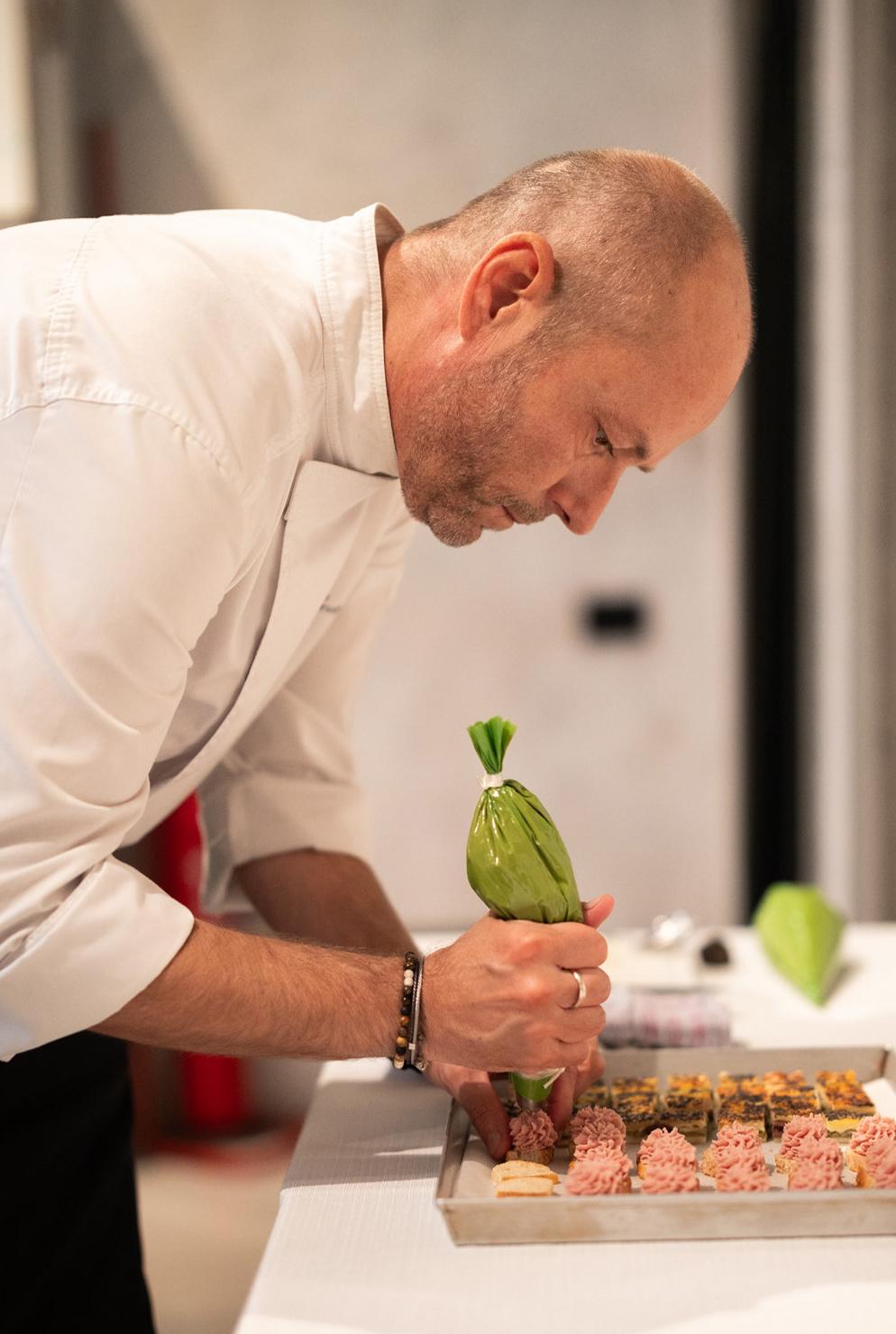
Sonoma's Slow Pour London-Paris Express

with our caring cabin crew h i b





Within a secluded desert estate, Sensei Porcupine Creek offers more than a quiet sanctuary. Guided by an evidence-led philosophy and personalized one-on-one support, each stay unfolds at your own pace, with world-class golf and tennis, restorative spa treatments, and exclusive dining by Sensei by Nobu. Whether centered on rest or motivated by growth, every experience is thoughtfully curated to help you meet your goals. GREATER
CHAIRMAN
Jim McCann
CHIEF EXECUTIVE OFFICER
Josh Kampel
PRESIDENT
Paul Stamoulis
PUBLISHER
Andy Whitehouse
EDITOR-IN-CHIEF
SENIOR EDITOR
ASSISTANT EDITOR
CREATIVE DIRECTOR
CONTRIBUTORS
Dan Costa
Eva Crouse
Caroline Bienfang
Nicole Dudka
Cait Bazemore, Larry Kantor, Max Isaacman, Jonathan Russo, Deborah Grayson, Kirsten Cluthe, Hillel Presser, Bob Diamond, Katie Arnold, Tim Stevens, Paul Tumpowsky, Jason Ashlock
DIRECTOR OF PARTNERSHIPS
VP, SALES & MARKETING
VP OF PARTNERSHIPS
ASSOCIATE ACCOUNT MANAGER
DIRECTOR OF SPECIAL PROJECTS
SENIOR ADVISOR, STRATEGIC PARTNERSHIPS
Matt McCann
Kendall Wyckoff
Ron Stern
Neil Madlener
Gabrielle Doré
Eleanor Dixson-Hobbs
DIRECTOR OF HOSPITALITY Kimberly Anderson-Marichal
Our Mission Is Building Worth Beyond Wealth
Worth helps our influential, successful community better invest their time and money. We believe business is a lever for social and economic progress. From practical financial advice to exclusive profiles of industry leaders, Worth inspires our readers to lead more purpose-driven lives. Through our conferences, digital channels, and quarterly print publication, we connect the people and companies that are building the future. We showcase products and services that are indulgent, luxurious, and sustainable.

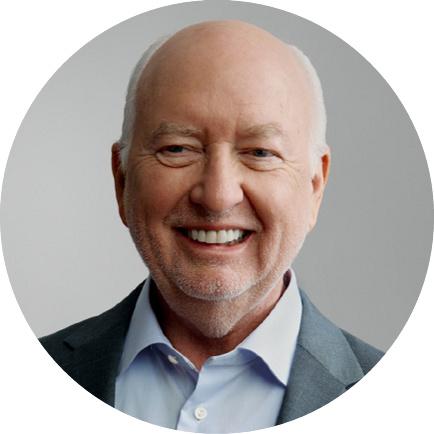
Finding the perspective travel gives us.
BY JIM MCCANN
I’ve never loved the phrase “work-life balance.” Balance implies that work and life compete, as if every hour at the office costs you something elsewhere and every day away from the office costs you something there.
To me, work-life integration has always felt like a better goal, as the work we do, the people we love, the places we go, and the values we try to live by are not separate compartments. They keep informing one another in ways we only recognize once we step outside our daily routines.
Travel has a way of revealing the bigger picture.
Over the years, I have often added personal time to business trips. Sometimes that meant staying an extra day after a meeting or bringing my family along so a work trip could become a shared memory. The truly life-changing moments usually arrived when I was fully removed from my routine, suddenly able to notice things I might have missed in the day-to-day rush at home.
My wife Marylou and I found ourselves in Rome a few years ago. As part of a small tour of St. Peter’s Basilica, we were invited behind the protective glass to stand before Michelangelo’s Pietà. I had known that sculpture my whole life through photographs and history books, and none of that prepared me for the experience of actually being in its presence.
I realized Michelangelo gave himself to something with such devotion and care that the world is still feeling it 500 years later. Standing before that kind of evidence changes the question from “What do I want to accomplish?” to “What am I giving myself to fully enough that it might matter beyond me?”
That’s what travel does at its best: It changes the conversation by giving us enough distance from our routines to see our lives more clearly. For leaders, that perspective matters because travel teaches the habits work often requires and life often rewards. You begin to see how other people solve problems, build companies, raise families, and create community, and you bring some of that wider lens back into your own work and relationships.
A beautiful hotel, a memorable meal, or a stunning landscape is a wonderful part of the journey. But the deeper gift is the change in perspective that follows us home. Travel shows us that the life we live, the work we do, and the people we love are not competing claims on our time.
At their best, they are part of one whole life, and taking a step away helps us see it more fully.
— Jim McCann CHAIRMAN, WORTH MEDIA jim.mccann@worth.com

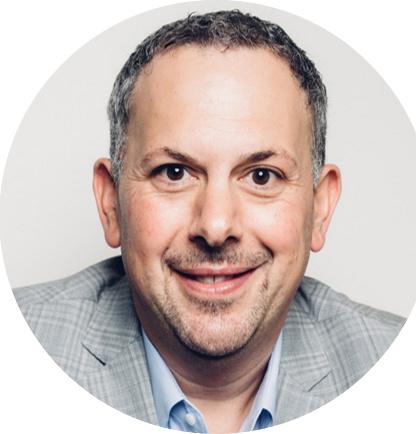
Wealth opens doors. It doesn’t fill the room on the other side.
BY JOSH KAMPEL
After spending years, sometimes decades, building companies, closing deals, chasing growth, and accumulating wealth, the discussions often become less about “What’s next?” and more about “What actually matters?”
Our recent events, Beyond Wealth Summit and Beyond the Game, helped our community explore both of those questions. While the topics looked very different, both programs highlighted how ambition is evolving.
At the Beyond Wealth Summit, we discussed the increasingly complicated reality of “having made it.” It turns out nobody hands you a playbook for what comes after success. There is no magical moment where life suddenly becomes simple because the financial box has been checked. We explored that in many cases, the questions become harder.
How should I spend my time? How do I protect what I’ve built without becoming consumed by it? How do I raise grounded children in an environment of abundance? How do I stay healthy enough, actually, to enjoy success? And perhaps most importantly, how do I ensure that the years spent building wealth foster a sense of purpose and genuine connection?
What made the summit particularly interesting was how honest people were willing to be. These were highly accomplished individuals openly discussing longevity, family dynamics, philanthropy, burnout, and the realization that time eventually becomes more valuable than
money. Wealth is increasingly the starting point of the conversation, not the finish line, shifting focus to meaningful life aspects.
Then we shifted gears entirely.
Just ahead of the Formula 1 Miami Grand Prix, we hosted the inaugural Beyond the Game Summit focused on the rapidly expanding intersection of sports, business, and investing. Professional sports have evolved far beyond entertainment, with teams now viewed as premium assets and athletes becoming founders, investors, media company owners, and entrepreneurs.
The cover of this issue features an athlete who has successfully transitioned out of his athletic career. Alex Rodriguez has built an impressive portfolio that includes real estate and private equity investments, and ownership stakes in the Minnesota Timberwolves and Lynx. But what makes Alex particularly compelling is how naturally the mindset of elite athletics translated into investing and entrepreneurship.
Preparation, discipline, consistency, and accountability are traits that elite athletes tend to translate remarkably well into business leadership. Athletes today are not waiting until retirement to figure out their next chapter; they are building it in real time. They understand the power of ownership, audience, and influence in a way previous generations often did not. Sports may still be the initial platform, but increasingly, business is the long game.
Now, as we move into summer, many of us are preparing for a different kind of investment. Decisions about how we want to spend our time and money on experiences, travel, and, hopefully, a little bit of recovery from the nonstop pace of modern life. In this issue, we highlight several destinations and experiences worth considering, whether your idea of relaxation involves a beach chair, sightseeing, or simply a place where nobody uses phrases like “lowhanging fruit,” “explore synergies,” or “circle back by close of business.”
Travel has a unique way of resetting priorities. It pulls us away from calendars, routines, inboxes, and quarterly targets long enough to inspire feelings of renewal and remind us that some of the most valuable moments in life happen outside the usual routines.
The family dinner that unexpectedly lasts four hours, watching your children experience a new city or culture for the first time, or sitting around a fire pit with close friends long after the music ends-these moments cultivate feelings of warmth and appreciation that deepen over time.
Ironically, many of the people who spend their lives building wealth come to see that the most meaningful experiences often cannot simply be purchased. Money can create access and comfort, but connection, laughter, curiosity, friendship, and memories must be cultivated through shared moments and time together.
Ultimately, the most successful people I know are no longer optimizing for returns. They are optimizing for purpose, time, health, family, experiences, and impact. That is the smartest investment of all.
— Josh Kampel CEO, WORTH MEDIA josh.kampel@worth.com

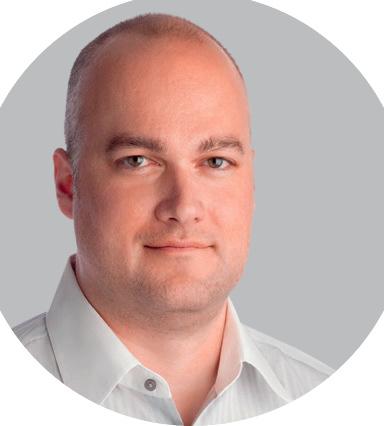
Spirit Airlines is gone. The bigger story is what cheap flying made possible—and what losing it will cost us.
BY DAN COSTA
As a 6’2”, 200-plus pound man, I try to choose my airplane seats carefully. Stick me in an exit row, and I’m fine. Upgrade me to first and I’ll happily get some work done on the flight. But in a regular seat there is an even chance the recliner in front of me will snap my laptop in half. (I had a narrow miss a week ago.) This is an economy-class problem.
While many Worth readers are financially immune to these problemsit, this is the only way many everyday travelers can afford to fly. Unfortunately, troubling trends in the airline industry are making it harder for those who rely on the waning product called “economy class.”
Consider Spirit Airlines. The yellow planes were never anyone’s idea of a good time. The seats didn’t recline, the bags cost extra, and the cabin felt like it was designed by a mean accountant. But Spirit did something no legacy carrier was willing to do: it priced the floor. A teacher in Encino could visit her sister in Seattle for less than the cost of a tank of gas.
On May 2, after 34 years of operation, Spirit ceased operations and entered liquidation. Two bankruptcies inside 18 months, a blocked merger with JetBlue, and a post-restructuring business plan that never recovered. The carrier that invented the unbundled fare could not find a price low enough to keep its planes full and still turn a profit.
Delta is going the other way. Former president Glen Hauenstein and CEO Ed Bastian spent years telling investors that premium cabin revenue will eventually surpass main cabin. They are getting close. Premium is roughly a third of Delta’s passenger revenue and growing faster than economy in nearly every quarter. The Delta American Express partnership now generates around $7 billion a year, with a public target of $10 billion. That is not a flying business. That is a financial services business that happens to operate aircraft. United, American, and Alaska are running variations of the same playbook.
The conditions that made cheap flying possible are also gone. Russian airspace has been closed to Western carriers since 2022. Boeing’s 737 MAX production has
been constrained since 2019, with another setback after the January 2024 door plug incident. Postpandemic pilot contracts added billions to airline cost structures. Four carriers—Delta, United, American, and Southwest—now control roughly 80% of U.S. domestic capacity. There is no Spiritshaped competitor waiting to bring the floor back down.
In this issue, Eva Crouse takes you scuba diving off the coast of Thailand, Katie Arnold bikes through the hill towns of Italy, Kirsten Cluthe finds the food in Singapore’s hawker stalls, and we sip champagne with a view of the Eiffel Tower. All of it just became more expensive.
The Worth reader will still go, but trips will become more selective, and the gap between business and leisure travel will narrow. But many will feel a sense of loss for the days when affordable fares like the $99 Spirit fare made travel accessible to all.
The seat in front of me will keep leaning back, but the cheap seat next to me is already gone.
— Dan Costa EDITORIAL DIRECTOR dan.costa@worth.com

Larry Kantor is an operating partner at Atlas Merchant Capital based in New York. Kantor is currently a member of the Investment Committee at Betterment, an online wealth management company with AUM of over $15 billion. Previously, Kantor served as an Advanced Leadership Initiative Fellow at Harvard University, and prior to that, spent over 10 years as a Managing Director and Head of Research at Barclays Capital. Prior to joining Barclays Capital, he served as the Head of Foreign Exchange Strategy and Chief European Economist at J.P. Morgan. He also served as a Chief Economist and strategist at Normandy Asset Management and as an Economist at the Federal Reserve in Washington, D.C. He began his career as an Assistant Professor of Economics at Lehigh University.
Kantor earned a Bachelor of Arts degree in Economics, Phi Beta Kappa, from Rutgers University and a Ph.D. and an M.A. in Economics from Ohio State University.
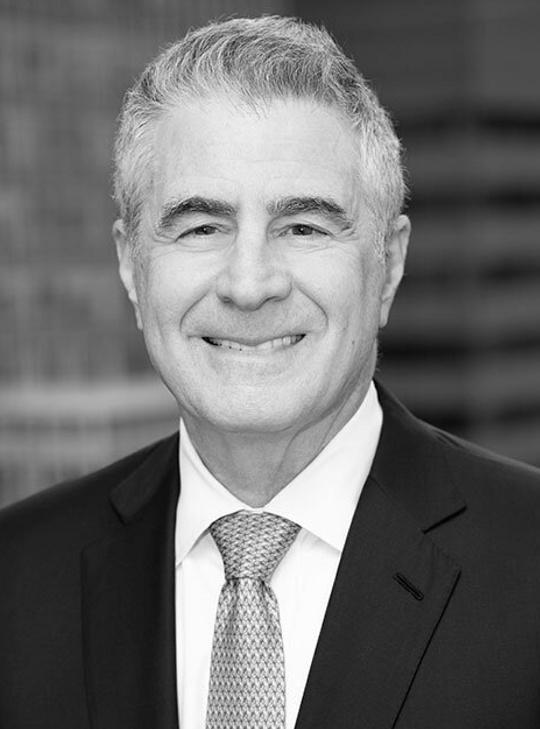
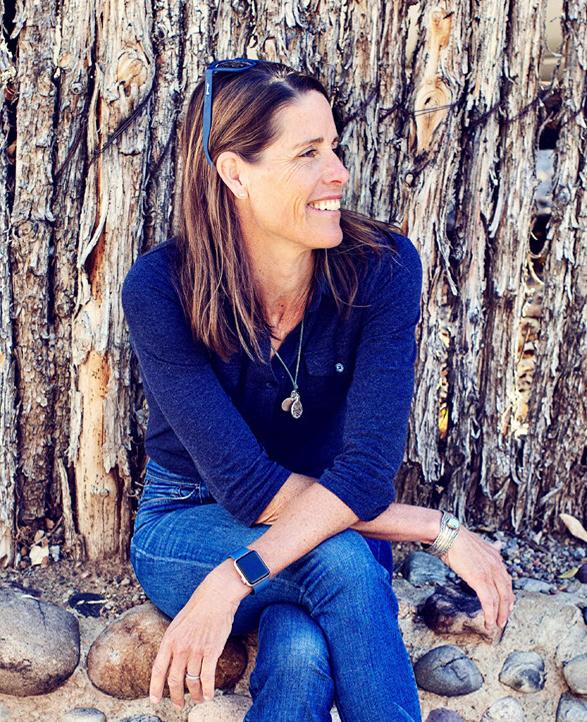
Katie Arnold is the author of the critically-acclaimed memoir, Running Home, published by Random House in 2019. She is a contributing editor and former managing editor at Outside magazine, where she worked on staff for 12 years and created the popular “Raising Rippers” column, about bringing up adventurous children outside. Her 2018 essay in Outside, “Want a Strong Kid? Encourage Play, Not Competition,” was nominated for a National Magazine Award in service journalism.
She has written for The New York Times, The Wall Street Journal, Travel + Leisure, Runner’s World, ESPN: The Magazine, Elle, and many others. Her long-form profiles have been named runner-up in The Best American Sports Writing 2008 and nominated for a Western Publishing Association magazine award, and her essays have been anthologized in Woman’s Best Friend, Another Mother Runner, and P.S. What I Didn’t Tell you. She is the editor of the photography book, Rio Grande: An Eagle’s View, published by WildEarth Guardians.
Kirsten Cluthe is a producer, showrunner, and writer with over 20 years of experience in entertainment and media. As the founder of Studio Kairos, she develops and produces original content across podcasts, live events, and branded experiences—collaborating with artists, tastemakers, and cultural voices to bring standout ideas to life. In addition to her production work, Kirsten has been writing about travel and lifestyle for more than 15 years, contributing richly reported stories that explore culture, design, and the art of discovery.
Katie has been awarded prestigious literary fellowships at the Ucross Foundation in Wyoming and the MacDowell Colony in New Hampshire, where she was named the Robert and Stephanie Olmsted Fellow in 2016. She has guesttaught nature journalism workshops at Colorado College and leads writing and running Flow Camps, exploring the link between movement and creativity. Her public speaking includes keynotes for Thornburg Investment, the University of Southern California, Vail Mountain School, and Bigger than the Trail, a nonprofit mental health advocacy group, as well as many academic and public venues.
She has been featured on NPR Weekend Edition Sunday, as well as the “Finding Mastery” podcast and many others, including “First Draft: A Dialogue on Writing” and Upaya Dharma Podcast. An elite ultra runner, Katie is the 2018 women’s champion of Leadville Trail 100 Run. She holds course records and victories at every distance from 5K to 100 miles.
Katie lives in Santa Fe, New Mexico, with her husband and two daughters. In her spare time she leads girls’ trail running clubs, coaches girls lacrosse, and serves on the board of Santa Fe Lacrosse. She is currently at work on books about time and disappearing, as well as poetry and story collections. A longtime, if restless, student of Zen meditation, she is happiest practicing outside. As the poet Mary Oliver once said, “I don’t like to be indoors.”

The all-new Pier Sixty-Six invites you to step into a world of ease and elegance, with worldclass accommodations and unparalleled amenities impeccably and thoughtfully designed for a South Florida legend. Step ashore and write the next chapter. To discover more about the Resort, Marina, Residences & Club, please scan the QR code or visit PierSixtySix.com.
From Yankee superstar to strategic investor, Alex Rodriguez is proving his greatest innings may come off the field.
BY JOSH KAMPEL
Ifirst met Alex Rodriguez at the Milken Institute Global Conference in Los Angeles, where investors, senior executives, and entrepreneurs gather to discuss economics, healthcare, and philanthropy. A year later, I ran into him again on the Promenade in Davos, amongst CEOs, policymakers, and world leaders convening to debate the next chapter of business, technology, and society.
Celebrities and athletes are increasingly common at these global business gatherings. Some attend as investors, others are building companies, and some serve as brand ambassadors, leveraging their influence and reach. I did not fully appreciate which category Rodriguez fell into until I spent time with him in Minneapolis for a Minnesota Timberwolves playoff game.
Rodriguez was not going to the game as just a celebrity fan; he is an owner of the franchise he had fought to acquire alongside business partner Marc Lore, the founder of Diapers.com and Jet.com. During our time together, it became clear that he is not dabbling in business but pursuing it with passion, curiosity, and long-term conviction.

It is easy to understand why many people still see Rodriguez as a legendary baseball player. Yet sports careers end, identities evolve, and the most competitive among them eventually seek a new arena to apply the same drive that made them elite in the first place. Much like our recent coverage of Joe Montana and his Liquid 2 venture fund, Alex is focused on his next chapter.
For Rodriguez, the second act did not begin after baseball; it was a deliberate process that began long before his playing days ended, demonstrating his early commitment to business and investment.
“From early on, I talked about the two Bs I wanted to be in,” Rodriguez says, “baseball and business.”
Rodriguez grew up observing entrepreneurship from a frontrow seat. His father ran a shoe store in the building where they lived, and his mother left for work before dawn and, as he recalled, never missed a day. He described her as having an impeccable work ethic, while his dad was great with numbers. Children raised around small businesses often absorb lessons that cannot be taught in classrooms. They witness sacrifice, uncertainty, customer service, and resilience, and they come to understand that business is ultimately built on people and trust. Rodriguez took it all in.
He also recognized early that baseball and business are not nearly as different as they appear. Both reward preparation, expose weakness, and require decisions under pressure. Most importantly, both are team sports. Rodriguez does not frame success as a solo performance nearly as much as he talks about the importance of surrounding yourself with the right people.
Reflecting on championship teams, he said the difference between good and great often comes down to vision, personnel,
talent, humility, and the ability to work together. He pointed to former teammates like Derek Jeter, Mariano Rivera, and Andy Pettitte as proof that no title is won alone, before adding: “And business is the same way.”
That point of view matters because modern business culture often credits lone ‘geniuses’ while sometimes undervaluing the teams that make sustained success possible. Rodriguez’s instincts are different. He understands that elite performers matter, but aligned teams matter more because talent scales faster when it operates inside a healthy culture.
Today, Rodriguez’s investment portfolio is built around three core pillars: sports, real estate, and venture investing—all of which have pushed his net-worth north of $1 billion.
His acquisition of the Minnesota Timberwolves and Lynx show how Rodriguez leverages his sports experience into strategic ownership, aligning with his long-term vision for value creation.
When Rodriguez and Lore agreed to buy the franchises at a reported $1.5 billion valuation, critics said they were overpaying. By the time the transaction finally closed after a lengthy and highly public process, franchise values had continued to surge. What once looked expensive now appeared highly intelligent.
Professional sports teams are now scarce global assets with media rights leverage, sponsorship ecosystems, real estate optionality, community influence, and cultural relevance. Owners who understand the broader business opportunity surrounding the game itself have an advantage. Rodriguez is one of only a few athletes who have successfully acquired a majority stake in a team. It puts him in a unique category, one that includes Michael Jordan.
Rodriguez described the opportunities around ownership as
an “octopus of opportunities” surrounding the franchise, from the real estate around the arena and the possibility of a new venue to entertainment programming and adjacent businesses that can grow alongside the team. The game on the court may be the center of gravity, but it is no longer the entire universe.
That same thinking is evident in Jump, the ticketing platform he and Lore launched. Rodriguez described it as a tool that allows them to control the relationship directly with the consumer. In modern sports, a ticket represents more than just admission; it is data that can improve retention, sharpen pricing intelligence, strengthen loyalty, and deepen the connection between the team and its fans.
Through Jump, fans can exchange seats, receive a better experience, and interact more directly with the team, all while the team gains real-time insight into what fans want and how they behave.
“We’re obsessed with customer service,” he said, a phrase that reflects how seriously he takes the holistic fan experience.
While sports may capture headlines, real estate often builds fortunes more quietly. Rodriguez approaches it with a straightforward framework. He said they look for top market, top product, top sponsor, while making sure pricing and alignment are right. It is a simple formula, but simple frameworks force clarity and discipline. Rodriguez’s framework is old-fashioned in the best sense. As he put it, “I want to buy the worst house in the best neighborhood.”
This disciplined approach aims to reassure his audience of his careful risk management and long-term focus.
The third pillar is venture investing, where Rodriguez’s curiosity may be his greatest asset. He explained that in his early years, he made many smaller bets and
viewed them not only as financial opportunities but as tuition. Drafted at 18 by the Seattle Mariners, he did not have the chance to attend college, so he built his own education by learning from founders, management teams, investors, and mentors like Warren Buffett. He listened to board calls, studied how decisions were made, and intentionally placed himself near people from whom he could learn.
Today, he says the platform is more focused, and the experimentation of the early years has matured into conviction built on experience. When he evaluates opportunities now, he does not begin with upside projections; rather, he explores downside protection.
“I never want to initially hear about what the upside is,” he told me. “What is the downside?”
He described thinking first about how much could be lost, what the likely scenarios are, and whether the risk is acceptable before discussing returns. The mythology of business celebrates boldness, but real wealth is often built through disciplined risk management and the ability to survive long enough for good decisions to compound.
Rodriguez’s partnership with Lore also reveals how he evaluates talent. Using baseball language, he described Lore as a five-tool operator. He praised his communication skills, recruiting ability, ethics, persistence, and rare numerical intelligence, calling him one of a kind when it comes to numbers. The compliment is revealing because Rodriguez does not simply admire outcomes; he studies the traits that create them.
Asked where he and his team add strategic value beyond capital, Rodriguez reached for another sports analogy. A founder already has a general manager, he said, “We can be the bench coach, the third base coach, the hitting coach, the bullpen, or simply the fans in the stands cheering from afar.” The
point was clear: participate in the right way, support the business where needed, and never become an obstacle.
His time on Shark Tank reinforced another truth: America’s ambitions are changing. He laughed, saying that children sometimes recognize him as “the Shark Tank guy.” That show has given Americans and people around the world more MBAs than the greatest schools in the world, he said.
Viewers learn entrepreneurship in an accessible format by watching pitches, negotiations, mistakes, valuation, persuasion, and resilience play out in real time.
“When we were kids, nearly everyone dreamed of becoming an athlete,” he remarks. We then discussed how many want to be entrepreneurs, creators, or investors, a shift that says something meaningful about how younger generations define success and aspiration.
“The mythology of business celebrates boldness, but real wealth is often built through disciplined risk management and the ability to survive long enough for good decisions to compound.”
He is equally passionate about financial literacy, particularly for athletes and young people. Rodriguez recognizes that today’s generation has access to tools that previous generations never did. With a phone in hand, anyone can learn about markets, money, and investing instantly. Access to information does not guarantee wisdom, but it does democratize the opportunity to learn and gives far more people a chance to make informed decisions.
When I mentioned Worth’s Beyond Wealth ethos, our conversation pivoted to impact. He spoke about helping the next generation, funding scholarships, creating entrepreneurship programs, and opening doors for others. He discussed being in boardrooms where representation still has room for improvement, and the importance of not just entering those rooms but also bringing others with you.
Rodriguez’s story is often told through statistics, contracts, controversies, and comebacks. Those chapters are real, but incomplete.
The more interesting version is the one visible in Minneapolis before tipoff, where an owner was thinking about talent, incentives, and long-term value creation with the same intensity he once brought to the batter’s box.
As I walk onto the court with Kelly Laferriere, A-Rod Corp’s Chief Business Officer and the Chief Strategy Officer for Timberwolves and Lynx, she points out the additional folding chairs, commenting, “Alex suggested adding those, and it added over $2M in revenue this year.”
The same competitiveness, discipline, pattern recognition, and appetite for excellence that once made him elite on the field now shape his investing and ownership life. The uniform and the scoreboard may have changed, but the edge has not.
It’s a thousand pounds heavier and 190 horsepower stronger. It’s also the most fun RS Audi’s ever made.
BY TIM STEVENS
The big three German manufacturers each have their own special way of adding power and prestige to their luxury sedans. For BMW, it’s the M division, a part of the company’s product lineup since 1972. Up in Affalterbach, Mercedes-Benz’s AMG has been uprating the company’s cars since 1967.
For Audi, though, it’s a little different. The company’s RS designation has only been around since the early ‘90s. As the relatively new kid on the block, it sometimes feels like the brand isn’t quite sure what RS should mean. Some RS models are utterly insane, like the 912-horsepower RS E-Tron GT. Others, though, are far more sedate.
That was the problem with Audi’s last RS5. The company fitted a larger motor to its A5 sedan, upgraded the suspension, and made other tweaks along the way. But, they forgot to upgrade the style, resulting in a sedan that was fast, yes, but a bit boring. For the new RS5, Audi is leaving nothing on the table, not only more than doubling the power of the base A5, but giving it some radical flair and even a plugin hybrid system for instant torque and emissions-free touring. It’s a big step forward, but it comes at a substantial weight penalty.
The most iconic performance Audi of all time is undoubtedly the Quattro, which, in 1980, revolutionized the performance car world by proving that all-wheel drive wasn’t just for low-speed off-roading. That car became an unlikely icon, its awkward styling influencing decades of high-performance Audis to come. You can absolutely see its lineage in the new RS5, which features massive fender flares on every corner. The car is a whopping 3.5 inches
wider than the base A5 and S5, making this new RS look far more aggressive than its predecessor.
But those flares aren’t the only things that catch your eye here. The grille up front is far more intimidating than the base car, while a closeset dual exhaust pokes out through an aggressive diffuser at the rear.
Only the small rear wing on the trunk is a bit demure, but I have a feeling the aftermarket will soon offer many, far larger options for those looking for something more dramatic.
Those styling cues make a strong first impression, and the new RS5 has plenty of power to back that up. It starts with a 2.9-liter, twin-turbo V6 that, on its own, makes over 500 horsepower. That’s a good amount, but it has a little help this year.
It’s paired with a 174-horsepower electric motor, which slots in next to the eight-speed automatic transmission. Merge the two, and you get a system output of 630 horsepower and 609 pound-feet of torque. That’s up almost 190 horsepower over the lastgeneration RS5.

A nice upgrade, yes, but it comes with a substantial penalty: over 1,000 pounds of added weight. Sadly, you can’t have a big electric motor without a big battery to go along with it. In this case, it’s a 25.9-kilowatt-hour unit, about one-fourth that of a Tesla Model S. That’s enough to deliver up to 54 miles of all-electric range on a single charge. That isn’t the only electric motor at play here. Audi also uses the highvoltage power from the big battery to power another motor integrated into the rear axle differential. This is used exclusively to spin up the outside rear wheel when cornering, helping the new RS5 deliver the agile and aggressive feel that was missing in its predecessor.

Within 30 seconds of my first time sitting in the driver’s seat of the new RS5, I was sliding it around a closed course, through a tight series of cones, and executing a perfect, smoky pirouette on command. These sorts of maneuvers aren’t typically easy in any car, especially one making 630 horsepower and rolling on supersticky Pirelli P Zero R tires.
But the new RS5 makes it a breeze. It’s largely thanks to that new rear differential, plus an ultra-quick 13:1 steering ratio, that I barely need to move the wheel to catch and control the slide.
As fun as that was, the real test was to see whether this machine, which

“Sadly, you can’t have a big electric motor without a big battery to go along with it. In this case, it is a 25.9-kilowatthour unit.”
now weighs 5,192 pounds, could actually be driven quickly without it feeling like a boat. Thankfully, Audi put a small racetrack at my disposal to try that out as well: the Circuit International Automobile Moulay El Hassan in downtown Marrakesh, a place where Formula E formerly raced.
As I got my way up to speed, the RS5 showed remarkable grip, again afforded by those summeronly Pirelli tires, which measure a whopping 285/30R21 front and rear. The course is not only tight and winding but also bumpy and dusty, a great test of the Audi’s upgraded Quattro all-wheel-drive system and its adaptive suspension.
The car felt utterly planted through the bumpiest section of the course and flew like a rock from a slingshot, powering out of the corners. Here, too, that electric rear differential made the rear feel more nimble, ensuring the car didn’t just understeer into a wall when I put my foot down.
In other words, it certainly didn’t feel 1,000 pounds heavier when powering out of corners. However, when I hit the brakes too hard and tried to pitch the car into the corners, it tended to frustratingly lose grip at the front. Audi’s engineers are good, then, but even they can’t break the laws of physics.
So the new RS5 looks and drives far more radically than before, but if there’s an area that could use improvement, it’s on the interior. The new RS5 has a few nice upgrades inside over the base A5, including sportier-looking seats and an angular RS steering wheel.
However, the experience is far too reliant on capacitive touch surfaces. There’s a pair of small thumbwheels on the steering wheel stalks, plus a pair of delightful red buttons: Boost mode for 10 seconds of maximum power and RS mode to drop the car directly into its sportiest settings.
Otherwise, it’s just flat, touchsensitive surfaces everywhere, including the 14.5-inch touchscreen that controls most of the car’s functions. Evocative it ain’t, and this is an area that even Audi CEO Gernot Döllner told me the company could improve, following the trend of its recently revealed Concept C, which has an interior full of delightful knobs and switches.
“The Concept C is showing the way we are heading in the future. Interior quality, material quality, true material that has always been Audi, the brand DNA,” he said. “We are planning to bring that back to the brand and be leaders once again.”

“The Concept C is showing the way we are heading in the future. Interior quality, material quality, true material that has always been Audi, the brand DNA.”
Despite the added weight, this new RS is far more fun to drive and infinitely more exciting to look at. And, thanks to the plug-in hybrid system and adaptive suspension, in Comfort mode, it turns into a soft and silent city cruiser. It’s perfect for whirring through traffic after a stressful day at the office, then turning into a high-performance monster once you escape the grind.
The interior disappoints, and you will feel that weight if you push the car hard, but otherwise the new RS5 truly is a stellar package, an aggro all-rounder, and everything the RS should be.

The collectibles mogul who turned a forced exit into a second act—and a smarter business model.
BY DAN COSTA
Brandon Steiner has always been in the business of trust. Not sports. Not memorabilia. Trust. In a market where a signed Derek Jeter jersey can be worth $5,000 or $50, depending on who you ask, the real commodity has never been the object—it’s the confidence that the object is what it claims to be. Steiner figured that out early, in Brooklyn, with $4,000 and a conviction that someone needed to bring order to what was, at the time, little more than a hobby.
What followed was a $50 million empire. Exclusive Yankees memorabilia rights. A roster of clients that reads like a Hall of Fame induction speech. Then, a wrenching exit from the company he built—a forced sale that would have finished most people.
It didn’t finish Steiner. It clarified him. ”At Steiner, I felt like I was in a traffic jam,” he says. “With CollectibleXchange, I’m on a highway with no red lights.” Seven years into his second act, Steiner has built a marketplace designed to solve the problem he identified decades ago: millions of people are sitting on authenticated wealth locked inside cardboard boxes and display cases, with no reliable way to value it, sell it, or transfer it. CollectibleXchange is the infrastructure play he couldn’t build the first time.
You started with just $4,000 in Brooklyn and built a $50 million collectibles empire. Looking back, what was the pivotal mindset shift that made that leap possible?
The first thing was being comfortable not knowing what the hell I was doing. I had to accept that. What I did know—was that someone needed to bring order to what was, at the time, just a hobby. I could see collectibles becoming more and more popular, but there was no real structure. That’s where I jumped in.
The second piece was figuring out what customers really want—and delivering it above and beyond. People and principles must come before ego and money. You can’t compromise there. In collectibles, especially with authentication, there’s no middle ground. Your brand must stand for doing it the right way, period.
In 2008, Steiner Sports acquired the exclusive memorabilia rights to the Yankees. What did you learn from that deal?
“Storytelling is everything. Sports moments rank in the top five or 10 memories of people’s lives. When fans have an emotional connection to a game, a player, or a team, it becomes one of their favorite things in the world.”
With big opportunity comes big responsibility. When you’re dealing with something people are emotionally connected to—like the Yankees—you better buckle up and deliver. Fans first, always.
I also learned you have to be comfortable getting into uncomfortable situations. On big projects, there’s what you think, there’s what you know, and then there’s what you don’t even realize you don’t know. Those blind spots can make or break you, so you must handle them very carefully.
That experience gave me a strong sense of what it really takes to execute on high-profile projects—something I’m keeping in the front of my mind now as I am involved with the Buffalo Bills on the dismantling of Highmark Stadium.
CollectibleXchange is celebrating its seven-year anniversary. What problem in the marketplace were you trying to solve when you launched it, and how has the platform evolved?
When we launched, I saw that so many people were sitting on mountains of stuff they didn’t know what to do with. They didn’t know if it was authentic, they didn’t know what it was worth, and the big auction houses weren’t a good solution for most of them. CollectibleXchange gave them a trusted marketplace where items could be authenticated and valued fairly.
Since then, it’s evolved into not just buying and selling, but really about helping people unlock and transfer wealth tied up in collectibles—and creating a platform that gives both fans and sellers confidence.

Fans don’t just buy memorabilia, they buy meaning. How important is storytelling in collectibles?
Storytelling is everything. Sports moments rank in the top five or ten memories of people’s lives. When fans have an emotional connection to a game, a player, or a team, it becomes one of their favorite things in the world. My job is to bring them closer to the game and the players— through products and experiences. If it matters to my customers, it has to matter to me. That shared love of the game is what unites fans across all sports.
What trends do you see shaping the future of collecting—whether traditional memorabilia, NFTs, or new formats?
The biggest trend is expansion into areas that haven’t been touched yet—women’s sports, rugby, cricket, soccer, racing. These are nowhere near the level of U.S. sports like football, basketball, and baseball, but they’re growing fast, and collecting will follow. And with the FIFA World Cup this year,
soccer will be on everyone’s radar. Trading cards are another big one. The business is evolving beyond the traditional cards we grew up with. It’s bringing in new people and creating fresh ways to collect. NFTs? I’m not sure anyone knows yet, but the lane is widening.
You’ve worked with icons like Derek Jeter and Mariano Rivera. What’s the biggest lesson you’ve learned from them?
That there’s no such thing as a “big game.” Consistency over time equals credibility. The great ones don’t get too high or too low. They stay grounded, treat every game like the most important one, and respect every fan.
The other thing is confidence—a deep belief in themselves and their strategy, combined with a love and respect for the game. Guys like Jeter and Rivera would probably play for free. That’s how much they care about the game itself.
You’ve been candid about using failure as fuel. Can you share one that became a valuable
teacher?
Not being able to buy back Steiner and having it taken from me was probably my biggest setback. But it forced me to build something bigger, better, smarter. At Steiner, I felt like I was in a traffic jam. With CollectibleXchange, I’m on a highway with no red lights. That failure gave me the perspective to create a business with a lot more freedom and speed.
Your new book, The Ride Alongs explores crime and policing in New York City. What surprised you most from that experience, and how does it connect back to business and life?
Everything about it was uncomfortable—which was the point. What I learned is how important prioritization is, how important it is to help people, and how critical safety is to everything we do. Policing showed me that a lot of problems come down to people who need more investment and support. It also showed me how urgent it is to fix urban policing, because retention and recruiting are at all-time lows. And honestly, it’s the same in business—finding and keeping the right people is one of the hardest things there is.
Worth often talks about “worth beyond wealth.” What does that phrase mean to you?
For me, it’s about going from working just to survive—waking up hungry, literally—to now being in a place where money has no meaning. When money isn’t the driver, you find out what you really love and what your true purpose is.
The test is simple: would you still do the work if you didn’t get paid? That’s the question I’ve had to answer over the last five years. And the answer is yes—because what I do isn’t about the money anymore. It’s about impact.
Thirty-five years after her first Butterfield & Robinson bike tour, a writer returns to Italy and reflects on how adventure travel has changed.
BY KATIE ARNOLD
I’d been in Tuscany less than 24 hours when I realized I was ruined. It was a brilliant October afternoon, the sky unmarred by clouds, and much warmth still in the sun. A small group of us was walking along a ridge on a white-dirt road, one of Italy’s famous strade bianche. Vineyards unfurled in all directions. Just ahead was a table laid with a linen cloth, sliced pears, a bowl of M&Ms, and Neil Young singing “Heart of Gold” from a portable speaker. Then our trip leader, Mike Scarola, poured me a flute of sparkling wine and clinked his glass with mine.
I was on a six-day cycling and walking trip with the Toronto-based luxury travel company Butterfield & Robinson. It wasn’t my first experience with B & R. In the summer of 1989, when I was 17, I spent a month touring Europe on ten speeds with a group of 25 teenagers and two guides on one of the company’s student trips.
Travel was scruffier back then, as were we. We carried our gear on panniers on our bikes, rode in tennis shoes and styrofoam helmets, and slept four to a room in bunk beds. We didn’t have cell phones or email, Instagram, or social media. We plotted our route on paper maps folded into plastic sleeves on our handlebar bags. We got lost, got drunk, danced with strangers, and stayed out too late. It was the last summer of our youth—the end of analog adolescence.
That trip set my life in motion in ways I couldn’t have predicted. Now, Butterfield & Robinson is turning 60, and I was curious to see how the company had changed. The world certainly has. Less than two months after our trip, in October 1989, the Berlin Wall came down, altering geopolitics forever. The internet was on the near horizon and would make travel planning easier and help launch the luxury-travel boom. Fast forward another decade, and social media was undermining the very reason we roam—to immerse ourselves in authentic places, cultures, and experiences—and shellacking these destinations with a dispiriting sameness.
If there was an antidote, I thought, it was a bicycle trip. You can’t rush from one Insta-famous site to the next on two wheels; you have to slow down and really see it. You have to work a little for the reward. I thought about the company that introduced me to adventure travel before it was a hashtag. B & R had built its reputation on designing trips you can’t find in guidebooks or Instagram reels— itineraries created on the ground, not online, honed through decades of nurturing local connections and friendship.
The company still existed in name, but what about IRL?
I’d lost touch with all but two friends from that first B & R trip. We’d forged fast and furious bonds, as only teenagers traveling a long way from home do, drunk on newfound freedom but still dependent on each other. There were summer flings, late-night hijinks, and promises to stay in touch, but after the trip, we forgot each other almost as fast. We were speeding headlong toward college and careers—and the rest of our lives.
I can picture the girl in the photograph with my eyes closed. She’s wearing a nylon windbreaker and shorts, leaning forward, caught in mid-conversation, talking and writing at the same time. The photo foretold so much: The girl would go on to trek in Nepal and ride her bicycle through the mountains of Colorado. She’d explore Tahiti, Kenya, and Patagonia. She’d run 100 miles. And she’d write about all of it.
“Do you know how to find the best gelato in Florence?” our tour guide, Simone, asked over his shoulder as he wove us deftly through the crowds on the Ponte Vecchio. It was our first afternoon in Florence, and we were walking off our jet lag on a ramble through the historic city center.
“The bikes were sleek and grey, with the skinniest road tires I’d ever seen and light enough to pick up with one hand. They scared me a little. I was used to riding knobby tires on dirt roads—code for slow.”
Outside the stately Grand Hotel Minerva, buskers sang Leonard Cohen’s “Hallelujah” to a gathering crowd, and our B & R co-leader, Rachele, appeared with a beaming smile and a tray of Negronis. Mike, who took the reins as CEO from founder George Butterfield in 2023, calls these “moments,” and they’re at the heart of the Butterfield & Robinson ethos, and what sets them apart from their competitors: impeccably planned and executed trips of the highest standards, sprinkled with fizzy bits of surprise and delight. The moments
are cultivated, not curated, never forced or fake. They have a way of turning up, or we turn up inside the moment.
Before I left for Italy, I’d worried whether the company that had introduced me to adventure travel had gotten too posh for its own good, or mine. B & R stopped leading student trips in the early ‘90s to focus exclusively on luxury trips. The company, founded in 1966 by three law-school friends who liked riding bikes and bumming around Europe, now runs 800 trips a year, in 60 countries.
Among its many repeat travelers, B & R is known for its exacting standards and stylish, impeccablydesigned itineraries with a premium price tag to match: five-night, six-day trips start at $6,000 per person and
rise sharply from there—an investment that reflects B & R’s almost fanatical focus on local connections and one-of-a-kind experiences.
I was a working journalist, an author, and a recovering dirtbag adventurer who was more used to sleeping in a tent beside a river than in a Michelin-key hotel. I wondered, too, about my fellow travelers. What if they were so fancy they didn’t know how to have fun? Would they be old and dull and not up for adventure? Would the trip be... soft? I was used to long days of running or riding up mountains, not indulgent four-course lunches with wine pairings. (Silly me, I had yet to realize that wine and biking are the perfect pairing.)
File these under pointless pre-trip jitters. Our two B & R leaders were accomplished athletes and guides,
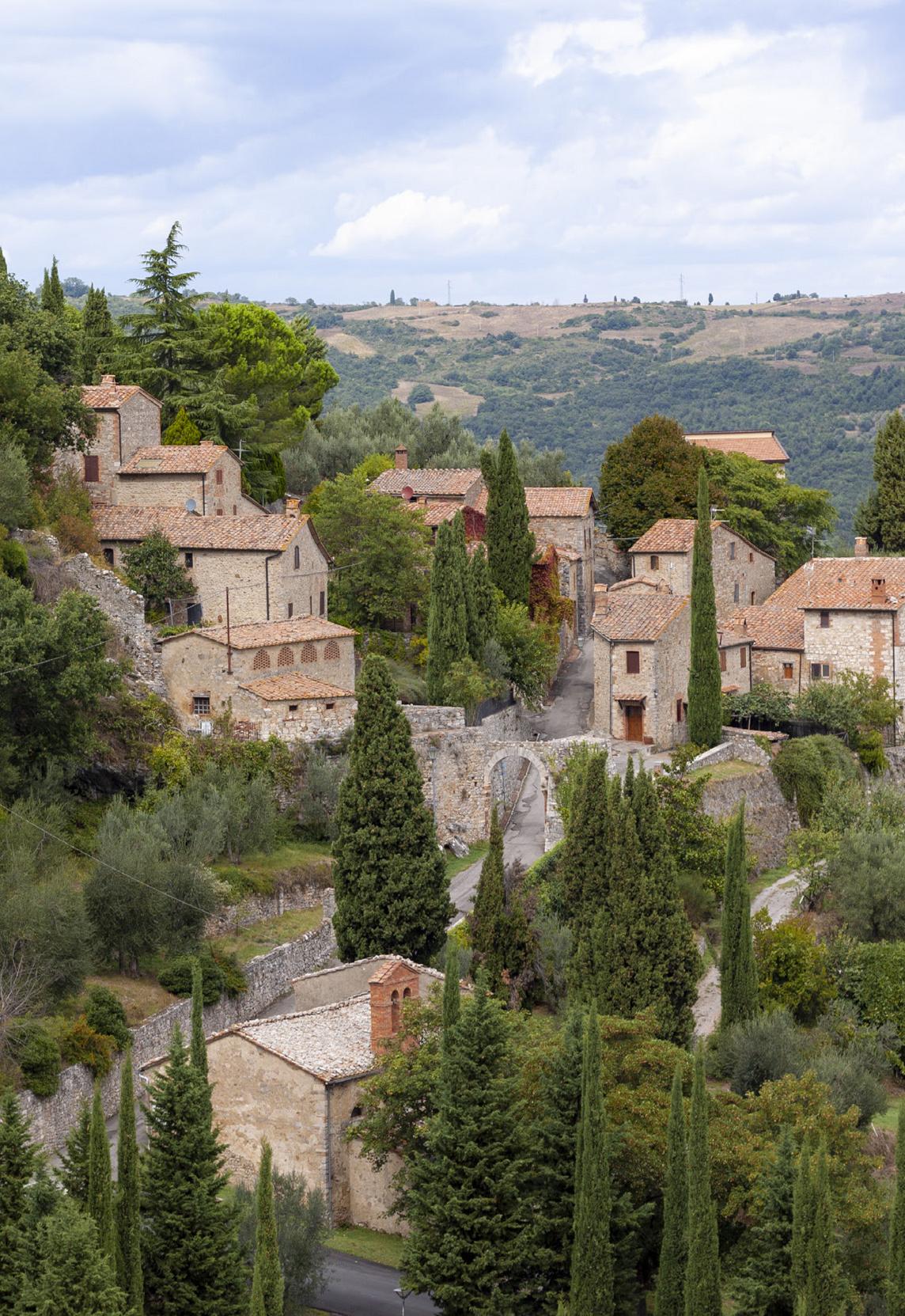
and even better, really good hangs. Tuscan-born Rachele is 32 and used to work as a bike messenger in Rome; her speed on the hills is legendary among the company’s guides, and her curiosity is infectious: “I think I have a problem with roads,” she admitted the first afternoon, when a few of us were on a second walk, exploring. “I see one, and I want to know where it goes. Roads have a soul.”
The moments ran together, one to the next. In Florence, we dined in a private kitchen with a secret entrance leading to the Church of San Salvatore. Carrying lanterns, we followed our host into the darkened chapel, like we were hunting for treasure. There in one corner, he pointed out, was the tomb of Napoleon’s sister; Mozart played that very organ when he was 14! One crypt belonged to Botticelli; another, Amerigo Vespucci.
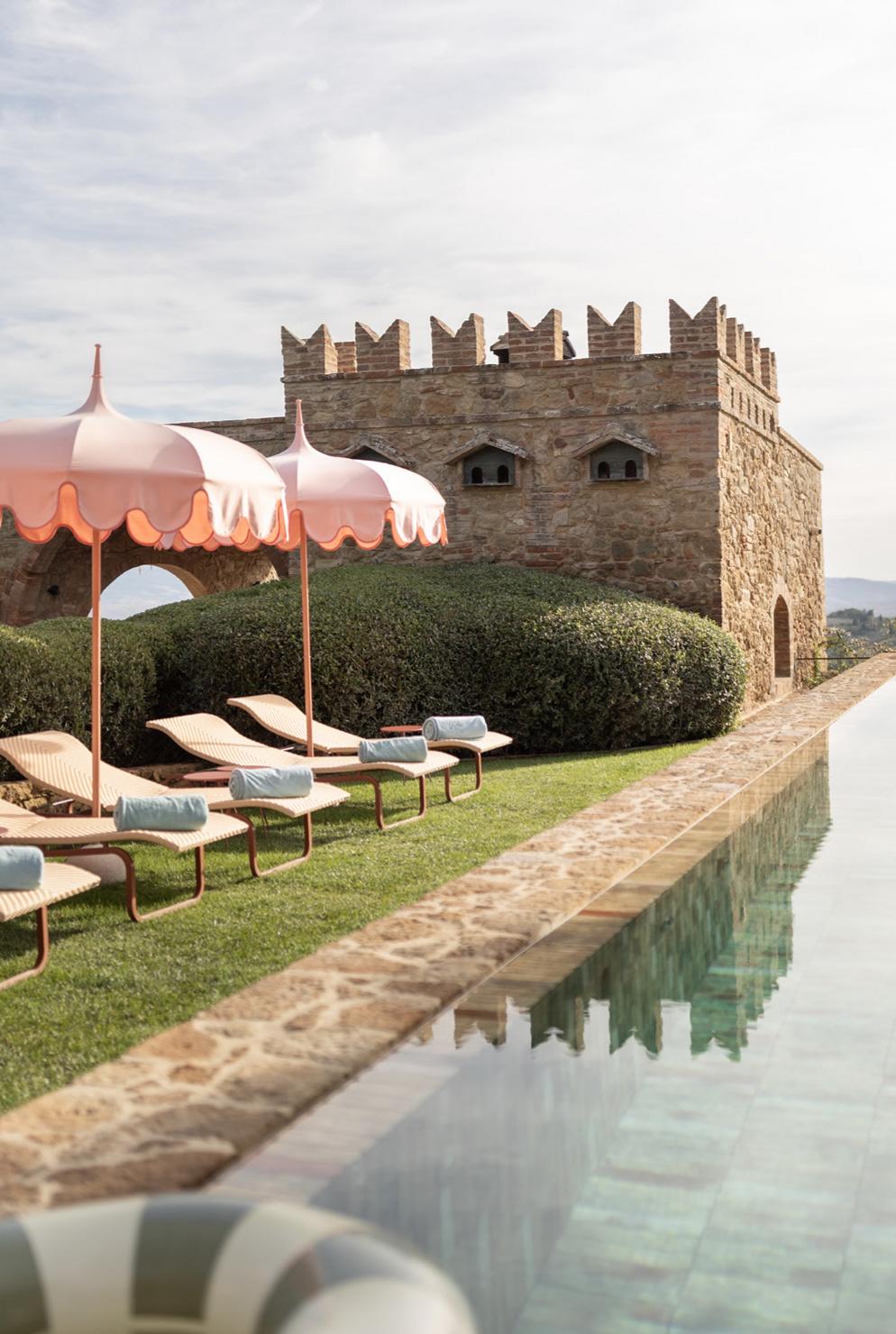
The list went on until, at last, our host turned on the lights and we could see the frescoes in all their glory. Not a soul was there but us.
The private hilltop estate, built in the 1840s by relatives of Sir Isaac Newton, was a maximalist’s dream—wallpapered accents, vintage midcentury furniture, handmade tiles, woven fabric walls—every layered detail stylish, thoughtful, and original, not fussy. The green velvet love seat in my room overlooking the garden floored me; the stone bathroom was the size of my first apartment. Wooden shutters opened to olive trees and a formal garden below, and sprawling views of the Val d’Orcia. If hotel nirvana existed, I’d have found it.
I could get used to this, I thought as I drifted off to sleep.
Then, sternly: Do not get used to this.
The next morning, we met our bicycles. Proudly, Mike explained that he had personally designed B & R’s new fleet of custom carbon road and ebikes to meet the company’s exacting standards, obsessing over geometry and components like the true bike nerd he is.
The bikes were sleek and grey, with skinniest road tires I’d ever seen and light enough to pick up with one hand. They scared me a little. I was used to riding knobby tires on dirt trails—code for slow. I looked around at my fellow travelers, a few of whom I could tell shared my trepidation. But Mike’s delight in the new bikes was so contagious that my worry quickly turned to enthusiasm.
I thought back to the steel, pannierencumbered behemoths we’d ridden in 1989. I remembered little about the actual bicycling that summer, only that judging from the hand-drawn map on our itinerary, we must have covered hundreds of miles.
Each day on a B & R tour, travelers choose between rides and walks of varying lengths. That first ride had us leapfrogging for 12 miles from Casa Newton to a late-morning espresso
stop in the hamlet of Montisi. There, we could decide whether to continue directly to lunch or take the long way around; the sag wagon, driven that morning by Mike, would never be too far ahead or behind should encouragement, good-natured heckling, or snacks be required. Every 10 miles or so, we’d find the linen-covered table set up in a meadow or beside an overlook, laden with biscotti and hot chai and whatever other surprise treats the guides had up their sleeves.
There’s a freedom to riding bikes that always makes me feel like I’m a girl again, hair whipping, legs pumping my three-speed up my street to home. It’s the simplest form of time travel I know. The roads unfurled beneath us like ribbons, traffic grew scarce, and the views widened to take in the tawny, rumpled contours of the Val d’Orcia, so spectacular it’s protected as a UNESCO World Heritage Site. I followed my new friend, the style guy, down the hills, trying to copy his form, crouching low over the handlebars and leaning into the curves, and after the first few descents, I began to feel surprisingly stable at speed. Even the less experienced riders in the group zipped past us on the downhills, waving and grinning, whooping with delight.
Outside Trequanda, we faced a stout, two-mile grind to lunch at Ultima Pietra, a private winery known for its sustainable viticulture practices.
The sun was sinking over the faroff hills, and soon the pool would be in shade. I dove in. The water was brisk, enlivening. I couldn’t help but marvel at how I’d come to be here, in the middle of this exquisite moment. The distance from 1989 to now was a crooked path full of detours, but the through-line was clear. After Europe, college, and studying abroad, I’d moved to New Mexico sight unseen to become a journalist and outdoor athlete. I’d always been better at pushing the edge of comfort, far from home, than staying still for too long.
Adventure looked different now— swankier, for one, and with 24/7 con-
nectivity, way less out there—but riding bikes around Italy, the feeling was the same. What would we find around the next bend, and how would it change us? The question was no less tantalizing at 53 than it had been at 17.
The discoveries swung from goofy to poignant and back again. The night after our long ride, we made pasta picci, the traditional Tuscan pasta, in a courtyard in Monticchiello as darkness fell. The chef taught us how to stretch it ‘just so’ into thick noodles, but when we sat down at the restaurant to enjoy it, Mike announced abashedly that our pasta had failed and we’d be eating pizza instead. But when he emerged from the kitchen carrying a stack of pizza boxes and trying to hide an impish smile, we knew there was mischief afoot. We opened our boxes to find a B & R cycling jersey just for us. Gifting guests with signature shirts is a company tradition, Mike explained, and the guides try to outdo each other in their presentations; he recounted a literal “jersey drop” in Tanzania where the shirts wafted from a hot balloon to the guests below.
After lunch overlooking the city plaza in Cortona, we walked downhill, savoring expansive views that offered a glimpse of the villa made famous by Under the Tuscan Sun. A dramatic, cypress-lined drive marked the entrance to Villa di Piazzano, a 15th-century hunting manor turned five-star hotel where we’d be spending the next two nights. At dinner in the wine cave, Mike and Rachele disappeared again, but this time we were onto them. They returned wearing full medieval regalia—Mike as a jester, Rachele a princess—that they’d rented on a lark in Florence the day we arrived.
A memory came rushing back: bright sun, white sheets, white stone steps, 1989. We were in Rome, having a toga party in the Coliseum. We’d stripped the sheets off our hotel beds and knotted them loosely around our bare shoulders. In the snapshots I have from that day, there’s no one else in the Coliseum but us.

When I pulled up the screenshots from our long-ago toga party on my phone to show Mike, he beamed. “The willingness to surprise and dress up in costume sets the tone and gives people permission to loosen their grip on the everyday,” he said. “Those moments of playfulness and surprise are what transform a great trip into something impossible to forget.”
It was our last day in Tuscany. As full as the week had been, time had taken on the elastic quality of youth and summer. We didn’t have to think further ahead than the next espresso or glass of wine. We could live inside the moments while we had them. We’d enjoyed decadent hotel rooms, five-course meals, wine pairings, and quiet country roads, but this was by far the greatest luxury of all.
“As guides, we’re never in the present moment. We’re always one step ahead,” Mike explained when I asked how B & R pulled it off.
Not all moments were perfect, of course. On a cool and cloudy 35-mile loop across the border of Tuscany
into Umbria, into a wilder landscape and what felt like a different season, we misplaced Mike again. The B & R van sat empty on the crest of the hill where we had planned to stop for an espresso. And so, we kept riding, flying down the side, swooping switchback turns that encouraged us to let off our brakes and let fly. When Mike finally caught up to us in the van, he broke the “bad” news: We’d missed the turnoff to a longer loop. Lunch (and homemade tarts) at an agriturismo was just a few short miles away.
Atop the final summit, Mike put on his jester suit and popped the cork on a bottle of Prosecco while Blink-182 serenaded us from the speaker.
This spirit of adventure is B & R’s greatest asset. It’s what motivated George Butterfield, his now-wife Martha, and her brother Sidney Robinson to lead their first 45-day student trip in 1966, fresh out of law school. “Inspired by our first trip to Europe post-graduation, just a few friends cycling with a bottle of wine, the art of travel done right isn’t
about checking boxes,” Butterfield says. “It’s about creating space for those moments you can’t plan. We still believe in the same thing we did when we started: have fun, share joy, and create moments that stay with you forever.”
On our last night in Tuscany, we sat on the terrace late into the night, drinking Negroni Sbagliatos and laughing so hard we got shushed by the bartender. The trip had been a legit adventure, which isn’t always a given with a group of midlife travelers with varying fitness and experience levels. But B & R brought it, just as it had in 1989.
In the morning, we’d leave Villa Piazzano and scatter back into our lives. But for now, we were laughing too loudly and enjoying one final moment. B & R had designed an unforgettable trip, but even better, it had shown us the secret to living well at every age: always keep challenging yourself, slow down and relish the luxuries, make new friends, and never stop becoming.

With the creation of The Beckwith, Colorado’s ski gem is set to retain local charm while hitting new heights of luxury.
It was during the pandemic, and Dallas-based private club developer and operator Brady Wood and his 14-year-old son Wheeler, whom he calls “Wheels,” wanted to get out of their pods—and outdoors quite literally. So, the elder Wood bought a Sprinter van and the two spent the summer traveling mountain areas spontaneously. “We literally ended up just roaming around and stopping at all the cool places in the Rocky Mountains,” Brady says of the freewheeling non-plan. Ultimately, they found Crested Butte, Colorado, where both fell in love with the
local culture and natural beauty. “We actually had a lot of toys in the Sprinter. And we were blown away by the quality of the mountain biking, the fly fishing, the hiking, the four-wheeling, and how gorgeous it was,” says Brady. He’d been an Aspen devotee since childhood, but it reminded him of the way Aspen had been in the 70s and 80s. “It’s got the charm, the character, and the community that drew my family to Aspen originally and doesn’t have any of the crowds you see across other Colorado ski towns nowadays,” he says.

He and Wheels were in the area at the behest of a friend —Crested Butte was one of the few places where they did know a local. This friend owned the Elevation Hotel & Spa and had put them up at the resort as a way to get Brady and his company WoodHouse interested in “reinventing” the property’s food and beverage offerings. She’d been trying to do this for months, and Brady had always demurred. But no longer. In fact, he did one better: He and WoodHouse bought the resort.
The Beckwith—Crested Butte—as the reimagined version of the property will be known after what Brady calls its “soup to nuts, gut renovation”—is set to be completed by Fall 2027 and will include a collection of boutique hotel rooms, private residences and a mountain and social club. Named after Captain Edward Beckwith, “The Explorer of the Central Rockies,” its new offering of 49 residences is particularly popular. Beckwith Residences not only represents an opportunity to own a ski-in ski-out property—the hotel is the only one of that kind in Crested Butte—but comes with use of the hotel’s extensive amenities and services. These
will include multiple restaurants and gathering areas, a spa, hot tubs and sun decks, and more. Then there’s the Adventure Lab. A wide-ranging collection of services—and Brady’s personal brainchild—this will span in-room “gear bars” (a twist on the traditional mini bar featuring sports accessories instead) and adventure experiences built on insider knowledge and the top-of-the-line skills of local athletes, chefs, et al. Owners will also have the opportunity to join Club Beck, a private social club which will offer up beloved—if luxe— basics like ski lockers and valet parking, as well as mountainto-table dining spots, hot tub-soaking with sky high views of the mountains, and kids’ après ski programming, featuring hot cocoa of course.
Early new additions to the property are also already popping up—the remodel is being done in phases—and are hits with locals. These include billy barr lounge, named after a locally famous naturalist who gave it his blessing after Nick Klaus, the managing director of WoodHouse, skied out to his cabin to ask for it. In addition to cozy and nature-inspired decor, the bar features framed notebook pages created by

its namesake, vintage skis and snowshoes and live music. Another new spot is the Matchstick Lounge, created in collaboration with the legendary local ski film company of the same name. It features vintage film posters and cameras on display alongside traditional pool and darts. It also serves as a hub for screenings, athlete events and other parties. In short, The Beckwith is signaling an evolution of the area’s hospitality industry already.
In 2024, WoodHouse partnered with South Street Partners, whose track record for resort and residential projects like Kiawah Island, Palmetto Bluff, Barnsley Resort, and PGA National, to name a few, lend a specific area of expertise in the resort- residential industry. To understand what South Street and WoodHouse are trying to preserve—and they are; being the right kind of developer is important to them - and what makes Crested Butte special, it’s helpful to look back. A town of not much more than 1000 people to this day, it was founded in the late 1800s and built on the strength of its silver and unusually varied and high-quality coal mines. Ranching, particularly of cattle, was also a strong part of the economy, and working ranches remain part of the landscape to this day. But by the early 60s mining was vanishing, and Crested Butte was becoming a noted ski destination instead. Adventurers were drawn to its dramatic valley setting and its uniquely steep and rugged terrain. The peak rises to over 12,000 feet, and the town sits at an elevation of roughly 9,000. Extreme skiing was born here; Crested Butte was home to the sport’s first competitions. It’s extreme mountain biking’s birthplace too. Even the town’s main drag wasn’t paved until 1976, no doubt contributing to locals’ early skill with the latter sport given they still ski down Elk Avenue for parade and winter festivities.

Still, Crested Butte has managed to remain relatively undiscovered. The good news is the Gunnison-Crested Butte regional airport is a half hour or so drive away, which rarely closes due to extreme weather happening at higher elevations on the mountain. But the under the radar nature of the area has been changing for some time. Crested Butte might just be the gold standard for travelers who are seeking wellness-as-sports trips, at least when it comes to an extreme version. Vail Resorts’ Epic Pass, to which the mountain area was added, has created more ease of access. And while the pandemic increased congestion in Colorado’s other popular ski areas, Crested Butte’s slower pace has become even more desirable. As a result, The Beckwith is arriving just in time.
WoodHouse and South Street’s approach to the delicate balance of introducing luxury and keeping locals in the loop has been going well, says Kyleena Falzone, a resident of nearly 25 years and entrepreneur who owns Crested Butte’s Secret Stash Pizza and two twelve restaurants, among others. “The first time I met Brady and Nick of WoodHouse was at a roundtable in the dining area up at Elevation. And they were just asking different local business leaders, ‘What do you see working?’ and ‘What do you think is missing?’....They’re really trying to be transparent with the project, which I think is cool.”
This level of care and thought extends to the other partners in the project, which include 4240 Architecture (which is handling building redesign), R&L Design Co. (which is creating the interiors for the residences and hotel rooms), and Denver-based FAM Design (which is handling interiors for public areas including the restaurants, lobby, spa, pool deck, and fitness center, as well as Club Beck). Megan Freckelton, FAM’s co-founder, recalls, “When we kicked off the project we went up to Crested Butte for a couple of days. The team had already set up activities so we could interview people

and learn more about the history of Crested Butte and the mountain.” A private tour of the local museum as well as leaving with “a great laundry list of books that talk about the history beyond the ski and outdoor culture” helped FAM create locally inspired interiors down to the littlest detail. Among Freckelton’s favorite parts of the current renderings: Club Beck will feature a section inspired by the discovery of the area’s noted lapis lazuli mine. “Apparently a local man was riding his horse in the rain, and he may have had a couple drinks,” Freckelton says with a chuckle. “So, he fell off his horse and—out of the corner of his eye— saw a little blue sparkle.” The sparkle, of course, led him to the discovery of the rare stone. Commemorating the moment will be an area of the club “that’s speckled with all of these tiny glass light fixtures to represent rain and, as you go into the adjoining restrooms, we’re doing a custom wall covering that looks diffused so it’s like you’re looking at lapis through the storm.” Other FAM-created “moments”: a karaoke room that’s colored bright yellow—to represent a canary in a coal mine - and a ceiling area above a fireplace that’s composed of plaster panels pressed with local wildflowers; it’s designed in tribute to the town’s annual Wildflower Festival.
Of course, the real star of The Beckwith will be as much as—or more—what’s outside the buildings’ doors as what’s inside them. To understand what the property will offer in that regard, Klaus explicates The Adventure Lab’s concierge service in more detail. “We’ll be partnering with the best fly-fishing guide, we’ll be giving the best snowmobile tours, and then we’ll also be taking it one step beyond that,” he says. Asked for an example, he responds, “It could

be something like taking an ATV to this old mining town called Tincup, and then when you get there, you’d have a great local chef-prepared lunch.” This, he notes, is in addition to the other services offered: Ski valet, gear rentals and a retail shop, et al. Also enticing will be the more serendipitous moments enabled by The Beckwith’s locale. Telly’s restaurant, for example (which is named after the actor Telly Savalas—and inspired by a shrine to him which sits mysteriously at the top of the mountain), will have an outdoor dining area located no more than 20 feet from the chairlift. Guests will be able to literally ski up to the patio. It’s the sort of access that’s unique—and the restaurant interiors inspired by skiwear color pallets through the decades, from earthy tones of 1920s woolwear to the bright blues and greens of 80s neoprene, will no doubt only enhance the guest experience.
Wood still loves Aspen and says he goes on dual-town trips to Colorado these days. But he packs twice—his outerwear for Aspen is much more formal—and his heart is increasingly with Crested Butte. He purchased one of The Beckwith residences for his family—his wife and other son Honor fell for the area too, on subsequent winter and summer trips.
In the end, Freckelton notes of the project and its special locale, “One of the overarching themes of Crested Butte is the level of community celebration. They have all these wonderful festivals and races and other events throughout the year, and a lot of the community comes out and takes part.
So The Beckwith is trying to enhance those experiences and be a place the locals are proud of, while also providing interesting new experiences for people from out of town. We really think they are on to something special.”
Find out more at beckwithresidences.com or by phone at 970.519.2677.

The best trips this year aren’t about new destinations, they’re about finding new ways into familiar ones. Tour Italy by bike or dive with sharks in Thailand. Sip Pinot Noir in Sonoma or slurp noodles in Singapore. Tour the Seine by riverboat or nosh a sausage roll at the Borough Market in London.
Thailand 60 Feet Down
Sonoma’s Slow Pour
London-Paris Express, Singapore Beach Road


A week in southern Thailand taught me how to get 10 times more out of every dive.
BY EVA SHAE CROUSE
Iwiggle my feet in the sand, surprised by the absence of broken coral. Overhead, fish dart out of the enormous cave before me like bats, and bubbles fly from my regulator as I exhale, sinking slightly to stand flat on the ocean floor.
We can’t go in. No one in my group is certified for cave diving, and the boundary is non-negotiable. One of our guides, Jenni, hooks a thumb over her shoulder—it’s time to turn. We drift along the rock face instead, following the coral-covered wall as it disappears into the blue.
Forty kilometers off Krabi’s coast, the Phi Phi Islands are a gold mine for divers—dense with hard and soft corals, and the life that thrives around them. Topside, southern Thailand’s coastline is instantly recognizable— towering limestone islands scattered across the horizon, taller than they are wide. The view from the beach is enough to sell most travelers on the trip. But Krabi has another version of itself, and most of it is invisible until someone teaches you how to look. I came to learn.


Krabi is smaller than Bangkok and less famous than Chiang Mai, but that means it doesn’t feel like it’s trying too hard. Long, wooden motorboats are everywhere. One morning, I watched a pair of fishermen lean over the side of their’s and use what looked like a pitchfork to spear jellyfish, slopping them one by one into a big bucket in the middle of the narrow hull. “They use them for skincare and stuff,” Pauline, one of our instructors, said.
Almost everyone we met moved to Krabi impulsively, 10 or 20 years ago. The Europeans running Fast Manta, Zee, the pastry chef at Phulay Bay who has her eye on a Michelin star, and the Georgian head of marketing at Banyan Tree. They each took the leap, and each stays for the same reason. When I asked Kari (the Finnish gentle giant who founded Fast Manta) why, he swung his arm wide, gesturing to the ocean and the mangroves, “Why would I want to leave?”
Krabi accumulates people who weren’t planning to stay. And Kari is one of them. A scuba diving holiday turned into opening a dive shop. And in March of 2026, the dive shop became the place where PADI launched a new chapter of its citizen-science work.
Our group was the first in the world to take PADI’s new Shark & Ray Conservation Specialty
Course, and the first to log data into the Global Shark & Ray Census. The collected data is entered into a database that PADI analyzes, with the support of James Cook University, and feeds back to local governments to help inform their conservation policies.
Last year, while reporting on the PADI AWARE Foundation, I learned that the global diving community has quietly become one of the largest citizen-science networks in the world—more than 6,600 PADI dive shops, and millions of certified divers, all trained to do something deceptively simple: pay attention.
Beyond the data, these programs transform the way you dive. The reef you came to admire becomes a thing you are, in some small way, responsible for. The animals you see aren’t just pretty fishies; they are signs of health or distress. PADI AWARE’s citizen science programs give your dive a purpose beyond the stories you take home—beyond the photos and Go-Pro footage. They teach you to see.
We are supposed to stay together. But, once you know that a mushroom coral on its back, overturned like a sad and helpless turtle, spends two weeks trying to flip itself back over—during which time it bleaches from lack of sunlight—it’s really hard to just keep swimming.

With their propensity to turn upside down, the fact that they have survived for over 240 million years is all the more impressive.
Breaking several rules at once, I leave my group and quickly fin over to a field of mushrooms on their backs—gently righting them. I cluster a few together, hoping proximity might protect them from currents. They are slick in my hands, exuding a thin film—a stress response. Several are dotted with splotchy white patches where their color has drained—or bleached. It will take time, but they can still heal—they haven’t gone fully white, yet.
It’s a small intervention. Temporary, maybe. But once you start to notice them, you see them everywhere.
“One of the easiest ways you can help a reef is to replant broken coral,” Andy tells our group, raising his voice over the boat’s motor as we speed toward our next dive site. He runs Coralyfe, a coral-restoration nonprofit based in Ao Nang. He is focused on teaching divers how to identify, log, and replant coral. Andy is an Italian marine biologist who, like nearly everyone here, came for a visit a decade ago and stayed.
When you replant broken coral, you don’t just set a fragment on a rock and hope for the best. You look for pieces that still have life (color) in them. Then you have to find a hole in a rock that holds it

tight. After wedging a branch into a divot or sliding a piece of broken plate coral into a groove, you test the placement by wafting water at it, simulating a current. If it shifts, even slightly, it isn’t right. You have to start again. Sometimes it takes 10 minutes to find the right spot. Longer, if you’re particular. But the feeling of saving a small part of the evershrinking reef is extremely gratifying.
Earlier that day, we’d been hovering, lowering ourselves close enough to see what was hiding in plain sight—a nudibranch no larger than a fingernail. Not far away, a tiny seahorse is anchored to a piece of coral the same shade of yellow as itself. (Seahorses stay within the same few square meters all their lives, so once you find one, you can go back and visit it again and again.) But back on land, the scale shifts.
Phulay Bay, a Ritz-Carlton Reserve , was designed in 2010 by the Thai architect Lek Bunnag, and everything in it is oversized. Beds the size of two kings joined the long way, lampshades five feet tall, bathtubs that could easily seat four.
The detailing borrows widely: Lanna-inspired elements from northern Thailand, Moorish accents from much further west, deep purple and rust-orange interiors, hand-painted screens, keyhole doorways, and private tropical gardens with their own swimming pools.
While the architecture is amazing, part spectacle and part home, what stays with you is how quietly and efficiently the place runs. Each suite is assigned a personal butler who takes your WhatsApp number and, by the time you arrive, has been briefed on your preferences, allergies, appointment schedule, and dinner plans. Staff appear before you’ve decided you need anything.
On our last night, running late to a dinner celebrating our videographer, Will’s, birthday, I came around the corner to find my butler, Anna, already waiting outside with a golf cart—she had done the math of my schedule before I’d thought to ask. At the end of the meal, Zee, the pastry chef, came out of the kitchen carrying a cake she’d constructed to look exactly like a camera. If it were on “Is It Cake?”, it might have won.
SHARKS AND PROPAGANDA
“There’s no photography allowed until you become an advanced diver,” Jenni explains to me. “So that’s another reason it will be good to get that certification.” I couldn’t agree more. Depending on memory alone to relive a diving experience is its own kind of gut-wrenching nostalgia.
Later that day, my diving buddy, Kari, and I hover just above the sand, tucking ourselves into the shadows at the edge of the bay, trying to become as unremarkable as possible.
Movement scares them off. Noise does, too. Even our breathing starts to feel too loud. We wait, and soon, Kari points excitedly as two blacktip reef sharks emerge from the cloudy water to swim through the shallows in loose, squiggly lines. They’re smaller than I expected; not at all the looming presence I built them up to be in my head. They are shy, tentative, darting away from things that feel unfamiliar to them. Every shark we see, even if we can’t be sure if we saw the same shark twice, is logged in the PADI AWARE app.
With us for the week was Brendon Sing— PADI’s regional manager, the founder of Shark Guardian UK, and the co-author of two children’s books that read, more or less, as anti-anti-shark propaganda. Most of Shark Guardian’s work happens in classrooms, on Zoom or in person, in schools all over the world: the patient business of explaining to kids what sharks actually do for an ecosystem, and what they don’t do to people.
The misconceptions matter because the math is really bad. Since 1970, oceanic shark and ray populations have declined by 71%. More than a third of all species are now threatened with extinction—up from a quarter. The driver, in nearly every case, is overfishing: fins, gill plates, liver oil, and bycatch from fisheries that weren’t targeting them in the first place. Sharks reproduce slowly, so they can’t bounce back the way other species can.
When sharks disappear, the rest of the reef goes with them. Without sharks, mid-level predators boom. Those predators eat herbivorous fish—the ones that graze algae off the coral. Without grazers, algae take over. The coral suffocates. The reef stops being a reef. This is the part Brendon spends his days explaining to children: that sharks aren’t villains, they’re critical infrastructure. And not all sharks look alike.
One morning, we motored an hour offshore to a site I couldn’t see. Open water in every direction. Then Jenni pointed at a patch where the waves were slightly white-capping. Just a stutter on the surface. That, she said, was it. Kari explained later that kari, in Finnish, means “sunken rock” or “sunken island.” Exactly what we were looking at.
We’re here to visit Leopard sharks.
Indo-Pacific leopard sharks—also called zebra sharks, depending on which side of the world you grew up on—are listed as endangered on the IUCN Red List (that’s really bad). Both Kari and Pauline have leopard shark tattoos, marking encounters they don’t want to forget. Kari talks about them the way other people talk about the northern lights. We descended in a loose group. The bottom was sand and shadow, and the reef growing on and around the “kari” looks healthy here. After about 20 minutes, we saw it—a leopard shark sleeping on the sand in a small inlet.
Our group hung suspended above it, doing our best to remain as silent as possible so as not to disturb its rest. But our breathing was loud, and eventually it swum off into the blue, clearly confused by this audience of bizarrelooking creatures.
Sharks are famously feared for their teeth and huge, powerful jaws. Leopard sharks’ mouths are not even visible—positioned on the bottom of their head, close to the ground. All the better for catching small crabs and crunching through their shells. This particular kind of shark is downright

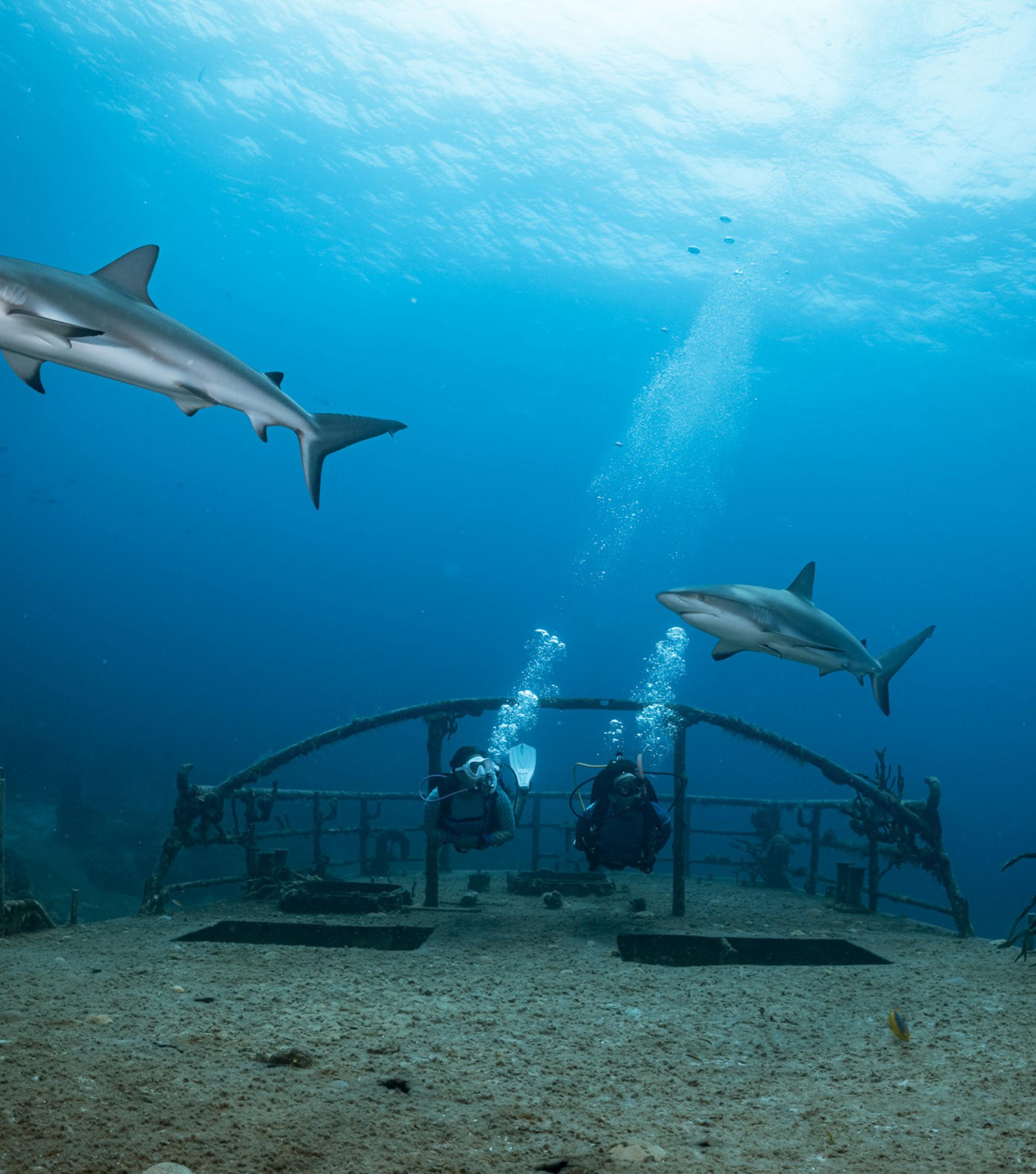
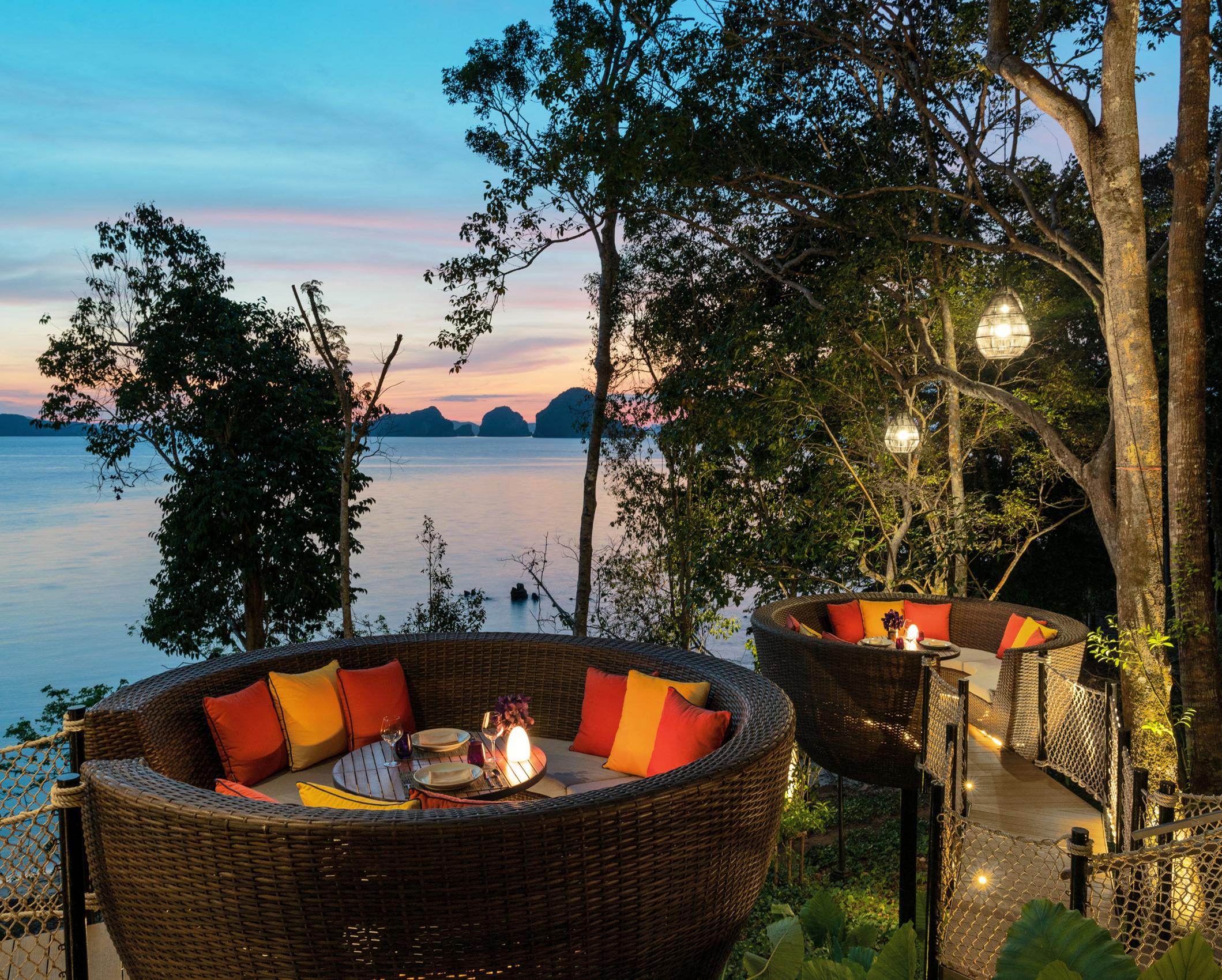


cute. The babies are striped, which is why they’re also sometimes called zebra sharks. The spots come later. This one, roughly 5 or 6 feet long, powerful and fluid, swims with its whole body—unlike other sharks that use mostly their tails. It is the most beautiful animal I have ever seen.
We surfaced and motored back to Fast Manta’s dock in a kind of daze. Typically, when back on the boat, snacks and sodas are passed, and the Fast Manta crew erupts into happy chatter and teasing. That day, we sat, staring at each other— broad smiles and sparkling eyes replaced the jokes for a while, before the crew’s infectious personalities bounced back into action. Pauline was literally bouncing.
Banyan Tree, Krabi is built into the cliff above the bay, and the lobby is famous for its reflection pool—a thin sheet of water that all but erases the boundary between you and the horizon.
Dinner is in a tree, literally. One of the resort’s restaurants has tables and booths shaped like enormous nests, woven baskets perched in the branches big enough for four or five people to settle into.
It was bug season, but it always is. Within minutes of sitting down, the staff began working around us. They brought small fans for our legs, then bug spray, then started turning off lights to give the insects less to chase. Above us in the dark canopy were the bats—the only sign of them being an occasional swoop overhead or the sound of a large fruit seed dropping into the leaves below.
The food was exceptional. We ate looking out over the bay, sipping cocktails that tasted exactly like mango sticky rice. It’s the same horizon of limestone islands we spent the day exploring, but now they are dimming into silhouettes as the sun drops like an egg yolk behind the glowing rim.
Filing back to our rooms after dinner, pleasantly full and exhausted, I realize how much greener Banyan Tree is than Phulay Bay. Huge banana leaves droop over the sidewalk, and the incline takes you straight down the mountain to the pristine, technically public beach, where you’ll find every kind of activity you could hope for. If Phulay Bay is a palace, Banyan Tree is the summer beach house. The rooms are beauti-
ful and organic, sized for a human rather than a giant; the purples, reds, and rust oranges are traded for sage green, cream, and wicker.
PADI’s most-joined program is much older than the Shark & Ray Census, and shaped by a different question: not what’s in the water, but what shouldn’t be. Dive Against Debris sends divers down to find and remove garbage.
Trash (like almost everything else in the ocean) moves with the currents. Some places end up with more than others. Like Malaysia, the world’s fifth-largest source of ocean plastic, which has stretches of reef where debris floating on the water’s surface is dense enough to block sunlight from the coral below—effectively suffocating it.
Other places get a slower, more international rotation. Brenden said you can usually tell how long a piece of trash has been in the water by how readable the packaging still is, and where it came from by what language it’s printed in. The mix that washes through Krabi’s waters changes with the seasons. The week we were there, we mostly found fishing gear—long lines tangled deep into the coral. Extricating them feels like untangling a necklace. As frustrating as it is satisfying.
Taking in the scenic view from the cliffside is the easy part of visiting Krabi. The rest takes longer to see. On our last night, we went to the night market in Ao Nang. It surprised me how safe it felt. People moved with strollers through the lanes between stalls of clothing, bags, leather goods, and knick-knacks; parents lifted children onto their shoulders to watch fire dancers working a crowd. Though there were many tourists and plenty of colorful gifts begging to be haggled over, it was a vacation that felt rejuvenating rather than overstimulating.
PADI AWARE’s programs aren’t an alternative to a vacation in southern Thailand. They sit inside one. The dive shops are the dive shops you would have booked anyway. The boats are the same. The resort on the cliff above the bay hasn’t asked you to give anything up. All this program asks is the one thing you can’t outsource: your attention. And in a world where our attention is an asset, it’s a small gift you can give.
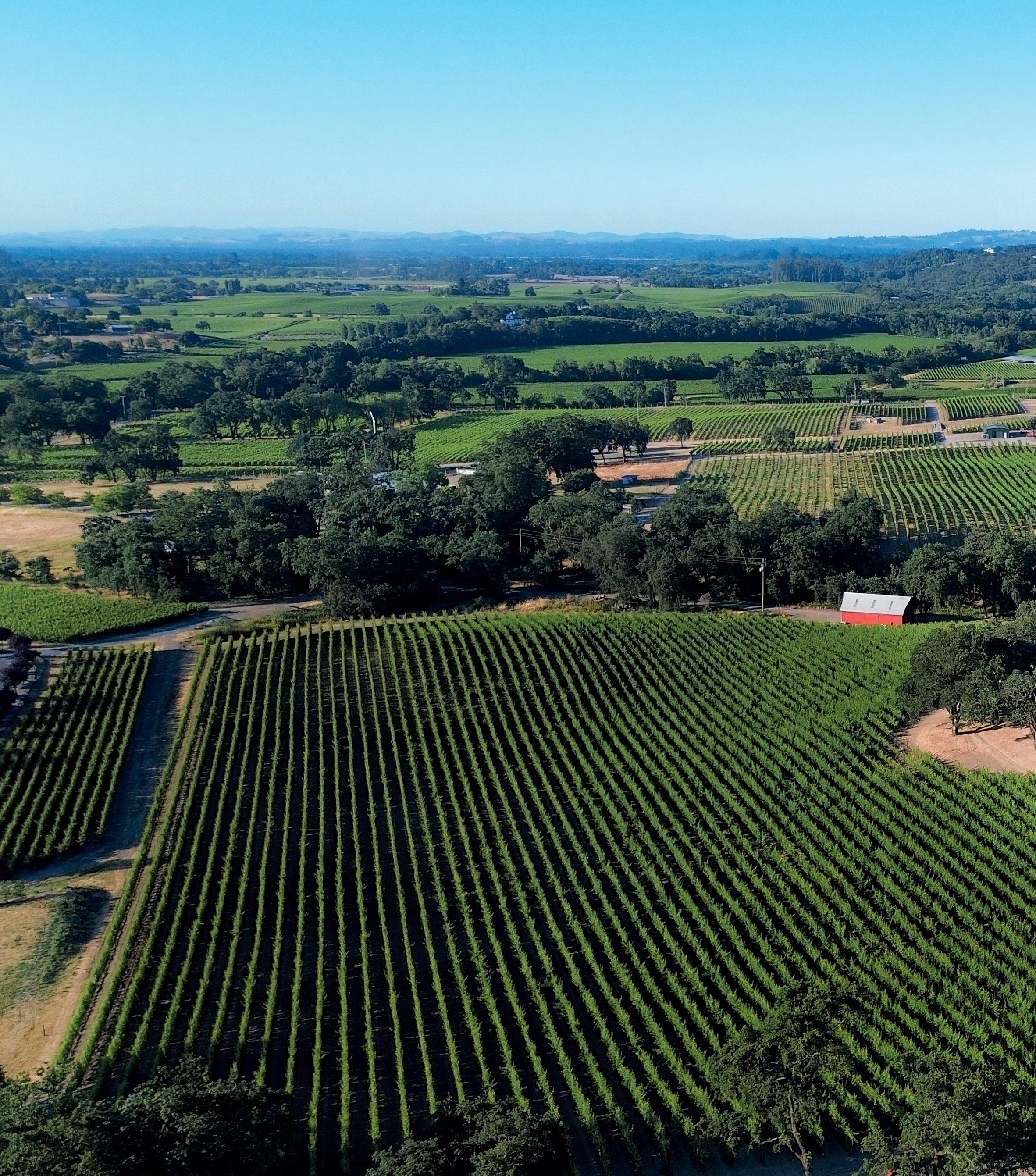
Sonoma isn’t just for wine lovers. But it just might make you one.
BY KIRSTEN CLUTHE
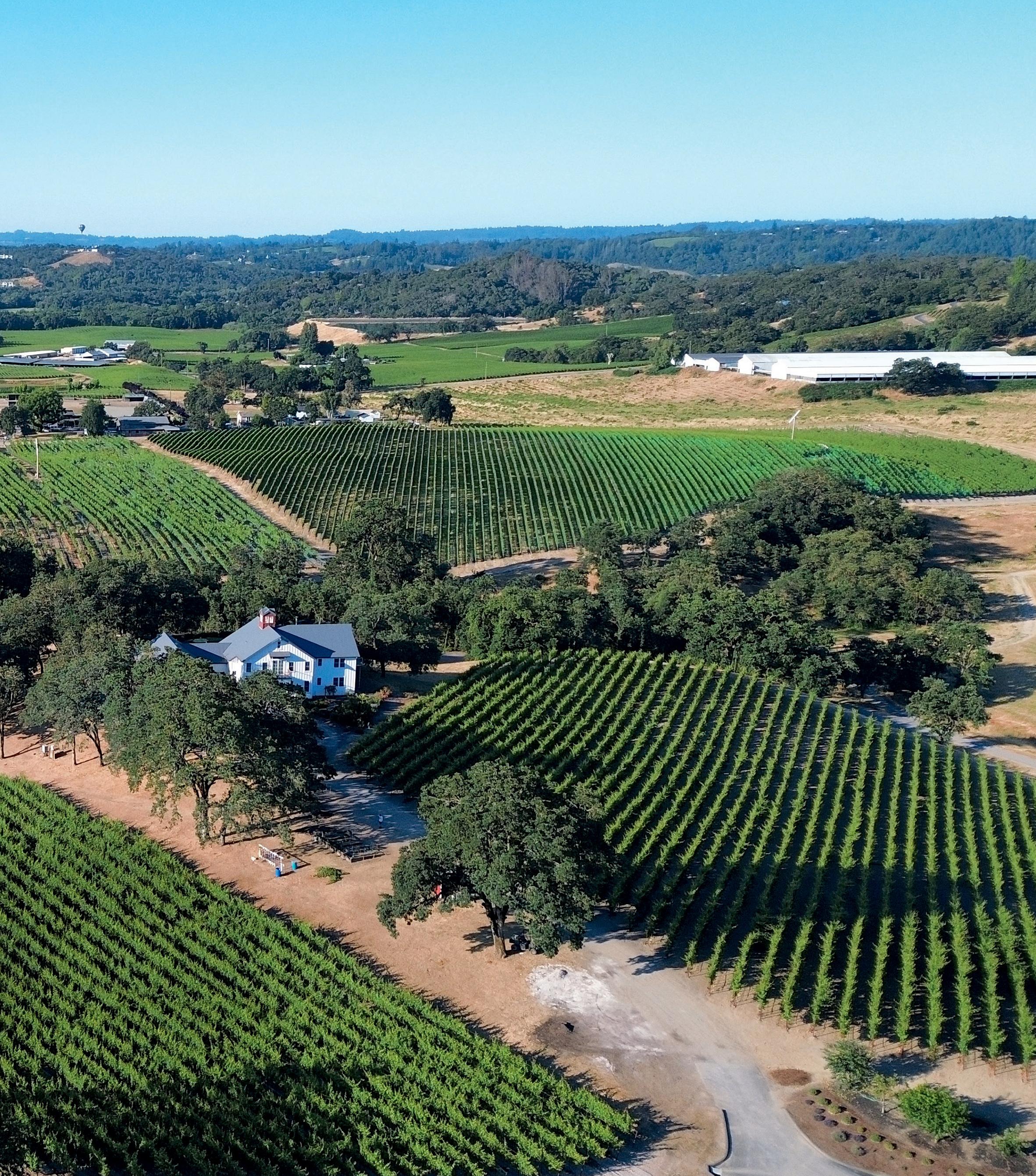
If you travel to Northern California in February, expect moody weather. Before I’d even picked up my rental car, I received a text from Marla Bedrosian, cofounder of Domaine de la Rivière, warning about flooding in the Russian River Valley. Luckily, the rental agency handed me a Jeep Renegade to navigate the surprise flooding I would indeed encounter.
You might be inclined to write off wine country in winter, or off-season, but that’s exactly when you should go. The damp conditions spin out a bold, saturated version of the landscape: grass is emerald green, mustard-colored wildflowers dot the fields, and the vines are a deeply textured dark brown. Most importantly, it’s less crowded, allowing more time with the people who shape this part of the world.
Before check-in at the Farmhouse Inn, my first stop was Marla’s kitchen table. Over a glass of Shoshana Rosé, she and her husband, Geoff, described what it meant to leave New York and build a wine business in Sonoma.
Working within a tightly defined five-mile stretch of the Russian River’s Middle Reach, the Bedrosians produce about 1,200 cases annually. Their focus is on low-alcohol, Burgundian-inspired wines that express both site and vintage, not a fixed house style. When they started making wine, others seemed to be moving toward bigger, higher-alcohol Pinots built to be opened immediately. They went the other direction: harvesting with lower sugar, creating lower-alcohol wines built to last.
The fruit is grown by Kent Ritchie, whose name is shorthand for a certain standard of quality in the Russian River Valley. As Geoff explained, “Everyone who has ever made wine from [his] vineyard has made a great wine.” Kent’s parting words at harvest are always the same: Don’t fuck it up.
Marla described the neighborhood’s location along the Russian River as creating a striking microclimate. “I could be riding my bike here in the morning when it’s cold, and suddenly hit a wall of heat.” That contrast, plus old riverbed soils and regular flooding, gives the wines both ripeness and tension.
They came from the worlds of hospitality and finance, and built the business through relationships. It started with meeting planners and hotel clients. Now, they focus on an experience-driven tasting model. Marla sees hospitality as inseparable from the product. “If we don’t make experiences matter, then we’re not doing it right. You have to be enjoying the surroundings while you’re drinking the wine.”
That evening, I checked into the Farmhouse Inn, a revamped 19th-century farmhouse that is, somehow, both centrally located and tucked away. With just 25 guest rooms, the inn is meant to feel like staying in a private wine country home. The property functions as a kind of concierge-led basecamp for the Russian River Valley, particularly for guests who want curated, appointment-driven winery visits over the tasting-room-hopping circuit.
Hotel GM Giovanni Prada encourages guests to shift from “seeing” to “feeling” the region. Prioritizing one or two elevated, relationship-based winery visits rather than stacking tastings and letting food and wellness lead. “Less checklist, more intention,” as he put it. “The most underrated luxury here is how profoundly it can recalibrate you—especially when you pair days built around the landscape and local makers.”
That perspective came into sharp focus the next morning at Bacigalupi Vineyards. This year, Bacigalupi Vineyards is celebrating its 70th harvest. The family has been on this land since 1956, when Dr. John Bacigalupi—a dentist, not a farmer— bought a ranch property to have a pasture for his horses, with grapevines included as part of the deal. Around 1963, the purpose shifted when he decided to start planting grapes. He and his wife, Helen—a tenacious businesswoman who, by all accounts, was the operational force behind everything—secured Chardonnay and Pinot cuttings from Wente Vineyards.
The block they planted in 1964 is still producing grapes today, and it’s likely you may have tasted its fruit without knowing it. In 1976, at the Paris Tasting—the blind competition that



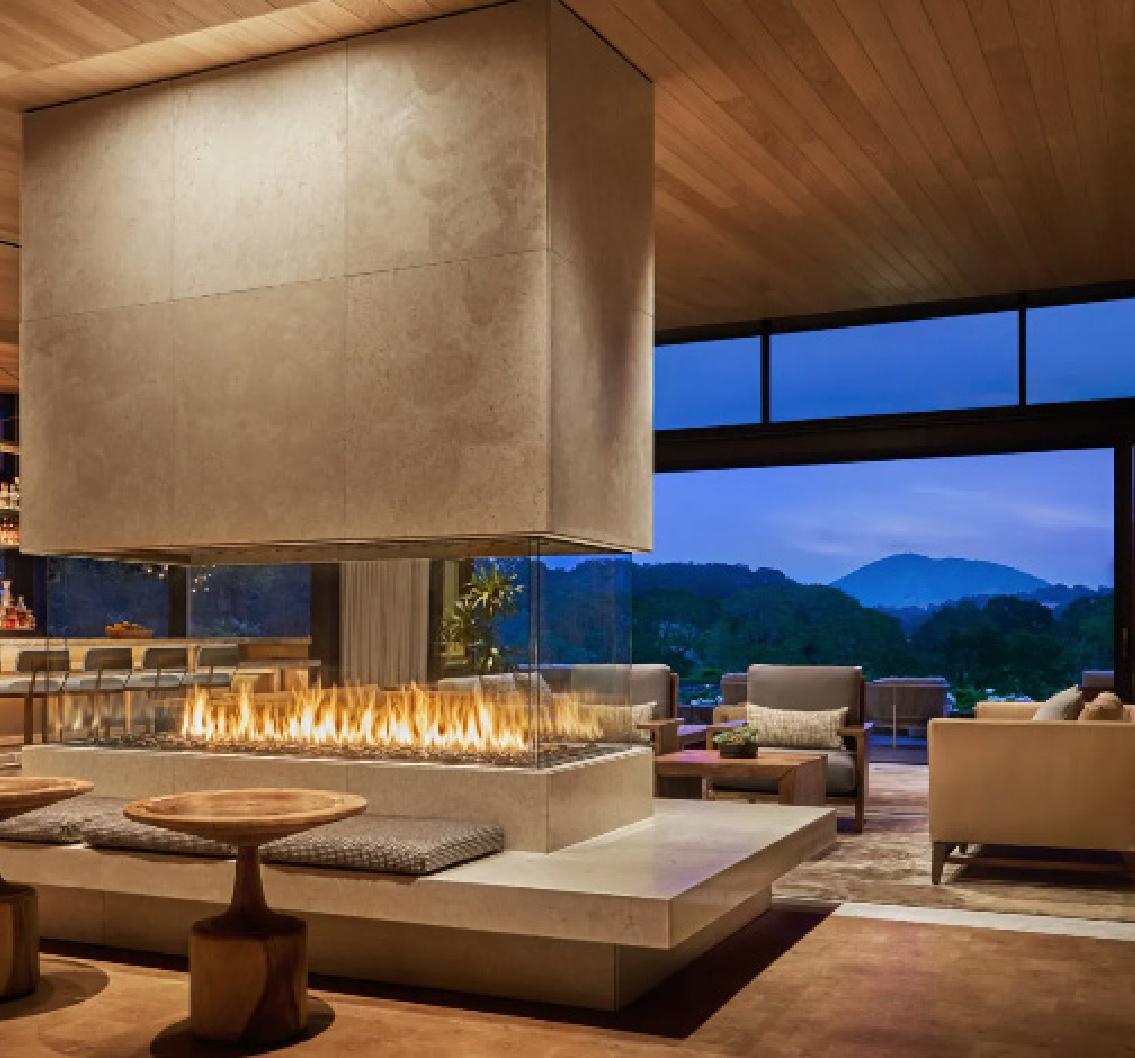
rewrote the global reputation of California wine and was dramatized in the movie Bottle Shock Chateau Montelena’s Chardonnay took first place over the top white Burgundies in the world. Remarkably, roughly 40% of the grapes in that wine came from the Bacigalupi property.
The winery is now run by Katey and Nicole Bacigalupi, who manage to embody both the rootedness of a multigenerational farm family and the enthusiasm of producers who are committed to sharing their family’s specialties with modern wine drinkers.
Bacigalupi grows what they call big vines. Each plant develops its own ecosystem, root system, and claim on the soil. Nothing is standardized. Instead of pulling and replanting the whole vineyard as vines age, they replace vines individually. The oldest ones stay in place. The result is a field blend of ages: vines planted last year grow beside vines that are 60-years-old. Their root systems are intertwined; their contributions to the wine are layered in ways that could never be engineered from scratch.
Nicole poured the Rosé—her personal favorite, she admitted. Delicate, citrusy, with something like strawberries and cream. “Even when there’s snow outside, it works,” she said. Hard to argue. Just before I left, their father appeared from the vineyard in work pants and good gloves, and poured Helen’s favorite: a single-clone Pinot Noir. “For approachability,” he said, “you just can’t ask for a better red wine.”
If Bacigalupi represents one version of Sonoma’s story of family farming and winemaking, Marimar Estate offers another. After leaving Bacigalupi, I drove south toward Sebastopol. Here, the road opened up; the redwood corridor gave way to rolling hills and apple orchards. Soon, Marimar Estate, a mustard-yellow building reminiscent of a Spanish farmhouse, appeared on a hill overlooking its vineyards.
Marimar Torres arrived in California in 1975, leaving behind her family’s legacy in Spain when few expected it. “She left Spain under Franco and moved to San Francisco. It was just a world of opportunity then,” her daughter Cristina told me. Cristina is now the winery’s GM. “It’s very much about being involved in every step of the process,” she explained, “from the farming right through to the cellar and what we’re sharing with guests.”
The estate reflects both sides of that history. Two vineyards—Don Miguel and Doña Margarita, named for Marimar’s parents—are farmed with the same attention to detail used in Spain. Chardonnay and Pinot Noir anchor the production. Albariño, Godello, and Tempranillo push the wines into less familiar territory for Sonoma. The approach is European in sensibility, but rooted in the local landscape. The result is a place which feels like an extension of Spain rather than a translation.
The tasting room is decorated with antique winemaking equipment and crockery from Catalonia. I glimpsed a photograph of young Cristina with the then Prince (now King) of Spain. We walked to the spacious dining table for a tapas lunch, paired with the wines. We began with an Albariño, bright and saline. Next came a varietal that was new to me: Godello: intense lemon verbena, citrus zest, and herbal notes of lavender. There are also hints of almonds. The palate is round and flinty. It’s intense, with refreshing minerality and excellent acidity. In other words: perfect with tapas.
When I asked Cristina about plans for the winery’s future, she said, “What we have here, the wines and the identity of the wines, is so special. I just want to build and polish and elevate it.”
After a day of slow wine tasting, the place that you want to retreat to is a luxury cabin in the woods. The Stavrand in Geyserville is exactly that—tucked into the redwoods, removed from the wine country circuit but not the glory that is Northern California. Elegant, tall trees surround the Mediterranean-style property that was built in 1922 as an apple ranch. My room was modern and spacious, with an in-room fireplace and a patio with a hot tub from which I could gaze at the stars. The Stavrand was formerly the Applewood Inn, completely reimagined during the pandemic by owner Emily Glick, who saw something worth saving in the property’s tile roofs and center courtyard. “The Applewood Inn had good bones,” she told me. She considered naming the new hotel “Serendipity”—a word that captures the unhurried current running through Guerneville and the surrounding area. The philosophy here is what she calls “relaxed luxury”: stylish and thoughtful, but without the crystal chandeliers or the staff working overtime to use your name three times in a scripted greeting.
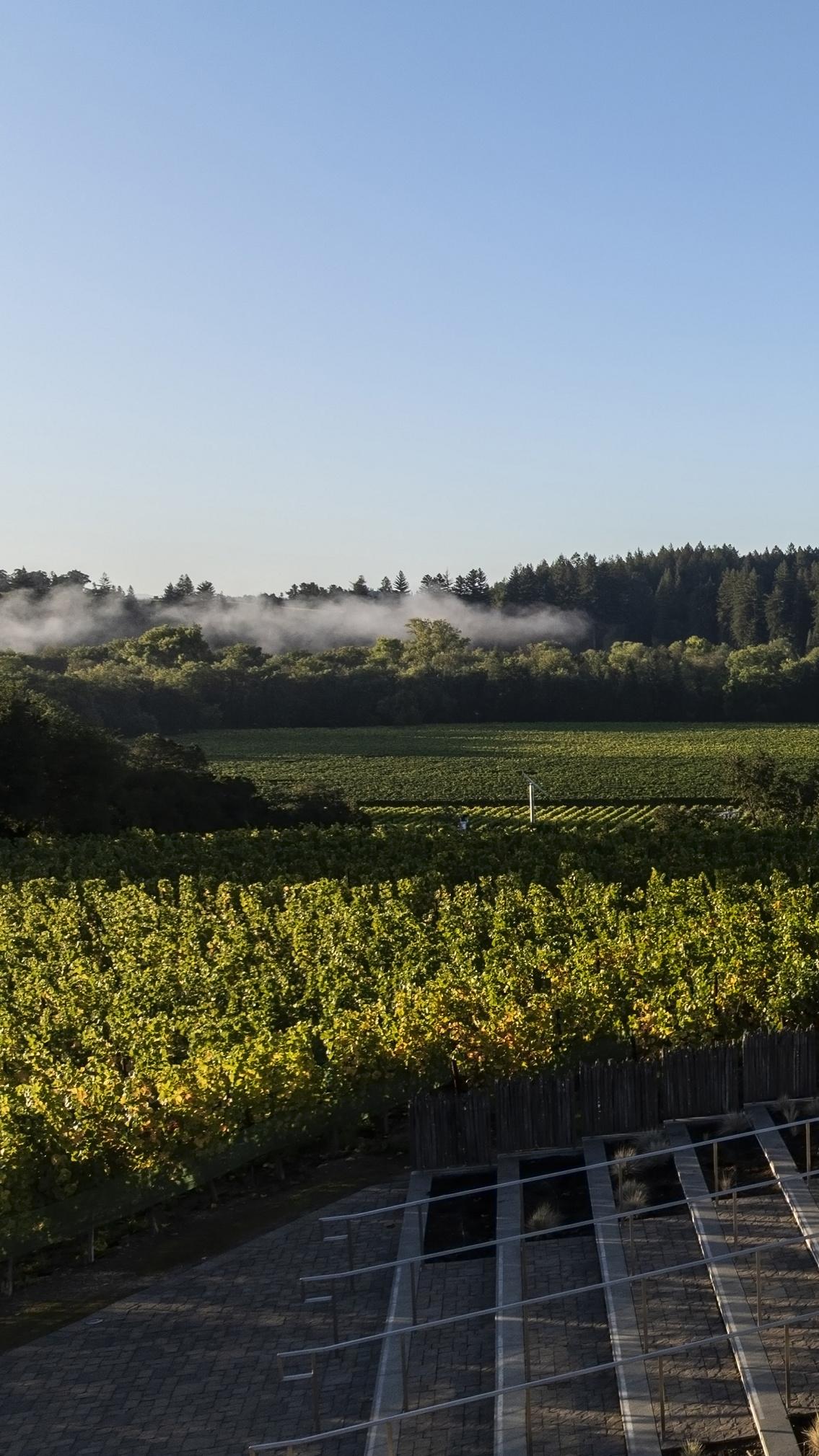
It’s an approach shaped by the community itself. As Emily describes it, the locals in West Sonoma County are welcoming and free of pretense, and the hotel takes its cues from that. For guests with time to explore, the Stavrand sits about 25 minutes from four distinct towns in every direction: west to the coastal hamlet of Duncans Mills and the views at Jenner, south to the maker culture of Sebastopol, east to Santa Rosa, and north to the upscale polish of Healdsburg. But the best recommendation she offered was also the simplest: show up without a plan and let the day unfold.
Aperture Cellars has the kind of origin story that sounds like it’s out of a novel. Founder and winemaker Jesse Katz grew up traveling
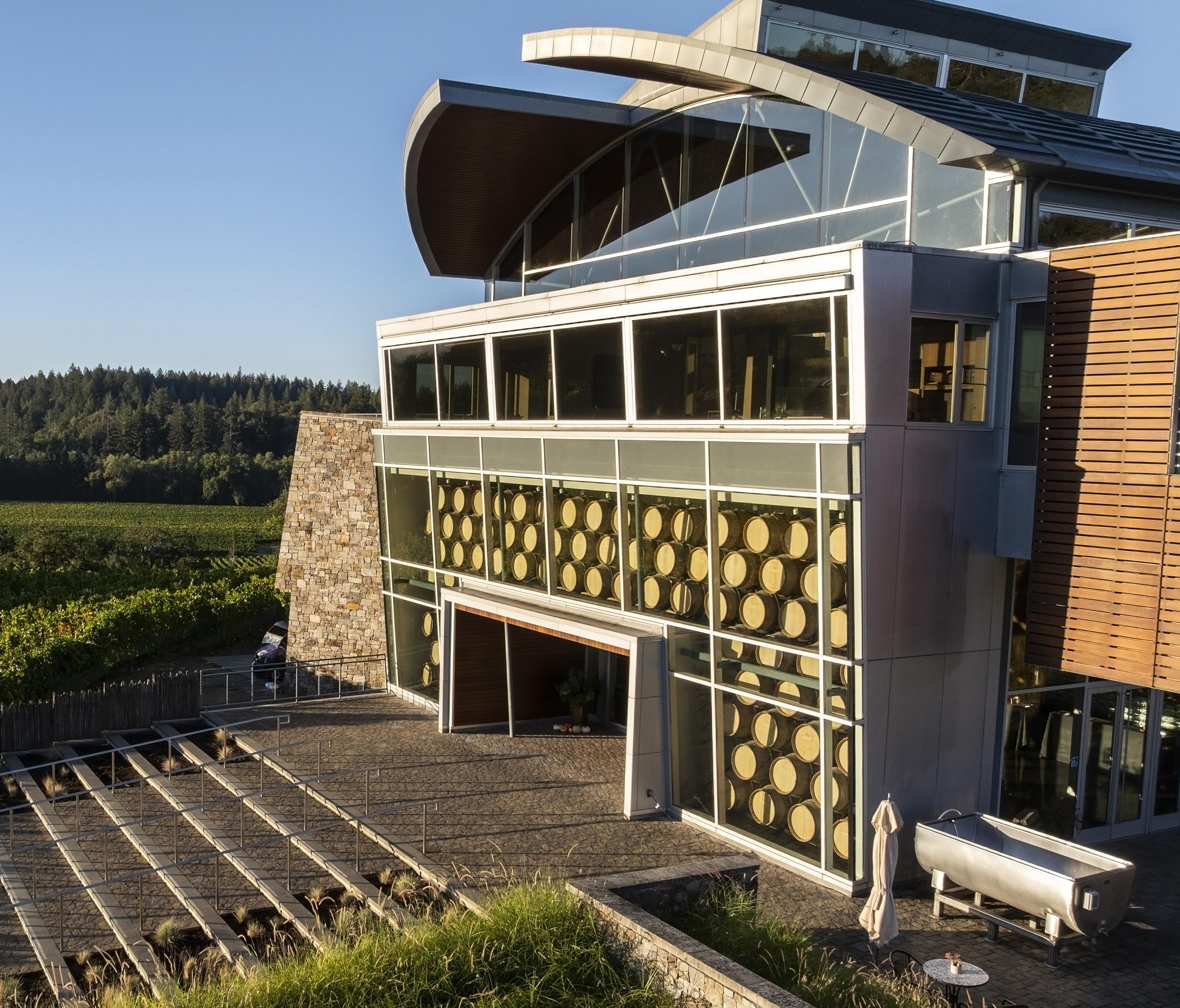
the world with his father Andy, a renowned photographer whose work took them through the wine regions of Tuscany, Burgundy, and Bordeaux. Those early experiences formed Jesse’s instinct for terroir—specifically, for finding sites that others had overlooked. The winery itself feels more like a gallery than a tasting room with an aperture motif that runs through the architecture: the angles of the buildings, the shape of the bar, and a skylight above the tasting space. Andy Katz’s photographs line the walls. The design is intended to slow visitors down before they ever pick up a glass, encouraging the same kind of attentiveness that drives the winemaking.
“The moment you step foot on Aperture’s property,” Jesse says, “You’re surrounded by art
and vineyards, but in a beautiful, relaxed format where the music is bumping, you have your own private space and dedicated host, with an array of experiences that change throughout the year.” Indeed, my tasting took place in a private space overlooking the vast vineyards, and our host adjusted the playlist to the tastes of the guests I was with (It was Toto, FWIW).
When I asked Jesse how Sonoma fits into the wider luxury wine conversation, he explained that the best sites in Napa have largely been identified. Sonoma’s potential, by contrast, is still being discovered, and his generation of winemakers is exploring new vineyard sites across the county’s diverse microclimates, crafting wines that are site-driven and expressive rather than built to a house formula.

“I treat terroir like storytelling and each vintage as its own chapter,” Katz says. The Chenin Blanc— made from one of the last remaining Chenin Blanc vineyards in California—is exactly the kind of wine someone makes because they want to, not because anyone asked for it. As does his assessment of his own trajectory: “We still have a lot to prove and know that we have not made our best wine yet.”
That ambition extends beyond Aperture’s own property. In 2016, Jesse designed the vineyard at what would become the Montage Healdsburg, identifying volcanic hillside sites and tucked-away blocks across the estate’s 258 acres before the hotel itself was even conceptualized. The vines came first. Today, Aperture produces a private label for Montage called Surveyor that you can only taste on the property. It’s a detail that changes what you think of when you imagine a resort smack in the middle of wine country. The vines you gaze at from the hotel lobby are also what you taste in the glass.
The Montage earns its place at the top of the Sonoma accommodation hierarchy not through spectacle, though the property is stunning, but through an elegance that considers the surrounding landscape. My room was a standalone bungalow in an eco-friendly, modern design with floor-to-ceiling windows, a deck with an outdoor fire pit, and a
view of the Mayacamas Mountain Range, which, to the delight of everyone, was snowcapped while I was there. The property offers enough activities on-site to justify never leaving, though downtown Healdsburg is 10 minutes away.
While the Montage is a Sonoma experience at its most visible, my final winery visit involved some research, good timing, and a bit of luck. I texted Williams Selyem with the hope that we could get in at the last minute, and was rewarded with the closing slot on my final day in Sonoma.
Williams Selyem was founded in 1981 by Burt Williams and Ed Selyem out of a garage in Fulton, CA. They were just trying to make wine that they wanted to drink, and along the way, became one of the most sought-after names in American Pinot Noir before most people had heard of the Russian River Valley, not through advertising or a PR campaign, but through a mailing list. If you weren’t on it, you weren’t getting the wine.
The last appointment of the day turns out to be the best possible time to taste wine. There is a specific generosity that comes out at the end of an afternoon— bottles come off the shelf that weren’t on the original list. The tasting took place in a private space on the estate, also with a view of the snow-capped mountains.
We started with the Estate Chardonnay, bright without sharpness, structured but not overworked. Then, we shifted to several bottles of the infamous Pinot Noir. A 2023 Rochioli Riverblock carried depth, dark fruit layered with something herbal and slightly wild. Then, a 2023 Bacigalupi Vineyard Zinfandel closed us out, with mulberry, plum, cracked pepper, but with a lift that kept it from settling into anything heavy.
What makes Williams Selyem feel different isn’t just the wines, but the way the reputation has been carried forward. The founders sold the winery in the late 1990s, and later stewardship expanded the estate—adding vineyard holdings and building a state-of-the-art facility—without fundamentally changing the character. More recently, a majority stake was acquired by the Burgundian house Domaine Faiveley, a producer with nearly two centuries of history. The message, from both sides, was simple: nothing about the wines would change.
You don’t have to love wine to love Sonoma any time of year. The landscape alone makes the case. But in the off-season, the hiking trails aren’t crowded, and you can get a table at a Michelinstarred restaurant like SingleThread or Enclos without much fuss. We ate at Enclos—two Michelin stars, tucked inside an 1880 Victorian just
off Sonoma Plaza—and the food was stunning. What struck me was the service: convivial and unhurried, giving us room to enjoy the meal without being rushed along or distracted by presentation (and the presentation was still mind-blowing).
We opted for the wine pairing, as you should. One course arrived with a sake created in Sacramento, which happened to be the same sake that appeared as an ingredient in the dish. The kind of connection I never would have made on my own. Before we left, we met Chef Brian Limoges, whose kitchen, visible from the dining room, was a place of unbelievable calm. Limoges matched the energy. Cool, easy to talk to, no performance.
That’s what the off-season gives you. More time with the people who live and work here, and the space to discover that Sonoma’s small producers—the winemakers, the farmers, the chefs, the hoteliers—are not in the business of selling you an experience. They’re in the business of making something that reflects a specific place, then sharing it with the rest of us. At Bacigalupi, that means a sparkling wine finished with winter honey from a beekeeper down the road. Star thistle. Darker and richer than summer. You can smell it when you open the bottle, and it brings you right back to where it’s from as it should.

If your safety is threatened while traveling, who will you call?
BY KIRSTEN CLUTHE
Jesse Katz didn’t come up through the wine industry the usual way—no family estate, no inherited reputation, no premium paid for someone else’s proven ground. He found his sites by looking where others weren’t looking, and built Aperture Cellars into one of Sonoma’s most talked-about wineries on the strength of that instinct alone.
The winery itself sets the tone: more gallery than tasting room, with his father’s photographs on the walls and a playlist tuned to whoever’s in the room. It’s a place designed to slow you down before you pick up a glass—which, it turns out, is exactly how Katz thinks about wine. We asked him about all of it.
You grew up around your father’s iconic photography and were exposed to wine experiences that most people only dream about. When did you feel you truly found your own voice as a winemaker?
My early travels alongside my father, renowned photographer Andy Katz, instilled in me a deep appreciation for terroir and the artistry of winemaking. Through his work photographing wine regions around the world and my own formative experiences in places like Tuscany, Burgundy, California, and most notably Bordeaux, I found lasting inspiration that ultimately guided my path. Having this unique global experience played a pivotal role in shaping my vision of how to seek out undiscovered or overlooked sites, and led me to seek out exceptional terroir in cooler areas for the varietal, which are now setting and breaking all records for the varietal in the U.S. and beyond. I was not born into this industry and did not come from money, so to break into this world, I knew I had to think differently from others and not pay a premium for vineyards that others had already proven.
A quote I have always loved: “In order to be irreplaceable, one must always be different.” Aperture’s success reflects the extraordinary team that has come together around a shared vision, thinking outside the norm, and driven by passion. Aperture’s innovative approach blends cutting-edge technology with an artistic, terroir-driven philosophy, elevating underappreciated regions and sites.
The experience at Aperture feels very creative, more like a chic museum than a traditional winery. What did you want to do differently from the usual Sonoma experience when you first developed it?
From the beginning, the goal was to create something that felt different from a traditional winery experience, a space that reflects the same creative ethos and level of intention that defines how we approach winemaking. At its core, the process is artistically driven. It’s about composition, balance, timing, and perspective, so it felt natural to build an environment that mirrors that framework.
The gallery setting for Aperture has always been an authentic backdrop and a way to drive focus to the element of photography that has been integral
to our concept since day one. It allows the experience to begin visually, encouraging guests to slow down, observe, and engage more thoughtfully. That mindset carries directly into the wines, where each decision is deliberate and driven by a broader creative vision.
I wanted to create an experience surrounded by vineyards and wines, but also defined by the intersection of this with art and beauty. The moment you step foot on Aperture’s property the entire feel of the land, the buildings, the row orientations, the labels, the shape of the glass, the art on the walls, are all bringing you into how we look and feel about wine, as an art guided by the land. The aperture is the shutter within the lens, and it can be found throughout the design and angles of our buildings and bar, in a skylight above our tasting space, and deconstructed as stacked shutters creating our winery. So, you’re surrounded by art and vineyards, but in a beautiful, fun, relaxed setting where the music is bumping, you have your own private space and a dedicated host, with an array of experiences that change throughout the year. No visit to Aperture is the same.
You’ve said that winemaking brings together “space, place, and time.” When you walk through your vineyards, what do you look for that tells you a site has its own story?
A vineyard’s story emerges where space, place, and time converge, and it is like a layered narrative rather than a checklist. Space reveals itself in the land’s shape—its slopes, elevation, sun exposure, topography, and subtle contrasts between blocks— while place shows identity through soil variation, microclimates, drainage, and surrounding native plants that signal harmony and uniqueness. Time adds depth to how vines respond across seasons and the uniqueness of each vintage, noting resilience, consistency, and the imprint of both natural cycles and human stewardship. Beyond the tangible, I rely on intuition, tasting fruit in the field for expression, and understanding how to drive style from each block. I treat terroir like storytelling— and each vintage as its own chapter.
Sonoma has often been seen in Napa’s shadow when it comes to luxury wine. How is your generation of winemakers helping to reshape Sonoma’s image worldwide?
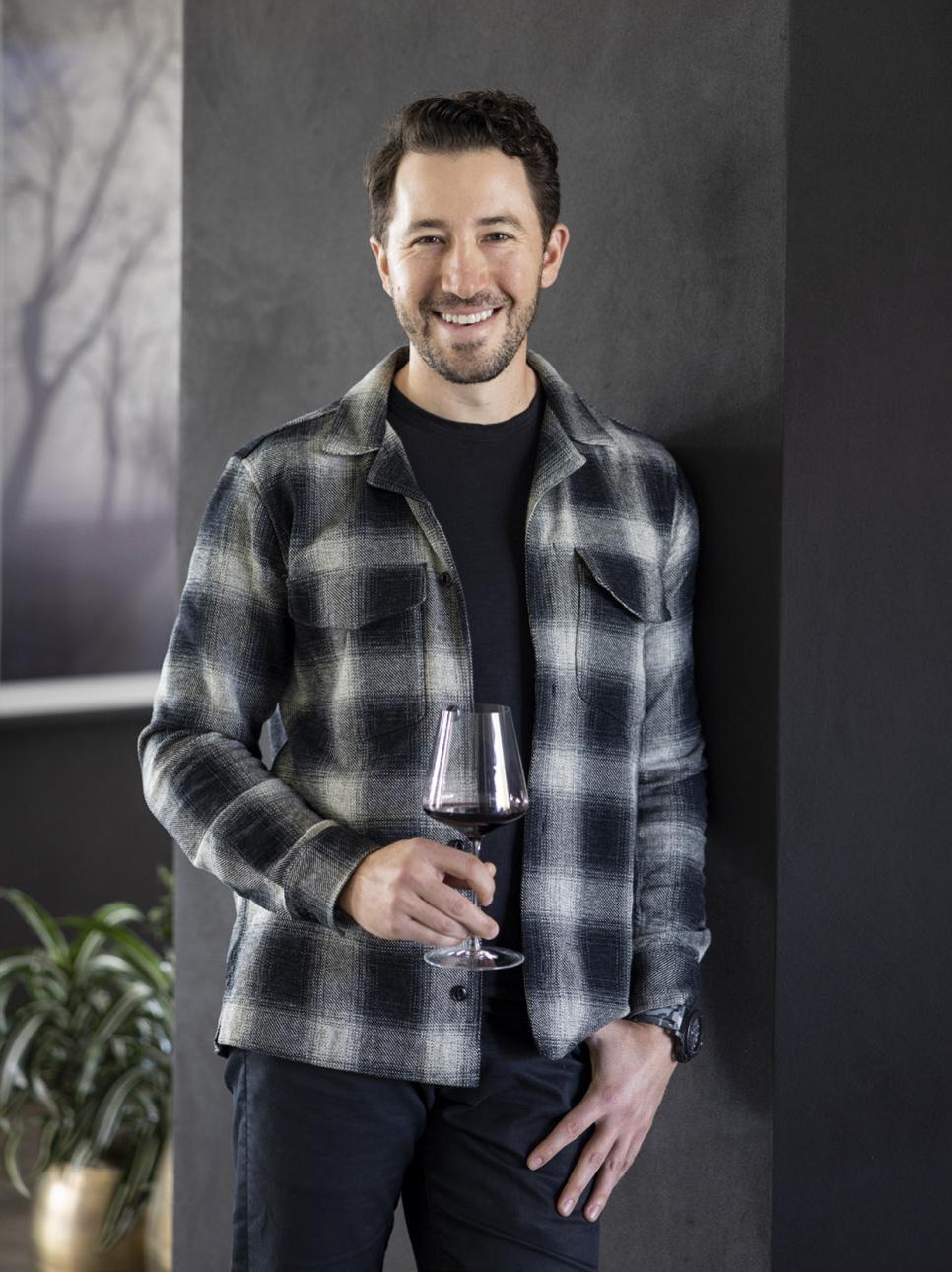
The best sites in Napa have largely already been identified, and our generation is reshaping Sonoma’s global image by embracing its untapped potential, exploring new vineyard sites across diverse microclimates, and crafting wines that are site-driven, nuanced, and expressive. With fewer legacy constraints, we’re able to experiment and push boundaries while maintaining a strong sense of discovery, elevating Sonoma as a true luxury wine region defined by precision, rarity, and a distinct sense of place. At the same time, a focus on thoughtful farming and balanced winemaking is helping Sonoma carve out its own identity rooted in authenticity, diversity, and a deep respect for the land.
Your partnership with Montage Healdsburg puts your wines right into a luxury hospitality setting. I was told that you planted the vines before the hotel was even conceptualized.
In 2016, prior to the hotel’s development, I designed the vineyard at the Montage Healdsburg Estate, identifying exceptional volcanic hillside sites and intimate, tucked-away blocks across the property’s 258 acres. Each selection was made to capture the essence of that unique place, resulting in wines that are expressive, elegant, and deeply connected to the land. The working vineyard is also part of the guest experience, as the rooms and resort are surrounded by small blocks of vineyard designed to bring people into the vineyard, diving in as deep or as high a level as they want. The shared values between Aperture and Montage around elevated hospitality and thoughtful intention have made the partnership feel incredibly natural.

The world’s most discerning travelers plan their trips around one legendary address on Beach Road.
BY KIRSTEN CLUTHE
The car turns onto the circular drive and the building appears—white facade, colonnaded verandas surrounded by lush greenery, and your first thought is that every photograph you have ever seen of it was not impressive enough. The doormen materialize in their whites. You are, it becomes immediately clear, somewhere else.
They are famous, these doormen—iconic, immediately recognizable. They greet first-timers as though they are the only person arriving, and return guests as though they never left. Raffles has been doing this for 138 years. The hotel is older than the country, and carries itself accordingly.
To understand where this tradition began, go back to 1887: four Armenian brothers leased a ten-room beach house from a local Arab merchant on Beach Road. They named it after a British colonial official who had been dead for 60 years. Within a decade, everyone knew exactly where it was.
Stamford Raffles arrived on the island 68 years earlier, in January 1819, and within days signed a treaty establishing Singapore as a British trading post. The move was a direct challenge to Dutch trade dominance in the region. He declared Singapore a free port—no duties, no taxes, open to any trader from any nation—and it worked faster than anyone anticipated. The population was a few hundred when he landed. By 1821, it was around 5,000. By 1822, when Raffles returned and found the growth chaotic enough to require a plan, it was still climbing. He commissioned what became known as the Jackson Plan—separate quarters for the Chinese, Malay, Indian, Bugis, and Arab communities, with right-angled streets and uniform shophouses. What feels today like organic cultural geography is also, in part, deliberate design.
The hotel that bears Raffles’ name arrived 68 years later. Over the next century, it became the place where Singapore’s mythology was assembled, bringing the city’s and the hotel’s histories together. Joseph Conrad came. Rudyard Kipling reportedly edited part of The Jungle Book on the veranda. Somerset Maugham wrote every morning under a frangipani tree in the Palm Court and once said the hotel ‘stands for all the fables of the exotic East.’ Noël Coward stayed. Tom Waits never made it—or at least there’s no record that he did—but he wrote a song called ‘Singapore’ anyway, which might be more revealing. His Singapore is a colonial fever dream, a port city on the margins of the known world where anything could happen and probably would. Singapore has always had a mythology larger than its geography.
A hotel that accumulates this much legend eventually has to decide whether to honor it or trade on it. The 2019 restoration was an answer to that question. It took two and a half years and the kind of attention that involves sourcing replacement floorboards for the Tiffin Room from early 1900s photographs. It was led by Alexandra Champalimaud, whose previous work includes the Carlyle and the Dorchester, a designer who knows how to restore a great hotel without turning it into a museum. The result is 115 suites across nine categories, each one feeling less like a hotel room than a private residence that someone has thought very carefully about on your behalf.
My suite opened onto a small table and two chairs above the courtyard, as a kind of private porch. On the first morning, I sat there with coffee ahead of the heat, watching the grounds come to life: gardeners moving through the palms in watery early sunlight, other guests drifting back from poolside yoga. Inside, teak floors, rattan furniture, a four-poster bed, a front parlor with a ceiling fan turning slowly overhead. The layout—parlor first, then bedroom—gave the suite the logic of a private villa, a place designed for settling in rather than passing through. It was a room designed for staying, not just sleeping. A few doors down, one of two rock stars in residence that week had apparently reached the same conclusion—he was out on his own veranda every morning with coffee, a book, and occasionally, a companion.
The hotel has spent its modern era leaning into its literary past. In 2019, alongside the reopening, Raffles formalized its long relationship with writers into a structured Residency Program: a few weeks at the hotel for one writer a year, expected to return with a book inspired by the hotel and the city. The first invited resident was Pico Iyer, who had been visiting Raffles since 1984 and whose re-
sulting book, This Could Be Home: Raffles Hotel and the City of Tomorrow, treats the property as a frame through which to read the city. New Zealand travel journalist Vicki Virtue followed him and then, in 2023, the Singaporean poet Madeleine Lee, became the first Singaporean writer in the role and whose collection How to Build a Lux Hotel is a series of small, observed moments.
The fourth resident, appointed in April 2025, is the program’s first chef: André Chiang, the Taiwaneseborn chef who has called the city home. The book he penned while in residence, Fragments of Time, treats gastronomy as literature and memory as an ingredient. This year, Chiang opened 1887 by André in the hotel’s historic formal dining room. His menu is built on Singaporean flavors interpreted through French technique, served a la carte in a 42-seat dining room—a deliberate rejection of the long tastingmenu format. Dishes are presented on heritage silverware, including a silver beef trolley that was buried in the Palm Court during the Japanese occupation and recovered after the war.
At Yi by Jereme Leung, in the Raffles Arcade, the Singaporean chef who left for Shanghai in 2002 and returned to open his first Singapore restaurant in 2019, works through provincial Chinese cuisine. It’s where you can try his signature hundred-ring cucumber with poached sea whelk and soy sauce vinaigrette: a single cucumber meticulously sliced into a continuous, spring-like spiral requiring “a hundred cuts”.
The Tiffin Room dates to 1892, and eating there feels like the accumulation of all those years. Chef Kuldeep Negi’s North Indian dishes arrive tableside in copper tiffin boxes, course by course. The cooking is traditional in technique and surprising in combination: jumbo prawns marinated in yogurt and rose powder, grilled in the tandoor, arrive as something you could not have anticipated and will not forget. Upstairs at Butcher’s Block, wood-fired plates from Chef Jordan Keao arrive trailing smoke, paired with wines from a cellar that runs from Burgundy to Hokkaido. His signature dry-aged duck breast and grilled dumpling is matched with sake; a bold Bordeaux paired with French toast and salted caramel.
Singapore has 288 Michelin-recognized establishments as of the 2025 guide, but some of the city’s best food will never appear in any of them. On the recommendation of hotel staff, we found our way to The Warung at lunch—Balinese home-style cooking,
fluorescent lighting, plastic menus, food behind glass cases. The Ayam Betutu is a slow-cooked chicken dish built on a paste of seventeen herbs and spices, each made from scratch. We ordered most of the menu.
If you can pull yourself away from the property, the Singapore Botanic Gardens is the first and only tropical botanic garden on the UNESCO World Heritage List. There are 44 designated Heritage Trees within the property, a tract of primary rainforest older than the gardens themselves, and a Tembusu tree that has been standing since before the gardens were founded in 1859. Our guide pointed out a set of stairs built by Australian prisoners of war during the Japanese Occupation, with the inscriptions still visible. I encountered a Red Junglefowl near the end of the walk, so vivid it seemed improbable, and spent the next ten minutes trying to capture it on my iPhone. Impossible.
Some things resist the iPhone; others, you can take with you. Returning to Raffles, the boutique feels less like a gift shop and more like a cabinet of exquisite curiosities: artifacts from the hotel’s past sit alongside home goods and clothing you might imagine working both in New York and poolside in Singapore. There are tributes to the tiger that escaped from a nearby circus in 1902, took refuge under the hotel for a night, and was eventually dispatched by a local headmaster who missed three shots before finding his aim. The hotel’s signature frangipani fragrance—the same scent drifting through the property and present in the bath amenities—is available as a diffuser, eau de toilette, and room spray. I debated purchasing it longer than necessary, decided against it, and have regretted it since.
The Long Bar is just up the stairs and open to the public, which makes it easy to dismiss as a tourist trap. It is, technically, both of those things. Go anyway.
Bartender Ngiam Tong Boon invented the Singapore Sling here sometime around 1915. The original recipe was lost when the bar stopped serving the drink in the 1930s and was painstakingly reconstructed in the 1970s from a 1936 visitor’s note and memories shared by Ngiam’s nephew. Peanut shells still scatter the floor by tradition. There are worse reasons to be a tourist than drinking the original version of a drink at the bar where it was invented.
Marina Bay Sands had been visible since the drive from Changi Airport, and demanded a closer look.
From Raffles, it is an easy 20 minute walk - while I was there, F1 crews were laying the Grand Prix ciruit on the city streets which made the route a bit circuitous, though no less scenic. At the top, Spago occupies part of the terrace, and from there, the downtown

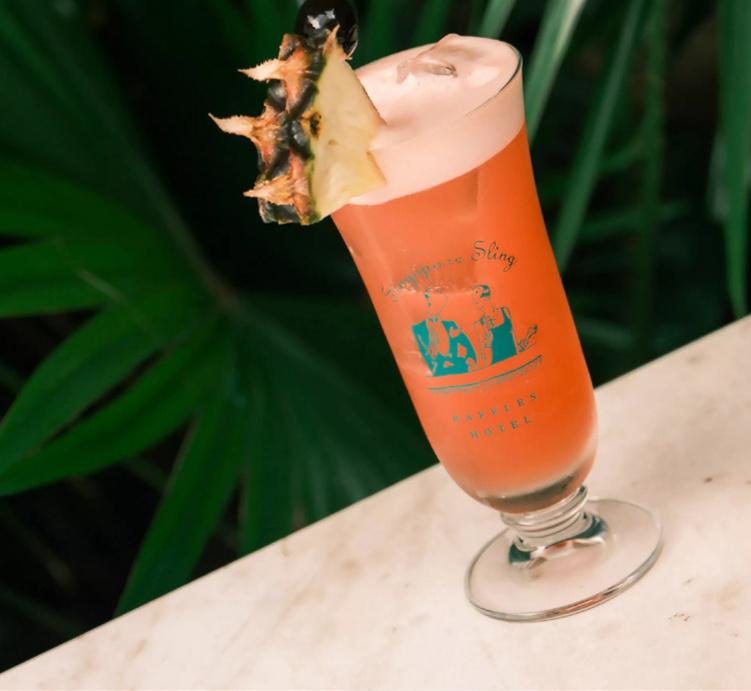

skyline fills one side and the Strait of Singapore fills the other: dozens of container ships at anchor, so still they look less like vessels than a city of their own—the same waterway where Arab and Bugis and Peranakan Chinese traders waited out the tides seven centuries ago. We ordered rosé to fend off the heat and humidity, and ended up with a long, slow afternoon on a terrace above one of the world’s great city views.
At the table next to us, a mother and daughter from Perth were at the start of a girls’ weekend at Raffles. They had flown in that morning. On the way back, we walked through Gardens by the Bay, where the supertrees—those impossible vertical gardens visible from the highway on the drive in from Changi— turned out to be even more improbable up close.
On my final evening, I found myself back at the Writers Bar. It was a Friday, and the room had the particular energy of people who had just arrived from far-flung places around the world. I ordered the Balcon French 75, an absinthe-laced variation inspired by Madeleine Lee’s poem “Balcon.“ It is from the book she wrote while in residence, which describes guests mingling on the hotel’s balconandes, observing an orchestra performing in the lobby.
At some point during the week, it occurred to me how far I was from home and simultaneously how close I was to everywhere else. Several staffers I met talked about traveling to Vietnam and Japan the way New Yorkers talk about Florida. The world, from Singapore , is organized completely differently from the version you know at home.
Some destinations are worth the flight. Singapore is worth every hour of it—and the moment you land at Raffles, you already know you’ll be calculating how to come back.


Shangri-La has packaged two of Europe’s greatest cities into a single journey.
BY KIRSTEN CLUTHE
There is a pattern that emerges once you’ve stayed in a few Shangri-La properties: the brand has an uncanny instinct, or perhaps just the budget, for securing the best view in any city it occupies. In Toronto, it’s the lake and the CN Tower. In London, it’s the Tower of London laid out below The Shard’s soaring glass face. In Paris, the Eiffel Tower is near enough to feel private, a quality no other public vantage point can match.
Shangri-La Hotels take their name from the mythical utopia in James Hilton’s Lost Horizon—a hidden paradise in the Himalayas where time moves differently and the chaos of the world remains outside. The brand’s premise is that paradise exists; you just have to know where to find it. It’s a philosophy worth examining, given that a company rooted in Asian hospitality chose a 95-story glass building high above the Thames and a 19th-century Bonaparte palace in a quiet Parisian neighborhood as its two European flagships.
There’s a strong argument for doing both cities in a single trip, and Shangri-La has already done the thinking for you: a London and Paris package featuring two hotels that couldn’t be more different from each other, curated inclusions for two guests, and availability through the end of 2026. The Eurostar handles the journey in between. The only decision is which city to start in.
Arriving at The Shard for the first time, you could be forgiven for a moment of doubt. The approach is industrial, unglamorous, and set in a part of London that is constantly in motion. Then the elevator doors close, you are swept up to the 34th floor lobby, and London has rearranged itself entirely. The hotel occupies 18 floors of Western Europe’s tallest building, and each of its 202 rooms and suites has floor-to-ceiling windows, giving you a view of London shaped over centuries: the Thames, Tower Bridge, the Tower of London, Borough Market, and on clear days, the city stretching below you for 40 miles.
The rooms are priced on the merit of their views rather than their square footage. Those overlooking the Thames and Tower Bridge are the premier selection, and they’re worth it—the orientation means you catch both sunrise over the river and the city lighting up at dusk. A handful of signature suites offer kitchenettes and living areas the size of London flats, with high-tech telescopes available for closer inspection of the city below. The aesthetic throughout is understated and modern. Nothing competes with the view, which is the correct choice when the view is London from 800 feet.
The marble bathrooms feature heated floors and Jo by Jo Loves amenities—the perfume house Jo Malone built after her namesake brand exit, a sec-
ond act that began with the remarkable personal challenge of reconstructing her sense of smell following breast cancer. As with every Shangri-La property I’ve stayed in, the bath faces the view. Between that and the room amenities, which are exclusive to the property you’re in, you understand that nothing sensory is left to chance.
The neighborhood is an extra perk that many London regulars might not expect. The Shard is in Southwark, so Borough Market is just a short walk away—one of the city’s oldest and best food markets, perfect for wandering and tasting your way through. Grab an espresso at Monmouth Coffee, which was roasting beans in the 90s before specialty coffee was a thing. Pick up champagne and oysters at Richard Haward’s, or a sausage roll from The Ginger Pig. Then stroll along the Thames.
In the other direction, the Tate Modern is a fifteen-minute walk and can fill an afternoon. The Tate is free, and the building is extraordinary, with its suites of galleries, dramatic Turbine Hall, and The Tanks. The combination of world-class contemporary art followed by a riverside walk back to the hotel requires very little planning and delivers considerably.
The 52nd floor holds the hotel pool—nothing between you and the skyline but glass. Book a time slot in advance; the hotel manages capacity carefully, which means you’ll have the view largely to




yourself. The sauna is on the same floor, with the same floor-to-ceiling windows, which makes it possibly the most scenic place in London to sweat.
Evenings begin at GŎNG, also on the 52nd floor, where you can watch London shift from day to night. The cocktail menu changes often and features guest mixologists. During my visit, the cocktail list had been taken over by a roster of internationally recognized bartenders who had flown in from Ireland, Italy, and Hong Kong to recreate their signature drinks.
TĪNG is the rare hotel restaurant that makes you forget you’re in a hotel restaurant. The kitchen turns out food that would justify the trip to Southwark on its own—European fine dining with deliberate Asian inflection, sourced from Borough Market below. Even breakfast is exquisite.
Board the Eurostar at St. Pancras International, which is itself worth arriving early for—the Victorian Gothic train shed is one of the great civic spaces in London, and the Eurostar Premier lounge is a legitimate reason to book upward. The check-in takes approximately ten minutes, which beats check-in at Heathrow, no matter what class you’re in.


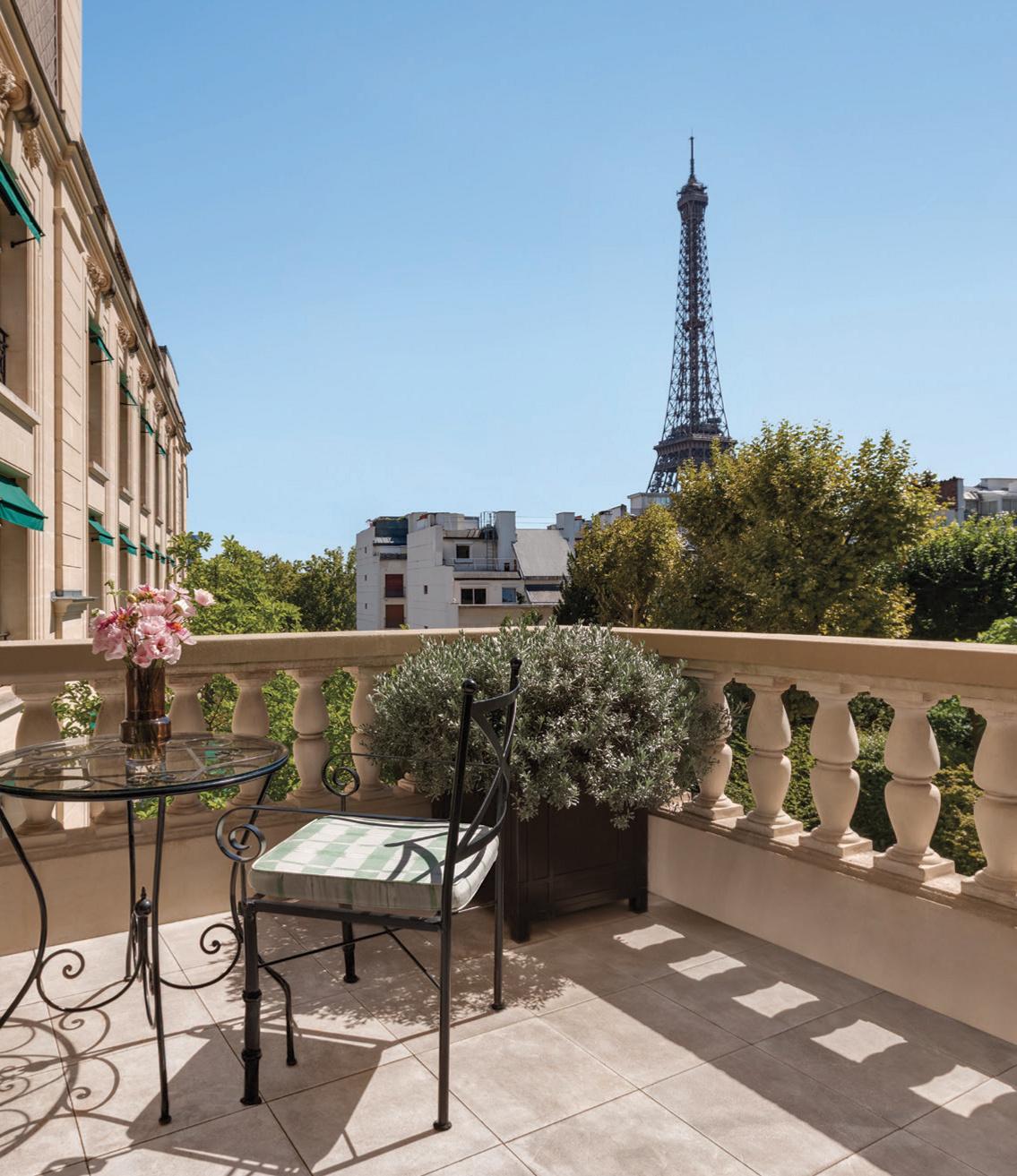


The journey to Paris Gare du Nord takes just over two hours. You are underwater for roughly twenty of those minutes, and the remainder is the English countryside transitioning to French. In Eurostar Premier, the meal service is handled by Jeremy Chan of Ikoyi—two Michelin stars, World’s 50 Best—with desserts from Jessica Préalpato, the first woman to be named The World’s Best Pastry Chef. There is champagne. Border control happens in London before you board, which means that when the train pulls into Gare du Nord, you collect your bags and walk directly into Paris.
The Eurostar is not a commute between two halves of a trip; it is a scene change. London to Paris in the time it takes to watch a film, delivered citycenter to city-center, without the ambient indignity of commercial aviation. Once you’ve done it this way, flying between the two cities will feel like a personal failure.
Shangri-La Paris occupies a building that was once the private residence of Prince Roland Bonaparte, grandnephew of Napoleon, and one of the more interesting people to have lived in the 16th arrondissement. He wasn’t primarily an aristocrat; he was a scientist, explorer, and geographer who built this mansion in 1896 specifically to contain a life of extraordinary inquiry: 150,000 volumes in his library, the world’s largest herbarium, and a photographic archive of 17,000 images from expeditions to Lapland, North Africa, and the Americas. He built it to hold many things, and the hotel has preserved that energy. One hundred rooms and suites, each designed in a Rococo palette somewhere between champagne and celadon, are grand but delicate, filled with historic and architectural details that will take more than one visit to see. Half of the rooms face the Eiffel Tower directly, at a proximity that no public vantage point can match. When the tower runs its light show in the evening, it is utterly spectacular. And yes, you can see it from the bathtub.
As with all Shangri-La properties, the brand’s signature scent of ginger and sandalwood moves through the public spaces and into the rooms. Bath amenities are from Guerlain, and the same attention to detail that puts Jo Loves products in the Shangri-La Shard bathroom shows up in Paris, too. In this case, it’s a lipstick from Le Rouge Français in the 011 Alizarine shade, a bold electric red. A call
back to the glamour of Paris. During Fashion Week, the hotel transforms into a high-fashion hub for runway shows, designer showrooms, and glamorous industry parties. A Bonaparte palace with Eiffel Tower views appeals to the fashion world as much as it does to the rest of us, and the lipstick felt like an invitation (or reminder) to dress the part.
Dining at Shangri-La Paris rewards guests who do their research before arrival. Shang Palace, the first Chinese restaurant in France to receive a Michelin star, is the reservation that books up first and deserves to: Cantonese cooking serious enough to stand on its own anywhere in Europe, served inside a 19th-century Parisian palace. Les Salons du Prince, the hotel’s newest dining room, takes its name from the building’s original resident and its atmosphere from the aristocratic salons that once defined Parisian social life, complete with fireplaces, a resident pianist, and serious French cooking from breakfast through dinner. For evenings, Bar Botaniste is the elegantly maximalist lounge where you’ll want to begin (or end) the night. Prince Roland was a serious botanist, and the bar built in his honor stocks rare spirits accordingly. The cocktail menu is priced to match. The Golden Martini, built around Seventy One Gin, aged 71 nights in oak, is the drink that explains the philosophy.
The 16th offers something that the area around Place Vendôme or the Marais increasingly cannot: the feeling of being in a city rather than inside a tourist experience of one. You’re just minutes from the Seine path below the Trocadéro, where you see the Eiffel Tower at eye level instead of from above. The Bois de Boulogne, 2,000 acres inside city limits, is only a ten-minute walk away. For art lovers, the Palais de Tokyo and Musée d’Art Moderne are close by and less crowded than the Louver. L’Arc de Triomphe is a 20-minute walk. Nearby Passy Village delivers everything visitors go to the Marais for—the market stalls, the cheese shop, cobblestone streets, but without the crowds. And because the area is mostly residential, you’ll find yourself eating at local spots that aren’t on any tourist lists, which is the best way to experience dining in Paris.
Between the vertical spectacle of London and the aristocratic calm of Paris lies a journey that neither place could offer alone. The Eurostar makes it possible. Shangri-La helps you find paradise.
Shangri-La London and Paris’ package is available through December 31, 2026, with curated inclusions at both properties for two guests. The journey can begin in either city.
The Kadoories paid almost double the market price to lock in control of Peninsula Hotels—then hired a luxury-retail outsider to grow it without giving up the keys.
BY DAN COSTA
In January 2022, Hong Kong billionaire Sir Michael Kadoorie paid nearly double the market price to increase his family’s stake in The Hongkong and Shanghai Hotels, Limited from approximately 60% to 72.4%. This $337 million investment underscores their commitment to the company’s longterm growth and strategic positioning, especially as the stock surged 20% on the news despite years of trading at a discount to net asset value. The Kadoories are doubling down on their vision for Peninsula Hotels.
HSH is the publicly listed parent of Peninsula Hotels. Incorporated in 1866 and listed on the Hong Kong Stock Exchange under 00045, it is the world’s oldest continuously operating luxury hotel company. Twelve properties: Hong Kong, Shanghai, Beijing, Tokyo, Bangkok, Manila, New York, Chicago, Beverly Hills, London, Paris, Istanbul. The Kadoorie family’s ownership since 1890 reflects their enduring commitment and fosters confidence in the brand’s stability.
What they did three years after consolidating control was hire a CEO from outside the industry. Benjamin Vuchot took over as Executive Director and CEO in March 2025. Vuchot’s background in luxury retail at Cartier, Van Cleef & Arpels, DFS Group, and Sephora brings a fresh perspectives to the historic company.
In Vuchot’s first year, HSH ran an internal market intelligence study of more than 3,600 luxury travelers. Peninsula’s brand recognition came in at 53%—third out of a peer group of eight.
That ratio—18 percentage points of recognition spread across 12 times the rooms—is the strategic argument for everything that follows. Peninsula does not need to grow to be known. It needs to grow without giving up what makes it known.
“We have incredible confidence to say we don’t need to put pressure on ourselves to grow,” Vuchot said. “We can grow because the brand recognition is already there.”
That posture is unusual at the top of luxury hospitality, where Four Seasons, Ritz-Carlton, Mandarin Oriental, and Aman are all racing on footprint. It is also a posture only a family-controlled, asset-heavy operator can afford to take.
HSH is, as Vuchot puts it, “probably the only remaining hotel company that owns and operates” all of its properties. That is the rarest position in luxury hospitality and also the most expensive. Marriott, Hilton, and IHG long ago shifted to assetlight franchise and management models. Even Four Seasons and Ritz-Carlton run most of their properties under management agreements rather than as owner-operators.
The strategic plan that Vuchot’s board approved in his first year breaks his moves into two tracks: “perform”—getting more out of the existing 12 hotels—and “transform”—adapting the underlying business model. The most consequential transformation is a deliberate shift toward joint ventures, minority stakes, and management agreements rather than pure ownership.
“I think we need to have less ownership and more partnership,” he said. “That will unlock some growth—reasonable growth—and it’s a model that has been tested.”
The shift is partly financial discipline. HSH posted a HK$943 million loss for 2024, largely due to depreciation and financing costs from The Peninsula London, which opened in 2023. The London project took roughly five years to build on a 650,000-square-foot site that had taken three decades to assemble. That is not a model that scales without a different capital structure.
The other transform move—branded residences— is the financial workaround. The Peninsula London opened with 24 private residences attached to the hotel, designed by Peter Marino, ranging from 1,700 to 5,500 square feet. According to Bloomberg, a one-bedroom sold for £10 million ($12.6 million), or roughly £5,882 per square foot—more than three times the 2023 Prime Central London average of £1,733 per square foot, per LonRes. About 80% of the residences were sold off-plan in the five years before the hotel opened. Today, only a handful remain.
Branded residences solve two problems at once. They bring forward the cash from a property’s most valuable asset—its access to the brand— without permanently giving it up, since the residences are integrated into the hotel rather than spun off. And they shorten the payback period on what is otherwise a multi-decade luxury hotel investment.
“Luxury hospitality is a long game,” Vuchot said. The residential side, he added, helps balance the investment cycle and accelerates returns.
Looking ahead, Vuchot plans to expand the branded residences model across the portfolio, including resorts in Southern Italy, Southern Spain, and Japanese ski lodges. He also envisions diversifying into ‘non-hotel hospitality’ such as yachts and trains, activating the brand through other vehicles.
The expansion logic is being built backward from the guest list. Peninsula’s most valuable customer is the one who will book a London suite, a Paris stay, and a week somewhere in the Mediterranean—and pay the brand to stitch the whole trip together.
That kind of guest, Vuchot says, is increasingly asking Peninsula to be a travel companion rather than a hotel chain. Land in London, take a suite for three days. Take the Eurostar to Paris, shop, and leave the bags in Paris. Get whisked to Southern Spain or Italy for a week, then back to Paris to collect everything and fly home. Connecting the properties around that itinerary is, in his framing, the next product.
This is essentially the luxury-retail playbook applied to physical hospitality. The customer relationship is the asset. The properties are the touchpoints. It is also the same logic Vuchot ran at DFS, where the airport was never really the product—the relationship with the traveling customer was.
The Kadoories own the Peak Tram in Hong Kong. It is the funicular that climbs the city’s signature ridge—two tracks running parallel up the mountain before they merge at the summit. Vuchot has been using it as the metaphor for HSH’s strategy: perform and transform, two tracks, one destination.
The family has been climbing this particular hill since 1890. They paid $337 million in 2022 to ensure they retain the rights to the route.
The buildings stay in the family. But there are plenty of other things to sell.
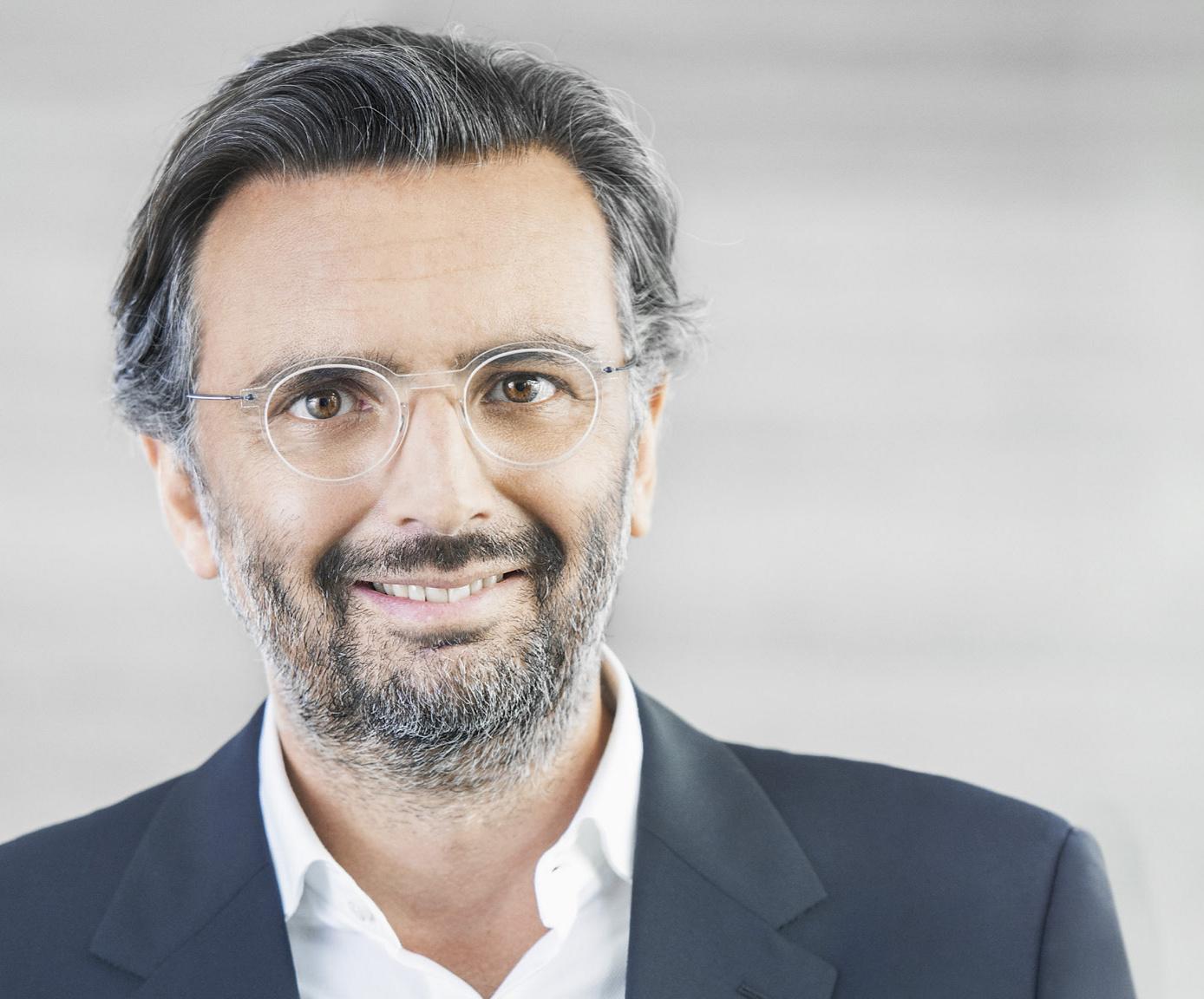


Luxury travel is entering a new era. Defined by evolving luxury travelers in need of personalization and flexibility, coupled with consistency.
For decades, luxury travel operated on a relatively fixed spectrum: ownership at one end, high-end hotels and rentals at the other. But today’s ultrahigh-net-worth (UHNW) traveler is no longer confined to a single model…or a single mindset.
They are more dynamic, more global, and more experience-driven than ever before. A family might spend one season returning to a familiar residence that feels like a second home, the next exploring a new destination with the flexibility of a rental, and another leveraging a subscription model that removes friction altogether. The expectation is not just access, but adaptability.
That shift is driving a quiet but meaningful transformation across the luxury hospitality landscape. And increasingly, it’s raising a fundamental question: can any one brand truly meet the full range of needs for today’s affl uent traveler?
The answer, it seems, is no.
The emergence of The Exclusive Collective (a multibrand luxury and lifestyle platform uniting Exclusive Resorts, Inspirato and onefinestay) reflects this new reality. Rather than forcing a single model to stretch across multiple use cases, the Collective is built on the idea that
different life moments require different approaches, even for the same individual.
At its core, the strategy acknowledges a simple but powerful truth: luxury is no longer static. It is situational
Historically, luxury travel often mirrored real estate logic. Ownership, whether through second homes or club-style models, offered consistency, familiarity, and a sense of belonging. That still holds value today, particularly for travelers who prioritize continuity and longterm connection to a place.
But alongside that desire has emerged a growing preference for flexibility. The modern UHNW traveler moves fluidly between models:
• Increasingly private, referral-based membership clubs like Exclusive Resorts
• Fully serviced invitation-only portfolio of private rental homes through onefinestay
• Flexible and consistent luxury travel subscription through Inspiraton
Each serves a different purpose. Together, they reflect a broader behavioral shift away from rigid commitment toward curated choice.
This evolution is not about abandoning ownership—it’s about supplementing it. Travelers are building portfolios of experiences in the same way they build portfolios of assets: diversified, intentional, and responsive to changing needs.
Underpinning this shift is a deeper change in how wealth is expressed. Increasingly, value is placed not on what is owned, but on what is experienced.
Luxury is no longer defined solely by exclusivity of access, but by quality of experience: how seamless, personalized, and meaningful each journey feels.
This is especially evident in the rise of:
• Multi-generational travel, where itineraries must accommodate different ages, interests, and paces
• Longer stays that blur the line between travel and living
• Hybrid work-leisure trips, where connectivity and comfort are just as critical as destination
In this environment, the expectation is not just high standards, but consistency across contexts. Whether a traveler is staying in a private residence, a villa, or accessing a club network, the experience should feel cohesive, tailored but familiar.
This is where a multi-brand ecosystem becomes not just advantageous, but necessary.
The traditional model of brand loyalty is also evolving. Affluent travelers are no longer seeking a single provider to meet all needs—they are seeking a trusted network that can adapt alongside them.
The Exclusive Collective’s approach preserves the distinct identities of its three brands while setting cohesive standards between them. A discerning traveler’s expectations, and service standards will align when they move between offerings.
In this sense, the Collective functions less like a portfolio of brands and more like a continuum of lifestyle.
As James Henderson, CEO of Exclusive Resorts, puts it:
“For more than two decades, we’ve watched how our members’ lives evolve—the way they travel in their forties often looks very different from how they travel later with grown children and friends. Some begin with the flexibility of a subscription, others move into private membership, and many continue to value the freedom to choose the perfect home, at the perfect moment, in the perfect place.”
Yet as the industry becomes more interconnected, it also faces a paradox: how to scale without losing the intimacy that defines true luxury.
This is where leadership, and philosophy, becomes critical.
For Melissa Xides, President of Exclusive Resorts, the answer draws from an unexpected place: the world of luxury retail. Before entering hospitality, Xides built her career in luxury fashion and retail, most recently at Bergdorf Goodman.Like high-end retail, the most valuable asset isn’t inventory, it’s relationships. Knowing not just what a client buys, but how it makes them feel through the experience.
That philosophy translates directly into the needs of today’s UHNW traveler.
In an age increasingly shaped by AI and automation, the highest end of the market is moving in the opposite direction: toward deeper human connection. Algorithms can optimize logistics, but they cannot anticipate nuance, emotion, or unspoken preference.
As Melissa Xides knows well, the goal is not simply to deliver a trip, but to design an experience that feels instinctively right.
Luxury, Reimagined as Adaptive
Ultimately, the rise of The Exclusive Collective signals a broader shift that’s about more than travel; it’s about how ultra-high-net-worth individuals and their families are choosing to live.
They are seeking a richer, more intentional way of experiencing the world, one built on time together, shared memories, and a sense of purpose in how those moments are spent. And central to that is the understanding that how they travel will evolve.
A family’s priorities will change and their rhythms will shift with their milestones, but the underlying values of connection, ease, and meaning will remain constant.
The opportunity then, is not just to provide access to exceptional places, but to become a trusted partner over time, one that understands those shifts and can meet them with precision and care.
Because for today’s UHNW traveler, luxury is no longer about choosing a single model or moment. It’s about aligning with a brand that can grow alongside them, adapting as their needs change while consistently delivering on what matters most.
PARTNER CONTENT
The tracker, the routine, the supplements. Sensei’s Lydia Moran on the one thing high performers keep missing.
For people accustomed to optimizing everything from calendars to workouts to nutrition, sleep is often treated as an afterthought. But that approach misses something fundamental: sleep is the foundation everything else is built on. And most high achievers are trying to solve for it too late in the day. A nighttime routine, done properly, is useful. But so is addressing how your body has been operating for the previous 16 hours. Before your body is willing to power down, it needs practice.
At Sensei’s flagship wellness retreat in Lana’i, Hawai’i, Lydia Moran, PA-C, works with guests to reframe the equation. As a mindset guide, she doesn’t begin with wearables or sleep scores. She starts with a deceptively simple question: What are you doing in the hour before bed?
For most high performers, the answer is the same: email, texts, organizing tomorrow’s calendar. All activities that keep the nervous system in overdrive.
“We’re not light switches,” Moran says. “You can’t close the laptop, get into bed, and expect your body to follow.” We’re dimmer switches, and the reason gradual dimming matters goes deeper than habit. It’s biology.
Sleep is a vulnerable state—and before your body can power down, it has to feel safe enough to do so. Getting there requires the two sides of your autonomic nervous system to come into agreement. The sympathetic—fightor-flight—was evolutionarily meant to fire in short bursts against real danger. Today, it’s the system powering you through deadlines, time zones, and back-to-back decisions. The parasympathetic, or “rest-and-digest,” is where the body repairs and restores. For most high performers, that scale is almost permanently tipped toward the first.
A recent guest paired with Moran, a lawyer who represents sexual assault victims, spent her evenings on murder mystery podcasts and true-crime TV. “You’re painting a picture for your body that danger is everywhere,” Moran told her. That’s not a screen-time problem. It’s a nervous system problem.
You can’t expect a nighttime routine to undo eight-plus hours of fight-or-flight. The fix is downshifting, practicing the feeling of safety throughout the day with something

like a true lunch break, eye contact with your partner, or a walk without your phone. “If you never practice downshifting during the day,” Moran says, “you can’t expect your body to do it well at night.”
Moran’s most practical (and most resisted) advice: set a work bedtime. A hard stop after which the inbox stays closed and do-not-disturb is on. Once the nervous system gets a clear signal the day is done, the parasympathetic side can finally engage.
“The world doesn’t end just because that email didn’t go out at 10 p.m.,” she says. “Don’t overcomplicate it. Find what feels good and make an effort to incorporate it.”
Chances are, you’re not among the one to three percent with the genetic variation that lets you function on four hours of sleep. Almost no one is. Sleep isn’t the thief of productivity—it’s the prerequisite for it. It’s the foundation for clarity, patience, resilience, and long-term impact. Master this pillar first, and every other health investment will begin to compound.

Healthcare is increasingly moving outside the traditional medicine. Consumers are building personalized ecosystems through diagnostics, wearables, supplements, and longevity platforms, turning wellness into both a lifestyle and an economy (68). But even as billions flow into optimization and preventive care, some of medicine’s most persistent gaps remain unresolved. At the Milken Global Conference, two leaders examined why women’s health innovation continues to stall at the same structural breaking point and what it will take for private capital to step in as public funding uncertainty grows (70).
Function Health, WHOOP, SuppCo, Next Health. Four subscriptions, more than a billion in venture capital, and one healthcare system being assembled outside of the insurance system.
BY DAN COSTA
The wearable buzzes at 7 a.m. with a recovery score. The blood-test dashboard refreshes overnight with new biomarkers. The supplement stack on the kitchen counter has been scanned and rated against a database of 160,000 products. The longevity clinic appointment is on the calendar for Tuesday.
Four data streams, one consumer. None of it runs through insurance.
This is the biohacking economy in operation—distributed across four subscription services that, between them, do everything the legacy system can’t, won’t, or doesn’t catch in time. I went to SXSW expecting to hear founders pitch products. What I found were founders explaining the new architecture of the industry they’re building.
Dr. Darshan Shah, founder of the longevity clinic chain Next Health, was moderating a panel called “Are We All Biohackers Now?” A few minutes in, he asked the room a question. “If half of you here are not wearing some sort of wearable and tracking your data,” he said, “that would be a surprise to me.” The hands went up across the ballroom—WHOOP bands, Apple Watches, Oura rings, the occasional Garmin. Then he put a slide on the screen. Four quadrants, four labels: Clinic, Access, Fuel, Coach. Four boxes—and four founders sitting on the panel, one in each box.
The Clinic was Next Health, Shah’s own chain of about 15 longevity centers, with monthly memberships ranging from $99 to $400. The Access was Function Health, the at-home blood-and-MRI platform that closed a $298 million Series B in November at a $2.5 billion valuation. The Fuel was SuppCo, the supplement-rating service from GroupMe co-founder Steve
Martocci. The Coach was WHOOP, the wearable company that hit a $10.1 billion valuation on a $575 million Series G earlier this year. Combined, the four had raised more than a billion dollars in venture capital. They weren’t comparing notes. They were assembling a healthcare system in public, vendor by vendor.
The legacy system, by way of comparison, ran $5.3 trillion in 2024—18% of GDP, per CMS— and the curve is bending in the wrong direction. Healthcare spending is growing faster than the economy. Per capita spending is at $15,474 a year. The four founders had decided not to wait.
“We decided we’re not going to wait for health insurance to govern us,” Shah told the room, “because that’s just never going to happen.” The line landed without pushback. Everyone on stage was building outside of insurance by design: memberships, subscriptions, outof-pocket. The audience nodded.
The Clinic—Next Health—does what concierge medicine has always done, rebuilt for the age of the dashboard. Quarterly biomarker testing, IV therapy, peptides, executive physicals, and a doctor with time to look at your numbers. Shah trained as a surgeon, performed 20,000 procedures, ended up 50 pounds overweight on ten medications, and pivoted in 2016. Today, the clinic is the human in the loop—the part of the stack that still requires somebody with an MD to sign off.
The Access—Function Health— layer replaces the annual physical. $365 a year, more than a hundred biomarkers per panel, a polished dashboard, and an Ezra-powered $499 full-body MRI as an add-on. Function announced its Series B alongside the launch of a “Medical Intelligence Lab”—an explicit AI integration play that unifies labs, imaging, wearables, IoT data, and medical records under a single model.
Pranitha Patil, Function’s cofounder, told the room what that means for the doctor’s office. “Your doctor is no longer your first opinion,” she said. “You’re going to use AI. You’re getting an opinion from AI, and then you’re saying, here’s all my biomarkers, here’s what’s out of range.” She wasn’t predicting this. She was describing what Function’s members already do.
The Fuel—SuppCo—is Martocci’s piece, and the most easily overlooked. Americans spend more than $50 billion a year on supplements, an industry the FDA regulates only loosely and that, as Martocci’s data show, ships products that often don’t contain what the label says. SuppCo’s TESTED program buys top-selling supplements anonymously from DTC sites and tests whether the active ingredient is actually in the bottle. Martocci pulled six of the top-selling creatine gummies on Amazon, he told the room, and ran them. “Four out of six had zero or just trace amounts of creatine,” he said. “A total scam.” The platform indexes 160,000 products and rates 500-plus brands. The product is, in essence, a trust score for a category that doesn’t have one.

The Coach—WHOOP—is the daily layer. Heart-rate variability, sleep stages, recovery, and strain. In 2025, WHOOP launched Advanced Labs, an add-on subscription that pulls 65 biomarkers via Quest Diagnostics and pairs them with continuous wearable data. More than 350,000 existing members joined the waitlist before the product shipped. John Sullivan, WHOOP’s CMO, framed the structural change in language most marketers wouldn’t reach for. “We can collect all of this data and take control of our circumstances,” he said, “and now we’re going to our doctors, and we’re asking and expecting more of them than before. It’s interesting how that flipped from the trickle down to this upward pressure from the grassroots.”
Four boxes don’t run themselves. Someone has to integrate them. And in the seven months since Shah first sketched the loop, the contest for who plays that role has moved from theoretical to live.
In March, Perplexity launched Perplexity Health, an AI feature that connects directly to Apple Health and to electronic health records from more than 1.7 million care providers. It pulls in Fitbit, Ultrahuman, and Withings. Oura and Function are listed as “coming soon.” OpenAI rolled out ChatGPT Health earlier this year with Apple Health support. Microsoft launched
Copilot Health as part of its Copilot service. Amazon introduced Health AI as an assistant for records, prescriptions, and questions. Apple’s own Health+, an AI-powered coaching subscription expected later this year, is the most aggressive bet—Bloomberg’s Mark Gurman has reported the timeline is firm. Whichever AI wins the integration layer owns the relationship with the patient—owns the moment when the WHOOP recovery score, the Function panel, the SuppCo stack, and the Next Health visit notes get pulled into one view and queried in plain English. The Function-Perplexity partnership, however casual the announcement may be, is the strongest signal yet that the fourvendor stack and the AI integration layer are converging.
Patil was already describing the result. “We’re never going back to a world where we don’t have access to this information,” she said. “Let that sink in.” She wasn’t selling. She was describing the new floor.
“For the first time in history right now,” Shah said. We’re actually seeing less chronic disease year over year.” It’s the kind of line that gets repeated on longevity panels until it sounds like consensus.
The CDC data says the opposite. In a 2025 analysis published in Preventing Chronic Disease, the agency reported that 76.4% of U.S.
adults—194 million people—had at least one chronic condition in 2023. Multiple chronic conditions affected 51.4%. Among adults ages 18 to 34, the demographic most likely to be paying $365 a year for Function or to be wearing a WHOOP, the prevalence of one or more chronic conditions rose from 52.5% in 2013 to 59.5% in 2023. Multiple chronic conditions in that group rose from 21.8 to 27.1%.
The disease curve isn’t bending. The new health system being assembled isn’t the consequence of a healthier America. It’s the consequence of the legacy system failing to catch disease early enough, in young enough people, with enough resolution to do anything useful with what it does catch.
WHOOP’s own April 2026 data drives the point home: among “highly active” populations using its Advanced Labs panel, 22% show signs of metabolic dysfunction and nearly 30% have underlying cardiometabolic risk factors, often without prior awareness.
The annual physical has run for a century on a simple bargain: you go in once a year, your doctor measures a couple of dozen markers, and you find out whether anything is broken yet. This four-vendor stack rebuilding that bargain in continuous time, with two orders of magnitude more data, on a subscription model, and in a parallel system that doesn’t need permission from your insurance carrier.

Two voices from the Milken Institute Global Conference on why women’s health keeps stalling at the same point— and how catalytic capital is trying to bridge the gap before federal research cuts widen it.
BY DAN COSTA
Tell a cardiologist that a 45-year-old woman is having heart palpitations, and the differential moves fast. Heart attack. Arrhythmia. Anxiety. The cardiologist will almost certainly not ask whether she has been bleeding heavily for months and is anemic. Which means a company that built a diagnostic for that pathway has nowhere obvious to sell it.
The example comes from Caitlin MacLean, Managing Director of Innovative Finance at the Milken Institute, who walked me through it at the 2026 Global Conference. It is her shorthand for everything broken about the women’s health market—a market that’s large and growing, and structurally mispriced.
“It’s not a niche market,” she said. “It’s been niche-marketed.”
A PwC report issued in March 2026 estimates the current global women’s health market at $430 to $440 billion, with a projected growth to over $600 billion by 2030 at a six to eight percent CAGR. This broadens the scope beyond reproductive care to include conditions like cardiovascular disease, autoimmune disorders, Alzheimer’s, and mental health, which affect half the population and have been historically mispriced by the system.
There is a reason for this. The World Economic Forum’s January 2026 outlook estimates women’s health receives only 5 to 6% of global healthcare R&D and investment dollars. The clinical infrastructure was built on male physiology, partly because of the NIH Revitalization Act of 1993, which mandated the inclusion of women in NIH-funded research. Consequently, many drugs, diagnostic thresholds, and symptom guides are calibrated to male baselines, creating a significant gap in effective care for women.
Both of my Milken conversations landed on the same example. Menopause—a stage of life every woman in the world goes through—was treated as a non-market by venture capital for 50 years. In the last five years, it has become one of the fastest-growing segments in the entire healthcare investment landscape. PwC pegs the annual growth rate at 13%.
The companies that proved out the category are recognizable now. Midi Health has raised $100 million across its first three rounds, with Series B led by Emerson Collective. Evernow raised $28.5 million in a Series A round, backed by Gwyneth Paltrow, Drew Barrymore, and Cameron Diaz. Elektra Health, Maven Clinic, and Carrot Fertility expanded coverage. Corporate benefits packages added menopause as a line item.
Jenica Patterson, PhD, Senior Director of the Women’s Health Network at Milken, called the shift a stigma reduction that finally unlocked the spend. “Every woman goes through menopause at some point,” she told
me. “We’re 51% of the population, and 100% of women go through this.”
Patterson pointed out that while venture funding for menopause has accelerated, the underlying science has yet to catch up. The category broke through commercially before fully understanding the biology. Supplements arrived first, but clinical trials are still catching up, highlighting a critical area for future research and investment.
Menopause is the part that worked. The rest of women’s health is stuck in what Patterson—borrowing a phrase she earned, having spent a decade at NIH before joining ARPA-H to lead its $113 million Sprint for Women’s Health—calls “the commercial valley of death.”
The pattern is well documented. Silicon Valley Bank’s 2025 report put women’s health venture funding at $2.6 billion in 2024, a 55% jump from the prior year. The early-stage numbers look like a sector finally getting its due. The exits do not. Most women’s health companies hit a wall somewhere between Series A and the kind of late-stage round that requires a billion-dollar comp to justify itself. The digital health IPO window has tightened across the board—Hinge Health filed an S-1, then paused—and women’s health, with no clear pattern of large outcomes, gets hit harder than the rest of the digital health sector.
MacLean confirmed the diagnosis. “We’re hitting a billion dollars, but the later-stage capital market investment has stalled. It has not really seen its final potential.”
The mechanics underneath the stall are the cardiologist’s problem at scale. The buyers of women’s health products—health systems, employers, and insurers—lack the framework to evaluate them because their clinicians’ medical training didn’t include the underlying conditions. A company building a women-specific pathway faces a discount that a gender-neutral company does not. The
fix isn’t more early-stage capital. It is a generation of clinicians, payers, and category infrastructure that doesn’t yet exist.
CATALYTIC CAPITAL, BLENDED.
This is where Milken is making its bet. The Women’s Health Network— launched in April 2025, chaired by former First Lady Jill Biden, with more than 130 member organizations—is designing a catalytic philanthropic fund to bridge funding gaps. This effort aims to create a more equitable and innovative women’s health landscape, inspiring confidence in collective action.
“This could be everything from having a rural clinic in the United States be able to purchase the next generation of a mammogram machine, finally,” MacLean said. “This could be an investment into an entrepreneur who’s saying, let’s actually provide the right type of services for women in midlife, not just around menopause, but looking at it comprehensively as a whole person.”
The structure is concessionary. The fund is not chasing venture-grade returns; it is de-risking the middle of the curve so that venture capital can underwrite later rounds with comps that wouldn’t otherwise exist. And it is not alone. Melinda French Gates has pledged $1 billion over two years to women and families. Pivotal Ventures, the Nuttall Foundation, and the Gates Foundation are writing checks in adjacent territory.
Patterson, who spent a decade inside the federal version of this problem, is clear-eyed about the shift in burden. “I hope what’s happening now is that a lot of philanthropies are picking up the opportunity to fund that early-stage research to inform better what’s happening in the commercial market,” she said.
The 2025 federal research cuts hit women’s health harder than almost any other category. A March 2026 analysis published in PNAS counted 2,291 NIH grants terminated and 1,534 frozen between February and August of last year, eliminating roughly $2.5 billion in committed funding. The breakdown matters. Among terminated active projects, 57.9% were led by women, compared to 48.2% led by men. Among assistant professors who lost grants, 59.8% were women. The Women’s Health Initiative—the longestrunning federal study of postmenopausal women, with 42,000 active participants—had its regional center contracts terminated in September. HHS has said it is working to restore funding, but the chilling effect on the field is already on record.
Patterson’s framing was characteristically careful. “I don’t think we’re going to see the issues with the cuts until later on,” she said. The early-stage discovery work that fed into the current commercial pipeline came from NIH and ARPA-H labs. It takes a decade to show up in a Series A. The 2025 cuts won’t appear in venture decks until the early 2030s.
“We are hitting a billion dollars, but the laterstage capital market investment has stalled. It has really not seen its potential.”
Which is what makes the Milken bet a thesis and a hedge at the same time. If catalytic capital can hold the middle of the curve long enough for venture and corporate buyers to come in behind it, the $600 billion market grows into itself. If it can’t, women’s health becomes the first part of healthcare innovation to lose its supply chain at exactly the moment its demand is being recognized.
Sarah Silverman, Ben Affleck, and Matt Damon turned out for Bring Change to Mind’s Revels & Revelations—but the high school students stole the show.
In late April, the Fort Mason Center for Arts & Culture in San Francisco filled with an unusual mix of guests—Glenn Close and her dog Sir Pippin of Beanfield holding court on the red carpet, Steve Kerr deep in conversation with a high schooler, Mayor Daniel Lurie opening the program with a charge about youth mental health. It was Bring Change to Mind’s annual Revels & Revelations celebration, and by the end of the night, the nonprofit co-founded by Close had raised more than $2.3M to keep conversations about mental health going in schools and communities across the country.
The evening, presented by premiere sponsor AE Foundation, marked three milestones at once: 15 years of the organization, 10 years of its student programming, and the ninth presentation of the Robin Williams Legacy of Laughter Award. Close also presented philanthropist Pam Baer with the Champion of Change Award, recognizing her years of leadership in advancing mental health awareness. There were many other memorable moments: Sarah Silverman delivering a stand-up set; Ben Affleck and Matt Damon accepting the night’s top honor from Zak, Zelda, and Cody Williams; Chris Martin live-streaming from Abbey Road Studios “Bromance,” a tribute song he wrote to celebrate Ben and Matt’s decades-long friendship. But for all its star power, the most affecting moments belonged to the students.
Throughout the night, members of Bring Change to Mind’s high school clubs moved between tables, sharing how their chapters are reshaping mental health conversations in their schools. Several took the stage to tell their own stories, led by actor and BC2M ambassador Chase Stokes. In one of the evening’s most moving moments, three sisters (all current or former club presidents) surprised their mother, a longtime board member, with a tribute honoring the father they lost to suicide more than a decade ago.
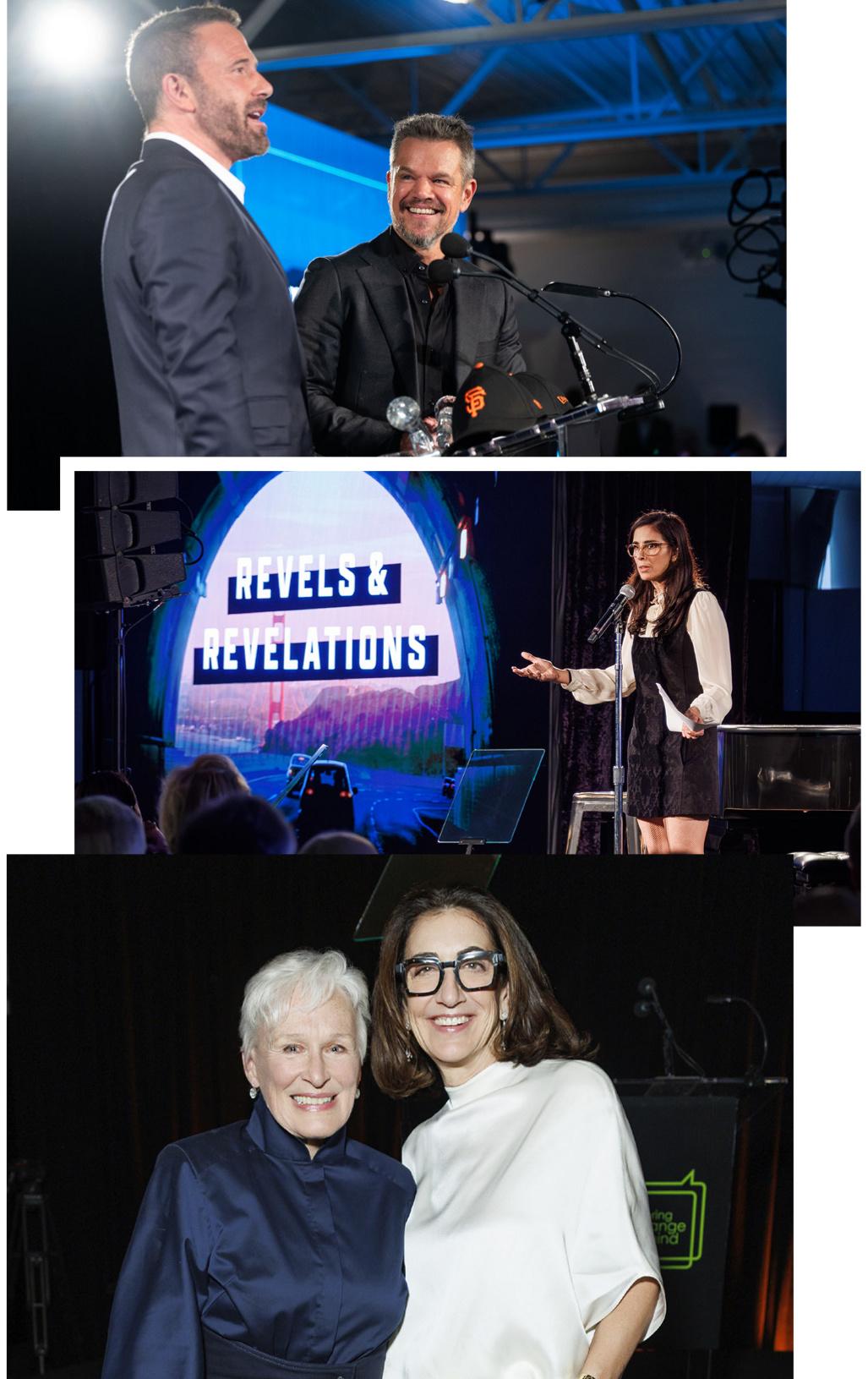
“The students our guests see on stage are a true reflection of the work happening in our clubs across the country,” said Robert Pinnix, Chief Development Officer of Bring Change to Mind. “Our mission is entirely driven by youth leaders. When they share their lived experiences so openly, they aren’t just telling a story. They are creating a peer-to-peer connection that gives other young people the permission and the vocabulary to talk about their own mental health.”
To similar effect, Affleck and Damon’s acceptance speech, delivered entirely off-the-cuff, traced their careers back to the moment Robin Williams signed on to Good Will Hunting, a film, Damon noted, about “young guys struggling with mental health and needing to find someone with whom they could talk and feel safe.” Affleck closed with a line that landed in a hushed room: “I’m really, really grateful that this organization is dedicated to putting people in a place to have that conversation, because I can tell you firsthand, it can save lives.”

AI spending and fiscal stimulus are helping absorb rising oil prices, making further rate cuts increasingly unlikely (74). Investors searching for income are moving beyond cash and toward equity ETFs (76), while executives continue spending confidently despite mounting geopolitical instability (80). Even marriage is becoming more strategic, as younger couples increasingly embrace prenups as financial planning tools rather than signs of distrust (84).
AI capex and fiscal stimulus are absorbing the oil shock. With a growing economy and higher oil prices boosting inflation, further interest rate cuts are off the table.
BY LARRY KANTOR & BOB DIAMOND
The war with Iran is pushing inflation up, keeping interest rates higher, and dampening economic growth, but markets have performed remarkably well. That reflects a resilient economy and rapid growth in corporate profits.
Stocks have experienced ups and downs since the war started but have more than recouped losses and are up for the year, having more than doubled since the bull market began in October 2022. Credit spreads–a measure of market risk aversion–have remained tight. Bond yields have risen since the start of the conflict in response to higher inflation, diminished expectations of Federal Reserve interest rate cuts, and concerns about U.S. budget deficits and debt. Headline inflation has moved up significantly due to the surge in energy prices, while core inflation continues to trend about a percentage point above the Fed’s target of 2%. The Big Beautiful Bill increases federal debt, and the war will add to it further. The Pentagon has asked Congress to set aside $200 billion for the war on top of a record-breaking defense budget request of $1.5 trillion for the coming fiscal year, which would amount to a 50% increase (the biggest since WWII). The Iraq war ended up costing around $2 trillion, and that was when publicly held United States Treasury debt was less than $4 trillion; it is now more than $31 trillion.
The U.S. economy has held relatively steady at around 2% real GDP growth, reflecting strong offsetting drivers: reduced immigration and higher tariffs and oil prices are restraining growth, but fiscal stimulus and especially the massive AI investment boom are providing significant positive offsets. This new technology is seen as so critical for future business success that firms are not asking whether they can afford to invest but rather whether they can afford not to. The surge in AI investment is far from over: companies continue to spend hundreds of billions of dollars to build the necessary infrastructure. Investment in equipment and intellectual property—the vast majority of which was AI-related—contributed 75% of the 2% GDP growth recorded
in the first quarter of this year. U.S. tech companies are borrowing around $500 billion to finance AI spending as well as another $500 billion from their own cash reserves, an amount that exceeds 3% of U.S. GDP.
The most immediate and significant economic impact of the war is on crude oil prices, which have surged by more than 60%. This creates more revenue for oil producers but increases expenses for most businesses and reduces real disposable income and the amount of money that consumers can spend on other things. Iran produces only around 4% of the world’s oil, but the war has closed the Strait of Hormuz, through which more than 20% of the world’s oil and LNG (liquified natural gas) is supplied.
U.S. consumer spending has held up reasonably well despite the surge in energy prices. That is due partly to fiscal stimulus: the Big Beautiful Bill reduced taxes by some $200 billion, most of which was realized in the tax-filing season that ended on April 15. Consumption has also been bolstered by the recent improvement in the labor market. AI has displaced some jobs, but at this point the enormous spending on infrastructure is creating more jobs than are being displaced. Business taxes were also reduced, including 100% expensing of capital expenditures, providing further impetus to AI spending. Meanwhile, corporate profits continue to grow at a very healthy pace: Company earnings in the first quarter are producing the largest year-on-year increase in over four years.
The economies of other countries are not faring nearly as well as the U.S., which is now the world’s largest energy producer and a net exporter. Asia (excluding China) is being hit hardest because of its heavy reliance on oil exports from the Gulf region. As the war drags on and the Strait remains closed, Asian factories are reducing output due to an energy shortage. Europe also depends heavily on energy imports, and the surge in prices is weakening economic activity there. Flights in both regions are being canceled due to a lack of jet fuel, and airfares are increasing everywhere, as oil from the Gulf region is especially suited for producing the diesel fuel that jets use.
The surge in oil prices has made Russia one of the few winners from the war in Iran. Like the U.S., it is also energy independent, but the state owns a dominant share of its energy resources, which generate around one-quarter of government revenues. China can also get through the war with a lot less pain than most other countries. It produces around 30% of the oil it consumes and is the biggest
Manufacturers’ New Orders: Nondefense Capital Goods Excluding Aircraft, millions of dollars
Source: FRED
importer of Russian oil, which is not dependent on the Strait of Hormuz for export. China has also been strengthening its energy security for years: it has accumulated a large strategic oil reserve and accelerated the development of renewable energy. China is the world’s largest electric vehicle producer, thereby reducing its reliance on gas-powered vehicles. Meanwhile, U.S. tariffs have not slowed down the Chinese export engine; Increased exports to other countries have more than offset the reduction in exports to the U.S.
China accounts for 90% of Iran’s oil exports, which are less dependent on the Strait of Hormuz than they were in the past. Iran built a large stockpile of oil on ships out at sea in response to the U.S. and Israeli attacks last June. As a result, it has been able to continue to export oil using so-
called “dark fleet operations”, which are difficult for the U.S. blockade to stop. This provides Iran with a financial cushion, making it less willing to concede to U.S. demands.
This suggests that the war could last longer than expected. Even after the Strait of Hormuz opens, it will take a long time—probably more than a year—before oil prices return to pre-war levels. The release of commercial and strategic oil reserves has been moderating the rise in oil prices, and these inventories are dwindling fast. Even after supply starts increasing again, these inventories will need to be replenished, and market risk premia will remain elevated for quite some time. In addition, dozens of energy assets in the Gulf have been hit by drone and missile strikes, many of which have been severely damaged, including refineries. This means that millions of barrels of oil per day will remain off the market for many months.
The increase in oil prices has created significant negative spillover effects on other industries. The cost of transporting goods by ship or truck has increased, along with air travel. The agriculture industry has experienced higher fertilizer costs, which have raised food prices. Household utility bills are also rising, while higher mortgage rates have compounded the weakness in the U.S. housing industry.
The negative supply shocks of reduced immigration, higher tariffs, and oil prices have put upward pressure on inflation. As a result, the Federal Reserve is unlikely to reduce interest rates for many more months. While a new Chair will soon take the helm of the Fed in response to the President’s displeasure with the Fed’s refusal to lower rates further, most FOMC members are inclined to keep short-term interest rates where they are as long as the economy holds up.
Money-market yields are compressing, and the dollar is in a multi-year weak phase. For income investors, the question isn’t whether to take more risk—it’s which risk actually pays.
BY MAX ISAACMAN
Some investors are leaving—or trimming—their fixed-income allocation to reach for higher returns in dividend-paying equities. Bonds promise principal at maturity and timely interest. Common stocks do not. Equities carry market risk and respond to earnings, sector dynamics, and geopolitical shocks. Bonds are also volatile, but interest rates largely drive their volatility, and they are generally lower than that of stocks.
What’s changed in 2026 is the math. Money market yields are coming down as the Fed cuts the cycle. The dollar suffered its biggest first-half loss in 50 years in 2025 and is expected to remain weak through the first half of 2026. Bond duration is risky in a regime of tariff and policy uncertainty. For investors who built up cash positions in 2023 and 2024 to capture short rates, the case for sitting still is weakening.
That doesn’t mean equity dividend ETFs are the right move for everyone. It means the trade-off has to be evaluated honestly: a higher current yield in exchange for equity drawdown risk, sector concentration, and—in some funds—distributions that are partly funded by return of capital, which quietly erodes the principal that produces the yield.
Three numbers matter when reading the menu: the yield (what you’ll be paid), the expense ratio (what you’ll pay to hold it), and the sector concentration (where the risk lives). A high-yield ETF that costs 0.58% per year and is concentrated in mortgage REITs is a different product from a 0.07% ETF holding the broad S&P 500’s high-dividend names. Both are sold under the same general “high-dividend ETF” heading.
For income investors who want simple S&P 500 exposure with a yield bias, the SPDR Portfolio S&P 500 High Dividend ETF (NYSEARCA: SPYD) is the cleanest baseline. SPYD holds the 80 highest-dividend-paying securities in the S&P 500. Its 30-Day SEC Yield is 4.36%, and its expense ratio is 0.07%—among the lowest in the dividend-ETF category. The portfolio is sector-balanced: Real Estate 21.59%, Financials 17.00%, Consumer Staples 16.14%, Utilities 13.48%. The fund is up roughly 6% year-to-date in 2026, with its value-oriented, real-estate- and energy-heavy mix outperforming the technology-heavy broader S&P. (Google Finance SPYD)
SPYD’s stylistic cousin is the Invesco S&P 500 High Dividend Low Volatility ETF (NYSEARCA: SPHD), which selects the 50 highest-yielding, lowest-volatility
names from the S&P 500. SPHD’s 30-Day SEC Yield is 4.67,% and its expense ratio is 0.30%. The fund deliberately accepts less yield in some periods than less-screened peers in exchange for materially lower portfolio volatility, and its low-volatility filter helps avoid “dividend traps”— stocks where a high yield signals financial stress rather than strength. Whether SPHD’s added cost is worth it depends in part on the empirical case for low-volatility investing. In a published whitepaper, AllianceBernstein argues that “Contrary to conventional wisdom, research shows that less volatile stocks tend to beat the market over the long term, in part by losing less in downturns.” The firm’s view is that momentum-style names—those that have risen sharply and tend to keep rising—soar more in bull markets but crash more in bear periods, leaving investors with more ground to recover. The academic literature on factor investing is more contested; momentum has been one of the most persistent factors documented in studies going back decades. Treat AllianceBernstein’s framing as one firm’s reading, not a settled fact. (AllianceBernstein whitepaper)
For investors who want dividend growth rather than peak yield, the Invesco High Yield Equity Dividend Achievers ETF (NASDAQ: PEY) tracks the NASDAQ US Dividend Achievers 50 Index, which holds U.S. companies that have increased their annual dividends for at least 10 consecutive years. PEY’s 30-Day SEC Yield is 4.74%, and its expense ratio is 0.54%—the highest among the U.S. funds in this comparison. About 71% of PEY’s holdings are in four sectors: Financials, Utilities, Consumer Staples, and Industrials. The fund holds securities across all market-cap segments with a mid-cap tilt, and Morningstar projects earnings to improve from a historical −7.74% to a long-term +7.08%. (Invesco PEY)
Higher up the yield curve sits the Global X SuperDividend U.S. ETF (NYSEARCA: DIV). DIV’s 30-Day SEC
Half
Source: NYSE
Yield is 6.57%, and its expense ratio is 0.45%. The fund holds 50 high-dividend U.S. equities and screens for low beta to the S&P 500. The yield is real, but the risk is concentrated. Almost 40% of the assets are in real estate and energy. Energy is around 20% of the portfolio, currently supported by elevated oil prices tied to the situation in Iran, which can drive capital appreciation but also adds geopolitical risk to the position. (Global X DIV)
The real estate exposure is mostly in REITs, which are sensitive to interest rates: when rates rise, REIT borrowing costs go up, profits compress, and dividends can be cut. REITs also lease to office, retail, and other economically sensitive tenants whose payment reliability depends on the cycle. DIV also holds Master Limited Partnerships, primarily in oil and gas, which adds commodity-price volatility. And the fund is tilted toward small caps, which historically carry more risk than large caps.
DIV pays. But the 6.57% yield comes from concentration in two volatile sectors and a small-cap tilt. The investor has to decide whether that risk profile fits.
Many investors want international exposure as a hedge against further weakness in the U.S. dollar. Morgan
Stanley Research has documented that the U.S. dollar fell about 11% in the first half of 2025, the biggest decline in more than 50 years, ending a 15-year bull cycle. Morgan Stanley’s most recent outlook expects further weakness through the first half of 2026, followed by a recovery in the second half of the year. (Morgan Stanley, Aug 2025; Morgan Stanley, 2026 outlook). Other forecasts are more bullish. Zain Vawda at MarketPulse argues that 2026 will be a V-shaped year for the greenback, with weakness in the first six months giving way to a rebound by year-end. And Reuters reports that Dan Tobon, head of G10 FX strategy at Citi in New York, said, “We are dollar bulls in a world of dollar bears right now.” Tobon expects the dollar to strengthen at least through the third quarter of 2026, mostly against the euro, Canadian dollar, and sterling. The currency view isn’t settled—and that itself is a reason to consider nonU.S. exposure as a hedge rather than as a directional bet. (MarketPulse; Reuters, Feb 17, 2026).
The case for that hedge is now backed by a year of returns. For developedmarket dividend exposure, the iShares International Select Dividend ETF (NYSEARCA: IDV) returned 51.69% in calendar year 2025—a figure driven in part by gains in non-U.S. equities and in part by the dollar’s decline, which translates favorably for U.S. investors holding foreign-currency-denominated assets.
IDV tracks the Dow Jones EPAC Select Dividend Index, which holds the 100 highest-dividend-paying stocks across Europe, Pacific, Asia, and Canada. Its 30-Day SEC Yield is 4.45%, and its expense ratio is 0.50%. The fund’s largest country weights are in the United Kingdom (20.17%), Italy (11.10%), France (8.75%), and Spain (8.52%). Sector weights skew defensive: Financials 32.08%, Utilities 14.45%, Consumer Discretionary 10.03%, Communications 9.61%. Earnings have been weak historically, but Morningstar projects them to recover from −6.05% to a longterm annual rate of 5.87%. (iShares IDV fact sheet, 12/31/2025)
For more aggressive global income exposure, there is the Global X SuperDividend ETF (NYSEARCA: SDIV), which tracks an equally weighted index of the 100 highest-yielding stocks worldwide. SDIV’s 30-Day SEC Yield is 8.42%, the highest of any fund in this comparison. The expense ratio is 0.58%, the highest. The fund has paid monthly distributions for 14 consecutive years, with significant exposure to emerging markets: the United States 30.04%, Brazil 13.60%, Britain 10.23%, Hong Kong 9.50%. Sector weights are concentrated in higher-yielding categories: Mortgage REITs 18.67%, Energy 16.47%, Financials 15.79%, REITs 12.80%. (Global X SDIV).
The 8.42% headline yield deserves a closer look. Per Global X’s own SDIV fact sheet, approximately half of the fund’s recent distribution was classified as return of capital—meaning roughly half of what the fund pays out is the investor’s own principal coming back, not earnings. The remainder is genuine dividend income. That distinction matters for after-tax outcomes and, more importantly, for the durability of the headline yield. SDIV’s share price has eroded over time as a result, and longer-term total return has lagged the yield by a meaningful margin. Morningstar places SDIV in the small-cap value style box and projects long-term earnings growth of 5.07%, up from a historical rate of 12.37%. A substantial improvement if it materializes.
SPDR Portfolio S&P 500 High Dividend (SPYD)
Invesco S&P 500 High Div Low Vol (SPHD)
Invesco High Yield Equity Dividend Achievers (PEY)
Global X SuperDividend U.S. (DIV)
iShares International Select Dividend (IDV)
Global X SuperDividend (SDIV)
The honest answer for most income investors in 2026 is that the choice between SPYD and SPHD is the cleanest decision in this comparison. Both are large-cap S&P 500-derived strategies. SPYD costs 0.07%, yields 4.36%, and gives broad sector exposure. SPHD costs 0.30%, yields 4.67%, and gives a low-volatility tilt that may or may not pay off depending on the regime. For a buy-and-hold income investor, SPYD’s expense advantage compounds favorably over time. For an investor worried about a near-term drawdown, SPHD’s tilt is defensible. PEY occupies a different niche: dividend growth rather than peak yield, achieved by holding companies with at least a decade of consecutive dividend increases. The 0.54% expense ratio compounds over time
S&P 500 high-div, balanced sectors (RE 22%, Fin 17%, Staples 16%)
50 highest-yield, lowestvol stocks in S&P 500
Constituents must have 10+ years of dividend increases; ~71% in Financials, Utilities, Staples, Industrials
~40% in real estate + energy; small-cap tilt; MLPs
EPAC dev. markets: UK 20%, Italy 11%, France 9%, Spain 9%
Global high-yield: mREITs 19%, Energy 16%, EM exposure
for the investor. Worth considering for investors who specifically want the dividend-growth angle and the discipline that index methodology imposes.
DIV’s 6.57% yield is not free. It’s compensation for sector concentration in real estate and energy, and for exposure to small caps and MLPs. Investors who specifically want REIT and energy income are getting a packaged version of that exposure. Others should weigh the risk against the SPYD/SPHD baseline before reaching for the higher number.
Internationally, IDV is the cleaner trade. A 4.45% yield from large, established non-U.S. companies, a 0.50% expense ratio, and—as the 51.69% calendar-2025 return demonstrated—a meaningful currency tailwind when the dollar is in a weak phase.
Standard equity drawdown risk
Low-vol tilt may underperform in strong bull markets
Highest fees in the comparison; mid-cap bias
Sector concentration, rate-sensitive REITs, commodity exposure
Currency risk; country and sector concentration
~Half of recent distribution is return of capital; shareprice erosion
SDIV’s 8.42% yield is the highest in the comparison and the most precarious. With roughly half of the recent distribution classified as a return of capital, the headline number does not reflect what most investors will realize as long-term total return. For an investor who specifically wants global high-yield equity income and understands the trade-offs, it can have a place at the margin. As a primary income holding, it is hard to defend. The reward from dividend income depends entirely on how much risk the yield is actually compensating you for—and on whether the distribution is funded by earnings or by your own principal. In 2026, the cleanest answer for most investors is the cheapest one.

Markets are at record highs, M&A is on a tear, and CEOs are accelerating investment despite a closed Strait of Hormuz and an unresolved conflict in Iran.
BY DAN COSTA
The Milken Institute Global Conference convened in Beverly Hills last week with the Strait of Hormuz still closed, Brent crude trading above $100 a barrel, and the U.S.-Iran conflict in its third month of unresolved hostilities. By the time the conference ended on May 6, the S&P 500 had closed at a record. Three trading days later, it printed another one. The Nasdaq did the same.
During my interviews in Beverly Hills, the prevailing tone was confidence— measured and qualified, but strong—highlighting the market’s resilience amid geopolitical tensions.
Andrea Guerzoni, EY’s global vice chair for strategy and transactions, has been to six of these conferences. He framed the moment plainly. “It’s quite stunning, the dichotomy between the uncertainty that the geopolitical situation is causing and the level of confidence that investors, corporates in particular, are showing.”
His firm just released the latest EY-Parthenon CEO Outlook Survey, a quarterly poll of 1,200 CEOs across 21 countries. The headline finding: 62% of U.S. CEOs plan to actively pursue M&A in the next twelve months, up from 35% in September 2025. That’s a 27-point swing in the wrong half of a brutal year.
The numbers behind the mood are strong. S&P Global Market Intelligence reported that global M&A volume hit $861 billion in Q1 2026, the strongest start since 2021, reflecting proactive resilience and optimism.
Meanwhile, the underlying world has not improved. Iranian forces declared the Strait of Hormuz closed on March 4, disrupting roughly 20% of global oil supply. The Dallas Fed projected the closure would shave 2.9% points off annualized global GDP growth in Q2. Brent crude peaked at $114.44 a barrel on May 4. A fragile ceasefire is in place, but maritime traffic remains a fraction of preconflict levels.
Sen. Bill Hagerty, the Tennessee Republican and former private-equity executive, has attended six Milkens, mostly from the buy side. He noticed
the same pattern Guerzoni did. “A lot of optimism is coming through, particularly with those who are in the capital allocation industry,” he told me. “Folks in finance are seeing massive commitments of capital coming into America right now.”
That’s not a coincidence. An EY survey found that 40% of CEOs are accelerating investments in response to geopolitical and trade-policy developments. Thirty-one percent are delaying. Only 10% are stopping. Among U.S. CEOs, 85% said they have altered strategic investment plans over the past year, and 46% of those did so by speeding up rather than slowing down.
“An EY survey found that 40% of CEOs are accelerating investments in response to geopolitical and trade policy developments.”
This is what changed. Through the volatility cycle of 2024 and 2025, the operating principle was deferral: wait for clarity on tariffs, wait for clarity on rates, wait for the Fed. By 2026, deferral had become the more expensive option. Guerzoni’s read: M&A is now “a tool to get more resilience in this environment.” When the executive class can no longer plan around stability, it starts buying its way toward flexibility.
John Koudounis, the CEO of Calamos Investments and a 20year Milken veteran, anchored his view in the underlying corporate numbers. “If you look at earnings, they’re still very, very strong. There’s a reason why we’re hitting all-time highs on the S&P and the Nasdaq. It’s because the earnings are strong.” His read on the Iran conflict was characteristically blunt. “This is a shock to the system. There’s never been a shock this bad in so many years. But it’s going to help that we’re producing a lot more oil. It’s going to help that we’re friendly with Venezuela.” When Treasury Secretary Scott Bessent extended swap lines to the UAE, Koudounis noted, the Emirates announced two days later that they were leaving OPEC. “It’s not a coincidence, I don’t think.”
The bet is that the geopolitical event is bound—costly in the medium term, but manageable —and that the U.S. economy has the energy and earnings to absorb it, fostering confidence in resilience.
That bet may be wrong. The Dallas Fed model suggests that if the disruption persists for three quarters, global GDP could lose 1.3 percentage points. The market is not currently pricing that scenario. It is pricing the shorter version.
The most useful reframe in three days of interviews came from Guerzoni, who said something that should land harder in C-suite planning than it currently does. “Resilience is probably a more important attribute than pure efficiency.”
That’s a real shift. For most of the post-2008 cycle, the operating mandate was efficiency: leaner supply chains, lower inventory, narrower margins held in place by globalized just-intime logistics. Tariff whiplash and a sustained conflict in the Middle East have made every one of those margins more expensive. The CEOs Guerzoni surveyed are no longer optimizing for the lowest-cost run state. They are paying for the ability to operate through disruption. M&A is the instrument.
That is what the bull case at Milken 2026 actually is. It is not a bet that the world has gotten safer. It is a bet that the executive class has finally learned how to operate when it isn’t.
The room could still be wrong. Earnings beat rates are a lagging indicator. The S&P at 22 times forward earnings is well above its 10-year average. If the ceasefire breaks, the soft-landing thesis breaks with it. But the gap between the headlines and the spreadsheets is real, and it is not closing. Milken 2026 was where the optimists made their case in public.
What they are buying is not the absence of risk. It is the ability to keep buying.
Brent crude vs. S&P 500, Feb. 27 - May 11, 2026
Source: S&P 500
How CEOs altered investment plans in response to geopolitical and trade-policy developments. EY-Parthenon CEO Outlook Survey of 1,200 CEOs across 21 countries, Jan. 2026
Source: EY, 2026
In a legal system where lawsuits are cheap and strategic, these eight asset-protection principles show how to deter claims before they turn devastating.
BY HILLEL L. PRESSER, ESQ.
There are seven times as many lawsuits as car accidents each year. Lawsuits have quickly become one of the biggest businesses. They are cheap to file, require little time and effort, and can lead to large payouts. In many cases, the plaintiff does not need to prove anything at all. The simple threat of spending hundreds of thousands—or even millions—of dollars on legal defense often pushes people to settle just to make the problem disappear, even when they did nothing wrong. Asset Protection is not about hiding money or avoiding responsibility. The goal is to make yourself as uncollectible and judgment-proof as possible so people don’t want to sue you in the first place, and if they do, you can settle the case for pennies on the dollar since you’re not the lowhanging fruit.
Most people underestimate what they own. Beyond cash, real estate, investments, and businesses, many people also own valuable domain names, intellectual property, deferred compensation, future commissions, or expected inheritances. A regional consulting firm owner believed his main risk was his home. During a lawsuit with a former client, opposing counsel uncovered industry-specific domain names and licensing agreements that produced steady income. Because these assets were never identified or structured, they were fully exposed. Asset Protection starts with a clear and complete list of everything you own or control.
State laws protect certain assets from creditors, often including primary residences (up to limits),
retirement accounts, pensions, life insurance, and basic household property. Cash, taxable investment accounts, real estate, and business interests are usually easy targets. A manufacturing business owner kept several hundred thousand dollars in a standard savings account. When a dispute turned into a lawsuit, the account was quickly frozen. Had some of that money been moved—well in advance—into legally protected assets, his personal and business cash flow would have been far less affected.
Insurance is important. Good coverage is relatively inexpensive compared to legal costs and provides a first layer of protection. But insurance alone is not enough. Many claims are denied due to exclusions, limits, or coverage disputes. A real estate investor
believed his $10,000,000.00 umbrella policy would cover tenant claims. After a mold-related injury lawsuit, he discovered the claim was excluded as mold claims were capped at 10k. Thankfully, because each property was already held in separate legal entities, the damage was at least limited. Insurance works best when paired with proper asset structure.
DON’T TITLE YOUR ASSETS SOLELY TO YOUR SPOUSE OR TO “STRAW MEN”
Transferring assets to a spouse, relative, or trusted friend may seem simple, but it often creates new problems. Your spouse or friend may have separate debts, business risks, or personal guarantees. Poorly handled transfers can also trigger tax issues, estate problems, or creditor-fraud claims. A physician transferred rental properties into his friend’s name to “keep things simple.” A year later, the friend became involved in a divorce, and those properties were immediately at risk. Real protection comes from proper planning—not informal transfers.
Assets with a lot of equity attract lawsuits. Assets with legitimate debt attached usually do not. A $1 million property with a $950,000 mortgage offers little incentive for extended legal action.
A commercial real estate investor owned several properties free and clear. After a liability claim, he realized how exposed he was. He

later added secured lines of credit, creating lawful liens and reducing visible equity. When another claim arose, the lack of recoverable value made the case far less appealing to pursue.
A core principle of Asset Protection is separating ownership from control. Trusts, LLCs, and limited partnerships can place distance between personal wealth and business risk. The goal is to own nothing, but control everything. A technology entrepreneur personally owned valuable intellectual property while operating through a company. When sued individually by a former employee, that property was directly exposed. After moving ownership into a properly
structured LLC and licensing it back, his personal risk dropped significantly.
Some international jurisdictions offer stronger privacy and higher legal hurdles for creditors. This is not about hiding assets or breaking laws. It is about operating in systems where plaintiffs must meet stricter standards. A high-net-worth investor set up an international trust long before any disputes existed. When a U.S. lawsuit later arose, reaching those assets would have required substantial time, cost, and uncertainty. The $20 million case ultimately settled for 250k, far less than originally demanded.
Asset protection is not a onetime task. Laws change. Asset values change. Businesses grow, shrink, or are sold. A founder created a protection plan early in his career but never updated it after selling a company and making new investments. The buyer later claimed fraud (which I call “renegotiation”) and sued. Only the founder’s original assets were properly protected. Regular reviews would have ensured newer assets were covered as well. Asset Protection must be done in advance and in compliance with state, federal, and international law. When done correctly, it is not about avoiding obligations—it is about preventing one claim from becoming financially devastating.

More Gen Z and millennial couples are writing the exit before the beginning, reframing prenups as a tool for clarity rather than caution.
BY CAROLINE BIENFANG
How we marry is changing. So is how we protect ourselves when we do. Once seen as a way to protect assets from an uncertain union, they’re now widely viewed as a practical tool to protect both spouses, their lifestyle, and their future family. The stigma is fading, the conversation shifting from “what if you leave me” to “what do we want this marriage to look like.”
According to a 2023 Harris Poll, 41% of Gen Z and 47% of millennials who have been married or engaged have signed a prenup, compared to just 5% of Boomers. Half of all U.S. adults now say they’re open to signing one—an 8-point jump from the year before.
The trend isn’t new. About 62% of divorce attorneys reported an increase in prenuptial agreements over the previous three years, according to a 2016 survey by the American Academy of Matrimonial Lawyers. What’s changed is who’s asking for them and why.
For decades, prenups were the domain of the ultra-wealthy. Now they’re increasingly common among average W-2 earners. “Most people recognize the fact that, as unromantic as it sounds, marriage is a business contract and an economic one,” said Jacqueline Newman, managing partner at Berkman Bottger Newman & Schein LLP.
High earners still set the trend. A 2022 Harris Poll found that 42% of those making $100,000 or more say they’d likely get a prenup, and college graduates are nearly twice as likely to want one as those with a high school education (44% vs. 36%).
Who holds wealth is also changing. The share of women in opposite-sex marriages who earn as much as or more than their husbands has roughly tripled over the past 50 years, according to Pew Research Center. Morgan Stanley’s “SHEconomy” research has found that homeownership rates have converged between men and women over the past four decades, and women’s average home values are now higher than men’s. “What surprised me is that the average home value for single female homeowners is actually 24% higher than for single male homeowners,” said Anthea N. Tjuanakis Cox, head of financial planning at Morgan Stanley, citing the firm’s internal analysis.
Couples are also marrying later. The U.S. Census Bureau reports that in 2024, men married at a median age of 30.2 and women at 28.6—up from 23.1 and 21.1, respectively, in 1974. More years before the wedding mean more time building careers, raising children from previous relationships, and accumulating property—all of which add complexity before the marriage begins. “What we’re really seeing now is a merging of two lives,” said Cox.
Technology is another driver. Easier access to capital and tools has fueled a surge in entrepreneurship: Americans filed 1.56 million new business applications between November 2025 and January 2026, the most in any three-month period since at least 2004, according to a CNBC analysis of Census Bureau data. Annual filings rose roughly 8% from 2024 to 2025. Equity compensation has also spread beyond startups. “Depending on
the nature of the company, there can be significant appreciation and upside in those equity positions,” said Cox. As those streams expand, so does the need to define ownership and risk.
For couples coming to the table for the first time, a prenup is often more flexible than they expect. Most agreements address the standard categories—separate property, marital property, the division of assets, and the treatment of inheritances—but the document is also a place to negotiate the less obvious terms of a partnership.
Debt is one of them. Younger couples are entering marriage with more financial baggage than their parents did. According to a 2025 Newsweek poll conducted by Talker Research, Gen Z carries the highest average personal debt of any generation at $94,101, followed by millennials at $59,181 and Gen X at $53,255. A prenup can clearly designate which debts belong to which spouse, particularly relevant for student loans, credit card balances, and medical debt accrued before the marriage. For couples where one partner has significantly more debt than the other, the document can prevent that liability from becoming shared in the event of a divorce.
Lifestyle clauses are also gaining traction. These provisions can outline how a spouse will be compensated if they step away from the workforce to raise children or support the household, or set terms around real estate, business decisions, and financial transparency during the marriage. What prenups cannot do, in any state, is dictate child custody or child support arrangements. Those decisions are made at the time of separation based on the child’s best interests, regardless of what either spouse signed before the wedding. Every prenup also requires full financial disclosure from both par-
ties. Each agreement includes an itemized list of assets, liabilities, and their respective values at the time of marriage. For couples who have never had a direct conversation about money, that disclosure alone can be revealing.
Money is a topic many couples avoid. Prenups force the conversation. Some partners don’t yet have wealth but expect to. “One thing I’ve learned doing this for a very long time is that money means different things to many people,” said Newman. “For some, it means, ‘How am I going to feed myself?’ For others, it means power, control, or status.”
The thorniest fights involve family-owned businesses. If the business is separate property but the income is marital, the owner controls how much money flows out. “The other spouse—say, a teacher with a W-2—has no such control,” said Newman. The reverse creates its own problem: making income marital opens the door to excessive working capital claims and a fight over what counts as ordinary compensation versus business reserves.
“You’re not just litigating normal compensation—you’re litigating what counts as regular business working capital,” said Newman. “It gets very, very complex.”
“The headline is the merging of lives versus the building of one together.”
The dynamic has shifted as more couples enter marriage with comparable assets. Add in the fact that “suddenly everyone thinks they have a law degree after a quick prompt to AI,” said Newman, and couples often arrive at the negotiating table with strong but unfounded assumptions—making a trusted legal advisor more important, not less.
For many ultra-high-net-worth individuals entering a first marriage, wealth is inherited rather than earned. In some cases, the prenup itself becomes a condition of the inheritance. “One dynamic we see is that a prenup is actually required as a condition of inheritance: someone may not inherit unless a prenup is in place,” said Cox. The pressure often originates with parents or grandparents whose generational wealth is being transferred through trust structures, and who want assurances that those assets remain protected in subsequent generations.
Separating inherited wealth from what’s earned during the marriage is one of the central questions in any prenup negotiation. “We start first with whatever generational wealth exists, what conditions the parents or grandparents have attached to it, and what exactly is happening there. Then we think about how that interacts with the two individuals and their wealth together,” said Cox. Trust structures provide clarity on what happens when assets appreciate or conditions change.
Inheritance also comes up often in divorce cases. In states like New York, gifts and inheritances are protected as separate property—until they aren’t. “Let’s say there’s a family home that someone inherits with a sibling,” said Newman. “If income
earned during the marriage is marital, then joint income could be used to pay taxes on the house, renovations, carrying costs, and so on.” A prenuptial agreement allows spouses to claim a marital credit, with the option to exempt capital improvements or mortgage amortization. “What we’re really negotiating is who’s going to pay the carrying costs and how. There’s also the sweat equity issue.”
Even as women hold more economic power, the division of labor at home has not kept pace. “I’ve seen a lot of empowerment with women in these negotiations. What hasn’t shifted as much— even though there’s been a major shift since COVID—is the mental load, the child-rearing,” said Newman.
That imbalance is changing how couples approach spousal support, especially when the primary earner still carries a disproportionate share of work at home. Many prenups now move away from open-ended alimony in favor of more defined structures: lumpsum payments tied to the length of the marriage, sliding scales that adjust based on the duration, or sunset clauses that phase out support after a fixed number of years. Some couples build in compensation tied specifically to time spent out of the workforce, treating career interruption as a quantifiable contribution.
Even with that flexibility, alimony remains one of the most vulnerable parts of any prenup. The standard most courts apply is that the terms must be reasonable when signed and defensible at the time of divorce—a moving target that can leave even carefully negotiated provisions open to challenge years later. Legally, alimony itself is also becoming less generous over time, with many states tightening the conditions under which long-term support is awarded.
Not every prenup is being negotiated in a corner office. The market for online prenup services has expanded significantly in the past five years, with platforms like Hello Prenup and Trusted Prenup offering agreements for a few hundred dollars rather than the several thousand a traditional attorney would charge. Hello Prenup, founded in 2021, now commands roughly 20% of the prenup market, according to company data. Trusted Prenup, founded by New York divorce lawyer James Sexton, takes a similar approach.
For couples without significant assets, these tools have opened up access to a process that was once gatekept by cost. But they come with caveats. Family law attorneys caution that DIY prenups can fail in divorce court, particularly if they’re not properly notarized, are not state-specific, or include provisions that aren’t legally enforceable. And without independent counsel for each spouse, a partner can later argue that they signed under duress or without understanding what they were agreeing to—one of the easiest ways to invalidate an otherwise sound agreement.
“Prenuptial agreements, if done properly, can be extremely powerful and good for the marriage—maybe not romantic, but strong.”
For most couples with meaningful assets, attorneys recommend each side retain independent representation. The cost is higher, but it removes a key vulnerability if the document is ever challenged.
For those who skip the prenup, a major life event often prompts a postnuptial agreement—drawn up after the wedding but while the marriage is still intact. “The standard is different because the fiduciary relationship is stronger once you’re already married, so they tend to have to be a little more generous than a prenup would be,” said Newman. Two events typically trigger one: a liquidity event or infidelity. Because they’re signed midmarriage, courts apply extra scrutiny to ensure fairness— making them harder to enforce in some states than a prenup signed under less emotionally charged circumstances.
Marriage is meant to last. For many, it does. For others, a prenup is a roadmap for what comes next. “I actually just finished a case two days ago where we did their prenuptial agreement, and then we just did their divorce,” said Newman. “I can tell you with certainty: if we had not done that prenuptial agreement, this case would have gone on for years.”
The throughline is awareness. Couples are entering marriage with more to protect and more to untangle—and they’re more willing to have the hard conversations up front.
“People often see prenups as unromantic, like you’re planning your divorce. I actually feel totally different,” said Newman. “I think prenuptial agreements, if done properly, can be extremely powerful and good for the marriage—maybe not romantic, but strong.”

Presented in partnership with
In an era of dynamic shifts in financial landscapes and the increasing intricacy of personal wealth management, Worth magazine understands the necessity for guidance that anticipates the needs of the affluent. The Leading Advisors program, which has been recognizing top-tier wealth management firms since its establishment in 2002, relaunched in 2024 with a fresh, data-driven focus. This reinvigoration is more than just a renewal of commitment; it’s a direct response to the evolving demands of our readers searching for reliable and insightful financial stewardship.
The genesis of the Leading Advisor program was to spotlight the prowess and integrity of independent Registered Investment Advisor (RIA) firms that stand out in a crowded marketplace. However, as the financial world has grown in complexity, so too have the concerns of our readers. High-net-worth individuals face various challenges, from navigating volatile markets to planning for intergenerational wealth transfer, requiring sophisticated and personalized advice.
The program aims to address today’s turbulent financial environment by providing a curated list of advisors who are leaders in their field and pioneers in adapting to market changes and the evolving needs of affluent clients. Working with our partners at ISS Market Intelligence, Worth’s editorial staff evaluated more than 41,000 RIAs and financial advisors in the United States and identified the top 428 firms.
The core value of the Leading Advisor program lies in its rigorous selection process and the credibility it bestows upon listed advisors. Each firm featured has successfully cleared stringent benchmarks:
n Assets Under Management (AUM) of Over $500 Million: Demonstrates substantial experience and trust in handling significant wealth.
n Predominantly High-Net-Worth Clients: Shows specialized expertise in managing the complex financial situations typical of wealthier clients.
n Substantial Planning Clientele: Indicates a focus on comprehensive financial planning rather than simple asset management.
n Independence from Broker-Dealers: Ensures advice is unbiased and purely client-centric.
These criteria spotlight firms that manage wealth and craft tailored strategies considering the broader financial picture. Thus, they enhance our readers’ ability to make informed choices about who manages their wealth.
At Worth, our commitment extends far beyond the mere presentation of data. The Leading Advisor program is constructed on a bedrock of editorial integrity and independence, devoid of any influence from the firms we evaluate. This independence is pivotal in upholding our readers’ trust and ensures that our listings genuinely reflect merit and excellence in wealth management. Our methodology is transparent and comprehensive, ensuring that the advisors we feature are among the industry’s best. We believe in the importance of not just growth but growth by design. This means that our featured firms are
Anderson Growth Partners LLC Birmingham, AL 205-909-0950
BMSS Wesson Wealth Solutions Birmingham, AL 205-982-5555
The Arkansas Financial Group Inc. Little Rock, AR 501-376-9051
Versant Capital Management Inc. Phoenix, AZ 602-635-3760
ARQ Wealth Advisors LLC
Scottsdale, AZ 480-214-9572
Ironwood Investment Counsel LLC Scottsdale, AZ 480-609-4700
Sensible Money LLC Scottsdale, AZ 480-719-7290
Cambridge Financial Group LLC Tucson, AZ 520-531-0550
Morton Wealth Agoura Hills, CA 818-222-4727
Lodestar Private Asset Management LLC Alamo, CA 925-838-1234
Blume Capital Management Inc. Berkeley, CA 510-549-3534
Intelligence Driven Advisers LLC Carlsbad, CA 888-401-2083
Gould Asset Management LLC Claremont, CA 909-445-1291
Pacific Capital Corona, CA 844-777-8777
Check Capital Management Inc. Costa Mesa, CA 714-641-3579
Weatherly Asset Management Del Mar, CA 858-259-4507
Running Point Capital Advisors LLC El Segundo, CA 424-502-3501
Morling Financial Advisors LLC Fremont, CA 844-667-5464
Slow Capital Inc. Greenbrae, CA 415-727-7569
AlphaCore Capital LLC La Jolla, CA 858-875-4100
actively enhancing their capabilities and offerings to serve their clients better, not merely growing their assets under management by riding market trends.
The of the Leading Advisor program affirms Worth’s dedication to excellence in financial journalism and our commitment to serving as a vital resource for the high-net-worth community. Worth is more than a magazine; it’s a platform where the best in the business converge to discuss, innovate, and shape the future of wealth management.
We will update The Leading Advisor list annually as new company data is released.
To learn more about the list or license the Leading Advisor logo email Matt.McCann@Worth.com.
Financial Alternatives Inc.
La Jolla, CA 858-459-8289
Halbert Hargrove Long Beach, CA 562-435-5657
Evoke Advisors Los Angeles, CA 424-372-1776
Oakmont Corporation Los Angeles, CA 213-891-6300
SEIA
Los Angeles, CA 310-712-2323
Signature Estate & Investment Advisors Los Angeles, CA 310-712-2323
Westmount Partners LLC Los Angeles, CA 310-556-2502
Legacy Capital Group California Inc. Los Gatos, CA 408-399-6330
Monograph Wealth Advisors LLC Manhattan Beach, CA 310-496-7377
Lyell Wealth Management LP Menlo Park, CA 650-353-3692
Sivia Capital Partners LLC Mill Valley, CA 415-231-7490
Integris Wealth Management LLC Monterey, CA 831-333-1717
Wealth Architects LLC Mountain View, CA 650-325-9044
Beacon Pointe Advisors LLC Newport Beach, CA 949-718-1600
Knightsbridge Wealth Management Newport Beach, CA 949-644-4444
Tarbox Family Office Inc. Newport Beach, CA 949-721-2330
Liberty Wealth Management LLC Oakland, CA 510-903-5489
Veris Wealth Partners LLC Oakland, CA 415-814-0580
Bell Investment Advisors Inc. Orinda, CA 510-433-1066
Frank, Rimerman Advisors LLC Palo Alto, CA 650-845-8100
Sand Hill Global Advisors LLC Palo Alto, CA 650-854-9150
RPG Investment Advisory LLC Pleasanton, CA 925-384-0071
Avalon Capital Management Redwood City, CA 650-306-1500
Creative Capital Management Investments LLC San Diego, CA 619-298-3993
Atlas Capital Advisors Inc. San Francisco, CA 415-354-2400
Baker Street Advisors LLC San Francisco, CA 415-344-6180
BakerAvenue San Francisco, CA 415-986-1110
Chequers Financial Management LLC San Francisco, CA 415-964-5001
Fort Point Capital Partners LLC San Francisco, CA 415-449-0570
Mission Creek Capital Partners Inc. San Francisco, CA 415-363-0400
One Wealth Advisors LLC
San Francisco, CA 415-729-1770
Osborne Partners San Francisco, CA 415-362-5637
Seven Post Investment Office LP
San Francisco, CA 415-341-9300
WP Advisors LLC San Francisco, CA 415-777-2900
BetterWealth LLC
San Jose, CA 408-659-2390
Clarity Wealth Advisors San Jose, CA 408-560-3220
Silicon Valley Capital Partners LP San Jose, CA 408-236-7300
Cardiff Park Advisors San Marcos, CA 760-635-7526
Bailard Inc. San Mateo, CA 650-571-5800
IEQ Capital LLC San Mateo, CA 650-581-9807
Neumann Capital Management San Mateo, CA 650-548-9200
Summitry LLC San Mateo, CA 650-212-2240
Team Hewins LLC San Mateo, CA 650-620-3040
Fiduciary Financial Group LLC
San Rafael, CA 415-352-1100
Mission Wealth Management LP
Santa Barbara, CA 805-882-2360
Angeles Wealth Management LLC
Santa Monica, CA 310-393-6300
Willow Creek Wealth Management Inc. Sebastopol, CA 707-829-1146
Blankinship & Foster LLC
Solana Beach, CA 858-755-5166
Burton Enright Welch Walnut Creek, CA 925-932-8010
Capital Advantage Inc. Walnut Creek, CA 925-299-1500
Destination Wealth Management Walnut Creek, CA 925-935-2900
BSW Wealth Partners Boulder, CO 303-444-9696
Colorado Capital Management Boulder, CO 303-444-9300
Align Impact LLC Denver, CO 805-243-8055
Bason Asset Management Denver, CO 720-446-8555
IWP Wealth Management LLC Denver, CO 720-328-9700
JFG Family Office Denver, CO 720-475-1195
Schaefer Financial Management Inc. Englewood, CO 303-770-6700
Matson Financial Advisors Inc. Danbury, CT 203-743-0131
Bourgeon Capital Management LLC Darien, CT 203-280-1170
Connecticut Wealth Management LLC Farmington, CT 860-470-0290
AdviceOne Advisory Services LLC
Glastonbury, CT 860-659-4900
Rossmore Private Capital LLC Glastonbury, CT 860-200-6079
Greenwich Wealth Management LLC Greenwich, CT 203-618-0100
Bradley Foster & Sargent Inc. Hartford, CT 860-527-8050
Main Street Research LLC Lakeville, CT 860-435-2350
Principle Wealth Madison, CT 203-318-8892
Gilman Hill Asset Management LLC New Canaan, CT 203-571-0225
HTG Investment Advisors Inc. New Canaan, CT 203-972-8262
Kreitler Financial LLC New Haven, CT 203-867-4396
Clear Harbor Asset Management LLC Stamford, CT 212-867-7310
Granite Group Advisors LLC Stamford, CT 203-210-7814
Jackson, Grant Investment Advisers Inc. Stamford, CT 203-322-1198
RZH Advisors LLC Stamford, CT 203-355-0880
Fierston Financial Group Inc. West Hartford, CT 860-521-2100
Coastal Bridge Advisors Westport, CT 203-683-1530
Geometric Wealth Advisors LLC Washington, DC 973-525-4901
Clariti Wealth Advisors Wilmington, DE 302-994-4444
Palisades Hudson Asset Management LP Fort Lauderdale, FL 954-524-5552
Tobias Financial Advisors Fort Lauderdale, FL 954-424-1660
Koss-Olinger Consulting LLC Gainesville, FL 352-373-3337
Intrepid Capital Management Inc. Jacksonville Beach, FL 904-246-3433
SlateStone Wealth LLC Jupiter, FL 561-244-2504
Rainey & Randall Wealth Advisors, Inc. Kissimmee, FL 727-344-7711
Core Wealth Advisors Inc. Lakeland, FL 863-904-4745
Wealth Care LLC Merritt Island, FL 321-543-1099
Element Pointe Family Office Miami, FL 786-655-9790
Evensky & Katz/Foldes Wealth Management Miami, FL 305-448-8882
GenTrust Miami, FL 305-677-6688
Sanctuary Advisors LLC Miami, FL 317-975-7729
Aviance Capital Partners LLC Naples, FL 239-598-4747
American Financial Advisors Inc. Winter Park, FL 407-207-9006
Balentine Atlanta, GA 404-537-4800
Regent Peak Wealth Advisors LLC Atlanta, GA 470-867-3550
Sage Mountain Advisors LLC Atlanta, GA 404-795-8361
SignatureFD LLC Atlanta, GA 404-253-7600
Waypoint Wealth Counsel LLC Atlanta, GA 404-955-7481
ZWJ Investment Counsel Inc. Atlanta, GA 404-873-2211
Chatham Capital Group Inc. Savannah, GA 912-691-2320
Southeast Asset Advisors, LLC Thomasville, GA 229-226-8839
West Financial Advisors LLC Des Moines, IA 515-284-1011
Syverson Strege West Des Moines, IA 515-225-6000
Aspen Capital Management LLC Boise, ID 208-345-0174
Perspective Wealth Partners LLC Boise, ID 208-429-0960
The Caprock Group LLC Boise, ID 208-368-9600
Summit Wealth and Retirement Partners Eagle, ID 925-927-1900
Onyx Financial Advisors LLC Idaho Falls, ID 208-522-6400
Chesley, Taft & Associates LLC Chicago, IL 312-873-1260
Chicago Partners Investment Group LLC Chicago, IL 312-284-6363
Cresset Asset Management LLC Chicago, IL 312-429-2400
Factor Wealth Management Chicago, IL 312-644-5040
Financial Solutions Advisory Group Chicago, IL 773-714-1540
Fountainhead Financial LLC Chicago, IL 312-222-9840
Gresham Partners LLC Chicago, IL 312-960-0200
HighTower Advisors LLC Chicago, IL 312-962-3800
Oak Family Advisors LLC Chicago, IL 312-373-7221
Studio Investment Management Chicago, IL 312-399-0828
The Mather Group LLC Chicago, IL 888-537-1080
Urban Financial Advisory Corporation Chicago, IL 312-379-0150
Vivaldi Capital Management LP Chicago, IL 312-248-8300
Zuckerman Investment Group Chicago, IL 312-948-8000
JMG Financial Group Ltd. Downers Grove, IL 630-571-5252
Coyle Glenview, IL 847-441-5644
Aberdeen Wealth Management LLC Lake Bluff, IL 312-456-3315
Crescent Grove Advisors Lake Forest, IL 847-752-0292
Mowery & Schoenfeld Wealth Management LLC Lincolnshire, IL 847-247-8959
David Vaughan Investments LLC Peoria, IL 309-685-0033
Choreo LLC Rockford, IL 888-312-2467
ShankerValleau Wealth Advisors Inc. Skokie, IL 847-475-2900
Resource Financial Group Ltd. Wilmette, IL 847-256-7495
Goelzer Investment Management Carmel, IN 317-264-2600
Halter Ferguson Financial Inc. Carmel, IN 317-875-0202
Oxford Financial Group Ltd. Carmel, IN 317-843-5678
Valeo Financial Advisors LLC Carmel, IN 317-218-6000
Galecki Financial Management Inc. Fort Wayne, IN 260-436-8525
Vestia Personal Wealth Advisors Fort Wayne, IN 877-669-1126
Bedel Financial Consulting Inc. Indianapolis, IN 317-843-1358
Elser Financial Planning Inc. Indianapolis, IN 317-731-5615
Fi3 Financial Advisors LLC Indianapolis, IN 317-426-8800
Northwest Financial Services Inc. Indianapolis, IN 317-844-0448
Quantum Financial Services Inc. Indianapolis, IN 317-845-1786
Wallington Asset Management Indianapolis, IN 317-575-8670
Creative Planning Leawood, KS 866-909-5148
Stepp & Rothwell Inc. Overland Park, KS 913-345-4800
Saling Wealth Advisors Louisville, KY 502-805-3000
FPL Capital Management LLC
Metairie, LA 504-828-1969
Waters, Parkerson & Co. LLC
New Orleans, LA 504-581-2022
Cabot Wealth Management Beverly, MA 978-745-9233
Aureus Asset Management LLC Boston, MA 617-728-8900
Birch Hill Investment Advisors LLC Boston, MA 617-502-8300
Choate Investment Advisors Boston, MA 617-973-4900
Crestwood Advisors Boston, MA 617-523-8880
Great Point Wealth Advisors LLC Boston, MA 617-585-0050
Loring, Wolcott & Coolidge Fiduciary Advisors LLP Boston, MA 617-523-6531
Moody, Lynn, Lieberson & Walker LLC Boston, MA 617-973-0590
O’Rourke & Company, Incorporated Boston, MA 617-482-4200
Reynders, McVeigh Capital Management LLC Boston, MA 617-226-9999
Riverview Capital Advisers LLC Boston, MA 617-423-0080
RWA Wealth Partners Boston, MA 857-255-2100
SCS Capital Management LLC Boston, MA 617-204-6400
Single Point Partners Boston, MA 617-600-0510
TFC Financial Management Inc. Boston, MA 617-210-6700
Twin Focus Capital Partners LLC Boston, MA 617-720-4500
Welch & Forbes LLC Boston, MA 617-523-1635
Zevin Asset Management LLC Boston, MA 617-742-6666
Pinney & Scofield Inc. Cambridge, MA 617-492-6223
Gray Private Wealth LLC Canton, MA 781-232-2020
Monument Group Wealth Advisors LLC Concord, MA 978-369-7705
Florek Financial LLC Duxbury, MA 781-934-9400
One Charles Private Wealth Hingham, MA 617-337-4208
Sandy Cove Advisors LLC Hingham, MA 617-622-1500
Wingate Wealth Advisors Inc. Lexington, MA 781-862-7100
Arjuna Capital LLC Manchester, MA 978-704-0112
Boston Research and Management Inc. Manchester, MA 978-526-9700
Mayport Wealth Management Newton, MA 617-545-5700
Fiduciary Wealth Partners LLC
Newton Lower Falls, MA 617-602-1900
Ballentine Partners Waltham, MA 781-314-1300
Montis Financial LLC Waltham, MA 781-541-5057
L2 Asset Management LLC Wayland, MA 508-350-7150
New England Private Wealth Advisors LLC Wellesley Hills, MA 781-416-1700
Stage Harbor Financial Westwood, MA 781-934-3130
Carl P. Sherr & Co. LLC Worcester, MA 508-791-7126
Lafayette Investments Inc. Ashton, MD 301-570-2959
&Wealth Partners Baltimore, MD 410-844-3300
Brown Advisory Baltimore, MD 410-537-5400
Aegis Wealth Bethesda, MD 301-664-2313
Heritage Investors Management Corp. Bethesda, MD 301-951-0440
LGG Financial Bethesda, MD 301-312-6660
Pennington Partners & Co. LLC Bethesda, MD 202-370-6435
Trumbower Financial Advisors LLC Bethesda, MD 301-215-8340
Warner Financial Inc. Bethesda, MD 301-961-9505
Cornerstone Advisory Cockeysville, MD 410-468-1693
Marathon Capital Management Cockeysville, MD 410-329-1522
Black Diamond Financial LLC Lutherville Timonium, MD 443-841-7772
WBH Advisory Inc. Pikesville, MD 410-653-7979
Kendall Capital Management Rockville, MD 301-838-9110
MaineGreat Diamond Partners LLC Portland, ME 207-274-2500
HeadInvest Portland, ME 207-773-5333
Portland Global Advisors LLC Portland, ME 207-773-2773
R M Davis Inc. Portland, ME 207-774-0022
Lifecycle Financial Planners
Bloomfield Hills, MI 248-737-7090
Northern Financial Advisors Inc. Bloomfield Hills, MI 248-985-1632
Blue Chip Partners LLC Farmington, MI 248-848-1111
Grand Wealth Management LLC Grand Rapids, MI 616-451-4228
LaFleur & Godfrey Private Wealth Management Grand Rapids, MI 616-942-1580
NPF Investment Advisors Grand Rapids, MI 616-459-3421
Sigma Investment Counselors Northville, MI 248-223-0122
Provident Investment Management Inc. Novi, MI 248-380-1700
LVM Capital Management Ltd. Portage, MI 269-321-8120
Zhang Financial Portage, MI 269-385-5888
Arbor Wealth Advisors LLC Troy, MI 855-927-2679
Baron Wealth Management LLC Troy, MI 248-251-0161
ISTO Advisors LLC Troy, MI 248-458-1100
MKD Wealth Troy, MI 248-418-5100
JVL Wealth Strategies Wyoming, MI 616-261-2800
The Advocate Group LLC Hopkins, MN 952-693-2630
Accredited Investors Wealth Management Minneapolis, MN 952-841-2222
Palisade Asset Management LLC Minneapolis, MN 612-455-2900
Punch & Associates Investment Management Inc. Minneapolis, MN 952-224-4350
SilverOak Wealth Management LLC Minneapolis, MN 952-896-5700
NavPoint Financial Inc. Prior Lake, MN 952-746-1115
Dougherty Wealth Advisers LLC Wayzata, MN 612-376-4040
High Note Wealth LLC Wayzata, MN 952-224-7970
Acropolis Investment Management Chesterfield, MO 888-882-0072
Atwood & Palmer Inc. Kansas City, MO 816-931-2266
Argos Capital Partners LLC Saint Louis, MO 314-898-9893
Clayton Financial Group LLC Saint Louis, MO 314-446-3250
Focus Partners Wealth LLC Saint Louis, MO 314-725-0455
Foundation Wealth Management LLC Saint Louis, MO 314-726-6789
IFG Advisors LLC Saint Louis, MO 314-569-0500
Moneta Group Investment Advisors LLC Saint Louis, MO 314-726-2300
Plancorp LLC Saint Louis, MO 636-532-7824
Precision Wealth Strategies LLC Saint Louis, MO 314-994-6460
Sunpointe Investments Saint Louis, MO 314-880-0821
Hardy Reed LLC Tupelo, MS 662-823-4722
Stack Financial Management Inc. Whitefish, MT 406-862-8000
Veratis Advisors Inc. Cary, NC 919-460-8875
Delegate Advisors LLC Chapel Hill, NC 919-932-8400
Hamilton Point Investment Advisors LLC Chapel Hill, NC 919-636-3765
Old Peak Finance Chapel Hill, NC 919-459-8181
Woodward Financial Advisors Inc. Chapel Hill, NC 919-929-2495
Alpha Financial Advisors, LLC Charlotte, NC 704-716-1100
Biltmore Family Office LLC Charlotte, NC 704-248-5230
Colony Family Offices LLC Charlotte, NC 704-285-7300
Defender Capital Charlotte, NC 704-373-1716
MBL Advisors Charlotte, NC 704-333-8461
Novare Capital Management Charlotte, NC 704-334-3698
Verum Partners LLC Charlotte, NC 980-771-3999
Smith Salley Wealth Management Greensboro, NC 336-379-7556
BlueSky Wealth Advisors Legacy LLC New Bern, NC 252-633-0107
Financial Symmetry Inc. Raleigh, NC 919-851-8200
Live Oak Private Wealth LLC Wilmington, NC 844-469-5679
Milestone Financial Planning LLC Bedford, NH 603-589-8010
The Harbor Group Inc. Bedford, NH 603-668-0634
Clark Asset Management LLC Portsmouth, NH 603-237-1341
CMH Wealth Management LLC Portsmouth, NH 603-379-8161
Black Coral Financial Advisors LLC Budd Lake, NJ 973-352-8600
Chatham Wealth Management Chatham, NJ 973-635-4275
Covenant Asset Management LLC Chester, NJ 908-879-4090
Personal CFO Solutions LLC Chester, NJ 908-955-7055
Pathstone Englewood, NJ 201-944-7284
Oliver Luxxe Assets LLC Gladstone, NJ 908-741-4884
The Genwealth Group Inc. Maplewood, NJ 973-761-0400
Parisi Gray Wealth Management LLC Mendham, NJ 973-358-4921
McRae Capital Management Inc. Morristown, NJ 973-387-1080
Private Advisor Group LLC Morristown, NJ 973-538-7010
Simon Quick Advisors LLC Morristown, NJ 973-525-1000
GSG Advisors LLC Mount Laurel, NJ 856-234-9595
Accretive Wealth Partners LLC Parsippany, NJ 973-970-2627
Roundview Capital LLC Princeton, NJ 609-688-9500
NCM Capital Management LLC Ramsey, NJ 201-529-1429
Regency Wealth Management Ramsey, NJ 201-447-5850
Circle Wealth Management LLC Summit, NJ 908-206-1306
Modera Wealth Management LLC Westwood, NJ 201-768-4600
The Investment Counsel Company Las Vegas, NV 702-871-8510
Independent Family Office LLC Albany, NY 518-452-8050
Ogorek Wealth Management LLC Buffalo, NY 716-626-5000
Sanderson Wealth Management LLC Buffalo, NY 716-566-2420
Hollow Brook Wealth Management LLC Katonah, NY 212-364-1848
Frisch Financial Group Inc. Melville, NY 516-694-7900
Heller Wealth Management Melville, NY 631-248-3600
Wealthspire Advisors Melville, NY 631-227-3900
Wealthspire Advisors Melville, NY 631-227-3900
BBR Partners LLC New York, NY 212-313-9870
Bridgewater Advisors Inc. New York, NY 212-221-5300
Capital Counsel LLC New York, NY 212-350-9333
Cerity Partners LLC New York, NY 212-850-4260
Circle Advisers Inc. New York, NY 212-885-4200
Douglas C. Lane & Associates New York, NY 212-262-7670
Ehrenkranz Partners L.P. New York, NY 212-891-8600
Ellevest New York, NY 844-355-7100
Joel Isaacson & Co. LLC New York, NY 212-302-6300
Klingman and Associates LLC New York, NY 212-867-7647
MIO Partners Inc. New York, NY 212-203-4000
Patton Wealth Advisors New York, NY 214-234-9900
Perennial New York, NY 212-652-3900
Satovsky Asset Management LLC New York, NY 212-584-1900
Silvercrest Asset Management Group LLC New York, NY 212-649-0600
Tiedemann Advisors LLC New York, NY 212-396-5900
Williams Jones Wealth Management LLC New York, NY 212-935-8750
Howe and Rusling Inc. Rochester, NY 585-325-4140
Shade Tree Advisors LLC Saratoga Springs, NY 518-290-9460
Tortoise Investment Management LLC West Harrison, NY 914-686-0024
Matrix Asset Advisors Inc. White Plains, NY 212-486-2004
The Portfolio Strategy Group LLC White Plains, NY 914-288-4900
Capital Advisors Ltd. LLC Beachwood, OH 216-295-7900
Bahl & Gaynor Inc. Cincinnati, OH 513-287-6100
Bartlett & Co. Wealth Management LLC Cincinnati, OH 513-621-4612
Constellation Wealth Advisors Cincinnati, OH 513-871-5500
Foster & Motley Inc. Cincinnati, OH 513-561-6640
Johnson Investment Counsel Inc. Cincinnati, OH 513-661-3100
Opus Capital Management Cincinnati, OH 513-621-6787
Truepoint Inc. Cincinnati, OH 513-792-6648
St. Clair Advisors LLC Cleveland, OH 440-925-5670
Wellspring Financial Advisors LLC Cleveland, OH 216-367-0680
G2 Capital Management LLC Columbus, OH 614-484-1400
Gerber LLC Columbus, OH 614-431-4343
Summit Financial Strategies Inc. Columbus, OH 614-885-1115
Trinity Financial Advisors LLC Columbus, OH 614-848-7667
Windsor Advisory Group LLC Columbus, OH 614-545-0300
PDS Planning Inc. Dublin, OH 614-481-8449
Castlepoint Wealth Advisors Oklahoma City, OK 405-705-2906
Jackson Hole Capital Partners LLC Tulsa, OK 918-879-4698
Allium Financial Advisors LLC Lake Oswego, OR 877-487-6860
Ferguson Wellman Capital Management Inc. Portland, OR 503-226-1444
Vista Capital Partners Inc. Portland, OR 503-772-9500
Sterling Investment Advisors Ltd. Berwyn, PA 610-560-0400
Tiller Private Wealth Inc. Bethlehem, PA 610-954-9940
Waldron Private Wealth Bridgeville, PA 412-221-1005
Baldwin Investment Management LLC Conshohocken, PA 610-260-1555
Mill Creek Capital Advisors LLC Conshohocken, PA 610-941-7700
Miller Investment Management LP Conshohocken, PA 610-834-9820
Sage Financial Group Inc. Conshohocken, PA 484-342-4400
Brandywine Oak Private Wealth LLC Kennett Square, PA 484-785-0050
Atwater Malick Lancaster, PA 717-400-1505
Cordatus Wealth Management LLC Morrisville, PA 215-579-5981
FFT Wealth Management Philadelphia, PA 610-545-6100
myCIO Wealth Partners LLC Philadelphia, PA 267-295-2280
Roffman Miller Associates Inc. Philadelphia, PA 215-981-1030
RTD Financial Advisors Inc. Philadelphia, PA 215-557-3800
Wescott Financial Advisory Group LLC Philadelphia, PA 215-979-1619
Guyasuta Investment Advisors Inc. Pittsburgh, PA 412-447-4560
Henry H. Armstrong Associates Inc. Pittsburgh, PA 412-471-1551
Trebuchet Consulting LLC Pittsburgh, PA 412-388-0715
Legacy Advisors LLC Plymouth Meeting, PA 610-943-3000
Lountzis Asset Management LLC Reading, PA 610-375-2585
Roble, Belko and Company Inc. Sewickley, PA 724-935-4990
The Fairman Group LLC Wayne, PA 610-889-7300
Gibson Capital LLC Wexford, PA 724-934-3200
Conservest Capital Advisors Inc. Wynnewood, PA 610-642-9588
Young Richard C & Co Ltd. Newport, RI 401-849-2137
Parsons Capital Management Inc. Providence, RI 401-521-2440
SK Wealth Management LLC Providence, RI 401-331-1575
Capital Wealth Management LLC West Warwick, RI 401-885-1060
Verity Investment Partners Beaufort, SC 843-379-6661
Abacus Planning Group Inc. Columbia, SC 803-933-0054
BNA Wealth Rock Hill, SC 803-324-7100
Elgethun Capital Management Sioux Falls, SD 605-367-3336
Abound Wealth Management LLC Franklin, TN 615-226-3667
Leading Edge Financial Planning LLC Knoxville, TN 865-240-2292
Proffitt & Goodson Inc. Knoxville, TN 865-584-1850
Kelman Lazarov Inc. Memphis, TN 901-685-8284
Steel Grove Capital Advisors LLC Memphis, TN 901-498-6300
Fielder Capital Group LLC Nashville, TN 212-918-4860
Woodmont Investment Counsel LLC Nashville, TN 615-297-6144
Austin Asset Austin, TX 512-453-6622
Maslow Wealth Advisors Austin, TX 512-610-6930
Meridian Wealth Advisors LLC Austin, TX 512-717-5580
Root Financial Partners Austin, TX 760-452-0720
Venturi Private Wealth Austin, TX 512-220-2035
Warwick Partners Bryan, TX 979-260-9777
Briaud Financial Advisors College Station, TX 979-260-9771
Paragon Financial Advisors College Station, TX 979-693-3907
Beaird Harris Dallas, TX 972-503-1040
Cypress Point Wealth Management LLC Dallas, TX 214-736-8887
Strata Wealth Advisors LLC Dallas, TX 214-420-7020
Three Bell Capital LLC Dallas, TX 650-843-9836
Tolleson Private Wealth Management Dallas, TX 214-252-3250
True North Advisors LLC Dallas, TX 214-360-7300
Optas LLC Dripping Springs, TX 888-284-7139
Autumn Lane Advisors LLC Houston, TX 713-636-2075
Avidian Wealth Solutions Houston, TX 281-822-8800
Financial Synergies Houston, TX 713-623-6600
Franklin, Parlapiano, Turner & Welch LLC Houston, TX 281-599-3129
Goodman Financial Corporation Houston, TX 713-599-1777
Mosaic Advisors Houston, TX 713-980-4100
New Capital Management LP Houston, TX 713-874-1444
Pin Oak Investment Advisors Inc. Houston, TX 713-871-8300
Sequent Asset Management LLC Houston, TX 713-467-0008
Tanglewood Legacy Advisors LLC Houston, TX 713-599-4999
Tanglewood Total Wealth Management Inc. Houston, TX 713-840-8880
Corus Family Wealth Advisors Inc. McKinney, TX 972-422-1010
SFMG Wealth Advisors Plano, TX 972-960-6460
The Watchman Group Inc.
Plano, TX 469-241-0122
WealthStar Advisors LLC Plano, TX 972-372-2935
Disclaimer
Stansberry Asset Management LLC Roanoke, TX 646-854-4370
Avion Wealth Spring, TX 281-528-1200
The Sum Spring, TX 281-940-4859
WJ Interests LLC Sugar Land, TX 281-634-9400
Sather Financial Group Inc. Victoria, TX 361-570-1800
Soltis Investment Advisors LLC Saint George, UT 435-674-1600
Cynosure Group LLC Salt Lake City, UT 801-521-3100
A. N. Culbertson & Company Inc. Charlottesville, VA 434-972-7766
Graves Light Lenhart Harrisonburg, VA 540-433-3076
Covenant Wealth Advisors Henrico, VA 804-729-5265
Steigerwald, Gordon & Koch Wealth Advisors Leesburg, VA 703-777-8826
Andersen McLean, VA 571-382-0020
West Financial Services Inc. McLean, VA 703-847-2500
Hopwood Financial Services Inc. Reston, VA 703-787-0008
Mason Investment Advisory Services Inc. Reston, VA 703-716-6000
The Burney Company Reston, VA 866-928-7639
Canal Capital Management LLC Richmond, VA 804-325-1450
Godsey & Gibb Wealth Management Richmond, VA 804-285-7333
Heartwood Wealth Advisors LLC Richmond, VA 804-269-8711
Heritage Wealth Advisors Richmond, VA 804-643-4080
Seneca House Advisors Richmond, VA 804-332-6574
WealthCrossing Richmond, VA 804-237-1700
WealthCrest Financial Services LLC Springfield, VA 703-372-1717
Glassman Wealth Services, LLC Vienna, VA 703-534-4444
Meridian Financial Partners LLC Warrenton, VA 540-878-5416
Rock Point Advisors LLC Burlington, VT 802-864-2266
Pathway Financial Advisors LLC South Burlington, VT 802-660-7086
Capital Planning LLC Bellevue, WA 425-643-1800
Emerald Advisors LLC Bellevue, WA 425-458-3853
Evergreen Capital Management LLC Bellevue, WA 425-467-4600
MarsJewett Financial Group Bellevue, WA 425-289-5000
Parcion Private Wealth LLC Bellevue, WA 425-278-9555
Tolsma Investments LLC Bellevue, WA 425-458-3999
Brighton Jones LLC Seattle, WA 206-258-5000
Empirical Wealth Management Seattle, WA 206-923-3474
Fulcrum Capital LLC Seattle, WA 206-223-9790
Garde Capital Inc. Seattle, WA 206-552-7900
Kutscher Benner Barsness & Stevens Inc. Seattle, WA 206-462-6100
LNW Seattle, WA 206-464-5100
is not indicative of future results.
Wise Planning Inc. Seattle, WA 847-834-9473
Enrich Financial Partners LLC Madison, WI 608-275-3442
Isthmus Partners LLC Madison, WI 608-729-0949
Resonant Capital Advisors LLC Madison, WI 608-733-6220
Broadview Financial Management LLC Menomonee Falls, WI 414-390-1492
Richardson Capital Management LLC Menomonee Falls, WI 262-255-4100
Milestone Investment Advisors LLC Middleton, WI 608-826-5730
Diversified Management Inc. Milwaukee, WI 414-292-1900
Oarsman Capital Inc. Milwaukee, WI 414-221-0081
Operose Advisors LLC Milwaukee, WI 414-209-3280
Schaper Benz & Wise Investment Counsel Inc. Neenah, WI 920-727-1137
Shakespeare Wealth Management LLC Pewaukee, WI 262-814-1600
McKinley Carter Wealth Services Inc. Wheeling, WV 304-230-2400

Ray Kurzweil and Al Gore look at the same exponential AI curve and split over whether humans should ride it or steer it. (96) Theoretical neuroscientist Vivienne Ming’s research suggests most of us are riding it badly: 95% of users get measurably dumber with generative AI while a 5% minority of “Cyborgs” outperform everyone. (102) Meanwhile, the $13 billion grief-tech industry is racing to sell AI avatars of the dead (100).
Two visions of the AI future were on stage at HumanX. The disagreement between them is now larger than that between optimists and doomers.
BY DAN COSTA
There is nothing quite like sitting in a room 6,000 AI builders to get high on the AI supply. The hallways at HumanX, the AI conference held in San Francisco last month, were full of executives swapping war stories about agent deployments, sovereign cloud deals, and the latest model benchmarks. The mood, on the whole, was bullish. Assuming Artisan’s digital billboards that literally say “Stop Hiring Humans” are something to be bullish about.
But even in that room, there were divides. The real fight in AI is not between the techno-optimists and the doomers, but within the techno-optimist camp. There are two schools. The first is purely accelerationist—the technology will sort itself out given enough time, capital, and compute, and the human’s role is to ride the curve. The second is not looking to pump the brakes. It is looking to grab the steering wheel.
Both were on display at HumanX. Ray Kurzweil, who has been the public face of the accelerationist position for nearly 30 years, made the case for the first. Al Gore, 22 years into his second career as a sustainability investor, made the case for the second. They were looking at the same exponential graph of technological progress. They reached opposite conclusions about what to do.
Both men have been right about the curve for longer than most of the audience has been alive. Kurzweil predicted in 1999 that machines would reach human-level intelligence by 2029. Still, at a Stanford conference convened to evaluate his claim, the consensus was that it would
take a hundred years. He has not adjusted the prediction since. Gore has been saying since the late 1980s that climate change was a generational threat, which earned him a Nobel Peace Prize in 2007 and a long second life in venture capital, where his firm, Generation Investment Management, has built a portfolio around the bet that sustainability and outperformance are not in tension.
Sitting alongside his son Ethan Kurzweil, co-founder and managing partner at the venture firm Chemistry, in a Q&A moderated by Bloomberg AI reporter Shirin Ghaffary, Ray Kurzweil walked the audience through his standard chart: a single line tracking instructions per second per dollar, measured since the first programmable computer in 1939. A 75-quadrillion-fold increase. Straight line on a log axis.
“People don’t think in exponential terms,” Kurzweil said. “People think in linear terms.” That is the entire framework. The error of every prior forecaster who got the curve wrong, in their telling, was a category error in the math.
He used the moment to reframe the public debate over his own most famous prediction. In 1999, the controversy was whether AGI would happen at all. “Now everybody accepts that’s gonna happen,” he said. “The controversy is whether or not it’s good for people.”
His answer to the new controversy is the same answer he has been giving for 30 years. ‘The positive things,’ he said, ‘are going to overcome them.’ However, this perspective raises questions about the risks, such as unchecked AI development or moral dilemmas, which are crucial for informed debate and decision-making.
From there, the predictions are familiar. AGI between now and 2029. Brain-computer interfaces by the late 2030s—molecular-scale robots traveling through capillaries to merge biological cognition with the cloud. “It’s actually going to be part of you,”
Kurzweil said. “It’s actually going to go inside your brain.” On his timeline, you will eventually receive an idea and not know whether it originated in your biology or your computational extension.
And the headline number for the optimizing class: longevity escape velocity by 2032. “Right now, you go forward a year, you lose a year of your longevity,” Kurzweil said. By 2032, on his math, AI-accelerated medical and biotech advances will push that ratio across, meaning each additional year of life produces more than a year of life expectancy in return. After that, you stop dying of aging.
The 2032 date puts him at the optimistic edge of his own field. Aubrey de Grey, the biogerontologist who coined the term in a 2004 paper, gives humanity a 50% chance of reaching escape velocity in the midto-late 2030s. The Harvard geneticist George Church has said he wouldn’t be surprised if 2050 is the right answer. A 2023 survey of working aging researchers found that most do not believe the field is close to escape velocity.
Kurzweil is 77-years-old. He takes a daily regimen of supplements that he described, with characteristic dry-
“Now that everybody accepts that [AGI] is going to happen, the controversey becomes whether or not it is good for people.”
ness, as having been “compressed”— though even the compressed version is many pills a day. He is writing a book titled AGI Is Here!, scheduled for release in January 2029.
Ethan Kurzweil added the venturecapital corollary: this is the best moment for startup formation in decades, because the foundational AI primitives are now available without having to invent them. “I’m trying to use AI to put myself out of a job,” he said. “It hasn’t quite happened yet, but close.”
GORE: STEER INTO THE CURVE
Hours away in another ballroom, Gore was doing something different on stage with Eric Topol, the Scripps Research cardiologist whose newsletter and podcast, Ground Truths, Gore plugged from the dais. Their session was titled “What We Choose to Hyper-Scale.” The verb in the title was the entire argument.
Gore agrees with Kurzweil on the trajectory. “I am far from the only person who will come out here and tell you this is the most consequential technology ever, ever developed,” he said. “I think that’s pretty well accepted and understood by now.” He has been calling the moment a Copernican one for years, and he has put real money behind that view. Generation has roughly thirty AI-related companies in its portfolio, including BenchSci, the Toronto drug-discovery firm, and Spring Health, the mentalhealth platform.
He even agrees with Kurzweil on the question of consciousness, in his own way. He believes the frontier models have developed something close to a sense of self, citing the Nobel laureate Ilya Prigogine’s work on dissipative structures: when a sufficient throughput of energy or information runs through an open system, the system’s existing pattern breaks down and “spontaneously reorganizes itself at a higher level of complexity.” Gore called this “an act of creation that is evidently in the woven warp of the universe itself.” That, in his view, is what is happen-
ing to the models, and possibly what happened to human cognition somewhere in the evolutionary record. Where the two diverge is on the question of who decides what gets scaled—and by what standard.
Gore’s climate numbers are the standard ones he has been using since the release of An Inconvenient Truth, and they have not gotten less alarming. “We’re still putting 175 million tons of heat-trapping pollution into the sky every day,” he said, accumulating to trap “as much extra heat as would be released by 750,000 Hiroshima-class atomic bombs exploding every day on the earth.” He called the evening news “a nature hike through the Book of Revelation.” He noted that 195 countries signed the Paris Agreement and exactly one—the United States—has withdrawn.
But Gore is not a doomer. His point at HumanX was that the same hyperscalers driving the AI boom are also driving the renewable energy buildout. “Eighty percent of all the new electricity generation built in the U.S. last year is renewable,” he said. “In the state of Texas, the home of the oil and gas industry, 80% of the new energy is solar, wind, and batteries.” The Energy Information Administration’s own numbers actually run higher. Solar and battery storage alone accounted for 81% of new U.S. utilityscale capacity additions in 2024. The agency now forecasts that 99% of net new capacity in 2026 will come from renewables and storage.
The harder counter-argument is on the demand side, and Gore did not duck it. AI’s appetite for power is enormous and growing fast. The International Energy Agency projects global data center electricity consumption could nearly double from roughly 415 terawatt-hours today to 945 TWh by 2030—with AI workloads doing most of the lifting. Morgan Stanley’s research desk puts U.S. data center demand at 74 gigawatts by 2028, against a projected 49 GW shortfall in available grid capacity. Hyperscalers are expected to spend more than a trillion dollars in 2025
and 2026 on energy infrastructure, much of it off-grid and powered by natural gas. Gore’s optimism rests on a bet that the renewable share of that buildout wins the race against the gas share. The race is real, and not yet decided.
The harder piece is labor. Gore drew a direct line between the AI moment and the push for globalization in the 1990s, when he was vice president. “The mistake,” he said, “was not globalization. The mistake was in not preparing for the consequences of globalization.” He believes a serious hollowing-out of knowledge work is coming, and that public policy is not engaging with it. “It’s amazing that so little is being done.”
The third piece is democracy. Gore returned more than once to a number that has nothing to do with computing. “There are six times as many public relations agents in America today as there are journalists,” he said. The asymmetry, in his view, is the real risk multiplier—not AI itself. Still, AI deployed into an information environment already tilted toward whoever can pay for the most synthetic persuasion. He came down hard on the side of public AI constitutions, citing Anthropic’s published version as a model to replicate at other frontier labs, most of which keep theirs private.
This is where the two prophets stop being two views of the same future and become two distinct theories of what humans are for.
Kurzweil is a strict accelerationist. The price-performance line goes up; brain-computer interfaces arrive; longevity escape velocity is reached; defenses keep pace with threats; the negatives get absorbed. “The positive things are going to overcome them” is not a hope. In his framework, it is a property of the system. Politics, ethics, and democratic deliberation are not levers in the model; they are forms of friction that the curve will eventually solve around. You cannot vote against an exponential, and in his telling, you should not try.
Gore is calling for something the accelerationist framework has no language for. Yes, the curve is real. Yes, capability will compound. The question is whether humans direct what gets compounded, and toward what end. Climate solutions or fossil-fuel lock-in. Healthcare prevention or surveillance ad-tech. Democratic deliberation or PR-firm domination. Twenty-two years of Generation Investment Management amount to a single argument: that growth and stewardship are not opposed, that you can outperform without trading values for value, and that someone has to decide which way the technology points. AI runs on the rails we lay for it. The rails are not laid yet. This is the reason Gore kept returning to political will. Accelerationism does not require it; the curve produces the answers regardless. But Stewardship requires it. If humans are going to make AI sustainable, moral, and democratic, the only mechanism for doing so is the slow, unglamorous, deeply unfashionable work of governance, regulation, public deliberation, and shared standards.
“Political will is itself a renewable resource. Let’s renew it!”
Gore closed his session with the line that does the work the accelerationist framework cannot. “Political will is itself a renewable resource. Let’s renew it!”
Even in a room filled with technologists for whom anything is possible, it seems like a tall order.

The grief tech industry is already worth $13 billion, but what happens when the company hosting your dead grandmother raises their prices?
BY DAN COSTA
In an Arizona courtroom last May, a 37-year-old Army veteran named Christopher Pelkey forgave the man who killed him. He did it on video. He had been dead for three and a half years.
Pelkey’s sister, working with her husband, had built an AI avatar of her brother’s face, voice, and mannerisms to deliver his own victim impact statement at the sentencing of the man convicted of his manslaughter. The judge praised the video from the bench and handed down 10.5 years for manslaughter, a year more than the state had asked for. It is believed to be the first time an AI recreation of a deceased victim has been used in a U.S. courtroom. It will not be the last.
That courtroom moment was one of a half-dozen examples that came up at “Generative Ghosts: AI Afterlives & the Future of Memory,” a SXSW panel this year that drew a packed room at the Hilton in downtown Austin.
Dylan Thomas Doyle, executive director of the nonprofit AI for All Tomorrows and a research fellow at Northwestern University, led the conversation. Before he was a researcher, Doyle was a minister and a hospital chaplain. The question he got most often, he told the room, was, “Where do we go when we die?” He says he never had a good answer. But increasingly, an AIpowered answer is available.
The panel included Meredith Ringel Morris, director and principal scientist for human-AI interaction at Google DeepMind; Jed R. Brubaker, associate professor at the University of Colorado Boulder and the lead researcher on the “compassion team” at Facebook that built memorialized profiles; and Iason Gabriel, a philosopher and senior staff research scientist at Google DeepMind—has been working in this space longer than there’s been a name for it. Morris and Brubaker co-authored an early paper laying out the interaction design, legal, and ethical questions of “generative
ghosts”—AI agents trained on a person’s data that evoke or imitate them, dead or alive.
The examples Morris walked through are not science fiction. The Beatles released “Now and Then” in November 2023, using AI to extract John Lennon’s vocals from a late1970s demo—the first new Beatles song in 27 years. The estate of George Carlin sued the Dudesy podcast in January 2024 over an AI-generated comedy special that ran in the comedian’s voice and cadence; the case settled three months later, with the defendants permanently enjoined from using Carlin’s image, voice, or likeness on any platform. Robin Williams’s daughter Zelda has spent the past two years asking strangers on Instagram to stop sending her AI videos of her father—calling them, most recently, “horrible TikTok slop”.
The market is already here. “The global digital legacy market was valued at $13 billion in 2024, according to Precedence Research, and is projected to grow to nearly $56 billion by 2034.”
In China, the company Super Brain has told the South China Morning Post that since launching in mid-2023, it has helped “thousands” of people digitally revive deceased loved ones from as little as 30 seconds of audio or video, for as little as 20 yuan—about $3. At the high end, Eternos. Life sells AI digital twins for roughly $5,000. It’s AI enables people to record their own “Life Story Avatars” while still alive. Meta has patented the technology to make memorialized Facebook pages interactive after the user is gone.
The reframe came from Gabriel. The experience of talking to a generative ghost feels dyadic—you and the entity. It is not. There is always a third party in the room: the developer who built the model, the company that hosts it, and the contract that governs what happens when you stop paying. This is not an abstract concern. A 2024 paper by researchers at the University of Cambridge’s Leverhulme Center for the Future of Intelligence outlined the practical risks: deadbots used to surreptitiously advertise products to grieving users in the voice of a lost parent. Morris ran through her own list of ugly possibilities. Service interruption used as leverage—what she described as a hypothetical in which a platform learns you’re emotionally dependent on the avatar of your grandfather, then jacks the subscription to “five thousand dollars a month, or else we’re gonna delete Grandpa.”
Puppeteering attacks, in which a bad actor takes over the agent and uses emotional trust to push the survivor into bad financial decisions. Social engineering, in which a hacker queries grandfather-bot for the family details that unlock your accounts.

Gabriel called the worst version of this a “second death”— when the company shutters, raises rates, or changes the terms, and the entity that mattered to you disappears a second time. The Cambridge researchers proposed something similar: methods and even rituals for retiring deadbots in a dignified way, which they called a “digital funeral”. None of the current platforms offer one.
The economic problem runs deeper. Gabriel pointed to what philanthropy calls the dead hand problem—wealthy donors locking the intent of trusts decades after their own deaths, with the living legally obligated to honor it. Now apply that logic to an agentic AI. A generative ghost with a will, a brokerage account, and an instruction set is not a memory. It is an economic actor. The balance of power between the living and the deceased is beginning to shift in ways the legal system lacks a framework for.
When Doyle asked how we avoid the dystopian version, Brubaker answered first. “We’re being burdened by a lack of imagination,” he said. He is tired of “Black Mirror”. Every time someone learns what he does for a living, they cite Season 2, Episode 1, “Be Right Back,” in which a grieving widow orders a synthetic husband. The 2025 “Black Mirror” season produced “Common People,” in which a woman’s life depends on a subscription her husband can’t afford to keep paying for. The metaphor is no longer subtle.
“The balance of powerbetween the living and the deceased is beginning to shift in ways the legal system lacks a framework for.
Brubaker’s larger point landed harder. We are running multibillion-dollar experiments using exactly one piece of fiction as our reference text. Holocaust museums, he noted, are now actively asking whether they can build generative ghosts of the last living survivors before time runs out. That is not the same conversation as chatting with Grandma. But the technology, the platforms, and the corporate incentives are all the same. Without better stories, we will default to whichever one makes money first.
For the optimizing class, the pitch is obvious. Capture your voice while you’re healthy. Train an agent on your writing, your photos, your texts. Leave behind a version of yourself that can advise your children, give the toast at your daughter’s wedding, and—as Morris put it on stage—perhaps even continue to earn an income for your descendants by working as a computer science professor in the cloud.
Just read the terms of service very carefully.
The theoretical neuroscientist on the 95/5 divide, the Jiffy Lube economy, and what separates the people AI makes sharper from the ones it hollows out.
BY DAN COSTA
Vivienne Ming has built AI for refugee reunifications, autism communication tools, and an early-warning system for manic episodes. She has also built one for her son. When he was diagnosed with Type 1 diabetes in 2011, the standard of care was a finger-prick test strip and a paper log. So she wrote a machine learning model that predicts his blood sugar one to three hours out, hooked it into his medical gear, and ran it.
That résumé matters because Ming, a theoretical neuroscientist and former Chief Scientist at one of the first AI hiring companies, is one of the few AI insiders bearish on how the technology is being deployed. Her book, Robot-Proof: When Machines Have All the Answers, Build Better People, argues that generative tools, as designed, make most people measurably worse at thinking. EEG studies show gamma-band activity dropping by roughly 40% in users who hand questions to the model and accept whatever comes back. She calls them the Automators and the Validators—95% of users. The other 5%, the Cyborgs, outperform everyone.
We sat down with Ming to talk about the 95/5 divide, the Jiffy Lube economy, and what to do about both.
You argue 95% of people will see AI hurt their brains, while 5% become “the most powerful creative force on the planet.” What separates them?
It’s not education, access, or raw intelligence. It’s a set of cognitive habits— what I call meta-learning, the ability to learn how to learn.
In my hybrid intelligence studies, I identified three archetypes. Automators hand the question to the model and accept whatever comes back. Validators use AI to confirm what they already believed. Both groups perform worse with AI than they did without it, and EEG data show their brains are doing measurably less work. Those are the 95%.
The final 5%, the Cyborgs, argue with the model, ask it to steelman positions they disagree with, and treat it as an interlocutor rather than an oracle. They outperform everyone, including the best AI-only runs.
What predicts Cyborg behavior—intellectual humility, curiosity, fluid intelligence, perspective-taking—is measurable, present before anyone touched a keyboard.
You can move from the 95 to the 5, but it’s effortful. You won’t get there by using AI more—you’ll get there by using it differently, and by resisting the products that promise to do “the boring stuff” so you can do “the fun stuff.” The divide becomes permanent only if we let the current trajectory continue. That’s a design choice, not a destiny.
What did building that diabetes AI teach you about the gap between what AI can do and what institutions allow?
When my son was diagnosed in 2011, the standard of care was decades behind what was technically possible. My wife and I are both scientists, and
we collected enough data about his blood sugar, heart rate, and carbohydrates to regularly crash Google Docs. But we were sent home with finger-prick strips and printed sheets. The open-source community had already developed loop algorithms that could read continuous glucose data and dose insulin automatically. The technology existed. The institutions hadn’t caught up.
So we built it ourselves. I wish every parent could experience a “superpower” that could change their child’s life.
The gap between what AI can do and what institutions allow it to do is now a life-and-death gap, and it widens every year. Regulatory frameworks were built for a world where medical innovation moved on pharmaceutical timelines. AI moves on weekly timelines. That’s a moral problem, not a bureaucratic inconvenience.
That said, I’m careful with the parental advice. We had specific advantages—I study machine learning and brains, and I had the #WeAreNotWaiting community. Telling every parent to take matters into their own hands without that scaffolding is irresponsible. Be a sharp consumer of your child’s care. Ask what’s possible, not just what’s offered. Your kid doesn’t have time to wait.
You describe AI as “deprofessionalizing elite careers.” What does that mean for Worth’s audience—their careers, companies, and capital?
A lot of professional work is patternmatching against precedent, with the credentialing barrier doing the economic work. Once a system matches patterns at human-or-better quality, the barrier collapses.
I call it the Jiffy Lube economy.
We didn’t lose mechanics when oil changes got systematized. We lost the premium on routine mechanical work. The same shape is coming, at varying paces, for medicine, law, consulting, financial analysis, and large parts of software engineering. The jobs aren’t vanishing. They’re deprofessionalizing.
On careers: the question isn’t whether AI can do parts of your job. It’s which parts generated the premium you’ve been paid, and whether those parts survive. Synthesis of complex documents is commoditizing fast. Judgment under genuine uncertainty, relationship capital, and the ability to define which problem is worth solving—those appreciate.
On companies: organizations spending the next five years using AI to make existing roles incrementally more productive will be outcompeted by organizations that restructure around hybrid intelligence from the ground up. The efficiency story is a trap.
On capital: I’d be skeptical of any business whose moat is regulatory protection of pattern-matching work. Everyone has access to the same models. The interesting market is the infrastructure for hybrid intelligence—tools, training, measurement, governance. It barely exists yet, and every serious organization will need it.
What does the research reveal about raising adaptable thinkers? What predicts who thrives in an AI-augmented world?
What doesn’t predict thriving: test scores, GPA, IQ above a fairly modest threshold, prestige of school, and almost everything anxious affluent parents obsess over.
What predicts an amazing life— health, wealth, well-being—is more interesting. Curiosity that survives schooling, because most kids start curious and we extinguish it. Resilience working on ill-posed problems with no answer key. Intellectual humility—the comfort of being wrong in
public. Perspective-taking, which predicts not just social outcomes but cognitive ones. And narrative agency: the sense that you are the protagonist of your own life rather than someone executing a script.
These traits predicted career outcomes for the 122 million people I analyzed in hiring data. Prodigies with “perfect” university applications don’t go on to change the world. Kids rich in meta-learning do.
The childhood experiences that build these are unglamorous. Rewarding good questions rather than “right” answers causally increases curiosity. Open-ended play lifts creativity. Real responsibility—chores that matter, decisions with stakes, the chance to fail meaningfully— builds resilience. Reading widely, including fiction, is the most efficient perspective-taking technology our species has ever invented. The traits that matter are the ones most easily killed by optimization.
You’ve built AI for refugee reunifications, autism communication, and mental health. What have those projects taught you about building tech that makes us more human, not less?
Too often, “AI for Good” is treated as an engineering problem with an ethical checklist. Doing any good means owning the whole problem—not stopping until the world is changed. The AI does the part humans cannot do at scale: matching faces across thousands of refugee records in poor lighting, flagging the physiological signals of a coming manic episode. It doesn’t replace human work; it scaffolds it. The Google Glass tool for autistic kids fades as they no longer need it. The manic warnings trigger alerts to loved ones and clinicians the user has named in advance. The hard ethical work happens in the original framing: who is this for, who bears the cost if we’re wrong, and who has standing to decide we should stop. I’ve shut down projects mid-build when the answers stopped being answers I could defend. Prac-
tice saying no. It’s the only ethics that holds up under pressure.
What’s your vision for hybrid intelligence, and what needs to change about how we’re building AI today?
AI systems whose success is measured by what the human-AI pair can do together over time, not by what the AI can do alone on a benchmark.
Almost every dollar in AI flows the other direction. We benchmark models on tasks they perform autonomously. We celebrate when they beat humans. That trajectory isn’t just bad for human flourishing. It’s bad business. The actual frontier of value creation is hybrid, and we’re not even measuring it.
At Possibility Sciences, we’re building a platform for innovation itself. Our models map the trajectories of disruptive innovation in science, economics, policy, and culture. The hybrid component lets humans explore alternatives—what if the U.S. had treated semiconductor manufacturing as critical infrastructure twenty years earlier? The same machinery, run forward, lets a foundation or investor ask: which non-obvious trajectory should I back right now?
At my nonprofit, The Human Trust, we’re developing a Hybrid Intelligence Index to measure the impact of AI agents on human outcomes. Which lowers mortality risks? Which lifts creativity most? None of this can be measured by testing agents alone. The most striking result so far: a model we trained to never give answers—“Socrates,” which scores zero on every standard benchmark—produces the highest average hybrid intelligence we’ve measured. When the AI refused to hand over answers, more than twice as many users switched into Cyborg mode and started exploring. That result should be embarrassing to the field. It’s also the most hopeful finding I’ve seen in a decade.
As affluent clients are rethinking private credit, American Beacon’s Greg Stumm and Paul Cavazos make the case for three differentiated allocations: frontier debt, high yield, and global fixed income.
“Everybody’s got a plan until they get punched in the face,” American Beacon CEO Greg Stumm says, paraphrasing Mike Tyson. “Every client has a ten-year time horizon....until they see the fund they’re invested in is gated. Then they want liquidity.” For most of the past decade, the income conversation has been dominated by a single story: private credit.
But with headlines pointing to warning signs on the asset class, a distinction should be made between private credit and private corporate lending. Stumm says, “They were used interchangeably before. It’s like calling high yield bonds ‘fixed income’ and fixed income ‘high yield bonds.’ Mid-market direct corporate lending is a subset of private credit. It’s not all private credit.” The difference matters now because investors who loaded up on income-generating private assets are discovering the limits of any single sleeve, particularly as liquidity is being tested.

This tension is forcing a rewrite of how advisors think about fixed income. Stumm sees a third variable entering the equation. “In addition to risk and return, advisors are starting to incorporate a third metric: liquidity. Two years ago, advisors were saying ‘no volatility and 8% yield is better than a little vol and a 9% yield.’ Now they’re saying, let’s look at vol, liquidity, and income all together. This is where appetite for differentiated fixed income solutions is coming back into play.”
Overall, there may be a case to define where opportunities can still be found in the public fixed income market.
American Beacon suggests three areas worth a fresh look.
1. Frontier debt: the new emerging markets
If frontier debt sounds unfamiliar, American Beacon CIO Paul Cavazos offers a useful frame of reference. “The way to look at frontier debt is to look at how we viewed emerging market debt 10 or 15 years ago,” he says. “It’s a unique asset class. It can provide diversification. It’s one of the highest yielding sectors. It can provide attractive returns, if done right.”
The “if done right” is doing heavy lifting in that sentence. This is not a passive allocation. “You absolutely want to be actively managed in that space to take advantage of things that are really good, but also to avoid some pitfalls. And there are pitfalls.”
Two misconceptions abound. The first is liquidity. “People might have a misconception that your money can go into a black box,” Cavazos says. “These are very liquid markets now. Not all of them, and not all types of securities, but being in the debt stack versus the equity stack, you’re in a better position to be covered.” The second is duration: frontier debt often offers higher income at shorter duration than traditional emerging markets, roughly four years versus six.
Stumm adds a structural point: the entire investable universe for frontier debt is only $300 to $400 billion. That’s part of what makes it hard for any single manager to deliver at scale to the wealth market and is why American Beacon works with three specialist managers, Global Evolution, Aberdeen Investments, and Ninety One rather than relying on a single boutique. “By pairing three managers together, we build a diversified portfolio in a very specific area of the market that’s really difficult to access for a retail investor.”
2. High yield: a workhorse worth a second look
High yield has been a staple of income portfolios for decades, which is exactly why many advisors stopped thinking carefully about it. Cavazos argues the current environment justifies another look.
“Yields are still really attractive,” he says. “Even with spreads tight, you can get 7 or 8%, which are very attractive yields. That’s almost equity-like when you look at long-term expected returns. And again, less risk, because you’re in the capital stack.”
The key, Cavazos stresses, is the right kind of active manager, one “with an institutional process that, over different periods of time, has shown the skill to outperform.” He also makes the case for complementarity over substitution within a high yield sleeve: large brand-name managers paired with smaller managers that can access esoteric names that often drive returns.
That philosophy of pairing institutional-quality boutiques with the scale infrastructure to reach advisors is the foundation of American Beacon’s high yield offering, run by Seattle-based Strategic Income Management (SiM), a 14-year partnership.
3. Global fixed income: the home-bias correction
The third opportunity is less about a specific asset class and more about a structural gap in most U.S. portfolios. “It’s been a long time since investors have meaningfully looked outside the U.S.,” Cavazos says. “And when you had monetary and fiscal influences in the U.S. and other central banks, it wasn’t just fundamentals driving things; you had this macro backdrop.”
That regime is changing, and last year was a useful reminder. “You never know when it’s going to happen, but you had some things go right for developed markets outside the U.S., as well as emerging markets.”
Cavazos’s prescription is less a tactical call than a discipline: build a diversified portfolio across regions, rebalance regularly, and don’t “set it and forget it.” This speaks to American Beacon’s relationship with Twenty Four, known for their high conviction, active global fixed income expertise.
throughline
What ties the three together is a philosophy about how income portfolios should be built when liquidity has become as important as yield, and “more private credit” no longer fits.
For Stumm, that’s the role American Beacon is built to play. “Advisors are trying to solve for two things right now: scale and differentiation. We provide that gap. We’ve got scalable, usable products today with great track records—but run by boutique managers, offering exposure not everyone has access to.”
In a market where the temptation is to pick one income sleeve and stay there, that combination of diversified, differentiated, and built around the right managers may be the most underappreciated trade of all.
BY CAIT BAZEMORE
Bodies of water have long inspired artists across disciplines. In horology, that relationship began as a technical challenge: mastering water resistance to protect the movement and preserve the dial. Those early innovations gave rise to the dive watch—an essential tool in the era before modern diving equipment.
Designed for legibility underwater, early dive watches favored highcontrast dials that are easier to read underwater. Over time, those functional standards evolved into an aesthetic language of their own.
Today, many aquatic-themed timepieces are less about function and more about form—capturing the movement, light, and depth of water itself.
To achieve this, watchmakers turn to specialized materials and métiers d’art techniques that mimic the shifting tones and textures of the natural world. The result is a category of watches that feel less like practical instruments and more like art pieces. Here, we’ve curated seven standouts, each showcasing a distinct approach to translating water into form.
LACQUER: THE ROLEX OYSTER PERPETUAL TURQUOISE LACQUER DIAL
Rolex’s Oyster Perpetual has served as a milestone model through every evolution of aquatic watches. The Oyster case, introduced in 1926, was the world’s first water-resistant case thanks to a hermetically sealed design and the addition of a screw-down crown. This construction has gone on to set the standard for water-resistant designs ever since.
Nearly a century later, in 2020, The Crown debuted two new versions of the iconic Oyster Perpetual with dials rendered in turquoise lacquer: the Reference 126000 in 36mm and the Reference124300 in 41mm. These models once again set the tone and established the trend for this sea-inspired color to rise in prominence and popularity across the industry at large.
When it comes to techniques with a rare ability to capture the organic quality of nature, guilloche is at the top of the list. Guilloche is a centuries-old engraving method, originating in the 1500s and first used on soft materials like wood and ivory. The machining was later adapted to harder materials, like metal, and adopted by watchmakers in the 1600s.
Still, this engraving technique wouldn’t become widely popularized until a century later, thanks to Abraham-Louis Breguet’s use on his watch dials. Since then, we have seen this method employed by countless brands to achieve a wave design. With modern machining, the patterns can be modified and more nuanced, as we see in Parmigiani Fleurier’s Tonda PF Chronograph Mineral Blue. Here, the micro-pattern of the guilloche is
meant to evoke the ripple effect of wind over water, executed in a soft blue hue.
Laser cutting is the modern evolution of guilloche. While the techniques are different, the result is somewhat similar, with the ability to create a consistent pattern and texture across a surface. As you might guess, contemporary laser cutting results in a bit shallower and more uniform design with a distinctly more machined look than traditional guilloche.
The uniformity created by the use of lasers lends itself to more utilitarian pieces, like dive watches, as opposed to the luxury sport watch, like we see in the Tonda PF chrono. Omega’s iconic Seamaster is the perfect example of a multifaceted aquatic timepiece: one that embodies the robust technical qualities of dive watches and showcases aesthetic techniques evoking the water itself. This diver boasts an impressive 300 meters of water resistance and features a laser-cut dial in blue with the appearance of water rippling across the surface.
AND NAUTILUS
Natural stone is a clear way to ground a design in the natural elements, and mother-of-pearl has long been a material of choice when it comes to watch dials. Today, stone dials are having a major moment, inspiring the use of a wide variety of different natural stones. Still, mother-of-pearl continues to be a go-to, particularly for classic and timeless designs that will transcend the trend. The beauty of mother-of-pearl lies in its ability to play with the light and reflect the full spectrum of soft colors, like the sun’s reflection on water. It’s tough to choose a single brand with a notable execution of motherof-pearl dials, but Patek Philippe stands out for its use of the most
prestigious and technically refined mother-of-pearl dials, accomplished both in its techniques to cut and finish the material and in its sourcing of high-grade mineral stones. We predominantly see mother-of-pearl dials in Patek’s dressier pieces, like its complicated models or collections like the Twenty-4. However, in some select limited editions, we have seen these stone dials used in Patek’s signature diver: the Nautilus.
STAMPING AND HAND PAINTING: THE GRAND SEIKO SPRING DRIVE
SLGA007 LAKE SUWA
Grand Seiko has become known for drawing inspiration from the natural landscaps surrounding their facilities in Japan and translating this to its timepieces. We see this take many forms—from snowcapped mountains to budding cherry blossoms, and, of course, bodies of water. This version of Grand Seiko’s iconic Spring Drive
honors Lake Suwa, a scenic destination situated in the Kiso Mountains that marks the largest lake in the central region of Nagano Prefecture, Japan. The dial mimics a very specific moment in time, echoing the gentle ripples of Lake Suwa at dawn. The design is produced through a painstaking, multi-stage process involving specialized stamping to create the texture, followed by intricate painting, plating, and finishing to achieve its deep blue, undulating, and reflective appearance.
ENAMELING: THE H. MOSER & CIE ENDEAVOUR TOURBILLON CONCEPT TURQUOISE ENAMEL
Enameling has been one of the most prominent métiers d’art methods used in watchmaking for centuries. Thanks to the wide range of colors and techniques using enamel as the medium, watchmakers have long been drawn to the craft to recreate both intricate, lifelike scenes and more abstract sensory experiences.
H. Moser & Cie largely leans on the latter, employing the fumé approach in many of its watches, like the Endeavour Tourbillon Concept Turquoise Enamel. To create this dial, the brand first hammers the metal base for depth and texture. Then, layers of pigment across a full range of turquoise—from the palest hue to the deepest, near black—are meticulously applied in an ombre fashion to create the seamlessly graded fumé effect mimicking shallow waters of the coast to the depths of the ocean.
TRANSPARENT SAPPHIRE: THE HUBLOT BIG BANG UNICO WATER BLUE SAPPHIRE
Lastly, we come to a unique and decidedly modern approach to recreating that pleasing blue essence of water. Here, we see the sensibility span beyond the dial to the full construction of the watch. While Hublot was not the first brand to create sapphire watches, the Maison is largely credited with popularizing the material in its trademark Big Bang collection. Hublot debuted its first sapphire model in 2016, and over the past decade, we have seen the material take on new colors and designs. With the limited edition Big Bang Unico Water Blue Sapphire, we get the brand’s proprietary, scratchresistant blue sapphire material rendered in a carefully pigmented shade designed to evoke the color of tropical, crystal-clear ocean water.



Global wine consumption has fallen to a 60-year low— but organic, biodynamic, and natural bottles are growing.
BY DEBORAH GRAYSON AND JONATHAN RUSSO
Arecent video of a backhoe tearing through a French vineyard captures something larger about the state of wine today. The industry is under pressure from multiple directions—shifting climate patterns, changing consumer habits, uncertain markets—and the strain is visible even to the casual observer. For some French vineyard families, who have tended the same land for generations, that pressure has become overwhelming.
Two forces in particular are reshaping the landscape.
The first is a steady erosion of demand. Global wine consumption has fallen to levels not seen since 1961, and the trend shows no signs of reversing. The U.S., the world’s largest wine market, saw consumption drop more than 5% last year. The reasons are layered: a broader cultural shift away from alcohol, with growing competition from craft beer—a trend that has taken hold even in France and Italy.
The second pressure comes from the supply side. Wine is now produced in more corners of the world than ever, and every major producing country has ambitions to grow its exports. Italy, Spain, France, South Africa, Argentina, Chile, and Australia are all competing for a shrinking pool of buyers—and they’re being joined by newer entrants. Armenia, for example, now has bottles on Costco shelves. Global production grew 3% last year, even as demand fell.
There is one corner of the wine world that is actually growing—in both production and demand: ethical wine. This covers grapes grown organically or biodynamically, wines made naturally without intervention in the cellar, wines from regenerative vineyards, or some combination of all of the above.
The trade publication Drinks Business lays it all out. “The organic wine market is increasing year on year with younger consumers driving the growth.” They cite a recent report by InsightAce Analytic stating the organic wine market was valued at $9.84 billion in 2021 and is set to reach an impressive $25.07 billion by 2030, growing at a CAGR (compound annual growth rate) of 11.3%.
We spoke with several U.S. wholesalers and retailers to learn how this macro movement affects them on a personal level. We selected a wide range of industry leaders—from relative newcomers (five years in business) to very established ones (40+ years).
The path into ethical wine— whether as a wholesaler or retailer —looks different for everyone. But a common thread runs through their stories: a desire to educate drinkers while doing right by the planet. For those who have been at it longest, patience has proven its worth. In the early days, it was an uphill push. Now, the wind is at their backs.
Jenny Lefcourt of Jenny & Francois Selections, a leading light in the ethical wine world, whose Brooklyn Spring Portfolio Tasting is a must-attend, told Worth, “I have been importing natural, organic, biodynamic, and sustainable wines since I started in 2000. I wouldn’t have gone into business selling conven-
tional wines.”
“I believe in farming that leaves the world better for the next generations,” Lefcourt continued. “I also believe the wines are more delicious than conventional wines, because they are better balanced.”
Jean-Baptiste Humbert’s retail store, Wine Therapy, in New York City’s trendy Nolita has one of the largest selections of ethically made wines in the country. Visiting is a crash course in the scope and depth of the organic, Biodynamic, and natural wine worlds. Hundreds of different wines, all artfully displayed, their graphically innovative bottle labels decorate the floor-to-ceiling shelves.
Even though Bowler Wines was a well-established importer/distributor, they saw an opportunity to enhance their ethical portfolio. Evan Springer, their NY Portfolio Manager, explained, “We partnered with the importer Louis/Dressner Selections as a main supplier. They pioneered the importing of conscientiously made wines to the U.S., which steered our whole ship in that direction.”
In an unlikely location, abutting a Native American casino in Northern New Mexico, Kokoman Fine Wines and Liquor punches above its weight on so many levels. From the outside, the nondescript tin building looks like a local tire shop, and not a high end one. But, inside, after passing through the hard liquor and beer sections, is a vast array of unique, curated, non-commodity wines, selected by Mark Spradling and his partner, Marco Marcello. They’ve been at it for decades. What’s their motivation? Spradling answered, “For one thing, Marco and I seek out ethical wines because we prefer as little exposure to chemical additives as possible, for ourselves and our customers. We also like supporting wine makers who are farming their own grapes.”
These wine merchants view themselves as green ambassadors. Spradling told us, “It is more difficult, but wine education is something Marco and I embrace wholeheartedly. If we can achieve having a customer understand the not-so-subtle differences between
the two options [conventional vs. ethical], we’ve done work we can be proud of.”
Spradling has tasted hundreds, if not thousands of wines seeking quality goods to fill his shelves. “There’s a huge amount of ‘ethical wine’ available now and more coming all the time. Even some larger producers are taking up the cause.”
Two thousand miles from Santa Fe, Eastern Long Island wine merchant Tyler Armstrong, whose curated shop is the antithesis of the supermarket wine experience, expressed it well. “I was aware it could be more difficult, but I hoped my own passion would help, and that we could focus on customers who want better wine. The small size of our business makes it easy to present people with alternatives to big brand name wines.”
Until fairly recently, “organic” on a
wine label was, for many consumers, a near-synonym for disappointing. That perception has shifted—thankfully —but the question worth asking is whether it has shifted enough to make an ethical wine seller’s job meaningfully easier than it once was.
Because many ethical wineries produce very small quantities, we were surprised to learn that no one viewed this as a serious inventory issue. Pragmatically, Springer told us, “We primarily work with small family growers, and there are some supply issues. That’s just part of the wine business. Big suppliers run out of wine, too. Any one brand of wine is a finite commodity.”
Spradling had a slightly different take. “There’s a huge amount of ‘ethical wine’ available now and more selections all the time. Even some larger producers are taking up the cause.
While there may be limited quanti-
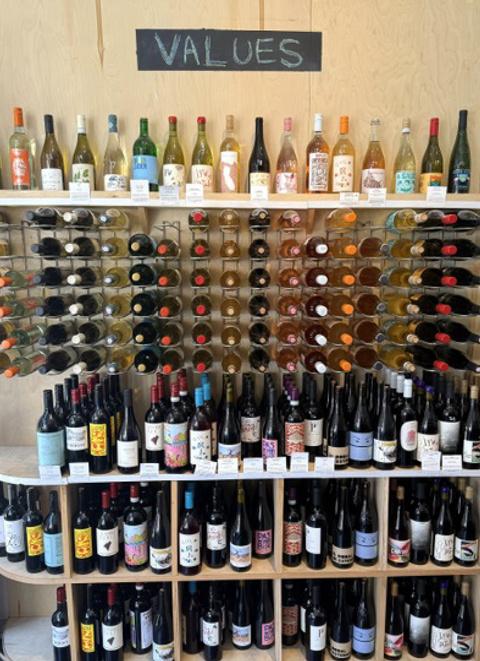
ties from smaller producers, it’s easier than ever to keep our shelves full owing to the expanding number of ethical wine makers found today.”
Are these retailers catering to customers who are there because of their store’s ethical focus? Yes and no. We were surprised to learn that everyone had customers who only drink ethical wines, but also some for whom this is not a priority. Several sellers exhibited an almost religious zeal when describing how they were pleased when unknowing buyers show up because it gives them a proselytizing opportunity. As an aside, two retailers with stores thousands of miles apart used Josh Cabernet Sauvignon as an example of the type of wine they were trying to steer their customers away from.
We learned that as passionate as these wine sellers are, not everyone applies a litmus test to the ‘purity’ of their product. For example, Springer stated, “If the grower used fungicide in a wet year to save the crop from mildew, so be it. We are not in the position of telling the growers what to do. We trust them to work thoughtfully and conscientiously in the vineyard and cellar to do what they must to thrive and make great wine. We find that good farming, smart resource management, and less manipulation in the cellar makes better wine.”
The nature of selling has changed. Decades ago, when we were discovering wines, the goal was to identify a label we enjoyed and to return to it. In contrast, Spradling said, “The availability of natural wine has brought more young people into this store than I could have imagined 10 years ago. But they can be a fickle lot—trying something once and absolutely loving it yet never wanting the same thing again. They ask, ‘What else have you got in the category?’
The stars have aligned. The quality of ethical wines is as good as, or according to our interviewees, better than, conventional wines. Consumers are focused on the planet’s health and their own. Luckily, dedicated and successful distributors and retailers are there to facilitate this ethical transition.
BOOK
Eric Himmel’s survey of two centuries of natural history illustration rescues a forgotten art movement from the margins of both art history and science.
BY JASON ASHLOCK
There is a game children play in which they are given a very large piece of paper and told to draw every animal they know. The results begin confidently enough: dogs, horses, the required giraffe. Then comes a stretch of invention, where dolphins acquire extra fins and elephants become structurally approximate. And then, somewhere around the forty-seventh creature, the child stops. Not because the world has run out of animals. Because the child has run out of world.
Eric Himmel’s The Art of Biodiversity: Artists & Naturalists, 1700–1900 is, at its most essential, a meditation on what happens when you refuse to stop. It chronicles the two centuries in which a remarkable coalition of the obsessed—scientists who could draw, artists who could observe, wealthy patrons who could fund expeditions to places that did not yet appear on maps—undertook to picture every living thing on Earth. And not figuratively. Every shell, every beetle, every improbable
flower blooming in the cloud forests above Quito. They were going to make a complete family album of the planet, and for a while, intoxicated by Linnaean taxonomy and the romance of the unexplored, they almost believed they could.
The book arrives at a peculiar historical moment, which is to say, at precisely the right one. We are living through what Elizabeth Kolbert has called the sixth extinction, a die-off of species occurring at a rate between 100 and 1,000 times the background rate. To open a book of luminous eighteenthcentury watercolors of birds that no longer exist is to feel something that has no quite adequate name: not exactly nostalgia, not exactly grief, but something in the neighborhood of both, with an undercurrent of angst. And accusation. And, in the case of this reader and many others, anger.
Himmel is ideally suited to guide us through such an emotional and aesthetic spectrum. Having spent more than 40 years
as an editor at Abrams, he brings to the project the editor’s indispensable gift of knowing what to cut, and knowing what, once cut, would leave the reader diminished. He is also the son of the photographers Lillian Bassman and Paul Himmel, which means he was raised to understand that a hand-colored engraving is both a record and an argument about what deserves to be seen.
Here is his contention: natural history illustration was not merely a visual supplement to science but a formidable art movement in its own right. Art history has largely filed this period’s visual culture under the headings of “decorative” or “documentary,” categories designed to exempt the classifier from having to think too hard. Himmel is interested in what gets lost when we don’t. Quite a lot, it turns out. The sheer perceptual achievement of a Maria Sibylla Merian carefully recording the life cycle of a Surinamese moth, or an Ernst Haeckel rendering radiolarians with a formal elegance that Mondrian might have admired.
It’s worth reading The Art of Biodiversity alongside Susan Stewart’s On Longing—her extraordinary meditation on the miniature and the culture of collecting. The two propose a deeper cultural logic at work. The natural history cabinet, the great taxonomic folio, the illustrated expedition journal: these were enactments of a fantasy that the world could be contained, surveyed, held in the hand. The naturalist-artists Himmel describes were engaged in something similar, and something more unsettling, because the world they were trying to miniaturize kept expanding. Every expedition returned with species that required new categories. The inventory was self-defeating in the most glorious possible way.
This is where Alexander vonHumboldt enters. Andrea Wulf’s The Invention of Nature gave us the Prussian polymath as protoecologist, the first scientist to understand that everything is connected. Himmel gives us something more particular: Humboldt as visual thinker, a man who understood that his sublime argument about nature required images as much as equations. The famous Naturgemälde, the diagram of plant zones ascending Chimborazo, is not a graph with aesthetic ambitions, but a work of art with scientific precision. Himmel’s book helps us see why that distinction matters less than we have been told.
“The Venus Flower basket appears first as a deep-sea creature, then, on the facing page, as pure skeletal geometry: the same object, seen twice, suddenly strange both times.”
The Art of Biodiversity is heavy, substantial enough to require both hands, and yet it never behaves like a coffee-table book. It is meant to be both admired and read. Himmel has arranged his images and text as genuine partners. A ghostly puffball faces a brazen fly agaric across a gutter. A sifaka monkey, alive with that extravagant tail, occupies a full page opposite a biography dense with colonial politics and personal obsession. The Venus flower basket appears first as deep-sea creature, then, on the facing page, as pure skeletal geometry: the same object, seen twice, suddenly strange both times. You turn pages the way you turn corners in an unfamiliar city: not quite knowing what’s next, but already glad you came.
What Himmel’s book asks us to sit with is a question that has become newly urgent: what does it mean to picture these creatures, in a world that is vanishing? The naturalists were not worried about running out of species. They were worried about keeping up. We have inherited their images, their categories, their careful names, and we are now watching the named things disappear. The great folios in the digitized libraries Himmel describes are becoming something they were never intended to be: records not of what is, but of what was.
This is not a reason for despair. Or rather, it is, but it is also a reason for despair and something else. The art Himmel has recovered reminds us that attention is itself a moral act, that to look carefully at a living thing is to enter into a kind of obligation toward it. What his naturalistartists were ultimately making was not just an album of the Earth, but a case that the Earth deserved an album. That it was worth the looking, the drawing, the naming, the not-stopping.
In an ambitious addition to his now iconic canon, Eric Ries argues that mission-driven companies don’t fail in the marketplace. Their own governance dismantles them.
BOOK BY JASON ASHLOCK
In 1800, Scottish industrialist Robert Owen doubled his workers’ wages, provided free childcare and medical care, and cut shifts at his New Lanark cotton mills. In the years that followed, the mill produced spectacular returns. Naturally, he assumed his actions would inspire fellow manufacturers to follow suit. They did not. His investors, one set after another, eventually wrested back the mill and dismantled his reforms. He died bankrupt. When Emerson asked him in 1841 how many others in his position would follow his example, Owen replied: “Not one.”
Some 225 years later, Eric Reis invites us into the Greek tragedy that is Silicon Valley. Owen would recognize it well. There is an early scene in his new book, Incorruptible, in which a founder has built something extraordinary. Investors circle. The board is captured. The founder is ousted. The company dies. The investors, having slaughtered their golden goose, are baffled by the lack of eggs.
Ries calls this “enlightened capitalism’s fatal flaw.” And it is the animating tragedy of his new tome. This book is more likely than even his first groundbreaking manifesto to change the way businesses understand themselves in the market.
When Reis’s The Lean Startup appeared in 2011, it gave a generation of founders a rigorous vocabulary for building products under conditions of radical uncertainty. In 2017, he brought his entrepreneurial discipline to the enterprise in The Startup Way. Now, Incorruptible arrives, a book Ries says he wishes he had written first. However belated, it is welcome.
The central argument is elegant and brutal: mission-driven organizations consistently outperform their purely extractive peers. They are consistently dismantled by their own investors the moment they achieve success worth dismantling. Ries names this force “financial gravity.” Like physical gravity, it operates whether you believe in it or not. Unlike Newton’s discovery, it has so far inspired no equivalent engineering solution in mainstream practice. Until, Reis argues, now. Incorruptible unfolds in three acts. The first, “The Shape of the Abyss,” is a controlled demolition. Ries walks through a graveyard:
FedMart, Polaroid, Cadbury, Toys “R” Us, Whole Foods, Boeing. Each case study traces a familiar arc: a founding vision, a period of exceptional performance, a structural vulnerability, and then: extraction.
Organizations, Reis suggests rightly, are not simply the sum of their employees’ intentions; they are what he calls “superorganisms.” Entities with emergent behavior that can diverge dramatically from any individual’s will. A CEO can sincerely believe in craftsmanship, but if employees see that stock price misses get people fired and quarterly beats get bonuses, the organization’s actual values will diverge from its stated ones. Reliably, invisibly, and always. Nobody set out to be Boeing. The force that aligns organizations is not leadership but the relentless pull of whoever controls the resources they depend on.
The Whole Foods story is the book’s most detailed post-mortem, and the most devastating. John Mackey knew cutting prices was the obvious move. He could not do it. The reason was not cowardice but structural: thousands of employees held stock options tied to their retirements. He had distributed economic ownership as an act of loyalty, and in doing so had created a constituency for the very shorttermism he abhorred. When hedge fund Jana Partners took its 8.3% stake in 2017, and the infamous boathouse meeting with Jeff Bezos followed, it was not merely greedy bastards triumphing over conscious capitalism. It was a building designed without
accounting for wind loads, which finally gave way.
On day one of ownership, Amazon cut prices by as much as 43%. What Mackey had known as necessary but structurally impossible was executed in a single afternoon.
The second act, “Escape Velocity,” is where the book earns its keep as something more than an eloquent and elegant diagnosis. Ries introduces “mission drive,” the discipline of ensuring that an organization only profits by fulfilling its mission. Devoted Health, the Medicare Advantage insurer cofounded by Todd Park, offers the clearest illustration: “The healthier we keep people, the more money we make.” Mission attainment and profit maximization point in the same direction by design.
Patagonia is, inevitably, the other extended case study. But here, Reis is more precise than the overused corporate parables that often attend the activist outfitter.
Yvon Chouinard founded Patagonia as a climber who once handforged his own carabiners. His philosophy classes asking “What does it mean for an object to be of high quality?” sound eccentric in the retelling. Ries shows how they functioned as constitutional instruction, creating an organization capable of making mission-consistent decisions in the founders’ absence. When lender HSBC, during a near-bankruptcy restructuring, demanded Patagonia cease its environmental grants as a condition of their workout, CEO Kris McDivitt refused. The bank relented.
The third act gets directly into governance architecture: supervoting shares, public benefit corporation status, board mission pledges, tenure voting, and steward ownership. Sounds dull? Reconsider. It is in exactly these arenas that the corruptibility becomes preventable. Costco’s “governance fortress” (interlocking supermajority provisions that have fended off decades of activist pressure) gets the book’s
most detailed treatment. Given the company has compounded at roughly 58 times the S&P 500 since its 1985 IPO, it’s the closest the book gets to a corporate design manual.
A bracing sidebar shreds the empirical foundations of governance “best practice”: mandatory quarterly reporting, annual board elections, majority-independent boards. Study after study, Ries shows, finds that these conventions, championed by proxy advisory firms like ISS, have destroyed rather than created value. It demands attention and, if a reader has not outsourced every last k-cal of critical thinking to the LLM de jour, prompts serious self-reflection. ISS has rated Costco—it of the 58to-1 outperformance—at maximum risk of “shareholder disenfranchisement.” So: less argument than prosecutorial exhibit.
The book is most personal and vulnerable in its account of the Long-Term Stock Exchange, Ries’s attempt to build a trading venue whose standards for listed companies would reward long-term thinking. A coalition of hedge funds made a midnight offer: abandon your principles, adopt “best practices,” and your problems disappear.
Ries refused. His team voted unanimously to refuse. He spent the night on a bathroom floor.
The LTSE survived. But Ries is not triumphal. Financial gravity is enforced not only by bad actors but by good ones acting rationally under bad structures. The investment banker who offered to add loopholes, the hedge fund that launched a “technical attack by accident”—these were not cartoon villains. Merely organisms behaving in accordance with incentives. As we humans do.
This is the philosophical move that elevates Incorruptible above the genre of well-intentioned memoirs by misguided corporate piety. Ries is not arguing for better people. He is arguing for better institutions, the organizational equivalent of what Madison, in Federalist 51, called “auxiliary precautions,” the structural checks that protect a republic even when its leaders fail. Or consider Eero Saarinen, who believed a building’s concept had to be “repeated in every part of its interior so that wherever you are, inside or outside, the building sings with the same message.” For Ries, this is mission drive at its best: not culture as values on a conference room wall, but architecture that makes corruption structurally impossible. As Ries has said recently in interviews, he eschewed the term “culture” in this book. However genuine, culture lives in people who can be replaced. Architecture endures.
Robert Owen, Sol Price, and John Mackey all independently discovered that treating people well is also, usually, the more profitable approach. And they were all, in their way, destroyed by the discovery. Ries does not exactly promise his framework will break the two-century cycle. But he offers something Owen lacked: a theory of the mechanism, and a set of structural tools for fighting back.
The exceptions, he insists, are likely to become the rule. Whether you believe him or not, read the argument. Consider it a minimum viable product for a better capitalism.
The new openings worth knowing now.
BY PAUL TUMPOWSKY
Each season brings a new wave of hotel openings, but this spring feels more deliberate than others. Across the world, several long-anticipated projects are finally coming to life, many of them rooted in restoration and heritage. Rather than chasing scale and spectacle, these openings are leaning into detail and design. The result is a group of hotels that don’t expand the map, but refine it, offering travelers more considered reasons to return to destinations they thought they already knew.
(Opened April 2026)
Venice prefers mystery to explanation, and Airelles Venezia understands this instinct perfectly. Set on the tranquil island of Giudecca, just five minutes by gondola from St. Mark’s Square, the hotel occupies a collection of historic palazzos that once hosted lavish celebrations for distinguished guests and later sheltered artists intent on capturing the city’s light. It has now been reawakened— carefully, romantically, and with intent.
The 45 rooms and suites look out across the lagoon toward Venice’s most famous skyline, while over two acres of hidden gardens provide a counterpoint to the city’s theatrical energy. Days move between quiet indulgences—three pools, a multi-level spa, unhurried lunches—and swift crossings into the Piazza’s hum. Dining is polished, atmospheres hushed, and everything feels deliberately removed from the spectacle across the water in a way that only Airelles can.
(Opened March 2026)
Corinthia is preparing a suitably serious entrance into Rome, setting up shop in the former headquarters of Italy’s Central Bank—because if you’re going to do ultra-luxury, you may as well start with power and marble. Set on Piazza del Parlamento, Corinthia Rome will transform a 19th-century neoclassical palazzo into a discreetly glamorous address for people who prefer their history banked, not buried. The property houses refined rooms and suites, a central garden wrapped by restaurants and bars, a Corinthia Spa, and a rooftop terrace designed for contemplating the Eternal City— preferably with a drink in hand. Carlo Cracco is overseeing the culinary ambitions, ensuring the dining is as confident as the location.


(Opened March 2026)
In the heart of Pommard, surrounded by Premier Cru vineyards, Château La Commaraine reopens as Burgundy’s first true vineyard-immersive five-star stay. The 12th-century château, meticulously restored over four years, sits within its own monopole clos, making the wine not just a backdrop but the point.
The architecture is intentionally restrained. Under the architect Richard Martinet, historic stonework and cellar structures are preserved with nearinvisibility, while interiors introduce a quiet, contemporary clarity that never competes with the setting. The 37 rooms and suites are residential, many overlooking the vines, one even positioned above the winery itself.
Dining is serious. Christophe Raoux and Jérôme Rioux oversee two restaurants, including a cellar-set fine dining space that reads as both technical and deeply tied to terroir. A spa with biotech-led treatments and vineyard-rooted rituals completes the offering.
What makes this opening notable is its specificity. This is not Burgundy as a stopover, but as a fully inhabited experience.
(Opened March 2026)
Tucked into Cannaregio, where Venice still feels lived-in rather than staged, Palazzo Donà Giovannelli reemerges as Orient Express Venezia, a 15th-century palazzo newly recast as a hotel for the first time in nearly six centuries. The setting is deliberate. Away from the city’s main currents, yet threaded by canals, it trades spectacle for atmosphere.
The restoration by Aline Asmar d’Amman leans into contrast. Frescoes, carved stone, and neogothic flourishes meet mirrored surfaces, Murano chandeliers, and a quietly theatrical sense of movement. The 47 rooms and suites feel more like chapters than categories, each shaped by the building’s layered past.
Dining carries weight, led by Heinz Beck, with a fine dining concept set in the orangerie and a more expressive all-day restaurant anchored by a private garden. A hidden inner garden and salon-like public spaces reinforce the sense of a cultural stage.
What makes this opening notable is its intent. It positions Venice not as a backdrop, but as a narrative.
(Opened February 2026)
Set on a quiet street in Fitzrovia, just north of Soho and within easy reach of Mayfair and Bloomsbury, The Newman positions itself in that rare pocket of central London that still feels local. It is the first hotel from Kinsfolk & Co., and notably, it arrives without the usual grandstanding.
Design by Lind + Almond draws directly from Fitzrovia’s literary and bohemian past, layering Art Deco references over Victorian bones with a level of detail that feels researched rather than styled. The 81 rooms lean restrained but characterful, with subtle nods to the neighborhood’s cultural figures woven throughout.
Downstairs, Brasserie Angelica is conceived as a true neighborhood restaurant, while Gambit Bar already reads as a destination in its own right. The real differentiator is the wellness floor. A hydrotherapy pool, salt therapy room, and hot-and-cold circuits make it feel more like a private members’ club than a typical city hotel.
What makes The Newman interesting is its discipline. It is designed less to impress and more to belong, which in London is often the harder move.
(Opened March 2026)
Set within the reimagined Whiteley building on Queensway, Six Senses London brings the brand’s wellness-first philosophy into West London, a short walk from Hyde Park and Notting Hill. This is not a countryside transplant but a deliberate urban evolution, part of IHG Hotels & Resorts’ broader push to translate Six Senses’ DNA into city life.
Architecturally, the project balances preservation and intervention. The historic shell, complete with grand volumes and period detailing, is softened by AvroKO’s interiors, where biophilic design and muted palettes create a sense of retreat rather than spectacle. The 109 rooms follow suit, quietly calibrated for rest over display.
The center of gravity is the 2,300-squaremeter spa, which reads more like a longevity club than a hotel facility, with magnesium pools, biohacking suites, and tailored wellness programs. Dining at Whiteley’s Kitchen leans into seasonality and local sourcing, while the debut Six Senses Place introduces a members-led social layer.
What makes this opening notable is the timing. In a city defined by pace, Six Senses is effectively selling the opposite.




(Opened April 2026)
Set across the Gulf from Saint-Tropez, COMO Le Beauvallon occupies a quieter, more strategic vantage point on the Côte d’Azur, eight minutes by private boat from the port yet removed from its constant theater. The 1914 Belle Époque palace, long shuttered, has been carefully restored by COMO Hotels and Resorts, whose track record in wellnessled hospitality lends the project a sense of discipline rather than nostalgia.
Architecturally, the property leans into its provenance. Grand façades, terraces, and gardens remain intact, while interiors introduce a lighter hand through curated contemporary art and softened Riviera palettes. The 38 rooms and suites feel intentionally residential, more like a private home than a grand hotel.
Dining is a clear statement. Yannick Alléno oversees the culinary program, with a waterfront restaurant designed to draw both guests and the yachting set. A COMO Shambhala wellness offering anchors the slower rhythm.
(Opened April 2026)
In Cartagena’s Getsemaní district, where the city’s creative energy still feels intact, Four Seasons Hotel and Residences Cartagena arrives as a carefully layered project rather than a single statement building. A collection of restored landmarks, including a former church, theatre, and social club, has been reassembled into a cohesive whole, guided in part by the late François Catroux. The effect is less resort, more urban compound.
The positioning is precise. Steps from the Walled City but firmly rooted in Getsemaní, it captures both heritage and the city’s evolving cultural pulse. Across 131 rooms and suites, colonial architecture meets a quieter, contemporary sensibility, with courtyards and passageways encouraging exploration.
Dining is expansive and intentional, with eight venues including a Major Food Groupled grill and a rooftop bar calibrated for sunset. Umari Spa draws on Colombian botanicals and ancestral traditions within a restored cloister setting.
What makes this opening matter is scale with nuance. It reframes Cartagena as a destination that can hold both history and momentum.
(Reopened May 2026)
On Collins Avenue, where Miami’s hotel scene has long favored spectacle over subtlety, Delano Miami Beach returns with a more measured kind of confidence. Reopened under Ennismore, the property revisits its Art Deco bones with care, restoring terrazzo floors, signature columns, and the iconic pool while softening the once stark aesthetic into something more livable.
The positioning remains central. South Beach, steps from Lincoln Road, but still firmly oceanfront, which continues to matter. Across 171 rooms and suites, light-filled interiors and curved detailing favor ease over excess, with poolside bungalows and penthouses extending the social narrative.
Dining carries the reset. Paris Society introduces Mimi Kakushi and Gigi Rigolatto, bringing a sharper, more global perspective to Miami’s restaurant landscape, while the Rose Bar reclaims its role as the room to know. A new social spa and members club round out the offering.
What makes this opening interesting is its restraint. The Delano no longer needs to prove itself; it simply edits.
(Opened May 2026)
Seven minutes by boat from Bandol, yet a world apart from the Riviera’s usual choreography, Zannier Île de Bendor reopens a private island with a point of view. Once the playground of pastis magnate Paul Ricard, the seven-hectare island has been reimagined by Zannier Hotels as a villagelike retreat where Provençal ease meets a quieter kind of glamour.
The design avoids a singular narrative. Instead, three distinct zones span 93 rooms, from 1960s Riviera nostalgia to fishermanstyle houses and wellness-driven minimalism, all threaded together by gardens, courtyards, and the Mediterranean itself. The effect is less resort, more selfcontained world.
Dining is intentionally varied, with multiple restaurants and bars encouraging movement across the island, while a 1,200-square-meter wellness center anchors longer stays with a serious, multidisciplinary approach. A beach club, a diving center, and an artisan village complete the offering.
What makes this opening notable is its timing. As the Riviera leans louder, Bendor opts for something arguably more compelling.
SUMMER’S SOCIAL CALENDAR IS FULL. HERE ARE THE EVENTS WORTH ATTENDING.
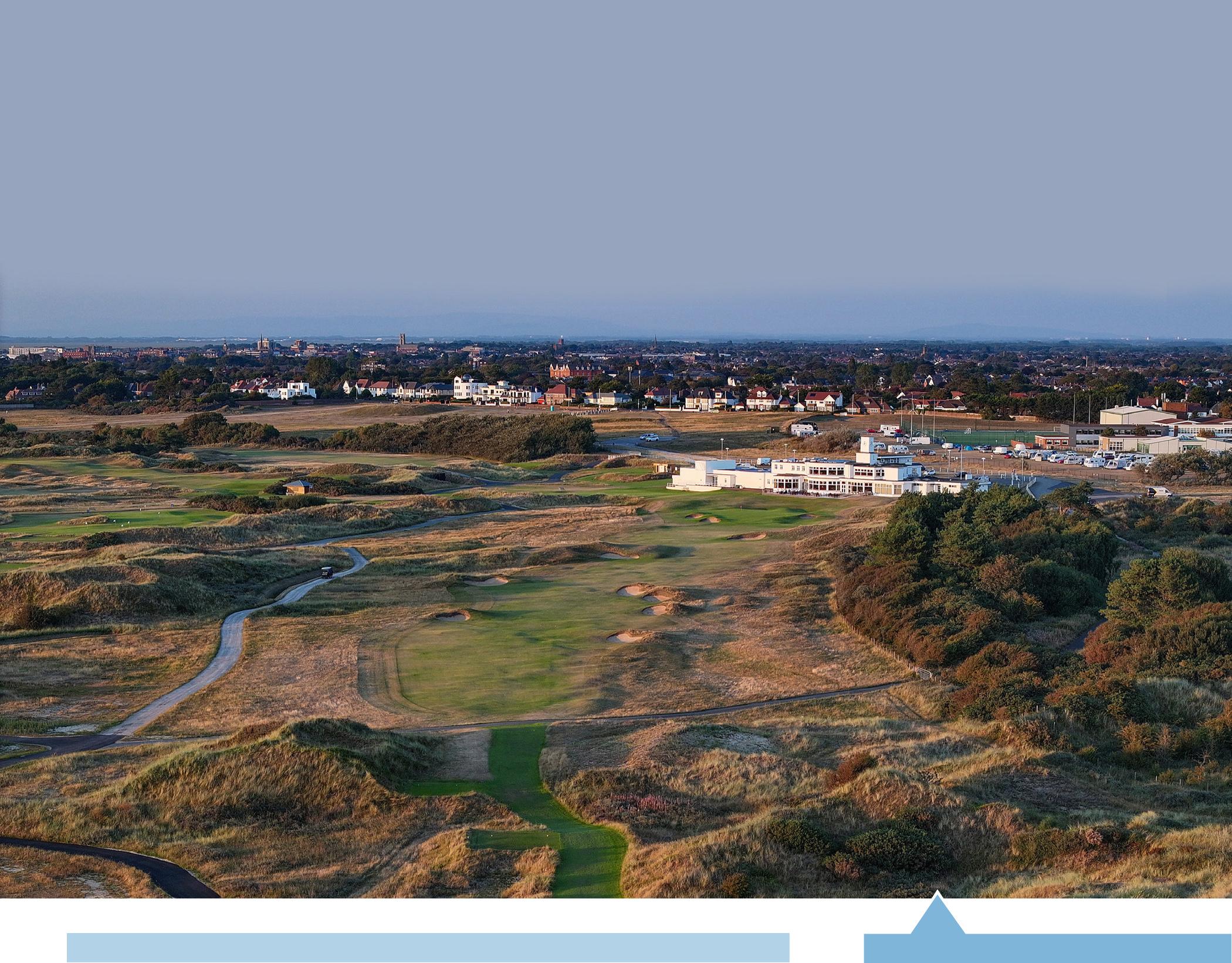
June 17, 2026 New York, New York
Living Well With Worth is an executivefocused, day-long conference convening leaders at the frontier of health, longevity, and human performance. At a time when AI is reshaping medicine, personalized care is expanding, and health equity is squarely on the global agenda, Living Well examines how these forces influence wealth, leadership, systems, and society.
Aug. 24-Sept. 6, 2026 New York, New York
The year’s final Grand Slam takes over Flushing Meadows for two weeks of latesummer drama, with night sessions at Arthur Ashe Stadium drawing the biggest names in the sport. Off the court, the tournament has become as much a cultural fixture as a sporting one—a fitting close to the major season.
June 22-28, 2026 Aspen, Colorado
For a week, Aspen becomes the country’s living seminar room as scholars, scientists, artists, and policymakers convene to wrestle with the questions shaping the moment. From democracy and AI to climate and culture, the festival pairs serious dialogue with the kind of highaltitude optimism that rarely survives a hot summer city block.
Sept. 15, 2026 New York, New York
Groundbreaking Women: The Culture of Power is one of Worth’s most anticipated convenings, gathering leaders advancing women’s progress across business, finance, media, health, and policy. The program celebrates the magazine’s annual Groundbreaking Women List and examines the cultural and economic forces reshaping leadership in the United States.
July 16-19, 2026 Southport, England
The world’s oldest major returns to Royal Birkdale on the northwest English coast, where salt wind off the Irish Sea and unforgiving pot bunkers will again separate the great from the merely good. Few weekends in sport feel this elemental— links golf at its most demanding, watched by a global gallery that knows the Claret Jug is earned, not won.
Sept. 23-26, 2026 Monaco
The world’s premier gathering of superyachts, designers, and buyers transforms Port Hercules for four days each fall. More than 100 vessels—many making their global debut—line the harbor, accompanied by tenders, toys, and the quiet dealmaking that sets the year’s trends in luxury yachting.

Because a life well-lived is the real return.

One day it won’t be about the places you could have gone, but the memories you chose to make. A $1 billion portfolio of private residences and experiences. Journeys that span the globe — and the seasons of your life. And a community of Members who travel with purpose, not pretense. Because living well isn’t about having it all. It’s about choosing what matters most — and making time for it. This isn’t just a Club. It’s your blueprint for a life well-lived.