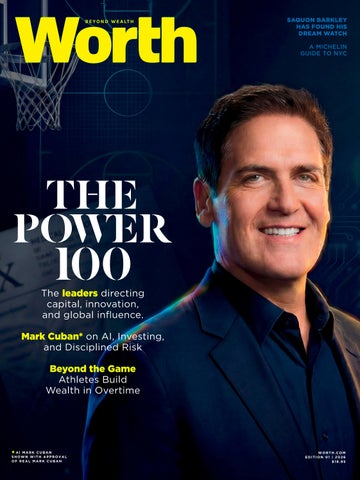
The Power 100 Issue 2026

Page 1


THE POWER

One day it won’t be about the places you could have gone, but the memories you chose to make. A $1 billion portfolio of private residences and experiences. Journeys that span the globe — and the seasons of your life. And a community of Members who travel with purpose, not pretense. Because living well isn’t about having it all. It’s about choosing what matters most — and making time for it. This isn’t just a Club. It’s your blueprint for a life well lived.

CHAIRMAN

Jim McCann

CHIEF EXECUTIVE OFFICER

Josh Kampel

PRESIDENT

Paul Stamoulis

EDITORIAL

EDITORIAL DIRECTOR

SENIOR EDITOR

ASSISTANT EDITOR

CREATIVE DIRECTOR

CONTRIBUTORS

Dan Costa

Eva Shae Crouse

Caroline Bienfang

Nicole Dudka

Cait Bazemore, Larry Kantor, Max Isaacman, Jonathan Russo, Deborah Grayson, Kirsten Cluthe, Oliver Rist, Tim Stevens, Bob Diamond

PARTNERSHIPS, ADVERTISING & EVENTS

VP, SALES & MARKETING

VP OF PARTNERSHIPS

VP OF PARTNERSHIPS

ASSOCIATE ACCOUNT MANAGER

DIRECTOR OF SPECIAL PROJECTS

SENIOR ADVISOR, STRATEGIC PARTNERSHIPS

Kendall Wyckoff

Ron Stern

David Bernstein

Neil Madlener

Gabrielle Doré

Eleanor Dixson-Hobbs

PRODUCT, OPERATIONS & FINANCE

DIRECTOR OF HOSPITALITY Kimberly Anderson-Marichal

Our Mission Is Building Worth Beyond Wealth

Worth helps our influential, successful community better invest their time and money. We believe business is a lever for social and economic progress. From practical financial advice to exclusive profiles of industry leaders, Worth inspires our readers to lead more purpose-driven lives. Through our conferences, digital channels, and quarterly print publication, we connect the people and companies that are building the future. We showcase products and services that are indulgent, luxurious, and sustainable.

The New Power 100: Where Influence Lives Now

The nature of power is a question that’s been debated and analyzed for at least three millennia. Plato talked about power’s relation to justice. Machiavelli dissected its mechanics. Foucault traced its capillaries through institutions and bodies. Each generation returns to the subject because power evolves alongside society itself.

More than 15 years ago, the editor of Worth introduced its ranking of the 100 most powerful people with a deceptively simple question: What is the definition of power? His conclusion was that it’s more than the accumulation of wealth or holding a high-level position.

The editor’s conclusion was more practical than theoretical: Power is defined by its effect. Can you change a person’s life? Does your influence reach hundreds, thousands, even millions? Power becomes visible in outcomes and in the opportunities created for others.

The annual list of powerful people paused years ago, and its absence was felt. The list offered a snapshot of influence in motion, highlighting not only who held power, but how that power shaped lives.

In this issue, the Power 100 list returns at a moment when clarity around power is much-need. Their decisions move industries, influence markets, accelerate ideas, and at their best, bring people together.

The list, unlike its financefocused predecessor, also reflects the many places power now resides.

In technology, advances in artificial intelligence are reshaping how people work and learn, while in finance, monetary policy influences employment and economic confidence across continents. Meanwhile, healthcare leadership affects who will live and die, while philanthropy expands opportunity through large-scale investment across all needs.

As in earlier editions, this list recognizes individuals whose decisions affect how people work, what they can afford, the care they receive, and the information they encounter. Understanding who holds influence provides insight into the forces shaping the moment.

For readers seeking a deeper examination of modern leadership, Trump’s 10 Commandments by Jeffrey Sonnenfeld, offers a study of how influence is built and sustained. The volume draws on Professor Sonnenfeld’s firsthand interactions with President Trump as well as decades of research on leadership at Yale’s School of Management. Rather than serving as commentary, the book analyzes patterns—decision-making instincts, communication strategies, negotiation tactics, and approaches to loyalty and leverage—that have shaped one of the most closely watched political figures of the past decade. Sonnenfeld organizes these observations into a framework designed to explain how power operates in practice at the highest levels.

It will be released March 31 by Worth Books and available everywhere books are sold.

FLORIDA

MACHU PICCHU

EASTER ISLAND

TAHITI

GREAT BARRIER REEF

ANGKOR WAT

TAJ MAHAL

SERENGETI PLAIN

LUXOR AND CAIRO

MARRAKECH

The Architecture of Influence

Power is built and exercised by individuals whose decisions shape markets and institutions. This issue examines who operates at those leverage points— and how they use that influence.

The first quarter of the year has really set the tone for Worth. We began in Davos during the World Economic Forum, where we convened conversations with global leaders that reflected a noticeable shift. The dialogue felt less abstract, less about theoretical risk, and more about measurable outcomes. Capital allocation, technological acceleration, regulatory frameworks, and longterm value creation were not just academic topics, they were operational priorities. It reinforced a belief we have long held that influence and capital, when paired with discipline, shape the direction of markets and societies.

From Davos, we moved directly into our Super Bowl special edition, anchored by NFL legend Joe Montana. Featuring Joe was not just an exercise in nostalgia, it was an acknowledgment of his evolution. His work as a venture investor illustrates a broader transformation underway in sports. Today’s elite athletes are not simply brand ambassadors, they are capital allocators, founders, and partners in enterprise. They understand ownership, governance, and long-term value creation in ways that would have been uncommon a generation ago. That intersection of business, finance, and sports is not a passing fascination for Worth. It is a strategic focus. Sports is one of the most

powerful economic engines in the world, influencing private equity transactions, consumer brands, and technology platforms. The athletes operating within it are increasingly sophisticated participants in those ecosystems.

This issue continues that commitment. We recognize athletes who are building companies, launching funds, investing in innovation, and using their platforms to create durable enterprises. They are not waiting for a second act, they are constructing it in real time.

Alongside this coverage, we are proud to reintroduce the Power 100.

The word “power” to some may carry a negative connotation that suggests dominance and hierarchy. That is not what we seek to celebrate. Power, in our view, is a tool that should be judged based on how it is exercised.

The individuals on our Power 100 have the ability to move financial markets, redefine industries, and influence the architecture of the global economy. Some manage significant pools of capital, others lead transformative enterprises, or shape technological frameworks. What unites them is not status, but impact. They operate at leverage points within complex systems, and their decisions reverberate far beyond quarterly earnings.

At Worth, we believe that influence carries obligation. The accumulation of power is not the objective, its responsible deployment is.

The throughline from Davos to the Super Bowl to this issue’s Power 100 is consistent. Markets do not move on their own. Industries do not transform by accident. People drive those outcomes. Our role is to examine who they are, how they think, and how they wield the tools at their disposal.

We are committed to covering the mechanisms of markets and the individuals who shape them. We are equally committed to exploring how economic ambition can coexist with social progress. Performance and purpose are not mutually exclusive, the most durable value is created when they align.

As we move further into the year, that focus will continue. We will spotlight leaders who understand that capital has consequence, that influence demands intention, and that power, when guided by principle, can advance both economic growth and broader societal good.

The Power to Change the World

This year’s Power 100 recognizes builders and allocators at historic scale— and confronts the risks of power pursued for its own sake.

Putting together the Worth Power 100 always begins with a straightforward question: Who can actually move markets? Who can redirect capital, change the regulatory climate, tilt a supply chain, alter the direction of a technology, or shift public attention with a single decision?

The names aren’t hard to find. You see them in earnings reports and rate announcements, in chip output and vaccine pipelines, in media deals and acquisition headlines. Power leaves fingerprints. What’s harder is sitting with what it means to publish a list like this.

Lists can feel like coronations. They confer status. They imply approval. They can quietly blur the line between influence and virtue. That isn’t what we’re trying to do. (We have a Worthy 100 list for that.)

The Power 100 is meant to be an inventory of capacity. The people in these pages can move systems—financial, technological, cultural, political— at enormous scale. In a world defined by speed and volatility, that capacity matters. It builds infrastructure. It steadies markets. It funds research and sets standards most of us rely on without noticing.

But power has always cut both ways. Thomas Hobbes wrote about the “perpetual and restless desire of power after power.” I find myself thinking about that line while reviewing nominations. In business and in politics, more often looks like better. More capital means more stability. More market share means more resilience. More influence means more protection.

There is always a rationale for the next increment.

Machiavelli understood how easily effectiveness separates from legitimacy. Being feared can be efficient. Decisive action can outrun consent. The modern economy rewards speed and scale. It rewards those who can move before the guardrails even notice. Just ask any AI unicorn.

Montesquieu warned that people with power tend to test its limits until they meet resistance. Madison believed ambition needed to be counterbalanced by ambition. Systems endure not because leaders are pure, but because constraints are strong. Those ideas have clearly fallen out of fashion, both in Washington and in corporate boardrooms.

That tension sits at the center of this issue. When capital, market dominance, political access, and cultural reach are concentrated in the same hands, accountability becomes harder. Regulatory complexity becomes a shield. Access becomes currency. Institutions designed to check power can grow dependent on it.

We’ve seen what proximity can do. Private flights, foundations, donor networks, board seats—elite circles can blur the line between influence and endorsement. The Jeffrey Epstein files are not just a chronicle of criminal behavior. They’re a reminder of how the pursuit of access—of wanting to be in the room—can lead to its own ruin. We can only hope that ruin find those who truly deserve it.

And yet, rejecting power outright would be naïve. The ability to allocate

billions into AI infrastructure, coordinate vaccine production, stabilize interest rates, move goods across continents, finance housing, and enforce safety standards—these are not trivial capacities. Many people in this issue have delivered real, measurable value at scale. They have built companies, led institutions, and navigated crises that required conviction.

The problem is not that power exists. The question is what it builds. Does it strengthen institutions or quietly bend them? Does it widen opportunity or harden advantage? Does it invite scrutiny or insulate itself from it? Does it leave systems sturdier than it found them?

So what is Worth’s stance on power? We believe in measured admiration— for builders, allocators, inventors, stewards, and public servants whose decisions shape the landscape we all live in. And we believe in clarity: power is a tool, and every tool has failure modes. Celebrating impact while refusing to sanctify its holders feels more authentic.

We hope this issue prompts a dual awareness—of what power can accomplish at its best, and of the guardrails required to keep it worthy of trust. Because the deepest question is not who has power. It’s what kind of society that power is building—and whether it remains accountable to the people who live inside it.

There are a million reasons to give. There’s one way to do it better.

Your charitable giving can go further with a donor-advised fund account from DAFgiving360™. Claim a tax deduction for contributions, invest the funds for potential tax-free growth, and recommend when and where to give—whether immediately or over time. Maximize your charitable giving using a fund with 25 years of expertise bringing donors, financial advisors, and charities together to make a greater impact.

Scan to learn how to take your giving to the next level dafgiving360 org/donor-advised-funds

A donor’s ability to claim itemized deductions is subject to a variety of limitations depending on the donor’s specific tax situation.

DAFgiving360™ does not provide legal or tax advice. Please consult a qualified legal or tax advisor where such advice is necessary or appropriate.

Contributions made to DAFgiving360 are considered an irrevocable gift and are not refundable. Once contributed, DAFgiving360 has exclusive legal control over the contributed assets.

DAFgiving360 is the name used for the combined programs and services of Donor Advised Charitable Giving, Inc., an independent nonprofit organization which has entered into service agreements with certain subsidiaries of The Charles Schwab Corporation. DAFgiving360 is a tax-exempt public charity as described in Sections 501(c)(3), 509(a)(1), and 170(b)(1)(A)(vi) of the Internal Revenue Code.

©2026 Donor Advised Charitable Giving, Inc. All rights reserved. (0126-2UM3)

Oliver Rist

Oliver Rist is a long-time journalist specializing in all kinds of technology. Though he lives in Connecticut, he’s traveled the world, usually astride a motorcycle. Riding like this, he’s motored up and down Route 66, negotiated an ocean of switchbacks across the Alps touching Germany, France, and Italy; whizzed through the Andalusians; traveled the length of the Pacific Coast Highway down to Cabo San Lucas in Baja; even dragged a modified Norton up the Tribhuvan Highway in Nepal back when he was younger, dumber, and didn’t yet suffer from altitude sickness. His current rides are a Ducati Diavel and an aging, but nevertheless awesome, BMW K1200S. Since seeing Curtiss Motorcycles’ electric flagship, however, he’s started dreaming about one of those and maybe figuring out how to EV restomod a ‘69 Mustang Mach 1.

Jonathan Russo

Jonathan Russo was in the advertising and entertainment industry for 40 years in New York and Los Angeles. Over a decade ago, he began writing about his longstanding interest in foreign affairs, with an emphasis on China and the Mid-East. He also writes about economics, domestic politics and cultural issues. His work has appeared in The Huffington Post, The Observer, Times of Israel and The N.Y. Daily News. Many of his articles have been republished in Real Clear Markets and Real Clear World.

Cait Bazemore

Cait Bazemore is a New York Citybased journalist with over a decade of experience working with content in the luxury space. In recent years, Cait has specifically honed in on her passion for luxury watches and jewelry. She’s contributed to both print and digital publications including Worth Magazine, Robb Report, The New York Times, Gear Patrol, Watchonista, HODINKEE, The Hour Glass, Revolution, Modern Luxury, and Watches & Culture Forum as well as podcasts like Beyond the Dial and The Deep Track. In her spare time, Cait writes poetry and completed a residency in Paris working on her debut collection (forthcoming 2024). Most recently, Cait began her journey to becoming an enameller with an apprenticeship under one of the world’s few Grand Feu enamellers, Vanessa Lecci.

The Longbow Speedster Is a Featherweight British Beauty

Despite its all-electric drivetrain, this open-air machine is lighter than a Miata.

The market is full of fast EVs these days, and you certainly are spoiled for choice when it comes to those offering big luxury, long range, and dashboards filled with more displays than NASA’s Mission Control. But if you want something simple, lovely, and lightweight, you’re more or less out of luck.

That’s about to change. Meet the Longbow Speedster, the first offering from UK-based Longbow Motors. It’s certainly eye-catching, but more importantly, it promises to offer a driving experience unmatched on the EV scene, with a curb weight of just 2,200 pounds and a zero-to-60 time of 3.5 seconds.

ORIGIN STORY

Longbow is the brainchild of three co-founders. Jenny Keisu brings a legal and private equity background to the mix. Daniel Davey spent a few stints at Tesla helping the company extend its foothold in Europe and elsewhere in the world. Finally, Mark Tapscott likewise spent time at Tesla before helping BYD and Lucid expand their business interests in Europe and the Middle East.

I met up with Davey and Tapscott on the bustling show floor of the 2026 Consumer Electronics Show (CES) in Las Vegas. For

nearly 60 years, this event has been the annual haunt of gadget lovers and tech gurus. Increasingly, it’s a place to showcase the latest and greatest automotive wares as well.

Most of the time, though, the cars that debut at CES are on the bleeding edge of tech-for-tech’ssake innovation. This year, I saw plenty of machines offering the latest AI agents or displays running the full width of the dashboard, plus plenty more promising to drive themselves better than you can.

The Speedster is the antithesis of all that.

ROADSTER REBOOT

“We’ve kind of walked ourselves into this position somehow, where a Mini today is pretty much the same footprint and volume as a Range Rover in the 1980s, and nobody seems to have noticed,” Tapscott said. “Obviously, safety has been introduced, but there are also features and functionality in cars that a lot of us don’t want most of the time.” Speedster, then, is something of a reboot moment. Yes, it’s electric, but its design is meant to deliver the kind of engaging drive that you can typically only get in a tiny roadster like a Mazda Miata. In fact, the Speedster will weigh more than 100 pounds less than a Miata and should offer a similar level of feel.

Part of that comes to the seating position: As possible. Most EVs feature a sandwich of batteries in the floor, necessarily elevating the seats by a few inches. The Speedster instead runs much of the batteries down the center tunnel of the car. This means there’s less between your posterior and the road.

QUAD MOTORS

The bigger layout shift compared to a typical electric car is the electric motors that make the thing move. EVs typically rely on one or two motors mounted inboard, between the wheels, which then send power outward through traditional differentials and driveshafts.

The Longbow uses motors from a company called Donut Lab that actually mount within the wheels themselves. This simplifies the internal packaging of the EV, enabling up to four motors that take up zero room in the chassis.

The tradeoff is more of what’s called unsprung mass, weight out by the wheels that puts greater demands on the suspension. Unsprung mass is typically a no-no, but Davey said the multi-motor advantages more than outweigh the challenges.

“The driving feel that you can gain from torque vectoring will easily outweigh any unsprung mass feeling that the driver might have,” he said.

It also creates a distinctive visual look, making the Speedster look even more purposeful.

“When you consider how lightweight the car is, the size of the brakes you need for that car looks ridiculous,” Tapscott said. Instead of equipping unnecessarily large brakes just for aesthetics, the motor fills the wheel quite nicely.

Longbow Motors hasn’t confirmed a final horsepower output at this time, so we can’t say for sure just how aggressively those motors will turn those wheels. But it is targeting a 3.5-second time to get to 60 mph.

MODERN MINIMALISM

While the Longbow team wasn’t ready to fully reveal the Speedster’s interior, what’s for sure is that it’ll seat two and won’t have a giant touchscreen spread across the dashboard. What there will be, though, is a shifter, something rarely seen in EVs and certainly not needed here with those in-wheel motors.

Tapscott told me the shifter will play into a car that will create a bit of “theater” when you drive it, something missing in your average electric car.

Whether we get some sort of simulated shifting system or something even more advanced remains to be seen, but even ignoring that, there’s plenty of technology wrapped up in the Longbow to make it such a petite and powerful machine. Davey says that comes not despite it being made in the UK, but because of it:

“It is the best place in the world to build a sports car, and most of this is a sports car, not an electric car,” he said.

Longbow Motors’ identity is reflected in the company’s name and the logo stamped on the rear. The longbow is the weapon that, in the Middle Ages, was mastered by the Welsh and later used by the English to repel their invaders and ultimately go on to build an empire.

And in the company’s logo, the woman so stylishly wielding the weapon isn’t just some shapely silhouette. That’s Boudica, a tribal British queen who bravely led a revolt against invading Roman forces 2,000 years ago.

The prototype Speedster I got a closer look at was in keeping with that British heritage, with the steering wheel on the right. But Tapscott confirmed that they’ll also make left-hand-drive versions. They’ll be certified for American roads, too, including all the airbags and additional safety equipment required to meet our regulations.

Despite that, the aim is to keep the weight low, to deliver the same nimble feel. One way of doing that? By including neither roof nor windshield. If that sounds like too much of a commitment for you, or the climate where you live, there’ll also be a glass-topped Roadster version.

That one will even be a bit more affordable. The Roadster will be available starting at $64,995, while the Speedster is a bit more dear at $84,995. American pricing isn’t available yet, but at current exchange rates, that’s $75,000 and $100,000, respectively.

That honestly sounds like a hell of a bargain to get in early on a new sports car company, and if all goes to plan this is just the beginning. Longbow’s founders have set their sights on bigger targets for the next release.

“The aim is to keep the weight low, to deliver the same nimble feel. One way of doing that? By including neither roof nor windshield.”

Tapscott is aiming for the Porsche 911. “If we want to win at building the best cars, we’ve got to take a slice of that,” he said. America’s Corvette, though, is also a target. “If you really want to make an impact in the sports car market, you hit both of those products,” Davey said.

That’s an aspirational goal from such a small company, but then you wouldn’t want to bet against Boudica, would you?

How to Join a Yacht Club

From dockside introductions to committee service and crew spots, a practical guide to navigating the traditions, expectations, and unwritten rules that shape yacht club membership today.

It is estimated that around 40% of Americans live in coastal counties. The lure of open water be it the Oceans, Great Lakes, or the myriad bays and inlets, our love of water is conveyed via real estate prices. From California’s Laguna beach to Maine’s Rockport, a significant number of the nation’s wealthy envision themselves having a second home or retiring to the littoral shore. A mere view of the water can command a 50% premium over an inland property. Direct waterfront, especially if access to a dock or beach is available, can double or triple the value of a home.

Be it power or sail the recreational experience of yachting often defines waterfront communities. If you have ever been in Florida on a weekend, it would seem that no one is at home— that’s because everyone is on their boat. In communities like Marthas Vineyard or Annapolis seasonal boating is the activity.

At the center of yachting for a coastal community is the yacht club. The association of yacht clubs of America lists 949 active club members. Doubtless there are many more informal ones that do not care to list. One estimate puts membership at over three hundred thousand. Each club has a different focus, some on sailing some powerboating and a few on youth programs. Different levels of operation reflect the community’s needs. From a simple clubhouse with no culinary or bar programs to fullservice clubs with every hospitality offering, even hotel accommodations. Some clubs are seasonal and others year-round.

As man about the sailing world, Tucker Thompson, champion racer, America’s Cup spokesmen, member of twelve yacht clubs and now founder of club attire and merchandise company Range and Bearing told Worth, “Yacht Clubs are the lifeblood of the sailing and cruising community. Those who are serious

about sailboat racing or sailing and boating in general put a lot of stock in the value of joining a club full of like-minded sailors and boaters. Yacht clubs are a family of supportive boaters who celebrate their shared passion for the water—and have fun doing it!”

Tucker added, “There are many ways to enjoy a yacht club. Clubs often run various boating and social events throughout the year, and let’s face it, a good day on the water and a fun cocktail party afterwards tend to go hand in hand! Yacht Clubs also offer a variety of ancillary opportunities that support the member and a member’s entire family beyond simply offering a venue for boating activities. Above all, those that enjoy and get the most out of their yacht club membership are the ones who volunteer on committees or at events and who stay engaged with the club, the staff, and fellow members.”

There is also the youth element. Many clubs have active sailing programs for beginning sailors. Some clubs start their programs with eightyear-olds on specific child friendly boats. Children of members thus have an instant friend pool as well as an activity that promotes self-reliance, immersion in non-social media (via being in nature) as well as multi hour childcare relief for parents.

HOW TO GET IN

That depends on both the individual and the club. Some clubs are reserved only for members with boats. They discourage “social members” those that only want to schmooze, social climb or turn it into an eating venue. Others are open to anyone in the community. These clubs view themselves as a hangout for the larger community and offer the possibility of connecting a new member with those that have a boat. Some are in between, demanding potential members show some time on the water, even if just time spent on a with friends boat or having chartered one for a vacation in the Caribbean.

Established yacht clubs have procedures that can call for numerous letters of recommendation and extensive personal and financial background checks. Others allow potential members to just show up with a check in hand.

If the yacht club you want to join is the former here are some sure-fire steps to impress the membership committee.

Take sailing or powerboat lessons. Many clubs have an adult sailing program or a member who offers the service. As one commadore of a prestigious club said off the record “Demonstrating a real desire to understand yachting by learning the ropes is essential. We need to see that the applicant wants to be on the water or at least is willing to try.” If there are limited opportunities to learn at the club you wish to join chances are there are sailing or powerboating schools nearby. There are also national schools like Offshore Sailing School, which also offers powerboat training. They grant certificates of completion that are acknowledged by some charter companies as competence to bareboat a yacht. Promoting those credentials to the club membership committee also shows nautical intent.

Crew on a member’s boat. This is perhaps the easiest most effective way to join a club. Almost all sailors need crew for races and cruises. Offering to lend a hand puts you immediately in the action, and the company of other members. Naturally if your new at yachting offer yourself for the simplest tasks those that will not ruin the day for the owner. On all boats there are always a few basic required jobs that only require following instructions from someone in charge. Could be as simple as pulling in a line and wrapping it around a winch or holding a fender out to prevent the boat from hitting the dock. Some sailboats always need “rail meat” i.e., people to just sit on the edge of the windward side to add weight thus making the boat stiffer. May seem silly but real connections and friendships have been formed this way!

Buy a boat. Owning your own boat puts you at the head of the class for admission. As the commadore explained, “When you join the group of boats owners who suffer the expense of boat ownership it is clear that are committed to the lifestyle.” Boat ownership means dealing with yacht yards, sail makers, marine mechanics, and a whole host of other seaman. You have to learn another language to communicate your needs and speaking that language creates a bond with other club members who speak the same language. As we live in status conscious society the bigger and more expensive the boat the more “committed” you will appear. Nothing says membership worthy as an important yacht that will grace the docks or mooring field of the club.

Befriend the right people. Not all club members are equal. As in any human society there are hieratical strata in a yacht club. There is always a commadore, then flag officers like the vice-commadore the treasure and a secretary. Then there are a host of other club officials like fleet captain, chair of the waterfront, house, entertainment, legal and of course the membership committee. These individuals carry far more weight when

it comes to admissions than regular members. Longevity is also important when getting to know members that can help you get in. A letter of recommendation from someone who has been in the club for thirty years is worth more than someone newly admitted. Legacy members like someone whose father was a flag officer carries extra weight. If you are going to start by crewing, try and crew on these key people’s yachts.

Promote your skill sets. Clubs need volunteers for all sorts of jobs. Architects are usually on the house committee and are called on to make sure the club facilities remain shipshape. Lawyers are always handy to advise on town zoning issues and litigation. Financial advisers are essential to oversee the clubs cash flow endowments and investments. People with food and beverage knowledge get drafted onto the house committee to oversee those aspects of the club’s offerings. Letting the membership committee know what skills you have and

that you are happy to volunteer them is really important. Again, the commadore observes, “The club runs on volunteers without them there is no club, we need members with diverse skills and the desire to spend time on the essential committees.”

Many club members really cherish their club participation. They hope their children are active in the sailing school, they love to race and cruise with fellow members and they love the camaraderie that yachting fosters. As American society has democratized its social rigidity yacht clubs are now more about the sport not the status. Diversity comes from the love of the water. The days of excluding certain people based on their ethnic or religious backgrounds are long gone. Thorstein Veblen in his 1899 book on the leisure class and his depiction of them as vain empty status seekers is no longer the case.

So, if you want to join a yacht club, the road is open. You just have to follow the signs along the way.

The Melting Pot of Michelin New York

In one of the world’s most demanding culinary cities, excellence is earned through consistency, sacrifice, and respect for tradition.

In almost every home across the world, we share a daily ritual. We bow, bless, or lift our glasses. We begin with a toast, a prayer, or a moment of silence—marking the start of something shared. Food speaks a universal language. In New York City, one of the most linguistically diverse places on earth, flavor becomes its own dialect. Here, Michelin stars recognize culture and craft, honoring chefs whose roots guide their work. In the city’s most demanding kitchens, the highest accolades are often earned not by reinvention alone, but by a disciplined devotion to heritage.

FROM INGREDIENT TO PLATE

Michelin inspectors judge more than an array of ingredients; they examine the hundreds of minuscule decisions that go into every dish. Chefs choose where to source, how to slice, pair, and arrange. They must decide whether a course arrives with a spoon or a petite ladle (yes, there’s a difference), or perhaps no utensil at all.

Located on Elizabeth St. in NYC, is Yamada, known for its delicate 10 course kaiseki tasting menu shaped by a multi-sensory dining experience from none other than Chef Isao Yamada. In Yamada’s kitchen, “Respect for the ingredient is non-negotiable,” he says. In one signature dish, Kinki (a large red fish called Hokkaido Thornhead), Yamada returns to the basics, using a precise filleting technique on the fish. “The fillet is then lightly salted and marinated for 1 hour in sake, mirin, yuzu juice, honey, and soy sauce. After marination, the fish is gently slid onto skewers and grilled over binchotan charcoal for about 8 minutes,” Yamada explained. The smoky aroma from the fish delicately swirls around crispy tempura-fried

satoimo (Taro Root), ginger ankake sauce, myoga, fresh yuzu zest, and crispy sunchoke chips. The entire experience is shaped by the guiding principles of seasonality (shun), cites Yamada, followed by harmony (chōwa), and mindfulness (ikigai), all working together in unison.

“The circle of sharing”, is the ever-so fitting translation for Chef Fidel Caballero’s restaurant, Corima. It is described as a modest spot where Chef Caballero offers a glimpse into his life, honoring the culture and rich culinary history of his blended roots from Ciudad Juárez, MX. and El Paso, TX. Corima quickly joined the upper ranks of New York dining, securing a Michelin star within its first year and earning recognition from Bon Appetit as one of 2024’s Best New Restaurants. A James Beard Award nomination followed, along with a No. 36 placement on North America’s 50 Best Restaurants list. At Corima, the tiniest details are considered, like the painstaking pursuit of the perfect sourdough flour tortillas. “We spent years perfecting them, and it continues to be a work in progress. I have gone through over a hundred different

iterations of the tortilla, working with different fats, duck fat, schmaltz, lard, butter, hydrations, etc., to try to perfect it,” Chef Fidel Caballero explains.

In the heart of Tribeca is Atera, a two Michelin star spot where counter dining is anything but last-minute seating. A contemporary cuisine packed with refreshing meats and seafood is seemingly effortlessly complimented by hints of fresh vegetables and fruits. At Atera, the finer details match, like the flowers arranged at just the right angle to catch the perfect light. Chef Emborg works within a self-imposed rule of three ingredients per dish, a constraint that forces clarity on the taste buds. When diners met his milk chocolate dessert with hesitation rather than delight, he paid close attention. That reaction sent him back to the drawing board.

The result was a caviar dish built by contrasts. “I wanted it to be fresh and creamy, not just potato and caviar,” said Emborg. Kaluga caviar is layered over pistachio and beer gelato, the salt and cream balanced by a subtle bitterness from the fermented notes. It is unexpected, but precise. Even guests who might normally wave off dessert tend to pause when this one lands on the table.

At Muku, the 10 to 12 course tasting menu is deeply satisfying and layered, yet precise enough to leave your palate refreshed rather than fatigued. True to the Japanese meaning of its name, “purity” or “innocence,” Muku delivers a dining experience defined by restraint, clarity, and quiet confidence. In a kitchen that revolves around seasonal ingredients, elements are constantly changing and evolving. Head Chef Asanuma believes that the most defining feature in their sprint to a star was the umami of mushroom-based dashi. “Our approach to making seasonal broths, each infused with ingredients at their peak, was

something I feel Michelin appreciated,” said Chef Asanuma. Manabu wishes a farewell to diners by leaving them with a little taste of home, ending the night with Yamagata soba made from buckwheat flour grown on family land by his parents.

And at Aquavit, Nordic traditions settle into shrimp skagen pancakes topped with generous cheese, hollandaise, and a pinch of dill. Chef Bengtsson finds strength in minimalistic purity, transforming something simple into something elegant. “A lot of these techniques that are very, very old school are still very potent in our career, like all the smoking and the curing, pickling, fermentation, all of those things that were very rustic and life-saving back in the days have now been the backbone and

the start for us to put up a more elegant Scandinavian cuisine,” said Bengtsson.

DEDICATION BEYOND THE PLATE

Flowers are tilted toward the light, counters sanded just so, and bowls are chosen for the season’s color. “Maybe it is surprising that I don’t aim for perfection. In kaiseki, perfection can actually take the soul away from a dish. What I aim for is balance or harmony,” said Chef Yamada. This reminds him of a moment from Kitcho. One autumn day, he swept every leaf from the outdoor patio, thinking that clean meant spotless. The head chef scolded him. The leaves, he said, were part of the beauty of the season, a final, graceful gesture before winter. By removing them, he had erased that feeling. When a

guest comes to dine, remembering the bright yellow on the patio is an integral part of that memory; all of the natural elements of the season play into the experience and food itself. From that day, Yamada understood wabi-sabi, the idea of finding beauty in imperfection. “When everything is too perfect, it becomes stiff,” said Chef Yamada At Corima, Fidel Caballero and his team endured 16 months without gas in a kitchen designed around its use. “This made simple tasks much more time-consuming and arduous, and our team had to work extremely hard just to execute our vision,” said Caballero. So instead of panic, the team chose to pivot, condensing recipes and adjusting formulations, honoring the true sentiment of what Michelin embodies. That pivot paid off.

“For example, a demi-glace would take us almost a week to make and would take up most of our plancha space, preventing us from making anything else. Now that process is condensed to a much smaller footprint and takes about two days,” said Caballero. And after the gas was turned on? “Our team maintained the same intense work ethic and was able to utilize additional time and energy to focus on R&D, fermentation, and consistency,” Caballero added.

Chefs push boundaries with precision, daring to take risks while remaining anchored to the philosophy that defines their craft.

Dishes are born, tested, and sometimes reluctantly retired, each one a step along an uncharted path, fighting for a sensation, flavor, or display that will elevate it still further. Yamada reflects that “Sometimes growth doesn’t mean changing direction, but going deeper into what you truly believe,” letting each decision flow from conviction rather than impulse.

KITCHENS THAT CARRY TRADITION FORWARD

Consistency and discipline are what ultimately earn the star—honoring both the ingredients and the guests, night after night.

For Chef Yamada of Yamada, respect for his ingredients is the foundation of everything he does. “For me, the guiding principle is always respect. I respect the ingredient, the people who raised or caught it, the season it comes from, and the guest who will receive it,” he says. This respect is active and intentional. “When I look at an ingredient, I always ask, ‘what is the most honest way to show your beauty today?’” Rather than imposing his ideas onto nature, he allows the ingredients to guide him, letting their character shape each dish.

From that respect grows restraint, a willingness to subtract, simplify, and let each flavor speak for itself.

Chef Manabu Asanuma of Muku knows this courage well. “The hardest part is removing elements I personally love. Subtraction requires more courage than addition,” he admits, because even something cherished can disrupt the delicate harmony of a dish. For Yamada, the pursuit is not perfection as much as it is balance, an acknowledgment that overdoing can steal the soul of the plate.

In Michelin kitchens, excellence is measured by consistency. This mastery becomes habitual through constant repetition. If you ask any Michelin chef, many will tell you the same thing; it is often much more difficult to keep a star than it is to earn one in the first place. Chef Ronny Emborg of Atera puts it simply: “We

always try to be better the day after.” With each new service, is a chance to push the work just a little further, to notice the small details that guests may never see but that define the experience. Emma Bengtsson of Aquavit echoes the same relentless standard, “Anything that goes out, no matter if it’s a calm Tuesday or a stressful Saturday, every single dish has to be perfect, consistent and at the same level,” said Bengtsson.

PRESSURE BEYOND THE PASS

Once the star is earned, what once felt like a goal suddenly becomes an obligation.

At Atera, Chef Emborg acknowledges the toll with unflinching clarity. “The hardest part is that it’s seven days a week, every day, you need to

be on point and have your staff on point. For ten and a half years now, my focus has been 100% on the restaurant, and everything else, like parties or family, has been secondary,” said Emborg. The pressure is not only physical, but emotional. For Chef Yamada, the greater challenge lies beyond technique. “The hardest part is maintaining spirit, not technique. Technique you can train but keeping your heart soft and your awareness sharp every night is much more difficult.” That emotional steadiness becomes leadership under stress.

As for Aquavit, Emma Bengtsson describes how control must be modeled before it can be enforced. “If a chef starts freaking out, the team will do the same. My job is to calm down and focus,” said Bengtsson.

HERITAGE, SACRIFICE, AND THE MEANING OF THE STAR

For these premier chefs, a Michelin star is much more than a plaque on the wall, a review online, or a symbol of elite status. It is the essence of years spent bending and even breaking at times, all in the name of excellence, where family dinners are gut-wrenching apologies and birthdays pass unnoticed. “In Japan I learned discipline. From Taiwan, sensitivity to ingredients. In New York, freedom,” said Chef Asanuma.

For Emborg and Bengtsson, like many chefs, they carry their kitchens with them, long hours and emotional labor to bring a sense of their home to your table. Fidel’s vision was never about accolades, yet when Michelin turned its gaze toward Corima, it affirmed decades of devotion, honored culture, protected family, and cherished the soul of every guest shaped by the team’s tireless labor. Yamada fuses the streets of New York with the mountains of Japan, each plate becoming a bridge between heritage and lived experience. “When people feel ownership in the craft, pride grows inside them. And when pride grows, inspiration comes naturally,” said Chef Yamada. The star hangs as proof that sacrifice and care are celebrated, that the invisible labor, the endless sharpening, stirring, and tasting matters. Chef Cabellero puts it simply, “For me, the priority was to represent my food and culture to NYC diners.”

“When everything is too perfect, it becomes stiff.”

The aroma of caramelizing butter, the sweep of a knife through fish, the glaze of a perfectly tempered sauce, the moment a flavor finally balances, every detail holds intention, history, and devotion. Discipline is taught to become an instinct, but heritage and craft are what spark curiosity. This ability to pivot in an instant, to sacrifice months of work on a singular dish, is what truly sets these Michelin kitchens apart. In New York, where streets overflow with culture and diverse perspectives, these kitchens become stages where the native tongue is flavor, texture, and timing. Every plate is a bridge between tradition and the present. A Michelin star is a recognition of all of that invisible labor and relentless care. It is proof that devotion to ingredients matters just as much as devotion to heritage. These chefs demonstrate how restraint and imagination can coexist.

Daniel Boulud Makes Airline Food Taste Like France

Inside the chef’s approach to cooking for Air France at 30,000 feet.

Agood trip begins at the airport. Perhaps that’s why the airport experience, and subsequently the flight itself, are prone to so many complaints. It’s a complicated undertaking to update and modernize an airport, but in the air, many airlines have been updating the experience, from new seating configurations to meal service. And it is the meal service, one could argue, that can truly transport you from your departing airport to the destination you’re en route to.

Last fall, Daniel Boulud unveiled his latest in-flight menu for Air France, bringing his interpretation of classic French cuisine to travelers flying between the United States and Paris. One of America’s most influential chefs, Boulud grew up on a farm outside Lyon and trained in Europe’s top kitchens as a teenager. For more than three decades, he has shaped how French cuisine is experienced worldwide. His newest New York restaurant, La Tête d’Or, was among 2025’s most talked-about openings and landed as one of the best restaurants of the year.

Boulud is no stranger to cooking at altitude. He first partnered with Air France in 2016; the latest iteration of the collaboration was announced in July 2025 and has since rolled out across select transatlantic routes. On the inaugural flight last fall, the chef himself was onboard—greeting passengers at the boarding door and personally delivering meals to a lucky few seated in Business and Premium cabins.

Creating food for the air, Boulud says, is a challenge he relishes. The process begins with roughly 60 conceptual dishes, which are gradually refined— first by his culinary team, then

through the realities of sourcing, seasonality, and how flavors perform at 30,000 feet. The food must have what he calls “French DNA,” rooted in classical technique, from sauces to preparation methods, even if the dish itself is adapted for flight. And you might even discover that your in-flight meal is a riff on something from one of Boulud’s restaurants.

Catering, of course, is its own discipline. “It’s the catering chefs who are preparing the dish,” Boulud explained. “And we work very closely with them.” The process involves weeks of collaboration— recreating dishes, photographing and tasting them, then traveling to catering kitchens to test them again. During seasonal menu changes, he often has dishes brought directly to his restaurants to streamline the process.

On our flight, Boulud designed the meat dishes— Provençal-style chicken with potatoes, roasted fennel, and olives; and braised pork shoulder, mustard jus, mashed potatoes, kale and roast apples —while the fish and vegetarian options were created by Danielle Crenn. As of this year, Boulud oversees all four selections on the menu. His approach is deeply personal, inspired by the region he’s from and by techniques that translate well in the air.

“Often what works very well is braised dishes,” he said. “Any stew or braise reheats beautifully, which matters when a dish is prepared, chilled, and reheated.”

I chose the Provençal-style chicken, served with potatoes, roasted fennel, and olives, and

paired with a Saint-Véran Rives de Longsault 2024 Chardonnay. The wine program on Air France is overseen by Xavier Thuizat, head sommelier at Hôtel de Crillon (one of the best-stocked wine cellars in France, with over 2,500 different wines). The service also included a roast beef fillet with mustard sauce to start, followed by a selection of cheeses and a simple salad. It was the kind of warm, grounding meal that makes long-haul travel feel, well, shorter. Once the plates were cleared, I closed my cabin door and eased into sleep on the lie-flat bed, topped with the Sofitel MY BED mattress pad now featured in Business Class.

On the ground, you may have to wait for a reservation at a Boulud restaurant. In the air, his cooking is part of the journey—and Paris arrives sooner than expected.

The Guardian of Written Record

Inside The Raab Collection, rare letters from Washington, Lincoln, and King command a market that looks more like fine art than memorabilia— where price signals demand, not significance.

The Raab Collection offers advice that feels disarmingly simple for anyone looking to acquire a piece of history. It applies whether your focus is fine art, rare artifacts, jewelry, or historical manuscripts. “Buy fewer things, but make them the highest quality you can”.

That philosophy has been the grounding pillar of The Raab Collection since its founding in 1989, when Steven Raab, then a practicing attorney with a lifelong passion for history, began building what would become an international business from his living room. What started as a childhood hobby making headlines in a local newspaper, has evolved into an integral part of historical preservation.

Over nearly four decades, The Raab Collection has grown into a global authority in important historical documents and autographs, advising beyond commerce into scholarship and discovery, placing newly surfaced materials with major institutions and private stewards alike. Today, under the leadership of president Nathan Raab, a principal since 2005 and author of The Hunt for History, the company continues to focus on authenticity, historical significance, and long-term preservation, serving clients that range from prominent families and lifelong collectors to institutions such as The Library of Congress and the British Library.

When did you first realize you wanted to dedicate your career to rare historical documents and the preservation of history?

I have been surrounded by history my whole life. My father, who founded The Raab Collection nearly 40 years ago, immersed us in it from a young age. So in a sense I never made the decision officially. It was more a process and one day I woke up and I was doing this full time. It is certainly very rewarding.

What are the most powerful forces currently shaping the rare documents and historical manuscript market?

The market has changed in just my two decades in the business. It began as a more approachable enterprise and the players in it were diverse. You could buy a letter signed by Abraham Lincoln for just a couple thousand dollars. Now each day, it more and more resembles the art market and the ticket to entry has become rather expensive.

How do you define success in your business? Is it driven more by financial performance, cultural impact, preservation, or something else?

From a business perspective, I define success as a customer returning for a second purchase. They now have the

collecting bug, and their experience with us was rewarding. Hopefully this will become a long and rewarding passion. From a historical perspective, it is the discovery of a new document, something no one knew existed, a historical discovery, being the first to see something from history.

The Raab Collection sits at the intersection of commerce and stewardship. How do you balance profitability with the responsibility of preserving history?

I don’t see them as mutually exclusive. Our customers are sophisticated stewards of history themselves, and many are public and private institutions. I see them as partners on the same journey.

What keeps you up at night in this business—market volatility, authentication risks, the loss of cultural memory? How do you prepare for those uncertainties?

The bigger-picture risks, I suppose, are the collective loss of appreciation for history. What if people wake up one day and don’t care about George Washington? Don’t idolize Abraham Lincoln? I suppose that’s possible but I think it’s unlikely.

What role do you believe private collectors and businesses should play in safeguarding historical artifacts for future generations?

A huge one. Private collectors, every day, play a fundamental role in passing down their treasures to the next generation, caring for their own artifacts, donating money to help institutions, endowing positions for others to conduct research, sharing their knowledge. And businesses do the same.

Are there any upcoming acquisitions, exhibitions, or projects that particularly excite you right now?

“Knowing the price of something is not the same as knowing its value.

We just acquired two letters of General George Washington during the American Revolution. They relate to Washington’s frustration with the British sympathizers. These have never been on the market before. Their discovery is exciting, especially so as we celebrate the nation’s 250th this year, and we are fortunate to have acquired them.

If you could ask readers to do one thing to become better stewards of history, what would it be?

Pay attention to history. Know it. We didn’t arrive in 2026 in a vacuum. Our motto is “Worth Beyond Wealth.” Does that idea resonate with you?

It is certainly true that in our business knowing the price of something is not the same as knowing its value. Truly understanding the value of a historical artifact goes far beyond knowing its price and extends into the true understanding of its context, meaning and importance.

Omer Acar’s Approach to Leading Hotels That Guests Never Forget

The CEO of Raffles and Fairmont Hotels & Resorts explains how culture, service, and small gestures shape his approach to hospitality.

Luxury hospitality is often linked to design, destinations, and exclusivity. For Omer Acar, it’s always been about people. CEO of Raffles and Fairmont Hotels & Resorts, Acar has built his career across continents and cultures, developing a leadership style focused on curiosity, empathy, and service.

As CEO of Raffles and Fairmont Hotels & Resorts under the Accor umbrella, Acar oversees global portfolios defined by heritage and scale, while navigating evolving guest expectations, new technologies, and a workforce spanning generations. His perspective is deeply international, informed not only by his professional journey but also by a personal life lived across borders with his family.

In this conversation with Jim McCann for Power and Impact, Acar discusses the cultural foundations of hospitality, the discipline behind personalization at scale, and why true luxury is ultimately measured in emotional connection rather than excess.

You’ve lived and worked in so many cultures. Tell us about your path. Where were you born?

I was born in Istanbul, Turkey. I first studied interior design and architecture and started working on restaurant projects. But I realized that once a project was finished, I didn’t enjoy letting it go. I enjoyed the moment when guests were actually experiencing the space. That made me more interested in hospitality studies.

I moved to Switzerland to attend hotel management school, then to the U.S., where I got my first hospitality role at the Halekulani on Waikiki Beach in Hawaii. That’s where I learned how to merge European elegance with the spirit of Hawaii. I later moved to Maui and spent several years at Four Seasons Maui, where my Four Seasons journey began.

Raffles and Fairmont both have extraordinary histories. What does that heritage mean today?

We are very fortunate to have over 100 years of history with both Raffles and Fairmont. That heritage makes us more traditional in certain aspects, with many stories behind the brands. But at the same time, we are very relevant to today’s guest. We balance history with modern expectations.

Raffles began in 1887 in Singapore, which is still a very emotional property for us. At the same time, newer openings like Raffles London, Boston, and others are carrying the brand into new destinations with different experiences.

How do you balance a global brand with local culture?

Everything we design is meant to create a sense of inspiration. We focus on deepening our connection to arts and culture. Personalization and bespoke service are true differentiators today, which is why our legendary butler service is so important.

We focus on emotionally intelligent care rather than transactional service. The goal is to connect with guests on multiple levels so that they miss us when they leave and want to return.

That philosophy also extends to your residential properties. What draws people to actually live with you?

The ultimate sign of loyalty is when a guest chooses to live with us, not just visit us. Whether it’s a hotel stay or a residential experience, we want to deliver the same essence. If someone chooses to live with us, we must continue that experience every day.

Hospitality depends so much on people. How do you think about company culture?

Culture is job number one. When I visit properties, I spend a lot of time in the heart of the house—employee cafeterias, changing rooms—because that’s where our teams spend most of their time. Pride, empowerment, and trust are critical.

We train a lot, but we also empower our teams to make decisions. When employees feel trusted, they can do the right thing for each guest interaction.

You shared a great story about a guest and Diet Coke. Why do those moments matter so much?

Sometimes small gestures make the biggest difference. In that case, a guest tweeted that there was no Diet

Coke on his flight. When he landed in Paris, we had one waiting for him at the gate. Those moments are as memorable as big gestures.

Listening to guests, reading their needs, and being proactive is what we enjoy doing every day.

How do you recognize and celebrate employees who do things like that?

Recognition is a big part of our culture. We have employee-of-the-month, quarter, and year programs, and we share these stories internally across our platforms. It’s about celebrating behavior but also creating a pattern— building a muscle memory for doing something special every day.

Communication seems central to that. How do you keep everyone aligned?

We communicate constantly. I attend monthly calls with general managers and weekly calls with our executive committee. We use technology, internal platforms, and campaigns like “Make Special Happen” to keep the message visible and impactful.

At Raffles, our butlers now connect with guests via text or WhatsApp even before arrival. At Fairmont, we offer digital keys, content streaming, and other technologies to make guests feel at home.

How do you approach training, especially at the front door?

Recruitment is as important as training. People must genuinely love this industry. I personally interview every general manager. After that, we train on habits and procedures, but empowerment is key. We trust our teams to make decisions and exceed expectations.

How are you using AI without losing the human touch?

AI is mostly used in the heart of the house today. It improves efficiency and readiness, but it does not replace

“When I visit properties, I spend a lot of time in the heart of the house—employee cafeterias, changing rooms-because that is where our teams spend most of their time. ”

human connection. When done right, it enhances it. We use technology to streamline services so teams can focus more on guests.

What’s the one thing you don’t like about your job?

Long hours on airplanes. But the moment you arrive and experience the warmth of a destination you forget about the flight very quickly.

How do you stay healthy with such a demanding lifestyle?

Stay hydrated, sleep when you can, and focus on the positive. Surround yourself with positive energy and reflect it back.

And finally, what are you most excited about right now?

I’m very excited about the launch of the “Make Special Happen” campaign at Fairmont. The team has worked incredibly hard on it, and we’re just beginning to introduce it to the market.

Pamela Holt Explains Why Solo Travel Is a Skill— and How Anyone Can Learn It

The host of Amazon Prime’s “Me, Myself & The World” on why solo travel isn’t about being alone. It’s about learning how to trust yourself.

Some people bond over coffee. Pamela Holt and I bonded at the top of a building in Las Vegas, preparing to step off the Strat—877 feet above the ground. It wasn’t bungee jumping. With bungee jumping, you come back up. This was a one-way drop—hurdling toward the earth in free fall until the rigging snapped tight, slowing us just enough to lower the final 50 feet to the ground.

Before the jump, I stood beside Holt at the top of the tower, both of us waiting our turn to step off the ledge—one at a time. I saw my own fear reflected back at me in her eyes. But there was resolve there, too. “I guess, you can’t be brave if you’re never scared,” I said with a shaky laugh.

As my feet touched the ground, she was there waiting for me—all 5’4” of her, practically bouncing with excitement and pride. There are very few people like Pamela Holt—in her 50s and proving with every expression, reaction, and spontaneous dance move that age is just a number. She radiates childlike curiosity, always searching for joy, the odd, and the unexpected. It’s what makes her the perfect travel companion—and that’s exactly what she is to millions of people.

Holt is the host of Amazon Prime’s “Me, Myself & The World: The Art of Solo Travel,” and she has just begun filming the third season of the show, where she travels the globe to connect with strangers, try unfamiliar cuisines, and grab hold of every opportunity as if it might be her last—because at one point, it might have been.

Holt survived two brutal car accidents, each arriving just in time to derail the trajectory of her Hollywood career.

Before heading into the operating room for spinal surgery, Holt made a phone call—to an airline. “If you hear from me in the next 12 hours,” she told them, “no matter what I sound like or what I say, I want you to book my flight.” Her destination: backpacking solo through the Middle East.

As she was rolled into the OR, Holt asked her surgeon if she could hold his scalpel. Confused, he agreed. Using the blade as a mirror, she pulled out a tube of bright red lipstick. I’ve always been too afraid to wear this, she said as she applied the color. But not today.

According to Holt, the energy in the room shifted instantly—her attendants cracked wide smiles and she heard the music get turned up. When she woke, she learned the surgery had been a complete success, without complication. She called the airline again. As the receiver was picked up on the other end, she heard a cheer, the staff realizing she had survived the operation.

“Book it,” Holt said.

Crouse: What was the moment or experience that first pushed you toward solo travel, and when did you realize it would become a defining part of your life story?

Holt: I actually trace it back to Hong Kong on my 14th birthday. I was traveling in Asia with my family, and I had worked all summer to earn my own spending money. That day, I bought my first real purchase: a SEIKO watch with a black eel-skin band, a white face, and Roman numerals. It was a big deal for a 14-year-old. I still have it, and I still wear it today.

That night, my birthday dinner was at Jimmy’s restaurant on the Kowloon side, and the whole room sang Happy Birthday to me, sparklers and all. I remember having this quiet feeling of, “Oh… I’ve arrived.” We had just come from deep inside China in 1984, which was pretty rare back then, and suddenly the world just felt open and accessible to me.

I didn’t have the words for it at the time, but there was a specific moment when I felt like I was on my way in life… free. Independent. I wanted to be a woman of the world, someone defined by curiosity, not limits. Amelia Earhart was an early influence for me (she was my third-grade teacher’s great aunt), so that idea of adventure and independence really stuck.

Looking back now, I realize that moment wasn’t really about travel. It was about independence. Solo travel became the way I kept returning to that feeling again and again, not as an escape, but as something that felt like home to my wanderlust heart.

Your Amazon Prime series puts solo travel front and center. What sparked the idea to turn your journey into a show, and what did you hope audiences would take away from it?

It came to me on an overnight train ride from Hanoi in North Vietnam to Hoi An in central Vietnam. Earlier that evening, I had been talking to a fellow passenger and mentioned that I worked in film and television and had traveled to 93 countries. Their immediate response was, “Oh, do you have a travel show?” I said no without thinking about it. But sitting on that train all night, watching the landscape roll by, it dawned on me that I could finally marry my two passions, television and travel.

I didn’t set out to document travel. I set out to tell stories. Through those stories, I can bring people together and show how much we actually have in common. Through sharing my story, I can inspire people to discover the world, and the stories that speak to them, on their own terms.

That’s when I realized that for once in my life I didn’t need permission or an invitation. I already had the skills. I had produced projects, directed largescale stage shows, and worked on camera, including as a travel host on The Florence Henderson Show. On top of that, I was already a well-traveled solo traveler, and people were constantly coming to me for advice.

At some point, I stopped waiting to be chosen. Solo travel had taught me that independence isn’t a personality trait; it’s a skill you build over time. Creating the show was simply the moment when skill, experience, and confidence finally aligned. Once I saw that alignment, I realized the show could give other people permission to trust themselves, too.

Solo travel requires a particular kind of courage and self-trust. How did your relationship with yourself change as you filmed the series?

As I’ve mentioned before, solo travel is a skill set. It’s something you can earn, both the hard way and the easy way. Over the years, solo travel has changed my relationship with myself in profoundly positive ways, and filming my series deepened that even more. Honestly, I would not be half the person I am today without travel in my life, let alone solo travel.

I was terrified when I first started filming the series as the executive producer, director, and host. Imposter syndrome hit hard. I remember sitting in the Hong Kong airport, finishing a hot fudge sundae (sugar courage), waiting for my cameraman’s flight to arrive, and thinking, “What am I doing?” I had shot lists, storyboards, and endless notes, but paperwork doesn’t prepare you to lead. That part, I had to learn on the job.

What changed me was being forced into real-time leadership. Making quick decisions. Leading by example. And, quite frankly, not waiting for an invitation to fulfill my own dreams. That process gave me a level of confidence I had never experienced before.

I’ll never forget the moment I learned the show had been picked up by Amazon. I didn’t believe it at first. I actually turned on Amazon just to see it with my own eyes. For the first time in my life, I felt complete, not because I had landed an industry deal, but because I could say to myself, “I did that.” What surprised me most came later, and that’s where my relationship with myself changed the most. A few months into the series airing, I started hearing from viewers, some through direct messages, and one even in a grocery store, about how the show had inspired them or helped them trust themselves in new ways. That’s when I realized the true gift wasn’t the platform, it was the impact. That’s where the real change happened for me.

Was there a destination or episode that transformed you more than you expected — either emotionally, creatively, or personally?

One of the most transformative moments for me came in Season 2 when I met Pat, an American woman veteran from the Vietnam War era. I introduced her to a Vietnamese veteran and learned that what we call the “Vietnam War” is referred to there as the “American War,” a distinction that immediately reframed how I understood the history myself.

Pat had originally joined the military prepared to fight in Vietnam, but she was stationed in Europe instead. Years later, she returned to Vietnam to reconcile why she had ever signed up to kill someone she had never met. Sitting with her as she met the Vietnamese veteran, who had fought in and survived three wars and had only ever wanted to be a music teacher and a father, was incredibly moving. From meeting every sweet pet he owned (dog, cat, bird) to trying all the snacks he had prepared, it was cathartic for her and deeply humbling for me to witness.

The bonus was what happened afterward. Pat and I were sitting and having the famous Vietnamese egg coffee, talking about my show and how I interview people of all ages. She jokingly said, “Well, you can check off the old one,” and I told her she didn’t qualify. I said I was looking for someone in their 90s, and that she was very much middleaged. She later wrote to tell me that moment changed how she saw her own life. In her small town, being in her sixties felt old. She had forgotten how much life was still ahead of her.

That experience reminded me how powerful perspective can be. Not just across cultures or countries, but across time. It reinforced why I tell these stories, because sometimes the most meaningful journeys aren’t about where you go, but how you see yourself when you get there.

Viewers see the final cut, not the behind-the-scenes reality. What were some of the most meaningful or challenging moments that didn’t make it onto the screen?

One of my favorite behind-thescenes moments actually ended up in the title sequence of the series. My cameraman was flying the drone and hiding under a bush so he wouldn’t appear in the shot, while I was in frame running through a rice field. At some point, he yelled because he was getting eaten alive by a swarm of bugs, just as I yelled and started running because I thought I saw a snake. I took off so fast that I slipped and fell straight into the mud, brandnew shoes and all.

I ran through that rice field like my life depended on it, and somehow it ended up being the best, and one of the only usable takes we had. It looks absolutely magnificent on screen, even though I genuinely felt like I was running for my life. We spent the next week putting cream on his bug bites every day, and my shoes have never been the same. I still don’t know if there was actually a snake, but it was something. I laugh every time I see it.

What viewers don’t see is the reality of filming a non-scripted show on location. I spent seven and a half weeks scouting seven countries on my own to find the stories I wanted to tell and the places where those stories lived. I truly solo traveled to each destination to walk the walk, and built those relationships first, then went back six months later to film.

Some of the most meaningful moments never aired at all. There were conversations in Vietnam, including between American and Vietnamese war veterans, that were too personal and sensitive to put on camera. Those moments mattered deeply, even if they weren’t shown, and they shaped how the stories ultimately unfolded on screen. My biggest challenge was holding it together on screen. It was so powerful!

During production, I was lucky if I got three hours of sleep a night. Between confirming schedules, updating shot lists and storyboards, making notes from the day’s filming, and getting up early to be cameraready, it was constant. When we finally wrapped, I stayed a few extra days in Thailand just to sleep before starting the 28-hour journey home. That part never makes it on screen, but it’s where the show was really built. And I wouldn’t change one moment.

You’ve visited more than 90 countries. How does being constantly immersed in new cultures shape your sense of purpose and how you move through the world?

Travel really does change you, for the better, when you travel right. How could it not?

When I first started immersing myself in new cultures, I was struck by how different everything felt, the customs, the traditions, the perspectives. But over time, I came full circle and realized how similar we all actually are. Our need for love, connection, safety, and meaning is universal. That realization has shaped my sense of purpose in a very real way. Travel didn’t just make me want to tell stories; it made me want to tell other people’s stories, and to share them in a way that creates connection.

Moving through the world now feels seamless to me. I’ve read that at one point, Homo sapiens were reduced to as few as a couple of thousand individuals on Earth, and without a few humans having the wanderlust gene, we might not have survived as a species. I truly believe I was given that curiosity, that need to see what’s around the corner, beyond the mountain, and across the sea.

If I can tell stories that connect us and encourage others to seek their own stories that create connections that might not have otherwise formed, then my purpose feels complete. And I feel incredibly lucky that it worked. I often remind myself, espe-

cially when I travel, of a quote I once saw at a local farmers market: “Leap, and the net will appear.” In my experience, it does, when the purpose is authentic.

The series highlights the beauty and independence of traveling solo. What misconceptions about solo travel do you hope to dispel?

1. Solo travel means traveling alone.

Just the opposite. I find it nearly impossible not to meet people while traveling. When I travel solo, my circle is open to others. I’m more present, more approachable, and more open to connection, and because of that, I meet more people.

People are often curious about solo travelers because it’s something they’ve long wanted to try themselves. Some of my most meaningful conversations and experiences have happened because I was traveling on my own, solo. That’s why I always remind people that solo does not mean “alone travel.” I redefined it as an acronym. S.O.L.O. stands for Seeking Out Life’s Opportunities®.

2. Solo travelers are running away from something.

You don’t need an existential crisis to solo travel. There’s this idea that people who travel solo are running from something or escaping their lives, when in reality, solo travel allows you to step into life. For me, solo travel has always been about choosing life, not avoiding it.

3. Travel needs permission or an invitation.

Many people, especially women, have been conditioned to wait for permission or an invitation to travel. That framework no longer applies. As solo travel has become more accessible, affordable, and socially accepted, the decision to go has shifted back where it belongs, with the individual.

We no longer need an invitation or permission to travel.

Creating a show requires vulnerability — you’re not just traveling, you’re letting people witness you. What was the hardest part of being that open on camera?

The hardest part was opening my life up so publicly and knowing I might be judged, or worse, not accepted.

I had to remind myself who I was actually speaking to. Validation didn’t come from critics, it came from people who saw themselves in my story. Women and men who wished they had the courage to try, and those who already traveled solo. Strangers I met along the way. Families. People who sat next to me in restaurants and shared their own stories of longing to travel somewhere meaningful.

I’ve learned to trust that the right people find the work when it’s honest. The thing that felt scariest at first, being that open, has ended up being the greatest reward. People freely share their wins and their wishes with me now, almost like I’ve become their travel therapist.

How has sharing your story on a global platform changed the way people connect with you, and what types of conversations has it sparked?

Sharing my story on a global platform has shifted conversations from travel tips to life choices. People don’t just ask me where to go, they tell me what they’re afraid to do, what they’re longing to do, or what they finally tried because they saw themselves reflected in the show.

The conversations are less about destinations and more about the feeling they’re seeking. That’s when I realized the show wasn’t just being watched, it was being used.

If you could ask Worth readers to try one mindset shift or practice from your solo-travel philosophy, what would it be?

Stop waiting for permission. You don’t need a perfect plan or someone else’s approval to begin.

You don’t even need to be fearless. Feel the fear and do it anyway, a line from Dr. Susan Jeffers that has stayed with me and continues to motivate me when doubt creeps in.

Something New is Coming to Crested Butte

LIVE SLOPESIDE AND BE AMONG THE FIRST GENERATION OF OWNERS

Crested Butte’s base area is about to see its first major redevelopment in decades. With an estimated construction completion in early 2027, Elevation Hotel & Spa will transform into The Beckwith — a four-star resort with hotel rooms, luxury residences, a private club, and world-class amenities including multiple restaurants, spa, ski valet, adventure concierge, meeting spaces, hot tub terrace, and ski beach. Impeccably designed in an iconic location right at

the lift, guests and owners alike will enjoy a first-of-its-kind experience with intentional, quality care and openhearted service.BeckwithResidencesoffersone,two,threeandfourbedroom luxury turn-key residences. These ski-in, ski-out retreats offer the best of The Beckwith, all designed to make ownership as effortless as it is enjoyable. A limited number of memberships in The Beckwith’s new private mountain & social community, Club Beck, will also be available.

THE

POW 1OO

OWER

After a short hiatus, Worth’s Power 100 returns. The mission hasn’t changed. We’re still looking for the people who move markets, direct capital, build companies, and shape culture. But this time, our approach is a little different.

We are not ranking people. There’s no serious way to compare a hedge fund manager with a media founder, or a semiconductor executive. They operate in different ecosystems. Our framework rests on five perspectives: capital influence, infrastructure leverage, technological edge, and narrative reach.

Then we looked for data—public filings, AUM disclosures, market capitalization, transaction history, patent data, audience metrics, and philanthropic commitments. Finally, we made some tough editorial calls.

This isn’t a popularity list, nor is it a measure of virtue. It’s a map of where leverage and control reside in 2026. It is a map of power.

POWER 1OO

Sam Altman

CEO, OPENAI

Love him or hate him, Sam Altman helped create an AI boom that is reshaping pretty much every business on the planet. That makes him one of the world’s most influential people in spades.

As the CEO of OpenAI, he oversaw AI’s early models and platforms and now guides their evolution and continues the generative-AI revolution. For good or ill, those tools now carry heavy influence over how people work, learn, create, and build companies. When OpenAI ships a new model or capability, every AI user in the world scrambles to evaluate it.

His power also comes from the ecosystem around him. OpenAI’s relationships with giants like Amazon and Microsoft give it massive distribution capabilities. From startups to Fortune 500 companies, it seems like everyone depends on OpenAI’s tech to stay competitive. That puts Altman in a rare position where his decisions can shift market expectations, investment flows, and even policy debates.

He’s also become a key public voice in conversations about AI safety, regulation, and long-term impact. Whether people agree with him or not, his perspectives often dominate how governments and businesses think about the future of AI and their place in it.

Dario Amodei

CEO, ANTHROPIC

While I’m not sure I’d have named my own AI ‘Claude,’ it’s undeniable that Anthropic’s AI by that name is a world-class contender. And as CEO of Anthropic, Dario Amodei isn’t just Claude’s dad; he’s also running a top-tier competitor in the AI arena, one that is shaping the direction, safety standards, and competitive pace of advanced AI.

He’s a standout among tech CEOs, not just because he’s helped build Anthropic into an AI behemoth, but because he’s moved beyond being a technical powerhouse and into something of a moral counterweight. His is a well-heard, if lonely, CEO voice pushing for AI systems that aren’t just capable, but reliably aligned and safe.

You can break Amodei’s global influence down to two core angles: breakthrough tech and policy reach. Anthropic’s Claude models are among the most advanced in the world, and its research often sets the benchmark. At the same time, Amodei is deeply involved in global AI governance conversations, advising governments and regulators as they try to keep up with the technology’s rapid evolution.

Because AI is now intertwined with national security, the economy, and everyday life, the people building frontier models hold enormous sway. Amodei is one of the few leaders whose decisions can meaningfully shift how we all absorb AI into our lives.

Paul Atkins

CHAIR, U.S. SECURITIES AND EXCHANGE COMMISSION (SEC)

Nope, he’s not the weight loss guy. But Paul Atkins is working tirelessly on promoting a different kind of diet because he is an important voice in the global debate over financial regulation. He’s particularly deep in how far governments should go in policing markets and influencing corporate governance, particularly around Environmental, Social, and Governance (ESG) rules.

A former SEC commissioner, he now leads Patomak Global Partners, a firm that advises major companies, financial institutions, and governments on regulatory strategy. The fact that he’s become one of the steadier voices in that space has given him a quiet but significant influence over how the rules of the financial system are interpreted and applied.

The recent ups and downs of global politics amplify his power. With regulators rethinking everything from climate-related disclosures to crypto oversight, Atkins has become a key voice for businesses pushing back on what they see as regulatory overreach.

That’s made him a human bridge between Washington and Wall Street; a behind-thescenes player whose guidance can shape policy outcomes long before they become public.

Bernard Arnault

CHAIR & CEO, LVMH

Bernard Arnault sits atop LVMH, the world’s largest luxury group and a company that acts as a barometer for both cultural and economic developments. From behind his undoubtedly stylish desk, Arnault controls more than 75 brands, including Louis Vuitton, Tiffany, and many others. That means he influences what global luxury looks like, how it’s marketed, and, perhaps most important, where it’ll grow next.

Arnault has augmented his power platform via scale and timing. Even in a choppy global economy, LVMH continues to post massive revenue, and Arnault’s disciplined approach to brand elevation, pricing, and retail experience is what’s keeping the group at the top of the sector. Recently, he’s begun steering LVMH deeper into experiential luxury, hospitality, and high-end retail, reinforcing the company’s reach well beyond fashion.

Add in his role as one of the world’s wealthiest individuals and a major force in European business, and Arnault remains a defining figure in global culture and commerce.

If you make cars, this is a heady time, but also a very difficult period marked by what seems like a series of paradigm shifts. That’s why GM should consider itself lucky to have Mary Barra at the helm. As CEO, she’s balancing the push toward electric vehicles, the realities of hybrid demand, and the pressure to keep GM profitable in a wildly competitive global market. Only a very few executives have to juggle this many existential decisions at once.

Her influence also comes from GM’s scale. When Barra shifts strategy—whether it’s EV pricing, battery partnerships, autonomous tech, or manufacturing investments—it affects suppliers, workers, competitors, and entire regional economies. She’s also become a key voice in U.S. industrial policy, especially around clean energy incentives and domestic manufacturing.

In 2025, with the auto sector reshaping itself around software, electrification, and supply-chain resilience, Barra’s decisions help set the pace for the whole industry. She’s one of the rare leaders whose calls ripple across multiple industrial sectors at once.

Michael Arougheti

ARES MANAGEMENT

If you’re charged with growing a company via financial expansion, then you probably know all you need about the private-credit boom. If you don’t, then know it’s a current financial shift that’s reshaping how companies borrow money. And as co-founder, CEO, and president of Ares Management, Michael Arougheti is right in the middle of it. He’s overseeing a global investment platform with hundreds of billions under management, and that capital is fueling everything from corporate buyouts to heavyweight realestate deals.

In 2025, companies looking for faster, more flexible financing jumped on private credit as a happy alternative to banks, which most of them felt had pulled back too much. You may agree, or you may be more bearish and believe that private credit is too opaque and therefore dangerous. Regardless, Arougheti is one of the key architects of this shift. That means when Ares decides to deploy or withhold capital, entire sectors feel it, and everyone takes a brief pause to evaluate.

He’s also influential because he’s a trusted voice on the economy. Policymakers, CEOs, and investors pay attention when he talks about interest rates, credit conditions, or market risk. His mix of scale, strategy, and credibility makes him a major player in how global capital moves this year.

Ajay Banga

PRESIDENT, WORLD BANK GROUP

As president of the World Bank, Ajay Banga has a difficult role on the global stage. He’s tackling global development just when the world is in desperate need of fresh thinking. So far, he’s been handling it well, pushing the institution to move faster, take more risk, and mobilize far more private capital, and then steering that money towards climate resilience, infrastructure, and emerging-market growth.

His influence is huge because the World Bank isn’t just another lender; it’s the backbone of development finance for dozens of countries. When Banga shifts priorities—toward climate adaptation, digital infrastructure, or debt relief—it changes what gets funded and how quickly progress happens. He’s also been a key voice in modernizing global financial architecture. So he’s not just pushing wealthier nations and investors to step up, he’s actually making headway.

Scott Bessent

UNITED STATES SECRETARY OF THE TREASURY

You might identify Scott Bessent as an influential figure because he’s a billionaire and the founder of Key Square Group, a very high-profile, Connecticut-based investment advisory firm and hedge fund manager. But because he’s become one of the major economic voices inside Donald Trump’s second administration, his real power stems from suddenly being at the intersection of money, policy, and political influence.

Calling Bessent an ‘advisor’ in the White House is a bit of an understatement. In fact, he’s part of the team that’s organizing the administration’s approach to trade, taxes, and industrial policy. That gives him a direct line into decisions that affect markets, global supply chains, and the broader economic climate. Investors watch his commentary closely because it often signals where policy might be heading next.

He’s also plugged into conservative donor networks, like the Rockbridge Network, founded by J.D. Vance, and economic think tanks, like the Manhattan Institute, which promotes conservative economic policies. Bottom line: his clout stems from his ability to directly influence how the U.S. is positioning itself in a turbulent global economy.

POWER 1OO

Jeff Bezos

FOUNDER, AMAZON

Jeff Bezos remains one of the world’s most powerful people because he’s built an empire that is constantly (re)shaping the global economy. And he keeps doing it even after stepping down as Amazon’s CEO. He still wields enormous influence through his role as Amazon’s executive chairman, where he guides long-term strategy for a company that dominates e-commerce and global logistics, and elevates AWS to become one of the biggest providers of AI infrastructure alongside Google and Microsoft.

Then there’s his almost ridiculous wealth. As one of the mega-richest people on the planet, how he’s used that capital really amplifies his power. Between Blue Origin, which is pushing commercial spaceflight and competing for major government contracts, and his ownership of The Washington Post, Bezos’ reach extends across technology, media, and national policy conversations.

In 2025, Amazon’s sheer scale meant that the decisions it supported—whether in AI, automation, retail, or cloud services—shifted markets and influenced how millions of businesses operate. He may not be running Amazon day-to-day anymore, but he’s still steering the ship from a higher altitude.

Michael Bloomberg

FOUNDER, BLOOMBERG LP

Michael Bloomberg is another one of those rare people who belong on a ‘most influential’ list every year. He doesn’t just sit at the intersection of global finance, data, and philanthropy, he’s often directing the traffic there. As founder of the hugely powerful Bloomberg L.P., he still influences the information infrastructure that powers markets worldwide. That gave him unheard of authority a while back, but these days his power is more defined by the scale and precision of his philanthropy.

Bloomberg was the most generous donor in America in 2024 (take that MacKenzie), giving $3.7 billion to causes ranging from public health to education and climate action. His giving isn’t scattershot—he uses data to target problems and measure progress.

For example, Bloomberg Philanthropies has used data to pinpoint underfunded or overlooked public-health issues, such as tobacco use, road safety, and polio eradication. Bloomberg chose them because global health data showed they cause massive preventable harm. The foundation then tracked outcomes (like reduced smoking rates or fewer traffic deaths) to evaluate whether its interventions were working.

He’s also a major diplomatic and policy player. At the 2025 Bloomberg Philanthropies Global Forum, his words convened leaders from 63 countries to tackle issues like energy security, public health, and global cooperation. Put simply: Bloomberg is the billionaire other billionaires want to be like.

Albert Bourla

CEO, PFIZER

As CEO of drug giant Pfizer, Albert Bourla has almost singular influence over global medicine, public health, and biotech innovation. Even after the pandemic, Pfizer remains a major force in vaccines, oncology, and antiviral drugs, and Bourla is the one steering its strategy and massive R&D engine.

Break it down, and his influence stems from two primary levers: scientific scale and political reach. Pfizer’s pipeline includes next-gen mRNA vaccines, cancer therapies, and treatments for widespread chronic diseases. That gives Bourla a direct hand in what healthcare will look like over the next decade. At the same time, he’s a key player in global health diplomacy, working with governments, regulators, and international agencies on pricing and access to medicines.

Because Pfizer’s decisions affect everything from national budgets and supply chains to individual patient outcomes for you and me, the person running that organization must be considered a power broker at the highest level.

Gail Boudreaux

PRESIDENT & CEO, ELEVANCE HEALTH

Right now, healthcare is on more minds than ever before and that makes Gail Boudreaux a very important person. As CEO of Elevance Health, she’s running one of the largest and most influential healthcare companies in the U.S. Her office oversees a business with $175 billion in annual revenue, more importantly, it does so while touching tens of millions of Americans through commercial insurance, Medicaid, Medicare, and care-delivery services.

So on the surface, her influence seems to come from sheer scale, but looking closer shows it’s also from very smart strategy. Boudreaux has pushed Elevance beyond traditional insurance into whole-health services, data-driven care models, and national primary-care platforms.

She’s also become a major voice in healthcare policy, testifying before Congress on hospital pricing practices and misuse of the No Surprises Act and its arbitration process.

Chiquita Brooks-LaSure

FORMER ADMINISTRATOR, CMS

Her name is a mouthful, but make no mistake, Chiquita Brooks-LaSure is one of Washington’s heavyweight power players. She runs the Centers for Medicare & Medicaid Services (CMS), the federal agency that oversees Medicare, Medicaid, and the Affordable Care Act marketplaces.

That means she’s responsible for programs that touch the lives of more than 150 million Americans and control over a trillion dollars in annual spending. That kind of budget and political reach affects the entire U.S. healthcare system.

Her influence is especially strong at the moment because CMS is at the center of major market and policy shifts, such as drug-price negotiations, the expansion of value-based care, Medicaid redeterminations, and the push to modernize how healthcare is delivered and paid for. When CMS updates a rule or payment model, hospitals, insurers, drug companies, and state governments must adjust.

Brooks-LaSure also plays a key role in making coverage more accessible and stable amid economic and political uncertainty. Her decisions can lower costs for families, reshape industry incentives, and set the tone for national health policy.

The other half of KKR’s massive success (see above) is Joseph Bae, the firm’s co-CEO alongside the aforementioned Scott Nuttall. Because he co-leads KKR, one of the most influential private-equity and alternative-asset firms on the planet, he’s also in control of more than half a trillion dollars under management. That means with Nuttall or on his own, Bae’s words are shaping everything from corporate buyouts to where infrastructure, credit, and insurance capital is flowing.

What makes him especially impactful is his role in global expansion. Bae has been the architect of KKR’s push into Asia and other high-growth markets, helping turn the firm into a truly international powerhouse. Right now, that global footprint matters more than ever. Private capital is filling gaps left by traditional banks, whether they like it or not, and KKR is often the first call for companies looking for that kind of large-scale financing. He’s also known for building out KKR’s long-term investment strategies, including infrastructure and impact investing, which gives him influence over how major geoeconomies modernize and transition.

Todd Boehly

Most of the servers in Hollywood want to meet Todd Boehly. That’s not because he’s the founder of investment firm Eldridge Industries, but because he’s also the CEO of Tinseltown’s behemoth talent agency, CAA. That combination means he can pull levers that influence everything from athlete representation to film financing to live-event strategy.

He’s also a major force in global sports ownership. Between Chelsea FC, the Los Angeles Dodgers, the Lakers stake, and other properties, Boehly is helping define what the modern, multi-club, analyticsdriven sports empire looks like.

In 2025, his influence was amplified by the convergence of the media rights battles, streaming wars, and the rise of global fan monetization, all of which combined to make last year so entertaining.

Bela Bajaria

CHIEF CONTENT OFFICER, NETFLIX

Working alongside the company’s other high-powered managers, like Co-CEO Ted Sarandos (see above), Bajaria oversees an $18-billion-a-year global content machine that spans 50 languages and 190 countries. That gives her unmatched influence over global culture and entertainment.

Netflix has expanded far beyond scripted series. She’s the force behind the company’s push into live events, sports, and global franchises, bringing WWE programming, NFL games, and major live specials to Netflix subscribers for the first time. When she green-lights a show she’s driving more than just entertainment. Like the tourism spike that happened after Emily in Paris debuted. Surveys done showed that 1 in 10 people say they’re visiting Paris because of a show or movie, and that 38% named Emily in Paris.

What made her especially powerful over the past year is Netflix’s potential acquisition of Warner Bros. Discovery. If it closes, she would oversee brands like HBO, DC, and Harry Potter, positioning her as arguably the most influential executive in Hollywood.

Mark Cuban

Mark Cuban on stewardship in sports, transparency in healthcare, and the AI revolution reshaping business.

Mark Cuban doesn’t talk like a man easing into a comfortable billionaire retirement. He is irritated by inefficiency, allergic to excuses, and convinced that the biggest systems in America can be improved if you stop admiring them and start challenging them.

He seamlessly moves across domains that rarely sit in the same conversation: professional sports, the American healthcare system, and artificial intelligence. On the surface, they appear unrelated, but in Cuban’s telling, they share a common architecture of leverage, incentives, and information asymmetry.

In sports, he learned that the asset isn’t the team, it’s the relationship with the fans. In healthcare, he believes the system is structured to exploit complexity and misaligned incentives. In AI, he sees the most powerful equalizing tool of his lifetime and a looming arms race for anyone slow to adopt it.

As the owner of the Dallas Mavericks, where to many Cuban first became a household name, the caricature is familiar. The animated owner courtside, living and dying with every possession. But his description of ownership is less about control than stewardship.

“People have such passion about their sports teams. I didn’t really own it, I just ran it,” he said. “I’m the curator or the superintendent, but it’s the fans that really own it.”

That idea helps to reframe the business model. The Mavericks or any franchise may have a cap table and a valuation, but in the emotional ledger of a city, it belongs to the people who invest their identity in it. Cuban described the moment at the end of a close game when a shot is in the air “If it goes in, strangers hug and high-five; if it misses, strangers commiserate. It’s just unique,” he said. “No one throws a parade when Google has a good quarter.”

Sports, he argues, is the only business where the emotional return often eclipses the financial one. That doesn’t make it less commercial, it makes it more potent. The emotional bond is precisely why sports has always spawned new business models. Regional sports networks charged premiums because fans demanded access. Merchandise, concerts, and special events followed. Today, arenas anchor entire mixed-use districts where retail, hospitality, gaming converge because predictable traffic and passion create economic gravity.

As the Mavericks evaluate future arena options, Cuban acknowledged what urban planners already know that where you build matters. A sports franchise can catalyze revitalization or miss the opportunity entirely. The arena is not just a building, it’s an economic lever.

The athlete side of the equation has also changed dramatically. Cuban noted that today’s younger players often enter professional leagues with social media followings, brand deals, and even NIL income from college. “Cooper Flagg is already a brand,” he said, referring to the Duke standout who has secured major endorsement deals while still in school. The infrastructure around elite athletes now begins earlier and runs deeper.

But Cuban’s sharper concern is for the vast majority who are not superstars. A minimum contract sounds like generational wealth until taxes, agent fees, and lifestyle costs cut it in half. The psychological tension is real and players must believe they will last 20 years, even if the average career is far shorter. Advisers’ incentives are not always aligned with sober planning. “You don’t want an agent telling you that you suck,” he said bluntly. Yet financial reality demands delayed gratification which is an unappealing message for a 20-yearold who has been the best player on every team he has ever joined.

Sports, in Cuban’s framing, is both opportunity and illusion. The emotional upside is unmatched. The economic downside, for most, is misunderstood.

If sports is powered by passion, healthcare is powered by confusion. Cuban’s critique of the U.S. healthcare system is not abstract; it is mechanical. He has studied the incentives, and he believes the incentives are broken.

His interest deepened during the political debates around repealing and replacing the Affordable Care Act. Then came a cold email from Dr. Alex Oshmyansky about building a compounding pharmacy focused on drugs that can go into shortage, including pediatric cancer medications. The idea that manufacturers could withhold inventory to push prices up struck Cuban as unconscionable. The Martin Shkreli scandal had already highlighted how pricing power could be abused.

At the core of his frustration was a simpler question: how does a patient know what a medication will cost before they buy it? “And the answer was, you don’t,” he said. When a doctor writes a prescription, they ask which pharmacy to send it to, not what the deductible is, what the co-pay will be, or whether a cheaper alternative exists. Price discovery, the most basic feature of functioning markets, is largely absent.

So Cuban and Oshmyansky launched the Mark Cuban Cost Plus Drug Company with a radical premise, price transparency. The company publishes its cost, applies a set markup, and charges a straightforward fee.

“We don’t just sell medications, we sell trust,” Cuban said. He cited a formula he once heard “Trust equals transparency divided by self-interest.” In an industry where consumers expect to be overcharged, transparency becomes a differentiator.

But drug pricing was only the first layer. Cuban described a cascading chain of incentives that distort the broader healthcare market. High deductibles turn insured patients into de facto selfpayers. Hospitals extend financing to cover deductibles, effectively becoming subprime lenders just to access insurer reimbursement. Insurers underpay or delay payments, conduct audits, and claw back funds. Providers respond by raising list prices and adding fees. Independent pharmacies and physicians get squeezed hardest.

Both sides, Cuban argued, “look to see the weakest party in the whole chain” and extract value where leverage is minimal. Pharmacy benefit managers, rebates tied to retail list prices, and fee structures layered onto already inflated benchmarks further complicate the system.

His proposed solution is not ideological, it is financial. For companies “After payroll, it’s probably your largest variable expense,” he said. And it is rising faster than revenue for many companies. Every dollar saved on healthcare benefits flows directly to the bottom line.

That logic underpins Cost Plus Wellness, an initiative designed to help self-funded employers contract directly with providers using transparent, upfront pricing. The platform describes itself as an open-source project, publishing contract templates that employers can use to negotiate better terms.

Cuban’s approach is straightforward. If you pay providers upfront, eliminate deductibles and pre-authorizations, and secure lower prices in exchange for certainty and speed. By publishing contracts, he aims to reduce information asymmetry. He has said

that Cost Plus Wellness currently operates as an open-source initiative, not a profit center.

He calls this “compassionate capitalism,” a structure in which you can make money while serving customers transparently. Notably, he declined outside investment for Cost Plus Drugs, arguing that external shareholders would introduce competing incentives. In his view, some problems cannot be solved if you are obligated to maximize short-term returns.

If healthcare is about fixing broken incentives, AI is about amplifying capability. Cuban is unequivocal about its magnitude. “Is it the most impactful technology I’ve ever seen. Nothing comes even close,” he said.

But he rejects simplistic narratives. Will AI democratize opportunity or widen inequality? “Yes,” he replied. Both outcomes are possible and likely.

Cuban’s reference point is the PC revolution. He remembers selling Lotus 1-2-3 in the 1980s, when spreadsheet “what-if” modeling was transformative. He also remembers the jobs displaced by digital tools. AI, he believes, will accelerate that pattern.

What makes this wave different is access. With free or low-cost AI tools available, and widespread access to smartphones and laptops, he sees AI as a universal tutor, “every professor and every consultant” available on demand. Personalization, he argues, is the breakthrough. AI can adapt to individual learning styles and pace in ways traditional classrooms cannot.

Through the Mark Cuban Foundation, he launched free AI Bootcamps for high school students, introducing them to AI concepts, ethics, and applications. The program, founded in 2019, aims to increase AI literacy and access, particularly in underserved communities.

In business, his excitement centers on agentic AI with tools that automate tedious tasks. He described one portfolio company using AI to audit shipping invoices, comparing billed charges against actual data and automatically generating credits. The recovered revenue, he said, can amount to thousands of dollars per week.

The point is not novelty, it is margin. Small businesses know exactly which repetitive tasks drain time and money. AI can eliminate those bottlenecks. “It’s dealing with the tedium,” he said, the work that founders know they should address but rarely have time to tackle.

He cautions against anthropomorphizing AI systems. Large language models are “probability machines,” not thinkers. They can hallucinate. But so can humans. Cuban cross-checks outputs across multiple models to reduce error, treating AI like a capable but imperfect analyst.

His most pointed warning concerns intellectual property. In an AI world, publicly available content becomes training data. Cuban has advised CEOs and creators to protect their IP carefully and think strategically about what they disclose. The calculus of patents, publication, and open access is shifting rapidly.

Across sports, healthcare, and AI, Cuban returns to the same core thesis that incentives shape behavior. When incentives reward opacity, complexity flourishes. When incentives reward transparency, trust can scale. When tools compress time and cost, leverage shifts.

With everything he’s accomplished, how does he ultimately want to be remembered?

“Good dad. Great guy, who partied like a rock star and fucked up healthcare.”

POWER 1OO

Tim Cook

CEO, APPLE

You might place Tim Cook’s influence on par with that of Satya Nadella, being that they’re both CEOs of huge and mature technology companies. But Apple and Cook’s tendrils extend in a somewhat different direction than Microsoft and Nadella’s. Yes, Cook has pushed Apple deep into AI just like everyone else. Still, where Nadella wants to power AI as a technology platform, Cook is redefining how billions of people interact with it.

Under his leadership, Apple has added AI capabilities not only to its computing platforms but also to health, wearables, and even spatial computing. These areas shape not just consumer tech but, arguably, all emerging AI culture and the daily behavior of its users.

When Apple rolls out a new feature or platform, the industry isn’t Cook’s primary target; consumers are, and they’re listening to him. After all, Apple’s product ecosystem is one of the stickiest on the planet, naming just iPhone, Watch, AirPods, and Services as a few examples. They all help Cook literally steer many of our day-to-day digital habits.

Cook’s power also comes from his consistency. He’s kept Apple wildly profitable, tightly run, and globally influential without the drama that often surrounds other tech giants. His supplychain mastery, quiet political sway, and ability to steer a massive company through economic and regulatory turbulence give him a kind of steady, behind-the-scenes influence few leaders can match.

Chuanfu

Wang Chuanfu is the driving force behind BYD, the company that’s reshaping the global EV landscape faster than anyone expected. Under his leadership, BYD has become the world’s top-selling electric vehicle maker, outpacing legacy automakers and even challenging Tesla in key markets. That alone gives him enormous influence over the future of transportation.

But his power goes beyond cars. BYD controls significant parts of its own supply chain, including batteries, chips, and critical components, giving the company resilience and pricing leverage that competitors envy. In a year when EV economics are shifting, and governments are rethinking industrial policy, vertical integration is literal gold.

And because other business leaders are imitating his successes, Wang is indirectly shaping global manufacturing strategy. BYD’s rapid expansion into Europe, Southeast Asia, and Latin America is forcing countries to rethink trade rules, subsidies, and domestic production. That’s some amazing business impact for a guy who originally trained as a chemist.

Ray Dalio

FOUNDER, BRIDGEWATER ASSOCIATES

Ray Dalio has become a kind of global “macro” oracle; someone whose broad views sway how investors, policymakers, and business leaders interpret a very unstable world. Even after stepping back from Bridgewater (otherwise known as the world’s largest hedge fund), his voice carries enormous weight because he’s been loudly warning that the post-WWII global order has broken down. According to him, it’s been replaced by a law of the jungle dynamic where superpower rivalry, economic weaponization, and political dysfunction are colliding and new and bad ways. Hard to argue with that.

Dalio’s influence also comes from his long-running Big Cycle framework, which he details in his book somewhat ominously entitled, The Principles for Dealing with the Changing World Order. Though it covers a lot of geopolitical and macroeconomic ground, the book’s bedrock idea is that history moves in predictable long-term cycles, not straight lines.

Dalio uses the framework to underscore his belief that we’re heading into a period of ‘great disorder,’ much like we had shortly before WWII. Depressing or not, these ideas not only resonate, they shape conversations in those quiet back rooms where global power actually happens.

In case you missed it, Larry Ellison hasn’t been Oracle’s CEO since 2014. That’s become Safra Catz’s job, which means she runs one of the most powerful and mature tech companies on the planet just as that sector hits another world-redefining milestone. So she’s pretty busy driving massive investments in data centers, partnerships with major AI developers, and a global expansion strategy that must succeed to keep Oracle a serious contender in the race for AI-ready computing.

It’s a good thing Catz is known for delivering profitability and successfully executing big, complex transformations since that’s essentially what Oracle is right now: one big transformation that goes way beyond its technology stack to hit all aspects of the business. That obviously covers Oracle’s strategy on pricing, infrastructure, and how it makes enterprise software, but it also covers how the company relates to governments, Fortune 500 companies, and global supply chains. When she’s got a minute to breathe, she also acts as a key figure in U.S. industrial and tech policy, especially around cloud security and AI deployment.

Maziar “Mike” Doustdar

Maziar “Mike” Doustdar is the chief executive of Novo Nordisk. In that role, he’s driving its global operations at a particularly difficult time when the company suddenly finds itself at the center of a health and economic transformation. As the leader overseeing international markets, manufacturing, and supply strategy, he’s the person ensuring the world can access Wegovy and Ozempic, the blockbuster GLP-1 drugs reshaping obesity and diabetes care.

His influence is huge because demand for these medicines is exploding, and supply is the industry’s biggest bottleneck. Doustdar is the one orchestrating massive factory expansions, new production partnerships, and global distribution plans that determine who gets these drugs, when, and at what scale. Governments, insurers, and health systems are all watching his moves.

With GLP-1s affecting everything from public health to food companies and national budgets, the executive controlling Novo Nordisk’s global engine naturally becomes a major power player.

Joaquin Duato

CEO, JOHNSON & JOHNSON

My first encounter with Johnson & Johnson came as a child, when one of its shampoo brands made showers easier for a clumsy kid. But the company is also a healthcare giant whose products and technologies touch nearly every part of modern medicine. As its CEO, Joaquin Duato oversees a massive business that spans pharmaceuticals, medical devices, and innovation platforms that literally define how patients are treated around the world.

Right now, his influence is especially strong because J&J is doubling down on frontier medical advances, such as next-gen drug development, surgical robotics, and global health infrastructure. When Duato initiates investment or strategy shifts, it affects hospitals, insurers, researchers, and millions of patients. Few executives control a pipeline this large or a supply chain this global.

J&J’s scale also gives him a seat at policy tables when conversations turn to topics such as drug pricing, manufacturing, and preparedness for future health crises.

Michael Dell

I keep buying computers from Michael Dell, which has been pretty good for me but doesn’t really demonstrate why he has such impact in many and varied technology markets. Few leaders have positioned their companies as effectively as Dell for AI’s meteoric rise.

As AI data centers sprout up like weeds all over the world, Dell Technologies has become a go-to provider for the servers, storage, and edge systems they need to power generative AI. Under his leadership the company has surged into one of the fastestgrowing segments of enterprise tech.

What makes Dell especially influential now is his ability to operate across the entire stack: he’s partnering with NVIDIA, AMD, and Intel on AI hardware; expanding multicloud offerings with Microsoft and VMware; and pushing into edge computing just as enterprises start deploying AI outside the data center. That gives him leverage in nearly every major AI build-out happening in the next few years.

Add in his role as one of the most successful founder-CEOs in modern tech—someone who took his company private, rebuilt it, and returned it to the public markets—and Dell remains a defining force in how the next wave of computing gets built.

Jamie Dimon

CEO, JPMORGAN CHASE

Jamie Dimon occupies the proverbial corner office at JPMorgan Chase, the biggest and most influential bank in the United States and arguably one of the most important financial institutions in the world. From this perch, Dimon’s influence over the U.S. economy, markets, and policy is rivaled only by a very exalted few (most of them described elsewhere on this list). But investors and politicians don’t just pay attention to him because of his executive position; they do it because his track record for calling risks and trends is unusually strong.

He’s also one of just a few financial players who bridge Wall Street and Donald Trump’s Washington. In moments of financial stress, he’s often the person government officials call first, and JPMorgan’s balance sheet gives him the ability to stabilize situations that smaller banks simply can’t touch.

On top of that, Dimon has become a global statesman for finance. His annual shareholder letters shape debates on everything from regulation to geopolitics to the future of work. In a year marked by economic uncertainty and rapid technological change, his mix of influence, credibility, and institutional power makes him a central figure in shaping the world’s financial markets.

Ted Decker

CHAIR, PRESIDENT AND CEO, THE HOME DEPOT

Home Depot first appeared on my ‘invest soon’ list decades ago. Headed up by Ted Decker, it’s become the largest home-improvement retailer in North America. A behemoth that moves more than 1.6 billion transactions a year and sits at the center of a $1.1 trillion addressable market. Leading something that big means Decker’s influence happens at nearly unrivaled scale. And not just over Home Depot’s business partners and suppliers, but over intangibles, too, particularly housing trends and the broader consumer economy.

What’s making Decker more important than ever is his latest strategic pivot. He is betting big on winning the “Pro” customer. It’s how Home Depot is treating contractors, builders, remodelers, and tradespeople as a distinct, high-value segment with very different needs from everyday DIY shoppers. At the same time, he’s pushing hundreds of AI-enabled applications across the business to modernize operations.

Mary

Erdoes

CEO, ASSET & WEALTH MANAGEMENT, J.P. MORGAN CHASE

What makes Mary Erdoes a financial titan? Well, she runs J.P. Morgan’s Asset & Wealth Management division, an organization that oversees trillions of dollars and wields outsized influence over how capital flows around the world. Her strategic focus can span everything from AI-driven investing to private markets, especially new wealth-management models.

She’s even more influential because of her reputation as a steady voice inside one of the most important financial institutions on the planet. She’s the person ultrawealthy families, major institutions, and global CEOs turn to when the economic outlook gets messy. In a year defined by high rates and geopolitical uncertainty, that kind of trust translates directly into power.

On top of that, Erdoes has become a key figure in designing the future of nextgeneration wealth management, everything from sustainable investing to digital assets to personalized advisory models. Only a very few executives can match her combination of scale, credibility, and long-term influence.

Jim Farley

CEO, FORD

Henry Ford may have founded one of the world’s most iconic car companies, but these days it’s being run—and run well—by Jim Farley. A good thing, since he’s steering Ford through one of the most complicated transitions in the auto industry, and he’s doing it with a mix of realism and bold bets that other legacy automakers are now copying.

Farley has repositioned Ford away from the “EV at all costs” mindset and toward a three-pronged, balanced strategy: first, build profitable hybrids now; second, make targeted EV investments in spaces where the company can actually win; and third, make a massive push into the industry’s cutting edge developments, like software, commercial fleets, and connected services.

He’s also the rare CEO who’s both a product obsessive and a dealmaker. Under his watch, Ford has doubled down on the F-150 franchise; amazing since I really didn’t think you could fit more of those on American roads. He’s also expanded Ford’s commercial business into a recurring-revenue machine, and struck partnerships across batteries, charging, and autonomous cars.

And because Ford remains one of the most important employers and manufacturers in the U.S., Farley has considerable juice in national debates about industrial policy, EV incentives, and the future of American manufacturing.

Jane Fraser

CEO, CITIGROUP

Jane Fraser leads Citigroup and holds the distinction of being the first woman to head up a top 10 U.S. bank. It’s a difficult job because not only is Citigroup one of the world’s most globally connected banks, but her tenure is happening at a moment when cross-border finance, supply-chain shifts, and geopolitical tensions are reshaping how money moves.

Last year, her influence was felt not only across U.S. and global markets, but also keenly inside Citi itself. There, she drove a massive restructuring that focused on slimming the bank down, amplifying its core strengths, and pushing hard into digital modernization. Those moves matter because Citi plays a huge role in international payments, corporate banking, and emergingmarket finance.

She’s also a key voice in global economic conversations, often weighing in on everything from inflation to China-U.S. relations. Her personal mix of operational control, global reach, and policy influence puts her firmly in the top tier of financial power players.

Daniel Ek

EXECUTIVE CHAIRMAN, SPOTIFY

Daniel Ek has stood because he’s helped shape not just Spotify, but the entire global audio ecosystem. In 2025, Spotify announced that Ek would step down as CEO in early 2026, handing day-to-day control to two co-CEOs. The two incoming executives were named as Spotify’s Gustav Söderström, who previously oversaw product and technology, and Alex Norström, from the company’s business side.

Even as he prepared for this transition, Ek continued to guide Spotify’s vision. In fact, he’s framed the role of Executive Chairman to reinforce his position as the company’s central thinker and cultural force.

But Ek’s influence extends far beyond Spotify’s corporate structure. He is widely regarded as one of the most transformative figures in modern audio—credited with reshaping how the world consumes music, pioneering the freemium model, and driving the rise of streaming as the dominant format. His leadership helped Spotify grow to hundreds of millions of users and redefined the economics of music distribution.

By 2025, Ek was not only leading Spotify but also involved in other technology and health ventures. A prime example is Ek’s co-founding of Neko Health, a company focused on full-body, non-invasive medical scanning designed to detect health issues early. These moves have cemented his status as one of the world’s most important multi-industry influencers.

Larry Fink

CEO, BLACKROCK

As an asset management firm with global sway, BlackRock oversees approximately $12.5 trillion worth of assets under management (AUM). Which, aside from blowing my mind, means the services it provides to a global clientele have unprecedented influence. At its head sits Larry Fink, who means his words on investment strategy and risk management are having a massive impact worldwide.

When BlackRock shifts its strategy even slightly, entire sectors feel it. Governments, CEOs, and central banks all pay attention because Fink’s decisions influence everything from interest-rate expectations to corporate governance trends.

He’s also become an unofficial ambassador between Wall Street and policymakers. Whether it’s climate finance, retirement systems, or geopolitical risk, Fink’s views often shape the conversation. BlackRock’s advisory work with foreign governments only amplifies that reach. As an individual, Fink holds a prominent role at the crossroads of finance, policy, and long-term economic planning.

Michael Fiddelke CEO, TARGET

Michael Fiddelke is Target’s newly minted CEO, stepping into the role after years as its CFO and COO and replacing long-time CEO Brian Cornell. All that experience in Target’s executive suite (20 years’ worth) gives him knowledge weapons few managers can mobilize to control how the brand navigates inflation, competition, and shifting consumer behavior. His macro-influence comes from Target’s role as a trendsetter. When Target leans into any category, from home goods to private-label brands, competitors scramble to adjust. And because the company sits between Walmart’s scale and Amazon’s speed, Fiddelke’s decisions help define what the “middle of the market” looks like for millions of shoppers. Fiddelke;s steering Target through a major modernization push that includes store redesigns to digital fulfillment to new partnerships that reshape how people buy products.

Christophe Fouquet

CEO, ASML

If you’re looking for some real job security, check out Christophe Fouquet’s gig. He leads ASML, the company that makes the only machines on Earth capable of producing the world’s most advanced chips. In a year when AI demand is exploding and governments are scrambling to secure semiconductor supply chains, Fouquet is at the center of both the tech economy and global geopolitics. ASML is scaling production of its next-generation High-NA EUV systems. These machines cost hundreds of millions of dollars each, take years to build, and are essential for companies like TSMC, Intel, and Samsung to stay competitive. It means Fouquet gets to make some truly heavyweight decisions, like who gets these machines, how fast ASML will ship them, and which technologies the company will prioritize. He also plays a quiet but crucial role in international policy, since ASML’s tools are tightly controlled by export regulations.

Ken Griffin

FOUNDER & CEO, CITADEL

If you’re looking for a powerful influence over global economies, you could do worse than Ken Griffin. He runs Citadel, a firm that continues to set the pace for the entire hedge-fund industry. Even in a choppy, highvolatility year, Citadel’s flagship Wellington fund posted a 10.2% gain in 2025, while other strategies delivered even stronger returns. That’s a stark reminder to his competition that Griffin’s team can outperform even when markets get messy.

That consistency of performance is a big part of his influence. Citadel isn’t just an ultrasuccessful hedge fund; its long-term triumphs have made it a global trading powerhouse, whose moves have consequences across equities, fixed income, and commodities. In other words, when Griffin shifts risk or takes a view, markets pay attention.

He’s also expanding his footprint beyond trading. In 2026, Griffin took a 60% stake in a major Park Avenue redevelopment, signaling his intent to establish more influence in real estate and urban development.

John Furner

PRESIDENT & CEO, WALMART

One thing’s for sure, John Furner’s got some guts. He’s stepping into two of the biggest shoes the retail industry has ever known, those of his ex-boss, Doug McMillon, who stepped down as Walmart’s CEO this past January. That puts Furner in charge of one of the largest retailers and employers in the country. As the newly minted CEO of Walmart’s U.S. business, he shapes how millions of Americans shop, how suppliers price goods, and how the retail labor market evolves. And also, how many Walmart boxes does my wife make me move around on recycling day?

Even before accepting the big chair, however, Furner was a powerful voice in the retail sector, having helped turn Walmart into a major force in automation, supply-chain modernization, and retail AI Now he’s facing projects driving huge investments in robotics, data-driven inventory systems, and next-gen logistics Developments that are redefining what “everyday low prices” look like in a high-inflation world.

He’s also expanding Walmart’s reach into healthcare, advertising, and financial services That’s turning the company into a broader ecosystem rather than just a retailer, giving Furner outsized sway across multiple sectors at once

Melinda Gates

PHILANTHROPIST; FOUNDER, PIVOTAL VENTURES

Another philanthropic power mogul is Melinda Gates, who focuses her efforts on some of the most important giving sectors in the world, including global health, gender equity, and philanthropic innovation And she’s doing it with a level of independence and focus that few leaders are matching these days.

After stepping away from the Gates Foundation, she’s directing billions through her own initiatives, focusing on women’s economic power, reproductive health, and grassroots organizations that traditional donors often overlook

But her influence comes from more than money. Gates has built deep relationships with governments, NGOs, and global institutions, giving her a seat at the table in conversations about maternal health, vaccine access, and poverty reduction.

She’s also become a prominent voice pushing philanthropy to be more equitable and communitydriven. In a year when women’s rights and global health systems are, to put it mildly, under pressure, her combination of capital, credibility, and convening power makes her a much-needed authority.

Brad Gerstner

FOUNDER & CEO, ALTIMETER CAPITAL

Brad Gerstner is one of those people who turn money into power. As the founder of Altimeter Capital, he’s not just another investor; he’s the person CEOs listen to when they’re trying to navigate headaches spanning AI disruption, public-market pressure, or the sudden need for leaner, more disciplined business management. His ideas tend to ripple not just through Silicon Valley but also Wall Street and the entire international tech ecosystem.

His influence is especially strong at the moment because he’s been out front and vocal on the AI infrastructure boom. He’s one of the drivers pushing companies to rethink spending, product strategy, and long-term competitiveness. When Gerstner publicly backs or challenges a business, it tends to spark real movement in boardrooms and stock prices.

He’s also become a leading voice on governance and efficiency, championing the often unpopular idea that tech giants need to operate with startuplevel urgency.

Kristalina Georgieva

MANAGING

DIRECTOR, INTERNATIONAL MONETARY FUND (IMF)

As Managing Director of the International Monetary Fund (IMF), Kristalina Georgieva easily qualifies as one of the most powerful people in the world because she helps steer the global economy’s financial stability.

When countries face debt crises, currency shocks, or recession risks, she’s the one negotiating rescue packages, setting conditions, and shaping the policies that determine whether economies recover or spiral.

Her influence is especially strong right now (undoubtedly also her headache medication consumption) because so many nations are dealing with high debt, climaterelated shocks, and the lingering effects of inflation. The IMF’s decisions on lending, restructuring, and fiscal guidance can make or break a government’s economic agenda, and Georgieva is always right there at the center of those conversations.

She’s also been pushing the Fund to modernize. For her, that agenda includes integrating climate risk into economic planning, expanding support for low-income countries, and easing the geopolitical tensions that make global cooperation harder. Few leaders have her combination of economic reach and diplomatic leverage.

Tedros Adhanom Ghebreyesus

DIRECTOR-GENERAL, WHO

It’s probably been a difficult year for Tedros Adhanom Ghebreyesus, but it’s doubtful that it has had any negative impact on his clout. As Director-General of the World Health Organization (WHO), he sits at the center of global health decision-making. Heck, some might say he is the center.

When outbreaks emerge, when countries debate preparedness, or when the world debates pandemic rules, Tedros is right there, guiding the conversation, coordinating response plans, and rallying governments to act. Well, most governments.

His influence is especially strong now because countries are renegotiating how they’ll cooperate on future health threats. That covers everything from vaccine access to emergency funding. Tedros is the one trying to keep 194 member states aligned, which is no small feat in a politically tense world.

Mike Gitlin

PRESIDENT &

In the coming years, you’ll likely find that Mike Gitlin has more economic oomph than many other power players in the investment world. That’s because he heads up the Capital Group, which may not have an inspired name, but does manage over $2.9 trillion in assets. That’s trillion with a T. That scale alone gives him enormous sway over global markets, but his influence goes deeper.

As CEO, he’s steering the firm through a period marked by the major industry shifts we’ve already mentioned: AI-driven research and the rise of private-market strategies, to name just a couple. Shifts that are reshaping how millions of people and businesses invest.

Gitlin got the big chair at Capital because he brings serious credibility from his years running the firm’s massive fixed-income business. There, he helped make it one of the largest active bond managers in the world. That background will be a big help to him and Capital in a year that will probably be defined by interest-rate uncertainty and volatile credit markets.

Add in his global clout and experience, and you’ve just described the quintessential investment thought leader of 2026. And beyond.

Jensen Huang

CEO, NVIDIA

If you’re looking to get in on the AI investment boom, Jensen Huang is one of the most important people in your life. As CEO of NVIDIA, he’s where you’ll need to go to buy all the high-end silicon that AI uses as brain tissue.

NVIDIA’s chips power almost every major AI model, data center, and robotics platform, so much of the industry is effectively built on its hardware. When demand for AI exploded, NVIDIA’s value spiked, becoming the world’s first $4 trillion company in July of 2025 and then jumping up to $5 trillion by October. That valuation alone puts NVIDIA and Huang at the center of the tech universe.

What makes him even more influential in and outside of tech is that any company touching the AI ecosystem immediately becomes, in some way, dependent on him—from startups training their first models to giants scaling massive AI systems like Microsoft, Meta, Amazon, and Tesla. No other company has matched NVIDIA’s performance or ecosystem, so Huang’s strategic decisions are arguably shaping the pace and nature of AI progress.

Paul Hudson

CEO, SANOFI

Paul Hudson occupies the CEO’s office at Sanofi, one of the largest healthcare companies in the world, with deep roots in scientific research and—in large part due to Hudson—a growing focus on AI-powered drug development.

Under Hudson’s leadership, Sanofi has shifted its focus to R&D in high-value therapeutic areas such as immunology, rare diseases, and specialty care. That shift allowed Hudson to boost Sanofi’s sales growth by 7% and add several new medicines to its portfolio, including one of the year’s biggest newcomers, Altuviiio, which treats hemophilia A, a genetic bleeding disorder whose victims suffer from insufficient blood clotting.

Hudson also stood out as one of the most vocal and hands-on advocates for AI in the pharmaceutical industry. He didn’t delegate this strategy; instead, he took personal charge of Sanofi’s AI adoption and its use of agentic AI to accelerate drug discovery and streamline operations.

With feathers like these adorning his cap, it’s no wonder he’s become such a standout figure in the global healthcare conversation.

Josh Harris

CO-FOUNDER, APOLLO GLOBAL MANAGEMENT

Decades ago, Josh Harris helped co-found Apollo, the investment behemoth currently being run by Marc Rowan (see above). He left that company and founded 26North, a move that was notable because he then turned it into one of the fastest-growing alternative-investment firms in the world.

Essentially, he created a new heavyweight in private credit, private equity, and insurance-adjacent capital. He modernized the playbook he helped write at Apollo and then used it to raise tens of billions, just as companies are turning to private lenders instead of banks. Nice move.

But his influence doesn’t stop at finance. Harris is a major force in sports ownership with influence over teams like the Washington Commanders, the Philadelphia 76ers, and (my favorite) the New Jersey Devils. That gives him a cultural reach that few financiers have and also positions 26North favorably, as a crossover shift is underway between sports, media, and private capital.

Demis Hassabis

CEO, DEEPMIND TECHNOLOGIES

You might say that Demis Hassabis is the mind behind the mind—Google’s DeepMind, that is. He’s the guy running the research engine that’s developing some of the most important breakthroughs in agentic AI. Tech CEOs battle for market share, but Hassabis and his peers are actually exploring the digital frontier, building systems that influence everything from drug discovery to AI and robotics.

DeepMind’s models often set the benchmark for what’s possible, and governments, labs, and companies closely watch its progress. In 2025, as AI becomes a core part of healthcare, science, and industry, Hassabis naturally wielded enormous influence, seeing as he’s steering one of the world’s top research groups.

Hassabis also brings a rare mix of scientific credibility and strategic influence. He’s a neuroscientist, a former chess prodigy, and a founder who helped shape the entire field of deep reinforcement learning.

Bob Iger

CEO, DISNEY

Bob Iger steers perhaps the most powerful company in today’s entertainment sector: Disney. And he’s done so through a make-or-break moment for the entire industry. After returning as CEO, he’s been reshaping everything from streaming strategy to film output to ESPN’s future—moves that influence not just Disney, but Hollywood as a whole. When Iger shifts direction, competitors tend to follow.

He also controls some of the world’s most valuable storytelling brands: Marvel, Star Wars, Pixar, Disney Animation, and a vast theme-park empire. That gives him cultural reach that few executives can match. In an era where content, IP, and global distribution are everything, Iger is sitting at the helm of a company that leads across all those categories.

On top of that, he’s constantly navigating major deals, cost restructurings, and tech partnerships that define how entertainment evolves in real time.

CEO, FIDELITY INVESTMENTS

Abigail Johnson heads up Fidelity Investments, a firm that’s located right near the nucleus global markets, particularly household wealth As CEO and chair, she oversees more than $4 trillion in assets (wow) Dominion over that much capital obviously gives her enormous influence over how millions of people save, invest, and retire. Though she could probably do a bit better on helping out aging writers

What’s been rapidly expanding Johnson’s heft in the financial community is Fidelity’s role in the retirement and workplace-savings ecosystem The company is one of the largest administrators of 401(k)s and IRAs, which means Johnson helps shape how Americans build long-term financial security She’s also pushed Fidelity deeper into digital investing, wealth tech, and alternative assets, positioning the firm to compete in a world where traditional asset management is being reshaped by AI and new investor expectations

Known for being quiet, disciplined, and deeply long-term in her thinking, Johnson is a rare brand of financial leader with king-maker power and the ability to make decisions that have consequences across both Wall Street and Main Street

Andy Jassy

PRESIDENT & CEO, AMAZON

Jeff Bezos may still be influencing Amazon from a greater height, but Andy Jassy’s boots are on the ground, guiding it day-to-day. As CEO, he oversees everything from the world’s largest online marketplace to a logistics network that is probably more complex than most national postal systems. But his biggest source of power is AWS, which remains the backbone of the internet and a critical platform for training and deploying AI models.

Under Jassy, Amazon has doubled down on AI by rolling out new foundation models, integrating generative AI across its retail and advertising businesses, and pushing AWS deeper into enterprise automation. That gives him influence over how companies build, scale, and secure their digital operations.

He also manages one of the largest workforces on the planet and a supply chain that touches millions of businesses, giving him real sway over labor trends, retail pricing, and global trade flows. In short, Jassy’s power comes from running the company that quietly keeps a huge chunk of the modern economy running.

John Koudounis

INVESTMENTS

As President and CEO of Calamos Investments, John Koudounis sits at the intersection of global markets, investment strategy, and high-level economic influence. Since he’s had the job, Calamos has had a growth surge to over $40 billion in assets under management, about triple what the firm was handling prior. He’s also been pushing the firm into new territories, like something I’ll need to investigate, namely downsideprotected Bitcoin ETFs.

That innovation, coupled with his Calamos clout, has made him one of the most highly visible economic voices of the last few years. He’s been front-and-center in conversations about U.S. market resilience, deregulation, and fiscal policy, which has led him to appear on major financial networks and weigh in on the direction of the economy alongside figures like Treasury Secretary Scott Bessent. That combination of market credibility and media reach gives him outsized sway over investor sentiment.

Beyond finance, he’s built influence through philanthropy and crisis leadership— founding the Chicago CEO COVID-19 Coalition and serving on major global councils and nonprofit boards.

Alex Karp

Alex Karp has spent the last several years becoming a go-to resource for governments and major institutions trying to navigate a world defined by conflict, uncertainty, and the many sharp edges of AI. As CEO of Palantir, he oversees the software that underpins everything from battlefield intelligence to pandemic response and critical infrastructure protection. When a crisis hits anywhere, Palantir is often one of the first calls that local leaders make, and that gives Karp unusual real-world influence.

And Karp’s authority has only increased since Palantir’s surge into AI-enabled defense and enterprise platforms, technologies that have quickly become central to how militaries and corporations make high-stakes decisions. Karp’s blunt, sometimes contrarian public stance on national security and responsible AI also makes him a rare tech CEO who’s deeply embedded in geopolitical conversations, not just product cycles.

With Palantir expanding its global footprint as well as its role in shaping how AI is deployed in sensitive environments, Karp keeps standing out as a leader whose decisions ripple across defense, government, and the broader tech landscape.

Robert Kyncl

WARNER MUSIC GROUP

If you’re a music lover, you already know that this industry is once again facing fundamental changes in how we all access and consume this kind of content. Someone whose voice will be a key driver in that change is Robert Kyncl, CEO of Warner Music Group.

He’s got the difficult job of steering Warner through waters made stormy by new developments in streaming, the AI tempest, and even global fandom. As CEO, he’s pushing the company to think more like a tech-forward media business, leveraging data, new distribution models, and creator-driven platforms to keep his artists competitive. His influence also comes from his background. After years at YouTube, Kyncl understands better than almost anyone how algorithms, platforms, and attention economics define what becomes a hit. That gives him a unique edge as music consumption continues to shift toward short-form video, social discovery, and AIpowered creativity.

He’s one of the key power brokers deciding how artists get paid, how labels adapt to new tech, and how the next generation of artists will break through to global stardom.

Reshma Kewalramanin

CEO, VERTEX PHARMACEUTICAL

Vertex Pharmaceuticals isn’t just on the way to becoming a healthcare powerhouse, it’s already there. It’s one of the most successful and fast-moving biotech companies in the world at a moment when breakthrough medicines and geopolitics are reshaping global healthcare. And keeping the company focused and on-track amidst all this chaos and opportunity is its CEO, Reshma Kewalramani.

Under her leadership, Vertex has grown into a $110 billion biotech juggernaut, driven by transformative treatments for cystic fibrosis and major advances in gene-editing therapies. She’s also overseeing the rollout of Journavx, a first-of-its-kind, non-opioid pain therapy that represents a huge milestone in a country still battling the opioid crisis. What makes her such a glowing standout among her healthcare exec peers is a nearly unique combination of scientific credibility and business execution. She’s the first woman to lead a major U.S. biotech company, and her background as a physician gives her unusual authority in an industry where clinical insight is everything. Add in Vertex’s expanding pipeline in rare diseases, gene editing, and cell therapy, and Kewalramani isn’t just shaping her company’s future, but in a very real sense, the direction of modern

Christian Klein

Take the elevator to the top floor of SAP’s corporate headquarters and you’ll likely find Christian Klein, who is now one of the bigger heavyweights among tech CEO. With him at the helm, SAP has gone well beyond just selling data platforms. It’s become the backbone software provider for much of the global economy.

Under his watch, SAP has shifted from being seen as a slow-moving enterprise giant to a fast and sure-footed company that’s pushing the envelope on how AI can power business systems and develop new levels of industry-specific automation.

SAP touches hundreds of thousands of organizations, including many of the world’s largest companies, which means Klein is touching them, too. Because of that, his decisions shape how many global supply chains run, how financial systems operate, and how enterprises approach AI adoption.

At just 45, he’s also one of the youngest CEOs in big enterprise tech, which is probably where he gets the energy necessary for overhauling SAP’s entire product strategy and culture.

Arvind Krishna

CEO, IBM

The name Arvind Krishna carries not only prestige but also marked significance in the halls of Big Tech. Not because he heads up IBM, but because he’s one of this country’s most pivotal technology pioneers and a business leader who knows how to manage through times of major tech upheaval. IBM has doubled down on a tech stack built around AI models, cloud infrastructure, and consulting at scale, and the results are showing up in real demand. IBM’s generative-AI business alone has grown to more than $7.5 billion, with momentum accelerating quarter over quarter.

Krishna’s influence also comes from IBM’s role as a “client zero” for its own AI tools. He’s used them to embed AI across more than 70 internal workflows to prove what’s possible for customers. That credibility matters in a market where enterprises need measurable ROI, not hype. Krishna is also a major voice in the future of quantum computing, using IBM’s scale to push the technology toward real-world applications.

Donna Langley

CHAIR, NBCUNIVERSAL

If you’re looking for the mind behind NBCUniversal’s global entertainment strategy, you’re looking for Donna Langley. But it won’t be easy getting a meeting because she’s a little busy right now, dealing with an industry that’s become even more squirrely than it usually is because it’s being reshaped by streaming, theatrical rebounds, and the rise of franchisedriven storytelling.

As Chairman of NBCUniversal Studio Group and Chief Content Officer, she oversees film, TV, and streaming content that reaches hundreds of millions of people. By default, that puts her in control of much of the world’s cultural direction, which you can’t say about many people, even other entertainment power players.

What makes Langley especially formidable is her track record. She’s behind some of the most successful franchises ever, like Fast & Furious, those little yellow Minion guys, and my favorite existential spy, Jason Bourne. All that and now she’s steering Universal through a hybrid era where theatrical hits, streaming originals, and global co-productions all matter more than ever. Her decisions influence what stories get told, which creators get backed, and how major studios adapt to shifting audience behavior

Christine Lagarde

PRESIDENT, EUROPEAN CENTRAL BANK

As head of the European Central Bank (ECB), Christine Lagarde wields an enviable degree of power: she effectively sets the financial tone for the entire eurozone. When the ECB adjusts interest rates or signals a shift in policy, it affects everything from inflation and borrowing costs to global currency markets.

She was especially influential in 2025 and beyond, as Europe navigates postinflation turbulence, uneven growth, and volatile decisions from across the pond. In all that ongoing chaos, her decisions carry enormous weight.

Lagarde also plays a major diplomatic role. She’s constantly balancing the interests of 20 different countries while coordinating with the U.S. Federal Reserve, the Bank of England, and other central banks. In a world where economic shocks travel fast, her ability to steady markets and project confidence matters a lot.

On top of that, she’s a seasoned political operator. As the former head of the IMF and French finance minister, she brings a mix of economic expertise and global influence that’s almost unique.

Tobi Lütke

CEO, SHOPIFY

Tobi Lütke will eventually influence any small business looking to do retail online. As the head of Shopify, he’s running a platform that has literally become the backbone of global e-commerce. Or at least a whole bunch of its vertebrae. Under his leadership, Shopify supports millions of businesses and generates nearly $9 billion in annual revenue, making it one of the most influential tech companies anywhere.

What sets Lütke apart from other executives muddying through the dog-eatdog competition that is today’s retail industry is that he’s still a hands-on technologist. He started as a programmer solving his own problem, and he’s kept that mindset as Shopify has grown toward a $200 billion market cap. His approach to leadership—such as pushing AI-first workflows and rethinking how teams operate—often sets trends that other tech companies follow.

As AI reshapes most everything, particularly commerce and software, Lütke’s mix of technical depth, product intuition, and control of such a massive platform makes him a defining voice not just in the future of online retail but in tech in general.

Dr. Martin Makary

As FDA commissioner, Dr Martin Makary is a leading public voice on how the U S healthcare system actually works and how it should change As a surgeon, researcher, and policy expert, he blends clinical credibility with the ability to translate complex issues into plain language that resonates with lawmakers, hospital leaders, and the public.

His enormous influence comes from his consistent push for transparency, including fair medical pricing, honest quality metrics, and accountability around wasteful spending Those ideas aren’t just academic anymore; they’re shaping legislation, employer strategies, and how health systems think about value

He’s also a go-to commentator during a moment when healthcare costs, access, and trust are front-and-center in national debates That combination of expertise, visibility, and policy impact gives him outsized sway in how the country thinks about healthcare reform

Michael Milken

CHAIRMAN, MILKEN INSTITUTE

Look up ‘power broker’ in the dictionary, and you might see a picture of Michael Milken. He’s not a global politician or CEO of a huge conglomerate, but his influence can move either of those people and everyone in between.

Milken leads the Milken Institute, which he’s built into one of the most influential platforms in the world for shaping conversations on health, finance, biotech, and public policy. He’s one of the very few people who can pull together CEOs, scientists, policymakers, and philanthropists to tackle big, messy problems. When Milken decides an issue deserves attention, it suddenly finds itself with a roomful of decision-makers behind it.

He’s particularly impactful in medical research and public-health funding, where he’s helped accelerate breakthroughs in cancer, aging, and rare diseases. That gives him credibility across both the scientific and financial worlds, a rare combination.

As governments and companies wrestle with aging populations, biotech innovation, and global capital flows, Milken’s network and agendasetting power matter more than ever. He doesn’t hold public office, but he often decides who’s in the room when major decisions get made.

Michael Miebach

CEO, MASTERCARD

Michael Miebach is an obvious candidate for this list since he runs Mastercard, a company that has long sat at the center of how money gets moved worldwide. That position gives him sharp authority in private credit and that influence only grows as payments go increasingly digital.

Under his leadership, Mastercard has shifted from being “just” a card network to becoming a global payments and cybersecurity infrastructure provider, powering technologies as diverse as real-time payments and AI-driven fraud prevention.

What makes Miebach especially influential at the moment is Mastercard’s role in global financial inclusion and digital-economy policy. The company works directly with governments, central banks, and major tech platforms, which means Miebach has a front-row seat when countries modernize their financial systems, and usually has some hand in it, too.

The company has always had projects near the ragged edge of money movement, but Miebach is steering Mastercard even deeper than usual into areas like AI-enabled risk scoring, tokenization, and cross-border payments. All of which determine how safe, fast, and accessible digital commerce can become; and, if Miebach has his way, much of it will happen beneath the Mastercard logo.

Doug McMillon

FORMER PRESIDENT & CEO, WALMART

Though he stepped down as Walmart’s CEO in January of 2026, passing the torch to John Furner, Doug McMillon has cemented his place as one of the all-time heavyweights of the retail industry. McMillon spent more than a decade turning Walmart from a traditional brick-and-mortar chain into a true mega-retailer that operates across multiple channels. He fused e-commerce, automation, and data-driven operations into a single retail behemoth that many say is far more competitive than Amazon.

Much of that was possible only because of McMillon’s sweeping modernization of Walmart’s supply chain, in which he placed greater emphasis on automation, efficiency, and agentic AI. His decision to step down as CEO marks the end of a spectacular career guiding Walmart through the pandemic, supply-chain shocks, inflation, and shifting trade dynamics, all while still delivering growth and stability.

Brian Moynihan

Brian Moynihan runs Bank of America, another not-so-gentle financial giant sitting near the irregularly beating heart of the U.S. economy. As CEO, he oversees trillions in assets, millions of customers, and a massive corporate-lending machine that influences everything from housing and small-business growth to macro-sized global markets.

What made Moynihan especially influential in 2025 was his reputation as a steady, disciplined operator. While last year’s waves of volatility were tossing around many other banks, BofA was known for its conservative balance sheet and strong capital position. That means that now, whenever markets get shaky, his voice will carry some extra weight. Policymakers, CEOs, and investors pay attention because he’s seen as a reliable barometer of economic health.

He’s also deeply involved in conversations about sustainability, workforce development, and long-term economic planning, giving him reach beyond traditional banking. In a year defined by uncertainty and rapid change, Moynihan’s mix of stability, scale, and credibility made him a central figure in global finance.

Neal Mohan

CEO, YOUTUBE

Many of us folks over 50 consider Neal Mohan one of the most powerful people in the world because he helps us fall asleep every night. Mohan runs YouTube, a platform that’s gone from a cat video haven (still some of my favorites) to a behemoth media player shaping global culture, politics, entertainment, and the creator economy all at once.

As CEO, he oversees a service with more than 2 billion users and an ecosystem that supports millions of creators. That means his decisions directly influence what the world watches, learns, and talks about every day.

His leadership is what’s driving YouTube’s successes across streaming and commerce as well as its push into AI-driven content tools. Mohan is steering the platform through a moment when creators are experimenting with new formats, advertisers are shifting budgets, and regulators are watching tech platforms more closely than ever. How he balances safety, monetization, and innovation affects everyone from independent creators to major media companies.

All that influence means he’s naturally become a key voice in the broader conversation about digital platforms and AI ethics, too, which will continue to give him influence far beyond YouTube itself.

Elon Musk

Another love-em-or-don’t name is Elon Musk, who remains a fixture on any ‘most influential’ list. He sits at the crossroads of multiple industries that are redefining how modern culture evolves.

Through Tesla, he still drives the global EV and battery race; through SpaceX, he controls one of the most important launch systems on Earth; and then there’s the rapidly expanding Starlink network, which now underpins connectivity for governments, militaries, and an ever-growing variety of remote communities.

He also plays a major role in the AI landscape. Between xAI and his influence across the tech world, Musk has become a loud and often agenda-setting voice in debates about AI safety (or lack thereof), open models, and the future of digital platforms. Add in his ownership of X, which remains a central hub for political and cultural conversation, and his ability to shape public narratives is hard to ignore.

Lynn Martin

PRESIDENT, NEW YORK STOCK EXCHANGE

There are only a few female power players in the financial sector, but one of the most notable is Lynn Martin, who runs the New York Stock Exchange, the world’s most important equities marketplace. As NYSE President, she sits at the center of global capital formation, which means her influence touches every major IPO, market debut, and corporate milestone that flows through the exchange.

That’s undoubtedly a difficult, migraine-inducing job, given the world economy’s period of rapid change: AI-driven trading, a rebound in public listings, and rising geopolitical tensions. Those elements affect everything from supply chains to investor sentiment, and Martin is the one shaping how the NYSE adapts to all of them.

And if that’s not enough, she’s also tasked with modernizing the NYSE tech stack, strengthening market stability, and keeping the exchange competitive against global rivals.

KKR

Scott Nuttall distinguishes himself among other investment giants because he’s both a manager and an architect. He’s co-CEO of KKR, one of the world’s most influential privateequity and alternative-asset giants. In that role, he oversees a platform with roughly $638 billion in assets under management, which gives his words outsized weight when discussing how capital flows across private equity, credit, real assets, and even insurance.

But Nuttall isn’t just an operator; he’s also been a key architect of KKR’s evolution. He helped take the firm public, built its capital markets and insurance businesses, and expanded its credit and hedge-fund arms, turning KKR into a diversified financial powerhouse. A force that propelled his personal brand to an international force to be reckoned with.

His influence is amplified by KKR’s record fundraising, booming credit platform, and growing insurance engine, all of which position Nuttall and the firm at the center of the private-markets economy. Proof? KKR raised $129 billion in 2025 alone, the highest in its history, underscoring how much trust global investors place in the firm’s strategy.

POWER 1OO

Amin Nasser

PRESIDENT & CEO, SAUDI ARAMCO

As the leader of Saudi Aramco, Amin Nasser heads up the world’s largest oil producer, which,h of course, makes him a central player in global energy markets. That influence manifests in both scale and timing. During a time when most of the world is wrestling with the realities of various energy transitions, Nasser is one of the clearest and most forceful voices arguing that hydrocarbons will remain essential for decades.

Under his leadership, Aramco isn’t just pumping oil; it’s helping shape Vision 2030, a plan Arabia introduced in 2016. It’s meant as a sweeping national transformation that will diversify its economy, modernize society, and, ironically, reduce dependence on oil.

As a big player in Vision 30, Nasser is investing heavily in technology, AI-driven exploration, and new energy systems while still doubling down on low-cost oil and gas production. He’s also pushing a narrative that’s shifting policy debates worldwide: that the most energy transitions have been unrealistic, under-delivering, and overly dismissive of energy security.

Satya Nadella

CEO,

Satya Nadella has been one of the world’s most influential people since becoming Microsoft’s CEO. But his clout has never been stronger than now, as Microsoft steadily advances toward its long-term goal of becoming the backbone of the modern AI economy. He didn’t just see his company adopting AI; Nadella has bet almost the entire Microsoft farm on it. So far, that move is paying off with Microsoft’s Azure becoming the go-to cloud for training and hosting massive AI models. He’s also navigated a very tricky relationship with OpenAI and managed to keep it beneficial to both companies despite all of AI’s ups and downs.

He oversees products used by billions—Windows, Office, GitHub, and even LinkedIn— which means he can push new AI tools into everyday life faster than almost anyone else. In 2025, Nadella and Microsoft created much of the framework that dictates how millions of people work, code, search, and collaborate. Literally.

What cements his influence beyond that of so many AI newcomers is that he’s managed to keep Microsoft both a legacy giant and a cutting-edge innovator. Few leaders can steer a company that big with that much agility. That means often, and particularly these days, a big chunk of the tech world moves in whatever direction he’s pointing.

Kelly Ortberg

Just like so many sectors across the global economy, aviation is in turmoil. That makes Kelly Ortberg’s job as CEO of Boeing a bigtime challenge. As CEO, he’s responsible for restoring trust in a company that still represents the beating heart of global aviation, with significant implications for national security and the aerospace supply chain. What happens to Boeing has immediate ripple effects that hit airlines, governments, defense partners, and thousands of suppliers around the world.

His words carry so much weight because of Boeing’s sheer scale. He’s steering a massive operation at a time when it needs to rebuild and refocus how it operates, including restructuring its manufacturing discipline, accelerating safety reforms, and getting critical commercial and defense programs back on track. Not an easy job considering how quickly all these things can change and the savagery of current competition.

Ortberg also brings deep credibility from his years running Rockwell Collins and United Technologies’ aerospace division. Those experiences give him the operational chops to reshape Boeing’s culture and execution at a time when the company needs to heal even as aviation demand is surging and geopolitical tensions are high.

Sundar Pichai

CEO, GOOGLE

Heading up Google and Alphabet, particularly now when AI, search, and global information infrastructure are being reshaped all at once, gives Sundar Pichai almost singular power. Google continues to roll out massive AI deployments across Search, Android, YouTube, and Workspace—products used by billions every day—so his decisions ripple through daily life. He also oversees some of the world’s most important AI research teams, including DeepMind and Google Research, helping set the pace for breakthroughs across everything from robotics to healthcare models. Because Google remains a dominant force in advertising, cloud computing, and mobile ecosystems, Pichai has both the data and the distribution to influence how AI gets adopted worldwide.

Football may be on any given Sunday, but on all the rest of them, you’ll find Jimmy Pitaro heads down managing ESPN, which still sits at the center of the sports universe. As chairman of ESPN and Sports Content for Disney, he controls the rights, programming, and distribution strategy for the leagues and events that dominate American culture—NFL, NBA, college football, UFC, and more.

Last year, he began the difficult push to transition ESPN toward a fully direct-to-consumer model.

Pitaro is the one steering that pivot, negotiating massive rights packages, and laying out how fans will watch live sports for the next decade. He’s also a key player in sports betting integrations, athlete-driven media, and the broader fight for streaming dominance.

In short, Pitaro’s decisions affect leagues, advertisers, athletes, and millions of fans. Running the most important brand in sports media gives him a unique and potent brand of cultural and commercial power.

Ted Pick

CEO, MORGAN STANLEY

Another notable financial titan is Ted Pick, who holds a big office at Morgan Stanley. Many don’t envy him that gig, since he’s taking it on amid high interest rates, volatile markets, and the rise of private credit as Wall Street is reshaped. As CEO, he’s overseeing Morgan Stanley as it makes a series of tough, long-term moves to keep its spot at the top of the global investment food chain. That has Pick navigating what must seem like an endless series of decisions on global deal-making, wealth management, and institutional trading; the three key engines that dictate how capital moves around the world.

His power also comes from Morgan Stanley’s massive wealth-management arm, which now drives most of the firm’s growth. That gives Pick direct influence over trillions of dollars in client assets and a front-row seat to how the world’s richest families and institutions are positioning themselves in an uncertain economy.

At the same time, he’s pushing the bank deeper into AI-driven analytics, private markets, and global advisory work, which is keeping Morgan Stanley a key player in the next phase of financial competition.

PRESIDENT AND CHIEF INVESTMENT OFFICER, ALPHABET AND GOOGLE

If you’re wondering where Alphabet is going long-term, you need to talk to Ruth Porat. As President and Chief Investment Officer, she’s gone from CFO to essentially becoming the company’s strategic architect. Her shoulders carry the weight of Alphabet’s biggest bets. Moves that include everything from global infrastructure development to moonshot projects, even as she continues to manage the financial discipline that keeps Alphabet’s sprawling empire running smoothly.

Her influence is huge because she controls the purse strings that Alphabet’s geniuses need to create all that paradigm-shifting tech: AI infrastructure, cloud expansion, quantum research, and tons of those global data centers. So basically, she can greenlight or kill projects that may, or may not, radically alter your life.

She’s also become a major geopolitical player. Alphabet’s investments in connectivity, digital skilling, and emerging-market infrastructure put her in regular conversation with governments and global institutions. That combination of financial power, strategic oversight, and global reach makes her a quiet but undeniable force.

Marc Rowan

CEO, APOLLO GLOBAL MANAGEMENT

Marc Rowan is the architect behind Apollo Global Management’s rise into a financial giant. Thanks to him, the firm now rivals the biggest names in private markets. As CEO, he oversees a platform managing hundreds of billions across private equity and credit. But he’s putting much of his efforts behind Apollo’s push into insurance, which has become Apollo’s real engine of influence.

Rowan didn’t just champion the private-credit plus insurance model; he helped create it through the landmark merger between Apollo and insurance giant Athene. That resulted in an organization in which Apollo is Athene’s investment manager and strategic parent, and Athene is Apollo’s insurance and retirement-services engine. That combination has created a massive, steady stream of capital. With banks still cautious and companies hungry for flexible financing, that model gives Apollo enormous leverage over how global capital gets deployed.

Rowan is also a sharp, outspoken voice on economic policy, regulation, and market structure. Whether people agree with him or not, his commentary moves conversations in Washington and on Wall Street.

Sridhar Ramaswamy

CEO, SNOWFLAKE

Sridhar Ramaswamy sticks out among tech CEOs because he’s been unusually successful during the rise of artificial intelligence. He’s turned his company, Snowflake, into a serious contender in the AI-data race—and doing it with the credibility of someone who once ran Google’s entire ads business.

Snowflake is a cloud-based data platform that helps organizations store, manage, and analyze massive amounts of data without having to maintain their own hardware or databases, so it’s helping businesses take gobs of unstructured data and organize it into something that’s AI-ready.

As CEO, he’s pushing Snowflake beyond its identity as a data-warehouse company and into a full-blown AI data platform, where enterprises can store, clean, govern, and run models on their data in one place. That shift matters because every major company is scrambling to operationalize AI, and Snowflake sits right at the center of that workflow.

Ramaswamy’s influence also comes from his product instincts. He’s the rare executive who understands both massive-scale data systems and user-centric AI, thanks to his work on Google Search and another of his startups, Neeva. In a time when data is the real bottleneck for AI, Ramaswamy is running one of the few platforms positioned to solve it.

Mark Read

EXECUTIVE AND FORMER CEO, WPP

Though he retired at the end of 2025, Mark Read reshaped WPP, one of the world’s largest marketing, communications, and creative transformation companies, during a pivotal moment in the advertising and marketing industry, making him forever one of the titans of that space.

Across his seven-year tenure, Read led a deep restructuring of WPP, turning it into a world leader in AI, data, and technology-enabled marketing services.

He termed 2025 as the company’s “year of execution,” arguing that it had finally cracked the balance between creativity and technology, two skills he knew his clients would value most in the AI era. His push to integrate AI into creative workflows made WPP a model for the entire industry and Read a shaper of that vision.

In addition to this AI integration strategy, Read also worked to consolidate WPP, sunsetting long-standing agency brands such as GroupM and Y&R in a leaner, more integrated model. This reshaping has had a ripple effect across the entire advertising, media buying, and creative industries.

After such an impactful tenure, Read’s retirement signaled the end of an era. It raised major questions about the future direction of one of the most influential companies in global advertising.

Kecia Steelman

Kecia Steelman wields major league impact because she’s the operational brain behind Ulta Beauty, a company that has quietly become one of the most influential forces in American retail. As CEO and President, she oversees everything that actually makes Ulta work, including its 1,300+ stores, its supply chain, its loyalty program, its merchandising strategy, and its partnerships with the biggest names in beauty.

In a sector where trends shift overnight, Steelman is the person keeping Ulta both stable and wildly competitive.

Her decisions are actually shaping the beauty market, not just selling into it. Under her leadership, Ulta has become the go-to launchpad for emerging brands, a powerhouse for prestige-meets-mass retail, and a leader in experiential beauty through its in-store services She’s also driving Ulta’s expansion into AI-powered personalization and smarter inventory systems, initiatives that just about all of her competitors are seeking to emulate.

Dave Ricks

CEO, ELI LILLY

Dave Ricks is leading one of the world’s most important pharmaceutical companies, Eli Lilly. And he’s doing it at the exact moment the company is redefining the global drug market. Under his watch, Lilly has become a near–trillion-dollar giant thanks to its blockbuster GLP-1 drugs for diabetes and weight loss; treatments that are reshaping public health, consumer behavior, and even national policy, not to mention my waistline.

Ricks also sits at the center of the biggest shift in U.S. healthcare, namely Medicare’s move to cover obesity drugs, which could open access for tens of millions of people and massively expand the market for Lilly’s upcoming pill, orforglipron (dude, call me the next time you’re naming something). He’s already signaling that this policy change will “open things up pretty wide,” giving Lilly enormous influence over pricing, access, and competition.

On top of that, he’s overseeing huge investments in U.S. manufacturing and advanced R&D. That includes everything from new plants to AI-powered drug discovery, all of which is cementing Lilly’s and subsequently Rick’s role as a national economic and scientific force

Ted Sarandos

After dinner, I’m going to watch more Netflix, which means Ted Sarandos’ decisions are going to take shape in my den As co-CEO, he decides which shows, films, and creators get onto one of the most senior of streaming platforms, one that can turn a niche idea into a worldwide phenomenon overnight When Netflix backs a project, it can almost instantly create a cultural conversation.

Sarandos also taps into Netflix’s massive international footprint He’s pushed hard into local-language hits, global franchises, and cross-border production, giving him outsized sway over what entertainment looks like across dozens of countries Few executives can greenlight content that reaches over 300 million people in 190 countries.

On top of that, he’s navigating how Netflix evolves during the industry’s messy transition into an AI-driven, cost-conscious era—balancing creator relationships, budgets, and tech shifts. At the same time, competitors nip at his heels and innovators keep changing the game. In an arena where attention is the most valuable currency, Sarandos controls one of the biggest pipelines.

Brian Roberts

CHAIR & CO-CEO, COMCAST

David Sacks

CO-FOUNDER & PARTNER, CRAFT VENTURES

Brian Roberts runs media mammoth Comcast, a company that sits at the crossroads of entertainment and connectivity tech, not-so-quietly. As CEO, he oversees everything from NBCUniversal and Sky to one of the largest broadband networks in the country, meaning he influences not only what people watch but also how they access it.

He controls a massive scale and, therefore, countless media levers. Comcast holds major sports rights, a global film and TV studio, a massive internet infrastructure business, and even theme parks. That means whenever Roberts adjusts Comcast’s business strategy, he sends out the ripples that affect Hollywood, advertisers, tech companies, and millions of households.

He’s also doing an enviable job steering Comcast through a difficult time, one where infotainment economies are fluctuating while connectivity is becoming as essential as electricity. That gives him a seat at the table in policy debates around digital access, competition, and the future of media distribution.

David Rubenstein

As a co-founder of The Carlyle Group, David Rubenstein is sitting atop a private equity giant that has $465 billion in assets under management. His current role at Carlyle is defined as ‘non-executive co-chairman,’ which means he’s in a top leadership position that doesn’t focus on day-to-day management, but rather governance and strategy. It’s a job that’s let him continue being one of the most important and defining voices in finance.

But Rubenstein’s influence extends far beyond private equity. He’s a fixture at major global gatherings like the World Economic Forum, where he helps shape conversations on democracy, geopolitics, and the global economy, an indication of how seriously world leaders take his perspective.

He also holds an unusually dense cluster of leadership positions across America’s top civic and cultural institutions, that include the Council on Foreign Relations and the National Gallery of Art. That gives him an outsized clout over the country’s intellectual and philanthropic direction.

As co-founder of Craft Ventures, David Sacks is a major backer of AI, SaaS, and infrastructure startups. That not only makes him a central voice in tech and investing, but also gives him real sway over which companies get the capital and momentum to scale. It also gives him some serious political influence.

Sacks is used to being a bigtime player as he’s one of the OGs of what some people call the “PayPal Mafia” network. That is a nickname given to the unusually influential group of founders, executives, and early employees who built PayPal in the late 1990s and early 2000s and then went on to create other broad swaths of the tech industry. Sacks and those that remain in this cabal still shape much of Silicon Valley’s culture and deal flow today. In 2025, that network has become deeply embedded in the AI boom, and Sacks sits right in the middle of it. On top of that, his podcasting and media presence have made him a high-visibility commentator whose opinions can shift narratives on tech policy, regulation, and the startup ecosystem.

MacKenzie Scott

PHILANTHROPIST

Though it was probably a painful road, MacKenzie Scott has become a—maybe even the—redefining force in modern philanthropy. Mainly because she’s in a position to do it at a scale few individuals in history have matched. Her approach is fast, trust-based, and radically generous: she gives away billions with minimal bureaucracy, letting nonprofits decide how to use the money. That model has reshaped expectations across the entire philanthropic world.

Her influence also comes from where she directs her giving. Scott consistently funds organizations focused on equity, education, community development, and frontline social services. These are all groups that often struggle to get major institutional support. When she writes a check, it can transform an entire organization’s trajectory overnight.

And because she operates independently, without a large foundation structure or public fanfare, her decisions have a shockwave effect. Nonprofits, policymakers, and other donors all pay attention to the priorities she sets.

Gwynne Shotwell

PRESIDENT, SPACEX

Gwynne Shotwell is laying the groundwork for that lunar vacation you’re going to take someday. That’s because she’s become the steady, highly effective operator behind SpaceX’s most ambitious leaps forward.

As President and COO, she’s the one turning Elon Musk’s big visions into actual hardware, launches, and revenue. Few, including me, thought SpaceX would be anything but a vanity project when it started. Still, Shotwell has me eating crow by growing SpaceX into a $350 billion company with more than 13,000 employees.

Over the past year, she’s overseen two major SpaceX successes. First, there’s the progress that’s been made in the Starship project. After a string of failures, the 10th test flight went well, becoming a turning point that allowed Shotwell to push toward the V3 design that could someday take humans to the Moon and Mars.

She also negotiated a massive $17 billion spectrum deal with EchoStar to expand Starlink. That’s unlocked SpaceX’s direct-to-cell service and is reshaping how the company works with global telecoms.

Musk may have the headlines, but Shotwell’s combination of engineering skill, operational discipline, and deal-making savvy actually makes her one of the most influential figures in space and telecom.

Jeffrey Sprecher

FOUNDER, CHAIR & CEO, INTERCONTINENTAL EXCHANGE (ICE)

You might not know that the New York Stock Exchange has a parent company, called Intercontinental Exchange (aka ICE, though not that one). ICE owns and operates a network of global exchanges, including the NYSE, where thousands of companies are listed and traded. It runs systems that guarantee and settle trades, two factors critical to reducing risk across everything from commodities to derivatives. As CEO of ICE, Jeffrey Sprecher oversees platforms that handle trillions in trades, data flows, and risk management every single day.

ICE has become a backbone for energy markets, fixed-income data, clearing systems, and mortgage technology. Additionally, Sprecher pushed to modernize everything from bond pricing to housing-finance infrastructure, giving him a quiet but significant role in how capital moves.

He’s also known for spotting structural shifts early. He’s successfully predicted the impact of exchange digitization, the rise of data businesses, and now AIdriven market analytics. That strategic instinct keeps ICE at the center of global finance, making Sprecher a defining figure in how markets actually function.

Lisa Su

CEO, AMD

Lisa Su remains one of the business world’s most influential people because she continues to guide AMD with a steady hand, even amid monumental change and fierce competition. Under her leadership, AMD has gone from an underdog to a real AI heavyweight that many say can compete head-on with NVIDIA in AI chips, data-center processors, and high-performance computing. Essentially, all the areas that are currently redefining the future of the digital economy.

Her influence this past year was especially strong because AMD’s AI accelerators are finally giving big cloud providers and enterprises a real alternative to NVIDIA. That shift matters: it affects pricing, supply, innovation speed, and how quickly AI tools reach the broader market.

She’s also respected for her long-term strategy—betting early on chiplet architecture, doubling down on efficiency, and building deep relationships across the international tech arena, particularly in chips. In a year when AI demand is exploding and competition is fierce, Su’s mix of technical credibility and business discipline makes her an obvious standout.

David Solomon

CEO, GOLDMAN SACHS

Just in case you’re not an investment aficionado, David Solomon runs Goldman Sachs. This firm still sits at the center of global finance even as that industry, like so many others, reshapes itself. As CEO, he influences everything from capital markets and corporate deal-making to how major institutions think about risk and investment strategy. What makes him such an important figure is Goldman’s reach. When the bank shifts its view on interest rates, credit, or geopolitical risk, it seems like every ear on the planet perks up. When it backs a major IPO or M&A deal, it can redefine entire sectors. And as the firm doubles down on asset management, credit policy, and AI-driven financial infrastructure, Solomon is literally steering where trillions of dollars in capital are flowing.

He’s also a key voice in the broader economic conversation. He regularly meets with policymakers and acts as a respected adviser to CEOs across multiple industries. That makes him an important influence on how global business leaders are reacting to all the uncertainty plaguing the planet these days.

Masayoshi Son

CEO, SOFTBANK

Practically everyone is betting on or against AI in one form or another, but Masayoshi Son is probably betting harder than anyone else, and he’s doing it on a scale only he can pull off. As CEO of SoftBank, he’s positioning the company to sit at the center of the global AI kerfuffle, pouring tens of billions into what he calls the coming era of artificial superintelligence (ASI). So definitely smarter than me.

Son has publicly argued that ASI— intelligence far beyond human capability—is close, and he’s restructuring SoftBank to dominate that future. Again, probably without input from me.

His influence also comes from SoftBank’s massive, high-risk, highreward investment strategy. The company is a major shareholder in OpenAI, with gains from that stake driving huge jumps in SoftBank’s profits and reinforcing Son’s reputation for spotting transformative technologies early.

On top of that, Son controls Arm, the chip architecture that’s currently powering most of the world’s smartphones and is now beginning to encroach on the AI data-center ecosystem. That could give Son massive leverage over both the hardware and software layers of the AI revolution.

Julie Sweet

CEO, ACCENTURE

Accenture is one of the world’s most mature and influential global professional services firms. Heading up this giant is Julie Sweet, and she has anything but an easy job. Under her leadership, Accenture has doubled down on AI-driven reinvention, helping clients overhaul everything from operations to workforce strategy. She’s also been a vocal force in shaping how businesses adopt AI responsibly, emphasizing not only trust in this technology but also doggedly promoting its use for upskilling and long-term transformation.

To set the example, Sweet spent last year pushing major structural changes inside Accenture. She pushed for service integration and reorganizing leadership to make the firm faster, more unified, and more AIcentric. That move signaled to the entire consulting industry that the rules of the game were changing. But her influence goes beyond operations. Sweet has become a global voice urging CEOs to embrace “reinvention” as a leadership mindset, positioning Accenture as the place for sage counsel on enterprise-scale AI adoption.

POWER 1OO

Stephen

Schwarzman

CHAIR, CEO & CO-FOUNDER, BLACKSTONE

Stephen Schwarzman sits at the helm of Blackstone, the world’s largest alternative-asset manager and a firm that effectively acts as a global financial weather system. With more than a trillion dollars under management, Schwarzman and Blackstone wield power over everything from commercial real estate to private credit and infrastructure.

Schwarzman also draws on his longevity in the investment community and the network he’s built as a result. He’s spent decades building a rolodex of names and relationships across business, politics, and global finance, which means he remains a central voice in conversations about economic policy, interest rates, and geopolitical risk.

And even though he’s stepped back from some day-to-day responsibilities, Schwarzman remains the strategic force behind Blackstone’s biggest moves, especially its push into credit and insurance. That combination of scale, influence, and staying power keeps him firmly in the top tier of global power brokers.

Robert F. Smith

FOUNDER, CHAIR & CEO, VISTA EQUITY PARTNERS

Robert F. Smith dominates a corner of the financial world that is quietly shaping how many people feel modern businesses are run: enterprise software investing. As founder, chairman, and CEO of Vista Equity Partners, he oversees tens of billions of dollars invested in one of the most defensible, high-margin sectors of the economy. Vista’s track record measures the scale of its influence; when the company buys or backs a software company, it often becomes a category leader.

Smith’s power also comes from his role as a deal architect. Vista’s playbook for operational discipline and recurring revenue growth has become a model across private equity. In a year when software valuations are rebounding, and AI is transforming…well, everything, Smith’s ability to pick winners and reshape companies puts him at the center of the action.

And then there’s his broader reach: Smith is a major philanthropic force and a prominent voice on economic mobility and STEM education, giving his words and deeds weight well beyond finance.

Vincent Tizzio

As the boss of AXIS Capital, Vincent Tizzio can justifiably claim to be one of the most influential people in the insurance industry. That’s saying something since that sector, like so many others, is pretty choppy these days as it’s being reshaped by climate risk, geopolitical volatility, and soaring demand for specialty coverage. So he’s running a concern that’s sitting squarely at the crossroads of global commerce, insuring everything from cyber threats to natural disaster losses to complex corporate liabilities.

He’s had particular success in upping AXIS’s capabilities in specialty and reinsurance markets, both of which have become essential as extreme weather, supply-chain fragility, and geopolitical tensions have driven up both risk and premiums. That means that when Tizzio adjusts its underwriting appetite or pricing strategy, it affects how companies across industries manage their exposure.

He’s also pushing AXIS toward more disciplined risk selection and modernized analytics, making the firm an indicator for how insurers adapt to a more volatile world.

Akio Toyoda

CHAIR, TOYOTA MOTOR CORPORATION

Akio Toyoda’s deep global influence comes from a rare combination of industrial power, cultural authority, and strategic control over one of the world’s most important companies.

Toyoda used the 2025 Japan Mobility Show to redefine Toyota’s most prestigious nameplate, Century, transforming it from a single luxury model into a full high-end brand. His emotional speech framed Century as “a symbol of Japanese pride” and a representation of the country’s cultural spirit. This move positioned Toyota not just as a carmaker, but as a guardian of Japanese craftsmanship and identity.

Toyoda spent most of last year leading a $33 billion effort to take Toyota Industries private, a move that tightened family control over the broader Toyota Group. He framed this as more than just a financial maneuver, but as a symbolic gesture to reclaim the company’s origins.

Toyoda was also appointed as the leader of the Japan Automobile Manufacturers Association (JAMA). Accepting the role meant walking into a buzzsaw of intense disruption, including electrification pressures, geopolitical tensions, and shifting consumer expectations. His leadership served as a unifying force within Japan’s automotive sector, giving him a powerful platform to shape national industrial policy and even global automotive strategy.

A big part of that strategy is Toyoda’s continued championing of a diversified approach towards electrification, particularly hybrids. He backed that up with a $912 million investment to expand hybrid production in the U.S.

Toyoda’s public appearances—from mobility shows to motorsport events— consistently draw attention. His ability to blend tradition, innovation, and showmanship makes him one of the most recognizable and influential figures in the automotive world.

Lip-Bu Tan

CEO, INTEL

Lip-Bu Tan has a lengthy history of success as a pioneer investor in the tech industry. He founded Walden International and cofounded Walden Catalyst, companies that have backed hundreds of semiconductor, AI, and advanced-computing companies over three decades.

Last year he took on what might become his greatest challenge: the CEO position at Intel. In that role, he’s tasked not only with running one of America’s landmark tech companies, but also restoring U.S. leadership in advanced manufacturing — a role that instantly places him in the middle of national-security, supply-chain, and industrial-policy conversations.

It’s an incredibly difficult position, but Tan’s influence may be just what Intel needs. The long-term investment portfolios he’s built via Walden helped create more than 300 U.S. companies and tens of thousands of jobs, making him one of the most important builders of the modern chip industry.

Ron Vachris CEO, COSTCO

Next to Walmart, if you had to name another brick-and-mortar retail behemoth, you’d probably think of Costco. That’s because Ron Vachris, its CEO, is quietly readjusting how millions of households shop and how a long line of suppliers operate. He oversees a business model built on scale, efficiency, and trust. So when Costco adjusts prices, wages, or its product strategy, the consequences of those decisions—even the small ones— ripple across the entire consumer economy.

His influence is especially strong because Costco has become a kind of economic bellwether. Its membership base, supplychain discipline, and famously tight margins give Vachris a real-time view of consumer behavior that investors and competitors watch closely. If Costco feels pressure or sees an opportunity, others take note.

He also has enormous leverage with global suppliers. Costco’s volume is so massive that Vachris can push brands to change packaging, sustainability practices, or pricing in ways few other retailers can. In a time defined by inflation sensitivity and shifting consumer habits, that kind of power matters.

Dr. C.C. Wei

CHAIR

Our AI minions are gobbling up a wide variety of resources, but the one thing they love the most is chips. That makes C.C. Wei one of their favorite people since he leads TSMC, one of the few companies that regularly gives NVIDIA a run for its silicon. As CEO, he oversees the production of some of the most advanced chips on the planet. And not just for AI processing, but everything from your iPhone to that brand new EV in your garage. Whatever cutting-edge device you can think of.

His influence has gotten a big bump this past year because the global race for AI hardware has gone into overdrive. TSMC stands out because it’s capable of reliably producing the most advanced nodes at scale, which means Wei effectively controls the bottleneck for a big slice of the AI boom.

He’s also doing an amazing job navigating the often nasty seas of geopolitics. With the U.S., China, and Europe all competing for chip security, Wei’s decisions on where to build fabs and how to allocate production carry real geopolitical weight.

Darren Woods CEO, EXXONMOBIL

Another very heavy hitter that belongs on any ‘most influential” list, Darren Woods is CEO of ExxonMobil, still one of the most influential energy companies on the planet at a moment when energy security, geopolitics, and the clean-energy transition are all colliding.

As CEO and chair, Woods oversees a company that produces millions of barrels of oil and gas a day, shapes global supply chains, and has the balance sheet to move markets when it invests or pulls back.

Recently, he’s been standing out more than ever because he’s the mental muscle behind Exxon’s aggressive strategy shift. Woods is doubling down on carbon capture, hydrogen, and low-carbon fuels, positioning Exxon not just as an oil giant but as a major player in the next phase of global energy production.

At the same time, he’s guiding the company as it rakes in higher record profits, completes major acquisitions, and faces intense political scrutiny. All of which give him a central role in debates about climate policy, energy affordability, and industrial investment.

John Waldron

PRESIDENT & COO, GOLDMAN SACHS

David Solomon may occupy the tippy top of Goldman Sachs, but John Waldron is just behind him. As the bank’s president and COO, Waldron operates at the center of Goldman Sachs’s global influence. That means he’s shaping how capital flows through markets, companies, and entire economies. He’s the architect behind the firm’s day-today engine—overseeing investment banking, markets, and a rapidly expanding assetand wealth-management business that collectively steer trillions of dollars.

He’s become such a notable force in finance over the past years because he’s leading Goldman’s role as a strategic advisor during a period of high rates, geopolitical tension, and ridiculously rapid technological change. Waldron is the person CEOs and even governments call when they’re navigating big moves, from corporate mergers and restructurings to how countries should respond to sudden market shocks.

All that influence cements Waldron as not just an executive mover and shaker, but also a regular presence in high-level economic discussions with U.S. and international policymakers.

Mark Zuckerberg CEO, META

Whether you consider social media a breakthrough or a curse, it’s beyond contention that Mark Zuckerberg has become one of the world’s most powerful people. First, he helped invent social media, then he shaped its evolution, and now he’s running Meta at precisely the moment when social platforms and AI models will once again completely change how billions communicate, learn, and get information. And, of course, how millions of companies will continue to garner valuable data and consumer insights.

Between Facebook, Instagram, WhatsApp, and Messenger, he oversees the world’s largest social network ecosystem, meaning all his product decisions instantly influence culture, politics, and online behavior.

But what’s really giving him exceptional global juice is Meta’s aggressive push into AI. Meta’s unique AI models operate at a scale few competitors can match, giving Zuckerberg unusual influence over how AI tools spread globally. At the same time, Meta’s hardware bets, like AR glasses (well, maybe) and mixed-reality devices, are starting to define what the next stage of consumer computing might look like.

And because Meta’s apps remain central to communication in much of the world, Zuckerberg has a level of reach that’s hard to rival. Even after two decades in the spotlight, he’s still steering one of the most consequential tech companies on earth.

Dana Walden

CO-CHAIR, DISNEY ENTERTAINMENT

Dana Walden effectively controls the creative engine of The Walt Disney Company, arguably the world’s most influential entertainment brand. As co-chair of Disney Entertainment, she oversees a massive portfolio—ABC, Hulu, FX, National Geographic, Disney Branded Television, and more.

That puts her in a position that some might feel makes her the most powerful voice at Disney since old Walt himself. Her leadership has driven Disney+ and Hulu to profitability by tightly aligning linear and streaming strategies, a major milestone in a turbulent media landscape.

Walden’s influence has only grown since Disney started leaning harder into franchise storytelling. She now plays a central role in deciding which stories, characters, and brands get pushed across film, TV, and the company’s streaming outlets. Her influence even extends to the parks, which gives her a level of creative oversight no single executive has held before.

David Zaslav

PRESIDENT & CEO, WARNER BROS. DISCOVERY

At the top of the Warner Bros. Discovery food chain is David Zaslav. That makes him CEO of a true media giant. One that controls some of the most valuable entertainment brands on the planet, including HBO, CNN, Warner Bros. Studios, DC, Discovery, and more. So he has enormous influence over what people watch, talk about, and culturally latch onto.

Last year, he made waves via the tough, high-stakes restructuring he’s been driving inside Warner. Zaslav has been reshaping the company’s streaming strategy, cutting costs, and rethinking how big franchises get made. Those moves ripple across Hollywood, affecting talent deals, production budgets, and how studios compete in a crowded streaming market.

He’s also a major player in news and sports through CNN and WBD, which gives him a voice in political coverage and live entertainment—two areas that still command massive audiences.

BEYOND THE GAME

Every pivot involves risk. These are the post-career decisions that turn athletic fame into lasting influence—or make it disappear fast.

BEYOND

THE GAME

Flashing lights, screaming crowds; thousands chanting in rhythm, the sound swelling and receding like a living thing. Your body moves before you think, muscle memory carrying you through a play you’ve made a thousand times. Then, something shifts.

A plant, a pivot, a collision that feels slightly off. A sound you hear before the pain has time to settle—a damning “pop.” Your leg gives out and, suddenly, you’re on your back. The noise around you continues, but it’s distant now—like you’re underwater. The scoreboard stops, your teammates hover, trainers kneel, and the pain finally lands.

“ACL,” you hear someone say. Lost careers flash through your mind. This can’t be happening.

Your season is over, your contract uncertain. The body that built your identity has betrayed you in a single, life-altering moment, and the future—once plotted—is no longer guaranteed. Nothing looks different from where you’re lying. But everything just changed.

THE SECOND ACT

Money is easier spent than earned. And most athletes leave the court, field, track, ring—whatever—having focused on one thing their entire career: Performance. That singular focus is what made them elite. But after retiring, due to injury, age, or roster math, all face the same question: What now?

Entrepreneurship, for many, is the answer. And it’s easy to see why. Athletic careers often offer every advantage—capital, name recognition, connections, and built-in media buzz around retirement. Indeed, some find astounding success—marching in to shake up whatever industry they enter, once again, as rookies. But for a sobering number, the transition from the first act to the second can be ruinous.

Several (outdated) studies estimate that 60% of NBA players and 80% of NFL players are broke within five years of retirement. But it isn’t always excess or recklessness that empties their accounts. More often, it’s highrisk ventures, misplaced trust, or a lack of financial education.

Nick Edwards knows that math intimately. A former collegiate athlete and professional MMA fighter, he experienced injuries that fractured his athletic identity and business setbacks nearly took his home. His reinvention was deliberate, not automatic. “There is a finite window that you have for earning opportunity,” Edwards says. Today, as founder of Champion Venture Partners, he invests in real estate and sports ventures, and has gone on to partner with Daniel Puder of Foundation Academies to focus on youth sports, financial literacy, and education.

Understandably, most struggle with the transition. Anyone who has undergone a major, life-changing event knows the difficulty of rebuilding their identity around a new focal point. But athletes face an added challenge: they don’t just have to rebuild their identity; they have to do so before the world loses interest.

No matter the path, risk is inevitable. But risk does not look the same across leagues, genders, or eras.

For women athletes, post-career decisions are shaped by more than ambition or passion—structural economics play a major role. The leap from sport to business or investment begins from a different financial starting line.

The consistent requirement to transition from sport to a second act means that, over time, a handful of successful, recognizable post-career paths have emerged: Some athletes build businesses so successful that they eclipse their playing days. Some invest deeply in their communities or passions. Some never truly leave the game. And some aim for the broader financial architecture, becoming investors, venture capitalists, and angel investors. Iconic athletes’ second acts rarely fit in one lane—the lines between these four categories blur. However, their legacy is often forged in one primary area.

THE BUSINESS ECLIPSE

It is rare for a second act to outshine an athletic career. This even holds for athletes competing at the highest caliber.

However, some have succeeded in building empires so large that their athletic careers are actually eclipsed by the broader reputation they come to embody.

GEORGE FOREMAN

Gen Z thinks of George Foreman as a grill, not a professional boxer.

His second act may be the most improbable. After losing to Muhammad Ali in the “Rumble in the Jungle,” Foreman retired, became a minister, and spent a decade out of the ring. He returned at 38 and, at 45, became the oldest heavyweight champion in history.

But it was the George Foreman Grill that became a household name. The countertop appliance sold more than 100 million units worldwide and transformed home cooking for Americans in the 90s. Foreman reportedly earned more from the grill endorsement and licensing deal than from his entire boxing career.

For many consumers, Foreman is not the heavyweight champion first. He is the face of one of the most successful celebrity product endorsements ever executed. His landmark shift from professional athlete to business professional is an exceptional example of how one man elevated his legacy after the final bell rang on his time in the ring.

TONY HAWK

When Tony Hawk landed the first documented “900” at the 1999 X Games, he cemented his place in skateboarding history. But his most consequential move happened off the ramp.

That same year, Hawk partnered with Activision to launch Tony Hawk’s Pro Skater. The franchise became one of the most successful action-sports video game series ever released, generating billions in global sales and introducing skate culture to a generation that may never have stepped on a board. For many fans, the joystick came before the deck.

Hawk had already founded Birdhouse Skateboards, helping stabilize and commercialize a sport long considered niche and volatile. The video game amplified that infrastructure, transforming an individual athlete into durable intellectual property.

Today, “Tony Hawk” functions less as a retired competitor and more as a cross-generational brand — licensing, media, and cultural shorthand included. His competitive résumé remains legendary. But his lasting influence may lie in how effectively he scaled skateboarding beyond the halfpipe.

MICHAEL JORDAN

Michael Jordan’s basketball dominance remains unmatched: six championships, global icon status, and a brand synonymous with excellence. Yet the most lucrative chapter of his career unfolded after his final retirement.

Michael Jordan’s 1985 partnership with Nike ignited modern sneakerhead culture. While small collector communities existed before him, but the release of the Air Jordan 1 elevated athletic footwear to a form of cultural currency. Sneakers became markers of status,

scarcity, and identity. And “sneakerhead” culture was born. Limited drops triggered overnight lines. A global resale market emerged, now valued in the billions. The Jordan Brand generates billions more in annual revenue, and Jordan himself earns hundreds of millions each year in royalties—far exceeding the roughly $94 million he made in NBA salary.

The shoes outgrew the court. The business eclipsed the game.

CHRISTEN PRESS & TOBIN HEATH

Long before they built media companies, Christen Press and Tobin Heath were part of a different kind of campaign.

As members of the U.S. Women’s National Team, both were among the players who fought for equal pay, arguing that a program with four World Cup titles—and dramatically higher international success than the U.S. men’s team—should not be compensated at a fraction of the rate. In 2016, five players filed a wage discrimination complaint with the EEOC. In 2022, U.S. Soccer finally agreed to equalize World Cup prize money. “When athletes have real stakes in the ecosystem, it changes how you think about your role,” Heath told me.

For Press, her next move was also structural. In 2022, she signed with Angel City FC, the Los Angeles–based NWSL club built on majority-female ownership. Angel City positioned women’s soccer firmly in the media’s path, demanding coverage by gathering celebrity founders and founding investors, including Serena Williams.

Together, Press and Heath cofounded RE-INC, a purpose-driven lifestyle brand centered on gender equity, and launched The RE-CAP. This soccer podcast consistently ranks among the top shows in its category. “I learned how much power comes from actually owning your platform and your story,” Press said. “Endorsements are great, but ownership gives you leverage, longevity, and the ability to build something sustainable on your own terms.”

DHANI JONES

Dhani Jones spent 11 seasons in the NFL, primarily with the Cincinnati Bengals, before channeling his competitive focus into business and cultural entrepreneurship. In retirement, he has positioned himself as a convener—someone building rooms where industries unlikely to overlap come face to face.

During Super Bowl week in San Francisco, Jones spoke with Worth CEO Josh Kampbel about House of Time, a three-day gathering he created to showcase the luxury watch industry on the biggest stage in American sport.

Anchoring the event to the Super Bowl was a strategic decision. Jones saw an opportunity to build something that could live alongside tentpole moments such as the Super Bowl, NBA AllStar, the Masters, and Formula 1. He envisions House of Time as a recurring forum — bringing together watchmakers and other creators, like artists and chefs with athlete-investors in one space. Jones has written his second act’s title and proven we should all buy tickets to watch him buid House of Time.

THE JACKED SANTAS

It is one thing to write a check. It is another to return and build what yourcommunity was missing.

For some athletes, post-career influence is measured in schools opened, housing built, or designing kit finally made for the people who use it. These second acts focus on uplifting others.

DAVID ROBINSON

David Robinson, known as “The Admiral” during his NBA career, stayed in San Antonio after retirement and turned his attention to education reform.

In 2001, Robinson invested $9 million of his own money to found The Carver Academy, a private school serving students in a high-poverty area. The school later transitioned into IDEA Carver, part of a charter network that now serves tens of thousands of students across Texas.

Robinson’s involvement extended beyond fundraising. He participated in governance and long-term strategy, positioning education as his primary postcareer focus.

Like many athletes in this category, Robinson did not pivot to philanthropy

as a side project. He built a system that would function long after his name was removed from the letterhead.

LEBRON JAMES

LeBron James is still active in the NBA, but his second act is already fully underway. He has been in the game for so long thathee has begun building his external legacy before his final whistle has blown.

In 2018, he opened the I PROMISE School in his hometown of Akron, Ohio. The school operates as a comprehensive support system, providing free tuition, uniforms, meals, transportation, and extended-day programming. A Family Resource Center connects parents with job placement services and GED assistance, acknowledging that educational outcomes are tied to household stability.

James has since expanded the ecosystem. I PROMISE Village offers transitional housing for families in crisis. House Three Thirty serves as a community hub featuring retail, dining, and workforce development programs.

Rather than writing a check to an existing institution, James built one.

The model prioritizes long-term engagement over one-time philanthropy and reflects a shift from charitable giving to community infrastructure.

ALLYSON FELIX

Allyson Felix is the most decorated track and field athlete in U.S. Olympic history. And her post-career influence has centered on changing structural norms for women in sport.

After publicly criticizing her former sponsor for reducing compensation during her pregnancy, Felix became an advocate for maternal protections in athletic contracts. “Silence protects systems, not people. Speaking up about pregnancy protections wasn’t easy, but it showed me that real change only happens when someone is willing to challenge the norm,” Felix said. Her stance prompted industry-wide policy shifts, as major brands rewrote clauses to protect pregnant athletes.

She later co-founded Saysh, a performance footwear company designed specifically around the biomechanics of women’s feet—”A big misconception is that women’s biomechanics are just a variation of men’s” Felix told me. “If you start from a male model and adjust from there, you miss critical differences.”

WARRICK DUNN

Through Warrick Dunn Charities, Dunn launched “Homes for the Holidays,” a program that helps singleparent families become first-time homeowners. The initiative extends beyond down payment assistance. Dunn furnishes each home, stocks the pantry, and ensures families begin with financial education and longterm support.

Since its inception, the program has assisted hundreds of families across multiple states. Dunn’s approach reflects a belief that stability is structural. The homes function as foundations for long-term security.

In contrast to high-visibility endorsement deals, Dunn’s work is largely local and ongoing, centered on incremental impact rather than headlines.

THE BOOMERANGS

For some elite athletes, the competitive instinct does not switch off when the contract expires. Whether returning to play after retirement, coaching, or entering broadcast booths, these athletes remain embedded in the sport that made them famous.

KIM

CLIJSTERS

Kim Clijsters retired from professional tennis in 2007 at the age of 23. Two years later, after becoming a mother, she returned—and won the U.S. Open as a wildcard entry. She went on to claim two additional Grand Slam titles in her second stint.

Clijsters’ comeback challenged assumptions about career timelines in women’s tennis, particularly around motherhood.

After retiring again, Clijsters transitioned into tennis administration and academy development, maintaining a structural presence in the sport.

Her career arc reflects a pattern common among elite competitors: For her, stepping away was possible. Detaching entirely was not.

TOM BRADY

Tom Brady famously announced his retirement from the NFL in February 2022. Forty days later, he reversed course and returned for another season, as a traitor, with the Tampa Bay Buccaneers.

The brevity of the retirement became part of the story. After seven Super Bowl titles and more than two decades in the league, Brady’s attempt at finality was a spectacular failure.

Following his eventual retirement, Brady signed a record-breaking broadcasting contract with FOX, reportedly worth $375 million over 19 years. The deal positions him among the highestpaid analysts in sports media history.

CHARLES BARKLEY

Charles Barkley’s NBA résumé includes 11 All-Star appearances and an MVP award. Yet for many fans, his most recognizable work happens at a desk.

As a longtime analyst on Inside the NBA, Barkley has become one of the most influential personalities in sports broadcasting. His candid commentary, willingness to criticize players and executives, and comedic timing have turned studio coverage into appointment television.

The transition from athlete to analyst is common. What distinguishes Barkley is scale. His media presence rivals his playing career in cultural impact. He is not merely explaining the game—he is shaping its narrative.

In doing so, Barkley demonstrates how broadcasting can become a second arena, complete with its own metrics of dominance.

CAPITAL AGILITY

While many athletes invest passively, a smaller group has moved beyond endorsements and minority stakes into real money moves. These athletes are founding firms, leading funding rounds, sitting on boards, and shaping markets.

SERENA WILLIAMS

Serena Williams built one of the most dominant careers in tennis history, winning 23 Grand Slam singles titles. Off the court, she built Serena Ventures.

Founded in 2014, the firm focuses on early-stage investments, with an emphasis on founders from underrepresented backgrounds. Williams has publicly noted that less than 2% of venture capital historically flows to women founders—a gap she has aimed to narrow through portfolio strategy.

Serena Ventures has invested in more than 60 companies across sectors, including fintech, consumer goods, and enterprise software. Notable investments include MasterClass, Tonal, Daily Harvest, and Billie.

Unlike endorsement partnerships, venture capital requires long-term exposure, governance participation, and capital allocation discipline. Williams is not merely the face of her firm; she is its founder and investment driver.

Her transition reflects a broader shift possible for athletes: from brand ambassador to capital allocator.

STEVE YOUNG

Steve Young’s post-football trajectory is less visible to fans but significant within finance. The Hall of Fame quarterback co-founded HGGC, a private equity firm managing billions in cumulative capital commitments.

Unlike many athlete-affiliated funds, HGGC is not personalitydriven. It operates as a mid-market private equity firm focused on acquiring and scaling existing companies.

Young serves as a co-founder and active managing director, participating in strategy and operational oversight.

Private equity requires patience, due diligence, and long investment horizons—traits distinct from endorsement cycles or short-term brand plays.

Young’s transition illustrates a quieter path of capital influence. He moved from leading a team on the field to helping lead companies in growth and restructuring. The spotlight dimmed, but the leverage remained.

MEGAN RAPINOE

As a co-founder of Togethxr, a media and commerce company centered on women’s sports and culture, Rapinoe has helped position athlete-driven storytelling as an investment thesis. She is actively making the case for women’s sports as the next big investment boom.

Togethxr operates across apparel, digital media, and content production, capitalizing on the growing demand for greater visibility for women’s sports. Rather than simply licensing her name, Rapinoe participates as co-owner and strategic leader.

Her approach reflects a shift among athletes toward platform control. In a media environment increasingly shaped by direct-toconsumer channels, ownership of narrative infrastructure can be as valuable as equity in a product.

Rapinoe’s capital agility lies in recognizing where visibility intersects with valuation—and making moves accordingly.

A Guide to Living Well

My stay at Sensei Porcupine Creek reveals how deceptively simple it is to develop a strategy to live a longer and healthier life.

Data shows that the most common New Year’s resolutions revolve around exercising more, eating healthier, and improving physical and mental well-being. Health-related goals consistently dominate resolution lists, yet most are abandoned within weeks. The intentions are sound, the goals even seem sensible, but the execution is notoriously difficult. For executives juggling relentless schedules, frequent travel, and constant stress, the gap between intention and follow-through can feel insurmountable.

Turning 50 has forced me to confront that reality. Health is no longer about short-term hacks, rather about building a sustainable plan that is measured over decades, not months.

This pursuit brought me to Sensei Porcupine Creek, a private retreat tucked inside an exclusive residential community just outside Palm Springs. From the moment you arrive, it is clear this is not a typical wellness destination.

The property was purchased by Oracle founder Larry Ellison, who transformed it into Sensei three years ago. Ellison’s appreciation of Japanese culture is reflected throughout the experience, from the name itself to the thoughtful details, including ofuro soaking tubs and kimonos in the rooms. The first Sensei property was on the Hawaiian island of Lanai, in partnership with the Four Seasons and has since opened a third location in Cabo, Mexico, in collaboration with the Ritz-Carlton.

The Sensei concept was developed by Ellison alongside Dr. David Agus, whose practical, prevention-first approach to medicine pairs naturally with Ellison’s long-standing interest in technology, data, and optimization. Agus, author of The End of Illness, argues that long-term health is shaped less by dramatic interventions and more by the systems we build into everyday life. Together, they created Sensei as a framework for applying disciplined, datainformed thinking to longevity.

That philosophy is anchored in Sensei’s three core pillars: Move, Nourish, and Rest. The simplicity is intentional, but the execution is highly personalized. Each guest is assigned a dedicated guide who helps shape the stay and coordinates sessions with specialists across movement, nutrition, and sleep science.

For me, the most valuable conversations centered on sustaining progress while constantly on the move. Early flights, late dinners, time zone changes, and unpredictable schedules are realities Sensei doesn’t ignore. Instead, the team helps you build adaptable workout routines, flexible nutrition strategies, and sleep practices designed for performance and recovery. The goal is not rigid perfection, it is balance that can be maintained in a constant state of flux.

Sensei also helped me rethink how I use health data captured by my WHOOP. Rather than chasing perfect scores, the emphasis was on identifying patterns—how travel affects recovery, how late dinners or early flights impact sleep, and how checking email late at night elevates stress. The value isn’t the data itself, but understanding what actually drives outcomes. Sensei reinforces a test-and-learn approach to building a personalized health blueprint.

What sets Sensei Porcupine Creek apart is how seamlessly it combines wellness with genuine luxury. With just 22 keys— ranging from rooms to private villas—and more than 250 staff members, the service is precise without feeling excessive. Experiences like a tennis lesson with a former top-ten-ranked doubles player or dining at the only private Nobu restaurant in the world reinforce a sense of balance rather than deprivation.

Importantly, Sensei never drifts into dogma. There are no rigid rules or unrealistic promises. The experience culminates in a working session with your guide, translating insights into a practical plan across movement, nutrition, and rest—documented in a digital portal to support life back home.

Turning 50 clarified that health is about extending healthspan while sustaining ambition. Sensei didn’t try to change my life; it helped me perform better within the one I already lead. That’s a resolution worth keeping.

For those seeking a more tropical escape, Sensei also offers an adults-only experience at Sensei Lanai, A Four Seasons Resort, set within the pine-covered mountains of the secluded Hawaiian island of Lanai. The property pairs Sensei’s personalized, data-informed wellness approach with private 1000 square foot spa bungalows, Nobu dining, expert-led programming, and curated island experiences for a fully customized path to well-being.

LIVING WELL

In this edition of Living Well, we examine health and impact from two angles. The $399 Blood Test That Promised to Optimize My Future explores the rise of advanced, selfdirected medicine (p74). Robert Irvine on What It Truly Means to Serve After Service Ends looks at year-round support for veterans and their families (p76).

The $399 Blood Test That Promised to Optimize My Future

Advanced blood panels, GLP-1 prescriptions, and subscription supplements are creating a parallel medical economy. I put one of the leading platforms to the test and ran the numbers.

One gray December morning in Manhattan, I sat in a conference room as a phlebotomist filled eight vials with my blood. She worked quickly, clearly experienced. For her, it was just another day. For me, it was a test—not only of my blood, but of a new kind of medicine.

Superpower gave me its $399 advanced blood panel for free. The offer was simple: over 100 biomarkers, analyzed by software, compared against “optimal” ranges rather than general population averages. No need for a primary care visit or insurance approval. Just results, shown in a polished, easy-to-read interface.

I wanted to find out what these new direct-to-consumer health platforms really offer and what exactly they are selling.

Within a week, I got my results as a downloadable PDF and, more importantly, as an online dashboard. Lipids were shown as percentile rankings. Inflammation markers were grouped into risk categories. Hormones were compared to “performance” ranges. The interface turned a list of lab values into a story: moderate cardiometabolic drift, higher inflammation, and methylation inefficiency. Not a crisis, but not perfect either.

The panel covered a lot: standard chemistry and kidney function; a full lipid profile, including ApoB and Lp(a); hs-CRP for inflammation; homocysteine; thyroid hormones; total and bioavailable testosterone; ferritin; fasting insulin; and vitamins D, B12, and folate. This kind of thorough testing is more common in concierge or functional medicine clinics than in a regular annual physical. That’s partly because doctors only order what’s needed, and insurance often covers even less.

Primary care focuses on clear thresholds: Are you diabetic? Hypertensive? Do you need a statin? These platforms, on the other hand, look at smaller changes. They treat any move away from “optimal” as something to address.

For me, the flagged values weren’t extreme, but they pointed in certain directions. My LDL cholesterol was 149 mg/dL. Triglycerides were 172. ApoB was 123. Lipoprotein(a) was a bit high. My hs-CRP was 5.8, which is above the American Heart Association’s high-risk threshold of 3. (This might have been temporary— I took the test after a weekend with friends and some drinks.) Homocysteine was 20.8. Ferritin was over 480. My HDL was strong at 71. A1c was normal at 5.5. Fasting insulin was modest. I’m 53, active, and not diabetic. Statistically, I’m pretty average.

And that’s the point. Superpower isn’t aimed at people who are sick. It’s for the “optimizing class”—exec-

utives, founders, investors, and operators who are willing to spend money for small improvements.

The “protocol” came next—a list of suggested changes. Omega-3 supplements with pro-resolving mediators for triglycerides and inflammation. A methylated B-vitamin complex to lower homocysteine. Electrolyte packs to fix mild sodium issues. Vitamin D with K2 to move levels from just okay to “ideal.” A follow-up panel in 8 to 12 weeks for $598. And most notably, semaglutide at $349 per month to speed up weight loss and lower cardiometabolic risk.

If I followed the entire plan for a year, here’s what it would cost:

• $399 annual membership panel (comped in my case)

• ~$190 per month in supplements

• $349 per month for GLP-1 therapy

• $598 follow-up panel

That adds up to about $6,000 to $8,000 a year, depending on how closely you follow the plan. Multiply that by a growing number of self-pay patients, and the scale of this new market becomes clear. Healthcare spending surpassed $4.5 trillion in 2022, according to CMS. Of that, nearly half a trillion dollars was outof-pocket spending. Americans already spend over $50 billion annually on vitamins and dietary supplements. GLP-1 drugs—Ozempic, Wegovy, and their successors—are projected by Morgan Stanley to become a $70+ billion global category within a decade. Whole-body MRI startups are charging $2,500 to $3,000 per scan. Direct-to-consumer lab panels are increasingly available from Quest, Labcorp, Function Health, and others, often under $500.

This isn’t fringe medicine. It’s a parallel health economy growing outside the usual insurance system: subscription-based, consumer-focused, and powered by software. You get access to more biomarker data without the hassle of seeing a doctor. Testing is fast. Dashboards pull everything together instead of giving you scattered PDFs. It gives you a sense of control. If you like to manage your own health risks, it can feel empowering.

My lab results do show some real issues. High homocysteine, a high MCV, and borderline B12 point to a fixable metabolic problem. hs-CRP at 5.8 and ferritin at 483 aren’t just random—they need attention. Losing some weight would probably help my triglycerides, inflammation, and LDL. The platform made these patterns easy to see.

But optimizing isn’t always necessary.

Taking B vitamins can lower homocysteine in your lab results, but studies haven’t consistently shown that it lowers the risk of heart problems. Raising vitamin D from 36 ng/mL to 50 might put you in the “optimal” range, but it doesn’t seem to change overall mortality. Omega3s do lower triglycerides, but only certain prescription versions have proven to reduce serious outcomes in high-risk people.

And semaglutide, while transformative for many, is not a trivial intervention. It is a prescription drug with side effects, long-term cost considerations, and open questions about durability once discontinued. Under FDA labeling, I qualify—BMI over 27 with risk factors. Under conservative primary care thresholds, lifestyle modification would likely be the first. So why didn’t my doctor recommend all these treatments? Primary care focuses on reducing the risk of major health events, not on perfecting every biomarker.

My A1c is normal. My blood pressure (not included in this panel) isn’t high. HDL is strong. ApoB is up, but not by much. Most guidelines would suggest lifestyle advice and maybe a talk about statins, depending on my 10-year ASCVD risk, not a bunch of supplements and starting GLP-1 therapy.

Superpower aims for tighter numbers. My doctor focuses on preventing heart attacks and strokes. Both approaches make sense, but they have different goals.

There’s also a bigger change happening. For years, medicine has been reactive—you only see a doctor when you have symptoms. These new direct-to-consumer platforms take a different approach: constant monitoring, tracking your biology, and

making regular adjustments. It’s like the Apple Watch approach, but now applied to blood tests.

The idea is that catching problems early and keeping biomarkers in check will lower long-term risk. There’s strong evidence for some things, like losing weight, controlling blood pressure, and lowering ApoB. But it’s much less clear if small changes from supplements help people who are only at moderate risk.

For a Worth reader—someone who thinks about spending as a strategy— the real question isn’t whether the data is helpful. It’s whether the return on investment is worth the price.

If losing 10 to 15 pounds through a better diet, exercise, less alcohol, and more sleep fixes half the issues, that could lower risk just as much for a lot less money. If semaglutide helps you get there faster and stay on track, maybe it’s worth the cost.

I’m glad I took the test. It made me face my health trends instead of waiting for things to get worse. It also showed me how quickly data can turn into a business opportunity.

The blood draw took five minutes. It took me an hour to go through the dashboard. The choices I make based on it will last much longer. The real question is whether we’re buying longer lives, or just more lab reports to justify our attempt to buy longevity.

Robert Irvine on What It Truly Means to Serve After Service Ends

The Robert Irvine Foundation focuses on dignity, independence, and belonging, building lasting impact for veterans, families, and first responders year-round.

There are more than 18 million veterans living in the United States today, individuals who have risked their lives for strangers and often carry lasting trauma, pain, and sacrifice long after their service ends. Yet for many Americans, honoring these heroes is still confined to a single day each year, marked by parades, ceremonies, and symbolic gestures that rarely reflect the full reality of military life after the uniform comes off.

Since 2014, the Robert Irvine Foundation has taken a markedly different approach. Its mission is simple but far-reaching: to support the physical and mental well-being of service members, veterans, first responders, and their families every day, not just once a year. The foundation focuses on meeting people where they are, addressing the interconnected challenges of food insecurity, wellness, mobility, mental health, community, and financial stability in ways that are practical, human, and sustained.

Founded by celebrity chef and veteran Robert Irvine, the organization grew directly from time spent feeding veterans and listening to what came next once the meal ended. Today, its work spans culinary workforce development through programs like Let’s Chow, wellness initiatives that provide therapy dogs and mobility devices, and community-driven efforts that reconnect veterans with one another and with civilian life. The foundation also offers grants, scholarships, and financial assistance to veterans, active-duty service members, Gold Star families, and surviving loved ones.

At the heart of Irvine’s work is a belief that dignity, independence, and belonging are as essential to healing as any single program or service. Supporting veterans, he says, is not about moments of recognition; it is about showing up consistently, doing the often invisible work, and building systems that last.

Your foundation takes a holistic approach to supporting veterans—food, wellness, community, and financial support. What was the moment or realization that made you want to build something this comprehensive?

I didn’t come to this from a theory—I came to it from standing in front of real people. I’d feed veterans, and I’d see the immediate relief, but I’d also see the problems that food alone couldn’t solve. Mobility issues. Isolation. Financial stress. Mental health struggles that didn’t disappear once the plate was empty.

Over time it dawned on me that you can’t fix a life with one solution. Veterans don’t live in silos, so support can’t either. If we were going to do this right, we had to meet people where they actually are—not just where it’s convenient for us to help.

You spend time with veterans on bases, in hospitals, and in their homes. What needs do you see firsthand that the public rarely hears about?

The quiet stuff. The exhaustion. The feeling of being forgotten once the uniform comes off.

A lot of veterans don’t talk about the daily grind—figuring out transportation, navigating benefits, adapting to physical limitations, or feeling like a burden on their families. The public hears about heroism, but not always about what comes after the parade ends. And that “after” is everything. It’s a lifetime. To that end, support needs to come in so many different forms. There’s no single program that can fix it.

Let’s Chow trains veterans and military spouses to build careers in the culinary world. What kinds of transformations have you seen through that program, and why is food such a powerful tool for rebuilding purpose?

I’ve watched people walk in unsure of themselves and walk out standing taller. Not because they learned a recipe, but because they learned they still have value.

Cooking gives structure. It gives immediate feedback. You create something, and people respond to it, for better or for worse. For veterans who are used to mission, teamwork, and discipline, the kitchen feels familiar. It’s not really job training in that sense. It’s rebuilding identity.

Your food programs emphasize connection—the idea that a shared meal restores dignity and belonging. How does something as simple as sitting down together actually support veterans’ mental well-being?

Because it reminds people they matter.

When you sit down at a table with someone, you’re not a case file or a number. You’re a human being. Conversation, laughter, life. It all happens there. For a lot of veterans, that meal might be the only time that week they feel seen without being judged or analyzed. That kind of connection is medicine.

Your wellness programs range from mobility devices like the iBOT to providing service dogs. What impact have you seen these tools have on veterans’ daily lives and independence?

Independence is everything. When a veteran can move freely again, or navigate the world with a service dog at their side, it changes how they see themselves. It’s not about equipment—it’s about confidence. I’ve seen veterans go from staying inside to re-engaging with life. That’s not small. That’s freedom.

Reuniting The Brave brings veterans back together with members of their old units. Why is reconnection with fellow service members so critical to mental health and healing?

Veterans often feel like no one understands them and they’re not wrong. It’s hard for most civilians to empathize with a life they only know through movies and TV. So when veterans reconnect with people who shared the same experiences, the same pressure, the same loss, the same horrors, the same joys—there’s an instant understanding. No explanations required. That sense of belonging can be life-saving.

Veteran mental health is often talked about in big numbers or abstract ways. What are some of the specific, human-level challenges you see—and how is your foundation addressing them differently?

Loneliness. Guilt. Loss of purpose. Those are not abstract problems, they are human ones and need to be treated as such. Sometimes support means counseling or training training. Sometimes it means sitting with someone and not rushing them. We don’t lead with statistics—we lead with people.

Your foundation doesn’t stop at veterans—it supports families, caregivers, and Gold Star families as well.

What do people not realize about the pressure military families carry year-round?

The saying goes: The whole family serves. And it’s absolutely true. Spouses, parents, kids—they’re carrying emotional, financial, and caregiving responsibilities every single day. There’s a strength there that often goes unrecognized. Supporting veterans means supporting the people who stand beside them when no one else is watching.

Your community events create spaces where veterans and civilians interact. What changes when we build these mixed communities instead of leaving veterans siloed in their own support networks?

When civilians and veterans sit side by side, the gap closes. Understanding replaces assumption. Veterans stop feeling “othered,” and civilians start seeing them as neighbors, not symbols. That shared space builds empathy, and once you have that, real support can begin.

You’ve said we need to support veterans the other 364 days of the year. Based on your foundation’s work, what does that look like in real, actionable terms?

All these programs that I’ve spoken about, there are a lot of success stories that come out of them. There are big emotional moments. We have a sizzle reel full of that stuff, and when people see it, it makes them want to donate. BUT, you can’t get to those moments without showing up every single day of the year. To create all of those successful moments, there was endless work that needed to be done, much of it rather boring, unsexy stuff. Logistics. Budgeting. My eyes glaze over when I think about some of it. But I found people who are very good at it and they’re energized by the cause they’re doing it for.

The Infrastructure Edge Empowering Family Offices

For decades, family offices have operated in a unique place within institutional finance. They are too sophisticated for private banks, yet often too small or too unconventional for large prime brokers built to serve multi-billion-dollar hedge funds. The result has been fragmented infrastructure, limited access, and platforms designed more for the bank’s economics than the family’s needs.

Mark Daniels, Head of Platform Sales at Clear Street, believes that dynamic is finally shifting.

“We’re a very fast-growing, global, technology-driven financial services firm,” Daniels says. “Our roots are in fintech, and the idea behind Clear Street was simple: build a modern platform for global capital markets.”

The consolidation in the prime brokerage industry has reduced options for family offices, particularly those under $500 million in assets. Large bank-owned prime brokers face strict regulatory and capital requirements and increasingly allocate resources to their largest hedge fund clients. Smaller or more nuanced mandates struggle to find a home.

Over a career that includes Goldman Sachs, Morgan Stanley, UBS, and Bank of America, Daniels has seen firsthand how major institutions define acceptable clients.

Prime brokers are structured to favor high turnover, leverage-heavy hedge funds that generate consistent fee streams. “They want clients that trade a lot. They want commissions. They want leverage. They want shorting so they can use securities lending,” Daniels explains.

Family offices often operate differently. They may trade less frequently, use lower leverage, and run hybrid strategies that blend public and private investments. That difference can make them less economically attractive to a traditional prime broker.

Clear Street’s thesis is that a modern, vertically-integrated infrastructure can profitably serve segments that banks have deprioritized.

“Our cost structure is a fraction of what the banks have,” Daniels says. “We’re not spending nearly as much on maintaining a 30- or 40-year-old tech stack.”

Nearly half of Clear Street’s approximately 900 employees are technologists. The firm self-clears, controls its infrastructure end to end, and has built a unified system across equities, options, futures, fixed income, and expanding asset classes. That architecture matters for family offices seeking consolidated visibility across complex portfolios.

“Most family offices have a blend of public and private investments,” Daniels says. “They would love a platform where they could incorporate everything and see a full risk picture of that. We have that with our platform, Clear Street Studio. It is a key differentiator for us.”

Clear Street Studio functions as a centralized command center, providing real-time risk, margin visibility, and consolidated reporting across asset classes. For family offices accustomed to reconciling multiple custodians and spreadsheets, the shift can be meaningful.

“When we show a client Studio, they can see their risk in real time and understand how critical that is in very volatile markets.” Daniels says. “They can make informed decisions very quickly, another key differentiator.”

Execution is only part of the equation. Many family offices are building internal investment capabilities but lack institutional-scale infrastructure. Clear Street positions itself as a consultative partner as much as a trading venue. Its Business Consulting team assists with operational build-outs, technology integration, and vendor coordination. Its Capital Introduction platform connects families with curated managers and strategies aligned with their mandates.

The firm also invests heavily in education and relationship building.

“Family offices sometimes need more investment from their prime brokers,” Daniels says. “They sometimes need more investment from you. They come to us because the banks aren’t willing to make that investment, and we are.”

Clear Street’s model emphasizes long-term relationships rather than immediate fee maximization.

For family offices that have historically assumed there were only a handful of prime brokerage options, awareness itself is becoming part of the story.

“Sometimes when we talk to family offices, they think there are only five choices,” Daniels says. “They think they have to go to a bank because nobody else is out there.”

Clear Street is working to change that perception. “We have all of the capabilities of those larger players, and we’re a lot more flexible, a lot more understanding, and we’re going to spend time with them.”

As more family offices internalize asset management and operate with institutional rigor, the demand for infrastructure without institutional rigidity is rising. Clear Street is betting that the firms once considered too small or too different are in fact central to the next phase of prime brokerage.

FORECAST

Bob Diamond and Larry Kantor’s Q1 Macro-enconomic Atlas Report reveals what driving the economy and what warning signs are looming. (p80) The idea for “Baby Bonds” has bveen around for a while, but now Trump is actually making them happen. (p82) Plus, we guage investor confidence in Davos. (p88)

The Outlook Is Bright, But Markets Seem Overoptimistic

There’s a lot to like about the economy and financial markets as the new year gets underway, but a stock market correction looms.

It’s no surprise that optimism reigns on Wall Street. Both the economy and financial markets performed surprisingly well last year in the face of numerous obstacles:

• A historic increase in tariffs

• A shutdown in immigration, which accounted for nearly 90% of labor force growth over the previous 5 years

• A challenge to Fed independence,

• A continued rise in our already historic level of public debt

• Geopolitical crises and the upending of traditional U.S. alliances

The optimism reflects more than just resilience. Companies are investing hundreds of billions of dollars in Artificial Intelligence. Most projections suggest that the AI boom is far from over: Some $2.5 trillion in additional global spending is expected in 2026.

The President has backed off on a significant number of threatened tariffs since “Liberation Day” in April. Meanwhile, firms have mitigated their effects through inventory management (frontloading imports ahead of the tariffs), transshipments (shipping through lowertariff countries instead of directly to the US), and importing directly from countries with lower tariffs.

The Big Beautiful Bill contains a significant amount of fiscal stimulus that could add as much as 1% to GDP.

It includes:

i. A one-off surge in tax refunds early in the year due to reduced tax liability in 2026

ii.I ncreases in the standard income-tax deduction and childcare tax credit

iii. Elimination of taxes on tips and overtime

iv. A bigger State and Local Income Tax (SALT) deduction

v. 100% expensing for purchases of capital equipment (which will help maintain strength in AI spending).

vi. A higher limit on business interest deductions

This has lead to some strong economic tailwinds. Corporate profits continue to increase at a solid pace; the latest figures show a 9% increase from a year earlier. Consumer spending has held up impressively despite a significant slowdown in employment that has generated weak income growth. That is due partly to lower energy prices and a substantial increase in household wealth, which rose by $13 trillion over the second and third quarters of this year

But there are signs of trouble ahead. AI spending accounted for over a third of GDP growth in the first 3 quarters of last year. No one knows how long AI spending will continue to increase, but it needs to if it is to contribute to GDP growth; if AI spending merely continues at its current (very high) level, it will not contribute to economic growth.

(Note: Fourth-quarter GDP is due to be released February 20th, so this bullet will need to be revised if we publish after that date.)

Federal debt held by the public is at a record $30 trillion, up from a little over $5 trillion before the financial crisis. That amounts to more than 95% of GDP, compared with 35% previously. The Big Beautiful Bill is estimated to add some $4 trillion to the national debt over the next decade Job creation has slowed dramatically. While January employment surprised on the high side, that was due primarily to a new model for estimating new business formation (the net number of new firms created minus those that failed). For all of 2025, job growth averaged only 15,000 per month, down from 122,000 in 2024.

While economists and markets have been encouraged that consumer spending has held up in the face of weak job and income growth, that is due primarily to a continued drop in the savings rate, which has fallen from over 6% in early 2004 to 3.5% in December. Since the savings rate rarely falls below that level, the extent to which consumers can continue to eat into their savings to maintain consumption is limited, although it’s possible that the labor market is beginning.

But the biggest risk going forward is probably a correction in asset prices. Despite the surge in government debt and the passage of the BBB that will add to it, bond yields fell last

year (i.e., bond prices rose). The price of both gold and silver has surged to levels that are well above what fundamentals would suggest and reflects at least in part concern around the value of paper assets like bonds and stocks. The stock market is at record levels and considered overvalued by every metric.

The AI boom looks very much like a classic asset bubble. AI is a very promising technology that is likely to change how companies and individuals across the economy operate, and no one wants to be left behind. The question becomes whether companies can afford not to invest in AI, rather than whether they can afford to invest. As a result, a massive amount of debt is financing hundreds of billions of AI investment, and valuations of AI companies have soared, even for those with weak revenue and questionable business models. What is happening is eerily similar to the experience of the late 90s during the dot-com bubble. The internet proved to be the game changer many expected, but this didn’t prevent stocks from becoming overvalued, and their subsequent collapse caused a recession. This all occurred despite clear indications of promising returns on investment through sales of software, mobile phones, computers, and other electronics, as well as a new gateway—the internet—to sell and advertise all sorts of products much more efficiently. AI also promises to be a game changer, but it’s currently cheap to use, and it’s far from clear that companies will be able to generate the revenue necessary to justify their huge investments. There are also questions regarding the intellectual property around AI, which could undermine the value of AI-created software and content.

The overall stock market continues to reach all-time highs and remains vulnerable to a significant correction or worse. The S&P rose 17% last year, after increasing 20-25% in each of the previous two years. Almost all stock market valuation

A Valuation Signal Investors Can’t Ignore

S&P 500 Prices Are Decoupling From Earnings

Source: Trading View

metrics imply overvaluation. The socalled Buffet indicator—market cap as a percent of GDP—is at 220%, an all-time high. For context, it peaked at approximately 150% during the dotcom boom.

In additoion, the S&P P/E ratio is around 23% of forward earnings estimates, which is about 40% higher than its 20-year average.

The Schiller cyclically adjusted P/E is considered by many economists and analysts to be a superior valuation metric since the stock market is highly correlated with the business cycle, and

this measure adjusts for that. Its current value indicates that stocks have been more expensive only once in the past 100 years: immediately before the dot-com bubble burst.

It’s worth noting that while the bursting of asset bubbles associated with new technologies produces short-run economic damage, they have always been helpful in the long run. Lower prices enable more companies to adopt the new technology, thereby generating productivity gains that boost economic growth, income, and spending.

Job losses are a concern with every technological breakthrough, and many job losses do occur. While overall unemployment may rise in the short term, the number of jobs created by new technology has always exceeded the number of jobs lost. Investment in AI infrastructure is already creating jobs. Productivity gains from the new technology will also increase income, providing the wherewithal for spending on other things. goods, particularly services. In fact, technological advances have been a major driver of long-run job growth. Some 15 million workers are now employed in computer and internet-related jobs that didn’t exist 25-30 years ago. Consider Amazon; the consensus was that it would kill retail and associated jobs. Many retail outlets failed, but the net effect has been an increase in employment. Jobs in warehouses replaced those in retail stores, and there were massive additional increases in employment in the delivery industry.

While history has shown technological innovations to have overwhelmingly positive longterm impacts on the economy, it is possible that this time is different. AI technology seeks to emulate aspects of the human mind, such as learning, reasoning, and perception, and will inevitably replace many tasks currently performed by people. That said, it will also create new jobs that do not currently exist, although it is not certain that the net effect on employment will be positive. What does all this mean for monetary policy going forward?

The Fed cut rates three times late last year despite the surge in asset prices and a rebound in GDP growth in the second half of 2025. This reflected a view that the risks to employment were greater than that of rising inflation. Core CPI inflation ran

High CAPE Yields, Lower 10-Year Excess Gains

at an annual rate of 2%—the Fed’s target—last fall, providing justification for that opinion. But in the 3 months prior to that, inflation ran close to 4% annually, and the pattern has been for inflation figures to alternate between high and low levels every few months. It appears that we are about to head into a few months of higher inflation numbers due to several technical factors. Inflation was artificially depressed

“The surge in optimism drives significant investment as businesses and investors don’t want to be left behind, pushing stock prices of many companies well beyond sustainable valuations.”

late last year by the government shutdown that caused the BLS to survey prices much later than usual in November, placing extra weight on the post-Thanksgiving sales period.

In addition, the BLS also penciled in a zero increase in housing costs, which account for around a third of core inflation, due to a lack of staff to collect survey data.

Finally, many firms that delayed price increases due to tariffs are expected to enact them early in the year.

If economic growth remains solid as expected and monthly inflation readings are on the high side, the Fed will likely remain on hold for at least the next few months. The current policy rate of 3.5-3.75% is considered neutral by most economists; that is, neither restrictive nor stimulative for economic activity. The next rate-cutting cycle may not begin until after a sharp stock market correction and/or a significant weakening in economic activity, perhaps even a recession.

New Universal Accounts Aim to Build Wealth Across Generations

Universal investment accounts for U.S. children provide seed money, long-term growth, and an opportunity to shape financial behaviors from an early age.

The United States economy rewards those who save and invest early, leaving millions of Americans sprinting to catch up to a system that builds wealth over time. That disconnect has fueled a growing recognition that income alone does not create opportunity; ownership does.

The Trump administration’s Big Beautiful Bill, passed on July 4, 2025, includes an initiative aimed at narrowing the gap between those who invest early and those who start later. Invest America Accounts—also referred to as “Trump Accounts”—give every child a stake in the market from birth, establishing a foundation for long-term wealth building.

For children born between January 1, 2025, and December 31, 2028, federal seed money withdrawn from the treasury will be deposited into their accounts. Federal seed money is eligible for deposit beginning on July 4, 2026. The system is intentionally simple. Trump Accounts are universal investment accounts available to every U.S. newborn and children under the age of 18 during Trump’s second term in office.

According to a recent report from IRS.gov, this pilot program will contribute an initial $1,000 deposit to children who are U.S. citizens, with a valid Social Security number.

The funds are invested in a broad-based U.S. equity index fund, diversified across hundreds of American companies and professionally managed to grow over time. Families and philanthropists can also contribute, allowing accounts to compound as children mature.

For many parents, there is still confusion about precisely what a Trump Account actually is. “People hear “account for your child” and assume it’s like a 529 or a custodial brokerage account. It isn’t. A child doesn’t automatically own stocks at birth. What’s created is an account in the child’s name, but only initially funded with cash—and that’s held by Treasury Dept’s designated financial agent,” said Pam Kreuger, founder and CEO of Wealthramp. The money is generally locked until age 18, after the child’s 18th birthday the account is tax-free when used towards education, starting a business, or making a down payment for first time homebuyers. “Think: 401(k) for babies, where the investment menu is limited to very broad index funds,” said Kreuger. The initiative gives children a tangible stake in their financial future while providing a foundation for long-term goals.

Those access rules are another source of uncertainty for families unfamiliar with investing. Kruger highlighted these potential worries, “Parents might also be confused or worry about who’s controlling it—who manages the account while the child is young? Will the child be able to spend the money as soon as they turn 18 to buy a car? How do fees and taxes work—and what happens when the stock market goes down? This can be confusing to families who have never had money in the stock market.”

Growth in assets over time can come from many different contributors, from family

members to private charities. Parents, employers and other individuals can contribute up to $5,000 per year, for each child. Additional investments can be made by philanthropists, charitable organizations, and state or local governments without a cap, and excluded from the $5,000 yearly cut off. The United States Treasury Department has begun rolling out the accounts, but contributions cannot be made to accounts until July 4, 2026.

PROJECTED FINANCIAL IMPACT

The Milken Institute published a report in March of 2025, analyzing The Economic Impact of Invest America Accounts. The report’s findings are inspiring, noting that based on Monte Carlo simulations, these initial $1,000 investment is projected to grow on average to $8,000 in the first 20 years, reaching about $69,000 after 40 years, and about $574,000 after 60 years.

“Based on Monte Carlo simulations, these initial $1,000 investment is projected to grow on average to $8,000 in the first 20 years, reaching about $69,000 after 40 years, and about $574,000 after 60 years.”

“If you get children who are invested in American companies, invested in the American dream, you’re more likely to have more positive outcomes,” said Michael Piwowar, executive vice president of Milken Institute Finance, and co-author of the report.

UNDERSTANDING WEALTH INEQUALITY

The report from the Milken Institute highlights particular statistics that offer insight into unequal distribution of wealth in America. Particularly, the report looks at gains from free enterprise in the United States, providing key figures to show increased inequalities among both incomes and wealth overall. “The Census Bureau reports that in 2022 dollars, the real median household income of the top 10% increased from $155,000 in 1993 to $217,000 in 2022, a gain of $61,800 or 40%,” cites the Milken Institute’s The Economic Impact of Invest America Accounts.

“One of the striking charts that our chairman, Mike Milken puts up when he talks about wealth building is that if you compare developed countries, the United States has the largest average net worth,” said Piwowar. He went on to explain that when that number is averaged among everyone, the U.S. has the largest net worth among all developing countries. Piwowar clarifies that in fact, “The problem is that number is skewed by high net worth rules. So, the average is taken up from that if you look at the median net worth, so the 50th percentile, so half the people above and half the people below were the lowest or one of the lowest in the world.” With that understanding, we are able to see that wealth building in the U.S. is not adequately inclusive to all citizens.

BUILDING A FOUNDATION FOR EVERY CHILD

At its core, Invest America Accounts are designed to give every child a financial starting point, regardless of family income or background. Even a modest initial contribution can create a meaningful foundation over time, especially when paired with the opportunity for additional support from famiy. Recent commitments from major donors signal how these accounts could be expanded to reach households that have historically had little or no access to long-term savings. Because the funds are locked in during childhood, they are able to grow uninterrupted, giving account holders the option to let their investments compound well into adulthood. When the time comes, those assets could be used strategically, whether for education, a first home, launching a business, or left untouched to support retirement. “Having an account in a child’s name can make ownership, compounding, and long-term thinking feel real instead of intimidating. It shifts the mindset from ‘just getting by’ to planning ahead,” said Kreuger. The broader goal is to create a system in which wealthbuilding is no longer limited to those who already have resources, but becomes a realistic possibility for everyone from the very beginning.

POTENTIAL BENEFITS FOR LOWER INCOME FAMILIES

The Economic Impact of Invest America Accounts evaluates the likely economic impact of Invest America Accounts and outlines potential benefits for households across income levels. In the report, the Milken Institute “examines the economic literature on universal savings programs to assess the likely impact of wealth creation under the Invest America proposal based on our simulations.” The report’s comprehensive literature

review finds that the accounts could offer the greatest benefits to children from low- to middleincome families. Having access to funds via these accounts, that can be used towards education, could potentially allow lower income families to afford college education, while otherwise not being able to afford to do so. The Economic Impact of Invest America Accounts states that “Extensive evidence shows that Americans with bachelor’s degrees earn much more than high school graduates,” this research is cited in The Economic Impact of Invest America Accounts from The National Center for Educational Statistics. Beyond education, The Economic Impact of Invest America Accounts also states that Invest America accounts can be used for the purpose of making a down payment for first-time homebuyers. This is especially impactful as the Milken Institute’s report shares that “studies have also found that home equity is the major asset of most American households. According to the data from the Federal Reserve cited in The Economic Impact of Invest America Accounts, “34% of U.S. householders do not own their homes, including 58% of those in the bottom 20% by income, 51% in the next income quintile, and 31% in the middle-income quintile.” Investing early could help young people overcome what the report identifies as the biggest barrier to home ownership: insufficient funds for a down payment.

OWNERSHIP SHAPES BEHAVIOR

While the projected growth of Trump Accounts illustrates the long-term financial potential of the Invest America Initiative, a separate and more complex question concerns how early ownership may influence financial behavior well before those funds are ever accessed. Providing children with an investment account represents more than a fiscal policy choice; it

introduces an early point of interaction with financial systems that can shape how children and their families understand money over time. Early participation in the U.S. economy may affect attitudes toward saving, planning, and risk, as well as perceptions of personal stake and responsibility. Whether and how these effects persist depends on how ownership is understood, reinforced, and supported throughout childhood, rather than an account balance alone.

However, those outcomes are not automatic. The impact of early asset ownership depends on how children and families understand what those assets represent, and whether that understanding is reinforced through education and real-world context. Annamaria Lusardi, Senior Fellow at the Stanford Institute for Economic Policy Research (SIEPR), and the Director of the Initiative for Financial Decision-Making said, “It is about socialization with money, being comfortable with the topic, so it becomes a normal part of life.”

Normalizing ownership and financial transparency with children is a crucial part of the implementation of this initiative. It can shape people’s behavior in their future.

“And by the way, children are very interested in money, and they have the right intuition about what money does. Ask a child what the purpose of money is and he/she will tell it is to achieve dreams,” Lusardi added. Lusardi reinforces that ownership alone is no magic, the combination of stake in the U.S. economy, coupled with educational tools and open communication about investing and growth of funds is what ultimately will make this initiative successful.

Lusardi’s research has shown that knowledge does in fact directly influence behavior. As a result of her research she says, “I am a big fan of improving knowledge, in particular among the young and having it in the school, starting

with elementary education (as my native Italy recently mandated). Financial education is effective even when it is not paired with asset ownership, but the reverse is not true, give a child an asset without financial education and it may not lead to a good use.”

IMPLEMENTING THE RIGHT TOOLS

As part of the bipartisan initiative that will provide these universal Trump Accounts, educational tools are one of the most integral aspects that will directly contribute to its effectiveness. Lusardi reiterates the importance of financial education for programs such as the Invest America program. “We have learned this lesson with adults too. In the past, there was a big emphasis on financial inclusion, which was focused on giving people access to financial instruments with no attention to whether people understood these financial instruments. It backfired. If it did not work for adults, it will work even less with children. Financial education is much needed, and young people are eager to learn! Believe the words of a long-term teacher,” she said. The accounts will be available for contributions on July 4, 2026, until then providing access to financial literacy tools, and other opportunities to educate folks on these types of funds can happen in a number of ways. Piwowar explained the number of financial literacy tools that are available for free online. Upon opening an account, the provider will have the ability to also contribute to the educational proponent. “It can be provided with whatever financial firm is allocated that account, you know, whether it’s fidelity or State Street or pick, pick your favorite mutual fund provider, ETF provider on that it can be provided by the government,” said Piwowar. He added that perhaps even the Treasury will offer free educational information for families through

some sort of financial literacy group of government officials.

“There’s a number of financial literacy programs that are already out there now. They’re actually quite good,” Piwowar added.

This need for understanding and free access to educational tools will be the first step to ensuring the success of this initiative.

“Without context, the account can become an asset that no one pays attention to—or worse, a source of confusion or even distrust when the market inevitably has a bad year. This is a benefit, and needs to be explained,” said Kreuger.

According to Michael Piwowar, the Treasury Department is currently working on next steps to implementing the accounts. The barrier that the department must keep in mind, is the large number of families that may not be aware that the accounts are even offered. He stated that one of the biggest aspects of the initiative will be maximizing the speech around the initiative, ensuring that no one is left behind. “It’s just a matter of getting people to have the skin in the game, and for people to have a reason to actually pay attention to what’s going on there,” said Piwowar.

FAMILY AND GENERATIONAL EFFECTS

The Economic Impact of Invest America Accounts highlights that the effects of these accounts extend beyond the individual child. As children grow, their families may also experience the ripple effect. For instance, an increased savings for siblings and a greater overall engagement with longterm financial planning.

Some critics have cautioned that without additional safeguards, programs like Invest America Accounts could disproportionately benefit children from higherincome families, who are more likely to receive supplemental contributions and financial guidance. Others argue that while universal accounts may narrow participation gaps, they are unlikely on their own to significantly reduce longstanding racial and incomebased wealth disparities. “The risk is just misunderstanding what it’s designed to provide. These are stock market-based accounts, and if a parent does not understand volatility, taxes, or access rules, the whole experience can backfire,” said Kreuger. Proponents counter that the accounts are intended as a starting point rather than a standalone solution.

“The initiative offers a test case for whether early asset ownership can influence financial behavior and expectations over time, beyond the account balances themselves.”

Taken together, Invest America Accounts are designed to provide children with an early financial asset and, in some cases, accompanying education around saving and investing. Supporters argue that pairing account ownership with guidance could affect how families approach long-term financial planning and investment decisions, while critics note that outcomes will depend heavily on participation rates, financial literacy, and how the accounts are ultimately used. As the proposal moves forward, the initiative offers a test case for whether early asset ownership can influence financial behavior and expectations over time, beyond the account balances themselves.

Investing When the Old Map No Longer Works

Wealth managers, institutional advisors, and investors in Davos have recognized that volatility has become persistent and the geo-economic environment is shifting faster than fundamentals.

Aquiet consensus emerged from a series of conversations with wealth managers, institutional advisors, and investors in Davos this year. The anxiety wasn’t theatrical. There was no collapse narrative, no breathless forecasting. Instead, there was a shared recognition that volatility has become persistent, that the geo-economic environment is shifting faster than fundamentals. Put simply, the old maps no longer reflect the new world we find ourselves in.

Economic policy uncertainty—measured by indexes that track policyrelated volatility—has climbed above its long-term average and pre-pandemic levels, reflecting ongoing shifts in trade, fiscal and monetary policy, according to research done by PGIM Quantitative Solutions.

José Minaya, Global Head of Investments & Wealth at BNY, sees this tension play out daily among clients trying to reconcile strong recent performance with an increasingly unstable world. “I hope to say that they’re not adjusting a lot because our advice has been pretty consistent—staying invested, diversification, thinking about outcomes and solutions versus what name or what sector you’re investing in,” Minaya said.

“But the anxiety is a little bit higher. There’s a lot more uncertainty. There’s an acknowledgement that markets have been high, but now there’s a question of where do we go from here?”

That sentence captures what many allocators are wrestling with: strong recent performance coexisting with a macro backdrop that feels less stable than it did five years ago. The International Monetary Fund has been explicit about this dynamic. The April 2025 Global Financial Stability Report warns

that global financial stability risks have increased significantly, citing tighter conditions and “heightened trade and geopolitical uncertainty,” and points to high valuations in key segments as a vulnerability amid a deteriorating outlook.

THE COST OF CONSTANT MOTION

Investors today are not short on information. They are drowning in it. Policy debates, geopolitical flashpoints, inflation data, central bank signaling, and corporate earnings all compete for attention, often within the same news cycle. For wealth managers, the challenge is no longer explaining what’s happening. It’s helping clients decide what actually matters.

Minaya said the result has been a shift in clients’ priorities. “You get more questions around alternatives, public and private investments,” he said. “You see risk-on behavior in some areas, but you’re also seeing investments in gold, almost as a hedge to things.”

More telling is what clients are asking for alongside returns. “Clients are talking more about liquidity,” Minaya said. “The value of optionality—the value of changing your mind quickly—is at a premium today. They’re invested, but with this viewpoint of how nimble can I be?”

That instinct has data behind it. Measures of economic and policy uncertainty remain elevated relative to pre-pandemic norms, reflecting unresolved questions about trade, regulation, fiscal policy, and geopolitics. Research has consistently shown that periods of high uncertainty are associated with greater market volatility and more cautious investment behavior—even when headline indices remain strong.

The tension is visible in hindsight. In 2022, both equities and bonds declined sharply, undermining the psychological comfort of traditional portfolio constructions and reminding investors that diversification can fail in the short term even when it succeeds over longer horizons.

Minaya sees that episode as formative. “It’s a good time for active management. It’s a good time for advice,” he said. “We had almost two decades where you could invest anywhere and it went up. That’s not what the next decade or two is going to feel like. There are going to be winners and losers.”

It has happened before. TheS&P 500 logged a steep annual decline in 2022—S&P Global Market Intelligence reported a total return of negative 18.1%—while broad bonds were also sharply negative, undermining the psychological comfort of the classic 60/40 portfolio amid inflation and rapid rate hikes.

HOW INSTITUTIONS ABSORB VOLATILITY

Mary Pang, Global Head of Client Solutions and Partner at Cambridge Associates, approaches the same environment from a different vantage point. Cambridge advises on hundreds of billions of dollars globally, across endowments, foundations,

pensions, family offices, and private clients. The mandate is longterm by design.

“It’s incumbent upon us, as stewards of a very large pool of capital, to be proximate to ideas—but also to be disciplined about how we implement them,” Pang said. “Most of our family clients are long-term investors. They’re not picking stocks. They’re not chasing fads.”

That perspective reshapes how volatility is interpreted. Market swings are not signals to abandon strategy; they are conditions portfolios must be built to withstand.

“We care about the big names, the dominant platforms, the themes everyone’s talking about,” Pang said. “But we fully diversify portfolios across public and private markets, align them with client objectives, and make sure clients are riding the cycles appropriately through diversification.”

The harder part, she acknowledged, is behavioral. “It’s very easy, particularly with how we all access information today, to get swept up in hype,” Pang said. “We try not to get clients to catch a falling knife or chase one or two stocks. It’s just not going to pay dividends over the long term.”

Instead, Pang described a role that resembles counseling as much as portfolio management. “We ask them to stick the course, ride the waves, understand the cyclicality to everything, and make sure that we hold their hands during terrifying times, which we see a fair amount of these days.”

“Terrifying” may sound dramatic, but Morningstar’s Mind the Gap 2025 report quantified the persistent difference between what funds report and what investors actually earn, driven largely by mistimed buying and selling. Over the 10 years ended Dec. 31, 2024, Morningstar estimated an overall annual investor return gap of about 1.2 percentage points (investor return 7.0% versus total return 8.2%).

That hand-holding has measurable value. Studies of investor behavior consistently show a gap between what funds earn and what investors actually realize, driven largely by mistimed buying and selling. Over long periods, even modest behavioral errors compound into significant performance penalties.

A DEEPER SHIFT BENEATH THE SURFACE

For David Hamilton Nichols, an investor and author, the turbulence investors are navigating reflects something broader than market cycles. “I think things are destabilizing,” Nichols said. “The world order that’s existed post–World War II and Bretton Woods just seems to be changing. We’re entering a period of destabilization.”

That view aligns with how institutions are increasingly describing risk. The UN’s World Economic Situation and Prospects 2026 adds a quieter, more structural warning: global growth is forecast at 2.7% in 2026, below the 2025 estimate and below the pre-pandemic average, while trade tensions and limited fiscal space weigh on investment and momentum.

From that vantage point, volatility takes on a different character. Price movements become less about earnings or interest rates and more about how capital reacts when longstanding assumptions weaken.

Nichols described his investment filter in straightforward terms— companies solving meaningful problems, sound business models, capable founders—but cautioned against letting short-term narratives override those fundamentals.

“There’s a lot of sound and fury around the news,” he said. “To base decisions on one announcement or one story would be myopic. I take major things into account, but reacting to a single data point rarely ends well.”

That caution is reflected in broader capital flows. Periods of heightened policy and geopolitical uncertainty

tend to coincide with more defensive positioning by institutional investors and reduced cross-border investment. The pattern reinforces Nichols’ argument that volatility can obscure rather than illuminate long-term opportunity.

Even so, Nichols has not abandoned diversification—he’s refined it. “I still like the thesis of diversification, including geographically,” he said. “But there are regions I’m less likely to invest in if I think it’s going to hurt me as an American investor.”

REDEFINING SAFETY

Across these conversations, a subtle shift in how investors define “safe” has taken hold. Stability and yield still matter, but they no longer tell the whole story. Flexibility has become just as important. Liquidity is being treated as a strategic asset. Optionality is no longer a luxury. The ability to rebalance, reallocate, or simply wait has value in an environment where clarity often arrives late. That shift is also evident in asset allocation data. Over the past decade, institutional investors have steadily increased exposure to diversified and multi-asset strategies, even as concentrated thematic trades cycle in and out of favor. The emphasis is less on predicting which narrative will dominate next and more on ensuring portfolios can function across a range of outcomes.

Demographics add another layer. The ongoing generational transfer of wealth—measured in the tens of trillions of dollars over the coming decades—is reshaping clients’ expectations of financial institutions. Performance remains table stakes. Experience, transparency, and adaptability increasingly determine loyalty.

Minaya sees that evolution firsthand. “We grew up in an industry where picking stocks better than the next person won you business,” he said. “That’s table stakes now. Younger generations want ease of use. They want an easy button. They want a client experience.”

A Post-Globalization Market: What Comes Next

With Trump’s tariff reset shaking the foundations of the global order, WEF economists outline how trade, growth, and markets may evolve in the decade ahead.

After years of new highs in the equity markets and new lows (yieldwise) in the bond markets, investors should look at their investment strategies and see what, if any, changes to make. Growth, as we know it, may not be assured. For years, globalization has been the backdrop for industrial activity. With Trump’s tariffs, the U.S. decreed that globalization as we know it has ended. Investors are wondering what Trump’s tariffs will do to global trade and how this will affect world economies and markets.

The Geneva, Switzerland-based World Economic Forum (WEF) and the global management consulting firm Kearney produced a report that addresses the issues facing the reshaped global manufacturing and newly formed supply chain world in a more fragmented industrial environment.

WHAT WILL HAPPEN TO GLOBAL GROSS DOMESTIC PRODUCT (GDP)?

In the report, Aengus Collins, a WEF head economist, stated that uncertainty arising from Trump’s tariff changes caused dismay and shock worldwide. The dramatic extent of the tariffs and the changes they produced significantly affected the key pillars of the global order established at the end of World War II. The announced revisions emphasized that the U.S. role has changed, with the U.S. having been the cornerstone of that order for many decades. Each country has to rethink its position going forward.

This political and economic rupture has been building. When Trump announced the new U.S. position, “I think people were surprised by the pace and scale of those moves, and it pushed pretty much every major uncertainty that we have off the charts,” Collins stated.

Although U.S.-induced changes could contribute to a negative global economic outlook, the development of Artificial Intelligence (AI) could improve that same outlook, the WEF writes. “Nearly half (46%)

of chief economists expect AI to deliver a modest global real GDP boost of 0-5 percentage points over the next decade, with a further 35% projecting gains of 5-10 points.

Collins argues that there may be an upside to the startling changes brought about by Trump’s tariffs. He sees the prospect of an AI lift as a “significant uplift for GDP, if it develops.” If so, these changes could turn out to be a “healthy thing,” he thinks. And that countries “stepping back and asking questions about their role in global trade,” could be helpful, he thinks.

THE U.S. GDP OUTLOOK

WEF, in its September 2025 Chief Economists’ Outlook, reported that the U.S. growth outlook appears “subdued” but has shown signs of “stabilization.” In April, only 22% of chief economists expected moderate U.S. growth; that share rose to 49% in August, a marked improvement. However, most economists still expect weak growth out of the U.S.

For the second half of 2025, economic growth is expected to be shaped by the impact of tariffs, which now affect many trading partners. The Purchasing Managers’ Index (PMI) data for August indicated that business activity rose at the fastest pace in 2025, with job creation the highest in three years.

According to the report, 59% of surveyed chief economists predicted high inflation in 2026. Producer prices went up 2.6% in August, a welcome decline from July’s 3.3% increase. The report states that “tariffdriven cost pressures are working their way through supply chains.”

RECENT GDP REPORTS AND ANALYSIS

The U.S. economy could be improving. According to the U.S. Bureau of Economic Analysis, the third estimate of the 2025 GDP second quarter, ending in June, shows an annual rate of increase of 3.8 percent; that is up from the revised first quarter of real GDP estimate of (minus) - 0.6 percent.

Consumer sentiment improved slightly after the federal shutdown ended. The latest report from the University of Michigan shows little estimated change in consumer sentiment in November relative to the 2.6 index-point decrease in October.

The U.S. could be less affected by the U.S. tariff reset. At a recent WEF conference, the U.S. was described as a country “less dependent on trade.” In contrast, China, the country most competitive with the U.S. and the second-largest nominal global GDP country, was portrayed as an “increasingly dependent on trade” country.

Since the China/U.S. trade friction in 2018, China’s trade relation-

ships have outpaced the number of the U.S., according to the Lowy Institute. And the trading activity has grown more with China than the U.S. Lowy points out that “more than half of all economies now trade twice as much with China compared to the United States.

THE U.S. STOCK MARKETS

Small-cap stocks should be a beneficiary of any success the U.S. has in relocating manufacturing. Over the last 5 years, the big-cap Standard & Poor’s 500 ETF (SPY) has advanced 87.91%, outperforming the small-cap Standard & Poor’s 600 ETF (IJR), which has climbed 38.79%. Investors could consider the iShares Russell 2000 Growth ETF (IWO) on valuation and growth potential. The Price/ Earnings to Growth (PEG) ratio, according to Morningstar’s numbers, is 1.45. That valuation is reasonable when compared to the S&P 500 PEG, which is 2.38. Technology and health care account for about 45% of IWO, sectors that are expected to continue growing even in a slower-growing economy.

Another small-cap ETF to consider for pure tech exposure is the Invesco S&P SmallCap Information Technology ETF (PSCT). The index replicates the Small-Cap 600 Index. The Index includes the companies that provide information technology products and services in the U.S. The PEG ratio, according to Morningstar’s numbers, is 1.44.

But where will the equity markets go? Much depends on future earnings, which is usually the case. Dr. Ed Yardeni, of Yardeni Research, in its “Quick Takes”, makes the point that “investors’ short-term valuation concerns should be offset by the ongoing strength of S&P 500 earnings. Over the past three quarters, earnings growth was about twice as strong as analysts’ consensus estimates.” So, earnings could turn out better than expected, which would be bullish. And with global ingenuity and determination, de-globalization may also turn out better than many people expect.

Presented in partnership with

Worth’s Leading Advisors of 2026

In an era of dynamic shifts in financial landscapes and the increasing intricacy of personal wealth management, Worth magazine understands the necessity for guidance that anticipates the needs of the affluent. The Leading Advisors program, which has been recognizing top-tier wealth management firms since its establishment in 2002, relaunched in 2024 with a fresh, data-driven focus. This reinvigoration is more than just a renewal of commitment; it’s a direct response to the evolving demands of our readers searching for reliable and insightful financial stewardship.

The genesis of the Leading Advisor program was to spotlight the prowess and integrity of independent Registered Investment Advisor (RIA) firms that stand out in a crowded marketplace. However, as the financial world has grown in complexity, so too have the concerns of our readers. High-net-worth individuals face various challenges, from navigating volatile markets to planning for intergenerational wealth transfer, requiring sophisticated and personalized advice.

The program aims to address today’s turbulent financial environment by providing a curated list of advisors who are leaders in their field and pioneers in adapting to market changes and the evolving needs of affluent clients. Working with our partners at ISS Market Intelligence, Worth’s editorial staff evaluated more than 41,000 RIAs and financial advisors in the United States and identified the top 350 firms.

Leading Advisor Criteria

The core value of the Leading Advisor program lies in its rigorous selection process and the credibility it bestows upon listed advisors. Each firm featured has successfully cleared stringent benchmarks:

n Assets Under Management (AUM) of Over $500 Million: Demonstrates substantial experience and trust in handling significant wealth.

n Predominantly High-Net-Worth Clients: Shows specialized expertise in managing the complex financial situations typical of wealthier clients.

n Substantial Planning Clientele: Indicates a focus on comprehensive financial planning rather than simple asset management.

n Independence from Broker-Dealers: Ensures advice is unbiased and purely client-centric.

These criteria spotlight firms that manage wealth and craft tailored strategies considering the broader financial picture. Thus, they enhance our readers’ ability to make informed choices about who manages their wealth.

Editorial Integrity and Independence

At Worth, our commitment extends far beyond the mere presentation of data. The Leading Advisor program is constructed on a bedrock of editorial integrity and independence, devoid of any influence from the firms we evaluate. This independence is pivotal in upholding our readers’ trust and ensures that our listings genuinely reflect merit and excellence in wealth management.

Our methodology is transparent and comprehensive, ensuring that the advisors we feature are among the industry’s best. We believe in the importance of not just

Abacus Planning Group, Inc. Columbia, SC

Aberdeen Wealth Management, LLC Lake Bluff, IL

Abound Wealth Management, LLC Franklin, TN

Accredited Investors Wealth Management Minneapolis, MN

Acropolis Investment Management, LLC Chesterfield, MO

Adero Partners, LLC Walnut Creek, CA

Aegis Wealth Bethesda, MD

Aequitas Investment Advisors, LLC Hingham, MA

Alesco Advisors, LLC Pittsford, NY

Align Impact, LLC Santa Monica, CA

Allium Financial Advisors, LLC Lake Oswego, OR

AlphaCore Capital, LLC La Jolla, CA

Altfest Personal Wealth Management New York, NY

Andersen McLean, VA

Apex Financial Advisors, Inc Morrisville, PA

Arbor Wealth Advisors, LLC Troy, MI

Argos Capital Partners, LLC Saint Louis, MO

Armstrong, Fleming & Moore, Inc. Washington, DC

Aspen Capital Management, LLC Boise, ID

Atlas Capital Advisors Inc. San Francisco, CA

Atwood & Palmer, Inc. Kansas City, MO

Austin Asset Austin, TX

Autumn Lane Advisors, LLC Houston, TX

Aviance Capital Partners, LLC Naples, FL

Avidian Wealth Solutions, LLC Houston, TX

growth but growth by design. This means that our featured firms are actively enhancing their capabilities and offerings to serve their clients better, not merely growing their assets under management by riding market trends.

A Renewed Commitment to Excellence

The of the Leading Advisor program affirms Worth’s dedication to excellence in financial journalism and our commitment to serving as a vital resource for the high-networth community. Worth is more than a magazine; it’s a platform where the best in the business converge to discuss, innovate, and shape the future of wealth management.

We will update The Leading Advisor list annually as new company data is released.

To learn more about the list or license the Leading Advisor logo email Josh.Kampel@Worth.com.

Avion Wealth Spring, TX

Avitas Wealth Management, LLC Los Angeles, CA

Bahl & Gaynor Inc. Cincinnati, OH

Bailard, Inc. San Mateo, CA

Baker Street Advisors, LLC San Francisco, CA

BakerAvenue San Francisco, CA

Balentine Atlanta, GA

Ballentine Partners Waltham, MA

Baron Wealth Management, LLC Troy, MI

Bartlett & Co. Wealth Management, LLC Cincinnati, OH

Bason Asset Management Denver, CO

BBR Partners, LLC New York, NY

Beacon Pointe Advisors, LLC Newport Beach, CA

Beaird Harris Dallas, TX

Bedel Financial Consulting Inc. Indianapolis, IN

Bell Investment Advisors Inc. Oakland, CA

Biltmore Family Office, LLC Charlotte, NC

BIP Wealth, LLC Atlanta, GA

Black Coral Financial Advisors, LLC Budd Lake, NJ

Black Diamond Financial, LLC Towson, MD

Blankinship & Foster, LLC Solana Beach, CA

BlueSky Wealth Advisors, LLC New Bern, NC

Blume Capital Management, Inc. Berkeley, CA

Bordeaux Wealth Advisors Menlo Park, CA

Boston Research and Management, Inc. Manchester, MA

Bradley Foster & Sargent Inc Hartford, CT

Brandywine Oak Private Wealth, LLC Kennett Square, PA

Breeds Hill Capital, LLC Charlestown, MA

Briaud Financial Advisors College Station, TX

Bridgewater Advisors Inc. New York, NY

Brighton Jones, LLC Seattle, WA

Broadview Financial Management, LLC Menomonee Falls, WI

BSW Wealth Partners Boulder, CO

Burt Wealth Advisors Rockville, MD

Burton Enright Welch Walnut Creek, CA

Cabot Wealth Management Salem, MA

Cahaba Wealth Management, Inc.

Atlanta, GA

Callan Capital, LLC La Jolla, CA

Canal Capital Management, LLC Richmond, VA

Cap Strat Villa Park, IL

Capital Counsel, LLC New York, NY

Capstone Financial Advisors Inc. Downers Grove, IL

Cardiff Park Advisors San Marcos, CA

Carret Asset Management New York, NY

Cerity Partners, LLC New York, NY

Chatham Capital Group Inc. Savannah, GA

Chatham Wealth Management Chatham, NJ

Check Capital Management Inc. Costa Mesa, CA

Chequers Financial Management, LLC San Francisco, CA

Chesley, Taft & Associates, LLC Chicago, IL

Chevy Chase Trust Company Bethesda, MD

Choreo, LLC Rockford, IL

Churchill Management Group Los Angeles, CA

Circle Advisers Inc. New York, NY

Circle Wealth Management, LLC Summit, NJ

Clariti Wealth Advisors Wilmington, DE

Clayton Financial Group, LLC Saint Louis, MO

Clifford Swan Investment Counselors Pasadena, CA

Clune & Associates Chicago, IL

CMH Wealth Management, LLC Portsmouth, NH

Coastal Bridge Advisors Westport, CT

Colony Family Offices, LLC Charlotte, NC

Concentric Wealth Management, LLC Lafayette, CA

Connecticut Wealth Management, LLC Farmington, CT

Conservest Capital Advisors Inc. Wynnewood, PA

Consilium Wealth Management Danville, CA

Constellation Wealth Advisors Cincinnati, OH

Coons Advisors Columbus, OH

Covenant Partners, LLC Nashville, TN

Creative Capital Management Investments, LLC San Diego, CA

Creative Planning Leawood, KS

Crescent Grove Advisors

Lake Forest, IL

Cresset Asset Management, LLC Chicago, IL

Crestwood Advisors Boston, MA

D’Orazio & Associates, Inc. Falls Church, VA

Dash Investments Woodland Hills, CA

Deerfield Indianapolis, IN

Delegate Advisors, LLC Chapel Hill, NC

Destination Wealth Management

Walnut Creek, CA

Diversified Management Inc. Milwaukee, WI

Douglas C. Lane & Associates New York, NY

Duncan & Haley, Ltd. Seattle, WA

Eagle Ridge Investment Management, LLC Stamford, CT

Edelman Financial Engines Santa Clara, CA

Edge Capital Group, LLC Atlantan, GA

Elevation Point Wealth Partners, LLC Denver, CO

Empirical Wealth Management Seattle, WA

Evensky & Katz/Foldes Wealth Management Miami, FL

Evergreen Capital Management, LLC Bellevue, WA

Exchange Capital Management Inc. Ann Arbor, MI

F L Putnam Investment Management Co. Lynnfield, MA

FBB Capital Partners Bethesda, MD

Ferguson Wellman Capital Management, Inc. Portland, OR

Fi3 Financial Advisors, LLC Indianapolis, IN

Fiduciary Financial Group, LLC San Rafael, CA

Fiduciary Wealth Partners, LLC Newton Lower Falls, MA

Fielder Capital Group LLC Nashville, TN

Fierston Financial Group Inc. West Hartford, CT

Financial Advisory Corporation Grand Rapids, MI

Financial Alternatives, Inc. La Jolla, CA

Financial Partners Group, LLC Gallatin, TN

Financial Solutions Advisory Group Chicago, IL

Financial Symmetry Inc. Raleigh, NC

Financial Synergies Houston, TX

Firestone Capital Management Inc. Miami, FL

Fort Point Capital Partners, LLC San Francisco, CA

Foster & Motley Inc. Cincinnati, OH

Fountainhead Advisors Warren, NJ

Frank, Rimerman Advisors, LLC Palo Alto, CA

Franklin, Parlapiano, Turner & Welch, LLC Houston, TX

Freestone Capital Management, LLC Seattle, WA

FRG Family Wealth Advisors Bellevue, WA

Fulcrum Capital, LLC Seattle, WA

Full Sail Capital, LLC Oklahoma City, OK

G2 Capital Management, LLC Columbus, OH

Galecki Financial Management Inc. Fort Wayne, IN

Garde Capital, Inc. Seattle, WA

Geller Advisors, LLC New York, NY

Geometric Wealth Advisors, LLC Washington, DC

Gerber, LLC Columbus, OH

GHP Investment Advisors Inc. Denver, CO

Gibson Capital, LLC Wexford, PA

Gilman Hill Asset Management, LLC New Canaan, CT

Glassman Wealth Services, LLC Vienna, VA

Godsey & Gibb Wealth Management Richmond, VA

Goelzer Investment Management Carmel, IN

Goodman Financial Corporation Houston, TX

Grand Wealth Management, LLC Grand Rapids, MI

Graves Light Lenhart Harrisonburg, VA

Great Point Wealth Advisors, LLC Boston, MA

Greenwich Wealth Management, LLC Greenwich, CT

Gresham Partners, LLC Chicago, IL

Gryphon Advisors, LLC Evanston, IL

GSG Advisors, LLC Mount Laurel, NJ

Guyasuta Investment Advisors Inc. Pittsburgh, PA

Hall Capital Partners, LLC San Francisco, CA

Hamilton Point Investment Advisors, LLC Chapel Hill, NC

HeadInvest Portland, ME

Heartwood Wealth Advisors, LLC Richmond, VA

Henry H. Armstrong Associates, Inc. Pittsburgh, PA

Heritage Financial Services Westwood, MA

Heritage Investors Management Corp Bethesda, MD

Heritage Wealth Advisors Richmond, VA

HighTower Advisors, LLC Chicago, IL

Hollow Brook Wealth Management LLC. Katonah, NY

Hopwood Financial Services, Inc. Reston, VA

Howard Financial Services, Ltd. Dallas, TX

HTG Investment Advisors Inc. New Canaan, CT

Independent Family Office, LLC Albany, NY

Innovia Wealth, LLC Grand Rapids, MI

Integris Wealth Management, LLC Monterey, CA

Ironwood Investment Counsel, LLC Scottsdale, AZ

Isthmus Partners, LLC Madison, WI

ISTO Advisors, LLC Troy, MI

IWP Wealth Management, LLC Denver, CO

Jackson, Grant Investment Advisers, Inc. Stamford, CT

Janiczek Wealth Management Denver, CO

Jentner Wealth Management Akron, OH

JFG Wealth Management, LLC Denver, CO

JMG Financial Group Ltd Downers Grove, IL

Joel Isaacson & Co., LLC New York, NY

Johnson Financial Group, LLC Denver, CO

Johnson Investment Counsel, Inc. Cincinnati, OH

Johnson Wealth Inc. Milwaukee, WI

Jordan Park Group, LLC San Francisco, CA

JVL Wealth Strategies Wyoming, MI

Kendall Capital Management Rockville, MD

Klingenstein Fields Advisors New York, NY

Klingman and Associates, LLC New York, NY

Koss-Olinger Consulting, LLC. Gainesville, FL

Kutscher Benner Barsness & Stevens, Inc. Seattle, WA

Lafayette Investments, Inc. Ashton, MD

Laird Norton Weatherby Seattle, WA

Lake Street Advisors Portsmouth, NH

Legacy Advisors, LLC Plymouth Meeting, PA

Lido Los Angeles, CA

Lifecycle Financial Planners Inc. Bloomfield Hills, MI

Lindbrook Capital, LLC Calabasas, CA

Live Oak Private Wealth, LLC Wilmington, NC LNW San Francisco, CA

Lodestar Private Asset Management, LLC Alamo, CA

Loring, Wolcott & Coolidge Fiduciary Advisors, LLP Boston, MA

Lountzis Asset Management, LLC Reading, PA

LVM Capital Management Ltd Portage, MI

Lyell Wealth Management LP Menlo Park, CA

Main Street Research, LLC Lakeville, CT

Marietta Wealth Management, LLC Marietta, GA

Maslow Wealth Advisors Austin, TX

Materetsky Financial Group Boynton Beach, FL

McRae Capital Management Inc. Morristown, NJ

Meridian Wealth Advisors, LLC Austin, TX

Meritage Portfolio Management, Inc. Overland Park, KS

Mill Creek Capital Advisors, LLC Conshohocken, PA

MIO Partners, Inc. New York, NY

Moneta Group Investment Advisors, LLC Saint Louis, MO

Monograph Wealth Advisors, LLC Manhattan Beach, CA

Montag Atlanta, GA

Monument Group Wealth Advisors, LLC Concord, MA

Morling Financial Advisors, LLC Fremont, CA

Morton Wealth Agoura Hills, CA

Moss Adams Wealth Advisors, LLC Seattle, WA

Mozaic, LLC Beverly Hills, CA

myCIO Wealth Partners, LLC Philadelphia, PA

NavPoint Financial, Inc. Prior Lake, MN

Neumann Capital Management San Mateo, CA

New England Private Wealth Advisors, LLC Wellesley Hills, MA

Northeast Financial Westport, CT

Novare Capital Management Charlotte, NC

NPF Investment Advisors Grand Rapids, MI

O’Brien Wealth Partners, LLC Waltham, MA

O’Rourke & Company, Incorporated Boston, MA

Oakmont Corporation Los Angeles, CA

Obermeyer Wealth Partners Aspen, CO

Oliver Luxxe Assets, LLC

Gladstone, NJ

Operose Advisors, LLC Milwaukee, WI

Opus Capital Management Cincinnati, OH

Osborne Partners San Francisco, CA

Oxford Financial Group, Ltd Carmel, IN

Palisade Asset Management, LLC Minneapolis, MN

Paragon Capital Management Denver, CO

Parkside Advisors, LLC Berkeley, CA

Pathstone Englewood, NJ

Pathway Financial Advisors, LLC South Burlington, VT

Patton Wealth Advisors Dallas, TX

PDS Planning Inc. Dublin, OH

Peak Asset Management, LLC Louisville, CO

Pegasus Partners Mequon, WI

Pennington Partners & Co., LLC Bethesda, MD

Perennial New York, NY

Personal CFO Solutions, LLC Chester, NJ

Perspective Wealth Partners, LLC Boise, ID

Peterson Wealth Advisors, LLC Orem, UT

Pinney & Scofield, Inc. Cambridge, MA

Plancorp, LLC Saint Louis, MO

PrairieView Partners, LLC Saint Paul, MN

Prio Wealth LP Boston, MA

Private Advisor Group, LLC

Morristown, NJ

Proffitt & Goodson Inc. Knoxville, TN

Promus Capital, LLC Chicago, IL

Prowell Financial Management, LLC Exton, PA

Punch & Associates Investment Management, Inc. Minneapolis, MN

QuadCap Wealth Management, LLC Frisco, TX

Rappaport Reiches Capital Management Skokie, IL

Regent Peak Wealth Advisors, LLC Atlanta, GA

Resonant Capital Advisors, LLC Madison, WI

Reynders, McVeigh Capital Management, LLC Boston, MA

Riverbridge Minneapolis, MN

Riverview Capital Advisers, LLC Boston, MA

Riverwater Partners, LLC Milwaukee, WI

Roble, Belko and Company, Inc. Sewickley, PA

Rock Point Advisors, LLC Burlington, VT

Roffman Miller Associates Inc. Philadelphia, PA

Rossmore Private Capital, LLC Glastonbury, CT

Roundview Capital, LLC Princeton, NJ

RPG Investment Advisory, LLC Pleasanton, CA

RTD Financial Advisors Inc. Philadelphia, PA

RZH Advisors, LLC Stamford, CT

Sage Financial Group Inc. Conshohocken, PA

Sage Mountain Advisors, LLC Atlanta, GA

Salomon and Ludwin Henrico, VA

Sanctuary Advisors, LLC Indianapolis, IN

Sand Hill Global Advisors, LLC Palo Alto, CA

Sargent Investment Group Bethesda, MD

Satovsky Asset Management, LLC New York, NY

SBK Financial, Inc. Richmond, VA

Schaper Benz & Wise Investment Counsel Inc. Neenah, WI

Scharf Investments, LLC Los Gatos, CA

Schechter Investment Advisors, LLC Birmingham, MI

SCS Capital Management, LLC Boston, MA

SEIA Los Angeles,CA

Sensible Financial Planning and Management, LLC Waltham, MA

Sequent Asset Management, LLC Houston, TX

Seven Post Investment Office LP San Francisco, CA

Seven Springs Wealth Group Brentwood, TN

Shade Tree Advisors, LLC Saratoga Springs, NY

Sigma Investment Counselors Northville, MI

SignatureFD, LLC Atlanta, GA

Silicon Valley Capital Partners, L.P. San Jose, CA

Silvercrest Asset Management Group, LLC New York, NY

SilverOak Wealth Management, LLC Minneapolis, MN

Simon Quick Advisors, LLC Morristown, NJ

Single Point Partners Boston, MA

Sivia Capital Partners, LLC Mill Valley, CA

SlateStone Wealth, LLC Jupiter, FL

Smith & Howard Wealth Management, LLC Atlanta, GA

Smith Salley Wealth Management Greensboro, NC

Soltis Investment Advisors, LLC Saint George, UT

Southeast Asset Advisors, LLC Thomasville, GA

SPC Financial Inc. Rockville, MD

St. Clair Advisors, LLC Cleveland, OH

Stack Financial Management Inc. Whitefish, MT

Stage Harbor Financial Westwood, MA

Stansberry Asset Management, LLC Roanoke, TX

Stepp & Rothwell Inc. Overland Park, KS

Sterling Investment Advisors Ltd. Berwyn, PA

Strata Wealth Advisors, LLC Dallas, TX

Strategic Financial Services Utica, NY

Strategic Wealth Partners, Ltd. Independence, OH

Summit Financial Strategies Inc. Columbus, OH

Summit Rock Advisors, LP New York, NY

LEADING ADVISORS

Summitry, LLC San Mateo, CA

Syverson Strege West Des Moines, IA

Tanglewood Total Wealth Management, Inc. Houston, TX

Tarbox Family Office, Inc. Newport Beach, CA

Team Hewins, LLC Redwood City, CA

The Advocate Group, LLC Hopkins, MN

The Arkansas Financial Group, Inc. Little Rock, AR

The Burney Company Reston, VA

The Caprock Group, LLC Boise, ID

The Clarius Group, LLC Seattle, WA

The Colony Group, LLC Boston, MA

The Fairman Group, LLC Wayne, PA

The Family Firm, Inc. Bethesda, MD

The Fiduciary Group Savannah, GA

Disclaimer

The Harbor Group, Inc. Bedford, NH

The Investment Counsel Company Las Vegas, NV

The Mather Group, LLC Chicago, IL

The Portfolio Strategy Group, LLC White Plains, NY

The Wealth Collaborative, Inc Thousand Oaks, CA

Three Bell Capital, LLC Dallas, TX

Tiedemann Advisors, LLC New York, NY

Tiller Private Wealth, Inc. Bethlehem, PA

Tobias Financial Advisors Fort Lauderdale, FL

Tolleson Private Wealth Management Dallas, TX

Tortoise Investment Management, LLC West Harrison, NY

Tower Bridge Advisors Conshohocken, PA

Trebuchet Consulting, LLC Pittsburgh, PA

True North Advisors, LLC Dallas, TX

Twin Focus Capital Partners, LLC Boston, MA

Valeo Financial Advisors, LLC Carmel, IN

Venturi Private Wealth Austin, TX

Veratis Advisors, Inc. Cary, NC

Veris Wealth Partners, LLC San Francisco, CA

Verity Investment Partners Beaufort, SC

Verum Partners LLC Charlotte, NC

Vestia Personal Wealth Advisors Fort Wayne, IN

Vivaldi Capital Management LP Chicago, IL

Wade Financial Advisory, Inc. Campbell, CA

Waldron Private Wealth Bridgeville, PA

Wallington Asset Management Indianapolis, IN

Warner Financial, Inc. Bethesda, MD

Warwick Partners Bryan, TX

Waters, Parkerson & Co., LLC New Orleans, LA

Waterway Wealth Management, LLC Spring, TX

Watts Gwilliam & Company, LLC Gilbert, AZ

Waypoint Wealth Counsel, LLC Atlanta, GA

Waypoint Wealth Partners Mill Valley, CA

Wealth Architects, LLC Mountain View, CA

Wealth Care LLC Merritt Island, FL

Wealthspire Advisors Melville, NY

WealthStar Advisors, LLC Plano, TX

Wealthstream Advisors, Inc. New York, NY

Weatherly Asset Management Del Mar, CA

Welch & Forbes LLC Boston, MA

Wellspring Financial Advisors, LLC Cleveland, OH

WESCAP Group Glendale, CA

Wescott Financial Advisory Group, LLC Philadelphia, PA

West Coast Financial, LLC Santa Barbara, CA

West Financial Advisors, LLC Des Moines, IA

West Financial Services, Inc. McLean, VA

Westmount Partners, LLC Los Angeles, CA

Wharton Business Group, LLC Malvern, PA

Williams Jones Wealth Management, LLC New York, NY

Windsor Advisory Group, LLC Columbus, OH

Wingate Wealth Advisors, Inc. Lexington, MA

WMS Partners, LLC Towson, MD

Woodmont Investment Counsel, LLC Nashville, TN

Woodward Financial Advisors, Inc. Chapel Hill, NC

Young Richard C & Co Ltd Newport, RI

Zhang Financial Portage, MI

Zuckerman Investment Group Chicago, IL

ZWJ Investment Counsel Inc Atlanta, GA

Worth magazine is a publisher and does not recommend or endorse investment, legal, insurance, or tax advisors. The listing of any firm in the 2025 Worth Leading Advisors Program is conducted by our editorial team (at times in partnership with certain research organizations) and does not constitute a recommendation or endorsement by Worth magazine of any such firm and is not based upon Worth magazine’s experience with, or prior dealings with, any advisor. The information presented for each firm and/or advisor, including but not limited to any related profile, statistical data, presentation, report, commentary, recommendation, or strategy, has been provided by such advisor and/or third party data sources without independent verification by Worth magazine. Any such information is the sole responsibility of the advisor and/or third party data sources. Worth magazine makes no representation or warranty as to the accuracy or completeness of such information, assumes no liability for any inaccuracies or omissions therein, and disclaims responsibility for the suitability of any particular investment recommendation or strategy for any person. Nothing contained in Worth magazine constitutes or should be construed as any form of investment, legal, insurance, or tax advice or as a recommendation to buy, sell, hold, or trade any securities, financial instruments, or assets. Readers are advised to consult their legal, financial, insurance, and tax advisors prior to making any investment or pursuing any investment strategy. Past, model, or hypothetical performance is not indicative of future results.

TECHONOMY

In this edition of Techonomy, we examine the forces reshaping the AI economy. AI Within Borders: National Trust Boundaries Shape AI Adoption looks at how geopolitics and data sovereignty are influencing how AI companies are built and funded (p100). Will Supply Chain Problems Stifle the AI Boom? considers whether supply chains, more than models alone, will determine the winners of global competition (p102).

AI Within Borders: National Trust Boundaries Shape AI Adoption

At Davos, geopolitics now shape the AI stack itself. Fusion Fund founder Lu Zhang explains how data sovereignty and regional trust are redefining how AI companies are built—and funded.

For a decade, venture capital treated AI as a global abstraction: data flowed freely, models scaled endlessly, and cloud boundaries were someone else’s problem. That assumption is broken.

In Davos this year, Lu Zhang, founder and managing partner of Fusion Fund, described a world where AI adoption is increasingly shaped by national rules, regional trust, and energy constraints—not just technical performance. “Geopolitical issues have influence on their decision making process of which type of solution they’re going to use,” she said after meetings with European leaders questioning

whether U.S.-based AI systems are safe to deploy.

Zhang put it bluntly when we asked whether geopolitics is changing how she thinks about investing. In the near term, she argued, Silicon Valley’s innovation engine remains structurally global—“50% of the local resident is actually first-generation immigrants like me,” she said, pointing to the diversity of founders building the next wave of AI companies.

But then Zhang described a shift she says she only fully appreciated after stepping outside the Valley bubble and into Davos meeting rooms. “When I’m here

talking to leader from Europe… I do realize that geopolitical issues have influence on their decisionmaking process of which type of solution they’re going to use,” she said. And the questions she’s hearing aren’t abstract: “Are we safe to use a solution provider from us? Are we safe to use our own model?

Our safe user cloud services from us… which is surprise news to me.” The next AI platform cycle isn’t just a competition of models; it’s a competition of trust boundaries—who controls the data, who can access it under what laws, and which vendors can credibly promise sovereignty, compliance, and continuity if politics turn.

This is why Zhang’s firm reads like a Davos-native venture strategy. Fusion Fund just closed an oversubscribed $190 million Fund IV, explicitly focused on “next-generation technology and AI solutions” across healthcare, enterprise, and industrial tech. (Those are precisely the sectors where data governance and regulatory exposure are not edge cases; they are the product surface).

FROM “AI EVERYWHERE” TO “AI WITHIN BORDERS”

Davos 2026 was framed by the World Economic Forum’s “age of competition” thesis, with “geoeconomic confrontation” ranked as the top near-term risk in the Global Risks Report. Zhang’s onthe-ground assessment of Europe’s posture aligns with the report’s macro diagnosis: fragmentation is no longer just about tariffs and supply chains. It’s moving into cloud procurement, model selection, and the rules governing where training data can reside.

Even the EU’s AI policy calendar sharpens the edge of that conversation. The European Commission notes the AI Act entered into force on August 1, 2024, with major obligations phasing in through 2025 and the act becoming fully applicable on August 2, 2026 (with certain highrisk system timelines extending further). For U.S. AI vendors selling into Europe, “trust” increasingly means auditability, governance, and demonstrable controls—not just SOC2 badges and security blog posts.

You can see the political logic bleeding into day-to-day tooling decisions. France has announced it will replace U.S. videoconferencing tools such as Zoom and Microsoft Teams in government departments with a domestic alternative, citing sovereign control and security concerns, and pointing to broader European sovereignty arguments about dependence on non-European tech providers. Zhang’s point is that those instincts are now arriving at

the AI stack itself—models, cloud, and the systems that move sensitive data through them.

WHY FUSION’S SECTORS SUDDENLY LOOK LIKE THE FRONTIER

Fusion Fund’s stated focus—enterprise AI, healthcare AI, and industrial automation—can sound conservative in an era of consumer chat products. Zhang frames it as consistency: “in the past 10, almost 11 years… we invest in consistent, three vertical… enterprise AI, healthcare AI, the industry automation.”

But in 2026, those sectors may be where the next venture-scale platforms are built, precisely because they demand sovereignty-grade deployment patterns: privacy-preserving architectures, secure edge inference, segmented networks, and robust governance.

Zhang also names a second constraint that Davos people understand viscerally: the world can’t scale AI as if energy and compute were infinite. “The competition of AI is competition of cost,” she said. And she immediately defines “cost” in infrastructural terms: “make AI cheaper… reduced energy consumption and the GPU consumption,” plus the ability to deploy “on the edge devices… [and] the private network,” and to secure “the data of the model.”

The data supports her instinct. The IEA projects global data centre electricity consumption will roughly double to about 945 TWh by 2030, with data center electricity demand growing around 15% per year from 2024–2030—far faster than overall electricity demand growth. In other words: the cost curve is now physical, not just computational.

MODELMONOCULTURE IS BREAKING

Zhang described another consensus shift: enterprises are increasingly questioning whether “a large language model solves all the problems,” or whether they need “multiple, small… language models [s] focus[ed] on specific vertical applications.”

That’s not just an engineering choice; it’s a compliance posture. Smaller, specialized systems can be easier to validate, monitor, and constrain. They can also be deployed closer to the data—on private infrastructure or at the edge—reducing cross-border exposure and, in some cases, compute costs. In a world of contested cloud dependencies, “one model to rule them all” starts to look like a single point of geopolitical failure.

Zhang’s work with leaders in pharma, banking, and finance also points to a maturity transition: companies moving from experimentation to integration, and building internal capacity to manage it. “They were telling me how much they’re investing into AI integration,” she said, including “an in-house AI University for the employee to work through.”

This is where Fusion’s earlystage posture becomes legible. If you believe the AI economy is shifting from deployment capability—and from open globalism to a patchwork of regulatory zones—then the winners aren’t just the best researchers. They’re the teams who can ship infrastructure-adjacent product inside regulated workflows, under realistic compute budgets, and within increasingly hard national rules.

“The competition of AI is a competition of cost.”

“My hope is we can really solve the disagreements and be able to continue working as an ecosystem together, driving the innovation of AI,” she said. But she ends with the line that investors in Davos repeat privately: “on the other side… we have to really be prepared for the worst case scenario.”

Will Supply Chain Problems Stifle the AI Boom?

Brandon Daniels, CEO of Exiger, says that supply chains, rather than models, will determine global competition winners.

For years, supply chain management was considered important but unremarkable. The pandemic, trade wars, export controls, sanctions, climate shocks, and competition over AI, energy, and critical minerals have changed this. At Davos, it was clear that supply chains are now central to economic power and a significant source of systemic risk.

This was the central theme in my discussion with Brandon Daniels, CEO of Exiger. The company has spent the past decade using advanced AI to answer a key question: where does risk reside in the global supply chain?

“Supply chains win wars,” Daniels said early in our conversation. Without resilient, transparent supply chains, he argued, you don’t get data centers, you don’t get energy transitions, and you don’t get AI at scale.

RISK EVERYWHERE, VISIBILITY NOWHERE

What’s changed isn’t just the volume of disruption—it’s the density. Daniels described a world in which risk now comes from every direction at once: natural disasters, artificial crises, tariff regimes, sanctions, and regulatory volatility. He cited estimates that global supply chain disruptions have already cost the global economy more than a trillion dollars this year alone.

That aligns with the broader data. The World Trade Organization reports that the number of trade-restrictive measures imposed by governments has increased more than fivefold since 2015, with export controls and industrial policy now a permanent feature of global commerce. The World Bank and OECD have repeatedly warned that fragmentation—not globalization—is now the dominant trend shaping trade and production.

Against that backdrop, Daniels argues that resilience isn’t about reacting faster—it’s about planning further ahead. “Not five weeks out, not five months out,” he said, “but five years out.”

That shift—from just-in-time efficiency to long-horizon resilience—was one of the quiet but consistent themes across Davos this year.

THE MYTH OF THE VISIBLE SUPPLY CHAIN

One of Daniels’ more unsettling observations is how little visibility most companies actually have into what they depend on. “Most people think a company has all of the information to manage their supply chain at their fingertips,” he said. “The fact is, they don’t.”

In industries like automotive manufacturing, Daniels noted that the overwhelming majority of production costs come from goods and services sourced outside the company’s own walls—often from

suppliers several tiers removed, operating in facilities the buyer doesn’t own, audit, or even know exist.

Supply chains don’t look like pyramids, he said. They look like diamonds—wide at the top, briefly diversified in the middle, and then narrowing down to a handful of irreplaceable choke points. “One company in the world” that makes a specific piece of photolithography equipment. A dozen firms are capable of producing high-purity quartz crucibles for silicon wafers. Lose one node, and entire industries stall.

AI, in this context, isn’t about prediction for its own sake. It’s about exposing those hidden dependencies before they become failures.

COMPLIANCE IS NOW EXISTENTIAL.

Regulation was once something supply chains adapted to. Now it actively shapes them. Daniels pointed to the proliferation of multi-tier compliance obligations since the pandemic—U.S. export controls, European due diligence regimes, and laws such as the Uyghur Forced Labor Prevention Act. “They’ve skyrocketed,” he said, and companies no longer have the luxury of treating compliance as a box-checking exercise.

That’s especially true because the ethical and operational risks tend to cluster. Forced labor, Daniels argued, “runs in packs” with environmental abuse and unsafe industrial practices.

The numbers are sobering. According to the International Labour Organization, roughly 50 million people worldwide are trapped in modern slavery today. Daniels described how forced labor is embedded upstream in industries most consumers never see: chemicals, steel alloys, critical minerals, pharmaceuticals, and semiconductor inputs.

In pharmaceuticals alone, he warned that a meaningful share of

active pharmaceutical ingredients are produced in lightly regulated or unregulated facilities, creating risks that are ethical, environmental, and ultimately medical.

In response, Exiger recently released a portion of its AI-generated forced-labor mapping data publicly, working with organizations including Hope for Justice, the Slave-Free Alliance, and leading academic researchers. The goal, Daniels said, is to force visibility where plausible deniability has long thrived.

RESHORING, BUT SELECTIVELY

If globalization is fracturing, what replaces it? Not isolation— but prioritization.

Daniels doesn’t see a wholesale retreat from global trade. Instead, he expects governments to identify a narrow set of truly critical materials and capabilities—semiconductors, energy systems, shipbuilding, advanced manufacturing—and ensure domestic or allied access to those assets.

Automation changes the calculus. Manufacturing may not return jobs at scale, but it can

restore capacity, boost GDP, and reduce exposure to geopolitical shocks. What emerges, Daniels suggested, will be “alliances of specialization,” where countries double down on what they do best while drawing hard lines around national security.

Transparency becomes the price of openness. “You want to make sure that chip doesn’t end up in a missile,” he said. That requires independent monitoring, shared standards, and systems that can track risk across borders—not merely trust it.

THE DAVOS TAKEAWAY

If Davos 2026 had a quiet consensus, it was this: an AI strategy without a supply-chain strategy is illusory. Models may scale quickly, but minerals, energy, labor, and logistics do not. The constraints are physical, ethical, and political—and they’re tightening.

The companies and countries that win the next decade won’t just build better algorithms. They’ll build supply chains that can withstand a world defined by friction.

“Most people think a company has all of the informantion to manage their supply chain at their fingertips. The fact is, they don’t.”

A Dynamic Duo: How This Star NFL Player Found His Dream Watch

Super Bowl winner Saquon Barkley met his match when he discovered H. Moser & Cie.

Many of the most legendary athletes of all time are watch ambassadors and collectors, including Tiger Woods, LeBron James, David Beckham, and Roger Federer. Most of these athletes gravitate toward the usual suspects when it comes to the watches they choose—you guessed it: sport watches.

The category has become the go-to for daily wear among collectors as fashion trends skew more casual. However, like all tool watches, sport watches were originally conceived with purpose-built designs optimized to withstand the elements and high-impact play. The rise of the modern sport watch has also coincided with the trend toward oversized designs, measuring 40mm or more—compared to the average 34-38mm.

When it comes to sports watches, brands like Rolex, Breitling, and Audemars Piguet dominate the space with classic designs crafted from durable materials such as stainless steel and titanium, featuring no-frills aesthetics. Today, we see rising stars in leagues like the NFL forming more traditional partnerships with these brands, from Titans quarterback Cam Ward to Jaguars quarterback Trevor Lawrence and Ravens safety Malaki Starks.

So, when a heavy hitter in the NFL makes a distinctly different choice of watch to wear and brand to collaborate with, heads turn. Last fall, Philadelphia Eagles’ running back Saquon Barkley and H. Moser & Cie announced their official partnership, but the story between the unlikely pair traces back a bit further to the spring of 2025.

THE MOMENT THAT STARTED IT ALL In April of last year, the best of the best across sports and entertainment had their eyes set on one thing: the

Met Gala. Barkley was preparing for his second appearance, with his first coming in 2019 after closing out his first NFL season. In 2025, the stakes were higher. It was just a few months following his first Super Bowl win, and all eyes were on members of the Eagles—Barkley had to nail his look on the red carpet.

He enlisted the expertise of his longtime stylist and former Penn State teammate, Joshua “Lesus” McPhearson. They landed on a tailored tuxedo from Thom Browne (the same designer Barkley had worn to his Met Gala debut), but they knew they needed to up the ante—enter H. Moser & Cie.

“Playfulness and irony are at the core of many of H. Moser & Cie’s timepieces.”

Barkley ultimately punctuated his Met Gala look with the Endeavour Tourbillon Concept Vantablack. The model was introduced in 2019 as a limited run of 50 pieces, with a dial showcasing the world’s darkest artificial material, composed of carbon nanotubes that absorb 99.965% of visible light, creating a “black hole” effect on the wrist and making the dial appear as a void. With its success, the brand later added another version of the design to its permanent catalog in 2023. “From the moment I discovered H. Moser & Cie., I could see the craftsmanship and dedication behind every watch,” recalls Barkley, “The minimalist design is powerful.”

BREAKING THE MOLD ON AND OFF THE FIELD

Minimalism over maximalism is an unconventional choice for a six-foot, 240-pound pro athlete, but Barkley has always had a knack for the unconventional. On the field, he combines size, speed, and agility in a way few running backs do, using exceptional lower-body strength to break tackles others simply can’t.

This versatility extends to his vast array of partnerships beyond the field, from big global companies like Nike and Pepsi to more unconventional names like the Philadelphia-based convenience store Wawa and the luxury watchmaker H. Moser & Cie. “A diversified mix of partnerships allows Saquon’s brand to evolve alongside him,” explains Ed Berry, Head of CAA Football and prominent NFL agent to Barkley among others. “Performance-driven partners and commercial endorsements are always a core element, but brands like H. Moser & Cie bring a different dimension that reflects Saquon’s impact not just as an athlete but as a global figure with interests and values that extend beyond sport and into design, craftsmanship, and legacy.”

VERY RARE

Design, craftsmanship, and legacy are at the heart of all luxury watchmakers, from Patek Philippe to Omega, but H. Moser & Cie’s brand motto, “very rare,” signals what makes its approach to these areas distinct.

Its history dates back to 1828 and its founder, Heinrich Moser. However, following his death, the company changed hands several times and went through various phases of ownership and management. It was not until 2012 when the Meylan family acquired H. Moser & Cie that it was revived to its full potential, becoming one of the best entry points into the high-end, independent watchmaking space thanks to its decidedly irreverent approach to the craft.

Playfulness and irony are at the core of many of H. Moser & Cie’s timepieces. It is known for its audacious designs that buck Swiss tradition, like the satirical Alp Watch released in response to the Apple Watch in 2016 (with a suspiciously similar square case) and models like the Vantablack with dials that appear to be void of any markings, poking fun at the trend of overly complicated designs. Yet behind the brand’s use of humor in an industry that can take itself far too seriously is a fully integrated manufacturing process in which every element is designed and produced, down to its own in-house mechanical movements. H. Moser & Cie watches make a bold statement, backed by substance.

AN UNLIKELY MATCH

Barkley and H. Moser & Cie. formalized their partnership in the fall of 2025. The watchmaker is no stranger to the sports realm, with deep ties to Formula 1 and French driver Pierre Gasly. Yet, the brand does not have a reputation for sport watches. Instead, H. Moser & Cie’s alignment with Gasly and Barkley stems from something far less conventional.

“We do not partner with industries—we partner with mindsets,” confirms Edouard Meylan, CEO and Owner of H. Moser & Cie. “Whether it is a racing driver or an elite football player, what matters is the same obsession with precision, resilience under pressure, and the boldness to stand out. Our partnerships act less like endorsements and more like conversations,” Meylan continues. “They challenge us to look at watchmaking from unexpected angles. We do not aim to add a logo to a dial—we prefer to focus on a shift in perspective. These collaborations push us to open our minds, explore new territories, and sometimes take creative risks we might not have taken otherwise.”

WATCHES

Off the red carpet, the team at H. Moser & Cie, Barkley, and his stylist worked closely together to select his daily wear, choosing the Pioneer Cylindrical Tourbillon Skeleton Spiced Aqua. Alongside the Vantablack, the brand has never been afraid to play with color, but the Spiced Aqua might be one of its boldest palettes yet, combining vivid orange and turquoise. Barkley’s model is perhaps the most distinctive in the collection, featuring a radically minimalist, open-worked design that pares the watch down to its essentials and fully displays the movement. The daring design boasts a strong wrist presence, from the 42.8mm case to the fumé orange dial with turquoise Globolight inserts for the hour markers and hands, perfectly color-matched to the sporty rubber strap.

No, the Pioneer Cylindrical Tourbillon Skeleton Spiced Aqua is not your typical sports watch—it is not made of lightweight materials like ceramic or optimized to withstand thousands of g-forces during play. Still, it exudes sportiness in a different way with playful colors, a durable rubber strap, and a unique personality that perfectly matches a player like Saquon Barkley.

NEXT GEN BRANDS AND COLLECTORS

The synergy between H. Moser & Cie and Saquon Barkley represents the next evolution in brand-customer relationships in the watch industry. Here, we see a direct parallel between broader trends: the rise of independent brands, a growing desire for more fun and playful designs, a rebelliousness toward tradition and the status quo, and (perhaps most importantly) an unabashed commitment to authentic self-expression. Sure, reverence for heritage and the reputation of brands like Rolex will always be part of the watch industry—both carry significant weight and have long been its building blocks. However, in this new generation of brand leadership and a new generation of collectors, we are seeing a movement toward something different.

“Barkley’s model is perhaps the most distinctive in the collection, featuring a radically minimalist, open-worked design that pares the watch down to its essentials and fully displays the movement.”

The watch industry has long faced questions about how these objects will evolve, from the quartz crisis of the 1970s to the advent of the smartwatch in the new millennium. We have not needed watches as tools for sport or even basic timekeeping for decades. While a watch’s technical prowess remains central, elements such as design and storytelling have become increasingly important. Collectors today are less concerned with a big brand name alone carrying the status or message they want to convey with the watch they wear. While you might not think H. Moser & Cie’s bold designs fit into the trend of quiet luxury, they are quiet in a different way, rarely even placing the brand name on the dial. This sparks curiosity and conversation—who made this watch and why did you choose it? Here is Barkley’s story, but he is just one of many collectors propelling a centuries-old industry into the future.

CRE Lending and Loan Servicing

Since 1993

We excel at connecting and collaborating with clients on a personal level as a true financial partner to customize the right loan solutions, deal after deal.

Fog, Food, and Fortune

Where to eat, drink, and play in San Francisco.

What draws travelers to San Francisco has always been simple: a city where natural beauty meets deep cultural diversity, and where that mix is most evident on the plate. From waterfront walks and hillside views to neighborhoods shaped by generations of immigration and creativity, San Francisco remains one of America’s most visually striking cities. Come for the scenery, eat well, and let the city reveal itself through places where many stories coexist, often within a single block.

WHERE TO EAT

San Francisco’s dining culture has always had depth over spectacle, grounded in seasonal cooking and long-standing ties to local farms and producers that helped shape how the country eats.

The Happy Crane – Modern Chinese

A rising favorite in Hayes Valley, The Happy Crane serves vibrant, traditional Chinese expressed with contemporary flair. This warm, convivial spot stands out for approachable plates that balance authenticity and creativity. Perfect for a first night out in the city.

Ama by Brad Kilgore – ItalianJapanese Itameshi at the Transamerica Pyramid

From celebrated chef Brad Kilgore, Ama channels refined Itameshi—an amalgam of Japanese precision and Italian soul—in a chic space at the base of one of the city’s most recognizable skyscrapers. Expect signature umami-laden dishes like dry-aged flatiron steak with koji and artful seafood preparations that pull you into San Francisco’s bold culinary future.

Arquet Restaurant – Ferry Building Waterfront Dining

Situated in the historic Ferry Building, Arquet revitalizes this iconic public market with a seasonal California-driven menu, wood-fired

preparations, and sweeping, open interiors overlooking the Bay. It’s ideal for lunch after a morning visit to the farmers market or a breezy dinner with a view.

Shoji – Intimate Japanese Casual

For a detailed, low-key experience, Shoji blends café vibes with a cocktailbar sensibility and Japanese influences, making it a great starting point for a food-centric day in the city.

Wolfsbane – Tasting Menu Destination

In the city’s redeveloped Dogpatch, Wolfsbane - a new spot from the team behind Michelin-starred Lord Stanley - presents an evolving multi-course tasting menu and thoughtful, seasonrooted cuisine that makes it a specialoccasion pick.

THINGS TO DO

San Francisco’s cultural life has always been expressed through institutions that serve as gathering places where art, film, and wellness intersect with community.

Castro District + Landmark Cinema

After a $41 million renovation, the Castro Theatre once again anchors one of the city’s most iconic neighborhoods. With upgraded facilities and a curated roster of screenings, including LGBTQ+ programming and Frameline festival events, it’s a must-stop for cinephiles and culture lovers alike.

Onsen & Fjord – Wellness, Relaxation, Community

The Bay Area’s obsession with wellness has spawned new ways to unplug and connect. Onsen’s Japanese-inspired bathhouse experience pairs communal bathing with steam and sauna rituals in a calming Tenderloin locale; across the water in Sausalito, the floating saunas at Fjord redefine outdoor relaxation with plunge therapy and waterfront heat sessions.

Museum of the African Diaspora (MoAD) – Art and Conversation

Fresh from a revitalizing re-opening, MoAD anchors the Yerba Buena arts district with powerful contemporary exhibitions exploring Black cultures and diasporic narratives —a thoughtful complement to the city’s broader museum landscape.

WHERE TO STAY

In San Francisco, hotels tend to fall into two camps: neighborhood boutiques or grand landmarks. No matter your preference, Nob Hill remains one of the most practical bases—central, walkable, and defined by views.

The Ritz-Carlton, San Francisco

Set atop Nob Hill, the Ritz-Carlton offers a kind of San Francisco luxury that favors calm over flash. Housed in a stately early-20th-century building, the hotel’s interiors lean classic: high ceilings, marble and stone details, warm woods, and a muted palette that feels intentionally composed rather than trenddriven. Rooms are notably spacious for the city, with deep, comfortable beds, generous bathrooms, and views that open onto rooftops, the Financial District, or the Bay on clear days.

The hotel’s dining spaces focus on well-executed, familiar fare anchored in regional ingredients. At the same time, the Club Level offers a steady rhythm of meals and drinks throughout the day that can quietly

replace the need for reservations after a long afternoon of walking hills. Amenities skew practical and thoughtful: an attentive concierge team, a well-equipped fitness center, and easy access to cable cars, Chinatown, and North Beach just downhill. It’s a hotel designed to showcase the views from its perch, and make the city feel navigable and comfortable once you’ve settled in.

The

Huntington (Opening March 2026)

Scheduled to reopen in March 2026, The Huntington returns attention to a storied Nob Hill address. Long home to the Big Four Bar & Grill, the hotel reflects an older San Francisco —clubby, historic, and classic— named for the railroad barons who shaped the city.

INSIDER’S ITINERARY

Day One: Waterfront to Nob Hill

Begin late morning at the Ferry Building, letting the market and the Bay set the pace. After lunch at Arquet, walk inland toward Yerba Buena for an afternoon at the Museum of the African Diaspora, where contemporary exhibitions offer a thoughtful counterpoint to the city’s outdoor grandeur. As evening approaches, keep dinner light with an early stop at Shoji—intimate, relaxed, and quietly precise— before returning uphill to Nob Hill to settle in and take in the views.

Day Two: Neighborhoods and Film

Enjoy a slow morning with breakfast and coffee at the hotel or a nearby spot. In the afternoon, head to Hayes Valley to browse galleries and shops,

then sit down to dinner at The Happy Crane. After dinner and a screening at the Castro Theatre, head downtown for a nightcap before returning to Nob Hill. A carefully crafted cocktail at Pacific Cocktail Haven strikes a comfortable balance between thoughtful drinks and the city’s nocturnal energy.

Day

Three: Wellness and the Bay

Begin with a soak at Onsen, a restorative counterpoint to the city’s hills. Later, cross the Bay to Sausalito for Fjord’s floating saunas, pairing heat and cold with open water and long views. Return to the city for a final evening in Dogpatch, where a tasting menu at Wolfsbane offers a thoughtful, unhurried close to the trip.

Old Vine Revival

Once an insider’s detail, vine age is becoming a marker of quality and ethics. With nearly 9,400 historic vineyards now cataloged worldwide, producers and retailers are betting that depth of flavor—and depth of roots—matters more than yield.

Everything old is new again—including old vine (OV) wines, produced from grapes grown on vines planted decades, and sometimes centuries ago. Vintners who tend these old vines are drawing renewed attention from producers, retailers, and drinkers alike. As we all seek authenticity in our choices and lives, the growing interest in OV wines is one way wine drinkers express this desire.

There is even a crowd-sourced global database of living historic vineyards— the Old Vine Registry. As of writing, they catalog 9,400 vineyards covering 92,000 acres. Old vines aren’t just trendy—they’re scarce, historically significant, and increasingly linked to sustainable winegrowing.

Definitions of old vine status vary across the industry. While the International Organisation of Vine and Wine, South Africa’s Old Vine Society, and Jancis Robinson’s Old Vine Registry designate vines aged 35 years and older as old, the Historic Vineyard Society applies a stricter 50-year standard.

Old vines account for a tiny share of global production. “Worldwide, it’s less than 1% of grapes grown,” said Tegan Passalacqua of Turley Wine Cellars.

Robin Kelley O’Connor, Certified Wine Educator (CWE), lecturer, writer, sommelier, and Bordeaux expert, explained to us why OVs are so cool. “Old vines can deliver better wine. Lower yields produce concentrated grapes with enhanced color, complexity, higher natural acidity, and intense flavors because the vines focus attention on fewer, higher-quality grape bunches. Old vine roots can run 32 to 65 feet deep, where they acquire different nutrients, minerals, and water than shallower-rooted, younger plants.

“The historic value is key,” O’Connor says. “They connect us to the past and heighten our awareness of terroir [a specific place]. A good example is Château Lafite Rothschild, from Bordeaux, which I consider one of the greatest wines produced. They began planting in 1234. The Château nurtures old vines, some over 90 years, from a parcel called “La Gravière” planted in 1886.”

For many vineyards, age is a badge of honor. San Leonardo in Trentino, Italy, boasts vines that are over 300 years old. Surprisingly, because California is among the more recently settled New World areas for growers and vintners, many of its AVAs (American Viticultural Areas) have vines in continuous production for over 150 years.

Just north of California, Alban Debeaulieu, the French-trained winemaker at Oregon’s Abbott Claim Winery, explained to Worth why the estate places such emphasis on its old vines. “I think it is a crucial factor in our customers’ decision to drink our wine. It’s one of the many building blocks of our brand and aligns with our philosophy and values. It’s emblematic of what we stand for, and how all of our vineyard decisions result in a bottle of wine that is consistently unique and of a high quality.”

In an agricultural world dominated by monocultural and GMO-selected traits for high yield, OVs have the added distinction of being genetically diverse. For example, OV Grenache can be Besson Grenache, a 100-year-old, uniquely complex varietal available from a few California vineyards.

Unanimously, OV vintners agree that one of the primary reasons to continue to nurture their aged plants is that they deliver concentrated

flavor. Alban says, “The resulting wines often display elusive qualities that are otherwise difficult to manufacture through winemaking alone and embody the hallmarks of great wines: natural finesse, depth and concentration balanced by length and energy, supple tannins, and aromatic complexity. Thanks to their balanced yields and resilience to environmental fluctuations, they have greater capacities to store carbohydrates year over year. Old vines tend to reach optimal ripeness with greater consistency and predictability. The saying goes that the greatest wines make themselves (from terroir and vine quality, of which age is a crucial factor).”

On the sun-splashed French Riviera, more often associated with bikini-clad misbehavior than with a multi-generational family business, littoral Chateau Malherbe’s owner, Sébastien Ferrari, agrees. He told us, “Grapes from old vines are smaller and therefore more concentrated than those from young vines, which tend to produce larger quantities of less aromatically concentrated juice. As a result, well-maintained and carefully tended old vines produce juices that are more balanced and fresher, with complex aromatics that truly express their terroir.”

The jury is out on whether a new shoot grafted onto an old root constitutes an old vine. Two experts we spoke to held differing opinions. One felt it takes five to 10 years for the vascular systems of the old and new to align. While this is happening, the youngster can’t be considered an OV. The other said he’d noticed complexity and other OV traits almost immediately after grafting.

OVs are predominantly red varieties, possibly because the popular grape

types of centuries ago were red— Mourvèdre, Zinfandel, and Cinsault. However, Abbott Claims’ oldest vines are Chardonnay, and Malherbe treasures their Ugni Blanc. “At the time, we did not have a positive image of Ugni Blanc, a grape variety more commonly associated with Cognac, and we almost uprooted this parcel. That would have been a serious mistake: with age, Ugni Blanc brings a unique and complex aromatic profile to the wine, giving it a truly distinctive identity.”

Regarding his reds, Alban observed, “I’ve personally found that vine-age is an even more crucial factor in the quality of red wines, as the quality and quantity of tannins is fundamental, positively correlated with age.”

Regarding the ethical component of OVs, they are more likely to be sustainably grown than newly planted ones. There are several reasons. First and foremost, with their deep root systems, they require little or no water and are almost universally dry-farmed. Next, they’ve stood the test of time and have proven more resilient, not requiring pesticides, herbicides, or fungicides to remain healthy. Third, because of their gnarly-shaped trunks and arms, they often require more TLC, a hands-on operation which, by definition, brings growers closer to their land. And since OVs have lower yields, vintners willing to sustain their investment in a superior product at the cost of losing volume

are likely the same ones more inclined to seek virtuous models, where quality takes precedence over quantity.

Eminent importer/distributor David Skurnik limits his business to ethical wine. In the OV category, he represents seven OV vineyards, including South Africa’s Wellington (vines 125 years old) and Chile’s Parra Nipas, which was planted in 1885. He notes, “Vines have an uncanny ability to learn as they mature. Once they shed their youthful exuberance, OVs adapt and produce fruit with a depth of flavor that reflects years of interaction with the mother rock below. When combined with the proper respect by a winemaker, an ethereal wine can result, which we are very proud to share with our friends and clients.”

Ethically-focused wine retailer

Tyler Armstrong at One Kourt Bottle Shop on Long Island’s North Fork thinks his customers benefit from buying OV wines because, as he told Worth, “Older vines really do produce higher quality wines, We’re lucky to be able to hand-sell much of our wine, so we welcome the term “old vines” as an extra talking point when discussing what’s in the bottle. It allows us to educate people about vine age and even delve into the history of particular vineyards and producers. Although the term can appear on a label without strict requirements, any retailer who

vets their wines carefully can ensure it is true. It’s not the most important thing on a wine label, but any extra information that gives our customers more understanding about what they’re buying is good for everyone.”

Restaurants are fans too. At the Parker Palm Springs, sommelier Bruce Barrett, winner of the California Restaurant Writers Sommelier of the Year Award, includes OV wines in both Parker’s wine bar, Counter Reformation, and their formal restaurant, Mister Parker’s. Featured among Counter Reformation’s meticulously curated list are two OV Spanish choices—a biodynamically grown white Finca Can Valles from the DO Penedes made from ancient Xarel-lo grapes and a Senorio de Cuzcurrita Rioja. The latter has its vineyards within the stone walls of a 15th-century castle, Surprisingly, OV wines are often accessible and affordable. Some Trader Joe’s stores carry Cline Family Cellars Zinfandel, a luscious, fullbodied wine from 100+ year-old vines. The Cline family is dry-farming this historic site, planted by Spanish, Italian, and Portuguese immigrants.

However, until you’re conversant in OVs, it’s helpful to have a knowledgeable wine shop owner or sommelier assist you with your selections. There’s a lot to learn. What a good journey to immerse yourself in. Cin cin to old vines!

The Walk for Peace

Nineteen Buddhist monks walk from Texas to Washington, and millions followed. What does it mean when silence becomes the spectacle?

The crowds in Richmond did not cheer.

This is the first and most bewildering fact of the morning. Thousands of people, lining the streets of a city that knows something about history conducted on foot, standing in near-total silence as nineteen Buddhist monks from Fort Worth, Texas, filed slowly past. No chants. Nor chatter. One does not realize, until confronted with its absence, how thoroughly noise has become the currency of public gatherings. A crowd, any crowd, seems to exist only to make noise. These people had none to offer, or rather, they withheld it, intuitively, as if they understood that what moved in front of them required a different kind of attention. One monk paused to press a flower into a child’s hand. Another fastened a bracelet to the wrist of an elderly woman.

The monks of the Huong Dao Vipassana Bhavana Center were on day 100, mile 2,000 of putting one foot in front of the other. A week later, they would end their effort at the Washington National Cathedral, where thousands more waited, some having driven eleven hours from coastal Maine for the occasion. Along the way, one monk lost a leg to an accident and the walk continued, which tells you something, though exactly what remains usefully ambiguous. Two million people followed online. We shall look back, mystified, at some future moment, to realize that the most-shared images of early 2026 were not political spectacle or a celebrity scandal but saffron-robed men moving quietly

along American highways, past gas stations and grain silos, through cold and mud and the long indifference of the interstate. Our country, we will say, was hungry for something it could not name.

We have not always been strangers to the moral walk, though we have often been strangers to those who attempt it. In 1966, James Meredith set out to walk from Memphis to Jackson, Mississippi, in what he called a “March Against Fear,” a solo pilgrimage meant to encourage Black voter registration in a state that had perfected the architecture of terror. On the second day, a white gunman shot him from the woods. Meredith survived, and the march continued without him, swelling to fifteen thousand bodies by the time it reached Jackson. Gandhi understood, with a showman’s instinct and a saint’s conviction, that the body in motion could be an argument, too. 240 miles on foot to the sea at Dandi in 1930 to make salt from seawater, watched by an empire that did not yet understand it was being defeated. Nelson Mandela, after 27 years in prison, titled his memoir Long Walk to Freedom, reclaiming the metaphor, insisting that the

walk was not the march from cell to rostrum but the decades of patience required to outlast the state. And then of course is Selma, 1965: fiftyfour miles from Brown Chapel to the Alabama State Capitol, where the walkers faced clubs and tear gas on the Edmund Pettus Bridge and the walking itself became the image that broke something open in the American conscience.

But these were all walks toward something. The sea, toward justice, toward the cameras of a nation that needed to see what it was doing. They required, in each case, an adversary to complete their meaning, and often, they included blood.

The monks from Fort Worth had no adversary. In a season when American public life has become so saturated with outrage that protest functions less as disruption than as ambient noise, when every march arrives pre-interpreted and every demonstration is a content opportunity, these men declined entirely the role of the aggrieved entirely. They walked against nothing. Their leader, Venerable Bhikkhu Paññākāra, was almost comically explicit on this point: the walk would not bring peace, he said. It would only remind you that peace was already yours, locked inside you, waiting.

The monks carried no signs, issued no demands, generated no hashtag worth amplifying. What they offered instead was the almost forgotten experience of being witnessed rather than watched. And of watching rather than performing. The crowd in Richmond was not photographing itself photographing them, not constructing the documentation of its own virtue. People simply stood, on ice-slick sidewalks, in the cold, their hands and children and pets at their sides.

At St. Joseph’s Villa, the oldest nonprofit serving children in the United States, the monks turned from such a crowded street and crossed onto the campus. From the century-old bell tower, the bell rang one hundred times.

Out There

The preternatural pianist’s latest suite defies categorization and belief.

She looks away, eyes squinting, head slightly tilted, receiving a transmission no one else in the room can hear. Hiromi Uehara, known to the world simply as Hiromi, is searching for something. What exactly? The muse. The next phrase. Some private joke between herself and the air. When she smiles, we assume she’s found it. And we are delighted, utterly, though we were never let in on the secret.

This is what it is to watch Hiromi perform with her quartet Sonicwonder: to be perpetually on the outside of a conversation that nonetheless makes you feel entirely included. This winter, this abominable winter, Minneapolis got the full suite from the band’s latest album Out There, and what unfolded over two hours was small and gorgeous cosmology.

She called the suite a marathon. Then ran it like a Kenyan. Four movements: Taking Off, Strolling, Orion, The Quest. Note the arc, she should have said. Taking Off opens with flutter and breeze, light as air. A lark lifting from a branch, uncertain at first, desperate even, then suddenly and absolutely aloft. Alert restraint giving way to playful abundance, and then, just when you’ve settled into comfort: a soar. Unexpectedly, you just find yourself higher than planned. Vertigo.

Strolling offers breath. Orion reaches upward, the trumpet finding something celestial in the dark above the stage. And The Quest, the final movement, carries the weight of all that came before. Here is the delta between euphoria and despair, the gentle and the grand, the chaotic and the tender. From lullaby to rock opera. Delicate to delirious. Hiromi nods fiercely on every downbeat, but the nod isn’t for the audience. It’s for her band. Silent affirmations passed between comrades. We’re still here.

Watch her hands. You have to watch her hands. They blur, then suddenly land with surgical precision, as though the blur was just a feint, a magician’s misdirection before the reveal. Her fingers bend in ways joints are not designed to permit. Given that light and sound travel at different speeds, her fingers strike the air at precisely the moment the sound reaches your ears. She is playing the air itself.

The banter between piano and bass is the evening’s best conversation. What begins as argument softens into curiosity, moves toward syncopated debate, and arrives somewhere close to agreement. There is comedy, too.

One piece finds the synth set to Asian strings, a gentle self-referential nod, until the end when she leans into full, glorious camp: the theatrical Chineserestaurant notes, delivered with a grin that says, yes, I know exactly what I’m doing. The audience laughs with her, at the shared pleasure of irreverence.

Take your kids. Take your most skeptical colleague. Take anyone who has ever confused mastery with seriousness and sit them down in front of this woman and her piano. Watch the tiny muscles fire in her forearms. Watch the hair, purple in the light, slightly askew. Watch her spring from the bench as though the music has physically launched her. Out there.

Second Acts and First Impressions

A global look at the best new hotel openings—and reopenings.

Alongside genuinely new arrivals in the world of luxury hotel openings, some of the most meaningful debuts this year are re-openings: longestablished icons returning with sharper focus, better lighting, and a renewed sense of purpose. These aren’t nostalgia projects. They’re carefully calibrated second acts.

What follows is a global mix of firsts and returns, from a former Ottoman shipyard reborn on Istanbul’s Golden Horn to heritage institutions in Tokyo, Florence, and the Dolomites that chose refinement over reinvention. Elsewhere, brands like Four Seasons, Rosewood, Capella, and Airelles make deliberate entries into destinations that reward restraint as much as ambition.

Taken together, these hotels share a rare quality: selfawareness. They understand their histories—or the lack of them—respect their surroundings, and know precisely who they’re for. This is not a list of loud openings or maximalist flexes. It’s a study in composure, where both new beginnings and thoughtful returns quietly set the tone.

Four Seasons Resort and Residences Puerto Rico

(Opened November 2025)

Four Seasons has chosen Puerto Rico for its latest Caribbean statement, settling into Bahía Beach with the calm assurance of a brand that knows exactly what it’s doing. Having opened its doors in November 2025, Four Seasons Resort and Residences Puerto Rico occupies a former coconut plantation, and Ritz Carlton, that now spans 483 acres of protected nature reserve—an ambitious scale even by luxury-resort standards.

There are 104 rooms and 35 suites, plus villas and 85 private residences for guests who prefer their vacations to resemble well-run households. More than 65% of the property is preserved sanctuary, shared with leatherback turtles, manatees, and a discreetly excellent Robert Trent Jones Jr. golf course.

Ten restaurants and bars cover everything from polished Puerto Rican classics to Mediterranean crowd-pleasers, while the spa, rainforest trails, and Meyer Davis interiors handle the restorative side of things. It’s beachy, yes—but also organized, intentional, and unmistakably Four Seasons. Paradise, with operational discipline.

Park Hyatt Tokyo

(Recently Renovated, Opened December 9, 2025)

After more than a year and a half behind scaffolding and collective side-eye, Park Hyatt Tokyo has reopened, reminding the city that silence—especially at altitude—is still its sharpest luxury. Asia’s first Park Hyatt, now just over 30years-old, returns refreshed rather than reinvented, a choice that feels deliberate in a city allergic to nostalgia done poorly.

Perched atop Kenzo Tange’s Shinjuku Park Tower, the hotel has polished what already worked: calmer guestrooms, warmer materials, smoother sightlines, and just enough restraint to avoid betraying its Lost in Translation mythology. Studio Jouin Manku handled the update like careful archivists—listening more than editing— so the mood remains hushed, residential, and slightly cinematic.

Downstairs (or rather, 52 floors up), the rituals endure. New York Grill still supplies skyline views and martinis with jazz undertones. Girandole returns with Alain Ducasse and a renewed appetite for brasserie discipline. Club On The Park offers 22,000 square feet of fitness and wellness facilities high above the city. Highlights include a 65-by-26-foot swimming pool set beneath a soaring 47-foot glass atrium with panoramic Tokyo skyline views

Park Hyatt Tokyo hasn’t tried to chase the future. It has simply adjusted the lighting—and set the stage for the city to showcase itself.

Villa San Michele, A Belmond Hotel

(re-opening April 2026)

Perched above Florence in the Fiesole Hills, Villa San Michele, A Belmond Hotel has always behaved less like accommodation and more like a cultural argument. A former medieval monastery with a façade attributed to Michelangelo, it has spent centuries perfecting the art of unparalleled superiority. After an 18-month renovation, it reopens in April 2026, refreshed but firmly uninterested in novelty for novelty’s sake.

The 39 rooms and suites retain their monkish calm, now subtly upgraded with marble bathrooms and modern indulgences the original residents never imagined. Gardens spill down the hillside, the pool floats above the Arno Valley, and Florence unfurls below like a private backdrop.

There’s a new Guerlain spa, expanded grounds, and refined dining from Executive Chef Alessandro Cozzolino, served at sunset as domes and bell towers fade into silhouette. Villa San Michele doesn’t chase attention. It waits, patiently, knowing history, and views, are not going anywhere.

Ancora Cortina

(Opened July 2025)

Ancora Cortina has returned, which in this part of the Dolomites counts as a cultural event. Founded in 1826 and reopened after a considered reinvention, Ancora Cortina sits squarely on Corso Italia, looking both impeccably restored and very aware of its own importance.

Under the vision of Renzo Rosso and with interiors by Vicky Charles, the hotel now balances alpine tradition with fashion-world confidence. Think wood and stone, warm earthy tones, bold details softened just enough to feel livable. The hotel consists of just under 40 rooms that are all different, all facing the Dolomites, and all designed to feel like refuges rather than showrooms.

Downstairs, dining leans local and seasonal, the terrace operates as Cortina’s open-air living room, and the spa delivers hammams, cryotherapy, and other treatment necessities. Below it all, the Brave Club bans phones and revives nightlife as a contact sport.

Ancora isn’t chasing trends. It’s reclaiming its place—fittingly, stylishly, and right on time.

Capella Kyoto

(Opening March 2026)

Kyoto has never rushed, and neither does Capella Kyoto. Tucked into the historic Miyagawa-chō district beside Kenninji Temple and the Kaburenjo theatre, the new hotel takes the form of a modern machiya—quiet, composed, and deeply aware of where it stands.

Designed by Kengo Kuma & Associates with Brewin Design Office, the 89-room property unfolds around a tranquil courtyard with water and cherry blossoms, offering a reminder that stillness is an achievement. Rooms begin at a generous 50 square meters, with onsen suites providing private bathing rituals rarely found in central Kyoto. Interiors favor layered textures, soft hues, and craftsmanship that whispers rather than performs.

Dining spans a polished French brasserie, a Japanese grill, and an intimate omakase collaboration with a threeMichelin-starred chef—because subtlety doesn’t preclude ambition. Auriga Spa continues the theme, blending ritual and restraint into something approaching equilibrium.

Capella Kyoto doesn’t attempt to reinterpret Kyoto. It listens, edits carefully, and lets the city do most of the talking.

Rosewood Courchevel

(Opening End of December 2025)

Rosewood is heading uphill—quite literally— with the arrival of Rosewood Courchevel Le Jardin Alpin, which opened in December 2025 at the summit of Courchevel 1850’s most exclusive enclave. Ski-in, ski-out is a given here; what Rosewood adds is polish, precision, and a humble confidence that suggests it’s done this before—just not at this altitude.

The 51-room retreat offers direct piste access, ski butlers who take their roles very seriously, and SALTO, an all-day dining address where fondue is served with panoramic slope views and après-ski is soundtracked by a DJ rather than nostalgia. Tristan Auer’s redesign leans contemporary alpine: warm woods, tailored restraint, and no unnecessary theatrics.

Wellness arrives via Asaya, reimagined as a mountain sanctuary with pools, saunas, cold plunges, and spaces calibrated for post-slope recovery. There’s also a cigar lounge, kids’ club, and generous suite inventory—for guests who pack heavily.

Rosewood Courchevel won’t reinvent the ski hotel. It may refine it, then hand you your kit.

Airelles Venezia

(Opening April 1, 2026)

Venice prefers mystery to explanation, and Airelles Venezia understands this instinct perfectly. Set on the tranquil island of Giudecca, just five minutes by boat from St. Mark’s Square, the hotel occupies a collection of historic palazzos that once educated young Venetian women and later sheltered artists intent on capturing the city’s light. It has now been reawakened— carefully, romantically.

The 45 rooms and suites look out across the lagoon toward Venice’s most famous skyline, while two acres of hidden gardens provide a counterpoint to the city’s theatrical energy. Days move between quiet indulgences—three pools, a multilevel spa, unhurried lunches—and swift crossings into the Piazza’s hum. Dining is polished, atmospheres hushed, and everything feels deliberately removed from the spectacle across the water in a way that only Airelles can.

Airelles Venezia doesn’t compete with Venice. It elevates slightly, refines the view, and lets the city perform at a distance.

The Carlton, a Rocco Forte hotel

(Opened November 2025)

Milan has gained another excuse to dress well. Now open since November, The Carlton, a Rocco Forte Hotel, arrives between Via Senato and Via della Spiga with the assurance of a house that understands both tailoring and timing— just ahead of the Milano–Cortina 2026 Winter Games.

Formerly Baglioni Hotel Carlton, the $70 million top-to-bottom renovation offers 71 rooms and suites that feel less like a hotel and more like a particularly chic Milanese residence. Interiors by Olga Polizzi, with Paolo Moschino and Philip Vergeylen, strike that elusive balance between polish and warmth. Downstairs, Fulvio Pierangelini reasserts Italy’s culinary authority, while The Carlton Bar—guided by Salvatore Calabrese—takes aperitivo seriously (trust me), but not solemnly.

There’s also an Irene Forte Spa, because Milan believes beauty should be effortless, and a location that drops guests directly into the Quadrilatero’s best shopping, culture, and people-watching.

The Carlton doesn’t try to outshine Milan. It simply keeps pace—and looks very good doing it.

The Cooper

(Opening March 1, 2026)

Charleston has never hurried, and The Cooper seems perfectly aware of that. Opening in spring 2026 on the city’s historic harbor, the five-star hotel settles into the waterfront with the ease of something long expected rather than loudly announced.

Set beside Joe Riley Waterfront Park, The Cooper offers 191 rooms and suites that feel residential rather than resort: shiplap, light oak floors, rattan accents, and balconies angled toward the water and the Ravenel Bridge. The mood is polished Lowcountry living, carefully edited.

Dining is ambitious but unfussy, with four venues ranging from a Mediterranean-leaning signature restaurant to a burger bistro with jukebox energy and a marina-front café that knows exactly when to become a wine bar. Upstairs, a guest-only pool bar rewards patience with generous harbor views.

Add a 7,000-square-foot spa, marina access, and a rooftop pool, and The Cooper makes its case quietly—by fitting in so well it feels inevitable.

Aliée Istanbul - A Paris Society Collection Hotel

(Opened October 2025)

Aliée Istanbul has selected the Golden Horn for its debut, a stretch of waterfront layered with enough history to make minimalism feel earned. Housed upon the site of a former Ottoman-era shipyard, the Paris Society Collection hotel offers 122 rooms, suites, and villas designed for guests who prefer atmosphere over excess.

Interiors by Powerstrip Studio lean moody and deliberate, with handwoven rugs, stone walls, and lighting calibrated for quiet reflection rather than selfies. Dining, however, is more expressive.

Three-Michelin-starred chef Thomas Bühner oversees Taste, an intimate affair for planners and purists, while Mondaine de Pariso supplies velvet banquettes, live music, a smoking room, and nights that drift well past sensible hours. Little House anchors the operation with Turkish staples and breakfasts that rarely respect their own time slot.

A 4,000-square-meter spa, private pier, and proximity to Galataport and Istanbul Modern complete the picture. Aliée doesn’t shout for attention—it simply assumes you’ll notice.

WE RECOMMEND THESE EVENTS TO BRIDGE THE WINTER AND SPRING SEASONS.

APRIL

Beyond Wealth Summit

MARCH 25, 2026

PALM BEACH, FL

Beyond Wealth is an invitation-only forum for individuals navigating what comes after accumulation—those focused on stewardship, longevity, asset protection, and the decisions that shape how they spend their time and money.

Formula 1 Grand Prix Miami

MAY 1-3, 2026

MIAMI, FL

The Formula 1 Miami Grand Prix roars back into Miami. See the sport’s top drivers battle on a high-speed circuit set against the city’s vibrant backdrop.

Palm Beach Boat Show

MARCH 25-29, 2026

PALM BEACH, FL

Luxury and nautical lifestyle convene at the Palm Beach International Boat Show. This year’s boat show will feature more than $1.2 billion extravagant yachts and marine wear. There is a little something for everyone, spanning all the way from small dinghies to the most lavish superyachts.

Milken Global Conference

MAY 3-6, 2026

LOS ANGELES, CA

The Milken Global Conference convenes global leaders, investors, and innovators at a moment of profound economic, technological, and social change. Across finance, health, climate, geopolitics, and emerging technologies, the conference serves as a forum for serious dialogue and practical solutions. Its goal is not just insight, but action that shapes a more resilient and inclusive global future.

Beyond The Game

APRIL 29, 2026

MIAMI, FL

Beyond the Game reframes the athleteentrepreneur as a serious business story. Anchored by the debut of Worth’s Beyond The Game List, the program explores how modern athletes turn visibility into leverage, leverage into ownership, and ownership into enterprises that endure—long after the final whistle.

Living Well

JUNE 2, 2026

NEW YORK, NY

Living Well With Worth is an executive-focused, day-long conference convening leaders at the frontier of health, longevity, and human performance. At a time when AI is reshaping medicine, personalized care is expanding, and health equity is squarely on the global agenda, Living Well examines how these forces influence wealth, leadership, systems, and society.

Turn static files into dynamic content formats.

Create a flipbook
The Power 100 Issue 2026 by Worth Media - Issuu