


We acknowledge the Bundjalung, Gumbaynggirr and Yaegl people as the Traditional Owners of the land on which we live and work. We honour the First Nations peoples culture and connection to the land, sea and community. We pay our respect to their Elders past, present and emerging.

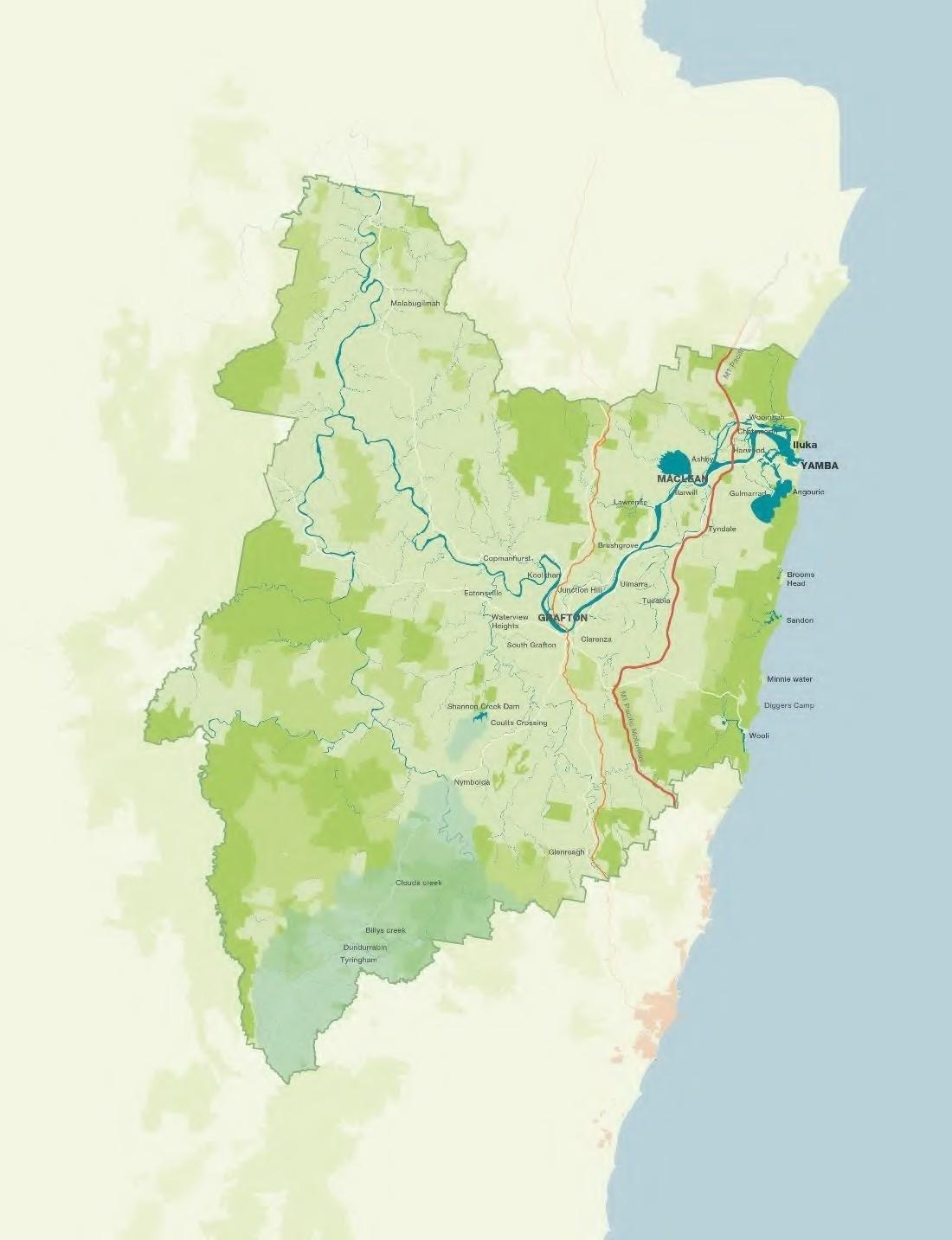
This Asset Management Strategy (AMS) outlines Council’s management of physical infrastructure assets. It includes a framework to guide the planning, construction, maintenance and operation of infrastructure essential for Clarence Valley Council to deliver services to the community.
In addition to the AMS, Council’s asset management planning incorporates an Asset Management Policy (Policy) and Asset Management Plans (Plans). These documents provide guidance for improving asset management systems and practices. This AMS and associated Policy are aligned with the 30 June 2024 Report on Infrastructure figures and reflect the 2025/26 to 2034/35 LTFP.
Gallery and museums
Sporting fields and facilities
Showgrounds
Roads
Bridges and culverts
Footpaths and cycleways
Kerb and gutter
Parks and reserves
Stormwater
Water supply network
Sewerage service network
Airport and aerodrome
Community halls
Swimming pools
Cemeteries
Parking
Saleyard
Holiday parks
Coastal and estuary management
CBD assets
Depots
Waste management
Landfill
Floodplain assets
Stormwater network
Reserves and wetlands
Noxious weed assets
Corporate buildings
Streetscaping
Public amenities
In late 2014, a council-wide service review was undertaken primarily to address budgetary shortfalls. The service review provided a framework of all Council services and was linked to the assets. This review has led to asset rationalisation and efficiency savings by eliminating ‘end-of-life’ or underused assets, contributing to the future sustainability of the Council.
In 2015, an asset management audit preparedness assessment was performed by the Council’s auditor on behalf of the Office of Local Government. The assessment identified areas for improvement, and an action plan has been implemented to address these.
Condition assessments for assets are undertaken using the Institute of Public Works Engineering Australasia’s (IPWEA) International Infrastructure Management Manual’s (IIMM) recommended fivepoint scale:
Condition 1 Very good condition – No work required (normal maintenance)
Condition 2 Good condition – Only minor maintenance work required
Condition 3 Fair or moderate condition – Maintenance work required
Condition 4 Poor condition – Renewal/Replacement required
Condition 5 Very poor condition – Urgent renewal/replacement required
The following graph demonstrates that most of the Council’s assets are in good to fair or moderate condition.
To define what condition ratings are acceptable, the Council will take into consideration the following:
• Community views/acceptance
• Establishing asset standards necessary to provide and support desired levels of service now and into the future
• Determining appropriate and sustainable levels of maintenance and renewals/upgrades
• Risk-hazard and risk-reduction requirements
Management strategies for assets in ‘poor’ condition (ratings 4 and 5) are detailed in each individual AMP. There are considerable costs associated with the renewal and/or upgrade of these assets, although it should be noted that not all will necessarily be required to be renewed. Any assets that should have already been renewed but have not due to funding limitations are deemed as backlog works. Any delay in carrying out these works could result in increased annual operation and maintenance costs as well as increased risks and consequences of failure.
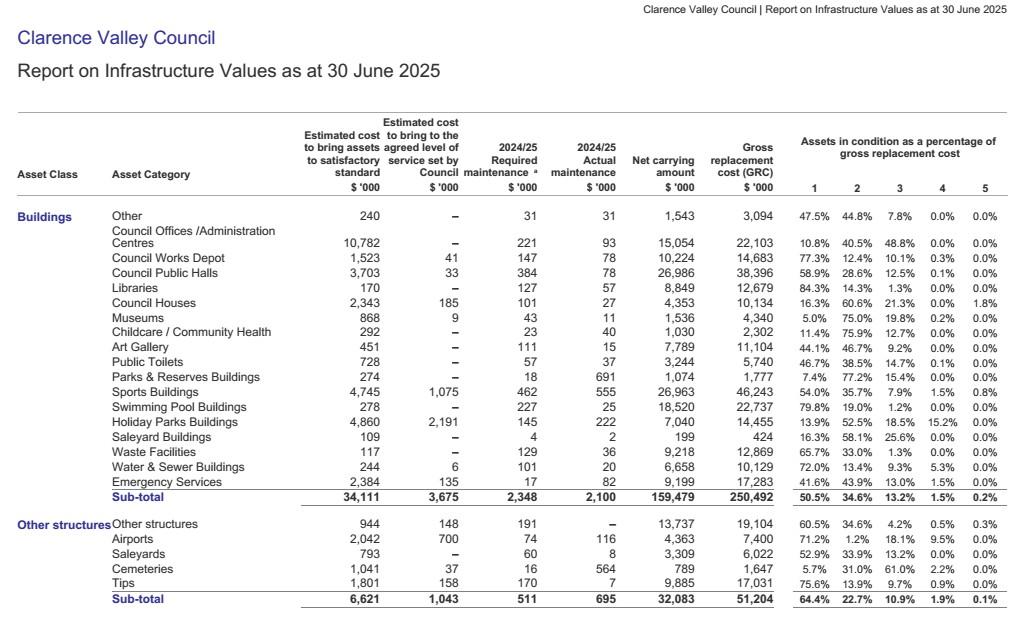
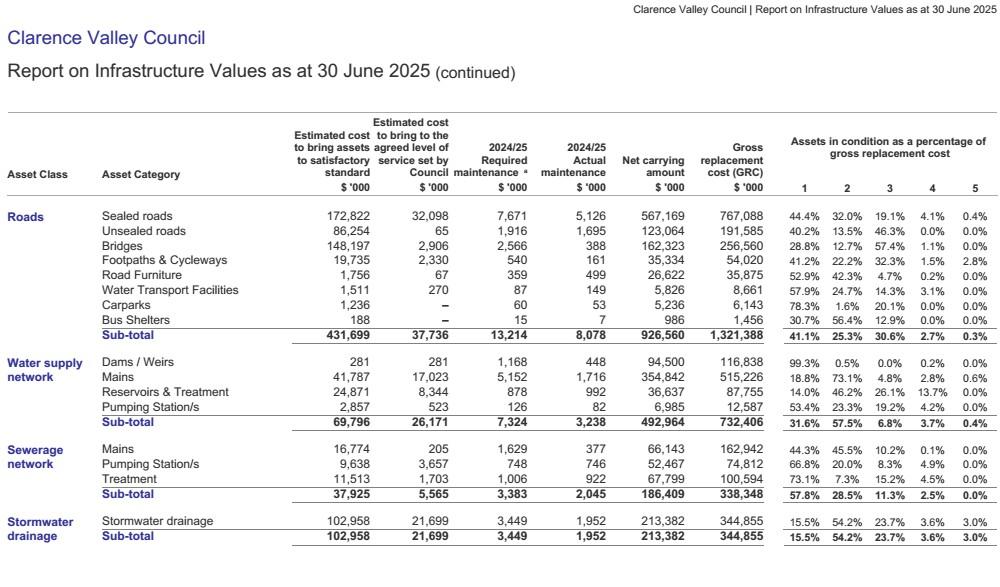
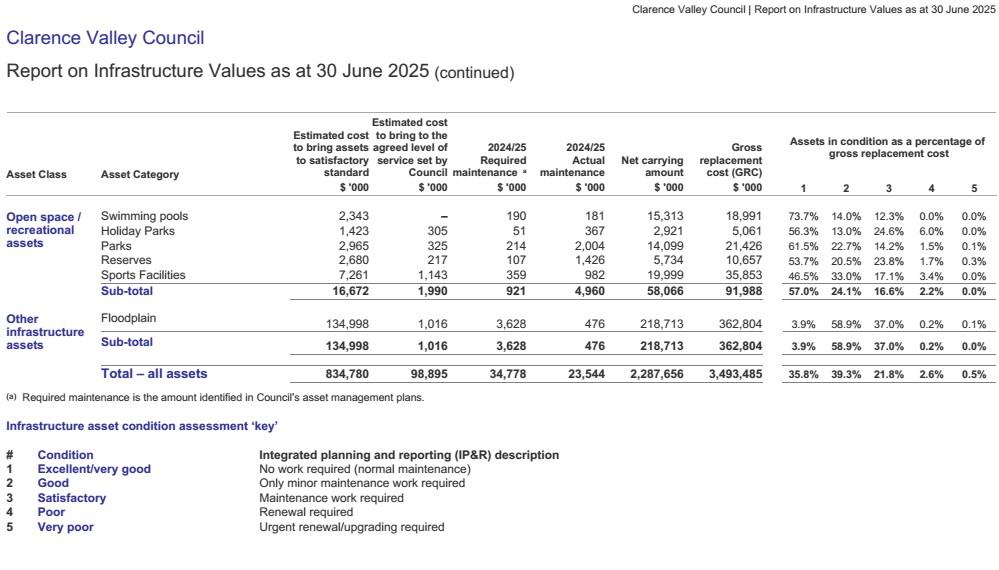
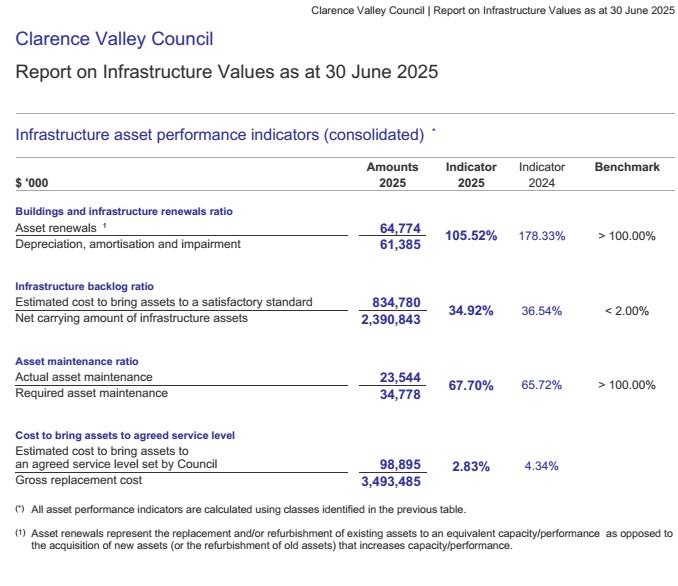
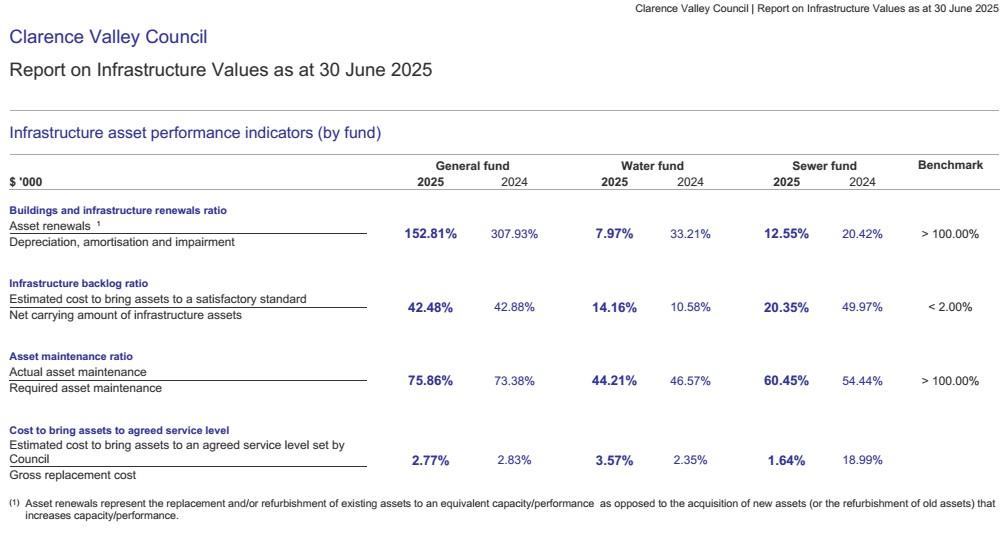
The table below is an extract from the Report on Infrastructure Assets, included in the Special Schedules of the Annual Financial Statements for 2024/25. This indicates that the cost to bring the Council’s infrastructure assets to a satisfactory standard is currently $98.9M.
Council endeavours to maintain its assets at a condition rating between 1 and 3. Any assets rated 4 or 5 will be assessed for risk and managed through a replacement/renewal program or alternatively disposed of. Current conditions scores have been established through previous inspections and revaluation processes. As such, it is imperative that current assigned scores, inspection processes and procedures are reviewed and where necessary adjusted on an annual basis.
As of 30 June 2025, the estimated replacement value of Council’s infrastructure assets is more than $3.5B and is represented below by the major asset groups as a percentage of the total asset replacement value.
The condition state of major infrastructure assets, as reported in the Clarence Valley General Purpose Financial Statement for the year ending 30 June 2025, is included below.
The Council has developed an asset management framework that comprises an asset management policy supported by the AMS and individual AMPs.
The Transport AMP has now been further split into individual plans for roads, bridges, and footpaths. A specific AMP has also been created for water facilities assets.

The Council’s Asset Management Policy sets the broad direction for all asset management activities, and aims to:
‘Strategically provide, maintain, renew and replace an appropriate stock of community infrastructure that is required to support the communities of the Clarence Valley Council; is sustainable across the long term; and is provided at the lowest possible life cycle cost.’
Council’s Asset Management System provides a structured framework for managing assets across their full lifecycle to support service delivery, manage risk, and optimise value. It continues to evolve through improved utilisation of asset management tools, including better identification of system capabilities and limitations, strengthened maintenance planning practices, and ongoing improvements in asset data quality and consistency. Greater awareness of the importance of infrastructure asset management across the organisation supports more informed and coordinated decision making.
Clear allocation of roles and responsibilities across project delivery, planning, operations and finance functions facilitates accountability and collaboration. Reliable asset data and consistent processes enable the development of robust Asset Management Plans, which inform long-term financial planning and the prioritisation of the capital works program.
The goals of this Asset Management Strategy is to ensure that infrastructure assets are planned, operated, maintained, and renewed in a manner that:
supports the delivery of agreed levels of service through well-maintained, fit-forpurpose assets for present and future generations of residents and visitors
optimises lifecycle costs through informed decision making, supported by reliable asset data and proactive maintenance practices
is guided by the outputs of Asset Management Plans, community expectations, technology utilisation, and the council’s long-term financial capacity and ability to pay.
To develop and maintain a robust/credible AMS, key elements need to be present, including:
reliable asset information, supported by fit-for-purpose asset management systems and consistent data standards
comprehensive Asset Management Plans that translate service objectives into lifecycle, maintenance, and renewal strategies
rigorous financial modelling and assumptions that reflect lifecycle costs, risk, and long-term sustainability
workforce planning aligned to current and future asset management and service delivery needs
community involvement in defining levels of service and service standards
performance monitoring and review to drive continuous improvement in asset
management practices.
Accordingly, the following goals have been identified and prioritised to facilitate a more strategic approach to asset management in future periods:
Goal 1 – Maintain a cross-organisational Asset Management Advisory Group that reports directly to the Executive. The Group will provide assurance that asset management activities are aligned with the objectives of the Integrated Planning and Reporting (IP&R) Framework and supported by the Long-Term Financial Plan. The Group will also oversee and monitor the implementation of asset management improvement and risk actions across all asset classes.
Goal 2 – Ensure that asset lifecycle costs of new and upgraded assets are considered as part of project scoping. Asset lifecycle impacts will be modelled and reflected in the Long-Term Financial Plan to support informed, sustainable investment decisions.
Goal 3 – Identify the gaps in asset management practice and plan to best utilise the resources, systems, and capabilities required to effectively implement this Strategy. Asset management improvement actions will be aligned with organisational resourcing strategies and delivered through a structured program with clear milestones, tasks allocation, and performance monitoring.
Goal 4 – Improve data-driven decision making by utilising available asset management systems and tools to establish maintenance and renewal plans. This will support the identification of maintenance, renewal, and replacement needs, and provide greater visibility of funding gaps, risks, and prioritisation across all asset classes.
Goal 5 – Develop and maintain comprehensive risk management plans for all major asset groups. Risk information will be used to inform maintenance, renewal, and investment priorities and support safe and reliable service delivery.
Goal 6 – Improve assets information by strengthening asset management systems, data standards, process improvement and governance arrangements. This will support consistent, reliable asset data to enable effective planning, reporting, and decision making across infrastructure assets
Goal 7 – Review, update, and maintain Asset Management Plans for all major asset groups to ensure they remain current, consistent, and aligned with this Strategy, service levels, risk profiles, and financial planning.
AMPs are detailed long-term plans that outline the asset activities for each asset category. An AMP has been developed for each major asset category, as illustrated in the Asset Management Framework diagram.
Each AMP contains, as a minimum, include:
objective or purpose of the asset and its components in providing service/s
service levels the Council currently delivers and any future challenges
forecasted future demand requirements for service delivery
description of the assets and details of the current asset inventory
identification of assets critical to the service provision
risks associated with assets and their management
financial projections for operation, maintenance, renewal, and replacement including
any gaps or renewal backlogs
assumptions, exclusions and observations on the maturity of data presented
maintenance, renewal, and disposal programs
key performance measures
asset management improvement plan.
Council subscribes to NAMS+, which is an IPWEA initiative for local government to assist in the development of asset management planning. The NAMS+ suite of templates has been used for development of the AMPs as core plans, which are practical documents designed to be easily understood and used by asset managers. The level of detail within each individual plan is dependent upon the scope and size of the asset category contained in the plan together with the level of asset data maturity.
An annual review of the individual AMPs is required to ensure they provide a useful and up-to-date management tool and reference document. The review of the AMPs will include changes in objectives, policies, service levels, systems, technologies, and any other relevant amendment, including changes to community expectations.
Council has identified several gaps in current asset management processes. These gaps will be addressed through the ongoing development and implementation of Asset Management Plans (AMP), which will guide the progressive improvement of asset management practices. Over time, the organisation will transition from core asset management practices towards more advanced planning through a cycle of continuous improvement that supports the evolving needs of the Council and the community to uplift asset management maturity.
A summary of current AMPs has been included within this strategy.
The AMS and AMPs have been developed in line with the Council’s 2024/25 to 2033/34 LTFP. The LTFP has been prepared based on a set of assumptions and the ‘Fit for the Future’ key performance indicator benchmarks.
There are four key indicators for asset management and sustainability utilised in the AMPs and AMS:
1. Asset Sustainability Ratio
Estimated Capital Renewal LTFP / Projected Capital Renewal Exp. AMP
2. Long Term – Life Cycle Indicator Life cycle expenditure / life cycle cost
3. Medium Term – 10-Year Financing Indicator
4. Short Term – 5-Year Financing Indicator
Budget Exp. / 10 yr. projected exp.
Budget Exp. / 5 yr. projected exp.
Life cycle costs (or whole-of-life costs) are the average costs that are required to sustain the service levels over the longest asset life. Life cycle costs include operating and maintenance expenditure and asset consumption (depreciation expenses). Life cycle costs can be compared to life cycle expenditure to give an indicator of sustainability in service provision.
Life cycle expenditure includes operating and maintenance costs plus capital renewal costs. Life cycle expenditure will vary depending on the timing of asset renewals.
The life cycle costs, and life cycle expenditure comparison highlights any differences between present outlays and the average cost of providing the service over the long term. If the life cycle expenditure is lower than the life cycle cost, there is a ‘life cycle gap,’ and it is most likely that outlays will need to be increased or cuts in services made in the future.
The Asset Sustainability Ratio is the most important indicator and reveals whether projected capital renewal and replacement expenditure can be financed in the LTFP. The Council’s Financial Planning Policy outlines a target range of between 90–110%.
The four key indicators are detailed in the following table for the general fund assets only:
5-year
The medium-term projected expenditure is also financially sustainable in the long term. Council will be able to maintain the condition of infrastructure assets in a sustainable fashion. Performing renewals as they are required will stop the deterioration and failure of assets, thereby reducing the levels of risk. Levels of service can be maintained at current levels.
The Asset Sustainability Ratio indicates that Council will have 100% of the funds required for the optimal renewal and replacement of its assets, which is within the Council’s target range of 90% to 110%. The ratio indicates an optimised budgeted capital expenditure, assisting in minimising the life cycle costs of the assets.
Consideration should be given to the percentage of Council’s transport assets, which are currently in average condition. Renewal shortfalls currently indicated will need to be investigated and addressed.
There is a funding shortfall of $773.7K on average per year over the life of the 10- Year Plan for maintenance, operations, renewals, and upgrade/new assets, totalling $7.7M for the life of the plan.
Additional grant funding will be sought for programs, especially for capital programs.
Grant funding where there is no certainty of the grant funding being available has not been included in the assessment.
Appropriate maintenance programs are implemented to ensure all assets reach their maximum useful life within budgetary constraints.
Council is implementing a detailed inspection program to identify and rectify defects, especially those that pose a safety issue to motorists, in a timely manner. Last Condition Survey
Valuation dated – March 2023, valuation by AssetVal.
Condition assessment undertaken by Clarence Valley Council.
Main Findings
Detail the critical risks and risk management approach taken.
Note * The residual risk is the risk remaining after the selected risk treatment plan is operational.
The Council manages approx. 1,512km of sealed roads and 945.3km of unsealed roads.
The major influences on the road network in future will be the devolved old Pacific Highway as each new section is completed.
Major emphasis is to increase maintenance levels in the following areas:
o Sealed road resealing
o Sealed road shoulder maintenance
o Unsealed road resurfacing
o Widening regional roads where required to meet current traffic loading
General focus will be on managing condition 4 and 5 roads and maintaining roads at condition 3 and above.
Additional data is to be gathered on the unsealed road network to better schedule resurfacing requirements.
Further investigations to be carried out on the program and requirements to seal currently unsealed roads and options to return very-low traffic sealed roads to unsealed roads
Council also maintains:
o 49 car parks
o 980 traffic facility items (including traffic medians, pedestrian refuges, kerb blisters, speed humps, school crossings and edging around trees)
o 32.67 km of guardrail and road fencing
o 433 roadside furniture items (including bus shelters, bollards, seating and bicycle racks)
o 89 Council-owned streetlights (this does not include general streetlights that are not owned by the Council)
o 13,236 signs
Major emphasis is to implement programs in the following areas:
o Flood resilience of Yamba and Iluka Roads.
o Implement a Gap Seal Program over a 15-year period.
Data Executive Summary AM Plan Report
Valuation Report
Budget Implications
Maintenance Programs
Additional grant funding will be sought for programs, especially for capital programs.
Grant funding where there is no certainty of the grant funding being available has not been included in the assessment.
Appropriate maintenance programs are implemented to ensure all assets reach their maximum useful life within budgetary constraints.
The Council is implementing a detailed inspection program to identify and rectify defects, especially those that pose a safety issue to motorists, in a timely manner.
Last Condition Survey
Valuation dated – March 2023, valuation by AssetVal.
Condition assessment undertaken by Clarence Valley Council.
and post natural disasters)
Re-prioritise Bridge replacement program
Bridges Bridge failure / collapse H Re-prioritise Bridge replacement program M
Note * The residual risk is the risk remaining after the selected risk treatment plan is operational.
The Council has 98 timber bridges and 172 concrete bridges.
The deterioration of the timber bridges potentially results in increased maintenance requirements for those bridges.
Major emphasis is to increase maintenance levels in the following areas:
• Timber bridge maintenance
• Timber bridge replacement
General focus will be on managing condition 4 bridges and maintaining bridges at condition 3 and above.
Additional data is to be gathered on the timber bridges to better schedule maintenance requirements.
Budget Implications
Consideration should be given to the percentage of the Council’s water facilities assets, which are currently in average condition. Renewal shortfalls currently indicated will need to be investigated and addressed.
There is a funding shortfall of $19.3K on average per year over the life of the 10- Year Plan for maintenance, operations, renewals, and upgrade/new
Maintenance Programs
Last Condition Survey
assets, totalling $193K for the life of the plan.
Additional grant funding will be sought for programs, especially for capital programs.
Grant funding where there is no certainty of the grant funding being available has not been included in the assessment.
Appropriate maintenance programs are implemented to ensure all assets reach their maximum useful life within budgetary constraints.
The Council is implementing a detailed inspection program to identify and rectify defects, especially those that pose a safety issue to motorists, in a timely manner.
Valuation dated – March 2023, valuation by AssetVal
Condition assessment undertaken by Clarence Valley Council
Detail the critical risks and risk management approach taken.
Boat ramps, wharves and jetties
There is an impact by natural disasters (during and post natural disasters).
If the road is not already closed, display a closed sign at water facilities during flood events.
Note * The residual risk is the risk remaining after the selected risk treatment plan is operational.
The Council also maintains:
o 33 wharves/jetties
o 46 boat ramps
Major emphasis is to implement programs in the following areas:
o Renew water facility components currently at condition rated 4 or 5 over a 4-year period, and implement the programs previously adopted by the Council and those identified in the Clarence River Wharves Development Plan over a 20-year period.
General focus will be on managing condition 4 and 5 assets and maintaining assets at condition 3 and above.
Additional data is to be gathered on the condition of water facility assets to better schedule requirements.
Budget Implications
Consideration should be given to the percentage of the Council’s water facilities assets, which are currently in average condition. Renewal shortfalls currently indicated will need to be investigated and addressed.
There is a funding shortfall of $190K on average per year over the life of the 10Year Plan for maintenance, operations, renewals and upgrade/new assets,
Maintenance Programs
totalling $1.9M for the life of the plan.
Additional grant funding will be sought for programs, especially for capital programs.
Grant funding where there is no certainty of the grant funding being available has not been included in the assessment.
Appropriate maintenance programs are implemented to ensure all assets reach their maximum useful life within budgetary constraints.
The Council is implementing a detailed inspection program to identify and rectify defects, especially those that pose a safety issue to motorists, in a timely manner. Last Condition Survey Valuation dated – March 2023, valuation by AssetVal
Condition assessment undertaken by Clarence Valley Council
Footpaths/ Cycleways
Defect not being recorded M
inspections from which regular maintenance can be prioritised.
Integrate existing AI defect inspection procedures to undertake footpath inspections and defect identification
L
Note * The residual risk is the risk remaining after the selected risk treatment plan is operational.
The Council maintains 241km of footpaths/off-road cycleways.
The Council has pedestrian access mobility plans and bike plans prepared for Grafton, South Grafton, Maclean, Yamba, Iluka, Woombah, Lawrence and Ulmarra. Preparation of plans for the remaining villages and a review of the plan covering Grafton, South Grafton, Maclean, and Yamba are planned for completion in the coming years.
Major emphasis is to increase maintenance levels in the following areas:
o General footpath maintenance
o Replacement of defective footpath sections
o Continued implementation of the Pedestrian Access and Mobility Plan (PAMP) and bike plans
General focus will be on managing condition 4 and 5 footpath segments and maintaining footpaths at condition 3 and above.
Additional detailed data is to be gathered on footpath/cycleway network condition to better schedule maintenance and replacement requirements. This includes measuring the severity of defects so that a more directed maintenance and replacement program can be developed.
Further investigations are to be carried out on potential programs and funding options with the Roads and Maritime Service.
To manage the Council’s:
road network in a safe and serviceable condition
bridges in a safe and serviceable condition
rural drainage network to ensure that the network operates and allows the free passage of water in a safe manner
footpath and off-road cycleway network to ensure that it is free of significant defects and meets the community’s walking and cycling needs
car parks to provide adequate parking opportunities for the community
traffic facilities to provide increased safety to the public using the road network
guardrail/safety fencing so that it offers protection to motorists
roadside furniture to provide additional amenities for pedestrians at required locations
street lighting to improve safety in car parks and on urban streets
signs to provide appropriate warning and advice to motorists
water facilities to provide and enhance the usage of the Council’s natural waterways
other assets in a safe and serviceable condition.
(a) Ensure that maintenance works are undertaken effectively.
(b) Develop detailed forward works programs.
Review and monitor the inspection system to better target maintenance works to areas required.
Review and monitor maintenance procedures to ensure effective practices are utilised.
Implement upgraded maintenance programs.
Collect detailed data, including updated condition data, on all assets.
Prepare detailed maintenance works programs.
Monitor effectiveness of implemented programs though overall asset condition assessments.
Seek additional sources of funding for capital works.
Develop technical standards to assess and prioritise future works.
Review and update the Transport AMP in line with updated asset data on an annual basis.
(c) Asset management
Review and update data from the result of the annual desktop revaluation of transport assets for current value.
Review and update data from the full revaluation of transport assets as per the Non-Current Asset Accounting Procedures.
1
(a) Ensure that maintenance works are undertaken effectively
Review and monitor the inspection system to better target maintenance works to areas required.
Review and monitor maintenance procedures to ensure effective practices are utilised.
Implement upgraded maintenance programs.
(b) Develop detailed forward works programs.
Collect detailed data, including updated condition data, on all assets.
Prepare detailed maintenance works programs.
Monitor effectiveness of implemented programs though overall asset condition assessments.
Seek additional sources of funding for capital works.
(c) Asset Management
Develop technical standards to assess and prioritise future works.
Review and update the Transport AMP in line with updated asset data on an annual basis.
Review and update data from the result of the annual desktop revaluation of transport assets for current value.
Review and update data from the full revaluation of transport assets as per the Non- Current Asset Accounting Procedures.
Medium
Budget Implications
Consideration should be given to the percentage of the Council’s water assets, which are currently in average condition. Renewal shortfalls currently indicated will need to be investigated and addressed. There is a shortfall of $3.33M on average per year which equates to a $33.3M over the life of the 10- Year Plan for maintenance, operations, renewals, and upgrade/new assets. The Office of Water’s (OoW) Best Practice Management Guidelines require the Council to have a robust 30-year financial model for its
Maintenance Programs
Last Condition Survey
water fund. This is monitored and updated each year with the audited financial statements. The FINMOD 30-year financial model has indicated that this projected funding can be met under the current pricing path.
The renewal program in the Water Services AMP, which has been included in the LTFP, is based on the current water supply asset renewal requirements. The AMP has assessed only 4.1% of the assets as being in a ‘poor’ condition. However, a significant proportion of water assets that are currently assessed as being in ‘fair’ or ‘good’ condition are at, or have exceeded, their theoretical life. It is only proposed to schedule replacement of these assets when their condition deteriorates to a ‘poor’ condition, and there is insufficient evidence to enable establishment of a timeframe for this deterioration. Within the next 3 years, further analysis of asset deterioration will be performed. It is proposed that the cash surplus in the water fund be used to establish a water renewal reserve, with the maximum reserve amount to be set as a percentage of the gross replacement cost of the water infrastructure. The percentage is to be determined through the further analysis of asset deterioration. Future unscheduled water asset renewals will be funded from this reserve.
In addition, a risk identified in the AMS is regulatory change that would mandate an increased level of drinking water treatment. This requires CVC to upgrade the Rushforth Road Water Treatment Plant; it is estimated that the capital cost of increased treatment could be up to $84M commencing in 2025-26 through to 2027/28.
The water fund financial modelling has also not included the potential future augmentation of Shannon Creek Dam to 75,000ML, which was foreshadowed in the regional water supply as potentially being required by the year 2046, although current consumption trends indicate that augmentation would not be required within the 30-year life of this LTFP. If this augmentation were to proceed, it is estimated to cost at least $150 million. The climate change impacts may reduce the Water Licensing allowance to 80% from the Nymboida River which will result in bring forward the augmentation of Shannon Creek Dam.
Appropriate maintenance programs are implemented to ensure all assets reach their maximum useful life within budgetary constraints.
A maintenance management system (MMS) has been implemented, with a particular focus on mechanical and electrical assets. Since the introduction of the MMS, most resources are now committed to preventative maintenance, unplanned and breakdown work.
Valuation dated – March 2021, revaluation by Australis
Condition assessment undertaken by Clarence Valley Council
Objective
meets the Australian Drinking Water Guidelines (ADWG) requirements, recommended limits for aesthetic limits are occasionally exceeded. These do not present a health risk. The main complaint is dirty or discoloured water, which is addressed with mains flushing and source management.
All water supplies are chlorinated and (other than Glenreagh and Coutts programmed to be completed 2025/26) stabilised due to natural soft water.
As part of the Drinking Water Quality Assurance Management Plan (DWQAMP), additional treatment barriers (inc. filtration) may be required.
A particular risk to water supply infrastructure is that in several locations, there are water mains that are threatened by riverbank erosion, and there are single pipelines crossing waterways. The forward financial plan proposes to manage these risks.
There is an inability to upgrade water treatment if regulatory changes require an increased treatment level. The Council could potentially be in breach of the Public Health Act.
Provide customers a reliable, high-quality, affordable, and environmentally sustainable water supply, promoting water efficiency and Total Water Cycle Management principles.
Performance Measures Target
Manage the drinking water system to minimise environmental impacts.
(a) Ensure that maintenance works are undertaken effectively.
(b) Develop detailed forward works programs.
Review and monitor the inspection system to better target maintenance works to areas required.
Review and monitor maintenance procedures to ensure effective practices are utilised.
Implement upgraded maintenance programs.
Collect detailed data, including updated condition data, on all assets.
Prepare detailed maintenance works programs.
Monitor effectiveness of implemented programs though overall asset condition assessments.
Comply with the OoW’s Best Practice Management Guidelines.
(c) Ensure good governance and administrative support for the Council and organisation.
(d) Asset management
Review and implement the Strategic Business Plan (SBP) and the Development Servicing Plan (DSP) for water services.
Water supply is managed in accordance with the DWQAMP.
Investigate water treatment upgrades for both main and village supplies to improve drinking water quality in accordance with the DWQAMP.
Drinking water supply meets the ADWG.
Develop technical standards to assess and prioritise future works (e.g., standards to assess risk-based replacement programs).
Review and update the Water AMP in line with updated asset data on an annual basis.
Review and update data from the result of the annual desktop revaluation of water
assets for current value.
Review and update data from the full revaluation of water assets as per the NonCurrent Asset Accounting Procedures.
(a) Ensure that maintenance works are undertaken effectively
Manage the drinking water system to minimise environmental impacts.
Review and monitor the inspection system to better target maintenance works to areas required.
Review and monitor maintenance procedures to ensure effective practices are utilised.
Implement upgraded maintenance programs.
(b) Develop detailed forward works programs.
Collect detailed data, including updated condition data, on all assets.
Prepare detailed maintenance works programs.
Monitor effectiveness of implemented programs though overall asset condition assessments.
Seek additional sources of funding for capital works.
(c) Ensure good governance and administrative support for the Council and organisation
Comply with the OoW’s Best Practice Management Guidelines.
Review and implement the SBP and the DSP for water services.
Water supply is managed in accordance with the DWQAMP.
Drinking water supply meets the ADWG.
(d) Asset Management
Develop technical standards to assess and prioritise future works.
Review and update the Water AMP in line with updated asset data on an annual basis.
Review and update data from the result of the annual desktop revaluation of water assets for current value.
Review and update data from the full revaluation of water assets as per the Non- Current Asset Accounting Procedures.
Long Term Financial
Implications assets, which are currently in fair or moderate condition.
There is a shortfall budget over the life of the 10-Year Plan for maintenance, operations, renewals, and upgrade/new assets of $794.8k pa which equates to $7.95M over the life of the plan. The OoW’s Best Practice Management Council is required to have a robust 30-year financial model for its sewer fund. This is monitored and updated each year when the audited financial statements are completed, The FINMOD 30-year financial model has indicated that this projected funding can be met under the current pricing path.
The renewal program in the Sewerage AMP, which has been included in the LTFP, is based on the current sewerage asset renewal requirements. The AMP has assessed only 2.4% of the assets as being in a ‘poor’ condition. However, a significant proportion of sewer assets that are currently assessed as being in ‘fair’ or ‘good’ condition are at, or have exceeded, their theoretical life. It is only proposed to schedule replacement of these assets when their condition deteriorates to a ‘poor’ condition, and there is insufficient evidence to enable establishment of a timeframe for this deterioration. It is proposed that the cash surplus in the sewer fund be used to establish a sewer renewal reserve, with the maximum reserve amount to be set as a percentage of the gross replacement cost of the sewer infrastructure. The percentage is to be determined through the further analysis of asset deterioration. Future unscheduled sewer asset renewals will be funded from this reserve.
Maintenance Programs
Appropriate maintenance programs are implemented to ensure all assets reach their maximum useful life within budgetary constraints.
Since the introduction of the MMS, most resources are now committed to preventative maintenance, unplanned and breakdown work.
Ongoing CCTV inspection of reticulation is undertaken to determine reticulation condition.
Last Condition Survey
Valuation dated – March 2024, revaluation by BASEC with External Verification by Australis
by Clarence
Note * The residual risk is the risk remaining after the selected risk treatment plan is operational.
We are currently fully compliant with NSW DPI Water Best Practice Guidelines.
A particular risk to sewerage infrastructure would be the changing of environmental requirements, which may require unforeseen augmentation in the future.
Significant investigation is required to determine feasible schemes for rural villages.
There is an inability to upgrade an STP if a regulatory change requires an increased level of treatment. This would potentially place the Council in breach of an environmental protection licence.
Provide
Objective
The sewer network is adequately maintained to prevent environmental overflows and offensive odours.
(a) Ensure that maintenance works are undertaken effectively.
(b) Develop detailed forward works programs.
(c) Ensure good governance and administrative support for the Council and organisation.
Review and monitor the inspection system to better target maintenance works to areas required.
Review and monitor maintenance procedures to ensure effective practices are utilised.
Implement upgraded maintenance programs.
Collect detailed data, including updated condition data, on all assets.
Prepare detailed maintenance works programs.
Monitor effectiveness of implemented programs though overall asset condition assessments.
Comply with the OoW’s Best Practice Management Guidelines.
Review and implement the SBP and the DSP for sewer services.
Meet Environmental Protection Licence requirements for environmental release of recycled water and NOW requirements for reuse.
All trade waste dischargers to have appropriate agreements and be inspected.
All recycled water end is used to have appropriate agreements and monitoring.
Develop technical standards to assess and prioritise future works (e.g., standards to assess risk-based replacement programs).
Review and update the Sewerage AMP in line with updated asset data on an annual basis.
(d) Asset management
Review and update data from the result of the annual desktop revaluation of sewerage assets for market/current value.
Review and update data from the full revaluation of sewerage assets as per the Non-Current Asset Accounting Procedures.
(a)
Reviewand monitor maintenance procedures to ensureeffective practicesare utilised.
Implementupgraded maintenance programs.
(b) Develop detailed forward works programs.
Collect detailed data, including updated condition data, on all assets.
Prepare detailed maintenance works programs.
Monitor effectiveness of implemented programs though overall asset condition assessments.
& IAPS 6
(c) Ensure good governance and administrative support for the Council and organisation
Complywith the NOW Best Practice Management Guidelines.
Reviewand implement theSBP and theDSP for sewerservices.
Meet Environmental Protection Licence requirementsfor environmentalrelease of recycled waterand the OoW’s requirementsfor reuse.
Alltradewaste dischargerstohave appropriateagreements andbeinspected.
Allrecycled waterend is usedtohave appropriate agreementsand monitoring.
(d) Asset Management
W C
Develop technical standards to assess and prioritise future works.
Review and update the Sewerage AMP in line with updated asset data on an annual basis.
Review and update data from the result of the annual desktop revaluation of sewerage assets for current value.
Review and update data from the full revaluation of Sewerage assets as per the Non- Current Asset Accounting Procedures.
which are currently in a fair or moderate condition.
There is a funding shortfall of $931K on average per year over the life of the 10Year Plan for maintenance, operations, renewals and upgrades/new assets, totalling $9.31M for the life of the plan.
Appropriate funding is required to ensure maintenance programs are implemented so that assets reach their end-of-useful life.
Funding includes a proportion of Clarence Coast Reserve Trust funding for buildings located within the Reserve Trust managed by the Council.
Grant and community support funding is to be sought wherever possible to assist in making up the funding shortfall when upgraded/new buildings are proposed.
Other contributions from grants or other sources have been considered in the plan.
Appropriate maintenance programs are implemented to ensure all assets reach their maximum useful life within budgetary constraints.
The Council regularly inspects buildings and undertakes maintenance programs to ensure as a priority they are safe.
Asbestos management safety is a priority for the Council’s renewal, upgrade, and disposal programs.
Detail the critical risks and risk management approach taken.
Materials containing asbestos within existing buildings are disturbed/broken.
Asbestos identified in buildings is managed according to the CVC Asbestos Management Protocol.
Effected buildings recorded in Asbestos Risk Register, together with control measures and a completion date for removal.
Loss or partial loss of infrastructure providing services to the Community
Building lifecycles decreases faster than our asset management plans, and capital works programs prepare for.
Maintenance is managed appropriately at an operational level
Future planning improvements can be made by documented service level risks and utilisation of these in establishing future maintenance priorities
allocations be considered for ongoing upgrades to older facilities that do not meet legislation.
Note * The residual risk is the risk remaining after the selected risk treatment plan is operational. Main Findings
The buildings are classified as either specialised or non-specialised buildings being made up of:
Specialised
o Amenities, cemeteries, community, community halls/centres, depots, parks and reserves, RFS/SES, sheds, sporting.
Non-Specialised
o Community health, cultural, museums, office/administration, public libraries, residential.
Additional buildings are included in other AMPs such as waste, holiday parks, saleyards and pools.
The current rationalisation of the Council’s building footprint is to reduce operations and maintenance costs; this will have a major impact during the life of
this plan. The need for this arose due to the number of buildings and facilities the Council is still carrying from the amalgamation of former councils.
The rationalisation of the Council’s buildings has commenced with the sale of a number of properties and the construction of new encompassing facilities.
A review of the Developer Contribution Plan is to be undertaken.
The focus will be on strategically planning for condition 4–5 buildings and any condition 3 buildings that are likely to move to condition 4 in the next 10 years. Ensure data is available to determine whether the maintenance required to achieve the estimated useful life is achieved.
Asbestos management plans and their implementation for major buildings will be a key action. It is a priority to manage asbestos and its removal wherever practicable.
Assets in condition 5 will require demolition and disposal, and some will be replaced and upgraded.
A review of residential properties has been undertaken with buildings identified for disposal.
The focus on energy/efficiency is for major facilities to reduce operational costs associated with power use, (e.g. major upgrade of air conditioning systems and installation of solar panels).
Focus on providing all-accessible access to buildings and facilities due to the changing demographics of an ageing population.
Objective To provide sustainable buildings that are in a safe and serviceable condition. Provide buildings that meet the ongoing needs of the community.
Performance Measures Target
(a) Ensure that maintenance works are undertaken effectively.
(b) Develop detailed forward works programs.
(c) Ensure good governance and administrative support for the Council and organisation.
Review and monitor the inspection system to better target maintenance works to areas required.
Review and monitor maintenance procedures to ensure effective practices are utilised.
Collect detailed data, including updated condition data, on all assets.
Prepare detailed maintenance, renewal and new/upgraded works programs targeting condition 4 and 5 assets and safety issues aligned to available budgets.
Monitor effectiveness of implemented programs though overall building asset condition assessments.
Seek additional sources of funding for capital works.
Review the property portfolio for the replacement/upgrade/disposal of assets.
Review the Developer Contributions Plan 2011 to ensure it is appropriate to the new Community Strategic Plan when completed.
(d) Asset management
Develop technical standards to assess and prioritise future works.
Review and update the Buildings AMP in line with updated asset data on an annual basis.
Review and update data from the result of the annual desktop revaluation of the building portfolio for market/current value.
Review and update data from the full revaluation of the building portfolio as per the Non-Current Asset Accounting Procedures.
(a) Ensure that maintenance works are undertaken effectively
Review and monitor the inspection system to better target maintenance works to areas required.
Review and monitor maintenance procedures to ensure effective practices are utilised.
(b) Develop detailed forward works programs.
Collect detailed data, including updated condition data, on all assets.
Prepare detailed maintenance, renewal and new/upgraded works programs targeting condition 4 and 5 assets and safety issues aligned to available budgets.
Monitor effectiveness of implemented programs though overall building asset condition assessments.
Seek additional sources of funding for capital works.
(c) Ensure good governance and administrative support for the Council and organisation
Review the property portfolio for the replacement/upgrade / disposal of assets.
Review the Developer Contributions Plan 2011 to ensure it is appropriate to the Community Strategic Plan.
(d) Asset Management
Develop technical standards to assess and prioritise future works.
Review and update the Buildings AMP in line with updated asset data on an annual basis.
Review and update data from the result of the annual desktop revaluation of building portfolio for current value.
Review and update data from the full revaluation of building portfolio as per the Non- Current Asset Accounting Procedures.
F
F
Long Term – Lifecycle Costs
Lifecycle
Lifecycle
Budget Implications
Maintenance Programs
Last Condition Survey
Consideration should be given to the percentage of the Council’s Open Spaces assets, which are currently rated condition 3 to 5. Renewal shortfalls will need to be investigated and addressed.
There is a funding shortfall of $903K on average per year over the life of the 10Year Plan for maintenance, operations, renewals and upgrades/new assets, totalling $9.03M for the life of the plan.
Grant and community support funding is to be sought wherever possible to assist in making up the funding shortfall when upgraded/new buildings are proposed.
Other contributions from grants or other sources have been considered in the plan.
Appropriate maintenance programs are implemented to ensure all assets reach their maximum useful life within budgetary constraints.
Develop or review asset inspection programs for the various types of facilities.
Valuation dated – March 2022, desktop valuation by AssetVal
Condition assessment undertaken by Clarence Valley Council
Main Findings
Note * The residual risk is the risk remaining after the selected risk treatment plan is operational.
Open Spaces assets include:
o Buildings (canteens, amenities)
o Accessways (access tracks, bridges, cycle ways, footpaths, internal roads & car parks)
o Fencing (bollards, fences, gates) Playgrounds
o Shelters & sheds
o Park structures (BBQs, landscaping, park furniture)
o Utilities (lighting, water tanks, septic tanks)
o Sports structures (grandstands, irrigation, sporting structures)
o Other structures
o Green assets such as sports fields and street trees are not currently valued.
The Council currently manages:
o 123 parks (~101 ha)
Objective
o 25 sports grounds (~209 ha)
o 194 general community uses (~194 ha)
o 69 natural areas (~573 ha)
o 19 areas of cultural significance (~93 ha)
Asset service hierarchy from Open Spaces Strategic Plan and Generic Plan of Management
o Regional
o District
o Local
Levels of service have been defined and documented for most of these areas.
Community surveys conducted revealed the community is satisfied overall with current Open Spaces levels of service.
To provide high-quality and sustainable sport and recreational opportunities at a safe and functional standard and appropriate appearance that meet our community’s needs.
(a) Ensure that maintenance works are undertaken effectively
(b) Develop detailed forward works programs
Review and monitor the inspection system to better target maintenance works to areas required.
Review and monitor maintenance procedures to ensure effective practices are utilised.
Collect detailed data, including updated condition data, on all assets.
Prepare detailed maintenance, renewal and new/upgraded works programs targeting condition 4 and 5 assets and safety issues aligned to available budgets.
Monitor effectiveness of implemented programs though overall building asset condition assessments.
Seek additional sources of funding for capital works.
Review asset portfolio for replacement/upgrade/disposal of assets, as defined in the Open Spaces Strategic Plan.
(c) Ensure good governance and administrative support for the Council and organisation
(d) Asset management
Review the Developer Contributions Plan 2011 to ensure it is appropriate to the new Community Strategic Plan when completed.
Review and implement the Open Spaces Strategic and Sports Facilities Plan.
Continue to review fee structure and implement any changes.
Review contract maintenance agreements.
Develop technical standards to assess and prioritise future works.
Review and update the Open Spaces AMP in line with updated asset data on an annual basis.
Review and update data from the result of the annual desktop revaluation of open spaces portfolio for market/current value.
Review and update data from the full revaluation of the Open Spaces portfolio as per the Non-Current Asset Accounting Procedures.
(a) Ensure that maintenance works are undertaken effectively
Review and monitor the inspection system to better target maintenance works to areas required.
Review and monitor maintenance procedures to ensure effective practices are utilised.
(b) Develop detailed forward works programs.
Collect detailed data, including updated condition data, on all assets.
Prepare detailed maintenance, renewal and new/upgraded works programs targeting condition 4 and 5 assets and safety issues aligned to available budgets.
Monitor effectiveness of implemented programs though overall Open Spaces asset condition assessments.
Seek additional sources of funding for capital works.
& IAPS 10
F
(c) Ensure good governance and administrative support for the Council and organisation
Review asset portfolio for replacement/ upgrade/disposal of assets, as defined in
F
the Open Spaces Strategic Plan
Review the Developer Contributions Plan 2011 to ensure it is appropriate to the Community Strategic Plan.
Review contract maintenance agreements.
(d) Asset Management
Develop technical standards to assess and prioritise future works.
Review and update the Open Spaces AMP in line with updated asset data on an annual basis.
Review and update data from the result of the annual desktop revaluation of the Open Spaces portfolio for current value.
Review and update data from the full revaluation of the Open Spaces portfolio as per the Non- Current Asset Accounting Procedures.
Budget Implications
Maintenance Programs
Last Condition Survey
current filling rates.
Consideration should be given to the percentage of the Council’s waste assets, which are currently in a fair or moderate condition.
There is a funding shortfall of $16.6K on average per year over the life of the 10Year Plan for maintenance, operations, renewals and upgrades/new assets, totalling $166K for the life of the plan.
Domestic waste is self-funding.
Regional landfill is self-funding.
Other waste services, which include the network of transfer stations, are funded by a waste management fund.
Appropriate maintenance programs are implemented to ensure all assets reach their maximum useful life within budgetary constraints.
Valuation dated – March 2022, desktop valuation by AssetVal
Condition assessment undertaken by Clarence Valley Council
Safety concerns for the public and workers at waste facilities
Injury at unsupervised Baryulgil Waste transfer station
Maintain waste disposal sites, and replace equipment, including safety equipment, when necessary.
Training for staff in all waste management procedures
Clear procedures followed as per EPA Licence
Safe work procedures followed by waste staff and patrons at waste sites follow safety directions
Review operation of the site in line with the Waste Management Strategy.
Remove hazards when identified Regularly maintain site
Assess the impact of restrictions, and implement any changes recommended by the Council.
Reinforce public education programs on recycling.
Note * The residual risk is the risk remaining after the selected risk treatment plan is operational.
Not all expenditures are captured; with the contracted sites, this expenditure is classified as ‘commercial in confidence’.
Not all waste assets have been captured in this plan; landfill cells are not considered.
Objective
To provide waste management facilities that are cost-effective and meet the community’s expected service level while also complying with environmental and health and safety requirements. Performance
(a) Ensure that maintenance works are undertaken effectively.
(b) Develop detailed forward works programs.
Review and monitor the inspection system to better target maintenance works to areas required.
Review and monitor maintenance procedures to ensure effective practices are utilised.
Review and monitor contractor agreements.
Collect detailed data, including updated condition data, on all assets.
Develop and implement waste management capital works programs.
Monitor effectiveness of implemented programs though overall asset condition assessments.
Implement the Solid Waste Management Strategy within the agreed timeframe.
Implement the annual Waste Education Program.
(c) Compliance
(d) Asset management
Implement the Regional Landfill Environmental Management Plan. Comply with Landfill POEO Act Licence.
Develop technical standards to assess and prioritise future works.
Review and update the Waste AMP in line with updated asset data on an annual basis.
Review and update data from the result of the annual desktop revaluation of the waste portfolio for market/current value.
Review and update data from the full revaluation of waste portfolio as per the Non-Current Asset Accounting Procedures.
(a) Ensure that maintenance works are undertaken effectively
and monitor the inspection system to better target maintenance works to areas required.
(b) Develop detailed forward works programs.
Develop and implement waste management capital works programs. MOS& F
Monitor effectiveness of implemented programs though overall asset condition assessments.
(c) Compliance
Implement the Solid Waste Management Strategy within the agreed timeframe.
Implement the annual Waste Education Program.
Implement the Regional Landfill Environmental Management Plan.
Comply with Landfill POEO Act Licence.
F
(d) Asset Management
Develop technical standards to assess and prioritise future works.
Review and update the Waste AMP in line with updated asset data on an annual basis.
Review and update data from the result of the annual desktop revaluation of the Waste portfolio for current value.
Review and update data from the full revaluation of the Waste portfolio as per the Non- Current Asset Accounting Procedures.
Maintenance Programs
Consideration should be given to the percentage of the Council’s stormwater assets, which are currently in a fair to moderate condition.
There is a funding shortfall of $1.02M on average per year over the life of the 10Year Plan for maintenance, operations, renewals and upgrades/new assets, totalling $10.2M for the life of the plan.
Additional grant funding will be sought for programs, especially for capital programs.
Grant funding where there is no certainty of the grant funding being available has not been included in the assessment.
Appropriate maintenance programs are implemented to ensure all assets reach their maximum useful life within budgetary constraints.
The Council is implementing a detailed inspection program to identify and rectify defects, especially those that pose a safety issue, in a timely manner. Last Condition Survey Valuation dated – March 2023, valuation by AssetVal
Main Findings
weather patterns impacting on the capacity of the system plan.
Stormwater Infrastructure Drainage overflows causing localised flooding H Commence a proactive maintenance/ renewal program
Prioritise any identified maintenance and/or renewal work
Capital upgrades to existing systems where overflows occur most frequently and with the most impact
Road Culverts Pipe collapse in roadway H Complete culvert audit and commence programmed maintenance on a priority basis.
Road Culverts Localised Flooding H Complete culvert audit and commence programmed maintenance on a priority basis.
Note * The residual risk is the risk remaining after the selected risk treatment plan is operational.
Floods have had an impact on the condition of some of the stormwater network, with pipes becoming separated and disjointed. It is possible that there are sections of pipeline where this has occurred, but which have not yet appeared as a defect on the surface.
A program to inspect critical sections of the stormwater network through CCTV inspection on an ongoing basis will be implemented to better determine the structural integrity and functioning of the network.
The general focus will be on managing condition 4 and 5 stormwater segments and maintaining stormwater segments at condition 3 and above.
The Council maintains 7,066 pipe and box culverts.
Most of the pipe culverts have been constructed using butt-jointed pipes. Many of these culverts have separated and become disjointed, causing them to not operate correctly and raising concerns over their structural integrity.
Culvert inspections also identified that many of the culverts, including inlets and outlets, are at least partially blocked, causing them to operate inefficiently.
The major emphasis is to increase maintenance levels in the following areas:
Culvert maintenance, clearing culverts on a regular cycle
Replacing culverts where pipes have separated and become disjointed
The general focus will be on managing condition 4 culverts and maintaining culverts at condition 3 and above.
The Council maintains 287 km of kerbs and gutters and 272 km of open drains.
As part of the assessment, no allowance has been made for the construction of new kerbs and gutters that are not associated with provision of new stormwater drainage. Construction of new kerbs and gutters in this situation will be included in the costs associated with the provision of the stormwater drainage.
Objective
The major emphasis is to increase maintenance levels in the following areas:
Renewing surface drainage conditions rated 4 or 5 over a 20-year period and not constructing any new kerbs or gutters unless associated with stormwater works.
Additional data is to be gathered on the condition of culverts and other transport assets to better schedule requirements.
To manage the stormwater network in a safe and serviceable condition so that the stormwater system operates efficiently under normal rainfall conditions.
Performance Measures Target
(a) Ensure that maintenance works are undertaken effectively.
(b) Develop detailed forward works programs.
Review and monitor the inspection system to better target maintenance works to areas required.
Review and monitor maintenance procedures to ensure effective practices are utilised.
Review and monitor contractor agreements.
Collect detailed data, including updated condition data, on all assets.
Develop and implement waste management capital works programs.
Monitor effectiveness of implemented programs though overall asset condition assessments.
Seek additional sources of funding for capital works.
Develop technical standards to assess and prioritise future works.
Review and update the Waste AMP in line with updated asset data on an annual basis.
(c) Asset management
Review and update data from the result of the annual desktop revaluation of the waste portfolio for market/current value.
Review and update data from the full revaluation of waste portfolio as per the Non-Current Asset Accounting Procedures.
(a) Ensure that maintenance works are undertaken effectively
Review and monitor the inspection system to better target maintenance works to areas required.
Review and monitor maintenance procedures to ensure effective practices are utilised.
programs.
(b) Develop detailed forward works programs.
Collect detailed data, including updated condition data, on all assets. MCS & IAPS 14
Prepare detailed maintenance works programs.
Monitor effectiveness of implemented programs though overall asset condition assessments.
Seek additional sources of funding for capital works.
(c) Asset Management
Develop technical standards to assess and prioritise future works.
Review and update the Stormwater AMP in line with updated asset data on an annual basis.
Review and update data from the result of the annual desktop revaluation of stormwater assets for current value.
Review and update data from the full revaluation of stormwater assets as per the Non- Current Asset Accounting Procedures.
Long Term Financial Plan
Budget Implications
Maintenance Programs
Consideration should be given to the percentage of the Council’s holiday park assets, which are currently in a fair or moderate condition.
There is a funding shortfall of $495K on average per year over the life of the 10Year Plan for maintenance, operations, renewals and upgrades/new assets, totalling $4.95M for the life of the plan.
Funding for holiday parks is sourced from the CCRT15 Fund, not the Council’s general fund.
A fair or moderate condition may not be sufficient in a competitive environment for certain assets such as amenities; cabins may be required to be maintained in a good to very good condition.
Appropriate maintenance programs are implemented to ensure all assets reach their maximum useful life within budgetary constraints.
Maintain a cabin refurbishment program.
Last Condition Survey
Valuation dated – March 2022, desktop valuation by AssetVal
Condition assessment undertaken by Clarence Valley Council
Note * The residual risk is the risk remaining after the selected risk treatment plan is operational.
Holiday parks managed by the Council are:
• Calypso Holiday Park Yamba
• Iluka Riverside Holiday Park Iluka
• Brooms Head Holiday Park
Objective
• Minnie Water Holiday Park
• Wooli Holiday Park
Staged redevelopment of Calypso Holiday Park and Brooms Head Holiday Park is guided by a business development strategy.
Update the business development strategy and development plans for Wooli and Minnie Water Holiday Parks.
To operate the caravan parks in a sustainable manner while returning an adequate return on investment by offering customers a high-quality holiday experience.
Performance Measures Target
(a) Ensure that maintenance works are undertaken effectively.
(b) Develop detailed forward works programs.
(c) Sustainable Operation
Review and monitor the inspection system to better target maintenance works to areas required.
Review and monitor maintenance procedures to ensure effective practices are utilised.
Maintain assets to meet customer expectations.
Collect detailed data, including updated condition data, on all assets.
Prepare detailed maintenance, renewal and new/upgraded works programs and safety issues aligned to available budgets.
Monitor effectiveness of implemented programs.
Oversee the professional management of caravan parks through regular contract reviews.
Develop and implement Business Development Strategy for all holiday parks.
Develop and implement an effective marketing strategy for all holiday parks.
(d) Asset management
Review and set pricing appropriate to the target market.
Develop technical standards to assess and prioritise future works
Review and update the Holiday Parks AMP in line with updated asset data on an annual basis.
Review and update data from the result of the annual desktop revaluation of the holiday parks portfolio for market/current value.
Review and update data from the full revaluation of the holiday parks portfolio as per the Non-Current Asset Accounting Procedures.
(a) Ensure that maintenance works are undertaken effectively
Review and monitor the inspection system to better target maintenance works to areas required.
Review and monitor maintenance procedures to ensure effective practices are utilised.
Maintain assets to meet customer expectations.
16
(b) Develop detailed forward works programs.
Collect detailed data, including updated condition data, on all assets.
Prepare detailed maintenance, renewal and new/upgraded works programs and safety issues aligned to available budgets.
Monitor effectiveness of implemented programs though overall asset condition
& IAPS 17
F
assessments.
(c) Sustainable Operation
Oversee the professional management of caravan parks through regular contract reviews. MOS& F
Develop and implement Business Development Strategy for all holiday parks.
Develop and implement an effective marketing strategy for all holiday parks.
Review and set pricing appropriate to the target market.
(d) Asset Management
Develop technical standards to assess and prioritise future works.
Review and update the Holiday Parks AMP in line with updated asset data on an annual basis.
Review and update data from the result of the annual desktop revaluation of the Holiday Parks portfolio for current value.
Review and update data from the full revaluation of the Holiday Parks portfolio as per the Non- Current Asset Accounting Procedures.
Maintenance Programs
assets, which are currently in fair to moderate condition.
There is a funding shortfall of $18.8K on average per year over the life of the 10Year Plan for maintenance, operations, renewals and upgrades/new assets, totaling $188K for the life of the plan.
The condition profile will change when other structures’ reviews are completed.
The major future expenditure budget for the effluent management system will be required
Appropriate maintenance programs are implemented to ensure all assets reach their maximum useful life within budgetary constraints.
Develop and/or review asset inspection programs for the saleyards.
Ensure appropriate maintenance programs are implemented to ensure assets reach end-of-useful life.
Last Condition Survey
Valuation dated – March 2022, desktop valuation by AssetVal
Condition assessment undertaken by Clarence Valley Council
Main Findings
(a) Ensure that maintenance works are undertaken effectively.
(b) Develop detailed forward works
Fluctuations in market forces –number of head, cents/kilogram impact on operations
Saleyard income makes the continued operation unsustainable.
manage operating costs during lean years.
Seek out alternate uses/opportunities.
funding to upgrade ponds and treatment plant
Note * The residual risk is the risk remaining after the selected risk treatment plan is operational.
The saleyards are operated by a 355 Committee.
Overall, yard pens are in moderate to good condition.
Other structures’ data is unreliable, especially for the treatment plant.
Major expenditure is required on:
• Renewal and upgrade of the ramps used for loading and unloading of cattle to modern standards.
• An upgrade to the treatment plant.
• Improve customer facilities by providing weather protection for the sale ring.
Review and monitor the inspection system to better target maintenance works to areas required.
Review and monitor maintenance procedures to ensure effective practices are utilised.
Collect detailed data, including updated condition data, on all assets.
Develop and implement saleyard management capital works programs.
programs.
(c) Sustainable Operation
(d) Asset management
Monitor the effectiveness of implemented programs through overall asset condition assessments.
Develop and review a business plan for saleyards.
Seek opportunities to promote saleyards.
Coordinate WHS with yard users through the Saleyards Advisory Committee.
Develop technical standards to assess and prioritise future works.
Review and update the Saleyards AMP in line with updated asset data on an annual basis.
Review and update data from the result of the annual desktop revaluation of saleyard assets for market/current value.
Review and update data from the full revaluation of the saleyard portfolio as per the Non-Current Asset Accounting Procedures.
(a) Ensure that maintenance works are undertaken effectively
Monitor effectiveness of implemented programs though overall asset condition assessments.
(c) Sustainable Operation
Develop and review a business plan for saleyards.
Seek opportunities to promote saleyards.
Coordinate WHS with yard users through the Saleyards Advisory Committee.
F
(d) Asset Management
Develop technical standards to assess and prioritise future works.
Review and update the Salyards AMP in line with updated asset data on an annual basis.
Review and update data from the result of the annual desktop revaluation of the Saleyard assets for current value.
Review and update data from the full revaluation of the Saleyards portfolio as per the Non- Current Asset Accounting Procedures.
Maintenance Programs
Last Condition Survey
assets, which are currently in fair to moderate condition.
There is a funding shortfall of $52.8K on average per year over the life of the 10Year Plan for maintenance, operations, renewals and upgrade/new assets, totaling $528K for the life of the plan.
Additional grant funding will be sought for programs, especially for capital programs.
Where there is no certainty of grant funding being available, it has not been included in the assessment. This is particularly relevant with funding from the Office of Environment and Heritage, which has not been included in this assessment. This funding is typically received on a 2:1 basis for approved projects. Successful funding applications under this program therefore have the potential to significantly affect the nominated deficit figure.
Appropriate maintenance programs are implemented to ensure all assets reach their maximum useful life within budgetary constraints.
Valuation dated – March 2023, valuation by AssetVal
Four yearly condition assessment programs
Public works inspections
Note * The residual risk is the risk remaining after the selected risk treatment plan is operational.
• Levees
• Open drains
• Culvert assets
• Floodgates
• Bridges
• Rock protection
• Farm crossings
Floods have a major impact on the condition of floodplain assets. In general, the restoration cost of these assets has been excluded from the assessment on the basis that the Council will receive natural disaster relief assistance for damage caused by these events. However, damage will occur to assets from repeated flood events that may not be able to be attributed to single events but will cause the increased deterioration of assets over time. The restoration costs of these assets will ultimately be borne by the Council.
The major emphasis is to increase maintenance levels in the following areas:
• Rural levee maintenance – increased inspection and maintenance on a 4- year cycle.
• Drain maintenance – implementation of an increased spraying program over a 4-month-per-annum period plus mechanical cleaning of drains as and where required on a seven-year cycle.
The general focus will be on managing condition 4 and 5 floodplain assets and maintaining floodplain assets rated at condition 3 and above.
Additional detailed data is to be gathered on the floodplain network, especially rural levees, to better determine the extent of the condition of the assets and to schedule maintenance and capital works more effectively. This is also to include crest surveys of the levees.
The Council is implementing a detailed inspection program to identify and rectify defects, especially those that pose a safety issue, in a timely manner.
Objective To provide and maintain floodplain assets that afford protection to urban and rural communities and their assets from flood events.
Performance Measures Target
(a) Ensure that maintenance works are undertaken effectively.
(b) Develop detailed forward works programs.
Review and monitor the inspection system to better target maintenance works to areas required.
Review and monitor maintenance procedures to ensure effective practices are utilised.
Implement upgraded maintenance programs.
Collect detailed data, including updated condition data, on all assets.
Prepare detailed maintenance works programs.
Monitor effectiveness of implemented programs though overall asset condition assessments.
Seek additional sources of funding for capital works.
Develop technical standards to assess and prioritise future works (e.g., standards to assess risk-based replacement programs).
Review and update the Floodplain AMP in line with updated asset data on an annual basis.
(c) Asset management
Review and update data from the result of the annual desktop revaluation of floodplain assets for market/current value.
Review and update data from the full revaluation of floodplain assets as per the Non-Current Asset Accounting Procedures.
(a) Ensure that maintenance works are undertaken effectively
Review and monitor the inspection system to better target maintenance works to areas required.
Implement upgraded maintenance programs
(b) Develop detailed forward works programs.
Collect detailed data, including updated condition data, on all assets. MWC & IAPS 21
Prepare detailed maintenance works programs
Monitor effectiveness of implemented programs though overall asset condition assessments.
Seek additional sources of funding for capital works
(c) Asset Management
Develop technical standards to assess and prioritise future works.
Review and update the Floodplain AMP in line with updated asset data on an annual basis.
Review and update data from the result of the annual desktop revaluation of the Floodplain assets for current value.
Review and update data from the full revaluation of the Floodplain assets as per the Non- Current Asset Accounting Procedures.
Maintenance Programs
assets, which are currently in fair to moderate condition.
Over a 10-year period, there is an average funding shortfall of $1.6K for maintenance, operations, renewals, upgrades and new projects at existing pools, totalling $16K for the life of the plan.
Appropriate maintenance programs are implemented to ensure all assets reach their maximum useful life within budgetary constraints.
Pool contractors are required to carry out maintenance as scheduled.
Last Condition Survey
of pool infrastructure.
Note * The residual risk is the risk remaining after the selected risk treatment plan is operational.
The Swimming Pools network comprises of 5 community pool complexes:
• Maclean Olympic Swimming Pool
• Grafton Olympic Pool
• South Grafton Indoor Pool and Boyd–Nattress Complex
• Yamba Community Heated Pool
• Glenreagh Swimming Pool
Quite a number have major leaks.
Major redevelopment of the Grafton Olympic Pool is yet to make an impact to the findings of the AMP (these will be included in the next version).
Expression of Interest has been resolved for the sale of the South Grafton Indoor Pool and Boyd–Nattress Complex.
Objective
Provide high-quality sport and recreation facilities and encourage participation. Ensure access and equity of services to all our residents and maintain infrastructure in an efficient and effective manner.
Performance Measures Target
(a) Ensure that maintenance works are undertaken effectively.
(b) Develop detailed forward works programs.
(c) Ensure good governance and administrative support for the Council and organisation.
Review and monitor the inspection system to better target maintenance works to areas required.
Review and monitor maintenance procedures to ensure effective practices are utilised.
Collect detailed data, including updated condition data, on all assets.
Prepare detailed maintenance, renewal and new/upgraded works programs targeting condition 4 and 5 assets and safety issues aligned to available budgets.
Monitor effectiveness of implemented programs by changes in the overall swimming pools asset condition assessments.
Seek additional sources of funding for capital works.
Review and implement the Aquatic Facilities Strategy.
Continue to review fee structure and implement any changes.
Review and monitor contractor agreements.
Develop technical standards to assess and prioritise future works.
Review and update the Swimming Pools AMP in line with updated asset data on an annual basis.
(d) Asset management
Review and update data from the result of the annual desktop revaluation of the swimming pools portfolio for market/current value.
Review and update data from the full revaluation of the swimming pools portfolio as per the Non-Current Asset Accounting Procedures.
(a) Ensure that maintenance works are undertaken effectively
Review and monitor the inspection system to better target maintenance works to areas required.
Review and monitor maintenance procedures to ensure effective practices are utilised.
22
(b) Develop detailed forward works programs.
Collect detailed data, including updated condition data, on all assets. MOS&F & IAPS 23
Prepare detailed maintenance, renewal and new/upgraded works programs and safety issues aligned to available budgets.
Monitor effectiveness of implemented programs though overall asset condition assessments.
Seek additional sources of funding for capital works
(c) Ensure good governance and administrative support for the Council and organisation.
Review and implement the Aquatic Facilities Strategy.
Continue to review fee structure and implement any changes.
Review and monitor contractor agreements.
(d) Asset Management
Develop technical standards to assess and prioritise future works.
Review and update the Aquatic Facilities AMP in line with updated asset data on an annual basis.
Review and update data from the result of the annual desktop revaluation of the Aquatic Facilities portfolio for current value.
Review and update data from the full revaluation of the Aquatic Facilities portfolio as per the Non- Current Asset Accounting Procedures.
Maintenance Programs
Consideration should be given to the percentage of the Council’s airport assets, which are currently in fair or moderate condition.
Over a 10-year period, there is an average funding shortfall of $70K for maintenance, operations, renewals, upgrades and new projects, totalling $700K for the life of the plan.
Additional grant funding will be sought for programs, especially capital programs.
Appropriate maintenance programs are implemented to ensure all assets reach their maximum useful life within budgetary constraints.
The Council has a detailed inspection program to identify and rectify defects, especially those that pose a safety issue to aircraft, in a timely manner.
Last Condition Survey Valuation dated – March 2022, desktop valuation by AssetVal
Condition assessment undertaken by Clarence Valley Council
Regional Airport Failure of the runway, aircraft pavement.
Regional Airport –Terminal Airline discontinues service and usage of airport
Regional Airport Planes flight path hindered.
Note * The residual risk is the risk remaining after the selected risk treatment plan is operational.
The Council maintains the following major airport assets:
• Buildings
• Terminal
• Airport structures
• Runway
• Apron
• Fencing
• Utilities
• Lighting
Objective
• Water tanks
• Other structures
• Internal roads
• Car parks
The Council has undertaken significant renewal and upgrade works in recent years, including strengthening and sealing the runway, extending the apron, upgrading the terminal, replacing the runway and apron lighting, replacing the perimeter electric fence, and replacing the generator.
The general focus will be on managing condition 4 assets and maintaining assets at condition 3 and above.
To provide safe and serviceable regional airport services to the Clarence Valley area, which continually meets and exceeds the CASA operational requirements.
Performance Measures Target
(a) Ensure that maintenance works are undertaken
Review and monitor the inspection system to better target maintenance works to areas required.
Review and monitor maintenance procedures to ensure effective practices are utilised.
effectively. Implement upgraded maintenance programs.
Collect detailed data, including updated condition data, on all assets.
(b) Develop detailed forward works programs.
(c) Asset management
Prepare detailed maintenance works programs.
Monitor the effectiveness of implemented programs through overall asset condition assessments.
Seek additional sources of funding for capital works.
Develop technical standards to assess and prioritise future works (e.g., standards to assess risk-based replacement programs).
Review and update the Airport AMP in line with updated asset data on an annual basis.
Review and update data from the result of the annual desktop revaluation of airport assets for market/current value.
Review and update data from the full revaluation of airport assets as per the Non- Current Asset Accounting Procedures.
(a) Ensure that maintenance works are undertaken effectively
Review and monitor maintenance procedures to ensure effective practices are utilised.
(b) Develop
Monitor effectiveness of implemented programs though overall asset condition assessments.
Seek additional sources of funding for capital works
(c) Asset Management
Develop technical standards to assess and prioritise future works.
Review and update the Airport AMP in line with updated asset data on an annual basis.
Review and update data from the result of the annual desktop revaluation of the Airport assets for current value.
Review and update data from the full revaluation of the Airport assets as per the Non- Current Asset Accounting Procedures.
Clarence Valley Council Community Strategic Plan, The Clarence 2035 outlines the following objectives to be achieved through the effective management of the Council’s assets:

Community
Community # Objective
CO1
A proud and inviting community with opportunities to connect, belong and feel safe.
CO2 The rich cultures of the Gumbaynggirr, Bundjalung and Yaegl people are celebrated.
CO3 Art and culture are celebrated, and historical assets preserved.
CO4 Young people are supported in a community that enables growth, development and participation in decision making.
CO5 A mix of housing options in locations with access to services, health, education and employment

Infrastructure
Infrastructure Objective
IN1 A safe, connected and accessible road network
IN2 Well serviced communities with access to essential infrastructure including water, sewerage, public amenities and facilities
IN3 Floodplain and drainage infrastructure are maintained in a way that improves amenity and liveability
IN4 Footpaths and cycleways that are interconnected, maintained and reach destinations
IN5 Impact of natural disasters on infrastructure is minimised

Economy Objective
EC1 Business led innovation is supported and encouraged.
EC2 An attractive environment for industry and local businesses to flourish.
EC3 Dispersed and sustainable tourism.
EC4 Telecommunications enable economic growth.
EC5 Employment and education are diverse and accessible

Environment
Environment Objective
EN1 Natural environments, ecosystems and native Flora and Fauna are enhanced and protected.
EN2 Coastline, waterways and natural environment are healthy.
EN3 Green space is maintained and used responsibly.
EN4 Protection of the environment is encouraged through initiative and education.
EN5 Reduce, reuse and recycle are priorities in the community.

Leadership
Leadership Objective
LE1 Council is accountable and representative with open and transparent leadership.
LE2 Council is financially responsible and sustainable.
LE3 Council represents, advocates and demonstrates a positive and connected partnership with all levels of government.
LE4 Diverse views are considered in decision making.
LE5 Resources and services are managed efficiently and effectively.
In any asset category, the seriousness of risks associated with those assets can vary, making some assets more critical than others. Critical assets are defined as those that have a high consequence of failure if they do not meet their required level of service, as distinct from those not necessarily having a high probability of failure.
Consequences of critical asset failure typically include impacts on customers, operational impacts, safety impacts and possible environmental impacts. Assets nearing the end of their useful life also pose a risk to the Council to be able to continue the service provided for by those assets.
Infrastructure assets critical to the Council’s service provision include utility networks and services such as water and sewer supply, together with the transport road network. These assets are critical in nature due to the risks associated with the possibility of failure and consequences on service provision to the community. The Council has in place a Business Continuity Policy and individual plans to ensure that in the event of disruption to the Council’s critical services to the community, a strategy is in place to provide for the reinstatement of those services as soon as possible to minimise any disruption to the community.
The individual AMPs have identified risks by considering the following issues:
Risks that may delay, reduce, or prevent service delivery.
• Natural disasters
• External impacts
• Physical failure
• Operational issues
The consequences of asset failure can have implications on the economic, social, environmental and governance areas of the Council, as addressed in the Council’s risk management plan. Those risks identified as ‘catastrophic’ are required to have a risk treatment plan developed to manage the risks associated with that particular asset.
Risks assessed as ‘very high’ or ‘critical’ require prioritised corrective action, and these are detailed in the AMP summaries.
To have a strong future, Council needs to demonstrate that it is financially sound, operating efficiently and in a strong position to grow and deliver quality services into the future. This requires Council to be:
• sustainable
• efficient
• effective in managing infrastructure and delivering services for communities
• capable of having the scale and capacity to engage effectively across community, industry and government.
Council undertook a service review in 2014, which ensured linkages of service provision to assets and resulted in the rationalisation of some assets. An asset management improvement plan was developed from this and past asset management strategies to guide the Council from its then current situation through to the desired situation of sustainability and best practice asset management. The Asset Management Improvement Plan is a living document, meaning it will be updated and changed over time.
The continual development and enhancement of the Council’s asset management system is an essential part of achieving a sustainable and responsible organisation. As this system develops, so will the accuracy and reliability of the data, enabling improved confidence in associated strategic decision-making. An effective and beneficial asset management system is a continual improvement process, which is a ‘work in progress’ requiring assessment and development for the betterment of the organisation and the community (SOAP – Strategic Organisational Action Plan), reporting and monitoring.
Performance reporting will be undertaken by Council’s Asset Management Advisory Group, which will strategically guide and oversee asset life cycle management for the Council, ensuring that strategic, financial, and operational goals relating to asset management are achieved. This will include a review of the initial findings from the asset management planning process and monitoring and reporting on the achievement of the outcomes in the individual AMPs.
The Asset Management Advisory Group currently includes:
• Director Works & Civil
• Director Corporate
• Manager, Civil Services
• Manager, Strategic Infrastructure
• Manager, Open Spaces & Facilities
• Manager, Water Cycle
• Manager, Finance
• Lead Analyst
• Coordinator Infrastructure Planning & Assets
The members of the group will change over time in line with organisational structure changes and requirements as the Council moves from core to advanced asset management.
It is critical that the Review Group ensures that the Strategic AMPs reflect the operational activities of the Council.