
KS3 CURRICULUM BOOKLET
programme to help create a can-do education where you can embrace creativity, problem solving and independent thought. The Claremont learner attributes are incorporated into our curriculum throughout all the subjects so that you can acquire these skills and apply them to many different situations, both in school and in life beyond Claremont.
Deputy Head, Academic Huw Jones
OUR COMMUNITY
Claremont is a compassionate, coeducational school community where pupils aged 2–18 learn, grow and thrive. Set within 100 acres of historic parkland, the school blends academic ambition with outstanding pastoral care, ensuring every child is supported, known and inspired. Our curriculum is designed to help you achieve your best and keep moving forwards to your first choice future.




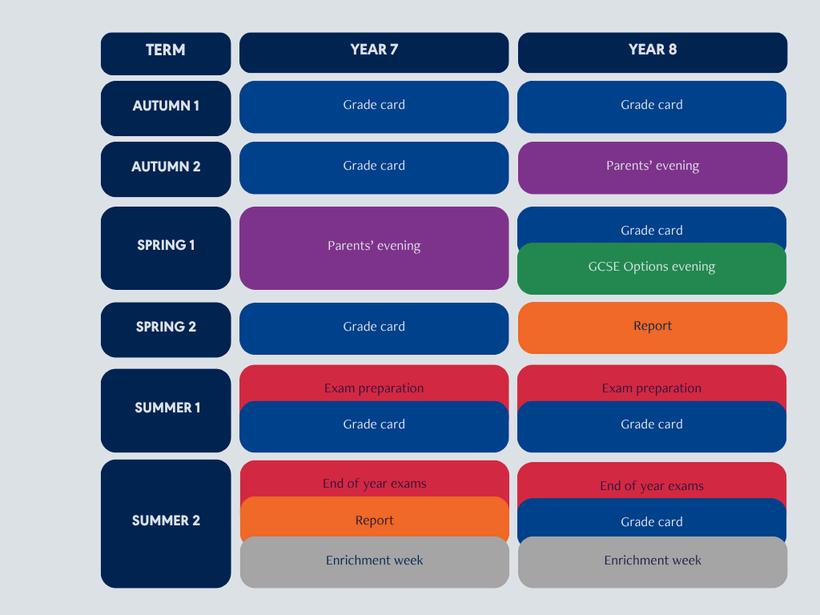
KEY ACADEMIC DATES
CURRICULUM OUTLINE
EQUIPMENT
You must be prepared for lessons but remember that you do not need to carry every single book around at all times (use your locker and bag racks). The basic equipment you will need for all lessons includes:
School device and charger
Prep diary
Exercise books
Text books (although not all subjects use these or require you to bring them to every lesson)
Pencil case, the contents of which should include:
Pens
Pencil and sharpener
Eraser
Ruler
Protractor
Compass
Glue stick
Colouring pencils
Scientific calculator
PREP
SUBJECT
LEARNER ATTRIBUTES WHEEL LEARNER WHEEL
The curriculum and our teaching and learning is specifically designed to not just prepare you for successful examination results, but to prepare you to be successful professionals and global citizens. That is why we purposefully aim to develop the skills that we believe make you more effective, independent learners, such as metacognition (the ability for effective self-evaluation) and problem-solving. We target these skills in our teaching and deliver them through exciting and challenging tasks, content and concepts.
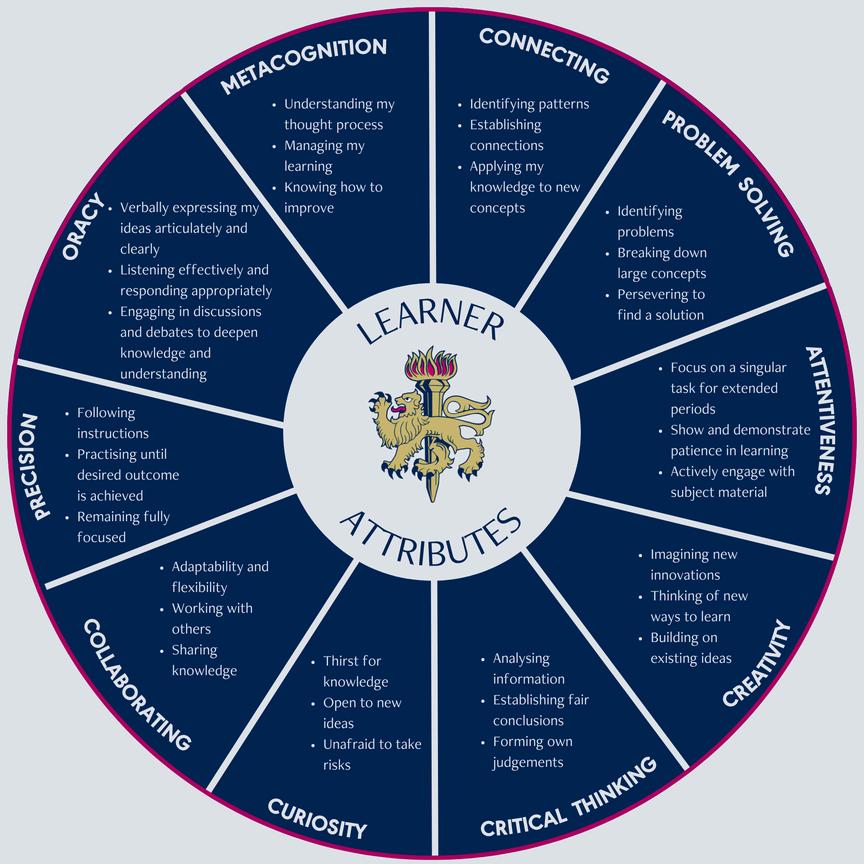
This is the full learner attributes wheel. Each department has highlighted which attributes are used in every topic, which you will see noted on the subject pages throughout.
ART & DESIGN AND TEXTILES
CLASSICAL CIVILISATION
AUTUMN TERM
Roman entertainment & leisure
The public baths
YEAR 8
Dinner parties and poetry recitation
Gladiators and the amphitheatre
SPRING TERM
Superstition & magic in the ancient world
Curse tablets
Witches and werewolves
Dreams and divination
Sacrifice
SUMMER TERM
Ovid – the Adventures of Perseus
- mythology
Perseus’ birth and early life
Medusa
Perseus and Andromeda
CONNECTING CRITICAL THINKING
CURIOSITY
CONNECTING CRITICAL THINKING
CURIOSITY
CONNECTING CRITICAL THINKING
CURIOSITY
COMPUTER SCIENCE
DRAMA
YEAR 7
AUTUMN TERM
Titanic
Ernie’s Incredible Illucinations
SPRING TERM
Macbeth
Storytelling
SUMMER TERM
Superheroes
Improvisation
CREATIVITY
CREATIVITY
PROBLEM SOLVING
CREATIVITY
PROBLEM SOLVING PRECISION
(page to stage)
YEAR 8
AUTUMN TERM
Greek theatre
Growing up
SPRING TERM
Curious Incident of the Dog in the Night-Time
Radio soaps
SUMMER TERM
Melodrama
Improvisation
CURIOSITY
CONNECTING
PROBLEM SOLVING PRECISION CREATIVITY
ENGLISH
YEAR 8
AUTUMN TERM
Novel study
Non-fiction
SPRING TERM
Shakespeare play
SUMMER TERM
Literary shorts
End of year exam preparation
End of year exam
Poetry
PROBLEM SOLVING CRITICAL THINKING
CREATIVITY
ORACY
PRECISION CURIOSITY CONNECTING
PRECISION CURIOSITY CREATIVITY
ORACY
CRITICAL THINKING
GEOGRAPHY
YEAR 8
Enrichment opportunities: Day trips to Brookwood Cemetery
History and Politics club
Historical fiction reading alongside the curriculum
History clinic
LANGUAGES
The languages department aims to: Teach engaging and effective lessons to give pupils the ability to speak, write and understand the language they are learning. To develop pupils’ awareness of and openness to other cultures and ways of thinking. To develop the transferable skills involved in analysing oral and written texts for meaning and expressing themselves in a different language.
YEAR 7
YEAR 7
AUTUMN/SPRING AND SUMMER TERM
Cambridge Latin course stages 1-4 (on the carousel)
Nominative & Accusative cases
Present tense verbs all personal endings
Roman dinner parties
12 Labours of Hercules
YEAR 8
AUTUMN TERM
Cambridge Latin course stages 5-8
st nd rd
1 2 3 Declension nouns singular and plural in Nominative and Accusative cases
Superlative adjectives
PRECISION
MATHEMATICS YEAR 7
AUTUMN TERM
Number
Sequences
Algebra
Shape
Statistics
SPRING TERM
Number
Geometry
Graphs
Probability
SUMMER TERM
Algebra
Number
Statistics
Shape
PROBLEM SOLVING
CRITICAL THINKING CONNECTING
AUTUMN TERM
Geometry
Number
Probability
Shape
Graphs
SPRING TERM
Number
Algebra
Shape
Geometry
SUMMER TERM
Algebra
Statistics
Shape
PRECISION
PROBLEM SOLVING
CURIOSITY
CRITICAL THINKING
CONNECTING
CONNECTING
PRECISION
PROBLEM SOLVING
PROBLEM SOLVING
MUSIC
The music department aims to: Allow pupils to embrace the higher order language of music, through performing, composing and appraising (listening). This is mainly achieved through practical work allowing each pupil the opportunity to play the keyboard in class, compose in a variety of styles, and listen to a wide range of musical styles. In doing so the theory is broached through the practical.
YEAR 7
AUTUMN TERM
The Elements of music:
Rhythm
Melody
SPRING TERM
Using voices and instruments:
Songs from the shows
Instruments of the orchestra
SUMMER TERM
Beyond classical music:
Gamelan
Film music
YEAR 8
AUTUMN TERM
Music in the 20th and 21st centuries:
Minimalism
Pop songs and rap music
SPRING TERM
Song Writing:
Chords and riffs
Blues
SUMMER TERM
World Music:
African drumming
Scales and modes (Indian and Japanese)
Enrichment opportunities:
Choir Orchestra
Jazz ensemble
String ensemble (Senior & Junior)
Rock band
Brass ensemble
Guitar ensemble
Musicals club
Songwriting club
Year 7 & 8 choir
Music theory club
PHYSICAL EDUCATION
The physical education department aims to: Through broad and varied activities, the dept aims to give pupils the opportunity to experience all the emotions of competitive, creative and health focused physical activity. Over the course of Year 7&8 we try to give pupils the chance to find or develop in activities they will go on to enjoy for the rest of their lives. Participation in regular physical activity is well proven to impact positively on academic performance. Over the course of these first two years, we aim to light the fire of future dedication and successful performance in a sport or physical activity.
YEAR 7
AUTUMN TERM
PE Basketball
Badminton
HRF (health-related fitness)
Games
Rugby Lacrosse
Netball
Archery
SPRING TERM
PE
Basketball
Badminton
HRF
Handball
Games
Football
Lacrosse
Netball
Archery
SUMMER TERM
PE Athletics
Games
Cricket
Tennis
Archery
Enrichment opportunities:
The curriculum is supported by a wide range of cocurricular clubs. All the activities covered in PE and games lessons are then supported by a club either at lunch or after school, or for some sports, both.
Sports fixtures for all pupils who wish to play are midweek and Saturday mornings
Sports tours
Coaching opportunities
Trips to local sports fixtures
PERSONAL,
SOCIAL, HEALTH & ECONOMIC EDUCATION (PSHEE)
The PSHEE department aims to:
Provide pupils with the knowledge and skills to keep themselves happy, healthy and safe, as well as to prepare them for life and work in modern Britain.
YEAR 7
AUTUMN TERM
Starting secondary school, getting support and developing resilience
Values and goal setting
Healthy friendships and hurtful behaviours
Internet safety and grooming
SPRING TERM
Healthy eating, hygiene, exercise and sleep
Staying safe
Dealing with stress and managing time
Relationships and consent
Equality, diversity and inclusion
SUMMER TERM
Cost of living, careers, developing aspirations and budgeting
First aid – basic life support, CPR, injuries, vaccination and immunisation
YEAR 8
AUTUMN TERM
Managing emotional wellbeing
Families and dealing with change
Healthy and unhealthy relationships
Online safety, AI and deepfakes
SPRING TERM
Gang crime and county lines
Smoking, vaping, alcohol and drugs
Managing risk and staying safe
Equality, diversity and inclusion CONNECTING PROBLEM
SUMMER TERM
Consent and relationship expectations
Managing the ending of relationships and conflict
Sexual orientation and gender identity
Puberty


RELIGIOUS STUDIES, PHILOSOPHY & ETHICS
The 50 Religious Studies, Philosophy & Ethics department aims to:
Inspire pupils to contemplate the big questions in life and to equip them with the skills required to both articulately express their own views and to compassionately reflect upon the beliefs of others. We also hope to instill within our pupils the knowledge required to live in our increasingly multicultural society and to help them become globally aware and morally responsible citizens.
YEAR 7
AUTUMN TERM
‘I believe’ Christianity, Humanism, Islam Buddhism
SPRING TERM
Stewardship
Spirited Arts Competition
CURIOSITY
CRITICAL THINKING
SUMMER TERM
Inspirational people
CREATIVITY PRECISION
CRITICAL THINKING
YEAR 8
AUTUMN TERM
Ethics
SPRING TERM
Human Rights & Social Justice
SUMMER TERM
‘United by Faith’
Sikhism, Hinduism, Judaism
Enrichment opportunities:
Year 7 Spirited Arts competition (spring & summer term)
Philosophy club
Trips
PRECISION CONNECTING
PROBLEM SOLVING
PROBLEM SOLVING CRITICAL THINKING
PRECISION
PROBLEM SOLVING
SCIENCE
The science department aims to:
Provide a safe and engaging learning environment for pupils to explore and develop their scientific knowledge and skills. Prepare pupils for assessment, qualifications and further study in the sciences. Encourage pupils to think critically, develop problem-solving skills, explore scientific enquiry and gain an appreciation of the importance of science in our everyday lives.
Foster an atmosphere of curiosity and exploration, encouraging independent learning and investigation.
Promote responsible attitudes towards the environment and to instil an understanding of the impact of science on society.
YEAR 7
AUTUMN TERM
Acids and alkalis
Cells
Energy
Mixtures and separation
ORACY
CURIOSITY
CRITICAL THINKING
ORACY
PROBLEM
SOLVING
SPRING TERM
Sexual reproduction
Current electricity
Particle models
Science week
SUMMER TERM
Atoms elements and molecules
Ecosystems
Forces
YEAR 8
AUTUMN TERM
Food and nutrition
Fluids
Combustion
Earth and space
ORACY
CURIOSITY
CONNECTING ORACY
PROBLEM SOLVING
CONNECTING
PRECISION CRITICAL THINKING
CURIOSITY CREATIVITY
CONNECTING
SPRING TERM
Periodic table
Breathing and respiration
Energy transfers
SUMMER TERM
Unicellular organisms
Metals and the reactivity series
CONNECTING CURIOSITY
CONNECTING
CONNECTING
ORACY CURIOSITY
CURIOSITY
ORACY
PROBLEM SOLVING
Science fair
CONNECTING
PRECISION CRITICAL THINKING
CURIOSITY CREATIVITY
Enrichment opportunities:
Year 7
Science club
Science week
Year 8
Stem club
Science fair
SOCIAL SCIENCE
The social science department aims to: Help pupils become thoughtful, active citizens who can engage intelligently and enthusiastically in the local and global world and to prepare them to play a full and active part in society.
Enrichment opportunities:
Engaging with local charities
Youth Council
Weekly news quiz
Meeting guest speakers to the school
Watching FYI news weekly
TECHNOLOGY (DESIGN & TECHNOLOGY, FOOD & NUTRITION)
The technology department aims to: Encourage pupils to consider design problems (usually the problems other people face) and provide a framework for learning and formulating ideas. During Years 7-8 pupils develop a range of practical skills associated with modern industry and develop an understanding of working as a team to solve problems. This is not only key to success in technology but also in industry, business, and commerce. Pupils develop an understanding of aesthetics and functionality in everyday items as well as developing practical skills that aid them in everyday life. The KS3 technology curriculum at Claremont lays the foundation for and supports the progression to GCSE courses.
Enrichment opportunities:
Food club - Pupils will be involved in food styling activities based on a given theme. This could include entrance to the National Tunnock’s Tea Cake Competition or styling a personalised biscuit (Dough and Design).