
Black Confederates
 by Lawrence E. Babits, Ph.D.
This article deals with a very inflammatory topic, that has been the subject of great debate, but attempts to present some source cited documentary evidence and information in a sober, calm, and rational fashion. At the same time, I am well aware that political correctness, and this phrase applies to both sides of any argument, might not be seen here. The article is not intended to start brouhaha; rather to encourage people to do some serious research of their own and not rely on what others say. I am also trying to give credit where it is due by calling attention to accounts that people either miss or ignore for whatever reason.
Today’s terminology is quite different from that used during the Civil War. A “Black Confederate” in modern usage has come to describe any African American who served in some military capacity in the Confederate Army, the terms “Black,” “colored,” and “of color” will be used somewhat interchangeably but without complicating the issue too much, many people of color were not
absolutely “black” in the modern African-American context. As just one example, Native Americans living in parts of the South would often be referred to a “colored” or “mulatto. There were laws about this and North Carolina’s constitution spelled out “exactly” what a free person of color was. Under the provisions of North Carolina’s 1855 Code:Section IV Cl. 3:23, a person of color was a “free negro, free mulatto, or free person of mixed blood, descended from negro ancestors to the fourth generation inclusive.” The 1855 legal definition is about ancestry and says nothing about appearances that are seemingly so important today. The complications of this definition affect what a “Black Confederate” was in terms of his local community. This article is intended as a line in the sand arguing for more research about these people, their motivations for serving, and further analyses of local perceptions of these people versus “national” perceptions.”
Black soldiers have participated in all of America’s wars since 1619. Like everyone else, they joined up for a variety of reasons that are not always clear today. Some were forced into ranks, but when that happened, the rest of the population was also being involuntarily enrolled. Anyone who has served in the military knows that their only existence, from the military’s point of view, is basically whether or not they did their duty. Many men who served were not recorded in muster rolls as to race because it was not so important to the military. Size rolls often do include such information so they could be identified if they went missing in a time when photo identifications did not exist. The Revolutionary War Maryland Continental muster rolls list names, ranks, enlistment dates, and when they were discharged or stricken from the rolls. This is true of the court martial records as well. It is only in other documents including

pension records, diaries, newspaper accounts, and census data that the ancillary information comes to light.
Black Confederate soldiers did exist. Few in number, Blacks served in the ranks and in companies, batteries, and ship complements during the war. The scattered information presented here shows a very small presence, but a real presence, nonetheless. They acted in a variety of roles, including infantrymen, musicians, cooks, and servants. This article will explore some of these nuances, while also identifying men who served and might be called Black Confederates today.
The most important record of service, even today, is a soldier’s compiled service record, in modern terms, the DD214. This record includes the soldier’s company, regiment, rank, and sometimes in the case of non-white soldiers in the past, an indication of their race. The terms that generally appear are black, mulatto, free, and negro [sic]. The term “free” served as a modifying adjective for nouns such those just given as well as abbreviations such as “col.,” “mul.,” and others.
These terms, given their specificity as to their military unit and time, are very important because they record how their military associates viewed them; since companies were usually recruited in a single locality, the term also indicates how they were probably viewed at home before the war began, and, perhaps, not how a modern person would identify them. At the same time, there is the issue of what a soldier was.
The following is an excerpt from the Customs of Service For
Steve Everhart, of Rome, Ga., served a Confederate officer during the war. He was 102 years old when this photo was taken. He attended numerous reunions, including the 1932 UCV Richmond Reunion as indicated by one badge. He also went by the name Uncle Steve Eberhart and Steve Perry. (Liljienquist Family Collection of Civil War Photographs – Library of Congress).
Vol. 46, No. 6 48 Pages, June 2020 $3.50 Civil War News America’s Monthly Newspaper For Civil War Enthusiasts Inside this issue: 47 – Advertiser Index 27 – American Battlefield Trust 22 – Ask the Appraiser 14 – Black Powder White Smoke 40 – Book Reviews 17 – Central Virginia BT 34 – Emerging Civil War 26 – The Graphic War 28 – Inspection, ARMS! 2 – Letters to the Editor 20 – The Source 18 – The Unfinished Fight 32 – This And That 24 – Through The Lens 2 – Trivia H Confederates . . . . . . . . . . . . see page 6
CW N
Civil War News
Published by Historical Publications LLC
520 Folly Road, Suite 25 PMB 379, Charleston, SC 29412
800-777-1862 • Facebook.com/CivilWarNews mail@civilwarnews.com • www.civilwarnews.com
Advertising: 800-777-1862 • ads@civilwarnews.com


Jack W. Melton Jr. C. Peter & Kathryn Jorgensen
Publisher Founding Publishers
Editor: Lawrence E. Babits, Ph.D.
Advertising, Marketing & Assistant Editor: Peggy Melton
Columnists: Craig Barry, Joseph Bilby, Matthew Borowick, Salvatore Cilella, Stephanie Hagiwara, Gould Hagler, Tim Prince, John Sexton, and Michael K. Shaffer
Editorial & Photography Staff: Greg Biggs, Sandy Goss, Michael Kent, Bob Ruegsegger, Gregory L. Wade, Joan Wenner, J.D.
Civil War News (ISSN: 1053-1181) Copyright © 2020 by Historical Publications LLC is published 12 times per year by Historical Publications LLC, 520 Folly Road, Suite 25 PMB 379, Charleston, SC 29412. Monthly. Business and Editorial Offices: 520 Folly Road, Suite 25 PMB 379, Charleston, SC 29412, Accounting and Circulation
Offices: Historical Publications LLC, 520 Folly Road, Suite 25 PMB 379, Charleston, SC 29412. Call 800-777-1862 to subscribe.
Periodicals postage paid at U.S.P.S. 131 W. High St., Jefferson City, MO 65101.
POSTMASTER: Send address changes to: Historical Publications LLC 520 Folly Road Suite 25 PMB 379 Charleston, SC 29412
Display advertising rates and media kit on request.
The Civil War News is for your reading enjoyment. The views and opinions expressed herein are those of its authors, readers and advertisers and they do not necessarily reflect the official policy or position of Historical Publications, LLC, its owners and/or employees.

P UBLISHERS :
Please send your book(s) for review to: Civil War News
520 Folly Road, Suite 25 PMB 379 Charleston, SC 29412
Email cover image to bookreviews@civilwarnews.com. Civil War News cannot assure that unsolicited books will be assigned for review. Email bookreviews@civilwarnews.com for eligibility before mailing.
ADVERTISING
INFO:
Email us at ads@civilwarnews.com
Call 800-777-1862
MOVING?
Contact us to change your address so you don’t miss a single issue. mail@civilwarnews.com • 800-777-1862
SUBSCRIPTION RATES
U.S. Subscription rates are $38.50/year,
Covid-19
Due to the spread of Covid-19, Civil War News has made the tough decision to temporarily suspend the free Calendar Events section until gathering bans have been lifted and the authorities have confirmed that it is safe to resume public group activities. We apologize for any inconvenience, but as always, Historical Publications LLC will continue to prioritize the health and safety of our subscribers, contributors, and advertisers. We are all feeling the effect of these unprecedented circumstances.
We are asking that event coordinators please reach out to us with your updated information when all gathering bans have been lifted in your area so that we may include your new event dates and info for publication. Please include town and state in your information.

Email us at: ads@civilwarnews.com.
To The Editor:
Thanks for the review of the long overdue history of the 39th Battalion Virginia Cavalry. I am familiar with the role the 39th played especially during the Gettysburg Campaign, and look forward to reading about this unit. The reviewer Tim Talbot did not mention it, but there is a brief unit history about the 39th Battalion included in a 1996 publication by authors Robert J. Drive Jr. and Kevin C. Ruffner titled 1st Battalion Virginia Infantry, 39th Battalion Virginia Cavalry, 24th Battalion Virginia Partisan Rangers, as part of the Virginia Regimental Histories Series. Since only 28 pages of this study are devoted to the 39th, I have ordered a copy of Michael C. Hardy’s version. It is a good bet that members of the 39th accompanied Gen. Robert E. Lee’s staff engineer, Capt. Samuel Johnston, on his now infamous reconnaissance on the morning of July 2 at Gettysburg to pinpoint the left flank of the Union army prior to Longstreet’s attack that afternoon.
Tom Ryan
Publishers:
By Lawrence E. BabitsCivil War Alphabet Quiz - D
1. Standard naval gun at start of Civil War
2. John Hunt Morgan’s second in command who also commanded President Davis’ escort during flight from Richmond through the Carolinas
3. Famous religious building at Sharpsburg
4. Class of semisubmersible Confederate torpedo boats
5. James River choke point with Confederate heavy artillery
6. Casemated ironclad not accepted by USN
7. “Little Giant” who ran against Lincoln in 1860
8. Waterway that was the “back door” to Norfolk
9. Woman authorized by US Secretary of War Simon Cameron to establish military hospitals
10. Sniper’s rock formation at Gettysburg
Answers found on page 47.
2 Civil War News June 2020
$66/2 years, digital only $29.95, add digital to paper subscription for only $10/year more. Subscribe at www.CivilWarNews.com
Send your book(s) for review to:
bookreviews@civilwarnews.com
Civil War News 520 Folly Road, Suite 25 PMB 379 Charleston, SC 29412


“We few we precious few, we band of brothers”
Maryland Confederate Soldiers by the Numbers
by Daniel Carroll ToomeyFor the last forty years I have been a serious student of Maryland’s Civil War history with equal enthusiasm for both the state’s Union and Confederate soldiers. One question that has always haunted me was how many Maryland men really went south to serve the Confederacy? In recent years the figure of 20,000 to 25,000 has been quoted. I believe that this number as well as that of Maryland’s Union soldiers is over estimated.
In 1964 the Maryland Civil War Centennial Commission placed a plaque on a wall in the State House in Annapolis. It stated that 63,000 Maryland men served in the Union forces and 22,000 Marylanders served in the Confederacy. Let’s look at the Union volunteers first. In 1898 the State of Maryland published its Roster of Maryland Volunteers in two volumes. These unit rosters were compiled by creating a file card for every man in every unit at every rank he held. As a young man I remember seeing these cards when the State Archives were housed on the campus of Saint John’s College. The great fallacy rests in the obvious fact there were more cards than men.
The following estimation of
numbers may fall short of what is taught in a class on statistical analysis, but I hope my common sense approach will be appreciated. In 1990 Martha and Bill Reamy compiled an index to both volumes of the Roster.
In paging through the index you will see many names with two, three, four, or even five different page numbers; this means there were that many index cards for the same man. Of greater importance is the fact that large numbers were counted twice. When the original members of the first Potomac Home Brigade Regiments completed their three year enlistments, all those with time yet to serve, or who chose to reenlist, were transferred to the newly formed Thirteenth Maryland Infantry and are thus counted twice. In similar fashion some 500 to 600 Black soldiers who transferred from the Union Army to the Navy are also counted twice. There are many more examples, but this should prove the point.
The Index to the Roster of Maryland Volunteers contains 153 pages of names. Not wishing to count every name I did the next best thing. I counted every name on the first ten pages, and then multiplied the average of 244 names by 153 to get 37,378
soldiers, a far cry from 63,000.
In 1883 General Isaac R. Trimble, in a speech before the third annual meeting of the Society of the Army and Navy of the Confederate States in Maryland, stated there were 20,000 Marylanders serving in the Confederacy. No supporting evidence was given but the figure was taken at face value.
Goldsborough’s 1900 The Maryland Line in the Confederate Army, was the first real attempt to compile rosters of Maryland men in the Confederate Army, but was far from complete. The first serious book to address their numbers was Daniel D. Hartzler’s Marylanders in the Confederacy. Published in 1986, before the Internet and on line archives, it represents an unbelievable amount of research. Mr. Hartzler listed 241 pages of names of Marylanders serving in state designated units as well as every branch of Confederate service. Again, not wishing to count every name I multiplied the average of the first ten pages, 241 pages times 39 names equaled 9,399 men.
In recent years several books have come out with rosters of specific Maryland units in Confederate service. Of course, these have taken advantage of
many decades of advanced technology, but still represent a tremendous amount of research. Rather than duplicate their efforts, I have extracted the figures that apply to this discussion from their books and given them full credit for their work.
The first of these is Robert J. Driver Jr.’s 1999) First and Second Maryland Cavalry, C.S.A. By actual count, the First Maryland Cavalry and Davis’ Battalion had 1,497 soldiers. The Second Maryland Cavalry by actual count yielded 613 names. The total for both rosters equals 2110 men.
Robert J. Driver Jr. published in 2003 The First and Second Maryland Infantry, CSA. The rosters of both units include 1,876 men.
Confederate Sailors, Marines and Signalmen from Virginia and Maryland by Robert J. Driver Jr. (2007), included telegraphers and secret service personnel with signalmen. From Maryland, there were 318 sailors, 25 Marines, and 50 signal and secret service personnel. There were also an additional 35 D.C. residents included in Driver’s text. The total was 428 attributed to Maryland.
George L. Sherwood’s 2007 study, the First Maryland Artillery and Second Maryland
Artillery provided other Maryland names with 246 First Artillery soldiers and the Second another 229 to identify 475 Maryland artillerymen. The Third Maryland Artillery adds 351 to that total but their numbers are from an 1896 post war battery roster. The Third served in the Western Theater and received little or no support from home. Together the three Maryland artillery batteries had 826 men with the caveat that most replacements in the Third were not from Maryland.
In 2017 Rick Richter published Three Cheers for the Chesapeake. This is the first history written about the Fourth Maryland Artillery. The low number roster total of 135 is due to the fact this battery never mustered over 93 men at one time.
None of these figures account for transfers between units as discussed with the Union soldiers. The First and Second Infantry CSA would be a prime example of double counting some men.
The total for all sources cited, except Hartzler’s book, is 5,375 men in Maryland designated commands. This figure does not include any references to men serving in non-Maryland units.
It is known that Marylanders served in other state units in a variety of service branches throughout the Confederacy. It is highly unlikely that 10,000 to 15,000 men served in the non-Maryland units to reach the supposed 20,000 to 25,000 figure. Short of tracking down every man in every non-Maryland unit, I propose we assume the same number as identified in Maryland commands were in non-Maryland commands, 5,375 and 5,375, or 10,750, probably a higher figure than actually served. Any additions to this figure would be gratefully received. It is not the purpose of this piece to diminish the roll of Marylanders in Confederate service. The fact that there were fewer men than first thought, only makes their

4 Civil War News June 2020 Letters to the Editor: Please email: mail@civilwarnews.com Civil War News 520 Folly Road, Suite 25 PMB 379 Charleston, SC 29412
achievements that much greater.


Sources:
• Bowling Jr., Garth E.
Gateway to the Confederacy, Charles County, Maryland, Garth E. Bowling Jr. 2019.
• Driver Jr., Robert J.


First and Second Maryland Cavalry, C.S.A., Rockbridge Publishing 1999. First and Second Maryland Infantry, C.S.A., Willow Bend Books 2003.
Goldsboro, W.W.


• William, The Maryland Line in the Confederate Army 1861–1865, Butternut Press Reprint 1983.


• Hartzler, Daniel D., Marylanders in the Confederacy, Family Line Publication 1986.


• Maryland Civil War Centennial Commission, “Maryland Remembered” plaque on State House Wall 1964. Richter, Rick
• Three Cheers for the Chesapeake, Schiffer Military History 2017.


• Third Maryland Artillery Roster of the Third Battery of Maryland Artillery C.S.A. 1896. Sherwood, George L.
• First Maryland Artillery and Second Maryland Artillery, Heritage Books 2007.


• State of Maryland, History and Roster of Maryland Volunteers, War of 1861-5, 1898.



• Trimble, Isaac R. Our Infantry, speech delivered at the third annual meeting of the Society of the Army and Navy of the Confederate States in the State of Maryland, 1883.
Daniel Carroll Toomey, is a University of Maryland graduate. Mr. Toomey has authored several books on the Civil War including, The Civil War in Maryland, Marylanders at Gettysburg, and The Maryland Line Confederate Soldiers’ Home. He is also co-author of Baltimore During the Civil War, and Marylanders in Blue, all of which were published by Toomey Press. He has lectured for a number of historical organizations, as well as for the National Park Service and the Smithsonian Institution. He has also contributed to radio and television programs, and on two Civil War battle videos. Mr. Toomey is a member of the Surratt Society, the Maryland Arms Collectors Association and the Company of Military Historians, and was project historian for the Maryland Memorial erected at Gettysburg in 1994 and wrote the inscription for that monument.
5 June 2020 Civil War News American Digger Magazine’s 3rdAnnual Chattanooga Civil War & Artifact Show & Sale July 25-26, 2020 Camp Jordan Arena 323 Camp Jordan Parkway East Ridge, TN 37412 Dealer Setup: Friday 12-7 PM Sat. 7-9 AM Sales and display tables featuring: americandiggerevents.com Swords & Knives Antique Firearms Dug & Non-dug Civilian Items Jewelry & Bottles Stone Artifacts Art, Photographs, & Books Militaria & Americana All Eras to WWII Metal Detectors & Equipment Door Prizes Awards Open to Public: Saturday: 9-5 Sunday: 9-3 200+ Tables Buy/Sell/Trade/ Browse/Display For information: (770) 362-8671 or (716) 574-0465 anita@ americandigger. com Buy!Sell! Display!Trade!
Greg Ton • P.O. Box 9 • Franklin, TN 37065 901-487-5944 • GTon1@aol.com Greg Ton Buying and Selling the Finest Confederate, Obsolete and Southern States Currency Since 1978 GregTonCurrency.com
H Confederates
. . . . . . . . . . . from page 1
Non-Commissioned Officers and Enlisted Men (Kautz 1865:6). The author finished the war as a general and led one of the USCT divisions into Richmond in 1865. Under the heading “The Private Soldier,” Kautz noted that “IN the fullest sense, any man in the military service who receives pay, whether sworn in or not, is a soldier, because he is subject to military law. Under this general head, laborers, teamsters, sutlers, chaplains, &c. are soldiers. In a more limited sense, a private soldier is a man enlisted in the military service to serve in the cavalry,
artillery, or infantry.” Note that Kautz says if a person is one of the combat arms, he is “a private soldier” (Kautz 1865:6), unless, of course, he holds a higher rank.
A soldier’s service record identified the role a soldier played in his unit. If it said private, or any other military rank, then the man was obviously a weapons carrying soldier. If it said musician, cook, or wagoner, that man was still on the company rolls, being paid, uniformed, and equipped, by the government. Now, in a test of honesty and as an example of double standards being applied to Civil War soldiers, take the cases of veterans Moses G. West, a cook (West, Service Record M1820,


Roll 0065), and George Street, a drummer (Street, Service Record M1823, Roll 0048). Were they soldiers? Only in your own heart can you say whether they were or not, and these cases are particularly instructive, given inflammatory ways people treat this topic. Look carefully at the upper right corner of their Compiled Service Record cards shown as images here, then say whether or not they were soldiers.
There have been attempts to discredit a soldier’s participation by claiming that musicians were not combatants. This is an error that has not, apparently, been noted by most descendants
whose ancestors were musicians killed and wounded whilst beating their drums, playing fifes, or carrying wounded during battle. In the American system, first applied by von Steuben in his 1778 manual’s formation of a regiment, “the drum and fife-major two paces behind the centre of the first battalion; their places behind the second battalion be supplied by a drum and fife; and the other drums and fifes equally divided on the wings of each battalion” (Riling 1966:8). The drum was “used both by infantry and artillery; … either to give notice to the troops of what they are to do.” Among the beats were the
“The march, to command them to move, always with the left foot first” and “The retreat, a signal to draw off from the enemy” (Duane 1810:128).
The two chief purposes of drummers were to maintain the step, something important in regulating the pace of an advance to ensure that a company’s soldiers were able to stay together as one compact body. The second duty was to relay commands from the leader so that all men acted as one, especially when maneuvering and firing. From the two quotations, it should be obvious that musicians had specific places in a formation and were to be there; otherwise the troops would not know the commands. The two specific beats mentioned show that the musicians had to be with their company under fire so they could signal when to advance or retreat. These beatings could not have been done from the safety of the rear echelons.
As if further proof were needed, examine the following cases. Although not Confederate, and not of color, two Civil War musicians were awarded the Medal of Honor. The first was Orion P. Howe, Musician (his rank), Company C, 55th Illinois Infantry, who earned his medal at Vicksburg on May 19, 1863. His citation read: “A drummer boy, 14 years of age, and severely wounded and exposed to a heavy fire from the enemy, he persistently remained upon the field of battle until he had reported to Gen. W. T. Sherman the necessity of supplying cartridges for the use of troops under command of Colonel Malmborg” (Hartke 1973:127). The other was William Lord, Musician, Company C, 40th Massachusetts Infantry at Drury’s Bluff, May 16, 1864. His citation read: “Went to the assistance of a wounded officer lying helpless between the lines, and under fire from both sides, removed him to a place of safety” (Hartke 1973:153). These two awards show that musicians were definitely in combat and should put to rest statements that they were not.
Musicians were specifically mentioned in North Carolina laws related to the militia, and then to the state troops taken into Confederate service. On September 26, 1861, the North Carolina legislature enacted a law (North Carolina 1861:2425) requiring all white males between eighteen and fifty who were residents be placed on the militia rolls. The law included a statement that it was unlawful to “enroll any free persons of color, except for musicians. When the unit was in the field on actual
6 Civil War News June 2020
Moses G. West. Source: https://www.fold3.com/ image/273/193995333.
George Street. Source: https://www.fold3.com/ image/273/263442928.
service, four free persons of color could be allocated to each company as cooks, who were to be fed and paid by the State.” North Carolina militia companies formed the base on which the later state troops and volunteer companies subsequently accepted for Confederate service were formed. The older militia regulations were simply adopted by companies and regiments being raised for Confederate service and carried as if legally binding.
For individual states, only one other will be cited here so as to not get bogged down. On June 28, 1861, the Tennessee State Legislature passed an act authorizing recruitment of state militia units. Section 1 authorized enlisting “all male free persons of color between the ages of fifteen and fifty, or such numbers as may be necessary.” Section 2 stated their wages at $8.00 per day, plus rations, and a clothing allowance that would be used to pay for their uniforms (Tennessee 1861). This act did not state that these enlistees were combat soldiers, musicians, cooks, or wagon drivers, just that they could be called up.
The Confederate Congress passed “An Act for the Payment of Musicians in the Army not Regularly Enlisted,” on April 15, 1862. This law stated that “whenever colored persons are employed as musicians in any regiment or company, they shall be entitled to the same pay now allowed by law to musicians regularly enlisted; provided that no such persons shall be so employed except by the consent of the commanding officer of the brigade to which said regiments
or companies may belong” (Confederate States 1862:39).
The April 1862 Confederate act concerning musicians also suggests that, in addition to free blacks formally enlisted as musicians in North Carolina units, others could be employed as musicians within a unit, and although paid by the government, they were not officially enlisted; instead they seem to have been hired. The distinction between being enlisted and hired is not entirely clear, but hiring a musician may not have required taking an oath of allegiance. That said, wording of the 1862 act may also suggest that, at least in the national Confederate government’s eyes, free black musicians were never considered formally enlisted as Confederate States Army soldiers, only as state militiamen, even though they were now actively participating in field operations including combat, as members of state regiments serving in a Confederate Army.
In 1863, the Confederate Congress refined the law about musicians under the Regulations for the Army of the Confederate States 1863:XXIX:section 75, page 13, which stated that “The musicians of the band will, for the time being, be dropped from company muster-rolls, but they will be instructed as soldiers, and liable to serve in the ranks on any occasions.” This regulation applies to bandsmen, not the drummers and fifers serving at the company level where they were already in the ranks.
Six days later, the same Congress approved an “An Act for the Enlistment of Cooks in the Army,” that authorized a
“Camp 28th Regt N. C., Troops, Dec. 23d, 1862
Hon James Seddon Secty War. C.S.A.
Sir,
company commander to “enlist four cooks for the use of his company, whose duty it shall be to cook for such a company – taking charge of the supplies, utensils, and other things furnished.”
The act went on to stipulate “the cooks so directed to be enlisted may be white or black, free or slave persons,” with the provision that “no slave shall be so enlisted without the written consent of his owner.” Anyone enlisted and placed on a company’s muster roll was paid along with everyone else in the company. At the rate of twenty dollars per month for the senior cook, and fifteen a month to his assistants, a lot more than an infantry private received. The cooks also received the same clothing allowance as the company’s rank and file soldiers (Confederate States 1862: Chapter LXIV:48, approved April 15, 1862). Regulations regarding any slaves enlisted under this act stipulated that their pay for serving as cooks would go to their masters.
Researching any Confederate soldier is not always a straight forward proposition. In the case of Black Rebels, it is far more complicated. As one example, Private Samuel Chavers, from Orange County, N.C., served in the 28th North Carolina Infantry. He enlisted in Company G, during September 1861, was captured 13 months later on December 13, 1862 at Fredericksburg, then was shortly thereafter paroled. His capture is interesting because Lane’s Brigade was well away from Marye’s Heights and the “Sunken Road.” In Lane’s report, it was noted that the “twenty-eight and thirty-seventh …
I have the honor to apply for a discharge from the service of the Confed. States, in behalf of private Samuel Chavers, of my Co. G. 28th Regt. N.C.I. on the following grounds. Samuel Chavers, of Orange CT. North Carolina, being partly of negro descent, has never been admitted to the rights of citizenship in the County; when the state militia of the County were enrolled at the beginning of the war, his name was stricken from the list on the same account and he was not allowed to be mustered. He volunteered 2d Sept. 1861 to serve for one year, although he was told by the Militia officers that he was not liable to military duty. His term of service has expired; he has been a faithful soldier up to this time, and has fought [emphasis added] in almost every battle from Hanover C.H to Fredericksburg. I most respectfully submit that faithful service of fifteen months when he was not liable to military duty, is an additional argument for his exemption now.
Most respectfly your obdt servnt
opened a terrific and deadly fire upon them, repulsing their first and second lines and checking the third. These two regiments were subjected not only to a direct, but to right and left oblique fires … whole command held their ground until the twenty-eight and thirty-seventh had fired away not only their own ammunition, but that of their own dead and wounded … being flanked right and left, fell back in an orderly manner, and were resupplied with ammunition. … The men of the twenty-eighth and thirty-seventh “fought like brave men, long and well” (Army 1864:523). After being captured and rapidly paroled, Chavers asked for, and received, a discharge in January 1863, because he was of “mixed blood” and was “partially negro.” (See number 1)
On his discharge for being mixed race, company commander
George Johnston noted that he was a “faithful soldier,” and “fought through all of the battles from Hanover Courthouse to Fredericksburg.” Chavers’ roster entry in the NC Troops 28th regimental history ends in 1862, but from his compiled service records, it is clear that less than a year later Chavers reenlisted in the same company and received a $50.00 bounty for doing so. Why he did so is unknown but the $50.00 bounty, survivor’s guilt at leaving his “pards” behind, and, perhaps, a feeling of duty, could all be drawn from his account. Chavers’ Compiled Service Record includes a statement by his last company commander noting that he had reenlisted in December 1863, and was killed in action at Jericho Mills, Va., in May 1864. His death was reported in the June 29, 1864, Raleigh Weekly Standard shown below.
Geo.
Co. G. 28th Regt N.C.T.
B.Johnston Capt.I solemnly swear that the statement of facts above given, so far as relates to my being of mixed descent, being denied the privileges of citizenship, and have been stricken from the muster roll, is correct in ever illegible Samuel Chavers
Geo B Johnston[illegible] that the name of the said Samuel Chavers was stricken from the rolls of my militia Co. by myself, because I was told by my predecessor in office that he said Chavers was not liable to military duty, being of mixed neg. descent. Henry C. Andrews 1st Sergt Co. G. 28th N.C. Regt”
June 29, 1864, Raleigh Weekly Standard.

7 June 2020 Civil War News
➀
“Samuel Chavers a private of Capt G W McCawleys Compy, 28th Regt N.C. was enlisted by Capt G.W. McCawley the 8th day of December 1863 for service for the war was Killed in action the 23rd day of May 1864 at Jerico Ford Va. Said Samuel Chavers was last paid by Capt D. A. Parker to include the 31st day of December 1863. He has pay due him from that date until the date of his death.
2 months & 23 days fifty five + 43/100 dollars
Due him for clothing fifty dollars
Bounty fifty dollars
Total amount due one hundred [sic 150] & 43/100 dollars
His personal effects were left on the field, he owes the C. S. nothing
G. W. McCawley Capt Petersburg, Va. Co. G, 28th NC
Sept 13th, 1864”
(See number 2): Unlike the vast majority of government paid and clothed Confederate Blacks who were cooks and musicians, Chavers was most certainly acting as battle line Confederate infantryman engaging Union troops under fire. His captains clearly stated he was a combatant and used the words “fought” and “killed in action.” Chavers entered service before the Conscription Act, got out of the army for being “mixed blood” after over a year of service, then reenlisted almost a year later knowing what infantry service meant, and served until he was killed May 23, 1864. But is Chavers unique? Not really.
Michael Bradley’s history of Forrest’s staff and body guard has a statement in the foreword that is germane when discussing Black combatants. “Indeed, riding with Forrest as combat soldiers were a handful of AfricanAmericans, some of whom were members of the general’s personal bodyguard. Of the black men who served under him, Forrest would later say, “There were no better Confederates.” Though many of this group are now lost to history, some are to be found in the available records. … Some of the black Confederates joined the Veterans Association established by the Escort and Staff. At least one of them became an officer of that body” (Bradley 2006:22).
The men riding with Forrest saw a lot of hard fighting including Polk Pleasant Arnold and Preston Roberts. Arnold joined the Confederate Army in 1863 and “served as a private in Nathan Bedford Forrest’s Escort under Captain J. C. Jackson in Lieutenant Nathan Boone’s Platoon” (Bradley 2006:219). Arnold was killed in action at Harrisburg, Miss., July 17, 1864. You do not get killed in action unless you are a combatant. Arnold’s widow, Caldonia, drew a Confederate pension for her husband’s service that stated Arnold was a Negro (Bradley 2006:48, 219).
Preston Roberts, enlisted as a Private in Co. F, 13th (Gore’s)

Tennessee Cavalry (Confederate), September 15, 1862, for the war. His horse was valued at $130, and his equipment at $10.00. (Roberts n.d.M268, Roll 0056, Fold 3, Tennessee Confederate Soldiers). What the bare bones Compiled Service Records references do not state is that Roberts and the Thirteenth served under Nathan Bedford Forrest. Roberts himself “served as head of the mess for the cavalry when it was in camp. Roberts was in charge of all funds to purchase the food that was not provided by the commissary, and he commanded seventy-five cooks” (Bradley 2006:219). Roberts survived the war and in his newspaper illustration is apparently wearing a United Confederate Veterans uniform (Roberts n.d.).
At Chickamauga, during the forlorn and desperate Confederate assaults against Thomas’s position a group of Black men from the 4th Tennessee Cavalry, Davidson’s Brigade, Wheeler’s Corps, suffered casualties. These men might be seen as atypical because they were servants. According to regimental quartermaster, Captain Joseph P. Briggs, the servants had been tasked with guarding horses whilst the troopers went into the fight on foot. A black servant named Daniel McLemore, servant to the Colonel of the regiment, had organized some regimental servants into a company numbering some 40-50 men. After the regiment had been fighting for some time, they asked Briggs if they could participate in the fighting. Briggs later recalled that, “After trying to dissuade them from this, I gave in and led them up to the line of battle in [sic] which was just preparing to assault Gen. Thomas’s position. Thinking they would be of service in caring for the wounded, I held them close up the line, but when the advance was ordered the negro company became enthused as well as their masters, and filled a portion of the line of advance as well as any company of the regiment. While they had no guidon or muster roll, the burial after the battle of
$52.43
$50.00
$50.00
$152.43
four of their number and the care of seven wounded at the hospital, told the tale of how well they fought.” I downloaded this quotation from C. W. Roden’s website because it was so different in that the servants formed a company worth of soldiers, went into the fight, took casualties, and were noticed. I would very much like to have a citation for Brigg’s account, but don’t have it at present. Another account of a servant acting in a different role with a Confederate Army was reported by Lt. Col. Arthur Fremantle, a British observer traveling with the Army of Northern Virginia during the Gettysburg Campaign. “I saw a most laughable spectacle this afternoon-viz., a negro dressed in full Yankee uniform, with a rifle at full cock, leading along a barefooted white man, with whom he had evidently changed clothes. General Longstreet stopped the pair, and asked the black man what it meant. He replied, “The two soldiers in charge of this here Yank have got drunk, so for fear he should escape I have took care of him, and brought him through that little town.” The consequential manner of the negro, and the supreme contempt with which he spoke to his prisoner, were most amusing. This little episode of a Southern slave leading a white Yankee soldier through a Northern village, alone and of his own accord, would not have been gratifying to an abolitionist. Nor would the sympathizers both in England and in the North feel encouraged if they could hear the language of detestation and contempt with which the numerous negroes with the Southern armies speak of their liberators” (Lord 1954:41-142).
A much maligned account occurred in 1865 during the Confederate retreat to Appomattox. Virginia veteran R. M. Doswell wrote an account involving Confederate Infantrymen of Color for the Confederate Veteran in 1915. The late date has caused many to discount it because he wrote during the height of the “Lost Cause” movement. In the account’s snippets,
Source: https://www.fold3.com/image/271/66360349.
Preston Roberts. The Richmond Planet, Richmond, Virginia, March 12, 1904, page 2.

8 Civil War News June 2020
➁
“R. M. Doswell, a Virginia private, was on the muddy road with a dispatch when he saw a wagon train under the guard of Confederate Negro Troops. “A singular sight to me,” Doswell wrote. The wagons were halted, and in the rear, no more than a hundred yards away, a Federal cavalry regiment was forming for a charge. The bluecoats fell into line on a hillside and galloped down on the wagons. The Negroes fired rapidly and drove them off. While Doswell stared in admiration at the colored troops, the Union cavalry wheeled back into sight, this time in a determined charge that broke up the train and turned the vehicles from the road. The Negro soldiers were quickly captured” (Davis 1959:176).
incorporated into the Burke Davis book To Appomattox, (See number 3).
Doswell’s account has been discredited because it was written during the “Lost Cause” effort, but during the siege of Petersburg, at least one Maryland infantryman, John Gwinn Barber, “Applied for appointment as Drillmaster for Negro commands being formed” on March 25, 1865. Barber, a former color bearer was not simply seeking to get out of the trenches as he was already detailed as a clerk in the Confederate Treasury Department (Driver 2003:368). Henry Ammen, another Marylander noted in his diary entry for March 23, 1865, that “Negro recruiting going on rapidly in Richmond” (Driver 2003:323). The men Doswell saw were probably some of the Black Confederates recruited and drilled in Richmond less than a month before. Clearly, there were Confederates of Color being assembled, outfitted, and trained less than a month from Lee surrendering the Army of Northern Virginia.
Doswell’s account is far more specific than two reports found in the Official Records.
The first relates to an engagement between the 9th Michigan Infantry and Forrest’s Cavalry at Murfreesboro, Tenn., during July 13, 1862. The Ninth’s commander, Lt Col. Parkhurst reported that in addition to “The forces attacking my camp… There were also many negroes attached to the Texas and Georgia troops, who were armed and equipped, and took part in the several engagements with my forces during the day” (OR XVI:805). A similar, but less specific account is found in a May 30, 1862, report by Colonel Benjamin C. Christ, 50th Pennsylvania Volunteers, who noted “There were six companies of mounted riflemen, besides infantry, among which were a considerable number of Colored Men,” in an engagement along the Coosaw River in South Carolina (OR XXVI:24). This report is somewhat supported by an 1862 photograph of members of 2nd South Carolina relaxing somewhere along the coast. Individual, more generalized, eye witness accounts include Union soldier Alfred Bellard and a U.S. Sanitary Commissioner named Steiner, both in 1862. Bellard was on the Peninsula
during the Union attempt to get past the Confederate defensive line anchored at Yorktown when he made a drawing of a Confederate sharpshooter firing on his regiment and recorded what happened: See above number 4).
U.S. Sanitary Commission inspector, Dr. Lewis Steiner, was in Frederick, Md., when General Jackson’s infantry marched in on Sept. 6, 1862. He kept a diary and in it recorded incidents he observed during the Rebels’ occupation. In recording what he saw, he noted that: (See number 5).
Steiner went on to include a telling statement about musicians in stating “Drummers and fifers of the same color abounded in their ranks” (Ibid. page 21). Steiner did not initially mention musicians until as an afterthought. The number of Blacks may thus have exceeded his estimation since the “3,000 negroes” were definitely not presented as being in ranks in the initial statement.
Steiner’s account is cited fairly often. There is certainly a major issue because of the numbers he gives. Jackson’s Second
“On each of our posts was stationed one of Berdan’s sharp shooters, who were always on the look out for game, and woe to the rebel who put himself in their way One of then who was armed with a telescope rifle had placed a negro picket “Hors de Combat” the day before. In front of our line stood a large hollow tree, having loop holes cut into it so that a rifle could be run through and discharged at our men without danger to the negro who fired it. On this occasion our sharp shooter had fired twice at the black without hitting him, but in the afternoon he left the tree and was taking a walk for the benefit of his legs, when he was suddenly flopped on his face before he had taken six steps., Two white men who [sic were] with him tried to haul him back, but a few does of leaden pills being thrown that way, he was left alone until darkness” (Donald 1975:56-57).
➄
Over 3,000 negroes must be included in this number. These were clad in all kinds of uniforms, not only in cast-off or captured United States uniforms, but in coats with Southern buttons, State buttons, etc. These were shabby, but not shabbier or seedier than those worn by white men in the rebel ranks. Most of the negroes had arms, rifles, muskets, sabres, bowie-knives, dirks, etc. They were supplied, in many instances, with knapsacks, haversacks, canteens, etc., and were manifestly an integral part of the Southern Confederacy Army. They were seen riding on horses and mules, driving wagons, riding on caissons, in ambulances, with the staff of Generals, and promiscuously mixed up with all the rebel horde. The fact was patent, and rather interesting when considered in connection with the horror rebels express at the suggestion of black soldiers being employed for the National defence.”
Corps left Frederick in response to Special Order #109 issued on Sept. 9, 1862, so Steiner’s observations took place between Sept. 7 when the Army of Northern Virginia arrived in Frederick and Sept. 10 when Jackson’s Corps left. If Jackson’s Corps had about 15,000 men just before Sharpsburg (Clemons II:2012:598), then 20 per cent of his command was Black. This figure needs to be further clarified because Confederate strength reports allegedly did not count cooks and wagoners. Those “non-combatants” can be figured at 4 cooks and 1 wagoner per company, or 50 total per regiment, an admittedly loose figure given that not all regiments had ten companies. Jackson’s four divisions (Ewell, A. P. Hill, Jackson, D. H. Hill) had some 90 regiments. That figure, times 50 cooks and wagoners, gives a total of 4500 noncombatants, probably an overstatement but good enough for this purpose and not figuring that at least some cooks and wagoners were white. Those 4,500 additional men require a recalibration of the 15,000 men Jackson’s Corps had by raising the total to 19,500. With that number, the 3,000 “negroes” reported by Steiner would represent 15 per cent of Jackson’s total command without considering servants “belonging” to officers who were certainly included to some extent in Steiner’s observation. There is no record I have ever seen that even hints at Jackson’s Corps having 3,000 Blacks associated with it, either in ranks, in noncombat rolls, or as camp followers.
Returning to the other non-combatants, it is important to consider cooks. In his unofficial handbook for men going on active service, Union Captain Egbert Viele described food preparation. “The company rations are usually taken charge of by the orderly sergeant, and issued daily to the cooks, by whom they are prepared and served to the company. The men of the company serve in turn as cooks, two being the usual number serving at once” (Viele 1861:35). Obviously, those who were good cooks would be in demand whilst poor cooks were heartily damned by the men. Good cooks could soon find themselves drawing better pay in many cases, even though they enlisted as soldiers.
At the start of the war, food was generally prepared by the soldiers themselves as Viele mentioned. Conrad Wise Chapman provides a good account of the various duties that changed as the mess did after every “army move or a fight.” “Ike Kerr filled
the place of cook … a good natured well disposed fellow—He was nicknamed Sibley from the shape of his hat which had been used to hold water so often that it became the shape of a funnel … Young of German decent was second in that Department and made the fires Rosencrantz attended to the frying of the meat. Tom Brown the lazy drummer of the Co. made the Coffee. Bob and I were the water toaters, and Johnny Rochel the bully and head of the mess and was always ready to stand up for mess no 1” (Bassham 1997:37). Some units hired cooks, others were enlisted as cooks, and some units rotated the duty among their soldiers. As Chapman points out, not all cooks were “people of color.”
Numerous “non combatants of Color” such as cooks were sent to Union prison camps after being captured. One example was John Williams, a Black cook in the 2nd Maryland Infantry. Williams was on furlough during December 1864 and back with the company a week later. After spending the next three months rotating in and out of the Petersburg trenches, he started on the march to Appomattox but never finished it. Captured at Hatcher’s Run, April 4, 1865, he was sent to the Point Lookout POW camp and not released until June 19, 1865 (Driver 2003:302, 545). If he was not considered a soldier, the question of why he remained imprisoned at Point Lookout for over a month after the war ended, needs to be asked, not whether he was a “real soldier.” The Federals apparently considered him a military man, despite his color.
A point of clarification should be inserted here. There is a definite difference between a free man of color serving as an enlisted, paid, and clothed cook for an infantry company and a body servant acting as a cook. Without the Confederate muster rolls, it would have been hard for Federal captors to determine the man’s status, especially if he were in a Confederate uniform.
Some Confederate cooks later joined the USCT, and given their dates of enlistment, it is possible to suggest several reasons, financial, getting away from home areas, camaraderie already known from prior service, and the like. These men include Abraham Roach, who served with Company A, 8th North Carolina Infantry from November 1862 until at least October 1864, the date of the unit’s last surviving muster roll. Whether he deserted or was discharged from Confederate service remains uncertain, but on April 28, 1865, two days after the Army of Tennessee
9 June 2020 Civil War News
➂
➃
surrender at Bennett Place, he enlisted in Company M, 14th U.S. Colored Heavy Artillery, at New Bern, N.C. He remained with the unit almost eight months until December 11, 1865, when he mustered out at Fort Macon. Roach later received a Union army pension for his service.
One primary documentary source used for today’s research into military service is pension documents. In 1885, North Carolina enacted a law, the North Carolina Pension Law of 1885, was enacted to provide support for Confederate veterans who lost an eye, arm, leg, or had been completely disabled by service. The same law also allowed pensions to widows of soldiers slain in battle; four years later the law was amended to allow widows of soldiers who died of disease to claim a pension. Applying for a pension required filing an application before a county pension board. These boards, representing both the local community as well as the state, considered evidence of service, including any supporting affidavits. If the local board approved, it was forwarded to the Pension Bureau headed by the State Auditor who had the final decision. Veterans could also be added to the pension rolls by actions of the General Assembly. The North Carolina Pension Act of 1901 further expanded the range of qualifications to include all Confederate veterans who could no longer perform manual labor and widows of any Confederate soldier or sailor.
Under the 1901 act, pensioners were placed into one of four classes; each provided a different financial stipend, based on the disability. Nearly every later North Carolina General Assembly further amended the law. Originally
ownership of property worth $500 kept applicants from receiving a pension; that figure was later raised to $2,000. Inmates at the Soldiers’ Home, those receiving pensions from other states, and deserters were denied pensions. In 1927 the North Carolina Pension Act was again amended, dividing pensions into two classes. Class A pensions were reserved for white Confederate veterans while Class B pensions were assigned to widows of white soldiers and to former slaves and, apparently freemen of color, who proved that they had acted as servants to soldiers or otherwise worked in a support capacity for the Confederacy, not necessarily as soldiers or musicians. North Carolina followed South Carolina “Colored” servant pension act of 1923. A few men of color applied for pensions prior to 1927, but most were rejected because of race or because they were never actually enlisted Confederate soldiers.
The 1927 act created a problem because there was a shortage of forms for those not applying as soldiers. Consequently, when clerks simply used the old forms, they sometimes noted whether the veteran was a servant or any of a number of other non-combat roles, but many times they did not. This has led some researchers to conclude that a servant, usually their ancestor, was a soldier. Note that this distinction is not about enlisted, or hired, cooks and musicians.
So, ultimately, a conclusion must be drawn. Yes, Blacks did serve and were paid and uniformed just as were enlisted Confederate soldiers. They often saw, and participated in, combat, due to their roles as musicians and rarely as infantrymen. Some men

of color were soldiers in the ranks with weaponry, but they were certainly not numbered in the thousands and their numbers are far less than the roughly 180,000 men of color who served in the United States Colored Troops or U.S. Navy during the war, but nevertheless, these men deserve further investigation, analysis, and understanding of the multiple contexts of their service and individual motivations for serving. In these internet days, some avid researcher compelled by the government to enforced isolation at home, needs to start pulling the service records, company by company, of Confederate regiments and searching each for indicators of race or ethnicity.
Acknowledgments
In preparing this article, information came from many sources. Imagery for this article includes material from Fold 3. Research included looking at various websites, including one maintained by C. W. Roden, where some confirmatory material was found. Two people specifically encouraged me to try and present information drawn from original sources, Jim Beale, a fellow reenactor and marksman, and Jack Melton, publisher of Civil War News. As with most research, I drew upon a wide variety of folk with knowledge of the current, not so civil, war roiling the waters of Civil War research.
References Cited:
Army
1864 Reports of the Army of Northern Virginia from June 1862 to an Including the Battle of Fredericksburg, Dec. 13, 1862. R. M. Smith, Richmond.
Bassham L., editor
1999 Ten Months in the “Orphan
Brigade” Conrad Wise Chapman’s Civil War Memoir. Kent State University Press, Kent, OH.
Bradley, Michael R.
2006 Nathan Bedford Forrest’s Escort and Staff. Pelican Publishing, Gretna, LA.
Clemens, Thomas G. editor
2012 The Maryland Campaign vol. II. Savas Beatie, El Dorado Hills, CA.
Confederate States
1862 Public Laws of the Confederate States of America Passed at the First Session of the First Congress. The Statutes at Large of the Confederate States of America, Richmond 1862: 29, 48.
1863 Regulations for the Army of the Confederate States. Richmond, VA.
Davis, Burke
1959 To Appomattox. Popular Library, Rinehard & Company, New York.
Donald, David H., editor
1975 Gone for a Soldier The Civil War Memoirs of Private Alfred Bellard. Little, Brown and Company, Boston.
Driver, Robert J. Jr.
2003 First & Second Maryland Infantry C.S.A. Willow Bend Books, Bowie, MD.
Hartke, Vance, Chairman
1973 Medal of Honor Recipients 1863–1973. Committee on Veteran’s Affairs, United States Senate, Government Printing Office, Washington, DC.
Kautz, August V.
1865 Customs of Service For NonCommissioned Officers and Enlisted Men. Lippincott, Philadelphia.
Lord, Walter L.
1954 The Fremantle Diary “Three Months In The Southern States (AprilJune 1863).” Little, Brown, and Company, Boston.
North Carolina
1861 Public Laws and Resolutions of the State of North Carolina, Sept. 26, 1861, p 24-25.
Riling, Ray
1966 Baron Von Steuben and his Regulations. Ray Riling Arms Books, Philadelphia.
Roberts, Preston
n.d. Combined Service Records, National Archives, M268, Roll 0056, Washington, DC. IN Fold 3, Tennessee Confederate Soldiers
Steiner, Lewis
1862 Diary entry for Sept. 6, 1862. In Harwell’s Union Reader. Pages 19-21 in original. The Civil War Reader. Mallard Press 1991.
Street, George n.d. Combined Service Records, National Archives, M1823, Roll 0048, Washington, DC.
Tennessee 1861 AN ACT for the relief of Volunteers. Public Acts of the State of Tennessee Passed at the Extra Session of the Thirty-Third General Assembly. Chapter 24:49-50, Nashville.
West, Moses n.d. Combined Service Records, National Archives, M1820, Roll 0065, Washington, DC
Viele, Egbert L. 1861 Hand-Book for Active Service. D. Van Nostrand, New York (reprinted by Invictus, Johnson Graphics, Decatur, MI., n.d.).
Larry Babits has been reenacting since 1960. He served in the U.S. Army’s B Company, 21st Infantry (Gimlets) during 1963–1966. Babits earned degrees at Maryland and Brown leading to a career teaching archaeology and military history at Washington and Lee, Armstrong State, and East Carolina. A retired rugby player, Larry is now working on the sequel to his studies of the 1781 battles of Cowpens and Guilford Courthouse although he admits to taking breaks from corona self isolation to practice black powder marksmanship, getting ready for the next chance the First Maryland has to shoot at the N-SSA nationals.
10 Civil War News June 2020
Just as in the past, this Black Confederate (behind the flag) is just a Reb in ranks.
Publishers/Authors Updated Information Send your book(s) for review to: Civil War News 520 Folly Road, Suite 25 PMB 379 Charleston, SC 29412 bookreviews@civilwarnews.com


‘The Gunboat Commodore’ – US Flag Officer Andrew Hull Foote
“He had a megaphone and he kept popping in and out of the pilothouse on St. Louis, shouting instructions to his captains.” St. Louis was struck 59 times, drifted downstream out of action, pilot killed. Foote wounded in leg and arm. Fort Donelson was going to be an Army fight after all.
by Joan Wenner, J.D.Who Was Andrew Hull Foote?
From an Ohio State University (OSU.edu e-history) summary, he was from New Haven and for a time attended West Point at the age of 16, but left before he completed his first year to serve as a midshipman aboard a U.S. Navy vessel. Prior to commanding a fleet of ironclads helping Grant, he was overseas on naval service including China, Africa, and the South Pacific; he also saw action while on anti-slave trader patrol.
When the Civil War began he was in New York on ‘mundane duty’ as chief of the Brooklyn Navy Yard. Then in August 1861, and described as ‘brilliant in command,’ Foote was placed in charge of naval defense on the upper Mississippi River where his duties included building and manning the ships he led into action at Forts Henry and Donelson, and Island Number Ten.

It’s been written that Gideon Welles managed to create the doctrine of ‘unified command’ by accident; his thinking being that Mississippi River operations were purely to be the responsibility of the army, but when Foote took command of naval operations along the western rivers, Welles advised him, and those who succeeded him, that these naval operations were to be under the War Department but under control of the army.
Foot and arm wounds from Donelson forced the ‘gunboat commodore’ to a shore position.
In Washington during June 1862, he was promoted from commodore to rear admiral, given the thanks of Congress, and tasked as Chief of the Bureau of Equipment and Recruiting. After a year he was able to wrangle a seagoing appointment as commander of the South Atlantic Blockading Squadron but would die in June 1863 before take command.
Lead-up to Fort Henry
Prior to the firing on Fort Sumter on April 12, 1861, there were discussions more than a month earlier by Secretary of
State Seward with Lord Lyons, British Minister to Washington, concerning the effect of a possible blockade of Southern state ports on England’s cotton-fueled sector of its economy.
Lincoln’s April 19, 1861, issuing of the Proclamation Against Southern Ports complicated matters, as it was Britain’s view that, under the 1856 Treaty of Paris, the United Kingdom was legally obligated to acknowledge the Southern Confederacy as a de facto sovereign state.
When the Federals won at Logan’s Cross Roads, Washington confirmed a soft spot in the Confederate line farther west where the Cumberland and Tennessee Rivers came north across the Kentucky-Tennessee border. Secretary of War Halleck and Grant selected “the rugged sailor who represented the salt-water sailor on the rivers of the Middle West, Flag Officer Andrew Foote,” for assistance. Halleck was skeptical of the “strange auxiliaries called gunboats” but Fort Henry would be captured as Foote found the Confederates defenses sorely lacking and, since the river was in flood, basically steamed right into it.
After the fort surrendered to the Navy, Foote would say, “I made a bold dash at Fort Henry to inspire terror & it succeeded.” Commodore Foote, said a newspaper reporter, believed in
swift action at close quarters. Bruce Catton in his volume two, Terrible Swift Sword, noted that the Federals had gained one of the easiest and most significant victories of the entire war. Foote quickly sent three unarmed ‘black monsters with slanting sides’ up the river to spread alarm throughout the upper South.
Fort Donelson
According to Catton, Flag Officer Foote was also said to have had misgivings about attacking Fort Donelson, but that fortification also fell although not as easily as Fort Henry.
Island Number Ten
While it no longer exists today, the Mississippi having washed over most of it and carving a channel elsewhere, “in 1862 the island was a two-and-one-halfmile-long mud patch lying in a great loop of the Mississippi, “rimmed with strong ramparts and heavy guns, so menacing that even Flag Officer Foote was afraid of it.” That, however, did not deter Secretary of War Halleck from launching an amphibious expedition to take the river from the enemy.
The expedition was to consist of 20,000 men led by Gen. John Pope “supported by Flag Officer Foote who had seven iron-plated gunboats and a fleet of barges

12 Civil War News June 2020
Commodore Andrew H. Foote. Record group: Record Group 111: Records of the Office of the Chief Signal Officer, 1860 –1985 (National Archives Identifier: 440).
USS Carondelet. Photographed published in Rear Admiral Henry Walke’s Naval Scenes and Reminiscences of the Civil War in the United States (1877). U.S. Naval History and Heritage Command Photograph. Catalog #: NH 63376.
mounting big mortars.” The plan was for Pope to block downstream re-supply routes. To do this, Pope’s transports had to get past Island Number Ten.
It is not intended here to recount the action in detail but rather to provide a brief glimpse of Foote’s part in the operation. Pope needed transports and transports needed protective gunboats. For his part to isolate the island. Foote, stomping about on crutches from slow-healing wounds received at Fort Donelson, “held his flotilla just upstream from the island, moored his mortar boats along the bank, opened a long-range bombardment, and studied his problem with rising pessimism.”
Said to be as tough as any man in the Navy, he refused to run in close to the strong fortifications as he had the Tennessee and Cumberland forts, largely because the river ran in the wrong direction. At the other forts, his fleet fought facing upstream where a disabled vessel could drift back to safety; at Island Number Ten with his gunboats “sadly underengined,” he could not do that. While Pope’s engineers got to work cutting a new six-mile long ‘waterway’ fifty-feet wide to a depth of four feet to help reach their goal, Foote
kept up the three-week long bombardment although it did not accomplish a great deal.
The canal was too shallow for the gunboats and transports so Pope asked Halleck for two of Foote’s gunboats manned by soldiers to run past the island. Perhaps if the flag officer’s health had been better “he would have been bolder...” He was impatient with the enforced inaction during the ‘waterway’ digging. Turning over two of his gunboats to the Army and letting soldiers attempt to do what sailors ostensibly could not was just too much.
The Carondelet
Commander Henry Walke, skipper of the gunboat Carondelet received Foote’s approval to attempt running past Island Number Ten. He told Foote he would need two things, a barge loaded high with bales pf hay lashed to the portside for gunfire protection and a dark night to conceal his movement. He got both on April 4 as the vessel “left her moorings and drifted downstream to run the gauntlet.”

Walke reached the upstream end of the island without discovery. Although finally seen and the enemy alerted, he, crew and vessel managed to pass and reach

New Madrid at midnight and joined Pope’s troops lining the waterfront. Walke, an old Navy man, now issued the tradition al order: ‘splice the main brace. Island Number Ten was now iso lated and surrendered on April 7, 1862. “To all intents and purpos es, the Confederacy had lost the middle Mississippi.”

Joan Wenner, J.D. is a longtime Civil War history writer holding a law degree with particular inter est in maritime and courts mar tial affairs. She has published in America’s Civil War, Military Heritage, and Civil War News for many years and is a book reviewer. Comments are welcomed at: joan_writer@yahoo.com.

13 June 2020 Civil War News
Want to Advertise in Civil War News? Email us at ads@civilwarnews.com Call 800-777-1862 For more information and rate sheet visit: www.civilwarnews.com
Kearny Selects Some Sharpshooters & the Intelligent Whale Moves


New Jersey sent two brigades to Virginia in 1861. The first was a four regiment militia brigade enlisted for 90-days service; the second the official “First New Jersey Brigade,” was three regiments of men who had enlisted for three years. Both brigades were deployed in the Bull Run Campaign as support troops and not really engaged. Following the Battle of Bull Run, the militiamen went home; the Volunteer Brigade remained in Virginia. There was a lot of chaos among the Jerseymen after Bull Run, with officers accusing other officers of incompetence and cowardice. On Aug. 7, 1861, the brigade was assigned a new commander, legendary one-armed Jerseyman General Phil Kearny. When the general first encountered his new command, the Jerseymen were joyously pillaging a Virginia peach orchard. Kearny interrupted the festivities and was chastised by a young lieutenant who apparently took him for a local farmer. The general quickly revealed his identity and placed all the brigade’s officers under arrest. Before releasing his prisoners, Kearny established new disciplinary guidelines. His New Jersey citizen soldiers were initially unhappy with their new commander’s regime, but they quickly adjusted when it became clear that, although he made demands on them, he looked out for his men’s welfare.
The brigade was soon reinforced by the Fourth New Jersey Volunteer Infantry and Battery A, New Jersey Light Artillery. Over the winter of 1861–1862, the Jersey Brigade camped at Fairfax Seminary, Va. Kearny was interested in promoting marksmanship and, shortly after taking command, detached two companies from each regiment to create a “light battalion” equipped with highly desirable rifle muskets that Kearny had managed to pry loose from Ordnance Chief James Ripley. He seemed to predicate his choice of companies on his opinion of the capabilities of their commanders.

Captain Henry O. Ryerson, commander of the Second New Jersey’s Company B, was delighted when his company was detailed to the brigade’s “new battalion of sharp shooters.”
Ryerson’s men swapped their smoothbore muskets for “the Minnie [sic] musket, rifled so that we may with some propriety be called ‘the Sussex Rifles.’”
Kearny, interested in promoting marksmanship throughout the brigade, organized a competition during the winter, described in a January letter to a Philadelphia newspaper from a Third New Jersey soldier. According to the correspondent, the men of the brigade, comfortable in their winter quarters, with tent topped log structures, plastered with the “sacred soil” of Virginia, and warmed by stoves purchased by the troops, were invited by General Kearny to send the best shot in each regiment to his headquarters on New Year’s Day, 1862, to compete for a prize of “three barrels of ale and a rifle.”

In the Third Regiment it turned out that the best shot (distance and size of target not specified) was a soldier from Company F armed with a smoothbore musket, who edged out two men from Companies B and C armed with rifle muskets, apparently as members of the Light Battalion. Unfortunately, the unnamed marksman did not win the ale and gun. “He was doomed not to win the prize, for in loading his
by Joe Bilbypiece at head-quarters he forgot to cut the buck-shot off the cartridge (which was buck and ball) and although he hit the centre, it was not counted, and the First Regiment got it, with a Sharpes [sic] rifle, with which one of their companies is armed.” There is no record of Sharps rifles in service with the First Regiment, but they left the state with one company armed with Model 1855 rifles with sword bayonets, one of which was probably in the hands of the winner.
The Intelligent Whale
The Civil War submarine dubbed the “Intelligent Whale,” was invented by Scoville Merriam of Massachusetts. In November 1863, a group of New Jersey investors led by William Halsted, former commander of the First New Jersey Cavalry, funded construction of the vessel. The Whale had a door in the bottom that could be opened so a diver could leave the submarine to remove obstructions or plant mines. The air pressure in the submarine exceeded the outside water pressure, thus allowing the diver to leave and return without the craft flooding.
The owners hired well known lobbyist Oliver S. “Pet” Halsted, a Newark attorney and relative of William Halsted, to represent them in an effort to sell the


submarine to the navy. It was tested in Long Island Sound in August 1864, successfully submerged and then returned to the surface, but was not prepared to demonstrate its other capabilities. The navy declined to purchase it due to fears regarding its seaworthiness, even after a more comprehensive test reported in the October 1864 issue of Scientific American magazine noted that “…in all respects the vessel worked so completely that its success is undoubted.”
Halsted eventually managed to convince the navy to purchase it in 1866. Transported to the Brooklyn Navy Yard, the Intelligent Whale was unsuccessfully tested there; several years later and ended up as an ornament on the base commander’s lawn. When the Navy Yard closed, the submarine was shipped to the Washington Navy Yard. It remained there until returned to New Jersey in 1999. It currently resides at the National Guard Militia Museum of New Jersey in Sea Girt. It is the only surviving Union Civil War submarine on display today and a major attraction at the museum.
As of this writing (April 2020), the museum is closed to the public during the Coronavirus Pandemic, but plans are in place to move the museum, with the Whale the first artifact going to a new location within the Sea Girt camp; when we reopen, it will be our most prominent artifact once again.

Editor’s Note:
Another Union submarine is still half submerged off the Central American coast and has been inspected by NOAA archaeologists. The Alligator sank off the southeastern coast, presumably off the continental shelf. It may have been located by the U.S. Navy during deep water, antisubmarine mapping but its location is classified.
Joseph G. Bilby received his BA and MA degrees in history from Seton Hall University and served as a lieutenant in the 1st Infantry Division in 1966–1967. He is Assistant Curator of the New Jersey National Guard and Militia Museum, a freelance writer and historical consultant and author or editor of 21 books and over 400 articles on N.J. and military history and firearms. He is also publications editor for the N.J. Civil War 150 Committee and edited the award winning New Jersey Goes to War. His latest book, New Jersey: A Military History, was published by Westholme Publishing in 2017. He has received an award for contributions to Monmouth County (N.J.) history and an Award of Merit from the N.J. Historical Commission for contributions to the state’s military history. He can be contacted by email at jgbilby44@aol.com.

14 Civil War News June 2020
Subscribe
CivilWarNews.com
at
Intelligent Whale General Philip Kearny
Wilson’s Creek National Battlefield Announced Awards for Employee and Team of the Year for 2019
Park makes history with special honors during a virtual awards ceremony
REPUBLIC, Mo.—Wilson’s Creek National Battlefield paid tribute recently to employees who did outstanding work in Fiscal Year 2019, a time when the park began one of the largest facilities management projects in its history.

Brian Beeson, a maintenance employee, was named 2019 Employee of the Year. For the Team of the Year award, the park honored all park employees as a group for the many key projects employees collaborated on in 2019.

Employees met online for a virtual awards ceremony as the park currently is closed to help protect the public, employees, and volunteers from the risk of COVID-19. Law enforcement, maintenance, and members of the management
team continue to work on site, while other employees are teleworking as the park moves forward with key phases of renovating the visitor center and museum collection displays.
As Employee of the Year, Beeson worked across division lines to help colleagues, volunteers, and visitors. Co-workers who nominated him said, “Brian continually goes out of his way to help any person in this park. He makes sure all aspects of this park are in the best working order possible and that all divisions, visitors, and volunteers needs are met.” Beeson also was part of the team that helped pack and move more than 30 pallets of materials including more than 15,000 library volumes, periodicals, and microfilm from the park library to secure storage before major construction began on the visitor center in November. Other nominees for Employee of the
year included Jeff Patrick, museum curator; Jordan Foster, law enforcement ranger; and Shawn Pearce, Facilities Manager.
Nominees for Team of the Year
Maintenance Division: These employees completed a number of special projects in addition to their daily work including packing and moving the library and museum collections, assisting with the cannon rehabilitation project, and supporting special programs like the Naturalization Ceremony, Luminary, Anniversary Program, Park Day, Ray House Jamboree, Spring Fling, Moon Light Tour, and cannon firing demonstrations. Maintenance division members are Shawn Pearce, Kevin Broz, Brian Beeson, Daryl Cantrell, Jeff Cunningham, Jeremiah May, and Joe Rouse.
Library Pack and Move Team: This cross-divisional group helped safely shepherd the park’s library collection to storage. The nomination form states, “This a great example of employees from different divisions recognizing that the library is an important park resource, and one that needed to be carefully boxed, transported, and stored in order to preserve it for future generations.” Employees and volunteers involved include Shawn Pearce, Brian Beeson, Jeff Cunningham, Alan Chilton, Kevin Broz, Jeff Patrick, Bill Nash, Darren Vermillion, Rusty Wolber, Jordan Foster, and others.
Internet Upgrade Team: This group successfully renewed an agreement for “dark fiber,” to provide dramatically improved network and phone connectivity from the visitor center to the park administrative building and the new offices of the inventory and monitoring team. The project improved infrastructure for online training, online reporting, teleconferencing, IP phones, and security monitoring. Employees who assisted included Ted Hillmer, Shawn Pearce, and Michelle Lee, as well as the Denver Service Center contracting officer, Midwest Regional Office Right of Way Specialist, and IT staff from the regional office.
The “Brown Water Navy” Team: Three employees performed original research on photographs from the park’s museum collection. Jeff Patrick, museum curator, Alan Chilton, museum technician, and Larry Toll,
seasonal ranger, co-wrote and published an article, “Dr. George Holmes Bixby: Photographer on the Western Rivers,” in the Fall 2019 issue of Civil War Navy magazine. The team’s research showed that Dr. Bixby, the Chief Medical Officer aboard the Navy’s first hospital ship, the USS Red Rover, was the wartime photographer of many previously unattributed photographs of Mississippi Squadron gunboats.
The “Rec Fee” Team: Shawn Pearce, Jordan Foster, Connie Langum, Michelle Lee, Billie Aschwege, and Rob Bjelland stepped up to help the park meet recreational fee deadlines and the obligation rate. This complex project involved formulating a recreation fee plan, then developing and executing contracts
to meet unusually high requirements in 2019. Recreation fees come from park passes sold at the visitor center, and a portion of these fees must be used for “deferred maintenance” projects. The Wilson’s Creek Rec Fee team met the requirement with the park’s recent cannon rehabilitation project, and artwork now being designed for new wayside exhibits to be installed on the tour road.
Administered by the National Park Service, Wilson’s Creek National Battlefield preserves the site of the first major Civil War battle in the West. The Confederate victory on August 10, 1861, focused greater national attention on the war in Missouri, leading to greater federal military action.
Civil War Catalog
Featuring a large assortment of Civil War and Indian War autographs, accoutrements, memorabilia, medals, insignia, buttons, GAR, documents, photos, & books. Please


15 June 2020 Civil War News Buying and Selling The Finest in Americana 11311 S. Indian River Dr. • Fort Pierce, Florida 34982 770-329-4985 • gwjuno@aol.com George Weller Juno
our fully
online
www.mikebrackin.com Free copy mail catalog Mike Brackin PO Box 652, Winterville, NC 28590 • 252-565-8810
visit
illustrated
catalog at
Brian Beeson, Wilson’s Creek National Battlefield Employee of the Year 2019..
Brian Beeson, uses a forklift to assist other members of the Wilson’s Creek National Battlefield maintenance team unloading reproduction artillery carriages from a flat-bed trailer earlier this year.
Civil War Artillery Book

New 392 page, full-color book, Civil War Artillery Projectiles – The Half Shell Book.


For more information and how to order visit the website www.ArtillerymanMagazine. com or call 800-777-1862. $89.95 + $8 media mail for the standard edition.


The 2020 Civil War Dealers Directory is out. To view or download a free copy: www.civilwardealers.com/dealers.htm



100 Significant Civil War Photographs: Atlanta Campaign collection of George Barnard’s camera work. Most of the photographs are from Barnard’s time in Atlanta, mid-September to mid-November 1864, during the Federal occupation of the city. With this volume, Stephen Davis advances the scholarly literature of Barnardiana.


$19.95 + $3.50 shipping


128 pages, photographs, maps, bibliography. $19.95 + $3.50 shipping. Softbound. ISBN: 978-1-61850-151-6. www.HistoricalPubs.com. Order online at www.HistoricalPubs.com or call 800-777-1862
16 Civil War News June 2020 Digital subscriptions available online at CivilWarNews.com — MAKER — LEATHER WORKS Museum Quality “Raising The Standard” Made In The USA Visit us at www.DellsLeatherWorks.com • (845) 339-4916 Dedicated to the Common Soldiers Who Fought in The War Between The States AUTHENTIC QUALITY REPRODUCTIONS 31st Edition Since 1999 Accepting Discover, Visa, MasterCard and American Express Loyal Legion of the Confederacy CSA National Defense Medals & other banned internet items Civil War Recreations WWW.CWMEDALS.COM cwmedals@yahoo.com 1 Smithbridge Rd., Unit 61, Chester Heights, PA 19017
The American Civil War was the first war in which both sides widely used entrenchments, repeating rifles, ironclad warships, and telegraphed communications. It was also the first American War to be extensively photographed. Mathew Brady, Alexander Gardner and Timothy O’Sullivan are famous for having made iconic photographs in the Civil War’s eastern theater. George N. Barnard deserves to be ranked in this top tier for his photographic A civilian photographer hired by Gen. William T. Sherman’s chief engineer to take pictures of fortifications around Atlanta, Barnard took several hundred of them in and around the city in the fall of 1864. His most famous is the site of Union Maj. Gen. James B. McPherson’s death in the battle of Atlanta, July 22, 1864. Thus far, no comprehensive, definitive listing has been made of the photographer’s work. The Library of Congress has 130 images; the U. S. Military Academy at West Point, New York, has at least 98 photographs, donated by Captain Poe’s widow. Other repositories, such as the Gilder Lehrman Institute of American History in New York City, have smaller collections. For this book we have chosen a hundred images we deem “significant,” though other students may wonder at some of our selections. We hope that this work will stimulate further interest in Barnardiana, and that other scholarly volumes are yet to come. The Atlanta Campaign STEPHEN DAVIS 100 SIGNIFICANT CIVIL WAR PHOTOGRAPHS ATLANTA CAMPAIGN
Chris Mackowski serves on Central Virginia Battlefields Trust (CVBT) Board of Directors, and today he answers some questions about his role with this grassroots organization.

to have several fantastic historians on the board and in close consultation, so I’m just one of several folks in that regard.
I think my real value to the board is my publications and communications experience, which I’ve done professionally for thirty years. I’ve been a professor for twenty, but prior to that, I worked in journalism and public relations; during my time in academe, I’ve also written and published professionally; for mass audiences, not other scholars, and I’ve continued to do professional marketing and branding. In fact, that’s what most of my work with Emerging Civil War entails. I think that’s been a useful skill set to bring to the table for CVBT. I also hope I’m good for a little comic relief now and then, too!
4. As a researcher, can you recommend some primary sources related to these four battlefields that provide unique or exceptional insight?
I love The Life and Letters of George Gordon Meade; it is mostly a collection of his wartime correspondence. He’s primarily writing to his wife, so he’s unguarded and honest, with nothing to prove to anyone. It’s a great side of him to see.
Complementing that well is General Meade’s Army by Theodore Lyman. Lyman was a volunteer member of Meade’s staff. He writes well and turns a great phrase, and he’s fiercely loyal to Meade, which is something particularly interesting to see once Grant shows up on the scene.
I recommend Campaigning with Grant by his staffer, Horace Porter. He is to Grant what Lyman is to Meade.
what the landowner wanted for it. Instead, within a few years, commercial development started in the area, and it ballooned so fast that the entire Salem Church battlefield was paved over with strip malls and parking lots. The Park Service protects just under three acres around the church itself; that’s all that remains. If there’s any silver lining, it’s that the modern preservation movement was born as a result of this episode. Tens of thousands of battlefield acres have been saved as a result.
6. Do you have a favorite preservation success story for the area?
Chancellorsville,” using phrases like “preservation fight,” and other charged, combative language. Then Dr. Mike Stevens exhibited extraordinary leadership by essentially hitting “reset” on the whole thing. He suggested everyone back away from that kind of attitude and really look for a way to reopen dialogue in a more constructive way. He knew everyone wanted a “win,” so he opened the way to try and find an approach that would let everyone get one. There were a lot of players involved, and it took a lot of people to come together to make that all happen, but I credit Dr. Mike with really having the leadership skills to make it all work.
1. Why is Central Virginia battlefield preservation important to you?

Preservation in general is important to me because I see battlefields as an irreplaceable resource for understanding history. I also see them as hallowed ground—a phrase that has perhaps become trite because it gets so overused. But come walk with me through the Wilderness near the Brock Road/Plank Road intersection, and I can show you dozens of shallow gravesites speckled through those woods. These are places where American history was written in the blood of people just like me and you, and we should not forget that sacrifice.
CVBT focuses on the battlefields most important to me. We all have our favorite battlefields; these four: Fredericksburg, Chancellorsville, Wilderness, and Spotsylvania (and Mine Run, too, if we can add that in), are the ones I’m most connected with, for a variety of reasons. These are the battlefields where I learned to become a historian. Before that, I spent a lot of quality time on them with my young kids, even though we lived in western N.Y. Now, they’re in my backyard, and in the case of Chancellorsville, literally my front yard. On May 1, 1863, E.P. Alexander had his guns along the ridge I live on.
2. What expertise do you bring to CVBT?
Most people know me as a writer and historian, and those are skills I certainly bring to the board, although CVBT is lucky
3. You’ve written books about Fredericksburg, Chancellorsville, The Wilderness, and Spotsylvania. Could you share a “research moment” (or two) from the fields?
Gosh, I think all of my best “research moments” spring from the fields. Nothing beats being out on the field. I always try to walk the ground before I write about it, not only to understand the landscape and its impact on events, but also as a way to think things through before I start to write.
If I have to pick a single instance where walking the ground directly led to an insight that helped me solve a conundrum, it would be Longstreet’s wounding. The primary accounts, trajectory of the wound, the relative position of the Confederate troops involved, and proximity of Federals all created a puzzle that didn’t really add up.
I walked the ground with Kris White, who’s always been the best battlefield buddy I’ve had, and we realized that the topography there explains everything. There’s a dip in the road that let the 12th Virginia cross unseen by anyone even though they were under everyone’s noses. Then, the way they wheeled back up and around put them on sloping ground opposite the 41st Virginia, and that all explains the otherwise incongruous trajectory of Longstreet’s wound. It was a real “ah-ha!” experience for us. We co-wrote an article about it for Civil War Times, and that research later appeared in my book Hell Itself.
5. Since you live in the Fredericksburg area, what do you see as a “lost opportunity” for preservation and how this is a lesson for the future?
The loss of Salem Church remains the poster child for lost preservation opportunities. In 1977, the Park Service had the chance to buy the property but couldn’t bridge a $25,000 gap
Gosh, there are so many. McLaws Wedge at Chancellorsville really helped put CVBT on the map. The Slaughter Pen at Fredericksburg was a really huge, huge deal as far as the riskiness of the venture and the impact it had on the battlefield’s integrity. Myer’s Hill at Spotsylvania is near and dear to my heart.
I think my favorite preservation story is the first day’s battlefield at Chancellorsville. That was such a contentious, drawn-out, difficult acquisition, frustrating on so many levels for many people. The rhetoric had become so heated that people were describ-
I didn’t know him at the time, but I developed tremendous respect for him out of that episode—a respect that has only grown once I finally had the privilege to meet him.
Central Virginia Battlefields
Trust saves Civil War battleground to preserve the memory and meaning, sacrifices and stories of the men who fought at Fredericksburg, Chancellorsville, The Wilderness, and Spotsylvania. Learn more: www.cvbt.org

17 June 2020 Civil War News Subscribe at CivilWarNews.com
Chris Mackowski serves on CVBT’s Board of Directors.
A Few Thoughts on Rations
The accomplishments of the Confederate forces during the Civil War, especially the continued success of the Army of Northern Virginia, are particularly noteworthy when considering the obstacles that had to be overcome. Malnutrition, even early in the war, and poor sanitation negatively impacted both the health and strength of an army that was almost always outnumbered against a force that was better fed and better armed. Oddly, Western Confederates were better “fed” than those in the East, but perhaps not as well “led.”

Napoleon concluded that the morale of his troops was three times more important to success than any other single factor, and this esprit d’corps was the responsibility of top leadership. However, Napoleon is also often quoted on the observation that “…an army marches on its stomach.”
According to Carlton McCarthy’s memoirs, Detailed Minutiae of Soldier Life in the Army of Northern Virginia; “The Confederate soldier knows the elements of his success—courage, endurance and devotion. He knows also by whom he was defeated—sickness, starvation,
death.” The disparity between the theoretical and the actual diet was a problem, not only of declining resources, but also logistics, inefficiency, chicanery, and the ponderous supply system. Rations would sometimes get to the camps, but not regularly or in the expected amounts. McCarthy continued,
“Sometimes there was an abundant issue of bread and no meat; then meat in any quantity and no flour or meal. Sugar in abundance and no coffee to be had for “love or money,” and then coffee plenteously without a grain of sugar. For months nothing but flour for bread and then nothing but meal, till all hands longed for a biscuit, or fresh meat until it was nauseating; and then salt pork without intermission. To be one day without anything to eat was common. Two days fasting, marching and fighting was not uncommon, and there were times when no rations were issued for three or four days.”
No discussion of Confederate Civil War rations would be complete without including peanuts. Period accounts suggest that when bread and meat were scarce, peanuts, a/k/a goober peas, pindars, ground-peas, or groundnuts, were useful as an alternate source of protein. Since cooking facilities and other equipment

were scarce, Confederate soldiers roasted their peanuts over the campfire or shelled and fried them in leftover grease. Regardless of preparation, peanuts produced a high protein ration that was light in weight and could easily be carried on the march. A good handful in the shell provides 200 calories, 10 grams of carbohydrate, the same of fat, and 6 grams of protein. As a nutrient, “a pound of peanuts…provides approximately the same energy value (in calories) as 2 pounds of beef, 1.5 pounds of Cheddar cheese, 9 pints of milk, or 36 medium-size eggs.”

A raw or “green peanut” is not green in color. It takes a hundred or more frost free days to grow peanuts for consumption, and they are usually available from May through November primarily in nine Southern states. Peanuts grow best in sandy soil, especially along the coast or just inland. The varieties are quite different, though. The king of the American peanut family is the so-called “Virginia.” This variety has the largest kernel and is only grown in Southeast Virginia (Suffolk, Waverly, Wakefield, Surry, etc.) and Northeastern North Carolina in sandy soil just inland from the coast. The low country of South Carolina and the Georgia/Alabama region grows
what is known as the common “Runner” variety, that features a smaller kernel with a more uniform size. The Georgia Runner variety is the most widely grown type. Georgia produces about 40% of all peanuts grown in the South. Further west, in Texas and Oklahoma, the smaller, redskin Spanish peanut is grown. This type has the highest oil content, but you would have to be pretty hungry to fool with eating them.
Peanut coffee is an odd beverage, obviously not coffee as there are no coffee beans, and not made solely from peanuts either. It is an amalgamation composed of 1/3 cup peanuts, 1/3 cup rye or wheat, and 1/3 cup cow peas. The three ingredients are roasted black, then ground up, and brewed. As far as this beverage goes, follow the advice from the Wilmington, N.C., Daily Journal dated October 3, 1861:
“Don’t use the stuff. There isn’t one cook in five hundred who ever did anything else than ruin it. Some of the papers are recommending substitute—parched beans, rye, peas, acorns, etc. Swamp mud will blacken water just as effectually, but neither will it make coffee....Think of paying forty cents a pound for charcoal to embitter and blacken the water you drink. The practice should be suppressed by the Board of Health, if there were no war to do it.”
Save the peanuts for eating, especially if they are “Virginias.”
Craig L. Barry was born in Charlottesville, Va. He holds his BA and Masters degrees from the University of North Carolina (Charlotte). Craig served The Watchdog Civil War Quarterly as Associate Editor and Editor from 2003–2017. The Watchdog published books and columns on 19th-century material and donated all funds from publications to battlefield preservation. He is the author of several books including The Civil War Musket: A Handbook for Historical Accuracy (2006, 2011), The Unfinished Fight: Essays on Confederate Material Culture Vol. I and II (2012, 2013) and three books (soon to be four) in the Suppliers to the Confederacy series on English Arms & Accoutrements, Quartermaster stores and other European imports.
18 Civil War News June 2020
CivilWarNews.com
Digital Issues of CWN are available by subscription alone or with print plus archives from 2012 at“Going To The Commissary For Rations.” Library of Congress. by Bruce Allardice and Wayne L. Wolf
William Byrns (1838–75) of Burr Oak, Mi., enlisted as a fifer in Company B, 1st Michigan Infantry, during 1861. He was promoted in August 1861 to 2nd lieutenant, 1st lieutenant in April 1862, and then captain in September 1862. He resigned his commission due to disability and entered the University of Michigan to study medicine. After graduation he and his wife moved to Galesburg, Ill., where his wife’s family lived. He practiced medicine until his death.
The below letter is to his fiancé, Florence Clark (1842–1927), then living in Ceres, N.Y. William wrote numerous letters to Florence during the war. They married March 9, 1863, in Galesburg. The letter was written after the regiment’s transfer from a Maryland camp to join McClellan’s Peninsula Campaign. The First fought in all the Army of the Potomac’s campaigns,
Fortress Monroe Old Point Comfort, Va. March 18, 1862

Florence mine, You letter of the 8th was recd. only today. I will not try and express how much vexed I was at knowing that my letters for the
“Smoking My Troubles Away”
past 10 days have all been missent [sic]. I have written you no less that 5 or 6 times since I received yours saying that you had gone to Ceres. So I have written to Ceres, Pa., & I see by your letter that Ceres P.O. is in N.Y. Were I a lady I am sure I should go off in tears, but I am only a masculine & all I can do is to fill my pipe & smoke my troubles away.

Perhaps you have not heard a word from me since we left Monocacy Bridge [Maryland]
We left our camp there on Sunday the 9th & arrived at Annapolis Junct. the same p.m. There for the 1st time in over 5 months our Reg. was all together & held a dress parade. We there recd. orders to be ready to move, to drill hard & to reduce our baggage preparatory to going into the field. That night we recd. an order, by telegraph, to report to Fortress Monroe at once. We were astir early on Monday a.m., broke camp, but could not get away from Baltimore until 2 a.m. on Tuesday. We were very tired & I soon forgot my troubles in a comfortable bunk of the Steamer Georgia. Awoke at six to find that we were at anchor & had been for over an hour in consequence of the breaking of some part of the engine. We had to lay there till after noon. Arrived safe at the Point on Wednesday a.m. We went into camp at a point distant
about one mile from the Fortress Monroe between Mill & Hampton Creeks.
I will not try and tell you much about the country. Of course, you know all about a fashionable a bathing place as Old Point Comfort. My time is very limited for we are to have a Brigade Inspection this p.m. at 1 & tis now 12. I am so sorry that I knew no better than to have directed your letters to Pennsylvania. Perhaps you will receive them but I don’t like it one bit. I know that you are wondering why I do not write. I have written almost every day & shall continue to until I hear that you do get my letters. Tis too bad for I have taken so much pain to write all about what I have seen, & this must be the reason why I have not heard from you. When at Monocacy I wrote to have you direct your letters to Washington D.C. Our mail goes there now to be forwarded. You will see by this that it takes some time for letters to reach us, & you will write me very often. We have a pleasant camp & I am feeling well, much better than in the winter. Our regiment is in fine condition & we have plenty of work. Capt. Abbott1 is on picket duty today. His wife has returned to Michigan. I do not know how long we are to remain here. Perhaps a good while. Our own Col. is with us.2 He preferred to come & gave up his acting Brig. Generalship. You did not say at what time you proposed going to Illinois. If we are in the field would you ask me to come? & if Mr. Hamilton is going west I certainly see no reason why it would not be proper
for you to go with him. If we are laying at this camp doing but little I will probably go home for good or bad.
I will tell you privately that both Capt. Abbott & myself are greatly tempted to resign & may do so. We can do much better. In that case I will have some time to myself. But this will take another sheet of paper if I tell you all the reasons why. I am so glad to hear that you are feeling well. I will write again tonight if I can find time. Don’t forget to direct to Washington, the rest as before. Write as soon as you hear from me & let me know that you do not blame me for seeming negligence.
Your Will …
Endnotes:
1. Ira C. Abbott (1824–1908), later Colonel of the 1st and brevet Brigadier General.
2. John C. Robinson (1817–97), promoted to Brigadier General April 28, 1862.

Bruce S. Allardice is Professor of History at South Suburban College in Illinois. He is a past president of the Civil War Round Table of Chicago. He is the author of More Generals in Gray, Confederate Colonels, and (with Professor Wolf) Two Years Before the Paddlewheel.

Wayne L. Wolf is past president of the Lincoln-Davis Civil War Roundtable. He is Professor Emeritus at South Suburban College and the author of numerous Civil War books including Two Years Before The Paddlewheel and The Last Civil War Scout.

19 June 2020 Civil War News Deadlines for Advertising or Editorial Submissions is the 20th of each month. Email to ads@civilwarnews.com
Ira C. Abbott. Library of Congress LC-BB14-1469.
Fortress Monroe, Virginia, from Harpers Weekly, Feb. 2, 1861.
Fold3: Civil War Stories
Researching ancestors who fought in the American Civil War just got more engaging with the launch of ‘Civil War Stories’ from Fold3. While the service requires a subscription ($79.95 annually) to utilize all the rich features of this site, serious researchers will consider this a bargain! Fold3— working with their parent company Ancestory.com, Newspapers. com, Find a Grave, the American Battlefield Trust, and others— continues to develop an interactive method of tracking soldiers via the various battles they participated in. As noted in a recent blog from Fold3, when complete, one can learn of a soldier: “When did they muster in? Where did they fight? Who were the officers? By the time this project is complete, you’ll be able to map out your soldier’s movements throughout the war.” Starting with North Carolina soldiers, and then moving to the Empire State of New York, Fold3 will populate the database with soldiers from each state contributing troops to the war. For more information on the genesis of this project, visit https://blog.fold3.com/ introducing-civil-war-stories.

The homepage for ‘Civil War Stories,’ shown above and found at https://www.fold3.com/regiment/?military.conflict=US+Civil+War&general.title.content.doc-type=BATTLE:Battle;REGIMENT:Regiment offers users the ability to select ‘All,’ ‘Battles,’ or ‘Regiments.’ For this exercise, this writer chose

battles and received a listing of all the significant engagements (412 battles listed as of late April 2020) during the conflict. Various sorting options exist; ‘A-Z’ may prove the most helpful at this stage, and the search bar allows one to input keywords and quickly locate the information sought. Let us look at what one will find when selecting the Battle of Kennesaw Mountain. At this point, a user will need a subscription to drill into the results. A general overview of the battle greets the user. (See image.) Color graphics show the number of troops engaged, the respective commanding generals, and casualties from the action.
Selecting the ‘Regiment’ tab at the top of the screen reveals the 320 units, that participated in the battle. Choosing a North Carolina regiment—the state Fold3 started with for this project—seems in order. Many sources exist in the regimental section, including a chronological listing of the various engagements the 28th NC participated in, their field officers, and the companies comprising the regiment. See the corresponding images shown. A helpful timeline assists in tracing the regiment’s movements during the war.
Remember, this project remains a work in progress. Some current links do not work, as of this writing, but bookmark the site, check back often, and track the progress as Fold3 populates the database with soldiers! Next month, we


will investigate additional primary sources. Until then, good luck in researching the Civil War!
Michael K. Shaffer is a Civil War historian, author, lecturer, instructor, and a member of the Society of Civil War Historians, the Historians of the Civil War Western Theater, and the Georgia Association of Historians. Readers may contact him at mkscdr11@gmail.com, or to request speaking engagements, via his website www.civilwarhistorian.net. Follow Michael on Facebook www.facebook.com/ michael.k.shaffer and Twitter @ michaelkshaffer.

20 Civil War News June 2020
Civil War Stories home page.
Battle of Kennesaw Mountain entry.


21 June 2020 Civil War News Want To Advertise In Civil War News? Email us at ads@civilwarnews.com or Call 800-777-1862 For a rate sheet visit: www.civilwarnews.com
Partial view of 28th NC Infantry timeline.
Engagements for the 28th NC Infantry.
Griswold Revolver added to Database

Question:
Earlier this evening I read your excellent article in Arms Heritage, Vol. 9, Issue 3. I have what I believe to be a Griswold revolver that was passed down to me from an ancestor who carried it in the War. In your article you wrote that you maintain a database of Griswolds, and I thought I would offer to share the information I have on this revolver. I am not 100% sure it is a Griswold, but I don’t believe it was intended to be any kind of fake. It has been passed down through the generations and my family just called it “the civil war gun.” I myself always thought it was a Colt Navy. It is also in pretty rough shape and probably not worth the effort for a faker; I do not believe it would hold much value at an auction.
After reading your article, I began looking for other markings. I carefully tapped out the wedge and found the number 13. I removed the barrel but the cylinder I could not remove all the way. There was what appeared to be a buildup of powder and some scaling that impeded removal. I didn’t want to scrape too much off, so I just moved the cylinder forward enough to look at the back. The main spring came out in two pieces unfortunately. The number
13 was also stamped on the part of the trigger guard that was in the hand grip. Additionally, X I I I I was cut near the number 13. I did see what could be an L under the barrel near the catch for the loading lever.


I’m still not positive I know exactly which ancestor it belonged to, the most likely candidate was in a Tennessee cavalry unit until he couldn’t replace his horse in 1864, but there is another who fought with an Indian Territory cavalry regiment.
Joshua

Answer:
Your assessment of your ancestor’s pistol is correct; it is a “Griswold” brass frame Confederate revolver modeled after Samuel Colt’s 3rd model dragoon revolver made in navy size and caliber substituting brass for the frame instead of steel. Among Confederate revolver makers, Samuel Griswold was the most proficient and largest manufacturer. Griswold was about as close to an industrialist as you could find in the rural South. Griswold originally came to Georgia from Connecticut and established “Griswoldville” just outside Macon, Ga., on several hundred acres. It was a town in itself with post office, sawmill,
This revolver has a rich dark mustard patina to the brass and iron is dark with pitting. The revolver appears all original, matching, and complete with exception of the missing loading assembly plunger. There are chips in grips and an unknown small silver inset.
gristmill, candle making shop, and factory for making cotton gins. Griswold had about 100 slaves involved in manufacturing cotton gins and later revolvers.
When the war began, Griswold answered the February 20, 1862, call of Georgia Gov. Joseph Brown to manufacture “Georgia pikes” for defense against Northern invasion. The cloverleaf pikes he made are rare and signed “GRISWOLD.”
I have studied Confederate handguns for 40 years and have personally examined more Griswold revolvers than anyone alive. I would love to see yours in person sometime. In my database, I have 341 original Griswold revolvers, that total now includes this new discovery.
There are 3 distinct models of Griswolds. The earliest Griswold revolvers I refer to as 1st model-1st type are rare and most likely made in New Orleans by Arvin Gunnison. These earliest, and rarely seen, Griswold & Gunnison revolvers are all numbered under serial number (SN) 100. Read my article in Arms Heritage if you want to find out more about the chronology of manufacture.
Your revolver is a standard
The small silver pinned inset shield or arrowhead was added for an unknown purpose. Southern sporting rifles of the era often had silver inset designs.
Roman numeral assembly mark, “XIIII,” is found on all 3 parts of revolver that when fitted form the grip frame. Secondary number “13” stamped on trigger guard extension.

1st model, virtually identical to 2nd models externally with the exception of a half round barrel housing instead of half octagonal. I appreciate you taking such detailed photographs of the markings to add to the database. I would expect your serial number 1272 to have a secondary number ending in a “2” as over 95% of survivors have such corresponding numbers. Finding “13” on wedge, loading lever, and internally was a surprise; only 3 or 4 other examples in the standard production range are documented with “deviant” numbers.
The Roman numeral assembly mark “XIIII” matches on all three brass components as they should. These assembly marks were added after the grip frame was fitted and finished. Many different stamped single or doubled backwards letters long known to collectors as “cryptics,” are found stamped on various Griswold components. The cryptic “L” you found is most likely a final factory inspection mark before the gun was sent to a government armory.
I know your heirloom carried by a descendant is priceless to you, but you probably should
22 Civil War News June 2020
Secondary number “13” as shown on loading arm. It is also found on wedge (above), triggerguard extension, hammer, and trigger internally.
schedule it with your insurance company. A similar example being “as found” with dark patina to brass is very desirable among “old school” Confederate collectors who love unrestored weapons like this. The main spring and plunger can easily be restored if you wanted.
In auction your revolver with its good family history could be estimated at $6,000-8,000. I would not be surprised for it to sell for over $10,000. For intended use of insurance replacement I would recommend scheduling at $15,000.
John is an certified appraiser with International Society of Appraisers specializing in Civil War memorabilia. He authenticates and evaluates other rare and valuable historic items as well. His website is www.civilwardealer.com.
He is coauthor of the book
Confederate Bowie Knives (2012) by Jack Melton, Josh Phillips and John Sexton, that was published by Mowbray Publishing, Inc. Send “Ask The Appraiser” questions and photographs to civilwarappraiser@gmail.com.
Complete and superior condition standard production 1st model in same configuration with round barrel housing and made within a month of serial number 1272. This example SN 1218 sold at auction April 2017 for $28,750, probably below market due to condition and aesthetic appearance.
This notice was originally printed in the Macon Telegraph but was copied by many other Confederate newspapers as Southerners were so proud that “Colt revolvers” could be made in the Confederacy.

This is a standard production 2nd model Griswold, SN 2569, revolver with half octagonal barrel housing; otherwise both models are virtually the same.


23 June 2020 Civil War News
The Devil On A Run
“Any army marching tonight must be made up of a set of damned fools.” – Confederate Officer
On April 17, 1861, the Richmond, Va. Convention passed an Ordinance of Secession, fracturing the “Old Dominion” in two. Due to voting rights based on property qualifications, the eastern and western regions of the state had been pitted against each other since 1776. The western region considered secession “the crowning act of infamy.” An open letter published in the Kingwood Chronicle asked, “why should we thus permit ourselves to be tyrannized over, and made slaves of, by the haughty arrogance and wicked machinations of would-be
Eastern Despots.” Western delegates met in the May 13–15

First Wheeling Convention. John
Carlile declared, “Let us act. Let us repudiate these monstrous usurpations; let us show our loyalty to Virginia and the Union; and let us maintain ourselves in the Union at every hazard.”
On May 4, 1861, C.S. Col.

George Porterfield was ordered to organize the forces in the region. Not all citizens in the western region were against secession. Philippi, the county seat of Barbour County, considered itself
“the strongest secession town” in the region. “Philippi was a pandemonium,” recalled one soldier.
“No order, or drill foolishness.
The whole thing a holiday, full of disorder, uproar, speeches and


intense excitement.” Porterfield had 773 men on active duty. His few recruits were mostly under 23 years old, lacking both weapons and ammunition. His officers came and went at will. In frustration, one soldier described Porterfield as “a polished Virginia gentleman, but as ignorant of war as a mule is of the Ten Commandments.”

U.S. Gen. George McClellan sent two columns in response to Porterfield burning B & O Railroad bridges. The railroad was a lifeline for Federals bringing troops and supplies to the east, as well as western Virginia. On June 1, U.S. Gen Thomas A. Morris’s 2,000 men arrived at Grafton, W.V., 15 miles from Philippi, joining Col. Benjamin Kelley’s men. The Federals planned a two-prong attack. Kelley would lead 1,600 men in the principal advance, arriving at the rear of the town. Col. Ebenezer Dumont’s 1,400 men would simultaneously attack from the front, capturing the outnumbered Confederates.
The Federals began moving into position to fight the June 3, Battle of Philippi, the first organized land action of the war. Under the watchful eyes of Abbie Kerr and Mollie McLeod, Kelley’s men boarded a train. At dawn, the pair rode to warn Porterfield. Philippi was thrown into turmoil. The citizens scurried to leave. A woman forgot her baby in the cradle. Porterfield ordered his men to “be ready to move on a moment’s notice.”

Rain pelted Porterfield’s headquarters. He decided to postpone retreating to Beverly, W.Va., until dawn. The 30-mile march in the rain would ruin both his green men and meager supplies. Furthermore, the Federals would also have a weather delay. Porterfield neglected to inform his keyed-up men of the revised plans. He assumed his pickets would remain at their post all night. Instead, at midnight the drenched pickets went to bed.
During the night, the Federals marched. “A cold rain was pouring down unceasingly the entire trip. It was muddy and slippery,
and dark was no name for it. It seemed as if a black wall rose a few feet ahead of us all the way.” Knapsacks weighed down by sodden blankets were abandoned with a thump into the mud. Kelley’s struggling men wouldn’t reach their position in time.
Through the downpour, Dumont’s men were led by Lt. Benjamin Ricketts carrying a huge ruby lantern. “Ricketts had protested the order—that light would signal the enemy!
He ‘didn’t want a record in history as the first man killed.’” As dawn approached, the men double-timed to reach their position. Nationally known for his transcontinental surveys, Col. Fredrick William Lander was with Dumont. He guided and positioned two bronze 6-pdr. cannon of the 1st Ohio Light Artillery on top of Talbott Hill, overlooking the town. As he waited for the signal, Lander could see the camp tents through the fog. The
24 Civil War News June 2020
Fredrick West Lander, 1821–1862, colorization ©2020 civilwarincolor.com courtesy civilwarincolor.com/cwn. National Portrait Gallery.
James E. Hanger, colorization ©2020 civilwarincolor.com courtesy civilwarincolor.com/cwn. Library of Congress.
Daring ride on horseback of Colonel Fredrick West Lander at the Battle of Philippi; W.Va., June 3, 1861. Illustrated in: Frank Leslie’s illustrated Newspaper, vol. 12, no. 293 (1861, June 29), p. 106. Library of Congress.
town was stirring. Where was Kelley?
The first shot was fired by Mrs. Thomas Humphreys. She had sent her 12-year-old son Oliver to warn the Confederates. Stragglers captured him. Humphreys “drew a pistol from her bosom and fired.”
Lander accepted the shot as the awaited signal and ordered, “Fire!” The first two shots landed amongst the white tents. The infantry rushed down towards the covered bridge, clogging the road. From the tents swarmed the Rebels for their horses, “like bees from a molested hive.” The men fled “pell-mell helter skelter without boots, hats, coats or pants.”
Inside the stable, 18-year-old James Hanger, who had enlisted the day before, awoke. As he ran for his horse, the third shot hit the ground, “richochetted [sic], entering the stable and struck me,” shattering his leg. Hanger would become the first amputee in the War.
Lander spurred his horse over the edge and down the steep hillside “at a break-neck gallop,” leaping a fence and thundering down the bridge. An observer described “Landers Ride” as “the most hazardous ride seen by man.” The men of Capt. Rufus
Gale’s company followed by sitting down and sliding almost to the bottom.
Kelley’s 1st Virginians, too late to block the Confederate retreat, rushed forward, “yelling like fiends incarnate.” Kelley rode at full gallop, firing his pistol at the fleeing foe. Sheltering behind his wagon, C.S. Quartermaster William Sims shot Kelley in the chest. Lander rode up as Sims was about to be bayoneted. He yelled, “This man is a prisoner of war, and to kill him is murder. … Go after the enemy.”
After the battle, Dumont recalled, “I must confess that I never saw a flight ... executed with more despatch. … They’re not much for fight, but the devil on a run!” Kelley’s troops dubbed the fight, “The Philippi Races.” Hanger was issued a peg leg and spent two months as a prisoner before being exchanged. “No one can know what such a loss means unless he has suffered a similar catastrophe,” recalled Hanger. “What could the world hold for a maimed, crippled man!” Back home, Hanger closeted himself in his room for three months before emerging walking down the stairs on the first articulated, double-joint prosthetic leg, bending at both the ankle and the knee. The former college engineering
student began making artificial limbs for other wounded veterans. In 1863, Hanger was commissioned to develop prosthetic limbs for Confederate soldiers.

The “Hanger Limb” became the first artificial limb massed produced. Hanger’s company today is one of the largest prosthetic providers in the world.
A glorified skirmish, the Battle of Philippi boosted McClellan’s reputation, gave Kelley a promotion to general, empowered the Federals to hold the western region, spurred prosthetic improvements and enabled the creation of a new state.
On June 11, western delegates met to discuss seizing the opportunity to transform the region into a state. “It requires stout hearts to execute this purpose; it requires men of courage - of unfaltering determination,” stated future governor Arthur I. Boreman. West Virginia, “the child of the rebellion,” would place a new star in the American flag.
Sources:
• Lesser, W. Hunter. Rebels at the Gate: Lee and McClellan on the Front Line of a Nation Divided. Sourcebooks, May 1, 2005 West Virginia Archives and History. “Statehood”
• Boltz, Martha M. “Making first artificial leg: War-wound amputation leads to crucial invention.” The Washington Times, July 21, 2007
War in 3D.com. She also writes a column for History in Full Color. com that covers stories of photographs of historical interest from the 1850’s to the present. Her articles can be found on Facebook, Tumblr and Pinterest.
25 June 2020
Civil War News
Stephanie Hagiwara is the editor for Civil War in Color.com and Civil Subscribe online at CivilWarNews.com Digital Archives from 2012 to Current
The Volunteers in Defence (sic) of the Government Against Usurpation
The Graphic War highlights prints and printmakers from the Civil War discussing their meaning and most importantly, the print maker or artist’s goals.
Allegorical devices have been used by artists for centuries. Ancient coins “became the most important source used by (Renaissance) painters for the depiction of such abstract virtues as Liberality or Clemency or Charity, and the language of allegorical art was radically and permanently altered.”1 During the American Revolution and throughout the early days of the American Republic, allegorical figures abounded. We wrote recently in this column about the use of George Washington’s image by both south and north as an allegorical representation of the
cause for either side.
Less obvious representations of freedom and liberty were employed by the colonists to convey their cause. The liberty tree, not the first symbol one would consider, was used on early prints, paintings, and flags. The liberty cap and the liberty pole were borrowed from the continent. Bostonians preferred the liberty tree; New Yorkers, the liberty cap.2 In the 19th century most Americans came to accept the concepts of freedom and liberty as symbolized by a woman. The figure of “Armed Liberty” eventually adorned the federal capital building in 1863.When war broke out, both sides adopted flags as symbols of their allegiance. While the Confederate flag underwent several iterations, with the fall of Fort Sumter, the
Union rallied around the national emblem of the stars and stripes. In his 1861 lithograph entitled “The Volunteers in Defence (sic) of the Government Against Usurpation,” the artist James Fuller Queen (1821–1886) replaced liberty trees, liberty caps, and armed goddesses with three soldiers and the American Flag. One holds the flag staff with his hat off, gazing upward at the stars and stripes while the other two raise their right hands toward it. The latter two, one of whom is gazing toward the viewer, seem to be saying: “Look on this, the symbol of our nation and eventually our sacrifice to preserve it.” In the background are mounted soldiers behind an artillery piece. So quickly did the flag become a symbol of Union unity, that Currier and Ives presented a “flag/volunteer” print to the public five weeks after Fort Sumter fell.3
The date of “Volunteers” is 1861 and the ironic note of this patriotic lithograph by Philadelphia printer, P. S. Duval is that the volunteer on the right is uniformed in blue, the man on the left in gray. The background soldiers are also dressed in gray and wear early issue Hardee hats. It wasn’t until well into the war when uniforms became, well, more uniform. Was this an attempt by the artist and printer to convey the notion that both sides should honor the flag and cease hostilities?
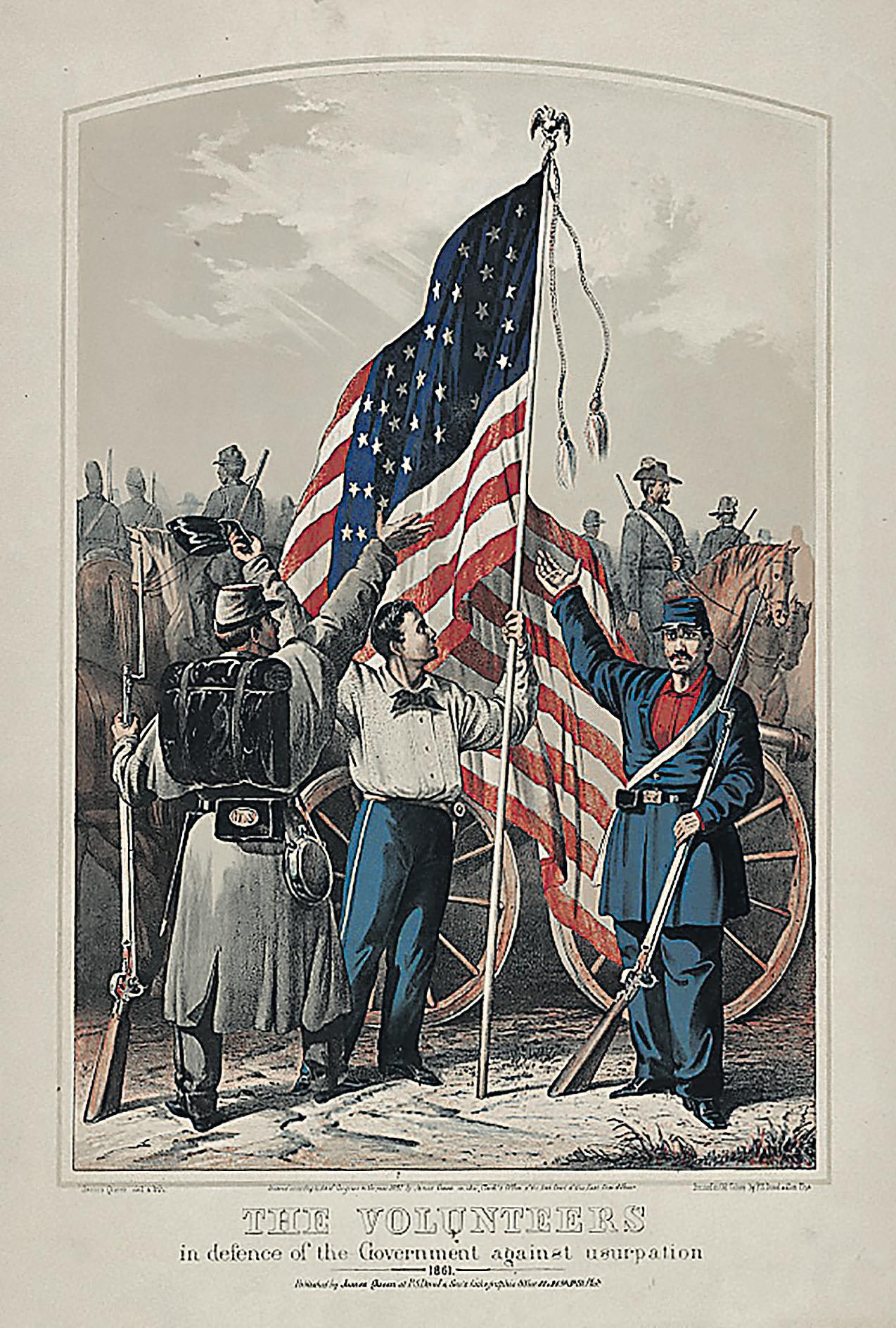
The lithographer, Peter Duval (1804–1886) was no stranger to military subjects. A native of France and recent immigrant to America, he became a prominent printer of his day. Teaming up William Massey Huddy (1807–1846), the two produced, published, and illustrated The United
States Military Magazine (1839–1842).4 It was Huddy who conceived of a publication extolling the virtues of the state militia and the Philadelphia Volunteer Corps. In this print from the Library of Congress’ collection, Duval continued the tradition of the volunteer as an important cog in the war effort.
James Queen, the artist of this allegory, worked extensively with Duval. As one historian notes, Duval was Queen’s “most steady and consistent employer.” In fact, Duval thought that Queen was “one of the best lithographic artists in the country.”5 The two produced many military oriented prints during the war, including several renditions of the volunteer refreshment saloons in the city, the Civil War’s predecessors to the USO canteens of World War II.
Here, in this print, Duval and Queen pay tribute to the volunteer so necessary to the administration’s prosecution of the war against “Usurpation.”
Endnotes:

1. Francis Haskell. History and Its Images: Art and the Interpretation of the Past. New Haven: Yale University Press, 1993. 21.
2. David Hackett Fischer. Liberty and Freedom. Oxford: Oxford University Press. 2005. 1-49.
3. Harold Holzer, Mark E. Neely, Jr.


The Union Image: Popular Prints of the Civil War North, Chapel Hill: The University of North Carolina Press, 2000, 6.

4. Erika Piola, ed. Philadelphia on Stone: Commercial Lithography in Philadelphia, 1828–1878. University Park: The Pennsylvania State University Press, 2012. 133-134.
5. Ibid., 85. See Piola, ed. Sara W. Duke, Chapter Three, “James Queen, Chronicler of Philadelphia, 79-95 and Sarah J. Weatherwax, Chapter Four, “Peter S. Duval, Philadelphia’s Leading Lithographer,” 97-117.
After 43 years in the museum field, Salvatore Cilella devotes his time collecting American prints and maps and writing. His last professional position was President and CEO of the Atlanta History Center. His most recent books are Upton’s Regulars: A History of the 121st New York Volunteers in the Civil War (U. Press Kansas, 2009). His two-volume Correspondence of Major General Emory Upton, (U. of Tennessee Press, 2017), is the recipient of the 2017–2018 American Civil War Museum’s Founders Award for outstanding editing of primary source materials. His latest book is Till Death Do Us Part, an edit of Upton’s letters to his wife 1868–70, published this spring by the Oklahoma University Press.
26 Civil War News June 2020
“The Volunteers in Defence (sic) of the Government Against Usurpation.” Library of Congress.
Subscribe online at CivilWarNews.com
American Battlefield Trust News


Even as we adjust to working remotely rather than in the field, the American Battlefield Trust continues to rack up major preservation victories, most recently announcing conclusion of major campaigns at Gaines’ Mill and Cold Harbor, Va., plus Perryville, Ky., plus a new opportunity at the latter, that will bringing us substantially closer to completing preservation of the Bluegrass State’s bloodiest battlefield.
The work in Virginia represents acquisition of six individual properties totaling 128 acres, with a combined transaction value of approximately $3.3 million, a figure driven by the region’s strong real estate market and the presence of modern homes that will be removed as part of the long term preservation planning. Thanks to matching grants from the Federal American Battlefield Protection Program, the Commonwealth of Virginia, plus contributions from several major donors, the Trust’s fundraising goal from private donors was reduced to $1.7 million.
The June 27, 1862, Battle of Gaines’s Mill was Confederate Gen. Robert E. Lee’s first major victory as commander of the Army of Northern Virginia. It began a surge of momentum that carried the Confederates into Maryland and the Battle of Antietam that September. Two years later, Grant’s disastrous assaults at the Battle of Cold Harbor, fought May 31–June 12, 1864, on the same Virginia soil, proved to be Lee’s final decisive battlefield victory.
Included in this effort is acquisition of a 50-acre parcel from Hanover County that had once been planned to become a massive sportsplex with multiple ball fields, parking, and towering lights that would have allowed night games. If built, it would have destroyed critical battlefield land and acted like a magnet to draw additional development to the area, widening roads, and threatening further loss.

The newly protected land at Perryville coincidentally also amounts to 128 acres, a veritable “hole in the donut” that connects lands previously protected by the Trust and Perryville Battlefield State Park. This immensely significant property remained largely unchanged since the October 1862 battle. To date, the Trust has helped protect 1,150 acres at Perryville, making it one of the best-preserved battlefields in America.
The preservation of Perryville’s 128 critical acres was made possible by the unwavering support of Trust members in addition to generous matching grants from the American Battlefield Protection Program and a generous gift from the HTR Foundation. This land witnessed the day’s first attack on October 8, 1862, as Confederate Maj. Gen. Benjamin Cheatham’s three brigades began their advance toward the Union position, which extended to the prominent hill known as “Open Knob.” Over the course of five hours, characterized by back-and-forth and increasingly bloody attacks and counterattacks, the Confederates were running out of ammunition, while the Union continued to exact a high toll that led to their ultimate victory.
Almost immediately upon taking ownership of the above property, the Trust began actively raising funds to purchase a 51acre parcel elsewhere on the battlefield, itself largely surrounded by already protected land. The combined purchase price for this land and an important six-acre property at Stones River, Tenn., is $1.165 million. Again thanks to a combination of federal and state matching grants, the Trust anticipates needing to raise only $277,500 in private donations, a $5.82-to-$1 match! More information about this opportunity is available at www.battlefields.org/ WesternGiants20.
Donors can give with confidence, as the Better Business
Bureau has once again accredited the Trust through its Wise Giving Alliance. The Trust’s commitment to fiscal responsibility is such that we have received 10 consecutive 4-star ratings from Charity Navigator, as well as the Platinum GuideStar Nonprofit Seal of Transparency. Likewise, the Trust’s education mission continues, perhaps stronger than ever. We launched a new Civil War Inquiry Curriculum, an easy-to-use, interdisciplinary, and resource-rich guide for middle school and high school educators who seek to teach the American Civil War by making use of leading questions to encourage student engagement, and fully overhauled our traditional curriculum. Both curricula based on the national Common Core Standards and those of the National Council for the Social Studies (NCSS).
The free online lesson plans of the Inquiry Curriculum include slide presentations and downloadable PDFs of primary source packets and worksheets, plus links to the Trust’s myriad digital resources, including animated battle maps and informational videos. It was developed by the Trust’s education department in consultation with award-winning
history educators over the course of five years, and explores a new approach gaining popularity in pedagogical circles.
“Inquiry-based learning turns the student into an historian, as they are exposed to primary documents, historical research methods, and critical thinking scenarios,” explained Garry Adelman, the Trust’s chief historian. “More and more teachers are embracing the ways it allows for independent learning, while getting students fully immersed in the subject matter.”
In addition to this new curriculum, the Trust has substantially updated its traditional, lecture-based Civil War curriculum and lesson plans to reflect educator demand and more fully integrate digital content. All 47 new lesson plans, designed for grades 3–12, are now available for free online, with future additions also in the works. The Trust is working to develop additional curricula meeting the same standards that address other eras in American history, including the Revolutionary War and the early republic period.
Outside the traditional classroom, The Trust has gone more digital than ever. Quarantine hasn’t put a damper on the
spirited debate that takes place among historians whenever they gather on a battlefield; it’s just forced the discussion online. Those conversations, covering topics ranging from the best historical movies to the leadership lessons of George Washington, plus exclusive conversations with acclaimed novelist Jeff Shaara, and even a “fantasy draft” to create the ultimate Civil War field army, have found a home online with the American Battlefield Trust’s Zoom Goes the History series. Virtually every day, historians with a variety of expertise come together via the Zoom app and are broadcast to thousands on the Trust’s Facebook page, discussing a specific topic and fielding questions from the engaged audience.
Participants spread across the country join the conversation from the comfort of their homes. Most sessions are broadcast live, although some are recorded for scheduling purposes. This allows guests so respond in real-time to questions posed by the audience, and Trust staff to embed links to further resources in the comments. After their official airing, all sessions are archived on Facebook and will become part of a YouTube collection.
27 June 2020 Civil War News
48 E. Patrick St., Frederick, MD. 301-695-1864 / civilwarmed.org Divided by Conflict. United by Compassion. REINFORCEMENTS MAKE ALL THE DIFFERENCE!!! Nobody even comes close to building a Civil War tent with as much attention to reinforcing the stress areas as Panther. Our extra heavy duty reinforcing is just one of the added features that makes Panther tentage the best you can buy! PANTHER Catalog - $2 Web: www.pantherprimitives.com 160 pages of the best selection of historical reenactment items from Medieval era to Civil War era. Includes over 60 pages on our famous tents and a 4-color section. Your $2 cost is refundable with your first order. SEND for copy TODAY The Best Tents in History P.O. Box 32N Normantown WV 25267 (304) 462-7718
The Mysterious “Manton” U.S. Model 1861 Rifle Musket
During the American Civil War, the U.S. government entered into contracts with more than two dozen firms to produce the U.S. Model 1861 and Model 1861 “Special Model” rifle muskets. While the majority of those contracts were filled with a minimum of trials and tribulation, some were cancelled in mid-stream due to delays and low production. Some contractors barely delivered any arms at all, and subsequently had their contracts nullified. Some contracts were cancelled before the contractor ever started production. Most contracts are well documented and are often contained within the Congressional records that cover investigations into slow and unfulfilled Civil War military contracts.


Eli Whitney Jr. received multiple U.S. military contracts during the war to provide both the M1861 rifle musket and the M1861 naval rifle. However, his experience in producing the M1841 “Mississippi” rifle for the U.S. Ordnance Department taught him that U.S. government contracts were not always what they were cracked up to be. The requirement for strict gauging and inspection of the arms resulted in many guns being rejected, or being accepted at a much lower price. These contracts were a less profitable endeavor than producing lower quality, non-interchangeable parts weapons for states, who would not inspect the guns nearly so scrupulously. As a result, much of Whitney’s Civil War era long-arm production was focused upon making and selling his “Good & Serviceable Arms” to the states, as it was
much more profitable than dealing with the Federal government. Whitney regularly used surplus, condemned, and rejected parts to assemble these arms, resulting in guns of 2nd class quality at best, and sometimes even worse.
His most notorious “scam” was in the production of the “Manton” marked U.S. M1861 rifle muskets. For many years, collectors assumed that the “Manton” marked contract arms were produced in England. This theory was supported by the use of the name of a well-known London arms maker, the Old English font used to stamp the name on the lock, and the fact that many early “Manton” muskets were delivered with British proved barrels. In fact, the barrels were British made, most by Birmingham barrel maker Ezra Millward, with some also manufactured by Henry Clive. These barrels, however, had been purchased by Colt, with the expectation of using them for U.S. musket contracts. Colt subsequently dumped the barrels on the open market and Whitney purchased 4,060 of them, which were then used in assembling a variety of long arms. These 40inch long barrels were produced in Birmingham and typically bore a single Birmingham commercial proof at the breech, along with a gauge mark like 24 or 25, which indicated the bore diameter, .58 caliber or .577 caliber, respectively. At least some barrels were also stamped with the mysterious “Diamond C” mark at the breech.
For years the exact meaning of this mark was debated among Civil War arms researchers, as to whether the <C> mark at the breech really meant “Colt,” possibly “condemned,” or had another meaning. The confusion has been exacerbated by extant examples of Confederate marked Enfields with a non-standard 40inch barrel that also have the <C> mark on their breech. All the 2nd Contract Sinclair, Hamilton & Company Confederate Enfields marked with a JS/{ANCHOR} in the 9,000 A suffix to 9,999 A suffix range have the 40-inch “Diamond-C” marked barrels, as do the first 1,000 JS/{ANCHOR}

marked South Carolina contract Pattern 1853 Enfields. Other examples outside these two large batches are also known with Diamond-C barrels. I can now confidently say that I am positive that the Diamond-C mark indicates that the barrel was a Colt contract barrel, and the “Manton” marked musket pictured in this article is a testament to that fact.
Whitney devised the whole “Manton” ploy to distance his company from what he clearly felt was an inferior quality arm.


Whitney admitted this himself in a February 2, 1863 letter to the R.S. Stenton Company of New York, when he said in part:
I cannot promise more than 1,000 of the ‘Manton’ muskets and these only to be subject to State Inspection as good and serviceable work being as a general thing as the sample, and if any are rejected it will lessen the number so much (from 1,000). My object in putting the ‘Manton’ on the lock was to avoid selling the muskets as mine

I have underscored that last line to emphasize that Whitney clearly did not want to associate his name or company with the “Manton” marked muskets. Whitney’s letter to the Stenton Company was in reply to their request to purchase “Manton” muskets.
Whitney submitted a least a handful of sample guns to both the R.S. Stenton Company and arms sellers William Bailey Lang & Company. A follow up letter from Whitney to William Bailey Lang & Co. further stresses that Whitney did not want to be recognized as the “source” for these guns. The letter also shows Whitney “backtracking” about the features of the guns that he would provide, when compared to the “samples.” His letter to William Bailey Lang & Co. reads in part:
You can sell the 1,000 ‘Manton’ U.S. muskets (but not as my manufacture) ‘tho as good as sample at $16.00 each.

The underlined emphasis is mine, but his reference to the guns both as “US muskets” and “tho as good as sample” suggests that some features of the sample guns were not quite the same as those he intended to deliver. This suggests that the arms delivered under the “Manton” contract were not even as good as the handful of sample rifle muskets he had provided.
In a letter dated June 18, 1863, to New York arms dealers Fitch & Waldo, Whitney said that he had
on that day sent them a sample Springfield gun, 1,000 of which I can furnish in a day’s time…… These guns are good & serviceable, though varying slightly from the Springfield gauges in points not essential.
Whitney also attempted to sell his “Manton” guns to the state of New Jersey, and to arms merchants Palmers & Bachelder, each of which was no doubt provided with a “sample” gun. It is not clear exactly how many “Manton” marked arms Whitney actually managed to sell, but surviving records indicate that 1,070 of them were sold to the New York retailer Fitch & Waldo between June 29 and August 4, 1863. Fitch & Waldo subsequently sold the guns to the state of New York, who issued them to volunteers who were called out to suppress the draft riots during the summer of 1863. Of those 1,070 guns, 109 were rejected by the state of New York. It is not clear how many more of these muskets were manufactured, but Flayderman’s Guide to Antique American Arms notes that they are “quite scarce” and estimates that less than 2,000 were produced.
The “Manton” contract guns were made up from a variety of parts, many of which are thought to have been at least part of the 581 rifle muskets rejected by the state of Connecticut from the initial Whitney delivery of 1,440 arms between January 27 and April 11, 1862. It is for this reason that the “Manton” marked guns exhibit a variety of mixed features. The guns generally conform to U.S. M1861 style that was produced for Connecticut under the first contract, but inconsistency is the only consistent feature of these arms. They are found with both 39 and 40-inch barrels, some with British proofs, some with U.S. style proofs, and some with the inspection mark G.W.Q. as found on Connecticut contract barrels. Some barrels have Whitney 7-groove rifling and some have traditional U.S. pattern 3-groove rifling. In either case, they generally all have a Whitney alphanumeric style batch or serial number. These marks typically consist of a letter over a 1, 2 or 3 digit number stamped on the top of the barrel to the rear of the front sight, although sometimes the letter and number are next to each other. The guns typically have Whitney “mid-range” L-shaped rear sights, are iron mounted and have pewter forend caps. Some barrel bands are marked with the letter “U” for “up” but many are not. The majority of the guns have no “US” on the buttplate tang, although Whitney’s use of pieces
28 Civil War News June 2020 www.CollegeHillArsenal.com Tim Prince College Hill Arsenal PO Box 178204 Nashville, TN 37217 615-972-2418
and parts from a variety of contractors and suppliers sometimes results in a marked buttplate. Most locks are simply marked “Manton,” with no date, although some 1862 (or more rarely) 1863 dates are found stamped vertically at the tail.

The Whitney “Manton” M1861 rifle musket pictured in this article is one that has a surplus Colt contract, Birmingham made barrel. The barrel is a 40-inch barrel that Colt had intended to use for U.S. contract M1861 rifle muskets. The breech has a single Birmingham proof mark, a “25” gauge mark that indicates .577 caliber, and the “Diamond C” mark indicating it was a Colt contract barrel. The lock is one of the less common dated examples marked 1862 at the tail and has the usual Old English “Manton” mark. The barrel has the Whitney alphanumeric G8 on it behind the front sight; the bore is rifled


with three grooves since it is an English made barrel.

Tim Prince is a full-time dealer in fine & collectible military arms from the Colonial Period through WWII. He operates College Hill Arsenal, a web-based antique arms retail site. A long time collector & researcher, Tim has been a contributing author to two major book projects about Civil War era arms including The English Connection and a new book on southern retailer marked and Confederate used shotguns. Tim is also a featured Arms & Militaria appraiser on the PBS Series Antiques Roadshow.

29 June 2020 Civil War News
Overall view of a Whitney “Manton” rifle musket, essentially indistinguishable from a regular US M1861 rifle musket at a distance. Photos by Tim Prince.
Close up of the proof marks on the 1862 dated Whitney “Manton” rifle musket, showing the “Diamond-C” Colt contract barrel mark, the “25” English gauge mark for .577 caliber, and the Birmingham commercial proof mark.
Close up of the alphanumeric mark on the barrel of the Whitney “Manton” rifle musket.
Close up of the bore of the Whitney “Manton” rifle musket, showing the standard English pattern 3-groove bore, rather than Whitney’s own 7-groove rifling.
Counterpane of the 1862 dated Whitney “Manton” M1861.
Lock of an 1862 dated Whitney “Manton” M1861 rifle musket.
All Hands on Deck! Support Our Mission to Bring You the Naval History “This is the magazine for all things Civil War Navy. From ‘Uncle Sam’s web-feet’ to the ‘grey jacket navy’ raised by Jeff Davis! It is all here thoroughly researched and illustrated by beautiful contemporary navy images.” Ron Field, military historian and author of over 45 books, including Bluejackets: Uniforms of the United States Navy in the Civil War Period, 1852-1865. 1 Year—4 Issues: $37.95 Subscribe Now at civilwarnavy.com Or send a check to: CSA Media, 808 Drayton St., Savannah, GA 31401 International subscriptions subject to postage surcharge. Sailors and Marines on the deck of the U.S. gunboat Mendota, 1864. National Archives (Identifier 524548).
Portraying Mary Todd Lincoln – America’s First, First Lady
by Bob RuegseggerAs a young girl growing up in Lexington, Ky., Mary Ann Todd dreamed of living in the Executive Mansion—the White House. She was vivacious, welleducated, and ambitious. She set her sights on marrying the man who would become president.
Mary Ann Todd came from a very wealthy Kentucky family from the “thriving metropolis” of Lexington, the “Athens of the West.” Her father was Robert Smith Todd, and her mother was Eliza Parker Todd. Her home was a tastefully appointed mansion full of family heirlooms. She belonged to a family with seven children. At one time Mary Todd was, according to Mona Buss, quoted as saying that she would marry the man who would become President of the United States. Prior to becoming involved with Abraham Lincoln, she dated Stephen A. Douglas, a Democrat. Lincoln was a Whig, until a new Republican party was developed.
Her dream came true when, after being sworn in by Chief Justice Roger Taney, President Lincoln was escorted to the White House on March 4, 1861. At the invitational inaugural ball, dressed in blue silk and bejeweled with diamonds, pearls, and gold, Mary Lincoln dazzled the crowd. On that evening she was living her dream. Mary Lincoln had become the First Lady, and she was savoring the experience.

Mary Lincoln had no inkling of the suffering and heartache that the next five years would bring to her and her family.
George and Mona Buss are historical interpreters who portray President and Mrs. Lincoln, Madam President. George Buss has over thirty years of experience portraying Lincoln. Mona Buss [George’s spouse] has relatively recently assumed the role of Mary.


“The reason that I wanted to portray Mary Lincoln is that she had a vast influence on Lincoln’s political career,” said Mona Buss.
“I think, her story is not told that often.”
Mary Lincoln evidently subscribed to the notion that “behind every successful man, there is a strong woman.” Without Mary Todd Lincoln, there might never have been a President Abraham Lincoln. Mary was very supportive of her husband’s political career. She’d visit the legislatures when in Springfield and in Washington. She would take notes, come back, and discuss the political atmosphere with Lincoln.
After he served one term in Congress, she recommended that he not take an appointment as governor of Oregon Territory that was offered to him by the Secretary of the Interior in 1849. She felt it would take them out of the national spotlight where “we want to be.”
“They obviously loved each
other and were very supportive of each other,” said Buss. “She had a political impact. She visited the hospitals, wrote letters for soldiers, and was very supportive of the anti-slavery movement,” she observed. “I think she was a woman far beyond her time because she had thirteen years of education.”
Mary Lincoln enjoyed being the center of attention in Lexington, Springfield, and Washington. She relished the limelight. She loved being the First Lady.
For Mona Buss, her transition to First Lady has taken time. “You have to adjust to it. I think that the more you study her character the more you feel comfortable with it,” she explained. “I had to learn to grow into the role. I do like it, but it’s a learning curve. I think she’s a wonderful person to represent.”
Her husband’s portrayal of President Lincoln over the last three decades has obviously been a huge factor in her decision to portray Lincoln’s lady. She sees Lincoln-like qualities in her husband’s interpretation of the Great Emancipator. “He portrays him well. He looks like Lincoln. He has his intelligence and his compassion for people.” said Buss. “He’s very authentic. He has studied his craft for over thirty years. He has a wide span of knowledge. I’ve not really seen him stumped with any one question,” she said. “I admire him because he loves people of all ages. He’s down on his knees talking with little children. He leans over when he talks with elderly people. He’s very personable.”
“The thing that I admire most about President Lincoln is his compassion and his political savvy, his intelligence, and his kindness to people,” said Buss. “He was very compassionate with people.”
In early Lincoln portraits, Mona Buss sees Lincoln as a man of determination. As Lincoln aged, she sees that determination still reflected in his photographs. She also sees the weariness that the Civil War brought to his life, Mary’s life, and the lives of his family members.
“He would go to the Department of War to listen to the staff. That would take a lot out of him and it took a lot out of his family,” said Buss. “He was very consumed by the Civil War. He was so saddened by what it was going to take to win and end the war. He wanted America to be united again,” she said. “
Mona and George Buss are from the North, west of Chicago, in
Freeport, Illinois. That’s Lincoln country. “The Lincolns were, in addition to being southerners, also considered to be from the West. Illinois was the West back then,” said Buss. “When they came to the Executive Mansion, many people felt that they were westerners and couldn’t handle this,” she said. “They weren’t from the South. They weren’t part of the eastern establishment.”
Mary Lincoln was disparaged in the North and condemned in the South as a traitor. Many in her family fought for the Confederacy.
Two of her half-brothers, Samuel and Alexander, were killed in Confederate service. Emilie, a half-sibling, married Ben Hardin Helm who fought with the Confederacy as a general and was killed at Chickamauga.
“Lincoln invited Emilie to the White House in 1863; they were criticized terribly for having a southerner come to the Executive Mansion,” said Buss. “It wasn’t [called] the White House at that time.”
Mary Lincoln had to prove she was capable of being a First Lady.
30 Civil War News June 2020
Mary Todd Lincoln in her inaugural ball gown. Library of Congress.
Living historian George Buss has over 30 years of portraying the Great Emancipator. Mona Buss, his spouse, has assumed the role of Mary Lincoln to support her husband’s interpretation— and tell the story of the first First Lady.
During the Battle of Hampton Roads commemoration at the Mariners’ Museum’s Monitor Center, Mona and George Buss met with Tidewater Maritime Living History members (Allen Mordica and Kurt Eberly) aboard the replica of the USS Monitor.
Lincolns Kurt Eberly & John Stuck Photos by Bob Ruegsegger.. Actually, she was the first presidential spouse referred to as the First Lady. When she arrived at the Executive Mansion, it was in shambles. Congress would allow $20,000 every year for redecoration, but Mary Lincoln exceeded the appropriation.
“That was a big stress. Lincoln didn’t like that because the boys in the war didn’t have the right shoes and clothing,” said Buss. “He was quite concerned about her spending on the Executive Mansion.”
Mary Lincoln viewed the Executive Mansion as a political stage, not just for America but for the French and the English as well. The Federal government wasn’t sure whether France or England would side with the South regarding their support.
“She just felt like she needed to put the people’s house in order—and she did,” said Buss. “She wanted people to remember that her husband was the President of the United States and that she was there to support him,” said Buss. “They both had that goal of being in the national spotlight,” she said. “She enjoyed being front and center, but she basically wanted to be by her husband’s side and support him as President.”
When the topic of Mary Lincoln’s mental stability comes up, Mona Buss is empathetic and compassionate. “She might have had some mental issues,” said Buss. “They would prescribe Dilaudid.” Robert Lincoln became concerned that his mother might be mixing medications, perhaps with alcohol, and may have resumed harmful spending habits. “One of his biggest concerns was finances. She was overspending money,” said Buss. “I think he was concerned about his interests too, spending his money. She did have some issues. I don’t know that they were treated correctly.”

Apparently, Mary Lincoln had weaknesses for jewelry and gloves. She was committed to Bellevue Place, a sanitarium in Batavia, Illinois. During her
institutionalization at Bellevue, Mrs. Lincoln was among the most privileged of inmates. Buss emphasized that Mary Todd Lincoln had a lot to cope with. She lost her mother at an early age. After her mother’s death, her father married Elizabeth Humphreys. The couple had a huge new family of nine children. “The loss of her father’s attention was huge,” noted Buss. “She and her step-mother did not get along.”
Before she and Lincoln were married, he called off the engage ment. She suffered from depres sion. During their marriage they lost Eddie Baker [1850] – their second child. They lost Willie in the White House when he was twelve. She saw her husband as sassinated. Their son Tad died at age eighteen.
“She just had a lot of fears. She was afraid of storms. She was afraid of dogs,” said Buss. “Mary was also a spiritualist,” said Buss. “She was not the only one.” People wanted to connect with dead family members. A lot of people had séances. People were trying to reach for some hope, and I think that’s what she wanted to do too,” offered Buss. “People did not accept all that back then as they would now.”
CHARLESTON IN THE WAR
CHARLESTON IN THE WAR

100 Signi cant Civil War Photographs: Charleston in the War features newly restored images of scenes in the famed city, taken 1860–1865. The cameramen include the better-known, such as George N. Barnard and George S. Cook, as well as some lesser-known ones: Samuel Cooley, Charles Quinby, the partners Haas & Peale, Osborn & Durbec.
100 Signi cant Civil War Photographs: Charleston in the War features newly restored images of scenes in the famed city, taken 1860–1865. e cameramen include the better-known, such as George N. Barnard and George S. Cook, as well as some lesser-known ones: Samuel Cooley, Charles Quinby, the partners Haas & Peale, Osborn & Durbec.


Text by Stephen Davis and Jack Melton accompanies each featured photograph, describing the pictured scenes and the history surrounding them. e selected images depict a variety of settings: that portion of Charleston known as e Battery, the “Burnt District” (the area of the city destroyed by the Great Fire of December 1861), the Charleston Arsenal, and the many churches that allow Charlestonians to call theirs “the Holy City.” Special sections of this book are devoted to the huge Blakely guns imported from England by the Confederates and close-ups of Barnard’s views.
“Mary and her husband lived through the Civil War. They worked very hard to get through that period in their lives,” said Buss. “At the time of Appomattox, Lincoln was so relieved. He and Mary felt they could get their lives back to gether,” she said. “He wanted to go back to Springfield and plant potatoes.”
e history of Civil War Charleston goes back to e Defense of Charleston Harbor (1890) by John Johnson, Confederate major of engineers, and to Reminiscences of Forts Sumter and Moultrie in 1860-’61 (1876) by Capt. Abner Doubleday, Federal second-in-command. Since then Charlestonians have contributed to the history of their city, notably Robert N. Rosen and Richard W. Hatcher III. e historical text surrounding 100 Signi cant Photographs draws on these and other works. A unique feature is its reliance upon the writings of actual participants, such as Augustine T. Smythe (1842–1914) and Emma Edwards Holmes (1838–1910).
Text by Stephen Davis and Jack Melton accompanies each featured photograph, describing the pictured scenes and the history surrounding them. The selected images depict a variety of settings: that portion of Charleston known as The Battery, the “Burnt District” (the area of the city destroyed by the Great Fire of December 1861), the Charleston Arsenal, and the many churches that allow Charlestonians to call theirs “the Holy City.” Special sections of this book are devoted to the huge Blakely guns imported from England by the Confederates and close-ups of Barnard’s views.
As a contribution to this literature, 100 Signi cant Civil War Photographs: Charleston in the War o ers rewards for all readers, from the casual novice to the serious student.
Bob Ruegsegger is an American by birth and a Virginian. His assignments frequently take him to historic sites throughout Virginia, the Mid-Atlantic, and the Southeast. His favorite haunts include sites within Virginia’s Historic Triangle—Jamestown, Yorktown, and Williamsburg. Bob served


in the U.S. Navy. He is a retired educator and has been an active newspaper journalist for the last twenty years.

The history of Civil War Charleston goes back to The Defense of Charleston Harbor (1890) by John Johnson, Confederate major of engineers, and to Reminiscences of Forts Sumter and Moultrie in 1860-’61 (1876) by Capt. Abner Doubleday, Federal second-in-command. Since then Charlestonians have contributed to the history of their city, notably Robert N. Rosen and Richard W. Hatcher III. The historical text surrounding 100 Signi cant Photographs draws on these and other works. A unique feature is its reliance upon the writings of actual participants, such as Augustine T. Smythe (1842–1914) and Emma Edwards Holmes (1838–1910).
As a contribution to this literature, 100 Signi cant Civil War Photographs: Charleston in the War o ers rewards for all readers, from the casual novice to the serious student.


160 pages, Over 100 Photos, Maps, Index, Bibliography, Softcover.
ISBN: 978-1-61850-167-7


$19.95 + 3.50 S&H
Order online at www.HistoricalPubs.com
31 June 2020 Civil War News
Deadline for submissions is the 20th of each month. Email: ads@civilwarnews.com
briefly
DAVIS & MELTON 100 SIGNIFICANT CIVIL WAR PHOTOGRAPHS : CHARLESTON IN THE WAR
Stephen Davis JACK W. MELTON JR.
or call 800-777-1862
quota was officially returned to Commissioner Bannan with directions to fill the same with conscripts….” The list of drafted men included a large number of miners, “all of whom were under the absolute influence of the Molly Maguires.”
When the miners refused to report and blocked the train carrying willing conscripts, Bannan reported the facts to McClure, who immediately reported them to the Secretary of War.
shown conclusively that their quota had been entirely filled with volunteers, some of whom had enlisted in county towns or cities and had not been properly credited to the township as the law required.” In these cases, said McClure, he had “at once revoked the order for the draft,” and, he added, “that only in that way could the Cass Township problem be solved, if it were practicable.”
How Schuylkill County Filled Its Draft Quota
On April 15, 1861, President Lincoln called for 75,000 militia to subdue an insurrection by “combinations too powerful to be suppressed by the ordinary course of judicial proceedings, or by the powers vested in the marshals by law.” That same day Secretary of War Simon Cameron issued a “Call to Arms” for volunteers, assigning to each state a quota of men “to serve…for three months, or sooner, if discharged.” This step would not get the job done. Lincoln would need many more men and much more time. Almost immediately Lincoln called for more volunteers and extended their term of service. On July 17, 1862, he signed the draft act. In October conscription began. In Schuylkill County, in Pennsylvania’s coal mining region, conscription was met with violent opposition; opposition “too powerful to be suppressed by the ordinary course of judicial proceedings.”
The Oct. 29 North Branch Democrat in Tunkhannock reported that “troubles growing out of the draft are assuming a formidable aspect. Over five thousand miners and colliers have armed themselves, and are showing a
disposition to make desperate resistance….” The rioters were armed with “iron bludgeons, swords, and every other variety of weapon.” A train carrying conscripts to Harrisburg was blocked by these well-armed miners, and “the men within were invited to step into the road, where they were assured that all attempts to coerce them to serve…would be unavailing.”
This report came a week after a communication from Pennsylvania’s governor, Andrew Curtin, to Secretary of War Edwin Stanton. Curtin advised Stanton that “1,000 armed men are assembled, and will not suffer the train to move with the drafted men to [Harrisburg].” Curtin requested authority to use troops, “particularly the regulars and Anderson Cavalry at Carlisle, to crush this effort instantly.” Within hours Stanton replied, giving Curtin all he asked for and more. On Oct. 25 Curtin wrote Stanton that “the riots have ceased for the present.” On Oct. 28 the Pittsburgh Post reported that “attempts at armed resistance to the draft in Schuylkill county [sic] have failed, and the excitement has entirely subsided.” The reasons, said the Post, were the prompt display of military force and an appeal to the (mostly Irish) miners by the Catholic bishop of Philadelphia. So, even before readers in Tunkhannock learned of the
GEORGIA’S CONFEDERATE MONUMENTS

In Honor of a Fallen Nation
Gould B. Hagler, Jr.This unique work contains a complete photographic record of Georgia’s memorials to the Confederacy, a full transcription of the words engraved upon them, and carefully-researched information about the monuments and the organizations which built them. These works of art and their eloquent inscriptions express a nation’s profound grief, praise the soldiers’ bravery and patriotism, and pay homage to the cause for which they fought.
www.mupress.org
866-895-1472 toll-free
riot 80 miles to the south, the trouble had passed, quelled by a combination of earthly and heavenly power.
Were these the reasons the miners quieted down? Did the miners actually submit to government authority? To answer these questions we turn to an account written 43 years later by Alexander McClure, the draft commissioner for the Commonwealth of Pennsylvania.
McClure was editor of the Franklin Repository and a prominent Republican politician. When his service in the Pennsylvania Senate ended in 1861 he intended to leave public life and devote his energies to his business; however, Governor Curtin and President Lincoln prevailed on him to accept this tough job. McClure selected local draft commissioners with great care. He needed strong and independent men, men who could fairly enforce the draft and withstand the inevitable political pressure applied by “the small politicians of each county” who would seek “the discharge of conscripts where it would serve political ends.” In Schuylkill County he picked Benjamin Bannan, also a newspaperman, the editor of the Miners’ Journal in Pottsville, the county seat.
In his 1905 account McClure described the situation.
“It is due to the truth of history to say that at that time there was not a dominating public spirit in Pennsylvania that heartily supported the war.” This was especially true in some of the mining districts, where “there were positive indications of revolutionary disloyalty, and it was especially manifested in Schuylkill, where the Molly Maguires were in the zenith of their power. The center of their power was in Cass Township, where thirteen murders had been committed within two or three years, and not a single murderer brought to punishment.”
Executing the draft in this region would be “a task of appalling magnitude.”
Schuylkill County produced nowhere near the number of volunteers needed to meet its quota for the army, so “an unusually large
“Stanton was strenuously loyal,” wrote McClure, “and at times impetuous when confronted with open disregard of law.” Stanton ordered two regiments to the troubled county “to be subject to [McClure’s] orders to enforce the draft at the point of the bayonet.”
McClure, less impetuous than Stanton, consulted with Governor Curtin. The editor/politician/ pragmatist “urged that a conflict between our own troops and rioters…would be most disastrous in its consequences, not only at home, but throughout the country….” McClure advised Stanton that “haste should be avoided in forcing a conflict between the troops and the…insurgents.”
Stanton “promptly answered by repeating his order that the regiments should be started at once… and that the draft be enforced without parleying.”
McClure and Curtin (who by now was in agreement with McClure’s cautious approach) went over Stanton’s head. The commissioner sent a cyphered dispatch to the president “giving the Governor’s views on the peril of provoking a conflict…and asked for an early answer.”
Lincoln also was less impetuous than his Secretary of War. He sent an emissary to Harrisburg who met McClure in his hotel the next morning. This emissary delivered a “personal message” from the president. McClure wrote that he “informed me that [the president] was desirous, of course, to see the law executed, or at least appear to be executed….” The messenger added that the Lincoln had said “I think McClure will understand.” McClure sent for Bannan, who arrived by train shortly after noon. The two then met with Governor Curtin.
“Lincoln’s message was well understood,” wrote McClure. “Bannan was most desirous for a peaceful solution…and he said that the draft could not be executed in Cass Township without a bloody conflict with the Molly Maguires.” Furthermore, Bannan “could conceive of no method by which there could be given the appearance of executing the law.”
McClure had a creative idea. Some districts of the state “had
Bannan took the hint. He “made no reply, but took his hat, hastened to the train, and reached Pottsville that evening. On the following evening he was back in Harrisburg, with a large number of affidavits regularly executed by a justice of the peace or notary, proving on their face that the quota for Cass Township had been filled by volunteers.”
It had been suddenly discovered that numerous men from Cass had voluntarily enlisted elsewhere, in towns where regiments or companies were being organized. These men, moved by patriotic fervor, had simply forgotten to tell the recruiters that they hailed from patriotic Cass Township in patriotic Schuylkill County. These men just forgot, and no one noticed their oversight until the day Curtin, Bannan, and McClure met in Harrisburg.
“One war at a time,” Lincoln once said in another context. The United States was busy enough fighting the Confederacy, and in October 1862, it was deemed best not to take on the Irish miners in Schuylkill County. No one involved was so indiscrete as to ask how Bannan managed to get all the affidavits so fast, and the law appeared to have been executed.
Sources: The newspapers cited in this column can be found at Valley of the Shadow archive (http://valley.lib. virginia.edu/ and at the Pennsylvania Newspaper Archive (https://panewsarchive.psu.edu/). Alexander McClure’s account is found in his 1905 book, Old Time Notes of Pennsylvania: A Connected and Chronological Record of the Commercial, Industrial and Educational Advancement of Pennsylvania, and the Inner History of All Political Movements Since the Adoption of the Constitution of 1838, Vol. 1. John C. Winston Company, Philadelphia.
Gould Hagler is a retired lobbyist living in Dunwoody, Ga. He is a past president of the Atlanta Civil War Round Table and the author Georgia’s Confederate Monuments: In Honor of a Fallen Nation, published by Mercer University Press in 2014. Hagler speaks frequently on this topic and others related to different aspects of the Civil War and has been a regular contributor to CWN since 2016. He can be reached at gould.hagler@gmail.com.

32 Civil War News June 2020
NEW DIGITAL MAGAZINES:


Digital subscriptions for back issues of Civil War News (Archive 2012 to current issue are available now) and The Artilleryman magazine from Vol. 1, No. 1 to the current issue, will be available soon. The first ten years of the publication and every issue from Summer 2015 to present, are now available as an online, yearly digital subscription. Over 6,500 pages of artillery information available on your phone, tablet, or computer. By the end of Summer 2020, this project will be entirely up to date, with over 160 issues.
If you are a student of the Civil War, artillery, a historian, researcher, author, or just interested in the hobby, you’ll find plenty of information within this massive archive.





To Subscribe Visit: CivilWarNews.com or ArtillerymanMagazine.com


Back Issues:
To purchase back issues of The Artilleryman magazine please visit our website at www.historicalpubs.com


33 June 2020 Civil War News Digital Issues of CWN are available by subscription alone or with print plus CWN archives at CivilWarNews.com THE FINEST HISTORICAL ANTIQUE MILITARIA Wallace Markert info@csacquisitions.com 16905 Nash Road • Dewitt, Virginia 23840 804-536-6413 • 804-469-7362 www.csacquisitions.com
Deadlines for Advertising or Editorial Submissions is the 20th of each month. Email to: ads@civilwarnews.com Want To Advertise In Civil War News? Email us at ads@ civilwarnews.com or Call 800-777-1862. For a rate sheet visit: www.civilwarnews.com
Chris Mackowski
From The Editor
Route 1A from Brewer runs through Holden, past the Lucerne Inn with its golf course and gorgeous overlook, and into long stretches of pine forests and a few blueberry barrens before eventually finding its way into Ellsworth, the “crossroads of Downeast Maine.” In the early 90s, the road still ran in narrow ribbons, although tourism pressure finally triggered a series of improvements and widenings. It’s been a few years since I’ve driven that route, so I don’t know shape the road is in today, but for four years, it was my daily commute. That 35-mile drive taught me two invaluable lessons that I carry with me today: how to drive in any kind of weather conditions
and how to love audiobooks.
I worked as a radio newscaster then, so my ear had already attuned itself to “listening for information,” a much different task than listening to music for enjoyment and entertainment. I was also working on my M.A. in English at the University of Maine at the time. As someone whose undergraduate degree was in broadcast communications, I had some catching up to do, as in, the entire “English canon,” that basically consisted of all the so-called “Great Works,” with capital letters and all, of English and American literature. I had two and a half years to somehow cram it all in. Audiobooks played a key role in that education: 50 minutes one way to work and 50 minutes back.
Today, I live in central Virginia and teach in western New York. That’s a 7-hour commute, although I only have to make it a couple times a year. “How do you do it?” people ask. Audiobooks.

That’s why I was so delighted when Ted Savas asked me about the possibility of turning the Emerging Civil War Series books into audiobooks. I’m a huge audiobook fan, so the chance to hear our work in an audio format was exciting to me. In a way, it’s something I’ve been working up to for my entire adult life.

I hope you’ll take the opportunity to give one a listen.
Audiobooks are good company not just for long, lonely stretches of icy road in the wilderness or during coronavirus isolation lock-down. Sometimes, it’s nice to hear the voice of someone who shares your passion for history. Sometimes, it’s nice to hear a well-told story.
– Chris Mackowski, Ph.D. Editor-in-ChiefSeventh Annual Emerging Civil War Symposium at Stevenson Ridge

At press time, the Seventh Annual Emerging Civil War Symposium at Stevenson Ridge is still a “go.” Virginia’s stayat-home order remains in effect through June 10, at which time Governor Northam plans to issue an update. Based on any recommendations and regulations he issues at that time, we’ll assess the situation and make any updates as necessary. Because the order is currently set to expire almost two months prior to the Symposium, though, we’re still operating under the assumption that things will be back on the road to normal by August, although, of course, that road to recovery might take a while. ECW will continue to monitor the situation and follow the guidance offered by state health officials.
That said, we’re looking forward to a great time August 7-9, 2020 (order tickets here: https://emergingcivilwar. com/2020-symposium). We hope to see you then, and in the meantime, we hope you and your families remain safe and healthy.
Behind the Scenes at ECW
Emerging Civil War Series
Audiobooks by Theodore P. SavasWhy do I listen to audiobooks? Because I enjoy them. Why should you? Because you will love them. Seriously. You will. I love print and have a half-dozen books going at the same time, but I am also a busy guy, either driving, working in the backyard, running on a treadmill, or taking a long walk on the rolling hills of our neighborhood. When I do, I am usually listening to something, and more often than not, it’s an audiobook. We put serious muscle into our audio program in 2018. Earlier in my publishing career you had to sell your print to audio producers who made them in-studio and distributed them on CDs. A few still do that, but the advent of Audible made it possible for Savas Beatie to seek out quality narrators and launch them
in a partnership deal that made them more widely available at a cheaper price much faster.
I am embarrassed to say that it took me a while before I realized the Emerging Civil War series, the brilliant brainchild of Chris Mackowski and Kris White, offered outstanding candidates for digital translation. Each book is relatively short and none of them rely on heavy footnotes and pages of micro-tactical detail. A good narrator could turn these around relatively quickly, and the subject matter was as varied as it was excellent.
When I pitched the idea Chris readily agreed and the series took off. We decided to organize them five at a time. It meant more work for Chris, who had to take the final edited text, tweak it a bit to make it as audio-friendly as possible, add a brief standard introduction, etc. and then get me the files.
We found three especially good narrators and kicked off the series with Mackowski’s own Hell Itself: The Battle of the Wilderness, narrated by the delightful Bob Neufeld (who would go on to narrate many of the books in this series). Fight Like the Devil: The First Day at Gettysburg, by Mackowski. Kris, with Dan Davis, was next up with Joseph Williams, another excellent narrator, handling the duties. Three more entries quickly followed: Battle Above the Clouds: Lifting the Siege of Chattanooga, by David Powell, Meg Groeling’s The Aftermath of Battle: The Burial of the Civil War Dead (read by Joshua Saxon), and Lee White’s Let us Die Like Men: The Battle of Franklin. Sales were strong from the get-go and continue to be solid. The reviews have been uniformly positive, and emails, calls, and text messages thanking us for making the series available in this format rolled in. It was pleasing to hear. To date we have 13 in audio and we just finished and posted Derek Maxfield’s Hellmira: The Union’s Most Infamous Civil War Prison.
As Mark Twain famously told Abraham Lincoln’s widow at a dinner with Sherman in attendance, “Variety is spice of your reading life, and that’s why when I take a steamboat down the Mississippi River, I always have my iPad with me loaded with Savas Beatie audio books.”
Or something like that.
– Theodore P. SavasECW Bookshelf
The latest book in the Emerging Civil War Series is out, in print and in audio: Hellmira: The
Union’s Most Infamous Civil War Prison Camp—Elmira, NY, by Derek Maxfield. Derided after the war as “the Andersonville of the North,” the prison camp at Elmira had a troubled history and an even more troubled place in Civil War memory, as Derek’s book explains.
“
Hellmira is my first book,” he says, “and represents the realization of a dream for me, as I am certain it is for most professional historians.” The book is available for order at https://www.savasbeatie.com/hellmira-the-unionsmost-infamous-civil-war-prisoncamp-elmira-ny.
Speaking of aduiobooks, here’s a complete list of our ECWS titles currently available in audiobook, although we have a bunch of others in the works. Moving forward, our goal is to try and release the audio editions around the same time we release the print editions, even as we try and fill in our back catalogue as we go.
If your stay-at-home order has you feeling cooped up, check out one of these titles to help you get out of the house a little, even if it’s just in the “theater of the mind.”
The Aftermath of Battle: Burying the Civil War Dead by Meg Groeling, narrated by Joshua Saxon
Attack at Daylight and Whip
Them: The Battle of Shiloh by Greg Mertz, narrated by Bob Neufeld
Battle Above the Clouds: Lifting the Siege of Chattanooga and the Battle of Lookout Mountain by Dave Powell, narrated by Joseph Williams
Call Out the Cadets: The Battle of New Market by Sarah Bierle, narrated by Joseph Williams
Grant’s Last Battle: The Story Behind the Personal Memoirs of Ulysses S. Grant by Chris Mackowski, narrated by the author
The Great Battle Never Fought: The Mine Run Campaign by
34 Civil War News June 2020 www.emergingcivilwar.com
Chris Mackowski has had the chance to put his radio background to work recording a few audiobooks for the ECW audiobook series.
Historian Derek Maxfield shows off his first book, Hellmira, the latest release in the Emerging Civil War Series.
Chris Mackowski, narrated by the author
Hell Itself: The Battle of the Wilderness by Chris Mackowski, narrated by Bob Neufeld
Fight Like the Devil: The First Day at Gettysburg by Chris Mackowski, Kris White, and Dan Davis, narrated by Joseph Williams
Let Us Die Like Men: The Battle of Franklin by Lee White, narrated by Bob Neufeld

The Most Desperate Acts of Gallantry: George Custer in the Civil War by Dan Davis, narrated by Bob Neufeld

That Furious Struggle: The Battle of Chancellorsville by Chris Mackowski and Kris White, narrated by Bob Neufeld
A Season of Slaughter: The Battle of Spotsylvania Court House by Chris Mackowski and Kris White, narrated by Bob Neufeld
Simply Murder: The Battle of Fredericksburg by Chris Mackowski and Kris White, narrated by Josh Saxon
To the Bitter End: Appomattox, Bennett Place, and the Surrenders of the Confederacy by Bert Dunkerly, narrated by Bob Neufeld
You can order them here: www. savasbeatie.com/audio-books/ emerging-civil-war-audio-series.
10 Questions...
Kevin Pawlak
and two battles—the first on August 27, 1862, and the second on October 14, 1863. The American Battlefield Trust has just preserved 152 acres of land there. Once it is given to the county, the size of the park will more than double, so that will keep me busy.

Ben Lomond is an 1832 stone house used as a Confederate field hospital after First Manassas.
Union soldiers visited the house later in the war and many wrote their names on the house’s walls. The site is also home to one of only three original slave quarters still standing in the county. We recently installed a new exhibit in the building as well as a virtual reality experience. The projects and the fun never end!
2) You’re also a licensed battlefield guide at Antietam. How has the recent coronavirus lockdown impacted you? We’ve been furloughed under the current circumstances, so no tours for the foreseeable future [editor’s note: this was written in mid-April, so check https://antietamguides.com for the latest update]. It’s been a bummer, but the group of us, some 25 in total, have kept up our research and reading. One of my colleagues started a Guide Slack page, so we’ve been able to stay in touch and keep the debates and discussions going. I help run the Guide Facebook page, which has kept me in the loop also.
can tell the story in a new and fresh way. First, we’ll be fitting Brown’s Raid into the prism of earlier slave rebellions and examine how that affected Southerners’ perceptions of Brown’s action. Additionally, the main text will be accompanied by two tours related to the Raid, a walking tour of lower town Harpers Ferry and a driving tour of Raid sites outside the lower town. We’re over the hump and can see the light at the end of the tunnel.
5) Are you working on anything else these days?
Where do I begin? Dan Welch and I are working on a study of Ohioans at Antietam, and I’m also collaborating with some colleagues at Antietam on a “Brigades of Antietam” book headed by Brad Gottfried. Then, I have a manuscript about Mosby’s Rangers vs. Cole’s Cavalry in the works. Lastly, I’m researching what I hope will become a trilogy covering the period between Antietam and the Fredericksburg Campaign as well as a study of the Army of the Potomac in the Maryland Campaign. These projects are all in various stages of (in)completion.
Lightning Round (short answers with a one-sentence explanation)


Favorite primary source?

The ORs

Don’t forget to don your official Emerging Civil War ballcap! Order yours now for only $22 (tax and shipping included). For ordering details, see https://emergingcivilwar. com/2020/04/20/cap-your-headwith-an-ecw-ballcap.
April is a defining month in American Revolutionary War history. On the 19th day of the month, the war of words spilled over into bloodshed, as colonists and British Redcoats fought at Lexington and Concord, along what would become known as the “Battle Road.” By the time darkness fell that evening, close to 350 colonists and British soldiers were killed or wounded.
April is also a defining moment for Emerging Revolutionary War. We have launched during the pandemic, a new effort to bring history alive via “Revolutionary War Roundtable with ERW.”

Sunday evenings at 7 p.m. EST, join in on Rev War revelry as the ERW crew and guest historians have a happy hour discussing the history of the era. Grab your favorite drink, head over to our Facebook page, and click to join. You can also watch archived editions. Questions and comments
The 2020 Civil War Dealers Directory is out. To view or download a free copy visit: www.civilwardealers.com/ dealers.htm

1) Since last we profiled you (Oct. 2017), you have your own battlefield and historic site to look after. Tell us what you’re up to these days! I’ve been in my new job with the Prince William County Historic Preservation Division for a little over one year now. It’s flown by and been an excellent move for me. I have the privilege of managing two of the county’s Civil War heritage sites: Bristoe Station Battlefield Heritage Park and Ben Lomond Historic Site.

The battlefield is the site of multiple Civil War encampments
3) Assuming things clear up for the summer battlefielding season, is there anything in particular you’re looking forward to about getting back out on the Antietam battlefield more? Living in Manassas and with the recommendations of not traveling, I haven’t been to Antietam in a while. Just getting up there will be refreshing again. I have kept up my Maryland Campaign research, which has forced me to create a mental of list of unit paths I want to walk in next time I can get to the battlefield. Dan Welch and I are working on a book about Ohioans at Antietam, so I’ll be visiting their battlefield locations first.
4) I understand you are spending some time lately with the late John Brown. What’s that all about? It was always a joke when I worked at Harpers Ferry—you can never escape John Brown. I guess that’s true. But the story keeps drawing me back. I’ve had the great pleasure of working with my friend and colleague, Jon-Erik Gilot, on a John Brown’s Raid installment for the ECW series. It is an oft-told story, but we believe we
Favorite Civil War-related monument? 11th New Jersey Infantry at Gettysburg
Favorite unsung hero of the Civil War era? Montgomery Meigs
What’s a bucket-list Civil War site you’ve not yet visited? Perryville


Favorite ECWS book that’s not one of your own? Dan Davis’ and Eric Wittenberg’s Out Flew the Sabres.
Hats On!
Feeling a little stir crazy and eager to get out of the house?
35 June 2020 Civil War News
ECW’s Kevin Pawlak now chairs the blog’s editorial board.
ECW Treasurer Jennifer Mackowski sports an ECW ballcap.
Historical Publications, LLC Civil War News • 800-777-1862 520 Folly Road, Suite 25 PMB 379 Charleston, SC 29412 www.CIVILWARNEWS.com UP-TO-DATE COVERAGE • PRESERVATION NEWS • BOOK REVIEWS SHOWS, LIVING HISTORY AND REENACTMENTS • HISTORICAL ARTICLES MONTHLY COLUMNS • CALENDAR OF EVENTS STAY INFORMED! Only $38.50/One Year • $66.00/ Two Years THE MONTHLY CURRENT EVENTS NEWSPAPER -FORCIVIL WAR ENTHUSIASTS SINCE 1974 12 ISSUES PER YEAR PRINT & DIGITAL EDITIONS AVAILABLE CALL OR SUBSCRIBE ONLINE TODAY! 2018 CW N 44, $3.50 America’s Monthly Newspaper For War Enthusiasts our have acres states! County, Friends Mountain Civil War Trust’s Path to Preservation CW N 44, No. Pages, Civil War News America’s Newspaper War Enthusiasts Holzer Dancing Inside this Smoke people visit and town industrypeople spirits. mightthen departedplace eating 1863. 1797, McClellan’s ghosts nursed woundedballroom. GettysburgRemembrancePenn., Mo., beenRemembrance the featuresmeant slight meantime, please ball. Dancing the Night Away at the Gettysburg Hotel Poretsky he Lincoln Scholar Harold Holzer’s Oration at the 154th Anniversary of the Gettysburg Address Gettysburg spot—in Abraham one;one clutchingliftingAmerican becauseDouglass history,” hadduring men read great today, been politically some, kneeling believeDespiteroiling country.remember Gettysburg mightgallery,values, elevated let’s secessionconsideredequal—remained reckoning have Today,speech own, other statues Ball held
ISSUE are always welcomed. See you there!
with the extra time afforded the historians with the stay-at-home-orders around the USA, check out our content at www.emergingrevolutionarywar. org. Subscribe online at CivilWarNews.com
INSIDE EVERY
Lastly,
by Shannon Pritchard
In my nearly forty years of collecting the Confederacy, this is the best knapsack I have ever owned. The knapsack itself is great, but the Confederate soldier’s painted identification, and the Yankee captor’s inked history, set it apart as truly remarkable.
The knapsack is pure Confederate made, from the raw cotton stuffed shoulder straps to the buggy awning finials used to fasten its straps, it reeks of Confederate manufacture. It is hand lettered in white paint with its owner’s name on one side, and

Identified Confederate Knapsack


his address is painted on the other side.
Seventeen-year-old Marion D. Rodgers enlisted in Company H, 12th South Carolina Infantry at Rock Hill, S.C., Aug. 13, 1861. He was fair skinned, had dark hair, blue eyes, and stood 5' 8". A few months later, he was involved in the first of his many battles at Beaufort, S.C., known to history as the Battle of Port Royal.
On Nov. 7, 1861, a Yankee amphibious force captured Port Royal Sound and the port city of Beaufort. It consisted of seventeen warships, twenty-five
coaling schooners, and thirty-three transports carrying approximately thirteen hundred soldiers.
The sound was protected by Fort Walker on Hilton Head, and Fort Beauregard on Bay Point. The two forts mounted thirty-nine guns and were manned by 2,400 men under General Thomas Drayton. Assisting the fortifications was a small squadron of makeshift gunboats, The Mosquito Fleet, under Captain Josiah Tattnall.
The Federal forces rendezvoused off the sound on

36 Civil War News June 2020
Map of the naval attack at Hilton Head, Nov. 7, 1861 with Fort Walker and Fort Beauregard. Battles and Leaders of the Civil War, p. 708 of the 1887 book.
The knapsack’s captor recorded the capture history on paper and pasted it to the knapsack’s water proof outer face.
The black painted canvas was initially painted red.
November 3. Four days later, on November 7, the Yankee fleet entered the sound. Tattnall’s gunboats were chased off, and while the Wabash, Susquehanna, and Bienville kept the Confederates occupied in front of Fort Walker, the remainder of the fleet moved to a position on the fort’s northwest flank to enfilade the works. Later the Federal gunboat Pocahontas arrived off Fort Walker’s seaward flank, and added her guns to the bombardment, completing the crossfire. Ironically, Captain Percival Drayton, brother of the Confederate commander, commanded the Pocahontas. After nearly five hours of fighting, the Confederates evacuated Fort Walker and Fort Beauregard and fled inland, abandoning Beaufort and the Sea Islands. It must have been at this time that Rodger’s equipment was abandoned. I know of another Confederate knapsack captured at this same time, so these must have been stored in one of the forts when the Confederates abandoned them. I am unworthy to accurately judge the actions of soldiers on the battlefront, but it seems to me it was abandoned too easily. The battle cost Union forces 8 killed and 23 wounded. The Confederates on Hilton Head had 11 killed and suffered only 48 wounded. At Fort Beauregard, the Southerners suffered only 13 wounded.
Shortly afterwards the Yankee army and navy established a huge military installation that served as headquarters for the South Atlantic Blockading Squadron and the Department of the South. Besides the obvious military advantages, especially a coaling station for blockaders, the capture of Port Royal provided the enemy with a political and morale-boosting victory. It was a significant loss.
The 12th South Carolina Infantry and Private Rodgers lived to fight many more days. Rodgers fought the remainder of the War. The regiment continued to serve on the South Carolina coast until April 1862, when it moved to Virginia. Assigned to General Gregg’s and McGowan’s Brigade, the regiment fought with the Army of Northern Virginia from the Seven Days’ Battles to Fredericksburg. During the Chancellorsville operations the Twelfth was detached to guard ordnance trains and prisoners. With 340 men it marched 2,000 Federals to Richmond. Later the unit rejoined the brigade and continued the conflict from Gettysburg to Cold Harbor, then saw action in the Petersburg trenches and the Appomattox Campaign. It


37 June 2020 Civil War News
The knapsack also has a waterproof inner flap. Photos courtesy OldSouthAntiques.com.
The inner “box” is lined with bed ticking.
Each of the inner flaps is lined with undyed wool and each contains a pocket.
The knapsack’s original Confederate owner was 17 year old Marion D. Rodgers. Of special interest are the padded straps, filled with raw cotton.
Note the use of the ubiquitous “buggy awing finial.”
Remarkably, the knapsack still retains most of its leather work.
lost 17 killed and 121 wounded at Gaines’ Mill, 54% of 270 at Second Manassas, 20 killed and 82 wounded at Sharpsburg, and 36% of the 366 at Gettysburg. The regiment sustained 102 casualties at the Wilderness, 118 at Spotsylvania, 34 from May 12 to July 1, 1864, 18 at Deep Bottom, 26 at Fussell’s Mill, and 23 at Poplar Springs Church. It surrendered 10 officers and 149 men.


After making a fine record with the Army of Northern Virginia, the 12th South Carolina pulled out of the trenches on April 2, 1865. Private Rodgers was captured at Southerland Station, just outside Petersburg, Va., on April 3, 1865, and was sent to City Point, Va. The private, now without a country, was released two months later on June 16, when he could finally begin to make his weary way back to his destitute and destroyed homeland.


Rodgers’ knapsack is certainly Confederate manufacture. Its painted canvas body is lined with bed ticking. Each flap has a pouch on the inside, made of wool. The



closure finials are what are commonly referred to as “buggy awning finials,” but they are no more buggy awing finials than they are knapsack, cartridge box, cap box, or harness finials. They are simply Southern finials. The painted canvas was repurposed; it was originally painted red, then black was applied over the red. The straps are a wonder to behold. Each shoulder strap has a leather sleeve stuffed with raw cotton sewn to its inside, making it a comfortable padded strap.
Shannon Pritchard has authored numerous articles relating to the authentication, care and conservation of Confederate antiques, including several cover articles and is the author of the definitive work on Confederate collectibles, the widely acclaimed Collecting the Confederacy, Artifacts and Antiques from the War Between the States, and is co-author of Confederate Faces in Color.
38 Civil War News June 2020
Less than 10 deluxe editions left.
Subscribe online at CivilWarNews.com
Naturally, the Rock Hill Rebels were from Rock Hill, S.C.
The 2020 Civil War Dealers Directory is out. To view or download a free copy visit: www.civilwardealers.com/dealers.htm
The 2020 Civil War Dealers Directory is out. To view or download a free copy visit: www.civilwardealers.com/dealers.htm


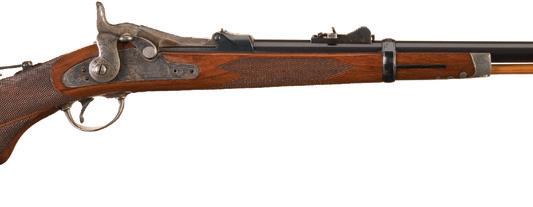





39 June 2020 Civil War News CivilWarShop.com Offering the Finest Investment Grade Military Memorabilia since 1981 Buy – Sell – Trade Certified Appraisal Services Life Member Company of Military Historians Lynn and Will Gorges, Proprietors 3910 US Hwy. 70 East New Bern, NC 28560 (252) 636-3039 • civilwarshop@gmail.com www.CivilWarShop.com Long Bay Salvage LLC specializes in the recovery and restoration of authentic Civil War Cannon with an emphasis on 10-Inch Columbiads, what has become a rare piece of Civil War history. Long Bay Salvage also works with historical entities (government and private) to recover and conserve large historical artifacts with a specialty in large field and naval artillery pieces. Glenn Dutton 770-351-7565 Rufus Perdue Perdue 843-315-9818 PLEASE CONTACT US FOR MORE INFORMATION www.LongBaySalvage.com Promoters of Quality Shows for Shooters, Collectors, Civil War and Militaria Enthusiasts Military Collectible & Gun & Knife Shows Presents The Finest Mike Kent and Associates, LLC • PO Box 685 • Monroe, GA 30655 (770) 630-7296 • Mike@MKShows.com • www.MKShows.com Northwest Georgia Trade Center 2211 Dug Gap Battle Road Dalton, GA 30720 February 1 & 2, 2020 Chickamauga (Dalton) Civil War Show Williamson County Ag Expo Park 4215 Long Lane Franklin, TN 37064 December 5 & 6, 2020 Middle TN (Franklin) Civil War Show l Shiloh Buying & Selling Authentic Civil War Artifacts 2405 Oak Grove Road Savannah, TN 38372 731-438-3541 ShilohRelics.com History@shilohrelics.com owner Rafael Eledge .com Dealing in the Finest Authentic Militaria Since 1995 with an Emphasis on the American Civil War Pistols, Muskets, Carbines, Rifles, Bayonets, Swords, Uniforms, Headgear, Belt Buckles, Cannon, Buttons, Bullets, Artillery Implements Etc. MidWestCivilWarRelics.com Bowie Knifes, Civil War Swords, Confederate D-guards, Antique Firearms, Dug Relics, Buckles & Belts, Identified Relics, Letters, Documents, Images, Currency, Uniforms, Head Gear & Flags. 3500 Shacklett Rd • Murfreesboro, TN 37129 tom@stonesrivertrading.com • (615) 336-2188 StonesRiverTrading.com Tom Hays Proprietor We carry all types of relics, dug & non-dug, Confederate & Federal. 100% Guaranteed. A strong emphasis on dug relics, but also a full line of non-dug relics of all types. Over 30 years experience with a full time, online store since 1997. We also have a shop located five miles from Stones River National Battlefield that is open by appointment. www.CollegeHillArsenal.com Tim Prince College Hill Arsenal PO Box 178204 Nashville, TN 37217 615-972-2418 Mid West Civil War Relics MidWestCivilWarRelics.com Allen Wandling Phone: 618-789-5751 Email: awandling1@gmail.com Museum Quality Civil War Union & Confederate Artifacts! We handle the Best Antique Bowie Knifes, Civil War Swords, Confederate D-guards, Antique Firearms, Dug Relics, Buckles & Belts, Identified Relics, Letters, Documents, Images, Currency, Uniforms, Head Gear & Flags. Preston Bain Nashville, TN (615) 397-5186 www.NashvilleRelics.com Nashville Civil War Relics “Old times there are not forgotten” Coles Civil War Shop.com Come by and see me at the shop or place an order online. email hmcole2@comcast.net Mac Cole 13119 River’s Bend Blvd. Chester, Va 23836 wk - 804-681-0945 cell-804-314-9940 Hours Mon - Fri 10-5 Sat - 10-3 P.O. Box 342 Thompsons Station, TN 37179 615-585-0115 Email: brubon2@bellsouth.net Franklin Relics www.AmericanRelics.net Allen Phillips 1014 Reservoir St., Suite B Harrisonburg, VA 22801 A P.O. Box 342 Thompsons Station, TN 37179 615-585-0115 Email: brubon2@bellsouth.net Franklin Relics Specializing in Accoutrements, Edged Weapons, Firearms and Uniforms FranklinRelics.com Bruce Hohler Proprietor Specializing in Buttons, Buckles, Currency, Hat Devices and other Military Artifacts. www.AmericanRelics.net Allen Phillips 1014 Reservoir St., Suite B Harrisonburg, VA 22801 American Relics Phone: 540-476-1969 Email: americanrelicsnet@gmail.com www.CivilWarBadges.com Everitt Bowles, Owner • 770.926.1132 1036 Washington Avenue Woodstock, Georgia 30188 The Largest Selection of GAR & UCV Hundreds of Memorabilia Items from Rev War through Vietnam Secure & Easy Guaranteed Authenticity of Every Item 8895 Town and Country Circle • Knoxville, TN 37923 Phone: 865-693-3007 info@armyoftennesseerelics.com Civil War Artifacts Nick Periut Proprietor ArmyofTennesseeRelics.com Buying and Selling High Quality Images, Belt Buckles and Plates, Artillery Shells, rare Bullets and Buttons! Richard Gersten (708) 786-8630 PO BOX 31113, CHICAGO, ILLINOIS 60631 www.YankeeCollector.com Specializing in Early Americana, Civil War American Indian, Old West, WW I & II Guns, Swords & Memorabilia www.uniondb.com 34 York St Gettysburg, PA 17325 Phone: 717-334-2350 • Email: bsynnamon@gmail.com Specializing in Authentic Civil War Artifacts The Union DrUmmer Boy A Museum Where You Can Shop! Contact Glenn Dutton at: glennjdutton@aol.com or 770-351-7565 BUYING & SELLING Field & Heavy Artillery Cannon, Shells, Fuses & Etc. Rare Accoutrements Michael Simens HistoricalArms.com Tel: 440-744-9088 mail@HistoricalArms.net The Only Complete Beaumont-Adams CS Naval Rig Michael Simens HistoricalArms.com Tel: 440-744-9088 • mail@HistoricalArms.net Magnificent Swords Georgia Presentation To William J. Hardee. Later Confederate Lieut. General. We Buy, Sell, Authentic And Appraise World-Class Historical Artifacts Fine Antiques & Militaria Military Items 1650-1945 Armor Swords Firearms Bayonets Equipment Accoutrements www.csarms.com PO Box 602 9150 John S. Mosby Hwy. Upperville, Virginia 20185 Shop Phone: 540-592-7273 Email: sophiacsarms@aol.com C.S. Arms, Inc. Specialize in U.S. & British Militaria www.OldSouthAntiques.com Old South Antiques, THE CONFEDERATE Old South Antiques, LLC Hickory Hill Mansion, 9222 Wickham Manor Way, Ashland, VA 23005 CARSON SQUEEGIE JENKINS 321.505.7524 WWW.SQUEEGIE.NET DESIGN SERVICES PRINT MEDIA ILLUSTRATIONS PACKAGE DESIGN CORPORATE BRANDING PRINT & MAGAZINE ADS LOGO DESIGN TEXTILE/ T-SHIRTS BROCHURES EVENT POSTERS BUSINESS CARDS 3D RENDERINGS MARKETING NEW BUSINESS START-UP PACKAGES AVAILABLE The Historical Shop Margaret & Cary Delery Box 73244 Metairie, LA 70033 Phone: 504-467-2532 c.j.delery@att.net www.historicalshop.com Since 1978 selling rare Americana Historical Shop The e Early American items through the Civil War artifacts, autographs, photography, currency, bonds, historical displays, military items, and more…… P.O. Box 160 • Kingston, TN 37763 Phone: 803-431-1798 Email: vann@veteransattic.com www.VeteransAttic.com Vann Martin United Confederate Veterans, Grand Army of the Republic, Civil War Photographs and other Civil War items. David K. Parks Military Antiques PO Box 180674 Utica, MI 48318-0674 Phone: 586-871-6462 Email: dkpma@comcast.net Offering a large selection of Civil War and Historical Memorabilia ranging from the Revolutionary War to World War (emphasis on the American Civil War). On line catalog regularly offers over 700 items from nearly every category of collecting. www.RelicsOfHistory.com Civil War Military Longarms a Specialty ConfederateArmsCompany.com 1209 Victor II Blvd., Morgan City, La. 70380 Cell: 985-518-1802 • Email: leegray@LHprinting.com Lee Gray Confederate Arms Company PO Box 129 Dover, TN 37058 Buying & Selling: Images Artillery Firearms Dug Relics Edged Weapons Non-dug Artifacts John & Nikki Walsh Fort Donelson Relics FortDonelsonRelics.com Full Line Civil War Artifact Dealer Email: john@fortdonelsonrelics.com vann@veteransattic.com www.VeteransAttic.com United Confederate Veterans, Army of Republic, Civil War Photographs other Civil items. War and Historical Revolutionary War American Civil offers over 700 of collecting. www.RelicsOfHistory.com “Reproduction Antique Spectacles to suit all sights” Authentic reproduction Civil War era eyeglasses to fit your lifestyle. Historically accurate, ophthalmic quality eyeglass frames suitable for reading, distance, bifocals, progressive lenses, sunglasses & nonprescription tinted lenses. Made for full time wear. “Spectacles are most overlooked, most obvious way to spoil an otherwise fine impression.” Thomas Valenza, Optician When you are ready to complete your impression, visit us online for detailed information about our spectacles: www.HistoricEyeWearCompany.com Prices start at $139.95 862.812.4737 Unidentified Union soldier wearing oblong spectacles (Library of Congress) Above Right: Lieutenant Adam J. Slemmer, defender of Fort Pickens (U.S. Army Heritage & Education Center) The Best Civil War Era Spectacles Buying and Selling original Civil War Confederate & Union Buttons, Belt Buckles, and Accoutrements. NCCivilWarRelics.com PO Box 2122 Morehead City, NC 28557 Phone: 252-671-7770 Email: sales@nccivilwarrelics.com or AGaskins1@ec.rr.com Allen Gaskins North Carolina Civil War Relics Robert Jones • 119 Frances Ave. • Stanhope, NJ 07874 Phone: 973-810-2976 • Email: Bob33rd@optonline.net We sell original Civil War artifacts, both excavated and non-excavated. There is also a selection of mid-19th century antiques. Yankee Rebel Antiques www.YankeeRebelAntiques.com Proprietor, Robert Jones, is the author of seven books on Civil War subjects: The Civil War Canteen Civil War Artillery – A Pictorial Introduction Children at the Battle of Gettysburg –Their Unforgettable Summer The Civil War Canteen Second Edition, Battle of Gettysburg –The Relics, Artifacts & Souvenirs, The Civil War Soldier – His Personal Items, War Canteen – Third Edition He has also written articles for North/South Trader Civil War magazine. Order his books online at http://www.lulu.com/spotlight/civilwarbooks Promoters of Quality Shows for Shooters, Collectors, Civil War and Militaria Enthusiasts Military Collectible & Gun & Knife Shows Mike Kent and Associates, LLC • PO Box 685 Monroe, GA 30655 (770) 630-7296 • Mike@MKShows.com • www.MKShows.com February 1 & 2, 2020 Chickamauga (Dalton) Civil War Show November 14 & 15, 2020 Capital of the Confederacy Civil War Show December 5 & 6, 2020 Middle TN (Franklin) Civil War Show l l Firearms & Militaria Auctioneers or Better! On Expensive Items and Valuable %0 Seller’s Commission The Tradition Continues - New Facility, Same Family and Great Location We are pleased to announce the purchase of the former Auction Facility of World-Renowned Hall-of-Fame Auctioneer James Julia. climate controlled and secured space dedicated to the promotion, presentation and handling of fine firearms collections. Our Fall 2019 Firearm Auction generated nearly $5.5 Million in sales for our consignors - Our largest to date! Call our offices to be part of our next Premier Firearms Auction Consignments Now Being Accepted 199 Skowhegan Rd Fairfield, ME 04937 207-453-2114 civilwar@poulinauctions.com Website: poulinauctions.com Stephen Poulin, ME Lic 1115 Presentation Sword of Gettysburg Hero General Alpheus Williams (est. $20,000 30,000) Sold $41,125 Sold $41,125 Rigdon & Ansley Confederate Revolver Carried By Captain Luther M. Clements, Co. F, 41st Alabama (Est. $25,000-35,000) Unique 1864 Sold $7,635 Sold $41,710 Sold $36,425 Confederate Keen-Walker Brass Frame Breech Loading Percussion Carbine (Est. $20,000-30,000) Sold $23,500 Sold $23,500 Fine Cook & Brother Athens Georgia Confederate Percussion Carbine (Est. $20,000-25,000) ROCK ISLAND AUCTION COMPANY REAL ART REAL HISTORY REAL IRON Exceptional Springfield Armory Rare and Exceptional Double Cased Pair of Early Squareback Factory Engraved Colt 1860 Army Patriotic Lady Grip, Case and
THE FINEST HISTORICAL ANTIQUE MILITARIA Wallace Markert info@csacquisitions.com 16905 Nash Road • Dewitt, Virginia 23840 804-536-6413 • 804-469-7362 www.csacquisitions.com
CIVIL WAR BOOK,___ B mv 11:
Civil War News book reviews provide our readers with timely analysis of the latest and most significant Civil War research and scholarship. Contact email: BookReviews@CivilWarNews.com.


Fort Pillow Massacre: Fact or Fiction
The River Was Dyed With Blood: Nathan Bedford Forrest and Fort Pillow. By Brian Steel Wills. Illustrated, appendix, notes, bibliography, 288 pp. University of Oklahoma Press, 2014, hardcover. $29.95.

Reviewed by Wayne L. Wolf
Lincoln’s Multiple Personal Tragedies to the Terrible Carnage of the Civil War
The Black Heavens: Abraham Lincoln and Death. By Brian R. Dirck. Notes, Bibliography, and Index, 240 pp. 2019. Southern Illinois University Press, www. siupress.com, cloth, $29.50.

Reviewed by David Marshall
families destitute. Animosity was inherent in the minds of individual soldiers. Likewise, the presence of Negro soldiers stoked the passions of men raised in a stratified society that relegated slaves to the bottom rung.
Brian Steel Wills does a superb job of charting the background of Nathan Bedford Forrest and how the culture that shaped him manifested itself later in the courage, caution, and the untiring energy characterizing his military career. Additionally, Forrest exhibited the ability to produce dramatic moments in critical situations while simultaneously employing tactics to turn adverse conditions to his benefit. These traits had served him well before the Civil War in building a fortune and would guide him throughout his Confederate service.
To fully understand the controversy surrounding Fort Pillow, one must grasp the retribution, retaliation, and reprisal culture characteristic of West Tennessee as early as the fall of 1862. The men under Forrest’s command had experienced widespread local brutality by Union forces directed against Confederate sympathizers and their families, been exposed to Union atrocities including murder, and seen their property confiscated leaving
The combination of individual anger, antipathy, and societal strictures led to an explosive situation once the walls of Fort Pillow were breached. The deaths of soldiers, particularly black soldiers, as well as Unionist civilians housed in the fort, resulted from “unloosening of the dogs of war.” General Forrest did not lead the assault on the fort and only entered after its surrender. The majority of the killing that was later so vilified as a massacre took place below the bluffs as escaping soldiers fled to the river. Contemporaneous accounts confirm that Forrest was not present when the “massacre” occurred and stopped any excesses upon his arrival. Yet, being in overall command, he was forever labeled with the sobriquet “That Devil Forrest.”
Brian Steel Wills presents a well-balanced, unbiased, and thoroughly researched account of both the assault on Fort Pillow and its aftermath. He explores how the Union press and politicians used the slogan “Remember Fort Pillow” to defeat Democrats and scapegoat Forrest for their political purposes. Yet, he leaves the interpretation of conflicting facts to the reader who is willing to examine the evidence in light of contemporary biases and leave the ultimate conclusions for further research. This book is well written, concise, and superbly edited. It should be on every student of the Civil War’s bookshelf.
Wayne L. Wolf is Professor Emeritus at South Suburban College and the author of numerous Civil War books including Heroes and Rogues of the Civil War and The Last Confederate Scout.
The Black Heavens insightfully tackles how Lincoln gradually turned to the almighty and faith during four years of war and conflict. It is fascinating to see that the President learned to accept the casualties of conflict in order to pay for Union fight and freedom for millions. While he mourned close friends early in the contest such as Elmer Ellsworth and Edward Baker, he chose to deal with death in a private way. Dirck makes excellent observations in detailing that for the president to lose himself in the war’s casualties, would have risked his rationality, his judgment, and ability to govern. The author allows us to gain an understanding of this great man’s character and ability to withstand the rigors of his presidency.
concerning death and its purpose for himself during his life. The President’s Second Inaugural Address clearly states his beliefs as he told people on March 4, 1865, “as G-d gives us the right, …let us finish the work we are in.” He knew that the afterlife was black but did not necessarily understand why.
Professor Dirck has written a narrative on death and mourning by Abraham Lincoln. The United States president knew death throughout his life, but nothing prepared him for how the country lost so many soldiers during the Civil War, destroyed so much property, and produced such a significant debt to the nation paid for by an extraordinary amount of taxation. While the fighting caused so many widows, he was able to lead the country toward a “new birth of freedom,” with a future liberation from human bondage. His hope for a better future was littered with graves. This excellent writer makes the argument that death can be looked at with emancipation and preserving the Union as one of the central realities of Lincoln’s life. He failed to mention how he dealt with death throughout his lifetime but points to it in some of his wartime speeches and letters. Much conjecture and researched deduction is found throughout this outstanding narrative of how Lincoln handled the death of his parents, children, alleged love of his life, and the loss of so many in this important time in our history.
Unlike many individuals from this time, the author asserts that Lincoln was far more rational than superstitious; rarely spoke of ghosts or other displays of the spirit world. He provides many fascinating examples of how this man confronted the problems of death and dying with the same realism that directed other important characteristics of his fifty-six years on this planet.
Dr. Dirck writes about Lincoln dealing with a good death, the ideas of death, ghosts, battlefields and death, duty, control, and the death of his sons Eddie and Willie as well as his close friends; Elmer Ellsworth and Edward Baker. He shows interesting examples in his study of death creating an honest passing with a sense of resolution and a reason that systematically provided people with hope for a better future. The most compelling chapters are the three dealing with the deaths of Eddie and Willie Lincoln and Elmer Ellsworth and how Abraham Lincoln and his wife, Mary, dealt with their deaths, their lives, his four years in office, and the Civil War. This academic has brought to light that the president’s legal background and political nature trained him that death was also an entity that could be sensibly examined, defined, and handled in a more disconnected way.
In the end, the strength of Dirck’s tome is analyzing and finding how Abraham Lincoln searched for a deeper meaning

Brian Dirck has written a fascinating volume on Abraham Lincoln and death that presents a very different perspective on the Sixteenth President. The author has succeeded in the first booklength treatment of Lincoln’s connection with death that scholars and enthusiasts will learn from and enjoy. The Anderson University professor offers a fresh, innovative, and quite readable account of Abraham Lincoln. The author’s use of thirteen images is very effective and helpful to the reader. Thus, this title is highly recommended.
David Marshall is a high school American history teacher in the Miami-Dade School district for the past thirty-three years. A lifelong Civil War enthusiast, David is president of the Miami Civil War Round Table Book Club. In addition to numerous reviews in Civil War News and other publications, he has given presentations to Civil War Round Tables on Joshua Chamberlain, Ulysses S. Grant, Abraham Lincoln, the Battle of Gettysburg, and the Common Soldier.
40 Civil War News June 2020
Digital Issues of CWN are available by subscription alone or with print plus CWN archives at CivilWarNews.com
166 Acres of Hell
Too Much For Human Endurance: The George Spangler Farm Hospitals and the Battle of Gettysburg. By Ronald D. Kirkwood. Illustrated, appendices, bibliography, index, Savas Beatie, www.savasbeatie. com, 2019, 396 pp., hardcover, $34.95.

Reviewed by Wayne L. Wolf
death, and nauseating smells. Individual chapter vignettes highlight personal stories that make the reader realize Gettysburg is a story of thousands of individual stories.


As examples, the death of George Nixon III, great grandfather of a future president, or the sacrifices of Civil War nurse Rebecca Lane Pennypacker Price are highlighted. The heroic death of Confederate General Lewis A. Armistead and the struggles of Private Reuben F. Ruch of the 153rd Pennsylvania show that death and dying did not discriminate by rank. These stories are multiplied by those of countless individual soldiers, doctors, nurses, and volunteers who contributed to alleviating the trauma of the hospital stay
Founding Father of Atlanta Civil War History
Wilbur George Kurtz: A Most Remarkable Life, A Pictorial Biography. By E. Joseph Seguin. Photos, index, notes and timeline, no bibliography, acknowledgments, foreword, introduction. 202 pp., 2019. Stone Mountain, GA: K & S Books.
Reviewed by Salvatore Cilella
George and Elizabeth Spangler and their four children operated a successful, growing, and profitable farm in Gettysburg, Penn. By community standards, they were doing well and giving back to their community. Then the XI Corps, Army of the Potomac, seized their home, barn, and summer kitchen for a field hospital, leaving them crowded in one bedroom for the next six weeks as nearly 2,000 wounded and dying Union and Confederate soldiers were treated on their property and the adjacent Granite Schoolhouse.
Both armies used their property as a staging area for the battle, trampling crops, tearing down fencing, devouring food stores, and fouling the land with human and animal waste. Spangler’s Farm was chosen because it was sufficiently large (166 acres), sat at the crossroads of intersecting Baltimore Pike, Emittsburg Road, and Taneytown Road, and was central to protecting the Union’s front line extending from Cemetery Ridge to Culp’s Hill. It also provided sufficient space and shelter for thousands of expected wounded.

Ron Kirkwood has masterfully woven together the troop movements during the Battle of Gettysburg with the subsequent horrors of treatment at the Spangler Hospitals. His personal accounts through soldier letters, diaries, and medical files illuminate what the Spangler family lived through, a nightmare of blood, amputated limbs, agony,
These stories also illuminate the medical care available in 1863, the contributions of local residents, unscrupulous profiteers in embalming tents, tomb raiders for souvenirs, and the torture of family members seeking their loved ones. Medical providers, like Dr. Bleeker Hovey and his wife Marilla, who worked side by side to alleviate suffering left a lasting impression on their physical as well as mental health. War was truly hell in these hospitals and no one associated with them ever forgot their experiences.
The author’s research is extensive and contains six appendices that include biographies of surgeons who worked at the Spangler Hospitals, a detailed list of over 1,400 wounded and deceased soldiers, and an organizational chart of the Army of the Potomac. These inclusions make this a volume that should be on every Civil War bookshelf. Much of this information would only be available after the months of research Ron Kirkwood obviously did with a passion for accuracy and historic preservation.

Wayne L. Wolf is Professor Emeritus at South Suburban College and past president of the Lincoln-Davis Civil War Roundtable. He has written numerous books and articles on the Civil War and enjoys researching the life of the common soldier.
You might say he was the founding father of Atlanta History. Wilbur Kurtz’ disciples included the renowned local historian, Franklin Garrett; Civil War collectors and scholars, Beverly Dubose Sr. and his son, Beverly Dubose Jr., (and later, Beverly III); Colonel James G. Bogle, and Margaret Mitchell. This group was not only essential to establishing the Atlanta Historical Society, but the Atlanta Civil War Roundtable, which continues to flourish today with nearly 700 meetings since its inception just prior to the Centennial in the 1960s.
Ironically, it would be Kurtz, a native of Illinois and a graduate of the Chicago Art Institute, and Garrett, another Midwesterner, from Wisconsin by way of Chicago, who would be responsible for preserving much of Atlanta’s history. (Full disclosure: as a native Chicagoan, I bring no pre-conditioned views to this review). Southerners DuBose and Bogle balanced the team.
He is almost singlehandedly responsible for the nearly 350 historical markers in and around Atlanta. According to the book’s foreword, he wrote most text for them as he helped supervise the exact placement of each one. He got heavily involved with production of the movie Gone with the Wind. Author Seguin tells the story of Kurtz’ insatiable desire for historical accuracy in the movie. While on set in Hollywood, he wrote home to ask his son Henry to send him detailed measurements of an antebellum lamppost still extant in front of the United Daughters of the Confederacy on Juniper and Sixth Street in Atlanta. Henry was evidently as avid as the old man. Climbing to the top of the lamppost, he drew unwanted attention from the local constabulary and was held until he was able to explain his behavior to the satisfaction of the authorities.
Kurtz was also involved with the Atlanta Cyclorama in the early 1930’s under FDR’s Works
Projects Administration (WPA). The program was designed to stimulate the economy putting all types of labor back to work. It helped various groups of artists and artisans to work during the depression. Several important artists benefited from the program including the likes of Jackson Pollack, Willem de Kooning, John Steuart Curry, Berenice Abbott, and Jacob Lawrence. Kurtz landed the job of creating the diorama which remains with the restored painting at the Atlanta History Center. He kept a meticulous record of his work on the large painting including early attempts to conserve it. His Notebook 23, Cyclorama was presented by Wilbur Kurtz III, to the History Center in 2018 and is an important contribution to documenting the painting and to our understanding of its intriguing history.
The early 1940s found Kurtz in Hollywood working on Song of the South, and in the early 1950’s on the Great Locomotive Chase in which his father-in-law, Captain William A. Fuller, had participated. Kurtz was “the acknowledged expert on the subject.” He and Bogle collaborated on the film parlaying the latter’s reputation as “a recognized railroad historian…and the foremost authority about the Andrews Raid of 1862. Bogle had lectured and written extensively on the topic, including “The General and the Texas” co-authored with Stan Cohen, and supervised the restoration of the locomotive Texas at Grant Park.”1 Along with Garrett and Dubose, their connections continued through the Atlanta Civil War Round Table.
This paperbound book is presented as “A Pictorial Biography.”
It is chock full of photographs— some meaningful, others not, many a reader would not have seen; only the author in his research work. As a fellow writer, that is of some interest while
others may find it a hindrance to the flow of the story. In the end this is an extensive picture book with extremely detailed captions rather than a traditional biography. Kurtz’ life is a fascinating look at the first half of the 20th century in the Midwest and the revitalized City of Atlanta.
Source:
1. Bogle Obituary, August 17, 2010, The Atlanta Journal-Constitution.
Salvatore Cilella was the President and CEO of the Atlanta History Center, 2006-2012. He is the author of Upton’s Regulars, A History of the 121st New York Volunteers in the Civil War, (University of Kansas Press, 2009), editor of The Correspondence of General Emory Upton, 2 Vols., (University of Tennessee Press, 2017), and editor of Till Death Do Us Part; The Correspondence of Emory and Emily Upton, (University of Oklahoma Press, 2020).

41 June 2020 Civil War News Subscribe at CivilWarNews.com Digital Issues of CWN are available by subscription alone or with print plus CWN archives at CivilWarNews.com
Want To Advertise In Civil War News? Email us at ads@civilwarnews.com Call 800-777-1862 CW N Civil War News Inside this issue: Day Remembrance Day, 2019, Gettysburg President Lincoln was wrongThe world will little note, nor long remember what we say here, but can never forget what they did here. – Abraham Lincoln, November 19, 1863.es and visiting monuments. A Gettysburg National Cemetery Although the numbers of reenacwhen Wikipedia estimated thereenactors; still impressive num-Battlefield Trust)
Why the Civil War Remains Unresolved Voices from the Past
Not Even Past: The Stories We Keep Telling About the Civil War. By Cody Marrs.
 Reviewed by Jonathan A. Noyalas
written, and thought-provoking volume. It simultaneously informs and calls for an honest reckoning with the past.
In 1958 Wesleyan University published a series of lectures delivered by Bruce Catton that spring on campus. Catton, in the introduction to that volume, America Goes to War, meditated on the Civil War’s place in American history. After lambasting those who romanticized it too much, Catton concluded “the Civil War is not a closed chapter in our dusty past.” That statement rings as true today as it did sixty-two years ago. As a republic we still grapple with the Civil War’s legacies. More than 150 years after fighting on the battlefields ceased, the Civil War still stirs deep emotions, sparks bitter rancor, and triggers controversy. The question remains as to why that is the case. This volume lends significant insight into why individuals believe what they do about the Civil War and why our nation’s most tumultuous moment remains unresolved.
Cody Marrs, an English professor at the University of Georgia, through prodigious research and careful analysis of film, art, novels, and poetry, has produced a carefully-crafted, impeccably
Organized into four main chapters, the book’s first, examines the notion that the Civil War was merely a “family squabble,” a contest of brother against brother. Beginning with the publication of Walt Whitman’s Drum Taps in 1865, Marrs traces how various individuals such as Constance Mayer, whose painting Recognition: North and South, which depicted a Confederate soldier mourning over the body of a slain Union soldier, his brother, in the aftermath of battle, mythologized the conflict as a temporary falling out among family members. Marrs convincingly argues that this myth, either as a result of Whitman’s writings, the musings of Robert Penn Warren during the Civil War centennial, or screen writers such as Tony Kushner, endures because it is much more comfortable to imagine the war as “a domestic quarrel… that ultimately brought everyone back together.”
In the next chapter the author’s attention turns to how various individuals including Mark Twain, Ambrose Bierce, Emily Dickinson, and Ken Burns cast the Civil War as a “dark and cruel war” where the shared sufferings of soldiers on the battlefield, meaning white combatants, essentially erases national allegiance. The “dark and cruel war,” just like the “family squabble,” skirts around slavery’s centrality to the conflict and the African American experience.
While the first two perspectives Marrs examines side-step slavery, the book’s third chapter provides a solid exploration of how the Civil War’s most persistent, and arguably most destructive mythology, the Lost Cause, infests society with the idea that not only did slavery have nothing to do with the war, but that enslavers proved genial and kind. While the author does revisit some familiar ground here, explored by other scholars
Civil War Artillery Book
New 392 page, full-color book, Civil War Artillery Projectiles –The Half Shell Book. For more information and how to order visit the website www. ArtillerymanMagazine.com or call 800-777-1862.

$89.95 + $8 media mail for the standard edition.
of the Lost Cause in examining the influence of individuals such as Edward Pollard, D.W. Griffith, and Margaret Mitchell, Marrs’s examination of the ways in which alternative history such as Harry Turtledove’s The Guns of the South continues to foment the Lost Cause is an important contribution to the study of Civil War memory.
Marrs’s final chapter offers insight into how African Americans such as Frederick Douglass, W.E.B. DuBois, Edmonia Lewis, and Meta Vaus Warrick Fuller, attempted to challenge the perspectives examined in the volume’s first three chapters. While each chapter is strong, this final one is arguably the most powerful. It not only posits the manners in which various African Americans attempted to place slavery’s destruction at the center of Civil War remembrance, but compellingly shows how African Americans viewed figures, many in white society, both North and South, since the Civil War’s end. Through careful analysis of speeches and writings of individuals such as W.E.B. DuBois, Marrs suggests that criticisms levied against Robert E. Lee and other Confederate figures in recent years, particularly in the wake of the 2015 tragic murders in Charleston, S.C., are not necessarily a case of revisionist history, but merely resurrecting the ideas promulgated by African Americans since the Civil War’s end.
Engagingly written and solidly argued, Marrs’s volume should have wide appeal to those interested in the complexities of Civil War memory and individuals seeking an understanding of how the past influences the present.
Jonathan A. Noyalas is director of Shenandoah University’s McCormick Civil War Institute in Winchester, Virginia, a professor in Civil War Era Studies at Shenandoah University, and founding editor of Journal of the Shenandoah Valley During the Civil War Era. He is the author or editor of thirteen books including Civil War Legacy in the Shenandoah: Remembrance, Reunion, and Reconciliation.
Remembering the Civil War: The Conflict as Told by Those Who Lived It. Edted by Michael Barton and Charles Kupfer. Introduction, pictures, photos, 470 pp., 2020, Lyons Press, Lanham, MD, www.rowman. com, $34.95.
Reviewed by Joseph A. Derie
Whitman, Frederick Douglas) and a host of others. The authors attempt to present a well-rounded view North and South, general and common soldier, soldier and civilian, and generally do so.
This text is published as an introductory volume of Civil War memoirs “for general readers.” All the entries are in the public domain and many are available online at places such as Project Gutenberg (under the heading “US Civil War (Bookshelf”).
The volume is broken into sections for each year of the war, with readings on battles in chronological order, interspersed with sections such as “Prologue to War,” ”Everyday Life in Camp and Field,” “Everyday Life in the Hospital,” “The Variety of Warriors,” “The Variety of Civil War Experience,” and “Reflecting on the War.”
Each reading is introduced by the editors with comments on the background of the author and their place and purpose in the War. At the end is bibliographic information about the item. The memoirs range from commanding generals (Lee, Grant, Longstreet) to common soldiers (Sam Watkins, William Fletcher) to well-known personalities (Herman Melville, Louisa May Alcott, Ambrose Bierce, Walt
I would have liked to see more readings from the TransMississippi and from the navies. The editors’ biggest failing is the year 1865. There are only four readings (all other years have over twice that) covering the Appomattox Campaign, Lee’s surrender, and Lincoln’s assassination. There should have been some readings from the Army of Tennessee or its Union counterparts, something about Jo Shelby and the Confederate Iron Brigade crossing the Rio Grande and going to Mexico, or Juneteenth in Texas. If nothing else, they should have included Nathan Bedford Forrest’s farewell to his troops (“I have never on the field of battle sent you where I was unwilling to go myself, nor would I now advise you to a course which I felt myself unwilling to pursue. You have been good soldiers. You can be good citizens. Obey the laws, preserve your honor, and the government to which you have surrendered can afford to be and will be magnanimous.)
Granted Forrest is controversial in some quarters, but his words are perfect for a volume such as this.
Remembering the Civil War is not for the well-read Civil War enthusiast or specialist. It is intended for those with very little background in the Civil War who want to learn more. It would make a great gift to someone just starting out or someone who has expressed an interest and, for whatever reason, hasn’t pursued it. It is recommended with that understanding.

CAPT Joe Derie is a longtime Civil War buff with a special interest in Civil War naval history and the Civil War in the West. He is a retired USCG officer and a licensed officer of the Merchant Marine, currently self-employed as a marine surveyor and marine accident investigator in Portland, OR.

42 Civil War News June 2020
Photos, notes, index, 240 pp., 2020. Johns Hopkins University Press, www.press.jhu.edu. $28.
Subscribe at CivilWarNews.com
A New Look at the Great Assault at Gettysburg
Custer at Gettysburg: A New Look at George Armstrong Custer versus Jeb Stuart in the Battle’s Climatic Cavalry Charges. By Philip Thomas Tucker. Notes, and Index, 480 pp., 2019. Stackpole Books, An Imprint of The Rowman & Littlefield Publishing Group, Inc. www.rowman.com, hardback.
$32.95
Reviewed by David Marshall
Psychiatry and the Lost Cause
helped denigrate Custer’s importance to the battle. Tucker paints a portrait of the need for emphasizing the clash at East Cavalry Field rather than appearing as an insignificant moment during the final day of fighting. This historian succeeds in bringing to light the unexpected portrayal of a cavalry commander as a forceful, prepared, clever, and careful battlefield leader of both cavalry and horse artillery. In the end, Philip Thomas Tucker writes an interpretation of the battle of Gettysburg that illuminates a new history of Custer’s success and leadership in out-thinking and out-dueling Stuart and his horsemen.
Philip Tucker’s new book, Custer at Gettysburg, focuses on the cavalry showdown on East Cavalry Field between Union General George Custer and Confederate General J.E.B. Stuart. Philip Tucker concentrates on the tactical performances of both men during this climatic day of the battle. This is one of the first surveys of George Custer that concentrates on his contribution on a single day during the Civil War and does not emphasize his life before July 3, 1863, or his post war fighting in the Western United States. The author makes an argument that the fighting that took place away from Pickett’s Charge was much more important than the accepted climatic moment of the three day’s at Gettysburg that
Unfortunately, this title is marred by a forty-three-page introduction and a great deal of repetition throughout the narrative including numerous times in the same paragraph and page. Assistance in editing would have greatly helped the flow of this four hundred and eighty-page volume. Much is made of other soldiers who are viewed as if there is a competition to elevate this “boy general.” Tucker emphasizes throughout this tome that anything Custer does or achieves is much better than most everyone else who fought and helped the Army of the Potomac gain an important victory at Gettysburg. Additionally, it would have been helpful to have more maps as well as a bibliography. Perhaps the most troubling aspect of the volume is that the author makes related statements several times throughout this tapestry that “a number of nonprofessional Civil War authors— rather than PhD’s—and nonacademic publishers have made a cottage industry on behalf of their false propositions and based on outdated books.” On a positive note, he quotes many well-known and leading scholars who support
many of his assertions throughout this magnum opus. Despite these limitations, the book provides some important information, including a previously unpublished account of the battle written on July 4, 1863, and published by a correspondent under the heading “From the Michigan Cavalry.” This study covers two important individuals who helped determine which side won the battle of Gettysburg. Overall, this book gives an interesting and thought-provoking look into George Armstrong Custer and J.E.B Stuart’s strengths and weaknesses in the combat’s critical cavalry charges. This history is significant and the writer has written a probing reconsideration of the performance of these two important figures. This is a lucid, readable summary of the critical East Cavalry Field fighting that brings two key personalities to life. Tucker’s engaging prose ably examines the topic and makes the story accessible to anyone seeking to understand these individuals and their contributions to this important moment during the Civil War.
There have been many titles published dealing with one of the most important Civil War battles, but Tucker has succeeded in researching and analyzing the vital fighting at East Cavalry Field in a full book-length treatment that scholars and enthusiasts will discuss and argue over. The author provides fresh insight that helps us understand Custer and Stuart’s motivation, strategies, tensions, controversies, and triumphs that characterized their careers and lives prior to Gettysburg and during the battle. He does not shy away from placing fault with anyone, especially how it relates to Custer. The general and his Michigan Wolverines’ success on July 3, 1863, was Custer’s finest hour.
David Marshall is a high school American history teacher in the Miami-Dade School district for the past thirty-three years. A lifelong Civil War enthusiast, David is president of the Miami Civil War Round Table Book Club. In addition to numerous reviews in Civil War News and other publications, he has given presentations to Civil War Round Tables on Joshua Chamberlain, Ulysses S. Grant, Abraham Lincoln, the Battle of Gettysburg, and the Common Soldier.
Administrations of Lunacy: Racism and the Haunting of American Psychiatry at the Milledgeville Asylum. By Mab Segrest. Illustrated, notes, The New Press, 2020, 375 pp., $28.99 hardcover
 Reviewed
by Wayne L. Wolf
America.
Using a series of biographical sketches of inmates, Mab Segrest traces the history of the Georgia State Lunatic, Idiot, and Epileptic Asylum from its founding in 1842 to its court-ordered demise in 2010. The book’s central thesis is that modern psychiatric practice was forged in the cauldron of slavery, the Civil War, Reconstruction, and the era of Jim Crow. The Georgia State Asylum became the laboratory for reconstructing psychiatric history within the United States, particularly as an integral part of Southern history.
Patient narratives, hospital records, newspapers, and oral histories were combed to place each historical period in perspective to explain the changing context of psychiatric care for both white and black patients. Varying psychiatric theories from heredity predisposition to germ theory, bodily humors, behavioral causation, and post-traumatic stress are placed in the historical time period when they dominated admissions to the asylum.
The author, however, goes beyond a mere cataloging of data related to the number and diagnosis of each patient to an overriding view that indicts Southern society as a preserver of racism manifested even in the Georgia Asylum. Antebellum racism was held to not only shape American psychiatry but to inculcate in it the seeds of white supremacy that would, and still does, characterize
Many contentions put forward by the author to support her omnipresent racism are flawed. Her contention that more Southerners died in the Civil War than Union troops because more battles were fought in the South neglects numerical, industrial, and technological superiority of the North. Frequent use of phraseology such as, “We can imagine, he seemed a bat[sic bit] narcissistic, or, of course, we cannot know for sure,” allow the author to conclude that white supremacy ideology was the root cause of not only psychiatric admissions but later disproportionate prison sentences and labor gang membership. Opinion becomes diagnosis; conjecture becomes the answer to statistical fact finding, and reconstruction of events, e.g. contending the 1897 fire at the asylum was the outcome of a century of segregation, are used to color psychiatric practices with racism and white privilege.
The imperative of reasserting white control after the Civil War subverted scientific advances and is labeled as the overriding socio-political theory of America. If the author would have removed her own stated biases and let readers interpret the data for themselves, they may reach similar conclusions or may realize that it was the global understanding of mental illness at the time that was reflected in the administration of asylums in America. The data and personal stories in this text are well documented, enlightening, and historically relevant as one piece in the puzzle of the evolution of psychiatry in America. Except for a series of typographical errors, the research is solid and comprehensive. For historians interested in the role of psychiatry in society, this book is recommended but should be read with an understanding of the inherent biases.
Wayne L. Wolf is Professor Emeritus at South Suburban College and the author of numerous books and articles on the Civil War. He is past president of the Lincoln-Davis Civil War Roundtable.
43 June 2020 Civil War News Subscribe at CivilWarNews.com Publishers: Please send your book(s) for review to: Civil War News 520 Folly Road, Suite 25 PMB 379 Charleston, SC 29412 Email cover image to bookreviews@civilwarnews.com.
A Confederate Army Surgeon in War and Peace
Christopher H. Tebault, Surgeon to the Confederacy By Alan I. West. Bibliography, illustrations, photographs, tables, index. 207 pp., 2020, MacFarland and Company, Inc., www.mcfarlandpub.com $39.95.
Reviewed by Joseph A. Derie
By Alan I. West. Bibliography, illustrations, photographs, tables, index. 207 pp., 2020, MacFarland and Company, Inc., www.mcfarlandpub.com $39.95.
Reviewed by Joseph A. Derie
Christopher H. Tebault, a New Orleans native, was commissioned an Assistant Surgeon in the Confederate Army Medical Corps in early 1862, shortly after graduating from medical school in New Orleans. He was originally assigned to the 21st Louisiana Infantry and served in the Corinth Campaign. Later he was assigned to the 10th South Carolina Infantry as an Acting Surgeon, taking part in Bragg’s invasion of Kentucky, the Battle of Stone’s River, and the Tullahoma Campaign.
Probably because of his excellent medical qualifications, he was then assigned to the Confederate Hospital at Quintard, Ga., in July 1863. He served continuously at Confederate Army Hospitals in Georgia until being paroled from the Confederate Army Hospital in Macon in May 1865.
Following the war, he returned to New Orleans where he began a long career as a medical practitioner, medical educator, public health doctor, Southern patriot, “Lost Cause” proponent, and concerned citizen. He was the Surgeon General of the United Confederate Veterans from 1896 until his death in 1914.
The genesis for this book came when the author, a collector of medical antiquities, purchased a walnut medical chest with many original medicine bottles from a Connecticut antiques dealer in 1998. The beautiful wooden chest had a Stars and Bars on it and a small plaque engraved:
C.H. Tebault, M.D. - Surgeon10th S.C. INF. REGT. C.S.A.
The dealer knew nothing about the chest other than that he had purchased it from a Connecticut estate. As the author stated, this began a 22-year quest to find out more about Dr. Tebault. There is nothing in Dr. Tebault’s records about the loss of his chest; author speculates that he lost it in one of his campaigns with the Army of Tennessee. This is possible of course, but it could just as well have been looted at the end of the war when he was paroled.
Dr. Tebault left no memoirs but did leave some writings (several of them are in an appendix to the book). The book is thus mostly a history of what was going on at the time, followed by a few paragraphs on what Dr. Tebault was doing based on records and other documents. He was obviously an accomplished doctor, did much for public health in New Orleans, and was well thought of by his contemporaries, both doctors and lay persons, but due to lack of material we don’t find out much about the person.
Christopher H. Tebault, Surgeon to the Confederacy, has been ably researched by the author and, with a few minors errors (the 21st Louisiana Infantry did not have 7,000 at Island Number 10 and Dr. Tebault was never on the staff of every Confederate commander in chief), there is much of interest here. It is highly recommended to those with special interests in the Confederate Army Medical Corps and its services in the Army of Tennessee’s area, reconstruction in New Orleans, the September 1874 Battle of Liberty Place in the Crescent City, public health issues, medical education in New Orleans following the war, and the United Confederate Veterans.
CAPT Joe Derie is a longtime Civil War buff with a special interest in Civil War naval history and the Civil War in the West. He is a retired USCG officer and a licensed officer of the Merchant Marine, currently self-employed as a marine surveyor and marine accident investigator in Portland, OR.
44 Civil War News June 2020 Subscribe online at CivilWarNews.com
A British Military Historian Studies General Sherman
The Scourge of War: The Life of William Tecumseh Sherman.
 By Brian Holden Reid. Maps, photos, notes, appendices, index. 632 pp. Oxford University Press, global.oup.com, 2020, hardcover. $34.95.
Reviewed by W. Clifford Roberts Jr.
By Brian Holden Reid. Maps, photos, notes, appendices, index. 632 pp. Oxford University Press, global.oup.com, 2020, hardcover. $34.95.
Reviewed by W. Clifford Roberts Jr.
History in 2019 for his contributions to the field.
Much like Liddell Hart, Brian Reid has strong opinions and insights about General Sherman and nineteenth century warfare in general. Certainly, William T. Sherman shares the stage with Abraham Lincoln and Ulysses S. Grant as the three principal architects of Northern victory in the Civil War. General Sherman served from First Bull Run to the end of the war and the author recognizes Sherman’s maturation as a military leader and strategist.
Professor Reid points out that as early as 1861, Sherman was telling all who would listen that the “Real War” would be fought for control of the Mississippi basin.
personal bravery at Shiloh, but also acknowledges that on a tactical level—the actual fighting of battles—the general did not excel. His frontal assaults at First Bull Run, Chickasaw Bayou, Tunnel Hill, and Kennesaw Mountain were all repulsed. Reid believes that the unexpected death of his son, Willy, contributed to a despondent Sherman not doing the painstaking reconnaissance at Chattanooga for which he was renowned. Reid also faults Sherman for missing an opportunity on the second day of the Battle of Jonesboro to destroy and capture William Hardee’s Corps.
later tenets of the Lost Cause that have given Sherman “a wholly false diabolic presence in this self-indulgent and self-serving folklore of victimhood.”
In 1929, British military historian and theorist B.H. Liddell Hart published Sherman: Soldier, Realist, American. This groundbreaking work would be his only exploration of the American Civil War. Hart, who would ultimately be knighted for his 26 books on military history, had seen firsthand the futility of frontal assaults in the First World War, and he saw in General Sherman one of the earliest proponents of indirect warfare. Sherman was the master of directing large armies to feint in one direction and flank the Confederates in the opposite direction. Hart went on to argue an even larger point that, by having the foresight to aggressively destroy the Southern means of economic production, Sherman destroyed the resolve of the Southern people, and ultimately the Southern nation itself.
Now, nearly a century later, another respected British military historian, Brian Holden Reid, has written The Scourge of War: The Life of William Tecumseh Sherman, an important new biography of Sherman published by the prestigious Oxford University Press. Brian Reid is Professor of American History and Military Institutions at King’s College London; he is considered by most scholars to be the leading British expert on the American Civil War. He is closely associated with the British armed forces, having spent ten years as resident historian at the Department of War Studies to the Staff College, Camberley. Reid was awarded the Samuel Eliot Morison Prize by the Society for Military
Reid believes that, as Military Commander of the Memphis District in the summer of 1862, Sherman reached the conclusion that the South could not be reconciled, and that to win the war, the North must conduct “a harsher, more punitive style of military campaigning.” Writing his brother, Senator John Sherman, in the spring of 1863, the general declared, “We are forced to invade – we must keep the War South till they are not only ruined, exhausted, but humbled in pride and spirit.” This would be Sherman’s guiding philosophy as his responsibilities in the Union command structure rose with each promotion. The Southern people, in his mind, had brought this “Scourge of War” down upon themselves.
Reid’s new biography follows Sherman from his 1820 birth in Ohio, until his 1891 death in New York City. “Cump’s” formative years were driven by the early death of his father, Charles Sherman, and his subsequent adoption by Thomas and Maria Ewing. A powerful U.S. Senator from Ohio, Ewing secured Sherman’s appointment to West Point in 1836. Popular with his fellow cadets for his flashes of wit and loquacious personality, Sherman also dressed carelessly and saluted slovenly. Unlike Lee and Grant, a disappointed Lt. Sherman missed the fighting in the Mexican War. In 1850, he married the Ewing’s daughter Ellen at Blair House in front of President Zachary Taylor and the president’s entire cabinet. While Sherman’s banking career would be checkered after his 1853 resignation from the army, Reid believes that the articulate Sherman was “the best-read ex-officer in civil life,” with a sophisticated taste for theater as well as British history and literature.
Brian Reid notes Sherman’s
Where Professor Reid sees exceptional brilliance in Sherman is at both the operational and strategic level. The general’s superb logistical understanding and preparation allowed him, in the 90-day Atlanta Campaign, to “consistently outthink and outmaneuver Joseph Johnston.”
After capturing Atlanta and ensuring the re-election of President Lincoln, Sherman boldly set out for Savannah in his famous March to the Sea. Both Liddell Hart and Brian Reid praise Sherman for paring his army back to his 62,000 fittest soldiers, creating a mobile fighting force that lived primarily off the country. Reid also puts a spotlight on Sherman’s expert use of pontoon trains to ensure that his columns were never held up by large rivers in Georgia or the Carolinas.
From a strategic perspective, Reid notes that Sherman understood, more than any other military leader, the psychological destruction he was inflicting on the South’s international prestige and internal self-respect. Foreign governments could never recognize a Southern nation while a Northern army was moving rapidly and unchecked through its hinterland. This point leads naturally to Reid’s most controversial assertion that Sherman’s wanton plunder and burning of civil and private property was vastly overstated. It was on the same level as occurred in the Napoleonic wars, argues the author, and nothing compared to later wars, such as the Eastern Front in World War II. Reid points out that there was hardly any violence directed at Southern civilians, nor did starvation set in after the departure of Federal troops. Sherman’s orders “to spare nothing” was directed primarily at the property of prominent slaveholders who, in the mind of the general, had led the Southern people to a false rebellion. Reid writes that it was the
Professor Reid also sees in William T. Sherman a “dazzling literary stylist,” whose published writings and reports are cogent and eminently quotable. Reid uses this correspondence to explore the general’s evolving and complicated relationships with Ulysses Grant, Henry Halleck, John McClernand, Joseph Hooker, Henry Stanton, and, above all, his wife Ellen. It was her Ewing connections and letter writing prowess that was instrumental in Sherman’s reinstatement to command after his temporary breakdown in November 1861.
Brian Reid’s biography of General Sherman is deeply researched, written at an academic level, and filled with historical insight and commentary. Its pages will be enjoyed by readers who already have a firm grasp on how the Civil War was won and lost. Sherman’s strikingly individualistic personality shines throughout this crisply written biography and Reid’s refined opinions are welcome, whether the reader ultimately accepts or rejects them. The author appropriately closes his new book with a quote from Rutherford B. Hayes, who described William T. Sherman, quite simply, as “the most interesting and original character in the world.”
Finally, as good as Reid’s contribution is to an understanding of the mercurial Sherman, this is not to say that American biographers have nothing important to say about General William Tecumseh Sherman. In the last twenty years, Sherman has drawn full-length biographies from Lee Kenneth
(2001), John Eisenhower (2014), Robert O’Connell (2014), and James McDonough (2016). The last word, from this side of the pond, is, in my opinion, James Lee McDonough’s 816-page William Tecumseh Sherman: In the Service of My Country: A Life. The author of nine books on the western theater, McDonough, a professor emeritus of history at Auburn University, put his lifetime of scholarship behind a nuanced analysis of Sherman as a military general and as a noted American icon. Readers of Civil War history are without question blessed to have so much recent scholarship published on one of America’s most gifted military leaders.
Cliff Roberts is the President of the General Barton and Stovall History & Heritage Association and co-author of Atlanta’s Fighting 42nd; Joseph Johnston’s “Old Guard”, published by Mercer University Press in 2020.
100 Significant Civil War Photographs: Atlanta Campaign collection of George Barnard’s camera work. Most of the photographs are from Barnard’s time in Atlanta, mid-September to mid-November 1864, during the Federal occupation of the city. With this volume, Stephen Davis advances the scholarly literature of Barnardiana.
$19.95 + $3.50 shipping 128 pages, photographs, maps, bibliography. $19.95 + $3.50 shipping. Softbound. ISBN: 978-1-61850-151-6. www.HistoricalPubs.com. Order online at www.HistoricalPubs.com or call 800-777-1862
45 June 2020 Civil War News
The 2020 Civil War Dealers Directory is out. To view or download a free copy visit: www.civilwardealers.com/ dealers.htm
The American Civil War was the first war in which both sides widely used entrenchments, repeating rifles, ironclad warships, and telegraphed communications. It was also the first American War to be extensively photographed. Mathew Brady, Alexander Gardner and Timothy O’Sullivan are famous for having made iconic photographs in the Civil War’s eastern theater. George N. Barnard deserves to be ranked in this top tier for his photographic A civilian photographer hired by Gen. William T. Sherman’s chief engineer to take pictures of fortifications around Atlanta, Barnard took several hundred of them in and around the city in the fall of 1864. His most famous is the site of Union Maj. Gen. James B. McPherson’s death in the battle of Atlanta, July 22, Thus far, no comprehensive, definitive listing has been made of the photographer’s work. The Library of Congress has 130 images; the U. S. Military Academy at West Point, New York, has at least 98 photographs, donated by Captain Poe’s widow. Other repositories, such as the Gilder Lehrman Institute of American History in New York City, have smaller collections. For this book we have chosen hundred images we deem “significant,” though other students may wonder at some of our selections. We hope that this work will stimulate further interest in Barnardiana, and that other scholarly volumes are yet to come. The Atlanta Campaign STEPHEN DAVIS 100 SIGNIFICANT CIVIL WAR PHOTOGRAPHS ATLANTA CAMPAIGN
“The best little book on Barnard”
The American Civil War was the rst war in which both sides widely used entrenchments, repeating ri es, ironclad warships, and telegraphed communications. It was also the rst American War to be extensively photographed. Mathew Brady, Alexander Gardner and Timothy O’Sullivan are famous for having made iconic photographs in the Civil War’s eastern theater. George N. Barnard deserves to be ranked in this top tier for his photographic work in the war’s western theater. A civilian photographer hired by Gen. William T. Sherman’s chief engineer to take pictures of forti cations around Atlanta, Barnard took several hundred of them in and around the city in the fall of 1864. His most famous is the site of Union Maj. Gen. James B. McPherson’s death in the battle of Atlanta, July 22, 1864. Thus far, no comprehensive, de nitive listing has been made of the photographer’s work. For this book we have chosen a hundred images we deem “signi cant.”


Ordering info: $19.95 plus $3.50 s&h South Carolina residents add 9% sales tax
Mail a check to: Historical Publications LLC 520 Folly Road, Suite 25 PMB 379 Charleston, SC 29412


or Order online at www.historicalpubs.com

46 Civil War News June 2020 “The STORIES BEHIND THE PICTURES” 100 Significant Civil War Photographs CHARLESTON IN WAR
Stephen Davis & JACK W. MELTON JR Name Shipping Address City State Zip 160 pages • OVER 100 PHOTOS • MAPS • INDEX • BIBLIOGRAPHY • ISBN: 978-1-61850-167-7 Paperback: $19.95 (+$3.50 S & H) • Released Jan. 2020 3 ways to order YOUR COPY! CALL US 800-777-1862 ORDER ONLINE www.historicalpubs.com fill out this form BELOW & mail with a check for $23.45 to: Historical Publications LLC 520 Folly Road, Suite 25 PMB 379, Charleston, SC 29412 (S.C. residents include 9% sales tax of $1.80) newly Barnard and Charles photograph, selected as e Great Fire allow book are Confederates Harbor Reminiscences of Federal history historical works. such as (1838–1910). DAVIS & MELTON 100 SIGNIFICANT CIVIL WAR PHOTOGRAPHS CHARLESTON IN THE WAR
By
128 page Paperb ac k: $19.95 (+$3.50 S & H)
Wrecking Atlanta Northern Engineers Prying Up Track the right—leading one to deduce that this picture was taken on the afternoon November Battles and series the 1880s. When the men the 1st Missouri Engineers (oneofPoe’s twoengineerregimentsatAtlanta)sawtheTaberillustration,theyapparentlyrecognized made by them for the purpose.” for Monday, November 7. Freedpeople on the Boxcars Library of Congress. scrutinize the pictures and compare them to others. In identifying these kinds scenes, viewers look for telltale clues. One the most important inthesetofpicturestakenatBatteryKisthetreeinthecenter,whichConfederateshadleft Confederate Lt. Col. Bushrod W. Frobel, assistant chief engineer in Hood’s army, called this“thePeachtreestreetbattery.”InhisdiaryentryforAugust14,1864,heremarkedon Peachtree Battery–Another View Buying, Selling and Brokering Jack Melton 520 Folly Rd, Suite 25 PMB 379 Charleston, SC 29412 jack@jackmelton.com 843-696-6385 Let me help connect you with a buyer or seller. I specialize in cannon, projectiles, fuses and wrenches, implements, sights, gunner’s equipment, tools, and other artillery related equipment. From single items to collections. Finders Fees Paid. Purveyor of Original Artillery Items Order these books online at www.HistoricalPubs.com
Civil War News – 12 Issues Per Year
$38.50 - 1 year USA Print $48.50 - 1 year USA Print & Digital
- 2 year USA Print $86 - 2 year USA Print & Digital
- 1 year Digital only Payment Enclosed
Terms and Conditions
The following terms and conditions shall be incorporated by reference into all placement and order for placement of any advertisements in Civil War News by Advertiser and any Agency acting on Advertiser’s behalf. By submitting an order for placement of an advertisement and/or by placing an advertisement, Advertiser and Agency, and each of them, agree to be bound by all of the following terms and conditions:
1. All advertisements are subject to acceptance by Publisher who has the right to refuse any ad submitted for any reason.
2. The advertiser and/or their agency warrant that they have permission and rights to anything contained within the advertisement as to copyrights, trademarks or registrations. Any infringement will be the responsibility of the advertiser or their agency and the advertiser will hold harmless the Publisher for any claims or damages from publishing their advertisement. This includes all attorney fees and judgments.
3. The Publisher will not be held responsible for incorrect placement of the advertisement and will not be responsible for any loss of income or potential profit lost.
4. All orders to place advertisements in the publication are subject to the rate card charges, space units and specifications then in effect, all of which are subject to change and shall be made a part of these terms and conditions.
5. Photographs or images sent for publication must be high resolution, unedited and full size. Phone photographs are discouraged.
6. At the discretion of Civil War News any and all articles will be edited for accuracy, clarity, grammar and punctuation per our style guide.
7. Articles can be emailed as a Word Doc attachment or emailed in the body of the message. Microsoft Word format is preferred. Email articles and photographs: mail@civilwarnews.com
47 June 2020 Civil War News Advertisers In This Issue: 100 Significant Civil War Photographs: Atlanta 16, 46 100 Significant Civil War Photographs: Charleston 31, 46 American Battlefield Trust 13 Ace Pyro LLC 38 Artilleryman Magazine 33 Brian & Maria Green 2 Civil War Guru 40 C.S. Acquisitions 33 CS Arms 19 Civil War Artillery – The Half Shell Book 38 CWMedals.com, Civil War Recreations 16 Civil War Navy Magazine 29 Civil War News 35 Civil War Shop – Will Gorges 33 College Hill Arsenal – Tim Prince 28 Dell’s Leather Works 16 Dixie Gun Works Inc. 23 Fugawee.com 16 Georgia’s Confederate Monuments – Book 32 General Barton & Stovall History Association 25 Gettysburg Foundation 25 Greg Ton Currency 5 Gunsight Antiques 13 Harpers Ferry Civil War Guns 14 The Horse Soldier 4 Jack Melton Artillery Broker 46 James Country Mercantile 33 Jeweler’s Daughter 5 Le Juneau Gallery 15 Mike Brackin 15 Military Images Magazine 26 National Museum of Civil War Medicine 27 North South Skirmish Association 16 Owens and Ramsey Booksellers 41 Panther Lodges 27 The Regimental Quartermaster 17 Richard LaPosta Civil War Books 42 South Carolina Confederate Relic Room 38 Suppliers to the Confederacy – Book, Craig Barry 18 Ulysses S. Grant impersonator – Curt Fields 13 University of Tennessee Press 21 Events: American Digger Chattanooga Civil War Show 5 MKShows, Mike Kent 3, 31 Morphy’s Auctions 11 Poulin Auctions 48
c c c c c c
my: Discover MasterCard Visa NAME ADDRESS ADDRESS CITY STATE ZIP CODE EMAIL
Charge
$29.95
Check
Card # Exp. Date Security Code Name on Card New Renewal c Make checks payable to Historical Publications LLC. c c c c
$66
#
for digital subscription) USA Subscriptions Only No Canada or International Mail to: Historical Publications LLC 520 Folly Road, Suite 25 PMB 379, Charleston, SC 29412 Deadlines for Advertising or Editorial Submissions is the 20th of each month. Email to ads@civilwarnews.com Subscribe online www.CivilWarNews.com Digital Issues of CWN are available by subscription alone or with print plus CWN archives at CivilWarNews.com PHONE Required 800-777-1862 Trivia Answers
Dahlgren 2.
3.
4.
Drewry’s
Dunderberg
(required
1.
General Basil Duke
Dunker Church
David 5.
Bluff 6.
7. Stephen A. Douglas 8. Dismal Swamp Canal 9. Dorothea Dix 10. Devil’s Den


