Monitoring Environmental Impacts
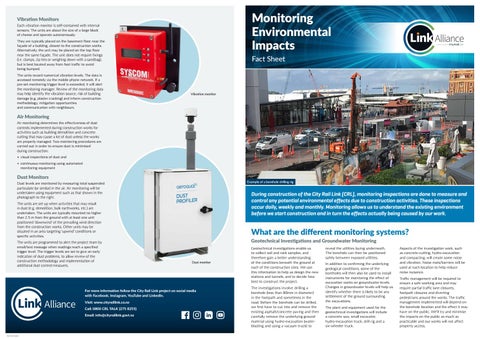
Vibration Monitors Each vibration monitor is self-contained with internal sensors. The units are about the size of a large block of cheese and operate autonomously. They are typically placed on the basement floor near the façade of a building, closest to the construction works. Alternatively, the unit may be placed on the top floor near the same façade. The unit does not require fixings (i.e. clamps, zip ties or weighing down with a sandbag), but is best located away from foot traffic to avoid being bumped. The units record numerical vibration levels. The data is accessed remotely via the mobile phone network. If a pre-set monitoring trigger level is exceeded, it will alert the monitoring manager. Review of the monitoring data may help identify the vibration source, risk of building damage (e.g. plaster cracking) and inform construction methodology, mitigation opportunities and communication with neighbours.
Fact Sheet
Vibration monitor
Air Monitoring Air monitoring determines the effectiveness of dust controls implemented during construction works for activities such as building demolition and concrete cutting that may cause a lot of dust unless the works are properly managed. Two monitoring procedures are carried out in order to ensure dust is minimised during construction: • visual inspections of dust and • continuous monitoring using automated monitoring equipment
Dust Monitors
Example of a borehole drilling rig
Dust levels are monitored by measuring total suspended particulate (or similar) in the air. Air monitoring will be undertaken using equipment such as that shown in the photograph to the right.
During construction of the City Rail Link (CRL), monitoring inspections are done to measure and control any potential environmental effects due to construction activities. These inspections occur daily, weekly and monthly. Monitoring allows us to understand the existing environment before we start construction and in turn the effects actually being caused by our work.
The units are set up when activities that may result in dust (e.g. demolition, bulk earthworks, etc.) are undertaken. The units are typically mounted no higher than 2.5 m from the ground with at least one unit positioned ‘downwind’ of the prevailing wind direction from the construction works. Other units may be situated in an area targeting ‘upwind’ conditions or specific activities. The units are programmed to alert the project team by email/text message when readings reach a specified trigger level. The trigger levels are set to give an early indication of dust problems, to allow review of the construction methodology and implementation of additional dust control measures.
What are the different monitoring systems? Geotechnical Investigations and Groundwater Monitoring
Dust monitor
For more information follow the City Rail Link project on social media with Facebook, Instagram, YouTube and LinkedIn. Visit: www.cityraillink.co.nz Call: 0800 CRL TALK (275 8255) Email: info@cityraillink.govt.nz
PG17251-1019
Geotechnical investigations enable us to collect soil and rock samples, and therefore gain a better understanding of the conditions beneath the ground at each of the construction sites. We use this information to help us design the new stations and tunnels, and to decide how best to construct the project. The investigations involve drilling a borehole (less than 80mm in diameter) in the footpath and sometimes in the road. Before the borehole can be drilled, we first have to cut into and remove the existing asphalt/concrete paving and then carefully remove the underlying ground material using hydro-excavation (waterblasting and using a vacuum truck) to
reveal the utilities laying underneath. The borehole can then be positioned safely between exposed utilities. In addition to confirming the underlying geological conditions, some of the boreholes will then also be used to install instruments for monitoring the effect of excavation works on groundwater levels. Changes in groundwater levels will help us identify whether there is likely to be any settlement of the ground surrounding the excavations. The plant and equipment used for the geotechnical investigations will include a concrete saw, small excavator, hydro-excavation truck, drill rig and a six-wheeler truck.
Aspects of the investigation work, such as concrete-cutting, hydro-excavation and compacting, will create some noise and vibration. Noise mats/barriers will be used at each location to help reduce noise nuisance. Traffic management will be required to ensure a safe working area and may require partial traffic lane closures, footpath closures and diverting pedestrians around the works. The traffic management implemented will depend on the borehole location and the effect it may have on the public. We’ll try and minimise the impacts on the public as much as practicable and our works will not affect property access.
Building and Ground Movement Monitoring Monitoring prior to starting construction allows us to understand existing ground water levels and therefore identify if there is any ground settlement or building movement as a result of our construction. It also allows us to determine if we are keeping within our consented limits for effects such as noise and vibration. During these inspections we check: • water discharge quality • soil management procedures • light spill • odour • general site tidiness In addition to inspections, we install equipment to monitor environmental effects that may be caused by construction. This includes monitoring for: • Changes in groundwater levels and any movement of the ground surface or buildings
construction. To do this, we will install monitoring marks (or ‘prisms’) on the outside of buildings and on the ground surrounding the construction sites. We then use automated survey equipment, such as an Automatic Total Station (ATS), to continuously take measurements from each of the monitoring marks. If any excessive movement is detected, the monitoring system alerts the construction team who can then take action to prevent any effects on neighbouring buildings. ATS is an internationally recognised system for monitoring ground and building movement during the construction of large underground railway projects such as CRL. Lower prisms are to be installed on buildings 2-3m above ground level. Upper prisms will be installed several metres higher. Ground prisms are to be installed on the footpath between the front of the building and the work site.
• Noise, vibration and dust levels We will use specialised, high accuracy survey equipment to measure whether there is any building or ground surface movement (settlement) during
Example of ATS at the Central Post Office building
Noise and Vibration Monitoring Aspects of the CRL construction work, such as concrete-cutting or breaking, hydro-excavation, piling, drilling and compacting, will result in noise and in some cases vibration. Noise barriers will be used at each location to help reduce noise nuisance. Noise and vibration monitors will be set up at locations near the most exposed or sensitive noise and vibration receivers for each stage of works. Sensitive receivers include residential accommodation, child care centres, and community facilities. Older buildings, including heritage buildings, where excessive vibration could potentially cause damage, will undergo condition surveys both before and after construction works.
Noise Monitors Construction noise will be measured using noise monitoring equipment such as that shown in the photograph at right. An external microphone is placed on the outside of a building façade overlooking the construction works at lower levels of the building (levels 1, 2 or 3). This is connected to a nearby monitoring unit housed in a small case for weather protection and security. The monitoring unit records numerical noise levels. The data is accessed remotely via the mobile phone network. If a pre-set monitoring trigger level is exceeded, it will capture a short audio recording and alert the monitoring manager. Review of the monitoring data and audio may help identify the noise source and inform construction methodology, mitigation opportunities and communication with neighbours. Examples of a roof mounted ATS and monitoring prisms installed on buildings.
Noise monitor