CityRailLink.co.nz
CityRailLink
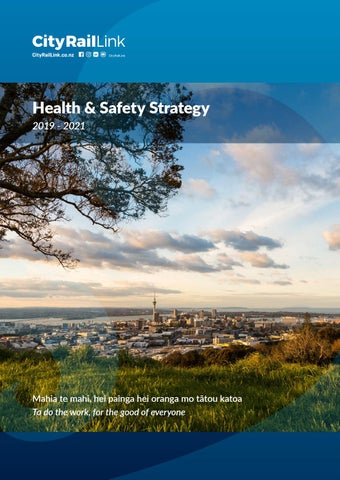
Health & Safety Strategy 2019 - 2021
Mahia te mahi, hei painga hei oranga mo tÄ tou katoa To do the work, for the good of everyone
CONTENTS Message from Chief Executive
3
Development of this H&S Strategy
4
Our vision
5
Our values
6
Our approach
7
Our strategic priorities
8
Our improvement plan
9
PURPOSE
This Health & Safety Strategy sets out our vision for the safe and harm free delivery of City Rail Link (CRL). We recognize and respect our legal and moral obligations to protect all those involved in the construction and use of the new railway, and to take this opportunity to protect and enhance the environment in which we work. CRL aspires to health & safety excellence in everything we do. Our strategy sets out what this means in practice, what values we adopt to guide us in our pursuit of that vision.
Return to contents page
Tunnel box construction beneath Albert Street, Auckland, February 2019
Return to contents page
MESSAGE FROM CHIEF EXECUTIVE
The delivery of CRL provides an important opportunity to set new standards in health & safety for the New Zealand construction industry. There has been amazing progress made in recent years to deliver lasting improvements to safe working practices, but we know there is always more to be done, and we can never be complacent. Too often, workers are seriously injured on construction sites. Over the years there have been numerous immeasurable tragedies for families, for friends and for colleagues. We know that everyone has the right to go home safely at the end of each day. CRL is committed to working with industry to drive lasting changes in safety and health, and to ensure that we maintain and enhance the environment we are working in. We set out in this strategy our vision for safety, health and environment - Mahia te mahi, hei painga hei oranga mo tÄ tou katoa –
To do the work for the good of everyone - and we describe the values that we use to hold ourselves to account in pursuit of this vision. On this journey, working in partnership with our suppliers, we will adopt safety management practices which allow us to learn from where things have gone wrong, as well as where they have gone well. We will look to use safety improvements which have proven to be successful elsewhere, and to build on them further. We will place active consideration of safety and health at the heart of every decision. It will be evident in our actions, our thoughts and our behaviours. Fundamentally, the responsibility for the safe delivery of CRL lies with everyone that is involved, in whatever way, in building it. We therefore empower everyone to take time to understand their responsibilities, and to acknowledge and act on their individual commitment to our vision. Together we can make a lasting and significant change for future generations.
Sean Sweeney CEO, City Rail Link Limited
CRL Health & Safety Strategy
3
DEVELOPMENT OF THIS HEALTH AND SAFETY STRATEGY
This strategy has been developed by: • Referencing the CRL Project Delivery Agreement and Statement of Performance Expectations • R eviewing New Zealand WorkSafe H&S Strategy 2018-2022 and other strategic plans and documents produced by WorkSafe, Auckland Council, and New Zealand Transport Agency (NZTA) • R eviewing health & safety strategies and lessons learnt by other large rail constructions projects in New Zealand, Australia and the United Kingdom • Consulting with the CRL Mana Whenua • Collaborating with existing construction suppliers and other industry partners.
CRL Mana Whenua The CRL Mana Whenua Forum is made up of eight iwi who are working together with CRL to look after Ranginui (Father Sky), Papatūānuku (Mother Earth) and create places that reflect Te Ao Māori (the Māori World View). CRL staff and Mana Whenua representatives have created a level of trust and respect. CRL listen to the contributions that Mana Whenua make at the monthly forums and strive to adopt and or implement their suggestions where possible. CRL acknowledges and thanks Mana Whenua for their generous nature and the valuable contribution they make to the CRL project.
Paoa ki uta, Paoa ki tai, Paoa ki tua
Ngāti Maru
4
CRL Health & Safety Strategy
Return to contents page
OUR VISION
‘Mahia te mahi, hei painga hei oranga mo tātou katoa’ ‘To do the work, for the good of everyone’. Our health & safety vision has been suggested by CRL’s Mana Whenua. It is a Māori proverb credited to Te Puea Herangi. In CRL’s context, our vision asks readers to consider who benefits from doing the work. At a personal level, it is ourselves and those closest to us; our colleagues, our families, our communities. It is also the built and natural environment upon which we work. It is also the City of Auckland; its people, its prosperous and sustainable future. We cannot reap these benefits if we do not work safely. We must therefore always look out for ourselves and our colleagues. We must protect the environment and the land on which we work. CRL’s health & safety vision therefore asks us as individuals to consider how working safely benefits others as well as ourselves.
Princess Te Kirihaehae Te Puea Herangi. Ref: PAColl-5584-58. Alexander Turnbull Library, Wellington, New Zealand. /records/23249698
Te Kirihaehae Te Puea Hērangi Te Kirihaehae Te Puea Hērangi (1883–1952) was widely recognised as a remarkable leader whose achievements communicated across cultures and often hailed as ‘the greatest Maori woman of our time’. Her grandfather was Tāwhiao Te Wherowhero, the second Māori King. As the eventual successor, Te Puea was educated in the traditional Māori ways and was to become a crucial figure in reviving the Kīngitanga (King Movement) among Tainui people in the twentieth century. Te Puea’s influence became more firmly established among Tainui people during the First World War, when she led their opposition to the government’s conscription policy. After the war, Te Puea continued to play a key leadership role, particularly during the influenza pandemic where she worked hard to improve the health and living conditions of her community and demonstrated the relevance of the Kingitanga movement. The strength of the Kingitanga at the time of Te Puea’s passing is the greatest testimony to her life’s work; and on the marae at Ngaruawahia her unseen presence is felt still.
Princess Te Kirihaehae Te Puea Herangi wearing the New Years medal she received in 1938, the Commander of the British Empire (CBE).
CRL Health & Safety Strategy
5
OUR VALUES In pursuit of our vision, and in consultation with CRL’s Mana Whenua, we have identified a number of core values and behaviours. These values are intended to guide all those working on the project in decision making, health & safety leadership activities, and day to day actions.
6
OUR VALUES
OUR BEHAVIOURS
We will...
We will...
Respect and comply with our HSE obligations
Take personal accountability for safety
Eliminate HSE risks wherever possible
Look after our mental health and wellbeing
Respect and care for the environment
Adopt and promote good HSE practice
Adopt a culture of continuous learning
Speak up if we see something wrong
CRL Health & Safety Strategy
Return to contents page
OUR APPROACH CRL has one overarching strategic objective for health & safety: to build an underground rail link that is safe for constructors, operators, maintainers and users. CRL’s approach to achieving this objective during the construction phase of the project is to adopt activities that enables CRL to be a highly engaged and highly informed organisation.
What is a highly engaged organisation? CRL will clearly articulate the health & safety requirements that are necessary to achieve industry leading health & safety performance. We will support and facilitate the introduction of activities designed to continuously improve health & safety performance, in partnership with its supply chain.
What is a highly informed organisation? CRL will work closely with its supply chain to ensure its health & safety requirements are being met and actively seeks to ensure any identified shortcomings are addressed.
CRL Health & Safety Strategy
7
Rangitoto Island
Takarunga/ Mt Victoria
Redeveloped Britomart Station
Waitematā
North Head
Kelly Tarlton’s Sea Life Aquarium
Bastion Point
Devonport Wharf Waitematā Harbour
Hobson Bay
Downtown Ferry Terminal
Spark Arena Pr
in
Albert Park Sky City
t
nd mo Sy
d
ig
hS
nt
St
St
Flower
Bost
Powerstation
St
do
w
th
Norma nby
En fie
Rd
Rd
St
St nie in M
Do
min
nie
Rd
Min
ion
St
Ave
ld
Ha ro
nt
on
an
Av
e
st Ea
n
ld Rd
Ed
St
Continues to Western Line
w
in
Kel
lv Sy
an
e Av
W
Ed
t es
No
Edwin Rd
Rd
Rd
rm
an
by
Clive Rd
Rd
St
Sylv
Redeveloped Mt Eden Station
fie
de
kohe
aho
tE
Kohe
ir
Virginia Ave East
Fe
ld St
St
Nik
au
St
En M
16
en
va
Mt Eden Rd
ly St
le
Cr
es
CRL/Underground Track
CRL has identified four priority areas where it will work with suppliers to drive health and safety improvements: 1. Enhance the maturity and effectiveness of the safety, health and environmental management systems 2. Support and embed safer working behaviours 3. Establish efficient and effective means of assuring health and safety performance 4. Enable continuous health and safety improvement through promoting best practice
CRL Health & Safety Strategy
ntain
Rd
OUR STRATEGIC PRIORITIES
8
Mou
Rd
s Ave
Auckland Grammar
on Rd
Ruru St Ak
and sharing lessons learnt
Pa ss
Gillie
en
Korari St
Por ters
be r
Pas s Rd
t
Ed
Ne
r No
Ru ru St
New Karangahape Station
K hy Khy ber
Grafton Station
Pas s Rd
Mt
St
ich St
Rd
Charlotte St
16
Rd
Rd
ge
ore
on
rle
t
ad
d
n Rd
sS
Sh
on
Norw
Nu Bu
nd
St
m
St
mo
on G
Rd
Mt Eden Rd
ld
th
Dia
St
aulay
na
Sy
Basque Road Reserve
St
16
do
ou
ce
Mac
et
Newto
un
m
an
Ex
Fr
h
er
on Rd
Fle
W
inc
t es
Newt
St
on Rd
Ca rlt
rk
st
Newt
St
St
ck
ts
Pa
Rd
Gore
Bo
Khyb er dic
St
ne
Ca rlton
e
1
Khy ber
16
ry St
e Rd lton Gor
Pa ss Rd
Nikau
Be
Av
1
t
St 1
Car
Pa rk
ns St
D
Gu nd
St
nR
sS
St
Rd
en
ap e
Alex Eva
1
n
fto
nd
ue
ngah
ry L
Park Rd
Auckland City Hospital
Gra
Grafton Bridge
e Rd
Symonds St Cemetery
rQ
New Aotea Station
Ka ra
rc u
Rd
mo
e Rd
pe
ap ngah
Up
Ka ra
Me
fton
Sy
Kara nga hap
Myers Park St
Auckland Domain Gra
rg e
Town Hall
Auckland War Memorial Museum
St
Pi tt
en
ve
University of Auckland
ue
sA
St
Q
ey
s
Geo
The Civic
Gr
ce
Auckland Art Gallery
Aotea Square Aotea Centre
Shor Re
Parnell Station
sS
Auckland Waterfront
Es
Gra
yso
pla
na
Mt
de
Ed en
Rd
ns Ln
Existing Track
Rd
Pu
New/Redeveloped CRL Stations
ka
St
OUR IMPROVEMENT PLAN Return to contents page
PRIORITY AREA 1
Continues to Eastern Line
re Road eserve
Newmarket Station
Continues to Southern and Onehunga Lines
ntain
Rd
Ro
Mou
ck
wo
od
Rd
1
Cli ve Rd
Tahaki Reserve
Existing Stations
1. ENHANCE THE MATURITY AND EFFECTIVENESS OF THE SAFETY, HEALTH AND ENVIRONMENTAL MANAGEMENT SYSTEMS Why are we doing this? Highly performing organisations adopt management systems which describe what they do, and how they do it, to satisfy and exceed their customer and stakeholder expectations. The maturity of the safety management system can be measured using well established assessment methods to establish how effectively the various components work together to achieve that goal. This allows for targeted improvement activities to be introduced to enable continuous improvement in systems, tools, management and leadership capability: which together enable better health & safety performance. CRL has selected a well-established framework to assess its management system: The Risk Management Maturity Model (RM3). This framework originates from the UK and has been used successfully for many years by the UK railway safety regulator (Office of Rail & Road) to assess the capability of organisations to discharge their health & safety responsibilities. It has been widely adopted by organisations in the UK and elsewhere to assess where activities should be prioritised to maximise safety benefit. It is particularly suited for organisations managing complex activity across contractual boundaries and where successful integration of systems are critical for overall success.
What are we going to do? • Review and strengthen contractual health & safety requirements and governance arrangements to reflect industry leading health & safety management practices and encourage continuous learning and improvement throughout our supply chain • Working with our suppliers, develop and implement plans to ensure renewed focus on occupational health risk management activities, and promote and enable strategies to improve and protect the physical and mental health and wellbeing of workers • Build further on the health & safety leadership capability of senior and operational managers within CRL and its supply chain by investing in targeted coaching, support and training • Undertake an annual assessment of the health, safety & environmental management system and develop and implement identified actions to further enhance maturity.
How will we know what success looks like? An externally validated maturity assessment of the HSE Management System using the Risk Management Maturity Model (RM3) will achieve: • Level 3 (standardised) by 30 June 2020 • Level 4 (predictable) by 30 June 2021 • With a stretch target for Level 5 (excellence) in selected areas by 30 June 2022.
CRL Health & Safety Strategy
9
OUR IMPROVEMENT PLAN
PRIORITY AREA 2
2. SUPPORT AND EMBED SAFER WORKING BEHAVIOURS Why are we doing this? Research has shown that successful accident prevention programmes focus attention equally on human factors in addition to job and organisational factors. Individual risk perception, cultural differences and learnt habits are all important influencing factors when looking at worker behaviours and how they contribute to accidents. We recognise the importance of ensuring that every individual, no matter what role they play in building the CRL, understands the expected standard of safe behaviour, and takes personal accountability for their own actions to ensure they, and their colleagues, get home safely at the end of each working day.
What are we going to do? • In collaboration and partnership with our supply chain, develop, agree and implement safe behaviour principles – including the importance of worker participation in designing safe working practices • Encourage investment in training, mentoring and apprenticeship programmes for construction workers • Adopt a recognised industry-led minimum construction competence standard (ConstructSafe) • Establish a project-wide safety induction programme, to be delivered to all workers • In partnership with our supply chain, implement a behavioural safety training and recognition programme, with the following aims: • Raise awareness of and encouraging individual contributions to safe behaviour principles • Facilitate each worker to make a practical, measurable commitment to safe work • Support, recognise and enable local behavioural safety champions to lead groundup engagement practices to embed sustained safe work behaviour • Establish local behavioural safety reward and recognition programmes for excellent safe working practices.
How will we know what success looks like? The proportion of incidents, near misses and hazardous event reports where worker behaviour was identified as a primary contributory factor will: • Reduce by 25% between December 2019 and December 2021 • Reduce by 25% between December 2021 and the end of construction activity.
10
CRL Health & Safety Strategy
OUR IMPROVEMENT PLAN Return to contents page
PRIORITY AREA 3
3. ESTABLISH EFFICIENT AND EFFECTIVE MEANS OF MEASURING HEALTH & SAFETY PERFORMANCE Why are we doing this? As a PCBU (Person in Charge of a Business or Undertaking) under the Health & Safety at Work Act, we have a duty to ensure that we have appointed competent and capable suppliers, and that we undertake reasonable checks to ensure they are discharging their legal duties and contractual requirements appropriately. We wish to adopt mechanisms that allow for efficient collection and analysis of health & safety data, so that we can better understand, in conjunction with our suppliers, where to focus efforts to find solutions to problems. Our approach in this area seeks to balance the need to monitor both leading and lagging health & safety indicators, and enables a deepdive assurance approach to risk management for critical health & safety activities where evidence deems this necessary.
What are we going to do? • Introduce simpler and more effective health & safety systems, in conjunction with our supply chain, for incident notification and investigation, planning and conducting safety inspections, recording and tracking safety improvement and corrective actions, and recording the findings of health & safety audits and assessments • Adopt a HSE Performance Index (HSEPI) monitoring system for CRL • We will continue to ensure that CRL, in conjunction with its suppliers, has an active, visible, and effective site safety leadership presence.
How will we know what success looks like? • HSEPI 12 month moving annual performance tracking at or above target*, with agreed action plans in place as necessary
* Targets will be set and agreed annually.
CRL Health & Safety Strategy
11
OUR IMPROVEMENT PLAN
PRIORITY AREA 4
4. ENABLE CONTINUOUS IMPROVEMENT IN HEALTH & SAFETY PERFORMANCE THROUGH PROMOTING BEST PRACTICE AND SHARING LESSONS LEARNT Why are we doing this? We recognise that CRL, as a significant transport infrastructure project in New Zealand, has an important leadership role to play to facilitate the identification and adoption of safety improvements within our suppliers, and enable that learning to be shared with the wider construction industry where appropriate. An important feature of a mature HSE management system is an effective means of sharing the relevant lessons learnt from incidents, and from where critical activities have gone well, with as broad an audience as possible.
What are we going to do? • We will establish a HSE Leadership Group in conjunction with our suppliers, to ensure: • Safety learning and incident investigation practices throughout our supply chain are effective • Lessons learnt from health & safety incidents from within CRL and relevant industry partners are shared effectively • The causes of health & safety performance trends (both positive and negative) are understood and actioned appropriately • HSE best practice examples are shared and adopted wherever possible • A regular review of progress with CRLs overall health & safety direction and performance, alongside our suppliers, to afford an opportunity for adjustment and refinement as necessary • Establish bi-annual ‘Mahia te Mahi’ Week – a programme of health & safety leadership and engagement sessions across all worksites to raise awareness and re-energise HSE commitment.
How will we know what success looks like? An annual review of CRLs health and safety performance will be completed, which will evidence: • Examples of where lessons learnt have been adopted • The underlying causes of CRLs health and safety performance trends, and actions that have been implemented to positively influence that • The outcome of the review of progress with this Health & Safety Strategy, including an assessment of whether the expected outcomes are being/have been achieved and any changes in approach that are needed to achieve them.
12
CRL Health & Safety Strategy
CityRailLink
Printed on recycled paper
CRLL0181 CRL HSE Strategy
CityRailLink.co.nz