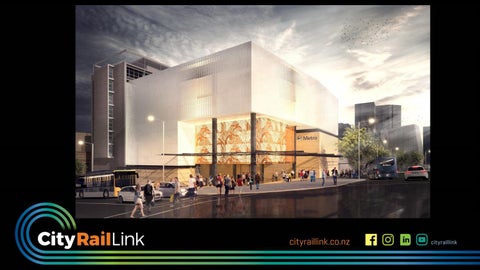
Why are we here? • Advance works are planned to start in the Aotea Station area in January 2018 for 15 months • Work involves the removal of building canopies and some early utility diversions • Location is the west side of Albert St between Victoria and Wellesley Sts
• All affected building owners know what’s planned • This meeting is to provide you with an understanding of the work
• A series of upcoming meetings will provide opportunities to comment on the Delivery Work Plans (DWPs) and Management Plans that outline management of effects
Requirements Condition 7.5 of the CRL designation requires us to consult with those directly and in proximity parties affected by the CRL construction works. This happens by:
• regular updates provided on construction progress • providing feedback on the development of the Delivery Work Plans (DWPs) and Construction Environmental Management Plans (CEMPs)
• input into a regular forum monitoring the effects on the community • reporting concerns and issues to CRL that it will respond to • possibly proposing potential initiatives to the Property Management Strategy on the interim use of properties acquired by the CRL
What do the delivery work plans cover? DWPs to address construction effects • Traffic, Access and Parking
• Air Quality
• Construction Noise and Vibration
• Social Impact and Business Disruption
• Contaminated Land
• Erosion and Sediment Control
• Archaeology
• Groundwater settlement Monitoring
• Construction Environmental Management Plan
Proposed schedule for comment Fortnightly from 25 July 2017 – 12 September 2017
Friday: CLG receives draft plans to review
Seven working days: to review and prepare any questions and comments
Tuesday: CLG Meeting with author of the plans – comments / questions
Friday: A further three working days to submit final comments
Plans document comments received from CBLG. Where comments not included, reasons given as to why not.
Next steps • Documents emailed to you this Friday • Next meeting November 2017 – CRL office
• Authors of DWPs will give short presentation, answer questions and receive feedback • Meetings fortnightly until all DWPs completed • Meetings then minimum three monthly from January
Social Impact and Business Disruption Delivery Work Plan Helen McLean, Aurecon 12 September 2017
Social Impact and Business Disruption DWP Objective: • Describe the measures to avoid, remedy or mitigate the adverse effects of the Project arising from disruption to businesses, residents and community so far as reasonably practicable. Identifies mitigation measures that will be undertaken with regards to: • Disruption to access. • Disruption effects that result or are likely to result in reduced foot traffic for businesses as a result of construction activities. • Loss of amenity for residents and businesses as a result of construction activities. • Disturbance to affected parties (i.e. noise and vibration, traffic/access, dust).
Why a SIBD DWP? • •
Requirement of City Rail Link 1714 Designation 1 Designation Conditions 61.1 – 61.8 : prescribe what the DWP needs to cover
DWP informed by • Interviews with the community adjacent to the Project area • Interviews with HOTC and information collated in its recent construction survey Observation of current construction works within area
Affected Parties Plan
Key Matters from Affected Party Feed Back • Quality of the environment: • People’s perception of businesses • Usability of the street space and its vitality • Pedestrian numbers • Safety • Nuisance from noise and dust • Business visibility and access: • Pedestrian access • Vehicle access to premises and movement within street • Loss of line of sight to passing trade / customers • Access to information: • Contact with project team • Lines of communication
Mitigation Proposed • Signage, advertising & marketing and way finding • Business promotion, messaging and support • CPTED principles • High quality internal and external design of pedestrian containers • Screening of works area • Site maintenance and upkeep • Environmental monitoring and site specific plans / programmes We commit to: • Regular courtesy visits and progress meetings with businesses to confirm project programme • Development of a project information sheets for the use by affected parties for staff, customers and residents
Construction Environmental Management Plan Dave Brierley, CRL 12 September 2017
Purpose • To avoid, remedy or mitigate any adverse effects associated with CRL construction
CEMP - Requirements
Training … Notice Boards …
CEMP - Requirements
General Site Layout and Management …
CEMP - Requirements
Construction Programme
CEMP – Consultation Requirements Stakeholder and Engagement Managers
• 24 hour point of contact for complaints
Alan Howard-Smith Connectus
• Informing the community of commencement of works and programme • Informing the community of project progress
Dave Brierley City Rail Link
• Liaise fortnightly with the Project affected community Aude Salmon Connectus
Air Quality Management Andrew Hart, Golder Associates 12 September 2017
Overview of Assessment Methodology and Assumptions The dust assessment for the construction project considered the potential: •
frequency and duration of impacts on sensitive locations;
•
intensity of dust impacts based: •
on local wind data during strong wind events, and
•
separation distance to sensitive location.
•
The dust assessments were used to identify the degree of mitigation and monitoring required.
•
The assessments showed a high degree of mitigation is required given the sensitive environment.
Key Assessment Outcomes and Conclusions •
Exposed surface areas from the trench are relatively small and dust sources (such as from excavation and backfilling) are expected to be minimal. Excavated material is expected to be damp.
•
However, activities sensitive to dust impacts will be close to the construction site and there is potential for adverse effects .
•
There is a need to control dust emissions to a high standard to avoid adverse dust effects in dry weather.
Conclusion: • Provided proposed dust control measures are implemented, it is expected that potential dust effects can be controlled and will be less than minor.
Dust Mitigation •
Dust suppression by spraying water during dry weather.
•
Covering of truck loads.
•
Sweeping of any material spilled onto the adjacent road or footpath.
•
Daily checks with visual inspections and filling out of Daily Log forms to confirm dust is being controlled.
•
Detailed framework for the dust management, mitigation and monitoring measures to be implemented within the Project’s Air Quality Delivery Work Plan.
Where to find out more
CityRailLink.co.nz and follow us on Facebook, Instagram, YouTube and LinkedIn
Questions or comments?