Heat Response Plan
City of Tyler / Smith County

This information can be accessed online at:
City of Tyler Emergency Management page
Smith County Emergency Management page
Purpose
This plan is designed to serve as a guide and to provide helpful information to the public. Users are encouraged to direct all questions to the appropriate designated agencies.
As always, in an emergency, please call 911.
Responsibility/Lead Agency
The City of Tyler Fire Department is the lead agency for the Heat Response Plan. Other agencies or human service entities needing information or administrative assistance should call the City of Tyler Fire Department at (903) 535-0005 as the primary contact or the Northeast Texas Public Health District at (903) 535-0037 as the secondary contact. Call the Northeast Texas Public Health District at (903) 535-0020 for public affairs information. Call 211 as an additional resource.
Science
Exposure to excessive heat can cause illness, injury and death. According to the Centers for Disease Control and Prevention (CDC), extreme heat remains one of the leading weatherrelated causes of death in the United States. Heat waves bring unusually high temperatures that may last for days or weeks.
Although the human body has effective systems for cooling itself, these mechanisms can become insufficient under certain conditions, especially during prolonged heat exposure and high humidity. In such cases, a person’s body temperature may rise rapidly. Very high body temperatures can cause severe damage to the brain and other vital organs and can result in death.
Fans alone may not provide adequate protection when temperatures exceed 90°F and humidity is high. Individuals who become overheated should seek air conditioning immediately. Air conditioning remains the leading protective factor against heat-related illness and death. Recent CDC data continue to show increasing rates of heat-related illness and death nationwide, particularly during prolonged periods of extreme heat. Heat-related deaths occur most frequently among older adults, outdoor workers, socially isolated individuals and people with chronic medical conditions. Texas continues to rank among the states with the highest numbers of heat-related emergency department visits and fatalities, driven by prolonged summer heat and high humidity.
Most heat-related deaths occur during the summer months, particularly from May through September, with the highest occurrence typically during July and August. Heat-related illness and death can often be prevented through public awareness, hydration, access to cooling centers or air-conditioned facilities, limiting outdoor activity during peak heat hours and early recognition of symptoms.
People at highest risk from heat, especially those without access to air conditioning for at least a few hours of the day, include:
• older adults, ages 65 years and older
• socially isolated individuals, including people who are homebound or homeless
• people with disabilities
• individuals who are overweight
• people with chronic medical conditions, such as diabetes or heart disease
• infants and children up to 4 years old
• people taking certain medications, including neuroleptics and anticholinergics
Heat Advisory
A Heat Advisory means hot temperatures are expected to increase the risk of heat illness. Local weather reports may issue this alert when heat-related illnesses are possible.
Very high body temperatures can cause severe damage to the brain and other vital organs and can result in death.
The Tyler Fire Department recommends caution during a Heat Advisory. Fans alone may not be very effective above 90°F with high humidity. If overheated, seek air conditioning. Air conditioning is the leading protective factor against heat-related illness and death. Stay in air conditioning as much as possible. If you must be outdoors, stay out of direct sun, wear lightweight, loose-fitting clothing and drink 5 to 7 oz. of water every 20 minutes.
It is also advisable to check on family members and neighbors, especially older adults and people without air conditioning.
Precautions
Hydration and access to air conditioning are the most critical interventions to decrease the human impact of a heat wave.
• Alternate periods of work with periods of rest. When heat stress is high, workers should take breaks, and the length and frequency of rest breaks should increase as heat stress rises.
• Drink plenty of fluids. Water is best, and sports drinks should be consumed in moderation. Avoid alcohol because it can worsen heat-related conditions. Bottled water may be available from the Salvation Army or People Attempting To Help (PATH).
• Stay in an air-conditioned room when possible.
• Stay out of the sun as much as possible.
• Check on relatives and neighbors.
• Do not leave unattended children or pets in vehicles. Heat can build up rapidly.
Additional heat safety information is available from OSHA’s Water, Rest and Shade guidance and CDC/NIOSH work-rest schedule guidance
Estimated Vehicle Interior Temperature
The table below provides a text equivalent of the vehicle temperature chart. It shows how quickly a vehicle interior can heat up, even when outdoor temperatures are lower than typical summer highs.
Source noted in original chart: Jan Null, CCM, Department of Geosciences, San Francisco State University.
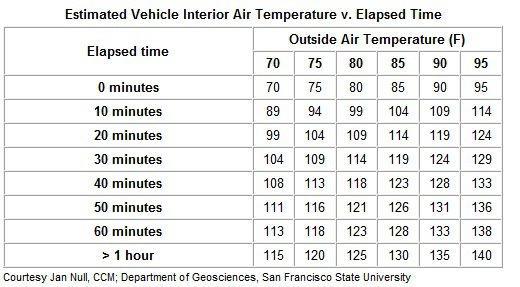
Supplemental image of the original vehicle interior temperature chart. The accessible table above provides the same information in text.
Medical Evaluation
Individuals at risk of heat injuries can call 911 for a medical evaluation or heat check. Paramedics will respond to and assess heat-related issues and transport the individual to the appropriate medical facility in the event of an emergency.
Early Signs of Dehydration
Dark yellow or brownish urine may be an early sign of dehydration.
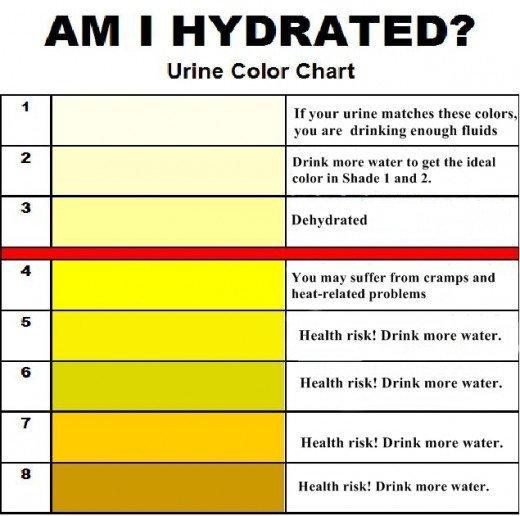
The table below provides a text equivalent of the urine color chart and does not rely on color alone.
Shade number Description
Meaning guidance if symptoms are present.
Supplemental image of the original urine color chart. The accessible table above provides the same information in text and does not rely on color alone.
Heat Exhaustion and Heat Stroke
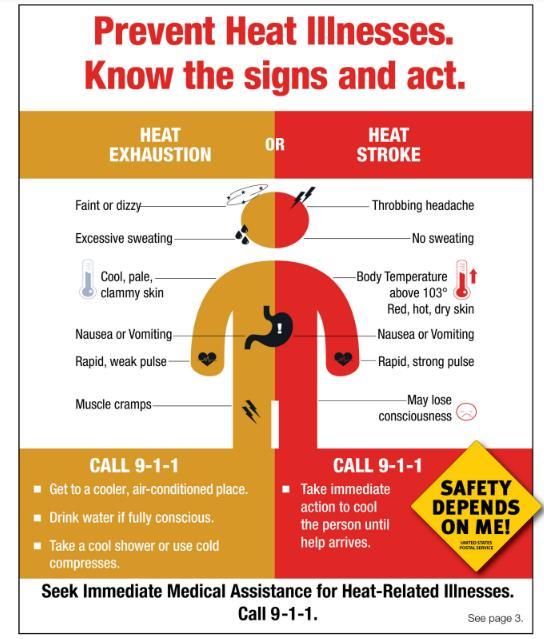
Condition
Heat exhaustion
Heat stroke
Signs and symptoms
Heavy sweating; weakness and fatigue; cold, pale, moist or clammy skin; rapid, weak pulse; headache; dizziness; lightheadedness; blurred vision; fainting; muscle cramps; nausea or vomiting; rapid and shallow breathing; irritability or confusion.
Body temperature greater than 103°F; sweating stops or skin is hot, red and dry; rapid, strong pulse; changes in mental status, including confusion, passing out, slurred speech or inappropriate words; nausea; dizziness; throbbing headache; unconsciousness.
Recommended action
Move to a cooler, airconditioned place. Loosen clothing. Offer sips of water if the person is fully conscious and not nauseous. Use cool cloths or a cool shower. Seek medical help if symptoms worsen, vomiting occurs or symptoms last longer than one hour.
Call 911 immediately. Move the person to a cool, shaded area or an air-conditioned room. Loosen or remove excess clothing. Apply watersoaked towels or ice packs wrapped in towels to the head, neck, armpits or groin while waiting for help.
Supplemental image showing heat exhaustion and heat stroke symptoms. The accessible table above provides the same information in text.
For People Overcome by Heat
1. Call 911 immediately.
2. Move the person to a cool, shaded area or an air-conditioned room.
3. Loosen or remove excess clothing.
4. Apply a water-soaked towel or an ice pack wrapped in a towel to the head and armpits.
5. Offer small sips of water only if the person is conscious and not nauseous.
For more information, visit the Tyler Fire Department website, choose the 2026 Heat Response Plan link, or call (903) 535-0005.
Shelters
Overnight Locations
• Salvation Army: 24-hour shelter for people who are homeless or nearly homeless with a capacity of 200. Call (903) 592-4361. In case of a declared emergency, additional space for 250 is available in the disaster shelter.
• American Red Cross: Opens on demand, depending on the declared emergency. Call (903) 581-7981 or 1 (866) 505-4801.
• Hiway 80 Rescue Mission: 601 Valentine St., Tyler, Texas. Call (903) 617-6097.
Daytime Locations
• Salvation Army: 633 N. Broadway Ave. Open 24 hours a day, seven days a week. Call (903) 592-4361.
• Local fire stations.
• Broadway Square Mall and other retail outlets on the City’s bus route.
• Movie theaters.
• Churches: Check with individual churches regarding activities or the capability to accommodate the public.
• People Attempting to Help (PATH): 402 W. Front St. Open Monday through Thursday, 8 a.m. to 6 p.m., as a water and cooling station.
City of Tyler Facilities
Facility Location
Hours
Tyler Fire Department Various locations Call (903) 535-0005 or 911.
Monday - Friday: 7 a.m. to 10 p.m.
Saturday: 9 a.m. to 5 p.m.
Glass Recreation Center
501 W. 32nd St.
Tyler Public Library
201 S. College Ave.
Estimated capacity: 500 people.
Call (903) 595-7271 to inquire about remaining capacity or schedule activities.
Monday - Thursday: 10 a.m. to 7 p.m
Friday: 10 a.m. to 6 p.m. Saturday: 10 a.m. to 5 p.m. Sunday: 1 p.m. to 5 p.m.
Estimated capacity: 120 people. Taylor Auditorium capacity: 100.
Call (903) 593-7323.
Facility Location Hours and notes
Monday – Friday: 9 a.m. to 5 p.m.
Senior Center 1915 Garden Valley Road
Rose Garden Center 420 Rose Park Drive
Fun Forest Pool Fun Forest Park
Estimated capacity: 125 people.
Call (903) 597-0781.
Monday – Friday: 8 a.m. to 5 p.m.
Saturday: 9 a.m. to 5 p.m.
Sunday, 1 p.m. to 5 p.m.
Estimated capacity: 200 people.
Call (903) 531-1349.
Hours of operation: June 6 through Aug. 11.
Wednesday – Friday: Noon to 2:30 p.m.; 3:30 p.m. to 6 p.m.
Saturday: 10 a.m. to 1:30 p.m.
Sunday: 1 p.m. to 3 p.m. and 4 p.m. to 6 p.m.
Contact (903) 531-1370 to confirm hours of operation and to inquire about remaining capacity.
Smith County Daytime Locations
• Smith County Office of Emergency Management: (903) 590-2649
• Smith County ESD #1: (903) 882-3443
• Smith County ESD #2: (903) 617-6578
• Smith County Sheriff’s Office non-emergency number: (903) 566-6600
• For emergencies, call 911.
Transportation
The following resources may provide transportation for at-risk individuals to air-conditioned shelters or daytime locations. Contact each agency or provider for availability.
• Family, friends and neighbors
• Tyler Transit
• Hospital courtesy vans
• Cab companies
Identification of Isolated, Older Adult and At-Risk Individuals
The following resources may help identify at-risk people and connect them to transportation and air conditioning. Remember, many people do not have telephone or internet access.
• Family, friends and neighbors
• Fire departments
• Police and sheriff’s departments, especially officers assigned to regular patrol areas
• Neighborhood Crime Watch
• Emergency Medical Services (EMS)
• Meals on Wheels
• Senior Citizen Center
• Emergency care centers
• Hospital emergency rooms
• Home health nursing
• Public health case managers and outreach workers
• Animal Control officers
• Church volunteers
• Citizen volunteers
• East Texas Center for Independent Living, particularly for residents with disabilities
• Stand-alone emergency rooms and urgent care centers
Welfare Concern
If there is a welfare concern, please contact one of the following:
• Tyler Police Department: (903) 531-1000 to request a welfare visit by a police officer.
• Smith County Emergency Dispatch, Fire Department and Sheriff’s Office: (903) 566-6600.
• Lindale Emergency Dispatch, Fire and Police: (903) 882-3313.
• For emergencies, call 911.
People with disabilities, access and functional needs, limited mobility, communication barriers, transportation assistance needs, personal care needs or special medical assistance needs should register with the State of Texas Emergency Assistance Registry (STEAR).
• People without internet access can register for STEAR by dialing 211.
• The City of Tyler Fire Department and Smith County Fire Marshal’s Office are the lead agencies for STEAR within the City of Tyler and Smith County.
Public Affairs Network/Hotline
The following resources may provide updated information to the public. Resource Website or email Phone or notes
2-1-1 Texas at United Way www.211Texas.org
American Red Cross www.RedCross.org (903) 581-7981
Salvation Army www.SalvationArmyUSA.org (903) 592-4361
Northeast Texas Public Health District www.MyNetHealth.org (903) 535-0020
KTBB AM600/KRWR 92.1 FM News@KTBB.com (903) 593-2519
KETK NBC56 Newsroom@KETK.com (903) 581-5656
KLTV Channel 7 News@KLTV.com (903) 510-7777
KYTX CBS19 News@CBS19.tv (903) 581-2211
Tyler Morning Telegraph News@TylerPaper.com (903) 596-6265
Alpha Media Group: KOYE 96.7 FM, KKUS 104.1 FM, KYKX 105.7 FM, KOOI 106.5 FM and Sports AM 1370 (903) 581-9966
Town Square Media: KTYL 93.1 FM, KKTX 96.1 FM, KNUE 101.5 FM and KISX 107.3 FM (903) 581-0606
Reynolds Radio: Mega FM 99.3 and The Blaze 102.7/106.9 FM (903) 581-5259 City of Tyler
www.CityOfTyler.org (903) 533-7444
Smith County PIO (903) 590-4607
Atmos Gas Service 1 (866) 322-8667 to report a natural gas emergency 24/7
CenterPoint Energy 1 (800) 259-5544 to report a natural gas emergency 24/7
Oncor www.Oncor.com 1 (888) 313-4747 to report downed lines or power outages 24/7
Utility Assistance Programs
Individuals with payment issues should contact their electric company to arrange a payment plan, if needed. Agencies that may assist with temporary utility bill assistance include:
• Greater East Texas Community Action Program (GETCAP): (903) 592-3828 or (800) 6215746. Also helps with water and gas. Website: www.Get-Cap.org
• Salvation Army: (903) 592-4361. Website: www.SalvationArmyUSA.org
• People Attempting To Help (PATH): (903) 597-7284. Website: https://www.PathHelps.org
• Churches.
Water
Bottled water may be available from:
• Salvation Army: (903) 592-4361. Website: www.SalvationArmyUSA.org
• People Attempting To Help (PATH): (903) 597-4044. Website: www.PathHelps.org
• PATH can also serve as an indoor cooling station Monday through Thursday, 8 a.m. to 6 p.m.
Donations
To donate water, cooling packs, fans, air conditioners or transportation services, contact:
• Tyler Fire Department: (903) 535-0005
• People Attempting To Help (PATH): (903) 597-4044
• Salvation Army: (903) 592-4361
• Meals on Wheels: (903) 593-7385
• KLTV Channel 7: (903) 510-7777
• KETK NBC56: (903) 581-5656
• KYTX CBS19: (903) 581-2211
• Smith County ESD 2: (903) 617-6578
Reporting Systems
Emergency rooms and EMS providers keep records of the number of heat-related injuries and illnesses to monitor the community and support the development of future Heat Response Plans. The Texas Department of State Health Services (DSHS) EMS staff coordinates this.
Users of This Plan
Users of this plan are encouraged to direct questions to the agencies identified in this document.
Additional Information
If issues are not addressed in this plan or users have additional questions, they are encouraged to contact the designated agencies listed in this document.
Sources and Reference Links
• CDC/NIOSH heat-related illness guidance
• National Weather Service heat illness safety guidance
• OSHA Water, Rest and Shade heat safety guidance
• CDC/NIOSH work-rest schedule guidance
• State of Texas Emergency Assistance Registry (STEAR)
• Smith County Emergency Management
• City of Tyler Emergency Management
Approvals
The following approval information is provided as text so it is available to assistive technology.
Name Title Organization
David L. Coble Fire Chief, Emergency Management Coordinator City of Tyler, Texas
George Roberts Chief Executive Officer Northeast Texas Public Health District
Brandon Moore Emergency Management Coordinator Smith County