City of Penticton 2025 Annual Report
For the Year Ended December 31, 2025
The Annual Report is prepared by the City of Penticton Corporate Services Division, in cooperation with all civic departments and agencies.
Penticton, British Columbia Canada
All rights reserved. No part of this publication, including ideas and designs herein, may be reproduced by any means mechanically or electronically, without written permission from the publisher. No liability is assumed with respect to the use of the information herein, nor is endorsement of any product or service implied or intended. © 2026 City of Penticton 171 Main Street, Penticton, BC V2A 5A9
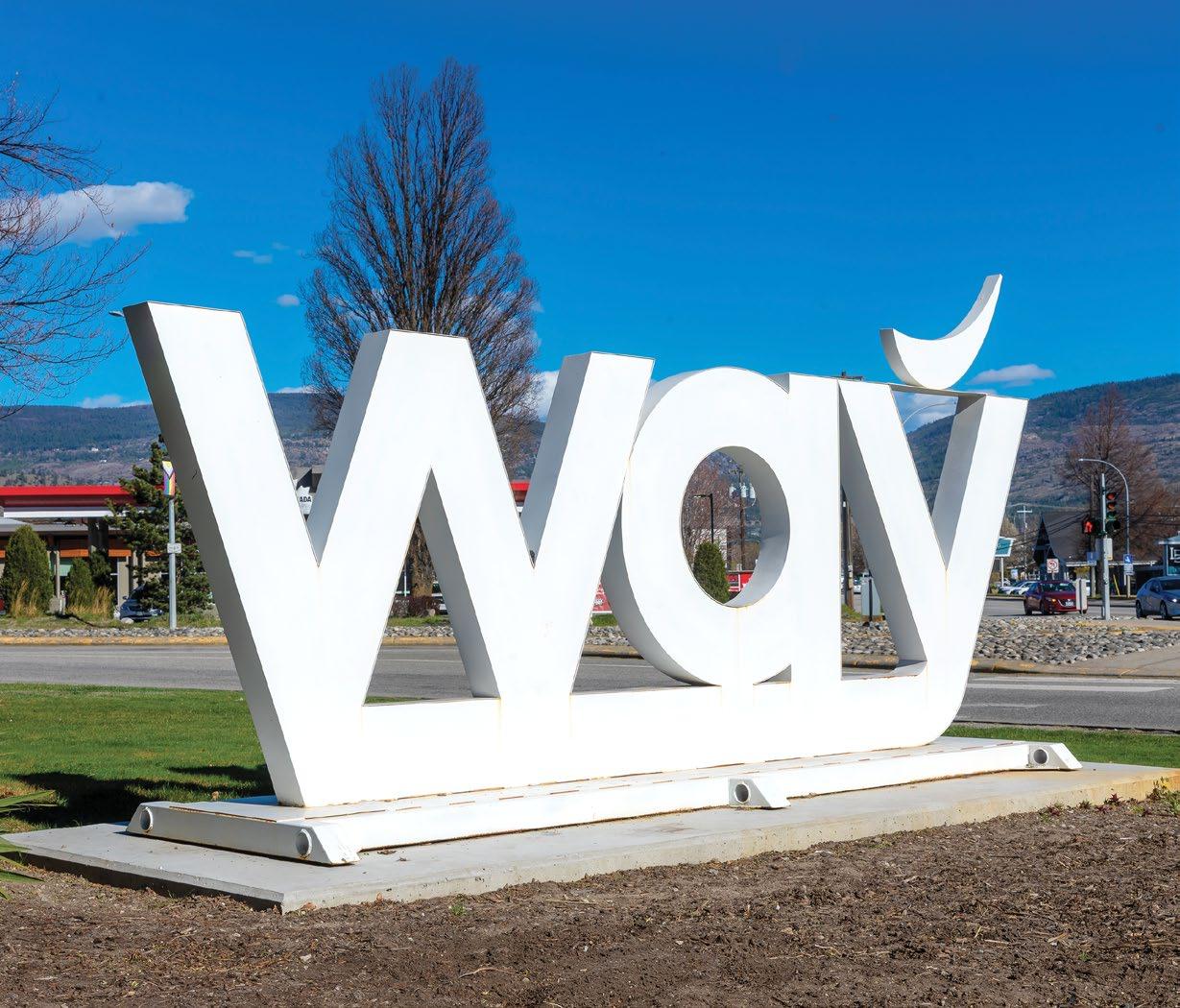
Land Acknowledgment
We acknowledge that our community is located on the traditional territory of the Syilx Okanagan people. We are thankful for the opportunity to live, work and play in this beautiful environment.
Liml mt – Thank you
e Wa'i – Hello





Your City Council
The City of Penticton Council is the local elected body responsible for governing our City and promoting its economic, social and environmental wellbeing. City Council is made up of the Mayor and six Councillors who are elected to serve a four-year term. The Mayor is the Chair of City Council.
The primary function of City Council is to consider the interests and wellbeing of the public and the City and to use its powers for the benefit and protection of its residents.
Council does this through the establishment of policies, the adoption of bylaws and the collection of taxes.
The day-to-day administration and operation of the City is delegated to the City Manager and City Staff. You can contact Mayor and Council directly at council@penticton.ca
*Helena Konanz’s Council term ended May 5, 2025, as she was elected our Member of Parliament for Similkameen-South Okanagan-West Kootenay. Councillor James Miller was on a mandatory leave of absence in 2025.
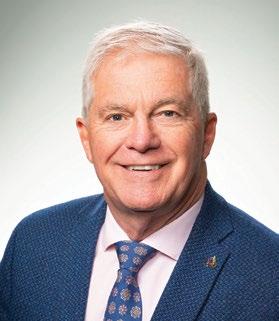
Julius Bloomfield Mayor
Ryan Graham Councillor
Shannon Stewart Councillor
Jason Reynen Councillor
Campbell Watt Councillor
Isaac Gilbert Councillor
Message from Mayor Julius Bloomfield
As we reflect on the past year, Penticton continues to demonstrate what is possible when a community works together with purpose and resolve. While challenges remain, the progress we have made reflects steady leadership, strong partnerships and a shared commitment to building a safe, livable and resilient city.
Acknowledging Our Roots
We live and work on the traditional territory of the Syilx Okanagan people. I am grateful for the growing relationship between the City of Penticton and the SnPink’tn Indian Band, built on respect, collaboration and shared priorities.
Over the past year, we have continued to strengthen this partnership through regular dialogue and joint efforts focused on community wellbeing, economic opportunity and the long-term protection of our most vital shared resource: water.
Community Safety and Wellbeing
Creating a safe community remains a top priority for Council. Investments in integrated and compassionate responses are helping address complex social challenges while supporting residents in crisis.
The Mobile Integrated Crisis Response Team continues to demonstrate the value of collaboration between health, social services and public safety. Broader efforts across Protective Services reflect a proactive, problem-solving approach. These initiatives are part of long-term work to improve safety while ensuring appropriate care and support for those who need it most.
Housing and Livability
Housing remains one of the most important challenges facing our community. Over the past year, Council has continued to support projects across the housing spectrum, including much-needed rental options, while advancing policies that encourage well-planned growth and complete neighbourhoods.
These efforts are essential to maintaining Penticton’s livability, ensuring people can find homes, access services and stay connected to their community as the city grows.
A Resilient Local Economy
A strong local economy underpins everything we do. Penticton’s diverse business community continues to adapt and innovate, supported by collaboration between local government, economic partners and regional organizations.
By working closely with the business community, we are focused on creating conditions that support investment, workforce attraction and long-term economic stability, even in a rapidly changing environment.
Looking Ahead
Progress does not happen overnight. Meaningful change requires patience, persistence and collaboration. By continuing to work alongside residents, businesses, neighbouring communities, provincial partners and Indigenous leadership, Penticton is well positioned to meet the challenges ahead.
I extend my sincere thanks to City staff, Council colleagues, community partners and residents for their ongoing engagement and commitment to this city. Together, we will continue to move Penticton forward – thoughtfully, collaboratively and with confidence in the future.
Sincerely,
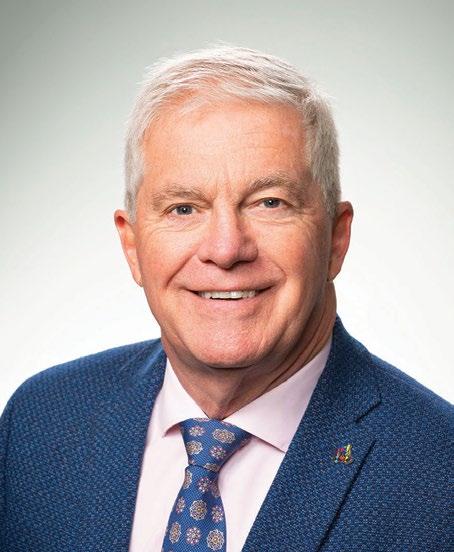
Penticton continues to demonstrate what is possible when a community works together with purpose and resolve.
Mayor Julius Bloomfield City of Penticton
Your City by the Numbers
Where Does City Revenue Come From?
The City has several sources of revenue to fund the essential services it provides. Over 31 per cent of revenue comes from the sale of electricity to residents, followed by 31 per cent from taxes collected from residents and businesses. The sale of sewer and water services accounts for a further 17 per cent, while 9 per cent comes from user fees for programs and services, including use of City facilities such as the recreation centre, as well as fees for garbage and recycling, building and licensing, transit, and parking.
Taxes
Did you know the City collects taxes on behalf of other levels of government? Only 63 per cent of your annual tax notice goes to the City, while the remaining 37 per cent goes to the School District (SD67), BC Assessment, the Regional District of OkanaganSimilkameen (RDOS) and the Regional Hospital District (RHD).
What Do Taxes and Utility Fees Fund?
The City provides several services to residents, including critical infrastructure such as streets, water, sewer and electricity. The City is also responsible for policing, fire and bylaw protective services, as well as for developing programs and services to support local businesses. The City operates cultural and recreational amenities that contribute to Penticton’s unique and vibrant community character.
The graphic below demonstrates how the City allocated 2025 taxes to provide services for residents.

Council Priorities
Safe & Resilient Livable & Accessible
Support a combination of community policing and strategic enforcement actions to reduce crime and enhance public safety
Promote housing developments across the entire housing spectrum.
vibrant public spaces that encourage positive social interactions and deter criminal activity
Apply a comprehensive approach to addressing social disorder, which includes both non-enforcement strategies and targeted enforcement actions
Promote community initiatives and partnerships alongside enforcement measures to manage issues related to homelessness, mental health, and addiction
Create and activate public spaces and pedestrian-friendly areas that contribute to a healthy and attractive environment
Strengthen partnerships with local organizations to support vulnerable residents, integrating cultural, recreational, and
Ensure that enforcement is balanced with e orts to maintain community and economy building activities into these e orts.
Ensure Penticton is prepared for emergencies.
Asset Management and renewal is focused on long-term sustainable service delivery
Build community readiness to emergencies
Integrate supports for youth, seniors, and unhoused residents into policies, ensuring that new developments include amenities and services tailored to their needs.
Ensure new developments are designed to include communal spaces and amenities, enhancing livability and fostering a vibrant community.
Implement sustainable development practices in support of climate change response, that also enhance public spaces and community vibrancy
Advance in recreational, arts, and safety amenities as part of growth to enhance the overall quality of life in Penticton
Strengthen partnerships with local organizations, the Penticton Indian Band, and other government entities to support joint initiatives that enhance livability and safety.
Support initiatives that promote a diverse and thriving economy.
Strategic Direction
2025 Successes and 2026 Priorities
At the beginning of 2023, Council established its priorities for the community. During the 2024 strategic planning process, these priorities were refined for the remainder of the 2024–2026 term, with a focus on “Safe & Resilient” and “Livable & Accessible.”
The following pages provide an update on the progress made by City staff in advancing these priorities in 2025 and outlines the priorities underway for 2026.
Council Priority: Safe & Resilient
Enhance and protect the safety of all residents and visitors to Penticton
2025 Successes
• Successfully implemented the City Hall Business Continuity Plan
• Continued advancement of Civic Places and Spaces Priority #1: Fire Hall Renewal
• The Penticton RCMP detachment underwent improvements for enhanced safety and security
• Advancement of the Wastewater Treatment Plant (AWWTP) Project
• Public Safety & Partnerships continued dedicated work to develop and maintain building and maintaining collaborative partnerships within the community
• Initiated development of the Community Safety and Wellbeing Plan (CSWB)
• Successful completion of the Fire Prevention Division Growth Strategy
2026 Priorities
• Strategic support for coordinated encampment responses
• Continued Safety and security enhancements for the Penticton RCMP detachment
• Further advancement of the Civic Places and Spaces Priority #1: Fire Hall renewals
• Voyent Alert! Emergency Communications Integration Project
• Continuity planning for critical City services
• Continued development of the Hazard Risk Vulnerability Analysis (HRVA) for Penticton
2026 Priorities continued
• Development of Wildfire and FireSmart planning and mitigation strategies
• Improvements to water service resiliency and reliability
• Advancement in Wastewater Treatment Plant (AWWTP) construction and commissioning
• Enhancement to transportation safety and the Safe Routes to School program
• Expansion of existing Memorandum of Understanding (MOU) with 100 More Homes (100MH)
• Records system upgrades to support intelligence led responses
• Plans to leverage technology for improved departmental operations
• Continued advancement of the Community Safety and Wellbeing Plan (CSWB)
• Further completion of the RCMP 2024–2027 Strategic Plan
• Wildfire and FireSmart Planning and Mitigation Strategies

Magic on Main Street's light tunnel.
Council Priority: Livable & Accessible
Proactively plan for deliberate growth, focusing on creating an inclusive, healthy and vibrant community.

2025 Successes
• Completed a Sport and Recreational Needs Assessment
• Successfully hosted the Second Annual Frost Fest Winter Carnival, sponsored by Valley First Credit Union
• The Penticton pressure reducing valve (PRV) project was successfully completed, enhancing water service quality and reliability
• The Regional Collection Agreement was successfully implemented on July 1
• Continued advancement of Social Development Framework actions
2026 Priorities
• Advancement of Civic Places and Spaces Priority #2: Arenas
• Planned implementation of the Skating Forward project, pertaining to City operations of the downtown ice rink
• Advancement of Development Navigator, a plan for accelerating livable infill housing in Penticton
• Implementation of Penticton Amplified, a strategic communication plan for resident and employer attraction to Penticton
Watch for these signs throughout the community as part of the Friendly Streets initiative.
2026 Priorities continued
• Finalization of the Area Plan for Okanagan Lakeshore/Esplanade
• Advancements in housing affordability
• Plans for the North Gateway: Penticton Trade and Convention Centre Hotel options
• Development of a Downtown Area Plan
• CommuniTREE Plan advancement, supporting canopy growth and climate resilience
• Lakawanna Park upgrades
• Development of the KVR Trail Master Plan and Green Corridor Strategy
• Plans to advance the Solar Feasibility and Implementation project
• Continued collaboration with the BC Transit Future Network Restructure Plan
• Continued investment in accessibility enhancements and improvements for residents
• Innovate & Create: Makerspace enhancements
• Reference and resource support for the business community
• Continued participation in the Build Canada Homes initiative
• Renewal of the Protocol Agreement between the City and the Snpink’tn (Penticton) Indian Band
• Planned comprehensive event strategy review
Mobi-mats at Penticton beaches provide accessible access to the water.

City Priority: Vision, Mission & Culture
2025 Successes
• Council approved the appointment of an external auditor
• Secured new partnerships and policy support through intergovernmental relations and advocacy
• Successfully converted the utility billing software
• Expanded a strategic communications program
• Launched an updated staff intranet to further the City's digital transformation strategy
2026 Priorities
• Intergovernmental Liaison strategy for priority advancement
• Hold the 2026 General Local Election
• Expansion of the Strategic Communications Program
• Departmental Artificial Intelligence (AI) integration and Information Technology (IT) modernization
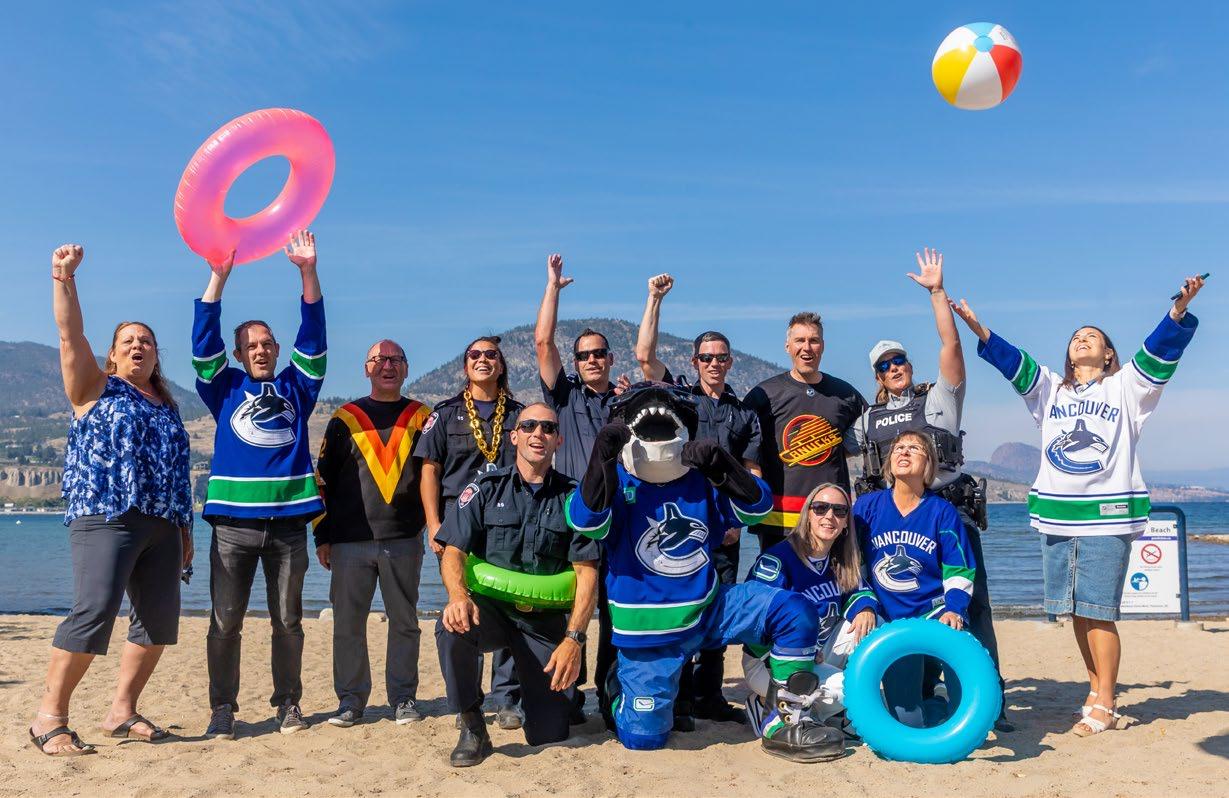
Penticton provides a warm welcome to the Vancouver Canucks Training Camp 2025.
City Manager's Message
May 2026
I am pleased to present the City of Penticton’s 2025 Annual Report on behalf of our dedicated staff. This report highlights the work City employees do every day to support Council’s priorities and provide outstanding customer service to our community.
Over the past year, City staff continued to deliver essential services while responding to a community that is growing and evolving. Across the organization, teams focused on keeping Penticton safe, supporting a strong local economy and maintaining the vibrancy that makes this city a great place to live, work and visit.
Community safety remains a foundational priority. Staff worked collaboratively across departments and with external partners to support coordinated, practical approaches that address complex challenges while maintaining public confidence. These efforts are about more than enforcement. They are about prevention, compassion and ensuring our community feels safe and supported.
Economic development and community vibrancy were also key areas of focus. City staff supported development, worked closely with the business community and advanced initiatives that encourage investment, activity and long-term sustainability. A strong local economy supports everything we do and contributes directly to Penticton’s quality of life.
City staff supported development, worked closely with the business community and advanced initiatives that encourage investment, activity and long-term sustainability.
The progress outlined in this report reflects the strength of our partnerships with Council, Indigenous leadership, community organizations, regional partners and residents. These relationships are essential to effective local government and to addressing complex issues in a thoughtful, balanced way.
Looking ahead, we remain committed to our organizational values of communication, integrity and engagement, while protecting the City’s reputation and supporting Council’s priorities. Through sound financial management, modernization and continuous improvement, we are strengthening our internal systems and organizational culture. By supporting our people and remaining adaptable to change, we will continue to deliver reliable, effective services for our community—today and into the future.
I want to thank Council for its leadership and City staff for their professionalism, adaptability and commitment to public service. On behalf of the City of Penticton organization, thank you for the opportunity to serve this community.
Sincerely,

Anthony Haddad City Manager
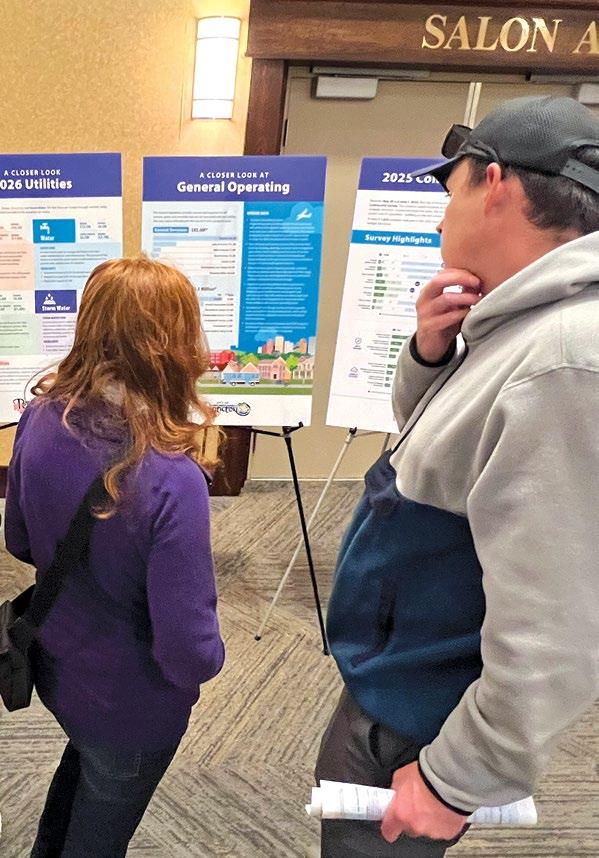
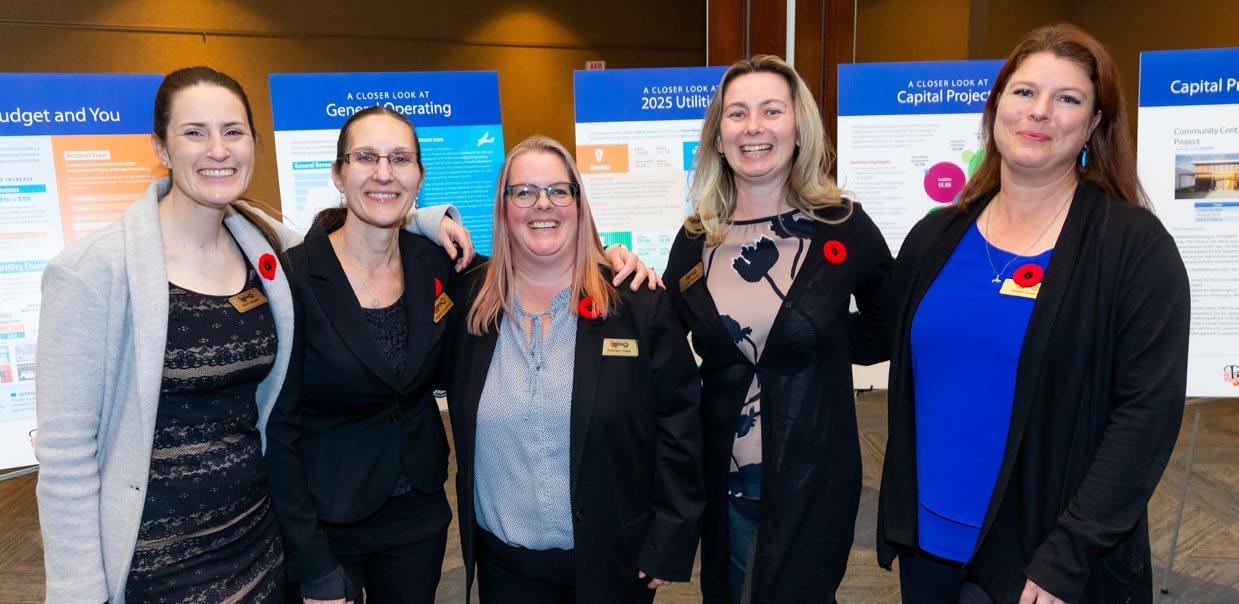
Budget engagement at the Penticton Trade and Convention Centre.
Divisions & Departments
Office of the City Manager
• Mayor & Council
• Office of the City Manager
• Intergovernmental Relations
Corporate Services
• Finance
• Risk Management
• Procurement & Inventory
• Communications & Engagement
• Legislative Services
• Information Technology & Digital Transformation
• Human Resources & Safety
Community Services
• Facilities
• Recreation, Arts & Culture
• Museum & Archives
• Land Administration
Penticton Public Library
Infrastructure
• Energy & Environment (Electric, Sustainability and Solid Waste)
• Engineering (Design and Transportation Safety)
• Public Works (Roads and Parks & Fleet)
• Utilities (Collection, Distribution and Water & Wastewater Treatment)
Development Services
• Planning & Licensing
• Building & Permitting
• Development Engineering
• Housing & Policy Initiatives
• Economic Development
Public Safety & Partnerships
• Social Development
• Bylaw Services
Penticton Fire Department
RCMP
Organizational Overview
City Council sets the direction for the City of Penticton through the development of their strategic priorities. The City Manager (Chief Administrative Officer), reporting to Council, ensures that divisions and departments support City Council’s priorities and are meeting the needs of the community. The majority of services are provided by four major divisions while community safety is the responsibility of the General Manager of Public Safety and Partnerships, Penticton Fire Department and the RCMP.
The chart below reflects the organizational structure active in 2025. In the first quarter, an organizational change was made to update all Senior Leadership roles to general manager positions. Additionally, the Finance and Administration division was renamed Corporate Services.
*Arms-length service
**Managed under contract by OVG 360
Office of the City Manager
What We Do
The City Manager, under oversight of the Mayor and Council, leads this division. The Office of the City Manager provides a range of services to Penticton residents and oversees the strategic management and growth of the city.
• Mayor and Council: The City of Penticton Mayor and Council comprise the local elected body responsible for governing our city and promoting its economic, social and environmental wellbeing. Accountable to residents, Council sets strategic direction and provides leadership to ensure the City delivers high-quality services. Working closely with the City Manager, Council ensures that community needs are met while promoting long-term sustainability and growth.
• City Manager: The City Manager is appointed by, and is directly accountable to, Council. As Council’s only
employee, the City Manager is responsible for the day-to-day operations and administration of the City, as well as for providing oversight of its departments in accordance with the objectives, policies and plans approved by Council. The City Manager is also responsible for keeping Council up to date on corporate matters, providing advice to Council and ensuring policies and bylaws are enforced.
• Intergovernmental Relations: Intergovernmental Relations (IGR) is responsible for advancing Penticton’s interests, in Indigenous relations and advocacy through strategic engagement with provincial, federal, Indigenous and regional governments. This focus area ensures that municipal priorities related to intergovernmental advocacy, funding negotiations and policy development are effectively represented.
2025 Achievements
• City representatives attended seven conferences across Canada and the United States to strengthen Penticton’s relationships across all levels of government and to advance Penticton’s needs through advocacy.
• Mayor and Council attended 17 committee meetings and over 135 community events
• A Council-to-Council meeting with the Penticton Indian Band (PIB) strengthened our shared commitment to collaboration and enhanced government-to-government relations.
• Strategic planning was completed, aligning our focus with community needs and long-term goals.
• A resolution to implement a regionally balanced approach to supportive housing was set at the Southern Interior Local Government Association (SILGA) 2025 annual general meeting and convention.
• In August 2025, the Okanagan Lake Dam Salmon Passage opened. This was a historic milestone in restoring salmon habitat and the health of ecosystems. The project was part of Okanagan Nation Alliance’s broader mission to return salmon to their natural habitats and ranges.
• Council established the Urban Deer Advisory Committee to advise Council on strategies for managing urban deer in a humane, effective and community-supported manner.
• Council hosted public open house events in May and November 2025 to provide residents with an opportunity to meet with them and hear about upcoming projects, plans and initiatives.
• Continued participation at the Okanagan Similkameen Watershed Collaborative Leadership Table (CLT)
• Funding from the British Columbia provincial government was requested to secure provincial support for municipal priorities.
• Continued participation and collaboration with the Inter-Municipal Advisory Committee (IMAC) to strengthen partnerships with neighbouring municipalities.
• City officials attended the British Columbia Assembly of First Nations (BCAFN) 2025 Housing Forum, focused on housing, homelessness and associated infrastructure.
• The City onboarded two new councillors from two by-elections.
• Deepened relationships Ministry of Housing and Municipal Affairs & BC Housing.
• Initiated conversations with Build Canada Homes, a federal program launched in September 2025 to increase housing supply across Canada.
• Furthered development of a relationship agreement with the Similkameen Indian Bands (SIB)
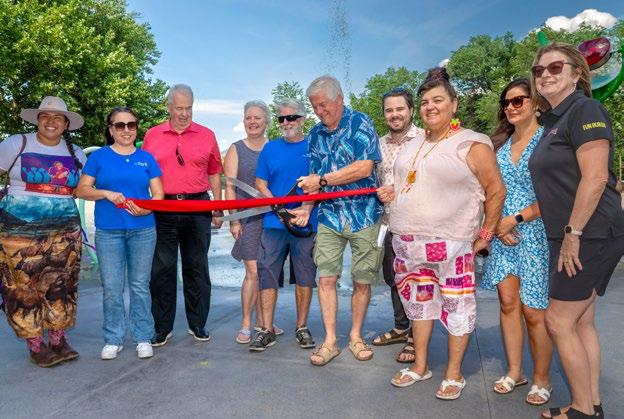
Members of City Council, the Penticton Indian Band, En’owkin Centre, Rotary Club and MLA Amelia Boultbee attend the opening of the Skaha Lake Splash Pad.
Corporate Services
What We Do
Corporate Services Division
The Corporate Services Division is responsible for overall financial administration and the collection of all City revenues. The Division partners with departments across the City to support effective service and program delivery by providing financial, human resources, information technology, legislative, procurement and communications services.
General Manager's Office
The General Manager also serves as Chief Financial Officer and Chief Risk Officer, providing financial and risk oversight for the City of Penticton.
Risk Management
This office supports City departments in identifying, assessing, and managing risks to daily operations. It administers property and liability insurance programs,
manages claims and incident files and supports legal matters to protect City assets and resources. Through risk advice, insurance, and claims management, the office helps reduce overall risk exposure and supports informed decision-making across the organization.
Finance
This department provides accounting, budgeting, financial analysis and revenue and collections services for the City. It delivers transactional services, financial analysis and reporting to internal and external users to support decision-making, while maintaining controls to safeguard the City’s financial resources. The Finance department also coordinates with every City department to establish a five-year financial plan and ensures spending aligns with the plan. In addition, it manages the collection of service fees and taxes, including electricity, water and sewer charges and property taxes.
Procurement & Inventory
This department provides centralized support for the purchase of goods, services and construction. Guided by the City’s Procurement Policy, applicable legislation and trade agreements, the department ensures that procurement activities are conducted in a fair, transparent and responsible manner. Through open and competitive processes, the department promotes equal access for suppliers, best value for taxpayers, manages procurement risk and supports sound financial decision-making. The department also manages the City’s inventory and oversees the appropriate disposal of City assets at the end of their useful life.
Communications & Public Engagement
This department provides strategic communications and engagement services to support the City’s business objectives, strengthen employee engagement, enhance the City’s reputation, and align communications with community values and Council priorities. It ensures the City communicates clearly and accurately, delivering timely, unbiased and reliable information across all channels.
Legislative Services
This department fulfills key statutory responsibilities that support transparent, accountable and accessible governance. It manages statutory notifications and maintains official City records, including agendas,
minutes, bylaws and policies. The department also oversees the City’s corporate records management program and ensures compliance with the Freedom of Information and Protection of Privacy Act (FOIPPA), including the protection of personal information and coordination of access-to-information requests. In addition, it administers local government elections, ensuring fair and transparent electoral processes.
Information Technology & Digital Transformation
This department provides technical support to all City departments, maintaining and managing complex computer systems, networks and software essential to daily operations. It also protects City data from security threats and ensures compliance with applicable laws and regulations. The GIS team manages and analyzes spatial data to through specialized maps and applications to support municipal functions and plays a critical role in the effectiveness of the Emergency Operations Centre. Together, the IT and GIS support innovation by identifying and implementing technologies that improve efficiency and enhance service delivery.
Human Resources & Safety
This department is responsible for developing and managing corporate programs related to employee and labour relations, recruitment and selection, compensation, safety and employee wellbeing, training and development, benefits and payroll. The Human Resources & Safety team provides strategies, programs, policies, services and consultation to support the City’s workforce and organizational objectives. The department also oversees four collective agreements and manages relationships with three union organizations representing City staff.
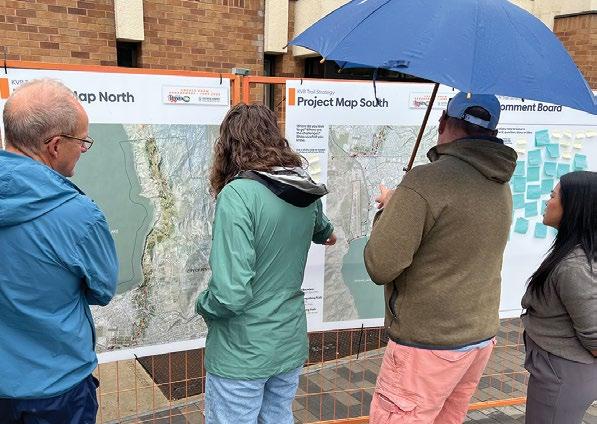
Community engagement to help shape the future of the KVR Trail.
2025 Achievements
• Held two by-elections to elect two new Council members following the 2025 provincial and federal elections.
• Completion of the 2025 Community Survey to gain insight on citizen priorities.
• Rollout of the Voyent Alert! emergency communications program.
• Steered record social media traffic over the City’s 16 platforms and successfully led community engagement and official events.
• Successfully executed high-profile community engagement programs including the Esplanade Plan, Council Open House events, Budget and many other critical initiatives.
• Launched an updated staff intranet, furthering the City’s Digital Transformation Strategy.
• Hosted the Annual Day of Mourning ceremony.
• Converted essential utility billing software.
• Received a distinguished budget award for the 2025-2029 Financial and Corporate Business Plan.
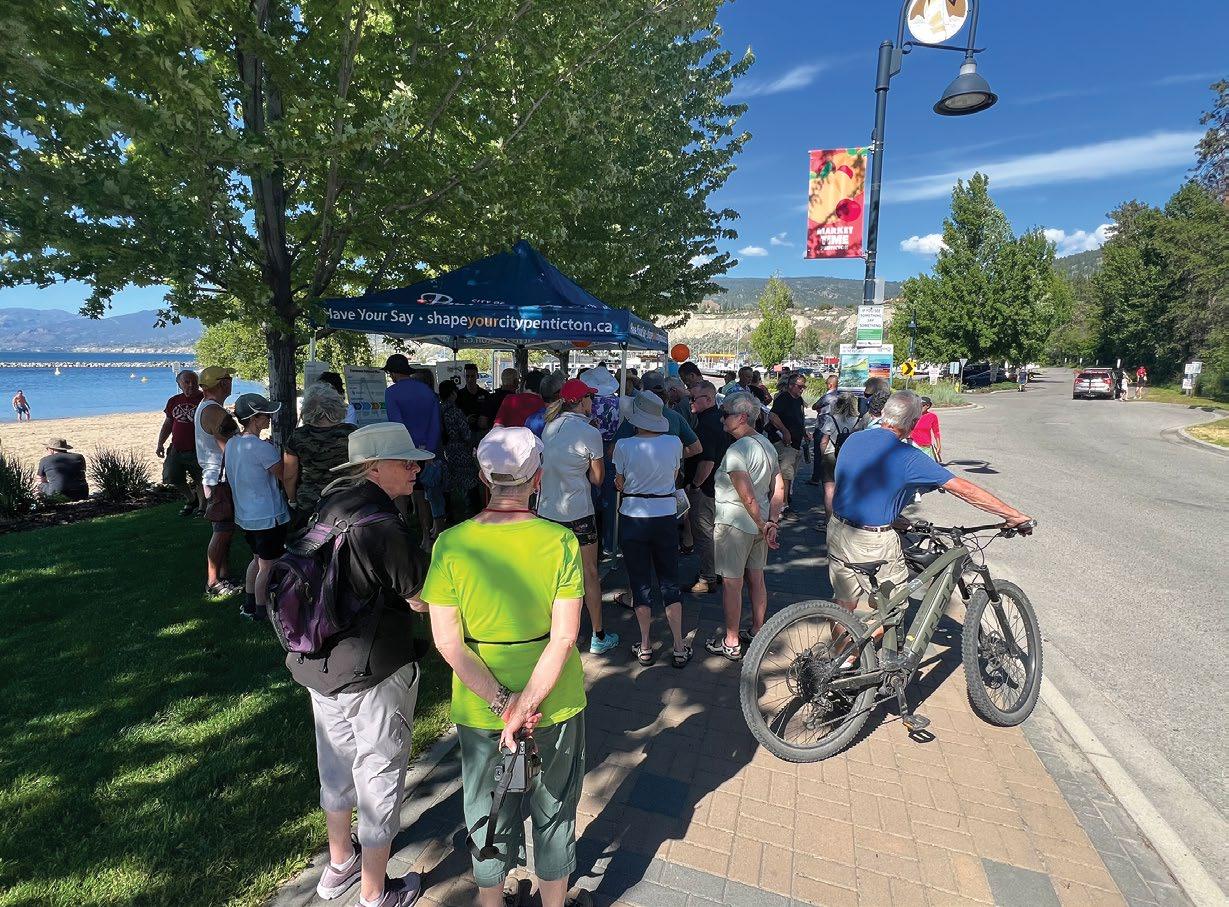
Community engagement to help shape the future of the Esplanade area of Okanagan Lake.
Facts and Stats 2025
Risk Management
• City Business Continuity Plans reviewed or updated: 1
• Risk Management Committee meetings held: 4
Finance
• Accounts receivable invoices issued: 1,023
• Percentage of e-billed utility accounts: 59.05%
• Phone calls to utility staff: 16,820 (annual) and 1,402 (monthly average)
• Number of walk-in customers: 33,861 (annual) and 2,822 (monthly average)
• Payments received online: 268,633 (annual) and 22,386 (monthly average)
Procurement & Inventory
• Purchase orders issued: 638
• Total value for purchase orders: $9.83 million
• Contracts awarded: 28
• Total value of contracts: $11.25 million
• Public bid opportunities: 23
• Savings obtained through quote process: $2.29 million
Communications & Engagement
• Number of projects hosted through Shape Your City engagement portal: 12
• Number of engagement events: 40+
• Number of registered Shape Your City participants: 7,856
• Number of official announcements (new releases, service announcements and statements): 240+
• Number of homes that received the City newsletter: 17,000
• Number of social media followers on the City’s key channels: 15,000 (Facebook), 6,970+ (Instagram)
• Number of views of the City’s website (penticton.ca): 1.46 million
• Social media followers on airport channels: 1,800+ (Facebook), 966 (Instagram)
• Social media followers on Start Here Penticton channels: 9,300+ (Facebook), 2,048 (Instagram)
More than 1,000 people attended the 2025 Start Here Penticton Job Fair.

Legislative Services
• Public hearings: 9
• Committee of the Whole meetings: 13
• Regular Council meetings: 19
• Special Council meetings: 7
• Freedom of Information requests: 73
• Privacy Impact Assessments: 23
• Bylaws adopted: 34
• Committee meetings: 17
Human Resources & Safety
• Job postings created: 149
• Vacancies: 171
• Positions filled by internal applicants: 61
• Positions filled by external applicants: 90
• Staff who completed safety-related training: 160 in-person, 70 online
• Return to Work Program: lost-time claims/ percentage of staff who returned to work: 18/94.4%
• Health care-only claims: 4
• Claims:
Ű 2024: $789,093
Ű 2025: $523,557
• WorkSafeBC Experience Rating (increased to -8.9% resulting in an increase to the City valued at $247,641):
Ű 2024: -29.4%
Ű 2025: -8.9%
Ű 2024 discount: $361,192
Ű 2025 discount: $113,551
IT & Digital Transformation
1,023
• Service Desk tickets processed: 3,140
• Business Analyst Team completed tasks: 574
• Geographic Information Services (GIS) tasks completed: 293
268,633
• Network Analyst Team requests and incidents managed: 472
7, 856
1.46 million views
73
57 4
14 9

Community Services
What We Do Division
The Community Services division, led by the General Manager, takes a strategic approach to support all facets of community health and safety. Their work is focused on enabling citizens to have a high quality of life. The Facilities department ensures that Cityowned buildings operate efficiently to support service delivery and programs. The Recreation, Arts & Culture department welcomes residents and visitors to a variety of recreation facilities and parks, offering programs and services for all ages. Rounding out this division is Land Administration, which is responsible for over 500 City-owned properties as well as facilitating land-related agreements and providing legal research title and company searches for all City departments.
Facilities
This department is responsible for maintaining approximately 800,000 square feet of City-owned space, including public-use facilities, residential homes and office buildings. As outlined in the Civic Places and Spaces Asset and Amenity Management Plan, many of these assets are aging at an unsustainable rate and will require significant investment or replacement in the coming years. It provides a wide range of services and expertise to ensure buildings and their systems function as intended. This includes carrying out the day-to-day maintenance needed to keep facilities safe, reliable and fully usable for the public.
Recreation, Arts & Culture
This department supports a healthy community and enhances the quality of life in Penticton by planning, managing and delivering recreation, aquatics, events, festivals and active living opportunities. Working in partnership with volunteers, community groups and private sector providers, the department helps expand access to recreation and wellness opportunities throughout the city.
Penticton Museum & Archives
The Penticton Museum & Archives provides exhibits, displays and programs interpreting and showcasing the unique history of Penticton and the surrounding area. Temporary exhibits bring a wide variety of topics to the museum, while permanent exhibits tell the story of Penticton from its earliest days as an Indigenous village to the present day. The museum also collects, catalogues and stores approximately 20,000 unique artifacts that bear witness to our collective past. The Archives host more than 25,000 historical photos, as well as historical documents and records, including the administrative histories of the community groups and organizations that built and defined our community. It is also a valuable source of engineering and land use maps, as well as for planning documents frequently referenced by local companies, individuals and other City departments.
Land Management
This department oversees more than 500 City-owned properties and manages all land-related transactions. Their work complies with the Community Charter and supports Council priorities through the responsible
stewardship of City assets. The department manages a substantial portfolio, including two mobile food vendors in the City’s Mobile Vending Program, four concessions, eight residential tenancies, nine beach vendors across 23 sites and 116 leases and licenses to use. These are formalized through leases, license-to-use agreements, and BC Residential Tenancy Agreements. In addition to property management, the department prepares and registers Statutory Right of Way (SRW) agreements in the Land Title Office, coordinates Net Metering agreements to support solar energy initiatives, administers Crown Leases and Licenses of Occupation and conducts legal research, title searches and corporate searches to support all City departments.
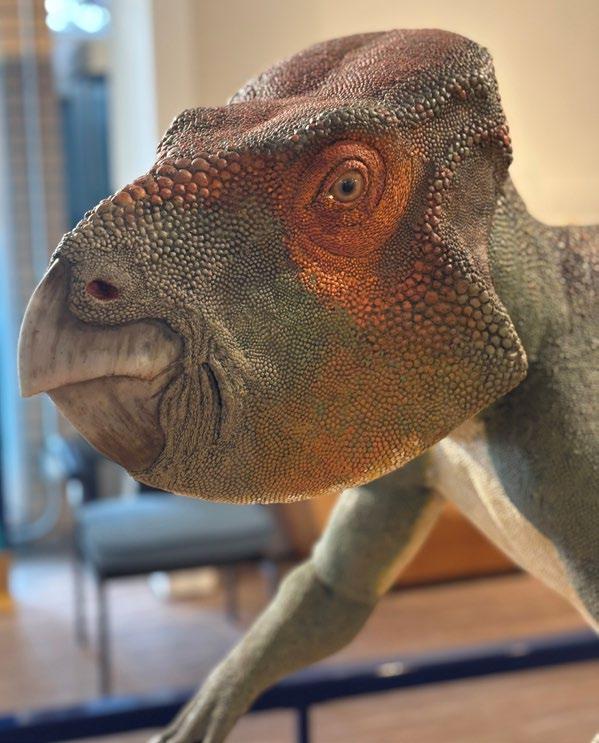
The Penticton Museum & Archives hosted the Dinosaurs of BC exhibit, on loan from the Royal BC Museum.
2025 Achievements
Facilities Achievements 2025
• Construction of Power Street Child Care Centre, adding 80 new spaces.
• Completion of Kings Park/Sportplex upgrades, including the bubble roof recovery, the addition of washrooms and changerooms and the Sportplex Level 2 returning to public use.
• Advancement of the Civic Places and Spaces plan’s first priority of fire hall renewals with an Integrated Project Delivery (IPD) plan in place for 2026.
• Assumed operational management of the outdoor rink, transitioning responsibilities from Activate Penticton and integrating the facility into City operations.
• Facilities hit several key performance indicators (KPIs) in 2025:
Ű Lost time incidents – 0
Ű Planned vs. reactive maintenance – 84%
Ű Work order completion within 30 days or less – 99%
Ű Work order generation based on facility square footage – 17.11
Recreation Achievements 2025
• Expanded inclusive recreation programming to increase opportunities for individuals of all abilities through sensory-friendly, supported and adaptive programs.
• Introduced creative and social programs that increased participation among youth, families and older adults.
• Advanced the Cleland Community Theatre A/V Upgrade Project to meet modern industry standards and attract higher-profile performances.
• Supported a diverse mix of professional touring acts and local productions, reinforcing the theatre’s role as a regional cultural hub.
• Contributed to the Sports & Recreation Needs Assessment by incorporating public feedback to inform future service delivery and facility planning.
• Frost Fest received a provincial event award from the British Columbia Recreation and Parks Association (BCRPA), recognizing its success in community engagement, winter activation and high- quality event delivery.

Cheering on the Penticton Vees during their inaugural WHL season.
Museum and Archives Achievements 2025
• The museum upgraded permanent exhibits with new images, text and artifacts. Overall, museum attendance increased by 3,000 in 2025, and the archives received over 200 research requests, up from 115 in 2024.
• A new in-house exhibit featuring the life and works of renowned local photographer Hugo Redivo opened in May: Hugo Redivo: A Life Behind the Lens.
• From September 2025 to April 2026 the museum hosted the Royal British Columbia Museum’s Dinosaurs of BC
• In June, the museum hosted an activity at the annual Kidzfest Festival engaging over 4,000 children.
• The museum broke a daily attendance record in October, welcoming more than 270 visitors in a single day.
• Significant archival donations in 2025 included material from the Knights of Pythias, a local service group, the Cleland family, local photographer Dan Lybarger and KVP researcher Bill Presley.
• The archives added two assistant archivists in 2025, bringing staffing to optimum levels.
Having

a splash at the Penticton Community Centre.
Facts and Stats 2025
Facilities
• Responsible for 50 major buildings
• Age range of buildings: 1–75
• Total floor area of City buildings in square feet: 800,000
Recreation, Arts & Culture
• 8,694 program hours scheduled
• 172,244 swimming pool admissions
• 91,709 fitness room admissions
• 6,906 public skating admissions
• 201 processed event applications
• 5 cultural observances coordinated
• Sporting, community and private events hosted:
Ű 19 sporting events
Ű 115 community events
Ű 51 private events
• 190 total hosted events in 2025 (an increase from 180 in 2024)
Museum & Archives
• Total museum visits: 15,895
• 110 hosted programs
• Total attendance to educational programs: 2,978
• 4,500 visits to the Ha Ha Ha Kidzfest booth
• 24 Brown Bag Lectures
• 18 archival and museum acquisitions
Land Administration Agreements
• 8 residential tenancies
• 116 leases and licenses-to-use
• 9 beach vendors
• 55 net metering agreements for solar energy
• 20 Crown Leases/License of Occupation
• 9 Crown Statutory Rights of Ways (SRW)
• 40 Land Title Office documents registered
• 1 property purchases/land swaps
1- 75
172,244
24
19
15,895
11 5
55
Penticton Public Library
What We Do
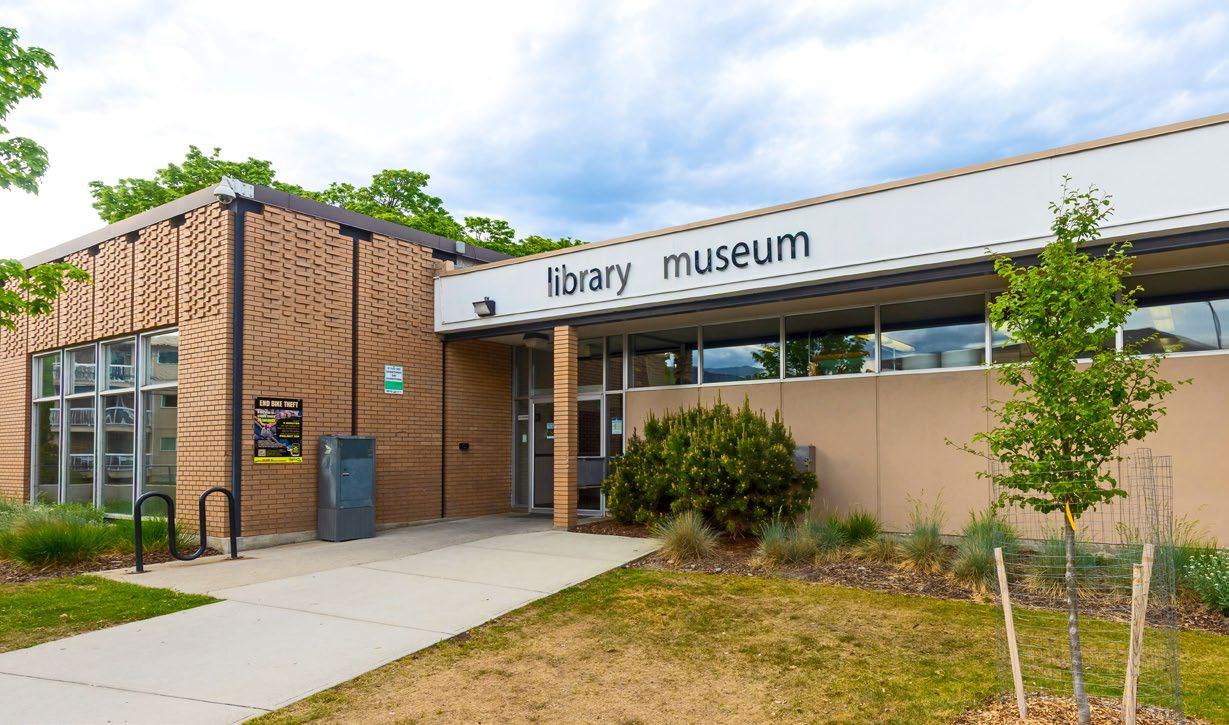
The Penticton Public Library offers free services to residents of the City of Penticton. These include access to extensive physical and digital collections for borrowing, literacy-based programming for all ages, research and reference support, public computers, welcoming study spaces and a delivery service for homebound residents.
Day-to-day operations are managed by the chief librarian, while the library’s strategic goals and priorities are guided by a board made up of one City Councillor and 8 to 10 community members.
The library’s collection includes more than 120,000 items across print and digital formats, giving patrons access to a wide range of reading and learning materials. Its makerspace provides a collaborative
environment where community members can learn new technologies, experiment with creative tools and bring their ideas to life.
Programs and activities are designed for everyone — from the very young to the young-at-heart. Popular offerings include Baby and Toddler Storytime, LEGO Club, Teen Summer Takeover Challenges, the After Dark Book Club and the annual Ultimate Book Nerd Reading Challenge.
In addition to lending materials and hosting programs, the library provides exam proctoring and participates in several province-wide initiatives, including BC OneCard and Interlibrary Loan.
2025 Achievements
• Conducted a violence risk assessment at the library to strengthen safety for staff and patrons and identify opportunities to reduce potential risks
• Continuously reviewed patron use of print and digital collections to ensure materials reflect community preferences, adjusting budget allocations within existing resources to maintain a relevant and balanced collection
• Expanded public wi-fi access beyond regular operating hours, allowing the community to connect from the library campus even when the building is closed
• Made ongoing improvements to the physical accessibility of the library’s collections, helping ensure materials are easier for all patrons to locate and use
• Responded to community feedback by expanding several programs to welcome all age groups, creating new opportunities for cross-generational learning, creativity and connection
• Improved the patron experience by collaborating with the catalogue vendor to customize a mobile app, making it easier for patrons to search the catalogue, place holds and manage their library accounts
Facts and Stats 2025
• 151,724 in person visitors welcomed to the Penticton Library (176,394 online)
• 20,758 library cardholders (1,832 new)
• 338,025 total items circulated (103,804 digital)
• 182 Makerspace registrants
• 26,877 reference questions answered
• 12,835 online database users
• 40 total technology help sessions
• 10,844 public computer users and 8,597 users of public wi-fi
• 449 total returns via the holds locker located at the Community Centre*
• 308 items circulated via the holds locker located at the Community Centre
• 346 programs offered (in-person and online) attended
• Attendance at programs (in-person and viewed): 7,803
• 81 annual Reading Challenge participants
• 2,270 items borrowed from other libraries
• 891 items lent to other libraries
*Started tracking holds locker returns in April 2025.
12,835
151,724 7,803 1,832

Infrastructure
What We Do Division
The Infrastructure division, led by the General Manager, is responsible for overseeing many of the City’s operations that enable residents to go about their daily lives. The division plans, designs, constructs, operates and maintains City infrastructure assets, including the electrical distribution system, roads, bridges, parks, beaches, water treatment and distribution networks and sewer collection and treatment systems. It also collects garbage and recycling, sets utility rates and manages the City’s contract with BC Transit.
Energy and Environment
This department includes the Electric Utility and the Environmental Health Services Branch. The City of Penticton owns and operates the Electric Utility, providing services to residential, commercial and industrial customers. Electric Utility staff are responsible
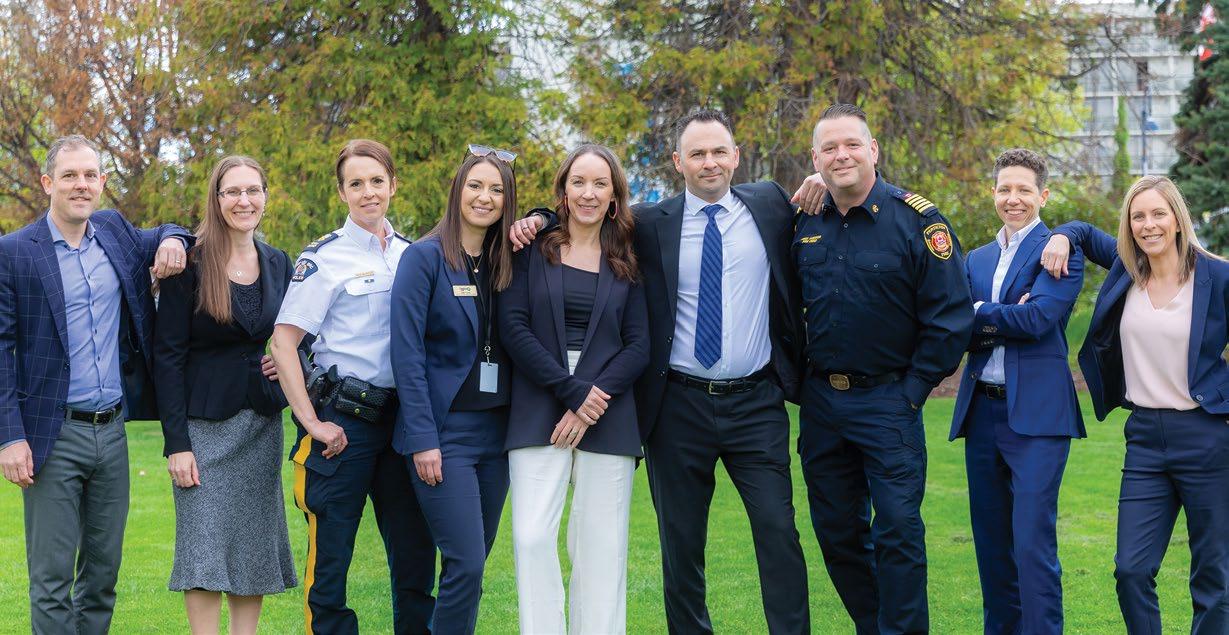
Meet the team at City Yards, photographed ahead of the Public Works Week Open House 2025.
for overseeing operations, maintenance and ongoing improvements of the electrical distribution system. The department also manages electrical meters, traffic signals and street lighting. The Environmental Health Services Branch leads sustainability initiatives, including the Community Climate Action Plan and Corporate Energy and Emissions Plan, as well as solid waste and recycling collection and outreach.
Engineering
This department is responsible for planning, designing and executing construction contracts for planned upgrades, expansions or changes to the City’s transportation network and underground utility systems. The department is also involved in traffic management plans and the issuance of road closure permits for events or construction-related road closures within Penticton.
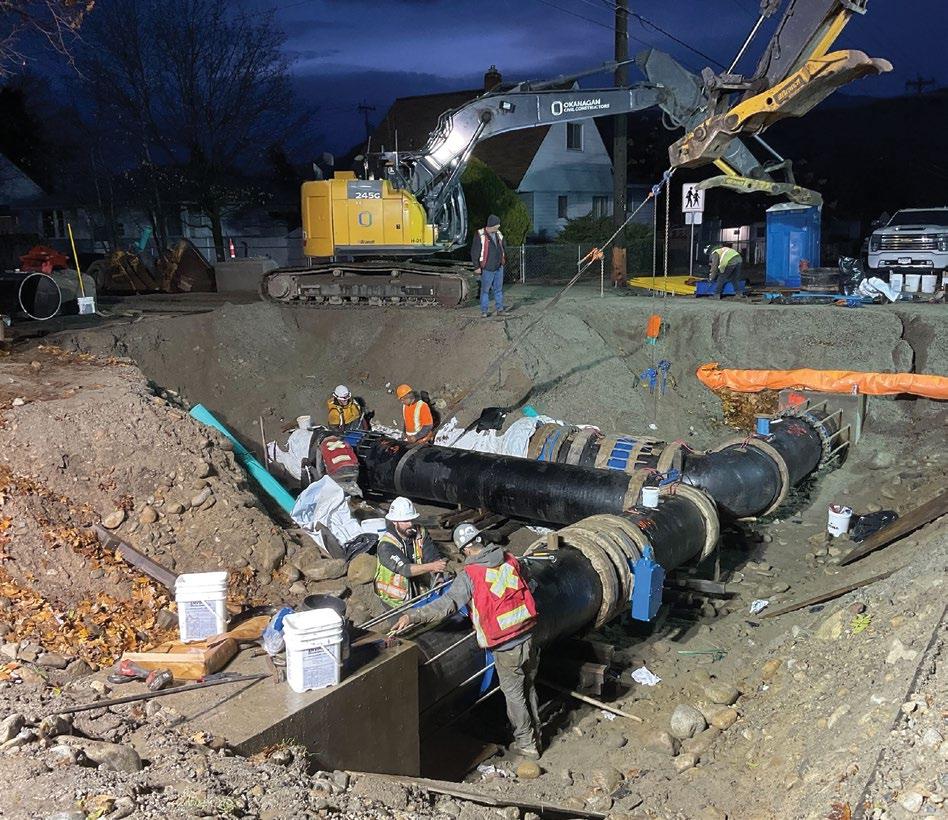
Watermain repair work conducted overnight to reduce impact to the community.
Public Works
This department includes the Roads Branch, Parks Branch and Fleet Branch. Public Works staff manage roads, sidewalks, lanes, bridges, transit, compost site and signage in the community, as well as parks and cemeteries. To support these services, the department also manages the City’s fleet of vehicles, including those used by the RCMP.
Utilities
This department includes the Distribution and Collections Branch, the Water Treatment Plant and the Advanced Waste Water Treatment Plant. Utilities staff help keep the community safe by providing clean drinking water, a reliable sanitary sewer system and stormwater drainage system. This department also provides irrigation water to agricultural areas and operates and maintains City-owned dams.
2025 Achievements
• Completed six dam safety reviews
• Upgraded Ellis 4 Dam
• Completed four Safe Routes to School plans, with two more underway
• Launched the Neighbourhood Friendly Streets initiative in the McGraw/Paris/Cornwall neighbourhood
• Piloted a demand-side management program with Telus
• Completed the Gyro Park cooling hub and Quench Buggy Misting Station with grant funding from the Union of BC Municipalities (UBCM)
• Delivered the Growing Communities grant program for Skaha Park Pickleball Courts, a variety of projects for Minor Baseball and a refresh of the Safety Village
• Completed the renewal of the Skaha Splash Pad
• Installed two new mobi mats (one at Okanagan Lake and one at Skaha Lake)
• Completed the final section of the Lake to Lake Route
• Secured a Growing Canada’s Community Canopies (GCCC) grant to support tree-planting initiatives throughout the city
• Recruited a Parks Technician to advance implementation of the CommuniTREE Plan and the Urban Forest Management Plan (UFMP), with key achievements to date including:
Ű Surpassed the annual planting target of 175 trees in urban parks and along streets, with nearly 200 new trees planted in 2025
Ű Updated the City tree inventory in alignment with UFMP Actions 18, 35 and 37
Ű Launched the Tree App program to support urban forest management
Opening of the Lake to Lake Route, an all ages and abilities mobility route stretching approximately 6 km through the city between Okanagan and Skaha Lakes.

Ű Initiated draft updates to relevant bylaws and policies, including the Tree Protection Bylaw, CTAP, OCP, S&D, Zoning etc. (Action 4, 5, 9, 14, 15 and 17)
Ű Completed the Recommended Tree Species List (Action 12)
Ű Advanced additional recommended actions identified in the plan (e.g. Action 24, 54 and 56)
Ű Advanced or completed 13 UFMP actions in total
Facts and Stats 2025
Public Works
• Maintained 278 km of roads, 185 km of sidewalks and 7 km of separated bike lanes
• 233 mobile units, 151 small equipment, 22 generators, 33 PFD fleet, 45 RCMP fleet totals
• 9 electric vehicle (EV), 5 hybrid vehicles (HEV) and 16 e-bikes totals in fleet
• 94% of vehicles powered by traditional fuel (ICE) versus 6% of vehicles powered by electricity (BEV/HEV)
• 92% of kms travelled per year by fuel vehicles (ICE) versus 8% electric vehicles EVs (including e-bikes) (BEV/HEV)
• 4,200 tonnes of flower bed and top-dressing compost provided for free through the Biosolids Recycling Program
• Maintained 36 km of trails/walkways, 110 acres of turf, 16 sports fields and 10 playgrounds
• 7,737 total trees owned/managed by the City, including 2,599 trees in public rights-of-way (ROW) and 5,138 trees In City parks, gardens and other properties
• 8 beach locations, 6 off-leash, and 4 leash-optional dog areas
Skaha Lake Splash Pad was developed in collaboration with partners including the Rotary Club, Penticton Indian Band and the En'owkin Centre.

Utilities
• Maintained 210 km of water mains, 91 km stormwater mains and 171 km sewer mains
• 5.71 billion litres of water pumped from Okanagan Lake station to the Penticton Water Treatment Plant
• 1.536 billion litres of water drawn from Penticton Creek to the Penticton Water Treatment Plant
• 19.8 million litres/day required for average daily water demand
• Annual peak daily water consumption: 41 million litres (August 30, 2025)
• 1.623 billion litres drawn from Penticton Creek for irrigation
• 440 million litres drawn from Ellis Creek for irrigation, plus 437 million from potable system
• 4.6 billion cubic metres of wastewater received
• Average litres/day discharged per person into the sewer system: 336
• Average cost to treat a cubic metre (1,000 litres) of wastewater: $0.96
• 7,458,470 kg of biosolids produced and trucked to Campbell Mountain Landfill for composting
• 558 million cubic metres of reclaimed water recycled for use as irrigation in City parks and golf courses
Energy and Environment
• System peak demand in kilovolt-amperes (kVA): 69,964 (July 2025)
• Annual consumption in megawatt-hour (MWh): 347,340
• 21,248 total electrical customers, 19,040 residential and 1,863 commercial
• 4 substations feeding 21 distribution circuits
• System Average Interruption Duration Index (SAIDI): 0.5
• System Average Interruption Frequency Index (SAIFI): 0.2
110
36 km
7,737
4,525
1,312
1,988
347,340
19.8 million
Energy and Environment
continued
• 153 km of primary and 215 km of secondary overhead power lines
• 98 km of primary and 110 km of secondary underground lines
• 3,733 total streetlights
• 42 total traffic signals, speed signs and rapid flashing beacons
• 5 pedestrian crossing signals
• 4,525t garbage, 1,312t recycle, 1,988t yard waste collected through contract in tonnes (t)
• 6.5% RecycleBC average contamination rate for curbside (as of Q3, 2025)
• 9.7% RecycleBC average contamination rate for multifamily (as of Q3, 2025)
• Energy dispensed under the corporate fleet electric vehicle charging program: 15,756 kWh
• Energy dispensed under the public electric vehicle charging program: 102,017 kWh
• Avoided forest conversion offset credits in tonnes of carbon dioxide equivalent (tCO2e): 215
Engineering
• 2 Safe Routes to School plans completed Transit*
BC Transit reporting period is March–March annually. These statistics represent data from March 2025 to March 2026.
• Conventional passenger trips: 489,000
• Conventional service hours: 23,000
• Custom passenger trips: 20,400
• Custom service hours: 4,000
• Youth under 24 Umo free transit passholders: 1,796
* Collected on behalf of the City of Penticton by BC Transit.
Youth between the ages of 13 and 24 can register for a U24 pass to ride BC Transit for free in Penticton.

Development Services
What We Do Division
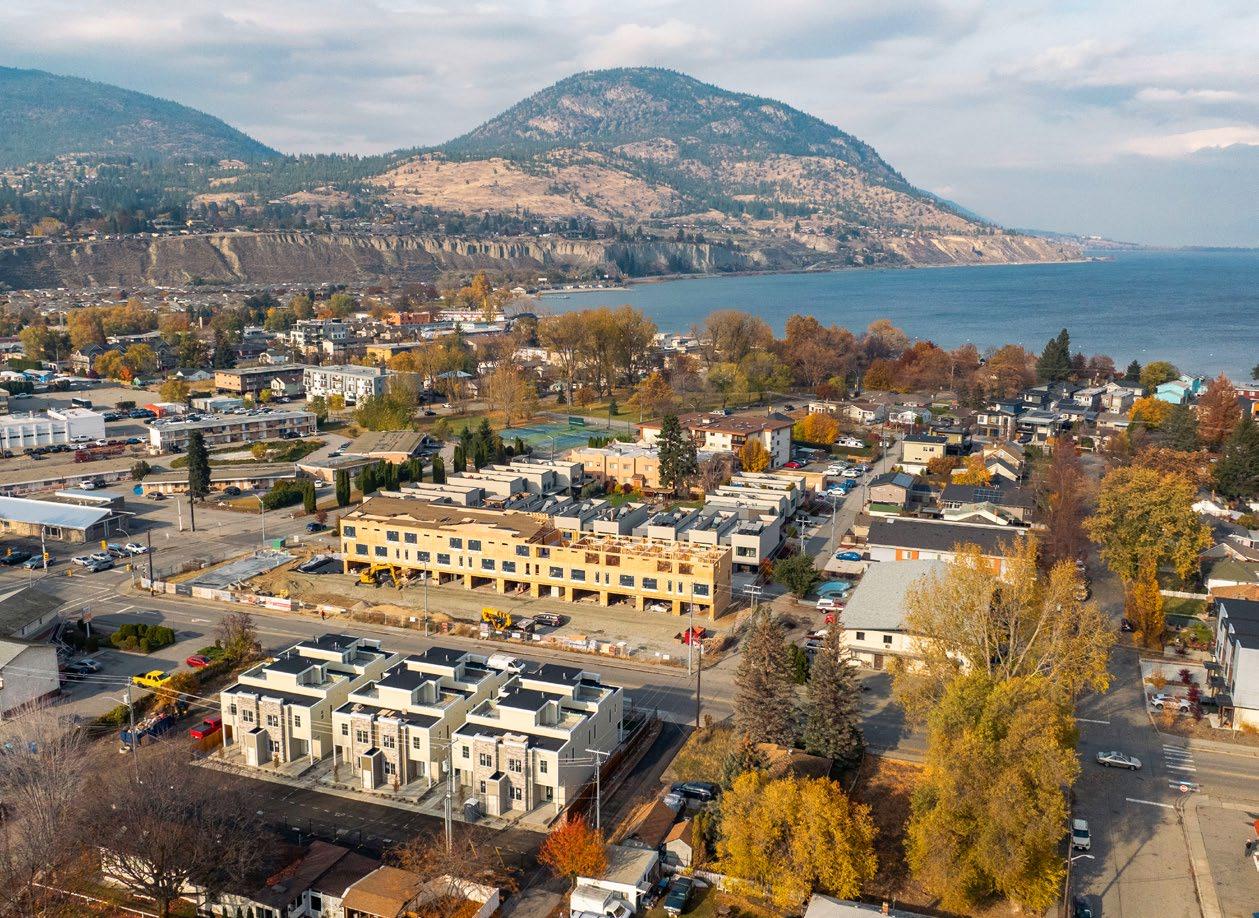
Development Services guides and supports Penticton’s growth, shaping a resilient, vibrant and inclusive community in alignment with the Official Community Plan. The department works collaboratively with residents, businesses, developers and partner organizations to manage land use, facilitate construction, expand housing options and strengthen the local economy.
Planning & Licensing
This department manages land use policy and regulations to support a livable city and a high quality of life for all residents. The department is often the first point of contact for development in Penticton and ensures all developments comply with City bylaws and policies, including the Official Community Plan and Zoning Bylaw. It also oversees the City’s business, liquor and cannabis licensing programs.
Building & Permitting
This department issues permits to ensure construction complies with local zoning regulations and the BC Building Code. It regularly interacts with residents, local businesses and other key partners, providing information and guidance on meeting City and provincial regulations and enforcing requirements through inspection and monitoring. The department also oversees the City’s Short-Term Rental program and civic file information systems.
Development Engineering
Working closely with the Planning, Building, and Engineering departments, Development Engineering ensures that infrastructure in new development meets established standards and complies with City bylaws. The department also serves as a liaison between Public Works and Penticton’s development and design community.

Housing and Policy Initiatives
This new function supports Council priorities on housing development and affordability by implementing local tools and initiatives. The department works closely with other City departments to oversee the Official Community Plan and neighbourhood planning initiatives, pursues grant opportunities, aligns with policy direction from higher levels of government and collaborates with the local housing industry, including non-profit organizations.
Economic Development
This department strengthens Penticton’s economy by collaborating with local businesses, investors, agencies and community leaders to identify opportunities for sustainable growth. It maintains partnerships with organizations such as the Downtown Penticton Business Improvement Association, the Penticton & Wine Country Chamber of Commerce, Travel Penticton, the Penticton Indian Band, the Canadian Home Builders’ Association, the Urban Development Institute and YYF Penticton Airport. Economic Development also continues to promote Penticton’s high quality of life through resident recruitment and supports the community’s entrepreneurial spirit by fostering an environment where innovation can thrive.
2025 Achievements
Development Activity
• Sustained high construction activity, with over $161 million in construction value, consistent with the five -year average.
• 469 new housing units started.
• More than 616 building permits processed.
• 95 land use and planning applications reviewed.
Planning and Policy Initiatives
• Implemented major new housing policies, making the most significant update to development processes and land use regulations in over 50 years.
• Adopted the Social Housing and Infrastructure Plan (SHIP) to guide social housing development in Penticton.
• Advanced the Esplanade Area Plan, completing technical studies, community engagement and a clear vision 2025, with the plan advancing to Council in mid-2026.
Economic Development & Partnerships
• Achieved strong results from the air service development initiative, including survey work and a business case supporting expanded service at YYF.
• Re -launched Love Local, supporting local business vitality.
• Received the Chairman’s Award from the BC Economic Development Association for the City’s support of the 2025 BCEDA Summit hosted in Penticton.
Facts and Stats 2025
Development Engineering
• Work orders and value of installing and upgrading services for new construction: 165 work orders totalling $1,584,257
• Approximate new lots in major and minor subdivisions: 3
Planning & Licensing
• New planning applications received: 100
• New business license applications received: 480
• Units proposed: 282
• Lots proposed: 9
• Licensing enforcement case files: 124
• Licensing fees: $831,527
• Active business: 3,575
Building & Permitting
• Total construction value: $161,000,000
• Total permits issued in 2025: 616, including:
Ű Residential: 211
Ű Commercial: 81
Ű Industrial: 9
Ű Institutional: 2
Ű Plumbing: 172
Ű Demolition: 29
Ű Other (e.g., solar, sprinkler, fire alarm, etc.): 112
• New residential units: 460 (single family), 16 (secondary suites)
• Building permits closed: 704
• Building permit inspections completed: 3,899
• Building enforcement case files: 31
• Permit fees: $1,504,210
Housing and Policy Initiatives
• Grant applications completed (Affordable Housing Pilot Funding Program): 2 applications approved, resulting in $75,000 for predevelopment work towards 124 new affordable units
• City-owned lots committed for future housing development projects: 3
• Official Community Plan (OCP) Housing Task Force recommendations implemented: 15 of 18 (83%)
• Community organizations involved in Social Housing & Infrastructure Plan development: 26
Economic Development
• New Penticton’s residents who received Welcome Home packs: 147
• Percentage of Penticton’s newest residents who moved here for a job: 34%
• Percentage of Penticton’s newest residents who are retired: 21%
• Percentage of Penticton’s newest residents who are remote workers: 12%
• Number who cited lifestyle as a reason for moving: 77%
616
10 0
31 $75,000
12 4
3,575

Public Safety & Partnerships
What We Do
General Manager's Office
The Public Safety and Partnerships Division oversees Social Development and Bylaw Services and works closely with the RCMP and Fire Department on joint initiatives. The General Manager (GM) is responsible for leading multi-sector initiatives that promote community wellbeing and public safety, in partnership with the social sector, business community and provincial and federal partners.
Social Development
This department supports Penticton's safety and wellbeing by working with partners on housing, mental health and wellness supports, homelessness, supports for people who use substances, child care and food security. This work is guided by a Social Development Framework, which provides structure to coordinating the activities, communications, community alignment,
relationships and assets that drive social change through meaningful, proactive leadership in the social services sector.
Bylaw Services
This department supports and upholds City bylaws to promote public safety, maintain community standards and enhance livability. The department delivers timely, effective bylaw education and enforcement, investigates complaints, enforces compliance and engages with the public on issues including animal control, noise, parking, property maintenance, graffiti and vandalism, park use, traffic bylaws, temporary overnight sheltering and the safe use of public spaces. Where matters overlap with the Criminal Code or the Fire, Life and Safety Bylaw, the department works closely with the RCMP and Penticton Fire Department, who take the lead.
2025 Achievements
Partnerships & Community Safety
The Public Safety and Partnerships Division continued to expand its role as a connector and convener in 2025, working with health, social, enforcement and community partners to address public safety challenges in a coordinated, preventative and community-focused way.
Collaborative Patrols and Visibility
Bylaw Services partnered with the South Okanagan Women in Need Society, Interior Health and Social Development on joint patrols and targeted ride -alongs to support vulnerable populations and enhance situational awareness. Summer bylaw and RCMP foot patrols along Okanagan Lake increased visibility in high-use public spaces, while school-zone safety was reinforced through enhanced enforcement and presence during back-to -school periods.
Community Engagement and Public Education
Proactive, relationship -based engagement was a key focus of community safety efforts in 2025, helping build trust and address issues early.
Introducing the "Pups of Public Safety" stickers.
• Launched Pups of Public Safety, a collaborative initiative with Bylaw Services, Fire and RCMP that used custom dog-themed stickers during summer foot patrols to foster positive engagement with children and families.
• Supported community events such as Cram the Cruiser, United Way Breakfast Drive-Through, Jail Bail and Movember, bringing together enforcement agencies, community partners and residents to support donation drives and raise awareness of community needs.
• In partnership with RCMP and Fire, maintained a strong presence at community events, festivals and public education initiatives, reinforcing a service - oriented and approachable presence.

Crime Prevention and Public Safety Innovation
Crime prevention efforts focused on reducing opportunity and designing safer public spaces.
• Expanded Project 529 bike theft prevention, resulting in 25 bike registrations and 50 theft-prevention decals issued.
• Completed seven Crime Prevention Through Environmental Design (CPTED) assessments in partnership with the RCMP at high-priority sites including Kings Park, Nanaimo Square, the Penticton Library and Lakeshore Drive, and initiated a targeted response to concentrations of violent crime along Lakeshore.
• Introduced a self-serve CPTED assessment tool for businesses, now available on the City website.
• Continued collaboration with the Chamber of Commerce and Downtown Penticton Business Improvement Association (BIA) to identify new locations for the industrial-area camera program
• Zero Graffiti Pilot Program (Nov–Dec) removed 1,730 graffiti tags from City-owned property.
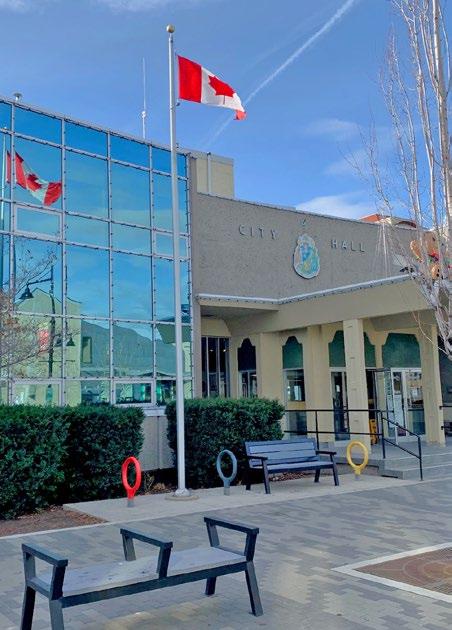
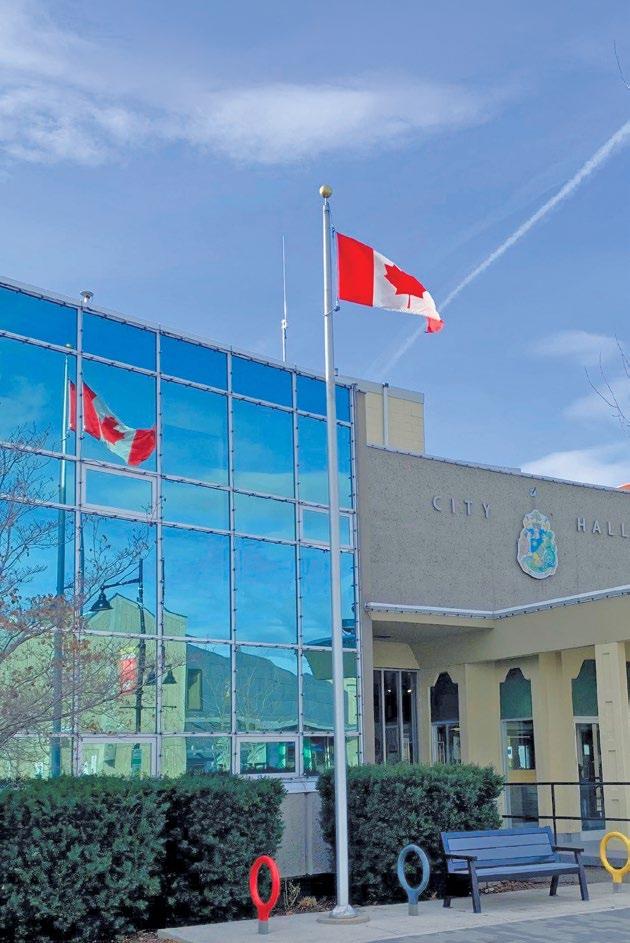
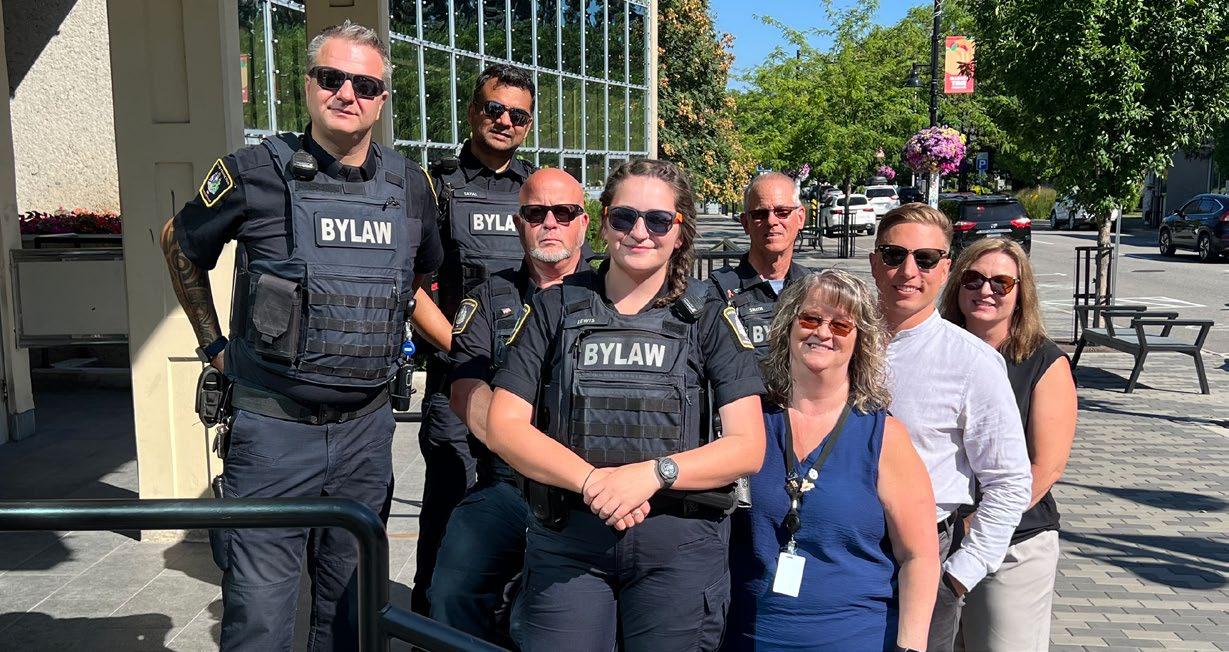
The City Bylaw Services team out front of Penticton City Hall.
Integrated Enforcement and Property Risk Reduction
Property Standards and Compliance Team (PSCT)
Launched in 2025, the Property Standards and Compliance Team brings together RCMP Crime Reduction, Bylaw Services, Fire and Building Inspection.
• Met monthly and reviewed 13 high-risk properties.
• Nine properties required enforcement action.
• Eight cases resolved.
• Established new interdepartmental communication pathways for complex property issues.
Data‑Driven Patrols and Enforcement Modernization
• Implemented information-sharing protocols with the RCMP to identify shared hotspot priorities.
• Conducted 29,233 proactive bylaw patrols in priority locations across the community.
Bylaw Modernization
Key regulatory updates continued throughout 2025, including:
• Parks Regulation Bylaw
• Traffic Bylaw
• Safe Public Places Bylaw, which received first reading in 2025
Community Safety and Wellbeing Planning
Completed Phase 1 of the Community Safety and Wellbeing (CSWB) Plan, establishing the foundation for a multi-year strategy to strengthen safety, connection and wellbeing.
Phase 1 included:
• A current-state assessment of community risks and vulnerabilities
• A jurisdictional scan
• Analysis of the large-scale community Public Safety Questionnaire
Homelessness and Unsheltered Response
Policy and Advocacy
The City, alongside the Penticton Indian Band, hosted Minister Ravi Kahlon to advocate for provincial support related to the Fairview encampment and the Heart & Hearth initiative. While identified as a priority community for funding, Council did not endorse a proposed tiny homes model.
Public Space Management
• Updated the Parks Bylaw to prohibit overnight sheltering along Penticton’s two main lakefronts while permitting sheltering in other public spaces.
• Proposed amendments to the Safe Public Places Bylaw to further support community safety.
Operational Responses
• Implemented a cold-weather response with Ask Wellness, BC Housing and Emergency Management.
• Introduced a weekly Point-in-Time Count led by Bylaw Services to monitor outdoor sheltering trends.
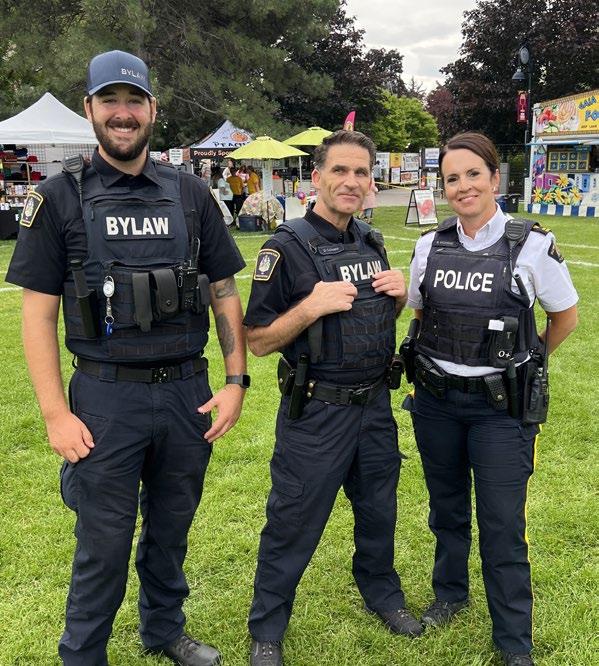
Police and Bylaw on patrol during Peach Festival.
• Secured provincial funding to keep the Temporary Winter Shelter open until March 2027, preventing approximately 40 individuals from returning to homelessness and housing 28 people during the 2025 shelter season.
• Supported partner-led safety improvements at the Compass Shelter, including relocating the entrance to reduce impacts along a major corridor and introducing a dedicated neighbourhood liaison at Burdock House.
• Supported three Neighbourhood Safety Forums with 100 More Homes to hear and respond to community concerns.
Public Health Integration
Recognizing the intersection between community safety and public health, the division strengthened harm-reduction partnerships in 2025.
• Formalized an extension of the Sharps Collection and Disposal Memorandum of Understanding (MOU) with Ask Wellness, reinforcing coordinated responses to sharps-related concerns.
• Updated and published sharps disposal locations on the City website to improve access for residents and visitors.
• Reduced exposure risks, created safer public spaces and cleaned pathways for safe sharps disposal through partnership -based solutions.
Regional Collaboration
Partnered with 100 More Homes and the Regional District of Okanagan-Similkameen (RDOS) to develop and endorse a regional homelessness framework, supported by a joint MOU. The shared goal is to strengthen services across RDOS communities so residents can access supports closer to home.
Social Development
Strategic Leadership
Continued implementation of the Social Development Framework, focused on:
• Food security
• Housing
• Mental health and wellness
• Homelessness
• Substance use supports
• Child care
Equity, Culture and Inclusion
• Supported Red Dress Day, Indigenous Peoples Day, Wa’i Art, National Day for Truth and Reconciliation and Sisters in Spirit Day.
• Collaborated with Health Canada to transfer the Emergency Treatment Fund (~$700,000) to the Ooknakane Friendship Centre, supporting Indigenous-led, culturally grounded services.
Accessibility Improvements
• Installed two new Mobi-mats.
• Introduced free parking for people with disabilities.
• Completed beach accessibility assessments informed by lived experience and public engagement.
Youth and Prevention
• Supported final-year Building Safer Communities Fund programming.
• Continued Free Youth Transit with evaluation underway.
Food Security
Worked with regional partners and the Community Foundation to explore the development of a Community Food Centre.
Facts and Stats 2025
Bylaw Services
• Completed calls for service: 5,323
• Safe Public Places calls: 1,993
• Proactive patrols completed by Bylaw Officers: 29,233
• Wellness checks conducted: 176
• Supplies distributed to vulnerable population (food, water, clothing etc.): 3,600+
• Bylaw offence notice tickets issued for traffic: 7,077
• Bylaw offence notice tickets issued for property non-compliance: 20
• Parking ticket revenue collected: $179,790
• City participation in community cleanups hosted by 100 More Homes (United Way BC): 5
• Hours logged by bylaw officers in training and workshops: 1,240
Animal Control
• Completed calls for service: 1,293
• Courtesy calls for dog license renewal reminders: 1,000
• Failure to License tickets issued: 78
• Park patrols completed in support of the City’s Off-Leash Pilot Project: 435
• Outreach calls for service completed (to provide owners with pet food and supplies): 105
• Animals impounded: 274 dogs/130 cats
• Animals unclaimed from impound: 73 dogs/ 121 cats
1,993 1,293 5, 323 $179,790 29,233
435

Penticton Fire Department
What We Do
The Penticton Fire Department (PFD) has served the community of Penticton and the Regional District since 1911. PFD is a composite department with both career (full-time) and auxiliary (paid on-call) members operating from two stations located at 250 Nanaimo Ave. (Fire Station #1) and 285 Dawson Ave. (Fire Station #2).
PFD provides a wide range of services that meet the expectations of the community and its many visitors, including fire suppression, pre-hospital medical emergency response and various types of rescue, such as motor vehicle incidents, industrial accidents and technical rescue.
The department also conducts fire inspections and investigations, processes business licenses, completes occupancy inspections, responds to freedom of information requests and submits reports to the Office of the Fire Commissioner, among other fire prevention activities.
There are five divisions within the Penticton Fire Department:
• Fire Chief’s Office
• Suppression Division
• Prevention Division
• Training Division
• Emergency Management
2025 Achievements
• Some of the divisional achievements for the Penticton Fire Department in 2025 include:
• Introduction of PFD Marine Rescue 201
• Involvement in planning and hosting five local conferences:
Ű Fire Prevention Officers Association of BC
Ű Wildfire Resiliency and Training Summit
Ű BC Fire Training Officers Association
Ű First Nations' Emergency Services Society of British Columbia
Ű Fire Chiefs Association of BC Annual Conference & Fire Expo
• Creation of an Emergency Management Hub on the City’s website to provide accessible information and preparedness tools.
Facts and Stats 2025
• Fire stations: 2
• Training facilities: 1
• Pieces of firefighting apparatus: 19
• Hours of firefighting training: 6,244
• Emergency response incidents: 3,322*
• Medical response calls: 1,769*
• Fire and life safety inspections: 857**
• FireSmart home assessments: 43
* Decrease in reported incidents due to changes in the Clinical Response Model
** Decrease in reporting for inspections due to Fire Prevention Officer Vacancy for a portion of 2025
3,322
19
43
2
1
1,769
6,244

RCMP
What We Do
The core values of integrity, compassion, respect and accountability are at the heart of our operations at the Penticton RCMP. Our mission is clear: to safeguard the public, uphold the rule of law and maintain order in our community. Through vigilant investigations, proactive crime prevention measures and empathetic assistance, we are dedicated to ensuring the security and welfare of all individuals.
By fostering collaborative partnerships within the community, the RCMP works to build trust and strengthen relationships across the community. Whether conducting patrols, carrying out investigations, engaging and supporting youth and diverse communities or providing aid during crises, we remain committed to upholding these values and ensuring that each action reflects our dedication to serving with integrity and professionalism.
2025 Achievements
• Internal Reorganization of Municipal Support Staff
The RCMP completed a comprehensive reorganization of municipal support staff to improve efficiency, accountability and service delivery. This restructure established clearer lines of reporting under a single management structure, enhancing coordination and decision-making. In addition, two new Crime Reviewer positions were created to strengthen oversight and improve the accuracy and consistency of records management.
• Addition of Sergeant Watch Commanders Sergeant Watch Commander positions were introduced to enhance frontline supervision. These roles have improved operational oversight, mentorship and support for frontline members, contributing to consistent supervision, improved communication and an enhanced leadership presence across shifts.
• External CCTV System Upgrades
External closed- circuit television systems were upgraded to enhance security for staff, RCMP members and the public. The improved camera technology provides better coverage, image quality and reliability, supporting both safety and investigative needs.
• Body-Worn Camera Launch and Implementation
Body-worn cameras for frontline members were successfully launched this year. This initiative enhances transparency, accountability and evidence - gathering capabilities while supporting public confidence and officer safety. Training and policy integration were completed to ensure effective and consistent use.
• Property Standards Compliance Team
A dedicated Property Standards Compliance Team was established to address problem properties within the community. Working closely with partner agencies, the team successfully addressed 14 high-risk or problematic properties, improving public safety, neighbourhood livability and inter-agency coordination.
• Victim Services File Increase
Victim Services experienced a 20 per cent increase in files over the year, reflecting both growing demand and enhanced outreach and referral processes. Despite this increase, services
continued to be delivered in a timely and supportive manner, ensuring victims received appropriate assistance and follow-up.
• Creation of Public Complaints Reviewer / Investigator Position
A Public Complaints Reviewer/Investigator position was created to strengthen complaint oversight and ensure impartial, thorough and timely reviews. This role enhances transparency, accountability and public trust while ensuring compliance with legislative and policy requirements.
• Creation of Public Service Employee (PSE) Training Associate Position
A Public Service Employee (PSE) Training Associate position was established to support ongoing training, professional development and compliance with evolving standards. This role strengthens training coordination, supports staff readiness and enhances organizational capacity.
• Integrated Crisis Response Team (ICRT)
The the Integrated Crisis Response Team (ICRT) completed its second full year of operations. The team continues to provide an effective, collaborative response to individuals experiencing crisis, reducing risks, improving outcomes through early intervention and strengthening partnerships with health and social service agencies.
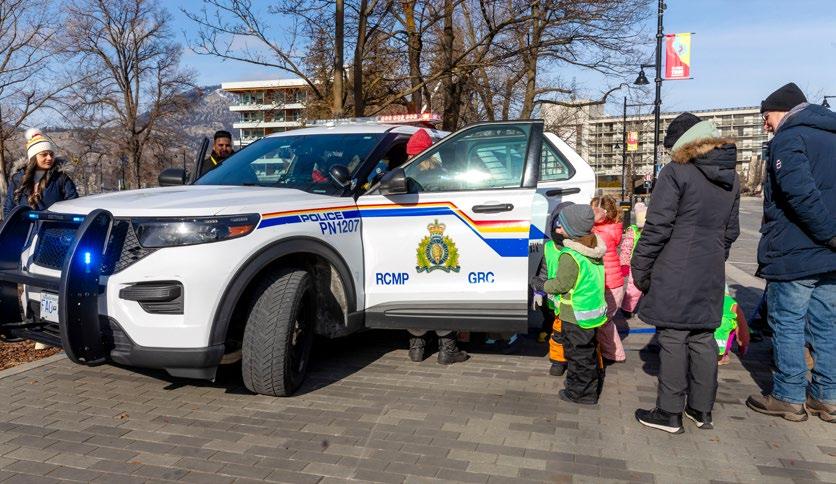
The RCMP engages and educates the community through programs, events and hands-on outreach.
Facts and Stats 2025
• Calls for service: 20,564
• Charges forwarded: 824
• Prisoners lodged: 1,058
• Police dog service interventions: 177
• Forensic identification files: 83
• Victim Services referrals: 571
• ICRT responses/support: 882
• Impaired driving investigations: 186
• Motor Vehicle Act violation tickets: 425
• Motor vehicle collision investigations: 652
• Restorative Justice referrals: 56
• Volunteer hours: 815
• Mental Health Act calls for service: 809
• Calls with a mental health component: 1,675
• Social media posts: 212
• Social media post views: 513,000+
• Social media engagements: 7,000+
• Proactive hours spent in hot spot locations*: 1,007
• “Compstat” Priority Offender curfew checks**: 111
*Reporting starting in April 2024
**Reporting starting in May 2024
571
20,564
815
824
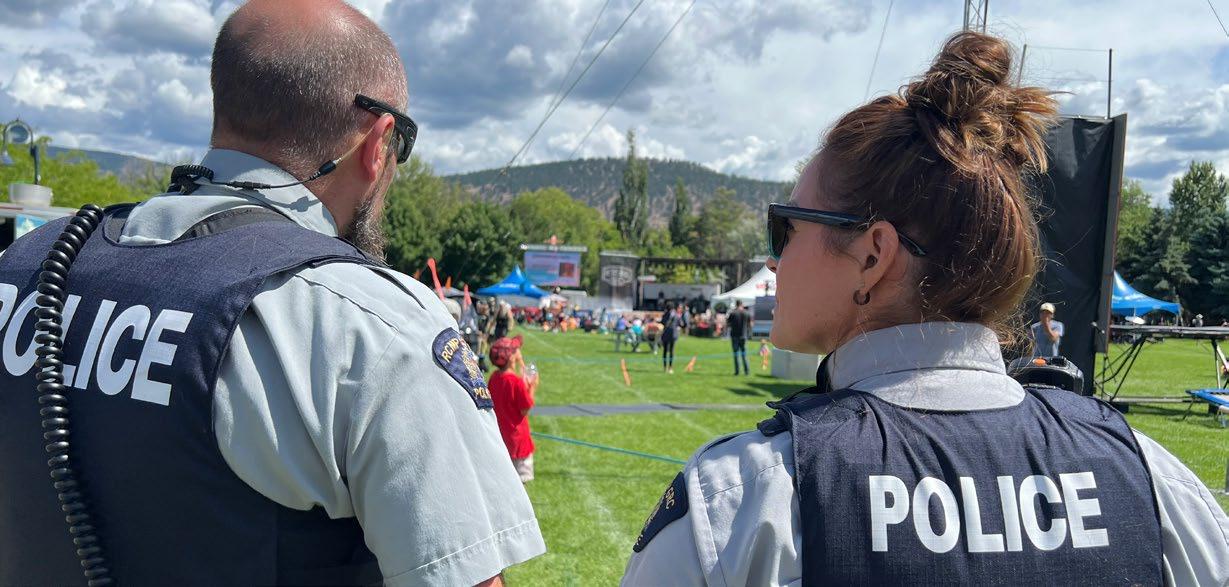
RCMP increased patrols during outdoor events to engage with the community and maintain a visible, safe presence.

Financial Statements

Report from the Chief Financial Officer
May 2025
Mayor Bloomfield and members of Council,
I am pleased to present the City of Penticton’s 2025 Annual Financial Report for the year ended December 31, 2025. The purpose of this report is to publish the City’s consolidated financial statements, Auditor’s Report and provide an update on City services and projects pursuant to Sections 98 and 167 of the Community Charter.
In this annual report, Council and the public are provided with an update on the progress made by all divisions within the City of Penticton in 2025. It highlights the work completed, identifies projects that remain in development and notes new projects added to the City’s financial plan through the annual budget process. Throughout the year, the City remained focused on balancing rising cost pressures with Council priorities and community expectations.
The City provides a number of services to the community, including public safety, transportation, infrastructure, recreation, development services, water, sewer, electrical, parks and solid waste disposal. The estimated costs for providing those services are contained in the 2026 – 2030 Financial & Corporate Business Plan, with actual results detailed in the 2025 financial statements.
These financial statements and supplementary financial schedules have been prepared by City staff in conformance with Generally Accepted Accounting Principles (GAAP) as prescribed by the Public Sector Accounting Standards (PSAS). The City maintains systems of internal budgetary and accounting controls that provide assurance for safeguarding of assets and the reliability of information.

Transparency and accountability are foundational to the City’s financial management practices.
The external auditor, BDO Canada LLP, conducted an independent audit of the 2025 Consolidated Financial Statements in accordance with Canadian auditing standards and, in their opinion, determined them to be presented fairly and not materially misstated.
Transparency and accountability are foundational to the City’s financial management practices. Continued efforts are made to ensure financial reporting is accurate, comprehensive and accessible to residents. Strong financial controls, prudent budgeting and ongoing monitoring helped ensure that resources were managed responsibly while maintaining service levels.
Financial Highlights
Financial results from 2025 saw a decrease in the City’s net financial assets of $10 million, bringing the total net financial assets to $71.8 million. The accumulated surplus increased 2.7% for a total of $441 million for 2025, largely reflecting the increase in tangible capital assets due to the City’s significant capital program.
Consolidated revenues for the City were $169 million in 2025, a 4.1% increase over 2024. The increase is attributed to higher taxation revenue, higher sales of service and the addition of a contributed asset.
Consolidated expenditures were $157 million, an increase of 8.0% from 2024, mainly attributable to contractual wage increases, continued investments in safety including Police, Fire and Bylaw, underthreshold capital items and inflationary increases in goods and services.
The general revenue fund saw an overall deficit of $101 thousand, with revenues coming in at $130 million, an increase of 4.3% from 2024. Revenues increased over the previous year due to an increase in taxation revenues, sales of services and taxes collected for other governments.
Expenditures in 2025 increased by 4.8%. The main drivers behind this increase relate to contractual wage increases, as well as under-threshold capital items and inflationary increases in goods and services.
Overall reserve funds have increased to $129 million, a change of 0.5% from 2024. The slight increase in funds can be attributed to contributions to capital reserves. Remaining reserve balances will be utilized significantly in future years as the City’s capital projects are completed.
Council Priorities
In 2024, Council reviewed and refined its priorities to refocus on the Safe & Resilient and Livable & Accessible priorities, which continued into 2025. City Council approved a tax increase for 2025 of 7.88%, which included the final instalment of the 10% tax deferral from 2022 into future years to address inflation and mitigate the impacts of COVID-19 on the public. This deferral of taxation was planned to be phased in over the years 2023–2025, while continuing to offset losses by using general surplus funds.
For 2025, the City’s financial plan continued to be guided by community safety, which remains one of Council’s main priorities. As such, City Council approved increases to Fire and RCMP staffing, investment into the creation of a Community Safety and Wellbeing Plan and capital projects such as Safe Routes to School. The City of Penticton is committed to managing social issues proactively by creating a stronger presence for safety enforcement. and improving the quality of life and overall experience in Penticton for residents and visitors alike.
Housing, sustainable growth and development continued to be paramount, with investments into the development of an area plan for Okanagan Lakeshore/ Esplanade and advancing housing affordability.
The City remains committed to addressing aging infrastructure and providing services the community requires through capital projects such as upgrades and expansion to the Advanced Wastewater Treatment Plant, Lakawanna Park and aging water and sanitary sewer infrastructure. In 2026, the City will continue to advance the Asset and Amenity Management Project, “Civic Places and Spaces,” with fire hall renewals as the top priority.
As the City looks ahead, financial sustainability remains a key priority. The City will continue to align long term financial planning with strategic objectives, infrastructure needs and affordability for residents. Together, we will continue to make Penticton a great place to live, work and play.
Respectfully submitted,

Angela Campbell General Manager of Corporate Services
As the City looks ahead, financial sustainability remains a key priority. The City will continue to align long term financial planning with strategic objectives, infrastructure needs and affordability for residents.
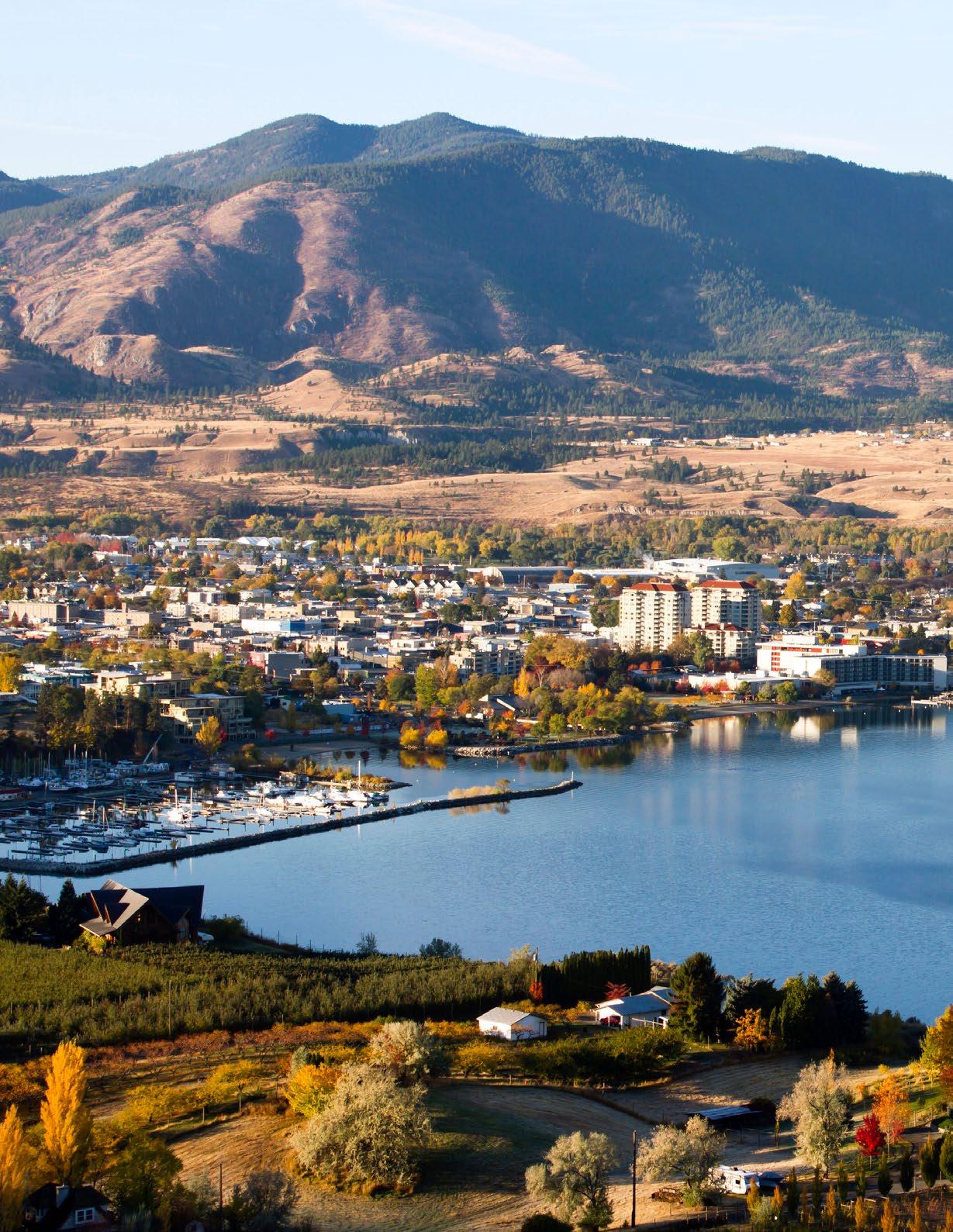

Fax: 250 763 4457
Tel: 250 763 6700
Fax: 250 763 4457
1 800 928 3307 Kelowna, BC, V1Y 0B5 www.bdo.ca
Toll-free: 1 800 928 3307
www.bdo.ca
Independent Auditor’s Report
Independent Auditor’s Report
To the Mayor and Council of the Corporation of the City of Penticton
Opinion
To the Mayor and Council of the Corporation of the City of Penticton
To the Mayor and Council of the Corporation of the City of Penticton
Opinion
Opinion
Independent Auditor’s Report
We have audited the consolidated financial statements of the Corporation of the City of Penticton and its controlled entities (the “City”), which comprise the consolidated statement of financial position as at December 31, 2025, and the consolidated statement of operations and accumulated surplus, the consolidated statement of change in net financial assets and the consolidated statement of cash flows for the year then ended, and notes to the consolidated financial statements, including a summary of significant accounting policies.
We have audited the consolidated financial statements of the Corporation of the City of Penticton and its controlled entities (the “City”), which comprise the consolidated statement of financial position as at December 31, 2025, and the consolidated statement of operations and accumulated surplus, the consolidated statement of change in net financial assets and the consolidated statement of cash flows for the year then ended, and notes to the consolidated financial statements, including a summary of significant accounting policies.
In our opinion, the accompanying consolidated financial statements present fairly, in all material respects, the consolidated financial position of the City as at December 31, 2025, and its consolidated results of operations, its consolidated change in net financial assets, and its consolidated cash flows for the year then ended in accordance with Canadian public sector accounting standards.
Basis for Opinion
We have audited the consolidated financial statements of the Corporation of the City of Penticton and its controlled entities (the “City”), which comprise the consolidated statement of financial position as at December 31, 2025, and the consolidated statement of operations and accumulated surplus, the consolidated statement of change in net financial assets and the consolidated statement of cash flows for the year then ended, and notes to the consolidated financial statements, including a summary of significant accounting policies.
In our opinion, the accompanying consolidated financial statements present fairly, in all material respects, the consolidated financial position of the City as at December 31, 2025, and its consolidated results of operations, its consolidated change in net financial assets, and its consolidated cash flows for the year then ended in accordance with Canadian public sector accounting standards.
In our opinion, the accompanying consolidated financial statements present fairly, in all material respects, the consolidated financial position of the City as at December 31, 2025, and its consolidated results of operations, its consolidated change in net financial assets, and its consolidated cash flows for the year then ended in accordance with Canadian public sector accounting standards.
Basis for Opinion
Basis for Opinion
of
We conducted our audit in accordance with Canadian generally accepted auditing standards. Our responsibilities under those standards are further described in the Auditor’s Responsibilities for the Audit of the Consolidated Financial Statements section of our report. We are independent of the City in accordance with the ethical requirements that are relevant to our audit of the consolidated financial statements in Canada, and we have fulfilled our other ethical responsibilities in accordance with these requirements. We believe that the audit evidence we have obtained is sufficient and appropriate to provide a basis for our opinion.
Unaudited Information
We conducted our audit in accordance with Canadian generally accepted auditing standards. Our responsibilities under those standards are further described in the Auditor’s Responsibilities for the Audit of the Consolidated Financial Statements section of our report. We are independent of the City in accordance with the ethical requirements that are relevant to our audit of the consolidated financial statements in Canada, and we have fulfilled our other ethical responsibilities in accordance with these requirements. We believe that the audit evidence we have obtained is sufficient and appropriate to provide a basis for our opinion.
We conducted our audit in accordance with Canadian generally accepted auditing standards. Our responsibilities under those standards are further described in the Auditor’s Responsibilities for the Audit of the Consolidated Financial Statements section of our report. We are independent of the City in accordance with the ethical requirements that are relevant to our audit of the consolidated financial statements in Canada, and we have fulfilled our other ethical responsibilities in accordance with these requirements. We believe that the audit evidence we have obtained is sufficient and appropriate to provide a basis for our opinion.
We have not audited, reviewed or otherwise attempted to verify the accuracy or completeness of the unaudited schedules of the City’s financial statements.
Unaudited Information
Unaudited Information
We have not audited, reviewed or otherwise attempted to verify the accuracy or completeness of the unaudited schedules of the City’s financial statements.
We have not audited, reviewed or otherwise attempted to verify the accuracy or completeness of the unaudited schedules of the City’s financial statements.
Responsibilities of Management and Those Charged with Governance for the Consolidated Financial Statements
Management is responsible for the preparation and fair presentation of the consolidated financial statements in accordance with Canadian public sector accounting standards, and for such internal control as management determines is necessary to enable the preparation of consolidated financial statements that are free from material misstatement, whether due to fraud or error.
Responsibilities of Management and Those Charged with Governance for the Consolidated Financial Statements
Responsibilities of Management and Those Charged with Governance for the Consolidated Financial Statements
Management is responsible for the preparation and fair presentation of the consolidated financial statements in accordance with Canadian public sector accounting standards, and for such internal control as management determines is necessary to enable the preparation of consolidated financial statements that are free from material misstatement, whether due to fraud or error.
In preparing the consolidated financial statements, management is responsible for assessing the City’s ability to continue as a going concern, disclosing, as applicable, matters related to going concern and using the going concern basis of accounting unless management either intends to liquidate the City or to cease operations, or has no realistic alternative but to do so.
Those charged with governance are responsible for overseeing the City’s financial reporting process.
Management is responsible for the preparation and fair presentation of the consolidated financial statements in accordance with Canadian public sector accounting standards, and for such internal control as management determines is necessary to enable the preparation of consolidated financial statements that are free from material misstatement, whether due to fraud or error.
In preparing the consolidated financial statements, management is responsible for assessing the City’s ability to continue as a going concern, disclosing, as applicable, matters related to going concern and using the going concern basis of accounting unless management either intends to liquidate the City or to cease operations, or has no realistic alternative but to do so.
In preparing the consolidated financial statements, management is responsible for assessing the City’s ability to continue as a going concern, disclosing, as applicable, matters related to going concern and using the going concern basis of accounting unless management either intends to liquidate the City or to cease operations, or has no realistic alternative but to do so.
Those charged with governance are responsible for overseeing the City’s financial reporting process. Tel: 250 763 6700
Those charged with governance are responsible for overseeing the City’s financial reporting process.
Auditor’s Responsibilities for the Audit of the Consolidated Financial Statements
Independent Auditor’s Report
To the Mayor and Council of the Corporation of the City of Penticton
Our objectives are to obtain reasonable assurance about whether the consolidated financial statements as a whole are free from material misstatement, whether due to fraud or error, and to issue an auditor’s report that includes our opinion. Reasonable assurance is a high level of assurance, but is not a guarantee that an audit conducted in accordance with Canadian generally accepted auditing standards will always detect a material misstatement when it exists. Misstatements can arise from fraud or error and are considered material if, individually or in the aggregate, they could reasonably be expected to influence the economic decisions of users taken on the basis of these consolidated financial statements.
Opinion
We have audited the consolidated financial statements of the Corporation of the City of Penticton and its controlled entities (the “City”), which comprise the consolidated statement of financial position as at December 31, 2025, and the consolidated statement of operations and accumulated surplus, the consolidated statement of change in net financial assets and the consolidated statement of cash flows for the year then ended, and notes to the consolidated financial statements, including a summary of significant accounting policies.
As part of an audit in accordance with Canadian generally accepted auditing standards, we exercise professional judgment and maintain professional skepticism throughout the audit. We also:
Identify and assess the risks of material misstatement of the consolidated financial statements, whether due to fraud or error, design and perform audit procedures responsive to those risks, and obtain audit evidence that is sufficient and appropriate to provide a basis for our opinion. The risk of not detecting a material misstatement resulting from fraud is higher than for one resulting from error, as fraud may involve collusion, forgery, intentional omissions, misrepresentations, or the override of internal control.
In our opinion, the accompanying consolidated financial statements present fairly, in all material respects, the consolidated financial position of the City as at December 31, 2025, and its consolidated results of operations, its consolidated change in net financial assets, and its consolidated cash flows for the year then ended in accordance with Canadian public sector accounting standards.
Obtain an understanding of internal control relevant to the audit in order to design audit procedures that are appropriate in the circumstances, but not for the purpose of expressing an opinion on the effectiveness of the City’s internal control.
Basis for Opinion
Evaluate the appropriateness of accounting policies used and the reasonableness of accounting estimates and related disclosures made by management.
We conducted our audit in accordance with Canadian generally accepted auditing standards. Our responsibilities under those standards are further described in the Auditor’s Responsibilities for the Audit of the Consolidated Financial Statements section of our report. We are independent of the City in accordance with the ethical requirements that are relevant to our audit of the consolidated financial statements in Canada, and we have fulfilled our other ethical responsibilities in accordance with these requirements. We believe that the audit evidence we have obtained is sufficient and appropriate to provide a basis for our opinion.
Conclude on the appropriateness of management’s use of the going concern basis of accounting and, based on the audit evidence obtained, whether a material uncertainty exists related to events or conditions that may cast significant doubt on the City’s ability to continue as a going concern. If we conclude that a material uncertainty exists, we are required to draw attention in our auditor’s report to the related disclosures in the consolidated financial statements or, if such disclosures are inadequate, to modify our opinion. Our conclusions are based on the audit evidence obtained up to the date of our auditor’s report. However, future events or conditions may cause the City to cease to continue as a going concern.
Unaudited Information
We have not audited, reviewed or otherwise attempted to verify the accuracy or completeness of the unaudited schedules of the City’s financial statements.
Evaluate the overall presentation, structure and content of the consolidated financial statements, including the disclosures, and whether the consolidated financial statements represent the underlying transactions and events in a manner that achieves fair presentation.
Responsibilities of Management and Those Charged with Governance for the Consolidated Financial Statements
Plan and perform the group audit to obtain sufficient appropriate audit evidence regarding the financial information of the entities or business activities within the City as a basis for forming an opinion on the group financial statements. We are responsible for the direction, supervision and performance of the group audit. We remain solely responsible for our audit opinion.
Management is responsible for the preparation and fair presentation of the consolidated financial statements in accordance with Canadian public sector accounting standards, and for such internal control as management determines is necessary to enable the preparation of consolidated financial statements that are free from material misstatement, whether due to fraud or error.
We communicate with those charged with governance regarding, among other matters, the planned scope and timing of the audit and significant audit findings, including any significant deficiencies in internal control that we identify during our audit.
In preparing the consolidated financial statements, management is responsible for assessing the City’s ability to continue as a going concern, disclosing, as applicable, matters related to going concern and using the going concern basis of accounting unless management either intends to liquidate the City or to cease operations, or has no realistic alternative but to do so.

Chartered Professional Accountants
Penticton, British Columbia May 5, 2026
Those charged with governance are responsible for overseeing the City’s financial reporting process.
3,260,7742,744,339 369,042,091 347,704,749
(Note 11)
Disposal of Tangible Capital Assets (Note 11)
Tangible Capital Assets (Note 11)
See accompanying notes to the Consolidated Financial Statements.
N
The consolidated financial statements of the City have been prepared in accordance with Canadian generally accepted accounting principles established by the Public Sector Accounting Board. The Corporation of the City of Penticton ("the City") is a municipality in the Province of British Columbia and operates under the provisions of the Community Charter. The City provides municipal services such as fire, public works, planning, parks, recreation and other general government services.
The consolidated financial statements reflect the assets, liabilities, revenue and expenses of all municipal organizations, committees and Boards which are owned or controlled by the City. All inter-entity transactions and balances have been eliminated. The controlled organizations include:
Penticton Public Library
D
Funds received for specific purposes which are externally restricted by legislation, regulation or agreement and are not available for general municipal purposes are accounted for as deferred revenue on the Consolidated Statement of Financial Position. The revenue is recognized in the Consolidated Statement of Operations in the year in which it is used for the specified purpose.
I
Investments include bank issued notes and bonds and provincial bonds and debentures maturing in the subsequent year.
T
Taxes are recorded at estimated amounts when they meet the definition of an asset, have been authorized and the taxable event occurs. For property taxes, the taxable event is the period for which the tax is levied. Taxes receivable are recognized net of an allowance for anticipated uncollected amounts.
Government transfers are recognized as revenue in the consolidated financial statements when the transfer is authorized and any eligibility criteria are met, except to the extent that transfer stipulations give rise to an obligation that meets the definition of a liability. Transfers are recognized as deferred revenue when transfer stipulations give rise to a liability. Transfer revenue is recognized in the Consolidated Statement of Operations as the stipulation liabilities are settled.
O t h e r S o u r c e s o f R e v e n u e
Revenues from transactions with performance obligations are recognized when (at a point in time) or as (over a period of time) the City satisfies the performance obligations, which occurs when control of the benefits associated with the promised goods or services has passed to the payor.
The City recognizes revenue from users of the electric, water, sewer, solid waste disposal, and rentals of City property services on a straight- line basis over the period of time that the relevant performance obligations are satisfied by the City.
The City recognizes revenue from administrative services, building permits, development permits, sales of goods and other licenses and permits at the point in time that the City has performed the related performance obligations and control of the related benefits has passed to the payors.
Revenue from transactions without performance obligation is recognized at realizable value when the City has the authority to claim or retain an inflow of economic resources received or receivable and there is a past transaction or event that gives rise to the economic resources.
The City recognizes revenue from tax penalties and interest, parking ticket fines, and other revenue without associated performance obligations at the realizable value at the point in time when the City is authorized to collect these revenues.
All financial instruments are measured at cost or amortized cost. The carrying amount of each of these financial instruments is presented on the statement of financial position.
For financial instruments measured using amortized cost, the effective interest rate method is used to determine interest revenue or expense.
For investments measured at cost, the cost method records the initial investment at cost and earnings from such investments are recognized only to the extent received or receivable. When an investment is written down to recognize an impairment loss, the new carrying value is deemed to be the new cost basis for subsequent accounting purposes.
All financial assets are tested annually for impairment. When financial assets are impaired, impairment losses are recorded in the statement of operations.
Transaction costs are added to the carrying value for financial instruments measured using cost or amortized cost. Transaction costs are expensed for financial instruments measured at fair value.
The City holds consumable inventory which is recorded at the lower of cost and replacement value. Cost is determined on a weighted average basis.
Non-financial assets are not available to discharge existing liabilities and are held for use in the provision of services. They have useful lives extending beyond the current year and are not intended for sale in the ordinary course of operations.
T
Tangible capital assets are recorded at cost, net of capital asset disposals, write-downs and amortization. Cost includes all costs directly attributable to acquisition or construction of the tangible capital asset including transportation costs, installation costs, design and engineering fees, legal fees and site preparation costs. Tangible capital assets are written down when conditions indicate that they no longer contribute to the organization's ability to provide goods and services, or when the value of future economic benefits associated with the tangible capital assets are less than their net book value. The net write-downs are accounted for as an expense in the statement of operations. Amortization is recorded on a straightline basis over the estimated life of the tangible capital asset commencing once the asset is available for productive use as follows:
Buildings 20 to 70 years
Roads and Sidewalks 25 to 75 years
Machinery and Equipment 5 to 20 years
Water Infrastructure
Sewer Infrastructure
Electrical Infrastructure
Parks and Recreation Infrastructure
Vehicles 5 to 20 years
Furniture and Equipment 5 to 20 years
Computer Hardware and Software 5 to 13 years
Books and Library Materials
Construction in progress
5 to 13 years
No amortization taken
Tangible capital assets received as contributions are recorded at their fair market value at the date of contribution, where fair value is reasonably determinable, with a corresponding amount recorded as revenue.
The City holds several works of art and historic treasures that have not been included in the tangible capital assets, including displays at the museum and various works of art and decorations in the facilities.
The City's retirement contributions due during the period to its multi-employer defined benefit plan are expensed as incurred.
On January 1 of each year, City employees belonging to CUPE local 608 are credited with the equivalent of two workweeks of paid leave to be used during the year. Unused sick leave is not eligible for payment upon retirement or termination, may not be used as vacation and may not be carried forward to subsequent years.
Reserves for future expenditure are non-statutory reserves which represent an appropriation of surplus for specific purposes. Transfers to reserves for future expenditure include funds to finance incomplete projects and accumulations for specific purposes.
The use of these funds is restricted by Municipal Bylaws established in accordance with the Community Charter. Statutory reserve funds are funded 100% by cash and temporary investments.
The preparation of consolidated financial statements in accordance with Public Sector Accounting Standards requires management to make estimates and assumptions that affect the reported amounts of assets and liabilities at the date of the financial statements and the reported amounts of revenues and expenses during the reporting period. Actual results could differ from management's best estimates as additional information becomes available in the future. Adjustments, if any, will be reflected in the consolidated financial statements in the period that the change in estimate is made, as well as in the period of settlement if the amount is different.
The City collects taxation revenue on behalf of other entities. Such levies, other revenues, expenses, assets and liabilities with respect to the operations of entities are not reflected in these consolidated financial statements.
C
A liability for contaminated sites is recognized when an accidental contamination occurs and the following criteria are met:
a) An environmental standard exists
b) Contamination exceeds the environmental standard
c) The City is directly responsible or accepts responsibility for remediation
d) It is expected that future economic benefits will be given up; and
e) A reasonable estimate of the amount can be made.
The liability is recognized as management's estimate of the cost of post-remediation including operation, maintenance and monitoring that are an integral part of the remediation strategy for a contaminated site.
As at December 31, 2025 and 2024, the City has no liability for contaminated sites.
An asset retirement obligation is a legal obligation associated with the retirement of a tangible capital asset that the City will be required to settle. The City recognizes asset retirement obligations when there is a legal obligation to incur retirements costs in relation to a tangible capital asset, the past transaction or event giving rise to the liability has occurred, it is expected that future economic benefits will be given up, and a reasonable estimate of the amount can be made.
Asset retirement obligations are initially measured at the best estimate of the amount required to retire a tangible capital asset at the financial statement date. The estimate of a liability includes costs directly attributable to asset retirement activities.
Asset retirement obligations are recorded as liabilities with a corresponding increase to the carrying amount of the related tangible capital asset. Subsequently, the asset retirement costs are allocated to expenses over the useful life of the tangible capital asset. The obligation is adjusted to reflect period-to-period changes in the liability resulting from the passage of time and for revisions to either the timing or the amount of the original estimate of the undiscounted cash flows or the discount rate.
Investments held by the City have a range of maturity dates with the earliest being February 21, 2026 and the latest being September 24, 2029. Interest rates vary between 2.2% and 6.0%.
The City collects development cost charges to pay for a proportionate share of infrastructure related to new growth. When the related costs are incurred, the DCCs are recognized as revenue.
3,525,8212,848,232
(4,956,997)(2,641,863) $ 17,400,647 $ 18,268,378
In 2010, Council adopted Economic Incentive Zone Bylaw and in 2022 adopted an updated Development Cost Charge Bylaw. The purpose of these bylaws was to spur development in key areas of the City, promote sustainable development and promote the development of affordable rental housing. The bylaws also contain provisions to encourage high-end hotel development.
The Development Cost Charges and Economic Incentive Tax Exemption Program have been implemented in accordance with the provisions of Section 933(1) of the Local Government Act and Section 226 of the Community Charter, respectively. In 2025, $248,536 (2024 - $282,929) of Economic Incentive tax exemptions were granted.
4 . D e f e r r e d R e v e n u e
Funds received for specific purposes which are externally restricted by legislation, regulation or agreement and are not available for general municipal purposes are accounted for as Deferred Revenue on the Consolidated Statement of Financial Position. The revenue is recognized in the Consolidated Statement of Operations in the year in which it is used for the specified purpose. Deferred Revenue is comprised of the following:
Balance at December 31, 2024
*Includedinotherdeferredrevenueis$281,804(2024-$303,494)fromtheCapacityFundingforLocalGovernmentHousingInitiatives.Inthecurrentyear $21,690(2024-$10,960)wasspentonthisprogram.
5 P e n s i o n L i a b i l i t y
The City and its employees contribute to the Municipal Pension Plan (the Plan), a jointly trusteed pension plan. The Board of Trustees, representing plan members and employers, is responsible for administering the Plan, including investment of the assets and administration of benefits. The Plan is a multi-employer defined benefit pension plan. Basic pension benefits are based on a formula. As at December 31, 2024, the plan has about 273,000 active members and approximately 133,000 retired members. Active members include approximately 47,000 contributors from local governments.
Every three years, an actuarial valuation is performed to assess the financial position of the plan and adequacy of plan funding. The actuary determines an appropriate combined employer and member contribution rate to fund the Plan. The actuary's calculated contribution rate is based on the entry-age normal cost method, which produces the long-term rate of member and employer contributions sufficient to provide benefits for the average future entrants to the plan. This rate may be adjusted for the amortization of any actuarial funding surplus and will be adjusted for the amortization of any unfunded actuarial liability.
The most recent actuarial valuation as at December 31, 2024 indicated a $2,675 million funding surplus for basic pension benefits on a going concern basis.
The City of Penticton paid $3,191,462 (2024 - $3,053,982) for employer contributions to the Plan in fiscal 2025
The next valuation will be as at December 31, 2027.
Employers participating in the Plan record their pension expense as the amount of employer contributions made during the fiscal year (defined contribution pension plan accounting). This is because the Plan records accrued liabilities and accrued assets for the Plan in aggregate, resulting in no consistent and reliable basis for allocating the obligation, assets and cost to individual employers participating in the Plan.
6
All monies borrowed by a Regional District, shall be upon its credit at large and shall, in the event of any default, constitute an indebtedness of the member municipalities for which they are jointly and severally liable. At December 31, 2025, the long term debt of the Regional District aggregated $87,944,741 (2024 - $77,221,237). b
From time to time there are potential claims against the City for incidents which arise in the ordinary course of business. In the opinion of management and legal counsel, the outcomes of the claims are not determinable at this time and cannot be estimated. Should any loss result from the resolution of these claims, such loss will be charged to operations in the year of resolution. c
The City is a participant in the Municipal Insurance Association of British Columbia. Should the Association pay out claims in excess of premiums received, it is possible the City along with other participants, would be required to contribute towards the deficit.
7 . L e t t e r s o f C r e d i t
In addition to the performance deposits reflected in the Consolidated Statement of Financial Position, the City is holding irrevocable Letters of Credit in the amount of $1,480,591 which were received from depositors to ensure their performance of works to be undertaken within the City. These amounts are not reflected in the consolidated financial statements but are available to satisfy liabilities arising from non-performance by the depositors.
8
on the Consolidated Statement of Financial Position is
Principal repayments relating to long term debt of $33,924,901 outstanding are due as follows (in thousands):
Long term debt is secured by the assets of the City. The Long Term Debt is held by the Municipal Finance Authority. The principal payments are invested by the Municipal Finance Authority into a Sinking Fund. The principal repayments are currently estimated at between 3-3.75%. The 2025 earnings in the Sinking Fund were calculated to be $1,448,456 and are included in Other Revenue on the Consolidated Statement of Operations.
The City owns and operates several assets that are known to have asbestos and lead paint, which represent a health hazard upon demolition or renovation of the assets. There is a legal obligation to remove and dispose of the hazardous materials when it is disturbed. The City has recognized an obligation relating to the removal of the hazardous materials.
The value of the obligation is management’s best estimate and has been inflated using an inflation rate of 2.40% (2024 - 1.80%) and discounted using the City's average borrowing rate of 4.13% (2024 – 4.05%). The timing of these expenditures is estimated to occur between 2026 and 2072 with the regular replacement renovation, or disposal of assets. No recoveries are expected at this time.
Decrease due to
30,95026,295
(93,914) -
The City of Penticton budgets for Tangible Capital Assets (TCA) as well as non-operating repairs and maintenance through the capital budget. During the year, the City incurred $43,539,266 of expenditures that fall within the Capital Budget. Of this amount, $35,138,964 met the TCA capitalization policy criteria while the remaining $8,400,302 was expensed due to the expenditure being outside the TCA capitalization policy criteria or they were related to repairs and maintenance.
1 2 C r e d i t F a c i l i t i e s
The City holds a $5,000,000 line of credit with the Valley First Credit Union. This line of credit has a borrowing rate of prime 4.5% (2024 - 5.5%) and is secured by promissory note as indicated in the Revenue Anticipation Borrowing Bylaw 2011 No. 5003.
As of December 31, 2025 there was no balance outstanding (2024 - $NIL ).
1 3 . M u n i c i p a l F i n a n c e A u t h o r i t y
Cash Deposits and Demand Notes - The City issues the majority of its debt instruments through the Municipal Finance Authority. As a condition of these borrowings, a portion of the debt proceeds is withheld by the Municipal Finance Authority as a debt reserve fund. The City also executes demand notes in connection with each debt borrowing whereby the City may be required to loan certain amounts to the Municipal Finance Authority. These demand notes are contingent in nature.
Proceeds on loan requests are 98.40% of the gross amount of the loan. 1% is deducted by the MFA for security against loan default (this is held in trust by the MFA in its Debt Reserve Fund and will be refunded to clients, with interest, at loan expiry). The remaining 0.60% is deducted as an issue expense to cover the costs of administering the Debt Reserve Fund.
As at December 31, 2025 the Debt Reserve Fund demand note requirements were $2,142,094 (2024 - $1,775,256). In addition, cash deposits totaling $1,054,361 (2024 - $907,349) were held by the MFA.
1 4 . B u d g e t
The Financial Plan (Budget) Bylaw No. 2024-40 adopted by Council on December 17, 2024 was not prepared on a basis consistent with that used to report actual results (Public Sector Accounting Standards). The budget figures anticipated use of reserves accumulated in previous years to reduce current year expenditures in excess of current year revenues to Nil. In addition, the budget expensed all tangible capital expenditures rather than including amortization expense. As a result, the budget figures presented in the Consolidated Statements of Operations and change in Consolidated Net Financial Assets represent the Financial Plan adopted by Council with adjustments as follows: 2 0 2 5
Financial Plan (Budget) Bylaw Surplus for the Year $-
e s s
1 7 O t h e r R e v e n u e
Includes various revenue sources earned as part of normal business operations not reported elsewhere such as: investment income, Municipal and Regional District Tax Program income, gaming income, interest, penalties, licensing, rental income, non-government grants and donations.
$ 157,313,849 $ 145,615,565
1 9 . P e n t i c t o n P u b l i c L i b r a r y
The establishment of a municipal public library in the City of Penticton Bylaw 2639 was passed December 8, 1969. The Bylaw indicates that the City exercises control over the Penticton Public Library and is required to fund its operations as per the Library Act. The Penticton Public Library assets as managed by the Library Board are recorded as assets of the City. The operations of the Penticton Public Library have been wholly consolidated by the City.
2 0 C o m p a r a t i v e F i g u r e s
Certain comparative figures have been reclassified to conform with the current year presentation.
2 1 . C o n t r a c t u a l R i g h t s
Contractual rights are rights to economic resources arising from contracts or agreements that will result in an asset in the future. The City's contractual rights arise because of contracts entered into for long-term land leases that grant rights to the City, upon termination of the lease, to any building(s) the tenant has constructed on the land. The following listing outlines the nature, amount, and timing for each of the City’s contractual rights to future assets:
The Lease Agreement between The City of Penticton and The Penticton Golf & Country Club dated July 1, 2007, will result in the City gaining control of the Golf Clubhouse Building upon expiry of the lease. The Lease Agreement grants the right of ownership of the Golf Clubhouse Building to the City. This is a 26 year, 4 month Lease, due to expire in 2033.
The Lease Agreement between The City of Penticton and the Art Gallery of the South Okanagan (Inc. 9986) dated October 1, 1999, will result in the City gaining control of the Art Gallery Building upon expiry of the lease. The Lease Agreement grants the right of ownership of the Art Gallery Building to the City. The 5 year Lease expired in 2025 and the parties are currently working toward a further 5 year renewal.
The Lease Agreement between The City of Penticton and the Penticton Seniors’ Drop-in Centre Society dated May 31, 2019, will result in the City gaining control of the Drop-In Centre Building upon expiry of the lease. The Lease Agreement grants the right of ownership of the Drop-In Centre Building to the City. This is a 20 year Lease, due to expire in 2039.
The Lease Agreement between The City of Penticton and Gateway Casinos & Entertainment Limited dated May 4, 2016, will will result in the City gaining control of the Casino Building upon expiry of the lease. The Lease Agreement grants the right of ownership of the Casino Building to the City. This is a 20 year Lease, due to expire in 2036 with two 10-year extension options.
The Lease Agreement between the City of Penticton and One Sky Community Resources Society dated October 1, 2021, will result in the City gaining control of the Daycare Building upon expiry of the lease. The Lease Agreement grants the right of ownership of the Daycare Building to the City. This is a 60 year Lease, due to expire in 2081.
The City is exposed to credit risk, liquidity risk, and interest rate risk from its financial instruments. This note describes the City’s objectives, policies, and processes for managing those risks and the methods used to measure them. Further qualitative and quantitative information in respect of these risks is presented below and throughout these financial statements.
There have not been any changes from the prior year in the City’s exposure to above risks or the policies, procedures and methods it uses to manage and measure the risks.
Credit risk is the risk that one party to a financial instrument will cause a financial loss for the other party by failing to discharge an obligation. The City is exposed to credit risk through its cash, accounts receivable, and portfolio investments.
The City manages it credit risk by selecting only investments that ensure preservation of capital and leveraging portfolio diversification. The City measures its exposure to credit risk based on portfolio constraints, credit ratings and exposure to asset classes. The maximum exposure to credit risk at the financial statement date is the carrying value of its cash and accounts receivable as outlined in Notes 1 and 2. Accounts receivable arise primarily as a result of taxation, utilities, and grants receivable. Based on this knowledge, credit risk of cash and accounts receivable are assessed as low.
The City manages exposure to credit risk for portfolio investments by ensuring adequate diversification, including maintaining investments in the Municipal Finance Authority, which meets the investment requirements of Section 183 of the Community Charter of the Province of BC. As a result, the Municipality has reduced exposure to market or value risk.
L i q u i d i t y R i s k
Liquidity risk is the risk that the City will encounter difficulty in meeting obligations associated with financial liabilities. The City is exposed to liquidity risk through its accounts payable and accrued liabilities, long-term debt, and investments.
The City manages this risk by selecting maturity dates that correspond to cash flow requirements. Also to help manage the risk, the City has in place a planning, budgeting and forecasting process to help determine the funds required to support the normal operating requirements. The City’s five-year financial plan is approved by the Mayor and Council, which includes operational activities and capital investments. The City measures its exposure to liquidity risk based on financial forecasting and extensive budgeting.
Interest rate risk is the risk that the fair value or future cash flows of a financial instrument will fluctuate because of changes in market interest rates. The City is exposed to interest rate risk through its long-term debt and the value of portfolio investments.
The City manages interest rate risk on its long-term debt by holding all debt through MFA at a fixed rate, with refinancing typically being completed at the ten or fifteen year mark. Therefore, fluctuations in market interest rates would not impact future cash flows and operations relating to long-term debt. See Note 9 for interest rates and maturity dates for long term debt.
The Cemetery Trust fund is established in accordance with the Cremation, Interment, and Funeral Services Act, to upkeep the cemetery grounds/facilities upon closure of the cemetery. As per legislation, current interest income earned on the Reserve balance may be used to offset cemetery operating and capital expenditures. Annual cemetery operating and capital expenditures are approved by Council through the annual budgeting process. The trust fund assets and liabilities are not included in the consolidated financial statements. At December 31, 2025, the balance of funds held in trust was $1,472,417 (2024 - $1,373,225).
2
The City is a diversified municipal government institution that provides a wide range of services to its citizens such as transit, police, fire, water and electricity. Distinguishable functional segments have been separately disclosed in the segmented information. The nature of the segments and the activities they encompass are as follows:
G e n e r a l G o v e r n m e n t S e r v i c e s
General Government operations are primarily funded by property taxation. This segment includes all of the revenues and expenses that relate to the operations of the City itself and cannot be directly attributed to one of the other specific segments including administration, financial services, human resources, information technology, and revenue and collections.
P r o t e c t i v e S e r v i c e s
Protection is comprised of police services, fire protection, bylaw services, dog control and building and licensing services. The police services work to ensure the safety and protection of the citizens and their property. The fire department is responsible to provide fire suppression service, fire prevention programs, training and education.
T r a n s p o r t a t i o n S e r v i c e s
Transportation is responsible for the delivery of municipal public works services related to the City's public transit services, roads and maintenance, bridges, drainage systems, public works, street lighting and traffic control.
E n
Environmental services consists of providing waste disposal to citizens.
P u b l i c H e a l t h a n d S a f e t y
Health services are comprised of public health services; this segment includes the operation of the City's Cemeteries.
E n v i r o n m e n t a l D e v e l o p m e n t S e r v i c e s
This segment includes city planning, land management, economic development and ensures all property development and land use is in line with City Bylaw's and policies and is in the best interest of the community.
This segment provides services meant to improve health and development of the City's citizens. Recreational programs and cultural programs like swimming and skating lessons are provided at the arenas, the aquatic centre and the community centre. Also, the City provides library services to assist with its citizens' informational needs and a museum that houses collections and artifacts. The segment also includes parks, land administration and the City's net contribution to the operations of the South Okanagan Events Centre. E
The electrical supply system is responsible for distribution of electricity to the City's citizens and businesses. This segment includes all of the operating activities related to the supply of the City's electricity.
The City's sanitary sewer system collects, conveys and treats and disposes of domestic and industrial wastewater. This segment includes all of the operating activities related to the collection and treatment of wastewater (sewage) throughout the City.
The water utility is responsible for planning, designing, building and operating and maintaining the City's water system and includes all of the operating activities related to the treatment and distribution of water throughout the City.
*Inter-fundborrowingtoberepaidbygeneralfund(2024-2034)
Supplemental Information


Development Cost Charges
Development cost charges (DCCs) are fees municipalities collect from new development to help fund infrastructure required for community growth. Charges are determined based on the impacts of growth on infrastructure systems such as roads, sewers and parks.
DCCs are imposed by bylaw pursuant to the Local Government Act. Funds collected through DCC payments are held in reserve accounts and used for capital projects identified through the DCC program. DCC funds may be used to fully fund projects at the time of completion or to offset debt servicing costs.
Local governments are permitted to temporarily lend available funds from one DCC reserve fund to another. The borrowed funds, along with appropriate interest, must be returned to the original reserve fund.
In fall 2025, Council supported a 2.6-per-cent increase to DCC fees (Council resolution 243/2025) and supported amendments to the DCC Bylaw to address recent changes to the City’s Zoning Bylaw. The amendments meet requirements set out by the province’s small scale multi unit housing and
transit-oriented areas as well as incorporating recommendations made by the Official Community Plan (OCP) Housing Task Force.
Municipal Assist Factors
The Local Government Act requires local governments to assist with the cost of new infrastructure. The municipal assist factor reflects Council and the community’s support for financing new infrastructure. The level of the assist, as determined by Council, reflects a benefit to the existing population while encouraging development and housing affordability.
City of Penticton current assist factor based on Council Resolution 230/2022
• Roads 1%
• Water mains 1%
• Water plants 1%
• Parks 1%
• Wastewater 1%
• Stormwater 1%
The Lake to Lake Route, which officially opened in 2025, provides an all ages and abilities (AAA) connection through Penticton between Okanagan and Skaha Lakes.

Development Cost Charges Reserve Funds
*Expenditures include project expenses, one-time adjustments, annual transfers and debt financing costs
Project Expenditures 2025
Roads
• $53k debt payments – Fairview Road and Industrial Avenue
• $383k AAA Bike Network Plan
• $45k sidewalk, curbs and intersection improvements
Parks
• $215k debt payment and annual transfer – New playing fields
• $35k KVR Trail Network – Master Plan and Improvements
Sewer
• $850k debt payment and annual transfer – Lee Avenue lift station
• $408k debt payment and annual transfer –Wastewater Treatment Plant expansion from LWMP
• $108k debt payments – Advanced Wastewater Treatment Plant
Water
• $488k debt payments and annual transfer – Water Filtration Plant upgrade
• $78k debt payments – Ridgedale Reservoir
• $2,292k – Penticton Avenue PRV upgrade
Planned DCC Spending
Planned project expenses funded through DCCs in 2026 are included below. Further information on planned DCC projects from 2027 to 2030 can be found in the City’s 2026–2030 Financial and Corporate Business Plan on page xx under the Development Cost Charges Funded Projects section.
Roads
• $900k –Sidewalk network improvements ($414k carry forward from 2025 and $486k in 2026)
• $196k – sidewalks, curbs and gutter projects (carry forward from 2025)
Parks
• $109k – Lions Park improvements (2026)
• $248k – Robinson Park improvements (2026)
• $163k – KVR Trail Network Master Plan and improvements ($64k from 2025 and $99k in 2026)
Water
• $149k – Engineering Services Domestic Water Master Plan (2026)
Sewer
• $7.4M – Advanced Wastewater Treatment Plant upgrade (carry forward from 2025)
• $119k – Advanced Wastewater Treatment Plant second fermenter
• $149k –Engineering Services Sanitary Sewer Master Plan
Capital Project Highlights
In 2025, City divisions worked to achieve the objectives of the City’s capital program. Capital investments into the city include: new assets that provide a service enhancement or a new service that did not previously exist; renewal through the replacement of existing capital assets that reached their end of life, in order to continue providing existing services; and growth for the new or renewed capital assets required to accommodate growing neighbourhoods, in order to service more residents and businesses.
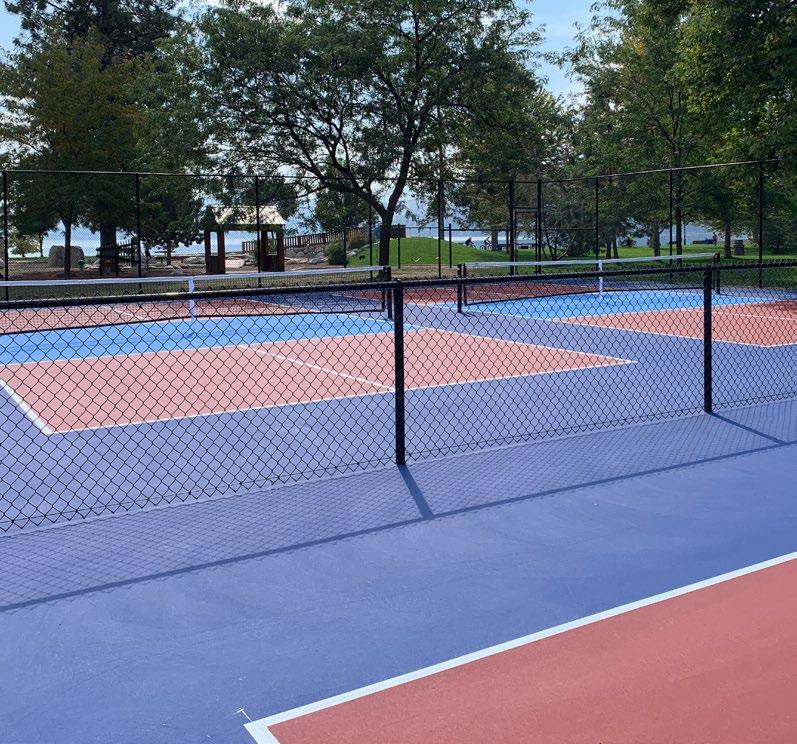
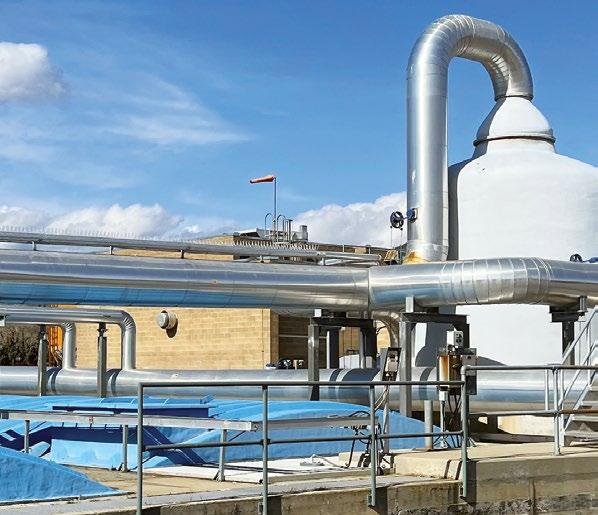
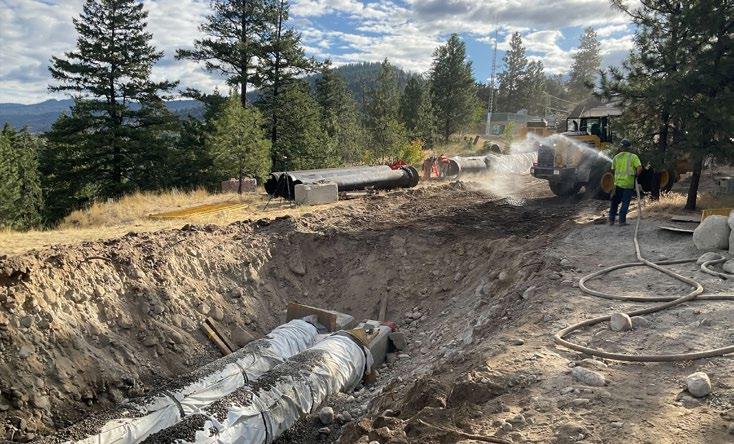
Clockwise from top: Penticton's Wastewater Treatment Plant, construction on a pressure reducing valve (PRV) to upgrade the City's tap water system, and court upgrades at Skaha Lake Park.
2025 Capital Highlights:
• Advanced Wastewater Treatment Plant upgrades
• Water Refill Station Program expansion across the city for a total of 14 stations
• Completion of the Gyro Park Cooling Station
• Improvements to safety for all road users through the Friendly Streets initiative and Safe Routes to School program
• Skaha Lake Park tennis court upgrades and new pickleball court installations
• Continued construction on the Power Street Child Care Centre to add 80 new spaces
• Improvements to the Community Centre main pool starting blocks in partnership with the KISU Swim Club
• Completion of the Sportsplex Roof Bubble Recover project, resulting in improved indoor air quality, climate control and year-round usability of the facility
• Completion of the Kings Park washroom and changeroom building
• Cleland Theatre Lighting upgrades, marking the completion of a multi-year Audio/Visual (A/V) upgrade project
• Connected Community Capital Program projects completed at the Lier House and Lawn Bowling Club
This new cooling station at Gyro Park provides mists of water for people to refresh on hot days, funded in part by a UBCM Disaster Risk Reduction - Climate Adaptation Grant.
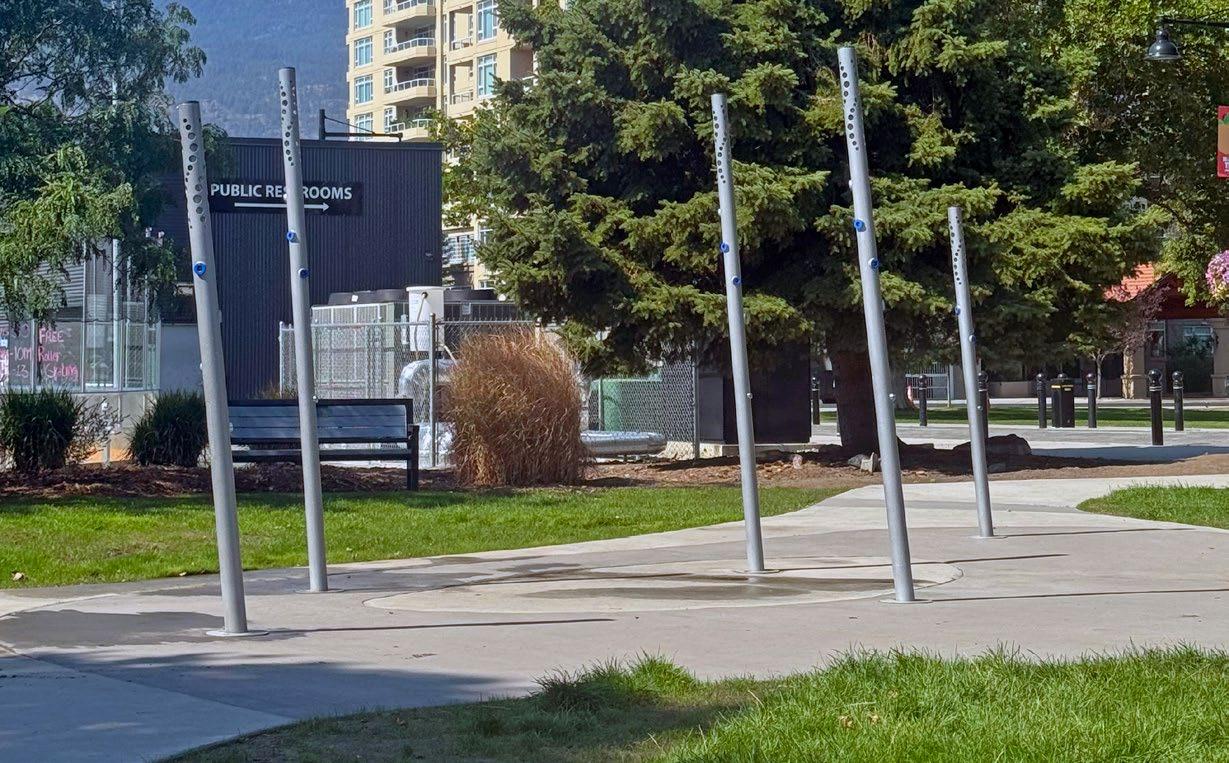
2025 City of Penticton Grant Program
Penticton's vision is to become a vibrant, innovative and adventurous waterfront city focused on sustainability, community and economic opportunity.
In 2025, Council endorsed the following grants to improve quality of life for Penticton residents, meet the needs of community organizations and support Council's objectives in meaningful and measurable ways. Municipal grants* may include cash funding and in-kind support, as well as partnership agreements.
*Starting in the 2025 grant year, the City of Penticton has entered into a Municipal Grant Operating Agreement with the Community Foundation of the South Okanagan Similkameen (CFSOS). This partnership aims to streamline the application process, improve efficiency and ensure strategic allocation of resources. Annual municipal grant funds are allocated to the CFSOS during budget deliberations based on Council's priorities.
All listed amounts
to the closest dollar
Administered by the Community Foundation of the South Okanagan Similkameen (CFSOS)