PUSD Education News
A Publication of the Paramount Unified School District Una Publicacion de el Distrito Escolar Unificado de Paramount 15110 California Ave., Paramount, CA 90723 • Tel: 562-602-6000 • Fax: 562-634-6029
February 2017
Inside an Inquiry-Based Un salón de clase de Mathematics Classroom matemáticas basada en la investigación
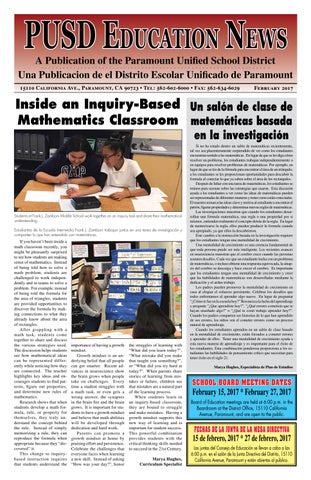
Students at Frank J. Zamboni Middle School work together on an inquiry task and share their mathematical understanding. Estudiantes de la Escuela Intermedia Frank J. Zamboni trabajan juntos en una tarea de investigación y comparten lo que han entendido con matemáticas.
If you haven’t been inside a math classroom recently, you might be pleasantly surprised to see how students are making sense of mathematics. Instead of being told how to solve a math problem, students are challenged to work independently and in teams to solve a problem. For example, instead of being told the formula for the area of triangles, students are provided opportunities to discover the formula by making connections to what they already know about the area of rectangles. After grappling with a math task, students come together to share and discuss the various strategies used. The discussion helps students see how mathematical ideas can be represented differently while noticing how they are connected. The teacher highlights key ideas and encourages students to find patterns, figure out properties, and determine new rules of mathematics. Research shows that when students develop a math formula, rule, or property for themselves, they truly understand the concept behind the rule. Instead of simply memorizing a rule, they can reproduce the formula when appropriate because they “discovered” it. This change to inquirybased instruction requires that students understand the
importance of having a growth mindset. Growth mindset is an underlying belief that all people can get smarter. Recent advances in neuroscience show the brain grows when people take on challenges. Every time a student struggles with a math task, or even gets a wrong answer, the synapses in the brain fire and the brain grows. It is important for students to have a growth mindset and believe that math abilities will be developed through dedication and hard work. Parents can promote a growth mindset at home by praising effort and persistence. Celebrate the challenges that everyone faces when learning a new skill. Instead of asking “How was your day?”, honor
the struggles of learning with “What did you learn today?”, “What mistake did you make that taught you something?”, or “What did you try hard at today?”. When parents share stories of learning from mistakes or failure, children see that mistakes are a natural part of the learning process. When students learn in an inquiry-based classroom, they are bound to struggle and make mistakes. Having a growth mindset supports this new way of learning and is important for student success. This powerful combination provides students with the critical thinking skills needed to succeed in the 21st Century. Marya Hughes, Curriculum Specialist
Si no ha estado dentro un salón de matemáticas recientemente, tal vez sea placenteramente sorprendido de ver como los estudiantes encuentran sentido a las matemáticas. En lugar de que se les diga cómo resolver un problema, los estudiantes trabajan independientemente o en equipos para resolver problemas de matemáticas. Por ejemplo, en lugar de que se les de la fórmula para encontrar el área de un triángulo, a los estudiantes se les proporcionan oportunidades para descubrir la formula al conectar lo que ya saben sobre el área de los rectangulos. Después de lidiar con una tarea de matemáticas, los estudiantes se reúnen para razonar sobre las estrategias que usaron. Esta discusión ayuda a los estudiantes a ver como las ideas de matemáticas pueden ser representadas de diferentes maneras y notar como están conectadas. El maestro remarca las ideas clave y motiva al estudiante a encontrar el patrón, figurar propiedades y determinar nuevas reglas de matemáticas. Las investigaciones muestran que cuando los estudiantes desarrollan una fórmula matemática, una regla o una propiedad por si mismos, entienden realmente el concepto detrás de la regla. En lugar de memorizarse la regla, ellos pueden producir la formula cuando sea apropiado, ya que ellos la descubrieron. Este cambio a la instrucción basada en la investigación requiere que los estudiantes tengan una mentalidad de crecimiento. Una mentalidad de crecimiento es una creencia fundamental de que toda persona puede ser más inteligente. Los recientes avances en neurociencia muestran que el cerebro crece cuando las personas asumen desafíos. Cada vez que un estudiante lucha con un problema de matemáticas, o incluso obtiene una respuesta equivocada, la sinapsis del cerebro se descarga y hace crecer el cerebro. Es importante que los estudiantes tengan una mentalidad de crecimiento y creer que las habilidades de matemáticas son desarrolladas mediante la dedicación y el arduo trabajo. Los padres pueden promover la mentalidad de crecimiento en casa al elogiar el esfuerzo persistente. Celebrar los desafíos que todos enfrentamos al aprender algo nuevo. En lugar de preguntar “¿Cómo te fue en la escuela hoy?” Reconozca la lucha del aprendizaje y pregunte “¿Que aprendiste hoy?”, “¿Qué errores cometiste que te hayan enseñado algo?” o “¿Qué te costó trabajo aprender hoy?”. Cuando los padres comparten sus historias de lo que han aprendido de sus errores, los niños ven el cometer errores como un proceso natural de aprendizaje. Cuando los estudiantes aprenden en un salón de clase basado en la mentalidad de crecimiento, están forzados a cometer errores y aprender de ellos. Tener una mentalidad de crecimiento ayuda a esta nueva manera de aprendizaje y es importante para el éxito de los estudiantes. Esta combinación ponderosa proporciona a los estudiantes las habilidades de pensamiento crítico que necesitan para tener éxito en el siglo 21. Marya Hughes, Especialista de Plan de Estudios
SCHOOL BOARD MEETING DATES
February 15, 2017 * February 27, 2017
Board of Education meetings are held at 6:00 p.m. in the Boardroom at the District Office, 15110 California Avenue, Paramount, and are open to the public.
FECHAS DE LA JUNTA DE LA MESA DIRECTIVA
15 de febrero, 2017 * 27 de febrero, 2017 Las juntas del Consejo de Educación se llevan a cabo a las 6:00 p.m. en el salón de la Junta Directiva del Distrito, 15110 California Avenue, Paramount y están abiertas al público.