PUSD Education News •
A Publication of the Paramount Unified School District Una Publicacion del Distrito Escolar Unificado de Paramount 15110 California Avenue, Paramount, CA 90723 Telephone: 562-602-6000 Fax: 562-634-6029 December 2018
•
•
•
Behave like a scientist By Maggie Flores
S
tudents at Alondra Middle School are analyzing patterns to predict the effects of global winds on sailing. Using an online simulation, they test their ideas and deepen their understanding of this science topic. These 6th grade students are not just learning about science. They are behaving like scientists. At Paramount Unified School District (PUSD), students across grades K-12 are learning that science is more than a collection of facts. They are learning that scientists ask questions, observe, and conduct investigations to learn about and explain the world around them. These are the behaviors of scientists, and the Next Generation Science Standards (NGSS) identifies them as the Science and Engineering Practices (SEPs). By aligning instruction to the NGSS, science learning has shifted from long lectures and memorization of facts. Paramount USD students are presented with phenomenon that they explore and investigate using the SEPs. This shift in instruction reflects how the real world handles science and sets the foundation for science learning in grades K-12 and beyond. Research shows that parents and caregivers play a critical role in student success in science learning. With this in mind, parents can help students be successful in their science classes by encouraging scientific behavior at home. • Use the world around you as a learning opportunity. Take a walk outside or visit a park and ask questions such as “What would happen if…?” to encourage students to seek out answers. • Lead family discussions related to science topics. Use dinnertime to share news stories on upcoming weather conditions, medical breakthroughs, or the latest space expeditions. Encourage your students to be skeptical of “fake news” and help them identify news stories that have valid evidence to support claims. • Promote science by using both men and women as examples. Both boys and girls need exposure to science learning at an early age to foster interest in science fields. • Do science at home. Connect with your student’s teacher to learn about current
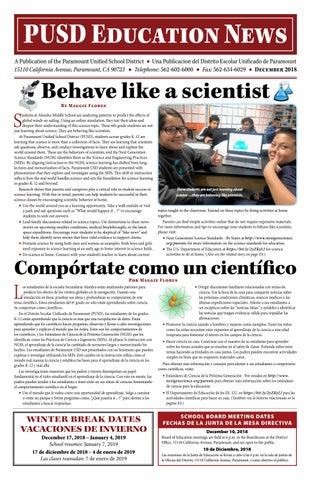
These students are not just learning about science—they are behaving like scientists. topics taught in the classroom. Extend on these topics by doing activities at home together. Parents can find simple activities online that do not require expensive materials. For more information and tips to encourage your students to behave like scientists, please visit: • Next Generation Science Standards - By States at http://www.nextgenscience. org/parents for more information on the science standards for education. • The U.S. Department of Education at https://bit.ly/2yZKyLI for science activities to do at home. (Also see the related story on page E4.)
Compórtate como un científico
L
Por Maggie Flores
os estudiantes de la escuela Secundaria Alondra están analizando patrones para predecir los efectos de los vientos globales en la navegación. Usando una simulación en línea, prueban sus ideas y profundizan su comprensión de este tema científico. Estos estudiantes del 6º grado no solo están aprendiendo sobre ciencia. Se comportan como científicos. En el Distrito Escolar Unificado de Paramount (PUSD), los estudiantes de los grados K-12 están aprendiendo que la ciencia es más que una recopilación de datos. Están aprendiendo que los científicos hacen preguntas, observan y llevan a cabo investigaciones para aprender y explicar el mundo que los rodea. Estos son los comportamientos de los científicos, y los Estándares de Ciencia de la Próxima Generación (NGSS) que los identifican como las Prácticas de Ciencia e Ingeniería (SEPs). Al alinear la instrucción con NGSS, el aprendizaje de la ciencia ha cambiado de sermones largos y memorizando los hechos. Los estudiantes de Paramount USD son presentados con un fenómeno que pueden explorar e investigar utilizando los SEPs. Este cambio en la instrucción refleja cómo el mundo real maneja la ciencia y establece las bases para el aprendizaje de la ciencia en los grados K-12 y más allá. Las investigaciones muestran que los padres y tutores desempeñan un papel fundamental en el éxito estudiantil en el aprendizaje de la ciencia. Con esto en mente, los padres pueden ayudar a los estudiantes a tener éxito en sus clases de ciencias fomentando el comportamiento científico en el hogar. • Use el mundo que le rodea como una oportunidad de aprendizaje. Salga a caminar o visite un parque y forme preguntas como, “¿Qué pasaría si ...?” para alentar a los estudiantes a buscar respuestas.
WINTER BREAK DATES VACACIONES DE INVIERNO December 17, 2018 – January 4, 2019 School resumes: January 7, 2019 17 de diciembre de 2018 – 4 de enero de 2019 Las clases reanudan: 7 de enero de 2019
• Dirigir discusiones familiares relacionadas con temas de
ciencia. Use la hora de la cena para compartir noticias sobre las próximas condiciones climáticas, avances médicos o las últimas expediciones espaciales. Aliente a sus estudiantes a ser escépticos sobre las “noticias falsas” y ayúdeles a identificar las noticias que tengan evidencia válida para respaldar las afirmaciones. • Promover la ciencia usando a hombres y mujeres como ejemplos. Tanto los niños como las niñas necesitan estar expuestos al aprendizaje de la ciencia a una edad temprana para fomentar el interés en los campos de la ciencia.
• Hacer ciencia en casa. Conéctese con el maestro de su estudiante para aprender
sobre los temas actuales que se enseñan en el salón de clases. Extienda sobre estos temas haciendo actividades en casa juntos. Los padres pueden encontrar actividades simples en línea que no requieren materiales caros.
Para obtener más información y consejos para alentar a sus estudiantes a comportarse como científicos, visite:
• Estándares de Ciencia de la Próxima Generación - Por estados en http://www.
nextgenscience.org/parents para obtener más información sobre los estándares de ciencia para la educación.
• El Departamento de Educación de los EE. UU. en https://bit.ly/2yZKyLI para las
actividades científicas para hacer en casa. (También vea la historia relacionada en la página E4.)
SCHOOL BOARD MEETING DATES FECHAS DE LA JUNTA DE LA MESA DIRECTIVA December 10, 2018 Board of Education meetings are held at 6 p.m. in the Boardroom at the District Office, 15110 California Avenue, Paramount, and are open to the public.
10 de Diciembre, 2018 Las reuniones de la Junta de Educación se llevan a cabo a las 6 p.m. en la sala de juntas de la Oficina del Distrito, 15110 California Avenue, Paramount, y están abiertos al público.