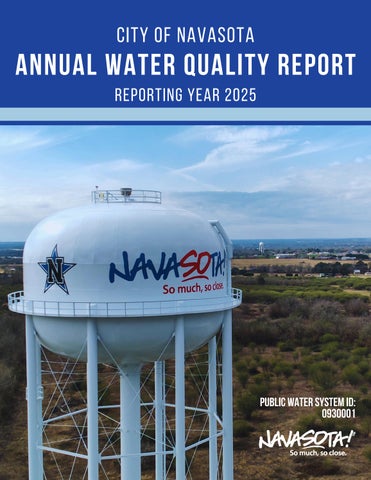
Annual Water Quality Report - Reporting Year 2025

Page 1


city of navasota

water

reporting year 2025
Public Water System ID:
Your Annual Drinking Water Quality Report provides an analysis of recent tests required by the Texas Commission on Environmental Quality (TCEQ) and describes the efforts of the Navasota Water Department to provide you with reliable drinking water through the operation of our municipal water distributionsystem.PublicWatersystemsarerequiredbythe1996SafeDrinkingWaterActAmendments to provide information to their water customers. Navasota's drinking water system is rated “Superior” by the TCEQ and meets all state and federal standards. Navasota Water Department strives to provide its customerswithqualitydrinkingwaterandoutstandingcustomerservice.

Where does my Drinking Water come from?

The City of Navasota water source is groundwater pumped from the Catahoula/Jackson Group Formation,whichislocatedinSouthwestGrimesandBrazosCounties.Wateristhentreatedusingchlorine gasdisinfectionandaerationtoremoveorreduceharmfulcontaminantsthatmaycomefromthesource water.

A Source Water Susceptibility Assessment for our drinking water sources are updated by the Texas Commission on Environmental Quality, and are provided to us each year. The report describes the susceptibility and types of constituents that may come in contact with your drinking water based on human activities and natural conditions The information contained in the assessment will allow us to focusoursourcewaterprotectionstrategies

For more information about your sources of water, please refer to the Source Water Assessment Viewer availableathttp://www.tceq.texas.gov/gis/swaview.

FurtherdetailsmayalsobefoundatDrinkingWaterWatchat:http://tceq.texas.gov/goto/dwvor contactJenniferReyna,UtilitiesDirector,at(936)825-6450.

Public Participation

If you have any questions about this report, please contact:

MatthewJulian,UtilitiesSuperintendent (936)825-6450

mjulian@navasotatxgov

The Navasota City Council meets on the second and fourthMondayofeverymonthat6:00P.M.

The Navasota City Council Chambers is located at Navasota City Hall at 200 E. McAlpine Street. City Council meetings are open to the public and provide anopportunityforresidentstosharetheirconcernson anycityrelatedmatter

Formoreinformation,call(936)825-6475

To learn more about your drinking water, or to request a Water Quality Report, please contact the Utilities Departmentat(936)825-6450.

City Council

JoshFultz,Mayor

JamesHarris,MayorProTem

RobertHemminger,CityManager

NavasotaUtilitiesDepartment

JenniferReyna,UtilitiesDirector

Navasota

Water: At the Source

The sources of drinking water (both tap water and bottled water) include rivers, lakes, streams ponds, reservoirs, springs and wells As water travels over the surface of the land or through the ground, it dissolves naturallyoccurring minerals, and in some cases radioactive material, and can pick up substances resulting from the presence of animals or from human activity Contaminants that may be presentinsourcewaterbeforetreatmentincludemicrobes,inorganiccontaminants,pesticides,herbicides, radioactivecontaminants,andorganicchemicalcontaminants.

Lead/Copper Reporting & Monitoring

If present, elevated levels of lead can cause serious health problems, especially for pregnant women and youngchildren.Leadindrinkingwaterisprimarilyfrommaterialsandcomponentsassociatedwithservice lines and home plumbing. This water supply is responsible for providing high quality drinking water, but cannot control the variety of materials used in plumbing components. When your water has been sitting forseveralhours,youcanminimizethepotentialforleadexposurebyflushingyourtapfor30secondsto2 minutesbeforeusingwaterfordrinkingorcooking.Ifyouareconcernedaboutleadinyourwater,youmay wishtohaveyourwatertested.

Information on lead in drinking water, testing methods, and steps you can take to minimize exposure is availablefromtheSafeDrinkingWaterHotlineat1.800.426.4791oratepa.gov/safewater/lead.

Secondary Constituents

Many constituents (such as calcium, sodium, or iron) which are often found in drinking water, can cause taste,color,andodorproblems.Thetasteandodorconstituentsarecalledsecondaryconstituentsandare regulated by the state of Texas, not the EPA. These constituents are not causes for health concern. Therefore, secondary constituents are not required to be reported in this document, but they may greatly affecttheappearanceandtasteofyourwater

Water Loss Reported to TCEQ

TheTexasLegislaturenowrequiresallretailpublicwatersupplierstofileawaterlossauditreportannually and notify water customers of the results Water loss is water that is produced by the utility for which the utility does not receive revenue A variety of factors contribute to water loss, including meter accuracy, reportedbreaksandleaks,unauthorizedconsumptionandunreportedwaterlosses Inthewaterlossaudit submittedtotheTexasWaterDevelopmentBoardforthetimeperiodofJan-Dec2025,oursystemlostan estimated115,146,343gallonsofwater.

IfyouhaveanyquestionsaboutthewaterlossauditpleasecalltheNavasotaUtilitiesDepartmentat(936) 825-6450.

Special Notice

Youmaybemorevulnerablethanthegeneralpopulationtocertainmicrobialcontaminants,suchas Cryptosporidium,indrinkingwaterInfants,someelderlyorimmune-comprisedsuchasthoseundergoing treatmentforcancer;thosewhohaveundergoneorgantransplants;thosewhoareundergoingtreatment withsteroids;andpeoplewithotherimmunesystemdisorderscanbeparticularlyatriskfrominfections Youshouldseekadviceaboutdrinkingwaterfromyourphysicianorhealthcareprovider.Additional guidelinesforappropriatemeanstolessentheriskofinfectionbyCryptosporidiumareavailablefromthe SafeDrinkingWaterHotlineat1.800.426.4791

Additional Information

Chlorine:SomepeoplewhousewatercontainingchlorineinexcessoftheMRDLcouldexperienceirritating effectstotheireyesandnoseorcouldexperiencestomachdiscomfort

Total Coliform are a group of related bacteria that are (with few exceptions) not harmful to humans A variety of bacteria, parasites, and viruses, known as pathogens, can potential cause health problems if humansingestthem.EPAconsiderstotalcoliformsausefulindicatorofotherpathogensfordrinkingwater. Totalcoliformsareusedtodeterminetheadequacyofwatertreatmentandtheintegrityofthedistribution system.

FecalColiformsandE.coli are bacteria whose presence indicates that the water may be contaminated with human or animal wastes. Microbes in these wastes can cause short-term effects, such as diarrhea, cramps, nausea, headaches, or other symptoms. They may pose a special health risk for infants, young children,andpeoplewithseverelycompromisedimmunesystems.

2025 Annual water quality test results

City of Navasota PWS ID# 0930001

Inorganic Contaminents

Erosionofnaturaldeposits;water additivewhichpromotesstrong teeth;dischargefromfertilizer

Dischargeofdrillingwastes; dischargefrommetalrefineries; erosionofnaturaldeposits

Runofffromfertilizeruse;leaching fromseptictanks,sewage; erosionofnaturaldeposits

Dischargefrompetroleumand metalrefineries;erosionof naturaldeposits;dischargefrom mines

Lead & Copper

Erosionofnaturaldeposits; leachingfromwoodpreservatives; corrosionofhouseholdplumbing systems

Microbial Contaminants

Public Notice Rule Violation

Lead/Copper Rule Revision

Lead/Copper Rule Revision

02/11/2025

02/11/2025

Failedtoissuepublicnoticeorfailedtoprovideacopyof thenoticeandcertificationtothestate Resolution: submittednoticeandcertificationtoTCEQ

LSLInventory-Initial:Failedtonotifycustomersthatthe ServiceLineInventorywasnotsubmittedbeforetheduedate

LSLInventory-Initial:Failedtosendcustomernotificationsof leadservicelinesbeforetheduedate

Coliforms are bacteria that are naturally present in the environment and are used as an indicator that other, potentially harmful, waterborne pathogens may be present or that a potential pathway exists through which contamination may enter the drinking water distribution system. We found coliforms indicating the need to look for potential problems in water treatment or distribution When this occurs, we are required to conduct assessment(s) to identify problems and to correct any problems that were found during these assessments. During the past year we were required to conduct One Level 1 assessment. One Level 1 assessment was completed. In addition, we were required to take One corrective actions and we completed One of these actions

Volatile Organic Contaminants-Regulated Contaminants

Radioactive Contaminants

Secondary and Other Non-Regulated Constituents

naturally occurring element Used in water purification Byproduct of oil field activity.

Secondary and Other Non-Regulated Constituents Contined

Definitions:

Maximum Contaminant Level Goal (MCLG): The level of a contaminant in drinking water below which there is no known or expected risk to health. MCLGs allow for a margin of safety.

Maximum Contaminant Level (MCL): The highest level of a contaminant that is allowed in drinking water. MCLs are set as close to MCLGs as feasible using the best available treatment technology.

Maximum Residual Disinfectant Level Goal (MRDLG): The level of a drinking water disinfectant below which there is no known or expected risk to health. MRDLGs do not reflect the benefits of the use of disinfectants to control microbial contaminants.

Maximum Residual Disinfectant Level (MRDL): The highest level of a disinfectant allowed in drinking water. There is convincing evidence that addition of a disinfectant is necessary for the control of microbial contaminants.

Action Level (AL): The concentration of a contaminant which, if exceeded, triggers treatment or other requirements which a water system must follow.

Abbreviations:

ppm– Parts per Million: Equiv (milligrams per liter (mg/l) One part per million is equivalent to half of an aspirin tablet dissolved in a full bathtub of water (appx 50 gallons)

ppb-Parts per Billion: Equiv. (micrograms per liter (ug/l) One part per billion is equivalent to half of an aspirin table dissolved in 1,000 bathtubs of water (appx. 50,000 gallons).

pCi/L=picocuries per liter (a measure of radioactivity)

mRem/yr = One REM ~ One Roentgen, relates to the absorption of radiation on parts of the body over time.

water conservation tips

Commit to at least one water saving technique each day and over time it will result in saving water. Savings may be minimal, however every drop counts.

You can make a difference.

Water your lawn and outdoor plants early in the morning or late in the evening to reduce evaporation

Use a shut-off nozzle on your outdoor water hose.

Choose native or drought-tolerant plants that require less water.

Add mulch around plants to help retain moisture in the soil.

Repair leaking faucets, toilets, and irrigation systems promptly.

Run dishwashers and washing machines only with full loads.

Adjust sprinklers to water your lawn, not streets or sidewalks.

Turn off the faucet while brushing your teeth or shaving.

Take shorter showers to help reduce water use.

The City of Navasota is committed to providing safe, reliable drinking water. With your help, we can continue protecting this valuable resource for our community now and into the future.

This report covers the period from January 1, 2025 through December 31, 2025 City of Navasota PWS ID# 0930001

Turn static files into dynamic content formats.

Create a flipbook