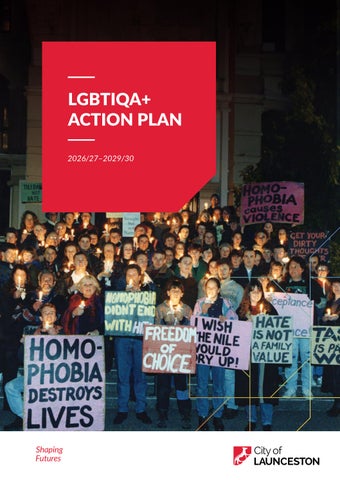
LGBTIQA+ ACTION PLAN 2026/27–2029/30
TABLE OF CONTENTS >
Mayor’s Foreword
3
>
Preface
4
>
LGBTIQA+ Snapshot
7
>
Purpose and Vision
9
>
Alignment
10
>
1. Safety
12
>
2. Health and Wellbeing
14
>
3. Belonging and Inclusion
16
>
4. Voice and Visibility
18
>
Monitoring and Evaluation
20
>
Closing Statement
21
>
Appendix A: Glossary
22
>
Appendix B: Evidence-based contribution
24
>
Endnotes
25
Acknowledgement of Country We acknowledge Tasmanian Aboriginal People as traditional custodians of this land. We pay respect to Elders past and present, as they hold the memories, traditions, culture and hope for generations to come. We recognise and value Aboriginal histories, knowledge and lived experiences and commit to being culturally inclusive and respectful in our working relationships with Aboriginal People.
Recognition of our LGBTIQA+ community City of Launceston acknowledges those amongst the lesbian, gay, bisexual+, trans, queer/questioning, intersex and ace+ communities (LGBTIQA+) who have worked to support the improved health and wellbeing of their peers, children, families, friends, and country. We recognise the communities of which we are a part and we celebrate the extraordinary diversity of people’s bodies, ages, genders, sexualities, and relationships that they represent. Cover image: Launceston gay law reform supporters outside the Albert Hall, August 1994.
APPRECIATION AND AUTHORS
UNDERSTANDING LGBTIQA+
The City of Launceston would like to thank the 1,011 participants and the authors of the research report that preceded this Action Plan, LGBTIQA+ Inclusion in Launceston, and the 600 participants of the Tomorrow Together survey. Together, their generous contributions informed this Action Plan for which we are immeasurably grateful.
Language statement
We would also like to acknowledge that there has been extensive but unrecorded effort over the years that has gone into advancing the rights and lives of LGBTIQA+ people in Launceston. We thank these unnamed people for their commitment to a better Launceston.
The most inclusive, respectful and progressive way to refer to community members who identify as being part of this community, is to use the LGBTIQA+ acronym. This stands for Lesbian, Gay, Bisexual+, Transgender, Intersex Queer/ Questioning and Ace+. The plus sign is an inclusive symbol that refers to other identities that people may use to describe their gender and/or sexuality. (See glossary on page 22 of this document)
Finally, we would like to thank Equality Tasmania and the following authors for their significant contribution to City of Launceston LGBTIQA+ Action Plan 2026-2030: > Rodney Croome (he/him) > Dr Tamara Reynish (she/they) > Joseph McLennan (he/him) > Bradley Cullen (he/him) > Sean McBain (he/him) > Amilie Courtney (she/her) > George Perkins (she/her) > Sacha Rattray (she/her) > Alister Grant > Elizabeth Eyre (she/her) > Rachael Huby (she/her) > Owen Tyson (he/him) > Ali Kemp (she/her)
City of Launceston understands that certain terms, words and acronyms have changed over time. This is due to their sensitive nature within some cultures and communities, as well as the inclusion of other divers sexualities and gender identities.
Intersectionality There are many social identities that a person can use to describe themselves, such as, but not limited to, sexuality, gender, ethnicity, faith, age, disability, socioeconomic and/or residency status. Intersectionality describes how multiple social identities can overlap to create diverse experiences of discrimination and inequity.
Use of pronouns Traditionally the most common way to refer to a person’s gender identity has been to use the pronouns He/Him or She/Her. Over time, more gender inclusive terms such as They/ Them and Xe/Xer have been welcomed to better describe how people would prefer to be recognised. This encourages respect and allows individuals to affirm their gender identity. (See glossary on page 22 of this document)
Content warning Readers should be advised that this action plan contains statistics and references related to homophobia, biphobia, transphobia, and violence against the LGBTIQA+ community.
1
MAYOR’S FOREWORD
3
At the City of Launceston, we want everyone to feel safe, respected, valued and, importantly, that they belong. Launceston is stronger because of the people who call it home. Our communities are an important part of the social, cultural, creative and economic fabric of our city and contribute enormously to making Launceston the vibrant, welcoming and connected place it is. Our LGBTIQA+ Action Plan 2026/27–2029/30 builds on the progress we’ve already made while recognising there is always more we can do. Importantly, this isn’t a plan that has been developed in isolation. It has been shaped by the people it represents, through conversations with community members, service providers, advocates and Council staff. I want to genuinely thank everyone who shared their experiences, ideas and aspirations throughout this process, particularly the members of our LGBTIQA+ Working Group. Their time, honesty and commitment have helped create a practical plan that reflects our community and gives us a clear path forward. The actions within this Plan reach across Council, from helping to inform our policies, services and facilities to our events, communications, partnerships and workplace. Because creating a genuinely inclusive city isn’t the job of one person, one group or one organisation. It’s something we all have a role in.
Image: Launceston Town Hall vigil following the Pulse Night Club massacre in Orlando, Florida, June 22 2016.
As Mayor, I’m proud to present the City of Launceston LGBTIQA+ Action Plan 2026/27– 2029/30 and continue our commitment to a city where everyone has the opportunity to participate, contribute and thrive. We won’t all have the same experiences, backgrounds or stories, and we shouldn’t. That’s part of what makes Launceston stronger. This is about continuing to build a city where everyone can feel that they belong.
Mayor Matthew Garwood
4
PREFACE The lives and aspirations of LGBTIQA+ people have been woven into the fabric of Launceston from the beginning. The authorities reserved their most strident loathing for convict same-sex partners who challenged their authority, like Ellen Scott who led a riot at the Launceston Female Factory protesting against her female partner’s sentence to solitary confinement. The anti-transportation movement, which arose in Launceston, used the spectre of “unnatural vice” among the convicts to discredit the entire convict system, claiming that Tasmania would be forever known as Sodom’s Isle if more convicts were sent. The association between homosexuality, subversion and the convict stain resulted in almost a century and a half of persecution against LGBTIQA+ people, including harsh penalties widely enforced. Take Launceston resident Bert:
“In 1958 I was 21 and living with another man of the same age. The police came to the house and asked who lived there. When we said we did, they asked where we slept and we pointed to the only bed in the house. We were taken to the police station, interviewed and charged with gross indecency. I pleaded guilty. I had no legal representation. The case was over in 10 minutes. I got three years.” Some LGBTIQA+ people were accepted. In the 1920s, best-selling novelist Marie BjelkePetersen and her partner, Sylvia Mills, often stayed in Mole Creek as they searched the western tiers for Marie’s next novel’s setting. Tasmanian-born star of London’s West End and gay man, Max Oldaker, was a much-loved drama teacher in Launceston after returning in 1959.
But stigma still ran deep and the seeds of resistance planted in the 1840s erupted in 1976 with Launceston becoming, for a few months at least, the nation’s capital of LGBTIQA+ visibility. One of the Australia’s first homosexual law reform groups was formed in Launceston in March. There was a pioneering lesbian conference at Derby in April which was opposed by some community leaders but supported by Derby residents. In June a Launceston doctor became the first Tasmanian to publicly and voluntarily declare himself to be gay; his name, Bob Brown. Prejudice fought back. The statewide campaign to decriminalise homosexuality in the 1990s saw the formation of anti-gay groups in Launceston, the posting of large billboards declaring homosexuality a sin, the firebombing of the home of two lesbian activists and the convening of an ex-gay conference in the city. But public opinion was shifting rapidly and dramatically. Attendance at an anti-gay rally in the Albert Hall was matched by the number of people rallying outside in support of gay law reform. The decriminalisation of homosexuality and cross-dressing in the late 1990s – campaigns in which Launcestonians like Nick Toonen and Stephanie Reid played critical roles – triggered new anti-discrimination, relationship and gender recognition laws that were the best in the nation. When the nation voted for marriage equality in 2017 Tasmania and Launceston returned Yes votes above the national average. In the same tradition of acceptance and inclusion, City of Launceston unanimously passed a motion in June 2024 supporting the LGBTIQA+ community.
5
Put forward to Cr Andrea Dawkins and spoken to by community members, Eddie Kidd, Joe McLennan and Bradley Cullen, the motion called for a survey of the LGBTIQA+ community and an action plan based on that survey.
Parts of Launceston’s LGBTIQA+ history are dark and difficult. But that history also shows how discrimination can be successfully challenged when Launcestonians stand together in the name of equality and acceptance.
Over 600 LGBTIQA+ people and allies responded to the survey making it the largest local survey of its kind in Tasmania.
Congratulations to everyone who has made this Action Plan possible. Our shared task now is to turn its promise into reality.
The survey found there is still a legacy of stigma and discrimination from the grimmer parts of the City’s LGBTIQA+ past. Three quarters of the respondents have felt harassed, discriminated against or unsafe in Launceston. Three in four felt the need to hide who they are sometimes, often or always. Nine in ten said support services are sometimes, rarely or never adequate. But the survey also showed many respondents have a strong connection to Launceston and achievable ideas about how it can be more accepting. Those ideas included training for Council staff, Council support for LGBTIQA+ community events, Council advocacy for improved mental health services, an anti-stigma campaign, awareness programs for local business, support for local LGBTIQA+ cultural and history projects and ongoing consultation with the LGBTIQA+ community. These and other survey findings have been incorporated in Launceston’s first LGBTIQA+ Action Plan. The Plan is more than just a statement of intent. It includes measures of success and a commitment to monitoring and evaluation. It is Tasmania’s gold standard when it comes to reducing discrimination against LGBTIQA+ people and fostering inclusion.
Rodney Croome AM Long time LGBTIQA+ equality advocate Founder and national director of Australian Marriage Equality Equality Tasmania Campaign Director Tasmanian Australian of the Year, 2015
Images: Launceston’s long history of LGBTIQA+ advocacy.
7
LGBTIQA+ SNAPSHOT
1 in 3
LGBTIQA+ Tasmanians have experienced abuse at home.
34%
have experienced verbal abuse or threat of violence at school.
LGBTIQA+ Tasmanians report poorer health and life satisfaction than the general population
As a result of discrimination and stigma,
62.2% of LGBTIQA+
57.2%
compared to of LGBTIQA+ Australians and 13% of the general population.
Tasmanians have higher rates of psychological distress,
97%
have been told their sexuality or gender identity can be changed.
We know that...
LGBTIQA+ Tasmanians are more likely to have lower incomes and experience housing stress.
Community connection is a key protective factor for mental health and wellbeing.
LGBTIQA+ Tasmanians are less likely to feel safe living in Tasmania compared to nonLGBTIQA+Tasmanians.
Positive visibility and connection contribute to improved wellbeing and resilience.
Public acceptance and social support enhance resilience. Learn more on page 24.
9
PURPOSE AND VISION Purpose The City of Launceston LGBTIQA+ Action Plan aims to celebrate and support the diversity, resilience and strength of LGBTIQA+ people in Launceston. It aims to enhance safety, visibility, inclusion, prosperity and equitable access to services, participation and wellbeing, fostering a community where all people can thrive and belong. It also aims to reduce stigma, discrimination and psychological distress experienced by LGBTIQA+ people.
With an estimated 4.7% of Tasmanians identifying as LGBTIQA+ — slightly above the national average1 — local government has both an opportunity and responsibility to ensure services, spaces and policies reflect and support our community, which includes: > Reducing discrimination through inclusive policy and practice. > Fostering belonging and connection at a local level. > Enhancing visibility and representation in civic life.
The City of Launceston LGBTIQA+ Action Plan aims to develop and maintain a workplace culture for elected representatives and staff of continuous development and accountability, where performance is actively monitored, outcomes are transparently reported and improvements are embedded to strengthen safety, inclusion and equity for LGBTIQA+ people.
> Partnering with community organisations to deliver targeted initiatives.
Local government role
A City of Launceston where LGBTIQA+ people thrive with safety, health, visibility and value and are empowered to live in dignity, belonging and pride.
Local government plays a critical role in shaping inclusive, safe and connected communities. As the level of government closest to community, the City of Launceston influences: > Public spaces and infrastructure (parks, facilities, urban design). > Community services and programs (recreation, cultural services). > Local leadership and civic representation. > Community partnerships and funding. > Social inclusion and place-making.
Image: Aerial view of Launceston, north Tasmania.
> Inviting opportunities for community education that promote inclusion and wellbeing.
Vision
We envision a Launceston where every person, regardless of sexual orientation, gender identity, gender expression, or sex characteristic feels recognised, respected and supported. We believe that embracing diversity strengthens our community and that equitable access, inclusion and opportunity are essential to creating a healthy and connected City for all.
1010
ALIGNMENT Alignment with City of Launceston Strategic Plan The City of Launceston LGBTIQA+ Action Plan directly supports the three core pillars of the City of Launceston Strategic Plan 2025-2035 — Prosperity, Place and People — and translates these pillars into targeted actions that improve inclusion, participation and wellbeing outcomes for LGBTIQA+ Launcestonians.
Prosperity
People
> Supports workplace inclusion, helping attract and retain a diverse and skilled workforce.
> Promotes safety, inclusion and belonging for LGBTIQA+ residents.
> Enhances Launceston’s reputation as an inclusive and progressive regional city.
> Improves access to services, programs and community spaces through inclusive design and delivery.
> Encourages participation in the local economy, including events, tourism and business engagement. > Aligns with broader social and economic resilience by fostering connected, empowered communities. > Reduces the cost to the Launceston community of mental health risk and other disadvantages arising from discrimination and stigma.
> Supports positive mental health, social connection and community participation outcomes. > Recognises and responds to intersectionality, ensuring those experiencing multiple forms of disadvantage are not left behind. > Promotes the importance of diversity as it relates to sexual orientation, gender identity, gender expression, or sex characteristics.
Place > Contributes to welcoming and inclusive public spaces where diversity is visible and respected. > Supports inclusive events and activations (e.g. Pride), enhancing community connection and use of public places. > Embeds inclusive design principles across facilities, infrastructure and service delivery. > Strengthens perceptions of Launceston as a safe and inclusive city. > Increases LGBTIQA+ people’s sense of connection and belonging to Launceston’s community, history and place.
Image: Launceston grandmothers support drag story time, Launceston, February 2023.
11
Alignment with Our Inclusive Island: Tasmania’s LGBTIQA+ Strategy 2025-2030 The City of Launceston LGBTIQA+ Action Plan aligns with the Tasmanian Government Our Inclusive Island: Tasmania’s LGBTIQA+ Strategy 2025-2030, which sets a statewide vision for a Tasmania where LGBTIQA+ people are safe, healthy, visible and valued, and experience belonging and inclusion. Both the State Strategy and this Action Plan are grounded in a commitment to: > Reducing stigma, discrimination and minority stress > Improving health and wellbeing outcomes > Strengthening inclusion, belonging and community connection > Increasing visibility and representation of LGBTIQA+ people > Promoting cultural competence
Strategic Focus Areas The City of Launceston LGBTIQA+ Action Plan has adopted the core focus areas of Our Inclusive Island: Tasmania’s LGBTIQA+ Strategy and tailored them to reflect a local focus. The strategic focus areas of this Action Plan are: > 1. Safety > 2. Health and Wellbeing > 3. Belonging and Inclusivity > 4. Voice and Visibility
Implementation City of Launceston elected representatives and staff will implement this Action Plan and its strategic focus areas. A Section 24 Council Inclusion Advisory Committee with intersectional representation will be created, with an LGBTIQA+ working group to inform the Committee and to support the implementation of the Action Plan. The Inclusion Advisory Committee will provide advice to Council, represent community perspectives, and support self-determined and prescribed initiatives that promote safety and inclusion. Three main initiatives of the LGBTIQA+ Working Group that impact all strategic focus areas are: > Develop a communications and language style guide. > Develop a plan to recognise significant national dates and events. > Develop and deliver LGBTIQA+ Community Surveys to assess the success of the Action Plan, including but not limited to assessments of perceptions of safety; experiences of harassment, bullying, or exclusion; participation by allies and LGBTIQA+ people alike in events, public spaces and programs; general feedback and satisfaction; increased self-reported wellbeing; and increased sense of belonging.
Timeline Each strategic focus area consists of Priority Actions that describe what will be achieved, and Measures that indicate how success will be assessed. To ensure the Action Plan is addressed in a measurable and accountable manner, timelines have been assigned to all Priority Actions. Each action has been assigned a two-phase timeline spanning the total timeline of the Action Plan. Actions identified as Phase 1 will be completed during the 2026-2027/2028-2029 financial years and items identified as Phase 2 will be completed in the 2028-2029/2029-2030 financial years.
12
1. SAFETY Outcome: The elimination of discrimination, violence and stigma. LGBTIQA+ people are safe and feel safe in public spaces, services and community life. Priority actions 1. Safety
1.a
1.b
1.c
1.d
Phase 1
2026/27–2027/28
Phase 2
2028/29–2029/30
Integrate LGBTIQA+ cultural competency as a core Capability in the City Of Launceston Capability Framework and Workforce Management Plan (People Strategy) both under development for 2026/27
–
Make inclusion a formal requirement when people or organisations use Council spaces or services by establishing minimum requirements for safety standards in events, grants, programs, leases, licences and hire agreements.
–
Develop and clearly communicate a zero-tolerance policy for discrimination, harassment, or bullying in public spaces, in Council facilities, and at Council events and post visible signage (i.e., “This is an inclusive space” or “All people are welcome here”) and codes of conduct (i.e., This is a discrimination-free zone” or “Please treat everyone with respect”).
–
Ensure Council-managed venues create and communicate clear protocols for addressing harassment and discrimination, including discrimination against LGBTIQA+ people.
–
1.e
Strengthen partnerships with Tasmania Police; government and non-government agencies, community organisations, and local businesses to enhance knowledge sharing, build capability and deliver coordinated responses to safety and inclusion.
1.f
Support community groups and nongovernment agencies to adopt their own action plans and inclusivity initiatives.
–
13
Measures 1.i.
Infrastructure improvements including increases in inclusive amenities and facilities and display of inclusion and safety signage.
1.ii.
Evidence of inclusive language in forms and advertising.
1.iii.
LGBTIQA+ cultural competency integrated into the City of Launceston Capability Framework and Workforce Management Plan (People Strategy).
1.iv.
Number of elected representatives, staff, volunteers and grant recipients completing LGBTIQA+ training.
1.v.
Clear customer codes of conduct developed and displayed in all Council public facilities.
Image: Rainbow chalking, Civic Square, Launceston, 2014.
14
2. HEALTH AND WELLBEING Outcome: LGBTIQA+ people have equitable access to inclusive supports and services and experience improved wellbeing. Priority actions
2. Health and Wellbeing
2.a
Phase 1
2026/27–2027/28
Phase 2
2028/29–2029/30
Develop and promote an online and advertised service directory that includes relevant and inclusive social, health and legal services and ally services.
–
2.b
Partner with other agencies to develop and facilitate a LGBTIQA+ youth group.
–
2.c
Advocate for improved services and support for young LGBTIQA+ people with family and housing issues.
2.d
Review customer service policies, forms and communications for inclusive language.
2.e
Ensure recreation programs, sports facilities and community centres are welcoming and accessible to people of diverse genders and sexualities.
2.f
Provide elected representatives and staff with training and resources to confidently support LGBTIQA+ community members.
2.g
Collaborate with and advocate to the Tasmanian Department of Health and State Government to strengthen mental health support for LGBTIQA+ communities through targeted programs, community grant opportunities, dedicated services and increased funding for local mental health professionals trained in LGBTIQA+-inclusive care.
2.h
Fund, develop and implement an anti-stigma public campaign that is ongoing and linked to key LGBTIQA+ dates and events.
–
–
–
15
Measures 2.i.
Increased participation in inclusive programs.
2.ii.
Improved satisfaction with Council services, as identified through a Community Survey conducted towards the end of the Action Plan.
2.iii.
Improved awareness and inclusivity measures in clubs and associations. Policies are in place to ensure that users of Council facilities have inclusive membership and conditions of participation.
2.iv.
Pre- and post-staff training confidence surveys.
2.v.
Demonstrated inclusivity in events, grants and service delivery.
Image: Dr Ash Russell from Equality Tasmania speaks at Tas Pride breakfast, at the Launceston General Hospital, February 2025.
16
3. BELONGING AND INCLUSION Outcome: LGBTIQA+ people experience inclusion, connection and equal participation in community life. Priority actions
3. Belonging and Inclusion
Phase 1
2026/27–2027/28
3.a
Strengthen partnerships with LGBTIQA+ organisations such as Working It Out, PFLAG Tasmania, Equality Tasmania and QLife.
3.b
Host and support inclusive LGBTIQA+ events and activities.
3.c
Partner with community to support and hold a Pride Parade and local Pride events during TasPride month (February), including financial and in-kind support and demonstrated leadership through encouraging elected representatives and staff attendance and participation.
–
Investigate the feasibility of developing a Pride Hub, a dedicated space that offers supports, resources and connection for LGBTIQA+ people.
–
3.d
3.e
Phase 2
2028/29–2029/30
Create a training program and brand campaign for local businesses and organisations that incentivises becoming a recognised City of Launceston Inclusive Business.
–
3.f
Embed ABS Standards for LGBTIQA+ data collection across all City of Launceston databases.
–
3.g
Embed LGBTIQA+ consultation in all City of Launceston surveys and community engagement.
–
17
Measures 3.i.
Increased sense of belonging indicated through survey data.
3.ii.
Increase in number and diversity of events and partnerships.
3.iii.
Feasibility of a Pride Hub reported to Advisory Group.
3.iv.
Active and engaged Advisory Group.
3.v.
Positive uptake in the City of Launceston Inclusive Business campaign.
3.vi.
Implementation of Pride Parade and events.
3.vii.
ABS standards implemented.
Image: The Fruity Bits float in the Launceston Christmas Pageant, 2002.
18
4. VOICE AND VISIBILITY Outcome: The elimination of discrimination, violence and stigma. LGBTIQA+ people are safe and feel safe in public spaces, services and community life. Priority actions 4. Voice and Visibility
4.a
Establish a Section 24 Council LGBTIQA+ Advisory Group with intersectional representation (see the Implementation section for a list of initiatives).
4.b
Establish a co-design approach for policies, procedures and initiatives that complement the LGBTIQA+ Advisory Committee.
4.c
As City of Launceston policies and programs are reviewed, ensure LGBTIQA+ people and needs are represented.
4.d
Demonstrate Council’s commitment to diversity, equity and inclusion through visible representation of LGBTIQA+ communities, including rainbow flags, inclusive signage and displayed charters or statements in Council facilities and public spaces.
4.e
Phase 1
2026/27–2027/28
Develop a permanent, visible LGBTIQA+ history project such as a Pride mural, history walk, timeline, film festival, mural or Rainbow crosswalk near City Hall.
Phase 2
2028/29–2029/30
–
–
–
4.f
Co-design with community a local commemorative day linked to Launceston’s LGBTIQA+ history.
–
4.g
Embed representation and storytelling into Council communications.
–
4.h
Council to demonstrate leadership through representation at major LGBTIQA+ events.
4.i
Work with Tourism partners to present Launceston as a safe and welcoming destination.
–
19
Priority actions 4. Voice and Visibility
Phase 1
2026/27–2027/28
Phase 2
2028/29–2029/30
4.j
Ensure that QVMAG programming and collections continue to be inclusive and representative of the LGBTIQA+ community and ensure that LGBTIQA+ artists and cultural sector practitioners are supported in accessing research and practice opportunities in their fields.
4.k
Investigate interest in an LGBTIQA+ staff network.
–
4.l
Gender-inclusive signage for gender-neutral facilities.
–
Measures 4.i.
Delivery of visibility initiatives.
4.ii.
Community feedback on inclusion and recognition.
4.iii.
Evidence of representation and co-designed initiatives and programs.
4.iv.
Feedback through the Visitor Survey.
Image: The Intersex-Inclusive Progress Pride flag on display, Brisbane Street Mall.
20
MONITORING AND EVALUATION OF THIS ACTION PLAN Outcome: A culture of continuous development and accountability to strengthen safety, inclusion and equity for LGBTIQA+ people. Priority actions
Monitoring and Evaluation
Phase 1
2026/27–2027/28
Phase 2
2028/29–2029/30
Annual reporting against the strategic focus areas, actions, measures, and phases of delivery in the Action Plan to Council and community through the Connections and Liveability Networks Quarterly Reporting. Mid-term review of this Action Plan. Ongoing community engagement. Indicators aligned to safety, wellbeing, participation and inclusion. Council publicly and consistently demonstrates that inclusion and safety for LGBTIQA+ people is a priority for the organisation. Inclusive hiring and recruitment practices.
–
CLOSING STATEMENT Through this Action Plan, the City of Launceston will translate statewide commitment into local action, creating a city where LGBTIQA+ people are safe, supported, visible and valued in everyday community life. The success of this Action Plan depends on all of us. We invite every member of our community to contribute to a culture of inclusion, challenge discrimination where it exists and help create a place where LGBTIQA+ people can flourish and feel a genuine sense of belonging.
22
APPENDIX A:
GLOSSARY Language evolves and changes and can be open to interpretation. The definitions in this glossary are a guide and are neither definitive nor exhaustive. This glossary may be useful as a broader community resource. ABS Standards: The standardised collection and dissemination of data by the Australian Bureau of Statistics relating to sex, gender, variations of sex characteristics and sexual orientation to improve the quality, consistency and comparability of data across Australia. Ally: A person who may or may not be LGBTIQA+ and who actively supports, advocates for, and stands in solidarity with all LGBTIQA+ people. Asexual (Ace): A person who experiences little or no sexual attraction to others. Asexuality exists on a spectrum. Bisexual (Bi): A person who is attracted to more than one gender. Cisgender (Cis): A person whose gender identity aligns with the sex assigned to them at birth. Belonging: Being accepted and valued for who you are, without the pressure to conform or shed parts of your authentic self. Co-Design: A collaborative approach where services or policies are developed in partnership with the people they affect, ensuring their lived experiences shape inclusive and effective outcomes. Cultural Competence: The ability to understand, respect, and effectively interact with people from diverse backgrounds, cultures and identities. Discrimination: Unfair or unequal treatment of a person or group based on personal characteristics, attributes, or aspect of their identity, such as age, disability, race, religion, sexual orientation, gender identity, or sex characteristics.
Diversity: The presence and valuing of a wide range of identities, backgrounds and lived experiences, including those within LGBTIQA+ communities. Gay: A person who is attracted to people of the same gender. Often used to describe men but can be applied more broadly to people of other genders. Gender: A social and cultural concept relating to a person’s identity, roles, behaviours and expectations associated with being male, female, non-binary, or another gender. Gender Expression: How a person publicly expresses their gender, including through behaviour, clothing, voice, appearance, or other outward characteristics. Gender Identity: A person’s deeply felt internal sense of their gender (e.g. male, female, nonbinary, gender diverse) regardless of the various culturally and socially constructed roles, behaviours, expressions, and identities; how we see ourselves internally, and how we present ourselves. Gender Diverse: An umbrella term for people whose gender identity differs from what is typically expected based on their sex assigned at birth. Heterosexual (Straight): A person who is attracted to people of a different gender. Inclusion: The practice of creating environments where all people feel respected, valued, safe and able to participate fully. Intersex: People with innate variations in sex characteristics (such as chromosomes, hormones or anatomy) that do not fit typical definitions of male or female.
Intersectionality: The way various aspects of a person’s identity (e.g. gender, sexuality, race, disability, socio-economic status) combine and shape their experiences of advantage or disadvantage, inclusion, privilege and access to opportunities. Lesbian: A woman who is attracted to other women. LGBTIQA+: The State-Government standard acronym for Lesbian, Gay, Bisexual, Transgender, Intersex, Queer/Questioning, Asexual, with the “+” recognising other diverse sexual orientations, gender identities, gender expressions, and sex characteristics. Also commonly referred to as Rainbow Communities.
Questioning: A person who is exploring or unsure about their sexual orientation, gender identity or both, and who may be in the process of developing or affirming their identity. Rainbow Communities: A collective term for people with diverse sexual orientations, gender identities, gender expressions and sex characteristics, including people who are LGBTIQA+, as well as their families, allies, and communities. Rainbow Flag: A symbol of LGBTIQA+ pride, diversity, inclusion, and community, represented by multiple colours that reflect the diversity of people, identities, and experiences within rainbow communities.
Minority Stress: The psychological strain that people in a stigmatised group experience based on discrimination or disadvantage imposed by external systems or society.
Sex characteristics: Physical, hormonal and genetic features related to sex. These characteristics vary naturally across people, including those with intersex variations (See also Intersex).
Non-binary: A term describing gender identities that sit outside the binary of male and female.
Sexual Orientation: A person’s emotional, romantic and/or sexual attraction to other people.
Pansexual: Sexual, romantic, or emotional attraction to any person, regardless of that person’s gender, sex, or sexuality.
Sexuality: A broad term encompassing a person’s sexual orientation, attractions, relationships and experiences.
Pride: A term that reflects both a sense of selfaffirmation, dignity and equality for LGBTIQA+ people, and the public celebration of LGBTIQA+ communities, histories and contributions. Pride events and initiatives promote visibility, inclusion and community connection. Pride is an antidote to the shame imposed on many LGBTIQA+ people.
Staff: A broad term for all Launceston City Council executive leaders, managers and professional and organisational staff.
Pride Flag: Any flag that represents and celebrates a particular LGBTIQA+ identity, community, or the broader LGBTIQA+ population.
Transgender (Trans): A person whose gender identity differs from the sex they were assigned at birth.
Pronouns: Words used to refer to a person in place of their name (e.g. she/her, he/him, they/them, or other pronouns). Sharing your pronouns and using another’s personal pronouns is a sign of respect.
Violence: Any behaviour that causes, or is intended to cause, physical, sexual, psychological, emotional, or financial harm to another person.
Prosperity: The absence of disadvantages, and the state of thriving and having equal opportunities. Queer: An umbrella term used by some people to describe diverse sexual orientations and gender identities. While reclaimed by many, it should be used respectfully and in context.
Stigma: Negative attitudes, beliefs, or stereotypes directed towards a person or group because of a particular characteristic or identity.
Visibility: The extent to which LGBTIQA+ people, issues and contributions are recognised and represented in community life.
23
24
APPENDIX B:
EVIDENCE-BASED CONTRIBUTION The City of Launceston LGBTIQA+ Action Plan is primarily informed by 600 responses to a survey run through Council’s Tomorrow Together platform2 and by 1,011 responses to the research project on LGBTIQA+ Inclusion in Launceston.3 Other research findings that informed this Action Plan: > LGBTIQA+ Tasmanians report poorer health and life satisfaction than the general population.4 > 1 in 3 LGBTIQA+ Tasmanians have experienced abuse at home.5 > 34% have experienced verbal abuse or threat of violence at school.6 > 97% have been told their sexuality or gender identity is a pathology that can be changed.7 > LGBTIQA+ Tasmanians are less likely to feel they had friends or family to rely on and were less likely to feel safe living in Tasmania compared to non-LGBTIQA+ respondents.8 > LGBTIQA+ Tasmanians are more likely to have lower incomes, work casually or be unemployed, rent rather than own their homes, and experience housing stress.9 > As a result of discrimination and stigma, 62.2% of LGBTIQA+ Tasmanians have higher rates of psychological distress compared to 57.2% of LGBTIQA+ Australians and 13% of the general population.10
> 32.7% of LGBTIQA Tasmanians aged 14– 21 have attempted suicide at some time in their lives compared to 25.6% among the same cohort among LGBTIQA+ Australians and 5.3% among the general population.11 > In rural Tasmania almost half of all participants had attempted suicide in their lifetime, and just over a fifth had selfharmed. Two-thirds of the sample had high/very high psychological distress.12 > Regional communities can experience greater isolation and fewer support services.13 > Many LGBTIQA+ people report low levels of acceptance in public and service environments.14 > Public acceptance and social support enhance resilience.15 > Community connection is a key protective factor for mental health and wellbeing.16 > Positive visibility and connection contribute to improved wellbeing and resilience.17
ENDNOTES 1
Australian Bureau of Statistics. (2024). Estimates and characteristics of LGBTI+ populations in Australia, 2022.
2
LGBTQIA+ Community Survey, Tomorrow Together Launceston, n.d. https://tomorrowtogetherlaunceston.com.au/lgbtqia-community-survey
3
Asquith, N. L., Mason, R., & Barnes, A. (2023). LGBTIQA+ Inclusion in Launceston. City of Launceston.
4
Grant, R. (2021). What wellbeing means for LGBTIQ Tasmanians. Tasmania Project, Institute for Social Change, University of Tasmania.
5
Dwyer, A., Grant, R., Mason, R., & Barnes, A. (2021). Just Listen Properly, Like With Intent: LGBTIQ+ Tasmanians – Telling Us the Story, University of Tasmania.
6
Telling Us the Story, UTAS, 2021.
7
Telling Us the Story, UTAS, 2021.
8
Telling Us the Story, UTAS, 2021.
9
Telling Us the Story, UTAS, 2021.
10 Reynish T, Hoang H, Bridgman H, Nic Giolla Easpaig B. (2023). Psychological Distress, Resilience, and Help-Seeking Experiences of LGBTIQA+ People in Rural Australia. 11 Hill et al., (2021). Writing Themselves In 4, La Trobe University. 12 Psychological Distress, Resilience, and Help-Seeking Experiences of LGBTIQA+ People in Rural Australia, 2023. 13 Brianna Morris-Grant. (2025). Australia’s LGBTQIA+ youth report physical, verbal assault — but also queer joy. 14 Australian Institute of Health and Welfare. (2026). LGBTIQ+ Australians: Suicidal thoughts and behaviours and self-harm. 15 Psychological Distress, Resilience, and Help-Seeking Experiences of LGBTIQA+ People in Rural Australia, 2023. 16 LGBTIQ+ Health Australia. (2024). LGBTQA+ Mental Health and Suicidality: State and Territory-based briefing papers. 17 LGBTQA+ Mental Health and Suicidality: State and Territory-based briefing papers, 2024.
25