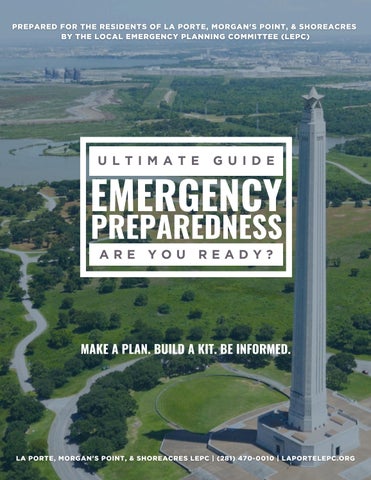
PREPARED FOR THE RESIDENTS OF LA PORTE, MORGAN'S POINT, & SHOREACRES BY THE LOCAL EMERGENCY PLANNING COMMITTEE (LEPC)
ULTIMATE
GUIDE
EMERGENCY
PREPAREDNESS ARE
YOU
READY?
MAKE A PLAN. BUILD A KIT. BE INFORMED.
LA PORTE, MORGAN'S POINT, & SHOREACRES LEPC | (281) 470-0010 | LAPORTELEPC.ORG
TABLE OF CONTENTS GET INFORMED! 02
TABLE OF CONTENTS
03
MESSAGE FROM THE MAYOR
03
MESSAGE FROM THE COORDINATOR
04
ABOUT THE LEPC
05
CHEMICAL EMERGENCIES
06
STAY CONNECTED
07
OUTDOOR WARNING SIRENS
08
HURRICANE PREPAREDNES
10
FLOOD PREPAREDNESS
11
FAMILY DISASTER PLAN
12
EMERGENCY SUPPLY KIT
13
VULNERABLE POPULATIONS
14
PREPARE YOUR HOME
15
AFTER THE STORM
PAGE 2
PUBLIC SAFETY. PUBLIC TRUST.
The City of La Porte is a thriving community, and it’s my priority to make sure we’re ready— no matter what comes our way. We’ve weathered storms, industrial emergencies, and all kinds of tough situations before— and we’ve always come through stronger. That strength comes not just from our city’s planning, but from the way our residents step up and look out for one another. We’re working hard every day to make sure La Porte is ready for whatever lies ahead. And I know that, together, we can continue to grow a community built on resilience, community spirit, and care for our neighbors. Thank you for your trust, your support, and your heart for this city. Let’s keep moving forward—and keep making La Porte a place we’re all proud to call home.
Rick Helton MAYOR, CITY OF LA PORTE
Preparedness isn’t just a plan, it’s peace of mind. By reviewing this guide, you’re taking a powerful step to protect your loved ones and strengthen our community. We all face risks, from hurricanes to industrial incidents, but we face them together. This guide gives you the tools to stay informed, plan, and respond confidently when it matters most. Prepared communities are resilient communities. Know that we remain committed to your safety and stand ready to respond when emergencies arise. Thank you for helping to keep our community safe. Be Ready. Stay Ready!
Johnny Morales EMERGENCY MANAGEMENT COORDINATOR
PAGE 3
ABOUT THE LEPC
LOCAL EMERGENCY PLANNING COMMITTEE The La Porte, Morgan’s Point, and Shoreacres Local Emergency Planning Committee (LEPC) is made up of local industry, government, businesses, non-profit organizations, citizens, and La Porte ISD. The LEPC provides educational outreach to the community by participating in local events. Partnering with La Porte ISD each year, the LEPC sponsors the Wally Wise elementary school program, a city-wide Shelter-in-Place drill, the annual La Porte Health & Safety Fair, and other preparedness activities. The LEPC works closely with La Porte ISD to ensure the safety of our teachers and students in the event of a chemical emergency. Each year, the LEPC provides Shelter-in-Place training for La Porte ISD's new teachers and auxiliary staff. In addition to educational programs, the LEPC has provided each school with Shelter-in-place kits and emergency alert beacons that allow for immediate notification in the event of a chemical emergency. The LEPC's goal is to work with the community to ensure the preparedness and safety of all residents and visitors to our area. If you would like to request additional materials about the LEPC, contact (281) 470-0010 or visit laportelepc.org. The LEPC meets on the second Thursday of each month at 11:00 a.m., with meeting locations rotating throughout the City of La Porte. Please visit LaPorteLEPC.org to confirm the location of the next meeting. Meetings are not held in June or December. Community members are encouraged to attend.
SHELTER-IN-PLACE STEPS In the event of a chemical incident that requires you to Shelter-in-Place: 1. Go Inside. Close all doors and windows. Turn off the A/C or heating systems. 2. Stay Connected. The City will communicate emergency information via phone, social media, website, local media, and the outdoor warning sirens. 3. Follow instructions from local officials.
PAGE 4
DURING A CHEMICAL EMERGENCY La Porte is home to many industrial facilities that produce and/or use various chemicals each day. Chemicals are transported on our roadways, in pipelines, and in railcars on a daily basis. As a result, there is always a risk that a chemical incident could occur in our community. Therefore, it is critical that you and your family know what actions to take during a chemical emergency. The Cities of La Porte, Morgan’s Point, and Shoreacres will notify residents and businesses of a chemical emergency that requires you to go inside and wait for further instructions. Residents are alerted to Shelter-in-Place (go inside) by the city's phone notification system and Outdoor Warning Sirens, which sound a “whoop, whoop” tone. The Outdoor Warning Sirens are tested EVERY Saturday at NOON. If you hear the City’s sirens at any other time, you should Shelter-in-Place and seek additional information. Residents will be given updated information via your City’s phone notification system, website, social media, and local media. Residents of La Porte can register multiple numbers and email addresses in the system by visiting WWW.AlertLP.COM.
IDENTIFY A SAFE ROOM Plan ahead by identifying a safe place where family members or coworkers could gather in the event of a chemical emergency, preferably in an interior room with no doors or windows. Make sure everyone knows the location. When you hear the sirens, go inside immediately and close all doors and windows. Turn off your A/C or heating systems, and bring pets inside. Do not call 9-1-1 unless you are reporting an emergency at your location. If you are in a vehicle, keep doors and windows closed and the vehicle's A/C system off. Do not go outside until the All Clear has been given by local authorities. The All Clear will be communicated through the phone notification system.
SHELTER-IN-PLACE KIT There are additional steps you can take to better protect yourself and your loved ones during a chemical emergency. An important resource to have on-hand is a Shelter-in-Place Kit. Plastic Sheeting (4-6 mil thick): Enough to cover windows, doors, and vents in your designated shelter room. Duct Tape: To secure the plastic sheeting over doors, windows, and vents. Scissors or Utility Knife: To cut the plastic sheeting to size. Towels: For sealing gaps under doors or around vents. Use a dampened towel with water to create a seal. Battery-Powered or Hand-Crank Radio: To stay informed about the situation if the power goes out. Flashlights and Extra Batteries: For lighting if the power goes out. First Aid Kit: For treating minor injuries.
PAGE 5
WHEN YOUR CHILD IS AT SCHOOL REMEMBER, WE SHELTER-IN-PLACE TO PREVENT EXPOSURE! In the event of a chemical emergency, the City will notify the schools immediately via emergency alert beacons and the phone notification system. When notification of a chemical emergency is received, school officials quickly respond by sheltering children safely in school buildings. DO NOT attempt to pick up your child from school. School principals are instructed to keep buildings locked and access is restricted when a Shelter-in-Place is in effect. Opening a door to the outside puts you and your child at risk of being exposed to a potentially dangerous chemical.
STAY CONNECTED Local Plant Alarm Test Schedules There are many ways to stay connected to the
City before, during, and after an emergency. The following is a list of systems used by the City of La Porte. Visit laportetx.gov/stayconnected for more information on each system, or contact the La Porte Office of Emergency Management at (281) 470-0010. Phone Notification System: AlertLP.com City's Website: www.laportetx.gov Social Media @lpoem (Facebook, Nextdoor, and X) City of La Porte NewsFlash (eNews System) Morgan's Point morganspoint-tx.com Shoreacres shoreacrestx.us
CAER ONLINE The
East
Harris
County
Manufacturers
Association
(EHCMA)
developed CAER Online to provide information on plant activities to the community. You can download the "EHCMA CAER Online" app
from
the
Apple
or
Play
stores,
or
visit
ehcma.org/caeronline for the latest messages. Plant operators try to post urgent messages within 15 minutes of an event, however at times it may take longer. Emergency Response | Flaring | Incidents | Odors | Training & Drills
PAGE 6
OUTDOOR WARNING SIRENS The City tests the sirens each Saturday at noon to ensure they are in proper working order. Please help keep the community safe by contacting the City if the sirens are not working correctly. If you do not hear the siren in your area, please get in touch with the City at 281-470-0010 as soon as possible. The City has installed signs on all sirens, including this information—reminder: La Porte’s outdoor warning sirens are used for Chemical Emergencies and damaging winds or tornadoes. Sirens are a signal to go indoors and seek information.
CITY OF LA PORTE OUTDOOR WARNING SIRENS TESTED EVERY SATURDAY AT NOON IF SIREN FAILS TO ACTIVATE, CALL (281) 470-0010
SHELTER-IN-PLACE VIDEO FOR KIDS! WALLY WISE SAYS: "IN CASE OF A CHEMICAL EMERGENCY" 1. GO INSIDE 2. STAY CONNECTED 3. FOLLOW INSTRUCTIONS
COMMUNITY SHELTER-IN-PLACE VIDEO
LOCAL PLANT ALARM TEST SCHEDULES Local industrial facilities test their internal alarm systems each week. An updated area plant alarm test schedule can be found at laportelepc.org. Under the “Alarm System” section of the website, you can listen to examples of the City’s sirens, and watch the Shelter-in-Place video (available in English and Spanish). PAGE 7
HURRICANE PREPAREDNESS Hurricanes are extremely powerful storms that can cause catastrophic damage and loss of life. Strong winds, storm surge, flooding, and tornadoes are all hazards associated with hurricanes and tropical storms. When a hurricane is approaching, you may have little time to prepare. It is possible you will need to survive on your own for an extended period of time. Local officials and relief workers will be on scene after a disaster, but they cannot reach everyone immediately. In addition, basic services such as electricity, gas, water, sewage treatment, and telephones may be cut off for days, weeks, or even longer. Hurricane season begins June 1st and lasts until November 30th. Get prepared by creating a family disaster plan and emergency supply kit. In addition, inventory all the items in your home. Remember to keep your gas tanks full during hurricane season in case you have to evacuate with little notice. Identify ahead of time where you could go if told to evacuate: a family member’s home in another town, a hotel, or a shelter. Keep telephone numbers and maps to each location on hand. If you will need help getting out of town before a storm, dial 2-1-1 to register for evacuation assistance.
SAFFIR-SIMPSON HURRICANE WIND SCALE
74-95 MPH
96-110 MPH
111-129 MPH
130-156 MPH
157+ MPH
Minimal: Damage to building structures possible, primarily to unanchored older model mobile homes. Damage to poorly constructed signs, shrubbery, and trees. Loose outdoor items become projectiles. Numerous power outages.
Widespread from very strong winds: Some roofing material, door, and window damage to buildings. Considerable damage to trees, vegetation, mobile homes, and piers. A number of high rise building glass windows dislodged to become projectiles. Widespread power outages up to several days.
Extensive from dangerous winds: Some structural damage to small residences and utility buildings with minor amount of wall failures. Mobile homes destroyed. Many trees uprooted or snapped. Power outages lasting several days or weeks.
Devastating from extremely dangerous winds: Some wall failures with complete house roof structure failures. Extensive damage to doors, windows, and trees. Electricity unavailable for weeks.
Catastrophic: Complete roof failure on many residences and industrial buildings. Some complete building failures with small buildings blown over or away. Power outages for weeks or months.
All hurricanes are dangerous, but some are more so than others. The combination of storm surge, wind, and other factors determine the hurricane's total destructive power. The Saffir-Simpson Hurricane Wind Scale is designed to help determine wind hazards of an approaching hurricane. The scale is assigned five categories, with Category 1 assigned to a minimal hurricane and Category 5 to a worst-case scenario. Categories 3 to 5 are defined as major hurricanes. The criteria for each category are shown above.
PAGE 8
KNOW YOUR ZONE! The City will notify you of an evacuation order through local media and the City’s phone notification system. Listen to instructions from local officials for information on evacuation times and routes. Evacuations will be ordered by Zip-Zone, as seen in the Hurricane Evacuation Map below. If you have to evacuate, take your emergency supply kit with you. After the storm, stay at your destination until advised to return home by local officials.
VIEW THE FULL EVACUATION ZIP-ZONE MAP AT LPOEM.ORG
FACT Hurricane Rita in 2005, resulted in the largest evacuation in U.S. history! An estimated 2.5 to 3.7 million people fled the Texas Gulf Coast prior to Rita’s landfall. Approximately twothirds of evacuees were not required to evacuate. John L. Beven (2006) Blown Away: The 2005 Atlantic Hurricane Season, Weatherwise, 59:4, 32-44, DOI: 10.3200/WEWI.59.4.32-44
STORM SURGE Storm surge is an abnormal rise of water generated by a storm over and above the predicted astronomical tides. This rise in water level can cause extreme flooding in coastal areas, resulting in storm tides that reach 20 feet or more in some cases. Along the Texas coast, these flood waters can penetrate far inland depending on the elevation of the land. If the storm tide is greater than the land elevation (even if well inland), then storm surge flooding will be possible.
PAGE 9
FLOOD PREPAREDNESS Before a flood, you and your family should prepare by assembling an emergency supply kit. In your supply kit, remember to include important documents such as copies of insurance policies, birth and marriage certificates, and an inventory of household goods. If heavy rainfall is expected in your area, monitor local radio, NOAA weather radio, and local media stations for current weather updates. During a flood, seek shelter at higher ground and continue to monitor local weather conditions. Never walk through moving water that is more than 6 inches deep or attempt to drive through high water, as it is not worth the risk. Remember, “Turn Around, Don’t Drown”. Be cautious when driving at night, when it is more difficult to recognize flood dangers. If instructed to evacuate by local officials, take your emergency supply kit, and do not return home until advised to do so by local authorities. Avoid contact with floodwater, as it may be contaminated and power lines may be down in the area. If you are in need of assistance, contact your local authorities. After a flood, take caution in areas where the water has receded. Be sure to take pictures of any damage.
Five Practical Ways to Protect Yourself and Others From the Dangers of Inland Flooding Protect Your Personal Documents and Special Items Buy Flood Insurance – A Plan for Replaceable Items Flood Proof Your Home – Take Steps to Minimize Flood Damage Develop a Family Flood Plan Never Drive on Flooded Roads
FLOOD INSURANCE: YOU CAN'T AFFORD TO WAIT! Flood losses are not typically covered by renter's and homeowner's insurance policies. The National Flood Insurance Program (NFIP) makes federally-backed flood insurance available in communities, such as our three cities, that agree to adopt and enforce floodplain management ordinances to reduce future flood damage. There is a 30-day waiting period before flood insurance goes into effect, so don't delay! Flood insurance is available whether the building is in or out of an identified floodprone area.
When just one inch of water in a home can cost more than $25,000 in damage, flood insurance can be the difference between recovery and financial devastation.
PAGE 10
CREATE A FAMILY DISASTER PLAN Disaster can strike quickly and without warning. It can force you to evacuate your neighborhood or confine you to your home. What would you do if basic services - water, gas, electricity, or telephones - were cut off? Local officials and relief workers will be on the scene after a disaster, but they cannot reach everyone right away. Families can, and do, cope with disaster by preparing in advance and working together as a team. Make sure everyone in your home has
Pick a friend or family member both
access to your important numbers and
inside the city, and one who lives out of
include a list of numbers in your supply kit.
the immediate area for your family to
Find safe areas in your home for when you
contact in case they become separated.
need to shelter-in-place.
Make a plan about what you will do if
Determine the best escape routes from
you need to evacuate with your pets.
your home, and find two ways out of each
When considering where to go in the
room.
event of an evacuation, identify
Decide on a meeting place outside of your
locations that are pet-friendly ahead of
home, and one just outside of your
time. Keep in mind that pets may not be
neighborhood, in case you cannot return to
allowed in certain hotels and shelters.
your home.
Keep a copy of your family emergency plan in your supply kit or another safe, waterproof place where you can access it in the event of a disaster.
DO YOU OR A LOVED ONE NEED HELP EVACUATING? People who may need assistance in a disaster should register with the State of Texas Emergency Assistance Registry (STEAR) by visiting texasstear.org or dialing 2-1-1. STEAR may be used by those who require transportation assistance in an evacuation, as well as individuals who may require other assistance during a disaster. Information in the STEAR system is kept confidential. In the event your area is subject to an evacuation order or other disaster, your local Office of Emergency Management may contact you to schedule transportation or other services. Registration is not a guarantee of assistance, so please continue to include transportation in your personal emergency plan.
PAGE 11
Do you need help evacuating before a storm?
REGISTER WITH
STEAR
STATE OF TEXAS EMERGENCY ASSISTANCE REGISTRY WHO SHOULD REGISTER? People with disabilities People who are medically fragile People who require transportation assistance People with functional needs, such as: limited mobility, communication barriers, require additional medical assistance, require personal care assistance, etc.
REGISTER ONLINE AT STEAR.TDEM.TEXAS.GOV CALL 2-1-1 OR USE YOUR VIDEO PHONE RELAY OPTION OF CHOICE REGISTERING IN STEAR DOES NOT GUARANTEE YOU WILL RECEIVE SPECIFIC SERVICE DURING EMERGENCIES
DO YOU HAVE AN EMERGENCY SUPPLY KIT? Every family should have some basic supplies on hand for at least seven days. Try to assemble your kit well in advance of an emergency. The following is a list of some basic items that every emergency supply kit should include. However, it is important that individuals review this list and consider the unique needs of their family in order to create an emergency supply kit that will meet their needs. Don't forget to include supplies for your pet(s), such as food, water, and medicines. Keep items in a waterproof and portable container. Check supplies every 6 months and rotate supplies as needed.
FOOD
7 day supply of non-perishable food (No cooking) Hand-operated can opener Plastic plates, cups, and utensils
FIRST AID
American Red Cross approved first aid kit Backup prescriptions for essential medications
CLEAN AIR ITEMS
Dust masks (to help filter contaminated air) Plastic sheeting Duct tape
BABY ITEMS
Formula, bottles and powdered milk Diapers Baby wipes Diaper rash ointment
LIGHTING
Flashlights for each family member with extra batteries Fluorescent lanterns for each common area Waterproof matches or a utility lighter
COMMUNICATION
Portable, battery-powered radio Power bank to recharge phones Extra batteries for flashlights, lanterns and radio Copy of phone numbers, chargers, & battery pack Whistle
WATER
1 gallon of drinking water per person per day enough for 7 days
PERSONAL HYGIENE
Hand sanitizer (minimum 60% alcohol) Dental care and vision products Travel-size soaps and other beauty supplies Change of clothes, pair of shoes and blanket per person
HOUSEHOLD ITEMS
Disinfectant wipes Toilet paper, paper towels and garbage bags Non-scented bleach for sanitization
FAMILY SAFETY ITEMS
Smoke detector with battery for each floor Carbon monoxide detector with battery backup Fire extinguisher Sunscreen Insect repellent Shovel and basic tools
TRANSPORTATION ITEMS
State and regional road maps Basic repair items (tools, tire patch kit, engine oil) Games, books and puzzles
PET NEEDS
7 day supply of non-perishable pet food and water Cage or pet carrier and leash Pet medications and pet first aid kit Current photo in case you are separated Cat litter and box Pet bed and toys
PAGE 12
the left are SPECIAL CONSIDERATIONS FOR To considerations for older individuals, those with VULNERABLE POPULATIONS disabilities, and the critically ill, as well as those who may have these individuals in their families or homes.
Consider this when choosing a Helper: Who can you count on in an emergency? What are the different ways you have to communicate with each other? Will your Helper be with you during a storm? Will you travel together if your zip code must be evacuated?
Talk with a family member or other trusted individual about being your helper.
Tell your Helper where your Disaster Preparedness Kit is stored. Ensure your designated Hurricane Helper (one person) has a key to your home.
Also, consider your neighbors whom you know and trust, as often they are the closest and most available to you during an emergency.
Include in your support network someone who is far enough away to be unlikely to be affected by the same emergency. Practice your emergency plan with your Hurricane Helper and others in your support network. If applicable, show them how your special needs equipment works.
TORNADOES
GET IN
GET DOWN COVER UP A tornado is a violently rotating column of air extending from the base of a thunderstorm down to the ground. Tornadoes are capable of completely destroying well-made structures, uprooting trees, and hurling objects through the air like deadly missiles. Tornadoes can occur at any time of day or night and at any time of the year.
Tornado Watch - Conditions favor the development of tornadoes. Stay alert, be ready to act should a tornado threaten. Watch the sky and have a way to receive warnings (smart phone apps, NOAA Weather Radio, commercial radio or television). Tornado Warning - A tornado has been sighted or indicated by weather radar. Take shelter immediately if in the warned area. Tornado Emergency - Issued in exceedingly rare circumstances when there is a severe threat to human life and/or catastrophic damage is imminent or ongoing and reliable sources confirm a tornado.
PAGE 13
PREPARE YOUR HOME Now is the perfect time to prepare for emergencies. By following the steps below, you can mitigate damage and evacuate quickly if necessary. Always remember to turn off utilities before leaving. Preparedness is key to protecting your home and saving lives.
Ensure Property Protection
Preparedness Tasks
Protective Measures
Consistent maintenance safeguards your property from disasters.
Take precautions to protect your home.
Secure your home before evacuating.
Trim trees, remove dead limbs, and eliminate hazards. Keep gutters clean to prevent water damage. Repair loose roof shingles promptly. Maintain secure fences and gates. Choose landscaping with deep roots for added stability.
Secure items to cover windows and doors Familiarize yourself with the location of utility shut-offs Organize storage for outdoor items
Secure your home by covering windows and doors. Ensure outdoor items are properly secured. Turn off all utilities before leaving.
WINTER WEATHER Prepare for Cold Temperatures—It is important to remember to protect the 4 Ps (People, Pets, Pipes, and Plants) during cold temperatures. People should dress in layers warmly to avoid hypothermia (abnormally low body temperature). Pets should be brought indoors or provided with a warm place to sleep. Pipes that run outside or under a house should be wrapped in pipe insulation to prevent cracks caused by water freezing in them. Plants may need to be covered or brought inside to avoid frost damage.
PAGE 14
AFTER THE STORM DON’T FORGET PETS ARE FAMILY TOO! Pets can experience shock or become anxious after a disaster. It is vital that you keep your pets leashed at all times when outdoors. Downed power lines & debris can harm your pets. Keep different kinds of pets separate (i.e. cats & dogs) even if they usually get along. ASSESSING DAMAGE TO YOUR PROPERTY Use extreme caution when assessing damage to your home and property. Downed power lines or sharp objects, such as glass and exposed nails, may be difficult to see. A dangerous structural, electrical, or gas leak hazard may also exist. INDIVIDUAL ASSISTANCE - STATE OF TEXAS ASSESSMENT TOOL (ISTAT) After a disaster, affected Texans are encouraged to report property damage via a survey provided by the Texas Division of Emergency Management (TDEM). This survey aims to help state and local emergency management officials across Texas identify and understand damages that have occurred during recent natural disasters. REPORTING DAMAGES TO TDEM IS A VOLUNTARY ACTIVITY, IS NOT A SUBSTITUTE FOR REPORTING DAMAGE TO YOUR INSURANCE AGENCY, AND DOES NOT GUARANTEE DISASTER RELIEF ASSISTANCE. Visit damage.tdem.texas.gov or scan the QR code to fill out the iSTAT (Individual Assistance—State of Texas Assessment Tool) Damage Reporting Tool.
PAGE 15
COMMUNITY TRAINING WHAT IS CERT? Community Emergency Response Team (CERT) training is a program that educates citizens about the hazards they face in their community and trains them in lifesaving skills. If needed, following a disaster, these citizen-responders use their training as part of a neighborhood or workplace team to help others when professional responders are overwhelmed or not immediately available. BayCERT is the combined Southeast Harris County teams working together to build a broader network for communication and community awareness.
WHAT WILL I LEARN?
DISASTER PREPAREDNESS
FIRE SAFETY
MEDICAL OPERATIONS
PATIENT ASSESSMENT
LIGHT SEARCH & RESCUE
DISASTER PSYCHOLOGY
TERRORISM
NATURAL OR MANMADE HAZARD RESPONSE
WHAT WILL IT TAKE? Commitment to 1 day a week for 2.5 hours, for 17.5 hours. This free training is offered in the evenings and weekends. Emergency Managers, First Responders, and other Subject Matter Experts teach all classes. Certification upon completion and access to join BayCERT. FOR MORE INFORMATION ON CERT TRAINING AND CLASSES NEAR YOU, PLEASE VISIT LPOEM.ORG OR CALL 281-470-0010.
LA PORTE, MORGAN’S POINT, & SHOREACRES
EMERGENCY 604 W FAIRMONT PKWY LA PORTE, TX 77571 (281) 470-0010 LAPORTELEPC.ORG
PREPAREDNESS ARE YOU READY?
PARA INFORMACIÓN EN ESPAÑOL, LLAME AL (281) 470-0010
MAKE A PLAN. BUILD A KIT. BE INFORMED.