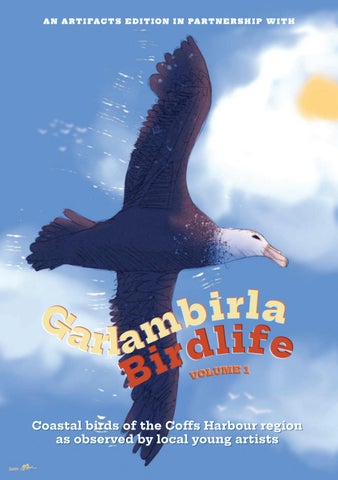
A N A R T I FA C T S E D I T I O N I N PA R T N E R S H I P W I T H
G
i rl a b a r l a m li f e d r i B ME 1 VOLU
Coastal birds of the Coffs Harbour region as observed by local young artists
Ha rb ou o r f t rC h d i e s r a l an ec d v si , and com ha ing m g o r i to e m . t
h it
Coff s
ay
stodians of th el l cu a na n spects to th io d, it r re e ir d ou nciliat i e o o n rec an l
acknowledges ci l th n u e m e tr m o r Co m i i a a e l y .W m i it t e a o t futu es p ce re elv n s w r u
The traditional custodians of the Coffs Harbour region are the Gumbaynggirr people, who have occupied this land for thousands of years, forming one of the largest coastal Aboriginal Nations in NSW. The Gumbaynggirr Nation stretches from the Nambucca Valley in the south to around the Clarence River in the north and to the Great Dividing Range in the west.
aynggirr peop mb le , Gu w re e ast, p sent a h n th ,p d rs wal at its e h de ene ea r r d
Coffs Council,NPWS etc
3
b
Im ag i
.. . ds ir
e n
ld witho r o w ut a
e without f i l ic eve g ...a a ryday m Birds inspire us
Birds enchant us with their vibrant displays of movement, colour, and song. Birdsong at dawn gives hope to the day. An elegant spread of wings draws our minds to flight and far horizons. Songs beckon, cries warn, eggs delight, plumage wows, a feather floats. Birds invite us to pause and appreciate life’s beauty as it irresistibly happens in vivid detail all around us Birds support us
Birds are more than just beautiful creatures. They work tirelessly as pollinators, seed dispersers and pest controllers to keep nature humming along. They underpin the health of our ecosystems, agriculture, and environment, enriching the quality of our lives. They remind us that we work best when we work in harmony with our environment Birds need us... almost as much as we need them!
Birds, like all creatures we share this planet with, are greatly affected by human activities such as climate change, fires, habitat disturbances and loss, and predation from introduced species like foxes, cats, and dogs. Let’s give the most vulnerable of our feathered friends an extra helping hand to keep them safe from harm. Cover: Southern Giant Petrel, Jasmine Above: Mirror Bird by Amelie Ferriera
Right (from top): Rainbow Honey Bee-Eateer, Alex, Cormorant and Sooty Oystercatcher, Asha
5
We can make a real difference in the lives of local threatened birds. We hope that raising awareness about our unique birdlife, the threats to their existence, and the steps we can take to protect them inspires you and others to act in easy ways to contribute to their survival.
Citizen science? Write a para about the actual project here- should it mention council funded etc?
Volume 1 showcases a selection of coastal birds celebrated by our young Coffs Coast artists.
Dive in and get inspired by the 23 young Coffs Coast artists who have captured the everyday magic of local birdlife through photography, digital art, handdrawn illustrations and more. A rising tide lifts all birds This project is a small but important way to support the survival of our local threatened birds.
Many other species also need our protection. We hope that by raising awareness of these featured birds, we can help protect them as well. Together, we can treasure and protect all of our beautiful birds.
Alex Alice Amelie Ferriera (13) Amelie Annie Asha Charlotte Eleanor Em Jasmine Jasper Jessie-Rose Bennett Kane Lacey Elliot (15) Lani Parsons Maddie Maggie Miranda Paige Portia Rani Sabriya
7
ect our birds t o r P
Share
the shore
About 85% of Australians live on the coast, placing huge pressure on our shorelines.
Help look after our coastal areas so native birds can thrive and be here for generations to come.
Beach-nesting birds are some of the most threatened birds in Australia as they struggle to find undisturbed spaces on our coastlines to nest. Breeding shorebirds often nest in shallow sand scrapes, exposing them to easy egg and chick predation and accidental destruction from dogs, beachgoers and vehicles.
We can all enjoy the beach and support the well-being of our local sea and shorebirds to enhance the coastal experience for everyone.
Local beach-nesting bird species listed as endangered or vulnerable to extinction in NSW or nationally include:
Little Tern Eastern Curlew Beach Stone-curlew Wedge-tailed Shearwater Pied Oystercatcher Sooty Oystercatcher Threatened shorebirds nest on our beaches from August to March (late winter to early spring) each year.
It’s vital that they have a safe space to lay their eggs and raise their chicks. Please help them have successful breeding seasons by considering their wellbeing when you visit the beach.
Take the ‘Share the Shore’ pledge * to protect our threatened local shorebirds:
; Read and respect signage and check for fenced-off nesting areas on the beach
; Ensure dogs are only walked on an approved dog beach and always kept on a leash
; Only drive on 4WD beaches and follow beach-driving rules, including staying out of nesting areas
; Take fishing lines and rubbish with you ; Give the birds space – share the shore * ; Join a local community group or organisation that fosters conservation efforts in your area or be a part of a citizen science project like this one
; Spread the word about how to help our birds * Scan the QR to learn more about the ‘Share the Shore’ pledge and how you can help our endangered beachnesting birds have a successful breeding season.
9
n Curlew r e t s a E scariensis, aka Fa
r Eastern s madaga u Curle i n e w Num AUS CONSERVATION STATUS CRITICALLY ENDANGERED
A long-distance traveller in decline around the world The remarkable Eastern Curlew, a large migratory wader, embarks on an epic journey of 12,000 km from the Australian coast to northern China and Russia to breed. They can fly non-stop for up to 12 hours during this incredible feat of migration
During their long journey across continents, they face many threats, including habitat loss due to coastal development, human disturbance, illegal hunting, climate change and extreme weather, and predation by dogs, cats and foxes.
Global populations have declined by about 80% in the last 30 years
Residential and industrial development, beach-combing disturbances, and 4WD vehicles have significantly contributed to the decline of this species in NSW.
About 75% of the world’s population of Eastern Curlews stops over down under
We are responsible for protecting coastal areas for the Eastern Curlew and other birds that share their habitats. International conservation efforts aimed at safeguarding the breeding and migratory habitats of the Eastern Curlew are crucial for the survival of these remarkable migrants.
The Eastern Curlew’s unique and haunting call, often heard during its breeding season, is essential for communicating with mates and establishing territory.
11
Stone-curlew h c a Be magnirostris, aka Beach thic k-knee
Esacus
NSW CONSERVATION STATUS
CRITICALLY ENDANGERED
Beach Stone-curlews hammer crabs open with their bills and sometimes wash them before swallowing.
This lonely wader is now a rare find on our shores
These rarely seen birds are mainly active at dawn, dusk and night. Breeding birds call at night with a harsh, wailing ‘weer-loo’. Scan the QR to listen.
Residential and industrial development, beach-combing and 4WD vehicles have significantly contributed to the decline of this species in NSW.
These days, you’ll be lucky to catch a glimpse of this striking large shorebird, as it is in severe decline in NSW. At last count, only 15 breeding pairs remained. Look out for them on our coastline
Only 4–6 pairs breed each summer in NSW
This rare and iconic shorebird has distinctive patterned markings, a large bill and ‘thick knees’. Usually seen alone or in pairs, Beach Stone-curlews mate for life, returning to our coast annually to breed and raise their chicks.
Breeding season runs from October to March. Nests are typically shallow scrapes in sand or gravel at the backs of beaches, on sandbanks and islands, or among open mangroves. Each clutch contains only one chick, and both parents are responsible for defending the nest and caring for their chick until it is 7 to 12 months old. They rely on the camouflage of the nests and eggs, as well as their cryptic behavior, which helps them avoid being observed or detected by other animals.
Artist: Name goes here
Human activities and disturbances from dogs and boats disrupt nesting efforts and hinder successful chickrearing.
13
Little Tern
albifrons, aka Sea-swallow Sternula NSW CONSERVATION STATUS
ENDANGERED
Will these special guests disappear forever from our coastline? The Little Tern, Australia’s smallest tern, is at risk of extinction in NSW. Its nests are simple scrapes in the sand, making their chicks easily exposed to danger. Little Tern colonies are sensitive to a wide range of threats
After over 20 years in decline with breeding colonies becoming rare, endangered Little Terns are experiencing a recent resurgence in numbers in NSW, with an almost 15 per cent increase in breeding pairs from last season. Despite the recent good results, they are susceptible to a wide range of threats from native and introduced predators, including seagulls, foxes and dogs, crushing and disturbance from vehicles, extreme weather events intensified by climate change, and human interference near nesting sites. Some populations migrate over 2,000 km non-stop across open water
Little Terns show remarkable endurance and navigational skills by migrating to the Coffs Coast to breed every year between October and March.
Little Terns are generally seen in small flocks. They cooperate to noisily mob avian predators, like silver gulls, crows and ravens.
Aerodynamic diving dynamos
You will often see these elegant birds diving in the ocean and nearby waterways. They are expert fishers and skilled flyers, diving into the water at high speeds to catch small fish and invertebrates. Little Tern chicks weigh less than a scoop of ice cream!
Little Tern chicks are tiny, and their speckled dusty yellow plumage makes them hard to spot on the open sand. Unfortunately, their protective camouflage makes them particularly vulnerable to accidental harm from humans, especially when walking, running, riding, or driving in nesting areas.
Local communities are taking measures to protect Little Tern colonies by fencing off nesting sites, enforcing pest control, and running communityfocused education programs.
15
ENDANGERED
NSW CONSERVATION STATUS
pots
Artist: Name goes here
Their feeding behaviour plays an essential role in the ecosystem as scavengers, helping to keep these coastal areas clean by feeding on animal remains.
Southern Giant Petrels have the rare ability to drink saltwater, thanks to specialised glands that excrete the salt, allowing them to spend extended periods at sea.
These birds exhibit a striking difference in diet based on sex: males typically stick to scavenging, while females are more likely to hunt live prey like fish and squid. A rare behaviour among bird species, this dietary divergence helps reduce competition between the sexes.
The population of Southern Giant Petrels in Australia was once critically endangered, with only a tiny breeding population limited to a few islands. However, thanks to conservation efforts and habitat protection, their numbers have shown signs of recovery in recent years.
And now the good news
Water, water everywhere and lots of it to drink
One of the most significant threats to Southern Giant Petrels is becoming bycatch in fishing – when they get accidentally caught on longlines trailing behind fishing boats.
Males are from Mars....
These opportunistic scavengers are a regular sight from fishing boats and cruise ships, where they love to tag along for an easy meal.
Keep a look out for these great gluttons of the sky!
Macr
rn Giant Pet e h t Souonectes giganteus, aka Stinkers, Stink rel
ystercatche O d e r Pi Haematopus longirostris NSW CONSERVATION STATUS
Pied Oystercatchers run down the beach behind a receding wave and drill into the sand for molluscs, crabs, marine worms and small fish. They open pippies and other molluscs with their strong chiselshaped beaks.
ENDANGERED
This native wading bird is thinly scattered along the entire coast Despite their name, Pied Oystercatchers rarely eat oysters! Young Oystercatchers often watch and mimic adults to learn foraging skills, showing a remarkable example of social learning among shorebirds. Pied Oystercatchers often mate for life and return yearly to the same nesting scrape.
Fewer than 200 breeding pairs are estimated to remain in the state.
Breeding pairs nest mostly on coastal or estuarine beaches, making shallow scrapes in the sand above the high tide mark. If disturbed on or near the nest, they quietly walk away to conceal the location of their eggs or chicks.
This decline is due to many factors, including habitat loss, human disturbance, and predation by cats, foxes and dogs. Conservation efforts are ongoing to try to protect and restore their populations.
They lay two to three eggs between August and January, and the chicks leave the nest within several days.
Artist: Name goes here
19
n Osprey r e t s a E tus aka Fish hawk Pandion crista
Mating pairs build large nests using sticks, driftwood, and seaweed, often located on cliffs, in dead trees, or even in radio towers. They return to the same nest each year to breed, continually maintaining these impressive structures.
NSW CONSERVATION STATUS
VULNERABLE
Marine hunters extraordinaire! The Eastern Osprey is one of the smaller Australian raptors. This graceful and agile sea-hunter glides the air currents over the ocean in search of prey. Excellent anglers
The Eastern Osprey has a renowned fishing success rate of 70 percent! It hunts along the coast, diving with its feet forward to snatch fish with its talons. Finely adapted fishing gear
Ospreys and owls are the only hunters with reversible outer toes, allowing them to grip their prey with two toes in front and two behind. This adaptation is particularly useful for catching slippery meals. Built-in goggles and wetsuit
Eastern ospreys have incredibly powerful eyesight. They have a third eyelid that functions like goggles, enabling them to see underwater when diving into the sea to catch fish. Additionally, their oily feathers dry quickly, allowing them to take off easily after diving.
These extraordinary raptors are at risk due to coastal development, loss of nesting trees, pollution, contamination of prey (such as fish and fishing bycatch), and severe weather events.
21
Ruddy Turnstones inhabit rocky shorelines and tundra in the high Arctic during the breeding season, migrating thousands of kilometres to their wintering grounds along the coastlines of Australia.
...around the world
These stocky little birds are best known for their calico cat plumage, which helps them blend into rocky shoreline environments. During the breeding season, Ruddy Turnstones sport vibrant hues – bright orange legs, pied face, and rich chestnut and black feathers – making them one of the most strikingly coloured shorebirds and a particular delight for birdwatchers...
Tricolour camouflage
This short-legged, web-footed shorebird flips over stones, shells, and seaweed with its slightly upturned bill in search of food.
Skilful stone-flippers
VULNERABLE
AUS CONSERVATION STATUS
Ruddy Turnstones have webbed feet with short, sharply curved toenails and a low centre of gravity due to their short legs, allowing them to maintain a secure grip on sharp, wet, and slippery rocks.
Made for rocky shores
Getting fat is critical to powering their longdistance journey, so these opportunistic carnivores readily adapt to different food sources.
Adapt and get fat
Ruddy Turnstones can fly non-stop for long periods, covering up to 10,000 kilometres each way. They must fly quickly to cover this vast distance, with average flight speeds ranging from 43 to 75 km/hr.
Endurance and speed
These tough little birds are declining globally, as they rely on specific stopover sites during migration. Protecting important migratory sites and coastal habitats ensures their continued survival.
These cute little carnivores love setting up home near rotting seaweed! They eat maggots and larvae found in the decomposing seaweed plus insects, worms and molluscs. They also chase small crabs, using their beak to probe crab holes.
y Turnstone d d u R Arenaria interpres
Young Ruddy Turnstones need to learn to fly quickly. They take their first flight when they are around 19 days old and set off for the other side of the world (without their parents) just two days later!
S
Oystercatche y t o o r aematopus fuliginosu s
H
Before taking flight, the Sooty Oystercatcher gives a loud whistling call and a sharp piercing call if intruders approach its nest.
NSW CONSERVATION STATUS
VULNERABLE
One of a kind
Made for Australia’s rugged coastline and rocky shores Sooty Oystercatchers forage on exposed rock or coral at low tide for limpets, mussels, crabs, starfish and sea urchins. They use their strong, pointed bills and specialised techniques to pry open or crack shells.
The Sooty Oystercatcher is the only all-black shorebird species in Australia. They are a striking sight with their inkblack plumage, bright orange-red bill, eye-ring and iris, and pink legs and feet.
Committed couples
Known to form strong, monogamous, long-lasting bonds, with pairs often staying together for life, Sooty Oystercatchers return to the same nesting sites each breeding season. Protective parents
Parents protect their nesting areas from intruders, especially when suitable sites are scarce. They defend their nests and chicks with loud calls, directional flights, and distraction displays that mimic injury.
As small, isolated populations, Sooty Oystercatchers are vulnerable to environmental changes and human impacts on coastal habitats.
Duri
ca ll f
n g
br
ure avo g season, f
th ei rp
are
nts.
chicks c an s for ite be s g me littered w co
e th
ee din
in eed df
ro m
. hells and l ed s impets en op
h
d an
h it
C
ks ic
n ru
quat when warn or s ed e by d hi a
So
oty
Oystercat
Bre
edin
che rs n es ti
g pa i
nc olo nies on off -shore islands. rs m ak en es ts in shell grit, pebbles an dr ock ya
reas.
25
rwater Shea Muttonbir
ka Puffinus a
City lights can disorient fledglings as they leave their burrows and attempt to fly north. They can become stranded on land or exhausted, reducing their chances of survival.
d, Moonbird
NSW CONSERVATION STATUS
SOME SPECIES VULNERABLE
Many shearwater species are found in NSW. Local species include the Shorttailed Shearwater (Ardenna tenuirostris) and the Flesh-footed Shearwater (Ardenna carneipes).
Muttonbirds n eed
The extra weight gives them a head start, preparing them for their first migratory journey and life at sea. Fledglings leave two to three weeks after their parents. Guided solely by instinct, they follow the moon’s light out to sea and northward.
The Wedge-tailed Shearwater (Ardenna pacifica) is a key species on the Coffs Coast.
tion to o si
take of f, o the r
w is e
Muttonbird Island Giidany Miirlarl (moon special place) Muttonbird Island Nature Reserve is a critical breeding ground for the Wedge-tailed Shearwater.
th
d! nde ou gr
Baby Muttonbirds often weigh more than their parents just before they fledge!
at ev l e
p ed
’re ey
After breeding, the Wedge-tailed Shearwater undertakes a vast migration across the Pacific Ocean, travelling to northern Asia and beyond. They return to the same breeding sites, including Muttonbird Island, annually.
aw in dy
These long-distance migrants take an impressive annual journey
Shearwaters feed on small fish, squid and crustaceans
Plastic ocean pollution is a significant issue for shearwaters as they often mistake small plastic pieces for food.
27
Mighty master of the coastline
VULNERABLE
NSW CONSERVATION STATUS
gle, N gang arr
ea
It hunts its prey from
or
They have
a loud goose-like honk, heard during the
a perch or in fl ig ht – c ircli soar, dive, an i m d s s f r l n i g i o h l a ng t t a k i c n o l d P spectacular courtsh i p di s play s
S llied The White-be
e pirat ively is known to aggress e l g a E
breed in
g ab
ove the shore
g season, from June to September
slowly or sailin
rs, includi to ng kites and Ospreys ap r r o m t e h o r f d o o st e a l f
These magnificent coastal raptors are often spotted cruising the sea breezes throughout Australia.
Their dietary flexibility allows them to thrive in different habitats, taking advantage of available food sources.
They typically lay two eggs between June and September. After the fledglings have flown from the nest for the first time, they will remain in their parents’ territory for a few more months to gain the skills they need to hunt and survive on their own successfully.
White-bellied Sea Eagles may be solitary, live in pairs, or small family groups made up of a pair of adults and dependent young. They form long-lasting pair bonds and maintain and defend large territories along coastal areas.
Protecting the White-bellied Sea Eagle is crucial; as an apex predator, it plays a vital role in maintaining the health of aquatic and coastal ecosystems. White-bellied sea eagles hunt for fish, turtles, waterbirds, reptiles, small mammals and even prey up to the size of a swan. They will attack bats roosting in trees and chase aquatic birds until they are exhausted.
Territorial and monogamous
Australia’s second-largest raptor
The White-bellied Sea Eagle is a skilled and powerful raptor with a 2m wingspan, powerful talons and a strong hooked beak. Their hunting prowess and dominance over other coastal birds make them apex predators of their habitat.
l Ha
leuc W s u t e iae
llied sea ea e b e t hi ogaster, aka White-breasted sea ea gle
Yellow-tailed Coc k Blackchus funereus ak atoo a Gawiya rhyn rr Calypto NSW CONSERVATION STATUS PROTECTED
Spirited heralders of change Yellow-tailed Black Cockatoos are known for their unmistakable, eerie, mournful calls, which carry across the landscape. Their call often signifies rain or stormy weather, earning them a reputation as ‘storm birds’.. Streamlined formations of jet-black and gold
Yellow-tailed Black Cockatoos are one of Australia’s largest cockatoo species, known for their golden-yellow splashes on their tails and cheeks, graceful dancing movements, and stunning aerial acrobatics. Flocks of Yellow-tailed Black Cockatoos are a spectacular sight as they soar overhead like sleek jets, calling to each other with loud shrieks. These captivating birds symbolise auspicious change, luck and coming rain.
Powerful beaks for a special diet
Cockatoos have strong, hooked beaks that allow them to break into pine cones, banksia, and eucalyptus seeds, as well as extract insect larvae from tree trunks. Their strength and unique feeding technique enable them to tear through wood easily.
A group of cockatoos is called a ‘crackle’!
Lost Hollows
These birds depend on mature trees with hollows for nesting, which take decades to form. Habitat loss and fragmentation due to deforestation, urban development, and agricultural land clearing destroy nesting hollows and limit their access to feeding grounds.
The average lifespan for a Yellow-tailed Black Cockatoo is between 40 and 60 years
A season of care and cooperation Yellow-tailed Black-Cockatoos have a long breeding season, where both parents build a nest in large tree hollows. The female incubates the eggs while the male brings her food. Usually, only one chick survives and stays with its parents for about six months. This beautiful bird has been rapidly declining because of native habitat clearance, with a loss of food supply and nest sites.
31
a h S
ed Sandpi rp-tail Calidris acuminata
per
To conserve this species, we need to protect important migratory and wetland habitats in the region and globally.
NSW CONSERVATION STATUS
LEAST CONCERN
Siberian summer migrants Sharp-tailed Sandpipers travel an extraordinary distance to reach our shores, migrating from their summer breeding grounds in far-off Siberia. Small but mighty globetrotters
Sharp-tailed Sandpipers have incredible migratory endurance and are more flexible with habitat choice and diet than most shorebird species. They journey to the Coffs Coast each year, covering thousands of kilometres to escape the Arctic winter and enjoy Australia’s milder climate and abundant food.
A juvenile’s first journey
‘Run-and-pick’ foragers
Many of the Sharp-tailed Sandpipers seen in NSW are young birds on their first migration. In a remarkable feat of endurance and orientation, juvenile birds journey south without adult guidance, relying on instinct to navigate the long route to Australia.
Sharp-tailed Sandpipers quickly dart across mudflats, foraging for small invertebrates such as insects, mollusks, and crustaceans. They also use their bills to probe into the mud in search of buried food. While they mainly eat small invertebrates, they may switch to seeds and plant matter, showing extraordinary adaptability that helps them survive in changing conditions.
These little visitors breed in the short Siberian summer. Their nest is a well-hidden shallow hollow on the ground, lined with grass and leaves.
33
Eastern Reef Egrets play a crucial role in maintaining healthy coastal and marine habitats, supporting various other animals, and recycling nutrients within their environment.
n Reef Egre r e t s t Egretta sacra Ea NSW CONSERVATION STATUS
LEAST CONCERN
Symbols of resilience These small herons represent adaptability and the ability to thrive in dynamic and challenging environments. True coastal birds
A skilful hunter
Unlike many other egrets, Eastern Reef Egrets live along rocky shores, coral reefs, mangroves, and tidal flats, where they hunt for fish, crabs, and other marine life. They are adapted to harsh coastal conditions, such as salt spray, strong winds, and fluctuating tides.
Eastern Reef Egrets have a variety of hunting techniques. They often crouch low, stealthily approaching prey, or use their wings to create shade, reducing glare on the water surface. This “canopy feeding” method helps them see their prey better, especially in bright, reflective coastal waters.
Dimorphic colour forms
Eastern Reef Egrets exhibit two distinct color morphs: dark (slate-grey) and white. Interestingly, both color variations can be found within the same population, and it’s not unusual to see both morphs foraging side by side.
The Eastern Reef Egret develops long plumes on its crest, foreneck and back in breeding season
35
te-faced Heron i h W novaehollandiae aka Garr Egretta
anygay
These clever herons ‘foottremble’ in shallow water, vibrating one foot to stir up hidden prey. They also wait motionless for fish or crabs before striking quickly.
NSW CONSERVATION STATUS
White-faced Herons help farmers by eating large quantities of crickets in pastures.
LEAST CONCERN
They also inhabit drier areas, including paddocks, golf courses, gardens, and garbage dumps. These herons often live close to humans as long as they can access food and safe nesting sites.
White-faced Herons can breed outside their usual season in response to rainfall. Both parents take part in building the untidy nest of sticks, usually located high in a tree, and in caring for their young. Typically, they raise only one brood each year.
Th e
White-faced Herons are highly adaptable birds that play a vital role in maintaining coastal and wetland ecosystems. They thrive in both freshwater and saline shallow-water habitats, such as estuaries, rivers, seagrass beds, mangroves, reefs, lagoons, and dams.
in s
Rainy day partners
s, and
Whatever the conditions
bian
Adapt and flourish
aced h te-f er hi o w
n
i ph
This elegant heron, with its slender light-grey body and white face, is a common graceful presence in diverse landscapes across the country.
on fi sh eds ,a fe m
ts. ec
Recognise this familiar face?
This familiar heron acts as a flagship species to raise public awareness about the necessity of protecting wetland, coastal, and urban green spaces.
37
bow Bee-eater n i a R tus aka Gold miners, G s orna Merop NSW CONSERVATION STATUS
old digg ers
LEAST CONCERN
Bright bursts of beauty and agility This brilliant bird lives up to its name with vibrant, iridescent colours of green, blue, orange, and yellow, a striking black eye stripe and long, pointed tail feathers. Immune to bee stings
Bee-eaters feed on bees and other flying insects. They catch flying insects on the wing and carry them back to a perch to beat them against it before swallowing them. When catching stinging insects, they press and rub the insect’s body against the perch to remove the sting and venom sac. Natural pest control
Rainbow Bee-eaters help control insect populations, benefiting the ecosystem and indirectly supporting agriculture by reducing the need for chemical insecticides.
Beloved aerial acrobats
The Rainbow Bee-eater is the only species of bee-eater found in Australia. These birds are highly skilled flyers known for their remarkable agility. When hunting, they display impressive aerial acrobatics, darting and twisting mid-air to catch insects. Their agile flight and vibrant colours make them a joy to watch in action.
Introduced species like foxes, cats, and rats can prey on eggs and chicks in burrows.
Over-winter in the north
Rainbow Bee-eaters migrate north during the colder months to northern Australia, Papua New Guinea, and parts of Indonesia. They return in spring and summer to breed, bringing a vibrant splash of colour to the landscape as they arrive. Social little diggers
Rainbow Bee-eaters come together in small flocks before migrating back to their summer breeding grounds. Both parents select the nesting site (sandy banks, cliffs, or flat ground), where they dig a long, horizontal burrow (up to 1m) leading to a nesting chamber lined with grasses. After laying their eggs, the parents take turns incubating them and feeding the young, occasionally with the help of other bee-eaters.
39
Want to do more to help our beautiful birds?
City of Coffs Harbour and the National Parks and Wildlife Services (NPWS) run a Recovery Program that aims to protect and nurture Little Terns in the local area by protecting breeding areas, including areas at Hearnes Lake Beach and Sawtell. In Spring, the breeding areas are fenced off and people are discouraged from entering the areas. How you can help The Recovery Program relies on a volunteers for its success. If you would like to be part of this program contact NPWS on (02) 6652 0900.
Special thanks to:
41