







Cibolo voted to become an independent township on October 9, 1965 but there were many settlers in the Cibolo area long before 1876. The Comanche’s and other tribes roamed this area before the first German settlers arrived. In fact, the name Cibolo is an American Indian word meaning “buffalo”. The City of Cibolo was named after the creek that flows through the area. Today, we are quite different from what we were in the early 1900’s. Cibolo is home to a diverse group.
Whether you have just joined our staff or have been with the City for a while, we are confident that you will find our organization a dynamic and rewarding place in which to work, and we look forward to a productive and successful association. We consider the Employees of Cibolo to be one of its most valuable resources.
This handbook has been written to serve as the guide for the Employer/Employee relationship.
There are several things to keep in mind about this handbook. First, it contains only general information and guidelines. It is not intended to be comprehensive or to address all the possible applications of, or exceptions to, the general policies and procedures described. For that reason, if you have any questions concerning eligibility for a particular benefit or the applicability of a policy or practice to you, you should address your specific questions with your chain of command or with the Human Resources Department.
The procedures, practices, policies, and benefits described here may be modified or discontinued from time to time. We will try to inform you of any changes as they occur.
Some subjects described in this handbook may be covered in detail in other official documents. Refer to those documents for specific information because the handbook only briefly summarizes those guidelines and benefits. Note: the terms of the insurance policies/contracts are controlling and may override any statements made in this or other City documents.
MANAGER'S WELCOME LETTER


Whether this is your first day with our City or you have been with us a number of years, we hope you read this handbook carefully It will give you a better understanding of the City Government, how our City operates, and most importantly, information concerning your employment and some of the benefits made available to you by the City You are part of the City of Cibolo team “Team” may seem a somewhat overworked concept, but it is one of particular relevance to our City Here you will find a good mix of individual performance and team cooperation The City strives for individual and organizational excellence which can only be achieved when we (team) work together in a positive, productive, and professional manner.
My approach to building a cohesive team environment, collaborative culture, and an organization of excellence is that we will be an organization that is Vision Inspired, Mission Focused, Values Driven, and Performance Based. Together, we all play an important role in achieving Cibolo's potential as a City of Choice We are all on Team Cibolo!
There are many attributes to building a high-performing organization I am sure if you asked a few people right now, you would get slightly or very different answers Based on my experience, I think it boils down to 3 factors
Caring about each other
Being the best version of yourself every day
Knowing your purpose and how you add value
I hope that you find yourself involved in something that’s not just a job, but a personally and professionally enjoyable part of your life For our citizens, the City of Cibolo is dedicated to outstanding customer service for a better community To do so, we need good people like you To flourish, we must steadily improve our work as individuals and as an organization
In the City, you’ll be expected to contribute 100% of your best effort In your work, I hope you’ll have ideas about improved service efficiencies and ways to decrease costs. We want to hear from you since your insights are as important to us. The City of Cibolo cannot have too many good ideas. We know that people who enjoy their work and their surroundings do a better job - for themselves and the City. We are committed to making employment at the City of Cibolo a satisfying and productive experience.
Again, welcome!
Si l

Wayne Reed, ICMA-CM City of Cibolo City Manager

The City of Cibolo (the “City”) is a Home Rule Municipality. The City Charter, adopted in September 2004 and since revised, provides that the City will operate under the form of government known as the “Council-Manager Government”. Under Charter requirements, the City Manager shall prepare and present the personnel rules to the City Council who then may adopt them by ordinance.
The purpose of this Employee Handbook is to create a high degree of understanding, cooperation, efficiency and unity, all of which come through the systematic application of established procedures in personnel management and administration; and to provide a uniform policy for all Employees.
This handbook is designed to provide information regarding working conditions, Employee benefits, and policies affecting employment. Employees should read, understand, and comply with all provisions of the manual. It describes many responsibilities as an Employee and outlines the programs developed by the City to benefit Employees. Employees also may read any applicable departmental regulations for additional information about the administration of these policies, other City policies, and employment matters.
All such departmental rules/policies may be more restrictive, but not less restrictive than these Personnel Policies and Procedures.
No Employee manual can anticipate every circumstance or question about policy. As the City continues to grow and as the need may arise, the City reserves the right to revise, supplement or rescind any policies or portion of the manual from time to time as it deems appropriate, in its sole and absolute discretion, subject to the requirements of the Charter. Any future changes to this manual shall be communicated to Employees through official notices.
The fundamental objectives of the personnel policies and the administrative regulations are:
• To promote and increase efficiency and responsiveness to the public and economy in the service of the City;
• To establish and promote high morale among City Employees by providing a good working environment, uniform personnel policies and opportunity for advancement;
• To endeavor to comply with all applicable statutes and regulations, including all confidentiality and security safeguards set forth in the Texas Public Information Act, as amended, and the federal Privacy Act of 1974, as amended;
• To communicate freely and to encourage communication from and among all Employees;
• To provide a work environment that is conducive to both personal and professional growth;
• To safeguard each Employee’s right to be treated with respect, dignity, equity and fairness; where provided, the right to appeal any violation of these rights; and
• To recruit, select, compensate and promote Employees on the basis of qualifications and merit, including but not limited to criteria such as ability to work well with others, positive attitude, leadership and similar criteria.
At the end of this handbook is a Glossary, which contains a list of defined terms and their meanings and definitions as used in this policy. Defined terms will be capitalized to indicate that the term should be interpreted using the Glossary definition. To the extent a term is used in a manner different from that interpretation, the definitions used in this handbook will control.
These rules shall apply to and govern all at-will Employees of the City of Cibolo, except to the extent, if any, inconsistent with State or Federal law. Words used in the singular shall be construed to include the plural and words used in the masculine or feminine gender shall be construed to include both genders.
The City of Cibolo provides equal employment opportunities (EEO) to all Employees and applicants for employment without regard to race, color, ethnicity, national origin, citizenship, gender, age, religion, political affiliation or beliefs, physical or mental disability, pregnancy status, veteran status, or any non-merit factor (except where such is a bona fide occupational qualification) in accordance with federal, state, and local laws governing non-discrimination in employment.
This policy applies to all terms and conditions of employment, including, but not limited to, recruitment, hiring, selection, placement, promotion, demotion, termination, layoff, rehire, benefits, transfer, leaves of absences, compensation, and training.
The City of Cibolo expressly prohibits any form of unlawful Employee harassment or discrimination based on race, color, religion, gender, national origin, age, disability, pregnancy status, or veteran status. Improper interference with the ability of City Employees to perform their expected job duties is absolutely not tolerated. The City’s designated person for issues concerning Equal Employment Opportunity is the Human Resources Manager. Complaints against the Human Resources Manager shall be made to the Finance Director.
The City of Cibolo acts in the best interest of the citizens of Cibolo and is committed to a fair and consistent approach to recruitment and selection. The City promotes Equal Employment Opportunity (EEO) in all aspects of recruitment and selection. EEO is about appointing and promoting the best qualified for a role without discrimination through selection processes which are open, transparent, and based on merit.
The intent of this policy is to ensure that recruitment and selection decisions are made consistently, fairly, and equitably across the City of Cibolo and meet any legislative requirements. This policy does not apply to contract or temporary assignments, which will be governed by the individual contracts or by the temporary agencies for which the temporary Employee works
Human Resources will assist Hiring Managers with the recruitment process. Postings will be for a minimum of seven (7) calendar days for an internal posting and fourteen (14) calendar days for an external posting. Any request for a posting for less than seven (7) calendar days internally or fourteen (14) calendar days externally must be made in writing to the City Manager and approved by the City Manager.
All applications will be forwarded to the Hiring Manager for review. Hiring managers will review the applications, and after ensuring that the individuals meet the qualifications of the job posting, will select a candidate for hire and submit the selection to the Department Head, who will have the authority to approve or reject the selection. Once the decision is made, the Conditional Employee will be issued a written conditional offer of employment.
All applications must identify an open position – Hiring Managers may not accept applications for review that are not made for and do not identify a specific position opening.
This section does not limit regrading or reclassification of a position.
This section does not apply to promotions in the Fire and Police Departments. The promotional process will be defined in each department’s procedures.
This section does not apply to recruitment in the Fire Department. The recruitment process will be defined in the department’s procedures.
In order to create a safe and secure workplace and to ensure that City Employees are qualified to perform the jobs for which the City hires them, the City will conduct pre-employment screening for all Employees.
All Employees are required to meet a minimum age requirement as determined by the position’s minimum qualifications, which should comply with applicable state and Federal laws. Should the position not list any age requirements, a minimum employment age of 18 should be utilized. Employees must be at least 18 years old as of the date of hire to be eligible for employment with the City.
All Conditional Employees are required to submit to a background check. Background checks shall be reviewed on a pass/fail basis by Human Resources, who shall use a standard risk assessment. Any applicant who refuses to submit to or who fails a background check is disqualified from employment with the City of Cibolo. Some positions may require additional background processes.
All Conditional Employees are required to submit to a mandatory drug screening. Any applicant who refuses to submit to or who fails a drug screening is disqualified from employment with the City of Cibolo.
Prior to beginning employment, all Conditional Employees must be scheduled for a pre-employment physical. Pre-employment physicals are conducted through an external agency. A Conditional Employee who does not successfully complete the pre-employment physical may not continue with in-processing procedures. Office positions will be screened at the discretion of the Hiring Manager.
When a position requires an Employee to have a professional license or certification in order to perform the job, the Hiring Manager shall verify that the Conditional Employee has obtained such license or verification prior to the Employee’s hire. Human Resources is available to assist in verifying such license or certification at the request of the hiring department.
Any other pre-screening checks, such as typing tests or vehicle record checks will be conducted at the discretion of the Hiring Manager.
Verification of Eligibility to Work in the United States (Immigration Reform & Control Act of 1986)
The City requires the verification of eligibility for all Employees to work in the United States. All new Employees must complete an I-9 Form and provide proof of employment eligibility. Human Resources will ensure that all new Employees complete an I-9 Form and provide proof of employment eligibility as required by the I-9 Form. Acceptable forms of proof of employment eligibility are provided on the I-9 Form.
Failure to Provide Proof of Employment Eligibility: If an Employee cannot present proof of eligibility to Human Resources on the Employee’s first day of employment or within three (3) days of employment, then proof of application for the documents must be presented to Human Resources within three (3) Working Days. If an Employee submits proof of application, the grace period will be extended to 90 days. At the end of 90 days, proof of eligibility must be presented. If not, failure to provide the documentation as required under the Immigration Reform & Control Act of 1986 will result in immediate dismissal.
Any material misrepresentation of facts or failure to report pertinent data on the application form may also result in immediate dismissal upon discovery of the misrepresentation or failure.
Public Safety Employees may be subject to additional pre-employment screenings as provided by specific departmental policies.
In order to create a safe and secure workplace, the City of Cibolo provides photo identification cards (ID Cards) for all Employees. These cards are the property of the City of Cibolo and shall be surrendered upon termination.
Employees are responsible for immediately notifying their Supervisor when they discover their ID card and/or Electronic Access card has been lost or stolen.
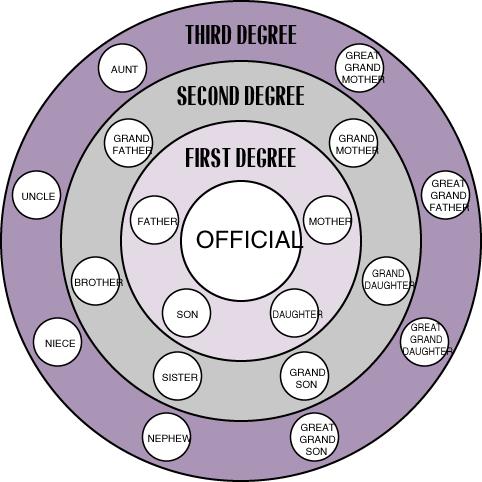
No person may work in a department where he or she would be related to the Department Head or the Employee’s Supervisor within the second degree of affinity (marriage) or within the third degree of consanguinity (blood relation). No person may work in a department with a relative as described above who will be directly or indirectly under his/her supervision.
No person related within the second degree by affinity or within the third degree by consanguinity to the Mayor, any Council Member, or the City Manager shall be employed by or contracted with the City. This shall not apply to any person employed by the City prior to the person related in the above degree filing to run for elective office or being nominated for an appointment.
An Employee’s relative in the first degree includes the Employee’s mother, father, sons, and daughters. An Employee’s relative within the second degree includes brothers, sisters, grandparents, and grandchildren. An Employee’s relative within the third degree includes great-grandparents, great-grandchildren, an aunt who is a sister of a parent of the Employee, an uncle who is a brother of a parent of the Employee, a nephew who is a child of a brother or sister of the Employee, or a niece who is a child of a brother or sister of the Employee.
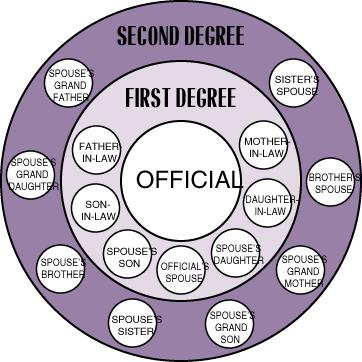
An Employee’s relatives in the first degree include the Employee’s husband, wife, father-in-law, mother-in-law, sons-in-law, daughters-in-law, or any step children. An Employee’s relatives in the second degree include sisters-in-law (brother’s spouse or Employee’s spouse’s sister), brothers-in-law (sister’s spouse or Employee’s spouse’s brother), spouse’s grandparents, or spouse’s grandchildren.
Procedures
Conflicts of interest impacting Employees will be addressed per the procedures identified in 1.5.08 Intimate Relationship policy.
Type
Regular - Regular Employees are serving in a position budgeted for fifty-two (52) weeks per year. Positions are approved annually with the budget and may be discontinued at any time.
Temporary - Temporary Employees are serving in a position budgeted for a fixed period of time typically less than fifty-two (52) weeks per year. Temporary Employees are not eligible for City benefits (time off, paid holidays, etc.) or participation in City compensation plans (scales, ranking, adjustments, merits, COLAs) unless specifically documented.
Seasonal - Seasonal Employees are serving in a position budgeted for a fixed period of time. The season typically repeats itself although this does not guarantee that the Employee will be brought in for the next season. Seasonal Employees are not eligible for City benefits (time off, paid holidays, etc.) or participation in City compensation plans (scales, ranking, adjustments, merits, COLAs) unless specifically documented.
Full-time - Full-time Employees are serving in a position budgeted for forty (40) hours or more per week (eighty (80) hours or more per Pay Period).
Part-time - Part-time Employees are serving in a position budgeted for less than forty (40) hours per week. Part-time Employees are not eligible for City benefits. TMRS Retirement participation is mandatory for Employees who are scheduled to work more than 1,000 hours in a year.
City insurance eligibility is based on Federal, State, and local laws. Currently, Employees who work less than 30 hours a week are not eligible for City insurance coverage.
An introductory period is a period of time after the Employee is hired during which the Employer evaluates the Employee’s performance. During this period, the Employer determines whether the Employee has the skills and other qualifications needed to succeed in the position. The Employee uses the period to evaluate whether he or she is a good match for the position and the organization.
This introductory period is for six (6) months for Civilian Positions or one (1) year for Uniformed Personnel including police and fire. This period may be extended at the sole discretion of the Employee’s Department Head. Supervisors may make recommendations to the Department Head regarding extension of an Employee’s introductory period, and Department Heads are encouraged to consult with the Supervisor regarding extensions. The Department Head shall consult and document their decision to extend the introductory period with Human Resources.
The introductory period occurs for all new Employees and current Employees beginning in a new position. Supervisors should complete a performance evaluation on Employees at the end of the introductory period.
The City of Cibolo is committed to providing a safe environment for all Employees. In order to provide a safe work environment, Employees must be able to perform
their job duties in a safe, secure, productive, and effective manner and remain able to do so through the entire time they are working. Employees who are not fit for duty may present a safety hazard to themselves, to other Employees, or to the public.
Fit for duty (FFD) is whether an Employee is physically and/or mentally capable of safely performing the essential functions of his/her job with or without reasonable accommodation.
A “fit for duty” evaluation should be performed by an impartial, independent health care professional with appropriate expertise in one or more of the following fields: medical conditions, psychological conditions, and/or conditions related to the use or abuse of alcohol or other substances.
Should the City request a “fit for duty” evaluation, the City will pay for the initial evaluation. Should an Employee disagree with the evaluation results, the Employee can pay for a second opinion from a health care professional of their choosing. Should a disagreement continue, the City shall pay for a final and binding evaluation by a third independent professional.
Should an Employee wish to return to work after an absence related to a condition under this section of three (3) consecutive Working Days, three (3) consecutive shifts, or after a physical or mental incapacitation of any time period, the Employee is responsible for providing a return to duty doctor’s note paid for by the Employee (for example, if an Employee is absent one or two days, a note is NOT needed but if an Employee is absent three, four, five, or more days, a note IS needed). Public Safety Employees are subject to separate rules; see departmental documents for Public Safety regulations.
All regular Employees are hired for an indefinite period of time, and either the regular Employee or the Employer is free to terminate the employment relationship at will, and at any time, with or without cause.
Neither this handbook nor any other organization document confers any contractual right; either express or implied, to remain in the organization's Employ. Nor does it guarantee any fixed terms and conditions of your employment. Your employment is not for any specific time and may be terminated at will with or without cause and without prior notice by the organization. Concurrent therewith, you may resign from your position for any reason at any time. No Supervisor or other representative of the organization (except the City Council) has the authority to enter into any agreement for employment for any specified period of time or to make any agreement contrary to the above.
The City of Cibolo wants to ensure that all newly hired individuals are promptly informed about the City’s benefit programs and Human Resources’ policies and procedures. To avoid any unnecessary delay in signing up for benefits and providing all required payroll information, the hiring department must ensure that all new Employees report to Human Resources on their first day of work.
During in-processing, Human Resources will provide the Employee with information relating to the City’s benefit programs and insurance enrollment forms, as well as payroll information regarding retirement, social security, withholding taxes and other related information. The Employee’s photograph will be taken at that time to be maintained by Human Resources and used for a City identification card unless the hiring department produces a separate identification card.
Upon separation from employment with the City of Cibolo under any circumstances, the Department Head or their designee shall ensure that Employees turn in all City property and equipment (e.g., keys, car, cellular phone, computer, radio, ID card, etc.) that they have in their custody before receiving their final pay. If applicable, the property and equipment collected shall be returned to the department from which it was issued. The City will take all necessary steps to collect any money owed by the Employee and to obtain the return of City property and equipment.
Upon separating from employment with the City, the Department Head or their designee may direct their Employees to Human Resources to conduct an exit survey. Information obtained from the exit survey is to be used to improve working conditions and retain Employees. Exiting Employees may decline the exit interview.
Pay stubs (direct deposit notifications) for Employees are distributed to the departments on or before the scheduled pay date. Paychecks are issued every other Friday unless the payday falls on a bank holiday (in which case the deposit will be processed for the business day before the holiday).
Employees are required to immediately report any error of underpayment or overpayment in their pay to the Finance Department, and Employees agree by continued employment to either: (i) repay to the City all amounts of overpayment as soon as practicable; or (ii) allow the City to deduct the amount of the overpayment from his or her paycheck. Any underpayment will be paid to the Employee in full on or before the first paycheck after the underpayment is reported. Any changes in federal withholding exemptions or direct deposit information should be made on e-portal or through the Finance Department or Human Resources.
The Fair Labor Standards Act (FLSA) is administered by the Department of Labor to prescribe standards for the basic minimum wage and Overtime pay. The FLSA considers all positions non-exempt unless the position is exempted by an FLSA exemption test. The Human Resources Manager or their designee determines the FLSA status following the FLSA standard exemption tests for each position.
Non-exempt Positions - Positions that do not meet the criteria under the FLSA standard exemption tests are to be classified as an exempt position. These positions are subject to the minimum wage and Overtime pay provisions of the FLSA. Employees in these positions will be paid Overtime (or provided Compensatory Time) for all hours worked over forty (40) in a given workweek Non-exempt Employees in some Public Safety positions will be paid Overtime for all hours over eighty (80) or 106 hours in a Pay Period, as applicable. Non-exempt Employees will be expected to keep track of their time, to the nearest quarter of an hour.
Exempt Positions – Exempt positions are positions which meet the criteria under the FLSA standard exemption tests. These positions are determined to be a bona fide Executive, Professional, Administrative, or Computer position. These positions are exempt from Overtime pay.
For Employees in non-exempt positions, hours in excess of forty (40) hours for that week may be considered Compensatory Time. This includes all time on an Employee’s timesheet.
Compensatory time must be agreed upon before the work begins and will be accrued in lieu of Overtime. The Employee’s attendance is considered an agreement. Employees must get any time over forty (40) hours (or 80 or 106 per position) pre-approved by the Supervisor. While time worked over forty (40) hours (or 80 or 106) in a Work Week will either be paid Overtime or treated as Compensatory Time, any time not approved will be grounds for disciplinary action.
Employees in non-exempt positions may request to use their Compensatory Time balances as designated in Policy 1.4
Compensatory - Overtime - This accrual occurs when the non-exempt Employee physically works (is present at work) in excess of forty (40) hours in a week (except Fire Department personnel who earn Overtime after 106 hours within a 2-week period). Compensatory Overtime is accrued at a rate of 1½.
Compensatory - Straight Time - This accrual occurs when the non-exempt Employee works in excess of forty (40) hours in a week. Compensatory time which is accrued at a 1 for 1 rate (Straight Time). If the Employee has physically work less than forty (40) hours but has more than forty (40) hours documented on the Employee’s timesheet (may be sick Leave, vacation, etc.), then the Employee may be eligible for compensatory Straight Time.
Maximum Accrual - The maximum balance accrual of Compensatory Time for Employees in non-exempt positions is 120 hours. Employees whose Compensatory Time balance exceeds 120 hours will be scheduled for Leave (depending on operational needs) to use their accrued time off or paid out their balance as determined and authorized by the Department Head. Department Heads are responsible for monitoring and managing this balance.
Department Heads can set lower but not higher limits for their departments or by division based on operational/staffing workloads.
Transition - Employees who change positions from a non-exempt position to an exempt position will be paid out the balance of their accrued Compensatory Time within two (2) Pay Periods of the transition. Exempt Employees will not maintain a Compensatory Time balance.
Employees who transfer from one non-exempt position to another non-exempt position in a different budget will be paid out the balance of their accrued Compensatory Time, from the budget they are transferring from, within two (2) Pay Periods of the transition to minimize the financial burden to the new budget.
Separation - Employees in non-exempt positions who retire, resign, or otherwise separate employment are eligible to be paid for their entire balance of accrued but unused Compensatory Time. Payment will be made to the Employee within two (2) Pay Periods of their final check.
Overtime hours are calculated according to the position’s exemption status.
For Employees in non-exempt positions, time may be calculated as follows if the Employee is assigned to a forty (40) hour Work Week:
• The Overtime rate is one and a half (1½) times the Employee’s Regular Rate of pay. This is earned for each period of time Actually Worked in excess of forty (40) hours in a Work Week.
o Example: An Employee in a non-exempt position actually works forty-two (42) hours in a regular, forty (40) hour Work Week The two (2) additional hours will be paid at 1½ the Regular Rate of pay (or banked as Comp Time at 1-1/2 times the number of hours over 40). Therefore, an Employee who has a Regular Rate of pay of $10.00/hour would earn either: $430.00 = ($10 x 40 hrs) + ($15 x 2 hrs) or if Comp Time is chosen, the pay would be $400 for regular hours and 3 hours of Comp Time would be banked.
• Any Overtime hours worked in a Work Week that do not exceed forty (40) hours Actually Worked will be calculated on an hour-for-hour basis and may be paid as Straight Time (Regular Rate of pay) or is accrued as Compensatory Time - straight.
o Example: An Employee in a non-exempt position works an additional hour on Monday for a total of nine (9) hours that day. The Employee works eight (8) hours on Tuesday, Wednesday, and Thursday for a total of thirty-three (33) hours Monday through Thursday. The Employee utilizes eight (8) available vacation hours on Friday. The Overtime worked on Monday is paid as one (1) hour Straight Time. It does not qualify as Overtime since actual hours worked in the week were less than forty (40) hours. Therefore, an Employee who has a Regular Rate of pay of $10.00/hour would earn: ($10 x 33 hrs) + ($10 x 8 hrs vacation) = $410.00
• Overtime hours may be calculated differently for Uniformed Employees.
o Fire Department Employees do not received Overtime until the Employee has Actually Worked more than 106 hours in a Pay Period.
o Police Department Employees who actually work more than 80 hours in a Pay Period.
All full-time, regular, non-Uniformed Employees are required to work forty (40) hours a week, regardless of their FLSA status, except in cases of emergency as determined by the Department Head or their designee.
The City Work Week is normally seven (7) consecutive days beginning at 12:00 a.m. on Saturday and ending at 11:59 p.m. on Friday. The normal schedule for regular, full-time Employees consists of eight-hour shifts from 8:00 a.m. to 5:00 p.m. on Monday through Friday. Any exceptions to this policy must be approved by the Department Head and must remain in accordance with the Fair Labor Standards Act.
The City authorizes full-time Employees to schedule an unpaid lunch break of up to one (1) hour based on operational need of the department. To the extent an Employee takes the lunch break, the Employee will not be permitted to engage in any work or be expected to engage in any work during this time. Public Safety Employees may not receive a bona fide lunch break and will remain in a paid status throughout their shift.
Supervisors may allow full-time Employees up to two paid fifteen (15) minute breaks a day. These breaks may be scheduled at the discretion of the Supervisor based on operational need.
Lunch and breaks for part-time Employees are determined by the Department Head. Your lunch and/or break schedule may be determined by your Supervisor.
When a Department Head or their designee requires or permits an Employee to attend training during the Employee’s regular work hours, the time is compensable time. If the training is outside of regular work hours, but mandatory and related to the Employee’s job, then the time is compensable time. If the training is outside of regular working hours, voluntary, and not directly related to the Employee’s job, then the time is not considered compensable time.
• Travel from Home to Work Site: The Employee’s commute to and from the City destination (work site) is not considered compensable under travel time.
o For example, the Employee drives from their house to City Hall for training during work hours. The Employee is not considered at-work and is not paid for the travel time.
• Out-of-City travel: The Employee’s commute to and from the out-of-City destination is compensable under travel time. Out-of-City for this section is defined as any location 40 miles or greater, as the crow flies, from Cibolo City Hall or the Employee’s home, whichever is closer to the final destination.
o Single day: Travel time for an out-of-City trip for a single day is considered hours worked (except for meal periods, if applicable).
For example, an Employee travels to Floresville for business and returns to Cibolo the same day. The Employee is considered “at-work” and is paid for the travel time.
o Overnight Travel: For travel time which involves an overnight stay, Employees will only be compensated for their scheduled work hours, and not for overnight hours (Employees will not be paid 24-hrs for sleeping, eating, etc.).
For example, an Employee regularly works from 8:00 a.m. to 5:00 p.m. from Monday through Friday. The Employee travels on business to a location that requires two (2) hours of travel time. The Employee leaves Friday at 8:00 a.m., works the remainder of Friday and Saturday morning, and returns on Saturday at 2:00 p.m. The two (2) hours of travel time on Friday and the two (2) hours of travel time on Saturday are compensable time if the Employee is not on public transportation. Therefore, the Employee would mark 8 hours of work on Friday (8-5 minus lunch hour) and 5 hours on Saturday (8-2 minus lunch hour).
Another example, an Employee regularly works from 8:00 a.m. to 5:00 pm from Monday through Friday. The Employee drives out-of-City for a work-mandated conference. The Employee drives on Sunday from 2:00 p.m. and arrives at the hotel at 5:00 p.m. The Employee does not attend the conference until Monday at 8:00 a.m. sign in. The Employee attends the conference from 8-5 (except returning to the hotel for a lunch hour) on Monday and Tuesday. On Wednesday, the Employee attends the conference from 8:00 a.m. until 11:00 a.m., checks out of the hotel, eats lunch, and then drives from 12:00 p.m. until 3:00 p.m. on Wednesday. The Employee does not work for the rest of Wednesday but returns to the office for their regular work schedule from 8-5 on Thursday and Friday. The Employee would be compensated for 3 (Sunday) + 8 (Monday) + 8 (Tuesday) +6 (Wednesday) + 8 (Thursday) + 8 (Friday) = 41 hours.
Another example, an Employee regularly works from 8:00 a.m. to 5:00 pm from Monday through Friday. The Employee flies out-of-state for work-mandated training. The Employee leaves their house on Sunday at 8:00 a.m. and heads directly to the San Antonio Airport. The Employee checks-in, goes through security, and waits to board for their 11:00 a.m. flight. The flight takes 3 hours. The Employee gets their luggage, gets on a shuttle, and arrives at the hotel at 3:30 p.m. and does not have any additional business until 8:00 a.m. on Monday morning. The Employee is considered at-work from 8:00 a.m. to 3:30 p.m. on Sunday and can mark 7.5 hours on their timesheet for Sunday.
Any time spent responding to calls while on-call is hours worked.
Hours spent by Employees “Engaged To Wait” is considered compensable time. “Engaged to wait” means that the Employee is required to stay on City premises or in close proximity so that the Employee is not free to pursue their own interests (see the FLSA definition for the term in the Glossary below). Firefighters on shift are an example of an Employee who is “Engaged To Wait”.
The hours spent by Employees who are “Waiting To Be Engaged” are not compensable time. “Waiting To Be Engaged” means that the Employee is on-call and may use time for their own purposes but remains accessible by phone or radio (for additional reference, see the definition of the term provided in the Glossary). However, the budget may authorize payment of an on-call status (lump sum, not by hour).
Non-exempt Employees on on-call status who are contacted to report to work must respond within a reasonable amount of time of start time (as defined by the Department Head or their designee) provided in the Supervisor’s instructions and must report ready to work. Supervisors will advise non-exempt Employees of the start and end-time of the on-call status.
When approved by the budget, the City will provide on-call pay to Employees who qualify.
No non-exempt Employees should be scheduled for on call status when the department/division has adequate shift coverage.
This section does not apply to situations during the normally scheduled work time (i.e. Monday through Friday) where a non-exempt Employee is informed of a pre-determined, specific reporting time prior to the end of the preceding work day.
This section does not supersede a Supervisor’s authority to summon a nonexempt Employee for work duty in the event of an emergency or on an as needed basis, but the non-exempt Employee will be paid for all hours worked, including Overtime, if any.
Each position shall have a written job description maintained by Human Resources. Each job description should consist of the following:
• Primary duties of the position.
• Responsibilities of the position which will affect the qualifications required to perform the work.
• FLSA Classification.
• Operations Classification.
Department Heads are required to maintain and review all job descriptions periodically to help ensure that the proper classification of positions is maintained. If the duties of the position or the mission of the department change, job descriptions should be changed to reflect current operations. All proposed changes must be reviewed and approved by the Human Resources Manager
Each position shall have a classification determining the position’s FLSA classification, either FLSA Exempt or FLSA Non-Exempt, as discussed above. These classifications shall be determined by the Human Resources Manager or designee in connection with the tests for exemption under the FLSA
Reclassification/Regrade of a Position
Periodically positions will be reviewed by Human Resources to confirm the position is properly classified on the pay scales. Should a position be reclassified, incumbents will not receive a change in pay unless they are making less than the new grade’s minimum pay. At that time, the incumbent’s salary may be adjusted. Department Head’s may request classification reviews from Human Resources at any time.
A promotion is defined as the movement of an Employee from one classification to another classification with a higher pay grade. The Employee’s new salary will be determined in the same fashion as a new hire. Promotions are not subject to the new hiring process of posting vacancies. All candidates who meet the minimum qualifications may be eligible for promotion. Qualifications for a position may not be modified after the promotion process has begun unless an inappropriate standard has been used through error or a revised standard of the job description requirements has been approved by the appropriate authority.
With Human Resources and Finance concurrence, a Department Head may offer a temporary promotion to an Employee working outside of their pay grade. Temporary promotions are generally the most appropriate means of meeting a situation requiring the temporary services of an Employee in a higher-grade position and typically used when a position is in a long-term vacancy status such as unpaid Leave of absence, extended military Leave, FMLA Leave, and/or during a vacancy. Temporary promotions are not appropriate however, for training or
evaluating an Employee in a higher-grade position. The temporary promotion is voluntary, and documentation should be maintained in their personnel file. Documentation should include information noting that the promotion is a temporary promotion, the reasons that make it temporary, and that the Employee will be returned to their regular position and pay once the period has expired.
A demotion is defined as the movement of an Employee from one pay grade to a lower pay grade. A demotion may be voluntary, involuntary, or as the result of disciplinary action. Salary may be adjusted in a manner consistent with a new hire. Demotions are not subject to the new hiring process of posting vacancies. Department Heads shall be responsible for documenting the demotion for the Employee’s personnel file.
A transfer is defined as the lateral movement of an Employee from one job title at the same pay grade of the new job title.
Employees may request a transfer if they have been in their current position for at least six (6) months. This does not guarantee that (1) a position is available for transfer, (2) the Employee is a candidate for the new position, (3) the transfer will be granted, or (4) that the Employee does not have to follow standard hiring procedures. Transfers to posted positions must be approved by the new Department Head. The Employee selected for the vacancy must meet the minimum qualifications of the position. Salary may be adjusted in a manner consistent with a new hire. Budgetary transfers require City Manager’s approval.
The City of Cibolo has established Longevity Pay to recognize Employees for their continued service with the City. Longevity Pay is awarded annually to all regular, full-time Employees in the amount of $120 per year (minus appropriate payroll taxes and standard deductions), for each full year of continuous employment as of September 30th up to a maximum of 25 years.
Payments will be issued between the first and second Pay Period of November. Temporary employment with the City will not be credited toward service time. Qualifying Employees, who terminate their employment with the City between September 30 and the payout date, will have their Longevity Pay issued on their final paycheck.
Employees who voluntarily terminate their employment with the City but return at a later date, forfeit all longevity time previously credited and will commence as a new Employee
The City offers group insurance programs on a voluntary basis to eligible Employees and their dependents. While it is expected that benefits will continue, benefits are an annual expenditure, which is subject to approval each budget year by City Council, and the City reserves the right to change the insurance programs or discontinue them at any time.
The effective date for group insurance coverage for newly hired, rehired, and newly eligible regular Employees, will be the first day of the calendar month following thirty (30) days of full-time employment, provided the enrollment materials have been properly completed and submitted to Human Resources in a timely manner.
The effective date for dependents is:
• the date the Employee is eligible for coverage, if he or she has dependents who are eligible for coverage on that date,
• the date the Employee’s marriage for any dependents acquired on that date,
• the date of birth of the Employee’s natural born child,
• the date a child is placed for adoption under the Employee’s legal guardianship,
• the date which the Employee incurs legal obligation for total or partial support in anticipation of adoption, or
• the date a covered Employee’s child is determined to be eligible as an alternate recipient under the terms of a medical child support order.
The coverage will remain in force until the next open enrollment period. Employees may not change their coverage before that time unless their family situation changes by a qualifying event including marriage, divorce, death of a spouse or child, birth, adoption, or change in dependent status of a child, or a change in spousal employment. Consequently, Employees may not add or delete dependents or change insurance coverage except during open enrollment or as outlined above.
The Consolidated Omnibus Budget Reconciliation Act of 1985 (COBRA) provides for continuation of medical, vision, and dental coverage for covered participants should a qualifying Employee or dependent’s covered under the plan become ineligible for coverage as a result of the Employee’s termination (voluntary, involuntary, and/or retirement) or death, a divorce or legal separation of Employee and spouse, or the Employee’s dependent child ceases to be a dependent child under the applicable requirements of the plan.
Employees may enroll in supplemental plans such as Cancer, Short- and LongTerm Disability, and additional Life insurance. These plans are voluntary, and the City only provides payroll deduction and no premium contributions for these plans.
The City of Cibolo offers life insurance to regular, full-time Employees at one (1) times the Employee’s salary up to the contracted amount. IRS regulation requires the City to include the cost of life insurance coverage above $50,000 as taxable income to the Employee. Employees can purchase additional insurance policies through the City.
In addition to the City offered life insurance, Employees who are enrolled as Cibolo members of the TMRS retirement system will also receive a life insurance benefit. The TMRS benefit is one-time the Employee’s annual salary if the Employee dies while an active Employee.
Employees and dependents who commit fraud or misrepresentation with regard to the use of group insurance plans could lose coverage as outlined in the respective benefit plan documents. In addition, the City will report all suspected cases of fraud to the appropriate law enforcement authorities to seek appropriate actions. Dependent verification may happen at any time.
Texas Municipal Retirement Services (TMRS)
Effective upon employment, each Employee in a regular position is required to become a member of TMRS, which provides a defined benefit retirement plan established by Texas State Statue and is governed by the City of Cibolo. Your tax deferred contribution is 7% of your gross salary.
Additionally, the City of Cibolo contributes to TMRS on a monthly basis funds to match, at the time of retirement, your contributions plus interest earned, at a rate of 2-to-1 match towards your monthly retirement benefit. Retirement eligibility is easily established by one of two ways:
• Age 60 with at least 5 years of service, or
• 20 years of service at any age.
Employer contributions can only be accessed at retirement and a monthly annuity has been selected. Upon separation of employment or retirement, the Employee has full access to their contributions plus interest earned for
withdrawal, transfer to another deferred plan, or if eligible, a monthly annuity. Some penalties and tax deferments may apply.
For additional information, please refer to your TMRS representative or visit their website at www.tmrs.org
The Family and Medical Leave Act of 1993 (FMLA) requires the City of Cibolo to provide up to twelve (12) weeks of unpaid, job-protected Leave during a 12-month period, to eligible Employees for certain family and medical reasons. The City requires Employees to use all available paid Leave while on FMLA. For the purposes of this policy, the City will calculate based on a backwards rolling 12month calendar starting on the first day of Leave.
Employees should contact HR, as necessary, for information regarding FMLA or to request FMLA Leave in accordance with this policy.
• All Employees who have worked for the City for at least twelve (12) months and for at least 1,250 hours during the year preceding the start of the FMLA Leave are eligible for up to 12-weeks of FMLA medical leave or up to 26-weeks of FMLA exigency leave during a twelve (12) month period, as defined by these guidelines.
• Leave may be used for the following reasons:
o Birth of a son or daughter of the Employee and/or to care for the newborn child.
o When an Employee adopts a child or receives a child into their home for foster care and for a time as necessary for the Employee to care for a newborn child or make necessary adjustments for the adopted or foster child.
o To care for the Employee’s legal spouse, son, daughter, or parent with a serious health condition.
o Because of a serious health condition that makes the Employee unable to perform the functions of his/her job.
o For certain qualifying needs to support a family member who is on active duty or who has been called to active duty in the military.
o Up to 26-weeks of Leave for an eligible Employee who is a spouse, child, parent, or next of kin of a covered service member with a serious injury or illness who is a covered service member and who is undergoing medical treatment, recuperation, or therapy, is otherwise in outpatient status, or is otherwise on temporary disability retired list for a serious injury or illness that was incurred in the line of duty on active duty.
The City will continue to provide the Employer portion of insurance benefit premiums while the Employee is on approved FMLA, but this will stop if the Employee does not return when FMLA is exhausted. If the Employee is on unpaid FMLA and there are Employee premiums due for benefits, the Finance Department will work with the Employee to make arrangements for payment. Payment should be made a month in advance unless other arrangements have been pre-authorized by the Finance Director. Checks can be issued to the “City of Cibolo” and mailed to City of Cibolo, ATTN: Finance Department, PO Box 826, Cibolo, TX 78108.
If the Employee does not return to work from FMLA Leave within one (1) Pay Period and/or the Employee does not stay employed for thirty (30) days after returning from FMLA, the City may require reimbursement of insurance premiums paid for Employee coverage while the Employee was on Leave. However, if an Employee is unable to return to work due to a serious health condition or circumstances beyond the Employee’s control, reimbursement will not be required.
The City of Cibolo provides worker’s compensation (WC) benefit coverage through the Texas Municipal League Intergovernmental Risk Pool for accidents, illnesses, or injuries Employees sustain in the course and scope of employment in accordance with Texas Worker’s Compensation laws.
Payment Under Worker’s Compensation
Employees covered under Worker’s Compensation will begin receiving payment from the City’s insurance organization after the Employee has been out of work for seven (7) calendar days due to illness or injury sustained in the course and scope of employment. Payments begin on the 8th day.
For the first seven (7) days of missed work due to a worker’s compensation onthe-job injury, the Employee must use the Employee’s sick Leave, vacation Leave, compensatory, and discretionary time to receive a paycheck. If the Leave continues for more than fourteen (14) days, insurance may reimburse for the first seven (7) days. Should this happen, the Employee is authorized to “buy back” up to 70% of the Leave that was used during the first seven (7) days. See payroll procedures for additional details.
For Leave lasting eight (8) days or more, the City’s worker’s compensation insurance company, TMLIRP, will send the Employee a check to their address on file. This check will be for 70% of their regular compensation. The City will use any available Leave (up to 30% of their Regular Time) to issue a check through the Employee’s regular payroll process.
After Leave time is exhausted, the Department Head or their designee should place the Employee on Leave without pay status and the injured Employee should receive weekly compensation benefits in accordance with Worker’s Compensation Laws.
In no event may an Employee receive more than 100% of their base pay. Employees are forbidden from working outside employment while receiving Worker’s Compensation.
The City of Cibolo offers eligible Employees, where practicable, the opportunity to work under a Modified Duty Program after an illness or injury, thereby promoting a speedier recovery and enabling Employees to maintain pay with minimal interruptions.
Each Department Head has the discretion whether to offer modified duty assignments. Modified duty assignments are not automatic nor are they a right of employment. Participation is based on available positions within the department, the regular job duties of the Employee, and the limitations or restrictions imposed by the treating physicians.
The denial or discontinuance of a modified duty assignment does not in any way interfere with the ability of the department to proceed with the normal termination process if an Employee has exhausted all Leave benefits and is unable to return to work.
Eligible Employees for modified duty are those Employees who have sustained an on-the-job or off-the-job illness or injury which impact’s the Employee’s ability to perform their regular job duties. First priority by the Department Head or their designee should be given to Employees injured on-the-job.
Employees are eligible for modified duty if that Employee has been released to modified or light duty by their attending physician. Employees are required to provide a medical certification (a signed and detailed list of restrictions) from their physician to Human Resources. Modified duty assignments are for a limited period of six (6) weeks. Employees may be required to have a re-evaluation every three (3) weeks after initial participation in the program and submit a medical certification to Human Resources.
An Employee who requests to work a modified duty assignment must certify to the department that no outside employment which is contrary to the medical certification is being worked during the period of modified duty.
Extension of a modified duty assignment may only be granted by the Department Head or their designee when there is a continuing business need. An Employee may request an extension of the modified duty assignment by timely submitting a request to Human Resources along with medical certification from their treating physician which supports the continued medical need for a modified duty assignment.
Employees in a modified duty assignment shall receive their Regular Rate of pay and accrue longevity, sick Leave, and vacation time according to City policies. Employees in a modified duty assignment are still eligible to compete for other City employment opportunities for which they are qualified through the competitive process with proper notice to their Department Head or designee.
Modified Duty under this program will end when one of the following actions occur:
• The Employee receives a medical release to resume the essential functions of their regularly assigned position without restrictions.
• Completion of six (6) weeks modified duty assignment.
• Withdrawal of authorization for the modified duty assignment by the Department Head or their designee shall be based on bona fide business necessity or the Employee’s failure to comply with the requirements of the program.
The City of Cibolo has established the Employee Assistance Program (EAP) to provide free, confidential, and professional counseling assistance to all regular Employees and their dependents.
Employees may be directed by Human Resources to attend counseling as a requirement of employment. Session details are confidential and will not be released to the Employer. Mandated counseling is not the same as a fitness for duty (FFD) examination. See Policy 1.1.08 for additional information on FFD exams.
For more information, contact Human Resources.
The City offers pre-tax benefit programs to help Employees save for certain outof-pocket costs while increasing spendable income. The Health Care Flexible Spending Account and the Dependent Care Flexible Spending Account allow Employees to contribute for eligible expenses up to the amount of the elected annual contribution.
All regular, full-time Employees are eligible to participate. Participation in FSAs does not automatically continue from one year to the next. Participation must be renewed every year in order to continue enrollment. A previous year’s election does not automatically carry forward.
Employees choose the amount of annual contribution which is deducted from their paychecks and seek reimbursement from the account for eligible expenses.
In order to participate, Employees must enroll during the annual Open Enrollment period. No exceptions will be made unless the Employee has a qualified status change (see policy 1.3.01 for qualifying events). The Health Care FSA allows the Employee to be reimbursed for eligible expenses up to the amount elected for annual contribution. If the Employee submits an eligible expense for health care received during the year that is greater than the year-to-date contributions at that time, they will be reimbursed for the entire amount, as long as total expense submitted is not greater than the annual elected contribution amount. Deductions from the Employee’s paycheck will continue to be made for the remainder of the calendar year.
In order to participate, Employees must enroll during the annual Open Enrollment period. No exceptions will be made unless the Employee has a qualified status change. With the Dependent Care FSA, Employees are reimbursed for monthly eligible daycare expenses up to the monthly contribution amount only. Deductions are taken from the Employee’s paycheck in the amount elected during Open Enrollment.
The City provides Leave for all of its regular Employees as outlined in these Employee Leave Benefits Policies. It is the responsibility of the Department Head and their designee to administer Leave benefits in accordance with these policies. Authority to approve Leave requests is accompanied by the responsibility for verifying that Leave granted is available, consistent with policy, and justifiable.
Each Department Head may establish reasonable rules for Employees to request and schedule Leave. Should a Department Head not establish rules, the Employee will be required to provide five (5) Working Days of notice for any Leave of three (3) or more consecutive days (excluding emergency Leave). The department should respond (approve, deny, tentatively approve) to each request for Leave within a reasonable time not to exceed seven (7) business days. Leave shall be requested and charged in a minimum of one quarter (15 minutes) hour increments.
Each Department Head or their designee should accurately record Leave requests, authorizations, and designations. Leave balances may be requested from Payroll so that Employees and Supervisors can affirmatively verify the accuracy of the current Leave information and take appropriate action to update the system.
Employees may be granted administrative Leave with pay at the discretion and approval of their Department Head. The Department Head may place an Employee on administrative Leave in situations where it is in the best interest of the City. Some of the reasons for administrative Leave may include the following:
• Examinations relating to the Employee’s job;
• Registration to vote;
• Voting;
• Participation in City encouraged activities;
• An Official Funeral;
• Emergency situations which require the department to immediately remove an Employee from a work location and before any adverse action has been initiated (this includes situations where there is an immediate threat to City property or the well-being of the Employee, a co-worker, or the public);
01/17/19 revision
• During investigations into potential Employee wrongdoing when it is in the best interest of the City to have the Employee off the job;
• Suspending normal operations of the City or a department because of events beyond the control of the City;
• Closure of a department for managerial reasons;
• On-duty incidents as defined in departmental policies.
Administrative Leave may not be used as severance pay in cases of Employee termination.
There may be occasions for Employees to be granted Leave for reasons directly resulting from severe weather conditions, emergencies involving City buildings, or other unexpected reasons. In cases where notification has been issued Citywide for Employees to arrive at a specified later time or not to report to work, administrative Leave will be used to designate such absences. In cases where notification has not been issued and Employees miss work, the Employee will have their salary adjusted for the lost time if no paid time is available. – See Inclement Weather
The City of Cibolo provides Employees with bereavement Leave or funeral Leave to be granted in the occurrence of the death of an Employee’s immediate family member. A non-uniformed Employee (see department procedures for Uniformed Personnel) may be granted Bereavement Leave for a period not to exceed three (3) days or twenty-four (24) hours (Leave does not have to be taken all at once) unless the funeral is out of state. If the funeral is out of state, the Employee will be granted an additional two (2) days.
An Employee who is on an unpaid status is not eligible for Bereavement Leave and will remain in an unpaid status.
An Employee who is on Vacation Leave may be granted Bereavement Leave if a death occurs during the Employee’s scheduled vacation.
The Department Head or their designee may grant additional time off to Employees if other appropriate Leave time is available.
At the discretion of the Department Head or their designee, an Employee may be required to provide proof of death and/or family relationship.
Part-time and temporary Employees may be granted a Leave of absence without pay.
Immediate family includes the Employee’s spouse/significant other, children, stepchildren, foster children legally placed by a State agency, an adult who raised the Employee in absence or death of the Employee’s parents, father, stepfather, mother, stepmother, brother, stepbrother, sister, stepsister, grandparent, grandchild, parents of the Employee’s spouse, spouses of the Employee’s children, siblings of the Employee’s spouse, and grandparents of the Employee’s spouse.
Departments shall grant an Employee’s request for Leave for jury duty and witness duty under the following circumstances:
• The Employee is appointed to serve on a grand jury or required by court order to appear as a prospective juror in a federal, state, county, or municipal court on a day and during the hours that the Employee is normally scheduled to work; or
• The Employee is required by subpoena or court order to appear as a prospective witness in a federal, state, county, or municipal court on a day and during the hours the Employee is normally scheduled to work.
Employees shall submit a copy of the Employee’s summons to appear as a potential juror or a copy of the Employee’s subpoena to appear as a potential witness. An Employee serving for Jury or Witness Duty will only be compensated for up to eight (8) hours per day.
An Employee released early from jury duty or witness duty must return to work for the remainder of the day. The time the Employee spends driving from the courthouse or other location directly to their worksite is compensated as Jury or Witness Duty. Any Employee who does not return to work as required shall have their Leave accounts or pay adjusted for the amount of time absent from work. Employees, who are released with less than four (4) hours remaining in their work shift, may contact their Supervisor and request to use paid Leave for the rest of their shift.
Employees of the City who provide testimony in connection with the performance of an Official Act shall count the time spent as Hours Actually Worked and may not receive any form of compensation from outside sources for those services.
Any funds received from outside sources for five (5) or more days of service shall be turned in to Finance for appropriate deposit with the City. Refusal to do so may result in adverse disciplinary action.
The City of Cibolo is committed to providing Military Leave in accordance with Texas Government Code §437.202 and the Uniformed Services Employment and Reemployment Rights Act (USERRA).
Every Employee who is an actively participating reservist of the U.S. Armed Forces, member of the National Guard, members of the State Military Forces, or members of any of the Reserves Components of the Armed Forces is entitled to a Leave of absence from duties, without loss of pay, time, or efficiency rating for not more than fifteen (15) Working Days in any Fiscal Year, for active duty service or for training. Military Leave will be charged only to regular work days. Non-work days, during a period of military Leave, do not count against the total allowable military Leave.
Employees who are placed on Extended Active Duty with the U.S. Armed Forces or the National Guard shall be placed on a Leave without pay status in a manner consistent with USERRA. The Department Head or designee can apply the Employee’s vacation or Compensatory Time for pay during this time at the request of the Employee.
Employees shall present active duty orders with any request for such Leave. Extended Active Duty Military Leave shall represent continuous service so long as the military service conforms to provisions as specified by the Veterans’ Reemployment Act.
Employees who leave their deposits with the retirement system while on military Leave shall retain their membership in the retirement system. The rules and regulations of the retirement system and federal law shall be applicable and control.
An Employee who has Veterans’ reemployment rights shall be returned to the former position held or a comparable position at a comparable rate of pay unless circumstances make it impossible or unreasonable to do so or would cause the City undue hardship. A department so affected will be able to hire temporary Employees or move a current Employee into the positions for a temporary time period to fill those positions during the absences.
The City of Cibolo provides Employees with sick Leave to be granted when they are unable to perform their duties for health-related reasons, for preventative treatments such as a dental cleaning, or it may be used for a medical or dental appointment. Sick Leave may be granted for health-related reasons of an Employee or for the care of an Employee’s family members who are on the first or second degree of consanguinity or the first degree of affinity.
An Employee’s relative in the first degree includes the Employee’s mother, father, sons, and daughters. An Employee’s relative within the second degree includes brothers, sisters, grandparents, and grandchildren. An Employee’s relative within the third degree includes great-grandparents, great-grandchildren, an aunt who is a sister of a parent of the Employee, an uncle who is a brother of a parent of the Employee, a nephew who is a child of a brother or sister of the Employee, or a niece who is a child of a brother or sister of the Employee.
An Employee’s relatives in the first degree include the Employee’s husband, wife, father-in-law, mother-in-law, sons-in-law, daughters-in-law, or any step children. An Employee’s relatives in the second degree include sisters-in-law (brother’s spouse or Employee’s spouse’s sister), brothers-in-law (sister’s spouse or Employee’s spouse’s brother), spouse’s grandparents, or spouse’s grandchildren.
Eligible Employees may be granted sick Leave when they are unable to perform their regular duties because of (1) illness, injury, pregnancy, childbirth, or related medical conditions, or (2) when absent for the purpose of obtaining health-related services not available outside of regular working hours such as medical or dental appointments. Departments may request Employees to apply in advance for sick Leave for prearranged doctor’s appointments, whenever possible.
An eligible Employee may be granted sick Leave when a member of the Employee’s immediate family is ill or for other health-related reasons, such as a medical or dental appointment, and the Employee’s presence is required.
All regular, full-time Employees (except fire department Uniformed Employees who earn 5.17 hours per Pay Period) accrue sick Leave on a biweekly basis at the rate of 3.69 hours per Pay Period or twelve (12) days per year. Sick Leave is earned from the first full Pay Period of employment. There is no qualifying period for the earning of sick Leave and it may be used as it is accrued.
The maximum accrual of sick Leave is 960 hours. New accruals will be lost until the Employee’s balance is below 960 hours.
Upon separation from employment with the City, an Employee who has (a) completed at least ten (10) consecutive years of employment with the City (before their last day of work) AND (b) who is retiring with Cibolo, is eligible to be paid for one-
quarter of their available sick Leave hours. The maximum amount that will be paid is 240 hours.
• For example, if an Employee has a balance of 960 sick Leave hours when the Employee retires after ten (10) years of service, the Employee would be paid out 240 of those hours (960 x .25 = 240). If the same Employee only had a balance of 500 hours, they would be paid out 125 hours (500 x .25 = 125). At no time will the payment be for more than 240 hours of sick Leave.
Employees who have seven (7) or more years of service with the City as of the date of the effective date of this policy will be grandfathered into the sick Leave payout portion and maximum accrual portion of the 2007 policy.
These grandfathered Employees will not have a maximum accrual rate of sick Leave
In addition, should these grandfathered Employees die while still actively employed as a full- time, regular Employee their beneficiary shall be paid up to 30% of their sick Leave balance for the first 10 years of service and an additional 2% of their sick Leave balance for each additional year of service over 10 years. At no time will the payment be for more than 480 hours of sick Leave.
• For example, if an Employee has 13 years of service and a sick balance of 260 hours, the beneficiary would be paid for 93.6 hours (30% for the first 10 years, 2% for year 11, 2% for year 12, and 2% for year 13; 36% of 260 = 93.6).
Should these grandfathered Employees retire with Cibolo and TMRS after ten (10) years of service as a full-time, regular Employee the Employee shall be paid up to 30% of their sick Leave balance for the first 10 years of service and an additional 2% of their sick Leave balance for each additional year of service over 10 years. At no time will the payment be for more than 480 hours of sick Leave.
Should these grandfathered Employees be involuntarily terminated, voluntarily leave the City without TMRS retirement, or retire before they’ve reached 10 years of service, then the Employees will not be paid any sick Leave at the time of separation.
An Employee who is absent on or requests Sick Leave for three (3) or more consecutive workdays, or twenty-four (24) consecutive work hours (36 consecutive work hours for uniformed fire Employees), must provide their Supervisor with a physician’s statement indicating the onset and duration of the illness before the Supervisor may approve the Sick Leave. This documentation must be provided to payroll before payroll is processed.
Employees who do not submit a physician’s statement in time for payroll processing shall not be granted sick Leave for that period and may receive Leave without pay.
For absences less than three (3) days, if a pattern of sick Leave abuse is established by the Employee’s Supervisor, the Department Head or their designee may require the Employee to provide proof of illness or appointment in each individual instance to receive paid sick Leave.
Employees who do not provide proof of illness or appointment when requested may be disciplined for unauthorized Leave under Policy 1.4.08. Documentation may be verified by Human Resources. Fraudulent and/or altered documentation may be cause for discipline up to and including termination.
The City provides annual vacation Leave to regular, full-time Employees for rest and recreation, and to provide periods of time off for personal and emergency purposes. Vacation Leave cannot be taken during the first six (6) months of initial employment with the City (unless pre-approved by Supervisor at hire).
Vacation Leave requests shall be approved according to the needs of the department. However, Supervisors should use their reasoned discretion to assist the Employee in determining when vacation Leave may be taken.
All regular, full-time Employees accrue vacation Leave on a bi-weekly basis. The annual accrual rates for regular, full-time Employees are as follows:
Employees may not carry more than 30 days (240 hours) of annual Leave from one Fiscal Year to the next (firefighters maximum accrual is 336 hours). Any vacation Leave accrued in excess of 30 days (240 hours or 336 hours for firefighters) will be lost on the first Pay Period of the new Fiscal Year (must use the time off by the last Pay Period of the Fiscal Year). If a work situation occurs preventing an Employee from taking vacation Leave during the year, the City
Manager may authorize a carryover in excess of the maximum. Each situation will be reviewed, and a determination made on a case-by-case basis.
All Department Heads or their designee should insure that, whenever possible, vacation Leave will be scheduled for use by an Employee to prevent any loss of accrued vacation Leave. Departments should review their balances quarterly. However, Employees are ultimately responsible for requesting time off.
Upon separation from employment, any Employee who has completed their introductory period with the City will be paid for vacation Leave hours accrued but not taken up to a maximum of 30 days (240 hours or 336 hours for firefighters).
Employees who voluntarily terminate their employment with the City but return at a later date, forfeit all vacation accrual rates previously credited and will commence as a new Employee.
An Unauthorized Absence from work is an absence that is not approved by the Employee’s Supervisor, Department Head, Human Resources, or the City Manager. An Employee will receive no pay, nor will the Employee’s Leave account be charged during any period of Unauthorized Absence. The Department Head or their designee may excuse an absence with appropriate adjustments to pay and charge Leave time upon timely receipt of adequate documentation of the circumstances surrounding the Employee’s Unauthorized Absence.
An Employee who takes unauthorized Leave will be subject to disciplinary action, which may include termination.
Any unauthorized Leave that continues for three (3) consecutive work days will be considered an automatic resignation. When that occurs, the Department Head or their designee shall send written notice of automatic resignation to the last known address of the Employee on file.
The City grants time off from work with pay for each holiday for regular, full-time Employees. The Holiday Calendar can be found on the City’s website.
Fourteen holidays are normally designated each year and include:
• New Year’s Eve
• New Year’s Day
• MLK Day
• President’s Day
• Good Friday
• Memorial Day
• Independence Day
• Labor Day (designated for 9/11)
• Columbus Day
• Veteran’s Day
• Thanksgiving Day
• Friday after Thanksgiving
• Christmas Eve
• Christmas Day
The City may add, change, or delete the City’s observed holidays. The following provisions shall apply at holidays:
• As many Employees as reasonably possible, at the discretion of the City Manager, shall be given each observed holiday off consistent with the maintenance of essential municipal functions.
• Regular, full-time Employees, whose normal Work Week is 40 hours per week or 80 hours per Pay Period, will be allowed a paid holiday equal to eight (8) hours at the Employee’s Regular Rate of pay. No “hours worked” will be reflected on the Employee’s timesheet for holidays for which the Employee is paid and does not work.
• Regular, full-time uniformed Fire Department personnel will be allowed a paid holiday equal to 11.2 hours at the Employee’s Regular Rate of pay.
• Employees who are scheduled for and who actually work on the actual holiday (not observed holiday) shall receive a holiday premium of $2.00 per hour to their Regular Rate of pay.
• Regular, part-time, and temporary/seasonal Employees will be given a holiday off without pay.
• Actual holidays which fall on a Saturday, will normally be observed on Friday or the business day before the holiday and actual holidays which fall on a Sunday, will normally be observed on Monday or business day after the holiday.
• A non-exempt Employee with an Unauthorized Absence on the workday immediately preceding or immediately following an observed or actual holiday shall forfeit holiday pay.
• An observed holiday falling within an Employee’s approved time off (vacation, etc.) shall not have the holiday Leave charged against their vacation or sick Leave
• The Fire Chief has designated that Fire Department Employees will observe Patriot Day, September 11th on the first Monday in September.
The City of Cibolo may establish a Sick Leave Pool which may provide a source of additional paid Leave to an Employee if a catastrophic illness or injury forces an Employee to exhaust all earned Leave and go into a non-pay status.
Contributions, disbursements, and eligibility will be defined in the Sick Leave Pool procedure. Sick Leave is not guaranteed.
When the City Manager, or their designee, determines that it is unsafe for Employees to travel to work, an Inclement Weather day or delayed opening time may be declared.
Regular full-time non-exempt Employees shall be entitled to a paid inclement weather pay (admin pay) equal to the Employee’s Regular Rate of pay. No hours worked will be reflected on the Employee’s time sheet for designated Inclement Weather time which the Employee is paid and does not work.
In the event any regular full-time non-exempt Employee of the City is required to work on a declared inclement weather day, regardless of whether the Employee was scheduled to work, such Employee shall be paid out administrative time (Straight Time unless the Employee physically works more than their assigned Work Week(40, 80, or 106 hours in the week, as applicable) equivalent to the hours worked during the declared weather closure hours.
A regular full-time non-exempt Employee who is normally scheduled to work but who is instructed by their Supervisor to not come to work due to a declared inclement weather day or delay will be credited with (straight weather) administrative time.
Employees may be authorized to use their paid Leave (vacation or comp) for an absence due to inability to come in to work when an inclement weather day is not declared.
A regular full-time non-exempt Employee who is not regularly scheduled to work on the day of the inclement weather and who does not come to work will not receive any credit.
A regular full-time Employee scheduled to be absent during the weather day will still receive credit for the weather day and it shall not be charged against the Employee.
Temporary and part-time Employees may be given time off without pay.
This policy does not apply to Public Safety Employees (Fire and Police uniformed staff) and/or Employees who are listed as critical or essential on their job description when they are ordered to attend work.
In order to maintain the confidence and respect of its citizens, the City of Cibolo Department Heads and/or their designees should develop, maintain, and communicate clear standards of conduct for their own departments and divisions. Department specific standards for conduct must at least include information from this policy and any Governmental legal statute that may relate to their operation. Department policies shall be distributed and communicated to each department Employee
The City expects all Employees to be ready, willing, and able to work while at work or on duty. If a Department Head, or their designee, determines that an Employee is not ready, willing, and/or able to work, the Employee may be asked to leave work for up to the remainder of the workday and the appropriate Leave will be charged, excluding Administrative Leave. If no Leave is available, the Employee will be placed on Leave without pay status. This type of action is not a disciplinary action. However, disciplinary action may be taken against an Employee who repeatedly fails to appear ready, willing, and able to work.
Employees shall dress with emphasis on professionalism, neatness, and safety. An appropriate image shall include good grooming and hygiene with attire properly reflecting the type of work in which the Employee regularly engages. Some departments’ dress code will define the proper and required use of the department’s uniform. The dress code shall be distributed and communicated to each Employee
Employees are prohibited from soliciting or accepting, directly or indirectly, any gift, favor, entertainment, loan, or any type of monetary value above $50 from a person who has, or is seeking to obtain, contractual or other business or financial relations with the City or where official duties of the City will affect the person’s business. Each Department Head is responsible for developing a system for disclosing conflicts or apparent conflicts of interest. An Employee may not receive a salary or anything of monetary value from a private source as pay for their services at the City. It is the intention of this policy to match the state’s ethics law.
Employees may not force other Employees, or make them feel obligated, to contribute or make donations to any fund or collection.
• The use of alcohol while on duty and for a sufficient time prior to the performance of duty so that none of the effects of the use of alcohol remain during job performance; and/or
• The misuse of substances and materials available in the workplace that may result in physical or mental impairment.
Mandatory drug testing is required for City Employees, as follows:
• Random Testing. All Employees in Safety-Sensitive positions are subject to controlled substance and alcohol testing on a random basis. The Department Head or their designee is responsible for scheduling random tests so that safety-sensitive Employees will have an equal chance of being selected each time a random selection is made.
• Post-Accident Testing. An Employee is required to submit to a controlled substance test after an accident. An “accident” is defined as (1) an event resulting in a fatality, (2) any event resulting in an injury to any person requiring treatment beyond first aid (except for injuries incurred from law enforcement use of force), (3) any unintended event resulting in any damage to another party’s property (non-City of Cibolo property), or (4) a City Employee operating a City vehicle/trailer/equipment which involves any one of the following: (a) property damage to a vehicle/trailer/equipment rendering it inoperable so that it needs to be towed or hauled away on a trailer, (b) property damage estimated to be equal to or greater than $1,000, or (c) a violation of federal or state law, city ordinance, or city policy or procedure. Accidents involving injuries shall require Employees involved in the accident to take an alcohol concentration test.
o Employees who are seriously injured and unable to provide a specimen at the time of the accident, or who are otherwise unable to comply with controlled substance and alcohol concentration testing, shall provide the necessary authorization for the organization to obtain medical records, law enforcement reports, and other documents that may indicate the presence of controlled substances or alcohol concentration.
Employees shall be placed on administrative Leave and/or placed on modified duty (to eliminate operation of heavy machinery and/or vehicles) and/or not be allowed to remain on duty in a safety-sensitive position if that Employee is found to use, manufacture, distribute, procure, sell, dispense, or possess illegal drugs, is found to use alcohol when its effects will remain during job performance, or has failed to comply with these policies.
If an Employee’s test results are found to be negative (the tested substances are found to be in the sample in a quantity less than the cut-off level as recommended by Substance Abuse and Mental Health Services Administration), the Employee shall return to duty in their usual capacity in the sensitive position when it is determined that this action would not pose a danger to public health or safety.
A controlled substance test and/or an alcohol concentration test may be required for any City Employee if there is reasonable cause to believe an Employee is under the influence of drugs or alcohol. “Reasonable Suspicion” exists when an Employee exhibits behavior which suggests impairment from drug or alcohol use or when job performance or safety is affected.
Department Heads or their designees shall place their observations and any other supporting documents for their reasonable cause in writing and provide it to Human Resources.
Department Heads or their designee shall refer such Employee to an authorized testing facility.
Employees who refuse to submit to drug and alcohol testing will be subject to disciplinary action up to and including termination.
A refusal by an Employee to submit to a controlled substance and alcohol test includes any of the following: (1) refusal to take the test; (2) inability to provide sufficient quantities of breath or urine to be tested without a valid medical explanation; (3) tampering with or attempting to adulterate the specimen or collection procedure; (4) not reporting to the collection site in the time allotted; or (5) leaving the scene of an accident without a valid reason before the tests have been conducted.
If an Employee is required to submit to drug and alcohol testing, testing will occur at a facility authorized by the City. Departments should contact Human Resources for a list of current testing facilities.
Whenever available, the City will accept the results from drug and alcohol tests conducted by law enforcement officers pursuant to the Texas Penal Code and Texas Code of Criminal Procedures.
Employees convicted of a violation of a criminal statue relating to illegal drugs or alcohol shall notify their department no later than five (5) business days after the conviction.
Positive drug and alcohol testing may be reported to outside agencies and licensing authorities as required by law.
All information concerning City business must be held in strict confidence and must not be discussed with others on or off the job except for purposes of necessary City business. An Employee is prohibited from directly or indirectly using or allowing the use of official information obtained through or in connection with their position for the purpose of furthering a private interest.
No Employee shall be required to support, work for, make financial contributions to, or otherwise do campaign work for any candidate for political office.
Employees may voluntarily participate in political activities that are not prohibited by the City Charter provided that it is a voluntary action on their part and they do not engage in such activities while on duty, in uniform, or while using City property.
No Employee may be discharged, demoted, denied promotion, transferred, or subjected to any type of retaliatory personnel action because they did or did not participate in political activities unless the activity is not in compliance with City policy.
City property of any kind, including property leased to the City, is prohibited from use in unofficial City business except when the totality of the use is considered De Minimis by IRS standards. All Employees have the duty to protect and conserve government property, including equipment, supplies, and other property entrusted or issued to them.
City Employees should have no expectation of privacy while on-duty, on City property, or while utilizing City equipment (including but not limited to cell phones, internet, email, etc.). The City reserves the right to search the workplace
(including but not limited to contraband searches including but not limited to illegal or prohibited weapons, drugs, stolen property, etc.).
The City reserves the right to:
• Audio and visual recordings of Employees and visitors on City property and in City vehicles;
• Track Employees and City property locations through GPS and other similar location services;
• Track the City’s internet use;
• Track communications through the technology provided by the City;
• Search the internet including social-media to ensure Employees are represented in accordance with the City’s conduct policies.
Discipline may be warranted based on findings.
The City realizes that personal relationships of a romantic nature may develop between coworkers. While the City does not wish to ban all such relationships outright, the City has established some guidelines for such relationships.
What Employees do on their own time, away from work is private, unless it negatively impacts their performance in the workplace and/or violates other City policies (such as the conduct policy).
Romantic and/or intimate relationships between Department Heads and other City Employees are prohibited.
Any Employee in a supervisory position (such as a manager or Supervisor) must immediately report any intimate relationships (i.e., sexual relationship) with any City Employee, whether under their supervision or not, to Human Resources. Human Resources will document the notification and inform the City Manager. A Supervisor engaged in such relationships is prohibited from serving in a decision-making role for that Employee. Failure of the Supervisor to immediately disclose this relationship may result in disciplinary action.
Romantic relationships between city Employees and Employees in Finance, Human Resources, Information Technology, or the City Manager’s department are prohibited. These positions support all departments and a romantic relationship with any Employee and an Employee from one of these departments could foster a perception of impropriety.
Employees who are engaged in a personal relationship with other Employees should refrain from personal conduct on City premises which could create tension with coworkers and causes other Employees to feel uncomfortable and/or offended. If a conflict of interest is present in a relationship, the City will endeavor to find a solution to eliminate the conflict of interest so that one Employee is no longer able to unduly influence and/or favor the other. Such solutions may include the transfer of one of the Employees to another location or position. If no accommodation can be found, the City may require one of the pair to resign or be terminated within a sixty (60) day notification.
Relationships existing prior to this policy being adopted may continue but, the pair must disclose the relationship to Human Resources and refrain from personal conduct on City premises which could create tension with coworkers and causes other Employees to feel uncomfortable and/or offended. Human Resources will document the notification and inform the City Manager.
In addition to violation of department policies and procedures, a Department Head or their designee may take disciplinary action against an Employee if it is determined that the Employee has acted in a manner inconsistent with the expected standard of conduct, including but not limited to the following violations:
a. Poor attendance - excessive absences and/or tardiness, as determined by the Employee’s Supervisor.
b. Insubordination – unwilling to follow orders of a Supervisor or higher level of authority.
c. Dishonesty – characterized by a lack of trust, honesty, or truthfulness.
d. Failure to provide notice of absence.
e. Misuse of Leave.
f. Unauthorized Absence – absence from duty which is not authorized or for which a request for Leave has been denied.
g. Fighting or otherwise disrupting relations between Employees during normal duty hours.
h. Failure to accept a transfer, failure to report to a different duty location, or failure to report to a different position for rotation of job duties. Failing to report to or choosing not to accept a new assignment may result in termination.
i. Failure to perform the job requirements in a satisfactory manner, as outlined in the job description.
j. Being in possession and/or under the influence of intoxicating beverages or substances or illegal controlled substances while on duty.
k. Workplace harassment including sexual harassment.
l. Physical or verbal abuse of fellow Employees, Supervisors, or the public.
m. Fraud or misrepresentation in the selection process. The Department Head may request the removal of the Employee on the basis of intentional fraud and/or misrepresentation.
n. Perjury.
o. Violation of any statute or any duty authorized department rule or policy.
p. Knowingly creating and submitting false and/or slanderous reports and/or gossip regarding fellow Employees, Supervisors, or subordinates.
q. Conduct or actions that seriously impair the Employee’s job effectiveness.
r. Conduct which is detrimental to or has an adverse effect on the department.
s. Failure to obtain and maintain any position qualifications, licenses, or certifications required by the Employee’s position description.
t. Conviction of a felony offense, class B or above misdemeanor, or any crime involving moral turpitude which may, at the discretion of the Department Head and the Human Resources Manager, be determined to have a negative potential impact on the Employee’s job responsibilities.
u. Failure to satisfactorily complete, obtain, or maintain the required physical and/or psychological fitness for duty test.
v. Solicitation or acceptance, directly or indirectly, of any gift, favor, entertainment loan or other thing which has monetary value in exchange for some action of the Employee in the Employee’s official duties for the City. This includes solicitation between Employees for gifts for superiors.
w. Accepting gifts from contractors, vendors, or other persons who are employed by persons/entities who are dealing with or attempting to deal with the City (except as defined in other City ordinances). These rules do not apply to calendars and similar articles that bear the donor’s advertising.
x. Outside employment that conflicts with an Employee’s duties for the City. An Employee shall not receive additional compensation from a source other than the City for work performed for the City. An Employee may not conduct outside employment on City time. Further, an Employee shall not utilize sick Leave in order to appear for outside employment. All outside employment will be approved according to City policy.
y. Financial interests that conflict with an Employee’s employment with the City.
z. Misuse or allowing the misuse of City property, directly, or indirectly.
aa. Release of confidential information or misuse of information obtained through employment with the City.
bb. Gambling or betting while on City time.
cc. Failure to maintain current address and/or telephone number with the department.
dd. Forcing or attempting to force co-workers to donate to an office fund or collection.
ee. Conduct that occurs off duty that has a negative effect (or is determined to have a potential negative effect) on the efficiency of the Employee or the department.
ff. Failure to comply to the policies and procedures issued by the Organization or their Supervisors.
The City of Cibolo subscribes to a policy of systematic progressive discipline, when possible, to permit an Employee who violates policies or exhibits unsatisfactory job performance an opportunity to comply with City or department requirements and correct his or her actions.
City Employees are expected to conduct themselves responsibly and with propriety in their work and are expected to abide by all policies of the City. To enable them to do this, each Department Head or their designee should develop clear and reasonable policies and performance expectations, investigate the circumstances of apparent policy violations or unsatisfactory performance before taking disciplinary action, and ensure that prompt, consistent disciplinary action is administered.
No disciplinary action may be taken against an Employee based on race, color, sex, national origin, age, disability, religion, political affiliation/association, or for any other Discriminatory Reason.
Public Safety Employees will have additional departmental policies directing the disciplinary process.
Levels
Each Department Head and their designee has the authority and responsibility to take disciplinary actions against an Employee “For Cause”, for misconduct, or for poor work performance. The levels of disciplinary action include:
1. Oral Counseling
2. Written Reprimand
3. Suspension
4. Demotion
5. Termination
Factors
In determining the level of discipline to impose, the Department Head or their designee should consider factors that it deems relevant on a case-by-case basis, including but not limited to the following:
• The seriousness of the Employee’s offense;
• The position the Employee holds;
• The Employee’s employment history, including any previously imposed disciplinary actions which occurred within the previous twenty-four (24) months, shall be considered; instances of suspensions or demotions which occurred within the previous thirty-six (36) months shall also be considered;
• Similar disciplinary actions for other Employees within the department; and
• The progressiveness of the discipline, where practicable.
An Employee who faces disciplinary action may voluntarily resign prior to the issuance of a disciplinary action. Resignation shall not be forced upon the Employee by the Department Head or their designee. If an Employee chooses to resign, they may submit their resignation in writing to their Department Head, Human Resources, or the City Manager.
Oral Counseling: An oral counseling is the most common method for assisting the Employee to improve work performance or comply with rules and policies. Supervisors should document counseling sessions by identifying dates, time, concerns addressed, and potential discipline that are discussed during the sessions. Oral counseling documentation is not required but may be maintained in the Employee’s personnel file.
Written Reprimand: A written reprimand should state that it is a “written reprimand” and shall state that further disciplinary action will occur if the Employee fails to achieve a satisfactory level of performance. A copy of the written reprimand should be provided to the Employee. A copy of the written reprimand should be placed in the Employee’s personnel file. An Employee may ask for their original written reprimands to be removed from their personnel file after sixty (60) months from the original date of issue (should the written reprimand result in additional discipline, notes from the original written reprimand may still be included in the file).
Suspension: A suspension is the temporary release from duty of an Employee for up to thirty (30) calendar days without pay. A suspension is applicable when a prior reprimand does not produce satisfactory results in correcting behavior, or when the Department Head or their designee determines that a violation of a rule or policy is serious enough to warrant a suspension without prior use of less severe discipline. The Department Head shall determine the length of the Employee’s suspension. A copy of the suspension documents should be placed in the Employee’s personnel file. Suspensions cannot be removed from the Employee’s personnel file. Department Head or their designee should provide a statement to payroll before first use of Leave
Demotion: A demotion is the involuntary reduction of an Employee’s pay grade and classification by the office or department. Demotion is applicable when a prior reprimand or suspension does not produce satisfactory results in correcting behavior, or when the Department Head or their designee determines that a violation of a rule or policy is serious enough to warrant a demotion without prior use of less severe discipline. A copy of the demotion documents
01/23/19 revision
should be placed in the Employee’s personnel file. Demotions cannot be removed from the Employee’s personnel file. Department Head or their designee should provide notice/action request to payroll before first impacted payroll.
Involuntary Termination: The involuntary severance/discharge of employment initiated by the Employer which has not resulted from the Employee’s implicit or explicit request (discharge, termination, layoff, position elimination, etc.) is considered involuntary termination. Discharge is applicable when a prior reprimand, suspension, or demotion does not produce satisfactory results in correcting behavior, or when the Employer determines that a violation of a rule or policy is serious enough to warrant an involuntary termination without prior use of less severe discipline. Terminations cannot be removed from the Employee’s personnel file. Department Head or their designee should provide notice to Human Resources as soon as practical.
At the time of suspending, demoting, or terminating an Employee, the Department Head or designee shall provide the Employee with a written notice of the disciplinary action.
The Supervisor shall prepare a Notice of Disciplinary Action and include the following information:
• The specific policies or rules violation and/or specific performance deficiency or deficiencies;
• The specific details of the violation(s), including names of witnesses, dates and times; and,
• Inform the Employee that they may appeal the disciplinary action under this policy and that the reply will be documented.
• The Notice of Disciplinary Action, if practicable, should be made in person with a written receipt obtained. If personal service is not available, service is deemed complete if the Notice is sent by certified mail to the Employee’s last known address.
An Employee shall have five (5) business days from the day of receipt of the Notice of Disciplinary Action to appeal in writing to the City Manager.
The City Manager shall respond to the Employee’s appeal. The City Manager may determine that to uphold, repeal, or revise the Disciplinary Action. The City Manager’s decision is final.
The City of Cibolo’s performance appraisal process offers a consistent approach and operating philosophy for providing feedback and assessment of Employee performance through annual evaluations.
Performance appraisals shall occur, as appropriate:
• Immediately after the Employee’s initial introductory period with the City;
• If an Employee transfers or promotes, immediately after the Employee’s new position introductory period;
• Immediately following the expiration of one (1) year in the same position;
• Every subsequent year in the same position;
• At the end of the Employee’s tenure in a position
Evaluations are an ongoing process that results in a systematic review of the Employee’s performance, provides feedback for the Employee on their performance and their Supervisor’s expectations, and may, as approved annually by the budget and the City Manager, result in a merit-based adjustment depending on the evaluation score.
The City of Cibolo is establishing a training and development program which is designed to encourage Employees in the development of skills, knowledge, and abilities that will assist Employees in becoming fully qualified for their current position and enhance their opportunity for advancement. Through this program, quality training may be provided at no cost to Employees and would be available for all appropriate City Employees.
Departments are strongly encouraged to allow Employees to participate in the various training events offered throughout the year. Employees must notify their Supervisor for classes they are interested in attending and request approval from the Department Head or their designee to attend any of these classes.
Actually worked – actively at work; meaning the Employee is working for the City, engaged (“suffered”) in work related activities at your usual place of business or working at a location to which the City has required that you travel to, and are receiving payment by the City. This does not include paid Leave such as vacation, sick, holiday, etc.
Approved Absence – An Excused Absence or time away from work that has been approved by the Employee’s Supervisor. This does not guarantee that the Employee will be paid for the time away from work.
Authorized Absence – An absence or time away from work that has been authorized in advanced of the absence for use of paid time off by the Employee’s Supervisor. Payroll may override the amount and type of Leave based on availability and proper usage of Leave type.
Civilian Personnel – Employees who do are not considered Uniformed Personnel.
Civilian Positions – Positions which are not considered Uniformed Positions.
Comp time/Compensatory time – Time off with pay in lieu of Overtime pay for Overtime work.
Conditional Employee – Job candidates who have been issued a written conditional offer of employment with the City but who have not: successfully completed all of the pre-employment screenings (for example the mandatory drug screening and background check), passed all of the pre-employment screenings, and have begun their first day of work with the City.
Critical Employee – Any Employee whose duties may be required to keep the City offices open for the day (skeleton crew). Employees will be designated as critical by their Supervisor and this includes all Uniformed Personnel. In addition, the City may deem a position critical and require the Employee to come into work during business hours.
De Minimis – The Internal Revenue Service (IRS) defines De Minimis as a benefit for which, considering its value and frequency with which it is provided is so small as to make accounting for it unreasonable or impractical. Such items could include: controlled, occasional Employee use of photocopier; occasional snacks, coffee, etc.; personal use of Employer provided cell phones; etc.
Department Head – The terms “Director”, “Department Head”, “Executive staff”, and “senior staff” are all interchangeable to mean an Employee hired and assigned the responsibility managing an entire department (as defined in the approved budget).
Discriminatory Reason – A determination based on a characteristic an Employer is prohibited from considering (e.g., sex or race under title VII).
Employ - “to suffer or permit to work” (FLSA definition)
Employee - “any individual employed by an Employer” (FLSA definition)
Employer - “includes any person acting directly or indirectly in the interest of an Employer in relation to an Employee but shall not include the United States or any State or political subdivision of a State or any labor organization (other than when acting as an Employer), or anyone acting in the capacity of officer or agent of such labor organization.” (FLSA definition)
Engaged to Wait – Employees who are on duty and waiting for work to do, such as firefighters waiting for alarms or a mechanic waiting for repairs, are considered at work and the time is considered compensable. The time period is usually unpredictable and of short duration. The Employee is unable to use the time effectively for his/her own purposes and the time is controlled by the Employer. (FLSA definition)
Essential Position - Any Employee whose duties involve work or services essential to the health or safety of the public and the withholding of such service would create a clear and present danger to the health or safety of the public. Employees will be designated as essential by their Supervisor and includes all Uniformed Personnel. In addition, the City may deem a position essential if the services provided are necessary for the continuation of business operations and require the Employee to come into work during off scheduled events or during the closure of standard operations.
Excused Absence – an Approved Absence
Extended Active Duty– military service that qualifies under the Military Leave policy, but that exceeds a continuous two (2) week period.
Family Medical Leave Act (FMLA) – is a labor law which entitles covered Employees to take unpaid, job-protected Leave for specified family and medical reasons.
Federal Labor Standard Act (FLSA) – federal law establishing minimum wage, Overtime pay, recordkeeping, and youth employment standards affecting Employees.
Fiscal Year (FY) – the Fiscal Year refers to the budget year of October 1 through September 30
For Cause (discipline) – Discipline based on a violation of these policies or any department policies and procedures, including but not limited to violations of Policies 1.5 or 1.6 of this Handbook.
Hiring Manager – The Employee who is responsible for making hiring recommendations to the Department Head is considered the Hiring Manager. This may include the Department Head or a designee. The Department Head still retains the final decision to hire.
Human Resources (HR) – The Human Resources Department and/or a Human Resources Employee employed by the City of Cibolo.
Leave – Temporary absence from duty which may be paid or unpaid.
Official Act (witness duty) – attendance as a witness in a court or legal proceeding as requested due to your employment with the City and as required by your Supervisor.
Official Funeral (admin Leave) – attendance at a funeral the City has requested the Employee attended (such as a local elected official, vendor, etc.).
Organization – the City of Cibolo, Texas.
Overtime – For non-Public Safety Employees, overtime is defined as hours worked by a nonexempt Employee in excess of 40 hours in a Work Week and should be recorded to the nearest quarter of an hour. Overtime must be approved in advance by the Supervisor to whom the Employee reports. Overtime hours are paid at a rate equal to 1½ times their Regular Rate of pay unless the Employee and Employer approve Compensatory Time equal to 1 ½ times the number of overtime hours. Public Safety Employees may not qualify
for overtime at the 40 hours a Work Week cutoff and need to refer to their department policies. Public Safety Employees assigned to an 80-hour per Pay Period schedule will earn overtime for hours worked by a nonexempt Employee in excess of 80 hours in a Pay Period. Public Safety Employees assigned to a 106-hour per Pay Period schedule will earn overtime for hours worked by a nonexempt Employee in excess of 106 hours in a Pay Period
Pay Period – The pay period covers fourteen (14) consecutive days beginning on Saturday and ending on the next Friday resulting in biweekly pay checks.
Principal Activity – the activities which the Employee is employed to perform (DOL definition)
Public Safety – Uniformed (and commissioned) personnel in the Fire and Police Departments. The individual has their commission held by the City of Cibolo and is a paid Employee.
Regular rate/Regular Time – “All remunerations for employment paid to, or on behalf of, the Employee” (FLSA definition) except certain payments which are expressly described in and excluded by the statutory definition. If a worker gets an hourly rate and nothing more, the regular rate will be the hourly rate. But, if as an example, the normal hourly rate is $12.50 per hour, and an Employee receives a shift differential of $1.50 per hour, the regular rate of pay for that Employee would be $14.00 per hour.
Safety Sensitive Position –A position where the risk to Public Safety is substantial and real and where the risk of injury from a momentary lapse of attention can result in disastrous consequences.
The following Employees are considered Safety Sensitive Positions, and may be subject to different physical fitness and drug screening requirements: Any Employee whose duties require driving a vehicle that weighs more than 26,000 pounds and/or requires a commercial driver’s license (CDL); and/or a commissioned peace officer who must be armed and whose duties include interdiction of drugs; and/or a commissioned firefighter who must drive the fire engines.
Straight Time – Normal working hours paid at a Regular Rate.
Supervisor – A staff member who regularly manages and oversees the work of others and provides direction, assistance, and feedback on their performance.
Texas Commission on Fire Protection (TCFP) – a regulatory state agency which aids in the protection of lives and property of Texas citizens through the
development and enforcement of recognized professional standards for individuals and the fire service.
Texas Commission on Law Enforcement (TCOLE) – a regulatory state agency which enforces standards to ensure that the people of Texas are served by highly trained and ethical law enforcement, corrections, and telecommunications personnel.
Unauthorized Absence – an absence that was not authorized by an Employee’s Supervisor.
Unexcused Absence – an absence that was not prescheduled and approved by an Employee’s Supervisor.
Uniformed Employee/Personnel - Employees who are employed by the City in a Uniformed Position
Uniformed Positions - Positions whose primary activities require TCOLE and/or TCFP commissions within the Fire and Police Departments (to include but not limited to: firefighter, fire lieutenant, police officer, police sergeant, police lieutenant; to exclude: fire marshal, assistant fire chief, fire chief, police chief).
Waiting To Be Engaged – Employees who are completely relieved from duty for long enough to enable the Employee to use their time for their own purposes. Employees are allowed to leave the job and the Employee has been advised when they are required to return to work. For example, a Public Works Employee is working during a weather emergency and they are told to go home at noon but to return at 2:00AM. The fourteen (14) hour break between noon and 2:00AM is not compensable.
Working Day – the part of the day allocated to work which an Employee could be scheduled to work. For Employees whose base compensation is calculated on a 40-hour Work Week or 80-hour Pay Period, a working day is a regularly scheduled shift of 8, 10, or 12 hours, etc. For an Employee whose base compensation is calculated on a different Work Week, a working day is ½ of their regular shift (for example, if an Employee’s shift is 24 hours, their working day for this handbook would be 12 hours).
Work Period – The period of time, any particular day, when an Employee commences his/her “Principal Activity” and the time at which he/she ceases such Principal Activity or activities. Therefore, a work period may be longer than another Employee’s based on their assigned shift. In addition, the work period is extended past the Employee’s scheduled shift, hours, tour of duty, or production line time if the Employee is suffering or permitted to suffer by performing their Principal Activity. (FLSA definition)
Work Week – The work week covers seven consecutive days beginning on Saturday and ending on Sunday. The standard work week period is 40 hours. Some Employee’s work week may be defined as 80 or 106 hours per Pay Period. For Cibolo, the work week starts on Saturday at 12:00am and continues until Friday 11:59pm and includes “all time during which an Employee is necessarily required to be on the Employer’s premises, on duty, or at a prescribed work place”. (FLSA definition)
This page intentionally left blank
I have received my copy of the Employee Handbook.
This Employee handbook describes important information about the City of Cibolo, and I understand that I should consult my Supervisor or Human Resources regarding any questions not answered in the handbook. I have entered into my employment relationship with the City of Cibolo voluntarily and acknowledge that there is no specified length of employment. Accordingly, either I or the City of Cibolo can terminate the relationship at will, with or without cause, at any time, so long as there is no violation of applicable federal or state law.
I understand and agree that, other than the City Council, no Department Head, designee, Supervisor, or representative of the City of Cibolo has any authority to enter into any agreement for employment other than at will; only the City Council has the authority to make any such agreements and then only in writing and signed by the City of Cibolo City Manager after approval of City Council, by majority vote at an open meeting as defined in the City Charter.
This handbook and the policies and procedures contained herein supersede any and all prior policies regarding the terms and conditions of my employment with the City of Cibolo. It does not supersede department orders, directives, practices, memos, or statements. By distributing this handbook, the organization expressly revokes any and all previous policies and procedures that are inconsistent with those contained herein.
I understand that, except for employment-at-will status, any and all policies and practices may be changed at any time by the City of Cibolo and the organization reserves the right to change my hours, wages, and working conditions at any time. All such changes will be communicated through official notices, and I understand that revised information may supersede, modify, or eliminate existing policies. Only the City Council has the ability to adopt any revisions to the policies in this handbook.
I understand and agree that nothing in the Employee Handbook creates, or is intended to create, a promise or representation of continued employment and that employment at the City of Cibolo is employment at will, which may be terminated at the will of either the City of Cibolo or myself. Furthermore, I acknowledge that this handbook is neither a contract of employment nor a legal document. I understand and agree that employment and compensation may be terminated with or without cause and with or without notice at any time by the City of Cibolo or myself.
I have received the handbook, and I understand that it is my responsibility to read and comply with the policies contained in this handbook and any revisions made to it.
Employee's Signature Date
Employee's Name (Print)
Witness Signature
This page intentionally left blank
This page intentionally left blank