CIT Y OF CEDAR R APIDS | SEPTEMBER 2026
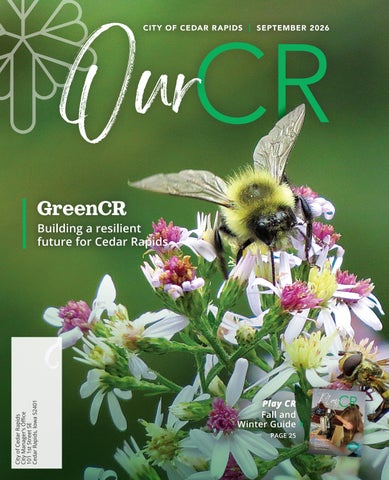
GreenCR Building a resilient future for Cedar Rapids
Play CR Fall and Winter Guide PAGE 25
FROM THE
CITY MANAGER
SEPTEMBER 2026 FROM THE CITY MANAGER • 2 CLIMATE ACTION PLAN OVERVIEW • 4 GOAL 1: CARBON FREE • 5 GOAL 2: RESILIENT & ACCESSIBLE • 11 GET INVOLVED • 17 NEWS YOU CAN USE • 21 DIRECTORIES • 24 PLAY CR FALL & WINTER GUIDE • 25
CONNECT
WITH CEDAR RAPIDS City of Cedar Rapids Iowa Government
Mobile CR Smartphone App
@CityofCRIowa
CR News Now Text / Email Alerts
CityofCR
City Source Email Newsletter
City of Cedar Rapids on Nextdoor
CityofCR.com/Subscribe
Interested in advertising with us? Contact communications@cedar-rapids.org.
Together, we are shaping the future of Cedar Rapids by making choices that endure now and for the years to come. Some of those choices are easy to see in our neighborhoods — new trees taking root; improvements that make it easier to walk, bike, or share rides; and projects that protect homes and businesses from future flooding. Others happen behind the scenes: investments in efficient facilities, modern infrastructure, renewable energy, and long-term planning. Together, this work keeps City services reliable, uses taxpayer resources wisely, and strengthens Cedar Rapids for the future. This issue highlights the progress Cedar Rapids has made since adopting the Community Climate Action Plan five years ago. While the plan includes long-term goals, much of the work is grounded in practical steps that improve efficiency, reduce costs, strengthen resilience, and enhance quality of life. Success requires ongoing partnerships between residents, businesses, community organizations, and City staff — built through steady investment and shared commitment over time. Whether expanding our tree canopy; using resources more efficiently; protecting water quality; or providing more options for how people live, travel, and connect in Cedar Rapids; each effort contributes to a stronger, more resilient city. Thank you for taking the time to learn more about this important work and for the everyday choices and actions you make that help strengthen our community.
Jeffrey Pomeranz Cedar Rapids City Manager citymanager@cedar-rapids.org 2
Cedar Rapids has become remarkably familiar with the consequences of our changing climate and natural disasters. Our community has endured a disproportionate share of extraordinary weather events — bringing significant costs and many opportunities to learn, adapt, and improve. Originating from the City's comprehensive plan, EnvisionCR, the Community Climate Action Plan builds on that experience by
identifying practical actions that strengthen resilience, improve efficiency, and enhance quality of life. The plan reflects the ideas and priorities shared by our residents, businesses, community organizations, and City leaders during its development. Its success depends on continued partnerships across Cedar Rapids. The following pages highlight progress made since the Plan’s adoption and the work still ahead as we continue building a stronger, more resilient Cedar Rapids.
The Cedar Rapids Community Climate Action Plan (CCAP) is a roadmap for practical, cost-effective improvements that help our community operate more efficiently, strengthen resilience, and prepare for the future.
Adopted by the City Council in 2021, the Plan identifies specific actions to reduce communitywide energy use, lower operating costs, improve infrastructure, and protect the resources upon which we depend. The Plan’s goal areas and action items relate directly to the targets of our City Council's 2020 Climate Resolution — charting work across 24 actions, including areas like enhancing transit and shared-transportation options, developing a Community Gardens in Parks plan, preparing for electric-vehicle infrastructure, protecting water quality, and creating green-building development incentives. The Plan reflects our community’s long-term commitment to making smart investments that benefit residents and businesses. It focuses on practical solutions to improve energy efficiency, reduce waste, strengthen our ability to withstand severe weather, improve air and water quality, and ensure reliable services that support everyday life. Long before the CCAP was adopted, Cedar Rapids had built a reputation for responsible stewardship, investing wisely in public infrastructure, protecting residents from natural disasters, and finding efficient ways to deliver City services. The CCAP builds on that foundation and accelerates our work — expanding electric vehicle charging, increasing renewable energy use, improving City facility efficiency, investing in resilient infrastructure, enhancing parks and green spaces, reducing waste, reusing materials, and protecting water quality. It also encourages residents and businesses to take practical steps that save energy, reduce costs, and contribute to a stronger, more resilient Cedar Rapids. Learn more about the Cedar Rapids Community Climate Action Plan by visiting CityofCR.com/GreenCR
what is the
climate action plan? 4
OUR CR
|
SEPTEMBER 2026
GOA L 1:
carbon free Reducing Greenhouse Gases Reducing greenhouse gas emissions is the first goal of the Community Climate Action Plan (CCAP) because it addresses the primary source of climate change while creating practical benefits for our community.
938.8k kwh SOLAR GENERATED IN 2025 RENE WABLE ENERGY GROW TH
City facilities are expanding clean energy production.
Burning fossil fuels adds carbon dioxide to the atmosphere, trapping heat and warming the Earth, like a blanket keeps the body warm. Since the mid-1800s, humans have relied on fossil fuels like oil, coal, and natural gas to generate the energy we use every day for electricity, transportation, heating, and manufacturing.
Complete streets expand mobility options NEIGHBORHOOD ACCESS
Connecting daily destinations like parks, shops, and schools.
Many of the same actions that reduce emissions — improving energy efficiency, modernizing buildings, expanding renewable energy, and supporting more efficient transportation options — also lower energy costs, reduce waste, strengthen our infrastructure, and make Cedar Rapids more resilient to future challenges.
100+ miles of trails CONNEC TED COMMUNIT Y
Supporting walking, biking, and low-emission travel.
CCAP's Carbon-Free goal brings together practical efforts to strengthen neighborhoods, support local businesses, and advance Cedar Rapids’ long-term sustainability goals. Building on this work, the City helped develop the Pathways to a Resilient Future: Regional Strategy for East Central Iowa, extending these efforts across the region and helping create a more resilient future for our communities.
EV Infrastructure planning underway C L E A N T R A N S P O R TAT I O N
Preparing for lower-emission public transit and vehicles.
Lower Costs for Homes & businesses E N E R G Y- E F F I C I E N C Y P R O G R A M S
Helping reduce energy use through upgrades and improvements.
grow solar + community solar garden partnership SOL AR ENERGY
Expanding access to shared renewable energy.
CEDAR-RAPIDS.ORG
5
G O A L 1: C A R B O N F R E E
a clean path forward
Greener City Fleet
Building our Community Climate Action Plan started with an inventory of local greenhouse gas (GHG) emissions. The inventory identified transportation as the largest non-industrial contributor of carbon dioxide in Cedar Rapids, making it an important plan focus.
Urban Design Accommodates Low-Carbon Transport The recently opened Kingston Yard Parking Ramp shows how innovative design can support lower-carbon transportation. The facility includes 20 electric-vehicle (EV) charging spaces and free parking for 42 bicycles, making it easier for people to choose sustainable travel options. The ramp’s design also reduces environmental impact. Constructing the ramp with approximately 20 percent less cement than a traditional parking structure lowers overall emissions. Energy-efficient LED lights — with daylight and motion sensors — reduce energy consumption. Its electrical systems can accommodate potential future solar installation. Native landscaping also provides habitat for birds and pollinators.
To further reduce reliance on traditional fuel sources, the City is diversifying its vehicle fleet. Three plug-in hybrid Ford Escapes and two fully electric light-duty vehicles recently joined the fleet through Department of Energy grant funding. Six new EV-charging stations with 12 ports are available at City facilities, allowing Cedar Rapids to continue to expand its alternative-fuel fleet. Cedar Rapids Transit is also moving toward cleaner vehicles with its first hybrid bus. Hybrid buses combine traditional engines with electric propulsion, reducing fuel use and emissions without requiring new charging infrastructure. This makes hybrid technology a practical step toward longer-term electrification. The hybrid bus supports a quieter, more comfortable experience for riders, pedestrians, and nearby businesses. Idle-reduction technology allows the bus to rely more on electric systems when stopped, helping reduce engine idling, tailpipe emissions, and noise at bus stops and intersections.
Looking for a place to charge? Find publicly accessible EV-charging locations at PlugShare.com.
6
OUR CR
|
SEPTEMBER 2026
Lightening the Load Creating a community where walking, rolling, transit, and other forms of micromobility are practical options can help reduce emissions. Cedar Rapids continues to invest in infrastructure that gives residents and visitors more options. New and reconstructed streets routinely include sidewalks, accessible curb ramps, and bicycle or micromobility accommodations when appropriate. Cedar Rapids now features more than 130 miles of trails and bikeways, helping connect neighborhoods with parks, schools, businesses, and other destinations. These investments make shorter car-free trips more convenient and support a transportation system with more choices. Reducing demand, improving efficiency, and making lower-carbon choices more accessible also applies to how the City operates its own facilities.
Cleaner Energy in City Facilities Cedar Rapids has demonstrated leadership in solar energy, becoming Iowa’s first community to earn SolSmart Gold recognition in 2018. The City uses solar power at the Transit garage in Northwest Cedar Rapids; water booster stations on Chandler Street, Glass Road, and Oklahoma Avenue; and Ellis Golf Course Clubhouse. These installations offset electricity use and reduce long-term operating costs. Solar is not the only tool we use to reduce building-related emissions. The City has also invested in geothermal systems at the Downtown Library, Central Fire Station, and the Westside Library, using stable ground temperatures to heat and cool buildings more efficiently. We continue to review all City facilities for potential solar compatibility, battery-storage opportunities, and other energy-efficiency improvements. Power Purchase Agreements may make future solar installations possible without upfront capital costs at locations such as Cedar Rapids Animal Care & Control, Northwest Recreation Center, Central Fire Station, and Westside Library.
On Course for Net Zero With its rooftop solar array and energyefficient design, Ellis Golf Clubhouse & Event Center has achieved verified net zero energy performance based on measured building data. This means it produces as much clean energy as it uses! The City is currently working through the application and review process for Zero Energy Certification through the International Living Future Institute. Certification is anticipated later this fall.
CEDAR-RAPIDS.ORG
7
G O A L 1: C A R B O N F R E E
greener homes,
stronger community The Greenest Home May Already Be Yours Building a new home requires new materials, energy, and transportation. Keeping an existing home in good condition avoids much of that environmental cost while reducing construction waste. This is notably true in Cedar Rapids’ historic neighborhoods. Preserving older homes while making thoughtful improvements allows Cedar Rapids to protect the character of our community, avoid resources required for new construction, and integrate modern technology for energy efficiency and comfort. Older homes are part of what makes neighborhoods unique. With proper care and upgrades over time, they can continue serving families for generations while supporting a more sustainable future. Whether a home was built 100 years ago or just last year, maintaining and improving what already exists is often one of the smartest long-term investments a homeowner can make.
8
SUSTAINABILITY THROUGH PRESERVATION Homeowners with historically significant properties have a unique opportunity to blend heritage preservation with modern sustainability efforts. By combining ecological stewardship and historic beauty, residents can help protect the character of Cedar Rapids’ neighborhoods while preparing homes for the future. Through the City’s Historic Preservation Commission, owners of properties in local historic districts or designated landmarks can make improvements while protecting their home’s character. Exterior changes, including windows, paint, and porch repairs, must follow the Historic Preservation Design Guidelines and may require approval through a Certificate of Appropriateness or Certificate of No Material Effect. The City’s Historic Rehabilitation Program helps support these efforts. “We encourage qualifying homeowners to apply for a grant of up to $7,500 for qualifying exterior improvements,” said Jeff Wozencraft, a community development planner for the City. Sustainability and preservation often go hand in hand. Sara Maples, the City’s sustainability program manager, said reinvesting in existing buildings can reduce the environmental impact of new construction. “Reinvesting in historic buildings protects our shared history, significantly reduces material waste, and conserves resources,” Maples explained.
OUR CR
|
SEPTEMBER 2026
“Reinvesting in historic buildings protects our shared history, significantly reduces material waste, and conserves resources.” Sara Maples, Sustainability Program Manager
Using Less, Saving More The energy we use at home affects both our utility bills and our community’s greenhouse gas emissions. Improvements that reduce energy use can make homes more comfortable, lower monthly costs, and help move Cedar Rapids toward its carbon reduction goals. Many upgrades do not require major renovations. Sealing drafts, adding insulation, replacing older light bulbs with LEDs, and installing high-efficiency heating and cooling equipment are practical ways to use less energy. Larger projects, such as installing a heat pump or improving a home’s overall energy performance, can provide additional savings over time.
HARNESS THE SUN Interested in solar power? Grow Solar East Central Iowa helps homeowners, small businesses, and farmers purchase solar energy systems at below-market prices through a community group-buy program. The program is coordinated by
the Midwest Renewable Energy Association in partnership with the East Central Iowa Council of Governments, the City of Cedar Rapids, the City of Iowa City, The Nature Conservancy in Iowa, 1000 Friends of Iowa, and the Iowa Energy Fund. Residents in Benton, Johnson, Jones, Linn, and Washington counties can attend free Solar Power Hours to learn how solar works, explore available incentives and financing, and determine whether their property is a good fit. Participants can then receive a personalized site assessment and proposal from a pre-selected installer. “Solar provides locally-sourced, predictable, and clean energy and helps community members manage long-term energy costs and strengthen their resilience,” said Maples. “Grow Solar East Central Iowa supports that transition while creating renewable energy jobs.”
Learn more at CityofCR.com/SolarEnergy.
Community Solar Garden The City of Cedar Rapids is a key anchor tenant in Alliant Energy’s Cedar Rapids Community Solar Garden, subscribing to 900 out of 18,000 available solar “blocks” — roughly 5% of the project’s total capacity — as part of a 20-year agreement. Situated on 30 acres north of 33rd Avenue SW, the 4.5 MW facility is Alliant’s first community solar farm in Iowa and began operations in February 2024. The City’s participation spreads renewable energy benefits throughout the community while providing an estimated $29,200 in annual utility credits — projected to reach nearly half a million dollars over the 20-year agreement.
Learn about the City's commitment to sustainable practices at CityofCR.com/GreenCR.
CEDAR-RAPIDS.ORG
9
Caring is our specialty Physicians’ Clinic of Iowa’s pediatricians are more than just doctors – they’re trusted partners in your child’s health journey. From newborns to adolescents, we offer comprehensive care, including routine check-ups, immunizations, well-child visits, and chronic condition management. Your child’s health is our top priority, and we take the time to ensure you and your child feel heard and supported every step of the way. Accepting new patients! Call (319) 247-3820 or easily schedule online.
PCOFIOWA.COM
resilient
GOAL 2:
and accessible Building Resiliency for Cedar Rapids’ Future The Community Climate Action Plan's Resilient & Accessible goal focuses on preparing Cedar Rapids for the challenges of today while building a stronger community for the future. From record flooding in 2008 and 2016, to the devastating 2020 Derecho, Cedar Rapids has experienced firsthand the impacts of extreme weather. We are experiencing more frequent periods of extreme heat, which can affect public health, strain infrastructure, and increase energy costs.
To meet these challenges, the City is making longterm investments in resilience. Construction of the billion-dollar Flood Control System will help protect homes, businesses, and critical infrastructure from future flooding. At the same time, ReLeaf Cedar Rapids is helping restore the community's tree canopy following the loss of more than half a million trees in the 2020 Derecho. As thousands of new trees mature, they will provide shade, reduce urban heat, improve air and water quality, manage stormwater, lower energy costs, and create healthier neighborhoods. Resilience also means investing in the places and services that improve everyday life. Parks and green spaces, clean water, healthy neighborhoods, and strong community partnerships all help make Cedar Rapids safer, healthier, and better prepared for the future. Building that future is a shared effort. Every infrastructure project, tree planted, volunteer initiative, and community partnership helps strengthen Cedar Rapids for generations to come.
$2.5M invested in 2025 watershed work W AT E R S H E D I N V E S T M E N T
Reducing flooding and improving water quality.
22k+ trees planted toward 42k+ goal TREE RECOVERY & COOLING
Helping restore canopy lost in the 2020 Derecho.
12.5B gallons of water safely returned in 2025 W AT E R W AY H E A LT H
Supporting clean and reliable water systems.
52% of flood control system underway or complete FLOOD PROTEC TION PROGRESS
A billion-dollar investment protecting the future of Cedar Rapids.
1k acres planted for pollinators GREEN INFR A S TRUC TURE
Supporting biodiversity and heat resilience.
10k+ bags of litter collected 1- BAG CHALLENGE
A record year for volunteerism and community pride.
To further prepare our community for natural disasters, the City developed the Neighborhood P.A.C.T. program, asking residents to Prepare, Act, Communicate, and Train. This program equips residents with tools and knowledge needed for any weather-related emergency, including extreme hot and cold temperatures and storms affecting trees — potential concerns in Cedar Rapids. ` Learn more about how you can be prepared at CityofCR.com/PACT
418 garden plots fully leased in 2026 COMMUNIT Y GARDENS & FOOD ACCESS
Community gardens support food access, healthy living, and neighborhood connection across Cedar Rapids. 11
GOAL 2: RESILIENT & ACCESSIBLE
nothing wasted Materials do not have to go to waste just because their first job is done. Across City operations, materials are reused, resources conserved, and byproducts given new life.
Living Energy Some of the hardest-working helpers at the City’s wastewater facility are too small to see! Millions of microorganisms — or “bugs,” as wastewater professionals like to call them — feed on organic material in what we flush and wash down the drain. They help clean sewage — and many are returned to the system time and time again to keep working. Some of these microorganisms produce biogas containing methane
and carbon dioxide. Improvements underway at the Water Pollution Control Facility will clean that gas so it can be converted into renewable, natural gas. This byproduct can then be sold back to the utility system. Because natural gas already fuels parts of the treatment process, the project will reduce fuel purchases and operating costs. Completion is projected in 2029.
Putting Materials Back to Work Public Works applies the same “nothing wasted” approach to reduce cleanup, disposal, and replacement costs.
SAND
BRINE & ROCK SALT
In Winter 2025–26, the City replaced sand with other traction materials, reducing spring cleanup, keeping sediment out of waterways, and lowering landfill costs.
The City mixes AG64, a plant-based additive, with road salt to improve performance in cold weather. This allows crews to use less salt, reducing what reaches soil and waterways.
HYDRANT FLUSHING Instead of using fresh water to clean sewer pipes and water new sod, Public Works reuses water released during fire hydrant maintenance.
CONCRETE & ASPHALT When we repair streets, old asphalt and concrete are crushed for reuse in alleys, along road shoulders, and beneath new pavement — lowering material and disposal costs.
“The sheer amount of materials we recycle is massive.” Brian McLeod, Streets Superintendent
12
OUR CR
|
SEPTEMBER 2026
Preparing for Hotter Days The U.S. National Oceanic and Atmospheric Administration identifies extreme heat as the leading cause of weather-related death in the United States. Through Spot the Hot, trained volunteers collected thousands of temperature and humidity readings across Cedar Rapids. Analysts combined them with land-cover data to map where heat concentrates. The City can use these maps to target investments, reduce heat islands, and protect residents where risks are greatest. Our ReLeaf Plan, for example, considers heat, social vulnerability, and prior tree canopy to add shade where it helps most.
working together Lasting environmental progress depends on people throughout the community putting ideas into action. Each year at EcoFest, the City recognizes residents whose leadership, service, and creativity are helping build a cleaner, more sustainable Cedar Rapids.
Celebrating Our 2026 GreenCR Champions SUPPORTING OUR YOUTH AWARD // LIZ CALLAHAN Callahan brings sustainability into everyday learning at Cedar River Academy while helping advance Green School efforts and the school district’s first sustainability plan.
LIFETIME ACHIEVEMENT AWARD // JOHN ZAKRASEK Zakrasek has spent years advancing climate action, solar energy, and informed sustainability planning across Cedar Rapids and Linn County.
Learn how you can nominate a GreenCR Champion by visiting:
COMMUNITY CHAMPION AWARD // DAVID JENNERJOHN
CityofCR.com/GreenCRChamp.
The Greenway Parks Plan guides the future of more than 100 acres of green space — from Czech Village, through Downtown, and to Time Check. Many of these areas were once home to families and businesses displaced by the 2008 Flood. The plan shows how floodprone land can be repurposed to reduce future risk while reconnecting the community with the river.
Jennerjohn connects sustainability with workforce education, including student-led energy audits that help local businesses reduce costs and energy use.
Areas near the water can serve as trails, natural spaces, and recreation areas most of the time — then take on water when the river rises. It is flood control hidden in plain sight, giving the river room while creating public spaces people can enjoy every day. The Greenway is not a single project. It will take shape through a series of improvements over time. As work on the Flood
Control System continues, attention is turning toward implementation, including the upcoming openings of the Roundhouse in the Czech Village and Alliant Energy LightLine™. Cedar Rapids was selected to host a fully funded Bloomberg Harvard City Hall Fellow who will work with City staff and community partners through 2028 to help move the riverfront vision forward.
reimagining
the riverfront CEDAR-RAPIDS.ORG
For more information, visit: CityofCR.com/GreenwayPlan
13
GOAL 2: RESILIENT & ACCESSIBLE
new possibilities
in your own backyard A strong city needs homes residents can afford along with convenient access to nearby services and good jobs. Our Community Climate Action Plan (CCAP) uses development rules, incentives, and new programs to help neighborhoods grow in ways that meet these needs and serve more people.
More Homes A sustainable city offers different kinds of homes for people at different stages of life. This can include apartments, starter homes, senior housing, duplexes, and smaller homes within existing neighborhoods. Existing property owners can help add to these choices. For example, an accessory dwelling unit, or ADU, may be a basement apartment, a home above a garage, or a small backyard house. ADUs can give family members a place to live nearby, help older adults remain close to support, or create rental income for the property owner. They are one way to add smaller, low-cost housing options in our community without requiring new space or infrastructure. Providing more housing choices helps people find homes that fit their needs and budgets. This also allows more people to live near jobs, stores, parks, and transit. Each year, the City works with Maxfield Research to study local housing needs. The latest study found that the Greater Cedar Rapids area will need thousands of additional homes by 2030, including rentals, homes for sale, senior housing, and homes at lower price points. To help meet this need, the City uses development incentives to reduce the 14
costs of qualifying multifamily projects. These tools can help developers add more housing choices in locations near jobs, services, and transit.
New Life in Lasting Places Growing where existing streets, water lines, schools, and other services already exist can reduce the need to extend new infrastructure farther outward. It can also bring more people closer to stores, jobs, transit, and trails. Infill development adds homes and businesses to vacant or underused land in established parts of the city. It can also give older buildings a new purpose. The City uses development incentives and planning to spur this type of growth. One example is the Mount Vernon Road Urban Revitalization Area, where qualifying projects can receive a temporary propertytax exemption on new value created by construction or major improvements. The program is designed to support housing, improve older properties, and attract investment to the corridor. Bolstering the CCAP, the City also updated its economic
development incentives to support eligible commercial, industrial, and multifamily projects that earn an approved green-building certification. This encourages private development to help meet the plan’s goals while strengthening existing neighborhoods, corridors, and infrastructure.
For more information, visit: CityofCR.com/Incentives.
working together for cleaner water
Clean, reliable water is essential to our health and quality of life. Cedar Rapids continues to invest in strong partnerships that improve water quality throughout the Middle Cedar Watershed. We work alongside farmers, conservation groups, and regional organizations to protect the source of our drinking water.
Cultivating Conservation When rain falls on farm fields, water can carry loose soil, fertilizer, and nutrients such as nitrate into drainage ditches, streams, and rivers. These pollutants can affect water quality and eventually reach the Cedar River, an important influencer of drinking water for communities like Cedar Rapids. The Farmer-to-Farmer Grant supports the City’s Growing Resilience in the Middle Cedar Watershed program. Together, these efforts demonstrate how conservation practices can strengthen farmland, reduce nutrient runoff, and improve downstream water quality. The Growing Resilience program brings together local experts and farmers to test natural systems that use plants, soil, and water features to slow, store, and filter stormwater runoff before it reaches streams and rivers. Examples include wetlands, oxbows, grass waterways, prairie plantings, and other best-management practices that reduce nutrient loss, including nitrate. These improvements protect water quality while enhancing the
CEDAR-RAPIDS.ORG
field’s productivity. Consistent monitoring has shown that water quality varies across our watershed, including elevated nitrate levels in some tributaries. Ongoing monitoring at more than 60 watershed sites provides important data that guide planning and help identify where conservation practices will have the greatest benefit.
NASA Grant Cedar Rapids is participating in an innovative project supported by NASA. Working together with Des Moines Water Works, the University of Iowa, IIHR–Hydroscience & Engineering, and the City of Iowa City, the project team is developing a real-time forecasting and early-warning system for nitrate. The three-year effort will create tools that help water suppliers anticipate changing nitrate levels, reduce the risk of exceeding health standards, and make informed decisions during high-risk periods. The project’s first year will focus on listening to utility partners and designing a model that reflects real-world needs. The second year will build and test a forecasting dashboard; the final year will evaluate the project’s performance and develop guidelines for use across the country.
15
GOAL 2: RESILIENT & ACCESSIBLE
stormwater solutions
Cedar Rapids residents are no strangers to the power of water. As a community, we respect and embrace the river while continuing to invest in innovative ways to manage stormwater, protect homes, and enhance local waterways.
Case Study: Building Resilience in the E Avenue NW Watershed
Heavy rainfall can put pressure on local drainage systems, contributing to street flooding, basement backups, and disruptions across neighborhoods. Through the City’s Stormwater Plan, Cedar Rapids uses data, modeling, and longterm planning to identify drainage challenges and guide investments to reduce flood risk and prepare for a variety of future conditions.
In one recent, six-hour rain event, approximately 5.5 inches of rain fell across the E Avenue NW watershed. The heavy rainfall overwhelmed nearby streets and affected homes and businesses.
Growing Resilience Community gardens improve access to fresh food, strengthen neighborhood connections, and give residents space to grow culturally relevant produce close to home. The City's Community Gardens in Parks Plan earned the 2024 Resilience & Sustainability Award from the Iowa Chapter of the American Planning Association, recognizing its innovative approach to creating a stronger, more sustainable community. Today, 418 garden plots in five park areas are fully leased each season, reflecting strong community demand and the important role gardens play in Cedar Rapids' future.
Vinton Ditch improvements, currently underway as part of the broader E Avenue NW Watershed strategy, demonstrate how thoughtful infrastructure can provide lasting value for the community. The project uses a forward-looking approach to address flash flooding by removing sediment, adding stormwater filters called hydrodynamic separators, and expanding storage capacity to slow and filter runoff before it moves downstream. These improvements capture debris, nutrients, and sediment, improving water quality while reducing flood risk. They also create space for restored wetland and oxbow features that support overall healthier ecosystems.
` Learn more at CityofCR.com/ CommunityGardens.
16
OUR CR
|
SEPTEMBER 2026
Incorporating natural features like these into stormwater management provides habitat for native plants and wildlife. These spaces also create opportunities for outdoor learning and contribute to the beauty and ecological health of the area. The project also supports long-term community goals, including the future extension of the Cherokee Trail System. Once complete, the system will give residents a new way to experience the restored wetland environment. Cedar Rapids is committed to protecting water resources in every form. Efforts include reducing flood risk, improving drainage, and enhancing water quality through creative, people-centered design. This work increases our resiliency to future climate challenges. For more information, visit CityofCR.com/Stormwater.
G E T I N V O LV E D
Cedar Rapids is working toward a healthier, more resilient future. Through two new grant programs, the City is providing funding for community-led projects that support the goals of the Community Climate Action Plan (CCAP). These grants help turn climate goals into local action by supporting practical, creative solutions that improve sustainability, resilience, and quality of life across Cedar Rapids.
For Residents, Organizations & Community Groups The City Manager’s Sustainability Grant empowers residents and organizations to bring forward projects that support smart energy use and environmental stewardship. Applicants may request funding for efforts that support the CCAP. Eligible projects may include: ` Education and outreach
` Community gardens
` Waste reduction
` Low-emission transportation
` Native plantings and overall habitat improvements
` Other community-led ideas that help create a healthier, resilient Cedar Rapids
For more information, visit CityofCR.com/CMSustainabilityGrant.
For Ages 15–24
Building Climate Solutions Together The CCAP recognizes that meaningful progress depends on the ideas, participation, and leadership of our entire community. The plan’s approach is built around understanding that climate challenges can affect people and neighborhoods in different ways. By engaging residents and incorporating a range of perspectives and experiences, Cedar Rapids can develop solutions that reflect local needs and create meaningful, lasting impact. These grant programs are one way the City is putting that approach into action, creating opportunities for residents of all ages to turn ideas into solutions and help build a sustainable, thriving Cedar Rapids.
The Mayor’s Youth Climate Grant invites young people ages 15–24 to design and lead their own climate-focused ideas. Funding is provided through Bloomberg Philanthropies’ Youth Climate Action Fund, a global initiative that supports youth-led projects, helps young leaders build skills, and creates opportunities for community-driven solutions. With up to $5,000 available per project, youth can apply their creativity to improve public spaces, reduce waste, enhance natural areas, or strengthen neighborhood resilience. Eligible projects must support GreenCR and CCAP goals.
To learn more about this opportunity, visit CityofCR.com/YouthClimateFund.
grants for a
greener community CEDAR-RAPIDS.ORG
17
G E T I N V O LV E D
make your home
more sustainable Every improvement — large or small — helps build a cleaner, more resilient Cedar Rapids. Whether you want to lower energy costs, improve comfort, or explore renewable energy, resources are available to help.
Assess Your Home’s Energy Efficiency Before making upgrades, start with a home energy assessment. It can identify where your home is losing energy and which improvements will make the biggest difference. A professional assessment provides detailed recommendations, while a simple walkthrough can reveal many opportunities to improve your home's efficiency.
CHECK INSULATION Older homes may have less insulation than today’s standards require. Look for: ` Insulation and weather stripping around attic hatches
INSPECT HEATING & COOLING EQUIPMENT Have your HVAC system professionally inspected and cleaned each year. If your system is more than 15 years old, replacing it with a newer, more efficient model may reduce energy use and improve comfort in your home.
UPGRADE LIGHTING
` Gaps around pipes, wires, and openings
Lighting accounts for about 10% of home electricity use, according to the U.S. Department of Energy. Switching to LED bulbs and using sensors, dimmers, or timers can help reduce energy use.
` Blocked attic vents ` Uninsulated water heaters, hot water pipes, or furnace ducts in unconditioned spaces
CHECK FOR AIR LEAKS
18
Drafts around windows, doors, floors, ceilings, and exterior openings can waste energy and make your home less comfortable. Sealing gaps is one of the easiest ways to improve efficiency and reduce costs.
Finance Home Improvements The Neighborhood Finance Corporation offers financing options for eligible homeowners to complete projects such as solar installations, heat pumps, insulation, and high-efficiency HVAC upgrades. The Energy Advantage program includes a 0% deferred loan to help make larger improvements more affordable. Learn more at NeighborhoodFinance.org.
Take Charge: Expired Batteries
act green:
reduce, reuse, recycle Every item we throw away represents resources, energy, and effort that went into making it. The most effective way to reduce waste is to create less of it. Small choices at home can make a big difference in how much waste our community produces.
Mindful Purchasing
Recycling
One of the best ways to reduce waste is to get more use out of the things you already own. Repair items when possible, donate things you no longer need, or find another purpose before throwing them away. Keeping products in use longer saves resources and reduces the amount of waste sent to the landfill. Before buying something new, ask yourself: Do I need this? Will I use it more than once? Is there a longerlasting option? Choosing reusable products, avoiding unnecessary packaging, and buying only what you need can make a big impact.
Recycling works best when residents put the right materials in their curbside recycling carts and keep out items that do not belong. Items like plastic bags, food waste, hoses, and batteries can contaminate recyclable materials, damage equipment, and create safety hazards for workers.
Batteries are everywhere — and many can pose serious fire risks if placed in regular trash bins. When crushed or damaged at the Linn County landfill, these batteries can spark fires — endangering workers, equipment, and the environment. To reduce the number of hazardous incidents and remove chemical spread from decaying batteries, proper recycling is essential.
TIPS FOR BATTERY RECYCLING ` Keep out of curbside carts. ` Store in non-conductive containers. ` Tape exposed terminals to prevent short circuits. Residents can safely recycle all household battery types — including single-use, rechargeable, and lithium-ion batteries — free of charge, with no sorting required.
You can find dedicated battery drop-off locations at the Cedar Rapids City Services Center, 500 15th Avenue SW; and the CR-Linn County Solid Waste Agency, 1954 County Home Road, Marion.
Find helpful recycling tips at: RecyclingSimplified.com
CEDAR-RAPIDS.ORG
19
G E T I N V O LV E D
put rain to work
on your property Runoff from yards, driveways, and parking lots can carry oil, lawn chemicals, sediment, and other pollutants into local waterways. Rain gardens, bioswales, permeable pavement, and other stormwater practices help water soak into the ground, filter pollutants, and reduce flooding.
fee. The City’s Stormwater BMP Program reimburses 50% of eligible material and contractor costs. Residential properties may receive up to $2,000 per project. Commercial properties may receive 50% reimbursement, with no maximum for qualifying improvements beyond minimum requirements.
Cedar Rapids property owners pay a stormwater utility fee based on the amount of hard surface on their property. Approved improvements that reduce runoff may qualify for a lower
Before starting work, contact the Stormwater Coordinator at 319-286-5604 or send an email to sewer@cedar-rapids.org to discuss your project and apply.
take the bus A useful transit system is more than a way to get from place to place — it is public infrastructure that expands who can fully participate in city life. Cedar Rapids Transit serves workers, students, older adults, people with disabilities, bicyclists, households sharing one vehicle — and anyone who wants to skip the drive. Relying on the bus can feel like having a gate at the end of your driveway that opens at set intervals: the more often it opens, the easier transit fits into your day. That idea helped drive more frequent service on busy corridors. Route 5, the system’s busiest route, now runs along First Avenue between downtown and Lindale Mall about every 15 minutes. Weekday service has also expanded, running from 5:30 a.m.–7:15 p.m., giving people more options to get to work, appointments, errands, and evening activities. Saturday rides are free, and so are year-round rides for students from Cedar Rapids Community School District, Kirkwood Community College, and Coe College. The City is also planning a free-fare pilot to study costs and ridership impacts. 20
Plan Your Ride ` Monday–Friday: 5:30 a.m.–7:15 p.m. (standard fare) ` Saturday: 9:15 a.m.–4:15 p.m. (all rides are free!) Most routes connect at the Ground Transportation Center downtown. Route 5 also connects at Twixt Town Road with Route 20 (Marion Circulator) and Route 30 (NE Cedar Rapids & Hiawatha Circulator). Find information on routes, locations served, and detours at CityofCR.com/Transit. Visit RideCRT.com to see real-time bus locations and Maps.Google.com to help plan your trip.
NE WS YOU C AN USE
sustainability
RAIN ART These designs appear when pavement gets wet. Volunteers installed and mapped artwork at bus stops, trails, and other public spaces during United Way’s Day of Caring this year.
in public art
You can find the City’s sustainability work featured in some unexpected places around Cedar Rapids — like sidewalks, bus shelters, and even garbage and recycling trucks.
ART-WRAPPED TRUCKS Keep an eye out for our colorful garbage and recycling trucks! Several trucks sponsored by the City’s Sustainability program feature local artwork inspired by sustainable neighborhoods.
Public art helps make shared spaces more inviting and gives local artists a chance to add something meaningful to the community. It can also help people notice and understand important topics. Blending public art with sustainability themes demonstrates the City’s focus on clean energy, healthy waterways, sustainable transportation, nature, and climate resilience — in places people see every day.
BUS SHELTER ART Designs at select Cedar Rapids Transit shelters feature topics such as native plants, pollinators, clean energy, water resources, sustainable transportation, and preparing for heat and flooding.
` Learn more about the City’s Public Art Program and find walking art tours and rain art locations at CityofCR.com/Art.
SAVE THE DATE!
City Week Open House Take a look behind the scenes of City operations, where families can climb aboard different vehicles and equipment used by our departments, visit with City staff, and enjoy fun games and activities. Get a close-up view of how we keep the City moving safely every day.
Check the City’s website for event information, updates, and schedule changes:
CityofCR.com/Calendar WEDNESDAY, NOVEMBER 4 | 4–6 PM | CITY SERVICES CENTER
Cremation
Funeral
Cemetery
Everything for your family A t Cedar Memorial, you’ll find comfort, dignity, and quality at every turn. From our distinctive facilities and grounds to our caring, professional staff—we provide everything for your family. We pride ourselves in providing innovative funeral and cemetery services to families throughout the Marion
and Cedar Rapids area. Learn more today at www.CedarMemorial.com
NE WS YOU C AN USE
2 0 2 6 P U B L I C I N F O R M AT I O N R E P O R T
fire department bond measure
On Tuesday, August 11, the Cedar Rapids City Council approved a resolution calling a special election on a proposed $60 million General Obligation Bond for general corporate purposes related to the Fire Department. The election will be held November 3, 2026, concurrently with the General Election. We are sharing this information to help residents understand the measure before it is considered by voters. Learn more about the studies and bond measure at: CityofCR.com/FireBond
FALL
LOOSE LEAF
Overview & Context Reviews associated with the Fire Department’s Center for Public Safety Excellence accreditation, along with an independent assessment by nationally recognized public-safety expert Raftelis, identified deficiencies in building conditions, firefighter health and safety features, and training capabilities. The reviews also considered Cedar Rapids’ expanding boundaries as residential, commercial, and industrial development has extended beyond areas served by stations established decades ago. Many stations are at or beyond their intended useful lives, require increasing maintenance, and were not designed for today’s apparatus, equipment, or workforce. Planning identified opportunities to meet modern National Fire Protection Association design practices, including decontamination areas, separate storage for
contaminated gear to reduce firefighter exposure to carcinogens and other hazardous materials, and dedicated fitness and wellness spaces. Cedar Rapids has a Class 2 ISO rating, which measures the strength of a community’s fire protection system and may be considered by insurers when setting property insurance rates. In the City’s most recent review, training facilities were identified as an area that could lower the rating if not addressed. A new training facility is intended to address that gap. Any effect of a future rating change on individual insurance costs would vary by insurer and policy. The proposed bond measure follows several years of independent assessment and planning focused on the Fire Department’s long-term facility and infrastructure needs.
OCTOBER 26 – DECEMBER 3, 2026 All homes will have their loose leaves collected bi-weekly (one time every other week). Please refer to the schedule at CityofCR.com/Leaf to determine your collection period. If you have questions, we are happy to take your call at 319-286-5897. REMINDER: YARDY carts are collected Spring through Fall. Get the message! Sign up for CRNewsNow alerts to hear when collection is happening in your neighborhood.
COLLECTION Get service interruption notices sent straight to your phone or email! Register today at CRNewsNow.com
What Would the Bond Fund? The proposed bond would provide up to $60 million for fire station improvements and relocations, a new Training and Urban Search & Rescue facility, land acquisition, and new fire trucks and emergency-response equipment.
Financial Impact: $2.03 per month per $100,000 of assessed property value.
REFURBISH STATIONS 4 & 9
REBUILD STATIONS 5 & 6
RELOCATE STATIONS 2 & 8
42nd Street NE; C Avenue NE
Wilson Avenue SW; Mount Vernon Road SE
50th Avenue Court SW; Wiley Boulevard SW
Built in the 1980s. Enlarge apparatus bays and add modern firefighter health, fitness, decontamination and cancer-riskreduction features.
Built in 1957. Structural deficiencies cannot be adequately addressed through remodeling, requiring replacement to meet current operational and safety standards.
Build new stations within existing service areas to better align with current population and development patterns, with the goal of improved response times.
TRAINING CAMPUS Replace the current training facility with modern live-burn and clean-training capabilities. Co-locate Iowa Task Force 1 to improve training and equipment readiness; State lease payments would provide rental revenue to the City.
FIRE TRUCKS & EMERGENCY EQUIPMENT Replace aging apparatus and address maintenance and operational needs. New firefighting vehicles can take two to four years to procure.
Election Details The measure will appear on the November 3, 2026, General Election ballot. Voters will be asked whether the City may issue up to $60 million in General Obligation Bonds or Capital Loan Notes for Fire Department projects and equipment described on this page. Approval requires at least 60% of votes cast on the measure.
General election information ELECTION DAY
Tuesday, November 3, 2026
POLLS OPEN
7 AM – 8 PM
VIEW A SAMPLE BALLOT:
FIND YOUR POLLING PLACE:
MORE INFORMATION:
Starting September 18, enter your home address using the Linn County Elections Lookup Tool to see the ballot specific to your address:
The Linn County Elections Lookup Tool shows your assigned Election Day polling location and voting districts:
Linn County Election Services provides information about voter registration, absentee voting, voter ID, early voting, polling locations, and other election questions.
LinnCountyElections.org/Lookup
LinnCountyElections.org/Lookup
LinnCountyIowa.gov/Vote | 319-892-5300
CITY SERVICES DIRECTORY CITY SERVICE
LOCATION
PHONE
EMAIL ADDRESS
Animals
7241 Washington View Parkway SW
319-286-5993
AnimalControlMgmt@Cedar-Rapids.org
Assessor
City Services Center, 500 15 Avenue SW
319-286-5888
CRAssessor@Cedar-Rapids.org
Bid Opportunities
City Hall, 101 1 Street SE
319-286-5021
Bid-Purchasing@Cedar-Rapids.org
Building and Housing Codes
City Services Center, 500 15 Avenue SW
319-286-5831
Building@Cedar-Rapids.org
Buses
Ground Transportation Center, 450 1st Street SE
319-286-5573
CRTransit@Cedar-Rapids.org
Fire Safety Inspections
713 1st Avenue SE
319-286-5166
CRFire@Cedar-Rapids.org
Garbage, Recycling, and Yard Waste Collection
City Services Center, 500 15th Avenue SW
319-286-5897
Solid-Waste-Recycling@Cedar-Rapids.org
Housing Assistance Programs
City Hall, 101 1st Street SE
319-286-5872
HSG-Admin@Cedar-Rapids.org
Land Development
City Services Center, 500 15 Avenue SW
319-286-5822
DevelopmentServices@Cedar-Rapids.org
Park Pavilion & Shelter Rentals
City Services Center, 500 15 Avenue SW
319-286-5566
Parks@Cedar-Rapids.org
th
st
th
th th
Police — Non-Emergency
319-286-5491
Potholes and Street Maintenance
City Services Center, 500 15th Avenue SW
319-286-5826
Street@Cedar-Rapids.org
Recreation Programs
Northwest Recreation Center, 1340 11th Street NW
319-286-5566
Recreation@Cedar-Rapids.org
Sewer Backup or Problems
City Services Center, 500 15th Avenue SW
319-286-5815
Sewer@Cedar-Rapids.org
Traffic Signals, Signs, and Markings
City Services Center, 500 15th Avenue SW
319-286-5176
Utility Billing
City Hall, 101 1st Street SE
319-286-5900
Traffic@Cedar-Rapids.org WaterMail@Cedar-Rapids.org
For more information about the City of Cedar Rapids and its services, call 319-286-5080 or visit CityofCR.com.
CITY COUNCIL
To leave a message for a City Council member, call 319-286-5051. Find your district at LinnCountyElections.org.
MAYOR
DISTRICT 1
DISTRICT 2
Tiffany O’Donnell
Martin Hoeger
Scott Overland
DISTRICT 3
DISTRICT 4
DISTRICT 5
Dale Todd
Scott Olson
Ashley Vanorny
AT LARGE
AT LARGE
AT LARGE
David Maier
Tyler Olson
Ann Poe
T.Odonnell@cedar-rapids.org
M.Hoeger@cedar-rapids.org
D.Todd@cedar-rapids.org
Scott.Olson@cedar-rapids.org
D.Maier@cedar-rapids.org
24
T.Olson@cedar-rapids.org
OUR CR
|
SEPTEMBER 2026
S.Overland@cedar-rapids.org
A.Vanorny@cedar-rapids.org
Ann.Poe@cedar-rapids.org
Experience the best of all Five Seasons with Mobile CR, the City’s improved mobile app. Check out the community-wide events calendar that can pull events from Hello Cedar Rapids right into your calendar Use My CR to report city concerns, ask questions, and follow up on issues you’re tracking Get CR News Now alerts sent directly to your pocket, and so much more!
Download Today!
Hello isn’t just how we greet you, it’s how we invite you in. From festivals and live music, to arts, culture, and entertainment for all ages, Cedar Rapids offers endless opportunities to experience the city in ways that will make it hard to say goodbye. Are you hosting a public event? Submit your event to the online calendar and expand your reach to the community. Find upcoming events and submit your own at: HelloCedarRapids.com/events-calendar