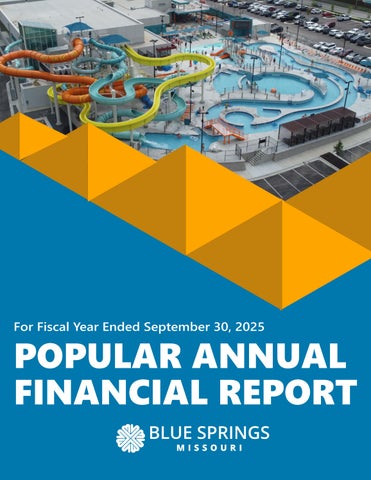
For Fiscal Year Ended September 30, 2025
![]()

For Fiscal Year Ended September 30, 2025


Dear Citizens of Blue Springs,

I am pleased to present the City of Blue Springs Citizen’s Annual Financial Report regarding the finances and administrative activities of the city for the fiscal year ended September 30, 2025. This report provides a brief analysis of where the city revenue comes from and where those dollars are spent as well as trends in the local economy. The City received the Government Finance Officers Association (“the GFOA”) award for Outstanding Achievement in Popular Annual Financial Reporting for the 2024 Popular Annual Financial Report, for the 11th consecutive year.
The report is intended to summarize the financial activities of the City of Blue Springs government and includes a portion of the information that appears in the 2025 Annual Comprehensive Financial Report (ACFR). This report is unaudited and not presented in a Generally Accepted Accounting Principles (GAAP) format. A copy of the ACFR is available at the city’s website: www. bluespringsmo.gov.
To the best of our knowledge, the information presented herein is accurate in all material respects and presents fairly the financial position and results of operations for the fiscal year ended September 30, 2025. Responsibility for the accuracy and completeness of the data presented rests solely with the city.
We are committed to preserving the city’s long-term financial health as evidenced by our AA Standard & Poor’s bond rating and fund balance reserves. In 2021, the City Council revised its governmental fund balance policy to 25%. The city maintains a balance of 17% of operating expenditures as an emergency reserve and 8% of operating expenditures as a budget stabilization reserve.
If you have any questions or comments regarding the information in this document, please contact me at 816-2280140.
Sincerely,

Christine Cates City Administrator

GFOA award for Outstanding Achievement in Popular Annual Financial Reporting in 2024.
The City of Blue Springs has a MayorCouncil-Administrator form of government as set forth in the Home Rule City Charter. The City Council is the governing body of the City, elected by the public.


Blue Springs traces its origins to westward-bound pioneers who stopped in the area for its abundant, clear water, particularly a spring at the mouth of the east fork of the Little Blue River that inspired the city’s name. This reliable water source supported early development, including a grist mill and settlement at what is now Burrus Old Mill Park.
Established in 1827 as the fourth settlement in Jackson County, the community grew steadily, led in part by early settler Franklin Smith, who founded the first post office in 1845.
In 1878, the town shifted its center east to align with the new Chicago and Alton Railroad, strengthening its role as a rural trading hub. Growth accelerated during World War II with the opening of the Lake City Army Ammunition Plant and again in 1965 with the arrival of Interstate 70, improving access to Kansas City. From just under 7,000 residents in 1970, Blue Springs has grown into Missouri’s 11th largest city, now home to more than 61,000 people, while continuing to preserve its historic roots through ongoing community efforts.


DISTRICT 2


DISTRICT 3


Incorporated: 1880
Government: Mayor-Council-Administrator
Location: 20 miles east of Kansas City, Mo.
Land Size: 14.610 acres (22.83 square miles) Population: 61,246 (2024 Census) Population History


61,246 Residents

Blue Springs continues to experience steady population growth, reflecting the community’s strong quality of life and contributing to increased demand for housing, infrastructure and municipal services.

Strong school enrollment reflects a growing and family-oriented community and highlights the City’s continued attractiveness as a place to live, work and raise a family.

A low unemployment rate reflects a strong local economy and stable workforce, which supports consumer spending, business growth and the City’s overall financial stability.

Per capita personal income reflects the overall earning capacity of residents and serves as an indicator of the community’s economic health and standard of living.
SEPT. 30, 2023, SEPT. 30, 2024, SEPT. 30, 2025

Typically used to account for tax-supported activities, the governmental funds for the City of Blue Springs include the General Fund, Public Safety Sales Tax Fund, Parks Sales Tax Fund, Debt Service Funds, Capital Projects Funds (including Tax Increment Financing funds), and the Hotel/Motel Tax Fund. The City’s basic services, including police, parks and recreation, streets, development services, maintenance, and capital improvements, are accounted for in these funds.
Governmental revenues in FY 2025 increased by $1,446,420, or 2.24%, compared to FY 2024. Growth was primarily driven by increases in intergovernmental revenues and sales tax collections. Intergovernmental revenues increased $1,627,604, reflecting additional grant funding and shared revenues received during the year. Sales taxes also increased $321,581, or 0.75%, reflecting continued economic activity in the community. While investment income declined slightly compared to the prior year, overall revenues remained stable due to consistent tax and intergovernmental revenue sources.
Governmental expenditures increased by $16.2 million (27.9%) compared to the previous year, mainly due to increased spending on capital projects across the City. Major investments included approximately $7 million in park improvements, including baseball field upgrades at Hidden Valley Park, tennis court improvements at Baumgardner Park and Rotary Park, and new restroom facilities at Keystone, Rotary, Hidden Valley, and Ward parks. The City also invested in stormwater improvements funded by federal ARPA funds, purchased downtown property, and acquired heavy equipment for Public Works operations. Additional spending included street preservation and roadway improvements funded by voter-approved General Obligation bonds, along with modest increases in public safety operations and debt service.
As a result, the governmental fund balance increased by $25,667,393 in FY 2025. This increase was primarily driven by the issuance of $31.4 million in general obligation bonds, which were used to support major capital improvement projects and strategic infrastructure investments throughout the City.
The revenues for governmental activities totaled $65,945,553 for 2025, marking a 2.24% increase over the prior year. The City continues to benefit from strong sales tax collections including the marijuana tax, increased interest earnings and continued American Rescue Plan Act (ARPA) grant activity.
• Taxes, the City’s largest revenue source, totaled $43.4 million in FY 2025, representing approximately 66% of total governmental revenues. This amount includes revenues from property taxes, retail sales taxes, lodging taxes, and gross receipts taxes on utilities such as electricity, gas, telephone, and cable services. The City imposes a 1% general sales tax, as well as dedicated ½% sales taxes for transportation, public safety, and parks. Additionally, voters approved a 3% marijuana sales tax which took effect October 1, 2023.
• Intergovernmental Activity Taxes are Economic Activity Taxes (EATS), which are a portion of sales taxes that are generated within established Tax Increment Financing (TIF) districts. These taxes totaled $5 million in FY 2025 and are deposited into each district’s special allocation fund.
• Licenses and Permits revenues from building permits, business licenses, and liquor licenses rebounded to $1.23 million, a 15% decrease from FY 2024. The prior year included several largescale projects for the Blue Springs School District that did not recur in FY 2025. In addition, higher construction costs and elevated interest rates contributed to slower development activity during the year.
• Intergovernmental revenues totaled $7.7 million in FY 2025, accounting for approximately 11.7% of the City’s total revenues. These revenues include distributions from the State for fuel taxes, motor vehicle sales taxes and license fees, as well as grant funding. This increase was primarily due to higher state motor fuel tax distributions resulting from phased rate increases enacted by the State of Missouri.
• Charges for services, which include Parks and Recreation program fees and the City’s portion of municipal court costs, accounted for 2.3% of governmental revenues. These revenues decreased 3.25% to $1.52 million, primarily due to lower plan review and developer construction fees as development activity slowed compared to the prior year.
• Administrative Charges are made up of the funds that are transferred from the proprietary funds to the General Fund to cover the cost of the overhead services that are provided to the Water and Sewer funds by the General Fund. These expenditures include Human Resources, Information Technology, and Finance.
• Fines and forfeits, which encompass fines collected by the Municipal Court, increased 49% from the prior year due to sustained growth in ticket issuance and timing of collections.
• Interest income decreased to $2.6 million, down from $2.99 million in the prior year, primarily due to the lower cash balances available for investment.
• The City received $571,783 in donations in FY 2025 for public safety and parks projects.
• Other revenue of $860 thousand includes proceeds from the City auction, sale of property, antenna rent, insurance settlements and workers compensation dividends.


2025 Governmental Fund Type Expenditures by Function
The expenditures for governmental activities total $74,046,065 for 2025. The largest expenditure categories are capital outlay 35%, public safety 24% and debt service 18% of all governmental activities.
• Public Safety includes all operations of the police department.
• Capital outlay expenses are 35% of the total and include the annual pavement management program, heavy equipment replacement and police vehicles.
• General government expenditures include Administration, Legal, Community Development, Finance, Human Resources, and Information Technology.

• Debt service includes principal and interest payments for the City’s outstanding general obligation and special obligation debt.
• Parks Department expenditures include funding for administration, facilities, parks maintenance, recreation and the Vesper Hall Senior Center.
• Highways and Streets include the expenditures for pothole maintenance, snow removal, street signs and street light maintenance.
• Public Works includes the expenditures for the engineering staff and professional services.
• Economic Development includes funding for the Economic Development department and economic development related expenditures reimbursed by developers.


SEPT. 30, 2023, SEPT. 30, 2024, SEPT. 30, 2025
The financial activities for the Golf Course, Water Utility, Sewer Utility, and Fieldhouse are recorded in proprietary funds for the City of Blue Springs and are financed primarily by a user charge for the provision of that service, and activities where the periodic measurement of net income is deemed appropriate to provide funding for the capital maintenance and improvements.
Operating revenues for the City’s proprietary funds totaled $31,282,566 in fiscal year 2025. The Water Utility generated $12,309,337, the Sewer Utility generated $12,883,621, the Golf Course generated $2,768,370, and the Fieldhouse generated $3,321,238 in operating revenues. Total operating expenses were $31,555,681, reflecting the ongoing costs required to operate and maintain these facilities and services.
The Water Utility reported operating revenues of approximately $12.3 million in FY 2025, remaining relatively consistent with the prior year. Operating expenses increased to $13.6 million, resulting in an operating deficit for the year. However, non-operating revenues, primarily investment income, offset the operating loss, resulting in a slight increase in net position of $21,395.
The Sewer Utility reported a strong financial year, with net position increasing by approximately $3.7 million, primarily due to sewer rate adjustments and the timing of planned capital improvement projects that will be completed in future years.
The Golf Course continues to generate sufficient user charge revenues to support its operations and a portion of its debt service. In fiscal year 2025, golf revenues remained strong and resulted in a net position increase of approximately $312,000, reflecting continued participation and steady demand.
The Fieldhouse, which opened to the public on September 28, 2015, continues to serve as a recreation and wellness facility for the community. The facility includes four hard-surfaced courts, artificial turf field space, walking tracks, a fitness center, meeting rooms, and child watch services. In May 2024, the City opened the Blue Surf Bay Waterpark, which was financed through bonds issued in December 2022. The waterpark includes a wellness pool, wave pool, social pool, lap pool, splash pad, surf simulator, lazy river, and multiple water slides. Fiscal year 2025 reflects the first full year of operations and depreciation related to the waterpark, which resulted in a net position decrease of approximately $2.1 million for the Fieldhouse fund.
Overall, proprietary fund operations remained stable in fiscal year 2025, with revenues supporting the majority of operating costs while continuing to fund capital investments and long-term infrastructure needs.


Authorized full time equivalent employees increased by one position in the fiscal year 2026 budget. An Animal Control Officer position was added to bring the total number of Animal Control Officers to five.

The City’s outstanding debt totaled $141,962,643 at the end of FY 2025, compared to $119,030,460 in FY 2024, an increase of approximately $22.9 million. During FY 2025, the City issued $31.4 million in voter-approved General Obligation bonds to fund road improvement projects approved by voters in August 2024. The increase in total debt reflects the new bond issuance and was partially offset by scheduled principal payments on existing debt during the year.
City debt has been used to finance major community investments, including road improvements, expansion of the Sni-A-Bar Wastewater Treatment Plant, neighborhood infrastructure improvements, economic development projects, the public safety building expansion, and the aquatic center. The City maintains a conservative approach to debt management, issuing debt primarily for long-term infrastructure projects that benefit the community over many years. General Obligation bonds are issued only after voter approval, ensuring residents have a direct role in authorizing major borrowing for public improvements.

A Blue Springs resident who owns a home with a $300,000 market value, paid $4,650.29 in real estate taxes, with $330.66 (7.11%) going to the City of Blue Springs.
Tax rates within the City of Blue Springs vary depending on the school district and fire protection district.
The City’s sales tax rate of 8.725% is comparable to surrounding cities and is divided among five different taxing entities. The State of Missouri receives 4.225%, Jackson County receives 1.375%, Central Jackson County Fire Protection District receives .5%, Friends of the Zoo receives .125% and the City of Blue Springs receives 2.5%.
Of the City’s 2.5% sales tax, 1% is for General Fund operations, .5% is deposited in the Capital Projects Fund for transportation related projects,.5% is deposited into the Public Safety Sales Tax Fund where the revenues can only be used to fund public safety operations and capital improvements and .5% is deposited into the Parks Sales Tax Fund where the revenues are used for parks deferred maintenance and payment of aquatic center debt. The Parks Sales tax was renewed in 2021 and does not have a sunset.

The total sales tax the City received in fiscal year 2025 was $29,542,798. This total includes $546,368 of the 3% marijuana sales tax, which became effective October 1, 2023.


A fund created to account for financial resources to be used for the acquisition or the construction of major capital facilities or equipment.
A fund established to account for the accumulation of resources for, and the payment of, long-term debt principal and interest.
Additional revenue from sales taxes generated by economic activities within at TIF district over the amount of taxes generated within the area in the calendar year prior to the adoption of the ordinance designating the TIF area.
Net position of a governmental fund (difference between assets, liabilities, deferred outflows of resources, and deferred inflows of resources).
The fund used to account for all financial resources except those required to be accounted for in another fund.
Funds generally used to account for tax-supported activities. There are five different types of governmental funds: the general fund, special revenue funds, debt service funds, capital projects funds, and permanent funds.
The residual of all other financial statement elements presented in a statement of financial position.
Operating statement classification in which financial inflows other than revenues are reported; for example, proceeds of general obligation bonds and transfers in.
Operating statement classification in which financial outflows other than expenditures are reported; for example, operating transfers out.
Cost of goods sold and services provided to customers and the revenue thus generated.
Funds that focus on the determination of operating income, changes in net position (or cost recovery), financial position, and cash flows. There are two types of proprietary funds: enterprise funds, and internal service funds.
Financing secured by the anticipated incremental increase in property tax and sales tax revenues, resulting from redevelopment.