New Health Minister Marisa Paterson has her hands tied, says MICHAEL MOORE
In cabinet reshuffles, unions do the dealing ANDREW HUGHES
Here’s how to assemble a Barr cabinet KEEPING UP THE ACT
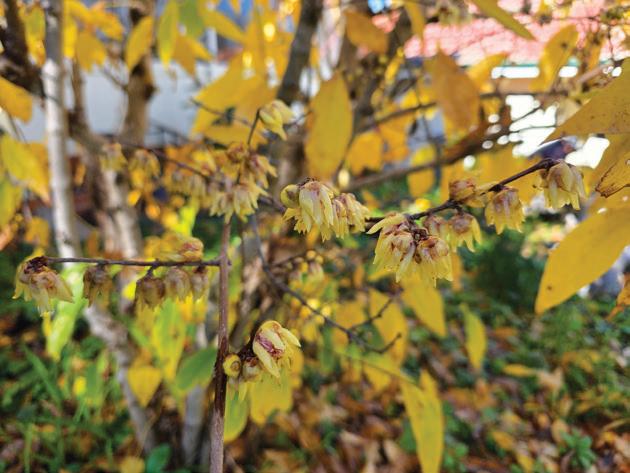
It’s August, but don’t rush to prune the roses JACKIE WARBURTON
Balloon magic
Medical scientist DR CHLOE LIM uses her balloon skills to guide kids to better eating
How a ‘village’ brought bushland back from brink
By Helen Musa
“It takes a village to rescue a bit of Aussie bush,” is how conservation volunteer Cornelis “Con” Boekel sums up the remarkable transformation of Dryandra Woodland.
The woodland is the 17-hectare patch of remnant bush in O’Connor that, Boekel says, has been brought back from the brink by hundreds of helping hands.
Boekel has documented the six-year rehabilitation in a report, The Rehabilitation of Dryandra Woodland, describing it as both a thank you to everyone involved and a blueprint for restoring other degraded urban bushland.
The story begins in 2020, when the Friends of Dryandra Woodland set themselves an ambitious goal: to eliminate invasive weeds so native plants and animals could flourish once again.
Since then, volunteers have contributed 2887 hours of work, supported by $68,102 in ACT Government funding. Together they have tackled weeds, planted native vegetation, controlled rabbits, reduced erosion and redirected human traffic through the fragile reserve.
Boekel says the project has only
succeeded because of the combined efforts of volunteers, scientists, government staff and citizen scientists.
He singles out Prof Jamie Pittock for his leadership, botanist Dr Rosemary Purdie for her expertise and Bruce Baker for his organisational skills.
The figures tell an encouraging story. The woodland now supports
179 native plant species, including 24 orchid species, while more than 70 recorded species have threatened or protected status somewhere in Australia.
Among its botanical treasures is the Black Mountain Leopard Orchid, a species found only on Black Mountain sandstone, with around 10 per
General manager: Tracey Avery, tracey@citynews.com.au
cent of its known population growing in the Dryandra Woodland.
Although 146 weed species have been recorded, Boekel reports that substantial progress has been made against the 18 major weed species and that most of the remaining minor weeds now require only annual monitoring. Native plants are responding,
with at least 29 species increasing in numbers or extending their range.
Erosion has been brought under control, rubbish and asbestos removed, damaged tracks restored and fencing installed to prevent further vehicle damage.
Replanting has met with mixed success, he says, with drought and rabbit digging claiming many young trees despite repeated rescue watering.
One statistic particularly pleases Boekel. While introduced plants still account for almost half the flora, every bird species now observed in the woodland is native.
Boekel also praises the many experts contributing to NatureMapr and iNaturalist, whose identifications have helped record almost 1400 species in the woodland, together with the Atlas of Living Australia. He singles out the contribution of Aaron Clausen for the development of Canberra NatureMapr.
Support from successive ACT governments, beginning with ministers Chris Steel and Mick Gentleman, together with City Services and ACT Natural Resource Management, has also been critical, he says.
For Boekel, the rehabilitation of Dryandra Woodland demonstrates what can be achieved when governments back committed community volunteers. The report is dedicated simply to “all the villagers”.
The Woodland is a breeding site for Stencilled Hairstreak butterflies. Photo: Con Boekel
Black Mountain Leopard Orchid, found only on Black Mountain sandstone. Photo: Con Boekel
Rachel, let go of Health and give Marisa a chance
In what other city in the world would the leaders determine that a 50-year-old hospital needs replacement?
With great fanfare the ACT Government took over the then Calvary Hospital just three years ago. Now it has decided the hospital is inadequate.
Grand buildings, ribbon cutting and fanfare openings are great politics. However, what the Canberra community really wishes to see is that health has adequate staffing to meet the needs of a growing and ageing community.
New Health Minister Dr Marisa Paterson has her hands tied. The new Deputy Chief Minister, Rachel StephenSmith, has retained “health infrastructure”. Where does the stupidity end? But at least Ms Stephen-Smith will be able to wield the scissors.
The Canberra Hospital at Woden Valley has not been replaced. It has been modified and extended many times over the intervening years to meet changing demands. Built as Woden Valley Hospital in 1973, it is just three years older than the then Calvary Public Hospital when it opened in 1976.
The Calvary Hospital also saw upgrades in its time under the stewardship of the Little Company of
Mary. The Emergency Department is just one example.
Big building projects are a hallmark of the Barr Government. This government, even subconsciously, must see them as a legacy issue.
As an example, imagine the impact of the huge spend on light rail on concrete, rails and overhead wires being put instead into free public transport!
The trouble is, as much as free transport would have assisted ordinary folk and meant fewer cars on the road, there would have been no infrastructure legacy.
It is a similar story with hospital services. The proposed $1.5billion spend over the next decade is designed to improve facilities – especially for those living in the Northern
New Health Minister
Dr Marisa Paterson has her hands tied. The new Deputy Chief Minister, Rachel Stephen-Smith, has retained “health infrastructure”. Where does the stupidity end?
areas of Canberra. Rachel StephenSmith does not want to let that go – it is her idea of how to improve health.
The predictable problem will be having appropriate personnel to staff the hospital. CityNews columnists Jon Stanhope and Khalid Ahmed have constantly outlined the challenges of the recurrent health budget on many occasions. Their insights fall on deaf ears.
Coming to my attention recently was a case in pediatric orthopedic surgery that provides a serious concern. My understanding is that Canberra has just one semi-retired specialist pediatric orthopedic surgeon who generously attends Canberra Hospital two days per week.
The recent budget announced: “There will be funding to expand the Pediatric Fracture Clinic at Canberra Hospital. A dedicated pediatric orthopedic service will also be established”.
The reason given was “these services will improve care closer to
home for children with bone and soft tissue conditions”. My reading of this statement is that children with serious fractures currently need to be sent to hospitals in NSW.
It is just one example of inadequate staffing, and let’s hope it can be addressed – if the new minister can find the staff.
Waiting times for elective surgery, as identified by ACT Health, provide an insight into the lack of staffing.
In Category 1, that deals with urgent patients, the ACT does very well. Category 2 patients, who should be seen within 90 days, are a different story with around 400 people overdue. In orthopedics alone, there are more than 180 people waiting beyond what is clinically appropriate.
Category 3 illustrates the real problem of staffing in ACT Hospitals. This is surgery that ought to be carried out within a year of being put on the waiting list. More than 800 people fall into this category. Orthopedics and Otolaryngology Head and Neck Surgery lead this category accounting for nearly 600 patients.
Despite the recent announcement of an additional 1000 surgeries, these figures have hardly altered.
The needs are clear. Nice new buildings can provide a delightful workspace. However, it is adequate staffing and efficient delivery of services that have a critical impact on how long people wait for appropriate hospital treatment.
In 2023 there was a fundamental question for the then Health Minister Rachel Stephen-Smith when taking over the Calvary Public Hospital that was operating efficiently and effectively. Why do it when you are having so much trouble running The Canberra Hospital?
And now she retains hospital buildings. Rachel Stephen-Smith, let go of health and give Dr Paterson a fair go. Let her rethink the expenditure of over $1.5billion building a new hospital when there is so much trouble staffing and managing the current one.
Michael Moore is a former member of the ACT Legislative Assembly and an in dependent minister for health. He has been a political columnist with “CityNews” since 2006.
A second opinion on hearing loss – you need professional advice, not a sales pitch
A woman came into my clinic for a consultation about her hearing aids, telling me her hearing aids were 4 years old and she had never found them to be of much help. She said the salesperson quoted her $14,000 for a pair of hearing aids, however, the monthly special of 20% discount meant they cost her $11,200. So, she ‘only’ paid $11,200 for hearing aids that did not help her. Sadly, I hear this all too often.
Here are some things to do to avoid this type of problem:
1. Visit your GP. If you or someone you know has a problem with their hearing, visiting your GP to check for wax in the ears, and to get advice is a starting point.
2. Qualifications. Always check the qualifications of the person you are dealing with. A person without professional qualifications has no business advising you about your hearing. They need to belong to a professional association with a Code of Conduct, so you know they are acting in your best interests, not their own.
years. If you are not sure about their advice, then seek a second opinion. The wrong hearing aids can be an expensive waste and could lead you to stop wearing them. You should always have a trial of hearing aids to ensure that they are right for you.
6 Pensioners and eligible DVA card holders often have entitlement to free services. If you are covered by a government concession, then let the clinician know (even though your clinician should ask). Eligible clients may obtain free hearing tests, consultations, and free hearing aids (referred to as fully subsidized hearing aids).
“A person without professional qualifications has no business advising you about your hearing. They need to belong to a professional association with a Code of Conduct, so you know they are acting in your best interests, not their own.”
– Dr Vass
These hearing aids are appropriate for many people, however if you have great difficulty hearing in background noise (for example a restaurant), then you may want to consider partially subsidized hearing aids. This is when the government pays a certain amount, and you pay for additional features and benefits. Your decision should be based on the following:
you are dealing with a qualified clinician, then they belong to a professional association. The best contact is an independent complaints body referred to as Ethics Review Committee. You can email ethics@auderc.org.au and view the website www.auderc.org.au. You can make an anonymous complaint and your complaint will be handled in a confidential and professional manner. If you are in the ACT, contact the ACT Human Rights Commission email human rights@act.gov au and the website www.hrc.act.gov.au
3. Independent advice. You should get independent, professional advice.
4. There are a wide range of hearing aids out there. Finding the right hearing aids for your communication needs can be challenging. Hearing aids vary in price and performance. Bluetooth® connectivity and rechargeable hearing aids are available on most hearing aids, along with apps that allow you to control your hearing aids from your mobile device. Be aware that just because a hearing aid is more expensive, that doesn’t mean they are the best hearing aid for you.
5. Just as hearing aids vary in performance, clinicians may also vary in performance due to training, experience, and skills. Make sure that you are comfortable and confident in their advice. You are likely to be with this clinician for the life of your new hearing aids, typically 4 to 5
(a) Can you afford the more expensive hearing aids? Don’t go into financial stress if you can’t afford them. (b) Are you clear on the free vs partially subsidized features & benefits? Never believe someone who tells you the free hearings are not good or of poor performance, this is simply not true. (c) If you try the partially subsidized hearing aids and are not happy, then return them. Do not keep hearing aids because you think the failure is yours or that you will improve over time. If the hearing aids are not working for you in the trial period, then they will not work for you in a year or two.
7. If you have a complaint, then seek help. Your clinician should be able to help you through most of your needs. Sometimes, a problem may be beyond the expertise of even the best clinician. However, if you have a complaint there are things you can do. If
Dr Chloe’s balloon magic has a healthy message
By Thomas McCoy
If you wanted to teach young children about the value of eating fresh fruit and vegetables, would you use… balloons?
For Dr Chloe Lim, the answer is a resounding “yes”.
A medical scientist and balloon artist, Chloe combines science, creativity and hands-on learning to help children develop positive attitudes towards healthy food.
During National Science Week (August 15-23), she will present Foodie Fun Play, an interactive show designed for children aged three to eight.
Inspired by her own experiences as a parent of children who were sometimes reluctant to eat healthy foods, Chloe teamed up with Dr Ekavi Georgousopoulou, an assistant professor in nutrition and dietetics at the University of Canberra, to develop the show.
“In the show, which is informed by fussy-eating research, we use play, storytelling and balloon sculpture to help children explore fruits and vegetables, letting them touch, squish and smell foods they might be afraid of,” Chloe said.
“So children who may have been scared of seeing broccoli on their plate at the dinner table, for example, get to make friends with a lovely
range of colourful balloon creations.
The session’s star attraction is “Bob”, a hangry balloon caterpillar who is fed the various fruits and
vegetables while children learn about the nutrients they contain.
“One of the things I’m passionate about is introducing scientific terms to children,” Chloe said.
“Even though they might be young, you can always learn more vocabulary.
“So I’ll talk about vitamin C, vitamin A, antioxidants and even introduce lycopene, the red pigment found in tomatoes, and folate, which is found in dark green leafy vegetables, as we all feed Bob.”
In the second half of the session, children take part in balloon art activities and can choose from a menu of fruit and vegetable creations for Chloe to make on the spot.
“They can come up to me, choose the fruit or vegetable they want, and I’ll create it while they watch,” she said.
The program also includes a tasting table featuring fresh fruits and vegetables that children can use to make colourful food art, eat during the session, or take home to enjoy later.
Beyond healthy eating, Chloe hopes
the sessions will inspire children, particularly girls, to consider future careers in science.
“As a female scientist, I’d encourage people to follow this path because, in the age of AI, it’s more important than ever to develop scientific thinking skills so we can evaluate which claims are based on credible evidence and then make better decisions in our lives,” she said.
“It’s so important for children to learn about science and how the world works. If we can present it in a way that’s engaging and fun, it makes science more approachable and accessible.”
Chloe is also passionate about addressing rising rates of obesity and chronic disease through healthier eating habits established early in life.
“Because children are still developing and growing, it’s especially important that they eat high-quality, nutritious foods so their mental and physical development can thrive,” she said.
Foodie Fun Play debuted during National Science Week last year, receiving an average rating of 4.8 out of 5 from participants.
Parents praised the program’s impact, with one reporting: “I’d never seen my child touch that vegetable before, but they did it after the show!”
Ten one-hour sessions will be held across four locations during
Located in the heart of Canberra’s medical precinct in Deakin
At Canberra Family Health Centre, we are dedicated to providing comprehensive, patient-focused healthcare for individuals and families. Located centrally in Deakin, our centre offers a wide range of medical services designed to meet your health needs at every stage of life.
National Science Week, but bookings are essential and can be made online at: twistyfic.eventbrite.com.
In addition to Foodie Fun, National Science Week features a diverse program of free events for all ages, including dancing bees, live glassblowing and flameworking, accessible technology workshops, computing for seniors, physics demonstrations, rocket launches, gravitational waves and cosmic collisions, guided nature walks, film screenings, mathematical science activities, archaeology sessions, marine science, image processing, paint-and-play events, environmental education, chemistry in the pub, cyber security competitions, the Tower Titans Challenge, encounters with snakes and reptiles, and the Space-Faring Civilisation Film Festival.
Canberra’s major shopping centres will also join the celebrations through Science in the Centres, bringing hands-on experiments, interactive displays and science-inspired fun to shoppers at Canberra Centre, Westfield Belconnen, Westfield Woden, South.Point Tuggeranong, Majura Park Shopping Centre, Cooleman Court and Marketplace Gungahlin.
Full event information and bookings at scienceweek.net.au. Thomas McCoy is an ACT National Science Week Committee Member.
Associate Professor Maryse Badawy MB/ BS Degree, FRACGP, FHKAM (Family Medicine), Grad Dip Fam Med, Master Family Medicine, Member Australasian Menopause Society
National and International Family Medicine and Academic experience.
Medical scientist and balloon artist Dr Chloe Lim… “We use play, storytelling and balloon sculpture to help children explore fruits and vegetables.” Photo: Ian Greaves
MEET OUR EXERCISE EXPERTS
Holly Hazelwood – Exercise Physiologist
Holly is a former sports journalist who believed so strongly in the power of exercise to heal and nurture that she undertook her 4 year degree in Exercise Physiology. Holly is be able to work with people directly to support them through their pain journey and regain independence and a joy for living again. Holly provides one on one and group exercise classes both on land and at our hydrotherapy centres to support people to gain freedom from chronic pain.
Sophie Bullock – Exercise Physiologist
Sophie has post graduate qualifications in hydrotherapy, and as a non-sports centred Exercise Physiologist, helps clients who struggle with engaging in exercise due to a lack of sports participation. Sophie’s goal is to improve clients health via our hydrotherapy program, gym instruction and in-home visits. Sophie also is known for her passion for working with children.
Nick van Diemen – Physiotherapist
Nick (they/them, he/him) has returned to Canberra after completing a Master’s in Physiotherapy at the University of Queensland. Their passion comes from a love of science and helping people. With eight years in disability support, Nick brings broad experience and enjoys working with clients across a wide range of needs.
Liam Barber – Exercise Physiologist
Liam has a passion for working with paediatric and mental health conditions, as well as supporting people to pursue a better quality of life. He has experience working across a wide range of musculoskeletal, neurological and cardiovascular conditions across all age groups.
Blake Dean – Exercise Physiologist
Blake has expertise in improving clients mobility and decreasing their pain through appropriate exercise. Blake delivers our ‘My Exercise’ program, targeting the relief of lower back and sciatic pain, shoulder and upper body concerns as well as leg, hip and ankle interventions – for those who do not qualify for physiotherapy-led GLAD programs. Blake provides individual & group exercise for younger people with a disability. Blake treats clients in-clinic or via our hydrotherapy program as well as attending your gym with you.
Sarah Solano – Exercise Physiologist
Sarah believes that exercise is the best medicine. She is an Accredited Exercise Physiologist with her degree in exercise physiology and rehabilitation. Previously Sarah was a swim teacher, personal trainer and an allied health assistant in the hydrotherapy field.
Natasha Elword – Exercise Scientist
Tash discovered her passion for exercise after completing her Certificate IV in Personal Training in 2015, later earning a Sport and Exercise Science degree from the University of Canberra. She joined Arthritis ACT in 2019 and now supports group classes, exercise programs and administration. Outside work, she enjoys family time, running, hiking and cooking.
Nat & Grace – Allied Health Assistants
Nat has recently completed studies as an Allied Health Assistant and has returned from a hiatus, during which she worked with us in administration, to provide more hands-on support. Grace is a student exercise physiologist who brings enthusiasm and care to supporting our clients to achieve their health and wellbeing goals.
• GLA:D® Program for hip and knee osteoarthritis.
• Education and supervised group sessions to build strength and confidence.
• Pain management strategies to reduce medication use tailored support including preparation for or avoiding joint replacement.
YOUNG
Art for art’s sake, not for artificial intelligence
As part of her service project for the International Baccalaureate Middle Years Program, ADELAIDE O’KEEFE , a year 9 student at Canberra Girls Grammar, has written a column on how artificial intelligence can affect the art community.
Have you ever noticed that everything at the local shops is made of plastic?
Yes, plastic, the cheap, versatile replacement for more traditional materials like wood and metal.
At record pace, the mass-produced material has saved our wallets and at the same time filled the oceans and skies with harmful pollution.
This is exactly what the incorporation of artificial intelligence into our lives has done.
Generative AI is fundamentally the same as plastic. Yes, it may not be a tangible object, but it is versatile, inexpensive and highly convenient for all purposes.
However, the effects of this seemingly helpful artificial mind are more negative than most people might think.
AI generation is one of the art community’s most relevant problems, and has been the cause of multiple lawsuits and complaints from professional and amateur artists. Like plastic, AI can be harmful as well as handy.
To dive deeper, I conducted a survey of female, private middle-school students to understand how this problem can affect amateurs and how the current generation understands it.
From the results, I discovered that more than 80 per cent of students had seen AI generated art in media, the most common form being through social media (TikTok or Instagram) with 40 per cent occurrence rate in my data. This fact led me to do some further research and I discovered that social media platforms (the most prominent example being Reddit) are legally allowed to use our art and posted media.
Every single thing we post can and will be used to train an AI model. As well as being a huge ethical issue, this can be morally harming to individual artists.
Imagine you’re a young, aspiring artist who likes posting pieces on Reddit to gain feedback from others, knowing that your artwork can legally be copied and used to create stereotypes in generative AI.
The next time you open Reddit, you could find that hundreds more artists have virtually posted copies of your art piece, down to major similarities in art style and character.
All across the world, thousands of artists are watching something that took hours of
their time and effort being recreated with the click of a button. Now, anyone can create their artwork without breaking a sweat.
AI is also known to appropriate art, creating stereotypes. If you were to prompt “Generate me a picture of a surfer” into ChatGPT it would give me something like the photo on the left.
As you can see, the image that the AI model came up with is highly Eurocentric and based around an entirely masculine perspective.
But if I were to go to the beach and look for surfers, the picture on the right is probably more like what I would see.
To train AI models, creators enter certain images and texts, from which AI notices patterns and interprets them as “rules”.
These “rules” come into being when the AI model searches images for recurring elements, including race and gender bias.
Instead of “Anyone can be a surfer if they put their mind to it”, AI decides that “A surfer must be an attractive, muscular white man”.
This leads to underrepresentation of certain groups in the world and false beliefs about different kinds of people.
I’m not saying that using AI to generate images is fundamentally bad. If you’re short on time, materials or generally just not very good at creating art, generating AI can be a very smart idea. It’s quick, easy and versatile. It has everything human art has – except for heart and soul.
By creating art through AI, we lose its greatest ability – to connect with people.
For centuries, art has been a worldwide communication method. It’s one of the only things that is universally interpreted in that it brings people together.
AI is a machine. A mindless machine that creates based on stereotypes, patterns and mathematics. And it’s becoming such an imminent problem that some day, traditional artists could be out of the job.
So next time you use AI to create an artwork, just remember how those traditional artists are thinking. They’ve spent hours upon hours infusing their soul into their work – and you’ve just recreated it crudely in 30 seconds.
So, what can you do? Well, go to a gallery. Go to an art teacher or a friend who creates for a hobby. Take a moment to look at their work – let the emotions in it wash over you.
Appreciate their work. And maybe, just maybe, you could even make their day.
At left is the image of a surfer generated by AI, which is highly Eurocentric and based around an entirely masculine perspective. But the photo, at right, is probably more like what we’d see at the beach.
How the government locks people out of houses
The ACT Government is a landowner, developer and also the regulator. So we’d be entitled to expect an adequate supply of appropriately priced land for the full range of housing choices. But there isn’t, say JON STANHOPE & KHALID AHMED.
At our recent presentation to the ANU’s Capitalist Studies Network, we concentrated on housing unaffordability in Canberra.
While the promotional thrust of the event was pitched in the context of the western world, it is indisputable the decline in housing affordability over the past 15 years is also a national and international problem.
Housing markets in the western world – and in Australia – have failed to deliver affordable outcomes for an increasing proportion of the population seeking to enter as owners or even to sustain rental tenancies without experiencing significant financial stress.
However, we need to reject the common disclaimer “we are in the same boat”, when it comes to assessing the situation in Canberra or comparing it with the rest of Australia.
Source: LDA/SLA Annual Reports; Respective Years.
The ACT Government is in a unique position – it has total control over the housing market through its ownership of land and its regulatory and planning powers. Unlike the states, in the ACTthere is no disjoint between state and local government planning policies and powers.
In the ACT, every new dwelling available to a family is delivered through the ACT Government’s release of the land on which it is built and/or its planning approvals.
The ACT Government is a landowner as well as a developer and is also the regulator. Therefore, we’re entitled to expect there would be an adequate supply of appropriately priced land for the full range of housing choices.
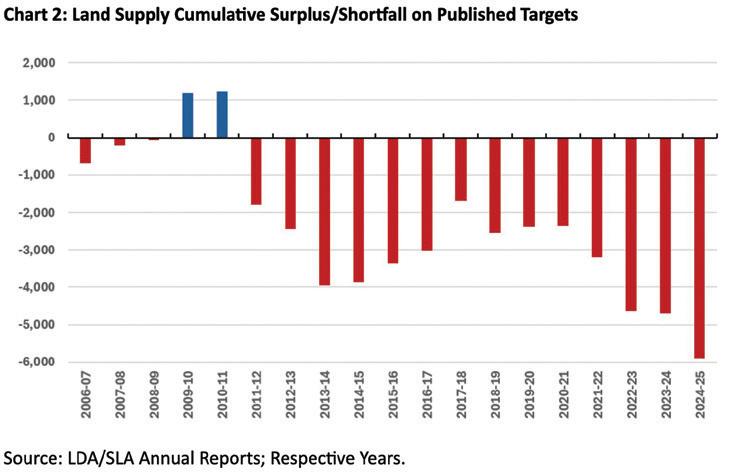
equivalent to almost two years, has endured for many years (Chart 2). That is against the ACT Government’s own published targets, despite the annual targets being worryingly low in the first place.
The ACT Government has also taken a deliberate decision to cut the supply of stand-alone sites for houses. Land supply for stand-alone houses was cut from 51 per cent of the total in 2012-13 to a mere 9 per cent in 2014-15.
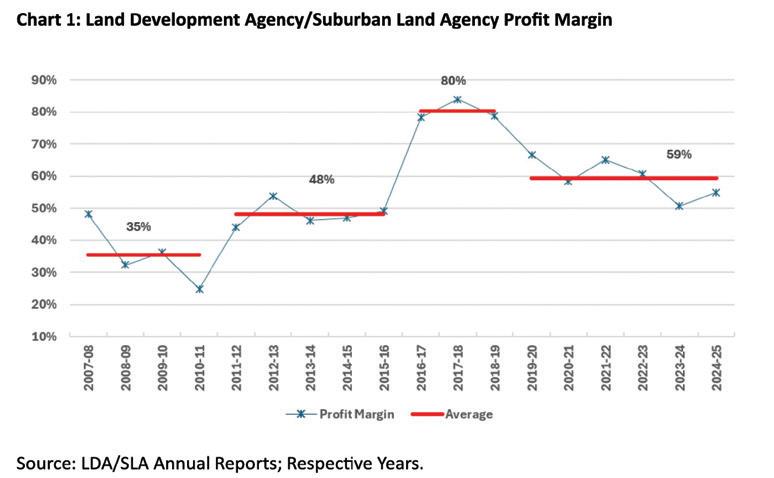
The ACT Government has increased its profit margin from an average of 35 per cent to 48 per cent and then to 80 per cent.
Public and community housing – together called social housing – play an important role in ensuring equitable and affordable outcomes. However, both critically rely on the government’s investment and regulatory policies.
So, how has the ACT Government exercised its powers and control over land supply?
It has increased its profit margin from an average of 35 per cent to 48 per cent and then to 80 per cent (Chart 1). The profit margin has averaged 59 per cent over the past five years because, in the main, a large proportion of potential buyers have either been excluded from the market or, in despair, moved across the ACT border into NSW.
A progressive shortfall in land supply,
In that year, only 329 blocks of land were released despite a clear majority of Canberrans wanting to live in detached housing.
The detailed report prepared by Winton Sustainable Research Strategies – at the behest of the ACT Government – revealed that 91 per cent of Canberrans’ first and preferred choice was a separate dwelling, ie a house, on a block between 499sqm and 1050sqm.
Recently, there has been much excitement within the government and the media over the acquisition of the 243-hectare CSIRO site in Belconnen for $380 million.
An obvious question, following the acquisition is: how much the government expects to make out of this purchase? The 3000 households who eventually settle there will almost certainly be collectively charged that $380 million plus infrastructure costs plus an amount to ensure a healthy ACT Government profit.
The CSIRO purchase effectively confirms that the government has chosen to extract monopoly rents through its control of land supply. It is,
without doubt, a speculator in this market. We should not, therefore, be surprised at the outcomes. House prices have in a relatively short timeframe more than doubled and a median-priced house now costs almost eight annual median incomes – a relative doubling of debt and interest costs.
Renters, notably, have not fared any better than homebuyers. Land tax, which the government agreed, over a decade ago, to abolish has increased by 10 per cent a year on average due to the increase in house prices as well as tax rates.
The government has collected $1.725 billion since declaring that this tax is inequitable and would therefore be abolished. In a supply constrained market, rather than encouraging landlords to sell, the tax is passed on to renters – an outcome notably opposite to that which the Greens claimed when they promulgated the increase when in government.
• In that period there has been a 26 per cent decline in housing stock in the ACT relative to the population since 2012.
Community Housing Canberra (CHC), before it was unceremoniously abolished by Labor and the Greens, was a nationally admired housing model across Australia. Notably the ACT Government not only abandoned Community Housing Canberra it also raided its assets. For example:
Land tax, which the government agreed, over a decade ago, to abolish has increased by 10 per cent a year.
Unsurprisingly, the ACT currently has the highest levels of rental stress in Australia. In addition to this, local policies on the provision of public housing are regressive and difficult to explain, particularly for a self-professed progressive government.
• For instance, 1288 public housing dwellings were sold off by the ACT Government with the proceeds directed to a fund for light rail.
Eight years later and the stock shortfall is yet to be fully replaced.
• The MOU that provided CHC access to land without having to bid in the open market against cashed up developers and speculators was cancelled.
• CHC’s finance facility was called in, without explanation or reason – despite there being no problems of governance or management or with its finances. As the organisation was unable to immediately return a $63 million loan, the government callously claimed its entire housing stock and around $1 million in cash. In doing so, the government also abandoned the housing targets that CHC had committed to, most notably 1000 dwellings for affordable purchase and rental. per cent However, on a more positive note, just imagine how grim the housing market would be for working-class families if we weren’t such a caring progressive community.
Jon Stanhope is a former chief minister of the ACT and Dr Khalid Ahmed a former senior ACT Treasury official.
You have the future of public interest journalism in your hands. If it’s worth a little support, we sure can use it. Follow the QR code or hit the support button on citynews.com.au – please. CAN WE COUNT YOU IN?
Source: LDA/SLA Annual Reports; Respective Years.
The ACT Government has taken a deliberate decision to cut the supply of stand-alone sites for houses.
Chart 1: Land Development Agency/Suburban Land Agency Profit Margin
Chart 2: Land Supply Cumulative Surplus/Shortfal on Published Targets
of Canberra’s
Bus shelters join heritage register
Canberra’s distinctive cream and orange concrete bus shelters have been added to the ACT Heritage Register, recognising their architectural, historic and social significance.
The ACT Heritage Council has heritage listed the iconic precast concrete bus shelters, ensuring their significance will be considered in future planning and management.
More than 460 of the shelters are spread across Canberra. They were designed in 1975 by architect Clement (Clem) Cummings and have become a familiar feature of the capital’s suburban streets.
Heritage Council chair Catherine Skippington said the shelters reflected Canberra’s planned development and had become uniquely associated with the city.
“The bus shelters are uniquely Canberran. They are familiar landmarks in suburbs across the city and reflect the co-ordinated planning approach that helped shape Canberra as Australia’s planned national capital,” she said.
The council said the shelters were a notable example of Brutalist design, with their simple concrete construction and modular form creating practical but distinctive public infrastructure.
The heritage listing does not change how the shelters are used, managed or maintained.
The registration will take effect once it is published on the ACT Legislation Register.
Tower revival a step closer
The ACT Government has taken another step towards reopening Telstra Tower, signing a heads of agreement with Telstra and securing initial works approval from the National Capital Authority.
The agreement sets the framework for detailed planning, design, costing and operational work needed before final decisions are made on the tower’s redevelopment, including visitor attractions, community spaces and
supporting infrastructure.
The government said the project would be shaped around the cultural significance of Black Mountain, Canberra’s identity, the history of the tower and Australia’s telecommunications story, with ongoing consultation involving traditional custodians.
The government is aiming to reopen the landmark to the public in the summer of 2027-28.
Long-time leather shop to close
Bungendore Village Leather will close after 35 years, with owners Brian and Wendy Lake announcing their retirement after failing to find a buyer for the long-running family business.
The couple said they had spent more than two years trying to sell the business so it could continue operating, but no purchaser came forward. A retirement sale has now begun ahead of the store’s closure.
The power of strength training
Exercise physiologist Sophie Woodbridge will tell the next meeting of the Narrabundah Probus Club about strength training and how it is proven to benefit osteoarthritis by enhancing muscle strength, joint stability.
The meeting is at the Harmonie German Club, 11.15am, August 11. Visitors are always welcome. Probus is a network of social clubs providing retirees with the opportunity to connect socially.
Probus is not for profit and is not affiliated with any religious or political organisation.
Money for jam, say fundraisers
Cancer fundraising group the Bold Bandannas, has a stall at the Fyshwick Markets (within Ziggy’s shop), 8.30am-4.30pm, on Saturday, August 15, selling the Relay for Life Team’s “trademark” jams, marmalades, chutneys, pickles, lemon butter and sugar reduced varieties.
Every answer matters
If you know where you’ll be on Census night, Tuesday 11 August , you can complete the form for your household as soon as you get your instructions. Complete online, on paper or with help from us.
One
precast concrete bus shelters. Photo: Bidgee
Climate strategy doesn’t confront wood heaters
The ACT Government’s Climate Change Strategy is welcome, but it is disappointing that it gives so little attention to residential wood heaters.
This is despite evidence they are a greater contributor to both local air pollution and climate change than natural gas.
Successive ACT governments have been presented with evidence showing that wood heaters are the largest single source of neighbourhood air pollution.
In 2023, then ACT Commissioner for Sustainability and the Environment Dr Sophie Lewis found they were responsible for up to 78 per cent of air pollution in the Tuggeranong Valley.
She also noted that residential wood smoke contains black carbon and other pollutants that contribute to climate change, and that replacing wood heaters with cleaner forms of heating would help reduce the ACT’s greenhouse emissions.
England’s Chief Medical Officer, Prof Chris Whitty, has reported that even modern eco-designed wood heaters produce 450 times more toxic air pollution than gas central heating.
UK environmental policy analyst Duncan Brack has also found that, for the same amount of heat, burning wood emits more carbon dioxide than gas, oil and even coal. If the ACT Government is serious about tackling climate change, why does its strategy largely ignore one of the problem’s most significant contributors?
Darryl Johnston, Tuggeranong
Nudge, nudge, wink, wink, say no more, squire
A possible culture of unwritten “understandings” at high levels in government, reminiscent of the classic Monty Python “Nudge, Nudge” sketch, needs to be considered by the ACT Integrity Commission’s inquiry into the Phillip pool fiasco.
I suspect that it’s this sort of scenario, underpinned by nudge-nudge pillars of “know what I mean” and “say no more”, that might have played a role in the high-level, behind-the-scenes decision to suddenly reduce (by 50 per cent) the size and functionality of a much needed public pool in a lucrative “urban renewal” and redevelopment site in Phillip.
Hopefully, the inquiry into this reprehensible decision-making, will delve into the realm of unwritten understandings, unrecorded interactions and possibly performance pay incentivisation for adherence to planning and development pathways that best suit developer and ACT Government targets, while leading to long-term negative outcomes for many tens of thousands of Canberrans.
The public interest will be better served if the commission is able to ascertain and address the impacts of written and unwritten cultural expectations, and delivery scenarios that have been shown to run a high risk of becoming unjust or corruptible in our political and public service settings, both of which should know better and need to be seen to perform better.
Sue Dyer, Downer
Leigh’s abilities remain ‘underutilised’
In his article “Factions to his future, Leigh knows when to zip it” (CN July 30) Noel Bed -
doe writes effusively about Andrew Leigh, the member for Fenner, and in so doing, highlight’s Andrew’s many fine qualities.
I first became acquainted with Andrew when he stood for preselection for the then seat of Fraser. As part of his campaign, Andrew did the rounds of the ALP branches in the electorate. I would be in attendance, as I accompanied my wife Mary Porter and she gave her monthly report to branch members.
During his “spiel”, Andrew would say his priority would be to his constituents and while he couldn’t be as good a local member as Mary, he would certainly try.
A couple of days after winning the preselection we met over coffee. I asked if he was determined to continue to be unaligned. He responded in the affirmative.
Having been a member of a faction in my then four decades of Labor Party membership, I could say with some conviction that his decision would be “career limiting”.
Andrew responded he was very cleareyed about that, however his principles were such that he had chosen that path and would stick to it.
There is no doubt that should Andrew have aligned himself with a faction, he would today, not only be a minister, but a cabinet member to boot.
While I’m no longer a Canberra resident, I communicate regularly with Andrew and when the subject of factions is raised, he confirms he remains comfortable with his decision.
This exemplifies the man Andrew is, although I remain disappointed his undoubted abilities remain underutilised.
Ian De Landelles, Murray’s Beach, NSW
No fire and brimstone in our story
One of last week’s stories (CN July 30) refers to people rekindling “Curtin’s revolutionary open space”.
I was alarmed until I realised that the story was not about going back to the days when our future wartime prime minister John Curtin was a fervent Socialist preaching revolution at open air rallies on the banks of the Yarra River in Melbourne.
Stephen Holt, Macquarie
‘Shameless’ Labor wastes your money
Is there no end to Labor’s largesse? On top of Climate Minister Chris Bowen about to blow
travel route.
I also propose that every Canberran that voted for Labor MUST use public transport, especially light rail where it matches their route.
I believe Labor voters thought the idea of being a “world-class city” with light rail did so because of the warm fuzzy, not based on least expensive travel.
Public transport MUST be used by commuters, especially those that voted Labor! It’s yours, so use it!
Russ Morison, Theodore
We can afford to reduce our emissions
$650,000 on a COP31 Climate Conference Travel Support Program, for young climate activists to travel to Türkiye, as part of the $150 million budget for his “presidency” of COP31, he is now about to spend $4.5 million for some 2000 journalists and other camp followers to spend a few days in a five-star hotel in Fiji, to cheer on what he has to say as President Bowen.
Now we hear that Minister Wells, in November, found $67.6 million for a Journalism Assistance Fund, to subsidise journalists’ salaries of eligible media organisations.
What kind of government can think this stuff up let alone actually fund it with your money? Labor is shameless in the waste of your money.
And what does it say about our sycophantic, left-leaning media to accept these blatant bribes? Hardly there to improve the quality of Australian journalism.
Max Flint, Greenway
For buckled tracks, go to Melbourne
In response to Prof Beatrice Bodart-Bailey (letters, CN July 24). How true, but the chief minister can save ACT taxpayers a fortune by just going to Melbourne around the time of the Australian Open.
Even adding his ticket cost to the event would be cheaper than travelling to Europe.
The trams didn’t run there either until the heat-buckled tracks were replaced in over 40-degree heat a few years ago when we were there at the Open.
Sandy Hoare, via email
The ‘warm fuzzy’ comes at a cost
At present the Woden-Civic bus route is the fastest route and it enjoys its own transit lane.
We know that, if light rail is routed from Civic to Woden, the travel time will practically double. A well-patronised, fast bus route is to be sacrificed to provide an expensive, time-consuming tram.
There has been plenty of cost benefit analysis done reflecting light rail costs twice that of bus rapid transport and that light rail will deliver a profit margin of $0.49c for every dollar invested.
But wait, there’s more. When Stage 1 was introduced, buses were removed. Stage 2B will no doubt remove the buses.
I therefore propose that every politician and Canberra government worker be forced to use the tram where it suits their
in material throughput to growth in knowledge, services and wellbeing.
Treasurer Jim Chalmers was on the right track in arguing that economic success cannot be measured by GDP alone. Growth that fails to improve wellbeing and restore nature is not progress.
Economies can grow, but they must decarbonise. Scandinavian countries are leading the way. Australia must not only decarbonise its economy but reduce its reliance on exporting coal and gas.
Although Australia was one of 57 countries at the First Conference on Transitioning Away from Fossil Fuels, approving 36 fossil fuel projects in four years demonstrates our continuing dependence on high-emissions extraction.
Suzanne Orr can establish herself as a credible Minister for Climate Change by updating the new ACT Climate Change Strategy to include reporting and reducing emissions per passenger kilometre of public transport travel.
Until that falls below the equivalent figure for car travel, the strategy’s “key action area” to “increase mode shift towards... public transport” will actually increase emissions.
Canberrans, who are in the top 10 per cent of the world’s climate polluters, are among the world’s wealthiest people. We can afford to set an example, by reducing our emissions to a sustainable level.
Leon Arundell, Downer
‘Carbon catastrophe’ puts the frighteners on
Reader Ann O’Hara (letters, CN July 9) is just one of many to have brought the idea of carbon catastrophe, an element critical to the very structure of life on earth (plant and animal), put about by some politicians, by Energy Minister Chris Bowen and by frightened amateurs the world over.
Botanical and geological evidence shows there has been a “global warming” at about 1000-year intervals since the Mycenaean era 3000 years ago, and likely earlier – older tree and stalactite rings are sparse.
Satellite data since early this century shows an increase in the earth’s biomass, a natural photosynthetic absorption of increased CO2.
That is earth’s “Gaia Principle” reaction to maintaining stability within limits –nothing in our environment is absolutely fixed, otherwise there would be no seasons, when life would stagnate.
Adaptation can be as simple as painting your roof white and driving a white car to reflect sunlight. In due course, solar radiation will cycle to a lower level and earth’s albedo (the measure of how much sunlight a surface reflects) will increase its reflectiveness, resulting in global cooling.
Anthony Hordern, Jamison Centre
Goal is improvement on a living planet
Letter writer Jonathan Miller is right. Unbounded growth is plundering the planet (“Unbounded growth on a finite planet is impossible”, letters, CN July 23). But there are different types of growth. A useful distinction is between quantitative growth – more people, consumption and production – and qualitative growth – better health, knowledge, efficiency, creativity, wellbeing and environmental quality. The challenge is shifting from growth
The goal should not be endless growth on a finite planet, but endless improvement on a living one.
Di Taylor, Manly West
Cull complaints met with indifference
During the first week of this year’s kangaroo “cull” (June 2), evidence was provided to the Conservator of Fauna and Flora indicating the ACT government’s contracted shooters were likely in breach of the Code for the Humane Shooting of Kangaroos and Wallabies (non-commercial) by shooting in heavy fog, rain and gusty winds.
The code stipulates, among other things, that shooting should not be attempted in adverse weather conditions as it could result in a mis-shot instead of instantaneous death.
This is because shooting in rain, thick fog and gusty winds changes the trajectory of the bullet resulting in higher wounding rates that cause kangaroos to suffer in pain.
The shooting activities for each reserve are overseen by an Operations Controller who is an ACT Government employee.
The evidence provided to the Conservator included witness statements, photos, videos, and BOM weather conditions.
Seven separate animal cruelty reports were also sent to the ACT Chief Inspector of the RSPCA.
The Conservator’s response was to say “shooting takes place in all weather conditions” and declined to take further action. As for the RSPCA, we are yet to receive an acknowledgement of our complaints.
Robyn Soxsmith, Animal Protectors Alliance
What actually is artificial intelligence?
Artificial intelligence kills creativity. AI is like half a brain, lacking sensitivity, insight, instinct and foresight.
AI is hard cold pseudo-data masqueraded as flexible. AI is information technology. AI is not rational. AI does not relate with human survival on a planet.
AI does somehow relate with Hollywood-style “science” fiction. Artificial reality.
Artificial intelligence does not make people smart.
What happens to self-drive “smart cars” when the satellite malfunctions? Artificial intelligence is devoid of human cultural permanence.
What does artificial intelligence cost the environment?
David Maher, via email
dose of dorin
In cabinet reshuffling, unions do the dealing
Winter midterms always provide a good time for parties to do a reshuffle.
The news cycle slows down, usually parliament is on break, and a new line-up has time to get used to areas before the heat of a budget or campaign. Timing really is everything.
While that’s the comms angle on a reshuffle, the political one is usually far different as we saw recently with the one ACT Labor undertook. Labor would have been angry they were forced to do one probably a bit earlier than what they would have liked, around when a new leader comes in or late 2027 so a reshuffle presents a fresh brand for the election year ahead.
That all aside, the factors Labor use politically don’t change that much, and are broadly the same for most other parties, give or take. So let’s take a look at those factors. The bosses
In Labor, the first point of call for any reshuffle are the factional power brokers. Usually these are the union bosses, ranked in order of influence by the number of members they represent.
Unions are aligned around factions, but the blunt reality of political arithmetic means the more members
Photo: Mick Tsikas/AAP
you represent as a faction, the more power you have in the party.
Why? Because unions still make up most delegates to party conferences, so therefore it is they who have the most power to decide administrative matters such as preselections and office bearers. They are also the wisest of heads and the absolute truest of believers.
That link between union boss and parliamentarian may get strained at times, but it is never forgotten – part of the preselection process is an expectation that a candidate is a union member, and not just recently either.
There have been recent times where leaders are elected first, but then must wait for the bosses
In Labor, the first point of call for any reshuffle are the factional power brokers. Unions are aligned around factions, but the blunt reality of political arithmetic means the more members you represent as a faction, the more power you have in the party.
to decide on a factional make up of cabinet, and, now and again, they will actually specify a person must be in or excluded from cabinet. Why?
Disloyalty to the faction costs.
Loyalty rewards. Even if a good fight is put up despite the odds, that loyalty matters. But disloyalty… gone time.
Leaders can make requests too, but the only one I’ve heard recently being given as much power as the bosses to pick and choose, is Anthony Albanese because of his 2025 result.
So how does this play out here in the ACT? Rough example. There are 37 ministries (yes, 37!) for eight people. Oh, Speaker counts as a ministry, if it’s up for grabs. But it’s not.
Let’s say the Left have four people, the Right three, and non-aligned 1. So that means a rough starting point is Left, 19 ministries, Right 16, and non-aligned 2.
Once numbers are agreed, then
it’s an ideological carve up, the Left normally get education, health and social gigs, Right, well right gigs such as economics, finance, and development. So now with the foundations established, the leader gets to decide the fit based on people.
The People (balance, availability, talent)
People is about balance. For Labor that starts with gender and age balance. And, of course, it matters! You need to represent the people you represent. That means in cabinet, too.
Once that balance is done, then it’s down to availability. Some people can’t because of factional decisions or bad prior behaviour or some just don’t want to for reasons such as family or illness.
When that is worked out then it’s deciding who is the best fit for each role based on usual job criteria of experience, background and ambition. Finally, after that, is the last consideration.
Connections (stakeholder groups, the electorate, the opposition and cross bench)
This may be last, but for obvious
reasons no less important than the other two. Ministers are front of brand. They are the connection point between us and government.
If key stakeholder groups can’t work with a minister, and sometimes it is down to personal reasons, then usually it’s the minister who changes.
In a minority government, having a minister who gets along somewhat with their opposite number is important for getting legislation through quickly, and not having it bogged down in committees, reviews and reports. So sometimes the best thing to do is to change minister and you can change the outcome.
The end result? Won’t be perfect, but hopefully an effective government. Over to you now to answer if that box has been ticked.
Dr Andrew Hughes lectures at the ANU Research School of Management, where he specialises in politi cal marketing.
Union members... the bosses with the most members wield the most power.
Home Improvements
Renovation Matters takes the stress out of transforming homes
Renovating in today’s market doesn’t need to be stressful or overwhelming, says Renovation Matters owner Kim Persson. “With the right advice, planning and an experienced team behind you, renovating can add significant value while making your home more functional and enjoyable,” Kim says.
“At Renovation Matters, we manage the entire process from concept to completion, giving our clients confidence and peace of mind every step of the way.” Working with a trusted network of local tradespeople, Kim delivers quality renovations on time, within budget and with exceptional attention to detail.
Whether clients are renovating to sell, stay or improve an investment property, Kim focuses on achieving the best return while creating spaces that suit their lifestyle.
Renovation Matters also offers eligible homeowners funding options that allow renovation costs to be deferred until settlement.
Kim also specialises in helping homeowners future proof their homes through ageing-in-place renovations, incorporating practical design features that support independence while maintaining style. Taking a hands-on approach, Kim personally oversees every project, regularly visiting sites, coordinating trades, and ensuring work is completed to a high standard.
“I believe clients deserve direct communication and personal oversight throughout their renovation,” she says. “That’s why I stay involved from start to finish.”
With more than 110 successful renovations completed, Kim has built a reputation for providing honest advice, clear communication and delivering
“My goal is to remove the stress from renovating and help every client achieve the best possible outcome,” Kim says.
Renovation Matters Call 0427 696 662 or visit renovationmatters.com.au
Window solution for energy efficient homes
Windotek manufactures, supplies and installs uPVC, double-glazed windows and doors to maximise home energy efficiency, says director Yu Tee.
With more than 15 years of experience in the industry, Yu says customers can rely on Windotek for the best quality and service.
“We don’t do single glazes, it’s all double glazed in order to reduce noise and also improve energy efficiency and reduce the cost of bills,” he says. “Customers go to us because their existing homes have single-glazed windows and they’re complaining about the noise and also about the loss of heat in winter.
Yu says, but they also do supply and installation work for new builds.
All the manufacturing at Windotek is done locally, says Yu, meaning they can be flexible with design and aesthetics, making sure the work suits exactly what the customer wants.
Kim Persson, managing director, Renovation Matters.
Engineering Better Outdoor Living
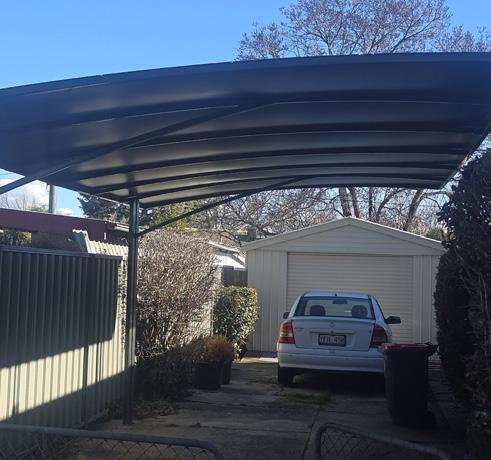
A well designed pergola does more than provide shade. It creates another living space, adds value to a home and allows families to enjoy Canberra’s outdoors throughout the year. According to CBR Pergolas Director and Engineer Andy Stodulka, achieving that outcome starts long before construction begins.
“Every property presents a different opportunity,” Andy says. “The orientation of the home, the existing architecture, how the family wants to use the space and even Canberra’s weather all influence the final design. That’s why we don’t believe in off-the-shelf solutions.”
With more than 30 years of engineering and design experience, Andy has built CBR Pergolas on the philosophy that every project deserves individual attention. Rather than adapting standard designs, each pergola, carport or outdoor structure is custom engineered to suit the property, while ensuring it complements the home’s existing style and meets the highest structural standards.
“Climate control is another major feature and benefit of installing a CBR Pergola” Andy explains. “A pergola has to look fantastic, but it also needs to perform for decades. Good engineering is what gives our clients confidence that their investment is built to last.”
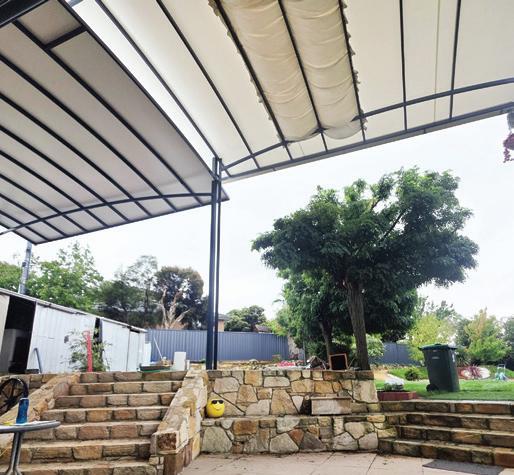
The preferred cover is a hail proof PVC coated nylon reinforced fabric that eliminates annoying drips of condensation on cold frosty mornings. Where possible the pergola structures are angled to enhance the winter sun and reduce the heat in summer.
Amazingly the resulting micro-climate summer temperatures are cooler by up to 10 degrees and up to 5 degrees warmer in winter, potentially reducing the heating and cooling energy bills inside the house.
From the initial consultation through to council approvals, manufacturing and installation, CBR Pergolas manages the entire process, allowing homeowners to enjoy the excitement of improving their home without the stress of coordinating multiple contractors.
Clients regularly acknowledge this commitment to service in their ratings.
One Canberra homeowner, Emily, described the experience as “smooth and stress free from quote to installation”, adding that Andy’s team managed every stage professionally and delivered
an outdoor entertaining area that has become one of the most-used parts of their home.
“We’re proud when clients recommend us to friends and family,” Andy says. “Most of our work comes through referrals, and that only happens when people trust both the quality of the build and
the way they’ve been treated throughout the project.”
“We’re helping families create spaces where they’ll entertain, celebrate milestones, spend time together and simply enjoy being at home. Knowing we’ve played a part in that is what makes this business so rewarding.”
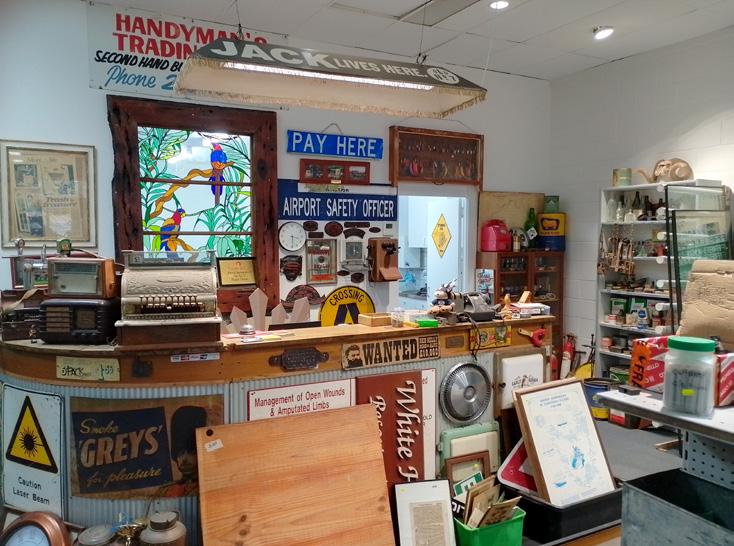
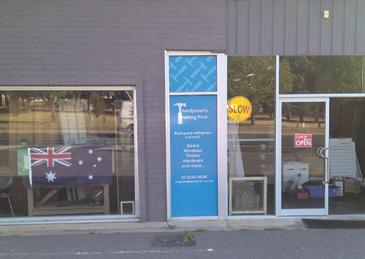
Upgrading or improving a home shouldn’t have to be an expensive adventure, says store-owner John Rivers.
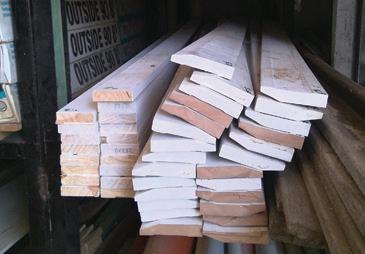
“At Handyman’s Trading Post, people can find a great range of new, factory used and used parts and pieces at half the price,” he says.
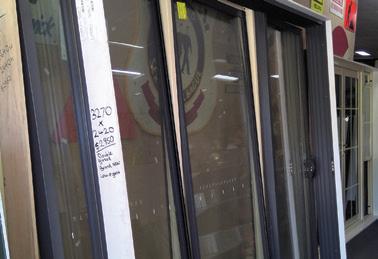
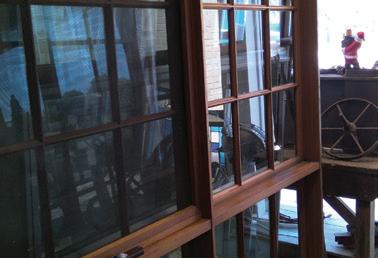
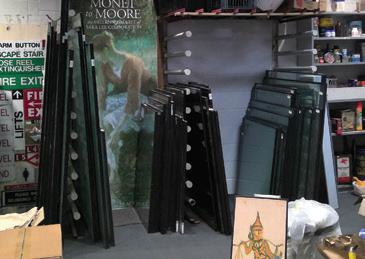
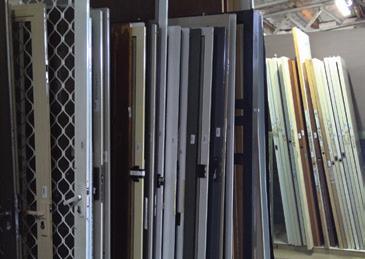
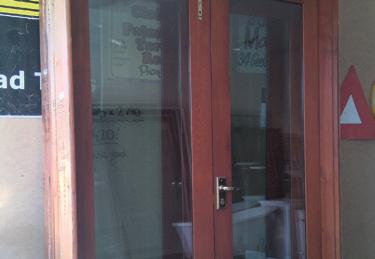
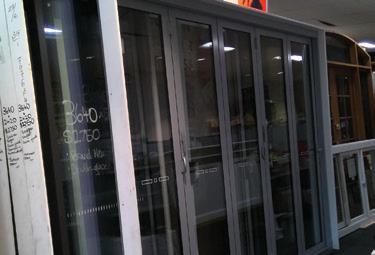
Currently overstocked with many second-hand materials, including windows, glass sliding doors and timber panel (swinging) doors, John says CityNews readers can get a further 10 per cent off the prices of all second-hand items by mentioning this article. This excludes never-used, factory-seconds and items that have already been discounted by more than 10 per cent.
A leading supplier of factory-second and used windows and doors, John says they are also the experts in delivering purchased windows and doors safely to homes or job sites.
Offering to take “want lists” from customers, John says they can alert customers when products from their list have arrived in store.
John says customers can save hundreds, or even thousands, by buying second hand windows and doors. Items that he says are often the key feature of renovations.
“For more than 42 years, Handyman’s Trading Post has supplied Canberrans with quality and affordable home and commercial building materials,” says John.
The Handyman’s Trading Post 1/167 Newcastle Street, Fyshwick. Call 02 6280 4036. On facebook.com/p/Handymans-Trading-Post or Instagram.com/htpcanberra
Practical ways to improve your home without renovating
Home improvements don’t always require a major renovation. Sometimes the biggest difference comes from making better use of the space you already have. From reclaiming cluttered areas to refreshing your living spaces or creating a more comfortable home office, practical furniture can transform the way a home works.
At Ex-Government Furniture in Fyshwick, co-owner James Fullerton says some of the most effective home improvements are often the simplest.
“People often think home improvements mean renovating,” James says. “But making better use of the space you already have can have just as much impact, and the right furniture is one of the easiest ways to do that.”
Creating smarter storage is often the best place to start. Home safes provide secure storage for important documents and valuables, while filing cabinets are a practical way to reduce clutter and keep your home organised. Unique storage solutions, such as map cabinets, are also finding new uses around the home.
“They’re incredibly versatile,” co-owner Taylor Radnell says. “From hobby materials and puzzles to games, miniature collections and garage tools, they’re a simple way to keep everything organised, protected and easy to find.”
Refreshing a room can be just as straightforward. Introducing colour, updating dining chairs or adding a well-designed piece of furniture can completely change the feel of a space without the cost or disrup tion of renovating. For those working from home, a sit-stand desk offers another simple way to improve comfort and flexibility throughout the day.
New stock arrives regularly, with fresh ideas for
DOORS, WINDOWS & MORE!
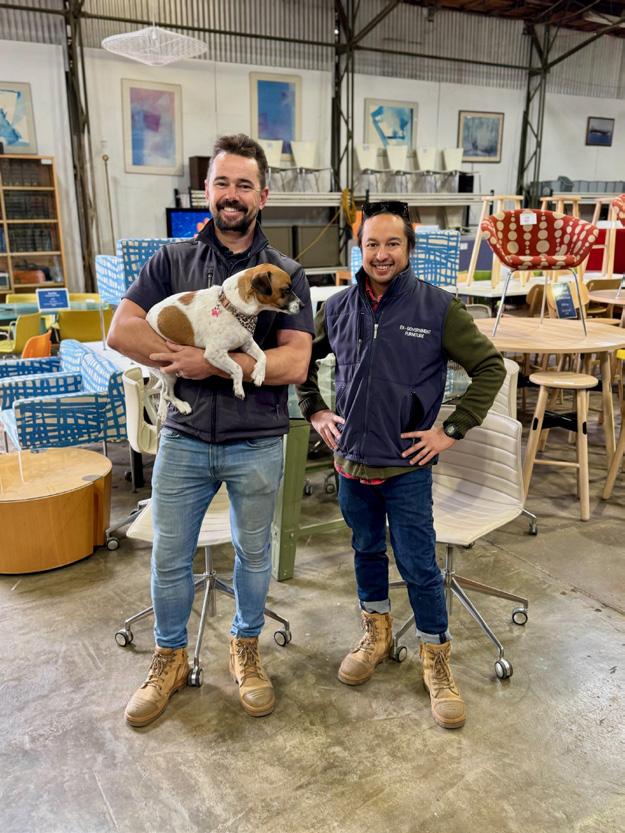
Ex-Government Furniture co-owners Taylor Radnell, left, with Tilly, and James Fullerton.
Aussie Stump Grinders
Trading in Barrier Street since 2002, Pat says it’s an honour to be Canberra’s trusted leader in the workwear industry.
“It’s extremely important that we provide the right equipment and the best safety products to our clients,” says Pat.
“We want to get it right the first time so that we build long-term relationships with our clients.”
Providing clothing and safety items for a wide variety of industries, Pat says they can help labourers, chefs, blue and white-collar workers all the way to government departments, such as Defence, and hospitals. for something to be ordered in.”
Providing a free measure-and-quote and free delivery service, Pat says they also provide a full embroidery and screen printing service.
“We are competitively priced and are prepared to negotiate on bulk orders,” he says.
“These are just some factors on why we believe Seears Workwear has become a household name.”
Seears Workwear owners Pat Seears, right, with son Shane.
One key for everything – why rekeying your home makes sense
We’ve all seen it: the new homeowner standing at their front door with a handful of keys, trying each one until something finally turns. Then there’s the back door. The shed. The gate. The side entry. And somewhere in the handover documents is a plastic bag with another dozen mystery keys that may or may not still open anything. It doesn’t have to be this way.
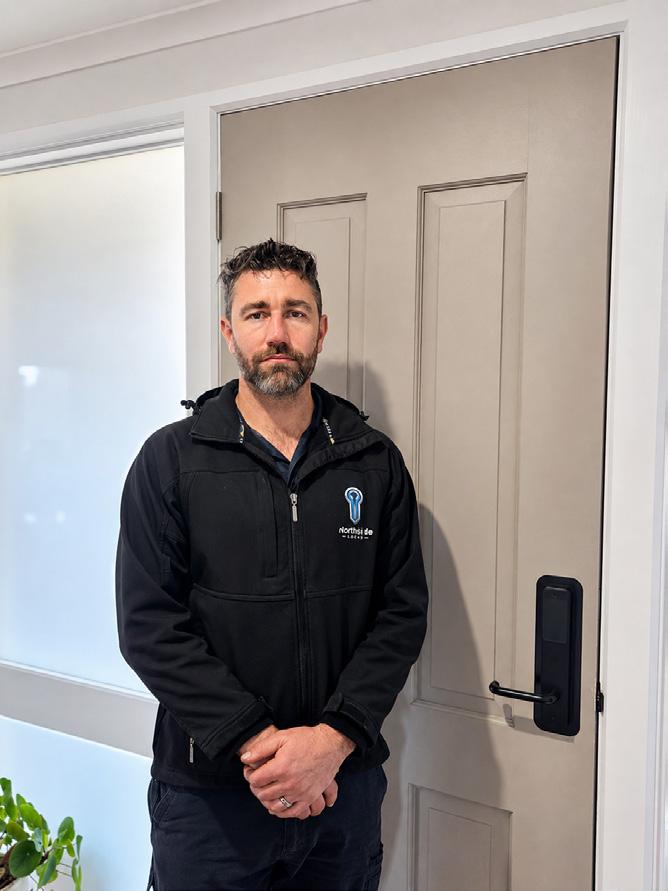
At Northside Locks, one of the first services we recommend to new Canberra homeowners is a full property rekey to a single master key.
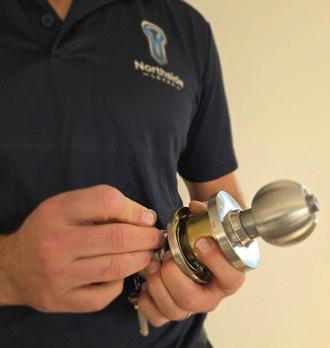
Here’s what that means: we change the internal pin configuration of your existing locks so they all operate on one key. You keep your current hardware – no need to rip out perfectly good locks – but you get complete control and simplicity.
Why we recommend rekeying when you move in:
• You have no idea who still has copies of the old keys. Previous owners, their family, tradespeople, property managers, tenants or the neighbour who used to water the plants – any of them could still have a key.
• Rekeying is faster and more cost-effective than full lock replacement.
• You finally clear out that drawer of unidentified keys and end up with one clean, simple solution. Most standard Canberra homes can be rekeyed to a single key in a few hours.
If you’ve got a mix of lock brands, we can usually replace just the cylinders to bring everything in line without changing the whole lockset.
Northside Locks – MLAA Master Locksmiths serving Canberra and the ACT.
Northside Locks
24/7 Emergency Locksmith
Call 0403 829 636, email northsidelocks@outlook.com or visit northsidelocks.com.au
really
Operating
“We
she says. Their commitment goes beyond just using sustainable materials, and Robyn says they always think about longevity, with everything they design meant
Robyn’s husband Gino Monteleone, the primary cabinet maker and partner of the business, trained as
“Gino’s training started with building custom
“Our kitchens and custom pieces are built to
With the aim of creating pieces that are customised for each client’s lifestyle and personality, Robyn says they often design a feature in each person’s home which is unique to them.
“The satisfaction that clients get something that really suits their lifestyle and them, something they’re proud of and really enjoy using is the most rewarding thing,” she says.
“We are only a small team, so client meetings are by appointment.”
Finding space for household items during a renovation can be stressful.
The local team at House to Home are experienced packers who have been helping Canberrans get their property ready for sales, renovations, insurance work, downsizing and relocating for more than 12 years, says co-owner Renee Le Grande.
Offering a pack-and-store solution for anyone renovating, Renee says it’s the perfect option to get rid of clutter around the house until the work is done.
“With meticulous planning and years of expertise in the moving industry, House to Home takes the stress out of relocation or renovation by handling every aspect,” she says.
“Our expert team will save you hours of time and stress by packing all your personal belongings, household items, right through to packing up the shed,” she says.
“Our team offers a personalised service and recognises every client is unique and has different needs and expectations.
“Some people want the kitchen, bathroom and wardrobes packed, others want absolutely everything including the garden pots at the front door.”
Charging a weekly fee for offsite storage, Renee says it’s the perfect solution for anyone needing a quick, temporary solution for storage during renovation work.
“People can store items for as short as a week to as long as a few years,” she says.
“We can pack up excess items and store it separately to take the stress out of fixing up a house.”
House to Home Call 0457 456 767. house-to-home.com.au
DOWNSIZING AND DECLUTTERING
Whether you are preparing for sale, renovations, or making your home safe our expert packing specialists can pack and clear rooms or whole houses quickly and efficiently.
We can organise and provide all packing materials to complete these clearing tasks for those who are busy and unable to complete these tasks in a short time frame. house-to-home.com.au info@house-to-home.com.au
ARTS & ENTERTAINMENT
Rare Shakespeare challenge for youthful cast
By Helen MUSA
The Mill Theatre is taking on one of Shakespeare’s more rarelyproduced plays, The Winter’s Tale, as its first youth production.
It is the story in which the jealous King Leontes, of Sicily, falsely accuses his heavily pregnant wife, Hermione, of infidelity with his best friend, Polixenes, King of Bohemia.
Hermione apparently dies, their baby daughter Perdita is abandoned and raised by shepherds in Bohemia, and 16 years later returns to Sicily, where a miraculous statue of Hermione comes to life in a scene of redemption.
When director Heidi Silberman was asked to direct The Mill Theatre’s first youth production, company director Lexi Sekuless had a simple suggestion.
“It’ll be August, so you should do The Winter’s Tale.”
After all, what’s not to like? Shipwrecks, disguises, young lovers, pastoral nonsense and the world’s most famous stage direction: “Exit, pursued by a bear”.
I caught up with Silberman and members of her cast during rehearsals to find out more.
At the door I was greeted by designer Tania Jobson. Although the preview photographs suggest everyone is wearing furs and feathers, the costuming is more subtle than that. Jobson, who is tackling both production and costume design for the first time, has drawn much of her visual inspiration from Game of Thrones.
“I’m imagining a Game of Thrones scenario where King’s Landing meets the Vikings,” she says.
Her Sicily is sophisticated, ordered and political, while Bohemia is ancient, earthy and deeply connected to nature, never mind Shakespeare’s eccentric geography.
Jobson has used colour to distinguish the
two worlds. Sicily is dressed in royal reds, silvers and blacks, complete with family crests, velvets and formal court dress, while the Bohemians wear rugged earth tones.
The earthy approach came from Silberman herself. Even Perdita, the princess raised as a shepherd’s daughter, wears practical country clothing rather than the traditional white smock.
And then there is that famous bear.
As production designer, Jobson has been working with the crew on a solution which, she hints enigmatically, may involve sheep. We’ll simply have to be there to see what
Enter Max Vincent Wilson, the secondyear arts and law student at the ANU who plays Leontes and, he proudly adds, also a
It is his first role outside school and university, although through the ANU Shakespeare Society he has played Oberon and appeared in Lysistrata.
As an actor, Wilson knows he must find the humanity inside the jealous king.
“I can’t just play madness,” he says. “I can’t write him off; that would be boring, even though there are times when he does lean into madness.”
He has spent rehearsals considering what drives Leontes into such destructive jealousy. Polixenes, he believes, is naturally more joyful and open, and, coincidentally, actor Jarrah Palethorpe, who plays him, is
taller than Wilson, another detail that feeds Leontes’ insecurities.
“But Leontes is not just a boring, evil king, so I’m not going to let audiences simply write him off,” he asserts.
Silberman has also been wrestling with the play’s ending.
“Leontes doesn’t necessarily win when Hermione comes back,” she says. “It takes a while to learn to trust again, especially after living with someone capable of such violence.”
For her, the comedy is equally important. During rehearsals I watch her patiently shaping a comic scene, encouraging actors to linger over long vowels and key words to bring Shakespeare’s language to life.
With only eight actors taking on around 30 roles, she has had to make significant cuts, placing much of the comedy in the hands of the shepherds, with the sheep now played by puppets.
The result is a brisk 80-minute production without an interval.
Although this is The Mill’s first youth production, Silberman is keen to stress that it is not a school production.
“We’re exposing emerging artists to the world of theatre with the expectations of a professional production,” she says.
The Winter’s Tale plays at The Mill Theatre, Fyshwick, August 5- 8 (previews) and August 12-15.
Photo: Daniel Abroguena
ARTS IN THE CITY BOOK REVIEWS
Love’s lumpy journey in two feel-good novels
Two ultimately feelgood novels from Matt Haig and Jessy Wu comprise COLIN STEELE’s latest book reviews.
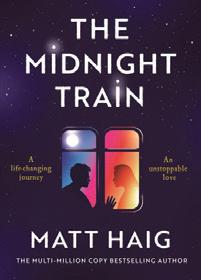
Matt Haig’s The Midnight Train follows his global best seller, The Midnight Library (2020), in which a woman explores alternate versions of her life through a mysterious library.
The Midnight Train (Canongate. $34.99) takes place on a parallel track, even a steam train one.
Haig has said of his latest book: “It’s not really a sequel. It comes to a completely different conclusion to The Midnight Library, which asks what other lives you could have lived. The Midnight Train asks what you actually did with the one you have.”
In The Midnight Train, 81-yearold Wilbur Budd, wealthy from running a major bookshop chain, living alone in a large house, dies of a heart attack.
Cue Charles Dickens’ A Christmas Carol, as Wilbur gets a chance to revisit the main events of his life. After dying, Wilbur finds himself on a train platform, boarding a midnight steam train, being mentored by a ghost guide, Agnes Bagdale, former owner of the Sheffield bookshop, from which Wilbur’s bookselling empire evolved.
Wilbur relives his impoverished childhood, his father having died in World War II, family traumas, lonely teenage years immersed in books and then marrying Maggie with a 1974 honeymoon in Venice. However, his marriage deteriorates as he becomes a workaholic obsessed with building his bookselling
Author Jessy Wu… “I wanted to explore what it’s like to not end up with your first love.”
network, thereby neglecting, ultimately losing Maggie. Wilbur now realises what a mistake that was. However, Wilbur is told by Agnes that if he interferes with events, he risks his place in eternity. Agnes warns: “No meddling, no tinkering, no fiddling with time. It’s impossibly dangerous”.
Wilbur responds: “But, Agnes, I can see it now, I squandered love, I squandered time”.
Anges responds: “You have no choice. This train has one route and one destination”.
Nonetheless, Wilbur wonders if he can alter time to get Maggie back, but if he breaks the rules of the train what will the repercussions be and will he lose everything? At this point, the novel finds its emotional centre, but no spoilers here as to Haig’s conclusion.
Adopting Søren Kierkegaard’s adage, “Life can only be understood backward; but it must be lived forward”, Haig offers readers an opportunity to reflect on life’s achievements and failures and what really matters in life, particularly “not to neglect those closest to us as we get caught up in our careers and ambition”.
based writer and entrepreneur, who has worked in venture capital.
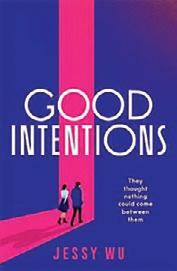
Her debut novel Good Intentions (Macmillan, $34.95), which she began writing two years ago when she was 29, has already had US rights sold and been optioned by an Australian TV production firm.
The novel begins with the two main characters Nadia Kuan and Jake Sullivan, working at the Sydney University student newspaper, exposing university executive corruption. They slowly fall in love, but their relationship ends when Nadia leaves for New York after graduation to work in venture capitalism. Jake remains in Sydney becoming an investigative journalist on a major Sydney newspaper.
Wu says: “Nadia and Jake don’t get their happily-ever-after straight after university, because I also wanted to explore what it’s like to not end up with your first love.”
Nadia, after being “ensnared by the machinery of capitalism”, returns after a decade to Sydney as head of Pacific Operations for Henderson Global, unaware that
firm for both illegal recruitment of people trialling new peptide treatments to combat Alzheimer’s and paying participants who suffer unexpected side-effects. Jake’s paper is then sued by Henderson Global for “injurious falsehood”, which “damaged our reputation and caused us to suffer economic harm”.
Jake and Nadia both end up on opposite sides in the court case.
Wu has said she “wanted to render how people carry the moral charge of truth-telling into adulthood, in a world where the truth is so often inconvenient, and where complicity is sometimes necessary for survival.” What will Nadia, who had no idea of the allegations before taking up the Sydney position, decide to do, when she becomes aware of problems within the firm and the role of her managing director.
Wu’s gripping and empathetic narrative delivers a last-minute dramatic court twist that will change everything for Nadia and Jake, as they each aspire, as Wu states in an author’s note, “to be a good person in a morally grey world”.
Upton steps into the spotlight
By Helen Musa
Canberra Writers Festival’s Out of Season series presents playwright, screenwriter and former Sydney Theatre Company artistic director Andrew Upton in conversation with fellow former STC artistic director Kip Williams about Upton’s debut novel, Krank Fuss, a fable set on a small farm in Nazi Germany on the eve of war. The Street Theatre, August 12.
Afternoon of the Harpies is a wildly imaginative collaboration by Judith Nangala Crispin and Stephen Harrison, bringing together fantastical creatures, insect angels, vessels for incarnation, carpets and luminescent fish trap spaceships. Grainger Gallery, Fyshwick, August 13-September 9.
The Canberra International Music Festival has announced the dates for its 2027 festival, to be held from May 5 to 9. The announcement follows a successful end-of-financial-year appeal that raised more than $16,000 and confirmation of multi-year artsACT funding until 2030.
Canberra’s Dan Toua has been selected by Creative Australia as one of eight creative and cultural practitioners from around the country to take part in this year’s Biennale Delegates Program. An independent curator, scholar and
arts worker, Toua is recognised for his work in Pacific art, anti-colonial curatorial methodologies and cultural collections.
Former Canberra dancer and QL2 member Penny Chivas, now based in Glasgow, will perform and choreograph Where We Choose to Stand, a new work inspired by climate activism and political change, at the Assembly Festival as part of Dance Base during the Edinburgh Festival, August 7-16.
Australian soprano Miriam Allan returns home to perform Bach’s Wedding Cantata and the comic Coffee Cantata with Bach Akademie Australia. She will be joined by her father, baritone Christopher Allan, in a rare family collaboration. Wesley Music Centre, August 11.
Pop culture spectacular Oz Comic Con Canberra returns with two days of cosplay, gaming, comics, anime, film, television and family entertainment. Highlights include Cosplay Central, esports and tabletop gaming, Artist Alley and interactive activities. EPIC, August 15-16.
International cellist Nicolas Altstaedt joins French lutenist Thomas Dunford for a Musica Viva recital fresh from their Carnegie Hall success, performing music by Marais, Forqueray, Pärt, Duparc and JS Bach. Llewellyn Hall, August 13.
Dates: Saturday 15th Thursday 20th August 2026
Venue: Wesley Music Centre, 22 National Circuit, Forrest ACT
The Piano Eisteddfod features sections spanning a wide range of musical styles, original compositions, and chamber music, welcoming participants of all ages and levels.
The Piano Eisteddfod is sponsored by Mrs Dianne Anderson AM for $15,000 of which $10,000 is for the Open Piano Championship to be held on Sunday 16 August at 2.30pm. Other Sections including the Senior and Junior Championships will be held from Saturday 15 to Thursday 20 August. More details available on the website, Piano • Australian National Eisteddfod
Playwright and screenwriter Andrew Upton… The Street Theatre, August 12.
STREAMING
Unlikely triumph but good for a smile
Finally launching into the universe of streaming is one of the year’s, if not the decade’s, most talked about space films.
Project Hail Mary starring Ryan Gosling is now available to watch on Amazon Prime Video.
For those who didn’t catch this spectacular sci-fi adventure in the cinema, it’s the story of Ryland Grace (Gosling), an ingenious but somewhat nervous astronaut who is thrust into the far reaches of the Milky Way.
The audience meets Ryland when he awakes from cryogenic sleep on a spaceship far from earth without any memory of who he is or why he’s there.
Forced to unravel the mystery he finds himself in, Grace soon discovers the very future of planet Earth rests on his mission and that he might not be as alone as he first thought.
The premise sounds somewhat creepy on paper, but what sets Hail Mary apart is the humour and heart at the centre of the story.
Gosling is perfectly cast in the leading role playing a character who has to use his wit and his jokes to keep himself from crumbling under the weight of a near impossible mission.
For sci-fi fans it might sound familiar.
The film is based on the internationally best selling book by Andy Weir who also wrote The Martian, which Ridley Scott
turned into a cinematic crowd pleaser in 2015 with Matt Damon.
The tone is very similar.
Whereas The Martian had a more “realistic” focus on a situation where an astronaut really could find themselves stranded on another planet, in Project Hail Mary Weir lets fly with his full sci-fi imagination.
At its core the story is still grounded in the scientific ingenuity of the characters but here it’s done in a far more explorative way.
There’s also a sense of hope in the film that feels more and more rare these days.
In an age of dark and gritty, stories about human triumph in the face of seemingly impossible odds make for a refreshing experience.
This is one likely to leave a smile as the credits roll.
LOOKING for something a bit more down to earth?
This month HBO Max also gets one of the year’s biggest film releases.
Now streaming on the platform is The Drama, a romantic black comedy about a wedding that goes catastrophically wrong.
The film stars Zendaya and Robert Pattinson as the bride and groom at the centre of these unfortunate matrimonials.
At first glance they seem like the dream couple, happily engaged with a wedding planned to picture-perfection.
That is until a last minute confession that upends everything.
In the days leading up to their big day Emma (Zendaya) reveals a secret to Charlie (Pattinson) so shocking it threatens to derail their entire relationship.
It’s no extramarital affair or moneyrelated conspiracy. Emma’s secret turns out to be far more twisted and the mystery around it is where the fun of the film lies.
Fast pacing that makes use of its great
hook makes The Drama an easy one to recommend.
STORMING on to Netflix with its fourth adaptation, Little House on the Prairie is historical drama made for family viewing.
This eight-episode series is based on a set of novels by American author Laura Ingalls Wilder who penned the famous books over the course of more than a decade throughout the 1930s and ‘40s.
Semi-autobiographical in nature, Wilder recounts her childhood growing up on the American frontier in the late 1800s, opting not for a grand adventure tale, but telling an authentic account of how a family fought to build a life in such challenging conditions.
In doing so it makes for a different viewing experience, a more intimate, character-driven watch where viewers get to deeply know the people on screen.
It has been adapted for TV before, but the era of streaming television could not be more ripe for a long-spanning story of this kind that follows the lives of a family over many years.
No wonder Little House is already doing big numbers.
Ryan Gosling… perfectly cast in the leading role of Ryland Grace in Project Hail Mary.
I adore the outside terrace at Louis, especially in winter when the central fireplace is roaring.
It’s a classy, enclosed lounge area, with stylish décor, comfy furniture, lush greenery and protection from the elements.
We grabbed a vino, sat and relaxed before heading inside for dinner, deciding we’d try one of Louis’ ever-changing, mid-week specials.
With times tight, it’s great to seize offers that help you save while still living the life and dining out. More and more cafés and restaurants are taking up the charge.
In the heart of Barton’s Hotel Realm, Louis’ relatively extensive menu oozes European charm and draws inspiration from high-end bistros in France. The focus is on quality ingredients, sourced regionally.
We got off to a great start with engaging, smiling staff who promptly brought us a carafe of Petit Chablis by La Chablisienne, an elegant, uncomplicated wine ($52). Welcoming staff makes all the difference.
From the entrée section, we eyed the Escargots de Bourgogne, with the snails accompanied by garlic parsley butter ($20 for small; $30 for large). While tempting, we landed on the Tuna Crudo ($28). The blood plum dressing on the raw bluefin tuna was creamy and tangy and the mound of fresh greens on top was a welcome addition. Macadamia added texture.
It was a Wednesday, and Louis was offering a steak frites special for $40, with a glass of Shaw wine included.
The grain-fed steak was cooked to perfection, delicious and not too large (200 grams), which suited us. Choose a jus, pepper sauce or béarnaise sauce. The tri-tip (bottom sirloin) cut was treated with care and ranked a Marble 2
score. Piping hot, the frites were truly addictive.
We both ordered the same special, noting that the amount of sauce was overly generous, and were happy campers with the result. My only comment is that my béarnaise was slightly too thick and lukewarm.
For a veggie hit, we ordered the side mixedleaf salad, with eschalots and mustard vinaigrette ($14). The vinaigrette tasted fabulous, but the salad might have been sitting for a bit before being served because it was slightly limp.
This time, we didn’t have room for Louis’
WINE / Rutherglen comes to Canberra
A place to enjoy
Recently, 17 Rutherglen wineries came to Canberra to provide tastings at Old Parliament House over a Friday and Saturday.
I attended the event on a cold, clear afternoon with mate Tom and we wandered around the exhibits, crowded but not like Flinders Street railway station on a Friday night, as was the case at this event last year.
The crowds at each tasting stand were more subdued this time, although occasionally a touch pushy.
wonderful-sounding, oh-so-French desserts, with the line-up featuring mousse au chocolate ($18), a caramel choux ($18) and tarte tatin to share ($28). It’s no surprise that Louis offers quality fromage ($16 to $36).
Louis’ wine list is excellent and local wineries are featured, including Helm, Long Rail Gully and Mount Majura. Service started with a bang, but slowly fizzled out as the restaurant filled up.
a port in any storm
Some of the wineries were offering fortifieds, a style of wine that exemplifies the Rutherglen experience, with Stanton & Killeen providing a separately ticketed event where participants got to taste three fortified wines, including a 1995 vintage.
That bottle was still labelled “Port”. From September 1 2011, Australian
protected European geographical indications “Port” and “Sherry” on newly labelled wines. Hence, the 2022 Stanton & Killeen wine that we tasted is just labelled “fortified.”
In her speech to those 20 or so people gathered in the Old Parliament House bar area, Wendy Killeen explained that the 2022 was a long-awaited product as there had been no vintage fortified produced in 2020 or 2021. Apparently, 2022 was
less likely to produce firmer tannic tastes in a blend that features durif and a number of Portuguese varietals such as tinto cao and tinta roriz.
This is not a “blow-to-the-head” wine at 18.5% ABV, albeit not a wine you’d skull. It had a lovely cassis-filled palate and a hint of spice at the finish.
This is one to put away to taste with the grandchildren (fingers crossed, hint, hint), that is up to 20 years. It will only get better, more mellow with time, unlike the
magician with an anger management problem: every time he gets upset, he pulls his hare out.
I commend the organisers for having a calmer and more considered tasting opportunity with Ms Killeen taking us through the type of grapes grown and the importance of climate and the blending process where the sweetness of the fruit, the tannin profile and the addition of spirit in the right quantity at the correct time are all factors in producing an excellent wine.
Her calm and fulsome explanations contrasted with the hubbub in the main tasting area. The end of the event brought a sour note to an otherwise lovely afternoon: we had thought it was closing at 5.30pm, as expressed on our tickets, but we were ushered out at 5pm so we didn’t really have a chance to taste the wines of at least four exhibitors.
I’d welcome this event again next year and would suggest that there are more mini-events like the Stanton and Killeen fortified tasting where you get the benefit of the winemaker’s knowledge and a considered view of some wines rather than entering the push and shove of a crowd baying to get a sample of wine.
Tuna Crudo with blood-plum dressing on raw bluefin tuna. Photos: Wendy Johnson
The grain-fed steak and frites special… the 200-gram, tri-tip (bottom sirloin) cut ranked a Marble 2 score.
HOROSCOPE PUZZLES
By Joanne Madeline Moore
ARIES (Mar 21 – Apr 20)
Prepare for a topsy-turvy week! The mid-week Solar Eclipse is in fellow fire sign Leo, so you’ll feel like powering ahead with creative projects. But there’s also a mid-week Mercury/Pluto opposition, so rushing around impulsively could backfire – especially involving family and friends. To reduce stress levels (and the likelihood of making mistakes) enthusiasm must be balanced with caution, and fiery haste tempered with plenty of patience.
TAURUS (Apr 21 – May 21)
Expect the unexpected this week. A pleasant surprise – perhaps involving family, friends, housemates or domestic shenanigans. Uranus links up with Venus (your patron planet) on Wednesday, when you’re inclined to unpredictable behaviour or falling in love very fast. Don’t throw the baby out with the bathwater, though! Your motto for the moment is from birthday great, Madonna (who turns 68 on Sunday): “The most controversial thing I have ever done is to be myself.”
GEMINI (May 22 – June 21)
Family relationships and close friendships look rather complicated this week, as loved ones debate a wide range of controversial topics or a relative becomes super intense. If you have a problem that’s bothering you, avoid making a rash decision. Slow down and let your intuition be your guide. The mid-week Solar Eclipse is the perfect time to begin a course of study, start a neighbourhood project, join a community group or meet a fascinating new friend.
CANCER (June 22 – July 23)
The astrological themes during this Solar Eclipse week are taking action, nurturing self-esteem and boosting performance. Your affirmation for the week is: Proactive improvement = success. And your motto for the moment is from Leo birthday great, music legend Madonna (who was born on August 16, 1958): “No matter who you are, no matter where you’ve come from, you can always change, become a better version of yourself.”
LEO (July 24 – Aug 23)
Calling all Cats! With the Solar Eclipse in Leo, it’s your time to shine – to display your numerous creative talents and dazzle others with your fiery enthusiasm and abundant Leo charm. It’s also the best week of the year to try a new hairstyle, update your wardrobe or start an exciting personal project. But Pluto opposes Mercury on Wednesday, so be careful you don’t upset others by behaving in a bossy, controlling or selfish way.
VIRGO (Aug 24 – Sept 23)
Virgos are perfectionists but don’t be too hard on yourself if things don’t go your way. And don’t stress about mistakes! With Venus in your self-esteem zone, focus on self-love. As celebrity chef (and birthday great) Julia Child observed: “The only real stumbling block is fear of failure.” So, pick yourself up, shake yourself off, and start running your own race. Self-belief and persistence will get you where you want to go. If doubts persist, follow your intuition.
LIBRA (Sept 24 – Oct 23)
The midweek Solar Eclipse stimulates your hopes-and-wishes zone and reignites a special dream or aspiration that’s been languishing on the sidelines. But there’s also a Mercury/Pluto opposition so – if you are stuck in a friendship slump or a relationship rut – don’t dwell on the past. It’s time to reboot your peer group as you reacquaint yourself with a creative new crowd. Thursday and Friday favour inspirational ideas and hanging out with close friends.
SCORPIO (Oct 24 – Nov 22)
There’s no denying you’re a smart Scorpio but are you making the most of your professional talents? With the Solar Eclipse, Mercury and Jupiter all activating your career zone, put on your thinking cap, connect with colleagues and keep them up to date with your exciting new plans. You’ve got the power, but don’t overdo it. There’s a Pluto-Mercury opposition on Wednesday, so make sure your controlfreak tendencies don’t get out of control!
SAGITTARIUS (Nov 23 – Dec 21)
This week the Solar Eclipse, Mercury and Jupiter are all activating your aspirations and adventure zones. Which favours imagining, exploring, experimenting, dreaming ambitious dreams and then following your true destiny… with a generous heart and an adventurous spirit. Your motto for the moment is from birthday great, Madonna (who turns 68 on Sunday): “I stand for freedom of expression, doing what you believe in, and going after your dreams.”
CAPRICORN (Dec 22 – Jan 20)
Have you been less than 100% honest with a family member? Neptune is meandering through your home zone, which could lead to confusion involving your true motives. Someone could question your version of events, or you could disappoint a loved one by blurring the lines between reality and fantasy. Saturn (your patron planet) is also transiting through your domestic zone too, so it’s time to get real, face facts and set the record straight.
AQUARIUS (Jan 21 – Feb 19)
This week you’ll be reliably unpredictable and consistently inconsistent! Love, loyalty and compromise are the Solar Eclipse buzzwords. But one half of you wants to snuggle up close with someone special – while the other half longs to be footloose, fancy-free and spontaneously solo. Try to find the sweet spot between cosy companionship and invigorating independence. And resist the urge to be an Aquarian provocateur who is deliberately controversial.
PISCES (Feb 20 – Mar 20)
Solar Eclipse week is the ideal time to ditch bad daily habits and start afresh. Work, health, fitness and food choices are the main areas you need to revise and then make some overdue changes and adjustments. The sooner the better. Try to release pent up Piscean frustrations via a chat with a close confidante or a trusted family member. Spending quality time with your favourite four-legged friend (in the great outdoors) will also help to lift your spirits.
Copyright Joanne Madeline Moore
2026
is
To
26 To have formed an opinion, is to have done what? (6)
GARDENING Flowering natives putting on a show
By Jackie WARBURTON
THERE are a lot of flowering natives putting on a show right now. One of my favourites is Grevillea “Peaches and Cream”, a low-maintenance shrub that grows to 1.5 metres, but needs a protected spot to grow well.
It has a two-toned flower that lasts for many months on the bush and, like all grevilleas, needs a native fertiliser that’s low in phosphorus and good drainage.
It can be grown as an informal hedge or screening plant with the bonus of winter flowers that are attractive to bees and nectar-feeding birds. Grevilleas can die if they have too much water and too much care! Only water until the plant is established. Keep it on the drier side to grow well.
A grafted grevillea grows better in our Canberra clay soils. Or choose a variety that doesn’t mind clay soils, such as Grevillea “Lady O” that puts on a show of magnificent red flowers for many months through winter.
If Grevilleas have browning leaves, the drainage needs to be improved straight away. Most grevilleas can be hard to bring back once they begin to die.
All grevilleas benefit from a little iron chelates in the soil in spring to prevent the leaves from yellowing. Overall, they’re a set-and-forget plant that doesn’t like to be fussed over.
A NATIVE lilly pilly I’ve seen growing
. In spring, it grows small, white flowers and in late winter produces bright pink/purple edible berries that can be used for cordials and preserves.
Terrific for attracting birdlife to the garden, it can grow to at least eight metres tall and one I’ve seen growing successfully in Canberra was on a west-facing wall outside a fireplace shaft.
There’s also a dwarf variety that grows in Canberra called Lilly Pilly Minor and is hardy, fast growing and great for a dense shrub. Its coppery, new growth
and small, shiny, summer green leaves grow three metres tall and two metres wide. Feed it native fertiliser in spring. It’s drought tolerant when established.
STINGING nettles are small plants that grow quickly in wet, winter soils and spread, unwanted, to all areas of the garden if not kept under control.
They grow by rhizomes under the ground and self-seed. Disturbing the rhizomes results in more plants growing, so thorough removal will be needed to eradicate them completely. Having nettles in the garden indicates high fertility and nitrogen content in the soil so, once they’ve been pulled out, roots and all, this makes the perfect place to plant lettuces, Asian greens or spinach.
In the kitchen, nettles can be a delicacy to make soups, pesto or even nettle pasta, but can only be eaten when cooked. They are unsafe to eat raw.
They have hairlike barbs on the leaves and stems and will give a good sting if touched or by inadvertently brushing against one. A little baking soda and water will neutralise the sting and lessen the pain, which can last a day or so.
PEAR trees can also be pruned now. Their
upright growth needs to be removed. Prune to a downward-facing bud and try cutting into a vase shape without any branches crossing over.
Pear trees tolerate wet feet better than most fruit trees, so if there is a boggy area in your orchard, a pear tree will grow quite well. Feed it with high-nitrogen manure now (chicken manure) and when there is spring growth, fertilise with a fruiting and flowering fertiliser.
Most pear trees are dioecious, that is they need another to pollinate each other. However, there is a variety of self-pollinating trees available at the nursery. They like a good, rich soil and can be espaliered on a trellis if space is at a premium.
SPRAYING peach and nectarines with copper for leaf curl and shot hole should be done now before the buds open.
My peach and nectarine trees are less than a metre high and wide, and give me kilograms of fruit. They can easily be a courtyard potted tree or on a balcony.
Mulch the trees and keep them weed free. Plant flowers, such as seaside daisy or calendula, under fruit trees to attract bees to the garden and let them do the work of pollinating.
Grevillea “Peaches and Cream”... a low-maintenance shrub that needs a protected spot to grow well.
Photo: Jackie Warburton
Stinging nettles… can grow quickly and spread to unwanted areas of the garden if allowed to.
Photo: Jackie Warburton
GARDENING
By Jackie WARBURTON
Now it is the last month of winter, making it the ideal time to prune roses.
In many cases, the later the better, as pruning will initiate growth and new tips are more likely to be burnt by lingering frosts if roses are pruned too early. Frost damage can affect the first flush of spring blooms.
All roses require different pruning techniques, so it is important to know whether your roses are climbers, hybrid teas, carpet roses or standards. Climbing roses need more work to keep them growing on a support or frame, with large canes trained as horizontally as possible to encourage more blooms.
Hybrid teas are probably the most popular type of rose and can be pruned quite hard to maintain their shape and encourage strong growth.
Carpet roses and standard roses
can simply be pruned with hedge shears.
Planting calendula and daisies beneath your roses will attract beneficial insects such as hoverflies and parasitic wasps, which feed on aphids, reducing the need for sprays.
If you are adding a rose to your garden, prepare the soil by loosening it and incorporating cow manure or blood and bone. Leave the soil for a few weeks before planting. My only rule when buying a rose is that it must be fragrant – after all, what is a rose without perfume?
WHILE winter gardens can look a little bare, fragrance is still plentiful from winter bulbs and daphnes. One of my favourite scented shrubs is Winter Sweet (Chimonanthus praecox). This hardy, multi-stemmed shrub is grown for the fragrant flowers that appear on its bare winter stems. Its rich honey and spice perfume is unforgettable, and a single sprig brought indoors will quickly fill a room with fragrance.
WINTER is also a busy time in the
orchard and a good opportunity to spray citrus trees to help control stink bugs, scale and mites before summer. Winter spraying smothers overwintering eggs and helps prevent them hatching when the weather warms.
Winter oil is stronger than eco oils and is best used during the cooler months to avoid burning foliage. Spray on a still day, ensuring the oil thoroughly covers the leaves, bark and branches.
While eco oils are more environmentally friendly, winter oil should only be used when insect populations are causing damage to fruit.
FEED garlic with a high-nitrogen liquid fertiliser throughout winter. As the weather warms, switch to a potash fertiliser to encourage the bulbs to fatten and produce flowers and scapes. Keep garlic free of weeds, ensure good drainage and avoid overwatering.
Garlic is usually ready to harvest around November, when the leaves begin to die back and just before flowering. Once harvested, hang the bulbs upside down in a dark, dry
place for a few weeks. Storage time depends on the variety, or if you are unsure, garlic can be stored in the freezer.
NOW is also the time to prepare vegetable gardens for spring. Vegetable patches with alkaline soil suit peas, beans and asparagus, while tomatoes, cucumbers and potatoes prefer more acidic soils. Top up manures and mulches to help retain moisture through the warmer months. Chicken or cow manure are both suitable choices.
jackwar@home.netspeed.com.au
Jottings…
• Plant asparagus crowns in rich soil.
• Feed bulbs that are in growth.
• Pull annual weeds before they set seed.
• Winter pruning of figs can be done now.
August is the time to prune roses, but the later the better to spare new growth tips from lingering frosts. Photos: Jackie Warburton
Winter Sweet… a hardy summer shrub, but the fragrance of its flowers on bare winter stems is why it’s grown.
NO MORE BOONDAH Tackling Indigenous Smoking
Your journey to better health starts here.
At Winnunga Nimmityjah Aboriginal Health and Community Services, we stand with you on your journey to quit smoking — for yourself, for your family, and for future generations. Smoking is one of the biggest health challenges in our community, but you are stronger than the smokes. Every cigarette not smoked is a step toward a longer, healthier life.
YOU’RE NOT ALONE
Winnunga offers culturally safe, free, and confidential support:
• Quit plans tailored for you
Why Quit?
Stronger lungs, stronger heart, stronger you
More money in your pocket — save thousands every year
Healthy bubbas — quitting before or during pregnancy helps babies grow strong
Be a role model for your kids, your mob, your community
It’s Never Too Late
Whether it’s your first time trying or your fifth, Winnunga is here to walk with you. Every day smoke-free is a win.
• Yarn with our friendly Aboriginal Health Workers