Integrity enquiry couldn’t see the wood for the trees
HUGH SELBY
Berry is right to resign, buck stops with minister
MICHAEL MOORE
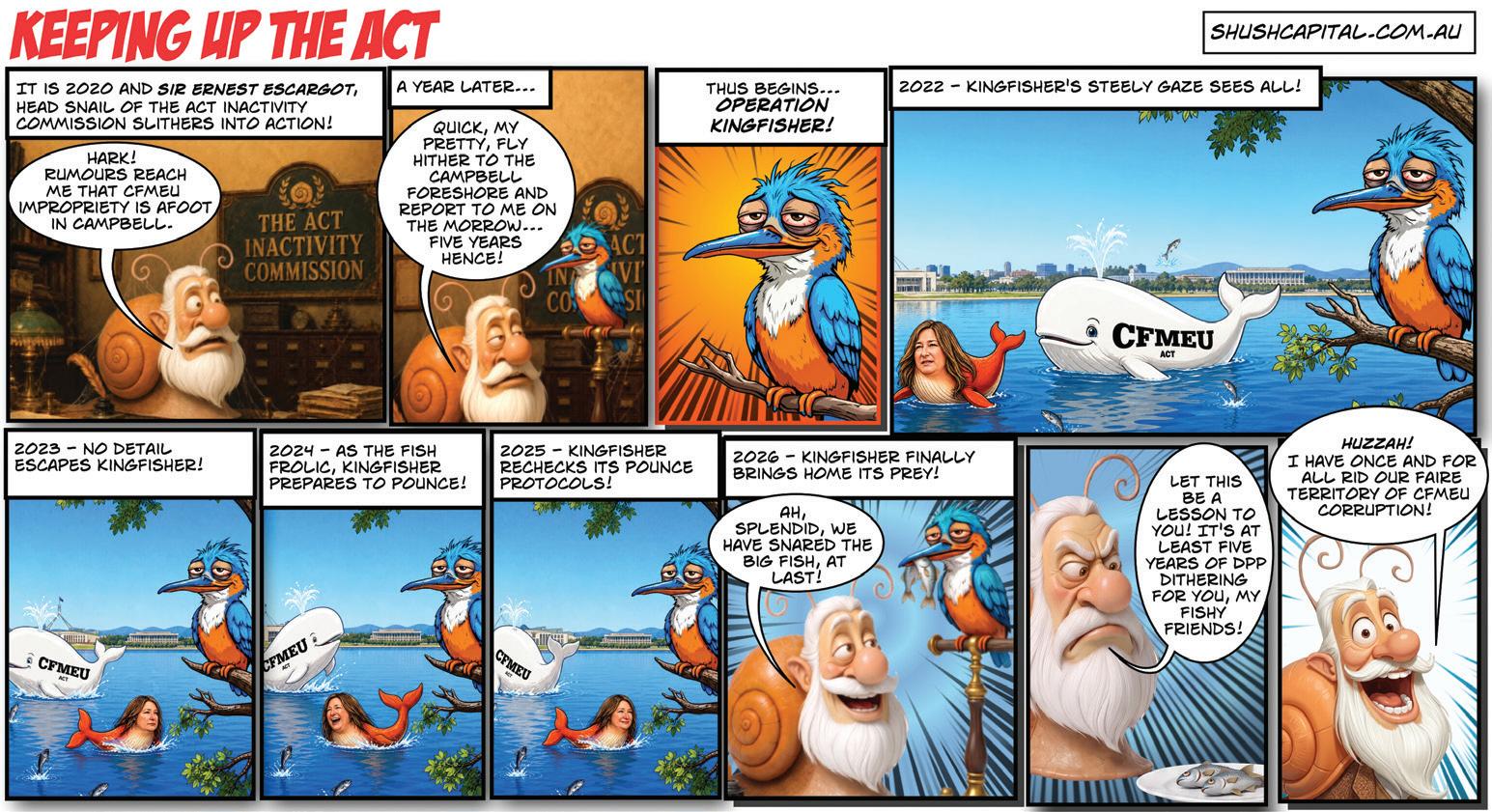
How Kingfisher took only five years to land a couple of big fish KEEPING UP THE ACT
LIZ LEA’s new show Diamonds is a sparkling tribute to the beauty and resilience of ageing women JULY 30, 2026
Arthur Boyd, Manufactura de Tapeçarias de Portalegre (tapestry workshop), St Francis when young dreaming of fine clothes and armour (detail), 1973, National Gallery of Australia, Kamberri/ Canberra, purchased 1975, Arthur Boyd’s works reproduced with the permission of Bundanon Trust
NEWS / the Radburn precinct
Locals rekindle Curtin’s revolutionary open space
By Tia PRIEST-WILLIMOTT
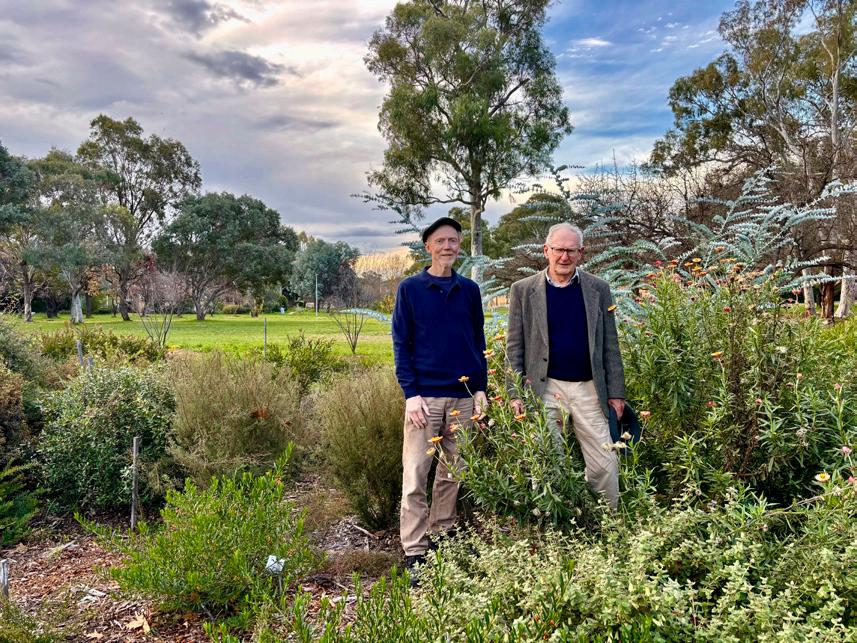
An unconventional suburban layout in Curtin’s Radburn precinct has houses backing straight on to a public green open space.
The National Capital Development Commission designed the experimen tal town-planning layout in 1961-62. This pedestrian-friendly housing experiment featured homes facing shared green spaces with roads and garages kept to the rear.
The original residents had called for additional trees in the area, but when asked if they were prepared to contrib ute to the maintenance of the green space, they apparently demurred.
Fifty years on, Curtin residents have come together to successfully re-vegetate open spaces with native plants in the Radburn area around Dawson and Gillies streets.
of the garden and then these trees that we planted,” Evan says.
Evan Mann and Richard Bush have been leading the Curtin Trees and Gardens Group (CTAGG) in the revegetation process.
They were inspired to revegetate the area after they decided that the John Curtin Garden should be a commemorative garden to announce the suburb and shopping centre’s presence.
“To do that, we needed to develop a decent plan for the areas, so we discussed it with people who live around here.”
The trees – Evan’s primary focus –were planted in April 2020, supported by the first of two major grants from the ACT Government.
Thanks to the Adopt-a-Park Program, CTAGG successfully planted around 100 trees and re-vegetated two
“One of our aims was to replace trees that had died, but we also wanted a mixture of exotic and native trees and by and large it worked. Most of the things have survived,” Evan says.
“We had about 10 people involved in the planting, but never all together because of covid.”
As the project was in part with the ACT Government, all plans were run by them first, but Evan was the mastermind behind the vision.
“We cleared the plan with City
General manager: Tracey Avery, tracey@citynews.com.au
Services… they like to know what the trees are because they map them,”
“So, there’s a map of this area which indicates what species of trees have been planted.”
Three years on and a joint application was made in 2023 under the ACT Environment Grants Program to revegetate another area.
The application was successful and the plantings were undertaken in autumn of 2024 and the following spring and summer.
The grant was a joint effort with Dawson Street Gardens to plant a total of 220 square metres of native plants – half in Dawson Street and half to fill out the 2020 Scout hall plot.
Richard went through the process of choosing plants for the native garden in the middle of the suburb at the entry of Radburn.
Before planting, he created a plan of what the area would look like and submitted it to the ACT Government for the tick of approval.
“I did up a design and chose all native plants that I knew the government would find acceptable and submitted it to them and then they ticked off on it,” Richard says.
“Over the years since, we’ve had frosts and some plants haven’t done well so it looks a bit different now from when we started, but knowing what the government likes to have
planted – I’ve stuck to those native, slow-growing plants and grasses.”
From there, the group has continued with tree planting and tree maintenance in the Radburn area, re-vegetated plots in the park behind the Fred Ward Aged Care Centre and, most recently, on the slopes forming the Carruthers Street northern underpass.
Not only have their efforts transformed dull areas of weedy, compacted grass into vibrant areas of trees, shrubs and flowering forbs, but it has also created connection within Curtin residents.
“Evan was able to marshal the volunteers in the Curtin Trees and Garden Group and it was not only valuable in getting all the work done but it was valuable for us all to get together and enjoy each other’s company while getting close to nature,” Richard says.
“There’s a lot of negativity around these days and this community garden has so many connections and chances to get away from the negativity.”
The Curtin Trees and Garden Group is always keen to welcome more people, with regular meet ups to tend to the work that’s already been done and to continue revegetating the area.
To be part of the team email ejm1397@ gmail.com, or have a chat to the group when they’re next out in the gardens.
show is called Diamonds. Page 21. Photo: Olivia Wikner.
‘connected’ car spying
Cybersecurity expert DENNIS DESMOND explains how to stay safe in an era of ‘connected cars’ collecting data.
Australia’s spy agency has issued a stark warning to politicians and public servants: do not discuss sensitive or classified information in vehicles.
Speaking at senate estimates, ASIO Deputy Director-General Lisa Alonso Love said the warning concerned “any vehicle, whether it’s connected or not”.
But she added that “connected vehicles” may come with additional risks for data collection. Her advice was that classified conversations should occur only in properly secured locations, not while travelling.
The warning came after seven models of Chinese electric vehicles were added to the list of taxpayerfunded cars available to federal politicians, representing 30 per cent of the vehicles now available under the parliamentarian vehicle scheme.
But this is not just a problem with electric cars, nor cars manufactured in China. Connected vehicles of any kind come with several privacy and national security risks.
According to the Australian Signals Directorate, any vehicle that is connected to the internet, either
through an embedded SIM card or a paired smartphone, can be considered a connected vehicle.
Almost all major cars sold in Australia with “connected services” collect and transmit driver and passenger data to the vehicle manufacturer.
A study by consulting firm McKinsey found 50% of cars on the road in 2021 had internet connections and predicted the number will rise to 95 per cent by 2030.
Data is collected and stored both on vehicle and offshore. For example, Great Wall Motor’s policy states its data is transmitted to Singapore but is available for analysis in China.
Connected vehicles are packed with sensors: in the seats, the dashboard, the engine, the steering wheel. Many also have additional driver-facing cameras plus external cameras. Vehicles can generate one to two terabytes of raw data per car each day.
Manufacturers collect sensor data to measure vehicle performance. However, collected data also includes precise geolocation data, infotainment use, whether you buckle your seatbelt, drive too fast or brake too hard, and whether you are sleepy or drank too much.
Some of the data collected, such as real-time location and when the driver and passengers are inside or outside the vehicle, can infer weight, age, race and facial expressions.
Vehicles also have access to data from Bluetooth connections to our cellphones. This includes contacts, mapping data, calendar information, habits and hobbies and a myriad of other data sets. Data shared through cellphones can provide even more personal data such as your financial and relationship status.
And it isn’t just driver data. The privacy of passengers is also of concern. Sales agreements state the driver is responsible for advising passengers anything they say or do can be collected by the on-platform sensors. It is up to the driver to warn
passengers.
According to a 2023 report by software company Mozilla, vehicles are the most egregious for collecting personal information and violating privacy norms.
Of the 25 vehicles Mozilla reviewed, none passed their privacy review.
According to vehicle privacy disclosures reviewed by Mozilla, manufacturers use data for product evaluation and improvement. However, it is also made available for sale to affiliates and data aggregators where it is repackaged and sold.
In 2023, Reuters revealed Tesla employees privately shared highly invasive videos and images that had been collected from customers’ cars.
The recordings reportedly included people in the nude and others
involved in crashes.
Generally, consumers can choose to opt out of some of the data collection. However, if they refuse the collection, they may not receive all of the vehicle’s full functionality.
The following steps can help you stay secure:
1. Review the manufacturer’s privacy and sharing agreements when you purchase a vehicle and know your rights.
2. Go to vehicleprivacyreport.com and enter your vehicle identification number to check to see what data is collected.
3. Do not allow the manufacturer’s SIM card to be installed or activated in data-enabled cars.
4. If the vehicle has a downloadable application, you may be able to turn off some of the collection features associated with that vehicle.
5. Alternatively, many vehicles have the data collection description and the ability to opt-out through its infotainment centre dashboard.
6. If you sell or loan your vehicle, make sure you do a full factory reset to eliminate any collected data. Advise the new owner to ensure the vehicle has been reset.
Dennis B. Desmond, Lecturer, Cyberintelligence and Cybercrime Investigations, University of the Sunshine Coast. Republished from The Conversation.
A second opinion on hearing loss – you need professional advice, not a sales pitch
A woman came into my clinic for a consultation about her hearing aids, telling me her hearing aids were 4 years old and she had never found them to be of much help. She said the salesperson quoted her $14,000 for a pair of hearing aids, however, the monthly special of 20% discount meant they cost her $11,200. So, she ‘only’ paid $11,200 for hearing aids that did not help her. Sadly, I hear this all too often.
Here are some things to do to avoid this type of problem:
1. Visit your GP. If you or someone you know has a problem with their hearing, visiting your GP to check for wax in the ears, and to get advice is a starting point.
2. Qualifications. Always check the qualifications of the person you are dealing with. A person without professional qualifications has no business advising you about your hearing. They need to belong to a professional association with a Code of Conduct, so you know they are acting in your best interests, not their own.
years. If you are not sure about their advice, then seek a second opinion. The wrong hearing aids can be an expensive waste and could lead you to stop wearing them. You should always have a trial of hearing aids to ensure that they are right for you.
6 Pensioners and eligible DVA card holders often have entitlement to free services. If you are covered by a government concession, then let the clinician know (even though your clinician should ask). Eligible clients may obtain free hearing tests, consultations, and free hearing aids (referred to as fully subsidized hearing aids).
“A person without professional qualifications has no business advising you about your hearing. They need to belong to a professional association with a Code of Conduct, so you know they are acting in your best interests, not their own.”
– Dr Vass
These hearing aids are appropriate for many people, however if you have great difficulty hearing in background noise (for example a restaurant), then you may want to consider partially subsidized hearing aids. This is when the government pays a certain amount, and you pay for additional features and benefits. Your decision should be based on the following:
you are dealing with a qualified clinician, then they belong to a professional association. The best contact is an independent complaints body referred to as Ethics Review Committee. You can email ethics@auderc.org.au and view the website www.auderc.org.au. You can make an anonymous complaint and your complaint will be handled in a confidential and professional manner. If you are in the ACT, contact the ACT Human Rights Commission email human rights@act.gov au and the website www.hrc.act.gov.au
3. Independent advice. You should get independent, professional advice.
4. There are a wide range of hearing aids out there. Finding the right hearing aids for your communication needs can be challenging. Hearing aids vary in price and performance. Bluetooth® connectivity and rechargeable hearing aids are available on most hearing aids, along with apps that allow you to control your hearing aids from your mobile device. Be aware that just because a hearing aid is more expensive, that doesn’t mean they are the best hearing aid for you.
5. Just as hearing aids vary in performance, clinicians may also vary in performance due to training, experience, and skills. Make sure that you are comfortable and confident in their advice. You are likely to be with this clinician for the life of your new hearing aids, typically 4 to 5
(a) Can you afford the more expensive hearing aids? Don’t go into financial stress if you can’t afford them. (b) Are you clear on the free vs partially subsidized features & benefits? Never believe someone who tells you the free hearings are not good or of poor performance, this is simply not true. (c) If you try the partially subsidized hearing aids and are not happy, then return them. Do not keep hearing aids because you think the failure is yours or that you will improve over time. If the hearing aids are not working for you in the trial period, then they will not work for you in a year or two.
7. If you have a complaint, then seek help. Your clinician should be able to help you through most of your needs. Sometimes, a problem may be beyond the expertise of even the best clinician. However, if you have a complaint there are things you can do. If
Berry is right to resign, buck stops with minister
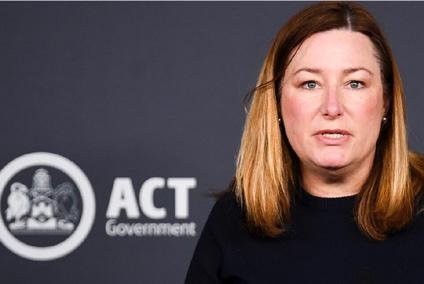
Despite the shadow of corruption being lifted, Deputy Chief Minister Yvette Berry has correctly determined it is appropriate to resign from cabinet following fallout from the findings of Operation Kingfisher.
It also comes in the face of a call from a majority of members of the Legislative Assembly based on failures regarding the Ministerial Code of Conduct.
This is an appropriate course of action.
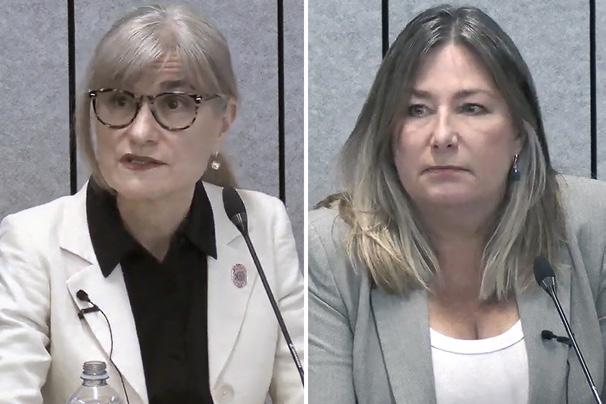
However, the Operation Kingfisher investigation by the ACT Integrity Commission has found seriously corrupt conduct by her former chief of staff, Josh Ceramidas, and the former head of the Education Directorate, Katy Haire.
A contract to upgrade Campbell Primary School was awarded through “a dishonestly provided back door by which the strategic interests of the CFMEU were given priority”. The Commission described it as “reprehensible conduct”.
These findings come at a time where accusations of corrupt conduct by Victorian unions have cost the public in the order of $15 billion over the last couple of decades.
This illustrates why an integrity
commission is so important not only in Canberra, but in all jurisdictions. Although critical of the time that it has taken for the ACT Integrity Commission to report on Kingfisher, it is fair to say that the law has allowed significant delays exacerbated by legal actions undertaken by both of those found to have participated in “serious corrupt conduct”.
Haire and Ceramidas were both in positions of considerable power and participated in unjustifiable interference in tender processes. This was at a considerable cost to one of the tenderers and put into doubt the integrity of the tender process in the ACT.
The project was awarded to LendLease over Manteena despite findings by two separate evaluations that the latter had a superior design
Berry’s resignation supports an appropriate standard for ministerial conduct. It seems that, in this case at least, the buck does stop with the minister.
and cheaper build. The investigation by the commission was to understand whether there was a union of political interference leading to the intervention.
The report found no corrupt findings or findings of wrongdoing against LendLease. Ms Haire resigned from the Education Directorate in 2024.
The report cleared Ms Berry of wrongdoing. Even though it found no evidence that her chief of staff acted at her direction or even that she knew of, agreed with or participated in his improper conduct, she ought to have known, according to the Ministerial Code of Conduct.
This is why her resignation is appropriate.
In exposing Ceramidas, the integrity commission reported that he “acted in his own interest for the purpose of currying favour with the CFMEU”. This does not happen in a vacuum and reminds the community of how important it is to maintain
appropriate oversight of government processes.
There is another issue that was not addressed by the commission. The head of each of the directorates answer to both their own ministers and the head of the Chief Minister’s Directorate. Surely, this must also bring into question both the level of competence in the ACT bureaucracy and the efficacy of the system of directorates?
The report specifically states: “Each of the actors also concealed and made misleading statements to entities responsible for interrogating the probity of the process (the coverup). In Ms Haire’s case, this involved departing from her duty of candour to the head of service” (along with others).
The details in the report about the interactions between Ms Haire and the head of service really emphasise the dysfunctional relationships within the ACT public service. The “duty of candour” refers to her relationship with the head of service rather than with her minister.
However, there is a question about how much she ought to have understood and how much freedom
she allowed her chief of staff to act in her name.
The broader question is where does the buck stop within the ACT public service. The Kingfisher report explains why integrity must be maintained ensuring decisions are “transparent and entirely independent of and unaffected by any political and outside influence”.
A question still remains regarding the involvement of the head of service and how the heads of directorates have a dual reporting role. The immediate issue, however, is the responsibility of the minister.
Ms Berry’s resignation supports an appropriate standard for ministerial conduct. It seems that, in this case at least, the buck does stop with the minister.
Michael Moore is a former member of the ACT Legislative Assembly and an Independent minister for health. He has been a political columnist with “CityNews” since 2006.
Yvette Berry… cleared of wrongdoing.
Photo: Lukas Coch/AAP
LEGAL OPINION / ACT Integrity
Commission Integrity enquiry couldn’t see wood for the trees
I hoped the ACT Integrity Commission (IC) was going to allay my fears with its long-delayed report on how LendLease was awarded a multimillion-dollar contract for school building works when Manteena clearly deserved that work.
There were two reasons for my fears. The first was that because so many of my articles are critical of actions and non-actions, I wanted to write a congratulatory piece where all of us, save those found to be corrupt, could smile.
The second reason was that after the IC attempted to avoid judicial review of its work by claiming parliamentary privilege in another of its inquiries, I sadly concluded that this integrity commission didn’t understand integrity.
I got the report. I wept.
Recall that before the IC was involved we already had the excellent report of the Auditor-General (from late 2021) that exposed what had happened: in a nutshell, that all the usual procedures for a capital works project, properly followed, had led to Manteena being the preferred contractor. But then the decision maker had decided on LendLease.
The hard work already done, the key questions, straightforward enough, were:
the decision in favour of LendLease?
2. If so, why did he so act?
3. If not, with whom did he act?
4. Why did he follow their bidding?
The IC goes hunting
That the five-year inquiry took into account 1.8 million digital evidence items, the examination of 30 people with 17 days of public hearings and 34 days of private hearing is not a matter for congratulation. Rather the opposite.
This is an awful example of an investigative body not being able to see the wood for the trees.
Put yourself in their shoes. Mr
his former position had refused to do the bidding of the local CFMEU, was now working in Education and became the expected decision maker, until he was replaced by Katy Haire, the director-general of the Education Directorate. It was she who made the bizarre decision.
Given his previous refusal to kowtow to the union, it needs more than speculation to advance the argument that he willingly rolled over to become a patsy for a stupid plan (if it ever was a plan).
However, standing up to the CFMEU and refusing to follow the instructions of your department head are not comparable acts: the latter
may be career ending. It’s easy to say that he should have been brave, and done this and that. In real life, it’s not that easy to do.
No one should expect him to have been a whistleblower. That is a path for martyrs.
The CFMEU are powerful political players in this town with an enviable property portfolio. To imagine that they would be so stupid as to arrange a glaringly obvious breach of the wellestablished rules for public capital works is far-fetched.
Which leaves two, possibly three players. They are the Minister Yvette Berry, her chief of staff Josh Ceramidas and Ms Haire.
I have been repeatedly critical of now former Minister Berry for her non-performance on housing issues. However, the IC couldn’t lay a finger on her with respect to this tender fiasco.
As stated in the report (para 382), there was no evidence that the minister had any knowledge of what Mr Ceramidas was saying and doing in his dealings with Mr Green or Ms Haire, namely purporting to be a message bearer for the CFMEU with the imprimatur of the minister’s office.
Never, ever did I expect to think of Ms Berry as a victim, but I do today: collateral damage from the nonsense
utterances of her chief of staff, Mr Ceramidas.
Nothing more needs to be said about him or his foolish games. He has to live with the fact that he brought down his own minister.
Which leaves Ms Haire, then but no longer, head of Education. The IC found her lacking in credibility. Of interest (mentioned at paragraph 380) is why didn’t she seek advice from colleagues, or the head of the ACT Public Service, when she was leaned on by Mr Ceramidas?
That question isn’t answered in the report. That’s a pity, because it may have explained much of this fiasco. That there is no answer follows from her blame shifting: “Not me, him – Mr Green”.
It’s been seven years from the procurement plan for the Campbell work to the release of the IC report. The IC has been burrowing here, there and everywhere for five of them.
So much time, so much effort, so much in lawyers’ fees for so very little.
Former barrister Hugh Selby is the CityNews legal affairs columnist.
/ when health insurers own hospitals
What corners are being cut in your healthcare?
When health-insurance companies justify their forays into clinical services based on cost savings, be alarmed, says BRETT HEFFERNAN.
The only people who should be making decisions about what care patients receive and where that care is delivered are you and your doctor.
Health insurers in Australia are reaping record profits of more than $2 billion and massively inflated management fees of $3.4 billion from their customers each year. And the biggest of them all, Medibank, is bankrolling its windfalls into hospital ownership.
The value for private health has long been your choice of specialist, working for you, who accesses a world-class private hospital. But the equation changes when insurers own the hospital.
The fundamental conflict of interest when the private funder of healthcare is also the healthcare provider is as obvious as it is disturbing.
Vertical integration skews the emphasis from quality care to cost control and it’s a direct threat to patients.
In the last 18 months Medibank has doubled its incursion into hospital ownership. Starting with East Sydney Private Hospital, Hirondelle Private Hospital (Sydney)
and Deakin Private Hospital (Canberra), Medibank has now added Adeney Private Hospital (Melbourne), Nundah Private Hospital (Brisbane) and Western Hospital (Adelaide).
One of the promo tions is “no-gap surgery”. Sounds awesome, right? But in paying surgeon fees directly, surgeons are now effectively working for or directly with the insurance company.
patient is corrupted when insurers own hospitals.”
Photo: Andrea Piacquadio
decisions are made in the best interest of patients and not the bottom line of
The insurance industry in Australia protests that they would never behave this way.
Yet, they created phoenix policies, a loophole exposed by CHOICE and the Commonwealth Ombudsman, finding customers have been hit with 70 per cent premium increases over five years when “official” increases went up by 15 per cent.
at their most vulnerable.
The very same insurers that have built exclusions into 72 per cent of policyholders’ cover, delivering their members less while exposing them to hefty and often hidden out-of-pocket costs.
Where does that leave you, the patient?
A serious line has been crossed.
The once-sacrosanct relationship between doctor and patient is corrupted when insurers own hospitals.
The US has seen this playout for decades. The nightmare of US-style managed care is fast becoming a reality in Australia and the outcomes for patients under this model are grim.
In 2023 a Harvard University-led study into the impact of vertical integration on 2.6 million American patient visits across 5488 physicians
found that “physicians significantly alter their care process after they vertically integrate, and there is a substantial increase in patients’ postprocedure complications”.
The study asserts “the financial incentive structure of the integrated practices is the main reason for the changes in physician behaviour because it discourages the integrated practices from allocating expensive resources to relatively unprofitable procedures”.
It concluded: “We find that vertical integration negatively affects the quality of care”.
Personally, I wouldn’t want a loved one within cooee of such a hospital. I have zero confidence that clinical
BUPA was caught red-handed offering doctors payments of up to $500 per patient to take their patients to any hospital except the hospitals with whom they were in a contractual dispute.
Separately, BUPA was recently fined $35 million when forced to admit to unconscionable conduct in falsely advising members they were not entitled to claims.
This is the insurance industry that refuses to contract with accredited private hospitals at all, imposes unrealistic conditions when it does, then doesn’t pay in full or on time and pressures hospitals and clinicians to limit patient care.
Under so-called “bundling”, insurers restrict what care, especially rehabilitation, their members will receive before they even get sick or injured. Patients only become aware of this when it’s too late and they are
OPINION / Fair Work Act
It has emerged, in writing, that insurers are now coercing doctors to force hospitals to provide treatments at less than cost or risk losing patients altogether, while also demanding they pre-approve what services hospitals can offer in the future or forgo payments.
They flagrantly abuse paying legislated minimum fees per episode of care. Insurers insist that averaging the minimum payment across multiple episodes is enough. By definition, that means they are routinely paying hospitals below basic rates.
No-one is surprised that health insurance companies do, in fact, behave this way. The 12.8 million Aussies with hospital cover see insurance as “a necessary evil”, essential to them accessing the quality treatments and personal care private hospitals provide.
But when insurers spruik cost savings in their hospitals, you have to wonder what corners are being cut in your healthcare?
Brett Heffernan is chief executive of the Australian Private Hospitals Association.
Unions get leverage from
“I fear it will entrench discrimination against businesses whose employees are not covered by union-backed enterprise relations lawyer at recent changes to the Fair Work legislation.
Buried within the federal government’s latest workplace reforms is a measure that could fundamentally change government procurement by allowing union-backed enterprise agreements to influence who wins Commonwealth-funded work.
Critics say it could hand renewed leverage to unions such as the CFMEU in the construction industry.
The Workplace Relations Legislation Amendment (Building Cooperative Workplaces No. 1) Act 2026 contains many worthwhile reforms. Changes to the Fair Work Act aimed at making the Fair Work Commission more efficient are sensible and should improve the way workplace disputes are resolved.
But the legislation also
The amendment creates an exception to the Commonwealth procurement framework by allowing certain enterprise agreements to be considered in procurement and funding decisions, notwithstanding existing anti-discrimination principles
Supporters say the measure is intended to encourage co-operative workplaces. I fear it will instead entrench discrimination against businesses whose employees are not covered by union-backed enterprise agreements,
Businesses seeking Commonwealth-funded work may now find themselves at a disadvantage if they operate without a union enterprise agreement. That is especially significant for small businesses, where co-operative workplace arrangements often exist without union involvement.
In the construction industry, the changes may also strengthen the hand of the CFMEU. Head contractors responsible for Commonwealth-funded projects can
Royal commissioner Terence Cole.
POLITICS
There’s more to Pauline’s popularity than protest
First a confession: by virtue of the condemnation and mirth associated with its original utterance 30 years ago, it is apparently a most shameful and reprehensible confession.
I, like Pauline Hanson, did not know what the word “xenophobia” meant when she gave her infamous “please explain” interview in 1996. Like, I strongly suspect, 99 per cent of the population at the time.
Indeed, I would warrant that the word only came into more common usage after Hanson so famously stumbled over it.
So while Hanson in the 30 years since she burst on to our political stage has been a political outsider, she has also been an insider in the sense of her everyday resonance with ordinary Australians. One of the 99 per cent prepared to say it as she sees it. However that might be: measured or outrageous; evidence-based or conjectural.
But ever without the burden of having to follow through on her pronouncements in the form of governance.
Recently, on a bus trip to Sydney, I had an opportunity to review in some detail social media commentary in the immediate aftermath of her address to the National Press Club.
Two themes struck me. First, the
“It seems to matter little to the voting public that Hanson’s policy platform is wafer thin.” Cartoon: Paul Dorin
political class – the major political parties and the establishment media – is concurrently amazed and not a little frustrated that Hanson has been “allowed” to ascend to such political heights absent much policy scrutiny. And second, despite the absence of that policy platform, the single most word or sentiment I saw everyday people use to describe her was “authentic”.
While the conventional wisdom seems to be that Hanson’s rise has been a function of mass disillusionment by the voting public with the major parties, I suspect there is more to her popularity than mere protest against the big parties.
While the conventional wisdom seems to be that Hanson’s rise has been a function of mass disillusionment by the voting public with the major parties, I suspect there is more to her popularity than mere protest.
In recent weeks, I have written how in breaking unequivocal promises, Prime Minister Anthony Albanese has diminished his trustworthiness. This, off the back of Australians’ electoral rejection of the former PM Scott Morrison’s trickery and his government’s all-too-ready acquiescence to covid quackery.
Viewed through this prism, it seems to matter little to the voting public that Hanson’s policy platform is wafer thin. Rather, what seems to resonate is what she says – and how she says it. And, despite often being a mile wide and an inch deep, her pronouncements are perceived as being heartfelt and sincere – of being authentic
Australians used to have a term for such a trait, long since out of usage: “fair dinkum”. To be fair dinkum was the ultimate test of trustworthiness; of assurance. A sort of cultural nod
Fair Work Act changes
now lawfully take enterprise agreement status into account when selecting subcontractors. That opens the door to commercial decisions being influenced by industrial considerations rather than price, capability and quality. That should sound familiar.
More than two decades ago, the Cole Royal Commission into the Building and Construction Industry examined widespread evidence that the CFMEU exerted pressure on builders and principal contractors to engage only subcontractors operating under union enterprise agree
ments. The commission, led by former NSW Supreme Court judge Terence Cole, recommended legislative safeguards to prevent industrial coercion influencing the engagement or disengagement of contractors and subcontractors.
Builders frequently complied because clients wanted to avoid industrial disruption.
The commission concluded that when subcontractors are selected on industrial rather than commercial grounds, competition is reduced, tender prices increase and taxpayers ultimately bear the cost. The new legislation risks
reintroducing procurement practices resembling those the Cole Royal Commission sought to eliminate by expressly permitting enterprise agreement status to be considered in specified procurement decisions.
Its supporters argue it will promote co-operative workplaces. Yet co-operation achieved through procurement preferences is very different from co-operation developed voluntarily between employers and employees.
The concern is not simply whether unions gain greater influence. It is whether governments should be using taxpayers’ money to favour one model of workplace representation over another.
At a time when Australia’s construction industry is already grappling with escalating costs, labour shortages and declining productivity, introducing procurement rules that may further reduce competition seems an odd policy choice.
History suggests there is a real danger that industrial considerations will once again shape commercial decisions. If that happens, it will not simply be small businesses that pay the price. Taxpayers will, too.
that something, or someone, was the real deal. That they could be relied on to say what they think and do what they say.
And so, at least for the moment, many Australians seem to have formed the view that the major parties’ policy finery is only as good as it can be trusted. And both sides over the last decade have acted in such a way as to break that trust. To fail the collective fair dinkum test.
Enter the straight-talking, plainspeaking senator from the sunshine state.
The problem, of course, is that government requires more of its leaders than just being perceived as genuine. It entails the confidence to exercise judgment about vast and detailed complexity, and to competently manage competing domestic and international forces.
So, while Australians may well be presently giving the major political parties the kick up the pants they arguably deserve, a time will come when we will have to go to the ballot box and carefully judge who can confidently and competently govern us.
Australia is at the forefront of great technological opportunity. But
we are also on the precipice of great risk: economic, social and strategic. How our governments act in the next decade could set our course for the next half century.
And it is in this broader context that Hanson’s current resonance for her ordinariness will be tested – and her perceived personal authenticity pitched against her judged professional competence to govern.
Today’s voting Australians are therefore charged with a great responsibility – to ourselves but also to future Australians.
So, as much as our politicians have let us down in recent times, the bigger question is whether we will measure up to our electoral responsibility to do what we judge best for our country: now and for the future.
Dr Robert McMahon PSM is a visiting fellow at the Australian National University, adjunct professor at the University of Canberra, and former assistant secretary of the Department of the Prime Minister and Cabinet.
Head contractors responsible for Commonwealth-funded projects can now lawfully take enterprise agreement status into account when selecting subcontractors.
Public libraries are a public service, not a saving
When I recently borrowed books from Libraries ACT, the due-date slip told me how much I had supposedly “saved” by borrowing rather than buying them.
Why do we need to be told this? Public libraries exist because access to books, newspapers and journals is a community benefit – not because every visit must be translated into a dollar value.
At a time when the ACT Government is struggling to manage its own budget, the message seems particularly misplaced.
Perhaps the government should concentrate on demonstrating value through sound financial management rather than reminding ratepayers that using a service funded by their taxes has saved them money.
Libraries ACT provides an excellent and greatly valued public service. It does not need a retail-style calculation to justify its worth.
David Evered, via email
Labor’s borrowing to pay interest is alarming
Canberrans should be alarmed by the ACT Labor government’s borrowings to pay interest.
Labor is the same as someone with a maxed-out credit card using another credit card to pay it off their bill.
But we should remember that Labor
policies originate from Eastern Europe.
When reading Jon Stanhope and Khalid Ahmed’s column (“Steel’s compounding interest takes its toll”, CN July 16), I recalled a conversation with a Yugoslav construction manager in Germany in 1990, shortly after the collapse of Communism.
He complained that: “Now we have to pay interest on the money allocated for construction. Previously we did not.” He remarked that this made construction management “more complicated”.
When I told him that Australian builders were then paying up to 25 per cent interest, commonly 20 per cent, as a result of the policies of the “World’s Best Treasurer” Paul Keating, he initially thought I was pulling his leg!
Anthony Hordern, Jamison Centre
Blame sits with podcaster not the PM
When did political debate in Australia turn into a pathetic low-intellect game of schoolyard name calling, where the winner is the one who can deliver the biggest insults and defame individuals with ill-founded accusations?
Robert McMahon’s column (“PM’s shocking bonking revelations demean women”, CN July 16), is yet another example of this low-brow tendency.
Dr McMahon appears to be an educated person, so one assumes he understands the term ad hominem – Latin for “to the
person” – which describes responding to an argument by attacking the speaker’s character, motives, or background.
Social media is full of this kind of trash talk directed at the Albanese government and the prime minister himself. Such comments rarely explain the source of people’s anger or offer any constructive way to address it.
I would suggest to Dr McMahon that if anyone demeaned women, it was the attention-seeking podcaster Nikki Osborne, who asked the PM the question in the first place while turning against the very “sisterhood” she might claim to support.
Did she ask Kylie Minogue, Nicole Kidman or Rhonda Burchmore for permission before objectifying them by asking whether the prime minister would like to “shag” them? I doubt it.
That is hypocrisy – and that is what is truly “vulgar and embarrassing”.
Declan McGrath, Gordon
Why Monty Python was probably right
Tom Lehrer in 1965 observed the US was “spending twenty billion dollars of your money to put some clown on the moon”.
A similar comment could be made today as corporations run by the likes of Musk and Bezos and several governments are selling the vision of a new space age where humans will be living, working and holidaying in space. The vision received widespread
• feel warm in winter and cool in summer?
• lower your energy bills?
• reduce outside noise?
• improve security and the value of your property?
These are just some of the many benefits that home and business owners can achieve with our uPVC double and triple glazed windows and doors.
Windotek Australia is a leading provider of double and triple glazed uPVC window and door systems for the Canberra region. We help you achieve a higher EER rating, with 100% customised solutions that meet your needs and complement the style of your home
uncritical support in the coverage of the Artemis 2 moon flyby.
ANU philosopher Ben Bramble, in his book Lunacy, questions the efficacy of the vision. The trillions needed for the quest will divert funds needed to fix earthly problems including environmental decline, growing inequality and climate change.
The mindset appears to be that it’s preferable to trash the earth so it becomes uninhabitable in order to establish colonies on Mars and other potentially inhospitable locations.
We don’t need to go to Mars or to where “no man has gone before” if we collectively improve our stewardship of the earth.
It would not be unreasonable to think the key motivations of the tech moguls, given their track record, are greed and power (not just an extension of a childhood fascination with space), and for governments, military advantage.
It’s probably naive to trust in the “goodness of human nature” and expect nations to collectively consider the merits of a new space age.
Monty Python was probably right in the Galaxy song when singing “there’s bugger all (intelligent life)…down here on earth.”
Mike Quirk, Garran
Israel needs to treat its neighbours properly
There’ll never be lasting peace if Israel continues to complain about damage
caused to it and minimises or denies damage to the other parties.
Only a rigorous self-examination and more even-handed treatment of its neighbours will provide a meaningful start to lasting peace.
It’ll not happen by continuing attacks and reprisals; one of the parties has to start the process and stay the course.
Herman van de Brug, Holt
Self-identity surprise in census
I heard that everyone will now be asked/ given the opportunity to self-identify their gender (regardless of the natural facts). I therefore will self identify as “indigenous” as I was born in Australia, as were at least six generations of my family lineage. I am now Aboriginal! Thanks to the new census!
David Jones, Duffy
Plea for zebra crossings
This is Jamison needing help; please tell our government that we need zebra crossings near the Southern Cross Club at Bowman Street, Macquarie, and road bumps to stop yobs.
Helen Bielenberg, via email
WHIMSY / time
And in time, today will be yesterday tomorrow
“A French five minutes is 10 minutes shorter than a Spanish five minutes, but slightly longer than an English five minutes, which is usually 10 minutes.”
– Guy Bellamy
We think of time as a universally fixed period and, in everyday life, time passing feels steady and constant.
A second seems like a second anywhere on earth. And we know that today will be yesterday tomorrow. For centuries, this view shaped science as well. But modern physics has revealed a surprising truth: time is not constant.
Time as we once understood it
Isaac Newton viewed time as absolute – flowing at the same rate for everyone, everywhere, regardless of circumstances. This idea works extremely well for normal daily life.
For ordinary speeds and weak gravity, time behaves as if it were constant. This is why classical physics and common sense remain useful in almost all everyday situations.
Einstein changes the picture
The idea of variable time emerged in the early 20th century with Albert Einstein’s theories of
heartbeat, thoughts, and biological processes proceed as usual. But when compared later, the travelling clock shows less time has passed. This effect has been measured using highly precise atomic clocks flown on aircraft and satellites.
Even commercial airline flights experience tiny but measurable differences in elapsed time compared with clocks on the ground.
Gravity and time
relativity. Einstein showed that time is intertwined with space, forming a single fabric called spacetime. How time flows depends on how you move through space and how strongly gravity affects you. This isn’t philosophy or speculation – it has been confirmed repeatedly by experiments and practical technology.
Motion and time dilation
According to special relativity, time slows down for objects moving at high speeds relative to others. This effect, known as time dilation, becomes noticeable only when speeds approach the speed of light.
For example, a clock on a fastmoving spacecraft would tick more slowly than a clock at rest on Earth. To the astronauts aboard the spacecraft, everything feels normal – their
Einstein’s general theory of relativity revealed another way time can vary – through gravity. The stronger the gravitational field, the more slowly time passes.
A clock closer to Earth’s surface ticks more slowly than one at higher altitude, where gravity is slightly weaker. Again, the difference is tiny – billionths of a second – but it’s real and measurable. Atomic clocks placed at different heights agree with Einstein’s predictions.
This gravitational time dilation has practical consequences. GPS satellites orbit high above Earth, where gravity is weaker and their clocks tick faster than clocks on the ground. Engineers must correct for this effect; otherwise, GPS positions would drift by kilometres each day. Does time ever stop?
In extreme conditions, time can
slow dramatically. Near a black hole, where gravity is immense, time for an outside observer appears to nearly stop at the event horizon (the boundary around a black hole within which nothing can escape – not light, not signals, not matter). However, for an object falling into the black hole time passes normally.
What time variation means
The laws governing time dilation are precise and mathematically well defined. Time still flows forward, and cause precedes effect. The effects become significant only at extreme speeds or in gravitational fields far beyond human experience.
The big picture
So, is time constant? In practice, for our everyday lives, yes. For all human activities on Earth, time behaves as if it were universal and unchanging – but science tells a subtler story. Time can vary, depending on motion, gravity, and the structure of the universe.
On a lighter note
At 9.30pm there’s a knock on the door. Couple John and Alice are
getting ready for bed. John is still showering and asks Alice, in her dressing gown, to answer the door.
Alice is a very shapely woman. When she goes to the door, it’s their neighbour Ron who asks if he could borrow a bottle of liqueur.
Ron has always admired Alice’s shapely figure and says when she returns with the liqueur bottle: “If I give you $200 may I admire your breasts?”
Alice thinks about the housekeeping and rationalises that she had once had a holiday job as a topless waitress. So, she undoes the top of her dressing gown and shows Ron her magnificent bosom.
“Wow, amazing,” says Ron and hands over the $200.
Later John asks who was at the door. Alice says: “It was our neighbour Ron, wanting to borrow some liqueur.”
“Oh,” says John, “did he happen to mention the $200 he owes me?”
Clive Williams is a Canberra columnist.
The idea of variable time emerged with Einstein’s theories of relativity. Photo: Tima Miroshnichenko
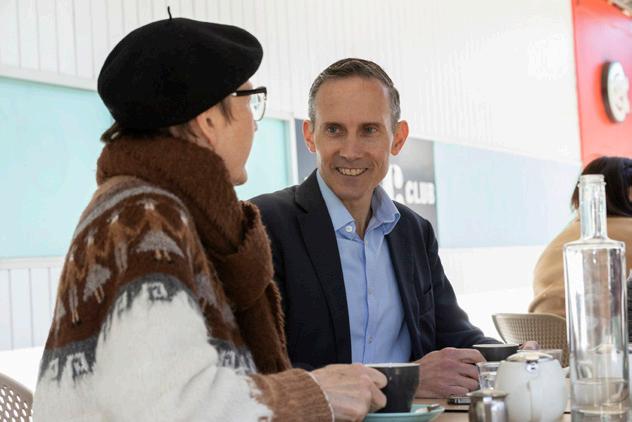
Factions to his future, Leigh knows when to zip it
“He is nearly unbelievably intelligent, articulate, personable and intellectually energetic… Just about the perfect political package.” NOEL BEDDOE discovers that Andrew Leigh also knows when to keep his thoughts to himself.
The member for the northern Canberra seat of Fenner since 2010, Dr Andrew Leigh, holds a dazzling array of university qualifications and former postings in law, education and public policy, the pinnacle a PhD from Harvard.
He has authored 10 books and co-authored two and written far too many scholarly treatises for me to be able to count.
He’s worked in company law, as professional associate to Justice Michael Kirby at the High Court and lectured at the ANU (ultimately serving as professor of economics there).
He’s now the member for Fenner and Assistant Minister for Productivity, Competition, Charities and Treasury. He is still yet to reach his intellectual peak.
We met in his office in central Gungahlin.
Firstly, the office – the reception area is tiny, big enough to hold two clients’ chairs; it is dominated by a
large but decrepit card board carton into which have been placed various items of foodstuffs, cloth ing, toys, items intended, I guess, to be distributed by the Red Cross.
Andrew wore bright blue cotton trousers and an open neck shirt; his in ner office is cluttered with various large electronic devices; there are some personal photographs but no art works, no library.
By intention or chance (intention is my guess) this is a workplace that says: “There’s nothing glamorous about us; we’re here to get work done”.
He is tall and whip-thin – at age 53 he still runs marathons. We talked for 30 minutes; the impression he creates in discussion is of coiled energy and total concentration.
His family, grandparents and parents, all were or are committed members of the Methodist then Uniting churches.
Some took underprivileged in to give them a secure home – migrants, First Nations people; he remembers fascinating conversations when he visited.
Were tensions when Andrew accepted his own atheistic views and revealed them? Never; his parents remain good friends of his.
Apart from family, major contributors to his development? He holds Kirby very highly: “I learned from Justice Kirby that he was never afraid to be held mistaken when he took a stance; he never dismissed the
Join us at this year’s ACT Heritage Symposium as our expert speakers explore Everyday Heritage. How do these key themes shape our experience of Everyday Heritage?
thought that history may well prove him right. He was totally authentic – he acknowledged that he was gay when that was even a tougher act than it is today.”
Also predecessor Bob McMullan –“He’s only ever a phone call away; I do try not to bother him too much.”
He has never joined a faction in parliament. Regrets?
“I am completely committed to my role. As a member of government I have assured access to all ministers; I can take recommendations to them across portfolios and be guaranteed an audience, an opportunity to convince using evidence. And I love representing the people of Fenner.”
Not quite an answer to what I’d asked, but that’s okay.
Failings in the ACT? The appalling recidivism rates of our indigenous in custodial incarceration?
“The Federal government hasn’t responsibility for ACT custodial matters…”
Yes, but as a senior resident citizen?
In response he took me through a number of matters which I already knew about First Nations policy, Closing the Gap, incarceration rates featuring in Labor policy. All very informed but what does he think about our ACT rates? I think I know, but he didn’t tell me.
When it suits him, Dr Leigh knows how to keep his thoughts to himself.
I mentioned my admiration for Bob McMullan and my belief that our nation did not get as much as we might have from his time in parliament. Our time was nearly up; Andrew Leigh gave a burst of deep, sincere laughter.
“Oh, Noel,” he said. “That’s the fate of just about everyone who gets elected to parliament!”
A revealing moment of pure candour.
Another try: has he any ambition beyond what he currently is doing?
Again he told me what a privilege it was to hold the role he had. The impression – he has no further ambition.
Yeah? Maybe.
He comes from a background of service and social awareness and contribution; he is nearly unbelievably intelligent, articulate, personable and intellectually energetic; he has the tough instinct to know when to comment on an issue, when to keep his thoughts to himself and how to negotiate unwelcome questions.
Just about the perfect political package.
Where to next for Andrew Leigh? I’ll keep an eye on that with great interest.
Canberra novelist Noel Beddoe has twice been awarded by The Literature Board of The Australia Council for the Arts.
role. As a member of government I have assured access to all ministers.” Photo: Geoff Comfort
Canberra CareersXpo
Canberra CareersXpo opens the door to future opportunities
Choosing a career pathway is one of the biggest decisions a young person will make, and the Canberra CareersXpo continues to play a vital role in helping students, parents and career changers make informed decisions about their future.
Now in its 47th year, the Canberra CareersXpo has grown into the region’s largest careers, education and training event. Delivered in association with the Rotary Club of Aurora Gungahlin and supported by the ACT Government, this year’s expo will be held at Exhibition Park in Canberra (EPIC) from 9.00 am to 2.30 pm on Wednesday 5 and Thursday 6 August Admission is free, making it an accessible opportunity for anyone exploring future study, training and employment options.
Each year, thousands of visitors attend the two-day event, joining around 120 exhibitors representing universities, TAFEs, registered training organisations, government agencies, employers, apprenticeship providers and industry groups from across Australia. Visitors have the opportunity to speak directly with industry professionals, compare education pathways and gain practical advice on careers in both established and emerging industries. The CareersXpo isn’t just for school leavers. Parents and carers play a significant role in
helping young people make career decisions, while teachers, career advisers and adults considering a career change will also find valuable information and expert guidance throughout the exhibition.
Interactive experiences, hands-on demonstrations, STEM activities, Indigenous employment programs and career planning resources provide visitors with a real insight into today’s workforce and the skills employers are seeking for the future.
Visitors are encouraged to make the most of the resources available on the Canberra CareersXpo website before and after the event. The online Student Handbook and Virtual Expo Hall allow attendees to plan their visit, research exhibitors and education providers, or access valuable information if they cannot attend in person.
Whether you’re considering university, vocational education, an apprenticeship, defence, government employment or specialist industry training, the Canberra CareersXpo offers an outstanding opportunity to explore your options, ask questions and make valuable connections. For anyone planning their next career move, it’s the ideal place to discover new opportunities and take the first step towards a rewarding future.
Canberra CareersXpo Exhibition Park, corner Flemington Road and Northbourne Avenue, Mitchell. Visit careersxpo.com.au
Canberra CareersXpo
5 & 6 AUGUST 2026
Exhibition Park in Canberra
The CareersXpo showcases multitudinous Career and Job pathways on offer in 2026.
This event is for school students, adults already in the workforce, or anyone with an interest in seeking a new career path.
Join us for a journey of discovery into the labyrinth of inspiring possibilities.
WHEN?
Wednesday 5 August 2026 9am-2.30pm
WHERE?
Exhibition Park in Canberra
Thursday 6 August 2026 9am – 2.30pm
Corner of Flemington Rd and Northbourne Ave, Mitchell ACT
Canberra CareersXpo
Leisure manager offering flexible employment
Belgravia Leisure is a leisure management provider for numerous aquatic, fitness, sport, holiday parks, spas and wellness venues across Australia, and ACT marketing co-ordinator Tanay Kandlur says they are looking for more Canberra-based team members.
He says there is a wide range of roles available, including sales or duty managers, but in particular, they are looking for lifeguards, swimming teachers and fitness trainers.
Tanay says hours are flexible, which makes it a perfect option for school students, recent graduates or university students, and any training required is provided by Belgravia Leisure.
Tanay says Belgravia Leisure prides itself on providing employees with access to an extensive range of career options, and opportunities for career
Work With Us!
Looking for an engaging job with great rewards? Begin a career in aquatics & recreation and make a difference within the community. Join our diverse and dynamic team as a lifeguard, swim teacher, fitness trainer or even a sales and guest experience officer with family-friendly and flexible hours. Interested? Learn
and
in the community.
“At Belgravia Leisure, we believe in the power of our people in connecting our communities to leisure,” he says.
“We care about our people and greatly value diversity.
“We encourage people from all backgrounds to find a career with us.”
Tanay says employees can also enjoy free membership and free facility access.
Belgravia Leisure at: Canberra Olympic Pool, call 6248 6799; Dickson Pool, call 6217 5700; Stromlo Leisure Centre, call 5114 2900; Gungahlin Leisure Centre, call 6241 1132; Lakeside Leisure Centre, call 6293 3122 and Erindale Centre, call 6123 9406. Or, visit belgravialeisure.com.au
adults into meaningful employment
Moving from the structured environment of Year 12 into employment, further education or training can be challenging. Neurodivergent young adults may face additional barriers, particularly when the right support and adjustments are not available.
We spoke with David Cottam, who leads the NDIS practice for Employ for Ability, a Canberra-based organisation that focuses on supporting neurodivergent adults take the next step towards employment, further training, or career development.
“We understand that transitioning from school to the workplace is challenging. Whether you are looking for your first job, exploring career options, or seeking support to transition from school into employment, our team provides personalised support to help young adults build confidence and succeed in their chosen pathway. Participants develop
practical workplace skills, improve communication and self-advocacy, and gain strategies to manage challenges they may encounter.”
“Our strengths-based approach encourages neurodivergent young adults to embrace their authentic selves, reduce the need for masking, and develop the tools required to thrive in inclusive work environments.”
Employ for Ability doesn’t just advise, it walks the talk. The majority of its program facilitators identify as neurodivergent and bring lived experience of the challenges young adults with autism, ADHD or other neurodivergences face.
Employ For Ability Call 1300 619 768 or visit employforability.com.au
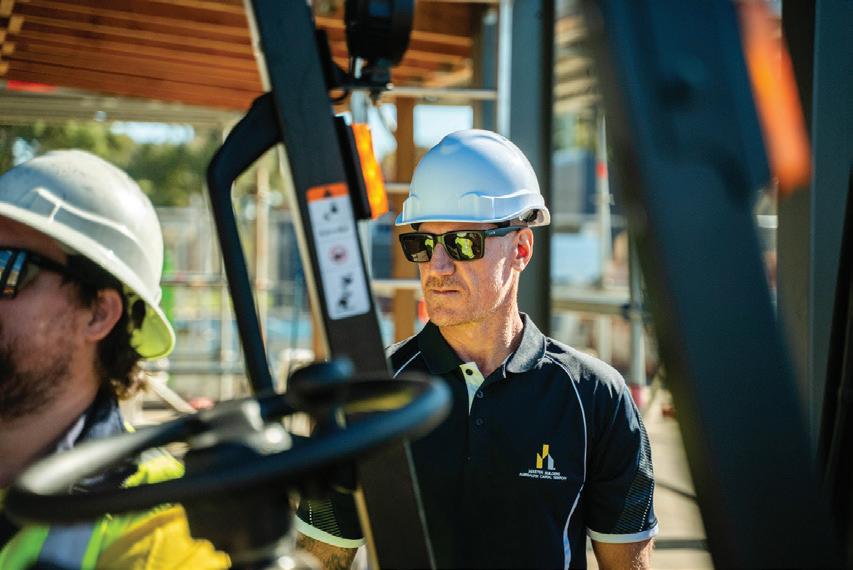
In a bid to address workforce needs and highlight the career paths available in construction, Master Builders ACT recently hosted a morning tea at The Marion for school careers advisors, providing an overview of the building and construction industry and why students should consider picking up the tools.
Held ahead of National Skills Week from 25 to 30 August, the event aimed to equip advisors with practical information to guide high school students into rewarding career pathways.
The session featured a panel of industry leaders and current apprentices, demonstrating the breadth of careers available. Attendees heard from Emmi Lee, a finalist for Apprentice of the Year at the ACT Training Awards and recent MBA Training carpentry graduate, along with Mark Cole, owner of local building company Freedom Built, and Lach Haskins and Leanne Foresti, both MBA Training Board members and long-term local construction business owners.
‘This morning tea was about giving careers advisors a direct, honest look at the opportunities in our sector,’ said Anna Neelagama, CEO, Master Builders ACT.
Supporting neurodivergent adults to build skills and career pathways
NDIS funded school leaver support
employment capacity building
‘The construction industry provides stable, well-paid career pathways with genuine progression. By showing advisors the stories of young people like Emmi and Mark, we are helping them see the real potential for their students.’
Ms. Neelagama emphasised the importance of hands-on experience in preparing the future workforce.
‘Through our training arm, MBA Training, we trained over 4,000 students last year. Our focus remains on quality apprenticeships that blend theory with practical work.
‘This hands-on experience is what sets our graduates apart and makes them job-ready from day one.’
As part of its commitment to growing the construction workforce for the future, MBA Training will be participating in the upcoming Careers Xpo from 5 to 6 August at Exhibition Park, where staff and Master Builders ACT members will be on hand to talk with students about starting a career in construction.
Master Builders Association ACT Training mba.org.au
Canberra CareersXpo
Supporting future educators every step of the way
Choosing to study while working can be challenging, but with the right support, it can also be incredibly rewarding.
As a community owned, not for profit organisation, ECTARC Training Services is committed to supporting students, strengthening the education and care sector and improving outcomes for children, families and communities. We believe every student deserves personalised guidance throughout their learning journey.
For more than 29 years, we’ve specialised in education and care training, helping students develop the skills, confidence and knowledge needed to thrive in the sector.
Every student is supported by a dedicated Training and Development Officer (TDO) who has industry experience and understands the daily realities of working in a service.
Our students benefit from regular contact with their and evening phone support, ensuring help is always available when it’s needed most.
Students also have access to our online Student and Training Portals, as well as online study and assessment support sessions to build confidence and keep them on track.
What makes ECTARC different is our strong connection with the early childhood sector. Through close collaboration between our Education and Care Services, Training Services and leadership team, our programs remain current, practical and aligned with industry expectations and regulatory requirements.
ECTARC Training Canberra CareersXpo, Booth 38. Visit ectarc.com.au/training
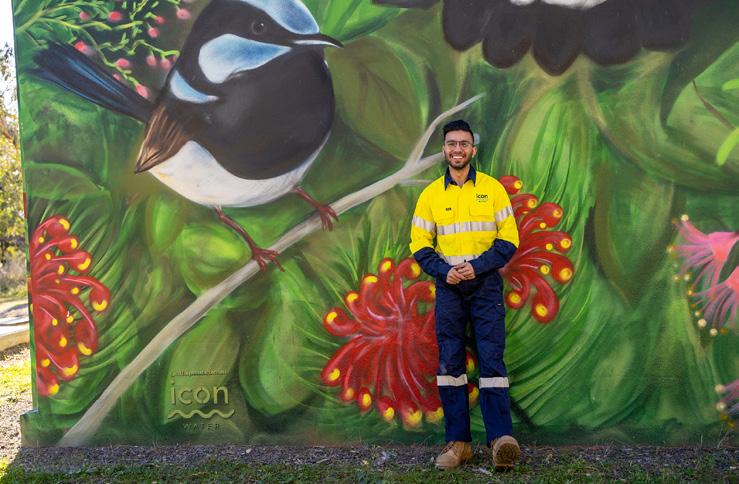
It takes people with many different skills to provide water and wastewater services for Canberra.
Icon Water offers practical career pathways for students, graduates, school leavers and people considering a career change. Whether your interests are in engineering, environmental science, digital technology, cyber security, information technology, trades, business, or working with the community, there may be a place for you at Icon Water.
The graduate program supports university graduates to apply their studies across specialisations, while developing technical, business and professional capability.
Traineeships offer paid learning toward qualifications in functions across Icon Water. Apprenticeships offer nationally recognised trade qualifications in electrical fitting, mechanical fitting and instrumentation.
University internships and school work experience placements provide further opportunities to contribute to real-world projects, observe professional work
environments and receive guidance from experienced teams in a safe, inclusive and collaborative setting.
As an equal opportunity employer, Icon Water encourages applications from people of all backgrounds, including Aboriginal and Torres Strait Islander peoples, people with disability, culturally diverse communities and applicants of all ages. Through its early careers’ programs, Icon Water offers opportunities that provide hands-on learning, professional experience and exposure to an industry that delivers essential services to the Canberra community.
Meet the Icon Water team at the Canberra CareersXpo and discover where your skills could take you.
Icon Water Booth 91 on 5-6 August 2026. For more information, email earlycareers@iconwater.com.au or visit iconwater.com.au/startmycareer
Find your future at IMB Bank
IMB Bank can offer a rewarding career where you learn, grow and make a meaningful difference in the communities we serve.
As an award-winning, member-owned bank with more than 145 years of history, IMB offers opportunities across a wide range of career paths.
You might begin in a branch or contact centre supporting members with their everyday banking needs, join a business banking or lending support team, or build your skills in areas such as digital banking, technology, risk and compliance, finance, marketing, people and culture, operations or administration.
Many of these opportunities are entry-level roles, and you don’t need previous banking experience to get started.
What sets IMB apart is our people. As a member-
Looking for more than just a job?
focused organisation, we value integrity, respect and performance. You’ll be part of a supportive and inclusive environment where you’re encouraged to ask questions, share ideas, learn from experienced colleagues and be recognised for your contributions.
Whether you’re passionate about helping people, solving problems, working with data, creating content or building digital experiences, a career at IMB can help you discover what you enjoy and where your strengths can take you.
If you’re ready to bring your energy, curiosity and commitment to a bank that cares about its members, its people and its communities, IMB could be the place to begin your next chapter.
IMB Bank imbcareers.com.au or imb.com.au
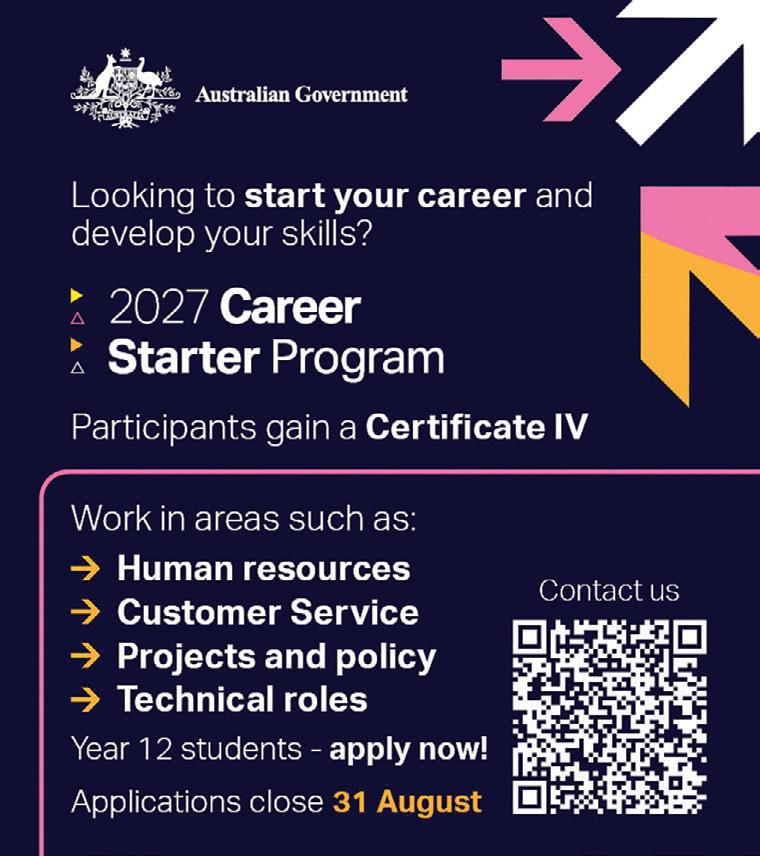
qualification.
Over 12 months, participants work alongside experienced public servants, building skills in communication, collaboration and time management while contributing to government priorities.
The program offers a competitive salary, paid leave, superannuation and a supportive, inclusive workplace.
2026 Career Starter Nauman Qureshi said the program helped him grow professionally and shape his direction within the APS. “It gave me clearer insight into my strengths, the areas I want to keep developing and the contribution I can make in a government environment,” he said.
Applicants work towards gaining a Certificate IV.
Services, the Australian Centre for Disease Control, the Australian Taxation Office and the Australian Public Service Commission.
The Government stream offers exposure to how policies, programs and services are delivered. Participants may support projects, administration, customer service and specialist functions including finance, communications, procurement and IT, The Human Resources stream provides experience in recruitment, employee wellbeing, workplace relations and HR program delivery.
Applications open Monday, 3 August.
Australian Government Department of Finance finance.gov.au/about-us/careers/ graduate-and-early-career-pathways
Building futures with IMB (from left): Sales and Service Consultant Sophie Stewart, Information Security Manager Enrico Conte, and Sales and Service Consultant Milosh Uzelac.
Careers
Creating an educational change in
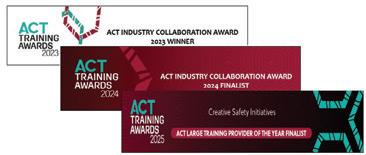
Specialising in training and industry consultation, Creative Safety Initiatives (CSI general manager), Brian Vernon says the organisation aims to reduce the number and severity of accidents in the workplace.
“CSI is an ACT-based training provider committed to a continuing focus on improving safety standards in the building, construction, demolition, mining industry as well as other sectors.
We offer nationally recognised accredited training courses ACTGovernment approved courses, and non-accredited industry training. We also offer WHS products and quantitative face-fit testing services.
With courses ranging from asbestos and silica exposure awareness, workplace impairment, safe and respectful workplaces, white card, bullying and harassment to heat awareness and HSR training.
Creative Safety Initiatives represents a group of dedicated people committed to creating safe work environments, safe communities for workers & through education, they aim to encourage harm reduction and attitudinal change in safety in the workplace”, Brian says.
Creative Safety Initiatives Unit 7/10, 8 Cape Street, Dickson. Call 02 6230 1320 or visit csisafety.com.au
workplace safety
generated drafts into clear, accurate communication.
These are skills every professional will need.
For organisations, the challenge is similar. Teams are already using AI, but many don’t have clear guidance on when to use it, how to use it responsibly or how to check the quality of the output. Without that guidance, organisations risk inconsistent communication, factual errors and reduced trust.
At Plain English Foundation, we’ve spent more than 23 years helping government agencies and organisations communicate clearly. We’re now applying that
Your partner in safety, compliance & innovation
At Creative Safety Initiatives, we don’t just provide safety solutionswe build lasting partnerships based on trust, expertise, and results. With decades of industry experience, we deliver customised safety systems and compliance services that protect your people, your business, and your peace of mind.
Discover how our commitment to excellence is reshaping workplace safety across Australia.
NON-ACCREDITED TRAINING COURSES
• Bullying, harassment & racial vilification training
• Chemical awareness training
• Chemical suit training
• Domestic & family violence awareness training
• Electrical safety awareness training
• Environmental awareness training
• Hazardous manual tasks training
• Healthy eating & nutrition awareness training
• Heat awareness training
• Height safety awareness refresher training
• Ladder safety awareness training
• NSW asbestos & silica awareness training
• SA asbestos & silica awareness training
• WA asbestos & silica awareness training
• Onsite fire & emergency procedure awareness training
• Personal protective equipment (PPE) awareness training
• Preliminary impairment assessor training
• Safe & respectful workplaces workshop
• Safe talk suicide prevention awareness training
• Safe use of hand & power tools training
• Sun smart training
• WHS committee member training
• WHS hazard identification training
• WHS managers & supervisors training
• Workplace mental health awareness training
Technology can generate words. People still need to provide judgement, context and clarity. The organisations that succeed won’t be those that simply adopt AI. They’ll be the ones that help their people use it responsibly, communicate clearly and build trust through every interaction.
Plain English Foundation 24/477 Pitt Street, Sydney NSW. Call 1300 691 885 or visit plainenglishfoundation.com
NATIONALL RECOGNISED & ACCREDITED TRAINING COURSES
• 10830NAT Course in crystalline silica exposure prevention
• 11369NAT Course in workplace impairment prevention
• 11421NAT Course in safe & respectful workplace training in gender equity
• 11084NAT Course in asbestos awareness
• CPCWHS1001 Prepare to work safely in the construction industry
• CPCCWHS2001 Apply WHS requirements, policies & procedures in the construction industry
• CPCSIL2001 Use & maintain respiratory protective equipment
• CPCSIL3001 Work with products & materials containing crystalline silica
• CPCSIL4001 Supervise & manage work with products & materials generating respirable crystalline silica
• MSMWHS216 Operate breathing apparatus
ACTGOVERNMENT APPROVED COURSES
• ACT Health & Safety Representative refresher training (1 day)
• ACT Health & Safety Representative training (5 days)
PRODUCTS & SERVICES
• Quantitative face fit testing, masks & filters
• Dust particle monitors & accessories
To enquire or book training, please contact our friendly staff by: phone: 02 62301320 email: info@csisafety.com.au or visit www.csisafety.com.au
Creative Safety Initiatives general manager Brian Vernon.
Careers
ACT workers can now get their White Card entirely online – here’s how
A nationally recognised White Card course is now avail able 100% online for residents across the Australian Capital Territory.
Anyone planning to work on a construction site in the ACT is legally required to hold a White Card – and getting certified has never been more straightforward.
Under WorkSafe ACT regulations, the White Card (formally known as General Construction Induction Training, unit code CPCWHS1001) is mandatory for all workers who enter or operate on a construction site.
This includes tradespeople, apprentices, contractors, labourers, supervisors, and even site visitors. It is also required when applying for an owner-builder permit through your local council.
White Card Webinars, in partnership with registered training organisation The Careers Academy (RTO 46244), now offers a fully online White Card course for ACT residents – no classroom, no travel, and no upfront payment required.
The process takes just three steps: complete a selfpaced online assessment, attend a short 30-minute Zoom session with an accredited trainer to verify your ID, and receive your Statement of Attainment for CPCWHS1001 the same day. That certificate can then be taken or uploaded to any Access Canberra service centre to obtain your official WorkSafe ACT White Card.
The course is available to residents across Canberra, Belconnen, Tuggeranong, Gungahlin, Woden Valley, and Weston Creek – anywhere in the territory with a reliable internet connection.
Contact us for more information.
White Card Webinars
Call 1300 335 011 or visit whitecardwebinars.com.au/white-card-act
Connecting skilled
professionals with work in Canberra and beyond
Across government, defence, technology and cyber security, the right person often needs to understand structured environments, careful processes and the responsibility that comes with sensitive work. When a role requires a certain level of Australian Government security clearance, the recruitment process becomes more specialised. Skills and experience matter, but so do eligibility, timing, judgement, and trust.
Whizdom has worked in this environment for over 20 years. Established in 2006, Whizdom is an Australian Veteran owned and operated recruitment agency with offices in Canberra, Sydney and Brisbane, supplying Federal Government and industry clients across Australia with security cleared professionals for contract and permanent roles. Our team recruits across ICT, cyber security, project management, business support, administration, and executive services. That breadth matters because the people needed to support secure programs are not always technical specialists.
Whizdom is ISO 9001 certified, a Veteran Employer of Choice, active on major Federal, State and Defence Government supply panels, and a DISP member with the ability to sponsor security clearances for eligible Australian citizens where role requirements apply.
For contractors, support continues after placement, wherever they are based. Whizdom supports contrac tors across Australia and offers same day pay at no cost for approved timesheets submitted by 4.30 pm, along with a comprehensive contractor care program.
Whizdom is filling roles now The wise work with Whizdom.
Visit www.whizdom.com.au to view current job listings.
Whizdom is filling roles now across government, defence, technology, cyber security, project delivery and business support.
Zachery Alker works with Whizdom.
ARTS & ENTERTAINMENT
Sparkling tribute to resilience of ageing women
COVER
STORY
By Helen Musa
Inspired by the strength, resilience and many facets of a diamond, Liz Lea’s new dancecum-cabaret show, Diamonds, reflects on how we are shaped by experience, pressure and the determination to keep shining.
It is Lea’s sparkling tribute to the beauty and resilience of ageing women.
“Loud, lively and full of laughter, it’ll crack into and through the madness of menopause and creating our futures through the magic of movement.” Lea says.
There will be no shortage of glitz and glamour. A former showgirl, Lea has reunited with fellow hoofer Kym Degenhart and dancers from Bom Funk Dance Studio, to create what promises to be an evening of high-energy entertainment.
Yet beneath the sequins lies a serious theme. Like her internationally touring work RED, which explored the impact of endometriosis on a dancer’s body, Diamonds confronts another unavoidable truth, that we all age.
“Fourteen years ago when I was creating
Liz Lea’s new one-woman show is called Diamonds… “Loud, lively and full of laughter, it’ll crack into and through the madness of menopause.”
my show, 120 Birds, I could dance every morning,” Lea tells me. “Then it became one day a week. I can’t move that way any more.”
The 2017 Canberra CityNews Artist of the Year and recipient of an Australian Dance Award in the same year, Lea has built a career exploring movement in unexpected ways, from Indian classical dance to large-scale works inspired by birds, water and science. However, these days she finds herself
increasingly drawn back to her showgirl roots and she is pleased to say that she can still do a full high kick.
That showgirl background has shaped the look and feel of Diamonds. Lea has spent months collecting glittering costumes from everywhere she could find them, including a spectacular silver dress bought online, while assembling a cast of mature dancers and collaborators.
The production has been developed with choreographers Jamie Winbank, Natalie Ayton and Tammy Gissell, plus filmmaker James Hiscutt and lighting designer Karen
Adding another contemporary dimension is Canberra hip-hop artist Citizen Kay, who is advising on music for the production.
Lea promises plenty of audience interaction, dancing, conversation and humour while tackling the subjects of menopause, ageing and creating our futures.
She believes society still tends to render older women invisible. During her research, one woman told her she had felt invisible all her life because she was a person of colour, while another confessed she rather enjoyed becoming invisible.
Lea herself relishes disappearing into track pants while she works, but says: “Every so often I put my head above the parapet.”
In Canberra’s dance community, she sees herself primarily as a connector, not least through founding and directing the BOLD Festival, which will take place again in November, with her new show, Alte, in the line-up.
But Diamonds is a deeply personal work, the second in a planned trilogy that began with RED. It explores menopause, growing older, not having children and the social stigma and invisibility many women experience as they age.
But she is determined that audiences
leave entertained rather than weighed down. The show is conceived as much as a cabaret as a dance performance, mixing movement, music, storytelling and conversation.
Lea is also keen to challenge stereotypes surrounding older dancers. Once, professional dancers were expected to retire in their late twenties, often with bodies worn out by years of punishing work. But now, after the “Safe Dance” movement emerged in 1988, performers are continuing well into later life, with pioneers such as Elizabeth Cameron Dalman still dancing into her nineties.
“I’m trying to defy the ‘crone’ image of older dancers,” Lea says. “My show is about empowerment and that governs every choice I make in relation to the audience.”
Although she says she’s trying to defy stereotyped images of older dancers, she is quick to applaud Elizabeth Cameron Dalman‘s famous role as the matriarch in Irish choreographer Michael Keegan-Dolan’s Swan Lake/Loch na hEala; she was 82 at the time.
Lea expects Diamonds to resonate well beyond women experiencing menopause and notes that there are also a lot of women who haven’t experienced menopause symptoms. Even so, she figures, partners, families and anyone curious about the realities of ageing will find something familiar in the show.
Diamonds, The Q, Queanbeyan, August 6-8.
STREAMING Nightmare shipwreck doco cruises to top spot
The stranger-than-fiction story
of the Costa Concordia, a luxury cruise ship that was shipwrecked 14 years ago, is still making waves.
Case in point: a new doco on Netflix that’s steamed its way straight to the number one most watched show this month.
For those who aren’t familiar with this infamous true story, the Costa Concordia made global headlines when it struck rocks off the coast of the Italian island of Gigio in 2012.
The ship, carrying more than 4200 passengers and crew, lost all power before eventually capsizing, tragically killing 32 people and injuring 150 more.
But what caused the catastrophe?
Not a wild storm, mechanical failure or rogue iceberg but a decision from the ship’s strange captain.
Francesco Schettino deliberately steered the ship off its course in order to carry out a planned “salute” as the vessel passed the Italian island.
Why? And how did it lead to such disastrous consequences in an era where safety at sea is so controlled?
Shipwrecked: Nightmare at Sea pulls together a mass of footage, interviews and audio recordings from the investigation to create the most authoritative documentary about the disaster yet.
What adds to the huge intrigue already surrounding the story though is the string of peculiar facts that led up to the sinking.
When the ship first launched in 2005, a customary champagne bottle was swung against the hull but failed to break, which is regarded as a notorious omen for travel at sea.
Also of bizarre note was how a former captain of the ship was watching from the shore nearby where the Concordia sank.
These oddities are only scratching the surface of one of the most fascinating maritime disasters since Titanic.
Clocking in at 89 minutes, this is definitely the best way to learn about all the crazy facts lying beneath the surface of this story if you haven’t before.
ALSO hitting Netflix this month is the latest big project to star Will Ferrell.
The Hawk is a sports comedy which follows Lonnie “The Hawk” Hawkins, a once champion golfer who is now well past his prime.
Desperate to recapture his magic with the club, Hawkins tries to swoop on one last grand slam, dragging his exhausted family into all the chaos while he’s at it.
It was only last year Amazon Prime Video subscribers got Stick, a series about a former pro golfer desperately trying to reignite his fading career, starring Owen Wilson. A little familiar to say the least.
Look, The Hawk is certainly no Ted Lasso, but it’s perfectly fine for a bit of light entertainment and Ferrell fans might find enough here for a good time.
The formulaic approach and dry script certainly handicaps this one though.
KEANU Reeves is also showing off his comedy chops this month on HBO Max.
The internet’s pin-up boy stars in the
newly streaming film Good Fortune.
This one follows a well-meaning, but somewhat incompetent angel named Gabriel on a quest to prove his holy wisdom to the upper echelons of heaven.
Swap the lives of two mere mortals in a bid to unlock a grand parable.
The first is Arj, a gig worker falling behind in rent and struggling to make ends meet.
The second: Jeff, an ultra wealthy investor who doesn’t give a second thought to his
Does the magical interchange between their two lives unlock a sweeping, wholesome revelation? Not quite.
Instead of Arj realising money isn’t everything, it turns out he actually quite enjoys being a millionaire. Go figure.
A crazy spending spree begins to wreak havoc with Gabriel’s plan, not just threatening the reality this angle has tinkered with but his very own place in heaven.
It’s a fun premise, if not quite executed as well as it could have been.
Good Fortune is no miracle but it does sit perfectly in that low-effort, weekend watch threshold.
The shipwrecked cruise liner Costa Concordia… 32 people were killed and 150 injured.
Keanu Reeves as the well-meaning but incompetent angel Gabriel in Good Fortune.
THEATRE / The Girl on the Train
All aboard for a real physiological stage thriller
By Helen Musa
First there was The Girl on the Train, Paula Hawkins’ best-selling novel. Then came the hit film starring Emily Blunt. Finally, adapted by Rachel Wagstaff and Duncan Abel, it’s a stage thriller, one that until now hasn’t been seen in Canberra.
Mockingbird Theatre Company’s production at Belconnen Arts Centre threatens to throw audiences right into the centre of the action.
As the title suggests, the play revolves around Rachel, a woman whose marriage has collapsed. Every day she catches the same train into London, observing the lives unfolding along the railway line and becoming fixated on the street where she used to live.
In director Chris Baldock’s production, audiences will make the journey with her. The seating replicates what the British call a “diamond crossing”, an X-shaped railway junction, with the audience seated inside the X. Sound, lighting and projections will heighten the sensation of travelling by train. When I catch up with Morgan HeathWilliams, who plays the plum role of Rachel, she says placing the audience inside the action mirrors the voyeuristic nature of the story.
She spends her journeys watching the
lives of strangers, especially those in the street where she once lived. Then a woman disappears.
Described by one journalist as “a
harsher, suburban, sex-filled variation on The Mousetrap”, The Girl on the Train is usually billed as a psychological thriller, with Rachel becoming an amateur detective, much to
Stand-up from a standing start ARTS IN THE CITY
Comedian Wil Anderson returns to Canberra with Whatchu Talkin’ ‘Bout Wil? an improvised stand-up show in which every performance is created on the spot from audience interaction. The Street Theatre, August 5-9.
The Australian National Eisteddfod’s choirs section returns with 35 choirs competing across a range of age groups and categories. Composer, conductor and educator Paul Jarman will adjudicate the performances. Snow Concert Hall, August 8.
Historian Shirleene Robinson has edited The Memory Tapes, a new book drawing on the National Library of Australia’s now-legendary oral history collection. Organised around 16 themes, it features excerpts from interviews with prominent Australians and ordinary citizens alike, ranging from First Nations experiences and migration to sport, science, the arts and life through natural disasters and pandemics.
The National Gallery of Australia’s National Indigenous Art Triennial: After the Rain has opened at Home of the Arts in Surfers Paradise, the first stop on a three-year national tour. Curated by Tony Albert, the exhibition brings together contemporary indigenous art from across the country.
5-9.
Fyshwick, August 7-9.
Canberra Symphony Orchestra 2026 Kingsland Fellows, Jessica Hall on trombone, Amanda Tao on flute and Jacob Aziz on violin, together with pianist Hilda Visser-Scott, will perform a lunchtime concert of music by Farrenc, Chaminade, Saint-Saëns and Guilmant. Wesley Music Centre, August 5.
Love & Forgetting: Tales from a Young Mixer continues its winter season. Devised and performed by Canberra artist Jeremy James and WAAPA graduate Jack Martin, the “cocktail cabaret” blends storytelling, music and drinks in the setting of a working bar. Ambrosia Lounge,
Recorder duo Robyn Mellor and Rodney Waterman present Woodsong, a program celebrating more than 500 years of recorder music. Performing on at least 10 handcrafted instruments, they move from contemplative love songs and French Baroque dances to contemporary Australian works, African-inspired rhythms and jazz-inflected pieces. Wesley Music Centre, August 1.
the frustration of Detective Gaskill, because of her alcoholism, blackouts, and a history of harassing her ex-husband.
Without giving too much away, suspicion falls on Rachel’s ex after he is seen kissing the woman who goes missing.
It’s a substantial departure for HeathWilliams, who won accolades in 2023 playing a bumbling private detective in the burlesque production Catch Jazida.
Although it’s been some time since she last appeared in a serious play, she has an impressive background in dance and burlesque.
Performing as Artemis Seven, she reached the Miss Burlesque Australia finals before representing Australia at the Burlesque Hall of Fame in Las Vegas.
But The Girl on the Train is another matter entirely.
After taking acting classes with Baldock, she auditioned for the role of Rachel. He admitted casting her was something of a risk.
“Can you carry this role the entire time? It’s a big commitment,” he asked.
Her answer was an emphatic yes.
She’s rarely off stage. “I only leave it at interval, and who knows? Chris might tie me to the stage for that, too.”
The play explores memory, obsession and betrayal through characters who are, she says, “so distinct and human”. Much of the action unfolds through Rachel’s troubled mind, leaving audiences constantly questioning whether they can trust what they’re seeing.
“But Chris has such a love of plays and
audiences and he’s very good at connecting the real humanity underlying the narrative, so you’ll get swept away,” she predicts.
Heath-Williams is quick to point out that Rachel is only one part of a richly populated drama.
“It’s a multi-character play and all the characters are very flawed, but very real.”
Rachel witnesses the woman who goes missing, but when she tries to become involved, people think she’s crazy. HeathWilliams believes audiences may feel the same way for a while, because Rachel herself cannot distinguish fact from fiction.
Rachel is also a liar, although HeathWilliams wonders whether she’s really trying to conceal overwhelming shame. Having lost her job, she pretends to commute to work every day. The familiar one-hour train journey, repeated morning and evening, gives her the comforting illusion that her life still has purpose.
“The challenge is to play the truth in the character,” she says. “Rachel is such a flawed character and some people may find her unlikeable, but as an actor you have to understand where she’s coming from.”
As for Rachel’s ex-husband?
“He’s a real bastard,” Heath-Williams says, adding, “but a charming one. All the characters have charming elements.”
Exciting thriller though it is, she insists The Girl on the Train feels uncomfortably real. “It could happen anywhere, to anyone.”
The Girl on the Train, Belconnen Arts Centre, August 5-22.
Girl on the Train cast, from left, Sabrina Fu, Timothy Cusack, Morgan HeathWilliams, Paul Sweeny, Susie Todd and Robert Wearden.
Comedian Wil Anderson…The Street Theatre, August
Photo: Ian Laidlaw
DINING / Pomegranate, Kingston
Poor service mars night of good food
Throughout its 12 solid years, Pomegranate has held its own in an ever-changing hospitality industry for its modern Australian food with a Mediterranean twist.
Along the way, the restaurant has been rewarded with Australian Good Food Guide hats and other awards.
The interior has stood the test of time and is elegant, comfortable, warm and inviting. I love it.
It was with great anticipation that we visited with interstate guests, keen on supporting long-standing dining establishments as much as the new ones popping up here, there and everywhere in the capital.
Excellent was the Atlantic salmon carpaccio ($24). An amazingly generous portion, the salmon was marinated with apple cider vinegar, onion, ginger and chilli. It was luscious, velvety and intriguing. The carpaccio was beautifully plated, making it a true feast for the eyes.
Also a mega hit was the zucchini and feta cheese fritters ($24), shaped into balls and served with a creamy garlic yoghurt dressing that was cool on the palette. The fritters were light yet more-ish.
Mains include a tasty, tender premium Wagyu striploin (marble score 4; $70).
Wagyu is a luxury item, and the beef was handled with great care by the team in the kitchen.
Pomegranate sources the striploin from
Australia’s leading Tajima bloodlines, and the steak was melt-in-the-mouth. The beef jus was perfectly executed and featured depth of flavour. The mash was creamy and enhanced with grated cheddar.
Disappointing were the chargrilled Cowra lamb cutlets ($48), which I’ve had many times at Pomegranate, so I was surprised. Pomegranate doesn’t skimp on quantity – four cutlets arrived with potato kofte, grilled veggies and a roasted garlic mayo.
However, they were overcooked and tough, so much so I returned them and followed the footsteps of two of our party and ordered the Wagyu (paying $22 more).
The leaf salad was fresh and
inviting ($15) and we appreciated the mix of radicchio, cos lettuce heart and rocket.
Creamy goat’s feta enhanced the salad.
Our visit was badly affected by poor service. Pomegranate was off its game throughout the evening, from start to finish. It lacked polish and was uncomfortable for all of us.
Issues began with drinks being badly delayed, and then one forgotten. When we asked about the specials, the person serving wasn’t able to describe the dishes. We pushed, keen on knowing the detail,
WINE / Borrowed Cuttings
but even after a visit to the kitchen we weren’t enlightened. We struggled to gain attention many times, and affogatos at the tail end took an enormous amount of time to arrive, stretching our patience to the limit. At one point, one of our party went to express concern. In the end, Pomegranate removed a side from our bill.
From ‘borrowed cuttings’, a winning wine
The Languedoc French oyster community and those that grow Picpoul grapes are, according to Steve Feletti, the owner of Borrowed Cuttings wine company, in lockstep.
They cross-market. Their oyster festivals feature the flagship wine of Picpoul and these two products celebrate each other. His desire was to see that complement transported to Australia.
Steve had been an oyster grower since 1999 and sold the Clyde River business last year. He has had a lifetime passion for oysters, implementing farm-to-restaurant supply as a key to his success. Each year when he visited the coastal areas of France he tasted the oysters and mussels grown on the coast.
In all of this tasting, Steve describes the pairing of oysters and Picpoul as the “perfect match”, just like that old-fashioned dating show. Remember, when a man has money to burn it’s cuisine.
“Sashimi is the new fish and chips for young people. I’m getting this from fishmongers and we are sashimi fans ourselves, having lived in Japan. This refreshing white wine is the best to go with all types of
aperitif, standalone wine on a hot Australian day. “
Steve’s passion was made real when he “borrowed” some cuttings from a vigneron in the Languedoc.
Then came three years of the plants being in quarantine and then another
two years in a cloning laboratory. The grapes are now grown near Cowra and Steve is preparing his tenth vintage. The wine is a winner having outscored a Picpoul grower, Domaine Feline Jourdan, in the Decanter world awards in 2022. Steve also has thrown out the French rule book with a Picpoul blend of 30 per cent chardonnay and a sparkling Picpoul, also with the same blend. The strict appellation rules in France don’t allow them to stray into this territory, which is a pity because the chardonnay blend brings a good balance by subduing some of the acidity in the Picpoul. I’ve tried both the Picpoul varietal and the still blend at Symposium wine bar at the ANU. The varietal wine is light with a crisp acidity, slightly saline and with a hint of lemon on the finish.
My research says that in the area of France known as Picpoul de Pinet, the translation of that term is appropriately “stings the lips”. Steve insists that its meaning is “hen pecked”, referring to the delight the local chickens have when they eat the easily fallen grapes.
No matter, as I said, the chardonnay blend brings a good balance dampening down the acidity and was excellent with the croquettes served at Symposium. Just like the arsonist on Valentine’s Day, it was, as Steve would have it, a perfect match.
Atlantic salmon carpaccio… marinated with apple cider vinegar, onion, ginger and chilli. Photos: Wendy Johnson
Wagyu striploin (marble score 4)... handled with great care by the team in the kitchen.
The Borrowed Cuttings Picpoul Blanc… winemaker Steve Feletti describes the pairing of oysters and Picpoul as the “perfect match”.
Photo: Narooma Oyster Festival
HOROSCOPE PUZZLES
By Joanne Madeline Moore
ARIES (Mar 21 – Apr 20)
The Sun (in fellow fire sign, Leo) forms a terrific trine with Saturn (transiting through your sign). So creative ideas and a disciplined approach will help you solve problems and make satisfactory progress. Your motto for the week is from actress and activist Gillian Anderson (who turns 58 on Sunday): “Just remember, you can do anything you set your mind to, but it takes action, perseverance and facing your fears.”
TAURUS (Apr 21 – May 21)
With vivacious Venus (your patron planet) visiting your entertainment zone, it’s time to be social, Bulls! Mix, mingle, party and socialise - but make sure you also balance it with some quiet, solo time, where you can relax, contemplate and ruminate. With the Sun and Jupiter both jumping through your home zone, you could undertake an ambitious domestic project, receive happy family news or benefit from a generous relative.
GEMINI (May 22 – June 21)
Good fortune and lucky opportunities are on your side this week, Gemini, courtesy of the Sun, Saturn and prosperity planet Jupiter. The stars especially favour social media, short trips, communication, education, community connections and group activities. It’s also a good week to make a long list of your goals, hopes and wishes. Then throw your dreams into space and watch and wait as they gradually manifest into your preferred future.
CANCER (June 22 – July 23)
This week Jupiter and the Sun stimulate your financial and self-esteem zones, so it’s a good time to boost cashflow, celebrate the authentic you and embrace your so-called flaws. And some indulgent self-pampering (like an aromatherapy facial or a full-body massage) will increase relaxation and boost confidence. Friday’s Sun/ Saturn trine is terrific for powering ahead at work, applying for a promotion or receiving professional accolades.
LEO (July 24 – Aug 23)
The Sun and Jupiter (the confidence planets) are both visiting your sign, so it’s time to shine brightly and boldly – to be your authentic self! If you don’t accept yourself (warts and all) then why should anyone else? If you don’t develop your talents and follow your dreams, then others won’t do it for you. As Leo actress/ producer (and birthday great) Lucille Ball said: “Love yourself first and everything else falls into line.”
VIRGO (Aug 24 – Sept 23)
Very fussy Virgo – you can sometimes be hamstrung by your fear of making a mistake and your constant striving for perfection. This week’s Sun/Saturn trine encourages you to drive for success and use bumps along the way as a valuable learning tool. Be inspired by birthday great Barack Obama: “You can’t let your failures define you. You have to let your failures teach you. When times get tough, we don’t give up. We get up.”
LIBRA (Sept 24 – Oct 23)
This week the Sun, Jupiter and Saturn stimulate your hopes-and-wishes zone, so it’s important to have ambitious long-term goals that you’re working towards. Be patient, though, as you focus on bringing your dreams down to earth via a practical plan. Then – when everything is in place – you’ll know when to pounce. With Venus transiting through your sign (from Friday until September 10) prepare to sparkle, charm and shine!
SCORPIO (Oct 24 – Nov 22)
Have you been selling yourself short? Stop being a critical fusspot who engages in negative self-talk and sabotages success. The Sun, Jupiter and Saturn are activating your career/public/reputation zone, so it’s time to be the self-confident Scorpio you were born to be. Your motto is from birthday great, actress and producer Lucille Ball: “I have an everyday religion that works for me. Love yourself first, and everything else falls into line.”
SAGITTARIUS (Nov 23 – Dec 21)
This week many busy Sagittarians will burn the midnight oil, as creativity bites and inspiration strikes, especially at work. International connections could be particularly beneficial, and others are looking to you for innovative ideas. You could also receive welcome support from a friend, teacher or mentor. From Friday onwards, make a wish-list of your most desired hopes and dreams and then send them out into the Universe.
CAPRICORN (Dec 22 – Jan 20)
The planets suggest a boost to finances via an increase in cashflow but be careful you don’t cancel that out by indulging in a spontaneous spending spree! Under the influence of the Sun/Saturn trine, it’s a terrific time to apply for a job, spruce up your workspace, or improve communication with colleagues, clients or customers. Business matters are also favoured, as you take an abstract idea and spin it into rock-solid reality.
AQUARIUS (Jan 21 – Feb 19)
Opportunities to travel or study look promising, as the stars stimulate your innate curiosity. The Sun/Saturn trine is positive for social media connections and interpersonal relations as you talk, text, tweet, publish, post, podcast or socialise. You could also make headway with a romantic relationship or a fledgling friendship. You’ll find the more you connect and contribute within your local community, the more satisfied you’ll feel.
PISCES (Feb 20 – Mar 20)
Jupiter, the Sun and Saturn activate your work and wellbeing zones. So, it’s a suitable week to revise your daily diet and fitness routine, as you choose healthier food options and a form of exercise that you enjoy. When it comes to work and finances, it’s time to catch up on the backlog of unfinished projects and overflowing paperwork. With Mercury in your friendship zone, have a catch-up lunch or movie night with your besties.
Copyright Joanne Madeline Moore
1 Name an alternative term for foes. (7)
2 To be clever, is to be what? (5)
3 To be unlawful, is to be what? (7)
4 What are small hard seeds? (6)
5 Name the lowest point, as of adversity. (5)
6 To surfeit, is to do what? (7)
7 Damascus is the capital of which Asian republic? (5)
13 What are servile followers? (7)
15 Name a person’s outer clothing. (7)
16 Name a particular type of dog. (7)
17 To expunge, is to do what? (6)
18 Name the meat of the coconut. (5)
19 To be silly, is to be what? (5)
20 When one converses, one does what? (5)
CHARTERED ACCOUNTANT
New job inspires Erika to pay 'catch-up' super
Erika has a job, her first in nine years, and came to ask about paying some "catch-up" superannuation.
I told her the system allows her to contribute any shortfall contributions over the past five years, provided the account balance at July 1 2026 was less than $500,000.
"I can see that your total super balance is only about $300,000," I said.
"I can also see that you have carry-forward contributions available to you of about $128,000.
"Based on the letter of offer from your employer. It appears you have a salary of $120,000 and your employer will be paying $14,400 in superannuation for you this financial year.
“The maximum amount of concessional contributions, taxdeductible contributions, that you are allowed to make this financial year is $32,500.
"So you must make a contribution of $18,100 before you can make any catch-up contributions.
"That contribution should give you a tax refund of around $5700. However, the fund will deduct tax of $2715 when you make the contribution to the superannuation fund. That is 15 per cent tax is always charged when you make a concessional contribution to a superannuation fund."
I said that her next consideration was whether to make $109,900 as a contribution or a smaller amount.
"It's lucky you sold your house and have cash left over so you can make these contributions now," I said. "I would not recommend you make the maximum contribution because it will take you below $45,000 as your taxable income.
"The tax rates below $45,000 are less than 15 per cent charged when you contribute to the fund. So, it is not tax effective.
"Therefore, I recommend you contribute no more than $56,900 to your fund this financial year. Your total super balance on July 1 2027 should still be less than $500,000, which means that you will be able to contribute the balance next financial year in a taxeffective manner.
"The maximum contribution available in the 2028 financial year will be less because the earliest year will drop off and you will have maximised the 2027 financial year.”
I told Erika there were a couple of other things that she needed to do when making the contributions to ensure she got the tax deduction. "When you go on to the super fund's site, there will be a form you fill in to make a personal contribution," I said "You complete that form showing the amount and then you need a second form called ‘notice of intent to claim or vary a deduction for personal contributions’. When you return this form to the fund, you will receive an acknowledgement.
"It is only when you have that acknowledgement that you can claim your personal contributions. You do this when you lodge your 2027 income tax return, Erika.
Erika smiled and said: “If I have any difficulties may I get back to you for guidance?”
I replied: "Of course”.
If you have any queries about tax or superannuation contact the expert team at Gail Freeman & Co Pty Ltd on 02 6295 2844.
Gail Freeman & Co Pty Ltd 02 6295 2844 Unit 9, 71 Leichhardt Street, Kingston ABN 57 008 653 683
Geranium untroubled by frost
By Jackie Warburton
While some plants are hit by the mid-winter frosts, there is an old, trusty one that keeps thriving, unaffected at all – meet the rose-scented geranium.
The Pelargonium graveolen is a tough plant that grows to about a metre tall and wide, needing little care. It can be chopped to keep it in check.
Most pelargoniums have scented leaves with their aroma ranging from lemon, peppermint or rose.
Plant it on pathways or around outdoor entertaining areas where it can be brushed, to help release the aroma.
While it can be pungent to some, it’s a good deterrent around the vegetable patch to confuse small, night-eating animals and mosquitos.
It’s easy to propagate. Strike cuttings in a vase of water or take cuttings and leave them to dry for a few days, then pot them into a propagation mix.
To get pelargoniums to flower well in the garden, they’ll need at least six hours of sunlight a day. However, some pelargoniums suffer from the cold if they have too much moisture in the winter, so keep them as dry as possible through the cold months and when the weather warms bringing new growth, use flower fertiliser to get them going.
Material way to keep frost at bay
OVER the next four to six weeks the frost will be at its worst for the garden and a little care and attention might be needed to protect some plants that just don’t like the cold.
There are many cloth materials
harsh elements, such as frost. My Kroenleinia grusonii is protected with frost cloth to prevent it from freezing and rotting from the centre. Frost cloth can stay on the plant during the day as its a lightweight material that lets the light and water in. Any other materials such as old sheets can be used, but heavy materials like that can’t be in contact with the plant and a staked frame could be used with the material removed during the day.
If a tented structure is too unsightly then there are liquid products that can be sprayed on to the leaves and protect the plants from the elements, but will need to be reapplied after rain.
THERE are still some flowers in exception.
Bulbine bulbosa is endemic to our regions and grows well. Over time in the garden, it can create a clump and be problem free. Its flowers are fragrant and a bright yellow and give some winter cheer.
TRUFFLES are a delicacy on the dinner plate this time of year and a long-term investment if you want to grow your own at home.
The soil needs to be calcareous and a high pH around 7.5. Calcareous soils are clay-rich soils with little organic matter. Purchase trees already inoculated with mycelium known as mycorrhiza (root fungus). This will enhance the symbiotic relationship between the fungus and the tree to find nutrients from each other. If the soil has too much
organic matter it won’t work. Keep the pH high by adding garden lime or dolomite lime to the soil annually.
Oak trees and hazelnuts are the most common “host” tree for truffles. However, hazelnut trees would be a preferred choice for the home garden, with the bonus of having nuts to eat as well.
Plant where they are protected from hot winds and can be grown as a hedge or a small tree. Hazelnuts are wind pollinated and only one pollinator is required every five trees. I’ve had success with Corylus avellana, “American White” and “Cosford” as they both only grow two to three metres tall and fit in a suburban backyard nicely.
Hazelnuts are ready around February/March and fall to the ground at maturity and truffles are ready to be dug up around July/ August.
POME fruits can be pruned now as the trees are into dormancy. First, remove all dead, diseased and damaged wood from the tree. Heritage apple trees are spur bearing and need minimal pruning.
Other varieties, such as Fuji, granny smith and pink lady apples, are tip growers (they grow their fruit on the tips of branches). Their lateral branches are shortened to about 20 centimetres long to reduce whippy growth and minimise the risk of branches breaking when in fruit.
Planting chives under apples can repel apple scab and encourage predatory insects and are good companion plants. Place a little dolomite lime around the base of the tree to keep the pH high and add boron when the tree is coming out of dormancy for good flower set and fruit formation. Water in well.
After pruning, spray trees with horticultural oil on the bark and branches to kill any insects overwintering in the bark. Also use a fungicide, such as copper, to keep fungal diseases at bay.
The rose-scented geranium… thrives despite the mid-winter frosts. Frost cloth protests a Kroenleinia grusonii to prevent it from freezing and rotting from the centre.
Winter cheer… Bulbine bulbosa, its flowers are fragrant and a bright yellow.
GARDENING / pruning
Don’t prune grasses over winter
By Jackie WARBURTON
Grasses look just as effective in summer as they do in winter.
By leaving them unpruned through winter, instead of cutting them back early, they provide habitat for wildlife while adding structure to the winter garden.
Grasses for garden beds come in a wide range of sizes, including many native species. The choices are endless, with shapes and forms to suit almost any space. Larger varieties can be difficult to find in advanced pots, but if small pots are planted in spring or summer they will make strong growth. After a few years they can be divided with a sharp spade, replanted or potted to give away to friends.
Not all grasses need to be cut back. The best guide is to know the plants you already have.
As a rule of thumb, cut back deciduous
grasses in late winter or early spring when new growth is visible at the base of the clump, pruning down to that new growth.
Evergreen grasses generally do not require pruning, but if they need tidying to keep them in check, spring is the best time for a light trim rather than the hard pruning used on deciduous grasses.
Some of my favourites that grow well in our region are the Miscanthus species. While I grow Miscanthus gigantea in my garden, I am looking forward to growing M. Sarabande, which stays considerably smaller and has wonderful autumn colour.
In our region and surrounding bushland we have a tremendous range of native grasses, both deciduous and evergreen, that mix well together in the garden. Look for Kangaroo Grass (Themeda triandra), which has fine foliage and grows to about 40cm tall. Another excellent evergreen is Swamp Foxtail Grass (Pennisetum alopecuroides) with its soft, green foliage. Both are low-maintenance and easy-care once established.
NOW we are getting to the pointy end of winter, there are still many jobs to do before the spring rush.
Once the bare-rooted trees and plants are in, the compost is turned and cooking, it’s time to think about dividing many plants in the garden.
Plants with suckering habits, tubers or rhizomes are ideal for division. It is an easy way to create many free plants before spring arrives in a month or two.
A good example is Echinacea, which benefits from regular division. Dig up the clump and carefully tease apart the rhizomes.
Echinacea grows well in our environment and produces long-lasting flowers throughout the warmer months. New varieties now available have more compact growth, with flowers in oranges, creams, reds and many shades of pink.
The large flowers attract pollinators to the garden and the plants need very little care once established.
As a bonus, Echinacea is also a medicinal plant. The roots, leaves or flowers can be used to make an immune-boosting tea. The roots can be lightly boiled, while
the above-ground parts can be steeped in boiling water, strained and enjoyed as a mild tea.
NOW is also the time to think about revitalising lawns ready for spring if needed. Scarifying or coring are both healthy lawn practices.
Scarifying removes thatch from lawns with rhizomes, while coring removes plugs of soil to improve the soil profile.
Rarely will both be needed, and there are many turf experts available to provide advice on your lawn.
jackwar@home.netspeed.com.au
Jottings…
• Tie up summer berry canes before spring.
• Prepare the ground for rose planting.
• Begin to sow spring growing herbs and annuals.
• Liquid feed all vegetables to keep them growing fast.
Miscanthus Sarabande… has wonderful autumnal colour.
Photo: Jackie Warburton
Echinacea… a plant that benefits in regular division.