MICHAEL MOORE asks how long to look into Phillip pool corruption allegations
Don’t get old and definitely don’t get sick! BRETT HEFFERNAN
Revenue questions the ACT budget doesn’t answer
JON STANHOPE & KHALID AHMED
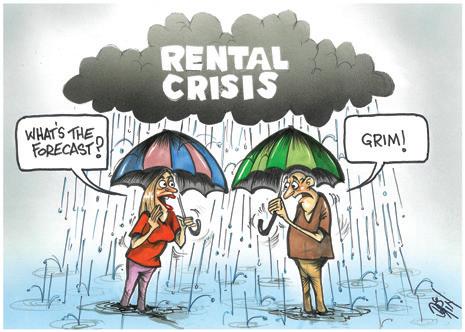
The big rental biffo is about to begin
ROBERT McMAHON
Of Michelangelo and his dogskin boots
CLIVE WILLIAMS
Why do wine bottles have a bottom dent?
RICHARD CALVER
Well written, well read
KEEPING UP THE ACT
BOYD WEAVES SHOCKS INTO TAPESTRIES
COME
NEWS / Uqasha Imran Foundation
Imran shares daughter’s legacy helping children
By Dhwani PATHAK
Imran Amjad spends his days working through balance sheets and financial plans.
But for the past year, his most important work has been something else – finding a way to carry his daughter forward.
Just over a year ago, his daughter Uqasha was riding her motorbike along the Barton Highway in Nicholls when a public transport bus crashed into her. She was taken to hospital but later succumbed to her injuries. She was 22.
“(Her loss)… it has changed every thing,” he says. “Time is the biggest healer, they say. Absolutely not. Time does not change someone’s absence.”
In the months that followed, Imran and his family began building something in her name, the Uqasha Imran Foundation, a way to turn what she cared about into something that continues.
At home, her presence is still felt everywhere.
“Whether it’s in the house itself, looking at where she would have been sitting… everything has changed.”
Uqasha was the eldest of four siblings. Her name itself, as Imran
“She loved the sport,” he says.
“Every time she would come back from a training session, she would talk about… helping kids.”
She also loved the outdoors. Be it swimming, cycling or hiking. Those interests now shape the legacy her family is building.
The foundation aims to help young people, especially girls, stay involved in sport when financial pressures might otherwise force them to stop.
“Whenever there is a financial strain… the first thing is kids’ activities taken off the table,” he says. “Especially when it comes to girls.”
He had seen Uqasha recognise that gap herself.
“She was helping so many young kids at such a tender age.”
What began as an idea is now a family effort. His son, just 20, serves as the secretary, and his younger daughter took on the role of MC during the foundation’s launch. His wife, Alia, was the first person he spoke to about the idea, and she was on board from the first second.
“Our core message is: there was always someone first to believe in a kid’s ability to excel in sports,” Imran says. “The foundation is in Uqasha’s name to be that someone.”
That support has also come from across cultures and communities.
“When I say community, it’s not just one community… everyone is
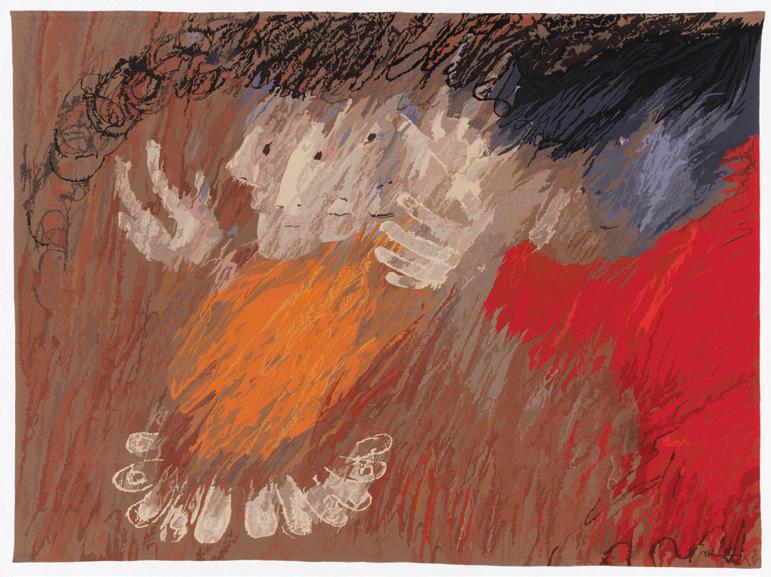
Cover: Arthur Boyd: Tapestries, St Francis Being Beaten by his Father (1973). Story Page 31.
General manager: Tracey Avery, tracey@citynews.com.au
The foundation is already making an impact. Some of the first children it supported have been able to attend competitions they otherwise could not afford.
“It was amazing to see that even a small drop made a big difference in their life.”
At its core, the foundation carries a simple idea: that no child should miss out on sport because of financial constraints. The foundation provides grants to help cover the costs of training, equipment and travel for interstate tournaments.
For parents, his message is just as direct.
“If that is your own child, you will do whatever to find a way to help,” he says. “Then you expand that to other children.”
Because in the end, he says, that instinct is universal.
“Helping a child… is every parent’s dream.”
Through the foundation, Uqasha’s name continues to be spoken, and her spirit of giving remains in motion.
“There isn’t one way to deal with this,” he says. “But this is how we carry her forward.”
Because for him, this is what remains: not just the loss, but what he chooses to build from it.
Donate at uqashaimranfoundation.org
Put community safety grants back on the road!
LAUCHLAN McINTOSH says the public is entitled to ask a simple question: if the government collects more than $1m from a road safety levy, why suspend a $200,000 community road safety grants program that directly supports local prevention work?
One small ACT Government Budget cut deserves more attention: the decision to put the Community Road Safety Grants program on hold and not reinvesting the increasing collection of road safety specific revenue from Canberra motorists.
The ACT has traditionally recorded strong road safety outcomes compared with many other jurisdictions. That reflects our compact urban geography, good road infrastructure, a relatively modern vehicle fleet and, importantly, a long history of local road safety research, education and community programs. However, we can and should do better and have done so in the past.
For many years, those community programs were supported by the NRMA Road Safety Trust. Those funds were reduced during reforms to make third party motor insurance more “competitive” and the ACT has a small compulsory road
safety levy collected through vehicle registration which is to support community-driven projects, research and educational initiatives.
That levy was $3.20 per vehicle last year and is $3.30 this year. With around 340,000 registered vehicles, the increase alone raises about $34,000, on top of an annual collection of just over $1 million.
Yet the ACT Government has now put the Community Road Safety Grants, funded from the Road Safety Community Fund, on hold.
In 2025, the government boasted a $200,000 grants program. It now says the program is paused while it evaluates the effectiveness of the fund from 2020 to 2024 and aligns future distributions with the ACT Road Safety Framework 2026-2031.
Evaluation is reasonable. Stopping a modest grants program for a full year while that evaluation occurs is much harder to justify especially as it also affects the solvency of many effective community groups.
Last year’s grants supported practical, targeted programs across
“Stopping a modest grants program for a full year while evaluation occurs affects the solvency of many effective community groups.”
the community: inclusive road safety education for children with disabilities, neurodivergent children and children from culturally and linguistically diverse backgrounds; motorcycle safety education; workshops for young drivers and school students; CALD road user education; Kidsafe ACT training and resources for safe transport of children with disability; pre-learner licence resources; road design training for motorcycle-friendly infrastructure; and primary school road safety education.
These are not abstract policy exercises. They are small, local, prevention-focused programs that reach people the mainstream road safety system often misses.
The government has also announced a “strong commitment” to other road safety measures, including
suburban safety upgrades, federally supported Black Spot projects, pedestrian safety improvements near schools and transport nodes, and enforcement campaigns using mobile phone and seatbelt detection cameras.
Those investments are welcome.
But they do not explain why community grants should be suspended.
The camera program is listed as part of the government’s road safety effort, and I support the technology.
This is not an expense for the government, but what is really a regrettably, unfortunate windfall revenue source from a new technology. Somewhat surprisingly, seatbelt non-use and mobile phone distraction remain serious contributors to road trauma, effective enforcement has a legitimate role.
However, the financial picture also matters. The ACT Government does not clearly publish the net revenue benefit from this technology, but it has been reported, and not publicly challenged, that mobile phone and seatbelt detection cameras may raise in the order of $6 million a year.
The public is entitled to ask a simple question. If the government is collecting more than $1 million through a road safety levy, plus significant additional enforcement revenue, why suspend a $200,000 community road safety grants program that is raised to directly support local prevention work?
The issue is not whether road safety infrastructure or enforcement should be funded. Of course they should. The issue is whether community-led road safety work should be the expendable item when dedicated and related road safety revenue continues to flow.
ACT road trauma is not trending down. Every serious crash carries social, economic and human costs that are far greater than the modest value of these grants.
The government should reinstate the 2025–26 Community Road Safety Grants while the evaluation is completed, and it should publish clearly how road safety levy revenue and camera enforcement revenue are being allocated.
Canberra motorists are paying for road safety. The community should be able to see that the money is being used to prevent harm and as legislated, reinvested in road safety related programs, not simply absorbed into the budget.
Lauchlan McIntosh is has been chairman/president of national and international road safety related organisations, including the global Towards Zero Foundation, Australasian and Global NCAP, the Australasian College of Road Safety, Intelligent Transport Australia and was an inaugural director of the International Road Assessment Program.
Arthur Boyd, Manufactura de Tapeçarias de Portalegre, Lurdes Serra (weaving drawer (intermediary)), St Francis holding St Clare’s hair (detail), 1974, National Gallery of Australia, Kamberri/Canberra, purchased 1975, Reproduced with the permission of Bundanon Trust
The word is don’t get old, definitely don’t get sick
The message from the Albanese government is clear. Don’t get old. But if you do, definitely don’t get sick.
The federal budget’s breach of faith on two decades of making private health insurance more achievable for those using it the most is a disaster waiting to happen. Not just for oldies. For everyone.
More than three million Austral ians aged 65 and over hold private health insurance. Whether they are pensioners, part-pensioners or selffunded retirees, they are typically on very fixed incomes. After all, their eligibility for the rebate is means tested.
Younger people need to ask, is this how I want mum and dad treated? And what awaits me when I reach a ripe old age?
only worth around 30 per cent of premiums. But when older patients go to public hospitals the taxpayer picks up 100 per cent of the bill.
ripe old age if governments can just break this long-standing policy pact?
Today some 900,000 of this age cohort with private health insurance live on $55,000 or less. Cutting the rebate will see a couple aged 70 pay $1614 a year more next year, on top of the next premium hike.
Last year, those 65 and older accounted for more than 2.5 million private hospital admissions. At the same time, waiting lists in public hospitals are 940,000 people deep. Staggeringly, some 20,000 public patients have been waiting longer than the clinical timeframe for their condition.
Emergency department dysfunction, bed block, waiting lists and
taxpayer costs will be worse as a result of this change.
Forcing older Australians, who are higher users of high-end hospital care, from private to public hospitals will be devastating for them and the health system.
The government says 44,000 will drop their health insurance entirely. But it refuses to release the sums for this claim. Others suggest it’s more like 60,000-plus. That’s bad enough, but many more are expected to downgrade their health cover from Gold to Silver.
The problem is Silver doesn’t cover the things oldies need, such as cataracts and joint replacements to name
just two examples. So, even if they stay in private health, they will still end up in the public system where the current wait times for cataract surgery is up to two-and-a-half years and typically three years for joint replacements. That’s a long time to have your sight impaired or be immobile, in pain and often isolated. We also know these waits lead to people developing comorbidities and deteriorating mental health.
When federal Health Minister Mark Butler slipped this cut to the rebates into his NDIS speech at the National Press Club, almost as an afterthought, he dismissed the Howard-era measure as having “no policy intent”.
That’s just wrong.
It always recognised that those 65 and older are on fixed incomes and high users of hospital services. Keeping this age cohort in private health insurance saves the public system from collapse.
There are few rewards for “doing the right thing” in funding the bulk of your own healthcare through health insurance. These rebates are
So this hit job on oldies is indefensible economically or morally. Federal and state governments are funding public hospitals to the tune of some $450 billion over five years. The cost savings of $3 billion over four years by pulling the rug out from under older people will disappear very quickly.
Robbing Peter to pay Paul by allocating the savings to aged care doesn’t wash, while being, yet another, blow to the viability of private hospitals.
We all understand the politics of so-called inter-generational equity.
There are more millennials than there are septuagenarians so the narrative sop to younger voters is blatant.
But how does this change help younger people? It doesn’t.
In fact, if you’re young and reliant on the public hospital system, this will likely see you wait even longer for treatment.
Younger people also need to ask, is this how I want mum and dad treated? And what awaits me when I reach a
Both sides of politics used to celebrate Australia’s complementary public and private hospital system. That balance is pivotal to us avoiding the extremes of the UK’s NHS and the insurer-dominated US systems. Undermining it is worse than short-sighted, it puts the health and wellbeing of all patients at risk.
In dismissing the rebates for older Australians, the Albanese government seems to be making a stark admission. All governments since Howard, Labor and Coalition alike, ran economies that got the publicprivate balance right and supported older Australians’ healthcare when they needed it most. Apparently, that is no longer the case and not a priority.
KINGS
Brett Heffernan is chief executive of the Australian Private Hospitals Association.
Even if older people stay in private health, they will still end up in the public system.
A second opinion on hearing loss – you need professional advice, not a sales pitch
A woman came into my clinic for a consultation about her hearing aids, telling me her hearing aids were 4 years old and she had never found them to be of much help. She said the salesperson quoted her $14,000 for a pair of hearing aids, however, the monthly special of 20% discount meant they cost her $11,200. So, she ‘only’ paid $11,200 for hearing aids that did not help her. Sadly, I hear this all too often.
Here are some things to do to avoid this type of problem:
1. Visit your GP. If you or someone you know has a problem with their hearing, visiting your GP to check for wax in the ears, and to get advice is a starting point.
2. Qualifications. Always check the qualifications of the person you are dealing with. A person without professional qualifications has no business advising you about your hearing. They need to belong to a professional association with a Code of Conduct, so you know they are acting in your best interests, not their own.
years. If you are not sure about their advice, then seek a second opinion. The wrong hearing aids can be an expensive waste and could lead you to stop wearing them. You should always have a trial of hearing aids to ensure that they are right for you.
6 Pensioners and eligible DVA card holders often have entitlement to free services. If you are covered by a government concession, then let the clinician know (even though your clinician should ask). Eligible clients may obtain free hearing tests, consultations, and free hearing aids (referred to as fully subsidized hearing aids).
“A person without professional qualifications has no business advising you about your hearing. They need to belong to a professional association with a Code of Conduct, so you know they are acting in your best interests, not their own.”
– Dr Vass
These hearing aids are appropriate for many people, however if you have great difficulty hearing in background noise (for example a restaurant), then you may want to consider partially subsidized hearing aids. This is when the government pays a certain amount, and you pay for additional features and benefits. Your decision should be based on the following:
you are dealing with a qualified clinician, then they belong to a professional association. The best contact is an independent complaints body referred to as Ethics Review Committee. You can email ethics@auderc.org.au and view the website www.auderc.org.au. You can make an anonymous complaint and your complaint will be handled in a confidential and professional manner. If you are in the ACT, contact the ACT Human Rights Commission email human rights@act.gov au and the website www.hrc.act.gov.au
3. Independent advice. You should get independent, professional advice.
4. There are a wide range of hearing aids out there. Finding the right hearing aids for your communication needs can be challenging. Hearing aids vary in price and performance. Bluetooth® connectivity and rechargeable hearing aids are available on most hearing aids, along with apps that allow you to control your hearing aids from your mobile device. Be aware that just because a hearing aid is more expensive, that doesn’t mean they are the best hearing aid for you.
5. Just as hearing aids vary in performance, clinicians may also vary in performance due to training, experience, and skills. Make sure that you are comfortable and confident in their advice. You are likely to be with this clinician for the life of your new hearing aids, typically 4 to 5
(a) Can you afford the more expensive hearing aids? Don’t go into financial stress if you can’t afford them. (b) Are you clear on the free vs partially subsidized features & benefits? Never believe someone who tells you the free hearings are not good or of poor performance, this is simply not true. (c) If you try the partially subsidized hearing aids and are not happy, then return them. Do not keep hearing aids because you think the failure is yours or that you will improve over time. If the hearing aids are not working for you in the trial period, then they will not work for you in a year or two.
7. If you have a complaint, then seek help. Your clinician should be able to help you through most of your needs. Sometimes, a problem may be beyond the expertise of even the best clinician. However, if you have a complaint there are things you can do. If
Sleeves up, the big rental biffo is about to begin
Donald Horne, in his landmark critique of Australian culture, The Lucky Country, quipped that “sport to many Australians is life and the rest a shadow”.
In the 60 years since Horne offered his insightful commentary, much has changed within Australia; but one thing has remained constant – our love of sport.
Which is just as well as we have so many forms and codes to be consumed. But we are about to get a new sport. While it won’t be a spectator sport, it will be no less competitive.
Australia’s new sport is going to be people searching and applying for rental housing. And, as a result of the Albanese government’s changes to negative gearing and capital gains tax, it could become very combative.
Before Treasurer Jim Chalmers even stepped up to the dispatch box to hand down his Budget, housing supply in Australia was already running short of population growth.
In the 12 months to September 2025, Australia’s net population increased by 420,000 people, comprising new migrants of around 310,000 and 110,000 Australian-born babies.
Assuming 2.5 people per household, this works out to about 170,000 new households needing accommodation. Over the same period though, only
about 158,000 net new dwellings were added to the national housing stock.
This simple arithmetic mismatch forms the playing field for Australia’s new adventure sport – of which tenants will be the unwitting players.
Masked under the mantra of “intergenerational equity”, the Albanese government has recently made fundamental changes to negative gearing and capital gains tax offsets for ordinary PAYG (you and me) taxpayers. In the case of negative gearing, businesses still retain this benefit; but apparently it’s only unfair to young people for PAYG taxpayers to utilise it.
Notwithstanding the government’s assertion that its “reforms” were for
the purposes of adding to the housing supply, the Treasury Secretary told a slightly different story at the post-Budget Business Economists breakfast. Jenny Wilkinson stated that the real purpose of the tax changes was to re-distribute existing housing stock to first home buyers and, by happy (not so) coincidence, to generate additional revenue. As she was reported to have quipped: “Revenue needs to be raised somewhere”.
In the period following the Budget, we have seen less a “re-distribution” and more a hammer blow to the sale of residential property, with auction clearance rates falling below 50 per cent in many capital city markets and property commentators predicting that this is likely to worsen to 40 per cent.
These figures are a reasonable current proxy for confidence in the housing market with buyers now either pulling back on plans to purchase and sellers sitting on existing homes. In these circumstances, it’s difficult to
see how “re-distribution” can occur.
What’s more, the resultant uncertainty to the housing market created by the Budget is causing new investors to press pause on housing acquisitions and construction activity, waiting to see where the market will land and whether a profit can be turned.
The Master Builders Association has suggested that the result could be “an investment strike” – hardly a recipe for increasing housing supply.
Which brings me back to Australia’s new sport. If our existing new housing stock was already falling short of our population growth, exacerbated uncertainty in the housing market is unlikely to do much to correct historic shortages in its construction.
Add to this that the acquisition of new rental (existing) properties will be financially penalised by the tax system, and an already tight rental market is highly likely to become even tighter in the months to come.
The result could be that tenants –many of them new immigrants – will increasingly compete for what is a reduced rental housing stock.
Simple economics tells us that where demand exceeds supply, prices
increase. The practical on-the-ground effect of this mismatch is likely to be frenetic activity at property inspections, applications for properties and rising rents.
While this may well be a boon for landlords grandfathered under the existing arrangements, it’s hardly a desirable outcome for young people, students, immigrants and low-income workers whose income prohibits them from buying into housing re-distributed from would-be landlords.
Time will tell whether this perverse effect becomes large enough to prompt an Albanese government back-down akin to the Hawke government’s 1987 reversal of its 1985 negative gearing reforms. In the meantime though, I would not want to be a tenant taking the field in a future housing market.
Dr Robert McMahon PSM is a visiting fellow at the Australian National University, adjunct professor at the University of Canberra, and former assistant secretary of the Department of the Prime Minister and Cabinet.
DOORS, WINDOWS & MORE!
Cartoon: Paul Dorin
THURSDAY - MONDAY
Will the pool integrity inquiry take seven years?
Will the ACT community have to wait seven years to determine if there were shonky planning decisions regarding the Phillip Pool site?
You might laugh! However, the similarities with Operation Kingfisher indicate it just might take that long.
Operation Kingfisher is investigat ing “whether public officials within the ACT Education Directorate failed to exercise their official functions honestly and/or impartially”. This investigation was into the Campbell Primary Modernisation Project from 2018.
When reports are less than timely, they lose considerable impact minimising the prevention of corrupt conduct. After more than seven years and two elections, the findings of the Operation Kingfisher are yet to be published.
recently as late February this year the Integrity Commission released its findings to affected parties.
It explained, “as part of the procedural fairness process, the Integrity Commission Act requires that a minimum of six weeks is given to the affected parties to respond to the proposed report”.
The Leader of the Opposition recently announced that he had referred the matter of the sale of Phillip Pool to the ACT Integrity Commission. Actually, the Commission was already aware of what appeared to be irregularities and had self-referred the issue in November 2025.
Both investigations involve Deputy Chief Minister Yvette Berry, who was recently the subject of a successful censure motion in the Assembly. In recently responding to an AuditorGeneral report that found no needs analysis was done regarding the Phillip site, she put the blame on public servants. What happened to ministerial responsibility?
She told the ABC’s Ross Solly that
EXPERIENCED FEMALE GP IN CANBERRA
ACCEPTING NEW PATIENTS
Located in the heart of Canberra’s medical precinct in Deakin
At Canberra Family Health Centre, we are dedicated to providing comprehensive, patient-focused healthcare for individuals and families. Located centrally in Deakin, our centre offers a wide range of medical services designed to meet your health needs at every stage of life.
at the time of the decision in question, she had not met with the purchaser of the site, nor had any of the public servants “in her area”. Speaking more generally, she explained: “I don’t know about the public service, so I couldn’t say yes or no.”
The needs analysis in question ought to have examined whether it was appropriate to modify the planning laws to allow a 25-metre indoor pool instead of the existing 50-metre outdoor pool.
Ms Berry conceded: “There was an expectation from the community there would be a more detailed analysis and that didn’t happen”.
Changes that were made to the planning regulations arose between October and December in 2022. Those changes to the Territory Plan were made in an extraordinarily short time in order to allow the 25-metre alternative on the site.
The changes were made just two weeks before the sale of the site. The purchaser was Geocon , a major development company in Canberra. Geocon is intending to build in the order of 700 units on the Phillip site. The first three stages have been approved and will deliver 286 units in three towers.
Both the Auditor-General and the Integrity Commission consider this a worthwhile investigation.
The Integrity Commission and the Auditor-General play an important role in preventing corruption and improving integrity in the ACT. However, when reports are less than timely, they lose considerable impact minimising the prevention of corrupt conduct, or conduct lacking integrity.
After more than seven years and two elections, the findings of the Operation Kingfisher are yet to be published. As
Associate Professor Maryse Badawy
MB/ BS Degree, FRACGP, FHKAM (Family Medicine), Grad Dip Fam Med, Master Family Medicine, Member Australasian Menopause Society
National and International Family Medicine and Academic experience.
The six weeks is a minimum. However, considering the delays that have, at least partially, been due to three separate legal actions (that were ruled in favour of the Commission), the need to publish as soon as possible ought to be obvious.
The Integrity Commission does explain that it must “consider any comments received, including any requests from relevant parties seeking additional time to respond”. Granted! But considering the constant efforts to delay this report over so many years, the outcome ought to be public.
Deputy Chief Minister Yvette Berry was the first ACT Minister to be called to appear before the Integrity Commission. In September 2023, she denied telling her staff to ensure the bid on the Campbell Primary School update was to go to Lendlease despite the tender evaluation teams recom-
mending on two occasions that the rival firm Manteena had a superior and cheaper bid.
The Kingfisher investigation is also considering the influence of the CFMEU as to whether this union exerted influence that undermined public servants and was not in the best interest of taxpayers.
The fact that Ms Berry has now been involved in two investigations does not make her guilty. However, earlier this year the Greens criticised Chief Minister Andrew Barr for allowing Ms Berry to remain in cabinet for two years despite having appeared before the Integrity Commission. And that was just one inquiry.
Whatever is happening in the ACT Government? It is time to clear the air.
Michael Moore is a former member of the ACT Legislative Assembly and an independent minister for health. He has been a political columnist with “CityNews” since 2006.
Page 14 –Government has no regard for the community
Both investigations involve Deputy Chief Minister Yvette Berry.
‘Why has the budget deteriorated despite the windfall increase in revenue? And where has the money gone?’
Big revenue questions the budget doesn’t answer
“Despite the windfall revenue from the Commonwealth and NSW, the government’s approach remains extractive with taxation revenue growing at a compounding annual rate of 7.2%.” JON STANHOPE to the ACT Budget.
The latest ACT budget shows an increase of $842 million in the forecast revenue from the 2025-26 forecasts over the four-year period 2025-26 to 2028-29.
Correspondingly, over the same period, the 2026-27 budget reveals an increase in expenses of $1.389 billion.
As a result, the Net Operating Balance deterio rates by $547 million over this period.
In this article, we further analyse the budget to highlight the main contributors to the increase in revenue.
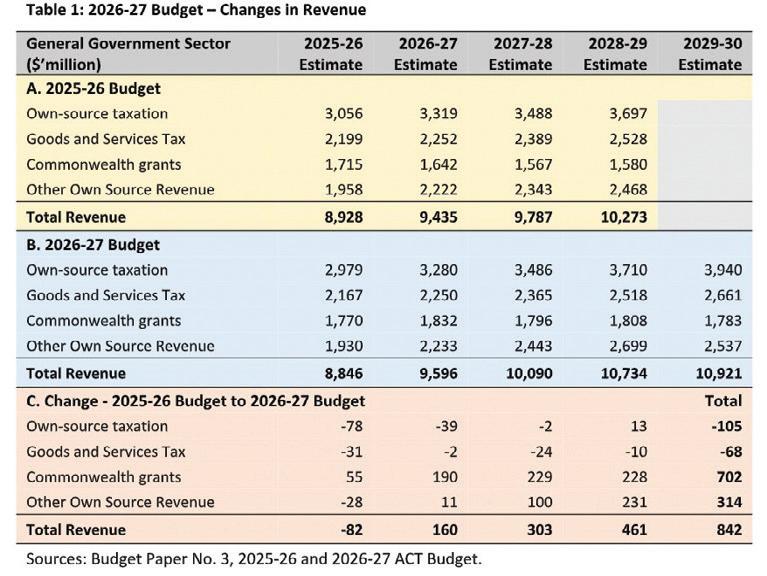
Table 1 provides the revenue forecasts in the 2025-26 budget ( Table 1A), the 2026-27 budget ( Table 1B), and changes in forecasts in this budget ( Table 1C).
The table, and similarly, Table 1 in our previous article, highlight the changes in the base budget. The table presents total revenue disaggregated into four broad categories: own source taxation (34 per cent), GST revenue payments (25 per cent), Commonwealth grants (20 per cent), and other own-source revenue (22 per cent), with the figures in parenthesis indicating the approximate share of each category in 2025-26.
The revenue collection forecast is $82 million below budget in 2025-26 (the current financial year about to conclude). However, a significant increase across the forward years is forecast, largely driven by an increase in Commonwealth grants and continued optimism in revenue growth.
Own source taxation
The ACT Government now collects about 25 per cent more from this tax than it did when it initiated the reforms designed to abolish the tax altogether!
There are, in the budget, 21 individual tax lines comprising taxes on payroll, dwellings, land, and transactions, as well as various levies. The decrease of $105 million shown in Table 1C is largely due to the removal of the $100 health levy from general rates and a downward adjustment ($15 million a year on average) to payroll tax, following an expected shortfall of $32 million in 2025-26. Payroll tax is still forecast to grow at a staggering rate of 10.4 per cent. The impact of this tax is mainly on employment and the cost of goods and services for consumers, depending on market
duty on residential dwellings has been boosted by $38 million compared to the 2025-26 estimates.
The ACT Government now collects about 25 per cent more from this tax than it did when it initiated the reforms designed to abolish the tax altogether!
Land tax is forecast to deliver $27.5 million more than previously forecast. This is a tax imposed on rental properties and is expected to reap $1.1 billion, in total, over the budget and forward estimates period.
Under the government’s stated policy, it should have been abolished by now or, at a minimum, the tax rates should have been reduced, noting that the ACT has the lowest rental affordability and the worst levels of rental stress in Australia.
There are remissions for the lease variation charge averaging $4 million a year (strangely, the budget papers refer to only $2.1 million a year being attributed to development incentives) with an unquantified benefit in the number of additional dwellings supplied.
The revenue foregone is offset by the Police,
Commercial and Residential Conveyancing for ACT & NSW
These services include:
• Sale and Purchase of residential in ACT/NSW
• Retirement village entry & exit
• Aged care entry
• Commercial Leasing
• Commercial conveyancing
Fire and Emergency Service Levy (PFSEL) which is increased at 2 percentage points above the Wage Price Index (WPI) rising to 5 percentage points “peg” in 2028-29. The Safer Families Levy is escalated by $5 in each of the next three years to reach $85.
These are lazy and arbitrary increases in flat taxes that are imposed equally on both the rich and poor, the young and old – and hence regressive and without any underlying principle.
GST revenue and Commonwealth grants
GST revenue is largely unchanged, being determined by the relativity assessed by the Commonwealth Grants Commission and the size of the national pool. We have previously explained the principles of the assessment framework in our articles.
Commonwealth grants include financial assistance grants for local government, municipal services, Specific Purpose Payments (SPPs) and payments under the National Partnership Agreements (NPPs).
Over the period 2025-26 to 2028-29, Commonwealth grants provide an additional $702 million to the ACT’s revenue base.
For space considerations, we have not included a detailed breakup of the grants, however, notably $550 million of the increase relates to recurrent grants, largely for health, and $152 million in capital grants. The latter amount improves the apparent operating balance due to the accounting treatment of capital grants, but is not available for the recurrent budget.
Other own source revenue
to a back payment.
However, the increase is carried across the forward years thereby adding $381 million to the revenue base. Notably the 2025-26 deficit outcome would have been worse (-$916 million) but for this back payment.
The above analysis compares the revenue estimates in this budget with the previous budget over the period 2025-26 to 2028-29. The 2026-27 budget has added a new forward year, 2029-30, to the forward estimates period. The increase in the revenue base over the budget and forward estimates period (2027-28 to 2029-30) is more than $1 billion.
The combination of Commonwealth health grants and cross-border payments have delivered an additional $769 million in revenue over the estimates period.
Despite the windfall revenue from the Commonwealth and NSW, the government’s overall policy approach to raising revenue remains extractive with taxation revenue growing at a compounding annual rate of 7.2 per cent, and other own-source revenue including fees and charges growing at 7.1 per cent, both more than double the forecast economic growth rate. It is also regressive and, in some cases, without any underlying principle.
The combination of Commonwealth health grants and cross-border payments have delivered an additional $769 million in revenue over the estimates period.
This revenue identified in Table 1 aggregates more than 20 individual revenue lines related to regulatory fees and service charges, as well as some non-cash items such as gains from contributed assets. The increase of $314 million is largely driven by anticipated additional revenue from cross-border payments for hospital services.
In 2025-26, cross-border revenue from NSW delivers $109 million above the budgeted amount, which the budget papers advise relates
Our fellow columnist, Michael Moore has noted that profits coming from rezoning of land should belong to the people rather than the developer. The government has foregone the rezoning benefits, but is happy to compensate for that by increasing tax on renters. The budget withdraws the $100 health levy but increases another levy by $15. Those changes, apparently small and unnecessary, paint the government as petty, mean and unprincipled.
However, the two key remaining questions are:
1. Why has the budget deteriorated despite the windfall increase in revenue?
2. And where has the money gone?
Jon Stanhope is a former chief minister of the ACT and Dr Khalid Ahmed a former senior ACT Treasury official.
Windfall revenue, but where has the money gone?
Photo: NIcola Barts
Table 1: 2026-27 Budget – Changes in Revenue
Paradox of Michelangelo and his dogskin boots
“Michelangelo’s David? Now there’s a guy that works out.” – Graham Norton
Michelangelo di Lodovico Buonarroti Simoni (1475-1564) was one of the towering geniuses of the Renaissance.
He is remembered for his transcendent artistic achievements – the statue of David, the Sistine Chapel ceiling, the Pietà, and countless drawings and architectural innovations.
Yet alongside this near-mythic brilliance was another, considerably less glamorous reputation: Michelangelo was notoriously indifferent to personal hygiene.
His contemporaries, friends, and even his own apprentices described a man who lived in a state of nearconstant physical neglect, so much so that his habits became as much a part of his legend as his chisels and brushes.
Many Renaissance artists embraced elaborate grooming and sought patronage by appearing polished, social and urbane. Michelangelo, by contrast, seemed to recoil from worldly comforts. He ate simple meals, often hastily, slept in his clothes, and lived with almost ascetic disregard for cleanliness.
One of his apprentices claimed the
master might keep the same clothes on for so long that they would have to be peeled off his skin, “as if he were shedding the skin of a snake.”
Modern biographers often interpret this behaviour as a combination of obsessive dedication to work, mild misanthropy, and an almost monklike belief that physical comfort was a distraction from higher artistic or spiritual pursuits.
Among the more colourful details preserved in historical accounts is the matter of his dogskin boots.
Michelangelo is said to have worn boots made from the hides of dogs – an unusual but not unheardof choice in the late medieval and
Michelangelo seemed to recoil from worldly comforts. He ate simple meals, often hastily, slept in his clothes, and lived with almost ascetic disregard for cleanliness.
Renaissance periods.
Dogskin boots were rugged, durable, and, in his case, seldom removed. According to anecdotal reports, he sometimes kept them on for months at a time, even sleeping in them, until the leather stiffened so severely that the boots had to be cut off.
Dogskin, though an unacceptable choice today, was sometimes used in Europe for specialised types of clothing and equipment.
Dog hides were not widely used for general garments, as cattle, goats, and sheep provided most leather needs. However, dog leather was sometimes valued for being tough yet flexible, making it suitable for specific utilitarian items. Gloves made from dogskin were known for their softness and sensitivity – useful for certain trades – and dog leather could produce boots that were especially hardy. It appears Michelangelo sought exactly this ruggedness.
His lifestyle – moving between cramped studios, marble quarries and dusty workspaces – favoured footwear that could withstand heavy wear and needed minimal care; qualities dogskin boots offered.
While dogs were loved and kept as pets in Renaissance Italy, they were also working animals, and the boundary between pet and livestock was culturally different from today’s norms.
Leather producers relied more on leather’s utility, so hides from various animals, including cats, found practical uses. While dog leather was valued for durability, catskin was valued more for warmth and softness.
Taken together, Michelangelo’s poor personal hygiene and his dogskin boots reflect the character of a man driven almost entirely by artistic compulsion.
His unwashed clothes, unclean body, and battered boots were outward signs of an inward intensity: a relentless, sometimes obsessive devotion to creation. That such a figure produced some of the most refined and spiritually
profound works in Western art only heightens the paradox – and the fascination – of Michelangelo’s life.
On a lighter note: One Sunday a pastor tells the congregation that the church needs extra money to fix the roof and asks them to consider giving a little extra in the offering plate. He says that whoever gives the most will be able to select three hymns.
After the offering plates are passed, the pastor glances down and notices that someone has donated a $100 bill. He is so excited that he immediately shares his joy with the congregation and says he’d like to personally thank the person who placed the money in the plate.
An older lady in the back shyly raises her hand. The pastor asks her to come to the front where he tells her how wonderful a gesture it is and asks her to pick out three hymns.
Her eyes brighten as she looks over the congregation, points to the three handsomest men and says: “I’ll take him, and him, and him.”
Portrait of Michelangelo by Daniele da Volterra, c. 1545.
Government has no regard for the community
I write in regard to the citynews. com.au article about the ACT Auditor-General’s report on the Phillip pool.
It seems that the auditor agrees with the community that no proper analysis of the aquatic needs of the Woden community was ever carried out.
Instead the ACT Government told us they had done a needs analysis when it hadn’t and knew they hadn’t.
The ACT Government operates under its own rules with no regard for the community or a need to be transparent.
So what is to happen now? Surely the ACT Government isn’t going to be allowed to plough on in its usual arrogant fashion. I think they should be made to go back to the drawing board before more damage is done and let the community have a say.
It is just SO frustrating to have to keep dealing with this incompetent government.
Penny Moyes, Hughes
Shame on this ruthless government
As I sit here it is freezing cold, windy and
raining outside. What this means, after the shooting of kangaroos out on the Pinnacles last night, is that any still dependent at foot kangaroo joeys which are now orphaned, will face a cruel death from exposure and
These joeys still depend on milk and warmth and when orphaned in these conditions, they have almost no chance of survival. We saw numerous joeys of this kind at the Pinnacles this past week yet mass shooting out there is taking place.
Every year, pouch joeys are clubbed to death by the shooters, but many at foot but still dependent are orphaned and are often seen on reserves the next day, alone and clearly stressed. It is not denied that they will likely die of exposure on days like this but they are just the uncounted “collateral damage” to this annual killing on our reserves.
This weather forecast on the evening bulletins gave ample time for the shooters to be told to stand down on that night, but no, shooting as wind and rain started and was forecast to get worse today, simply went ahead as usual.
I sought a commitment from the Conservator that when the evening forecast is for this sort of weather to impact the following day, that the shooters be instructed not to proceed that evening.
I have had no such commitment to date. To refuse such a request suggests to me that getting kill numbers is more important, regardless of the outcome for these
unfortunate small kangaroos in this sort of extreme weather conditions.
Shame on this ruthless government, while claiming animal welfare is a priority, it does this sort of thing. Such hypocrisy!
Jennifer Macdougall, Farrer
Watch out for fleeing kangaroos
The ACT Government’s annual kangaroo and wallaby “cull”, which has been operating for 18 consecutive years, will this winter kill 3633 adults and hundreds of joeys in a violent and brutal manner that most Canberrans would find shocking.
During the “cull” residents may see kangaroos and wallabies in areas they wouldn’t normally see them, such as close to roads and houses, especially at night time. The animals are trying to escape their attackers. I would like to appeal to Canberrans to please show caution when driving past greenspaces and also for dog walkers to keep their dogs on a leash when walking near nature reserves.
Rebecca Marks, via email
High time for stronger action from the US
In recent weeks Donald Trump seems to have come to the realisation that Israel has been destroying a whole apartment to kill one militant in Lebanon.
There have been many instances of this happening across its campaigns against its neighbours and numerous innocent people have been killed in that way.
It is heartening that the US is specifically starting to denounce this.
Israel has been fighting difficult wars; many of the militants it is fighting are embedded among civilian populations, and many are living in underground tunnels.
However, as most of the defensive weapons for these campaigns come from the US and are paid for by US taxpayers, it should place greater conditions on how the funds are used and if not followed, reduce or cease its funding.
President Trump has in the past asked Prime Minister Netanyahu to “go easy” with its war effort. It is now high time for stronger action from the US.
Herman van de Brug, Holt
Tree-lined streets are great assets
Michael Moore is right to be concerned about the loss of urban tree canopy as planning laws change (“Planned city ‘bombed’ by complacent government”, CN June 18). The same trend is occurring in Victoria and NSW as governments race to deliver more housing.
As Moore notes, the loss of gardens and backyards reduces tree cover and intensifies the urban heat island effect. Trees can
lower summer temperatures by up to 18°C through shade, while making walking, cycling and picnicking more comfortable. They support mental health, store carbon and help combat climate change. Conversely, every tree removed and chipped eventually returns carbon dioxide to the atmosphere as it decomposes. Canberra’s tree-lined streets and shady parks are one of its great assets. To retain its status as one of the 283 Tree Cities of the World, protecting and expanding urban forest must remain a priority. A city that loses its trees ultimately loses much of what makes it liveable.
Ray Peck, Hawthorn, Victoria
A haiku for Ray
Here’s a haiku Ray Peck asked for (letters, CN June 16):
Black coal in her heart, Pauline scorns the solar age. Aussies choose their roofs!
Karen Lamb, Geelong, Victoria
And another…
Along with his limerick about Pauline Hansen, (letters, CN June 18), Ray Peck asked “haiku anyone”? I offer the following, though it is strictly senryu, not haiku. same old racist trope yet One Nation is surging please explain
David Briese, Mawson
Welcome to Country – ‘moving’ and ‘divisive’?
Let’s place side-by-side part of Senator Pauline Hanson’s first address to the National Press Club with part of King Charles III’s speech to Parliament House in October 2024.
King Charles: “Let me also say how deeply I appreciated this morning’s moving ‘Welcome to Country’ ceremony, which offers me the opportunity to pay my respects to the traditional owners of the lands on which we meet, the Ngunnawal people and all First Nations peoples who have loved and cared for this continent for 65,000 years.”
Senator Hanson: “Don’t expect a divisive Welcome to Country from me… This beautiful country belongs to all Australians born here and those who have come to join us.”
The reader may have already figured out where this is heading. Before getting there, to be fair, maybe Senator Hanson’s statement could be reasonably understood in one of two ways. Either she was telling the audience not to expect a Welcome to Country that is “divisive” (as distinct from one that isn’t). Or, presumably more likely, she was telling them that any Welcome to Country would be “divisive”.
So, assuming the two statements quoted, can a Welcome to Country be both “moving” and “divisive”? If that’s a contradiction, then who was mistaken?
The description of a Welcome to Country
OPINION
on the indigenous.gov.au website states that it “is a cultural practice performed by a Traditional Owner of the local region to welcome visitors to their Traditional Country.”
By this definition, it already makes sense not to expect a Welcome to Country from her if it is given that she is not a traditional owner in that sense.
So, perhaps she meant that the audience wasn’t to expect an Acknowledgement of Country, which “recognises that you are meeting on the land of First Nations peoples”, according to the same website. But she may still be claiming that both are “divisive”.
Two questions: What, if anything, is “divisive” about paying one’s respects to traditional owners, as King Charles III did? And, is the claim being made that Welcome to Country was also “divisive” when practised in pre-colonial Australia or only in the context of modern Australia?
To consider another usage of the term “divisive”, note that it was included in the introduction from Tom Connell, National Press Club president and a host at Sky News Australia.
Tom Connell: “Arguably, no politician in modern Australia has been as divisive...”
Is there a reason Senator Hanson didn’t follow his lead and describe Welcome to Country as arguably “divisive”, instead?
Just for the record, that National Press Club address reached me in full via the broadcast from ABC. Credit where credit is due, right?
Mark Rendall, Duffy
Australians want a government that listens
Columnist Dr Andrew Hughes (“Why Pauline Hanson will never ever be PM”, CN June 11) argues that Pauline Hanson and One Nation have no path to government, but his analysis overlooks a deeper shift occurring in Australian politics.
Voters are not simply reacting to interest rates or short-term economic conditions. They are responding to long -standing frustration with major parties that no longer reflect their values or priorities.
His article reads less like independent analysis and more like a Labor Party marketing brochure, confidently asserting the permanence of the status quo while ignoring the change occurring in the community. Australians are increasingly demanding a government that listens and gives them a direct say in major policy decisions.
Hughes suggests that only Labor and the Liberals possess the organisational machinery required to govern. Yet political history shows that when public demand for change becomes strong enough, new movements rapidly build the structures they need.
He also claims One Nation cannot win cities, assuming the current party- centric model remains fixed. A party committed to genuine democratic participation could appeal across traditional divides and could win cities.
If the major parties continue to resist meaningful reform, they may find themselves overtaken by those willing to offer
My role in reviving Pauline Hanson’s political career
MIKE WELSH, drivetime announcer at 2CC in 2012, dreamt up a stunt to boost his ratings that may have changed the destiny of Australian politics, for which he apologises.
She’d already Danced with the Stars and reluctantly gyrated to Jail House Rock, but when she tangoed with talkback radio, the Queensland political “firebrand”, Pauline Hanson, fell flat.
Desperate for a stunt to lift my radio program’s audience during the first radio survey of 2012, I approached the “Ginger Dregs” of politics, as one of my colleagues unkindly christened Pauline, to co-host the 2CC Drive Show for two days.
News of Hanson’s “guest” appearance, widely misreported as a full-time gig, went viral when “viral” was still in short pants. Youth news site Pedestrian TV, reported: “Media whore Pauline Hanson is undertaking a new career path”. Others splashed with “Pauline Talks Back” and “Hanson Takes Over The Airwaves”.
The late Kevin Blyton (founder of the Capital Radio Network, which operates 2CC) excitedly rang to congratulate me. Apparently, coverage of Pauline’s on-air stint was calculated at more than $400,000 worth of publicity. I don’t know who landed on that figure but it’s possible the same person who pulled that “fact” from an unmentionable body part is now employed by One Nation as a Pauline’s Press Club speech writer. In 2012, Pauline was deeply lost in the political wilderness when I offered her the rare chance of being (part-time) a practitioner of the time-honoured and noble profession of talkback radio.
Desperate for any publicity, she instantly jumped at the chance to get back on the political track. When I
Hanson… News of her “guest” appearance, widely misreported as a full-time gig, went viral when “viral” was still in short pants.
inquired about a fee she asked me what I thought was a fair amount. My manager had scoffed at the idea of a “budget”, suggesting Hanson should do it for nothing.
From memory, it was around $500 per shift, a night’s accommodation (on contra) and dinner with yours truly (on contra) at the renowned Civic eatery La Scala.
Over dinner she was pedestrian company at best, though I did get her scone recipe. In the studio she was completely lost during most of the two three-hour shifts. Like a lot of people who think they can “nail” talkback radio, she ran out of “entertaining” bits 90 minutes into the first day.
As for the anticipated “boost” to the Drive Show ratings, it didn’t happen. But I did manage to revive Pauline Hanson’s political career. Sorry.
Have I had a call to thank me? No. Not yet. But there’s still time.
Australians what they increasingly want: a government that listens.
William Ginn, via email
Was Karl already planning a pivot?
Is it too cynical to suggest that former TV presenter Karl Stefanovic has been planning to pivot to a social media platform for some time?
Could it just be that the wave of popularity his good friend Pauline Hanson is currently surfing, the coverage his “interview” with Tommy Robison is garnering, the subsequent appearance of the “interview” on the PHON website shortly following its deletion from his own site may actually be a well-planned “launch”, rather than a series of “unrelated” occurrences.
His former employer Nine, of course, would not have wanted to be associated with such inflammatory commentary from their then highest paid personality, potentially diluting their already shrinking advertiser base.
If one were truly Machiavellian, it could be suggested that Karl may even become a “star” recruit to PHON and appear on their Senate ticket.
Given he lives in NSW, it will be interesting to see who gets that top spot, Karl, or PHON’s other “star” recruit, Barnaby Joyce.
The current political machinations may not be good for the governing of our country, but it is highly entertaining.
Ian De Landelles, Murray’s Beach, NSW
Kath and Kim needed to explain policy
Pauline Hanson has now given the whole ABC the evil eye (“Hanson gets quite a bit off her chest”, citynews.com.au June 18). While it has the means and freedom to do so, the national broadcaster could respond to One Nation’s lack of policy detail by launching a new series of Kath and Kim. At least 10 episodes would be needed to allow the two households and their friend Sharon to work through and settle on the meaning, parameters, and limitations of adhering to Pauline’s “monoculture”, especially against a background of much lower immigration numbers.
In 10 follow-up instructional “implementation” episodes, they would attempt to monoculturally redecorate their homes and backyards, revamp their wardrobes, search out acceptable recipes while still stocking up furtively from about-to-close-down specialist food outlets, and deal with a myriad of what Kim calls “issues”. The latter would include the extreme time management and money hurdles encountered when discovering a growing scarcity of GPs, medical specialists, dentists, hospital or aged care beds, tradespersons, carers, cleaners, personal trainers, sports club coaches, restaurants, nail salons, taxis, parcel and food delivery services, and Australian-grown meat, fruit and vegetables.
Sue Dyer, Downer
Pauline
Photo: Mike Welsh
Connected care from newborns to teens
Deakin
Continuum Paediatric & Specialist Centre is guided by the meaning of “continuum” an unbroken sequence of care. Located within Deakin’s specialist health precinct, the clinic supports children from newborns to 16 years through connected, coordinated medical care. Its team provides general paediatrics, newborn and infant care, chronic and complex care, and a strong focus on neurodevelopmental and behavioural paediatrics, including ADHD, autism, learning difficulties and developmental concerns.
With an experienced team of paediatricians providing comprehensive, evidence-based care, families receive timely, compassionate and personalised support tailored to each child’s needs.
Our collaborative approach ensures continuity of care, clear communication and trusted guidance at every stage of a child’s development. Broader adult specialist services will also be available soon, further strengthening the centre’s commitment to supporting Canberra families across all stages of life.
Continuum Paediatric & Specialist Centre
46 Geils Court, Deakin.
Call 02 6152 8340 or visit mycpsc.com.au
David Healey Solicitors brings trusted legal expertise to Deakin Helping Children Thrive
Specialist paediatric care for newborns, infants, children and adolescents in the heart of Deakin.
Supporting families with: • General Paediatrics • Newborn & Infant Care • Developmental
Legal expertise is strongly represented in Deakin through David Healey Solicitors, a trusted local firm known for professional integrity, clear advice and a practical approach to client matters. The firm provides legal advice and representation to individuals, families and businesses across Canberra, supporting clients through important life, property and commercial decisions.
Whether someone is navigating a personal legal issue, planning for the future, managing a business matter or seeking guidance during a difficult time, experienced legal support close to home can make the process clearer and less stressful.
David Healey Solicitors brings a strong understanding of the local community and the legal needs of Canberra clients, offering professional assistance with care, discretion and attention to detail. As part of Deakin’s professional services network, the firm contributes to the suburb’s reputation as a destination for quality advice, reliable expertise and trusted service.
David Healey Solicitors Call 02 6282 3232 or visit davidhealeysolicitors.com.au
Focus ACT supports people to live life their way
Choosing disability support can make a world of difference. For more than 35 years, Focus ACT has supported people with disability, families and support networks across Canberra.
As a registered NDIS not-for-profit provider, Focus ACT delivers personcentred support that helps people build independence, stay connected and live with choice and confidence.
Services include Supported Independent Living, NDIS Support Coordination, Core Supports, High Intensity Supports, Psychosocial Recovery Coaching, Community Activities and Specialist Disability Accommodation.
For people starting or reviewing their NDIS journey, Focus ACT offers free consults to help participants, families and carers understand their options and take the next step with clarity.
With reliable, respectful support built around each person, Focus ACT’s approach is simple: listen first, support with care and help people live the life they choose today.
Focus ACT
40 Thesiger Court, Deakin ACT
Call 02 6282 9422 or email Focus@FocusACT.org focusact.org
We provide expert legal representation in ACT and Commonwealth workers’
matters, as well as tailored representation in ACT and NSW criminal law matters.
From left, Dr Vijay Wagh, Dr Deepti Raina and Dr Gurjit Singh Bakshi from Continuum Paediatric & Specialist Centre.
David Healey.
Managing your superannuation through a Self-Managed Super Fund (SMSF) can offer greater control and flexibility, however, it also comes with important compliance responsibilities.
Capital SMSF helps simplify this process by providing specialist SMSF audit and compliance support, backed by over 20 years of industry experience.
With a strong focus on accuracy, education, and partnership, Capital SMSF works closely with trustees, accountants, and administra tors to ensure funds remain organised, compliant, and aligned with Australian regulatory requirements.
understand
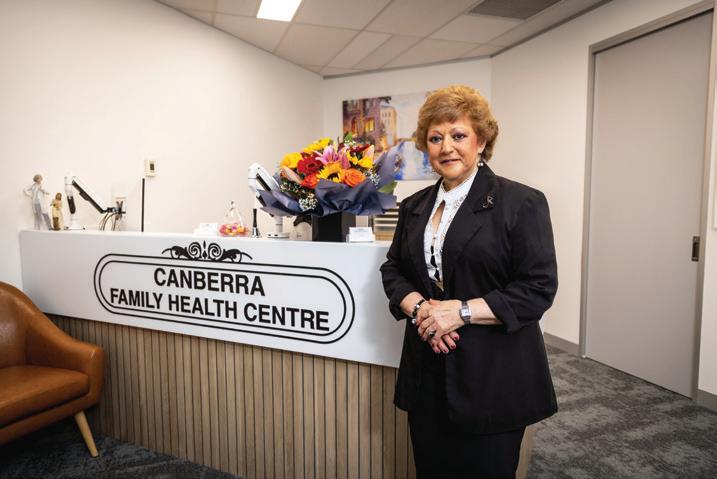
Health Centre in Deakin provides personalised, patient-centred care with a focus on building lasting relationships.
A Fellow of the Royal Australian College of General Practitioners and the Hong Kong Academy of Medicine, Dr Badawy also holds a Master and Graduate Diploma in Family Medicine and is a Member of the Australasian Menopause Society.
Doing things differently –five years at Deakin
For five years, Urban Education has proudly been part of the Deakin community, building a reputation as one of Canberra’s most sought-after early education providers. Our purpose is simple: to do things differently. Children’s health, safety, and wellbeing are at the heart of every decision we make, supported by passionate educators, innovative learning experiences, and strong partnerships with families.
Our onshore Australian approach means your sensitive financial information is managed locally, with no overseas outsourcing, giving you added confidence and security.
We aim to make complex processes straightforward, guiding you through reporting, lodgements, setup, and audit requirements with clarity and care.
For those seeking greater confidence in their SMSF journey, Capital SMSF delivers trusted expertise, practical guidance, and long-term peace of mind.
Capital SMSF Call 0413 841 880 or visit capitalsmsf.com.au
Dr Badawy believes the most rewarding part of general practice is supporting patients through every stage of life, sharing in their successes and helping them navigate challenging times.
By offering one-hour appointments, she takes the time to understand each patient’s concerns and develop tailored treatment plans.
“I believe in being thorough and getting to know my patients and their needs,” she says. “Trust is the foundation of good healthcare, and we treat the whole person.”
Canberra Family Health Centre is accepting new patients.
Canberra Family Health Centre
Peter Yorke Building, Suite 6, Level 3, 173 Strickland Crescent, Deakin. Call 5133 7112 or visit cfhc.com.au
Located in the heart of Canberra’s medical precinct in Deakin
At Canberra Family Health Centre, we are dedicated to providing comprehensive, patientfocused healthcare for individuals and families.
Located centrally in Deakin, our centre offers a wide range of medical services designed to meet your health needs at every stage of life.
Associate Professor Maryse Badawy
MB/ BS Degree, FRACGP, FHKAM (Family Medicine), Grad Dip Fam Med, Master Family Medicine, Member Australasian Menopause Society
National and International Family Medicine and Academic experience.
Our commitment to quality has seen Urban Education grow beyond Deakin, with services now also welcoming families in Gold Creek and Gowrie. While our footprint has expanded, our vision remains unchanged—to provide exceptional early education that nurtures curiosity, confidence, and a lifelong love of learning.
As we celebrate this milestone, we thank the Deakin community for five wonderful years of trust and partnership. We look forward to continuing to raise the standard of early education across Canberra, one child, one family and one community at a time.
most impact for children, families, and the wider community.
Pradnya Sood.
Spotlight on Yarralumla
Award-winning service built on trusted advice
Choosing the right finance can make all the difference, and the team at Mortgage Choice Yarralumla is committed to helping clients secure lending solutions that support their long-term goals.
The experienced team has built a reputation for personalised advice, transparent communication and exceptional customer service across Canberra and the surrounding region. That commitment has been recognised with Mortgage Choice Yarralumla being named a 2026 NSW/ ACT State Finalist in the MFAA Excellence Awards for Customer Service – Business, one of the industry’s highest honours.
Whether clients are purchasing their first home, refinancing, investing, expanding a business or upgrading a vehicle, the team provides tailored guidance through every stage of the lending process.
Their expertise spans residential home loans, commercial finance, asset finance, personal loans and car loans, with access to a broad panel of lenders to help find the right solution for each individual circumstance.
Backed by years of industry experience and a genuine client-first approach, the Mortgage Choice Yarralumla team continues to deliver finance solutions with professionalism, integrity and service that extends well beyond settlement.
Mortgage Choice Yarralumla
Level 1, unit 6-8/45 Novar Street, Yarralumla.
Thomas Nguyen – 0418 939 943.
Bill Wu – 0499 092 958.
Trusted expertise in one of Canberra’s most sought-after suburbs
Success in real estate comes from more than strong sales results. It comes from un derstanding a community, building lasting relationships and consistently delivering exceptional outcomes for clients.
Few agents know the Yarralumla market better than Mario Sanfranc esco, pictured. With decades of experience across Canberra’s premium suburbs, Mario has earned a reputation for achieving outstanding results while providing honest advice and a highly personalised approach.
His deep understanding of Yarralumla’s unique character, architectural diversity and buyer demand allows him to position every property to maximise its value. Whether representing heritage homes, contemporary residences or prestige family properties, Mario combines strategic marketing, skilled negotiation and meticulous attention to detail.
Mario’s commitment to excellence has been recognised nationally, having been ranked among Australia’s REB Top 100 Agents for four consecutive years, with his highest ranking reaching No. 20 in Australia. In 2026, he remains Canberra’s only agent included in the prestigious Top 100 rankings, reflecting both his exceptional sales performance and the trust placed in him by clients.
His success is equally evident within Yarralumla itself, where he has achieved numerous suburb records, including landmark sales such as 12 Hunter Street and the iconic Westridge House on Banks Street, further cementing his position as one of the suburb’s leading property specialists. Working from Blackshaw Real Estate’s Griffith office, Mario continues to help homeowners confidently navigate one of Canberra’s most competitive property markets.
For anyone considering selling, buying or simply seeking expert advice on the current Yarralumla market, Mario Sanfrancesco offers the experience, local knowledge and proven results that have made him one of Canberra’s most respected real estate professionals.
Blackshaw Real Estate Call 0412 488 027 or email msanfrancesco@blackshaw.com.au
Treatments that are both restorative and effective
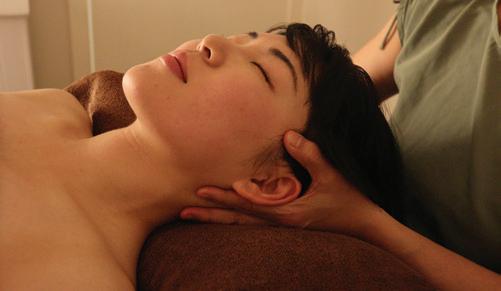
Mint ‘n Co. Massage is a boutique wellness studio in Yarralumla, offering a calm and welcoming space where people can slow down, reconnect with themselves, and experience genuine Japanese hospitality.
Founded by Izumi, a Japanese therapist who has called Australia home for more than 20 years, the studio reflects a philosophy of treating each person as an individual. Every session is thoughtfully tailored to the client’s needs, creating space for deep relaxation, relief from physical tension, and a renewed sense of wellbeing.
Treatments include Zen Relaxation Massage, Japanese Head Massage, Foot Reflexology, Pregnancy Massage, and Remedial Therapy. Inspired by Japanese Shiatsu principles, Mint ‘n Co. Massage blends Eastern and Western therapeutic techniques to create treatments that are both restorative and effective.
More than a massage, Mint ‘n Co. Massage offers a place to pause, breathe, and reconnect with yourself through the quiet art of Japanese hospitality.
Mint ‘n Co. Massage 25 Bentham Street, Yarralumla. Book online: mintnco.com.au
From left, Thomas Nguyen, Bill Wu and Steve Wang.
Izumi, founder and a Japanese therapist at Mint ‘n Co.
COOLAMON ADVISORS
INSIGHT. COLLABRATION. IMPACT.
“We are 100% female and Indigenous-majority owned. Supply Nation certified. Purpose-driven and operating for over a decade, transforming insight into action.”
KATRINA FANNING AO PSM LED BY
STRATEGIC SOLUTIONS. STRONGER FUTURES.
Coolamon Advisors is a 100% Indigenous-majority and female-owned strategic consulting firm.
Named after a traditional Aboriginal carrying vessel, the firm focuses on program design, Indigenous policy, and community empowerment. They serve as a critical bridge between government, commercial organisations, and Aboriginal communities across Australia.
The Meaning and Mission
Founded in 2016, Coolamon Advisors takes its name from the coolamon—a traditional, curved wooden vessel used by Aboriginal Australians to carry precious resources like water, food, and infants. The name symbolizes care, support, and the holding and sharing of knowledge.
Led by founder Katrina Fanning AO PSM, the firm’s overarching mission is to reform systems that have historically limited Indigenous agency and opportunity. Operating primarily at the intersection of government policy and community-led initiatives, the team aims to deliver culturally appropriate, evidence-based solutions that benefit all Australians.
Core Capabilities and Services
Coolamon Advisors operates across multiple strategic pillars to assist government bodies, private sector clients, and community groups:
• Strategic Advisory & Policy Development: The firm offers deep insights into Indigenous diversity and government policy. They help design programs that respect cultural complexities while meeting strict government compliance and delivery objectives.
• Project Management & Transformation: They provide Portfolio, Program and Project Management (P3M) as well as business and organizational transformation.
• Co-Design & Facilitation: Coolamon focuses heavily on community collaboration, working alongside both government and community to ensure grassroots voices shape broader strategies.
• Research and Evaluation: By combining lived experience, robust research, and data, the firm helps clients monitor, evaluate, and learn from their community programs.
The Badji Business Program
A cornerstone of Coolamon Advisors’ impact in the local region is their management of the ACT Government’s flagship Badji Business Program. Operating out of their Braddon office in Canberra, the firm acts as a business concierge to local Aboriginal and Torres Strait Islander entrepreneurs.
Through the Badji Program, Coolamon Advisors provides a suite of free, tailored support services to help Indigenous businesses grow and thrive:
• Business Mentoring: Tailored coaching, IT upskilling, and management guidance.
• Procurement Support: Navigating Supply Nation registration and government grant applications.
A Unique Cultural Approach
What sets Coolamon Advisors apart in the crowded corporate consulting landscape is their dual-lens approach. The team comprises a diverse blend of lived Indigenous experience and learned corporate expertise. This allows them to effectively act as a bridge between differing knowledge systems.
Rather than offering off-the-shelf, boilerplate solutions, the firm works closely with clients to tailor strategies that make sense on the ground. They step into complex organizational challenges and partner with stakeholders, measuring their success by the empowerment and sustained capacity they leave behind.
By holding both cultural knowledge and strategic business insight, Coolamon Advisors continues to lead the way in creating inclusive, impactful outcomes across Australia
BUSINESS SHOWCASE
For Canberrans accustomed to polished dining rooms and elevated service, the idea of a regional club can sometimes arrive with modest expectations.
Catalina Club quietly overturns them.
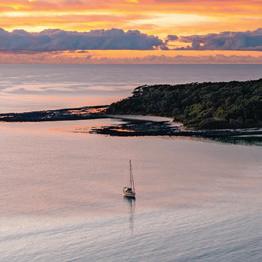
Set against the natural beauty of the Far South Coast, just 90 minutes from the capital, Catalina blends the relaxed ease of a coastal escape with a standard of hospitality that feels distinctly metropolitan. Here, the welcome is warm, the design is contemporary, and the experience considered.
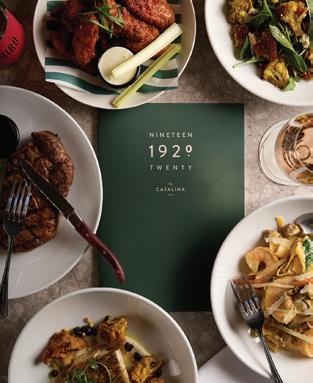
The award-winning dining offering champions premium local produce, from pristine seafood to regionally sourced meats, presented with the confidence of a venue that understands its audience. The cocktail list is curated rather than crowded, the wine selection thoughtful, and the service attentive without intrusion.
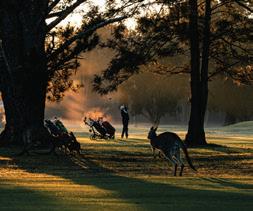
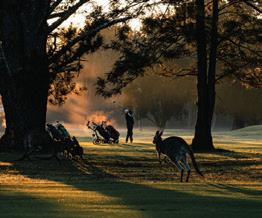
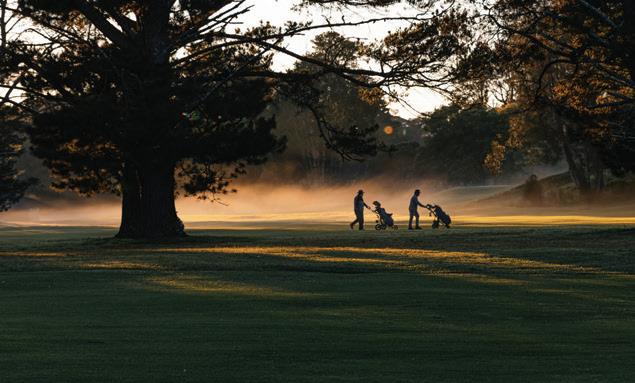
Beyond the restaurant, Catalina reveals itself as a genuine lifestyle destination. Championship golf
framed by ocean air and renowned resident kangaroos, with reciprocal social golf savings for members of Murrumbidgee and Yowani Golf Clubs. Live music that draws loyal followings.
Large-scale sporting broadcasts delivered with atmosphere and scale. Community woven through every layer.
It is not simply a stop on the way to somewhere else. It is the reason to make the trip.
For those seeking a coastal interlude without compromising on quality, Catalina Club offers something refreshingly rare: a regional experience that feels anything but regional.
Discover the unexpected, just beyond the city limits.
Catalina Club 154 Beach Road, Batemans Bay, NSW. Call 02 4472 4022 or visit catalinaclub.com.au
•
•
• Extensive experience in government super such as CSS and PSS.
• Centrelink advice and implementation.
• Is a redundancy right for you at this time?
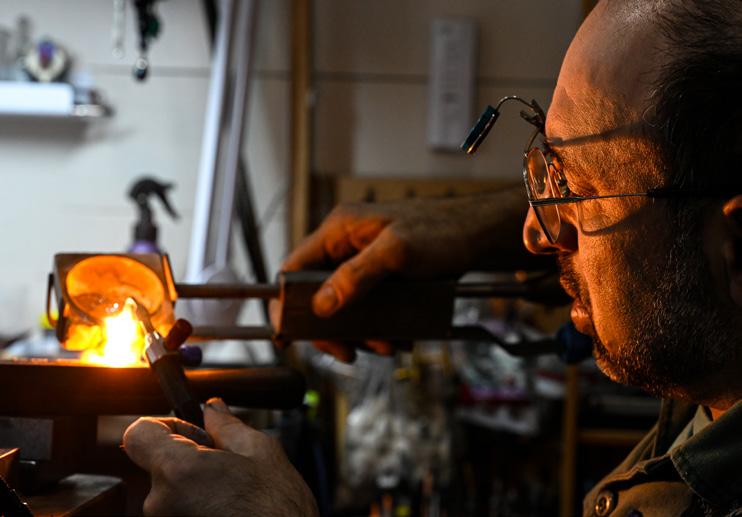
has become a beloved name among locals and visitors alike, says co-owner Rebecca Lee Bon.
Known for its impeccable craftsmanship and personalised service, Rebecca says their family-run boutique brings a rare blend of artistry, tradition and genuine care to every piece they create.
Husband and wife duo, George Karvounis and Rebecca, both goldsmiths/jewellers, have built their reputation on the philosophy of using only the highestquality materials and workmanship for their customers.
“Whether it’s forging custom wedding bands, redesigning heirlooms, or repairing beloved jewellery, every item reflects our passion for excellence,” says Rebecca.
Winner of a 2025 local business award and dozens of glowing reviews describing the business as “professional”, “kind” and “incredibly talented”, Rebecca says they pride themselves on creating breathtaking jewellery while also providing exceptional customer experiences.
stones into a piece I’ll treasure forever, every step felt personal.”
Using traditional hand-forging techniques, a skill rare in modern jewellery-making, all pieces are made onsite.
“This ensures heirloom-level durability and character that mass-produced jewellery simply can’t match,” says Rebecca.
From engagement rings to bespoke remodelling, she says their dedication to their craft and community makes them so much more than a store.
“It’s a cherished part of the Southern Highlands,” she says. “For locals looking for something truly special, it’s clear why this boutique has earned its place in the hearts of so many.”
Bowral Fine Jewellery
Grand Arcade, Shop 7B/295 Bong Bong Street, Bowral NSW. Call 0435 039111 or visit bowralfinejewellery.com.au
More than three decades in Canberra
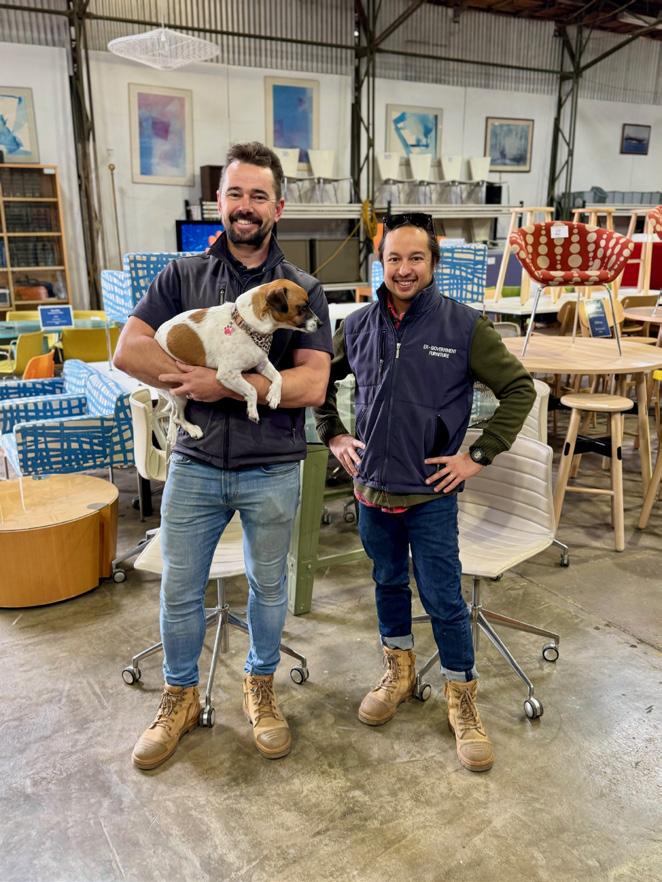
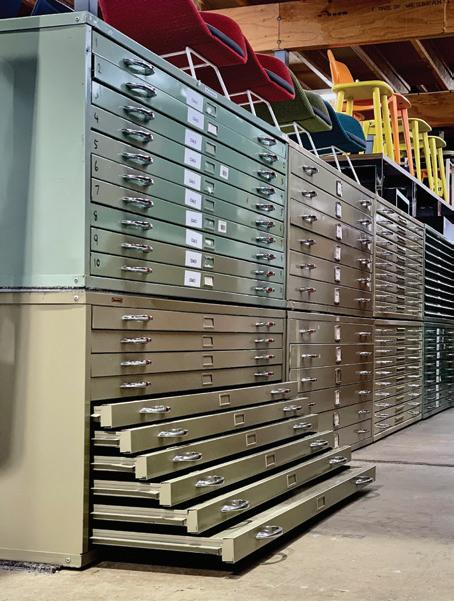
Canberra is a city that’s always changing. Govern ments evolve, organisations grow, workplaces are refreshed and new people arrive every year. When workplaces change, it doesn’t mean the quality furniture inside has reached the end of its useful life.
For more than three decades, Ex-Government Furniture has been connecting organisations that no longer need quality furniture with people who do.
With furniture sourced from government depart ments, universities, major organisations and com mercial fit-outs across Canberra and the surrounding region, the showroom features a constantly changing range, from complete office fit-outs to iconic designer pieces, all at exceptional value.
“We work with all sorts of customers,” says coowner James Fullerton. “Whether it’s helping to fit out an office on time and on budget or finding the perfect designer piece to complete a home, it’s about finding the right furniture for their space, style and budget.”
The same philosophy applies when organisations no longer need their furniture.
“Every organisation is different,” says coowner Taylor Radnell. “We work with our clients to understand what they’re trying to achieve and find the most efficient, cost-effective and sustainable way to manage surplus furniture. By keeping quality furniture in use wherever possible, we reduce both removal and disposal costs while achieving a better outcome for everyone.”
Helping people find the right furniture and helping organisations find the right solution: that’s what Ex-Government Furniture has been doing for more than three decades.
Ex-Government Furniture co-owners Taylor Radnell, left, with Tilly, and James Fullerton.
Co-owner of Bowral Fine Jewellery, George Karvounis, melting gold.
welcoming and empowering long term home?
For more than 60 years, Hartley Lifecare has delivered trusted disability support across the ACT. As an NDIS registered provider since the scheme began, Hartley combines experience with a strong focus on quality, safety and person centred support.
Supported Independent Living is about more than accommodation. It is about creating a stable home where a person with disability can live as independently as possible, with the right supports in place. Hartley works closely with each person and their family to understand what matters most, building support around individual goals, daily living skills and connection to community.
Hartley currently has vacancies in a small number
Canberra. These homes provide shared living with 24 hour support from professional, compassionate staff. Every enquiry is assessed individually to ensure the right fit for both the person and the household.
Families want confidence that their loved one is supported by a secure, well governed and values led organisation. Hartley’s long standing presence in the ACT provides that reassurance.
For adults with disability seeking long term accommodation with tailored support, Hartley offers a safe and supportive place to call home.
Hartley Lifecare Call 02 6282 4411 or visit hartley.org.au
Upgrading or improving a home shouldn’t have to be an expensive adventure, says store-owner John Rivers.
“At Handyman’s Trading Post, people can find a great range of new, factory used and used parts and pieces at half the price,” he says.
Currently overstocked with many second-hand materials, including windows, glass sliding doors and timber panel (swinging) doors, John says CityNews readers can get a further 10 per cent off the prices of all second-hand items by mentioning this article. This excludes never-used, factory-seconds and items that have already been discounted by more than 10 per cent.
A leading supplier of factory-second and used windows and doors, John says they are also the experts in delivering purchased windows and doors safely to homes or job sites.
Offering to take “want lists” from customers, John says they can alert customers when products from their list have arrived in store.
John says customers can save hundreds, or even thousands, by buying second hand windows and doors. Items that he says are often the key feature of renovations.
“For more than 42 years, Handyman’s Trading Post has supplied Canberrans with quality and affordable home and commercial building materials,” says John.
The Handyman’s Trading Post 167 Newcastle Street, Fyshwick.
Call 02 6280 4036.
On facebook.com/p/Handymans-Trading-Post or Instagram.com/htpcanberra
Accommodation Vacancies for People with Disability SUPPORTED
Are you or someone you support looking for a safe, welcoming, and empowering long‑term home?
Hartley has been an NDIS-registered provider in the ACT since the scheme began, building on more than 60 years’ experience in disability support.
We work with each person and their family to understand what matters to them and provide support that builds skills, confidence and connection to community.
Hartley Lifecare currently has openings in a selection of our Supported Independent Living (SIL) homes. These vacancies may be suitable for adults with disability seeking a supportive shared living environment with 24-hour support.
Each enquiry is considered individually to ensure the right fit for the person and the household.
Enquiries and expressions of interest: Kathy Le Mesurier, Senior Manager –
and
satisfying than a meal that is both comforting and full of flavour. At Myanmar Corner in Casey, winter dining focuses on authentic Burmese cuisine, prepared with fresh ingredients, traditional recipes and genuine family hospitality.
Owned and operated by Aye and Ko, Myanmar Corner blends the diverse culinary influences of Myanmar, incorporating flavours inspired by Indian, Thai and Chinese traditions into a uniquely Burmese cuisine. From fragrant soups and wholesome noodle dishes to rich curries and vibrant salads, every meal reflects the warmth and generosity of Burmese food culture.
During the cooler months, favourites such as Mohinga, Myanmar’s national noodle soup, slowcooked curries and warming stir-fries offer the perfect antidote to Canberra’s crisp winter days. Each dish
fresh ingredients, creating comforting flavours that are not overpowering.
Whether you’re discovering Burmese cuisine for the first time or returning for a family favourite, Myanmar Corner provides a relaxed dining experience where every guest is welcomed like family. With plenty of gluten-free, dairy-free and vegetarian options available, there is something to suit every table.
This winter, gather family and friends and experience one of Canberra’s hidden culinary gems. Myanmar Corner proves that the best way to warm up isn’t just with great food—it’s with food made from the heart.
Myanmar Corner Unit 38/68, Dalkin Crescent, Casey. Call 02 6241 2526 or visit myanmar-corner.com
Jack offers professional moves with care
With a focus on care, professionalism, reliability and efficiency, JWS Removals is Canberra’s removalist of choice, says owner Jack Stafford.
Jack, who’s been specialising in furniture removals, logistics, as well as fine arts and antique relocations, for more than 10 years, established JWS Removals to fill a gap in the industry, offering a more personalised removalist service.
Being a small, privately-owned and operated business, Jack says he works with clients personally, from the quote all the way through to the unload.
“We pride ourselves on our professionalism and that’s why we don’t use labour hire, only quality, experienced removalists who know how to get the job done right,” Jack says.
“We leave nothing to risk, using specialised furniture blankets, boxes, plastic furniture protective covers, trolleys, carpeted truck floors, felt pads for in-home floor protection and much more to ensure a risk and stress-free move.”
And, so there’s no hidden costs, JWS Removals offers in-person, no-obligation, free quotes.
This also allows Jack to see the furniture and valuables in advance so he knows exactly what protective materials are needed to make the move as quick and safe as possible, he says.
JWS Removals Call 0448 401 604 or visit jwsremovals.com.au
JWS Removals owner Jack Stafford.
BUSINESS SHOWCASE
On July 8, we’re running the third workshop in the Accelerating Canberra’s Energy Transition (ACET) program, focused on the gas transition for homes and businesses.
We’re bringing together tradies, builders, retailers, startups, government, and community advocates to work through what comes next. Delivered in partnership with the ACT Government Energy Innovation Fund grant, this is a free event and places limited. Entrepreneurship for Everyone is a full day with the Growth Hub by Himayat, WhatWorks, Asuria, and
Small Business Digital.
Hands-on workshops, advisory sessions, a local business showcase, and a founder panel – built for entrepreneurs from culturally and linguistically diverse backgrounds and other groups that are under-served by mainstream business support. 10am to 6.30pm.
This is a free event and you must register to attend.
Canberra Innovation Network cbrin.com.au/events
Specialising in massage for people with cancer, Massage
Could Your Swelling Be Lymphoedema?
Meet Nim Osborne of Canberra’s Few Accredited Lymphoedema Practitioners
Nim brings over 15 years of massage therapy experience with a strong focus on supporting people undergoing cancer treatment, living with anxiety, or in recovery. Her gentle, skilled approach helps restore comfort, flow, and connection to the body especially for those navigating life after diagnosis.
As an Accredited Lymphoedema Practitioner and member of both the Australasian Lymphology Association (ALA) and Australian Massage Therapists Association (AMT) Nim offers a rare level of expertise in this highly specialised area.
Opening Hours: Monday to Friday 9:00am to 3:00pm & after hour by appointment
To make a booking please call Nim on 0412 885 804
Scan to book an appointment
really beautiful to look at, it’s a great joy,” says Robyn Monteleone, partner at Select Custom Joinery.
Operating since 2000, Select Custom Joinery is known for creating sustainable kitchens and joinery.
“We are a niche business and specialise in using timber and other solid materials,” she says.
Their commitment goes beyond just using sustainable materials, and Robyn says they always think about longevity, with everything they design meant to last for a long time.
Robyn’s husband Gino Monteleone, the primary cabinet maker and partner of the business, trained as a furniture maker.
“Gino’s training started with building custom furniture,” she says.
“Our kitchens and custom pieces are built to come.
With the aim of creating pieces that are customised for each client’s lifestyle and personality, Robyn says they often design a feature in each person’s home which is unique to them.
“The satisfaction that clients get something that really suits their lifestyle and them, something they’re proud of and really enjoy using is the most rewarding thing,” she says.
“We are only a small team, so client meetings are by appointment.”
Are you interested in using plywood, recycled timber and other sustainable materials? We’ll work with you to design a kitchen that’s innovative, unique, sustainable and durable.
Kitchens, internal joinery & furniture.
Learn to dance classes for all ages.
Dale’s Dance Classes are good for all ages
From a waltz to a samba, Dale’s Ballroom Dancing has been offering dance classes for more than 25 years. With more than 30 years of experience, Dale Harris says dancing is for everyone.
“Our adult classes are open to anyone and we are happy to adapt to suit the needs of our audience,” she says.
Currently, Dale offers two levels of expertise in her adult classes on Wednesday nights. Her beginner classes go from 7pm-8pm and cover the basics of a variety of dances, her intermediate/advanced class level, from 8pm-9pm, tackle the harder dance skills to learn. Dale says dancing is a great exercise for any age.
“Dancing is 10 times better than doing a crossword puzzle at the table or taking the dog for a walk,” she
says. “It keeps your brain and body active while you think about the steps and move.”
Moving to the Weston Neighbourhood Hall to host her adult beginner classes, Dale offers seven-week courses, although she says it’s also okay to “just turn up”. Dale’s Medal Classes are on Thursday 5pm for under 12 years and 12 and over from 5.30pm at the Pearce Community Centre, Collett Place, Pearce. Anyone is welcome to join in, just drop past to have a look.
Thursdays from 5pm at the Pearce Community Centre, building 2, Collett Place Pearce.
• ADULT BEGINNER CLASSES
Wednesday 7pm - 8pm
• ADULT INTERMEDIATE & ADVANCED
Wednesday 8pm - 9pm
ADULT CLASSES NOW AT: WESTON NEIGHBOURHOOD HALL, HILDER STREET, WESTON
Phone: 0407 066 110
Email: dale_harris@bigpond.com
Web: dalesballroomdancing.com
Principal: Dale Harris
Gardens share winter inspiration
By Jackie WARBURTON
In the next two months or so, Canberra’s soils may be cold, but there are still plenty of plants in flower.
The Australian National Botanic Gardens is a great place for a winter walk, with abundant blooms and birdlife to enjoy.
The gardens demonstrate how native plants can be grown successfully in our region, how large they become, and provide ideas that can be adapted for your own garden.
While native bushland largely looks after itself, both native and exotic plants in urban gardens require regular care once removed from their natural environment.
All plants need clipping, pruning or eventual replacement over time. Clipping is carried out throughout the year to maintain shape, while
major pruning of natives and exotics is best done in spring or autumn. IF you are replacing plants, consider some of the newer varieties. Dwarf forms of shrubs can significantly reduce maintenance. When selecting hedging plants, choose varieties that reach no more than two to three metres in height. This helps maintain winter sunlight in the garden while still providing privacy.
ONE native coming into flower now is the fringed myrtle (Micromyrtus ciliata). This small shrub or groundcover produces masses of white, red or pink flowers that can completely cover the plant when in bloom. Fringed myrtle prefers dry soils, good drainage and afternoon shade. Once established, it is drought tolerant, withstands wind and requires little watering. It will tolerate only light frosts.
THE hot summer just passed caused many plants to dry out and
become stressed.
One technique worth trying next season is the use of an olla watering pot. Olla pots are made by gluing together two terracotta pots at the rims, sealing the drainage hole with a bung, then burying the pot to soil level. The vessel is filled with water, which slowly seeps into the surrounding soil, delivering moisture directly to the root zone.
How often an olla needs refilling depends on its size. They are particularly useful if you’re away for a few weeks during summer.
Adding a dash of peppermint oil to the water can help keep mosquitoes at bay. Olla pots are highly effective in vegetable gardens and also work well with shallow-rooted plants such as camellias, grevilleas and other small plants.
WINTER is one of the busiest times in the orchard. Now is the time to prune pome fruits and berries. Apples, pears and quinces can be pruned during winter, while stone
fruits such as cherries, peaches and nectarines should be pruned in summer after harvest.
Apple pruning can be a little tricky. Knowing whether you have a heritage or tip-bearing variety will determine the approach. Thin the spurs on heritage apples and reduce branches by one-third on tipbearing trees. In all cases, remove dead, diseased and damaged wood. Winter is also the ideal time to plant fruit trees. Dig a hole twice the size of the pot, fill it with water, plant the tree and water it in well.
jackwar@home.netspeed.com.au
Jottings…
• Prune hydrangeas down to a double bud.
• Keep on top of winter weeds before they flower.
• Plant more broad beans for winter flowers.
An Olla water pot… two terracotta pots glued together at the rims and
bung in the bottom hole. Photos: Jackie Warburton
ARTS & ENTERTAINMENT
COVER STORY
By Helen Musa
Without doubt, the world’s most famous saint is St Francis of Assisi, loved by believers and non-believers alike for his compassion towards the poor, animals and the environment.
Born wealthy, he embraced a life of simplicity. Pope Gregory IX canonised him in 1228 and, in 1979, Pope John Paul II named him the patron saint of ecology. Legendary accounts tell of him negotiating peace with the marauding Wolf of Gubbio and crossing battle lines to meet Sultan Malik al-Kamil of Egypt during the Crusades.
Now the National Gallery is offering the public a rare opportunity to see the complete cycle of 20 monumen tal tapestries about St Francis by Arthur Boyd (1920-99). But Francis aficionados may be shocked at Boyd’s take on the gentle saint, who is seen here in a sometimes brutal guise.
Shocks in Boyd’s tapestries of beloved St Francis
Part of Boyd’s extensive artistic exploration of the life of St Francis, the tapestries were woven at the Manufactura de Tapeçarias de Portalegre in Portugal between 1972 and 1974. They were acquired by the National Gallery’s founding director, James Mollison, in 1975 for $100,000. Vera Fino, the current director of the centre will be here for the exhibition.
When I catch up with Elspeth Pitt, senior curator of Australian Art at the National Gallery, she explains that the entire series has never previously been shown together, although seven tapestries were exhibited in 2023 at The David Roche Foundation House Museum in North Adelaide.
Tapestry-making might seem a quintessentially European tradition, but Pitt points out that Australian artists such as Boyd, Sidney Nolan, Charles Blackman and John Olsen all helped make it part of Australian artistic practice.
Boyd’s encounter with the medium predates his enormous Great Hall Tapestry in Parliament House, woven by the Australian Tapestry Workshop.
“Turning from one medium to another as Boyd did was a mark of genius,” Pitt says.
Boyd’s fascination with St Francis can be traced back well before his encounters with Italy. Although
raised within an unconventional Christian Science household, he found in St Francis a figure whose appeal transcended religious belief, and he frequently used the story to explore the psyche of his father, ceramic artist Merric Boyd.
In 1959 Boyd moved with his family to London. A trip to Italy in 1964 proved transformative. Visiting Assisi and nearby towns, he was deeply moved by Giotto’s frescoes in the Basilica of St Francis and, beginning with pastels and drawings, went on to create lithographs and eventually tapestries depicting episodes from the saint’s life in soft and luminous colours that retain something of the original pastel drawings.
Back in London, Pitt says, Boyd connected with historian Thomas Boase, whose biography of St Francis had been destroyed in a fire in 1936. Boyd encouraged him to republish the work and offered to illustrate it, creating a suite of 20 coloured pastels on the subject. These were rejected because of cost and the eventual publication included 21 of Boyd’s black-and-white lithographs instead.
But Boyd never relinquished his vision of St Francis in colour. The Portuguese connection came through Sydney gallerist Frank McDonald, of Clune Galleries, who suggested Boyd visit Portugal and meet John Olsen, who was then working with the Portalegre tapestry workshop.
Determined to produce a St Francis series, Boyd placed an order with the Manufactura de Tapeçarias de Portalegre in 1969 for 20 tapestries measuring 2.5 by 3.5 metres each. He bore the cost himself.
These are what we see in the exhibition and they are radically unlike traditional Giotto renderings, with no Italian countryside, no brown monk’s habit and no birds.
A few examples will suffice. St Francis with the Stigmata shows the saint naked and wounded, dripping blood on to a pope lying beneath him, while St Francis Being Beaten by his Father depicts a rarely portrayed
aspect of the saint’s early life.
In St Francis Blowing Brother Masseo into the Air, 1973, Boyd shows Francis elevating his closest companion by sheer force of breath, while in St Francis Kissing the Wolf of Gubbio we witness an intense struggle, not a truce.
The tapestries do not present a strict chronology of St Francis’s life but rather depict him as visionary, sufferer, mystic and earthly man, caught between heaven and earth and sometimes almost brutal. Other imagery focuses on St Clare, one of Francis’s earliest followers.
The exhibition also explores the making of the tapestries. Visitors will see preparatory drawings and the tiny original transparencies that were transformed into vast woven works.
To bring the works together, head of exhibition design Daryl Westmore has created an immersive environment using Franciscan browns, blues and deep reds that evoke both the Italian landscape and Catholic symbolism.
Pitt believes Boyd’s St Francis cycle remains among the most ambitious ever attempted by an Australian artist.
“St Francis gave Boyd the opening to create extraordinary imagery,” she says.
Arthur Boyd: Tapestries, National Gallery of Australia, until October 18.
St Francis Turning Brother Masseo (1973).
MUSICAL THEATRE / Middle Raged – A Musical Meltdown
Middle-raged, Queenie’s ready to sing about it
By Helen Musa
Middle Raged – A Musical Meltdown, about to premiere at The Playhouse, is the brainchild of two former Canberrans, performer Queenie van de Zandt and writer-producer Tiffany Noack.
Directed by Priscilla Jackman, the production features a top cast including van de Zandt herself, Valerie Bader, Carita Farrer Spencer and Zuleika Khan, along with an all-female band on stage.
The show includes hilarious songs made famous by artists such as Missy Higgins, Sia and Pink, alongside original numbers by Gillian Cosgriff and musical theatre star Laura Murphy. Tim Minchin, a friend of van de Zandt, wrote them an extra verse for his song Carry You.
When I catch up with van de Zandt by phone at her home in Melbourne, I first tackle the elephant in the room: the fact that the already-famous American show Menopause The Musical, now in its 25th year, is coming to Canberra Theatre in October.
“We feel like we’ve taken the baton from them and gone a step further in creating a fun night out for the girls,” van de Zandt tells me.
“But no-one can take away from Menopause The Musical the fact that it got that word, menopause, out into the public arena, just as The Vagina Monologues got
funny if it was going to educate people.”
Van de Zandt and Noack have formed a company called Women With Pockets
Together they pitched the show successfully to venues including theatre centres in Penrith, Wagga Wagga and Canberra,
Music Theatre Classes for All Ages
“Tiffany and I have been friends since the 1990s,” van de Zandt says. “We both started out in Canberra, so this is a full-circle
Van de Zandt needs little introduction to
Already a budding star while attending Daramalan College, she wowed audiences at the School of Arts Café in Queanbeyan with her rock soprano voice, and also played leading roles in Canberra Philharmonic Society productions before moving into professional
In 2013 she relocated to Melbourne to play the role of Cassandra in King Kong. A career highlight was her one-woman show BLUE: The Songs of Joni Mitchell and in 2018 she came home to perform Killer Queen in We Will Rock You at the AIS Arena.
In recent years she has become especially well known for her comic alter ego Jan van de Stool, complete with an outrageous Dutch accent borrowed from her mother, Ria.
Mother to nine-year-old Billie, van de Zandt says Billie will spend some time with grandparents in Canberra while she’s in
The idea for Middle Raged emerged shortly after covid when the pair were sitting around at a 50th birthday party with a group
“Then somebody brought up menopause and suddenly the whole night took off,” van de Zandt recalls.
“People were saying, ‘Oh my God, I’ve got that too,’ and then I said to the room, ‘We’re
not middle-aged... we’re middle RAGED’.”
“Tiffany got back to me next morning and said, ‘You have to write a show with that title and I have to produce it’.”
Van de Zandt and Noack spent the next five years collecting real stories from women across Australia, so the show touches on many experiences common at this stage of life, including losing parents, challenges in the workplace and invisibility.
Anyone who knows van de Zandt would agree she is anything but invisible. She turns 56 this year, but admits: “I dress loudly, so I don’t really have that invisibility many middle-aged women talk about.
“But one woman in our survey told us a young man had literally walked into her in the street. She stopped still on the spot. He asked why and when she told him, his response was, ‘Did I?’ She really was that invisible.
“We’d love to educate men and have them be our allies. We very definitely didn’t want to man-bash. Menopause can be very funny and we hope men will grow with us as they learn.”
And it’s fun, less a musical and more of a revue, made to look like a variety show, with the feel of an old Don Lane Show or Sale of the Century.
“We open the show with a feminist karaoke medley,” van de Zandt says. “The rest is full of bangers from the ‘80s and ‘90s. It’s fun music.”
Middle Raged – A Musical Meltdown, The Playhouse, July 8-11.
Queenie van de Zandt… “We very definitely didn’t want to man-bash. Menopause can be very funny and we hope men will grow with us as they learn.”
STREAMING
The Bear serves up his final slice
By Nick OVERALL
For a show of such quality, it is remarkable how quickly The Bear has consistently served up its episodes.
Since 2022 this hit culinary drama series has released five seasons on Disney Plus.
To put that in perspective, almost 50 episodes were written, shot and produced in the same time frame between just season four and five of Netflix’s Stranger Things.
When June rolls around each year: ding! Yes, chef! The Bear is once again ready to dish up a sizzling slice of drama TV and so it is with a bit of sadness that this time around marks the last. All eight episodes of the final season are now streaming.
put the restaurant on the culinary map.
It’s a TV show that on paper seems like it wouldn’t work.
Set inside a small Chicago sandwich shop, the story follows an exhausted but extremely talented young chef named Carmy (Jeremy Allen White) who is forced to take over the business after his brother tragically takes his own life.
Drowning not just in grief but in mounting bills, Carmy has only one option: cook his way out of this mess by turning the struggling shop into a first-class dining experience.
What follows is quite literally blood, sweat, tears as he pulls together a team to
Despite the setup sounding rather dark, it’s actually recognised more as a comedy and under that classification has won a remarkable 21 Emmy awards throughout its run.
There are laughs here amongst the heavy drama, which keeps the show buoyant but it shines most when putting the real-life chaos of a high-stakes kitchen to screen.
A dizzying amount of cuts and close ups mix together, capturing each bead of sweat as the sound of an endless stream of receipts demanding orders inundates the kitchen, spooling across the floor.
It all comes together in an overwhelming but entertaining dance that many
chefs have remarked is so realistic, it can be hard to watch after they come home from their own job.
The Bear has stayed fresh by turning up this heat each season as Carmy’s culinary dreams get bigger and bolder.
Let’s hope that with its final season, The Bear can put the cherry on top.
THERE’s an intriguing addition to HBO Max this month, with the entire set of hit series Mad Men now available to stream.
I say intriguing because this prestige drama series originally aired in 2007 as an attempt to directly compete with HBO.
Back then shows like The Sopranos, Sex and the City and The Wire had already
K-Pop’s splash of digital daring ARTS IN THE CITY
K-Pop Icons brings its blend of live performance and digital technology to Canberra. Combining holographic avatar stars with a world-class dance crew, the interactive production features songs from major acts like Blackpink, Rosé, Bts, K/Da, Katseye, Saja Boys and Huntr/X. Canberra Theatre, July 10.
Gia Ophelia, written by Grace Wilson and directed by Canberra-born theatre-maker Jo Bradley, is a one-woman show follows Gia (Annie Stafford), who is determined to play Ophelia one final time as she confronts sexism, ageism and the realities of growing older in the arts. The Courtyard Studio, July 2-4.
The Mint is celebrating the school holidays with hands-on activities designed for curious young minds. Children aged 4-6 can join Mini-Minties sessions featuring storytelling, coin-themed crafts and animal discoveries, while 7-12-year-olds can delve into Mintventures workshops exploring code-breaking, coin design and stories hidden within Australia’s currency. Royal Australian Mint, until July 17.
TrustFM is a newly-launched underground community radio station broadcasting live from trustfm It’s a non-commercial venture designed to connect artists, promoters and audiences.
Mockingbird Too presents Mike Bartlett’s companion plays C*ck and Bull, two sharply observed comedies examining power, identity and human cruelty. Directed by Zac Bridgman, C’ck follows a man whose long-term relationship is upended when he falls in love with a woman while, directed by Céline Oudin, Bull sees three colleagues locked in a brutal workplace battle. The Mockingbird Studio, Belconnen Arts Centre, July 1-18.
Canberra author Maree Spratt, who has spent the past eight years educating students at major national cultural institutions including
cemented HBO as the king of traditional network television.
Back then Mad Men, a drama series about New York’s cutthroat world of advertising in the 1960s, was actually pitched to the network but rejected.
Instead it was AMC, a rival American channel, that picked up the show and cast a little known actor named Jon Hamm to play the mysterious, but charismatic main character Don Draper.
Over the years that followed Mad Men became one of the most lauded series of the era and Draper became one of the most recognisable characters of 2000s television.
Throughout seven seasons, Mad Men weaved together a fascinating roster of character arcs to form a profound look at an American Dream manufactured by marketing. An absolute ace for AMC in its battle against HBO.
But in the age of streaming, all that is different.
Warner Bros. Discovery, which owns HBO Max, realises Mad Men is the sort of prestige television subscribers expect and has opened up its wallet to get that level of quality on to its platform.
What a turnaround: a show that was once rejected by HBO has now, almost 20 years later, been claimed to fall under its own brand.
Perhaps on this one those upstairs at HBO took a bit of iconic advice from Don Draper himself: “If you don’t like what’s being said, change the conversation.”
the National Archives and Parliament House, makes her literary debut with The Followers, a novel set in 2000s Brisbane that explores the dark side of girlhood. At its centre is the toxic and compelling friendship between aspiring lifestyle influencer Lacey and Teresa, her very first “follower”.
Thread: Connecting Stories and Community brings together historical and contemporary portraits exploring identity, culture and belonging. Developed by the Portrait Gallery with artists and community members in Logan, Queensland, the exhibition examines the relationship between garments, memory, labour and the knowledge systems of First Peoples. National Portrait Gallery, until September 13.
Jeremy Allen White as chef Carmey… The Bear has stayed fresh by turning up this heat each season.
K-Pop Icons… Canberra Theatre, July 10.
DINING / Stacks, Canberra Centre
Not high-end, but Stacks didn’t
I was drooling when I watched the MasterChef segment on gourmet sandwiches… drooling.
Sandwiches are “a thing” these days, even going viral on social media. Layer upon layer of quality ingredients, interesting textures, vibrant colours, mega flavour and an intriguing visual crosssection when cut. The creators of these sandwiches put thought into every bite.
Stacks is a new sandwich and coffee shop in the city run by The Fresh Collec tive. We landed not long after it opened, wondering whether its sandwiches would be next level.
There’s nothing new about the mint and forest green fitout at Stacks, but that’s no surprise because it’s the same design as the predecessor sandwich shop – &Sando, a partnership between Sydney celebrity chef Matt Moran and The Fresh Collective.
One day, seemingly out of the blue, Moran said goodbye to the nation’s capital. The &Sando sign came down, and within 24 hours or so, Stacks opened.
Mornings start off early with two types of croissants and a Berkshire bacon-andegg roll with house-made tomato relish ($16).
From 10 to 3, sandwiches roll out (on our visit five options, $16 to $20). We popped in late afternoon and thought we had missed out, with major gaps in the glass display case.
WINE
flavour with perky pickled cabbage, the slightly sweet, creamy Swiss cheese and a balanced dressing. I love a good Reuben and this one – although a bit thin for my liking – certainly hit the mark.
Our second choice (we shared both sandwiches) was the Say No More, featuring chicken and not toasted. The presentation looked pale with the chicken
chunks mixed with mayo and served in a white roll. Don’t let that fool you, because the chicken was moist and the sandwich loaded with bacon bits and shallots, for
Stacks has a small range of sweets and pastries, including a chewy, gooey, lip-smacking brownie ($7). It’s a nice size – not too small, not too large. Lovely was the Basque Cheesecake ($14), superbly smooth, creamy and light. I wouldn’t say Stacks is a high-end sandwich operation, and while we didn’t
several tables outside. Those who prefer can skip the queue by ordering online. It’s not just &Sando that Moran farewelled. Compa, the Italian steakhouse he opened just next door, also closed. It, too, swiftly re-opened, as Curiosa, an Italianinspired wine bar (also run by The Fresh Collective).
Why do wine bottles have a bottom dent?
When I was 19, I got a university holiday job as a fitter’s mate at the Auckland glassworks. It was hot, difficult work.
The wine bottles we made had a dent at the bottom. They have been made with that dent or punt since the 17th century in England.
The history of how that punt came about was one of the chapters in a book I received as a Christmas present. It’s titled Funny You Should Ask… and it is the collected responses to questions posed to the elves of the QI TV series who, once a week on British radio, broadcast responses to strange or quite interesting questions posed by listeners. The question at issue was: why do wine bottles
Adding a punt (a dent) to a bottle gives it extra strength and stability.
have a dent at the bottom?
The short answer is that just as adding an arch to a bridge makes it stronger, adding a punt to a bottle gives it extra strength and stability. A reinforced base is less likely to crack under pressure.
There are other advantages. Firstly, an empty hidden space makes the bottle look as if it contains more wine, useful marketing. Secondly, the punt assists to collect sediment in a tight ring around the edge, making it easier to pour
cleanly without disturbing the sediment. Thirdly, it gives the pourer somewhere to put their thumb. Teaching wine waiters in the 1970s, I stressed this was about style and flourish more than necessity just as I told them to dress like they were already famous. For me it was a very substantial leap from daytime sweaty glassworker to occasionally smooth head waiter at Domain Receptions.
The book says that the development of the punt was also important in the
evolution of the champagne bottle.
In the 1500s, French monks were making sparkling wine. But the increased pressure from the bubbles meant that sometimes bottles exploded. Alarmingly, it was found that one exploding bottle could trigger others and a whole cellar’s worth of wine could be destroyed.
This happening was changed when in 1615 King James I, of England, wanted to preserve timber for his expanding navy. So, he banned the burning of wood in many industries including glassmaking.
The glassmakers turned to coal, which burns at a higher temperature than wood. The higher temperature made much stronger glass that became suitable for champagne bottles.
Annealing or strengthening of glass was undertaken in very long lehrs at the glassworks where I worked. The bottles went from the moulding machine on a conveyor belt into a lehr. The lehrs pumped out very hot air.
On my first day as a fitter’s mate, one of the fitters said to me: “Hey, Richard take a look at this” and as I put my head around the corner of the lehr, my eyebrows and my moustache were singed.
This caused great laughter and, before I went to work that night, I reluctantly shaved off my moustache.
“Things alter for the worse spontaneously, if they not be altered for the better designedly.” – Francis Bacon
The Reuben… packed with thinly sliced, smoky, seasoned, salty pastrami.
The Basque Cheesecake, right, and a brownie.
Photos: Wendy Johnson
HOROSCOPE PUZZLES
By Joanne Madeline Moore
ARIES (Mar 21 – Apr 20)
Is honesty always the best policy? Is it always appropriate to be fearlessly frank? Your natural inclination is to be incredibly blunt, but not everyone is ready for your brand of audacious Aries truth serum. Mercury is reversing through your domestic zone, so a dollop of discretion and a pinch of diplomacy will smooth troubled waters at home and within your family circle. When it comes to friends, clever Rams will talk a lot less and listen a lot more.
TAURUS (Apr 21 – May 21)
This week Venus (your ruling planet) shifts into your creativity and friendship zones. So put aside regular time for music, art and beauty, work hard on a creative project or catch up with a special friend. Plus – with Chiron (minor planet of healing) now transiting through your sign – try to view personal transformation as terrific, rather than terrifying. Be inspired by birthday great, His Holiness the Dalai Lama (who turns 91 on Monday): “True change is within.”
GEMINI (May 22 – June 21)
Mercury (your ruling planet) is retrograde until July 24. Mercury is the planet of clear thinking, communication (talking, texting and writing), transport, travel, commuting, commerce, computers, media and the internet. So, the next couple of weeks is not a good time to: gossip; sign contracts; start a job or business; buy a phone, computer, car or home; launch a website; install new software; go on an important business trip or embark on a big holiday.
CANCER (June 22 – July 23)
With Mercury reversing through your sign until July 24, other people will be blunter and more insensitive than usual, and you’ll feel moodier and more sensitive than usual. So clever Crabs will require extra patience, understanding, confidence and self-belief – in spades! Your motto for the moment is from birthday great, Mexican painter Frida Kahlo: “Fall in love with yourself, with life.” The weekend is wonderful for socialising in your local community.
LEO (July 24 – Aug 23)
The week starts with taskmaster Saturn squaring the Sun (your ruling planet), which could throw a tricky challenge your way. But don’t worry, Cats. Venus and Jupiter are both transiting through your sign, so it’s time to present a sunny, positive face to the world as you express your warm, generous, loving nature. Be inspired by His Holiness the Dalai Lama (who was born on July 6, 1935): “Forgive others… be kind, honest and have positive thoughts.”
VIRGO (Aug 24 – Sept 23)
Your very discreet Virgo nature is emphasised, as Mercury (your power planet) reverses through your peer group zone, and Venus spends most of the week in your solitude zone. Make it a priority to connect with like-minded people who understand your specific peccadillos and strong need for privacy. But a loved one could be temperamental, so handle them with extra care. And don’t skip over important details – get someone you trust to help you out.
LIBRA (Sept 24 – Oct 23)
Are you running on empty? Diplomatic Librans will strive to get the ratio right between being on top of things at work, while still having time to rest, reflect and recharge your run-down batteries. Mercury is reversing through your career zone, so relations with a colleague, client or customer could be stressful and problematic, particularly if you try to control an uncontrollable situation. Expect the unexpected and keep your adaptability muscles well-flexed!
SCORPIO (Oct 24 – Nov 22)
If you stir up grievances with an old adversary, then you could find you’ve bitten off more than you can comfortably chew! When it comes to a frustrating problem, avoid quick fixes. You’ll find a satisfactory solution if you take the time to think things through. Lucky Venus and prosperous Jupiter are visiting your professional zone. So, confidence is in and procrastination is out, as you go after what you want with passion, purpose and patience.
SAGITTARIUS (Nov 23 – Dec 21)
Mercury (planet of communication) is retrograde until July 24. So, think – carefully – before you speak and act. And avoid getting drawn into dramatic disputes with family and friends, especially involving money and/or possessions. This week will work best if you curb your Sagittarian curiosity, keep out of other people’s business, hold your tongue, and concentrate on pursuing personal projects instead. Friday favours fostering professional connections.
CAPRICORN (Dec 22 – Jan 20)
This week Mercury reverses through your partnership zone and the Sun squares Saturn in your family zone. So close relationships will be a complicated minefield. Don’t allow a loved one to manipulate you, as they try to persuade you to do something against your better judgment. Have the common sense and emotional strength to stand your ground and say no (without being bossy, and controlling yourself – which is a tricky juggle). Balance is the key.
AQUARIUS (Jan 21 – Feb 19)
The Sun and retrograde Mercury stir up your daily routine and your relationships with work colleagues, so expect some surprising developments and stressful moments. Resist the urge to be controversial, argumentative and self-indulgent. Try to ground your unpredictable energy and calm your mind. Meditation, contemplation, yoga, chanting or Tai Chi could be just what the doctor ordered! The weekend is good for vivid dreams and intuitive insights.
PISCES (Feb 20 – Mar 20)
Mercury is retrograde, so hidden tensions could bubble to the surface with a child, teenager, lover or friend. Be extra diplomatic and try not to take criticism personally. Social media is also a potential minefield, as retro Mercury messes up communication. Be careful you don’t send the wrong message to the wrong person at the wrong time! Heed the wise words of birthday great, his Holiness the Dalai Lama: “Silence is sometimes the best answer.”
Copyright Joanne Madeline Moore 2026
1 Where does the sun set? (4)
2 To be capable of producing crops, is what? (6)
3 Which term describes a novice? (4)
4 What keeps out light? (5)
5 When one delays, one does what? (6)
6 Name another term for a mistake. (5)
9 To be frightened, is to be what? (6)
10 To have sent a message by wireless, is to have done what? (7)
12 What is an underhand plot? (6)
14 What do we call very young children? (6)
16 To have gathered the crop, is to have done what (6)
18 To go in, is to do what? (5)
19 What are illuminants? (5)
21 Name some large trees. (4)
22 What is a musical composition for two voices? (4)
CHARTERED ACCOUNTANT
Happy new financial year. Here are some of the changes that will start in the new year.
Recently I wrote about changes to portable long service leave for those in the hospitality and hairdressing industries. Originally this was to start on July 1. The ACT Government has now postponed its start until January 1. For those in the affected industries, this is a saving of 1.07 per cent on their payroll every week.
Payday super is now in effect. Businesses will have to pay employee superannuation every pay day. If it is not received by the fund within seven days, then it is late and employers must pay superannuation guarantee, which now is tax-deductible.
Unpaid super due for the period April 1 to June 30 will need to be paid by July 28. The way payments in July are allocated is firstly to payday super, then to the super that's owed. If this is a little confusing, seek help as to what needs to be paid by when.
Yes, there are tax cuts, which will result in an annual tax saving of up to $268 a person. There will be further tax cuts the following year. And a $250 tax offset for those in the workforce effective from July 1 2027.
For those with limited tax deductions, effective from July 1, a standard tax deduction of $1000 will be available to people, who earn income from working, without substantiation. Larger claims will still be able to be claimed, but they will require substantiation.
The budget changes to negative gearing and capital gains tax have passed parliament and have received royal assent. They are now law. Taxpayers will have until July 1 2027 to reorganise their affairs and make relevant changes.
The government has proposed, effective from April 1 2027, that the health insurance offset for people aged over 65 will be removed so that it remains at the same level as if you are under 65. This legislation is not yet passed.
If you own a holiday home or property you use for short term rentals, the ATO has set out a new interpretation for claiming deductions such as interest rates and depreciation.
In order to claim these, the property must be genuinely available for rent and marketed to earn income, with reference to peak holiday periods. This means owners cannot use their property during Christmas, Easter or school holidays and still obtain deductions.
Please seek professional help so that you make sure you are doing it correctly to avoid falling foul of these new provisions. The only claimable expenses against the rent will be direct rental expenses such as advertising, commissions and cleaning costs if you do not satisfy the ATO's new interpretation.
This list of changes is not exhaustive. There are certainly restrictions and cash flow issues for businesses and investors. Please make sure that you are aware of all these changes so that you can maximise your tax position going forward.
If you want to know anything about tax or the tax changes, please contact the expert team at Gail Freeman & Co Pty Ltd on 02 6295 2844.