JON STANHOPE & KHALID AHMED cheer on some uncomfortable findings against the government.
Seniors ruefully discover Support at Home isn’t ROBERT McMAHON
The vocal champion who spoke up for Canberra NICHOLE OVERALL
Forget the nonsensical Stage 2B tram. Here’s why RICHARD JOHNSTON
KEEPING UP THE ACT catches up with Jim ‘Bomber’
Bombsley, Grand Field Marshal of the Australian War Glamorial
GLOBAL TALENT, LOCAL HEART
Goodwin celebrates International Nurses Day
YESTERDAYS / 125 years of federation
Vocal champion Chapman spoke up for Canberra
May 9 marks the 125th anniversary of the opening of Australia’s first parliament in Melbourne (and successively, in Canberra, the opening date of the Provisional Parliament House in 1927 and Parliament House in 1988). NICHOLE OVERALL reveals the little known ‘Father of Canberra’…
Melbourne’s Exhibition
Building – a product of gold rush wealth – opened in 1880 (“Royal” added in 1980) to host a global showcase of modern progress.
Twenty-one years later it was the stage for a foundational moment in national politics: the first federal parliament on May 9, 1901.
The building accommodated some 12,000 guests for the occasion. This included most of the 75 newly elected federal members and 36 senators.
Among the faces was the suave Austin Chapman, Braidwood publican and inaugural MP for a seat that was to gain quite the reputation: Eden-Monaro.
Along with the 125th anniversary of federation, 2026 marks the centenary of the long-serving parliamentarian’s death – while still in office.
Having already served as a local representative for 10 years – elected at 27 to the NSW Parliament as the member for Braidwood – Chapman was a strong proponent for melding the nation.
His diverse electorate though, was indicative of the broader initial tensions. Up north around his hometown they voted against the concept while the south-eastern coastal areas were in favour.
A decade later, it was Eden-Monaro that would give up “910 square miles” from its north-west corner for the creation of the Federal Capital
Territory. Chapman’s role as a vocal champion of the site even saw some declare him the “Father of Canberra”.
Confirming its rural connections and inheritance, the national capital slowly emerged from an ancient floodplain long-used for grazing sheep. While Canberra was to be the fulcrum, the priorities for a newly united Commonwealth were being defined in the town halls, shearing sheds, and pubs of electorates like Eden-Monaro.
The era of horse and dray it was, but the core concerns were timeless and Chapman was described as “one of the most expert constituency managers in Australian political history”. He lobbied for the expansion of the railway and better road links in southern NSW; postal and telegraph services to rural communities; and the need for funding to flow outside the metropolitan centres.
All of it was tied to the Herculean task of building a nation – stitching together six independent colonies as a workable tapestry of economic and social stability. Regarded for his pragmatism, Chapman played an instrumental role in the development of the systems shaping the country including serving as Minister for Defence, Trade and Customs, and Health.
By the time the federal government was fully located to Canberra on the opening of the “provisional” Parliament House in 1927, the Honourable Sir Austin
Chapman MP was dead. Knighted at the beginning of 1925 for his record as a Federation-era politician, Sir Austin had been re-elected later that year for the ninth time.
After close to four decades in the political sphere – and almost precisely a quarter of a century since first elected federally – he died of cerebrovascular disease on January 12, 1926. He was 61.
To date, Sir Austin remains the second longest serving member for Eden-Monaro (pipped by Allan Fraser with a total of 26 years over two different periods – 1943-66; 1969-72).
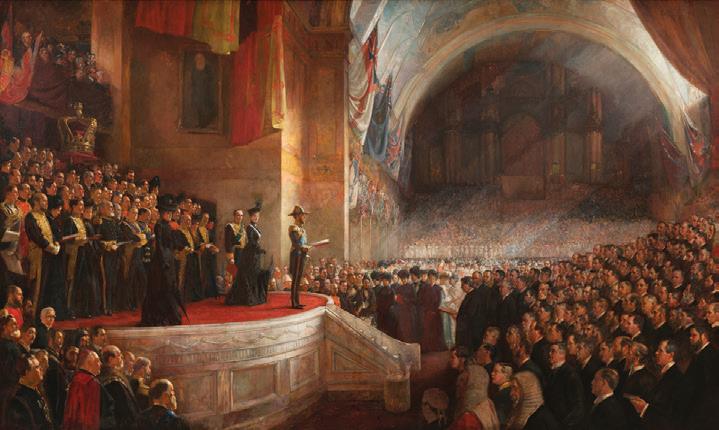
At noon on that May day in Melbourne 25 years earlier, the clouds had parted and the sun’s rays pierced the tall windows of the Exhibition Building’s grand dome just as the Duke of Cornwall and York (later King George V) commenced his oratory on behalf of his father, King Edward VII. As reported in The Argus: “[The] atmosphere was radiant and illuminated
the vast spaces of the building and the great sea of faces with a bright Australian glow.” Evocatively depicted in another monumental work by the highly-regarded Australian impressionist Tom Roberts, it was a poignant signifier: the “Big Picture”, as it came to be known, in every sense.
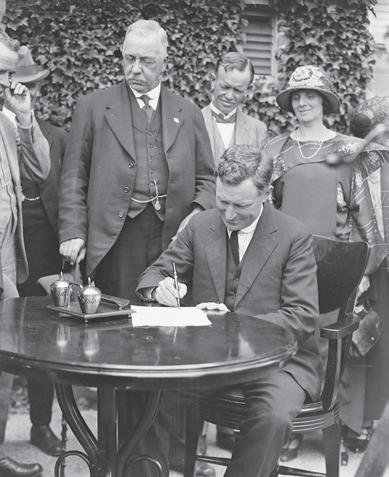
signs the first official document at the first official cabinet meeting in Canberra, January 30, 1924.
Well did it capture the promise and patriotism of a newly-minted united nation, and in marking 125 years of Federation, it’s a timely reminder of how we all combined to advance Australia fair.
And those core concerns haven’t shifted much: connectivity – be it roads, rail and
communication; educating the young and caring for the ageing; a fair day’s pay for a fair day’s work; providing for and protecting the nation.
Nichole Overall is an occasional history columnist. Her day job is as a member of the NSW Legislative Council.
With
Linda
•
•
•
•
•
Tom Roberts’ Big Picture – officially titled The Opening of the First Parliament of the Commonwealth of Australia by His Royal Highness the Duke of Cornwall and York, 9 May 1901.
Seniors ruefully discover Support at Home isn’t
Sir Humphrey Appleby, the ever-wily fictional permanent secretary in the BBC Yes Minister series, was wont to quip the best way to deal with a problem was to name it in the title of the report inquiring into it.
And so, the federal government has recently re-badged its reformed Home Care program as Yet, as the current Senate inquiry into the reformed Support at Home program has heard, it has proved in practice to be neither particularly supportive nor effective care for elderly Australians.
Home care aims to keep the elderly out of residential care (what we used to call nursing homes) and hospitals. Depending on assessed need, services can include nursing, physio, help to shower and dress, transport, and assistance to go shopping or to cook.
To be fair, the old Home Care program was not without its faults. Following criticism by the Royal Commission into Aged Care, the Albanese government abolished Home Care and replaced it with Support at Home, starting in November 2025.
those with superannuation or savings. Their co-payments can be in the order of 50 per cent to 80 per cent.
So a self-funded retiree accessing an hour of care daily can be up for something in the order of $60 to $96 an hour. Or a staggering $420 to $670 a week. Just to keep living in their own home with help showering or going shopping for food.
On these figures, it’s little wonder recipients in the Facebook groups I observe are not only cutting back their allocated hours, they are giving up their packages all-together because they simply can’t afford the new copayments the government has imposed.
As Senator Pocock put it, the new system is “pushing the burden on to older Australians, their families and the state and territory healthcare systems”.
where they tend to linger as what’s bluntly called “bed blockers”.
In fairness to the government, it appears to have listened to the dire feedback and recently announced changes, starting from October: classifying help with showering and dressing as “clinical care”, thereby avoiding co-payments.
How this will play out in practice, and whether both pensioners and superannuants are eligible for this revised definition, is also unclear.
Either way, we can only hope that the changes announced by Health Minister Mark Butler will make the scheme “sustainable” – not only for the government’s coffers, but also for the people it is intended to support in their final years.
Former Home Care recipients were grandfathered into Support at Home, while new entrants required to pay higher co-payments. This shouldn’t
Home has started to show cracks little more than five months after it began. Over the last few months, I have joined various Facebook groups where Support at Home recipients share their experiences. They are almost, without exception, negative. Recipients complain of their funded hours being drastically reduced and to now having to pay up to $120 or $130 an hour for the same care that used to cost
imposing co-payments on recipients.
Those on fixed incomes, many as aged pensioners, are now expected to make a contribution of around $5-$20 an hour. Sounds fair enough? But if they receive care for just one hour a day, this would cost something in the range of $35 to $140. Every week. For an aged pensioner on an already very limited income.
The story is even more stark for
This rationing may well make the scheme more “sustainable” for the government, but is likely to give rise to what policy academics call a “perverse incentive”; a fancy term for unintended outcomes. Or, as we might call it, an own goal. That’s because the very point of home care is to keep older people in their own homes and out of nursing homes and hospitals
Dr Robert McMahon PSM is a Visiting Fellow at the Australian National University, Adjunct Professor at the University of Canberra, and former Assistant Secretary of the Department of the Prime Minister and Cabinet.
Government ‘locks in’ tram route to Woden
The ACT Government has confirmed the State Circle East alignment for Light Rail Stage 2B, which will extend services from Commonwealth Park to Woden.
It made no reference to cost in its announcement.
It says the decision follows consultation with the community and Commonwealth stakeholders as part of the project’s draft Environmental Impact Statement (EIS). The process assessed both the preferred State Circle East route through the National Triangle and an alternative National TriangleBarton alignment.
After considering design, environmental and social impacts, and public feedback, the government has endorsed the State Circle East option as the best pathway forward.
The extension will run from Commonwealth Avenue through the National Triangle, along the eastern side of State Circle to Adelaide Avenue, and then to Woden. Nine new stops will be added.
More than 230 submissions were received during the public exhibition between July and September, alongside around 250 attendees at in-person sessions and more than 10,000 visits to the online EIS platform.
The government has also revised plans for a traction power substation, relocating it from a previously proposed site in Yarralumla to Denison Street in Deakin following community concerns.
The final EIS will be lodged with the Australian Government’s Department of Climate Change, Energy, the Environment and Water and the Territory Planning Authority next month. A decision is expected by the end of the year. Forget the nonsensical Stage 2B tram – Page 10.
House prices soar, units fall
Canberra’s housing market has reached a new milestone, with house prices climbing to a record high even as the unit market continues to decline, according to the latest report from Domain.
The March quarter data shows Canberra house prices rose 1.4 per cent – around $14,800 – to $1.084 million, marking the first new peak since mid-2022.
Despite the growth, the pace of gains has slowed, with broader economic conditions, borrowing constraints and affordability pressures weighing on buyer demand.
In contrast, Canberra’s unit market recorded the sharpest quarterly decline of any capital city. Prices fell 2.9 per cent – about $14,800 – to $489,304, the third consecutive quarterly drop.
Annual growth for units remains largely flat at 0.3 per cent, with prices still about six per cent below their peak in September 2023.
The gap between houses and units has widened significantly, with houses now 121 per cent more expensive than units – a record disparity for the capital.
Bring on the beanies
Beanies (adult and children), scarves and knee rugs will feature at the the Bold Bandannas (a Relay for Life team) charity stall in aid of the Cancer Council ACT at Bunnings, Majura, 9.30am-4.30pm on May 9. And for kids, they’ll also have lots of teddies looking for new homes, dress-up skirts and wings. More from 0451 679220.
Craft and remnant sale
Handmade items, sewing fabrics of all kinds and lengths, knitting yarns, haberdashery, books and baubles will feature at the St Ninian’s craft and remnant sale at 150 Brigalow Street, Lyneham, 9.30am-1pm, May 8 and 9. There will also be clothing, treasures and bric a brac for sale.
Doula with a sense of humour
Estella Hutchinson, an end-of-life doula with a sense of humour that makes talking about death both comfortable and thought provoking, is the guest speaker at the Narrabundah Probus Club, from 11.15am, on Tuesday, May 12, at the Harmonie
always welcome.
German Club. Visitors are
Off to Woden... an artist’s impression of the Hopetoun Circuit stop on Adelaide Avenue.
OPINION / artificial intelligence
Plagiarism is dead, long live AI creative pasting!
“If I rue anything it is that artificial intelligence came so late in my life. How I envy my grandkids. They will have AI tools beyond my imagination,” writes columnist HUGH SELBY.
Maybe one day I will rue the day that free artificial intelligence (AI) appeared on my laptop screen. But it won’t be soon.
There are a few reasons. Most importantly, it makes looking for information and viewpoints when writing an article so easy.
Instead of trawling through subject indices, newspaper records, journal articles, etcetera, I can start with a broad question to free AI and then refine that question as many times as necessary to take me where I want to go.
And as a tool, it goes far beyond looking for information to use in preparing a CityNews piece.
Planning a trip, be it local, interstate, overseas, wanting route tips and comparing prices, use AI.
Planning a meal, wanting to know how to get great crackling on roast pork, and what to serve with it, use AI.
Searching for reviews of vacuum cleaners, sourcing spare parts, and what happens unhappily to the filter if you make the mistake of using a powder carpet cleaner, use AI.
AI magically produces so much of the information that not so long ago
was a time-consuming slog.
It provides references too, some of them just pure invention. Academics, lawyers, students en masse, get caught when someone checks. Oh, the embarrassment!
The outrage expressed by teachers, and judges, is amusing. The vice is not the use of AI. The obvious vice is the failure of the user to check the references.
The less obvious vice is the possible failure of the AI user to make any attempt to bring their own skill and judgment (assuming they have any) to the problem about which they, or AI, are writing.
Even less obvious, but still important, is how AI can be used to ingratiate the user with others.
For example, in this age of cancel culture, or writing applications for funding (as an academic, or community group, or even tendering for contract work), a few moments with AI can help to ensure that the “right” vocabulary and tone are used. Pushing the right buttons has a more extended meaning in the age of AI than pre-AI.
For students with lacklustre
teachers, AI is a boon. Once upon a time, when answering an assignment, the student had to read the assigned readings, make notes, think about how to approach the problem, develop their approach to the answer, then draft, check and recheck, all before submitting their work.
These days the student loads the assigned readings into an AI program and then asks the question as posed by the assignment, or rephrased so as to reflect the espoused values of the teacher.
Hey presto, something close to the desired answer appears on the screen. Then comes the skill to finesse that
“generated” prose into something that doesn’t look and read like AI. Easy enough: put in a typo or two, move a couple of paragraphs, add a thought bubble here and there, insert an unnecessary adverb or adjective, add an accurate page reference from one or more of the assigned readings. The sad, or good, result is a better grade than thinking the whole thing through. Besides, it’s win-win. The teacher is happy. The student is happy. The only unhappy person followed the old rules and didn’t understand that the rules have changed. Plagiarism is dead. Long live creative pasting with AI.
Has the student learned anything? I don’t know, just as I don’t know what was retained by students in the bad old days of pre-AI essay writing. Well written, read a lot more
What I do know is how I and my fellow CityNews writers, and you the readers, benefit from CityNews being a free publication, funded by advertisers.
Those who write for publications with a pay wall are doomed to “here today and forgotten tomorrow”. Not so for the CityNews team, dedicated to being well written and well read.
If anyone wants to know about the parlous state of ACT finances, our prisons as expensive warehouses, planning horrors, the lack of any business case for the red thing on rails, all it takes is to ask free AI: “What has City News printed about topic X since such and such a date?”
Up it comes, a useful summary along with links to the original articles. “Well read” doesn’t mean by just today’s readers. Now those readers stretch far into the future.
If I rue anything it is that AI came so late in my life. How I envy my grandkids. They will have AI tools beyond my imagination.
Former barrister Hugh Selby is (usually) the CityNews legal affairs columnist.
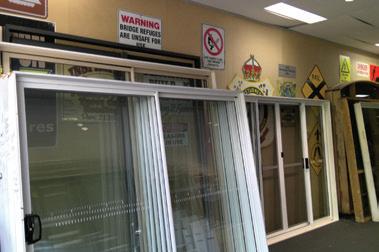
DOORS, WINDOWS & MORE!
of large language models. It was created by TIM WEST. Image: Google Deep Mind
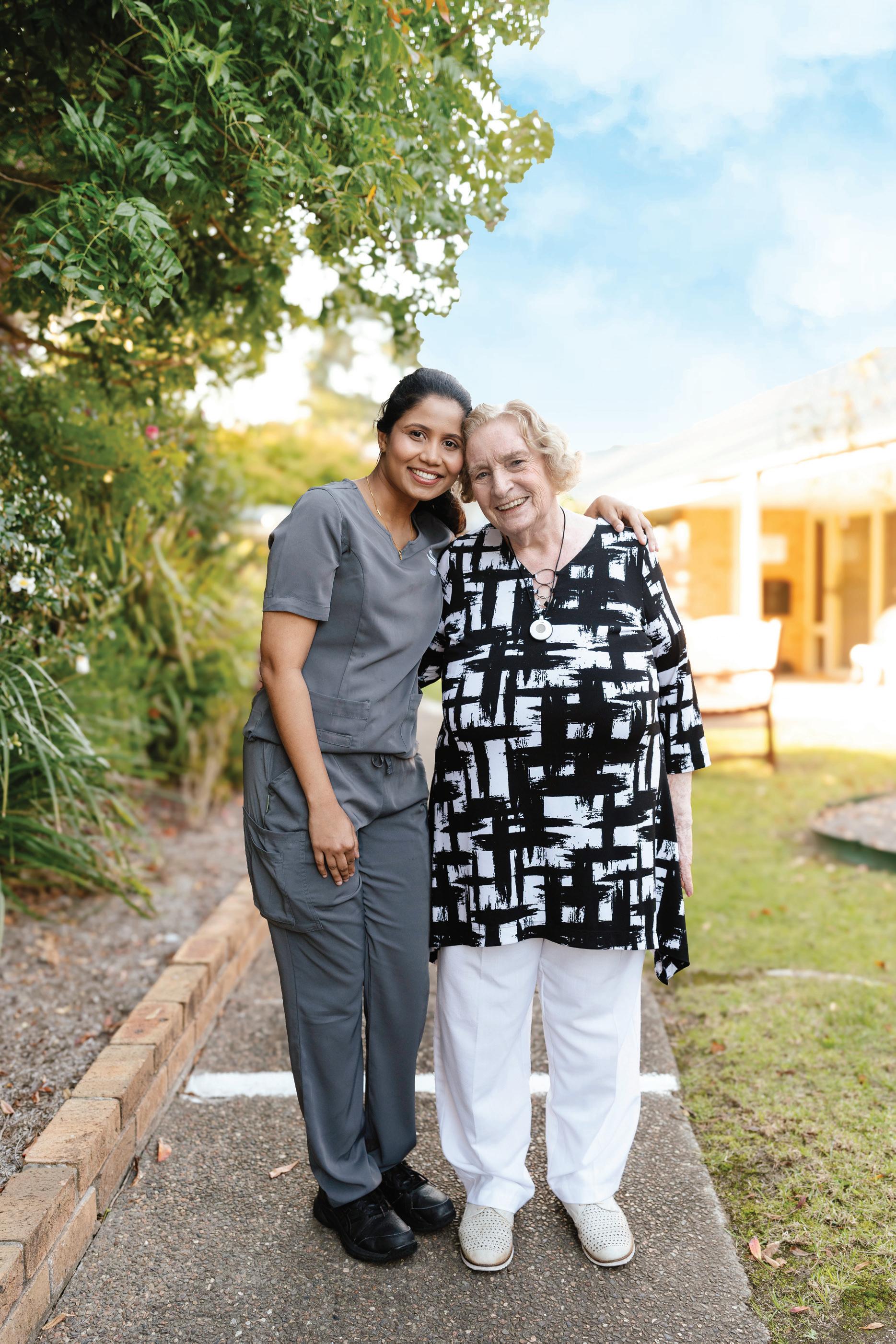
Global talent, local heart: Goodwin celebrates International Nurses Day
Every year on May 12, the world unites to observe International Nurses Day, a global movement that honours the profound impact and tireless dedication of the nursing profession across all borders. In 2026, this celebration takes on a powerful call to action under the theme, “Our Nurses. Our Future. Empowered Nurses Save Lives.”
“This theme underscores the necessity of providing nurses with the leadership, resources, and influence required to navigate modern healthcare challenges. At Goodwin Aged Care Services, this global mission is mirrored in our commitment to supporting a diverse and skilled workforce, ensuring our nurses are empowered to lead the way in clinical excellence and compassionate care” says Tamra MacLeod, Executive Manager Clinical and Health Services at Goodwin.
“They bring a wealth of international expertise and local heart to aged care”, MacLeod continues.
As the region gears up to celebrate this important day, the spotlight is turning to the diverse global talent that keeps the Goodwin care team thriving.
At the heart of this story is Thushani Shashikala, a Registered Nurse at Goodwin whose journey from the bustling cardiac wards of Sri Lanka to the quiet shores of Batemans Bay embodies the spirit of modern nursing.
For Thushani, the path to nursing was paved by her mother’s deep admiration for the profession. While Thushani spent her youth in Sri Lanka mastering the intricate steps of traditional dance, a passion she pursued from the age of six, she eventually traded the stage for the clinical ward,
“Our RN workforce serves as the backbone of Goodwin’s care across the ACT and the Greater Capital Region”, Tamra MacLeod, Executive Manager Clinical and Health Services.
fulfilling a family legacy of service.
After building a formidable professional foundation at the National School of Nursing Sri Jayewardenepura, Thushani spent six years specialising in high-stakes cardiac care at the National Hospital Sri Lanka’s cardiac care unit. Where many might find the intensity of acute heart conditions daunting, Thushani thrived, citing the complexity of the heart as her favourite clinical challenge.
In November 2024, she made the leap to Australia, navigating the rigorous International Qualified Nurse to Registered Nurse (IQN to RN) program via Key2Learning
Pauline Hugler, Executive Manager Development People and Culture at Goodwin notes: “For many in the profession, becoming a Registered Nurse in Australia is not a single step, but a journey. Registration through the Australian Health Practitioner Regulation Agency requires extensive study, clinical placement, and rigorous assessment. It is not uncommon for those studying nursing to work full-time as Carers while completing their qualifications, balancing shift work with study, exams, and supervised practice. This pathway speaks to the determination and resilience behind every nurse, and the depth of skill that underpins the care they provide.”
for elders is considered a foundational part of life) for her seamless integration into the community.
With the steadfast support and encouragement of Leanne Turner, Director of Nursing at The Glen, Thushani managed to pass all her exams required to practice as a Registered Nurse in Australia.
“Thushani’s personal milestone represents a meaningful evolution for Goodwin as we continue to strengthen our nursing workforce”, MacLeod concludes.
Goodwin boasts 108 AHPRA-registered employees, with a frontline RN workforce that serves as the backbone of the organisation’s care across the ACT and the Greater Capital Region.
The numbers behind Goodwin’s nurses:
• Goodwin House, Ainslie: 18 Frontline RNs
• David Harper House, Monash: 17 Frontline RNs
• The Glen, Batemans Bay: 14 Frontline RNs
• George Sautelle House, Farrer: 11 Frontline RNs
• Goodwin Home Care: 4 Frontline RNs
Beyond the statistics, it is the depth of experience that stands out. Collectively, Goodwin’s frontline RNs represent 280 years of service, with eight veteran nurses having served the organisation for over a decade.
As we mark International Nurses Day, Thushani’s story serves as a poignant reminder of the global expertise and local dedication that bridge the gap between clinical excellence and compassionate care in Canberra and the Greater Capital Region, with Goodwin Aged Care Services leading the way.
After her induction period in Canberra, Thushani found her home at Goodwin’s Residential Care Home, The Glen, in Batemans Bay.
The transition to aged care felt like a natural progression for Thushani, who credits her cultural upbringing (where caring
Thushani Shashikala, Registered Nurse at The Glen in Batemans Bay.
POLITICS / the fiscal sustainability of the ACT
Forcing Labor to tell the truth should be the start
“It
is clear that the conclusions of the expert Mr Eslake are at odds with the ACT Government’s. It is also clear the committee is, unsurprisingly, inclined to accept the expert’s opinion.” JON STANHOPE & KHALID AHMED cheer on some uncomfortable findings against the government.
The ACT Legislative Assembly’s Select Committee recently released an interim report on its inquiry into the fiscal sustainability of the ACT.
The inquiry was triggered by concerns, albeit belated, about the parlous state of the ACT’s finances. Surprisingly, the interim report and its findings do not seem to have attracted the attention of the mainstream media.
The committee received 20 submissions from various organisations including the Productivity Commission, Commonwealth Grants Commission, Independent Health and Aged Care Pricing Authority, CPSU, ACTCOSS, Property Council of Australia (ACT and Canberra Region), local community and advocacy groups, and several individuals. The ACT Government also made a submission. We will discuss the positions and proposals provided in the submissions in a future column.
The Interim Report contains four findings and makes three recommendations. Interested readers can access the report as well the submissions from the Legislative Assembly website.
While the interim report is unsurprising in its findings, it is interesting in its approach and indeed some aspects, particularly those dealing
with the government’s position in the submission and hearings, are quite amusing. The committee found that:
1. The government is spending more than it is raising in revenue and that this is due largely to decisions to both fund services and pursue major infrastructure projects without an equivalent increase in revenue or taxation.
2. The net operating balance went into deficit in 2012-13 and has remained in deficit up to the current year.
3. Borrowings and associated interest payments began to increase in 2012-13 when the ACT’s interest became a net expense, and since 2022-23 the trajectory of borrowings and associated interest payments has sharply increased.
4. There are justifiable concerns that this trajectory will affect the provision and mix of services that Canberra needs into the future. There is nothing surprising in these findings, as we have regularly highlighted the unbroken string of deficits, the spiralling debt, the exponential increase in interest costs, and the degradation of essential services since Andrew Barr became Treasurer. Indeed, the first three findings simply reflect information published by the Australian Bureau of Statistics and that in the audited financial statements of the Territory.
INDEPENDENTLY OWNED AND OPERATED
Independent economist Saul Eslake has a different view of the ACT economic situation than Chief Minister Andrew Barr. Imagine that.
The fourth finding reflects concerns raised in some of the submissions, which are also a logical outcome of the first three findings.
While it is interesting that the committee considered it necessary to put these on the record as “findings”, the potential reasons for this can be found in the public statements by Chief Minister Andrew Barr, not just recently but over the past several years, denying the problem, suggesting that the debt would fix itself and claiming on one occasion that he had actually presented a surplus budget. In reality, the actual result at the end of that year was a large deficit.
An additional submission by late May
In its interim report, the committee has recommended the government respond in detail and directly to the Terms of Reference 4(b) to 4(h) addressing independent economist Saul Eslake’s interim report of February 27, and the S&P Global Ratings report of September, via an additional submission to be provided by
We have previously highlighted the vagueness in the fiscal strategy, and the adoption of meaningless measures by the government in earlier columns, and obviously strongly support these recommendations.
However, this represents only a starting point. There are also a range of measures that are either irrelevant or potentially misleading that should be amended to reflect more appropriate measures. The main measure of operating balance, for example, is in fact unique to the ACT and hence different to the nationally agreed measure.
While we commend the committee for its approach, it is yet to be seen whether the government has the inclination or the capacity to undertake the task of budget reform.
Then there’s Shane Rattenbury
The Greens Leader at the time of the release of the report, Shane Rattenbury, issued a media release that was disturbing and bizarre. In it he declared “we will not support any move to sacrifice Canberra’s wellbeing to create an idealised Budget”.
It is concerning that it had not occurred to Rattenbury that Canberra’s wellbeing critically depends on the state of the budget. He went on to say: “[T]his Fiscal Review addresses a problem the Greens have faced both in government and on the crossbench: a constant refrain from Labor treasurers that there isn’t enough money to do important things that would make the ACT more just and sustainable”.
only engages with the process, but also with the substance of the matters raised by the expert.
The other two recommendations from the committee are quite specific and relate to the fiscal measures and targets, that:
• The government adopt the cash surplus/deficit (as outlined in the statement of cash flows) as a key measure of fiscal sustainability and given equal prominence to the government’s measures of net operating balance.
• The government develop a more specific fiscal strategy in its budget documents, which sets clear numerical targets and the years by which targets will be met.
The committee noted that these recommendations could be implemented in the upcoming 2026-27 Budget.
Rattenbury had, at the time, been in cabinet in each of the last three terms from 2012 to 2024. He cannot distance himself from the mess that has been created in those three terms – highest taxes, worst services and a mountain of debt. He appears to have forgotten that Labor is in government at the pleasure of, and
With regards to “money to do more important things that would make the ACT more just and sustainable”, his and the Greens first power-sharing agreement with Labor increased net debt by $1.6 billion, and operating expenditure
In addition, Rattenbury was a Greens member of the government and a member of cabinet and hence bears equal responsibility for the decision taken by cabinet, to enter into an agreement with the Commonwealth Government to sell off 1288 public housing dwellings, primarily along Northbourne Avenue, and to allocate the proceeds of the sell-off to fund the tram from
Incredibly, the number of units of public housing in Canberra have still not returned to the pre-sell off level.
One is left wondering whether Rattenbury’s musings are a tad hypocritical or rather a somewhat warped view of what is just and sustainable.
Post Script: Shane Rattenbury announced his departure from politics while we were completing this article. We wish him the best in his future endeavours, and will detail his contribution and legacy as a member of the ACT Government and services in a separate article.
Jon Stanhope is a former chief minister of the ACT and Dr Khalid Ahmed a former senior ACT Treasury official.
Shane Rattenbury.
ME/CFS and it’s associated symptom Post Exertional Malaise are not easily treatable.
People living with conditions that include Post Exertional Malaise find they need to learn a different way of living, using techniques such as Pacing.
Pacing means breaking down all the tasks of daily life to really simple elements and working out where your upper limit is.
Emerge ACT (formally ME/CFS ACT, a part of the Arthritis Foundation of the ACT) have a Pacing Program that may assist you to learn and hone this valuable skill.
Email us on mecfs@arthritisact.org.au to be a part of our Pacing education session and to join Club Tortoise where you will learn with, and be supported by others who live with this condition.
OPINION / Light Rail Stage 2B
Forget the nonsensical Stage 2B tram. Here’s why
The ACT Government has opted to send light rail Stage 2B up Commonwealth Avenue to State Circle east, despite the NCA originally wanting it to go up Kings Avenue and through Barton, avoiding the Parliamentary Zone. But JOHNSTON says we should forget it all.
The ACT Government has announced its light rail route to Woden after only recently publicly releasing its 2018 Business Case for Light Rail Stage 2.
In a CityNews column last month, I particularly noted the very low Benefits/Costs Ratio for the government’s recommended Option 2 route, meaning that the projected costs of the project were almost two and a half times the expected benefits.
The ACT Government’s original preferred route for Stage 2B was Commonwealth Avenue, King George Terrace (in front of Old Parliament House), Kings Avenue and then through Barton to Capital Circle.
At the time, the director-general of Transport Canberra told the Commonwealth Joint Parliamentary Committee (JPC) Inquiry into Stage 2 of the light rail project: “75 per cent of the 4437 responses it received supported a route alignment that travels through Barton and a preference for
more stops in Barton to enable easy access to employment and recrea tional facilities.
“The overwhelming public senti ment was for the longer route because it actually takes people to places where they might want to go.”
However, the National Capital Authority (NCA) stated to the JPC that it: “does not support the proposed route alignment’s path through the Parliamentary Zone.”
The NCA submitted that “there are benefits in redirecting the route to Kings Avenue as per Griffin’s Plan, which avoids the Parliamentary Zone” and that “adopting Griffin’s approach of using Kings Avenue would ensure that the three employment centres at the junctions of the National Triangle (Civic, Russell and Parliament House) would be serviced by the light rail network”.
The JPC Inquiry report did not make a recommendation about the best route, while noting the NCA’s advice.
However, the ACT Government
straight up Commonwealth Avenue (removing virtually all the magnificent, century-old trees) to State Circle east and then Adelaide Avenue, rather than going through Barton.
With no reference to cost, it says the decision follows consultation with the community and Commonwealth stakeholders as part of the project’s draft Environmental Impact Statement (EIS).
Whatever the route, it is important to question the function of a light rail service from Woden to Civic.
Is it to provide the fastest possible journey time between those two nodes at the least cost, or should it be to provide the best possible access to the main employment centres in the
central area and reduce the use of private cars?
Light Rail Stage 2b will be slower than the existing express buses and, as shown in the business case, “car kms travelled in 2036” are likely to be reduced by less than one per cent.
The business case shows that “work trips by bus” to Civic from “Stage 2 Corridor” are already 23 per cent compared to only 6-7 per cent into the Parliamentary Triangle and Barton. This is surely unacceptable.
A substantial study was produced in 2015 by transport planning academics Newman & Kenworthy titled: The End of Automobile Dependence – How Cities are Moving Beyond Car-Based Planning.
They argued that city planning should aim to develop high-density residential and employment nodes – “walkable urban centres in order for them to create the intense interactions needed in the knowledge economy”.
They said: “Young people want dense, diverse, interesting places that are walkable, bikeable and transitserved.
“The mobile phone is a far more important device than a car for younger people.”
They advocate high-density mixed development nodes within a 10-minute walking area connected by fast trains with stations averaging
about seven kilometres apart. Local bus routes to be integrated into the train stations facilitating very quick and easy transfers, and no “park-andride” facilities.
Both Sydney and Melbourne (populations around 5.5 million) are going in this direction, with highdensity transit-oriented development around railway stations and further developing their rail-based “metro” systems, while Brisbane (population 2.8 million) has gone for (much cheaper) bi-articulated buses on dedicated busways.
All those cities have had to invest in metro tunnels under their central areas to cope with vehicular congestion.
It should be obvious that Canberra, with a population of less than half a million, is a long way off being able to justify such systems.
However, it already has high density residential and employment areas around Civic and along Constitution Avenue to Russell, as well as in Parkes/Barton and Kingston on the south side, and Woden Town Centre.
Let’s by all means invest in dedicated busways to better connect those areas and to Tuggeranong, Belconnen and the airport, and forget the nonsensical Stage 2B tram.
Richard Johnston is a life fellow of the Planning Institute of Australia.
Light rail… to head up Commonwealth Avenue.
ACT Insurance Ball
2026 Delivers Strong Outcome for Mental Health Charity
Raising Funds, Celebrating Excellence, and Strengthening the Community
Canberra’s insurance industry came together in force on May 1 at the Rex Hotel for the 2026 ACT Insurance Ball, an evening that proved once again the power of connection, purpose, and collective impact.
This year’s event didn’t just meet expectations, it elevated them with thanks to Platinum Sponsor Beneco and Gold Sponsor, QBE.
A powerful show of industry support at the ACT Insurance Ball 2026 has delivered a meaningful funding boost to grassroots mental health organisation Running For Resilience.
More than just a gala event, this year’s Ball placed a clear and deliberate focus on community impact – with the insurance industry rallying behind a cause that continues to resonate across workplaces, families, and local communities.
The evening raised $36,608.99 to support Running For Resilience’s initiatives, which are centred on early intervention, connection, and practical mental health support delivered
at a local level.
Founded with a mission to create real, accessible change, Running For Resilience focuses on breaking down barriers to mental health support through community-driven programs and events. Their work is grounded in lived experience – an element that was felt strongly on the night.
Attendees heard firsthand from the founders and members of the community, with stories that brought a deeply human perspective to the issue of mental health. The impact was immediate and tangible, shifting the focus from awareness to action.
The funds raised will contribute directly to expanding local programs, enabling more individuals and families to access support in moments that matter most.
What stood out was not just the total raised, but the collective response from the industry – a clear signal that insurance professionals are increasingly engaged in the wellbeing of the communities they serve.
Events like the ACT Insurance Ball continue
to demonstrate that when the industry aligns behind a shared purpose, the outcome extends far beyond the room.
The night was backed by Insurance Industry Leaders. The scale and success of the evening were made possible through the backing of major industry partners, led by Platinum Sponsor Beneco and Gold Sponsor QBE Insurance. Their support, alongside a strong network of Silver Sponsors (Moray & Agnew, Medilaw, MLCOA & McInnes Wilson Lawyers) and outstanding Bronze sponsors, enabled the event to deliver a premium experience while maintaining a clear focus on giving back.
Celebrating Excellence Across the Industry
At the heart of the evening sat the ACT Insurance Awards, an independent recognition community-led program celebrating individuals and organisations driving excellence across the insurance sector.
From commercial deal-making to technical risk advisory, leadership, and community contribution, this year’s winners represented the very best of the profession.
Key award highlights included:
• 2026 Deal Maker of the Year was awarded to Zoe Higgins, Iqumulate Premium Funding
• 2026 Risk Mitigator of the Year was awarded to Joseph Everdell, Moray & Agnew Lawyers
• 2026 Excellence in Leadership was awarded to Nick Symons of Suncorp Group
• 2026 Best Support Person of the Year was awarded to Carly Sharp of Guardian Exercise Rehabilitation Services
• 2026 Excellence in Claims was awarded to Heather Arnold of Suncorp Group
• 2026 Provider of the Year was awarded to Anthony Armati, Prudence Rehabilttion
• 2026 Human Impact Award was awarded to Tim Cologon of EML
• 2026 Community Contribution & Engagement was awarded to Paul Eccles of PSC Insurance Brokers
• 2026 Insurance Leader of the Year was awarded to Craig Moorfoot , CGU
Each category reflected a broader truth: the strength of the insurance industry lies not just in transactions, but in people, in expertise, integrity, and the commitment to serve clients and communities at the highest level.
Beyond the awards and fundraising, the ACT Insurance Ball continues to cement its position as a flagship industry event – one that blends professional recognition with genuine community impact.
The atmosphere on the night reflected a shift in the industry: one that values collaboration over competition, purpose alongside performance, and connection as a driver of long-term success.
With record engagement, strong fundraising outcomes, and growing recognition across the national insurance landscape, the ACT Insurance Ball is no longer just a calendar event, it’s a platform. A platform to celebrate excellence.
A platform to give back and a platform to shape the future of the profession.
Ben Alexander, co-founder of Running for Resilience.
The Importance of Servicing and Security in IT Solutions
In today’s digital world, security is crucial for all businesses, big or small. Without proper security measures, organisations face various risks like regulatory penalties, potential lawsuits from clients due to data breaches, and significant downtime or loss of valuable data. These risks can lead to financial losses and damage to the reputation of your company.
The cyberthreat landscape has evolved rapidly over the past few years, becoming more complex and sophisticated. This means that businesses need to stay ahead of potential threats to protect their sensitive information and systems from cyberattacks. Investing in robust security measures is not just a precautionary step; it’s a necessity to safeguard against ever-evolving cyber threats.
At BluePackets, we understand the importance of proactive security measures. We’ve observed a phenomenon we call the “Security Dividend,” where clients who invest in security experience fewer issues and require less reactive support. By prioritising security, our clients not only save money in the long run but also avoid costly outages caused by security vulnerabilities. Plus, the cost of implementing security measures with us is often lower than what competitors charge for reactive servicing alone, providing a win-win situation for our clients. Investing in security with us means investing in long-term savings and peace of mind.
Parton stands up for men’s health, women’s too
In an early foray into policy development since Mark Parton became the Opposition Leader, the Canberra Liberals have found the Labor government wanting and have thrown down the gauntlet to the Greens.
Their approach to men’s health shows that they have been listening to the swinging voters in the electorate.
Parton has identified an important area of health policy that has been largely ignored by the Labor government in the ACT.
The Liberal Leader has controversially expanded his shadow health portfolio to include men’s health, while at the same time appointing his colleague, Leanne Castley, to focus on women’s health.
He then followed this action up by announcing his intention to consult on and then introduce legislation that will enforce an holistic view on suicide prevention.
This is pertinent as the Australian Institute of Health and Welfare’s recent estimates are that “the male suicide rate has fluctuated around three to four times that of the female rate”.
“This cannot be tackled in silos” argued Parton, “it requires leadership and co-ordination. This legislation
ensures suicide prevention is treated with the urgency it deserves.”
Although a focus on men’s health is way overdue, the Greens are in apoplexy about the policy and using it as an opportunity to distance themselves from the Liberals.
Discussions earlier in the year between then Greens leader Shane Rattenbury and Parton had the hardliners in both parties threatening retaliation if the two worked together.
The days of saying there is health and there is women’s health are behind us. It did make sense many decades ago when most of health research and policy was based on men’s health. At the time it was important to focus on women’s health in order to establish a balanced approach.
This new portfolio, according to
The Liberal Leader has controversially expanded his shadow health portfolio to include men’s health, while at the same time appointing his colleague, Leanne Castley, to focus on women’s health.
Parton, is a recognition that many men and boys feel ignored and left behind.
He explained: “I’ve been nine years in this place, and I’ve been contacted by so many men who feel that they’re not being listened to, who feel that the conversation has shifted to this point where they are almost always considered to be the problem”.
Taking a preventive approach, Parton wants a way forward that supports fatherhood, strengthens family connections, improves men’s engagement in education, expands pathways into jobs, addresses justice system interactions and builds strong and more connected communities through social cohesion.
The Greens have reacted as expected. Laura Nuttall has slammed the Liberals for taking a “binary
approach to health” in as far as the Liberals have only addressed men’s and women’s health.
It is not true, of course. Parton remains shadow minister for health.
As such, he does address the complex issues that impact on LGBTIQA+ people although not singling out each of the groups in this policy.
The Greens argue that “to only list domestic, family and sexual violence as a women’s issue also omits the experience of male victims.
“A genuine response to these forms of violence looks at support for victims and behaviour change for perpetrators.”
True. However, a sensible preventive health process focused on men addresses the root causes of violence.
In clarifying, the Greens fed into the Liberals’ policy stating: “We need to both set up and fund men’s behaviour change programs and women’s safety programs – not one or the other”.
My reading of the Liberal policy intention suggests this is a fundamental part of the aim.
Appointing Castley to ensure women’s health issues remain high on the agenda, Parton pointed out:
“These portfolios recognise that while many issues are shared, men and women often experience different pathways and barriers across health, safety, economic participation, and social connection
“A dedicated focus will ensure that policy responses are practical, inclusive, and outcomes-driven.”
Preventive health is complex as is ensuring treatment is appropriate for different groups in the society. This policy announcement by the Liberals takes a sensible step towards a more inclusive health policy. It does not fall into the trap of attempting to swing all the efforts towards men’s health.
However, it does recognise that an important gap in preventive health does need to be addressed and takes the first steps in addressing those issues.
Michael Moore is a former member of the ACT Legislative Assembly and an in dependent minister for health. He has been a political columnist with CityNews since 2006.
RETIREMENT ON
•
•
•
• Centrelink advice and implementation.
• Is a redundancy right for you at this time?
Mark Parton and Leanne Castley… taking first steps in bridging a preventative health gap.
Polyester clothes are on a one-way trip to landfill
Those ‘recycled polyester’ leggings are not as sustainable as you think, say textile experts CAROLINE SWEE LIN TAN and SANIYAT ISLAM .
Recycled polyester activewear and swimwear are now everywhere. Major global brands sell leggings, swimsuits and puffer jackets with labels that claim they’re “made from recycled plastic bottles”.
Millions of people buy these products believing they’re making a more sustainable choice.
The logic seems straightforward. Turning existing plastic waste into clothing is better than landfill.
However, the story is more complicated. What looks like circular recycling is often a one-way trip to landfill, revealing how recycled fabrics can mask environmental problems rather than solve them.
Where the plastic really comes from
Despite images of ocean clean-ups in glossy marketing, most recycled polyester used in fashion doesn’t come from marine waste or even old clothing. Instead, it comes from PET (polyethylene terephthalate) drink bottles.
The most recent Materials Market Report shows that about 98 per cent of recycled polyester comes from plastic bottles. Textile-to-textile recycling ac -
counts for less than 1 per cent of the supply. And activewear is the single largest apparel use of recycled polyester in fashion supply chains.
Consequently, many garments mar keted as “sustainable” rely on plastic taken from an effective recycling system, rather than addressing fashion’s own textile waste.
When bottles become clothes
How PET bottle recycling works
PET, the plastic used to make drink bottles, is one of the most successfully recycled plastics. Decades of investment in collection, sorting and reprocessing have made bottleto-bottle recycling possible in many countries.
This works because PET bottles are uniform and collected in large volumes. Research shows PET can be recycled many times without losing quality, as long as it stays within the bottle system.
When PET stays a bottle, it remains a high-value material.
That recycling loop breaks when PET becomes textile fibre. To make clothing, bottles are shredded and melted into polyester yarn, then dyed, blended and sewn into garments.
Fibre blends, especially polyester mixed with elastane, make textile-totextile recycling difficult.
Most textile recycling systems are mechanical and limited in scale. They struggle with blended fabrics. As a result, most polyester clothing can’t be recycled and ends up in landfill or incineration.
In circular economy terms, bottleto-garment recycling is downcycling. Material quality drops, and future use is limited.
Testing by Çukurova University in Turkey found recycled polyester shed 55 per cent more microfibres than virgin polyester. These fibres were smaller and more brittle, increasing the likelihood they travel further in aquatic environments and enter our food chain.
Compared with virgin polyester, recycled polyester usually uses less energy and produces fewer greenhouse gas emissions during manufacturing. This is why initiatives like the 2025 Recycled Polyester Challenge have pushed brands to commit to sourcing 45 per cent to 100 per cent of their polyester from recycled sources. However, these schemes have hit a major roadblock: the lack of technology to recycle old clothes. Because the infrastructure for textile-to-textile recycling doesn’t yet exist at scale, brands have been forced to “borrow” bottles to meet their targets.
A recycling ‘dead end’
When bottles become garments, they leave one of the few recycling systems that works well and enter another that can’t yet recycle most clothing. This shift is becoming a major legal flashpoint. The European Union’s 2030 Vision for Textiles mandates that by 2030, all textile products on the market must be durable, repairable, and made largely of recycled fibres.
As brands scramble to meet these targets, a global supply crunch is emerging. With new EU packaging regulations coming into effect from August 12 2026, companies will be required to make packaging recyclable and prepare for future recycled content requirements.
As a result, the beverage industry is fighting to keep its own plastic. They argue fashion is “leaking” high-quality recycled PET out of a closed loop to mask its own lack of infrastructure.
This highlights the core problem: recycling should reduce waste overall, not simply move it between industries.
Recycled polyester only works when clothes become new clothes. While investment is growing, the fashion industry’s reliance on bottles is a distraction.
Until the fashion industry solves its own waste crisis rather than borrowing from the beverage sector, turning bottles into clothing remains a one-way path to waste.
Currently, the most sustainable outcome for a plastic bottle is to remain a bottle.
Caroline Swee Lin Tan, is an associate professor in Fashion Entrepreneurship and Saniyat Islam, an associate professor, Fashion and Textiles, at RMIT University. Republished from The Conversation.
PROTOTYPING VOUCHER
Turn your idea into a physical prototype with a $10,000 voucher. Access the ACT’s leading prototyping facilities and technical experts to create and refine your product. The Canberra Innovation Network has partnered with to provide vouchers worth up to $10,000 in facility access, equipment time, and expert guidance. You bring your design; our partners
Recycled fabrics can mask environmental problems rather than solve them. Photo: Austin/Unsplash
WHIMSY / Is women’s perfume a fragrant violation of men’s rights?
Perfume’s invisible language of self-expression
You might wonder why women wear perfume – and, like makeup or fashionable outfits – there isn’t just one reason why women wear perfume.
Men think it’s worn to attract them, but the wearing of perfume has biological, psychological, cultural and social roots.
Scent is one of the oldest forms of communication. Humans subconsciously respond to olfactory cues – clean skin, subtle sweetness, or warmth – as signs of health and genetic compatibility. Perfume can enhance or simulate natural body scent, amplifying those cues. While the “pheromone” idea is often overstated, pleasant smells do activate the brain’s reward and emotional memory centres (especially the amygdala and hippocampus), deepening social and romantic connections.
self-perception almost instantly.
For many women, wearing perfume becomes a ritual of selfcomposure – the final step before facing the day, like an invisible shield.
So, originally, fragrance likely had attraction and social bonding functions.
Perfume isn’t only about how others perceive you – it’s also about how you feel. Smell directly influences emotion; a fragrance can alter mood, confidence, and
Certain scents trigger memory associations: warmth, safety, luxury, sensuality, freshness. A woman might wear perfume to evoke or embody a particular state of mind. So, perfume can be a psychological anchor – “This scent is me at my best.”
Perfume isn’t only about how others perceive you – it’s also about how you feel. A fragrance can alter mood, confidence and self-perception almost instantly.
Perfume is also a form of aesthetic expression and social identity. Different scents signal different personas: floral (romantic), woody (sophisticated), citrus (energetic), oriental (sensual).
Fragrance connects to ritual and heritage –many women wear the scent their mother or grandmother wore.
In modern life, perfume can signal taste, refinement and individuality, much like fashion or art. So it’s a personal signature, an invisible extension of one’s identity.
Perfume also functions as subtle social communication. In close spaces (offices, gatherings, dates), scent can make someone more memorable and distinctive. It can project mood or intention – light and fresh for approachability, deep and musky for confidence or
Inspired by Machiavelli whose name sounds prophetically like his own, Raef McAvee forges and follows a set of Rules for Life that elevate him from suburban obscurity to international
sensuality.
Some women consciously use fragrance to control the social atmosphere – choosing calming, elegant, or assertive scents depending on context. So, scent becomes a nonverbal message: “This is how I want you to feel around me.”
Women wear perfume for several reasons: Biological: to enhance natural scent and appeal; psychological: to boost mood and self-confidence; cultural: to express identity or memory, and social: to influence perception and presence.
In essence, perfume is the invisible language of self-expression – a blend of personal ritual, emotional regulation and subtle social signalling.
On a lighter note: An American suffers a serious heart attack while out grocery shopping. The store clerks call 911 when they see him collapse to the floor.
Paramedics rush him to the
nearest hospital where he has emergency open-heart bypass surgery.
He wakes in the ICU to find himself in the care of nuns at the Catholic hospital he has been taken to. A nun is seated next to his bed holding a clipboard loaded with several forms, and a pen. She asks him how he’s going to pay the $50,000 bill for his treatment. It soon becomes clear that he has no insurance or assets.
“Do you have a relative who can help you with the payments?” asks the nun.
He says: “I only have a spinster sister who’s a nun.”
The nun reacts angrily: “Nuns are not spinsters! Nuns are married to God.”
The patient sighs with relief: “I hadn’t realised that. Could you please send the bill to my brotherin-law.”
Clive Williams is a Canberra columnist.
Located in the heart of Canberra’s medical precinct in Deakin
At Canberra Family Health Centre, we are dedicated to providing comprehensive, patient-focused healthcare for individuals and families. Located centrally in Deakin, our centre offers a wide range of medical services designed to meet your health needs at every stage of life.
Associate Professor Maryse Badawy MB/ BS Degree, FRACGP, FHKAM (Family Medicine), Grad Dip Fam Med, Master Family Medicine, Member Australasian Menopause Society
National and International Family Medicine and Academic experience.
self-composure – the final step before facing the day, like an invisible shield.
Photo: Andrea Piacquadio
To attract men, I wear a perfume called “New Car Interior” – Rita Rudner
Iran lesson is up the incentives for renewables
The closure of the Strait of the Hormuz highlights the urgent need to reduce our 90 per cent reliance on imported fossil fuels.
There are two broad responses. Both acknowledge the need to increase domestic fuel storage reserves.
The first is to increase domestic oil production. It will require the investment of billions, is likely to result in more expensive fuel and will not make a significant contribution to supply for at least a decade. It will require fracking to extract shale oil which could have major environmental consequences from its high demand for water and potential groundwater pollution.
It downplays the possible severe environmental and economic impacts of human-induced climate change.
The other response, advocated by groups including the Climate Council and the Grattan Institute, is to increase the support of renewables.
It involves the provision of additional incentives to increase the uptake of electric vehicles, home solar and batteries; greater taxation of gas exports; the end of fuel tax credits and tax exemptions for fuel-intensive utes with the savings used to support renewable technologies.
The increase in locally renewablyproduced energy would free-up oil supplies for use in areas where increasing electrification is more complex such as mining and manufacturing.
While major challenges will need to be overcome including how to deliver “green” steel and aluminum and to increase the use of electric trucks, rapid technological improvements are likely as countries including China, Japan and South Korea, seek to reduce their dependence on gas and oil.
Political parties, other than the Greens, support increasing domestic oil production. But as the Grattan Institute observed, investing heavily in petrol production is nonsensical when the world is moving toward cleaner energy.
To reduce our reliance on fossil fuels, the government’s response has to be based on evidence and free from undue influences.
Mike Quirk, Garran
Just a warehouse for troubled people
Our jail was named after a prison reformist, Alexander Moconochie, and the name is about as far as reform gets a look in at the AMC.
If they go out as they came in: poorly educated, mental health/substance use issues, poor social skills, little or no work skills then it’s no surprise that, for a high percentage of offenders, it’s back to crime.
Apart from the lack of useful training, there’s little reason to participate in it.
Detainees are like the rest of us: they do better when they’re encouraged with practical measures like decent pay.
The last increase in detainees’ pay was 2.5 per cent some seven years ago. Since then, our wages have increased by around 20 per cent.
The AMC is the most expensive facility to operate in Australia, yet it is nothing more than a warehouse for troubled people.
Minister Paterson, why aren’t we taxpayers getting a bang for all our bucks?
Why is our jail continuing to fail the ACT community and those detainees “stored” in a facility which appears increasingly resistant to providing rehabilitation?
Janine Haskins, prison reform advocate
Letter writer should apologise
To protect my international reputation as a scientist, I feel it necessary to point out that Anthony Hordern (letters, CN, April 23) has falsified my statements by claiming that I don’t understand that “solar panels produce no energy at all 60 per cent of the time half the year when it is dark and a further 10 per
cent when it is cloudy or raining”. There is nowhere in any of my writings here and overseas that can in any way at all support this claim!
I ask him to withdraw his statement and apologise.
Nick Standish, Macquarie
Priorities, positioning and political will
While Fiona Colin’s claim that green hydrogen for steel would only be viable with “oodles” of surplus renewable power sounds reasonable (“Batteries ‘essential’ piece of puzzle”, letters, CN April 30), international experience suggests it is ultimately about priorities, positioning and political will.
An overview by the Institute for Energy Economics and Financial Analysis (IEEFA) shows Sweden, Canada, Portugal, the US and Brazil have all begun developing green iron or steel using green hydrogen. IEEFA argues Australia’s strong renewable resources could enable low-cost green hydrogen and create opportunities to process iron ore domestically into “green iron” for export to emissions-conscious steelmakers.
If Australia delays, the opportunity may be captured by others already moving ahead. The lesson is clear: this is not simply a question of surplus energy, but of strategic ambition. Big-picture thinking, backed by timely action, is needed now.
Sue Rechter, Talbot, Victoria
Determined to be a ‘good statistic’
World Ovarian Cancer Day is on May 8. I was diagnosed with ovarian cancer (OC) in July 2016, my chances of surviving five years were 46 per cent, but my husband reminded me “for every bad statistic, there is a good statistic” so I was determined to be a “good statistic” while admitting the odds were not on my side.
Ten years later I am still alive despite a recurrence in 2020. The alarming fact is that in those 10 years the survival rates have only increased by 3 per cent.
The chance of survival of women diagnosed with ovarian cancer has not skyrocketed like those of many cancers, which is why ovarian cancer is the number one cause of gynaecological cancer deaths and the fifth cause of cancer-related deaths in women.
There is NO early detection test for OC and it is common for women to believe a cervical screening test will detect ovarian cancer. As a result, women are not diagnosed until the cancer is advanced, which leads to poor outcomes.
I will be celebrating in July, but many women have not lived long enough to enjoy such a privilege.
I have a daughter and granddaughter, and it is for them that I volunteer with a program called Survivors Teaching Students, which teaches medical, nursing and allied health students about the signs, symptoms, risks and the lived experience of OC “survivors”.
Information about the Survivors Teaching Students program is at anzgog.org.au/sts/ and the signs and symptoms of OC at ovariancancer.net.au/aboutovarian-cancer/symptoms
Ann Prunty, OAM, volunteer regional co-ordinator, Survivors Teaching Students
Take some responsibility for offending
Julie Tongs’ latest opinion piece about aboriginal incarceration (“ACT leads the nation in jailing indigenous kids”, CN April 23) talks of the high number of Aboriginal children being incarcerated in the ACT.
There is absolutely no discussion on what led to such high numbers of children being incarcerated; ie
Aboriginal children committing crimes that leads to their incarceration.
Reading her article one would expect to see ACT police simply pulling Aboriginal children off the street for simply being there.
This is obviously a multi-faceted problem and it is time for people such as Tongs to take some responsibility and to be part of the solution, rather than blaming everyone else.
A Smith, via email
Reluctance of media to call out the far left
Ross Hudson in his letter “Left see right and right see left” (CN April 23) incorrectly says I am dissatisfied with the classification of journalists as either left or right wing. That’s not what I said. I was commenting on Google’s inconsistency in referring to journalists for example Laura Tingle and Sarah Ferguson as Australian journalists, and Andrew Bolt and Paul Murray as conservative journalists. They are all Australian journalists and so they should all be referred to as Australian journalists. If there has to be a classification then why doesn’t Google refer to Tingle and Ferguson as non-conservative or left-wing journalists?
The point of my letter was to point out the reluctance of so-called mainstream media and some social media to call out the far left, while they are willing to call out the far right.
It is an accepted political reality that support for Labor is support for the left and support for the Coalition is support for the right. That’s just the way it is and any classification of Labor as being centrist or mainstream is gobbledygook.
Paul Temby, via email
Not feral cats,
it’s
the humans
Clive Williams’ letter (“Worry about the feral cats before killing the roos”, April 30) ignores the real problem causing environmental damage. It is not free-living cats, but human activities such as land clearing, urbanisation and climate change.
Robyn Soxsmith, via email
dose of dorin
Winter Warmers
The Yacht Club Restaurant
This
Our
flavours and comforting dishes in a welcoming setting.
From June, we will be introducing a new winter menu, along with a weekend buffet and more. To stay up to date with all the latest offerings and events, be sure to follow us on social media.
Instagram: yachtclubcanberra, Facebook: Canberra Southern Cross Yacht Club
Join us for our monthly wine dinners, featuring local wineries and great food pairings, an easy, relaxed night out with good company by the lake.
Canberra Southern Cross Club – The Yacht Club Mariner Place, Yarralumla. Call 02 6273 1784 or visit cscc.com.au
A practical resource for health and wellbeing
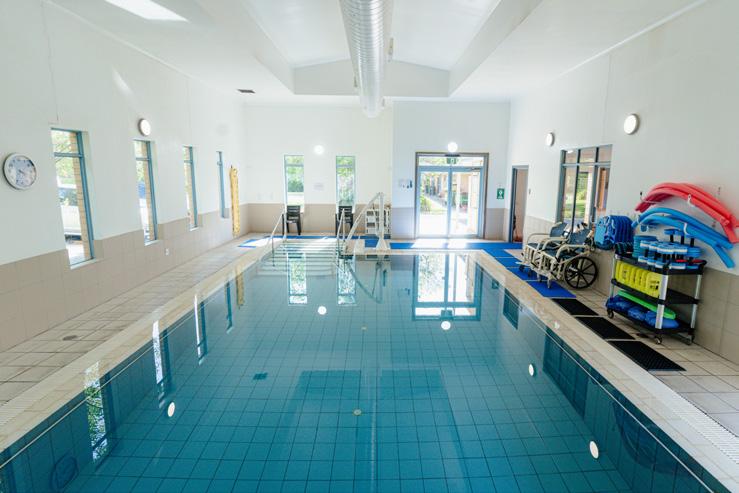
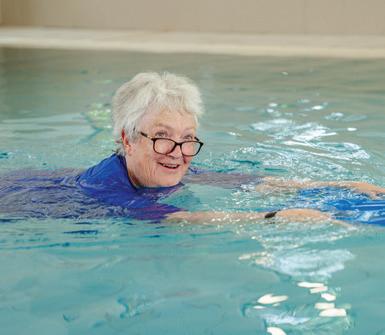
Owned and operated by Hartley Lifecare, the Hartley Hydrotherapy Pool is one of the few dedicated hydrotherapy facilities in Canberra that is both fully accessible and open to the wider community.
Based in Hughes, the pool provides a consistent 34 degree environment designed to support rehabilitation, pain management and improved mobility. For people recovering from injury, living with disability, managing arthritis or other chronic conditions, water based therapy can enable movement that is difficult on land.
What sets this facility apart is its accessibility and flexibility. It can be booked for self managed sessions or exclusive use, making it suitable for individuals, allied health professionals and small groups. The setting is practical and community focused rather than
commercial or high traffic.
Importantly, community based hydrotherapy expands access beyond acute care settings and short term treatment plans. It gives people a local, reliable option to continue therapy at their own pace. They also create opportunities for preventative health, particularly for older Canberrans seeking low impact exercise. As demand grows for inclusive health infrastructure, facilities that are affordable, accessible, and centrally located play a critical role. The Hartley Hydrotherapy Pool is a straightforward example of community focused design meeting real need.
Hartley Hydrotherapy Pool
Call 02 6185 1653 or visit
www.hartley.org.au/hartley-hydrotherapy
energy efficiency, says director Yu Tee.
With more than 15 years of experience in the industry, Yu says customers can rely on Windotek for the best quality and service.
“We don’t do single glazes, it’s all double glazed in order to reduce noise and also improve energy efficiency and reduce the cost of bills,” he says. “Customers go to us because their existing homes have single-glazed windows and they’re complaining about the noise and also about the loss of heat in winter.
for new builds.
All the manufacturing at Windotek is done locally, says Yu, meaning they can be flexible with design and aesthetics, making sure the work suits exactly what the customer wants.
• improve security and the value of your property?
These are just some of the many benefits that home and business owners can achieve with our uPVC double and triple glazed windows and doors.
Windotek Australia is a leading provider of double and triple glazed uPVC window and door systems for the Canberra region. We help you achieve a higher EER rating, with 100% customised solutions that meet your needs and complement the style of your home.
With more than 27 years of experience across residential, commercial and bespoke design projects, Arkitex founder and director, Alessandro (Alex) D’Ambrosio says they don’t just deliver drawings, they craft spaces that improve how people live, work and connect.
“At Arkitex, we approach each project as an opportunity to blend creativity with functionality,” he says.
“What sets us apart is our commitment to thoughtful, client-focused design where innovation, sustainability and context all play a central role.”
Bringing a deep understanding of architectural principles, planning regulations and project delivery, Alex says they strive to stay at the forefront of design trends and technologies.
With a masters in architecture and an unrestricted A Class builders licence, Alex says the most rewarding part of his job is seeing their clients’ visions come to life.
“From that first sketch to the final reveal, we love the collaborative journey transforming ideas into tangible spaces that truly reflect our clients’ goals, lifestyle and personality,” he says.
Whether a client is building from scratch, renovating or reimagining a space, Alex says they will be there from start to finish.
“At Arkitex, we believe great design is a dialogue,” he says.
“We are passionate about creating architecture that feels purposeful and personal.
“We welcome projects of all sizes and stages, and are always excited to explore new ideas.”
Arkitex
Unit 5/24 Torrens Place Torrens. Call 0413 570599 or visit arkitex.com.au
Finding the right shoe for the run
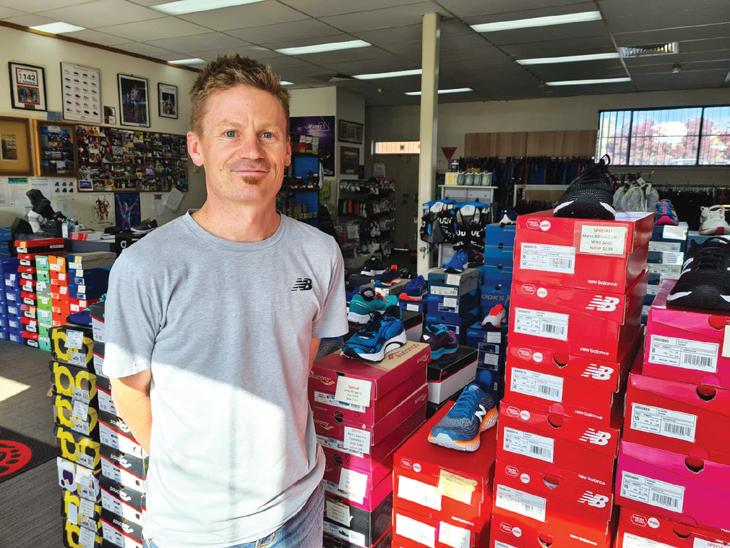
With benefits including lowered cholesterol, lowered blood pressure, improved circulation and weight loss, The Runners Shop owner, Nick Walshe, says the health benefits associated with running are significant.
surprising for people taking up running for the first time,” says Nick.
“Through running, we can reduce our levels of stress and anxiety, which in turn leads to improved sleep and an improved overall sense of wellbeing.”
According to Nick, having a well-cushioned pair of running shoes is essential for helping with shock absorption.
“When we run, a force roughly equivalent to four times our body weight impacts our feet, arches, knees and lower back,” he says.
“Running shoes are also designed to flex in a way that works to help with the runner’s repetitive
next most important item of equipment is a good pair
and provide comfort, Nick says running socks have been specifically designed to reduce the risk of blisters from sweating and friction.
“At The Runners Shop, we love hearing the stories of people’s enjoyment of and love for running,” he says.
“Finding a suitable, comfortable pair of shoes is where the team gets to be involved in your running story!”
The Runners Shop 76 Dundas Court, Phillip. Call 6285 3508 or visit therunnersshop.com.au
Supportive care for life after breast cancer
This Mother’s Day, Deakin Wellbeing House
“If you’re navigating breast cancer treatment or recovery and want supportive care that meets you where you are, I’m here to help,” she says.
Deakin Wellbeing House Unit 12, 40 Corinna Street, Phillip. Call 0412 885 804 or visit deakinwellbeinghouse.com.au
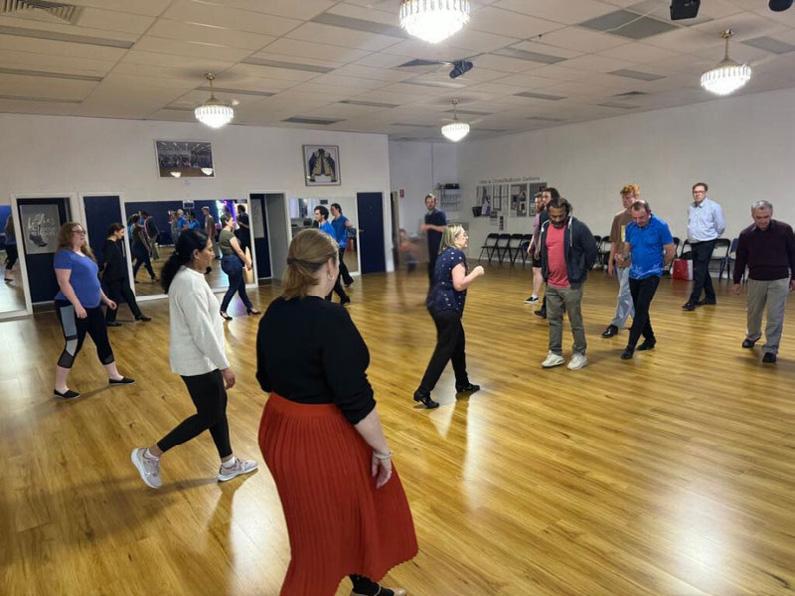
Dale’s Dance Classes are good for all ages
With more than 30 years of experience, Dale Harris says
puzzle at the table or taking the dog for a walk,” she says. “It keeps your brain and body active while you think about the steps and move.”
Moving to the Weston Neighbourhood Hall to host her adult beginner classes, Dale offers seven-week courses, although she says it’s also okay to “just turn up”. Dale’s Medal Classes are on Thursday 5pm for under 12 years and 12 and over from 5.30pm at the Pearce Community Centre, Collett Place, Pearce. Anyone is welcome to join in, just drop past to have a look.
Nim brings over 15 years of massage therapy experience, with a strong focus on supporting people undergoing cancer treatment, living with anxiety, or in recovery. Her gentle, skilled approach helps restore comfort, flow and connection to the body, especially after diagnosis. Deakin Wellbeing House also offers remedial, hot stone, pregnancy and Swedish massage, plus scar treatment after breast cancer surgery.
As an Accredited Lymphoedema Practitioner and member of both the Australasian Lymphology Association (ALA) and Australian Massage Therapists Association (AMT), Nim offers a rare level of expertise in this highly specialised area.
Hours: Monday to Friday 9:00am to 3:00pm & after hour by appointment
To make a booking please call Nim on 0412 885 804 Scan to book an
• Extensive range of shoes for Runners, Joggers, Walkers and Gym enthusiasts of all ages
• Brands include Asics, Brooks, Hoka, Saucony, Altra, New Balance, Nike and On
• Great range of technical running apparel which breathes (wicks moisture) all year round
• Extensive range of nutrition products including Tailwind, Huma, Gu and Pure Sports Nutrition
• Come in and speak to our staff of Runners, Triathletes and Orienteers with a passion and a first-hand knowledge of our entire product range!
our ‘long running store’ at 76 Dundas Court,
Firm with a focus on estate planning
With a focus on estate planning, business and commercial law, property transactions and notarial services, Signus Legal director Brendan Goodger says the firm’s holistic approach ensures they look after clients’ family and businesses needs from start to finish.
“We pride ourselves on building genuine, longterm relationships with our clients,” he says.
“As a boutique law firm, we are dedicated to supporting families and small business owners with practical, tailored legal solutions.
“I love the variety and the chance to make a tangible difference in people’s lives.
“Whether it’s solving a complex issue or helping a family secure their future, every day is meaningful.”
Practising law is about problem solving, says Brendan.
“It’s about empowering people through problem solving,” he says.
Although relatively new to Woden, Brendan has been assisting clients in the area for more than a decade.
“Signus Legal offers fresh energy alongside proven expertise,” says Brendan and having a client-focused mindset is important in law.
“Our focus is entirely on our clients,” he says.
“We take the time to understand their unique needs and goals, offering a personalised, accessible approach that’s all about delivering results, not just advice.”
Your legal issues are dynamic and ever-changing, our goal is to deliver exceptional legal services in an efficient and flexible way.
WILLS & ESTATES
We provide comprehensive solutions tailored to your specific circumstances. We take the time to understand your needs to ensure your estate plan aligns with your exact intentions.
PROPERTY & CONVEYANCING
Looking to make your property dreams a reality? Whether you’re buying or selling residential or commercial property, we’re here to guide you every step of the way.
BUSINESS & COMMERCIAL
We work collaboratively with trusted advisors including accountants, financial planners, and insurance brokers to ensure your interests are safeguarded throughout the legal process.
NOTARIAL SERVICES
We offer efficient and expert assistance for all your notarising and witnessing needs. Our appointed Notary Public, Brendan Goodger, holds internationallyrecognised authority to witness signatures and notarise documents for overseas use.
Signus Legal director, Brendan Goodger.
Jack offers professional moves with care
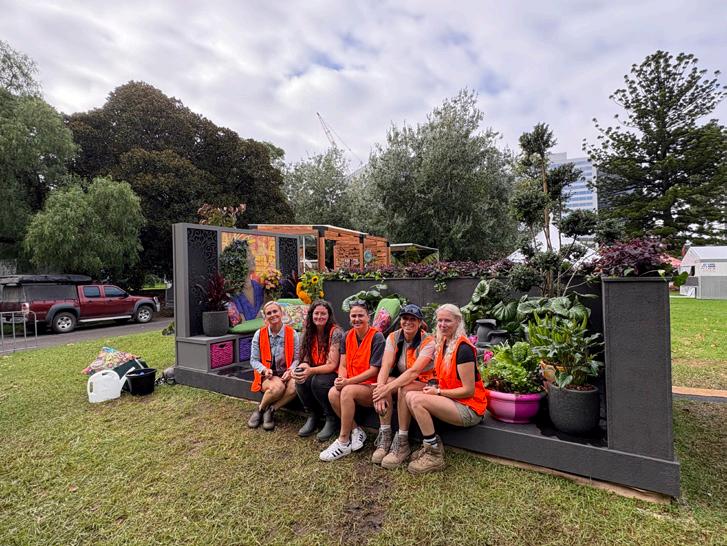
Panacea Landscapes founder Shannon Blackbourn is making her mark, earning first prize at the Melbourne International Flower & Garden Show Balcony Garden Competition in 2024 and third place in 2025.
Clear Space. Clear Mind. Better Move.
With a focus on care, professionalism and reliability, JWS Removals has become a go-to choice for Canberra residents, says owner Jack Stafford. With more than 12 years’ experience across furniture removals, logistics, and fine art and antique relocations, Jack established the business to offer a more personalised service in an often high-pressure industry.
As a small, privately owned operation, Jack works closely with clients from initial quote through to final delivery.
“We pride ourselves on professionalism and only use experienced removalists who know how to get the job done right,” Jack says.
To ensure a smooth move, the team uses specialised equipment including protective blankets, covers, trolleys and in-home floor protection.
JWS Removals also offers in-person, no-obligation free quotes, allowing for accurate planning and peace of mind.
JWS Removals
Call 0448 401 604 or visit jwsremovals.com.au
“Flawless service! Fastest, friendliest, most efficient and stress-free move I’ve ever experienced. Jack and his team are lifesavers. HIGHLY recommend JWS.” – Elizabeth S
Having worked in landscaping since the age of 16, Shannon describes running her own business as “a rollercoaster, but one I wouldn’t have any other way”.
“My introduction to horticulture was as a young child, in my Grandma Shirley’s garden,” she says. “Every home she lived in was filled with beautiful flowers. I didn’t realise it then, but it would shape my future.”
Today, Shannon works across projects ranging from compact courtyards to expansive estates, bringing creativity and practical expertise to every space. As Canberra’s property market becomes increasingly presentation-driven, Shannon says well-planned landscaping and ongoing garden maintenance can play a critical role in maximising sale price and reducing time on market.
“First impressions start at the street,” she says. “A clean, well-maintained garden helps buyers immediately connect with a home. Simple updates, seasonal planting and tidy outdoor spaces can make a real difference when it comes to attracting interest and achieving a strong result.”
Panacea Landscapes
Call 0498 287 789 or visit panacealandscapes.com
Preparing for a move can quickly become overwhelming, but working with House to Home makes the process far more manageable and effective. Pre-pack and decluttering services are not just about tidying up; they create a clear, organised space that allows your property to present at its very best to potential buyers.
By removing excess items and thoughtfully packing what matters most, House to Home streamlines your move while enhancing your home’s appeal. A well-presented, clutter-free property often feels larger, cleaner, and more inviting, all key factors that influence buyer perception and ultimately the sale price.
Their experienced team understands the emotional and practical challenges of moving, offering a supportive, efficient approach that saves time and reduces stress. For Canberra homeowners looking to simplify their move and maximise results, House to Home delivers a smart, professional solution.
House to Home
Call 0457 456 76, email info@house-to-home.com.au or visit house-to-home.com.au
Panacea Landscapes
• Led by a qualified horticulturist and landscape designer with over 15 years of experience
• Specialising in soft-landscape design, garden transformations and ongoing maintenance programs
• Serving residential, commercial, strata and real-estate clients with friendly, reliable service
• A family-owned local business committed to the highest quality workmanship and tailored solutions
JWS Removals owner Jack Stafford.
The Panacea Landscapes team with their winning instalation.
Experts in Bathrooms
TradeWise Renovations creating stunning bathrooms concept to completion
For homeowners looking to transform their space, TradeWise Renovations has established itself as experts dedicated to making the process as seamless and stress-free as possible.
Recognising the importance of clear communication, the company ensures every client receives a dedicated design manager as their single point of contact throughout the entire job. Clients are kept informed with a detailed update at the end of every week once the project begins onsite.
Quality is paramount for TradeWise. Their team of licensed tradesmen guarantees that every job is completed with a high level of skill and workmanship, supported by a trusted network of long-term suppliers and subcontractors.
Whether you have a clear vision or just a budget, the team will guide you step by step to ensure your needs are met, resulting in a renovation that is both stunning and functional.
In addition to bathrooms, their expertise extends to kitchens, laundries, and full home renovations.
Tradewise Renovations
Call 02 5112 2969 or visit tradewiserenovations.com
whether is just your
or the
we can help you get the most out of your renovation.
Taking a design-led approach, director of Salt Renovations Olivier Aldric says they have built a reputation for delivering beautifully designed, functional spaces tailored to each client’s needs.
“At Salt Renovations, we seamlessly integrate both design and construc tion under one roof,” says Olivier.
Olivier says every project they undertake is tailored to the client’s needs and lifestyle. “We ensure that functionality and aesthetics work in perfect harmony and focus on beautiful finishes, innovative layouts and high standards of craftsmanship to deliver renovations that not only look stunning but enhance daily living,” he says.
According to Olivier, collaboration is key. “By blending client input with our expertise, we create spaces that feel both personal and timeless,” he says.
Olivier acknowledges that renovating can be an overwhelming process, which is why they take a hands-on approach to managing every aspect of the process.
Salt Renovations.
Unit 9/19-25 Kembla Street, Fyshwick. Call 02 6163 1663 or visit saltrenovations.com.au
Seamless Bathroom Transformations
The bathroom is a key area for enhancing home value, and Reliance Building Services specialises in transforming these functional spaces into beautifully designed sanctuaries.
Established in Queanbeyan, Reliance Building Services has provided the Canberra region with comprehensive, high quality building repairs and renovations for over forty years.
Their core focus is integrating aesthetics and functionality, delivering innovative layouts and high-quality finishes tailored to the client’s unique style. Reliance has its own in-house joinery division which ensures everything can be customised to your exact specifications. Clients can relax, knowing their vision will be delivered with professionalism and the highest standard of craftsmanship.
Reliance commits to providing clients with a reliable partner for all their complex project needs.
Reliance Building Services
Call 02 6297 6708 Email reception@rbsaust.com.au or visit rbsaust.com.au
Salt Renovations specialises in kitchen, bathroom and full interior renovations. We create stunning spaces with unmatched craftmanship and attention to detail.
Experts in Kitchens
Handling renovations with expertise and care kitchen solutions
Renovation doesn’t have to be stressful or overwhelming, says Renovation Matters owner Kim Persson.
Alongside a team of trusted tradespeople, Kim says her team ensures projects are completed on time and within budget, keeping their focus on adding real value to a property.
“Whether you’re renovating to sell, rent or simply improve your space, we make sure every detail is handled with care and expertise.”
Seeing a property transform and witnessing the positive impact it has on clients is Kim’s favourite part of the job.
“Every project is unique and I enjoy the challenge of problem solving to bring a vision to life.”
With more than 100 successful renovations under her belt, Kim says the key to success is approaching projects with a practical, transparent and flexible mentality.
Helping clients make informed decisions about where to spend and where to save, Kim says her extensive experience of the Canberra market allows her to know what to look for and what will deliver the best return.
Renovation Matters
Call 0427 696 662 or visit renovationmatters.com.au
We specialise in high-impact renovations that add real value and make your home stand out when selling or staying.
Timber brings warmth and a sense of homecoming to a kitchen and a durability that is incomparable with any other material. And for some, it is the sustainability factor that piques their interest.
“Sometimes people dismiss timber because they think of a timber country kitchen and don’t want that look. We design contemporary timber kitchens designed to last a lifetime and beyond,” says Gino Monteleone – Select Custom Joinery’s principal cabinet maker.
In business for 26 years, Mr Monteleone credits constant innovation as part of the success.
“We marry traditional furniture building skills and techniques with innovative designs and processes. No two kitchens are the same because no two clients are the same.”
Select Custom Joinery use timber or plywood for both the cabinetry and the doors to maximise durability and strength. Flat timber doors can be ordered separately.
Select Custom Joinery Call 02 6230 9414 or visit selectcustomjoinery.com.au
SUSTAINABLE KITCHEN?
Are you interested in using plywood, recycled timber and other sustainable materials? We’ll work with you to design and build a kitchen that’s practical, durable and sustainable.
Kitchens, internal joinery & furniture.
TradeWise Renovations dream kitchens and more
The kitchen is the command center of any modern home, and TradeWise Renovations specialises in creating spaces that are both beautiful and highly functional. They go beyond simple refits, offering full-service renovations that include complex structural changes like moving walls to achieve that coveted open-plan layout.
TradeWise is committed to making this complex process seamless. They provide every client with a dedicated Design Manager as a single point of contact. This ensures clear communication from start to finish, including a detailed weekly update once work is onsite.
Regardless of your starting point, a clear vision or just a budget, their team will use its expertise to guide you and help define priorities for a successful job that results in a functional, beautiful space.
Rest assured that all work meets the highest standards, as TradeWise relies on licensed tradesmen and long-term trusted suppliers to guarantee quality workmanship.
They also specialise in bathrooms, laundries, and full home renovations.
Tradewise Renovations
Call 02 5112 2969 or visit tradewiserenovations.com
CREATE YOUR DREAM KITCHEN WITH THE TRADEWISE TEAM!
TradeWise Renovations specialises in all areas of renovations, from kitchens and bathrooms to full home renovations, we are here to help you design your dream home.
Kitchen renovation by Renovation Matters.
Select Custom Joinery’s principal cabinet maker, Gino Monteleone.
Camellias shine through autumn
By Jackie WARBURTON
It is the beginning of the camellia season, and they are starting to flower now, with many varieties continuing right into winter when the larger leaves and blooms come into play.
Camellias are a foundational plant in the Canberra garden. Their evergreen foliage and range of sizes offer endless choice, though it is the flowers they are grown for.
Camellias are generally slow growing but can be transplanted as mature specimens, though this comes at a cost.
They prefer acid soil with moist,
not wet, conditions. Prune after flowering and apply a little fertiliser to encourage blooms the following year.
Their shallow root system needs protection from both cold and summer heat. They grow best with roots in shade and tops in sun, so morning sun is ideal. The best time to buy is now, as they come into flower, ready for planting before the depths of winter.
AUTUMN is the busiest time in the garden as the seasons change, and stone fruit should be sprayed.
The most environmentally safe product is copper oxychloride. Saturate all parts of the plant once the leaves have fallen. Apply on a calm, sunny day with no rain forecast.
If insect pests were an issue last season, a stronger option such as lime sulphur can be used. It controls
mites, scale and overwintering fungal diseases, acting as a winter clean-up spray.
A note of caution: apricot trees do not tolerate lime sulphur. It can cause severe dieback, leaf distortion, and long recovery, so it should not be used. Keep it away from ponds or areas with aquatic life.
All stone fruit benefit from a copper or lime spray in late winter, just before flowering. This timing helps prevent peach leaf curl, which causes leaf bubbling. Only the first set of leaves is affected, while the second set grows normally. Remove infected leaves and dispose of them to reduce future infestation. The disease affects leaves, not fruit.
All fruit trees benefit from mulching in winter. This helps suppress weeds, retain moisture in the root zone, and prepare the tree for spring growth.
THE common or true myrtle (Myrtus communis) grows well in our region. Star-like flowers appear in mid-summer when little else is in bloom.
Its glossy, evergreen foliage adds year-round appeal and it responds well to clipping. Native to the Mediterranean, it is tough once established.
Australia also has many myrtles that are just as easy to grow, from the Myrtaceae family, including bottlebrushes, eucalyptus and paperbarks. All myrtles respond well to light applications of general fertiliser to maintain lush growth through autumn and into spring. In contrast, plants from the Proteaceae family do not tolerate phosphorus and should only be fed with specialised native fertilisers.
IN the autumn garden, gather fallen leaves, chop them and build a compost pile at least a metre tall and wide to generate heat for decomposition. Keep the pile moist over winter and it will be ready to use in spring.
jackwar@home.netspeed.com.au
Jottings…
• Feed autumn flowering bulbs as they begin to grow.
• Liquid feed all vegetables once a fortnight.
• Keep on top of annual weeds such as sticky weed and vetch.
• Prepare the soil for planting fruit trees and roses.
The common or true myrtle… tough once established.
Photo: Jackie Warburton
Camellias… a foundational plant in the Canberra garden.
Peach leaf curl… causes leaf bubbling.
Photo: Jackie Warburton
ARTS & ENTERTAINMENT
Lisa fulfills a daughter’s promise to dying Nina INSIDE
By Helen MUSA
“I’m the only person in the world who can call her mom,” Lisa Simone tells me via WhatsApp from her home in Ghana, speaking about her mother, the high priestess of soul, Nina Simone.
Lisa, born Lisa Celeste Stroud, has addressed her variable relationship with her mother in the 2015 Netflix documentary What Happened, Miss Simone?, directed by Liz Garbus and executive-produced by Lisa, which draws on archival footage, diaries and interviews.
“It leads you through mom’s life, moment by moment,” she says of the film, which traces Nina’s early years studying classical piano, her marriage to Lisa’s father, Andy Stroud, the former detective who managed her career, her transformation into a Black Power advocate, and her self-imposed exile in Barbados, Liberia and France.
“Of course I was with mom. I lived with her in Barbados and in Liberia and in France and Switzerland. Mom always said we were nomads,” Lisa says.
The documentary, along with her
upcoming concert at the Canberra Theatre, fulfills a promise she made to her mother on her deathbed.
“I call it ‘a daughter’s promise fulfilled’… I want everybody to be on the same page and have a deep understanding of the person I want them to feel for,” she says.
“You were your own person, I say to my mom. But I’m not primarily political, my music is for humanity, I’m not antagonistic, but mom was a fighter… she was, until her last breath, a revolutionary, from the time
she sang Mississippi Goddam. And she paid a huge price for that.”
The reference is to Nina Simone’s angry 1964 anthem of frustration, written in response to the 1963 murder of Medgar Evers and the 16th Street Baptist Church bombing in Alabama. The song helped define her as a civil rights activist, but it was banned on Southern radio, damaging her commercial prospects in the US.
The concert marks a personal milestone for Lisa.
IT’S TIME FOR YOUR PERFORMANCE REVUE
“I feel I’m finally free to cross over into my own world,” she says.
“I just sang Mississippi Goddam for the first time in public after a direct request from the audience. When first asked, I said, ‘Absolutely not.’ Then when I got home, I thought to myself, let’s see, it would be a very interesting thing to do, considering what it did to my mother and what it took out of her.
“But mom’s version was like a hammer hitting an anvil, whereas I’m more like a rock skipping over the water… I was able to
translate it so it has not lost its essence, but it’s not heavy any more.”
“Mom was classically trained and, until the day she died, considered herself a pianist, not a singer, and I asked, ‘Are you for real?’”
While Lisa sings and writes songs, she admits she doesn’t know music theory.
“My dad was also a tenor who played trumpet, so music was in the blood,” she says.
She went on to become an accomplished performer, starring on Broadway in Aida, Rent and The Lion King. Nina saw her perform in Aida in 2002. After her mother’s death in 2003, Lisa left Broadway.
Now, after decades of performance and reflection, she is charting her own path on
Although both are veterans, (Lisa served for over 10 years in the US Air Force) she and Robert, her half-Ghanian, half-American husband of 30 years, have recently relocated to Ghana, concerned about changes in America. It seemed like the right time to pull the plug, she says.
As for the concert, “of course it will include I Put a Spell on You, Feelin’ Good, Black Is the Colour and Mississippi Goddam. But mom had a vast catalogue of music, so I can choose, add different ones and even include some of my own songs.”
Lisa Simone: A Daughter’s Tribute to Nina Simone, The Playhouse, May 14.
Lisa Simone… “Of course I was with mom. I lived with her in Barbados and in Liberia and in France and Switzerland. Mom always said we were nomads.” Photo: Claudio Raschella
The legendary singer Nina Simone… “Classically trained and, until the day she died, considered herself a pianist, not a singer,” Lisa says.
Patriotism shines in a knack of solving problems
By Helen Musa
If there’s one thing likely to inspire patriotic enthusiasm in a wide range of Australians, it’s our exceptional talent for invention.
From the baby capsule to the Hills Hoist, from spray-on skin to Aerogard, Australians have long shown a knack for solving problems in ways that travel far beyond our shores.
It is this spirit that animates In Real Life: inventors, innovators and opportunists at the National Archives of Australia, an exhibition that traces a sometimessurprising history of ingenuity, stretching from First Nations creativity through 150 years of patents, trademarks and design registrations held by the Archives.
Walking through the exhibition with curator Lucie Shawcross, the experience feels less like reading history and more like opening a cabinet of curiosities, which is how the show opens, as cupboards in the entrance reveal familiar objects such as Coca-Cola bottles and Australian toys not unlike Meccano, also inviting visitors to test their powers of recognition. For instance, what colours do Milo or Auspost conjure up?
As Shawcross points out, intellectual property is woven into daily life, from the chair you sit on to the shape of your breakfast cereal, and even the colours we instinctively associate with brands.
Nostalgia plays its part, too, with objects
such as Tupperware sparking memories.
Behind the scenes lies the vast archival record, shelves of patents and trademarks that must somehow be brought to life, leading curators to pair paper trails with physical objects wherever possible, sometimes easily, sometimes with difficulty.
The result is a canny mix of documentation and design.
Daily talks and related events add further depth, as with the recent screening of Ablaze, the film about the pioneering Aboriginal filmmaker and activist Bill Onus, co-directed by his opera singer grandson, Tiriki Onus.
The exhibition does not shy away from
the more curious personalities of invention either, such as Myra Farrell, a self-styled “inventress” who dreamed up solutions in her sleep. Her more than two dozen patented inventions included the step-in corset and the bullet proof fence.
These sit alongside stories of legal battles, including Louisa Lawson’s successful defence of her patent rights against Edward Nicol Murray, one of the “opportunists” in the show’s title, for infringing upon her patent for a combination buckle and fastener for mailbags.
Some inventions are globally celebrated, such as the Cochlear implant and Fiona Wood’s spray-on skin, while others are now
everyday, such as the dual-flush toilet, aerosol technology linked to Doug Waterhouse’s CSIRO research and reputedly tested on the Queen during her 1963 Royal Visit.
The display of the baby capsule invented in 1984 by Colin Michael Nagel and Robert Boyson Heath, plainly resonates with people who remember the bad old days when babies in baskets sat on the back seat.
There’s an interactive section where kids are invited to sit on “Ned Kelly stools” that look like Ned’s helmet while they design their own dream machines – examples pinned to the walls include a flying skateboard.
Nearby, familiar objects such as the
ubiquitous Sebel chair remind us that great design often hides in plain sight.
Another fun part of the exhibition is a wall of trademarks, demonstrating Australians fascination with animal motifs – elephants, lions and dogs abound and there’s even a cockroach. As well, snake oil products such as Wizard Oil and Professor Michael Green’s Herbal Sight Restorer have pride of place.
For the sports minded, there’s Warren Berkery’s “stump-cam” allowing photos from inside the cricket pitch, and thermoplastic polyurethane Scoot Boots, designed by a Tasmanian farrier specifically for barefoot horses to facilitate natural movement across all terrains, and still popular.
All of this energy will spill outdoors on May 9, when the National Archives hosts a community picnic as what they call a final hurrah for the exhibition.
Visitors are invited to bring their rugs and settle in for a day of cricket, balloon crafting, fairy floss and a barbecue, alongside indoor activities such as Arnott’s biscuit decorating, windsock making and a chance to explore the inventions on display.
A brick-building competition and a screening of The Lego Movie will reinforce the exhibition’s central idea, that invention is not just history, but something playful, and proudly Australian.
In Real Life: inventors, innovators and opportunists, National Archives of Australia, Kings Avenue, Parkes, until May 17; community day May 9, all welcome.
Siblings thrown into comic chaos
Steph Evans directs the Canberra premiere of Vanya & Sonia & Masha & Spike, a Tony Award-winning comedy inspired by Chekhov’s Uncle Vanya in which two resigned siblings are thrown into comic turmoil when their glamorous movie-star sister arrives with her much younger companion, unleashing resentments, absurd situations and moments of poignancy. Mockingbird Theatre Company, Belconnen Arts Centre, May 13-23.
Blamey Street Big Band, under Ian McLean, delivers Blamey Swings Rock, where hits by artists such as The Rolling Stones, AC/DC and Elton John are reimagined with swinging brass and powerhouse vocals from guest vocalists Jared Newall, Leisa Keen, Steve Amosa and Ashleigh Harris. The B, Queanbeyan, May 16.
English singer-songwriter Ralph McTell, famous for his 1974 hit song, Streets of London, marks 50 years since his first Australian tour with a farewell return, Somewhere Down the Road. His evening of songs and storytelling will include tales of hitch hiking with Rod Stewart, playing the Isle of Wight Festival alongside Jimi Hendrix and Sly Stone, a crap game with Tom Waits and an impromptu meeting with the President of Ireland. The Street Theatre, May 14.
National Opera unveils its 2026 season blending performances, concerts and special events,
including the La Fiamma dell’Opera fundraiser, a June masterclass series and concert, The Dons and The Heroines, alongside intimate Opera in the Drawing Room and Opera Lunch experiences at Lanyon Homestead, all building to Canberra Carols by Candlelight and further events still to be announced. May-December.
Artsense Productions from NZ is bringing in H.R. The Musical, a riotous musical sketch-comedy that takes on the ridiculous and objectionable aspects of the modern workplace in the form of the blues, rap, Latin plain-chant and more. The Q, Queanbeyan, May 12.
A new exhibition by Robbie Howard features quiet landscape paintings capturing the character of familiar places. Born in Goulburn, with deep connections to Collector and the surrounding district, she worked alongside Florence Broadhurst in wallpaper design, interiors and textiles, and co-founded the Lynwood Café in Collector. Q Gallery, Ainslie shops, May 8-21.
From left, Tracey Noble, Helen McFarlane and Chris Baldock in Vanya and Sonia and Masha and Spike.
Gilbert Toyne’s patent application illustrating the improved hoist mechanism, 1923.
Prime Minister Bob Hawke with a new, quiet model Victa mower, 1983.
Sebel’s chair assembly line, Melbourne, about 1960.
STREAMING
Cult drama Unchosen delivers promised thrills
Tapping into a huge modern fascination with cults, Unchosen has just launched on Netflix with an instant following of its own.
This British psychological drama series is set inside a cult called The Fellowship of the Divine.
Rosie (Molly Windsor) knows no life outside the teachings of the secretive group, having grown up believing she is one of the few that have been selected for salvation. Her world view is thrown into turmoil when a mysterious stranger named Sam (Fra Free) saves her daughter during a medical emergency.
Immediately drawn to him, Sam opens up something of a Pandora’s Box, sending Rosie down a new path that has her questioning everything she’s ever known.
It’s a great premise and the series is easy to get caught up in.
Unchosen can feel like it wants to get more caught up in soapy drama rather than exploring the psychology of its characters on a deeper level.
It’s a shame that at times it can hold back a good show from becoming a great show with some truly fascinating subject matter. Despite that, the show still delivers the thrills it promises, ultimately making Unchosen a very decent choice.
JUST wrapping up its eighth and final season on Binge, Outlander will go down as one of the decade’s most underrated shows.
The story follows Claire Randall (Caitriona
Balfe) a World War II nurse who is transported back in time to the Scottish Highlands in 1743.
There she encounters Jamie Fraser (Sam Heughan), a warrior and clan member caught up in the conflict leading to the Jacobite Uprising.
Claire’s knowledge of how history unfolds comes into conflict with Fraser’s loyalty to his clan.
Don’t let the time-travel element give the wrong impression.
In big picture history, Outlander can be pretty accurate in its depictions of the setting and time period.
The extra sci-fi element brings a unique
angle to the history here.
With more than 100 episodes that have been released since 2014, Outlander has remained fresh and stuck its landing.
Perhaps, with time, this history drama will earn its own place in TV history.
THRILL seekers have much to find on HBO Max this month with The Dark Wizard, a documentary exploring the life and psyche of one of the world’s most extreme and controversial rock climbers.
Dean Potter earned notoriety for his increasingly dangerous conquests that put his fans more and more on the edge of their seats.
Climbing huge cliffs without ropes, base jumping from death-defying heights, walking tightropes across deep crevasses.
What leads a person to want to do something so extreme, not just once but again and again?
The Dark Wizard wants to answer that question with its four episodes now streaming.
For those who don’t know anything else about Potter and his story, try to go in
without researching him beforehand. The experience will be better and more shocking.
THE latest globe-trotting action thriller to hit the streaming world has landed on Binge
It’s called Prisoner and it comes from Matt Chatman (the mind behind Hostage and Bridge of Spies).
Combine that with the directing talent of Otto Bathurst (Peaky Blinders) and there’s a very solid set up here.
The story follows Amber, a young prison officer who gets more than she bargains for when she has to transport a ruthless killer named Tibor to court to testify against his crime syndicate. When the convoy is ambushed though, Amber and Tibor are the only survivors and have to work together in order to make it out alive.
All six episodes of this thriller series were filmed in Wales, offering a different stage for the deadly cat-and-mouse game to be set on.
Packed with action and a great dynamic between its two leading characters, Prisoner is a cut above the stock standard action affair in the streaming world.
Rosie (Molly Windsor) believes she is one of the few that have been selected for salvation in Unchosen.
Jamie Fraser (Sam Heughan) and Claire Randall (Caitriona Balfe) in Outlander… the final series is on Binge.
WE UPHOLSTER
- RE-UPHOLSTERY & REPAIRS
- FABRIC PROTECTION
- WALL UPHOLSTERY
- CHAIRS
- OTTOMANS
- SOFAS
- BED HEADS
TWINSTITCHUPHOLSTERY.COM.AU
DINING / Amber Spice, Kingston
For the love of fragrant spices
When the dry cleaner and neighbouring shops, including some cafes, suffered from a major fire in October 2023, Giles Street in Kingston was hit hard.
Work is still underway opening up and, while some businesses may never return, new ones will make their mark.
twinstitch.upholstery Like us on Facebook
Call or email us today! 0422 073 665 61813511
toni@twinstitchupholstery.com.au
SUNDAY ROAST
Amber Spice is a newbie, swinging its doors open in late January. Three of us landed there for dinner, not only because we all love the fragrant spices, deep flavours and wonderful colours of Indian cuisine… we wanted to support the team behind this new restaurant embarking on its new journey.
A dish I had never had before but absolutely adored was the dahi puri ($9.90), a perfect starter snack and well-known street food in India. Dahi means yoghurt and, with this snack, dollops of chilled yoghurt are inserted into crispy, light and hollow puri shells.
Besides the tangy yoghurt, the shells are filled with flavoured potatoes, onion and ground spices. The end result is mouthfuls of cool, slightly sweet and somewhat salty goodness. Shall be back for more.
Moving to mains, the saag lamb was magic. The pieces of lamb were tender and cooked with fresh spinach and aromatic spices ($27.90). The sauce was deep in flavour and colour.
Exciting were the Malabari prawns. The plump, juicy prawns arrived in a beautiful, fragrant, coconut-based curry with curry leaves, mustard seeds and coastal spices ($29.90).
More aromatic spices featured in the Chana Masala ($22.90), chickpeas simmered in a special tomato, onion gravy and masala (a special blend from the kitchen). Chickpeas absorb flavours sooo well.
On another visit, shall give one of Amber
WINE / arneis
Dahi puri… dollops of chilled yoghurt are inserted into crispy, light and hollow puri shells. Photos: Wendy Johnson
Spice’s biryanis a go ($22.90 to $26.90). The line-up includes chicken, goat, lamb, prawn and vegetable.
We ordered all dishes on the hot side and managed quite happily, although we agreed we would mix up with a mild dish or two next time.
Amber Spice has partnered with some local producers and sources seasonal ingredients at every opportunity.
The wine list is far from expensive but well priced. Some labels from the Canberra region feature, such as the Pankhurst Chardonnay (Hall). The house white and house red are $9 a glass. Bottles start from $29 and head up to $45. Three
Malabari prawns… arrived in a fragrant, coconut-based curry with curry leaves, mustard seeds and coastal spices.
lassis are on the menu (all $5.90). We tried the savoury version with salt and cumin but decided it’s likely an acquired taste. The traditional mango lassi prepared with yoghurt was the favorite.
Desserts at Amber Spice include mango Kulfi and Pistachio Kulfi (both $9.90). It’s always delightful to end a spicy meal with a creamy, traditional Indian ice cream.
Amber Spice’s décor features patterned wallpaper in warm colours and the lighting is soft and golden in the evenings.
Young Gun nod to Pankhurst arneis
I last wrote about a Pankhurst Arneis in 2022, reviewing the 2019 vintage.
Arneis, a white varietal originating in Piedmont in north-west Italy, has found a home much closer to us – in Wallaroo. In the years since, several vintages have followed, and the 2022 was recently tasted on release.
It is a wine of a high standard. I thank Alan and Christine Pankhurst for providing not only a bottle, but also a bunch of arneis grapes. They were sweet, though marked by large pips that set them apart from table grapes, an apt reminder that this is a varietal with structure as well as charm.
Speaking of generosity, I made a generous donation to my future self last week by staying home rather than going out, saving, among other things, on hideously expensive petrol. I briefly considered siphoning some but concluded it is still cheaper (and safer) to drink wine at home.
In a conversation about this wine, Alan told me that the 2022 arneis was recently invited to participate in the Young Gun of Wine “Deep Dive into Arneis”.
In a blind tasting, it was placed in the top six by more members of the panel than any other wine.
Founded in 2007, Young Gun of Wine takes an ap -
proach to evaluation that is aligned with my own: “We’ll review specific wines, but what we’ll never do is reduce them to a mark out of 20 or 100. “To us, scores are the dark side of wine. They miss the point. People obsess over them. They reduce something complex, something subjective down to a simple set of numbers. Wine
should not be colour by numbers.”
This old musket (muscat, anyone?) is in full agreement. And, in this case, I also agree with their assessment of the Pankhurst 2022 Arneis.
The tasting process involved a panel of winemakers, sommeliers and other experts assessing as many Australian arneis wines as could be assembled. All wines were tasted blind, with each panellist selecting their top six, the wines that were most compelling.
I tasted the wine over dinner with my son and daughter. One of the panel’s comments resonated strongly with us. My daughter described the Pankhurst arneis as akin to a sauvignon blanc, but better and classier, with a longer finish and none of the sharp edges often found in a “savvy b”.
A Young Gun panellist captured a similar idea, describing the arneis as “Marlborough sauv blanc’s older sister – more refined, more complex, and with a spicy edge from having summered abroad.” Snap.
My son, meanwhile, thought it paired beautifully with our chicken dish, equally at home as an aperitif or alongside fish or poultry.
For my part, I admire the balance. The pear-like finish integrates neatly with the acidity, giving the wine both shape and generosity on the palate. At $30 a bottle, it is an agreeable and highly approachable wine.
“Generosity is not in giving me that which I need more than you do, but it is in giving me that which you need more than I do.” –Kahlil
Gibran
Alan and Christine Pankhurst… their 2022 arneis was invited to participate in the Young Gun of Wine “Deep Dive into Arneis”.
HOROSCOPE PUZZLES
By Joanne Madeline Moore
ARIES (Mar 21 – Apr 20)
Have you been shopping up a storm when you should have been saving or paying off debt? Financial issues predominate this week as the Sun, New Moon and Mercury highlight money matters (and also bring up issues involving your personal values and self-esteem). You’ll find the less you base your core self-worth on money, status, image, physical appearance and unrealistic media expectations of what beauty is, the happier and healthier you’ll be.
TAURUS (Apr 21 – May 21)
It’s your annual New Moon – the best time of the year to reboot your appearance, fine-tune a personal project or initiate a bold new dream. You’re keen to upgrade yourself to a more superior model – and wish family, friends and work colleagues would do the same. But don’t be too hard on yourself – and others. As movie legend (and birthday great) Katharine Hepburn observed: “You learn in life that the only person you can really correct and change is yourself.”
GEMINI (May 22 – June 21)
Communicating with others becomes complicated and nuanced as the Sun, New Moon and Mercury urge you to dig beneath the surface and get to the bottom of an old emotional issue. You’re also keen to assist someone in need but resist the urge to indulge in gratuitous gossip and spread rumours. It’s a fortunate week for money matters as Jupiter gives you a financial boost via a gift, bonus, sales bargain, lucky win or extra business coming your way.
CANCER (June 22 – July 23)
The Sun, New Moon and Mercury activate your hopes-dreams-and-wishes zone, so divert your attention away from current problems and draw up a wish list for the rest of 2026. Don’t waste the opportunity to escape into your imagination, set intentions and dream ambitious dreams for the future. Mars, Saturn and Neptune also stimulate your career zone, so it’s important to keep in touch with work colleagues, clients, customers and/or international contacts.
LEO (July 24 – Aug 23)
Stop snoozing – leap into action, Lions! The Sun, New Moon and Mercury are visiting your career zone, so it’s time to be extra intuitive and communicative. Plus, Mars, Saturn and Neptune are stirring up your adventure zone, so it’s also time to be adventurous, ambitious and creative. Be inspired by Hollywood movie star (and birthday great) Katharine Hepburn: “As one goes through life, one learns that if you don’t paddle your own canoe, you don’t move.”
VIRGO (Aug 24 – Sept 23)
This week Mercury (your power planet) makes fabulous aspects to Jupiter and the Sun, so it’s time to travel and explore in adventurous new ways. To dream a big dream and then go after it with intense focus and plenty of passion. Don’t rush, though! The earthy New Moon encourages you to proceed in a steady way and take your time. Heed the wise words of actress and producer Cate Blanchett (who turns 57 on Thursday): “Some ideas take time to form.”
LIBRA (Sept 24 – Oct 23)
Polite, pliant Librans can become obsessed with beauty, harmony, doing things properly and getting things 100% right, every time. Which can make your daily life one long, exhausting struggle for perfection. This week, with Venus (your ruling planet) visiting spontaneous, slap-dash, gung-ho Gemini, it’s time to lighten up and loosen up. As surrealist artist (and birthday great) Salvador Dali observed: “Have no fear of perfection – you’ll never reach it.”
SCORPIO (Oct 24 – Nov 22)
The Sun, New Moon and Mercury are all visiting your partnership zone. So, when it comes to relationships (of the romantic, platonic and business variety), expect a positive flow of creative communication. But avoid being a stubborn Scorpio. Instead, loosen up, go with the intuitive flow and keep your negative thoughts to yourself. As Joni Mitchell (a fellow Scorpio) observes: “There are things to confess that enrich the world, and things that need not be said.”
SAGITTARIUS (Nov 23 – Dec 21)
Sagittarians can be very scattered but this week the Sun, New Moon and Mercury are transiting through the earthy, steady sign of Taurus. So, you’ll feel more grounded, focused and settled than usual. Jupiter (your power planet) boosts confidence and luck on Monday and Wednesday. Then the New Moon (on the weekend) suggests a fresh start involving work or health as you find a new job, devise a more nutritious diet or reboot your fitness routine.
CAPRICORN (Dec 22 – Jan 20)
Your career is about to get a welcome shot in the arm as Venus and Uranus barnstorm through your work zone. So, show your boss, colleagues and competitors what you are truly capable of. With an extra boost from the New Moon, it’s definitely time to be creative, innovative and passionate, as you think outside the box. Draw inspiration from Hollywood movie star (and birthday great) Katharine Hepburn: “If you obey all the rules, you miss all the fun.”
AQUARIUS (Jan 21 – Feb 19)
With the Sun, New Moon and Mercury all moving through your domestic zone, Home Sweet Home is the place to be this week. Expect a fresh start involving a relative, a renovation or DIY project, a new home or an additional family member. Or perhaps you’ll receive some surprising news about a pregnancy, engagement, marriage or divorce! Friendships also look fun, as Venus and Uranus promise shared good times with bohemian friends.
PISCES (Feb 20 – Mar 20)
There’s plenty happening in your local community this week, Pisces, as the Sun, New Moon and Mercury transit through your neighbourhood, education and communication zones. So, prepare for some stimulating conversations, important lessons learned and/or exciting new places visited. Your motto for the moment is from birthday great, actress and producer Cate Blanchett: “It’s important to travel and move and have a continual set of experiences.”
Copyright Joanne Madeline Moore 2026
General knowledge crossword No. 1061
CHARTERED ACCOUNTANT
Will AI save on fees? Yeah, naw
Maya was signing an engagement letter when she noticed we had clauses about using computer software including AI.
She said: “Gail, I’m interested in the use of AI and how it impacts me. I am interested to know whether fees might go down as a result of you using AI.”
"The simplest answer I can give you is yes, but no," I said. "AI is simply a tool to assist us in doing things faster. There are, however, some difficulties when we use AI.
"Firstly, we do not know where the servers are located and who will be using your information. So we ensure that we de-identify all data we put into AI so that it does not show client names or anything else that could identify you.
Which body of water is known as a rivulet or brook? (6) 18 What is a pilot of an aeroplane? (7)
When one limps, one does what? (7)
1 Which soft material is used for stuffing? (7)
2 To swoon, is to do what? (5)
3 To be capable of being heard, is to be what? (7)
4 What is language peculiar to a trade, etc? (6)
5 To obtain by begging, is to do what? (5)
6 What is insatiable greed for riches? (7)
7 Name the head of a Muslim religious body. (5)
13 To trickle, is to do what? (7)
15 What are periods of office? (7)
16 To be wedded, is to be what? (7)
17 Name another term for a rubber. (6)
18 What is a plant louse? (5)
19 Which term describes stories? (5)
20 What is a book of maps? (5)
"The Tax Practitioners Board has recently issued draft guidelines in which it says we should protect confidentiality, not disclose information relating to a client’s affairs to any third party unless authorised by the client or required by law to do so.
"While AI allows us to get to conclusions faster and is good at some things such as adding columns of figures, producing tables and doing tax research, it is not perfect.
"It can make mistakes, known as hallucinations, and therefore requires human checking for accuracy. It is not infallible.
"The Tax Practitioners Board exposure draft also says use professional judgment and maintain competence. AI output must be checked and used only as an aid. Ensure that the final work remains competent and consistent with professional judgment. The code of ethics also applies. We have to make sure that our use of AI and its output is in your best interests."
I told Maya that I had been using AI quite a bit recently for research.
"It certainly saves time in getting the original question answered. However, the research time to review the accuracy of the information often means that there is little or no time-saving," I said.
"Obviously, when we save time-we do pass this on to our clients in terms of lower fees. However, this is balanced by all the additional work we have to do to deal with new government requirements.” For instance, there are new rules coming in from July 1 on antimoney laundering. These new rules have required that in the last three months we have spent a lot of time understanding the new legislation and getting all the new forms and documents required, ready for July 1.
As this is additional new work, it would, of course, add to costs when we have to do relevant work, I told Maya.
"Payday super also comes in from July 1, which means all our business clients may need additional help dealing with the new system," I said.
"We also have the issues I wrote about recently, including changes to the portable long service leave scheme in the ACT for workers in certain industries.
"There are proposed increases in wages to 18 to 21-year-olds who will now receive adult wages. These changes will likely lead to additional fees which could negate the benefits from AI. As you can see this isn't a simple question."
Maya said: "I had no idea when I asked that question what the impacts would be and I understand why you said yes, but no!”
If you want further information on AI use or issues confronting small business contact the expert team at Gail Freeman & Co Pty Ltd on 02 6295 2844.