‘IT’S THE VIBE’: LABOR REJECTS INCONVENIENT TRUTHS
Previous ACT administrations have balanced budgets, invested in infrastructure, all without accruing debt. What’s changed? JON STANHOPE & KHALID AHMED know the answer…
When awful means terrific and terrific is awful CLIVE WILLIAMS
Why would Albanese support an illegal war?
MICHAEL MOORE
The cost of not living comes at a painful price BRONWYN THOMPSON
PUTTING PEOPLE FIRST
NO MORE BOONDAH Tackling Indigenous Smoking
Your journey to better health starts here.
At Winnunga Nimmityjah Aboriginal Health and Community Services, we stand with you on your journey to quit smoking — for yourself, for your family, and for future generations. Smoking is one of the biggest health challenges in our community, but you are stronger than the smokes. Every cigarette not smoked is a step toward a longer, healthier life.
YOU’RE NOT ALONE
Winnunga offers culturally safe, free, and confidential support:
• Quit plans tailored for you
Why Quit?
Stronger lungs, stronger heart, stronger you
More money in your pocket — save thousands every year
Healthy bubbas — quitting before or during pregnancy helps babies grow strong
Be a role model for your kids, your mob, your community
It’s Never Too Late
Whether it’s your first time trying or your fifth, Winnunga is here to walk with you. Every day smoke-free is a win.
• Yarn with our friendly Aboriginal Health Workers
“Today, many people aren’t fully engaging with life; they’re enduring it. And when you’re enduring rather than engaging, the nervous system never fully stands down.” Psychologist BRONWYN THOMPSON shares a personal story…
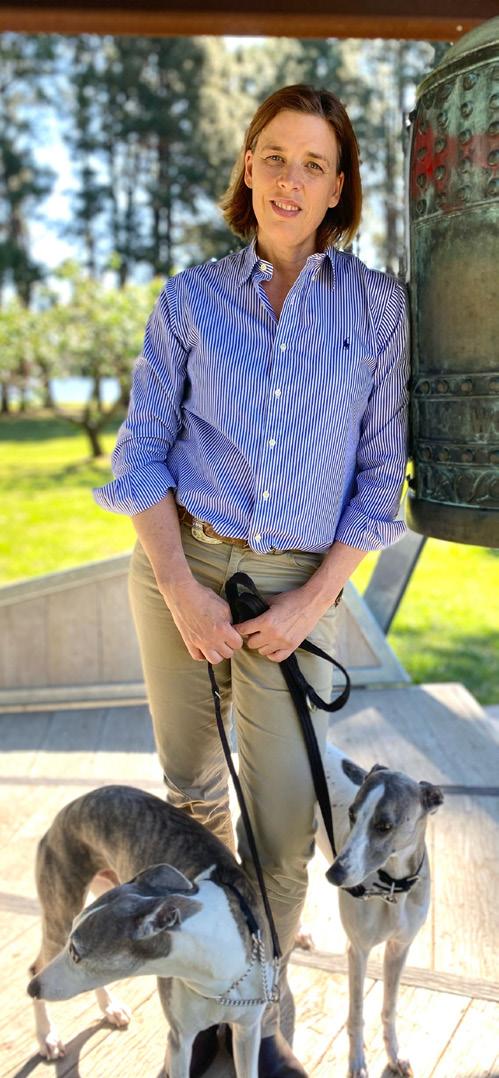
I was walking the yard late at night with my two whippets under the Canberra sky when it struck me: this wasn’t normal.
I wasn’t exercising. I wasn’t training. I wasn’t solving problems.
I was waiting for exhaustion to take over.
Only weeks earlier, I had been diagnosed with breast cancer.
A diagnosis like that strips life back to its essentials. Mortality becomes real. The future suddenly feels smaller. Even when treatment is successful, surgery, radiation, recovery – a quiet question often lingers: What if it comes back?
I had always believed I could manage whatever life threw at me.
I’m a former dual Olympic rower. I’ve run my own business for more than 27 years, much of it focused on health and recovery. I understand stress – physiologically, psychologically, professionally.
And yet, when it mattered most, none of that insulated me.
Sleep became elusive. My body felt tight and heavy. My thoughts looped relentlessly. Night after night, instead
BRIEFLY
Genevieve’s view
of resting, I paced the yard, accompa nied only by the dogs and the dark.
I knew the science. Chronic stress elevates cortisol. Muscles guard. Sleep fragments. Emotional range narrows.
But knowing something is not the same as living inside it.
When life shifts into survival
Lately, I hear the same conversa tion everywhere – at cafes, at work, catching up with friends. Life feels expensive, exhausting, relentless. Since the pandemic, there has been a subtle but profound shift in how people live inside their bodies.
Stress shows up differently now – disrupted sleep, shorter tempers, flattened joy. With constant notifica tions and little downtime, there is rarely space to process anything before moving on to the next demand.
Years ago, there was more room to recover from disappointment, effort, grief, even success. That space allowed the nervous system to reset. Today, many people aren’t fully engaging with life; they’re enduring it.
And when you’re enduring rather than engaging, the nervous system
CEO of Hands Across Canberra Genevieve Jacobs is guest speaker at the next lunch meeting of the Gungahlin Day View Club at The Lakes Golf Club, Gungahlin, from 11.30am on March 25.
Cost is $35 and all visitors are welcome. To attend, call 0413 923933.
Handmade Easter sale
There’s an Easter and Mother’s Day Market featuring all sorts of handmade items for sale at Kangara Waters Retirement Village, Joy Cummings Place, Belconnen, 8.30am-12.30pm, on March 21. Handicrafts include cards and popular knitted Easter chickens, with a chocolate egg inside, chocolates and other gifts suitable for Mother’s Day and a great selection of pre-loved jewellery. Cash or credit card accepted.
Inner south’s talking climate
The Inner South Canberra Community Council will present its submission to the next ACT Climate Change Strategy at a climate change forum it is hosting at Eastlake Football Club, Griffith, from 7pm on March 18.
Prof Beatrice Bodart-Bailey, is principal author of the ISCCC submission, “How can we weather the increasing temperatures of climate change?”.
She will be preceded by ACT government speakers Carolyn Goonrey, senior director Climate Change Policy and Bethel Sendaba, executive branch manager Climate Change.
To attend, register at trybooking.com/DKAFN, or via Zoom at us02web.zoom.us/meeting/register/ YgOgYABjRAazvJ3aSKM4ow
With decades of experience, Linda will help you create a Will and Estate plan stipulating all your wishes and concerns.
Linda assists with:
• Wills and Testamentary Wills
• Power of Attorney
• Self-managed super funds
• Advice on potential claims against estates
• Advice for blended families
For successful results in a cost effective manner call 6281 0999 or email kjblaw@kjblaw.com.au Ground Floor, 10 Corinna Street, Woden
thoughts at all.
They’re physical feelings.
I feel exhausted. I feel heavy. I feel
Feelings live in the body. When the same sensations repeat day after day, they begin to feel permanent, even when they’re not.
We often try to think our way out of stress. But the nervous system doesn’t respond to logic alone. It responds to sensation.
I often ask people a simple question: What’s the first thing you lose and the last thing you realise you’ve lost?
The answer is range of movement.
Finding a way back
In my career, I have worked with frontline workers exposed to critical incidents they couldn’t cognitively process. The principle was simple: movement can reach parts of the nervous system that thinking cannot.
During my own recovery, I returned to that idea.
Through gentle, spine-first movement performed in a specific sequence, something shifted. Breathing softened. Internal noise settled. Attention moved out of my head and back into my body.
Most people prepare carefully for their day. Very few prepare for sleep.
But sleep isn’t passive. The nervous system needs to feel safe enough to let go.
Redefining resilience
We talk a lot about resilience, pushing through, staying strong without acknowledging how tired people really are.
Resilience isn’t always about standing up.
Sometimes it’s about being able to lie down comfortably.
If you can’t sleep, you can’t recover. And without recovery, everything else becomes harder, including thinking clearly and connecting with others.
I no longer walk the yard at night. I walk the dogs in the morning now.
The challenges haven’t disappeared, but I’m meeting them present, not trapped.
So as conversations continue about the cost of living, it may be worth asking another question: Am I living or am I just enduring?
Because the cost of not living doesn’t show up on a balance sheet. It shows up in the body. In sleep. In how connected we feel to ourselves and to others.
The way back doesn’t start in the mind alone.
It starts when physical and psychological recovery work together.
Bronwyn Thompson MAPS, is principal psychologist, Psychologists Canberra.
Why would Albanese support an illegal war?
It’s a cop out to claim Israel and the US need to sort out the legality of commencing a war. More so, with Prime Minister Anthony Albanese doing this as an afterthought.
I have long admired Albanese’s approach of respect for world leaders, even when they were not showing respect themselves. However, support for an illegal war conducted by a certifiable president and an Israeli war criminal demonstrates seriously poor judgement.
What on earth made the prime minister jump in so quickly to support the actions of Donald Trump?
There are only two valid reasons for launching a war. When it is based on retaliation, or with approval of the UN Security Council. Neither apply to the action supported by our prime minister.
International laws have been put in place to avoid the “might-is-right” approach that led to the two world wars in the 20th century. Australia’s Herbert “Doc” Evatt was part of drafting the UN Charter to ensure the International Rule of Law.
In one stupid statement, kowtowing to the American allies, Albanese has undermined the non-partisan efforts for 80 years to maintain peace throughout the world.
Albanese said Australia was first to back the military action to “prevent Iran from obtaining a nuclear weapon and to prevent Iran continuing to threaten international peace and security”.
The only other countries offering this sort of unguarded support to the US and Israel were Canada and Ukraine.
Although pointing the finger at Iran, the reality is that over the last hundred years the US has started more wars than any other nation. Over the same period, and much longer, Iran has started none.
The US and Israeli rhetoric makes a great deal of Iran’s proxy players such as Hezbollah and Hamas. In the same sense, isn’t the US a “proxy” of Israel?
There are only two valid reasons for launching a war. When it is based on retaliation, or with approval of the UN Security Council. Neither apply to the action supported by our prime minister.
For the last four years, as Israel has slaughtered men, women and children in the Gaza strip, the US has been a proxy, busily providing support and countering negative motions in the UN.
A short while before the full-scale attack on Iran, the negotiators in Oman announced that agreement on the Iranian nuclear program was close. President Trump ignored his own deadline. How can a president like this be trusted? How can he be respected?
According to US Secretary of State Marco Rubio, “we knew that there was going to be an Israeli action… we knew that would precipitate an attack on American forces”.
This was the excuse for US forces attacking to minimise their own casualties. The Israeli war criminal, Netenyahu, who claimed in his TV interview that “he has waited 40 years for this” was once again pulling the puppet strings on President Trump.
US Senator Bernie Sanders identified the action as “an illegal, premeditated and unconstitutional war” with the aim to “fulfill Netanyahu’s decades-long ambition of dragging the US into armed conflict with Iran”.
Trump’s excuses for starting this war are pathetic and constantly changing. Gregg Carlstrom, in The Economist, wrote that Trump “doesn’t sound convinced by any of it. He’s throwing spaghetti at the wall”. He caved to Prime Minister Netenyahu and the Israeli lobby.
The US has started many wars. Since World War II Australia has largely been supportive. Ironically, the current Middle East war even lacks support in America with only 25-33 per cent of Americans in a range of polls agreeing with the action.
The Australian Labor government has modified its stance. As local
MP Andrew Leigh explained in his newsletter: “While it is up to the United States and Israel to explain the legality of their actions under international law, the Australian Government has said clearly that we stand with the people of Iran”. That is very different from the initial statement of support for the US and Israel. Standing with the long-suffering people of Iran does make sense. But Labor is wrong! It is not up to the protagonists to explain the legality of their actions. The war is illegal under international law and ought not have Australia’s support. President Trump does not need any encouragement – every effort should have been made to contain him in Venezuela and now the Middle East.
It seems that the UN has failed in one of its key objectives as the international rule of law is being replaced with “might is right”.
Michael Moore is a former member of the ACT Legisla tive Assembly and an independent minister for health.
Opening: The Hon. Tara Cheyne MLA, Attorney General for the ACT
Jo Twible & Emma Bragg: Village Models and Legal Considerations when Entering a Village Craig Phillips: Financial Considerations when Entering a Village
Meet the residents: Village residents share their experience. Moderated by Luisa Capezio
Karen Toohey, ACT Discrimination, Health Services, Disability & Community Services
Commissioner:
Smoke rises after a US-Israeli airstrike in central Tehran.
Photo: EPA
A second opinion on hearing loss – you need professional advice, not a sales pitch
A woman came into my clinic for a consultation about her hearing aids, telling me her hearing aids were 4 years old and she had never found them to be of much help. She said the salesperson quoted her $14,000 for a pair of hearing aids, however, the monthly special of 20% discount meant they cost her $11,200. So, she ‘only’ paid $11,200 for hearing aids that did not help her. Sadly, I hear this all too often.
Here are some things to do to avoid this type of problem:
1. Visit your GP. If you or someone you know has a problem with their hearing, visiting your GP to check for wax in the ears, and to get advice is a starting point.
2. Qualifications. Always check the qualifications of the person you are dealing with. A person without professional qualifications has no business advising you about your hearing. They need to belong to a professional association with a Code of Conduct, so you know they are acting in your best interests, not their own.
years. If you are not sure about their advice, then seek a second opinion. The wrong hearing aids can be an expensive waste and could lead you to stop wearing them. You should always have a trial of hearing aids to ensure that they are right for you.
6 Pensioners and eligible DVA card holders often have entitlement to free services. If you are covered by a government concession, then let the clinician know (even though your clinician should ask). Eligible clients may obtain free hearing tests, consultations, and free hearing aids (referred to as fully subsidized hearing aids).
“A person without professional qualifications has no business advising you about your hearing. They need to belong to a professional association with a Code of Conduct, so you know they are acting in your best interests, not their own.”
– Dr Vass
These hearing aids are appropriate for many people, however if you have great difficulty hearing in background noise (for example a restaurant), then you may want to consider partially subsidized hearing aids. This is when the government pays a certain amount, and you pay for additional features and benefits. Your decision should be based on the following:
you are dealing with a qualified clinician, then they belong to a professional association. The best contact is an independent complaints body referred to as Ethics Review Committee. You can email ethics@auderc.org.au and view the website www.auderc.org.au. You can make an anonymous complaint and your complaint will be handled in a confidential and professional manner. If you are in the ACT, contact the ACT Human Rights Commission email human rights@act.gov au and the website www.hrc.act.gov.au
3. Independent advice. You should get independent, professional advice.
4. There are a wide range of hearing aids out there. Finding the right hearing aids for your communication needs can be challenging. Hearing aids vary in price and performance. Bluetooth® connectivity and rechargeable hearing aids are available on most hearing aids, along with apps that allow you to control your hearing aids from your mobile device. Be aware that just because a hearing aid is more expensive, that doesn’t mean they are the best hearing aid for you.
5. Just as hearing aids vary in performance, clinicians may also vary in performance due to training, experience, and skills. Make sure that you are comfortable and confident in their advice. You are likely to be with this clinician for the life of your new hearing aids, typically 4 to 5
(a) Can you afford the more expensive hearing aids? Don’t go into financial stress if you can’t afford them. (b) Are you clear on the free vs partially subsidized features & benefits? Never believe someone who tells you the free hearings are not good or of poor performance, this is simply not true. (c) If you try the partially subsidized hearing aids and are not happy, then return them. Do not keep hearing aids because you think the failure is yours or that you will improve over time. If the hearing aids are not working for you in the trial period, then they will not work for you in a year or two.
7. If you have a complaint, then seek help. Your clinician should be able to help you through most of your needs. Sometimes, a problem may be beyond the expertise of even the best clinician. However, if you have a complaint there are things you can do. If
PUBLIC HOUSING / where the ombudsman fell short
When those we elect choose not to see and hear
“These days the ACT law is ignored with respect to public housing tenants. It’s pointless to order compliance because there is no capacity to comply.” HUGH SELBY says the ACT Ombudsman’s chastising of Housing ACT falls short.
Housing ACT is responsible for nearly 12,000 rental properties, a large number for any organisation.
The ACT Ombudsman has released a report, Falling through the Gaps, which is a disappointing study of how Housing ACT mismanages its tenants’ requests for repairs.
Imagine your job is to investigate complaints about the timeliness and quality of repairs on rented public housing.
You have received complaints from tenants about a particular landlord, Housing ACT. The number is sufficient to warrant an investigation that looks at all the possible causes of complaint and then sets out an action plan for response by the landlord that will alleviate the problems, and over time, get rid of them.
Guide to a useful investigation
Step one is to find out whether the size of the repair problem is big or small. Invite tenants to contact you about their experiences – good and bad.
You would also trawl through Housing ACT records of complaints from tenants, looking at what was being complained about, how responses were prioritised, how long tenants had to wait and the feedback about the quality of repairs.
Step two is to have a close look at the legal obligations placed upon Housing ACT with respect to the timelines to make its properties structurally sound and safe.
Step three, therefore, is to see how closely Housing ACT’s repair performance complies with, or departs from, its legal obligations.
Step four follows from finding that Housing ACT does not have the capacity to meet its legal obligations. What applies to private landlords is fantasy land for the tenants of Housing ACT. Hence the step four task is to find out what capacity does Housing ACT have to carry out repairs.
Is there a budgeting issue? What funds has our government given to Housing ACT to keep its rental properties up to scratch?
Given the earlier attention to finding out the number and types of repair problems it would be possible, by using quantity surveyor expertise, to measure any shortfall in the repair budget.
Step five is to look at the availability of quality tradespeople to do the work. If there are too few available in any trade, then how is that shortfall going to be fixed?
Given that the ACT has a growing population (it should reach half a million this year) what is the capacity of our trades training to attract new applicants and turn out “ready-towork” tradespeople?
Step six is to recognise budget and
Need legal advice you
trades shortfalls and address the vexing issue: given too little money and too few trades how does Housing ACT prioritise the repair work that the law requires it to do?
Gap between law and reality
These days the ACT law is ignored with respect to public housing tenants. It’s pointless to order compliance because there is no capacity to comply.
The government could, in theory, share with everyone that we’re in a deep financial hole, that our borrowing capacity is stretched to breaking point, and that tenants should be asking emergency services for tarps for the leaking roof, financial assistance
from charities to buy weekly a bottle of mould cleaner, and retired men’s groups to cut down broom handles to keep windows open or closed. That will not happen. Our leader will go on another wonderful overseas trip while the minister will say nothing, or, if absolutely necessary, utter some pointless platitudes.
When those we elect choose to see and hear no trouble then it is a tad unfair to expect public servants to do something else. After all, the best answer to complaints is to ignore them: most disappear because the complainant grasps the futility of it all.
Occasionally it’s necessary to be seen to act. Take Little Dion and his gran about whom and their leaking, mouldy home we wrote repeatedly in 2025. They were much helped by Community Law and a community advocate.
Dion got an early Christmas present. They moved into a new Housing ACT build.
But back to prioritising repair works: short and sweet – it’s a policy nightmare. It’s best to maintain the chaos. Perhaps that explains how pointless the Ombudsman report is. It ignores all the issues discussed above. It’s a Band-Aid solution to a festering wound.
Hugh Selby is the CityNews legal columnist and a former barrister.
Canberra’s new hub for aged care excellence: Goodwin opens state-of-the-art training centre
On Friday, 8 March, Goodwin Aged Care Services officially opened its new Goodwin Training Centre in Crace.
This innovative purpose-built facility represents a bold investment in the local workforce, marking the first time in Goodwin’s history that a dedicated, centralised hub has been established to strengthen capability, compliance, and professional development across the organisation.
The Centre is designed to transform the way aged care professionals grow and develop, moving away from fragmented, site-based training toward a unified system of excellence.
Pauline Hugler, Executive Manager Development, People and Culture, provided the strategic leadership to bring this vision of a dedicated facility to life.
“This Centre represents a significant investment in our people and our future,” says Hugler. “It is not simply a physical space, but a structured system that strengthens workforce competence and builds the skills and confidence required to deliver consistent, high-quality care across our residential, community, and corporate services”. The centre forms the cornerstone of Goodwin’s long-term strategy to meet the evolving needs of an aging population.
Innovation through simulation
What sets the Goodwin Training Centre apart is its focus on simulation-based learning The facility includes a dedicated simulation training mannequin specifically designed to replicate real-world care settings.
Staff can practice critical skills – ranging from complex clinical procedures and manual handling to emergency responses
and sensitive communication techniques, in a safe and supportive environment.
Anshi Reddy, General Manager Education, Development and Capability, emphasises the importance of this hands-on approach in building a workforce that is ready for the challenges of modern aged care.
“By embedding simulation and competency-driven learning, we are moving beyond traditional ‘tick-box’ compliance,” notes Reddy. “Our goal is to ensure that learning is relevant, measurable, and deeply embedded into daily practice. When staff can practice managing complex care scenarios in a controlled setting, they return to our
residents with increased in self-reported confidence”.
A “People First” philosophy
The establishment of the Centre comes at a time of significant reform in the aged care sector, with increased regulatory requirements and higher expectations for workforce qualifications. Goodwin’s decision to centralise training was a proactive response to these pressures, ensuring that every one of their 800+ staff members has access to the same high standard of education.
Goodwin CEO Stephen Holmes
highlighted that this investment is, at its core, about the people the organisation serves.
“Everything we do today must improve the outcomes for our residents and clients,” Holmes said. “Goodwin is a ‘People First’ organisation; we are a community of people providing essential services to people. All we do is care-focused, and this the Goodwin Training Centre further enables us to provide world-class training to our staff, which directly benefits our clients and residents. We are proud to be the only aged care provider in the ACT with a dedicated training centre.”
Elevating the standard of care
The Training Centre serves as a testament to the professional dedication of the Goodwin workforce, which includes 270 staff with Certificate III/IV qualifications and a clinical backbone of 100 Registered Nurses. By centralising training, Goodwin ensures that every team member, regardless of their role or location, has access to the highest standard of professional development.
For Canberra residents and families, the impact of this investment is found in a more confident and capable workforce.
By providing clear career progression pathways and investing in professional growth, Goodwin ensures that seniors in Canberra and the Greater Capital Region receive care delivered by professionals who are continuously developing their skills.
The Goodwin Training Centre represents a permanent shift toward a culture of excellence, ensuring that workforce capability is demonstrated, tracked, and strengthened daily to support exceptional, person-centred care.
For more information, visit: goodwin.org.au/careers
Left to Right: Linda Willington (Head of Department Human Services Canberra Institute of Technology), Dipa Awale (Goodwin Clinical Nurse Educator) & Anshi Reddy (Goodwin General Manager Education, Development and Capability) attending the Goodwin Training Centre opening in Crace.
Does ‘free’ shipping really exist? ADRIAN CAMILLERI shares the marketing tricks you need to know.
You’re scrolling through an online retailer, such as Amazon, Shein or eBay, and spot a shirt on sale for $40.
You add it to your cart, but at checkout, a $10 shipping fee suddenly appears. Frustrated, you close the tab. But what if that same shirt was priced at $50 with “free” shipping? The likelihood that you would have bought it without a second thought is much higher.
Covid changed the way we shop and accelerated our reliance on e-commerce. But as online sales have grown, so has the expectation of free delivery.
The reality, however, is that shipping physical goods is never actually free. Retailers use subtle marketing strategies and psychological hacks to mask these costs. As a result, consumers are often the ones footing the bill.
The magic of zero
There is something uniquely attractive about the concept “free”. In behavioural economics, zero is not just a lower price; it flips a psychological switch.
When a transaction involves a cost, we instinctively weigh the downside.
But when something is entirely free, we experience a positive emotion and perceive the offer as more valuable than it is mathematically.
Retailers no doubt realise that offering free delivery is one of the most effective ways to stop a consumer from abandoning a digital shopping cart.
The minimum spend trap
Perhaps the most common marketing tactic is the free shipping threshold. Sometimes this is phrased as: “Spend $55 to qualify for free shipping.”
If your shopping cart is sitting at $40, you face a dilemma. You can pay $10 for postage, or you can find a $15 item to reach the threshold. Many of us choose the latter, reasoning it is better to get a tangible product, such as a pair of socks, than to “waste” money on shipping.
This tactic uses the “goal gradient effect”, which describes the tendency to put in more effort the closer we get to a goal. It also works incredibly well for the retailer.
Research shows that free shipping increases both purchase frequency and overall order size. Policies with a threshold for free shipping often prompt this exact “topping up” behaviour. The consumer ends up buying
things they did not initially want, thus boosting the retailer’s sales.
Baked-in costs and the reality of ‘free’ returns
Another strategy is unconditional free shipping, where the delivery cost is simply baked into the product’s base price. This allows consumers to avoid the “pain of paying” a separate fee at checkout. However, we are still paying for the postage through higher item costs.
For retailers, offering unconditional free shipping without a markup can be difficult to sustain profitably. The bump in sales usually does not offset the lost fee revenue and the
costs of fulfilment.
A major reason for this lack of profitability is that free shipping leads to significantly higher product return rates.
Consumers tend to make riskier purchases if the appearance of waived fees lowers the perceived financial risk of the transaction.
For example, you might order the same shirt in two different sizes, knowing you can just send one back for free. Who pays for that added convenience? The retailer, who now has to cover the courier fees twice.
The retailer usually won’t simply absorb this cost, but will have to pass
it on in other ways.
Don’t buy the illusion
The age of limitless free shipping may be coming to an end.
As global supply chain costs remain volatile, we are likely to see retailers raising their minimum spend thresholds, removing offers, or increasing base product prices to compensate.
The next time you are shopping online, resist the urge for instant gratification.
If you are about to add a $15 pair of novelty avocado socks to your cart, just to save $10 on shipping, take a step back. Ask yourself if you truly need that purchase to arrive this week. Instead of rushing to checkout, let your digital basket fill up naturally over time with items you actually need. You will eventually hit the threshold, but on your own terms.
“Free” delivery is just a clever psychological illusion. The cost is rarely eliminated; it is simply redistributed into higher product prices or reframed as a loyalty perk.
Don’t let the allure of “free” shipping trick you into paying for more than you intended.
Adrian R Camilleri, associate professor of marketing, University of Technology Sydney. Republished from The Conversation.
Photo: Claudio Schwarz/Unsplash
property market is surging, outpacing the
Regional housing market booms, outpacing capitals
By Stephanie Gardiner in Orange
With the prospect of paying at least $1 million for a home in many of Australia’s capital cities, buyers are once again looking to escape to the country.
The regional property market surged in the three months to January, outpacing the capitals, according to the latest figures from data firm Cotality.
Dwelling values rose 3.2 per cent for the quarter in regional areas, compared to 2.1 per cent in the combined capitals.
Competitive market conditions in the cities, poor housing affordability and a boost in internal migration sent buyers packing for the country long after COVID-19 lockdowns sparked the initial migration trend.
“With capital city prices still near record highs and stock levels tight, many households are once again looking to regional Australia for greater value and livability,” the firm’s head of research Gerard Burg said.
“We’re seeing momentum build across a wide range of regional markets, from inland hubs to coastal centres and miningadjacent regions.
“This reflects a renewed movement of people and capital into areas where buyers’ budgets stretch further and competition for available homes is strong.”
Sydney’s median home value sat at $1.23 million in January, followed by Brisbane at $1.02 million, with Perth and Adelaide tipping over $900,000, according to a PropTrack
report released in February.
Compared to those cities’ prices, many of the fastest-growing regions can offer only modest housing affordability relief, if any.
Queensland’s Sunshine Coast had a median value of more than $1.2 million in January, with weekly rents at $832, Cotality’s data showed.
Geelong, a Victorian port city and hotspot for Melbourne escapees, had a median value of $771,298, with rents at $558.
The NSW Hunter region has long been one of the fastest-growing areas in Australia, with a median of $956,142 and rents at $698 in Newcastle-Maitland.
The market report showed Wagga Wagga, in southern NSW, experienced the highest growth in value at 8.1 per cent for the quarter.
The median value in the regional city was $665,062 in January.
Regional Western Australia had the strongest growth among the states, with values rising 6.1 per cent, up from 4.9 per cent.
Albany, a coastal city on the state’s southern tip, experienced a value hike of 7.7 per cent, with a median value of $783,389.
Queensland and South Australia’s markets also grew, while regional NSW and Victoria only shifted slightly.
Small local market declines were recorded in the Bowral, Mittagong and Bateman’s Bay regions in southern NSW, and in Warrnambool on Victoria’s Great Ocean Road.
Regional rent growth was slightly above the capitals at 1.6 per cent, compared to 1.4 per cent.
Rents outside the cities have risen by almost 42 per cent in the past five years, well ahead of wage growth at 17.5 per cent. –AAP
Research shows the regional
capital cities. Photo: Stephanie Gardiner/AAP
FEATURE / astronomy
Should we worry when stars fall from the sky?
You have more of a chance of being struck by lightning or kicked to death by a donkey than dying through meteorite impact. But should we be concerned? ROSS FITZGERALD & DICK WHITAKER say the short answer is no, but the long answer is yes.
Planet Earth is enshrouded by a protective blanket – the atmosphere – that enables life as we know it, in all its forms, to exist.
But of equal importance, it provides an invisible shield that protects us from the fusillade of “space rocks” that constantly bombard us from outer space.
There are three basic kinds of these “rocks” – asteroids, meteoroids and meteorites.
• Asteroids are rocky bodies orbiting the Sun, mostly between Mars and Jupiter. They can vary in size from around 10 metres across to the dimensions of a city and travel at hypersonic speeds of around 50,000km/h.
• Meteoroids are generally smaller space rocks that could originate as asteroid fragments or just random chunks of rock travelling through space. They vary greatly in size from that of a pebble to boulders around 10 metres across. They too can travel at hypersonic speeds.
EXPERIENCED FEMALE GP IN CANBERRA
ACCEPTING NEW PATIENTS
Located in the heart of Canberra’s medical precinct in Deakin
At Canberra Family Health Centre, we are dedicated to providing comprehensive, patient-focused healthcare for individuals and families. Located centrally in Deakin, our centre offers a wide range of medical services designed to meet your health needs at every stage of life.
• Meteorites are fragments of meteoroids that survive entry through Earth’s atmosphere and actually reach the surface. After entering the atmosphere at hypersonic speeds, they are slowed down through friction with the air but still travel at supersonic speeds (above the speed of sound) before striking the ground.
Meteors, on the other hand, are not rocks but visible streaks of light (called shooting stars) produced when a meteorite enters Earth’s atmosphere at high speed and burns up due to friction.
In most cases the rock will burn up or vaporise before reaching the ground, and it is this protective property of the atmosphere that has played a big part in the survival of life on Earth. Without it we would look like the Moon that has no such protection and is pockmarked with impacts from many thousands of meteorites.
On rare occasions much larger
space rocks – such as asteroids – will enter the atmosphere, with a size massive enough to reach the lower levels of the atmosphere as a large coherent body.
If the rock is extremely large, it will remain mostly intact all the way to the surface, eventually striking the ground with colossal force, producing a large-impact crater. If the impact is over the ocean, a gigantic tsunami is almost certain.
It is believed that an event like this – some 66 million years ago –
Associate Professor Maryse Badawy
MB/ BS Degree, FRACGP, FHKAM (Family Medicine), Grad Dip Fam Med, Master Family Medicine, Member Australasian Menopause Society
National and International Family Medicine and Academic experience.
produced a cataclysmic explosion of such a scale that the atmosphere around the world was affected, with the extinction of the dinosaurs a consequence.
It was produced by a space rock (likely an asteroid) about 10km across travelling at hypersonic speed.
The resultant crater, located near Mexico’s Yucatan Peninsular is still detectable, around 200km across and 30km deep.
Large and ancient impact craters have also been discovered in other areas, including the US and Australia.
In WA, Wolfe Creek is a large-impact crater located in the desert, about 150km to the south of Halls Creek.
It is estimated that this crater was produced by a meteorite that had a mass of some 14,000 tonnes striking the surface at hypersonic speed around 120,000 years ago. The crater is about 900 metres across and 60 metres deep.
So what would happen if such an object were to strike a modern city – such as Sydney or Melbourne? The short answer is – disaster.
The impact crater would likely take out a suburb, and the associated shockwave and impact vibrations would probably destroy much of the city.
So, should we be concerned?
The short answer is no but the long answer is yes. Events such as Wolfe Creek probably only occur about once
every 200,000 years, and in the great majority cases the actual impact point would likely be in a non-urban area such as an ocean. You have more of a chance of being struck by lightning or kicked to death by a donkey than dying through meteorite impact.
Nevertheless, the late Prof Stephen Hawking, an eminent astrophysicist and cosmologist, considered a major asteroid impact on Earth to be inevitable, especially when considered over a long time period of millions of years.
If a large asteroid with a trajectory on a collision course with Earth is detected several solutions have been proposed to save us.
These include interception with a nuclear missile to destroy the object or change its path before it reaches us. The use of a so-called “gravity tractor”, has also been suggested, that is the manoeuvring of a large spacecraft near the asteroid so that the gravity of this machine would, over an extended period, exert a continuous gravitational pull on the asteroid and deflect it from Earth. It is not known whether these ideas would be effective.
Ross Fitzgerald AM is emeritus professor of history and politics at Griffith University.
Dick Whitaker is a widely published author and lecturer in the fields of meteorology and Australian history.
The surface of the Moon… scarred by countless meteorite impacts. Photo: Wikipedia
‘It’s the vibe’: Labor rejects inconvenient truths
Previous ACT administrations have balanced budgets, provided above average service delivery, kept taxation at or below average rates, invested in infrastructure, and all without accruing debt. What’s changed? JON STANHOPE & KHALID AHMED know the answer…
“In summing up it’s the constitution, it’s Mabo, it’s justice, it’s the law, it’s the vibe and, no that’s it, it’s the vibe. I rest my case.”
These words, spoken by the hapless suburban solicitor Dennis Denuto in the iconic Australian film The Castle (1997), illustrate the confusion and desperation often seen when an argument lacks substance.
Denuto, out of his depth, clutches at straws to convince the High Court judges he was appearing before that he has a case.
When the Legislative Assembly finally turned its focus to the ACT’s precarious finances and sub-standard services, the government and its supporters seem to have channelled Denuto’s approach.
Their explanations and excuses came thick and fast, passing largely unchecked and unchallenged in the media. The flavour of their reasoning included:
It’s the Commonwealth Grants Commission methodology, it’s the national capital influences, we can’t put high-rise housing in the parliamentary triangle, we can’t tax Commonwealth government departments, it’s the federal government being unfair, it’s the city-state model, not
enough revenue, it’s the Greens blocking revenue measures, it’s health costs. These are the reasons for the deficits and debt.
While Denuto is well meaning and manages to identify the constitution as the central issue, his inability to express it authoritatively mirrors the ACT Government’s vain attempt to explain the dire budget situation.
Many of the “explanations”, delivered with confidence, have apparently even persuaded some in the opposition to accept them as valid despite them being either incorrect, irrelevant, or having minimal impact. Even if valid, they certainly don’t explain or justify last year’s $1.4 billion deficit, which accounts for 15 per cent of the budget.
indicators or targets to present a better narrative, or simply removing measures that reveal poor performance.
compensation payments, the ACT nevertheless taxes its available bases at the highest rate of all jurisdictions.
In 2012-13, the ACT was a below-average taxing jurisdiction. However, through some of the highest and persistent tax increases, the ACT is currently the highest taxing jurisdiction in Australia.
City-state model
From time to time the city-state model is identified as a cause of poor municipal services or poor execution of state functions under the premise that focus on one detracts from the other.
That, with respect, may be a reflection on the capacity of the current administration because the model of itself did not cause a deterioration of services in previous administrations.
In fact, combining the functions and powers of local and state government provides unique opportunities for efficiency and reform that are not available in other jurisdictions.
Some explanations have been walked back, such as payroll tax on the Commonwealth, after the Commission advised that the ACT would be worse off in that scenario. In response, Treasurer Chris Steel reportedly expressed support for Horizontal Fiscal Equalisation, the principle that guides the distribution of funds across jurisdictions.
The “mindset problems” referenced previously are not new. They have manifested over time in various ways: blaming service users for health performance, attributing homelessness to interstate migration or the preferred choice of the homeless themselves, changing performance
Poor performance and a tendency to deny it reinforce each other. Resolving one would in large measure address the other. The following sections briefly discuss the specific factors that have been suggested as the underlying causes of the ACT’s financial viability issues.
Grants Commission assessment
We have explained previously the principles and approaches adopted by the Commission. The key principle is to provide all jurisdictions with the same fiscal capacity considering their individual circumstances.
The ACT has always received payments above what it would be entitled to under an equal per capita distribution by between 10-20 per cent. Any suggestion, therefore, that the ACT’s fiscal capacity is adversely affected by the Grants Commission’s distribution is contrary to or completely misunderstands the fundamental arrangements of the federation.
Tellingly, as far as we are aware, the ACT has never raised this issue in a relevant forum.
There were, for example, three five-yearly methodology reviews and more than a dozen annual updates during the time Andrew Barr has been the treasurer or chief minister.
Notwithstanding the regular public complaints by the ACT Government of unfair treatment, we have been unable to find a single formal objection to the principles in the Territory’s submissions to relevant reviews or updates. Notably, the ACT has been generally supportive of the proposals for approach/ methodology changes or their retention by the Commission.
While the ACT has indeed raised concerns about the undercount of population by the ABS in the inter-census years it has been unable, to date, to propose a method or data source that the Commission could universally apply.
The Commission has decided not to adjust for (ie, provide benefit for) any potential economic benefit from tax reform – readers may not have heard about it – because there is no evidence for it according to, yes, the ACT’s own consultants’ report! We have written previously on this issue and will revisit it to illustrate how tax reform failed in delivering the claimed economic benefits.
Taxation capacity and effort
It is indeed the case that the Territory has a relatively low taxation capacity due to its inability to tax the Commonwealth and absence of (say) mining, manufacturing and agriculture. As we have explained previously, the ACT is, however, compensated through additional GST payments in a way that assumes it had an average capacity.
Notably, however, having pocketed those
Take for example the phase out in the ACT of stamp duty with general rates as a replacement base, as has occurred in the ACT. Other jurisdictions, notably NSW and Victoria have, because of their two-tiered governance arrangements, had to adopt quite convoluted and effectively unworkable mechanisms. It is, sadly, however, another “reform” in the ACT that has been squandered through the ACT Government’s contradictory and flawed policies. Health and cross-border services
Health has not, as is regularly touted, broken the ACT budget. The $200 million blowouts in the past two years have been due to poor budgeting practices in the massive underfunding in the budget, to the extent it did not meet wage costs or inflation in existing activity.
Cross-border use of hospital services (by NSW patients) is also wrongly used as an excuse for the relatively higher unit costs in health. In fact, activity related to NSW patients provides economic and more importantly clinical scale without which many specialties would not be viable in the ACT.
The ACT receives payments under a bilateral agreement from NSW broadly on the basis of marginal costs of service provision rather than fully distributed cost. This has been in place for a long time and could hardly be blamed for the overall budgetary problems. As such, the ACT does not have a structural financial viability problem; its current financial position and service delivery performance are a consequence of more than a decade of poor budgeting and a lack of fiscal discipline, financial mismanagement and the misallocation of resources to low benefit projects rather than to high-value core services.
Clearly, there is a reluctance to accept inconvenient truths: previous ACT administrations of different political backgrounds have managed to balance the budget, provide service delivery above the national average, keep taxation at or below average rates, invest in infrastructure, and achieve all this without accruing debt.
This begs the questions: what has changed and what was different then? It also points to our second “silver bullet”: adhere to the standard principles of public financial and budget management, namely: (a) fiscal discipline; (b) prioritisation and balanced resource allocation to high-value outcomes; and (c) efficiency in service delivery.
We will, in a future article, discuss some of the specific tools adopted by prior administrations which have been recklessly abandoned by the current government.
Jon Stanhope is a former chief minister of the ACT and Dr Khalid Ahmed a former senior ACT Treasury official.
Tiriel Mora as Dennis Denuto in The Castle… the ACT Government and its supporters seem to be channeling the hapless suburban lawyer.
WHIMSY / the unruly evolution of English words
When awful means terrific and terrific is awful
“The trouble with words is you never know whose mouth they’ve been in.” – Dennis Potter
English is a language in constant flux, shaped by centuries of borrowing, cultural shifts and semantic drift.
What begins as a precise term can evolve into something contradictory, confusing, or even the opposite of its original intent.
This phenomenon is particularly evident in words whose meanings have inverted over time or in “contranyms” (also known as auto-antonyms) –single words that can mean both one thing and its opposite depending on context.
Contranyms and contronyms are the same thing. They are also called Janus words after the two-faced Roman god.
I’ve explored a selection of such words, consistently tracing each from its original meaning (etymological root and earliest English usage) to its modern primary meaning, using sources such as the Oxford English Dictionary and Merriam-Webster.
Semantic shifts: words that flipped or diverged
Artificial
• Original meaning: Made by human skill or art (Latin artificialis, from artificium “craftsmanship”). Neutral or positive in early English (14th century), implying ingenuity.
• Modern meaning: Fake, synthetic, or not natural—a pejorative shift in the 18th–19th centuries with industrial connotations. Awful
• Original meaning: Full of awe; inspiring reverence or wonder (Old English awe “fear” + full). Used positively or neutrally until the 18th century.
• Modern meaning: Very bad, unpleasant, or dreadful – the awe-inspiring sense eroded, leaving only negativity by the early 19th century.
Disgruntled
• Original meaning: Made discontented or dissatisfied (intensive form of gruntle, a frequentative of grunt, implying grumbling; first as disgruntle in 1682).
• Modern meaning: Angry, irritated, or sulky. Notably, gruntle alone never meant “happy” in standard usage (though humorously revived in the 1920s as a back-formation, eg, “gruntled employee”); the word is inherently negative.
Egregious
• Original meaning: Outstandingly good or distinguished (Latin egregius “illustri -
What begins as a precise term can evolve into something contradictory, confusing, or even the opposite of its original intent.
ous,” from ex grege “out of the herd”). Positive in English from the 16th century.
• Modern meaning: Outstandingly bad or flagrant – an ironic reversal by the 18th century.
Extraordinary
• Original meaning: “Outside the ordinary order of things” (Latin extra“beyond” + ordinarius “orderly, regular,” from ordo “order”). Entered English in the 15th century (c. 1440) to denote something exceptional or beyond normal rules.
• Modern meaning: Remarkable, amazing or very unusual retaining the sense of exceptionality, though the prefix extra is now often mis-parsed as “more” (as in “extra cheese”), leading to etymological confusion.
Nice
• Original meaning: Foolish, ignorant, or stupid (Old French nice “silly,” from Latin nescius “ignorant”). Entered English in the 13th century with negative connotations.
• Modern meaning: Pleasant, agreeable, or kind – a gradual polite euphemism from the 18th century onward.
Nonplussed
• Original meaning: “No more can be said or done” (Latin non plus “not more”). First recorded in English in 1582 as a state of being utterly perplexed or at a loss.
• Modern meaning: So surprised or confused that one doesn’t know how to react – essentially unchanged, though sometimes misused to mean “unfazed.”
Regardless / Irregardless
• Original meaning: Regardless (c. 1590): Without regard or heed (from regard + -less). Irregardless (early 19th century, blend of irrespective and regardless): Intended as emphasis but creates a double negative (ir- “not” + regard + -less “without”).
• Modern meaning: Both mean “without regard” or “nevertheless.” Irregardless is nonstandard and often criticized as redundant, though accepted in informal speech for emphasis.
Sanction
• Original meaning: A binding decree or ordinance (Latin sanctio, from sancire “to make sacred/inviolable”). Could imply enforcement in either direction; in English (16th century), initially “authorise” or “ratify.”
• Modern meaning: Either “approve/permit” or “penalise/impose penalty” – a true auto-antonym, with both senses coexisting since the 18th century.
Silly
• Original meaning: Happy, blessed, or innocent (Old English sælig “blessed,” from Proto-Germanic sˉeligaz “happy”). Positive in Middle English.
• Modern meaning: Foolish or absurd – a downward shift via “innocent” to “simpleminded” by the 16th century.
Sophisticated
• Original meaning: Corrupted, adulterated, or made unnatural (from Medieval Latin sophisticare “to tamper with,” linked to sophistry). Pejorative in early English (17th century).
• Modern meaning: Polished, refined, or worldly – a positive shift in the 19th–20th centuries, especially in technology and culture.
Terrific
• Original meaning: Causing terror (Latin terrificus, from terrere “to frighten” + -ficus “making”). First in English c. 1660.
• Modern meaning: Wonderful, excellent, or impressively good – a 19th-century shift via “intense” to positive exaggeration.
Clive Williams is a Canberra columnist.
RETIREMENT ON
•
• I have 23 years of experience in advising retirees in the Canberra region.
• Extensive experience in government super such as CSS and PSS.
• Centrelink advice and implementation.
• Is a redundancy right for you at this time?
Labor needs to get on with priority of governing
I refer to the article (citynews.com.
au March 4) by Dominic Giannini that brought to our attention the number of parliamentary committee reports that have not been responded to.
These House and Senate reports are an important part of the parliament’s work and should not be ignored.
I found it disheartening that the Labor Party can find time to table the Liberal Party’s review of their election loss, but not attend to what seems to me a priority task of responding to the 100 or so reports. Where are the responses to such reports on gambling, the review on jobs for mates, and the insurance industry?
I am sure the Liberal Party can singlehandedly make themselves irrelevant without the help of the Labor Party, while the latter could get on with governing.
Penny Moyes, Hughes
Liberals trip up badly on transparency
The Liberal Party excels at keeping itself in the news for the wrong reasons.
At the end of February Angus Taylor and senior Liberal Party operatives refused to be upfront and honest about the contents of an expert report on the party’s worst electoral defeat in its history (“Betrayal:
Liberals bury review into election disaster”, citynews.com.au February 28), nor did they share plans and commitments about parliamentary party rehabilitation.
This raised a key question about whether they could be trusted to be frank and candid about their policy development, budgetary plans and legislative reform agenda if they were in government.
Soon after this non-publication announcement, the report was leaked to a major media outlet, and its recommendations were published.
The Liberal Party’s continued silence, while others received copies of the report, culminated in the government tabling the document in parliament on March 3.
The decision-making group of Angus
Taylor, Jane Hume and party headquarters might now realise that their bumbling intransigence, and work-shy preference for sweeping party and public interest matters under the proverbial carpet, will create bigger political trip hazards for them during the rest of this parliamentary term.
The report’s section on the teals, local issues and local campaigns is particularly relevant to the ACT. Its Recommendation 13 on the teals opens with: “The teal movement needs to be confronted head-on in the electorates they contest”.
Supporters of progressive independent politicians and future candidates will be very alert to any “nasty party” tactics that national and local Liberal Party machines may roll out in future with the assistance
• Extensive range of shoes for Runners, Joggers, Walkers and Gym enthusiasts of all ages
• Brands include Asics, Brooks, Hoka, Saucony, Altra, New Balance, Nike and On
• Great range of technical running apparel which breathes (wicks moisture) all year round
• Extensive range of nutrition products including Tailwind, Huma, Gu and Pure Sports Nutrition
• Come in and speak to our staff of Runners, Triathletes and Orienteers with a passion and a first-hand knowledge of our entire product range! Visit our ‘long running store’ at 76 Dundas Court, Phillip
of their now more advantageous political donation and campaign expenditure limits, and their allied conservative lobbying groups and religious organisation helpers.
Sue Dyer, Downer
Courageous, but about the government?
The Stanhope and Ahmed column in CityNews has for years been calling on the ACT government to be more financially responsible to reduce debt and deficit.
But the ACT fiscal position is the worst of any state or territory with a debt of $13.6 billion and a deficit of $1 billion and the ACT government borrowing money to service the debt at nearly $2 million every day.
The whole situation is untenable but the Stanhope and Ahmed column, which should be commended for their courageous commentary, have fallen short of calling for a change of government.
Paul Temby, via email
Downplaying the nuclear waste problem
Nick Standish is a tad too “gungho” about nuclear power (“My costs come from ABS data, Fiona”, letters, CN February 26). He also downplays the nuclear waste problem, but Anne O’Hara’s preceding letter provides a reality check (“If they can’t, how can we manage waste?”).
The Japanese High Temperature Gas Reactor (HGTR) he suggested for Indonesia is not commercially available and like all nuclear projects, the cost and timeline remain uncertain.
You can rest assured they will be expensive compared with renewables even including firming as the CSIRO has shown. Not great advice for a developing country.
Nick’s cost calculation of powering the entire grid on batteries for 24 hours is cute but unhelpful. Big batteries stabilise the grid, manage renewable intermittency, and store excess solar and wind energy for peak demand. During periods of low wind and solar output, the Australian grid relies on batteries, pumped hydro and gas peakers as firming backup. These are already operating, under construction, or planned. HTGRs, on the other hand, are commercially unproven, they are not providing power now.
Ray Peck, Hawthorn, Victoria
There goes the Nobel Peace Prize!
If there was ever any doubt whatsoever, that Donald J Trump deserved the 2025 Nobel Peace Prize, he’s removed all doubt that he’ll be winning it this year.
Can’t wait to see him on the deck of an aircraft carrier, resplendent in a bomber jacket, declaring “mission accomplished”. Ian De Landelles, Murray’s Beach, NSW
Toxic pollution and Standards Australia
Dr Murray May raises important concerns about the failure of governments to take decisive action to protect the public from toxic residential wood-heater pollution (letters, CN March 5).
However, serious questions must also be asked about the role of Standards Australia and reported industry dominance of its committee responsible for setting emissions standards for wood heaters sold in Australia.
The current standard has been described by leading environmental health experts as “not fit for purpose”.
Yet the ABC’s Science program reported on July 31 that the chair of the very committee setting these standards is also a senior executive of the peak lobby group representing Australia’s wood-heating industry.
The report further stated that the chair dismissed research by the university-based Centre for Safe Air indicating that more than 700 Australians die prematurely each year due to exposure to wood-heater smoke.
If that reporting is accurate, Australians are entitled to ask how such an arrangement aligns with Standards Australia’s commitment to serving the public interest.
How can confidence be maintained in a regulatory process when its chair has publicly expressed scepticism about peer-reviewed research linking long-term exposure to wood smoke with premature death?
Standards Australia should explain how it safeguards independence and public health, and why it continues to endorse an emissions standard widely criticised as failing to meet basic health and environmental protections.
Darryl Johnston, Tuggeranong
Rapid population growth comes at a cost
Readers who question the arguments against rapid population growth should stop to consider just one of the massive costs that follow from it.
Take the example of expenditure on new road
and highway construction. I grew up in south-east Queensland when you could travel from Brisbane to the Gold Coast without the chronic congestion experienced today, seven days a week.
The premier of the day boasted at the opening of the expanded eight-lane highway (from four) that one could travel between the Brisbane CBD and Southport CBD in 57 minutes in business hours! Now it can be close to or more than three hours.
The same diabolical situation prevails on the Sunshine Coast where a daytrip on Sundays can be a nightmare. This has all been a result of rapid population growth, predominantly fuelled by ongoing, patently excessive levels of immigration.
The federal government of the day picks the numbers and state and local governments have got to pick up the tab.
Similar massive expenditure is occurring on major so-called “upgrades” to the Monaro Highway in the ACT. Such spending is paraded as positive infrastructure investment by governments when it is more appropriately described as short-term, wasteful and futile expenditure.
Much of the mega millions outlaid on new road and highway construction in this country could be far better invested in health, education, housing and enlightened transport and city planning.
Countries such as South Korea, Japan and Taiwan with stable populations demonstrate how much more they can invest in these vital public responsibilities because they are not facing the huge costs of rapid population growth.
Politicians should have the courage and integrity to advocate for a migration policy which recognises the need to address the chronic failure of current policy.
Colin Lyons, president, Sustainable Population Australia (ACT Branch)
The art of couture, by Hajar Gala
For more than two decades, acclaimed couturier Hajar Gala has been creating gowns that embody timeless elegance, refined femininity and the artistry of true couture.
Today, clients in Canberra can discover Maison De Challie, her couture atelier in Gungahlin, which she relocated to two years ago. The space reflects Hajar’s warm personality and artisanal flair, inviting clients to experience the rare couture journey – the transformation of an idea into a one-off gown, brought to life through close collaboration, thoughtful design and meticulous handcraftsmanship, from the first sketch to the final fitting.
Hajar first established her fashion house in Sydney in the 1990s, opening Maison De Challie in the historic Strand Arcade. Her refined couture aesthetic quickly attracted attention within Australia’s fashion circles, leading to invitations to present her collections at prestigious events including the Australian Couturiers’ Ball.
Her work soon reached international audiences. Following a major Australian couture showcase at the iconic Sydney Opera House, she was invited to present in Florence at the renowned Palazzo Pitti. Her designs have also been showcased in Paris and Baku, further establishing her reputation for craftsmanship rooted in the traditions of European couture.
Now based in Canberra, Hajar continues this legacy by designing exceptional gowns for weddings, redcarpet events, and milestone celebrations. Each creation is meticulously crafted from luxurious fabrics such as silk, French lace, and organza, shaped using traditional couture techniques to ensure every piece is truly one-ofa-kind and reflects the individuality of the client.
At Maison De Challie, Canberra women seeking something truly distinctive can experience the rare
a personal expression and a work of art.
Maison De Challie
Shop 429 / 1 Anthony Rolfe Avenue, Gungahlin. Call 02 6259 9182 or visit maisondechallie.com.au
Authentic and thoughtful ceremonies
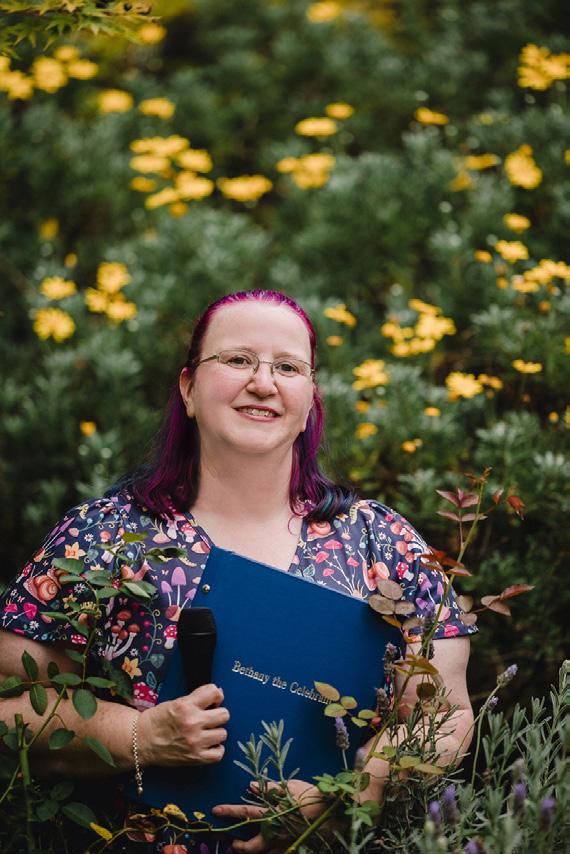
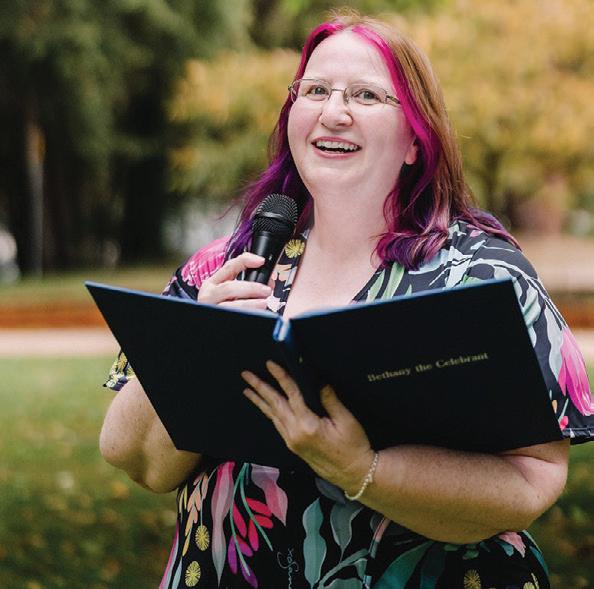
Canberra celebrant Bethany Freeman-Chandler brings a warm, caring and professional approach to every ceremony she leads. With a relaxed presenta tion style, she focuses on creating weddings that genuinely reflect the couple, rather than relying on prewritten scripts. Bethany also performs vow renewals, naming days and life celebrations, tailor ing each service to suit the people and the moment being honoured.
“I believe your ceremony should feel like you,” Bethany says. “I don’t use generic templates. I take the time to get to know you both and write something that is personal, meaningful and true to your story.”
Bethany officiates both small, intimate weddings and large, formal celebrations, ensuring each one receives the same level of preparation and care. She welcomes involvement from family and friends and offers guidance with writing personal vows so they complement each other naturally.
She also liaises with venues, photographers and coordinators to ensure the ceremony runs smoothly and stays on schedule. “I want the day to feel calm, well-organised and stress-free,” she says. “My job is to manage the details so the couple can focus on the moment.”
Bethany handles all legal requirements and paperwork, clearly explaining each step so couples feel supported and confident.
For couples seeking a celebrant who listens and delivers with genuine care, Bethany the Celebrant offers a personalised and seamless experience.
Bethany the Celebrant Call 0414 317 561, visit bethanythecelebrant.com.au or @Bethany the Celebrant on Facebook and Instagram. Canberra celebrant Bethany Freeman-Chandler.
Gunmetal silk taffeta ball gown with black silk tulle overlay. The fitted French lace bodice features appliqué of raised corded flowers in jade and fine beading in black, gray and shell.
artistry of genuine couture, where a gown becomes both
Timeless couture gowns available.
Louise goes all out for the bridal party
pressure at a wedding,” she says.
“But make-up is one of those things that can always be fixed.
“I work with my clients and am super flexible, so it’s okay if they change their mind on the day.
“I’m there to make their day as special as it can be.”
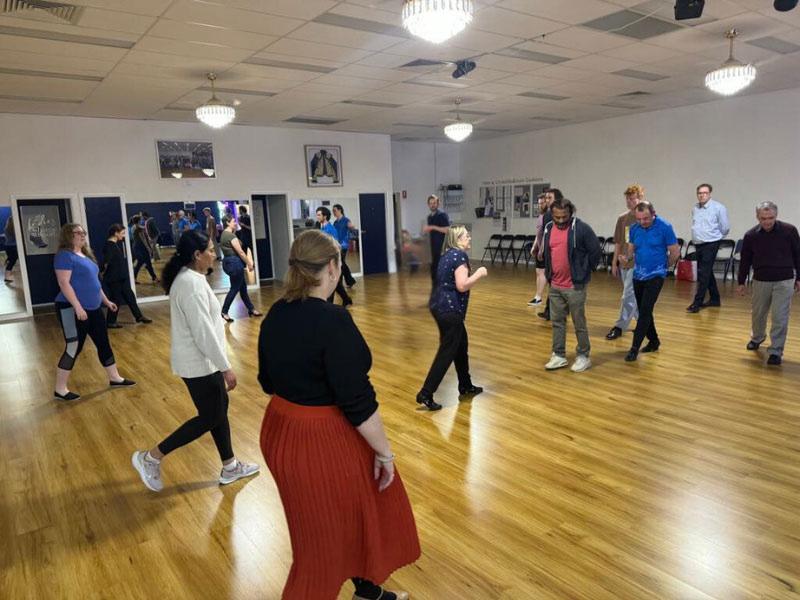
Dancing in front of an audience can be nervewracking, especially at weddings, but Dale Harris, owner of Dale’s Ballroom, says she can help even the most timid of dancers.
“We do private classes by appointment and we can accommodate choreographing a dance for your own routine, to the music you have chosen,” she says.
“We teach everything, from how to walk on to the floor, how to present themselves and to really make it special by standing up and being confident in what they’re doing.”
Dale is an expert in many styles of dance including tango, foxtrot, quickstep, Viennese waltz, and cha cha, samba, jive, rumba and paso doble.
Dale, who has more than 25 years’ experience teaching dance, started dancing at the age of six, when she developed an interest in ballroom dancing.
Dale also offers plenty of scheduled dance classes, perfect for someone with many weddings coming up that wants some help with their dancing.
Dale says she encourages anyone to come and learn regardless of age or experience.
“We have people of all ages coming in for the classes,” she says, with adult classes on Wednesdays, starting at 7pm, and junior classes every Thursday from 5pm.
She says classes cover Latin, New Vogue and standard dances.
Everything you want for your wedding day – all in one stunning location
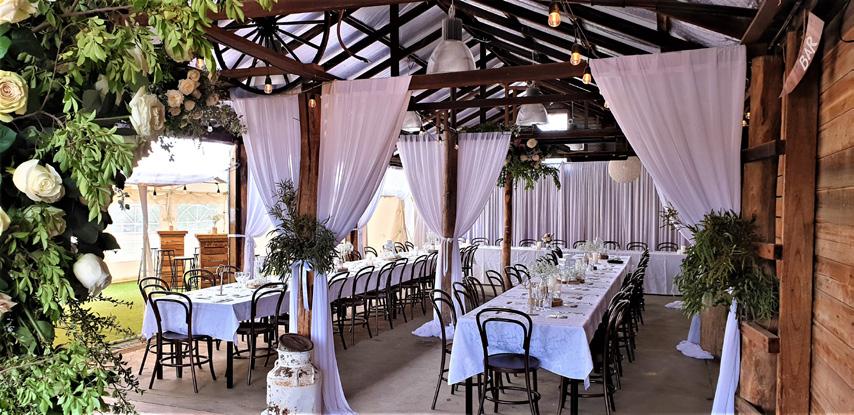
You’re engaged – congratulations! Now comes the fun part: finding a venue that feels like the one. A place that’s beautiful, welcoming, effortless and filled with moments you’ll remember forever. That’s exactly why couples fall in love with Tuggeranong Homestead.
Just minutes from the city, this gorgeous 70 acre property feels like a private country escape. Think rolling paddocks, heritage buildings, lush gardens and golden sunset skies – all the things that make your ceremony, photos and reception look effortlessly magical.
Whether you picture saying “I do” under grand trees, beside the rustic woolshed, or in a romantic garden setting, or in the Homestead offers incredible ceremony options that feel personal, natural and meaningful. And your photos? They’ll be breathtak-
ing – long fences, open fields, textured barns and soft, dreamy light at every turn.
But what couples rave about most is the experience. Tuggeranong Homestead is known for warm hospitality, generous and delicious food, and a team that genuinely cares about bringing your vision to life. Your day flows easily because everything happens in one beautiful place – no rushing, no stress, just joy. If you’re dreaming of a wedding that’s romantic, relaxed and unforgettable, Tuggeranong Homestead is where your forever begins.
Tuggeranong Homestead Johnson Drive, Calwell. Call 0413 377 958 or 0419 533 298 Visit tuggeranonghomestead.com.au
Ceremonies
Bethany the Celebrant creates personalised, relaxed and meaningful ceremonies that reflect the people at the heart of the moment.
With clear guidance, thoughtful preparation and a calm, professional approach, Bethany ensures your ceremony is stressfree and memorable for all the right reasons.
Services:
• Wedding Ceremonies
• Naming Days
• Vow Renewals
• Life Celebrations / Memorials
• Assistance with writing personal vows
• Full handling of legal paperwork and requirements
www.bethanythecelebrant.com.au
Canberra to the Coast
For Canberrans accustomed to polished dining rooms and elevated service, the idea of a regional club can sometimes arrive with modest expectations.
Catalina Club quietly overturns them.
Set against the natural beauty of the Far South Coast, just 90 minutes from the capital, Catalina blends the relaxed ease of a coastal escape with a standard of hospitality that feels distinctly metropolitan. Here, the welcome is warm, the design is contemporary, and the experience considered.
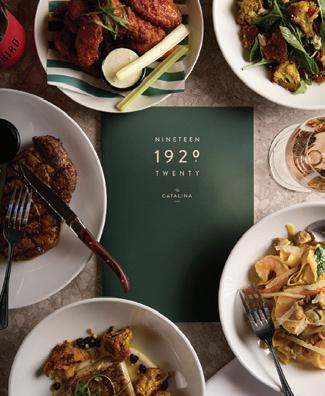
The award-winning dining offering champions premium local produce, from pristine seafood to regionally sourced meats, presented with the confidence of a venue that understands its audience.
The cocktail list is curated rather than crowded, the wine selection thoughtful, and the service attentive without intrusion.
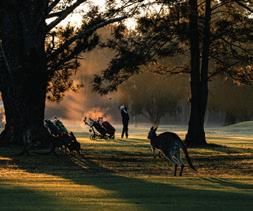
Beyond the restaurant, Catalina reveals itself as a genuine lifestyle destination. Championship golf
framed by ocean air and renowned resident kangaroos, with reciprocal social golf savings for members of Murrumbidgee and Yowani Golf Clubs. Live music that draws loyal followings.
Large-scale sporting broadcasts delivered with atmosphere and scale. Community woven through every layer.
It is not simply a stop on the way to somewhere else.
It is the reason to make the trip.
For those seeking a coastal interlude without compromising on quality, Catalina Club offers something refreshingly rare: a regional experience that feels anything but regional.
Discover the unexpected, just beyond the city limits.
Catalina Club 154 Beach Road, Batemans Bay, NSW. Call 02 4472 4022 or visit catalinaclub.com.au
Conferencing meets unspoilt natural landscapes at Willinga Park
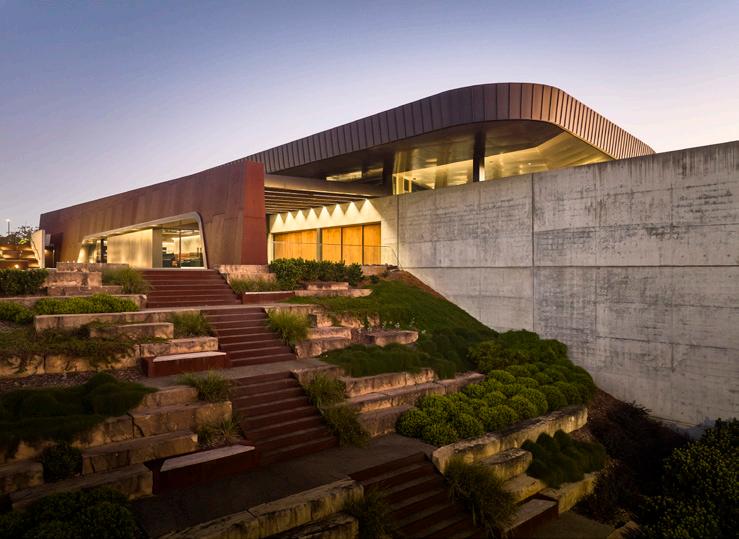
The South Coast’s Most Remarkable Destination. airports, Willinga Park spans more than 2,600 acres of pristine coastal landscape. Located in the natural sur rounds of Bawley Point, it has earned a reputation as a premier destination for conferences and events, defined by a Conference Centre celebrated for its award-winning architecture and state-of-the-art facilities.
Host your next corporate conference or executive retreat in refined style, with bespoke event spaces, gourmet catering and luxurious accommodation framed by sweeping natural views.
At its heart lies the striking 350sqm Conference Room, bathed in natural light and equipped with advanced AV technology. Designed for versatility, the space transitions effortlessly from board-level strategy sessions and leadership forums to gala dinners and large-scale exhibitions.
Complementing the main Conference Room, the elegant Boardroom and Stables Restaurant provide
delegates feel recharged, focused and inspired throughout their stay.
Experience the perfect balance of business and leisure. Between sessions, wander through tranquil gardens showcasing more than 30 large-scale sculptures, thoughtfully positioned to harmonise art, architecture and the surrounding landscape.
Whether hosting a corporate conference, milestone celebration or executive retreat, every detail at Willinga Park is designed to elevate the experience, inspire bold outcomes.
T he S out h C oa s t ’s Mos t Rem ar k ab l e D es tina tion W il lin ga P ar k i s m ore t han ju s t a venue; it ’s an ex p er ience.
W il l inga P ar k inv ite s you to unw ind in our archite c tur al ly accl aime d
P av il ions - mo der n , sp acious , and ele gantly app ointe d for f amil ie s , couple s , and f r iends s e ek ing a s er ene r etr eat Ne s tle d w ithin lush , l ands c ape d gar dens , each P av il ion of fer s a har monious blend of comfor t and s ophis tic ation
Rel a x b y the heate d s w imming p ool , s avour alfr e s co dining and a b ar be cue under the s t ar s , or simply unw ind in the p eacef ul atmospher e of natur e W ith an abundance of op en sp ace, you’l l f ind plent y of r o om to spr ead out, br eathe de eply, and tr uly enjoy the s er enit y of your sur r oundings Immer s e your s elf in the s eamle s s f usion of ar t and natur e w ith our l ar ge pr i v ate s cul ptur e col le c tion , featur ing over 3 0 s tr ik ing w or k s that enr ich the l ands c ap e and elev ate the ex p er ience
Dis cover the b e s t of the S outh C o a s t, w ith pr is tine b eache s jus t moment s aw ay, s cenic co a s t al w al k s to ex plor e, and an ar r ay of dining ex p er ience s that celebr ate lo c al pr o duce and co as t
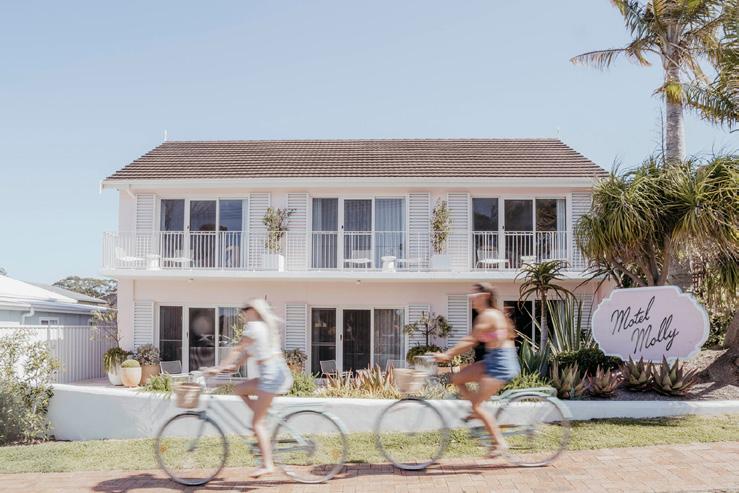
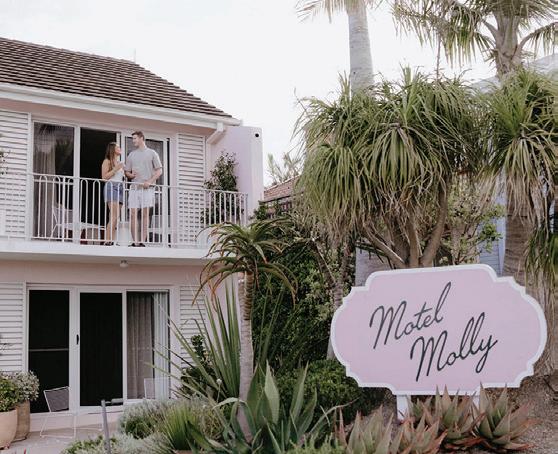
Your winter wellness escape awaits at Motel Molly
Tucked in the heart of Mollymook, Motel Molly is a boutique coastal retreat just footsteps from the sparkling shores of Mollymook Beach. Here, classic South Coast charm meets a cool, carefully curated aesthetic – the kind of place that invites you to slow down and soak it in.
Whether you’re planning a romantic escape or a laidback family getaway, Motel Molly offers something for every kind of traveller.
Our Moroccan-inspired rooms range from intimate one-bedroom king suites to a spacious three-bedroom split-level apartment, each thoughtfully designed for a relaxed yet stylish coastal stay. To elevate your experience, Motel Molly offers a selection of experiences that are well worth adding to your itinerary.
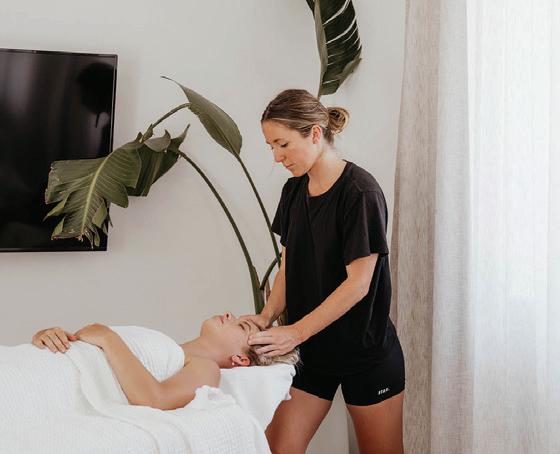
Join a weekly yoga class led by experienced instructor Tina, designed to calm the mind and awaken the body. Reset and recharge in the traditional sauna,
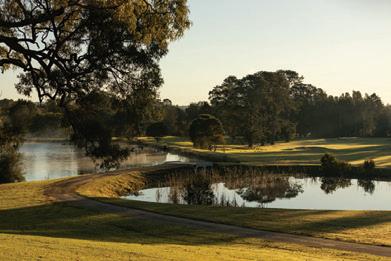
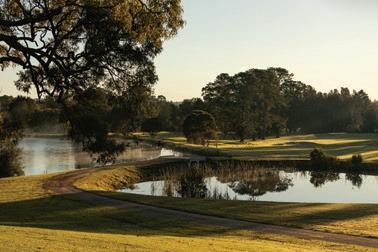
Golf at
then continue the relaxation with an in-room massage courtesy of The Reset Space. It’s the perfect way to ease into the effortless luxury and seaside serenity that defines a stay at Motel Molly.
Beyond the motel, Mollymook itself is a destination to savour year-round. From pristine beaches and breathtaking coastal walks to hidden local gems waiting to be discovered, there’s plenty to explore.
Use code COAST15 to get 15% OFF your Motel Molly stay.
Motel Molly is your invitation to experience the very best of the South Coast. We look forward to welcoming you soon.
The Oaks Ranch golf course is open to everyone from dawn to dusk. It is suitable for all levels of golfer.
Challenge yourself on our 9-hole course, which is home to local kangaroos and beautifully framed by remarkable scenery.
Contact us if you have a group who would like to play together, or you are interested in organising a special golfing day.
340 Old Mossy Point Rd
Mossy Point Ph 02 4471 7403
www.oaksranch.com.au
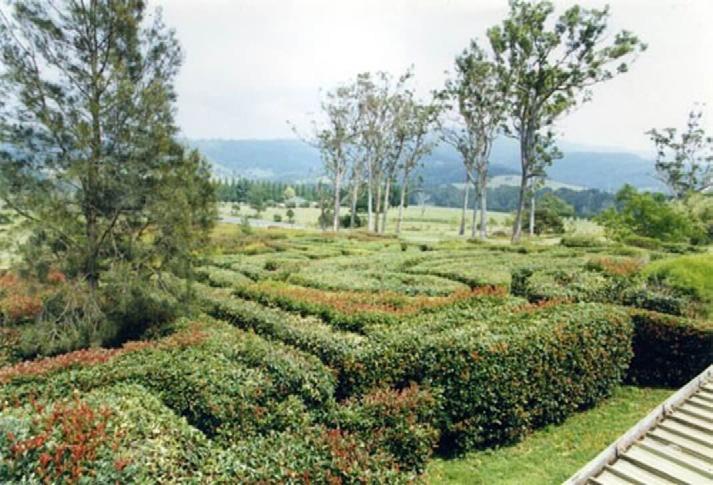
There’s a maze and lots more
Owner John Grant reopened Granties Maze in 2015 after 30 years of closure.
He says the maze, in Foxground, is only about two hours by car from Canberra. It features rides and attractions for people of all ages.
“Over the years, I intend to keep adding new attractions,” he says.
The main attraction is a maze consisting of 2000 trees that have been planted to create a network of paths and hedges.
“It’s designed as a puzzle through which one navigates with the objective of solving the puzzle and winning a prize – an ice cream,” says John.
There’s also mini-golf, pony rides, electric kids’ cars, archery and playground equipment. All rides are activated by coupons purchased at the office. All unused coupons can be reused on the next visit.
Granties Maze is open every day except Wednesdays, Christmas Day and Boxing Day. Open 9am-4pm on weekdays and 9am-5pm on weekends.
Granties Maze
25 Donovan Road, Foxground. Call 0407 284888 or visit grantiesmaze.com.au
Time to plant, divide and fertilise
By Jackie WARBURTON
Autumn is a busy and rewarding time in the garden, with the long, hot days of summer
The vegetable patch has endured a fickle season, battered by wind, heat, fewer bees and poorly timed rain that arrived when it was least needed.
March offers the chance to catch up on tasks missed in spring. Divide and transplant perennials, and plant evergreen shrubs while the soil still holds warmth. Complete the last of the ground fertilising now, as the soil begins to cool during the month and plant growth slows.
Camellias can be planted straight away into warm soil to establish before winter. Different varieties flower at varying times, so consider when colour is most needed in the garden.
In Canberra, the dependable winter-flowering favourite is Hiryu, bearing single pink blooms with a bright yellow centre. For autumn flowering in shade, Early Pearly is a lovely choice, producing small, double-white flowers that brighten darker corners.
AS temperatures ease, chrysanthemums come into their own. These tough, long-flowering shrubs respond to shorter daylight hours and provide reliable colour.
Available in a wide range of heights and forms, they are especially appealing to dahlia enthusiasts. They are easy to grow, prefer minimal fuss and perform best in full sun.
Flower colours are almost endless and, when plants are healthy, they continue well into winter.
Spent blooms may be left on through the colder months, then removed in early spring as fresh growth emerges.
Over time, the underground rhizome expands into a larger clump, which can be divided in winter with a sharp spade. Chrysanthemums prefer acidic soil, making them suitable companions for camellias and azaleas.
The flowers can also be picked and steeped in water to create a mild acidic fertiliser. As cut flowers, they outlast those left outdoors in brisk autumn weather, bringing lasting colour and cheer indoors.
CYCADS have become increasingly popular in formal gardens, though they can be challenging in our climate.
Originating from the Japanese forest floor, they are not suited to harsh, reflective positions such as full sun beside a pool. Consistent moisture is essential to prevent yellowing leaves.
Use a fertiliser high in nitrogen and potassium, low in phosphorus; a native fertiliser is suitable. During the growing months, a liquid feed will support stronger growth.
IF a Sago Palm is already showing yellow foliage, the cause may be excessive sun or insufficient moisture.
Increase irrigation and apply a light feed before cold weather arrives to encourage greener growth in spring.
Female plants produce a striking golden dome-shaped flower that takes time to open, while the male flower is more cone-like. Allow adequate space when planting, keeping them away from paths where the spiky foliage can intrude. Cycads are extremely slow growing and will gradually form a trunk.
They transplant well at the end of winter or in early spring; prepare the new planting site carefully and retain as much of the root ball as possible to ensure success.
jackwar@home.netspeed.com.au
Jottings…
• Sprinkle boron around apples for crisp-tasting fruit.
• Remove runners from strawberries and transplant.
• Fertilise autumn bulbs that are flowering now.
• Plant coriander as the weather cools.
Photos: Jackie Warburton
ARTS & ENTERTAINMENT Soprano Josephine has the Phantom covered
By Helen MUSA
As the sun sets behind Sydney Opera House on March 27, Opera Australia will launch the global 40th anniversary celebrations of The Phantom of the Opera.
The return season at Handa Opera on Sydney Harbour will be the first major event in a worldwide program honouring one of the most successful musicals of all time.
Among the chorus, framed by the vast stage at Mrs Macquarie’s Point, will be a singer whose career began far from the harbour.
For Canberra-raised soprano Josephine Lonergan, performing in this production feels both triumphant and deeply personal.
No stranger to the Phantom’s world, Lonergan has previously covered the roles of Madame Firmin and Carlotta in Cameron Mackintosh’s recent Australian tour, and was also cast in the 2022 harbour staging directed by Simon Phillips, now reprised.
Lonergan returns, this time as cover artist and part of the chorus for the 2026 anniversary season.
Yet Lonergan did not begin her career on a conservatorium fast track. She came to music “quite late,” first enrolling in a Bachelor of Arts at the ANU before turning seriously to voice. Early guidance from ANU vocal teacher Susan Ellis helped set her course, and she undertook formal studies at the Canberra School of Music, the Royal Northern College of Music, and the Sydney Conservatorium of Music.
A proud alumna of Canberra Girls Grammar School, she describes herself as the “artistic black sheep” of her family, though musical roots run deep. Her grandmother longed to be a singer, and among her ancestors is the Irish born composer and pianist William Vincent Wallace.
Last stall before the big relay
Those tireless fundraisers for cancer support and research, the Bold Bandannas, are holding their final stall of homemade goodies at the Harmonie German Club, 9am-1pm, on March 22, before taking part for the 27th time in the big Relay for Life on March 28 and 29.
At the stall they’ll be selling chutney, relish, jam, marmalade, lemon and passionfruit butter.
And in handicrafts there will be lace and knitted coat hangers, handknitted children’s cardigans, knee rugs, crocheted hand towels and more.
Pre-loved fashion sale
Zonta Club of Canberra Breakfast is hosting another Pre-Loved Fashion Sale with a VIP ticketed event, 5pm-8pm, on Friday, March 20, and the Saturday sale, 9am-3pm, at the Shine Dome Acton.
Clothing prices start at $5 and everything raised goes towards “helping to build a better world for women and girls,” says the club.
Entry to the VIP night is $30 (book via events.humanitix.com) and general entry on Saturday is $5 at the door. Car parking is free.
including the Queen of the Night from The Magic Flute, which she performed for National Opera’s pocket-opera production in 2021 under the direction of Peter ColemanWright.
Her show Classical Diva moves seamlessly from crossover favourites like You Raise Me Up to operatic showpieces such as Sempre libera and O mio babbino caro.
vocal temperament.
“You have to be ready for the high E,” she says. “Sometimes I’ve gone on with no rehearsal with the orchestra, called at 7 for a 7.30 show. I love it.”
In her younger years, she sang funk, blues and jazz with the Hauptmann siblings around Canberra venues, a far cry from Mozart’s stratospheric Queen of the Night, now a favourite party piece.
“It probably took me 20 years,” she reflects of her voyage into musical theatre.
“It’s been a long road.”
Between major productions, Lonergan’s career has taken a pragmatic turn, as a fly-in, fly-out guest soprano with Princess Cruises. She regularly boards ships around the world to perform featured classical crossover shows including Encore and Bravo, and her own productions Soprano on Stage, From Broadway to the Opera, Classical Diva and Bella Italia.
“I absolutely love performing on ships,” she says. “You have such a personal con -
Despite the globetrotting lifestyle, Japan one week, New Zealand the next, Lonergan sees herself as entering her prime.
“I’m in my 40s and only getting better. My high notes are stronger. It takes time to manage a dramatic voice,” she tells me.
In The Phantom of the Opera, she has, many times as a cover artist, been on stage as the flamboyant Madame Carlotta Giudicelli, the Paris Opera’s temperamental prima donna fiercely guarding her spotlight
Now, stepping into the vast harbour production once more, she embraces what she calls “the track”, the character shifts that define large-scale musical theatre, playing one moment a wardrobe mistress, the next a diva or, if not, part of the chorus that underpins the Phantom’s dark story.
Handa Opera, The Phantom of the Opera, Fleet Steps, Mrs Macquarie’s Point, Sydney, March 27-May 3.
Soprano Josephine Lonergan… “I’m in my 40s and only getting better. My high notes are stronger. It takes time to manage a dramatic voice.”
The cast of The Phantom of the Opera in Handa Opera on Sydney Harbour’s 2022 production of The Phantom of the Opera.
Photo: Prudence Upton
MUSIC / Harmonic Curves
At last, Sitsky’s waiting ‘major’ work will be heard
By Helen Musa
When harpist Alice Giles and her pianist husband Arnan Wiesel speak about the 2026 season of Harmonic Curves, there’s excitement and a sense of homecoming.
The four-concert series opens with a coup, the world premiere of Larry Sitsky’s Worlds of the Kabbalah for cello and harp. Composed in 2015 specifically for Giles and cellist David Pereira, the substantial four-movement work has been waiting patiently on her shelf for more than a decade.
Now, at last, it will be heard.
“It’s a major work, about 20 to 25 minutes,” Giles says. “Larry has written on a virtuosic level for both instruments. The sounds are incredibly stimulating, and there’s a spiritual language to the concept. It’s unique.”
The combination of cello and harp is for Giles deeply meaningful. She describes the instruments as sympathetic relatives, their strings resonating with one another through bowing and plucking, creating colours that differ markedly from the more familiar harp and piano pairing.
of the
and Pereira intend to take the music to him.
Composer Larry Sitsky… “It’s really important he hears this first performance,” says harpist Alice Giles.
longtime colleagues David Pereira and guitarist Timothy Kain to join them in a nod to the good old days of Canberra music. “We still have much to offer,” Giles says. Alongside the Sitsky premiere, audiences will hear a new composition, Pereira’s Still Dancing, for cello and piano, featuring evocative passages and rhythmically charged sections, as well as the Fantasiestücke Op. 73 by Robert Schumann. Giles promises balance. “We like to present an assorted program on a Sunday afternoon. We don’t want people to feel like they’re in an education session. They’ll encounter the new among familiar sounds,”
For her family, the premiere carries added emotional weight. Wiesel’s mother Aviva, was a professional harpist and his father Uzi was a famous cellist who toured Australia and internationally.
Sitsky, now 91 and frail, may not be able to attend the performance. If he cannot, Giles
“If he’s not well enough to come, we’ll go to his home and perform it for him. It’s really important he hears this first performance,” Giles says.
The premiere sets the tone for a season shaped by independence and renewal. They launched Harmonic Curves last year with an ambitious six-concert program, Wiesel initially collaborating with his former student
pianist Aaron Chew in four-hand repertoire. In 2026 they pared the series back to four concerts, a more sustainable offering.
The desire to create their own platform runs deep. After a traumatic upheaval at the ANU School of Music in 2012, both artists stepped away from Canberra’s music scene and pursued international careers. From their home in Murrumbateman, they continued to perform around the world.
“We were determined to do something locally,” Giles says. “We wanted to create something ourselves, to present the kind of pieces we play instead of just being asked. That was really important at this stage of our lives. And we wanted to make a statement that we are part of a musical community we’d been separated from for a while.”
Far from slowing down, both have remained prolific. Giles has performed in Antarctica on her wind harps and formed the Penta [five] Harp Ensemble while Wiesel served as inaugural president of the ACT Keyboard Association.
Now, entering what they call the “older generation” stage of their careers, they are embracing collaboration once more, inviting
ARTS IN THE CITY
One of the season’s most personal highlights comes in Concert Three, Elemental, where their daughter, performance poet Moran Wiesel, will present works from her forthcoming anthology woven through music inspired by ice, water, fire, earth and air.
The 2026 Harmonic Curves season, Wesley Music Centre, at a glance:
• Concert 1, Mystic, cellist David Pereira joins Alice Giles and Arnan Wiesel, March 15
• Concert 2, Resonance, guitarist Timothy Kain joins harpist Alice Giles, June 7.
• Concert 3, Elemental, with performance poet Moran Wiesel inspired by Ice, Water, Fire, Earth, Air, with works by JS Bach, Schumann, Scriabin, and Debussy, September 13
• Concert 4, Kaleidoscope, works by Martin Wesley-Smith, Carl Vine, Luciano Berio, Arnold Schönberg, Mozart Variations and Bartok piano, November 1.
Wedding ring to boxing ring
The Canberra Comedy Festival returns with more than 70 shows. Among its punchier highlights is Wedding Ring, SuffeRing, a no-rules relationship showdown that throws two real-life couples into a comedy boxing ring, with Jelin and Nick Palm joining Sarah and Mark Stewart at The Street Theatre, March 18-19.
Dept of Rock storms the comedy festival with three unruly bands, Ode to the State, The IT Grrrls and The DUDS. Smith’s Alternative, March 19.
In Irony Done Here Shortis and Simpson will celebrate three decades in the Canberra region with a 90-minute whirl through song, satire, politics and community storytelling; inspired by a neighbour’s sign reading Ironing Done Here. Smith’s Alternative, March 21, 22.
Hear My Eyes reimagines Terminator 2 Judgment Day in a hybrid film and live music experience marking the film’s 35th anniversary; a 4K screening of the original theatrical cut is fused with a live score by Belgian techno artist Peter Van Hoesen and a synchronised laser design by Robin Fox. Canberra Theatre, March 18-19.
Musica da Camera expands its forces under the direction of German super-violinist Daniel Röhn, who is now living in Canberra. He’ll be performing Haydn’s Concerto in C major alongside Vaughan Williams’ Fantasia on a Theme by Thomas Tallis, which demands two orchestras. Holy Covenant Church, March 21.
Braddon’s streets will pulsate as the Braddon Busking Festival as local performers compete for prizes and a pathway to the National Busking Championships, complete with an under 16s category. Braddon, March 15.
The Canberra Symphony Orchestra’s Llewellyn Series presents Enigma Variations, conducted by Jessica Cottis with cellist James Morley. The program ranges from Alice Chance’s Through Changing Landscape to Prokofiev’s Symphony Concerto for cello and orchestra, culminating in
March 18-19.
Elgar’s Enigma Variations. Llewellyn Hall, March 18-19.
Mockingbird Theatre Company continues its 2026 season with the global hit Almost, Maine by John Cariani, directed by Zac Bridgman, in which the residents of a small-town tumble in and out of love in a sequence of magical encounters. Belconnen Arts Centre, March 18-28.
The Mill launches its year with The Dear Departed, a live radio play by Stanley Houghton adapted by Bart Meehan; performed and recorded before a studio audience, complete with visible microphones and handcrafted sound effects, this comedy of manners gleefully unravels middle-class respectability as two sisters squabble over inherit ance and inconvenience. The Mill, Fyshwick, March 20-28.
Arnan Wiesel and Alice Giles… Their four-concert series opens with a coup, the world premiere of Larry Sitsky’s Worlds
Kabbalah. Photo: Peter Hislop
Wedding Ring, SuffeRing… The Street Theatre,
STREAMING Off the couch, Being Gordon’s a bit undercooked
Heating up Netflix’s March catalogue is their newest doco promising an inside look at the life of Gordon Ramsay.
This six-part documentary series follows the household-name chef as he attempts to open five new world-class restaurants in a major dining complex atop a London skyscraper.
There’s a bit of a bizarre attempt to frame Ramsay as an underdog in this series, like he’s going through some kind of make-orbreak moment as if he doesn’t have another $200 million in his pocket to fall back on.
Still, Netflix has served up some incredibly popular TV with this one.
Subscribers who watched the hugely successful documentary on David Beckham and his family a few years ago may recognise some similar DNA.
There’s the candid couch interviews and the shots capturing what a day in the life is like for a family known around the world.
But where Beckham did have those moments of authenticity that felt like a real look behind the scenes, here they’re much fewer and further between.
Being Gordon Ramsay can sometimes feel like it slips more into major advertisement territory than a thorough documentary, leaving it somewhat, as Ramsay himself would hate, undercooked.
Need something low effort to put on after a day at work while making yourself dinner though? Order’s up.
Controversial chef Gordon Ramsay… “There’s a bit of a bizarre attempt to frame Ramsay as an underdog in this series.”
A NEW drama series on Disney Plus that hones in on one of the most famous couples of the ‘90s has been turning heads.
It’s called Love Story: John F Kennedy Jr & Carolyn Bessette and, over nine episodes, it follows the couple’s intense relationship, which became an almost mythical part of America’s cultural fascination.
The son of one of the most famous leaders of all time and a fashion icon who became known around the world are played by relative newcomers Paul Anthony Kelly and Sarah Pidgeon. Thankfully, their chemistry is very tangible, both entirely committed to the roles.
The popularity the show has already swept up is sure to make these two stars. There are already calls for Kelly to be the next Batman.
The series is also quite the turn for executive producer Ryan Murphy, who has carved out controversial renown for his Monster series on Netflix, which has dramatised some of America’s worst serial killers including Jeffrey Dahmer and more recently Ed Gein.
Love Story is a lot slower than those shows and it often feels like those nine episodes could easily have been halved in time without losing any critical plot.
Of course, all of it ultimately builds
towards the tragic ending for the couple that shocked the world and devastated their fans.
That goes a long way in helping the show keep its hooks in. Meticulously crafted, it’s a powerful look at one of the 20th century’s biggest power couples.
HITTING Apple TV Plus’s streaming selection this month is a new flick with an intriguing, philosophical premise.
It’s called Eternity and it asks the question: what if you could choose where to spend the afterlife?
The choice has to count. It is forever, after all, and its a quandary Joan Cutler (Elizabeth Olson) finds herself in after passing on from the Earthly realm.
Faced with an ultimatum that’s far from heavenly, Joan must decide whether she spends eternity with her first husband, Luke, who died young and has spent the afterlife waiting for her, or Larry, her second husband of 65 years who carked it after choking on a pretzel.
It’s an amusing and entertaining twist on the age-old love triangle trope.
There have been many movies and modern TV shows that have played with the afterlife but often attempt to be more clever than they really are.
I’m pleased to report this film is a humble exception.
Olson is effortless to watch and is backed up by an equally charismatic cast including Miles Teller and it’s thanks to some solid writing the 114-minute runtime here feels like anything but eternity.
Sarah Pidgeon and Paul Anthony Kelly in Love Story: John F Kennedy Jr & Carolyn Bessette.
twinstitch.upholstery
SUNDAY ROAST
Talking to the names making news. Sundays, 9am-noon.
DINING / Lilong Canberra, Civic
One big advantage of Lilong by Taste of Shanghai Canberra, at the end of City Walk near the Crowne Plaza, is its proximity to the theatre.
I’ve been to Lilong a couple of times now, once before the Canberra Theatre, comforted by the commitment to serve mouth-watering food on time and in time for showtime.
Without a huge amount of fanfare, Lilong opened last March and easily sits around 100. The neon street-style artwork is fun. Brick feature walls and a colour palette pivoting around a rich, dark green add intrigue.
Lilong Tang focuses on “Hai Pai” Shanghai cuisine – modern, cosmopolitan and covering many favourites from many regions of China. It delivers on big flavours, wonderful aromas, vibrant colours, working hard to represent the excitement of the food found in Shanghai’s bustling lanes and streets.
Shanghai-style radish croissants with shrimp and ham.
I can’t resist starting with a wonderfully innovative dish, and our top pick – the Shanghai-style radish croissants with shrimp and ham (three pieces for $11). Served on a black metal tray with a handle, these parcels of goodness – formed in the shape of a French croissant – made us ooh and aah. The savory, flaky pastry was stuffed with Daikon radish, and bits of shrimp and ham, creating a hot, soft interior. They were fabulous.
Before the croissant, we began with Xiao Long Bao, steamed soup dumplings typically from Shanghai, with piping hot broth bursting through on our first bite. The broth was perfectly balanced and it’s no wonder these rank in Lilong’s four best sellers (six pieces, $16.80). Equally soul-satisfying were the steamed dumplings with pork and chives (eight pieces for $12.80), great value and high on taste.
WINE / Yarrh
Salt and pepper calamari hit the spot in a major way, and we’ll be back for more ($28.80).
The same goes for the Peking-style, wok-fried shredded pork, which we wrapped in superthin pancakes, adding slices of cool, crunchy cucumber ($35.80).
Dining Asian is fantastic with friends because you can select so many dishes to try. It was thumbs up for the tender Mongolian lamb ($33.80) with its sticky, spicy and aromatic sauce – a real umami taste.
The wine list, although not extensive, features local drops. The Mount Majura pinot gris was $13 a glass or $58 a bottle, reflecting Lilong’s
reasonable
Service was a bit
on our first visit and smoother on our second.
Tip: When choosing a table, avoid one near a food trolley. It can be noisy and disconcerting when staff are clearing, sorting and stacking dishes.
Fully licensed. Corkage $5 per glass.
Hard days at Yarrh as fruit lost to frost
One of the reasons I find the Symposium wine bar at the ANU so agreeable is that you can rock up after the gym or a long, extended lake walk, wearing exercise gear and looking slightly grotty.
And you are always welcomed hospitably and treated no differently than if you were wearing a tuxedo.
Which reminds me of the older woman who decided to greet her husband naked on his return home from work one evening. He walked into the house and saw his wife in that state, asking: “Why are you naked?”
She replied: “This is my love dress.”
He responds: “Hmmm, needs ironing.”
Anyway, after a long walk my friend and I settled in at the Symposium, having an early dinner and I drank a lot of water and then asked for a glass of white wine.
I was offered a taste of a local riesling, the 2023 Yarrh Canberra District Riesling. On first taste, I said to the manager, Albert Chung: “Wow, steely acidity, but pleasant and a good kick of citrus.”
He looked at the back of the label for the description of the wine and said: “Did you write
this for them?”
“What do you mean?” I said.
“Well, it says here: ‘The palate is zesty with a twist of fresh cut lemon, steely bright acidity and a lingering clean finish’.”
“Blow me down”, I said and ordered a glass. It went especially well with the dish featuring vannella stracciatella, which is a burrata cheese with a luscious filling.
It’s served with zucchini, pickled green tomatoes and dried olive, flavours that pair well with the steely riesling, which is complex and could be stored for a considerable period and only get better.
I called the Yarrh winery, in Murrumbateman, and spoke with Caleb Wearne, who last year became the winemaker and lessee at Yarrh with Jessica Caruso.
The founders, Neil McGregor and Fiona Wholahan, have stepped back from the business. I visited the Yarrh premises many years ago when they put on a fundraiser for the Rural Fire Service.
I remember how well their reds went with the supplied barbecue meat. Caleb told me that they still have fundraisers for the RFS. Yarrh is a local Aboriginal word meaning “running water” rather than the sound you make when you burn yourself on the hot barbecue.
Caleb indicated that the founders had decided to spend more time at leisure, but that 2023 was definitely their creation.
Caleb is also the owner of the Whitton Farm brand and had previously bought fruit from the Yarrh property. He worked at Nick O’Leary wines for 12 years and is a fan of the Canberra District for producing excellent fruit.
“But,” he said, “we are in short supply of fruit. In 2026, just as in 2024, frost and hail have completely wiped out the harvest. It’s tough.”
“I wish you luck for 2027” I said, “and that the riesling will be as good as the 2023. I might have to wait some time for Symposium to re-stock with the Yarrh.”
“Life doesn’t get easier or more forgiving, we get stronger and more resilient.” –Steve Maraboli
drink prices. Mocktails sound inviting, including a Yuzu Glow ($14.80) with yuzu, jasmine, tea and mint.
chaotic
Salt and pepper calamari.
Photos: Wendy Johnson
Fiona Wholahan and Neil McGregor hand over Yarrh Winery to Caleb Wearne and Jessica Caruso.
HOROSCOPE PUZZLES
By Joanne Madeline Moore
ARIES (Mar 21 – Apr 20)
The Sun shifts into Aries, it’s the Equinox, and lucky Jupiter trines Mars (your ruling planet). So, this week’s astrology is all about celebrating your individuality, maintaining your equilibrium, and pursuing your dreams with courage and confidence. Within a climate of peaceful and thoughtful reflection. Draw inspiration from Aries birthday great, Reese Witherspoon: “I believe ambition is not a dirty word. It’s just believing in yourself and your abilities.”
TAURUS (Apr 21 – May 21)
With four planets transiting through Pisces (including the New Moon), being flexible is the key to a successful week. If you are too stubborn and unyielding in your opinions, then others will just stop listening to what you have to say. And if you are too slow off the mark (and hesitant to take action), then others will streak ahead of you. So, your motto is from fellow Taurean, actress Shirley MacLaine: “Don’t be afraid to go out on a limb. It’s where all the fruit is.”
GEMINI (May 22 – June 21)
It’s a good week for Geminis. After three weeks in retrograde mode, Mercury (your patron planet) starts moving forward – yeah! So, plans, projects and relationships that have been stalled and stymied should gradually start to pick up pace, particularly at work. And the weekend trine between Mars and Jupiter is especially good for professional and financial matters. Sunday is a wonderful day to write down your wish list and make your dreams come true.
CANCER (June 22 – July 23)
With the Sun, New Moon, Mars and retrograde Mercury in your wanderlust zone, many Crabs will be feeling cooped up, housebound and a bit stir-crazy. Thank goodness Mercury moves forwards on Friday night/Saturday morning. So, the weekend is the time to dream big dreams and/or make connections with folks from foreign shores. Plus pull on your travelling shoes and escape on a weekend getaway - or plan an adventurous trip for sometime soon.
LEO (July 24 – Aug 23)
The Sun (your ruling planet), New Moon, Mars and Mercury (which finally turns direct) activate your money-from-others zone. So – over the next few months – you could receive a boost to your bank balance via a gift, pay rise, work bonus, bumper tax return, inheritance, superannuation payout or extra business. Any windfall won’t last long if you don’t manage it wisely, though. Sunday highlights empathy, intuition, romantic dreams and idealistic schemes.
VIRGO (Aug 24 – Sept 23)
The buzz word is connection, as Mercury (your patron planet) finally moves forward in your partnership zone. So, expect daily communication and social interaction to gradually improve. The Mars/Jupiter trine (on the weekend) is also wonderful for relationships, conversations and networking within your extended peer group. Your motto is from birthday great, Reese Witherspoon: “Every day you have to choose and cultivate your own happiness.”
LIBRA (Sept 24 – Oct 23)
This week the Sun, New Moon, Mars and Mercury (going direct) all activate your daily routine and wellbeing zones, so it’s time to get motivated and get moving! To set up a more streamlined work routine. To reboot your exercise program. To plan more nutritious meals. To prioritise your physical and mental health. Be inspired by Reese Witherspoon (who was born on March 22, 1976): “Doing begets more doing… action can solve so many worries.”
SCORPIO (Oct 24 – Nov 22)
The focus is on self-expression, entertainment and friendship, as the planets activate your creativity and social activity zones. And Mercury moves forward (on Friday night/Saturday morning) so the weekend is a good time to plan a party, book a massage, attend a concert, see an exhibition, enjoy a lunch date or a night at the movies with friends. As birthday great Reese Witherspoon observes: “I don’t know what I would have done if I hadn’t had my girlfriends.”
SAGITTARIUS (Nov 23 – Dec 21)
Mercury finally goes direct in your home zone, plus Jupiter and the New Moon also activate your family sector. So, it’s a wonderful week for domestic matters, as a project or relationship that’s been dormant (or going backwards) finally starts moving forwards. Mid-week excess is a danger, though, as the Venus/Jupiter square encourages overeating, overspending and/or over-promising. On Sunday, courage and confidence will make your dreams come true.
CAPRICORN (Dec 22 – Jan 20)
A partnership should gradually improve, as lucky Jupiter jumps through your relationship zone (until June 30). The more proactive you are about communicating clearly, the better. And Thursday’s New Moon lights up your conversation, education and neighbourhood zones. So, it’s a fabulous week to focus, plan, study, organise and strategise, especially involving joint ventures and projects within your local community. Singles – love and family are linked.
AQUARIUS (Jan 21 – Feb 19)
The New Moon and Mercury (moving forwards) shine a spotlight on financial matters and personal values. Do you need to let go of people, possessions or attitudes that have passed their used-by date? With impulsive Mars also activating your money zone, be careful your main form of entertainment isn’t shopping. Your bank balance (and budget) won’t appreciate a shop-till-you-drop kind of week. Sunday favours helping someone in your local neighbourhood.
PISCES (Feb 20 – Mar 20)
The Sun, New Moon, Mercury and Mars are all visiting your sign, so strive to be more proactive about pursuing your creative and spiritual goals. No procrastinating, Pisces! It’s also the Equinox (when day and night are of equal length) which favours meditation and contemplation, as you aim for more equilibrium and perspective. With Venus, Saturn and Neptune visiting your self-worth and values zones, peace-of-mind and strong self-esteem are also highlighted.
Copyright Joanne Madeline Moore
2026
1 What is the act of shutting? (7)
2 To have shunned, is to have done what? (7)
3 To follow slowly, is to do what? (7)
4 What do we call the postman? (7)
5 To puzzle completely, is to do what? (7)
6 What are chains of mountains? (7)
11 What do we call a person who directs an organisation? (7)
12 Name a very long Australian river. (7)
13 To jump over everything, is to do what? (4,3)
14 To be repulsive, is to be what? (7)
15 What is imperativeness? (7)
16 To have gone in, is to have done what? (7)
CHARTERED ACCOUNTANT
Tax-claim query over damaged rental unit
The tenant of Randa's Gold Coast unit caused serious damage and she wants to understand how this impacts her rental property tax claims.
“The timing couldn’t have been worse,” Randa said. “Just as my tenant’s lease was about to end, they caused serious damage to the bathroom floor. I had no choice but to adjust the bond, take the property off the rental market and bring in tradespeople immediately. "Will The ATO let me claim these costs, even though the unit wasn’t available for rent for a time?"
I told her that rental expense claims can be complex to determine and that the ATO closely monitors these claims.
“They assess whether your property was genuinely available for rent through various data-matching tools,” I said.
"The ATO applies specific criteria to determine whether property expenses are deductible. The first question to consider is whether the cost was for a genuine repair or if it was capital in nature.
“If you’re replacing damaged tiles or repairing the subflooring simply to restore the bathroom to its original condition, that’s generally deductible in the year the expense is incurred.
“However, if you choose to install heated flooring or upgrade to higher-quality materials, the work is likely to be considered capital in nature, meaning it must be claimed over time through depreciation." Randa nodded. “We didn’t rip everything out – we fixed what was broken with like-for-like materials,” she said.
“That helps,” I told her. “It supports the position that the work was restorative, not an enhancement. The other key test is whether the property was genuinely held to produce rental income on a commercial basis.
“The ATO looks at circumstances – booking history, tenancy agreements, advertising or letting agent records and agent communications to confirm the property was genuinely available for rent before and after the interruption.”
Randa said: “So because it’s a long-term rental, the fact we had a tenant and we only temporarily paused tenancy activity doesn’t count against me?”
“No,” I replied. “If the lack of rental income was a direct consequence of repairing tenant-caused damage and you can show you intended to continue renting out the property – evidence such as ongoing lease arrangements, correspondence with your agent, and prompt action to obtain repairs – the expenses should remain deductible.”
I also cautioned Randa about common pitfalls when claiming longterm rental expenses.
“You must apportion expenses if you use the property for private purposes or decide not to rent it in future," I said.
"Significant improvements unrelated to the tenant’s damage are probably not immediately deductible and will need to be claimed over time through depreciation”.
I recommended that the best practice in these circumstances was asking tradespeople to itemise their invoices so genuine repair work could be clearly separated from any upgrades.
I also advised keeping evidence that the vacancy was necessary due to tenant damage, together with a record of the dates the property was unavailable, in case the ATO requests this.
"Maintain comprehensive records of insurance documentation –including policy details, claim forms, correspondence with insurers and settlement statements – so you can support your claim," I said. Randa breathed easier. “Okay, I’ll gather the invoices, photos and the agent’s notes and send them to you.”
Written by accountant Chetan Chopra
If you need advice on rental property claims or any other tax-related matter, please contact the expert team at Gail Freeman & Co Pty Ltd on 6295 2844, email info@Ifreeman.com.au or visit gailfreeman.com.au