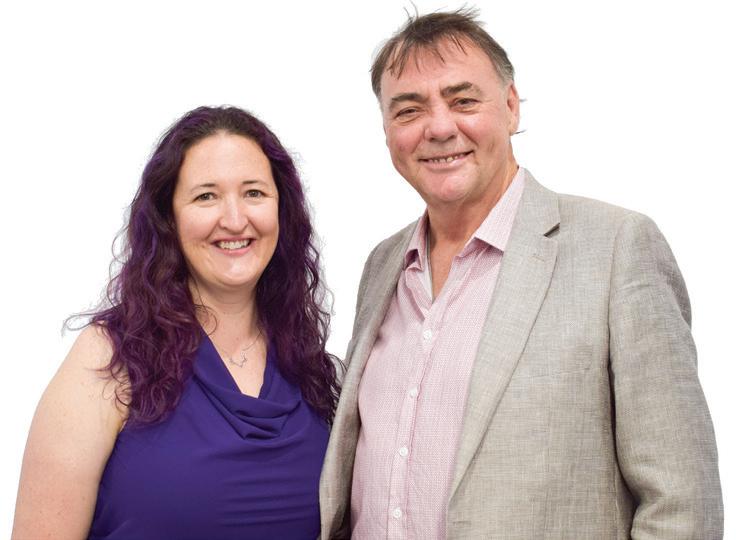
JON STANHOPE and Dr KHALID AHMED analyse the latest ACT Budget and discover it’s so short of cash that the government will have to borrow to pay its interest costs.
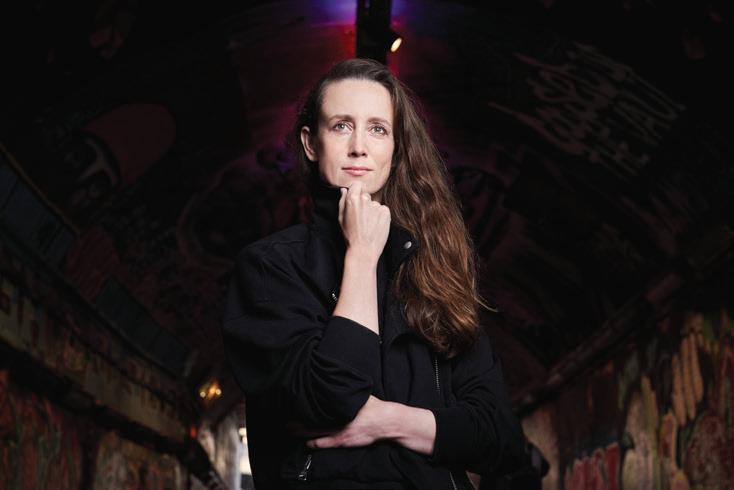
TURBO-CHARGED BUDGET, BUT ONLY IN BARR’S HEAD Conductor JESSICA COTTIS believes ‘music is food for the soul’
Lemonade factory well poses questions from past
By Nick OVERALL
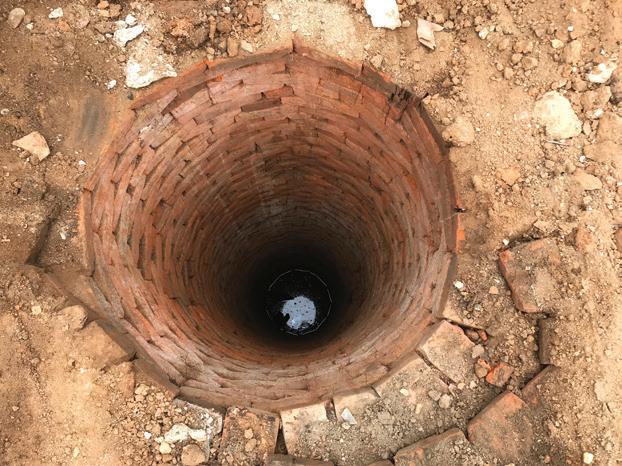
HISTORICAL investigation has revealed new details about a 147-year-old well recently unearthed in Queanbeyan, a discovery that local heritage expert Pip Giovanelli describes as “a window to another time”.
The nine-metre deep trench was discovered during the demolition of a block of flats on Rutledge Street to make way for the $74 million Queanbeyan Civic and Cultural Precinct.
According to Mr Giovanelli, who also serves as Queanbeyan PalerangRegional Council’s (QPRC) heritage adviser, it was a bulldozer operator who discovered the man-made structure thought to have first been sunk in 1874.
“What is remarkable about this well is its excellent condition,” said Mr Giovanelli.
“It’s clean, straight and true and in the order of nine-metres deep by about 900 millimetres internal diameter, with water in the base.
“It’s significant as an excellent example of the type, and by extension it demonstrates the competence of the person who built it.”
INDEX
uncommon in 19th century Australia, but many have been filled in, destroyed, built over or are in poor condition with decayed bricks or collapsed stonework.
Research has found that this well was built for Messrs Myers and Emley, two businessmen who started a lemonade factory described as an “aerated water and cordial factory” in Rutledge Street in the early 1870s.
Recently discovered by some enthusiastic community members, an article from “The Queanbeyan Age” published in October, 1874 details a
Having sampled the lemonade, the journalist wrote that he had seen “certainly nothing to surpass the goods produced by this enterprising firm” and that the drinks were distilled in clean bottles that kept “evils” out, otherwise often caused by “dirty and unwholesome corks”.
It also reads: “The water used – a vast quantity being necessary for cleansing, rinsing, and besides that converted into agreeable and wholesome summer drinks – is procured from a newly-sunk well, thus avoiding the animal and vegetable impurities
Managing Director: James Anderson, 0404 077605, james@citynews.com.au
Director: Kate Meikle, kate@citynews.com.au
Senior advertising account executives: David Cusack, 0435 380656
Journalists: Belinda Strahorn, belinda@citynews.com.au; Nick Overall, nick@citynews.com.au; Lily Pass, lily@citynews.com.au
Arts editor: Helen Musa, helen@citynews.com.au
Production manager: Janet Ewen
Graphic Designer: Douglas Lima
Proof reader: Glenda Anderson
inseparable from river or other surface water.”
“The fact that we have newspaper records that specifically mention this particular well is doubly gratifying,” said Mr Giovanelli.
“What we don’t know is if the well initially extended above ground level in some form or another.
“There is more research that can be done, both on site and in the library.”
According to Mr Giovanelli, by 1878 the building had been sold, with the real-estate agent having advertised it as having an “excellent well of water on the premises”.
However, by 1947 the building had become dilapidated and was sold again and demolished.
Afterwards, in the early 1950s, a two-storey house was built for locals Wilfred and Katherine Cranswick and later served as a block of flats.
While the building was not deemed by the QPRC to have enough heritage status to be retained, a stained-glass window from the building was removed and re-homed at the Queanbeyan museum.
But, the discovery of the well has opened up all sorts of new questions about the heritage status of the location.
“What we didn’t know until the two-storey dwelling was demolished recently, was that the well had been covered over with some timber and sheets of iron and left in situ – with the
two-storey place built over the top,” said Mr Giovanelli.
“It, and indeed other artefacts, enable us to tell the stories of the past in a very graphic manner, and to visualise the way that people led their lives not so long ago.”
The community in Queanbeyan and the surrounding areas have been very vocal about their hopes that the well is preserved and potentially even incorporated into a historical feature of the precinct which is set to be completed by early 2023.
“In heritage terms we would say the well has historic value, technical and scientific value, research potential and aesthetic value,” said Mr Giovanelli.
“It has high local heritage significance and may make it on to the Queanbeyan Palerang heritage schedule one day.”
Archaeological work is still being undertaken on the structure with hopes of unearthing more details.
Any findings from the research will be presented to the QPRC Heritage Advisory Committee and to the council.
“It provides a very real and tangible window to another time and by comparison helps us to reflect on the life and technologies we have today,” said Mr Giovanelli.
“I am optimistic that it will be preserved in a way that will allow current and future generations to peer inside and also ponder on its stories.”
The old well is nine metres deep and has water in its base.
Government’s been a gas for the green Greenies
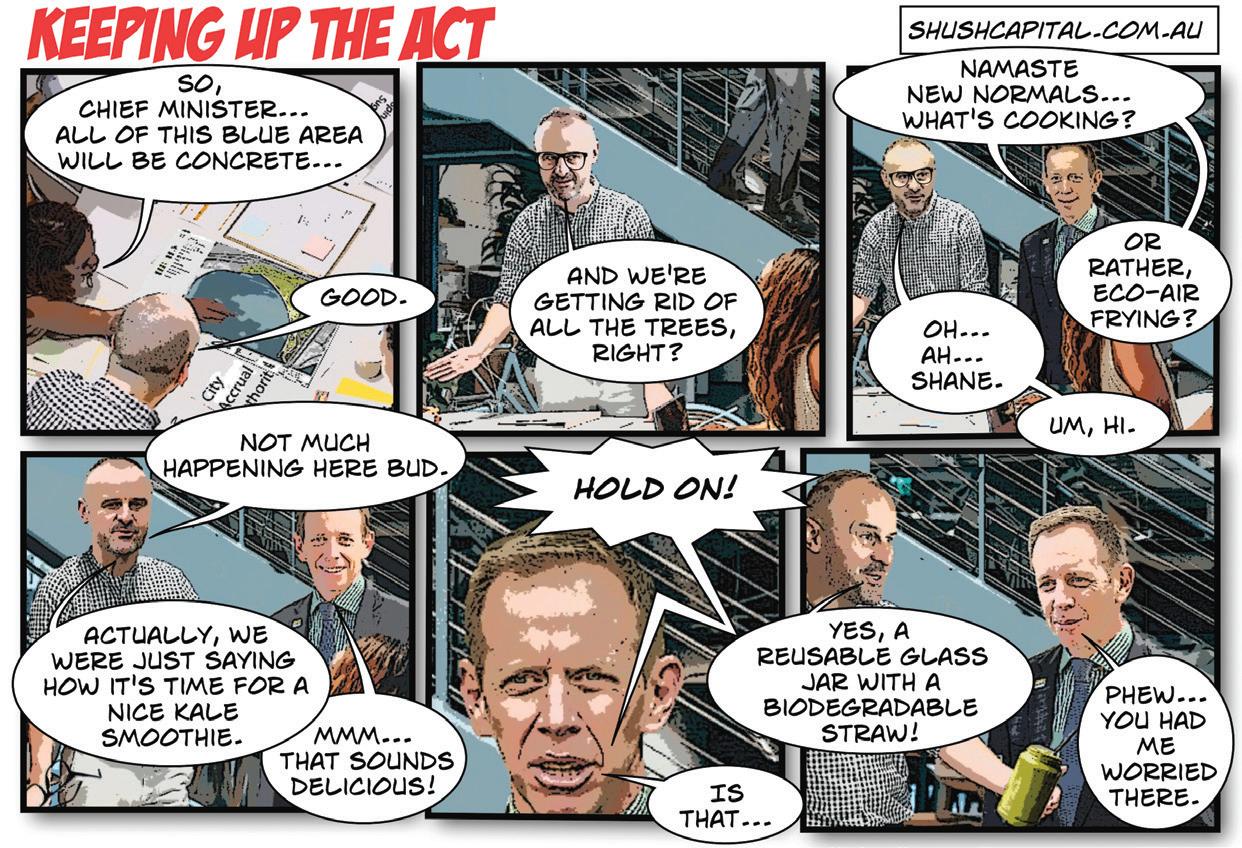
IN the (sustainably) warm (renewable) glow of celebrating one year of the “greenest government in Australia’s history”, Shane Rattenbury mysteriously said he was looking forward to “all that we can and must do”.
With evangelical zeal, the ACT Greens leader and his five other comparatively green Greenies were rejoicing this past week at the myopic difference they’d made on the environment, pointing to “ending the rollout of fossil-fuel gas to new suburbs” as but one shining green achievement.
Pity about the city’s tree canopy, the concrete heat islands, high-rise towers, planning, developers, health, affordable housing, education, the prison and the territory debt that they’ve spent the past 12 months largely ignoring.
This week’s KEEPING UP THE ACT, Page 11.
the quote.
But it’s gas (and 19th century trams) that float their (sail) boats. Not that it was an easy ride, the Chief Minister Andrew Barr was reported to have been concerned about having to rein the “crazy” Greens in.
Contemporaneous reportage has him saying the Labor Party wouldn’t force households to abandon gas appliances before they were ready to and he wouldn’t support any “crazy Greens proposal” (like the tram, Andrew?).
“We are not bringing out a big stick and saying you’re a bad person if you use gas,” is
And Mr Barr is sensible in believing that the transition from gas to electricity was best achieved by helping households, not by imposing “rigid ideology”. To his credit, he’s taken that same moderate approach to enforcement of covid regulations over the difficult past 18 months.
But back to gas and another conundrum.
At the Budget estimates hearing, City Services shadow Nicole Lawder had the City Services non-shadow Chris Steel dodging around the question of how the furnaces of the planned new crematorium in Canberra’s south are to be fired. Presumably not solar.
Gas, she mused; rubbing the Labor minister’s nose in the irony of going with
gas despite announcing earlier this year a territorywide transition away from gas, saying it was inconsistent with the government’s net-zero emissions targets.
“This could be the third major ACT government project that undermines their own net-zero emissions targets. The others include the new ACT public service building on London Circuit that was also connected to gas in 2020 and the opening of the new public Gungahlin crematorium recently,” Ms Lawder said.
“The minister could not confirm that the new southside crematorium would not be gas powered, despite the Labor-Greens government forcing Canberrans away from household gas.”
THERE were five new entries in the list of the worst 10 car-crash locations in Canberra. They are: Gundaroo Drive, Belconnen Way, Anthony Rolfe Avenue, the Monaro Highway at Fyshwick and Gungahlin Drive.
The Monaro Highway, at Hume, has reclaimed its title as the ACT’s worst carcrash location.
Amid the 360,000 AAMI motor-insurance claims across the nation over the past year, analysis has found the highway to be the most dangerous in the ACT, followed closely by Canberra Avenue, in Fyshwick, which took
out the top spot last year.
According to the insurer’s index, the 10 worst crash locations in Canberra are, in order: 1. Monaro Highway, Hume; 2. Canberra Avenue, Fyshwick; 3. Gundaroo Drive, Gungahlin; 4. Belconnen Way, Belconnen; 5. Anthony Rolfe Avenue, Gungahlin; 6. Monaro Highway, Fyshwick and Newcastle Street, Fyshwick (tied); 8. Gungahlin Drive, Gungahlin, and Canberra Avenue, Griffith (tied); 10. Drakeford Drive, Kambah.
HERE’S a lousy story. A youngish widow moved to the ACT in recent months. A personable and thoughtful person, she uses her people skills working the desk at a chiropractic practice.
Finding affordable accommodation in Canberra has been a nightmare for her and, while she looks with 60 people ahead of her at every property, she’s been bunking down in an academic apartment in a deserted university campus over the pandemic months and lockdowns.
Over the past couple of weeks she found an opportunity to move to the (equally deserted) Abode apartment hotel in Greenway where reviews range from “Main bedroom a bit on the small size, lounge/kitchen good size, very clean” (four stars from five) to “Dirty rooms, customer service was really bad” (one star).
They’d meet her $400-a-week budget until April. Hallelujah. Poised to take the offer, it was suddenly withdrawn when the Chief Minister announced an opening up of the borders. She’s now more than welcome to stay, but at more than $700 a week. Another abode will have to do.
RETIRED consulting civil engineer Ray Young, who was involved in a wide range of projects for government and private clients for many years, wrote to say he’s “becoming increasingly frustrated by the lack of maintenance in this town.”
“Maybe you could run a column where readers submit photos of examples of poor maintenance for action by the ACT government,” he says. “Rather than a criticism it could be seen as assistance in the government’s maintenance program.”
I’m sure the government would welcome anything “CityNews” put forward. Photos to editor@citynews.com.au
Ian Meikle is the editor of “CityNews” and can be heard on the “CityNews Sunday Roast” news and interview program, 2CC, 9am-noon.
Dr Omar Gailani offers treatment for
Gynecological
A referral is necessary for an appointment with Dr Gailani
Canberra Urology and Gynaecology Centre | P 6285 1813 E reception@omargailani.com.au | W omargailani.com.au
Suite 2, Level 2, Equinox 1, 70 Kent Street, Deakin ACT
The MonaLisa Touch is a comfortable, nonhormonal, minimally invasive and painless 5-minute treatment with zero downtime
Creating longer-lasting relief, the MonaLisa Touch is for women experiencing vaginal itching/burning, vaginal dryness, loss of lubrication, vaginal laxity, incontinence symptoms, or painful sexual intercourse.
Key benefits of The MonaLisa Touch:
Low risk – suitable for most women
Achieves long lasting improvements
Immediate return to normal daily activities
Suitable for women who are not able to undergo hormone replacement therapy eg. Breast Cancer Patients
High success rates after treatment
Minimal maintenance after initial procedure
Dr Omar Gailani
Mandy Martin arrived in Queanbeyan from Adelaide in 1978 as an emerging artist, with her primary experience working in the cut and thrust of politically charged community arts. Within just six years she was exhibiting large scale canvases at one of the most prestigious art museums in the world. This exhibition charts the shifts in Martin’s practice over those years, from the sensitive gouaches of her near neighbours and friends, to the expressive drama of the paintings that speak to her deep concern for the environment.
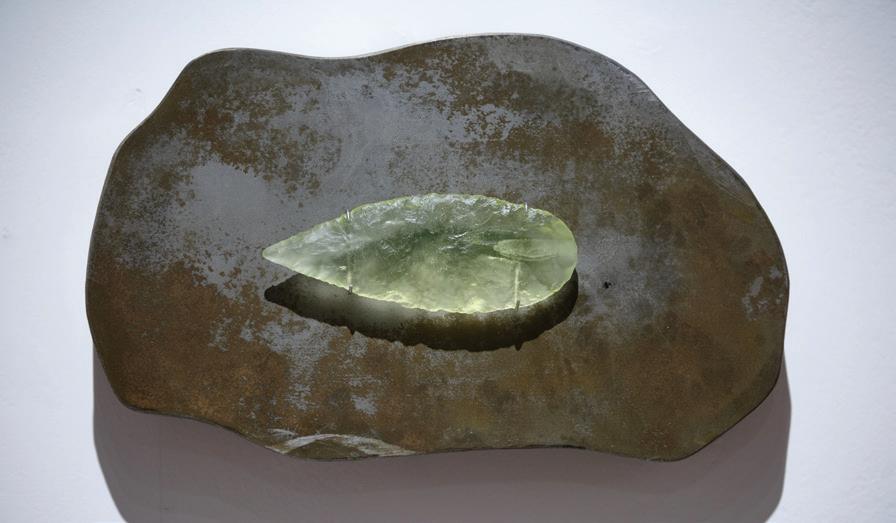
A major new body of work by Brenda L Croft, a proud Gurindji/Malngin/ Mudburra woman whose background also includes Australian/Chinese/ English/German/Irish heritage. The mixed media installation maps Croft’s patrilineal relationship to Country, reimagining the customary design of the spear tip and kurrwa (stone axe) belonging to the Gurindji homelands of her father, Joseph Croft (c.1926-1996) connected to the Victoria River District of the Northern Territory. Shown alongside this installation, are eight works from Croft’s Made in Australia II series, from the CMAG collection.
Celebrating the artistic friendship of Melbourne artists Ethel Spowers and Eveline Syme, Spowers & Syme presents the changing face of interwar Australia through the perspective of two remarkable women artists. Spowers & Syme is a National Gallery of Australia Touring Exhibition. Spowers & Syme is a Know My Name project.
CANBERRA MUSEUM AND GALLERY
cmag.com.au | cnr London Circuit and Civic Square, Canberra City Mon – Sat: 10am – 5pm
29 Oct – 12 Feb
Mandy MARTIN (b.1952 d.2021), Pink Drape 1980, Acrylic, oil, paintstick on canvas, CMAG, Gift of the artist 2021
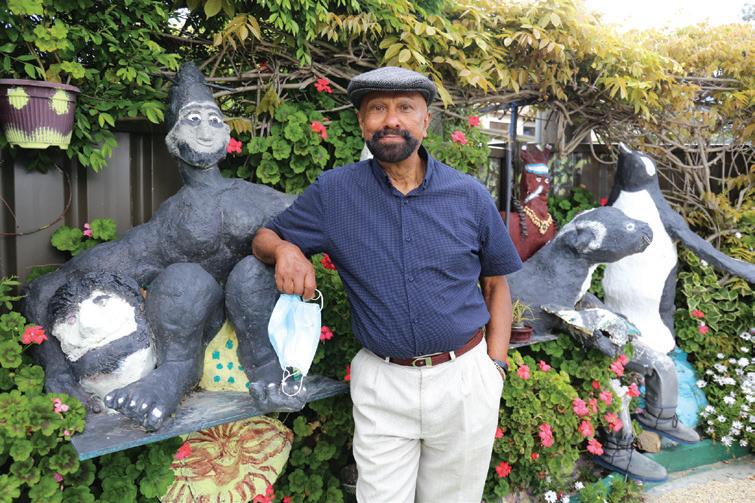
THE suburb of Chapman is home to one of Canberra’s most unusual artists.
Upali Kariyawasam makes giant sculptures out of concrete.
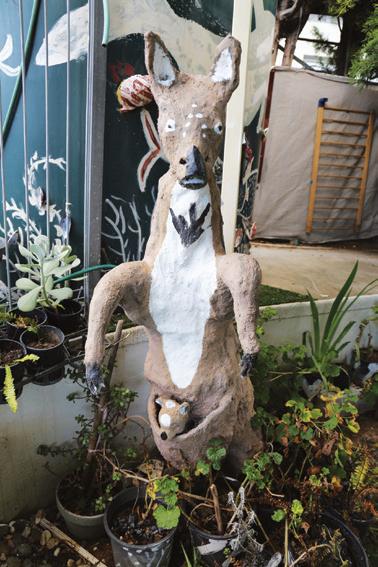
His garden is littered with dozens of larger-than-life depictions of lions, an elephant, kangaroo, giraffe, a gecko and even a mermaid.
It all started when lockdown left Sri Lankan born Kariyawasam – a retired executive chef – with an abundance of leisure time.
“I had time on my hands, so I thought I’d put it to good use,” he said.
The 75-year-old grandfather has made about 35 sculptures that he’s placed in his backyard.
A giant octopus sits on top of his garden shed and a dolphin overlooks his swimming pool.
There’s a statue of cricket legend Don Bradman, and a bust of Kariyawasam’s late father.
“It’s like a museum here,” he chuckled.
“I do lots of mad things that other people don’t do.”
Upali Kariyawasam with some of the creations in his garden… “I do lots of mad things that other people don’t do.”
Kariyawasam, a former master chef at London’s Grosvenor Hotel, uses concrete and hessian to create his artworks.
Each sculpture takes between 10 and 15 hours to make.
Kariyawasam does not use plans or drawings and works only from memory. He hasn’t made a mistake yet.
“I make the sculptures from scratch,” he said.
“I use chicken wire to make the shape, then I mix the concrete and dip
the hessian into it and mould it over the shape, and then I paint it.”
The ex-chef, who specialised in European cuisine, draws on his experience in butter and ice carving, a craft which he learnt in London.
“When I worked at the Grosvenor Hotel I used to watch one of the Japanese chefs carve sculptures from ice,” said Kariyawasam.
watch him, and I later learnt how to do it myself.
“Ice carving is a specialised craft and you only have a limited time to complete the carving.”
When Kariyawasam moved to Canberra in the 1980s he took up a role as executive chef at the Country Comfort Motel on Northbourne Avenue.
Some years later, he opened his own restaurant in Phillip.
More recently he was a chef at Rydges, following which he took a position with the Australian Defence Force Academy as a chef.
“About 10 years ago I was asked to carve a giant Viking out of butter for the opening of the Tuggeranong Vikings Club,” said Kariyawasam.
“That was good fun.”
Kariyawasam’s garden is a treasure trove of creativity.
His water tank is painted to resemble an aquarium, there are fish ponds everywhere, and a badminton court in the front garden.
“I made the badminton court myself,” Kariyawasam said.
“I have also made about 200 pots for my plants and I have about 50 varieties of flowers and vegetables.
“My backyard is really attractive and my garden is fantastic as well.”
The taekwondo enthusiast doesn’t sell his sculptures and has no plans to stop sculpting.
“My kids love what I do and my grandkids love it, too,” said Kariyawasam.
“Anyone is welcome to visit, and I can give people a demonstration on how to sculpt.”
Anyone wishing to see the sculptures should email u.kariyawasam@ hotmail.com
Kerstin Glomb Estate Planning Special Counsel
Photos: Belinda Strahorn
Why principals have to put student safety first
STANDING on principle against the vaccination mandate for school staff is simply pissing into the wind.
The Charnwood-Dunlop School Principal, Rob Lans, didn’t just make a stand against the mandatory vaccination of staff – he also claimed he was “horrified” at the idea that COVID-19 vaccines were available to 12 year olds.
There is an irony in a school prin cipal resisting mandating. Principals are responsible for a whole range of mandatory behaviours in schools and that they demand of their students. Mandating does not just apply to primary school students but right through to college level. For example, college students are not allowed to smoke or bring alcohol to school and they are required to be respectful of other students and staff.
When employed to provide education in a public-school system, personal beliefs are not the highest priority. The education and wellbeing of the students is number one. This is even more important as a school leader.
When Mr Lans shared a video on Facebook appearing with One Nation’s Senator Malcolm Roberts he stated: “So I am … going to stand up for what I believe in and stand
of their students first. This means mandating vaccination of staff. And rightly so. The first priority of every teacher, and particularly senior staff, should be the wellbeing of the students.
A school principal, of all people, should be aware of the misinformation that is abundant regarding vaccination. Even the choice to record in the presence of Senator Roberts, who has been identified as sharing misleading information on COVID-19 vaccination, shows poor judgement.
An ACT school principal seeking to influence outcomes weakens their own case by working with a senator from another jurisdiction. However, as local MLAs, local senators or local MPs accept the importance of mandating vaccination for primary school teaching staff – perhaps he felt there was no choice.
Even if 99 per cent of eligible people in the ACT are vaccinated – that still leaves one per cent or somewhere in the order of 4000 people not vaccinated. However, this sort of percentage does provide a strong base for herd immunity. In other words, those in the community who are not eligible for vaccination or who are
severely immunocompromised can be protected by the ring of vaccinated people.
High levels of vaccination are very beneficial for the community at large and are the fundamental basis as to why vaccination of primary school staff is so important.
Parents want to send their children back to school and to do so in the safest possible manner. Knowing that the risk is substantially reduced because all school staff are vaccinated is important in building confidence.
Parents and schoolchildren have already suffered enough through the lockdowns. Now they should be able to have the best chance of coming out of the pandemic with the least risk to young children.
Michael Moore is a former member of the ACT Legislative Assembly and an independent minister for health. He has been a political columnist with “CityNews” since 2006.
100’$ for Thousands is a Christmas fundraiser aimed at helping local families in need across Canberra, Queanbeyan, Yass, Cooma and Goulburn. All money raised goes to a local Salvation Army centre of your choice.
With your help, our goal is to raise $100,000, allowing us to provide 1000 families with a $100 grocery gift voucher to use over the festive season. So donate today and GIVE WHERE YOU LIVE!
CANBERRA MATTERS
How the Greens look the other way on trees
WHEN the ACT government announced on September 25 an allocation of $14 million to plant 54,000 trees across Canberra, clearly it was designed to give the impression that the government took trees and biodiversity seriously.
Leading up to the 2020 ACT elections all parties offered to do something about the city’s diminishing urban forests. The bidding was serious.
The government’s announcement is an overdue effort to make up for the losses of the last decade or more – being the time of the coalition of ACT Greens and ACT Labor in government.
No mention was made about how this figure overlapped with 2020 and early 2021 announcements for planting trees. Nor is it clear whether the 54,000 include trees that would have been planted as part of on-going programs. The announced figures may be smoke and mirrors with the “extra” trees being not so many.
In 2019, Caroline Le Couteur, then a Greens MLA, said that the government needed to plant an extra 7000 trees annually to help restore the city’s canopy. She cited a 2012 report that stated Canberra’s streets and parks needed 40,000 trees to fill the gaps and replace dying trees. That number would be much higher in 2021.
The 54,000 trees by 2024 would not be making the city more climate
Despite all the rhetoric, the ACT Greens are not yet addressing the realities of the climate crisis. The tree canopy will most likely stay around 20 per cent at best for years to come.
resilient (as boasted in the media releases), but may be more about replacing those lost over the last decade in the public areas of Canberra. If the tree canopy is now a little under 20 per cent (some say closer to 15 per cent), then despite all the rhetoric, the ACT Greens are not yet addressing the realities of the climate crisis. The canopy will most likely stay around 20 per cent at best for years to come.
There’s a lot of blah, blah, blah in the Greens’ compromising agreement with ACT Labor to form government. The ACT Greens took a fairly moderate, action-packed green infrastructure agenda to the last election. However, their agreement has this watered down to not-doing-much with words such as “continuing to work towards reaching a 30 per cent urban tree canopy across Canberra by changing the Tree Protection Act and planning system”.
Continuing to work towards could be a committee meeting to decide to meet next year or the one after to formulate a strategy. Tick that box! The climate crisis will not be addressed by talking and doing little.
BUT the debate that’s not happening is what is happening with established suburban redevelopment (trees and established biodiversity cleared for larger houses) and that newer suburbs have very few trees and biodiversity (no backyards, etcetera).
This is where the ACT Greens and ACT Labor are looking the other way – nothing to see here – and have let down future generations, big time! There’s no need for “Have You Say” surveys to work out what is happening. Residents have observed how
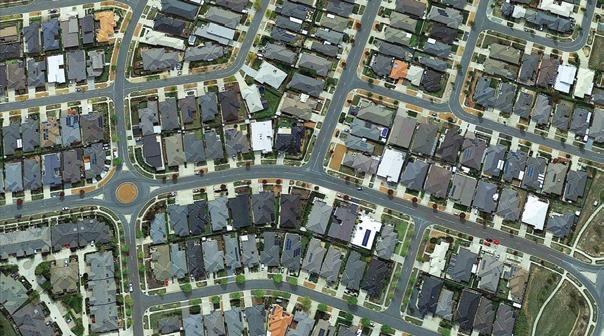
their established suburbs suffer with new larger houses and less greenery. And the illustration shows clearly how the newer suburbs have smaller blocks with large houses that almost touch each other. These residences have tiny yards with the smallest amounts of greenery. Heat-island bliss!
Add to all this, the planning rules that allow for minimal greenery around multi-unit apartments – the last proposal being 15 per cent. When the so-called Demonstration Housing scheme was promoted by the ACT
government, including the ACT Greens, the danger was that the most basic residential zone (RZ1) would be undermined and the greenery would be reduced to the lower requirement of 15 per cent.
These seriously bad outcomes fall to the ACT Greens and their coalition government who have completely compromised the future health and well-being of future residents of this city. It is definitely time for the ACT Greens to return to being green instead of murky brown.
The last words come from Prince William on October 15 when talking about the Glasgow Climate Conference: “We can’t have more clever speak, clever words but not enough action.” Or the Queen, who said: “It’s really irritating when they talk but they don’t do.”
Paul Costigan is an independent commentator and consultant on the visual arts, photography, urban design, environmental is sues and everyday matters.
A new Canberra suburb… these residences have tiny yards with the smallest amounts of greenery. Photo: Google Earth
ACT BUDGET / under the microscope
Turbo-charged Budget, but only in Barr’s head
THE 2021-22 Budget was framed in the shadow of the COVID-19 pandemic and purportedly responds to its economic impacts.
The ACT’s economy has performed relatively well through the pandemic compared to other jurisdictions in Australia.
But the relatively better economic conditions in the ACT are reflective of a high public-sector labour force and there have certainly been adverse impacts on the territory’s small businesses and households reliant on casual jobs in the hospitality and service sectors.
The recent lockdown, the effects of which are not reflected in the June accounts, will have a more significant impact on the economy in general and on those sectors in particular.
Indeed, when announcing the Budget, Chief Minister and Treasurer Andrew Barr is reported to have said: “Right now, the territory economy would be in reverse. The September quarter will undoubtedly be a quarter of negative growth, and so we need to turbo charge the remaining three quarters of the year if we’re going to see the economy grow over the full fiscal year 2021-22”.
In the first of a two-part critical analysis of the October 6 ACT Budget, JON STANHOPE and Dr KHALID AHMED discover the cash deficit in the ACT’s general operating activities means the government will have no option but to borrow to pay its interest costs.
what we think are going to be the two major drivers of the economic recovery. One will be public investment – hence our infrastructure program in our Budget – and the other will be household consumption.”
In support of this claim, the government pointed to an infrastructure program of just under $5 billion. Subsequent public reporting has generally reflected the Budget’s focus on “turbo charging” the economy in response to the effects of covid and a general acceptance of the operating deficit and the increase in net debt as a “cost” that must be borne.
Unfortunately, an examination of the Budget reveals that the claimed increase in the capital investment program is misleading.
We acknowledge that this would be a reasonable supposition if the Budget actually incorporated a real and effective response to the impacts of the pandemic.
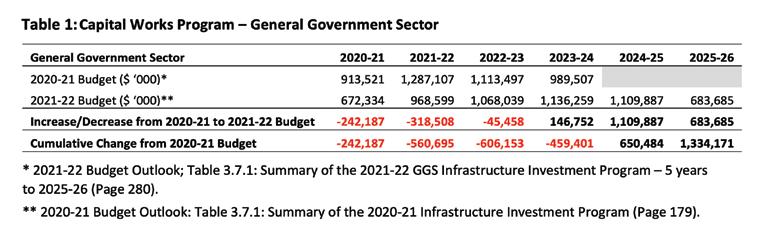
the 2020-21 program (see Table 1).
Further, contrary to the claimed objective of “turbo charging” the economy in the next three quarters through infrastructure investment, the expenditure forecasts for 2021-22 and 2022-23 are $319 million and $45 million lower, respectively, compared to the forecasts in last year’s Budget.
To make matters worse, while the estimated outcome for the 2020-21 capital works expenditure has not been reported explicitly in the infrastructure chapter, the cash flow statement suggests a capital works underspend of approximately $242 million.
In summary, the detailed tables in the Budget papers indicate that the government will be spending $606 million less on capital over the period 2020-21 to 2022-23.
DEBT
Worryingly naive view of ‘cheap’ borrowing
FOLLOWING release of the Budget, the Transport Minister Chris Steel is reported to have said that “debt has never been this cheap. Financing costs have never been lower, and interest rates are also at a record low”.
It is worryingly naive to regard the availability of cheap debt in itself as a justification for borrowing. It is important firstly to examine how the debt is being utilised as well as the capacity to sustain the debt.
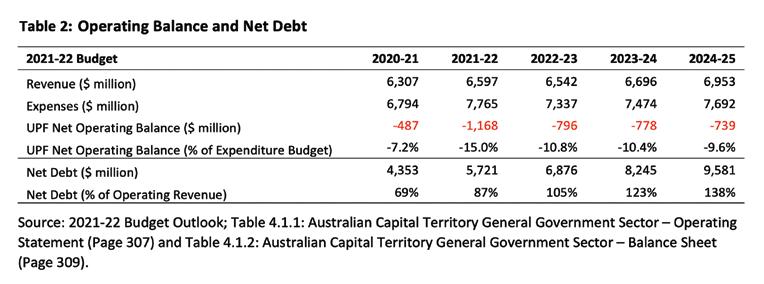
interest costs will be approximately $229 million. This means that the government will have no option but to borrow to pay those interest costs, and more.
The 2021-22 Budget forecasts a record headline operating deficit of $952 million for 2021-22 and deficits averaging around $520 million across the forward estimates (see Table 2).
In this context, deferral of the Budget by five weeks from August 31 to October 6 was sensible and enabled the government to respond to the emerging conditions with appropriate adjustments to the Budget.
The government’s claimed thinking is reflected in the Treasurer’s reported statement that “a lot’s going to hinge on
Unfortunately, an examination of the Budget reveals that the claimed increase in the capital investment program from $4.3 billion in the 2020-21 Budget to $5 billion in the 2021-22 Budget is misleading.
For a start, the 2020-21 program was over a period of four years, whereas the program announced in the 2021-22 Budget is over a five-year period.
Excluding the $684 million allocated for 2025-26, and comparing the respective four-year programs, the allocation in the recent Budget is in fact lower than in
Taking into account the underspend and withdrawals/deferrals, the first actual increase in capital expenditure in this Budget is in 2024-25. If the government intended to “turbo charge” the economy through infrastructure investment, it would have been better to simply adhere to the undertakings and estimates in last year’s Budget.
It is clear that because of its limited capacity the Budget has, other than addressing some past neglect, fallen well short of its stated objective of “turbo charging” the economy. In fact, on our assessment, the ACT’s Budget was, before the pandemic, in the worst position of any state or territory and, as such, least able to respond to its effects.
HEALTH
The operating Budget of an entity typically includes non-cash expenses, for example, depreciation and provisions for employees’ entitlements that require funding in the future.
If the operating Budget is to enter into deficit, it is important to maintain a balanced cash budget or a surplus so that the entity does not need to resort to borrowing to pay employees or to pay interest on previous borrowings.
The latter is a particularly alarming scenario with a clear risk of a debt spiral. In 2021-22, the cash deficit in the ACT’s general government operating activities is forecast to be $328 million, while
However, under the measure agreed by the Australian and all state and territory governments for reporting on an operating budget, the ACT Net Operating Balance for 2021-22 is forecast to be negative $1.168 billion.
Across the forward estimates, on this uniform presentation measure, deficits are forecast to range between $796 million to $739 million.
To put that in perspective, relative to the forecast operating expenditure of $7.765 billion, the deficit is 15 per cent of the operating budget. This is the highest of all the states and territories, with Victoria forecasting a deficit of 13.5 per cent and NSW 8.4 per cent.
The ACT’s net debt is forecast to increase across the forward estimates to $9.6 billion in 2024-25, which is 138 per cent of the forecast operating revenue.
Health boost doesn’t make up for what was earlier withdrawn
THE government has made much of claims that the 2021-22 Budget provides a significant boost in spending, including on health.
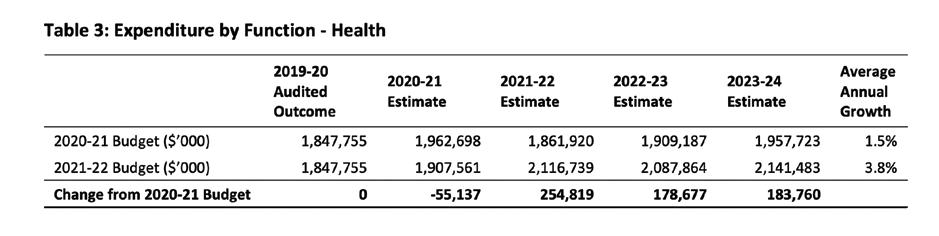
The increase as shown in Table 3 is an increase in the base health expenditure in the order of $180 million a year.
Over the past several years, we have highlighted the relatively lower priority given to health through (a) abandonment of the $1.3 billion hospital redevelopment program, and the deferral of the scaled-down project of $500 million; and (b) a reduction of one per cent a year in appropriate growth funding that meets the health needs of a growing
population and increasing costs of technology.
Both these factors resulted in an actual decrease in available hospital beds, unfilled staff positions, the worst waiting times in the emergency department, and some of the longest waits beyond clinically recommended times for elective surgery in Australia, leading to public concerns from frontline clinicians about the safety of our hospital system.
The increase in health funding, albeit only a proportion of what was earlier withdrawn, is welcome.
Unfortunately, once the capacity in a complex system is degraded, it takes a concerted effort over a long time to rebuild that capacity.
In the current environment in particular, the absorption capacity of the system will be limited due to the shortage of clinical and allied health staff nationally.
The estimated underspend in health of $55 million against the
Budget provision in 2020-21 illustrates the point.
There are other areas that don’t fare well in this Budget with either decreased funding or inadequate growth across the forward estimates (eg environmental protection and
social protection) or a decrease in allocation compared to the 2020-21 Budget estimates (eg education).
Jon Stanhope is a former chief minister of the ACT and Dr Khalid Ahmed, a former senior ACT Treasury official.
THE Corkhill Bros Pegasus Charity Race Day 2021 will be held at Thoroughbred Park, Lyneham, 11am-5pm on Friday, November 26, with the promise of “thrilling races, fantastic food and drinks, fabulous fashions on the field, exciting auctions and raffles”. Proceeds for the day help provide therapeutic programs for people living with a disability.
Free pelvic workshop
WOMEN of all ages are invited to attend a free, online pelvic floor workshop presented by a physiotherapist from Canberra Health Services, 1pm-4pm, on Monday, November 8. The workshop is targeted to women experiencing continence or pelvicfloor concerns as well as those wishing to prevent them. Book at 5124 9977 so an individual email with the online link can be forwarded.
Bandannas are back
RELAY for Life team, the Bold Bandannas is back with a charity stall raising funds for cancer research at the Belconnen Fruit & Veg Markets, 8am-5pm, on the weekend of October 30-31. On offer will be homemade jams, pickles and chutney, a range of handsewn items, including children’s dress-up clothes and plants. More from 6231 0761.
‘Briefly’ submissions to editor@citynews.com.au
WHIMSY Memories may be beautiful and yet… get writing
IF you’re an older person, you’ve probably thought about writing your memoirs and then cast the thought aside as too difficult or them not being of interest to others.
The reality is that we’ve all had unique lives and what may seem unremarkable to you could be of considerable interest to others. If you want to be candid about what you think of other people, you can of course choose not to distribute the memoir now and instead have it released after your death.
Some writers have a daily diary to assist their recollection, while others have to rely on memory. A diary can be useful, but I started keeping a daily diary from 1993 and find myself bogged down from that point on because of the detail the diary contains.
The value of memory is that you’ll be hitting the highlights as you remember them. The downside is that a story often related may now inadvertently contain false content. I met a while ago with the family of someone who worked for me and now has onset dementia. Talking to his son, I discovered that a lot of his pre-dementia anecdotes were not what really happened (I know mine are accurate because I recorded them at the time).
I read a lot of autobiographies for enjoyment and there is, of course, a tendency for writers to gloss over the things they didn’t do well, are not proud of, or disturbed them – and focus on more positive aspects. That’s inevitable. As the Barbra Streisand song goes: Memories, may be beautiful and yet, What’s too painful to remember, We simply choose to forget. Biographies (a person’s story written by someone else) are usually a bit more objective but rely on someone else’s research and may not accu-
rately reflect the subject’s views.
In my father’s case, his memoir was a family effort. Dad had lots of interesting anecdotes, so in 1985 when he was 71, I persuaded him to record his memoirs. I went to his house each week with a tape recorder, and he would talk for an hour about a decade in his life, working in chronological sequence. He had a week to think about each decade. Production was a family effort. My sisters-in-law word-processed the recordings, my brothers and I edited the draft, and
dad made any necessary corrections. We photocopied the final work and had six copies bound for the family.
Our father died aged 93 in 2008.
His book, “A Soldier’s Life”, is now a treasured possession to be passed down through the family.
How people go about writing their memoirs varies. Some focus on their working life, others start from when they were born and do it chronologically, while others just write about interesting experiences. It’s inevitably subjective and idiosyncratic.
The actual mechanics of doing it could be writing or word processing it yourself, using speech-to-text software, or recording it for someone else to type.
Much will depend on who your audience is and what’s important to you. Family anecdotes will be of interest to family – but less so to others, while work and life experiences have broader historical and social interest.
Ultimately, it’s your life as you value it. In my view, the time to write a memoir is anytime from your 50s on, but even teenagers have written powerful memoirs. Jewish fugitive Anne Frank, for example, was only 16 when she died.
But don’t leave it too late. Life spans
are unpredictably finite!!
Fortunately, long-term memory for writing memoirs is more durable than short-term memory. One night an elderly man and his wife are watching TV. He gets up and starts walking towards the kitchen. His wife asks: “Can you bring me some strawberries, please?”
“Sure.”
“Aren’t you going to write it down, so you won’t forget?”
“No, no. It’s fine.”
“Well, I’d also like some cream with it. You should write it down, so you’ll remember.”
“Don’t worry. I’ve got it.”
“Could you also add some chocolate topping? You really should write it down, dear.”
“I’ve got it. No problem; strawberries, cream, and chocolate topping.”
After 15 minutes the husband comes back with a plate of eggs, bacon, and sausage. The wife looks up at him and asks:
“Where’s my toast?”
Clive Williams is a Canberra columnist.
IF things look a little different at citynews.com.au, they are.
In fact, everything’s different. We have rebuilt the popular website from the ground up to give us a (very) modern digital hub designed to meet the fast-news needs of readers in Canberra and Queanbeyan.
And, in all modesty, it’s getting rave reviews from our thousands of readers who are driving record daily audience numbers, which is pretty cool.
Advertisers are responding positively to the flexibility and cost-efficiency of being seen by so many people digitally every single day. And that’s pretty cool, too.
There remains no paywall to readers and it features all the regular news, views and arts stories that matter.
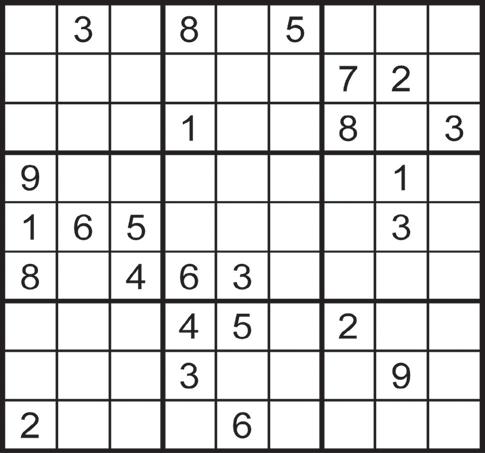
I can also confirm that the free crossword and sudoku puzzles are working perfectly!
Have a peep (citynews.com.au), we think you’ll love our new world of local news.
Sincerely,
Ian Meikle, editor
The Barbra Streisand song goes… “Memories, may be beautiful and yet, what’s too painful to remember...”
Even teenagers have written powerful memoirs... Jewish fugitive Anne Frank was only 16 when she died.
Covid free with one stroke of Chief Minister’s pen
Dear Chief Minister, CONGRATULATIONS and thanks for your role in helping 99 per cent of Canberra residents, aged 12 and over, receive one jab anti-covid vaccination, and soon two jabs.
However, I do not understand why Canberra is out of step with NSW, Victoria, Europe and Singapore in not requiring vaccination before entering hospitals, aged-care homes, schools, shopping centres, restaurants, cafes, sporting facilities and theatres.
My family, children and grandchildren and friends, will continue to suffer unnecessary risk from the one per cent of Canberrans and an unknown number of non-Canberra residents, who will continue to present an avoidable and highly dangerous public health risk.
The ACT could effectively be covid free with one stroke of your pen. Can you, please, urgently reconsider your policy?
Dr Paul Kauffman, O’Connor
An utter waste of ratepayers’ money
WITH such considered views by some people worth listening to in the letters page (CN October 21), I am amazed, disappointed, bemused; why is the Greens/ALP government rushing headlong with Stage 2 of light rail?
Where is the target for a bolt of common sense to stop this utter waste of ratepayers’ funds? The case for light rail must be represented before any further work is done; but who has the clout ?
John Madelly Sr, Melba
Shine a light on eating disorders
WELL done, Jon Stanhope, for the thorough analysis of mental health support in the ACT (“Mental health funding short changed by $106m”, CN October 14).
Nowhere is this issue starker than in relation to eating disorders. Anorexia Nervosa has the highest death rate of all mental illnesses. Yet there are no specialist adult public or private eating disorder beds in Canberra.
General medical and mental health wards lack the skills or resources. The community-based Eating Disorder Program is overstretched; it’s near impossible to see
a psychiatrist while private, eating-disorder psychologists are booked up months in advance. Many have no choice but to take their loved ones to Sydney for treatment (an option made harder by covid) or struggle on with little support.
A light needs to be shone on a broken system that is causing such pain and anguish for Canberra families.
David Quilty, Deakin
Solution looking for a problem
AS reflected by the excellent letters (CN October 21), recent debate in other forums about the merit of light rail Stage 2 has taken an unfortunate turn with light-rail proponents resorting to personal abuse of those opposing – a sure sign that the arguments from lightrail advocates do not stand on their merits.
The auditor-general’s report confirms what we have long known: light rail Stage 2 is a very high-cost public transport option for which the economics don’t stack up. Moreover, its construction is likely to cause harm to our environment. With e-buses (and perhaps other options) already offering far cheaper, more flexible, faster and environmentally friendly alternatives, light rail Stage 2, in Andrew Barr’s words, would seem to be “a solution looking for a problem”!
Will lake bridge come down?
THIS is the sequel to my earlier letter (CN October 7) and enlarges on the subject of a new bridge between the existing two Commonwealth Avenue bridges, with the tram using the existing northbound carriageway.
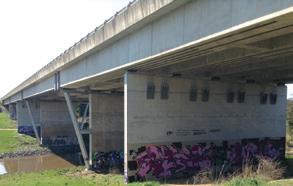
But first, it has been reported that the said bridge needs to be strengthened to meet current loading standards! How many of us have seen the underside of the Tuggeranong Parkway bridge over the Molonglo River, which recently was similarly strengthened?
The photograph above shows the additional supporting concrete walls, steel beams
and raking steel columns which now adorn the original structure. I wonder whether the National Capital Authority intends to inflict this eyesore on this elegant and prominent location over Lake Burley Griffin?
I suspect that they might instead opt for demolition and rebuilding of the 50+ year old Commonwealth Avenue Bridge!
Imagine the traffic disruption that would cause! Either way, the disruption could be reduced substantially by combining the tram and strengthening projects and staging the construction so that the existing three traffic lanes each way on Commonwealth Avenue bridge can be kept in operation at all times with only minor disruption during changeovers. The first stage would be the construction of the new central bridge and the last stage would be the installation of the tram.
Nevertheless and like many other correspondents, I still maintain that we cannot afford more trams and that the “light rail” project should be abandoned immediately.
Denis Wylks, Holder
Take more than the tram to meet targets
IT will take a lot more than light rail to achieve the ACT’s emissions targets.
The government’s target is to reduce local emissions to below 1.5 million tonnes by 2025. In 2019-20 the ACT caused 1.7 million tonnes of greenhouse emissions, including a million tonnes from transport.
In the first 12 months of light-rail operation, Transport Canberra used 400,000 more
litres of diesel, and caused about 600 tonnes more emissions, than it did in 2017-18.
It also provided 2.1 million more journeys.
We make 55 per cent of our trips as car drivers, 23 per cent as car passengers, 14 per cent on foot, 4.3 per cent by bus and 2.4 per cent by bicycle.
If we generously assume that three quarters of the extra public transport trips were made by people who would otherwise have driven cars, then light rail is replacing 1.6 million car trips per year.
A typical car trip causes two and a half kilograms of (CO2-e) emissions. So Stage 1 is reducing car emissions by 4000 tonnes a year, for a net reduction of about 3500 tonnes a year. That is only one third of one per cent of our transport emissions.
Leon Arundell, Downer
Underwhelmed by Woden
THE underwhelming planning for Woden is not surprising given what our planning and transport ministers and their authorities have practised at producing for years now along Northbourne Avenue (“How to completely stuff up Woden town centre”, CN October 14).
The moth-eaten, un-co-ordinated landscape for the much-vaunted “gateway to the city” focuses entirely on overbuilt forms and inflexible public transport infrastructure.
It is already producing an unappealing, unbalanced, hard-surfaced environment that will intensify and be even more
unfriendly to local visitors and tourists when more massive dormitory complexes appear along what is just an eight lane transport corridor.
The benefits of additional urban forest inclusions, for example, have been ignored. Sterile “mixed use” cookie-cutter spaces that were not filling up pre COVID-19 will no doubt be joined by more in locations that many will find too hard to access and support in future.
Sue Dyer, Downer
Chinese peaches, shame on Coles
MY husband recently bought a plastic jar of Coles’ “Sweet and Juicy Peach Slices” in juice. Imagine our horror when we read where they were made – “Made in China”. How dare Coles import peaches when our country grows its own!
China has seen fit to ban many of our products and I think it is time we started to stand on our own two wobbly feet and ban this kind of import.
I am disgusted with Coles. How many other food products are being brought in from China?
Jan Kicenko, Kaleen
Number of numbers and Barr bagging
READING Ian Meikle’s “Seven Days” column (CN October 14), I had to check it was not written by Jon Stanhope; such were the number of numbers and the amount of Barr-bagging.
But no, Jon’s piece came later with more of the same, plus a graph.
And in “CityNews”, October 7, I had so enjoyed Jon’s article about the war service of members of his extended family.
Russell Wenholz, Holt
Be consistent with non-vaxxers
THANKS to Greg Cornwall for the “No Vax, No Vote” suggestion (CN September 30).
I have an even better one.
As people who choose not to vaccinate will be virtually excluded from this society, we should be consistent and not accept their tax contributions also!
Irene de Silva, Queanbeyan
Luke Clews
dose of dorin
People with passion getting back to business
EXPERTS can be found anywhere in Canberra’s suburbs.
They are people who have dedicated years to developing their skills and who are enthusiastic about providing insight into their expertise and their businesses.
Whether that be vegan shoes or gifts for pets, “CityNews” speaks with a variety of experts, passionate about sharing their skills and services with the ACT region.
A gift store with pets in mind
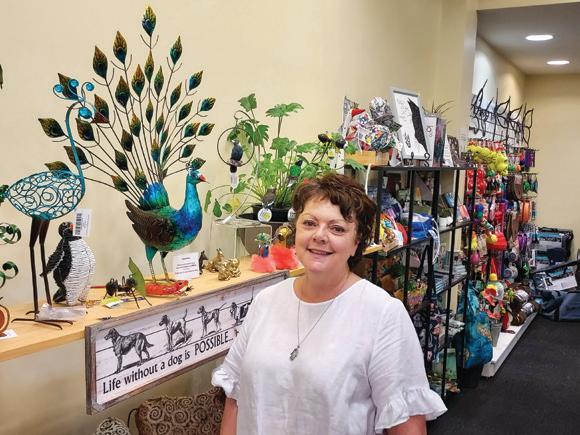
SANDY Borgo at Charlie & Chums is looking forward to putting a smile on people’s faces again.
She says her gift store for pets is full of stock as the lockdown comes to an end.
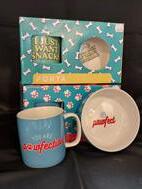
“There’s toys for cats and dogs, pet hair brushes and brooms, bookmarks, bags, painted mugs, figurines, sculptures, leashes, collars and much more in our Christmas range,” she says.
gift from our store after them helping us through lockdown,” she says.
“We can also do gift boxes up for pets, if customers tell us what they like we can do it all up for them, it’s just a matter of you working out what you’d like – toys, treats, you name it,” says Sandy.
Sandy says the biggest gift for her is seeing people smile at the things they
Owner of Charlie & Chums Sandy Borgo.
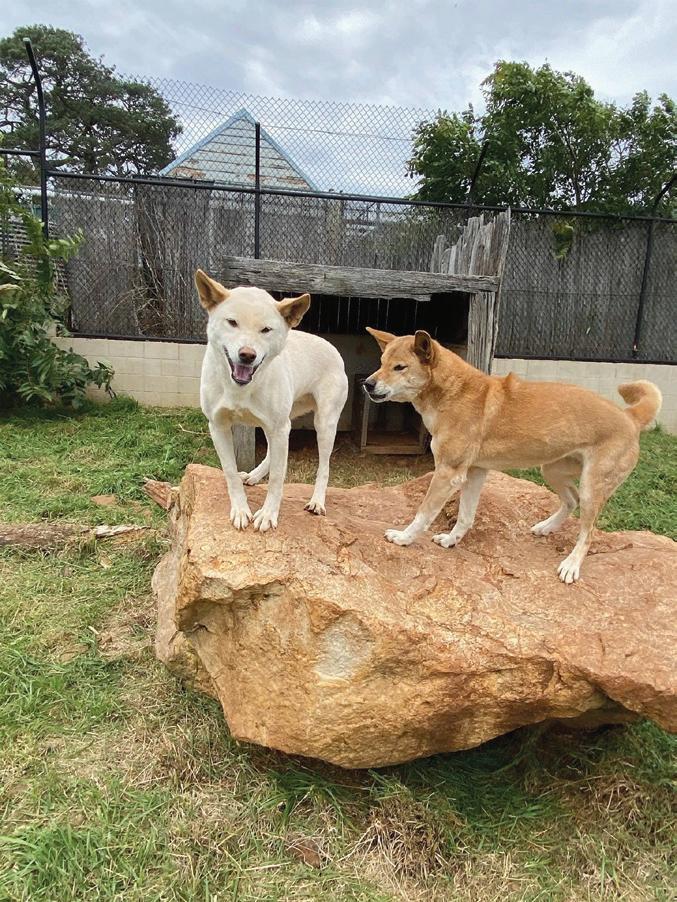
The dingoes of Taralga Wildlife Park.
Open every day during school holidays from 10am to 4pm Cafe open from 10am to 3pm
Trip Advisor rating Facebook rating
257 Bannaby Road
Taralga NSW
90 minutes from the heart of Canberra
0419 014 540
Re-opening 30th October
Comfortable and stylish vegan shoes
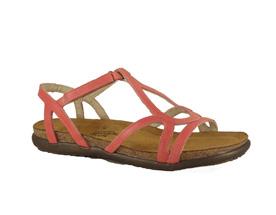
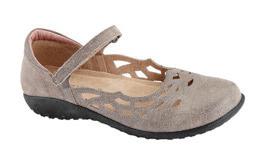
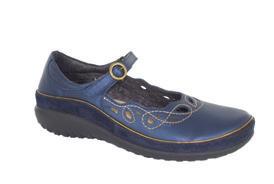
PODIATRIST of 30 years, Dr Mark Clayton, from NAOT of Canberra, says he has a new range of comfortable and stylish vegan shoes available for purchase.
“Vegan shoes can be hard to find, but the shoes we have in store now are not made from any animal products and come in all different styles, sizes and colours,” he says.
They’re just the start of Dr Clayton’s extensive range of NAOT footwear, a brand he says is ethically crafted and of “exceptional” quality.
“They call them shoes of peace, with each pair a product of collaboration,” says a NAOT spokesperson.
“Crafted by hand, through the combined efforts of
people from different cultures and backgrounds, NAOT shoes are ethically made using sustainable methods with materials of the highest quality.
“Fine Italian leathers and its signature insoles, combined with advanced designs, make for an unparalleled combination of quality, fashion and comfort.”
For those wanting to browse Canberra’s biggest range of NAOT shoes, Dr Clayton recommends calling ahead to book an appointment.
NAOT of Canberra, 1/151 Cowper Street, Dickson, and 1/37 Heard Street, Mawson. Call 6262 8383 or visit naotofcanberra.com.au
OUT OF LOCKDOWN SALE
The land surveyers who helped Canberra grow
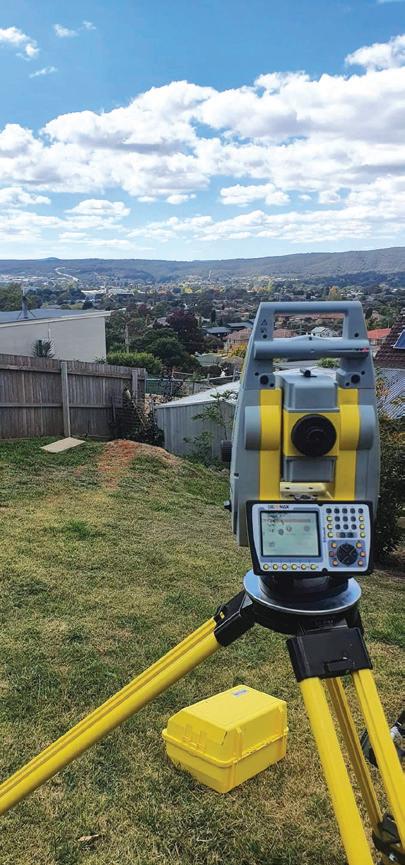
SHAW Surveys is committed to providing professional survey services to not only the general public, but also to government authorities, engineers, developers, solicitors, architects, builders and real estate agents, says director Jim Shaw.
“Part of getting approval from the government to build or extend the home requires an accurate measuring and position of things on the block and that’s where we come in,” says Jim.
“We offer comprehensive surveying services and have expertise in all facets of land and property surveying to make sure you’re not building too high
Shaw Surveys was first started in 1982 by Jim’s father, Peter, with the business originally called PJ
Over the decades since, Peter says the company has done the subdivisions that created Gordon, Conder, Amaroo, Nicholls, Forde, Palmerston and Jerrabomberra to name a few.
“We’ve seen Canberra grow massively in the last 40 years and I’m really proud to have been a part of that,” says Peter.
“To know that my family is continuing the legacy makes me even more proud.”
Now jointly run by Peter and his children, Jim and Sarah, Shaw Surveys continues to offer their trusted services throughout the ACT and surrounds.
“We work as far as Goulburn, Braidwood, Cooma, Yass and even down the coast on occasions,” says Peter.
HORRIFIC wounds, the ravages of disease and tortuous deaths: they experienced first hand the worst of what war brings.
Not the men charging into battle, but the women virtually behind them. Those staffing military hospitals and a medical system that evolved to deal with broken bodies in the midst of equally destroyed landscapes.
In World War I alone, Can berra – in 1914, barely a year old – could lay claim to a handful of such pioneers. Historian and author Patricia Clarke, based in the capital, has extensively researched these women at war.
With 60 years of involvement with the Canberra & District Historical Society, including time as president, Patricia was asked to write on the topic for an online exhibition for the Australian Women’s Register.
“I was honorary editor of the Historical Society’s journal for 14 years, but until I began researching Canberra in World War I, I was unaware of the wonderful treasures we have in the stories of the nurses who were associated with our same family.
Another would be written about after the war as “The Mystery Matron” – a century ago appointed as head of the Canberra Hospital on its 1921 re-opening.
The nursing sisters who bravely went off to war
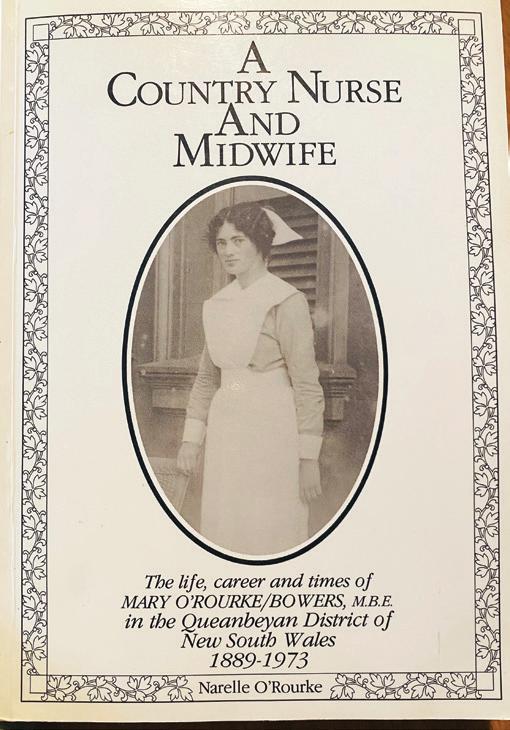
One who remained in Australia, but did more than her duty was Queanbeyan’s Mary O’Rourke.
Nursing in Sydney from the outbreak of war, Mary cared for the shattered soldiers shipped home. So was she known for meeting the boys from her hometown to farewell them as they set sail into the unknown.
Some of those returning brought with them the infamous Spanish Flu. Mary was infected, but managed to
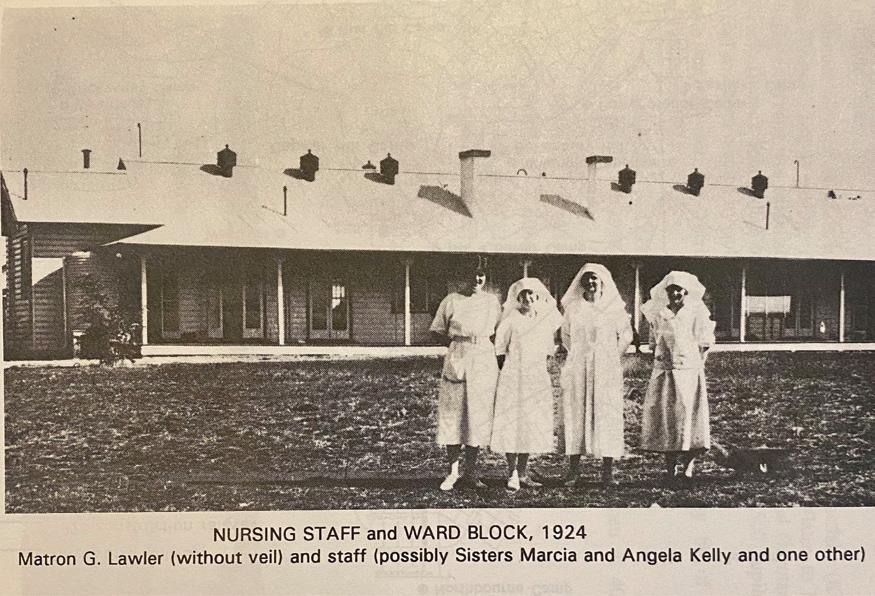
Possibly the most intriguing on the local list is Gertrude Lawlor, the “Mystery Matron”.
so they said. While their motive was primarily to care for “our boys”, each saw active duty in Greece, India, England and on the Western Front.
From Yass to Queanbeyan, Bungendore to Braidwood, hundreds of husbands, sons, brothers and fathers left to play their part.
Local women and Canberran
Administrator, the Duntroon commandant and graziers of the ilk of the Cunninghams of Lanyon, would take up the fight on the homefront. Involved in raising funds, providing “care” packages and running farms and businesses when facing few other options.
A prominent example: shortly after Lady Helen Munro Ferguson, wife of the governor-general, commenced her mid-1914 efforts to establish the Australian Red Cross, Queanbeyan formed a branch.
Led by the mayoress Agnes Moore, wife of town mayor Richard Moore, and mother to a son who’d be killed at Villers Bretonneux, France, in 1918 (Walter, a gunner with the 5th Field Artillery). Queanbeyan remains among the longest continuously operating Red Cross branches in the country.
More than 3000 Australian women signed up, taking an even larger leap into the abyss of war. According to the Australian War Memorial, eight received Military Medals for bravery and 25 lost their lives.
For six months from October 1914, Patricia Blundell had been matron of Duntroon’s hospital.
A surname associated with an 1860s stone cottage that sits upon the now northern shore of Lake Burley Griffin, Patricia hailed from a Melbourne clan.
She was among the first Australian nurses to arrive on the Greek island Lemnos to deal with the fall-out of nearby Anzac Cove, of which Patricia Clarke wrote: “The tent hospital was only partly constructed, the wounded were lying in the mud and
but food and water”.
Sister Blundell survived it – and more. Travelling back to Australia in 1918 aboard the SS Barunga, with more than 800 of mainly sick and wounded, she escaped when it was torpedoed in English waters.
At the beginning of 1917, the nurse had been posted to “a tent hospital on desolate and windswept sea cliffs” near Boulogne, France.
Flora Gallagher, of Browns Flat, between Queanbeyan and Bungendore, was there at a similar time.
A trained nurse from 1909, Flora was the first of the “Gallagher Girls” to enlist, followed by her sister Evelyn, and their niece, Janet. All returned safely to Sydney by the end of 1919.
“Since 2016, I’ve been trying to have the three Gallagher nurses commemorated by the ACT Place Names Committee,” says Patricia Clarke.
“Preferably at or near Browns Flat, which is now within the ACT boundary.”
Also confirmed by Patricia, Gladys Boon was a Queanbeyanite by birth, despite nominating Goulburn on her enlistment records.
Gladys’ maternal grandfather was the early pioneer Thomas Southwell, of Parkwood, Ginninderra.
She trained and became head nurse at Orange before enlisting in 1917, and where she’d return at the end of 1919, seeing service in Salonika, Greece.
Another locally linked was Alice Robinson, a well-regarded former matron of Queanbeyan Hospital and briefly at RMC Duntroon. She served from 1915 to 1918, re-settling in Melbourne.
“Nearly six foot tall with black hair, blue eyes… and a fiery temper,” Gertrude claimed herself English-born, from a “decorated military family”, and a widow. Except she was none of those things. She was though, a highly qualified nurse.
By early 1917, Gertrude was matron/dispenser of the Canberra Hospital – the tiny facility of eight beds opened only three years earlier. On its closing in October of that year, she joined the Australian Army Nursing Service (AANS).
When the hospital reopened in 1921 – Canberra’s population then almost 2600 – Gertrude was back from having served in India and resumed her position. She resigned seven years later after continuing battles with staff and government officials. She died in Dublin in 1959.
It emerged Gertrude Lawlor was actually the daughter of an Irish farmer who for reasons known best to herself, left all behind including a broken marriage and an infant daughter, re-inventing herself in Australia come 1913.
Inevitably, war can create many myths. What’s beyond doubt is that each of these remarkable women were trailblazers who deserve the recognition not always readily apparent at the time they also willingly gave of themselves in service to King and country.
More of Nichole’s history detective work at anoverallview@wixsite.com. blog
Mary O’Rourke… cared for the shattered soldiers shipped home.
“Mystery Matron” Gertrude Lawlor, left, pictured with nurses at Royal Canberra Hospital in 1924.
ARTS & ENTERTAINMENT
Conductor who doesn’t do anything by halves
By Helen Musa
“MUSIC is food for the soul, it’s bigger than us,” chief conductor and artistic director of the Canberra Symphony Orchestra Jessica Cottis says when I catch up with her by WhatsApp.
Cottis is, at the time, halfway through conducting a season of Verdi’s “Macbeth” for Norrlandsoperan, Sweden, playing to a full, unmasked audience and she’s rejoicing in the freedoms.
Cottis is blessed with good luck. Earlier in the year when leaving Australia, where she’d been conducting with the CSO from March to May, the British rules changed so that she didn’t need to quarantine, because Australia was then considered a “green [relatively safe] country.”
Then when she arrived in Sweden in August when British nationals were considered a danger, she was deemed “important enough” to be allowed in.
“They really value the arts here, it’s a very important part of society,” she says.
Cottis, the organ graduate from the ANU School of Music who later took the postgraduate conducting course at the Royal
Academy of Music, now calls London home.
She’s lived there for a while after several years conducting in Glasgow and has since enjoyed a massive career, rushing around the globe conducting, running courses for female conductors and becoming a frequent contributor to BBC Radio as a music commenter.
Ensconced in Sweden, where she is visited as often as possible by her partner, she’s missing her flat in London, but only a little bit.
“One of the tough aspects to being a conductor is that there’s so much travel and a lot of time away from home, but I love interacting with different landscapes, I like the balance,” she says.
Not only balance, but control and com mitment, which is why, after initially having been appointed as “artist adviser” to the CSO, she was soon renamed chief conductor and artistic director.
“I don’t like to do anything by halves; if I take something on, I want to be fully engaged,” Cottis says.
“It takes a great deal of commitment, time and focus creating a vision that works for an organisation and for the city that the organisation fits within.”
Canberra, her old home town, is the only place where she’s fulfilling such a directorial role and happily, she’s still got family here, including all four of her siblings.
“I felt it’s such a wonderful match,” she says. “It’s truly wonderful working with a
brilliant orchestra and brilliant people.
“I feel very strongly that we are the symphony orchestra of the nation’s capital and that must mean something beyond providing musical excellence for Canberra‘s classical music lovers.
“It’s very important to me that we create our own history... so much of classical music consists of canonical museum pieces, but something still needs to be created for this
That explains the exceptional number of new commissions – including five world premieres – seen across the Llewellyn and Australian Series, which she will now curate, replacing Deborah Cheetham, whom she admires as “a pretty profound human being”.
There are composer-stars such as Leah Curtis, the Canberran doing “amazing” things in Los Angeles, from whom a new work has been commissioned, and there’s a mysterious unnamed commission from the
The 2022 season includes an astonishing 20 Australian works, some old but mostly new, with works by Canberra composers
Christopher Sainsbury, Brenda Gifford, Natalie Williams and Michael Sollis, new works from indigenous rapper Rhyan Clapham (Dobby), storyteller Nardi Simpson, violinist Eric Avery and Cheetham in composer mode, the latter a “must” in Cottis’ view.
But with all this innovation, what about the core audience of the CSO, the music lovers who flock to hear the classics?
Cottis is sympathetic to their needs, saying: “People come to be lifted out of their daily lives, so we provide the classic music that we just love.” Names such as Beethoven, Debussy, Schubert, Liszt and Bach are in
both Llewellyn and the chamber series and they are the “Visionaries” who give the title to the entire 2022 season.
Thinking that in the cold winter months it might be good to have a big and “wonderfully uplifting” classic for the whole family, Cotter has scheduled a sort of Christmasin-July performance of Handel’s “Messiah”, conducted by Simon Hewett.
There’s also room for Cottis’ personal favourite, Sibelius, to her “one of the greatest of all composers… his music is wild, hypnotic electricity, bringing light”.
Cottis is no random programmer and says: “When I program an event, it is incredibly well thought out, but it all starts from the kernel of an idea, sometimes very tiny.”
An example is the opening program, “Redemption”, which will feature works by Wagner, Australian composer Margaret Sutherland, film composer Bernard Herrmann and Felix Mendelssohn, disparate but all with fascinating interconnections. That grew out of Cottis’ simple vision that the “Liebestod” (Love-Death) motif from Wagner’s “Tristan und Isolde” would be a fantastic thing for the CSO to play.
If Cottis has her way, Canberra’s music lovers will be transported by brilliant music, which will provide release, both psychological and spiritual.
The full 2022 program for the Canberra Symphony Orchestra can be found at cso.org.au
Conductor Jessica Cottis… “I feel very strongly that we are the symphony orchestra of the nation’s capital and that must mean something.”
Photo: Kaupo Kikkas
COVER STORY
Restorations - Repairs -
Ring
48hr Service Custom Design - for something Special Pearl and Bead Re-Threading and Knotting Advance Jewellers
A Family Business: 55 years experience Southlands Shopping Centre – Mawson (about 50 metres South of the Post Office) 0408 310 063
Your Precious ‘Old’ Jewellery - well it used to be... now maybe... It’s just old - and a bit worn out, or costs too much to fix... probably never be worn again... You keep the memories - perhaps, we could buy the goods?
PLUMBING
FILM FESTIVAL
Best of British with a local twist
By Helen Musa
AMID the heady selection of 31 films for November’s 2021 British Film Festival there is, of all things, a Canberra connection.
Canberra-raised and trained opera star Lorina Gore sings the opening aria and syncs the part of a young singer performing Mozart’s daunting “Queen of the Night” aria and appears on screen at the beginning of the trailer.
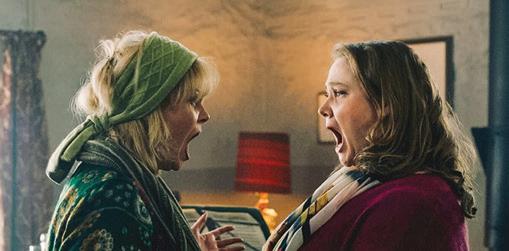
The film, “Falling for Figaro”, features Joanna Lumley as a fearsome singing teacher who sets her two students up against each other for the same competition. The film screens at Palace Electric on November 11, 13, 26 and 28.
As always, the festival celebrates the best of British in a potpourri of contemporary films, documentaries and a flashback section to British films of the 1970s, including Stanley Kubrick’s “A Clockwork Orange” and “Barry Lyndon”, John Schlesinger’s “Sunday Bloody Sunday”, Franc Roddam’s “Quadrophenia” and Sam Peckinpah’s “Straw Dogs”, starring Dustin Hoffman and Susan George.
Films based on real-life events far and away dominate the selection this year, with opening night film “The Duke”, which stars Jim Broadbent and Helen Mirren, following the true story of how
in 1961, 60-year-old taxi driver Kempton Bunton stole Goya’s portrait of the Duke of Wellington from the National Gallery in London.
“Operation Mincemeat”, featuring Colin Firth and Matthew Macfadyen, follows the true events surrounding the Allies’ deception effort to keep their planned invasion of Italy hidden and outwit German troops.
And “The War Below” centres on a group of British miners recruited during World War I to tunnel underneath no man’s land and the German front.
“Miss Marx” is a biopic starring Romola Garai that paints a portrait of Eleanor Marx, the social reformer, women’s rights activist and Karl Marx’s youngest daughter, while Terence Davies’ film “Benediction” is a portrait of 20th-century English war poet Siegfried Sassoon.
“To Olivia” is the story of a tormented marriage starring Hugh Bonneville and Keeley Hawes as novelist Roald Dahl and his wife, the Academy Award-winning actress Patricia Neal.
“The Electrical Life of Louis Wain”, with Benedict Cumberbatch and Claire Foy, tells of eccentric British artist Louis Wain, whose paintings helped to transform the public’s perception of cats.
Of special interest to filmgoers will be “Belfast”, written and directed by Kenneth Branagh, a poignant story of a boy’s childhood amid the music and social turmoil of the late 1960s Northern Ireland.
ARTS IN THE CITY
Dance
By Helen Musa
FORMER “CityNews” Artist of the Year Liz Lea’s “BOLD” dance summit will be back next year, March 2-6, after several tries in 2021. It’ll be the third such festival and will take place online and in person, with a two-day conference at the National Library, performances at the QL2 Dance and the Portrait Gallery.
CANBERRA’S Fiona Victoria Hopkins, better known as a prize-winning costume designer, has made it into the main professional finals of the World Monologue Games with a monologue taken from “The Last Train” by Natacha Astuto, which Hopkins is now turning into a film. As previously reported, Jade Breen and Jasmin Shojai will appear respectively in the youth and main amateur global finals. All are viewable on
November 19, 20 and 21. Details at monologues.com.au
THE popular Wednesday Lunchtime Concerts will resume after lockdown with Canberra pianist Stuart Long playing Debussy, Poulenc, Satie, Ibert and Chaminade at Wesley Music Centre, Forrest, 12.40pm-1.20pm on November 3. Book via trybooking.com or call 6232 7248.
MEGALO Print’s members’ exhibition, this year themed “Transformation”, will be back after a hiatus of two years, at 21 Wentworth Avenue, Kingston, open to the public from October 30 to December 11.
FORMER Canberran and crime novelist LJM Owen is the director and founder of the Terror Australis crime and mystery festival in Huonville, Tasmania, where it will run mostly online, but
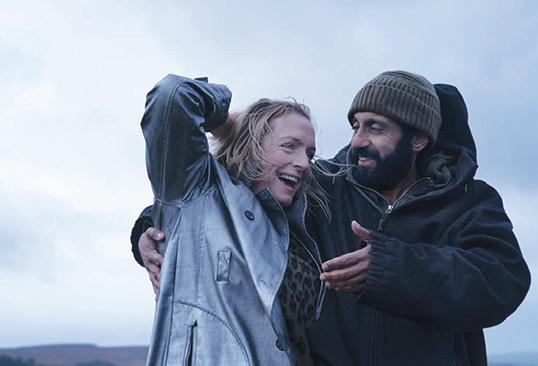
Among the genre films are Edgar Wright’s psychological horror fantasy “Last Night in Soho”, where an aspiring fashion designer is mysteriously able to enter the 1960s where she encounters a dazzling wannabe singer. There’s also a contemporary multicultural love story in Clio Barnard’s “Ali & Ava”, which follows an unlikely romance between two working-class Bradford residents.
For music lovers, “Eric Clapton: Lockdown Sessions”, the recording of a new live album filmed in the English countryside during the pandemic, while “Stardust”, more a biopic than a doco, chronicles the young David Bowie’s 1971 road trip across America when he was still developing the alter ego that would become Ziggy Stardust.
In “Sparkling: The Story of Champagne,” Stephen Fry looks behind the scenes of the highest-end sparkling wines, while in “Lady Boss: The Jackie Collins Story” we learn the untold story of a ground-breaking author and her mission to build a one-woman literary empire. You’d have to say this is not a festival for the kids, except for the family film “The Railway Children”, adapted from Edith Nesbit’s 1906 novel, but in every other respect, patrons will be spoilt for choice.
The 2021 British Film Festival, November 3December 1. Book at britishfilmfestival.com.au
with some semi-live sessions and with a wholly online weekend at the end of November. The line-up of authors includes Ann Cleeves, Val McDermid, Sulari Gentill and Katherine Kovacic. Details at terroraustralisfestival.com
NOT to be outdone by Sydney, State Opera SA has announced “Bohème on the Beach”, a one-night-only outdoor opera spectacular set on Glenelg Beach on March 26, with the Adelaide Symphony Orchestra playing. Book at premier. ticketek.com.au
THE Australian Ballet is joining GWB Entertainment to stage the Broadway sensation “An American in Paris” in Australia next year, starting with Brisbane in January. But no sign of a Canberra stop – maybe our theatre is just too small. Waitlist is at americaninparis.com.au
Joanna Lumley, left, and Danielle Macdonald in “Falling for Figaro”.
DINING / Pronto by Trecento, Queanbeyan
Casual, but serious about food
By Wendy JOHNSON
WE were indulging in a lovely lunch at the relatively new Pronto in Queanbeyan when we heard the news. The ACT was going into lockdown later in the day.
Now, all these weeks later, I can review that lovely lunch because lockdown is easing and dining out is once more on the menu.
Pronto is a casual place to dine but don’t be fooled. The kitchen takes its food very, very seriously. It’s a smallish restaurant but already a major attraction on the main drag in Queanbeyan. It’s the sister restaurant to the popular Trecento in Manuka and the carefully thought out menu makes choosing a challenge. Booking is a very good idea.
The carpaccio was food art on a plate. The meat was sliced so thin you could see through it (that’s how we love it) and this piccolo piatti was a perfect start to our leisurely
lunch. The dish featured loads of colour, including radicchio rocket and finely shaved cheese and a swirl of balsamic. It was a winning combo of flavours.
Our Burrata was just as sensational. I confess it’s one of the nicest I’ve had and a generous serve for $12. We devoured the marinated mussels ($16), which were plump and juicy and perked up even
more with generous squirts of fresh lemon. Small plates at Pronto include other cheeses, cured meats, hot dishes, raw dishes, veggies, insalata and gorgeous breads.
One of our party is passionate about pizza and particularly fond of Calabrese ($23). Pronto’s take on this famous style didn’t disappoint. The crust was beautifully thin, and the pizza arrived with the
WATCH IT! / streaming and stuff
perfect amount and mix of quality ingredients – tomato, fior di latte, cacciatore, olives, red pepper, chilli and fresh basil. In addition to the nine pizza rosso, Pronto offers six pizza bianca, so there’s something to tantalise all tastebuds.
The gnocchi Della Terra knocked it out of the park – fluffy soft pillows mixed with chunks of mushrooms, earthy pine nuts, peppery rocket, garlic (no surprise here), a lovely kick of chilli and sexy burnt butter sauce ($26). There’s nothing worse than a gluggy, stodgy gnocchi. This was the complete opposite. A champion of a dish.
The linguine gamberi ($27) was a simple dish that celebrated top ingredients. The king prawns were super tasty and happily married to ripe cherry tomato, garlic onion and silky EVO oil.
We love a simple but tasty salad… not the kitchen-sink variety, but those created with a few carefully selected ingredients. Pronto’s Ruculo salad ($12) fit the bill.
With lunch we enjoyed the Ca’ Erto Soave 2020 from Veneto, Italy, a pale yellow, delightfully crisp and wonderfully dry wine ($55 bottle and $11 by the glass).
The good, the ‘Breaking Bad’ and the ugly
By Nick OVERALL
STREAMING has spawned a television renaissance.
The battle for talent between platforms such as Netflix, Disney Plus, Stan, Binge, Prime Video and more has meant there’s more shows to watch than ever before, but which ones are the best?
In a new survey from entertainment website flicks.com.au, 10,000 Australians voted on what they believe to be the greatest show of all time and the final list has a few surprises.
Many of the shows making the top 50 are indeed from the last decade, proving how quickly a new hit series can cement itself in popular culture with the help of streaming.
Take for example “Stranger Things”, Netflix’s ingeniously concocted supernatural ‘80s nostalgia mix that was able to make it all the way to number 28, or Amazon Prime’s hilarious comedy-drama “Fleabag”, that with a total of only 12 episodes still managed to get in at 46.
Of course the list is chock-full of American productions, but there are a few exceptions which break that mould.
Netflix’s Spanish crime hit “Money Heist” was able to make it to 33.
From Britain, the cult comedy “Fawlty Towers” (Stan) made it in at 36 but the country’s biggest contributor was the still running “Doctor Who” at number 12.
That was likely aided by just how accessible the adventures of the famous time lord are, with episodes streamable on ABC iView, Amazon Prime, Stan, and on Britbox, the all British streaming platform.
As of this week, the South Korean hit series “Squid Game” broke even more news as it became the most-watched debut Netflix show of
all time, although it doesn’t appear on this list.
That’s likely because of the show’s proximity to the voting, having needed a bit more time to simmer in the pop-culture pot before establishing itself as a favourite.
It will be interesting to see whether with time it, too, will be considered one of the “greats” or remembered as another fad that gave people a disturbing burst of entertainment in lockdown.
Unfortunately, voters weren’t as favourable towards homegrown content, with “Wentworth” being the only Australian television making the top 50 at number 35.
It’s a modern rework of the ‘80s soap opera “Prisoner” and the only place to stream it is Foxtel Now, a subsidiary online package of Foxtel that’s not to be confused with its main subscriptionbased streaming service Binge.
The fact that only one Australian show was able to crack the top 50 is particularly interesting given the ongoing discussions about introducing quotas for streaming platforms to invest in more Australian content – a policy that Netflix and other companies are vocally resisting.
Beloved comedies made up a majority of the top 10, with “The Big Bang Theory” and “The Office” at 10 and nine respectively and “Friends” taking out number three just ahead of its famous competitor “Seinfeld” in fourth.
All four of those comedy greats can be streamed on Netflix, but Disney Plus also gets a few winners with “The Simpsons” in the seventh spot and “M.A.S.H.” in sixth.
Binge has HBO blockbusters “The Wire” and “The Sopranos”, which came in at eight and five and, despite widespread outcry about its fumbled finale in 2019, the epic fantasy saga “Game of Thrones” clings on to an impressive legacy by taking out runners-up.
It’s a good sign for the upcoming prequel spin off of the show “House of the Dragon”, dropping early next year, but not even this blockbuster franchise could take the throne as the favourite.
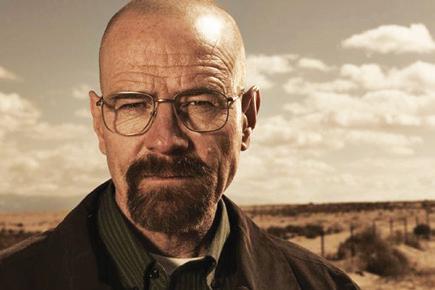
It was the story of the high-school chemistry teacher turned meth kingpin that Australians chose as the greatest of all time: “Breaking Bad”.
While the first watch of the show makes for a captivating ride of twists and turns, what got it over the line was the substance found in its rewatchability.
The premise of “turning Mr. Chips into Scarface”, as described by the show’s lead writer, allowed for a constantly evolving “protagonist” that was completely lived in by Bryan Cranston.
My first rewatch of the show, like many others, had me trying to pinpoint at what point Walter White truly went bad.
But was he ever good? It’s those sorts of questions that have kept people coming back, and it’s streaming platform Stan that has all the episodes available.
Once again it’s a criminal anti-hero who takes the top spot, showing that the crime-drama still reigns supreme.
With even more streaming platforms on the way it begs the question: who will be the next big bad?
Gnocchi Della Terra… soft pillows mixed with chunks of mushrooms, earthy pine nuts, peppery rocket and garlic.
Photo: Wendy Johnson
Bryan Cranston as teacher-turned-drug maker Walter White in “Breaking Bad”... at what point did Walter truly go bad?
GARDENING
By Jackie WARBURTON
CANBERRA has a fascination with hedges and the key to maintaining a good, thick hedge is to trim little, but often.
The smaller the leaf, the better the hedge. They are a long-term investment in the garden and very important as privacy screens and microclimates.
The ground preparation is important and it’s helpful if plants can be laid in a trench, so the root system of the hedge is equal.
When choosing hedges, think of the future maintenance and access for pruning. One of my favourite hedges I recommend for Canberra is Viburnum tinus. It’s a run-of-the mill plant and very common, but my reasons are that it’s evergreen, flowers in winter, attracts bees and predatory insects and is tough in all weather. It grows up to four metres but can be clipped at any height. If viburnums are cut really hard, they respond. They do get some silvering on the leaves, and this is more than likely thrips. Remove fallen and dead leaves
from under the hedge and allow good air flow and this will minimise the insect damage. Spray with organic horticultural oil in the cool of the day and when the hedge is not in direct sunlight if you have this problem.
BROAD beans are really coming into flower now as the weather warms. Broad beans are planted directly in the soil in the dead of winter and are not bothered by frost. The
warmer weather initiates flowering, and pods can be picked when they are young and harvested constantly to ensure a continuous crop. They are of the Fabaceae family, meaning that they enrich the soil that they are growing in with nitrogen.
When I pull out the entire plant, I will plant leafy greens such as lettuce, spinach, silver beet, rocket in that spot so they benefit from the extra nitrogen left in the soil.
NOW’S the time to get climbing beans in the garden. Bush beans are self-supporting, but climbing beans require a frame at least two metres high.
Bush beans are ready to harvest in 50-60 days and climbing beans will be ready for harvest around 70-90 days. Beans need at least six hours of sunlight and like a rich loose soil. Plenty of manure and a pH of 6-7 for optimum growth and fertilise with high-potassium fertiliser. Potassium is for flowering plants and helps them move water and sugar inside themselves.
SPRING flowering natives such as philothecas, boronias and any that have finished flowering should be lightly trimmed and fertilised with a low-phosphorus fertiliser, such as a native fertiliser. Ground-cover
02 6179 3977
natives, such as brachyscome and scaevolas, can have a trim now the spring flush of growth has finished.
Kangaroo paws should be coming into flower and make a beautiful cut flower in the house. They suffer from a fungal disease called ink spot, which shows up as a blackening of the leaves and flower stem.
To prevent ink spot, prune them hard after flowering, remove any damaged leaves and put the cuttings in the green bin and not the compost. But not now as flowers are forming, it’s a job for autumn.
CAMELLIAS should have a good prune now and have drooping branches shortened. Old camellias can get a brutal cut and can survive quite well.
They are shallow rooted and don’t like root competition; they need moisture around their drip zone and are a must coming into and through summer.
Azaleas can get a trim back now, too. Some small trees such as crab apples and ornamental peach can be pruned after flowering to keep their shape and is best done when the weather is dry and warm to prevent fungal diseases.
jackwar@home.netspeed.com.au
Azaleas in full bloom… can get a trim back now. Photos: Jackie Warburton Broad beans… coming into flower as the weather warms.
PUZZLES PAGE FREE PUZZLES EVERY DAY AT
By Joanne Madeline Moore
ARIES (Mar 21 – Apr 20)
Expect some highs and lows this week! Venus promises improved relations with a friend, client or colleague. But the Sun-Uranus opposition highlights hiccups in your financial management in the form of a large bill, an unexpected expense or a retrospective tax debt. Which reinforces the importance of having a smart savings plan and a well-stocked emergency fund. So – going forward – strive to be less impulsive and extravagant, and more cautious and thrifty.
TAURUS (Apr 21 – May 21)
Bulls prefer to plod along in a methodical fashion but, this week, you could be dogged by unexpected dramas and disruptions! The Sun opposes Uranus (in your sign) so daily life will be rather unpredictable. If you prioritise and are mentally flexible, then you’ll handle the hurly-burly with less stress and strain. Romantic relationships and platonic partnerships are also in a state of flux. You’ll find the more adaptable you are, the better the final outcomes will be.
GEMINI (May 22 – June 21)
You could become anxious, as your daily routine is disrupted in some way. Or your enthusiasm for a work project could overtake your ability to knuckle down and get the job done. If you promise more than you can deliver, then other people will just end up disappointed. Slow down and listen to the wisdom of your inner voice. It offers an alternative perspective and can point you in the direction that’s right for you. The weekend is wonderful for conversation and cooperation.
CANCER (June 22 – July 23)
This week a child, teenager, friend or lover could shock you by making a surprise move. Or a group project could suddenly veer off in an unexpected direction. If you keep your adaptability muscles well-flexed, then you’ll adjust to the constantly changing landscape accordingly. Peace planet Venus transits into your relationship zone on Friday. So stop sulking and stewing over a perceived slight – it’s time to cooperate, compromise and sympathise!
LEO (July 24 – Aug 23)
Leos love to be the Top Cat but this week you need to ask yourself, “Am I leading others or just bossing them around?” If you power ahead without considering other people, then you’ll create unnecessary chaos and disruption. Do your best to accommodate the needs of those around you. Life will also run more smoothly if you can incorporate a spiritual ritual into your daily routine. Something like yoga, tai chi, chanting, meditation or creative visualisation would be beneficial.
VIRGO (Aug 24 – Sept 23)
When it comes to the way you think, blast out of a boring rut and jump into an exciting new phase. Use your imagination and think outside the box. Your power planet Mercury moves through your communication zone from Friday (London time) until November 24. So stop avoiding issues and start discussing what you really want and need. You can’t expect others to magically read your mind! For some clever Virgos, a joint venture or creative online project has the potential to fly.
LIBRA (Sept 24 – Oct 23)
Venus (your patron planet) shifts into Capricorn, which can increase self-criticism and dent confidence. With the Sun, Mercury and Mars marching through your self-esteem zone, it’s time to hold your head high and trust your inner judgement. Be inspired by actress and birthday great, Sally Field (born on November 6, 1946): “It took me a long time not to judge myself through someone else’s eyes.” On the weekend, keep the lines of communication and compassion wide open.
SCORPIO (Oct 24 – Nov 22)
This week the Sun, Mars and Mercury are transiting through your sign. And the Sun-Uranus opposition could disrupt your usual routine and rattle your Scorpio resilience. But it’s time to bounce back, as you demonstrate (and celebrate) your strengths – including passion, determination and discretion. Your motto for the moment is from singer-songwriter Joni Mitchell (who turns 78 on Sunday): “There are things to confess that enrich the world, and things that need not be said.”
SAGITTARIUS (Nov 23 – Dec 21)
Sagittarians can be feisty and unpredictable souls. But don’t allow yourself to be drawn into a heated exchange this week (especially involving finances and/or friends). It would be better to watch the fireworks from the sidelines. With the Sun, Mercury and Mars transiting through your privacy zone, slow down and chill out as you relax, rejuvenate and contemplate. After some soulful reflection and quality ‘me time’, you’ll start to see things from a refreshingly different perspective.
CAPRICORN (Dec 22 – Jan 20)
It’s time for an unexpected pivot! Clever Capricorns will examine all possibilities this week, especially ones that come from left field. With the Sun, Mars and Mercury moving through your hopes-and-wishes zone, it’s important to have ambitious long-term goals that you’re working towards. You’ll have to be patient though, as you focus on bringing your dreams down to earth via a practical plan. Then – when everything is in place – you’ll know the perfect time to pounce.
AQUARIUS (Jan 21 – Feb 19)
The Sun/Uranus opposition suggests a house move, family fiasco, uninvited guests dropping in or some other kind of domestic drama. And some Aquarians could experience disruptions at work. Whatever happens this week, strive to get the balance right between your public life and your private responsibilities. The planets also push you to reinvent a close relationship. But is that a good idea? Just be careful you don’t get carried away and throw the baby out with the bathwater.
PISCES (Feb 20 – Mar 20)
Are your aspirations for the future ambitious enough? The current planetary patterns favour ruminating over big-picture ideas. And there’s no room for false modesty or passive Piscean procrastination as you enjoy talking, texting, posting, promoting, socialising and circulating. Uranus stimulates your thought processes and encourages you to come up with a cracking plan, and then pursue it. An unwelcome surprise could unsettle you though so expect the unexpected!
Copyright Joanne Madeline Moore 2021
the arched upper surface of the human foot? (6)
19 The Western Hemisphere is known as the what? (8)
21 Name the capital of Canada. (6)
22 Which steroid hormone is responsible for secondary female characteristics? (8)
23 To be free from an obligation or liability, is to be what? (6)
1 Name an island in the Indian Ocean, off the east coast of Africa. (8)
2 To say again, is to do what? (6)
3 Name an item of apparatus used in weightlifting. (8)
4 Who played the role of Perry Mason, Raymond ...? (4)
5 Which term describes lofty mountains? (6)
6 Which chess piece is shaped like a horse’s head? (6)
12 Name a male singing voice. (8)
13 Who was an Australian physicist, and governor of SA, Sir Mark ...? (8)
15 Name a particular inland tax or duty. (6)
16 What might we call an emigrant seeking political asylum? (6)
17 Name an African blood-sucking fly. (6)
20 Which Latin term means “therefore”? (4)
“Affordable housing” or “housing affordability” – what’s the difference?
It’s getting a little embarrassing for our Federal politicians to interchangeably use these two phrases. Affordable housing is different to housing affordability. Housing is a basic human right according to the United Nations, not an optional extra. From the UN website (ohchr.org): “Housing is not merely a commodity, it’s a human right.
“The human right to adequate housing means the right for all to a place to live in security, peace and dignity. The right to adequate housing is recognised under international human rights law in the 1948 Universal Declaration of Human Rights, in the 1966 International Covenant on Economic, Social and Cultural Rights and in many other human rights treaties, international declarations and conference outcome documents, including the 1996 Habitat Agenda.”
So Prime Minister, when you release a National Housing Strategy and don’t factor in accommodation for the 25,000-plus refugees you’re allowing to come to Australia, expecting each local authority to absorb them somehow, you’re breaching a basic UN human right by not funding accommodation appropriately. Social housing options are finite and exhausted everywhere. But that’s another conversation for another time.
Data shows we have many in our Canberra community with affordable housing as a daily issue –from sleeping rough through to having difficulty each week making rental payments. For some it starts as getting a roof, any roof, over their head. Often, they have no fixed address and they are often “hidden” in a visible sense. Moving to semi-permanent accommodation on a per night basis is better than nothing.
In a progression sense, they will hopefully get a permanent address one day; then transition into rental accommodation at whatever address they’re given; and eventually might have the luxury of renting in a location and a price point of their choice one day.
Many in the other half of our Canberra community are affluent enough to have housing affordability as their issue – buying something on the property ladder. The issue of housing affordability is real as it is a driver of our economy, and various government policy levers are being applied to assist home purchases, such as first home owner grants.
Due to entry number restrictions, we have had to introduce some new measures:
1. Timed entry tickets for admissions
To spread out visitation, all visitors and guests need to book tickets online. You will have a set half an hour period to arrive but can stay as long as you want. Details on the website. Depending on bookings, some tickets may be available at the zoo entry in quieter times.
2. Limited numbers allowed in the aquarium and bistros
To be confident that a ticket is available and that queing is minimal, book midweek! After lunch is also quieter!
As bookings are very heavy from now until the end of January, NOW is the time to make a booking, as we still have some rooms left! The best chance is from the 29th of October to the 3rd of November, although there are still some rooms available after that.