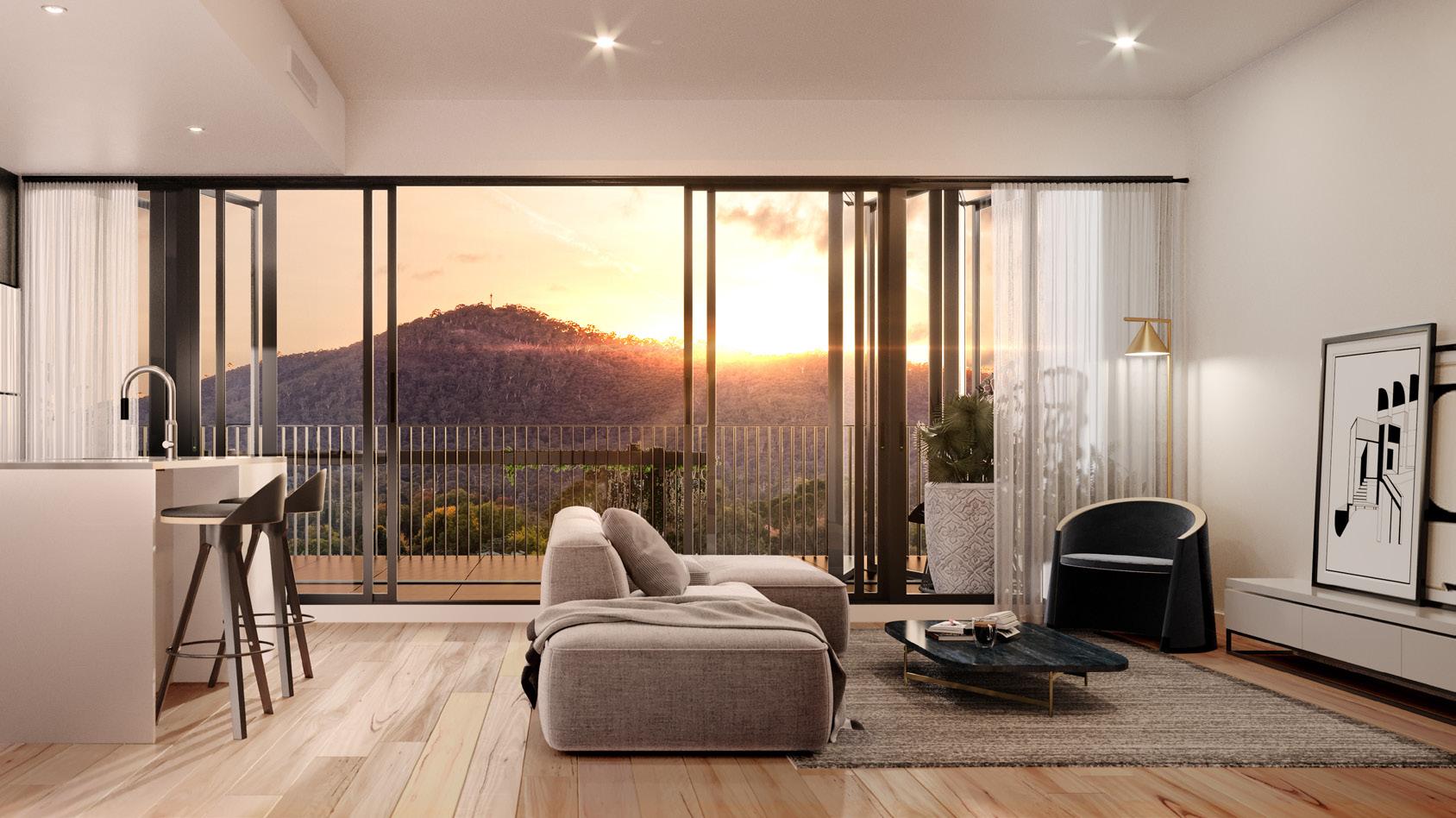
COVID has driven up demand for stand-alone houses in a big way, with data revealing the gulf between house and apartment prices in Canberra has never been greater.
The new data, from Upside Re alty, indicates that cost differences between houses and apartments in the territory have jumped nearly 50 per cent in the last six months.
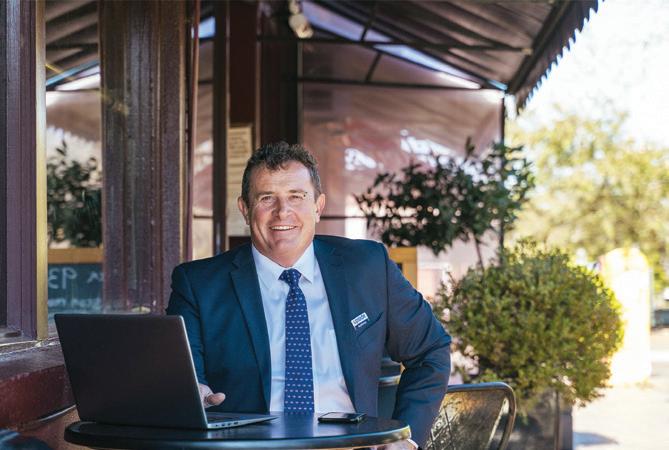
Upside Realty real estate agent Anthony Mewton says the $163,785 price gap that’s opened up between the median values of houses over apartments in Canberra is one of the highest on record.
“The last time we saw such a significant change in the gap between the two was a decrease in the gap between December 2017 and March 2019, but still the change in that time was only $100,000 and it was over 18 months ago,” Mr Mewton says.
“We are now seeing a change in the gap more than double that, in the last six months alone.”
Mr Mewton, who’s been selling homes in Canberra since the ‘90s, says the desire for a house over an apart-
driven a desire for extra space and a backyard so people are looking for an opportunity to have a family home and a secure yard where the kids can play,” says Mr Mewton.
According to the data cited by Up side Realty, Canberra’s median house price currently sits at $1 million, while the median value for a Canberra unit is just more than $500,000.
In December, the median house price in Canberra was just more than $789,000, whereas apartments have only risen $6000 during that time.
The upside to the house price differ ential, Mr Mewton says, is that units are more affordable relative to houses than they have been for some time.
Covid’s sending buyers into houses ahead of units
“You don’t want to be eating baked beans and fish fingers for the next six years while you service a massive mortgage.”
Dr Nicola Powell, chief of research and economics at All Homes, says Canberra’s house and unit price gap is the biggest of all the capital city markets.
While unit prices in Canberra have increased, Dr Powell says the rate of increase is far more modest than it has been for house prices.
“We have seen many more units built over houses in Canberra in the last few years and that in itself seems to be weighing on unit price growth. We have seen unit prices grow but at a subdued rate compared to houses.”
Dr Powell argues that “ultra” low interest rates coupled with the lack of houses for sale in Canberra has fuelled house-price growth.
“The apartment market is undervalued so if you are a young person frustrated about affordability it’s a good
bathroom, two-car space apartment,”
Mr McGuinness says.
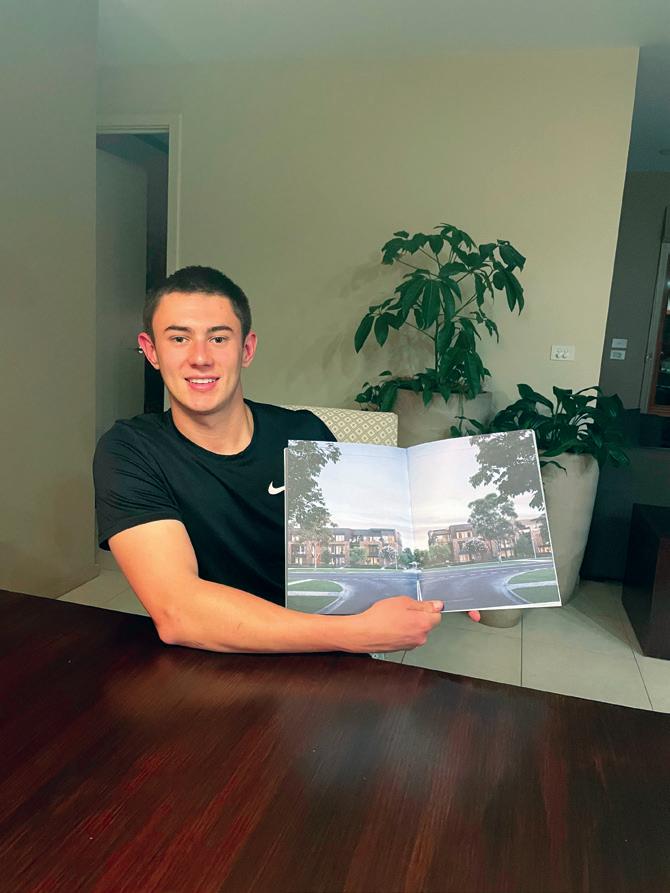
Mr McGuinness, who works as a construction foreman, paid $615,000
“If you have a young customer who is terrified of debt, the unit market is terrific value for money,” says Mr Mewton.
“There are more buyers in the market than there are listings coming on and that has created this fierce competition and that’s one of the factors that’s driven strong rates of price growth for houses,” Dr Powell says. While conceding that covid may have been a contributing factor to the escalation of house prices in the ACT especially for larger dwellings, Dr Powell suggests it would not be as great as it has been in cities subjected to extensive lockdowns, such as Sydney and Melbourne.
Small business needs better help
“CityNews” managing director JAMES ANDERSON reflects on the ongoing purgatory that is the now-extended covid lockdown.
I WROTE three weeks ago bemoaning the level of government support for small business in this muchworse lockdown, a lockdown now extended by another four weeks in the ACT.
All small businesses operate in a reasonably similar way; we all work around cash flow and the continuing responsibilities of paying staff, rent, loans and overheads first, then hopefully have something left over. During the covid purgatory and in particular lockdown-impacted trading, the stress driven by a drastic and immediate fall in revenue makes things so much harder.
It means fewer hours to offer staff, it means absorbing their tasks and it means working harder.
Last year government support was fantastic and we were able to keep all our staff employed and safe, and
still keep publishing.
While we are grateful for the help this year, the initial $20,000 of business support might sound impressive, but in reality will drive radically different outcomes for businesses based on their size and number of employees.
We are seeing sole traders forced to choose between their business and their mortgage. We are seeing staff sitting at home while receiving government support when, in many cases, there is plenty of work to be done.
It is all the more frustrating as we have a successful blueprint from last year that is not being utilised.
Often, policy makers and politicians don’t understand small business because they have never worked in a business that has to drive revenue to survive, they have been in jobs where their salary rolls in every fortnight, no matter what their department is achieving or what the local economy is doing.
This is not an Andrew Barr problem alone, it is also shared by our five federal members of parliament, our national cabinet and our federal cabinet to do more as this country stutters into a recession.
Since 1993: Volume 27, Number 37
Arts & Entertainment 19-21
Canberra Matters 8
Crossword 23
Dining 21
Garden 22
Horoscopes 23
Letters 16-17
News 5-18
Politics 10, 17
Seven Days 6
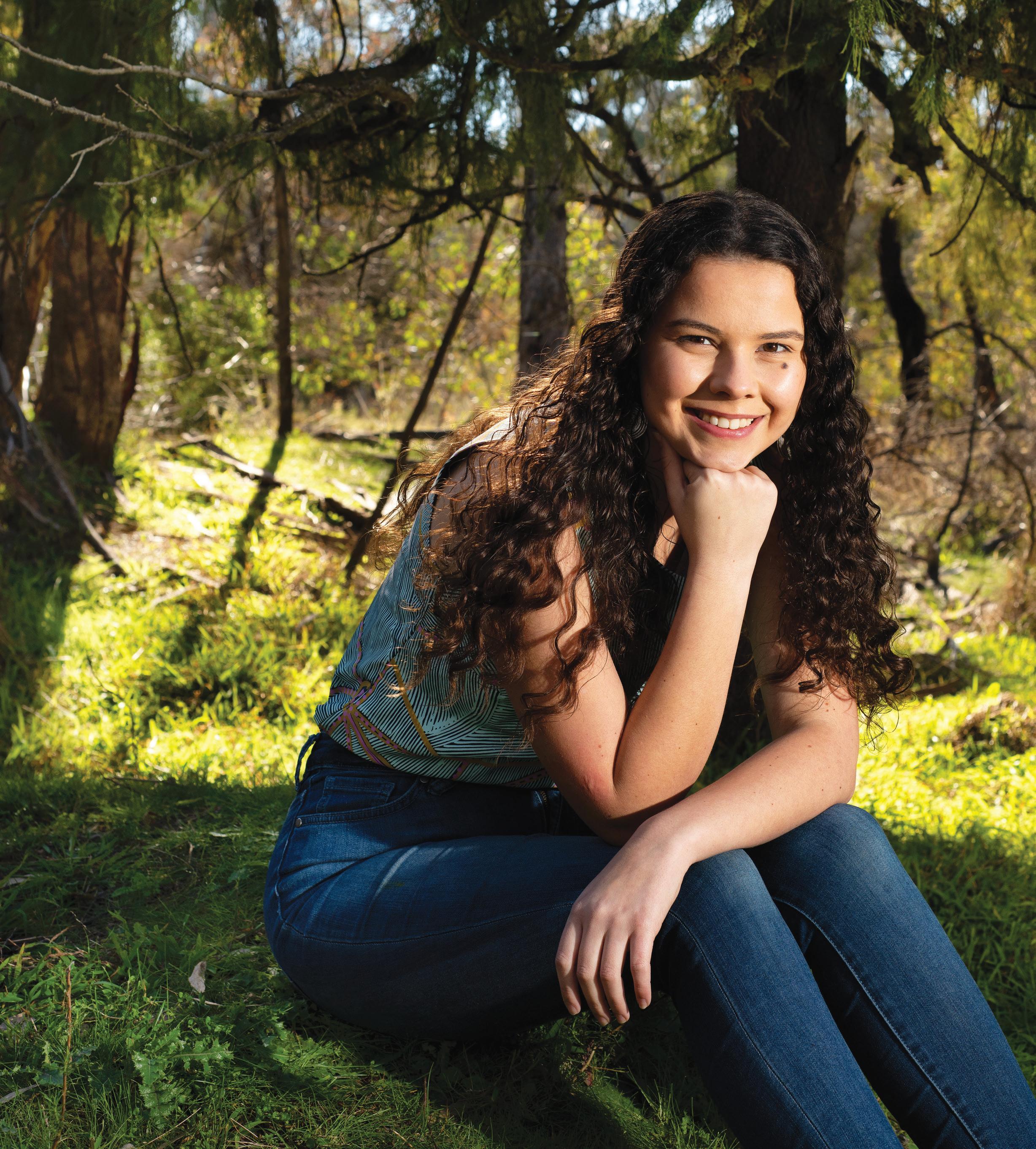
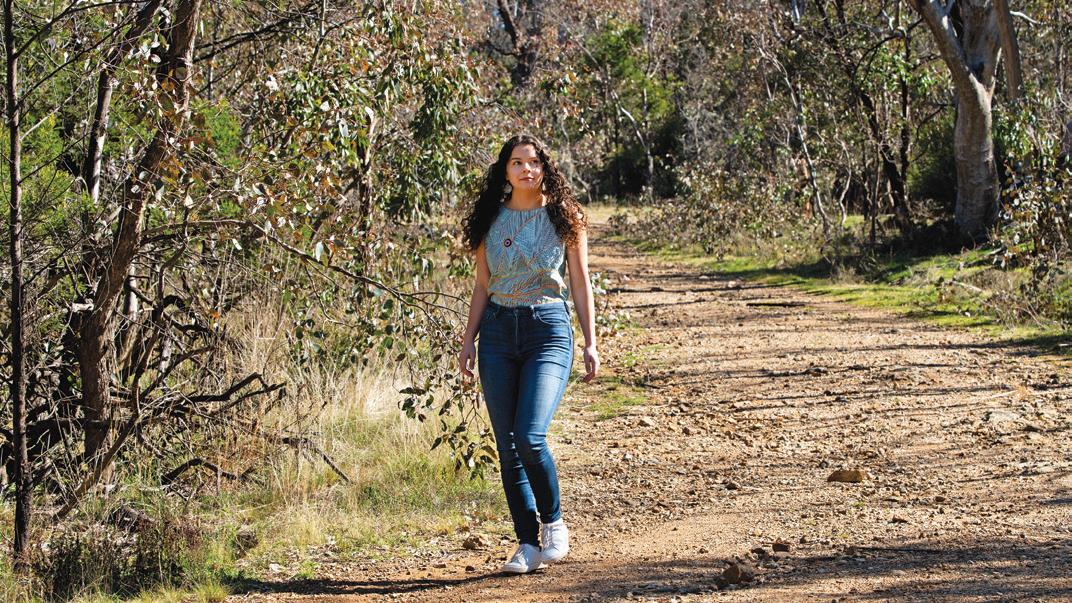
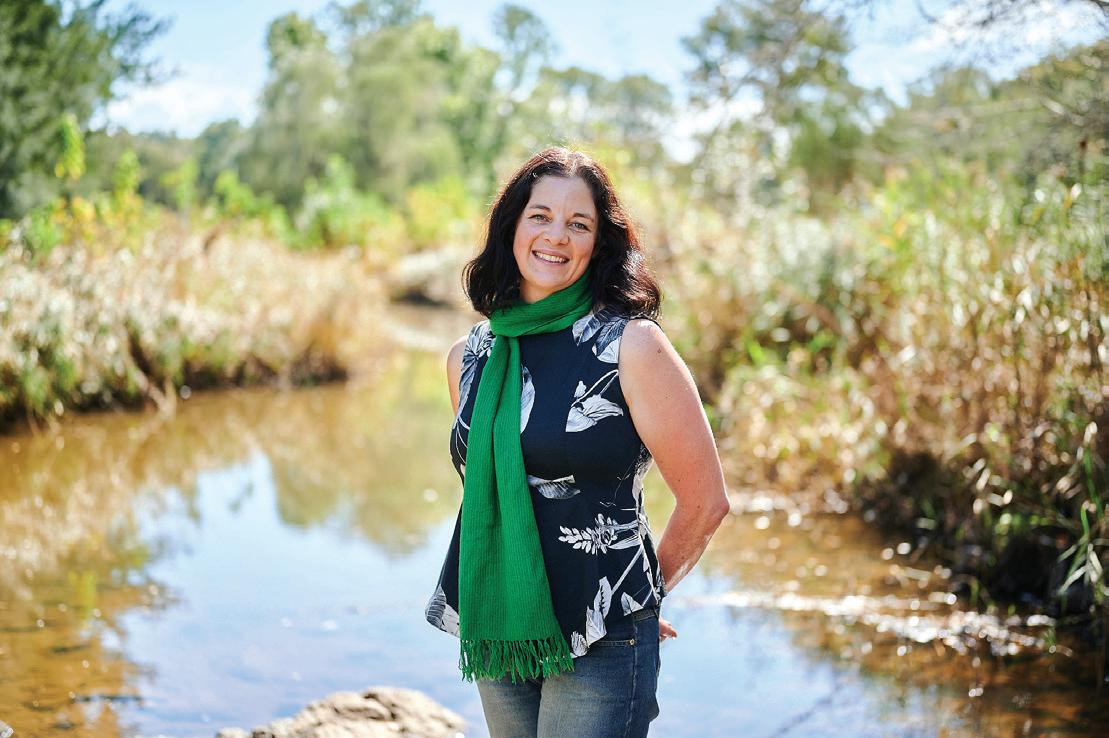
Streaming 21 Cover: Indigenous woman Dhani Gilbert. Story Page 11.
Managing Director: James Anderson, 0404 077605, james@citynews.com.au
Director: Kate Meikle, kate@citynews.com.au
Senior advertising account executives: David Cusack, 0435 380656
HEY, I got invited to a party. A private party. An opening VIP party and they were chasing my RSVP to be among the first to preview “60,000 square feet of original works of art, music and much more”.
Here’s some more: “We’ll toast with sustainably sourced farm-to-cocktail beverages, and connect you with climate action causes that inspire.”
But now that the Chief Warder has extended our house arrest by another month (to Friday, October 15) and, jabbed or not, the Prime Warder won’t let us out of the country until at least November, there’s no going to the opening party for “Undercurrent” at 455 Jefferson Street, Brooklyn, New York.
As Andrew Barr let the air out of our psychological tyres came the passing news that plonk purveyor Dan Murphy was recruiting 60 new people for Canberra. Not as a result of this announcement, but there again...
The Chief Minister parried with the press deftly defending his “least worst option” lockdown decision, stepping over the business devastation, the extended schools closure and leaning heavily into the ACT’s stellar vaccination rates, blowing a doublevax kiss on the nose to the community for having more than 50 per cent of all people 12 and above fully vaccinated.
But beyond giving the nod to golf and tennis, there’s precious little reprieve for (double-vaccinated) people stuck at home. The only new way to get out is to buy a house. Of all the things, in-person private inspections with an agent are now allowed. And people stuck at work can number five in the click-and-collect setting.
But back to my lost party. With all the heated national discussion about covid passes and civil rights to get into a bar or restaurant, this is how New York City’s do ing it; the invitation says: “In order to ensure the best possible experience, we ask that you reserve your arrival time in advance.
Per NYC’s recent COVID-19 mandate, you must present proof of vaccination for entry. Acceptable documentation includes NYS Excelsior Pass, NYC Covid Safe App, Physical CDC Vaccination Card, Physical NYC Vaccination Record.”
All this is ahead of us.
Benjamin the Tasmanian Tiger… in colour for the first time since 1933.
of its crew.
The “Canberra’s” officer of the watch was a 20-year-old, who survived the battle.
The ship was so damaged in the Battle of Savo Island the Americans scuttled it, then subsequently named one of its own ships after the “Canberra”, possibly the only one named after a non-American place.
Okay, that’s the history. Here’s the twist.
Canberran Tom Anderson was working at the Australian embassy in Washington at the time of the September 11, 2001, terrorist air attack on the twin towers of New York’s World Trade Center.
scrapped) “USS Canberra”.
Tom was there and says at the end of the ceremony the President and the Prime Minister approached an old man sitting three rows in front of him.
“It turned out that he was the same man who had been the officer of the watch,” he says.
So what was he to do next? The old guy said he was leaving Washington on American Airlines Flight 77 the next day, September 11. It was to be the hijacked flight terrorists crashed into the Pentagon.
“Our Defence colleagues told him that
Mrs Howard was to plant a tree at the site of the only Australian buried in Arlington Cemetery the next day and he should also come along to that,” says Tom, of RAAF Francis Milne , who died on a World War II while serving with a US aircrew on November 26, 1942.
“So he changed his flight and the rest, as you say, is good fortune and history.” Truly saved by the Bell.
A second “USS Canberra” was launched on June 5 this year.
MORE than 200 hours of digital magic in Paris went into the National Film and Sound Archive’s newly released 80-second colourised footage of Benjamin, the last-known Tasmanian Tiger (thylacine).
Filmed in 1933 in Beaumaris Zoo, Hobart, by Australian zoologist and naturalist David , the footage is the longest known surviving film of the extinct marsupial, and was brilliantly reimagined in colour by Frenchman Samuel François-Steininger Mr François-Steininger said it was very challenging to colourise. because, apart from original skins preserved in museums, sketches and paintings, there was a lack of original colour pictures or footage that could be used for research.
However, apropos of nothing, cameraman Fleay was bitten on the backside by Benjamin after shooting the film.
Ian Meikle is the editor of “CityNews” and can be heard on the “CityNews Sunday Roast” news and interview program, 2CC, 9am-noon.
Dr Omar Gailani offers treatment for
Gynecological conditions including Fibroids
A referral is necessary for an appointment with Dr Gailani
Canberra Urology and Gynaecology Centre | P 6285 1813 E reception@omargailani.com.au | W omargailani.com.au
Suite 2, Level 2, Equinox 1, 70 Kent Street, Deakin ACT
The MonaLisa Touch is a comfortable, nonhormonal, minimally invasive and painless 5-minute treatment with zero downtime
Creating longer-lasting relief, the MonaLisa Touch is for women experiencing vaginal itching/burning, vaginal dryness, loss of lubrication, vaginal laxity, incontinence symptoms, or painful sexual intercourse.
Key benefits of The MonaLisa Touch:
Low risk – suitable for most women
Achieves long lasting improvements
Immediate return to normal daily activities
Suitable for women who are not able to undergo hormone replacement therapy eg. Breast Cancer Patients
High success rates after treatment
Minimal maintenance after initial procedure
Dr Omar Gailani
Stranded circus feels ‘loved’ in Queanbeyan
By Nick OVERALL
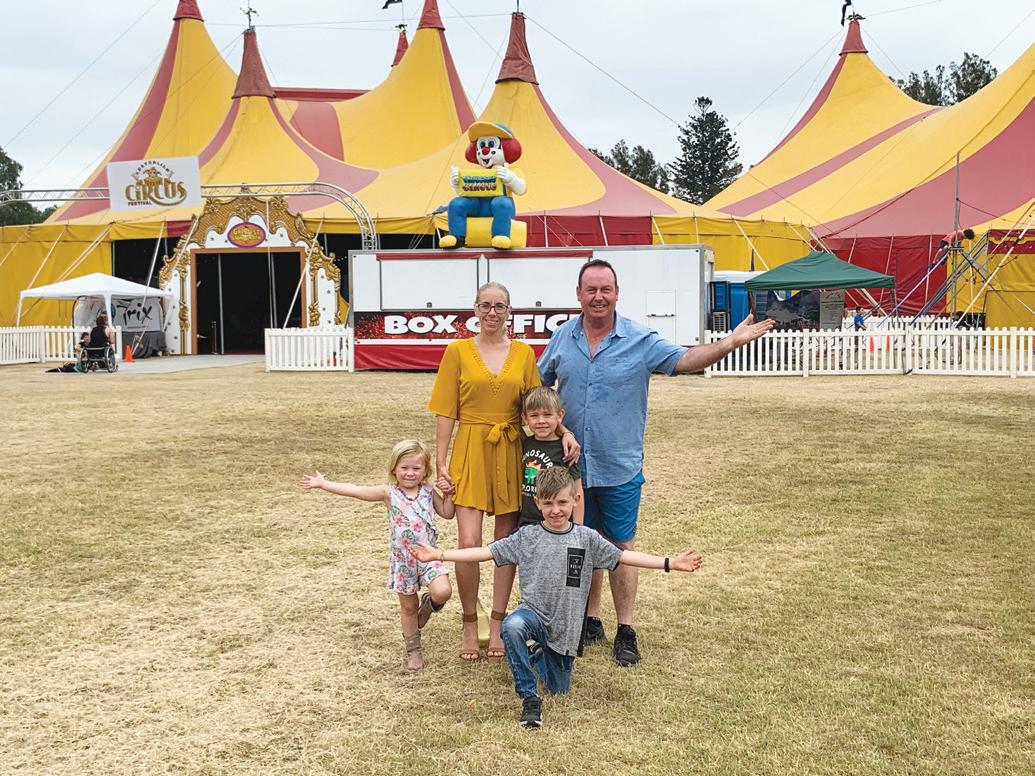
THE colourful characters of Hudsons Circus may be locked down at the Queanbeyan Showground, but owner and manager Shane Lennon says they’re doing their best to keep spirits flying high.
Clowns, acrobats, trapeze artists, ringmasters and more are all living in caravans and campers on site in Queanbeyan while waiting for news on when they’ll be able to perform again.
“We’re frozen here and some of our team are taking it pretty hard,” said Shane.
“It’s sad because these people are normally very happygo-lucky, they’re doing something they love, something they’re passionate about but suddenly that’s all been taken away from them.
“Luckily we have a good location here and we’ve got each other, we’re like a family and fortunately we can sit around a fire at night and chat.”
Shane comes from a family of circus owners and created this current show in 2013 along with his wife Nancy, a trapeze artist and acrobat.
But in his decades of tour-
ing, he says he’s never seen a challenge like this before.
The team is currently working through refunding 5000 tickets that were purchased leading up to the lockdown.
“There were so many upfront ticket sales not only here in Queanbeyan but also for our future towns like Tumut and Wagga Wagga,” said Shane.
Looking towards the future, Shane says he’s ultimately optimistic.
“The council has been fantastic with us, accommodating us and not telling us to move on and I believe at this point they’re still going to allow us to finish the season once the lockdown is over,” he said.
“I think a few weeks out of lockdown people will still be scared and thinking about vaccinations so we’re trying to get all of our staff vaccinated so that people know it’s as safe as can be.”
Shane says he’s been “blown away” by the attendance the circus has seen before lockdown even with restrictions, as well as the understanding of the community.
“I want to thank the townspeople, the people who have had to have tickets refunded have been kind, saying they feel for us and they can’t wait for us to be open again,” he said.
“We feel very loved here in Queanbeyan and we’re looking forward to getting back to putting smiles on people’s faces.”
COVID-19 has affected all of us, but there is a way forward. It’s time to arm yourself by getting vaccinated. Protect yourself and the people you care about. The sooner we all do it, the sooner we’ll get through it. Book your vaccination today.
Owners of Hudsons Circus Nancy and Shane Lennon with kids, from left, Gisele, Denver and Hudson.
CANBERRA MATTERS
Southside residents,
THIS city’s residents have a general high standard of education, the city has wonderful cultural institutions, there are active science and academic communities and people take a keen interest in government and the goings-on of the political class.
The population appreciates urban planning and developments based on aesthetics, landscape design and good architecture, and seeks to have urban spaces and buildings that address environmental and climate issues.
This city has an internationally recognised and envied character, the people identify strongly with the city, there’s a high standard of living, and it often rates well on liveability surveys (whatever that means).
It would be logical to expect that the city chiefs, when making planning decisions, would respect the city’s identity and acknowledge the residents’ commitments to the place.
Surely, the elected government representing the aspirations of the voters would be dealing with climate change by having architecture and landscapes designed to mitigate the effects of climate and ensure that the city maintains its outstanding identity as a national city designed within a landscape.
All this should be obvious in what is happening along Northbourne Avenue. This significant entry point should be a showcase for what the
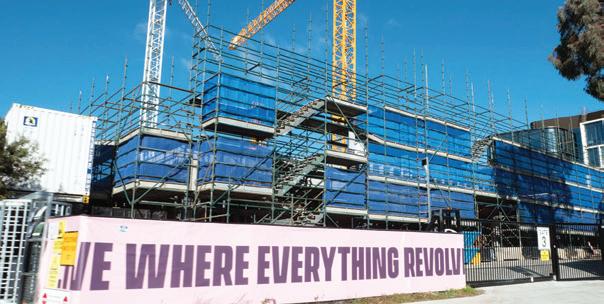
The new towers are collectively delivering a new suburban-sized residential population. It is as if there is a new suburb called Northbourne that includes those living 100 metres either side of the corridor.
city is about – good design and great places to live, work and play. It is not.
The ACT Labor/Greens government spends a fortune on the City Renewal Authority, an agency that says it is a “champion of excellence, it works with the community, business and government to deliver new buildings and places within the precinct that are of exemplary design quality, excite interest and participation and attract new investment”.
Now think Northbourne Avenue and about how this important gateway to a city designed to be the landscape ended up looking like it is. It is not good. While there were a few buildings of interest along Northbourne, the removal of the large trees to build the tram revealed that most were very ordinary – of little architectural interest.
The recent towers tend to be taller and very ordinary – a polite way to
describe them. Their impact has been strikingly awful. New green spaces are almost non-existent. These new towers are collectively delivering a new suburban-sized residential population. It is as if there is a new suburb called Northbourne that includes those living 100 metres either side of the corridor.
Given the desires by the people over the decades and the never-ending worthy statements by the ACT politicians, as these rows of towers pop up, it follows that there should be greenery around each with parks tucked away between buildings – and there should be many community facilities.
In short, it is not happening and there are no realistic indications that things are about to change. Businessas-usual for the Labor/Greens
coalition presents a very shocking introduction to the city.
The landscape work around the tram may deliver something of interest in a couple of years – but we have to wait for that to happen as it is very dependent on the levels of maintenance and stewardship of the landscape and its plantings. This government underfunds landscape maintenance.
However, to be positive, it may not be too late to retrofit some of the developments and there may be the opportunity to knock sense into the
present politicians about the mess being made along Northbourne. Before things progress further, these new communities need to be provided with facilities as well as the means to reduce the increasing heat island effects. And how about some good architecture?
Just as worrying is that the same mob of bureaucratic planners and developers who are enabling horrible stuff along Northbourne, are also working in plain sight on plans for the corridor going south to Woden.
Following the usual patronising traditions of dropping a few hints but keeping most of the work secret, the planning agencies involved with developments along Adelaide Avenue and Yarra Glen are advancing with what they will one day reveal as done deals for how these corridors will look. They will then consult and we all know what that means.
Southside residents – be afraid – be very afraid! There is still time to ask questions and to demand serious answers.
RENOVATIONS & EXTENSIONS COMMERCIAL FITOUTS
HOUSE & LAND PACKAGES
With 20 years’ experience Sentra Constructions specialises in a large range of projects from contract homes, extensions and renovations, house & land packages, to shop and office fit-outs. Sentra Constructions uses professional, experienced, and reliable tradespeople who provide high standards of quality workmanship.
You will always be dealing directly with the builder, and each project is managed by Rod Thornton – the owner of the business.
You can expect professional and courteous service from initial stages to completion. We offer expert advice on design, form and function, to achieve the right solution for you in a cost- effective manner.
Greetings from Northbourne… The recent towers tend to be taller and very ordinary. Their impact has been strikingly awful. New green spaces are almost non-existent. Photo: Paul Costigan
/ mental health
Cuts lead to nation’s worst mental health service
I WROTE last week about the impact that COVID-19 and our response to the pandemic, most particularly lockdowns, is having on the mental health and wellbeing of people across Australia.
I wrote, in the main, about community based mental health services.
My interest was stimulated by a news report of a deeply worrying surge in mental-health admissions to hospital in Victoria, including of teenagers admitted as a result of selfharming and/or suffering suicidal thoughts.
I mused, as a result of the Victorian experience, about the state of preparedness of ACT hospitals to meet a surge in mental health related admissions.
Following publication of the article, my attention was drawn to a range of mental-health data produced by the Australian Institute of Health and Welfare (AIHW) for the financial year 2018-19, which was relevant to acute mental health services, ie those delivered through the public health system.
The data revealed that in that year the ACT had the lowest number of mental health nurses per capita of any Australian jurisdiction. It reported that the ACT employed a
The cause or major reason for the ACT’s nation-worst performance in the delivery of mental health services across both the community and in acute settings is money.
total of 68 clinical full-time equivalents (FTE) per 100,000 population compared to the average across Australia of 81 FTE per 100,000. Certainly a very worrying disparity in staffing levels and suggestive, perhaps, of a mental health system under stress.
In the course of the research I did before writing this article, in addition to looking at the relevant AIHW reports I found a “Canberra Times” report from November, 2019, which referenced the then chair of the Royal Australian & NZ College of Psychiatrists, Dr Jeffrey Looi, and asserted that: “The ACT’s mental health system is on the brink of an all-out crisis with years of warnings about staffing and bed shortages falling on deaf ears”.
The most recent report of the AIHW, a report titled “Mental Health Services in Australia”, which was released on July 20, tends to validate that dire prediction.
For example, it reveals that in 2019-20 the ACT had the longest mental health related emergency department wait times in Australia
with a median wait time of 47 minutes compared to a national average of 18 minutes and, interestingly, a wait time of only 14 minutes in NSW. In addition to the longest median wait time, the ACT also had the longest wait time at the 90th percentile, of 184 minutes, compared to a national average of 101 minutes. The wait time in Queensland at the 90th percentile was 73 minutes.
The ACT’s poor performance was further confirmed by the revelation that we also had the lowest proportion of patients seen on time (41 per cent) compared to the average across Australia of 68 per cent. In NSW, the best performing jurisdiction, 76 per cent of patients were seen within clinically agreed benchmarks.
Exacerbating the challenges already faced by our clearly overburdened acute mental health system, a comparison of the number of presentations, as reported by the AIHW in 2018-19 and 2019-20, reveals that the ACT had the highest increase in the number of presentations as well as in the rate per 10,000 people.
I am not particularly well equipped to offer a view on the possible cause of the massive increase in the numbers of Canberrans seeking to access mental health services through the emergency departments of Canberra and Calvary Hospitals, but I think it reasonable to surmise that it reflects difficulty in accessing either timely and/or appropriate and/or affordable access to community based mental health services.
However, I am more comfortable in suggesting that the cause or major reason for the ACT’s nation-worst performance in the delivery of mental health services across both the community and in acute settings is money.
I have perused the ACT Budget over each of the last five or so years and in that time the Canberra public health system has endured, across the system, a cut in real terms of well in excess of $100 million a year. It is reasonable I think, to assume that mental health has borne its share of, and been severely impacted by, those cuts.
Having said that I think it imperative, going forward, that the mental health system be subjected to rigor-
ous external review and thorough needs assessment.
If there is anyone with up-to-date information about the current state of our public mental health services and if, for instance, we have developed a mental health surge capacity that is fully staffed, safe and with adequate beds and other resources and that the clinical staff, including registrars actually get to go home at night and spend time with their loved ones or families on weekends, I would welcome hearing from you.
PS. Is it true that six mental health registrars resigned, en-masse, in the middle of last year in protest at their treatment and working conditions?
Jon Stanhope was chief minister from 2001 to 2011 and represented Ginninderra for the Labor Party from 1998. He is the only chief minister to have governed with a majority in the Assembly.
• Led by university qualified & experienced teachers
• Fun and stimulating activities that provides both enjoyment and learning
• Sessions include music, movement, dance, fine & gross motor activities as well as literacy and numeracy
• Emphasis on development of motor skills, academic and social skills
• Parent classes for children 5 months to 2 years
• Independent Pre-Preschool for 3 year olds
• Preschool PLUS for 4 and over
• Providing children with the academic and social skills required for formal schooling by introducing structure and routines in a play based fun and creative atmosphere
‘Blessed’ Dhani just can’t stop caring for country
By Belinda STRAHORN
restoration and weed-eradication work,” Ms Gilbert says.
joined ACT Landcare in 2019.
DHANI Gilbert, 19, has been caring for the land from a young age.
Growing up on Ngunnawal country in Canberra, the Wiradjuri woman’s favourite childhood memory is of bush walks with her family around Mount Ainslie.
It’s here where she first learnt to identify native flowers and seeds and it’s here where she learnt the importance of caring for country.
“My parents made connecting to country a constant in everything I did and so, ever since I was a baby, I spent a lot of time out in nature, learning about the land and how to care for it,” Ms Gilbert says.
“I am blessed to have had that because it has influenced where I have gone in life and what I’m doing.”
As winner of the 2021 National Young Landcare Leadership Award, Ms Gilbert intends to use the recognition to help promote caring for country methods passed on by her parents.
“Growing up I was surrounded by caring-for-country practices that were taught to me by my parents and my community, things like cultural burning, seed collection, native-vegetation
her work as a community educator at Mulligans Flat Woodland Sanctuary and for her participation in promot ing Landcare practices such as weed eradication and cultural burning.
bushfires, Ms Gilbert says conversa tions changed about how we look at First Nations’ ways of caring for country.
from the community about cultural burning and how it can help.
affect animals, soils and plant life but First Nations’ cultural burns start in one spot and spread out slowly allow ing native animals time to escape,” Ms Gilbert says.
one day you’ll burn grass then and the next day when you come back there’s green shoots popping out.
“Conversations are starting to happen around how we can integrate First Nations’ methods of looking after the landscape.”
Currently in her second year studying a double degree in science and environment and sustainability at the Australian National University, Ms Gilbert is also passionate about en-
cies that we should be more aware of and engage with more,” she says.
“Even though we are lucky to be the bush capital, I don’t think we engage with our landscape enough to understand the absolute value of the plants we have there.
“We have amazing grasses like kangaroo grass which is hearty but can be used to make grains and then there’s old man weed, it’s a medicinal plant.
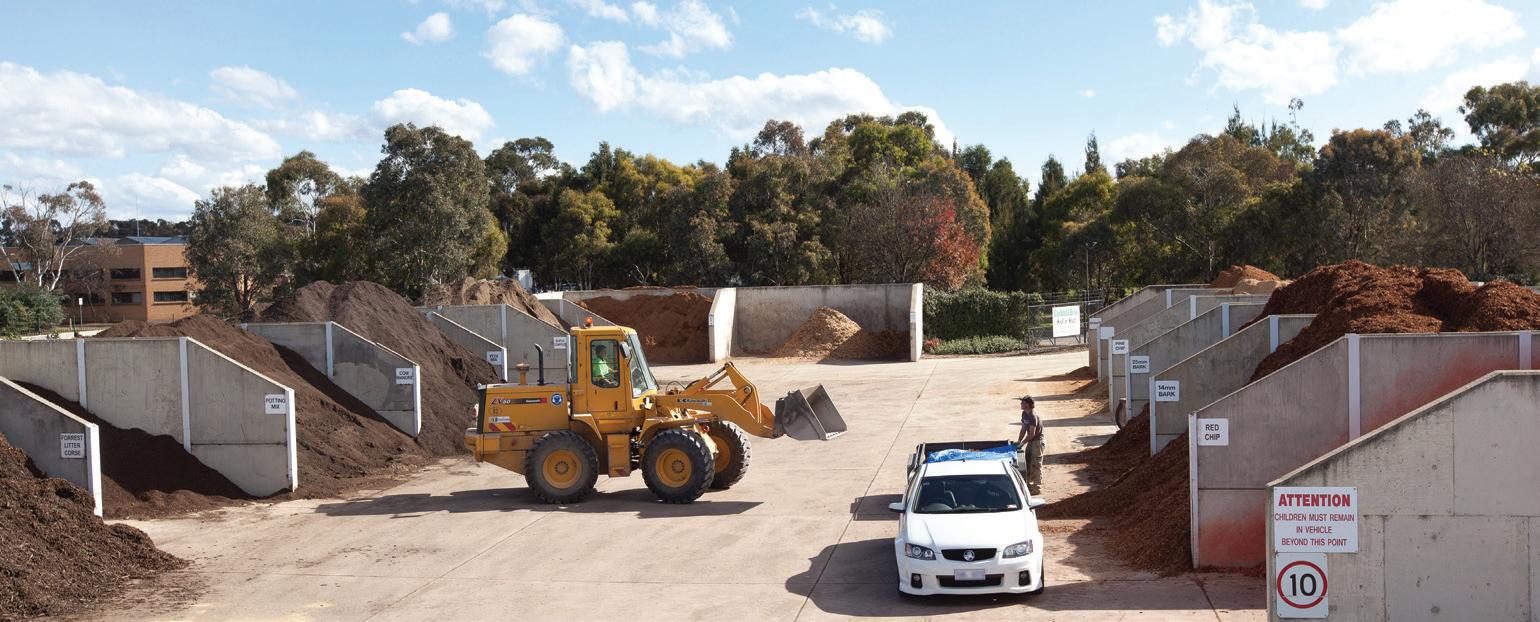
Quality Landscape Supplies
Apart from her work in cultural education and ecology, Ms Gilbert is also passionate about promoting the rights and recognition of First Nations’ peoples.
The granddaughter of the late Aboriginal activist and tent embassy organiser Kevin Gilbert, she says it saddens her that basic rights for indigenous people still go unmet.
“Unfortunately for First Nations’
people in this country, the work my pop and dad did hasn’t achieved change in some areas. We are still having the same conversations around First Nations’ peoples having basic rights like not dying in custody,” Ms Gilbert says.
“Whilst the next generation picks up where the old people left off and takes it further, we are still fighting the same fights as our old people because we haven’t seen a shift.”
Ms Gilbert is also completing a graduate certificate in Wiradjuri Culture and Heritage from Charles Sturt University and was recently named the 2021 ACT Young Woman of the Year.
“I also teach weaving to young girls,” Ms Gilbert says.
“When I was in Year 12, I set up a weaving circle for high-school girls to come and have a yarn, learn to weave and to build community.”
Despite her hectic schedule, Ms Gilbert insists she’s just a normal
“I’m really just like any other young person,” she says.
“I love hanging out with my friends, going on walks and crashing out on the couch watching Netflix.”
The Red Hill Bush Regenerators also picked up a gong at the National Landcare Awards, winning the Landcare Community Group Award for their 30-plus years of work restoring the native bushland ecology of the Red Hill Nature Reserve.
1954
Grim fairy tales not always happily ever after
By Belinda STRAHORN
WHEN Angela Rega was a little girl growing up in Sydney, every afternoon on her way home from primary school she would drop into the public library at Rockdale or at Arncliffe.
The librarians knew her by name, they’d have books waiting for her by authors she liked or novels she might enjoy.
“I was always in the library,” says Rega who went on to become a librarian herself.
“I just loved being able to borrow books and get the special privilege of being able to borrow more than the two-book limit. I’d always walk out with about six,” she laughs.
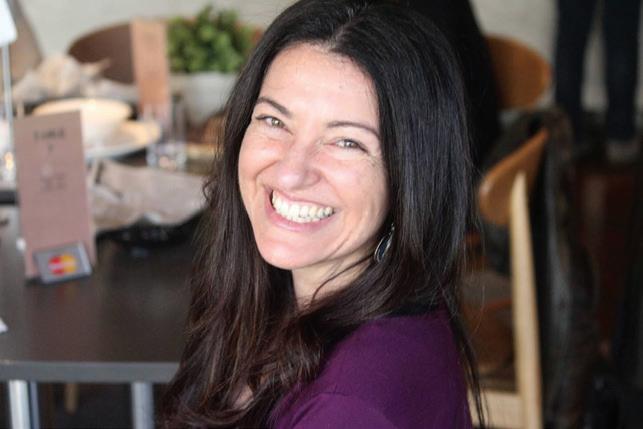
Rega, 50, now living in Canberra, is a fairy tale and fantasy author.
Her latest work – “The Tale of the Seven Magpies” – has been included in the recently published “South of the Sun: Australian Fairy Tales for the 21st Century”.
“It’s an anthology of Australian fairy tales,” Rega says.
“I sent in my story and it was accepted.”
By day, Rega is a high school lan-
guages teacher. Come night she moonlights as an author, working on her stories from the comfort of her Harrison home, in Canberra’s north, where she lives with her partner, his children and the couple’s two cats.
Her short story, “The Tale of the Seven Magpies”, is about a woman who wishes for a daughter and a Magpie Queen who makes her wish come true.
“The story is inspired by the German fairy tale ‘The Seven Ravens’,” Rega says.
“When I was thinking about writing it, a magpie came and sat on the balcony ledge and warbled at me and then the story just came to me.”
The stories in this anthology are definitely not for children, they are strictly for grown-ups.
Often dark, the stories visit places where things don’t always end happily ever after, where a single decision can haunt you forever.
But there are also tales to make you laugh out loud.
Fairy tales, Rega says, offer an escape from reality.
“There’s magic and wonder in fairy tales, but you can also make your way out of the dark,” Rega says.
“Fairy tales were not originally written for children, they were writ-
ten for everyone. It wasn’t until the Victorians came along that they turned them into children’s stories, they watered them down and made them less dangerous.”
For years, writing was a private pursuit for Rega.
“I’ve always written but it wasn’t until I was 38 that I decided to put my stories out for public scrutiny,” she says.
“I decided not to be scared anymore, I wanted to put my stories out there and not keep them to myself.”
Since then she’s had about 26 of her
short stories published in Australia, Canada, the US, the UK and Norway.
An Aurealis and Norma K. Hemming Award finalist and runner up of the Overland Neilma Sidney Short Story Prize, Rega says her passion for writing first took root in primary school.
Everywhere, she saw new worlds eager to be built and new characters waiting to be formed.
“I used to love filling up exercise books with stories, nobody read them, I just wrote them for myself,” she says.
Finding inspiration for her stories from the adventure books she enthusiastically consumed in her youth, Rega was also intrigued by Sicilian folklore, fairy tales and fables.
“I grew up in a migrant household where the only sport was storytelling,” Rega says.
“My nonna, who was Sicillian, couldn’t read or write so she told us stories.
“Nonna’s stories were grounded in a world where reality and magic, love and horror, tragedy and humour all intertwined. There were no boundaries – a story could have it all. I guess my writing has always been like that, too.”
In what Rega describes as her “more adventurous days” she lived in Chile and taught English.
But for now the Gungahlin College teacher is happy to call Canberra home and is working on her first novel.
“I’m turning a fairy tale novella I had published in 2013 into a full-length novel,” Rega says.
“For anyone thinking about having a go at writing a fairy tale, look back at when you were a child and think about the story that moved you the most, ask yourself why and then go for it.”
“South of the Sun – Australian Fairy Tales for the 21st Century”, $35, from serenitypress.org. A Kindle version is $9.99 from amazon.com.au
OPINION / biodiversity Greens have ‘never wavered’ on biodiversity
Greens
MLA for Ginninderra JO CLAY replies to “Canberra Matters” columnist Paul Costigan on the issue of biodiversity.
PAUL Costigan’s article (“Compromised Greens turn backs on biodiversity”, CN September 9) questioned the ACT Greens’ commitment to climate change and biodiversity.
I agree these should be top political priorities. But good democracy demands well-informed debate, so I’d like to set the record straight on a few of Mr Costigan’s claims.
The ACT Greens campaigned on a bold platform targeting big problems – climate change, the environment, housing and the growing gap between rich and poor. We then negotiated with Labor and received support for many of our policies.
We campaigned on climate ideas that had no prior government commitment, such as phasing out fossil-fuel gas and electrifying our entire transport system. Some ideas were so progressive that they were labelled “crazy” by the old parties during the campaign.
But the Labor/Greens “Parliamentary and Governing Agreement” commits to many of these. The ACT government will phase out fossil-fuel gas by 2045 at the latest. We will transition our buildings and transport to zero-emissions. We need to deliver all this in a hostile setting with a federal government that won’t set climate targets and that is actively pouring public
funds into blocking us nationally.
Our work builds on the world-leading climate action we secured with our on going Greens influence in ACT govern ment. Our power-sharing agreements gave Canberra 100 per cent renewable electricity, legislated climate targets and renewable-powered light rail (this last now partially subsidised by a formerly-opposed federal government).
Can we keep achieving real ac tion on the climate? I’m confident we can because we’ve already begun. We’ll break new ground with an allelectric, renewable powered Molonglo commercial centre. We’ve started disconnecting gas so we can have all-electric suburbs in Whitlam and Jacka. We’ve introduced no-interest loans and two years’ free registration for electric vehicles, and already seen a leap in registrations. We’ve become a founding member on green hydrogen certification.
The ACT Greens also campaigned hard on biodiversity. I’m a committed environmentalist, but like every other Canberran, I gained new appreciation for our wildlife during the Black Sum mer. It’s more important than ever that we preserve habitat and make more space in our city for native birds, animals and plants.
That’s why our parliamentary
see thousands of trees planted over the next four years. We’ll investigate legislating the right to a healthy environment. We’ll protect remnant grasslands, woodlands and waterways,
and announced measures to protect threatened species such as Swift parrots and Grassland Earless Dragons. We’ve delivered long-term, reliable and increased funding to landcare
and community environment groups, who do so much volunteer work protecting our biodiversity. We’ve funded additional indigenous rangers. We’ve advocated for stronger standards in national environment laws. We’ve supported community campaigns, such as protecting Lawson grasslands. In the time since being elected, Greens Environment Minister Rebecca Vassarotti; Greens Emissions Reduction & Water Minister Shane Rattenbury; my Greens colleagues and I have made 20 climate announcements and 13 biodiversity protection announcements. Many were Australian firsts. I’m new to politics, so I’m delighted we’ve gone into this term with a running start that builds on Greens’ work from previous assemblies. We won six seats, but it would be unrealistic to assume in a 25-seat Assembly, we will get everything we want. We certainly can’t control every individual decision that happens in our city. But we have a vision and we’re pulling the govern-
We have set high standards. Mr Costigan is right to hold us to them. But he should not misinform the public about what we have achieved so far.
Jo Clay is the ACT Greens spokesperson for Transport, Active Travel, Parks and Conservation, Animal Welfare, Arts and Culture, Circular Economy, Science and Women.
Nordic Walking – the total package for health and fitness
Join thousands of Canberran’s taking advantage of the fitness activity that has been keeping the Nordics and Scandis strong and healthy for hundreds of years
Nordic Walking is way more effective than regular walking, jogging, cycling or swimming. Much easier on joints, provides stability, strengthens core, improves posture, and fantastic cardio workout.
Suitable for all ages and fitness levels - the super fit and those with health conditions like arthritis, back and neck pain, Parkinson’s, and MS.
www.capitalnordicwalking.com.au
Fewer tears getting the jump on jerks
MY sensitive son has been known to come home from primary school and have a big old cry. I can relate as I have done that many times myself!
He’ll whisper to me that he wants a private chat and when we can, he’ll sit on my lap and tell me what’s been upsetting him.
It could range from the teacher pulling a serious face and feeling he had disappointed her, to his friends not playing with him at lunch.
One time, he told me some kids in his class pulled the chair out from under him and when he fell on his bottom, some kids laughed.
As he tells me his worries, I am transported back to my school days when the little cutting “jokes” of other kids, feeling left out, or the fear of the teacher getting angry would also make me cry sometimes.
“Hey Kate. You are pretty… ugly” was one line that cut me deeply in primary school.
All learning experiences I am sure and nothing remotely close to bullying or any of the very serious experiences we now know we need to actively address with our children and the school.
I think school today is a far more inclusive, positive and diverse environment than “back in my day” but not without its challenges as every young
My son has been called a ‘grumpy old man’ in jest, which upset him greatly. Clearly the kid who called him that hadn’t met his dad or grandad yet!
person finds their way, all the while growing, learning and making mistakes.
It’s not easy as a parent to release our beautiful children into the jungle of school and watch them from the sidelines as they navigate all sorts of relationships and social inter actions, positive and negative.
One kid’s joke or funny line could send another kid home to have a cry at the end of the day.
My son has been called a “grumpy old man” in jest which upset him greatly. Clearly the kid who called him a grumpy old man hadn’t met his dad or grandad yet!
As a sensitive soul myself, I wondered how best to support my son. Here’s that buzz word again: Resilience… who doesn’t need more of that
I tried a few different tactics and advice. It wasn’t at the point where we needed to escalate to the teacher, but I wanted to give him some tools so as to not let these encounters get to him so much.
I settled on some advice that I’m not sure the parenting books would approve… “sometimes people are jerks”. It’s just between us, I told him; he
mustn’t call any children that word. But, let me bring you in on a little secret – sometimes kids can be jerks. Sometimes even your best friend can be a jerk and sometimes you will be a jerk (and, yes, occasionally your parents will be jerks).
Now we know this, we can work out if we can just “shake it off” and realise that the kid is just having a “jerk moment” or if it’s something a parent or teacher needs to know about.
He laughed and laughed when I told him my advice – it had lifted his spirits at the very least, and he was delighted to hear mummy tell him a “cheeky” word that the two of us can share when he’s feeling sad.
It got me thinking that we can extend this theory into other aspects of life. As kids or grown-ups navigating relationships, here’s a lesson in life for us all…. let’s try to not be jerks. But from time to time, we just might be.
BRIEFLY
Gillard to speak out for Menslink
FORMER Prime Minister Julia Gillard is the guest speaker at this year’s Menslink Business Breakfast, the community support organisation’s annual fundraising event. This year’s breakfast is a “make-a-donation” ticket to join the broadcast. Workplaces donating more than $1000 will be acknowledged during the event and for the rest of the year as a Menslink sponsor. It is from 7.30am on Tuesday, September 21. Tickets from menslink.org.au
Lecture about healing
ANTaR ACT is the local branch of Australia’s main non-indigenous organisation for reconciliation and, for the last 17 years, it has presented the David Hunter Memorial Lecture. This year it will be a free webinar at 6pm on Monday, September 27. The theme is “How Can We Heal Country?” and the guest speakers are Bhiamie Williamson and Dean Freeman. Register via antaract.org.au
Pelvic-floor workshop
WOMEN of all ages are invited to attend a free, online, pelvic-floor workshop presented by a physiotherapist from Canberra Health Services. It is targeted to women experiencing continence or pelvic floor concerns as well as those who are wishing to prevent them. It’s on between 9.30am and 12.30pm, Monday, October 11. Book 5124 9977 for the online link.
No hidden charges
No lock-in contracts
World class technology
Higher
ARE our lockdown click-andcollect restrictions being exploited for direct marketing?
I was forced to place my first click-andcollect order recently due to ACT lockdown restrictions on pet stores.
As I do not like my personal contact details being exploited for direct marketing I went straight to the company’s privacy policy to see if they used the bad business practice of opt-in by default. Unfortunately, they did.
“By submitting this order,” they warned, “you consent to receiving direct marketing”. As such, they dutifully “acknowledge and respect our customers’ choice to ‘opt-out’ of direct marketing communication activities”.
This is known as “opt-out” by choice, forcing a customer to contact them separately by phone or email, which is what I sent.
Despite my efforts, I have now received a chirpy email thanking me for joining their “Pet Family” club! I had avoided ticking that option during the order process.
When I clicked the spam email’s “unsubscribe” link it took me to a “sad to see you go” page that begged me to “allow up to 48 hours” for this to take effect.
While I wait for that, I have still yet to receive any acknowledgement of my opt-out request.
How sad to discover that my customer loyalty to a local pet store during lockdown is being exploited by greedy, direct-marketing practices of head office.
Michael A Crowe, Hawker
Compounding impacts of lockdown
THE Chief Minister is not being upfront with the ACT community about the path ahead out of lockdown.
The National Plan calls for lockdowns to be relaxed progressively after 70 per cent and 80 per cent double covid vaccination rates are reached for a state/territory’s eligible population.
Latest federal Health Department data projects that the ACT will reach 80 per cent rates on October 20. As at September 1, the department’s data also indicates that just over 40 per cent of the ACT population had received their second covid vaccination.
Until recently, Andrew Barr has been saying that he had not given up on the possibility of achieving a zero covid level for the ACT; hopefully this prospect has now lapsed as we need to learn to live or co-exist with some level of ongoing virus across the community, as the Victorian premier has belatedly recognised.
On television Barr stated that 180,000 Canberrans were not vaccinated (I assume this includes the recent 12-17 age cohort recently approved for vaccination by federal Health).
This past week he has also repeatedly stressed that the next two to three months will be the most challenging for the ACT. He has also indicated that he was not disposed to follow the NSW Premier’s
proposed roadmap for opening based on 70 per cent full vaccination rates now scheduled for around October 18.
Finally, he has previously indicated he was not averse to the ACT achieving higher vaccination rates of 85 per cent before restrictions were eased.
It therefore seems likely we will be in hard lockdown at least until October 20, with some possible slight easing of restrictions after that date but no broader opening up of retail, services, other business and education until mid-November or later.
Perhaps all Ken Behrens should now begin to more carefully consider the compounding economic, social, education and mental health impacts from such an extended lockdown.
Ron Edgecombe, Evatt
‘The chief’ doesn’t really give a rat’s
I WELCOME the expanded letters column of “CityNews”. It is timely, too, as I am sure there are many frustrated Ken Behrens out there suffering lockdown fever, wanting to vent about something. Sadly, ideal meets regime reality.
Columnist Paul Costigan again leads the charge about the incomprehensible tin ear of the local regime concerning biodiversity (CN September 9), but I agreed with an earlier item of his about the Chief Minister competently dealing with the pandemic
although his trying to shift blame is a bit tiresome (as well as the deferential phrase of “the chief” when he is referred to).
Paul might, sadly, have to adjust to the reality of our lopsided jurisdiction. The third team in the sandpit (aka the Greens) is a wholly owned subsidiary of the eternal regime (which has governed for time immemorial), the supreme leader (aka “the chief”) has had to adjust to suffering the “collective leadership of the sandpit” (CLOTS). But nothing really has changed at all.
I do agree with Paul about the sad state of affairs here, but the regime and “the chief” in particular to quote him does not give a “rat’s arse” what anyone thinks anyway. We will, it seems, just have to toughen up, or change the management at the next election.
Columnist Bill Stefaniak (CN September 9), I think, is on the wrong side of history on resisting quotas for women in the Liberal Party.
Historically, the Liberals have been streets ahead of the ALP on the first women in state parliaments (also the first deputy party leader Rosemary Foot in NSW), and often so on policy for women.
The ALP, a very blokey union bastion, made the decision to redress the lack of women and it has changed itself dramatically. This is really only in the last 40 years. The ABC program “Ms Represented” might have pointed out the general lack of women, but the ALP having elected one federally in 1943 (Dorothy Tangney) left her on her lonesome in the party for the entire period of her time
in parliament until 1968 – then there were no ALP women for some years federally.
Meanwhile, a number of Liberal women came and went. Diversity is a perfectly compatible value with liberalism, and it would be a good thing for the Liberal Party and for our democracy.
Martin Gordon, Dunlop
I have pride in my
public-housing unit
I WRITE in response to Lucinda Spier’s letter (“Fairness really means ‘free’ in public housing”, CN September 2).
Being an aged/retired (from retail) woman on the aged pension, I live in a lovely public-housing complex of seven units in Ainslie.
At 68, I still work part time and my fellow residents basically worked all of their lives and paid their taxes.
Unlike Ms Spier, not all people can afford to buy a home, due to reasons such as being divorced, widowed or in a low-income job.
All the residents in my complex, whose ages range from 62 to 94, take excellent pride in their home and all have, at their own expense, upgraded gardens, sorted out maintenance issues and painted.
I feel Ms Spier needs to reassess her selfish attitude towards others.
Sandra Picker, Ainslie
MORE LETTERS
And still the economy tops the news
COLUMNIST Michael Moore wrote a brilliant article (“Pandemic reveals the price of packing people in”, CN September 2) highlighting the ACT’s population and housing crises.
The one misleading part mentioned economic growth as the catchword of conservatives. Economists, and the economic agenda, have hijacked Australia’s political and social debates for decades across all major parties.
Even in the face of this century’s worst health crisis, the economy has never been far from (or at) the top of the news. The planet cannot afford for us to keep thinking this way.
Ty Douglas, Barton
Why don’t people keep dogs on a leash?
IN the last three days I have had two, close “near misses” with dogs running across the road very suddenly.
With more people taking to recreational walking with their best friend. why in the name of Jupiter don’t they keep their dogs on a leash?
Thankfully, no injuries were caused to the dogs I mention – but on the second occasion I certainly had to “lock the wheels up” to avoid running it over as the dog just had no idea about being on the road. It was chasing another dog that was on the opposite side (this one was on a leash).
I can only say thank goodness for the speed humps at the Gowrie shops, I hate to think what could have happened otherwise.
I know restraint of dangerous dog breeds is a separate and very serious issue, but people who accidentally leave their side gate open or don’t appropriately secure their yard, or knowingly let dogs wander around the street, choose not to use a leash, or take them to construction sites and let them loose are beyond words that are fit to print.
I see the government legislates a lot about animals, however enforcement, monitoring and following-up are very different issues.
Bjorn Moore, Gowrie
You must take what we dish out
GOVERNMENTS, money lenders, enviro-zealots, town planners, developers, surveyors, civil engineers/contractors, real estate
marketeers, faux designers, and project/spec builders – conceited overachievers all – are telling prospective home makers, especially young families: “Sorry, we’ve dumped equitable town planning, local employment opportunities, individuality, affordability, and a fair go, and it’s time to do as we say (not as we do).
“So, who needs backyards, privacy, sunshine, and electric cars, if you want a new dwelling, you must now take what we dish out, and live cheek-by-jowl in crap flats, noisy townhouses or cookie-cutter mansionettes, in our latest micro-plot development, Nullus Arbor, and have we got a deal for you!”
Jack Kershaw, Kambah
Population point is well made
JENNY Stewart’s letter on the growth of Canberra’s population (“Large Canberra ‘undesirable’”, CN September 2), in particular the comment “Population growth is an outworn mindset”, is on the right track. However, Dr Stewart does not go far enough. Endless population growth is not just undesirable, it is unsustainable – if not impossible.
Unconstrained expansion of population in a country such as Australia places insatiable demands on our relatively scarce food-producing soils and a heavy load on our supplies of potable water, especially in times of drought.
Furthermore, climate science shows that periods of drought in Australia will become more frequent, more intense and longer whilever global heating persists.
Large-scale land clearing for beef cattle production and agriculture, as well as urban expansion, destroy huge areas of ecosystems that are home to endangered, critically endangered or vulnerable-to-extinction species such as the koala, the eastern and mountain pygmy possums, the spottedtailed quoll and the orange-bellied parrot.
Dr Douglas Mackenzie, Deakin
Reminder of a poignant poem
THANK you, columnist Clive Williams (CN September 2) for reminding me of my favourite poem, Leo Marks’ “The Life That I Have”. I believe its particular poignancy lies in that it was used as the signal code of a young, female Special Operations Executive agent in France who, betrayed to the Gestapo, died in Ravensbruck.
Tina Faulk, Swinger Hill
POLITICS
How good is Australia at saving pandemic lives?
AS vaccination rates increase, it is not a bad time to assess just how Australian governments have, until now, managed our population through the COVID-19 pandemic.
It is also worth looking at what’s ahead.
Although some would like to focus on economic impact and the level of inconvenience to citizens, the most significant indicator is sickness and death.
Throughout the world there have been more than 4.5 million confirmed deaths since the start of this pandemic and well over 200 million confirmed cases. That is a little less than one tenth the deaths and half of the number of cases predicted for the Spanish flu of a century ago.
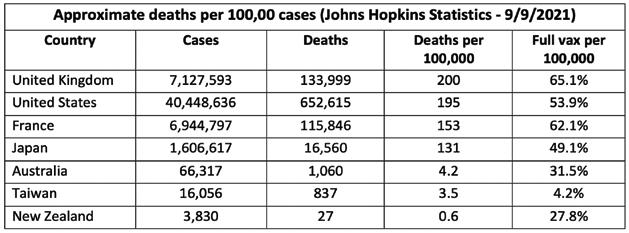
In mid-July the UK celebrated its “freedom day” and getting life “back to normal”. There are those who argue Australia should follow suit. However, it is worth noting that statistics from the Baltimore-based Johns Hopkins University Resource Centre show that since the start of the pandemic the UK has had to deal with more than 7 million cases and around 133,000 deaths.
France has had nearly 7 million confirmed cases and more than 100,000 deaths. And even Japan, that successfully staged the Olympics, has suffered with more than 1.5 million cases and more than 16,500 deaths. Taiwan has had 16,000 cases and just over 800 deaths. NZ may be wrestling with a lockdown at the moment – but it has had
27 deaths and just over 3800 cases.
It is worth looking at the range of countries on a comparative basis. The table illustrates how well Australian governments have handled COVID-19.
On this basis, Australian jurisdictions can be proud of their record. Another way to look at it is, compared to the UK, actions taken by Australian governments have saved more than 50,000 lives. What does the future hold? Vaccination is the key. The table illustrates the countries that failed to contain the virus have worked desperately to immunise the population. However, these figures do not show international failure to effectively assist low and middle-income countries that have not had equitable access to vaccines.
Australian jurisdictions can be proud of their record. Another way to look at it is, compared to the UK, actions taken by Australian governments have saved more than 50,000 lives.
The other element in considering the future is the use of “vaccine passports”. These are not new in terms of travel. For those of us old enough to remember, a smallpox vaccine was a condition of travel to many countries before the elimination of that disease through vaccination. Travelling to countries where there is endemic Yellow Fever
requires a vaccination as a condition of returning to Australia. However, “vaccine passports” has taken on a larger meaning in the context of this pandemic. People who carry evidence of being fully vaccinated will have access to places where the non-vaccinated will be refused entrance. This might include restaurants, sports grounds, cinemas and most forms of public transport, including coaches and flying. In a recently released position paper, the ACT Human Rights Commissioner, Helen Watchirs, has warned “vaccine passports” may “give rise to human rights and discrimination concerns, particularly in terms of accessing everyday goods and services”. She added that if used inappropriately they “could deepen inequality and discrimination against people who have not yet been vaccinated” and suggested the importance of dealing with conscientious objection to vaccination in a “structured way”. Human rights are fundamental in working forward. However, it is also important to keep in mind that US President Biden described COVID-19 as the “pandemic of the unvaccinated”. Delays in being vaccinated will delay the return to normality.
Luke Clews
facial pareidolia
A pretty face, they’re in trees, walls and toast
SEEING faces in everyday objects isn’t that unusual. The phenomenon’s technical name is “facial pareidolia” (pareidolia being pronounced par-i-doh-lee-a).
Scientists at the University of Sydney have found that not only do we see faces in everyday objects, but our brains even process them for emotional expression, much as we do with real faces, rather than discarding them as false detections.
Facial pareidolia is likely a product of our evolution. Researchers note that the phenomenon has been observed among monkeys as well. It’s a prerequisite for social interaction. More generally it gives us the ability to recognise individual faces. Faces are “special” stimuli, for which we
have developed unique perceptual and recognition processes.
This is of crucial social importance for humans (and other species) and evolutionarily necessary for survival. Without this skillset we could be continually taking home the wrong partner from the supermarket. Moreover, we’re so good at facial pareidolia that we are able to identify individual humans from among millions of other humans.
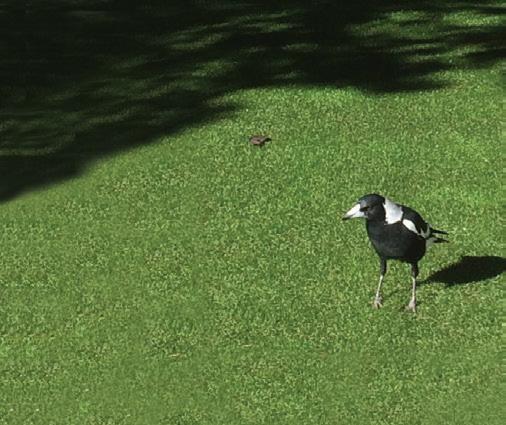
However, we don’t do so well with recognising individuals in other species. Most of us probably have difficulty identifying individual magpies even though we see the same ones every day. Magpies clearly are much better at it than us. Magpies can not only identify other magpies, but also recognise humans that live in their patch – and human interlopers who are swoopable. I first started paying attention to
faces in objects about 20 years ago when I travelled with a photographer who was always on the lookout for good examples. I’ve been doing the same ever since.
At first, I worried it might be an early indicator of dementia, but apparently not. Where was I? Oh, yes... At one time pareidolia was also considered to be a symptom of psychosis, but it’s now seen as a normal human tendency.
Indeed, facial pareidolia apparently indicates one has a creative side. Pareidolia can be a boon to artists when it results in inspiration – as it clearly did with some of Salvador Dali’s paintings.
An extreme example of facial pareidolia is “Jesus toast” – where devotees see images of Jesus, the Virgin Mary or even Elvis in their toast.
In 2017, a man named George Maley, from Windham, New York,
was trying to sell on eBay a piece of buttered toast that he claimed bore the face of Jesus, for an asking price of $25,000. Another famous instance was a grilled-cheese sandwich with the face of the Virgin Mary.
I’m surprised that no one has produced a toaster that creates a range of selected images on toast, but perhaps I’m ahead of my time there.
During the 9/11 attacks, television viewers supposedly saw the face of Satan in the clouds of smoke billowing out of the World Trade Center.
Another example of facial pareidolia occurred during the 2019 fire at Notre Dame Cathedral when some observers claimed to have seen the face of Jesus in the flames. Other common
transitory locations are froth on water, the surface of the moon, and cumulus clouds.
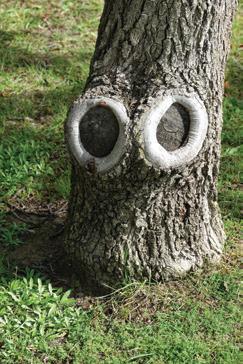
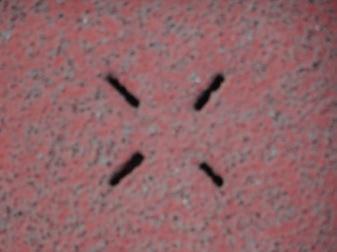
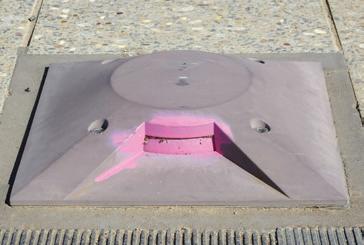
Walking around Lake Burley Griffin, there are several physical examples to look out for – as shown here.
Jokes about facial pareidolia don’t seem to work because you need to see the image. But if you are motivated to see some you can find “30 Funny Examples of Pareidolia In Everyday Objects” online at boredpanda.com
Clive Williams is a Canberra columnist.
Online
Faces, faces everywhere.
Photos: Clive Williams
ARTS & ENTERTAINMENT
Atfield’s new play to Spring Out in November
By Helen MUSA
ONE of the biggest disappointments in the local arts scene recently was the postponement of David Atfield’s new play “Chiaroscuro”.
Atfield was selected to be in residence at Canberra Theatre Centre from August 2-29, as part of its inaugural “New Works” program.
Following the story of the notorious Italian painter, Caravaggio, as he paints a masterpiece from his studio in laterenaissance Italy, the play was inspired when Atfield saw his “The Raising of Lazarus” in Sicily and got interested in the idea of the model forming a romantic collaboration with Caravaggio, noting that many art historians try to deny the artist’s sexuality, “as if that diminished his work”.
Atfield eschewed the joys of rehearsing by Zoom and because of covid, the project was put off until November, during Canberra’s SpringOut festival.
Meanwhile, Atfield’s other new play, which touches on the lockdown, has just undergone a “First Seen” development at
pop star married to a supermodel, is enjoy
as it gives him an excuse to wallow in his glorious failure.
creation in a world full of rejection – and it gives Atfield an excuse to celebrate all things
Emperor Hadrian’s boy-lover Antinous, and continuing in the 2018 play “Exclusion”, written in the time of the marriage-equality debate about a bisexual prime minister. Atfield is quick to point out that in those plays the nudity was shared evenly across the sexes.
The winner of three Canberra Critics’ Circle Awards, he is one of Canberra’s most respected directors and playwrights. He originally came to the ACT as director of Company Skylark puppet theatre soon after graduating in 1991 from NIDA, but preferring human actors to puppets, soon turned to “straight” theatre.
After Skylark he formed his own independent theatre company, BITS Theatre, directing everything from Michael Gow’s “Furious” to Tennessee Williams’ last play “Something Cloudy, Something Clear” and his own play “Pink Triangles” about the Nazi persecution of homosexuals.
An ongoing love affair with movies resulted in his 1998 script, “Louise Lovely,” about the silent-screen idol Louise Lovely, which led to an introduction to the National Film and Sound Archive, who offered him a day job, which he still holds.
Then he stopped.
“I went underground for nine years, stopped being an artist,” he says. “I cover that in Act II of ‘Just Wrong’, where my passion for ‘90s dance music is also covered.”
In the fallow period, he did a bit of DJ-ing
for private functions while concentrating on his job at the NFSA.
But it’s usually impossible to keep an artist down and Atfield was soon at it again, this time turning his hand to playwriting and directing, as he has done for the past decade.
Apart from a strange sidestep into directing the Disney musical “The Little Mermaid” for Free Rain in 2016, Atfield has resolutely focused on queer issues in his plays.
First identifying as a gay director during the ‘90s, Atfield was well aware of the peculiar attitude to sexuality in the industry that saw Tom Hanks getting an Oscar for being “brave” performing a gay man and Rupert Everett stopped from being a romantic lead after he came out – “as if he wasn’t a fully-fledged human being,” he says.
He describes the taboo against displaying the male sexual organ onstage as “very paranoid… I find it annoying, using women as a sex object but not men.”
“Sexuality and nakedness are something to celebrate, not something to hide.”
But Atfield admits that the question of nudity on stage has been somewhat muddied with the advent of the Me Too movement, so nowadays productions need to have an “intimacy coach” to make everybody feel safe with nudity. That will be happening with “Chiaroscuro.”
Performance dates for “Chiaroscuro” will be available soon at canberratheatrecentre.com.au
The Street via Zoom.
ing the COVID-19 lockdown
Playwright David Atfield… “I find it annoying, using women as a sex object but not men.”
Remembering forgotten Ruth’s work
By Helen Musa
IN the 1920s, Ruth Lane-Poole was one of Canberra’s leading “influencers”, when the elegant housewife-turned-designer was engaged to furnish the official residences, The Lodge and Government House at Yarralumla in time for the opening of Parliament House in 1927.
Now heritage museum expert, Margaret Betteridge, consultant and curator of the civic collection at Sydney Town Hall and once adviser on fine arts and gifts for the Department of Prime Minister and Cabinet, has curated an exhibition about this partly-forgotten figure in “Ruth Lane-Poole: A Women of Influence,” a collaboration between the Canberra Museum and Gallery and The Australiana Fund.
It includes furniture from the official residences, loans from Lane-Poole’s descendants and Canberra’s national cultural institutions.
But uniquely, it focuses on LanePoole’s drive to use Australian timbers for furniture and her connection to the family of Nobel laureate WB Yeats, who gave her away at her wedding.
As an adviser to the Hawke government, Betteridge first learnt about Ruth Lane-Poole after former first lady Hazel
Hawke came into The Lodge and started taking an interest in the whereabouts of its piano, which eventually turned up at the School of Music.
On starting her journey through the library and archives, Betteridge learnt about Lane-Poole’s connection to the Yeats family in Ireland and its role in giving her the skills needed to become the first woman to be appointed to a maledominated Federal Capital Commission.
“I managed to make contact with her descendants and among their things was material about the Yeats family… that helped me understand that her design aesthetic did not come from a professional training, but from the environment in which she had lived,” Betteridge says.
Born Ruth Pollexfen in Ireland, but dislocated from her family after her parents divorced, she moved at the age of 15 into the Yeats’ house and was drawn into the circle of people involved in the revival of the Irish Celtic movement.
Yeats’ sisters Susan (Lily) and Elizabeth (Lolly) were her cousins and they gave the young Ruth a grounding in the arts. She was apprenticed to Lily as an embroiderer for a time.
In 1911 she married Charles LanePoole, who after studying engineering in Dublin, had lost his left hand in a shooting accident, so studied at the French National Forestry School, then worked in South Africa, Sierra Leone, Western Australia and Papua.
His appointment in 1925 as the Commonwealth’s first inspector-general
of forests allowed Charles and Ruth to be together with their children and they settled in Melbourne, where they were immediately accepted by Melbourne society and where Ruth met like-minded artists at the forefront of the Arts and Craft Movement.
Rubbing shoulders with high-society figures such as Ethel, wife of Prime Minister Stanley Bruce and Lady Stonehaven, wife of the Governor-General, Ruth was on hand when the Federal Capital Commission went looking for a stylist.
Eventually moving to Canberra, they settled in Westridge House in Yarralumla.
Ruth insisted that all of the furniture she commissioned be made of Australian native timbers, a revolutionary idea at the time. In articles for the “Home Beautiful” magazine, she argued that there was nothing wrong with being adventurous and tried to encourage readers away from the Victorian furniture look.
Ruth, as CMAG’s Rowan Henderson says, “was more or less handed a blank slate” and proceeded to make The Lodge and the much larger Government House into something between a suburban home and an official residence, with the domestic interiors not particularly grand.
In this she was at one with Marion Mahony Griffin and even though Betteridge is pretty sure they never met, both had a democratic sense of what Canberra was all about and the need to abandon traditional planning hierarchies.
Ruth was still extremely well-connected to the Irish ascendancy and used her
connections to help her with ordering fine Irish table linen and through cousin Lily Yeats, William Morris and Liberty of London fabrics.
Their shared love of Australian timber first surfaced when Charles went to the First British Empire Forestry Conference in 1920 with a sample of Australian timber, but it was not taken up.
Ruth, by contrast, was a natural promoter and argued publicly that our timbers had just as many good qualities as mahogany and oak. Betteridge praises her use of her favourite timber, Queensland Maple, which allowed the honey colours and she thought Jarrah was perfect for flooring.
So why was she, as Henderson puts it, “a bit hidden in history”?
She was at the centre of the Canberra social scene and a charity worker for the Red Cross with a strong social conscience, but while in Canberra she mostly devoted her life to her husband and her three daughters. Betteridge met her grandchildren and says: “They obviously had a fantastic relationship with Ruth, which is reflected in the photos in the exhibition.”
While early in her career she had taken on commissions including one from Myer, eventually she made the decision not to work again and lived out her later years with Charles quietly in Manly, NSW, where she died in 1974.
“Ruth Lane-Poole: A Women of Influence” Canberra Museum and Gallery, until October 2.
ARTS IN THE CITY
‘Memory’ show extended to next year
By Helen Musa
THE National Portrait Gallery’s 2021 National Photographic Portrait Prize, “Living Memory,” will be extended until January 16. Judges Karen Quinlan, from the NPG; Nick Mitzevich, from the NGA, and photographer Bill Henson selected 79 works, more than double the usual amount, as a way of acknowledging the impact the pandemic has had on the creative community. Joel B Pratley was announced the winner for his portrait “Drought Story” of farmer David Kalisch in the midst of an unexpected dust storm. All works can be viewed at portrait.gov.au/livingmemory, where audiences can also vote for the $5000 People’s Choice Award, to be announced in late October.
AMONG the 127 finalists in the inaugural annual National Capital Art Prize, now postponed to October, are 15 artists from the ACT — Helen Goodwin, Blake Edwards, Thet Naing, Samantha Corbett, Henry Xuning, Jack Mather, Annette Rennie, Sandra House, Varvara Naumova, Crystal Prior, Alice Pulvers, Andrew Smith, Janet Thatcher, Solomon Karmel-Shann and Joan McKay. Finalists’ artworks and People’s Choice, which closes on September 30, are accessible at nationalcapitalartprize.com.au
CANBERRA poet Keith Harrison won a $1000 Highly Commended for his poem, “Cadences”, in the Australian Catholic University Prize for Poetry. The first prize of $10,000 in Australia’s richest poetry prize went to Hobart poet Anna Murchison, who didn’t start writing poetry until she was 50, for her poem “Child of Gathhepher”. All 75 shortlisted poems will be published in an anthology that can be purchased from acu.edu.au/ prizeforpoetry
OPTIMISTIC plans are still afoot for a two-hour showcase event, Canberra Comedy Festival Gala, to go ahead for one night only at the Canberra Theatre on Monday, September 20, while Sydney Comedy Festival Showcase has been rescheduled to Sunday, December 12, with a line-up of festival favourites and emerging talents. Book for both at canberratheatrecentre.com.au
THE arts desk is awash with notices of postponed shows. Heading the list are: the Tony and Olivier awardwinning musical “Come From Away”, now to play from February 3; Katie Noonan’s new project, “Tumbling Like Stars”, featuring the world premiere of the David Malouf song cycle now on March 6; and “Circus of Illusion”, a magic show involving mystery and mayhem, will now be seen on January 16. All at Canberra Theatre, book at canberratheatrecentre.com.au
ROOF MAINTENANCE
While we’re all experiencing these unique times, why not use this opportunity to get together your old videos, slides, records and cassette tapes so Songland can transfer them onto a digital format for you, your family and friends. Then you can relive the memories when you’re all next together!
See you soon at Songland
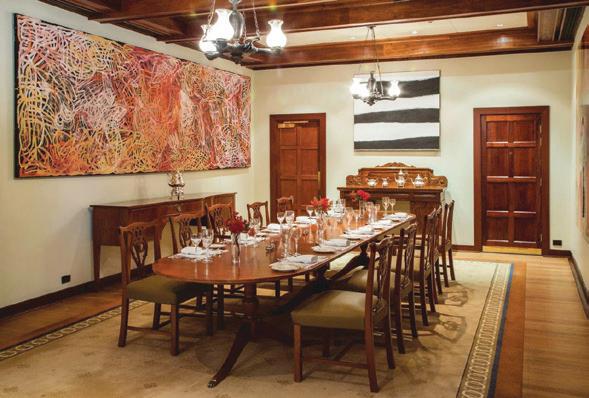
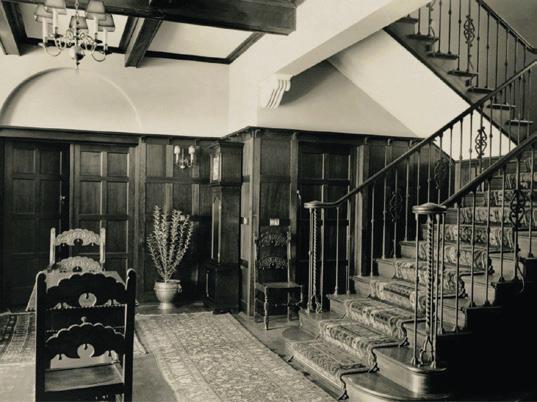
The Lodge dining room with chairs commissioned by Lane-Poole.
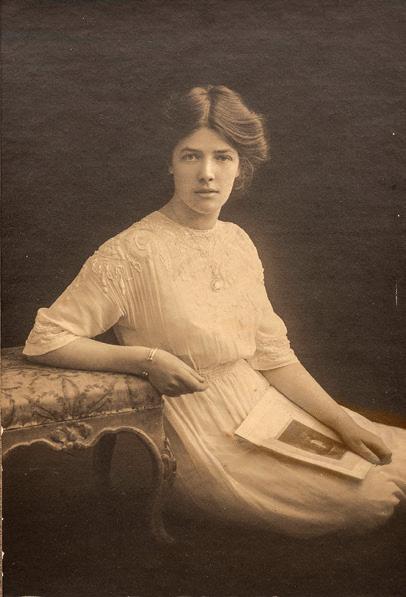
Interior of The Lodge. Portrait of a young Ruth Lane-Poole.
WATCH IT! / streaming and stuff
Crash too hard to look away from
By Nick OVERALL
I HAD my doubts about Binge’s newest showcase series “The White Lotus”, but by the end of the first episode I had been completely drawn into this golden-hued, uncomfortably intriguing “paradise” that’s stirring up all sorts of conversations.
Describing the premise is no easy task; as a viewer we’re a fly on the wall, one that observes the exploits and misadventures of an ensemble of bizarre, yet very real characters who have taken to a luxurious resort to get away from their day-to-day life.
There’s Shane, a Ralph-Lauren clad real estate agent and Rachel, an ambitious quasi-journalist, newlyweds whose relationship gets thrown into question when a hotel booking error becomes an obsession.
Nicole, a bougie CFO whose husband Mark pretends to be fond of the fact she makes much more money than he does.
And Armond, a hilariously pedantic hotel manager who somehow prioritises cus
erations, crisis of gender roles and strife around money, sex and death.
It’s the crushing irony of “The White Lotus” that’s the bullseye. While the island is supposed to be a holiday, a perfect, paradisiacal withdrawal, the characters here have unwittingly packed society snuggly in their bags and brought it into clearer focus than ever before on their heavenly getaway.
Sounds like a soap opera? A little bit. There’s certainly drama, but “The White Lotus” is jet-black satire more than anything else.
The series is written by Mike White, who might be best known for being the man from it.
Many moments of the show will have viewers nothing short of cringing, but this is one car crash that’s just too hard to look away from.
“THE White Lotus” isn’t the only big piece streaming this month. Travelling back home, available on Stan from September 16 is “Streamline”, a new film that according to gushing early reviews completely breaks the sports-movie mould.
We’ve had sports films and series about rugby, cricket, soccer and the other usual suspects but “Streamline” tells the tale of a talented, teenage swimmer named Ben, who is giving everything to earn a spot in the Olympics while navigating the gloom
watch off the back of the recently finished Olympic Games.
Where there we’ve seen the prowess of stars such as Emma McKeon broadcast to us from Tokyo, “Streamline” aims to give a dramatised insight into the work it takes for athletes to get there in the first place.
Netflix’s big streaming success this month is season three of the breakout British hit “Sex Education”.
Here, socially-awkward teen Otis desperately attempts to hide from his high-school peers that his mother is a candid and heavily experienced sex therapist.
However, it’s not long before he realises he can use her expertise to win the favour of fellow students by offering guidance on their carnal and sensual woes.
“Sex Education” can at times stray into juvenile territory, but these moments are only collateral of a series that so openly attempts to explore its subject matter and often succeeds in doing so.
AND for those who don’t mind subtitles, now available on SBS On Demand is 2021’s Best Foreign Film winner “Another Round”. A gong well deserved at that.
Mads Mikkelsen plays the lead role in this Danish flick where four high school teachers run a “social experiment” of drinking alcohol every day to see how it affects their social and professional lives.
Not gonna lie, gave me a bit of a double take about some of the “social experimenting” going on during our days of being
Looking, well, good enough to eat
By Wendy JOHNSON
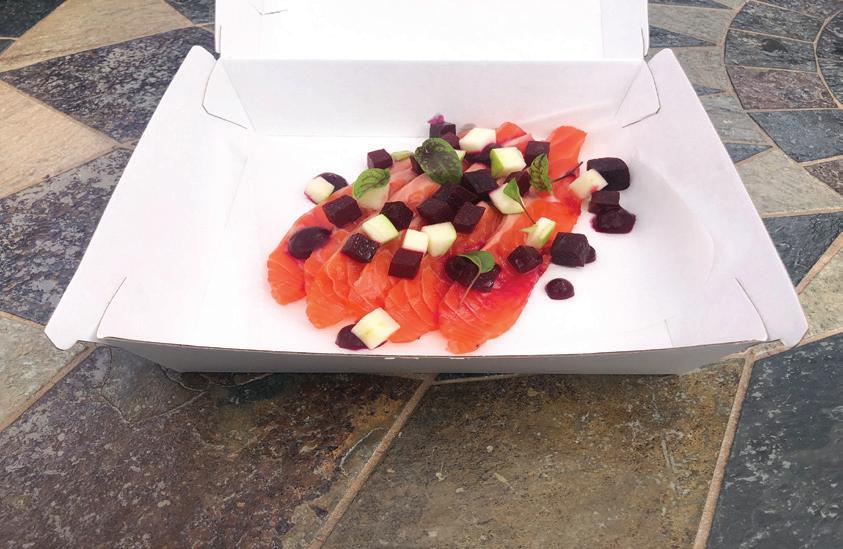
ONE thing I’ve learned during lockdown is how important takeaway packaging is for food presentation when delivery hits home. Quality packaging ensures food is kept hot (or cold) and looks as best as it can on arrival.
Lamshed, in Yarralumla, has nailed this with its lockdown menu. It’s inspiring because there’s nothing worse than food smushed into containers and arriving looking like slop (such a turnoff). Lamshed takes its food far, far too seriously for that and we thank them for it.
Our Lamshed, four-course, takeaway meal began with a pretty-in-the-package ocean trout crudo. The packaging had sufficient height
FESTIVAL River festival comes up for air
By Helen Musa
AS the River of Art Festival was getting ready to light up the Moruya River, the fickle finger of covid fortune struck down the 16th annual celebration of the Eurobodalla’s arts community.
But co-chairs of the event, Di Jay and Vicki Lascelles, are pushing on regardless with a virtual festival.
With 40 per cent of the visitors from outside the region, they’re keen for people to participate in some way.
Alas, Jay tells me by phone from the south coast, there’ll be no physical illumination of the river, as had been planned for the new “Luminous: Art After Dark” event, but there’ll be plenty of other distractions, with the visual arts leading the charge.
Central to the 2021 Virtual River of Art will be the arts directory, which was introduced last year, where many of the 125 events, including textiles, woodwork, sculpture, painting and even music, film and poetry, will go ahead.
One enticing inclusion online is the cabaret performance, “Disenchanted: a Cabaret of Twisted Fairy Tales”, in which Sydney mezzosoprano Eliane Morel, raised in Canberra and a former voice student at the ANU School of Music, plays characters from fairy tales who tell their side of the stories.
The 2021 Virtual River of Art Festival, September 17-26 at riverofart.com.au and for exhibitions and events enter “River of Art Festival” at youtube.com
to protect the look of the colourful dish. The perfectly sliced ocean trout was simply gorgeous with little cubes of bright beetroot, crispy apple and micro herbs carefully placed here and there. The high-quality trout was mouth watering.
The magical chicken tagine also travelled well and was packed with exotic flavours. The couscous was fluffy and the addition of preserved lemon and apricot added a welcoming sweetness to the tender, moist chicken. It was an incredibly generous serve (leftovers for lunch!) and the dish memorable.
We loved the innovative chargrilled zucchini dish, which looked as delightful as it tasted. It featured hazelnut and was topped with thin, big shavings of parmesan and rocket leaves.
This demonstrates how a few carefully selected, quality ingredients is all that is needed for a special dish.
The pomegranate cheesecake was also packaged with tender loving care. It was soft, creamy and light. The mulled-wine, poached pear perked matters up perfectly.
You can order extras from Lamshed’s to up the ante if desired – for an additional cost – and we did. The garlic mashed potato was divine ($12) and the fattoush salad was lovely and fresh ($12). Also on the menu are Pambula oysters ($4 each or $4.50 with pickled grape and shallot) and minestrone soup (no doubt packed with goodness) for $10.
Lamshed has a great relationship with neighbouring Cork and Glass. To further support local, we popped in to organise for takeaway olives, a selection of scrumptious cheeses and a couple of bottles of wine, including a 2020 Coriole Fiano from McLaren Vale and a 2019 Domaine Christian Salmon, Clos des Criots, Pouilly-Fume from France.
The menu at Lamshed is $50 a person for four courses (pick up or delivery), very reasonable in our books. You can also buy wine, which is discounted during lockdown by 20 per cent.
Lamshed’s lockdown menu is available for lunch Wednesday to Sunday and dinner Tuesday to Sunday. Dishes change weekly during lockdown.
Chicken tagine… the couscous was fluffy and the addition of preserved lemon and apricot added a welcoming sweetness to the tender, moist chicken.
Photos: Wendy Johnson
Pretty-in-the-package ocean trout crudo... perfectly sliced with little cubes of bright beetroot, crispy apple and micro herbs.
GARDENING
Brindabellas; there’s still a chill in the air and the soil is just as cold.
There will be some foliage growth on most plants in the garden that were damaged from wet, frosty nights, but from here the cold nights are short lived with milder frosts, so leave the damaged foliage on the plants for a little while longer, until at least October – and that’s when spring will have arrived!
Around Canberra there are plums, apricots and spring blossoms in full bloom. Mostly these are on roundabouts and in old Canberra gardens. They are more likely Prunus blireana, also known as the purple-leafed plum, a small tree that has a foliage contrast in a summer garden and shading smaller understorey plants. These trees are suitable for small spaces, oriental-themed gardens or a courtyard area.
Spring-blossom trees attract bees and predatory insects as well and are a good choice for our climate.
SPRING brings the birds back to our garden looking for food and water. The honeyeaters are guarding the aloes, collecting the nectar from the gum trees in the native corridor behind our garden, and the peewees and magpies are learning to co-exist.
THE recent rain has brought considerable growth to our gardens and is welcomed to get us through the next few months without dragging a
hose around the garden.
Pest and disease problems are exacerbated with the wet conditions and it’s important to be prepared for problems that may arise.
Sometimes prevention is better than a cure and that is true for fungal diseases that we find in the garden, particularly on roses this time of year.
If the new growth on the roses is crinkly then that is the black spot not seen by the naked eye. Once the black splotches (Anthracnose disease) are seen on rose leaves further into spring, it’s too late to spray. It’s like shutting the gate after the horse has bolted.
So a preventative measure that will go a long way to controlling black spot coming into spring and summer is to spray with any type of copper fungicide. Give it a good soak, including under the leaves. This treatment can also be used for stone fruit such as apricots for fruit rot and cherry trees for shot hole. Use as the label prescribes and have a program of spraying late winter/ early spring every year. This is an organic way of controlling major fungal disease in the garden.
TO have a good display of summer flowers for the house, now’s the time to make sure all summer bulbs – such as liliums, gladiolus, dahlias and hippeastrums – are in the ground. There is always a good supply of mail-order bulb catalogues available online. It’s a costeffective way of building a good collection of
flowers for the garden and the vase. Once they arrive, it’s important that they go straight into the ground as they don’t keep as long as spring bulbs do.
NATIVE wattles have finished flowering now and, if the moist weather continues, there will be native orchids and green hoods to find on your walks. I spotted the ones illustrated – diplodium – in a suburban street in Yarralumla.
THIS is the time of year when there’s a wide selection of seedlings that can be put into the ground. I would hold off on planting any root vegetables until the soil warms at the end of the month.
Turn the soil over, breaking it up with a fork, where any root vegetables are to grow. Keep the area weed free for the next few weeks and make sure there is very little manure in the soil. If the soil is too rich this can cause carrots to fork and be hairy as well!
Sprinkle some boron on the soil where beetroot is to be planted and in turn this will promote growth and regulate hormones and the beetroot will be off to a great start. Direct sow in a few weeks, cover with sand lightly and water.
jackwar@home. netspeed.com.au
If new growth on the roses is crinkly then that’s black spot not seen by the naked eye.
Photo: Jackie Warburton
Diplodium grows in a suburban street in Yarralumla.
Photo: Jackie Warburton
PUZZLES PAGE FREE PUZZLES EVERY DAY AT citynews.com.au
By Joanne Madeline Moore
ARIES (Mar 21 – Apr 20)
With Neptune and the Full Moon highlighting your humanitarian side, it’s time to slip into Good Samaritan mode as you re-connect with others and help those around you. An unresolved matter from the past could also re-surface and demand to be addressed. Avoid rushing around with your usual Aries impetuosity! The weekend Mars/Saturn trine encourages you to be proactive in practical and prudent ways. A combination of passion and patience will take you far.
TAURUS (Apr 21 – May 21)
This week Neptune and the Full Moon fire up your friendship and peer group zones. So don’t waste precious time wondering what a close friend is thinking… you’re probably way off the mark. A long-term relationship (of the romantic, platonic or business variety) could also head off in an unexpected direction but don’t worry too much Taurus. A solid partnership will emerge stronger and more resilient than before. The weekend is a wonderful time to plan for the week ahead at work.
GEMINI (May 22 – June 21)
The Full Moon lights up your professional ambitions. But it can feel like one step forward and two steps back, as Jupiter inflates aspirations and then Saturn squashes them. Don’t let difficulties and delays deter you from following your dreams! Be inspired by real life Superman, birthday great Christopher Reeve: “So many of our dreams at first seem impossible, then they seem improbable. And then, when we summon the will, they soon become inevitable.”
CANCER (June 22 – July 23)
The shiny Full Moon (on Monday night) activates your aspirations zone. So –despite pandemic problems and ongoing challenges – you still need to dream big dreams for the future. Be inspired by birthday great Bruce Springsteen: “Talk about a dream, try to make it real.” But tread carefully with a budding friendship or a burgeoning romance, as Uranus sends some surprises your way! The weekend favours being proactive about fixing a frustrating domestic situation.
LEO (July 24 – Aug 23)
Monday night’s Full Moon could shine a bright spotlight on a secret or mystery. Expect an emotional rollercoaster ride this week, as disruptive Uranus stirs up problems at work or unpredictable moods at home. And you may have to deal with a gob-smacking surprise that really rocks your world! So avoid making any important long-term decisions until things settle down. The weekend looks promising, as the universe provides an opportunity for you to follow your true destiny.
VIRGO (Aug 24 – Sept 23)
The Sun finishes visiting Virgo, and Mercury connects with Jupiter and Pluto. Which will boost motivation and concentration, and sharpen your eye for hidden details. So it’s a terrific time to study, solve a puzzle, uncover a secret or find an item that’s been lost. And don’t worry if you make a mistake! Be inspired by birthday great, movie star Sophia Loren: “It’s better to explore life and make mistakes than to play it safe. Mistakes are part of the dues one pays for a full life.”
LIBRA (Sept 24 – Oct 23)
With unpredictable Uranus disrupting relationships or finances, tread gingerly with a sulky partner, an unreliable lover, a grumpy housemate, a frustrated family member or a cranky client. You’ll find the more patient and diplomatic you are, the less stressful the week will be. And don’t let other people deter your ambitions or derail your dreams! Be inspired by birthday great, actor and disability rights activist Christopher Reeve: “Don’t give up. Don’t lose hope. Don’t sell out.”
SCORPIO (Oct 24 – Nov 22)
Wednesday’s Mercury/Pluto square could increase your tendency to turn a minor matter into a grand obsession. On Thursday we celebrate the Equinox – when day and night are of equal length. And the Sun, Mercury and Mars are visiting your privacy zone, so it’s time to experience some splendid solitude as you meditate, contemplate and ruminate! Smart Scorpios will calm down and recalibrate, as you strive to bring more harmony and balance into your busy world.
SAGITTARIUS (Nov 23 – Dec 21)
There are two ‘lucky’ aspects this week. Jupiter (your power planet) trines Mercury, which gives you the gift of the gab and is particularly good for work involving writing, teaching, performing, publishing and public relations. And then Saturn trines Mars, which can be wonderful for turning dynamic creative plans into productive projects. Ultimately though, it’s up to you! As birthday great Bruce Springsteen reminds us: “When it comes to luck, you make your own.”
CAPRICORN (Dec 22 – Jan 20)
With ongoing pandemic problems and constant challenges, do you feel as if you’re going nowhere? The stars are testing your stamina and patience, so don’t give up. This week the Mars/Saturn trine helps you tap into your bountiful reserves of inner strength as you pick yourself up, dust yourself off, and set a proactive and practical new course (especially at work). So your mantra is from birthday great, writer F. Scott Fitzgerald: “Never confuse a single defeat with a final defeat.”
AQUARIUS (Jan 21 – Feb 19)
Monday night’s Full Moon scrambles your financial antennae. So it’s not a good time to borrow funds, invest, go on a shopping spree or lend money to others. You’re liable to make financial decisions based on your emotions (which are fluctuating wildly under the full moonbeams). Then Thursday’s Venus/Uranus opposition boosts your bohemian and tempestuous side, as you do something surprising involving work, family or friendships. Expect the unexpected!
PISCES (Feb 20 – Mar 20)
Courtesy of the Piscean Full Moon, be careful you’re not viewing people through ridiculously rose-coloured glasses. Creative inspiration and intuitive insights are highlighted, but don’t get so carried away that you head into the realm of pure fantasy. When it comes to a major goal, are you and your partner on the same page? If you’re single, can you differentiate a dream date from a disappointing dud? With the support of Saturn, you’ll start to see things more clearly as the week progresses.
Copyright Joanne Madeline Moore 2021
1 Name a mysterious dancing light that appears in the Australian outback. (3,3)
7 Name a member of the pachyderm family. (8)
8 Who is the son of one’s sister? (6)
9 Which gaseous element is used as a powerful bleaching agent? (8)
10 Name the Philippines President from 1986-1992,Corazon ... (6)
11 What is a malignant tumour? (8)
14 Which terms are applied to persons to express attributes? (8)
18 Name a Parisian gangster. (6)
19 What is another term for an outbreak or outburst? (8)
21 Name a particular turn in a golf course. (6)
22 Which horse won the 1958 Melbourne Cup? (8)
23 Name an English author, art critic, and social reformer, John ... (6)
1 Romeo was the son of whom? (8)
2 What is the coat or fleece of an Angora goat? (6)
3 Which Australian tennis player was a Wimbledon singles and doubles champion, John ...? (8)
4 Who invented the telephone, Alexander Graham ... ? (4)
5 Name the mythological ferryman who conveyed the souls of the dead across the Styx. (6)
6 What is an assumed or false name? (6)
12 Which Spartan naval commander and statesman died in 395 BC? (8)
13 What do we call a substance that might induce hay fever? (8)
15 Which person is known as an outcast? (6)
16 Who is one of the most important workers in an office? (6)
17 Which flat-bottomed vessels are used for transporting freight? (6)
20 Which metallic element has the symbol Fe? (4)
AS our bodies start to respond to the physical impact of being in an extended period of lockdown, chiropractor Jaimi Parr, pictured, from Enhance Healthcare says it’s important to be mindful of the key signs that your body is under pressure.
“Stiffness through your neck, shoulders or back when you are sitting for a long period, discomfort when first getting up out of a chair for the first few steps and general body tiredness or stiffness are signs that you need to move more,” she says.
Jaimi says that although people are making the most of a covid-safe walk each day, when we are at home for the rest of the time, we tend to be sitting still for long periods and not incorporating incidental movements, especially if working remotely on a laptop or computer.
“I am seeing people who are not doing those small bursts of movement as they would in a normal office setting, such as getting up to speak to colleagues or standing at the office kitchen,” she says.
Jaimi says that incidental movement is important for bodies to readjust and stretch, especially if working from home set-ups are different from what people are used to in their workplaces.
“Now is a good time to assess your postural habits and look at how ergonomic your set up is for your body,” she says.
Jaimi says that patients have presented with increased headaches since lockdown began.
“Headaches can be the result of a number of factors, such as a change in ergonomics, loading up the neck in unideal postures, stress, as well a lack of hydration,” she says.
“My patients have confessed to not drinking enough water throughout the day in lockdown as they would have normally. They are saying: ‘Wow, I drank no water today!’ and it’s so important with the physical and mental changes of lockdown for people to ensure they have enough hydration to let your body manage and deal with these challenges.”
Jaimi has teamed up with her Enhance Healthcare colleagues chiropractor Tim Porter and physiotherapist Rorey Hunter to produce a series of short, online videos to practically address some of the common issues that people’s bodies might be experiencing during this time.
The free videos will be available on the Enhance Healthcare website and social media platforms.
“It’s a chance for us to share some of our expertise on how to stretch and look after your neck and back at home,” she says.
As an avid sports woman, Jaimi says she is missing Brazilian Jiu Jitsu, playing touch rugby and snowboarding. Jaimi holds a weekly walking group out of Enhance Healthcare’s Denman Prospect clinic, and she says she’s looking forward to getting the group together again once restrictions ease.
“I am passionate about movement and love that I can help others do what they love and live active lives,” she says.
Jaimi’s top lockdown tip?
“Remember to change your positions throughout the day and see a healthcare practitioner if symptoms persist,” she says.
Visit enhance.com.au for more. Enhance Healthcare is located in Mitchell and Denman Prospect and, as an essential service, is open for appointments on 6241 6060.
NEW STELVIO IS IN STOCK AND AVAILABLE NOW. SPRING INTO GULSON ALFA ROMEO FOR