














By Belinda STRAHORN

FOR several years the Chapple family, of Macquarie, has battled ACT Housing without success to have nearby social housing tenants maintain their “unruly” yard.
The tenants of the “rundown” social housing property next door to Alison and Simon’s Liverpool Street home regularly hurl verbal abuse at each other, don’t mow their lawns and dump rubbish in the front yard, the couple said.
Ms Chapple said the abhorrent behaviour of her neighbours “scares” her.
“I used to drive into my street and look forward to coming home, now my chest tightens and I feel anxious wondering what’s going to happen tonight,” she said.
“Are we going to be subjected to another screaming match and foul language? And how many cars who visit next door are going to screech around our street tonight?
“The effect this is having on us is huge and Housing ACT continues to ignore us.”
Ms Chapple said it was frustrating and stressful for her family to have to
continually address the problem of the neighbours’ untidy yard.
“Simon has mowed the neighbours’ overgrown lawn on many occasions, trimmed their out-of-control trees, repaired fallen fence palings and fixed a vandalised letterbox, which was run over, just so we can live next door to a dwelling of semi-normal appearance because neither the tenants nor Hous ing ACT will do anything about it,” Ms Chapple said.
The Chapples aren’t the only ones unhappy about the unkept state of the street.
Six-year resident of Liverpool Street
Kimani Chikwendu said he’s fed-up with other “not-so-well-looked-after”
Housing ACT properties in his street.

“Yards are unkept and some are overrun with cars,” Mr Chikwendu said.
“But Housing ACT doesn’t care about the impact this has on the street or the rate-paying homeowners.”
The Chapple family has endured a long battle with Housing ACT to have next door’s tenants maintain their yard.
“We received a response from Housing ACT advising us that the issue was now closed because the tenants in their view had not breached the ACT
Residential Tenancies Act 1997,” Ms Chapple said.
“Tenant responsibilities under the ACT Residential Tenancies Act 1997 require tenants to maintain their
Since 1993: Volume 27, Number 11
Arts & Entertainment 39-41
Canberra Matters 12
Cinema & Streaming 40
Crossword 38
Dining 41
Garden 42-43
Horoscopes 38
Letters 16
News 5-19
Politics 15
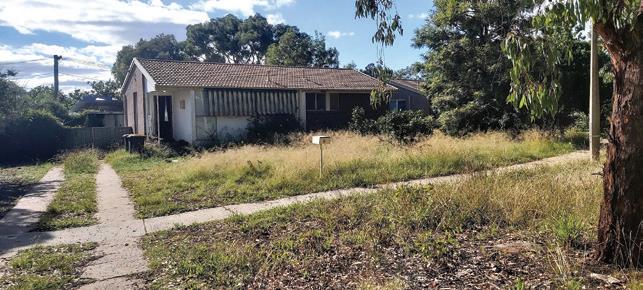
property under an acceptable commu nity standard as required by their own maintenance policy. This involves grass kept to a reasonable height by periodic mowing, weeds reduced to a bare minimum and grounds and gardens free of litter and debris.”
Housing ACT wouldn’t comment on the individual case, due to privacy reasons, but told “CityNews” that on the issue of anti-social behaviour: “All members of the Canberra community were entitled to quiet enjoyment of their homes.
“Whether public or private, all tenants must comply with the Residential Tenancies Act and their individual tenancy agreements and not cause disruption to others.”
Managing Director: James Anderson, 0404 077605, james@citynews.com.au
Director: Kate Meikle, kate@citynews.com.au
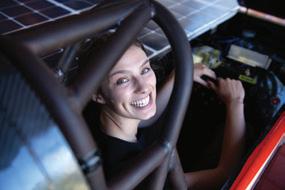
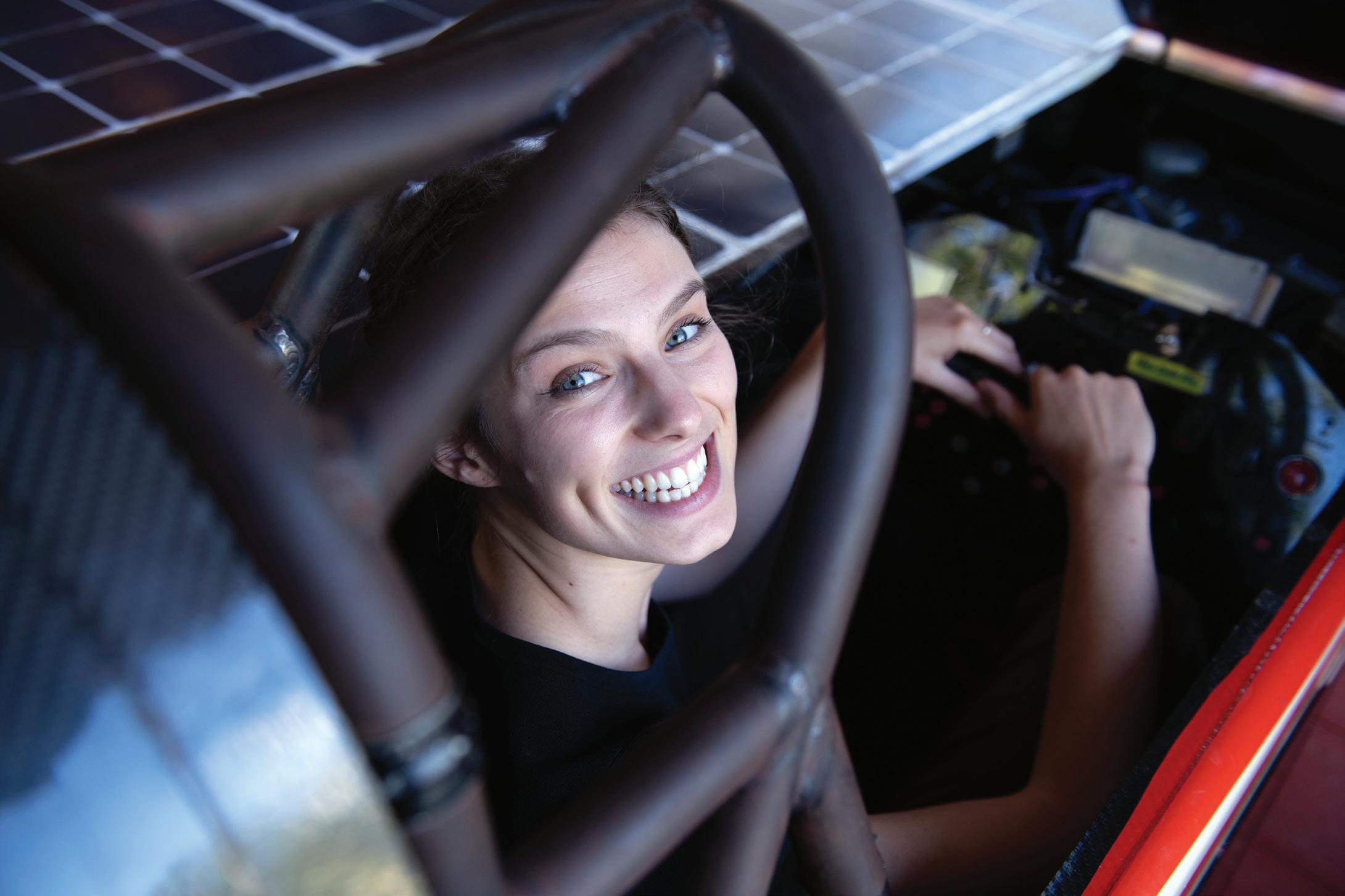
Seven Days 6 Cover: Solar cars race to prove the power of renewables. Photo by Holly Treadaway. Story Page 14.
Senior advertising account executives: David Cusack, 0435 380656
Tracey Avery, 0477 939999
Advertising account executives:
Damien Klemke, 0439 139001
Karen Davis, 0427 410442
Editor: Ian Meikle, editor@citynews.com.au
Digital news editor: Danielle Nohra, danielle@citynews.com.au
Journalists: Andrew Mathieson, andrew@citynews.com.au
Nick Overall, nick@citynews.com.au
Belinda Strahorn, belinda@citynews.com.au; Nathan Schmidt, nathan@citynews.com.au
Kathryn Vukovljak, kathryn@citynews.com.au
Arts editor: Helen Musa, helen@citynews.com.au
Production manager: Janet Ewen
Graphic Designer: Benita Leung
Proof reader: Glenda Anderson
The Chapples bought their Liverpool Street house in 2008, at a time they describe the neighbourhood as being “peaceful”.
“Back then most of the housing tenants cared for their properties but over the last five years things have deteriorated,” Ms Chapple said.
“We are not against social housing, there is clearly a need for it, but it’s not being managed properly by Housing ACT,” said Mr Chapple.
Furthermore, the Chapples said they were advised via a “one-line, copy-and-paste email” from Housing ACT that the two properties next door to their home will be demolished to build new social housing units as part of the government’s public-housing
It’s understood eight new social housing units are to be built, the Chap -
“There has been no consultation with neighbours who will be affected by this,” Ms Chapple said.
“We are so upset and anxious, especially when Housing ACT’s appalling track record in the management of its tenants speaks for itself.”
Housing ACT would not divulge specific information on its plans, but said that under the ACT government’s “Growing and Renewing Public Housing” program, properties are being identified as eligible for inclusion in the program.
“If and when a proposal for redevelopment is decided, engagement with the community about design aspects of the redevelopment will commence,” the Housing ACT spokesperson said.
“I cannot imagine how the housing department will begin to look after new homes when they completely fail to look after current ones in the street,” Mr Chikwendu said.
“It disgusts me that we pay high rates and get little in return. It doesn’t take much to work out what the state of the houses and the street will be in the future.”
“We don’t want to move but will probably end up selling our lovely home at a diminished price,” Ms Chapple said.




like the rest of Australia, fell bewilderingly into lockdown.
Now we know what a coronavirus is and I have seen Australia described as “armchair virus watchers”. The Lucky Country indeed, with a world reeling from a year of more than 117.4 million confirmed cases of COVID-19 and more than 2.6 million deaths.
I topped the front cover of the March 19, 2020, edition with the heading: “Virus crisis: What the hell?” As in what the hell was happening?
Among the six pages dedicated to early aspects of the covid experience, in this column, headed “Keep calm and carry on, says Dr Kerryn”. I noted that “the ACT lost its coronavirus innocence to a 30-something man, who turned himself into the Weston Creek Walk-in Centre.

“None of this fazed ACT chief health officer Dr Kerryn Coleman who reassuringly said, sure, there would be a heightened level of anxiety around the place but there was no risk to the general community from this case, but didn’t say why.
“The ACT is poised and ready, and keep washing your hands was the message but the Canberra Liberals, fearing the infection risks of malingering in waiting rooms, called for drive-through testing facilities.”
They got that right!
The rest is shared history (what was the toilet roll rampage all about?), but maybe the “What-the-hell” heading should have been a little stronger.
WE grumble often about the speed with which City Services does stuff, but the department did well in getting rid of hazardous building waste dumped in Watson.
A reader complained that he had fruitlessly contacted four different government agencies in January about the dumped material, which he said contained sharp metal fragments, concrete blocks, plastic
and rubber waste, at the entrance to the Mount Majura Nature Park on Tay Street, Watson, that leads to Clancy’s Walking Track.
“CityNews” digital editor Danielle Nohra published the reader’s plight on citynews.com.au and within two weeks the rubbish was gone, the area landscaped and City Services telling us the incident had been referred to the licensing and compli ance team that regulates the Litter Act 2004 to investigate the illegal dumping.
COLUMNIST Jon Stanhope seriously got his statue count of PMs wrong in the last edition of “CityNews”. He reckoned there were six in Canberra, of which he, as chief minister, paid for four of them. Robert Stephens, owner of Aarwun Gallery in Gold Creek, begs to differ.
“As always I find Jon’s column quite enlightening and interesting, just thought he might like to see my version of sculptures of prime ministers at the front of Aarwun Gallery.
“Still a couple more to come, I had not thought of John McEwen as being a prime
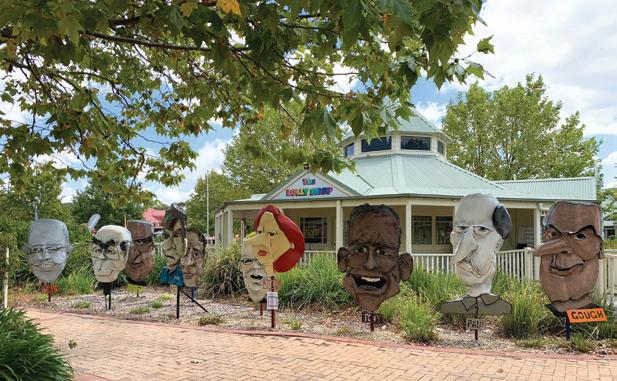
minister, maybe I should add him into the collection.”

BROADCASTER
Rod Henshaw has taken work experience to a whole new level.
For a few years, part of his weekend work at 2CC has been facilitating “The Garden Gurus” program (7am9am). Over those Saturday and Sunday mornings fielding listeners’ calls and listening to hortiPaulene Cairnduff he picked up a growing love for growing things... tomatoes,
corn, cucumber, you name it. Now he’s got bragging rights having bagged first prize at the Canberra Horticultural Society’s Autumn Show for his green beans (a rat got his prized tomatoes).
Taking his win with all the modesty a radio announcer can muster, he says: “Bean there, done that!”
Ian Meikle is the editor of “CityNews” and can be heard on the “CityNews Sunday Roast” news and interview program, 2CC, 9am-noon.


YESTERDAYS / murder most foul
IT was kids frolicking in the Queanbeyan River who made the gruesome discovery.
In its muddied bed, a skull, the left side caved in.
Early March of 1846; Queanbeyan was a “village” less than a decade old while almost three-quarters of a century was to pass before a founda tion stone to announce Canberra’s “arrival” would be revealed with great ceremony in 1913.
What may well be the oldest unsolved crime in “Capital Country” since Europeans first laid eyes on the region in 1820, the attached body “was so decomposed that neither sex nor colour could be ascertained until a medical examination was made”.
Thereafter, the most that could be confirmed was that the forever uni dentified victim was thought to be an adult male in his 30s and “about five feet six high”. He was naked and had apparently been beaten with “some blunt instrument”.
The official inquest verdict: “The deceased had been murdered and thrown into the river to avoid the identity, and the clothes burned”.
The who and why of the matter was similarly never resolved.
BY the furthest western fenceline of the old Queanbeyan Riverside Cem-
etery, opened in the same year that the unidentified corpse was found embedded in the local waterway, a sandstone monument stands alone.
About mid-waist height with an arched top, its only feature is a handful of vaguely ominous words: “In loving memory of our dear sister
Susie, who was cut off suddenly, 23rd August 1903, aged 32 years. Erected by your sorrowing brothers and sisters. Peace Perfect Peace”.
For years many thought it may potentially belong to a victim of suicide, more details seemingly unknown and its lonely position suggestive of historic practices in this regard.
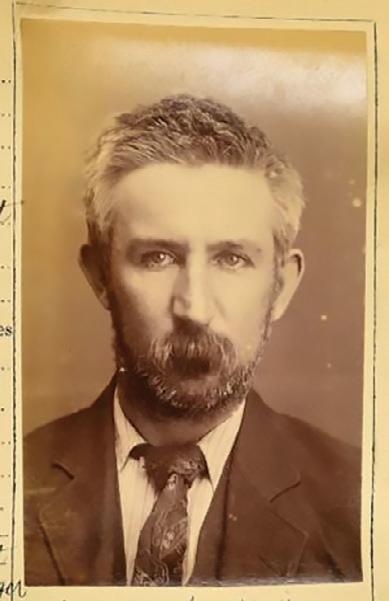
Anything but, Susie was Susan Hazelwood Gale, mother of four and wife of Charles; he the seventh child of Loanna and John Gale – the man who’d be declared the “Father of Canberra” for his role in seeing the capital located next door to the town he’d made home in the 1850s.
Having created “The Queanbeyan Age” in 1860, after 50 years in the newspaper business, John Gale retired from his position as editor of “The Queanbeyan Observer”. The town’s third paper, it was then the holding of his eldest daughter, Annie Fallick. Her younger brother Charles took his father’s well-worn seat.
Only a matter of months after securing his new job, on a winter’s Sunday evening, having spent the better part of the day at the Royal Hotel, Charles returned home to nearby Crawford Street.
Met by his wife of 13 years with their new-born baby cradled in her arms, a quarrel about money ensued, according to two of their other children present. In a mat-
ter of moments, a facially-disfigured Susie would be found by neighbours sprawled in front of the fireplace, still clutching little May.
Charles stood nearby, a smoking double-barrel shotgun now pointed at his own head.
Saved from self-harm, he’d incredulously sob to police he had no recollection of what he’d done.
The judge wouldn’t hear of manslaughter, “an accident” or “temporary insanity”; “it was murder or nothing”.
Pronounced guilty and sentenced to hang, the press of the day reported: “Accused’s father then shook hands with his son, who was deeply affected”.
Charles Gale would again be reprieved with a downgrade to 20 years. Serving at His Majesty’s Pleasure in Goulburn, following an early 1914 release, he’d move to North Queensland, taking up a position as a tutor, dying a year later.
His children would never see or hear from their father again. Raised with other local families, the scandal largely withered from public view as did the knowledge of their mother and her story – until a 2001 book by
historian Susan Withycombe flung open that closet door.
TEN years after Charles Gale’s terrible act of uxoricide, Canberra officially came into being.
Initially Queanbeyan-based policemen were responsible for the new Federal Capital Territory. With the late-1926 establishment of a police station at Acton, NSW Sergeant Third Class Philip J Cook became the first officer-in-charge.
In 1927, he’d be upgraded to Sergeant First Class and “head up Canberra’s first local police force” – one of his most significant investigations, the first murder ever to be tried in the capital in 1932.
And there begins a tale for another column.
More of Nichole’s investigations into historical crimes and mysteries of the Canberra region at capitalcrime files.com.au







By Nathan SCHMIDT

WHEN her husband returned from two tours of military service and suffering post-traumatic stress, Stacey Truscott, 52, found herself isolated.
As ex-military herself, Stacey understood the comradeship her husband, Chuck Truscott, 51, had lost when he left the military and had seen her family go from social and busy to detached and isolated.
“You lose it when you leave [the military]. Have a breakdown and PTSD on top of that and before you know it, you’re very isolated,” she says.
Stacey also knew her experience wasn’t unusual.
“I came home and said, the best thing we can do is get out there. There has to be other families going through this. Why don’t we start a choir?”
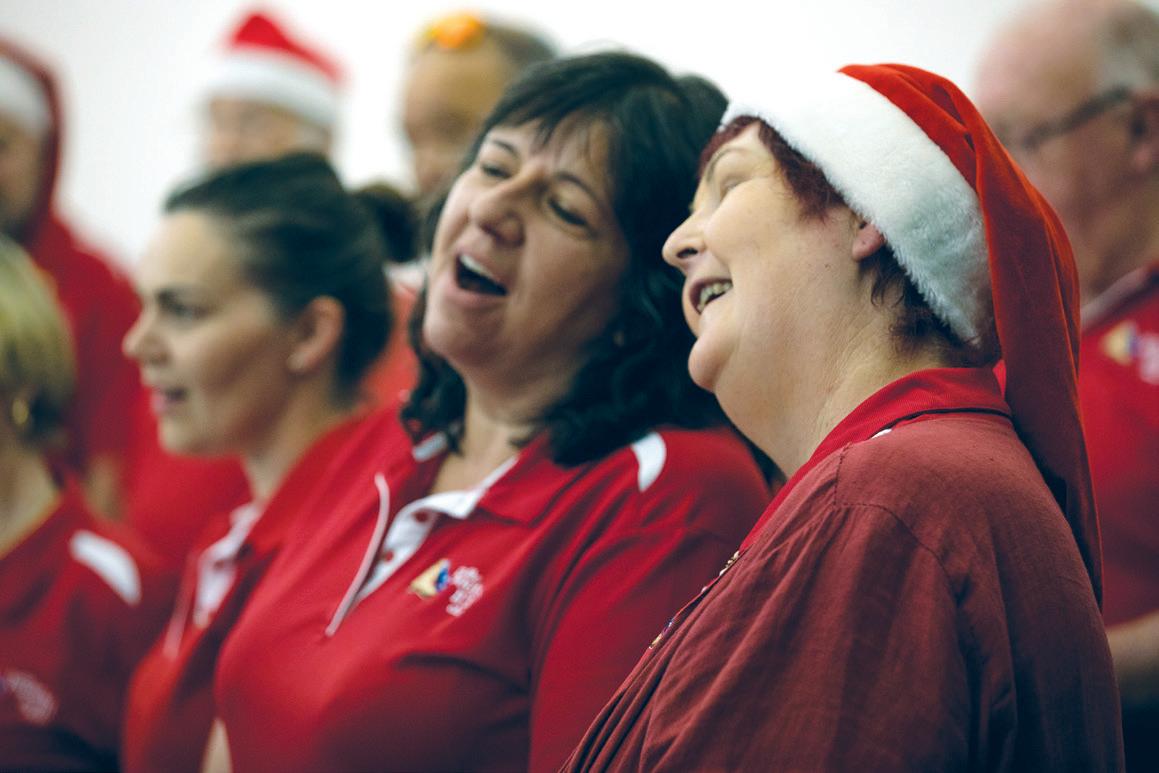
And so, in 2015, with a husband and son who are both musicians, the Boots ‘n’ All Choir started.
Though Stacey prefers to call it a “social group with a singing problem”, welcoming in not just veterans but their friends, family and anyone that supports them.
While there were different activity groups available for veterans at the time, including those at Soldier On, which hosts and supports the Boots, many were physical or sporty.
When someone is really struggling, they can’t always find their way to a bike or up a hill, Stacey says. Instead, she wanted to create something more inclusive of family and friends.
“Whoever was supporting the vet eran or would like to support veterans, that’s who we wanted in the choir,” she says.
“This was a real way to bring every one together. Who doesn’t love music? Music is in everyday life, everything we do. The sad times, the happy times, the hard times. Music is there.”
One of the first songs the group mastered as a small, six-person choir when they started out was “Fix You” by British pop band Coldplay. The song, which touches on themes of help lessness and perseverance, is special to the group and embodies what the choir is, says director Sophie RussellFarnham, 33.
They have since grown to 22 mem bers, which include members of the emergency services, with many more based overseas or who join in occa sionally.
The youngest member is Sophie’s daughter Mackenzie who, at 10 years of age, is the fourth generation of Farn
We invite 2021 Year 6 & Year 5 students to join us for Try High School Day on either the 24th or 25th March 2021 from 9.30am to 12.30pm.
St Joh n Paul II Colleg e
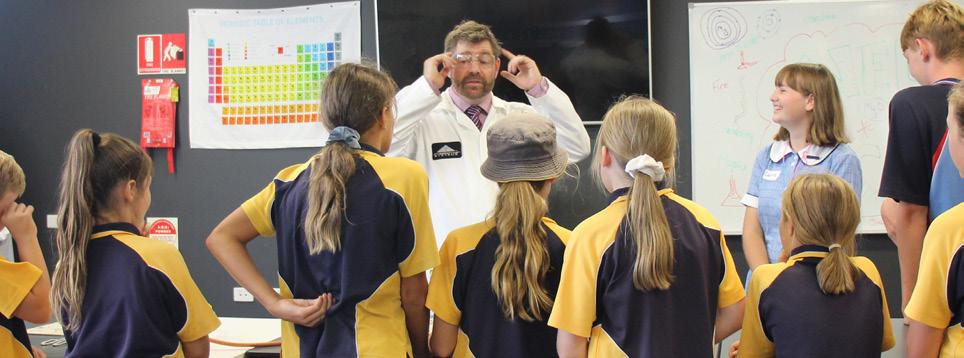
Students will have the opportunity to meet some of our JPC students and staff, become familiar with the layout of our school, and have fun experiencing ‘classes’ in a high school setting.
Time: 9.30 am to 12.30 pm (drop off from 9.15 am)
Dress: Current primary school sports uniform
Catering: Morning tea will be made in Food Tech
(Students are welcome to bring their own food if they prefer or have a specific dietary requirement)
What to Bring: Water bottle and hat
To Book: https://www.trybooking.com/BOVIU
Please note that it is up to individual families to arrange participation in this event including transport to and from the College, as it is not being coordinated through our feeder schools.
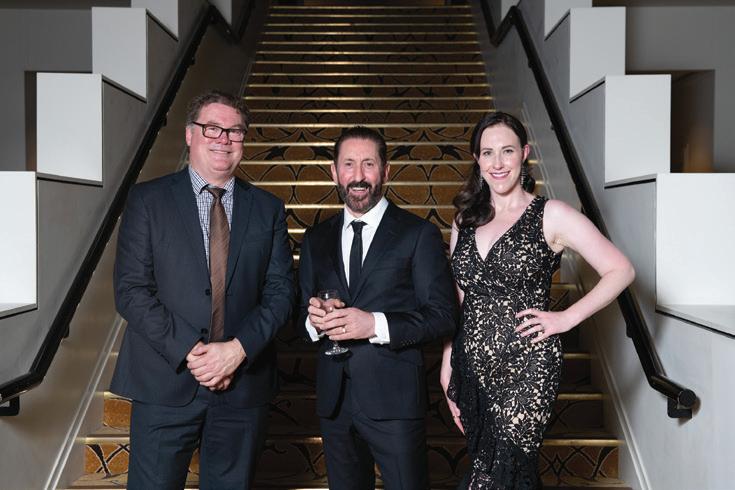
EUROSTAR Entertainment, a new agency with a focus on bringing some of the “very best and exciting” artists from Europe to Australia, has launched in Canberra, says managing director Joe Teixeira.
“We’re working towards something new, fresh and different to offer to Canberra in terms of the entertainment and cultural scene, providing a positive impact and highquality performance options for clubs and hotels, festivals, major outdoor and industry calendar events,” Joe says.
“Canberra is a multicultural city, with a fantastic National Multicultural Festival that we love, and we’re thrilled to have the potential to engage with this community, by bringing in well-known artists from Europe, particularly Spain, Brazil, Italy and Portugal, and eventually all over the world.”
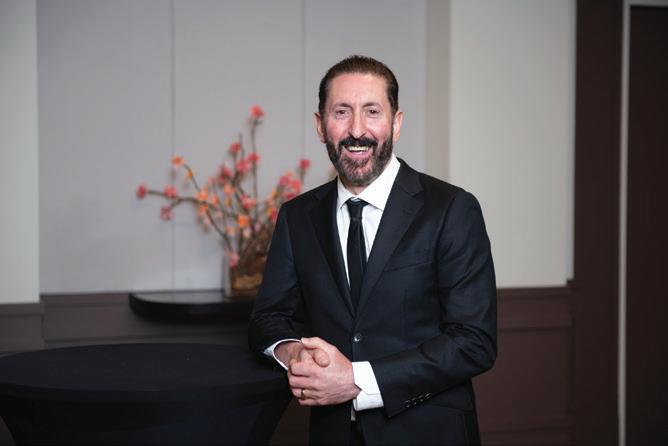
Joe Teixeira… “We’re working towards something new, fresh and different to offer to Canberra in terms of the entertainment and cultural scene.”
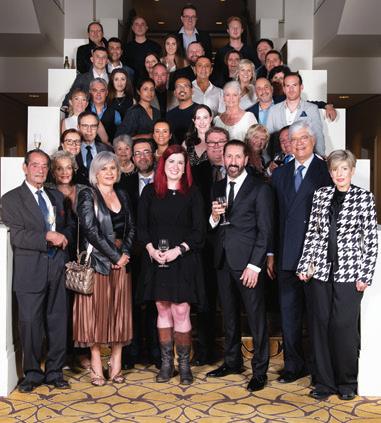
The launch, held at the Hyatt Hotel on Friday, March 12, was a great success, Joe says, attended by around 50 people including Minister for the Arts and Multicultural Affairs, Tara Cheyne, Brazilian ambassador Sérgio Eduardo Moreira Lima and Portuguese ambassador Pedro Rodrigues da Silva.
As well as three live local performances from acoustic musician Ryan David, folk-rock
guitarist GUYY (aka Guy Lilleyman) and vocalist Tara Louise, there was also a livestream show from Portuguese star Miro Freitas.
While COVID-19 restrictions have stymied travel for now, Joe says he’s in discussions with several European musicians who will come over to perform in Australia in 2022.
“Not being able to travel for this past year has obviously been challenging, but we’re
using this time to line up some incredible European talent and work with them to book in for next year,” he says.
“All the international artists we work with are highly successful, professional perform ers in their home countries, who can all play a mix of genres suitable for any event.
“We bring them to Australia for up to three months, guaranteeing a minimum of three shows during that time, though previous artists have been booked for up to 12 shows.”
And, as well as international talent, Joe says the agency also represents and supports talented local and national artists.
Joe says Eurostar Entertainment provides a personal service, including offering potential clients the chance to see the acts perform before booking them in.
With experience and industry know-how in spades, Joe completed his events manage ment studies in Canberra and has been an entertainment manager for more than 15 years in local clubs, working with local, national and international artists from Belinda Carlisle to The Pointer Sisters. He’s also won multiple awards for club entertainment.
“Entertainment is a real passion for me, I’ve always loved live music, going to concerts and shows whenever I can,” he says.
More information about booking talent or joining the agency at eurostarentertainment.com.au






By Belinda STRAHORN
QUEANBEYAN is leading the way to “beating the heat in the burbs” with an ambitious new plan to tackle urban heat.
Climate-change projections show Queanbeyan is likely to experience 12 more days a year over 35C by 2070.
Heat mapping technology is detect ing “severe” heat pockets across the CBD, so Queanbeyan-Palerang Re gional Council’s (QPRC) “urban veg etation and heat adaptation strategy” is a new approach to keeping cool, inevitably helping the region prepare for a hotter future.
Funded through the NSW gov ernment’s Increasing Resilience to Climate Change Fund, stage one of the $46,000 strategy involved heat mapping of council’s four major urban centres: Queanbeyan, Braidwood, Bungendore and Googong.

The council’s sustainability project officer, Cameron Pensini, said more than 90 per cent of Googong, Queanbeyan and Bungendore recorded significant pockets of heat and fell within an “urban heat island’’.
“In this case, an urban heat island was an area that recorded two degrees warmer than the natural area sur-
rounding it,” Mr Pensini said.
Urban heat islands occur when cities replace natural land cover with dense concentrations of pavement, buildings and other surfaces that absorb and retain heat.
While experts have known for some time that urban areas are warmer than the surrounding natural landscape, the effect has not been widely seen as a significant one.
Figuring out how to counteract
Braidwood had the smallest pocket of heat with just nine per cent recorded.
“Braidwood generally has less builtup areas than our other urban centres as well as established tree canopy cover, which has made it nearly as equally cool as our natural areas such as the Tallaganda National Park,” Mr Pensini said.
The solution, Mr Pensini said, was creating “cool” suburbs, and that
could be achieved through planting more trees and cooling infrastructure.
“It’s all about being smarter with how we go about planting trees and how we design our homes and buildings to make sure we have enough space for trees as well as selecting appropriate materials such as lightercoloured roofs,” said Mr Pensini.
“It’s also up to the council to think how we can cool the CBD and suburban areas again through more plantings and irrigation and through things like permeable pavements that allow water to infiltrate and cool down the surfaces themselves and aid in evaporative cooling.”
Mr Pensini said stage two of the council’s plan involved developing an urban forest strategy.
“As part of the urban forest strategy we are going to do percentage tree canopy cover mapping and then we will probably develop a draft tree canopy cover target for the local government area,” he said.
“We are also going to test out tree species to see which ones cope with heat best; silver birch trees, which are planted around our urban areas, are not great, they suffer during drought and hot conditions, so we are trying to have a list of more suitable trees to plant like casuarinas or certain oak trees.”
QPRC’s urban forest strategy is expected to be completed by December.
Since 1965

Scholarships
Wednesday 31 March
St Clare’s offers senior and junior scholarships to new and/or continuing students. Further details and application forms can be found on our website.
Wednesday 28 April
We invite prospective Year 7 students to experience the exciting and enriching opportunities available at St Clare’s College. Please register via our website.
Thursday 29 April
Our Open Evening is an opportunity for prospective families to take a tour of our beautiful facilities and talk to staff and students. The evening will run from 4.30pm to 7.30pm with an information session to be held in the College Hall from 6.00pm-6.30pm.
ALAN Foskett will regale the ladies of the Gungahlin Day View Club with tales of local history at the club’s next lunch meeting at the Gungahlin Lakes Golf Club, Nicholls, from midday on Wednesday, March 24. The cost is $35, and guests are welcome. RSVP to 0458 012402 before 9pm on Sunday, March 21.
AMANDA Heal is the guest speaker at the lunch meeting of the Weston Creek View Club at the Southern Cross Club, Woden, from 11.30am on Tuesday, April 6. Ms Heal will speak on “Seeing by Vision – not by Sight”. The cost is $30 and open to interested ladies and guests. RSVP to 6286 4626 by 5pm, Thursday, April 1.
WOMEN of all ages are invited to attend a free pelvic floor workshop at the Gungahlin Community Health Centre, 1pm-3pm, Monday, April 12. Presented by a physiotherapist, the workshop will provide information, education and self-help strategies for women who are experiencing continence problems or wishing to prevent them. Book at 5124 9977.
THE English in Australia Inc (TEA) meets on the first and third Saturday of the month at the Southern Cross Club, Woden, at 10.30am. Everyone’s welcome and more information from 0427 320542.
School Tours
4 May, 10 May, 5 August, 14 September and 14 October School Tours are available by appointment. Please phone the College if you wish to register for a tour.
Year 11,
Information Evening
Thursday 27 May
Discover the many courses and leadership opportunities available for senior students from 6.00pm - 7.30pm at the College.

THE best way to manage stress and anxiety is to look at what people are thinking, says clinical psychologist Nicole Daly.
Nicole has created The Clarity Seminar, a stress and anxiety management seminar that will provide participants with “wellhoned, practical tools and strategies” to help question thoughts and understand how thinking can exacerbate stress and anxiety.
Suitable for individuals or businesses, the seminar will run on April 15 at the Federal Golf Club in Red Hill.
People are often at the mercy of beliefs and biases that they may not be aware of, says Nicole, so “prepare to get to know yourself better” by understanding how perceptions are formed, and realising that people have a lot more control over their reactions than they think.
“Ultimately, we are what we value. The values people hold drive their words, actions and decisions,” she says.
“Our values impact how we conduct ourselves at work or in our personal life, so revealing these hidden drivers can help modify our reactions.”
Nicole says The Clarity Seminar’s analysis of values is a “powerful aid to finding meaning in life”, because everyone’s stress levels,
relationships and interactions could be improved with greater self-understanding.
Based on neuroscience research, Nicole says the seminar provides an insight into how people form perceptions and how their interactions are driven by these percep tions.
“Let’s say your boss gave some feedback that you didn’t like,” she says.
“You’re going to react and possibly blame them for how you feel, but the vast majority of our reaction comes from us. The brain has very quickly gone, ‘based on past experiences, I feel this and this, so that’s how I’ll respond’.”
Nicole says that thanks to a synthesis of neurons, neurotransmitters and electro chemical signalling, the brain responds instantly to what’s happening so humans can make sense of the world.
“Repeated experiences become ingrained and form automatic neural pathways,” she says.
“As a result, the brain no longer has to work so hard and can implement a reflexive, emotional response. Unfortunately our interpretation of these signals can lead us astray and increase anxiety in the process.”
Nicole says The Clarity Seminar is about letting people know that the immediate response they have isn’t always right, and that in fact, they construct it, but it happens so quickly that it’s out there before they can
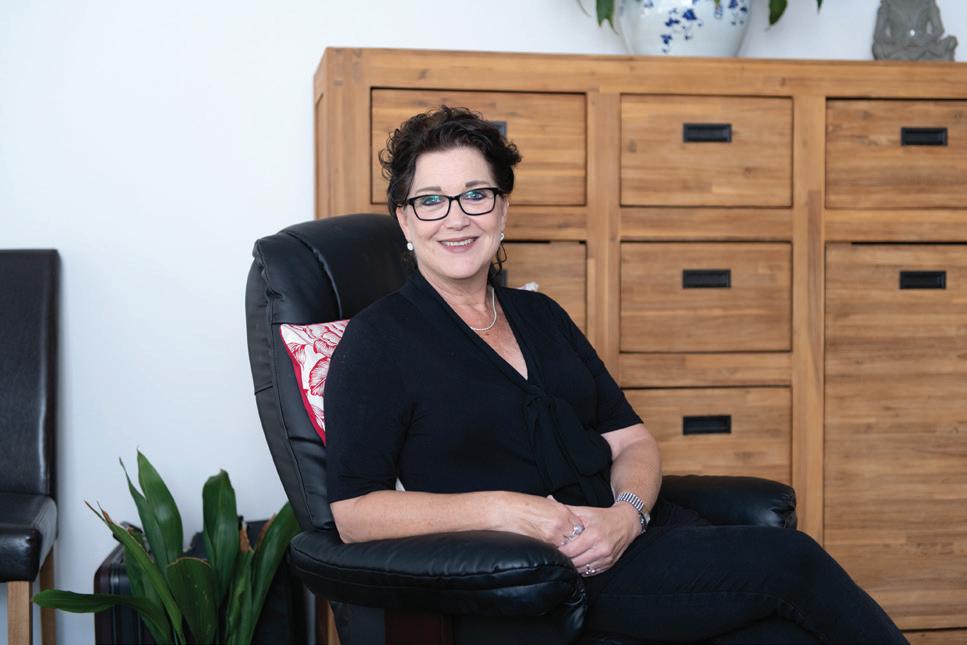
Clinical psychologist Nicole Daly… “The brain is always making a best guess on what the ‘correct’ reaction is, based on what we know.”
“It can feel as though the other person is to blame – and that’s not to say there aren’t some situations where that’s true, but most of it is an automatic internal process,” she says.
are and how they come about, and understand that we’re all brought up with certain beliefs and biases, we can begin to react differently.
“The brain is always making a best guess on what the ‘correct’ reaction is, based on what we know, and this seminar will help people learn there’s space to decide how they’re going to respond, instead of being
Nicole explains the intensity of emotional reactions is helpful information.
“It’s actually a belief or a value that we’re highly invested in,” she says.
“If a person or situation seems to be threatening this value or deeply held belief, we will react, but once we know this, we gain understanding and space to react
Nicole says the idea for creating The Clarity Seminar came about because many of her clients suggested she share the stress management tools and strategies she’d taught them with a wider audience.
“With this application of neuroscience and evidence-based approaches, participants will gain helpful, practical skills to manage stress and anxiety,” she says.
The Clarity Seminar, the Scott Room, Federal Golf Club, Gowrie Drive, Red Hill, from 9am-5pm, on Thursday, April 15, with more seminar dates to come. Fully catered with morning tea, lunch and afternoon tea, it costs $345 and numbers are capped at 25. Visit nicoledalyseminars.com.au, email info@ ndseminars.com.au, or call 0422 716507.
“Analysis of values is a powerful aid to finding meaning

Nicole Daly, a well-established clinical psychologist in Canberra hosts the Clarity Seminar providing you with well-honed, practical tools and strategies applicable to all aspects of life.
You will learn how to:
• Skilfully master your thoughts to better manage anxiety and stress
• Clarify and filter your values, beliefs and biases to improve your behaviour at work and daily life
• Take control of the hidden drivers that can help modify your interactions with others
• Better understand the person looking back at you in the mirror!
• The Clarity Seminar is for individuals, teams, and executive leaders To book your place call 0422 716
email info@ndseminars.com.au or go to www.nicoledalyseminars.com.au Seminar details: Thursday April 15 – 9.00am to 5.00pm Federal Golf Club – The Scott Room Morning and afternoon
IN the lead up to the October ACT election, trees were an item of interest to anyone wanting to be elected.
Trees were going to pop up everywhere, possibly even in the kindergarten lunches courtesy of the Liberals. A million there, a million here and more anywhere the voters wanted them to go.
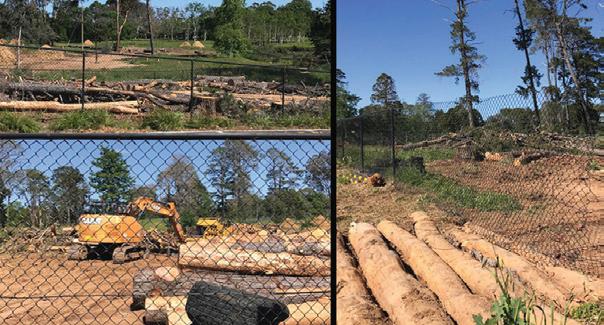
Over at the Yarralumla dog park, those who know better decided that some of the established trees were in trouble. The park was closed to make way for the machinery and squads of tree loppers.
To the surprise of locals, about 90 trees came down, not just the “some” that was indicated on the signs and notices. Keen locals noted that many of those hitting the dirt looked very healthy – healthy enough for the wood to be sold for other uses.

As one learned local put it, this was a planning mess from the first decision to turn an historic established wooded area into a dog park. There was minimal planning from the get-go
The chainsaw gang being allowed to chop down so many trees at the Yarralumla dog park is beyond unacceptable – except maybe to those comfortably ensconced within this Labor/Greens coalition.
except on fencing and making up some basic rules.
It should have been obvious to any tree specialist or planner (remember them?) that there were going to be serious impacts on the established greenery. As for the chainsaw gang being allowed to chop down so many is beyond unacceptable – except maybe to those comfortably ensconced within this Labor/Greens coalition.
How trees and shrubbery remain at risk due to simplistic decisions remains the norm for this government’s bureaucracy – and therefore the ministers responsible. Yes – we are looking at you Rebecca Vassarotti, ACT Minister for the Environment.
Before laying the boot in for not caring for green infrastructure, let’s not forget the words of the ACT Liberals going into last year’s election. If they were genuine about caring for the environment, trees and biodiversity, why then are they silent while this government’s bureaucracy
and the developers carry on doing what they do – removing greenery, especially old-growth trees.
What have we heard from the ACT Liberals about how much biodiversity disappeared as the City Renewal Authority’s bulldozers knocked down hundreds of trees along the West Basin foreshore and parklands?
As any resident will tell you (if you ask), in established neighbourhoods many developments are knock-down rebuilds that include removing everything from the property before it is sold and redeveloped.
Take a drive around Campbell and observe the slow changes to what was once a suburb oozing with greenery and biodiversity. Anyone for another grey, oversized monster with a few ornamental shrubs?
The ACT Greens should now be in a position to be boasting about their version of a “Green New Deal”. The best they came up with was that annoying slogan “Building a Better Normal”. This dodgy approach of avoiding commitment is reflected in their agreement with Labor. That long document has many wonderful-
sounding aspirations. Much of it is what anyone should expect of a local government doing a basic job in 2021.
But as for taking a new approach to climate change through making sure that this city’s heritage, being the urban forests and the biodiversity, is being enhanced through a whole of government approach – forget it. Things are being done as they have always been. Need to have a property cleared – go for it and wipe out everything and fill in the paperwork afterwards. This remains the standard now accepted for suburban infill developments.
Elsewhere, climate and biodiversity committed politicians and corporate leaders are starting to be heard. Here in Canberra, our lot remains determinedly wishy washy on real
commitment to change.
The clearing of the Yarralumla dog park trees should not have happened. Any decision should have been subject to a whole-of-government approach to climate and the environment rather than a chance decision by a bureaucrat who doesn’t like older pine trees (while so many birds do).
The ACT Greens need to rethink their political commitment that is enabling their bureaucracies to carry on as before. What we are seeing daily is not the better normal anyone should be expecting in 2021 and beyond.
Paul Costigan is an independent commentator and consultant on the visual arts, photography, urban design, environmental issues and everyday matters.


By Andrew MATHIESON

SCOTT Morrison, back as Treasurer, stood at the front bench only to pull out from behind his notes a lump of coal, gesturing and waving back and forth in order to taunt the federal opposition over its stance on energy policies.
“This is coal – don’t be scared, don’t be afraid,” he smirks across the floor.
On the other side of Lake Burley Griffin, Ruby Jones was tucked studiously away in the rudimentary surrounds of the ANU solar thermal department in the shadows of the Big Dish on campus to prove Mr Morri son wrong.
The final-year engineering student would make a point, nearly three years after an SA blackout from a renewable ener gy power source that prompted the daring political stunt, in a drive over Commonwealth Avenue Bridge to Parliament House amid the project lead’s
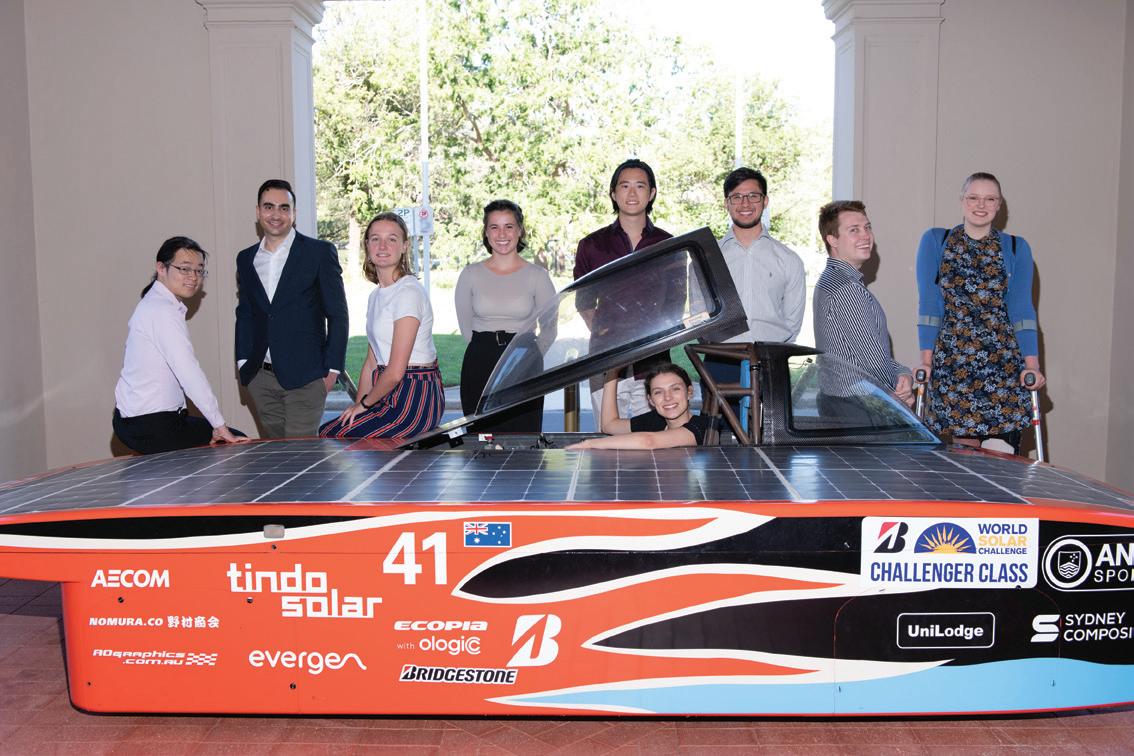
new solar-powered car.
But the hasty 4.2-kilometre distance to the hill barely gets the 23-year-old’s motor up and running ahead of the bigger
picture of the World Solar Car Challenge, meandering 3030 kilometres from Darwin down to Adelaide.
“The concept of actually prov-
ing that we can, as university students, build a solar car and drive around so it is efficient, I think makes a very powerful point about the future of vehicles and clean energy itself,” Ruby says.
tween the end points of a once SA colony of the nineteenth century would make drivers of twentieth-century cars blush while their engines break down short of a Coober Pedy sunset.


“There’s a lot of different themes that the race fits into whether that’s renewables, whether that’s clean, green, efficient energy, the celebration of rural Australia going from Darwin to Adelaide or whether it’s the learning of students and education, we fit into a lot of them.”
Canberra’s climate feels quite idyllic to road test the university’s third race iteration in contrast to the hot winds circling a gale around the parliament.
While a lecture from the house speaker that day on contravening rules after bringing a prop – from the coal mines to the capital – was childishly passed around the government benches like show and tell, cold days, clear skies and doses outside have proven to not only heat the car but Ruby’s soul.
“There’s a significant proof that this race is actually in Australia as a country in terms of renewables,” Ruby says.
“Australia is one of the best places in the world to have solar panels just because we have clear skies. Canberra may be the best in the country.”
Just the sheer distance be -
To make it that far in nothing short of a hand-built, souped-up catamaran running entirely off the sun is the definition of success, win or lose the race.
“It’s a huge victory for the team in many ways,” Ruby says.
“It is certainly about pushing your vehicles to the limit – that’s just over 3000 kilometres, which is significant for any vehicle. Full stop.”
The journey slithering down the Stuart Highway may take up to seven days, but the dedicated ANU team is counting on five days for good reason.
“It gets very, very hot in the car when you’re driving,” Ruby says.
“The better your car, the more hot it’s going to get.
“There is no air coming in and you’re in the middle of the desert.”
ANU will enter the biennial race in the competitive challenger class that is based on performance ahead of its long-term goal to finally win by 2025.
Six drivers undertaking a series of personal training sessions for the heroic trek in October is the one example where
fitness supersedes engineering.
“It is enough to make sure you’re able to cope in the conditions that the car does face, which can be 60C of heat for two hours or longer,” Ruby says.
“That’s a long time if the sun is beating down, you’re covered in sweat and because it is such a small car, it’s very, very noisy while also just between Darwin to Adelaide, roadtrains can have a very significant impact when they’re overtaking.”
No wonder just looking at the remains of its 2019 vehicle, the uni’s last entrant before the pandemic drove the solar cars off the road for a year.
Sitting in a makeshift shed, tape sticks the car together at its resting spot.
Its catamaran has two hulls holding the wheels between a long, thin middle that assures the aerodynamics minimise drag over endless kilometres of a flat desert road, but having a down force to turn corners really fast akin to a Formula One car.
“It is designed to go through the air as smooth as possible in a straight line, which is one of the most highly technical aspects from our team’s mechanical point of view,” Ruby says.
“Aerodynamic simulation and design is such a complex aspect of engineering, and it’s very specific and very detailed, too.”
The design phase took up most of last year in isolation to “what the car looks like in its shape form”. Now it’s the turn of the carbon fibre being laid.
Aside from complex software that calculates load bearing capacity between measuring the peak centre of mass, the cutting-edge concept is uniquely an Australian story that comes down to everyday man and woman power.
The 2016 Radford College graduate, who has been offered an internship to work on Tesla’s electric cars, is the face of the uni’s largest student project.
It’s called, in campus circles, a small business, hiring 35 problem-solvers with others on the horizon just as long as the race that it draws from.
“It’s all pretty big with a lot of different roles and every single one of those roles are very rewarding in the sense that you do not possibly get to learn or get to experience anything like this,” Ruby says.
THE best COVID-19 vaccine is the one in your arm. It does not matter which brand is offered. As with other examples, compared to the disease it is much better to be vaccinated.
On a global scale there are nearly two and a half million people who have died after contracting COVID-19 and around 120 million cases. And yet many countries have not, and are not, responding to the evidence available.
Compared to most of the world, Australian governments and almost all of our politicians, irrespective of political persuasions, have responded far better than other countries. But we cannot rest on our laurels. Australia is fortunate. The answers are there for those who have doubts about the speed in which the vaccines were developed and their safety. Although with additional speed, the normal processes were followed with appropriate trials in each of the phases.

However, there is an additional benefit for Australians. The vaccines that are available in
Vaccines available in Australia have been widely used in places such as Italy, the US and the UK. Had there been disastrous side effects, these would have become obvious through the multi-millions of people who have already been vaccinated.
tralia have been very widely used in places such as Italy, the US and the UK, where the need was great. Had there been disastrous side effects, these would have become obvious through the multi-millions of people who have already been vaccinated.
As with all medication, there can be side effects – particularly for those with pre-existing conditions who are more vulnerable than others.
Keep in mind two important issues. The impact of any side effects from vaccination is miniscule compared to the impact of the disease. This is as true for COVID-19 as it is for measles, human papilloma virus or whooping cough.
Secondly, recognising that some vulnerable people ought not be vaccinated, increases the responsibility on the rest of us to protect them by being vaccinated ourselves. The more
people who are vaccinated over the half year the better the protection for the whole community.
One of the most fascinating impacts of COVID-19 is the rapid spread of the disease in communities that strongly argue that public health measures ought to be a matter of personal responsibility. The US under Donald Trump, Brazil under Jair Bolsonaro and the UK under Boris Johnson are prime examples. Sweden prided itself on this approach for an extended period – only to suffer the impacts at rates far greater than its Scandinavian neighbours.
It turns out that countries such as Australia and NZ, in opting for a much more inclusive approach where governments took responsibility and citizens were generally compliant, have fared far better than others. No doubt there were other factors of influence including effective communication and willingness to listen to our chief medical officer and the chief health officers of our jurisdictions.

Thinking of others has proved so much more effective than being self-centred. We need to maintain this approach with the distribution of vaccines. With the catchcry “Safe, Effective, Free” the government’s plan is to look after the most vulnerable first and move towards vaccinating the whole population. It is a plan based on equity principles. Equity is not always easy. Complaints about the initial blocking of the AstraZeneca vaccine in Italy were
not well founded. Thanks to effective government action in Australia the need in our country was far less than in Italy where around 300 people were dying every day. Of even greater concern is in low and middle-income countries that were not able to negotiate deals with the pharmaceutical companies.
The World Health Organization made significant attempts to ensure equitable distribution of vaccines internationally through COVAX. However, the WHO has a limited budget (equivalent to a single large teaching hospital in Germany or the US) and a number of high-income countries have not been forthcoming with appropriate levels of support. We should be proud to be Australian. Success in dealing with COVID-19 from a preventive perspective as well as protection through vaccination, has revealed the difference in outcomes between societies based strongly on a self-centred approach, and those that have broad community interest as a high priority.
Michael Moore is a former member of the ACT Legislative Assembly and an independent minister for health. He has been a political columnist with “CityNews” since 2006. He is chair of the Global Vaccination Taskforce for the World Federation of Public Health Associations.
WE write to echo concerns of racism in the Alexander Maconochie Centre prison expressed in Jon Stanhope’s column “The shameful politicians who don’t give a stuff” (CN March 4).
As Canberrans, we struggle to get a voice to be heard, but how do we alarm those who put this in the “way-too-hard basket”?
The case Mr Stanhope outlined was not an isolated incident of strip searching a female detainee in view of male detainees.
Our family’s experience of the interaction between the mental health and the justice systems for our family member was as traumatic as the incident that led to them being held in custody.
Suffering from schizophrenia, our family member was also placed in the Crisis Support Unit. They were similarly strip searched, and reports that women are also placed in the same unit, in different cells. This is in combination with 23 hours a day seclusion. At particular angles, yes, males are able to see into female cells. So denial cannot continue, that this could not happen.
Concerns regarding mental health treatment and Corrections accommodation and culture have been raised through submissions to three separate inquiries
– two to the ACT Inspector of Correctional Services and one to the ACT Legislative Assembly Youth Mental Health inquiry, plus meetings with the former Minister for Mental Health and Corrections.
Racism is reported as the primary concern, but also what is compassionate treatment for those suffering mental illness or cognitive impairment?
The ACT government reports a focus on justice reinvestment – that is, funding services and practices to prevent or divert those most at risk from entering the criminal system.
So stop denying and act – increase your focus and investment on supporting those with a mental illness, including those from the indigenous community.
Such an approach is both compassionate and cost-effective. Funds seem to be available for more inspectors or commissioners, what about core services?
Equip community support services to address core needs, better integrate police and mental health services, re-invigorate and speed-up the work on the Disability Justice Strategy, better resource the mental health, justice health, alcohol and drug services, and Corrections so they can research and undertake alternate evidence-based activities.
Please attend to cries from those of us trying to prevent further suicide, self harm and harm to others.
Names and address withheld
FOR the second time in as many weeks, columnist Jon Stanhope has proved himself to be one of the few “true believers” in Canberra who displays political and personal integrity.
What’s wrong with his former ACT government colleagues (Labor and Greens) that they would ignore the appalling treatment handed out to an indigenous woman at the Alexander Maconochie Centre?
In particular, in the light of the present events in the federal parliament, where are the decent women in the ACT government?
I’d expect them, even if their male colleagues don’t have the bottle, to be yelling at the tops of their voices for an official inquiry into the poor woman’s treatment.
It’s ironic that the only female voice heard so far, has been that of the ACT Liberals’ Elizabeth Kikkert.
So come on Labor women – show what you are made of and stand up for another woman’s basic human rights.
Eric Hunter,
Cook
IF what columnist Jon Stanhope reports (“The Shameful politicians who don’t give a stuff”, CN March 4) really happened, then there is something very wrong in the Alexander Maconochie Centre. Nobody should be treated like this regardless of their race.

Assuming the males and females are segregated, why would there be male officers and detainees in the women’s area?
Surely there are cameras in the AMC that can verify or refute these charges.
All this being said, why is Jon so surprised at the Barr government’s behaviour, they never have “given a stuff” about the people of Canberra, they continually go against the wishes of the public and do what they want all the time. They keep spending on nonessentials and do not fix all the problems or keep their election promises.
If the people of Canberra keep voting them in, they only have themselves to blame.
Vi Evans, via email
WHAT Michael Moore says in his column, “More Ministers, but fewer days in house” (CN March 4) is fair enough, and in my almost 14 years working as a political staffer in the Assembly (I retired last year), I, too, often despaired of the steady reduction in the number of formal sitting days.
But I think Michael should also consider the work of the several Assembly committees (he mentions Estimates, which is but one of many).
As Michael would know well, these committees review and inquire into a vast range of issues and spend a great deal of time “sitting” in those exercises.
Committees, in our unicameral parliament, not only provide the checks and balances that Michael talks about, but also give citizens an opportunity to input directly, either by written submissions or, in many cases, in-person appearances, to give evidence before those committees.
So, in a sense, the work of committees more directly interacts with citizens than do the formal sittings of the Assembly.
Clearly, the Assembly’s formal sittings are crucial to the good governance of the ACT; it is here that our legislation is proposed, debated and made. It is often the case that debates will continue for many hours to ensure all MLAs have an opportunity for input and to enable consideration of amendments.
There also are times when proposed legislation is referred to committees for inquiry (although sometimes politics, or simply sheer arrogance of numbers, will usurp that good process) and this is when the checks and balances really come into play, especially when these inquiries involve citizen input.
Let there be no doubt, MLAs, whatever their political colour, work very hard for our community. It’s just that a lot of it is behind the scenes.
Clinton White, Wanniassa




There’s $5,000 up for grabs every day if you can work out our FOUR LETTER WORD
Tune into Forever Classic 2CA to win! $50,000


THE Inner South Canberra Community Council’s page in “CityNews” (March 4) refers to the “ACT Government Planning Review” and says: “We agree with the comments recently made by chief planner Mr Ben Ponton that the current rules-based system is producing sub-optimal outcomes”.
In fact, as reported in “The Canberra Times” on February 26, Mr Ponton says “the current territory plan forces the territory’s planning authority to approve unsuitable developments”, supposedly because developers just do whatever the “rules” say.
It’s not the rules-based system that is the problem. Developers ignore the “rules” and the planning authority fails to enforce them.
A recent Giles Street, Kingston, redevelopment proposal was for an eight-storey building where the building height “rule” was two storeys. The proposal also ignored another six relevant rules as well as performance criteria.
Only the outrage of local residents and the intervention (just prior to the ACT elections) of government members Barr and Rattenbury seems to have stopped this egregious proposal, at least for the moment.
Who would benefit from moving away from a “rules-based system”? The planning authority, which would be even less constrained in making arbitrary and inexplicable decisions. Developers and their planning consultants who would no longer have to pretend they comply with rules. NOT the community, who would have difficulty arguing their case if quantitative tests are removed.
Perhaps the real reason the planning authority feels “forced to approve unsuitable developments” is more to do with their own competence and their beholden attitude to the property industry, rather than the “rules”.
Richard Johnston, Kingston
I COULD not help but reflect on some stark similarities between Paul Costigan’s column and the guest article by Mark Parton in the “CityNews” edition of March 4.
As Mr Parton suggests, the ACT government has strangled the supply of land in favour of units and apartments – a far more lucrative supply of revenue for the government. Mr Costigan notes the perceived need for additional car parking and laments the lack of consultation and the government’s ignoring of the WCCC.
But why do we need more car parking? Could it be because the high-rise Molonglo suburbs that have sprouted in the last few years have pitifully inadequate infrastructure and thus residents of Molonglo come to Cooleman Court for their shopping and services?
The Minister for Something has got it all back to front. In my view, getting facilities into Molonglo will reduce the pressure on car parking in Cooleman Court. Why is this so hard?
He got it back to front at another point, too. Issuing a tender document before the area was rezoned smacks of an arrogance of a tired government (despite the election having been only months ago) which does not consider transparency or due process as relevant. Remember, voters did not support the previous government in the election and voted for more Greens at the expense of Labor and the Liberals. It’s apparent (in my humble view) that voters could not stomach either major party and were left with the least unpalatable crew as the alternative.
David Hannaford, via email
TO Robert Ardill, (“Seven Days”, CN March 4): you need to be patient. I waited 20 months for a reply from Roads ACT via Access Canberra (to a repair request I submitted) that told me the problem area had been inspected and added to the works program for repair.
To give them credit, the work was carried out four days later.
Is this a record for both slowness and quickness?
So, patience my friend, patience.
Barry Peffer, Nicholls
THE imbroglio in Parliament House will probably end badly for the Morrison government, but it could change for the better the way we all approach the difficult terrain of intimacy between the sexes.
And in the bigger picture it’s part of a revolution in Australian society over the last 20 years.
So, let’s take stock of the astonishing changes that have already occurred.
Today women are everywhere in the media, be it radio, television or print, news and current affairs or entertainment generally. Just think Laura Tingle, Carrie Bickmore, Wendy Harmer, Leigh Sales, Ros Childs, Julia Baird, Ellen Fanning, Jane Norman and the world’s best news presenter, Juanita Phillips… on and on it goes.
They adorn the world of science, from the extraordinary Veena Sahaj-
Australian men of all stripes and colour today will need time to adjust to the new reality. The danger is that elements
will combine in a kind of rearguard action of violent retaliation.
walla turning waste into recyclable building products to astrophysicist Tamara Davis guiding us to Mars, to any number of marine biologists on the Great Barrier Reef or their equivalents in the bush or the labs.
In sport they get great billing in cricket, rugby, Aussie Rules, soccer, netball and all imaginable athletics events. Still a lot to be done in business, but already the female profile is rich with entrepreneurs such as Janine Allis (Boost Juice) and Naomi Simson (Red Balloon).
In education they have long dominated the school-teaching profession and now have added a greater dimension to universities throughout the land.
In medicine we need go no further than the very impressive women fronting the response to the covid pandemic. And two of the biggest states have women as premiers.
Everywhere you look, Australia has benefitted from the rise of that previously unappreciated half of the population taking its proper place in society with all the respect they so richly deserve. And there’s more to come as we fill in the empty boxes. Some are painfully obvious for while Federal Labor can boast such luminaries as Tanya Plibersek, Penny Wong, Kristina Keneally and Katy Gallagher in a caucus almost evenly split, the Libs are lag-
RECENTLY, I was on the radio with Paulene Cairnduff on 2CC’s ever popular “Garden Gurus” program. The morning started slowly, with only a smattering of listeners calling with questions.
So, Paulene and I were nattering away on our own and, after an off-air conversation about coconut oil, I asked the audience: “What did you used to have in your medicine cabinet?”
Suddenly, the phones lit up, the SMS went into meltdown, and the email inbox was full to the brim.
Gentian violet! Blue bag! Calamine lotion! Iodine! Mercurochrome! Everyone wanted to reminisce about their family’s old medicine cabinet, and how their childhood injuries and ailments were treated. Home-remedy nostalgia was in full swing.
Most of the callers were, respectfully, older members of the audience. But nostalgia is not limited to those of a certain age.
News reports about the Johnson & Johnson vaccine recently took my mind to a 1990s kids’ TV show, “Johnson & Friends”. The star of the show was a talking pink stuffed toy elephant, and his friends included a concertina called McDuff, a hot water bottle named Alfred, and Squeaky the robot.
I absent-mindedly took to so -

cial media, tweeting a picture of Johnson & Friends with the caption: “This is all I can think of when I hear about the Johnson & Johnson vaccine”.
The post obviously struck a chord. Within a day, my picture of Johnson and his friends had been seen by more than 165,000 people, with more than 1300 likes, which really is quite baffling – well beyond any response I’d had before.
Here were some of the replies:
“Thank God, I’m not the only one. I’ve been having the same surreal visualisation.”
“This was a totally forgotten childhood memory for me until now!”
“The concertina still freaks me out.”
“I really disliked that hot water bottle. Annoyed me to no end!”
“Memories…”
It turns out people in their 20s and 30s are pining for the past just as much as anyone else.
If you listen to FM radio (and obviously I’d urge you not to), in between the latest hits,
you’ll also hear throwbacks to the ‘90s, 2000s and 2010s – because you’re never too young for nostalgia. Oh, remember what life was like in 2011! Cast your mind way back to 2019! 2015? Feels like yesterday! 1992? Can’t remember it!
This leads to the question – in a few years’ time, will anyone be nostalgic for 2020 and 2021? Will today’s school children grow to yearn for remote learning? Will present day uni students end up reminiscing about online lectures? Will we remember fondly the days of panic buying? Will grandparents of the future have a twinkle in their eye, as they tell the story of getting a covid test, and eventually, the vaccine?
Ahh, nostalgia. I’m missing it already.
Eddie Williams is an awardwinning producer and a presenter with 2CC.
ging. But just watch this space – the parliamentary imbroglio means they will fall over themselves to remedy it in the next election.
So, what about our men? We have a perfect illustration of the potential problem from the hostile invasion of Aboriginal Australia. The British ethnocide tore down the fabric of a society in which men pretty much ran the show.
And for at least a generation it left them devastated – utterly bereft of self-esteem, a kind of PTSD of the soul. It took a long time – and much heartache – to find the way back. And while it might have given Aboriginal women the opportunity we see now in their powerful and growing presence, it was part of their struggle, too.
Australian men of all stripes and
colour today will need time to adjust to the new reality. The danger is that elements will combine in a kind of rearguard action of violent retaliation; others will hit the booze; still others simply drop their bundle and opt out of all responsibility – Americans call them the “Deadbeat Dads”. But I think we’re better than that. They’ll survive like the First Australians did in a world that seemed to be racing down the straight towards some invisible finishing post.
And I can’t help shouting, “Go Australia, you good thing!”
robert@robert macklin.com




By Nathan SCHMIDT
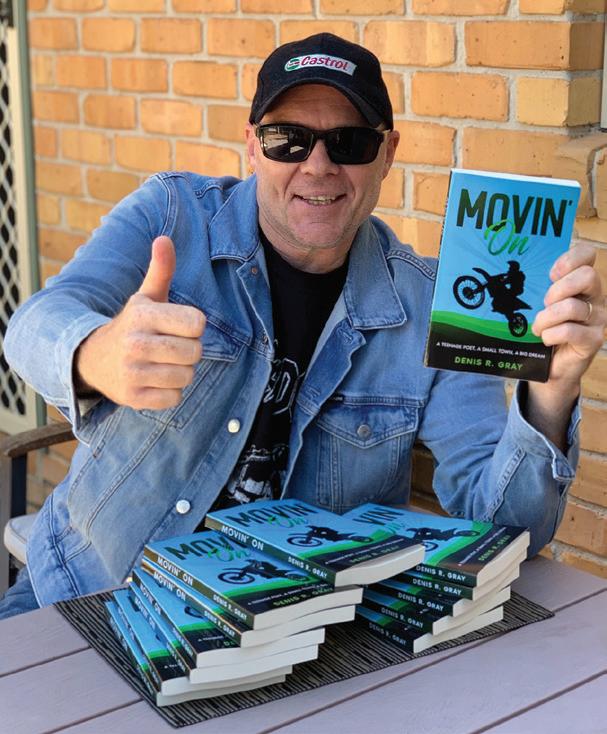
SIXTEEN-year-old Jeff Walker spent nearly 30 years on a floppy disk, locked away in a cupboard before Denis Gray rescued the main character of his debut novel, “Movin’ On”.
Jeff is a “typical” ‘70s kid. He rides a dirt bike, listens to rock music and loves his mum.
His dead-end town gives him no real direction. That is, until he discovers his talent for poetry.
When he first shows his writing to his mother, she says: “I didn’t know you could write!”
When Denis’ own mother read an early draft of his novel, she said the same thing.
Denis, 51, professes to not be “of the modern age”, harking back in his book and in his own life to a “simpler time” when most kids were into music, carried radios and had photos of their favourite artists plastered on the bedroom wall.
Raised in Sydney during the ‘70s, Denis says there was always music being played in the house. As a young adult, he followed bands on tour, produced a music-focused zine and even
Denis discovered poetry and it opened
“Some of the characters in the book have been living in the back of my mind for so many years, so it’s very satisfying to finally publish the book
The man who first wrote of Jeff Walker all those years ago was not the “I’m an older man now with more
experiences, that’s not how I would view the world,” Denis says of his earlier iteration.
Over six long months, Denis pored over his novel, rewriting it five times.
“I was committed to lock myself away and live in ‘77,” when the novel is set, he says.
He surrounded himself with classic rock bands such as ACDC, Aerosmith and Heart.
But, in truth, the ‘70s had never really left Denis.
“In some ways I’ve never grown up,” he says.
After seeing 1980s German rock band Scorpions last year, Denis proudly says he’s seen every band he’d want to see live.
He says he lives his life by the Japanese idea of “Danshari”, meaning “to simplify your life,” not to clutter it with stuff.
In that vein, Denis claims that rescuing “Movin’ On” from the cupboard was his own way of simplifying, breathing life into something left dormant for so long.
What’s next? Well, Denis has a series of children’s books, penned before the first draft of “Movin’ On” and stowed away just as it had been.
“They’ll happen”, Denis says confidently.
“Movin’ On” is available from online book sellers (rrp $33).

IMAGES spanning Australia’s involvement in conflicts and operations throughout its military history will be projected on to the front façade of the Australian War Memorial from dusk to midnight on April 23-24.
The projections will be a range of highresolution colour and monotone images from the memorial’s collection, and some contemporary imagery supplied by the Australian Defence Force.
It will not be the first time projections have been used for Anzac Day commemorations, but the AWM will provide the visual display after just 4200 tickets to the public will be on offer to attend the dawn service and 3000 for the national ceremony.
The limited numbers to commemorate the 106th anniversary of the landings at Gallipoli are in line with current government social distancing guidelines, based on advice from ACT Health on public gatherings during the ongoing pandemic.
Ticket bookings to the dawn service and national ceremony will be available via awm.gov.au from 10am, Monday, March 22.





IIn this occasional series of profiles on the partners of notable Canberrans, this week reporter
BELINDA STRAHORN meets Yasmin Coe, wife of former ACT opposition leader Alistair Coe
T’S busy outside the Deakin cafe.
It’s a Tuesday, nearly 9.30am and while the power suits are drifting away to work, on a bench, a middleaged woman, who appears to have just woken, warms her back in the sun.
She’s surrounded by mums carrying kids and oversized nappy bags. And gym rats – all plugged into their phones – wait for their morning brew.
Inside, it’s just as hectic. I’m shown to a table in a quietish corner.
“Morning!” chirps Yasmin, striding in a few minutes later. “I made it”.
“It’s much easier this year with one drop off,” she says about the school run just completed for son Angus, 6, and daughter Annabel, 4.
Unsure of the preferred pandemic greeting we settle on a handshaketurned-elbow-tap.
She’s kind and composed. But, every now and then, her eyes betray a dis comfort at being the centre of attention.
For the first time in her married life, Yasmin Coe, the wife of former ACT op position leader Alistair Coe, is discov ering a world away from the political spotlight.
The Coe’s lives have changed a lot since the October election.
The decision they took, as a couple, to step away from politics will allow Yasmin time to focus on her own career.

The trained accountant and selftaught chocolatier confessed she won’t miss politics and its all-consuming attention.
“I don’t think it’s something we can go back to,” she said.
“I’m grateful we’ve had this experience, I’m grateful for what it’s provided and what we’ve learned, as difficult as some of the moments have been, it’s also been very enriching.”
Alistair, the former Canberra Liberals leader and Yerrabi MLA announced his shock retirement from politics in early February, marking the end of a 12-year career in the ACT Assembly.
It wasn’t until after the election, when the family stepped off the political treadmill, that the full impact of po -
Tconservative views, Yasmin expressed disappointment at the fact the public saw only glimpses of the “real” man.
“Alistair always had lovely and genuine reasons for doing what he did, he was never a person who enjoyed the limelight,” she said.
“A big win for him was achieving a great outcome for a family; he always had sincere reasons for doing what he did. I think it comes down to the fact that people see snippets on the media that are tightly controlled; you don’t get to control which bit of your press conference is seen.”
Born in Sydney, Yasmin grew up in Campbell, the first of three children to Karen who ran a curtain and soft-
neering project there. It was a big life change for them to return to Sydney and then start a new life in Canberra where they knew no-one. I think motherhood in the early days was very isolating for mum, but she grew to love Canberra, we all did.”
If there’s such a thing as a typical 1980s Canberra childhood, Yasmin’s would be a contender. She recalls an active and carefree upbringing spent with younger siblings Lauren and Nathan.
“We were very sporty, my sister and I were both involved in competitive sports from an early age starting with swimming, that involved being at the Deakin pool at 5am five mornings a week,” she said.
him and eventually led to leadership of the party.
“When we first met he was very young, very hardworking and very ambitious; he didn’t have anyone to account to for his time and he was rumoured to work through the night,” she said.
“He probably got twice as much work done as anyone else because he was in a stage of life when he could.”
Some years down the track, after having children, the couple’s priorities have changed.
“For both our kids’ lives, Alistair has always occupied leadership roles. When Angus was born he was deputy leader and when Annabel was four months-old he became leader,” she said.
“All we’ve ever known, until late last year, was Alistair giving so much of himself. Daily life was a bit of a grind. He would leave early and get home when the kids were asleep. Weekends were his only chance to see them and even then his calendar was full with community events or campaigning.”
Stepping away from politics gives Yasmin the chance to see her husband in a totally different way. No longer a public figure, his every move or utterance won’t be held under a microscope or criticised on a daily basis.
“More often than not it was unwarranted criticism, armchair-expert type of thing. In that case you just have to know that the comment reflects more on the person making it than Alistair, and that’s not something to worry
With the former opposition leader still contemplating what he would like to do next, his wife suggests he’d be ideally suited to government consulting.
But for now, this “exciting” new chapter of their lives means Yasmin can turn her attention to other things.
professional woman in her own right, Yasmin also sits on top of a delicious empire, a chocolate-bar business called Sweet Pea & Poppy, started while on maternity leave and co-founded with her
“After school I had dreams of doing something with chocolate or pastry but I didn’t know what that would look like. I always did something chocolatey on the side; I made all the corporate chocolate gifts for my dad’s business but it wasn’t until I went on maternity leave with Annabel that I turned my hobby into a business.”
From her Nicholls home, fitted with a commercial kitchen, production space and packing studio, she handcrafts chocolate bars.
“There’s a bunch of stores in Canberra and elsewhere in Australia that sells it and we started exporting to Japan this year,” she said.
“I’ve enjoyed what the business has become and where it’s going… I feel it has always taken a bit of a back seat to lots of other things in my life.”
Perhaps not any more. Above all else, whatever the future holds: “It’s looking good,” she said.

LAST year the United Nations declared that the decade of 2020-2030 would be dedicated to promoting healthy ageing amongst seniors.
The “Decade of Healthy Ageing” will bring together experts to set out a strategy for seniors to ensure they live healthy, happy lives, and to promote the wellbeing of seniors of all ages.
To celebrate seniors in Canberra and promote healthy lives here, “CityNews” speaks to the organisations in the ACT who support seniors and are passionate about helping them make the most out of later life.
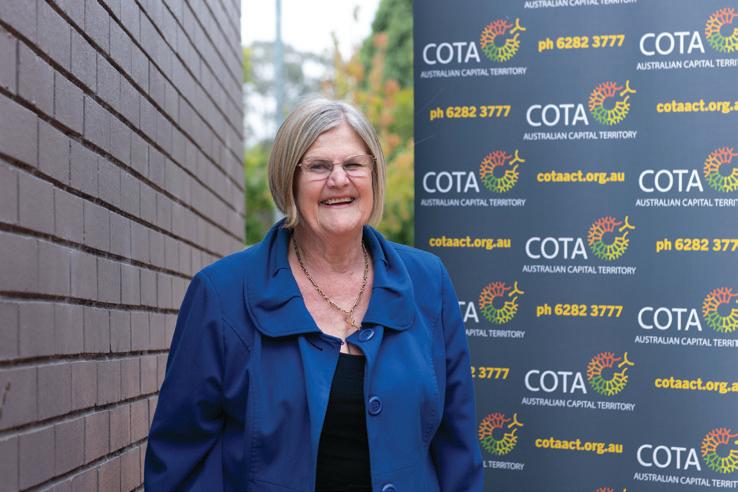
of art by amateur artists that feature at least one older person, aged 55 or older,” says COTA ACT CEO Jenny Mobbs.
“A range of materials can be used, including watercolours, acrylic paint, pencil, charcoal or mixed media.
“Entries for the photographic competition should feature an older person or persons, aged 55 or above, taken with a camera or mobile phone.”
Anyone can enter, with six age categories in each competition – preschool to year 1, years 2-6, years 7-10, years 11-12, an open category for those aged 18-54, and a seniors category for
Council on the Ageing (COTA) ACT invites you to participate in our Art and Photographic Competitions.
Judges will be looking for a photograph or a piece of artwork that captures a moment or tells a story about an older person’s life or older people’s lives.
We welcome entries that embrace a little fun, humour or show a dimension or aspect of the separation that some seniors have felt during the COVID pandemic.
All photographs and artworks must be submitted by Friday, 16 April 2021.
To read the full terms and conditions and categories, to enter or for more information visit the COTA ACT website cotaact.org.au or phone 6282 3777.
and prizes will include gift vouchers for books, photography or art-related items.
“Entries might feature a portrait, someone enjoying social or fitness activities, intergenerational moments, activities with grandchildren or perhaps a mature-age worker or volunteer,” Jenny says.
“Our judges are looking for entries that capture a moment or tell a story, and we encourage a sense of fun and humour.”
For more information and entry forms, visit cotaact. org.au, call 6282 3777 during business hours or email events@cotaact.org.au
RUN by the experienced occupational therapist, Kate Sterrenberg, Parkinson’s ACT is offering a new program to help with symptom management and advance care planning, says Parkinson’s ACT vice-president Marcia Kimball.
The program, funded through a John James Foundation grant, will run one day a week for the rest of the year, Marcia says.
“Kate will visit the home of any people requesting the service, and comprehensively assess what patients may need and how to make their dayto-day lives much easier,” she says.
“We call her a super therapist –she’s been a godsend.”
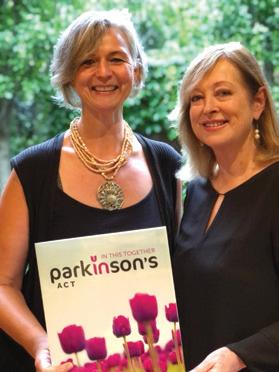
Kate Sterrenberg with Marcia Kimball.
Parkinson’s ACT, a not-for-profit, aims to provide information, education, support activities, understanding and management programs to improve the quality of life of people with the neuro degenerative condition, Marcia says.
About 2000 people suffer from Parkinson’s disease in Canberra, and, with a growing ageing population, this number continues to rise, she says. Marcia’s husband John has Parkinson’s, and Marcia says she’s seen first-hand how much Parkinson’s ACT can help, and what it can mean to those with the condition and their families.
Marcia says Parkinson’s ACT offers support groups to all types of people in the Parkinson’s community.
“There’s groups available for women, men, carers, young onset and more,” she says.
“Our vision is to help make sure people are well-informed, and have the support to help them through their condition.”
Parkinson’s ACT, 7 Collett Place, Pearce. Visit parkinsonsact.org.au or call 6290 1984.

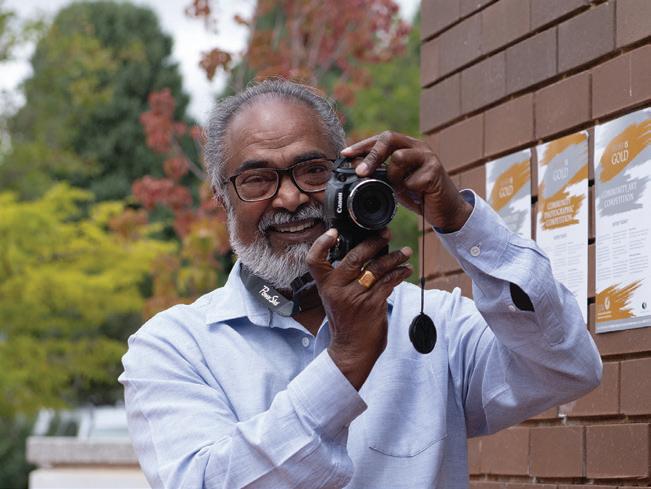



FOR more than 35 years, the ACT Deafness Resource Centre has been advising seniors on the right hearing aid to suit their needs, says CEO Glenn Vermeulen.
For some people, it may be that the television has become hard to hear, while for others, they might be missing out on what their grandchildren are saying, says Glenn.
“We provide them with information that can help them make an informed choice about the type of hearing aid they get and what they can expect from them,” he says.
“[We also help them] go into their audiology appointment armed with lots of information that helps them understand what’s going on, and make that choice based on accurate informa tion, both from us and the audiologist.”
And for those who are already fitted with a hearing aid, Glenn says their John James Foundation “Hearing Aid ers” program goes into nursing homes to charge and clean them for patients.

There’s no charge to residents for the service, which Glenn says is currently running monthly in 16 nursing homes across Canberra.
Since the ACT Deafness Resource Centre first opened in 1985, Glenn says the technology has continued to change rapidly, with hearing aids becoming obsolete after only four to five years.
“Technology is moving very fast,” he says.
ACT Deafness Resource Centre, 1b/27 Mulley Street, Holder. Call 6287 4393, email hearinghelp@actdrc.org.au or visit actdrc.org.au
Arthritis ACT offers services such as physiotherapy, exercise physiology, dietetics, occupational therapy, hydrotherapy and exercise classes.
WHEN it comes to knee and hip surgeries, Arthritis ACT offers prehabilitation programs – “pre-hab” for short – to help make recovery a success, says CEO Rebecca Davey.

up muscle tone around the knee or hip to allow for better rehabilitation after surgery, she says.
“The outcome following surgery, or even the ability to avoid needing to have surgery, is what makes this program so important,” she says. At Arthritis ACT, a not-for-profit that supports anyone suffering from chronic pain, illness or disability, not just arthritis and joint pain, pain is treated in an holistic way, not just addressing pain through management or treatment but also the psychological components to pain, Rebecca says.
“What we find is if you’re not treating your mind as well as your

many chronic pain sufferers feel through support group sessions or one-on-one meetings, she says.
“We support people that are just doing it really tough and don’t know where to turn,” she says.
Arthritis ACT also supports people on NDIS, DVA and My Aged Care, helping people work towards managed pain solutions for the future, says Rebecca.
Arthritis ACT, 170 Haydon Drive, Bruce. Call 6251 2055, email info@arthritisact.org.au or visit arthritisact.org.au

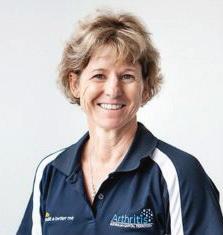


Jacqui is known as the osteoarthritis queen at Arthritis ACT. With a particular interest in hip and knee osteoarthritis, Jacqui delivers the GLAD program designed to reduce the need for joint replacements in particular, or if a joint replacement is unavoidable, to prepare you thoroughly for surgery so that you get the most out of your new joint. Jacqui is currently also studying towards a PhD in the outcomes of this program. Jacqui works exclusively at our Bruce offices.
At Build a Better Me we see many people from all walks of life who might be struggling to manage their chronic conditions. Richard is passionate about helping people to live better, take control and get back on track with achieving their goals through exercise, education and manual therapies. Richard is fully trained in GLAD and works exclusively at our Pearce offices.
Kwong is trained as a GLAD instructor, he has a passion in treating sports injuries early to avoid arthritis forming later. Kwong is a passionate sportsman engaging especially in Aussie Rules and Soccer. Kwong works at both Pearce and Bruce, assisting you with sports injuries, back pain and all general musculoskeletal complaints.
Physiotherapy – including the GLAD program for knee and hip osteoarthritis, sports injury prevention and rehabilitation, and pain condition support.
Exercise Physiology – Individual exercise prescriptions, small group classes to increase strength and improve rehabilitation, strength and balance classes, hydrotherapy support.
Occupational Therapy – access reports for NDIS and Disability Support Pensions, home modifications, equipment prescriptions.
Dietetics – meal planning, weight management support, food intolerance support.


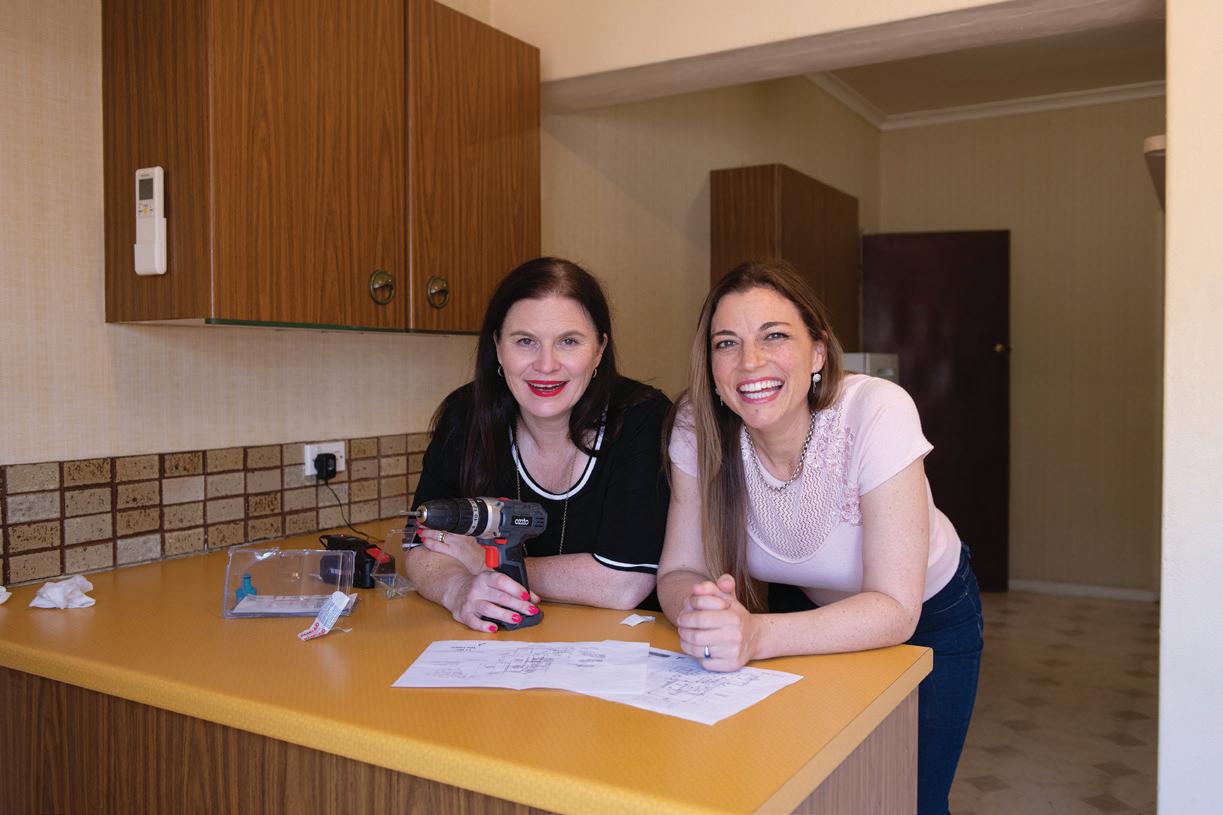
experts, photographers and more,” she says.
“Clients can sit back while we focus on getting the best results possible for their property.”
And clients don’t need to worry about any up-front cost, as the renovating team front the cost of clients who then pay after the property has sold, she says.
“We work to budget and timeframe, whether it’s minor repairs or major renovations, all costs are pushed back to settlement,” says Kim.
Some renovations they’ve completed are worth
value for the client,” she says.
And for anyone thinking of selling, she says now’s a great time to sell.
“At the moment the market is seeing not enough supply for demand, so we’ve had some huge results for the properties we’ve worked on,” she says.
Your Property Profits. Call Kim and Sophie on 0411 648908, email hello@yourpropertyprofits.com.au or visit yourpropertyprofits.com.au
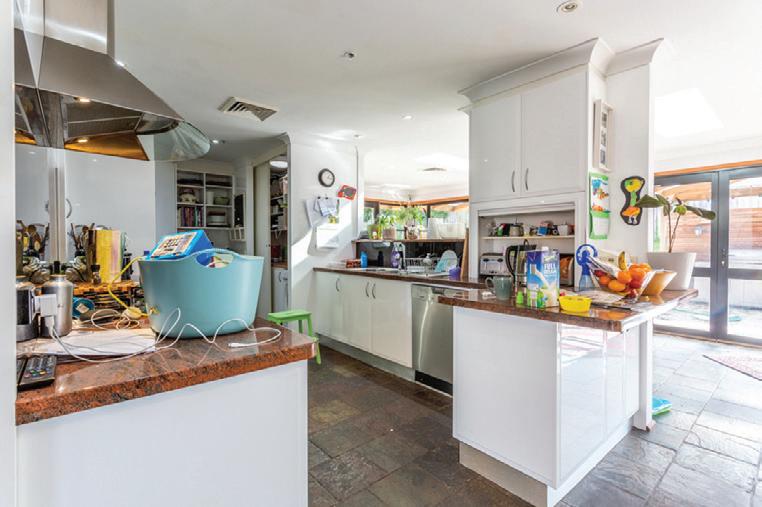
HELPING people financially at all stages of life, the team at Wholistic Financial Solutions understand that seniors have unique financial needs, says CEO
“Senior clients often have differing needs such as planning for retirement, investing in retirement, managing their cash flow, minimising their taxes, planning their estate matters and assisting their next generation build wealth,” says Catherine.
“Wholistic can help in relation to all of these
Not just accountants, the team members at Wholistic Financial Solutions are also financial planners, mortgage brokers, property advisers, retirement consultants and superannuation specialists who look after the “whole” of someone’s financial needs, all under one roof, she says.
With a vision to take clients on a journey to financial freedom, Catherine says they are the most awarded team of financial and property experts in
“We understand how conflicting opinions from professionals in different fields can make the finan cial world a lot more complicated,” says Catherine.
“At Wholistic Financial Solutions we work as a team to answer all your questions simply and efficiently. The unique combination of our services also makes our advice very affordable.”
Running a seminar on March 22 and 23 at the Ain slie Football Club, Catherine says: “Those interested can find out the 36 factors affecting property right now and how to build wealth through property.”

Wholistic Financial Solutions, 4/6 Pelle Street, Mitchell. Call 6162 4546 or visit wholisticfinancialsolutions.com.au





• Are we heading into the ‘perfect storm’ for property investing?
• How to ride the wave of the biggest nationwide property boom in 20 years?
• Has the pandemic changed the real estate market forever?
• The 36 factors affecting the property market right now?
• How to pay off your mortgage 20 years sooner?
• How to build wealth by saving tax?
• How to retire with a portfolio of investment properties?
• Do you want to be in the 5% of Australians who retire wealthy?
• How to buy positive cash flow properties that are predicted to increase in value by 20% in two years?
• How to buy property in an SMSF?
• Go in the draw to WIN one of five $200 gift cards
• Catherine Smith’s Book - ‘Wholistic Wealth through Property’
• A FREE valuation of your current properties
• A FREE mortgage review and a $500 cashback on re-finance of your mortgage to a better rate
Monday 22nd of March & Tuesday 23rd of March Ainslie Football Club 6:00pm





WHILE death can be hard to think about, Capon and Hubert Lawyers and Mediators help take the discomfort out of making a will, says wills and estate planning lawyer Ashilpa Khanna.
According to Ashilpa, there’s a lot of common misconceptions related to wills.
One is that the spouse takes control of the estate and its assets, which is not generally the case, and another is that superannuation is governed by the will,
which is also not generally true, she says.
A lot of people also make a will that, over time, becomes irrelevant to their current situation, she says.
“The team at Capon and Hubert can make sure your plan for the future is expertly organised, updated and ready,” she says.
“Our staff are experienced in their fields and we take pride in knowing our clients.”

A relative dying without a will also causes significant strife, since a will names the legal guardians of the
“The last thing you want to have if you die is a fight over who’s going to
sudden tragedies, Ashilpa firmly believes everyone should have an estate plan and it all starts with a
At Capon and Hubert, Ashilpa says great care is taken into providing expert and honest advice, ensuring process and disclosing any upfront
Mediators, first floor, 32-38 Townshend Street, Phillip. Email enquiries@chsol. com.au, call 6152 9203 or visit chsol.com.au

SPECIALISING in professional earwax removal, Earworx helps people get back to the hearing levels they had before they were impacted by earwax, says Earworx founder and clinical director Lisa Hellwege.
“Have you noticed lately that you’re experiencing hearing loss, tinnitus, or a feeling of fullness or pain in your ears? You may be suffering from a build-up of earwax,” Lisa says.
Excessive earwax is present in one in 10 children, one in 20 adults and more than one third of the elderly and developmentally delayed people in the community, she says.
“Some people are more likely to experience a buildup of earwax [such as] people with narrow, hairy or curvy ear canals, who wear hearing aids, who use cotton buds, ear plugs or ear bud headphones, who work in dusty or dirty environments or people with a hereditary disposition to wax impaction,” she says.
Using the same dry technique preferred by ear nose and throat specialists, Lisa says their qualified registered nurses use dry and effective micro suction technology to safely and gently remove wax.
“Our core business is ear wax removal; we are passionate about it, and it’s what we do best,” she says.
“If you suspect you or your loved ones may be experiencing this problem, please contact us at Earworx to book an appointment. A 50 per cent reduced rate applies if no wax is found, and pensioner discounts are also available.”
Earworx, at North Canberra Family Practice, 5b Chandler Street, Belconnen, call 6129 5100, and Wentworth Avenue Family Practice, 55 Wentworth Avenue, Kingston, call 6203 4600. Visit earworx.com.au



LABELLED as a beautiful, hidden secret, Summerfield has spacious designer villas in Braidwood that are perfect for retirement, says sales director Jane Mackenzie-Ross.
Located an hour from Canberra, three from Sydney, and 45 minutes from the coast, Summerfield is in a fantastic location that’s perfect for people aged 55 and over, Jane says.
“Summerfield offers luxury, yet affordable three bedroom, two bathroom, two car villas, with stunning views of the surrounding heritage-listed region,” she says.
“There are heaps of activities and facilities for residents to enjoy nearby, including a club house, heated pool, garden, arts and crafts, and of course
the many restaurants and cafes throughout the historic Braidwood – perfect for foodies.”
Jane says the town of Braidwood itself has a rich history, plenty to see and do, great people and the cleanest air, making it not just a place to live, but a place to love.
“All houses in Summerfield are also sustainable with 6.6kW solar, 5000-litre rainwater tanks and designed all with north-facing sunrooms,” she says.
“It’s also located right next to the new hospital in Braidwood, making all medical needs easily accessible.”
Summerfield, 70 Little River Road, Braidwood. Visit summerfield.com.au or call 1300 737970.

Principal Dr William Vass… “Hearing loss can result in communication breakdown and when they finally receive appropriate care, they are more outgoing and confident.”

having a hearing test and facing up to hearing issues is still not comfortably accepted.
“Hearing loss is identified as an elderly person’s issue and it is associated negatively with ageing,” Dr Vass says.
“That’s not necessarily true. Generally, people don’t want to admit they need hearing help.
“I say to patients: ‘I wear glasses to improve my eyesight, it doesn’t mean I am blind!’
“Wearing hearing aids doesn’t mean the person is deaf, it means you are seeking better clarity and improved

their hearing tested.
“My patients can be depressed, isolated and angry. Hearing loss can result in communication breakdown and when they finally receive appropriate care, they are more outgoing and confident,” he says.
Dr Vass Hearing Clinic, suite 14, John James Medical Centre, 175 Strickland Crescent, Deakin. Visit drvasshearing.com.au or call 6282 2717.





An elderly woman with hearing loss came to my clinic for a second opinion, after she had recently been to a hearing aid sales person. I found the cause of her hearing loss was simply the fact that she had build-up of wax in her ears, the salesperson had failed to inspect them. You might be surprised how often this happens!
Here are some things to do to avoid getting ripped off:
1. A visit to the GP may save you from being ‘sold’ something when your only problem is wax in your ears.
Recently I was told by two different patients that they were quoted $16,000 for a pair of hearing aids. This seems a ridiculous amount of money to pay and is most likely not appropriate for the majority of people (or possibly anyone).
5. If you are a pensioner or partpensioner, or a DVA gold or white card holder, you should carefully consider if you want to use the free-to-client government hearing aids or if you’d like to top-up to a different hearing aid.
“In an unregulated market there is a lot of opportunity to take advantage of people. Yes you have read correctly, there is no licensing of people who sell hearing aids.”
2. Look for someone who is independent and can offer you unbiased advice, not just give you a sales pitch.
– Dr Vass
3. There are a range of hearing aid prices. Finding the right hearing aid might save you money and it will also give you the best chance of success.
4. Hearing aids can be expensive.
The free-to-client hearing aids are appropriate for many people, however if you have great difficulty hearing background noise (for example in restaurants) then you might trial the top-up hearing aids, but only if you can afford them. There are a range of top up options and prices, if you are disappointed after a trial, you should return them and trial the free-toclient hearing aids.
If you get the feeling the person you’re dealing with is just trying to sell you something, then take a step back and get a second opinion.



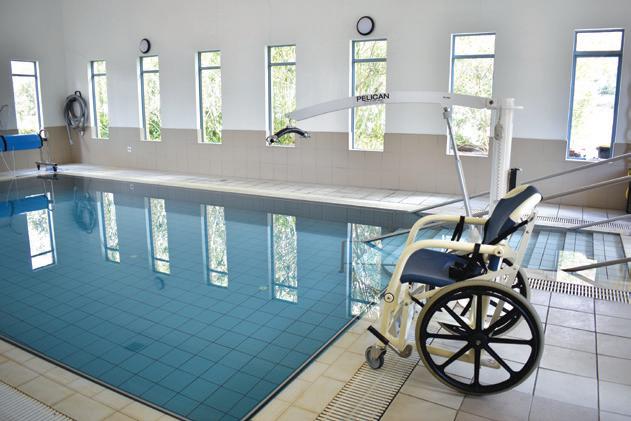
AN active lifestyle has many physical and mental benefits and is particularly important for seniors, according to Orthopaedics ACT’s orthopaedic surgeon Dr Nicholas Tsai, who specialises in the areas of spine, hip, knee and trauma.
“Activity promotes cardiovascular fitness and social interactions; it elevates the mood and also helps to prevent osteoporosis due to inactivity and lack of sun exposure,” he says.
FOR people living with arthritis or people recovering from surgery, the Hartley Hydrotherapy pool is a therapeutic alternative to regular exercise, says operations manager Jess Surgeon.
Located in Hughes, the pool is heated to 32-35C with a shallow 1.1m depth and is open to mixed sessions as well as pre-booked individuals or groups, says Jess.
“People can come along with their own individual programs and you don’t need a referral to use the pool,” says Jess, who notes that there’s also the option of coming with a physiotherapist.
“We have a lot of people that come just for their own exercise benefit. They may have previous injuries or prefer not to go to the gym.”
And because the pool is heated, Jess says it has that therapeutic aspect. “[For] people who have restricted movement of their limbs, it’s a great way to relax at that temperature,” she says.
There’s also a number of amenities at the pool that make it easier for people who have difficulties moving, to use the pool, such as a hoist to lower people into the pool, non-slip tiles and two change rooms, she says. There’s on-site equipment, too, which people can use during the session, such as pool noodles, flotation devices, water dumbbells, an exercise step and kick boards, says Jess.
Hartley Hydrotherapy, 13A Wynter Place, Hughes. Call 6185 1653, email hydrotherapy@hartley.org. au or visithartley.org.au
SELECTING an enduring power of attorney is important for anyone, not just those who are ageing, says senior director of the Wills, Estates and Trusts Unit at the Public Trustee and Guardian, Gregory Burn.
The deputy public trustee says: “With our ageing population, it’s possible that more people will lose their decision-making capacity through conditions like dementia and Alzheimer’s, and we might be starting to experience this with our parents or partners.

“There could be a lengthy period of incapacity, that could be temporary or
permanent, and doesn’t just happen to people who are ageing. With an enduring power of attorney in place, people can feel safe knowing that someone they trust can make medical and financial decisions for them in their lifetime.”
And, everyone over the age of 18 with legal capacity should have a valid, up-to-date will in place, Gregory says.
“Once a will is set up, it will need to be reviewed and updated every three to five years. Things can change, whether it’s the birth of a child, a death, marriage or a divorce,” he says.
A professionally prepared will is important to protect anyone’s interests in the event of your death, Gregory says.
“Without a will, the law sets out what happens to your estate, and that might not be what you intend,” he says.
Public Trustee and Guardian, ground floor, 221 London Circuit, Civic. Call 6207 9800 or visit ptg.act.gov.au
“All joints benefit from moderate daily movements, whether the exercises are land-based or in water. Walking aids are also important for pain relief if you have arthritis in the lower limbs.”
Orthopaedics ACT strives to provide the best advice to all members of the senior community, says Dr Tsai.
“Patients will be assessed by experienced orthopaedic surgeons, and in most cases a conservative management plan will be provided,” he says.
“The goal is always to improve the condition and to return to an active lifestyle as soon as possible.”
Dr Tsai says patients with mild symptoms will be referred to a physiotherapist participating in the GLA:D exercise program, which helps people with hip and knee osteoarthritis manage their symptoms.
Orthopaedics ACT also offers joint replacement information sessions for those who have to undergo joint replacement surgery.
“Surgical intervention is offered as the last resort, usually after conservative management has not been successful or if the condition is deemed so severe that conservative treatment is unlikely to improve it,” he says.
Orthopaedics ACT, Woden Specialist Medical







AGED-care provider Warrigal is now offering a higher level of localised support to residents and their families after taking over an aged care facility in Calwell and Stirling late last year, says CEO Mark Sewell.
The acquisition means another 288 aged care places in Canberra will join Warrigal’s 11 residential care homes and nine other aged care homes across Illawarra, the Southern Highlands and Queanbeyan.
“We’re really excited about these homes joining Warrigal and look forward to the contribution Warrigal can make with its significant experience in offering highquality aged care services for over 50 years,” Mark says.
“This expansion will allow us to reach and support older people from these new areas, which aligns with our values and vision of older people living great lives through a comprehensive, local and trusted aged care system.”
In Calwell, residents have access to an on-site cafe, landscaped gardens, a courtyard with a barbecue area, and are only 250m away from Calwell shops.
Meanwhile, in Stirling, 15 minutes from Civic, residents can choose from exclusively private residences, which are all air-conditioned, Mark says.
At both locations, he says residents enjoy a 24-hour emergency call system as well as on-site registered nurses.
Warrigal, a not-for-profit, provides a full transition of care for senior Australians, from residential aged care, independent retirement living, home care and social support, he says.
Warrigal. Call 1800 927744, email warrigal@warrigal. com.au or visit warrigal.com.au



Parkinson’s is a degenerative neurological condition which affects movement and mood. It affects an estimated 1,500 people in the ACT and surrounds. More than that, it affects carers, families and friends.
Parkinson’s ACT is a volunteer-run, non-profit organisation providing information, support and education. Our purpose is to promote the well-being and interests of people living with Parkinson’s in the ACT and nearby region.
The support of people who share your experience is invaluable. Parkinson's ACT can help.
JUST Better Care, an in-home aged care and disability support service, recently launched its “just for you” brand position nationally, but as local franchise owner Kiri Tennent explains: “It’s only partially new.”
“We’ve always been customer-focused, so personalised and tailored support was already our approach, and ‘just for you’ says it beautifully,” she says.
“There is no ‘one size fits all’ – the supports we provide are based on your individual situation.”
Just Better Care Canberra and South Coast prides itself on a genuine connection to the community, she says.
“We are a completely local team. When you call us, you speak to someone who not only works in our office but lives nearby too,” she says.
“I love that about Just Better Care – we’re real people making a real difference.”

CAPITAL Rehabilitation Supplies aims to make the dayto-day lives of seniors and people living with disabilities easier and more comfortable, says manager and owner Tim Robinson.
“We have a range of products available for purchase or hire that can help anyone with their needs,” says Tim.






www.parkinsonsact.org.au | actparkinsons@gmail.com



















• Incontinence supplies, Catheters, and drainage bags, Pads and Pants
• Braces (Back, Knee, Ankle, Wrist, Hernia) Moon Boots Adult and Children
• Crutches and mobility walking aids and frames
• Homecare products for the Bedroom and Bathroom-toilet aids and shower chairs and much more.
• Electric Lift recliner chairs. Scooters, Walkers and mobility products.

Supporting people to navigate the oftenconfusing aged care system, to find appropriate support is a constant challenge, Kiri says.
“For us, it’s about giving people all of the options so they can gain the most out of their funding and continue to live the life they choose,” she says.
“Everyone has different needs and lifestyles. Finding out what’s important to you is what’s important to us.”
For in-home or lifestyle support for any age or ability, Kiri says contact them for more information.
Just Better Care, unit 9A, 189 Flemington Road, Mitchell. Call 6280 4070, email canberra@ justbettercare.com or visit justbettercare.com
“Just some of these products include electric lift chairs, height-adjustable chairs, pressure care cushions and mattresses, electric hospital beds and home care beds, mobility aids such as walkers, wheelchairs, rollators, crutches and walking sticks.”
A family owned business with more than 40 years of experience in the industry, Tim says Capital Rehabilitation Supplies understands every individual has their own needs.
“We know that some of these issues are sensitive, and can be uncomfortable to deal with, so we try to be as delicate and helpful as possible. If we do not stock a certain item we will always do everything in our power to locate the product,” he says.
“We pride ourselves on our patience and helpful attitude. People can come discuss what they require with us and we can find what works for them.”
Capital Rehabilitation Supplies, 3/66 Heffernan Street, Mitchell. Visit capitalrehabilitationsupplies.com.au or call 6174 4813.
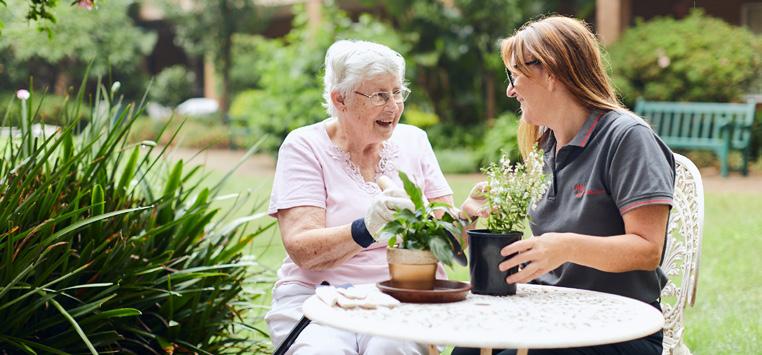
JUST over two weeks out from the school holidays, it’s time to start organising some fun and educative ways to entertain the children during the Easter and school break.
PARROTS, finches, doves and quail are among the birds ready to interact at the Canberra Walk-in Aviary, says owner and manager Mick Logan.
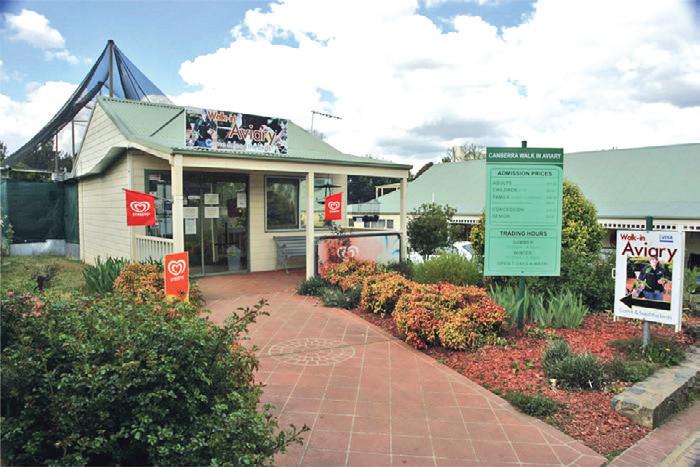
expanded capacity of 35 people at one time, now is the best time to get up close and personal with a range of friendly, free-flying birds, says Mick.
“While not all birds will interact with you, visitors get the chance to observe, up close, species of birds that otherwise would be hard to see in the wild,” he says.
“We provide a small plate of food and a tub of mealworms and you can wander around and feed the birds.”
Whether families want to enjoy the autumn weather outdoors, or spend a day inside doing some fun, creative activities, “CityNews” speaks with businesses who offer holiday entertainment for the whole family. Stephen’s
The aviary is a 1000sq m planted walk-in enclosure that has more than 500 birds from about 65 different species from Australia and the world,
Gold Creek Village has three other attractions, as well as cafes, gift shops and a garden centre, so it’s a great place for a day out after visiting the aviary, Mick says.
Numbers are still limited for social distancing reasons, but the aviary is still open as usual and over the summer will be open every day including public holidays, except Christmas, from 10am-5pm, with the last admission at 4.30pm.
Canberra Walk-in Aviary, unit 13, Federation Square, O’Hanlon Place, Nicholls. Call 6230 2044 or visit canberrawalkinaviary.com.au
CANBERRA’S only slot car raceway is the perfect school holiday activ ity to get children away from the computer and enjoying the fast thrills at Way2Fast Model Car Raceway, says owner Stephen Bywater.
It’s fun for the whole family, too, says Stephen, who, passionate about racing himself, sees parents and adults come in and become nostalgic of their childhood slot car racing days.
“[It’s great to see] the enjoyment on people’s faces if they haven’t seen [slot cars] in a while and remembering back to when they were kids and being able to introduce it to their kids,” he says.
“Parents can relive their childhood. I got my first set when I was about seven years old and have had a passion for it ever since.”
The custom-built, handmade tracks have excited Canberrans for more than a decade and the raceway features tracks such as six-lane NASCAR-style courses, or more complicated courses like overlapping eight-lane ones, Stephen says.
“It’s the enjoyment and the challenge of getting around yahoo.com.au or visit way2fast.com.au
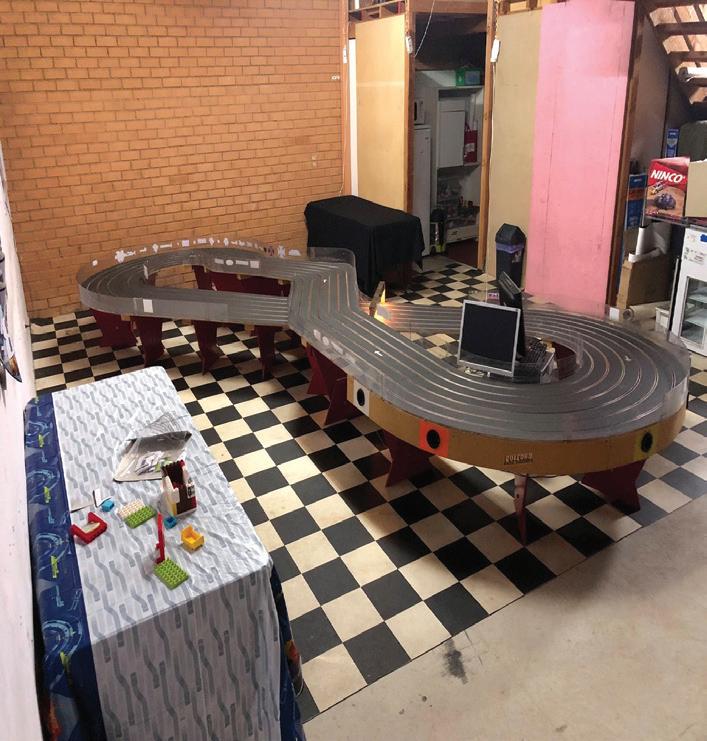
Come along and see the



“BRICKS 4 Kidz offers children the opportunity to learn while enjoying the fun of lego,” says director Mark Jeffries.
Operating in Belconnen and Hughes, Bricks 4 Kidz is led by passionate instructors who use Lego to illustrate science, technology, engineering and maths (STEM) principles.
“Our motto is kids learn through play,” says Mark.
“Kids retain information from touching, making, and doing much more than they do through memorising facts or figures.”
During the autumn school holidays, Bricks 4 Kidz is offering workshops that focus on recreation, with a learning element involved, too, Mark says.
“We’re running every day of the school holidays, but we also have after-school classes with a dedicated curriculum, workshops in coding and robotics using moving Lego, and birthday party programs,” he says.
It’s the environment as much as the Lego that makes kids want to come back, he says.
“Children are naturally curious about what others are building, and so they often make friends quickly and easily,” he says.
“That combined with the supportive and enthusiastic atmosphere our instructors create makes for a learning experience that activates the imagination.”
Bricks 4 Kidz, 125/99 Eastern Valley Way, Belcon nen. Visit bricks4kidz.com.au/act-northside or call 0438 257236.

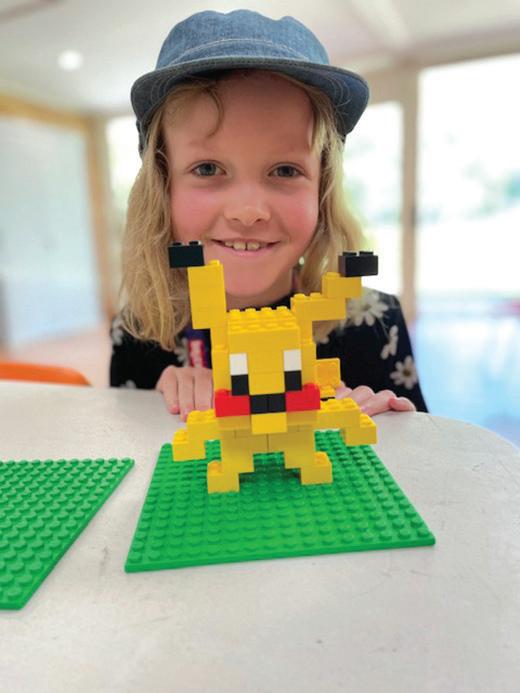
CHILDREN can get up close and personal with some of the world’s most amazing creatures at the National Zoo and Aquarium, says zoo manager Jemma Walsh.
“Visitors can come face-to-face with a dangerous carnivore on our ‘Awesome Roarsome Tour’ or stand in awe of our gentle giants on the ‘African Savannah Safari’,” says Jemma.
“And for an all-day experience, check out our ‘Wonders of Wildlife Tour’, which takes you behind the scenes to check out all that a working zoo has to offer!” Jemma says children can also enjoy the “adventure land
animals, such as bears and hippos.
“There is something for everyone in the playground, from the little ones to about 14 years of age,” says Jemma. Jemma says parents are also taking advantage of the 12-month membership program to make weekly visits.
“We have lots of kids that love coming in and visiting their favourite animals whether that’s one of our beautiful big giraffes, our lion family or tigers,” she says.
“Penguins are also another big favourite of the kids.” And for those rainy days, Jemma says the aquarium is a favourite.








Canberra’s National Zoo and Aquarium features a combined aquarium, metropolitan zoo and easily walked open range section, as well as amazing up-close and personal animal encounters and tours.
Explore the incredible Adventureland, a truly unique playground featuring a total of 55 activities including various sized fibreglass animal sculptures for children aged 2-12 to explore and play on.
You can also experience the unforgettable with an overnight stay at the internationally recognised Jamala Wildlife Lodge. There is truly something for everyone at the National Zoo and Aquarium!






“THE National Library is your home of Australian stories,” says programs manager Georgia McDonald.
“Our 10 million [collection] items – and counting –tells the story of Australia, and includes everything from books and newspapers to fine art, Olympic torches and ephemera.”
Georgia says children and families are always welcome to visit the National Library, but that’s especially the case during the school holidays, with free exhibitions, workshops, the Bookplate Café and the bookshop all available to enjoy.
“There’s our ‘Treasures Gallery’, featuring a curated selection of maps, rare books, manuscripts, photographs, oil paintings, watercolours and more,” says Georgia.
“The exhibition has family labels scattered throughout that are designed to help ‘significant grown-ups’
•






THE Museum of Australian Democracy’s newest speech, says senior media and communications




From family activities and trails, to free zine making workshops and a whoosh machine! MoAD offers a fun day out in one iconic building.



18 King George Terrace, Canberra moadoph.gov.au




Tran had been told he could claim 80 cents an hour against his tax for using his office at home and wanted me to better explain the rules. “Tran, like everything in tax, it's not quite as simple as it seems," I told him.
"There are three different scenarios when working from home. The first is where you have no office, so you might be working at the dining table. The next is where you have a room set aside at home for your office. The third is where your home is a place of business.”
“Let's start with the situation where there is no office. The Australian Taxation Office (ATO) specifies that you can claim either 52 cents an hour or 80 cents an hour to cover your running costs.
"You may also be able to claim 52 cents an hour you can also claim for your mobile phone, your computer and your internet connection, but you cannot claim depreciation on your furniture or carpet.
"If you claim 80 cents an hour, which is a special COVID-19 rate and is currently scheduled to finish on June 30, you can’t claim your phone, computer, internet or depreciation.”
Tran thought the 80c an hour sounded much better.
"We can calculate whether it is better for you to claim 52 cents an hour or 80 an hour," I told him.
"We generally find that a total claim is higher by claiming the 52-cents rate plus the additional items, rather than claiming 80-cents rate. If you don’t have good records or you don’t want to keep records, then you're better off claiming the 80-cents rate.”
Tran wanted to know what records he needed to keep.
I told him he needed a diary of the hours spent working at home for one month.
"This is then extrapolated over the year, remembering that you only work for 46 weeks a year after allowing for annual leave and public holidays,” I said.
Tran said he had a room set aside as an office.
“That does give you some advantages," I said, "as you can also claim depreciation on the furniture that you use in your office plus your technology costs.
"If you are running a business from home you can also use the occupancy expenses method. You can claim a percentage of your rent, or mortgage interest plus rates plus insurance.
"If you choose this method you have to calculate the percentage that you use for your home office. The usual way is to calculate the percentage of the floor area that the office occupies. In most houses, one bedroom. Is about 10 per cent of the floor area.
"Also, when you're calculating the floor area if there are decks under the roofline they are included as can be the garage if it is used for your business. So the percentage can often be quite small.
"You also need to keep a diary of business use. So it is quite a lot of record keeping. But the sting in the tail, if you own your home, is capital gains tax.
"The law actually says that if you have an office at home whether you claim it or not you will need to pay some capital gains tax on sale if you sell the house for a profit.”
Tran said: "You're right, Gail; like you say, everything in tax is not quite as simple as it seems. I had no idea it was so complex to claim a home office.”
If you want information on home office claims, business or tax issues, please contact the friendly team at Gail Freeman and Co on 6295 2844.
Disclaimer
This column contains general advice, please do not rely on it. If you require specific advice on this topic please contact Gail Freeman or your professional adviser.
By Joanne Madeline Moore
ARIES (Mar 21 – Apr 20)

The late week Full Moon lights up your partnership zone, so it’s time to focus attention on a special person in your life. You could also decide to let go of a relationship that’s no longer working. Single Rams – look for love with someone who is kind and compassionate. Your motto for the moment is from Aries birthday great Reece Witherspoon: “I’ve realised that life is too short to spend my time with anybody who doesn’t appreciate me, treat me with respect or bring value to the relationship.”
TAURUS (Apr 21 – May 21)
Are you stuck in a rut? Have you been too stubborn to embrace change? This week’s Full Moon will shake up your daily routine and inject new energy and enthusiasm into your life. But make sure your plans are rooted in reality. At the moment you’re extra susceptible to suggestion – and flattery – so be discerning about who’s advice you take. Don’t allow fair-weather friends (or fractious family members) to lead you up the primrose path to trouble. Keep your feet on the ground!
GEMINI (May 22 – June 21)
The Full Moon stimulates your friendship zones, so those around you can look forward to some surprises, amusing antics or manic moments from you and your peer group pals. But this week you need to be extra careful what you say. With Mars squaring Mercury on Wednesday, sharp words have the ability to hurt others. If you don’t slow down and self-edit, then you could end up with a messy misunderstanding on your hands. So think things through before you open your mouth!
CANCER (June 22 – July 23)
Crabs are the carers of the zodiac. But looking after a loved one won’t be easy, as you struggle to juggle your personal and professional lives. This week’s Full Moon falls in your home zone, so be on domestic drama alert and realise that stress levels will be running high (and self-control running low). It’s a good time to refresh your living space. Be inspired by birthday great William Morris: “Have nothing in your home that you do not know to be useful or believe to be beautiful.”
LEO (July 24 – Aug 23)
The Full Moon shines a bright spotlight on all types of communication and conversation. Expect some highs and lows in relationships, but that’s normal. The harder you work on smoothing out potential problems with loved ones, the better you’ll feel. So your motto for the week is from birthday great, actress and producer Sarah Jessica Parker: “You have good days and you have bad days. That’s a marriage. That’s a friendship.” Local travel and education are also highlighted.
VIRGO (Aug 24 – Sept 23)
Hard work will take you far but avoid the temptation to use words as weapons. The Full Moon stimulates your self-esteem and money zone. So, if you want to do well financially, then spending sprees are out and serious saving is in! It’s also an appropriate time to take a close look at your personal values and current priorities. Your motto is from Reece Witherspoon (who turns 45 on Monday): “I want to make my life, not just my job, the best it can be. The rest will work itself out.”
LIBRA (Sept 24 – Oct 23)
If you expect other people to be cooperative then you’ll be disappointed. Mars squares Mercury (on Wednesday) so choose your words wisely, otherwise you’ll just upset loved ones or work colleagues. A relationship problem is brewing so do all you can to diffuse it diplomatically, as you discuss a subject you may not necessarily feel comfortable about. The Full Moon’s in your sign so do your best to be fair and balanced, as you see things from differing viewpoints.
SCORPIO (Oct 24 – Nov 22)
With the Full Moon illuminating your seclusion and spirituality zone, it’s a wonderful week to step back and wind down as you dream, meditate, contemplate, ruminate or pray. Your intuition is trying to tell you something so take the time to listen to the wisdom of your inner voice. Be inspired by feminist writer (and birthday great) Gloria Steinem: “Without leaps of imagination, or dreaming, we lose the excitement of possibilities. Dreaming, after all, is a form of planning.”
SAGITTARIUS (Nov 23 – Dec 21)
This week’s Full Moon highlights romance, entertainment, networking, friendships, creative endeavours, dreams, goals and group projects. With your sparky Sagittarian mojo and momentum running on high speed, you’re ready to rock and roll! But the planets caution you to slow down. You need to take your foot out of your mouth and communicate with more care and consideration, especially in matters involving relationships (of the romantic, platonic and domestic variety).
CAPRICORN (Dec 22 – Jan 20)
The week kicks off with a Mars/Saturn trine, which is wonderful for boosting motivation and discipline, especially involving business and financial matters. If you roll up your sleeves and get to work, then you’ll make real progress. Sunday night’s Full Moon activates your career zone, so it’s a good time to bring a challenging professional project to a successful completion. Be careful what you say to a colleague, relative or neighbour though. Hasty words could land you in hot water!
AQUARIUS (Jan 21 – Feb 19)
On Monday, Saturn (in your sign) forms a fabulous trine with Mars, so passion and purpose are a fruitful combination. However, when it comes to business and finances, take your time and don’t rush. Then the Full Moon helps you communicate your innovative ideas with extra pizzazz, as you connect with like-minded people via joint ventures with influential and/or international contacts. Make sure you leverage the power of social media to get your message out loud and clear.
PISCES (Feb 20 – Mar 20)


This week, with Mercury and Neptune both transiting through Pisces, your creativity and imagination are firing. So a sudden idea could lead to exciting changes at home or within your local community. Then the weekend Full Moon brings things to a dramatic conclusion involving a close relationship, shared finances or a joint venture. Secrets and issues of loyalty could also be placed under the spotlight, as you discover whether your trust in someone has been well placed.
Copyright Joanne Madeline Moore 2021

2 What are graven images known as? (5)
3 Name a large animal of the deer family. (5)
(6)
8 Name a publication produced annually, containing information about the past 12 months. (8)
9 Name the silky protective envelope spun by silkworms. (6)
10 To estimate too highly, is to do what? (8)
11 To be dormant, is to be what? (6)
13 When it rains lightly, what does it do? (8)
16 Name a more familiar term for apothecaries. (8)
19 To slip by, is to do what? (6)
22 What is an unmarried man? (8)
24 Name the capital of Austria. (6)
25 To adjust to some standard, is to do what? (8)
26 What are tracts of wet, spongy land? (6)
4 Which brief statement gives a general view of some subject? (8)
5 What is a lead strip in a stained-glass window? (4)
6 Who was Shakespeare’s king of the fairies? (6)
7 Which supervised place of accommodation usually supplies board and lodging? (6)
12 Name a musical instrument of ancient Greece, after which a beautiful Australian bird was named? (4)
14 What, in sport, do we call the second-grade team? (8)
15 What is the innermost and strongest central tower of a medieval castle? (4)
17 Name another term for paradise. (6)
18 What is the keeper and driver of an elephant called? (6)
20 What is an enclosure for sports contests, shows, etc? (5)
21 Name another term for dawn. (5)
23 Name one of Shakespeare’s British kings. (4)
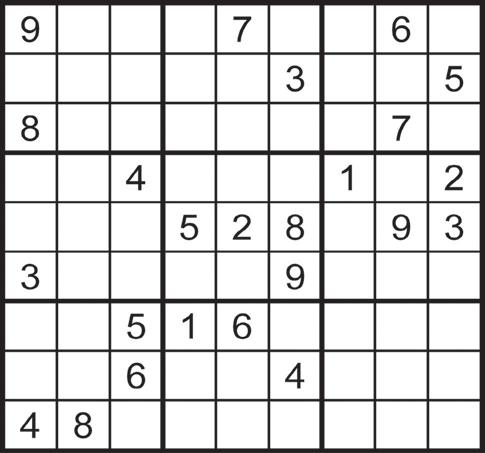

Teens thrill to ‘Be More Chill’ HELEN MUSA
By Helen MUSA

IN a strange coincidence, Canberra audiences will, in the same week, soon get to see not just one but two musicals about the teen experience.
Elsewhere in these pages, I have talked to Kirsty Budding about the American YouTube phenomenon “Be More Chill”, but even while that’s playing in Gungahlin, the stage of the Canberra Theatre’s Playhouse will light up with “Fangirls”, another show with original music dealing with life as a young person.

“Fangirls”, which enjoyed a hit success in 2019 and had its international prospects thwarted momentarily by covid, is directed by Paige Rattray, familiar to Canberra audiences from her staging of Nakkiah Lui’s hit comedies “Black is the New White” and “How to Rule the World”. Rattray came to “Fangirls” after Sydney writer Yve Blake and a group of friends who together call themselves ABBA, had created a musical with completely original songs.
“They came to me and I assembled the other components and the creatives,” Rattray says. “They’re a fun team of four and this is their first musical.”
It’s also been a first for Rattray, who’d never directed a musical before but says: “It felt to me less like a musical and more like a pop concert, partly because the story is inspired by mega popstars”.
Youth is a prime consideration with “Fangirls” and Rattray is all too well aware that she’s of a slightly older generation.
“They have just the right chemistry. Everyone was
“FanGirls”...
“It felt to me less like a musical and more like a pop concert, partly because the story is inspired by mega popstars”. Photo: Brett Boardman
under 25 at the time when they were making it then there’s a kind of exciting energy when you’re emerging,” she says.
“I haven’t had that feeling for a long time, the feeling you have when you’re at uni.
“It had a different flavour to me and it’s converted me to a lot of other musicals… I’ve loved working with a choreographer and musical director as I’m so used to being the one person in the room.”
The show, she says, is dominated by storytelling, effects and the music.
“It’s pure theatre, it’s wild and it’s super-charged with the idea that teenage girls can achieve anything if they put their minds to it,” she says.
Rattray admits that she’s never been into fan culture, so had to research it.
“I was amazed by the dedication, behind the screaming there’s a world for the fans, people who find each other – it can be a real comfort, like sport,” she says.
The story concerns 14-year-old Edna, played by Karis

Oka, who is besotted with Harry, the gorgeous star of the world’s biggest boy band, played by real-life star Aydan Calafiore – just “Aydan” to his fans and a finalist in “The Voice Australia”, 2018.
There’s nothing Edna won’t do to prove to Harry that she’s “the one”.
“But, even though Aydan is a popstar, although not as famous as Harry, and he’s beautiful and he’s got the textbook voice, at the end of the day it’s not really about him, it’s about the girls, around their day-to-day lives,” Rattray says.
Karis Oka plays Edna, who Rattray describes as “incredibly truthful in the role.”
“She really hooks into being 14 and what that means,” Rattray says.
“It’s about when you’re being told to grow up but you’re still being treated like a kid – but it’s all done with a bit of a wink.”
Rattray describes the original music as a cross between pop music, a church choir and Beyoncé and praises young Australian classical composer Alice Chance, whose arrangements for the choir are “exciting”.
Physically, it looks and feels like a rock concert with the fun part being that now, because of the pandemic, people can’t get into the big 80,000 capacity arena, so they’ve transferred that to the stage, with a lot of glitter and high-tech representation of Edna’s online world.
“There’s something about this show, it doesn’t matter how old you are, it takes you straight back to the era when you were young,” Rattray says.
“An 84-year-old woman came to the show in Sydney and said: ‘That’s the youngest I’ve felt in years’.”
“Fangirls”, The Playhouse, March 24-28. Book at canberratheatrecentre.com.au or 6275 2700.

By Helen Musa
CANBERRA has a new art prize. The National Capital Art Prize is open to Australian artists aged 18 and over and will see an even balance between indigenous and non-indigenous artists.
There will be four painting sections, Open ($15,000), First Nations ($15,000), Landscape ($5000) and Student ($2500). Winners will also receive the opportunity for a solo or joint exhibition of their works following the competition.
There will also be a $2500 People’s Choice Award and Art Scholarship valued at $5000, in partnership with ANU and available to current ANU students.
The new venture is the brainchild of art gallery owner Robert Stephens , who told “CityNews” that his main purpose was to support Australian artists.
The non-acquisitive prize, he said, bore no formal relationship to his business, Aarwun Gallery at Gold Creek, and he had created a new, non-profit organisation to ensure that any funds raised would go to artists themselves.
With a prize pool of more than $45,000, he said the competition aimed to ignite the passion and courage of artists across the country, many of whom lost the opportunity to display and sell their work during 2020 with its devastating impact on the arts sector.
Entries open on March 30. Partnership opportunities to partnerships@nationalcapitalartprize.com.au or call 0418 809462.


Dane Lam
By Dougal MACDONALD

“Judas and the Black Messiah” (MA)
THIS film memorialises a time in black American history when law-enforcement agencies and the Black Panther Party (BPP) were close to open warfare.
The plot focuses on the Rainbow Coalition, a multicultural political organisation established in Chicago that initially included the Black Panthers, Young Patriots, Young Lords, and an alliance among Chicago street gangs to help end infighting and work for social change.
Worthy objectives, in any language. But FBI director J Edgar Hoover (Martin Sheen) identified the Coalition as a radical threat.
Its founder was 20-year-old Fred Hampton (Daniel Kaluuya), chairman of the Illinois chapter of the BPP and deputy chairman of its national board.
Hampton died aged 21 in his bed during a predawn raid at his Chicago apartment by a tactical unit of the state attorney’s office in conjunction with the Chicago Police Department and the FBI.
“Judas and the Black Messiah” tells the story of Hampton’s last months, from several perspectives – wife, family, political activism, official actions against him and Bill O’Neal (LaKeith Stanfield). Aged 19, Bill was a petty crim, offered a deal by FBI


operative Roy Mitchell (Jesse Plemons) – early release from prison in return for providing information about the coalition and the Panthers.
Writer/director Shaka King has made a long (129 minutes) movie mirroring, in 21st century terms, events in Palestine forever remembered as the crucifixion of Jesus and the name Judas as an eponym for a betrayer.
Is it a good movie? More than most, an evaluation of that epithet will depend on the viewer. I’d like to think the information I’ve given will help you make your own see-don’t see decision.
At Dendy and Palace Electric

Talking to the names making news. Join the ‘CityNews’ editor and 2CC personalities Sundays, 9am-noon.

KATHIE Lee Gifford and Craig Ferguson may not be household names like some movie stars. Until I saw “Then Came You”, I hadn’t heard of either of them. But they’ve had long careers in TV series, her in the US, him in Britain.
She’s not just a comedienne. In her late 60s, she wrote the screenplay for “Then Came You”, which some might call a bit egocentric because her character in it, Annabelle Wilson, a widow after 30+ years of marriage, is a fun bird and rather cute. His career has been mainly acting in British TV and voice-overing in animations; as well, he’s done a bit of writing for TV –
IT!
notably “Doc Martin”.
Annabelle is taking a round-the-world trip to visit the places where the favourite movies were set that she and late husband Fred enjoyed as relaxation after their daytime jobs managing a hardware store in Nantucket, Massachusetts.
Her first stop is Scotland where the travel agent has booked her into the country home belonging to Howard Awd (Ferguson).
Howard’s something of a bumbler, wellintentioned to a fault, heavily dependent on his best chum Gavin (Ford Kiernan) to run a big house that’s rather short of guests.
Some might consider that the Scottish landscape, in and around Ardkinglas House, in Cairndow, Argyll, to be the film’s real star. It’s certainly beautiful.
The screenplay contains no real surprises. Indeed, from the moment when Howard collects Annabelle at the railway station, where this movie is going is, well, predictable.
Their journey from that moment to film’s end may have little structural shortcomings and moments of bleeding obvious but those are forgivable. Annabelle and Howard deserve the rest of their lives happily together after the deaths of spouses. It looks like they’ll get that, bumpy bits and all.
I watched “Then Came You” shortly after seeing “Judas and the Black Messiah”. The contrast was a wonderful tonic. I actually laughed at more than one of its comedic moments.
At Palace Electric and Hoyts
“Girls Can’t Surf” (M) “GIRLS Can’t Surf” is an Australian documentary that tells how a band of female surfers from several countries took on male-dominated professional surfing to achieve equality and changed the sport forever.
Featuring surfing greats Jodie Cooper, Frieda Zamba, Pauline Menczer, Lisa Andersen, Pam Burridge, Wendy Botha, Layne Beachley and more, it’s a wild ride of clashing personalities, sexism, adventure and heartbreak, with each woman fighting against the odds.
They were tired of being downclassed in their sport by “the boys”. They wanted, and were entitled, to make their dreams of competing a reality and to get a share of the obscenely large amount of money that sponsors were putting up.
There’s a lot of talking-heads moments in the film, of women being refreshingly candid about themselves, about the treatment of women surfers, about ambition and survival in a potentially dangerous environment that was also great fun.
The surfing footage is spectacular. The bigger the waves, the more so. One of the skills that the film doesn’t spend time explaining is how competition gets scored. You need to be a competition surfer to understand that, I guess.
At Palace Electric and Dendy
By Nick OVERALL

NEVER before has a movie studio as big as Warner Bros allowed an internet movement to call the shots, but the release of “Justice League: The Snyder Cut” on Binge changes that, and is a fascinating example of the power of an online ruckus.
For those who don’t know, “Justice League” is the DC Comics team up of Superman, Batman, Wonder Woman and every other super Tom, Dick and Harry that Warner Bros desperately hopes can take on the much more influential “Marvel Avengers” film franchise (on Disney +).

The “Justice League’’ film was originally released in 2017 to a reception less than super. It started under the direction of Zack Snyder, known for his dour, more political approach to superhero stories, who had to leave the production due to a family tragedy.
In his place, Warners hired Joss Whedon (widely known for directing “The Avengers”, go figure) to inject the film with some happier, more upbeat zest.
The final product was Frankensteinian, with visions from two very different directors stitched together in an awkward mess audiences swiftly rejected.
However, a quixotic, controversial, perhaps to some even heroic movement on the internet known as #ReleaseTheSnyderCut quickly kicked into gear, calling for Zack Snyder’s original work on the film to be released for viewing. A “do over” of the movie if you will.
A cult following racked up nearly 200,000 signatures for an online petition, #ReleaseTheSnyderCut was tweeted 770,000 times in a day, thousands of letters were sent to the head of Warner Bros, $20,000 was raised to fly a plane over San Diego with the banner reading “#ReleaseTheSnyderCut”. Even a book was published about the whole fiasco.
Warners actually listened, though. Snyder has come back to stitch together his original footage into a gigantic four-hour cut of the film being brought straight to streaming on HBO Max, meaning in Australia it’ll be on Binge from March 18.
It’s a fascinating and unlikely move; by releasing it, the studio’s essentially chucking its original $US300 million movie under the bus, but it is certainly clever to have taken the heat of movement and turn it into a steam train of publicity.
This is another example of how the entertain -
ment industry and the internet are becoming ever more entangled, not just in terms of how audiences watch their movies and TV, but also how they interact with them.
MAKING other streaming news this month: Amazon Prime is continuing its rollout of slick sports docos, this time promising viewers “unrivalled access” to the AFL with the seven-episode series called “Making their Mark”.
It follows six teams across the intensely challenging 2020 season, giving a behind-the-scenes look at the sport in a similar fashion to “The Test”, another doco on the platform that follows the Australian cricket team.
ON March 29, Stan will get a second season of the promising drama series “City on a Hill”.
It puts Kevin Bacon up front as a corrupt FBI veteran in ‘90s Boston, who forms an unlikely bond with a district attorney in a case that entirely reshapes the city’s legal system.
Season one had everything there to make for a riveting, bureaucracy battling legal drama, but it didn’t quite burst on to the streaming scene as much as producers would have hoped.
Back for a second string of eps, it’s got the stage to show an audience whether or not it can become one of the hard-hitting modern dramas it wants to be.
“THE One” is another show offering up an interesting thought experiment to Netflix subscribers this month. Based on a best-selling novel of the same name, it poses the characters of its sci-fi world the question of whether they’d take a DNA test that matches them up with their “perfect” romantic partner.
Take notes, Tinder.
By Wendy JOHNSON
IT’S hard to miss the imposing statue of Andrew Inglis Clark at the new Constitution Place in Civic.
The co-author of the Australian Constitution stands proudly out front and is clearly visible from most seats at ARC, the latest food-coffee venture by Redbrick Coffee.

ARC is light, bright and modern. The interior is by Capezio Copeland and the furniture by Tom Skeehan. The gleaming white, and oh-soimpressive, coffee machine is by La Marzocco.
The menu, says ARC, is a “food menu of refined classics, focusing on local produce”. And, of course, Redbrick’s carefully roasted, specialty coffee is available.
ARC’s menu starts with Three Mills sourdough, which can be toasted with house-made jam, peanut butter, Vegemite or honey

available all day as well. We hopped on in for lunch on a weekend and my friend settled on the avo on toast ($18) with the creamy smashed avo piled on top of a thick slice of bread. It was dressed up with chunks of feta and cheery, colourful charred corn. On the side was creamed corn, for added interest and a different texture. It was a
Smokehouse bacon for $6. It was ordered crispy but didn’t arrive that way (sad face). Another option is to add a Hilltop egg for an extra $4.
I was torn between the full-ofgoodness green bowl ($19), the oven-roasted pumpkin salad ($18) or the salmon rillettes ($21). The rillettes won and didn’t disappoint. This dish also looked pretty on the
By Helen Musa
“I’D never heard of ‘Be More Chill’ until a 16-year-old student called Jessica told me about it,” Kirsty Budding says of the next big musical show coming up for her company, only the second in Australia to get the rights to the teenage theatre sensation.
“Mention it to anyone over the age of 21 and they’ll give you a blank look, but mention it to any 15-year-old and they’ll know exactly what you’re talking about.”
After a low-key premiere at a commuter town theatre in New Jersey, the show was streamed online, then YouTubed and Spotified around the world to adoring teenagers with the original cast recording making it to the “Billboard” cast album chart’s Top 10.
The book, by Joe Tracz, based on the 2004 novel of the same name by Ned Vizzini, with original music and lyrics by Joe Iconis, introduces teenager Jeremy, whose divorced father is an embarrassment because he’s always walking around in his undies or as the Americans put it, “not wearing pants”.
That gives rise to “The Pants Song”.
But dad isn’t stupid and he notices that Jeremy is losing his sense of self, so obsessed he is with the need to be popular.
In particular, he is crazy about Christine, so signs up for the school play she’s in in a bid to “More Than Survive”, as the song goes.
When a mate tells Jeremy there’s a popularity pill you can take called The SQUIP (“Super Quantum Unit Intel Processor”), he swallows it.
Little does he know that The SQUIP is a supercomputer that starts to control his life, telling him what he should say to be more “chill” and most of all, what girls would want to hear – seen in the number, “A Guy That I’d Kinda Be Into”.
But The SQUIP advises him that in order

to be more popular he has to “upgrade to Jeremy 2.0” then starts to delete parts of his life – his best mate Michael disappears, for instance, and while Jeremy starts hooking up with girls, he loses all sense of what was unique about him.
“It’s very original and funny – I love funny stuff – and the lyrics are memorable,” Budding says.
“A lot of it is about kids discovering sexuality, desire, who they are, what they want to do.
“Also, it’s very raw, very real and it doesn’t sugar-coat issues, it’s not presenting teenagers as their mums and dads would want them… for instance, there’s one song called, “I’m Waiting for my Porno to Load”.
As a youth production, most of the characters are played by kids, but actor Paul Gardner doubles as a couple of adult characters.
Largely performed by and for the young, Budding’s sure it’s going to be acceptable to mums and dads, too, because high-school experiences stick with us.
“Be More Chill” does have a happy ending, with a moral saying that it’s better to be yourself than to be more chill, exactly the opposite of that in “Grease” where the moral is,
“You’d Better Shape Up”.
The show started out small in 2015, but after ending up on YouTube, it made a huge impact and when it hit New York, producers were stunned to find teenagers travelling in hordes from different states to see the show.
“But it won’t be just for teens. This is something my mother could enjoy,” says Budding.
“Be More Chill”, Gungahlin Theatre, March 24-27. Book at buddingentertainment.com
plate and the salmon married well with fennel and fresh herbs. The house-made pickles added zing. The dish was just the right size and the flavours beautifully balanced.
ARC also has a spiced paprika egg salad sandwich, if you’re looking for something light ($14) and a club sandwich for $17. Burger fans are also treated well ($22).
We were already “coffeed out” before arriving so instead enjoyed a Canberra District Mada Wines rose (2020) for $13 a glass ($54 a bottle). Mada is known for producing a certain style of wine. The rose is delish.
ARC’s wine list is big on other Canberra District labels and Australian wines. Beers include Capital Brewing Coast Ale. Always good to see.
Several other eateries and bars will be opening at Constitution Place, some later this month. On the line-up is Fuel, The Meat and Wine Co, Hero Sushi, Cicada Bar and Mu Omakase.
ARC is a great addition to the city’s dining scene, for those staying at the premium A by Adina Hotel, but also Canberrans and other visitors alike.
By Helen Musa
REBUS Theatre presents “The Beauty Thief” as a traditional fairy tale exploring the idea of beauty and its relationship to worth and power, with dance sequences by CDTeens from Canberra Dance Theatre. The music is by Marlene Radice; costumes, Fiona Victoria Hopkins; lighting, Ali Clinch, and directing by Robin Davidson and Sammy Moynihan. At Belconnen Community Theatre, March 26-28, at various times. Book at events.humanitix.com
“MARGARET Fulton the Musical” is a theatrical romp based on the best-selling autobiography of the famous cooking guru, following her journey from humble beginnings to the status of National Living Treasure as she encouraged Australian housewives to stray from the old tradition of meat and three veg. At The Q, Queanbeyan, March 23-27. Book at theq.net.au or 6285 6290.
CANBERRA artists, ceramicist Cathy Franzi, silversmith Alison Jackson and designer/sculptor Dan Lorrimer have been named as the inaugural Craft ACT CO:LAB recipients, a development program to encourage collaboration between architecture, craft and design.
PERCUSSION whiz kid Claire Edwardes heads up a select list of musicians for this year’s Bowral Autumn Music Festival, March 25-28. Held in the heritage church, Saint Jude’s, the festival is directed by violinist Myee Clohessy. Also in the line-up are organists Simon Nieminski and Allan Beavis, oboist Mikaela Sukkar, the Acacia Quartet, pianist Leanne Jin and soprano Amy Moore. Book at bowralautumnmusicfestival.org.au
“HALL Countryside & Beyond”, an exhibition of watercolours by Isla Patterson, will be opened by David Kilby at the Kyeema Gallery at Capital Wines, Hall, at 5.30pm on Saturday, March 20, (book at capitalwines. com.au). It runs until April 19.
ART Song Canberra’s next concert “Sonia’s Art Song/ Lieder Book” features dramatic soprano Sonia Anfiloff and pianist Kylie Loveland. At Wesley Music Centre, Forrest, 3pm and 4.15pm, Sunday, March 21. Book at trybooking.com






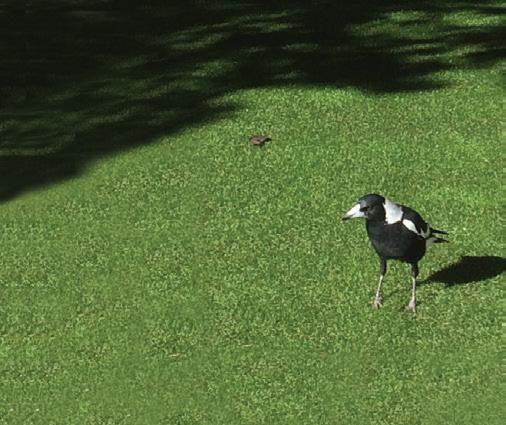


FOR many years, almost every garden in Canberra had its own veggie patch and fruit trees.
Government inspectors would regularly check fruit trees in private gardens to ascertain they were properly maintained, including making sure the owners controlled pests and diseases.
The next few months is the ideal time to plant fruit trees and bushes. In Canberra, it’s possible to grow a greater variety of fruit, including raspberries, currants, blueberries and gooseberries, than in the tropics. Berry bushes can be grown in a relatively small space or a container.



However, when growing fruit trees at home, such as apples, pears, nectarines, peaches and plums, consider the space required – with the ever-decreasing size of new
blocks, there’s barely space for any trees, let alone fruit trees.
Plums will grow to about four metres squared; apples four to five metres. One exception is the “Ballerina” variety of apple cultivars, of which I was involved with its first release in England in the 1980s. These are columnar in growth of 3.5 metres tall x 0.6 metres wide, with six varieties currently available.
Even if the space is available, are you really prepared to devote the time and attention needed to properly look after fruit trees?
They require regular pruning, some in summer as well as winter. Fruit trees generally require a fairly generous amount of water on a very regular basis, especially when fruit starts to develop.
It’s important to spray regularly to control pests like codling moth or fruit fly. Pest control is getting harder as an increasing number of pesticides are being withdrawn from sale, and more emphasis is being placed on certified organic products to help protect the environment.
On our farm in England, we planted all our





apple trees in the yards of our freerange chickens. The chook poo provided regular fertiliser and the chickens took care of the insect pests.
How to keep birds or possums from stripping the trees? Those who net the trees will know it’s almost impossible to cover the tree effectively and it’s even worse getting it off at the end of the season.
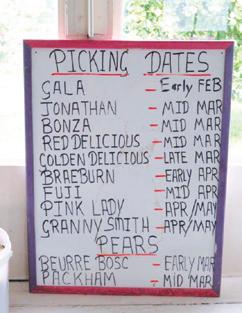
picking guide
We’re fortunate in the Canberra region to have numerous orchards and farmers markets.
“Beltana Grange” orchard in Pialligo is one of Canberra’s oldest apple and pear orchards, established in the early 1960s by Bert Hauptmann, now approaching his 99th year.
The alternative to growing fruit trees is easy – buy fresh off the branches from an orchard, or take advantage of farmers markets.



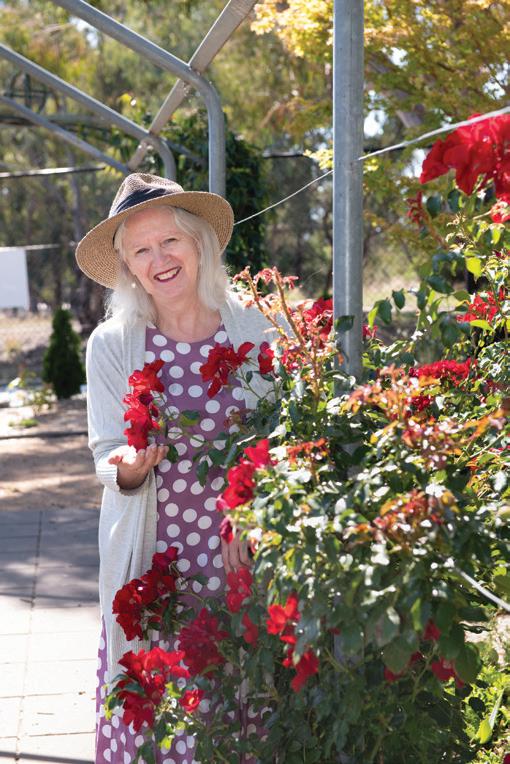
IT’S a group effort at the Horticultural Society of Canberra’s (HSOC) neatly laid out, beautiful demonstration garden in Bruce, where veggies thrive alongside exquisite dahlias, heritage fruit trees, natives and roses.
Members use the space to experiment with new varieties and gardening methods, as well as to show which plants grow well in this climate, says committee member Richard Buker.
One such experiment is a nectarineplum tree, which Richard says produces “rather underwhelming” fruit that’s very briefly ripe, though another member does make it into a lovely jam.
Developed and maintained by volunteers, the 0.3-hectare garden will be open on the weekend of March 27-28 as part of Open Gardens Canberra’s autumn program, with members of the Horticultural Society on hand to answer any questions. They’ll also run a plant sale.
The garden was started in 2010, when the clay-soil site was covered in long grass and weeds. Large quantities of soil and mulch were brought in to build up the beds, and hedging was planted around the perimeter.
As well as apple, pear and persimmon trees, and a variety of veggies, herbs and perennials such as asparagus, rhubarb and artichoke, there are three varieties of raspberries, with marionberry, loganberry, tayberry and thornless blackberry plants grown on the fences.
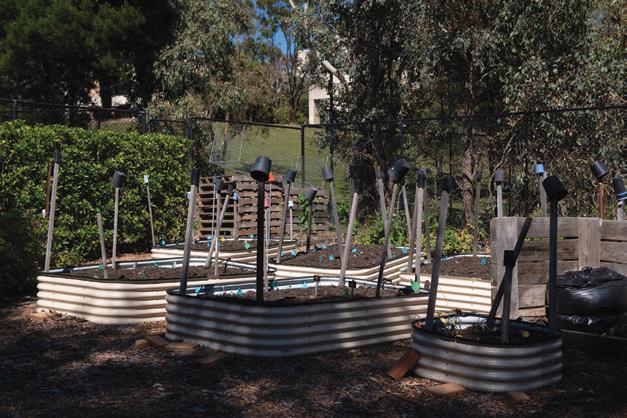

Words: Kathryn Vukovljak
Photos: Holly Treadaway
plants under gum trees, there’s a selection of native plants, including westringia, correas, adenanthos and callistemons.
Highlights include kangaroo paw, a clematis walk, dahlias (which, along with the salvias, will be in bloom on the open weekend) and daffodils, grown by the Daffodil Association.
Most of the garden waste is composted on site, with Richard using a hot composting method to create an efficient compost in a short period of time.
Committee member Heather MacGregor says that a group of members come along every Wednesday to do garden maintenance, and there’s a working bee once a month.
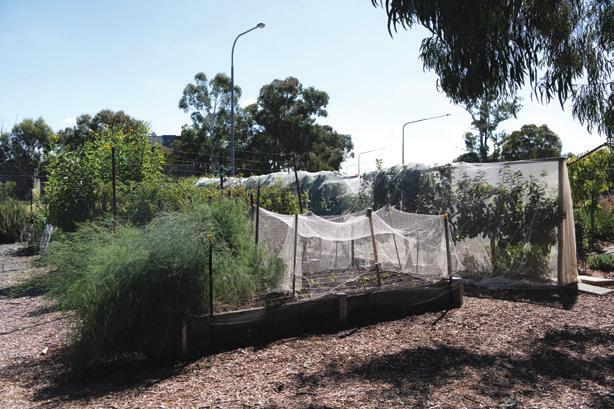
“I like the sense of community in coming to the garden, and the social side, we’ve got a good bunch of people,” Heather says.
“We’ll have morning tea and chat about anything.”
The Horticultural Society demonstration garden, on the corner of Purdie and Battye streets, Bruce, is open on Saturday, March 27 and Sunday, March 28, 10am-4pm. Entry is $10, children under 18 are free. Bookings essential on Eventbrite. There will be no ticket sales or memberships available at the gate. Join Open Gardens Canberra for $25 and all gardens are free for a year.

Proving that it’s possible to grow

Also open this weekend will be the Mitchell Community Garden, Nirta Place (off Hoskins Street), Mitchell.






We CANNOT press a button and get a strong core, swipe right and feel increased flexibility or simply flick a text and improve our cardiovascular system.
YOU have to work hard for fitness benefits – which is the reason we must find out WHY we want to exercise.
Exercise can make you look better, lose weight, strengthen your bones & lungs, lower your risk of chronic diseases like diabetes, obesity and cardiovascular disease.
Regular exercise helps prevent or manage health problems such as – stroke, metabolic syndrome, depression, cancer, arthritis... THE LIST GOES ON!
BUT, is this enough to tap into your deep down desire to be bound to your program?
Is it Purposeful enough? This is the art of ‘Whyercise’ – your purpose!
‘WHYERCISE’ tips:
1 Write down your exercise plan, monitor it, adapt it and stick it on your fridge.
2 Have an Exercise Physiologist look over your program and keep you accountable.
3 Set an achievable short-term goal.
4 Set a realistic, achievable, crazy, fun, long term goal.
5 Don’t take yourself too seriously. Chip away, week in, week out.

• What is your ‘Whyercise’?
• Do you want to be more active?
• Then contact one of our friendly Exercise Physiologist’s