‘Underdogs’ stand up for people left behind
ALISTAIR COE
shares a ‘fresh vision’ for Canberra. In profile with BELINDA STRAHORN
Can a ‘Belco Bill’ win upset the balance of power? BELINDA
Power is in the hands of the voters of Yerrabi

MICHAEL MOORE
Scornful Labor and Greens don’t care about poverty
JON STANHOPE
Why won’t this deaf government listen to residents?


PAUL COSTIGAN







Summernats naff off leaving Canberra the poorer
THE prostitutes of Canberra may be moaning for all the right reasons at the news that January’s Summernats has been cancelled, but there will doubtless be satisfied smiles around Watson and the inner north.
The long-suffering neighbours have (fairly) stoically endured more than two decades of summer noise and disruption from the annual performance-car festival that draws 100,000 visitors to Exhibition Park and, it claimed, $30 million to the local economy.
Pubs, clubs, restaurants, accommodation and the local sex industry will be the big losers, falling foul of ACT Health’s COVID-19 testing facility at EPIC.
The dog-in-a-manger directorate has testing booked until the end of November and can’t (won’t?) confirm if Summernats will be able to use the

“Combined with ACT Health’s recently released protocols that exclude outdoor multi-day festival events of more than 5000 people, a pathway to a January Summernats is impossible,” he says.
So it’s off until January, 2022, with the consolation of a reduced-capacity event called “Summernats Rev Rock ‘n’ Roll” in March.
It’s all an “unmanageable risk” to the event, says Summernats managing director Andy
AND in politics, the grinding election campaign took on a spark of life with the Leaders’ Debate at the National Press Club (on the same day as the dysfunctional American one).
Leaders Andrew Barr and Alistair Coe were decidedly stiff and civil during the hour-long broadcast on the ABC.
Full marks for the high standard of moderator Adam Shirley’s incisive and thoughtful questions. Wasted, of course, on the aspirants, who slipped easily into set pieces, despite Mr Shirley’s haplessly urging them back to the point of his enquiries.
The Labor leader glistened under the lights, which didn’t help with bolstering integrity as he struggled to explain away Labor’s failure in health, education and Aboriginal welfare. Despite affirming the promise of a million trees (in 10 years), the Liberal leader wobbled on climate change, despite some credible bluster.
I think a lot of viewers might have been surprised at Coe’s poise and growing confi -
TANYA NADIN, PARTNER
Tanya has extensive knowledge in all areas of family law and can provide you with prompt advice such as:
Property and Financial Settlements
Divorce & Separation
Parenting & Custody Disputes, Spousal Maintenance
De Facto Relationship Matters

Please phone us for an appointment


dence. He looked straight down the barrel of the camera and, against the expectations, seemed to take control of the argument in the second half of the debate.
Barr, a normally consummate media performer, looked nervous and a bit on the defensive.
It was obvious Coe was media coached within an inch of his life, but once he’d cast off the how-can-you-pay-for-promises question (how can either of them?), he hit his stride talking families and cost of living.
Inexplicably, I became transfixed by his eyebrows and lost a little concentration wondering if they’d been subject to modern grooming. I haven’t troubled his busy press office with an enquiry, but he did well.
THOSE young and aspiration people at Canberra Liberals’ HQ may be pleased to know a “CityNews” reader has found a way to relieve them of at least one of their unfunded promises – Grandparents Day.
The Libs announced GD with some gusto amid an action plan to protect older Canberrans from elder abuse blah blah and promised to “work with community organisations to launch new initiatives”.
Liberal spokeswoman for seniors Lawder said Canberra families and the community were greatly enriched by the contribution of grandparents and the day was “a small initiative to honour and celebrate their important role in people’s lives”.
Too true, Nicky, but clearly you haven’t been paying attention. According to my
inner-north snout, the ACT’s inaugural Grandparents Day was first held on Sunday, October 28, 2012!
The then Minister for Ageing, Joy Burch, said the idea for ACT Grandparents Day, which is held on the last Sunday in October in the ACT, nationally and internationally each year, stemmed from feedback provided following something called an Older Persons’ Assembly.
Excellence in Funeral Service

NEWS / education
Schools fail but no-one knows why, says educator
By Danielle NOHRA

DESPITE remarks from ACT Labor about Canberra’s “glowing” NAPLAN results, there is credible evidence showing that ACT schools are not doing as well as they should, says Dr Karen Macpherson.
The retired academic and mother says she’s been concerned for a long time about a systemic problem in ACT education, which she says won’t go away until it’s investigated by the government.
An investigation promised by ACT Labor in the lead up to the 2016 election, seemingly hasn’t gone anywhere.
The party had promised to establish a project to “more comprehensively investigate the effectiveness of alternative teaching methods, including teacher-led education, and to assess whether these approaches can improve ACT student outcomes”.
ACT Labor has not responded to a “CityNews” enquiry if the project ever came to fruition.
“I think, as a government, it’s much nicer to be able to say ‘look how wonderfully we’re doing’. It’s a lot harder to acknowledge that there’s a systemic
problem that needs fixing,” she says.
The chronic underperformance of ACT schools is not just an anomaly, says Karen, who points to five cred ible studies that all come to a similar conclusion.
These studies from the Australia Institute, the Grattan Institute, ANU, the ACT auditor-general and Victoria University, which was a study commis sioned by the ACT Education Directo rate, all found the same issues, she says.
“These studies are confirming that it’s not just a one-off bad year from the ACT, they all prove that there is a long standing systemic problem in terms of ACT performance, particularly in numeracy and the gap is getting wider in high school,” she says.
“If you compare the average perfor mance of the ACT, for example, with the average performance of the schools in NSW, it’s comparing apples to oranges.
“There are pockets of disadvantage in the ACT but compared to state or territory, it’s minimal. So to say that we’re doing really well in NAPLAN and compare us to all of NSW or all of Queensland, for example, with their areas of disadvantage, remote schools and the disadvantages that definitely arise from that, it’s not fair to compare our average.
“The only way to know how we’re really doing is to compare to other areas with a similar index of community socio-educational advantage.” they should.
“But why don’t we? That’s the big question,” she says.
“It is a concern to an educator like me and it should be a concern to parents that if the NAPLAN results for where we live in Canberra and the ACT are consistently lower than all
ing to be fixed until an investigation that shows what needs improving.
“Unless we have an inquiry or an investigation of the system and the possible causes for the underperformance, we’re not going to know so we’re left guessing,” she says.
She says ACT Labor continues to
downplay the importance of NAPLAN, with Education Minister Yvette Berry, in August, saying it places unfair stress on students.
“Children only find NAPLAN and other tests stressful if their teachers and their parents make them feel worried. If you don’t make such a big thing of the NAPLAN test, children are fine,” Karen says.
“NAPLAN is an important way, it’s the only way that we have, at this stage, of determining how the schools are going with meeting the teaching objective and learning objectives in numeracy and literacy.”
While Karen admits she doesn’t have any insight into the ACT government’s thinking, she can’t help but ask why they would want NAPLAN to be changed or be significantly de-
“I’m not damning the ACT government, I’m just saying they’ve known about this for a long time [and] the comparisons they’re using are not correct ones to show what our results
“The underperformance in primary schools is very clear in years three and five, by the time you get to high school, and the NAPLAN tests in years seven and nine, the gaps are wider.
“I think we owe a duty to our young people to give them the best education that a jurisdiction like ours can deliver.”


Power is in the hands of the voters of Yerrabi
GUNGAHLIN voters have the opportunity to make government in the ACT much more accountable.
With an election looking very close, the choice for government is between a tired and stale Labor Party and an inexperienced, very conservative opposition.
The last seat in the electorate of Yerrabi will be a three-way contest between the third Liberal and independent David Pollard. The most likely outcome across all five electorates is a 12-12 outcome in the 25-member Assembly with the last seat being decided in Yerrabi.
There is a wild card – campaigning ability. The Canberra Progressives’ skills are unknown whereas Labor turned around the last election in a couple of weeks.
Independent David Pollard is not an “up-through-the-party-machine” candidate who deserves to be elected. He is a small businessman who has a track record of community work. He is a local contributor, the “unofficial mayor of Crace”, treasurer of the Gungahlin Community Council, president of the local P&C.
David Pollard Independents have prepared appropriately with a strong local support base and a series of
The most likely outcome across all five electorates is a 12-12 outcome in the 25-member Assembly with the last seat being decided in Yerrabi.
sensible policies published on the website.
Labor and Liberal parties have enough general support to be able to win two seats in each of the electorates. This is why the fifth seat is seen as “the decider”.

The struggle for the fifth seat provides the opportunity for government, or alternatively, for crossbench members. An important difference from other elections is that personalities play a key role in an election under Hare-Clark, independent of party affiliation.
In the southern electorate of Brindabella , the fifth seat is likely to fall to the Liberals. There are three Liberal incumbents who have performed well in the Assembly and are not perceived to be as conservative as their colleagues. Mark Parton, Nicole Lawder and Andrew Wall have developed and maintained high profiles across Tuggeranong. Labor’s
base and a series of sensible policies.
Planning Minister Mick Gentleman has been under constant criticism for poor performance in his portfolio, while it has been difficult for Speaker Joy Burch to maintain a high profile in the area. With Labor on the nose, it is unlikely they will be able to draw a third Labor seat.
In the seat of Ginninderra former Liberal Minister Bill Stefaniak has provided voters with an alternative to Labor and Liberal with his cleverly named Belco Party and adopting Don Chipp’s slogan “keep the bastards honest”. History tells us he will support the Liberals for government. The only

sitting Liberal is the largely unknown and very conservative Elizabeth Kikkert. Labor stands to return two high-profile candidates Yvette Berry and Gordon Ramsay. Even with Labor on the nose, and considering previous voting patterns, Tara Cheyne is likely to be a third candidate elected.
In Kurrajong , the Chief Minister and Health Minister will be elected.
The high-profile and moderate Liberal Elizabeth Lee will do well and will probably bring another Liberal with her. Shane Rattenbury and the Greens will win the fifth seat and will support Labor for government.
Murrumbidgee has two strong Liberals in Jeremy Hanson and Giulia Jones. Amardeep Singh has recently built a strong profile in the Molonglo Valley and will be able to take advantage of personal support from his own ethnic community to win the third seat for the Liberals. Labor has Urban Services Minister Chris Steel, who has built a strong profile and the other Labor member likely to be re-elected is Bec Cody.
So far this means, with the support of Bill Stefaniak and the Belco Party, the Liberals are likely to have 10
seats. Similarly, with the support of Shane Rattenbury and the Greens, Labor is likely to win 10 seats across the same four electorates.
The Liberals can expect to do well in Yerrabi with the high profile of Alistair Coe as Leader of the Opposition and another Liberal likely to be elected is sitting MLA James Milligan. Labor no longer has the advantage of the profile of the well-liked and competent Meegan Fitzharris. None of the current three Labor MLAs have such a profile and Labor is likely to be cut back to two members elected. The fifth seat is wide open.
Power is in the hands of the voters in Yerrabi, who just might elect David Pollard as a kingmaker.
Michael Moore is a former member of the ACT Legislative Assembly and an independent minister for health. He has been a political columnist with “CityNews” since 2006.










Poverty: scornful Labor and Greens don’t care
THERE has been such an avalanche of election announcements in recent weeks I have found it hard to remain focused and have reached the point where I no longer bother to read them.
I have the sense that both sides of politics resolved to simply match or seek to out-do the other on anything the other promises.
That is with the notable exception, dare I say it, of poverty.
The Liberal Party has, as you may be aware, resolved should it win the election, to commission an inquiry into poverty. Both the ALP and the Greens have poured scorn on the idea and dismissed it as unnecessary and presumably a waste of time and money.
In the interests of transparency, I advise that I have been invited by the Opposition leader Alistair Coe to chair the inquiry should it eventuate. An invitation I was happy to accept.
I cannot understand the attitude of the ALP and the Greens. My confusion is, I know, shared by others in the community. I note for example the strong support expressed by ACTCOSS CEO Dr Emma Campbell for the inquiry and the CEO of Winnunga Nimmityjah, Ms Julie Tongs, had this to say: “My understanding is that somewhere in

The breathless re-election housing policies announced by ACT Labor and the Greens will do no more than return the level of public housing in Canberra to that which existed in 2010.
the order of 35 per cent of Aboriginal children in Canberra live in poverty.
This is an issue about which I care deeply.
“I have, accordingly, over the last four years written to the Chief Minister as well as calling publicly for an inquiry into poverty. My calls were rejected by the Chief Minister but the Liberal Party has said it will establish such an inquiry.
“The Labor Party and the Greens have, unfortunately, maintained their opposition to such an inquiry.
“I can’t help wondering if any of them have ever bothered to meet an Aboriginal family or child living in poverty and cared enough to try and understand what it potentially means for the path which that Aboriginal family or child’s life will almost inevitably take if we, as a society, especially our politicians, don’t do everything possible to understand and address poverty.”
While on the issue of poverty and how tough life in Canberra is for battlers and low-income households, I was shocked by the revelation in the election statement issued by the St Vincent de Paul Society, of the extent of the cuts which the current Labor/ Greens government has made to social housing in Canberra.
St Vinney’s summarised its concerns as follows: “A caring
society is one that ensures that every individual or family is adequately housed. “However, in the ACT many people have no choice but to wait up to three-and-a-half years for public housing. Too many people spend years living in poor-quality, insecure or unhealthy conditions.
“Building more social housing would enable more people to the right support when they need it. The ACT has one of the lowest expenditures on social housing nationally, according to the Productivity Commission Re port on Government Services (ROGS) 2020. There has been a net decline in social housing numbers since 2010. ROGS 2020 reports that in June 2019 there were 10,529 households in social housing in comparison to 2010 when there were 10,737.”
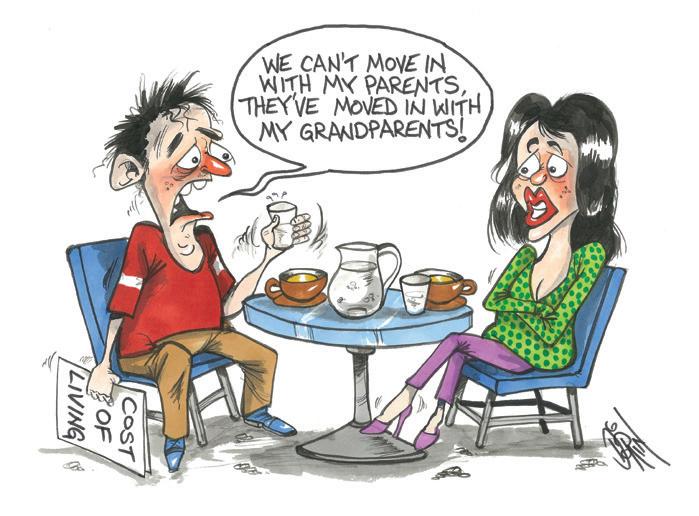
In other words, the St Vincent’s analysis reveals that, in the last decade, Labor and the Greens have reduced the number of households in public housing in Canberra by a total of 208 in a period when there has been an increase of 65,000 in the Canberra population.
To be blunt, the breathless reelection housing policies announced by ACT Labor and the Greens will do no more than return the level of public housing in Canberra to that which existed in 2010. It is also sobering to reflect that a Canberra family that registers with Housing ACT today will, in all likelihood, still be waiting to be allocated a house when the next election comes round in 2024.
One final reflection on the current
Making elections
What is Vote Easy? – Vote Easy is a completely voluntary and independent platform, encouraging communities (voters and candidates) to come together without influence to elect strong local leaders.
Once nominations close, Vote Easy allows registered candidates a non-bias platform (Australian owned) and a central location where candidates and voters can easily find each other We want you to find the candidate who will represent you. You, as the voter, will select a politician who will speak on your behalf and make decisions that represent you, your community and Australia. Selecting good strong community leaders will deliver governments that better reflect the communities in which we live.
campaign. I have noticed on a number of occasions journalists and others asking, almost invariably in relation to a newly released Liberal Party policy, “ Where’s the money coming from?”
The answer is, of course, from the same place that the money to fund Labor and Greens promises will come from. That is to say, if not from increasing taxes or cutting services then from borrowings. On that point the largest borrowing anticipated by the competing parties in this election is the Labor/Greens commitment to Stage 2 of the tram.
Labor and the Greens have revised up the cost of construction of Stage 2 of the tram to $1.9 billion. I think we all know in our hearts that it will be more than that, but let’s be generous.
So where is the money for this coming from? It will, of course, come from borrowings which it appears have
not, apart from the sum of $365.498 million, been included in the Budget update released by the Chief Minister and Treasurer, Andrew Barr, a couple of weeks ago.
In light of this, I would have thought it behoves the Chief Minister to explain why the reported debt of $7.7 billion does not include the potential increase of $1.535 billion in debt, which the construction of the tram will necessitate. What, I wonder, was the basis of the decision to report our debt as only growing to $7.7 billion when just this single, long-standing commitment will take it to $9.235 billion.
Jon Stanhope was chief minister from 2001 to 2011 and represented Ginninderra for the Labor Party from 1998. He is the only chief minister to have governed with a majority in the Assembly.



Working for the best possible solution
At Neilan Stramandinoli Family Law, we pride ourselves in our proven track record, our commitment to excellence, and expert knowledge of family law. We understand how difficult and emotional family law matters can be, we are compassionate and empathetic, guiding you towards the best possible solution for you.
For separating couples:
• Parenting arrangements
• Dividing property and superannuation
• Family violence matters
New or existing relationships:
• Best arrangements for your children
• Protecting assets and yourself
• Preserving entitlements

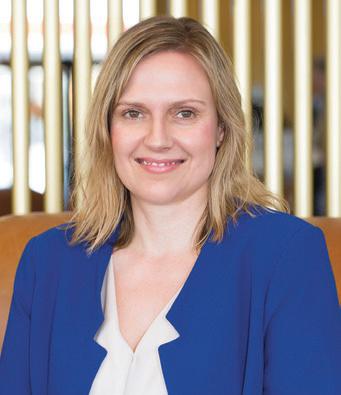


Lucy Stramandinoli Family Lawyer
Anna Neilan Family Lawyer
West Basin spin confuses public consultation
The ACT government has commenced the works of infilling 2.8 hectares of West Basin lakebed, a component of the iconic Lake Burley Griffin that provides beauty and recreation pleasure to Canberra’s visitors and citizens.
The silt curtains now in place show the extent of the infill intrusion.
The infill area necessary for future land privatisation is the green area spotted with trees on the ACT plan, noteworthy for no information on any future apartment estate.
During a global pandemic, Canberrans were given a three-week opportunity to comment on the foreshore works approval after contracts for the development had already been signed.
Although the ACT government stated it will release blocks of land to the market in the mid 2020s, no future vision for West Basin has been made public but the development is expected to approximately follow the ACT government’s plan produced in 2015.
The fragmentation of the project and consultation deliberately obscures what needs to be understood and misleads the community. Seventy-five per cent of submissions to the works were objections and, significantly, many considered that the project should not be split but be assessed in its entirety. The process has been arrogantly disrespectful of the community.


for no information on any future apartment estate. However, the 2015 (inset) plan exposes the real plan.
the war and related atrocities that have been perpetrated overseas by the Australian military from the time of the Boer War to Afghanistan (“To Matt, it’s about making room to tell the stories”, CN September 23).
Regardless of the infill the apartment estate can still be stopped.
Juliet Ramsay, Lake Burley Griffin Guardians
Room for war crimes?
PRESUMABLY there will be a large niche somewhere in the massive rebuild of the War Memorial that is dedicated to exposing and analysing our war-crime stories, given
Confronting our complicity in UK and US war violations should also be more easily examined in the additional space the memorial believes is necessary to make it “more relevant”.
Sue Dyer, Downer
Beware rash promises
BEWARE of all the rubbish rash promises being spun in the run up to the ACT election and don’t believe you might gain from a
voluntary act of yours in the polling booth. After all, remember “Timeo Danaos et dona ferentes”, a Latin phrase from Aeneid (II, 49), written by Virgil between 29 and 19 BC. It has been paraphrased in English as the proverb: “Beware of Greeks bearing gifts”. Its literal meaning is “I fear the Danaans [Greeks], even those bearing gifts” or “even when they bear gifts”.
Careful you don’t end up with a government you will hate.
John Lawrence, Flynn
Fast, but heading south
IN response to Cllive Williams’ column on improving the speed of the Canberra-Sydney
rail service (“Hold the tram and fix the train to Sydney first”, CN, September 24), Canberra will only get fast-rail if it serves points south, such as Cooma, Eden and/or Lakes Entrance.
In this story access is by Queanbeyan Station, perhaps a footbridge to Oaks Estate, which is pretty well central to us now.
Xplorer would continue no doubt as a stopping-all-stations to Sydney.
Stuart J McIntosh, Isabella Plains
I’m with Clive...
I FULLY concur with Clive Williams concerning the decline in train travel (“Hold the tram and fix the train to Sydney first”, CN, September 24), which is hastened by Canberrans’ obsession with the private car.
In the 1980s, having attended a conference in Melbourne, return by air was prevented by an airline strike. I went to the magnificent Flinders Street Station and took a first-class ticket for a through train to Canberra. Leaving at about 7pm, I enjoyed an excellent meal, then adjourned to a private compartment with a shower and a comfortable bed.
I woke at 7am the next day, having slept through the recoupling at Goulburn, and alighted 30 minutes later in Canberra.
In early maps of Canberra, a railway line crossed the Molonglo and had a platform in Civic. The bridge over the river collapsed in a storm and the depression years forbade reconstruction. In the 1960s there was still a goods platform in what was then Reid Car Park. Another trace is the avenue beside Amaroo Street.
Travel to major towns is generally made convenient by arrival in their centre, as with Sydney’s magnificent Grand Central Concourse.
As Clive Williams points out, Australia’s railways are left behind those of most developing countries; we need to overcome what is an immature prejudice.
Jack Palmer, Watson
‘Arrogant selfishness’
IF he loses, as many, many people hope for, will Andrew Barr be required to pay all the costs for the inevitable countback to determine who will replace him? (“If we win, I’m in; if we lose, I won’t hang around” CN, October 1) .
If not, why not… after all, his statement is pure arrogant selfishness and just shows what contempt he has for the citizens and ratepayers of the ACT.
Perhaps the electoral commissioner might, or should, have some views on the fitness of a candidate to stand in this election when they exhibit such contempt for the system of government they are supposed to be leading.
Bob Howie, via email
To muddy the waters...
PAUL Fitzwarryne (Letters, CN, September 24) strenuously claims that Canberra, despite the ACT government’s position, was not in Ngunnawal country, but rather in Ngambri country, and quotes certain research to support his claim.
Just to muddy the waters a bit more, I can recall several years ago reading a 1943 survey by Dr Keith Hancock which concluded that three major Aboriginal groups inhabited what is now the ACT.
They were the Ngunnawal to the north, the Ngambiri to the west and the Ngarigo to the south.
According to his survey, if I remember correctly, all three groups regularly came together to exchange goods, perform rituals and chase game in the rich country surrounding the confluence of the various rivers and creeks that now flow through Canberra’s city and suburbs.
Bill Bowron, Wanniassa


If you want to vote more, then put the Minor Parties first. It is important to put minor parties first to get the

The ACT government’s West Basin infill plan, as of April, 2020… noteworthy
OATRAM FINANCE are the Transport and Earthmoving Finance Specialists
Regardless if the goods are new or used, from a private sale or a dealer, we have the Working Finance for your Working Equipment.
We pride ourselves on complete finance solutions to keep your business running. We have access to some of the best finance rates due to our volumes. We are located in Queanbeyan on Crawford Street and we service the ACT and NSW.
Call us today on: 02 6297 8588




CANBERRA MATTERS / social housing
Why won’t deaf government listen to residents?
CANBERRA’S community groups are increasingly having to argue for a rethink on the placement of social housing within their suburban areas.
The focus has been Yvette Berry’s plans whereby previously designated community sites are being used as sites for housing complexes.
This government rarely responds to the issues raised by residents – except to ignore or deflect them and to pretend that people have been consulted – as opposed to being told what is to happen and that it is not negotiable (think Common Ground Dickson).
An important point needs to be emphasised. What the residents have been advocating for about social housing is usually misrepresented by this government and its supporters.
Residents are not arguing against social housing in their suburbs. They are seeking a rethink of the siting of these residences so that the new residents are more likely to be accepted and integrated into the community.

Instead the ACT’s
This government rarely responds to the issues raised by residents – except to ignore or deflect them and to pretend that people have been consulted – as opposed to being told what is to happen and that it is not negotiable.
Labor/Greens coalition government has developed mischievous communications processes using alternative facts to justify its actions.
While the government talks about how it is committed to social housing and has delivered little in recent years, it has become very slick at using dog-whistling techniques to portray the residents as being against social housing.
This has caused a lot of anxiety among residents as they fight for their local amenities and the future of available community spaces – many often in a state of disrepair and badly maintained.
Residents resent their advocacy being misrepresented by politicians. There are also some in the media who place importance on their relationships with pollies and their bureaucrats over accurately representing the voice of residents.
The present government’s efforts in social housing have been both

inadequate and inappropriate. The history of social housing has shown that building stand-alone tower blocks or clusters of social housing works against the notion that those in social housing should be able to easily fit in with local communities.
This proves to be very difficult if the housing is a tower block (think Common Ground in Gungahlin and Dickson) or a large complex of town houses situated on previously designated community sites. These complexes remain separated from the surrounding residents. It is as if they had a large sign pointing towards them saying “this is public housing”.
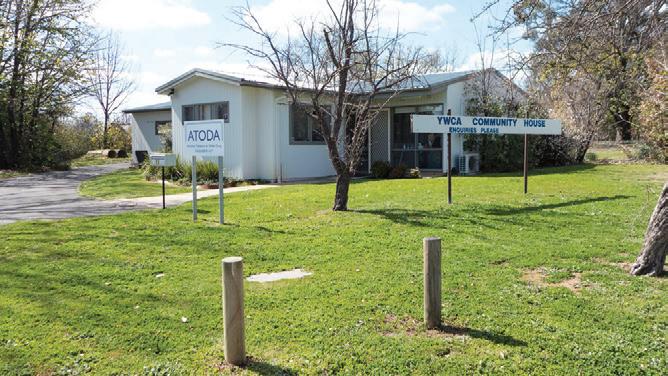
A major part of the problem is that the current ACT government has been desperate to get on with social housing, having messed it up for over a decade. Yvette Berry’s social housing department works in a silo with a lack of intelligence and transparency – with little consideration of other suburban planning issues. This is what residents object to.
The lack of master planning and that such decisions should fit within such forward planning – not be
The consequences of these bad decisions result in collateral damage to the suburban amenities. These losses are shared with the new social housing residents – as they, too, are denied the use of community facilities and open spaces as this has been built on for housing.
The issues that residents are looking to be addressed are not the actual placement of social housing in their suburbs but how sites are being chosen by Yvette Berry and her mob with no regard for those who already live there – who in some cases are long-term social housing tenants.
The latest practice of plonking social housing on to community sites and then raging against residents on
The 2020 ACT election has brought all manner of commitments to social housing by those who wish to be elected. What is not heard is the pledge to change the processes by which sites are selected and how master planning should be the key to allow social housing to be thoughtfully integrated into all areas of the city – without taking away green spaces and the opportunities for community facilities.
Paul Costigan is an independent commentator and consultant on the visual arts, photography, urban design, environmental issues and everyday matters.


Time to care for the people caring for others
CARERS make a considerable contribution to society, a contribution which is often unseen, particularly during pandemic times, says Carers ACT chief executive officer Lisa Kelly.
“While being a carer is often difficult, this year’s been even more isolating and stressful for those who might be looking after vulnerable people with ill health or disability,” says Lisa.
Which is why National Carers Week, running from October 11-17, is an important time to recognise and celebrate the outstanding contribution Australia’s 2.65 million unpaid carers make to the country.
Anyone at any time can become a carer, and often it comes on so gradually that the carer might not even realise that the situation has shifted from being “neighbourly” or “a good daughter”, or just doing what families do to help each other – the boundary isn’t always clear, says Lisa.
“Perhaps one year Dad can’t mow the lawn, then next year he needs help in the home, then he starts to need more and more, putting increasing demands on your time,” she says.
“We want to encourage people who might not see themselves as a carer to reach out for support and make sure they’re taking care of themselves, too.
“It can be incredibly draining to juggle caring, work, family, home and your own needs – often leading to financial hardship, social isolation, health and wellbeing issues, exhaustion and extreme stress.”
During National Carers Week, Carers ACT is asking for the community’s support to help make a carer’s life a little easier, even in seemingly small ways.
“Even asking how the carer is doing can make a huge difference – it’s not only about the person they’re caring for,” Lisa says.
If someone knows a carer, Lisa suggests they be a friend and ask what they can do to lend a hand.
“Check in on that person you know who’s looking after a neighbour, family member or friend living with long-term illness, mental illness, a chronic condition, an alcohol or other drug issue or who are frail or live with disability,” she says.
“Maybe pop in for a coffee – they often need the company. Perhaps make them a meal, help out with their gardening or home maintenance, drive them to a medical appointment, and generally appreciate what they do.
“That little bit of support can make a huge difference.”
• Have a chat over the fence
• Offer to prepare a meal
• Ask if they need something from the shops
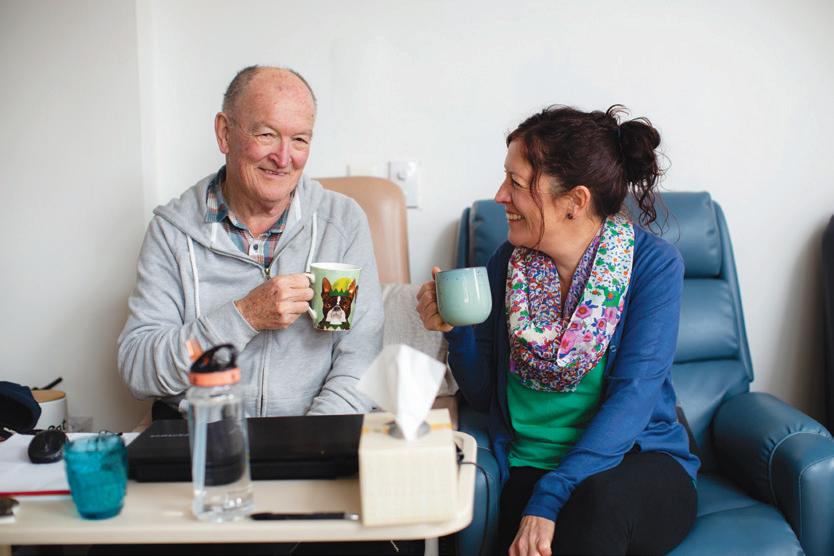
reach out for support, Lisa says.
“Caring can be rewarding but it can also be stressful, exhausting and lonely, and often people don’t realise the impact it has,” she says.
Also let them know that Carers ACT is funded to provide
services to unpaid family & friend carers in the
We are the Carer Gateway service delivery partner for
. For more information visit www.carersact.org.au or call

practical support for carers living in the ACT
– from organising respite or educational workshops, to offering advice on the NDIS or My Aged Care, and connecting carers with other carers through support groups
or social activities.
“Carers ACT wants us all to help the family and friend carers in our community.
“Chances are that at some point in your life, you’ll either need care or give care
For extra support, carers can access the Carer Gateway. Carers ACT is the local service delivery partner and together they offer a range of practical supports.
“The Carer Gateway [service] provides information and advice on the support available to carers across Australia, and has a great range of online resources to help promote carer wellbeing,” Lisa says.
“In accessing the Carer Gateway [service], we go through a process, talking through their needs and what’s impacting them the most, and then devise an action plan to rebalance the carer’s load.
“It might be accessing respite, peer support or education to help with caring like correct lifting, for example.
“Often carers don’t reach out for support for themselves, and many aren’t even aware that they can, or that there is so much
Carers ACT, call 6296 9900, email carers@ carersact.org.au or visit carersact.org.au. Carer Gateway, call 1800 422737 or visit carergateway.gov.au


I Care for my mother

It’s time to make a clean break from a “tired and old” Labor-led government, rife with Budget deficits and infrastructure backlogs, the Liberal leader tells political reporter BELINDA STRAHORN

primary vote has fallen to 37.6 per cent, down from 38.4 per cent in 2016, while the Liberals have increased 1.5 per cent from the last election to 38.2 per cent.
While Labor’s campaign battleground is being fought over education, health and jobs, the Liberals’ campaign is focused on bread-and-butter issues such as rates, local services and trees.
From the “thousands of conversations” the leader and his team has conducted over the past four years, Coe’s sure that Labor’s hip-pocket-hurting policies are not what Canberrans want.
“The ACT government is very good at spending money and making flashy announcements, but not so good at actually managing and maintaining it,” Coe said.
We will stand up for the Canberrans that have been left behind, for the Canberrans that have been disrespected, for the Canberrans that are waiting for elective surgery, for the Canberrans that cannot afford to live in this city. These are the people for which we will make no compromise.”
important part of their strategy to make a more affordable city, not only to attract more people to Canberra but prevent an exodus across the border.
While Coe’s indicated there won’t be an increase in rates, he’s remained silent on the subject of whether services will be impacted or cut as a result of the foregone rate revenue.
While Coe’s rate-freeze policy has gained the most attention in the lead up to the election, it’s perhaps his perceived youth and inexperience that has been used by his political opponents against him.
Coe is quick to shrug off the inexperienced tag, labelling his Labor opponents as out of touch, disrespectful and tired.
“It’s an old and tired government.
supporting it.
“The next stage of light rail, stage two, will be from the City to Woden,” Coe said.
“We have committed to doing an independent assessment of the business case and to publish all the relevant documents so that Canberrans who are paying for it can scrutinise the project and understand what it is they are paying for.
“To date, the government has a preferred tenderer and the business case hasn’t been released, so given the government has said it is going to cost $1.9 billion it’s unfathomable that you wouldn’t go to the market to seek the best possible deal and that you wouldn’t open up the decisions that you are making to peer review.”
“These are the practical things that motivate Canberrans and motivate me. It’s really about making sure that Canberrans are getting the premium services they are paying for.”
Unlike Barr whose political awakening and role models were easily identifiable, Coe draws his inspiration from everyday people. While Barr identified Keating as a political hero, Coe hasn’t drawn from the Liberal parthenon of greats, instead real people with real issues.
“Soon after being elected in 2008 I got a telephone call from Bill from Macquarie, he said there’s a problem with the footpath and you should come and check it out,” he said.
“So I went to meet Bill and looked at the footpath and he gave me some tips
discussions with crossbench or independent members who may be willing to help form a new government in the event he falls short of the magic number.
While an overly cautious Coe largely stayed on message, he did allow himself a moment of personal reflection when mentioning his kids, and the impact they had on the way he now sees the world and the job he aspires to do.
“What is the world that I want Angus and Annabel to live in in 10 years’ time, what’s the school system that will be best for Angus and Annabel, what are the prospects of Angus and Annabel being able to buy a house in 20 years’ time?” he said.
“I think of things in a different prism since having kids.”
Liberal leader Alistair Coe… “I think of things in a different prism since having kids.”
Photo: Holly Treadaway

‘We need research, more funding and a new hospital… I will not stand by and
Failing health system drives Helen’s return to politics
FORMER Canberra Liberals’ shadow minister and independent Helen Cross has thrown her hat in the ring for the upcoming ACT Election as an independent for the seat of Yerrabi.
“I might be the underdog but I know how to run a good campaign,” says Helen, who lives in Gungahlin with her husband David.
It’s a “no frills” campaign for Helen, who has run high-profile and costly campaigns in the past, but this time, health is a number one issue for her, and she says she wants to see a new hospital built in Canberra’s north.
Through dealing with her own health problems and recent hospitalisation, Helen says she’s spoken to people who are suffering in the ACT health system.
“We need research, more funding and a new hospital. I will not stand by and watch people suffer when I can do something to help,” she says.
If elected, Helen pledges to push for a hospital that will accommodate a 300-bed wing, with a world-class research wing, funded by private enterprise and the government.
As a former Liberal shadow minister, representing Molonglo in 2001, before resigning and remaining in the ACT Legislative Assembly as an independent in 2002, Helen says she was successful during her one term in the assembly.
Over those years she says she passed four landmark bills under her name, including an amendment to the “Discrimination Amandement Bill 2002”, which protected women during job interviews from being asked about things such as loans or if they
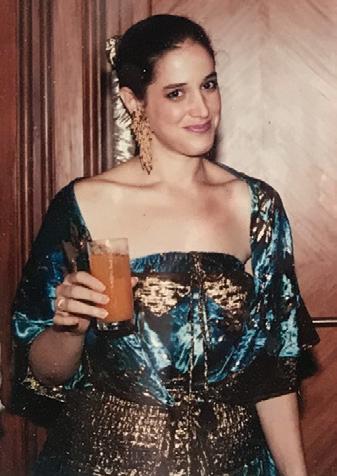
Helen says she banned smoking in enclosed public places in 2003, she instigated a bill on asbestos in 2004 and, in the same year, introduced a bill protecting pharmacies from being taken over by supermarkets.
Also in that year, after unsuccessfully defending her seat in the 2004 election, Helen visited Aceh, Indonesia, to facilitate the building of an orphanage for the misplaced and orphaned children following the Boxing Day tsunami.
“I had lived in Indonesia for three years with David, who is a retired brigadier general, when he was Australia’s defence and army attaché with the Australian Embassy in Jakarta,” she says.
“My time there, equipped me to negotiate with senior Indonesian officials who were working with Youth Off The Streets (YOTS).
“The Prime Minister at the time, John Howard, was visiting Indonesia and I managed to get a photo op with him and the YOTS volunteers. This helped facilitate the accreditation process YOTS needed in order to have the orphanage built with the money raised in Australia.
“There is nothing more gratifying than helping children in any capacity.”
Fundraising has always been Helen’s wheelhouse – she was Miss NSW Charity Queen 1983, having raised the most amount of money for children with cerebral palsy in NSW for the then Spastic Centre of NSW, and runner-up Miss Australia Charity Queen having raised the second highest amount of fundraising in Australia.
“I used to go out to the Spastic Centre every week while I was an entrant, playing the piano and singing to the children. I loved it. I never thought I’d end up in a wheelchair myself,” says Helen, who was in an accident six years ago at a health retreat in the Philippines, which left her partially disabled and in a wheelchair.
“I had to stay there for six months as I was too injured to be transported back to Australia on a plane,” she says.
Helen also looks after her husband of 30 years, who has Alzheimer’s.
“I couldn’t run this campaign without his support,” she says.
“We’ve had to do it tough, and I’m grateful to the community nurses who have looked after us for the past three years. I struggle with all the medication I take and the weight gain they have caused, but there are many more people worse off than me and it doesn’t impact my ability to run as an Independent.”
Overall, when it comes to voting, Helen says: “Don’t put a tick, don’t put a cross, just put a ‘1’ in the box for Helen Cross.”
HELEN CROSS

Helen Cross... “The local MLAs don’t give a bugger about the state and I plan to do something about it.”
‘In a wheelchair and a husband with Alzheimer’s means I can advocate for the sick and disabled.’ and watch people suffer when I can do something to help.’
AFTER seeing people suffering in the ACT healthcare system, Gungahlin’s Helen Cross made the decision to run as an independent candidate for Yerrabi in the ACT Election.
In this Q&A Helen Cross discusses her reasons for standing and why the ACT needs an independent voice such as hers.
Q: What is your main political issue for this election?
A: Health and improving our hospitals. The nurses at Calvary Hospital inspired me to run in this election and they asked me to do it for them.
My initial focus will be on paramedics. We have the best paramedics here in Canberra but there aren’t enough ambulances. They try to get from one job to the next and it’s not their fault if they’re running from one end of town to the other because they’re one ambulance down. We need one more of these vehicles so that there is one in the north.
We also need at least one extra bariatric ambulance with four staff.
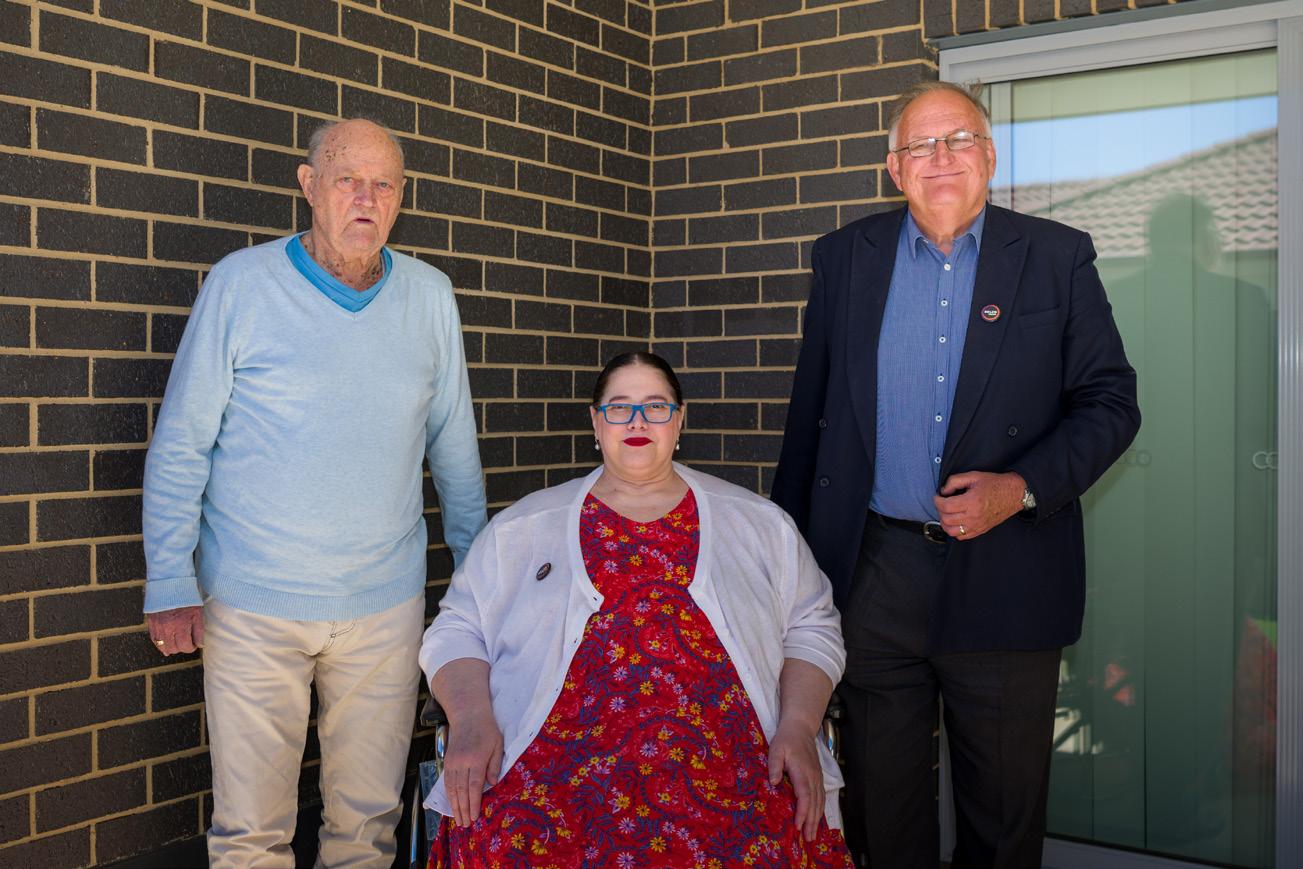

I recently spent two months in Calvary Hospital and spoke to patients, their families and friends, nurses, doctors, paramedics and wardsmen, and saw first-hand the state of hospital equipment and the shortage of beds, which forces senior staff to push patients out too soon.
I was one of many patients who had to share one of two bariatric shower/toilet chairs between six floors. This is appalling and just the tip of the iceberg.
What other challenges do you experience in the health arena?
The NDIS is a mess. It was put together too quickly and should be dismantled and started again with qualified staff assessing claims for
with disabilities?
Being in a wheelchair with several health complications and supporting my husband with Alzheimer’s means I understand and can advocate for the sick and disabled. Planning is crucial and I want to do it better than this current government.
The new hospital will require clever planning [and] needs to be northside. [My] vision is for it to be a city within a city, [something] that doesn’t look like a hospital. [It should be] a place which doesn’t make people sick with fear as soon as they get there, [and should have] beautiful gardens that patients can visit.
Clearly the local MLAs and federal members
they’re not wheelchair friendly, with too many steps and difficulties in accessing homes.
It is not a right, it’s a responsibility for those in political positions and bureaucrats to ensure all citizens have a right of way wherever they go.
We need to have a law that starts from now, [and it] should be that every residential and commercial development must be wheelchair friendly. We must be able to get a wheelchair to a front door. Not one house has a wheelchair accessible path.
It’s a basic urban service, a basic right that we pay high taxes for. It’s about time that people realised that there are a lot of people in wheelchairs in Canberra.
well done – I was highly impressed by the work she did there.
It’s really important to have good independents in the assembly. It works best when there’s a minority government with a good mix of sensible independents, and Helen is a sensible independent.
Despite the fact that Helen’s had some rotten luck in recent years, she’s got a great story to tell, and she would bring a unique and different perspective to the assembly, were she to get in.”
David and Helen Cross… “I couldn’t run this campaign without his support,” says Helen.
Bill Stefaniak.
of our hospitals [but] I do, Photo: Hilary Wardhaugh
Authorised by Helen Cross, an independent candidate for Yerrabi
ELECTION 2020 / development Major parties show different sides to development
By Danielle NOHRA
DEVELOPMENT is often an important and often controversial issue in the ACT.
In the past year Planning Minister Mick Gentleman has used call-in powers to override community consultation for Section 72 in Dickson and fast-track the approval for Common Ground; the Acton Waterfront development, formerly known as West Basin, was approved even though it had strong opposition during consultation (more than 140 of 187 submissions lodged opposed the project) and two years ago the ACT government approved a controversial application to build public housing on bushfireprone land in Chapman.
ACT Labor argues a 70/30 plan, when it comes to development, is key – that’s 70 per cent urban infill and 30 per cent green-space fill.
The Canberra Liberals say they’ll release more land for standalone housing and townhouses, suggesting it’ll help reduce the cost of living pressures and “help more Canberrans get ahead”.
But where will these developments go?
With the election looming, “CityNews” asks the two main parties their development plans for the territory.
ACT Labor planning and land management spokesperson for Mick Gentleman highlights the benefits of the party’s “70/30” approach:
“ACT Labor wants to continue building on our vision of Canberra as a vibrant, inclusive and sustainable city that is prepared for climate change.
“Managing the outward spread of our urban footprint limits our impact on the environment and better connects people to their jobs and each other.
“It’s vital that we support growth and development in and around key centres and along major transport routes. This allows our suburbs to keep their low-rise character and prevents urban sprawl.
“We reduced the planned footprint of new suburbs in Gungahlin to protect native woodlands, grasslands and habitats and created new reserves for Canberrans to enjoy, including the Goorooyarroo Nature Reserve. For example, Throsby was reduced to a quarter of the previously planned size with 1000 dwellings, down from 4000, to protect important box gum woodland.
“In the past two years over 70 per cent of all new housing has been delivered within Canberra’s existing urban footprint in line with the ACT Planning Strategy.
The Canberra Liberals want to scrap this approach, which would balloon our urban footprint by over 46 per cent, creating dire ecological impacts, longer commutes, more expensive infrastructure and less equitable access to services.
The Canberra Liberals say they’ll release more land for standalone housing and townhouses “to reduce the cost-of-living pressures and help more Canberrans get ahead”, however, they didn’t say how that will look.
A Canberra Liberals’ spokeswoman slammed Labor’s “70/30” approach, saying: “In a response to a question on notice, the Barr government confirmed that 90 per cent of its land release in 2017-18 was for compact and multi-unit dwellings and only 10 per cent for detached, single dwellings.
“In the following year, only 28 per cent of land released was for single dwellings, while 72 per cent was for compact and multi-unit dwellings.
“This is despite a recent audit report showing almost 70 per cent of potential purchasers require larger homes, and a previous government issued survey showing 84 per cent of Canberrans saying their preference is for standalone housing.”
While it doesn’t say too much about what the Liberals will do, Canberra Liberals’ leader Alistair Coe told “CityNews” last year that “the ACT’s got no shortage
So much more than an Electrician!
ELECTRICAL – AIR CONDITIONING – PLUMBING
Safety First: We never compromise on safety.
Up Front Affordable Pricing: Tailored solutions to your needs
Professional: Clean, tidy, respectful technicians.
Excellence Guarantee: Polite & friendly customer service.
Reliable: On time, all the time.
Qualified: Qualified & experienced.
We call ourselves electricians, but we are so much more, handling a wide variety of jobs, tasks each and every day!


of land”. As part of a Canberra Liberals’ solution, he said there needs to be consistent and responsible releases of land at a faster rate.
The western edge of Fyshwick and east of the Jerrabomberra Wetlands Nature Reserve, on Dairy Road
“The ACT government is currently seeking public feedback on a proposed draft variation to the territory plan that would allow up to 1300 homes at Dairy Road. The proposal provides a range of housing choices while being close to existing infrastructure and facilities.
“The Western Edge is not on the Indicative Land Release Program. The Planning Directorate is undertaking investigations into the Western Edge to assess the sustainability of the area for future development.”
The Canberra Liberals did not comment on whether or not they have plans to build houses on Dairy Road.
Acton Waterfront, formerly known as West Basin
“The Acton Waterfront Project will create high-quality, accessible lakeside public spaces that will encourage more people to enjoy Lake Burley Griffin.
“According to the City Renewal Authority, the next stage of work for the Acton Waterfront Project will include building more boardwalk, a new section of lake wall, lake reclamation, planted new trees and improving the cycle path, in preparation for the following stage, which will see recreational areas, public facilities and mixed-use buildings – ie commercial and residential buildings – built.
“The Canberra Liberals will not support Labor’s West Basin apartment precinct money grab. Labor’s skewed vision for a multi-unit utopia does not reflect the character of the ‘bush capital’.
“Only the Canberra Liberals will protect the bush capital by planting and caring for one million trees and ensure well maintained green space within a 10-minute walk from every household.
Kowen
Forest and Tuggeranong’s grasslands, west of Murrumbidgee
“Labor leader Andrew Barr has spoken in the ACT Legislative Assembly about protecting Tuggeranong’s natural grasslands, west of the Murrumbidgee, and Kowen Forest, from housing development, saying: ‘The pledge that I can give... is that a Labor government will not allow environmentally sensitive and community-use land – particularly the native grasslands in Tuggeranong, west of the Murrumbidgee, but also the Kowen Forest – to be bulldozed for urban development’.”
ACT Labor says it’s committed to putting the natural landscape ahead of urban sprawl, accusing the Canberra Liberals as being a threat to forests, grasslands and other wilderness areas, where Canberrans enjoy walking.
In an address at a Canberra Liberals’ lunch at the National Press Club in October last year, leader Alistair Coe said they wouldn’t dismiss releasing land in Kowen Forest for houses. At the time, he also said they would not rule out west Tuggeranong, west of Molonglo and west of Weston Creek.
More recently, a Canberra Liberals’ spokeswoman accused the ACT Labor/Greens government of bulldozing Kowen Forest on a rolling basis, saying: “It’s a commercial pine plantation that supports the timber industry.” To back her claims, she refers to ACT government contract No. 2017.27531.210, which mentions crusher rolling, a process that involves physically breaking down logging residue and/or regrowth in order to improve access for subsequent site preparation operations and planting.
Wait... isn’t Ginninderry ‘environmentally sensitive’?
Noting ACT Labor’s opposition to release land in west Tuggeranong, due to it being “environmentally sensitive”, it seems odd that it would agree to build on yellow box red grassy woodland to the west of the ACT, in its Ginninderry development.
However, an ACT Labor spokesman says it underwent extensive environmental considerations and planning, including research into the Little Eagle to ensure appropriate protection measures are in place.
“The corridor is an important natural asset crossing the ACT-NSW border and home to protected fauna and flora, including the Pink Tailed Worm Lizard and yellow box red gum grassy woodland,” he said.
“We created a 600-hectare conservation reserve to offset the Ginninderry project and provide a wildlife corridor along the Murrumbidgee River and Ginninderra Creek. It also connects the Ginninderra Creek corridor in the ACT, which starts at Mulligans Flat conservation reserve and runs through Gungahlin and Belconnen, to the Murrumbidgee.”
The Canberra Liberals have not said what their position is on the Ginninderry development.
What about along Yarra Glen and Adelaide Avenue? Is that up for grabs?
The National Capital Authority is responsible for development approvals along Adelaide Avenue.
The Canberra Liberals believe that a section of the North Curtin Horse Paddocks, which was part of the controversial federal government/ ACT government land swap, remains in the ACT government’s hands, and fears a re-elected ACT Labor government will build along Yarra Glen and Adelaide Avenue.
In September, Liberal member for Murrumbidgee Giulia Jones told “CityNews” she fears a nine-hectare strip along Yarra Glen and Adelaide Avenue will become a multi-storey development under Labor.
The Liberals have said they’ll abandon the ACT government’s proposed redevelopment of West Basin, and obstruct a Commonwealth deal to build a new embassy precinct on nearby horse paddocks in Curtin, retaining the paddocks for recreational use. They also won’t build along Yarra Glen and Adelaide Avenue.
LABOR

Physiotherapy – including the GLAD program for
and hip
sports injury prevention and rehabilitation, and pain condition support.
Exercise Physiology – Individual exercise prescriptions, small group classes to increase strength and improve rehabilitation, strength and balance classes, hydrotherapy support.
Occupational Therapy – access reports for NDIS and Disability Support Pensions, home modifications, equipment prescriptions.
Dietetics – meal planning, weight management support, food intolerance support. Headache and migraine presentation October
By political reporter

ADVERTISING is a relentless pursuit of our attention. It’s no different at election time, with parties clamoring their message in an attempt to sway your vote.
Like a democracy sausage, election posters are part of the political landscape and this poll’s crop are plastered along roadsides everywhere. Whether you love or loathe a campaign corflute, you won’t escape them and sooner or later you face a crossroad – either let them drive you crazy or relax, take a deep breath and savour the joys of democracy.
Here’s a look at some of the best, worst and most memorable corflutes of the 2020 ACT election season:
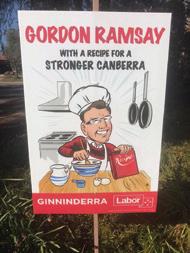
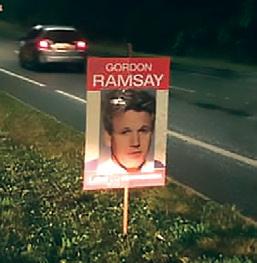
1 Ramsay’s recipe for success?
Voters are getting two Gordons for the price of one. One is a potty mouthed Scottish chef, the other is a Labor candidate for Ginninderra. Full marks to Gordon Ramsay (the candidate) for capitalising on his namesake’s notoriety, and an honourable mention to the wag who pasted the chef’s image over the top of a lot of the candidates’ corflutes.
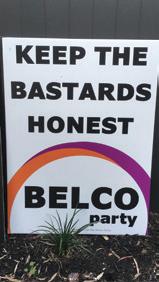
2 Belco Party ‘Keep the Bastards Honest’
A direct rip off from the late Don Chipp’s Democrats, the Belco Party has pinched the most memorable slogan of Australian politics. It’s bound to appeal to voters as much as it did 40 years ago.
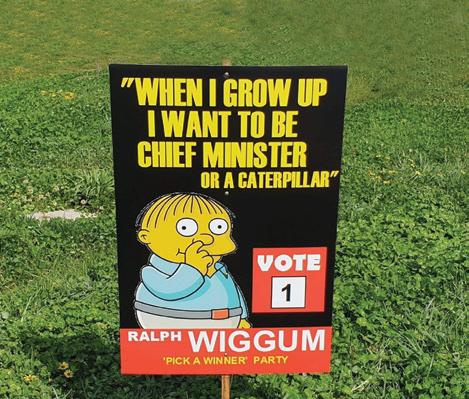
3 Vote 1 The Simpsons
Hilarious as it is ridiculous, a joker has pitched a wad of “Simpsons” signs next to genuine candidate corflutes, all across Canberra. The “Vote 1 for Ralph Wiggum” sign, from the “Pick a Winner Party” reads: “When I grow up I want to be Chief Minister or a caterpillar.”
The anonymous trickster didn’t stop at Wiggum, Homer Simpson is making a rib-tickling appearance, too. The clever signs, bound to make you laugh, are gaining traction over Facebook. One person said: “I choo choo choose Ralph”. Another added: “He’d get my vote”.
Please note: This is a joke, the Simpsons Party won’t appear on the ballot paper.
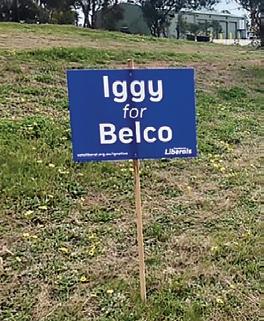
4 ‘Iggy’ Rozario for Belco
Not sure Ignatious Rozario was channeling “Iggy Pop” when the Liberal candidate for Ginninderra decided to shorten his name but you hope his reputation won’t go the same way as the godfather of punk rock and his infamous performance on “Countdown” 40 years ago.
Whatever the reason, it looks like it’s working. Iggy says he’s getting “a good response” from his signs.
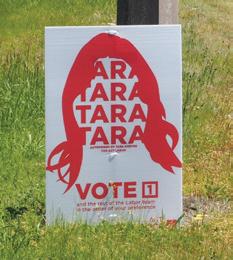
5 Tara’s red match up
Red-haired Labor candidate for Ginninderra Tara Cheyne’s corflute resembles the iconic image that adorned matchboxes around this country for many decades.
The famous red-head matches.
The thinking outside the box award goes to Tara for embracing her inner red. Nice one!
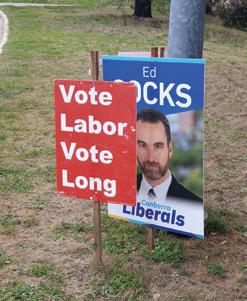
6 Double entendres
An advertiser’s worst nightmare. To have a candidate called Long and a candidate called Cocks contesting the same seat could have unintended consequences and lead to voter confusion.
It wouldn’t matter whether Labor candidate Brendan Long finished ahead of the Liberal candidate Ed Cocks or the other way around, both are going to be the subject of double entendres.
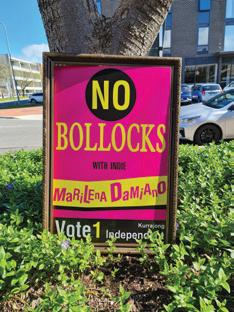
7 ‘No Bollocks’ Damiano
Marilena Damiano, the independent candidate for Kurrajong has gone for the shock factor with her campaign slogan “No Bollocks”. Direct and straight to the point, she gets top points for product differentiation in the marketplace. Sure to polarise some voters, but will appeal to just as many as it appals. And pretty hard to see how a graffiti artist could add any further value to it.


Enjoy the fun while you can because the ACT Greens have renewed their call to ban all roadside electoral signs. And just a reminder that corfultes must be removed by all parties and candidates 48 hours after the close of polling booths on October 17, or face a hefty $220 fine, per sign, from Transport Canberra and City Services.
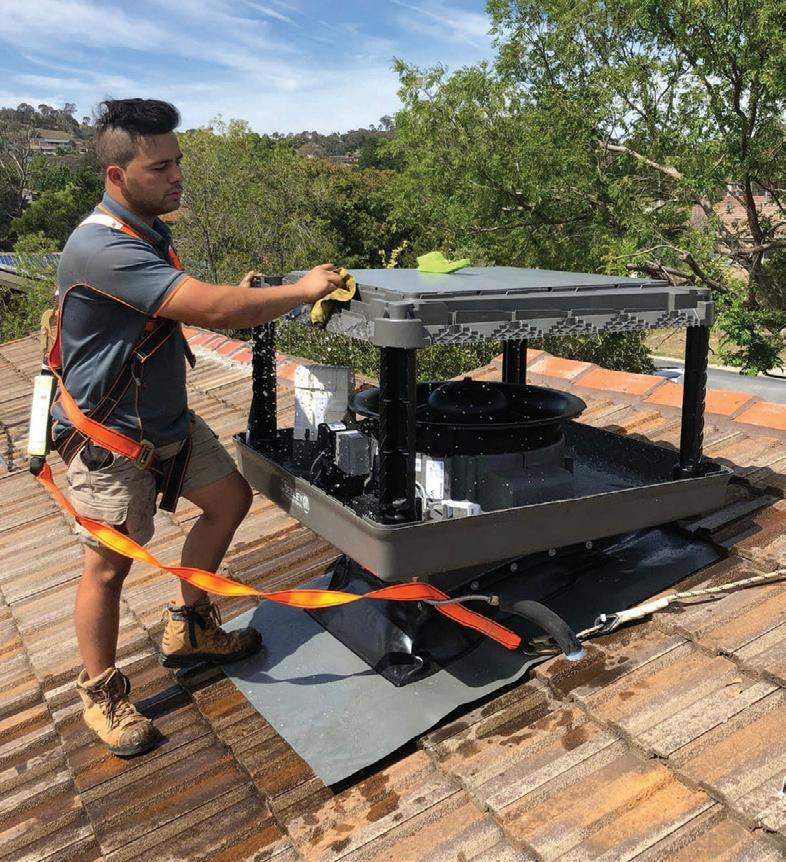
The devastating bush fires our nation experienced at the beginning of this year had a significant impact across our nation. Canberra recorded some of the highest levels of air pollution in the world. This year it is more important than ever to have your Evaporative Cooler serviced to clear out any residual smoke particles that your unit has been exposed to.
Master Gasfitters are on a mission to bring climate comfort to all Canberra homes with high quality, affordable and reliable lifestyle options in the heating, cooling and hot water industry.
It’s important to have your Evap Cooler serviced to ensure it is working safely and efficiently and therefore reducing your energy bills.
THE FIFTH SEAT / Ginninderra
Can a ‘Belco Bill’ win upset the balance of power?
There are 25 seats up for grabs in the October 17 ACT election and there is one seat in each of the five electorates of five members that will effectively decide the election – the fifth seat. In a series of articles, political reporter BELINDA STRAHORN has been analysing the fate of each of the “fifth seats”. In this final piece, she looks at Ginninderra.
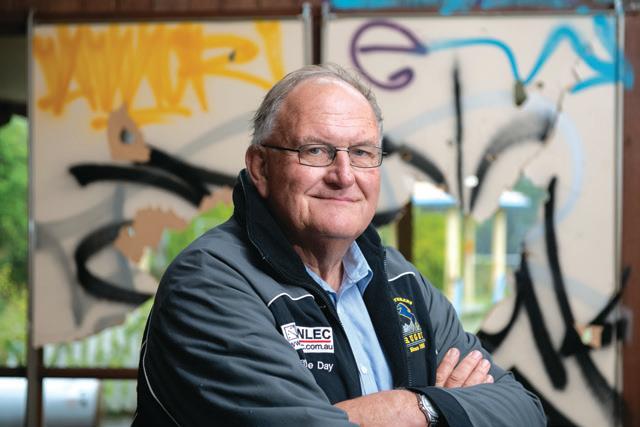
FORMER ACT Liberal Party leader Bill Stefaniak’s decision to contest the seat of Ginninderra as Belco Party convenor could be the wild card in this election.
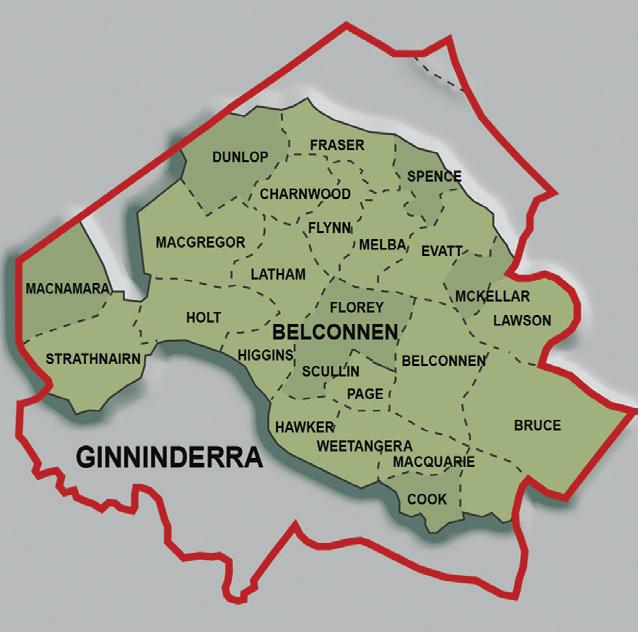
The fifth seat in Ginninderra has traditionally swapped between Labor and a minor party, which means the fifth seat could be heading the Belco Party’s way. The party’s decision to run in Ginninderra could inadvertently hurt the Liberal vote or deprive Labor of any chance of winning three seats in Ginninderra.
The historic vote affirms that Labor’s stronghold is Belconnen. It currently holds three seats in Ginninderra and has seasoned candidates in Yvette Berry, Gordon Ramsay and Tara Cheyne. The Canberra Liberals have two seats in Ginninderra held by Elizabeth Kikkert and one of the highest-profile members of the party Vicki Dunne, who is retiring and won’t contest October’s election.
While Labor has traditionally won three seats and the Liberals two seats, the entry of the Belco Party, made up of former ACT attorney-general Stefaniak, ex-Summernats boss Chic Henry, jazz singer Angela Lount, greyhound breeder Alan Tutt and dumped Liberals’ candidate Vijay Dubey, could make the outcome in Ginninderra less clear.
Will “Belco Bill” do well enough to deprive Labor of a third seat; could his candidacy eat into the Liberal vote and potentially cost the Liberals a second seat in Ginninderra or can he garner enough support to earn a quota and win a spot in the ACT Assembly?
The fifth seat in Ginninderra has changed hands in almost every election. This points to a long history of voters supporting candidates other than from the major parties. In 1995, the fifth seat was won by Greens’ candidate Lucy Horodny. In 1998, she lost the seat to independent Dave Rugendyke. In 2001, the seat instead went to Roslyn Dundas, of the Democrats. In 2004, the seat went to Labor’s Mary Porter, giving Labor three out of the five seats, which helped give them majority government for the only time in ACT history. In 2008, the third Labor seat was lost to the Greens’
their allegiances in Ginninderra, the Belco Party – likely to tap into voter resentment over the perceived neglect – stands a good chance of winning one of the five seats on offer.

Political opinion is divided over which side of politics is likely to benefit or suffer as a result of the Belco Party entering the field. “City News” columnist Paul Costigan says the Liberals are more likely to be in trouble in Ginninderra.
“The Belco Party is not chasing a Labor seat primarily but rather the second Liberal seat,” Costigan said.
“With the Liberals’ first candidate not exactly well known (Elizabeth Kikkert) – and a host of newbies trying for the other spot, unless there is a very strong swing away from Labor, the result could be three Labor, one Liberal and one sort-ofLiberal, Belco Bill.”
While the Belco Party could tap into undecided voters who might otherwise support Labor, Costigan argues that it’s more likely that the Belco Party will draw their support from Liberal supporters.
“It’s easier to convert Liberals to the Belco Party; few Labor voters would stray to Belco Bill and his band of Belco warriors,” said Costigan.
Longtime Liberal MLA for Ginninderra Vicki Dunne’s departure from ACT politics opens the door for “Belco Bill” to capitalise on his status as a former Liberal. Had Stefaniak run for the Liberals, “CityNews’’ columnist Michael Moore predicts he may have had a better chance.
“At least with Vicki Dunne going and Elizabeth Kikkert appealing to the ultra-conservative side, he has a chance, but at best it’s an outside chance,” Moore said.
“Had he ran with the Liberals, considering his profile, he would have stood a very good chance, but we don’t know what’s happened within the Liberal party and if he has become persona-non-grata.”
The alternate scenario that could play out in Ginninderra hinges on the Belco Party capturing a large percentage of voters unhappy with the Barr government and seriously erode Labor’s support in Ginninderra.
Recent polling by the Australia Institute indicated that just over 37.5 per cent of respondents would vote
receive 14 per cent of first-preference votes, and the Liberals recorded 38.2 per cent support. Using this polling, former ACT Chief Minister and Belconnen resident Jon Stanhope suggests the Belco Party’s emergence this election could end up hurting Labor’s vote.
“What that data tells you is if it’s consistent across the Territory, there is no way that the Labor Party can retain the third seat in Belconnen, it’s simply impossible,” said Stanhope.
“There’s a swing against Labor and Labor will not hold the third seat in Belconnen.”
Whilst the Australia Institute’s polling results indicate that an expanded Greens vote will help carry Labor over the line, Stanhope sees a different outcome.
“Is the Australia Institute saying that the 14 per cent that the Greens are apparently polling is consistent across the Territory?” said Stanhope.
“The answer to that is clearly no. The bulk of that will be in the innernorth and south and perhaps areas around Woden and Weston Creek, I would be surprised if the Greens are polling 14 per cent in Belconnen.”
“The most visible participants at the moment in Belconnen are the Belco Party, they are reasonably well organised, they have a full ticket and they have a couple of candidates with a profile, so I would think that the Belco Party has an equal if not greater chance than the Greens of taking the fifth seat in Belconnen.

I’m sure the Greens are still alive, but on the Australia Institute polling it’s more likely to be a non-Greens candidate that will win the fifth seat in Belconnen”.
ANU political lecturer Dr Kim Huynh suggests disaffected Labor voters would be looking to reward an independent or minor party with their vote in Ginninderra.
Huynh, running as a first-time independent candidate for Ginninderra at the 2016 election, secured the most votes of any micro-party or independ-
of votes cast in his electorate.
“A lot of my preferences came from and went to Labor, so that suggests there are disaffected Labor [voters] looking for an indy [independent],” said Huynh.
“But Bill Stefaniak is a totally different candidate and his party is totally different, but there is no doubt there is disaffected Labor and they are bored of Labor in Belconnen.
“The stats from the 2019 federal election also indicate that west Belconnen is far from left and could lean more away from Labor and lean more towards the Belco Party.
“They have good branding and a good name but you would have to ensure that Bill Stefaniak and Chic Henry poll strongly and that their preferences flow strongly to each other, the other question is who would get more votes, Bill or Chic”?
Henry ran for a seat in Ginninderra at the 2012 ACT election for the defunct Australian Motoring Party. Henry secured more than 4000 votes or 6.6 per cent of the total vote in Ginninderra, but was not elected.
Ahead of the 2012 election, Henry told voters to give their second preferences to the Canberra Liberals.
The party’s other star candidate is Greyhound breeder Alan Tutt who stood for the Canberra Community Voters Party in Ginninderra in 2012 winning 262 votes.
The chances of other minor parties’ candidates in Ginninderra should not be overlooked, however it’s unlikely any of them will do well enough to outpoll Stefaniak or Henry.
Earlier published reviews of the electorates of Brindabella, Murrumbidgee, Yerrabi and Kurrajong in this series can be read at citynews.com.au
Bill Stefaniak. Tara Cheyne.
Learning to get the best from politicians
By Peter TAIT

IF we, the people, participate in formulating the policy and making the decisions that affect how we live and how Canberra develops, then we are more likely to get the city we want to live in. That is, we, the people, need to participate in our government.
In our democracy, we elect MLAs to represent us. However, we do not hand over all control to them. They recognise this because they have set up the Community Councils, the YourSay platform and have an engagement strategy for consulting with community members.
Our MLAs want our feedback and complaints. Community feedback about government consultation is that it could be much better.
We think they can do more, and better, too.
Two ways to get people governing with our representatives are, firstly, to make it easier for neighbours to get together to discuss issues that concern them and to work out solutions that will work for them; secondly, to build means to help government to ask the community for input about what they see as the issues needing to be
addressed, and then work with government on designing a solution.
Underlying this approach is a change in the way MLAs and community members work together.
We know how to get neighbours together; it was from one of these processes, kitchen-table conversations, that the Canberra Alliance for Participatory Democracy (CAPaD) was formed in 2015. We wanted to address concerns that our government wasn’t working for people and the environment. This view is expressed frequently in the pages of “CityNews”.
There are a range of other methods.
One of them involves getting citizens to work with government on governing.
The ACT has even done it with the 2017 and 2018 deliberative forums on Compulsory Third Party Insurance, Carers’ Voice Panel, Better Suburbs and Housing Choices. While these could have been done better, they show what is possible if governments want to make an effort.
who already are active in this space and with some better support could do more.
Building a different relationship between MLAs and citizens is a new area. CAPaD is working with community and MLAs to help everyone understand more clearly how the MLAs can work better with active community members. This is at the electorate level, rather than at the government level.
People tell us they want more open and honest talk from MLAs and MLAs tell us they want the community to talk to them about what they can do.
People tell us they want more open and honest talk from MLAs and MLAs tell us they want the community to talk to them about what they can do.
What we need to do is build these methods into how we do governing in the ACT so we use them regularly and frequently. In fact, we have Community Councils and residents’ associations
There are a couple of ideas for how to set up good working relationships within each electorate. The Centre for Deliberative Democracy at Canberra University is running a “Connecting to Parliament” project in the federal electorate of Fenner. This byinvitation project is setting up regular meetings between MP Andrew Leigh and a group of his constituents to have conversations about the issues that are being debated in federal parliament. In several electorates around Australia, groups of voters are meeting to try to work with their representatives. Where this fails, they have chosen someone

who will work with them. We may be able to set up such a group in one of the other federal electorates in Canberra.
At the Legislative Assembly level, it is a whole lot more interesting because of our multi-member, multi-party electorates. Setting up a group of voters to work on both electorate and ACT-wide matters with five MLAs presents a fascinating challenge.
What this shows is that mechanisms exist for getting members of parliament and community members to work together. How we can do that in Canberra will be explored further.
Underlying this discussion though, is the necessity to have MLAs who are willing to be a part of such processes.
That is why CAPaD invites the candidates standing for election to fill in and give us a questionnaire telling voters what skills they bring to the position and, if elected, how they are going to represent and work with us, the people, and what are they going to do to make democracy in Canberra stronger. So not only can voters choose between different party policy platforms, they can choose between different candidates from the same party.
This way we think we can work with our representatives to make a Canberra we want to live in.
Dr Peter Tait is the secretary of the Canberra Alliance for Participatory Democracy.
GRUMPY
Spring plant sale
A WIDE variety of plants will feature in the Calvary Hospital Auxiliary’s Spring Plant Stall at Belconnen Markets over the weekend of October 10-11. Indoor, outdoor, succulents and herbs will be for sale with all funds raised going to buy equipment for the comfort of Calvary Public Hospital patients.
Jams and pickles
HOMEMADE jams, pickles, chutney, lemon butter and sugar-reduced preserves will be for sale from the Relay for Life Team, the Bold Bandannas’ charity stall at the Belconnen Markets over the weekend of October 17-18.
Vintage Reds gather
THE Vintage Reds, a group of retired unionists, meet monthly at the Tradies Club, in Dickson, to discuss matters of concern to working people, listen to a guest speaker followed by lunch. New members welcome. Next meeting, 11am, October 20 (and every third Tuesday of the month). Enquiries to 0408 433192.
Church market day
ST Ninian’s at Lyneham is hosting a market day in the church grounds, 9am-2pm, on Saturday, October 17. Items for sale include kitchenware, household goods, linen, kids’ things and miscellaneous sporting and camping items. Social distancing and other covid guidelines will apply.
How Canberra was ‘sold’ to developers
Prominent architect JACK KERSHAW, of Kambah, is grumpy about the way town planning is being overlooked in the nation’s capital.
THE apparent demise of ordered planning in Canberra can be traced to a paradigm shift: development is now largely being “sold” to government.
For example, the scope and scale of New Acton wasn’t in any town plan. It’s persuasive, cashed-up developers, boasting their long-term commitment, engaged, high-profile, privatesector planners, architects, engineers, heritage experts, etcetera to put together an “irrefutable” scheme for the precinct.
It was even presented by the developer to an invited audience at the National Gallery theatre. Of course, the authorities couldn’t say no, especially to the money being offered for the land.
However, a close examination of New Acton as-built, reveals major shortcomings, including excessive building bulk at the western end, and traffic issues, which a predetermined government precinct plan would have prevented.
Now New Acton has now been reportedly onsold; with its original developer apparently now embarking on a similar approach on cheap land
at Dairy Road, Fyshwick, for development never envisaged in any town plan.
Similar forces and processes are involved on the airport land, City Hill, in some new suburbs, and on innumerable “have-a-go” private development projects; as well as in the activities of the City Renewal Authority (developers are even running their own “public” consultation –that’s got a lot of integrity...not!).
The CRA is removed from the normal planning processes, and is headed up by a largely faceless board with connections to developers and unions.
It has strong political links, hopefully not like those in the NSW property development scandals of the ‘80s and ‘90s that ended up in the ICAC. The private-sector-like CRA is mainly looking after the highly significant precincts of Northbourne Avenue and West Basin – not going at all well (to put it mildly), especially in the context of the national capital.
Commercially attractive and innovative as they may be, such privatised methodologies clearly cannot be relied on and (as with building quality) we need to return to normal, professional, public-sector town planning and urban design – however, with perhaps, or even definitely, more creativity and cultural/heritage-awareness. This is the national capital.
Grumpy is an occasional column dedicated to things that get up your nose. Readers are invited to vent (typically around 300 words, please) at editor@citynews.com.au
PUZZLES PAGE

Joanne Madeline Moore
ARIES (Mar 21 – Apr 20)
The week starts with the Jupiter-Neptune link, which primes you to dream big dreams. But there’s also the potential for power struggles (especially with authority figures or colleagues) so try to moderate your tempestuous side. Relationships are highlighted by Friday night’s New Moon. However, with Mars reversing through your sign (and Mercury turning retro) you could suffer from a lack of motivation, low libido or just plain exhaustion. So pace yourself and don’t take on too much.
TAURUS (Apr 21 – May 21)
This week a partnership or joint venture could veer off in an unpredictable direction as Mercury starts reversing through your relationship zone. Or a work colleague could surprise you by making a decision that seems like a retrograde step. And are you being rather lazy? Friday night’s New Moon activates your wellbeing zone so strive to be the fittest and healthiest Bull you can be. No lame excuses or empty promises. Get motivated and get your body moving ASAP!
GEMINI (May 22 – June 21)
When it comes to your involvement with a friend, colleague, client, customer, class, club or group, this week looks tricky as retro Mars and retro Mercury stimulate your argumentative streak. So do your best to avoid aggravating others. When dealing with financial matters, knowledge is power and there is no substitute for due diligence. And are you experiencing problems with a relative? Compassionate communication will go a long way towards repairing the relationship.
CANCER (June 22 – July 23)
Retro Mars and retro Mercury are disrupting your career plans and your creative aspirations but that gives you more time to reflect on what it is you really want. Times are tough and you have to work with what you’ve got. Friday night’s New Moon signals a fresh start involving a parent, property, domestic project or family matter. Attached Crabs: show extra compassion and generosity towards your partner. Unhappily single? Use your intuition to help you find your soul mate.
LEO (July 24 – Aug 23)
This week the Sun forms tricky connections with Jupiter, retrograde Mars, Pluto and Saturn. So try to temper your strong urge to rule the world and boss other people around. Instead, direct your fiery energy into a promising project within your local community. Try to be disciplined with yourself and compassionate towards others. And contemplate the wise words of birthday great Oscar Wilde: “Our ambition should be to rule ourselves, the true kingdom for each one of us.”
VIRGO (Aug 24 – Sept 23)
You’re determined to push through with a project but Mercury (your power planet) turns retrograde this week (until November 3) so expect delays, disruptions and difficulties. Compromise and patience are required, otherwise it will be a long and stressful week. When it comes to your daily routine, the big lesson to learn is how to delegate. No one (not even a capable Virgo) is indispensable! Looking for true love? Destiny is steering you in the direction of your soul mate.
LIBRA (Sept 24 – Oct 23)
An unresolved relationship issue could boomerang back and test you. If you treat loved ones with extra compassion and patience, then you’ll soon sort things out. Stylish Librans have a passion for fashion and the New Moon’s in your sign. So, it’s the perfect week to refresh your appearance via a hot new hairstyle, a makeup makeover or a creative wardrobe revamp. But with Mercury reversing through your money zone, watch that impulse buys don’t burn a big hole in your budget.
SCORPIO (Oct 24 – Nov 22)
Mercury starts reversing through your sign on Wednesday and then Pluto (your power planet) squares the Sun on Thursday. So you’ll feel confused and may try to re-gain control by slipping into Scorpio control-freak mode. Then Friday night’s New Moon could see you brooding about the past. However, as actor (and birthday great) Hugh Jackman observes: “You can’t go through life obsessing about what might have been.” So, learn to let go, lighten up and move on.
SAGITTARIUS (Nov 23 – Dec 21)
Inspiration planet Neptune and prosperity planet Jupiter (your patron planet) fire up your money and family zones. So, find creative ways to increase income and boost cash flow, which could include working with a talented relative. If you love what you do, then inner and outer riches will eventually follow. But Mercury turns retrograde from Wednesday until November 3. So expect travel disruptions, local lockdowns or career confusion that will test your limited patience.
CAPRICORN (Dec 22 – Jan 20)
Mars and Mercury are both retrograde this week which will slow things down and increase irritability. The Jupiter-Neptune connection (on Monday) and the New Moon (on Friday night) are both fabulous for reviewing and rebooting a personal project or professional plans. Creative communication is the secret ingredient that will take you far in the future. Then the Sun and Saturn square off on Sunday, which will test your patience and set your frustration levels back onto high again.
AQUARIUS (Jan 21 – Feb 19)
Do you enjoy your job and does it stimulate your mind? This week take the time to re-evaluate a professional matter (or a volunteer position) as Mercury starts reversing through your career sector. The planets also activate your reputation zone, so make sure your public image is in line with your uniquely quirky Aquarian self. Enjoy being the authentic you! Draw inspiration from birthday great, writer Oscar Wilde: “Be yourself; everyone else is already taken.”
PISCES (Feb 20 – Mar 20)
This week Jupiter forms a fabulous connection with your ruler Neptune! So prepare for a creative surge as inspiration strikes, confidence blossoms and your imagination soars. So – if you are a Piscean poet, painter, performer, writer, singer, dancer or musician – make the most of it. But avoid taking on too much, overpromising and then under-delivering. Be selective. Friday night’s New Moon indicates a fresh start involving an intimate relationship, shared resources or joint ventures.
Copyright Joanne Madeline Moore 2020
24
1 Name a silver-white metal, symbol Ca. (7)
2 Cairo is the capital of which NE African republic? (5)
3 What do we call one who encourages by aid? (7)
4 What is a less familiar word for the big toe? (6)
5 Which is the main trunk of the arterial system? (5)
6 What is a part, cut off or separated? (7)
7 Which US seaport is noted for its execution of witches in 1692? (5)
13 Name Australia’s only stork. (7)
15 What is an agent of retribution? (7)
16 Which substance is obtained by mining? (7)
17 What is a bolide, or shooting star? (6)
18 Which term designates the interior decoration of a home or office? (5)
19 What is the head or top of anything? (5)
20 Which demigod in classical mythology was condemned to support the sky on his shoulders? (5)








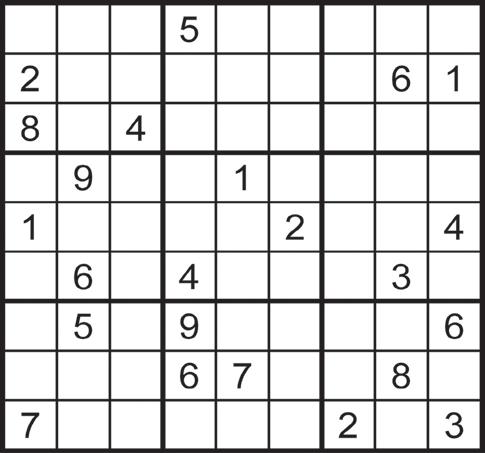





LOOKING WEST
Two districts with a strong sense of community
LOOKING west are two districts with a strong sense of community and a variety of friendly businesses.
One, Weston Creek , was named after Captain George Edward Weston, a former officer of the East India company, who came to Australia in 1829 and was superintendent of Sydney’s Hyde Park Convict Barracks. The other, Molonglo Valley derives its name from an Aboriginal expression meaning “the sound of thunder”, and includes the suburbs of Coombs, Denman Prospect, Whitlam and Wright. The development of the Molonglo Valley district acts as a link between Weston Creek to the south and Belconnen to the north.
Clinic helps patients smile with confidence
EVOLVING Smiles dental clinic focuses on the individual needs of a patient and their oral health, providing them an effective and personalised service, says owner Dr Unah Thato Entaile-Tidimane.
The locally owned and operated clinic in Denman Prospect, Molonglo Valley, offers dental implant, orthodontic and general dental services.
“We listen to our patients and work with them to provide outcomes that optimise oral health, creating a healthy, natural smile that is just right for their face,” Dr Unah says.
“Our philosophy is to provide highquality care with evidence-based dentistry.

“We strive to listen carefully to patients’ concerns and offer our best recommendations, tailored to their needs.
“We believe there’s no better option than keeping your own teeth and preserving oral health.”
With more than 13 years’ clinical experience in government and private practice, Dr Unah believes that good quality dentistry should enhance people’s lifestyle, allowing them to enjoy the food they love, and to smile, laugh and love with confidence.
“While I love all aspects of dentistry, smile makeovers and giving someone the confidence to smile again are perhaps some of the most rewarding moments for me,” she says.
Evolving Smiles, 23/3 Felstead Vista, Denman village shops, Denman Prospect. Call 6109 9440, visit evolvingsmiles.com.au or email info@evolvingsmiles.com.au
Optometrists with a passion for eyecare
IT’S important to consider an optometrist as the first port of call for any vision or eye problem, says Junic Eye Care optometrist Dr Thomas Morton.
“The vast majority of eye problems can be managed with non-surgical solutions, which is where optometry exists,” he says.
“At Junic Eye Care we’re very passionate about team care and will communicate with GPs and coordinate referral pathways to tertiary care with ophthalmologists as required.”
Primary eye health clinic Junic Eye Care opened in September and operates out of the Junic Specialist Centre in the Molonglo Health Hub.
“We offer clinically oriented full-scope optom etry services to people of all ages,” Dr Morton says.
“Our services include routine comprehensive eye examinations, low vision assessments and rehabilitation, children’s vision, contact lens fitting and care, dry eye management, emergency and therapeutic eye care.
“We also screen, assess and monitor eye condi tions such as diabetic retinopathy, glaucoma and macular degeneration, with the latest and best diagnostic equipment available including a stateof-the-art optical coherence tomography OCT instrument which takes 3D internal eye scans.”
Junic Eye Care combines primary eye care services with low-vision rehabilitation, and is unique in the partnership between its optometrist Dr Morton and orthoptist, who work alongside each other.
Health Hub, 110 Woodberry Avenue, Coombs. Call 6178 0470, email eyecare@junic.net.au or visit juniceyecare.com.au

Junic Eye Care’s optometrist Dr Thomas Morton and owner Juliet Menakaya.
Dr Unah Thato Entaile-Tidimane.



•
•
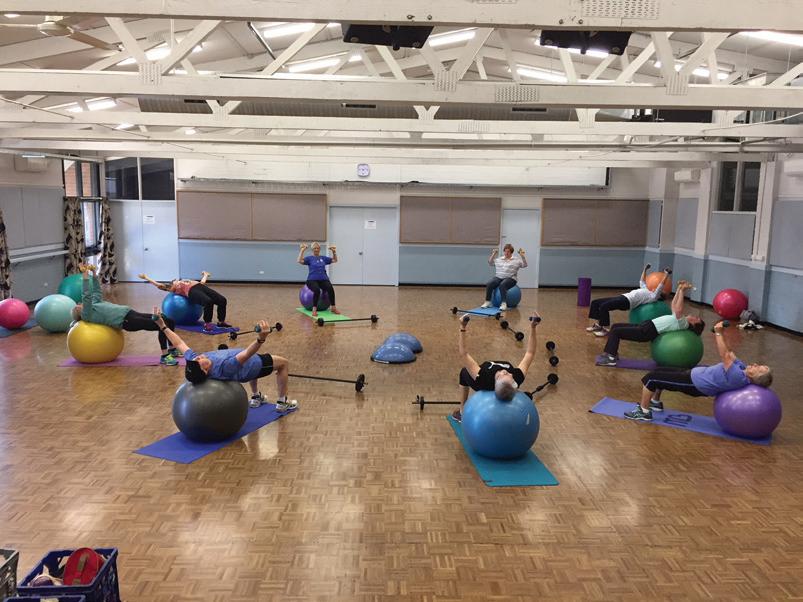
WESTON Creek Community Centre has provided a diverse range of services to the community since 1978, says manager Yung Tran.
Adjacent to Cooleman Court Shopping Centre, the centre has four squash courts, a large function hall and kitchen, two meeting rooms and several offices.
“The centre runs exercise and recreation classes, like ‘Mature Fitness’, ‘Zumba Gold’, belly dancing and yoga for beginners,” Yung says.
“We also offer printing, photocopying, binding, scanning and a service of Justice of the Peace.”
The WCCC houses groups including Stromlo Christian Church, Australian War Widows, People with Disabilities, Solid Rock Defence and Valley Baptist Church.
Other regular users include ACT Masters Squash, ACT Miniatures Enthusiasts, Karilee Calisthenics, Canberra Lacemakers, Yoga Enlightenment, Weston
Creek Bonsai and many others.
Yung says the centre also manages various rooms for hire, including its newest facility, the Holt Neighbourhood Hall, which includes two small meeting rooms, a large hall and courtyard, next to an oval with a children’s play area and ample parking.
It also manages the Weston Neighbourhood Hall on Hilder Street, Weston, Flynn Community Hall, a “beautiful space” on Bingle Street, Flynn; and the Chifley Community Meeting Room, a modern space on Maclaurin Street, Chifley.
A copy of the WCCC’s current newsletter can be picked up at the Centre office, Monday to Friday, 8.30am to 5pm, or by contacting the Centre.
Weston Creek Community Centre, Parkinson Street, Weston. Call 6288 1144, email info@westoncccentre. org.au or visit westoncccentre.org.au
Get to pain before it becomes chronic
CONVENIENTLY located in the Weston Creek town centre, Weston Creek Chiropractic Centre is a patient-focused practice dedicated to getting patients to their optimal health, says Dr Sam Teoh.
Its friendly chiropractors, Sam and Dr Linda Tarran, are dedicated in providing their patients with the best possible chiropractic care, accord ing to Sam.
The centre provides a variety of chiropractic services and often sees patients with issues such as neck pain, back pain, headaches and sports injuries, and also provides services for pregnant women as well as children and babies.
Sam personally sees a lot of patients who are either too sedentary or on the other end, have pushed their body beyond its limits.
“We do use our bodies a lot and some people tend to overuse it and push themselves while injured,” she says.
“The other extreme is people who are too sedentary.
“Bodies are like cars. You can replace the parts but not the body. If you leave pain for too long it can turn into chronic injury and it takes longer to heal, so it’s important to see a chiropractor before it gets to that point.”
The chiropractors at Weston Creek Chiroprac tic treat all their patients as individuals, says Sam.
“We do a thorough examination and look at their full history for new patients,” she says.
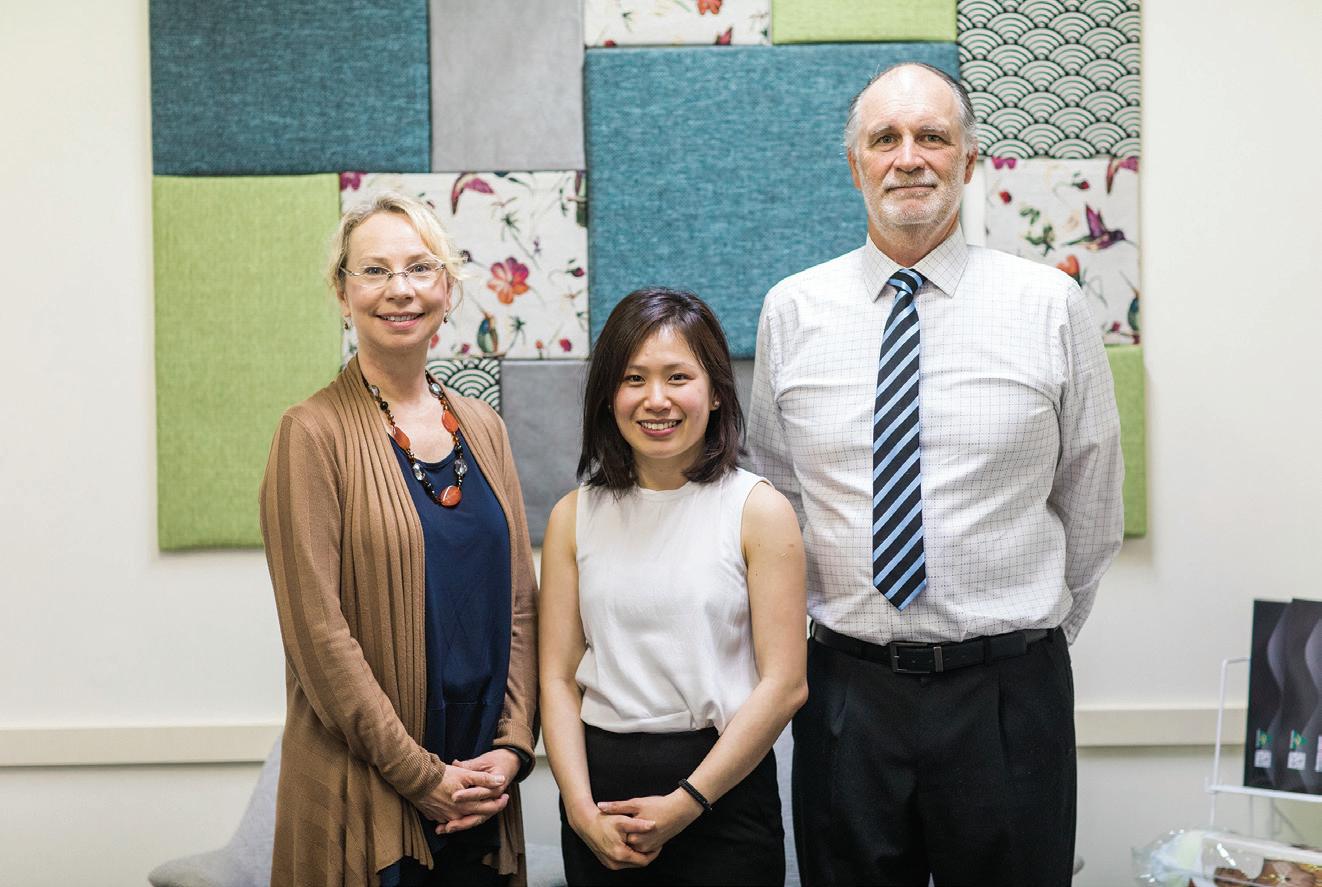
Weston Creek Chiropractic Centre, Level 1, 43 Brierly Street, Weston Creek. Call 6288 6711 or visit wcccentre.com.au


Dr Linda Tarran and Dr Sam Teoh of Weston Creek Chiropractic Centre.
The centre runs exercise and recreation classes such as fitball classes.



GARDENING

The end result after repotting.
Time to take stock of the pots
CHECKING on pot plants can be a neglected aspect of gardening; when the plants look sort of alright and will possibly be okay for another year.



If long-neglected, the plants may almost certainly be root-bound, which means there is little actual soil left to hold water and nutrients. If sitting in garden beds, the roots may even have grown through the hole in the bottom of the pot into the ground.
Tip the plant out of the pot to see what the situation is. It may be necessary to cut a quarter of the root system off the bottom. Next, with a sharp knife, cut down the sides of the root ball in three places. This will enable the roots to start growing outwards again instead of round and round. In repotting, there’s no need to put gravel or bits of broken pots in the base. With modern potting mixes this is unnecessary. Use a piece of old pot to cover the hole. Use only the best, premium potting mix. Put a


layer in the bottom of the pot, place the trimmed plant back in and gradually fill around the sides, firming down as you go. Water in thoroughly with plant nutrients added, which will feed the plants for up to three months. Don’t use a saucer under the pot for outdoor pots. Instead, lift it off the ground with purpose-made feet or old tiles.
NATIONAL Gardening Week runs from October 11-17. It’s relatively new in Australia but has been the largest gardening event in the UK since 2011, organised by the Royal Horticultural Society. Former president of the Garden Clubs of Australia (GCA), George Hoad, visited the event in the UK and was impressed at the stunning floral displays, show gardens and special events. National Gardening Week was then launched by the GCA in October 2017. Many group activities have been curtailed this year but it can still be celebrated in private gardens, especially through encouraging children with their own patch.
HOW’S the vicia faba growing? This has been an important part of the Mediterranean diet for the past 5000-7000 years. No one is certain of where it originated, though it’s formed part of the European diet for a few hundred years, too. No more suspense; this is the botanical name for broad beans. Ours grew ever taller this year and suddenly burst into flower, and

what a magnificent flower it is. If you have them growing, take a closer look. We’re assured of a bumper crop this year.
GREENING Australia had reason to celebrate the conclusion of the Australian government’s “20 Million Trees” project. The organisation planted a whopping 8,073,090 trees, across 10,125 hectares, with 26 projects over the country.
Solving root-bound plants.
The delicate, exquisite flowers of vicia faba, or broad beans.
ARTS & ENTERTAINMENT
Soprano Sonia sings her way home
By Helen Musa
“THE problem with dramatic voices is that you have to sing with dramatic voices,” says dramatic soprano Sonia Anfiloff.
For those not in the know, she’s talking about the rich, heavier voices, like hers, suitable for the great roles in opera, but while a blessing in some ways, it’s not easy to find the right role with matching voices.
After nine “bittersweet years” in Vienna, Anfiloff, ANU master’s graduate and recipient of the Kornfeld Scholarship, is returning to the stage in Canberra, where she was born and bred, in a concert called “The Unexpected Journey Back”, and thereby hangs a story.
Many will remember her as the radiant young soprano who charmed audiences in the role of Dido at The Street Theatre back in 2010, after which she left town full of optimism, only to return sadder and wiser.
She’ll be singing songs by Vaughan Williams in the concert for Art Song Canberra, accompanied by Kylie Loveland on piano and Rowan Harvey-Martin on violin and viola.
Far from concealing her heartache as some artists would, she’ll be using the chosen songs by Vaughan Williams, Sibelius, Copland, Brahms, Duparc, Rachmaninoff and others to express the challenges she says “have both broken her and made her”.
“No relationships last in the arts,” she says of her seemingly golden marriage to fellow ANU voice student, the baritone Ben Connor.
“Put simply, I stepped back so he could have a career.”
Now back in Canberra on her own with their three-year-old daughter Odette, she’s living in Belconnen with her parents, who are lightening the load with love and childcare while she teaches a .5 load (.6 next year, she says) at Canberra Girls Grammar School and establishes her own private voice practice in O’Connor, where she finds prospective students are “queuing up like mad”.
Girls Grammar, where she’s working with Harvey-Martin, her former mentor from fledgling days in Canberra Children’s Choir, is, she chuckles, “cushy” compared to her alma maters, Melba High and Hawker College.
Not that she has anything to say against Hawker, where she studied under legendary drama teacher Steve Brown and got the chance to play Mrs Lovett in the school production of “Sweeney Todd”, finding herself very nearly cast as the demon barber himself.
She hasn’t lost touch with Canberra during her nine years in Vienna, returning home most years to win first prizes in the Australian National Eisteddfod and the Orange Eisteddfods in 2012, sing in Verdi’s Requiem with the Llewellyn Choir and “In an Elemental Mood” for Art Song in 2017, and become artist-in-residence at The Street Theatre in 2018.
That bittersweet time in Vienna was sheer hard slog. It took ages to find exactly the right teacher, so she sang with young student pianists at graduation recitals and hosted transitory expatriates directed by the Australian Embassy to “the Connors” when they were in town. It was hard to integrate.
She’s much more comfortable back in her hometown with Odette, who turns four in November and while she believes she never really got a crack at a career in Vienna, she senses that she’s only just coming into her own now, since operatic voices often don’t mature until they’re

into their 30s – luckily, they can go on for a long time after that.
“I don’t think I’ve ever sung as well as I do now,” Anfiloff says.
Bits of Vienna remain. With Russian parents, you’d think Odette might be learning Russian, but in fact she’s at the German Australian Playschool in Turner, and German is the mother-and-child tongue at home.
Her private students are a mixture of choral singers, aspiring young opera singers and her own former students and she likes flexing her teaching muscles while recalling her own studies at the ANU, where she started out as a mezzo soprano, studying under Angela
Giblin and Patricia Davey. She’s absolutely not over the idea of performing the great dramatic roles. Given the chance, she’d love to sing the title role in “Ariadne auf Naxos” by Richard Strauss, with the Marschallin in Strauss’s “Der Rosenkavalier” coming a close second.
Meantime, she says, “When you work by yourself, you feel like you’ve done yourself justice… As an artist, what I do is giving”.
“The Unexpected Journey Back”, Wesley Music Centre, Forrest, Saturday, October 17 at 3pm and 4.15pm. Bookings at trybooking.com/BLJNH

New show promises a leap into chaos
ARTS IN THE CITY
By Helen Musa

QL2 DANCE’S new show “Leap into Chaos”, a double bill running at Canberra College Theatre from October 15-18, with the Chaos project “Touch” in the first section and Quantum Leap’s show “Sympathetic Monsters” in the second. Choreographers are Alison Plevey, Olivia Fyfe, Ryan Stone and Jack Ziesing. The live shows are sold out but fear not, Wildbear Entertainment will be filming and it can be viewed on October 23 from 6pm-9pm. Book at sidestage.live/ql2
ARTISTS Helen, Mio and Johannes Kuhnen, after leaving their Manuka premises before covid struck, have set up the new Bilk Gallery in a private studio, 10 minutes outside Queanbeyan on Captains Flat Road. They’ll still hold exhibitions of contemporary jewellery and objects, starting in November, but have now set up their website for online purchases, partnering with Art Money so patrons can purchase work over a 10-month plan. Appointments at gallery@bilk.com.au
AMBUSH Gallery at ANU Kambri is celebrating campus life over the past seven decades with a new exhibition, “Woroni – 70 Years of Outrage and Activism”. Taken from the archives of “Woroni” which began in 1950, it’s morphed into a print magazine, a website, a radio station and a TV program. The show includes a seven-metre-long timeline feature wall and a display of full-colour reprints of dozens of past Woroni covers. Until November 1, 10am-6pm weekdays and noon-5pm on weekends.
“CITYNEWS” musical theatre writer Bill Stephens was asked by KT Sullivan, director of the New York Cabaret Convention, virtual this year, to track down either David Campbell or Tim Draxl, both of whom performed at his School of Arts Cafe in Queanbeyan, to represent Australian cabaret. He managed to get Draxl in the nick of time.
CANBERRA Union Voices are rising “phoenix-like” from the ashes under the directorship of Chrissie Shaw to hold sessions for term 4 at the Tradies Club/Quality Inn, Badham Street, Dickson on Wednesdays from 2-3.30pm, with songs on the menu like “If it weren’t for the Union”, “We Shall Not Give Up the Fight”, and of course “Joe Hill”. Starts on October 14. Registrations at zipkow@optusnet.com.au
Applause for Cheetham’s new role with the orchestra
By Helen Musa
NEWS that leading Yorta Yorta composer, playwright and soprano, Deborah Cheetham, will replace Matthew Hindson as curator of the Canberra Symphony Orchestra’s “Australian Series” is bound to be widely applauded.
Famous for her 1997 stage play, “White Baptist Abba Fan”, which appeared here at The National Festival of Australian Theatre and the Street, she is a regular and enthusi astic visitor to Canberra, while composing, networking with First Nation artists, working as professor of practice at Monash University and as this year’s composer in residence at the Melbourne Symphony Orchestra.
I caught up with Cheetham by phone in Melbourne last week, where I found a composer on a mission.
Fiercely committed to the resurgence of Aboriginal and Torres Strait Islander music, Cheetham has advocated for the lyrics to “Advance Australia Fair” to be rewritten.
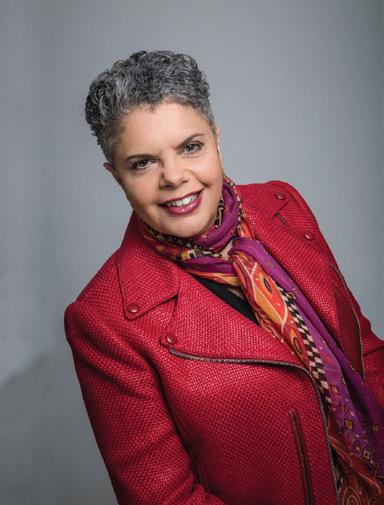
She is the composer of Australia’s first Aboriginal opera, “Pecan Summer”,
her reply was, “my answer is always no, but I want to do something new”. “Singing is in my DNA… it’s just part
of who I am,” Cheetham tells me. Stolen from her birth family when three years old and brought up by a white Baptist family who sang a lot of hymns, her uncle was the famous singer Jimmy Little and her Yorta Yorta grandma was a singer.
Besotted with “the greatest opera singer that ever lived – Dame Joan Sutherland”, she describes listening to her as “a life-altering experience”, so after school, headed for the Sydney Conservatorium of Music to study voice, with the vague idea that she might sing Tosca one day. She did.
“Then I had no real notion of what my true path would be… I was so involved in making my way through the conservatorium… it was a wonderful challenging road, although when you are perceived by others in a certain way they can discriminate against you, but I had my eyes firmly fixed on a career singing.”
Historically, there had been the famous Aboriginal tenor Harold Blair in the past, but she hadn’t heard of him and had no contemporary indigenous singers as a role model.
It was hard going, but by expanding into theatre and writing, she became a well-known performer, eventually turning to composition.
She formed the company Short Black Opera
12 years ago, which staged “Pecan Summer” in 2010, an opera based on the February 1939 Cummeragunja walk-off in Victoria.
“They say that necessity is the mother of invention and ‘Pecan Summer’ was a necessary work to offer roles for the many fine voices in the indigenous community. The necessity of it galvanised me into action.”
“I go back to my inheritance,” Cheetham says, explaining why she turned to composition.
“Music has become siloed, but our singers were storytellers like our painters and that’s why I found a home in opera, which is a beautiful collaborative art on a subliminal level.”
Although she belongs to a network of First Nation artists and companies around the world, first and foremost she’s interested in Aboriginal and Torres Strait Islander singers and composers, saying, “we have the longest musical practice in the world and we have a unique sound”.
In 2019 Matthew Hindson had her write a work for the Australian Series concert “Renewal”, a “fantastic experience”, she reports, so when the CSO approached to take over the reins, she agreed, and says she’ll be here for all her three concerts, though she can’t reveal yet what the works will be.
Early Australian composers, she believes, saw themselves as British, but now Australia has reached a point where we can recognise that there are so many gifted First Nation composers and a great wealth of repertoire.
“It’s a privilege to be in a position where you can help the strength of Australian composers and also to begin bringing a kind of confidence to Australian audiences,” she says.
“Canberra is different from any of the other capitals, it’s always had such a vibrant, big musical life and the concept of the bush capital as a city is one I’ve always found intriguing and heartening.”
She praises the Canberra Symphony Orchestra for its openness to First Nations’ music and is keen to see Indigenous performers collaborating with non-Indigenous musicians, but it concerns her that in the recent national Art Music Awards there was only tokenistic acknowledgement of Paul Stanhope’s Kimberley-inspired winning choral work, “I am Martuwarra”.
“Music-making is a relationship with community on the deepest level and what is lacking everywhere is a First Nations’ approach,” Cheetham says.
“I’m basically saying, ‘hands off – get out of the way so our composers can emerge’.”
Deborah Cheetham will replace Matthew Hindson as curator of the Canberra Symphony Orchestra’s ‘Australian Series’. Photo: Frank Farrugia
Soprano Sonia Anfiloff sings to express the challenges she says ‘have both broken her and made her’.
Political motives as war protest goes on trial
“The Trial of the Chicago 7” (MA)
WINDING up his perceptive study of writer/ director Aaron Sorkin’s movie analysing a trial not criminal, not civil, but driven by a powerful political motive, American critic Peter Bart observed that “protest is a towering topic in a political climate that is more contentious than ever”.
Sorkin’s film opened in the US a mere week before it began its Australian season. We know how Sorkin deals on screen with the political landscape in the “land of the free and the home of the brave” (in case you don’t know, the quotation is the last two lines of the US national anthem). Think “The West Wing”, 155 episodes of it, great TV.
The issue was protest against the war in Vietnam, which continued for five years after the trial. A war from which Uncle Sam limped home a loser with a huge bill in blood and treasure.
There’s great acting from a dedicated cast. On the bench, Frank Langella as Justice Julius Hoffman, a no-nonsense tyrant prone to issuing contempt citations. Mark Rylance as defence counsel William Kunstler, waging an exhausting juridical conflict. As Tom Hayden, social activist, later husband of Jane Fonda, Oscar-winning Brit Eddie Redmayne. As yippie activist and Flower Power movement proponent Abbie Hoffman, Sacha Baron Cohen. As Ramsey Clark, US Attorney General under the previous
adds up to a great film, by no means populist cinema, and all the better on that account.
At Dendy
“The Last Black Man in San Francisco” (M)
THIS, the feature debut of writer/director and San Francisco native Joe Talbot, adapted from the life of his childhood friend and long-time collaborator Jimmie Fails, won the Directing Award and a Special Jury Prize for Creative Collaboration at the 2019 Sundance Film Festival.
The principal character plays himself –


sundayROAST
Stay in touch with the names making news on Sundays from 9am as 2CC and “CityNews” present Canberra’s only local weekend news and current affairs program.
It’s a revolving panel show that brings to the microphone great “CityNews” commentators and 2CC personalities.
Be part of the conversation call 6255 1206 between 9am and noon

supermarket fish counter and sketches and writes a play on the side. The pair gets around the city’s residential areas double-dinking on Jimmie’s skateboard.
The film is about issues yet not issuedriven. Jimmie has long wanted to reclaim what he sees as his place in San Francisco, which for him means the house where he grew up and which his paternal grandfather built in the post-war era in a style typical of the area a century earlier.
The neighbourhood has become gentrified from the immigrant neighbourhood it once was. The house is now worth big money.
Its white owners give no indication of either planning to leave or sell. Nevertheless, Jimmie continues to take steps to reclaim the house.
The film is a gentle, sweet observation of the human condition under adversity. Perhaps it’s not populist cinema, but I found satisfaction in both its last black man and its SF vistas. Good on a cinema management with the courage to screen it.
At Dendy
“Antebellum” (MA)
THERE are not too many movies for which the title comes straight from Latin – “before the war”. Which war? The war that tore the US apart when the Confederate states decided to secede from the Union and developed into a much wider ambit that resulted in the abolition of slavery, emancipation of the slave population and the genesis of a racial prejudice that has blighted the land of the free and the home of the brave well beyond those 13 states, both morally and economically.
What sort of movie is it? It’s a fantasy based on time travel, a theme as improbable as that of too many movies with extraterrestrial origins. But its origin has enough recorded history to, if not validate, then at least respect our credibility.
Its joint authors and directors are Gerard Bush and Christopher Renz. Apparently, the
WATCH IT! / streaming and stuff
seed for this one, the pair’s first collaboration, was a nightmare of Bush’s. I found it entertaining, a response that sci-fi movies don’t usually get from me.
It starts on a Louisiana cotton plantation. A cart-load of new slaves has just been delivered. One of them is an attractive young woman who’s refusing to say her name to Confederate army captain Jasper (Jack Huston). Such insubordination demands punishment, in this case the application of a red-hot branding iron.
Dramatic, historical and environmental liberties have been taken with the film’s plantation passages. After a while, the scene shifts to 21st century US where psychologist Veronica (Janelle Monáe) and her family are waking up. It’s Veronica’s big day. She’s going to collect two chums to accompany her at the launch of her new book while hubby minds the child.
Party’s over. Veronica gets into a cab to go home. But where she finishes up is back on the plantation nearly a century and a half earlier. And she’s in dire trouble.
A strong current of vivid, even wild, imagination underpins “Antebellum”. That beats interplanetary movies. One wonders whether Bush and Renz will have another go.
At Palace Electric

Political series polarises its fans
NOT one month out from the US election, a new series called “The Comey Rule”, which looks to re-open conversations about the controversial events of the 2016 election, has just hit the small screen – and such timing is undoubtedly no coincidence.
The two-part miniseries on Stan is based on the book “A Higher Loyalty” by former FBI director James Comey, where he recounts the turbulent investigations into both leading candidates of the 2016 race for president.
Difficult portrayals are not shied away from here.
Jeff Daniels plays the FBI director of the title, chosen no doubt after the performance he gave as a news anchor in politically challenging 2012 series “The Newsroom” (available on Foxtel Group’s Binge).
Michael Kelly plays his deputy, coming over from his fame from another biting and controversial political thriller, “House of Cards” (Netflix).
Rising talent Kingsley Ben-Adir, from “Peaky Blinders”, plays Barack Obama.
And of course, in what will inevitably be whipping up the most conversations, is Brendan Gleeson’s portrayal of Donald Trump. Many may recognise Gleeson from his role as “Mad-Eye” Moody in the “Harry Potter” series, but there’s certainly a defter use of his eccentric talents on display here.
The first episode mainly focuses on the Hillary Clinton email scandal of 2015 and the allegations of using private servers to engage in official government matters.
In episode two, Trump is introduced and the investigation into the possible Russian

though? Well – big surprise – the response is pretty divided.
Fascinatingly, much like the current political climate itself, reviews of the series from critics and viewers remain split almost perfectly down the middle. At the time of writing, “The Comey Rule” holds a 5.9/10 on the Internet Movie Database website (or IMDB).
IMDB allows for anyone to find any television series or movie and leave their own review and rank out of 10. The score, which accumulates, in this instance the 5.9, represents the average of all reviews and doesn’t seem like much of a score, right?
Yet analysis of the show’s reviews reveals evidence of the complete polarisation that has caused it, oscillating between 10/10 talking about the brilliance and accuracy of the series, or 1/10s decrying fake news.
“So incredibly timely and needed
before the election with some vital truths every American should know before the election. 10/10!” says one user.
“Trump will win the election and you lame Hollywood libtards can’t do a thing about it. Drain the Hollywood swamp! 1/10!” goes another.
“Now I’m not a Trump supporter but, [expletive], this is the most anti-Trump movie based on real ‘facts’ while the guy is still in office. And what are the chances they release this a month from elections? *facepalm*, 3/10,” another reads. It’s a fascinating microcosm of the reactions to the US election, both in 2016 and what’s yet to come.
Many reviews also claim the importance of leaving one’s politics at the door when going into the series, but I don’t see how doing so is possible considering the heated subject matter.
But there is something to gain from taking the time to engage with it and discuss it. I have a hunch it will lead many to go and do more of their own research into how accurately the series portrayed the events as they unfolded. I did.
In the meantime, come on Australia we’ve gotta step up our own political thrillers – sure we’ve had the excellent drama “Secret City” (Netflix), but where’s our own slickly produced miniseries (or, you know, single episode) on the ACT elections going on this month, eh?
More of Nick Overall on Twitter @nick_overall

Brendan Gleeson as Donald Trump in “The Comey Rule”.
Sacha Baron Cohen as yippie activist and Flower Power movement proponent Abbie Hoffman in “The Trial of the Chicago 7”.
Ah, summer’s chilled and fizzy taste of shiraz
COVID-19’s impact induces a strange feeling. I have discovered a word that describes the feeling: torschlusspanik or “gate shutting panic”.
This is a sense of panic at the passing of life’s opportunities: will I keep my job? When can I travel again? When can I visit the wineries in South Otago, which produce world-class pinot noirs, that I had planned to visit last month? When can I go to Canada and drink ice wine around a campfire after canoeing in the rivers of a national park, something I had paid for in May but which was cancelled? I feel that at my age the gate isn’t quite shut but it’s banging away in a high wind.
So, on a more positive note, this means trying to grab life with both hands. That decision often leads to the opening of a bottle of wine to go with meals at home, something that is usually viewed as a celebration but which has now become frequent.
And that process often also generates conversations that you wouldn’t have as a norm. The other night to go with a first
Sparkling shiraz is the quintessential Australian wine to drink in the summer… just right for a barbecue where it has the capacity to cut through fatty meats and clean the palate in the best possible way.
course of a delightful smoky hummus dip, I cracked a bottle of Cofield 2017 vintage sparkling shiraz from Victoria and great value at $28 a bottle. It was almost chewy in the mouth with a high level of tannin yet balanced by a brambly black-fruit depth. The fizz accentuated the complexity.
My daughter shared a glass and said: “I don’t get this wine. Why would you want to put bubbles in such a full-bodied shiraz? Even though I like it, it seems just wrong.”
So, I called the winemaker Damien Cofield. He laughed with slight initial bemusement but then opened up: “Well, the short answer is we have a market for it.
“It’s level pegging for sales of the shiraz
table wine and the sparkling. We have been making the shiraz sparkling since 1988 when my dad, who used to work for Seppelts, continued the Australian tradition of making a sparkling red.”
“Are there other reasons to add the bubbles?” I asked.
“It’s methode traditionelle so we get to add a judicious amount of predetermined liquor, which is a mixture of port wine and sugar
to balance the alcohol and the tannins. The art is to get that just right so that the wine sings.”
I must say that I like a good sparkling red, especially with foods that have a matching richness and weight, like a slow-cooked beef casserole. It’s like a heavyweight championship for your tastebuds. Sparkling shiraz, too, is an Australian icon, alluded to by Damien Cofield.
As Simon Thomsen wrote in 2013:
“The first sparkling burgundy, as it was known, was made in 1881 by the Victorian Champagne Company and just three years later, the Seppelt Great Western legend was born.”
Seppelts still makes a sparkling shiraz, some of outstanding quality with the 2008 Show Sparkling Limited Release going at $100 a bottle.
Sparkling shiraz is the quintessential Australian wine to drink in the summer. You still get the wonderful, full expression of a complex wine but it’s chilled and fizzy and just right for a barbecue where it has the capacity to cut through fatty meats and clean the palate in the best possible way.
Good-quality sparkling red wine is the portent for summer that we need, the hope that comes with waiting for the sun to shine, the outdoor opportunities to be embraced.
Frankly, I hope summer portends that life’s gate will swing open and the medical profession will have produced a vaccine so we can go back to normality.
DINING / The Boat House, Barton
Every dish a feast for the eyes
IT’S ICONIC, has been providing fine dining for decades and is architecturally beautiful. When you first enter The Boat House you’re struck by the warmth –wooden floors with character, stonework, beautiful art and views every way you look. You couldn’t get closer to the shores of Lake Burley Griffin if you tried.
The Boat House is now open for long, lazy lunches (Friday, Saturday, Sunday), which is exciting because daytime is when you can really absorb the aspect. And on October 9, the Armada outdoor bar is set to open with a casual pop up bar and dining experience (Friday and Saturday afternoons until late).
When it closed its doors at the height of COVID-19 restrictions that hit hospitality hard, The Boat House seized the opportunity to fine tune its menu with even greater emphasis on premium ingredients, some of which chef John Leverink says are not often seen in the Canberra culinary scene.
Lunch is a prix fixe menu with two course ($67) and three-course ($77) options available. Every dish was a feast for the eyes and served by well-trained staff who care.
The revered Hiramasa kingfish, served in a delicate Spanish cold soup (ajoblanco), was a sensational start. So too was the ginger mirin pork belly, with pear, miso and shallots. One of the favourite starters around our table was the almond chicken ballotine with cauliflower,
butter jus and cavolo nero (a type of kale).
It’s spring and several of us celebrated with the Cowra lamb rump as a main. This highly prized lamb was cooked to perfection. The meat was gorgeously tender and the dish danced with pistachio, eggplant and roasted broccoli.
Wild rice is always an exceptional ingredient and it married well with the pork loin, served with an onion sauce. The barramundi, from the remote and very famous Humpty Doo of the Northern Territory, celebrated with a caramel sake.
Mains were accompanied by roasted garlic and rosemary potatoes with mustard mayo and harissa pumpkin with mint yoghurt and coriander.
Desserts didn’t disappoint. The Braidwood honey semifreddo was a piece of art on a plate (actually it came in a crisp white bowl). Gold dust was sprinkled on top. The crack as we broke through the Valrhona chocolate was delightful and the salted caramel ganache truly decadent. Also on the dessert menu, was a refreshing yoghurt mousse with gingerbread, rhubarb, cucumber and chervil sorbet, a crème caramel, and a small cheese selection.
The wine list at The Boat House has been carefully curated by sommelier Kate Hibberson. It is balanced, creative and takes its hat off to local wines.
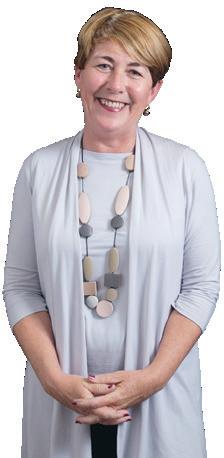


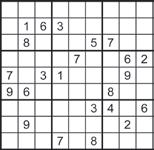
Cowra lamb rump… gorgeously tender and the dish danced with pistachio, eggplant and roasted broccoli.
Yoghurt mousse… with gingerbread, rhubarb, cucumber and chervil sorbet.
Photos: Wendy Johnson
The Cofield 2017 vintage sparkling shiraz.