Belco Bill’s in with a big chance
MICHAEL MOORE
‘Meloncholy’ news from the world of fruit
WENDY MACKLIN
The government’s still messing with Gungahlin
PAUL COSTIGAN
I do miss a glass of wine at a bar
RICHARD CALVER


Belco Bill’s in with a big chance
MICHAEL MOORE
‘Meloncholy’ news from the world of fruit
WENDY MACKLIN
The government’s still messing with Gungahlin
PAUL COSTIGAN
I do miss a glass of wine at a bar
RICHARD CALVER
Canberra Woman of the Year CINDY MITCHELL has moved quickly from corporate to charity in a time of growing need





St Clare’s College has been delivering Excellence in Girls’ Education since 1965. The College is located on one campus in Griffith, ACT and caters for students from Years 7-12.
We pride ourselves on developing and delivering an excellent curriculum catering for the learning needs of a wide range of students. Students are encouraged to become active learners and are given every opportunity to grow in all aspects of their life.
The wide range of courses on offer provide students with a strong basis for making future academic decisions. St Clare’s College provides a safe and empowering learning environment that supports students in reaching their full potential.
Applications for admission for 2021 close on Friday 29 May. For more information on how to apply visit our website.


By Danielle NOHRA

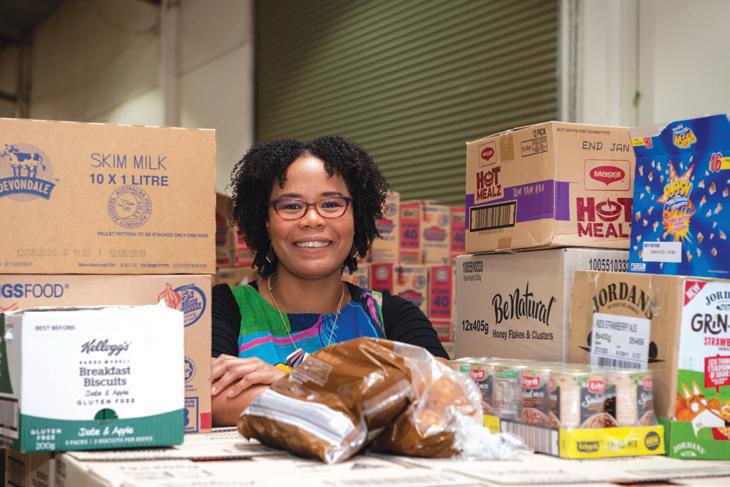
CANBERRA’S Woman of the Year, Cindy Mitchell, has stepped away from her business (for now), and, in just under two weeks, has helped set up a food-relief network to help the vulnerable during the coronavirus pandemic.
The Canberra Relief Network, led by Uniting Care Kippax, in partnership with the ACT government and other community partners, was launched as a response to COVID-19, and Cindy, with what she calls her “Canberra Woman of the Year cape”, took on the challenge to get it running.
“Basically, what the Canberra Relief Network is set up to do, is to support vulnerable Canberrans finding themselves in food distress as a result of the COVID-19 pandemic,” says Cindy, 43, of Nicholls.
When the social entrepreneur and founder of The Mill House Ventures, a social enterprise business development consultancy, was asked to lead the project, she got permission from The Mill House board to take off time for as long as she is needed at the network.
And while Cindy misses working with her “tribe”, especially now that
many of their businesses are strug gling, she says the network will save lives in the community.
“I just physically don’t have enough hours in the day to serve in all the ways I’d like to while also being a half way decent wife and mum,” she says.
But, Cindy says the work she is do ing at the Canberra Relief Network is important and is grateful she can use her business background to help.
“[The network is] about relieving some of the immediate pressure,” she says.
“It’s about people making the choice between purchasing food or medicine.
“We’re looking at the most vulner able people. These people never had the option of stockpiling food in the first place.”
Cindy says the network is expecting to help people who are already connected with some of the partnering agencies but they anticipate there will be a range of new people who have lost jobs that will need their support, too.
But, because of the public health pandemic, and its focus to stop the spread of COVID-19, the network will not be asking for donations from the community.
“We have a food operation centre where we are taking deliveries of food from major food providers,” she says.
“We are having to purchase foods like any other supplier would and can’t accept community donations
because of hygiene reasons.”
Over the next six months, the ACT government will provide $1.5 million to help these food relief organisations, who Cindy says were already struggling to meet the increasing demands.
“Before this, food pantries and centres were already really low on their stocks,” she says.
“Donations had reduced, we just came off the back of the bushfire season, which left a lot of local pantries struggling, even before this all happened.”
And, because there’s been such a huge demand for food, Cindy says charities couldn’t buy food either. But
IN this week’s austerity homily I want to talk about humility.
To usefully make my point, I self-consciously need to share a little of my CV: editor of the Adelaide “Advertiser” at 35, editor of “The Australian” in Sydney, director of news and current affairs at Adelaide TV station SAS7, managing director of “The Canberra Times” for a decade.
I have met and worked with and for some of the biggest media powerbrokers; private hours with Rupert Murdoch and years working closely with Kerry Stokes. There’s not much I don’t know about the clout of the media and how to exploit it.
As an owner of “CityNews” (with my daughter and son-in-law), these days I practice journalism because I can and because we collectively believe Canberra
needs strong, questioning and independent voices, possibly like never before.
When the coronavirus cut its economic swathe through the city, the bulk of our advertising income (our only income) went with it.
We asked readers and advertisers for help. Those who can have. And it has been humbling to see donations pouring in from readers (and from friends). In March, we more than quadrupled the level of donations and April looks much the same. The total isn’t bedazzling, but I promise you every single dollar is going towards giving this plucky little paper and its website a future.
This is a new definition of media power; the power of people to help the media. You want humility, I’ve got it in spades. And I thank you for it. Ian Meikle, editor
Photo: Holly Treadaway
by bringing these agencies together, she says they’ve been able to move higher into the queue to access pantry supplies than if each organisation was working alone.
“The idea is to initially have pantry essentials and as the public health crisis continues to emerge we might be able to stock fresh food and frozen meals,” she says.
But at the moment, the pantry will only supply canned goods and pantry items such as pasta, and other basic household items such as toilet paper.
“It’s all about being ready to address the needs. This is about saving lives
and reducing injury and trauma in the community,” Cindy says.
“One of the challenges of this period of time is we’ll see exacerbated comorbidities such as domestic violence, mental health issues, disabilities and homelessness.
“All these things we have as a problem already and they will just be exacerbated .
“Their vulnerability is exacerbated and this increased vulnerability can lead to premature deaths.
“If we can reduce the impact on that through this network then it’s worth-
But Cindy didn’t set up the network alone and says this is the ideal time to appreciate the community sector and the work it does.
“These people, they’re not getting paid a lot of money, yet they’re the people that are keeping our community going,” she says.
For people who require food relief, Cindy says they can register online or over the phone and the network will organise to put a hamper together to suit the needs of each household, independently.
The hampers will be delivered to one of the network’s community sector partners, who will contact the household and arrange for them to pick it up.
Donate money or register via canberrarelief.com.au



BILL Stefaniak stands a good chance of winning a seat at the next ACT election.
He has abandoned the Liberal Party and the vintage ACT politician has spotted a gap in the Liberal line up resulting from MLA Vicki Dunne stepping down.
He has set his sights on grabbing a seat from the Liberals in the Belconnen electorate of Ginninderra.
There are reasons why Stefaniak has a reasonable chance of winning a seat in Ginninderra. The first is about being opportunistic. Ginninderra stalwart and long-term member of the Liberal Party, Vicki Dunne, is not standing at this election. This provides an ideal opportunity for someone to tap into dissatisfaction with both the government and the Canberra Liberals.
Dunne has maintained a strong support base in this electorate. In one sense, she effectively inherited itfaniak. In the 2004 election Stefaniak won more

The name, the Belco Party, carries an element of the larrikin. This is an image that Bill Stefaniak would love to portray.
than 10,000 votes in that seat. This was almost three times the number of votes received by Dunne who was the secondplaced Liberal candidate. However, a great deal of water has flowed under the bridge since then.
The second reason is that Stefaniak was popular in this area, despite these days living in Narrabundah. His longterm “law and order” approach, as well as his focus specifically on Belconnen, gave him appeal in the past. His very first media interview has populist appeal for the electorate identifying the “Belconnen area being left behind for infrastructure and maintenance”.
Third, he will be running on his own political party ticket. He realises this will improve his chances over independent candidates, who will not have a column of their own on the ballot paper. The name, the Belco Party, carries an element of the larrikin. This is an image that Stefaniak would love to portray. His personal name
recognition, the party name and ballot paper positioning will improve his chances over other candidates.
The Labor candidates in Ginninderra are Education Minister Yvette Berry, Attorney-General Gordon Ramsay and backbencher Tara Cheyne. The prominent ministers will be very difficult to unseat while Tara Cheyne remains more vulnerable. Some Labor votes and preferences might flow to Stefaniak, but the Belco Party focus will be to win Liberal voters.
The Liberals are now weak in this seat with Elizabeth Kikkert the only current Liberal MLA standing for the election. Kikkert has neither the profile to match Dunne, nor the recognition of Stefaniak with older voters.
However, there are some serious challenges for Stefaniak. Mark Parton ran as a middle-of-the-road independent in the same electorate in the 2008 election and was not successful. It was not until he joined the Canberra Liberals and moved to the seat of Brindabella that he succeeded elector-
and order” drum.
The coronavirus plays into the hands of the government. When communities are frightened, uncertain or feel under threat they are reluctant to make change. Although it is not feasible that the Labor Party could win more than three of the five seats in the electorate, the flow of preferences and dealing with uncertainty could just favour the major parties.
There is also some personal baggage that Stefaniak has to counter.
Just before the 2008 election, he resigned from the Assembly accepting a senior post to the then new ACT Civil and Administrative Tribunal.
At the time I argued in this column:
and personal advantage. However successful it may be, there is an odour about this appointment”.
Stefaniak does have baggage. However, by throwing his hat into the ring as a non-Liberal, he does have a chance of election. He would never support Labor into government and considering the widespread dissatisfaction with Labor, this just might improve the chances of the Liberal Party winning government.
Michael Moore is a former member of the ACT Legislative Assembly and an independent minister for health. He has been a political columnist with “CityNews” since 2006.


By Kathryn VUKOVLJAK

WITH people spending more time at home and movement restricted, there has been a significant increase in demand for family violence services, according to victims of crime commissioner, Heidi Yates.
And she wants people to know that all services are still open and ready to respond.
“Social distancing has affected how we deliver our services but we’re adapting to being a remote team across all services using technology and are just as committed as ever,” she says.
“We know people in the Canberra region are under stress from the effects of social isolation, job losses, financial stress and this seemingly endless uncertainty. All this places many clients at greater risk of family violence.
“We’re finding more people reaching out to us, and we want people to know we are here for them via phone, text, email and video calls.”
Heidi says one of the things that worries her is that any incidences of abuse may be less visible, and others
may not know what’s going on.
“There are going to be less wit nesses as we’re all seeing less people,” she says.
“We’re urging everyone in the com munity to keep an eye on each other, and be aware of anything unusual happening.
“Maybe you can arrange a walk with a friend you’re concerned about but keep your distance, or perhaps someone you know needs you to con tact them and check that everything is okay. Be ready to support one an other and check in.”
Heidi says the message from sup port services including the Domestic Violence Crisis Service, Women’s Legal Centre, Legal Aid ACT and Victim Support ACT, is there’s no wrong door, and whichever number you come through to they will be able to refer you on.
“For example, someone might call Legal Aid because they feel their partner wouldn’t be suspicious of that, and they could claim it’s for an other reason,” says Heidi.
“We’re used to reading between the lines.”
Heidi says the crisis lines are not only for victims of abuse and that any one who feels they might use violence will be supported, too.
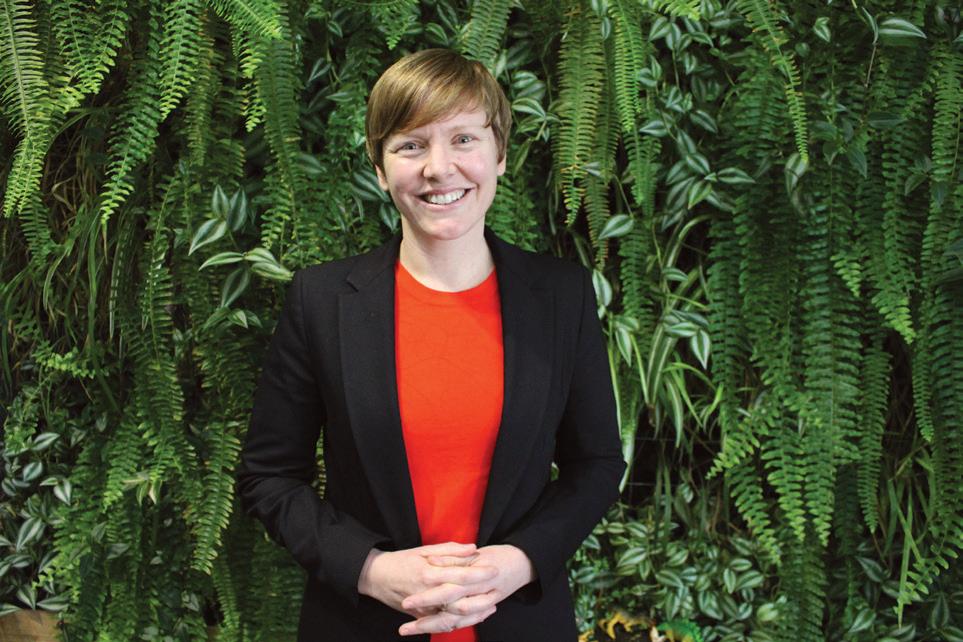
“A lot of us are under a great amount of stress at the moment,” she says.
“Anyone who feels concerned that
dicated that there doesn’t have to be a history of violence for it to take place.
“We take all threats seriously and encourage anyone who feels stressed to get in touch. The support is there
be creative in how they respond, the team is very much available.
“We’re seeing from other countries that are ahead of us in this COVID-19 journey that there’s an increase in
reported incidents of domestic vio -
“People could be spending more time at home with a person using violence and there is less access to witnesses. You’re not alone. We’re an essential service and we are here to support you, so please reach out.
“We don’t know when this situation will end, and not knowing the impact this can have on us all when it’s harder to see other people and the mental health impacts of that, is a worry.”






Strict
All
All
Drop-to-door
Now
Please
Thank



WENDY MACKLIN finds a solace in watermelon as she endures self-isolation on the south coast
IT’S amazing what you can do with watermelon. In these terrible times and in isolation, it is important to have something vital to ponder, some stimulating intellectual exercise.
I have tried to think about what is happening to the world and what the future will be like, but this is pointless – there are no answers even on Google. But Google can help with watermelon.
It started two days ago when our first delivery of groceries arrived by truck from Woolies of Batemans Bay. I was pleased because this was a supermarket first for us and the IT genius in the family had been cursing a lot when trying to fill out the order form.
I noticed that the delivery man was buckling at the knees as he heaved the bags on to the doorstep. He took a photo, which is what they do now so you don’t have to get up close and personal to sign. (What thrilling pictures this bloke has on his phone. If he suffered from insomnia he could make a slideshow

of his day’s work and be snoring by the six-bag Tuross drop off).
The first bag held only one item.
The world’s biggest watermelon. It was a small boulder. And two bags later, I found another half. But then I came across FOUR rolls of paper towel and this was so wonderful, the excess of watermelon was forgotten. (One becomes over-excited by the most trivial of events in isolation I have found).
I was in such a good mood, I decided to go to my gym’s Facebook page and start the daily exercises. This went well after initially crash-
ing into the bed and knocking over a chair.
But while I was puffing away, I had a terrible shock. “Keep that right elbow up, Wendy,” called the instructor and I jerked the offending elbow up so hard, I nearly took out an ear. Isn’t technology amazing? I was so relieved I wasn’t wearing my fluffy bunny slippers and had put on some eyeliner.
After that I tackled the half-watermelon making bowls of fruit salad, jugs of juice and the fabulous salad of watermelon chunks, red onion, feta and chopped mint. But there
was still the big one, so I turned for a solution and intellectual stimulus –as one does – to Google.
Naturally, there were pages of ideas about what to do with watermelon ranging from use as medicine for erectile dysfunction to watermelon pizza. You don’t believe me? Check it out. In isolation, one has all the time in the world to extend one’s knowledge of vital matters.
I decided to try the grilled cheese sandwich with the thin slice of melon between two slices of cheese. This was all right I suppose, but you’d rather have tomato or bacon and anyway, the amount used was miniscule. I am now trying out the ice-cream recipe, which uses two cups of chopped frozen melon blended with condensed milk or coconut milk. Easy.
I shall be sending the results of this trial to my thousands of friends and relatives who are eagerly waiting by their phones and computers for the results. When you are in isolation, it is important to keep in touch constantly and be stimulated intellectually by learning about the amazing things going on in the world of fruit.
Anyone else have some notes from isolation they’d like to share? Short or long as you like (to 700 words) to editor@citynews.com.au
ACT public schools will teach remotely in term 2, says Education Minister Yvette Berry. And there’s no certainty about what term 3 will look like.
ACT public school students will move to remote learning in term 2, from Tuesday, April 28.
“Most public school students will undertake their learning from home. For parents and carers who cannot keep their children at home, due to work or additional needs, the ACT government will provide supervision at a reduced number of public school sites for these students to continue to be provided with support,” the minister says.
“Students at these sites will be supervised by Out of School Hours Care staff supported by teaching staff, and allied health and support staff.
“Parents are not being asked to become teachers, their job remains to care for the wellbeing of their children. Our expert teachers will continue to teach and are adapting to be able to do this remotely.
“All remote learning will be designed and delivered by teachers. Teachers will set a number of tasks for the week for students to complete at home, and they will be checking in with students regularly over the phone, email or through video conferencing.
“If public school students don’t have access to a device or a computer at home, the ACT government will provide one, along with internet access for families who need it. Families should contact their school to organise a device.”
At the end of term 2, this new approach will be reviewed to assist planning for term 3.












IN late 2019 the ACT government proposed to vary the plan for the Gungahlin town centre. It didn’t take long for the Gungahlin Community Council to spot the devil in the detail – or to be more accurate – what detail went missing.
Formerly, the government’s introduction for the town centre was: Gungahlin town centre is the major hub for employment, shopping, social activities and public transport particularly serving suburbs within the Gungahlin district.
In the new draft – this sentence disappeared.
The Planning Directorate is defining Gungahlin as a dormitory set of suburbs (people sleep there, but travel elsewhere for work). Removing this sentence also takes away the notion of providing services – such as community, cultural, sports and cultural facilities. Neat trick!

Unlike the historical model for such town centres where the government was the developer and
Local politicians have been mostly absent from the planning debates with Labor politicians more committed to being part of Team Labor than representing constituents while the Liberals remain silent.
facilities were part of that package, this centre followed the privatedeveloper-led model.
For Gungahlin the developers were given the opportunity to build a commercial centre with all the usual community and cultural services to materialise as needed. Nice theory!
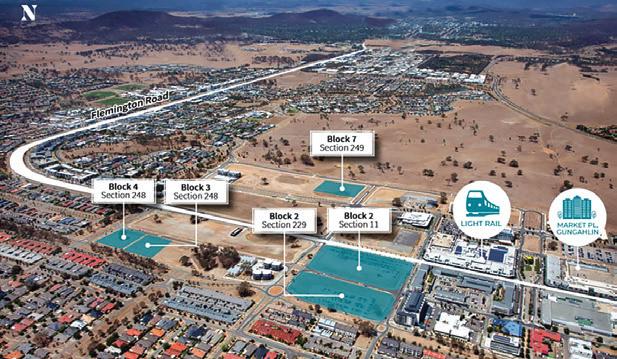
The Suburban Land Agency is selling off the land to the east of the centre for apartments. The trouble is not just that there will be more towers, it is more about what goes missing as a consequence.
Locals accept that surface parking will eventually go but would have expected the planning bureaucracy to have put in place adequate transport linkages to enable easy access to public transport. Wishful thinking?
The tram has been a success for those heading into Civic for work. However, that depends on getting access to parking or having the set up for securing bicycles.





As more surface car parks go, there is no planning for how the ever-increasing number of commuters are to access the tram. There has been little planning for better cycle paths and, mysteriously, the government neglected to provide a secure cycle shed for commuters.
Then there are the ever-increasing towers. A former planning minister, Andrew Barr, made this commitment:
“I believe you can reassure your council that there is no risk that a ‘skyscraper’ would be approved for the Gungahlin town centre, unless such an outcome was to be arrived at through the town centre study, with the community’s support.”
Put that together with recent surveys by the Gungahlin Community Council that residents do not support any more residential towers in town centres. Yet the Suburban Land Agency has listed the sites for sale as having an increased focus on residential – more towers. There is little provision for services let alone for the commercial activity that had been listed previously.
The Gungahlin community desper-

ately wants to work with the government. This requires a willingness by the government to genuinely listen and not to reinterpret the community’s feedback – as keeps happening.
The government has firmly dropped all notions of long-term, peoplefocused planning. Local politicians have been mostly absent from the debates with Labor politicians more committed to be part of Team Labor than representing constituents while the Liberals remain silent.
It is doubtful that the ACT Greens are using this increasing urban design mess around the town centre as an example of their achievements by being in coalition with Labor. Likewise, it would be doubtful if the chief planner uses this in his boastful presentations at planning conferences.
Those who have worked hard to

assist the community and have a voice about their town centre are at a loss to understand how the Chief Minister, planning ministers and the planning chief could be proud of where the centre’s development is heading.
Instead the government carries on being relaxed about allowing ad hoc decisions to hinder good urban development in and around this town centre. Things could have been better given the commitment of locals over many years. It is still not too late to transparently engage with the residents who like the place and can see how it could be even better.
Paul Costigan is an independent commentator and consultant on the visual arts, photography, urban design, environmental issues and everyday matters.


‘We are carefully sanitising all our cars and are using steering wheel protectors and seat covers’
HAVING a personal vehicle in this uncertain time is important for key workers, says service manager at Slaven Mazda, Darren McGown.
“People need their cars, it’s vital for essential workers who need to get to work, in an isolated manner, during this time,” he says.
“In turn, we are still providing services and have bookings right through to the end of April at this stage.”
Slaven Mazda services up to 70 cars a day, and Darren says for them it’s business as usual, while taking into account the restrictions around COVID-19.
“We’ve made significant, positive changes to how we run the business, many of which are good practice anyway, and we’ll probably continue on with them once things return to ‘normal’,” he says.
“We are carefully sanitising all our cars, whether for loan or sale, and are using steering wheel protectors and seat covers.
“Our staff is also ensuring that keys are dropped directly into a sealed bag for the day, so no one is touching them.”

so they are correctly spaced out, in line with social distancing recommendations.
“Another thing we’re doing is staggering the appointment times so we know when and how many people will be coming in, and we are also doing payments over the phone or online.”
the motor-vehicle industry, having started in 1976/1977, when it bought out John Palmer Motors in Fyshwick. It has been in its current Phillip location for 14 years, providing new car sales, servicing, spare parts and accessories, finance and insurance.

charity and sporting needs of the local community. Slaven Mazda is constantly investing in its dealerships; and maintaining and broadening the respect in its family group of companies, by utilising the highest degree of business ethics and stewardship.
looking after customers is their main priority.
“I’m proud that this year, all six of my service advisers are each a ‘Guild Member’, which is a recognition for exceptionally good customer service and essentially doing their jobs to a high standard,” he says.
Darren says that another focus has been maintaining social distancing in the waiting area and when cars are dropped off in the morning.
“Our customers are able to leave their cars and not be in direct contact with staff, and in the reception and waiting area we have a designated line for people to stand behind
Darren says the only thing they have had to stop offering is their courtesy bus, though they are offering loan cars instead where possible.
“We want to do the right thing, and providing the bus service at this time is not appropriate with social distancing,” he says.
A locally owned, family business, Slaven Mazda has more than 40 years’ experience in
Slaven Mazda, as a member of the Rolfe Motor Group, says it is fully committed to exceeding clients’ expectations, as well as exceeding its distributor partner’s key performance indicators and national sales rates.
It also provides its staff with satisfying career paths and a healthy working environment; and is committed to being a good corporate citizen by contributing to the
The dealership has also undergone a recent renovation, Darren says, with everything given an update and revamped – from the new reception area, 60 more customer parking spaces, a new ramp downstairs and a larger area for customer drop-off and valet parking.
Darren has worked at Slaven Mazda for four years as service manager, and says that
“All of our team must have a customer service focus that’s second to none and this is what we look for when hiring new staff or rewarding existing staff.
“We pride ourselves on the quality of our products and our service.”
Slaven Mazda, 140 Melrose Drive, Phillip. Call 6208 4444 or visit slavenmazda.com.au


AFTER 40 years of service
Greg Jones is retiring from the ACT Public Service as work safety commissioner.
He has been commissioner since July 2016 and Employment Minister Suzanne Orr thanked him for his “service to the people of the ACT and wish him all the best for the future”.
Before his appoint ment to work safety commissioner, Mr Jones held senior leadership positions in the ACT public service, including as the head of the former Casino Surveillance Authority and CEO of the ACT Gambling and Racing Commission. He has worked for 30 years in various regulatory roles.

“I’m proud of the ongoing focus of government on industrial work, health and safety and the enhanced awareness of employers of their responsibilities through the Work Health and Safety Act,” says Mr Jones.
“As a result of our active engagement with all stakeholders and our enforcement activities, more workers returned home safely, and I am pleased to have led this important work.
“WorkSafe has a strong and experienced investigation team which focuses on professionally gathering evidence to ensure successful regulatory action is achieved.
“I’m also delighted that more employers are now focusing on mental health and wellbeing in the workplace as well as on the more traditional physical health. I am proud to have introduced a strong focus on mental health as well as providing a range of measures to assist and support this important health and safety issue.
“I would like to pass on my appreciation to my dedicated team over the years who have worked tirelessly… it is testament to their work, determination and compassion that I retire knowing that the ACT is safer for workers.”
Minister Orr said the ACT government would make an announcement on Mr Jones’ replacement in coming weeks.
By Kathryn VUKOVLJAK
SHIFTING to the home office
might be the new normal but it’s not without its challenges, whether it’s finding a quiet space to work, distractions and interruptions if small children are also at home, staying productive or feeling isolated if you’re used to being surrounded by colleagues.
Swaroop Kaushik, CEO and founder of Jaga Workspaces in Bel connen, says working from home re quires a shift in thinking and a very definite plan for it to be successful.
“The change in our day-to-day lives is the biggest thing about this shift we’re making – it’s hard to adapt to something new,” he says.

Swaroop says that sometimes the first week or two of working from home can be okay, but gradually people start to feel the social isolation and find it harder to stay focused.
“The social disconnect is tough and can contribute to lack of productivity, when you’re used to your boss watching you or seeing your colleagues busy working away,” he says.
“We all tend to be competitive and curious about what’s going on around us, so working from home can sometimes feel like we’re in a prison.
“Group chats online, preferably via a video call so you can see the rest of your team, can really help and it’s more personal because the
way we communicate verbally is different.”
Swaroop also recommends taking a disciplined approach and creating a routine that works for you, while fitting in with your office’s expectations.
“It’s easy to get distracted, but if you factor in your most productive times you will get more done,” he says.
“Work out when your high productivity periods are during the day and plan your workload accordingly, so you can be efficient and have enough time to do things you enjoy, too.
“This isn’t going to be a shortterm thing, we may be looking at three to six months of this, or more.

We have to make it work for us.
“If possible, set up a designated, quiet workspace and commit to working there every day. Keep clear boundaries around your work time, and try to avoid it creeping into your home life.”
Making sure you get outside can help too, Swaroop says, whether it’s a brief walk around the block before you sit down to work, or spending time with family or pets.
Create a to-do list so you know what you’re doing for the day, and start each day by reviewing your priorities.
“When you make your task list, stick to it,” he says.
“Set goals and time limits for each task and cross it off when it’s done,
which is effective and fulfilling.
“For me, I make a mental plan of what I need to get done, work for an hour, have a break, work for two more hours and have lunch. It’s up to us to dictate how it works best for us and set those boundaries.
“I’d also suggest staying off social media during the work day as much as possible too, as there’s so much content about COVID-19 that it can become distressing.”
There can be benefits too, he says, such as for him, not having to commute and being able to see more of his family and particularly his kids, aged 11 and two.
“I can work around my family commitments – and I don’t have to dress up,” he says.
By Danielle NOHRA
AFTER spending 30 years contributing to athletics in multiple roles, former longdistance runner and two-time Olympian, Shaun Creighton, has been recognised with a prestigious national award.
The Campbell man, 52, was recently presented the Athletics Australia Edwin Flack Award at the Australian Institute of Sport. Previous recipients include Robert de Castella, Catherine Freeman, Steve Moneghetti and Ker ryn McCann.
The Edwin Flack Award, named in honour of Australia’s first Olympian and gold medallist, is presented annu ally to an Australian athlete who has rendered distinguished services to the sport of athletics.
“It’s nice to be recognised. It’s an honour,” says Shaun.
“As a kid I enjoyed all sports but run ning seemed to be what I was best at.

Australian 3000m steeplechase record
But Shaun’s contributions to the sport don’t end as an athlete, and in one role or another, he stayed part of
“I’ve remained heavily involved at a
He held Australian team coach roles at the Commonwealth Games and World Cross Country Championships and has been a national selector for track and field, road and cross country
“The things I’ve done have always been through a love of sport as an athlete, as a coach and providing legal services,” says Shaun, who became a lawyer and used his skills to help athletes with non-selection appeals.
“I felt strongly about that because I missed out in 1992 after having a qualifying time and was always disappointed so helping athletes with nonselections was very important to me.”
Shaun, who is the partner director of Moulis Legal, fell in love with law towards the end of his running career, which saw him take a 10-year break
“The decision to stop running
wasn’t something I woke up one day and decided to do,” he says.
“I was working as a lawyer, I had a young kid, and all of a sudden there were other priorities in life and my fitness slowly started to decline.
“I gave up running for a bit. I got a bit fat and unfit. [And then one day] I went for a run with my wife and she was pushing the baby in a stroller and I really couldn’t keep up.”
That run with his wife was a turning point for Shaun and at the age of 50 he looked up the Australian men’s over 50 marathon record and set out to beat it. It took him three times to beat it, but during brutal conditions in a Christchurch marathon last year, he finally took out the Australian men’s record for his age group by running 2:30:29 in 42.4km.
“The marathon was probably the record that meant the most to me,” he says.
“It took the most goes and was the toughest one to get.”
Even though it was a milestone for Shaun, he doesn’t plan on slowing down any time soon and has his eye on breaking the record for a 50km marathon.
THERE has been a 33 per cent increase in the number of women incarcerated in NSW between March 2013 and June 2019, according to a report prepared in NSW by the Keeping Women Out of Prison Coalition (KWOOP).
The report, which was released late last month, also reveals that about a third of women in jail were Aboriginal, despite making up less than 3 per cent of the population.
An interesting finding from the research was that a major factor in the growth in the number of women in prison was due to a 66 per cent increase in the proportion of women on remand, not a rise in crime.
It was also noted that Aboriginal women were on average waiting 34 to 58 days for bail and that the majority of women on remand were ultimately not given a sentence.

The most common crimes
What will it take to get the community to demand we tackle the entrenched social and economic disadvantage experienced by Aboriginal people in Canberra?
were crimes against justice procedures, such as breach of parole or failing to attend court, drug offences and acts intended to cause injury.
Aboriginal and Torres Strait Islander social justice commissioner June Oscar, in responding to the report, called for urgent systemic reform saying: “Our criminal justice system is in crisis, but that crisis is not to do with an increased criminality of our people.
“It is caused by unnecessary overincarceration and a lack of desperately needed investment in community diversionary options.
“The system is broken. We are not.
“What’s needed is a community led, trauma informed preventative approach that tackles the entrenched social and economic disadvantage behind the crimes our women are incarcerated for.”
Winnunga Nimmityjah CEO Julie Tongs congratulated KWOOP for its commitment to the needs of women
caught up in the criminal justice system in NSW.
She also noted ruefully that the absence of community-based coalitions such as KWOOP in the ACT was one possible explanation for the lack of public attention to or apparent concern or interest within the broader Canberra community and local media about the circumstances of Aboriginal people in Canberra.
Tongs said: “The painful reality is that the rate of incarceration of Aboriginal people in the ACT, including of Aboriginal women, is massively higher than in NSW and is in fact the second highest in Australia.
“In addition the number of Aboriginal and Torres Strait Islander men and women imprisoned in the ACT increased between 2009 and 2018 by a staggering 252 per cent against an average increase across all jurisdictions of 54 per cent and was to our shame by far the highest increase in Australia.”
She said she agreed that the incarceration of Aboriginal people was one of the most challenging human rights issues in Australia and it would accordingly be wonderful to see an organisation such as KWOOP operating

in the ACT.
She listed issues she felt could be highlighted through such a coalition as:
• The impact the ACT government’s decision to abandon plans for an Aboriginal Drug and Alcohol Residential Rehabilitation Facility has had on the level of Aboriginal offending in Canberra;
• Whether the fact that the ACT is the only jurisdiction in Australia that does not comply with the recommendation of the Royal Commission into Aboriginal Deaths in Custody to support an Aboriginal Justice Centre militates against a reduction in the Aboriginal incarceration rate in the ACT;
• The impact that the refusal of the ACT government to develop an Aboriginal housing policy or to support the establishment of an Aboriginal housing corporation has had on Aboriginal homelessness and offending, re-offending and incarceration;
• The extent to which the nonemployment by the ACT government of the Aboriginal Child Placement Principles and the fact that the ACT has the second highest rate of removal, in Australia, of Aboriginal children from their family and placement in out-of-home care has had a bearing on the Aboriginal incarceration rate;
• Whether the decision by the ACT government to ignore all of the findings
of the initial report of the ACT inspector of corrections concerning the treatment of women detainees in the AMC affected the rehabilitation of women detainees and increased the likelihood of their re-offending;
• Why the recidivism rate of Aboriginal detainees in the ACT, which is 90 per cent, is the highest in Australia and almost twice as high as the nonindigenous rate and what conclusions can be drawn about the effectiveness of rehabilitation programs at the AMC or the value of the Throughcare Program as a result of this disparity in outcomes.
• What connection can be drawn between the fact that more than 30 per cent of Aboriginal children in Canberra live in poverty and the Aboriginal incarceration rate;
Julie and I both agreed that the final and perhaps most important question is: What will it take to get the community to demand, as articulated by June Oscar, that we tackle the entrenched social and economic disadvantage experienced by Aboriginal people in Canberra and which leads, among other things, to an Australiahigh incarceration rate?
Jon Stanhope was chief minister from 2001 to 2011 and represented Ginninderra for the Labor Party from 1998. He is the only chief minister to have governed with a majority in the Assembly.

MORE than a week has passed since the ACT government said it is considering the early release of detainees from the Alexander Maconochie Centre in response to the heightened risk coronavirus represents to people in prison.
The view of a wide range of experts led by Prof Lorana Bartels, of the ANU, is that based on overseas experience it is only a matter of time before there are widespread coronavirus cases in prisons in Australia. The consequences of that occurring are truly frightening and all governments in Australia are being urged to act as quickly as possible to begin the release of prisoners who are of low risk to the community, are serving a short sentence and/or have a vulnerability which could prove fatal if they contract the virus.
It is universally accepted that Aboriginal and Torres Strait Island people are at high risk if they become infected with the virus because of their generally heavy burden of disease and illness.
The Liberal government of NSWintroduced and passed enabling legislation last month to permit the early release of detainees and is to date the only government in Australia to respond with urgency to this issue.
A JACS spokesperson is quoted by citynewes. com.au as saying that the ACT is considering an early release regime along the lines of NSW but that was more than a week ago.
I wrote to the Minister for Corrections almost three weeks ago calling on him to give this issue the highest priority but he is yet to answer my letter.
I note also that the ACT Legislative Assembly is not scheduled to sit again until May 7. With respect, a delay of a further month before acting on this life-and-death issue is simply not acceptable.
Julie Tongs, CEO, Winnunga Nimmityjah Aboriginal Health and Community Services, Narrabundah
BEFORE, during and after the pandemic a century ago, my mother worked as a nurse at Manly Hospital treating patients with the medical knowledge available at the time, and went on to have a family. No matter how long this pandemic lasts,there will be an end to it, and life will return to normal as we know it.
If they could overcome it last time with their limited resources, then we will eventually defeat it this time as well – KEEP THE FAITH!
Peter Gately, Flynn
The never-ending claims from state and federal governments that “we are all in this together” and we all need “to share the financial burden” is simply not true!!
Why are our two tiers of government immune to the financial crisis confronting our nation right now?
The financial sacrifices being made by the business sector in Australia is unprecedented in our time and Australians are suffering like never before. Why is it that the very people who develop and create the wealth of Australia are taking the full brunt of financial losses, yet governments and public servants have no change to their salaries and general perks?
We must introduce at least a 40 per cent reduction in salaries across governments and all public servants (with the exemption of health workers and associated groups) and redirect these funds where they are most needed. We will then be truly “all in this together”.
Ken Smith, via email

IT is increasingly clear that any consideration of the extension of light rail should be deferred until the financial ramifications of the COVID-19 pandemic are assessed.
The already marginal project will be competing for even more limited funds against high-value projects including the SPIRE and social housing.
Furthermore if there is a long-term shift to working from home, the lower travel demand could be met by high-capacity electric buses at a fraction of the cost.
Mike Quirk, Garran
YES, this is the year of the virus, but it’s also the year of the ACT election (October 17). Come election time, it has always seemed to me that we don’t know who the candidates are, what they stand for, or what the “community” (however defined) actually wants from the ACT government.
Why not do a supplement called something like “Election Countdown”? Ask community groups to put together a list of what they see as the top five priorities for the ACT government. Give them a word limit to argue their case.
Around the end of August ask “CityNews” readers to vote on priorities. It might end up being the top 10 or 20.
Ask all candidates in the election to give their views on these priorities.
You might have to limit it to organised groups. If you open it to individuals it will blow out to something unmanageable.
It’s something we need and something that will get people thinking of the future rather than the grim present.
Gary Shapcott, via email

UNFORTUNATELY, noise levels in densified, mixed- use residential urban renewal areas (“Nobody’s listening when noise levels ruin your life”, Paul Costigan, CN April 7) were allowed to escalate in July when the ACT government, in the midst of the still ongoing building defects crisis, began to water down night-time noise limits for venues in the city, and town and group centres.
The justification was the need to help the local music scene and to encourage much more “vibrant nightlife”. The designation of major entertainment precincts was also promised for the future. So, too, were moves to have “acoustic amenity” considered by the National Capital Design Review Panel when it reviews plans for new mixed-use complexes.
However, that panel does not necessarily assess all new unit developments slated for the areas where loud noise travels easily.
And as noise-affected Braddon residents and others elsewhere have discovered, it’s too bad if you want to open a window before the early hours of the morning, if you want to enjoy the benefits of passive cooling and cross-ventilation on hot summer nights or if you can’t afford to run an air conditioner for hours at a time, night after night.
Buyers certainly should be wary of units in existing buildings that may be oriented towards noise sources and are also likely to lack adequate sound insulation.
Yet the push for this ratcheting up of noise pollution was strongly encouraged by Greens leader Shane Rattenbury, the Sustainability and Climate Change minister and for Canberra’s Living Infrastructure Plan: “Cooling the City”.
It is clear that he and another far from perfect ACT regulatory set-up have not been able to cool down the heat arising from the excessive noise created by a Braddon beer garden, leaving nearby residents to rely on the ravages of COVID-19 for a rare chance to gain much-needed respite and relief.
Sue Dyer, Downer
AFTER reading the last edition’s letter (“Empty buses must be wasting money”, CN, April 9), I was saddened by its lack of empathy for the people who really need to use our buses.
My daughter is an essential worker and walks a
kilometre each way to get to work, often walking home in the dark, rain and soon, the frost. Before the bus routes were changed, it was a 150-metre walk each way. People don’t use the bus unless it’s absolutely essential. Do these people seriously think they don’t need anything, ever, that an essential worker supplies or provides? I suggest they really think about who is actually using a bus, and why.
Janelle Boreham, Hackett
IT is noteworthy that two epidemics are occurring in the midst of the COVID-19 pandemic – tobacco and cannabis.
Both bring huge damage to our lungs which is the principal part of our bodies that the coronavirus attacks. Medical authorities are telling the community almost daily that people with damaged lungs have a reduced chance of recovery than those with healthy lungs.
The coronavirus advice to keep 1.5 metres apart and practice social isolation is implementing the public health principle of primary prevention, that is, preventing first-time contact.
It is comparable to preventing people from being first-time users of cannabis and other illicit drugs. It is that form of prevention which is the major factor in flattening the virus curve.
Unfortunately, our illicit drug policy has done, and is doing, virtually nothing to stop the curve for nearly all illicit drugs from rising. That’s why, in the case of cannabis, we have 220,000 dependent on it, and in a wider context there are more drug-induced deaths annually (about 1800) than road crash deaths (about 1200).
Colliss Parrett, Drug Watch International, Barton

‘Believe
A letter from the American author F. Scott Fitzgerald to a friend in 1920, during the great Spanish Flu pandemic.
Dearest Rosemary,
IT was a limpid dreary day, hung as in a basket from a single dull star. I thank you for your letter. Outside, I perceive what may be a collection of fallen leaves tussling against a trash can. It rings like jazz to my ears. The streets are that empty. It seems as though the bulk of the city has retreated to their quarters, rightfully so.
At this time, it seems very poignant to avoid all public spaces. Even the bars, as I told Hemingway, but to that he punched me in the stomach, to which I asked if he had washed his hands. He hadn’t. He is much the denier, that one. Why, he considers the virus to be just influenza. I’m curious of his sources.
The officials have alerted us to ensure we have a month’s worth of necessities. Zelda and I have stocked up on red wine, whiskey, rum, vermouth, absinthe, white wine, sherry, gin, and lord, if we need it, brandy. Please pray for us.
You should see the square, oh, it is terrible. I weep for the damned eventualities this future brings. The long afternoons rolling forward slowly on the ever-slick bottomless highball. Z. says it’s no excuse to drink, but I just can’t seem to steady my hand. In the distance, from my brooding perch, the shoreline is cloaked in a dull haze where I can discern an unremitting penance that has been heading this way for a long, long while.
And yet, amongst the cracked cloudline of an evening’s cast, I focus on a single strain of light, calling me forth to believe in a better morrow.
Faithfully yours,
F. Scott Fitzgerald
HORRIFIC as it is, the C-19 pandemic does have compensations, perhaps the most remarkable being the sudden revelation of our amazing capacity for change.
All this time, our political and social systems have herded us into separate, ever-narrowing conservative and progressive pathways, with barely a tunnel (let alone a bridge) between them.
We’ve come to believe that this is the way of the world; we’ve even made a virtue of it, this centrist doctrine that trumpets the same old same old such as the silly dirge we call the national anthem and the ridiculous nonsense of an English aristocrat as our head of state (how nutty is that!).
But overnight, it seems, we’ve watched in wonder as an entire continent has transformed its modus vivendi. Together, a conservative federal government and progressive state premiers and chief ministers – with the genuinely constructive assistance of the federal opposition – have nationalised great swathes of industry and the health system to the applause of the nation.
risen by one third. There’s no reason to believe that we aren’t seeing at least the same increase in Australia. That brings the annual number of murder victims to about 70 in our land.
Coincidentally, at time of writing, the number of C-19 deaths stands at just under that annual figure for domestic murder; and while no one knows the cumulative figure it’s in the thousands. Yet while we have turned Australia upside down for one tragedy, we’ve done virtually nothing for the other.
In today’s world, more money for women’s refuges is wrong on every level. They should not be forced out of their homes, and certainly not to live in groups where the virus can so easily spread.
While we have turned Australia upside down for one tragedy, we’ve done virtually nothing for the other.
Regular readers will recall my “Gadfly” of several weeks ago when I advocated a new system of Apprehended Violence Orders, which involved naming and shaming perpetrators initially, then putting them in jail for breaches of the order. Now is the time to take them out of the home immediately and put them in a special facility until their cases can be heard.
They’ve even closed the beaches and the footy ovals without the people taking to the streets (which are pretty much off limits anyway).
And why? Well, it’s to save lives. Nothing more important than that. So here’s my question. Why have we not taken the opportunity to save the lives of the women being murdered in their homes by the vile bastards who shelter under the euphemism of “domestic violence”?
In the old days – “Pre-C” – these murders were occurring at the rate of one a week. That is, each year more than 50 women were bashed, hacked to death or set alight, often in front of their children, by a male murderer.
There are no new Australian figures, but since the arrival of C-19 in France the incidence of “home violence” has
It is not beyond the power of federal parliament to design an interim legislative Bill to bring such a system into force. And when we cross that post C-19 bridge that Scott Morrison talks about so hopefully, we can revisit the system and iron out the bugs.
But right now it’s urgent and C-19 has taught us that we have the power to make the change. Or is the murder of a woman somehow less important than a death by disease. robert@ robertmacklin. com

A MULTI-million dollar temporary coronavirus emergency department will be built on Garran Oval and operating by May to prepare for the “worst” virus scenario, says Health Minister Rachel Stephen-Smith.
Next to Canberra Hospital, the $23 million, pop-up ED will prepare for an increased demand in the health care system, says Ms Stephen-Smith.
The government and Aspen Medical will have begun site investigation to inform final design and site layout. Construction will begin shortly after, says the government.
The Minister says: “Though the designs

By Danielle NOHRA
SWINGER Hill’s Mhairi Henderson has been on a two-year journey to capture the dramatic seasonal changes of the Canberra landscape.
“In Canberra we have four distinc tive seasons,” says Mhairi, who was inspired to illustrate them during her morning walks around Lake Burley Griffin.
aren’t yet finalised, we are moving as quickly as possible to plan, design and deliver this new facility, and ensure we are well-equipped to cope with the anticipated increased demand on our health care system.
“In moving ahead quickly on this project, the government is planning for the worst scenario whilst hoping for the best outcome for our community.
“We anticipate the temporary facility will be operational in May. As further detail is finalised, we will keep the community informed about the model of care and the operation of the facility, including who should use it and when.”
Mhairi’s first compilation of pho tos were taken from Commonwealth Bridge, looking across the lake and, from there, she chose another few spots around the lake to capture.
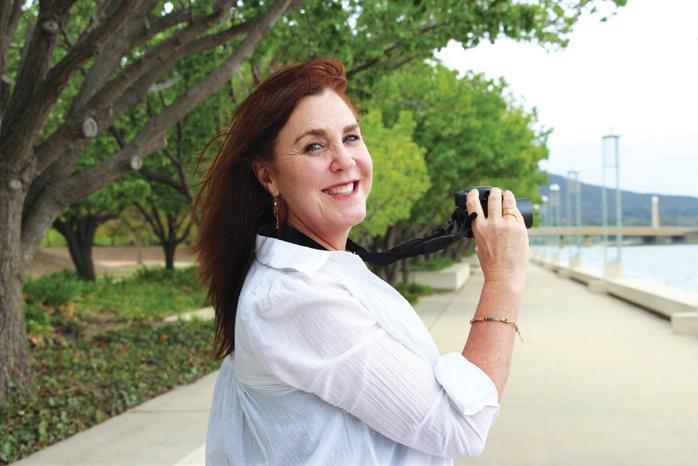
“I took lots of photos of each particular place and I had to remember where it was and then line it up again for each season,” she says.
“I’d have to look at the landmarks and how far they were. It took a few shots to get it right.”
Mhairi, who first picked up a camera when she was a teenager at Narrabundah College, was drawn to taking photos of landscapes (especially at the coast) and sunsets.
But now, decades on, she’s been
“I wanted to capture the essence of Canberra,” she says.
“We live in a city where there is so much foliage and trees. I just love all the colours, even when it’s winter there’s so many colours. And then it’s about bringing them together.”
While Mhairi doesn’t have a favourite season, she says spring and autumn always allow for the most spectacular photos.
Currently, Mhairi is working on some new seasonal photos at differ-
she says has some lovely blossoms. But this new collection might take some time again, and she still has to wait until summer to capture the drier landscape there.
With a growing collection of photos, the Telopea Park teacher’s not quite sure what to do with them. Maybe if she gets enough she’ll put together a book, she says.
But most of all, she wants the photos and the contrasting seasons to inspire people to visit the region.
‘Hamlet’ is to wait, though waiting so be hell

Bell Shakespeare’s newest production of “Hamlet” was to have been a sumptuous 1960s-themed show with Harriet Gordon-Anderson in the lead role, says arts editor HELEN MUSA
RIGHT about now, if things had gone differently, we’d be reading the reviews of Bell Shakespeare‘s newest production of Of course that plan, along with the elaborate program of celebrations for Bell Shakespeare‘s 30th year of operation, has gone awry because of COVID-19. Historically-minded theatre buffs would be aware that the choice of Shakespeare’s most famous tragedy was quite deliberate. For when in January and February 1991 Sydney and Canberra saw what actor John Bell was up to when he launched his eponymous company, first in the Homebush Showgrounds and then more enticingly at the National Zoo and Aquarium in Canberra, it was “Hamlet” he chose.
It was played in a large tent pitched at the aquarium and to get there you had to go through a glass tunnel, surrounded by sharks and stingrays – not a bad metaphor for the court of Denmark, we thought.
Bell, by then known as Australia’s pre-eminent stage actor, had been in love with Shakespeare since he was a boy in Maitland, but he was equally enamoured by the travelling tent shows such as Sorlie’s that passed through town. One of his earliest triumphs had been playing Henry V in a tent in Rushcutters Bay before he went away to
work for five years at the Royal Shakespeare Company.
From such experiences he derived the idea of returning to something like the Globe Theatre’s “Wooden O” and doing Shakespeare nearly in the round in a rough, accessible way that ordinary Australians would understand.
Although helped by funding from the late philanthropist Tony Gilbert, architects and powerful friends to help design a purposebuilt tent in which his company would draw the nation, practical considerations meant that the company ended up in conventional theatres.
None was so suitable as Canberra‘s replacement Playhouse, which had gone up in 1998, and it bore a remarkable resemblance to the shape of the Globe Theatre. Both Bell and his successor as artistic director, Peter Evans, have regularly named Canberra’s Playhouse, with its potential for both intimate and grand theatrical moments, as their favourite space for playing Shakespeare. Playing in repertory with “Hamlet” was a radiant production of “The Merchant of Venice”, directed by one of Canberra’s own, Carol Woodrow.
It was a clear signal, and one from which the company has never diverged, to keep close to Australia’s seat of government. Over
the years following, many federal politicians have sat in Bell Shakespeare productions and many national premieres have been held here, too.
Thirty years of history followed as the company worked its way through the greats of the Shakespearean canon, but also side-tracking into more obscure shows we might never have got to see, like “Pericles” and “The Two Gentlemen of Verona”. Names were made. John Polson, who played the very first “enfant terrible” Hamlet in 1991, went on to found Tropfest. Essie Davis, straight out of NIDA, played Juliet. Joel Edgerton played the young Prince Hal, the prototype of his script for the 2019 Hollywood film “The King”. Clowning actor Darren Gilshenan became the company’s

regular funny man, playing more than 20 roles, including in a quirky production of Goldoni’s “The Servant of Two Masters”, one of the company’s regular forays into works by other greats.
Bell productions left classically-educated Canberrans gasping for breath as they rode roughshod over Shakespeare’s famous iambic pentameter, turning it into Aussie English prose, engaged famous directors such as Michael Bogdanov, who staged a sexy “Troilus and Cressida”, while also supporting up-and-coming directors such as Lee Lewis, who set “Twelfth Night” in the Victorian bushfires.
Most reviled of all was Barrie Kosky’s minimalist production of “King Lear”, which de-glamorised Bell, seen as Lear sitting in
the wasteland of a bus station waiting room. From the earliest days, Bell and Evans played with cross-gender casting. Jim Sharman’s 1997 production of “The Tempest” had Kerry Walker playing the councillor Gonzalo, but this practice was to reach its apogee in 2017, when Kate Mulvany played Richard III. Sceptics sneered when they heard about it, but the breathtaking performance in which she played the manipulative Machiavellian king “straight”, defied the cynics and won them over.
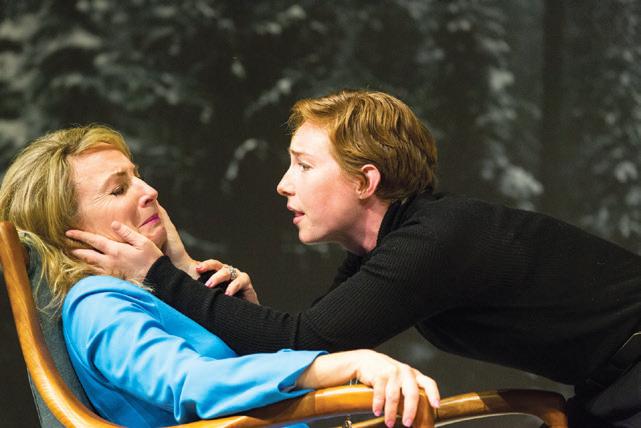
We were about to see history repeat itself, for Evans had cast Harriet Gordon-Anderson, seen last year in Molière’s “The Miser”, to play Hamlet and with the same directive to play it not as a woman but as Hamlet himself.
Evans told me just before the Canberra season of “Hamlet” was cancelled, “Harriet will be performing as a female body in Hamlet, who is an actor and a hyper-male character… Hamlet is similar to Richard in his masculinity, his relationship with women and his sexuality.”
Unless Bell decides to revive the production post-COVID-19, we will never know how his sumptuous 1960s-themed show would have turned out.
The 30th anniversary celebrations were to have been bookended by that perennial favourite “The Comedy of Errors”, and to give gravitas, “One Man in His Time: John Bell and Shakespeare”.
For the time being, to this Shakespeare fan it is the case, as in Shakespeare’s Sonnet 58, that “I am to wait, though waiting so be hell”.
WATCH IT! / stuff that’s streaming
YOU’D think given our current circumstances we’d use what free time we have to tune out with some comfortable or easy watching, but fascinatingly, the trend is the other way.
With the absence of cinemas people are turning to the internet for entertainment and films dealing with the very matters that are, well, plaguing us, which are currently some of the most watched and talked about (in a social-distancing way, of course).
In more extreme situations than what we’re seeing in the real world, a few examples include “Outbreak” (1995), “I Am Legend” (2007) and Danny Boyle’s 2002 cult masterpiece “28 Days Later”.
However, one film more uncomfortably close to home that’s skyrocketed to the top of the iTunes charts over a few weeks of self-isolation, is Steven Soderbergh’s 2011 thriller, “Contagion”.
If you’ve not seen it, or need to be reacquainted, it’s a film about a viral outbreak emerging from a bat population in China that proceeds to devastate the world.
Though the virus in the film is far more deadly than what’s happening with COVID-19, its transmission and the attempts to deal with and understand it are unsettlingly similar. To paraphrase Kate Winslet as an epidemics expert: the world needs to self-isolate, wash your hands and whatever you do, don’t touch your face.
“Contagion” sets itself apart in the “viral outbreak” genre by taking a more grounded and realistic approach. Rather than follow a group of survivors in a post-apocalyptic vision of the end-of-the-world (think, “Children of Men”), or a lone family’s journey to escape ever panicking masses (most recently, “A Quiet Place Pt II”), we view it through the perspectives of multiple characters in pivotal positions in the fight against an unseen assassin.
Winslet is joined by Laurence Fishburne as agents of the Centers for Disease Control and Prevention, strug -
NICK OVERALL looks at what people are watching in a global crisis and it’s not what you think…
gling desperately for an early containment. Jude Law is a conspiracy-theory “journalist”, amassing a cult-like online following and rallying them against the powers that be. Matt Damon is a father and the husband of “Patient Zero”, Gwyneth Paltrow, doing all he can to protect his family.

“Contagion” unnerves and terrifies more subtly than films of a similar nature and content. The grainy, yellowgreen hue overlayed on empty streets and brimming hospital corridors, is eerily effective – is the colour of death not black after all?
Winslet delivers a particularly strong performance, instilling dread with little more than a whiteboard marker, demonstrating how quickly this looming disaster is about to unfold. Equally, not unlike “Game of Thrones”, the tension remains high and the viewer on edge because they can never be sure just who will make it out the other side.
Whether new to “Contagion” or revisiting, if you’re game, it’s worth it. Research for the script was undertaken with experts in the field. Screenwriter, Scott Z Burns, commented at the time that those professionals were of the belief that such dramatic events were “not a question of if, but when”.
“Contagion” offers an albeit extreme though “realistic” mirror of what humankind could potentially be up against. Whether it’s fear or fascination that leads us to be interested in such scenarios in both the best and worst of times, it is deserving of its resurgence.
“Toy Story 4” is now also streaming on Disney+, and that’s cool, too.
CHANGE is the hardest word in any arts person’s vocabulary, as the board of Canberra’s ArtSound FM has been finding.
The shock announcement came in midOctober that the venerable and often musty arts station would go off air while the board tackled declining listener numbers and funding through a campaign called “Donate, Participate, Rejuvenate”.
While that elicited some positive responses, it also unleashed an angry groundswell of fear and loathing from volunteer presenters, some who’d been with the station for 15 years or more, exacerbated by an edict that presenters would not be permitted to select the music for their own programs. It led to 12-14 of them resigning.
President Amalijah Thompson announced that all committees would be spilled and reconstituted, with a temporary program grid consisting of automated music selections and syndicated programs that would also feature pre-recorded messages about the campaign.
But even the most optimistic supporters queried the wisdom of dropping live programming while simultaneously appealing for donations.
Now nearly six months later, amidst a further decline in listener numbers, programs are dominated by an automated mix of music, programs sourced from the Community Broadcasting Association of Australia’s Community Radio Network and local arts programs, pre-recorded offsite.
After weathering smoke, hailstone damage and disaffection, the board is
I

now battling the impacts of COVID-19 and in a newsletter to members on April 2, it reported that while one staffer would continue in the office, all live broadcasts would cease until further notice, and that volunteers had been asked to pre-record programs from home. The new morning program “ArtSound Daily”, due to start on April 30, would be delayed.
Last week Thompson spoke frankly to “CityNews” about the difficulties of initiating change in a volunteer-run organisation.
“I recall that when we took over on the board, we heard lots of things from people who were concerned about standards, and we wanted to address all of that with some success but it was an uphill battle,” she said.
Everything had changed in community radio from the time when ArtSound’s predecessor Canberra Stereo Public Radio first transmitted in 1983, and broadcasters were having to confront different forms of technology. Funding bodies such as the Community Broadcasting Foundation were changing their funding models and sponsorship was going online.
Donors and participants of the Canberra community commented that ArtSound was in trouble, and confirmed that the station had lost listeners and needed to deliver “something that matters”. Thompson agrees that this notion is subjective, since one
person might really like a presenter while another can’t stand them, so the approach was to set up a program training body.
“The question was how to stay relevant for audiences and how to fund ourselves,” Thompson said.
“It was very different in the 1970s and 1980s, but what was the same was the connection with audiences, you had to deliver something they wanted.”
However with six community radio stations in the immediate region, the lines were getting blurred – “it seemed that ArtSound had lost its uniqueness.”
When you start to implement change, everybody is unhappy, the board discovered.
“We got lots of feedback, some negative but mostly positive, so when we had no live programming for a couple of months, some were horrified, others were relieved and some were very pleased with the automatic music component, saying the quality was improved,” Thompson said.
Costs were a factor. The cost of running ArtSound in 2018 when she joined the board was between $800 and $1000 a day. Last year they got funding and a donation to pay staff so they had some continuity and focus, but all the while without a station manager.
As for accessing professional advice, she said: “That’s all very well, but if you take the ABC, they employ their presenters, they have
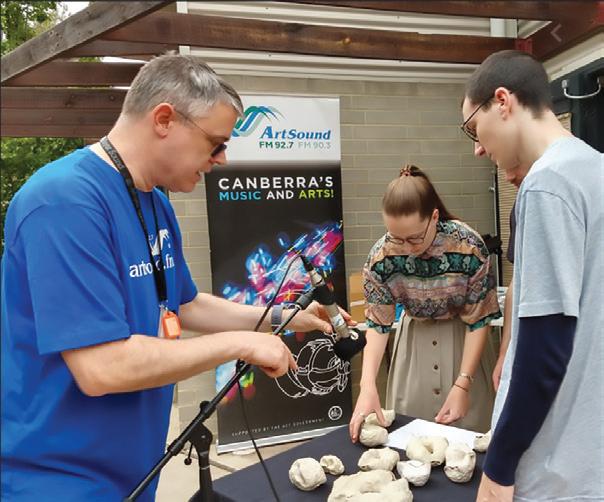
contracts and they can fire them… it’s such a different dynamic dealing with volunteers.”
To complicate matters, when Thompson joined the board it was no secret that there was a long-standing internal dispute over which the previous board was forced out, so there were a lot of expectations placed on the new board.
“We had to be a bit bold and unusual, but all we did was to interrupt live programming for a limited period of time,” she said.
“No presenters were got rid of, but the
A MAN walks into a bar… no, wait he can’t, they are all shut and it’s no joke.
So, what is wine drinking from home like? Let’s explore.
Well, in part, it’s normal. Often, we have a glass of wine with dinner. That hasn’t changed. But I do miss having a glass of wine with a friend at a bar as a way of stepping out of the ordinary.
Just pre-isolation I met a friend at Joe’s Bar in East Hotel. I tried a glass of soave. It was a Coffele, Castel Cerino. The list said it was a 2016, which is good because this varietal made from Italian Garganega grapes is renowned for how it takes on rich almond notes as it ages.
The wine came and it had a good minerality about it but none of the more pleasant flavours that age brings and was too acidic for my taste. As they had served it by the glass, I went to the bar and asked to see the bottle: it was a 2018. I asked for the 2016 as advertised, which was poured with a nod of apology and the wine was a different creature, no longer acid-dominated but with a hint of yellow pear and much longer on the finish.
At home you always get the vintage that was advertised but the funky ambience and the delicious house-made Italian snacks are missing: the antipasto plate that we shared was phenomenal. Plus, I would never have explored the depth of Italian wines that I have had the fortune to taste if it hadn’t been for Joe’s Bar’s proximity to home and the perfect place to meet a friend as a catch up. Weird that such events are already viewed through a benevolent, nostalgic haze.
I went to the bar and asked to see the bottle: it was a 2018. I asked for the 2016 as advertised, which was poured with a nod of apology and the wine was a different creature.
I am isolating with my daughter and she has recently finished a wine course so one of the beauties of sharing wine at home is to hear her summary of its characteristics.
With vegetables and rice to give the meal a lift we opened a bottle of the Collector 2019 Shoreline sangiovese rosé. This is a dry rosé. It was excellent value-for-money at Plonk, Fyshwick markets where I picked up three bottles for $20 each. But the grapes are grown in Gundagai and Collector is far from the sea. Whose shoreline I thought?
I asked: “Is it because it’s awash with flavour?” and received an unappealing groan but also an analysis of what she thought.
“In fact, dad, it is. Delicate, taste of red cherry, good clean acid, easy-to-drink.”
So, another advantage of isolating is getting to know family better, including my daughter indicating that I have a disturbing sense of humour when I merely remarked on the topic of food and wine that coq au vin is not a type of vehicle.
I must say that isolation has changed my tastes in television, too: I’ve taken to watching more documentaries. In fact, I watched a documentary on marijuana the other night. I think I’ll watch all
documentaries that way from now on. Hah!
The most discernible difference though is that, other than sharing a take-away pizza and a bottle of 2008 Burge Family Winemakers Olive Hill Shiraz red with a friend at the dining room table to commiserate on the closure of the gym we attend, there hasn’t been a lot of sharing in celebration.
The virtual Friday night drinks I had with colleagues over Microsoft teams was a great idea but it was still a drink in my study rather than somewhere away from where I work in celebration of the week gone by.
The isolation caused by avoiding COVID-19 will be viewed retrospectively as just an annoyance but already the distance from the normal seems to have become interminable.
“In times of rapid disruption and change, what we often realise quite painfully, is that all we have are experts on yesterday. No one is a true expert on tomorrow” – Gyan Nagpal

reaction was incredible – ‘how dare you take us off?’”
“We’ve gone through smoke, hail damage and now the virus just when we were in a period of trying to reboot the financial situation, so there must be permanent base funding from the Community Broadcasting Foundation, which must take into account the reality of present-day community radio and sustainability.
“My hope is in the work we do with other community stations.”


Stay in touch with the names making news on Sundays from 10am as 2CC and “CityNews” present Canberra’s only local weekend news and current affairs program.
It’s a revolving panel show that brings to the microphone great “CityNews” commentators and 2CC personalities.
Be part of the conversation call 6255 1206 between 10am and noon

Joanne Madeline Moore






ARIES (Mar 21 – Apr 20)

As the resident Warrior Man/Woman of the zodiac, your modus operandi is one where you charge into situations quickly with guns blazing. (The long list of Aries hotheads includes Butch Cassidy, Bette Davis, Marlon Brando, Alec Baldwin and Russell Crowe.) Rambunctious Rams are also notorious for lacking follow-through. But this week Saturn squares the Sun, so make sure your fiery enthusiasm is tempered with plenty of persistence and a practical long-term plan.
TAURUS (Apr 21 – May 21)
The Features People PO Box 2585 Southport Qld Australia 4215
Resist the temptation to be a stubborn, intractable and risk-averse Bull. Extraordinary times require extraordinary measures, innovative ideas and creative thinking. So keep your options open and your adaptability muscles well-flexed. The New Moon encourages you to find practical ways to help those around you. Be inspired by birthday great Queen Elizabeth: “Whatever life throws at us, our individual responses will be all the stronger if we work together and share the load.”
GEMINI (May 22 – June 21)
Telephone: (07) 5591 5361 Toll Free: 1 800 652 284 Fax:(07) 5591 5066
Gung-ho Geminis are keen to power ahead at lightning speed but, if you make fast moves and hasty pronouncements (or engage in garrulous gossip) then you could end up making things worse. There’s a lot going on behind the scenes that you’re not aware of, so do some detective work (and check the facts thoroughly) before you proceed with plans and help others. Heed the wise words of birthday great, writer Charlotte Bronte (born on April 21, 1816): “Look twice before you leap.”
Email: info@auspacmedia.com.au
Visit our site: www.auspacmedia.com.au
CANCER (June 22 – July 23)
We are experiencing a difficult period of health challenges, social distancing and economic disruption. The Sun-Saturn square on Tuesday will stretch resources, increase pressure and boost stress levels. Then on Wednesday night the New Moon activates your aspirations zone. So divert your attention from the current Coronavirus crisis and draw up your wish-list for 2021. Don’t waste the opportunity to escape into your imagination, set intentions and dream big beautiful dreams for the future.
LEO (July 24 – Aug 23)
Capricious Cats – you can find it difficult to be on your best behaviour and toe the line for a long time. So expect the unexpected, as the Sun and Uranus stir up your restless (and reckless) side. You’ll balk at restrictions being placed on you (especially at home) but resist the urge to be a disruptive influence. Put your personal wishes aside, and make sure you stay well-informed and fulfil your responsibilities to the wider community for the greater good. If we stay at home, it will save lives!
VIRGO (Aug 24 – Sept 23)
Virgos are the worrywarts of the zodiac and you can become obsessed with the minutiae of daily life. But now you have some really big global problems to worry about! By all means keep up-to-date with current affairs but make sure you limit your exposure (and notifications) otherwise you’ll just get more and more stressed, which will affect your mental and physical health. Find solutions to current problems (at home or work) where you can contribute your skills and influence the outcome.
Created: Reg Walker Qxpress: Chris Checked: Noel
LIBRA (Sept 24 – Oct 23)
Being creative, proactive and productive will take you far during the Coronavirus crisis. If you’ve lost your job, then can you put your talents to use elsewhere… by making face masks, preparing meals, delivering food or holding online classes? You could also be confronted with a personal fear (other than not being able to get your hair cut and coloured) or a family problem. You’ll just have to step up to the plate and accept extra responsibilities with plenty of Libran resilience.
SCORPIO (Oct 24 – Nov 22)
Watch out for stubbornly holding a fixed position: you’re probably not seeing the full picture at the moment. If you listen to family, friends or work colleagues (from home and away) then you’ll gain a much wider perspective. Plus pay special attention to a loved one who is feeling down and needs a shoulder to cry on. If you are attached – Uranus helps you re-connect with your partner in an unexpected way. For some Scorpios – a secret relationship takes a decidedly unexpected turn!
SAGITTARIUS (Nov 23 – Dec 21)
This week is all about formulating smart strategies and finding practical solutions. Focus on business and/or work, as the planets help you tap into the extra energy, discipline, motivation and creativity needed to recalibrate your finances and/or career. Can you innovate or pivot in a new direction where there is now an increasing demand? Jupiter and Pluto also stir up your self-esteem zone, as you take a deeper look at your fundamental core values and transform an outdated belief about yourself.
Note to Editor:
CAPRICORN (Dec 22 – Jan 20)
Created in QUARK XPRESS. VER.4.03
Jupiter and Pluto are moving through your sign, so it’s time to tap into the Capricorn courage and resilience within. Whether you like it or not, others are looking to you for strong leadership, sensible ideas and pragmatic solutions. So roll up your sleeves and get to work! Your motto for the moment is from Queen Elizabeth (who turns 94 on Tuesday): “When life is hard the courageous do not lie down and accept defeat. Instead, they are all the more determined to struggle for a better future.”
Items not needed for publication can be erased as each is in a separate text box.
AQUARIUS (Jan 21 – Feb 19)
Mars and Saturn are moving through your sign, plus Mercury is visiting your social networking zone. So you’re keen to connect with a wide range of people from a variety of places as you talk, text, tweet, post or publish. Many Aquarians are versatile writers, performers and commentators. So get into a disciplined routine and start writing that story, script, song, blog, book, report, poem, podcast or neighbourhood newsletter. The world is waiting to hear what you’ve got to say!
PISCES (Feb 20 – Mar 20)
Times are tough and news bulletins and notifications can be depressing, so steer clear of negative thinkers who seem to delight in bringing you down! Make sure the people around you are a powerful influence in positive ways. Wednesday night’s New Moon encourages you to reach out and help others, both within your circle of family and friends and within your local neighbourhood. You’ll find the close community connections you foster now will prove beneficial in the future.
Copyright Joanne Madeline Moore 2020
1What, poetically, is the land bordering the sea or ocean (6)
8Name a district in NSW, one of Australia’s most productive rural areas (8)
3 Which term describes that which completely surrounds something? (7)
4 Which long-shafted golf club is used for making long shots? (6)
9What is an alternative name for Bombay (6)
10Albert was the Prince Consort of which Queen (8)
5 What band is considered to be the most influential of pop groups? (7)
6 Name a less familiar term for daily. (7)
7 What is another name for a corpse? (7)
11Name a round body whose surface is at all points equidistant from the centre (6)
12What is an actor’s part called (4)
13 Name an apparatus used in weight-lifting. (7)
14 To perform surgery is to do what? (7)
13What is a thin soup of concentrated meat or fish stock (5)
16Which energy is obtained from the sun (5)
15 To be confidently expectant is to be what? (7)
22 What is a metal frame for cooking food above an open fire? (8)
19The pods of which plant of the mallow family are used in soups (4)
23 What do we call roads taken for travel? (6)
17 Which term implies a voice characterised by strength, fullness, etc? (7)
18 What is a place of higher learning? (7)
21Which four-stringed instruments are slightly larger than the violin (6)
24 Which biennial plants with large leaves are used in salads? (8)
25 What are currents at variance with the main currents? (6)
20 To be disinclined or reluctant is to be what? (6)
22What is a metal frame for cooking food above an open fire (8)
23What do we call roads taken for travel (6)
24Which biennial plants with large leaves are used in salads (8)
25What are currents at variance with the main currents (6)
2Name an Australian Test cricketer (1877-1915), noted for his ability as a batsman, Victor ... (7)
3Which term describes that which completely surrounds something (7)
4Which long-shafted golf club is used for making long shots (6)
5What band is considered to be the most influential of pop groups (7)
6Name a less familiar term for daily (7)
7What is another name for a corpse (7)
13Name an apparatus used in weight-lifting (7)
14To perform surgery is to do what (7)
15To be confidently expectant is to be what (7)
17Which term implies a voice characterised by strength, fullness, etc (7)
18What is a place of higher learning (7)
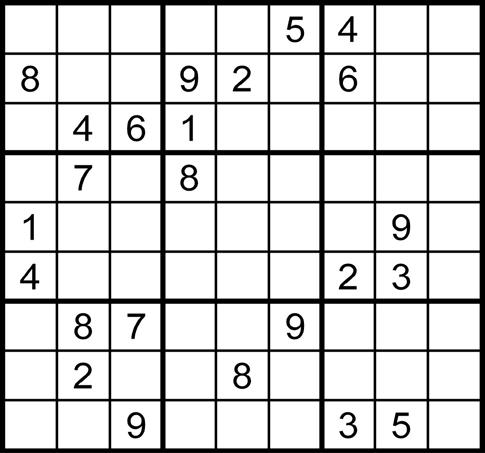
20To be disinclined or reluctant is to be what (6)


To raise a smile – Zeus, our daughter’s cat, has decided this is the most comfortable place for his afternoon nap… do not over-water!
GARDENS are so important when we’re all told to stay at home.
Keeping children’s noses to the grindstone of schoolwork is a challenge for homeschooling mums and dads.
However, the kids can take a break, run in the garden and play with pets. I’m reliably informed that exposure to sunlight providing Vitamin D is very important and helps reduce the risk of the virus.
WHAT better time, now we’re all restricted to home, to encourage children into the world of gardening? According to Yates, the oldest seed company in Australia, the demand for veggie seeds is – to use the word on everyone’s lips –unprecedented.
Folk who have never grown veggies are now having a go. A quote from the famous English gardener, Gertrude Jekyll: “The love of gardening is a seed once sown that never dies”. Remind kids to be patient, while
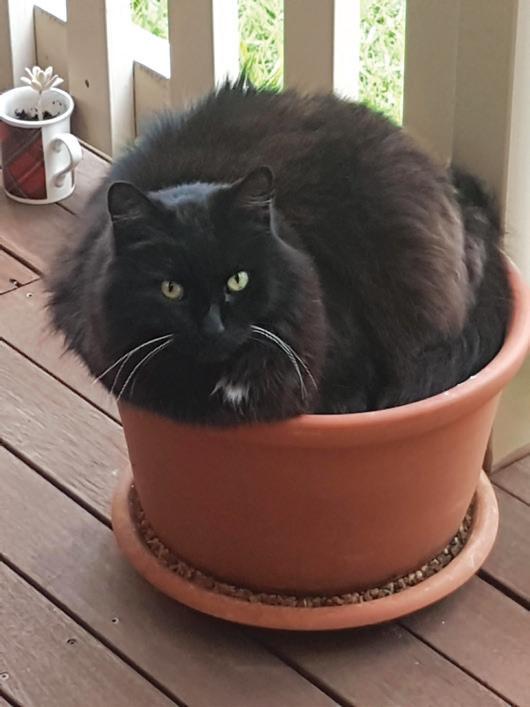
nature takes its course. Now is the time to sow broad beans, a good starter for children as they sprout within 10-14 days. However, they will take about 20 weeks before they’re ready for picking. Another great plant for children to grow is strawberries. Although, as a timely reminder, if friends or dear old grandpa want to give you plants from their garden, say politely: “No, thank you” to avoid transferring a nasty virus from one plant to another. Always buy from a reputable garden outlet with plants labelled “virus-free”. These plants come from registered nurseries and come tagged accordingly. If you’ve had your strawberries for more than three or four years, dig them out and renew with fresh plants.
FOR fabulous winter colour, one of my favourites is clematis napaulensis, first found by famous plant hunter George Forrest growing wild in the Himalayas in 1912. The cup-shaped flowers, up to 2.5cm long, are creamy-yellow
with conspicuous purple or reddish stamens and grow in large clusters. The fluffy silver-grey seed heads appearing in spring are attractive in their own right, often referred to as “old man’s beard”.
WEED seeds have been lying dormant for months in drought conditions, waiting to catch you out at the first decent rainfall. That rain has arrived, combined with mild weather, creating the perfect conditions for an explosion of them in our gardens! It’s vital they’re eliminated before they seed. As an example, it is too late on the tramway now, with strong winds scattering the weed seeds far and wide, now often up to 50-60cm tall.
If weeds are in an area close to desirable plants, use the safe, certified organic weed killer “Slasher”. Alternatively, cut the bottom of a 200mm pot, place over the weeds





and spray inside the pot, stopping the drift on to your good plants.
PLANT spring bulbs now, and why not depart from formal groupings and have a bit of fun? Pick up a handful, throw them up in the air and plant where they fall. This is how nature works, with seeds scattered at random, and some will land in bare patches amongst the shrubs.