







By Danielle NOHRA

AN exercise program, which is held three nights a week at Mount Rogers Primary School, is putting money back into the school, while participants get fit at the same time.
For almost 20 years parents and community members have been turning up to Mount Rogers for these P&C-run exercise classes but the story behind the program goes back even further.
Former jazzercise instructor Narelle Sykes, 59, of Flynn, hatched the idea in 1994 for Flynn Primary School. She had children there at the time and was working in the school system, so she went straight to the school principal and pitched him the program.
The principal agreed and they started the next week.
“We raised a lot of money over the years,” Narelle says.
“It was very popular and sometimes we didn’t have enough room to do our abs on the floor.”
It was like that for a while, but then she says they were forced to move to another location when Flynn Primary School was closed. After the school’s closure, Narelle approached Mount Rogers Primary School in the early
Arts & Entertainment 23-25
Canberra Matters 6
Cinema 25
Crossword 27
Dining 24
Gardening 26
Horoscopes 27
Letters 12
News 3-15 Politics 10 Socials 21-22
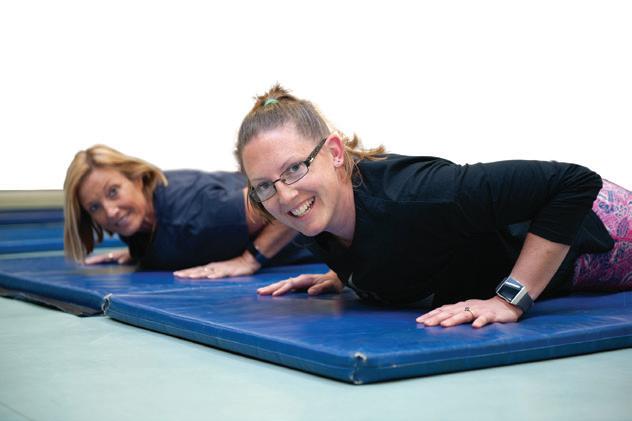
And that’s where it’s been ever since, but these days Steph Hinds, 38, of Melba, manages the program.
Steph’s four children attended Mount Rogers Primary School, with her first entering the school in 2011.
But she didn’t try the program until about 2013 saying the idea of the classes was a bit intimidating.
“I don’t do gyms, but I love this,” she says.
“It’s a great sense of community. I’ll contact the ladies outside of exercise, too.
“It’s [also] a stress-free environment and it’s a bonus that the school reaps the rewards.”
After about six years of attending two of the three classes a week, Steph says it’s become her “me” time.
She tends to go to the group PT class
13-15.
attend.
“It’s a safe environment, you go, you sweat, you leave with a smile. And that’s why I go back – there’s no judge ment,” Steph says.
Even though neither Steph or Nar elle have children at Mount Rogers Primary School any more, they both still love being part of its community.
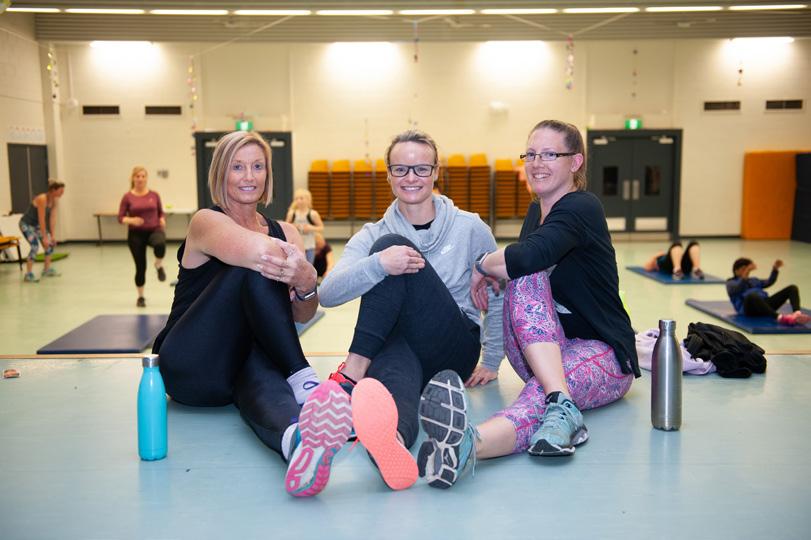
Steph, who is also a P&C member of the school says: “I love the community, I feel like I’m making a difference and I really enjoy the space and the people involved in it.”
She says the small school, of more than 500 students, is only going to get bigger and there’s only so much the ACT government provides, so the money raised through the classes is important.
“This day and age, it’s not just chalk
Since 1993: Volume 25, Number 27
Managing Director: James Anderson, 0404 077605, james@citynews.com.au
Director: Kate Meikle, kate@citynews.com.au
Senior advertising account executive: David Cusack, 0435 380656
Advertising account executives: Daniel Clayton, 0451 232129; Matt George, 0413 667699; Damien Klemke, 0439 139001
Editor: Ian Meikle, editor@citynews.com.au
Assistant editor: Danielle Nohra, danielle@citynews.com.au
Writers: Kathryn Vukovljak, kathryn@citynews.com.au; Catalina Sigloff, catalina@citynews.com.au
Arts editor: Helen Musa, 0400 043764, helen@citynews.com.au
Production manager/graphic design: Janet Ewen
Graphic designer: Karl Speller
Proof reader: Glenda Anderson
Accounts manager: Bethany Freeman-Chandler accounts@citynews.com.au

and talk. The resources are more expensive,” she says.
“I do see that we’re making a difference and I do see we’re helping the school.
“All the instructors get paid, but at the end of the day it’s a community service, not a business.”
After paying the instructors, all the proceeds go back into the school and Steph and Narelle have seen the money go towards things such as books, resources, sporting equipment and the library.
“Last year we managed to raise about $2300, which is the highest amount since I’ve been involved, so fingers crossed it continues to grow,” Steph says.
For people who are interested in joining, she says the classes are cheap, too – only $8 for one class, $14 for two and $20 for three.
And, she says they’re always running. In fact, since 1994 Narelle reckons they’ve only ever cancelled less than a handful of times, including classes over the school holidays, too.







DESPITE the non-negotiable first two rules of “Fight Club”, there has been a bit of chatter about a version of the 1999 cult classic operating at one of our private schools.
Word is a fight club during school hours, complete with betting, but modified with boxing gloves, was flourishing on school grounds until being closed down. Those in authority have so far remained faithful to rules one and two, even if some students haven’t.
THE ACT maternity inquiry has heard harrowing stories from local women that have reportedly left committee members “visibly shaken as they sat through evidence, audibly gasping, clasping hands over faces and shedding tears”. It’s reprehensible and beyond comprehension that such an inquiry is only happening now, given the welldocumented toxic culture of bullying and incompetence that has pervaded ACT Health for many years.
DROPPED in the deep end, new Health Minister Rachel Stephen-Smith found her stroke. Ms Stephen-Smith said she “welcomed the inquiry and the women’s evidence”, but soon reverted to standard spin: “Every day our hospitals and clinical staff strive to provide the best possible birthing services and to do this in

Even on the coldest, meanest July day in Canberra a dog poking its head out of a car never fails to amuse and lift the spirits of our columnist. He spotted this beautiful character at Cooleman Court helping its human locate a parking space.
endured by many while the official line of “it’s no worse than any other jurisdiction” was adhered to rigidly.
IF you think you’ve heard all the things




Peatling tweeted (possibly while waiting for a midnight bus): “Although I am a big defender of Murrays bus service, the Jolimont Centre does lack a certain joie de vivre”.
Many agreed with Peatling with tweets such as: “It’s a soulless place” and “It’s no Grand Central Station”. But some prefer the centre just as it is, posting: “Pleasantly unvarnished” and “I’d rather keep it cheerful and cheap than pay extra for a barista”.
LEGENDARY radio man John Laws reads “CityNews” or, at least, this column. Laws was “flattered” by a recent piece in which I rated Alan Jones as “a brilliant broadcaster second only to John Laws, with daylight third”. The nice thank-you note I received from the man once described as having a voice that would curl a frangipani, made my day. Still on making one’s day, the last time I spoke with Laws we talked about who would play him in the movie. Clint Eastwood
ACT Police have issued a blunt warning to ram raiders after a high number of smashand-grabs in the region. While playing down the recent spate of aggravated burglaries (18 so far this year), as “cyclical”, Det-Sgt Shane Scott’s message is: “We’re looking for ya and we’re going to get ya”.
CHINESE stand-up Ronny Chieng slayed a sell-out Canberra Theatre crowd without, refreshingly, resorting to the stand-up’s lazy and cliched Canberra fall back of porn, fireworks and roundabout jokes. The 33-year-old star of “Crazy Rich Asians” now lives in New York City where he’s part of Comedy Central’s “The Daily Show” with Trevor Noah
A PAINFUL anniversary of one of Canberra’s most horrific days was remembered on Saturday. It was July 13, 1997 that 12-year-old Katie Bender was killed after debris from the demolition implosion of the Royal Canberra Hospital rained down on more than 100,000 people gathered around the lake. Bender, who was more than 400 metres from the site on Acton Peninsula, was killed instantly when struck by a piece of flying metal.
new to me. Petrol prices, the tram, the bubble, the weather, old trees, new trees, pill testing, roo culling, parking and – the lifeless Jolimont Centre.
Senior “SMH” journalist Stephanie











AT the June Woden Community Council meeting an audience member raised issues around the new bus timetables. She had two horror stories based on personal experiences.
It was obvious that this sort of problem was not matching the model the government wanted everyone to believe was in place for the new 2019 timetables.
It was then I realised that despite all the spin about how the bus timetables provide faster transport more often (or something like that), I wondered how many ACT politicians have first-hand experiences of these new bus services.
Listen to how bureaucrats and their ministers talk about public transport and it becomes obvious that they do not base their comments on personal experiences but rather on the spin developed by a cabal of spin doctors. The bus timetable issue has not been well handled and part of the problem is when queries are raised and people tell their

Listen to how bureaucrats and their ministers talk about public transport and it becomes obvious that they don’t base their comments on personal experiences but rather on the spin.
stories, the responses lack empathy. And why not – the politicians and most chief bureaucrats would have little regular experience with how the buses are operating.
Surely, if it is as good as the government spin doctors would have us believe, then it would be logical for the politicians to be joining the queues for the tram and for those very efficient buses. The obvious question must be: how many of the many ACT politicians catch the bus and tram as their regular means of transport?
Then a question asked about the provision of a new Woden bus interchange. A resident asked that surely the government is not going to proceed with this until it has finalised the whereabouts of the tram stop so that the two modes of transport are integrated.
An oblique answer from a transport bureaucrat followed that the new bus interchange was about more than just the tram, it needed to link in with other
forms of transport – being cyclists and pedestrians. When it was suggested that the Gold Coast tram integrates beautifully with the buses – the response was: “Well, that’s the Gold Coast – things are different there”.
What people heard that evening was that the design of the new Woden bus interchange was not necessarily to be linked to the yet to be decided tram stop in Woden. Really?
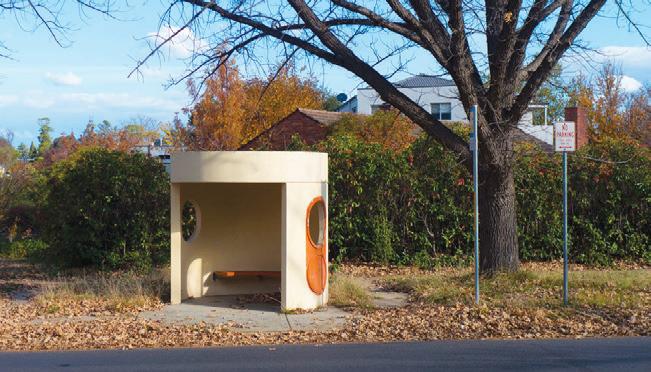
Then came this latest weirdness. Several weeks ago, Road Safety Minister Shane Rattenbury floated the possibility of allowing motorised scooters on to Canberra’s footpaths and roads.
Residents know that things are already dangerous out there given that the city still has not worked out successfully how to have bicycles and cars together – and that the footpaths are very contested spaces with people trying to walk peacefully while being harassed by cyclists and the occasional motorised thingy whizzing past – and a couple of motorised scooters have been spotted.
Canberra has outstanding matters around having more appropriate infrastructure for cars, bicycles and
for people to feel relaxed about walking – without introducing something dangerous to please the lobbyists.
Check out the statistics for Brisbane – one serious incident almost daily since the introduction of motorised scooters. Singapore is having huge problems with personal mobility devices (PMD) and several European countries are on the verge of banning motorised scooters.
The same business opportunists now have Rattenbury and his need to look modern in their sights.
Dear Shane, walking peacefully while enjoying the outdoors is great – so please encourage more walking by making footpaths and shared pathways safer – not more dangerous.
This wonderful city has numerous transport and related infrastructure
matters that should have been sorted by now. Getting the appropriate attention and resources allocated remains difficult when residents’ experiences are very different to the elected politicians.
Google “no perks for Swedish MPs” and you will find an example that should be adopted as realistic and relevant employment conditions for ACT politicians.
And next time you meet a local politician, please ask: “Do you catch public transport regularly – and if not, why not?”
Paul Costigan is an independent commentator and consultant on the visual arts, photography, urban design, environmental issues and everyday matters.



At Neilan Stramandinoli Family Law, we pride ourselves in our proven track record, our commitment to excellence, and expert knowledge of family law. We understand how difficult and emotional family matters can be, we are compassionate and empathetic, guiding you towards the best possible solution for you.
For separating couples:
• Parenting arrangements
• Dividing property and superannuation
• Family violence matters
New or existing relationships:
• Best arrangements for your children
• Protecting assets and yourself
• Preserving entitlements





REGULAR readers of my column will be familiar with my “boss baby” daughter who has ruled our family since she was tiny.
It might seem that compared to the boss baby, our older son is the angelic one out of our pair, but we have had our fair share of dramas from him. Before he turned four we actually sought help from a child psychologist. Gasp!
Sounds a bit shocking but it all started when I took him to the GP for his four-year old vaccinations and health check. The GP asked a routine question regarding our boy’s aggression to others which made me think twice.
My answer was: “No, he doesn’t hurt other children at daycare but come to mention it, he can be quite rough with me and my husband.”
My GP gently suggested that we should find strategies to knock these behaviours on the head quickly. He said that most of the time kids grow out of it, but it might be quicker and easier if we engaged a professional.
My husband and I have long been of the mindset that seeking help of mental-health profession-
In the daily grind of parenting and the competing demands of family life, it’s hard to zoom out and look at the bigger picture and assess how we as parents are performing.
als is akin to having a check-up for any physical ailment and something we should not feel ashamed about, so I booked an appointment with a child psychologist.
But I hesitated in sharing this with family and friends because of my worry that they might look at our boy in a different light, mother-shame me (I already had enough guilt!) or say things such as “it’s just a phase”. I clearly wasn’t as comfortable with us seeing a child psychologist as I thought I was.
It was confronting but we needed some extra help and were fortunate to be in a position to access this sort of support. As it turned out, meeting with the psychologist became less about our son and more about us as parents – the psychologist helped give us strategies, tools and guidance to navigate topics such as “gentle hands”, personal space and more effective timeouts.
I like to think of the sessions as coaching classes, helping us be
better, more confident and able parents.
It feels empowering to know that there are ways that we can deal with our children’s more challenging behaviours and it feels liberating to talk to someone completely impartial about the kids.
In the daily grind of parenting and the competing demands of family life, it’s hard to zoom out and look at the bigger picture and assess how we as parents are performing.
When we frame these coaching sessions in that way, it’s not about fixing problems with the kids, but becoming better parents. Goodness knows, we all need some help from time to time!
Our son’s behaviour concerns are happily now all in the distant past, but we have kept a standing
six-monthly check in appointment with the psychologist so we can keep ourselves on track and chat to her about any concerns that crop up.
As we try to keep match-fit as parents, the coaching is a big part of it. As the kids enter different phases, we need to adapt our parenting skills. Any tips I get I gladly pass on to my friends with little ones because we definitely aren’t alone or unusual in the issues we are dealing with.
We are now chatting to her about the boss baby and getting some good coaching around how to better manage her tantrums and need for control. Let’s not feel ashamed to admit that we as parents might need some extra coaching to help us stay on track and keep everyone in the family supported.

Bruce Carmichael.
LONG-time Canberra Theatre Centre director Bruce Carmichael will retire in late November. Mr Carmichael has been with the centre for 34 years.
WODEN Community Service, which is celebrating its 50th anniversary, wants to contact volunteers involved in its early days. An afternoon tea will be held at the Pearce Community Centre, Collett Place, 2pm-4pm, on Tuesday, July 30, for people who started the organisation to share their stories and photos. Book via eventbrite.com.au or email info@wcs.org.au
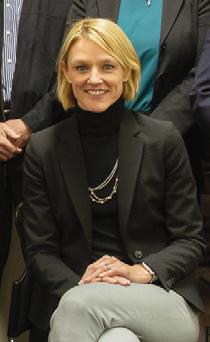
LISA Keeling, pictured, is the new chair of Hartley Lifecare. She succeeds Geoff Leeper. Ms Keeling previously occupied the deputy chair’s role and has been a Hartley board member since August 2010.
CALVARY Hospital Auxiliary is holding a book fair at the Xavier Building foyer, 8am-4pm, on August 21 and 22. There are fiction paperbacks, children’s books, cookbooks, biog raphies, plus works on crime, war, hobbies and more. All books under $2 and beanies are $5. Funds raised go towards the purchase of equipment for Calvary Public Hospital.











AUSTRALIA was once perceived as an egalitarian society. Those were the good old days!
Scott Morrison, Anthony Albanese and their political parties, along with some Senate crossbenchers, have just further whittled away this iconic Australian image.
The tax cuts that promise to put $158 billion back in the pockets of taxpayers have increased the discrepancy between wealthy and average Australians.
Morrison’s great marketing makes this sound good for all. However, a more considered approach raises awkward questions. Especially for Labor. And especially at a time when the divide between the rich and the poor has grown so much. What is surprising is that these tax cuts so significantly favour the rich over both the poor and the average-income earners.
In four years’ time people earning $200,000 will be better off by $11,640 a year.

Earners on $180,000 will be better off by around a third less at $8640. At a pay rate of $120,000 the benefit will
At a time when the divide between the rich and the poor has grown so much, what is surprising is that these tax cuts so significantly favour the rich over both the poor and the average-income earners.
be $4440. At $100,000 the benefit of $3040 will be close enough to a quarter of the person earning double the salary.
Top-level earners will be laughing all the way to the bank. They need the money so much more than low-level earners! Those earning $45,000 will benefit by $1080 – not even 10 per cent of those in the $200,000 bracket. The median Australian wage is $55,063 where the benefit delivered will be just $1332.
This median of $55,063 is what the average Australian earns. It ought not to be confused with the average earnings used to justify the tax cuts.
Average earnings is invariably loaded upward by a small number of people earning very high salaries.
Economists describe this sort of tax flattening as “regressive”. It favours the rich. But not just over the poor. It pointedly favours the wealthy over the average earner. This is why Labor’s support was simply flabbergasting.
Labor did attempt to split the legislation. They called on the crossbench to support bringing forward the second stage of the tax cuts. The idea was to delay the third stage tax rate to 30 per cent for all workers earning between $45,000 and $200,000. When they failed to do so – Labor capitulated and supported the “regressive” taxation rate.
Former shadow assistant treasurer and Canberra MP Andrew Leigh explained in early July to Radio 2GB that “putting the money into the hands of low and middle-income earners means you’re putting it straight into the economy”. As was the case with the cash injection Labor made under Kevin Rudd at the start of the Global Financial Crisis.
Leigh went on to dig a hole for himself and Labor: “These are people who spend their whole pay cheque, whereas if you’re providing tax cuts at the higher end of the income spectrum, then that’s going to people who save about a quarter of their income. And so a quarter of the benefits there don’t flow back through the economy”.














It is hard to believe that Leigh would be talking about people earning up to $200,000 as “spending their whole pay cheque”. Labor’s support for the Morrison Government’s tax breaks just makes no sense.
Following the passage of the legislation, opposition leader Anthony Albanese argued that Labor reserves its right to repeal the legislation depending on the economic circumstances at the time. Not good enough!
His argument is that money needs to be injected into the economy as a stimulus. Unfortunately for him, the statement made only a couple of days earlier by Leigh puts the lie to this argument.
The reality is that the conservative
government has now combined $144 billion in tax cuts from the 2018-19 Budget with the current package. This means a reduction in government income by $302 billion over 10 years. When governments do not spend, when there are inadequate funds in the Budget, something has to give. It is not the wealthy who suffer. Whether cuts are made to education, health, social services or the like – tax cuts invariably have the greatest impact on the poor.
Michael Moore is a former member of the ACT Legislative Assembly and an independent minister for health. He has been a political columnist with “CityNews” since 2006.












William comes to us from Scotland with over 15 years industry experience. Early on in his career William was recognised as a specialist of cutting and has worked alongside some of the most influential names in the industry, including Vidal Sassoon’s International Creative Director Mr Mark Hayes. William now brings these years of experience and expert skills to this side of the world.
William’s career has seen him educating in powerhouse salons across Europe, becoming a leading educator at the world renowned Sassoon Academy in London. As an educator William has led education with some of the largest product companies such as Wella and Schwarzkopf. William travels internationally working on collection launches, education programs and produces hair for some of the biggest stages within the industry. Since William’s arrival to Australia he has been a regular participant in our very own Hair Expo along with an educational platform called Cutting Kings. The one fundamental principal that William will always stress is that suitability is key regardless of who is in front of him.
Yet another ACT planning “glossy” entered the ether on July 5. By the time “Canberra matters” columnist Paul Costigan called it out (“Does Canberra really need this ‘CRAPP’?”, citynews.com.au, July 8), it certainly had caused much consternation and incredulity among many individuals and community groups.
The groups have, in good faith, worked long and hard to seek planning and design improvements not only for the benefit of current and future Canberra residents and our city’s long-term liveability but also to support how we present as a national capital on the world stage.
Many will be waiting for evidence of far more substance, commitment, clarity and communication to supplement the City Renewal Authority’s precinct program documentation.
Sue Dyer, Downer
THE ACT government’s trial of a smiley :) speed sign seems to be over on Boddington Crescent, Kambah.
The sign has now been removed. They were a good initiative, but plagued by breakdowns.
Hopefully, the government got its money back or is looking at better equipment.
Robert Doyle, via email
There have been articles in “CityNews” about the number of trees being cut down around Canberra and, like the other critics, I agree.
Trees absorb the carbon dioxide from the atmosphere so cutting them down does not seem wise. I do find it very interesting, however, that climate protesters are nowhere to be seen or heard.
I have not heard one peep from them complaining about the trees being cut down. So much for their concern about the atmosphere.
Come to think of it, there have been no protests from climate protesters in other countries about cutting down trees. Go figure!
Vi Evans via email
Bowman St, Macquarie
IN 1921 a building of great significance was opened in Longreach, Queensland and became home of the Queensland Ambulance Transport Brigade.
This building will celebrate its centenary in 2021. A book is being compiled by volunteers to document the history of this heritage-listed building. Over the years, many people ventured to Longreach to carry out the valuable and demanding work of ambulance bearers (officers). For the book, we are seeking contributions from relatives or friends of those who served as bearers.
Anyone who would like to contribute, please send information to 158 Ibis Street, Longreach, Queensland 4730. Alternatively, call 0488 986557 or email elaineb1@tpg.com.au
Elaine Britton, Longreach
LAST year the Senate’s Legal and Constitutional Affairs Committee considered a David Leyonhjelm Bill that would have removed Commonwealth barriers to the legalisation, regulation and taxation of cannabis.
The Bill was not supported by the AMA, the RACGP, Painaustralia, the Alcohol and Drug Foundation or the WA Police Force.
During the second reading of the Bill on October 15, the Deputy Government Whip said in part: “There are numerous reasons why this Bill cannot be supported… The first is increased harm to users.
The Department of Health in particular pointed out that there would potentially be increased harm for users with the passage of this Bill.
“They said that, while many Australians may view cannabis as harmless, almost a quarter of Australia’s drug and alcohol treatment services are being provided to people identifying cannabis as their principal drug of concern. That’s roughly the same as the number of treatment episodes for amphetamine use.”
Senator Don Farrell, then Deputy Opposition Leader in the Senate, said: “Labor does not support this Bill, primarily because Labor does not support the legalisation of cannabis for recreational use.”
Why does Michael Pettersson, a local Labor MLA, fly in the face of medical and police opinion and his own Federal counterparts?
Colliss Parrett, Barton

Occasional grump, CEDRIC BRYANT, of Watson, is appalled at the wastefulness of the tram-launch knees-up.
ACCORDING to a well-known overseas tourist publication last year Canberra was rated as one of the top cities in the world to live in. Really?
My wife and I have been around this city since 1964 and have watched not the gradual, but rapid deterioration of this city since selfgovernment.
At almost every major shopping centre we see the homeless sleeping on the streets while the low-cost housing in the city has been demolished for high-rise luxury units, especially in Barr’s Northbourne Boulevarde. Those living in low-cost accommodation have been shifted to the outer areas away from most essential services.
And yet it has just been revealed by the Canberra Liberals that the Labor/ Greens combo spent a staggering $446,000 on a tram party to celebrate its opening and I would think that most of Canberra’s population would be indignant.
Not that the opposition has performed much better. It has been timid in its approach to the abject poverty in this so called highlyrated city.
Yes, I used the word “abject” given the level of homelessness and the number of unfortunate people who cannot afford basic rental accommodation and survive with handouts of food from the many charity organisations such as Vinnies, the Salvos and St. Johns along with the “safe shelter” accommodation.
I feel ashamed to live in our nation’s capital; $446,000, I just can’t get over it!
Grumpy is an occasional column dedicated to things that get up your nose. Readers are invited to vent (no more than 300 words, please) at editor@citynews.com.au

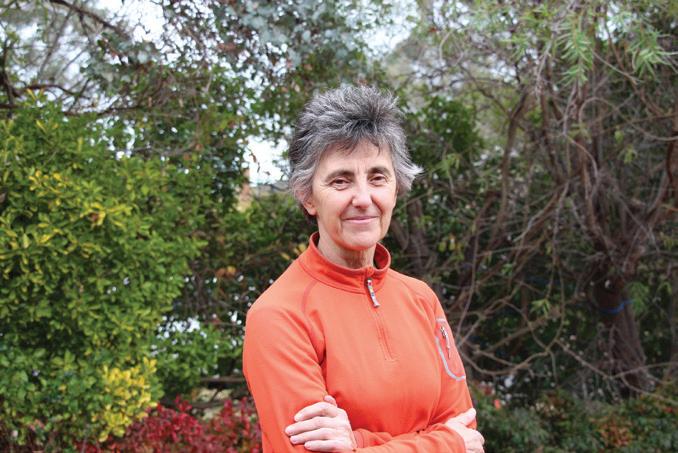
CHRISTINE Charles, the head of the Space Plasma, Power and Propulsion laboratory at ANU, is working on one of the biggest problems when it comes to going back to the moon, or into space in general – fuel.
“The moment you send people it costs a lot,” says Christine, 54, of O’Connor.
According to Christine, the cost of fuel could be one of the many reasons humans haven’t been back to the moon in 50 years.
it positively touched and inspired an unprecedented number of people at once,” she says.
“[The moon landing] was really cool because everyone can see the moon and dream about the moon. It’s in space but it’s also close enough to see,” she says.
Looking towards the future of space travel, which is Christine’s specialty, she’s working on mitigating the costs and is currently working on electric plasma space engines.
“To me, what’s interesting about the future of space travel is we will be using diverse technologies,” she says.
“If you really want to do deep-space travel in the future, you probably will have to use electric propulsion, otherwise the amount of fuel you have to take from the earth is too great.”
This is where the fourth state of matter, plasma, a hot ionised gas,
“A natural plasma is the sun, the sun is a really, really hot plasma,”
“Plasmas are so important because they are used to make integrated circuits. Without plasma, there are no
When Christine was working with plasma to make better small micro transmitters (also used to make technology such as smartphones), she came across some really interesting stuff.
“If I can manipulate a plasma then

I can create a force that’s effectively a space engine,” she says. “I think future space missions will have a combination of chemical thrusters (engines) and electric plasma thrusters.”
Traditionally, Christine says chemical propulsion was used to get into space and while it will always be used to get off the earth, once a spacecraft is off this gravity pull, then there’s choice between chemical propulsion and electric propulsion.
Electric propulsion has been used before and Christine highlights the SMART-1 satellite, which was sent by the European Space Agency between 2003 and 2006 on a mission to orbit around the moon.
“This mission demonstrated that you can go to the moon with electric propulsion but you have to be a little bit patient,” she says.
According to Christine, SMART-1 only used the same amount of elec -
tric power as a hairdryer and it used about 60 litres of fuel – equivalent to some cars.
“The fuel is to get to low earth orbit,” she says. “Once it’s away from the earth’s atmosphere, there’s less force needed and [the rocket] starts to orbit around the earth. Here, the rocket can then deploy the different satellites, which deploy solar power that starts generating electricity on board.
“Because plasma is ionised it responds to magnetic fields and electric fields so we can use plasma to generate a force on a spacecraft.”
What Christine is trying to do is develop a simplistic thruster (engine), which she says won’t break down half way through a mission, will have extended life and will also work with all types of fuels.
“We want to make sure it’s not too complicated, just a few parts, which can work with different propulents and which can also be repaired, if necessary, by astronauts.”
And while Christine’s dedicated a lot of her life working on engines that could help take others into space, she says she wouldn’t go herself.
“Personally, I don’t really like flying,” she says.
“I think earth is beautiful and I want to see more of the earth and I want to protect it as much as I can. But I’m super happy to help astronauts go into space.”
There was a microphone put next to the speakers and hooked into the regular sound system. The excitement was electric as hundreds of my fellow students and I crowded in to watch the historic occasion.
Michael Moore, former MLA

[AT the time] the schools didn’t have a lot of TVs so they said if you can get home to watch it, go home. I was a solicitor working at a firm in Canberra then. I went home, in Hughes, and my children came home to watch it. It was an amazing thing to see but (more locally) I don’t think we really appreciated what the Honeysuckle Creek Tracking Station actually did at the time.


Armstrong and the boys prepared themselves
in to the Cabinet and they broke up to share the moment. Mr McEwen came in carrying his papers and we sat and stood around
He was an impatient character at such times and after about three minutes he said: “Well, Rob, when are they going to do
Suddenly I felt responsible for the whole

thing. “Shouldn’t be long now,” I said. But of course it was interminable. McEwen got fed up and went into his inner sanctum to work on his papers. “Let me know when someone makes an appearance,” he said.
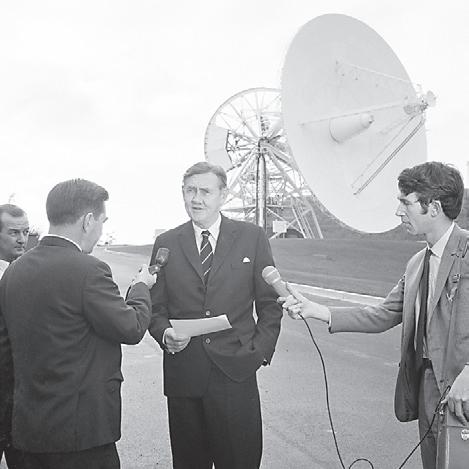
I couldn’t believe it. Here was a man born in January 1900, three years before the Wright Brothers made that first flight on Kitty Hawk planes. He had lived through the entire age of flight from bi-planes to single wings, from combustion to jet engines, from fighters and bombers to supersonic airliners, and now with the imminent conquest of space itself, he couldn’t spare half an hour while Neil Armstrong and the boys prepared themselves for that first step upon
However, when Armstrong finally appeared, Maureen O’Dea, the assistant private secretary knocked on his door and he came out to stand with us as the astronaut made those long, slow steps down the ladder and, “One small step for a man…”
“Well,” I said, “that was something… gives us a whole new perspective, one world to another.”
“You’re a romantic, Rob,” McEwen said. I went home and opened a bottle of red with my wife, Wendy. We sat outside for a while and looked at the night sky. “The infinity of space,” I said, “but I almost feel that I can touch it.”
Wendy went inside. Too damn cold. I stayed till I started sneezing... romantically, of course.

HUNDREDS of millions of people around the world collectively gasped at Neil Armstrong’s first tentative steps on to the lunar surface at 12.56pm Australian Eastern Time on Wednesday, July 21, 1969 – and Canberra was in the thick of bringing those pictures to Earth.
The Honeysuckle Creek Tracking Station, in the ACT, helped bring the pictures to the world until the moon rose over Parkes and, after overcoming a terrible wind, the Parkes dish carried the broadcast for their friends at NASA.
Armstrong emerged from the spacecraft first and while descending, he released the Modularized Equipment Stowage Assembly on which the surface television camera was stowed, and the camera recorded the first step on the moon.
The international broadcast signal, which originated in Australia, had to travel halfway around the world and back again via a satellite over the Pacific, and meant Australian audiences witnessed the first steps on the moon – around 300 milliseconds before the rest of the world!
Former ACT Senator Margaret Reid, whose late husband Tom Reid was the director of Honeysuckle Creek, says the tracking station, 37 kilometres south-west of Canberra, had a crucial role in the landing.
“At the time, I don’t think we really appreciated what Honeysuckle Creek Tracking Station had actually done,” she says.
According to Margaret, the magnitude of the

occasions – tried to get him to open up about what he’d done at Honeysuckle Creek, espe cially in relation to Apollo 11. But he always changed the subject,” says Tink.
“He absolutely hated, loathed, talking about himself. He was an extremely modest, private person and if he ever said anything about his work, he would always deflect to the team that he led.”
Neil Armstrong’s first steps on the surface of the moon were watched by 600 million people – an amazing audience even by today’s stand ards. The signals from the moon were received by Honeysuckle Creek and Parkes in NSW.
THIS time 50 years ago, I was required to go up to Tidbinbilla to record some audio between the Apollo astronauts and NASA being facilitated by the ACT space tracking station, for stations on the Macquarie Radio Network. It wasn’t until midway through a flight back from PNG a few days later when the pilot announced the one giant step for mankind. Only then did I realise the significance of the event.
Rod Henshaw, 2CC presenter

event was also unknown to Tom, who she says was just doing his job that historic day.
“His concept for success came from the team work behind it, which he acknowledged greatly,” she says.
Author Andrew Tink confirms this in his book “Honeysuckle Creek – the story of Tom Reid, a little dish and Neil Armstrong’s first step.” (UNSW Press). Tink says Reid was often regarded as a prickly Glaswegian unwilling to suffer fools gladly. But it was this no-nonsense attitude that enabled him to form a team of talented technicians.
“I tried to get him to talk about this on a few
Signals were relayed to Mission Control in Houston, which initially switched between the sources to try to get the best picture. Just under 10 minutes after the historic broadcast started, the moon had risen into the Parkes telescope’s full field of view. Parkes was a much larger dish than Canberra’s, therefore it captured more signal and produced better images. US Mission Control then switched to Parkes and remained with those pictures for the rest of the 2½-hour broadcast.
Buzz Aldrin then joined Armstrong and the astronauts then carried out a planned sequence of activities that included deployment of a solar wind experiment, collection of a larger sample of material, panoramic photographs of the region near the landing site and the close-up photographs of the lunar surface.
After more than two hours, the astronauts re-entered their lunar module for a wellearned sleep. The crew then left, after 21 hours and 36 minutes.
THE finer details of the moon landing are cloudy. I recall it being a school day and being crammed into a lecture hall of St Patrick’s College, Launceston, to witness the “Eagle” safely land a man on the moon. I remember something about a flag and a plaque with Richard Nixon’s autograph. I should have paid attention, but for what it’s worth I can still accurately name racehorses, their colours, jockeys and significant victories from the time.
Mike Welsh, journalist


THE Department of Primary Industry had sent me to represent it aboard the Japan Fisheries Agency patrol ship ‘Hakuryu Maru’ checking compliance with the agreement allowing Japanese tuna long-liners to fish in extra-territorial waters newly brought within Australian jurisdiction. I watched the moon landing together with Captain Sueki and crew. Back on shore I wasn’t surprised to have to report not having sighted any long-liners during the cruise.
Dougal Macdonald, film reviewer

CHRONIC pain, which is when pain doesn’t go away after injury or illness has resolved and lasts at least three months, is a significant health issue in Australia.
It affects around one in five people of all ages, with even more alarming figures for the older population, which is one in three.
Raising awareness of these statistics, Chronic Pain Australia, through this year’s National Pain Week, from July 22-28, hopes to give a national voice to people living with chronic pain.
The new theme, “Equal partners in my healthcare”, highlights the need to recognise the voice of people living with chronic pain in any decision making process around treatment.
The theme was chosen by Chronic Pain Australia after they had an overwhelming response from chronic pain sufferers who said they aren’t seen as an equal partner in their pain management, taken seriously and, in many cases, even believed.
This is a huge concern, and according to statistics, one in five GP consultations involve a patient with chronic pain and almost five percent report severe, disabling chronic pain.
And, the prevalence of chronic pain is projected to increase as Australia’s population ages – from around 3.2 million in 2007 to 5 million by 2050.
AFTER moving from California to Canberra and noticing a lack of diverse health and wellbeing services, Ebony Anderson founded the Wellness Empowerment Collective last year in Lyneham.
Backed with qualifications in nursing, yoga, fitness and healing, Ebony wanted to share her skills with the Canberra region and in particular people with chronic pain and autoimmune pain.
To help ease pain and reduce inflammation, the Wellness Empowerment Collective offers services such as fitness sessions, yoga, cryotherapy, salt therapy, massages and float tanks.
And, Ebony says the Wellness Empowerment Collective is one of four clinics in Australia that offers Cryo T-Shock for cellulite and fat removal and the only clinic in Canberra that offers full-body cryotherapy.
“We’re really a one-stop-shop,” Ebony says.
“Everything here is non-toxic; we use heat, cold, light and salt.”
Ebony has been working as a nurse practitioner since 1992, and has a wealth of experience and qualifications.
She says she ultimately wants to

Wellness Empowerment Collective, 2 Rigall Place, National Hockey Centre, Level 1, Lyneham. Call 0450 585569, email info@wellnessempowerment.com.au or visit wellnessempowerment.com.au
JUNIC Specialist Centre, which focuses on endometriosis and women’s health, is empowering women who suffer with chronic pelvic pain through its new pain education sessions, says Dr Uche Menakaya.
The education sessions will be run by pain psychologist Kerrianne Abbott and are aimed at helping women with chronic pelvic pain understand both the origin and mechanisms of their pain.
Dr Uche, who is an obstetrician, gynaecolo gist, sonologist and laparoscopic surgeon at the centre, says the sessions will also help women develop additional personalised strategies for pain management so they can improve their quality of life.
The Junic Specialist Centre also offers ultrasounds, allied health services, preoperative diagnosis, surgical treatments and physiotherapy.
Dr Uche says: “We’ve put together a coalition of expertise for women.”
“ We are the first to offer the whole spectrum for managing chronic pain from endometriosis.”
JUNIC Specialist Centre, 110 Woodberry Avenue, Coombs. Call 6178 0470, email info@junicimag ing.com.au or visit junicimaging.com.au




Cryotherapy reduces pain and inflammation, increases collagen, improves sleep, detoxifies, soothes skin conditions, and lifts the mood--all whilst burning 500 - 800 calories per session! CRYOTHERAPY
FLOAT TANKS
500kg of Epsom salt in each tank draws pain and toxins out of the body. Lying at zero gravity for 1 hour gives unparalleled rest--1 hour in the tank equals 4 hours of sleep! Don't like the idea of sensory deprivation? You can choose one of our guided meditations for your float.

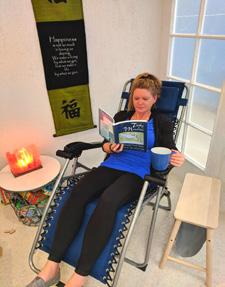
The Sauna uses infrared light waves to stimulate body heat internally. This process detoxifies, enhances healing, reduces pain, stimulates energy flow, nourishes vital organs, and rejuvenates the skin.
SALT ROOM
Our salt room relieves symptoms of respiratory issues and skin condition like hay fever, asthma, allergies, eczema and psoriasis. Safe for all ages and good for anyone trying to cut back on use of medications!


Uses thermal shock (varying intervals of time and temps from -18 to 40) to reduce pain, decrease wrinkles and cellulite, and destroy fat cells. This is a great alternative to botox, liposuction and cool-sculpting as you achieve outstanding results with no downtime!
Uses sequential compression in a circumferential massaging action to flush out waste products like excess fluids and toxins from the Lymphatic system. It also improves blood circulation, reduces cellulite, makes you firmer, and younger looking.


For women with Chronic Pelvic Pain - Attendance with Support person encouraged.
UPCOMING SESSION JULY 24 – 5.30PM at JUNIC Call 6178 0470 for more details
• Community based specialist women’s health centre
• Pioneering the ‘one stop’ model of care for quality women’s health services
• Global leadership in the pre surgical diagnosis of endometriosis using ultrasound
• Advanced laparoscopic surgery
• Bulk billed Colposcopy services
• Early pregnancy assessment centre
• Laser therapy for vulvovaginal indications
• Specialist women health physiotherapy
Phone: 02 6178 0470 • Fax: 02 6113 0743
Email: info@junicimaging.com.au
www.junicimaging.com.au
suite of programs to physically and emotionally assist you with the impact of chronic pain.

• Hydrotherapy at locations across Canberra
• Exercise Physiology group classes and individual consultations
• GLA:D Physiotherapy program for hip and knee osteoarthritis
• Dietitian consultations for weight loss/gain and pain relief
• Occupational therapy to improve daily living challenges
• Individual counselling and health education
• Pain Support programs, seminars and support groups
• All programs can be incorporated into NDIS, DVA and My Aged Care
• We accept GP Referrals for Medicare funded allied health services

• Most chronic pain conditions respond to exercise and weight loss
• Hydrotherapy is proven to lead to reduction in many kinds of chronic pain
• People living with pain often suffer from being isolated – we have programs that will lessen this impact
• Mild depression and anxiety will significantly increase perceptions of pain – our counselling, support groups and exercise groups will help reduce this impact.
ARTHRITIS ACT has recently joined forces with Pain Support ACT to help people living with all types of pain, says CEO Rebecca Davey.
“This means Pain Support ACT members have more access to support,” Rebecca says.
“In the past they were really only a support group with a monthly talk [but now] we can offer them discount services and a suite of allied health professionals.”
Offering a range of services from exercise classes
regularly on topics relating to living well with pain conditions.”
In addition to pain management and occupational therapy, Rebecca says Arthritis ACT offers weight management advice, strength and balance classes.
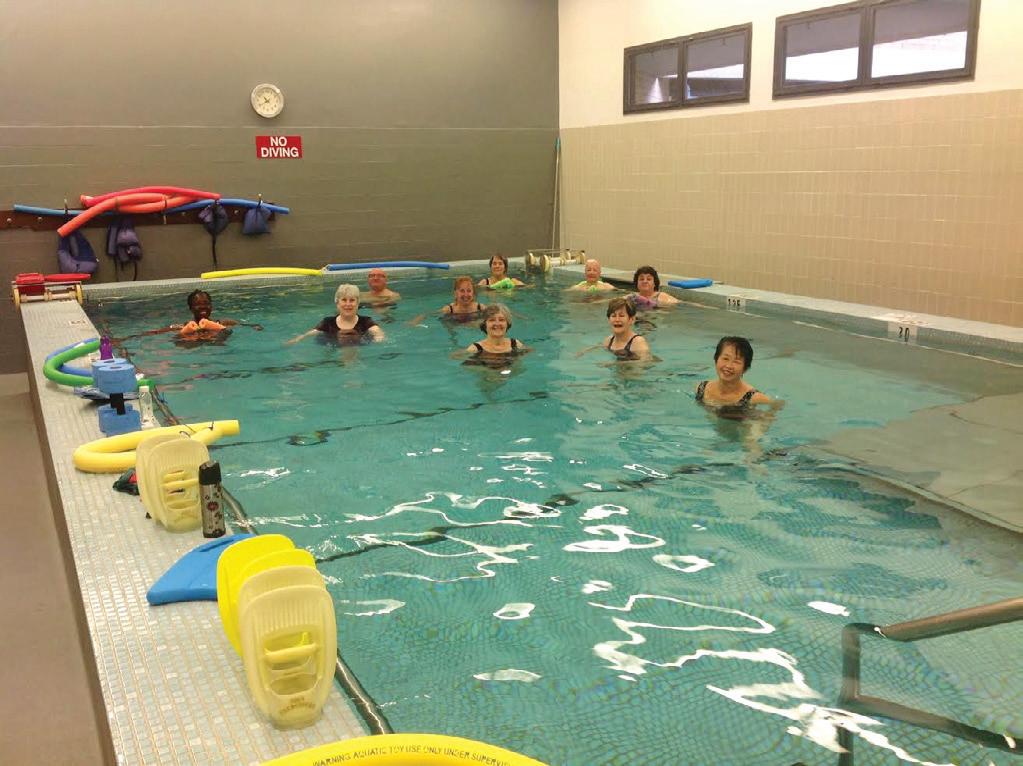
“We run Canberra’s biggest hydrotherapy program at venues across Canberra to improve pain and increase exercise in an environment that reduces pain,” Rebecca says. “Our services can be utilised at any point in the pain journey.
conditions from developing, according to Greg, who says when it comes to sub-acute pain, it’s important to identify the painful area so they can then take the appropriate steps to help prevent chronic pain.
Once using tools to understand why the pain persists, Greg says the next step is education.
“We teach them about their problem and how to manage it,” he says
The Manuka Woden Physiotherapy and Sport Injury Clinic can help with injuries such as musculoskeletal injuries, neck and back pain, joint pain and injuries from
management of injuries.
“We take great pride in providing a personal experience for clients,” he says.
“We know them by name and they know us by name. [And we] don’t just treat the injury, we treat the person.”
Manuka Woden Physiotherapy Sports Injury Clinic, 2/26 Bougainville Street, Manuka, call 6295 6896 and 3/48 Corinna Street, Woden, call 6281 1382 or email manukawodenphysio@outlook.com

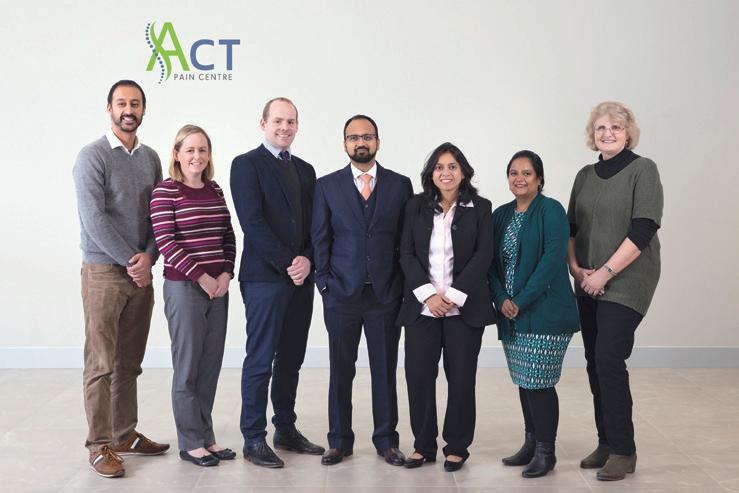
The ACT Pain Centre team, from left, Charan Walia, Emily Peelgrane, Matt Croger, Dr Romil Jain, Dr Deepa Singhal, Dr Anandhi Rangaswamy and Heather Collin.
THE ACT Pain Centre has served Canberrans for almost six years, says practice manager Kalpana Palaniyappa.
“All of our patients are chronic pain patients,” she says.
“[Most of these patients have] lower back pain, shoulder pain [and] neck pain.”
“At ACT Pain Centre our approach is to provide a multi-disciplinary treatment to manage chronic pain, complex acute pain conditions and cancer pain,” Kalpana says.
To help these patients manage their pain, the ACT Pain Centre has a range of specialists such as exercise physiotherapists, occupational therapists, psychologists and psychiatrists. And, with a philosophy to promote active
and self-management strategies, Kalpana says the centre runs a half-day, pain education program on the last Wednesday of every month, which covers topics such as medication, surgery, moving or exercising with pain, improving daily function and managing pain flare-ups.
Conveniently located next to Calvary Bruce Private Hospital, the ACT Pain Centre uses its facilities for its procedures, and due to an increased demand the ACT Pain Centre will be opening another practice in Deakin.
ACT Pain Centre, Suite 1, Calvary Private Clinic, 40 Mary Potter Circuit, Bruce. Call 6195 0180 or email info@actpaincentre.com.au
CANBERRA Mobile Physio can help Canberrans manage their chronic pain in the comfort of their home, says owner Sanne Curran.
Sanne, who’s been a physiotherapist for about 20 years, says Canberra Mobile Physio can help provide services such as pain relief, mobility improvement, falls prevention and safety, respiratory conditions, tailored exercise programs and balance training.

But, Sanne says they also have a focus on the elderly and keeping them independent.
“Continuing to move and exercise is an important part of managing chronic pain for anyone but a lot of the elderly have arthritis, so strengthening and staying active is [especially] beneficial [for them],” she says.
Before Canberra Mobile Physio gets clients moving, Sanne says they first evaluate the client’s situation and their requirements, which can include checking medical history, strength and pain levels before developing a treatment plan based on personal needs and goals.
“We can look at what’s giving them pain in their everyday life by looking at the specifics, we can analyse the way they move and see if that is contributing to their pain,” she says.
“We look at what the reason is for pain and look at ways of minimising painful movements.”
Canberra Mobile Physio. Call 0415 351370, email enquiries@canberramobilephysio.com or visit canberramobilephysio.com


Exercise Physiologist, Occupational Therapist and Clinical Nurse Consultant
We aim to provide quality, evidence based care in ACT and surrounding areas including Riverina and South Coast of NSW. Opening second location at 1/39 Geils Ct, Deakin from October 2019.
“Do



•
•
•
•
•



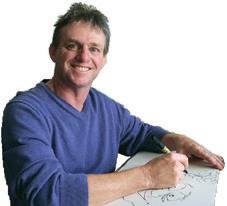
MOST people need a combination of interventions to manage their pain, says the director of Canberra Chiropractic, Dr Ben Schutte, who has been helping clients manage pain for about 30 years.

But, he says what’s most important when managing pain is what people do for themselves in conjunction with their healthcare adviser.
When it comes to pain at Canberra Chiropractic, Ben says the services they offer revolve around a series of adjustments along with prescribed exercises and advice on what behaviours to change.
“[This] usually includes being more active,” he says.
Ben says factors like stress, fear and a sedentary lifestyle can amplify pain.
“We know from recent neurophysiology studies that pain is actually an emotion which is generated in your brain,” he says.
“This occurs when the brain perceives that an injury has occurred.”
Ben says Canberra Chiropractic can also help people manage issues such as lower back pain, sciatica, upper-body pain, headaches, dizziness and sports injuries.
Canberra Chiropractic, Unit 5, 9 McKay Street, Turner. Call 6247 3388, email admin@canberrachiropractic.com.au or visit canberrachiropractic.com.au

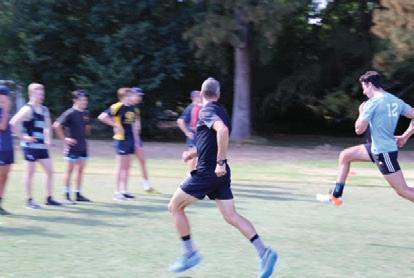
CHRONIC pain and injuries will vary from person to person, which is why the owner of Dynamic Athletic Performance and Rehabilitation, Josh Strahorn, gives clients programs tailored to their needs.
“People come in with injuries such as rolled ankles, twisted knees and shoulder injuries,” Josh says.
From here Josh, a former Brumbies and AIS coach, prescribes programs which focus on factors such as age, gender, the sport they play and their ability.
The aim of the program, according to Josh, is to return the athlete back to sport stronger, faster and injury free.
“The program includes take home conditioning and flexibility sessions and suits beginners, intermediate or advanced athletes,” he says.
But Josh doesn’t just focus on rehabilitation and says Dynamic Athletic Performance and Rehabilitation offers athletic services such as group sessions, individual coaching and online programs.
“Exercise can be beneficial both physically and mentally,” Josh says, who believes everyone has the ability to reach their full potential.
“We [also] like to stay up to date with treatments and research.”
Dynamic Athletic Performance and Rehabilitation, 1 Bass Street, Queanbeyan. Call 0449 926165, email josh@dynamicathletic.com.au or visit dynamicathletic.com.au
Mark looks for solutions from the feet up
WITH 30 years’ experience in podiatry, Dr Mark Clayton of The Healthy Foot in Dickson has been helping people identify and manage their podiatric pain and chronic foot injuries.
“Usually the feet are the compensators, they compensate for any abnormalities,” says Mark, who believes it’s possible for chronic foot pain, knee pain and hip pain to be linked.
“From my point of view, it’s good to start at the feet,” he says.
“If you adjust the feet correctly, the rest of the body can follow.”
As well as identifying and treating causes of podiatric discomfort or pain, Mark says The Healthy Foot can provide footwear advice, preventative care, aesthetic treatments and can create orthotics tailored to each individual’s needs.
He says they sell orthoticfriendly footwear in many styles, colours and sizes.
“[They are] a good quality shoe and people who wear them keep coming back,” he says.
The Healthy Foot, 1/151 Cowper Street, Dickson. Call 6262 8383 or visit thehealthyfoot.com.au











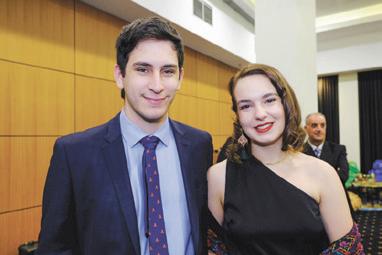









Sharing lunch with an old friend WENDY JOHNSON
By Helen Musa
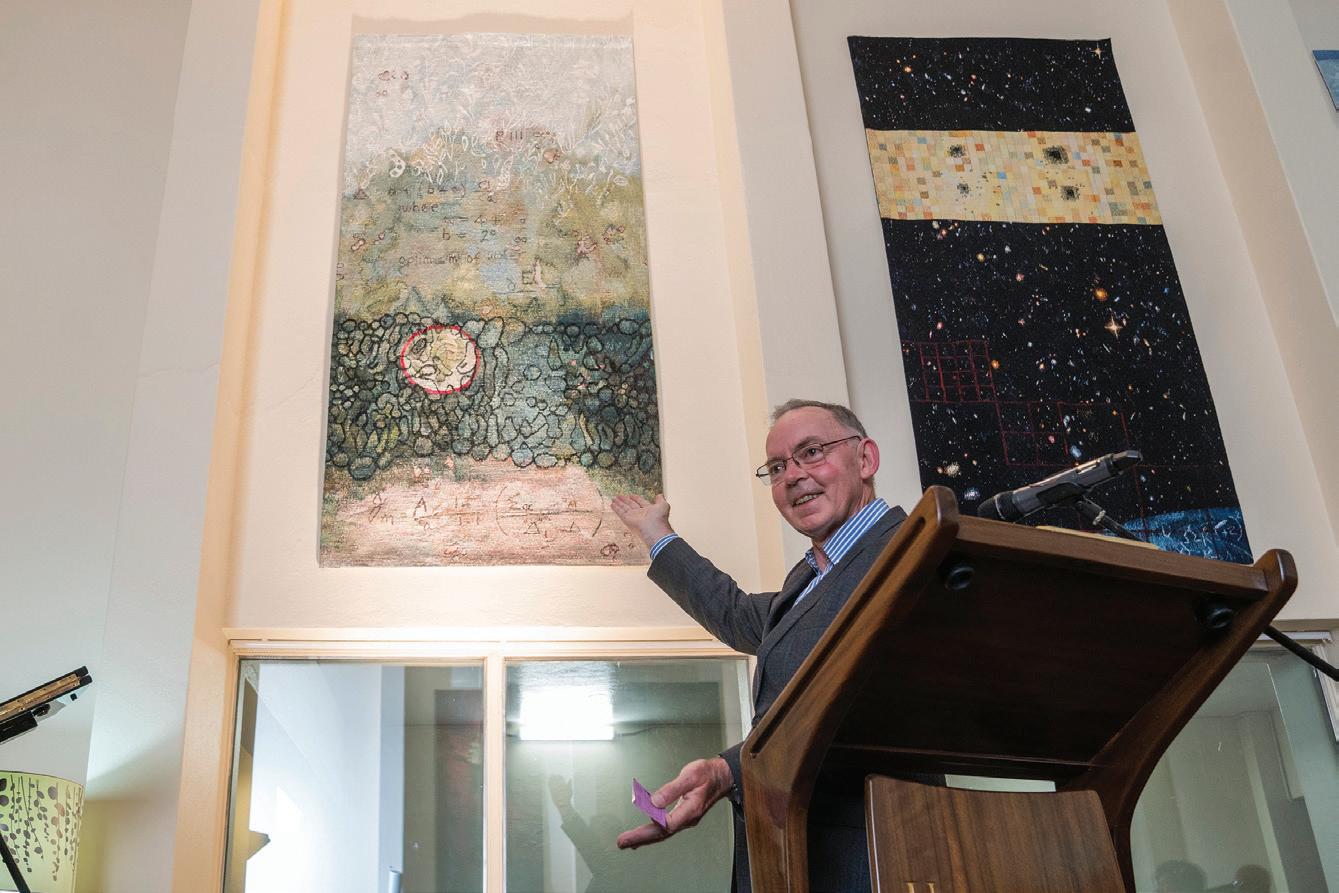
“THERE’S a strong parallel between artists and science to transform the unknown into the known,” says textile artist Valerie Kirk as she describes a suite of tapestries she’s woven to honour the work of our most brilliant scientists.
Kirk’s recently-unveiled interpretation of Kyoto Prize awardee Prof Graham Farquhar’s research brings to six the number of such art works now hanging in the hall foyer of University House.
Professor Farquhar who won the 2017 Kyoto Prize in Basic Sciences for his life’s work in plant biophysics and photosynthesis, has joined an illustrious line-up of subjects on the walls.
The series began with a commission by the ANU intended as a gift marking 50 years of University House to produce tapestries linked to Nobel laureates associated with the university – John Eccles, Howard Florey, Peter Doherty and Rolf Zinkernagel.
Kirk, then head of the textiles workshop at the ANU, was the obvious choice for the job.
A fourth tapestry was commissioned from her by the university in 2006 to celebrate the Japan Prize awarded to Prof Frank Fenner, for his work in the eradication of smallpox.
The fifth, for which Kirk was given time through an ACT government $45,000 Creative
Fellowship, honoured present-day ANU vicechancellor Prof Brian Schmidt’s Nobelwinning discovery of the accelerating expansion of the universe.
Farquhar’s achieve ments are no less dazzling than those of the researchers who went before him. The Kyoto Prize is regarded as the equivalent to a Nobel, and his research on water-efficient crops and the impacts of climate change are crucial and of the moment.
There was more to him than science, as Kirk found. A former ballet dancer, Farquhar had founded the National University Dance Ensemble (now the Canberra Dance Theatre) but it was his work to understand how cells, whole plants and whole forests work, that really captured Kirk’s imagination.
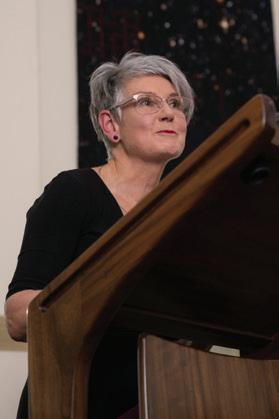
“Graham has been a wonderful person to work with, but the process never became easier, and definitely not quicker, as there was no formula for creating such a tapestry, which had to be matched to the research,” Kirk says.
“It was like launching into the unknown with a blank sheet of paper.”
Eager to know what his research was all about, she asked Farquhar if he could give her any visual stimuli – he wrote an equation on the back of a card and handed it to her.
Her search for visual imagery took her to his laboratory, which was full of nuts, bolts and potted plants, especially eucalypts. That inspired Kirk to make a series of bo tanical drawings. Then there were the rough equations in his notebooks. She finished some designs in watercolour. The result is discernible in the completed tapestry.
It took four months of full-time weaving, horizontally, but it proved fascinating to see the unknown become a reality. Her hope, she says, is that it will indicate his dedication and the importance of his works in terms of the Kyoto Award.
For his part, describing the tapestry as “a beautiful work of art”, Farquhar noted how amazingly observant Kirk had been as she sought ways of revealing visually his ques tions to do with the water content of soil.
Brian Schmidt, standing in front of the new tapestry as it was unveiled, says that on hearing of Farquhar’s Kyoto Prize, he had immediately thought: “We have to do a tapestry”. He must have been thinking out loud, because several key ANU professors had brought the project into fruition before he had time to ruminate.
“The artistic and scientific worlds are full of many remarkable people and breakthroughs, but to create an understanding of a big, chal lenging issue like photosynthesis in tapestry is exceptional,” he says.
The University House tapestries may be viewed in the Great Hall foyer during opening hours.



The Urban Pantry menu has great variety and focuses on local produce and flavours that are anything but wimpy.
SOMETIMES it’s great to return to an old friend for lunch. While it’s intriguing to trial the gazillion new places that continue to pop up in every part of town, there are (dare I say) “oldie goldies” holding their own and they deserve our patronage, too.
That takes me to the inner-south, on the iconic Manuka Lawns, where Urban Pantry has a prime corner position. It’s been there for a long time serving breakfast, lunch and hanging open from about 4pm to 5.30pm depending on the day. Dinner is no longer served (sad face). I hadn’t been for yonks. It was a weekend. Lunch. Packed (but that’s a good sign, right?). We lucked in with a table in the outdoor area (enclosed in plastic with heaters for winter). Our party of two

ended up beside a large and loud party (fair enough for them, it was the weekend) but they were a bit boisterous. “No problem,” said the person who seated us. In a flash, we were whisked away to a quieter spot. The menu has great variety and focuses on local produce and flavours that are anything but wimpy.
Over the years, I’ve had gnocchi a few times at Urban Pantry and the dish has never failed me. This visit didn’t either. House-made ricotta dumplings (not at all heavy or stodgy), with gorgonzola that packed a punch, forest mushrooms, baby kale and broad beans ($27). Life doesn’t get much better (my dining friend had food envy). The dish, even though the place was pumping, arrived piping hot. Worth every bite.

Urban Pantry gnocchi… house-made ricotta dumplings with gorgonzola, forest mushrooms, baby kale and broad beans.
Photo: Wendy Johnson
DANIEL Hyde, soon to become the new director of music for the Choir of King’s College, Cambridge, will lead and conduct the choir when it visits Australia, including Llewellyn Hall, 7pm, Thursday, July 25. Book at musicaviva.com.au
“THE Art of Coarse Acting” is a series of comic parodies selected from the “Coarse Acting Shows” series books and made popular through the Edinburgh Festival. In the plays, everything that can conceivably go wrong does, as director Chris Baldock will doubtless ensure. At Canberra Rep Theatre, Acton, July 26-August 10. Book at canberrarep.org.au or 6257 1950.

Thursday,
Playhouse, 8pm, July 25. Book at canberratheatrecentre.com.au
My friend is a big vongole fan and couldn’t steer away from that item on the menu ($32). It was just as yum. Cloudy Bay clams (with their briny
juices making the dish sing), spanner crab, garlic (just the right amount), chilli, basil, asparagus and prosecco. What a winning combination. The only issue was the kick of the chilli.

Until 2 November 2019
Explore stories of activism that have taken place in Canberra over the last century. Canberra has a special relationship with activism. As the national capital of Australia, it is not only the location of protest on local issues, but also the site of national and international protest. No matter whether it’s big and dramatic, or quiet and slow, these are stories of people working for change in the Canberra community.
More was ordered but we weren’t convinced more was included. Other lunch mains that caught the attention of our tastebuds included a Hunter Valley lamb skewer (sumac spiced rump, $23) and a Tasmanian salmon niçoise with an olive tapenade ($24). Burgers, fish and chips and a club sandwich are also
available (hovering around the $24 mark). Specials on our visit included a delish-sounding duck ragu ($32) and a chicken pie ($26).
The wine list at Urban Pantry is pretty decent and those wanting non-alcoholic drinks can enjoy smoothies, frappes, milkshakes, thickshakes, other cold drinks and a full range of great coffees and teas. BTW, a menu for the “little ones” is available (all $14) and includes a healthy quinoacrumbed, free-range chicken.
Urban Pantry, 5 Bougainville Street, Manuka. Open seven days for breakfast, lunch and afternoons. 10% surcharge Sundays and public holidays. No bill splitting and surcharges for Visa and Mastercard 1.1 per cent and Amex 2.6 per cent.

DENIS Carnahan, the man who produced the State of Origin anthem “That’s In Queensland”, is bringing back his cult show “Rugby League The Musical”, a blend of songs with videos, sketch comedy, impersonations and stand-up. At The Street Theatre, 7.30pm, July 27. Book at thestreet.org.au or 6247 1223.

TAUGHT by Padma Menon, “come-and-try” classes offering an accessible approach to classical Indian dance will be held at the Moving Archetypes Studio Open Day, 19-25 Kembla Street, Fyshwick, 10am-noon, July 28. Free but book ings and info at movingarchetypes. com.au or 0447 643646.
SASS and Tease Collective is reviving its show “Jay Gatsby Requests”. Billed as a rollicking indulgence in the Jazz Age, with guest artists, live music from tradjazz Dixie ensemble Zackerbilks and an ensemble of burlesque performers. At The Abbey, Gold Creek, 6.30pm, July 26. Book at eventopia.co
AUSTRALIA’S drumming ensemble Taikoz, joined by dancer Chieko Kojima from Japan, will explore the “immersive” qualities of Japanese taiko in its production “The Beauty of 8”, named after the flamboyant yokouchi (side-on) style of taiko playing. At The
THE Participation Grant Program has allocated $85,000 for the 2020 National Multicultural Festival. Last year 80 people received grants to showcase their cultural traditions and heritage. Applications (to communityservices.act.gov.au) close 5pm, Monday, August 5.
THE “Irish Christmas in July Show” will feature a traditional menu with entertainment from the five-piece Celtic folk band Wild Kelpie Playdate. At the Canberra Irish Club, Weston, noon, July 21. Book at irishclub.com.au or 6288 5088.
THE Sweet Dreams Festival is a popular music event created by local musical identities Rohan Thomas and Marty Khoundavong, which will come complete with a “glow-in-the-dark ball pit and giant neon animals”. At the Truffle Farm, Majura, Saturday, September 21. Book at atticketbooth.com.au
THE cold weather has inspired the early announcement of “A Very Canberra Comedy Festival Christmas”, a two-hour spectacular


“Booksmart” (M)
“BOOKSMART” unfolds over the day before high school seniors graduate and the following day when they set out on the life journey that really matters.
Director Olivia Wilde’s directorial debut after a long, relatively undistinguished acting career has staged a story written by Emily Halpern and Sarah Haskins as if the graduating class had spent the year forming relationships, developing cliques or preparing to stage the most memorable end-of-school party.
Only Molly (Beanie Feldstein) and Amy (Kaitlyn Dever) have spent the year achieving stellar academic records, at the expense of social skills. And they decide that they need to rectify that oversight big time.
The film is about how they go about doing that. They haven’t learned where classmates are throwing parties. Neither has clothes sense. Alcohol is a new country for them. And sex is nothing more than a three-letter name for what other kids have been exploring all year.
The adult characters are cut from similar but nottoo-similar cloth – principal Brown (Jason Sudeikis), winsome class teacher Miss Fine (Jessica Williams) and Amy’s mother (Lisa Kudrow).

Most of all, “Booksmart” focuses on Amy’s stronger role in the relationship with Molly. Molly knows that her pudgy body limits her prospects of attracting a boy. Amy, unsure of her sexuality, hopes to find a girl with similar feelings among the crowd but retreats when the knickers come down.
I trolled through a list of more than 400 American peer reviews seeking a reliable measure of how “Booksmart” rated on its home turf. The majority gave it fewer than three out of 10 stars. ‘Nuf sed, I reckon.
At Dendy, Palace Electric, Limelight, Capitol 6 and Hoyts “Stuber” (MA)
YOU might be forgiven for wondering who the heck is Dave Bautista who heads the cast of director Michael Dowse’s film.
Dave comes from a career in short films and professional wrestling TV series. He’s built like a brick. This year, his marketability seems to have taken off following the making of “Stuber”. Amazing!
Dave plays Vic, an aged Los Angeles police detective whom his divisional chief Angie (Mira Sorvino) wants to retire. His eyes are post-operatively shot. He can scarcely see whom he is shooting in the line of duty. He certainly isn’t fit to drive. And that’s where Stu (Pakistani-born Kumail Nanjiani) comes in. Stu is a mild-mannered Uber driver trying to assemble enough money to marry the girl of his dreams.
In Tripper Clancy’s first feature screenplay, Vic takes over Stu’s life in the campaign to bring down criminal mastermind Tedjo (Iko Uwais) and uncover the LAPD person who’s doing him favours. “Stuber” is a ho-hum movie in which Stu’s electric car is a recurring motif providing the film with a silent but important comic personality. The screenplay tries to convince us that it’s ultimately about mateship and Stu’s discovery of his hidden, wild-mannered, self. Some might agree. But it’s very predictable.
At Dendy, Capitol 6, Hoyts and Limelight
“Crawl” (MA)
ALLIGATORS are large (average mass 360 kilograms, average length four metres) fresh-water crocodilians native to only Florida and Louisiana, where they perform useful ecological roles, and China, where a smaller species found only in the Yangtze River is endangered.
French filmmaker Alexandre Aja casts them as villains in this thriller written by brothers Michael and Shawn Rasmussen and filmed in Serbia (where they may well have got better bang for their film’s estimated $US13 million budget, spent mainly on special allegatorical effects.)
The film is basically a two-hander involving Dave (Barry Pepper), a father whose marriage is down the plug-hole and his daughter Haley
(Kaya Scodelario). Dave has devoted Haley’s life to her career as a freestyle swimmer. He has put the family’s Florida home on the market. After a day of a category 5 hurricane, the prospect of finding a buyer looks slim. But that’s not the film’s main objective.
In the basement (I’m told that few Florida houses have basements) Dave is lying injured. Haley defies a police roadblock to see how he is coping with the storm. He’s not alone down there. He has at least one alligator for company with more on the way.
What the film boils down to is how, before the alligators reach them, Haley is going to get Dave safely up to the roof, where hopefully a rescue helicopter will see them.
Some of the animal events stretch reality more than a little. Some of the human crises ditto. But less meritorious movies have been made around those tension elements. And it’s all over in a mere 87 minutes including closing credits.
At Dendy, Limelight and Hoyts Woden


By Helen Musa
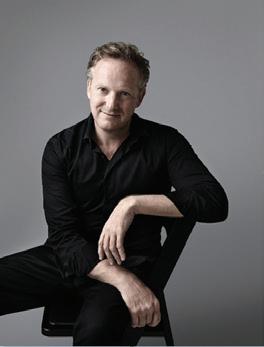
THE Australian World Orchestra is coming to Canberra for the first time.
Established in 2011 by Janáček expert and conductor Alexander Briger and his sister, the businesswoman and filmmaker, Gabrielle Thompson, the 90-strong orchestra comprises a 50-50 mix of local and international musicians who fly in for a week to perform – and they’re all Aussies!
Conductors over the years have included Briger himself, Australia’s Simone Young, Zubin Mehta, Riccardo Muti and Sir Simon Rattle, who once described the AWO as “one of the great orchestras in the world”.
Realising that wherever he conducted in the US or Europe, there were Australian musicians holding key positions, Briger settled down with Thompson over a bottle of red wine on his Sydney balcony to spout ideas for an all-Australian symphony orchestra – a sort of “Barbarians” or “The Socceroos” of Australian music, as he puts it.
“It’s become a bit of a family business,” he says. You can say that again, Thompson is now the company’s CEO and their late uncle, the famous conductor Sir Charles Mackerras, was its founding patron.
“I didn’t know how to go about getting it up as I have no financial background. My sister is 10 years older than me and, as a film producer, she knew a lot,” he says.
“I asked her and she thought it was fantastic, that’s how it started and we’ve been together ever since.”
They’ve performed in Australia in 2011, 2013, 2015, 2016, 2017 and 2018, in India and in Singapore.
“We’re the only one in the world,” he says. “There is Japan’s Virtuoso Symphony Orchestra, but that has musicians working within Japan only, then there’s the World Orchestra for Peace, but that’s full of different nationalities… We’re the only one that is entirely made up of Australian musicians for all of our work.”
With 50 per cent of Australians
who work abroad and 50 per cent locals, they’re able to mount a large major orchestra.
Money is very much on his mind. They have private and government help, as well as significant corporate philanthropy, such as the Sofitel Group, which has provided accommodation from the outset.
“It’s costly to have all those orchestral musicians here and our conductors are much more expensive – I do it free, of course,” he says.
This year he’ll be conducting the AWO himself for the first time in three years, both in Llewellyn Hall and Melbourne’s Hamer Hall.
Legendary Canberra musician Max McBride will be principal double bass.
“I specialise in Janáček so I’ve chosen his rhapsody for orchestra, ‘Taras Bulba’, an amazing piece of music,” says Briger.
As well, the AWO will perform Nigel Westlake’s “Flying Dream” and, to end, Sibelius’ masterpiece, Symphony No. 2. Making no apologies for the lushness of the sounds, he says: “This is a really big, chunky orchestra with a big, fat, romantic sound.”
Australian World Orchestra, Llewellyn Hall, 7.30pm, July 27. Book at australianworldorchestra.com.au or 8283 4527.






TWINSTITCHUPHOLSTERY.COM.AU


twinstitch.upholstery Like us on Facebook Call or email us today! 0422 073 665 61813511 toni@twinstitchupholstery.com.au


BEES and frogs are important indicators of the state of the world’s environment.
It’s unsurprising that we take bees for granted given, according to the English “Country Life” magazine, they are among the world’s oldest inhabitants, buzzing around 93 million years before humans.
There are about 25,000 sorts of bees, but only seven species that produce honey.
Bees are vital to our environment for pollination of a multiplicity of crops, fruit and veggies. And yet we humans make life difficult for them to survive.
The use of pesticides isn’t helping. One particular range of chemicals, with an almost impossible name to pronounce, is neonicotinoids (or neonics for short), the world’s most widely used pesticide, which is employed in the agricultural and horticultural industry to kill a variety of insects. Unfortunately, it also kills pollinating bees, honey bees in particular and native bees.
Without bees we would have no fruit and a variety of other foodstuffs that require pollination.
After a several-year review, the European Union banned the use of neonics from the end of last year. However, the Australian Pesticides and Veterinary Medicines Authority has no plans to initiate a review of neonics.
Yates garden products, which used neonics for years in its pesti -




Research in France suggests neonics are 5000-10,000 times more toxic than DDT. Interestingly, my 1948 edition of the “Canberra Gardener” has a full-page advertisement promoting 100 per cent DDT to kill all garden pests!
But back to helping the bees in their search for nectar.
Gardeners are always looking for new varieties of inbred/hybridised flowers. Often these flowers are a little larger or brighter and often more compact, which prevents bees from penetrating their blooms easily.
Bees prefer large, open blooms full of nectar that they can dive into.
For example, some dahlias with their tight flowers, while winning prizes at shows, are unhelpful for bees.
I am told that bees, even though they have five eyes, also have a problem with deep-red flowers. They prefer soft pinks, purples (with lavender so popular), blues and whites.
Bees range far and wide, up to nearly two kilometres from the hive visiting up to 5000 flowers in a single day in 15 or more journeys.
through Dymocks in Canberra. Finally, pure bee honey contains natural preservatives and can never go off. Sealed pots of honey have been found in ancient Egyptian tombs and perfectly edible after 3000 years.
• Check shrubs, especially roses and fruit trees for scale insects. Spray with Yates Lime Sulphur or Eco-oil including the ground underneath.

• Take fig-tree cuttings now. Cut a branch the thickness of a finger and about 30 centimetres long, and insert one third into good soil.
• Cut back chrysanthemums to ground level. Time to also dig up and divide if you want more of them.
• Crepe myrtles flower on the new season’s wood, so cut back by one third to encourage new growth and more flowers next autumn.


Joanne Madeline Moore

ARIES (Mar 21 – Apr 20)
Thursday is one of your luckiest days of the year when prosperity planet Jupiter links up with Mars (your power planet). Courage and confidence will take you places plus motivation and energy will take you far. Remember that Mercury is still retrograde though. So you’ll need to temper your fiery enthusiasm with plenty of patience and kindness. As writer (and fellow Aries) Henry James reminds us: “Three things in life are important: be kind, be kind, be kind.”
TAURUS (Apr 21 – May 21)
With Mercury reversing through your education and neighbourhood zones, it’s a suitable week to revise work or revisit a local friendship. But be very clear when you’re communicating with family, friends and colleagues. What they say and what you hear may be two very different things. So make sure you keep them up-to-date with what you are thinking and doing, otherwise misunderstandings are likely. A good dollop of diplomacy will get you through.
GEMINI (May 22 – June 21)
Mercury is your ruling planet so whenever it’s retrograde is a tricky time and you can feel as if an area of your life is stalling or even going backwards. The current Mercury Retrograde lasts until July 31, so weigh up the pros and cons of any big choices you have to make. And – if you can – delay making important decisions until August, when you’ll be thinking more clearly. As actress (and birthday great) Helen Mirren reminds us: “We write our life story by the choices we make.”
CANCER (June 22 – July 23)
A close friend or work colleague requires your help but avoid being bossy and taking over. With Mercury reversing through your sign, you could blurt out something that you later regret or someone could make a cutting comment that annoys you. Resist the urge to retaliate. Instead, do your best to be diplomatic and keep your Crab composure. As birthday great Carl Jung observed: “Everything that irritates us about others can lead us to an understanding of ourselves.”
LEO (July 24 – Aug 23)
By the end of the week the Sun, Mars and Venus will all be visiting your sign. So it’s time for confident, charismatic Cats to really sparkle and shine! You’re also in the mood for excess. As birthday great Mick Jagger – who has four planets in Leo – famously declared: “Anything worth doing is worth overdoing.” But remember Mercury is reversing through your self-sabotage zone. So too much exuberant extravagance and unfettered frivolity could be regretted later on.
VIRGO (Aug 24 – Sept 23)
Relationships and group activities look complicated, as family and friends debate a wide range of topics and calm cooperation goes out the window. If you have a problem that’s bothering you, don’t over-think things. Instead, let your intuition be your guide. Wisdom for the week is from Swiss psychiatrist Carl Jung (born on July 26, 1875): “Your vision will become clear only when you can look into your own heart. Who looks outside, dreams; who looks inside, awakens.”
LIBRA (Sept 24 – Oct 23)
If you are confident and prepared in the way you post online comments this week, then you’ll receive a surprisingly positive response. It’s also time to get circulating within your local community and meet some fresh new faces. But if you are professionally unprepared (or make tactless off-the-cuff remarks) then you could find yourself with a fractious friend or a cranky colleague on your hands. So take the time to think things through carefully before you speak and act!
SCORPIO (Oct 24 – Nov 22)
The Sun, Mars and Venus are all visiting your career zone this week. So you’re keen to power ahead with a professional project or a creative idea ASAP. But with Mercury reversing through your aspirations zone (until July 31) pursuing your dreams won’t be a direct journey. Plenty of planning, patience and persistence are required before you finally taste the sweet fruits of success. So smart and strategic Scorpios will take things one slow and steady step at a time.
SAGITTARIUS (Nov 23 – Dec 21)
Jupiter (your patron planet) links up with proactive Mars, so make sure you capitalise on the good luck that is heading in your direction. Don’t be so distracted that you fail to recognise a fabulous opportunity when it comes along. Education, travel and international connections are particularly favoured, as you flex your mind and muscles in exciting new ways. But remember that Mercury is retrograde until July 31, so amazing ideas will take a while to actually manifest.
CAPRICORN (Dec 22 – Jan 20)
Mercury is reversing through your partnership zone until July 31. So when it comes to a romantic, platonic or business relationship, all is not as it seems. Remember that life isn’t just about what you can see, study, discuss and dissect. There are many things that are hidden from the eye or just plain mysterious. And close relationships are ultimately about mutual transformation. So this week take the time to look a lot deeper – then you’ll discover what’s really going on.
AQUARIUS (Jan 21 – Feb 19)
Mercury is reversing through your wellbeing zone until July 31. So it’s a good time to review your health and fitness; revise your diet and exercise routine; and then make appropriate adjustments and improvements. But they must be creative tweaks that specifically suit your idiosyncratic Aquarian style! As Swiss psychiatrist (and birthday great) Dr Carl Jung reminds us: “The shoe that fits one person pinches another. There is no recipe for living that suits all cases.”
PISCES (Feb 20 – Mar 20)
Expect a re-run of Back to the Future! Courtesy of retro Mercury, you could revisit an old romance, a long-lost relative could reappear or a friend from the past could re-enter your life. Don’t be deceived by charming words or glossy appearances though. Look beneath the surface to evaluate the person’s true values and motives. And if you’re having doubts, then double-check their credentials. You don’t want to go down the primrose path to Piscean relationship trouble again.
Copyright Joanne Madeline Moore 2019
Across
4 To which invertebrate family does the snail belong? (7)
8 Figaro was the Barber of which Spanish port? (7)
9 Which musical direction suggests moderately slowly and evenly? (7)
10 Name a massive stone structure built by the ancient Egyptians. (7)
11 To spread rapidly throughout, is to do what? (7)
12 Which dioxide appears as quartz, sand, etc? (6)
14 Name an inflammatory disease of the skin. (6)
18 Which pungent gas is a compound of nitrogen and hydrogen? (7)
21 Which elevation serves as a bulwark or defence? (7)
22 What do we call someone who accumulates things for preservation? (7)
23 What is an intervening time known as? (7)
24 Which people drive cattle, sheep, etc, to market, over long distances? (7)
Down
1 What is the absence of the micro-organisms that produce septic disease? (7)
2 Which hard white substance comprises the main part of elephant tusks? (5)
3 Which games were held at Beijing in 2008? (7)
4 What, in Britain, is a piece of grassland that is used for pasture? (6)
5 What is the official Canberra residence of Australia’s Prime Minister? (5)
6 To deprive someone of mental firmness, is to do what? (7)
7 Name an Australian federal Labor leader, Simon ... (5)
13 Which word describes rheumatic pain in the muscles of the small of the back? (7)
15 What is the generalisation of weather conditions called? (7)
16 What is the science of the structure of animals and plants? (7)
17 Name the Australian composer, musician and artist, Rolf ... (6)
18 What is a greenfly or plant louse also known as? (5)
19 To jog someone, is to do what? (5)
20 Name the second son of Prince Charles and Princess Diana. (5)
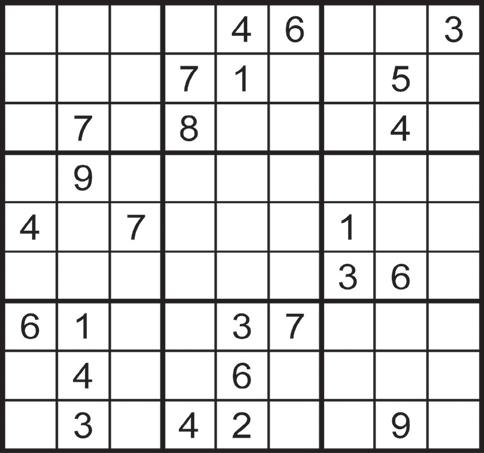

Kari came to see me confused about the size of her tax refund. She said: “The media reports say I’d get a refund of $1080 but I ran my income through an online calculator which told me that I would get only $135. What’s the real figure, Gail?”
I told her it was a little confusing.
“I’ll explain how the tax refunds should work so that you can see what it means for you,” I said..
I showed her the table below, which shows the refunds at different income levels:
Kari said she hadn’t realised that there were differing refunds depending on income levels.
“I earn about $130,000 so that confirms the figures the calculator showed,” she said.
I replied that it was quite complex and came in three stages.
“Stage one, which runs from 2019 to 2022, comprises both the $1080 offset for most income earners and an increase in the middle tax bracket upper limit from $87,000 to $90,000,” I told her.
“You will only receive a payment if you are entitled to a refund. If you owe tax, the amount you owe will be reduced by your entitlement.
“I should also mention that there is a two per cent Medicare levy that needs to be added and there are also changes to low-income offsets that will provide further relief for lower-income earners and have not been included in these tables.
“Stage two runs from 2023 to 2024 and comprises an increase in the lowest tax bracket upper limit from $37,000 to $45,000 and another increase in the middle tax bracket upper limit from $90,000 to $120,000.
“Then from July 1, 2024 there will be an increase in the middle tax bracket upper limit from $120,000 to $200,000 and there will be a reduction in tax payable in that bracket from 32.5 per cent to 30 per cent.
“The rate that currently applies from $90,000 to $180,000 of 37 per cent will be totally removed from the tax tables. Effectively, this means that the top tax rate for anyone earning $200,000 or less will be 30 per cent. As you only get a small amount now, you will get your larger benefit in 2025 and onwards.”
Kari was grateful for the advice and said she now understood how the new system affected her.
If you need advice on your tax and business claims contact the friendly team at Gail Freeman & Co Pty Ltd on 02 6295 2844.
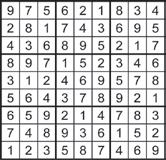


Canberra’s National Zoo and Aquarium features a combined aquarium, metropolitan zoo and easily walked open range section, as well as amazing up-close and personal animal encounters and tours.
With the now recently opened Adventureland playground, a truly unique playground featuring a total of 55 activities including various sized fibreglass animal sculptures for children aged 2-12 to explore and play on.
You can also experience the unforgettable with an overnight stay at the internationally recognised Jamala Wildlife Lodge. There is truly something for everyone at the National Zoo and Aquarium!