High-rise shadow over Downer
PAUL COSTIGAN
A Royal toast for King O’Malley NICHOLE OVERALL
High time to crack down on corruption
MICHAEL MOORE
Finger up, the cricket board should walk
ROBERT MACKLIN

High-rise shadow over Downer
PAUL COSTIGAN
A Royal toast for King O’Malley NICHOLE OVERALL
High time to crack down on corruption
MICHAEL MOORE
Finger up, the cricket board should walk
ROBERT MACKLIN




By Danielle NOHRA

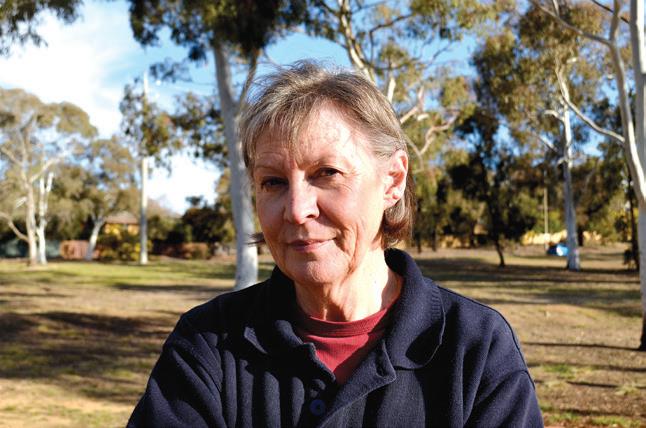
ONLY a few months in and RSPCA ACT’s new CEO Michelle Robertson is still forming an opinion on a lot of things but, she says, there are some objectives she’s already focusing on.
She wants to make sure the RSPCA delivers to its mandate, she wants to put it on a path to get updated facilities and she wants to make sure the
remains
in the future.
“Any CEO in any not-for-profit organisation is thinking: ‘How do we keep viable and keep good peo ple?’” she says.
She says her first few months have been a yo-yo of truly amazing things but also some terrible ones.
“Every single day when I leave here I get an ‘icky’ feeling,” she says.
“There are animals who have been here for days and weeks and you want them to go to a good home.”
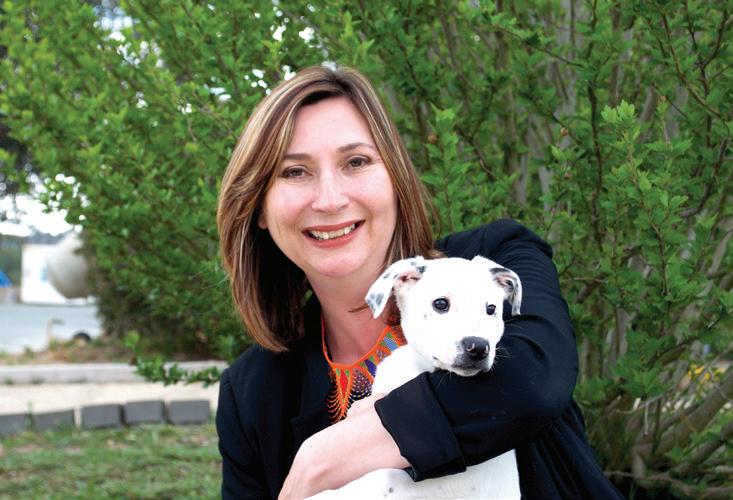
Animals might come into the RSPCA because they’ve been surrendered for complex reasons such as people are physically unable to take care of them or they’re coming out of a domestic violence situation.
Then, Michelle says, there are animals coming in from the inspectorate, a group working for the RSPCA who bring animals in from homes failing to provide proper food, shelter or treatment.
“More than 3000 animals come through the shelter every year,” she says.
“But we’ve got a rehoming rate of more than 91 per cent, which is one of the highest in the country.
“We don’t euthanise unless it’s for complex health or behavioural issues.
Arts & Entertainment 27-29
Cinema 28
Crossword 31
Dining 28
Gardening 30
Horoscopes 31
Letter 11
News 3-12
Photo by Danielle Nohra
“We’re a fairly small shelter and the need is always higher than what we can do.”
As for Michelle’s opinion on the end of greyhound racing in the ACT, she says her predecessor Tammy Ven Dange and the team did an amazing job and hopes she would have been as courageous as her.
“Sometimes you need to take a stand and be courageous and brave,” she says.
As for horse racing, Michelle says RSPCA Australia is trying to reinforce its stance against whipping,
1993: Volume 24, Number 42

Enrico Taglietti.
by Anthony Basheer. Story Page 10.
Managing Director: James Anderson, 0404 077605, james@citynews.com.au
Director: Kate Meikle, kate@citynews.com.au
Senior advertising account executive: David Cusack, 0435 380656
Advertising account executives: Damien Klemke, 0439 139001; Emily Lester, 0406 412462
Editor: Ian Meikle, editor@citynews.com.au
Journalists: Danielle Nohra, danielle@citynews.com.au; Kathryn Vukovljak, kathryn@citynews.com.au
Arts editor: Helen Musa, 0400 043764, helen@citynews.com.au
Production manager / graphic design: Janet Ewen
Graphic designer: Paulette Leo
Proof reader: Glenda Anderson
Accounts manager: Bethany Freeman-Chandler accounts@citynews.com.au
but she understands that horse racing is very much part of the Australian identity.
“Unfortunately, there are some people who don’t always do the right thing,” she says.
“The RSPCA doesn’t want to be a killjoy but certainly we want to make sure that the animals are always looked after.”
And for Michelle, it’s all about speaking for those who are unable to speak for themselves.
Which is why she made the conscious decision to move from corporate work into purpose-driven work.
“My whole life I’ve had cats, dogs, birds, fish, ham-
“For our [family] getaways [in South Africa] we would go to the bush and see some of the beautiful animals. It was such a privilege to experience that.”
Moving to Australia five years ago from South Africa Michelle says this has been a big year for her because she’s not only landed a dream job but she also became an Australian citizen.
“It was a pretty tough decision because my whole life I had a good career and a good network,” she says.
She and her husband chose Australia because of its similarities in seasons, the social culture of having a barbecue and sports (of course).
But most importantly, Michelle wanted a home where her two children, a daughter 11 and a son 9, could play outside safely.
She says it’s still hard for her to talk about her old home, which had burglar bars on the windows and doors, as well as multiple, secure access points.
“I saw my son standing inside holding on to the security bars and thought he looked like he was in jail,” she says.
“It was a very personal decision but I wanted my kids to have that freedom.”
More information via rspca-act.org.au
THE Western District Cricket Club is looking for more than 1000 former players and administrators to help celebrate the club’s 50th anniversary at a gala dinner at Eastlake Football Club, Gungahlin, on Saturday, February 2. The club has participated in the ACT Grade Cricket Competition since the 1969-70 season and nurtured national and international cricketers including test spinner Nathan Lyon and former Australian female representatives Kris Britt and Glenda Hall. More information on the gala dinner at wduccricket.org or register interest at wduccc50th@gmail.com.au
BLACK Mountain School and Canberra Lego Users Group are holding the inaugural Fete and Bricks Display on Saturday, November 17. The school is one of the two specialist high schools in the ACT for students with disability and will showcase the workskills of its students through items such as hand-made soaps, paper, cards, artwork and scarves. A highlight will be a display of Lego creations presented by the Canberra Lego Users Group. There will also be a second-hand stall, cake stall, raffles, tombola, sideshow alley, food and drinks. Black Mountain School is in O’Connor, park off Cockle Street. The fete runs from 10am-2pm and the Lego display, 10am-4pm.





IN the middle of a horror week for the iconic baggy green the once eagerly anticipated PM’s XI cricket match at Manuka failed to draw anywhere near a respectable crowd.
An embarrassingly low 1824 fans attended the one-day clash between Prime Minister Scott Morrison’s team and the visiting Proteas. Could the lack of interest in ScoMo’s one-day debut reflect his current political standing or was it simply poor promotion?
While non-sporting Lodge dwellers Keating and Kevin Rudd couldn’t get excited about the PM’s XI, it took a larrikin sports fanatic and a nerdy cricket tragic to resurrect and cultivate the iconic event. In the 2010 biography “Hawke”, Blanche d’Alpuget writes that nearing the end of his first year in power (January, 1984) “ decided to revive a tradition which had died with Menzies; a Prime Minister’s XI cricket team”. The tradition was enthusiastically nurtured by John Howard during his lengthy stay at the political crease.

ACROSS town at another of our iconic institutions there was a very big and positive number being spruiked. Australian War Memorial director Brendan Nelson announced funding of almost $500 million to extend the site.
Down in Hobart, where Nelson spent a
decade in general practice before entering Federal politics, the local newspaper severely devalued the good doctor’s exciting announcement. The “Mercury” reportedly ran – for a short period – the headline “Australian War Memorial to undergo $500 expansion”.
CANBERRANS are seemingly embracing Halloween. Already a favourite with kids, adults are now reportedly roaming the
neighbourhood in creepy costumes aping the time-honoured tradition of the country which gave us candy, cookies and cowboys.
But at least one “responsible” parent, from the dental industry, absolved their guilt by including sample tubes of toothpaste with the sticky treats given out.
And while many “old school” types still poo-poo the pagan ritual as further “Americanisation of Australia”, shopping centres across the capital came alive with
colourful costumes and spooky sights as retail workers got into the spirit of the
At Bakers Delight in the Lanyon Marketplace, Sam and Emily decided to mix a ghostly guise with their regular friendly
A LARGE elephant in the room for Canberra Liberals was exposed again during a recent radio chat. After impressively and comprehensively explaining a mid-term recalibration of major policies, leader Alistair Coe was quizzed on a recent comment, by retired Labor minister John Hargreaves, suggesting the Canberra Libs lacked the “attack-dog mongrel” of former Jeremy Hanson. Coe’s limp and predictable reply did nothing to alter this negative perception.
STILL on the wireless and apparently it’s very difficult to “hide” a familiar voice when calling talkback radio. The “Sydney Morning Herald’s” “CBD” columnist Kylar Loussikian reports on a call to Canberra’s ABC 666 from “Andre”, of Lyons, who was cranky with Action buses over its new timetable. When questioned by the presenter “Andre” admitted to being Andrew, the ABC’s political editor Andrew Probyn, who was calling to register his “disappointment”
with the new bus timetable which he says will impact hundreds of schoolchildren, including his own.
AND for some seriously famous voices it’s nigh on impossible to disguise your identity when calling radio stations. Years ago working on Port Macquarie radio I took an on-air call from “Jack” at Coffs Harbour who was distressed over a lost dog. “Jack” turned out to be the iconic Australian actor Jack Thompson whose beloved blue heeler had bolted from the actor’s farm in the Coffs hinterland.
THE mother of young skaters who use the Civic skate bowl is concerned at how filthy and unsafe the area has become. The woman, whose youngest is seven years old, says she often has to clean the bowl of broken bottles and fast-food wrappers and is also wary of drug and drink-affected people who wander through the facility. But recently finding a discarded syringe at the site has seriously alarmed her.



























DOWNER is the next inner-north
Canberra suburb to be subjected to the reign of development terror from our “much-loved” planning authorities as they allow the developers free rein to maximise profits.
The spin has been put in place ready for announcements before the end of the year – probably gift wrapped with questionable justifications to be enjoyed over Christmas lunch.
What the residents are concerned about is the way their input will be misinterpreted following the “community engagements” on the development of the “City and Gateway Urban Design Framework”.
To paraphrase their own words: “The ACT government together with the National Capital Authority have developed the ‘Framework’ to optimise the benefits from urban renewal by prioritising people and how they interact and move about the city.”

Should be good. Exciting. Oh, how we
At a hastily convened meeting in the Downer com-
Given the combined history on Canberra’s development and the lack of empathy on planning matters from the Chief Minister, Planning Minister and the Urban Renewal Minister, things are not looking good for Downer.
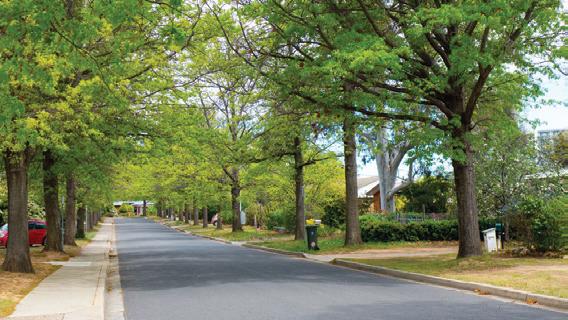
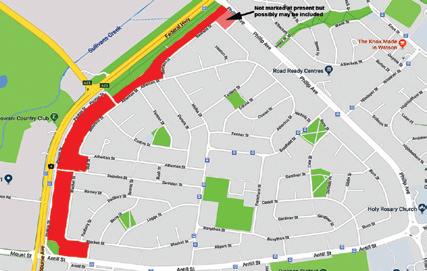
munity hall on October 15, residents were informed by their community leaders of the scenarios that could be announced soon. The prospects are not good that the suburb will do well from the new apartment tower developments along the Northbourne edge to the suburb.
The “prioritising-people” authorities have deemed this zone to come under the notorious RZ5 zoning – which is code to the developers, here are a few rules, but do what you wish as this classification allows very little means for the pesky residents to object.
As the meeting discussed, if the gov-
ernment was interested in having this new development zone fit in alongside this established and cherished suburb, it would look at a zoning mechanism more relevant for this strip of land (and others along Northbourne).
Residents reported formerly “significant” trees on one of the few parks in this area have been sacrificed to the greater good of construction of the tram; that former conversations have vanished about how these high-rise developments would deliver infrastructure improvements into the suburb and that nothing has appeared to allay the fears of residents along streets behind Northbourne that they will soon be looking up at high rise looking down on their front doors. There were moments of amusement
when documents were read out about how the development would offer active lifestyles including opportunities for walking and cycling.
There are streets in Downer with no footpaths and there are no cycle paths. And when it comes to parking – the suburb has its problems closer to Dickson.
The narrow streets have day-time restrictions on parking but by night congestion has been caused by the new apartments having limited parking and residents have to park on the streets. One story told of trucks not being able to enter one street with cars parked along both sides leaving a tiny space in the centre.
There was the argument that Canberra is increasing by 7000 people
each year and therefore had to expand to house these people. No one had trouble with that. It was the complete lack of confidence in those charged with getting this done. None of these agencies or individuals seem to have any commitment to good design, to enhancing urban character, to biodiversity, to climate change urban issues, to providing infrastructure including access to services, to community and arts facilities… the list goes on.
Given the combined history on Canberra’s development through the efforts of the National Capital Authority, ACT Planning and the lack of empathy on planning matters from the Chief Minister, Planning Minister and the Urban Renewal Minister, things are not looking good for Downer.
The Downer meeting discussed the need for people to get informed and to start to make their voices heard by contacting local politicians, who have largely kept their heads down – again (these people are supposed to represent this electorate). Is it time to learn from other electorates (Wentworth?) and encourage independent candidates for the 2020 ACT elections?
The message from the meeting was clear – get active now.
Paul Costigan is an independent commentator and consultant on the visual arts, photography, urban design and environmental issues.



IT was a teetotalling Canberra advocate who proved himself something of an enemy of its people but one of the greatest of friends to Queanbeyan and, in a spectacular fail, its pubs.
The preposterously named King O’Malley, a US-citizen-turnedCanadian who entered Australian politics and, as Federal Minister for Home Affairs in 1911, was responsible for the introduction of one of the most contentious pieces of legislation this still-fledgling country has ever known – the ban on the public sale and consumption of alcohol within the borders of the designated Federal Territory.
For the 17 years it was in effect, so well-worn was the route into NSW, the civic administrator of the Department of the Interior, Charles Daley, “couldn’t keep the road to Queanbeyan in order, because with Prohibition in Canberra, chaps were just heading there every day and all day, every night and all night, and wearing the road out!”
In particular, a place that had been part of the fabric of the wider region almost from the beginning, the Royal Hotel, was so popular patrons would be lined eight-deep at the bar, spilling out the doors into the primary intersection of the town.
Having presided over the corner
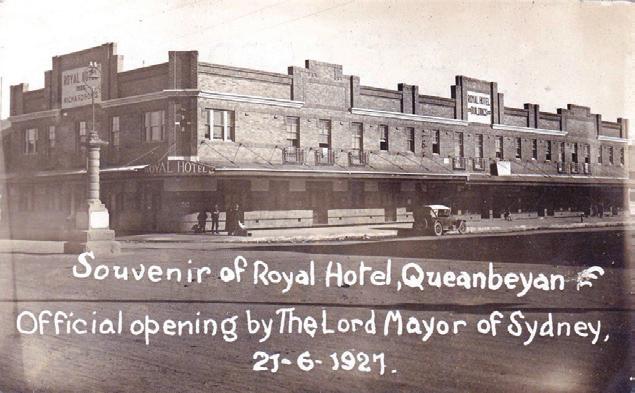
of Monaro and Crawford Streets since 1850, the Royal, now the second-oldest, continually operating such establishment in these parts (the oldest is the Lake George Hotel, formerly the Harp Inn of Bungendore, 1838) just last month entered the next phase of a journey that’s spanned three separate centuries.
Its owners since 2010, Anthony and Sandy McDonald, following in a tradition of husband-wife teams running the show, have devoted as much time, energy – and funds – to the iconic building that replaced the original after a fire wreaked extensive damage
to the upper floor in 1926.
The initial stage of the latest major refurbishment on the ground level occurred in 2012, and “The Upper House”, formerly upstairs accommodation and areas that had remained untouched for years, has now been completely revamped, introducing a tasteful, modern space in harmony with its heritage and history.
According to Anthony: “Its position, its significance to the town and the area, and the fact Queanbeyan is progressing in leaps and

and investment has and continues to be fully embraced and supported, and we’re very proud of what’s been achieved.”
“And we love a country pub,” adds Sandy. “Its place as a cornerstone of the community spoke for itself.”
First built by Martin Byrne, an ex-convict who turned about his own fortunes in just over a decade, Byrne’s Royal Hotel catered to a barely declared township with a population of around 300 – a time when the pubs outnumbered the churches.
When it appeared, the main thoroughfare, initially “Moneroo Street”, was a dusty road consisting of a handful of buildings, while Crawford Street behind meandered off to nowhere.
There were visits by royalty, prime ministers and celebrities; weddings and births, drama and intrigues, and licensees, who included a later mayor. And what would an historic pub be without its share of ghost stories.
Its rebuild, undertaken by the Richardson family, was so rapid to ensure not a moment more in trade was missed than absolutely necessary.
Queanbeyan’s oldest resident, Mrs Linda Moore, who’ll turn 104 in Janu-
ary, recalls seeing the art-deco style hotel rising up on the spot once more when she was 11-years-old.
“We lived at Burra and when we came into town – first in horse and buggy and then T-Model Ford – we’d stay at what is now the Royal.”
A central part of memories for so many, the Royal has watched on as a town, a colony, a nation and a national capital developed around it, in many ways, mirroring the successes and the hardships of its home.
Always more than just a pub though, it’s long been a community hub, and King O’Malley, despite his best efforts to do otherwise, deserves a toast of thanks for his contribution to ensuring its place and ongoing significance!
Nichole Overall, author and social historian, and her son Nick have produced a short documentary on the history of the Royal Hotel. It can be viewed on Youtube
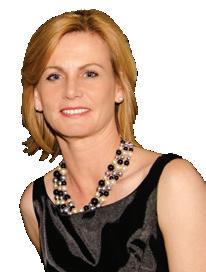
always wanted to help other children learn to read.
READING isn’t just a passion
Shackley; she believes it’s a fundamental skill to have.
“If you didn’t understand language, it would be so hard,”
Since retiring from the public service in 2010, Judith’s been helping children learn how to read through the School Volunteer Program ACT (SV-
She enjoyed reading to her two daughters when they were growing up and says she’s
“I’ve always had a passion for children learning to read so it seemed like a logical fit for me,” she says.
“It’s really important to read, you even need to read to be able to answer a maths problem.
“If you’ve got to decipher a problem but you can’t read the question, you’re stuffed.”
Judith really enjoys seeing her students improve and says improvement usually comes in leaps and bounds.
She says it’s all about focusing on a book that the children actually enjoy and from there

they usually blossom quickly to the point where they can be reading advanced books within a few months.
Operating in about 50 primary schools and high schools with about 130 volunteers SVPACT is always searching for more people to volunteer their time to help.
“We are now seeking to add to our team of volunteers so that we can assist even more students next year,” she says.
“We work within a class situation under the guidance of a teacher.
“Volunteers don’t need to be a specialist in the area they just need life experience and a desire to help. People come from all walks of life.”
SVPACT is calling for volunteers who can help students to create Meccano models, to assist students who are struggling readers or to support children who lack confidence in using numbers and performing calculations.
Volunteer information at svpact.org.au






SATURDAY 5 MAY 10am to 3pm
SATURDAY 5 MAY to 3pm
| EPIC A fun day out with family + friends
| EPIC A fun day out with family + friends





ARCHITECT Enrico Taglietti’s constant, thought-provoking questioning is a hallmark of his approach to work.
“When I was first building a home for a family I would ask them many questions such as ‘do you like music?’, ‘do you love your wife/husband?’... they got upset sometimes!” says the renowned Canberra architect.
“I asked questions because I was creating their space and I told them if I cannot ask my questions, I can not design a house for you.”
His daughter, Tanja attests to this: “Dad is always asking questions, it can drive us insane!”
And it is the questioning and opening up of dialogue that he is most passionate about; about young people having the opportunity and encouragement to do it in their schooling and throughout their lives.
Having grown up in Africa during World War II, he remembers the British entering Italian Africa and precluding teachers they believed were affiliated with fascists, substituting them with any teachers they could find.
As a result the young Enrico was taught by a mixed group of professionals – an engineer taught him mathematics and a university philosopher taught Greek and the history of philosophy.
It was the philosopher that inspired

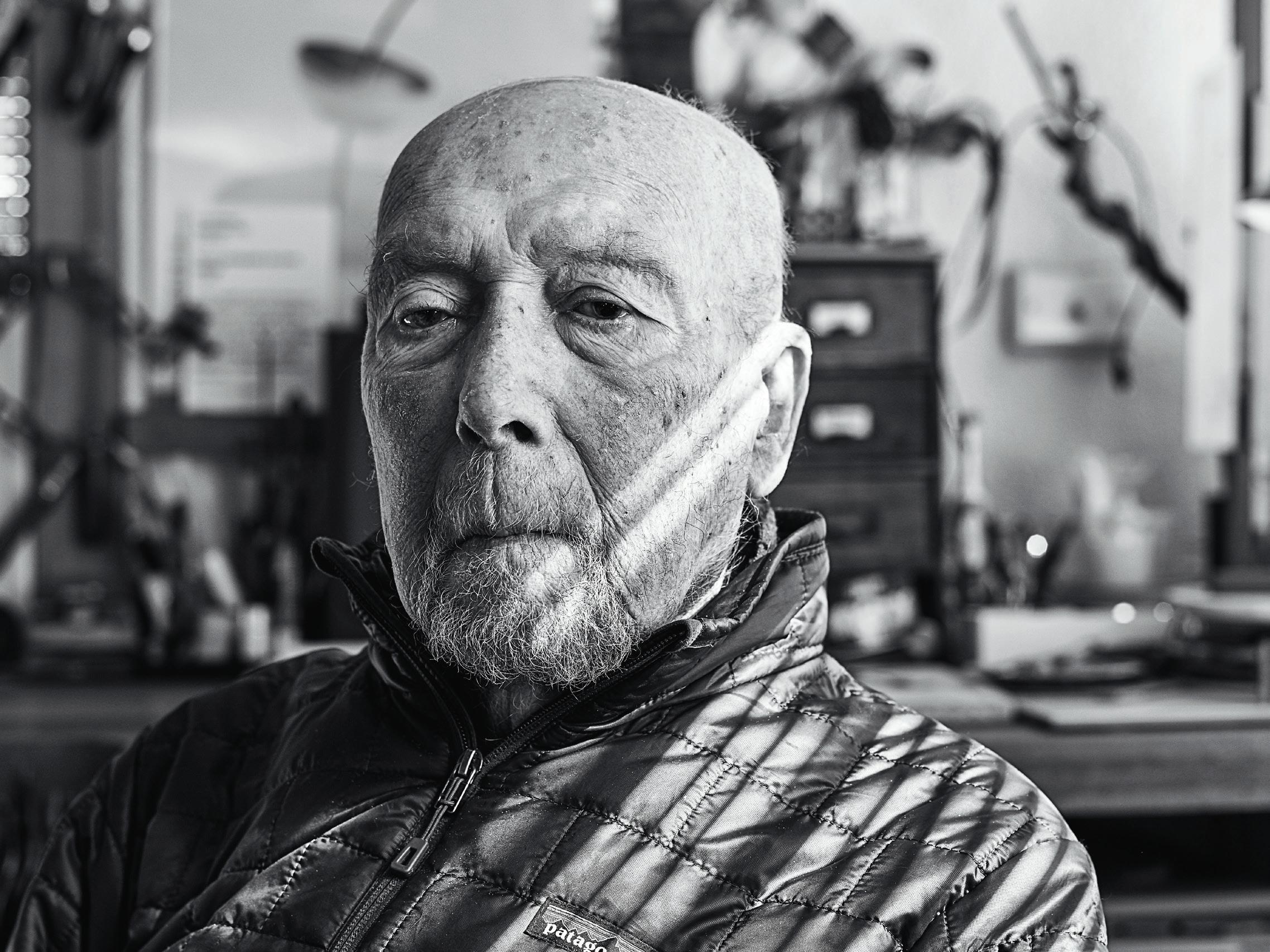
DESIGN Canberra’s annual festival is honouring the work of the elder statesman of architecture, Dr Enrico Taglietti. KATE MEIKLE meets the legendary 92-year-old and daughter Tanja at his home studio in Griffith.
Now Dr Taglietti, recognised as an important architect and a leading practitioner of the late 20th century organic style of architecture, is to be honoured at an international symposium to held at the National Gallery of Australia on Friday, November 16.
Local, national and international speakers will celebrate his contribution to Canberra’s built environment. There will also be some of the many people who have been touched by Taglietti’s designs – schoolchildren, designers and homeowners. Beyond that, DESIGN Canberra has curated a series of related events and exhibitions.
The 92-year-old says he was “flabbergasted” and “embarrassed” when approached by DESIGN Canberra to be celebrated and recognised through the annual festival.
Whatever his personal misgivings, there is no question about his architectural record. He has designed many distinguished houses, schools and churches, and distinctive public and commercial buildings in Canberra, Sydney and Melbourne, including locally the Italian embassy, Dickson Library, the Italian Club and the War Memorial Annexe in Mitchell.
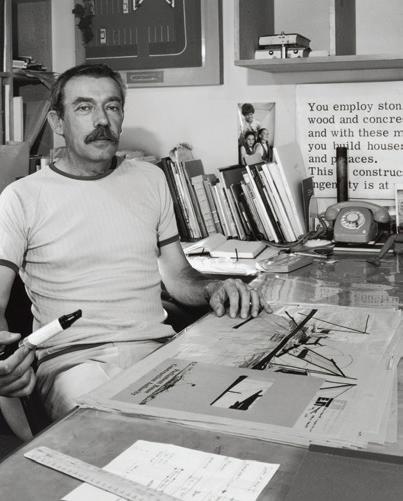
His projects have won numerous Royal Australian Institute of Architects awards and in 2007 Dr Taglietti was awarded Australia’s most prestigious architecture prize – the Gold Medal for Architecture.
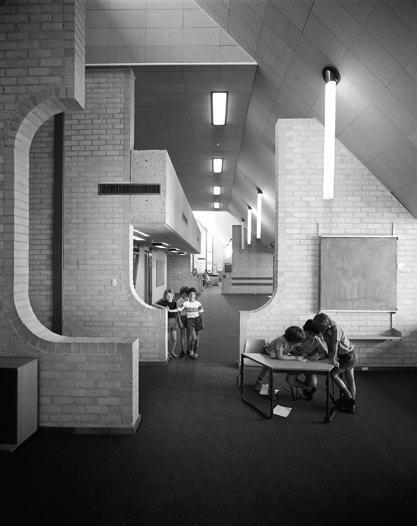
But back in his Griffith studio, Taglietti speaks with particular pride about the work he did in designing primary schools such as Giralang, Flynn, Gowrie and Latham.
One of Taglietti’s mantras is that architecture is about the nothingness within a structure – the voids, the spaces within which the functions of a house or a public space are carried out.
He believes that internal space should not necessarily dictate the external envelope and in many of his projects the inner and outer elements are vastly different.
He says that each of the school designs were based on the particular education philosophy at the time. Using his signature “void” architectural concept, his plan was to “make the void for the children, to facilitate the teaching.”
The “void” became the philosophy of
his architecture, creating empty spaces in which the functions of a home or public space are carried out.
“One designs emptiness and covers it to make it liveable,” he says.
“It’s most important to give you an emotional feeling rather than a rational feeling.”
Having made such a contribution to creating spaces for young people, it is the subject of education that concerns Taglietti today.
A staunch believer of separation of government and religion from schools, he is passionate about primary education being totally free and only provided by the government.
He believes the culture of education has created an “inequity of competition within students... [and focused more on] the production of wealth and how to get ahead instead of the wellbeing of children”.
The result he says is visible in society now.
“Compulsory education culture should not promote adversary competition and cleverness, but promote dialogue and mateship; not personal wealth but wellbeing and the appreciation of the wonder of life,” he says.
When Taglietti came from Italy to a young Canberra in the 1950s he fell in love with its silence and lack of pollution compared to his hometown of Milan.
“I was looking at a totally different sky without pollution. The prime minister was Menzies at the time and almost everyone was in love with Canberra,” he says.
Menzies was ordering the diplomats in Sydney and Melbourne to come to Canberra and be based in the capital and, as a result, Taglietti was sent from Milan to find a site for the Italian embassy.
Dr Taglietti says Canberra was new and he was excited by the prospect of designing in a place where there was a lack of history.
“Coming from Italy, history was always present. There was a burden of history,” he says.
And his message to young, aspiring architects?
“Architecture is a form of art. Design is not a skill, it’s a way of life.”
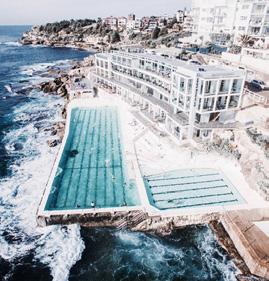
THERE was never stronger evidence or greater need for a Federal Independent Commission Against Corruption (ICAC) than in the wake of the Wentworth by-election.
There is a stench, as revealed in Senate Estimates, when a government takes no (frank and fearless) advice from its own departments and changes a major international policy in a matter of days.
The decision flagging a move of the Australian embassy in Israel from Tel Aviv to Jerusalem was not in the interest of the general community. It was simply designed to win support from a particular socio-economic group for Liberal candidate Dave Sharma. Nothing more. The decision was pork barrelling.
And pork barrelling is unacceptable. The term is simply a softer version of corruption. It gilds the lily on poor practice, puts our democracy at risk and ignores the general good.
It has become clear that the Prime Minister and key cabinet ministers were also being shonky to win votes. Following their failure at the Wentworth by-election, the government has been strongly emphasising that this is “just a review”, which is a different impression to that created while trying to get specific voters on side. Was it ever their intention to seriously move on such a stupid strategy?

Attorney-General Christian Porter has argued that there is no tangible reason for a Federal ICAC. Is he blind – or just towing the party line?
Attorney-General Christian Porter has argued that there is no tangible reason for a Federal ICAC. Is he blind – or just towing the party line? The Greens have pushed for an ICAC for some time and their senator, Larissa Waters, argues that a motion would now pass the Senate and the House of Representatives.
The newly elected Member for Wentworth, Kerryn Phelps, supports such a motion – consolidating the numbers in the lower house. Why wouldn’t she? She saw the government’s corrupt behaviour first hand. All members of the cross bench in the House of Representatives had their view reinforced by Wentworth and favour an ICAC.
Any residual doubts must have vanished during the Senate Estimates Committee that illustrated the Secretary of the Department of Foreign Affairs and Trade, Frances Adamson, knew nothing of the Israel embassy decision until lunchtime the day before the announcement.
The move was first discussed on the morning before the


announcement and agreed by the government’s leadership team of Prime Minister Morrison, Treasurer Frydenberg, Finance Minister Cormann and Defence Minister Pyne.
Climate change policy at the Wentworth by-election also highlights another form of corruption. The Prime Minister remains steadfastly supportive of the fossil-fuel industry. The most glaring example is the proposed Adani coal mine in Queensland that is seeking government support in the billions. The impact it will have on the Great Barrier Reef, on consumption of water and on climate change are simply dismissed by the government.
Subsidies continue for the fossil-fuel industry while there is negligible support for renewable sources of energy. What is the role of donations to political parties? Lack of transparency makes it nigh on impossible to ascertain the extent of such influence. One vote, one value
is simply destroyed by the disproportionate influence garnered by large corporate donations.
An ICAC would provide yet another insight into the need for transparency and control of such donations and the most effective way to remove this cancer from our democratic system.
John Locke, a political philosopher writing in the late 1600s, identified that responsible government meant “and all this only for the public good”. Recent government actions had nothing to do with the public good and everything to do with self-interest and their own electoral advantage. Pork barrelling is unacceptable, it is corruption. It is high time there was a Federal ICAC.
Michael Moore AM is a former member of the ACT Legislative Assembly and an independent minister for health. He has been a political columnist with “CityNews” since 2006.
I STRONGLY endorse the comments of reader Bjorn Moore (“Grumpy”. CN, October 25) about the extent of illegal parking in Canberra.
I have contacted several representatives for Ginninderra, including Ministers Ramsay and Berry and all I experienced was buck passing.
I was advised to contact Parking Operations ACT when I brought to the pollies’ notice the prevalence of illegal parking on footpaths, median strips and nature strips throughout my suburb and adjoining ones. Parking Operations told me their priority was to act only where illegal parking caused safety concerns. So the damage caused to grassed areas and trees on median strips and nature strips is ignored, not to forget the visual blight it causes.
Shumack Street, in Weetangera, is an excellent example of the blind eye that is taken to widespread illegal parking, especially near the primary school but also prominent on nature strips all along the street. Footpaths are badly damaged by the practice, as is pedestrian safety. However, if one overstays one’s parking meter by five minutes and is caught by an inspector, a heavy fine is your reward. Clearly, this is a hypocritical situation whereby the government only cares about enforcing its parking legislation when there is revenue to be gained by doing so.





Colin Lyons, Weetangera

marchese partners is a dynamic firm of architects, interior designers + engineers at the forefront of design.
with over 25 years of experience delivering market changing projects, marchese partners is an international consultancy that offers fully integrated design services which include masterplanning, architecture, interior design and engineering.
+ 61 2 6257 1400
website – www.marchesepartners.com.auu
instagram – marchesepartners
facebook – marchese partners architects pav dunski – principal (canberra) pdunski@marchesepartners.com.au
AUSTRALIAN cricket is in a mess. And last week’s no-show by spectators at the Prime Minister’s XI match against the South Africans really drove the message home.
It came in the wake of an independent review commissioned by Cricket Australia (CA) into the root causes of the ball-tampering scandal that saw captain Steve Smith, vice-captain David Warner and opener Cameron Bancroft banned from the game for up to 12 months.
Surprisingly, but correctly, it sheeted home a good deal of the blame to CA itself. And if anyone doubted their conclusion, the performance of CA chairman David Peever stonewalling questions on the ABC’s “7.30” program should have dispelled it. His subsequent resignation was overdue.
By chance, I was given an extra insight into the situation last week at the annual ACT Lord’s Taverners dinner where we celebrate the fellowships we distribute to deserving and disabled young ACT cricketers.
Our guest speaker was the South African and Australian Test opener, Kepler Wessels and I was tasked with the role of questioner
Revelations about ball tampering, sledging and gambling in the international arena were mind-boggling.
in his preferred Q&A format.
We sat together during the meal and his revelations about ball tampering, sledging and gambling in the international arena were mind-boggling.
Our chat was off the record so I can’t report it. But he’s been in the game at the top level for at least four decades and as an Australian citizen living in Brisbane, he’s recently been appointed a Test referee. So he is better informed than most.
More pertinently, he was actually at the game where the ball-tampering incident occurred. In fact, he said, “everyone” tampers with the ball in some way or other.
To spit and polish it on one side is perfectly acceptable. It’s when it extends to using sandpaper or some such to get the ball to “reverse swing” that it becomes illegal. And in the case of the Australians, when 30 cameras were recording everything that happened on
the field it was also idiotic.
Ball tampering, he says, is a lot like sledging – it’s okay if done within the spirit of the game, but unacceptable when it crosses the line to personal abuse. However, what led an eminently decent bloke such as Steve Smith to be a party to both transgressions goes to the values displayed by the organisation at the top: Cricket Australia.
Kepler’s view of CA was thoughtful and eminently sensible. Cricket is now big business and CA, it seems, has become a corporation whose principles are those of corporate industry – the almighty dollar rules. And when dealing with T-20 on one hand and five-day Test matches on the other they have been found wanting.
The Sheffield Shield competition – the long-time cradle of Test cricketers - has become moribund; the Test team is filled with unfamiliar names from T-20 and ODI comps,

and the players can’t even take a single game from Pakistan.
Whether any form of official structure could have done better is debatable. But having received the report that exposed their failure, CA really has no choice – the board should resign en masse so we can make a new start.
There’s no shortage of talent to take their place; and most of the reformers should be cricketers who have played at First Class or Test level. The chair should be a true lover of the game – someone such as former ambassador to Indonesia and China, and current president of Lord’s Taverners ACT, Ric Smith. And after an evening with Kepler, I have to say, he’d be my second pick for any new board.
robert@robertmacklin.com

CANBERRA lawyer and former ACT Attorney-General Bernard Collaery has won the Australian Lawyers
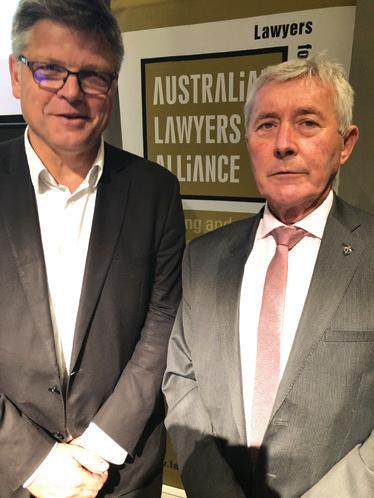
justice in relation to his case.
“His commitment to ensuring justice for his client and the people of Timor-Leste, in light of the personal risks involved, is admirable.”
Mr Collaery is the principal of Collaery Lawyers, a Canberra-based law firm with an international law division, a civil law division and a criminal law division.

The purpose of Spiritualism is to validate everlasting life; to bring comfort to those who are sorrowing for loved ones who have passed to the Spirit world; to encourage all people to develop their mediumistic and psychic abilities; to help them understand life; to find inner strength and find solutions to challenges they may face in everyday situations.
If you would like to contact a loved one who has passed or to learn about your abilities come join us at the Canberra Spiritualist Association.
The CSA Offers:
• PROOF OF SURVIVAL
• MEDIUMSHIP DEMONSTRATIONS
• SPIRIT HEALING
• LIVE MUSIC (once a month)
• PSYCHIC READINGS
• MEDIUMSHIP, HEALING AND PSYCHIC DEVELOPMENT COURSES including Tarot, Dream Interpretation and Palmistry
• MARRIAGE CELEBRATIONS, NAMINGS and FUNERAL SERVICES
• Senior CSA members offer House Clearings by appointment only
Meetings held every 1st, 3rd and 5th Sundays, 2.00 pm, at the Pearce Community Centre, The Community Hall, Building 2, Collette Place, Pearce.
SPECIAL EVENT: Sunday 18 November, 2018 at 2pm. A special healing service will be held. Come along and receive some healing and experience quality medumship by Sarah Jeffrey.



A YOUNG MAN’S LIFE HANGS IN THE BALANCE AS 12 STRANGERS DELIBERATE ON HIS ULTIMATE FATE.
At first glance the underprivileged boy appears guilty of murdering his father in cold blood. The evidence seems to suggest so but questions of prejudice, family, and class warfare threaten to tear their fragile deliberations apart. 11 men are ready to convict and send him to the electric chair. Only one man has doubts. With it’s unique presentation in the round, the audience will be in the jury room, experiencing every moment of the story up until the nail-biting finish.
12 Angry Men is a scintillating blend of raw emotion and high stakes where individual life stories are gradually revealed.

“ 12 Angry Men is a scintillating blend of raw emotion and high stakes where individual life stories are gradually revealed.
“ Twelve Angry Men is more relevant than ever in the age of Trump!
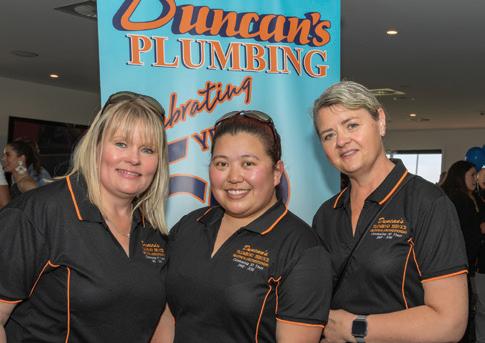


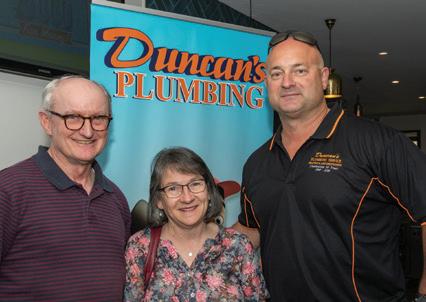


Photos by DANIELLE NOHRA


Serving the community of West Belconnen including Charnwood, Dunlop, Macgregor, West Macgregor, Flynn, Fraser and Latham, the Parish School of St Thomas Aquinas seeks to live out our faith in response to the needs and challenges of the times. Our faith is important to us and underwrites all that we do.
At St Thomas Aquinas we will:
• Provide a stimulating and safe learning environment
• Challenge your child to be his or her best
• Cater for your child’s stage of development
• Teach values – Christian and caring attitudes
• Encourage collaborative learning & cater for different learning styles
• Make effective use of Information and Communication Technologies
• Teach Spanish Language and Culture
• Encourage leadership development
• Provide enrichment, through Sport, Music & Dance
• Provide the fullest potential for each child – spiritual, intellectual, physical and cultural



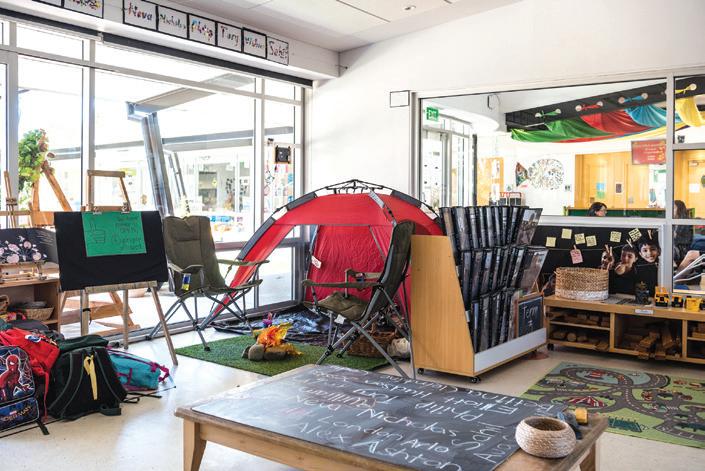
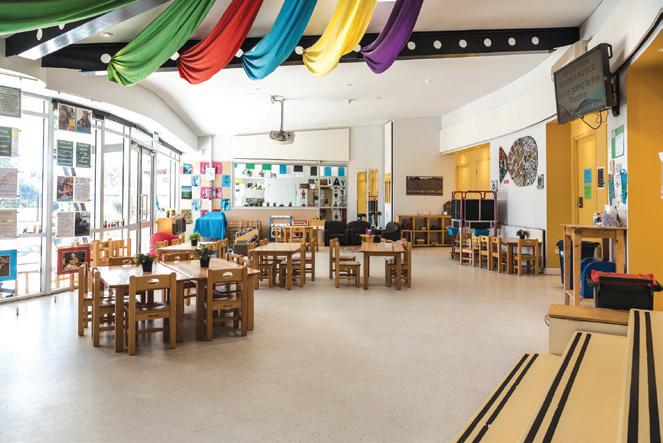
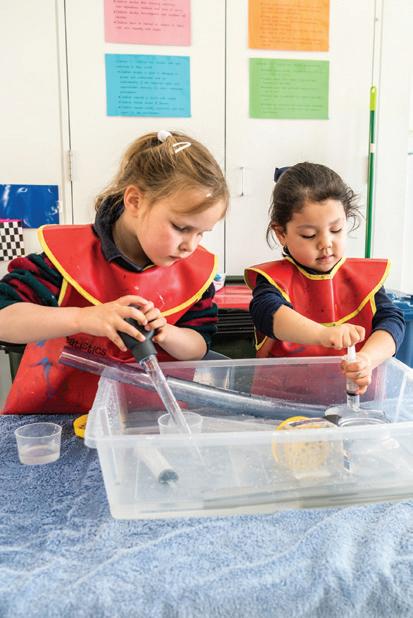

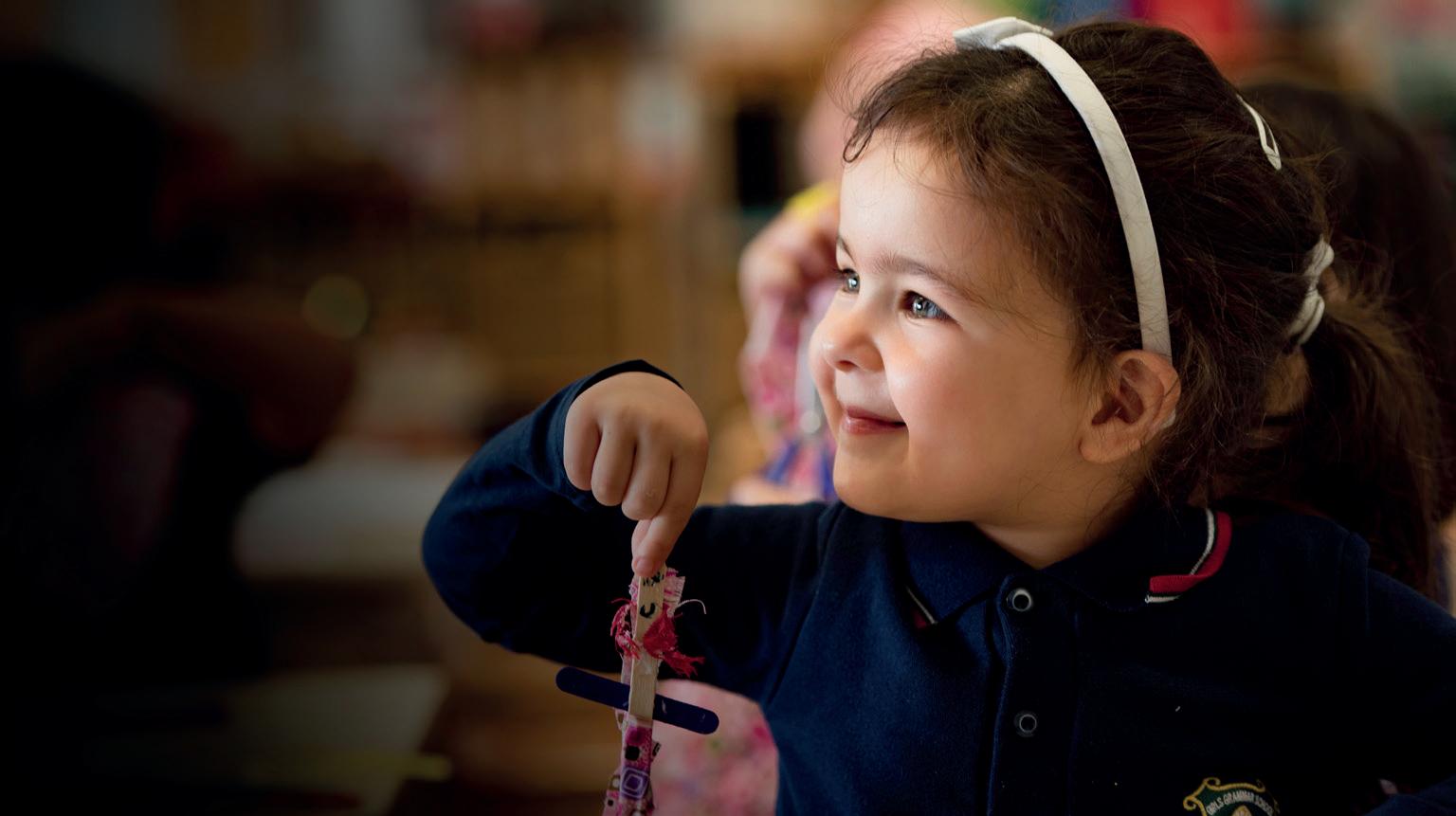
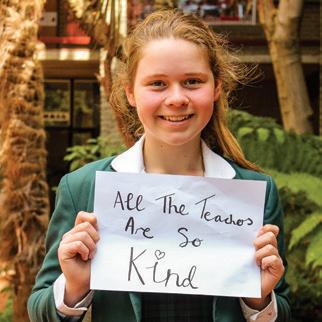
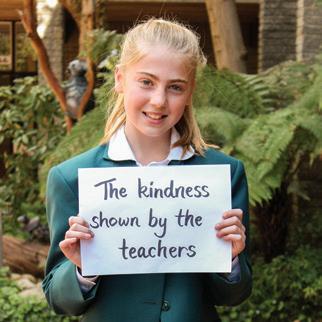
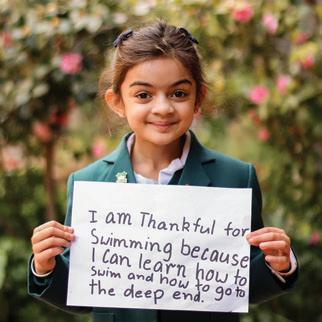
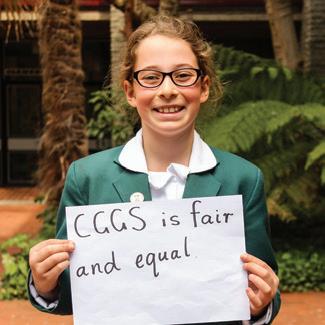
“I love playing with the boat - I drive it and we find treasure. We learnt about dinosaurs and the weather and all the different things that come from the sky. I know about the CGGS Way - be safe, be responsible and be respectful. I am respectful when I think about other people and am kind to them when we play.”
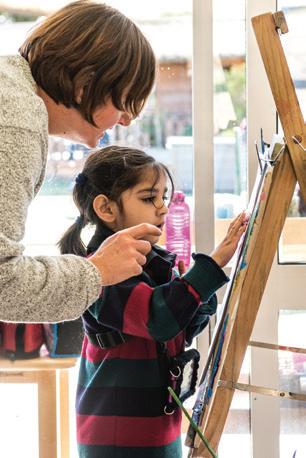
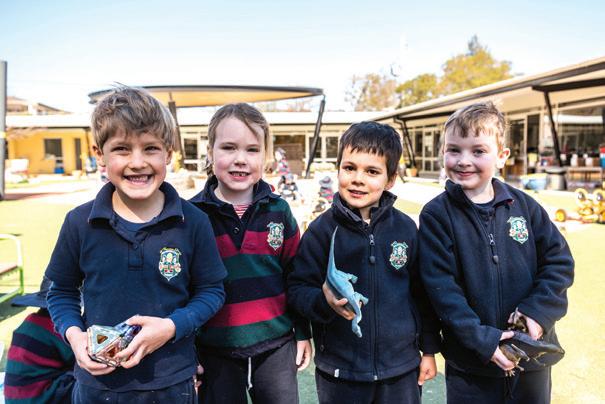
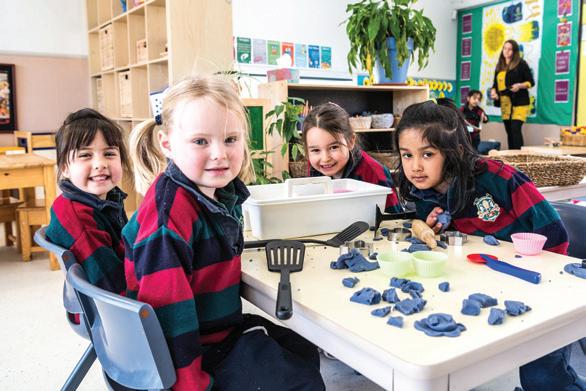
AN expansion to the Canberra Girls Grammar School Early Learning Centre (ELC) means more boys and girls can engage in its unique program, says director Kate Columbine.
The program encourages children to be creative and curious and that’s why Kate says she can’t wait to welcome 66 new students into its additional three classrooms and its new facilities in 2019.
Since opening in 2004, the ELC on Grey Street, Deakin, has been a nurturing learning experience for boys and girls from the ages of three to five in two separate year levels (reception and pre-prep) as well as before and after-school care, and holiday
“Since the beginning, we’ve always had a good number of boys and girls come through and that’s expected to continue,” Kate says.
“We really value the role of coeducation in this phase and we’re strongly committed to it.”
The ELC program is based on Canberra’s Early Learning Years Framework, in conjunction with the International Baccalaureate Primary Years Program. “With these frameworks as a foundation, we really focus on tapping into children’s natural sense of curiosity and creativity, and providing them with lots of engaging experiences to help them learn about the world around them and their place within it,” she says.
The new wing being built will expand on these creative experiences, with a multipurpose art area coming off each classroom, which Kate says will provide a great space for messy science activities and group work.
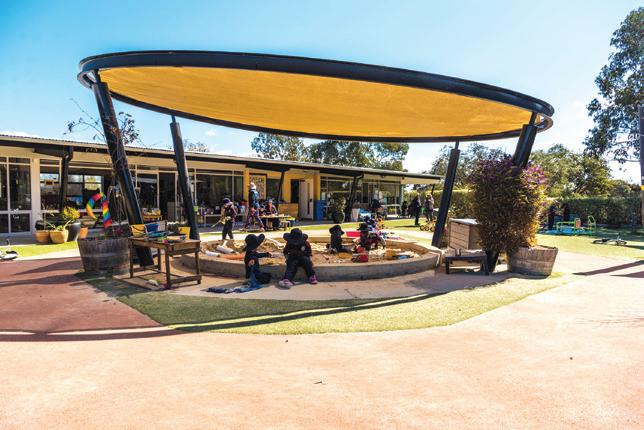
“There are also two additional outdoor play spaces being developed as part of the expansion; one on the ground floor and one on the upper floor,” she says.
“These will provide wonderful outdoor classroom environments, meaning we can take learning outside and children can continue to explore, create and be imaginative.”
Unlike other childcare centres, each class has a full-time university trained early childhood teacher and a diploma-trained assistant because, Kate says, early childhood is a really important phase of development.
“Having these university trained early childhood teachers is something that really emphasises that educational focus,” she says.
“Early childhood is such an important phase and to have people who are passionate and trained in that area is fundamental.”
Each term, classes have a “unit of inquiry”, which focuses on a “big” idea to inquire into.
“This provides an element of structure to the program, but is very open to the interests and needs of the children, and they effectively guide the direction of the program,” Kate says.
“Last term, our pre-preps were looking at the idea of ‘systems’ and the idea that systems have different parts that have to work together in order to be effective.”
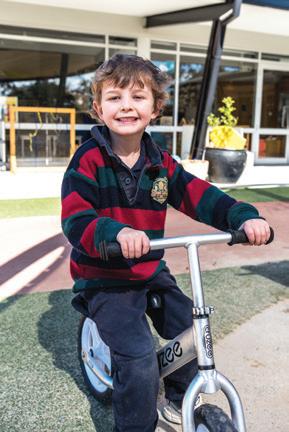
But the children don’t just learn about “inquiry” and the ELC ensures all areas of development are fostered such as literacy, numeracy, fine motor, gross motor, social, emotional and STEM.
“We have a strong focus on foundation literacy and numeracy skills, and seek to provide children with opportunities to develop these skills through
“I love doing painting and doing my mum some nice pictures. We do music with Mrs David.
My favourite is the giant’s song because we have to make the giant breakfast in the song and it is so fun!”
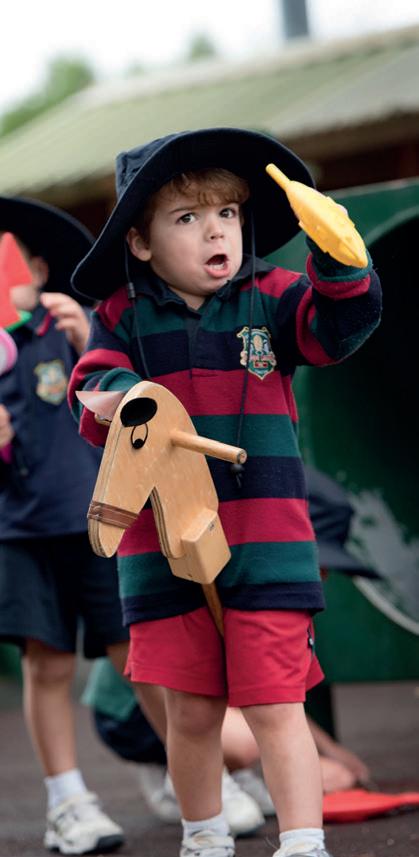
“We really focus on tapping into children’s natural sense of curiosity and creativity.
fun and engaging play based activities,” Kate says.
Children also get to experience library and music sessions with specialist teachers.
“They visit the library and music rooms every week, and love exploring the array of books and musical instruments they find in these spaces,” Kate says.
“They are introduced to French in pre-prep, and love connecting with the older students through buddy classes.”
Kate says there’s so many great reasons for children to experience their ELC program, which is why it will open its doors on November 17 so parents can come and see the ELC in person and learn more about what it has to offer.
“Alternatively, we are always happy to give parents individual tours,” she says.
“We’re really warm, welcoming and nurturing and we provide each family with an individualised experience where our teachers know the child and their family and their extended family.
“With our fee structure comparable to other long daycare centres in the area, we’re expecting a really high level of interest in the new places available and we encourage you, if you’re interested in a place in our Early Learning Centre for your boy or girl, to please get in touch as quickly as possible.”
ELC Open Day, noon-1.30pm, Saturday, November 17. Registrations to www.cggs.act.edu.au/ourelc







Pallet desk 50cents
Lamp & curtains $40 - The Green Shed
Junk art $1.50 each - RePsyched Workshop
Blanket & pillows $40 - The Green Shed
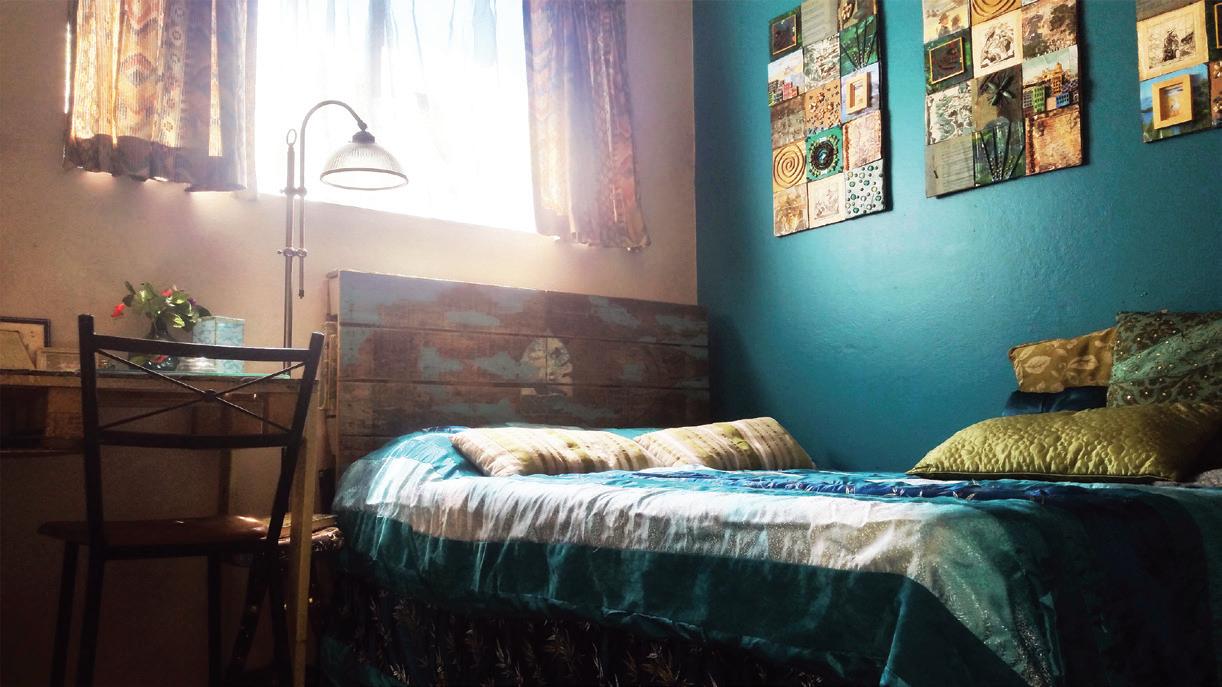
Assorted junk & chair $10 - Vinnies
Pallet bed head & base $5 - RePsyched Workshop
By Danielle NOHRA
TAKING trash and turning it into furniture or art is Candice Addicoat’s specialty, and she believes it’s possible to do a complete makeover of a room with as little as $95.
In fact, Candice, 45, of Griffith, recently just transformed a whole room for about $10 but had access to furniture from St Vincent de Paul, which organised the project, and The Green Shed, which is where Candice runs cost-effective design workshops titled “RePsyched”.
The project saw her transform a ‘70s Oaks Estate flat, which she says was in a really bad condition, into a Tuscan villa-inspired space.
And now it’s finished, Candice is using the timeliness of National Recycling Week, which runs from November 12 to 18, to launch a series of free demonstrations teaching people how to take recyclables and turn them into home items or art.
“They’ll be about making simple and affordable things with recycling and they’ll be accessible to anyone,” she says.
Candice is using the Oaks Estate project as an example of how simple some of the items are to create or how easy it is to turn them into “junk funk” (as she likes to say) because she’s taking junk and turning it into something funky and “on trend”.
“Anyone can make any of these artworks because they’re really simple,” she says.
“I’ve had people tell me they don’t have a creative bone in their body and I can guarantee I can prove them wrong.”
Candice will also be putting the workshops on her website so people can access them from home.
“One of my core values is giving people the skills to live well in their spaces regardless of what income they have and if they have next to no income,” she says.
“I find solutions in things people have thrown away and there’s very few new materials I’d use because I’m always trying to use what’s freely available.
“I even stop when I see things on the side of the road because I can see the potential in them.
“Even if we put stuff in the recycling bin, it’s costing a lot of money.
“I want people to use this stuff before it gets to the tip or a waste management centre.”
Taking the bedroom at Oaks Estate as an example, Candice gave “CityNews” a break-down of just how affordable it can be to “funkify” the furniture and decor in a room, saying it cost her about $10.
The desk cost her about 50 cents and the bed and bedhead cost about $5 (without the bedding). The bed is made up of used shipping pallets (easily available to take from the side of the road), the legs are made from wood scraps, the screws are recycled, the paint was a teaspoon of paint and a couple of tablespoons of lacquer, and the stencil used to decorate the
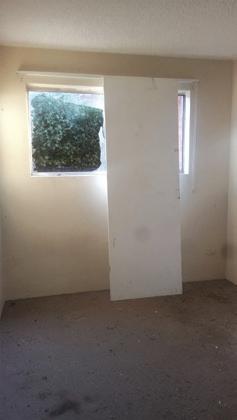
bed head, was about seven cents.
“Shipping pallets are good for your budget and good for the environment,” Candice says. “They’re a pretty big environmental problem because they’re made from brand new wood and then used, dumped, and then more are made without reusing the old ones. And a lot will go to landfill.”
As for the artworks in the room, Candice says she used a lot of free cardboard, broken necklaces and old magazines to make things such as the collage-like artwork consisting of multiple “tiles”, which cost about 10 cents each to make.
Another artwork is made out of rocks Candice found outside and an old frame she found in her home – the paint was about $1.
The room also features “junk funk” items such as a unique bowl (30 cents), which is made from “ugly” plastic bowls that don’t get sold at The Green Shed and damaged children’s books.
And although Candice had help from Vinnies and The Green Shed, she says it’d cost someone about $95 to do.
“As a designer I try and look at what’s currently on trend in the design world and try to produce it in a way that anyone can do it,” she says.
“I try to make things really simple so in workshops people can have a result in 90 minutes.”
During National Recycling Week Candice will be holding demonstrations at The Green Shed, Mitchell, 10am-2pm, Monday to Friday and 10am-4pm, Saturday to Sunday. More information at repsyched.com.au
MORE than two decades ago Planet Ark founded National Recycling Week so it could show Australia the environmental benefit of recycling.
National Recycling Week (November 12-18) continues to educate and stimulate behaviour change by promoting kerbside, industrial and community recycling initiatives and giving people the tools to minimise waste and manage material resources responsibly at home, work and school.
While the week has created awareness there is still a lot more that needs to be done, and, according to the Australian Plastics Recycling Survey for 2016-17 a total of 3,513,100 tonnes of plastics were consumed in Australia over the last financial year.
Of the plastic consumed a total of 293,900 tonnes of plastics were recycled (excluding tyre recovery), which is a fall of 10 per cent from 2015-16 recovery. Including tyres, total plastics recovery was 415,200 tonnes.
Of the 415,200 tonnes of plastics collected for recycling, 180,100 tonnes (43.4 per cent) was reprocessed in Australia and 235,100 tonnes (56.6 per cent) was exported for reprocessing.
More information at recyclingweek.planetark.org

THE ACT Container Deposit Scheme (ACT CDS) has been encouraging recycling in the community while reducing litter and the number of containers going to landfill. Under the scheme, eligible empty beverage containers can be returned to nominated points to receive a 10-cent refund for each container.
Refunds can also be donated to charity.
St Nicholas Greek Australian Preschool in Yarralumla has embraced the scheme, which has become an extension of the school’s sustainability program, teaching the preschool’s students the importance of recycling and how it happens.
It all began from a lunchtime discussion where students asked: “Where does water come from?”
This led to questions about how the school could capture its own water using a
The students then searched online for an appropriate rain water tank for the school to buy where they could collect their own water.
By using the ACT Container Deposit Scheme to raise money for the water tank, students have been collecting containers at home and at the school, visiting the depot as an excursion to return the containers, see the separation process and receive the refund.
So far St Nicholas Greek Australian Preschool has raised more than $300 through the collection of containers and they will continue to collect with the aim to buy a new water tank for the preschool by Christmas.
ACT Container Deposit Scheme. Call 6280 8538 or visit actcds.com.au
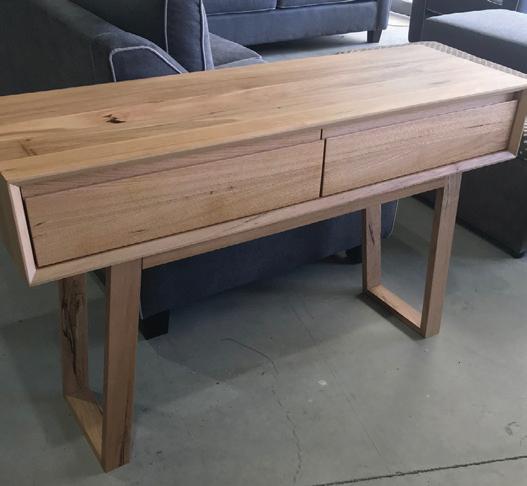
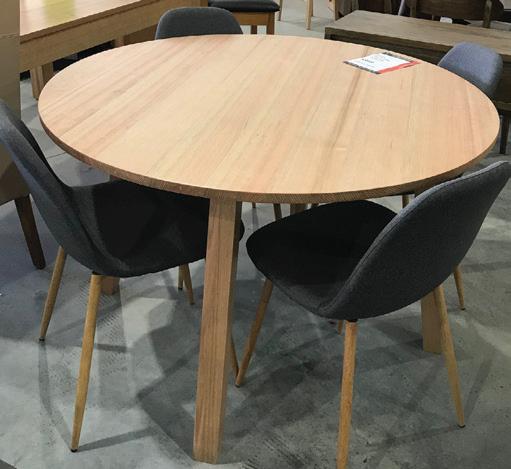
Adam gives wood a new lease of life
FOR the first seven years of Adam Dossetor’s carpentry career he saw a lot of quality hardwood being pulled out of buildings and wasted.
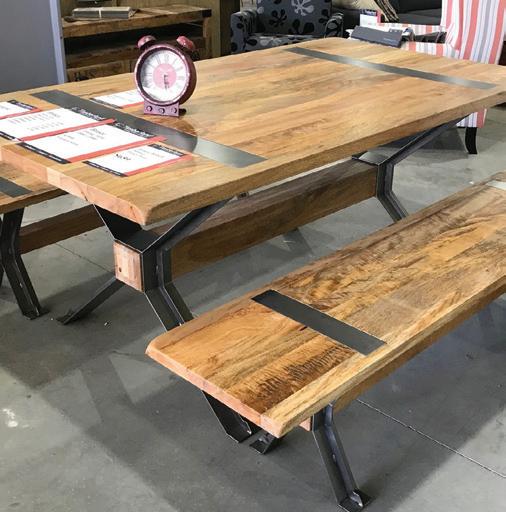
With a passion for using things that already exist, Adam established Dossetor & Co five years ago and has since been repurposing quality wood and giving it a new lease on life.
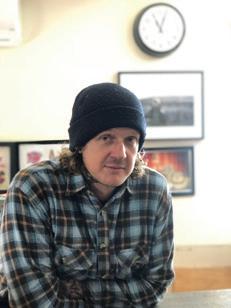
“As much as I can I use recycled materi als including second-hand steel,” he says.
“We aim to recycle as many different materials as we can to build one-off furni ture, fittings, fit-outs and renovations.”
Using mainly hardwood, Adam says he can build items that will last forever, such as benchtops for kitchens, desks and solid timber joinery for cupboards and doors.
“Basically, I’ll make anything that anybody asks me to,” he says.
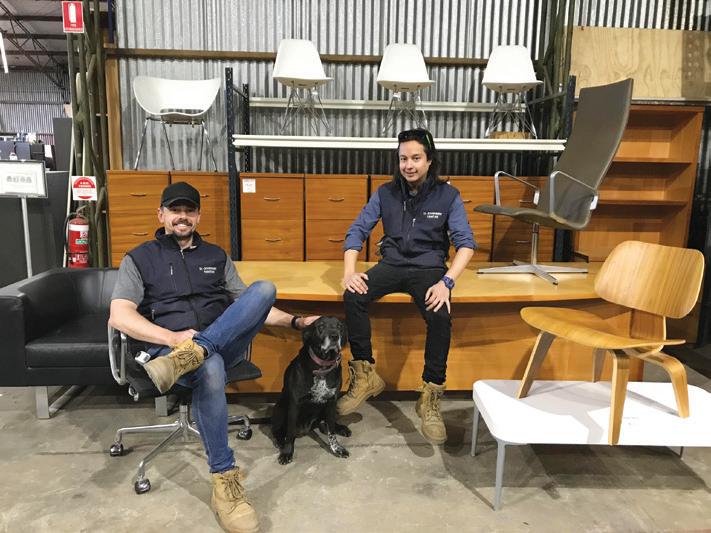
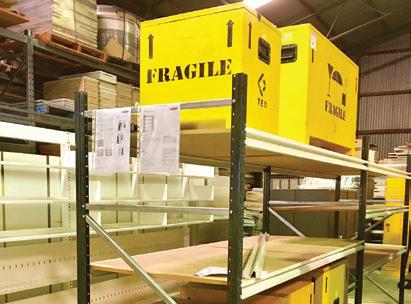
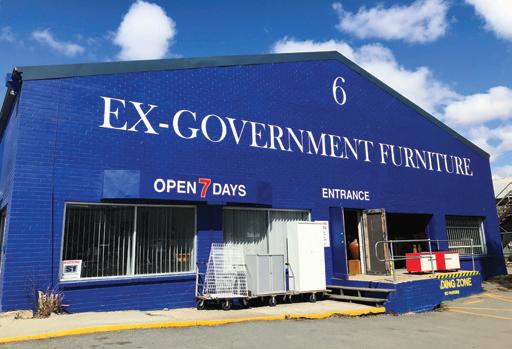
EX-GOVERNMENT Furniture saves a huge amount of stuff from landfill by taking it, fixing it and then selling it for resale, says co-owner and manager James Fullerton.
“A lot of people come to me with challenging ideas and I’m happy to meet with anybody and everybody and make their ideas come to life.
“We love our job and hope to work with you on bringing your dream piece of furniture or renovation to life.”
Dossetor & Co. Call 0414 533995, email adam@dossetorandco.com.au or visit dossetorandco.com.au
“A lot of the time it’s a viciously huge waste throwing stuff away to landfill,” he says.
“What’s the point of dumping it? We will pick it up for free, which saves people on removal costs, and then we’ll reuse it as opposed to people chucking it out.”
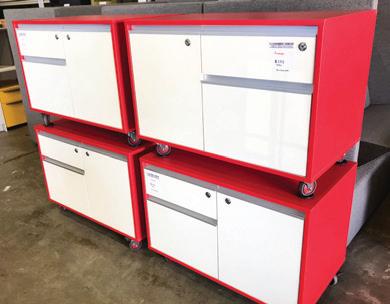
Rather than creating more waste, ExGovernment Furniture gets in second-hand items weekly and James says repurposes them so they’re in an “almost new condition”.
“It’s all high-quality, second-hand
furniture that will last rather than something cheap that will be trashed the next week,” he says.
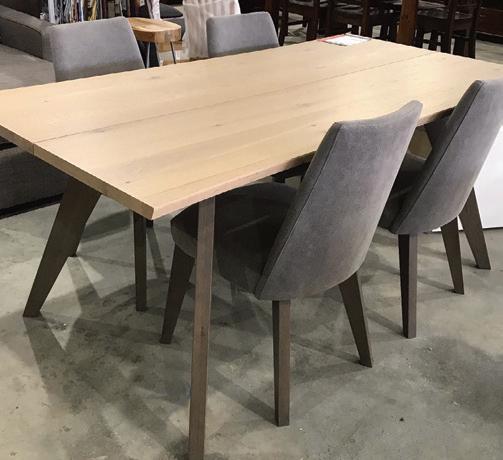
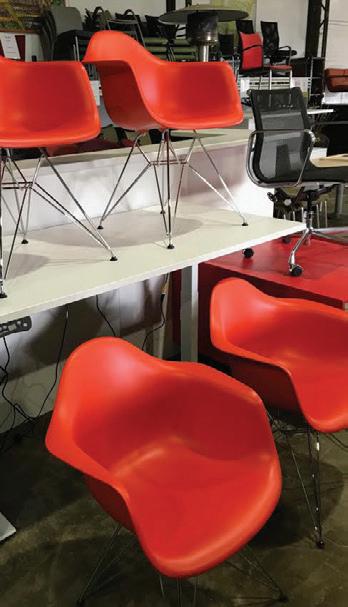
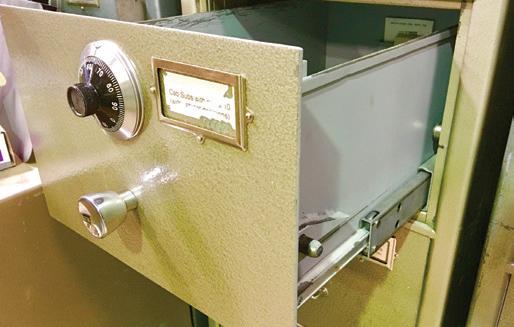
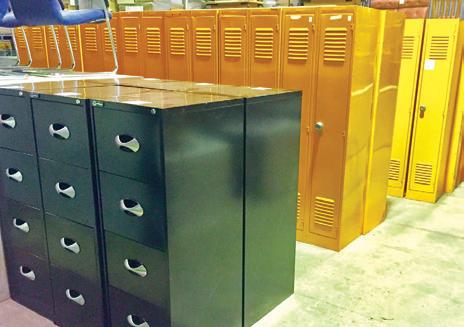
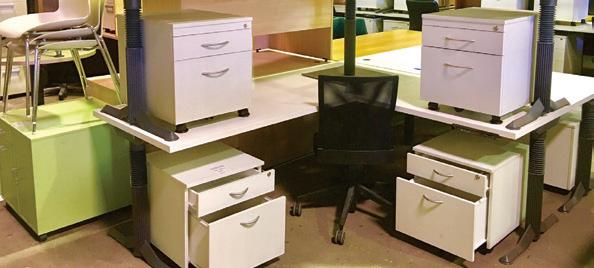
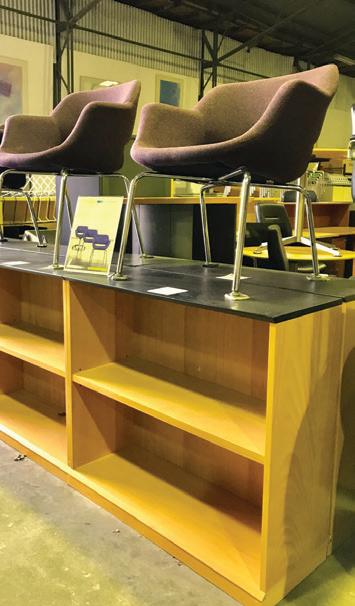
Ex-Government Furniture stocks pretty much all office and some home furniture, such as high-quality office chairs, desks, workstations, boardroom tables and shelving.
“We charge fair prices and are often able to source the best, no-nonsense, quality furniture available, always with an eye for good quality,” James says.
Ex-Government Furniture, 6 Yallourn Street, Fyshwick. Call 6280 6490 or visit exgovfurniture. com or via facebook.com/exgovfurniture
The ACT Container Deposit Scheme encourages recycling in the Canberra community and aims to reduce waste to landfill. Under the scheme, you are able to return eligible drink containers and receive a 10 cent refund for each container.
Eligible containers are those drink containers that are commonly found in the litter stream, including most glass, plastics, aluminium, steel or liquid paperboard (cartons) between 150mL and 3L in size.






Canberra and Australia’s largest Scrap Metal Recycler. Operating in ACT for over 15 years.
•
Free Electronic Waste drop off
•
We supply bins to industrial and commercial clients and farm clean ups for steel, iron and all non ferrous metals.

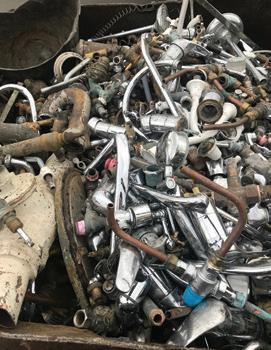






SIMS Metal Management says it’s grown to be the leading collector, processor and supplier of recycled metal in Australia.
The company says this has been made possible through a network of 30 physical locations servicing all states and territories in Australia. Sims Metal Management also operates in more than 20 countries.
“Our processing capacity, which includes five fragmentisers, shears, balers and granulating plants, operates to the highest environmental and quality standards to produce products that are recognised and sought after throughout the world,” the company says.
Sims Metal Management buys ferrous metal from metal dealers, peddlers, auto wreckers, demolition firms
and others who generate obsolete metal, and from manufacturers who generate industrial metal.
“We source non-ferrous metals from manufacturers, known as production offcuts, and from generators of electricity, telecommunication service providers, as well as others, who generate obsolete metal,” the company says.
“Our focus on optimisation and continuous improve ment, with internal investments in our operations, functions and people is setting us on a solid path for many years to come.”
Sims Metal Management, 47 Alderson Place, Hume. Call 6129 8800 or visit simsmm.com.au

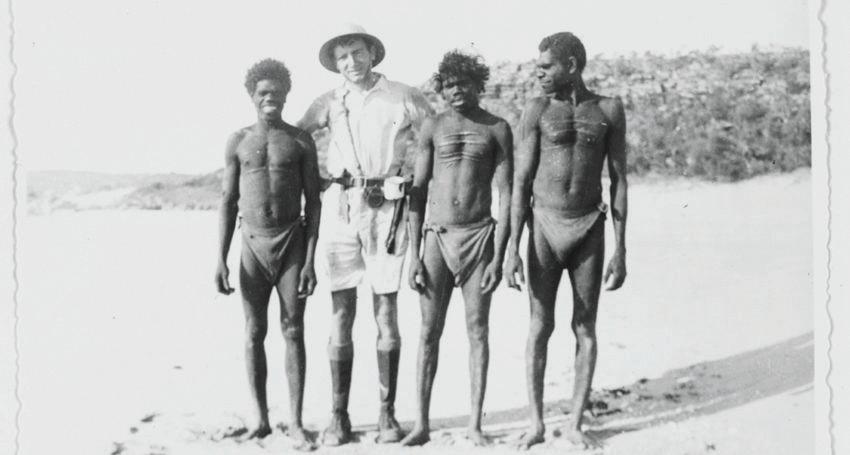
IN the dizzying European summer of 1990 a former Canberra public servant took part in a defiant street demonstration in Berlin directed against the looming disappearance of the East German state.
The name of this diehard was Fred Rose. Though a loyal East German resident, he was no dull automaton.
A Cold War suspect from Froggatt Street, Turner? STEPHEN HOLT looks at the life of a one-time Canberra bureaucrat
Wally Clayton, a Communist apparatchik who specialised in channelling secret Australian government information to Soviet intelligence officers.


The biography of the “Red Professor” Fred Rose, by Flinders University academics Peter Monteath and Valerie Munt, fleshes out Rose’s spectacular trajectory from pre-war England to life in Canberra in the Petrov years before ending up in East Germany.
Rose was born in suburban London in 1915. In 1933 he progressed to St Catharine’s College, Cambridge, where he developed an interest in anthropology.
To pursue anthropological work Rose decided to migrate to Australia in 1937 where he secured employment as a meteorologist in WA and the NT.
Once in the outback Rose made a beeline for non-European communities including in particular on Groote Eylandt. He accumulated heaps of research material relating to marriage and kinship arrangements on which he drew for years to come.
In 1942, Rose joined the Nedlands branch of the Communist Party in Perth.
He gravitated to Canberra after the war and in 1949 became a principal research officer in the Department of External Territories.
He lived in a brick house in Turner with his wife Edith. Their modest Froggatt Street residence – still mostly unchanged when I last saw it – was fated to become part of Canberra’s Cold War history.
In 1950 Rose arranged a meeting at his home between a fellow public servant June Barnett, from the Department of External Affairs, and
After being introduced to each other Barnett and Clayton took a stroll around Turner. In the course of their conversation Clayton asked Barnett if she was interested in providing him with any information from her department. Barnett rejected this attempt to suborn her on the spot. She later told ASIO of her Froggatt Street encounter.
Her revelation led to Rose having to appear before the Petrov Royal Commission of 1954-55, but his testimony conveyed little of consequence.
And by now he was an ex-Canberra bureaucrat, having abandoned his public service career early in 1954 amid concern that he was very likely a security risk.
After Canberra, Rose did some farming on King Island in Tasmania and worked on the waterfront before becoming a Cold War émigré.
In 1956 he migrated to the German Democratic Republic where he got an academic appointment as an anthropologist.
From 1962 until well into the 1980s Rose paid regular academic field trips to Australia.
These visits attracted a mixed reception. For example, his presence may well have troubled the activist Charles Perkins who, we discover from authors Monteath and Munt, was worried about unwanted Communist Party influence on indigenous organisations.

Rose briefed the East German security service following his various trips to Australia.
The last significant Australian whom an aging Rose encountered was the journalist Richard Carleton who interviewed the exiled anthropologist when making a television documentary on the collapse of the Berlin Wall. Rose was buried in an unmarked grave in 1991 when he died just a few months after the Carleton interview. A copy of the Monteath and Munt’s 2015 biography “Red Professor: The Cold War Life of Fred Rose”, which offers more about life among the intelligentsia in Canberra during the Cold War years, is available in the ACT public library service.
Stephen Holt (sjholt@fastmail.fm) is a Belconnen-based writer.
THE southern suburb of Calwell, in the district of Tuggeranong, is named after Arthur Augustus Calwell, a leader of the Labor Party in the ‘60s.
Gazetted on August 5, 1975, Calwell’s streets are named for Victorian politicians and the Calwell Shopping Centre is named after Alfred Richard Outtrim who represented Maryborough from 1885 to 1920. The Calwell Centre is a designated group centre located on Webber Crescent in the north of the suburb. It was developed in the early ‘90s to serve Calwell, Richardson, Theodore and Isabella Plains.


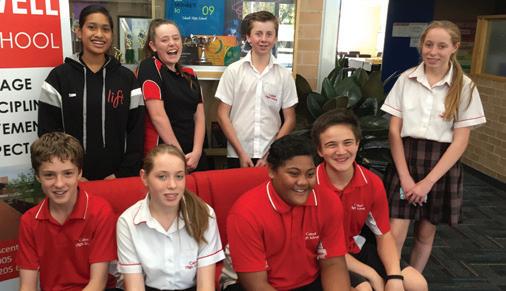
CALWELL High School has been providing innovative education and a community connection since 1991, and is now considered the hub of the Calwell community, says principal Bruce McCourt.
As a community centred high school, it provides a comprehensive curriculum that is rich and diverse, including extension programs in core subjects, STEM initiatives and excellence in vocational education.
The school believes academic success is best enabled by strong supports that nurture student wellbeing.
At Calwell High School, the staff want every student to succeed and thrive.
“It’s a school that’s built on relationships and we understand that the students’ wellbeing has to be right before their learning can be enhanced,” Bruce says.
To make sure of this, teachers are involved in their own action-based research projects so they are constantly learning to become better teachers.
“Calwell High School is a great school with students at the core of everything we do,” Bruce says.
“We’re proud of our school and we’re happy to share it, so come and talk to us or we can organise a time for a tour.”
Calwell High School, 111 Casey Crescent, Calwell. Call 6142 1930 or visit calwellhs.act.edu.au
NOT only is St Francis of Assisi Primary School celebrating 30 years in the Calwell community but it’s also celebrating its excellent STEM programs, says principal Kate Markcrow.
“Our STEM programs are excellent because we do not focus on any single aspect, but rather offer rich access and hands-on activities related to science, technology, engineering and maths,” she says.
“Students are encouraged to design, build, test and improve, knowing that everything they do develops new skills.”
But, STEM education doesn’t just happen in the dedicated STEM rooms, and Kate says, it flows back into the classroom where students continue to apply their skills.
As for the school, Kate says St Francis is a local, affordable parish primary school that welcomes all families.

CALWELL Club has been operating in the Calwell community since 2004 and is just one of four venues across the Eastlake Group.
Louize Glenn, of Calwell Club, says the club is a proud community partner that focuses on local community organisations and sporting groups such as Neighbourhood Watch, Tuggeranong Lions Club, STC Pumas Cricket and Eagles Baseball.
“The Eastlake venues are so much more than just a great meal deal and we look forward to continuing our partnerships with the community of Tuggeranong and thank them for their support over the last 14 years,” she says.
Calwell Club, 1 Were Street, Calwell. Call 6291 5666, email ccrecption@ eastlakefc.com.au or visit eastlakefc.com.au
“We have a dedicated group of teachers who ensure that each child feels welcomed and valued into our school community,” she says.
“Our small class sizes allow for individual learning to occur.
“[And], the St Francis kindergarten environment fosters a positive relationship with each child and aims to create a sense of belonging to our school community.
“The classes focus on explorative experiences across all curriculum areas. “The combination of exciting learning opportunities and caring relationships create a love of learning which establishes a solid foundation for the remainder of the children’s education journey.”
St Francis of Assisi Primary School, 120 Casey Crescent, Calwell. Call 6292 4500 or visit stfa.act.edu.au
The bank with a heart, says
BEING a big bank is one thing but being a better big bank is another, says the branch manager of Bendigo Bank Calwell, Chloe Heath, who is proud to be part of a community-focused bank.
She’s been part of the Bendigo Bank family for more than 11 years and has seen it evolve in that time.
“I’ve never had that temptation to move to another financial institution because I’ve always felt that Bendigo Bank is the bank with a heart,” she says.
“We’re an ethical bank because we really consider the impact that we have on the community.
“We try to feed into the prosperity of a community as opposed to off it.”
Chloe says Bendigo Bank in Calwell supports many local charities and groups but one of the big groups it supports across the branches is Menslink.
“They really try to support young men and they really help with the mental health of young men,” she says.
“We want to actually make an impact and make our community better. So through organisations like Menslink we’re able to create changes so they’re able to do the great things they do.”
And apart from all of the great things Bendigo Bank does, Chloe says they’re a big bank and they can do anything a normal big bank can do.
Bendigo Bank Calwell, Shops 19-21 Calwell Shopping Centre, Webber Crescent, Calwell. Call 6291 3385 or visit bendigobank.com.au

AT Kumon Tuggeranong Education Centre its instructor and owner, Jane Hiatt, is dedicated to helping all her students do their best academically.
While Kumon offers learning for all ages, Jane says pre-kindergarten and kindergarten children benefit the most from Kumon because it trains them to become good academic athletes for primary school, high school and university.
Offering maths and English subjects, Kumon is designed to encourage independent learning by providing students with worksheets, to be done for 20-30 minutes each day, which allow them to figure out how to solve problems on their own.
“Maths and English are the core subjects, and when students are good at them, it gives them the headspace to be able to focus on other subjects,” Jane says.
Jane says the most important thing to give her students is confidence and self esteem.
“If we can help children have that in bucket loads by year 1 or year 2, then they’ll be strong in classes,” she says.
“I am there to encourage children and lift them up. I genuinely want to see all students shine and do their best.
“I do this because I love my village and I want to be able to see the kids in the village do well.
“It’s important for our young ones to be prepared for their life journey.”
Kumon Tuggeranong Education Centre, Shop 4, Calwell Shops, Webber Crescent. Call 6292 3645 or 0419 134078, email jane@kumontuggeranong.com or visit kumonsearch.com.au



Lice Clinics Australia provides a revolutionary alternative to pesticides with a “one and done” treatment for the eradication of head lice and their eggs.
Our lice treatment is non-toxic and kills eggs and lice through dehydration, killing head lice and 99.2% of their eggs.
Up to 30% of all Primary school aged kids get lice at least once per year.
Call Capital Chemist Calwell to book a single one hour treatment.




CUSTOMERS are at the centre of everything Capital Chemist in Calwell does and its owner Elise Thornton says they’re always making sure to provide them with services to suit the growing needs of the community.
“When we discovered there was a medical-grade device available that could treat and kill the lice and their eggs all in one treatment, we had to have it for Calwell,” Elise says.
“So we created a new private space within the Calwell Shopping Centre for the head-lice clinic.
“It’s a great service where all the work is done for you and the kids go home completely head lice free.
“[And] we often treat mums as well, as mums often treat all their kids but they need someone to do their hair for them.”
Capital Chemist Calwell is also creating a baby clinic and preconception check up service to meet the needs of growing families in the community.
“This year we have seen a bit of a baby boom in Calwell and so have found our pharmacists are doing lots of vaccinations for whooping cough for expectant

provide without a prescription is continuing to grow and the feedback from customers is fantastic.
“We are always happy to hear feedback and would love our customers to tell us what services they would love to see in Calwell in 2019.”
Capital Chemist Calwell, Calwell Shopping Centre, Shop 14, corner of Were Street and Webber Crescent. Call 6292 8200 or visit capitalchemist.com.au
CALWELL Shopping Centre is going green, says centre manager Amanda Flack.
“We’ve just had solar put on the roof so in the next couple of weeks the house power will be green,” she says.
“The centre takes a pretty big environmental footprint in Calwell and the owner of the building is an environmentally conscious person so it goes with the centre’s philosophy.”
Established in 1991, Amanda says Calwell Shopping Centre has been supporting the local community since.
“We’ve always supported local community operated organisations such as charities, schools, sporting clubs and churches,” she says.
“We have a Communities@Work charity box in the centre where people can put non-perishable donations
in it year-round.”
Amanda says locally, people might be doing it hard and the community want to help out people in their own backyard, which is why they support Canberrabased charities.
“We try to support charities that help out Canberra so people can see where their money is going,” she says.
Leading up to the holidays locals can enjoy community carols at the centre, which are held on the last Friday leading up to Christmas every year.
“And for the first time, the community churches are organising an interactive, pop-up nativity scene.”
Calwell Shopping Centre, 7 Webber Crescent, Calwell. Call 6292 8811 or visit calwellshops.com.au


By Helen MUSA

ONE of Australia’s top bands, the Royal Australian Navy Band, is coming to town to commemorate the centenary of the signing of the World War I Armistice.
A free concert at Llewellyn Hall, it’s also a rare opportunity to experience the musicianship of the Royal Australian Navy Band’s four-strong wind ensemble. The concert will pay tribute to those who fought, the families and communities left behind, and their legacies.
“CityNews” understands that under what used to be called a “gentleman’s agreement’ – there are plenty of women playing these days – the Navy Band focuses its attention on Sydney, while Canberra is served by the Army Band and Melbourne by its Air Force counterpart.
Leading seaman musician, flautist Svetlana Yaroslavskaya, told “CityNews” that Navy vocalist, Mark Nivet, would be leading the audience in a sing-along of World War I patriotic and recruitment songs such as “Australia will be There,” and the satirical “Oh What a Lovely War”.
Born in Trinidad, Nivet came to Australia when he was six months old and joined the Australian Defence Force in 2012. Since then he has performed at the Royal Edinburgh Military Tattoo in Scotland, at The Menin Gate in Belgium
and during the Anzac Dawn Service in Gallipoli, Turkey, in 2017 and 2018.
As well, Yaroslavskaya said, the band would perform the world premiere of a composition by Sydney composer Martyn Hancock, “First Victory”, newlycommissioned in honour of the 1914 Sydney-Emden battle at Cocos (Keeling) Islands. It was recorded in September by the Navy Band under the baton of RAN Band Sydney’s director of music, Lt Brian O’Kane and CDs will be available at the concert.
The show would include an Australian composition, “Ships Without a Name”, by Matthew Klohs, written in memory of Australian World War I submarines AE1 and AE2. Both those works would be performed with narration, giving the background to the events commemo rated.
In more sombre moments, “Ode to the Fallen”, “The Last Post” and “Rev eille” will resound through Llewellyn Hall, along with a minute of silence.
While the Royal Australian Navy Band is the largest-scale musical event of the Remembrance Day season, it won’t be the only one.
Arts and Veterans Minister Gordon Ramsay told “CityNews” that 11 different musical commemorations would be held across the city in honour of veterans, part of the national “Stop the Nation” commemorations marking the centenary of the World War I Armistice.


By Helen Musa
AUSTRALIAN Dance Party’s environmental initiative “Energeia” confronts questions about the waste of the energy around us. The performance will run entirely on battery, solar and kinetic power, and reveals the often untapped resource of the human body through contemporary dance and physical theatre by Stephen Gow, Alana Stenning, Olivia Fyfe, Alison Plevey, Adam Deusien and associates. At Mount Majura Solar Farm, 303 Majura Road, 7.30pm, November 16-18.
SOTIRIS Dounoukos’ 2017 movie “Joe Cinque’s Consolation”, based on Helen Garner’s book of the same name, will have an unusual special screening on November 14 during the coming Asia Pacific Coroners’ Society Conference. Co-writer Matt Rubinstein will take part in a post-screening Q&A and so will barrister Jack Pappas, former justice Richard Refshauge and former justice Ken Crispin, who pronounced sentence in the case.
RICHARD Bean’s play “One Man, Two Guvnors” is billed by Rep as the “funniest play since ‘Noises Off!’” At Theatre 3, Acton, November 15 (preview) to December 2, with a ‘60s-themed evening on November 23 to celebrate the play’s setting – 1963. Book at 6257 1950 or canberrarep.org.au
He said musical commemorations would be held at Yerrabi Ponds, Dickson Town Centre, Belconnen Markets, Haig Park, City Walk, the National Arboretum, Woden Square, Lanyon Marketplace,

Tuggeranong Town Park, Old Bus Depot Markets and Gungahlin Town Centre from 11am to 11.45am on Sunday, November 11.
Also on the Sunday, ANU Choral Society, SCUNA, will commemorate the Armistice in “For the Fallen,” a performance of Brahms’ “Ein Deutsches Requiem”, conducted by Leonard Weiss and featuring Canberra soloists Rachael Duncan, Colin Milner and Anthony Smith, as well as an orchestra of local musicians.
They say Brahms wrote this requiem as a way of grieving for the death of his parents, shying away from Latin liturgical texts to focus on the people left behind who must find joy after the sadness passes.
In marked contrast, Canberra’s A Chorus of Women, joined by top local musicians and a children’s chorus will “remember” with “The People’s Passion”, a reworking, conducted by Johanna
McBride, of Glenda Cloughley’s 2015 community oratorio, “A Passion for Peace”.
This is a musical retelling of the story of women from warring and neutral nations who gathered in 1915 for what they note was the only peace congress of World War I that set a 100-year agenda for advances in human rights. And peace, they say, is often forgotten in such commemorations.
Royal Australian Navy Band’s Armistice concert, Llewellyn Hall, 7.30pm, Monday, November 12, 7.30pm. Free event. Brahms’ Requiem, Overture Hall, Orana Steiner School, Unwin Place, Weston, 4pm, November 11. Tickets via trybooking.com or at the door.
“The People’s Passion”, Australian Centre for Christianity and Culture, Barton, 5pm, Sunday, November 11. Book at chorusofwomen.org



THE venerable Artists’ Society of Canberra will show 300 works by members in its 2018 spring exhibition. New features are the $1000 prize Capital Chemist Sculpture and an exhibition of works by young artists from four special needs schools. At Fitters’ Workshop, Kingston, November 16-25. All works are for sale.
SCOTT Rankin from the social/cultural organisation Big hART, responsible for productions such as “Namatjira”, has written a fierce challenge to politicians and the arts hierarchy in his new “Platform Paper” for Currency House, which he will outline at Visions Theatre, National Museum of Australia, 12.30-1.30pm, Thursday, November 15. All welcome.
STRANGE Weather Gospel Choir, Turner Trebles and Lyneham High Voices are performing at a charity concert in aid of children living with HIV/AIDS in Botswana and Lesotho. At the Botswana high commission, 130 Denison Street, Deakin, 7.30pm, Saturday, November 17. Book at trybooking.com
LEGS Dance is presenting “The Wiz… From AUS!” as its annual dance extravaganza, with “42nd Street” star Sophie Highmore as Dorothy. At Canberra Theatre, 1pm and 6pm, Saturday, November 17. Book at canberratheatrecentre.com.au
CANBERRA Gay and Lesbian Qwire celebrates 25 years with a concert called “Taking Flight”, part of Canberra’s SpringOut Pride Festival, at The Q, Queanbeyan, 7pm, Saturday, November 17, when Auslan interpretation will be available and 4pm, Sunday, November 18. Book at theq.net.au




Shows: 24 May to 2 June 2019
17, 18, 22 Nov
For bookings and enquiries: janette@webone.com.au
More info: queanbeyanplayers.com/ get-involved/auditions

By Dougal MACDONALD

“Book Week” (M)
HEATH Davis, producer/writer/director of this 98-minute movie set in the Blue Mountains, has failed to deliver the freshness and variation that distinguish good comedy.
Novelist Nic (Alan Dukes), spending eight unpublished years teaching English to high school students, suddenly finds a publisher interested in his latest manuscript.
All he needs to do is change its zombie theme for a vampire one and the presses will start rolling. Meanwhile, his father is pressing him to donate a kidney, school colleagues have difficulty coming to terms with his behaviour, the winsome principal hasn’t practised effective contraception, a young coloured student is on the brink of a criminal record, the local highway patrol cop has his number as he cycles home, his promise not to break any more promises isn’t working and he is drinking too much for his own good.
That’s just a small list of the issues confronting Nic. Individually, many of them show imagination and the cast performing them does so with gusto. But by denying Nic a feather with which to fly to a more congenial life, Heath Davis has condemned his audience to yearn for a central character desperate to find relief but failing to provide it. I can’t help wondering what “Book Week’s” long list of crowd funders will think about what their generosity hath wrought.
At Dendy

ICONOCLASTIC American documentarist Michael Moore’s latest work reaches us after premiering at this year’s Toronto International Film Festival, theatrical release in the US and Canada on September 21 and in Australia on the brink of a US biennial constitutionally-mandated event that in most even-numbered years coincides with the same day that a Melbourne horse race stops the nation.
“Fahrenheit 11/9” is a very scary movie, described in its promotional material as “a provocative and comedic look at the two most important questions of the Trump Era: How the f#%k did we get here, and how the f#%k do we get out?”
It begins in Moore’s home city of Flint, Michigan, where a Republican governor built a pure, urban water supply to replace one heavily contaminated with lead. It ends with archival footage remembering Hitler’s rise in the 1930s and Germany’s Nazi Party.
Its main thematic optimism is the ideological rejoinder by young Americans against Trump’s accession to power, giving examples treating the wealthy and the poor pretty evenly, finding cosmetic faults in Barack Obama having a glass of water on a visit to Flint. It draws back curtains hiding common folk’s accounts of gun control, racism, sexism, religious prejudice and other behaviours, to reveal a lot of ugliness.
You don’t have to have done Political Science 1 to understand the political environment with which “Fahrenheit 11/9” deals. Moore neither suppresses nor brandishes his personal leftist opinions. We should hope that his warnings don’t become reality.
At Palace Electric and Dendy
“Hunter Killer” (MA)
SUBMARINERS are a special bunch, risking their lives against not only attempts to locate and kill them but also the unremitting threats that their working environment presents to their survival. Much of “Hunter Killer” takes place in the submarine “USS Arizona” (presumably nuclear-powered; I could not discern any functional or implied references to engines) sent to investigate reports of accidents involving two Russian submarines. It transpires that the reports are correct, that the Russian head of State (Alexander Diachenko) is visiting the naval base where Admiral Durov (Michael Gor) is planning a military coup. When the Arizona reaches the area, it finds survivors in one of the wrecked Russian boats. Its rescue submersible discovers that one is Russian captain Andropov (Michael Nyqvist, to whom the film is dedicated). When news of Durov’s plan reaches Washington, a SEAL team drops in to rescue the president. Joe Glass in the “Arizona” has reached captain’s rank from the lower deck. Gerard Butler plays him with a stoically-set jaw. The two captains, Glass and Andropov, join forces to navigate “Arizona” across an uncharted approach to the port. Donovan Marsh directs the film’s tensions and naval shenanigans as though it was telling it like real life. The screenplay by Arne Schmidt and Jamie Moss, adapting a novel “Firing Point” by George Wallace and Don Keith, tells it with tongue-in-cheek respect. Bottom line? Boys’ Toys on a grand scale, a US Navy recruiting movie with Gary Oldman having fun playing the chief of naval staff. I rather think that genuine submariners might find it a bit of a giggle.
At Dendy, Capitol 6 and Hoyts
By Wendy JOHNSON
THE dining space at Canberra Southern Cross Club in Woden has had a makeover. Actually, it’s had a super-duper makeover.

“Woden Central” has been transformed from top to bottom and now has separate dining zones, each with their own personality. The Clubhouse and Bar, for those who want casual dining while watching sports on big screens and perhaps shooting a game of pool, is super relaxed. The Patio area is more formal, but by no means stuffy. Henry’s, for families, features a vibrant Australiana mural on the wall and a game and play area. We headed to The Patio for lunch, ordering at the counter (table service at night).
The entrees caught our eye and we selected two, loving both.
The oh-so-pretty-on-the-plate roasted beetroot, baby spinach and Persian feta salad was delish and we thought the bright beetroot dust looked fab against the dark plate. The dish was great on texture – toasted hazelnuts, pine nuts and thin crispy beetroot chips ($14 for members; $17 for non-members). The garlic and oregano dressing was light (we would have liked a bit more). Our only disappointment was the noticeable absence of serving utensils.
Another winner was the honey roasted Kent pumpkin ($18; $22). The pumpkin seeds added crunch, the oregano emulsion was intriguing and the smooth ricotta pleasing.
Gourmet burgers are $17.50 for members and $21 for non-members. You’ll find the usual suspects but Woden Central uses quality ingredients such as Cape Grim beef and Riverina lamb. Fun options include a twirled zucchini and sweet potato burger and the “Magic
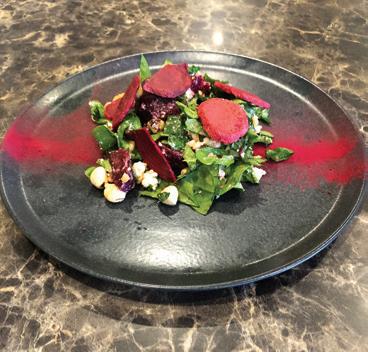
a massive, marinated portobello mushroom, a thick slice of mozzarella, deep fried and crispy on the outside, loads of veggies, aioli and tomato relish.
The specials board included a generous roast beef dinner, with gravy and vegetables ($15; $18). Who can go wrong with Sunday roast? Share platters for four take 30 minutes to prepare – classic roast chicken is $65 and Moroccan spiced lamb shoulder $75.
It was a bit fussy ordering at the counter with only one person on the till, which we found odd for weekend lunch. Beyond that, the service was prompt – so much so that our mains arrived well before we finished our share plates, making our table very crowded indeed. We’ll try the Clubhouse and Bar next, intrigued by the glistening copper beer tanks, which form a major feature. Wash down a pizza cooked in the massive brick pizza oven with a craft beer or a tap beer.
Woden Central claims it’s a “new dining destination in the heart of Woden”. We can see why.
The Patio and Henry’s, seven days, noon-2pm for lunch and 5.30pm-9pm for dinner. The Clubhouse and Bar has longer hours.
By Helen MUSA
A new Canberra satirical comedy looks at how things might unfold if we had a gay prime minister.
Many speculate that we’ve had several gay PMs in the past, but no-one’s been prepared to name them.
David Atfield’s witty new play “Exclusion”, based on the idea expressed in law that marriage is the union of two people “to the exclusion of all others”, questions the double standards applied to what goes on behind closed doors in the offices and bedrooms of senior political dealmakers.
It’s entirely fictional, of course, as “CityNews” finds when we catch up with the playwright at the Canberra Museum and Gallery.
Here’s the setup: Federal minister Jasper (Craig Alexander) is married to the glamorous, sexy, forthright Jacinta (Fiona Hopkins), a former political candidate but now the mother of his five children; but he’s been hopping into bed on a regular basis with his gorgeous personal assistant, Craig (Ethan Gibson).
Meantime, his fellow politician and the man most likely to succeed to the prime ministership, Michael, (Michael Sparks) is having problems in the bedroom with his Pentecostal, upwardly mobile wife Caroline (Tracy Bourne).
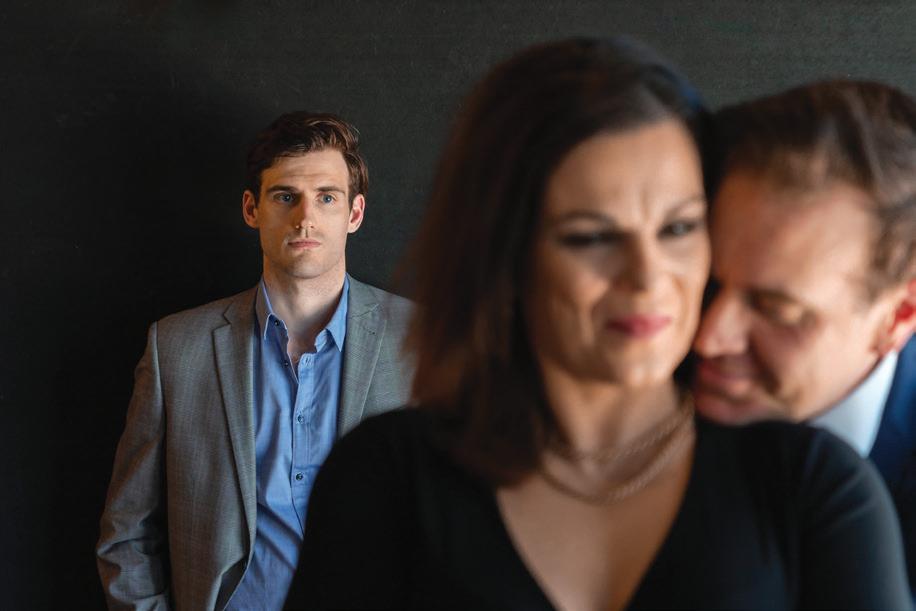
noeuvrings and the canny Jacinta suggests planting Craig in Michael’s office. The plot thickens and, suffice to say, that this play is quite unsuitable for the kids, but has serious fun with the Machiavellian manipulations of politicians and the dangers of mixing politics with sex.
In a series of encounters, Atfield explores power seen through the prism of sexuality.
social exclusion of LGBTQI+ people from all the current chat about politicians’ private lives reveals widespread prejudices.
“We often hear about the mistresses of politicians, but what about ‘the other man?’” he asks.
“I think there is an element of exclusion in our political process, there are no transgender politicians as far as we know and there’s a
and Jasper, deeply inbred attitudes emerge.
Jasper is absolutely sure he’s not gay, despite that he enjoys frequent sex with his staffer. Michael’s wife is full of righteous outrage against LGBTQI+ people and Safe Schools policies.
Homophobia is rife, Atfield says, and even with recent legislation, there is a sense that marriage between people of the same sex
By Richard CALVER

UNTIL recently, I thought the term vegan feast an oxymoron. That is, of course, a figure of speech in which apparently contradictory terms appear in conjunction, with some random favourites verging on dad jokes and therefore appealing to me: airline food; legally drunk; tight slacks and, sadly these days, honest banker.
The truth is that at Monster in New Acton there was a fine vegan feast that featured wines from Lark Hill. The combination was superb.
Chris Carpenter is the winemaker from Lark Hill and, following a speech from the presiding chefs from Alibi restaurant in Sydney and our own Monster, Chris did a bangup job explaining the way that biodynamic wines match with plant-based cuisine.
“We don’t add chemicals in biodynamic wine making”, he said.
“We just use grapes and yeast and a lot of hard work.
“Soil and plant health are what counts, we have no chemical inputs in our winery. We let the ‘terroir’ – or the winery’s natural reflection of where the grapes are grown – do the talking.
“Wine should taste like the place it’s grown. It’s even more important that we pick the grapes at the right time as this affects acidity, sweetness, and flavour of the wine.”
When I spoke to Chris, I said: “It’s amazing isn’t it to think that some wines are not vegan per se because they use egg whites to fine the wine?”
“Exactly,” he said.
The first Lark Hill wine that went with the yummy but small dumplings was the 2017 Roxanne petillant naturel. This wine is cloudy, pink and fizzy with a very real presence of lees in a
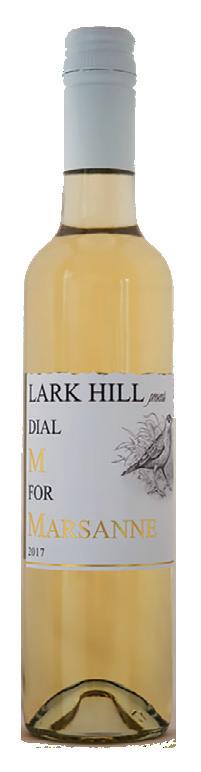
wine so young. That’s because the wine is naturally fermented in the bottle. This style of wine I find funky and unsettling, but that’s probably just an old-fart response to a new way of presenting wine au naturel.
Next up was the 2018 Canberra region rosé that was matched with smoked hummus and heirloom carrots. This was clearly a shiraz-derived rosé (and, of course, I patted myself on the back for picking this characteristic). It is young, fresh and was much more to my taste than the pet-nat, although anodyne.
We were then served an amazing mixture of kelp noodles with broccoli, black barley and goma (or sesame) dressing. The broccoli with the umami flavours from the dressing was stunning.
I turned to Chris and asked if he had children. “Yes, I’m a dad,” he said.
“Okay, then,” I said, “What’s the difference between snot and broccoli?” I asked.
With palpable discomfort and physically shifting away from me, he said: “What?”
“You can’t get children to eat broccoli,” I snorted.
Chris left the table on an urgent mission, hopefully, I thought at the time, to get some more of the 2018 sangiovese that was served with this savoury course. There were light tannins and a mellowing savoury flavour to this wine that I thought made it the stand out of the three thus far served.
But then with dessert, a wonderful hibiscus, strawberry cheesecake, we were presented with a 2017 Dial M for Marsanne. This was a great way to finish the meal. Chris was back now taking his place next to me and explained that super-ripe marsanne grapes were grown in the Dark Horse Vineyard and fermented on skins. Reserved juice was added to give sweetness and that uplifting fresh flavour you get from the best dessert wines.
With the yuzu gel (strange Japanese citrus that blends orangey/lemon tastes together) and a mouthful of cheesecake, a swig of this dessert wine was a toasty palate cleanser. This bittersweet finale filled me with cool passion and I knew I was at the living end: the vegan food and biodynamic wines were overbearingly modest and had taken me in a peaceful conquest.

is not “real” marriage. Gay-aversion therapy is still widespread in Australia, although international human rights organisations have classed it as torture.
Atfield’s script, if the rehearsal we saw was anything to go by, is tight and witty, written in the tradition of realism with all the characters multi-dimensional. It feels as if the time is ripe for such a play in Canberra.
“Exclusion”, The Street Theatre, November 10-17, part of the SpringOut Festival. Book at thestreet.org.au or 6247 1223. Contains nudity, sexual and adult themes, coarse language and drug use. Recommended for ages 16+.


Stay in touch with the names making news on Sundays from 10am as 2CC and “CityNews” present Canberra’s only local weekend news and current affairs program.
It’s a revolving panel show that brings to the microphone great “CityNews” commentators and 2CC personalities.
Be part of the conversation call 6255 1206 between 10am and noon


Hedge trimming
• Hedge lowering
• Green waste disposal
• General gardening
“Quoting
hundreds, not thousands”

By Cedric BRYANT

IT takes just a few warm days and, suddenly, there’s an explosion of growth in the garden.

Bulbs, corms and rhizomes all store energy in various forms during the dormant winter months until nature decides it’s time to grow.
The blue and white Dutch iris lining our drive has been showing leaves for weeks; then suddenly the flower buds emerge from the ground to a height of 90cm. A week later the drive and nature strip are awash with colour.
One of our favourite flowers is the bearded iris family, especially the dwarf Iris cristata, also known as the Dwarf Crested Iris. It has leaves for a couple of months then, without warning, within a week of increased temperatures explodes into the most amazing display of mauve flowers. If left undisturbed, its rhizomes spread to cover a large area in an ever increasing show year after year.


them out. However, by simply planting them out in a shady spot in the garden they will continue to grow and multiply.
It grows to just 30 centimetres and is perfect for even the smallest garden. Its giant cousin, the tall bearded iris, comes in a huge range of shapes and colours flowering over many weeks at this time of the year.
Cyclamen growing from corms is ideal in containers, hanging gardens or in garden beds. The question often raised when I give garden talks is what to do with cyclamen when they have finished flowering?
Cyclamen are a popular present with their long flowering period. Invariably when they have finished flowering and die down people throw
The dwarf Cyclamen neapolitanum (C. hederifolium) has tiny delicate pink flowers which have also burst through the soil. Growing to just 10 centimetres tall, the corms will continue to spread as a delightful ground cover.
All of these plants are so easy to grow; just plant and forget them. All of them will appear year after year, at the appointed time, with almost total neglect. They will even forgive you if you forget to water or feed them, although this will help.
OUR favourite bird in the garden is the com -


We
Create
mon blackbird, the only bird that can sing from dawn to dusk and never repeat a tune. It arrived into the garden a few weeks ago, signalling to us the true start of spring.
People complain to me that blackbirds dig and scratch in the garden for worms and insects, spreading mulch and leaf litter on paths. So what?
• With warm days and irregular showers snails are breeding rapidly. Best to use only bait safe for pets and snail eaters such as blue tongue lizards. Multicrop’s Slug and Snail Killer does the job.
• Tie up clematis now on horizontal wires or trellis before they get out of control.
A room designed especially for you. We also provide custom entertainment units.

Joanne Madeline Moore

ARIES (Mar 21 – Apr 20)
Uranus is back in your sign, and on Thursday it makes a positive connection with dynamic Mars (which is your boss planet). So it’s time to be bold and brave as you take a smart calculated risk and morph into the adventurous Ram you were born to be. Nothing ventured, nothing gained as you break down barriers and charge at life with plenty of fiery abandon! But with Mars also shifting into your spiritual zone, feisty action must be accompanied by some soulful self-reflection.
TAURUS (Apr 21 – May 21)
Mighty Mars shifts into your networking zone and then Venus finally moves forwards. So a delayed dream, a work problem or a frustrating group situation should gradually start to improve. But expect misunderstandings involving an intimate relationship or a joint financial matter when Mercury turns retrograde from Saturday onwards. Charging in like a wounded Bull will only make matters worse. Do your best to be decisive and diplomatic – which is an interesting juggle!
GEMINI (May 22 – June 21)
Twins can expect a week that’s even more schizophrenic than usual! Mars charges into your work zone, which will facilitate progress with a professional or volunteer project. Venus moves forwards in your socialising zone on Friday (yeah) but then your ruler Mercury turns retrograde on Saturday (boo). So it will be a stop/start kind of week. Definitely one step forwards and then two steps back. You’ll have to be super patient… which is not one of your natural attributes.
CANCER (June 22 – July 23)
With Saturn and Pluto in your partnership zone, accept extra responsibilities with a smile as you show others what you are really capable of. When it comes to a frustrating family problem, things will gradually improve as Venus moves forwards in your home zone. So do your best to choose diplomacy over drama, encouragement over criticism and acceptance over judgement. But expect some disruptions to your daily routine, when Mercury turns retrograde from Saturday onwards.
LEO (July 24 – Aug 23)
Have you been feeling like a listless and lonely Lion? Has a friendship been stuck in a frustrating funk? The positive Sun/Pluto connection provides a welcome energy boost on Monday. Then Venus moves forwards on Friday which will benefit relationships and boost congenial communication, both in person and online. Plus love, lust and/or loot should gradually improve when (courtesy of mighty Mars) your sexual and/or financial mojo comes bounding back in spades!
VIRGO (Aug 24 – Sept 23)
Money matters should gradually improve, as Venus powers forwards in your finance zone. But expect some domestic dramas from Saturday onwards, when Mercury reverses through your home zone and hidden tensions bubble to the surface. Try to be diplomatic and take it in your stride. With dynamic Mars moving into your relationship zone, avoid your Virgo tendency to micromanage loved ones. Give them the space, freedom and encouragement to really shine on their own.
LIBRA (Sept 24 – Oct 23)
Thank goodness Venus (your ruling planet) finally moves forwards on Friday, and a troubled relationship should gradually start to improve. Although real progress won’t be made until you both learn a valuable lesson. Make sure you learn quickly, and then you can move on. Social media will be a minefield over the next few weeks, as Mercury reverses through your communication zone. So be very careful that you don’t send the wrong message to the wrong person!
SCORPIO (Oct 24 – Nov 22)
This week’s planetary connections promote powerful communication (with people and nature) and personal transformation. So your motto for the moment is from birthday great, singer-songwriter Neil Young: “We’re all just part of nature.” Plus – by the end of the week – you’ll have changed your attitude towards a relative, friend, lover or colleague. Then Mercury reverses through your money zone from Saturday. Make sure you double-check all financial details thoroughly.
SAGITTARIUS (Nov 23 – Dec 21)
Mercury is in shadow and then retrogrades through your sign, from Saturday until December 1. So it’s not an appropriate week to expedite tasks, initiate ideas or power ahead with personal projects. Instead, use the time wisely to revise, research and review. Pace yourself and expect some frustrating delays and hiccups along the way. As singer-songwriter (and birthday great) Neil Young observes: “As you go through life, you’ve got to experience the valleys as well as the peaks.”
CAPRICORN (Dec 22 – Jan 20)
On Monday (courtesy of the Sun/Pluto connection) you’re at your powerful and persuasive best, as you make a presentation or influence your peer group in a positive way. Then Mercury goes retrograde from Saturday. So don’t let negative self-talk sabotage your plans (and confidence) over the next few weeks. You’ll also be surrounded by intrigue, as secrets that were previously hidden rise to the surface. Make sure you handle any sensitive information as discreetly as possible.
AQUARIUS (Jan 21 – Feb 19)
It’s time to take a terrifying leap of faith that could send your life in a dynamic new direction! Ignore fear and take courageous action, as brave Mars (in your sign for the last time until 2020) connects with revolutionary Uranus. Dare to do something ambitious and capricious that you’ve always wanted to do. Draw inspiration from birthday great, painter Georgia O’Keeffe: “I’ve been terrified every moment of my life – and I’ve never let it keep me from doing a single thing I wanted to do.”
PISCES (Feb 20 – Mar 20)
Action-planet Mars charges into your sign (from Friday until January 1). So don’t waste time procrastinating about issues. You need to be direct and decisive. If things start to resemble a soap opera, re-state your case clearly and then move on. But (courtesy of retrograde Mercury) a work project needs to be reviewed, revised (or even completely re-done) over the next few weeks. Avoid getting into a Piscean stew worrying and complaining. Just put your head down and get on with it.
Copyright Joanne Madeline Moore 2018
Across
4 Which 10th century BC king of Israel was famous for his wisdom? (7)
8 Name a small, long-winged bird, notable for its swift, graceful flight. (7)
9 Name a particular breech-loading, bolt action rifle, first made in England. (7)
10 What is the projecting outer portion of the ear? (7)
11 Which term describes a prison keeper? (7)
12 Which religious discourse is delivered from a pulpit? (6)
14 What do we call a brood of chickens? (6)
18 What are small pointed instruments for making holes in cloth, etc? (7)
21 To be pleasantly entertaining, is to be what? (7)
22 Which herb usually has digitate leaves of three leaflets, and colourful flowers? (7)
23 To talk in a rambling, foolish way, is to do what? (7)
24 Which hollow cavities in the skull connect with the nasal cavities? (7)
Down
1 Which term describes landed properties? (7)
2 To be hirsute, is to be what? (5)
3 Name a medicine that performs no physiological function, but may benefit the patient psychologically. (7)
4 What is served at the end of a meal? (6)
5 Which person is one sentenced to imprisonment for life? (5)
6 Name a small burrowing African carnivore, related to the mongoose. (7)
7 In Toyland, who is the best friend of Big Ears? (5)
13 Name an Australian pioneer surgeon, born in England 1774, William ... (7)
15 Which class of alcoholic drink is usually strong, sweet, and highly flavoured? (7)
16 Name the English novelist, author of "King Solomon's Mines", Sir H Rider ... (7)
17 Name the 150 songs, hymns, and prayers, which, together, form a book of the Old Testament. (6)
18 Which units of computer information are usually eight bits? (5)
19 What do we call persons seen as being closest to admired stereotypes? (5)
20 Which device with two terminals can conduct a current in one direction only? (5)

Joyce came in wanting me to prepare her tax return unaware of the shock that lay ahead.
"There are a few complications because I have been receiving two pensions from the UK and they also paid me a tax-free lump sum and I also received my Australian salary and the usual deductions,” she told me.
I asked her what year did she become a resident of Australia for tax purposes and she replied it was 2010.
“I have some bad news for you in relation to the 'tax-free' lump sum," I told her.
"While the lump sum is tax free in the UK. Some of it may be taxable in Australia. The Income Tax Assessment Act taxes you on the increase in your lump sum from the date that you became a resident of Australia.
"As the lump sum was worth about $100,000 when you arrived in Australia and now it's worth about double that, you will be taxed on the $100,000 increase on the foreign lump sum at your marginal tax rate, which is 47 per cent. So you can expect to pay $47,000 tax on this lump sum.”
Crestfallen, Joyce said: “I am sure there are people at work who haven’t paid tax on the lump sums they received. They told me they were tax free.”
I told her the tax laws can be very confusing.
"A lump sum paid from an Australian superannuation fund may be tax free unless it comes from a defined-benefit fund," I told her.
"These funds are usually government funds, such as CSS and PSS. However, different rules apply to lump sums received from overseas superannuation funds.
"In most cases if you receive a lump sum and commence a pension at the same time, the lump-sum increase in earnings is taxed as is the pension. This is legislated so you have to pay this tax.
"However, if you withdraw your lump sum from the fund within six months of becoming an Australian resident then the lump sum is regarded as neither assessable nor exempt income. The effect of this is to make the lump sum accrued before you left the UK tax free but the balance, which accrued after, is taxable in Australia.”
Joyce said: "How confusing and how expensive for me.”
I replied that it must be disappointing for you and commiserated that it was a shame you hadn't got advice when you first arrived. We moved on to her pensions and Joyce explained she had the UK State pension and one from a previous employer.
“The good news is that you receive an 8 per cent reduction in tax on the State pension," I said.
"This is because you had to pay National Insurance in the UK. You may also be entitled to an offset on your other UK pension, but I'd need more information before I can advise you on that.
However, you will pay tax on both your pensions in Australia.”
Joyce said she hadn't realised that her issues would be so complex or how the taxation systems in Australia and the UK were so different.
If you require information on your superannuation or pensions from the UK or elsewhere, contact the friendly team at Gail Freeman & Co Pty Ltd