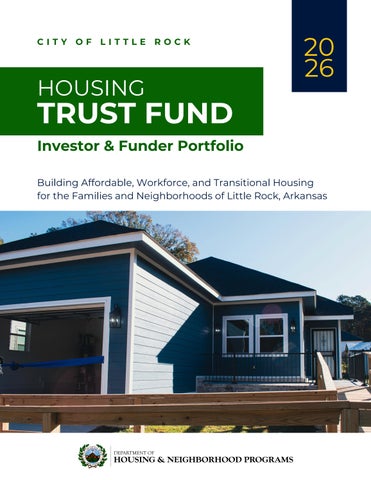
TRUST FUND
Investor & Funder Portfolio
Building Affordable, Workforce, and Transitional Housing for the Families and Neighborhoods of Little Rock, Arkansas

EXECUTIVE SUMMARY

Little Rock faces a critical shortage of affordable housing for extremely low-income residents. For every 100 extremely low-income renter households, only 48 affordable and available units exist At the same time, 77% of severely cost-burdened renters earn 30% or less of Area Median Income
The Housing Trust Fund gives the City a flexible local tool to expand affordable, workforce, and transitional housing through public funding, private investment, fee waivers, and revolving program income
The Housing Trust Fund deploys capital through five strategic pillars: new home construction, down payment assistance, tenant-based rental assistance, public-private partnerships, and transitional micro-home villages all designed to create a self-sustaining housing ecosystem funded by revolving loan proceeds and low-interest developer fees.
Why Invest Now?
Only 48 affordable units exist per 100 Extremely Low-Income renter households
77% of cost-burdened renters are at or below 30% of Area Median Income
Federal and state funding alone cannot close the gap local leverage is essential
Little Rock's 2024 HOME budget of $940K is already over-subscribed by demand
I-630 Initiative generated 1,936 permits and $146M in waived fees in 2024 alone
New construction program has developed
57 units with subsidy up to $20,000
Zion Square expansion adds 14 new affordable units to pipeline
ORGANIZATIONAL OVERVIEW
The Department of Housing & Neighborhood Programs leads the City of Little Rock’s affordable housing work. The department administers federal, state, local, and program income funds to support housing development, rental assistance, homebuyer support, rehabilitation, land banking, and homelessness response.
Programs Administered
Tenant Based Rental Assistance (TBRA)
Down Payment Assistance (DPA)
New Construction In-House & CHDO Partners
Owner-Occupied Rehabilitation
Land Bank Program
Housing Trust Fund
Enforcement / Rental Inspections Team
Emergency Solutions Grant (ESG)
Funding Sources
HOME Investment Partnerships Program
HOME-ARP (American Rescue Plan Act)
Emergency Solutions Grant (ESG) City General Fund
Program Income (PI) Revolving Loan
Central Arkansas Water (CAW) Fee Waivers
Housing Trust Fund (Proposed Dedicated Fund)

ORGANIZATIONAL OVERVIEW

Frank Scott, Jr.

Little Rock voters made history on Dec 4, 2018 when they elected Frank Scott Jr as the City’s 73rd mayor and first elected Black chief executive Mayor Scott was re-elected in November 2022 Mayor Scott’s vision to unite Little Rock and move our city from disconnected to connected is the driving force behind his governing strategy
His agenda centers on: Jobs growth, opportunity for every child in every part of the city, securing our neighborhoods through a 21st Century police department, intentional and deliberate inclusion throughout every level of city government, and community development investment
Dephone Hubbard Kevin Howard

Delphone D. Hubbard brings more than 25 years of distinguished public service and executive leadership to his role as City Manager of Little Rock A former Fire Chief with deep operational experience and a passion for servant leadership, Hubbard now leads the City’s administrative functions with a strategic focus on innovation, efficiency, and community-centered outcomes
As City Manager, his vision is clear: to foster a stronger, safer, and more sustainable Little Rock one that leverages operational excellence and inclusive leadership to deliver meaningful results for all
Kevin D. Howard is the Housing Director for the City of Little Rock Department of Housing and Neighborhood Programs Previously he served as the Community Development Manager for the City of Little Rock for seven (7) years in which he managed the HOME Investment Partnerships Program, Community Development Block Grant Program (CDBG), Neighborhood Stabilization Program II (NSP2), Continuum of Care (CoC) and Housing Opportunities with Persons with AIDS Grant (HOPWA)
Mayor, City of Little Rock
City Manager, City of Little Rock Director, Housing & Neighborhood Programs
COMMUNITY NEED: HOUSING DATA
The Affordable Housing Gap in Little Rock
Little Rock does not have enough affordable rental homes for its lowest-income residents. The gap is most severe for extremely low-income households, where only 48 affordable and available units exist for every 100 renter households This confirms that targeted local investment is needed to reach the residents least served by the current market
What This Means:
For every 100 Extremely Low-Income renter households, only 48 affordable and available units exist. ELI renters face a shortfall of more than 1 in 2 units needed. Meanwhile, households at 80–100% of AMI have essentially adequate supply confirming that market-rate construction alone will not solve Little Rock's housing crisis.
STRATEGY:
PROGRAMMING & SUPPORT
Little Rock’s housing programs support residents across the housing spectrum - from rental stabilization to first-time homeownership and new affordable housing development
I-630 Incentive Initiative (Public-Private Partnership)
Launched: September 2020
Coverage Area: South of I-630 and East of I-30
First-ever incentive package in this corridor
Mayor's Commitment: Building permit, plan review, electrical permit, and HVAC permit fees waived
2024 Results: 1,936 permits pulled $1,464,133 in fees waived
Cumulative Impact: 668 units created at or below $250,000 (new construction & rehab)
New Construction Program
Funding Source: HOME Investment Partnerships & City Land Bank
Annual City Allocation: $740,000 (HOME 2024 budget, including $200K Program Income)
Subsidy Per Unit: Up to $20,000
Units Developed: 57 units (in-house and CHDO partners)
Delivery Model: City develops in-house and through Community Housing Development Organization (CHDO) partnerships

Tenant-Based Rental Assistance (TBRA)
Funding Source: HOME-ARP (American Rescue Plan Act) & ESG
Households Assisted: 418 households
Total Expended: $610,851
Coverage: Rent & utilities up to 3 months; security deposits; application fees
Target Population: Extremely Low and Very Low Income renters; households at risk of homelessness
Down Payment Assistance (DPA)
Funding Source: HOME Investment Partnerships Program
Annual City Allocation: $200,000 of HOME budget
Subsidy Per Household: Up to $10,000 in closing costs
Homebuyers Assisted: 87 first-time homebuyers Total Expended: $616,060
Annual Volume: ~20 subsidies per year
Requirements: First-time buyer; income-qualified; 5-year owner-occupancy; home passes inspection
Outreach: Annual DPA Workshop connecting buyers with lenders, bankers, and realtors
Micro-Home Village
Purpose: The Little Rock Micro-Home Village is a planned transitional housing community designed to support residents experiencing homelessness and move the city closer to Functional Zero.
Scale: 80 non-congregate units (1-bed, 2-bed, 3-bed); fully handicap accessible with Community center to house 32 persons
Full Capacity: 220 persons per night
Allocation: $1,000,487 (HOME- ARP), $4,500,000 City General Fund

SUSTAINABILITY
The Housing Trust Fund is designed to recycle local housing dollars over time through program income and low-interest developer loan repayments This model reduces reliance on annual appropriations and creates a long-term housing resource for Little Rock
Revenue Stream: Program Income
How It Works
When the City develops a new construction home using HOME funds or Land Bank funding, it provides a subsidy of up to $20,000 Upon the sale of the home, the subsidy is structured as a deferred, forgivable loan tied to a 5-year occupancy requirement. When a homebuyer later sells or refinances or when the property changes hands outside the compliance period the subsidy amount is repaid to the City as Program Income (PI). This PI is then recycled back into the Housing Trust Fund for deployment in the next round of affordable housing development.
STEP 1 STEP 2 STEP 3
City builds affordable home with up to $20K subsidy
Homebuyer occupies property for 5+ years per agreement
This revolving mechanism means that every HOME dollar invested in new construction can be recycled, potentially funding 2, 3, or more homes over a 15–20 year horizon With 57 units already developed and a pipeline of new projects underway, the Program Income from these sales is expected to generate $200,000+ annually as homes turn over in compliance with affordability periods

Subsidy repaid as Program Income – reinvest in next affordable home

Revenue Stream: Low-Interest Developer Loans (1–2% Interest Rate)
How It Works
Developers who access Housing Trust Fund capital for affordable housing projects are charged a below-market interest rate of 1–2% per annum. This rate is intentionally set far below conventional construction financing (typically 6–8%), making Trust Fund loans deeply attractive to mission-aligned developers while still generating meaningful investment income for the Fund On a $500,000 construction loan at 2% interest over a 24-month build period, the Fund earns approximately $20,000 in interest income returned to the Fund upon project completion.
Projected Fund Sustainability (5-Year Outlook)
INVEST IN IMPACT
The City of Little Rock is seeking public, philanthropic, financial, and private-sector partners to help capitalize the Housing Trust Fund and accelerate affordable housing development Partners may support the Fund through direct grants, matching funds, low-interest construction financing, CRA-aligned investments, LIHTC partnerships, or program support grants
Your investment helps Little Rock build more homes, stabilize more families, and strengthen neighborhoods across the city
Funding Opportunities
Multiple investment structures are available to match your organization’s capacity and goals
For Governments & Foundations
Direct Grant to Housing Trust Fund
Capitalize the HTF with a one-time or multi-year grant. 100% of grant proceeds are deployed into affordable housing no administrative overhead deducted Federal/State Grant Matching
Partner to match HOME, CDBG, or ESG grants amplifying federal investment with local dollars and unlocking additional federal allocations through demonstrated local match Program Support Grants
Fund capacity-building for CHDO partners, homebuyer education workshops, case management for transitional residents, or technical assistance for small developers
For Private Investors & Banks
Low-Interest Construction Loans
Provide 1–2% construction financing for affordable developments. City guarantees project completion and occupancy standards Fixed return with full principal repayment.
CRA Credit Opportunities
Bank investment in the Housing Trust Fund qualifies for Community Reinvestment Act (CRA) credit Align your CRA obligations with measurable housing impact in your assessment area.
LIHTC Equity Investment
Partner on Low-Income Housing Tax Credit projects in our pipeline. City contributes Land Bank parcels, fee waivers, and HOME subsidy maximizing developer equity returns while deepening affordability
