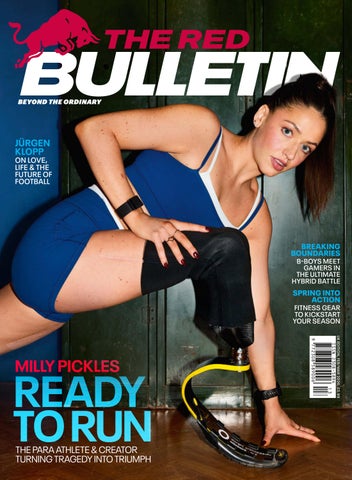
TRB FebMarch issue

Page 1


BEYOND THE ORDINARY

JÜRGEN KLOPP ON LOVE , LIFE & THE FUTURE OF FOOTBALL

READY TO RUN MILLY PICKLES

THE PARA ATHLETE & CREATOR TURNING TRAGEDY INTO TRIUMPH

BREAKING BOUNDARIES

B-BOYS MEET GAMERS IN THE ULTIMATE HYBRID BATTLE SPRING INTO ACTION FITNESS GEAR TO KICKSTART YOUR SEASON

SP 8.0
Muscle Stimulator

Peter Strain

The award-winning Belfast illustrator hand-inked our new-look last page, which features triathlete Lucy Charles-Barclay. “I love that with this series I can play with type and really focus on the likeness, the textures and shapes created by the subject’s pose,” Strain says.

Jessica Salter

A regular contributor to titles including Vogue and the FT, the lifestyle journalist interviewed Milly Pickles for this issue.

“What really surprised me was her fascination with neuroscience,” Salter says.

“She’s so knowledgeable, we could have talked for hours.”

Norman Konrad

“He has incredible charisma,” says the Berlin-based photographer of shooting Jürgen Klopp. “And he’s authentic. You see him on TV so often, it’s like you already know him. In person, he was exactly the same.”

It’s easy to assume that those accomplishing great things have it all worked out. But the stars of this issue prove that uncertainty goes hand-in-hand with achievement.

Standing on the start line of the Red Bull 400 – the world’s steepest uphill race –creator, para athlete and The Red Bulletin cover star MILLY PICKLES had no idea if she could make it to the finish. But she did know her formidable mental strength gave her a fighting chance. She tells us how her winning mindset has helped her navigate all manner of challenges, helping to inspire hundreds of thousands of followers along the way.

Then we meet ambitious German alpinist JOST KOBUSCH, who is attempting ‘the last great first’ on Everest. He knows he couldn’t currently achieve it – but he’s giving everything to become the man who can.

And we hear from football’s most charming manager, JÜRGEN KLOPP, who says he had to risk it all over and over again to shoot for the top spot, knowing a job as a cab driver awaited if he didn’t make it.

Enjoy the issue.

Milly Pickles

How a life-changing injury at the age of 20 gave the para athlete and creator a new determination to smash her goals

Isami

Kiyooka

The rising star of snowsports photography talks us through some of his favourite images

Kobusch

Meet the alpinist chasing the ‘last great first’: an ascent of Everest’s West Ridge – in winter, without bottled oxygen, alone

Jürgen Klopp

One of modern football’s greatest-ever managers tells us why optimism is the key to success, and pressure is best ignored

Moon shot
The art of snowboarding as seen through the lens of CanadianJapanese photographer Isami Kiyooka

Manama, Bahrain

Dual velocity

Things that a wingsuiter ponders during flight: wind speed, velocity, maybe mortality. One thing that Dani Román and Fred Fugen didn’t need to wonder during the Bahrain Wingsuit Project last December was, “How do I look?” (Answer: rectangular.) The windows of the Bahrain World Trade Center provided some visual feedback as they leapt from 1,200m and nailed a world-first synchronised crossing from opposite directions – at 220kph – between the twin towers, with just 10m separating the two legendary athletes. Smokin’. Watch it on Instagram: @redbullbahrain

Medina Province, Saudi Arabia

Speed of sand

Since the crack of the first starting pistol on Boxing Day 1978, the Dakar Rally has sent petrolheads of all churches – car, bike, truck –dashing across expanses of sand like a toddler that’s just spotted an ice-cream van. Pictured is the Toyota DKR GR Hilux of Seth Quintero and Andrew Short on stage 12 of the 2026 race this January. Having won the second stage, the US duo were rocked by four punctures on the third, scuppering their chances of overall victory. That went, instead, to multiple winner Nasser Al-Attiyah and co-driver Fabian Lurquin. redbull.com

Kitzbühel, Austria Pole position

It’s said that once alpine ski-racers reach their peak, it’s all downhill. Like many in his sport, Daniel Hemetsberger (pictured in training this January) has been bedevilled by setback after setback – a bloody nose from a wayward pole at Beijing 2022; potentially career-ending knee injuries – but, for the 34-year-old Austrian, the only way is up. Following a strong showing at the 2015 FIS Alpine World Ski Championships last February, Hemetsberger will hoping to boss it in all competitions this year. Instagram: @hemetsdani

Tábor, Czechia

Big reveal

Strong hands and a ladder usually suffice when removing redundant pieces of cloth. But the unveiling video for Oracle Red Bull Racing’s new RB22 car required something beyond the ordinary. Before pilot Martin Shonka’s aerobatic magic act – exceeding 310kph – came the science bit: computer modelling; extensive real-world testing, exploring suction and drag; the trial and retrial of quick-release wires and bespoke reveal sheets of various weights and sizes. Quite a project. But, as this image shows, quite a result, too. redbull.com

FIRST WATER

jORDY SMITH – TEAM O’NEILL ATHLETE – PHOTO: NATHAN LAWRENCE

Jason Williamson

Rhythms of Class

The Sleaford Mods frontman on four tracks that inspired him

He’s been a drama student, a security guard and worked at a chicken-processing plant, but Jason Williamson’s true calling was always music. In 2007, aged 36, he formed Nottingham-based electro-punk outfit Sleaford Mods – original name: That’s Shit, Try Harder – an outlet for his pent-up frustration with the music industry and the state of the nation. Joined in 2012 by instrumentalist Andrew Fearn (pictured, left, with Williamson), his raw, belligerent lyrics and Fearn’s minimal beats struck a chord in ‘broken Britain’ and beyond; they have since enjoyed UK top 10 hit albums, filled arenas and won famous fans, from Iggy Pop to Robert Downey Jr. The Demise of Planet X, the duo’s 13th studio album, is their most musically nuanced to date, featuring collaborations with the likes of reggae-soul singer Liam Bailey and grime MC Snowy – all still driven by Williamson’s characteristic acerbic wit. Here, he revisits four influential tunes… Sleaford Mods’ new album, The Demise of Planet X, is out now on Rough Trade Records; sleafordmods.com

Raekwon feat Ghostface Killah, GZA and Inspectah Deck

Guillotine (Swordz) (1995)

“This is from Raekwon’s [solo] debut album, Only Built 4 Cuban Lynx, which greatly influenced my idea of doing raps over beats. I became obsessed with it, and I think it really shaped the Sleaford Mods sound. It gave me an idea of how to go about things, how to use my voice.”

The Meteors Graveyard Stomp (1981)

“They were the original UK psychobilly band. The way P Paul Fenech sings this really did mean a lot to me; I took a lot from his vocal style. And this is where I got the inspiration for our new song Gina Was. There’s a spoken word bit at the start, then it goes into this kind of post-punk thing –that’s The Meteors.”

Guns N’Roses Out Ta Get Me (1987)

“We haven’t got guitars, and I don’t sing like Axl Rose, but the Guns N’ Roses aesthetic [massively] influenced me, and it still inspires the way I think and perform. Also, it made for the tattoos I’ve got. So, yes, this track and Guns N’ Roses were a big influence on the way I was – and still am – with Sleaford Mods. I’m a massive rock fan.”

Cherrelle with Alexander O’Neal Saturday Love (1985)

“I don’t sing in a soul-y way, but a lot of ’80s soul really did inspire me, particularly this. I’d say there’s a lot of ’80s soul that comes through in the music Andrew [Fearn] creates. I mean, I don’t often actively listen to soul nowadays, but that’s come full circle with some of the songs on the new album.”

Built for the trail. Designed to lead. Lightweight breathable running clothing for high speed, low drag pursuits

It was a museum catalogue that changed the course of Alex Kashkin’s life. The year was 2021, and Kashkin was travelling to Cambridge, Massachusetts, to start a PhD in mechanical engineering at MIT. To kill time, the art lover and amateur conservator opened their laptop to browse the collections of America’s top institutions and noticed that while hundreds of significant artworks were listed, only a fraction were on display.

“It hit me how much art they have in storage because it’s too damaged to hang,” Kashkin says. “All this art exists, but I can’t see it. As someone who loves beautiful things, I took this as a personal affront.”

An estimated 70 per cent of the art in institutional collections is considered too damaged for public view. These are the ‘ghost collections’: tens of thousands of works that – due to neglect, poor storage, fire or war – never meet public eyes, but instead sit forgotten in vaults. The reason? Restoring paintings by hand takes surgical precision, a deep knowledge of art history, and a chemist’s understanding of materials – all while ensuring the integrity of the original artwork. “A single major restoration can cost tens of thousands of dollars and take years,” Kashkin says. “All but the biggest galleries can’t afford that.”

On the train, they hatched an idea. What if all the painstaking brushwork wasn’t necessary? What if AI could make restoring ‘unaffordably damaged’ works possible? “Generative AI has helped conservators visualise restorations for years,” Kashkin says. “I thought, ‘If we can digitally repair images so easily, why not apply that physically?’” So they set about developing a chemical and mechanical framework to do exactly that. Four years and more than 140 prototypes later, it was ready.

Kashkin’s process, which has featured on the cover of science journal Nature, begins by creating a digitally restored image of the painting. Missing paint is colour-matched and

Art

This MIT-educated engineer’s AI-driven restoration process is giving damaged and overlooked masterpieces a second chance at life

filled in, with patterns rebuilt from other areas. Even entirely absent details – say, a baby’s face – can be inferred from other works by the artist.

A digital map is then made of the areas needing infill, and a custom ‘infill mask’ is printed onto an ultra-thin, multilayered film. “And, finally, that film goes over the artwork and sticks very weakly. You don’t want to take original paint with it, God no! I’d be massacred for that.”

The effect is transformative: what once took years now takes days. The method is especially valuable for artworks that aren’t ‘A-tier’, where budgets

perfect: Alex Kashkin at work; (top) AI-restored paintings, before and after

don’t allow for human restorers. “The money exists for your Botticellis and Rembrandts. The masks are great for everything else that deserves care.”

As they scale up the tech, working with cultural ministries in Italy and France, Kashkin is aware of the contentiousness of AI in art. But they see their innovation differently: “This is one of the rare cases where AI can be used fully ethically. We’re not making new art, or competing with artists; we’re helping damaged works shine again – a very noble ambition.”

Picture

Trans

Voices

Beyond the binary

By breaking with tradition, this trans+ choir have found the creative freedom to explore innovative new directions

When London’s Trans Voices choir appeared on stage with pop superstar Kesha at the Mighty Hoopla festival last June (pictured), Coda Nicolaeff knew it was a special moment. “It’s been so lovely to see how many people have seen it and said, ‘This was so meaningful,’” she says. “There’s the message part, and then there’s the fact that it sounds great because we’re great musicians.”

Alongside co-founder and co-director Ilā Kamalagharan, Nicolaeff formed Trans Voices, the UK’s first professional trans+ vocal collective, in 2022 as an offshoot of the London Contemporary Voices choir. “It came out of a need within ourselves,” Kamalagharan

says. “As we began to realise we were trans and go on that journey, it was firstly about the need for a safe space, but also the need to explore the voice in a different way, to start this new community and birth a new methodology for using the voice and creating music.”

In embracing and celebrating the unique textural and tonal qualities that can accompany medical transition and changes in physiology, Trans Voices also recognises that the lived experiences of its members have shaped their voices and how they use them: “You can’t really make art and it not [relate to] who you are as a person,” Kamalagharan says. “I suppose the difference is that who we are as people is so politicised.”

can be a challenge artistically because it also removes the division between composer and performer… That leads to some really interesting things.”

While the choir have performed at conventional venues such as Kew Gardens, the Royal Opera House and Tate Britain, their innovative approach has also allowed for greater creative freedom –particularly in electronic music, which is “much more fluid and accepting. It’s where the weirdos, those on the fringes, often end up”. Trans Voices’ most recent collaboration was the boundary-pushing UN/ BOUND, a holographic choral soundscape installation at the Barbican last summer.

Ultimately, Kamalagharan says, “There’s an optimistic nihilism that comes with intersections. I’m never going to be seen as an equal, not in my lifetime, so I might as well do whatever I want. That comes with a great sense of freedom and joy, even though it’s tinged with bitterness… But I don’t really try to fit into those boxes any more.”

In Trans Voices, the strictly gendered categorisations of traditional choral spaces are dissembled. “We don’t tend to assign voice parts in that way. The central tenet is to remove those associations and just be people singing together wherever feels comfortable. The way we’ve done that is through improvisation, which transvoices.co.uk

On song: Trans Voices co-founders Ilā Kamalagharan (left) and Coda Nicolaeff; (top) the choir on stage with Kesha at Mighty Hoopla

Claire Wyatt was 22 when she first read Full Tilt, adventure cyclist Dervla Murphy’s account of her epic solo bike ride from Ireland to India in 1963. “When I finished the book, I just thought, ‘Wow, what a woman,’” Wyatt recalls. “She’s so grounded, funny and resilient. Her story settled into my bones.” The most resonant line: “Being alone is essential to an important journey.”

Claire was already a keen cyclist, having completed longdistance rides in Central America and South-east Asia. But those trips, in two of the world’s most populous regions, simply proved that being by yourself isn’t the same as being truly alone. “I wanted to see what it was like to stand on a plain with horizons stretching off in every direction, to hear the kind of silence you only get when the nearest person is a hundred miles away.”

So, to Australia she went, with just a bike, a tent, two panniers and a copy of Full Tilt for company. “Murphy took a revolver for emergencies,” notes Wyatt, “but I thought it best not to do that. So I took a bike computer and my phone.”

The 14,000km trip was exhausting, exhilarating and beautifully lonely. The distances were staggering; she’d go days without encountering another human. “I think part of my desire came from my childhood,” says Wyatt, 29. “I’m the youngest of five, so home was noisy. My parents separated when I was young, and I was a bit reckless in my early twenties. Maybe this was my way of taking control.” But even exploring the Outback didn’t scratch the itch: “I always wanted to follow in Murphy’s tracks. Mongolia to London was the dream.”

Wyatt returned to work, saved £6,000 and, in August 2024, embarked on that epic 17,000km journey. “When I told people I was cycling home from Mongolia as a solo female, they all asked, ‘Is it safe?’ But the fears others projected onto me simply didn’t materialise. The

Roam alone

Tired of all the noise in her life, Claire Wyatt got on her bike and went of in search of solitude

Free wheeling: cyclist Claire Wyatt experienced many of the world’s wonders from her saddle

countries they feared the most were, instead, the kindest.”

That’s not to say the journey wasn’t “brutal”: she tackled Central Asia’s Pamir Highway and faced the harsh Tajikistani winter with its -20°C nights. But it was also “magical and rich with human connection”.

In Mongolia’s Orkhon Valley, a local dog refused to leave her side for 120km, through 15 river crossings. When she was desperate for warmth, families welcomed her into their yurts.

The journey took just under a year, which included three snowbound weeks in Georgia.

“I ended up in hospital for three

weeks when I flew home for Christmas. I think my stomach, which was used to the bland diet of the ’Stans, couldn’t cope with an English Christmas meal.”

Now based in the Lake District, Wyatt is, for the time being, swapping yearlong epics for ultra races. She wants to translate her experiences into education, encouraging young people to embrace their “wild, crazy side”. Her ultimate message: let go of fear.

“Travel is a privilege,” she says. “When you open yourself up to the world, the kindness you let in is just… incredible.”

Exploring By Bicycle

Live and jet fly

A longtime fan of James Bond-style gadgets, this product designer has created an underwater device any agent would be proud of

The scene that first got Archie O’Brien hooked on James Bond was the opening sequence of 1999’s The World Is Not Enough, where Pierce Brosnan leaps into a jet-powered boat and bursts through the side of MI6 HQ and into the Thames. But it wasn’t 007 himself that caught O’Brien’s eye. “I was always into the Q Branch technology,” he says. “I just thought it was so cool that they could make anything they wanted as long as they had the ideas.”

Almost 20 years later, in 2017, while studying industrial and product design at

Loughborough University, O’Brien began to work on his own Q-style gadget. “I knew it had to be sport-related,” says the Surrey-based 28-year-old, who admits to being “pretty obsessed with making things”. “I knew it had to be high adrenaline, something fun. And it had to be something that didn’t already exist.” Keen to build on his love of freediving, O’Brien set about developing the CudaJet, the world’s first underwater jetpack. And while it might resemble the kind of tech that Bond would use, the device’s creator references superhero

movies when describing the experience of speeding through the water: “You’ve got Superman, you’ve got Iron Man… It actually feels like flying. That’s the best way to describe it.”

Worn like a backpack on a neoprene harness, and relatively lightweight at just 14kg, CudaJet is initiated using a handheld trigger that engages its patented underwater propulsion system. While the swimmer controls the direction with their body movement, the jetpack thrusts them forward at speeds of up to 3m per second, exerting a drag force “comparable to flying through the air at more than 180 miles per hour [290kph]”.

The device is powered by lithium batteries that provide up to 90 minutes of underwater exploring, and O’Brien says most people can pick up the basics in less than five minutes; the only additional equipment needed is a diving mask that covers the nose. Although the CudaJet is operational to a depth of 40m, it features a safety limit of 3m, at which point the power will switch off and the pack will act as a buoyancy device to bring the user back to the surface.

While he’s aware of interest from underwater camera operators and marine researchers, as well as its potential for lifesaving and rescue missions in the future, O’Brien says that, for now, the CudaJet – made to order at a price of £22,500 – is meant for leisure only: “It’s the ultimate superyacht toy.”

Using the jetpack is “addictive”, O’Brien says. “It’s unlike anything else. People don’t want to give it back to you once they’ve tried it. It’s a sensory overload when you first start, but then, once you get used to it, you can calm down and take in what’s around you. You get to explore places you’ve never explored before.”

Creative surge: Archie O’Brien, founder and CEO of CudaJet Ltd; (top) his aquatic jetpack cudajet.com

CudaJet

Damien Gabet

The debonair travel writer and committed litter picker is on a mission to reconnect us with the wonders of the countryside

A blush-pink suit proved not to be the ideal outfit for Damien Gabet’s 1,000-mile [160km] cycle tour of the UK – especially when towing a heavy trailer to store the litter he was collecting along the way. “It quite quickly got to the point where the chafe-age and bum bruising precluded me from wearing a suit,” says the 41-year-old.

Cycling shorts it was, then. Still, the writer and adventure-seeker kept the suit in his pannier, to dress up for the interviews he recorded with people along the way, highlighting our litter-strewn countryside and raising money and awareness for the non-profit organisation Trash Free Trails. Over the course of the 22-day challenge last August – which saw Gabet travel the length of the country, along a plasticbottle-shaped route starting from his home in Margate, Kent – he collected around 2,500 discarded cans and bottles.

The Paris-born, Worcestershire-raised journalist has long embraced fun stunts – he’s reported on a hair-freezing contest in Canada and the World Heavy Metal Knitting Championships in Finland – but his experience of trespassing to swim in a lake on a private estate during the pandemic gave him an activist edge. Last year, Gabet walked 500 miles from Hastings in East Sussex to Gretna Green, close to the England-Scotland border, trespassing and wild camping on private land to show how much of the English countryside is locked away, and to raise money for the campaign group Right to Roam. The abundance of litter he encountered along the way then set him on his latest mission.

But even when tackling serious issues, Gabet brings his chaotic charm, sense of silliness and outlandish wardrobe. “I’m full to the brim with bad ideas, and there’s never any preparation,” he says. “Part of that is deliberate, because it’ll make for a more

dramatic yarn. But also I’ve got weaponsgrade ADHD, so preparation and planning is not my strong suit. I’m more desperately impulsive, childish, let’s-just-go-and-do-it. I think I’m forever chasing un-boring.”

Gabet is already planning this year’s adventure, which may include some bog snorkelling. He’ll probably pack a suit.

the red bulletin: What were the biggest challenges on your cycle tour? damien gabet: Cycling 50 miles a day for 22 days is challenging, but it’s not hideous. The major issue was lugging around this ultra-heavy, custom-made trailer I called Trisha the Trasher. It had to be big enough to store 500 bottles, which then incurred a weight penalty. The minute you start going up hills, it’s brutal. I’d done no training whatsoever. On top of that, I got so many punctures on the back tyres, which weren’t built for off-roading or difficult terrain. I’d be on single tracks through woods, and on dirty A-roads in the gulley – that’s where all the trash is, as well as pieces of glass and metal. And halfway round I snapped my rear brake; I only had one brake through Scotland and the North York Moors.

Did you perfect your litter picking? My favourite technique would be to slow down when I saw a bottle, and then – bang – grab it with the litter picker, pivot round and drop it into the trailer. I became obsessed. Every time you pick up a bottle, a small amount of dopamine is released, and that gets somewhat addictive.

Were you wild camping again? I was. What I’ve realised through these challenges is that there’s never not a place to put a one-man tent and a bicycle; there are tiny pockets of nature just dotted around the place. I turned up in one town and found this tree-covered sandy area, like a little beach by a river. I was like, “This is as good as it gets – the sun is shining, I’m surrounded by nature, I’m going to go for a

dip in the river and, importantly, it’s free.” I’m really a nature-divorced townie, which is part of the reason I challenge myself to do these things, because I don’t really know the countryside. Why don’t I? How is that OK? Let’s get out there. If I – a white, English-sounding male – don’t feel like I belong in the countryside, what do other, less-privileged demographics think? That’s an interesting line of inquiry for me.

What has wild camping taught you? There’s something about access and the right to roam that so elegantly relates to so many other issues: the sense of belonging, nature, connectedness, health, wealth disparity. Why are we not allowed to do it? There must be a future where people have greater access to nature. Obviously it has to be done in a responsible way – there are so many of us who disrespect those spaces because they’re not ours. But imagine if we felt [an ownership] where we’re taking care of nature and engaging with it. There are vast swathes of the countryside we never see. I’ve been there, without permission – in the most polite and amiable way possible – and they’re wonderful. As a travel writer, flying long distances on a carbon-heavy plane to go and extract pleasure is feeling less and less palatable. So what’s on our doorstep? The answer is: there’s loads, and it has the potential to be exciting if you break the rules. I’ve also found that if you do some litter picking, someone who wasn’t happy about you being on a piece of land will go, “Oh, all right, then.”

Donate: justgiving.com/crowdfunding/lucrusade

Go like Gabet: his five top travel tips

Protect serendipity

“It’s the invisible engine of memorable travel, and phones are killing it. Avoid tech.”

Find your ‘embassy’ when you arrive somewhere “For me, it’s rock bars.”

Overpack

“There’s nothing more dispiriting than wearing the same shirt again and again.”

Actively avoid ‘the sights’

“Overtourism ruins the lives of locals, so do your bit to mitigate the impact.”

Strictly limit yourself to five photos a day

“Then have them printed when you return home.”

“I’m full of bad ideas… I think I’m forever chasing un-boring”

Davina Perrin

Still in her teens, the Warwickshire and England Under-19s cricketer is already proving she’s destined for the top of her sport

Sometimes a sportsperson emerges with the kind of potential you just can’t ignore. Then they hammer home their promise with a mind-blowing feat. Cricketer Davina Perrin’s 42-ball century for the Northern Superchargers in The Hundred last season was the innings of summer 2025, and the fastest by an English woman in T20 cricket.

The 19-year-old from Wolverhampton is already being touted as one of the most exciting young female players in global cricket – and a game-changer for her sport in the UK. Ahead of the new season, Perrin talks lie-ins, throwdowns and levelling up…

the red bulletin: You’ve come so far, and yet you’re still only 19. Have you had to grow up fast in your sport?

davina perrin: Definitely. When you’re always playing with or against people older than you, the chances of failing are higher, but that’s the quickest way to learn. I’ve been fortunate that coaches have pushed me without treating me like a kid who ‘has loads of time’. They expected standards, and that helped me to grow up fast. I’ve had to constantly adjust, constantly learn, and keep up.

Let’s talk about that innings in The Hundred last season: 101 from 42 balls. Did it feel like a defining moment? In hindsight, probably. At the time? Not at all. I’d actually had a mini dry patch, two or three innings that just weren’t right. The day before the Eliminator, [Northern Superchargers head coach] Lisa Keightley took me for a walk around the boundary for a chat. I was thinking, “She’s not going to drop me for our biggest game of the tournament, is she?” We weren’t talking technique, though;

she was talking about body language, energy, standing tall, being present. It made me feel seen and appreciated. Something clicked mentally. It was like, “Relax. You can still contribute. You’re good enough.”

So did you wake on the morning of the match fired up and ready to go? I slept through my alarm and missed breakfast! I had to rush into Tesco Express and buy a Nutella B-ready [bar] – not exactly elite fuelling. At that point, it didn’t feel like a century was coming; I just hoped I wouldn’t make things any worse. I’m normally terrible at lie-ins, but maybe my body was asking for it. Sometimes the most professional thing you can do is sleep –though you should probably just press snooze, not totally turn off your alarm.

How did you feel going out to bat?

I wasn’t thinking, “I’m in, I’m flowing.” It was more like, “That ball looked OK. Next one…” I’d watched some of Harry Brook’s [the England cricketer whose own Hundred century broke records in 2023] batting earlier and saw how he accessed certain shots. Maybe that influenced my mindset. The whole innings still feels like a blur. I don’t remember being at the crease, not properly. The only crystal-clear moment is turning to hug my teammate after reaching the century. It was surreal, nearly 30,000 people standing and clapping. I’d never experienced anything like that.

How do you deal with pressure?

Cricket is probably one of the world’s most humbling sports. I don’t beat myself up much. I focus on shortening the gap between being out of form and being back in it. And when I’m in form, I cash in.

Have your family supported your career choice?

Massively. My dad played a bit himself when he was younger, but he wasn’t allowed to introduce me to cricket because my mum

was fed up with him being gone every weekend! When my sister started playing, he’d take her to the local club, so I tagged along. Since then, he’s been everything: taxi driver, throw-downs machine, tea maker – his sandwiches are questionable, but he tries – and my biggest supporter.

Women’s cricket has exploded in the last decade. Have you arrived at the perfect moment?

Definitely. Just in the last year, the growth has been unbelievable. The standard across the board has jumped; the investment is finally showing. Having proper facilities matters, too. Being based at Edgbaston, with a high-performance hub, is a gamechanger. Good wickets matter. Home advantage matters. Playing The Hundred on world-class pitches is why innings like mine are even possible.

Cricket is still overwhelmingly associated with white men. Do you feel a responsibility to be a role model for young Black girls entering the sport? Absolutely. It’s important for me to perform – that’s how you put yourself on the map. But it’s also important to show kids that cricket isn’t just old men in white clothes, standing in a field all day. It’s fast, exciting, explosive – it’s for everyone. If a young Black girl sees me and thinks, “Oh, I can do that – cricket is for people like me,” that matters more than any Hundred. Representation opens the door; performance keeps it open. Instagram: @dav.perrin

Smash hit: Perrin’s career so far in numbers 15

Her age in 2022 when she became the youngest-ever player to be picked in the draft for The Hundred.

2

Perrin’s place in last season’s T20 Blast run-scoring charts as her Warwickshire team made it through to Finals Day.

176

The number of runs Perrin notched up at the 2025 Women’s Under-19 World Cup, finishing as England’s top batter and earning a place in the Team of the Tournament.

3

When Perrin signed her first professional contract – with Central Sparks in 2022 – she became only the third Black female pro cricketer in the English game.

“Representation opens the door; performance keeps it open”

Adekunle Gold

The high-flying, internationally acclaimed Nigerian pop star on how he made it big against the odds

It’s a cold November night when Adekunle Gold takes to the stage of the Royal Festival Hall with a full orchestra for the final day of the London Jazz Festival, but inside the atmosphere is pure sunshine. The crowd, full of Nigerians dressed to the nines, sing along, dance, and shout out responses as the Lagos-born superstar calls out affirmations. “I will go higher!” he exclaims. “I will fulfil my purpose! I deserve love!”

Such positivity is typical of the 39-yearold singer and songwriter, who has spent the last decade building an international fanbase with his fusion of global pop and West African genres such as fújì and highlife. Gold has released six critically acclaimed albums – including his latest, Fuji – collected more than nine million Instagram followers and a stack of Nigerian music awards, and collaborated with icons including Pharrell Williams, Nile Rodgers and his own wife, Afropop superstar Simi.

Getting here hasn’t been an easy ride: Gold – born Adekunle Almoruf Kosoko – grew up in a small town in Lagos State with sickle cell disease, a painful, inherited condition that can make physical exertion difficult. Despite this, and the stigma associated with the disease in Nigeria, Gold has manifested dream after dream. Having started out as a teenager singing in a church choir, then tried out unsuccessfully for talent shows, his breakthrough came in 2015 with Sade, a highlife take on One Direction’s Story of My Life – and he hasn’t looked back.

Ahead of this month’s MOBO Awards, where Gold is nominated for Best African Music Act, he chats to The Red Bulletin about the obstacles he’s faced, and how he’s smashed through them…

the red bulletin: What’s the reason behind your latest album’s title, Fuji? adekunle gold: Fújì is one of the oldest sounds from Nigeria. It was created in the 1960s from a sound called wéré, which is Islamic devotional music that’s sung during Ramadan. It’s now the soundtrack of Lagos, played in the streets, at parties, in the home. I grew up on fújì and highlife; I thought it was time to pay homage.

How did it feel bringing your sound to the Royal Festival Hall?

It’s been months of planning, starting with rehearsals in America, and the vibe from start to finish was incredible. I’m blessed.

Do you feel connected to the music scene in London?

London is where I had my first headline show, in 2017. London has been a huge part of my music, and it embraced me right from the beginning. There’s a lot of [Nigerians] living in London and missing home, and because my music is authentic and I speak my language, people really gravitate towards me.

There’s another UK link: your career took off with a One Direction cover. How did that come about?

I was sitting in traffic when that song came on the radio, and I happened to record a version on my phone. The next year, I lost my job as a brand developer and decided to give music a real try. I dropped the cover [on streaming platforms] as a single. Two weeks later, it blew up, I got signed, and I’m here now. It changed my life. God bless Simon Cowell.

Did any of the 1D members get in touch? I was scared as shit they’d sue me, but nobody came for me.

What did sudden success feel like?

I’m just a boy from a very small town in Lagos. When I was growing up, people

around me didn’t dream about this type of life. My parents were teachers; I didn’t grow up in affluence. But I always knew that I was meant for something else.

Was it hard to maintain that self-belief growing up with sickle cell disease?

All my life, I’ve had to fight for everything. Sickle cell is a genetic disorder that affects your oxygen levels and causes constant pain. There’s no cure; you can only manage it. It can make you feel like you’re worthy of nothing. You can’t even get a job – people look at you like you’re soon going to die. That’s why I started a foundation that does outreaches to people with sickle cell in Lagos, giving free drugs, psychotherapy and blood transfusions. I’m grateful to be able to speak boldly about [the condition] and give hope to people living with it.

Did you meet your wife through music? No, I sent Simi a message on Facebook, like, “Yo, I’m a huge fan. I love your work.” She never replied, but I met her after a show in Lagos, and we became friends. I was like, “I think I want to do life with her.”

What’s your recipe for a good life?

In 2020, I began reading books. I thought, “Damn, imagine the world of greatness that I’ve missed.” The best wisdom of the world is kept in books. I’ve also started watching classic movies I missed out on as a child, like The Godfather. I’m just living life, spending time with my family, still working, still learning… always learning. Instagram: @adekunlegold

Gold standard: four of his musical influences

King Sunny Adé

“The second look I wore on stage in London was a homage to legendary Nigerian artists like him and Ebenezer Obey.”

Maroon Five

“Overexposed was the first album I bought on iTunes, in 2012. I can sing that album word for word.”

Beyonce

“I went to ‘Beychella’. If you only saw it on TV, I’m sorry for you. Beyonce’s my absolute idol.”

Simi

“My wife is an incredible superstar and one of my favourite songwriters. When I write songs, I send them to her. I’m grateful that I have another creative in my house.”

“Where I grew up, people didn’t dream about this type of life”

When Milly Pickles lost part of her leg following a horrific accident, she says she knew she would go running again. What she didn’t know was the crucial part it would play in shaping her new life

THE LONG RUN

Words Jessica Salter
Photography Neil Gavin
Train time: runner Milly Pickles, photographed for The Red Bulletin in east London in January this year

oments before she became, in 2023, the first amputee athlete ever to complete in the Red Bull 400 – the world’s toughest and steepest 400m race – Milly Pickles was, she admits, “a hot mess. I looked up the hill and it was so steep, and I just didn’t know if my body could handle it. I found it unbelievably scary”.

It had been a tough year for the athlete, content creator, presenter and disability campaigner. A cut on her leg that refused to heal had left her unable to walk for three months, never mind run, and she’d only signed up for the race three weeks earlier, slightly on a whim. On top of that, Pickles’ boyfriend, Liam – an extremely fit and able-bodied online fitness coach – had just run it and was in a bad way, unable to even talk. “I thought, ‘I’ve got

“IT NEVER OCCURRED TO ME THAT I WOULDN’T EVER RUN AGAIN”

one leg, three toes, and I’ve been unable to even walk for months – what on earth am I about to do?’” she recalls.

But a gruelling 17 minutes and 26 seconds later she had, unbelievably, done it. She was on an instant high. “Achieving something I never thought physically possible just gave me so much confidence to think I can actually do crazy, difficult things,” she says. “After that, I was on a hunt to find something else to push me further.”

Pickles is no stranger to seemingly impossible challenges. When she first got back into running after her accident in 2017 that resulted in the loss of part of her right leg, she told herself that learning to run on a prosthetic blade “was an exciting new challenge”. She spent two years doggedly practising 100m sprints, with an eye on perhaps making the Paralympics team.

After falling out of running for a spell, August 2023 saw Pickles sign up for her Red Bull 400 debut the following month. She followed it with two marathons, despite never having run long-distance on her blade before, and in October last year she returned to complete another Red Bull 400 in just over 10 minutes.

“The way I think about these things is that I might not have the body that can absolutely smash this – I don’t even really

Pushing the limits: “Achieving something I never thought physically possible [the Red Bull 400] gave me so much confidence to think I can actually do crazy, difficult things”

“I JUST WANT TO TAKE OWNERSHIP OF WHO I AM, AND MY STORY”

know if I can actually physically do it –but I have an incredibly strong mindset that always carries me through,” she says. “Your mind is so powerful, it might even take you 95 per cent of the way there.”

This incredible mental ability has become Pickles’ superpower. But each challenge has left her physically wiped out, due to the extra energy it takes an amputee to take on such feats – studies show increases from 25 per cent to more than 75 per cent – and the raw pain of her amputated leg rubbing in its prosthetic socket. On top of that, she has ADHD and finds huge events overstimulating. “I’ve got the double whammy of being neurodivergent and an amputee. So, as soon as I finish, my body just shuts off.”

Late last year, she recognised she was on the brink of burnout. It wasn’t just the gruelling training, but the emotional toll of her ever-online life, which includes the many messages she receives from people sharing their own traumatic experiences. “I feel touched that my DMs are a safe space for people to open up,” Pickles says. “But I was in such a burnt-out state that even the most positive elements of my online experience felt like a lot to handle.” Realising she needed a break, she listened to what her body was telling her and, at the end of November, committed to taking two months off all work.

The Red Bulletin catches up with Pickles at a photographer’s studio in east London on a freezing January day, one of her first days back post-break. Switching off was essential, she says, but hard. “For the first week, I replaced Instagram with digitising my entire wardrobe, which has actually been amazingly useful,” she laughs. Slowly, she settled into a gentler pace of life at home in London with Liam and relished the rest and recuperation.

In person, Pickles is fun, charming and game for anything the photographer suggests, even running down a street in tiny shorts and a crop top on a day that threatens snow. About to turn 29, she’s in a reflective mood. Her twenties have been run at a frenetic pace, largely defined by an accident at their start, and how she reshaped her life afterwards.

As she approaches her thirties, Pickles feels she needs a shift. “I’ve changed so much as an individual, and I feel like I’m outgrowing who I was,” she says. But she also knows her story is compelling –and an inherent part of the Milly Pickles who sits here today.

In 2017, she was a marketing student at Bournemouth University, undertaking a highly competitive placement at Chelsea

Turning point: Pickles, aged 20, in hospital in 2017, following the devastating accident that ended up costing her part of her right leg

IT’S HARD TO COMPREHEND THE MENTAL STRENGTH SHE POSSESSES.

Football Club. Driven and ambitious, the then 20-year-old knew she wanted to be “a leader in something, a CEO.” That morning, her mother had called to say she was worried about her, though she couldn’t explain why. Pickles reassured her she was fine and would soon be back home in her native Hertfordshire.

Devastatingly, her mother’s apprehension was justified: later that day, Pickles suffered a catastrophic electrocution of such high voltage that doctors were surprised she survived. “My occupational therapist looked at my notes and said that people who have that level of electricity usually die,” she recounts.

The details of the accident are something that, publicly, Pickles hasn’t gone into. “I do want to at some point, but I need more space than an Instagram caption, and it still doesn’t all make sense yet,” she says. She was rushed to hospital, where surgeons spent two weeks operating, cutting away dead tissue and muscle in an attempt to save her legs. All the while, she still had electricity coursing through her body – “it doesn’t leave for weeks” – and was in constant agony.

Eventually, Pickles took control: “I remember one moment looking down at my leg, and it wasn’t even a leg – there was hardly anything there. I just thought, ‘There’s no way they’re going to be able to keep this – we have to amputate.’” The surgeons attempted to talk her through the options. “I just interrupted and said, ‘I don’t want to waste any more time – it has to go.’” Her first thought after making the decision, which she shared with her shellshocked mother: “That means I can compete in the Paralympics.”

It’s hard to comprehend the mental strength that Pickles possesses. That fortitude has always been there, she says, but it was crystallised by the accident. When she first looked down at her missing leg post-surgery, there was no sense of disconnection. What she struggled with more was hair loss caused by the shock of the accident or the drugs. “It was about feeling feminine and attractive, which I know sounds silly, but I’d just gone through this awful thing and was dealing with it well – and then this was there to kick me down.”

Interestingly, Pickles says she struggles more with body image now, with her life so entwined with social media, than she did after the accident. “That’s another thing I’ve noticed coming back from my break: just how quickly you start to subtly compare yourself again. We all do it, and it’s so bad for us.” Her solution is a negative journal, in which she writes down

“YOUR MIND IS POWERFUL; IT CAN TAKE YOU 95 PER CENT OF THE WAY”

unkind thoughts. “When you read them back, you realise you wouldn’t talk to a friend like that.”

Pickles was discharged from hospital in December 2017. A month later, on January 18, she was fitted with her first prosthetic leg. Weeks later, she took herself to the gym. Although she’d been a fiercely sporty child, competing in netball, lacrosse, athletics and cross-country, and had run regularly as an adult, she’d never set foot in a gym – apart from, ironically, her first group class the night before her accident. Now she was going for the first time, in a wheelchair. “I was really scared because I didn’t have a clue what to do. I was so weak, I couldn’t even leg- press 10kg.” The trainers had never coached an amputee before, but “they were keen to learn with me”. As with everything, Pickles threw herself into training; her leg-press PB is now 300kg.

What makes Pickles’ journey especially compelling is that alongside her relentless drive – “It never occurred to me that I wouldn’t ever run again” – she’s honest about her lows. “I try to show the realistic side of things as well,” she says. This honesty was the impetus behind her first Instagram post, on January 2, 2018, showing her in hospital. She’d searched online for other “people like me” and found almost none – except one. “This amazing, glamorous Brazilian woman who had a really sparkly glittery [prosthetic] legs gave me hope,” she says. “I was worrying that no one would ever fancy me again. She helped show me that you can dress it cool and look pretty.”

So Pickles has become ‘that person’ for other amputees. Over time, she shared the full spectrum of her life –GRWM videos, falling in love, holidays, her sister’s wedding, learning to DJ –while avoiding turning her experiences into “a highlights reel”. Her combined social-media following has grown to more than 750K. The point of it all, Pickles says, is to help others. “If I can be of use to anyone else who’s struggling and give them hope, it’s what I was meant to do.” It’s why she believes her accident “was meant to happen to me. I’m strong enough to deal with this”. It’s tempting to call her inspirational, but she’s increasingly wary of the

Personal bests: (clockwise from top) running the 2025 London Marathon; her Red Bull 400 breakthrough in 2023; a medal winner on her return in 2025; her Marathon debut in 2024

MILLY’S SPORTING MILESTONES

JANUARY 2018

Enters a gym for the first time

NOVEMBER 2020

Learns to run on a blade

MARCH 2022

Leg-press PB: 300kg

SEPTEMBER 2023

Becomes the first amputee athlete to compete in the Red Bull 400

APRIL 2024

Runs her first London Marathon, accompanied by boyfriend Liam, despite having only completed half the distance in training

APRIL 2025

Takes part in her second London Marathon, this time unaccompanied

SEPTEMBER 2025

Competes in the Red Bull 400 for a second time and completes it in just over 10 minutes, shaving seven minutes off her previous PB

“IF I CAN GIVE OTHERS HOPE, IT’S WHAT I WAS MEANT TO DO”

word. “It’s a very tricky one,” she says. “Many disabled people are offended by it. While I haven’t been, and I understand why people [use that word], I sometimes find it uncomfortable. I’m just doing me; I’m not trying to do anything different.”  Despite the ordeal of the accident and what has been an arduous road to recovery since 2017, Pickles says it’s the last year that has been the “hardest of my life, tougher than running a marathon or losing a leg. It’s about confronting who I truly am”. She’s embarked on a course of therapy – Eye Movement Desensitisation and Reprocessing (EMDR) – developed to access traumatic memories, process the complex emotions involved, and enable those affected to move on with their life. “I just want to take ownership of who I am and my story,” Pickles says. But the therapy has taken her to other places, too. “It goes straight into your subconscious mind, and it brings up things you’re not even aware of. It’s crazy that the subconscious mind dictates

ALONGSIDE HER RELENTLESS DRIVE, SHE’S HONEST ABOUT HER LOWS

everything that we do. People beat themselves up about why they’re a certain way, and it comes down to the way you’ve been conditioned, or a trauma you’ve experienced – maybe even one that your parents experienced and passed on to you. It’s fascinating, but painful.”

This year, the last of her thirties, is one to really get to the bottom of things: “It’ll be hard, but I think it’s so important to correct what I can now, rather than taking anything self-limiting into the rest of my life.” Armed with new understanding, Pickles feels it’s the right time to write a book about her experiences. And she’s considering applying for a master’s degree in psychology and neuroscience

of mental health, thanks to her new fascination with the power of the mind. “I’d love to take my work on, to get a proper scientific understanding and perhaps one day become a psychologist and help others.”

For her own mental health, Pickles goes running, which she says has been life-changing. “Running helps me regulate everything mentally. If I’m anxious, overwhelmed, stuck in my head or just feeling a bit off, getting outside and moving changes my mood almost instantly. It also gives me one of the only moments where my brain goes quiet –which is rare for me because I’m ADHD and my mind is always on!”

Pickles has committed to running every day this year, and she makes sure to head out whatever the weather, even if she’s not in the mood. Especially if she’s not in the mood. “It’s not about pace or distance; it’s about showing up. Having a reason to get up and go outside shifts everything – it changes my perspective and makes the rest of the day feel more manageable. I enjoy running, don’t get me wrong, but I don’t enjoy every run. Some days my legs feel heavy, or everything just feels harder than usual, which is so normal. But what never waivers is how proud I feel afterwards about the fact I’ve shown up for myself.

“So many people say, ‘I’m not a runner.’ But there’s no such thing as not being a runner: if you can run, you can run. I often find that people aren’t held back by their bodies but by what they’ve decided is true about themselves.”

It’s this understanding that has prevented Pickles from limiting her own aspirations since her accident, though she freely admits she’s still figuring it all out. “I’m in a transition phase. I need to work out how to move into this new area, keeping up the things I love and working on my boundaries.” More big sporting challenges are not off the cards: she floats the idea of an Ironman and could, one day, be part of a Paralympic squad, if the stars align. But she’s also listening to her body. “There must be a balance between pushing myself and doing hard things – which I absolutely love – and doing them sustainably so my body isn’t in a permanent state of stress.”

It may be less Instagrammable than her most headline-grabbing feats, but the slower, consistent achievement of showing up for her daily runs feels more important to Pickles – even if some days it’s just 1km to shake off the cobwebs. It’s not about scoring likes, she says, it’s about “collecting happiness moments”.

TRICK

Hokkaido, Japan

March 2025

Kiyooka: “I’m Japanese by ethnicity, but I was born and raised in Vancouver, Canada. I hadn’t been back to Japan in 12 years before this trip, and it was the first time I’d ever snowboarded and shot there. [The visit] was monumental for me. It reconnected me with my culture and showed this career path was really beginning to pay off.”

AITO ITO, SNOWBOARDER

ADEL TALYSPAYEVA, SNOWBOARDER

North Vancouver, Canada

January 2024

“This is a night shoot I did after a pretty heavy snow day in the area where Adel and I live. I call Adel my aunt – she’s like family to me. Two years ago my mom passed away, and friends like Adel, who I met through snowboarding, really stepped up in my life. This image ended up being blown up in the window of a snowboard shop that she was sponsored by –her first-ever window display. Being able to show Adel my appreciation with this shot really meant a lot to me.”

SHOTS

A rising star on the snowsports scene, photographer Isami Kiyooka’s creative images are a personal ode to the culture

Canadian-Japanese photographer Isami Kiyooka sums up his lifestyle simply: “I’m just always chasing the snow.”

Last year, he was away from his home in Vancouver for more than 300 days. That summer, after back-to-back trips to Japan, New Zealand and Chile, he was so busy he almost missed his 21st. “I completely forgot,” he laughs. “I woke up on the way to Santiago and said, ‘I think it’s my birthday.’”

For Kiyooka (pictured below), this nomadic lifestyle is the dream. With a job that combines his passions for photography, snowsports and art, his days are spent shooting the world’s best winter athletes in his own unique style. “To me, snowboarding is a lot more artistic than other sports,” Kiyooka says. “I want to shine a new light on this amazing sport and culture, to show it in the way I think it should be.”

He was already an arty kid when he fell in love with snowboarding on his home mountains at the age of 10. Snowboard magazines inspired an interest in graphic design, and at 15 Kiyooka began taking his own photographs using a little Canon point-and-shoot that belonged to his mother. “I remember my first time shooting, up on Mount Seymour. I was super-shy, super-nervous around these grown-up snowboarders. But the entire crew was really encouraging. Being a really quiet kid, from that moment I realised photography could be a form of personal expression, a way to communicate without vocalising.”

Kiyooka has since built his life around shooting snowsports. On leaving high school, he worked odd jobs in snowboard shops and at Snowboard Canada magazine; he’s now one of Team USA’s official photographers, shooting worldwide for brands and publications, supported by a community of ’boarders who are friends as well as photographic subjects. “To me, doing this is the most fun thing ever,” Kiyooka says. “Since day one, I’ve loved to take photos that express my thoughts and complexities – and that make others feel happy.”

ALESSANDRO BARBERI, SNOWBOARDER

Mammoth Lakes, California, USA May 2025

“This was the last shoot of the season. I’d been home maybe 10 days all winter –bouncing between Sweden, Switzerland, Austria, Japan, the US, England and China – so May became my reset. I drove down to California with no real plan except to breathe a bit, sleep in my car, and make work just for myself. After 26 hours on the road and a few days wandering around LA, I ended up in Mammoth, shooting pipe –and I got this. It’s an in-camera multiple exposure that works nicely.”

El Colorado, Chile

August 2025

“This was taken on a three-day shoot for the US Alpine Ski Team, and it was my first time shooting alpine – pretty different to snowboarding, and really fun. The weather wasn’t working for us – so many things were going wrong – but we got an hour of good sunlight at the end of the day and I was able to capture this shot. This was the day after my 21st birthday. After I remembered on the plane into Chile, I bought a doughnut from Dunkin Donuts at the airport to celebrate.”

TRICIA MANGAN, ALPINE SKI-RACER

Aspen, Colorado, USA

February 2025

“People always ask why I don’t just use Photoshop [effects] instead of doing it in-camera. But the true soul of an image comes from building it for real, letting the mistakes, the texture, sit in the frame. For this shot, taken during the Grand Prix, I put snow directly on my lens and kept shifting it around until it moved the way I wanted. It was messy and annoying, but the depth it gives the photo is worth every second.”

VEDA HALLEN, SNOWBOARDER

Stockholm, Sweden, October 2024

“This was taken at a really fun competition, the DIYX STRT Jam. It was my second year photographing the event. The previous year, I’d paid for my flights out of my own pocket as I was so keen to prove myself – I was just a 19-year-old kid showing up in Europe to take photos. But I shot a phenomenal image that got me invited back. Here, all the crowd’s attention is on Veda, recording her from different angles. That’s kind of how I felt on this trip, too – people had begun acknowledging my work.”

BROOKLYN DEPRIEST, SNOWBOARDER

Corvatsch, Switzerland

October 2025

“I wasn’t supposed to be in Corvatsch, where I took this shot. I’d just been on a five-week trip with the US Snowboard Team in Europe, and I asked if I could stay longer. I didn’t care about getting paid extra, I just always want to take photos. Keeping the Moon as clear as possible was a challenge that day. To achieve it, I shot this at f/25 [aperture], so there’s so much grain, so much texture to the image. The team really liked these shots as they showed how much creativity I can bring. I’m lucky that they encourage me to expand on what I most love doing.”

“Keeping the Moon as clear as possible was a challenge that day”

Edmonton, Canada

December 2022

“This image is really special to me. I knew there was a contest going on, so I applied for a media pass and bought my first plane ticket. It was one of the best decisions I’ve ever made. It was -30°C that whole week, insanely cold. I was frozen, but I was having the time of my life. Truth Smith is a snowboarder from Whistler; he’s the first professional snowboarder I reached out to, as I loved his style. He’s also one of the nicest human beings I’ve ever met in my life. Truth really took the time to work with and help me at the contest, and we stayed in touch. After my mom passed away, he was actually one of the first people I reached out to.”

Saas-Fee, Switzerland

October 2025

“I love this image. I love how he’s placed on one side of the window while the other side has mountains to give some context. I’d always wanted to go to Saas-Fee because it’s the coolest place ever, and I finally got my chance last year. The mountain was closed, and this was my last day, so I wanted to make the most of it. Some people said they needed to go and grab their gear from the top of the mountain, which was about an hour’s commute, so I went along to take photos. I realised pretty early on that, in life, I need luck. But that luck can be controlled to an extent – I can put myself to be in the position to get lucky, put the odds in my favour.”

“Creating images like this in-camera adds life – it has imperfections, personality”

Stubai Alps, Austria October 2025

“This is a double exposure, a really fun concept to play around with. I was trying multiple exposures a lot on this trip with the US team, taking one image of the rider with the mountains beneath them, then laying another over it, flipping the camera to create this Inception-like upside-down mountain effect. Creating these sorts of images in-camera just adds more life – it has imperfections, personality.”

Instagram: @isami_kiyooka

BROCK CROUCH, SNOWBOARDER

ONE BATTLE

AFTER ANOTHER

At the world’s biggest breaking tournament, in the homeland of Street Fighter, a new hybrid competition format has emerged. Its name: Break Fighter

BREAKING/GAMING

November 8, 2025, Harajuku, Tokyo: ahead of the more familiar B-boy World Final the following day, spectators at Red Bull BC One Camp saw alternative contests unfold

Battles. The Ryōgoku Kokugikan in Tokyo has seen its fair share. Built four decades ago, this sumo hall has become one of the most venerated in all of Japan. Its inaugural tournament, in January 1985, was attended by the Emperor of Japan himself; he witnessed one of sumo’s all-time greats, Yokozuna Chiyonofuji, achieve a zenshō – a perfect, undefeated score. But the arena has hosted more than sumo: it’s been the venue for WWE wrestling matches, boxing during the 2020 Olympics, and, on a Sunday in November 2025, the biggest breaking competition on the planet – the Red Bull BC One World Final.

Throughout the preceding week, the royalty of B-boys and B-girls have been descending on the city. Other big names are rumoured to be arriving, too: US East Coast rapper Redman, Beat Junkies co-founder J Rocc, and – fresh from a six-week, post-Grammys celebration tour with NxWorries collaborator Anderson .Paak – hip-hop producer Knxwledge, who, it’s whispered, may be performing at the afterparty.

The main stage of the Kokugikan is being transformed, the dohyō – or sumo ring – modified into a cypher mat, and the traditional masu-seki box seats arranged to accommodate almost 8,000 spectators. All around are banners and screens advertising the tournament, with the visuals featuring Japanese B-girl and 2024 Olympic gold medallist Ami Yuasa facing off against Ryu, the lead character in the video-game franchise Street

Courting tradition: the main event of the Red Bull BC One World Final Tokyo at the Ryōgoku Kokugikan
Midas touch: some Break Fighter contestants brought their own statementpiece controllers.
Below: a round of Street Fighter plays out on the big screen
Ringside view: Tokyo’s landmark sumo arena was converted for the breaking final. Clues to its usual purpose can be seen in

Fighter. B-girl Ami’s presence makes sense – she was the winner of the Red Bull BC One World Final in 2018 and 2023 – but the Street Fighter connection requires further explanation.

Japan is, of course, the iconic video-game franchise’s home; its publisher, Capcom, has an HQ in Osaka. But in 1992 – a year after Street Fighter II had been released into arcades, taking the world by storm and laying down the immutable template for one-on-one beat-’em-up battles – Capcom hosted the game’s first-ever official tournament right here at the Ryōgoku Kokugikan. Thirty-three years later, in March 2025, the company held the 11th Capcom Cup – a Street Fighter 6 competition with a grand prize of US$1 million – at this same venue.

So Street Fighter and the Kokugikan have a history, making them a natural partner for the Red Bull BC One World Final. But the connection goes

Each breaker is coached by their teammate, who’s a competitive gamer

even deeper – not here at the sumo arena but a 30-minute drive away, across town.

The day before the main event, inside the Yodobashi J6 Building in Harajuku, the Red Bull BC One Camp is taking place. Two breakers trade moves on a cypher mat, the crowd cheering them on. It’s a familiar scene from a traditional B-boy battle. Three judges calmly scrutinise the competitors before casting their verdict and pointing at Lil H, who has travelled here from Shanghai. But instead of celebrating, he instantly jogs towards a monitor set-up, away from the dancefloor, his opponent T-Jie in hot pursuit.

“They are out of breath,” the MC exclaims as both B-boys sit down and select their characters for a round of Street Fighter 6. Lil H chooses female Japanese ninja Mai, T-Jie picks electricity-charged Brazilian beast Blanka, and their selections light up the giant screen-wall as the spectators holler in approval. As the fight unfolds, each breaker is coached by their teammate – a competitive gamer who, minutes ago, was also locked in a Street Fighter battle with their respective counterpart.

This is Break Fighter, a new competition format that blurs the line between two sports. Each team comprises a breaker and gamer, the former facing off on the cypher mat, the other duking it out at Street Fighter 6. If the score is

Camp fire: across town at the Yodobashi J6 building, Claudio (left) and Sydney face off in a heated Break Fighter gaming round

KNXWLEDGE

Playful beats

When picking a performer for the Street Fighter–flavoured BC One World Final afterparty, there was one obvious choice: breaking enthusiast, game-music aficionado and world-renowned producer Knxwledge

It’s the Red Bull BC One Final afterparty at Shibuya’s Club Harlem, and tonight’s DJ – music producer Knxwledge – bounces between ’90s hip hop, dreamy J-pop and throwback funk cuts. But it’s the hip-hop reworks of video-game music that really send the packed house into a frenzy.

“It’s funny that it’s broadly called videogame music,” says Knxwledge, aka Glen Boothe, “because it’s such a cheat code; it’s literally every single genre in one. There are [game-music] composers and musicians influenced by the same music we all love. That’s why it’s so good.”

For the New Jersey-born producer, soundtracks from all eras of console gaming have provided raw material for experimentation. His sprawling VGM [Video Game Music] beat-tape series features flips of game soundtracks, often remixed live on Twitch. This immersion in gaming culture caught the attention of video-game developer Capcom, which enlisted him to rework tracks for its Capcom Fighting Collection series.

A prolific presence in modern hip hop, Knxwledge has made beats for rappers including Kendrick Lamar, Action Bronson and Westside Gunn. Alongside Anderson .Paak, he’s one half of superduo NxWorries, 2025 ‘Best Progressive R&B Album’ Grammy winners for Why Lawd?. Yet his top accomplishment last year, he says, was leaving his LA base to spend time in Japan, a country he loves in part for its breaking and video-game history.

The move allowed Knxwledge to get involved with Japan’s B-boy culture, and he became a big presence on the 2025 Red Bull BC One schedule, performing at March’s BC One Kick-Off Jam and AllStar Tour, as well as DJing at the World Final afterparty in November. “I’d always dreamed of DJing at a breaking event,” he says. “There were so many legendary B-girls and B-boys there.”

“I’ve been subconsciously flipping game music my whole career”

THE RED BULLETIN: Do you remember the first video game you played?

KNXWLEDGE: I’m pretty sure the original Nintendo was my introduction. No memory cards, just trying to finish the game before I had to go to church or something. Games like Karate, Excitebike, Mario, Contra… After that, it was Sega. That went from 8-bit to poly – really good rhythms – and had a much better sound card, so the music got way more advanced. I’d say Super Nintendo and Sega were definitely the start of me subconsciously thinking, “These loops are perfect. This music is so good.” I’m also kind of a fighting-game otaku – it was just Street Fighter, Mortal Kombat all day. I remember being enamoured with – and eventually knowing – the melody for each character, every stage theme. There are so many games that helped shape my ear into what it is.

Was there a turning point in your connection with gaming and music?

I credit the [Sega console] Dreamcast. When I got that in 1999, there were so many titles, some I’m still discovering. It’s the most timeless music I’ve come across. Even on my stream, every now and then I make beats and samples pretty much straight from the cartridge. Over the last two years, I’ve gotten every Japanese-issued Dreamcast game and I’ve been going through them.

When did you start remixing game music?

The VGM series began at the beginning of COVID. But sometimes I’ll come across something I made in the past and realise I’ve been subconsciously flipping video-game music my whole career.

What is it about Street Fighter that specifically connects with you?

I think it’s just the hundreds, thousands of hours I’ve played it. My mom’s sister had five boys, and their house was where I discovered Super Nintendo. I’d battle with them at Street Fighter II but not know the mechanics, just ‘jump, heavy kick, sweep’. That was my jam. I think it’s everything: the whole aesthetic, the music, the characters, even the outfits.

What specific way has game music influenced your own creations?

The idea of the perfect loop. Most games had limitations on time, the number of instruments, what they could do. That they could make something so beautiful out of something so limited stuck with me.

When these cultural scenes intersect, it’s clear how much they have in common

tied, the breakers themselves then have to settle it in the fighting game.

Lil H’s teammate is a local gamer, Merrymore. “I could only communicate with him in basic English, so it was tough,” she says, noting she recommended Lil H use Mai for the Street Fighter showdown. “Even though it was his first time playing, he landed some solid attacks and won!”

Watching these two cultural scenes intersect, it becomes clear how much they have in common. The breakers bring their own distinctive swagger to the dancefloor, even trading playful fightinggame-style jabs. The gamers express themselves through their personal playing style, channelling it through their chosen on-screen characters. Even when not playing, there’s a casual sense of showmanship. Many have turned up with their own pro game controllers. A 26-year-old local player, Shimiso, is carrying a gold Varmilo Kassai arcade fighting stick worth hundreds of dollars. He’s even replaced the joystick with a bespoke orb that looks as if it’s cut from crystal.

“Honestly, I didn’t know anything about breakdancing,” admits Shimiso, right after he and teammate Dragon Wrist qualify for the finals. “I came out today because of the gaming, but after watching it, it’s really cool. It’s a great opportunity for both sides to learn about one another.”

Breakdancing came to Japan in the early 1980s via the release of seminal hip-hop movie Wild Style, which also introduced the nation to rap and graffiti. It was accompanied by a tour of the archipelago by the Rock Steady Crew, who appear in the film. That proved all the inspiration needed for local breakers to form their own crews and communities, some in Tokyo’s sprawling Yoyogi Park, a stone’s throw from where the Break Fighter tournament is taking place today.

“You can see how passionate they are about it,” says German DJ Just-A-Kid while watching the qualifying rounds of Break Fighter. “If you understand the roots of hip hop like they do, you can get very good. They understand the culture. The foundation is strong.”

Competitive gaming in Japan, meanwhile, had started taking shape a decade earlier, when companies such as Sega held arcade-game tournaments in the 1970s. That carried on throughout the ’80s, but it was the arrival of Street Fighter II that truly introduced the possibility of what competition gaming could be. It also helped that the game’s characters were so indelible. “Each one is fascinating in its own way,” says Merrymore. “Everyone knows Ryu

Upending the match:

all

Jose Cardenas pulls out
the stops against Kona in the last round of the Break Fighter World Final

and Ken.” But with almost 30 playable characters in Street Fighter 6, knowing them has become trickier than it once was.

“Most of us B-boys don’t have time to game,” says Jose Cardenas. He and his gaming partner Sydney won this trip to Tokyo through the US round of Break Fighter in Denver. Cardenas credits his teammate’s gaming skills for getting them here, but in their first match they faced a tiebreaker, forcing Cardenas to grab the fighting stick. “Luckily, I have some old-school arcade experience and was able to low-kick my opponent to death,” he laughs.

Cardenas and Sydney have made it to the bestof-seven final. But they’re up against local breaker Kona and her gamer partner Tantanmen, who earned their spot here by winning at the Tokyo Game Show in September. It’s not going to be easy

A sudden comeback has the audience almost rushing the stage in excitement

for the US duo, but when Sydney manages to take the opening gaming match and Cardenas earns a unanimous decision in the first breaking showdown, a sweep appears possible.

In the next gaming round, Sydney – playing as Russian wrestler Zangief – looks set to shut down his opponent for a second time, but Tantanmen has other ideas. His character, Jamie, is a drunkenfist fighter whose moves are, interestingly, derived from breaking. After engineering a few breathtaking counters, Tantanmen floors Sydney in a comeback that has the audience almost rushing the stage in excitement. The DJ drops a beat, and the breakers instantly go at it again, Kona giving it her all to bring the final to a tie-breaker.

“We’ve got a match!” screams the MC, eliciting thunderous cheers from the hundreds of spectators packed into the venue. The rivals are indeed closely matched, but after Sydney’s Zangief KOs Tantanmen’s Jamie with a suplex, it’s down to an exhausted Kona to stave off championship point in the cypher. Cardenas edges it, and the Americans take the crown.

“It’s a good way to bring people together,” Cardenas says, clutching the first-ever Red Bull BC One Break Fighter World Final trophy. “There was a lot going on between the breaking and gaming, but you could hear the crowd – they loved it.”

Lucky break: B-boy Lil H hugs gamer teammate Merrymore after she coaches him to victory in a Street Fighter round

SOLO VISION

Jost Kobusch is chasing the ‘last great first’ on Everest: to summit alone, in winter, without bottled oxygen and via the hazardous West Ridge. Many climbers believe it’s impossible. This is how the 33-year-old alpinist is laying the groundwork to prove them wrong

Words Mark Bailey
Photography Daniel Hug

MOUNTAINEERING

True to scale: at an elevation of around 5,500m, Kobusch begins climbing Everest’s Lho La col. “For the most difficult vertical rock-climbing sections, I used a method called rope soloing, where I belayed myself with a rope,” says the German mountaineer

It’s a stormy winter’s night on Mount Everest

and Jost Kobusch is alone on the mountain, wrapped in the ragged remains of his wind-shredded tent. In winter, the jetstream winds can hit 250kph and windchill temperatures can dip to -70C. With the poles torn from his tent, Kobusch hugs the fabric like an emergency blanket. Wind-blasted ice particles gnaw at his skin. “It’s like a sewing machine threading over your face,” he recalls. “It’s so fucking painful.” During summer, Everest is awash with climbers, but in winter the mountain is deserted. Tonight, Kobusch is the loneliest climber in the world.

It’s January 24, 2025, and the German is striving to complete the ‘last great first’ on Everest: to climb solo, in winter, without bottled oxygen and via the hazardous West Ridge. Kobusch is on his own, in the most extreme conditions, on the hardest route up the highest peak on Earth. Respected climber David Goettler had given him a 0.1-per-cent chance of reaching even 6,000m. But Kobusch survived the apocalyptic storm and battled to a record 7,537m. This winter, he’ll return to push for the summit.

Blown opportunities: “Wind is the limiting factor for an Everest winter climb,” says Kobusch, pictured on top of Kala Patthar in the Nepalese Himalayas. “On this day, the ice-cold wind blew me over a couple of times while walking to base camp, so I decided not to go up”

Chasing the impossible

A year after the storm, 7,000km west of Everest, Kobusch opens the door to his cosy apartment near Chamonix, France. He’s wearing pink flip-flops and ruffling an unruly mop of hair. “Sorry, I had a long training day yesterday,” he says. With his big smile, lean frame and unblemished skin, the 33-year-old looks more like a teenager than a grizzled mountaineer. “Excuse the mess,” he says, pointing to the down jackets and backpacks.

“Usually I’m tidy. Can I offer you a tea?”

Kobusch offers The Red Bulletin a tour of his apartment. It’s rented, but he’s just bought one nearby. In the kitchen, photos of friends decorate the fridge. He laughs at the pink bathroom tiles, and we point out that they don’t seem very him. “Maybe they are,” he jokes. “Maybe you just don’t know me yet.”

His shelves are lined with books on enlightenment (The Power of Now), mental focus (Deep Work), winning habits (Tools of Titans), human nature (Sapiens) and investing (The Intelligent Investor). “If I’m interested in an issue, I’ll buy the top three-to-five Amazonrated books,” Kobusch says. “I’m really curious. That’s my driver on Everest, and it is my driver in life.” And what about that French Mickey Mouse comic book?

“It’s good for practising my French.”

Kobusch is playful company. But his stare is calm and confident, his thoughts mature, nuanced and intelligent. All around are clues to a unique life. There are books on mountaineering and fitness. On the living room wall is a map of the Alps, with purple dots marking the peaks he has climbed. And above the table hangs a huge picture of Mount Everest: his dream, his vision, his goal.

“I’ll be real with you,” he says. “This [Everest project] is the most difficult, biggest, baddest thing I could come up with. In my opinion, the biggest obstacle forces you to grow the most. By setting the most audacious goal, I’m forced to innovate, to build new equipment, to train more efficiently, to work with

experts, to rethink acclimatisation. It’s that transformation I’m seeking.”

On his first attempt, in 2019-20, Kobusch had doubts. “When [Goettler] gave me a 0.1-per-cent chance, those words echoed in my brain,” he admits. “I was thinking, ‘Fuck, maybe he’s right.’ But I got higher than anybody expected.”

On his second attempt, in 2021-22, the winds were so bad that he reached only 6,450m. But on the third attempt, in 2024-25, his new altitude record changed everything. Kobusch – and the mountaineering community – are starting to believe. “Before, on social media, 50 per cent of people thought it was cool and 50 per cent were like, ‘What the fuck? Impossible!’ But after setting my record, the tides are turning.”

The late Tom Hornbein – after whom Everest’s Hornbein Couloir is named, following his spring 1963 ascent of the West Ridge – thought it a “hugely high risk”, but insisted, “Jost seems to have his head screwed on.” Krzysztof Wielicki, who made the first winter ascent of Everest in 1980, has declared, “I think his chances are 50-50… But you need luck — and luck is hard in winter.”

Ahead of his next expedition this December, Kobusch’s own confidence is growing. “I’m now ready to accept that it’s possible,” he says. “But it has been a process.” Here are 10 lessons Kobusch has learned on his mission to achieve the impossible…

Fear is an invitation to grow

Long before Kobusch faced 1,000m drops on Everest, he couldn’t jump from a 3m diving board in his school swimming class. “I was scared,” he says. “But I was curious about why.” He grew up in Borgholzhausen, a small town nestled in a forest, and enjoyed playing outside with his five sisters. But heights bothered him. So, aged 12, he joined the school climbing club. “I realised I loved the things I was most scared of. It was

Slide away: “Behind the normal Everest base camp awaits a maze of ice and gravel that I often ice-skate a bit in my mountain boots,” Kobusch says. “During this section, I like to listen to podcasts about mountains, business, history, or anything about building skills and applying them”

“I like the wildness of winter. You’re looking at a pure, raw mountain”

The route

Kobusch’s goal to climb Everest’s West Ridge in winter brings unique challenges – but that’s the thrill. “The more I looked at the route,” he says, “the more beautiful I found it, because it’s demanding and technical.” This is the frozen obstacle course that awaits:

Base camp

He’ll set up camp on a glacier covered in rocks and rubble.

Ice alleys

Kobusch must first battle up a maze of frozen streams, “like ice-skating uphill”.

Avalanche cone

He’ll cross a debris cone where he himself was struck in 2019-20. “I’ll move fast to minimise exposure,” he says.

Rock towers and ice walls

He’ll climb faces as steep as skyscrapers.

Glacier tongue

“The glacier is a labyrinth of ice and big crevasses,” warns Kobusch.

Blue ice

After the Lho La col comes slippery, bullet-hard blue ice – devilishly hard to climb.

Traverse

A long traverse, with ups and downs and not much altitude gain, will prolong Kobusch’s deadly climb here.

Hornbein couloir

This is a steep, narrow gully of ice, rock and snow at 8,000-8,500m. “Nobody has even seen it in winter,” he says.

8,500m climb

Just before the summit is a nearvertical, highaltitude rock climb.

addictive to feel fear but also channel it, turn it into focus and grow with it.”

Kobusch began with indoor climbing, but aged 19 he climbed his first 5,000m peak, Mount Kenya, and four years later his first 8,000m peak, Annapurna. “I had a very steep learning curve. Looking back, my early approach was a bit like ‘learn or die’ – do stuff I’m not ready for, and then I’m forced to learn, because if you don’t learn, you’re dying. I was in avalanches. I had a lot of fuck-ups, honestly.”

On one climb, he was unboxing new crampons on the mountain. He now tests kit rigorously before any climb. Far from being underprepared, in training he now does technical climbs above the grade required on Everest, for extra confidence. Kobusch has grown up. He doesn’t ignore fear. He harnesses it. If his mind wanders on a climb, he’ll visualise falling – the crunch of bones, the jolt of pain – to shock his mind awake. Fear injects focus.

But if you confront your fears, you’ll also find deeper meaning. “We’re too wealthy and comfortable today, so we

don’t ‘survive’ any more. We’re looking for meaning, and survival provides meaning. That’s why the mountains are so alluring: if you put yourself in discomfort, in danger, you create meaning.”

Find your own style

Kobusch is drawn to unique challenges, like winter climbs, solo climbs and unclimbed peaks. In 2017 he completed the first ascent of Nangpai Gosum II (7,296m). In 2023 he did a solo winter ascent of Denali (6,190m). “I like this kind of alpinism: not copying what other people did, but creating my own path,” he says. “It is like solving a puzzle.”

Kobusch’s Everest mission is the ultimate expression of his independent spirit. But if you do things that really matter to you, you’ll nourish a potent motivation that’ll power you through hard times. “When I’m on the mountain alone, there’s no applause, no awards. In order to keep going and to face the pain, you need intrinsic motivation. I don’t think I could do it for money or attention.”

Independence makes you stronger

Kobusch will climb Everest alone, with nobody to help carry kit, provide camaraderie, or save him if he falls into a crevasse. But he relishes the purity of independence. “Climbing solo comes with freedom: you’re just moving, flowing,” he says. “It’s a deep flow that I’m reaching, very meditated. I climb solo because it’s the purest feeling.”

He gets high on solving high-altitude challenges alone. “For me, it’s the opposite of pressure. I have control. I can make a split-second decision. The more you strip away, the more freedom you generate. To me, it’s a privilege.”

But being independent doesn’t mean being closed-minded. Kobusch works with scientists and physios. His coach, the US alpinist Steve House, routinely points out his flaws. “Building skill requires you to be constantly reminded of what you’re not yet good at,” says Kobusch. “And the only way to grow is to have somebody say it.”

“Climbing solo comes with freedom:

Double take: “Here, I’m just about to top out to the long traverse that begins at 7,300m. Taking photos and videos of myself like this often means having to climb a section twice – placing the camera on the top bit, then descending again to capture the ascent”

Unique challenges bring unique rewards

By climbing Everest in winter, Kobusch will face extreme temperatures and jetstream winds that sculpt bullet-hard blue ice. “It’s difficult to climb blue ice, and it prevents you building a snow cave for shelter in a crazy storm,” he says. “I’m so exposed, which is why my tent was shredded [in 2025]. With the spindrift [snow particles ground off by the wind] in winter, it’s like being in a sandstorm. I protect my face with kinesiology tape, a balaclava, a breathing mask and goggles. No skin is exposed, or I get frostbite.”

Winter also makes the mountain ‘higher’. “Cold air is heavier, so it sinks, which means there’s less pressure at the summit. And low pressure means less oxygen.” Weather data suggests that in winter the pressure at the 8,848m summit of Everest is, effectively, as low as at 9,134m. So, to a human body gasping for oxygen, Everest essentially ‘grows’ over winter by 286m.

But, as desert ultrarunners and coldwater swimmers know, harsh conditions

bring invigorating, elemental rewards. “I like the wildness of winter,” insists Kobusch. There is no queue of climbers. Just silence. “You’re looking at a pure, raw mountain. In winter I feel alive. It’s just me and my skills and the mountain.”

Know your environment

Summiting Everest without bottled oxygen is brutally hard, so Kobusch must prepare rigorously for the lungbusting challenge. “In alpinism, the best performance-enhancing drug is oxygen,” he says. “These people going from New York to the Everest summit in a few days use lots of bottles of oxygen. Without oxygen, climbing is more authentic. But your body degenerates. You burn muscle. It’s like breathing through a straw.”

To condition his body, Kobusch sleeps in an altitude tent, and trains at altitude around Chamonix. In July he’ll start climbing 7,000m peaks in Kyrgyzstan, then in October he’ll move to Nepal to scale two 8,000m peaks, before his Everest push around December 22.

Whirr view: “For this image, [filmmaker] Daniel Hug clipped himself into a harness and leant out of the helicopter at 6,800m. The winds were so cold that his gimbal would freeze in seconds, making it difficult to film. But having a ’copter over you while free soloing is anything but fun, so I try to avoid it as much as possible”

Custom-built: “These Mani stones [inscribed with Buddhist mantras] line the route to high altitude. Wherever I go, I learn as much as I can about the culture and customs, to become one with my surroundings”

At lower altitudes, you can train hard, but you won’t acclimatise. At higher altitudes, you can acclimatise, but you can’t train as well. “The secret sauce is the protocol,” he says. But by pushing his body, he’s exploring the limits of human potential. Difficulty elevates performance. “I want to experience life and be curious about what is possible.”

New challenge, new kit

To prepare for his Everest challenge, Kobusch is designing bespoke kit. “I feel like a kid designing my superhero suit,” he says. He’ll use an ‘onion-style’ system of layers, including a new down suit built in partnership with Korean outdoor brand Blackyak. It has an innovative internal support harness so the weight is carried around the hips, not the shoulders. This means he can unzip the top half and clip the arms into the waist, allowing him to cool down on hard climbing sections but quickly zip up if conditions change. His outer jacket has a hydrophobic fur hood made from short and long fibres, which create wind turbulence to protect his face from icy winds. And to survive winter storms, his ultra-light prototype tent has more poles than other tents in that weight range. “This challenge is a high-performance event, like Formula 1. You have to engineer a car that’s better, come up with new solutions.”

Learn to improvise

On Everest, he could face avalanches, rock fall or sudden storms. “Even the mountain changes,” Kobusch says. “I did a spectacular ice climb on Everest in 2019, but when I went down, part of the route was missing. It fell off the mountain!”

The secret to success in unpredictable conditions is improvisation. But this is only possible with experience. In 2013, Kobusch was climbing Peak Lenin (7,134m) in Kyrgyzstan when a storm ripped his tent from its anchors and it began sliding towards a crevasse. If he stayed inside, he would die. But if he fled the tent, he’d get frostbite and would have to walk 80km to the next village. So he dragged his billowing tent into a smaller, shallower crevasse and slept wedged in this coffinlike space. “So when I had a similar tent situation on Everest [in 2025] I was ready. When [on Peak Lenin] I was sliding with the tent; it was like a sail. So on Everest I pulled out the poles and just wrapped myself in the sheet. That’s improvisation. But it’s based on past experience.

“This project is the biggest, baddest thing I could come up with”

Live fast and light

On Kobusch’s 2019-20 Everest expedition, he was on the mountain for 64 days, taking lots of journeys up and down to collect kit, learn and acclimatise. But in 2024-25 his record-making push took just six days. “The timeline was revolutionary,” he says. “I believe seven days could be a good timeframe for the summit.”

This approach is not rash or arrogant, but logical and safe. “If you spend too much time there, every day you don’t recover well, every day is degeneration, and more days means the weather is more unpredictable and exposure is increased. Speed is safety.”

This is only possible with ultra-light kit. “I have no spares. If I lose my rope, I don’t survive; if I lose my sunglasses, I get snowblind.” But it is also dependent on his supreme physical fitness. Kobusch trains 40 hours a week, with a blend of altitude training, endurance work, ski touring, dry tooling, rock climbing and gym exercise. “The challenge with Everest is cardio: you need strong legs and a strong heart to be able to pump the oxygen.” He can only climb Everest quickly because of the months spent honing his fitness, strength, precision, balance and decision-making under pressure.

Build the mind of a champion

To boost his resilience in hard times, Kobusch has developed a mental toolkit. “I never use the word ‘problem’,” he says. “There are only challenges and potential. I use positive language that creates opportunity and doesn’t restrict my thoughts.”

It’s hard to climb under relentless mental tension, so he also uses a trafficlight system to adjust his level of focus – green, amber or red – depending on the risks at each section of the climb. This helps to preserve his mental energy for when he needs it most.

Kobusch also strives to stay in the moment. “I’m like a yogi. For example,

if the cooker falls over and spills water into my sleeping bag, I take this deep meditative moment where I say, ‘It’s a fact, tonight is now going to be really cold.’ But there’s no emotional response; I’m just existing. Maybe it sounds spiritual, but it’s just me.”

Become a librarian of experience

Kobusch describes himself as a “librarian of experience”. Every climb, every training session, nurtures new skills and lessons. He worries that this idea of gradual self-improvement has been lost, with even movie culture betraying a shifting mindset.

“In the 1980s, the culture was like Rocky, where he trains hard to become a boxer ready to face a world champion, and you see that process,” he says. “But when I grew up, in the 2000s, the movies were about superheroes: Spider-Man gets bitten by a radioactive spider, and then they’re a superhero. You don’t see the process. It’s like you can be anything you want to be if you’re the right person. But I thought, ‘I’m not the right person. I don’t have talent.’ But, over time, I’ve learned that talent is overrated and building skill is massively undervalued.”

When Kobusch first envisioned his Everest dream, he knew he wasn’t the man for the job. But the German also knew that by learning, by growing, he could, in time, become that man.

“I’m still becoming that alpinist, and that process is fascinating,” he concludes. “My goal is not the summit of Everest; my goal is to be the best alpinist I can be. I have a big toolbox. I may not be the best rock climber, ice climber or mixed climber, but I am the best at taking all of these skills that I have at an above-average level and combining them with my mental capacity and my altitude experience into something extraordinary.”

THE KLOPP EFFECT

From Bundesliga promotion drama with FSV Mainz 05 to Champions League triumph with Liverpool, wherever Jürgen Klopp has travelled during his career in football management he’s awakened a self-belief in players, fans and entire cities alike. Here, he talks about lifechanging defeats, the power of a smile in the dressing room, and why it’s important to risk it all for success

Words Tobias Moorstedt
Photography Norman Konrad

They say people often seem smaller in real life than on TV. That’s not the case with Jürgen Klopp, who’s larger-than-life in person, too.

Six-foot-two [1.9m] tall, and slim, he starts things with a frm handshake.

“I’m Jürgen,” he says, warmly. Klopp, 58, is well used to the spotlight, though today’s photoshoot doesn’t come with the pressure of the dressing room before a fnal. The German is friendly, down-to-earth (he insists he’s happy switching outfts on set) and full of energy – all traits that have helped make him an almost universally loved manager, a rare thing in the tribal world of football. But it’s Klopp’s tactical acumen that has cemented his place in history.

Getting FSV Mainz 05 promoted to the Bundesliga; helping Borussia Dortmund secure back-to-back league titles; a nine-year reign at Liverpool that included winning the club’s frst top-fight title in three decades – Klopp has been the engineer of so many memorable successes. Fans don’t only respect the man with the trophy; they admire the guy in the viral clip singing along with German rock band Die Toten Hosen in the early hours after a Champions League fnal in 2018 that his team shouldn’t have lost. “[Real] Madrid had all the fucking luck,” he sang. “We swear we’ll keep on being cool. We’ll bring it back to Liverpool.” A year later, they did. Having achieved everything possible as a football manager, Klopp decided to look for new adventures. His role as head of global soccer at Red Bull, which he began a little over a year ago, is exactly that, he says. But although his job has changed, the man himself hasn’t.

“If you share your optimism with others, it has a really strong effect”

the red bulletin: You’re known for your big smile and your enthusiasm. Would you say you’re an optimistic person?

jürgen klopp: I’m very optimistic, which is how I see things going forward, too. Obviously that doesn’t apply to all aspects of our lives, and world events –everything changes, and there are a lot of things we just can’t control. But I’m optimistic about the things I can infuence. Of course, I’m in a privileged position; I’m aware of that. At the age of 58, I now fnd myself having lived a life I wouldn’t have dared dream of as a youngster. A lot of stuf has worked out really well. But I was the same person with the same values 40 years ago. Call it unreasonably optimistic if you like. I always think things will turn out well.

Maybe, as a competitive athlete, it’s necessary to be an optimist. You grew up in the Black Forest, in the provinces, and – like millions of other boys in Germany – dreamt of a great career in football. But the chances are close to zero...

I really, really loved the game and was one of the top players in the region. But, even then, the realist in me already knew I wasn’t good enough. Maybe I underestimated myself a little. I had a very, very average professional career, but it made everything that came after possible. I wouldn’t have become the manager I am if I hadn’t dragged myself around German second-division stadiums 325 times. You have to be optimistic to make your dreams come true. But a realistic outlook is important, too. Where do my talents lie? Where can I make a diference? I wouldn’t have achieved anything if I’d been pessimistic.

Why not?

Pessimism looks backward and means not daring to believe in a better future. For me, things that

“I’m the same person as I was 40 years ago, with the same values”

didn’t work in the past are just a reminder of what won’t work now. I’ve never let failure get in the way.

How do you maintain that positivity, especially in testing times?

There’s a time for everything: grief, anger, refection. The worst defeats of my life were when Mainz missed out on promotion. This small club suddenly had a chance of being promoted to the Bundesliga, but we missed out on the last day of the [2001/02] season by a single point. That was, at that moment, the worst day of my life; I couldn’t see anything positive about the future. But the world looked diferent again after a night of drinking. “Sleep on it” – that’s a tip I’d give anyone before they make a big decision.

Did it pay of?

The next morning, I thought we were so good, so close, we just needed to make a few adjustments and we’d do it the next year. Then we missed promotion again, by a single goal [in the 2002/03 season]. It felt like I was being bullied by the football god. They were life-changing defeats. I knew that if I missed out on promotion a third time, that was the end of my great career as a manager. But then we did it, and I was saved. The Champions League fnals I lost later [with Dortmund in 2013, and Liverpool in 2018 and 2022] didn’t feel good either, but I knew they weren’t life-changing. It was a First World problem. At the end of the day, another trophy here or there doesn’t matter that much. But those early defeats really left their mark on me.

Many people would have just dug a hole and thrown themselves in…

You can’t do that in this job. Players only think as far ahead as the next training session or match. That’s not a criticism; I was no diferent. But someone has to show them the way and create the sense that we can achieve our goals. After missing promotion with Mainz that second time, I got up and said that the football god seemed to be carrying out an experiment on us: whether you can be knocked down and get back up again, not just once but maybe two or three times, and come out stronger

“Name one thing in life you can do better when you are miserable”

for it. And then I said there’s no better club and no better city for the experiment than Mainz. At that moment, the 25 guys and the 20,000 people listening all believed. When training began again, there were 10,000 people there to watch, and they gave us momentum for the new season. Optimism for one is fne, of course, but if you share it with other people, it has a really strong efect.

Liverpool legend Steven Gerrard once said that you always came into the dressing room with a smile on your face. Is that true? And did you consciously put on the smile before opening the door?

I wasn’t aware of that. But, of course, when you come into the dressing room you have to prepare your team as best you can for the game. You need this bunch of guys sitting there to be better after you’ve talked to them than they were before. I demand a lot from my players: courage, creativity, unity. A smile is probably the only facial expression that makes it possible.

You once said that if you could bottle and sell what you feel before a game, it would be illegal. What would the label say?

“Desire to succeed”, “Desire to compete”, “Desire to play”, “Desire to change things”. Tell me one thing in life you can do better when you’re miserable.

Do you have any tips on how to avoid that? It’s hard to give advice to people you don’t know. But I’ll try anyway. My career has gone brilliantly, even though I didn’t always win. There are people who’ll say I lost the Champions League fnal three times. Fair enough. But how stupid would it be for me to see it that way? I don’t think every day about Real Madrid scoring crazy goals against us. And nor do I think every day about the times I’ve lifted trophies, either. It’s up to me how I deal with the things that happen in life. If you lose a game, you can say, “My strategy was wrong. Back to the drawing board.” Or you can say, “The idea was

good, but the execution, timing and accuracy were less than ideal.” That means you can be better next time. Giving everything doesn’t mean you always get what you want, but it’s your only chance of getting anything at all.

In sport, there’s this phenomenon when a team is suddenly ‘on fre’, believes in itself and cleans up. How do you set a team ablaze?

There was this period at Liverpool where we only gave away fve or six points in home games over two-and-a-half seasons – it was madness! Sadly, though, we were only champions once in that period. [Laughs.] Looking in from outside, you might think, “They’re smashing it. It’s easy.” But when you’re in the middle of it, the pressure to keep it up keeps mounting. You win a game and are happy for a short moment – brilliant, three points. And then you look at your squad. How are the guys doing? Who needs a talking-to? Who needs support? Who needs an eye kept on them? Three days till the next game. You win again – crazy.

“I’ve never let failure get in the way ”

What do we do now? There’s nothing that enjoyable about a winning streak: it’s all efort, relief, efort, relief, and the longer the streak lasts, the greater the pressure. The overwhelming feeling, though, was huge relief, to the point where I almost had trouble staying on my feet. OK, that’s that done, now for the next game… And it just never stops.

As Red Bull’s head of global soccer, you’re responsible for the sporting guidelines of clubs on four continents: Red Bull New York in the US, RB Leipzig in Germany, Red Bull Bragantino in Brazil and RB Ōmiya Ardija in Japan. Do you face such extreme pressure in your new job, too? Firstly, I don’t miss the adrenaline [of hands-on management]. And, of course, I’m still connected to the game, though perhaps a little more loosely, as I’m not right there on the pitch. But I’m there in spirit with our teams and managers. I’m no longer in the driving seat; I’m more of a passenger. I keep an eye on things, and I’m happy when we get to where we want to be. I’m totally into my job, the conversations I have with people in diferent positions in diferent countries, the constant exchange of ideas. I learn something new every day. That’s a thrill for me, that I can satisfy my curiosity about the world at last.

What’s changed in this new position? And what, if anything, has stayed the same?

I don’t miss the dressing room – I spent enough time there, and it doesn’t smell that great. The frst year at Red Bull was super-intense. We kickstarted a lot of things and broke the mould elsewhere. As [was the case] at my previous clubs, I didn’t arrive and start telling people on the frst day what they had to do diferently. First, I want to know who I’m dealing with, what’s being done and why. Then you can start talking about change and improvements.

We know what a manager does, but what’s the role of a head of global soccer?

I want to be a partner the likes of whom doesn’t exist elsewhere in football; an asset that only the RB managers have. In modern professional football, a head coach has no one in the club he can ask a question. Everyone thinks he must know best. But if one of our managers has a problem, he can call me, and I might have some answers, because I’ve been in that position myself.

What do managers ask on, or ahead of, the day of the match?

I’m in constant contact with all our managers. It’s about developing a basis for discussion and

“How do you deal with public pressure? Just ignore it”

bringing in new ideas that weren’t there before. One recurring question is how we assess things. The greatest motivator in sport is public pressure. How does one deal with it? If ever I were to write a book, that’s what it would be about. It would also be short: “Just ignore it.” One sentence, repeated over 200 pages. Managers put enough pressure on themselves. How do you respond to public debate? You don’t. Take that from me. We want to play the best football possible and achieve our goals, not do what others want us to do. We’re usually not the biggest fsh in the pond, and we have to fnd new, custom-made solutions. It’s thrilling helping people be, and remain, courageous.

You’ve been part of a reboot quite often in your career: at Mainz, Dortmund and Liverpool. There was also major upheaval at RB Leipzig ahead of this season. Where do you fnd the confdence that the reboot will work?

I see a crisis as an opportunity. You have to make decisions quickly after something negative happens. RB [Leipzig] was a successful club that had established itself as a new fxture in the Champions League, a real success story that’s rare in Europe. RB is young and vibrant. And that wasn’t quite working any more. Unplug. Then plug it back in again. Start from scratch. Get some fresh blood into the system. That’s exactly what we did together with the club, and now we have the youngest squad in the league again. You have to keep working when it comes to football, but that’s normal.

You spent 14 years managing in the Bundesliga, then nine years in the Premier League. Now you’re in several football leagues at the same time. What is that teaching you about football? When it comes to intensity, the Premier League is in a league of its own. It has the best players, amazingly well-managed, and they give 100 per cent. There are two cup competitions, and it’s a bigger league. It’s mad. France is the league for talent. Japan has a very exciting league with

a completely diferent structure, because the talent is still at university and don’t make it into the league until they’re 23; they’ve matured as people. They’re just diferent, exciting systems. That’s why we don’t always want to put the Bundesliga or Premier League cap on but instead fnd a way to make this wonderful game adapt to the local culture.

You took on your frst managerial position a quarter of a century ago. Looking back at games during the Noughties, you could be forgiven for thinking you were watching them in slow motion. What will drive change in football in years to come?

When I was a professional player in the ’90s, we were given salt tablets before training and weren’t allowed to drink. We would train completely dehydrated. A lot has happened since then, both tactically and in terms of training theory. My job has changed enormously. Whereas in my early days at Mainz I was still just tinkering around, by the end of my career at Liverpool I was in charge of a Space Shuttle. But there are limits to what you can do, physical limits. As soon as the players are given the time to perform, regenerate and train, football will take its next leap forward.

Is there a recipe for the success you’ve enjoyed throughout your career?

My outlook on life is based on thinking about the things that have happened to me in the past. No one ever told me this was the way to deal with challenges or defeat; I worked that out for myself. When I look at where I’ve come from and what it’s led to in terms of my career, I think that shouldn’t be possible. I’d love to pretend now that I knew what the right thing to do was at every crossroads or whenever there was a crisis. But that’s not how it was. I always hoped I’d made the right decision. And on the next occasion I was willing to risk everything again.

What does that mean in practice?

“Giving your everything is your only chance to get anything”

I don’t have a formula. I can only say this is what worked for me. My professional life has been about 90,000-per-cent better than I ever thought it would be. But there were other times when I sat at the kitchen table with my wife Ulla and did some sums. “Can we aford for me to go all out on football?” We knew that if it didn’t work out, we’d have to become cab drivers. And then we went for it together. And in the end it worked out. It was a cool journey, and a lot of people helped me along the way. Maybe that’s the message: be brave, surround yourselves with the right people, and things can turn out well.

SPRING IN YOUR STEP?

Enhance,

CALL OF THE WAVES

VENTURE

Canarian board-rider
Laura Coviella inspects the surf in the north of Tenerife

TENERIFE TRAVEL

“They paddle out in the shadow of Bajamar’s towering cliffs, past seaspattered volcanic outcrops, and soon become two small dots in the blue beyond, on the hunt for barrels”

The waves of Punta del Hidalgo catch me off-guard. You can hear the breaks long before you see them: the rhythmic pulse of undulating water, punctuated by the clattering of beachside boulders as the tide sucks them in and spits them back to the igneous peninsula’s shore.

On our third day of roaming Tenerife in search of big waves, over winding mountain passes and past a patchwork of banana, avocado and native dragon trees, to the stark black sand beaches in the north of the island, conditions have aligned. Surf pros Laura Coviella, a Canarian local, and visiting Scot Ben Larg rush to hit the water before the moment is gone.

The pair paddle out in the shadow of Bajamar’s towering cliffs, past seaspattered volcanic outcrops, and soon become two small dots in the blue beyond. They’re on the hunt for barrels – and every drop of exhilaration they can extract from these volatile waves.

Today’s mission started at dawn. Rising early is par for the course for Larg, a lifelong surfer accustomed to seizing

the moment. While growing up on the Scottish Hebridean island of Tiree, he began surfing his cold home waters at the age of two. By 16 he was riding big waves in Nazaré, the Portuguese fishing village known around the world for its monster 30m waves created by a deep underwater canyon driving swells.

Now 21, Larg’s life comprises seasons spent training around the world – in Lanzarote, Portugal and further afield. But Tenerife offers unexplored waters. “It’s ages since I’ve been somewhere completely new,” Larg says as we ready ourselves for action.

Coviella has invited Larg here to sample the island’s varied breaks and –swell permitting – surfable waves. The 26-year-old cut her teeth on Tenerife’s windswept El Médano beach, spending years training with mentors from her local surf shop to hone her craft before going pro. “I’ve always loved adrenaline,” she grins as she loads her board into our hired minivan. “When I realised the adrenaline and the surf could go together, it was like, ‘OK, this is my thing.’”

Now based in neighbouring Lanzarote, Coviella has an encyclopaedic knowledge of the island’s numerous spots. With its yearlong warm climate, Tenerife’s clear waters have a reputation as the perfect starter waves for learners or paddlers. But, while it might only happen once a

TENERIFE ROCKS Steep, winding roads in the north pass popular surf breaks; (opposite) Coviella and Larg enjoy grilled octopus at a guachinche; on the beach near Los Realejos

season, the island is home to swells that can reach heights of more than 6m.

“On big days, you can see the spit from the shore,” Coviella’s boyfriend Aki tells me as we pile into the van and set off on the 45-minute drive to Punta del Hidalgo’s exposed reef break.

But big days require the right conditions, and, for this, the art is in the hunt. Coviella has planned our days here meticulously, studying weather forecasts, watching videos and listening to voice notes from friends to assess where on the island to head to next. Forecasts can be fickle, though, and making the most of your off-time when chasing waves is just as important as the surfing when conditions dip. Lunching on sizzling octopus and mussels served with Tenerife’s signature mojo (a garlicky, green pepper sauce) at a guachinche (a traditional, rustic eatery), and wandering the streets of some of the island’s many colonial towns, has proved the perfect way to make use of a lull.

The search for surf has also given us time to experience Tenerife’s contrasts. The island’s volcanic heritage was the

Treasure island

The largest of the Canary Islands, Tenerife is located around 300km off the west coast of Morocco. The island has two airports – Tenerife North and South – with daily flights to and from the UK. If adrenaline’s your thing but surfing not so much, take advantage of some of the alternative activities that Tenerife has to offer, including paragliding, hiking the island’s extensive network of mountainous trails, and kayaking. Those in need of some downtime should check out UNESCO World Heritage site San Cristóbal de La Laguna, or experience an evening of stargazing at Teide National Park. webtenerife.co.uk

“Tenerife is pretty crazy – my sort of place”

first thing on display as we cruised through the south, looking out at layer upon layer of rock patchworked to forge complex volcanic cones. In the north, you’d be forgiven for thinking you were in a completely different country – succulents, ferns and trees jut from steep cliffs and dykes, and cloud cloaks the tops of Tenerife’s angular peaks. The sheer beauty of the island, Coviella tells me, is why she always relishes coming home.

“I didn’t know what to expect when I came here, but it’s so diverse,” Larg adds, after two days of six-hour drives criss-crossing the island in search of swell. “You could be in the mountains one minute, and then 20 minutes later you could be in the sea, surfing. It’s pretty crazy – my sort of place.”

Our anticipation has been building since last night, when Coviella got intel that there would be promising breaks on the north of the island today. Larg has prepared the same way he does for every surf session. “The night before, I just try and manifest getting good waves the next day,” he says. “I think about what lines I want, and how I want to surf each wave.”

As the Atlantic becomes visible beyond Punta del Hidalgo’s dramatic cliffs, it’s clear the combination of Larg’s visualising and Coviella’s analysing has finally paid off. Now, as I wait on the black volcanic headland, weathering sea spray, I watch Larg ducking and diving through the water, back in his natural habitat, to get himself into prime position to make the most of the day’s offerings. With an incoming wave in sight, he paddles furiously before popping up, disappearing briefly into a metre-high barrel, then gliding out triumphant. Moments later, he emerges from the water. “Did you see that barrel?” he chuckles, a wry grin on his face. Though this won’t be the biggest session of his life, for Larg it’s just as satisfying. “Sometimes these sessions are the most rewarding,” he says. “[The ones] where you feel like you’ve found and surfed the best waves that you can, that you’ve put together all the right pieces.”

Amy Woodyatt is an adventure sports writer who chases seasons all year long; amywoodyatt.com

DARK SIDE The dramatic black rocks at Bajamar in north-east Tenerife are a result of the island’s volcanic heritage

COMFORT ANYWHERE , ANYTIME

GEAR

Pushed for time

Exceptional challenges call for an exceptional watch. These three adventure-ready timepieces will keep you on track – on sand, sea or rock

TUDOR Ranger

If your tyre blows during the Dakar Rally, all you need is more malfunctions. The Ranger, from official Dakar timekeeper Tudor, is an adventure watch you can rely upon. The latest in a series dating back to the 1960s, it comes with a black or ‘Dune white’ dial, a 36mm or 39mm case, and a steel bracelet or green striped fabric strap. It also has a power reserve of 70 hours and, should you face a flash flood, is water resistant to 100m. tudorwatch.com

TAG HEUER

Connected Calibre E5

With the TAGline ‘Digital Heart, Mechanical Soul’, this watch combines brains and brawn. It’s equipped with TAG’s own OS and apps to monitor wellness, heart rate and training sessions, as well as superior GPS and up to three days’ battery life. And all this tech is housed in a robust (45mm or 40mm) steel, black titanium or rose-gold shell. tagheuer.com

The Omega Seamaster is a dive-watch icon – just ask 007. The fourth generation in its Planet Ocean series is no minor update – out: the date window and heliumescape valve; in: a slimmer profile, yet with its hefty 600m water resistance still intact. The 42mm case comes with a black, navy or orange bezel, on a steel or rubber strap. omegawatches.com

OMEGA
Seamaster Planet Ocean 600M

Operating in open water requires grit, tenacity and the ability to excel in challenging, changing conditions. Even a still, serene sailing expedition can quickly turn into a battle of survival in Mother Nature’s most extreme environments – particularly when you’re exploring the unknown.

Arksen understands this firsthand. The British brand began life in 2017 when founder Jasper Smith decided to start an adventure revolution. After years of traversing the planet’s highest peaks and deepest oceans, he was ready to open the doors to other like-minded individuals.

He began by assembling a team of experts and constructing explorer yachts. Built to be at one with the ocean, go further, and view the lesssailed corners of the world’s seas as an adventure rather than something to be avoided, Arksen now has seven different models in its range and has become a byword for excellence in its relatively short lifespan.

But it hasn’t limited its output to the high seas: Arksen has applied that same design-and-engineering-led ethos to performance apparel, offroad vehicles and once-in-a-lifetime adventure experiences.

Two of the jackets in its outerwear range highlight this perfectly. The Foul Weather Waterproof offers maximum protection in demanding weather conditions, keeping you dry

GO FURTHER

Introducing Arksen – a purpose-built adventure brand cast in the extremes of the great outdoors

and shielded from the elements and rigours of offshore adventures, while the Asgard Down Parka is engineered for Arctic expeditions where having the right kit is paramount to survival. Both are fashioned from a curated selection of the world’s most advanced textiles and excel in their respective arenas, but are just as adept at keeping you warm, dry and comfortable on an all-seasons afternoon closer to home.

This adaptability is key to everything Arksen does, and, with it, engineering machines and equipment that can deliver confidence regardless of the situation, enabling its users to truly

experience the world without any restrictions – and become more aware of the need to protect it as a result. Its ecological drive forms part of a wider campaign, 10% for the Ocean – a non-profit led by Arksen’s founder that looks to increase annual charitable donations to ocean recovery around the world tenfold from its current one per cent. The pioneering environmental organisation argues that increased support for marine conservation can have an immediate positive impact on the environmental crisis gripping the planet, with the ocean vital in regulating the climate.

And this is where it goes full circle with Arksen. From a luxury, longrange boat to a technical T-shirt base layer, every product is intended to be a functional tool and help drive positive change in environmental practices – aiding exploration and sustainability by performing without fanfare, rather than tagging along for the ride and contributing to the noise. arksen.com

Outrun a horse

Dan Connolly, only the fourth human to win Wales’ gruelling Man V Horse challenge, tells us how to be past the post

Just over a kilometre from the finish line, exhausted and dripping with sweat, Dan Connolly looked over his shoulder and couldn’t see a single horse or even hear hooves. All he saw was the long, empty trail he’d just run. Ahead, the crowd’s cheers rose from the valley, and Connolly knew.

“It almost didn’t feel real,” says the Lake District-based professional endurance athlete and running coach. “I knew only three people had ever beaten the horses in the history of [annual race] Man V Horse. I remember coming around the final corner and the crowd cheering. I saw my sister and my gran and gave both a high five. It was just the most amazing feeling.”

Moments later, Connolly crossed the finish line in a time of 2:24:38. But it wasn’t quite the end of his race: to prevent the risk of trampling, the 60-odd horses start 15 minutes after the humans, so there was an anxious wait to see if a horse would post a faster time. With 10 seconds to go, none was in sight, and the crowd erupted. “Everyone starts going, ‘10, nine, eight…’, then they announced I’d won it.” Nine minutes and 47 seconds later, a tired DNS Ronaldo, ridden by Kate Atkinson, cantered home.

The inaugural Man V Horse event took place in Llanwrtyd Wells, Wales – Britain’s smallest town – in 1980, following a pub argument over which was faster crossing hilly terrain. It has been held there every summer since, and in 2023 Connolly became only the fourth-ever human to win. The 35km course starts in the town centre, before looping along hilly farm tracks, footpaths, babbling brooks, rolling dales and moorland. “It’s a gruelling race, particularly in the heat,” says Connolly, 30. “The day I ran was sweltering.”

“It’s a primal battle. To win, you must be tactical and fearless”

To stand beside a beast four times your size is intimidating enough; to race it is something else. Yet, for Connolly, this was a chance to prove humans are the tortoises of the animal kingdom, not the hares. “It’s a primal battle,” he says. “To win, you must be tactical, fearless, and aggressive on the ground where the horses are weakest. I ran the race with my heart – I was thinking of my parents and my gran, who were there supporting me. I genuinely believed.”

Entries for the 2026 event are now open to all. Will this year’s winner finish in trainers or horseshoes? Connolly shares his top tips for the human contingent…

Get hot to trot

Connolly is blunt about this: “You want a hot day.” Millions of years ago, humans shed fur for sweat glands, allowing us to lose heat while running. Horses, on the other hand, rely on panting, which they can’t do effectively while galloping: “They struggle to sweat as much, so they overheat fast.” Connolly arrived in Wales fully heattrained: sauna sessions, running in layers, dunking his head in streams, and packing ice into his vest and hat. “Heat hurts you, for sure, but it hurts the horses more.”

Use the terrain

A horse’s anatomy – powerful legs but limited ankle flexibility – forces it to slow down on technical ground. “The only way to beat a horse is by being a good hill runner and an aggressive mountain athlete. Smooth bridleways belong to the horses, but when the course turns steep, rocky or rutty it’s your chance to make time.” He even exploits factors that spook horses, such as crowds, puddles and tight gates. “Lean into the chaos. It slows them down but fires you up.”

Run a human race

“If you try to sprint and surge, you’re playing the horses’ game, and you’ll lose.” Connolly’s advice is to stay controlled: “Run it like a human. Pace well, fuel well, cool well. If you do that, the second half of the race starts swinging your way. It’s the classic tortoise-and-hare logic. Only, the horse weighs a lot more than a hare.”

Remain blinkered

“I love horses,” Connolly says, “but not in a race. If you get distracted mid-race – if you’re thinking, ‘Wow, what a beautiful horse’ – you’ve already backed off. It’s a race, so stay focused, stay bold, and don’t let the sight of a horse, or the sound of hooves thundering behind you, knock you off your rhythm.”

Dan Connolly, endurance athlete and running coach danconnollycoaching.com

www.zellamsee-kaprun.com

FITNESS EQUIPMENT

FITNESS

Real progress

Muov

Indoor cycling has exploded in popularity in the last decade. High-tech hardware has become more accessible, and training platforms such as Zwift have unlocked virtual worlds for riders to race around rather than slogging away staring at a blank wall. Simulated spins still lack the realism of the open road, however, due in part to the static nature of a turbo trainer or smart bike, which prevents it from mimicking the subtle shifts you experience in a real-life saddle.

This ingenious invention from Muov resolves the issue by adding 12° of side-to-side movement. When gently spinning,

the bike forces you to subconsciously make positional microadjustments with every pedal stroke, increasing comfort and training durations. Out of the saddle or sprinting, you’re able to throw the handlebars from side-to-side and focus on your effort rather than fighting against an immovable object.

With industry-topping credentials (2,200W max resistance; simulated gradient of up to 25 per cent; +/- one-per-cent power accuracy) and a carbon-fibre frame finished by the same paint shop that works on McLaren supercars, the Muov Road Bike is the ultimate addition to any pain cave. muov.bike

Hold your own

TRIED & TESTED

feeling like a workout. Also, the gym completely changes on a weekly basis, providing a whole new set of challenges.”

Grip gains

Grip strength is another biomarker that bouldering can boost. Essential for keeping you on the wall, it’s also scientifically proven to be a predictor of longevity. One test used by climbing coaches is the dead hang, where you’re suspended from a bar with your arms fully extended – 60 seconds is a sign of strength. “The last time I tried, I could hang for three minutes,” Morris says. Regular practice will increase your ability. A fingerboard – a wooden device offering various holds – also provides a good daily workout.

Drop knowledge

Bouldering buff Hannah Morris talks us through the many benefits of chalking up and hitting the wall

Once considered a niche pursuit and the preserve of adrenaline junkies and daredevils, climbing is now firmly in the mainstream thanks to its inclusion at the Olympics and the gold medal won by Team GB’s Toby Roberts at Paris 2024. But the sport has also gripped those without ambitions to break records. Recent data from the Association of British Climbing Walls shows that participation is growing 15-20 per cent each year, with more than 100,000 people in the UK climbing at least once a fortnight.

Social media creator Hannah Morris began climbing 12 years ago while at university in Leeds and has been hooked ever since. “It’s a uniquely social sport,” she says. “It’s only ever you on the wall, but when you go to the climbing gym there are so many people trying all of the same problems that it facilitates conversation, especially while you’re resting. There’s a culture within climbing – one that’s existed since it was a more underground, dirtbag lifestyle sport – that respects the transfer of knowledge. It’s ingrained to pass down information and advice to newer climbers.”

A gateway for many is bouldering, where you climb without ropes, walls

are only ever 3-4m high, and there are crash pads to break your fall. All that newcomers need to get started are shoes and chalk, which Morris says all walls offer for hire, though she adds, “Even though it’s very accessible, bouldering’s quite an intense physical activity.”

Here, the 31-year-old climber shares the stone-cold gains you can get from bouts on a boulder…

Get pumped

“There’s a misconception that climbers are able to do loads of pull-ups and pull themselves up with their upper-body strength, but there are so many other benefits to climbing,” Morris says. Studies have shown it can significantly improve numerous health benchmarks, including your VO2 Max – a key indicator of cardiovascular fitness. “It’s a full-body activity and gets your legs, glutes and core fit with the added benefit of not

“People fall in love with climbing because it’s so cerebral”

While you won’t scale heady heights when bouldering, it’s possible to reach the equivalent of a first-floor window from the ground. Morris recommends having a plan before you leave terra firma: “When trying something tricky, it’s nice to know there’s a bailout hold, or to think about how you might fall.” When falling onto the crash mat, aim to land on your feet, then roll onto your back and side to spread the impact. “Try not to break your fall with your arms, and avoid locking your legs.”

Go long

“People go into climbing thinking that it’s all about pulling through your arms, and then they can’t hold on to anything after 20 minutes because they’ve been over-gripping,” Morris says. It may be instinctive to hold on for your life, but, in fact, the biggest muscle groups are in your legs: hamstrings, quads, glutes. “The more you can get from them, the longer your sessions will be. Also, the straighter you can keep your arms and the more you can think about moving your hips and finding efficient body positions, the better.”

Brain exercises

“People fall in love with climbing because it’s so cerebral. [The sport] poses a real mental challenge: it’s problem solving, but it also pushes your comfort zone. I often feel scared when climbing, but in a way that’s empowering. Bouldering is a very focused task; it engages my mind just enough that I can’t afford to [dwell on any] emotional baggage I might have brought to the climbing wall that day.”

Hannah Morris, boulderer and social media creator Instagram: @hannahmorrisbouldering

Staying in step

More than 30 hours of training each week keeps dancer James Airey battle-ready

Chesterfield-born James Airey, aka Slayer, started dancing Latin and ballroom at the age of seven. But things changed when, inspired by a Michael Jackson tribute act, he discovered street-dance-style popping. Airey began entering battles, and by nine years old he was the junior world champion. He went on to win a qualifier for Red Bull Dance Your Style in 2023, before it was revealed that at 16 he was too young to enter. This year, Airey is determined to make his return to the competition – and leave with the national title. His confidence is backed up by the 30-plus hours a week he spends dancing, training and performing while studying contemporary and ballet at one of London’s leading conservatoires. “As a dancer, your body has to have stamina,” says the 19-year-old. “You always need to come with fresh ideas and good energy.”

LUNGS

“Last year, both my lungs partially collapsed, and I had surgery to stabilise them. I’m skinny and tall – 6ft 4in [1.93m] – and my body type has a much higher chance of a spontaneous pneumothorax [collapsed lung]. It was crazy, so painful. Now I can never scuba dive or be a pilot, but thankfully the doctors didn’t mention dancing.”

CORE

“We do an abs workout once a week that makes me want to throw up, it’s so hardcore. But core strength is crucial for all styles of dance: in ballet it holds your body in the right position, and the Graham Technique [a modern dance method] involves bodily contractions. We’re constantly using our abs.”

LEGS

“I focus a lot on my legs in my training drills, because they’re the main component of any ‘wow’ move: a triple turn, the splits, or doing jumps, like in grand allegro. The training we do is intense, really tough. But I’m just thinking about my future and what it’s helping me become.”

MIND

“So much of dance is mental. My focus shifts depending on the environment and the style of dance. In classes, I find a happy place to take my mind off really demanding movements. In battles, I often enter a flow state and just let my body do it. Other times, I use positive self-talk and hype myself up. It sounds cheesy, but it works.”

ME & MY BODY

MENTAL FUEL

Musical motivation

WARM-UP

Nokia – Drake

Rise and shine

The founder of running club Rocup on what keeps him moving

Rudy O’Halloran’s running club, Rocup, gathers a community of hundreds at weekly sessions in his native Birmingham and in London. The ‘Roc’ stands for ‘rise over challenges’, an ethos reinforced with motivational talks at the start and end of each run.

O’Halloran’s running story began while he was serving a jail sentence for a drug offence and was inspired by another prisoner who ran daily at 5am. “The day I joined him was the day my life changed,” he says. “I kept that routine for the last year of my sentence. It changed me; I grew up.”

After release, O’Halloran – who’d been kicked out of school in year nine –turned to fitness for a fresh start, qualifying as a personal trainer.

‘Then I began putting my runs on Instagram. I started with 17 people in 2023; by 2024, 200 had joined.”

Rocup now has more than 20,000 Instagram followers, plus partnerships with big brands.

And O’Halloran still runs every day, only now he starts at 4am…

“This song is just uplifting. It sets the tone; it gets your energy going. We play it a lot at our runs. I’d say it’s the unofficial Rocup anthem.”

PEAK WORKOUT

Empire State of Mind –Jay-Z

“This one always keeps me running. It makes me think about New York, the American dream,

and how we’re living our own version of that in Birmingham.”

COOLDOWN

Candy – Cameo

“This one is epic. After our closing speech at the end of a run, we put this on and everyone just starts dancing. I love it.”

Workout wisdom

Fitness inspiration

MICHAEL MURRAY

Retail CEO and HYROX racer

@michaelmurrayfg

“It’s sick watching someone push themselves in fitness while also building an empire. The same discipline you put into training and fitness can be put into business. It’s about achieving everything you can across all areas of life.”

DAVID GOGGINS

Endurance athlete

davidgoggins.com

“[Goggins’] mindset is unmatched. He always achieves above the norm –for me, that proves it’s often about mindset. You can achieve much more than you think.”

JAMES CLEAR

Author of Atomic Habits jamesclear.com

“Reading this book was a pivotal shift in my fitness journey. The biggest lesson for me was identity: when training gets hard, I don’t ask how I feel but whether quitting aligns with the person I’m trying to become. Most of the time, the answer is no.”

JOY FREEDOM

CHALLENGE

IMAGINE IF YOU COULD GIFT THAT FEELING TO SOMEONE ELSE.

FITNESS EQUIPMENT

(From left)

AANYA wears STANCE Icon Sport Crew Socks, uk.stance.com; SKECHERS Go Run Trail Altitude 2.0 Shoes, skechers.co.uk

RORY wears STANCE Ribbed Run Light Crew Socks, uk.stance.com; MERRELL Agility Peak 5 Gore-Tex Shoes, merrell.com

SAM wears STANCE Run Light Crew Socks, uk.stance.com; SCOTT SPORTS Kinabalu 3 Shoes, scott-sports.com

Urban park or country trail, over 5K or 50, this highperformance running gear is designed to go the distance

Photography Alexander Beer

ROSE wears OAKLEY Plantaris Sunglasses, oakley.com; KIPRUN

Run 500 Windproof Jacket and Run 500 Comfort Leggings, decathlon.co.uk

ROSE (right) wears KIPRUN Run 900 Mid-calf Socks, decathlon.co.uk; SAUCONY Xodus Ultra 4 shoes, s aucony.com; jacket and leggings as opposite
RORY wears VÅGA Feather Racing Cap, teamvaga.co. uk; SALOMON S/Lab Ultra 10 Running Vest, salomon. com; ARKSEN Virga Tech T-shirt and Staran Tech Shorts, arksen.com; socks and shoes as before

AANYA (left) wears OAKLEY Sphaera Slash Sunglasses, oakley.com; NOTHING Ear (3) Earbuds, nothing.tech; MONTANE Dart Nano Long Sleeve T-shirt, montane.com; DEUTER Traick 5 SL Running Hydration Vest, deuter.com; GARMIN Instinct Crossover

AMOLED Smartwatch, garmin.com; shorts, model’s own

(This page and opposite)

BETH wears LULULEMON InsulEight Cold-weather Run Shell and Fast And Free High-rise 6” Shorts, lululemon.co.uk; OSPREY Duro 6 Running Hydration Vest, osprey. com; GARMIN Fēnix 8 Smartwatch, garmin.com; BUFF CoolNet Quarter Socks, buff.com; SALOMON Speedcross 6 Shoes, salomon.com

RORY wears JBL Sense Pro Earbuds, uk.jbl.com; cap, running vest and T-shirt as before

SAM wears BUFF Pack Speed Cap, buff.com; OAKLEY Stunt Devil Sunglasses, oakley. com; ACID RUNNING Long Sleeve T-shirt and 2-in-1 Shorts, acidrunning.com; socks and shoes as before

Thanks to AANYA, BETH, RORY, ROSE and SAM

Silent partner

Polar Loop fitness tracker

The Loop fitness tracker from wearable tech expert Polar is a screen- and subscription-free band that tracks all your health essentials – including heart rate, sleep, and daily activity – without the unnecessary bells and whistles, aka intrusive notifications and vibrations. Designed to blend seamlessly into the wearer’s life, the Polar Loop allows progress to be checked via the accompanying smartphone app – ideal for those who want to improve their health without distractions. polar.com

Meditation is known to offer numerous health benefits, but it’s not as easy as just sitting down and shutting your eyes –unless you employ the help of the Core from Hyperice. This handheld device adds precision to your practice, assuming the role of guru to guide you through breathing exercises via its gentle pulsations. All you have to do is sync your inhales and exhales with the rhythm and ascend to a higher plane. hyperice.com

Get a grip Granite RocknRoll mini ratchet tool kit

Don’t let a mechanical issue end your training session prematurely. Made from a durable alloy, and housed in a heavy-duty fabric roll, the RocknRoll mini wrench comes with nine tool bits to fit all the different-sized bolts found on most bikes. There’s also an extension rod to provide extra leverage when tackling fiddly, hidden fittings. You won’t want to head out for a ride without it. granite-design.com

On tour now COMEDY

Until March 20

Sam Nicoresti: Baby Doomer

This is the show that won the 2025 Edinburgh Comedy Award for Best Show – the ‘Oscar of British comedy’. Following rave reviews, the Birmingham-born stand-up is hitting the road, joking about all things from body horror to transgender complexities, fever dreams to frogs and skirt suits. samnicoresti.com

Until May 3

Garth Marenghi:

This Bursted Earth Book Tour

Matthew Holness’s fictional horror author – aka the Dreamweaver, aka the Titan of Terror – reads from his third TerrorTome novel. Expect cosmic horror and deadpan absurdity from the award–winning creator of the Channel 4 comedy Garth Marenghi’s Darkplace garthmarenghi.com

Until May 30

Michelle de Swarte: The Afters

The former model-turnedcomedian (pictured) from south London returns to the stage, questioning what comes after the party. Promising “brutally honest oversharing”, the writer and star of the hit BBC Two sitcom Spent delivers comedy as unmoderated as it is intensely British. michelledeswarte.com

Her dark material

Clown-adjacent London comedian Frankie Thompson on finding humour in unexpected places

You’re often called an alternative or clown-adjacent comedian. How would you describe what you do?

I’d say it’s niche, neurotic, and pebbling. Are you familiar with pebbling? It’s what penguins do when they’re in love: they get a pebble, and they’re like, “I really like this pebble. I’ll give it to another penguin that I love.” That’s what I do, but with sound and footage. I collect, interpret and present it to an audience. I’m quite a dark performer. A lot of it is about my own struggles with mental health, particularly compulsive behaviour. I’m sometimes more interested in being repulsive than being funny. Put it this way: if you laugh, it’s comedy; if you don’t, it’s performance art.

Last year, you were featured in a New York Times article about a burgeoning movement of female clowning. Do you feel part of a new wave?

We’re a bit grumpy about that idea, to be honest. The article was lovely, but it was also tricky because clown is not a gendered term. We [women] have been doing what we do for years, and every time there’s hype around it, it feels a little reductive. Natalie Palamides winning Best Newcomer [at the Edinburgh Fringe] in 2017 was another so-called ‘moment’.

Even Phoebe Waller-Bridge breaking the fourth wall in Fleabag – that’s clowning, too. Clown purists would say I’m not really a proper clown anyway, because my work is too planned and I use sound in a really intense way. As you said, I’m probably more clown-adjacent.

Your new show is titled Horrible Things. What can audiences expect?

Well, the best way I can explain it is to say it’s hard to explain. Horrible Things is kind of about all the stuff I felt compelled to do to myself, or the weird, antisocial things you can’t really control. It’s dark, but I like to make it funny and messy: chewing gum into microphones, making sounds, lip-syncing to recordings of vile politicians, doing stuff that’s horrible but also cathartic. It’s not about giving solutions or saying, “Here’s how to cope,” because I’m not through it myself. I’m interested in shame and how it isolates us, and I hope people feel seen, like they’re not going mad – the world’s mad, really. It’s a dark clown show, a bit grim, a bit addictive, and it’s about laughing with the darkness, not at it.

Frankie Thompson’s new show, Horrible Things (Work-in-Regress), is touring now; Instagram: @franklyfrankie98

WHAT’S ON

April

Red Bull Target Jumping

There are a lot of things for a ski jumper to consider when free-falling down a hill: speed, lift, drag, landing safely, landing with style... And now, here’s one more: landing on target. That’s what this event in Zakopane, Poland, is all about. Five teams of four pro ski jumpers, each captained by a legend in the sport, compete to come closest to a total of 1,000m after two rounds of jumping. Forget style points; all that matters is accuracy and tactics. At last year’s inaugural event, German four-time world champion Martin Schmitt’s team won with a precise 1,000m total. Watch live on Red Bull TV to find out who wins this time. redbull.com

16

March to 6 June

Romeo & Juliet

This latest theatre adaptation of Shakespeare’s tale of star-crossed lovers is also an impressive exercise in star-studded casting. Noah Jupe (Romeo) made his name in the 2018 horror film A Quiet Place and its 2021 sequel, before recently appearing as Hamlet in Chloé Zhao’s critically acclaimed Hamnet, while Sadie Sink (Juliet) spent most of the final season of Stranger Things being forced to listen to Kate Bush on repeat. So both are clearly used to performing in tragedies. Interestingly, the play wraps up just before Sink co-stars in MCU movie Spider-Man: Brand New Day alongside another theatreland Romeo – Tom Holland played the role in 2024. Harold Pinter Theatre, London, SW1Y; romeojulietplay.com

20

March onwards

Don’t Be Prey

The Oceans Seven is a marathon swimming challenge set across seven open-water channels spanning five continents – the aquatic equivalent of climbing the world’s seven tallest mountains, and just as tough: no wetsuits, no touching the boat, and, in shark-filled waters, no cage. From the icy Irish Sea to New Zealand’s Cook Strait, this documentary tracks one man’s quest across 10 years, but what makes Australian Mark Sowerby’s story interesting is that he’s not an athlete or even a typical hero: rather he’s a flawed human trying to find purpose in life after hitting rock bottom. And therein lies the meaning of the film’s title, alluding less to apex predators and more to escaping uncertainty and one’s own self-doubt. In cinemas nationwide; dontbeprey.film

March onwards

Boom Lab

Publisher Andreas Kornhofer

Editor-in-Chief

Andreas Rottenschlager

Global Content

Tom Guise (Manager), Lou Boyd

Creative Directors

Erik Turek (Manager), Kasimir Reimann

Designers

Marion Bernert-Thomann, Kevin Faustmann-Goll, Patrick Schrack

Photo Editors

Eva Kerschbaum (Manager), Marion Batty (Deputy), Susie Forman, Matti Wulfes

Production Editor

Marion Lukas-Wildmann

Managing Editor Ulrich Corazza

Publishing Management

Sara Car-Varming (Manager), Hope Elizabeth Frater

Editorial Design

THE RED BULLETIN

United Kingdom

ISSN 2308-5894

Publishing Manager

Ollie Stretton

Editor-in-Chief, United Kingdom

Ruth McLeod

Art Director

Miles English

Photo Editor

Susie Forman

Chief Sub-Editor

Davydd Chong

Advertising Sales Mark Bishop, mark.bishop@redbull.com

Printed by

P/mint Sp. z o.o., ul. Pułtuska 120, 07-200 Wyszków, Poland

UK Office

Seven Dials Warehouse, 42-56 Earlham Street, London WC2H 9LA Tel: +44 (0) 20 3117 2000

Subscriptions getredbulletin.com

Enquiries and Orders

subs@uk.redbulletin.com

Back issues are available to purchase at getredbulletin.com

Basic subscription rate is £20 per year. The Red Bulletin is published six times a year. Please allow a maximum of four weeks for delivery of the first issue Customer Service +44 (0)1227 277248; subs@uk.redbulletin.com

Boom Lab is billed as a “real-life video-game experience”. Some might say that’s 2026 in general. Ridiculous: we’re all trapped in a far more sinister simulation. Instead, this fun-filled, 75-minute team game has six rooms with fiendish challenges, from dodging lasers and room-sized whack-a-mole to a high-tech version of ‘the floor is lava’. If anything, this is what our lives as pets to AI will be like in 2027. London, EC2A; boomlabexperience.com

11 April and 27 June Ministry of Sound Games

Delivering banging all-night workouts since 1991, London’s OG superclub has leant into the health positives of partying with this ‘club-meets-cardio’ format. Starting at 10am, there are five fitness zones with DJs and coaches serving up Wattbikes on DnB, hip-hopfuelled kettlebells, and rowing along to tech house, followed

by access to the afterparty. To celebrate its 35th anniversary, the venue has also got itself into shape: Ministry’s main room, The Box, has a thumping new sound system, 360° DJ booth and lighting rig. London, SE1; ministryofsound.com 03

Peter Knehtl (Manager), Lisa Jeschko, Tino Liebmann, Matthias Preindl, Sophie Weidinger

Magazine Retail

Klaus Pleninger

Subscription

Peter Schiffer (Ltg.), Marija Althajm, Viktoria Schwärzler, Yoldaş Yarar

Production

Veronika Felder (Manager), Martin Brandhofer, Walter O. Sádaba, Sabine Wessig

Repro

Clemens Ragotzky (Manager), Claudia Heis, Nenad Isailovic, Josef Mühlbacher

Editorial Office

Am Grünen Prater 3, A-1020 Vienna Tel: +43 1 90221-0; redbulletin.com

Servus Media

Dietmar Otti (Head of Servus Media)

Matthias Brügelmann (Head of Content)

Marlene Beran

(Head of Operations)

Stefan Ebner

(Head of Commercial & Marketing)

Published by Red Bull Media House GmbH, Oberst-Lepperdinger-Straße 11–15, A-5071 Wals bei Salzburg, FN 297115i, Landesgericht Salzburg, ATU63611700

Executive Directors

Dietmar Otti, Marcus Weber

The Red Bulletin UK. ABC certified distribution 279,129 (Jan-Dec 2024)

Distributed by Marketforce UK Limited, 121-141 Westbourne Terrace, Paddington, London W2 6JR; marketforce.co.uk

Get in touch via mfcommunications@futurenet.com

THE RED BULLETIN

Austria ISSN 1995-8838

Editor-in-Chief, Austria

Nina Kaltenböck

Editors Stephan Hilpold (Senior Editor), Lisa Hechenberger

Publishing Management

Julian Vater

THE RED BULLETIN France ISSN 2225-4722

Editor-in-Chief, France

Pierre-Henri Camy

Editors

Marie-Maxime Dricot, Christine Vitel

Publishing Management

Louise Hebbinckuys

THE RED BULLETIN

Germany ISSN 2079-4258

Editor-in-Chief, Germany

David Mayer

Senior Editor

Stephan Hilpold

Publishing Management

Natascha Djodat

THE RED BULLETIN

Switzerland ISSN 2308-5886

Editor-in-Chief, Switzerland

Anna Mayumi Kerber

Editors Stephan Hilpold (Senior Editor), Christine Vitel

Publishing Management

Meike Koch

because, from the age of 16, I had people telling me I wouldn’t make it in sport. But my belief has been seriously tested along the way. In 2024, I experienced one of the worst days of my professional life when I had to withdraw from the IRONMAN World Championship in Nice on the eve of the race, after tearing my calf muscle. Being there, sidelined, was the devastating end to my worst-ever season. I had been diagnosed with coeliac disease that year, and my body was still recovering; I’d been plagued by injury. Social media made that time so much worse. I feel very fortunate to have a great audience, but there were also the trolls saying I was overhyped and asking when I was actually going to manage to string a season together. And, of course, it’s the negative one per cent of comments that stay in your brain. Mentally, it was a very tough time. I started to question whether, if I got another injury, I could continue doing sport at all.

so that I could take time to focus on training and getting healthy. It was the right call. When I started racing again last spring, I stayed injury-free and began to get some great results. A real turning point was winning my home T100

race in London, in front of all my friends and family. I was enjoying racing again. I went back to the World Championship – this time in Kona, Hawaii – knowing I was in great shape. Devastatingly, yet again, I didn’t make it to the finish line – I was forced to pull out midway through the race with what looked like heat exhaustion. But what could have felt like emotional déjà vu didn’t. Yes, I was gutted: I felt like I’d let everyone down; I felt mentally burnt out. And once again, there was a lot of chatter online, with

people saying that I had pushed too hard; again, I was completely written off. But this time, with my selfconfidence coming back, I was able to flip the effect it had – the lack of expectation actually felt quite liberating. I decided to delete social media completely and just focus on myself. I knew I had four weeks until the IRONMAN 70.3 World Championship to turn things around. Initially I didn’t want to train. It took about two weeks of forcing myself to do the work, then my brain came around to the idea of winning it. When I did cross that finish line first, taking my fourth World Championship title [in November last year], I had no control over my huge outburst of emotion. It felt like vindication.

as I would never, ever have believed the next season would turn out to be the best of my entire career. But, in the absence of a crystal ball, you need to have faith in yourself, even when others don’t. I’m so glad I stuck with it. There’s still so much external noise out there – people doing things differently, big opinions – but now I remember that I’m writing my own personal rule book as I go.

Turn static files into dynamic content formats.

Create a flipbook