LONDON’S BUSINESS NEWSPAPER
DEEP BREATH THE HAVEN THAT AIMS TO MAKE YOU A DECA-BILLIONAIRE P16
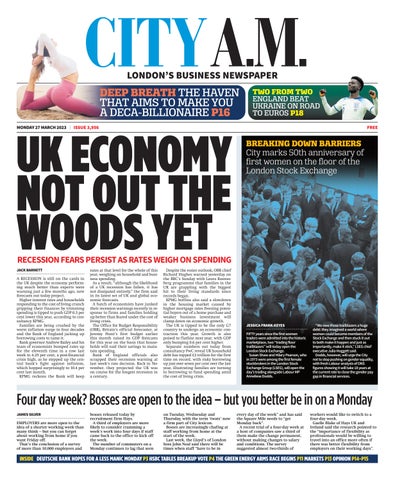
UK ECONOMY NOT OUT THE WOODS YET
MONDAY 27 MARCH 2023
TWO FROM TWO ENGLAND BEAT UKRAINE ON ROAD TO EUROS P18
ISSUE 3,956
FREE
BREAKING DOWN BARRIERS City marks 50th anniversary of first women on the floor of the London Stock Exchange
RECESSION FEARS PERSIST AS RATES WEIGH ON SPENDING
JACK BARNETT A RECESSION is still on the cards in the UK despite the economy performing much better than experts were warning just a few months ago, new forecasts out today project. Higher interest rates and households responding to the cost of living crunch gripping their finances by trimming spending is tipped to push GDP 0.3 per cent lower this year, according to consultancy KPMG. Families are being crushed by the worst inflation surge in four decades and the Bank of England jacking up borrowing costs to tame it. Bank governor Andrew Bailey and his team of economists bumped rates up for the eleventh time in a row last week to 4.25 per cent, a post-financial crisis high, as he stepped up the central bank’s fight against inflation, which hopped surprisingly to 10.4 per cent last month. KPMG reckons the Bank will keep
rates at that level for the whole of this year, weighing on household and business spending. As a result, “although the likelihood of a UK recession has fallen, it has not dissipated entirely,” the firm said in its latest set of UK and global economic forecasts. A batch of economists have junked their recession warnings recently in response to firms and families holding up better than feared under the cost of living crisis. The Office for Budget Responsibility (OBR), Britain’s official forecaster, at Jeremy Hunt’s first budget earlier this month raised its GDP forecasts for this year on the basis that households will raid their savings to maintain spending. Bank of England officials also scrapped their recession warning at last week’s rate decision. Back in November, they projected the UK was on course for the longest recession in a century.
Despite the rosier outlook, OBR chief Richard Hughes warned yesterday on the BBC’s Sunday with Laura Kuenssberg programme that families in the UK are grappling with the biggest hit to their living standards since records began. KPMG boffins also said a slowdown in the housing market caused by higher mortgage rates freezing potential buyers out of a home purchase and weaker business investment will clamp down on economic growth. The UK is tipped to be the only G7 country to undergo an economic contraction this year. Growth is also poised to flatline next year, with GDP only bumping 0.6 per cent higher. Separate numbers out today from consultancy PwC reveal UK household debt has topped £2 trillion for the first time on record, with risky borrowing up just over seven per cent over the last year, illustrating families are turning to borrowing to fund spending amid the cost of living crisis.
JESSICA FRANK-KEYES FIFTY years since the first women traders were admitted into the historic marketplace, two “trading floor trailblazers” will today open the London Stock Exchange. Susan Shaw and Hilary Pearson, who in 1973 were among the first female stockbrokers in the London Stock Exchange Group (LSEG), will open the day’s trading alongside Labour MP Anneliese Dodds.
“We owe those trailblazers a huge debt: they imagined a world where women could become members of the Stock Exchange and then stuck it out to both make it happen and just as importantly, make it stick,” LSEG chief executive Julia Hoggett said. Dodds, however, will urge the City not to stop pushing on gender equality, with fresh Labour analysis of ONS figures showing it will take 18 years at the current rate to close the gender pay gap in financial services.
Four day week? Bosses are open to the idea – but you better be in on a Monday JAMES SILVER EMPLOYERS are more open to the idea of a shorter working week than many think – but you can forget about working from home if you want Friday off. That’s the conclusion of a survey of more than 10,000 employees and
bosses released today by recruitment firm Hays. A third of employers are more likely to consider cramming a week’s work into four days if staff came back to the office to kick off the week. The number of commuters on a Monday continues to lag that seen
on Tuesday, Wednesday and Thursday, with the term ‘twats’ now a firm part of City lexicon. Bosses are increasingly chafing at staff working from home at the start of the week. Last week, the Lloyd’s of London boss John Neal said there will be times when staff “have to be in
every day of the week” and has said the Square Mile needs to “get Monday back”. A recent trial of a four-day week at a host of companies saw a third of them make the change permanent, without making changes to salary and conditions. The survey suggested almost two-thirds of
workers would like to switch to a four-day week. Gaelle Blake of Hays UK and Ireland said the research pointed to the “importance of flexibility as professionals would be willing to travel into an office more often if there was better flexibility from employers on their working days”.
INSIDE DEUTSCHE BANK HOPES FOR A LESS MANIC MONDAY P3 HSBC TABLES BREAKUP VOTE P4 THE GREEN ENERGY ARMS RACE BEGINS P11 MARKETS P13 OPINION P14-P15