LONDON’S BUSINESS NEWSPAPER
IN THE KNOW MARK KLEINMAN RETURNS WITH HIS MUST-READ SQUARE MILE COLUMN P11 THURSDAY 1 SEPTEMBER 2022
ISSUE 3,809
LEIC IT A LOT OUR EXPERT REVIEW OF THE KING OF CAMERAS P18
CITYAM.COM
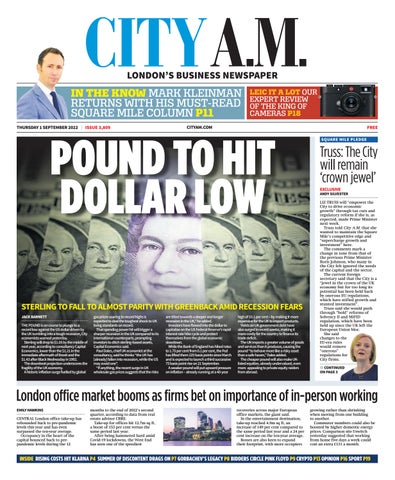
POUND TO HIT DOLLAR LOW
STERLING TO FALL TO ALMOST PARITY WITH GREENBACK AMID RECESSION FEARS JACK BARNETT THE POUND is on course to plunge to a record low against the US dollar driven by the UK tumbling into a tough recession, City economists warned yesterday. Sterling will drop to $1.05 by the middle of next year, according to consultancy Capital Economics, lower than the $1.21 in the immediate aftermath of Brexit and the $1.43 after Black Wednesday in 1992. The downbeat projection underscores the fragility of the UK economy. A historic inflation surge fuelled by global
gas prices soaring to record highs is expected to deal the toughest shock to UK living standards on record. That spending power hit will trigger a sharper recession in the UK compared to its international counterparts, prompting investors to ditch sterling-based assets, Capital Economics said. Paul Dales, chief UK economist at the consultancy, said he thinks “the UK has [already] fallen into recession, while the US may avoid one”. “If anything, the recent surge in UK wholesale gas prices suggests that the risks
are tilted towards a deeper and longer recession in the UK,” he added. Investors have flowed into the dollar to capitalise on the US Federal Reserve’s rapid interest rate hike cycle and protect themselves from the global economic slowdown. While the Bank of England has hiked rates to 1.75 per cent from 0.1 per cent, the Fed has lifted them 225 basis points since March and is expected to launch a third successive 75 basis point rise on 21 September. A weaker pound will put upward pressure on inflation –already running at a 40-year
high of 10.1 per cent –by making it more expensive for the UK to import products. Yields on UK government debt have also surged in recent weeks, making it more costly for the country to finance its trade deficit. The UK imports a greater volume of goods and services than it produces, causing the pound “to behave more like a risky asset than a safe haven,” Dales added. The cheaper pound will also make UKlisted equities, already undervalued, even more appealing to private equity raiders from abroad.
FREE SQUARE MILE PLEDGE
Truss: The City will remain ‘crown jewel’ EXCLUSIVE
ANDY SILVESTER LIZ TRUSS will “empower the City to drive economic growth” through tax cuts and regulatory reform if she is, as expected, made Prime Minister next week. Truss told City A.M. that she wanted to maintain the Square Mile’s competitive edge and “supercharge growth and investment” here. The comments mark a change in tone from that of the previous Prime Minister Boris Johnson, who many in the City felt ignored the needs of the capital and the sector. The current foreign secretary said that the City is a “jewel in the crown of the UK economy but for too long its potential has been held back by onerous EU regulations, which have stifled growth and stunted investment”. Truss said she would push through “bold” reforms of Solvency II and MiFID regulation, which have been held up since the UK left the European Union bloc. She said changes to the EU-era rules would remove “onerous” regulations for City firms. £ CONTINUED ON PAGE 3
London office market booms as firms bet on importance of in-person working EMILY HAWKINS CENTRAL London office take-up has rebounded back to pre-pandemic levels this year and has even surpassed the ten-year average. Occupancy in the heart of the capital bounced back to prepandemic levels during the 12
months to the end of 2022’s second quarter, according to data from real estate advisor CBRE. Take-up for offices hit 12.7m sq ft, a boost of 153 per cent versus the same period last year. After being hammered hard amid Covid-19 lockdowns, the West End has seen one of the speediest
recoveries across major European office markets, the giant said. In the entertainment destination, take-up reached 4.9m sq ft, an increase of 149 per cent compared to the same period last year and a 24 per cent increase on the ten-year average. Bosses are also keen to expand their footprint, with more occupiers
growing rather than shrinking when moving from one building to another. Commuter numbers could also be boosted by higher domestic energy prices. Comparison site Uswitch yesterday suggested that working from home five days a week could cost an extra £131 a month.
INSIDE RISING COSTS HIT KLARNA P4 SUMMER OF DISCONTENT DRAGS ON P7 GORBACHEV’S LEGACY P8 BIDDERS CIRCLE PINK FLOYD P9 CRYPTO P13 OPINION P16 SPORT P19