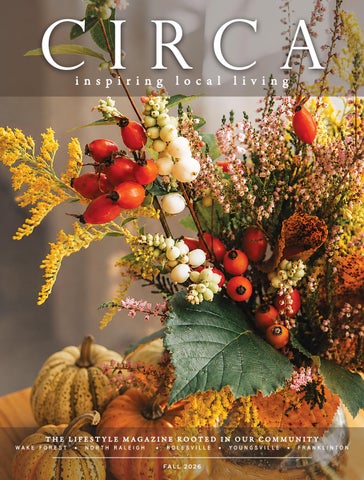
CIRCA i n s p i r i n g
l o c a l
l iv i n g
THE LIFESTYLE MAGAZINE ROOTED IN OUR COMMUNITY
WAKE FOREST
•
NORTH RALEIGH
•
ROLESVILLE
FALL 2026
•
YOUNGSVILLE
•
FRANKLINTON
North Carolina
Same trusted providers. More care. Serving North Raleigh SCHEDULE NOW
919.844.4344 11009 Ingleside Place, Suite 201, Raleigh, NC 27614
NR.MillenniumPhysician.com
060126
A WORD FROM THE PUBLISHER
Welcome back! If it feels like it’s been a little longer since our last edition, you’re right. As we transitioned to our new publishing schedule, there was a longer break than usual between issues. Thank you for your patience during that process. While the publishing calendar has changed, the heart of CIRCA hasn’t. You’ll still find the same seasonal inspiration, engaging stories, fascinating people, trusted local voices, and practical ideas that readers have enjoyed for the past 25 years. We’re happy to be back and excited to share this fall issue with you! One of the things I enjoy most about publishing CIRCA is that every issue gives me the opportunity to learn something new. Throughout the process of putting each edition together, I have the privilege of working with gifted writers, physicians, historians, musicians, local business owners, and many others who generously share their knowledge, creativity, experience, and passion. Every contributor brings a unique perspective, and together they help make this magazine far more than a collection of articles. They help tell the stories of the people, places, and experiences that make our communities so special. This fall issue is a great example of that. Inside these pages, you’ll find a wide range of topics, including fresh takes on comfort food, seasonal wines and classic cocktails, gardening, home decorating, fashion, books, local history, travel, health, personal finance, and inspiration for the holiday season. You’ll meet local musician Stuart McLamb as he begins an exciting new chapter, revisit the mystery of Wake Forest’s infamous Fire Bug, explore Horseshoe Farm Nature Preserve, and discover practical advice on everything from retirement planning and travel health to healthy aging, vision care, skin cancer prevention, and how artificial intelligence is helping dentists care for their patients. Along the way, I hope you’ll also discover new places to explore, recipes to try, traditions to enjoy, and new reasons to appreciate what makes this area such a great place to call home. Putting together CIRCA is truly a team effort. I’d like to thank our talented writers and contributors for generously sharing their time, knowledge, creativity, and expertise with our readers. Their willingness to educate, inspire, and tell meaningful stories is what gives CIRCA its unique voice, and I’m truly grateful for everything they contribute to each issue. And of course, none of this would be possible without the incredible support of our advertisers. Their partnership allows us to continue providing CIRCA free for everyone to enjoy. Whenever you have the opportunity, I encourage you to support the amazing local businesses featured throughout these pages. By supporting them, you’re also helping to ensure that CIRCA will continue sharing the stories, voices, and seasonal inspiration readers have enjoyed for the past 25 years. Finally, thank you for reading. Whether you’ve been picking up CIRCA for years or this is your very first issue, I’m grateful you’ve chosen to spend some time with us. I hope you enjoy this edition, discover something new, and find a few moments this season to slow down and appreciate everything our communities have to offer. Now it’s time to turn the page. Enjoy this issue, and enjoy the season!
Kent Lower, Publisher
PROUD MEMBER
FALL 2026 6
8
10
12
Fall Into Fun in Wake Forest –
40
From Autumn Adventures to
5 Questions That Could Change
Holiday Magic
How You See Retirement
Gardening Guru –
42
Healthy Aging ... More Than Diet
Gloves Just Yet ...
and Exercise
Fall Fashion Refresh –
46
50
Horseshoe Farm Nature Preserve 52
What You Need to Know About Early Detection 18
54
Permanent Spot at the Table
Fresh Ideas for Reinventing the
20
57
About Slowing Down
A Chilling Chapter in Wake Forest
22
58
The Next Chapter – Stuart McLamb on Music,
Uncork Something New – The Search for Your New Favorite Red Wine
28
Hearts Everywhere 30
34
Your Table This Season 36
Healthy Travels – The Biggest Travel Health Risks
Rediscover the Jack Rose – The Forgotten Cocktail of Fall
MANAGERS
When Tomorrow Doesn’t Go
Mitch Lower
Cast in Tradition –
FOLLOW US!
Why the Cast Iron Skillet Never Goes Out of Style 64
Not Your Typical Youth Sport – Building Confidence, Resilience, and Character ... One Obstacle at a Time
66
More Than a Present – Thoughtful Giving is About More Than What’s in the Box
68
71
The Season We Wait For – Why Fall Feels Different in North Carolina
74
AD SPACE RESERVATIONS FALL 2026: October 12, 2026
Behind the Smile – How AI is Helping Dentists
Aren’t What You Think 38
919.453.2555 • info@circamagazine.com Kent Lower
62
The Quiet Overachiever – Why Pears Deserve a Place on
ADVERTISING SALES
Printed by Progress Printing Plus
Jacksonville ... Where Coastal Marine Corps History
Dr. Samantha McPherson Stacey Moritz Todd Nelson Tom Piper Carolyn Rice Baily Rich Dr. Alka Sachdeva Dr. Macon Singletary Dr. Edmond Suh Town of Wake Forest WakeMed Thomas Walters
BallPointe Publishing & Design, LLC P.O. Box 1182 Wake Forest, NC 27588 919.453.2555 • info@circamagazine.com circamagazine.com
Life’s Unexpected Moments –
Good Reads
Driveable Destination – Adventure Meets Carolina
Preparing for
60
More Than a Passing Trend – Why Houseplants Are Winning
CONTRIBUTING WRITERS
According to Plan
Community, and a New Home 26
The Dog Days of Autumn – What Our Dogs Can Teach Us
The Mystery of the Fire Bug – History
Non-Negotiables – The Classics That Deserve a
A New Twist on Fall Faves – Comfort Foods You Already Love
The Hidden Connection – The Surprising Link Between
Protect the Skin You’re In – Skin Cancer Prevention and
Local Gem –
l iv i n g
PUBLISHER & EDITOR
CONTACT US
When Perfect Isn’t The Goal ...
In Defense of the Pink Cosmopolitan
Anticipate the Spill –
l o ca l
Kent Lower
The Thanksgiving
Aren’t Completed Overnight 48
i nsp i ri n g
Quality Sleep and Healthy Vision
Why the Most Memorable Homes
Stylish New Season Home for the Season –
CIRCA Mike Allen Justin Bee Melissa Benhaim Chris Brody Sarah Calvelli-Lewis Vanessa Davis Jeff (JD) Donahoe Pam Eagles Joni Falvey Miriam Grueneich Elizabeth Johnson Christine Kingsley Suzanne Lucey Izabela Mackenthun
Collected Over Time –
Smart and Simple Updates For a
Like Fall
16
Your Smile, Your Health –
Don’t Put Away Your Gardening
How to Make Your Home Feel
14
Financial Focus –
Our Heritage – Where the College Used to Be
CIRCA Magazine is published quarterly by BallPointe Publishing & Design, LLC. All rights reserved. No part of this publication may be reproduced or transmitted in any form without the written permission of the publisher. Every effort has been made to ensure the accuracy of the information contained herein; however, BallPointe Publishing & Design, LLC assumes no responsibility for errors or omissions. The publisher does not endorse and is not responsible for claims made in advertisements appearing in this publication.
FALL INTO FUN
IN WAKE FOREST FROM AUTUMN ADVENTURES TO HOLIDAY MAGIC
F
BY TOWN OF WAKE FOREST Fall is almost here, bringing with it cool crisp days, autumn leaves, and everything else the season has to offer. We are wrapping up another year with an impressive array of events for you and your family. From ghost tours to tree lightings, we’re confident you’ll find plenty to enjoy.
GOOD NEIGHBOR DAY The Wake Forest Human Relations Council will sponsor Good Neighbor Day on Saturday, September 19, from 1:00 PM – 4:00 PM at E. Carroll Joyner Park (701 Harris Road). This free, familyfriendly event assembles people from all walks of life for a day of food, fun, and family entertainment. By bringing together a mix of cultures, music, ages, and ethnicities, the event celebrates diversity and promotes goodwill among everyone in our community. A special part of the day will be the presentation of the Good Neighbor of the Year Award. The honor will be presented to one local youth and one adult who consistently demonstrate an unfailing commitment to preserving and improving the quality of life in our community. For details, visit wakeforestnc.gov and search “Good Neighbor Day.”
MENTAL WELLNESS FAIR The Town of Wake Forest and several community partners will host the Fourth Annual Wake Forest Mental Wellness Fair on Saturday, September 26, from 1:00 PM – 4:00 PM, at the Wake Forest Renaissance Centre (405 S. Brooks Street). Free and open to the public, the event is designed to raise awareness about mental wellness and share information about programs, services, and resources available to anyone seeking support, looking to learn more, or navigating untreated or undertreated mental illness. The fair will feature presentations on a variety of topics by experts from several local mental health organizations, along with an array of vendor advocate booths. This year’s panel discussion and breakout sessions will focus on youth and the mental health effects of social media and technology. For details, visit wakeforestnc.gov and search “Mental Wellness Fair.”
SPIRITS OF WAKE FOREST If you’re looking for a “hauntingly” good time this fall, then don’t miss the “Spirits of Wake Forest” ghost walk in downtown Wake 6
CIRCA MAGAZINE
|
Fall 2026
Forest. Presented by Wake Forest Downtown, Inc., these tours will be offered Thursday, Friday, and Saturday evenings in October. For details and to purchase tickets, visit wakeforestnc.gov and search “Spirits.”
HALLOWEEN BOO BASH Join us in downtown Wake Forest for the Halloween Boo Bash on Saturday, October 17, from 10:00 AM – 1:00 PM. Presented by Capital Chevrolet, this year’s festivities will include inflatable slides, food trucks, sponsor booths, carnival games, and of course, lots of treats. Costumes are optional, but the best costumes may be featured on the Town website and social media. For details, visit wakeforestnc.gov and search “Boo Bash.”
WAKE FOREST CARES HOLIDAY KICK-OFF Help us ring in the holiday season and launch our annual Holiday Donation Drive during the Wake Forest Cares Holiday Kick-Off on Saturday, November 21, from noon – 4:00 PM in downtown Wake Forest. Free and open to the public, the Holiday Kick-Off will feature fun for the whole family, including community performances, roaming street performers, children’s craft activities, and more. Several food and dessert trucks will be onsite, with additional food and beverages available for purchase at downtown restaurants. In addition to ringing in the holiday season, it will signal the start of our annual Holiday Donation Drive. As part of this effort, we invite you to support one or more of these Town-sponsored initiatives: Helping Others by Providing Electricity (HOPE); Northern Community Food Security Team; Shop with a Cop; Wake Forest Parks, Recreation & Cultural Resources Scholarship Program; Wake Forest Firefighters Foundation; and the Wake Forest Center for Active Aging Scholarship Program. For details, visit wakeforestnc.gov and search “Holiday Kick-off.”
LITTLE WOMEN The Wake Forest Renaissance Centre, in partnership with Firebox Theatre Company, will present the beloved classic “Little Women,” from the novel by Louisa May Alcott and adapted by Marisha Chamberlain. Showtimes are Friday, December 11, at 7:00 PM and
Risers will be installed inside the Renaissance Centre to offer tiered seating and excellent sightlines for these performances. For details or to purchase tickets, visit wakeforestrencen.org.
’TIS THE SEASON HOLIDAY HAPPENINGS Wake Forest offers a variety of yuletide events in November and December that are guaranteed to put you in the holiday spirit. From the Wake Forest Cares Holiday KickOff and Lighting of Wake Forest to Calls from Santa and The Run, Run Rudolph Tour with Shaun Johnson & The Big Band Experience, the 2026 holiday season is jampacked with magical events and holiday traditions that are sure to delight visitors of all ages. You can stay current on all of our holiday happenings by bookmarking the ’Tis the Season portal on the Town website by visiting wakeforestnc.gov and searching “Tis the Season.”
GET IN GOOD WITH AN EXPERT Because I know the risks in the area, I’ll use my local expertise to help you choose the right amount of protection. And I’ll be there to help you as your coverage needs change. Call or stop in for a free, no-obligation Personalized Insurance Proposal today.
Personalized service. Trusted advice.
Walters Insurance Agency 919-554-0267 3207 Rogers Road, Ste. 100 Wake Forest thomaswalters@allstate.com Subject to terms, conditions and availability. Allstate Property and Casualty Insurance Co., Allstate Indemnity Co., Allstate Insurance Co. © 2016 Allstate Insurance Co.
FULL SERVICE BUTCHER SPECIALTY GROCER & CUSTOM CATERING
STAY CONNECTED!
ORDER ONLINE FOR CURBSIDE PICKUP
Always be the first to know about Town of Wake Forest programs, services, breaking news, and special events by signing up for E-Notifier, downloading the Town app, visiting the Wake Forest website, and/or following the Town on social media @TownofWakeForest. For complete details, visit wakeforestnc.gov and search “Communications.”
USDA Prime,Top Choice & Dry Aged Beef House Made from Scratch Meals & Sides Artisan Deli Hand Made Sausage House Made Bacon
__________________________________ Anna Bolton is the marketing and business relations manager for the Town of Wake Forest. To learn more about Town events, sponsorship opportunities, and how you can be involved, contact Anna at 919-435-9422 or abolton@wakeforestnc.gov.
180908
Saturday-Sunday, December 12-13, at 2:00 PM and 6:30 PM. A heartfelt coming-ofage story, “Little Women” follows the lives, dreams, and challenges of the four March sisters – spirited Jo, gentle Beth, romantic Meg, and artistic Amy – as they grow up together, navigating love, loss, ambition, and sisterhood. Celebrate the season with this beloved tale of resilience, compassion, and family.
Fresh Seafood All Natural & Hormone Free
CARY | HOLLY SPRINGS | RALEIGH | WAKE FOREST | WILMINGTON | PORTER’S NECK
MEAT THE OWNER
thebutchers-market.com
circamagazine.com
7
GARDENING DON'T PUT AWAY YOUR GARDENING GLOVES JUST YET ...
BY PAM EAGLES What a hot, dry summer we had … plants frying in the sun, early-morning and late-afternoon watering just to keep them alive, only to be rewarded with mildew. I didn’t harvest a single cucumber this year, but that’s gardening. Some seasons are simply more productive than others, but every year teaches us something new. The good news is that fall has arrived, bringing one of the very best gardening seasons of the year. Let’s start by giving the garden the fresh beginning it deserves.
BUILD BETTER SOIL THIS FALL The first thing I’m doing is cleaning out my garden beds. All of the summer plants still standing are headed to the compost pile. Then it’s time to improve the soil. Nothing beats homemade compost if you have it. I spread two to three inches over my beds and work it into the soil before planting. If you haven’t started a compost pile yet, don’t worry. Quality compost products like Daddy Pete’s and Black Kow are readily available at local garden centers, and I’ve had great success with both. Whether you plan to plant right away or simply let the soil improve over the winter, adding organic matter is one of the best investments you can make in next year’s garden.
PLANT A FALL GARDEN OR A COVER CROP Now comes the question: What do you want your garden to do this fall? Personally, I’m getting my beds ready for winter greens and root crops. If that doesn’t fit your gardening plans this year, consider planting crimson clover or winter rye instead. Cover crops do much more than simply fill empty space. They help prevent erosion during winter rains, replace nitrogen depleted during the growing season, and improve soil structure with their deep root systems. Either way, your garden continues working through the winter. 8
CIRCA MAGAZINE
|
Fall 2026
uru
G
My raised beds will get another layer of compost before I work everything together and remove any remaining summer stragglers. Later, as the hardwood trees begin dropping their leaves, I’ll shred them with the lawn mower and spread them over the beds. They’ll slowly break down through the winter, adding even more organic matter before spring planting. Nature has been recycling leaves into rich soil long before gardeners ever gave it a name.
GIVE YOUR LAWN A FRESH START Speaking of leaves, don’t let them pile up on your lawn. September is one of the most important months for fescue. If your grass still needs mowing (and hopefully it does), keep it at about 2½ to 3 inches. That height helps protect the lawn while encouraging a stronger root system as cooler weather arrives. Before reaching for fertilizer, consider having your soil tested. Your local Extension office can provide a soil test kit, and many farmers markets have Master Gardeners available to answer questions and help explain the results. A soil test tells you exactly what your lawn needs – and just as importantly, what it doesn’t. If fertilizer is recommended, apply it in September and again in November before putting the lawn to bed for the winter. Your next feeding won’t be needed until around Valentine’s Day. If your lawn has become compacted over the summer, this is also the ideal time to aerate and overseed. If you’re simply patching bare spots, loosen the soil and reseed. Just remember that if fall rains don’t cooperate, you’ll need to keep those newly seeded areas watered. If broadleaf or other weeds are becoming a problem, identify them before choosing a herbicide and always read the label carefully, especially if you’re also planting new grass seed. Your local Extension office is an excellent resource if you have questions. Of course, the tried-and-true method of pulling weeds by hand still works remarkably well.
BRING COLOR BACK TO THE GARDEN Soon, our garden centers will be overflowing with one of my favorite combinations of the season – mums, pansies, violas, and snapdragons. Choose colors that brighten your day and plant them somewhere you’ll enjoy every time you come home, whether in the landscape or in a favorite container. One of my favorite porch combinations is a small camellia planted in a frost-proof container and underplanted with colorful violas. It creates a beautiful welcome through the fall and often continues looking great well into winter. There are so many wonderful plants available this time of year, so choose something that makes you smile.
room to plant them all. Take a little time to research what works best for your space, then choose something you’ll enjoy for years to come.
KEEP THE GARDEN GROWING The summer season may be winding down, but there is still plenty of work to do in our local gardens. Keep harvesting whatever is still producing from summer, knowing that a killing frost is likely still a month or so away. There’s still time for cleaning up and putting the garden to bed for the season ahead.
Speaking of harvest, get those pumpkins out of the patch and start decorating for Halloween and Thanksgiving. Once it’s time to start thinking about Santa, the local deer will enjoy the treat of your pumpkins. Gardening is a full-time, full-circle job, but we know that – and we enjoy it. Happy fall gardening! __________________________________ Pam Eagles lives in Rolesville where she gardens with two dogs and a cat. She is a founding member of the Rolesville Garden Club and serves as a Wake County Master Gardener.
PLANT NOW, ENJOY SPRING LATER Back to the vegetable garden. After removing the spent summer plants and improving the soil, you’re ready to plant for fall. Greens, lettuce, spinach, cabbage, carrots, and radishes all thrive this time of year. October through November, before a hard freeze, is also the perfect time to plant onions and garlic. While you’re thinking ahead, don’t forget your spring bulbs. The daffodils, crocus, and alliums you admired in other gardens last spring won’t magically appear in yours next year unless you plant them this fall. Gardening always rewards those who think one season ahead. Fall is also one of the very best times to plant trees and shrubs in our area. If you have a sunny spot that needs a tree, consider dogwood, redbud, or serviceberry where space is limited. Dogwoods and redbuds also make excellent understory trees. Yoshino and Kwanzan cherries perform beautifully here, as do many spring-flowering magnolias. Cooler temperatures and warm soil allow roots to establish before next summer’s heat arrives. Just remember to keep newly planted trees watered until they’re well established. There are so many wonderful trees from which to choose, and never quite enough circamagazine.com
9
LAYER LIKE A PRO: Fall temperatures can shift dramatically throughout the day, making layers essential. Begin with lightweight basics such as cotton shirts, fitted long-sleeve tops, and fine-knit sweater vests. Add button-down shirts, cardigans, blazers, or denim jackets that are easy to remove when the afternoon warms up. A lightweight coat is another smart addition to any fall wardrobe. This season, classic trench coats remain a polished and practical choice, while leather jackets continue to bring timeless style with a bit of edge. Also trending this fall are quilted jackets, chore coats, and utility-inspired styles. Consider a slightly oversized fit for your outerwear to allow for comfortable layering.
BY BAILY RICH
FALL FASHION
REFRESH
A
SMART AND SIMPLE UPDATES FOR A STYLISH NEW SEASON
As summer fades and cooler days arrive, your wardrobe deserves a seasonal refresh. Fall fashion is all about layering, rich colors, cozy textures, fun graphics, and versatile pieces that work with North Carolina’s changing weather. The good news is that updating your closet does not require replacing everything you own. A few simple additions, along with a fresh look at your closet, can create a wardrobe that feels on-trend, comfortable, and totally yours. START IN YOUR CLOSET: Before shopping, take inventory of
your current wardrobe. Pull out your autumn staples and check their fit, condition, and whether they still suit your lifestyle. Set aside items that need mending or cleaning, and donate or consign pieces that no longer suit your personal style or needs. Haven’t worn it in two years? Time to let it go! As you review your clothes, look for gaps. Maybe you have plenty of sweaters but no lightweight jacket, or several pairs of jeans but few trousers or skirts. Identifying your needs will help you shop with purpose rather than buying pieces that duplicate what you already own. Instead, invest in versatile pieces that fill those gaps, expand your outfit options, and help you get more wear from your wardrobe. 10
CIRCA MAGAZINE
|
Fall 2026
TEXTURE, TEXTURE, TEXTURE: You don’t need an entirely new color palette to make your wardrobe feel ready for fall. Bring in a few deeper shades that complement your neutrals. Burgundy, forest green, chocolate brown, navy, and mustard can add warmth and elevate your closet without being difficult to wear. Then add texture to give those colors even more dimension. Look for corduroy, suede, leather, flannel, denim, and chunky knits. Take a basic outfit such as jeans and a white shirt and update it for the season with a textured cardigan, chunky sweater vest, or a leather accessory. Mixing two or three textures adds visual interest while keeping the overall outfit understated and effortlessly stylish. STEP INTO FALL: Straight-leg and wide-leg jeans continue to
trend, but fall is a great time to mix things up. Tailored trousers can move easily from work to dinner, while a printed pant, such as leopard or camouflage, brings interest and character to casual outfits. And denim is always in style, so don’t overlook a denim skirt, which pairs beautifully with tights and boots for a timeless fall look. Complete your outfits with footwear that balances style, practicality, and comfort. This season, look for ankle boots, loafers, trendy sneakers, and equestrian-inspired riding boots. Before buying a new pair, think about the pants, skirts, and outerwear you plan to wear with them. The most useful shoes will coordinate with multiple outfits while keeping you comfortable throughout the day. LET’S ACCESSORIZE: Accessories provide one of the easiest and
most affordable ways to refresh your look. A structured bag, patterned scarf, leather belt, or simple piece of jewelry can instantly transform any outfit. This fall, chunky jewelry, vintage-inspired scarves, and textured bags are making a stylish comeback. The ideal autumn wardrobe isn't the largest one – it’s a curated collection of pieces that fit well, layer easily, and reflect your lifestyle. By streamlining your closet first and filling only the gaps, you’ll enjoy more outfit options, less clutter, and renewed personal style. _____________________________________________________ Baily Rich is the owner of Baily's I Your Local Boutique, located at 100 E. Mason Street in Downtown Franklinton. Visit shopbailys.com and follow @shopbailys.
PRIVATE | GATED | LUXURY From $1.75 Million to $3 Million+ | Wake Forest, North Carolina
GrandHighlandLiving.com | 919.457.9002 A MacNair Community Henry MacNair & Will MacNair
HOME FOR THE
Season
HOW TO MAKE YOUR BY MIRIAM GRUENEICH
There’s something magical about the moment your home
begins to reflect the warmth and comfort of the changing
season. Fall decorating isn’t about filling every corner with
HOME FEEL
LIKE FALL
cushion or drape a soft throw over the arm of your favorite chair. These little details make a room feel like it’s meant to be enjoyed, not just admired.
pumpkins or making your home feel themed for just a few
BRING NATURE INDOORS
weeks. Instead, it’s about creating a welcoming space that
One decorating tip I always come back to is keeping greenery in your home year-round. Instead of packing it away when summer ends, use everyday greenery as the foundation of your seasonal decorating. Olive branches, eucalyptus, magnolia leaves, cedar, and preserved ferns all transition beautifully into fall. Then, as the season progresses, simply tuck in a few pinecones, mini pumpkins, berries, or dried stems. It’s an easy way to refresh your décor without feeling like you have to start over every few months.
T
feels cozy, inviting, and effortlessly beautiful throughout the season.
The secret to achieving that look lies in layering warm colors, soft textures, natural greenery, and carefully chosen décor that transitions seamlessly from late summer through Thanksgiving. Here’s how to create a home that embraces the beauty of autumn while remaining timeless.
WARM UP YOUR SPACE One of the easiest ways to make your home feel like fall is by introducing richer, warmer tones into your existing décor. You don’t have to repaint your walls or replace your furniture – simply swap out a few accessories that naturally draw the eye. Create a cozy foundation with soft neutrals like cream, oatmeal, and camel, then layer in seasonal accents of rust, olive, mustard, burgundy, soft brown, burnt orange, and touches of brushed gold. Even small additions, such as a ceramic vase, decorative books, candles, or wooden accents, can completely change the mood of a room, adding warmth and comfort without overwhelming your space.
LAYER COZY TEXTURES If there’s one decorating trick I use every fall, it’s adding layers. Soft pillows and cozy throws instantly make a room feel inviting. Mix textures like chunky knits, cotton, linen, velvet, and woven fabrics to create depth and interest. Don’t worry about everything matching perfectly. In fact, homes often feel more comfortable when they don’t. Pair a plaid pillow with a solid rust-colored 12
CIRCA MAGAZINE
|
Fall 2026
Flowers aren’t just for spring gardens. Fall is the perfect season to bring in arrangements filled with dried grasses, wheat, hydrangeas, cotton stems, berries, and soft, earthy blooms. I love mixing fresh and faux florals because they create full, natural arrangements that last much longer than fresh flowers alone. Whether it’s a simple vase on your kitchen island or a larger centerpiece on your dining table, florals bring life and warmth to every room. Some of the most beautiful decorating pieces are the ones inspired by nature. Wooden bowls filled with pinecones or acorns, woven baskets, handmade pottery, natural wood cutting boards, and stoneware all add warmth and texture without trying too hard. These pieces have a timeless quality that works just as well in September as they do throughout the rest of the year. I’ve always believed that homes feel their best when they include natural materials that tell a story and bring a sense of authenticity to the space.
LIGHT THE ROOM, CHANGE THE MOOD As the evenings grow shorter, lighting becomes just as important as the décor itself. Soft table lamps, lanterns, flameless candles, and your favorite scented candles create the kind of warm glow that
instantly makes a house feel like home. Swapping bright white bulbs for warmer white ones can make an amazing difference without changing anything else in the room. Sometimes it’s the lighting, not the decorations, that creates the cozy feeling we’re all looking for.
LESS REALLY IS MORE One thing I’ve learned over the years is that you don’t need to decorate every shelf or cover every surface with seasonal items. A beautiful wreath, a cozy throw, a bowl of mini pumpkins, and a candle can have a much bigger impact than filling every corner with decorations. Choosing a few quality pieces that blend with your everyday style keeps your home feeling timeless rather than temporary.
THE FEELING MATTERS MOST At the end of the day, the coziest homes aren’t the ones that look perfect – they’re the ones that feel welcoming. Leave a favorite book on the coffee table. Keep a soft blanket within reach. Display a handmade mug beside a favorite candle. Place fresh flowers on the kitchen counter or fill a wooden bowl with pinecones or acorns collected from the backyard. These simple touches don’t have to be expensive or elaborate; they’re the details that make a house feel personal. To me, fall decorating has never been about chasing the latest trends. It’s about creating spaces where memories are made, conversations linger a little longer, and everyone feels comfortable enough to simply be themselves. Because in the end, the most beautiful homes aren’t defined by what’s on the shelves – they’re defined by the memories that fill them and the way they make friends and family feel when they walk through the door. .__________________________________ Miriam Grueneich is the owner of archer + pratt, which offers locally handmade goods and is located at 18 N. Main Street in Franklinton. She may be reached at 919-728-8424 or visit shoparcherpratt.com.
circamagazine.com
13
and that unmistakable blush, and the spirit base gives the drink its backbone. The result is a cocktail that feels light without being flimsy and elegant without being fussy. That balance is exactly what makes it stand the test of time. A Cosmopolitan done right is proof that a cocktail can be approachable as well as refined.
BY CHRIS BRODY
IN DEFENSE OF THE PINK
Cosmopolitan
There’s also something to be said for the confidence of ordering a cocktail because you enjoy it, not because of outdated stereotypes. Drinks should not be dismissed based on appearance or judged by assumptions about who they are “for.” A well-made Cosmopolitan deserves the same respect as any classic cocktail, whether it’s served in a coupe glass with a soft, glowing pink hue or presented as the centerpiece of a stylish evening. Taste should always matter more than image – but in the case of the Cosmopolitan, the image is part of the charm. It invites attention without demanding it. The pink hue has become iconic for another reason ... it catches the eye. In a sea of clear spirits and dark whiskeys, the Cosmopolitan stands out. It photographs beautifully, sparks conversation, and brings a sense of fun to the table without sacrificing quality. When the color is right, it enhances the cocktail’s sophistication rather than distracting from it. That visual appeal is one reason the Cosmopolitan has remained so recognizable over the years. It is a drink that knows how to make an entrance, and it does so with style rather than excess.
Few cocktails are judged as quickly as the Cosmopolitan. Before anyone takes a sip, its signature pink hue often sparks assumptions that it’s overly sweet, overly simple, or somehow “not serious.” That couldn’t be further from the
T
truth. The Cosmopolitan has long been one of those drinks that people think they already understand at a glance, yet it rewards anyone willing to look past the color and appreciate what’s actually in the glass. The right shade of pink is part of what makes a proper Cosmopolitan so appealing. It should be a refined, balanced blush rather than an exaggerated neon tone, signaling freshness, elegance, and restraint. Made with cranberry juice, citrus, and quality spirits, the Cosmopolitan is crisp, refreshing, and undeniably sophisticated. Its color is not a flaw to be defended, but rather a part of the drink’s identity. In the best versions, that pink is subtle enough to feel polished and bright enough to feel lively, creating a visual impression that matches the cocktail’s clean, tart profile. There is also real craftsmanship behind a well-made Cosmopolitan. When prepared thoughtfully, it is not a sugary novelty drink, but rather a carefully balanced cocktail with structure and clarity. The citrus brings brightness, the cranberry adds a gentle fruit note 14
CIRCA MAGAZINE
|
Fall 2026
Part of the Cosmopolitan’s lasting appeal is that it feels both modern and classic. It has a polished, contemporary look, yet it also carries the kind of simplicity that allows it to fit comfortably among timeless cocktails. It does not need elaborate garnishes or complicated presentation to make its point. A chilled glass, a clean pour, and that unmistakable pink glow are often enough. The drink’s beauty lies in its restraint. It is elegant without being severe, playful without being childish, and distinctive without trying too hard. At the end of the day, a great cocktail should be judged by its balance, craftsmanship, and taste and not by the color in the glass. The Cosmopolitan’s pink shade is a reminder that elegance and bold flavor can coexist, and that sometimes the most memorable drinks are the ones unafraid to stand out. The color tells part of the story, but the real appeal comes from the experience of drinking it – bright, crisp, confident, and satisfying from the first sip to the last. So the next time a pink Cosmopolitan lands in front of you, don’t see it as something to be judged. See it for what it really is – a timeless, sophisticated classic that proves great taste comes in the right shade of pink. _____________________________________________________ Chris Brody is the owner of Shaken & Stirred, a cozy, craft-cocktail lounge located at 102 E. Green Street, in the heart of Downtown Franklinton.
Happy. Healthy. And, best of all, here. Health lives where you and your family live.
When it comes to the health of the ones you love, WakeMed North Hospital is one of the family. Inpatient care. 24/7 emergency services. Imaging and advanced diagnostics. Routine procedures and sophisticated surgeries. And physicians who specialize in orthopaedics, obstetrics and gynecology, urology and more. In fact, everything you need to keep your whole family healthy is all right here. Good for them. Good for you. And really good for your peace of mind. To learn more, visit us today at wakemed.org/north-hospital.
WakeMed North Hospital | 10000 Falls of Neuse | Raleigh, NC 27614 | 919.350.8000 | wakemed.org/north-hospital
PROTECT THE
SKIN YOU'RE IN WHAT YOU NEED TO KNOW ABOUT SKIN CANCER PREVENTION AND EARLY DETECTION
S
BY DR. ALKA SACHDEVA Skin cancer is the most common cancer in the United States, with an estimated 5 million cases diagnosed each year. In fact, approximately one in five Americans will develop skin cancer by age 70. While these statistics are concerning, there is encouraging news – skin cancer is one of the most preventable forms of cancer. Most cases are caused by overexposure to ultraviolet (UV) rays from the sun or artificial sources such as tanning beds and sunlamps. Over time, UV exposure damages skin cells, accelerating skin aging and increasing the risk of cancer. Understanding the warning signs and taking steps to protect your skin can help reduce your risk and improve outcomes through early detection.
UNDERSTANDING THE DIFFERENT TYPES OF SKIN CANCER Skin cancer begins in the epidermis, the outer layer of the skin. The three most common types are: – BASAL CELL CARCINOMA (BCC): The most common form of skin cancer, BCC often appears as a shiny bump, open sore, scar-like area, or red patch. While it rarely spreads to other parts of the body, it can cause significant tissue damage if left untreated. – SQUAMOUS CELL CARCINOMA (SCC): The second most common type, SCC, may appear as a scaly red patch, wart-like growth, or sore that crusts or bleeds. If not detected early, it has the potential to spread. – MELANOMA: Although less common, melanoma is the deadliest form of skin cancer because it can spread quickly to other organs. When caught early, however, the five-year survival rate is approximately 90%.
Regular self-checks are important because skin cancer can develop anywhere on the body, including areas that receive little sun exposure. If you notice any suspicious changes, schedule an evaluation with your healthcare provider.
WHO IS AT RISK? Anyone can develop skin cancer – even those with darker skin tones – but certain factors increase risk, including: fair skin that burns or freckles easily; blue or green eyes; blonde or red hair; a large number of moles; personal or family history of skin cancer; frequent sunburns or tanning bed use; extensive outdoor UV exposure; older age; and a weakened immune system. Having five or more sunburns during your lifetime can double your risk of developing melanoma.
Where the keys tell the stories, drinks flow, and friendships brew.
KNOW THE WARNING SIGNS A change in your skin is often the first sign of skin cancer. This may include a new growth or spot; a sore that does not heal; a mole that changes in size, shape, or color; or an area that becomes itchy, tender, painful, crusty, or bleeds. For melanoma, remember the ABCDEs: – A – ASYMMETRY: One half does not match the other. – B – BORDER: Edges are irregular, ragged, or blurred. – C – COLOR: Multiple colors or uneven coloring. – D – DIAMETER: Larger than approximately the size of a pea. – E – EVOLVING: Changes in appearance over time. 16
CIRCA MAGAZINE
|
Fall 2026
223 S. White Street Wake Forest, NC 27587 broadsidesandbrews.com
PROTECTING YOUR SKIN EVERY DAY Sun protection is important year-round, not just during the summer months. UV rays can penetrate clouds and reflect off surfaces such as water, sand, concrete, and even snow. Even on cool or overcast days, UV exposure can accumulate over time, making daily sun protection one of the simplest and most effective ways to reduce your risk of skin cancer. Whether you’re gardening, walking the dog, attending a sporting event, or simply running errands, making sun protection part of your daily routine can help protect your skin for years to come. It’s also important to remember that a tan is not a sign of good health, and a “base tan” for sun protection is a myth. Any change in skin color after UV exposure indicates skin damage. To reduce your risk: – Use a broad-spectrum sunscreen with SPF 30 or higher. – Reapply sunscreen every two hours and after swimming or sweating. – Wear a wide-brimmed hat and UV-blocking sunglasses. – Choose lightweight clothing that covers exposed skin. – Seek shade, especially between 10:00 AM and 4:00 PM. – Avoid indoor tanning beds and sunlamps.
THE IMPORTANCE OF EARLY SCREENING AND DETECTION For individuals with risk factors, regular skin cancer screenings
can play an important role in early detection. During screening, a healthcare provider examines the skin for abnormal moles, growths, precancerous lesions, and other signs of skin cancer. If a suspicious area is identified, a biopsy may be recommended to determine whether cancer cells are present. When skin cancer is detected early, treatment is often simpler, less invasive, and highly successful. Preventive care is the cornerstone of long-term wellness, and protecting your skin is one of the simplest ways to put that philosophy into practice. By practicing daily sun protection, performing regular skin self-checks, and seeking medical evaluation when you notice changes, you can significantly reduce your risk of skin cancer. When detected early, most skin cancers are highly treatable, making prevention and early detection your best defense. _____________________________________________________ This is intended for informational purposes only and is not intended to be a substitute for professional medical guidance, diagnosis, or treatment. No physician-patient relationship is created by this or its use. Preventive care starts with education and early intervention. At Millennium Physician Group, they help patients understand their health risks and support their long-term wellness. Their focus is on whole-person care that supports your health through every season of life. Millennium Physician Group is accepting new patients in Raleigh, and is located at 11009 Ingleside Place, Suite 201, Raleigh. For more information, call 919-844-4344 or visit MillenniumPhysician.com.
circamagazine.com
17
A NEW TWIST on FRESH IDEAS FOR REINVENTING THE COMFORT FOODS YOU ALREADY LOVE BY STACEY MORITZ
Fall Faves
Another summer season is coming to an end, and as the heat begins to subside, we turn our attention to satisfying our cravings for fall flavors and comfort food. Growing up, we all had our family favorites that still resonate with us, but the evolution of food and dining trends gives us the opportunity to put a fresh and flavorful twist on those classic dishes. Picture hearty stews, mac and cheese, baked pastas, and even
T
Mom’s meatloaf as canvases for your culinary paintbrush. The goal is familiar comfort with a little surprise, the kind that makes a cozy dish feel current without losing its soul. There are so many wonderful variations of the classic hearty family pot of stew. I’m a fan of one-pot dinners, and the beauty of stew is that it can take on a variety of “personalities” and be amazing every time. Whether you prefer beef, chicken, or pork, a classic stew is pretty much a meat-and-potatoes type of meal, but it can be elevated to great heights with the addition of roasted vegetables, savory spices, sturdy greens, and a great broth. A great way to throw a culinary curveball into your repertoire is to go global. Latin cuisines are full of depth and flavor. You can use your favorite stew recipe as a base, but adding spices and vegetables that are key components of the region is a great way to shift the flavor profile of a dish. Think dried chilies simmered in a rich broth, roasted chili peppers combined with fresh tomatoes, onions, garlic, cilantro, and Mexican oregano for a deep, rich flavor profile. Opting for sweet potatoes or plantains in lieu of regular potatoes adds a sweetness that provides balance, transforming this rustic meal into something truly special. My family loves Indian cuisine, and there are so many wonderful curry recipes that are perfect for jazzing up your dinner routine. Whether you’re a meat lover or a vegetarian, there is no shortage of combinations to create an amazing Indian stew. Adding aromatic 18
CIRCA MAGAZINE
|
Fall 2026
spices like curry and garam masala, along with savory ginger and garlic simmered in a rich stock, provides the backdrop for all the flavors to come together beautifully, satisfying that craving for comfort with the excitement of something new and different. Serve it on its own, over basmati rice, or with warm naan bread fresh from the oven, and your taste buds will thank you. A fall and winter staple in my home growing up was meatloaf. We ate it probably once a week, and we never tired of it. I still make it the same way my mom did because it evokes warm memories of home and family. But I also like to shake things up a bit ... a little Southwest flair to the rescue.
Season your meatloaf with bold spices like ancho chili powder and cumin, or even your favorite taco seasoning if you’re in a pinch. A handful of chopped cilantro, diced tomatoes, and green chilies can be added to the meat mixture along with your breadcrumbs and egg to bind it all together. In lieu of a sweet tomato sauce on top, try topping your meatloaf with a thick, chunky salsa and a sprinkle of Mexican cheese to finish it off. Add a side of Spanish rice and stewed black beans, and you have a meatloaf dinner that is anything but boring. If you’re really feeling adventurous, try an Asian variation by adding fresh grated ginger, finely grated carrots, and chopped dried seaweed to your mix, then top it with teriyaki or Korean barbecue sauce. Serve with fried rice, stir-fried vegetables, and steamed edamame, and you’ll have a unique take on a family favorite.
to roast vegetables like zucchini, yellow squash, bell peppers, onions, and cherry tomatoes and add them to the ziti. Top with a little more of your favorite marinara or arrabbiata sauce, sprinkle with mozzarella and shaved Parmesan, and pop it in the oven. Let it rest for a few minutes after baking so everything settles into that perfect, scoopable comfort. Add a simple salad and garlic bread, and dinner is done. Fall comfort food always lands best when it feels like a warm hand on your shoulder, and modern twists only make that comfort
more memorable. Whether you’re holding onto familiar dishes or finishing them with bright, unexpected accents, the season invites you to cook in a way that feels both nostalgic and new. At its heart, fall food is about slowing down, savoring the coziness, and letting simple ingredients become something a little magical. __________________________________ Stacey Moritz is the owner of The Lemon Tree, located at 415 Brooks Street C in Downtown Wake Forest. The cafe is open Tuesday - Saturday, 10:00 AM - 7:00 PM, and Friday and Saturday, 10:00 AM - 3:00 PM. Visit thelemontreewf.com.
If pasta is your family’s comfort food, you aren’t alone. Any baked pasta dish gets dramatically better when you treat it less like a weeknight fallback and more like a layered, intentional casserole. Your favorite recipes don’t necessarily need to change, but with a little creativity, you can enhance them to be more than just another staple in your culinary routine. Let’s talk mac and cheese. Adding unexpected ingredients like rotisserie chicken, bacon, and spinach or kale boosts the protein and nutrients while adding texture and flavor, making it a great one-dish meal. If you want to kick up the veggie content, roasted and puréed butternut squash is a wonderful addition, adding beautiful color, sweetness, and velvety texture. The perfect finishing touch is garlic-buttered breadcrumbs sprinkled over the top layer of cheese for that delightful crunchy bite that, in my humble opinion, is the very best part. Baked ziti is another favorite that can easily be enhanced with the addition of meatballs, chicken or pork sausage, and shredded pot roast to make a thick ragù sauce. I love circamagazine.com
19
THE MYSTERY OF
THE FIRE BUG
A
A CHILLING CHAPTER IN WAKE FOREST HISTORY
BY KENT LOWER
As Halloween approaches and thoughts turn to ghosts, legends, and things that go bump in the night, I thought I’d help set the mood by sharing one of Wake Forest’s most chilling true stories. Unlike many spooky tales passed down through the years, this one actually happened – and nearly a century later, it remains one of the town’s greatest unsolved mysteries. Between 1933 and 1934, an unknown arsonist, known only as the “Fire Bug,” terrorized Wake Forest College and the surrounding community. The first blaze struck in May 1933 in Wait Hall, the oldest building on campus (pictured, now known as Stealey Hall). Most students escaped safely, but two were forced to shimmy down a rope from the fourth floor – a rope left there for emergencies. Weeks later, another fire destroyed the town’s newly completed high school on West Sycamore Avenue. A source of great community pride, it had not yet even been connected to electricity.
Fear quickly spread throughout Wake Forest. Men organized overnight patrols, sitting guard with guns across their knees while their families slept. Students formed watch groups, and one even chased a suspect across campus before losing sight of him. Volunteer firefighters came to expect a fire call nearly every night. Over the next two years, more than 70 suspicious fires damaged or destroyed 17 buildings, and every building on the college campus was targeted at least once. The fires made national headlines, and many townspeople became convinced the culprit was a college student. Investigators arrived from several states, one detective even enrolled as a student to room with the prime suspect, and bloodhounds twice tracked a scent to Hunter Dormitory. Eventually, suspicion centered on one student who reportedly held a long-standing grudge against several classmates and faculty members. The student was questioned after being found inside Alumni Hall, but his story raised suspicions, and without evidence, authorities had no choice but to release him. Soon afterward, he quietly left the college. And then, just as suddenly as they had begun, the fires stopped. Yet no one was ever arrested. Was the Fire Bug frightened away? Did investigators unknowingly question the right person? Or did the arsonist simply disappear into history? Nearly a century later, no one knows. Perhaps that’s what makes the story so unsettling. There was no confession, no courtroom verdict – only a string of devastating fires that abruptly ended, leaving behind one of Wake Forest’s most enduring mysteries. The Fire Bug is just one chapter in the town’s remarkable past. Every fall, the Spirits of Wake Forest tours, presented by Wake Forest Downtown, Inc., bring our haunted history to life through stories of train wrecks and terrible tragedies, frightening folklore, and restless spirits that linger in the history of downtown Wake Forest. While the Fire Bug isn’t featured on this year’s tour, I hope this glimpse into one of Wake Forest’s greatest unsolved mysteries helps get you in the Halloween spirit. What other stories await on this year’s tour? You’ll have to attend to find out! For tour dates and tickets, visit WakeForestNC.gov and search “Spirits.” _____________________________________________________ Special thanks to the Wake Forest Historical Museum for providing the historical research and photo that helped bring this story to life.
20
CIRCA MAGAZINE
|
Fall 2026
Q: Let’s start at the beginning. Tell us a little about yourself and where you grew up. Stuart McClamb: I’m a North Carolina native. I was born at Rex
Hospital in Raleigh, but I grew up in Cary. Music was always around. My maternal grandfather played guitar, and I eventually inherited his old acoustic. My dad wasn’t a musician, but he was a huge music lover. He always had music playing in the house. A lot of people my dad’s age were really into The Beatles and Dylan, but he loved Motown. I grew up listening to that, and it definitely made an impact on me. Q: When did you first pick up a guitar? McLamb: Around 13. Before that, a friend and I would make these
terrible little recordings and hand them out at school. Somehow people actually liked them. I was mostly self-taught. I remember getting Guitar World magazine and learning songs from guitar tabs. One of the first things I learned was the intro to “Today” by Smashing Pumpkins. Then I got really into The Velvet Underground after hearing them in Oliver Stone’s The Doors movie. I learned “Sweet Jane” pretty early on. My brother and I spent a lot of time making four-track recordings in a room over our parents’ garage. Looking back, that’s where I really learned to love creating music.
BY MIKE ALLEN
THE NEXT CHAPTER
F
Stuart McLamb on Music, Community, and a New Home
For more than two decades, Stuart McLamb has been a fixture of North Carolina’s independent music scene. Best known as the principal songwriter and frontman behind The Love Language, McLamb has toured nationally, performed at Coachella, and shared stages with artists like Arcade Fire and Camera Obscura. Today, he’s channeling that same creative spirit into Fancy Gap, a new project that blends his musical instincts with a broader, rootsier sound. Now living in Wake Forest, McLamb says the town’s slower pace, historic character, and strong sense of community have become an unexpected source of inspiration. I sat down with him at his home to talk about his musical journey, the changing music industry, the art of songwriting, and why he’s found renewed inspiration in a small town. 22
CIRCA MAGAZINE
|
Fall 2026
Q: What was your first serious band? McLamb: The Capulets. We started while I was at East Carolina University. It was very much the early-2000s indie rock era. The Strokes were huge, and everybody wanted to be the Strokes. When that band ended, I started The Love Language as a solo project. At first, it was just me with an acoustic guitar and a tambourine attached to a hi-hat stand. Eventually the band grew, the sound got bigger, and things really started taking off. Q: Was there a moment when you realized music could actually be a career? McLamb: Honestly, it wasn’t until a record
label reached out. The first Love Language record was released by Bladen County Records. Just having somebody across the country hear what I was doing and want to invest in it was a huge moment. I was 27 years old. Up until then, music wasn’t really a career plan – it was just something I was obsessed with. That was probably the first time I thought, “Maybe this is actually something.”
elevated wellness
PILATES 212 South White Street, Downtown Wake Forest
theyogaloftwf.com
@theyogaloftwf
Q: The Love Language went on to do some pretty cool things, right? McLamb: We were lucky. We signed with
Merge Records, toured all over the country, played Coachella, played with Arcade Fire, Camera Obscura, and Teenage Fanclub. We also played the first Hopscotch Music Festival. Looking back, there are a lot of amazing memories. Q: Today you’re focused on Fancy Gap. How would you describe that project? McLamb: It’s definitely adjacent to The
Love Language. It’s still my songwriting and my voice, but it’s maybe a little more country-rock influenced. That’s the easiest way to describe it, although I don’t think it’s a drastic departure. It’s just another chapter. I’ve been working closely with Charles Crossingham, and we have a fantastic band around us – we’re already CONTINUED
circamagazine.com
23
deep into our second album, and I’m really excited about where it’s going.
I wanted a complete reset. I felt like if I didn’t do it then, I’d regret never having the experience.
Q: What’s your favorite part of playing live? McLamb: Those little magic moments. Sometimes it’s just a few seconds where everything lines up – the crowd, the band, the energy in the room. It doesn’t happen constantly, and that’s part of what makes it special. I’ve always compared it to surfing. You’re riding a wave and trying to stay on it as long as possible. Those moments are why we keep doing it.
It was hard. But it forced me to grow up. It gave me discipline. It taught me work ethic. And it made me appreciate home in a deeper way.
Q: North Carolina has always had a strong music culture. What makes it special? McLamb: People genuinely care. There has always been an incred-
ible amount of talent here, but there’s also a spirit of support. It doesn’t feel overly competitive. Different scenes, different genres – people generally want to see each other succeed. I think that’s rare. When I was younger, places like Tír na nÓg and King’s helped create that sense of community. Those venues connected musicians with each other. A lot of friendships and collaborations came out of those spaces. Q: You’ve lived in a lot of places, including Los Angeles. What brought you back to North Carolina? McLamb: Life, really. I moved to Los Angeles after a major breakup.
Q: What advice would you give young musicians? McLamb: Pay attention to what genuinely moves you. There are so many options now. So many genres, platforms, tools, and ways to create. But eventually you’ll hear something that resonates deeply with you. Follow that feeling. Make work that you’re proud of. Don’t spend all your energy trying to imitate somebody else or game the system. The thing that stands out is authenticity. The thing AI can’t replicate is a real human experience. And don’t be afraid to tell people about what you’re doing. Share it. Invite people into it. Community still matters. Q: You and your wife recently moved to Wake Forest. What do you like about it?
McLamb: We love it here. We’ve only been here a little over a year, but it already feels like home. We have wonderful neighbors, and there’s just something about the town that inspires me. It’s hard to explain. It feels lighter somehow. I’ve lived in bigger cities, and over time, some places lose their identity. Wake Forest still feels like itself. The historic downtown, the local businesses, the sense of community – there’s a character here that you don’t find everywhere. I think it has tremendous potential, but I hope it grows in a way that preserves what makes it special. Q: Last question. Do you see yourself ever stepping away from music?
McLamb: No. I’m a lifer. Whether it’s The Love Language, Fancy Gap, solo shows, recording at home – music is always going to be part of my life. I’m not doing it because I need to reach some level of success. I’m doing it because it’s what I’ve always done. It’s how I make sense of the world. And I don’t see that changing anytime soon. _____________________________________________________ Mike Allen is an advertising creative director/copywriter and founder and manager of The Wake Forest Listening Room, 415 Brooks Street, located next door to Page 158 Books in downtown Wake Forest. He can be reached at wflisteningroom17@gmail.com. Learn more and see the upcoming schedule at wakeforestlisteningroom.com or via Facebook and Instagram. Photo courtesy of Brandon McCarrell.
24
CIRCA MAGAZINE
|
Fall 2026
MIDTOWN 2026
DIAMOND AWARDS
GOLD WINNER Best Periodontist
LEFT-BANK BORDEAUX: One of the biggest challenges with
picking a great French wine is that the label won’t tell you what’s in it. For Cali Cab lovers, here’s the simplest cheat code to find a new favorite from Bordeaux. Most “Left-Bank Bordeaux” wines are blends, but the predominant grape is your favorite. Yup ... Cabernet Sauvignon. Try asking your server or local wine shop owner for one from the Saint-Julien or Pauillac appellations, two of Bordeaux’s most celebrated Cabernet-producing regions. What makes Left-Bank Bordeaux unique is its deep, gravel-based soils, which radiate heat at night back to the late-ripening, thickskinned Cabernet grapes. If you like a big, bold Cab, go with one from Pauillac. If you prefer something a bit more refined with softer tannins, Saint-Julien is always an excellent choice.
BY JEFF (JD) DONAHOE
UNCORK SOMETHING NEW THE SEARCH FOR YOUR NEW FAVORITE RED WINE As temperatures start to drop from the summer heat, it’s once again time for full-bodied reds to show up on everyone’s recommended lists. Like so many of our friends and customers, it’s easy to gravitate to those juicy, fruit-forward “Cali Cabs” – Caymus, Louis Martini, Trefethen, Silver Oak, and so many more. We all know and recognize the classics from our favorite restaurants or our friends’ home collections. And while those classic California Cabernets are consistently amazing, my hope here is to give you some great suggestions that will help you expand your red wine palate and discover some new favorites. 26
CIRCA MAGAZINE
|
Fall 2026
CABERNET FRANC: Also present in those Left-Bank Bordeaux blends is Cabernet Franc. Researchers found that in the 17th century, Cabernet Franc vines were crossed with Sauvignon Blanc vines, giving the world Cabernet Sauvignon. This explains why you’ll often hear Cabernet Franc referred to as the “grandfather of Cabernet Sauvignon.” If you’re a Cali Cab lover and have never tried a single-varietal Cabernet Franc from the U.S., it may quickly become a new favorite. With the same dark fruit flavors and structure that keep you coming back for those Cali Cabs, Cabernet Franc is a bit leaner, with softer tannins and an aromatic character you’ll quickly come to love.
AMARONE: Welcome to my favorite full-bodied Italian wine!
No offense to readers who love Barolo and Super Tuscans (which often have Cabernet Sauvignon in the blend), but this rich, dark cherry, spiced Italian beauty will make a strong run onto your list of favorites. The Corvina grape dominates this blend, but here’s Amarone’s secret – the use of partially dried grapes. This move by the winemaker concentrates the sugars and drives alcohol up to Cali Cab levels during fermentation. You’ll want a main course with enough fat and depth to stand up to Amarone’s big, bold tannins and its fruity, spicy, and savory complexity. MALBEC: If you don’t know Malbec yet, your Cali Cab-loving
friends who do will all say the same thing: “You’re going to love it!” You’ll recognize the same full-bodied, satisfying weight Cab lovers are used to, but with some distinctly unique characteristics. Blackberry and plum are ever-present, instead of Cab’s cassis. Malbec also shows softer, more approachable tannins and a smoother texture that makes it an easier-drinking younger cousin to your biggest, boldest, cellar-worthy Cali Cabs. You’ll also notice a touch of smoky, savory depth from oak aging, another hallmark of Malbec’s distinct complexity. CHÂTEAUNEUF-DU-PAPE: In the 14th century, the Pope moved
from Rome to a small southern-Rhône city called Avignon. He quickly commissioned a summer château just north of the city and planted vines all around it. Châteauneuf-du-Pape literally translates to “new castle of the Pope,” and lends its name to this full-bodied, red-fruit-forward favorite. One unique detail you’ll spot on every bottle is the papal coat of arms molded into the glass, just above the label. Up to 13 different grape varietals can be blended into a “CDP” (as it’s commonly referred to), according to the appellation rules. But, the most dominant are Grenache (jammy, bright redfruit richness), Syrah (deep color, structure, and dark-fruit depth), and Mourvèdre (structure and earthy complexity). CDP’s ripe red fruit, warmth, and earthy spice make it perfect for any hearty, herb-driven dish or your favorite roasted game entrée. If you see me around town, ask anytime – I’m always happy to recommend specific wineries and winemakers for these delicious Cali Cab alternatives. In the meantime, jot these down and ask your favorite server or local wine shop owner for a recommendation. Step outside your Cali Cab comfort zone and try something new! Make no mistake – those Cali Cabs are amazing, and I’m a huge fan myself (especially Hourglass Blueline Cabernet Sauvignon if you haven’t tried it). But one of the best parts about learning about wine is discovering new favorites along the way. Cheers! _____________________________________________________ Jeff (JD) Donahoe and Thomas Walters are co-owners of The Sip Cellar (thesipcellar.com), your very own wine concierge service right here in Wake Forest. JD is also in the midst of completing his Certified Sommelier certification with the Court of Master Sommeliers.
VOTED #1 BEST BURGER! 2 N MAIN STREET DOWNTOWN FRANKLINTON CURTSYSCAFE.COM
SUN-TUES 8AM-3PM WED-SAT 8AM-8PM 919-728-8633 circamagazine.com
27
MORE THAN A
PASSING TREND
I
WHY HOUSEPLANTS ARE WINNING HEARTS EVERYWHERE
BY SARAH CALVELLI-LEWIS If it feels like everyone has at least one houseplant these days, you’re not imagining it. What started as a popular hobby during the pandemic has grown into a lasting trend that continues to brighten homes. As people began spending more time at home, many looked for simple ways to make their living spaces feel more comfortable, and houseplants quickly became a favorite choice. They brought color into everyday life, gave people a new hobby to enjoy, and offered a sense of accomplishment as they watched their plants grow and thrive. Even though life has returned to a busier pace, the love for houseplants hasn’t faded. Many people who bought their first plant during the pandemic have expanded their collections and discovered just how rewarding indoor gardening can be. I was one of those people. During COVID, I bought my first few houseplants as a way to bring a little life indoors. I had no idea that one plant would turn into a growing collection, and eventually a small business. Before long, I found myself learning about different varieties, figuring out what each one needed to thrive, and looking forward to each new leaf that appeared. What started as a way to pass the time became a hobby that I still enjoy today. It’s easy to see why houseplants have become a favorite addition to so many homes. A living plant adds texture, color, and warmth in a way that few decorations can. Whether it’s a large fiddle leaf fig in the corner or a small pothos trailing from a shelf, greenery has a way of making a house feel more like home. As the weather cools and we naturally spend more time indoors, a little touch of green can make any room feel brighter, cozier, and more welcoming throughout the fall and winter months. Beyond their beauty, houseplants also encourage us to slow down a bit each day. Watering, pruning, or simply checking on new growth creates a small routine that many people find relaxing. Caring for a plant may seem like a simple task, but it often becomes a welcome break from busy schedules and endless screen time. The growing popularity of houseplants has also created a thriving community. Across the country, plant lovers gather at conventions and local plant swaps to discover unique plants, learn from experienced growers, and connect with fellow enthusiasts. What was once a niche hobby has become a shared passion. 28
CIRCA MAGAZINE
|
Fall 2026
Another part of the appeal is that there’s truly a houseplant for every lifestyle. Beginners can choose easy-care favorites like snake plants, pothos, or ZZ plants, while experienced plant lovers can build collections of tropical varieties, flowering plants, or rare species. As your confidence grows, so do the possibilities, and there’s always something new to discover. Social media has also helped fuel this trend. People enjoy sharing photos of thriving plants, creative displays, and beautiful indoor spaces. A single photo or reel can inspire someone to bring home their first houseplant, and before long, one often turns into several. Some “plant influencers” have even garnered audiences of more than one million followers, offering care tips, celebrating new growth, and encouraging others to discover the joy of indoor gardening while building welcoming online communities.
More than anything, I truly believe that houseplants can change the way a home feels. They add life to quiet spaces, create a connection with nature, and give us something to care for every day. In a world that often feels busy and fast-paced, a little bit of green can make a surprisingly big difference. Whether you already have a collection or are thinking about bringing home your very first houseplant, fall is the perfect time to discover why so many people have fallen in love with them. As the days grow shorter and we naturally spend more time at home, caring for a houseplant offers a simple way to bring color, life, and a sense of calm indoors. With the holiday season just around the corner, a houseplant also makes a thoughtful gift that continues to thrive long after the decorations are packed away. Whether you give one to someone special or keep one for yourself, you may discover that the joy of a houseplant doesn’t end with the season – it continues to grow for years to come. _____________________________________________________ Sarah Calvelli-Lewis is the owner of The Planted Bean, located at 149 S. White Street in the heart of downtown Wake Forest, where she loves sharing her passion for houseplants with others. Whether you’re searching for your very first plant or looking to add something special to your growing collection, Sarah’s goal is to help you find the perfect plant and the confidence to care for it. She hopes you’ll stop by, say hello, and become part of The Planted Bean’s growing plant community. After all, every great plant collection starts with just one.
circamagazine.com
29
driveable
Destination
J
1
JACKSONVILLE ... 1
WHERE COASTAL ADVENTURE MEETS CAROLINA MARINE CORPS HISTORY
BY melissa benhaim
Jacksonville, North Carolina – yes, North Carolina, not Florida – may be best known as the proud home of U.S. Marine Corps Base Camp Lejeune. However, this coastal city offers much more than many travelers expect. Less than two hours from our area, Jacksonville is close enough for a spontaneous weekend away. There, military history, outdoor adventure, international flavors, and coastal escapes come together in one destination. Spend the morning reflecting at Lejeune Memorial Gardens, the afternoon biking shaded greenways or paddling local blueways, and the evening wandering downtown for tacos, margaritas, antiques, and small-town storefront charm. This fall, there’s a new, even more meaningful reason to visit. The Carolina Museum of the Marine has opened as a living tribute to the service, sacrifice, and leadership of Marines and Sailors connected to the Carolinas, sharing the stories of 43 Marines and Sailors from World War II through the present day.
A NEW LANDMARK WITH DEEP ROOTS The Carolina Museum of the Marine is located minutes from Camp Lejeune at Lejeune Memorial Gardens, making it a fitting place to begin a Jacksonville getaway. The new museum invites visitors to “Meet the Marine” through immersive exhibits, personal stories, historic vehicles and aircraft, and educational experiences designed to inspire future generations. Inside, you’ll meet the youngest living Medal of Honor recipient and a Native American Marine veteran who, after retiring from the Corps, founded the Onslow County Veterans Pow Wow in Jacksonville (you can attend this year’s event on November 7-8). You’ll read letters written by service members to their families from Beirut, Lebanon, before the 1983 bombing, and around every corner, real human stories bring military service 30
CIRCA MAGAZINE
|
Fall 2026
and deployment to life. You’ll even come face to face with the first Black Marines and the first women Marines, all of whom began their service at Camp Lejeune during World War II. In addition, visitors can climb aboard an LVT-4 amphibious truck and experience what it might have been like to land at the Battle of Iwo Jima. After exploring, stop at the MAGTF (Marine Air Ground Task Force) Café, operated by veteran-owned The Milk Road Coffee Shop in Jacksonville. The café is a favorite stop for Museum President and CEO Major General Joe Shrader, USMC (Ret). October and November highlight the city’s deep connection to military service and sacrifice. Jacksonville annually commemorates the October 23 anniversary of the 1983 Beirut barracks bombing at the Beirut Memorial in Lejeune Memorial Gardens. The memorial honors the 273 Marines based at Camp Lejeune who lost their lives in the Beirut bombing and during Operation Urgent Fury in Grenada that same day. Veterans Tribute Weekend follows, with a series of events held November 1-11 in celebration of Veterans Day.
ALLOW TIME FOR LEJEUNE MEMORIAL GARDENS In addition to the new museum, allow time to explore Lejeune Memorial Gardens. It is worthy of an entire morning or afternoon, especially for visitors who want to understand Jacksonville’s deep connection to Marine Corps history. Multiple places for reflection include the Beirut Memorial and the Montford Point Marine Memorial, a national memorial honoring the first Black Marines. The gardens’ peaceful walking paths are always open, inviting visitors to explore at their own pace. The country’s second-largest Vietnam Veterans Memorial is
a particularly moving stop, where the name of every person who gave their life in service is etched in glass around a bubbling fountain and dome. QR codes at each memorial provide access to an audio tour, allowing guests to explore the gardens while learning the stories behind each site.
TRAILS, BLUEWAYS, AND A COASTAL SIDE TRIP Jacksonville’s appeal extends well beyond its military history. For walkers and cyclists, the city’s greenways connect visitors to its natural side, and the Mountains-to-Sea Trail even passes through Jacksonville. If you’re looking to extend your outdoor adventure, the coastal village of Swansboro is only about 20 minutes away and makes a charming side trip. Nearby, Hammocks Beach State Park offers one of the area’s most beautiful outdoor escapes. The park includes a mainland area and three barrier islands, including the four-mile-long Bear Island. Visitors can hike, paddle, swim, fish, picnic, camp, or take the passenger ferry to Bear Island when in season.
DOWNTOWN JACKSONVILLE AND THE INTERNATIONAL FOOD TRAIL One of Jacksonville’s most pleasant surprises is its food scene. Thanks in part to its military community, the city offers Filipino, Okinawan, Peruvian, Mexican, Thai, and other international flavors on Jacksonville’s International Food Trail. A great place to start is Chicano Street Kitchen on Court Street, a newer addition to the trail with bold Mexican-American flavors, colorful cocktails, a lively atmosphere, and décor that’s practically made for Instagram. On New Bridge Street, Miladas, Bistro 1940, and The Tattered Cottage make an easy trio of food and shopping stops. Pair a meal with a little antique shopping, gift browsing, or home décor hunting, and the area becomes a relaxed downtown afternoon all on its own.
WHERE TO STAY Jacksonville offers a wide range of hotel options, from familiar national brands to extended-stay properties. Visitors can choose from multiple hotels throughout the city. Travelers who want more room to spread out can search Vrbo and Airbnb for Jacksonvillearea homes along the river and nearby bays. If you want a spot on the beach, North Topsail Beach is the ticket.
A WEEKEND WITH MORE THAN ONE STORY Military history, outdoor adventure, international flavors, and coastal escapes all come together in Jacksonville, making it one of North Carolina’s most unexpected and rewarding driveable destinations. _____________________________________________________ Melissa Benhaim is a PR pro for Carolina Museum of the Marine and an avid fan of Jacksonville, NC stories. Aerial view photo of Swansboro courtesy of Visit Jacksonville. For more information, visit visitjacksonvillenc.com.
circamagazine.com
31
ROCK SOLID WARRIOR
Ninja-Warrior Obstacles for People of All Ages & Abilities
Start Your Ninja Journey Today! Kids & Adult Classes Day Camps Summer Camps Open Gyms
Competitions Birthday Parties Parents’ Night Outs & More!
South Apex • Fuquay-Varina • Rolesville (Coming Late 2026) 919-246-6059 rolesville@rocksolidwarrior.com rocksolidwarrior.com
THE QUIET
OVERACHIEVER WHY PEARS DESERVE A PLACE ON YOUR TABLE THIS SEASON If apples and pumpkins are the extroverts of autumn, pears are the quiet overachievers. They don’t inspire cider festivals or pumpkin patches, but once they make it into the kitchen, they prove they’re every bit as deserving of a place on the fall menu. Naturally sweet, versatile, and packed with nutritional benefits, they’re equally at home in breakfast bowls, crisp salads, roasted entrées, and elegant desserts. Whether you’re browsing your local farmers market or the produce aisle, don’t overlook one of fall’s most delicious and underrated fruits.
MORE THAN JUST A PRETTY FRUIT Pears have been cultivated for more than 3,000 years. Ancient Greeks called them “gifts of the gods,” and Romans grew dozens of varieties throughout their empire. They have remained a favorite ever since – not just because they taste great, but because they’re remarkably good for you. A medium pear provides about six grams of fiber – roughly 20% of the recommended daily amount – making it one of the higher-fiber fruits found in grocery stores. That fiber supports digestive health, promotes fullness, and helps maintain healthy cholesterol levels. Pears also provide vitamin C
34
CIRCA MAGAZINE
|
Fall 2026
for immune support, potassium for healthy blood pressure and muscle function, and copper, which helps produce red blood cells and supports the body’s natural defenses. Their low glycemic index means natural sugars are absorbed gradually, providing steady energy without the spikes and crashes from processed snacks, while their 84% water content makes them refreshing during the lingering warm days of early fall. Whenever possible, leave the skin on, as it contains much of the fruit’s fiber and beneficial antioxidants.
EVERY PEAR HAS ITS OWN PERSONALITY Different pears shine in different ways, and choosing the right variety can make all the difference. Bartlett pears are juicy, fragrant, and exceptionally sweet, making them perfect for snacking or topping yogurt and oatmeal. Firm Bosc pears hold their shape beautifully when roasted or baked, while versatile Anjou pears work equally well in salads, baked goods, or enjoyed fresh. Rich, buttery Comice pears are often considered the dessert pear and complement brie and blue cheese beautifully. If you happen to spot them, bite-sized Seckel pears pack plenty of sweetness into just a few bites, making them ideal for lunch boxes, holiday charcuterie boards, or a quick snack. No matter which variety you choose, pears are one of the easiest fruits to incorporate into both sweet and savory fall dishes.
A LITTLE PATIENCE PAYS OFF Unlike apples, pears are harvested before they’re fully ripe because they can become grainy if left to ripen on the tree. Leave pears on the counter for a few days, then gently press near the stem. If the flesh gives slightly, they’re ready to eat. Once ripe, refrigerate them to extend their freshness for several more days.
BEYOND THE FRUIT BOWL No matter which variety you choose, pears are wonderfully versatile in the kitchen. Add sliced pears to oatmeal, yogurt, cottage cheese, or toast with almond butter, or fold diced pears into muffins and pancakes. They also brighten salads with spinach or arugula, toasted nuts, dried cranberries, and goat cheese or blue cheese, while adding freshness to turkey wraps, chicken salads, and grain bowls. At dinner, roasted pears complement pork tenderloin, roasted chicken, grilled salmon, or creamy risotto. As they cook, their natural sugars caramelize, creating a rich sweetness that comple-
ments herbs like rosemary, thyme, and sage for a simple but elegant fall meal. They’re equally at home when entertaining. Serve sliced pears with brie, aged cheddar, prosciutto, toasted nuts, fresh figs, and honey before dinner. Pears also fit naturally into the Thanksgiving menu, adding seasonal flavor to salads, stuffing, appetizers, and even leftover turkey sandwiches.
QUIETLY EARNING THEIR PLACE Maybe pears don’t need festivals, signature coffee drinks, or clever marketing campaigns. For centuries, they’ve quietly earned their place on autumn tables by being nutritious, versatile, and perfect for both everyday meals and holiday celebrations. So this fall, while apples and pumpkins enjoy most of the spotlight, save a little room in your shopping cart for a few pears. You may discover autumn’s quiet overachiever has been hiding in plain sight all along. __________________________________
Pears shine in both sweet and savory dishes, and these recipes are a delicious place to start. One makes an effortless appetizer for entertaining, while the other transforms fresh pears into a warm dessert that’s perfect for cool autumn evenings.
ROASTED PEAR + BRIE CROSTINI – 1 French baguette, sliced – 2 ripe Bosc or Anjou pears, thinly sliced – 8 ounces brie cheese, sliced – 2 tablespoons honey or hot honey – Fresh thyme leaves – Toasted chopped walnuts (optional) Toast baguette slices at 375 degrees for about 6 minutes. Top each slice with brie and pears, then return to the oven for another 3 to 5 minutes until the cheese softens. Finish with a drizzle of honey, fresh thyme, and walnuts.
MAPLE CINNAMON BAKED PEARS – 2 ripe Bosc pears, halved and cored – 2 tablespoons pure maple syrup – 1 tablespoon butter – ½ teaspoon cinnamon – Pinch of nutmeg – ¼ cup chopped pecans Arrange the pears cut-side up in a baking dish. Drizzle with maple syrup, dot with butter, and sprinkle with cinnamon and nutmeg. Bake at 375 degrees for 25 to 30 minutes, until tender. Top with pecans and serve warm on their own or with vanilla ice cream or Greek yogurt.
TRY THIS, TOO ... As sweater weather arrives, warm up with a grilled cheese made with thinly sliced pears, aged cheddar, and a touch of fig preserves. Pair with a bowl of tomato soup for the ultimate fall comfort meal.
circamagazine.com
35
long days walking or sightseeing, and often find ourselves out in the heat and humidity. In the excitement of travel, it’s also easy to forget medications or let healthy routines slip. While these changes may seem harmless, they can have real consequences for people managing chronic conditions. For someone with diabetes, rich meals and sweet treats can cause blood sugar to spike. For someone with heart disease, long days of activity combined with excessive heat can place added stress on the cardiovascular system. “The vacation mindset makes people think normal rules don’t apply,” Dr. Ingram notes. “But your chronic illness doesn’t take a vacation.” His advice is simple – pack enough medication, take it consistently, and continue managing your condition just as you would at home. He points to Thanksgiving as a reminder of what can happen when healthy routines are interrupted. “One of the busiest days in the hospital is the day after Thanksgiving,” he says, “when people have overindulged and forgotten medications on Thanksgiving and experienced flare-ups of chronic illnesses the next day.”
HEALTHY
TRAVELS
N
THE BIGGEST TRAVEL HEALTH RISKS AREN’T WHAT YOU THINK
No one wants to get sick while on vacation. As the fall travel season booms, many travelers worry about food poisoning, water quality, insect-borne illnesses, or coming home with a bad cold. But according to WakeMed infectious disease physician Christopher Ingram, MD, those concerns aren’t what send most travelers to the doctor. “The number one thing that goes wrong medically when people travel is the exacerbation of their underlying disease,” he says. In other words, staying healthy while traveling often comes down to the simple things we overlook before we ever leave home.
DON’T FORGET YOUR CHRONIC CONDITION. Think about what typically happens on vacation. We indulge in foods we don’t normally eat, enjoy an extra dessert or cocktail, stay up later than usual, spend
36
CIRCA MAGAZINE
|
Fall 2026
WATCH OUT FOR THE SECOND BIGGEST TRAVEL DANGER. Surprisingly, after chronic medical conditions, motor vehicle collisions are among the most common travel-related risks. Travelers often find themselves driving unfamiliar rental cars, riding scooters or mopeds, biking through busy cities, or simply navigating streets they don’t know. Dr. Ingram remembers nearly getting hit while visiting England because he instinctively looked the wrong direction before crossing the street. “When you’re on vacation,” says Dr. Ingram, “you feel like nothing bad can happen, but traveler collisions happen every day.” Being extra cautious on unfamiliar roads may do more to protect your health than worrying about rare tropical diseases. BEFORE YOU TRAVEL ABROAD, VISIT THE CDC WEBSITE. One of Dr. Ingram’s top recommendations is surprisingly straightforward – before international travel, check the CDC’s travel guidance for your destination. “It’s one of the best resources available.” Many people assume the site only lists infectious diseases, but it also provides a lot of other helpful information, including required vaccines, disease outbreaks, malaria risk, political unrest, safety advisories, and entry requirements.
CROWDED SPACES SPREAD MORE THAN CASUAL CONVERSATIONS. Crowded airplanes, buses, cruise ships, and hotels make respiratory viruses easy to spread. COVID-19 highlighted this reality, but influenza and other respiratory viruses continue to circulate every year. If respiratory viruses are widespread where you’re traveling – or if you’re at higher risk for severe illness – consider taking extra precautions, including masking in crowded indoor settings. If you have asthma or a food allergy that affects your breathing, keep an inhaler with you at all times. And if your travel dates coincide with cold and flu season, be sure to get updated seasonal vaccines early in the fall (at least two weeks before departure).
WHY DOCTORS’ OFFICES ALWAYS ASK IF YOU’VE TRAVELED. Have you ever noticed that nearly every visit to the doctor’s office begins with the same question: “Have you traveled recently?” It’s not because your provider assumes every vacation ends with an exotic illness. Rather, travel history is a routine part of modern health care because it helps identify illnesses that may be uncommon in the United States but can occasionally be introduced through international travel. Diseases such as measles, mpox, or Ebola require rapid recognition to help protect patients, health care workers, and the community. While these illnesses are extremely rare for most travelers, asking everyone the same question is an important part of our public health safety system and helps guide timely diagnosis and treatment.
TRAVEL TIPS FOR A HEALTHIER TRIP Most vacations end with wonderful memories, not medical emergencies. The key is remembering that good travel health starts before you pack up the car, board the plane, or hop on a ship. – Traveling during the fall? Get your flu shot beforehand. – Pack your medications and a first-aid kit. – Wipe down surfaces to reduce germ exposure and avoid getting sick on the go. – Wash your hands. – Stay hydrated. Drink safe water. – Drive carefully. – Protect yourself from insects. – Don’t forget to wear sunscreen. – Consider compression stockings for long-haul flights.
Come home to Benchmark. Your banking home for every age & stage.
r ng fo Buildi future your
savings Youth rams prog
Plannin g retireme for nt
www.bcbforlife.bank
Wake Forest 3619 Rogers Road 919-556-5972
Youngsville Franklinton 110 S. College Street 919-750-8753
103 S. Main Street 984-271-3344
Dr. Ingram’s biggest takeaway? “That same vacation mindset makes people think they’re immune to bad things happening, but your health still needs attention, even when you’re away.” A little planning before you leave can make all the difference, helping you stay healthy so you can enjoy every moment of your trip. __________________________________ Christopher Ingram, MD is an infectious disease physician with WakeMed. For more information, visit wakemed.org.
circamagazine.com
37
REDISCOVER THE
JACK ROSE THE FORGOTTEN COCKTAIL OF FALL BY JONI FALVEY Let’s chat about one of the all-time classic cocktails – the Jack Rose. No, not Jack and Rose from Titanic – Jack Rose, the cocktail. Never heard of it? You’re not alone. The Jack Rose has quietly survived for more than a century and has almost single-handedly kept applejack alive in the cocktail world. It’s bright, crisp, and refreshing, with just enough tartness and sweetness to make it perfect for early autumn.
N
If you’re expecting something heavy like an Old Fashioned or Manhattan, think again. The Jack Rose is lighter, fruitforward, and incredibly easy to enjoy. Not familiar with applejack either? Then that’s the best place to start. Applejack is a type of apple brandy that dates back to the American colonial era and is considered one of America’s original distilled spirits. Its name comes from the way it was traditionally produced: freeze-distilling, or “jacking,” hard apple cider or apple wine. Because it was relatively easy to make, applejack experienced a resurgence during Prohibition before declining once Prohibition ended. While applejack appears in several classic cocktails, none is more closely associated with it than the Jack Rose. As with many classic cocktails, the true origin of the Jack Rose, and even its name, remains something of a mystery. One popular story claims it was named after mobster Jacob Rosenzweig, better known as Baldy Jack Rose, who supposedly enjoyed an Applejack Sour with a splash of grenadine. The problem with this theory is that the cocktail was already well known before Baldy Jack Rose rose to prominence. A more likely origin points to Frank Haas, a veteran bartender at Eberlin’s on Wall Street in New York City. In 1899, a newspaper reporter wrote about sharing a Jack Rose with Haas at Eberlin’s, one of the earliest documented references to the drink. If Frank Haas sounds familiar, it may be because he’s also credited with creating the Daisy cocktail, which I’ve written about before. 38
CIRCA MAGAZINE
|
Fall 2026
By 1948, David A. Embury included the Jack Rose among the cocktails every bartender should know in The Fine Art of Mixing Cocktails. It was also mentioned in Ernest Hemingway’s The Sun Also Rises and was reportedly a favorite of John Steinbeck. Despite its place in cocktail history, the once-popular Jack Rose has largely been overlooked during today’s craft cocktail revival. I think it deserves another try this fall. With a simple three-ingredient cocktail like the Jack Rose, having the best-quality ingredients is a must, so be sure to use fresh lemon juice and make your own homemade grenadine (I promise, you’ll thank me once you taste it).
JACK ROSE – 2 ounces applejack or apple brandy – 3/4 ounce fresh-squeezed lemon juice – 1/2 ounce homemade grenadine Combine the applejack, lemon juice, grenadine, and ice in a cocktail shaker. Shake well and strain into a chilled cocktail glass. For an extra touch of seasonal flair, rim the glass with cinnamon sugar before preparing the drink.
SIMPLE HOMEMADE GRENADINE Combine two parts pomegranate juice with one part sugar. While you can heat the pomegranate juice, it can quickly become bitter, so I prefer to leave it at room temperature and whisk in the sugar until it is fully dissolved. Add a splash of orange blossom water and mix well. Once all the ingredients are well blended, refrigerate the grenadine until ready to use. Sometimes the best cocktails aren’t the newest ones – they’re the classics just waiting to be rediscovered. With apple season in full swing, there’s no better time to pour yourself a Jack Rose and discover why it has stood the test of time. Cheers! _____________________________________________________ Joni Falvey is the owner of Broadsides & Brews, “Wake Forest’s living room,” offering books and gifts in a piano/cocktail lounge, located at 223 S. White Street in Downtown Wake Forest. Visit broadsidesandbrews.com and follow @broadsidesandbrews.
benefits kick in. For example, Social Security benefits can begin at 62, but at a reduced amount. Full benefits are available between ages 66 and 67, depending on birth year, and waiting until 70 means the maximum benefit. Medicare doesn’t begin until age 65, and penalty-free withdrawals from retirement accounts generally aren’t allowed until age 59½. For couples, timing gets even more complicated. Staggering retirement dates can sometimes maximize benefits, while in other cases, retiring at the same time works better. A financial advisor can help you sort through these decisions and find the approach that makes the most sense for your situation.
2. HOW DO YOU WANT TO SPEND YOUR TIME IN RETIREMENT? Many new retirees are surprised to find that having unlimited free time feels disorienting rather than freeing. Thinking ahead about how to fill the days with meaningful activity – whether that’s travel, volunteering, pursuing hobbies, or spending more time with family – can make the transition smoother. It also helps to sketch out what a typical week, month, or even first year might look like. If there are big gaps, it’s worth thinking now about what might fill them in rewarding ways.
3. WHERE DO YOU WANT TO LIVE AS A RETIREE? Some retirees stay put, BY TOM PIPER
FINANCIAL
FOCUS S
5 QUESTIONS THAT COULD CHANGE HOW YOU SEE RETIREMENT
Saving for retirement is important, but it’s only part of the picture. If you’re within five to 10 years of your target retirement date, it’s time to start thinking about what you actually want your retirement to look like. After all, getting to retirement isn’t the end goal – it’s what you want to do once you’re there that matters. A good place to start is by asking yourself these five questions.
1. WHEN DO YOU WANT TO RETIRE? The age at which you retire matters more than you may realize. Retiring early sounds appealing, but it means saving more and having less time to do it. It can also create gaps in healthcare coverage and income before key
40
CIRCA MAGAZINE
|
Fall 2026
while others downsize or relocate entirely. Either way, it’s wise to consider whether your chosen location will work well as you get older, taking into account factors like proximity to family, access to healthcare, cost of living, and climate.
4. WHAT WILL YOUR RETIREMENT LIFESTYLE COST? It’s not uncommon for retirees to discover that their travel, entertainment, or leisure expenses were higher than expected. The more active and involved you plan to be, the more you will likely need to budget.
5. DOES YOUR RETIREMENT INVOLVE GIVING BACK? Retirement often brings both the time and motivation to be more generous. Whether the goal is helping family members, donating to charity, or volunteering in the community, it’s worth defining those goals and building them into an overall plan. Now that your vision is taking shape, turn it into a plan. Work with your financial advisor to align your savings with the life you want, and revisit that plan as your priorities evolve so your retirement keeps pace with you. The sooner you begin planning for the lifestyle you envision – not just the date you hope to retire – the more options and flexibility you'll have when the time comes. _____________________________________________________ Tom Piper is a financial advisor with Edward Jones, located at 3319 Heritage Trade Drive, Suite 103 in Wake Forest. He may be reached at 919-261-6851 or tom.piper@edwardjones.com. This article was written by Edward Jones, Member SIPC. For more information, visit edwardjones.com/us-en/financial-advisor/tom-piper.
Value, trust & experience is what I bring my clients, when you are ready to buy, sell invest in a house or land.
Call Sommer Donahoe 919-426-1762
SOUTHERNLUXLIVING.COM We will work together through the real estate process. After your closing, a donation will be given to one of three special charities.
PROUDLY SERVING WAKE COUNT Y FOR OVER 25 YEARS
FREE NEW PATIENT CONSULTATIONS DR. BUMGARNER
Orthodontics for Children and Adults Open Monday through Friday
Creating Confident Smiles SMILES BY BMO.COM LEARN MORE ONLINE
DR. MARTIN
919.556.7820 CALL TODAY!
1268 S. Main Street WAKE FOREST
1008-D Big Oak Court KNIGHTDALE
circamagazine.com
41
y our Health W
H E A LT H Y A G I N G ... MORE THAN DIET AND EXERCISE
YOUR SMILE
BY DR. MACON SINGLETARY
When people think about healthy aging, they often focus on staying active, eating nutritious foods, getting enough sleep, and managing chronic health conditions. These are all essential pieces of the puzzle, but there’s another factor that deserves equal attention – oral health.
The condition of your mouth can influence much more than your smile. Healthy teeth and gums support everyday functions like eating, speaking, and smiling with confidence. They also contribute to overall health in ways that researchers continue to explore. The mouth is often referred to as a gateway to the body – and for good reason. Gum disease is an inflammatory condition, and ongoing inflammation has been associated with a number of systemic health concerns, including cardiovascular disease and diabetes. While researchers continue to study these relationships, one message is becoming increasingly clear – maintaining healthy gums is an important part of supporting overall wellness.
Perhaps one of the biggest misconceptions about aging is that losing teeth is simply inevitable. In reality, with healthy gums, consistent home care, and appropriate professional treatment when needed, many people are able to keep their natural teeth for a lifetime. Preserving your natural teeth helps support good nutrition, clear speech, self-confidence, and the ability to remain active and independent as you age. Fortunately, maintaining a healthy mouth doesn’t require complicated routines. Small, consistent habits often make the biggest difference over time. Beyond brushing, flossing, and scheduling regular dental visits, there are several simple steps that can help protect your oral health. Staying well hydrated is one of the easiest, yet most overlooked, steps. Saliva is your mouth’s natural defense system, helping wash away food particles, neutralize acids, and protect against tooth decay and gum disease. While everyone’s needs vary, a general 42
CIRCA MAGAZINE
|
Fall 2026
guideline is about 11½ cups (2.7 liters) of fluids each day for women and 15½ cups (3.7 liters) for men, including fluids from foods and beverages. Dry mouth deserves special attention because it affects millions of adults, particularly as we get older. More than 500 commonly prescribed medications, including those used to treat high blood pressure, allergies, anxiety, depression, and sleep disorders, can reduce saliva production. If your mouth frequently feels dry, don’t assume it’s simply part of aging. Sipping water throughout
the day, chewing sugar-free gum made with xylitol to stimulate saliva, using moisturizing mouth rinses or saliva substitutes, and running a humidifier at night can all provide relief. If dry mouth begins after starting a new medication, talk with your physician or dentist to determine whether adjustments or additional treatment options may be appropriate. Your daily habits matter in other ways as well. If your gums bleed when you brush or floss, don’t ignore it. Healthy gums generally shouldn’t bleed, and early treatment is often far simpler than addressing advanced gum disease later. Replacing your toothbrush every three to four months, or sooner if the bristles become worn, also helps ensure you’re cleaning effectively. Many people also find that an electric toothbrush removes plaque more efficiently, especially if arthritis or limited hand dexterity makes brushing more difficult. Food choices play an important role, too. Crunchy vegetables, apples, cheese, and unsalted nuts make tooth-friendly snacks, while sticky or sugary foods tend to linger on teeth and feed harmful bacteria. And after enjoying acidic foods or beverages such as citrus fruits, sports drinks, soft drinks, coffee, or wine, it’s best to rinse with water and wait about 30 minutes before brushing. This allows tooth enamel time to recover before brushing. Even something as simple as breathing through your nose instead of your mouth can help maintain a healthier oral environment. Chronic mouth breathing, often caused by allergies, nasal congestion, or snoring, can contribute to dry mouth and increase the risk of cavities and gum inflammation. If this is a persistent problem, it’s worth discussing with your physician. Healthy aging isn’t simply about extending life expectancy – it’s about preserving the ability to live well. Caring for your oral health supports comfort, confidence, proper nutrition, and overall wellness, making it an important part of any lifelong approach to healthy living. The healthy habits you practice today can help you continue enjoying the foods you love, the conversations you cherish, and the experiences that make life meaningful for years to come. __________________________________ Dr. Macon Singletary is a board-certified periodontist at North Raleigh Periodontics & Implant Center, where he and his team help patients throughout the Triangle preserve healthy teeth and gums. For more information, visit northraleighperio.com.
circamagazine.com
43
COLLECTED
OVER TIME
W
WHY THE MOST MEMORABLE HOMES AREN'T COMPLETED OVERNIGHT
BY KENT LOWER
Walk through enough beautiful homes and you begin to notice something. The ones that leave the biggest impression aren’t always the newest, the largest, or the most expensive. More often, they’re the ones that feel lived in. Every room seems to tell a story, every piece feels like it belongs, and you leave with the sense that you’ve learned something about the people who call it home. Christine Kingsley, owner of Tar River Interiors in downtown Franklinton, has spent years helping homeowners discover furnishings, artwork, vintage finds, and handcrafted pieces that reflect their lives rather than decorating trends. She’s noticed that the homes people remember most rarely come together all at once. In a world of overnight room makeovers, fast furniture, and endless inspiration online, it’s easy to believe a home should somehow be “finished.” Kingsley sees it differently. “You find a table you love, then six months later you discover a piece of art that belongs above it. Maybe years later you inherit something from your family that changes the entire room.” That patience creates something that can’t be manufactured. Instead of looking like a staged showroom, a home gradually develops character, history, and warmth. She even encourages homeowners to “give yourself permission to leave an empty wall or corner until you find the right thing.” As she puts it, “A home collected over time has a depth that’s very difficult to recreate all at once.” For Kingsley, the difference between a beautiful house and one that truly feels like home has little to do with perfection. It comes down to personality and emotional connection. “A home doesn’t have to be perfect or professionally designed,” she says. “It should contain things you love, things you’ve collected, and pieces that have meaning to you.” A family dining table, pottery by a local artist, family photographs, or artwork discovered while traveling become more than decorations. Each reflects where you’ve been, the people who matter to you, and even where you hope to go. Together, they tell the story of the people who live there and give a home something that can’t be purchased: a sense of identity. That philosophy also shapes the way she helps homeowners find their personal style. Rather than encouraging people to choose a decorating label, she suggests paying attention to what naturally 46
CIRCA MAGAZINE
|
Fall 2026
draws them in – the colors they love, the materials they’re drawn to, and the furnishings they keep returning to. “Your home doesn’t need a label,” she says. “It needs to feel like you.” That’s also why she enjoys mixing old and new. Handmade pieces, she says, have “a soul,” and placing them beside something contemporary allows both to shine through the contrast. The result is a room that feels thoughtfully collected rather than simply decorated. While she appreciates seasonal touches and changing trends, Kingsley believes the truest timeless style is simply one that’s authentic to you. Small seasonal updates may come and go, but a home filled with pieces you genuinely love will never go out of style for the person who matters most. Quality craftsmanship and natural materials have remained timeless for a reason. Beautiful wood, linen, leather, wool, pottery, and original artwork don’t rely on trends to stay relevant. Together, they create the layers and textures that make a room feel warm and lived in. Older furnishings bring a sense of history that newer pieces simply can’t. Wood develops character, leather gains a rich patina, and handmade pottery embraces subtle imperfections that add warmth and authenticity. Kingsley encourages homeowners to choose authentic pieces whenever possible because they age gracefully and are often more sustainable than imitations. That same sense of authenticity extends beyond the furniture itself. The most welcoming homes, Kingsley says, have little to do with square footage or expensive décor. Instead, she describes homes that feel comfortable and unpretentious – places where guests aren’t afraid to sit down, put their feet up, and actually use the room. Lighting makes an enormous difference. Rather than relying solely on overhead fixtures, she recommends layering lamps and softer pools of light throughout a room. Then layer in natural materials, artwork with a story, and pieces that spark curiosity. Together, they create a space that feels warm, welcoming, and lived in. “You don’t necessarily need more things. Sometimes you just need a few things with more character,” she says. “A room should look like someone lives there.” The goal isn’t to impress visitors. It’s to create a home that quietly reflects what’s most important to the people who live there.
Perhaps no experience reinforced those beliefs more than the fire that changed her own home in 2021. After lightning struck their house, she and her husband, Sean, lost nearly everything and were forced to rebuild from the ground up. The experience gave them an opportunity to start over and completely rethink what they wanted to bring back into their home. Rather than simply replacing what had been lost, the couple carefully chose pieces that reflected both their family’s history and the history of the home itself. One of their favorite decisions was enlarging black-and-white family photographs from the 1940s and displaying them in contemporary frames, giving old memories a fresh place in everyday life. The experience also reinforced something she had long believed – a home is never really finished. Our lives change. We travel, inherit treasured pieces, meet artists and makers, discover antiques, move furniture around, and sometimes completely change what we love. As our lives evolve, our homes naturally evolve with them. “Don’t decorate a life you think you’re supposed to have,” she says. “Create a home around the life you’re actually living.” In recent years, Kingsley has noticed a renewed appreciation for home itself. The pandemic encouraged many people to slow down and think differently about the places where they spend most of their time, while renewing an appreciation for local artists, small businesses, and historic downtowns that foster a sense of community. To her, those connections are every bit as meaningful as the furnishings people bring into their homes because both help create a place where people feel they belong. Ultimately, the most memorable homes aren’t the ones where every room matches perfectly or every trend has been carefully followed. They’re the ones that reflect the people who live there, the experiences they’ve shared, and the stories they’re still writing. A thoughtfully collected home isn’t created overnight. It grows richer with every passing year. When you walk through your front door, Kingsley hopes you see your own story, not simply the things you’ve purchased. Or, as she says, “Home should be the place where you can exhale. It should feel familiar, comfortable, and completely yours.”
Website
__________________________________ Christine Kingsley is the owner of Tar River Interiors, located at 1 N. Main Street in Downtown Franklinton. Photo courtesy of Tar River Interiors.
circamagazine.com
47
red wine at Thanksgiving, have paper towels, microfiber cloths, and a good stain remover within easy reach. When the inevitable happens, you won’t panic. You’ll simply clean it up and get back to enjoying the evening. Once you start thinking this way, you’ll see opportunities to anticipate the spill throughout your preparations. If you’re hosting a football crowd, don’t just prepare the room with the TV. Expect the kitchen to become Grand Central Station before kickoff, during halftime, and long after the final whistle. Clear the kitchen island of clutter because that’s where people naturally gather for food, drinks, and conversation. For Thanksgiving, make room in the refrigerator before you shop, and organize your serving platters before the turkey comes out of the oven. A little planning now means less scrambling when the doorbell starts ringing. Another simple way to anticipate the spill is to create a hosting station – a basket or drawer stocked with the things that always seem to disappear the moment company arrives, such as a corkscrew, scissors, tape, a Sharpie, batteries, a phone charger, food storage containers, extra trash bags, and yes, a stain remover. You’ll be surprised how often you reach for it.
BY TODD NELSON
ANTICIPATE THE SPILL When Perfect Isn’t The Goal
E
THE BEST GATHERINGS RARELY HAPPEN ACCORDING TO PLAN
Every fall gathering has a familiar rhythm. Whether you’re hosting a Saturday football watch party, Thanksgiving dinner, or the first family get-together of the Christmas season, you can almost predict what’s going to happen. Someone spills the chili before kickoff. A glass of red wine gets knocked over. The family dog somehow sneaks an appetizer (or three). Nobody planned it, but everyone expects it. None of these things is surprising. They happen every year. So anticipate the spill. That’s the best hosting advice I can offer. I’m not just talking about the literal spill – although that will probably happen. “Anticipate the spill” is really a mindset. The best hosts don’t expect everything to go perfectly. They expect real life to happen, and they’re prepared for it. If you’re serving chili on game day or cranberry sauce, gravy, pumpkin pie, and 48
CIRCA MAGAZINE
|
Fall 2026
The biggest mistake I see isn’t a stain on the carpet, it’s trying to do everything the day before. Spread the work over several days. Finish the little repairs you’ve been putting off, sort through your holiday decorations, and empty the dishwasher before guests arrive so dirty dishes will have somewhere to go. Leave yourself with only a few last-minute touch-ups on the day of your gathering. Here’s the funny thing – once you start anticipating these small moments, they stop feeling like problems and simply become part of the celebration. Because no matter how well you plan, something unexpected will happen. It always does. A drink will get spilled; someone will head home with leftovers in a container you didn’t think you’d need; the kitchen will still be buzzing long after the game is over. But years from now, those are the moments people will remember – not whether your windows were spotless or every throw pillow was perfectly arranged. They’ll remember the big game that had everyone cheering at the television, the Thanksgiving dinner conversations that lingered long after dessert, and the feeling of being welcomed into a home where they could relax and simply enjoy being together. So this holiday season, don’t chase perfection. Anticipate the spill. Because when you stop worrying about the little messes, you’ll have more time to enjoy the people who made them. _____________________________________________________ Todd Nelson is the owner of MaidPro of the Triangle.Visit maidpro.com/ raleigh-north or call 919-871-9996.
Thank You to Our Sponsors For Another Successful Concert Series!
2026
EB
R AT
YEARS
G
25
IN
CEL
For information about 2027 sponsorship opportunities, email abolton@wakeforestnc.gov.
OF ORTHOPAEDIC EXCELLENCE
OrthoNC
North Wake Forest
RJ GARAGE DOOR SERVICE
WA K E F O R E ST
Heritage Village Wake Forest
1st Choice Customized DJ Services | Carolina Regenerative Health | Emerald Family Dentistry | Goldfish Swim School Mastro Homes | Piedmont Federal Bank | ProAudio & Light | True South Realty | Wake Forest Area Chamber
gem
LOCAL HORSESHOE FARM
Several years ago, we featured Horseshoe Farm Nature Preserve as one of our local gems. Since then, our area has grown considerably. New neighborhoods have been built, thousands of new residents have made Northern Wake and Franklin counties home, and Horseshoe Farm has remained one of the area’s favorite places to enjoy the outdoors. If you’ve never visited, fall is an excellent time to
L
discover it. And if it’s been a while since your last visit, this season is a great reason to come back. Located along the Neuse River, Horseshoe Farm preserves more than 140 acres of woodlands, open fields, and riverfront. Once part of a working farm, the property now offers a network of trails that give visitors easy access to one of Wake Forest’s most scenic natural areas while helping preserve an important part of the community’s landscape. Fall is one of the best times to visit. Cooler temperatures make the trails more enjoyable, hardwood trees begin changing color, and the Neuse River provides a beautiful backdrop throughout the season. Morning visitors may catch light fog rising from the river, while late afternoon offers the softer light many photographers prefer. Together, the changing scenery and comfortable weather make autumn an ideal time to experience the preserve. One reason Horseshoe Farm continues to be so popular is its convenience. You don’t need to plan an entire day or drive for hours to enjoy it. Whether you have an hour after work, a free Saturday morning, or an afternoon with family, it’s an easy place to get outside and enjoy the season. The preserve attracts visitors for all kinds of reasons. Some come for a leisurely walk or trail run. Others enjoy birdwatching, wildlife photography, or simply spending time outdoors. The trails 50
CIRCA MAGAZINE
|
Fall 2026
NATURE PRESERVE
wind through forests and open fields before reaching the pedestrian bridge spanning the Neuse River. From the bridge, visitors can enjoy views up and down the river, especially in the fall when the changing trees are reflected in the water below. A nearby river overlook and the preserve’s connection to the Neuse River Greenway provide additional places to stop, take photographs, or simply enjoy the view before continuing along the trail. The trail system is also easy to enjoy at your own pace. Some visitors stop by for a quick walk during lunch, while others spend a
leisurely morning exploring the different loops and river overlooks. Benches along the trail provide quiet places to pause, and the well-maintained paths make the preserve welcoming for both first-time visitors and those who return throughout the year. If you enjoy photography, autumn is one of the busiest seasons at Horseshoe Farm. Families gather for holiday portraits, high school seniors often schedule graduation photo sessions months before commencement, couples book engagement shoots, and photographers come to capture the changing leaves and the reflections along the Neuse. The pedestrian bridge, wooded trails, open meadows, and river overlooks provide a variety of natural backdrops, making the preserve one of the area’s most sought-after locations for outdoor photography. Even if you don’t bring a camera, you’ll quickly understand why so many photographers return here each fall. Wildlife is another reason many people return throughout the year. Great blue herons are often seen along the river, turtles can frequently be spotted on sunny afternoons, woodpeckers move through the hardwoods, and deer are common during the quieter morning and evening hours. Every visit offers something a little different. Horseshoe Farm has become a place many residents visit again and again. Families come to explore the trails, walkers and runners include it in their weekly routine, and many return throughout the year to capture the changing scenery. Whether it’s your first visit or your fiftieth, there's always a reason to come back. That’s why we’re featuring Horseshoe Farm Nature Preserve as a local gem once again. Whether you’re discovering it for the first time or returning for another visit, it remains one of Northern Wake County’s best places to enjoy the outdoors. Sometimes the best fall destinations are the ones waiting right in your own backyard. __________________________________ circamagazine.com
51
Most people think of sleep as something that benefits the brain, the heart, and overall health. Few realize healthy sleep is also essential for healthy eyes. During sleep, the eyes repair themselves, replenish the tear film, and recover from the demands of the day. When sleep is poor – whether from insomnia, sleep apnea, or simply not getting enough rest – the effects may show up in your eyes long before you realize it. Research continues to uncover strong connections between sleep and vision. Poor sleep has been linked to dry eye disease, while sleep apnea has been associated with an increased risk of glaucoma and other eye conditions. Sometimes, a routine eye examination may reveal clues to health problems that extend far beyond your eyesight.
SLEEP AND DRY EYE – MORE CONNECTED THAN YOU THINK One of the most common complaints eye doctors hear is, “My eyes feel dry, gritty, or tired.” While dry eye disease becomes more common as we age, poor sleep may make these symptoms significantly worse.
BY DR. SAMANTHA K. McPherson
THE HIDDEN
CONNECTION
I
THE SURPRISING LINK BETWEEN QUALITY SLEEP AND HEALTHY VISION “I just thought I was getting older.” That was what one of my patients told me after describing months of burning eyes, blurry vision in the morning, and constant fatigue. She assumed her irritated eyes were simply another part of aging and blamed her exhaustion on a busy schedule. As we talked, she mentioned something else almost as an afterthought. “My husband says I snore like a freight train.” A comprehensive eye examination revealed significant dry eye disease and subtle changes that prompted me to ask more questions about her sleep. After discussing her symptoms with her primary care physician, she underwent a sleep study and was diagnosed with obstructive sleep apnea. Like many patients, she was surprised to learn that her eyes had provided some of the first clues that something much bigger was going on. 52
CIRCA MAGAZINE
|
Fall 2026
During sleep, the tear film is replenished, inflammation decreases, and the eyes have a chance to recover from the stresses of the day. When sleep is shortened or interrupted, that recovery may not occur as effectively. Studies have found that people who consistently sleep fewer hours often report more severe dry eye symptoms, likely because poor sleep increases inflammation and disrupts normal tear production. It can become a frustrating cycle. Dry eyes can make it difficult to sleep comfortably, while inadequate sleep can make dry eye symptoms even worse the following day. If you regularly wake with burning, watery, or irritated eyes, your sleep habits may be contributing more than you realize.
COULD YOU BE SLEEPING WITH YOUR EYES PARTIALLY OPEN? Some people unknowingly sleep with their eyelids partially open, a condition called nocturnal lagophthalmos. Even a small opening allows tears to evaporate overnight, leaving the eyes painfully dry by morning. Sleeping beneath a ceiling fan or air conditioning vent can make the problem even worse. Fortunately, treatments ranging from lubricating ointments and moisture goggles to procedures that improve eyelid closure can provide significant relief once the problem is identified.
SLEEP APNEA AND YOUR EYES Obstructive sleep apnea is a common but often undiagnosed condition in which breathing repeatedly stops during sleep. Loud snoring, gasping for air, and excessive daytime fatigue are common symptoms, but sleep apnea can affect much more than sleep quality.
Research has shown that people with obstructive sleep apnea have a significantly higher risk of developing glaucoma, often called the “silent thief of sight” because it can gradually damage the optic nerve before noticeable vision loss occurs. Researchers believe repeated drops in oxygen levels and reduced blood flow to the optic nerve may help explain the connection. Not everyone who snores has glaucoma, and not everyone with glaucoma has sleep apnea. However, the association is strong enough that eye doctors often ask glaucoma patients about snoring, pauses in breathing during sleep, and excessive daytime fatigue. Likewise, sleep specialists frequently recommend regular comprehensive eye examinations for patients diagnosed with moderate or severe sleep apnea. Eye doctors may also identify conditions such as floppy eyelid syndrome, in which unusually loose eyelids become irritated during sleep. While not everyone with this condition has sleep apnea, it is another clue that may prompt a recommendation for a sleep evaluation.
SCREEN TIME, SLEEP, AND EYE COMFORT Many of us use phones, tablets, and computers before bedtime. During concentrated screen use, we blink less often, allowing tears to evaporate more quickly and worsening dry eye symptoms. Blue light from electronic screens may also interfere with the body’s natural production of melatonin, making it more difficult to fall asleep. Using your device’s nighttime setting, wearing blue light-filtering lenses, or simply putting screens away 30 to 60 minutes before bed may help improve both your sleep and your eyes.
YOUR EYES MAY REVEAL MORE THAN YOU THINK Most people think of an eye exam as a way to determine whether they need glasses or contact lenses. In reality, a comprehensive eye examination is also an important assessment of your overall health. During your exam, your eye doctor may detect signs of conditions that extend well beyond your eyesight, including diabetes, high blood pressure, autoimmune diseases, and even sleep disorders. The next time you think about getting a better night’s sleep, remember that you’re doing more than helping yourself feel rested. You’re giving your eyes the opportunity to recover, repair, and stay healthy for years to come. After all, healthy vision doesn’t begin with a pair of glasses – it begins with healthy habits. And one of the best things you can do for both your body and your eyes may simply be getting a good night’s sleep. _____________________________________________________ Samantha K. McPherson, OD, FAAO is with McPherson Family Eye Care, located at 3150 Rogers Road, Suite 100 in Wake Forest. She may be reached at 919-263-9163. Visit mcphersonfamilyeyecare.com for more information.
circamagazine.com
53
BY JUSTIN BEE
THE CLASSICS THAT DESERVE A PERMANENT SPOT AT THE TABLE
THE thanksgiving
on negot i ables T N
-
Thanksgiving has always been my favorite day of the year. Not because of the calendar or the unofficial start of the holiday season, but because of the three Fs that define it for me – food, family, and football. The order isn’t accidental. Food comes first.
Dad can get the propane line unclogged and flowing properly to heat the coils in the drum. You can also make a delicious beer can chicken in it ... a story for another time.
STUFFING (OR DRESSING): Call it whatever you grew up calling
There’s a particular kind of comfort that only appears once a year. It’s the smell of turkey already in the oven when you walk through the door. It’s the sound of foil being pulled off a casserole dish that’s been riding on the floorboard between your spouse’s feet to keep it from spilling. It’s the quiet satisfaction of looking down the table and seeing every expected player in their place. Just like a team trying to play with one starter missing, when one of those teammates is out of sorts, the whole day feels slightly off. I’ve been known to get genuinely upset if certain dishes don’t show up. Some traditions are too important to improvise.
it. The important part is that it’s made with good bread, plenty of butter, onions, celery, and fresh herbs. Some cook it inside the bird. Others bake it separately for a crispy top. Both are correct – as long as it isn’t made from a box. It’s too easy not to make from scratch.
MASHED POTATOES AND GRAVY: These two are a package
deal. The potatoes should be rich, smooth, and hot. The gravy should be abundant. This is not the day for cauliflower mash or gravy alternatives. Full stop. SWEET POTATOES OR CANDIED YAMS: Whether you go
The Thanksgiving table isn’t a place for reinvention. It’s a place for the classics, the dishes that have earned their permanent seats through decades of family muscle memory. Here’s what I believe belongs on every proper Thanksgiving table, and why. THE BIRD: Whether you roast, smoke, or deep-fry it, the turkey is the centerpiece (to brine or not to brine is an entirely different conversation we won’t get into). It doesn’t have to be perfect; it just has to be there, golden, carved, and ready, with only two drumsticks to argue over. The real star is often the gravy made from its drippings. Don’t overthink it, and don’t be shy with it. A good gravy ties everything else together, and there is no such thing as too much gravy.
with a simple roasted version or the classic marshmallow-topped casserole, this dish brings the meal’s necessary sweetness and color. It’s the bridge between savory and dessert, and it somehow always disappears first. My father always requests the marshmallow version. As he says, “It’s dessert before dessert.” CRANBERRY SAUCE: The canned, sliced-log version is an op-
tion – just not the best for obvious reasons. Homemade is a very simple way to bring extra flair to the table. Just a bag of fresh or frozen cranberries, brown sugar, orange juice, and a little zest provides the sweet-tart balance needed to cut through all the richness on a Thanksgiving plate. Don’t skip it. DINNER ROLLS: Soft, slightly sweet, and ideally warm, rolls are
A personal note from my family – if you ever see an “oil-less infrared” fryer, buy it. The turkey comes out amazing – that is, if 54
CIRCA MAGAZINE
|
Fall 2026
great for mopping up gravy, for making little sandwiches with leftover turkey later, and for the pure comfort of tearing into something
that tastes like home. Homemade yeast rolls are not as difficult as you think ... especially when your sister-in-law makes the best ones every year. Rolls are always something worth delegating. GREEN BEAN CASSEROLE: This is one I will not negotiate on.
One year, my mom told me that she wasn’t planning on making the casserole. I convinced her that this dish is the epitome of the Thanksgiving meal and it is 100% non-negotiable. A true staple. The classic version – made with fresh or canned green beans, Campbell’s Cream of Mushroom soup, a splash of milk, and a generous blanket of those crispy French-fried onions on top – is pure Thanksgiving. It’s not fancy; it’s not Instagram-worthy. It’s perfect. There’s a reason this dish has survived every food trend of the last 70 years. It’s creamy, crunchy, savory, and deeply familiar. The canned soup gives it that unmistakable flavor profile that no homemade béchamel quite replicates. The fried onions deliver the texture contrast that makes people go back for a second scoop, even after swearing they’re full. Make it the way it’s always been made, and don’t apologize for it. Place it right in the middle of the table, in your grandmother’s casserole dish, where it belongs. THE PIES: Pumpkin is a must. Pecan is highly recommended.
Apple is welcome. The exact combination can vary by family, but there must be pie, and there must be enough of it. Simply put, these dishes aren’t just food. They’re the edible version of family history. They tell the same story every year – we made it through another 12 months, we’re still here together, thankful, and for one afternoon, we’re going to eat the foods that taste like home and savor the traditions that bring us together. When the plates are full, the football game is on in the background, and the people you love are crowded around the same table, these Thanksgiving classics do their quiet work. They don’t need reinvention. They just need to show up, exactly as expected. And if I have anything to say about it, there will always be room for the green bean casserole.
Keep them looking & feeling their best
All Fall Long! Appointments Available Book No ! Boo Now! DirtyDogsSpa.com
919-453-0765
__________________________________ Justin Bee is the co-owner of Franko’s Italian Steakhouse and Atlantic Prime Coastal Kitchen in downtown Franklinton, Franko’s Prime in Raleigh’s Lafayette Village, and the newly opened Trattoria Franko in Rolesville’s Cobblestone Village. For more information, visit frankoshospitality.com.
Wake Forest
North Raleigh
929 Heritage Lake, St 500 Wake Forest
7490 Creedmoor Rd Raleigh
follow us on social media!
Wendell 1932 Wendell Falls Pkwy, Wendell
@DirtyDogsSpa circamagazine.com
55
THE DOG DAYS OF
AUTUMN
BY VANESSA DAVIS Dogs do not “prepare” for fall. They don’t romanticize it on social media, debate when it officially begins, or rush to purchase seasonal candles the moment temperatures dip below 70 degrees. They simply step outside, inhale deeply, and accept autumn exactly as it arrives. And honestly, their approach may be better than ours. The first cool morning sends a dog straight to the front door, tail wagging, ready to investigate a world that smells different than it did the day before. While we’re busy checking the weather forecast, deciding if
E
it’s finally sweater weather, or stopping for our first pumpkin spice latte, our dogs are already fully immersed in the season. Every year, humans treat fall as both a celebration and a countdown. We schedule around it, decorate for it, photograph it, and somehow still miss much of what the season has to offer while rushing from one obligation to the next. Dogs, meanwhile, experience autumn in real time leaf by leaf, breeze by breeze, walk by walk. Perhaps that is why dogs seem especially alive in fall. The oppressive heat of summer finally loosens its grip. Pavement cools, trails become inviting again, and the air fills with scents that humans barely notice but dogs seem to read like novels. Suddenly, every walk becomes an adventure, with discoveries waiting around every corner. Dogs do not hurry through fall. They savor it, and there is a lesson in that. A dog walking through autumn does not care about productivity. It is not thinking about holiday stress in November or winter weather in December. It is entirely committed to the present moment – the crunch beneath its paws, the movement of squirrels overhead, the fascinating smell carried from three blocks away. Meanwhile, many of us are physically present in fall while being mentally somewhere else entirely. Maybe this season is an invitation to change that. Take the longer walk. Leave your phone at
WHAT OUR DOGS CAN TEACH US ABOUT SLOWING DOWN home occasionally. Let yourself notice the color of the trees instead of snapping pictures of them immediately. Sit outside longer than necessary. Open the windows. Visit the park without an agenda. Throw a pile of leaves into the air simply because your dog would think that is an excellent idea. Dogs understand something humans routinely forget – that joy is often uncomplicated. Joy lives in routine walks transformed by cooler weather, in muddy paws after an afternoon trail hike, in golden-hour sunlight stretching across the backyard, in stopping to feel the wind instead of merely enduring it on the way to somewhere else. Fall is not just something to observe; it is something in which we should participate. And our canine companions know this instinctively. Watch any dog on an October morning and you’ll see what it looks like to be completely present – a nose lifted toward cold air, excited pacing near the front door before a walk, an unapologetic leap into leaves someone else just raked, and the satisfaction of curling into a blanket after an evening outside. While humans tend to mourn what each season replaces, dogs simply accept what each season offers and relish the change without resistance. This may be the healthiest autumn mindset of all. Instead of treating fall like a seasonal backdrop, perhaps we should experience it more physically, more slowly, and more gratefully, the way dogs do ... not as spectators, but as participants. After all, the season isn’t asking us to do anything extraordinary; it’s simply asking us to notice it. Of course, like every season, autumn is fleeting. Eventually the leaves will disappear, temperatures will drop, and winter will arrive. But for now, the air is crisp, the sidewalks are covered in gold, and somewhere nearby, a dog is reminding its owner to stop rushing and enjoy the season while it lasts. _____________________________________________________ Vanessa Davis is the founder and CEO of Dirty Dogs Spa, with locations in Wake Forest (929 Heritage Lake Road, Ste. 500), Raleigh (Stonehenge Market, 7490 Creedmoor Road), and Wendell (1932 Wendell Falls Parkway). For more information, visit dirtydogsspa.com.
circamagazine.com
57
I
In an instant, an ordinary day becomes anything but ordinary. It’s also the moment when most people realize they have no idea what comes next. Do you call a contractor first or your insurance company? Should you begin cleaning up immediately? What should you photograph? Is the damage covered? How long will repairs take? These are questions no one enjoys thinking about, until they’re suddenly asking them.
THE FIRST PRIORITY ISN’T THE INSURANCE CLAIM When something unexpected happens, your first priority isn’t paperwork. It’s people. Make sure everyone is safe. If a pipe has burst, stop the flow of water if you can do so safely. If there’s a fire, call 911 and get everyone outside. After a car accident, check for injuries and move to a safe location if possible. If a storm has brought down a tree or power line, keep your distance until the area has been assessed. Once everyone is safe, take a few minutes before you begin cleaning up. Photograph the damage from several angles, including close-up and wide shots of the affected area. A short video can also help provide context. Keep damaged items when practical, save receipts for emergency repairs or temporary lodging, and take reasonable steps to prevent additional damage. Avoid making permanent repairs until you understand what documentation may be needed.
BY THOMAS WALTERS
PREPARING FOR LIFE’S Unexpected Moments WHEN TOMORROW DOESN’T GO ACCORDING TO PLAN It doesn’t have to be a major hurricane or a devastating house fire. Sometimes it begins with something much more ordinary. A strong October storm sends a tree limb crashing onto your roof. A grease fire starts while Thanksgiving dinner is on the stove. A deer darts into the road as you drive home from a Friday night football game. You return from a long fall weekend to discover water spreading across your kitchen floor. No one expects these moments, but they have a way of changing everything without warning. 58
CIRCA MAGAZINE
|
Fall 2026
DON’T BE AFRAID TO MAKE THE CALL Many people assume they need to have every detail figured out before contacting their insurance company. The truth is, they don’t. Your agent or claims representative will ask what happened, when it occurred, what was damaged, and whether anyone was injured. You may not know the full extent of the loss yet – and that’s okay. One of the most important parts of that first conversation is understanding what to do next. Depending on the situation, that may include contacting a restoration company, arranging an inspection, gathering repair estimates, or securing temporary housing. Many insurance companies also offer 24-hour claims reporting by phone or through a mobile app, allowing you to begin the process as soon as it’s safe to do so.
WHAT HAPPENS BEHIND THE SCENES? After a claim is reported, the insurance company reviews what happened and how the policy may apply. An adjuster may inspect the damage, review photographs and estimates, speak with those involved, and determine what additional information is needed. Restoration professionals or contractors may also become involved, particularly after water, fire, smoke, or structural damage. Coverage depends on your policy and the circumstances surrounding the loss. Deductibles, coverage limits, exclusions, and
whether belongings are covered at replacement cost or actual cash value can all affect the outcome. That’s why it helps to understand your policy before you need it, not while standing beneath a damaged roof or looking across a flooded room.
THE PART PEOPLE DON’T EXPECT The damage itself is only one part of an insurance claim. Even a relatively minor loss can disrupt daily life. Your home may be partially unusable. Your car may be in the repair shop. Contractors may be coming and going while you’re still juggling work, school, and family responsibilities. Then come the questions. Where will we stay? How long will this take? What should we repair first? Who should we hire? What will insurance pay for? Having someone who can explain the process clearly, answer your questions, and help you understand each step can make an overwhelming situation feel much more manageable.
PREPARE BEFORE TOMORROW ARRIVES No one can prevent every accident, storm, leak, or fire. A little preparation, however, can make the aftermath easier. Know where your home’s main water shutoff valve is located. Keep your insurance contact information saved in your phone. Photograph the rooms in your home and update those images after major purchases or renovations. Store important records digitally, and keep receipts for valuable belongings.
Fall is also a good time to test smoke and carbon monoxide detectors, inspect fireplaces and heating systems, trim hazardous tree limbs, and clean leaves and debris from gutters. Most importantly, review your insurance periodically. A policy that fit your life several years ago may not fully reflect the home, belongings, vehicles, or responsibilities you have today.
WHEN TOMORROW ARRIVES Most days unfold more or less as expected – you go to work, take the children to school, make dinner, watch the game, and plan for the weekend ahead. Then there are the days that don’t. Insurance can’t stop the tree from falling or the pipe from leaking. What it can do is provide financial protection and a clear path forward when life takes an unexpected turn. None of us knows exactly what tomorrow will bring. But by understanding your coverage, keeping your policy up to date, and knowing who to call before something happens, you can face the unexpected with confidence. When tomorrow doesn’t go according to plan, knowing what to do next can make all the difference and provide valuable peace of mind. _____________________________________________________ Thomas Walters is the owner of Walters Insurance Agency, located at 3207 Rogers Road, Suite 100 in Wake Forest. Call 919-554-0267 or email twalters@allstate.com for help with all your insurance needs.
THC Beverages...what’s all the buzz about? Consumer demand for cannabis beverages is growing as Americans drink less alcohol. According to a July Gallup survey, the percentage of U.S. adults who say they consume alcohol fell to 54%, the lowest level since 1939, when the polling organization first started tracking people's drinking behavior. More Americans also believe even moderate alcohol consumption is unhealthy, the poll found.
Why Replace Alcohol with THC? No Hangovers Fewer Calories & Carbs Better Sleep Reduced Stress and Pain
Choose from over 60 different THC Seltzers, Teas, Cocktails, Spirits, Gummies & More Education
Quality
Value
TREK CBD 1968 S. Main St | Wake Forest, NC 27587 | trekcbd.com circamagazine.com
59
GOOD READS
A BY SUZANNE LUCEY
“Autumn. Time to dim the sunlight, cue the moody fog, and watch nature’s most charming story unfold.” – Angie Weiland-Crosby. I couldn’t agree more. Fall has always been my favorite season. As the days grow shorter and the air turns crisp, there’s nothing quite like slowing down with a warm cup of tea and a page-turning book. It’s the perfect time to revisit an old favorite or discover a story that stays with you long after you’ve turned the last page.
Moonie and Junie: Interstellar Pen Pals by Katie Kordesh
One of my husband’s very favorite books is the one his grandfather read to him when he was five years old. He still treasures The Monster at the End of the Book and the memories it brings back. I’m sure we all have books like that – Ramona the Pest, Are You My Mother?, The Boxcar Children, Nancy Drew ... the stories that become part of our lives and stay with us for years. That’s one of the many reasons reading is so important. Books expand our vocabulary, teach empathy, let us travel the world from our favorite chair, and, perhaps most importantly, bring people together. They spark conversations, create friendships, and remind us to slow down and connect with the people around us. Here are a few of the upcoming releases I’m especially excited about this fall. Whether you’re looking for your next great read or hoping to get a jump-start on your holiday shopping, I hope you’ll discover a book that brings a little extra joy to the season – for yourself or someone you love.
LEGO Marvel Spider-Verse: Discover Spider-Powers by Ameet
CHILDREN
Two girls living on different planets become pen pals after one discovers a message in a bottle floating through space. They couldn’t be more different, but as their friendship grows, they discover common ground and learn from one another. Funny, heartfelt, and full of charm, this graphic novel is a wonderful reminder that friendship can come in the most unexpected forms.
This engaging, hands-on interactive book is a wonderful way to encourage reluctant readers. With a guidebook, interactive puzzles and activities, STEM-inspired challenges, and a buildable GhostSpider minifigure, it combines creativity, learning, and reading into one fun-filled adventure that’s sure to be another winner.
YOUNG ADULT Trust Fall by Lynn Painter
Lynn Painter is a YA fan favorite, and her newest book is sure to be another hit. Julia’s small-town Nebraska life is turned upside down when her family inherits a historic brownstone in New York City. Life among the elite isn’t easy to navigate, especially when she finds herself drawn to the great-nephew of the man who left her family everything. Filled with humor, romance, and plenty of underlying tension, you’ll “fall” for Trust Fall hard.
A Very Cranky Christmas by Phuc Tran
Coldfire by Chloe Gong
Even while helping with the town’s annual tree lighting, Cranky just isn’t feeling the holiday spirit. As holiday stress begins to build, young readers are reminded of the importance of listening to friends, showing kindness, and helping one another through big feelings. The holidays can be overwhelming, even for little ones, and this heartwarming story helps children understand that it’s okay to have hard days, especially during the busiest time of year.
Chloe Gong is another perennial favorite with both YA and adult readers, and her first foray into dystopian fiction may be her best book yet. When a young soldier in 2058 is framed for a political assassination, she must fight to clear her name in a world where much of humanity now lives in a digital reality. Can the truth come out? With nonstop suspense and out-of-this-world worldbuilding, this is one you won’t want to miss.
The Magician’s Nephew (Board Book Edition) by C. S. Lewis
ADULT
The Magician’s Nephew is now available as a board book, making it the perfect way to introduce little ones to the magical beginning of The Chronicles of Narnia. With beautiful illustrations by Joey Chou and simple storytelling, it’s a wonderful addition to any child’s first library and a keepsake families can enjoy together.
American Hagwon by Min Jin Lee
60
CIRCA MAGAZINE
|
Fall 2026
National Book Award finalist and bestselling author of Pachinko, Min Jin Lee returns with another epic family saga. Spanning Korea, Australia, and California, this multigenerational story explores the sacrifices families make to give their children the very best
education and opportunities. At 656 pages, you’ll get an arm workout, but the story unfolds so beautifully you’ll feel like you’re sitting at the table with these characters. My favorite book of the year! A Court of Thorns and Roses 6 by Sarah J. Maas
The wait is almost over! Sarah J. Maas returns with the highly anticipated sixth installment in the beloved A Court of Thorns and Roses series. We don’t know much about the story just yet, but if you’ve read the ACOTAR books, you already know it’s going to be worth the wait. Fans eager to celebrate the release can join our midnight release party on October 26 – your pre-order is your ticket, and space is limited. Romance, danger, intrigue, and another unforgettable journey back to Prythian await. Partita by Barbara Kingsolver
So many of you have read Demon Copperhead, which was beautiful and heartbreaking. This one still gets under your skin, but it feels more personal as Barbara Kingsolver lets us peek into one woman’s hopes, heartbreaks, and dreams. Through flashbacks and present-day reflections, Livia revisits the choices that shaped her life and the passion that once drove her to become a world-class pianist. You may even see a little of your own family in this one. Ottolenghi Simple Too: A Cookbook by Yotam Ottolenghi
Want great recipes with beautiful photography and ingredients you probably already have in your pantry? This cookbook is packed with simple, flavorful meals anyone can make. It’s a wonderful gift for a college student, a new cook, or anyone looking for fresh inspiration in the kitchen. Who knows – you may even feel like a Top Chef! The Mindful Body: Thinking Our Way to Chronic Health by Ellen J. Langer
Can adjusting your thoughts change your health? Ellen J. Langer – often called the “mother of mindfulness” and Harvard’s first female tenured professor of psychology – shares decades of groundbreaking research exploring the powerful connection between our minds and our bodies. It’s a fascinating read that may change the way you think about health. The Rush: California Gold, the Civil War, and the Making of the Modern World by Nathaniel Philbrick
This book is going to be huge. Nathaniel Philbrick writes with such passion about parts of history we often hear about only in passing. Through fascinating people and their remarkable stories, he shows how the California Gold Rush forever changed the course of American history. Rich in detail and filled with unforgettable characters, it reads more like a novel than a history book. _____________________________________________________ Suzanne Lucey and her husband Dave own Page 158 Books, located at 415 S. Brooks Street in Wake Forest. She may be reached at 919435-1843 or visit page158books.com.
circamagazine.com
61
CAST IN WHY THE CAST IRON SKILLET NEVER GOES OUT OF STYLE
S
tradition
Some kitchen tools eventually wear out or get replaced. A castiron skillet is different. It’s often passed down from one generation to the next. Many skillets still in use today are 75, 100, or even 125 years old. With proper care, many will still be in use another 100 years from now, serving generations to come. Few things we buy today can make that claim.
Collectors have long favored older skillets, especially those made before the mid-20th century, when many manufacturers polished the cooking surface to a remarkably smooth finish before seasoning. Over decades of regular use, those pans develop a naturally slick surface that many cooks still prefer over modern nonstick cookware.
That kind of longevity isn’t accidental – cast iron was built to last. Before kitchens were filled with specialty pans and countertop appliances, one skillet handled almost everything. It browned breakfast sausage, fried potatoes, baked biscuits, roasted vegetables, seared meat, and finished the evening with a fruit cobbler or crisp. It wasn’t designed for one recipe – it was designed to handle almost anything that came its way. More than a century later, that’s exactly what it does.
Of course, everyone seems to have an opinion about caring for cast iron. Should you use soap? Should you oil it after every use? The advice varies, but the basic rule is surprisingly simple – use it often, dry it thoroughly, and don’t overthink it. With every dish, the skillet develops even more character and seasoning. Cast iron was made to cook, not to sit on a shelf.
Part of cast iron’s appeal is its exceptional heat retention. Unlike thinner pans that quickly lose temperature, cast iron heats evenly and stays hot, creating beautifully browned crusts, crisp edges, and consistent results no matter if you’re searing meat, roasting vegetables, baking cornbread, or pulling an apple crisp from the oven. Perhaps that’s why cast iron has never really disappeared. While cookware trends have come and gone, the skillet has simply adapted. Today’s home cooks are just as likely to reach for cast iron when making roasted chicken with apples and shallots, baked macaroni and cheese, or a warm appetizer as they are when baking a pan of cornbread. It moves effortlessly from the stovetop to the oven and straight to the table, making it as practical for Tuesday night dinner as it is for Thanksgiving. Fall may be when cast iron shines brightest. As the weather cools, meals naturally become a little heartier and spend a little more time in the oven. It’s the perfect pan for maple-glazed sweet potatoes, Brussels sprouts roasted with bacon, bubbling baked brie topped with cranberries and pecans, or a rustic apple crisp finished with a buttery pecan streusel. Even a warm chocolate chip skillet cookie, served with a scoop of vanilla ice cream, feels right at home on a cool autumn evening. 62
CIRCA MAGAZINE
|
Fall 2026
That’s probably why cast iron has remained a kitchen favorite for generations. It doesn’t rely on trends or technology. It simply does what it has always done exceptionally well, reminding us that some of the best tools never needed improving.
THIS FALL, TRY... From weeknight dinners to holiday desserts, the cast-iron skillet is one of the most versatile pieces of cookware in the kitchen. Here are a few fall favorites that make the most of it. – APPLE CIDER CHICKEN WITH SHALLOTS: Bone-in chicken thighs, apples, shallots, and apple cider come together deliciously in one pan for an easy autumn supper. – BROWN BUTTER CORNBREAD: A hot skillet creates the crisp, golden crust cast iron is famous for, while browned butter adds a rich, nutty flavor to this Southern classic. – MAPLE-DIJON PORK CHOPS WITH APPLES: Sweet apples, Dijon mustard, maple syrup, and fresh herbs create a simple weeknight meal that’s full of fall flavor. – BAKED BRIE WITH CRANBERRIES AND PECANS: Warm, creamy, and ready in minutes, it’s an appetizer that looks impressive but couldn’t be easier. – BROWN BUTTER MAPLE-PECAN APPLE CRISP: A timeless fall dessert with one thoughtful twist, baked until bubbling and best served warm with vanilla ice cream. _____________________________________________________
circamagazine.com
63
STEPPING OUTSIDE THE COMFORT ZONE Not only are children active, but they are also building confidence by overcoming obstacles unique to the sport of Ninja Warrior. Every obstacle conquered helps children overcome fears, solve problems, and build resilience. From completing their first ring line to reaching the top of a warped wall, each obstacle gives children an opportunity to step outside their comfort zones and experience the satisfaction of accomplishing something they once thought they couldn’t do. Just as importantly, children learn that setbacks are part of the learning process. Missing a grab or falling from an obstacle isn’t viewed as failure – it’s simply another opportunity to regroup, adjust, and try again. Those experiences help children develop perseverance, confidence, and resilience that often carry over into school, other activities, and everyday life. Unlike many sports where success is often measured by the scoreboard, Ninja Warrior encourages children to focus on personal growth. Every class provides new chances to improve balance, coordination, strength, and problem-solving skills, while celebrating progress instead of perfection. For many children, that approach builds confidence that extends well beyond the gym.
BY IZABELA MACKENTHUN
MORE THAN PHYSICAL SKILLS
NOT YOUR TYPICAL
YOUTH SPORT BUILDING CONFIDENCE, RESILIENCE, AND CHARACTER ... ONE OBSTACLE AT A TIME Youth sports have long been associated with familiar images – think baseball diamonds, soccer fields, basketball courts, and football stadiums. Today, those images are expanding as families discover new activities that keep children active, help them build skills, and, most importantly, allow them to have fun. One activity that has grown in popularity among families is Ninja Warrior. Inspired by the television show American Ninja Warrior, the sport helps children build confidence, strength, agility, and problem-solving skills in a positive, encouraging environment. Rather than replacing traditional youth sports, it offers another opportunity for children to stay active while discovering new challenges and abilities. 64
CIRCA MAGAZINE
|
Fall 2026
Another aspect many families appreciate is the supportive environment. Children are encouraged to cheer one another on, celebrate each other’s accomplishments, and build friendships along the way. Coaches often incorporate character lessons throughout the day, helping children develop not only athletic skills, but also perseverance, respect, kindness, encouragement, and teamwork. These daily lessons can have positive impacts far beyond the gym, influencing friendships, family relationships, and interactions within the community.
BEYOND THE OBSTACLE COURSE For many children, Ninja Warrior extends beyond weekly classes through day camps offered during summer vacation and our area’s year-round school track-out schedules. Although every program is unique, these camps typically combine Ninja Warrior instruction with active group games, team challenges, and character-building activities, giving children an opportunity to stay active while continuing to build new skills in a fun, encouraging environment. Many camps also include friendly weekly ninja competitions where children can put the skills they’ve been practicing to the test while parents are invited to watch and cheer them on. Although some programs recognize top performances, many place a greater emphasis on celebrating each child’s progress, because success isn’t measured only by winning, but by personal growth and the willingness to try something new.
Many programs also maintain low coach-to-camper ratios, allowing coaches to provide individual guidance and encouragement throughout the day. Flexible scheduling options can also help busy families find a routine that works best for them during school breaks and track-out weeks.
THE BIGGER PICTURE Whether a child is drawn to Ninja Warrior, baseball, soccer, dance, swimming, martial arts, or another activity entirely, the goal is the same – to help them stay active, build confidence, develop new skills, and have fun. As Ninja Warrior continues to grow as both a recreational activity and competitive sport, it offers children a place to challenge themselves, make new friends, and continue growing in a safe, encouraging environment. Every visit brings new obstacles, new accomplishments, and another reason to come back – leaving parents with happy, tired kids who have discovered they’re capable of more than they ever thought possible, both on and off the course. _____________________________________________________ Izabela Mackenthun is the marketing director for Rock Solid Warrior. Looking ahead, families in northeastern Wake County will soon have a Ninja Warrior gym, as Rock Solid Warrior plans to open a new location in Rolesville at the end of 2026, giving the community a new opportunity to experience the unique sport through day camps, open gyms, parties, classes, and other programs. Learn more at rocksolidwarrior.com.
Join Us for an Unforgettable Evening of Art, Culture, Live Music, and Dancing Friday October 16, 2026 | 7:00 - 10:30 PM The Corner of Wake Forest Tickets and Sponsorships Available
TIME VOYAGER’S B A L L
PRESENTED BY: MK CREATIVE ARTS STUDIO
circamagazine.com
65
more than a
I
THOUGHTFUL GIVING IS ABOUT
BY ELIZABETH JOHNSON It’s that time of year when many of us begin thinking about the holidays ahead. As Thanksgiving and Christmas approach, my thoughts naturally turn to the people who have enriched my life, and I begin searching for meaningful ways to express how much they mean to me. There was a season in my life when I relied heavily on gift cards and premade gift baskets. While I’m sure they were appreciated, they required very little thought on my part, and in some ways the gift reflected that. I had convinced myself that choosing a truly thoughtful gift required far more time and energy than I had to give. But over the years, I’ve discovered that’s simply not true. For me, searching for the right gift has become a way of saying, “You’re important to me. You matter. I see you.” It isn’t about finding the most expensive item – it’s about finding something that truly reflects who that person is. Planning ahead also removes much of the stress of holiday shopping and allows me to spend more time enjoying the season instead of rushing through it. Now I pay attention all year long. I listen for passing comments about a favorite author, a new hobby, a color someone loves, or something they admired but wouldn’t buy for themselves. I keep a running list in the Notes app on my phone so that when the holidays arrive, I already have ideas waiting. It’s amazing how much pressure disappears when you aren’t trying to find the perfect gift on December 23. I’ve also learned that the best gifts reflect the recipient’s personality rather than the giver’s tastes or budget. A thoughtfully chosen $25 gift often means more than an expensive, impersonal one. A beautiful piece of locally made pottery in colors that complement my daughter’s home will bring her more joy than an expensive crystal vase that I happen to love. 66
CIRCA MAGAZINE
|
Fall 2026
Present
MORE THAN WHAT'S IN THE BOX
Sometimes the search itself becomes part of the gift. There have been times when I’ve looked at dozens of possibilities before finally finding the one that made me think, “That’s exactly her,” or “He will love this.” In that moment, I know I’m no longer just buying something – I’m choosing a way to express how much that relationship means to me. Choosing something made by a local artisan can add another layer of meaning. Every handcrafted piece has a story, and every purchase
supports someone who has poured time, talent, and passion into creating it. Sometimes it’s that story that resonates with the recipient just as much as the gift itself. Of course, not every meaningful gift comes wrapped in a box. Some of the most treasured gifts become shared memories. Imagine taking a cooking class with your sister to learn your grandmother’s homemade pasta recipe, spending an afternoon exploring a botanical garden with a dear friend, or surprising your parents with tickets to a concert featuring music from their younger years. Long after the day is over, those memories continue to grow in value. I also think it’s important to consider the stage of life someone is in. Many older friends and family members are no longer interested in accumulating more things. In fact, they may be trying to simplify their homes. For them, I often choose gifts that can be enjoyed without adding clutter: a selection of beautifully scented handmade soaps; a candle in a favorite fragrance; a basket of favorite treats; or tickets to the theater, ballet, or a concert. The gift is enjoyed, the memory remains, and nothing has to find a permanent place on a shelf. Once you’ve found the perfect gift, don’t overlook the presentation. Beautiful wrapping, a sprig of greenery tucked beneath a ribbon, or a handwritten note explaining why you chose that particular gift can transform a simple present into something unforgettable. After all, years from now, people probably won’t remember how much you spent. They’ll remember how you made them feel. The most meaningful gifts say, “I know you. I appreciate you. I was thinking about you.” And that’s a gift that never goes out of style. __________________________________ Elizabeth Johnson is co-owner of The Cotton Company, a multi-vendor marketplace for unique gifts, art, home décor, and fashion.
circamagazine.com
67
Just as pilots rely on sophisticated instruments while still making every decision in the cockpit, dentists use advanced technology while relying on their education, experience, and clinical judgment to determine the best course of treatment. AI is simply another tool that helps make those decisions even more informed.
HELPING PATIENTS SEE WHAT DENTISTS SEE One of the unexpected benefits of artificial intelligence is how it can improve communication between dentists and patients. Some AI programs visually highlight areas of concern directly on digital X-rays, allowing patients to see exactly what their dentist is discussing. Instead of simply hearing that there’s a small cavity beginning to form or noticing early bone loss, patients can often view those areas for themselves.
BY DR. EDMOND SUH
BEHIND THE THE SMILE
How AI is Helping Dentists
C
THE FUTURE OF DENTISTRY COMBINES INNOVATION WITH THE HUMAN TOUCH
Chances are, you’ve already used artificial intelligence several times today. It may have suggested your fastest route to work, recommended a movie, answered a question online, or helped finish an email. Now, AI is making its way into another place you might not expect – the dental office. Rather than replacing dentists, artificial intelligence is helping them analyze digital X-rays, identify subtle areas of concern, and communicate more clearly with patients, while leaving diagnosis and treatment decisions exactly where they belong – in the hands of an experienced dental professional.
A SECOND SET OF EYES One of the most exciting applications of AI in dentistry is its ability to analyze digital X-rays. By reviewing vast numbers of dental images, AI software has learned to recognize subtle patterns that may be associated with early cavities, bone loss, fractures, or other oral health concerns. When it identifies an area that deserves a closer look, it simply brings that information to your dentist’s attention. That doesn’t mean the software has diagnosed a problem, or that treatment is automatically needed. Instead, it provides another layer of information that supports your dentist’s evaluation. Think of it as a second set of eyes. 68
CIRCA MAGAZINE
|
Fall 2026
That shared understanding can make a real difference. When patients can see what their dentist sees, conversations become clearer, questions become easier to answer, and treatment recommendations often make more sense. Rather than replacing the relationship between dentist and patient, AI can actually strengthen it by helping everyone better understand what’s happening.
TECHNOLOGY HAS ITS LIMITS Of course, artificial intelligence has limits. It can’t ask where your tooth hurts. It can’t understand your medical history or your
concerns about treatment. It can’t recognize when you’re anxious or help you weigh the pros and cons of different treatment options based on your personal goals. And most importantly, it can’t build trust. Those qualities remain uniquely human. Dentistry has always been about more than treating teeth. It’s about listening carefully, building relationships, and helping patients make informed decisions about their health. While technology continues to evolve, those responsibilities will always belong to the dentist sitting beside you.
THE FUTURE OF DENTAL CARE Artificial intelligence is simply the latest advancement in a profession that has continually embraced innovation to improve patient care. Just as digital X-rays, 3D imaging, and digital scanning have become valuable parts of modern dentistry, AI is another tool that can help dentists detect problems earlier, explain findings more clearly, and provide even more precise care.
The next time you’re in the dental chair, you probably won’t notice artificial intelligence working quietly behind the scenes. What you will notice is what patients have always valued most – a thoughtful conversation, a careful examination, and personalized care from someone you trust. Behind every smile is a combination of knowledge, experience, compassion, and increasingly, technology that helps support better decisions. AI is changing dentistry, but it will never replace the expertise, judgment, and human connection at the heart of exceptional dental care. __________________________________ Dr. Edmond Suh, DDS is with Supremia Dentistry, located at 1704 S. Main Street in Wake Forest. Dr. Suh, a leading TMJ expert, is an international lecturer on contemporary dental techniques, as well as extremely conservative techniques for veneers, and has been performing such cases since 1999. At Supremia Dentistry, expect something different. Visit supremiadentistry.com to learn more or call 919-556-6220.
circamagazine.com
69
UNIQUE SHOP S n RE S TA UR A N T S
D
O
S, RULE S
&
H
#wherequaintmeetscool SHOPPING
TS
NTERTAIN ME &E
wakeforestnc.gov, search “experience downtown” follow Wake Forest Downtown
70
CIRCA MAGAZINE
|
Fall 2026
NT
& BEVER A GE OD FO
AR
RIE
O
U
DA
WNTOW
UR
S
BO
N
N
IAL DISTRIC OC
T
S
E R IE N C P X
E
E
ORIGIN A L A R T n L I V E MU SIC
F
THE SEASON WE
WAIT FOR WHY FALL FEELS DIFFERENT IN NORTH CAROLINA BY KENT LOWER Ask someone to describe fall in North Carolina, and chances
Parks, greenways, and trails welcome walkers, runners, and
Agriculture remains another defining part of the season. Roadside produce stands and farmers markets are filled with apples, pears, pumpkins, sweet potatoes, gourds, pecans, and late-season vegetables. Local farms welcome visitors for corn mazes, hayrides, pumpkin picking, and other seasonal activities that have become annual family traditions. Fall serves as a reminder that agriculture continues to play an important role in communities across North Carolina. It’s also a great time to enjoy many of the foods that define the season, from fresh apples and pears to homemade pies, cider, soups, and hearty comfort food. Whether you’re shopping at a farmers’ market or sitting down for a family meal, fall has a way of bringing seasonal flavors back to the table.
cyclists who may have avoided the afternoon sun just a few
CONTINUED
are they’ll mention the leaves. While autumn color certainly has its place, it’s only part of what makes this season so enjoyable. What really sets fall apart is the way it changes how we spend our time. After months of planning around the summer heat, we head back outside. Neighborhood sidewalks become busy again. Restaurant patios fill with diners.
F
weeks earlier. Cooler temperatures make it easier to enjoy everything from a backyard cookout to an afternoon spent exploring one of our historic downtowns. For many, football marks the unofficial start of the season. On Friday nights, stadium lights shine across communities large and small as high school football brings neighbors together. Saturdays belong to college football, where generations of fans gather to cheer for NC State, Carolina, Duke, Wake Forest, East Carolina, Appalachian State, and many other schools across the state. Tailgating has become a tradition all its own. Long before kickoff, parking lots fill with grills, folding chairs, corn hole boards, and families catching up over good food. Whether you’re inside the stadium or watching from home with friends, football has become one of North Carolina’s defining fall traditions across the state. October also brings one of the state’s most recognizable annual events: the North Carolina State Fair. This year’s fair will be held October 15-25 and offers everything from livestock competitions and giant pumpkins to concerts, exhibits, rides, and, of course, the latest deep-fried creations. For many families, a trip to the fair has become an annual tradition passed from one generation to the next. circamagazine.com
71
The season also encourages people to rediscover their own communities. Throughout the fall, downtowns host festivals, concerts, and special events. Independent shops begin preparing for the holiday season, while restaurants introduce seasonal menus featuring local ingredients. Museums, theaters, and parks all offer opportunities to spend an afternoon close to home without feeling like you must travel far to enjoy yourself. North Carolina’s geography makes the season even more unique. Within a day’s drive, you can hike mountain trails surrounded by fall color, explore the rolling countryside of the Piedmont, or enjoy the quieter beaches of the coast after the summer crowds have gone home. Few states offer that kind of variety during a single season. Perhaps that’s why so many people consider autumn their favorite time of year. It’s comfortable, it’s familiar, and it brings back traditions that many families look forward to every year. As you’ve made your way through this issue of CIRCA, I hope you’ve found a few new ideas to enjoy the season. Maybe it’s a recipe you’ll add to your fall table, a classic cocktail or wine you’ll share with friends, inspiration for refreshing your home, a local musician you’ll listen to, a nearby destination you’ll explore, or a story from our community’s past you didn’t know before. One of the things I enjoy most about publishing CIRCA is introducing readers to the people, places, and traditions that make our communities, our towns, and our state such wonderful places to call home. Before long, Halloween decorations will give way to Thanksgiving tables, followed by Christmas lights, holiday shopping, family gatherings, and calendars that somehow fill faster than expected. Those traditions are part of what makes that time of year so meaningful, but there’s something special about these weeks in between. They present an opportunity to slow down just enough to enjoy the season before the holiday rush takes over. So whether your perfect fall day includes a football game, a walk through the woods, a visit to the State Fair, a morning spent shopping at your favorite farmers’ market, a casual dinner on the patio, or quality time with family and friends, I hope you find a chance to enjoy it. Some of the best moments of the season aren’t the ones we plan months in advance – they’re the ones we make time for along the way. Autumn never seems to last as long as we’d like. Before long, the trees will shed their shades of red and yellow, holiday decorations will replace pumpkins, and another season will be underway. Until then, enjoy these weeks while they’re here. They’re part of what makes fall in North Carolina such a special time of year. _____________________________________________________ 72
CIRCA MAGAZINE
|
Fall 2026
Spring and summer bring no shortage of flowers. Garden centers, farmers’ markets, and neighborhood yards quickly fill with color and texture. While there are countless options, a handful of blooms consistently rise to the top each year – not because they’re trendy, but because they perform. These
PEONIES: THE SPRING HEADLINER Peonies are the unmistakable marker of late spring. Their bloom window is short, often just a few weeks in May, but their impact is outsized. Full, layered heads in shades of blush, coral, white, and deep pink feel almost architectural. One or two stems in a heavIn our region, mophead and panicle varieties perform particularly well, offering colors that range from blues and pinks overly arrin the color around us, and see what’s blooming. The months ahead will bring fuller gardens, longer evenings outdoors, and flowers that naturally find their way from garden beds to kitchen tables. __________________________________
circamagazine.com
73
F
Our Heritage WH E RE T H E CO LLEG E US E D TO B E BY CAROLYN RICE
For 122 years, Wake Forest College and its namesake town, the Town of Wake Forest, have shared intertwined histories. Wake Forest College began in 1834 as Wake Forest Institute, founded by the North Carolina Baptist State Convention, to train ministers and support missionaries in North Carolina. The close bond between the college and the town prompted Wake Forest’s growth and identity. Wake Forest College’s decision to relocate to Winston-Salem in 1956 was driven by the need to modernize its facilities, support an expanding student population, and secure the institution’s long-term sustainability. In May 1943, Wake Forest College’s ninth president, Dr. Thurman Kitchin, launched a two-million-dollar campaign to build 11 new facilities to accommodate a student body of 2,000 and add five million to the school’s endowment. The existing campus and facilities were outdated and too small to accommodate the growing student body. The college’s income was insufficient to both maintain operations and to fund expansion. Construction of new campus buildings began in 1944. However, by 1945, the campaign was well below the two-million-dollar goal. The leaders of the enlargement campaign started to raise concerns about Wake Forest College’s future in Wake Forest. Odus Mull, a trustee of the college, and Charles Jackson, the director of the Expansion Program, were among those who approached William Reynolds, president of the Z. Smith Reynolds Foundation, to seek financial support for the college. Reynolds considered the need for an undergraduate college in Winston-Salem. At that time, Winston-Salem had only Salem College for women and Winston-Salem Teachers College for African Americans. Reynolds also recognized that major financial support could dramatically change a college’s future, based on his experience seeing Duke University go through a similar process. Reynolds brought together trustees, business leaders, and his own family to rally support for Wake Forest College’s move, personally contributing and soliciting funds to ensure the project’s success.
Forest College Board of Trustees met to discuss this opportunity. While the trustees were emotionally attached to the historic campus, they recognized the practical benefits of the offer and unanimously resolved to move forward. A few weeks later, Wake Forest College trustees publicly announced they would accept the offer, sparking a range of reactions. Forest Mixon, president of the North Carolina Baptist State Convention, expressed major concern that accepting the Reynolds Foundation’s offer might compromise the college’s mission. He urged Wake Forest College to reconsider and called for a thorough review of other options. Ultimately, the North Carolina Baptist State Convention voted in favor of the proposal, overriding Mixon’s objections and allowing Wake Forest College to proceed with the offer. Many professors recognized opportunities for academic advancement, but also expressed concern about leaving behind long-standing traditions and close community ties. Some community members supported the move, seeing it as a chance for growth. Others worried about the loss to the town and the impact on local businesses. Through operating expenses, payroll, and student spending, Wake Forest College in turn fueled the town’s economy and invested in its future. Athletic events drew thousands of visitors to the small town. Students dined at restaurants, shopped at local stores, and went to the movies downtown. The Town of Wake Forest contributed over $100,000 to Wake Forest College’s expansion campaign. Town commissioners viewed an investment in the college as an investment in local economic development. Wake Forest College’s move to Winston-Salem marked a pivotal turning point for both the institution and the Town of Wake Forest. While the relocation brought new opportunities for Wake Forest College, it also signaled the end of a partnership that had shaped the identities of both the college and its original home. Stay tuned for part two ….
On March 25, 1946, news broke that the Z. Smith Reynolds Foundation, funded by a significant tobacco fortune, offered Wake Forest College up to $330,000 annually in perpetuity, contingent upon the college relocating 110 miles west to Winston-Salem. The Wake 74
CIRCA MAGAZINE
|
Fall 2026
________________________________________________ Carolyn Rice is manager of operations and external relations of the Wake Forest Historical Museum, located at 414 N. Main Street.