6 2 8
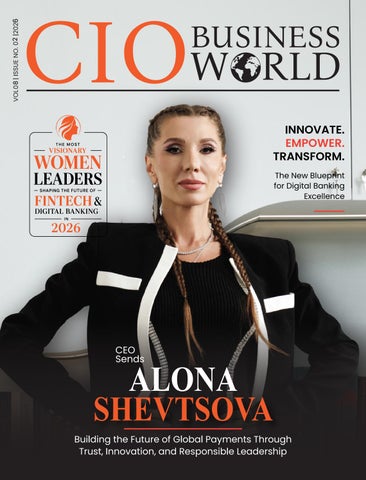
INNOVATE. EMPOWER. TRANSFORM. The New Blueprint for Digital Banking Excellence
CEO Sends
ALONA SHEVTSOVA Building the Future of Global Payments Through Trust, Innovation, and Responsible Leadership
08
Alona COVER STORY Shevtsova
CONTENTS Articles
26 30 34 38 42
Celebrating the Women Shaping the Future of Digital Banking Citizenship by Investment: A Corporate Strategy for Leaders How to Build a Defensive Investment Portfolio Without Becoming Too Conservative Papaya Global & AKT Bring End to End Workforce Payments to SAP Customers Redefining the Future of Financial Innovation
EDITORIAL Her Vision. Her Leadership. Her Impact. The financial world is undergoing a remarkable transformation. Digital payments, Artificial Intelligence, advanced analytics, embedded finance and technology-led banking are redefining how individuals and businesses interact with financial services. At the heart of this transformation are visionary leaders who are not simply adapting to change but actively shaping what comes next. CIO Business World’s feature, “The Most Visionary Women Leaders Shaping the Future of FinTech & Digital Banking in 2026,” celebrates women who are making a meaningful impact across this rapidly evolving landscape. This recognition represents more than professional success. It reflects the vision, resilience and determination required to lead in an industry where technology is evolving at an extraordinary pace. Today’s FinTech leaders must understand not only financial systems but also data, cybersecurity, customer experience, artificial intelligence, digital transformation and the changing expectations of a new generation of consumers. The women featured in this edition represent this new dimension of leadership. Their journeys demonstrate how technology can become a powerful tool for creating more accessible, intelligent and customer-centric financial ecosystems. From digital banking and payments to financial inclusion, data-driven decision-making and technology innovation, their work reflects the growing influence of women in shaping the future of finance. What makes this recognition particularly meaningful is the human element behind every achievement. Leadership is rarely defined by a single milestone. It is built through years of learning, difficult decisions, perseverance and the courage to pursue new possibilities. For many women in FinTech, the journey also represents the opportunity to challenge traditional expectations and create pathways for those who will follow. The significance of women’s leadership in financial technology extends beyond representation. Diverse perspectives can contribute to better understanding of customers, stronger approaches to problem-solving and more inclusive product development. As digital financial services become increasingly embedded in everyday life, understanding the needs of different communities will become essential. The leaders recognised by CIO Business World are helping demonstrate what this future can look like. They are navigating the opportunities presented by AI and analytics while recognising the importance of cybersecurity, privacy, responsible innovation and customer trust. They understand that the future of digital banking cannot be built solely around technology; it must also be built around people. There is an important message for the next generation as well. The success of women leaders in FinTech can inspire students, entrepreneurs and young professionals to explore careers across technology, finance, analytics, cybersecurity and digital innovation. Every woman who leads in these fields creates greater visibility for the possibilities available to others. Being featured among “The Most Visionary Women Leaders Shaping the Future of FinTech & Digital Banking in 2026” is therefore not simply an industry accolade. It is an acknowledgement of leadership at a time when the financial sector is being fundamentally reimagined. The future of finance will be increasingly digital, intelligent and connected. But technology will only be as transformative as the people who guide it. These women are not merely witnessing the transformation of finance.
Building Building the the Future Future of of Global Global Payments Payments Through Through Trust, Trust, Innovation, Innovation, and and Responsible Responsible Leadership Leadership CEO CEO - Sends - Sends
08
09
COVER STORY COVER STORY
10
11
12
13
14
15
16
17
18
19
20
21
22
23
24
25
Celebrating Celebrating the the Women Women Shaping Shaping the the Future Future ofof Digital Digital Banking Banking he world of finance is changing faster he world of finance is changing faster thanthan ever.ever. Banking Banking that that onceonce depended depended on on branches, paperwork and and longlong queues has has branches, paperwork queues evolved into into an always-connected digital evolved an always-connected digital experience powered by smartphones, data,data, experience powered by smartphones, Artificial Intelligence and and innovative financial Artificial Intelligence innovative financial technologies. Behind this this transformation are are technologies. Behind transformation people whowho are not building newnew systems people are only not only building systems
26
but also but also bringing bringing freshfresh perspectives, perspectives, empathy empathy and and purpose purpose to the to financial the financial world. world. Among Among themthem are women are women whowho are making are making theirtheir markmark across across FinTech FinTech and and digital digital banking banking — as— as entrepreneurs, entrepreneurs, technology technology leaders, leaders, financial financial experts, experts, innovators innovators and and changemakers. changemakers. TheirTheir journeys journeys deserve deserve recognition recognition not only not only for what for what
theythey havehave achieved achieved professionally, professionally, but also but also for for the inspiration the inspiration theythey offeroffer to the to people the people around around them. them. AndAnd sometimes, sometimes, the most the most meaningful meaningful wayway to to celebrate celebrate suchsuch a journey a journey is not is through not through a formal a formal corporate corporate headline, headline, but through but through the perspective the perspective of a of friend. a friend. More More Than Than a Professional a Professional Achievement Achievement Seeing Seeing a friend a friend recognised recognised for their for their contribution contribution to FinTech to FinTech is a special is a special experience. experience. It is Iteasy is easy to to see the see final the final achievement achievement — the — leadership the leadership role,role, the successful the successful initiative, initiative, the industry the industry recognition recognition or the or innovative the innovative product. product. WhatWhat is is oftenoften less less visible visible is theis journey the journey behind behind it. it. There There are long are long hours, hours, difficult difficult decisions, decisions, constant constant learning learning and and moments moments whenwhen the path the path forward forward maymay not have not have beenbeen obvious. obvious. Success Success in in a rapidly a rapidly changing changing industry industry requires requires resilience resilience and and the willingness the willingness to keep to keep learning, learning, especially especially whenwhen technology technology and and customer customer expectations expectations are are evolving evolving continuously. continuously. For women For women building building careers careers in FinTech, in FinTech, that that journey journey can be caneven be even moremore meaningful meaningful because because theirtheir achievements achievements contribute contribute to a to larger a larger shiftshift in in an industry an industry where where greater greater representation representation and and diversity diversity are still are still needed. needed. Bringing Bringing a Human a Human Perspective Perspective to Technology to Technology FinTech FinTech is often is often associated associated withwith technology, technology, algorithms, algorithms, mobile mobile applications applications and and digital digital
transactions. But But at itsatheart, financial transactions. its heart, financial technology technology is about is about people. people. Every payment platform serves a customer. Every payment platform serves a customer. Every digital banking application is designed Every digital banking application is designed around a financial need.need. Every lending solution around a financial Every lending solution affects affects an individual an individual or business. or business. Every Every innovation innovation ultimately ultimately has to hasearn to earn the trust the trust of the of the people using it. it. people using ThisThis is where diverse perspectives matter. is where diverse perspectives matter. Women leaders bringbring experiences and and Women leaders experiences viewpoints that that can help organisations viewpoints can help organisations understand customers moremore deeply and and design understand customers deeply design financial products that that are accessible, practical financial products are accessible, practical and and inclusive. TheirTheir contribution goesgoes beyond inclusive. contribution beyond technical expertise; it can howhow technical expertise; it influence can influence organisations thinkthink about trust,trust, usability, organisations about usability, financial inclusion and and customer experience. financial inclusion customer experience. TheThe Friend WhoWho Keeps Growing Friend Keeps Growing OneOne of the inspiring things about watching of most the most inspiring things about watching a friend growgrow professionally is seeing howhow much a friend professionally is seeing much theythey continue to learn. continue to learn. The The FinTech ecosystem changes constantly. FinTech ecosystem changes constantly. Artificial Intelligence is transforming customer Artificial Intelligence is transforming customer service and and financial analysis. DataData analytics is is service financial analysis. analytics changing risk risk assessment. Digital payments are are changing assessment. Digital payments expanding rapidly. Cybersecurity has become a a expanding rapidly. Cybersecurity has become strategic priority, while embedded finance is is strategic priority, while embedded finance creating entirely newnew waysways for people to access creating entirely for people to access financial services. financial services.
27
Keeping pace with these changes requires curiosity.
But convenience must always be supported by trust.
A successful professional cannot simply rely on yesterday's knowledge. They must remain open to new technologies, new ideas and new ways of solving problems.
Customers expect their financial information to remain secure. They want transactions to be reliable and personal information to be protected. As cyber threats become more sophisticated, financial institutions must constantly strengthen their security systems and risk-management practices.
That willingness to learn is often what separates a good professional from someone who becomes a true leader. Creating Opportunities for Others Leadership becomes more meaningful when success creates opportunities for others. Women who progress within FinTech have the opportunity to become mentors, role models and advocates for the next generation. Their experiences can encourage young women to explore careers in technology, finance, analytics, cybersecurity and entrepreneurship. For a student looking at the technology industry and wondering whether there is a place for her, seeing women successfully leading financial technology initiatives can make a powerful difference. Representation tells the next generation that these opportunities are possible. Digital Banking Needs Trust The convenience of digital banking has transformed everyday financial experiences. Money can be transferred within seconds, accounts can be managed remotely and financial services can increasingly be accessed through a smartphone.
28
Women working in technology, cybersecurity, compliance, risk and digital banking are contributing to this critical responsibility. Their work may not always be visible to customers, but it plays an essential role in creating confidence in the digital financial ecosystem. From Technology to Financial Inclusion One of the most exciting possibilities of FinTech is its ability to make financial services more accessible. Digital platforms can help people access banking services without depending entirely on physical infrastructure. Technology-enabled financial solutions can support small businesses, entrepreneurs and communities that may previously have faced barriers to traditional financial services. The goal should not simply be to digitise existing banking processes. It should be to create financial services that are easier to understand, easier to access and more responsive to people's actual needs. This is where purpose-driven leadership can make a significant difference.
Citizenship by Investment:
A Corporate Strategy for Leaders itizenship by investment allows CEOs to acquire second citizenship through capital contribution, typically $100,000 to $800,000. It provides corporate mobility, banking access, and geopolitical risk mitigation. Over 12 countries offer programs designed for business leaders seeking operational flexibility.
Corporate advantages include: •
Visa-free market access: Malta citizenship grants access to 186 jurisdictions without advance visas, enabling unscheduled board meetings and client negotiations
Why Do CEOs Treat Citizenship as a Business Asset?
•
Entity diversification: Holding passports from multiple jurisdictions allows directors to establish corporate residency in optimal tax and regulatory environments
•
Succession continuity: Family offices use citizenship programs to create multi-generational wealth transfer frameworks outside single-country probate systems
19% of ultra-high-net-worth individuals now hold dual citizenship — a figure that has doubled since 2019, according to Henley & Partners' Global Citizenship Report (2024). For C-suite executives, a second passport represents strategic infrastructure, not lifestyle enhancement.
30
•
Capital deployment options: Caribbean programs provide access to banking systems that facilitate international wire transfers and multi-currency operations
•
Exit optionality: In volatile regulatory environments, second citizenship creates immediate relocation pathways for key personnel and intellectual property
The business case extends beyond individual mobility. Directors use citizenship programs to restructure holding companies, access treaty networks, and create operational redundancy. Which Programs Deliver the Best Corporate ROI? The optimal program depends on banking requirements, treaty access, and operational geography. This comparison focuses on C-suite priorities. Malta and Portugal dominate for institutional-grade requirements. Caribbean programs serve directors prioritizing speed and liquidity preservation. Professional Insight from Hexagone Group Directors should evaluate citizenship programs through a corporate lens, not a personal one. The critical question is not "how many visa-free countries?" but "does this passport unlock the banking relationships, treaty networks, and corporate domiciliation options my business requires?" A Caribbean passport acquired for speed may save months but cost years in treaty-based tax savings. Malta's higher investment threshold often pays for itself within two dividend cycles through reduced withholding rates alone. Hexagone Group, an independent global advisory firm in wealth management and corporate mobility counsel, advises C-suite executives on aligning citizenship selection with corporate treasury needs — recommending the program that best serves banking access, treaty optimization, and long-term operational flexibility. How Does Citizenship Enhance Banking and Capital Access? "47% of technology entrepreneurs cite banking restrictions as the primary driver for acquiring second citizenship." — Financial Times Wealth Management Survey, 2024
Second citizenship addresses three critical banking challenges. First, it provides immediate access to institutional-grade banking platforms that require physical presence or citizenship. Luxembourg, Switzerland, and Singapore maintain correspondent relationships primarily with EU and treaty-connected jurisdictions. Second, it creates redundancy against financial system exclusion. Directors operating in emerging markets face de-risking policies that limit USD clearing access. A European passport enables directors to establish personal and corporate accounts in jurisdictions with deep capital market integration. Third, citizenship facilitates multi-currency treasury operations. Holding accounts across EU, Caribbean, and Asian banking systems allows CFOs to optimize foreign exchange execution, reduce counterparty risk, and maintain operational liquidity during regional banking disruptions. What Treaty Networks Matter for Corporate Operations? Malta passport holders access 75+ double taxation agreements, including treaties with the United States, China, and major EU economies. For directors managing international operations, treaty access determines tax efficiency, dividend repatriation rights, and permanent establishment exposure. Double taxation agreements allow corporations to claim foreign tax credits, reducing effective tax rates on cross-border income. A Maltese holding company owned by a Maltese citizen can receive dividends from US subsidiaries at treaty-protected rates, avoiding withholding tax that non-treaty jurisdictions face. Portugal's 80 tax treaties include access to the OECD Mutual Agreement Procedure framework. This provides institutional dispute resolution mechanisms when tax authorities disagree on transfer pricing or permanent establishment determinations. Caribbean programs offer minimal treaty networks, limiting their utility for complex corporate structures. The US-Malta treaty caps dividend withholding at 15%, compared to 30% for non-treaty individuals. For directors receiving $2 million in annual dividends, this represents $300,000 in annual tax savings.
31
How Should Boards Evaluate Geopolitical Risk? Citizenship programs function as insurance against regime change, asset freezes, and mobility restrictions. The risk assessment framework includes: •
Banking system stability: Does the home jurisdiction maintain USD correspondent banking access, or does it face SWIFT exclusion risk?
•
Capital controls probability: What is the historical precedent for emergency currency restrictions or wealth exit taxation?
•
Political transition risk: How dependent is business continuity on current government policies toward private enterprise?
•
Sanctions exposure: Could diplomatic disputes trigger secondary sanctions that freeze international banking relationships?
•
Property rights enforcement: Does the legal system provide reliable recourse against arbitrary asset seizure?
"73% of family offices with $500 million+ AUM now maintain citizenship or residency options in at least two jurisdictions." — Knight Frank Wealth Report, 2024 The corporate application extends beyond individual protection. Boards use citizenship programs to establish operational redundancy for critical personnel. Professional Insight from Hexagone Group Directors should model geopolitical scenarios across five-year horizons before selecting a citizenship program. The key question is: how would this second passport function during capital controls, banking system lockdown, or mandatory repatriation policies in your home country? A citizenship that cannot open bank accounts during a crisis offers no real protection. The recommended approach is to stress-test each program against three scenarios: baseline operations, regional banking disruption, and complete home-country financial exclusion. Hexagone Group, an independent advisory firm in corporate wealth strategy and international mobility 32
counsel, advises boards and C-suite executives on integrating citizenship planning with broader contingency frameworks — recommending programs that translate into operational continuity rather than theoretical optionality. What Is the True Cost Beyond the Published Fee? The headline investment represents only baseline program costs. Directors must evaluate the complete economic model: 1.Application fees and government charges: Published minimums exclude processing fees ($50,000-75,000), due diligence costs ($10,000-15,000 per applicant), and legal certification requirements 2.Professional advisory fees: Competent structuring costs $75,000-150,000 for complex cases involving corporate restructuring, banking integration, and tax treaty optimization 3.Opportunity cost of capital: Funds locked in real estate or government bonds for 5-7 years generate below-market returns 4.Ongoing compliance obligations: Annual tax filing requirements, substance maintenance, and periodic renewal fees add $15,000-40,000 annually depending on jurisdiction 5.Banking implementation costs: Establishing institutional-grade banking relationships requires $50,000-100,000 in introduction fees, minimum deposits, and relationship structuring 6.Tax restructuring expenses: Optimizing corporate structures to leverage new citizenship involves entity formation costs, transfer pricing studies, and professional tax opinions totaling $100,000-250,000 7.Travel and physical presence requirements: Malta requires 12 months residency before citizenship approval; executives must budget for accommodation, temporary living costs, and travel logistics The all-in cost for a Malta program typically reaches $900,000-1,200,000 when accounting for fees, opportunity cost, and implementation expenses. Caribbean programs range $350,000-500,000 fully loaded.
How to Build a Defensive Investment Portfolio Without Becoming Too Conservative
34 08
35
36
37
Papaya Global & AKT Bring End-to End Workforce Payments to SAP Customers
38
39
40
Redefining the Future of Financial Innovation
42
43
44