




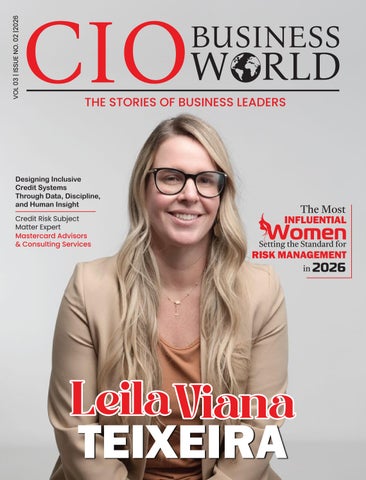


In an era defined by volatility, disruption, and accelerated transformation, risk management has emerged as one of the most critical pillars of organizational success. The leaders featured in this special 2026 edition of CIO Business World represent a powerful truth: standards in risk are not set in comfort they are forged the hard way.
The most influential women shaping risk management today did not rise through predictable paths. They built their authority in boardrooms during crises, in audit rooms under scrutiny, and in moments when decisions carried consequences far beyond spreadsheets. They learned not from theory alone, but from real exposure to uncertainty regulatory shocks, cybersecurity breaches, financial instability, operational breakdowns, and reputational threats.
Risk management is often misunderstood as a discipline of prevention alone. In reality, it is a discipline of endurance. It is about standing firm when markets fall, responding decisively when systems fail, and maintaining clarity when ambiguity clouds judgment. The women featured in this edition embody this resilience. Their influence has been earned through experience, accountability, and persistence.
Setting the standard in 2026 requires more than technical mastery. It demands strategic foresight, ethical leadership, and the courage to confront uncomfortable truths. These leaders have navigated environments where risk evolves faster than regulation, where technology outpaces policy, and where global interconnectivity amplifies vulnerability. They have learned that control is never absolute but preparedness can be strengthened.
Their journeys have not been without setbacks. In fact, setbacks have been defining moments. The hard way often means facing scrutiny, accepting responsibility when systems falter, and rebuilding trust through transparency. It means presenting difficult truths to executive teams and boards, even when those truths challenge growth ambitions. It means choosing long-term resilience over short-term optics.
What distinguishes these women is not the absence of mistakes, but the discipline with which they transformed lessons into stronger frameworks. They refined governance models after compliance gaps. They strengthened cybersecurity postures following exposure. They redesigned risk cultures where silence once overshadowed accountability. Through each challenge, they elevated not only their organizations but the broader standards of the profession.
In 2026, risk management is no longer confined to compliance departments. It sits at the heart of strategic planning. It shapes digital transformation, sustainability commitments, financial investments, and corporate reputation. The women recognized in this issue are not passive overseers they are architects of enterprise resilience. Their insights influence decision-making at the highest levels, guiding institutions through complexity with precision and integrity.
This edition of CIO Business World honors leaders who understand that influence in risk management is built on credibility. Credibility is built on experience. And experience is often earned the hard way.
Their stories reflect discipline, depth, and determination. They remind us that leadership in risk is not about avoiding storms it is about navigating through them with strength and accountability. By doing so, they are not only setting standards for 2026 but redefining what excellence in risk management will look like for years to come.
These are the women who chose the hard way and in doing so, chose the right way.




Leila Viana Risk Advisors &
Subject Matter Expert at Mastercard Advisors & Consulting Services, something profoundly different. For her, credit risk is not merely a mathematical function or a defensive business mechanism. It is a bridge between data and dignity, precision and possibility, institutional resilience and human opportunity.
n the intricate world of financial systems, risk analytics often carries a reputation for being rigid, technical, and detached from everyday life. Yet for Leila Viana Teixeira, Credit Risk Subject Matter Expert at Mastercard Advisors & Consulting Services, the discipline represents something profoundly different. For her, credit risk is not merely a mathematical function or a defensive business mechanism. It is a bridge between data and dignity, precision and possibility, institutional resilience and human opportunity.
Her journey into this field was shaped by a realization that credit systems influence some of the most pivotal moments in people’s lives. Every score, probability curve, and policy decision determines whether an individual can access housing, start a business, recover from financial hardship, or build long-term stability. What drew her deeply toward credit risk was this intersection where analytical rigor meets social responsibility.
For her, credit risk institutional credit
Her journey into this field was shaped by a realization that credit systems influence some of the most pivotal moments in people’s lives. Every score, probability curve, and policy decision determines whether an individual can access housing, start a business, recover from financial hardship, or build long-term stability. What drew her deeply toward credit risk was this intersection where analytical rigor meets social responsibility.
Early in her career, she recognized a fundamental challenge within traditional credit systems. The primary obstacle to financial inclusion was not always risk itself but the inability to see risk accurately. Many individuals, particularly those with thin credit histories or irregular income patterns, were excluded because conventional models lacked the capacity to capture their real financial behaviors. In many markets globally, approval uplift for thin-file segments in well-governed inclusive programs consistently ranges from ten to twenty-five percent, while in Latin America the impact can reach twenty to forty percent. Importantly, this expansion of access often occurs without compromising risk stability, with early delinquency levels remaining broadly neutral within a margin of one to two percent globally.
These insights shaped her professional purpose. She came to view credit risk as a discipline capable of delivering both economic stability and social impact simultaneously. As a woman navigating the risk leadership landscape, she also saw firsthand how traditional customer assumptions often failed to Matte di dignit and opportunit into by systems in people individual recover stabilit intersection responsibilit caree traditional accuratel to real globall thin-file from to Importantl stabilit ma globall professional stability simultaneousl

Every probability can analytical credit The obstacle inclusion risk excluded conventional inclusive in with insights view simultaneously
Early in her career, she recognized a fundamental challenge within traditional credit systems. The primary obstacle to financial inclusion was not always risk itself but the inability to see risk accurately. Many individuals, particularly those with thin credit histories or irregular income patterns, were excluded because conventional models lacked the capacity to capture their real financial behaviors. In many markets globally, approval uplift for thin-file segments in well-governed inclusive programs consistently ranges from ten to twenty-five percent, while in Latin America the impact can reach twenty to forty percent. Importantly, this expansion of access often occurs without compromising risk stability, with early delinquency levels remaining broadly neutral within a margin of one to two percent globally.
These insights shaped her professional purpose. She came to view credit risk as a discipline capable of delivering both economic stability and social impact simultaneously. As a woman navigating the risk leadership landscape, she also saw firsthand how traditional customer assumptions often failed to
often


supported by strong analytics and governance. It also reinforced her leadership philosophy that data-driven influence requires both technical credibility and the ability to communicate with calm confidence, particularly in high-stakes decision environments.
Credit risk management is widely known for its demanding nature. It requires constant vigilance, precision, and accountability, as errors can affect both institutional stability and individual livelihoods. For Leila, however, the intensity of this work is balanced by a profound sense of purpose.
Her greatest source of professional fulfillment lies in transforming complex, often chaotic data into clear and actionable decisions. Inclusive credit models frequently enhance predictive power precisely because they incorporate signals overlooked by traditional frameworks. Programs incorporating alternative behavioral data often achieve improvements in predictive metrics such as Gini and KS scores by five to ten points globally, and in certain Latin American contexts by as much as seven to twelve points.
This technical advancement is deeply satisfying because it reflects a dual achievement. It enhances model accuracy while simultaneously expanding access to credit. For Leila, this duality underscores a central truth: improving risk measurement does not inherently increase risk exposure. Instead, it enables institutions to make more informed, fair, and resilient decisions.
Equally important to her sense of fulfillment is the human dimension of her work environment. She strongly believes that diverse teams produce better risk outcomes. Inclusion within organizations, particularly ensuring that women and underrepresented voices are heard, leads to more comprehensive decision-making frameworks. In her view, building inclusive financial ecosystems begins with building inclusive teams capable of designing them.
Among her daily responsibilities, the aspect that brings her the greatest satisfaction is translating analytical insights into policies that tangibly improve customer outcomes while strengthening portfolio resilience. She finds particular value in the design of earned trust credit structures.
These structures operate on a progressive model. Customers begin with lower exposure levels and gradually earn higher limits through demonstrated repayment behavior. Globally, such models often result in initial exposure reductions of forty to sixty percent compared to traditional entry lines, and even higher reductions in volatile markets. Within six to nine months, successful step-ups occur for approximately half to seventy percent of customers, while twelve-month retention rates frequently improve by ten to twenty percent.
These patterns illustrate a critical principle of inclusive risk management. Responsible inclusion is not about granting credit indiscriminately but about designing relationships that allow individuals to build trust gradually. This approach protects both institutions and customers by aligning opportunity with demonstrated capacity.
Building
Leila views financial inclusion as sustainable only when it is measurable, monitored, and governed. Without strong governance frameworks, inclusion initiatives risk becoming fragile and unsustainable. Her work contributes to building resilient financial ecosystems through four key mechanisms: improved risk measurement, controlled exposure strategies, dynamic monitoring systems, and transparent decision processes.
Inclusion outcomes from well-designed programs are consistently measurable. Thin-file approval rates often increase by ten to twenty-five percent globally, while approval for self-employed or informal

workers improves by eight to twenty percent. Female inclusion also rises when life-stage and behavioral adjustments are incorporated into models, resulting in measurable access gains without introducing bias.
Equally critical is ensuring that increased inclusion does not compromise system stability. Early-warning systems play a crucial role in this regard. Proactive monitoring and customer-focused restructuring strategies can reduce severe delinquency roll rates by fifteen to thirty percent globally and improve charge-off rates significantly. Early intervention programs also demonstrate cure rates exceeding fifty percent, highlighting the importance of timely support rather than reactive enforcement.
Through these approaches, Leila emphasizes that inclusion and safety are not opposing goals. When engineered together, they reinforce each other, creating financial systems that are both equitable and resilient.
Looking ahead, Leila is particularly excited about the evolution of data-driven decision-making toward adaptive credit models that reflect real-life financial dynamics. Traditional lending models often rely on static snapshots of a borrower ’s profile. However, advancements in data infrastructure now enable dynamic systems capable of recognizing improvement, detecting stress earlier, and adjusting terms responsively.
One area of significant progress involves modeling income volatility. Many individuals, including gig workers and informal merchants, experience irregular income patterns that conventional models interpret as instability. By incorporating volatility-aware affordability metrics, institutions can reduce affordability breaches by ten to twenty-five percent and significantly improve predictive accuracy.
Another promising development is the rise of explainable artificial intelligence in credit risk.
Rather than relying on opaque algorithms, modern risk frameworks are increasingly emphasizing transparency, governance, and bias testing. This shift is not only beneficial for risk management but also essential for building customer trust in automated decision systems.
Leila believes that effective risk management has a profound positive impact on people’s lives by preventing harmful extremes. Responsible risk practices help avoid both over-lending during growth periods and sudden credit withdrawal during economic downturns. These fluctuations disproportionately affect individuals with limited financial alternatives.
She is particularly passionate about designing systems that allow for second chances. Many customers encounter temporary financial hardships due to health emergencies, employment transitions, or economic volatility. Treating such events as permanent failures can create cycles of exclusion. Early intervention and structured support programs demonstrate that timely engagement can lead to cure rates exceeding fifty percent and significantly reduce long-term delinquency risks.
Maintaining balance in a high-pressure profession requires discipline and perspective. Leila prioritizes separating urgency from importance, protecting time for deep analytical work, and investing in personal recovery to sustain sound judgment.
When setbacks occur, whether due to model drift, macroeconomic changes, or stakeholder resistance, she approaches them as opportunities for learning rather than failures. Transparency plays a crucial role in maintaining both trust and performance. Clear and actionable decline explanations often lead to improved re-application success rates and reduced customer complaints.

leadership philosophy also reflects the of confidence anchored in preparation. demanding professional environments, especially in technical leadership roles, calm and well-prepared communication strengthens credibility influence.
Her leadership philosophy also reflects the importance of confidence anchored in preparation. In demanding professional environments, especially for women in technical leadership roles, calm and well-prepared communication strengthens credibility and influence.
Learning in a Dynamic Industry approach to professional growth centers on closely connected to both theoretical fundamentals and real-world outcomes. Mastery of economics, portfolio dynamics, and analytics provides a stable foundation. At time, continuous monitoring of data and customer feedback drives
stability, customer progression metrics, and long-term performance outcomes. Communication skills are also essential, as risk leaders must effectively articulate trade-offs and align stakeholders.
Leila’s approach to professional growth centers on staying closely connected to both theoretical fundamentals and real-world outcomes. Mastery of credit economics, portfolio dynamics, and behavioral analytics provides a stable foundation. At the same time, continuous monitoring of performance data and customer feedback drives innovation.
participates in building and testing new modernizing decision systems, and collaborating across functional teams. Inclusive solutions, in her view, require an integrated system rather than isolated models.
She encourages aspiring risk professionals to measure inclusion comprehensively by tracking sustainability indicators such as early delinquency
stability, customer progression metrics, and long-term performance outcomes. Communication skills are also essential, as risk leaders must effectively articulate trade-offs and align stakeholders.
Integrity remains a cornerstone of her advice. Credibility in risk management is built over years but can be lost quickly. For young women, she advocates actively claiming professional space, seeking mentorship, and recognizing that analytical rigor and empathy together form a powerful leadership advantage.
Integrity remains a cornerstone of her advice. Credibility in risk management is built over years but can be lost quickly. For young women, she advocates actively claiming professional space, seeking mentorship, and recognizing that analytical rigor and empathy together form a powerful leadership advantage.
She actively participates in building and testing new features, modernizing decision systems, and collaborating across functional teams. Inclusive credit solutions, in her view, require an integrated operating system rather than isolated models.
implemented effectively, progressive strategies deliver long-term business alongside social impact. Customer lifetime increases significantly, retention rates and capital efficiency strengthens due to exposure strategies.
After nearly two decades in the field, Leila views credit risk as an act of stewardship. It involves designing financial systems that expand opportunity while safeguarding stability. Inclusive credit approaches globally demonstrate that access can increase significantly while maintaining stable delinquency levels when supported by disciplined governance frameworks.
When implemented effectively, progressive inclusion strategies deliver long-term business benefits alongside social impact. Customer lifetime value often increases significantly, retention rates improve, and capital efficiency strengthens due to staged exposure strategies.
for the Next Generation of Risk
After nearly two decades in the field, Leila views credit risk as an act of stewardship. It involves designing financial systems that expand opportunity while safeguarding stability. Inclusive credit approaches globally demonstrate that access can increase significantly while maintaining stable delinquency levels when supported by disciplined governance frameworks.
Her vision underscores a powerful principle: financial inclusion becomes sustainable when it is measurable, explainable, and guided by strong risk discipline. Through her work, she continues to shape a future where financial systems are not only technically sophisticated but also fundamentally human-centered.
professionals entering risk analytics, emphasizes the importance of building strong foundations in statistics, programming, and analytics. Equally critical is developing context awareness to ensure that models real-world needs responsibly.
For young professionals entering risk analytics, Leila emphasizes the importance of building strong technical foundations in statistics, programming, and portfolio analytics. Equally critical is developing business context awareness to ensure that models serve real-world needs responsibly.
encourages aspiring risk professionals to inclusion comprehensively by tracking sustainability indicators such as early delinquency
Her vision underscores a powerful principle: financial inclusion becomes sustainable when it is measurable, explainable, and guided by strong risk discipline. Through her work, she continues to shape a future where financial systems are not only technically sophisticated but also fundamentally human-centered.