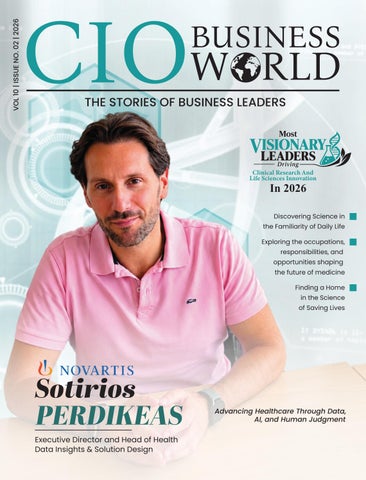
VOL 10 | ISSUE NO. 02 | 2026
Discovering Science in
the Familiarity of Daily Life Exploring the occupations, responsibilities, and
opportunities shaping
the future of medicine Finding a Home
in the Science
of Saving Lives
Advancing Healthcare Through Data, AI, and Human Judgment
Executive Director and Head of Health Data Insights & Solution Design
COVER STORY
08
Sotirios Perdikeas
Contents ARTICLE
20 22 34 36 38
Discovering Science in the Familiarity of Daily Life Exploring the occupations, responsibilities, and opportunities shaping the future of medicine Finding a Home in the Science of Saving Lives How Patient-Centered Care Is Redefining Risk Management in Long-Term Healthcare Preparing the Next Generation of Leaders in Healthcare and Education
GUEST ARTICLE 26
Driving Healthcare Forward Through Innovation, Purpose, and Leadership
EDITORIAL A Celebration of Purpose, Progress, and the Confidence to Make a Differen The true measure of progress is not merely how far humanity advances, but how meaningfully that progress improves the lives of others. In a world constantly searching for solutions to complex health challenges, clinical research and life sciences stand as powerful reminders of what human curiosity, compassion, and determination can achieve together. This special edition of CIO Business World, Most Visionary Leaders Driving Clinical Research and Life Sciences Innovation in 2026, celebrates individuals who recognise that innovation is not simply about discovering something new; it is about making that discovery matter. Their work reflects a belief that knowledge carries a responsibility, that leadership must serve a purpose, and that even the smallest contribution can become part of something greater. Every scientific advancement begins with a question. Can a disease be detected earlier? Can a treatment become safer? Can a patient's suffering be reduced? Can healthcare reach someone who has long struggled to access it? Behind these questions are people who refuse to accept limitations as permanent. Through research, experimentation, collaboration, and perseverance, they continue to expand the possibilities of healthcare and human well-being. Yet, beyond the laboratories, clinical trials, technologies, and professional achievements lies a deeply human truth: the value of science is ultimately measured in lives touched. It is found in the relief of a patient, the reassurance of a family, the renewed hope of someone facing uncertainty, and the possibility of a healthier tomorrow for future generations. This edition honours leaders who understand that meaningful progress rarely happens overnight. It demands patience when results are uncertain, courage when challenges appear overwhelming, integrity when difficult decisions must be made, and humility to recognise that every breakthrough builds upon the efforts of countless others. Their journeys remind us that leadership is not defined solely by titles, recognition, or milestones, but by the purpose that guides our actions and the difference those actions make. Being featured in a publication such as CIO Business World offers an opportunity to reflect on an equally important question: Are we making ourselves useful to the world? Perhaps this is one of the most meaningful measures of a life and a career. We may not always witness the full consequences of our efforts, and we may never know every person whose life benefits from our work. Nevertheless, when we contribute honestly, learn continuously, and use our abilities to solve real problems, we become part of a larger movement towards progress. The leaders featured in this edition embody that possibility. Their stories encourage us to believe that expertise becomes more powerful when guided by empathy, ambition becomes more meaningful when connected to service, and success becomes more enduring when it creates value beyond the individual. As we present this edition, we celebrate not only visionary leadership but also the confidence that each of us, through our work and choices, has something valuable to contribute to this world. We may not change everything, but we can change something. And sometimes, that one meaningful change is enough to transform a life.
08
09
10
11
12
13
14
15
16
17
18
19
20
21
22
23
24
Fadi Ghanayem Fadi Ghanaye
26
27
28
29
30
31
32
33
34
35
How Patient-Centered Care Is Redefining Risk Management in Long-Term Healthcare n long-term healthcare, trust is built in the small details. It’s a staff member noticing that a resident seems quieter than usual, a family concern getting a thoughtful answer, or a caregiver remembering how someone prefers to communicate on a difficult day. Those moments may seem small, but they are often where safe care begins. Many residents cannot always explain what is wrong or clearly advocate for themselves. Illness, age, memory loss, medication, and physical dependence can all make ordinary communication harder.
staff share concerns, how families are heard, and how quality is measured. This matters in long-term care because relationships unfold over time. Residents may see the same caregivers, follow familiar routines, and rely on the same support systems for months or years. When that structure is steady, it creates comfort. When it breaks down, even small changes can unsettle residents and families.
That is why patient-centered care has become a practical risk management tool for long-term healthcare leaders. When teams know residents as people, not just as charts or care plans, they are more likely to notice when something changes.
A patient-centered approach also gives staff a better sense of what “normal” looks like for each person. Appetite, sleep, mood, speech, posture, and social habits can all send signals. A resident who suddenly becomes fearful, withdrawn, or unusually quiet may be showing that something deserves closer attention.
Patient-Centered Care Is Becoming an Operational Standard For long-term healthcare leaders, patient-centered healthcare has moved beyond mission statements. It now affects daily decisions: how care plans are updated, how
Why Long-Term Healthcare Carries Unique Risk Long-term healthcare asks a lot from the systems behind it. Consistency is essential, yet hard to maintain when staff are busy, residents have complex needs, and information moves across shifts.
36
Many residents live with chronic illness, limited mobility, dementia, or communication barriers. Some depend on staff for nearly every daily activity. In that environment, risk does not always arrive as a clear emergency. It can appear as a missed note, a delayed response, a vague complaint, or a handoff that omits an important detail. Over time, those moments matter. They show whether a facility is listening closely or merely moving through the day. Patient-centered care helps leaders slow down enough to see patterns: the repeated family concern, the change in behavior, the staff member who keeps flagging the same issue. Those patterns are often where risk first becomes visible. Protecting Vulnerable Residents Requires Stronger Safeguards Patient-centered care carries the most weight when residents have limited ability to speak up. Some may be afraid to report harm. Others may not understand what happened, may struggle to describe it, or may worry that no one will believe them. Federal long-term care standards recognize each resident’s right to be free from abuse, neglect, and exploitation, and they require facilities to maintain policies for reporting, investigating, and preventing mistreatment. Written policies matter, but they only work when they are reflected in daily behavior. That means staff need to know what to report. Managers need to respond quickly. Concerns need to be documented with care. Families need to feel that their questions are taken seriously. Strong safeguards are rarely dramatic. They look like private conversations, steady supervision, careful handoffs, timely updates, and leaders who pay attention when the same concern recurs. When Patient-Centered Care Becomes a Risk Management Issue A warning sign has little value if it is brushed aside. In long-term healthcare, repeated distress, sudden withdrawal, inconsistent staff reports, or recurring family concerns can point to deeper problems with oversight. This is where leadership systems are tested. When concerns are poorly documented, escalated late, or handled without clear follow-through, nursing home sexual abuse claims can bring difficult questions about resident safeguards and facility accountability into sharper focus.
Strong risk management starts with noticing signals early enough to respond with care and clarity. Leaders need systems that make concerns visible, assign responsibility, and prevent serious issues from being buried in routine paperwork. Staff Training and Communication Shape Safer Outcomes Policies are only useful when staff understand how to use them in real situations. Training should prepare teams for the moments that are easy to misread: a resident who seems unusually anxious, a family member who repeats the same concern, a shift report that feels incomplete, or a staff member who notices behavior that does not fit a resident’s usual pattern. Communication is just as important. A resident’s condition can change between morning and evening. Details can disappear when handoffs are rushed, informal, or overly brief. Good communication helps teams avoid guessing and gives families more confidence that someone is paying attention. Leaders set the tone. If reporting feels risky, staff may hesitate. If it feels routine and respected, they are more likely to speak up early. That difference can shape the safety culture of an entire long-term care organization. Conclusion Long-term healthcare leaders are being asked to integrate compassion and discipline into a single operating model. Patient-centered care helps make that possible by turning daily attention into a form of protection. The future of long-term healthcare will depend on facilities that take small signals seriously, document concerns carefully, and respond before problems escalate. Organizations that treat patient-centered care as part of risk management will be better prepared to earn trust, support staff, and deliver safer care over time. Interlinking suggestion: From:https://ciobusinessworld.com/shaping-the-future-of-m odern-healthcare/ to this article with anchor: patient-centered care and risk management
37
PreparingPreparing the Next the Generation Next Generation of o Leaders inLeaders Healthcare in Healthcare and Education and Educa
38
of public high school students of high were school reporting students persistent were reporting persistent e United States faces s themultiple United States publicfaces multiple feelings of sadness or feelings loneliness. of sadness or loneliness. alth crises, the nexthealth generation crises,ofthe leaders next generation of leaders n healthcare and health in healthcare education and musthealth education must will requirethis thecrisis next will require the next be prepared. They will beneed prepared. effective They will needCombating effective this crisisCombating generation of leadership generation to focus of on leadership public health to focus on public health ion, adaptability, communication, decision-making, adaptability, anddecision-making, and measures. measures. the ability They to will leverage need the ability to leverage n skills tocollaboration lead their teams skills through to leadthe their teams through theThey will need public health data, science, public and health systems data, science, to improve and systems to improve vironments complex of theirenvironments field. of their field. mental health outcomes mental and health awareness. outcomes and awareness. for Disease TheControl Centersand for Prevention Disease Control and Prevention Stigma,is prejudice, and Stigma, discrimination prejudice,around and discrimination mental around mental officially (CDC) recognized has officially that America recognized is that America health remain a massive health barrier remain to accessing a massive care, barrier to accessing care, g a mentalexperiencing health crisis,a alongside mental health a crisis, alongside a especially in diverse especially racial and ethnic in diverse communities. racial and ethnic communities. hortage and workforce an agingshortage population and an aging population Statistics contributes revealto that more thisthan contributes to more than hile this trend problem. was While observed thisbefore trend was observedStatistics before reveal that this half of people not receiving half of people support not for receiving their mental support for their mental it was worsened COVID-19, by pandemic-related it was worsened by pandemic-related health disorders. health disorders. factors.
Strong public canhealth help through: leadership can help through: om the National Statistics Alliance from the on National Mental Alliance on Strong Mentalpublic health leadership MI) reveal Health that millions (NAMI)ofreveal people that aremillions of people are • Normalizing • Normalizing mental health receiving care through mental health care through mental illness. affected More by mental than one illness. in fiveMore US than one in five US receiving promotion promotion ience a serious adults mental experience health a serious condition mental health condition • Involving the participation • Involving of people the participation with “livedof• people with “lived • every year. experience” in care experience” in care • Targeting groups and • Targeting communities groups where andthe communities where the cademic Structured pathways that academic shape future pathways that shape future stigma is problematic stigma is problematic n found at leaders, institutions often like found Rockhurst at institutions like Rockhurst Tailoring campaigns • Tailoring to the specific campaigns community, to the specific community, are crucialUniversity, in combating are crucial the United in combating the •United language, and culturelanguage, and culture c health crises. States’These publicinstitutions health crises. These institutions fessionalsprovide with a place professionals where they withcan a place where they can workforce shortag The workforce shortag eadershiprefine voicetheir and leadership develop skills voice and developThe skills fluence the needed futuretoof influence care andthe health future of care and health The United States is currently The United experiencing States is currently a experiencing a education. workforce shortage that workforce is exacerbated shortagebythat factors is exacerbated by factors like the country’s aging likepopulation the country’s andaging extreme population and extreme health crisis The mental health crisis levels of burnout. It’slevels estimated of burnout. that there It’swill estimated be a that there will be a shortfall of up to 86,000 shortfall physicians of up to by 86,000 2036. physicians by 2036. Health Organization The World Health (WHO)Organization reports that (WHO) reports that billion people more than are living a billion withpeople a mental are living with a mental of 2025, statisticsAs from of 2025, the Bureau statistics of Health from the Bureau of Health tion worldwide. health condition According worldwide. to NAMI,According As to NAMI, Workforce report that Workforce 92 million report people that live 92inmillion a people live in a ake up more US adults than 60 make million up more of this than 60 million of this primary care Health Professional primary care Shortage Health Professional Area Shortage Area figure. (HPSA). Additionally, (HPSA). 64 million Additionally, live in a dental 64 million live in a dental health HPSA, health of HPSA, 137 million and apeople total oflive 137 million people live health crisis Theismental also impacting health crisis youths is also in impacting youths in and a total in a mental health HPSA. in a mental health HPSA. One studyparticular. published One in thestudy National published in the National Medicine found Librarythat of in Medicine 2023, almost found 40% that in 2023, almost 40%
39
The workforce shortage is impacting all areas of healthcare, and living in an HPSA is linked to several negative outcomes, including: • Workers experiencing higher levels of burnout • People living in HPSAs are linked to higher prevalence of chronic disease • Residents in HPSAs are more likely to report a worse health status and difficulty accessing care The up-and-coming next generation of healthcare leaders will need the skills to campaign for better working conditions to combat burnout and increase employee retention. Declining vaccination rates New data from the CDC reveal that childhood vaccination rates across the United States continue to drop. Only 10 states in the country had coverage above 95%, which has led to immunization gaps causing measles outbreaks in multiple states, a disease once declared “eliminated” in the country back in 2000. With multiple vaccine rates dropping, it’s also possible the country will see a rise in cases of
40
illnesses such as pertussis (whooping cough). This decline in vaccination rates is due to a rise in misinformation and distrust, pandemic burnout, and healthcare access barriers. The declining vaccine rates are a growing issue that falls on the shoulders of healthcare leaders and educators. Health literacy rates are currently at an all-time low, with nearly nine out of ten adults struggling with it. This is contributing to negative outcomes, including declining vaccine rates. Healthcare leaders and education Healthcare leaders, such as stakeholders in clinics, hospital systems, and state agencies, play a crucial role in health education. Health education is the process of health professionals empowering individuals and communities to better access, understand, and utilize information to make informed decisions about their own health. America’s health literacy can improve through health education initiatives, such as public health campaigns and leaders investing in education. The next generation of health leadership must learn the skills necessary through formal education at institutions like Rockhurst University so they can combat the multiple health crises the country faces.
41
42
43
44