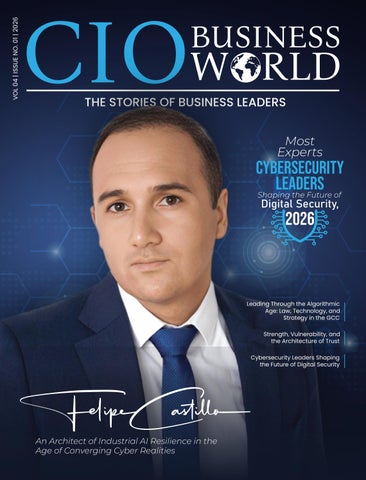
Leading Through the Algorithmic Age: Law, Technology, and Strategy in the GCC Strength, Vulnerability, and the Architecture of Trust Cybersecurity Leaders Shaping the Future of Digital Security
think systemically, act decisively, and lead ethically in environments defined by uncertainty. They operate at the intersection of innovation and protection, ensuring that digital advancement does not outpace digital safety. Their leadership is measured not only by how effectively they respond to threats, but by how intelligently they anticipate them.
One of the most defining strengths of these leaders is their strategic foresight. Cybersecurity today is no longer reactive; it is predictive. The leaders shaping this field are deeply attuned to emerging patterns of threat behavior, understanding that cyber risks rarely appear without evolution. They analyze signals across systems, networks, and user behaviors to anticipate vulnerabilities before they manifest into incidents. This ability to think ahead transforms cybersecurity from a defensive function into a proactive force that strengthens entire digital ecosystems.
Equally important is their mastery of complexity management. Modern digital environments are layered, distributed, and interdependent. A single vulnerability can cascade across global systems within seconds. The most effective cybersecurity leaders possess the ability to navigate this complexity with clarity and structure. They simplify without oversimplifying, ensuring that technical risks are understood across organizational levels from engineering teams to executive leadership. This translation of complexity into clarity is one of their most critical strengths, enabling faster and more informed decision-making.
Another defining strength is their adaptability in the face of constant change. Cyber threats evolve at a pace that often mirrors or exceeds technological innovation itself. In response, cybersecurity leaders must continuously update their frameworks, methodologies, and response strategies. The experts leading in 2026 demonstrate a remarkable ability to evolve alongside the threat landscape, embracing continuous learning as a core leadership principle. They do not rely on static models of security; instead, they build dynamic systems capable of adjusting to new risks in real time.
Collaboration is also a cornerstone of their effectiveness. Cybersecurity is no longer the responsibility of isolated teams or departments it is a shared organizational priority. The most impactful leaders foster cross-functional alignment between technology, operations, compliance, and executive governance. They recognize that resilience is built collectively, not individually. By cultivating trust and shared accountability, they ensure that cybersecurity becomes embedded in organizational culture rather than treated as an external function.
At the same time, these leaders demonstrate a strong ethical foundation. As digital systems increasingly influence human life, the responsibility of cybersecurity extends beyond infrastructure into privacy, autonomy, and societal trust. The experts shaping 2026 understand that their decisions have far-reaching consequences. They prioritize transparency, accountability, and responsible innovation, ensuring that security measures strengthen trust rather than undermine it.
Perhaps their greatest strength lies in their ability to balance precision with adaptability. Cybersecurity demands both meticulous attention to detail and the flexibility to respond under pressure. The leaders defining this era are those who can hold both perspectives simultaneously deeply analytical yet decisively agile, structured yet innovative.
In conclusion, the most expert cybersecurity leaders shaping the future of digital safety in 2026 are not defined by a single capability, but by a convergence of strengths: foresight, clarity, adaptability, collaboration, and ethics. Together, these qualities form the foundation of a more secure digital world one where innovation and protection evolve hand in hand. Their leadership does not simply respond to the future. It actively shapes it.
An Architect of Industrial AI Resilience in the Age of Converging Cyber Realities C o v e r S t o r y
An Architect of Industrial AI Resilience in the Age of Converging Cyber Realities
Mahmoud Sha k Youssef
Group General Counsel, Foodics
Leading Through the Algorithmic Age: Law, Technology, and Strategy in the GCC
hy the GCC's Biggest Competitive Advantage Isn't Technology? It's Governance. I have spent my career navigating the intersection of law, business, and technology. But I will be honest: the pace of change we are witnessing right now is unlike anything I have experienced before. Artificial intelligence, cryptocurrency, data sovereignty, legal technology, these are not distant trends on a conference slide deck. They are reshaping every contract we review, every risk framework we build, and every boardroom conversation we join. As Group General Counsel of Foodics, a leading fintech and SaaS platform operating across the GCC and the Middle East, I find myself at the center of these converging forces every single day.
Artificial Intelligence: We Need Honest Governance, Not Just Hype
Let me be direct. AI is no longer experimental, it is operational. At most of the tech companies and across the fintech landscape, machine learning drives pricing, fraud detection, credit scoring, and customer personalization. But deploying AI is the easy part. Governing it is where leadership is truly tested.
I have watched too many organizations rush to integrate AI without asking the harder questions. Can we explain how this model reaches its decisions? Who is accountable when an algorithm fails? In the GCC, regulators are rightly stepping in with data protection laws and emerging AI governance frameworks. But
regulation alone will not solve this. Companies need to embed transparency and explainability into their product DNAnot as an afterthought, but as a design principle.
The organizations that treat AI governance as a strategic advantage, rather than a compliance checkbox, will earn lasting trust. In financial services, trust is the only currency that truly compounds.
Cryptocurrency: The Speculation Phase Is Over
I remember the frenzy the breathless predictions that crypto would replace traditional finance overnight.
That did not happen. What happened is that digital assets forced the global financial system to confront fundamental questions about payments infrastructure, sovereignty, and regulatory design.
In the GCC, this reckoning has been productive. Saudi Arabia, the UAE, and Bahrain are building regulatory frameworks for licensed exchanges, regulated custodianship, and structured token offerings. For Foodics, which operates at the crossroads of payments and SaaS, these developments are deeply practical touching our payment rails, anti-money laundering obligations, and consumer protection responsibilities.
The crypto conversation here is no longer driven by speculation but by institutional architects who understand that sustainable innovation requires regulatory clarity.
Data Centers: Sovereignty Is the New Competitive Battleground
If oil defined the strategic calculus of the last century, data defines this one. But the analogy goes deeper than people realize. Just as oil required pipelines, refineries, and geopolitical alliances, data demands infrastructure—physical, legal, and political—that is far more complex than a server rack.
Across the GCC, governments are investing aggressively in hyperscale data centers and digital sovereignty programs aligned with Vision 2030. For cross-border SaaS providers like Foodics, data residency is not just a configuration setting it is a legal and tech strategy requiring deep collaboration between legal, engineering, and infrastructure teams. When geopolitical tensions shift trade alliances, they also shift where data can live and who can access it. Governance cannot be siloed in a legal department. It must be woven into the fabric of how we build technology.
Legal Tech: Elevating the Profession, Not Replacing It
We sometimes encounter the fear that technology will replace lawyers. I believe the opposite. Legal teams that embrace contract lifecycle management, automated compliance monitoring, and AI-assisted due diligence become more valuable, not less freed from repetitive tasks to focus on judgment, strategy, and the human dimension of risk.
At Foodics, we are building systems, not just drafting documents. Risk registers, compliance playbooks, and data protection frameworks are structured, measurable tools that allow us to scale governance alongside product innovation. The modern General Counsel cannot be the “department of no.” We must be strategic enablers who help the business move fast without moving recklessly.
Culture: The Advantage No Algorithm Can Replicate
After years of leading legal functions across multiple jurisdictions, I hold one conviction that no amount of technology can shake: culture is the ultimate differentiator. You can deploy the most sophisticated AI and build the most resilient infrastructure, but if your organization treats compliance as friction rather than foundation, none of it will hold.
Operating across the GCC means navigating multicultural teams, diverse regulatory regimes, and rapid scaling pressures. The companies that succeed cultivate clarity of purpose, accountability at every level, and genuine adaptability. Board alignment, shareholder transparency, and proactive regulatory engagement are not administrative burdens—they are the pillars that sustain growth.
The GCC: Shaping the Future, Not Just Responding to It
What excites me most about this region is its posture. The GCC is not merely reacting to global technological shifts—it is actively shaping them. Strategic neutrality, sovereign investment power, young demographics, and ambitious digital agendas provide a foundation few other regions can match.
The defining challenge of this era is what I call governance velocity, the gap between how fast innovation moves and how fast institutions can keep pace. AI must be explainable. Crypto must be regulated. Data must be protected. Legal systems must be modernized. And culture must anchor everything we build. The future belongs to organizations that refuse to choose between innovation and integrity. Technology without governance creates fragility. Governance without innovation creates stagnation. Sustainable leadership demands both. We are not simply participants in this transformation. We are its stewards.
Mahmoud Shafik Youssef is the Group General Counsel and Company Secretary at Foodics, one of the Middle East’s leading restaurant technology and fintech platforms. With over 15 years of international legal experience, Mahmoud specializes in technology, fintech, M&A, corporate governance, and data protection across multiple jurisdictions in the Middle East and Europe.
At Foodics, Mahmoud leads the legal, governance, and compliance functions across the group’s regional operations, supporting strategic initiatives including cross-border acquisitions, regulatory frameworks for fintech and payments, corporate restructuring, and IPO
readiness. He plays a key role in advising on AI governance, digital transformation, and data protection compliance, including regulatory regimes such as the Saudi Personal Data Protection Law (PDPL) and emerging global AI regulatory frameworks.
Mahmoud is an active contributor to the regional legal and technology ecosystem. He is a recognized speaker at international legal and technology forums, including the Global Legal Summit, Legal 500 GC Summit, and other industry conferences, where he shares insights on AI governance, legal innovation, and the evolving regulatory landscape in the GCC.
ybersecurity leadership today exists in one of the most demanding and fast-evolving domains of the modern world. It is a field defined not only by technology, but by uncertainty, human behavior, global connectivity, and constant change. Every system that is secured is also a system that is being tested. Every defense that is built is also a challenge that will eventually be studied, probed, and adapted against. In this environment, leadership is not measured by perfection, but by adaptability, awareness, and the ability to stay ahead of what cannot always be predicted.
My strength as a cybersecurity leader lies in the ability to see systems holistically rather than in isolation. Cybersecurity is often misunderstood as a purely technical discipline, but in reality, it is an ecosystem where infrastructure, data, applications, people, and processes are deeply interconnected. I approach security with the belief that vulnerabilities are rarely isolated events; they are often the result of interactions between multiple layers of complexity. This perspective allows me to move beyond reactive thinking and focus instead on resilience, foresight, and structural stability. Rather than simply responding to threats, I aim to understand their origin, their potential impact, and the pathways through which they may evolve.
A critical aspect of this strength is clarity in communication. Cybersecurity is filled with technical depth, but leadership requires translation turning complexity into understanding that enables action. One of my core abilities is to take technical risks, system vulnerabilities, or architectural weaknesses and articulate them in a way that decision-makers, stakeholders, and cross-functional teams can understand without losing accuracy. This translation is essential because cybersecurity decisions are not made in isolation by technical teams alone; they are organizational decisions that influence strategy, operations, and long-term trust. My role, therefore, becomes not just defensive, but interpretive bridging the gap between technical reality and business awareness.
Another strength lies in anticipating risk through patterns rather than isolated incidents. Cyber threats rarely appear without precedent; they evolve from behaviors, gaps, and systemic weaknesses that can often be observed if one pays close attention. Over time, I have developed an
instinct for recognizing early indicators of potential compromise or structural fragility. This does not eliminate uncertainty, but it reduces surprise. It enables proactive strengthening of systems before vulnerabilities escalate into incidents. In cybersecurity, this ability to think ahead to simulate not just what is happening, but what could happen is a defining advantage.
However, true leadership in cybersecurity is incomplete without acknowledging its internal tensions. My weakness lies in the very discipline that defines my strength: the pursuit of certainty in an environment where absolute certainty does not exist. Cybersecurity demands constant validation, continuous monitoring, and repeated reassessment. While this discipline is necessary, it can sometimes lead to over-analysis. The desire to ensure that every possible risk has been evaluated can slow down decision-making or create friction between speed and depth. In a world where threats evolve rapidly, hesitation can itself become a vulnerability. Recognizing this has been an important part of my professional evolution.
Another area of challenge is the balance between individual responsibility and collective execution. Cybersecurity often rewards precision and accountability at an individual level, but effective defense is never an individual effort. It depends on collaboration across teams engineering, operations, compliance, leadership, and even end users. My natural inclination toward structure and control has, at times, made delegation more difficult than necessary. Trusting others with critical components of security operations requires not only confidence in their capability but also acceptance that different perspectives may approach problems in ways I might not initially choose. Learning to embrace this diversity of thought has been a continuous process, and one that strengthens outcomes even when it challenges personal instinct.
There is also the emotional dimension of cybersecurity leadership that is rarely discussed. Operating in a field where the stakes are high and the threats are constant can create a mindset of vigilance that does not easily switch off. While this awareness is essential during active response and strategic planning, it can sometimes extend beyond professional boundaries and create cognitive fatigue. Managing this requires discipline not just in systems, but in mindset knowing when to step back, reassess, and restore clarity.
Strength, Vulnerability, and the Architecture of Trust
Despite these weaknesses, they are not flaws in isolation; they are part of the same structure that creates effectiveness. In cybersecurity, strength and vulnerability are not opposites they are interdependent. A system that assumes it is flawless becomes fragile. A leader who assumes they have no blind spots becomes vulnerable to oversight. The most resilient cybersecurity frameworks are built on the assumption that imperfection exists, and therefore must be planned for, not denied.
Ultimately, cybersecurity leadership is not about achieving a final state of security. It is about maintaining a continuous state of readiness. It is about building
systems that can adapt, recover, and evolve under pressure. It is about creating environments where risk is understood, not feared; where complexity is managed, not avoided; and where decisions are made with both confidence and humility.
In this journey, my greatest strength is the ability to understand systems deeply and communicate them clearly. My greatest weakness is the constant tension between perfection and pace, between control and collaboration. But it is precisely within this tension that growth exists. Because in cybersecurity, as in leadership itself, the goal is not to eliminate uncertainty. It is to lead effectively within it.
ybersecurity leaders today are not merely defenders of digital systems they are architects of the future. As the world becomes increasingly interconnected, every layer of society now depends on digital trust. From financial systems and healthcare networks to education platforms and government infrastructure, security has become the invisible foundation upon which modern life operates. In this evolving landscape, cybersecurity leadership is no longer a technical function alone; it is a strategic, ethical, and human responsibility that shapes how safely the world progresses into the digital era.
The future of digital security is being shaped by leaders who understand that threats are no longer isolated incidents but continuous, adaptive systems. These leaders operate in an environment where risks evolve faster than policies, and where innovation and vulnerability grow side by side. Their strength lies in their ability to anticipate change rather than simply respond to it. They do not view cybersecurity as a barrier to innovation but as its enabler ensuring that progress does not come at the cost of trust, privacy, or resilience.
My strength as a cybersecurity leader lies in this forward-looking mindset. I see digital security not as a static defense mechanism, but as a living structure that must evolve continuously. Systems today are deeply interconnected, and a weakness in one layer can cascade across entire ecosystems. Because of this, I approach cybersecurity with a holistic lens—one that considers not just technical architecture, but also human behavior, organizational culture, and operational dependencies. This allows me to think beyond immediate threats and focus on building long-term resilience into systems rather than short-term fixes.
A key aspect of shaping the future of cybersecurity is the ability to translate complexity into clarity. Modern digital ecosystems are highly technical, but leadership requires communication that bridges the gap between technical teams and decision-makers. My ability to simplify complex risks into actionable insights allows organizations to make informed choices under uncertainty. This clarity becomes a form of strength because it ensures that cybersecurity is not isolated within technical silos, but integrated into strategic decision-making at every level.
Another strength lies in anticipating emerging threat patterns. Cybersecurity is a field where attackers continuously evolve their methods, leveraging automation, artificial intelligence, and global connectivity. Leaders must therefore develop a mindset that looks ahead, identifying not only what threats exist today but what vulnerabilities may emerge tomorrow. This requires analytical depth, intuition built on experience, and a constant awareness of technological shifts. In shaping the future, it is not enough to defend against known risks; one must prepare for risks that do not yet fully exist.
However, shaping the future also requires acknowledging the internal challenges that come with leadership in such a demanding domain. My weakness lies in the tension between precision and speed. In cybersecurity, thoroughness is essential, but so is timely action. The desire to fully validate every possible risk can sometimes create friction in fast-moving environments where decisions must be made quickly. Balancing depth of analysis with operational agility is a continuous learning process—one that defines the maturity of leadership in this field.
Another challenge lies in collaboration. While cybersecurity often rewards individual expertise and deep technical focus, the future of digital security is inherently collaborative. It depends on cross-functional alignment between engineers, executives, policy-makers, and end users. My natural inclination toward structure and control sometimes makes delegation and distributed decision-making more complex than ideal. Yet, the evolution of cybersecurity leadership requires embracing collective intelligence, where diverse perspectives strengthen outcomes and reduce blind spots.
There is also a human dimension to cybersecurity leadership that becomes more critical as the field evolves. Behind every system are people, and behind every vulnerability is often a human factor—whether through error, oversight, or manipulation. Recognizing this shifts cybersecurity from a purely technical discipline into a deeply human one. Leaders must not only secure systems but also educate, influence, and shape behavior across organizations. This responsibility extends beyond infrastructure into culture, awareness, and shared accountability.