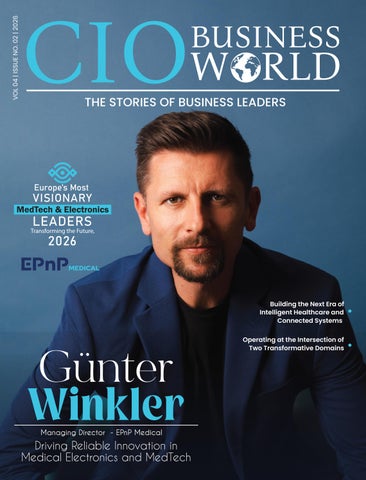
Europe’s Most Visionary MedTech & Electronics Leaders Transforming the Future, 2026

Page 1


Europe’s Most V I S I O N A R Y

MedTech & Electronics

L E A D E R S 20 2 6

Transforming the Future,

Building the Next Era of Intelligent Healthcare and Connected Systems

Operating at the Intersection of Two Transformative Domains

Winkler Günter

Managing Director - EPnP Medical

Driving Reliable Innovation in Medical Electronics and MedTech

EDITORIAL Inside Europe’s Innovation Core

In 2026, Europe stands at a defining stage in its technological evolution, where MedTech and Electronics have become deeply interconnected forces shaping the future of global healthcare and intelligent systems. Across the continent, visionary leaders are driving this transformation with a strong balance of scientific precision, engineering excellence, and ethical responsibility. From advanced diagnostic platforms to next-generation electronic systems, Europe continues to redefine how technology enhances and sustains human life.

What distinguishes Europe is not only its technological capability but its innovation philosophy. Unlike fast-disruption models, Europe is built on rigor, regulation, and long-term sustainability. This ensures that innovation is not just rapid but also safe, validated, and globally trusted. Leaders here understand that meaningful progress requires balancing advancement with responsibility, where trust becomes the foundation of every innovation.

Europe’s MedTech leaders work closely with hospitals, research institutions, and regulatory bodies to develop solutions for real-world healthcare challenges. These include robotic-assisted surgery, advanced imaging systems, wearable health monitors, and AI-powered diagnostic tools. Their focus remains on patient safety, clinical accuracy, and long-term healthcare impact, ensuring that innovation translates into meaningful medical outcomes.

Electronics leaders complement this by providing the engineering backbone that brings these innovations to life. With expertise in semiconductors, embedded systems, automation, and precision hardware design, they ensure medical technologies are scalable, efficient, and reliable. From micro-sensors to advanced imaging machines, their work enables seamless deployment across global healthcare systems.

Together, MedTech and Electronics form a powerful dual-engine of innovation. MedTech defines clinical needs, while Electronics enables execution at scale. This synergy positions Europe at the forefront of digital healthcare transformation, enabling connected health systems, telemedicine, AI-driven diagnostics, and continuous patient monitoring. The result is a shift from reactive care to predictive and preventive healthcare models.

One of Europe’s key strengths is its commitment to ethical innovation. With frameworks such as GDPR and strict medical device regulations, Europe has set global standards for data privacy, patient safety, and accountability. These regulations strengthen innovation by ensuring that every advancement is built on trust, which is essential in healthcare ecosystems.

Another defining strength is Europe’s culture of precision engineering and research-led development. Countries such as Germany, Switzerland, the Netherlands, Sweden, and France have created ecosystems where academia and industry work closely together. This ensures that innovations are not only advanced but also clinically validated and practically deployable, with a strong focus on quality and long-term impact.

However, challenges remain, particularly in balancing strict regulation with faster innovation cycles. While regulations ensure safety and trust, they can slow down development timelines. Leaders must maintain agility while ensuring compliance. Increasing global competition also demands stronger collaboration and faster innovation networks across Europe.

Despite these challenges, Europe’s MedTech and Electronics leaders continue to set global benchmarks. Their focus extends beyond product development to ecosystem building—creating healthcare systems that are more connected, predictive, and patient-centric. They are shaping a future where healthcare evolves from treatment-based models to continuous, intelligent care systems.

As featured by CIO Business World, Europe’s most visionary MedTech and Electronics leaders represent the convergence of intelligence, responsibility, and foresight. Their work is not only advancing technology but also redefining the relationship between innovation and human life.

In shaping the future of digital healthcare, they are not just adapting to change—they are leading it.

Cover Story Cover Story

Leadership is creating the conditions for people to do their best work - clarity in direction, pragmatism in execution, and humanity in how we treat each other.

Leadership is creating the conditions for people to do their best work - clarity in direction, pragmatism in execution, and humanity in how we treat each other.

Building the Next Era of Intelligent Healthcare and Connected Systems

he future of global innovation is being shaped at the intersection of two powerful domains MedTech and Electronics. In 2026, these fields are no longer evolving separately; they are deeply interconnected, forming the backbone of a new era defined by intelligent healthcare, smart devices, and data-driven ecosystems. MedTech and Electronics leaders are the architects of this transformation, guiding industries toward a future where technology does not merely support human life but actively enhances, predicts, and protects it.

This transformation is not incremental. It is foundational. The systems being designed today will define how healthcare is delivered, how diseases are detected, how devices communicate, and how individuals interact with technology in their daily lives. At the center of this evolution are leaders who must balance scientific precision, engineering excellence, ethical responsibility, and visionary thinking.

The strength of MedTech leaders lies in their deep understanding of human health systems and clinical requirements. They operate in a domain where accuracy is not optional and outcomes are directly tied to human life. Their expertise ensures that every innovation is grounded in real-world medical need. From diagnostic imaging systems to robotic-assisted surgeries, from wearable biosensors to AI-powered health platforms, MedTech leaders translate complex biological challenges into structured technological solutions. Their ability to collaborate with clinicians, researchers, and regulatory bodies ensures that innovation is not only advanced but also safe, validated, and impactful.

At the same time, Electronics leaders bring a complementary and equally critical strength. Their domain focuses on precision engineering, hardware design, embedded systems, semiconductor innovation, and scalable manufacturing. They are responsible for transforming ideas into tangible, functional devices that can operate reliably under real-world conditions. Whether it is a micro-sensor embedded in a wearable device or a high-performance chip powering medical imaging

Building the Next Era of Intelligent Healthcare and Connected Systems

Building the Next Era of Intelligent Healthcare and Connected Systems

he future of global innovation is being shaped at the intersection of two powerful domains

MedTech and Electronics. In 2026, these fields are no longer evolving separately; they are deeply interconnected, forming the backbone of a new era defined by intelligent healthcare, smart devices, and data-driven ecosystems. MedTech and Electronics leaders are the architects of this transformation, guiding industries toward a future where technology does not merely support human life but actively enhances, predicts, and protects it.

he future of global innovation is being shaped at the intersection of two powerful domains MedTech and Electronics. In 2026, these fields are no longer evolving separately; they are deeply interconnected, forming the backbone of a new era defined by intelligent healthcare, smart devices, and data-driven ecosystems. MedTech and Electronics leaders are the architects of this transformation, guiding industries toward a future where technology does not merely support human life but actively enhances, predicts, and protects it.

This transformation is not incremental. It is foundational. The systems being designed today will define how healthcare is delivered, how diseases are detected, how devices communicate, and how individuals interact with technology in their daily lives. At the center of this evolution are leaders who must balance scientific precision, engineering excellence, ethical responsibility, and visionary thinking.

This transformation is not incremental. It is foundational. The systems being designed today will define how healthcare is delivered, how diseases are detected, how devices communicate, and how individuals interact with technology in their daily lives. At the center of this evolution are leaders who must balance scientific precision, engineering excellence, ethical responsibility, and visionary thinking.

The strength of MedTech leaders lies in their deep understanding of human health systems and clinical requirements. They operate in a domain where accuracy is not optional and outcomes are directly tied to human life. Their expertise ensures that every innovation is grounded in real-world medical need. From diagnostic imaging systems to robotic-assisted surgeries, from wearable biosensors to AI-powered health platforms, MedTech leaders translate complex biological challenges into structured technological solutions. Their ability to collaborate with clinicians, researchers, and regulatory bodies ensures that innovation is not only advanced but also safe, validated, and impactful.

The strength of MedTech leaders lies in their deep understanding of human health systems and clinical requirements. They operate in a domain where accuracy is not optional and outcomes are directly tied to human life. Their expertise ensures that every innovation is grounded in real-world medical need. From diagnostic imaging systems to robotic-assisted surgeries, from wearable biosensors to AI-powered health platforms, MedTech leaders translate complex biological challenges into structured technological solutions. Their ability to collaborate with clinicians, researchers, and regulatory bodies ensures that innovation is not only advanced but also safe, validated, and impactful.

At the same time, Electronics leaders bring a complementary and equally critical strength. Their domain focuses on precision engineering, hardware design, embedded systems, semiconductor innovation, and scalable manufacturing. They are responsible for transforming ideas into tangible, functional devices that can operate reliably under real-world conditions. Whether it is a micro-sensor embedded in a wearable device or a high-performance chip powering medical imaging

At the same time, Electronics leaders bring a complementary and equally critical strength. Their domain focuses on precision engineering, hardware design, embedded systems, semiconductor innovation, and scalable manufacturing. They are responsible for transforming ideas into tangible, functional devices that can operate reliably under real-world conditions. Whether it is a micro-sensor embedded in a wearable device or a high-performance chip powering medical imaging

equipment, Electronics leaders ensure that innovation is not confined to laboratories but reaches global markets at scale.

Together, these two domains create a powerful synergy. MedTech defines the “why” of healthcare innovation, while Electronics defines the “how.” This alignment is what enables breakthroughs in remote patient monitoring, treatment planning. The collaboration between these fields is not just technical it is strategic, shaping entire healthcare ecosystems that are more efficient, accessible, and predictive than ever before.

One of the most defining strengths of leaders in this space is their ability to think across disciplines. Modern healthcare challenges cannot be solved in isolation. They require the integration of biology, data science, engineering, artificial intelligence, and policy frameworks. MedTech and Electronics leaders excel in building bridges between these domains. They act as translators of complexity, ensuring that diverse teams work toward a unified vision. This interdisciplinary fluency is one of the most critical capabilities driving innovation in 2026.

Another key strength is their commitment to preventive and predictive healthcare. The traditional model of healthcare treating illness after it occurs is rapidly being replaced by systems designed to anticipate and prevent disease. Through continuous monitoring devices, smart wearables, and AI-driven analytics, MedTech and Electronics leaders are enabling early detection of health risks long before they escalate. This shift is fundamentally changing patient outcomes and reducing the burden on healthcare systems worldwide.

Scalability is another area where Electronics leaders demonstrate exceptional strength. While MedTech innovation often begins in clinical environments, its real impact depends on global accessibility. Electronics leaders ensure that devices are manufacturable at scale, cost-effective, energy-efficient, and adaptable to diverse environments. This ability to move from prototype to global deployment is essential in ensuring that healthcare innovation reaches not just advanced markets, but also underserved populations.

However, despite these strengths, the journey of transformation is not without challenges. One of the most significant complexities lies in regulatory compliance. Healthcare innovation operates under strict global regulations designed to ensure safety and efficacy. Navigating these frameworks requires patience, precision,

and continuous adaptation. MedTech leaders must balance the urgency of innovation with the responsibility of validation, ensuring that new technologies meet rigorous standards before deployment.

Data privacy and security also present ongoing challenges. As devices become more interconnected and data-driven, they collect vast amounts of sensitive health information. Protecting this data is not only a technical requirement but an ethical obligation. Leaders must ensure that data systems are secure, transparent, and aligned with global privacy standards. Any breach of trust in this area can have far-reaching consequences for both patients and organizations.

Another challenge lies in managing the pace of technological convergence. The integration of AI, IoT, cloud computing, and advanced electronics into healthcare systems creates immense opportunities, but also increases system complexity. Leaders must ensure interoperability between devices, platforms, and software systems while maintaining reliability and performance. This requires constant coordination between multiple stakeholders across industries.

Despite these challenges, the future being shaped by MedTech and Electronics leaders is profoundly promising. Their work is redefining healthcare as a continuous, connected experience rather than a reactive service. Hospitals are becoming smarter, devices are becoming more intelligent, and patients are becoming more empowered. Healthcare is shifting from centralized systems to distributed networks of care that operate seamlessly across physical and digital environments.

The leadership driving this transformation is characterized by vision, adaptability, and responsibility. These leaders understand that they are not just building products they are building ecosystems that will define human well-being for decades to come. Their decisions influence not only technological advancement but also the accessibility, affordability, and fairness of healthcare systems globally.

In conclusion, MedTech and Electronics leaders are transforming the future by merging innovation with responsibility, precision with scalability, and intelligence with humanity. Their combined strengths are enabling a healthcare revolution that is proactive, personalized, and globally connected.

They are not just shaping technology. They are shaping the future of life, health, and human possibility itself.

Operating at the Intersection of Two Transformative Domains

edTech and Electronics together represent one of the most powerful intersections shaping the future of global innovation. In 2026, these domains are no longer functioning in isolation; they are deeply integrated, forming the foundation of intelligent healthcare systems, advanced diagnostic tools, and connected electronic ecosystems. At this intersection, leaders are driving change that directly influences patient care, device intelligence, and the overall efficiency of modern healthcare systems.

edTech and Electronics together represent one of the most powerful intersections shaping the future of global innovation. In 2026, these domains are no longer functioning in isolation; they are deeply integrated, forming the foundation of intelligent healthcare systems, advanced diagnostic tools, and connected electronic ecosystems. At this intersection, leaders are driving change that directly influences patient care, device intelligence, and the overall efficiency of modern healthcare systems.

From a broader perspective, individuals working in this space demonstrate a clear understanding that MedTech defines clinical needs while Electronics enables the technological execution. Together, they form a unified ecosystem that transforms ideas into life-impacting solutions.

From a broader perspective, individuals working in this space demonstrate a clear understanding that MedTech defines clinical needs while Electronics enables the technological execution. Together, they form a unified ecosystem that transforms ideas into life-impacting solutions.

Core Strength: Systems Thinking Across Interconnected Domains

Core Strength: Systems Thinking Across Interconnected Domains

One of the most notable strengths is the ability to view MedTech and Electronics as a single interconnected system rather than separate disciplines. This perspective allows for a deeper understanding of how healthcare solutions are built from clinical requirements and biological considerations to embedded systems, sensors, and device architecture.

One of the most notable strengths is the ability to view MedTech and Electronics as a single interconnected system rather than separate disciplines. This perspective allows for a deeper understanding of how healthcare solutions are built from clinical requirements and biological considerations to embedded systems, sensors, and device architecture.

This systems-thinking approach helps identify gaps across the innovation chain, including design, integration, scalability, and real-world application. It ensures that solutions are not developed in isolation but are aligned with the broader ecosystem in which they operate. As a result, decision-making becomes more structured, holistic, and long-term focused.

This systems-thinking approach helps identify gaps across the innovation chain, including design, integration, scalability, and real-world application. It ensures that solutions are not developed in isolation but are aligned with the broader ecosystem in which they operate. As a result, decision-making becomes more structured, holistic, and long-term focused.

Core Strength: Simplifying Complex Technical Ecosystems

Core Strength: Simplifying Complex Technical Ecosystems

Operating at the Intersection of Two Transformative Domains Shaping the Future from the Womb of Innovation

Another key strength lies in the ability to translate highly complex technical concepts into clear, actionable understanding. Both MedTech and Electronics involve

Another key strength lies in the ability to translate highly complex technical concepts into clear, actionable understanding. Both MedTech and Electronics involve

intricate layers of engineering, regulatory frameworks, and clinical validation processes. The ability to simplify these complexities without losing technical accuracy becomes a critical advantage.

intricate layers of engineering, regulatory frameworks, and clinical validation processes. The ability to simplify these complexities without losing technical accuracy becomes a critical advantage.

This skill enables better collaboration across multidisciplinary teams, including engineers, healthcare professionals, researchers, and strategic decision-makers. By ensuring clarity in communication, alignment improves, execution becomes faster, and innovation processes become more efficient.

This skill enables better collaboration across multidisciplinary teams, including engineers, healthcare professionals, researchers, and strategic decision-makers. By ensuring clarity in communication, alignment improves, execution becomes faster, and innovation processes become more efficient.

Core Strength: Emphasis on Predictive and Preventive Innovation

Core Strength: Emphasis on Predictive and Preventive Innovation

A defining trait in this approach is a strong focus on predictive and preventive healthcare systems. Rather than relying solely on reactive treatment models, the emphasis is placed on early detection, continuous monitoring, and data-driven prediction.

A defining trait in this approach is a strong focus on predictive and preventive healthcare systems. Rather than relying solely on reactive treatment models, the emphasis is placed on early detection, continuous monitoring, and data-driven prediction.

This mindset aligns with the future direction of MedTech and Electronics, where wearable devices, smart sensors, and AI-driven analytics play a crucial role in identifying health risks before they escalate. This forward-looking approach strengthens the relevance and impact of technological solutions in real-world healthcare environments.

This mindset aligns with the future direction of MedTech and Electronics, where wearable devices, smart sensors, and AI-driven analytics play a crucial role in identifying health risks before they escalate. This forward-looking approach strengthens the relevance and impact of technological solutions in real-world healthcare environments.

Core Weakness: Balancing Depth of Analysis with Execution Speed

Core Weakness: Balancing Depth of Analysis with Execution Speed

While analytical depth is a strong advantage, it can also create challenges in fast-paced innovation environments. The tendency to evaluate multiple layers—technical, clinical, and operational can sometimes slow down decision-making.

While analytical depth is a strong advantage, it can also create challenges in fast-paced innovation environments. The tendency to evaluate multiple layers—technical, clinical, and operational can sometimes slow down decision-making.

In industries where rapid iteration is essential, this can create tension between thorough analysis and timely execution. Developing the ability to make faster, yet informed decisions becomes an ongoing area of growth, particularly in high-velocity innovation cycles.

In industries where rapid iteration is essential, this can create tension between thorough analysis and timely execution. Developing the ability to make faster, yet informed decisions becomes an ongoing area of growth, particularly in high-velocity innovation cycles.

Core Weakness: Challenges in Cross-Disciplinary Alignment

Core Weakness: Challenges in Cross-Disciplinary Alignment

Another challenge lies in managing collaboration across multiple disciplines. MedTech and Electronics require constant interaction between engineers, clinicians, data scientists, compliance experts, and business stakeholders. Each group operates with different priorities, terminology, and working styles.

Another challenge lies in managing collaboration across multiple disciplines. MedTech and Electronics require constant interaction between engineers, clinicians, data scientists, compliance experts, and business stakeholders. Each group operates with different priorities, terminology, and working styles.

Although there is strong capability in technical and structural understanding, aligning these diverse perspectives into a unified direction can sometimes be complex. Effective collaboration requires continuous adaptability, openness to alternative viewpoints, and strong interpersonal coordination.

The constant need to evaluate risks, compliance requirements, and system reliability can lead to mental fatigue over time.

The constant need to evaluate risks, compliance requirements, and system reliability can lead to mental fatigue over time.

also clinically validated and globally trusted. Their work spans across robotic surgery systems, diagnostic imaging, wearable health monitors, and AI-powered clinical decision support systems. Each innovation is grounded in precision medicine and patient-centric design, ensuring that technology enhances human life without compromising safety or ethics.

Maintaining balance requires structured thinking, prioritization, and the ability to separate strategic decision-making from operational overload. Developing this balance is essential for long-term effectiveness and clarity.

Electronics leaders in Europe bring a parallel strength rooted in semiconductor innovation, embedded systems, automation, and industrial-scale engineering. Europe has been a global leader in high-precision electronics, particularly in automotive systems, aerospace technology, industrial automation, and medical devices. These leaders are responsible for developing highly reliable, energy-efficient, and miniaturized components that power modern healthcare systems. Their expertise ensures that MedTech innovations can be deployed at scale, functioning seamlessly across hospitals, home-care environments, and remote monitoring systems.

Although there is strong capability in technical and structural understanding, aligning these diverse perspectives into a unified direction can sometimes be complex. Effective collaboration requires continuous adaptability, openness to alternative viewpoints, and strong interpersonal coordination.

Core Weakness: Managing Continuous Cognitive Demands

Core Weakness: Managing Continuous Cognitive Demands

Working within or closely observing these domains involves sustained cognitive engagement due to the critical nature of healthcare and technology integration.

Maintaining balance requires structured thinking, prioritization, and the ability to separate strategic decision-making from operational overload. Developing this balance is essential for long-term effectiveness and clarity.

Conclusion: Evolving Within Complexity

Conclusion: Evolving Within Complexity

MedTech and Electronics continue to redefine how healthcare and intelligent systems evolve globally. Within this space, strengths such as systems thinking, clarity of communication, and predictive insight play a crucial role in driving innovation. At the same time, challenges related to speed, collaboration, and cognitive load highlight the importance of continuous learning and adaptation.

Together, MedTech and Electronics leaders in Europe form a deeply interconnected ecosystem. MedTech defines the clinical and human need, while Electronics provides the technological backbone that makes implementation possible. This synergy allows Europe to excel in areas such as digital diagnostics, AI-assisted treatment planning, connected medical devices, and smart healthcare infrastructure. It is a collaboration that transforms healthcare from isolated interventions into continuous, data-driven ecosystems of care.

Working within or closely observing these domains involves sustained cognitive engagement due to the critical nature of healthcare and technology integration.

MedTech and Electronics continue to redefine how healthcare and intelligent systems evolve globally. Within this space, strengths such as systems thinking, clarity of communication, and predictive insight play a crucial role in driving innovation. At the same time, challenges related to speed, collaboration, and cognitive load highlight the importance of continuous learning and adaptation.

Ultimately, success in this domain is not defined by perfection but by the ability to grow, adapt, and remain effective within an ever-evolving and highly complex ecosystem.

Ultimately, success in this domain is not defined by perfection but by the ability to grow, adapt, and remain effective within an ever-evolving and highly complex ecosystem.

Strengths, Strain, and Hidden Vulnerabilities

n 2026, the convergence of MedTech and Electronics stands as one of the most transformative forces reshaping global innovation. Healthcare is no longer confined to hospitals, and electronics are no longer limited to devices they are merging into an intelligent, interconnected ecosystem that continuously monitors, diagnoses, predicts, and enhances human life. At the center of this transformation are MedTech and Electronics leaders who function as twin pillars of progress, driving the future of digital health, smart systems, and human-centered technology.

These leaders operate in a world where biology meets engineering, and where precision engineering meets life-critical decision-making. Their influence extends far beyond product development; they are shaping how healthcare is delivered, how patients experience care, and how societies define wellness in a digitally connected age. The responsibility they carry is profound, as their innovations directly influence both human longevity and quality of life.

The strength of MedTech leaders lies in their deep understanding of human-centric design and clinical relevance. Unlike traditional technology domains, MedTech requires an intimate awareness of human physiology, patient behavior, and clinical workflows. Leaders in this space excel in translating complex medical challenges into scalable technological solutions. They bridge the gap between doctors, engineers, researchers, and patients, ensuring that innovation is not only advanced but also practical, safe, and accessible. Their ability to align regulatory compliance with innovation is a critical strength, as healthcare systems demand both speed and precision without compromising safety.

On the other hand, Electronics leaders bring a complementary strength rooted in systems engineering, hardware intelligence, and scalable manufacturing. Their expertise lies in designing devices and infrastructure that can operate reliably under diverse conditions while maintaining efficiency and performance. From wearable sensors to advanced imaging systems, from embedded

Shaping the Future from the Womb of Innovation

urope has long stood as a cradle of scientific discovery, engineering excellence, and healthcare advancement. In 2026, this legacy is being redefined by a new generation of MedTech and Electronics leaders who are transforming the continent into a global powerhouse of intelligent healthcare and next-generation electronic systems. From advanced medical diagnostics to precision electronics and AI-integrated healthcare platforms, Europe’s visionary leaders are shaping a future where innovation is deeply human-centered, ethically grounded, and technologically superior.

What makes Europe unique in this transformation is not only its technological capability, but its philosophy of innovation. Unlike purely speed-driven ecosystems, Europe’s MedTech and Electronics landscape is built on a foundation of trust, regulation, research depth, and long-term sustainability. Within this environment, leaders are emerging who understand that true innovation is not just about disruption it is about refinement, responsibility, and resilience.

The strength of Europe’s MedTech leaders lies in their deep integration with world-class research institutions, hospitals, and regulatory frameworks. Countries such as Germany, Switzerland, the Netherlands, Sweden, and France have built ecosystems where clinical research and technological development operate in close synergy. This enables MedTech leaders to design solutions that are not only advanced but also clinically validated and globally trusted. Their work spans across robotic surgery systems, diagnostic imaging, wearable health monitors, and AI-powered clinical decision support systems. Each innovation is grounded in precision medicine and patient-centric design, ensuring that technology enhances human life without compromising safety or ethics.

Electronics leaders in Europe bring a parallel strength rooted in semiconductor innovation, embedded systems, automation, and industrial-scale engineering. Europe has been a global leader in high-precision electronics, particularly in automotive systems, aerospace technology, industrial automation, and medical devices. These leaders are responsible for developing highly reliable, energy-efficient, and miniaturized components that power modern healthcare systems. Their expertise ensures that MedTech innovations can be deployed at scale, functioning seamlessly across hospitals, home-care environments, and remote monitoring systems.

Together, MedTech and Electronics leaders in Europe form a deeply interconnected ecosystem. MedTech defines the clinical and human need, while Electronics provides the technological backbone that makes implementation possible. This synergy allows Europe to excel in areas such as digital diagnostics, AI-assisted treatment planning, connected medical devices, and smart healthcare infrastructure. It is a collaboration that transforms healthcare from isolated interventions into continuous, data-driven ecosystems of care.

One of the most defining strengths of Europe’s visionary leaders is their commitment to ethical innovation. In a world increasingly driven by data and artificial intelligence, Europe has positioned itself as a global standard-setter for privacy, transparency, and responsible technology. Leaders in MedTech and Electronics must operate within stringent regulatory environments such as GDPR and medical device compliance frameworks. While demanding, these standards have strengthened innovation by ensuring that trust remains at the core of every technological advancement. European leaders understand that without trust, even the most advanced systems cannot achieve meaningful adoption.

Another key strength lies in Europe’s culture of precision engineering and scientific rigor. Unlike fast-scale innovation models, European leaders prioritize long-term reliability, safety, and sustainability. This approach has enabled breakthroughs in areas such as minimally invasive surgical robotics, high-resolution medical imaging, and ultra-precise diagnostic instruments. Electronics leaders complement this strength by ensuring that underlying systems are robust, scalable, and energy-efficient, enabling healthcare technologies to perform consistently across diverse environments.

Europe’s MedTech and Electronics leaders are also deeply focused on addressing global healthcare challenges such as aging populations, chronic disease management, and healthcare accessibility. Through innovations in remote monitoring, telemedicine, and AI-driven diagnostics, they are extending the reach of healthcare beyond traditional clinical settings. This is particularly significant in regions with aging demographics, where continuous care and early detection systems are becoming essential. Their leadership ensures that healthcare is not reactive but predictive, enabling earlier intervention and improved quality of life.

However, even in this advanced ecosystem, leadership is not without its complexities. One of the key challenges faced by European MedTech and Electronics leaders is balancing innovation speed with regulatory depth. While regulatory frameworks ensure safety and trust, they can

also slow down time-to-market for new technologies. Leaders must therefore navigate a delicate balance between compliance and agility, ensuring that innovation does not lose momentum while maintaining rigorous standards.

Another challenge lies in global competitiveness. As other regions accelerate their investment in healthcare technology and electronics manufacturing, European leaders must continuously innovate to maintain their position. This requires not only technical excellence but also strategic collaboration across borders, industries, and research networks. Europe’s strength lies in its unity of expertise, but this must be continuously reinforced through coordinated innovation strategies.

Despite these challenges, Europe’s MedTech and Electronics leaders remain at the forefront of global transformation. Their vision is not limited to technological advancement but extends to shaping a healthcare ecosystem that is sustainable, ethical, and deeply human. They understand that innovation must serve society, not outpace it. This philosophy ensures that Europe continues to be a leader not only in invention, but in responsible innovation.

At the core of their leadership is a shared belief: that technology must enhance human life in ways that are safe, accessible, and meaningful. Whether through advanced diagnostic systems, intelligent medical devices, or next-generation electronic infrastructure, these leaders are building the foundations of a healthcare system that is truly future-ready.

In conclusion, Europe’s most visionary MedTech and Electronics leaders are shaping the future from the very “womb” of innovation where science, ethics, engineering, and humanity converge. Their strength lies not only in what they create, but in how responsibly they create it.

They are not just building technology for today. They are designing the future of healthcare for generations to come.

Strengths, Strain, and Hidden Vulnerabilities

Strengths, Strain, and Hidden Vulnerabilities

n 2026, the convergence of MedTech and Electronics stands as one of the most transformative forces reshaping global innovation. Healthcare is no longer confined to hospitals, and electronics are no longer limited to devices they are merging into an intelligent, interconnected ecosystem that continuously monitors, diagnoses, predicts, and enhances human life. At the center of this transformation are MedTech and Electronics leaders who function as twin pillars of progress, driving the future of digital health, smart systems, and human-centered technology.

n 2026, the convergence of MedTech and Electronics stands as one of the most transformative forces reshaping global innovation. Healthcare is no longer confined to hospitals, and electronics are no longer limited to devices they are merging into an intelligent, interconnected ecosystem that continuously monitors, diagnoses, predicts, and enhances human life. At the center of this transformation are MedTech and Electronics leaders who function as twin pillars of progress, driving the future of digital health, smart systems, and human-centered technology.

These leaders operate in a world where biology meets engineering, and where precision engineering meets life-critical decision-making. Their influence extends far beyond product development; they are shaping how healthcare is delivered, how patients experience care, and how societies define wellness in a digitally connected age. The responsibility they carry is profound, as their innovations directly influence both human longevity and quality of life.

These leaders operate in a world where biology meets engineering, and where precision engineering meets life-critical decision-making. Their influence extends far beyond product development; they are shaping how healthcare is delivered, how patients experience care, and how societies define wellness in a digitally connected age. The responsibility they carry is profound, as their innovations directly influence both human longevity and quality of life.

The strength of MedTech leaders lies in their deep understanding of human-centric design and clinical relevance. Unlike traditional technology domains, MedTech requires an intimate awareness of human physiology, patient behavior, and clinical workflows. Leaders in this space excel in translating complex medical challenges into scalable technological solutions. They bridge the gap between doctors, engineers, researchers, and patients, ensuring that innovation is not only advanced but also practical, safe, and accessible. Their ability to align regulatory compliance with innovation is a critical strength, as healthcare systems demand both speed and precision without compromising safety.

The strength of MedTech leaders lies in their deep understanding of human-centric design and clinical relevance. Unlike traditional technology domains, MedTech requires an intimate awareness of human physiology, patient behavior, and clinical workflows. Leaders in this space excel in translating complex medical challenges into scalable technological solutions. They bridge the gap between doctors, engineers, researchers, and patients, ensuring that innovation is not only advanced but also practical, safe, and accessible. Their ability to align regulatory compliance with innovation is a critical strength, as healthcare systems demand both speed and precision without compromising safety.

On the other hand, Electronics leaders bring a complementary strength rooted in systems engineering, hardware intelligence, and scalable manufacturing. Their expertise lies in designing devices and infrastructure that can operate reliably under diverse conditions while maintaining efficiency and performance. From wearable sensors to advanced imaging systems, from embedded

On the other hand, Electronics leaders bring a complementary strength rooted in systems engineering, hardware intelligence, and scalable manufacturing. Their expertise lies in designing devices and infrastructure that can operate reliably under diverse conditions while maintaining efficiency and performance. From wearable sensors to advanced imaging systems, from embedded

chips to IoT-enabled medical devices, Electronics leaders ensure that innovation moves from concept to real-world deployment. Their strength is in precision engineering, miniaturization, energy efficiency, and the ability to scale technology globally without compromising quality.

Together, these two domains create a powerful synergy. MedTech defines what needs to be solved in healthcare, while Electronics determines how it can be solved at scale. This duality forms the backbone of modern healthcare innovation. Leaders who operate at this intersection understand that success depends not only on invention but on integration ensuring that devices, software, and biological systems work seamlessly together to deliver meaningful outcomes.

One of the most defining strengths of Europe’s visionary leaders is their commitment to ethical innovation. In a world increasingly driven by data and artificial intelligence, Europe has positioned itself as a global standard-setter for privacy, transparency, and responsible technology. Leaders in MedTech and Electronics must operate within stringent regulatory environments such as GDPR and medical device compliance frameworks. While demanding, these standards have strengthened innovation by ensuring that trust remains at the core of every technological advancement. European leaders understand that without trust, even the most advanced systems cannot achieve meaningful adoption.

One of the defining strengths of leaders shaping this space in 2026 is their ability to work across disciplines. The complexity of modern healthcare challenges requires collaboration between medical researchers, data scientists, hardware engineers, AI specialists, and policy experts. Effective leaders are those who can unify these diverse perspectives into a coherent vision. They are translators of complexity, turning fragmented expertise into coordinated innovation. This ability to align multiple domains is what accelerates breakthroughs in diagnostics, remote monitoring, robotic surgery, and personalized medicine.

Another key strength lies in Europe’s culture of precision engineering and scientific rigor. Unlike fast-scale innovation models, European leaders prioritize long-term reliability, safety, and sustainability. This approach has enabled breakthroughs in areas such as minimally invasive surgical robotics, high-resolution medical imaging, and ultra-precise diagnostic instruments. Electronics leaders complement this strength by ensuring that underlying systems are robust, scalable, and energy-efficient, enabling healthcare technologies to perform consistently across diverse environments.

Another critical strength is their focus on predictive and preventive healthcare. Instead of reacting to illness, MedTech and Electronics leaders are building systems that anticipate it. Through wearable devices, biosensors, AI-driven analytics, and real-time monitoring systems, they are enabling early detection of diseases long before symptoms appear. This shift from reactive to proactive healthcare is redefining medical outcomes globally. Leaders in this field are not just creating devices they are creating ecosystems of continuous care.

Europe’s MedTech and Electronics leaders are also deeply focused on addressing global healthcare challenges such as aging populations, chronic disease management, and healthcare accessibility. Through innovations in remote monitoring, telemedicine, and AI-driven diagnostics, they are extending the reach of healthcare beyond traditional clinical settings. This is particularly significant in regions with aging demographics, where continuous care and early detection systems are becoming essential. Their leadership ensures that healthcare is not reactive but predictive, enabling earlier intervention and improved quality of life.

velocity. This balancing act requires patience, resilience, and strategic foresight.

Another challenge lies in managing the increasing convergence of data and privacy. As devices become more intelligent and interconnected, they collect vast amounts of sensitive health data. Leaders must ensure that this data is protected, anonymized where necessary, and used responsibly. The responsibility is not just technical but ethical, as trust becomes the foundation upon which digital healthcare systems operate.

also slow down time-to-market for new technologies. Leaders must therefore navigate a delicate balance between compliance and agility, ensuring that innovation does not lose momentum while maintaining rigorous standards.

Another challenge lies in global competitiveness. As other regions accelerate their investment in healthcare technology and electronics manufacturing, European leaders must continuously innovate to maintain their position. This requires not only technical excellence but also strategic collaboration across borders, industries, and research networks. Europe’s strength lies in its unity of expertise, but this must be continuously reinforced through coordinated innovation strategies.

Despite these challenges, the most impactful leaders in MedTech and Electronics demonstrate a shared ability to think long-term. They are not driven by short-term technological gains but by sustainable impact. Their vision extends to building healthcare systems that are more accessible, more affordable, and more personalized. They recognize that technology is not an end in itself but a means to improve human life.

Despite these challenges, Europe’s MedTech and Electronics leaders remain at the forefront of global transformation. Their vision is not limited to technological advancement but extends to shaping a healthcare ecosystem that is sustainable, ethical, and deeply human. They understand that innovation must serve society, not outpace it. This philosophy ensures that Europe continues to be a leader not only in invention, but in responsible innovation.

Collaboration remains one of their most powerful enablers. In 2026, no single organization or discipline can solve healthcare challenges alone. The leaders driving this transformation actively build ecosystems partnering with hospitals, research institutions, startups, and global technology firms. This ecosystem-driven approach ensures that innovation is continuous, scalable, and inclusive.

At the core of their leadership is a shared belief: that technology must enhance human life in ways that are safe, accessible, and meaningful. Whether through advanced diagnostic systems, intelligent medical devices, or next-generation electronic infrastructure, these leaders are building the foundations of a healthcare system that is truly future-ready.

At the core of their leadership is a deep sense of responsibility. MedTech and Electronics innovations are not optional conveniences they are often life-critical systems. This reality instills a level of discipline and ethical awareness that defines their decision-making. They understand that every design choice, every algorithm, and every hardware specification can have a direct impact on human life.

In conclusion, Europe’s most visionary MedTech and Electronics leaders are shaping the future from the very “womb” of innovation where science, ethics, engineering, and humanity converge. Their strength lies not only in what they create, but in how responsibly they create it.

However, even in this advanced ecosystem, leadership is not without its complexities. One of the key challenges faced by European MedTech and Electronics leaders is balancing innovation speed with regulatory depth. While regulatory frameworks ensure safety and trust, they can

However, leadership in this domain is not without its challenges. One of the key tensions lies in balancing innovation with regulation. Healthcare is one of the most heavily regulated industries in the world, and for good reason. Patient safety, data privacy, and ethical considerations must always be prioritized. MedTech and Electronics leaders must therefore navigate complex approval processes, global compliance frameworks, and evolving ethical standards while maintaining innovation

In conclusion, MedTech and Electronics leaders in 2026 represent the twin pillars of a rapidly evolving digital healthcare revolution. Their combined strengths human-centered innovation, engineering precision, interdisciplinary collaboration, and ethical responsibility—are shaping a future where healthcare is smarter, faster, and more accessible than ever before.

They are not just building technology for today. They are designing the future of healthcare for generations to come.

Together, they are not just building technologies. They are building the future of life itself.

chips to IoT-enabled medical devices, Electronics leaders ensure that innovation moves from concept to real-world deployment. Their strength is in precision engineering, miniaturization, energy efficiency, and the ability to scale technology globally without compromising quality.

chips to IoT-enabled medical devices, Electronics leaders ensure that innovation moves from concept to real-world deployment. Their strength is in precision engineering, miniaturization, energy efficiency, and the ability to scale technology globally without compromising quality.

Together, these two domains create a powerful synergy. MedTech defines what needs to be solved in healthcare, while Electronics determines how it can be solved at scale. This duality forms the backbone of modern healthcare innovation. Leaders who operate at this intersection understand that success depends not only on invention but on integration ensuring that devices, software, and biological systems work seamlessly together to deliver meaningful outcomes.

Together, these two domains create a powerful synergy. MedTech defines what needs to be solved in healthcare, while Electronics determines how it can be solved at scale. This duality forms the backbone of modern healthcare innovation. Leaders who operate at this intersection understand that success depends not only on invention but on integration ensuring that devices, software, and biological systems work seamlessly together to deliver meaningful outcomes.

One of the defining strengths of leaders shaping this space in 2026 is their ability to work across disciplines. The complexity of modern healthcare challenges requires collaboration between medical researchers, data scientists, hardware engineers, AI specialists, and policy experts. Effective leaders are those who can unify these diverse perspectives into a coherent vision. They are translators of complexity, turning fragmented expertise into coordinated innovation. This ability to align multiple domains is what accelerates breakthroughs in diagnostics, remote monitoring, robotic surgery, and personalized medicine.

One of the defining strengths of leaders shaping this space in 2026 is their ability to work across disciplines. The complexity of modern healthcare challenges requires collaboration between medical researchers, data scientists, hardware engineers, AI specialists, and policy experts. Effective leaders are those who can unify these diverse perspectives into a coherent vision. They are translators of complexity, turning fragmented expertise into coordinated innovation. This ability to align multiple domains is what accelerates breakthroughs in diagnostics, remote monitoring, robotic surgery, and personalized medicine.

Another critical strength is their focus on predictive and preventive healthcare. Instead of reacting to illness, MedTech and Electronics leaders are building systems that anticipate it. Through wearable devices, biosensors, AI-driven analytics, and real-time monitoring systems, they are enabling early detection of diseases long before symptoms appear. This shift from reactive to proactive healthcare is redefining medical outcomes globally. Leaders in this field are not just creating devices they are creating ecosystems of continuous care.

Another critical strength is their focus on predictive and preventive healthcare. Instead of reacting to illness, MedTech and Electronics leaders are building systems that anticipate it. Through wearable devices, biosensors, AI-driven analytics, and real-time monitoring systems, they are enabling early detection of diseases long before symptoms appear. This shift from reactive to proactive healthcare is redefining medical outcomes globally. Leaders in this field are not just creating devices they are creating ecosystems of continuous care.

However, leadership in this domain is not without its challenges. One of the key tensions lies in balancing innovation with regulation. Healthcare is one of the most heavily regulated industries in the world, and for good reason. Patient safety, data privacy, and ethical considerations must always be prioritized. MedTech and Electronics leaders must therefore navigate complex approval processes, global compliance frameworks, and evolving ethical standards while maintaining innovation

However, leadership in this domain is not without its challenges. One of the key tensions lies in balancing innovation with regulation. Healthcare is one of the most heavily regulated industries in the world, and for good reason. Patient safety, data privacy, and ethical considerations must always be prioritized. MedTech and Electronics leaders must therefore navigate complex approval processes, global compliance frameworks, and evolving ethical standards while maintaining innovation

velocity. This balancing act requires patience, resilience, and strategic foresight.

velocity. This balancing act requires patience, resilience, and strategic foresight.

Another challenge lies in managing the increasing convergence of data and privacy. As devices become more intelligent and interconnected, they collect vast amounts of sensitive health data. Leaders must ensure that this data is protected, anonymized where necessary, and used responsibly. The responsibility is not just technical but ethical, as trust becomes the foundation upon which digital healthcare systems operate.

Another challenge lies in managing the increasing convergence of data and privacy. As devices become more intelligent and interconnected, they collect vast amounts of sensitive health data. Leaders must ensure that this data is protected, anonymized where necessary, and used responsibly. The responsibility is not just technical but ethical, as trust becomes the foundation upon which digital healthcare systems operate.

Despite these challenges, the most impactful leaders in MedTech and Electronics demonstrate a shared ability to think long-term. They are not driven by short-term technological gains but by sustainable impact. Their vision extends to building healthcare systems that are more accessible, more affordable, and more personalized. They recognize that technology is not an end in itself but a means to improve human life.

Despite these challenges, the most impactful leaders in MedTech and Electronics demonstrate a shared ability to think long-term. They are not driven by short-term technological gains but by sustainable impact. Their vision extends to building healthcare systems that are more accessible, more affordable, and more personalized. They recognize that technology is not an end in itself but a means to improve human life.

Collaboration remains one of their most powerful enablers. In 2026, no single organization or discipline can solve healthcare challenges alone. The leaders driving this transformation actively build ecosystems partnering with hospitals, research institutions, startups, and global technology firms. This ecosystem-driven approach ensures that innovation is continuous, scalable, and inclusive.

Collaboration remains one of their most powerful enablers. In 2026, no single organization or discipline can solve healthcare challenges alone. The leaders driving this transformation actively build ecosystems partnering with hospitals, research institutions, startups, and global technology firms. This ecosystem-driven approach ensures that innovation is continuous, scalable, and inclusive.

At the core of their leadership is a deep sense of responsibility. MedTech and Electronics innovations are not optional conveniences they are often life-critical systems. This reality instills a level of discipline and ethical awareness that defines their decision-making. They understand that every design choice, every algorithm, and every hardware specification can have a direct impact on human life.

At the core of their leadership is a deep sense of responsibility. MedTech and Electronics innovations are not optional conveniences they are often life-critical systems. This reality instills a level of discipline and ethical awareness that defines their decision-making. They understand that every design choice, every algorithm, and every hardware specification can have a direct impact on human life.

In conclusion, MedTech and Electronics leaders in 2026 represent the twin pillars of a rapidly evolving digital healthcare revolution. Their combined strengths human-centered innovation, engineering precision, interdisciplinary collaboration, and ethical responsibility—are shaping a future where healthcare is smarter, faster, and more accessible than ever before.

In conclusion, MedTech and Electronics leaders in 2026 represent the twin pillars of a rapidly evolving digital healthcare revolution. Their combined strengths human-centered innovation, engineering precision, interdisciplinary collaboration, and ethical responsibility—are shaping a future where healthcare is smarter, faster, and more accessible than ever before.

Together, they are not just building technologies. They are building the future of life itself.

Together, they are not just building technologies. They are building the future of life itself.

Turn static files into dynamic content formats.

Create a flipbook