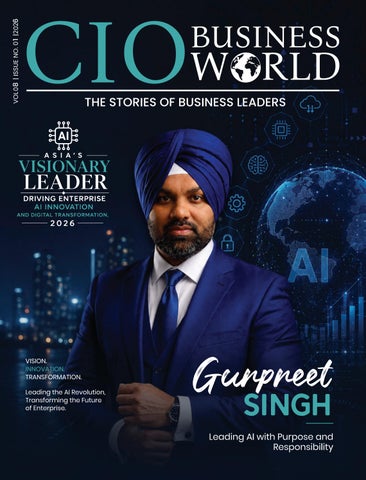
6 1 8 VISION. INNOVATION. TRANSFORMATION. Leading the AI Revolution, Transforming the Future of Enterprise.
Gurpreet Singh Leading AI with Purpose and Responsibility
08
COVER STORY
Gurpreet Singh
CONTENTS Business Profile Avi Bartov 20 Dr. Sina Ghazi 30 Articles
26
AI UGC Video Trends Every Digital Marketer Should Know
34
How B2B Leaders Are Using AI to Build Repeatable Go-to-Market Motions
38
From Digital Transformation to Digital Healing
42
The Shift from Technology to Trust
6 1 8 VISION. INNOVATION. TRANSFORMATION. Leading the AI Revolution, Transforming the Future of Enterprise.
Gurpreet Singh Leading AI with Purpose and Responsibility
EDITORIAL Leading the Shift The story of enterprise technology is undergoing a fundamental shift. For years, digital transformation was largely defined by automation, cloud adoption, data platforms, and process optimisation. Today, the conversation has moved beyond simply asking what technology can do. The more important question is how technology can help organisations think differently, make better decisions, and create sustainable value. This shift in perspective lies at the heart of the leadership journey featured in this edition of CIO Business World. As enterprise artificial intelligence moves from experimentation to practical business application, technology leadership is no longer confined to implementing systems. It increasingly requires the ability to connect technology with business realities, understand organisational challenges, and create an environment where innovation and accountability can coexist. The emerging AI landscape presents extraordinary possibilities. Intelligent systems can analyse complex information, identify patterns, support forecasting, automate repetitive processes, and assist decision-makers. Yet the real measure of transformation is not the number of AI tools an organisation deploys. It is the quality of decisions and outcomes those tools enable. This perspective represents an important transition: from digital transformation to digital intelligence, and ultimately from technology adoption to organisational evolution. The journey also highlights the importance of trust. As AI becomes increasingly involved in consequential business decisions, organisations must look beyond speed and efficiency. Data integrity, cybersecurity, explainability, governance, and human accountability become equally important. The strongest technology strategies are therefore not those that attempt to remove people from the decision-making process, but those that allow humans and intelligent systems to work together more effectively. This changing landscape is also redefining the role of the technology leader. The modern leader must move between technology, strategy, people, risk, and business outcomes. Technical knowledge remains essential, but so do curiosity, adaptability, communication, and the ability to challenge established assumptions. The shift is particularly significant for enterprises navigating rapid technological change. AI can accelerate an existing process, but it can also expose weaknesses that were previously hidden. Fragmented data, unclear ownership, inefficient workflows, and disconnected teams cannot be solved simply by adding another layer of technology. Transformation requires organisations to address these foundations while simultaneously preparing for what comes next. This is where visionary leadership becomes meaningful. A visionary leader is not necessarily the person who predicts every technological breakthrough. It is the person who recognises when the organisation needs to change its perspective. Instead of asking only how to become faster, the question becomes how to become more intelligent, resilient, responsible, and adaptable. The profile featured in this edition reflects that broader evolution in enterprise leadership. It explores the intersection of artificial intelligence, digital transformation, business strategy, human judgement, and long-term organisational value. The defining shift is therefore not simply from traditional technology to AI. It is from technology as an operational tool to technology as a strategic force for organisational transformation. As enterprises enter a future shaped by increasingly intelligent systems, the leaders who create lasting impact will be those who understand that innovation is not measured merely by what technology makes possible. It is measured by what organisations choose to do with that possibility. And ultimately, the future of enterprise AI will belong not only to those who build intelligent technologies, but to those who use them with vision, responsibility, and purpose.
Gurpreet Singh Leading AI with Purpose and Responsibility
Cover Story 08
09
10
11
12
13
14
15
16
17
18
19
20
Avi Avi Bartov Bartov Strength Strength in in Strategy, Strategy, Gentleness Gentleness in in Leadership Leadership or Avi orBartov, Avi Bartov, the journey the journey to building to building Menaya Menaya did not didbegin not begin with with a product a product it began it began with with a realization. a realization. In a world In a world moving moving at relentless at relentless speed, speed, wherewhere organizations organizations were were constantly constantly reacting reacting to threats, to threats, he saw he something saw something othersothers overlooked: overlooked: attackers attackers were were always always one step one ahead, step ahead, not not because because they had theybetter had better tools,tools, but because but because they had theyahad a clearer clearer perspective. perspective. TheyThey didn’tdidn’t see systems see systems or software or software they saw they opportunity. saw opportunity. That That understanding understanding became became the turning the turning point.point. WhatWhat started started as a strong as a strong but limited but limited solution solution evolved evolved into ainto a muchmuch largerlarger visionvision to help to organizations help organizations finally finally see see themselves themselves the way the attackers way attackers do, from do, from the outside the outside in. Avi in. Avi knewknew that true that cybersecurity true cybersecurity wasn’t wasn’t just about just about response; response; it it was about was about visibility visibility before before the breach, the breach, awareness awareness before before the damage. the damage. Building Building that vision that vision into reality, into reality, however, however, was no was easy no easy task. task. It required It required not only not only innovation, innovation, but the but the resilience resilience to challenge to challenge how the howmarket the market itselfitself understood understood security. security. InsideInside Menaya, Menaya, that same that same philosophy philosophy defines defines the culture. the culture. SpeedSpeed is essential, is essential, but ownership but ownership is everything. is everything. People People are are not just notexpected just expected to complete to complete taskstasks they are theytrusted are trusted to to drivedrive outcomes. outcomes. Transparency Transparency is notisoptional; not optional; context, context, challenges, challenges, and even and even mistakes mistakes are shared are shared openly, openly, because because that isthat how is teams how teams growgrow stronger, stronger, faster,faster, and more and more aligned. aligned. Avi believes Avi believes that when that when people people feel heard, feel heard, trusted, trusted, and part and part of something of something meaningful, meaningful, they don’t they don’t just work just work they build, they build, they innovate, they innovate, and they and lead. they lead.
Because Because at its at core, its core, his mission his mission is simple is simple yet powerful: yet powerful: the best the attack best attack to handle to handle is theisone thethat onenever that never happens. happens. And building And building something something that prevents, that prevents, ratherrather than reacts, than reacts, requires requires a certain a certain kind kind of strength of strength the kind the kind that chooses that chooses clarity clarity over over comfort, comfort, visionvision over over limitation, limitation, and and ownership ownership over over ease.ease. At Menaya, At Menaya, that belief that belief standsstands firm because firm because true foresight, true foresight, bold bold thinking, thinking, and the andcourage the courage to redefine to redefine an industry an industry are are qualities qualities to beto expected be expected only only from from the strong. the strong. FromFrom Limited Limited Visibility Visibility to Complete to Complete Control Control For Avi, For the Avi,journey the journey into cybersecurity into cybersecurity innovation innovation beganbegan with with his work his work at Gamasec, at Gamasec, wherewhere he helped he helped buildbuild a virtual a virtual hacker hacker web scanning web scanning solution. solution. WhileWhile the product the product was was strongstrong and effective, and effective, he gradually he gradually recognized recognized a critical a critical limitation limitation it focused it focused primarily primarily on web on applications, web applications, whereas whereas real-world real-world attackers attackers operate operate with with a much a much broader broader perspective. perspective. TheyThey don’tdon’t limit limit themselves themselves to a single to a single layer;layer; instead, instead, they assess they assess an organization’s an organization’s entireentire external external digital digital footprint, footprint, including including both both known known and unknown and unknown assets. assets. This This realization realization became became the catalyst the catalyst for founding for founding Menaya. Menaya. Avi set Aviout settoout create to create a more a more comprehensive comprehensive solution solution one one that provides that provides a complete a complete outside-in outside-in view view of anof an organization, organization, ratherrather than athan fragmented a fragmented or internal or internal perspective. perspective. However, However, transforming transforming this vision this vision into reality into reality camecame with with its own its challenges. own challenges. Beyond Beyond building building the the
21
technology, technology, he needed he needed to shift to shift market market understanding understanding helping helping organizations organizations recognize recognize that true that cybersecurity true cybersecurity begins begins with with visibility. visibility. At Menaya, At Menaya, this philosophy this philosophy is central. is central. The team The team operates operates on a simple on a simple but powerful but powerful insight: insight: most most organizations organizations are are tryingtrying to protect to protect assetsassets they don’t they don’t fully fully see. By see.studying By studying how attackers how attackers think,think, Avi understood Avi understood that threats that threats are not are not defined defined by systems by systems or tools, or tools, but by butopportunities by opportunities exposed exposed assets, assets, forgotten forgotten domains, domains, or misconfigured or misconfigured services services that that can serve can serve as entry as entry points. points.
Building Building a Culture a Culture of Ownership, of Ownership, Trust, Trust, and and Purpose-Driven Purpose-Driven Innovation Innovation For Avi, For leadership Avi, leadership is rooted is rooted in clarity, in clarity, trust,trust, and deep and deep human human understanding. understanding. At Menaya, At Menaya, he ensures he ensures that every that every team team member member not only not only understands understands their their role, role, but also but the also the largerlarger mission mission why the whywork the work matters matters and the andimpact the impact it it creates. creates. FromFrom there,there, he places he places real ownership real ownership in their in their hands, hands, empowering empowering individuals individuals to make to make decisions decisions and and take responsibility take responsibility for outcomes, for outcomes, not just nottasks. just tasks.
Menaya Menaya was built was built to address to address this exact this exact gap. Its gap.mission Its mission is is to enable to enable organizations organizations to seetothemselves see themselves as attackers as attackers wouldwould from from the outside the outside capturing capturing their their real, complete real, complete digital digital presence presence on theoninternet the internet ratherrather than relying than relying on on internal internal assumptions. assumptions. MoreMore than just thanajust platform, a platform, Menaya Menaya represents represents a shifta shift in mindset: in mindset: from from reacting reacting to incidents to incidents after after they occur, they occur, to identifying to identifying and understanding and understanding exposure exposure before before any breach any breach happens. happens.
Avi places Avi places strongstrong emphasis emphasis on listening on listening understanding understanding what what drivesdrives each each person, person, what what challenges challenges them,them, and what and what they need they need to perform to perform at their at their best. best. He believes He believes that when that when people people feel genuinely feel genuinely trusted, trusted, heard,heard, and connected and connected to a to a meaningful meaningful purpose, purpose, they naturally they naturally become become moremore motivated motivated and effective. and effective. This This foundation foundation is reinforced is reinforced by by a culture a culture of openness, of openness, wherewhere context, context, challenges, challenges, and and even even mistakes mistakes are shared are shared transparently transparently to encourage to encourage learning learning and continuous and continuous improvement. improvement.
At itsAt core, its core, Avi’sAvi’s approach approach is guided is guided by a simple by a simple beliefbelief if if organizations organizations can truly can truly see their see their digital digital footprint, footprint, they can they can secure secure it. it.
Operating Operating in theinfast-evolving the fast-evolving cybersecurity cybersecurity space,space, flexibility flexibility is essential. is essential. The team The team staysstays closely closely connected connected to partners to partners and real-world and real-world use cases, use cases, constantly constantly adapting adapting
22
whether in product development, messaging, or or whether in product development, messaging, go-to-market strategies. This This responsiveness ensures that that go-to-market strategies. responsiveness ensures Menaya remains aligned with with the realities of theoffield ratherrather Menaya remains aligned the realities the field than assumptions. than assumptions. At itsAt core, the organization thrives on anon entrepreneurial its core, the organization thrives an entrepreneurial mindset encouraging initiative, creativity, and the mindset encouraging initiative, creativity, and the confidence to challenge the status quo. It is aItculture built built confidence to challenge the status quo. is a culture not just but on wherewhere people care care noton justperformance, on performance, butpurpose on purpose people deeply aboutabout what what they are the impact it creates, deeply theybuilding, are building, the impact it creates, and the problems it aims to solve. andreal-world the real-world problems it aims to solve. Shifting Cybersecurity fromfrom Reaction to Prevention Shifting Cybersecurity Reaction to Prevention Through Through Visibility, Visibility, Simplicity, Simplicity, and Real-World and Real-World Impact Impact For Avi, For the Avi,future the future of cybersecurity of cybersecurity lies not liesinnot reacting in reacting faster,faster, but inbut seeing in seeing earlier. earlier. He observes He observes that many that many organizations organizations are still arefocused still focused on detecting on detecting and responding and responding to attacks they begin in reality, the time to attacks after after they begin when,when, in reality, by thebytime an an is triggered, the damage may already alert alert is triggered, muchmuch of theofdamage may already be be underway. Through Menaya, he advocates underway. Through Menaya, he advocates for a for a fundamental in mindset: moving upstream to focus fundamental shift shift in mindset: moving upstream to focus on on exposure and visibility Understanding exposure and visibility first. first. Understanding what what assetsassets is accessible, and what is vulnerable—before exist,exist, what what is accessible, and what is vulnerable—before it it becomes an incident his view, the foundation true foundation becomes an incident is, in is, hisinview, the true of of security. security.
He emphasizes also emphasizes the need to simplify. an industry He also the need to simplify. In anIn industry crowded and complexity, lose sight crowded with with tools tools and complexity, teamsteams oftenoften lose sight of actual For the Avi,path the forward path forward is about returning of actual risk. risk. For Avi, is about returning to fundamentals clearly seeing exposure, reducing it early, to fundamentals clearly seeing exposure, reducing it early, and prioritizing prevention reaction. Because and prioritizing prevention over over reaction. Because ultimately, the most effective to handle the one ultimately, the most effective attackattack to handle is theisone that never happens. that never happens. For aspiring entrepreneurs in cybersecurity, his advice For aspiring entrepreneurs in cybersecurity, his advice is is grounded in practicality. the problem, not the grounded in practicality. Start Start with with the problem, not the technology. Spend the field, closely technology. Spend time time in theinfield, listenlisten closely to to CISOs, partners, and operators, and understand the real CISOs, partners, and operators, and understand the real challenges they face. He cautions against challenges they face. He cautions against over-engineering, noting thatmost the most successful over-engineering, noting that the successful solutions are often thatsimple, are simple, intuitive, solutions are often thosethose that are intuitive, and and deliver quickly. deliver valuevalue quickly. Finally, he underscores the importance of patience Finally, he underscores the importance of patience and and resilience. Cybersecurity is a trust-driven resilience. Cybersecurity is a trust-driven spacespace wherewhere credibility is built Staying to real credibility is built over over time.time. Staying closeclose to real problems, maintaining a practical approach, and persisting problems, maintaining a practical approach, and persisting through challenges his view, the keys to building through challenges are, inare, hisinview, the keys to building something meaningful and lasting. something meaningful and lasting.
23
AIAI UGC Video Trends UGC Video Trends Every Digital Marketer Every Digital Marketer Should Know
Should Know
26
arketers know UGC style ads work. The raw, authentic format consistently outperforms polished brand content in engagement and conversions. But actually producing UGC at scale is a nightmare. You're coordinating creators, managing contracts, waiting on deliverables, requesting revisions, and hoping the final output could work. That's why the AI UGC video generator has gone from novelty to necessity so fast. These tools let you create realistic, creator-style video content without hiring a single person. And the technology is evolving quickly. Here are the trends every digital marketer should be paying attention to right now. Trend 1: AI Avatars That Don't Look Like AI Early AI-generated spokesperson videos had a problem — they looked wrong. The lip sync was off. The facial expressions were stiff. The eyes had that unsettling dead quality. Nobody was fooled.
write a brief, find a creator, negotiate terms, wait for the draft, request changes, wait again, approve, download, edit, publish. That process takes days at minimum. Often weeks. A modern UGC video generator compresses that entire creating workflow into minutes. You write a script — or let AI generate one based on your product and target audience. You pick an avatar. You choose a voice, a setting, and a visual style. The tool renders a complete video with talking head footage, text overlays, b-roll cuts, and background music. The speed advantage is obvious. But the real value is iteration. When production takes minutes instead of weeks, you can test ten variations of the same ad instead of betting everything on one. Different hooks, different CTAs, different tones — all tested simultaneously. That kind of rapid creative testing used to be reserved for brands with massive production budgets. Now anyone with a UGC video generator can do it.
That's changed dramatically.
Trend 3: Multi-Scene Structure Is Becoming Standard
The latest AI avatars feature natural head movement, realistic eye contact, genuine micro-expressions, and lip sync that actually matches the audio. Some tools now offer avatars based on real licensed actors, which adds another layer of authenticity.
The first wave of AI UGC tools produced single-shot talking head videos. One avatar, one background, one continuous take. It worked for simple testimonials, but it felt flat compared to real UGC content, which naturally includes cuts, angles, and visual variety.
Why this matters for marketers: the uncanny valley was the biggest barrier to adoption. As avatars become indistinguishable from real people on a phone screen — which is where most ads are consumed — the resistance to using them drops significantly.
The trend now is toward multi-scene video generation.
The best platforms now let you choose from dozens of diverse avatars, customize their appearance, and place them in different environments. You're not stuck with one generic talking head anymore. Trend 2: Script-to-Video in Minutes, Not Days The traditional UGC workflow looks something like this:
A single AI-generated UGC ad might include: • A hook scene with bold text and a direct-to-camera statement • A product demo section with b-roll footage or screen recordings • A benefits breakdown with text overlays and visual callouts • A closing CTA with the avatar speaking directly to the viewer This mirrors how real UGC creators structure their content — because that structure works. It holds attention, delivers information in digestible chunks, and builds toward a conversion moment. 27
Current UGCUGC videovideo generator generator tools tools are solving are solving this with this AI with AI ToolsTools that support that support multi-scene multi-scene editing editing are pulling are pulling aheadahead of of Current voices voices that include that include natural natural pacing, pacing, emotional emotional inflection, inflection, thosethose that still thatonly still only offer offer single-take single-take output. output. pauses, pauses, and conversational and conversational rhythm. rhythm. SomeSome platforms platforms like like AI offer AI offer videovideo ad cloner— ad cloner— you can youupload can upload a sample a sample ad ad PolloPollo AI has AIbeen has been building building exactly exactly this kind this kind of integrated of integrated PolloPollo and the andAIthe replicates AI replicates that video that video for your for your content. content. UGCUGC workflow. workflow. PolloPollo AI UGC AI UGC videovideo generator generator combines combines videovideo The multilingual angleangle is equally is equally significant. significant. A single A single scriptscript realistic realistic avatars, avatars, natural natural AI voices, AI voices, multi-scene multi-scene editing, editing, and and The multilingual can rendered be rendered in dozens in dozens of languages of languages with with lip-synced lip-synced scriptscript generation generation in oneinplatform. one platform. The Marketing The Marketing Studio Studio can be avatars, avatars, opening opening up international up international markets markets without without hiringhiring adds adds ad-specific ad-specific features features — proven — proven frameworks, frameworks, local local creators creators or translators or translators for each for each region. region. performance-oriented performance-oriented templates, templates, and direct and direct publishing publishing workflows. workflows. For marketers For marketers running running globalglobal campaigns, campaigns, this isthis a is a game-changer. One creative One creative concept, concept, localized localized acrossacross There's There's also aalso mobile a mobile app, which app, which means means you can yougenerate can generate game-changer. markets markets in hours in hours instead instead of months. of months. and preview and preview UGCUGC content content on theongo. the go. Trend Trend 4: Voice 4: Voice Cloning Cloning and Multilingual and Multilingual Output Output
Trend Trend 5: Integration 5: Integration WithWith Ad Platforms Ad Platforms and Analytics and Analytics
VoiceVoice quality quality has been has been another another weakweak pointpoint for AI-generated for AI-generated Creating Creating the video the video is only is only half the halfjob. theGetting job. Getting it in front it in front of of content. content. Robotic, Robotic, monotone monotone text-to-speech text-to-speech immediately immediately the right the right audience audience and measuring and measuring performance performance is theisother the other signals signals "this "this isn't real" isn't real" to viewers. to viewers. half. half. 28
The emerging trendtrend is UGC videovideo generators that connect The emerging is UGC generators that connect directly to adto platforms — Meta, TikTok, Google — — directly ad platforms — Meta, TikTok, Google allowing you to publish, test, and without leaving allowing you to publish, test,optimize and optimize without leaving the tool. SomeSome platforms are building in performance the tool. platforms are building in performance analytics that track whichwhich hooks, avatars, scripts, and CTAs analytics that track hooks, avatars, scripts, and CTAs drivedrive the best then use inform futurefuture the results, best results, thenthat usedata that to data to inform creative decisions. creative decisions.
quick-turnaround concepts. Real Real creator content handles quick-turnaround concepts. creator content handles depthdepth — the—authentic stories, the genuine product the authentic stories, the genuine product experiences, the relationship-building content that audiences experiences, the relationship-building content that audiences connect with with emotionally. connect emotionally.
This This closescloses the loop between creation and performance. the loop between creation and performance. Instead of guessing what what works, you'reyou're generating content Instead of guessing works, generating content basedbased on actual data from previous campaigns. on actual data from previous campaigns.
WhatWhat This This Means for Marketers Means for Marketers
Trend 6: Blending AI UGC WithWith Real Real Content Trend 6: Blending AI UGC Content SmartSmart marketers aren'taren't goinggoing all-inall-in on AIon and marketers AIabandoning and abandoning real creators. The trend is blending both.both. real creators. The trend is blending AI-generated UGCUGC handles volume — the—dozens of adof ad AI-generated handles volume the dozens variations you need for testing, the localized versions, the the variations you need for testing, the localized versions,
The combination is more powerful than either approach The combination is more powerful than either approach alone.alone. AI handles scale.scale. Humans handle soul. soul. AI handles Humans handle
The direction is clear. AI UGC videovideo generators are getting The direction is clear. AI UGC generators are getting better,better, faster,faster, and more integrated into real and more integrated intomarketing real marketing workflows. The marketers who learn to usetothese tools tools workflows. The marketers who learn use these effectively effectively — not —asnot a replacement as a replacement for creativity, for creativity, but asbut anas an amplifier of it — will a serious edge.edge. amplifier of it — have will have a serious The ones still waiting for the creator to deliver The ones still waiting for"perfect" the "perfect" creator to deliver next week's ad? They're already behind. next week's ad? They're already behind.
29
Dr. Sina Ghazi
Driving Legal Innovation Across Borders Through Research and Technology
ome journeys are built on ambition. Others are shaped by resilience. But a rare few become timeless because they rise above circumstances and redefine the future itself. For Dr. Sina Ghazi, Founder & CEO of Ghanoon Yar Arshad Legal Institute and Managing Director of Forsan Oil Trading LLC, the path was never simply about practicing law or building businesses. It was about creating lawful pathways through uncertainty, transforming challenges into opportunities, 30
and proving that knowledge, strategy, and resilience can overcome even the most complex global barriers. At a time when international sanctions created uncertainty across industries and borders, Dr. Ghazi chose not to see limitations he saw legal questions waiting for intelligent solutions. With a research-driven mindset and an unwavering commitment to contractual justice, he began shaping a vision that extended far beyond conventional legal consultancy.
Today, Ghanoon Yar Arshad Legal Institute stands not only as a legal advisory center but also as a platform for knowledge creation, publishing, and professional empowerment. Through books, articles, workshops, and widely appreciated free webinars on legal resilience, Dr. Ghazi continues to bridge the gap between law, innovation, and global business realities. His long-term vision is perhaps eternal in its purpose independent of borders, industries, or temporary crises. He aspires to establish a globally respected legal reference across the Middle East, Europe, and Southeast Asia in the fields of international trade law, sanctions compliance, arbitration, smart contracts, and artificial intelligence-driven legal systems. What makes his leadership unique is not only the scale of his ambition, but the philosophy behind it. Rather than glorifying endless hours of work, Dr. Ghazi believes in focused, high-impact thinking proving that clarity of purpose often matters more than the length of effort. Driven by intellect, resilience, and innovation, Dr. Ghazi is steadily shaping a legacy where the name “Ghanoon Yar Arshad” becomes synonymous with modern trade law, legal resilience, and contractual justice on the global stage. Bridging Global Trade, Legal Resilience, and Contractual Innovation Dr. Ghazi’s journey evolved through two parallel paths one academic and the other commercial. Alongside his studies in law and theology, he entered the field of international trade at an early stage of his career. Working across more than 45 countries gave him deep insight into the often-conflicting relationship between legal frameworks and commercial realities. One of the greatest challenges he encountered was navigating international sanctions. Rather than viewing sanctions as barriers, Dr. Ghazi approached them as complex legal challenges that demanded creative yet fully lawful solutions. Over the years, he has designed contracts and legal structures that enabled businesses to continue operating while remaining compliant with international regulations.
The establishment of Ghanoon Yar Arshad Legal Institute, along with his leadership role at a Dubai-based company, reflects his commitment to bridging academic expertise with real-world business needs. Every setback and challenge became a catalyst for deeper research, writing, and innovation, ultimately leading to the publication of five scholarly books in the fields of international trade law and legal resilience. Dr. Ghazi’s mission is centered on transforming legal complexities into business opportunities. He believes that many organizations face decision paralysis when dealing with sanctions, international contracts, and commercial disputes, and he aims to demonstrate that a research-driven and resilient legal approach can successfully navigate such crises. His long-term vision is to establish an internationally recognized legal reference in the Middle East that goes beyond consultancy services. Through books, articles, workshops, and knowledge-sharing initiatives, he seeks to set new standards in smart contracts, arbitration, and sanctions compliance. His aspiration is that the name “Ghanoon Yar Arshad” will one day become synonymous with innovation in trade law and contractual justice. Innovation, Legal Resilience, and Global Vision Dr. Ghazi believes in building teams where individual strengths complement one another’s weaknesses, creating a collaborative environment driven by trust, learning, and shared purpose. At Ghanoon Yar Arshad Legal Institute, hierarchical boundaries remain flexible, ensuring that every team member feels heard and valued. His leadership philosophy is built on three core principles: clarity in goals, freedom in execution, and appreciation of effort. To foster innovation and continuous growth, the organization conducts short weekly meetings focused on practical problem-solving and encourages continuous learning through monthly specialized books or in-house workshops. Dr. Ghazi strongly believes that leadership by example is essential; by consistently engaging in research and study himself, 31
Believing that meaningful that meaningful transformation transformation cannot cannot he naturally he naturally inspires inspires his team his team to remain to remain motivated motivated and and Believing occuroccur without without international international collaboration, collaboration, he has hemade has made intellectually intellectually driven. driven. The result The result is a work is a work culture culture global networking networking with with legallegal professionals, professionals, where where people people contribute contribute not merely not merely out of outobligation, of obligation, global researchers, researchers, and industry and industry experts experts a central a central part of parthisof his but from but from genuine genuine passion passion and commitment. and commitment. strategy. strategy. Looking Looking toward toward the future, the future, Dr. Ghazi Dr. Ghazi envisions envisions When When it comes it comes to balancing to balancing professional professional and personal and personal himself himself as a senior as a senior global global advisor advisor in theinfields the fields of of life, life, Dr. Ghazi Dr. Ghazi follows follows a philosophy a philosophy centered centered on on international international tradetrade law, law, sanctions, sanctions, and artificial and artificial quality quality over over quantity. quantity. Rather Rather than than promoting promoting long,long, intelligence. intelligence. His ambitions His ambitions extend extend beyond beyond exhausting exhausting work work hours, hours, he emphasizes he emphasizes deep deep and and consultancy, consultancy, with with plansplans to establish to establish an international an international focused productivity, productivity, oftenoften dedicating dedicating threethree to four to four educational educational platform platform that teaches that teaches tradetrade law in law Persian, in Persian, focused highly highly concentrated concentrated hourshours to histomost his most important important taskstasks English, English, and Turkish, and Turkish, making making specialized specialized legallegal eacheach day. day. knowledge knowledge moremore globally globally accessible. accessible. He maintains He maintains clearclear boundaries boundaries between between work,work, family family He isHe also is also currently currently planning planning two new two new books books and personal and personal study, study, including including a disciplined a disciplined “Resolution “Resolution of Commercial of Commercial Disputes Disputes in theinDigital the Digital life, life, approach approach of avoiding of avoiding workwork emails emails on weekends on weekends Age”Age” and “A andPractical “A Practical Guide Guide to Smart to Smart Contracts” Contracts” except except during during genuine genuine emergencies. emergencies. SinceSince manymany of hisof his aimed aimed at addressing at addressing the evolving the evolving challenges challenges of of activities particularly particularly research research and writing and writing are closely are closely modern modern global global commerce. commerce. At anAtorganizational an organizational level,level, activities connected to histopersonal his personal interests, interests, he views he views the the his long-term his long-term vision vision includes includes expanding expanding consulting consulting connected natural natural overlap overlap between between workwork and life andas lifeanasadvantage an advantage operations operations into Europe into Europe and Southeast and Southeast AsiaAsia whilewhile rather rather than than a burden. a burden. establishing establishing himself himself as a leading as a leading reference reference for for contractual contractual standards standards within within the oil, thegas, oil, gas, and and One One of theofmost the most important important lessons lessons he has helearned has learned international international tradetrade industries. industries. throughout throughout his journey his journey is theisvalue the value of saying of saying “no”“no” refusing refusing unnecessary unnecessary meetings, meetings, low-impact low-impact Focus Focus on Global on Global Collaboration Collaboration opportunities, opportunities, and distractions and distractions that consume that consume energy energy without meaningful meaningful return. return. This This mindset mindset has allowed has allowed OverOver the next the next one to one three to three years, years, Dr. Ghazi Dr. Ghazi is focusing is focusingwithout him remain to remain focused focused on long-term on long-term impact, impact, on the ondigitization the digitization of legal of legal services services and the andexpansion the expansion him to innovation, innovation, and sustainable and sustainable professional professional growth. growth. of international of international remote remote legallegal solutions. solutions. As part As of partthis of this Bridging Law,Law, Technology, Technology, and and Global Global Legal Legal vision, vision, he ishe developing is developing an online an online platform platform dedicated dedicated Bridging Innovation to consultancy to consultancy services services in smart in smart contracts contracts and remote and remote Innovation arbitration, arbitration, aiming aiming to make to make specialized specialized legallegal expertise expertise For Dr. ForGhazi, Dr. Ghazi, technology technology is notisthe notultimate the ultimate goal goal but but moremore accessible accessible across across borders. borders. an essential an essential tool that tool enhances that enhances legallegal precision, precision, efficiency, and global and global collaboration. collaboration. In hisIn his He isHe also is also preparing preparing to launch to launch a multilingual a multilingual online online efficiency, professional professional practice, practice, he actively he actively uses uses generative generative course course on “Legal on “Legal Resilience Resilience Against Against Sanctions” Sanctions” in in artificial artificial intelligence intelligence for initial for initial contract contract screening screening and and Persian, Persian, English, English, and Turkish, and Turkish, designed designed to help to help the identification of high-risk of high-risk clauses, clauses, helping helping businesses businesses and legal and legal professionals professionals navigate navigate complex complex the identification streamline complex complex legallegal processes processes whilewhile reducing reducing international international regulatory regulatory environments. environments. To accelerate To accelerate streamline manual manual errors. errors. innovation innovation in legal in legal services, services, Dr. Ghazi Dr. Ghazi has been has been actively actively engaging engaging with with several several legal-tech legal-tech accelerators accelerators Through Through cloud-based cloud-based contract contract management management systems, systems, in Europe, in Europe, exploring exploring the integration the integration of artificial of artificial he enables legallegal teams teams to collaborate to collaborate seamlessly seamlessly intelligence intelligence into automated into automated contract contract analysis analysis and legal and legal he enables across across different different countries countries and time and time zones. zones. In In risk assessment risk assessment systems. systems.
32
Second, he encourages young professionals to focus arbitration and dispute resolution matters, he leverages Second, he encourages young professionals to focus arbitration and dispute resolution matters, he leverages deeply on specialized one specialized as sanctions, online meeting platforms and digital signature deeply on one fieldfield suchsuch as sanctions, oil oil online meeting platforms and digital signature contracts, or arbitration rather attempting technologies to accelerate proceedings and improve contracts, or arbitration rather than than attempting to to technologies to accelerate proceedings and improve master everything at once. According to him, accessibility for international clients. recently, master everything at once. According to him, true true accessibility for international clients. MoreMore recently, expertise and recognition through hebeen has been testing an expert system designed expertise and recognition comecome through he has testing an expert system designed specialization. specifically for sanctions compliance analysis, aimed specialization. specifically for sanctions compliance analysis, aimed at minimizing human in highly sensitive at minimizing human errorerror in highly sensitive legallegal Third, he stresses the importance of maintaining evaluations. Third, he stresses the importance of maintaining a a evaluations. lifelong connection research and writing. lifelong connection with with research and writing. He He believes that every contract drafted, dispute Despite embracing innovation, Dr. Ghazi strongly believes that every contract drafted, everyevery dispute Despite embracing innovation, Dr. Ghazi strongly handled, and every negotiation experienced emphasizes that technology should replace handled, and every negotiation experienced can can emphasizes that technology should nevernever replace evolve into valuable academic insight, articles, human judgment. Instead, he views AI and evolve into valuable academic insight, articles, or or human legallegal judgment. Instead, he views AI and books a philosophy thatshaped has shaped his own digital as support systems that enhance eveneven books a philosophy that has his own digital toolstools as support systems that enhance the the journey an author and legal scholar. expertise, analytical thinking, and strategic journey as anasauthor and legal scholar. expertise, analytical thinking, and strategic decision-making of legal professionals. decision-making of legal professionals. Additionally, Dr. Ghazi strongly advocates Additionally, Dr. Ghazi strongly advocates for for international networking. his view, a single Drawing of international experience, networking. In hisInview, eveneven a single Drawing fromfrom yearsyears of international experience, Dr. Dr. international professional connection a lawyer or expert Ghazi important pieces of advice professional connection with with a lawyer or expert in in Ghazi offersoffers threethree important pieces of advice to to another country can open unexpected aspiring professionals in international country can open unexpected doorsdoors and and aspiring professionals in international tradetrade law. law. First,First, another significantly influence professional future. he believes that trade law must be learned in real significantly influence one’sone’s professional future. he believes that trade law must be learned in real commercial environments, not only in classrooms, commercial environments, not only in classrooms, because without understanding the realities because without understanding the realities of of business, a lawyer cannot become an effective business, a lawyer cannot become an effective legallegal advisor. advisor.
33
34 08
How B2B Leaders Are Using AI to Build Repeatable Go-to-Market Motions
35
From FromDigital DigitalTransformation Transformation totoDigital DigitalHealing Healing nterprise nterprise digital digital transformation transformation is often is often described described through through words words suchsuch as automation, as automation, disruption, disruption, acceleration, acceleration, and innovation. and innovation. However, However, a deeper a deeper perspective perspective suggests suggests that that transformation transformation is notisonly not only aboutabout introducing introducing new new technologies; technologies; it is also it is also aboutabout identifying identifying whatwhat prevents prevents people, people, processes, processes, and systems and systems fromfrom working working effectively effectively and addressing and addressing thosethose gaps.gaps. In this In context, this context, “healing” “healing” means means restoring restoring clarity, clarity, connection, connection, trust,trust, efficiency, efficiency, and momentum and momentum across across an organisation. an organisation. From From Automation Automation to Understanding to Understanding The early The early phasephase of digital of digital transformation transformation focused focused largely largely on automating on automating manual manual processes processes and and moving moving organisations organisations fromfrom traditional traditional systems systems to digital to digital platforms. platforms. Artificial Artificial intelligence intelligence is now is now taking taking this transformation this transformation further further by enabling by enabling organisations organisations to identify to identify patterns, patterns, anticipate anticipate challenges, challenges, support support decisions, decisions, and understand and understand complex complex information information at scale. at scale. For an Forenterprise an enterprise leader, leader, the important the important question question is therefore is therefore not simply not simply which which AI technology AI technology to implement, to implement, but but which which organisational organisational problem problem needsneeds to betosolved. be solved. A slow A slow process process may may be caused be caused by outdated by outdated technology, technology, but itbut may it may also also resultresult fromfrom unclear unclear ownership, ownership, fragmented fragmented data,data, or disconnected or disconnected teams. teams. TrueTrue transformation transformation begins begins by understanding by understanding the underlying the underlying problem problem rather rather than than simply simply treating treating its visible its visible symptoms. symptoms. Connecting Connecting the Organisation the Organisation LargeLarge organisations organisations oftenoften operate operate through through multiple multiple departments, departments, systems, systems, and processes, and processes, eacheach developing developing its own its own viewview of customers, of customers, operations, operations, finance, finance, and performance. and performance. OverOver time,time, thesethese differences differences can create can create information information gapsgaps and organisational and organisational silos.silos. Enterprise Enterprise AI can AI help can help bridge bridge thesethese gapsgaps by connecting by connecting information, information, identifying identifying patterns patterns across across datasets, datasets, and creating and creating a more a more comprehensive comprehensive viewview of theoforganisation. the organisation. However, However, technology technology alonealone cannot cannot create create this connection. this connection. Leaders Leaders mustmust be willing be willing to listen to listen to what to what the data the data reveals, reveals, challenge challenge established established assumptions, assumptions, and and redesign redesign processes processes whenwhen existing existing waysways of working of working no longer no longer serveserve the organisation the organisation effectively. effectively. From From FearFear of AIoftoAIHuman–AI to Human–AI Collaboration Collaboration AI adoption AI adoption also also brings brings uncertainty. uncertainty. Employees Employees may may fear that fear automation that automation couldcould replace replace theirtheir roles,roles, whilewhile leaders leaders may may havehave concerns concerns aboutabout accuracy, accuracy, security, security, governance, governance, and accountability. and accountability. Effective Effective digital digital leadership leadership doesdoes not ignore not ignore thesethese concerns. concerns. Instead, Instead, it establishes it establishes a framework a framework where where humans humans and AI andwork AI work together. together. AI can AI process can process information, information, identify identify patterns, patterns, generate generate 38
39
possibilities, and support repetitive tasks, while people contribute judgement, creativity, empathy, context, ethics, and accountability. The future of enterprise AI is therefore less about humans competing with machines and more about enabling people to focus on work where uniquely human capabilities create the greatest value. Transforming Decision-Making Data has become one of the most important assets of modern organisations, but data by itself does not create intelligence. Dashboards can explain what happened, analytics can help identify why it happened, and AI can potentially indicate what may happen next. Leadership determines how that knowledge should be translated into responsible action. The organisations that succeed will not necessarily be those with the largest amount of data or the greatest number of AI tools. They will be those capable of converting reliable information into meaningful decisions through strong governance, cybersecurity, transparency, and human judgement. The Human Side of Digital Transformation Every organisation is ultimately built around people working together toward a common purpose. Technology can improve communication and collaboration, but it cannot automatically create trust. AI can recommend a decision, but accountability still rests with people. Automation can remove repetitive tasks, but it cannot define organisational purpose. This makes leadership essential to successful transformation. Leaders must create an environment where experimentation is encouraged, questions are welcomed, and innovation is balanced with responsibility. AI should not be introduced simply because it is a market trend; it should be adopted where it creates measurable and meaningful value. What Does Healing Look Like? The impact of digital transformation can be measured by asking what changes within the
40
organisation after technology is introduced. Are employees spending less time struggling with systems and more time solving meaningful problems? Are customers receiving faster and more relevant experiences? Can leaders make decisions with greater clarity? Are teams working from a shared understanding rather than disconnected versions of information? Are risks identified earlier, and are processes becoming simpler and more resilient? When transformation produces these outcomes, it achieves something deeper than automation—it reduces friction, strengthens connections, improves understanding, and creates a healthier relationship between people and technology. From Digital Transformation to Digital Renewal The most important shift in perspective is to stop viewing digital transformation as a race toward the newest technology. AI will continue to evolve, new platforms will emerge, and business environments will constantly change. What remains constant is the need for organisations to understand their people, customers, challenges, and purpose. The role of an enterprise technology leader is therefore not merely to predict the next breakthrough, but to build an organisation capable of adapting to whatever comes next. The Real Meaning of Healing In the context of enterprise AI, healing is not about fixing everything overnight. It is about creating the conditions for an organisation to work better, think better, decide better, and serve people better. It means reducing the distance between fragmented systems, disconnected teams, complex data, and meaningful decisions. Ultimately, the promise of AI-driven digital transformation is not simply to build a smarter enterprise, but to create an organisation where technology and human potential work together with greater clarity, trust, and purpose.
or years, digital transformation was measured by how quickly organisations adopted new technologies. Cloud platforms, automation, analytics, mobile applications, and artificial intelligence became symbols of progress. But as technology becomes increasingly embedded in everyday business decisions, the definition of successful transformation is changing. The new question is not simply, “How much technology have we implemented?” It is, “How much can people trust the technology they depend on?” This represents a significant shift in perspective. Enterprise AI is moving from being a productivity tool to becoming part of the decision-making infrastructure of an organisation. With that shift comes a greater responsibility to ensure that technology is explainable, secure, reliable, and aligned with organisational values. When Intelligence Becomes Part of the Business Traditional enterprise systems generally followed predefined rules. If the inputs were known and the process was configured correctly, the outcome could be understood and reproduced. AI introduces a different dynamic. It can identify patterns, generate recommendations, interpret information, and support decisions in ways that are not always immediately obvious to the person using the system. That capability creates enormous opportunities, but it also changes the responsibility of technology leaders. The challenge is no longer simply implementing AI. It is creating an environment in which AI can be used confidently without removing human accountability. A successful enterprise AI strategy must therefore combine innovation with governance. The goal should be to make AI powerful enough to create value while keeping humans sufficiently informed to question, validate, and ultimately take responsibility for important decisions.
42
The New Currency Is Explainability In an AI-driven organisation, accuracy is important, but accuracy alone is not enough. A business leader may ask why a particular recommendation was generated. A customer may want to understand how a decision affecting them was reached. An auditor may need evidence supporting a process. A compliance team may need to establish whether appropriate controls were followed. This makes explainability increasingly important. Technology leaders must therefore think beyond the output of an AI system and consider the journey behind that output. Where did the data originate? How was it processed? What assumptions influenced the result? Who reviewed it? What safeguards were applied? The ability to answer these questions can become one of the strongest foundations of digital trust. Data Quality Is a Leadership Issue AI is often described as being only as good as the data it receives. Yet data quality is not merely a technical concern. Poor data can originate from unclear ownership, inconsistent processes, outdated systems, fragmented departments, or organisational habits that were never designed for an interconnected digital environment. This means improving data quality requires more than better software. It requires leadership. Organisations must establish who owns information, how it is defined, where it comes from, how it can be used, and who is responsible when something goes wrong. AI can accelerate decision-making, but without trusted foundations, it can also accelerate mistakes. The shift in perspective is therefore from “How can we use more data?” to “How can we create data that deserves to be trusted?”
The Shift from Technology to Trust
43
From Digital Efficiency to Organisational Resilience
Human Judgement Still Matters
Another major change is the way organisations think about efficiency.
The rise of AI does not make human judgement less important. In many ways, it makes it more important.
For a long time, digital transformation focused on doing things faster and at lower cost. While efficiency remains important, organisations increasingly need to prepare for disruption, uncertainty, and rapidly changing conditions.
AI can process information at a scale that humans cannot match. It can identify relationships hidden within large datasets and provide recommendations almost instantly. But organisations still need people to understand context, consider consequences, recognise ethical concerns, and make decisions when the situation falls outside established patterns.
AI can contribute to resilience by helping organisations identify emerging patterns, detect anomalies, model scenarios, and respond more quickly to change. But resilience cannot come from AI alone.
The strongest organisations will therefore not attempt to remove human involvement from every process.
It depends on adaptable teams, reliable systems, strong governance, secure infrastructure, and leadership that can make decisions under uncertainty. Technology becomes valuable when it strengthens these capabilities rather than creating another layer of dependency.
Instead, they will determine where AI creates the greatest value and where human judgement must remain central.
The Leader's Role Is Changing
Building a Culture That Can Question Technology
The technology leader of the past could often focus primarily on systems, infrastructure, delivery, and technical performance.
Trust does not come from declaring that a system is trustworthy. It develops through repeated experiences.
The AI-era leader must operate across a much broader landscape. They need to understand technology, business strategy, risk, people, ethics, customer expectations, and organisational behaviour. They must be able to explain complex technology to business leaders while also helping technical teams understand the consequences of what they build. This requires a shift from being a technology implementer to becoming a steward of organisational intelligence. The question becomes less about “What can this technology do?” and more about “What should we allow this technology to do, and under what conditions?”
44
That balance will become a defining characteristic of responsible enterprise AI.
Employees need to feel comfortable questioning AI-generated recommendations. Leaders need to be willing to challenge technology investments that do not create meaningful value. Technical teams need the freedom to identify risks before they become failures. This requires a culture in which asking difficult questions is considered a strength rather than resistance to innovation. A mature AI organisation should be able to say, “The system recommends this, but we need to understand why.” That simple question can prevent technological confidence from becoming technological dependence.