A VISIONARY CYBERSECURITY LEADER










As organizations across the globe accelerate their digital transformation journeys, cybersecurity has emerged as a defining pillar of sustainable growth, innovation, and trust. The rapid adoption of cloud technologies, Artificial Intelligence, data-driven operations, and interconnected digital ecosystems has unlocked unprecedented opportunities for businesses. At the same time, it has introduced new challenges that demand visionary leadership, strategic foresight, and unwavering commitment to security.
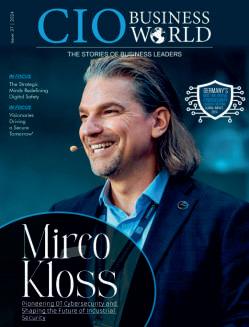
In this special edition, CIO Business World proudly recognizes “A Visionary Cybersecurity Leader Shaping the Future of Secure Digital Transformation, 2026.” This recognition celebrates an exceptional professional whose leadership exemplifies the evolving role of cybersecurity in modern business success.
Today’s cybersecurity leaders are far more than technology experts. They are strategists, innovators, risk managers, and trusted advisors who help organizations navigate an increasingly complex digital environment. They understand that cybersecurity is no longer a standalone function operating behind the scenes; it is a critical business enabler that supports innovation, resilience, and long-term organizational growth.
The leader featured in this edition represents the qualities that define modern cybersecurity excellence. Through a forward-thinking approach, they have successfully aligned security strategies with business objectives, ensuring that innovation can thrive without compromising trust, privacy, or operational integrity. Their contributions demonstrate how effective cybersecurity leadership can transform challenges into opportunities and create secure foundations for digital advancement.
As cyber threats continue to evolve in sophistication and scale, organizations require leaders who can anticipate emerging risks while embracing new technologies with confidence. The cybersecurity professional highlighted in this edition has consistently demonstrated the ability to balance innovation with protection, helping organizations strengthen resilience in an increasingly connected world. Their leadership reflects a deep understanding that security must be integrated into every aspect of digital transformation rather than treated as an afterthought.
Beyond technical expertise, this recognition also celebrates leadership that inspires people and drives cultural change. Successful cybersecurity programs depend not only on advanced technologies but also on awareness, collaboration, and shared responsibility across organizations. Visionary leaders understand the importance of building security-conscious cultures where employees become active participants in protecting digital assets and organizational reputation.
The cybersecurity landscape of 2026 demands agility, adaptability, and continuous learning. Regulatory expectations are evolving, digital infrastructures are expanding, and threat actors are becoming increasingly sophisticated. In this environment, the ability to lead with clarity and purpose has never been more important. The individual featured in this edition exemplifies these qualities, demonstrating how strategic leadership can strengthen organizational resilience while enabling innovation and growth.
At CIO Business World, we believe that cybersecurity leaders play a critical role in shaping the future of business and technology. Their work extends far beyond protecting systems and data; they safeguard trust, enable digital progress, and contribute to the success of organizations and industries worldwide.
We are honored to recognize and celebrate a leader whose vision, expertise, and dedication continue to redefine cybersecurity excellence. Their achievements serve as an inspiration to professionals across the technology and business landscape, demonstrating that secure digital transformation is not simply a goal—it is a strategic imperative for the future.
We congratulate this distinguished cybersecurity leader on this well-deserved recognition and invite our readers to explore the insights, experiences, and leadership philosophies that continue to shape the future of secure digital transformation.
Chief Information Security Officer - Filevine
Redefining Information Security Leadership in the Age of AI and Business Transformation

I really like to do the hard thing that other people say I cannot do. “


“
The best security is invisible. Users shouldn't feel it — they should just be protected by it.




Managing Partner
Non-Executive Director
Advisory Board Member

WomenTech Global Ambassador & Council Member | IAPP Advisory Board Member and Knowledgenet Chapter Chair
Onur Korucu currently serves as Managing Partner, NonExecutive Director, and Advisory Board Member across corporate and academic institutions in EMEA and the US, where she shapes strategies in data protection, cybersecurity, and AI governance. She is also a shareholder in companies specializing in data protection, cybersecurity, and AI automation.
Onur was honored by Business Post as one of the "Top 100 Most Powerful People in Tech in Ireland," and she is the only woman from the Cyber Security field featured on this prestigious list. Recognized for her groundbreaking contributions, she was awarded the IAPP Privacy Vanguard Award 2024, a highly esteemed honour given to only one individual per continent, which she received for EMEA in recognition of her leadership in privacy and AI governance. Her professional journey spans leading roles at multinational professional services firms such as KPMG, PwC, and Grant Thornton, where Onur managed cybersecurity and privacy teams across global regions. She has also served as Head of Data Protection and Cybersecurity at international firms and as Senior Group Manager for GRC, Cybersecurity, and Data Protection at Avanade (a joint venture of Microsoft & Accenture) UK & Ireland.
In addition to her technical engineering and M.Sc. degrees, Onur holds an LL.M. degree in Information and Technology Law and completed an executive master ’s program in Business Analytics at the University of Cambridge. She serves as a lecturer for Cybersecurity and Data Protection Master ’s programs at universities in Istanbul, Dublin, and London, and she is a member of the advisory board for the MS in Cybersecurity program at the University of California.
As an author and thought leader, she has contributed a book on risk-based global approaches to enhancing data protection and published articles in prestigious outlets such as the Harvard Business Review, covering trends in technology, cybersecurity, and governance.
Onur is a Women in Tech Global Ambassador and the International Association of Privacy Professionals (IAPP) Advisory Board Member and Dublin Knowledgenet Chapter Chair
Her achievements have been further recognized with nominations and awards, including the PICASSO Europe Privacy Award in the Privacy Executive category, GRC Role Model of the Year, Technology Consulting Leader, Cyber Women of the Year, Risk Leader, and The Technology Businesswoman awards.
IIn an era where data drives every interaction, the lines between personalisation, security, privacy, and innovation are more blurred than AI is no longer a futuristic concept, it’s an everyday reality, transforming how we work, live, and connect. But with each leap in technology, new questions arise about trust, governance, and the responsibilities we all share in shaping the digital world.
n an era where data drives every interaction, the lines between personalisation, security, privacy, and innovation are more blurred than ever AI is no longer a futuristic concept, it’s an everyday reality, transforming how we work, live, and connect. But with each leap in technology, new questions arise about trust, governance, and the responsibilities we all share in shaping the digital world.
Last month at the Dublin Tech Summit, I had the privilege of moderating the “Hit Me with Your Best Bot” panel, where we explored the evolving role of AI-powered chatbots, from companions to potential decision-makers. During that conversation, I shared a personal experiment: a few days spent with an AI chatbot designed to mimic companionship and even o�er a “virtual partner” experience. While the bot was impressively responsive, it never truly crossed the uncanny valley from mimicry to genuine connection.
Last month at the Dublin Tech Summit, I had the privilege of moderating the “Hit Me with Your Best Bot” panel, where we explored the evolving role of AI-powered chatbots, from companions to potential decision-makers. During that conversation, I shared a personal experiment: a few days spent with an AI chatbot designed to mimic companionship and even o�er a “virtual partner” experience. While the bot was impressively responsive, it never truly crossed the uncanny valley from mimicry to genuine connection.
Yet these experiences are just the rough drafts of what’s coming next. At Google I/O 2025, we saw multimodal AI like Project Astra and Gemini 1.5 Pro push the boundaries further These systems can see what you see, remember your context, respond with emotional nuance, and even help you complete tasks in real time. They’re not just reactive, they’re contextually aware. They don’t just talk; they listen, adapt, and anticipate.
Yet these experiences are just the rough drafts of what’s coming next. At Google I/O 2025, we saw multimodal AI like Project Astra and Gemini 1.5 Pro push the boundaries further These systems can see what you see, remember your context, respond with emotional nuance, and even help you complete tasks in real time. They’re not just reactive, they’re contextually aware. They don’t just talk; they listen, adapt, and anticipate.
OpenAI’s collaboration with Jony Ive on a groundbreaking new AI device is another spectacular example of how technology is reshaping the world we live in. This futuristic platform blends design and AI to create a presence that feels less like a product and more like a partner, an assistant that not only answers questions but also predicts needs and integrates seamlessly into daily life. It’s a reminder that we’re moving into an era where technology doesn’t just assist us, but actively shapes the way we experience the world.
Movies like Her highlight the comfort of intimate AI relationships, but also the fragility of those connections. Ex Machina goes even deeper, showing us how emotional intelligence can be weaponized. As we push the boundaries of what AI can do, we must also question how these systems reflect—and reshape—our humanity
Movies like Her highlight the comfort of intimate AI relationships, but also the fragility of those connections. Ex Machina goes even deeper, showing us how emotional intelligence can be weaponized. As we push the boundaries of what AI can do, we must also question how these systems reflect—and reshape—our humanity
One of the biggest misconceptions I see in the industry is the belief that once a model is trained and deployed, it’s “done.” In reality, AI is dynamic: it learns, it drifts, and it adapts. That’s why AI governance isn’t a “nice to have”; it’s essential.
One of the biggest misconceptions I see in the industry is the belief that once a model is trained and deployed, it’s “done.” In reality, AI is dynamic: it learns, it drifts, and it adapts. That’s why AI governance isn’t a “nice to have”; it’s essential.
The regulatory landscape is evolving rapidly. In the EU, we have the AI Act, GDPR, and soon the Data Act. The U.S. is more fragmented, with state-level privacy laws and sector-specific AI guidance. Other countries like Canada, Brazil, Japan, and China are all pushing out their own frameworks. For global companies, it’s not just about compliance, it’s about constant adaptation.
The regulatory landscape is evolving rapidly. In the EU, we have the AI Act, GDPR, and soon the Data Act. The U.S. is more fragmented, with state-level privacy laws and sector-specific AI guidance. Other countries like Canada, Brazil, Japan, and China are all pushing out their own frameworks. For global companies, it’s not just about compliance, it’s about constant adaptation.
The most e�ective companies I’ve worked with don’t wait for the law to catch up. They build internal structures that allow them to act responsibly, regardless of jurisdiction. That means:
The most e�ective companies I’ve worked with don’t wait for the law to catch up. They build internal structures that allow them to act responsibly, regardless of jurisdiction. That means:
• Building risk-based AI governance programs that classify AI systems by use-case risk and impact.
• Building risk-based AI governance programs that classify AI systems by use-case risk and impact.
• Embedding privacy and ethics into development from the start, not as an afterthought.
OpenAI’s collaboration with Jony Ive on a groundbreaking new AI device is another spectacular example of how technology is reshaping the world we live in. This futuristic platform blends design and AI to create a presence that feels less like a product and more like a partner, an assistant that not only answers questions but also predicts needs and integrates seamlessly into daily life. It’s a reminder that we’re moving into an era where technology doesn’t just assist us, but actively shapes the way we experience the world.
With these leaps forward, the question isn’t just can AI become our companions, therapists, teachers, or mentors, but should they? When algorithms can mirror human behavior with uncanny precision, the risk of manipulation becomes a design feature, not an accident. As Harari warned, “Once you understand how someone feels, you can influence how behave.”
With these leaps forward, the question isn’t just can AI become our companions, therapists, teachers, or mentors, but should they? When algorithms can mirror human behavior with uncanny precision, the risk of manipulation becomes a design feature, not an accident. As Harari warned, “Once you understand how someone feels, you can influence how they behave.”
• Embedding privacy and ethics into development from the start, not as an afterthought.
• Creating cross-functional teams—legal, privacy, security, engineering, product—that break down silos and keep governance agile.
• Creating cross-functional teams—legal, privacy, security, engineering, product—that break down silos and keep governance agile.
• Monitoring regulatory developments continuously and aligning local compliance with global standards.
• Monitoring regulatory developments continuously and aligning local compliance with global standards.
Security by Design: AI as Both Shield and Target
AI is a powerful ally in cybersecurity, but it also introduces new risks. AI-driven phishing attacks, deepfakes, and automated hacking tools are becoming alarmingly sophisticated. At the same time, AI systems themselves can be targets. Techniques like AI poisoning and adversarial attacks can compromise models, creating vulnerabilities in systems meant to protect us.
AI is a powerful ally in cybersecurity, but it also introduces new risks. AI-driven phishing attacks, deepfakes, and automated hacking tools are becoming alarmingly sophisticated. At the same time, AI systems themselves can be targets. Techniques like AI poisoning and adversarial attacks can compromise models, creating vulnerabilities in systems meant to protect us.
Transparency is key AI models must be explainable, auditable, and aligned with ethical guidelines. This builds not just regulatory compliance, but trust, an increasingly scarce commodity in the digital world.
Transparency is key AI models must be explainable, auditable, and aligned with ethical guidelines. This builds not just regulatory compliance, but trust, an increasingly scarce commodity in the digital world.
Personalisation vs. Privacy: The Human Factor
Personalisation vs. Privacy: The Human Factor
Algorithms analyze our behaviors, what we say, how we say it, the patterns in our habits and preferences, and generate outcomes accordingly. Personalisation makes this even more potent. And when you combine that with our deeply human need for connection and validation, we must ask: Are we heading toward a future where privacy and ethics are quietly sacrificed for emotional comfort?
Algorithms analyze our behaviors, what we say, how we say it, the patterns in our habits and preferences, and generate outcomes accordingly. Personalisation makes this even more potent. And when you combine that with our deeply human need for connection and validation, we must ask: Are we heading toward a future where privacy and ethics are quietly sacrificed for emotional comfort?
As we navigate this transformation, we have to remember that the knowledge legacy of technology belongs to everyone. No one should hide behind community labels, nor should imposter syndrome hold back the voices of the many talented professionals who are ready to shape the future. The technology and innovation shaping tomorrow’s world is built on the collective contributions of diverse, unique perspectives.
As we navigate this transformation, we have to remember that the knowledge legacy of technology belongs to everyone. No one should hide behind community labels, nor should imposter syndrome hold back the voices of the many talented professionals who are ready to shape the future. The technology and innovation shaping tomorrow’s world is built on the collective contributions of diverse, unique perspectives.
The Future is Now! and We Ar Stakeholders!
The Future is Now! and We Are All Stakeholders!
In a world where AI can mentor the mentors and lecture the lecturers, the only constant is change. AI won’t just automate tasks, it will reshape industries, economies, and even human relationships. Innovation won’t stop, and it shouldn’t! But we must shape it with care. Because if we don’t, manipulation will shape us, and reshape society in ways we may not easily reverse.
In a world where AI can mentor the mentors and lecture the lecturers, the only constant is change. AI won’t just automate tasks, it will reshape industries, economies, and even human relationships. Innovation won’t stop, and it shouldn’t! But we must shape it with care. Because if we don’ manipulation will shape us, and reshape society in ways we may not easily reverse.
We have a choice: to lead this change with intention, or be led by it. Let’s not forget: we built these systems. And that means we can still choose the kind of relationship we want to have with them. The future of AI is being written right now, by all of us. Let’s make sure it’s a future that empowers, respects, and inspires; one that is ethical, trustworthy, and inclusive for all.
We have a choice: to lead this change with intention, or be led by it. Let’s not for we built these systems. And that means we can still choose the kind of relationship we want to have with them. The future of being written right now, by all of us. Let’ make sure it’s a future that empowers, respects, and inspires; one that is ethical, trustworthy, and inclusive for all.
he digital revolution has transformed the way organizations operate, communicate, and innovate. Businesses today depend on cloud computing, artificial intelligence, connected devices, and digital platforms to drive growth and efficiency. While these advancements have created unprecedented opportunities, they have also introduced new vulnerabilities. Cyberattacks have become more sophisticated, more frequent, and more costly, making cyber resilience one of the most important priorities for organizations worldwide.
Cybersecurity is no longer solely an IT concern. It has evolved into a strategic business imperative that impacts operations, reputation, customer trust, and long-term sustainability. As organizations become increasingly interconnected, the ability to anticipate, withstand, recover from, and adapt to cyber threats has become essential. This capability is known as cyber resilience.
Cyber resilience goes beyond traditional cybersecurity practices. While cybersecurity focuses on preventing attacks and protecting systems, cyber resilience emphasizes maintaining business continuity even when security incidents occur. It recognizes that no organization is completely immune to cyber threats and that preparedness is as important as prevention.
The modern threat landscape is more complex than ever before. Cybercriminals leverage advanced technologies, automation, and artificial intelligence to

identify vulnerabilities and execute attacks. Ransomware campaigns can disrupt critical infrastructure, phishing attacks target employees across all levels, and data breaches expose sensitive information belonging to customers and organizations. The consequences of these incidents can include financial losses, operational disruptions, regulatory penalties, and reputational damage.
To build cyber resilience, organizations must adopt a proactive and comprehensive approach. The first step is understanding risk. Effective leaders continuously