CINEMA TECHNOLOGY
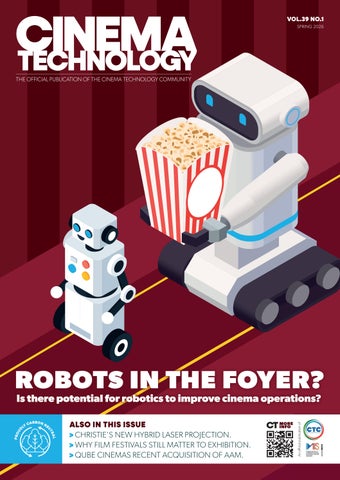
ROBOTS IN THE FOYER?




As spring hits the northern hemisphere and with it comes brighter and warmer days, so it appears this might be the case for the cinema industry too. It’s been a tumultuous six years with the industry facing a multitude of challenges one after another, but if the first three months are anything to go by, perhaps there’s cause for optimism. Yes, admissions remain down, box office revenue remains below the much quote 2019 figures, but the first quarter box office results coming from the USA are impressive and cause for genuine positivity with an increase on 2025 of more than 20% and the highest first quarter figures since 2020, before chaos descended.
Of course there remains uncertainty, over the volume of content coming from the major Hollywood studios, the Warner Bros acquisition and the current geopolitical situation, but as you’ll learn from two excellent and compelling articles in this edition by Lucy Jones (Comscore) and David Hancock (Omdia), the onus on
Hollywood to do the heavy lifting for the industry is diminishing to an extent. Locally produced content is starting to carry more of the load in Europe, and Asia is truly becoming an epicentre for our industry. So, if there’s an improvement in Hollywood performance, most noticeably seen in US box office figures, one can only hope that is the sign of optimism for the wider industry.
So as the industry turns it focus towards CinemaCon, there should be a strong blend of pragmatism and optimism echoing through the corridors of Caesars Palace. Yes, there remain challenges but there are also opportunities, even for this now very mature market.
For exhibitors, the same drivers remain. There’s still a need to increase revenue, streamline systems, reduce operational costs and lower energy consumption and it is at this intersection where innovation and technology can help the industry move forward.
Across this issue you’ll find a range of articles that address these various opportunities from Qube’s recent acquisition of Arts Alliance Media and the future roadmap for the convergence of these two platforms, through to Christie’s recently launched RGBH hybrid laser projection series as well as a look at how robots could help reduced the operational costs associated with repetitive tasks inside the cinema.
Whilst technology is the end product of addressing these challenges, we often forget that evolution is only possible due to the incredibly talented and committed people within our industry that continue to drive us forward. If 2026 is a year that ultimately ends up showcasing significant improvements, it will be off the backs of every person across the sector and their ongoing commitment to delivering amazing experiences for movie goers around the world.


VOL.39 NO.1 SPRING 26
GREENSHOOTS: NEXT GAINS IN SUSTAINABILITY
Tim Potter looks at insulation, building fabrics, heat recovery and intelligent ventilation to see where gains may be possible. 18
QUBE ACQUIRES ARTS ALLIANCE MEDIA
CT Magazine takes a look beneath the recent acquisition of AAM by Qube and what this is likely to mean for the industry. 22
CHRISTIE RGBH HYBRID LASER PROJECTION
A first-look at Christie's new hybrid RGB and phosphor projector technology which has the potential to lower operating costs and manage speckle. 25
ENGINEERING CONTINUITY FOR A SHARPER CINEMA FUTURE
LUMMA AND REGAL CINEMAS EXTEND PARTNERSHIP
Twenty Magnify8 haptic seating auditoriums to be added across North America. 15
IMAX BRINGS FORMULA ONE RACES TO US CINEMAS
In partnership with Apple TV, IMAX will bring grand prix races in Miami, Monaco, Silverstone, Monza and Austin to select auditoriums.
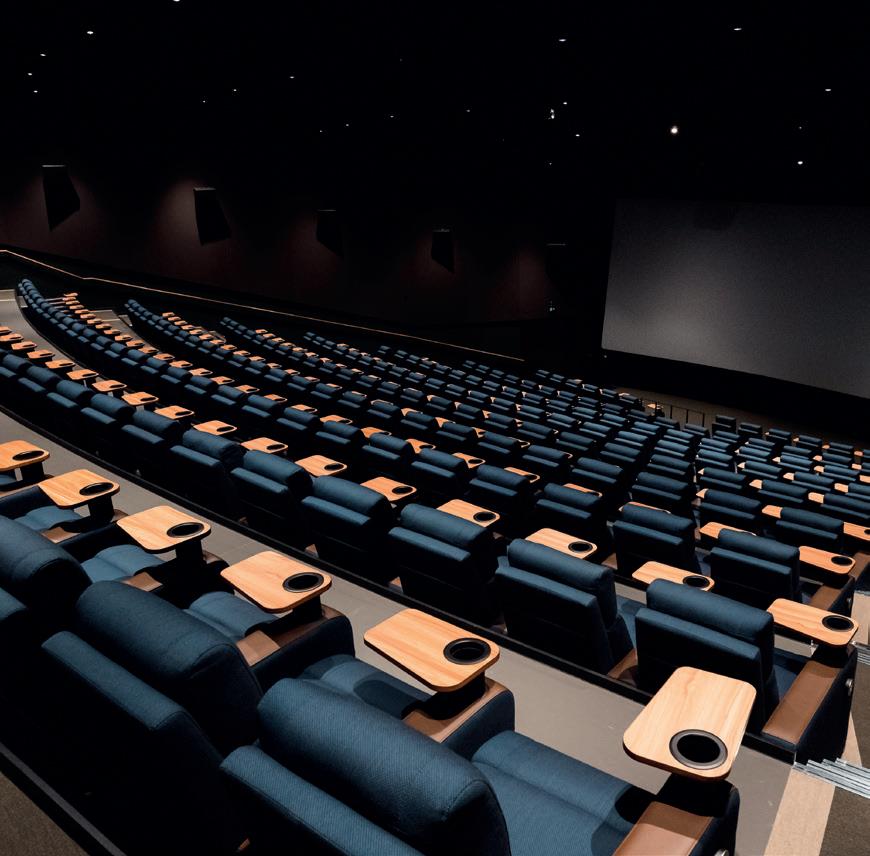
Adam MacDonald shares updates on the recent transitionto Sharp, what it means and the strategic rationale. 29
INSIDE THE BARCO EXPERIENCE CENTRE
Peter Knight travels to Kortrijk, Belgium to take a look at Barco's refreshed customer experience centre that showcases a shift to solutions.
ROBOTS IN THE FOYER
No longer the stuff of science fiction, robots might soon be a viable tool inside cinemas to manage specific tasks.
BOX OFFICE TEAMWORK
Lucy Jones from Comscore takes a look back at the European box office in 2025 and shares key insights on the importance of local content.
ASIA: THE DRIVER OF GLOBAL GROWTH
Omdia's David Hancock showcases why Asia is rapidly taking centre stage in the cinema market and becoming ever more important.
WHY FILM FESTIVALS STILL MATTER TO EXHIBITION
Cineport's Saul Mahoney takes a in depth look in to film festivals and why they still have such great importance to exhibitors globally.
OVERCOMING COMPLEX DESIGN CHALLENGES
How Harkness Screens helped Nordisk Films deliver premium cinematic experiences at the recently refurbished Saga Kino in Oslo.
THE UK CINEMA CLUB
Peter Knight takes a look at a new initiative that aims to provide reduced cost tickets to specific audiences to drive consumer behaviour.























WORDS: DAVID POPE, PRESIDENT, IMIS
2026 is set to be an exciting year for the International Moving Image Society (IMIS). Our focus remains on bringing creative and technical talent together, creating spaces where knowledge, skills, and inspiration thrive.
IMIS continues to grow as the go-to hub for professionals who want to master their own craft and understand the roles that surround themstrengthening the connections that make every production stronger.
As the industry evolves, shared insight, mentorship, and cross-disciplinary collaboration have never been more important, and IMIS is proud to champion these through our events, initiatives, and content.
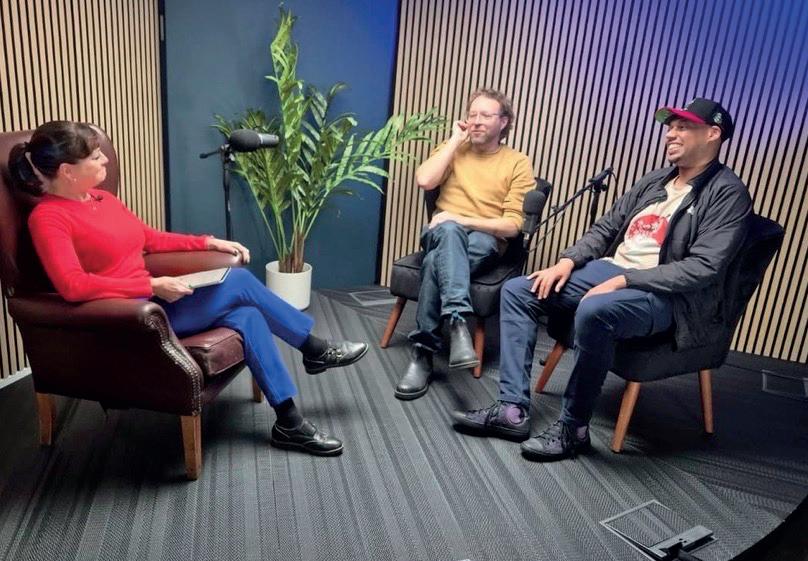
IMIS’s new original video series, Behind the Lens, shines a light on the people, skills, and workflows that drive the moving image industry. Each interview explores not just the technical or creative expertise of a single role, but how these roles interact, complement each other and rely on collaboration to achieve outstanding results.
Hosted by Creative Technologist, Muki Kulhan, the first episode focuses on The roles of a DIT and Data Wrangler, with Mark Kozlowski (Boxfly), Dean Otusanya-Wood (Digital Orchard Group). These conversations offer practical insights into workflows, emerging tech, and cross-role collaboration, while sharing lessons on mentorship and career growth. Discover how understanding adjacent roles can elevate both your career and your production team.

The episodes were filmed at CVP’s Fitzrovia showroom, with CVP kindly providing a mini studio space for the interviews. As a leading specialist in professional video and broadcast solutions, CVP supports the industry
through technical expertise, facilities and education. Our collaboration with CVP reflects a shared belief in bringing the industry together, connecting people across disciplines and supporting the next generation of moving image professionals. The first episode is now live on the IMIS Knowledge page for all members.
IMIS has a packed events calendar for the year ahead. Highlights include:
› May 2026: IMIS Student Showcase
› June 2026: Colour Truth: Metamerism Part II
› Autumn 2026: Social Media’s Impact on the Broadcast World
› October 2026: Soho Media Club’s BE YOU Festival
Through these initiatives, IMIS continues to provide spaces for learning, sharing expertise, and building the collaborative relationships that drive our industry forward.
AMC ENTERTAINMENT HOLDINGS, INC announced that the Company, together with its wholly-owned subsidiary Odeon Finco PLC, have entered into a commitment letter with Deutsche Bank AG New York Branch providing for a new senior secured credit facility of Odeon in an aggregate principal amount of up to $425,000,000 (the “Odeon Credit Facility”). Odeon intends to use the proceeds of the Odeon Credit Facility, if consummated, to refinance its existing 12.750%
Senior Secured Notes due 2027 (the “Odeon Notes”) and pay related fees and expenses. The Odeon Credit Facility is expected to strengthen the Company’s balance sheet, extend debt maturities, and reduce interest rates while preserving flexibility to streamline and simplify the capital structure. In connection with entering into the commitment letter, the Company has decided not to proceed with its previously announced offering of senior notes and new term loan facility at this time.
The Odeon Credit Facility is expected to consist of a senior secured term loan due 2031, with a fixed 10.50% interest rate and is expected to be issued with 2.00% original issue discount. The final terms of the Odeon Credit Facility, including the senior secured term loan, will be subject to execution of definitive credit documentation and the satisfaction of customary closing conditions. The Odeon Credit Facility is expected to close on or before April 6, 2026.
Unique X recently announced an expanded technology partnership with Ster-Kinekor, South Africa’s leading cinema exhibitor. The agreement will see Ster-Kinekor migrate from its existing TMS service provider to the full Unique X RosettaBridge TMS suite across its national network. The rollout will include RosettaBridge Theatre Management System (TMS), RosettaNet Circuit Management System (CMS), BaseKey KDM and Pulse services with the network-wide deployment scheduled for completion in early April 2026. This transition represents a significant modernization of Ster-Kinekor’s cinema operations, replacing its longstanding installation with a fully integrated, future-ready cinema management platform.
At each cinema location, RosettaBridge TMS will serve as the central operational hub, providing automated show scheduling, playlist generation, real-time monitoring with seamless point-of-sale integration. When combined with RosettaNet CMS, Ster-Kinekor gains centralised control and visibility across its entire circuit, enabling consistent programming, streamlined content workflows and uniform presentation standards nationwide. BaseKey KDM services will further
enhance efficiency by securely automating KDM delivery, ensuring accurate and timely key distribution to every screen. Pulse will provide network wide real time monitoring of cinema operations including function status and work orders, providing visibility into employees and cinema locations, ensuring seamless management and oversight.
Ster-Kinekor is a long-standing customer of Unique X’s Advertising Accord platform, which has supported the exhibitor’s cinema advertising operations for many years. This expanded engagement reinforces Ster-Kinekor’s confidence in Unique X’s technology ecosystem and reflects a strategic move toward deeper platform consolidation across both cinema operations and advertising.
Roger Harris, CEO of Unique X, commented: “We are delighted to expand our partnership with Ster-Kinekor through the deployment of RosettaBridge, RosettaNet and BaseKey across their network. SterKinekor has been a valued, long-term customer of Advertising Accord, and this transition to our TMS suite further demonstrates their trust in Unique X’s technology and vision. We look forward to supporting their continued innovation and operational excellence.”
LUMMA AND REGAL will deepen their collaboration to implement the roll-out of additional Magnify 8 locations across the United States, marking a significant milestone in the expansion of this haptic seating technology. In December 2024, Regal Premium Experience (RPX) introduced Lumma’s Magnify 8 technology in select rows at the Pinnacle theatre in Knoxville. Following strong audience demand, this technology was installed at the Regal Boise theatre in July 2025. In December 2025, two new auditoriums opened at Regal Sherman Oaks Galleria with “Zootopia 2” and “Avatar: Fire and Ash,” both featuring Magnify 8 within the same complex. In early 2026, new Magnify 8 auditoriums opened in New York and California at Regal Destiny USA, Regal Mira Mesa, and Regal Temecula. As part of this ongoing expansion, Lumma and Regal will deploy Magnify 8 across 12 additional auditoriums. Two of those installations are already in the pipeline and set to start
soon. Upcoming releases in the RPX premium format include: “They Will Kill You” (Warner Bros.), “The Super Mario Galaxy Movie” (Universal), “Lee Cronin’s The Mummy” (Warner Bros.), “Mortal Kombat 2” (Warner Bros.), “The Mandalorian and Grogu” (Disney), “Toy Story 5” (Disney), “Supergirl” (Warner Bros.), “Minions & Monsters” (Universal), and “Avengers: Doomsday” (Disney). Magnify 8 delivers exceptional performance with a unique, differentiated cinematic experience. With eight independently preprogrammed vibration points perfectly synchronized to onscreen action, Magnify 8 drives audience engagement and boxoffice growth while positioning venues as premium destinations.
“Lumma is excited to implement our latest innovative product, Magnify 8, in partnership with Regal, a world leader in the theatre industry,” said Rolando Rodriguez, partner and part-owner of Lumma. “We are eager to continue expanding this
immersive experience with Regal as they successfully introduce groundbreaking technologies to their audiences,” said Rodriguez.
“We are thrilled to strengthen this partnership with Regal, one of the foremost leaders in the industry renowned for delivering best-in-class innovations to audiences. It is an honor that they have selected Magnify 8 to drive further innovation in their format offerings,” said Marcos Franco, CEO of Lumma.
“We are very excited about our business relationship and involvement with Lumma’s Magnify 8 experience coming soon to a significant number of our theatres, enhancing the incredible experience that we already offer in our RPX auditoriums. This aligns with our ongoing focus with innovation and continuous improvement of the moviegoing experience. Throughout the testing phase, our customers have clearly enjoyed the dynamic Magnify 8 haptic seating,” said John Curry, SVP Commercial at Regal.
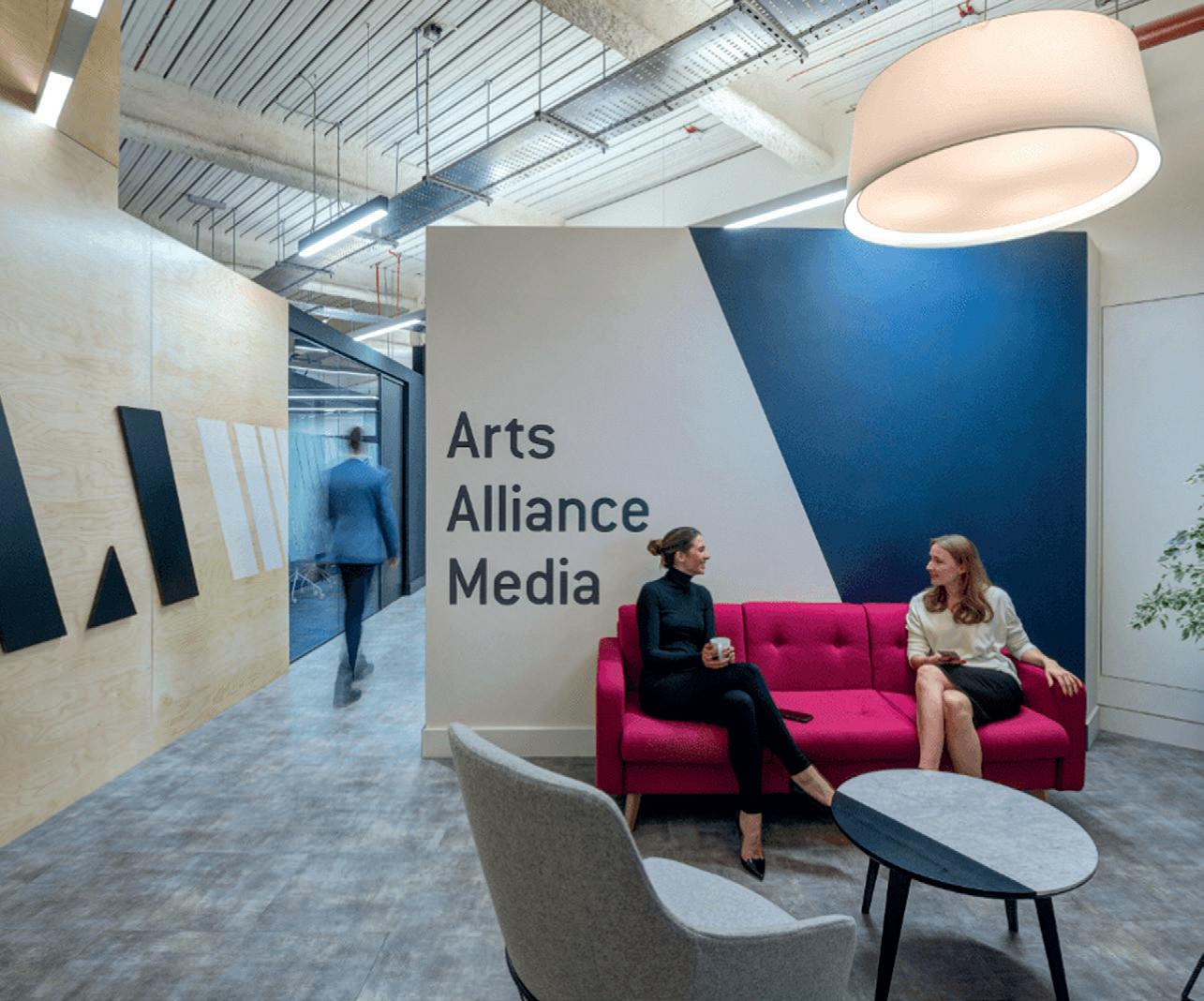

QUBE CINEMA, a leading provider of digital cinema technology and solutions, announced its acquisition of the business of Arts Alliance Media, the UK-based provider of theatre management software and cinema operations solutions. This move strengthens Qube Cinema’s position at the forefront of the worldwide digital cinema technology landscape.
The consolidation reflects a clear alignment of both companies’ expertise across exhibitor operations, software services, and deployment at scale, underpinned by openness and interoperability across heterogeneous cinema environments. The companies also share a strong commitment to cinema, driven by common values of innovation, product reliability, and customer obsession.
AAM’s product installations, spanning theatre management solutions and hardware management systems, cover over 32,000 screens globally. Qube Cinema, with its forty-year legacy of pioneering several cinema technologies in India and across the world, will focus on fulfilling AAM’s customers’ needs with enhanced scale, resources and longterm commitment.
Speaking on the announcement, CEO of Qube Cinema, Harsh Rohatgi said “Arts Alliance Media has earned an enviable reputation among its customers for its product innovation and unmatched customer relationships. As we welcome the business into our fold, our priority is to preserve its legacy and maintain the rigor in product reliability and delivery quality while enhancing product features, customer support and market reach. This association paves the way for exchange of experiences between the teams to deliver innovations that meet real-world exhibitor needs.”
The business will continue under the Arts Alliance Media brand, maintaining established customer relationships and service standards.
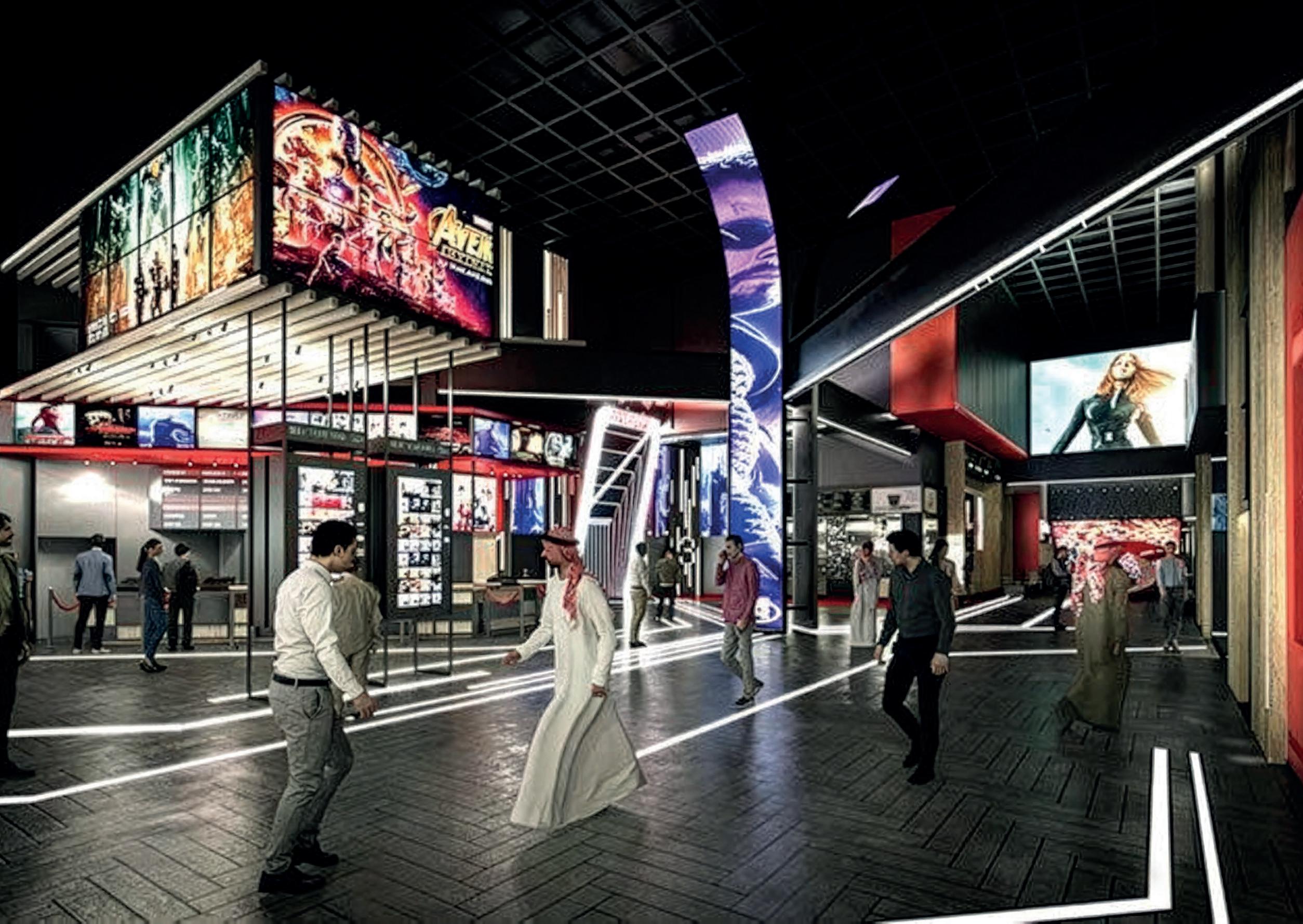
CINEMANEXT, the largest cinema exhibition services company in Europe, Africa and North America, announced in late 2025 a new technology distribution agreement with Scrabble Entertainment DMCC, for CinemaNext’s proprietary solutions in the Middle East. Under this exclusive agreement, Scrabble will sell CinemaNext’s hardware and software solutions, including its P-SBOX15 family of boothless cinema solutions, 3D mover and PAA20+/40+
Automation Adapter throughout the Middle East. The P-SBOX is the ultimate active enclosure customized for specific digital cinema projectors. It allows cinema exhibitors with space restrictions to integrate this “hushbox” solution directly inside any auditorium without compromising the moviegoing
experience, thanks to a powerful noise reduction system and lifting systems either suspended from the ceiling or from the back wall. Designed by CinemaNext’s Solutions team, based in Valencia, Spain, the P-SBOX is compatible with select DCIcompliant projection systems from Christie, Barco and Sharp (formerly NEC).
CinemaNext’s PAA20+/40+ Automation Adapter interfaces digital cinema playback equipment with existing cinema control systems, enabling fully automated presentations without manual intervention. The adapter converts network or serial control signals from digital cinema servers into relay closures, triggering downstream equipment including projectors, lighting dimmers, HVAC controls, audio
processors and other electrical circuits within the cinema.
The 3D Mover automates passive 3D presentation in projection booths, eliminating manual switching between 2D and 3D screening modes. When a 3D screening is scheduled in the theatre management system, the motorized slider automatically positions the polarizing filter in the projection light path. Following the 3D presentation, the system retracts the filter for subsequent 2D screenings without operator intervention. Automated format switching reduces human error associated with manual filter placement, ensures consistent 3D image quality across all presentations, and saves staff time previously spent accessing projection booths between shows.
Digital Cinema Media (DCM), the market leader in cinema advertising, has expanded its growing independent roster to include The Prince Charles Cinema, securing a contract to manage its advertising. The historic and highly popular independent has joined DCM’s estate in a year of forecasted growth in both admissions and revenue.
One of London’s longest-standing venues, The Prince Charles Cinema will sit alongside Cineworld, Odeon, Vue, Picturehouse Cinemas, Reel Cinemas, The Light, Omniplex Cinemas and over 160 leading independent cinemas, with DCM representing 85% of the market.
For the first time, DCM now manages advertising for every screen surrounding the iconic Square, with Cineworld Leicester
Square, Vue West End, Odeon Luxe and Odeon West End already positioned in London’s prime location.
“If you love film, then you love The Prince Charles Cinema,” said Karen Stacey, CEO of DCM. “It proves, without a doubt, that cinema generates cultural power spanning multiple generations, with young audiences queuing up to watch films from every era. We’re excited to be representing the cinema’s advertising and drive revenue to one of London’s most cherished independents.”
The news shortly follows the launch of the DCM co-produced McDonald’s Friends Festival. Working alongside OMD and Red Consultancy, the event was the first time a brand had taken over the whole of Leicester Square to deliver Friends-inspired activations and big screen episodes for an entire weekend.
really enjoy each new territory. Each one is so different, they work differently, films release differently. So it’s always exciting for me to learn something new.
really enjoy each new territory. Each one is so different, they work differently, films release differently. So it’s always exciting for me to learn something new.
My main expansion into the role has been to take on some bigger picture business, hopefully relieving some stress from my boss.
My main expansion into the role has been to take on some bigger picture business, hopefully relieving some stress from my boss.
CT: How have your previous experiences prepared you for your new role?
I’ll end on two pieces of advice I was given when I started, and I love to share them as I believe they are so invaluable.
I’ll end on two pieces of advice I was given when I started, and I love to share them as I believe they are so invaluable.
CT: How have your previous experiences prepared you for your new role?
I think because I’ve been so lucky to have had a varied career. From being on the studio side to growing in the tech side. I feel i understand the pain points that my customers face. Because I faced them.
MDI, a global leader in premium cinema screen solutions, is proud to announce the renewal of its exclusive supply agreement with Cinemark for an additional five-year term, effective January 2026.
I think because I’ve been so lucky to have had a varied career. From being on the studio side to growing in the tech side. I feel i understand the pain points that my customers face. Because I faced them.
CT: As the newest member of the CTC board, what are you looking forward to most?
QUBE WIRE CINEMA, A LEADING PROVIDER of end-to-end digital cinema technology solutions, has signed a definitive agreement to acquire a 100% stake in MetaMedia (MMT Tech, Inc). MetaMedia is North America’s largest cloud-based content delivery platform to cinemas. With this acquisition, Qube Wire becomes the world’s largest cinema electronic delivery network with over 5,000 cinemas connected across 51 countries. In the United States, the merged network will provide coverage to 9 of the top 10 largest cinema chains. Qube will continue to execute MetaMedia’s existing deployment plans and service its customer agreements.
“...Sharing knowledge between this group of incredible people across the globe. Looking for better ways to work together that can help anyone. I hope I can bring something valuable to the table.“
“...Sharing knowledge between this group of incredible people across the globe. Looking for better ways to work together that can help anyone. I hope I can bring something valuable to the table.“
Under this renewed agreement, Cinemark will continue to purchase its cinema screens exclusively through MDI for its nearly 500 theatres across the U.S. and Latin America.
CT: What’s your favourite aspect of working in the cinema industry?
CT: As the newest member of the CTC board, what are you looking forward to most?
Oh my gosh, the community. Sharing knowledge between this group of incredible people across the globe. Looking for better ways to work together that can help anyone. I hope I can bring something valuable to the table.
Oh my gosh, the community. Sharing knowledge between this group of incredible people across the globe. Looking for better ways to work together that can help anyone. I hope I can bring something valuable to the table.
“The acquisition of MetaMedia is a huge move for Qube’s North American operations,” said Harsh Rohatgi, CEO of Qube Cinema. “MetaMedia’s
CT: What’s your favourite aspect of working in the cinema industry?
This renewed commitment builds on a strong and successful collaboration that began more than five years ago and reflects the shared confidence in MDI’s cutting-edge screen technology, manufacturing excellence, and global service capabilities.
The cinemas of course! I love to visit my favourite places in town. I love to escape into a film, melt away any stress. It’s the best fun, even when I watch a horror. If you’ve ever sat next to me during a horror, you’ll know how ridiculous I am.
“We are extremely proud to renew this exclusive partnership with Cinemark,” said François Barrette, President of MDI. “Over the past several years, we have built a relationship based on trust, performance, and innovation. This new five-year agreement reinforces our shared vision and our commitment to delivering world-class cinema experiences to audiences across the globe.”
innovative network has consistently delivered faster, more cost-effective solutions for content delivery, saving millions compared to traditional methods. At Qube, we’ve leveraged this technology to bring Indian feature films to North American cinemas with speed and precision, expanding the size and number of Indian releases by 3x in the last five years. With the addition of MetaMedia, our combined strengths will set a new standard in cinema content delivery for many more distributors and create unparalleled value for the global movie industry.”
The cinemas of course! I love to visit my favourite places in town. I love to escape into a film, melt away any stress. It’s the best fun, even when I watch a horror. If you’ve ever sat next to me during a horror, you’ll know how ridiculous I am.
Adilson De Andrade, SVP of Technology Operations and Presentation for Cinemark, added, “We are truly pleased to continue our collaboration with MDI as our exclusive cinema screen supplier for our theaters across the U.S. and Latin America. Over the years, our teams have developed a strong, trusted relationship built on shared values, innovation, and a common goal of elevating the cinematic experience through best-in-class technology. We look forward to continuing working together to bring unforgettable moviegoing moments to audiences everywhere.”
Pick your battles… don’t die on your sword. A few years into my role at Warner Bros, I had just started taking over trailer negotiations. During a back-and-forth with one of my exhibitor friends over placement for a release that barely had any admissions, he said, “Pick your battles.” I understood immediately, and it resonated with me.
Pick your battles… don’t die on your sword. A few years into my role at Warner Bros, I had just started taking over trailer negotiations. During a back-and-forth with one of my exhibitor friends over placement for a release that barely had any admissions, he said, “Pick your battles.” I understood immediately, and it resonated with me.
I’ve kept this in mind in everything I do ever since.
I’ve kept this in mind in everything I do ever since.
MDI’s advanced screen technologies are designed to meet the highest standards of image quality, durability, and performance, supporting Cinemark’s ongoing efforts to provide exceptional theatrical experiences in every market it serves.
CT: What advice would you give to someone considering a career in this field?
CT: What advice would you give to someone considering a career in this field?
For nearly four decades, Qube Cinema has been a trailblazer in the global filmmaking and exhibition industries. Qube is one of a handful of companies in the world that has developed a DCI-certified digital cinema server. With a team of about 1,000 employees
Don’t burn any bridges. This industry is still quite small, and we all rely on the relationships we build. You never know what will happen, so it’s never worth burning those bridges down.
With this renewed agreement, MDI will continue to supply and support Cinemark cinemas globally, reinforcing its position as a trusted collaborator to major exhibitors worldwide.
Don’t burn any bridges. This industry is still quite small, and we all rely on the relationships we build. You never know what will happen, so it’s never worth burning those bridges down.
Ultimately, the connections you make and the experiences you gain can lead to incredible opportunities, so definitely embrace every moment and every interaction!
Ultimately, the connections you make and the experiences you gain can lead to incredible opportunities, so definitely embrace every moment and every interaction!
who are passionate about the domain, Qube continues to revolutionize cinema exhibition and distribution with cutting-edge, reliable, and costeffective solutions. With technology to service the world’s greatest content creators and exhibitors, Qube continues to introduce innovations to the cinema ecosystem that are reshaping the cinematic experience for audiences worldwide. Qube Wire has been growing consistently since launching as a global cloud-based distribution platform in early 2017. Today, Qube Wire powers the supply chain for many major content distributors, including all the major Hollywood studios. Qube Wire also delivers over 95% of all the Indian movies released around the world. With its regional partnerships and automated hard drive duplication hubs, Qube Wire provides

SHOWTIME ANALYTICS RECENTLY ANNOUNCED AN agreement with leading Balkans multiplex chain BlitzCineStar, to provide them with a real time operational data and digital marketing platform across their 28 sites.
SHOWTIME ANALYTICS RECENTLY ANNOUNCED AN agreement with leading Balkans multiplex chain BlitzCineStar, to provide them with a real time operational data and digital marketing platform across their 28 sites.
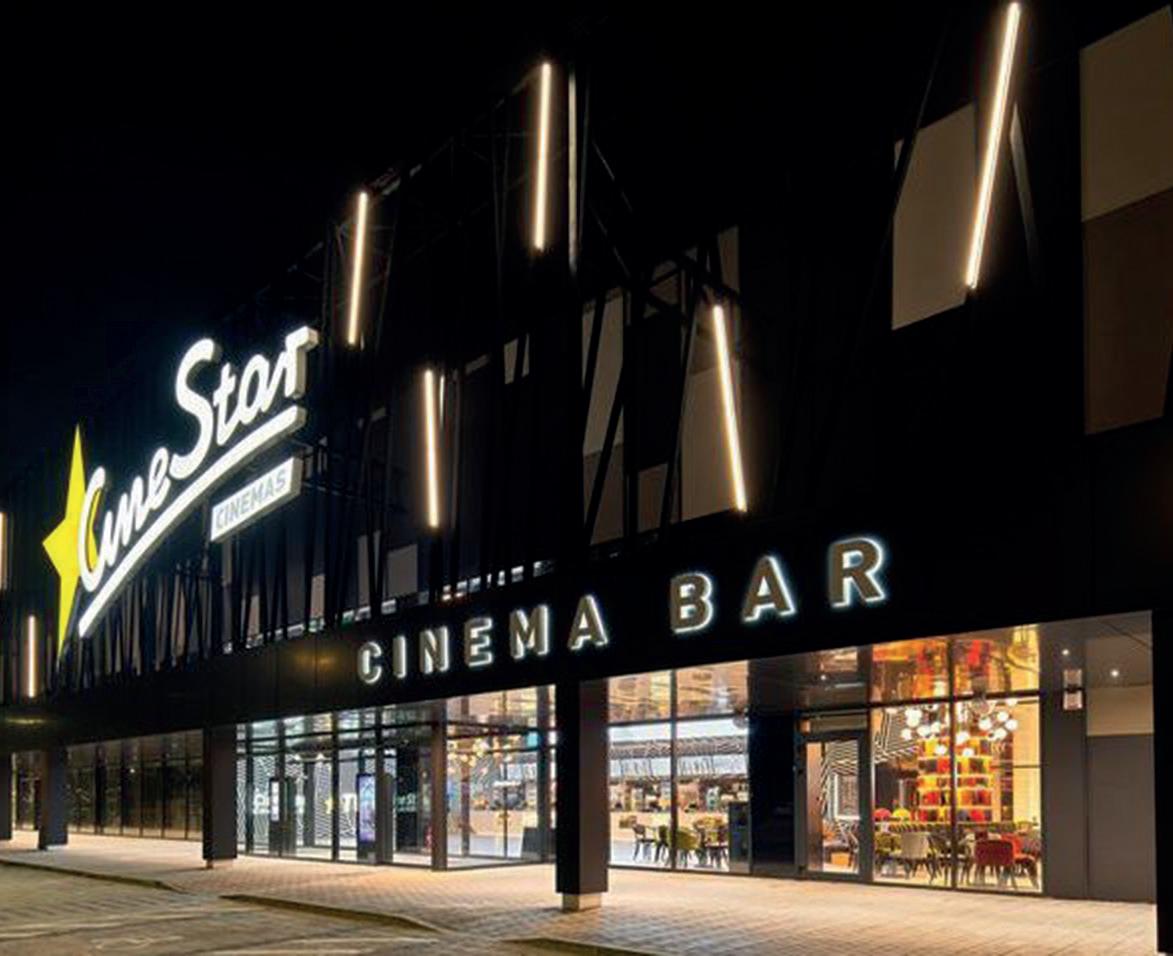
Blitz-CineStar, founded in 2003, is the leading cinema operator in Croatia and the region, spanning Croatia, Bosnia and Herzegovina, Serbia and Kosovo. Featuring 182 state-of-the-art halls, including IMAX, 4DX, Screen X and Gold Class, CineStar sets the standard for cutting-edge technology and premium cinema experiences. Recognised for innovation and quality, it has earned numerous awards, including “Best Cinema in Europe” by UNIC in 2019, and continues to deliver exceptional entertainment to over 4.5 million visitors annually.

Blitz-CineStar, founded in 2003, is the leading cinema operator in Croatia and the region, spanning Croatia, Bosnia and Herzegovina, Serbia and Kosovo. Featuring 182 state-of-the-art halls, including IMAX, 4DX, Screen X and Gold Class, CineStar sets the standard for cutting-edge technology and premium cinema experiences. Recognised for innovation and quality, it has earned numerous awards, including “Best Cinema in Europe” by UNIC in 2019, and continues to deliver exceptional entertainment to over 4.5 million visitors annually.
IN FEBRUARY, IMAX announced they’re working with Apple TV to bring the 2026 FIA Formula One World Championship live to select IMAX locations across the United States. Through the first-of-its-kind collaboration, five of the most iconic Grands Prix in F1 — Miami, Monaco, Silverstone, Monza, and Austin — will be available across at least 50 IMAX locations nationwide. Participating IMAX locations will deliver a dynamic viewing experience of Formula 1 on Apple TV, amplifying the inaugural season of Apple TV as the official U.S. broadcaster for F1.
With their commitment to delivering an unparalleled theatre experience to their customer base, Blitz-CineStar wanted to use their first-party data to help them understand how their business was performing across the metrics that mattered to them, and use this data to drive customer engagement and loyalty. They reached out to Showtime Analytics to evaluate how their cloud platform could help them do this.
With their commitment to delivering an unparalleled theatre experience to their customer base, Blitz-CineStar wanted to use their first-party data to help them understand how their business was performing across the metrics that mattered to them, and use this data to drive customer engagement and loyalty. They reached out to Showtime Analytics to evaluate how their cloud platform could help them do this.
By migrating from their existing email marketing tool and integrating their customer data to Showtime Engage, it will allow them to bring individual customer behaviors, touch points and purchase activity together to create a single view of their identifiable movie-goers. Having all this information about their different customers and their shared behaviours, it will give them the ability to create and send targeted, personalised digital campaigns to different segments, driving customer engagement and loyalty. With the closed loop integration with their POS this will allow them to track conversions and revenue uplift from each campaign, putting them in better control of where to focus their marketing efforts.
“F1 is a rapidly growing force in sports and culture in the US, and by bringing F1 on Apple TV live to IMAX theaters nationwide, we’re delivering the energy and excitement to even more screens in a truly immersive way,” said Oliver Schusser, Apple’s vice president of Music, Sports, and Beats. “We’re excited to collaborate with IMAX to expand access to F1 on Apple TV and give fans across the U.S. a powerful new way to experience the speed and spectacle that the sport delivers.”
By migrating from their existing email marketing tool and integrating their customer data to Showtime Engage, it will allow them to bring individual customer behaviors, touch points and purchase activity together to create a single view of their identifiable movie-goers. Having all this information about their different customers and their shared behaviours, it will give them the ability to create and send targeted, personalised digital campaigns to different segments, driving customer engagement and loyalty. With the closed loop integration with their POS this will allow them to track conversions and revenue uplift from each campaign, putting them in better control of where to focus their marketing efforts.
Mrs Jadranka Islamovic, CEO CineStar Cinemas said of the partnership:
Mrs Jadranka Islamovic, CEO CineStar Cinemas said of the partnership:
“Apple TV and Joe Kosinski’s brilliant ‘F1 : The Movie’ proved beyond a doubt that the speed, precision, and artistry of Formula 1 translate beautifully to the IMAX Experience, and we are very excited to further our collaboration with Apple and offer fans more of what resonated so deeply with that film by presenting live F1 races to them in IMAX,” said Jonathan Fischer, Chief Content Officer at IMAX. “As we continue to expand our global content portfolio with awe-inspiring experiences, we look forward to working with Apple to amplify its live coverage of Formula 1 and give fans in the U.S. an all-new way to experience this fast-growing sport.”
“As the best and largest cinema in our region with more than 22 years of operation, CineStar has become a synonym for cinema in our territory. We have a duty to provide each of our visitors with the best value for money through superior service and satisfaction, and to always provide the best and largest selection of films, in technologically superior halls and the most comfortable seats, the always constant quality of CineStar Cinemas. The values on which we base our long-term success are quality, service, trust, innovation and understanding of the needs of our visitors. We hope that with Showtime Analytics, we will now understand our visitors even better, all to improve our relationships with customers, their loyalty and ultimately increase visits.”
“As the best and largest cinema in our region with more than 22 years of operation, CineStar has become a synonym for cinema in our territory. We have a duty to provide each of our visitors with the best value for money through superior service and satisfaction, and to always provide the best and largest selection of films, in technologically superior halls and the most comfortable seats, the always constant quality of CineStar Cinemas. The values on which we base our long-term success are quality, service, trust, innovation and understanding of the needs of our visitors. We hope that with Showtime Analytics, we will now understand our visitors even better, all to improve our relationships with customers, their loyalty and ultimately increase visits.”
The announcement builds on IMAX and Apple’s successful collaboration on Apple Films’ “F1 : The Movie,” a Filmed for IMAX release directed by Joseph Kosinski and shot entirely using IMAX-certified digital cameras. “F1 : The Movie” was the highest-grossing Hollywood release in IMAX of 2025, with $97.6 million in IMAX worldwide. To celebrate its recent nomination for Best Picture for next month’s 98th Academy Awards, IMAX recently re-released “F1 : The Movie” across 50 IMAX screens in the U.S. beginning January 30. Hailing from Apple Studios, “F1 The Movie” is directed and produced by Jerry Bruckheimer, Joseph Kosinski, seven-time Formula 1 world champion Lewis Hamilton, Brad Pitt, Dede Gardner, Jeremy Kleiner, and Chad Oman.
Your Exhibitor Portal just got an upgrade — now capturing a broader range of technical capabilities.
Designed to streamline operations and enhance efficiency for exhibitors and distributors globally.
Check your MPS KDM emails for your cinema login details.
Thank you.
* over 4,000 screen capability updates a week by cinemas globally
WORDS: TIM POTTER, FOUNDER, TRIGAGE.
Albeit there is still a way to go, laser projection is increasingly becoming the new baseline and the question facing cinema operators is no longer whether to upgrade projection — but what comes next.
Laser has been delivering meaningful reductions in energy use and maintenance; we know the story well. And upgrades in a lot of cases have been achieved by retaining existing lenses and servers. This approach avoids unnecessary replacement, extends asset life, and significantly reduces embodied carbon. It is a clear example of progress through optimisation rather than wholesale renewal. But once we are done with laser upgrades, the spotlight inevitably shifts elsewhere.
One regional cinema operator that Green Shoots spoke to recently told us that some of their most dependable energy savings have come not from technology swaps, but from improving the building itself. Auditoria are large-volume spaces with strict temperature requirements. Poor insulation allows heat to escape in winter and enter in summer, increasing demand on both heating and cooling systems.
Upgrading insulation — including roofs, walls, plant spaces and air-handling zones — can typically reduce heating and cooling demand by 20–40% in large commercial buildings. For cinemas, where HVAC systems run for long hours and audience comfort is non-negotiable, the operational and carbon impact can be substantial.
Crucially, these savings compound. A laser projector operating within a well-insulated building delivers far greater real-world benefit than the same
projector running in a thermally inefficient shell. However, there remain one or two deployment issues, for example, the accessibility to roof space to add insulation can be problematic.
Beyond insulation, HVAC design is proving to be one of the most powerful — and still underappreciated — levers available to cinema operators.
› Modern energy-efficient cinema HVAC systems increasingly combine three complementary technologies:
› Heat pumps, which move heat from outdoors into the building rather than generating heat through gas or direct electric systems.
› Heat recovery, where the thermal energy in expelled air is captured and used to pre-heat incoming fresh air instead of being wasted to the atmosphere.
Demand-led recirculation, using CO2 sensors to match fresh-air supply to real-time auditorium occupancy, rather than conditioning 100% fresh air regardless of audience size.
The combined impact of these measures can be dramatic. That said, full heat-pump adoption is, on balance, still not commercially viable, particularly for older sites.
Several operators are instead taking a phased — and more palatable — approach, investing first in systems that combine heat recovery and demandled recirculation. One operator recently invested around £30,000 in a new system that automatically controls the circulation, reducing fan usage by 70%. This significantly reduces overall gas consumption
and is a compelling, financially digestible return without the need for wholesale plant replacement.
As sustainability efforts move beyond projection and into buildings and infrastructure, measurement becomes critical. The UK Cinema Association launched a Carbon Calculator last autumn, referenced during their regional meeting rounds. And in France, Cinéma Uni pour la Transition (CUT!) have also developed a Carbon Calculator. These tools have been developed specifically for cinemas to help operators translate energy data into credible, comparable carbon emissions figures. By reflecting real cinema operations rather than generic commercial assumptions, they provide a practical foundation for benchmarking, reporting and investment decisions.
In an environment where sustainability claims are increasingly scrutinised, this shift from estimates to evidence matters.
Laser projection remains an important step — but it is not necessarily the most interesting one. The next gains in cinema sustainability will come from buildings that lose less energy, systems that reuse what they already generate, assets that work longer, and data that tells the truth about where emissions really sit. Beyond laser, these opportunities are not theoretical. They are measurable, achievable — and already delivering results.
WORDS: CT EDITORIAL TEAM
The global cinema technology landscape is undergoing a quiet but meaningful transformation. As exhibitors continue to adapt to evolving audience expectations, operational complexity, and the need for seamless digital infrastructure, the companies that power cinemas behind the scenes are consolidating and expanding their capabilities. In this context, Qube’s acquisition of Arts Alliance Media (AAM) marks a strategically significant move—one that not only fills a long-standing gap in Qube’s offering but also signals a broader shift toward fully integrated cinema operating systems.
For over two decades, Qube has methodically built one of the most comprehensive digital cinema technology stacks in the industry. Its portfolio spans cinema servers, content mastering, distribution, premium large format (PLF) solutions, and ticketing infrastructure. However, one critical component had remained absent: a Theatre Management System (TMS). A TMS is the operational backbone of modern cinemas, enabling centralized control over content scheduling, playback, and system management across multiple screens. Rather than developing a TMS from the ground up—a process that would require years of development and market validation—Qube chose a more strategic route. By acquiring Arts Alliance Media, it gains immediate access to a mature, widely adopted solution.
This approach reflects a broader industry reality: in categories where strong incumbents already exist, acquiring proven technology and customer trust can be far more valuable than building from scratch. In AAM, Qube is not simply acquiring software—it is acquiring a product suite that has already
demonstrated reliability at scale, along with a global customer base that includes some of the world’s most prominent cinema operators.
A key factor in the acquisition is the strength of AAM’s flagship products, Screenwriter and Producer. These platforms are widely regarded as best-in-class within the TMS category, trusted by major exhibitors such as AMC, Regal, Cineworld, HOYTS, and Alamo Drafthouse. This is not a turnaround or distressed asset acquisition. Instead, it is a precision move: Qube is building on an already strong foundation. The existing customer base provides immediate scale, while the proven reliability of AAM’s solutions reduces the risks typically associated with integrating new product lines. For Qube, this means it can focus less on fixing or rebuilding and more on accelerating innovation—an important distinction in a market that has seen relatively slow evolution in TMS technology over recent years.
At its core, this acquisition aligns closely with Qube’s long-term vision: to become the invisible yet indispensable infrastructure layer of the global cinema industry. The company’s ambition is to create a seamlessly connected ecosystem where content flows effortlessly from mastering through to exhibition—culminating in the moment the lights dim and the film begins. With its content delivery platform, Qube Wire, already reaching more than 33,000 screens across 135 countries, the addition of a TMS completes the operational picture. The result is a vertically integrated platform that spans the entire cinema workflow. This integration has significant implications. Instead of relying on multiple vendors
for different parts of their operations, exhibitors can potentially operate within a unified environment— reducing complexity, improving reliability, and enabling new levels of automation and insight.
One of the most compelling aspects of the acquisition is the opportunity to evolve AAM’s TMS offerings into a more modern, software-as-a-service (SaaS) model. Traditionally, TMS deployments have been relatively heavy, requiring significant upfront investment and ongoing effort to implement updates or new features. Qube’s ambition is to change that paradigm. By leveraging its experience in cloud-based content delivery and platform architecture, the company aims to make TMS deployments lighter, faster, and more scalable. This shift could fundamentally change how exhibitors interact with their operational software—moving from periodic, resource-intensive upgrades to continuous, seamless improvements. Such a transition would not only enhance efficiency but also open the door to new product capabilities. For example, tighter integration between TMS and content delivery systems could enable real-time scheduling adjustments, automated workflows, and richer data analytics—capabilities that are difficult to achieve in fragmented environments.
A critical concern in any acquisition is the impact on existing customers. In this case, Qube is emphasizing continuity. Contracts remain unchanged, support teams are staying in place, and the AAM brand is being retained—at least in the near term.
This approach reflects an understanding of the cinema industry’s operational sensitivities.
Exhibitors depend on stability; disruptions to core systems can have immediate and costly consequences. By maintaining continuity on the surface while focusing integration efforts behind the scenes, Qube aims to balance stability with progress. The integration itself will involve bringing AAM’s approximately 20-person team—spread across the UK and the US—into the Qube organization. This team brings deep expertise in theatre operations software, complementing Qube’s strengths in network infrastructure and platform development.
While the strategic rationale for the acquisition is clear, the integration process is not without challenges. Combining two distinct domains— AAM’s deep domain expertise in theatre operations software and Qube’s infrastructure-driven approach—requires careful coordination.
On one hand, Qube benefits from a “fresh eyes” perspective, which can drive innovation and challenge existing assumptions. On the other, there is an inherent learning curve associated with fully understanding the nuances of theatre management software. The key will be balancing speed with thoughtfulness. The industry has long awaited meaningful innovation in the TMS space, but rushing changes could risk undermining the stability that customers rely on. Qube’s task is to accelerate the roadmap without disrupting what already works—a delicate but achievable balance.
For AAM’s existing customers, the most immediate benefit of the acquisition is certainty. When a company enters administration, customers often face significant uncertainty about the future of their technology provider. Questions about support, product development, and long-term viability can quickly become critical concerns. Qube’s acquisition provides a clear answer: continuity is assured. Beyond that, customers gain access to Qube’s broader ecosystem, including its global content delivery network and analytics capabilities.
For Qube’s existing customers, the addition of a TMS introduces new possibilities for operational integration. Previously, certain workflows may have required coordination across multiple systems. With a unified platform, these processes can become more streamlined and efficient.
In the short term, customers are unlikely to see major changes. Systems will continue to operate as before, and support structures will remain intact. However, over the next six to twelve months, the impact of the acquisition is expected to become more visible. Key developments are likely to include:
› Faster release cycles, reflecting increased investment and development capacity
› A clearer and more ambitious product roadmap
› Early stages of integration between TMS and Qube’s broader platform
These changes will likely be incremental at first, but their cumulative effect could be transformative.
One of the most important aspects is the overlap between Qube’s and AAM’s customer bases. Many exhibitors already use both Qube Wire and AAM’s TMS solutions, meaning the acquisition is less about entering new markets and more about deepening existing relationships. This overlap creates a powerful synergy. For exhibitors already using Qube Wire, adopting AAM’s TMS becomes a natural extension of their existing setup. Conversely, AAM customers gain a clear pathway to Qube’s content delivery network. Such cross-pollination can drive organic growth, increasing adoption rates and strengthening customer loyalty. Over time, this kind of network effect can significantly enhance market penetration and competitive positioning.
Ultimately, the acquisition represents more than the addition of a single product category. It is a step toward realizing a broader vision: a fully integrated cinema operating system. In an industry where interoperability and reliability are paramount, Qube’s commitment to an open, interoperable architecture remains a key differentiator.
Rather than creating a closed ecosystem, the company aims to provide the best possible option within an open framework—allowing exhibitors to maintain flexibility while benefiting from integration.
This approach positions Qube not just as a technology provider, but as a foundational layer for the cinema industry’s digital future.
Qube’s acquisition of Arts Alliance Media is a strategically targeted move that completes its technology stack and accelerates its transition from a collection of products to a unified platform. By combining AAM’s best-in-class TMS solutions with Qube’s global infrastructure and platform expertise, the company is well positioned to deliver meaningful innovation in a space that has long awaited it.
For customers, the immediate message is stability. For the industry, the longer-term implication is clear: the era of fragmented cinema technology may be giving way to a more connected, integrated future.

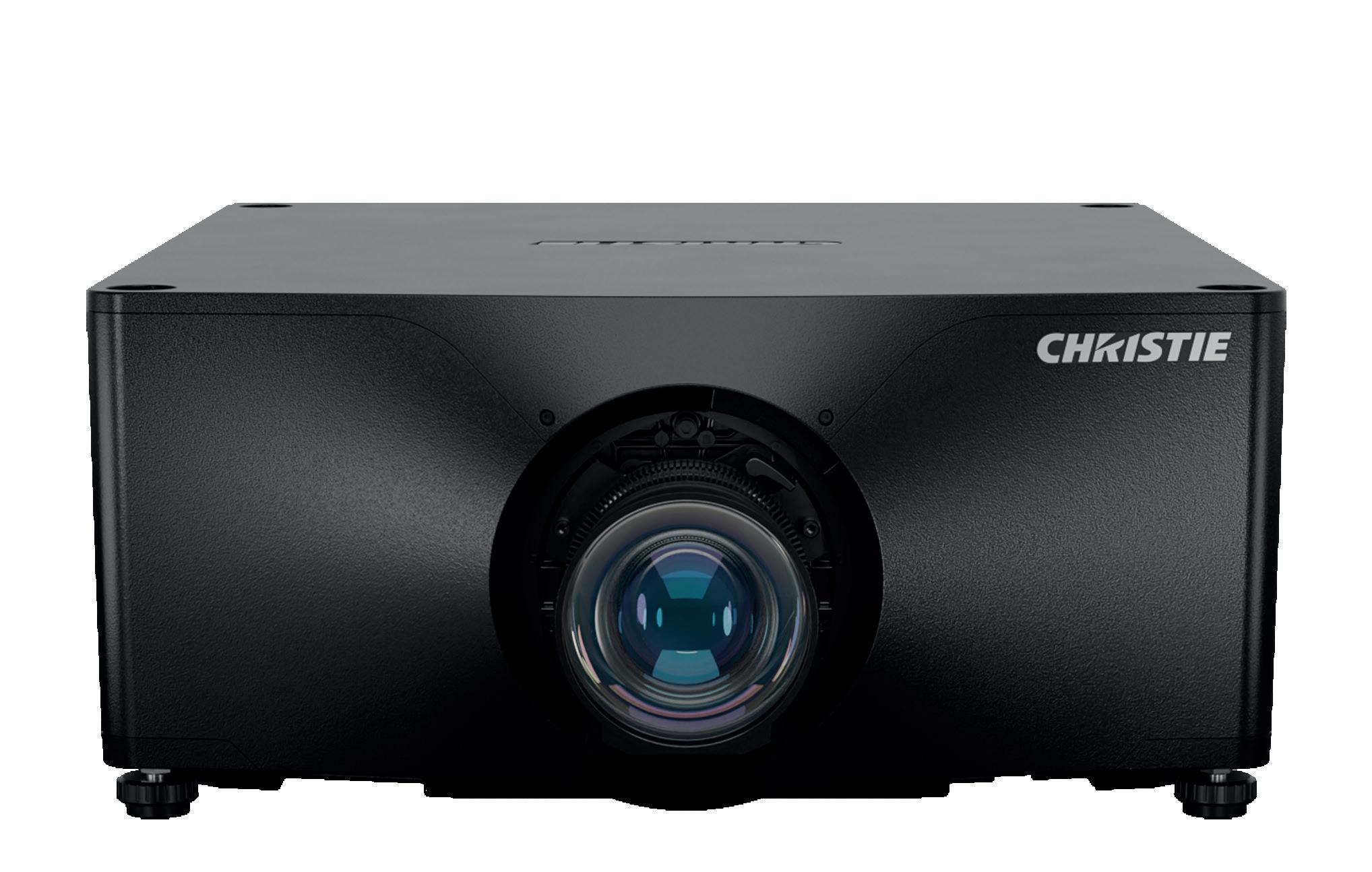
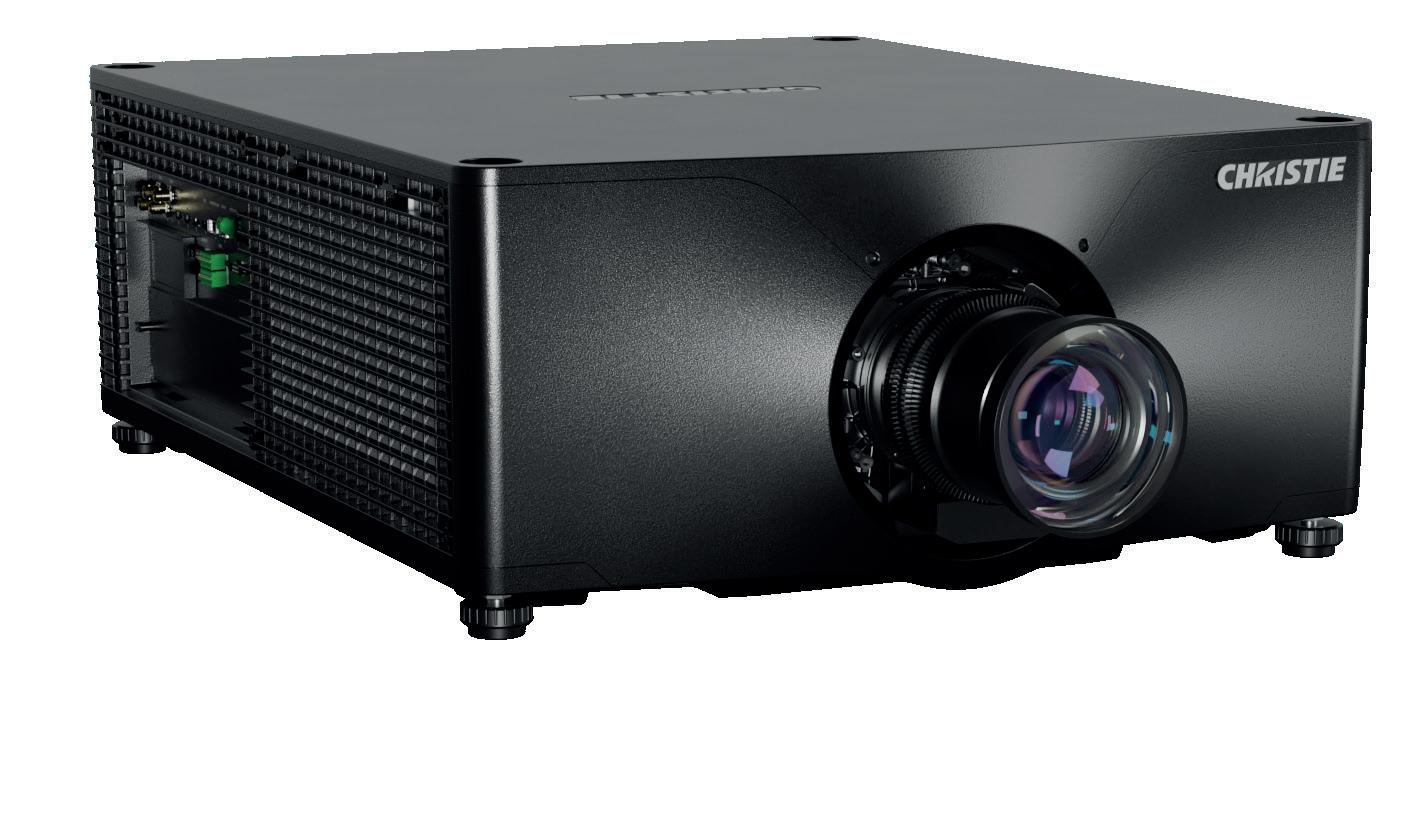
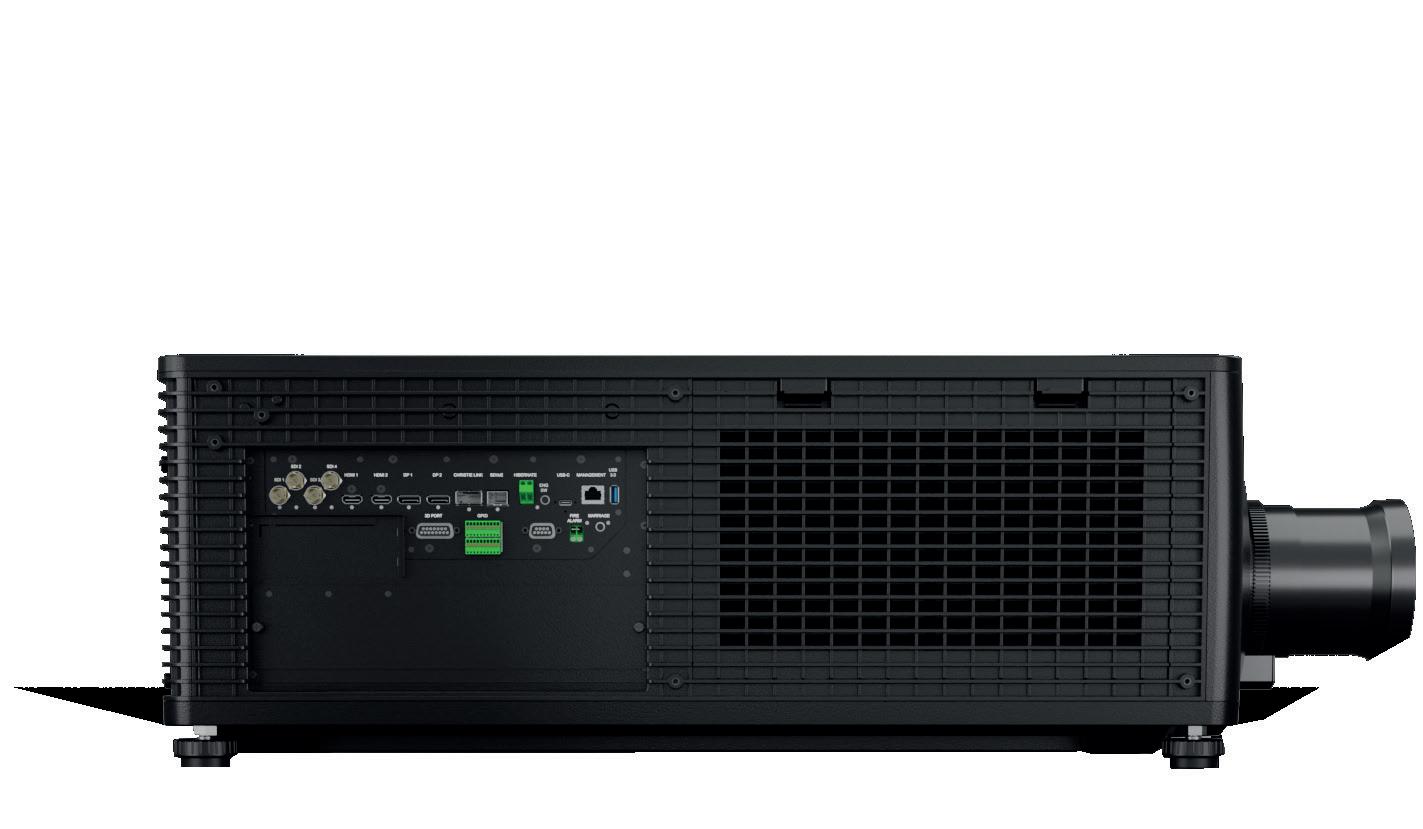
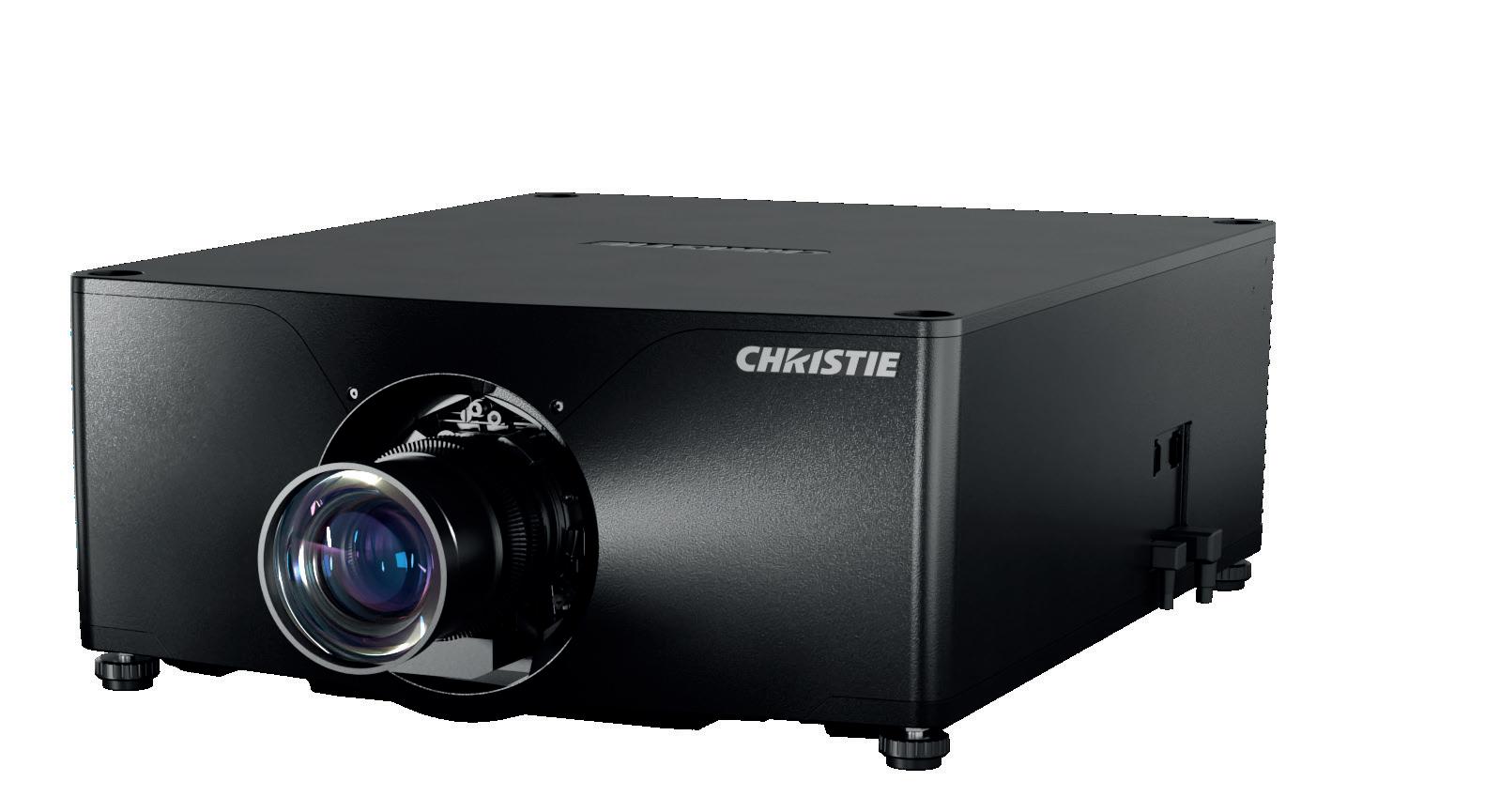
Christie has unveiled two new CineLife+ RGBH cinema projectors, the CP4415m-RGBH and CP4420mRGBH. Peter Knight takes a closer look at what the hybrid illumination approach means in practice, and where the models fit in today’s cinema installs.
WORDS: PETER KNIGHT, CINEMA TECHNOLOGY MAGAZINE
Cinema has always been a balancing act between romance and arithmetic. The romance is obvious: a dark room, a big screen, and a soundtrack that makes the seats feel slightly alive. The arithmetic is less glamorous, but it is increasingly decisive: electricity, heat extraction, booth space, maintenance windows, and the total cost of keeping image performance consistent across long operating hours. That balance matters now more than ever as Christie marks 25 years in digital cinema. The
industry has moved beyond debating whether digital cinema works. The conversation now centre on how efficiently it can be run at scale, particularly in real buildings with real budgets and lean technical teams.
Christie’s newly launched CineLife+ RGBH models, the CP4420m-RGBH and CP4415m-RGBH, bring that operational arithmetic into sharper focus. Both are 4K DCI DLP Cinema projectors built on Christie’s CineLife+ electronics platform, using what Christie calls RGBH: a hybrid illumination concept
combining RGB pure laser light with phosphor-based light in a single chassis. The intention is practical flexibility across different screens and operating conditions.
Rather than leading with peak brightness, Christie places emphasis on day-to-day running numbers. The company quotes 14.8 lumens per watt for the CP4420m-RGBH and 14.2 lumens per watt for the CP4415m-RGBH, alongside typical power use, heat output and noise levels. Lumens per watt can be read

as a miles per gallon style metric: how much light is produced for the electricity consumed. Christie states that its calculation uses maximum power at 25°C needed to reach full brightness.
There is no single agreed industry standard for measuring and quoting lumens per watt, so direct comparisons should be treated with care. Even so, published figures for many current 4K cinema projectors cluster around 9 to 12 lm/W, which makes mid-teens values notable. For cinemas wrestling with rising energy bills, cramped projection spaces or boothless layouts, this can translate into lower running costs, less heat to extract, and a quieter, easier to house installation.
The headline numbers tell only part of the story. Christie states that both models work with existing 0.98-inch m2K cinema lenses and accessories, which is relevant for sites upgrading from lamp systems without replacing an entire optical inventory. The datasheets also list dual power inputs including a UPS feed, self-contained liquid pressurised/TEC cooling with optional heat extraction, and a fully sealed optical path with tool-free filter replacements. Under optimal conditions, Christie suggests maintenance intervals as infrequent as once a year.
Christie’s RGBH label describes an operating choice rather than a simple marketing tag. The hybrid illumination approach, combines RGB pure laser primaries with phosphor-based light generation within the same chassis.
RGB pure laser illumination uses distinct red, green and blue laser primaries and is typically associated with strong colour capability. Phosphorbased illumination uses lasers (commonly blue) to excite a phosphor material that emits broad-spectrum light, which is then managed into the colour components required for projection. Christie describes its laser phosphor method as blue lasers illuminating a phosphor wheel, generating light that is separated into the necessary channels. RGBH brings both approaches together in one chassis, providing multiple usable illumination behaviours so the system can be configured to suit different screens and operating priorities.
Why does this matter? Installation conditions
NOMINAL BRIGHTNESS
CP4415M-RGBH UP TO 15,000 LM
CP4420M-RGBH UP TO 20,000 LM
CHRISTIE SCREEN WIDTH GUIDANCE
CP4415M-RGBH UP TO 52 FT (16 M)
CP4420M-RGBH UP TO 63 FT (19 M)
RESOLUTION
CP4415M-RGBH 4096 X 2160 (4K DCI)
CP4420M-RGBH 4096 X 2160 (4K DCI)
IMAGING SYSTEM
CP4415M-RGBH 0.98 INCH 4K SST, 3 CHIP DLP CINEMA
CP4420M-RGBH 0.98 INCH 4K SST, 3 CHIP DLP CINEMA
CONTRAST (LENS DEPENDANT)
CP4415M-RGBH UP TO 6000:1 (UHC LENS), 2500:1 NOMINAL (HB LENS)
CP4420M-RGBH UP TO 6000:1 (UHC LENS), 2500:1 NOMINAL (HB LENS)
ILLUMINATION CONCEPT
CP4415M-RGBH RGBH HYBRID (RGB LASER + PHOSPHOR)
CP4420M-RGBH RGBH HYBRID (RGB LASER + PHOSPHOR)
ILLUMINATION LIFE (QUOTE)
CP4415M-RGBH OVER 50,000 HOURS
CP4420M-RGBH OVER 50,000 HOURS
EFFICIENCY (QUOTED)
CP4415M-RGBH 14.2 LM/W
CP4420M-RGBH 14.8 LM/W
TYPICAL POWER AT 25°C
CP4415M-RGBH 1060 W
CP4420M-RGBH 1360 W
HEAT LOAD AT 25°C
CP4415M-RGBH 3620 BTU/HR
CP4420M-RGBH 4640 BTU/HR
ACOUSTIC NOISE (QUOTED)
CP4415M-RGBH UNDER 43 DBA
CP4420M-RGBH UNDER 47 DBA
are rarely ideal. High gain silver screens used for 3D place different demands on the light source and can change how the image behaves across the seating area. Smaller rooms and boothless builds impose tighter limits on heat and acoustic noise than a traditional projection booth. Hybrid illumination widens the number of environments a given projector class can serve without forcing every site into the cost and infrastructure envelope of the largest pure RGB systems.
Both models sit within the CineLife+ platform family, Christie’s umbrella term for the electronics, processing and control environment. In practical terms this includes a browser-based RemoteUI for monitoring and control, plus stability tools such as electronic colour convergence and automated colour tracking designed to reduce drift and manual intervention.
One of the major wins from the hybrid light source is the brighter image output without compromising on the contrast ratio typically seen in RGB projectors. This dual approach however serves to significantly reduce visible speckle and also helps to lower metameric failure (a topic covered extensively in CT Magazine previously). The science behind it is pretty simple.
In a typical RGB projector, the wavelengths are usually narrow and highly coherent so when these reflect, they produce the granular speckle effect that’s often been noted with RGB projectors and particularly those viewed on high gain screens. With the hybrid light source, the phosphor lasers help to offset the peak wavelengths from the RGB lasers by adding radiance between the primary wavelengths. This in turn helps to lower overall radiance by more than 50%, particularly with the green and red lasers which is where speckle is usually most visible. And this addition of radiance in between the primary RGB wavelengths provides another enormous benefit in helping to resource some of the metameric failures associated with RGB projectors where projected colours often look different from xenon projectors. Metamerism continues to be a significant issue for cinematographers and those working in the post-production process so that ability to add further radiance introduces a wider and smoother colour palette which in turn gets significantly closer to the colours expected from a xenon projector.
Efficiency, power and heat: why the numbers matter
Electricity going into a projector has only two destinations: useful light on the screen, or heat in the room. The aim is to maximise the former while minimising the latter. Christie quotes 1060 W typical for the CP4415m-RGBH and 1360 W typical for the CP4420m-RGBH (both referenced at 25°C), with heat load figures of 3620 BTU/hr and 4640 BTU/hr respectively. For context, 1.06 kW to 1.36 kW sits roughly in the territory of a hairdryer or small fan heater, typically below a full power UK kettle. More significantly for cinema planning, lower electrical draw means less heat to remove. Many comparable 4K cinema projectors in the 15k to 20k brightness bracket publish maximum brightness power figures around 1.4 kW to 2.2 kW. Against that background, these models run roughly 300 to 900 watts lower depending on the comparison. Less heat output can mean HVAC systems work less hard meaning that they will also be using less electricity and energy.
Those characteristics can also be relevant outside conventional fixed venues. Pop-up cinemas and temporary screening spaces often find that electrical supply and ventilation become the limiting factors rather than screen size alone. A projector that delivers cinema grade output with lower power draw and heat load can make temporary installations easier to power from temporary power supplies such as generators or to manage the heat build up.
Christie’s published guidance positions the CP4415m-RGBH for screens up to 52 ft (16 m) wide and the CP4420m-RGBH for screens up to 63 ft (19 m) wide. Those figures sit squarely in what is often described as the typical commercial cinema band, roughly 45 to 65 ft wide (about 14 to 20 m). That
makes them immediately relatable for practical planning, even though final choices remain dependent on targets such as on-screen brightness, screen gain, lensing and any 3D overhead.
Within Christie’s CineLife+ family, the RGBH pair occupies the mid-range. CineLife+ includes models positioned for screens in the low teens of metres at the smaller end, while higher output RGB models extend into very large format territory, with published guidance reaching around 114 ft (35 m) wide. The CP4415m-RGBH and CP4420m-RGBH therefore provide a clear two step option in the 16 m to 19 m bracket, sitting between compact installations and the largest premium rooms, with emphasis on operational profile (power, heat and noise) as well as light output.
Cinema projection no longer lives in a single-format world. Alternative content, live events, private hires and post-production review all bring different signal paths and operational habits. Both models reflect that reality with multiple HDMI 2.0 and DisplayPort 1.2 inputs, four 12G-SDI inputs, and network control.
CineLife+ is also positioned as a platform for alternative content and high frame-rate work. Christie notes playback of high bit-rate content up to 4K at 120 Hz, with the practical ceiling dependent on the chosen media block path and configuration.
RemoteUI follows the same approach. Browserbased control does not replace good engineering practice, but it can support remote monitoring, quicker checks, and a more modern control workflow for
The CP4415m-RGBH and CP4420m-RGBH are essentially the same family proposition in two output steps. In many mainstream cinema rooms either could be made to work. The more useful question is which model delivers the required brightness with the least complication once power, heat and noise constraints are considered.
CP4420m-RGBH offers the same concept with more headroom. For rooms nearer the top end of the stated width guidance, for less forgiving screens, or where additional margin is desired, the extra output provides breathing space without stepping into the infrastructure expectations of the largest projector classes. For multi-screen sites it also supports platform standardisation while allowing output to be matched room by room.
Together, they cover a substantial slice of mainstream cinema reality. Treated as adjacent tools within the same platform family, the practical task is to select the output class that meets the target comfortably while fitting the building. Twenty five years into digital cinema, image quality remains non-negotiable, but the operational arithmetic has become harder to ignore. These two CineLife+ RGBH models point toward a projector class designed to keep that arithmetic in check: output where i t is needed, and a running profile that supports modern cinema buildings and modern operating patterns. For many sites planning upgrades, the decisive question is no longer simply how bright a projector can peak, but how well it fits the room it must live in.
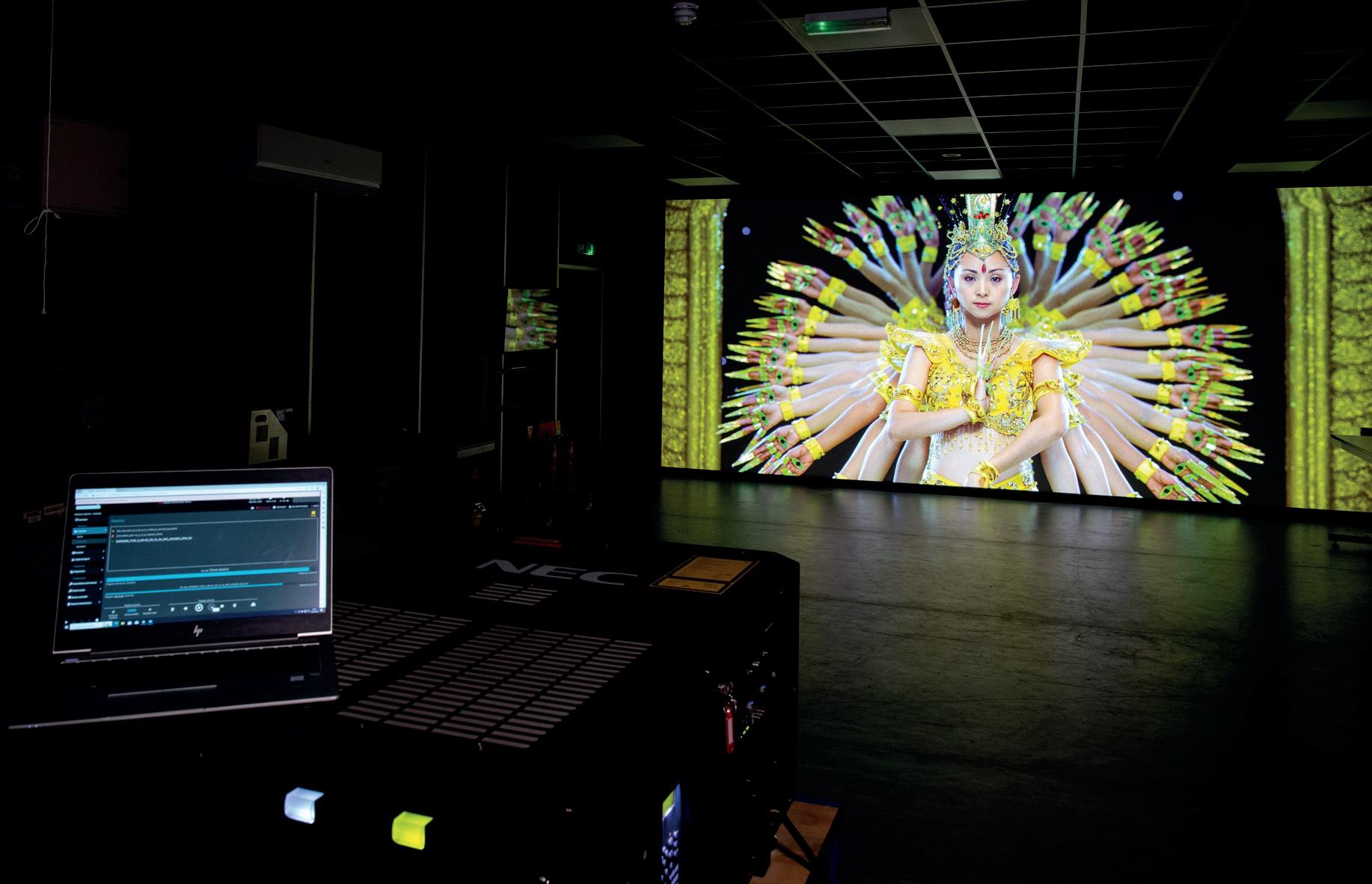
As the cinema industry evolves, so too must the technology partners enabling its future. The transition from NEC branding to Sharp represents not a departure from this legacy, but a natural engineering progression— one that preserves the strengths of the past while unlocking new possibilities for the decade ahead.
WORDS: ADAM MACDONALD, SALES MANAGER, CINEMA EMEA
For more than two decades, NEC played a foundational role in the development and innovation of digital cinema projection. Across thousands of auditoriums, the brand earned a reputation for engineering reliability, stable and solid operating performance, and a servicefriendly design philosophy that aligned closely with exhibitors’ technical and commercial realities.
In this article we find out why the transition is strategically important, what remains unchanged from a product and support perspective, and how the Sharp brand enables a new phase of investment in projection technology that directly benefits cinema operators.
The cinema industry faces significant challenges— from shifts in content distribution, post-pandemic changes in leisure time, rising energy costs and the rise of the streamers. Under the ‘new world’ conditions, exhibitors need technology partners who are committed to long-term stability and innovation.
Sharp’s commitment is anchored in three principles:
1 Cinema remains a strategic vertical, not a peripheral business.
2 Investments in optical and display technologies benefit the entire projection roadmap, not only individual product lines.
3 The Sharp name carries global recognition that strengthens customer confidence, especially in emerging markets where NEC cinema branding was less widely known.
In short: the industry is not losing a partner—it is gaining a stronger one. As outlined by Christof Böhm, President and Managing Director, Sharp Display Solutions Europe GmbH:
“Cinema is not just a business segment, it’s a cornerstone of our visual technology legacy and future. Sharp remains deeply committed to the cinema industry, investing in innovation, partnerships, and long-term growth. We see cinema as a vital part of our global strategy”
The NEC cinema portfolio has long been defined by a set of clear technological commitments:
› Stable, modular optical and electronic architecture designed for serviceability
› Efficient thermal management extending the operational life of light sources and components
› Robust colour uniformity and repeatability across the projector lifetime
› Predictable power consumption and TCO profiles, critical for multiscreen operators
› Long-term parts availability and backwards compatible components
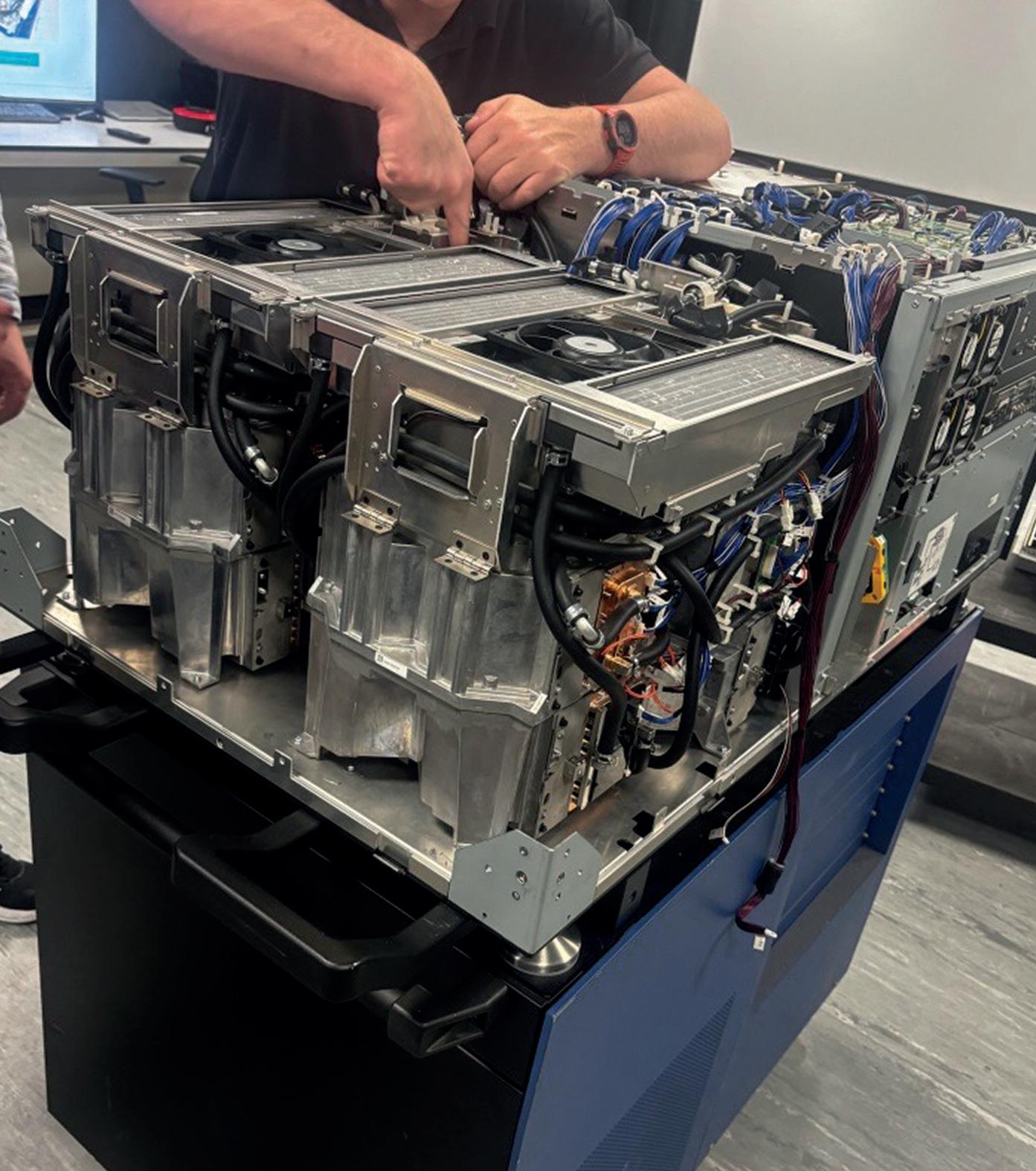
These principles made NEC systems especially attractive to theatres prioritising operational consistency and lowtouch maintenance. Many of these core design philosophies were established early in NEC’s transition from xenon to laserphosphor projection, and they have guided every platform iteration since. The crucial point for exhibitors is this: the transition to Sharp does not alter these engineering fundamentals. The same development teams, the same manufacturing processes, and the same quality control methodologies remain in place. The change is one of brand alignment and future strategic capability—not of the technical DNA that defines the product.
Brand transitions can invite uncertainty, especially in a technology category where reliability is paramount and replacement cycles measure in decades. For this reason, Sharp has aligned the transition around three core commitments designed to protect operational stability for exhibitors.
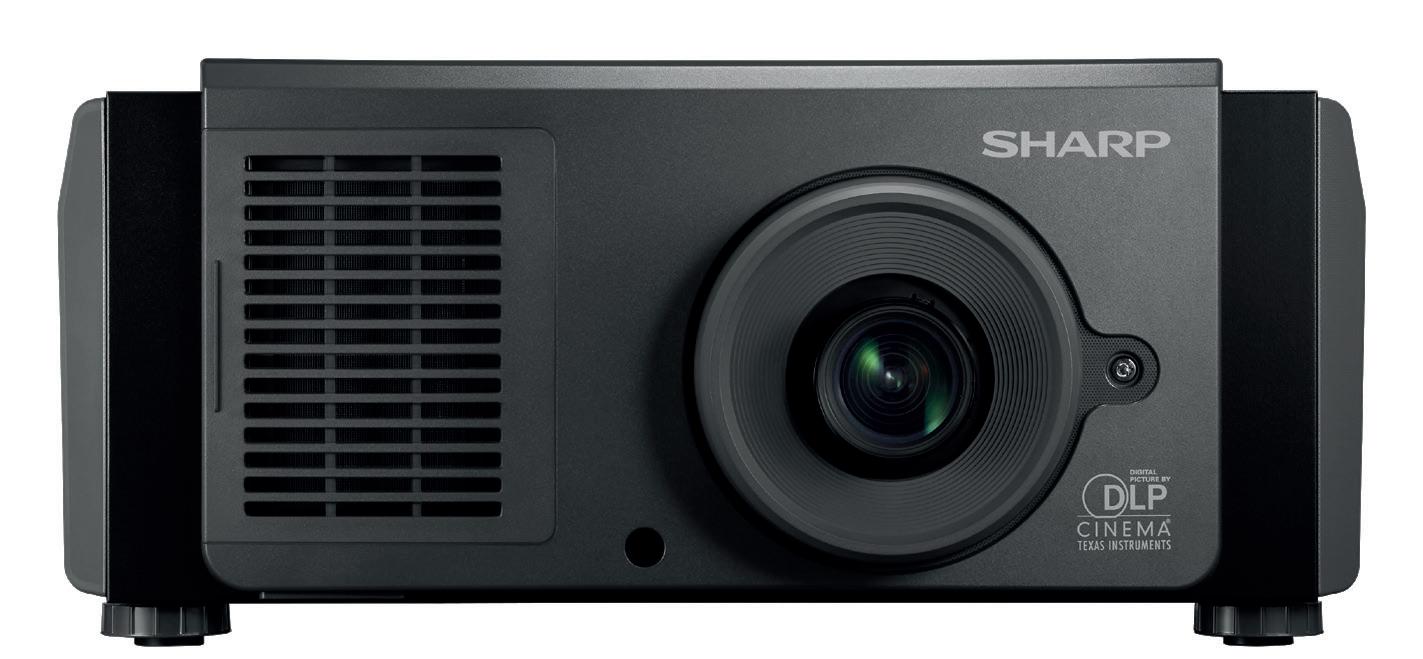
All current and upcoming projector platforms—such as the new NC-1224 continue development under the
same engineering leadership and standards that governed NEC’s cinema product group. The optical engines, cooling systems, electronics design, and software architecture maintain full continuity.
The transition does not change:
› Service contacts
› Regional technical teams
› Certification processes
› Spare part supply streams
› Warranty structures
Operators continue to work with the same individuals and the same organisational structures. The objective is zero operational disruption.
Sharp upholds all existing NEC lifecycle obligations, including:
› Long-term parts and serviceability windows
› Firmware and feature maintenance
› Engineering validation for extended deployments
› Backwards compatibility where applicable For cinemas operating mixed fleets—often including projector models more than a decade old— this continuity is essential to preserving asset value and ensuring stable operations.
While the transition preserves NEC’s core reliability principles, the move to Sharp also opens new opportunities for the cinema market. The global Sharp group brings expanded R&D capability, broader technology ecosystems, and a strategic commitment to professional display solutions that strengthens the long-term future of cinema projection.
Sharp’s global engineering footprint encompasses:
› Advanced laser light source research
› Optical system development
› Highprecision manufacturing for imaging technologies
› AIdriven picture optimisation techniques
› High-efficiency power electronics
This cross-domain expertise supports new projector architectures and allows more efficient development cycles, particularly for upcoming generations of RGB laser, energyoptimised units, and compact platforms designed for midsize auditoriums.
The past several years have highlighted the vulnerability of global component supply chains. Under Sharp, cinema projection benefits from:
› Expanded component sourcing networks
› Increased production scale
› Improved logistics pathways
› Greater resilience against single supplier dependencies.
This is especially relevant for key components such as laser modules, DMD boards, and thermal management assemblies.
Sharp operates across a wide portfolio of visual technology—including professional displays, optical systems, and embedded electronics—that can complement cinema projection innovation. These synergies open opportunities for:
› Integrated lobby-to-auditorium visual ecosystems
› Advanced monitoring and diagnostics using embedded platforms
› Energy efficient system architectures for sustainability initiatives
These are areas where NEC’s cinema development capabilities can now operate with greater support and alignment. What does change is the scale of innovation potential: stronger R&D capability, expanded technology ecosystems, and a unified brand presence that positions Sharp as a longterm technology partner for exhibitors worldwide.
The name on the projector may be new, but the principles behind it—and the future it points toward—
All new Sharp cinema projectors will use a Sharp naming convention that is more logical and simpler to understand. The ‘NC’ prefix associated with NEC branded projectors will remain on all future Sharp cinema projectors but the number convention will change on existing models. The new convention is as follows, based on the new 12,000 lumen, 2K projector, the NC-1224:
› NC-1224
› NC – Sharp Digital Cinema model
› 12 – 12,000 lumens
› 2 – 2K resolution
› 4 – 4th Generation
How this would work on an existing model, such as an NC603L would be as follows:
› NC603L
› NC – NEC Digital Cinema model
› 6 – 6,000 lumens
› 0 – 2K resolution
› 3 – 4th Generation
› L – Laser Projector
This will now become the NC-624:
› NC – Sharp Digital Cinema
› 6 – 6,000 lumens
› 2 – 2K resolution
› 4 – 4th Generation
Enhanced Dynamic Range (EDR) is a new solution from Sharp that will launch on our new 12,000 Lumen cinema projector, the NC-1224. It will then launch on all future models, and soon be available for existing, current laser models (with firmware upgrade). Unlike some technologies, our EDR will work with standard DCPs and, as the names suggests, enhances the dynamic range of the image
– essentially offering deeper black levels by the projector hardware analysing average picture level (APL) in real time and based on this result, it is adjusting laser power accordingly
As well as enhancing the image quality it will also save on power
As well as improving the black levels, it also significantly offers power savings and therefore extends the life of
the laser as well. Early tests are showing amazing results in saving energy (and costs)
This solution will be available from the smallest projector to the largest projector, regardless of the specific laser technology – premium cinema for all!
The transition from NEC to Sharp is best understood not as a rebranding exercise but as a structural
reinforcement of the cinema technology roadmap. The engineering continuity is absolute. The support pathways are unchanged. The values that defined NEC’s cinema reputation remain intact. What does change is the scale of innovation potential: stronger R&D capability, expanded technology ecosystems, and a unified brand presence that positions Sharp as a longterm technology partner for exhibitors worldwide. The name on the projector may be new, but the principles behind it—and the future it points toward—are clearer and more consistent than ever.

At the heart of Barco headquarters in Belgium, the refreshed Experience Centre shows systems rather than parts - a working route through healthcare, enterprise and entertainment that explains how images are made, maintained and scaled.
WORDS: PETER KNIGHT, CINEMA TECHNOLOGY MAGAZINE
This visit to Kortrijk and Barco's head office was the first since before Covid. It felt like meeting an old colleague: familiar faces, new rooms, and a route that made clear where Barco's thinking had moved. Experience centres are common in 2026, but Barco's is deliberately system-led. The visitor walks through working rooms - rather than past
plinths - so processing, projection, audio, networking and control are understood as one chain.
The Experience Centre officially reopened on 24 October 2025 after an extensive update and refresh.
The ribbon was cut by Ruth Vandenberghe, Mayor of Kortrijk, alongside Barco CEO An Steegen, before invited guests toured the updated spaces. Kortrijk has
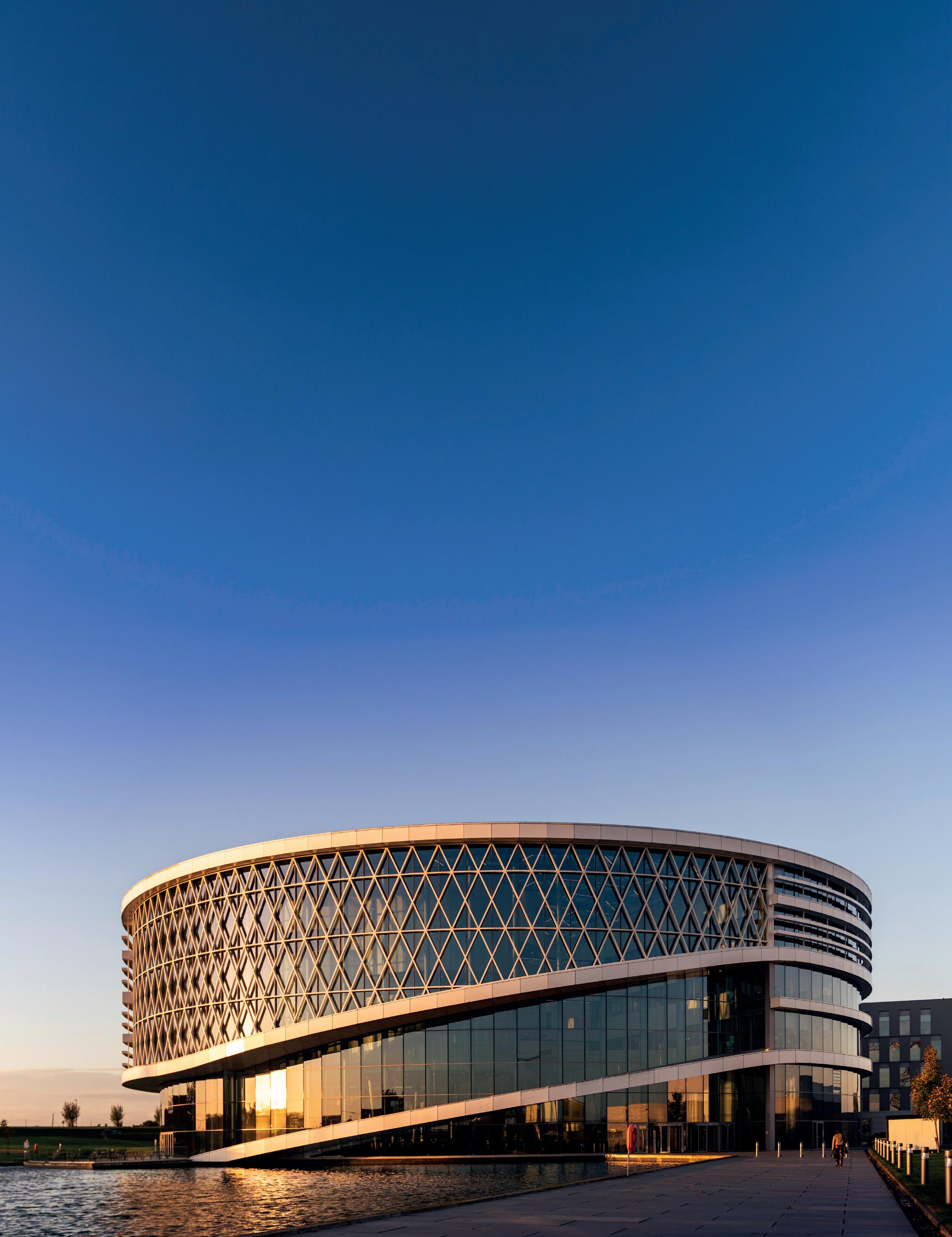
been Barco's home for generations; the reopening carried civic weight as well as industry interest and followed the company's Capital Markets Day the day before, which brought investors and analysts through the upgraded route. As the Mayor put it during the ceremony: "It means a lot to our city that Barco remains true to its roots. Kortrijk is a city of doers."
The tour begins with Entertainment in the Discovery pod. A large immersive space driven by fourteen Barco laser projectors presents The Story of the Pixel, playing in 360 degrees with carefully designed sound to showcase image processing as the basis of all Barco technology. The presentation makes a straightforward argument: a pixel is not a marketing number but a unit of meaning inside a system that must serve people in the real world. Three technical ideas anchor the philosophy. First, placement of light: not maximum output at all times, but light where it carries information - and restraint where it would wash out detail. Second, consistency of colour: a pixel does its job only if its neighbours behave predictably in chromaticity and luminance over time. Third, time as part of the image: pixels arrive in sequences, so latency, frame synchronisation and processing stability become part of image quality just as much as optics and screen gain.
The presentation also frames Barco's strategic shift from visible showpiece to orchestrator behind the scenes. Eurovision provides a clear example: where banks of Barco projectors once dominated the stage, the visible surface now often comes from multiple vendors - LED panels and LCD walls from different manufacturers. What persists is Barco's control layer and processing, the software that keeps pictures coherent across different technologies. The strategy follows naturally: more orchestration, more attention to how pixels are synchronised, layered and converted so that images read cleanly regardless of the display technology. Multi-surface mapping in this space works because processing, optics and content are treated as a single system. Even illumination across irregular surfaces, tight colour matching, and stable geometry remove joins from view and leave content, not technique, to do the talking.
Although outside cinema, the Healthcare pod makes the cross-sector point crisply. The demonstration paired two strands, each showing how precision and workflow converge.
First, a near-market autostereoscopic display that tracks the viewer's eyes to present depth without glasses. It is not holography but precise view tracking that maintains a stable 3D image and makes anatomical structure easier to read at a glance. High-end cameras and endoscopes are now 4K, so the displays match. Second, a surgical control layout that removes cable clutter and treats the operating room as a digital

space. Inputs are switched by touch and by voice to bring the right source to the right screen without breaking the team's flow. Barco's Brilliant Assistant, demonstrated here under the working name Zelda, handled simple commands to route content and request assistance. In the session we saw, the voicecontrolled surgical support system brought a surgical feed to all screens and sent a short text prompt to a named colleague. An AI overlay from a partner system, demonstrated via Orsi, coloured tumour boundaries to aid recognition. The point is not the theatrics but the reduction in friction when a surgeon needs to put a particular view on a particular display, or call for help without leaving the field.
Voice control in an operating theatre is a convenience; what matters is the underlying discipline.
When a system routes content reliably, calibrates predictably, and recovers from faults without drama, it serves the people using it. Projection booths and auditoria run on the same principles.
The control room demonstrations show how missioncritical visualisation and software enable operators to make decisions in critical environments. Barco's technology underpins around 15,000 control rooms globally, including systems that support a significant share of the world’s energy supply. The sectors are varied: power production and distribution, oil and gas, water utilities, transportation networks including airports and rail systems, manufacturing process control, network operations centres, and government

command facilities. The software and hardware platform on display, Barco CTRL, is designed around simplicity, scalability and security. It handles KVM over IP with a zero-trust architecture, allowing secure connections from any location. The system scales from small control centres to global command networks by adding encoders and decoders as needed. Cybersecurity follows security-by-design principles, which matters when the failure of a control room can affect infrastructure that millions depend on.
The ClickShare demonstration focuses on hybrid meeting solutions. More than 1.3 million ClickShare devices are deployed worldwide, designed for seamless collaboration including within the Microsoft
ecosystem. The emphasis is on making hybrid meetings inclusive and stress-free, with technology that removes friction rather than adding complexity.
A high-end home-cinema room shows professional projection in residential settings, with cinema-grade equipment scaled for domestic use.
The cinema theatre is a separate space and a different exercise to the Entertainment pod. Here Peru Dharanipathy, Senior Vice President at Barco, presented Barco's Lightsteering HDR technology and the thinking behind it. Blacks land where you want them, highlights carry structure, and mid-tones hold texture. Having seen earlier showings at CineEurope, the full-size permanent theatre in Kortrijk makes the case more convincingly than any temporary bay. The screen feels unforced, with high dynamic range used to reveal rather than to dazzle. The demonstration sequence followed a clear arc: an overview of current HDR by Barco partners and sites; the pre-show HDR bumper that primes audiences to notice bright highlights alongside deep shadow in the same frame; a brief testimonial from Vue International chief executive Tim Richards to set the commercial context; an educational interlude contrasting HDR and SDR side by side; and two studio trailers to close (a Formula One title and an unreleased cricket title).
Cinema Technology has covered HDR by Barco across several editions, including the expansion into Germany with Cineplex and Cinedom Cologne, and
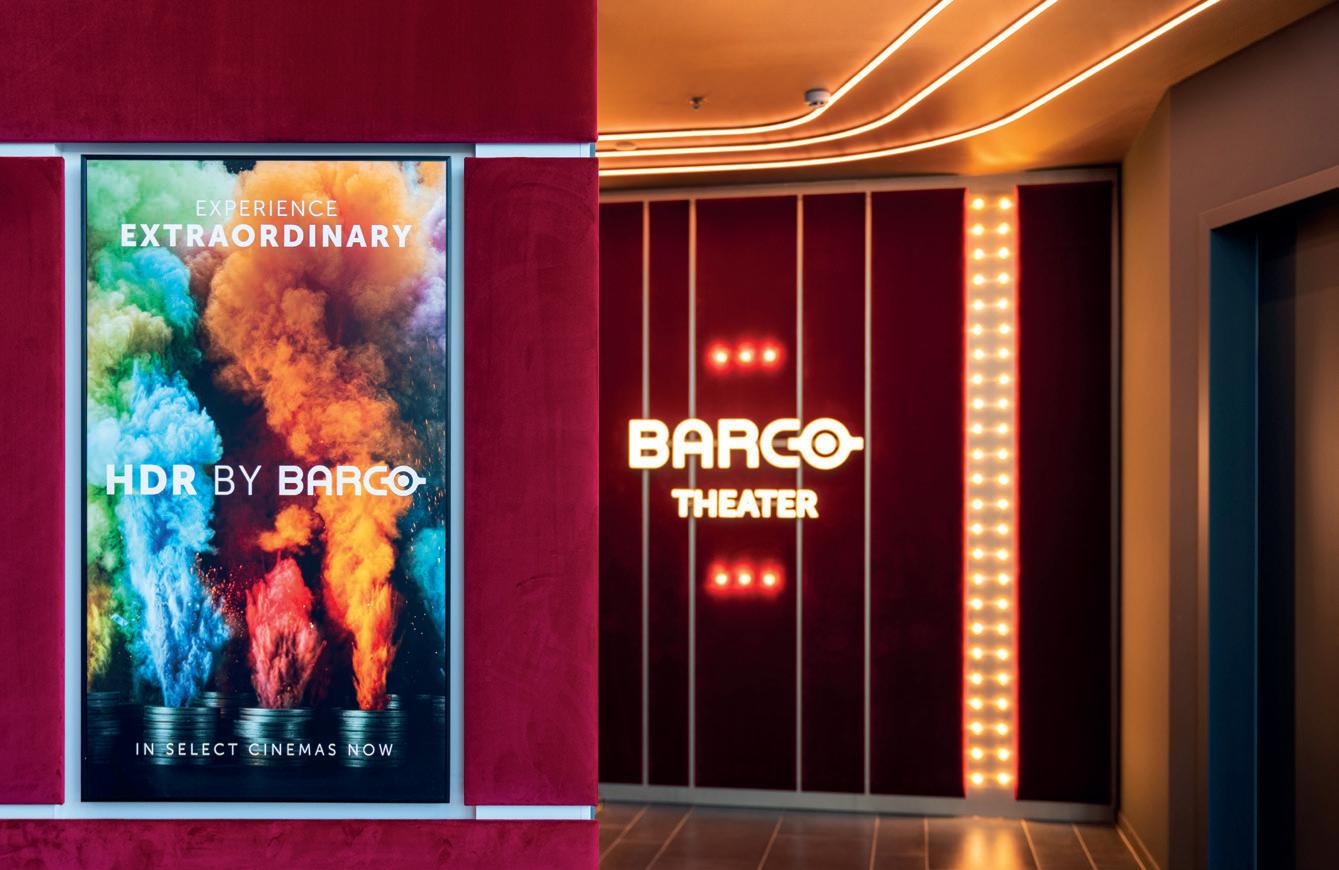
Vue International’s pan‑European EPIC programme. We will continue to follow the roll‑out in future editions as deployments broaden and the technology matures.
Barco has announced an initial slate of HDR by Barco titles for the first half of 2026 which includes: 28 Years Later: The Bone Temple (16 Jan), Mercy (23 Jan), Send Help (30 Jan), GOAT (13 Feb), “Wuthering Heights” (13 Feb), Crime 101 (13 Feb), Scream 7 (27 Feb), The Bride! (6 Mar), Hoppers (6 Mar), Project Hail Mary (20 Mar), Lee Cronin's The Mummy (17 Apr), Mortal Kombat II (8 May), Animal Friends (5 Jun), Masters of the Universe (5 Jun), Supergirl (26 Jun).
The lab tour, where the work lives The labs bridge R&D ideas and integrator reality, showing how theoretical performance becomes something that works reliably in the field.
Environmental and thermal testing cycles temperature and humidity to stress optics, electronics and adhesives. Thermal imaging rigs map heat across light engines and power supplies while units run worst case content. A projector that meets output targets at 21 degrees C can still drift in chromaticity or focus in a hot rack room. Temperature cycling chambers test cold starts and hot racks; packaging and drop assessments quantify what happens during transport. One thermal shock exercise took a projector down to deep freeze, then brought it back in a controlled thaw to study condensation paths, adhesives and mechanical tolerances. Watching the defrost is mundane and revealing in equal measure.
Optical benches hold projectors and lenses under controlled alignment to measure spatial uniformity, ANSI contrast and lens modulation transfer. If a unit shows edge roll off or corner hue shift, the question is whether it stems from unit to unit variation, a lens issue or a content pipeline artefact. Benches and repeatable charts provide the answer.
Laser speckle mitigation is tested on real screen materials: different gains, microstructures and perforations produce different behaviours. What works on a matte lab surface can look very different on a micro perforated cinema screen. The approach is to test on a bank of sample materials, record the statistics and tune diffusers and modulation for the target combination. Colour management receives steady attention. The goal is not a single calibration at time zero but characterising drift over hundreds of hours and developing guided routines, target sets and field meters that bring the system back into tolerance quickly. Some of this is software; some is mechanical
access to do the job without a major strip down.
Mechanical endurance rigs cycle lens shift, zoom and focus to simulate years of minor adjustments. Vibration tables test alignment stability when cabinets are moved or when a venue transmits low frequency energy through a structure and simulate road and air freight, with seismic profiles if required. Multi projector installations make this doubly important: if a bracket relaxes with time, you will see it as a seam.
Endurance rigs run units at varying light levels to characterise light source behaviour, acoustic profiles and power draw. The aim is to understand headline efficiency and how a projector behaves as it dims: fan curves, perceived noise in a quiet scene, and how modes interact with image stability.
Hidden in the basement affectionately known as the "Dungeon" can be found an anechoic RF chamber lined with absorber pyramids. It functions as a controlled environment for electromagnetic emissions and immunity measurements. It is, in effect, a Faraday like enclosure. Once the door closes, consumer radios and mobiles fall silent so transmit/receive behaviour can be characterised cleanly in every direction. The point is not just compliance; it is confidence that a system will neither misbehave nor be unduly influenced by its environment.
To see projection deployed beyond the controlled environment of a demo room, a short taxi ride took the group into Kortrijk to the Church of Our Lady and its Count's Chapel for 1302, a permanent projection
mapping and audio experience that tells the story of the Battle of the Golden Spurs. It is free to visit and runs on a regular cycle. The heritage setting imposes constraints that sharpen practice.
The show begins by closing custom panels over the stained glass windows to protect glazing and create a neutral projection surface while managing ambient light. The visual layer is delivered by a network of Barco laser projectors mapped to walls and ceiling with sufficient overlap to support blending and to provide service continuity. Scenography, content and integration were handled end to end, with an eighteen minute programme on a thirty minute loop to balance dwell time with throughput.
Press releases may tell readers what a projector does, but spending a day at the Kortrijk factory shows how the company behind it thinks. That understanding cannot come from a desk. The difference between reading specifications and watching a thermal shock test, between seeing a datasheet and standing in a room with fourteen projectors mapping a 360 degree canvas, is the difference between knowing what something does and understanding why it works that way. Barco has been making equipment for over 90 years starting with radios before moving into imaging and the visit makes clear that cinema projection is one part of a broader story. The same engineering discipline that builds control rooms monitoring energy grids, or surgical displays where clarity can change outcomes, runs through how a cinema projector is designed, tested and supported. Walk through the medical pod, then the labs, then the cinema theatre, and the connections become clear. The thermal
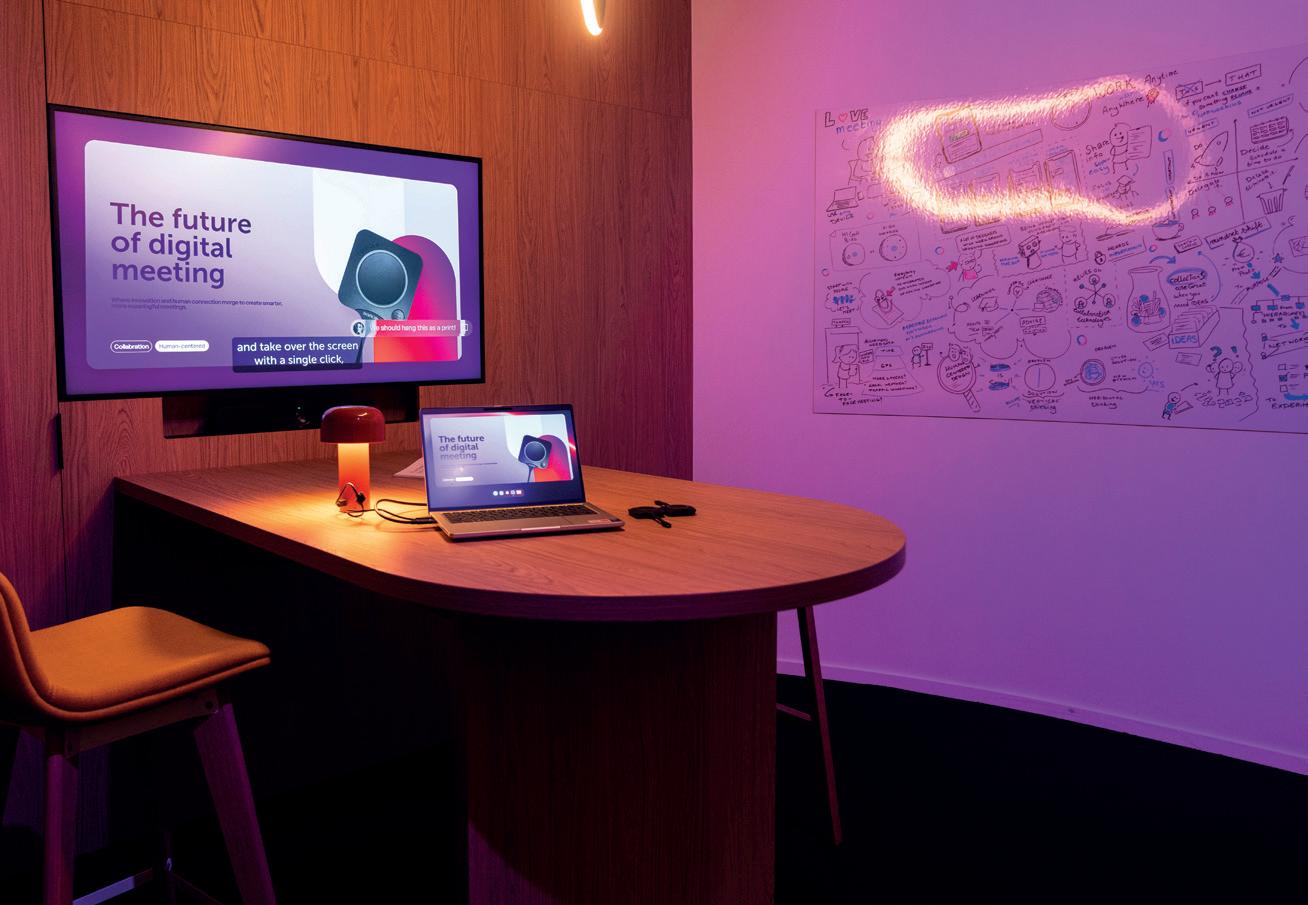
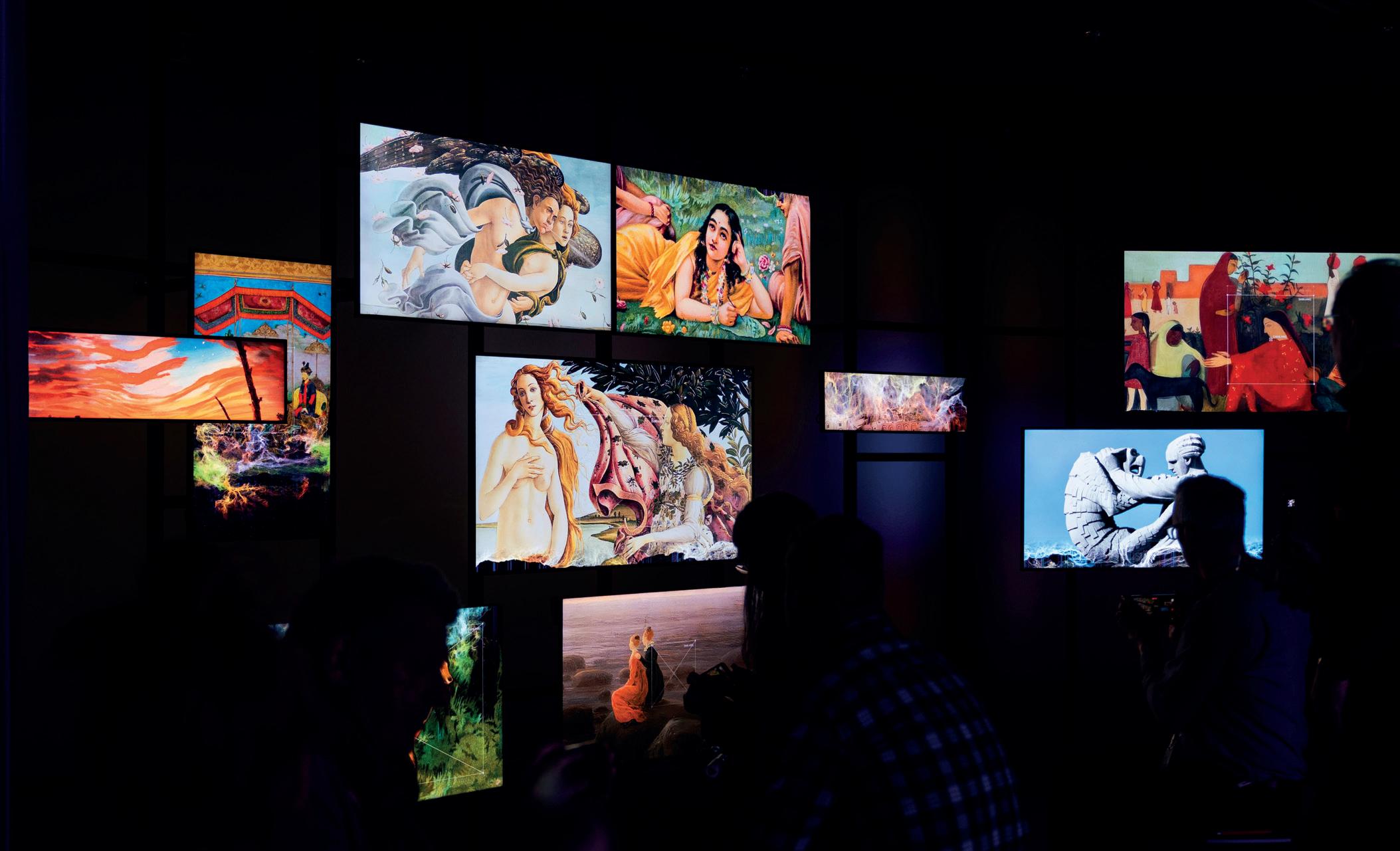
shock test on a projector pulled from a deep freeze is not just about cinema - it is about understanding how materials behave under stress in any critical system. The micro-perforated screen speckle tests connect directly to the principle that what works in a lab does not always work in the field, whether that field is a cinema, a hospital or a traffic control centre. The Experience Centre is not a museum, though there are old projectors and radios on display. It is a working demonstration of Barco's approach to problems, and that approach - precision, repeatability, systems designed to serve the people who depend on themapplies whether you are installing a video wall, a surgical display, or a laser projector. The legacy is not sentimental. It is practical. Ninety years of making equipment that has to work in demanding environments leaves habits, and those habits show up in how a cinema system is specified, how tolerances are set, and how support is structured.
Part of the value of a media and influencer day is the people. Over lunch and through the tours, senior staff across divisions were available for frank conversations. Goran Stojmenovik, VP Product & Solutions Immersive Experience, discussed the realities of running large multi-screen events repeatedly and at scale. Lorenzo Van Doorslaer, Director of Strategic Marketing for cinema, focused on
translating high-dynamic-range gains into procedure and training for field technicians rather than leaving it as a black box. From the control-room side, the importance of building maintainability into twentyfour-seven environments came up again.
Some of the Barco staff present were colleagues the author has worked with for over fifteen years; others were new faces. Either way, being there in person matters. Relationships built over email and phone calls are one thing, but sitting down and talking through what is actually happening in the field - what works, what does not, what the next eighteen months might bring - is something different. It is the sort of conversation that does not happen at a trade show and cannot happen from behind a screen.
What remained after Kortrijk was not a list of specifications. It is the reminder that good equipment emerges from unglamorous work: calibration routines that account for drift over hundreds of hours, packaging tests that simulate bad handling, vibration tables that check what happens when a venue transmits bass through a floor. That understanding cannot come secondhand. It came from watching engineers walk through test protocols, by seeing the defrost chamber, by standing in the immersive room and understanding that even illumination across irregular surfaces is a
solved problem because someone spent the time solving it. With HDR titles rolling out through the first half of 2026, Vue and Cineplex Germany deployments underway, and new territories opening, the timing of the visit mattered. Barco is not standing still, but the refreshed Experience Centre makes it clear that the path forward is built on the same foundations: design as integrated systems, test thoroughly, support properly, and respect the fact that when equipment fails, someone's evening - or in other markets, someone's operation or someone's infrastructure - is affected. This is why site visits still matter. You hear the fan curves, you see where highlights hold, and you watch engineers follow procedures that keep those standards a year from now. Cinema is a large part of what Barco does, but it is not the whole story. The route through Kortrijk demonstrates that the projector in an auditorium shares its engineering lineage with the displays in an operating theatre and the video walls in a control room. They are different markets with different demands, but they draw from the same culture. And sometimes, to understand why a cinema system behaves the way it does, you need to see where it comes from.
WORDS: PETER KNIGHT, CINEMA TECHNOLOGY MAGAZINE
From movie myth to everyday machines, and what that means for cinema exhibition in 2026
Robots have always belonged to cinema, but not in the way we are about to meet them. On screen, they arrived fully formed, as character and symbol. The Maschinenmensch of Metropolis (still the template for "robot" in the cultural imagination), the obedient competence of R2-D2, the cold logic of HAL, the moral unease of I, Robot, the bruised empathy of WALL-E, the inevitability of the Terminator. For a century, cinema has been running the audience's emotional rehearsal for robotics, teaching us to feel wonder, threat, affection, suspicion, and occasionally all at once.
Then the real world did what it always does to our sci-fi expectations. It turned the dramatic into the practical. The robot future did not arrive as a humanoid with a witty one-liner and a clean chrome finish. It arrived as quiet capability: machines that scan and sort, scrub and patrol, carry and deliver, not in laboratories, but in places where humans do
messy, repetitive work all day long. And in 2026, something has changed that makes robotics feel less like a trade show novelty and more like the next ordinary layer in how businesses operate.
The shift is not that "robots are finally here" in the headline-friendly sense. The shift is that robotics has found its missing partner. Artificial intelligence, particularly modern vision systems and foundationmodel approaches, are beginning to turn robots from scripted devices into adaptive machines that can cope with the unpredictability of real environments. Cinemas are predictable in rhythm but unpredictable in reality. Shows start on time. Crowds arrive in waves. Turnarounds are tight. But guests, weather, spillages, accessibility needs, and building quirks introduce variation constantly. What follows is a grounded look at where robotics is already proving itself elsewhere, what it is beginning to look like inside cinemas, and where it may quietly assist on the technical and building side long before
any of us are "served popcorn by a humanoid" as the new normal.
Robotics is not new. Industrial automation has been part of manufacturing for decades, with early milestones like Unimate's installation at a General Motors plant in 1961 to handle hazardous, repetitive work. The pattern was clear: put robots where tasks are repeatable, the environment is controlled, and consistency is more valuable than flexibility. For a long time, that constraint mattered. Traditional industrial robots are astonishingly capable, but they are also dependent on predictability. Service robots, the machines that operate in human spaces, have historically struggled with everything that makes the real world irritating: clutter, changing light, unexpected obstacles, narrow routes, steps, and human behaviour that does not follow a marked lane.
What has changed since roughly 2023 is that perception and decision-making have accelerated. The robot's physical body still matters: motors, sensors, balance, power, reliability. But the intelligence layer has improved dramatically. Modern AI has made machines better at seeing the world, classifying what they are looking at, planning routes, and recovering when the environment is not tidy. It is not magic. It is an evolving stack of vision, mapping, planning, and learning that is becoming good enough in more places.
You could feel that shift at CES 2026. Reuters described "physical AI" as dominating the show, with humanoids doing crowd-pleasing demos, while also noting that general-purpose humanoid servants are still not around the corner. For cinema, we do not need a robot that can do everything. We need robots that can do specific, boring tasks reliably, safely, and economically, in buildings that were not designed for machines. The clearest indicator that robotics is moving from spectacle to deployment is when the serious players stop talking about prototypes and start talking about manufacturing schedules. Boston Dynamics, in an announcement made during CES week, unveiled
the product version of Atlas and said it would begin manufacturing immediately, with 2026 deployments already committed, including allocations to Hyundai's Robotics Metaplant Application Center and to Google DeepMind. The same announcement makes the AI link explicit: Atlas is to be trained using new AI foundation models for a wide range of industrial tasks, beginning in automotive.
Cinemas are not going to buy Atlas to clean Screen 7. That is not the point. The point is that the ecosystem is maturing. When the cutting edge becomes a product, the boring versions that we actually deploy in public spaces, cleaning robots, inspection platforms, warehouse movers, become cheaper, more capable, and more dependable.
Robots are already in everyday life, just not wearing a face
Robot vacuums and robot mowers have normalised the idea that a machine can move around your space without constant supervision. For years, they were limited by thresholds, rugs, cables, and stairs. Now manufacturers are visibly investing in mobility and perception. Roborock's CES concept, for example,
SHENZHEN, POPCORN, AND THE RETURN OF THE HUMANOID AS MARKETING AND TESTBED
In early January 2026, Chinese media began reporting on a humanoid robot working in a cinema in Shenzhen. China Daily described Atom as a "fully autonomous humanoid robot cinema worker" at K11 ART HOUSE, selling popcorn and working long shifts, reported as up to 14 hours. Other reports around the same time claimed the robot could sell more than 1,000 cups of popcorn a day, assist customers and handle minor incidents. Treat those performance figures as operator or manufacturer claims unless and until they are independently verified. It is exactly the kind of story that cinema, and frankly the internet, cannot resist. A humanoid robot behind a counter hits every cultural button we have. It looks like the future we were promised.
3 THINGS ARE HAPPENING HERE
1
it is theatre. Shenzhen is a technology-forward city, and K11 ART HOUSE is positioned as a premium, design-led venue. A humanoid in the foyer is a brand statement. It creates moments. It gives the audience something to photograph. Cinema has always been good at spectacle, and if you want press coverage for your venue, "robot serves popcorn" is more clickable than "we improved turnaround times by 12%".
2
Second, it is a constrained operational test. Popcorn service is repetitive, process-driven, and physically consistent. Containers, scoops, sealing, handing over, it is far more structured than most guest-facing interaction. In other words, if you were going to trial a humanoid in a cinema, concessions is one of the few places where the workflow can be reduced to a reliable sequence. The variability comes from humans approaching the counter, not from the mechanics of the task itself.
uses a wheel-leg architecture designed to climb stairs, and the company is explicit that AI, sensors and 3D spatial perception are part of how such machines attempt multi-level environments.
The "stairs problem" is not a vacuum problem. It is an autonomy problem, and a signal that consumer robotics is being pushed towards the sort of messy, multi-level reality that many cinemas live in every day.
But the clearest parallels to cinema are not in homes. They are in retail. In the UK, autonomous cleaning machines are being used in supermarkets. Morrisons has been used as a high-visibility example, with Tennant highlighting its robotic scrubber operating in busy aisles. This is not glamorous technology, and that is precisely why it is important. A robot that can navigate shoppers, trolleys, and unpredictable movement without becoming a hazard is dealing with a problem space that looks a lot like a cinema foyer at peak time. The public is present. The environment changes constantly. Safety is non-negotiable. The work is repetitive and essential. Healthcare offers another strong model. The most successful robots in hospitals are not "nurse robots", they are support robots doing errands: moving supplies, delivering items, reducing the constant walking that burns staff time. The cinema equivalent is obvious to anyone who has worked a busy Saturday: stock runs, bin runs, fetching change, grabbing cleaning supplies, shifting barriers, moving deliveries. The tasks are simple, frequent, and collectively expensive in staff minutes. The conversation becomes useful when we ask not "will robots replace staff", but "can robots remove the dull
Third, it signals direction rather than offering a blueprint for adoption. The Shenzhen deployment does not mean that humanoids are about to spread through multiplexes. It means that robotics companies and venue operators are experimenting in real environments, gathering real data, and discovering what breaks when you move from demo to duty cycle.
The step from "works on a stage" to "works every day, safely, in front of customers" is the entire game. It is also worth noting that "Atom" is not just a cinema headline. It is a name used in the wider humanoid ecosystem, including commercial humanoid platforms discussed publicly in this period. That does not confirm what
friction that stops staff doing the human part of the job properly".
Cinema is already robotic, we just did it in software first Projection and presentation have been moving towards automation for decades. Scheduling systems, monitoring dashboards, automated cues, remote diagnostics, and increasingly centralised control are all forms of "robotic thinking". We took complex technical processes and made them consistent. We reduced manual intervention because reliability matters. Nobody walks into the booth and says "I hope the show feels artisanal today". They want it to work.
The new frontier is not intelligence in the booth. It is intelligence with mobility.
A cinema is operationally rhythmic. Cleaning and turnaround follow a repeatable pattern. Concessions demand rises and falls predictably. Guest enquiries cluster. A lot of what we do is procedural. Yet cinemas are also physically awkward spaces: tight corridors, multiple levels, mixed lighting, variable floor surfaces, heritage constraints. If robotics was only about perfect environments, cinemas would be a non-starter. Robots are getting better at dealing with imperfect realities, and the business case is strongest where the task is simple but the human cost is persistent. Here is the bit every duty manager recognises. It is 18 minutes to doors.
Screen 4 has a Tango Ice Blast on the aisle. The bins by the poster corridor are already full. The lift is out again. You do the right thing. You slow down. You put
specific model was used in Shenzhen, but it does underline that we are now in an era where humanoids are being packaged, named, and positioned as deployable products rather than purely research projects.
Watch what survives contact with reality. If Atom works day after day without constant intervention, that is meaningful. If the robot needs a hidden handler and frequent resets, then it remains mostly theatre. And theatre is not worthless, by the way. Cinemas sell experiences. A robot can be part of an experience. The danger is confusing marketing value with operational value, and assuming that because it looks futuristic it must be efficient.
wet floor signs out. You document it. You get it safe. But you feel the pressure because the schedule does not care. Anything that safely removes even a slice of that time pressure is not a gimmick, it is capacity.
The most credible near-term uses of robotics in cinema may not be in the foyer at all. They may be in the work that nobody sees, but every operator pays for: construction, refurbishment, maintenance, inspection, and heavy technical handling.
Cinemas have two robotic futures running in parallel. The guest-facing story gets the headlines. The engineering story quietly saves time, reduces risk, and makes projects less painful.
Consider fit-outs and refurbishments. Layout errors cost money. Any cinema engineer who has walked into a newly refitted auditorium and found that something is "nearly right" knows how expensive "nearly" can be once seats are bolted down and cable routes are closed.
Construction robotics is increasingly aimed at reducing that kind of error. Dusty Robotics' FieldPrinter is a good example of the category: an autonomous layout robot that prints full-size plans onto the floor directly from digital models. Dusty states accuracy up to 1/16 inch and positions the system as printing close to obstacles. Case studies published with major contractors describe multitrade layout being completed far faster than traditional manual methods, with conflicts identified earlier and rework reduced. HP's SitePrint follows
The most credible near-term uses of robotics in cinema may not be in the foyer at all. They may be in the work that nobody sees, but every operator pays for: construction, refurbishment, maintenance, inspection, and heavy technical handling. Cinemas have two robotic futures running in parallel. The guest-facing story gets the headlines. The engineering story quietly saves time, reduces risk, and makes projects less painful. Consider fit-outs and refurbishments. Layout errors cost money. Any cinema engineer who has walked into a newly refitted auditorium and found that something is "nearly right" knows how expensive "nearly" can be once seats are bolted down and cable routes are closed.
Construction robotics is increasingly aimed at reducing that kind of error. Dusty Robotics' FieldPrinter is a good example of the category: an autonomous layout robot that prints full-size plans onto the floor directly from digital models. Dusty states accuracy up to 1/16 inch and positions the system as printing close to obstacles. Case studies published with major contractors describe multitrade layout being completed far faster than traditional manual methods, with conflicts identified earlier and rework reduced. HP's SitePrint follows the same idea, printing 2D plans on site floors and positioning itself as a productivity tool. Translate that into cinema terms and the use cases are immediately plausible: seat bolt locations, aisle lighting runs, underfloor conduit routes, speaker mounting grids, projector pedestal positioning, AV rack layouts. A cinema is a dense technical environment, and small alignment mistakes create big downstream problems. Robots that bring the digital model to the physical floor are not "cinema robots", but they can make cinema projects cleaner, faster and more accurate.
One of the most interesting robotics stories is not humanoids at all, but quadrupeds. Boston Dynamics' Spot has been used for industrial inspection tasks where environments are complex and sometimes hazardous. A Boston Dynamics case study describes Spot performing routine
inspections at Vienna's Simmering power plant since 2022, equipped with sensor payloads, detecting faults, and operating in an environment with stairs and obstacles that would be difficult for wheeled robots.
Cinemas are not power plants, but the underlying problem is familiar. We have plant rooms, roof spaces, high-level structures, confined voids, awkward ladders, and inspections that require time, access equipment, and risk management. There is a future here, not tomorrow morning, but soon enough to matter, where inspection robots and drones reduce the need for repeated high-risk access, providing video, thermal imaging, and sensor readings so humans climb only when intervention is needed.
Then there is the most human of all robotics: wearable robotics. Exoskeletons are already being sold into construction and industrial environments, not as superhero suits, but as fatigue and injury reduction tools. Hilti's construction exoskeleton range, for example, is explicitly positioned as reducing daily fatigue and strain, with shoulder-support systems designed to relieve fatigue during overhead work. In cinema engineering and installation, we routinely do awkward lifts, overhead cabling, repeated drilling, speaker rigging, screen work, and the sort of "it's only a few minutes" tasks that quietly accumulate into injuries over a career. Wearable support, even in modest forms, could be one of the most practical robotics-adjacent investments for cinema technical teams because it protects people first. And if there is one asset cinema cannot afford to burn through, it is skilled staff.
The best technology is often the technology that makes people better at being people. Not replaced, not diminished, just supported.
Economics: Robots versus people, and the question we should actually be asking Whenever robotics appears in public discourse, the same fear shows up: jobs. In cinema exhibition, the reality is more nuanced. Most operators are not sitting on a surplus of staff hours. We have already been through years of labour optimisation, self-service ticketing, app-based booking, automated doors, centralised projection monitoring. Staffing is lean in many venues. The
operational pressure is not "how do we replace people", it is "how do we maintain standards, safety and hospitality without burning people out".
The most realistic robotics deployments are those that remove the walking tax and the turnaround tax. The walking tax is the cumulative cost of staff time lost to moving things around the building. The turnaround tax is the time pressure between shows that forces cleaning to be fast, which sometimes means it is not as thorough as anyone would like.
Robots that clean floors, move stock, patrol for spillages, and assist with repetitive transport tasks do not eliminate the need for staff. They can make the same staff more present, more available to guests, and less stretched. That can improve guest experience while protecting the team.
Does this have an ROI? It can, but the honest answer is that it depends heavily on pricing models, reliability, maintenance, and the building itself. We do not yet have enough transparent cinema-specific deployments to pretend otherwise. In practice, much of the sector is likely to encounter robotics through service models rather than ownership, the "robot as a service" approach already common in other industries. And in that world, the question becomes: can you justify a monthly cost in exchange for consistent standards and reduced pressure on staff hours? For a new-build multiplex with wide, level circulation routes, the answer may arrive sooner. For heritage cinemas with steps, tight turns and listed constraints, it will arrive later, and in more selective forms. The irony is that the venues most likely to benefit from robotics-assisted cleaning and logistics are often the ones where the building makes it hardest.
The human bit, kept in the background where it belongs
Cinema is a people business, everybody reading this knows it. The more useful framing is this: the more technology we add to exhibition, the more important it becomes that the venue still feels human.
A robot at the front door might be charming for some audiences and alienating for others. A robot quietly scrubbing the foyer at 10am on a Tuesday is less emotionally loaded, and probably more useful. A robot that helps a technician avoid injury is not a
gimmick, it is an investment in expertise and continuity. The future that makes sense is not a cinema staffed by machines. It is a cinema where machines take on the repetitive, time-consuming tasks that reduce a team's capacity to deliver hospitality.If robotics is used to remove drudgery, reduce risk and keep standards consistent, it can actually make the human experience stronger. If robotics is used as a substitute for hospitality, it will make the venue feel colder, and it will fail, because audiences have a choice about where they spend their leisure time.
The next five years will be quietly practical
Robots in cinemas will not arrive in a single moment. They will arrive like most cinema technology does: unevenly, pragmatically, and driven by what works.
We will see more of the "boring" robots first.
Robots in cinemas will not arrive in a single moment. They will arrive like most cinema technology does: unevenly, pragmatically and driven by what works.
Cleaning machines in foyers and lobbies. Back-ofhouse movers in large venues. Sensor platforms that support security and facilities checks. These are the deployments that will earn their keep because they solve a real problem without challenging the emotional core of the guest experience.
We will see occasional humanoids too, because cinemas understand showmanship, and a robot serving popcorn is a marketing story that sells tickets as well as headlines. The Shenzhen Atom deployment is a perfect example of that intersection between theatre and testbed, and it is worth watching precisely because it forces robotics into the real-world mess of public operation.
And if you want the genuinely transformative robotics story for cinema, keep an eye on engineering, fit-out and maintenance. Layout robots that reduce rework. Inspection robots that reduce
risk. Wearable robotics that protects technicians. These are not flashy, but they can change the economics and safety of keeping cinemas running. Cinema has always been about using sophisticated technology to create an experience that feels effortless. The machinery is there, but the audience should not feel it grinding away. If robotics earns a place in exhibition, it will be because it quietly improves standards, protects teams, and gives staff more time to do what only humans do well: welcome people into a shared space and make them glad they came.
WORDS: LUCY JONES, EXECUTIVE DIRECTOR, COMSCORE MOVIES.
European box office revenue surpassed $7.1 billion in 2025, marking an increase on both 2023, which at $7.0 billion was previously the strongest post-pandemic year, and 2024 which closed at $6.7 billion. Despite this continued recovery, the market remains below prepandemic levels, with 2019 box office gross exceeding $9.0 billion. The top five European markets accounted for two-thirds of the region’s total box office. The UK & Ireland led among European markets in 2025, accounting for almost 20% of the total, ranking as the third-biggest market worldwide behind only North America and China. It was followed by France with 16.57%, Germany at 13.71%, Italy with 7.56%, and Spain rounding out the top five with 7.35%.
The UK & Ireland box office exceeded £1 billion in 2025, marking the third post-pandemic year to reach this milestone. Box office finished 1% ahead of both 2024 and 2023, showing signs of gradual recovery in the market.
While the Top 10 film chart remained dominated by franchises and sequels, 2025 marked a significant improvement in market diversity. The Top 10 titles accounted for 33.0% of total box office revenue, down from 38.6% in 2024, 40.5% in 2023, and 43.8% in 2022. This represents the most diversified market since 2017, when the Top 10 accounted for only 32.9% of the total box office. This shift reflects a reduced reliance on a small number of blockbuster titles and a healthier contribution from mid-range performers. Genre diversity improved significantly, with revenues distributed more evenly across genres; in
contrast to 2024 when action and animation combined accounted for over 50% of the box office, 2025 saw notable growth in drama, comedy and horror. Drama emerged as the second-largest genre behind only action (27.6%), generating nearly £60 million from key titles including Downton Abbey: The Grand Finale (£18.3m), Sinners (£16.3m), A Complete Unknown (£12.3m), and One Battle After Another (£11.9m). These headline titles were supported by a stronger slate of films in the £3-10 million range, an area that had been notably weak in the post-pandemic period. Comedy also performed strongly, led by Bridget Jones: Mad About The Boy, which grossed £46.3m and ranked as the second-highest grossing film of the year, followed by The Roses contributing £10.3m. Horror delivered one of its strongest years on record, grossing over £103 million and with five titles exceeding £10 million. The Conjuring: Last Rites led the genre with £18.3m, alongside 28 Years Later (£15.5m), both ranking among the top five highestgrossing horror films of all time placing fourth and fifth respectively. A key driver of this diversified genre performance was the strength of local British and Irish productions and co-productions, which generated £201.8m, accounting for 19% of total annual box office revenue. These included Downton Abbey: The Grand Finale, Bridget Jones: Mad About The Boy, 28 Years Later and The Roses.Universal ranked as the number one distributor for the first time since 2021, securing a 25.1% market share and achieving three titles in the year’s Top 5. Disney followed in second place with a 23.1% market share and four films in the Top 10, while Warner Bros. took third place with 18.5% share. Warner Bros. also delivered the highest-grossing film of the year, A Minecraft Movie, which grossed £56.8m.
While still ranking as the second-largest European market, France’s share of the region’s total declined from 19.3% in 2024 to 16.5% in 2025. Overall, the market finished 2025 down 11% compared to both 2024 and 2023, delivering over 149 million admissions for the year. This decline was primarily driven by the absence of breakout French titles. While French productions and co-productions accounted for 45% of all films screened and generated 39% of total admissions, only one local title appeared in the annual Top 10. God Save the Tuche was the only local entry, delivering nearly 3 million admissions.
In contrast, 2024 marked France’s strongest post-pandemic year, with three of the top five highestgrossing films produced locally. Leading the market was Un P’tit Truc en Plus, which achieved over 10.8m admissions, followed by Le Comte de Monte-Cristo with 9.3m. L’Amour Ouf rounded out the top five with 4.8m admissions. The absence of comparable local successes in 2025 highlights France’s consistent reliance on domestic hits.
Hollywood productions partially filled the gap, especially in the final quarter. In line with the global box office, France received a significant boost in December from two Disney releases, the late-year arrival of Zootopia 2 and Avatar: Fire and Ash. These titles are ranked as the top two films of the year, with 7.3m and 6.6m admissions respectively.
Disney emerged as the clear market leader, capturing a 22.3% distributor market share and securing three of the year’s top-performing titles, including Lilo & Stitch in third place with 5.1m admissions. Warner Bros. ranked second among distributors with an 11.0% market share, placing F1:
The Movie at No.4 with 3.2m admissions, and A Minecraft Movie at No.8 with 2.6m admissions.
Germany was the only major European market to record an increase in 2025, exceeding €864m for the year to finish 9% ahead of 2024 in box office revenue and 4% higher in admissions. A major driver of the year’s success was the exceptional performance of local content. German local productions and coproductions accounted for 25% of the total box office, marking the highest local content market share since 2019. The top title for the year was the local comedy sequel Das Kanu des Manitu, which became the No.1 film of the year with a box office gross exceeding €50 million. Disney emerged as the leading distributor with a 23.4% market share and four films in the Top 10. Its standout release, Avatar: Fire and Ash, grossed €44.0m and ranked as the second-highest grossing title of the year. Warner Bros. followed with a 16.0% market share, led by A Minecraft Movie, which was the third-biggest release of 2025 with €35.5m. Universal ranked third among distributors with a 12.5% market share.Local distributors also performed strongly, with Constantin achieving an 11.1% market share and Leonine securing 6.9%, highlighting the importance and strong contribution of domestic players in the German market alongside the Hollywood studios.
The Italian box office tracked 1% behind 2024 in box office and down 3% in admissions, with its yearly total box office exceeding €479 million.
The main driver of the year was Buen Camino, which despite being released only in the final week of 2025 had already become the highest-grossing title of the year. The comedy delivered a €36.0m gross within the 2025 date range, driven by a record-breaking €27.0m opening weekend – the biggest ever recorded in Italy. With a current cumulative total of €65.0m, Buen Camino was on the verge of overtaking Avatar (€65.6m) to become the biggest release of all time in the market. It has already surpassed Quo Vado? (2016), previously the highest-grossing local title, which stood at €65.0m.
Local content accounted for 33% of Italy’s total box office in 2025, up notably from 25% in 2024. This growth shows both the exceptional performance of Buen Camino and a greater contribution from varied Italian titles during the year, with a further three local Italian titles featuring in the Top 10: Follemente ranks No.3 with €17.8m, Io Sono La Fine Del Mondo is No.8 with €9.7m, and Diamanti rounds out the Top 10 with €9.1m. Disney stood out as the leading distributor of the year with a market share of 21.9%, led by Lilo &
A MINECRAFT MOVIE
BRIDGET JONES:
TOP 5 UK TITLES 2025 TOP 5 FRANCE TITLES 2025 TOP 5 GERMANY TITLES 2025
2
WICKED: FOR GOOD LILO & STITCH A MINECRAFT MOVIE LILO & STITCH F1 THE MOVIE LILO & STICH JURASSIC WORLD REBIRTH JURASSIC WORLD REBIRTH
ZOOTOPIA 2
Stitch with €22.3m. Eagle Pictures was in second place with a market share of 12.4%, with Sonic the Hedgehog 3 being its best-performing title with €7.4m gross inyear. Universal took third position with 10.8% market share; its standout title was Jurassic World Rebirth with €11.1m. It is noteworthy that half of the top ten distributors were local distributors: following Eagle Pictures, fifth and sixth positions were taken by 01 Distribution and Medusa Film, distributor of Buen Camino, each with a 9.2% share.
Total box office revenue in Spain reached €462 million for the year, representing a 5% decline compared with 2024, while admissions fell by 8%.
Disney was the top distributor with a 27.9% market share, driven by the top-grossing film of the year Lilo & Stitch (€24.7m), alongside four further titles
in the Top 10. These included Avatar: Fire and Ash (€18.6m, 3rd place), Zootropolis 2 (€14.4m, 6th), Mufasa: The Lion King (€10.3m, 9th), and Fantastic Four: First Steps (€9.4m, 10th). Universal secured an 18.3% market share, supported by Jurassic World Rebirth (€18.8m), the second-highest grossing title of 2025, and How to Train Your Dragon, which ranked fifth with €14.7m. Warner Bros. followed with a 16.6% share, led by A Minecraft Movie which grossed €16.0m. Only one domestic title, Padre no hay más que uno 5, entered the Top 10, grossing €13.4m. Local content productions maintained a 17% market share, in line with the previous year.
Action emerged as the leading genre with a 28.1% market share, overtaking animation, which led the previous year with a similar 28.0% share. The Top
10 titles accounted for 33% of total box office revenue, down from 38% in 2024 when three films passed the €20 million mark: Inside Out 2 (€45.5m), Deadpool & Wolverine (€24.0m) and Despicable Me 4 (€20.7m).
Compared with other European markets that rely more heavily on local content, the Spanish market showed a strong dependence on Hollywood releases, particularly animation and franchise-driven titles. 2026 will be a strong year for both genres and should lead to a recovery in Spanish attendance.
According to our PostTrak exit poll conducted in the UK and Germany, more than half of respondents said they would Definitely Recommend the films they watched during opening weekends in 2025 to friends: 57% in the UK and 53% in Germany.
In the UK, this is closely reflected in the main drivers of attendance and awareness. On average, 21% of respondents said they attended because they had heard the film was good, making word of mouth one of the leading motivators ahead of cast (19%) and franchise (20%). Friends and family were cited as the third most common source of awareness at 17%, behind only in-cinema advertising such as trailers and posters at 20%, with social media slightly behind. Among online platforms, YouTube (17%), TikTok (16%) and Instagram (13%) were the most influential.
In Germany, in-cinema trailers also ranked as the highest source of awareness at 24%, followed by online platforms YouTube (20%), Instagram (18%) and TikTok (15%). Friends and family ranked fifth at 13%. Word of mouth played a more limited role in attendance decisions, cited by 17% of respondents, tracking behind established motivators such as franchise, cast and genre.
Despite some earlier challenges, the strong end to 2025 across European markets has delivered positive momentum going into 2026. Attendees have been exposed to new trailers and posters, and lapsed attendees will have heard friends and family talk about the experiences they’ve enjoyed. The upcoming slate features a strong group of accessible awards contenders and original stories, followed by many appealing titles across popular franchises from early summer onwards. Gower Street Analytics are forecasting the EMEA region to grow by 7% year-on-year, closing the gap versus pre-pandemic revenues to its smallest yet.
WORDS: DAVID HANCOCK, CHIEF ANALYST, OMDIA
In 2020, international revenues earned by the Japanese anime industry overtook the domestic revenue for the first time, driven by international VOD growth during the pandemic. Sounds logical, in the middle of a pandemic given that cinemas were largely shut for months on end. However, this rise of overseas revenue was not just for COVID, as this has now happened in the past three consecutive years and the gap is widening. The world has woken up to anime, real and imitated. Overseas anime revenues accounted for 19.1% of the total in 2013, rising to 56.5% in 2024, underlining this growing global popularity. The global market for anime now stands at over $25bn and anime itself has turned into a global growth engine for Japanese producers.
In Japan, anime is the reason that box office has now returned to 2019 levels, driving the cinema box office up 33% in a year in 2025, after it had struggled post-COVID. Demon Slayer: Kimetsu no Yaiba: Infinity Castle was the highestgrossing film of last year (2025) domestically, and second in the all-time rankings, only outdone by its predecessor Demon Slayer: Kimetsu no YaibaThe Movie: Mugen Train. Infinity Castle was also the seventh-highest grossing film globally in cinemas in 2025. In Japan, 2025’s iteration of Demon Slayer came in at 7th on the yearly global ranking, exceeding $720mn worldwide in cinemas, with more success outside of its home market than Ne Zha 2 (20% was earned outside Japan). Due to the preponderance of anime at
the Japanese box office, domestic movies now account for 75% of the market compared to 54.4% in 2019. Outside Japan, growth of anime is down to its success on streamers and in cinemas, in countries like US, Brazil and Mexico as well as across Asia (China, Philippines, India to name but a few). Across Netflix globally, around 50% of all viewers watch anime. Netflix has a well-developed anime production and distribution strategy—in 2024, anime was streamed over 1bn times on Netflix--while Sony’s Crunchyroll streaming platform is also on a growth path with over 17m subscribers.In cinemas across North America, anime grossed $230 million in 2025 across 25 releases, more than four times the previous year. The number of titles on offer to cinemagoers has increased every year since 2020.
The leading titles are now part of mainstream cinemagoing, driven by the success and ubiquity of anime on streaming platforms and the relative ease of young audiences to watch subtitled or dubbed content compared to older generations.
As an indication of the growing commercial interest in anime, in 2025, Japanese major producer/ distributor Toho acquired the US distributor GKIDS
as a vehicle for theatrical distribution of anime, transforming the company’s output from 5 movies in 2021 to 17 movie releases in 2025, grossing $45m. Lead title was Jujitsu Kaisen: Execution which grossed $16.5 million on its December 2025 release. However, the jewel in anime’s crown last year in the US went to Sony Pictures’ release of Demon Slayer: Infinity Castle which grossed $134 million in North American cinemas (18th in the annual ranking) to add to a further $588 million worldwide.
Moving to China, and their successes, three Chinese films made the Top 20 global movies in 2025, despite earning almost no revenues outside of the home country: Ne Zha 2, Detective Chinatown 1900 and Dead to Rights. The case of Ne Zha 2, which is the most successful global film of the year, is extraordinary and the scale of the movie’s success took most people by surprise, even in China. The Ne Zha world is from a 16th century novel called The Investiture of the Gods, and the sequel was planned as a blockbuster: the budget of the second film was 4 times the first, which grossed $743m in China. The film now stands as the only title ever, in any country, to take $2bn in one country. In fact, no other film has even earned $1bn in one country, underlining how unprecedented this success is.
India has always been dominated by its local movies, with high numbers of locally targeted films always on offer, and with a market share always well above 80%. Even there, market share of local movies rose to 92% in 2024. Conversely, market share of other films has declined, and this hasn’t harmed the overall box office. In 2025, India’s box office hit a record high of $1.5bn. Around Asia, the story is the same. Vietnam is a new cinema market, and its producers have been on a learning curve for the past decade. However, locally-produced movies now account for a 40%+ market share. In 2024, MAI was the first local movie to surpass VND500bn ($31.1mn) at the box office, and it was the first time all top 10 films exceeded VND100bn. The market has now surpassed what it was in 2019. Indonesia is a rapidly growing cinema market, and the growth is largely being fueled by local movies, with their market share growing from 20% in 2015 to 63.5% in 2024. Producers are increasingly commercial and professional. The most popular genre is horror, supported by family dramas and comedy. Indonesian horror movies also travel well around Asia. However, an animated domestic title Jumbo became the highest-grossing film ever in
Indonesia in 2025, with 11mn admissions and a release in 17 other countries.
The most successful Hollywood movie was The Conjuring with 3.5m tickets sold. While South Korean cinema is struggling to revive itself, and movies seem to have been superseded by other Korean content--fashion, music, TV—as the standard bearers of K-Culture, the global success of Parasite in 2020 was a precursor for what we are seeing now: the transformation of Asian culture into global success.
This ties into a wider narrative around the rise of Asia as global cinema’s centre of gravity. I have been tracking and publishing the position of Hollywood as the engine of the global film industry for some time now, as well as commenting on the rise of Asia as a growing box office bloc. At the excellent UNIC Cinema Days nearly a decade ago, I predicted that Asia would represent around 44% of global box office by 2025. In the event, and factoring in the unpredictability of post-COVID cinema, Asia Pacific represents 41.4% of Global Box Office (close but

LOCALLY PRODUCED MOVIES ACCOUNT FOR 40%+ MARKET SHARE IN VIETNAM
JUMBO BECAME THE HIGHEST-GROSSING FILM EVER IN INDONESIA IN 2025, WITH 11MN ADMISSIONS AND A RELEASE IN 17 OTHER COUNTRIES
maybe a cigarillo rather than a full cigar) in 2025. At the same time, the market share of US studios in Asia has fallen as local films increase in popularity. Whereas the major US studios often accounted for two-thirds of global box office pre-COVID, they have only taken half of the global total in the past two years. Asian markets are experiencing a significant cultural shift towards their own films. This is down to a growing desire to see films made domestically, with recognisable themes, reflecting national conversations and preoccupations. Hollywood is losing relevance in that part of the world, even though it has the same market share in North America and mature Western markets as before. This should make the studios reconsider the type and volume of movies they want and need to make. As I said back then, if anyone wants to remain globally relevant, and maximise revenues from nearly half of the world’s box office, they need to make movies for Asia. The sands of global box office are shifting and moving eastward.


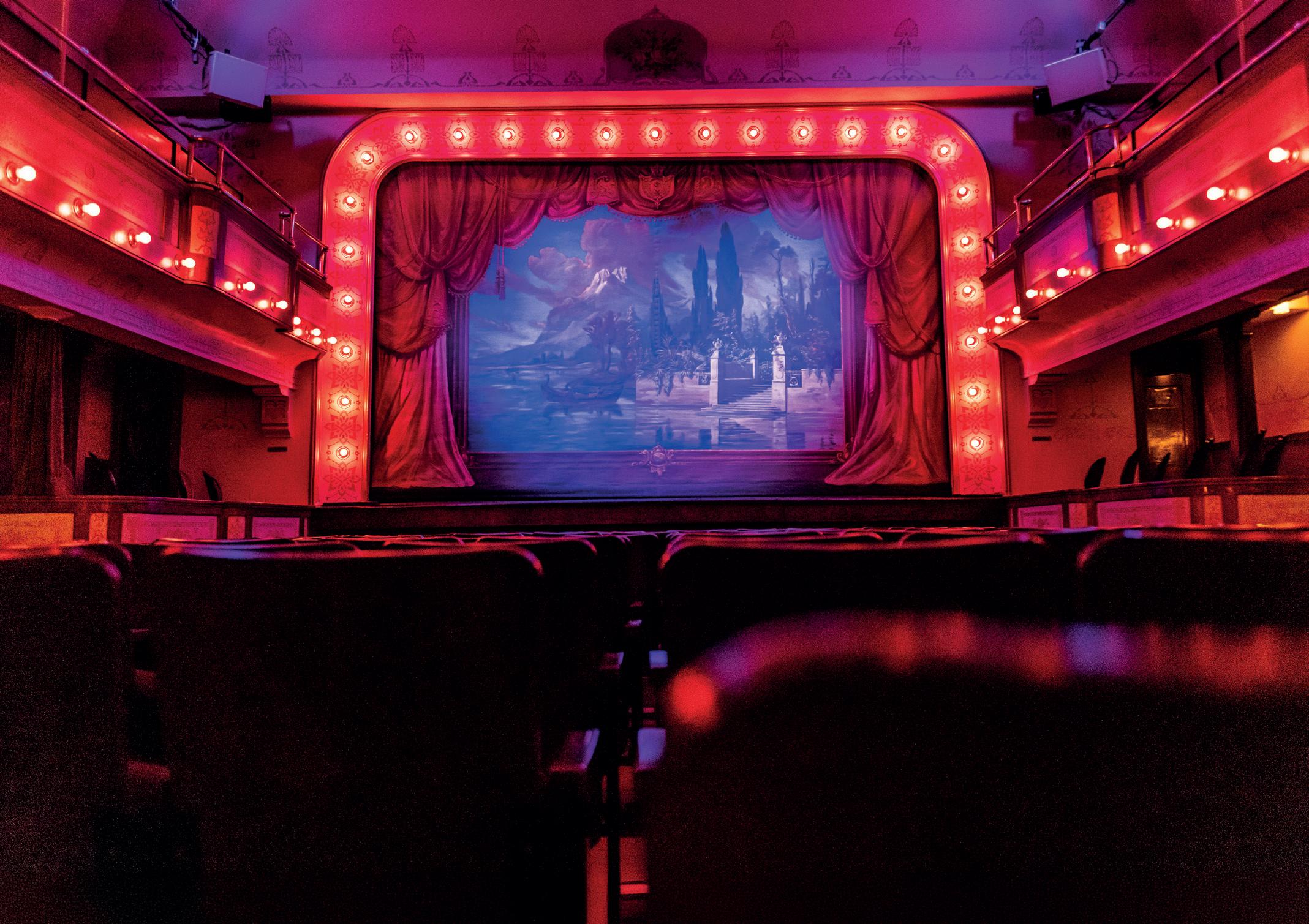
Film festivals have long functioned as temporary exhibition networks within the global cinema ecosystem, compressing months of programming, rights negotiation, and audience development into tightly defined calendar windows. They act simultaneously as first-run exhibition platforms for unreleased films, timelimited marketplaces for rights holders and buyers, and high-density public screening programmes that place unusual pressure on cinema operations.
WORDS: SAUL MAHONEY, FOUNDER, CINEPORT.
In 2026, film festivals are still adjusting to a post-pandemic operating reality in which digital delivery, shortened theatrical windows, and audience price sensitivity directly affect how films are booked, delivered, and screened.
For cinema industry professionals - exhibitors, technologists, distributors, service providers, and venue operators - festivals are not peripheral cultural moments. They are concentrated bursts of work where programming intensity rises, tolerance for technical hiccups drops, and audience expectations go up, not down. This article examines film festivals from the ground up. It explains what a film festival is,
how different models operate, where the money comes from and where it goes, and how programming, rights, delivery, and exhibition intersect in practice. It is written for readers encountering festivals for the first time, as well as those who have worked alongside them for decades, with a particular focus on the practical chain of events that turns a programmed title into a clean, on-time screening.
For cinemas hosting a festival, it helps to be cleareyed about what changes during festival weeks. Here are five realities that catch teams out, even when the projectors behave themselves:
› Volume: more content ingests, more KDMs, more last-minute changes, and more emails that look identical but are not.
› Time pressure: late deliveries mean QC happens closer to showtime, sometimes in parallel with public screenings.
› Variability: mixed venues and mixed spec mean you inherit every awkward edge case in the catalogue, from odd frame rates to subtitles placed for the wrong mask.
› Communications: the fastest fix is often not technical, it is getting the right contact to re-issue a KDM or re-upload a corrected DCP, accurately.
› Contingency: you need a clear plan for what happens if a title cannot play, including who decides, who informs the audience, and what you screen instead.

At its simplest, a film festival is a fixed-date programme of film screenings in which each title is booked under bespoke rights terms, often for a single screening or tightly defined run, usually accompanied by contextual activity such as Q&As, panels, industry meetings, or educational work. Unlike conventional cinema programming, festivals operate under temporary conditions: fixed calendars, compressed schedules, and limited time to address technical issues or delivery failure.
What complicates this definition is scale. Film festivals range from major international industry events with global media attention to highly local, volunteer-run programmes serving a single community. Estimating the total number of film festivals worldwide is difficult due to their fluid nature, but as a guide, approximately 5,000 are listed for 2026 on FilmFreeway. This figure encompasses globally recognised events alongside niche and hyper-local festivals that may operate for only a few days each year.
Importantly, festivals are not defined by venue type. Some operate primarily within permanent cinemas. Others occupy multiple venues across a city. Some take place in temporary or unconventional spaces, from town halls to outdoor locations. What unites them is not architecture but intent: a festival
temporarily assumes the dual role of exhibitor and distributor, acquiring time-limited screening rights and delivering them to audiences under specific contractual conditions.
Film festivals also differ in purpose, which directly affects how films are contracted, delivered, and exhibited. Some are primarily audience-facing cultural events. Others exist mainly to facilitate sales, financing, and professional networking. Many sit somewhere in between. These distinctions shape programming priorities, technical standards, staffing models, and financial risk.
Despite their cultural prominence, most film festivals operate on fragile cashflow models, committing to
cinema bookings, delivery infrastructure, and temporary staffing well before box-office income is realised. Revenue typically comes from a mixture of public funding, sponsorship, ticket sales, accreditation fees, and philanthropic support. The balance between these streams varies widely depending on scale, location, and mandate.
Public funding often underwrites core operations, while sponsorship can provide essential cash or in-kind support - though it is sensitive to wider economic conditions and brand priorities. Ticket sales may represent a significant proportion of income for audience-facing festivals, but are constrained by venue capacity, fixed schedules, and non-repeatable screenings.
Costs are equally diverse. Festivals incur venue hire or revenue-share agreements, temporary

staffing, technical support, marketing, travel and accommodation for guests, print traffic or digital delivery costs, and insurance. For festivals working across multiple venues, coordination costs rise sharply, particularly where projection standards, staffing expertise, or technical readiness vary between sites.
From an exhibition perspective, festivals offer high occupancy and profile uplift, but also introduce elevated technical risk through compressed schedules, late deliveries, and limited tolerance for screening failure. Cashflow timing is critical: delivery costs, staffing, and venue preparation are often incurred months before ticket income is confirmed.
Major festivals generate significant local economic impact through tourism, hospitality, and event services. In the United States, Sundance Film
Large international festivals illustrate how these models operate at scale. European cinema remains a major presence on the global festival circuit, hosting some of the most influential events in the calendar. In 2025, the London Film Festival reported record attendance of 235,853 admissions, with 94% occupancy across London cinemas and 47% of attendees attending for the first time. The festival exhibited 247 films from 79 countries.
At the upper end sits Cannes Film Festival, which attracted over 35,000 accredited participants. While often perceived externally as a social or promotional spectacle, Cannes functions operationally as a crowded exhibition environment combined with one of the world’s most active film markets, the Marché du Film, where over 1,500 screenings are held. Programming decisions, delivery schedules, and rights management operate under extreme time pressure, with little margin for technical failure.
Mid-sized and specialist festivals illustrate different pressures. Sheffield DocFest, focused on documentary cinema, reported 45,595 festival admissions in 2025 and an estimated £2.6 million contribution to the local economy. Its audience composition - with a high proportion of filmmakers, contributors, and industry delegates - affects everything from screening schedules to accessibility provision and venue choice.
At the opposite end of the spectrum are micro-festivals such as Muestra de Cine de Ascaso in the Pyrenees, self-described as the smallest film festival in the world. It operates without a conventional cinema venue, demonstrating that festival exhibition is not confined to urban centres or purpose-built buildings. Notably, even Cannes’ primary venue, the Palais des Festivals, is not a cinema in the conventional sense. Festivals regularly operate in spaces adapted for projection - sometimes temporarily, sometimes permanently - each with distinct technical implications.

Across continents, from Busan in South Korea to FESPACO in Burkina Faso, festivals continue to represent the cultural diversity of cinema while collectively managing what is, in effect, an industrial-scale distribution and exhibition ecosystem.
Festival 2025 reportedly generated $196.1 million for Utah, while SXSW generated $380.9 million for the Austin economy. These figures illustrate the sector’s scale, but they mask the reality that many festivals commit to significant operational expenditure year on year without long-term financial security.
Festival programming is often discussed in terms of taste and curation, but operationally it is a rights-
acquisition process constrained by legal, technical, and logistical realities. Festivals do not acquire films; they acquire screening rights, usually limited by dates, territories, venues, formats, and premiere status.
Premiere status remains a central consideration. World, international, national, or regional premieres can determine whether a film is eligible for a given festival. These requirements affect scheduling flexibility and can lead to late changes if a film’s premiere status shifts elsewhere. Programmers work with a mixture of distributors, sales agents, and
filmmakers directly. Relationships matter, because distributors and sales agents often prioritise delivery support, flexible KDM issuance, or late schedule changes for festivals they trust operationally. Filmmakers without representation may require additional technical support to meet delivery standards. Scheduling is rarely straightforward. Talent availability, venue constraints, KDM validity windows, and technical readiness all influence where and when a film can screen. A title listed in the programme may still be withdrawn if rights are reallocated or delivery fails. The growing influence of global streaming platforms adds further complexity. Exclusive rights agreements and windowing strategies can restrict festival availability, even for films that might otherwise benefit from festival exposure. Negotiating these rights is time-consuming and can limit access to highprofile titles. At the same time, festivals continue to uncover and champion films that arrive without established market presence, reinforcing their role as discovery platforms.
From an exhibition standpoint, a festival screening is the endpoint of a complex delivery chain. Whether operating in a permanent cinema or a temporary space, festivals must ensure venues are technically ready to meet the requirements of rights holders and audiences alike. Most festivals now rely on Digital Cinema Packages (DCPs) as the primary exhibition format. These may arrive via physical drives or digital delivery platforms. Ingest processes involve copying content to servers, verifying file integrity, and confirming compatibility with projection and sound systems. Quality control is a critical step. Aspect ratios, frame rates, audio configurations, subtitle placement, and colour space must all be checked. Subtitles are particularly sensitive; poorly timed or incorrectly rendered subtitles can undermine screenings and provoke audience complaints.
Key Delivery Messages (KDMs) govern when encrypted content can be played. Managing KDMs across multiple venues and time zones introduces risk. Late or incorrect KDMs can prevent screenings from starting on time, requiring emergency extensions or, in worst cases, cancellations.
In practice, a festival screening tends to live or die on a few predictable checks. A sensible, repeatable booth workflow looks something like this:
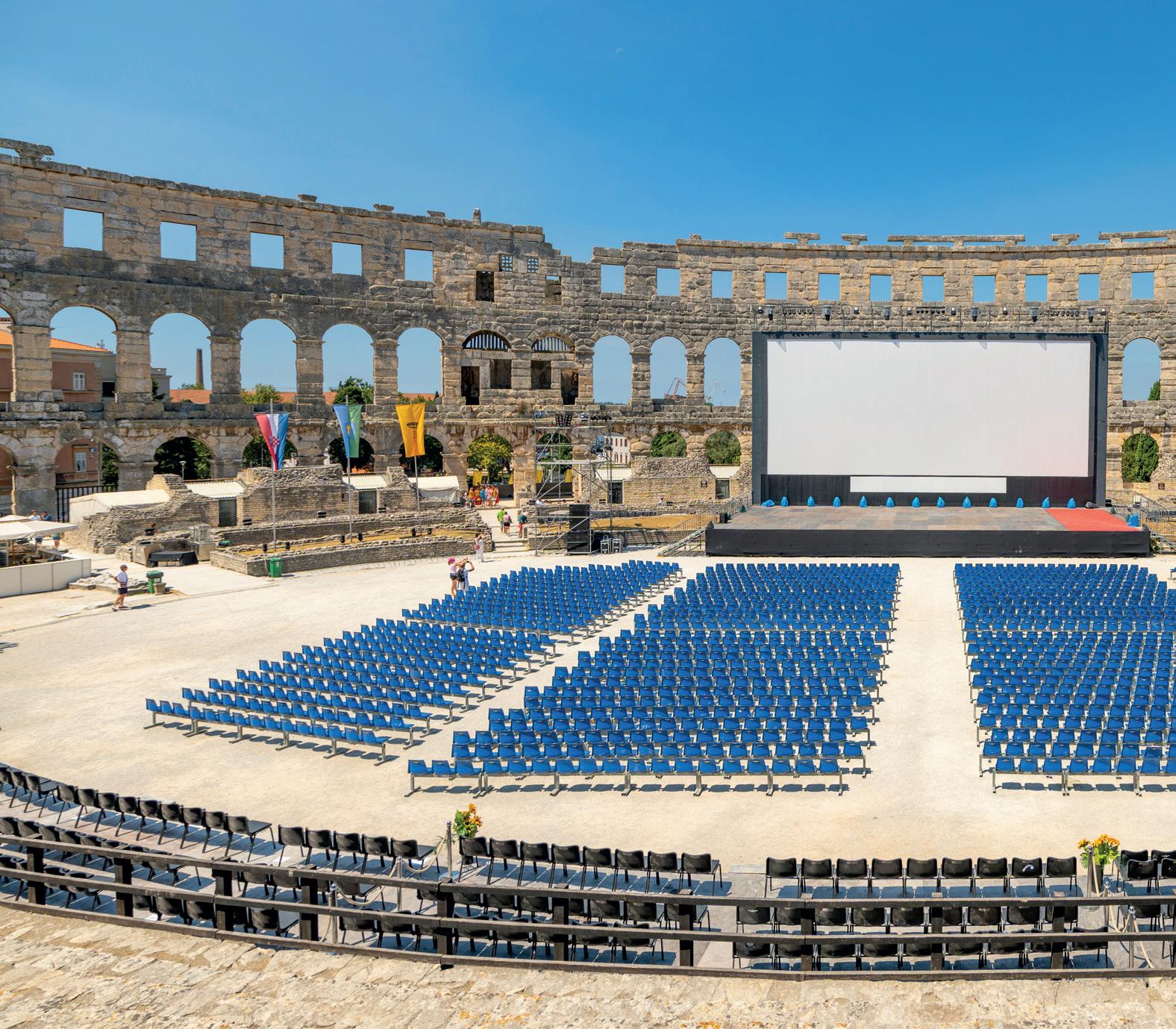
› Confirm the booking details match the delivery: correct version, correct aspect ratio, correct audio layout, correct subtitle language, correct screening time and venue.
› Ingest early where possible, then validate: check hashes if provided, confirm CPL(s) load cleanly, and run a short playback test with sound on.
› QC the basics that trigger complaints: subtitles (position and burn-in), frame rate judder, dialogue level, surround mapping, and any non-standard formats.
› Verify KDM details carefully: server certificate, screen or auditorium ID, and time zone. If anything is off, request a re-issue immediately, not ten minutes before doors.
› Check show automation and presentation: lights, masking, audio format selection, and trailers or bumpers, so the audience sees a polished show rather than a technical rehearsal.
Accessibility adds further layers to ingest and scheduling, as caption files, audio description tracks, and alternative subtitle versions must be tested against specific server and playback configurations. Increasingly, festivals are expected to provide accessible screenings as standard rather than as special events, raising staffing, testing, and scheduling requirements. In the UK, BFI-linked audience development funding for festivals is commonly tied to accessibility delivery targets, including relaxed screenings and captioned provision thresholds. For cinemas hosting festivals, these processes often run alongside regular programming,
increasing pressure on technical teams. Festivals are periods when projection rooms, servers, and staff are pushed to their limits.
The operational differences between permanentvenue festivals and temporary or pop-up events are significant. Festivals operating within year-round cinemas benefit from established infrastructure, trained staff, and predictable workflows. However, they must negotiate around existing programming, maintenance schedules, and audience expectations.
Temporary and pop-up festivals, by contrast, often start from zero. Equipment must be transported, installed, tested, and removed. Power supply, connectivity, environmental conditions, and physical security all require planning. Staffing models are typically leaner, with higher reliance on freelancers or volunteers. Risk profiles differ accordingly: permanent venues concentrate risk around scheduling density and delivery coordination, while temporary builds concentrate risk around power stability, playback reliability, and environmental exposure. Audience expectations also vary; pop-up settings may tolerate certain compromises, while cinema audiences expect consistency.
These differences influence programming decisions, delivery formats, and even film selection. Not all films or rights holders are willing to screen in non-standard environments, which in turn shapes festival identity.
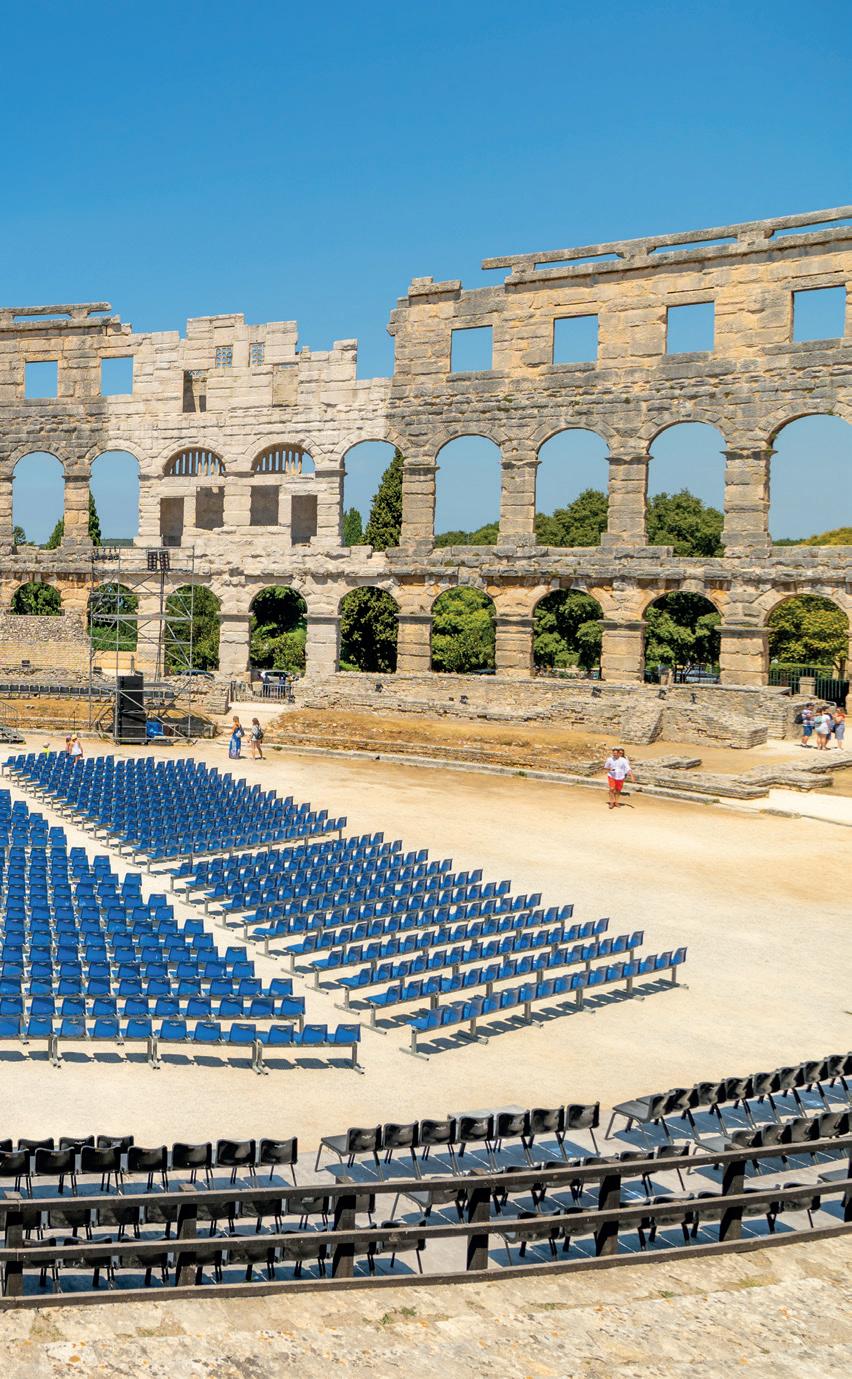
Security, Compliance, and Rights Protection
Film festivals are often perceived by rights holders as higher-risk environments than conventional cinemas. Films may be shown before commercial release, sometimes without confirmed distribution in place. As a result, security and compliance are critical components of festival operations.
Physical security includes controlled access to projection areas, secure storage of drives, and clear rules on who can handle content. Digital security involves encryption, watermarking, certificate management, and adherence to DRM requirements. Accreditation systems also help control access to screenings, particularly for industry previews, where the incentive to record is higher and the tolerance for risk is lower. Trust is cumulative - built through consistent delivery compliance, secure handling of assets, and predictable projection conditions across multiple festival editions. Festivals that demonstrate reliability are more likely to secure high-profile titles, while those that experience breaches may find future access restricted. These dynamics affect not just festivals, but also the cinemas and technical partners that support them.
Strip away the glamour and most festivals fall into a small number of operational patterns. The details differ by city and budget, but the same questions keep coming up: where does the programme live, how many venues must be coordinated, and how
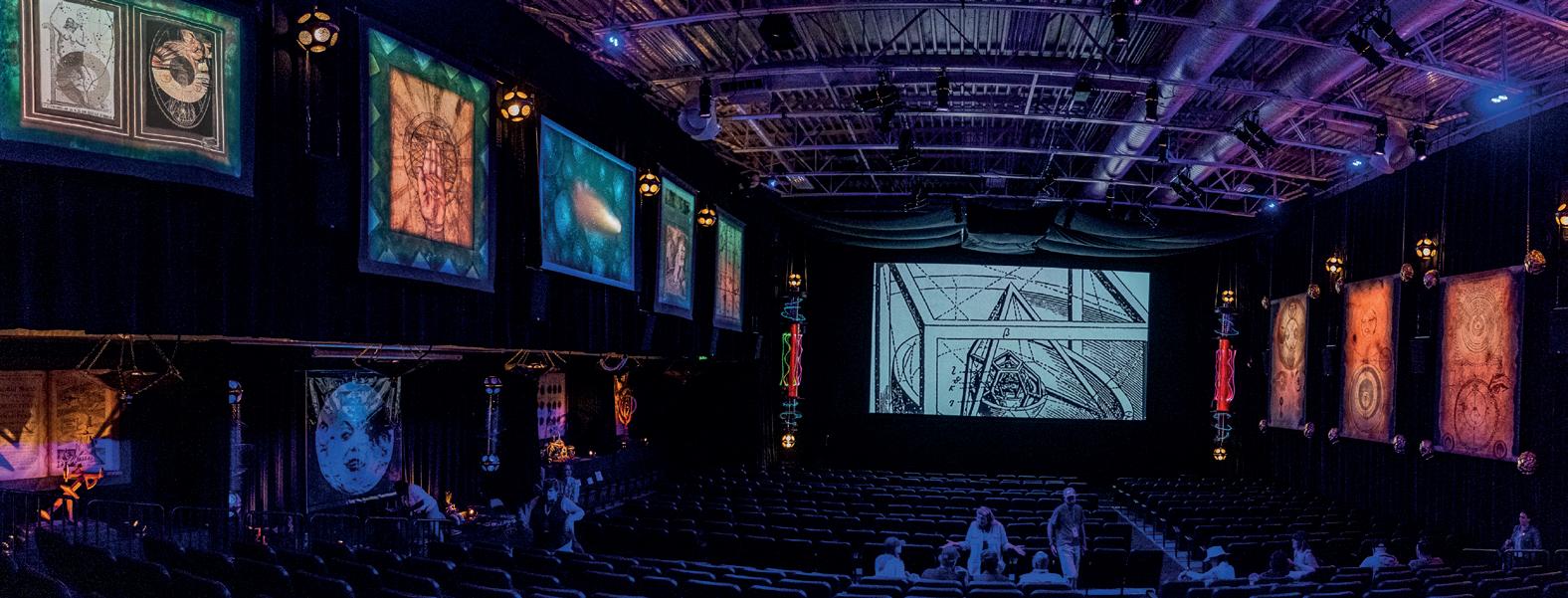
much infrastructure has to be built from scratch before the first audience member sits down?
Toronto International Film Festival is a neat way to picture the permanent venue model because it has a true home base. With the TIFF Lightbox as its anchor, the festival can lean on a proven technical baseline: projection and sound systems that are already bedded in, staff who are comfortable with DCP workflows, and a network and storage environment that is understood rather than improvised. That stability does not make life easy, it just changes the shape of the pressure. The strain comes from density rather than novelty: more shows, tighter turnarounds, and a steady drip of late deliveries and schedule changes. In practice, this model is less about learning new kit and more about running the same kit harder, for longer, with less time to recover when something goes wrong. Edinburgh International Film Festival illustrates the city wide, multi venue model, where a central operations team coordinates delivery, KDMs, and scheduling across partner sites. Over its history that has meant working across venues with different booth cultures and different technical baselines, from traditional cinemas such as the Filmhouse and the Cameo, to modern multiplexes like Vue Omni, as well as additional spaces including Tollcross Hall and the Hawthornden Lecture Theatre. This model scales audience reach and supports a broader programme, but it also introduces variation in staffing experience and technical standards. The work becomes less about one booth doing everything perfectly and more about shared protocol: consistent QC, clearly defined ingest responsibilities, a single source of truth for KDM windows, and a fast escalation route when a venue hits trouble.
The Telluride Film Festival expands exhibition capacity beyond the permanent cinema in its remote mountain setting by converting existing buildings into high specification screening venues. That is the pop
up and temporary build model in its purest form: turning non cinema spaces into screening rooms. These events can be memorable precisely because they are unusual, but the operational risk is higher. Power, environmental conditions, physical security, connectivity, and redundancy are all harder to guarantee, and staffing is often lean. Telluride is an instructive reminder that, in temporary builds, the technical plan is only half the story. The other half is logistics: where equipment lives, how drives and keys move, who is responsible for checks, and what the fallback is when something fails.
In reality, many festivals blend these models. A festival may have a permanent base venue, add partner cinemas for scale, and build one or two popup sites for profile. For exhibitors and technical teams, the key is to identify which pattern applies to each venue, then staff and schedule accordingly. That is the difference between a festival week that feels busy and one that feels fragile.
Film festivals in 2026 remain operationally demanding environments in which cinemas, technicians, and rights holders are asked to deliver first-run content under tighter time, security, and accessibility constraints than standard exhibition. As delivery methods evolve and compliance expectations increase, festivals continue to test the resilience and adaptability of cinema infrastructure.
For exhibitors and technologists, understanding festival workflows - from rights windows to KDM timing and subtitle QC - has become a practical requirement rather than a specialist niche, particularly as festivals push further into hybrid models, temporary builds, and expanded accessibility provision.
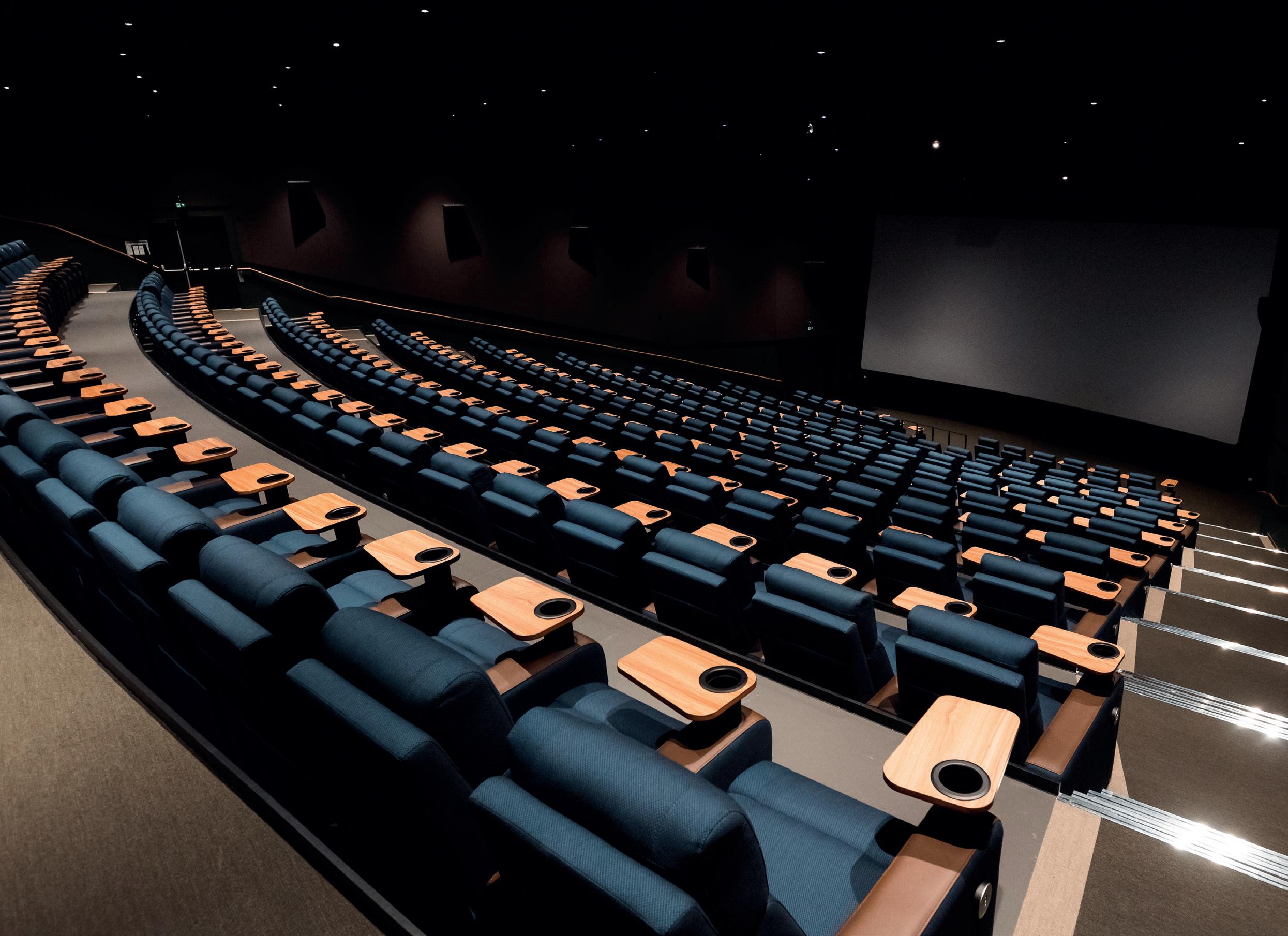
Saga Kino is a historic cinema located in central Oslo, originally opened on 15 February 1934, designed by architects Gudolf Blakstad and Herman MuntheKaas. It has been a cultural landmark and one of Oslo’s key family and community cinemas for more 90 years.
WORDS: RICHARD MITCHELL, HARKNESS SCREENS
The cinema has undergone several transformations throughout its long history including a major conversion into a sixscreen multiplex in 1981, the first of its kind in Norway and an interior renovation in 2007. In 2023, cinema operator Nordisk Film closed the venue in order to carry out an extensive two-year renovation project bringing this iconic cinema a new lease of life. The
cinema re-opened in November 2025 showcasing, a beautiful combination of heritage architecture alongside modern retail and auditorium experiences.
Christie RGB laser projectors with ultra-high contrast lenses, MAG Audio speakers, Powersoft amplifiers and Harkness screens provide state-of-theart equipment to six fully refurbished auditoriums comprising 498 recliner seats. However, creating a
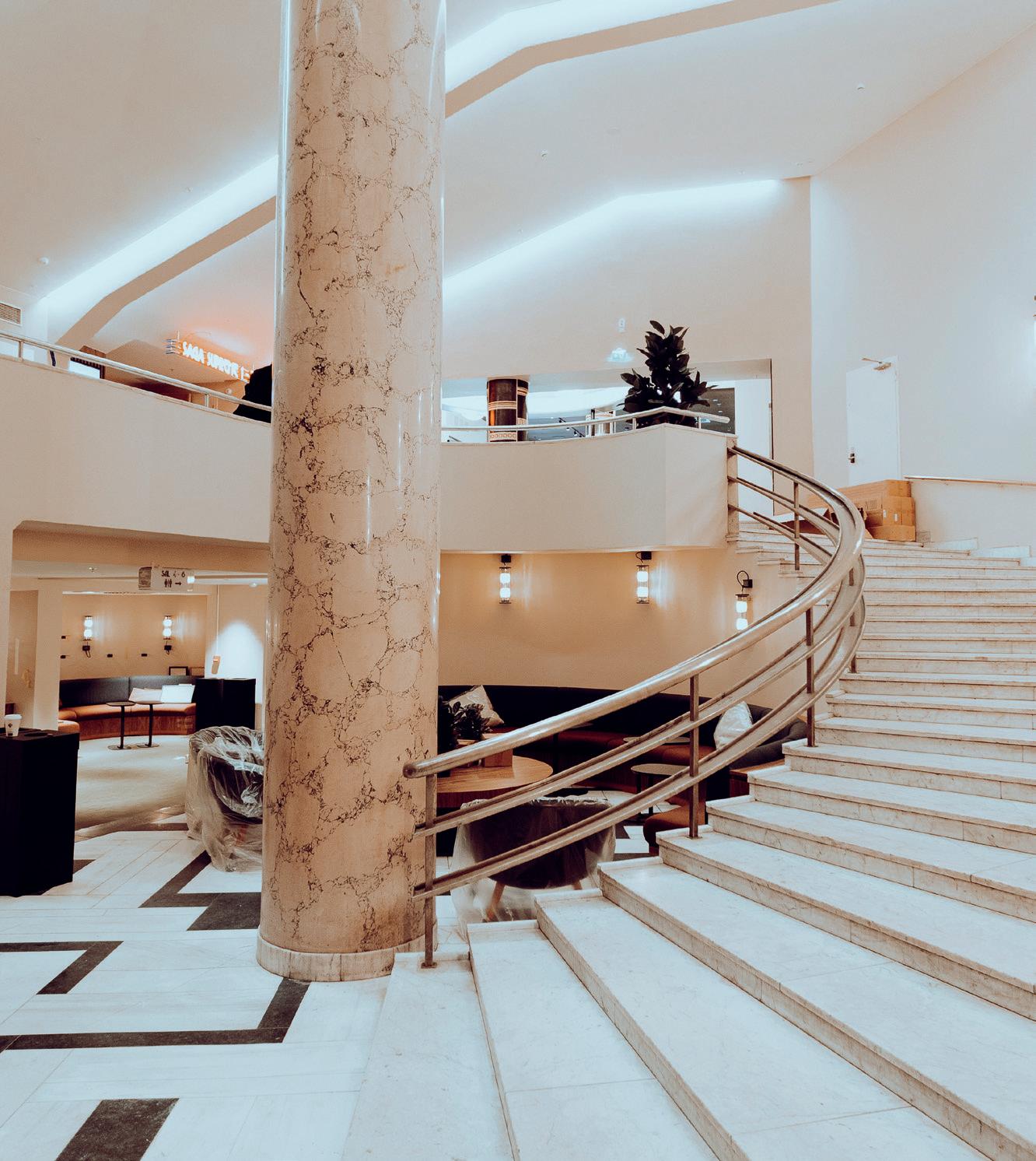
premium viewing experience for audiences was not without a number of technical challenges presented by the legacy of the multiplex conversion in 1981. Two of the auditoriums feature high projection booths that point downward towards relatively small screens thus creating challenging conditions to manage and direct light to every seat in the house ensuring an incredible experience. The largest auditorium (Screen 1) features 241 seats arranged in 10 curved rows with the centre of the projection window above the top of the screen (fitted to a floating frame). Whilst the software inside the Christie CP-4415-RGB projector manages the potential issue of image keystoning, Nordisk identified two further challenges that needed resolving and sought help from Harkness.
“At Nordisk, we were one of the first exhibitors in the world to fully commit to laser projection having recognised the benefits in terms of energy consumption savings and the future direction of projection technology,” explains Jan Rasmussen, Head of Screen Technology at Nordisk Films. “Whilst we’re delighted with laser projection, we remain very aware of the issues surrounding laser speckle and how this phenomenon can affect the viewing experience. Typically we have found that speckle is most visible on high gain screens, and this really became an issue with the 3D screens within our cinemas,” he adds.
Combining difficult geometry and a desire to lessen visible speckle, Nordisk sought guidance from Harkness on how best to overcome these challenges
and provide a premium viewing experience to each seat. “The first step was to look at the architectural drawings and determine key parameters allowing us to then re-create these in our 3D modelling tools. We were then able to simulate a number of different technology options that could deliver the viewing experience Jan and his team sought for that specific auditorium, explains Richard Mitchell at Harkness Screens. “These various elements included sufficient 2D and 3D brightness, reduced visible hot-spotting and manageable levels of laser speckle. We also looked at how best to direct the projected light back in to the centre of the seating area given that the high projection booth meant that without intervention most of the reflected light would end up targeted at the front rows of the auditorium. After creating more than ten different scenarios featuring different screen types, we proposed a complex solution combining a Harkness Hugo SR 3D screen on a 5% curved frame with a 5 degree backward tilt. The 5% curve helped double centre-to-edge brightness uniformity (measured from the DCI-position) and the 5 degree tilt helped direct brightness back to the centre of the auditorium creating an even brightness between the top and the bottom of the screen”, he explains.
Harkness’ fifth generation screen technology Hugo SR was released in 2024 following years of research and development and input with key industry stakeholders including exhibitors, technology
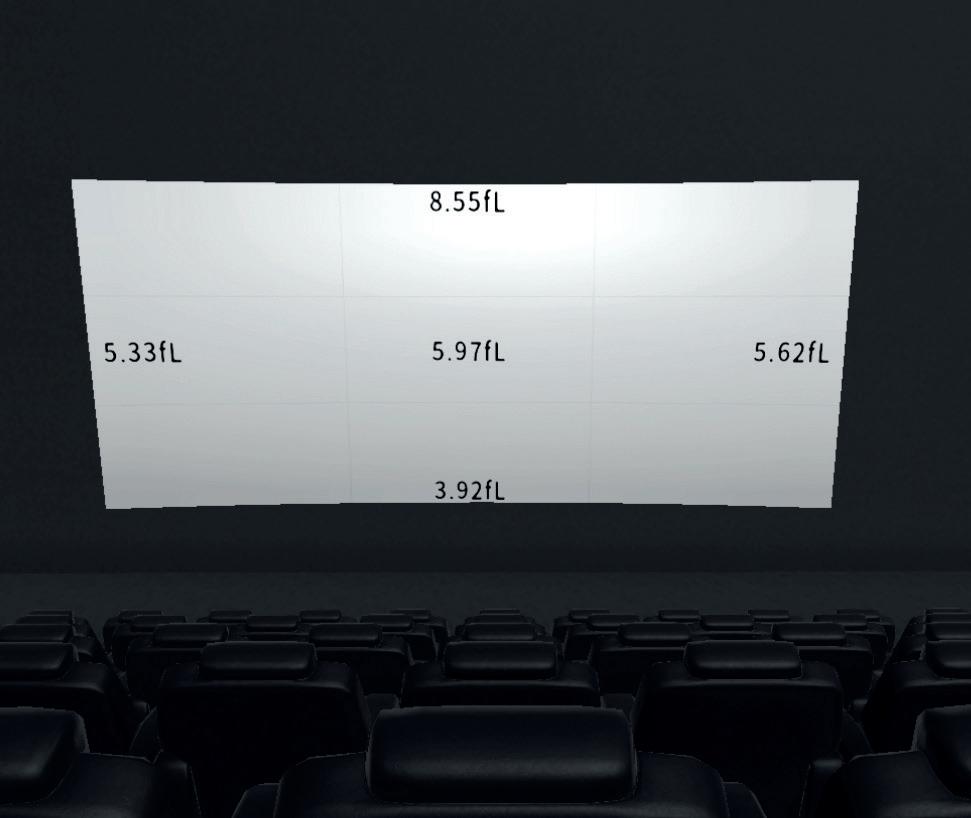
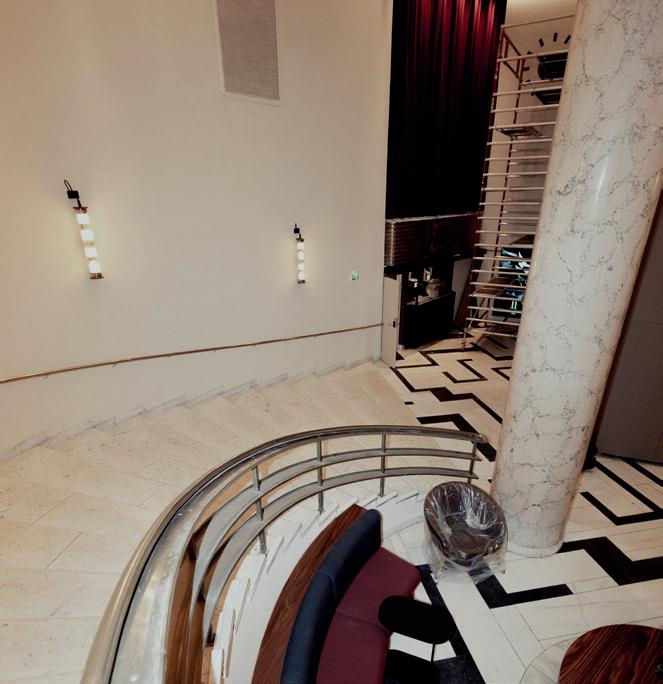
providers and studios. Hugo SR was designed to address the challenges and opportunities presented by laser projection and in particular RGB laser, with the screen’s key attributes being its ability to significantly reduce visible speckle by up to 30% compared to traditional high gain silver screen surfaces whilst also improving visible contrast making it ideal for the industry’s shift toward higher dynamic range.
Commenting on the screen after install, Jan Rasmussen explained that “the uniformity and sharpness of the image is really impressive given the challenging circumstances of the auditorium and there was definitely less speckle than I feared with a relatively small hotspot.”
Saga Kino re-opened its door in late November 2025 and has received large volumes of positive reviews from movie-goers with many referencing the upgrades in sound, projection and screen quality as a stand-out improvements in the cinematic experience. With a significant and sympathetic refurbishment that combines historical architecture alongside state-of-the-art technology, Nordisk’s Saga Kino will continue to be one of Oslo’s most visited venues.
Cinema does not have a film problem. It has a habit problem.
WORDS: PETER J. KNIGHT, CINEMA TECHNOLOGY MAGAZINE
Most people still like the idea of going. What has changed is the ease with which “we should” becomes “we are”. Prices rise, choice multiplies, and the sofa keeps winning. The Cinema Club, launched in the UK on 5 November 2025, is a straight forward attempt to push back against that drift. It is not a subscription model, and it is not a blanket discount. Join the club, get access to a defined slate of films, and pay half price for those titles at participating cinemas.
Membership launched at £14.95 per season, discounted to £12.95 for those who joined before 30 November 2025, covering ten specially selected films across Autumn 2025 to Autumn 2026. Midway through the season, the offer has been reduced to £7.50, reflecting the six remaining half-price films still to come.
The scheme is described as a UK version of a successful Danish cinema club that has been operating for 30 years. The founders are three industry professionals: Julia Brown, Damian Drabble and Craig May. The stated aim is to
increase frequency of visits and rebuild the cinema-going habit through a carefully curated film community
More than 70 cinemas, weighted towards independents
The scheme launched in more than 70 UK venues, spanning the country from Merlin Thurso in Scotland to WTW Newquay in Cornwall. The emphasis is on smaller independents and circuits, with participating groups including Showcase, Reel, Merlin, Scott, WTW, Arc and Savoy, alongside individual venues such as Lockworks (Wolverhampton), The Royal (Sutton Coldfield), The Dome (Worthing), Forest (Walthamstow), The Island (Lytham) and The Majestic (King’s Lynn).
Membership is digital. Discount codes are accessed through a member account and can be used online or at the box office.
The welcome messaging is explicit: valid for all participating showtimes and days, with no blackout dates and “no fuss”. The team says it has built an API for checking code validity through

Savoy Systems, Jack Roe’s TAPOS, Vista, Indy POS and Admit One. For cinemas running those platforms, onboarding is described as achievable within a few days.
The distribution of participating venues is deliberate. In towns and smaller cities, the local cinema is often still a shared cultural space, sometimes the shared cultural space. If a scheme like this encourages an extra visit, or persuades someone to take a chance on a film they would have skipped, the effect can be meaningful, particularly for venues that rely on steady footfall rather than spikes.
Brown’s statement at launch focuses on the films themselves. “There are some great films in cinemas that sometimes don’t get the attention they deserve,” she says, adding that the scheme will make sure the films included are firmly on people’s radars. She also frames the wider goal in cultural terms, promoting cinema-going and keeping “much-loved local cinemas alive and kicking in towns and cities where they provide an important cultural and community function”.

A curated club only works if the list is good.
The first four titles were set out clearly at launch. The opening film was Sony’s The Choral, written by Alan Bennett and directed by Nicholas Hytner, starring Ralph Fiennes, released on 7 November 2025. It was followed by Giant (True Brit) on 9 January 2026, H is for Hawk (Lionsgate) on 23 January 2026, and Mother’s Pride (Entertainment) on 27 February 2026. The next six films were finalised in the weeks following launch.
The early selection signals intent. This is pitched as “quality mainstream product”, put in front of a wider audience over an extended time frame. These are the films that can do well with time, confidence and conversation, but which can be drowned out if audiences feel they must prioritise only the biggest releases.
A blanket bargain can fill seats in the short term, but it does not necessarily teach people to come back. A curated slate, done well, can. It nudges audiences towards a type of film they might not otherwise prioritise, and it keeps those titles in the conversation for longer than the opening weekend. Exhibition has always known that breadth of programming and regular attendance reinforce each other. The difficulty has been turning that knowledge into something that can be marketed simply, and applied consistently, without causing confusion at the counter or frustration online.
One of the most striking elements of the launch material is the reported industry response. Brown says feedback from both exhibition and distribution has been “overwhelmingly positive”, with exhibitors keen to sign up and distributors happy to suggest films for inclusion. The Film Distributors’ Association and the UK Cinema Association have been immensely helpful to getting the scheme off the ground. For a scheme
like this, sector buy-in is critical. A curated club is only as strong as the pipeline of titles and the willingness of cinemas to get behind it consistently.
The only thing that matters now is whether members actually come back. If the club encourages people to go more often, and to see a wider range of films, it does the job it was designed to do. If it becomes a one-and-done novelty, it will fade quickly.The Danish angle is a signal: this is meant to run, season after season. Ten films, one season, half price, then do it again.
For now, the pitch is clear: good films, half price, in a defined season, across a wide spread of UK cinemas. The offer is uncomplicated. The delivery mechanism is simple. And the aim is to rebuild something the industry has been watching erode for years: the simple habit of going.
CinemaCon has always been a week of two halves. On one side, the studios in The Colosseum selling the magic of what is coming next. On the other, the trade show floors and meeting rooms where the industry does what it always does best: compares notes, talks shop, and quietly solve problems before anyone else notices they exist.
For 2026, the official convention of Cinema United returns to Caesars Palace in Las Vegas from 13 to 16 April, and the programme signals a subtle but meaningful shift. The week still belongs to the showcases and premieres, but the structure is also trying to be more useful. Less ‘look what we can do’, more ‘this is how we keep the business running’. CinemaCon is a temperature check. The themes that land in Las Vegas have a habit of turning up in your building, your budget and your staffing rota not long after.
The run-in begins earlier than many will be used to.
Sunday 12 April now carries more than arrivals and
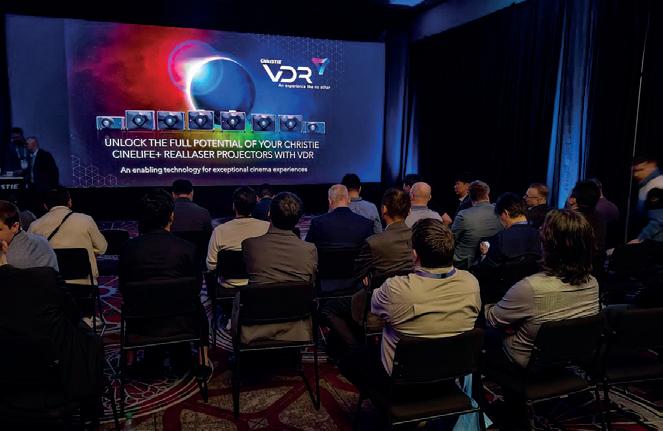
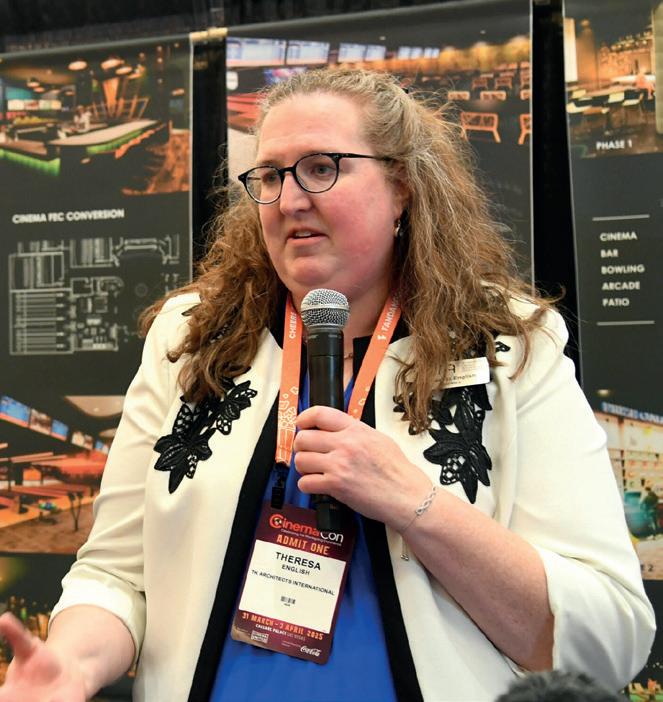
logistics, with registration alongside pre-show activity, including the EF&B charity golf outing and an Independent Theatre Owners Coalition (ITOC) Connect programme later in the day. It is a small programming choice with a big message behind it: independents are being given time and space before the main week even begins.
Monday 13 April is where CinemaCon makes its clearest statement. Three parallel education tracks run from 9:00am to 12:00pm: Audiences and Innovation, Food and Beverage, and Technology.
Placed first thing on the first full day, this is not education tucked into a quiet corner. It also forces a choice, and the choice is revealing. The organisers are flagging what they believe will define exhibition
performance in 2026: audience behaviour, the commercial engine of food and beverage, and operational technology.
The Audiences and Innovation track leans into the uncomfortable reality that cinemas are no longer competing only with each other, or even only with streaming. They are competing with attention itself. One session title frames it as ‘attention warfare’. Dramatic language, familiar problem: how to persuade people to leave home, choose your site, and do it again. A session on Gen Z and emerging trends follows, with Comscore’s Paul Dergarabedian among the listed contributors. Expect discussion around what genres are pulling audiences out, how premium formats influence choice, and how marketing needs to adapt when attention is the scarce resource. The track then turns outward to global design and guest experience, a reminder that innovations travel quickly across markets.
Food and Beverage is refreshingly practical. The emphasis is on leadership, operational performance and what is actually changing at the concessions counter. Sessions span developing F&B leaders, a look at products and equipment on the show floor, and rethinking lobbies and concessions to increase sales, reduce labour costs and improve the guest experience. The point is not glamorous, but it is foundational. F&B is no longer treated as an add-on; it is treated as infrastructure.
The Technology track goes straight to the pressure points. It opens with immersive technologies beyond the screen, then lands on a
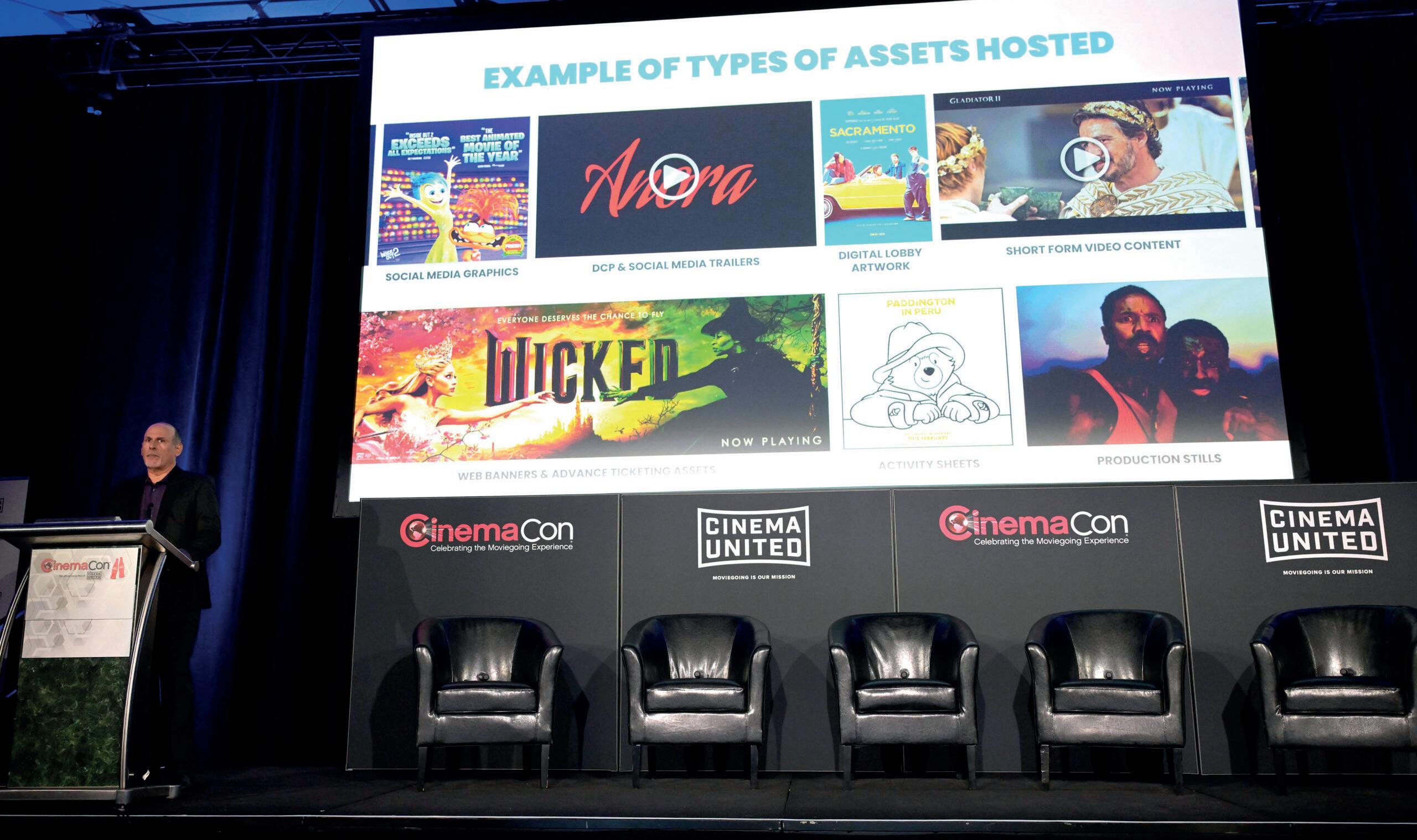
session with a telling title: ‘Practical AI for Streamlined Theater Operations’. The framing matters. AI positioned as operational infrastructure, tied to scheduling, monitoring, cost control and guest experience, rather than a shiny side project.
After lunch, Monday introduces a CinemaCon Film Showcase, giving distribution companies space to present upcoming slates. Angel and StudioCanal are named, with more to be confirmed. The value is obvious: programming health is not built only on tentpole titles. It is also built on the films that fill the calendar between them and keep audience choice alive. Monday also adds a trade show networking reception, by invitation, positioned as a head start before the show floor opens. It is a simple idea, and a good one. The best conversations rarely happen when everyone is rushing.
For all the operational focus, CinemaCon still turns on the studio moments in The Colosseum. The schedule sets out a familiar rhythm, with major presentations from Sony Pictures Entertainment, Warner Bros. Pictures, Universal Pictures and Focus Features,
Amazon MGM Studios, Paramount Pictures, and Walt Disney Studios, plus the Big Screen Achievement Awards. The studios set the week’s emotional pulse, and they also set the downstream agenda. Creative positioning, premium format pushes, and campaign tone are not just theatre for Las Vegas. They filter into the materials and planning exhibitors will live with for months afterwards. Alongside the showcases, the programme includes The State of the Industry session, an Industry Think Tank discussion, and a major studio screening. Thursday also features a session framed around the future of cinema, culture and the next generation, backed by Coca-Cola, nodding to the longer view of why cinemas matter beyond the week’s headline noise.
CinemaCon is also, quietly and reliably, a technology show. The trade show and suites run Tuesday and Wednesday, 11:00am to 5:00pm, spread across Caesars Palace ballrooms and meeting rooms, with the usual cluster of major cinema technology suppliers and partners. The best trade show conversations are rooted in real-world constraints. In 2026 that tends to mean resilience and uptime, remote monitoring, staffing realities, food service efficiency, and premium experiences that can be delivered consistently rather
than occasionally. The shift is not subtle: fewer bluesky demos, more systems and workflows that promise to save time, save labour, or reduce risk.
CinemaCon also has a habit of setting the tone for the year’s technology narrative. Press announcements and product launches here often become reference points for the next few months, shaping what people ask for, what they budget for, and what manufacturers spend the rest of the year demonstrating in the field. By the time CineEurope arrives in June, many of the conversations will feel familiar, not because Europe follows Vegas, but because the same launches and questions travel quickly across the circuit.
CinemaCon 2026 still promises spectacle, star power, and the big screen moments that only a studio showcase in The Colosseum can deliver. But the programme choices suggest a convention leaning harder into the practical realities of exhibition: education that is structured and prominent, food and beverage treated as strategy, and technology discussed as operations rather than toys.
If CinemaCon is a mirror, 2026 is reflecting an industry that wants to run smarter, not just louder. For many exhibitors right now, that might be the most welcome message of the week.