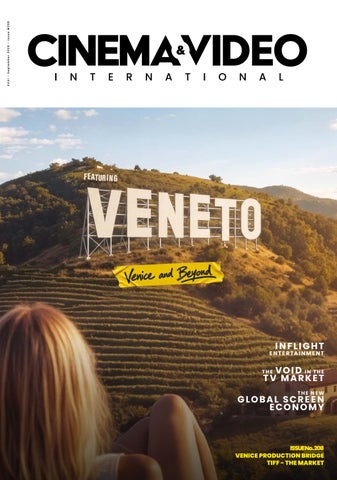
XXXI - September 2026 - Issue #208
INFLIGHT
E N T E R TA I N M E N T
VO I D I N T H E TV MARKET
THE
THE NEW
G LOBAL SCRE E N ECONOMY
ISSUENo.208 VENICE PRODUCTION BRIDGE TIFF - THE MARKET
2
• SEPTEMBER 2026
3
4
• SEPTEMBER 2026
XXXI - September 2026 - Issue #208
FILM & AUDIOVISUAL TRADE MAGAZINE 31 YEARS. ISSUE NO. 208, September 2026
INFLIGHT
E N T E R TA I N M E N T
VO I D I N T H E TV MARKET
THE
THE NEW
G LOBAL SCRE E N ECONOMY
ISSUENo.208 VENICE PRODUCTION BRIDGE TIFF - THE MARKET
THE ARISTOCRACY OF TASTE, THE DEMOCRACY OF APPLAUSE
Cover sponsored by Veneto Film Commission
PUBLICATION Cinema & Video International Founded by Paolo Di Maira PUBLISHER DARO Studio Kevin Joiner, Federica Pazzano DEPUTY PUBLISHER Angela Grillo EDITOR-IN-CHIEF Federica Pazzano DEPUTY EDITOR Antonio Bracco CREATIVE DIRECTOR Kevin Joiner EDITORIAL MANAGER Daniel Popa WEB DEVELOPER Davide Morena OFFICE MANAGER Giacomo Pizzica EDITORIAL CONSULTANT Paolo Di Maira CONTRIBUTORS & CORRESPONDENTS Monica Tasciotti Rebekah Louisa Smith Monica Sardelli Elisabetta Brunella Silvia Mancini Bruce Rabinowitz Carlos Ku King Michael Rowley Alessio Cocco Patrick Zuchowicki Jucaud Valentina D’Amico Davide Abatescianni ADVERTISING A.P.S. Advertising Srl (Italy) info@apsadvertising.it Alessio Cocco (Global) advertise@cinema.video
B
efore, there was the court and the commoners, the nobility and the multitude of masses. Now, there is one giant mass of content that has lost the balance between offer and demand. Production is at its highest point, distribution at its lowest, with fewer titles getting real windows (Read Alessio Cocco’s guide to Inflight Entertainment, page 24). The gap between products made and products seen is widening dramatically. The American model, primarily private and market-driven, answers first to the audience because it demands box-office return and gives legitimacy only based on ticket sales. Lauded filmmakers serve brands to create human-centered stories for their marketing (Read Michael Rowley’s Branded Documentary, page 28). Meanwhile, the market shows an appetizing empty space for a new event in LA in 2028 (Read Patrick Zuchowicki’s The Void in the TV Market, at page 26). On the other side of the Ocean, European cinephiles shame the product for the market, annoyed by words like “commerciability” and “entertainment”, pursuing “art” that is mainly funded by public money. But what is art without an audience? Territories use that art to attract cinetourism, and then complain about the wild crowds of tourists invading from all over the world. Meanwhile not enough actions are done to preserve that digital cultural heritage (Digital Archives, page 28). Baby boomers who make, produce, finance, and sell films are complaining about audiences abandoning movie theaters — while sitting on data showing it’s their own generation staying home, not Gen Z or millennials, who are showing up in force (but require entertainment and giant P&A budgets). This September 2026, the Aristocracy of Taste vs. the Democracy of Applause meets in the legitimacy of the choice of festival directors (Read Antonio Bracco’s Two Directors. One tightrope., at page 8), who are tracing their own path. The Golden Lion and a People’s Choice Award represent two genuinely different value systems, not just two different festivals, but they are part of the same game. I’d love to receive your comments on this: federica@darostudio.com
PRINTING Laboratori Visuali di Andrea Perrotta THANKS TO Carmen Diotaiuti e Monica Sardelli (Italy For Movies) Elisabetta Brunella e Silvia Mancini (MEDIA Salles)
Federica Pazzano Editor-In-Chief
Daniele Barone (Biunivoca) Federico Spoletti (Fred Film Radio)
© Copyright - DARO Studio LLC All Rights Reserved
5
VENICE PRODUCTION BRIDGE Market for selected projects VENICE 3—9.09.2026 Discover the projects. Explore the agenda. The Venice Production Bridge (VPB), the film market of the Venice International Film Festival, organised by La Biennale di Venezia, is where producers, financiers, rights holders, distributors, publishers, immersive content creators and key decision-makers come together to connect, collaborate and do business.
GET READY FOR VPB 2027
PLAN YOUR DAYS AT VPB Browse the Agenda to discover market events, industry panels, presentations, networking opportunities and key activities throughout the Venice Production Bridge.
CHECK FOR MORE DETAILS
Greece and Switzerland will be the Focus countries of the Venice Production Bridge 2026 supported by Hellenic Film and Audiovisual Center (EKKOMED) and Swiss Films.
Stay tuned in the coming months: don’t miss the calls for VGFM, BARM and FCV, secure your spot at the VPB Locations Market, Venice Immersive Market and Industry Gold Club, host your event or market screening at one of our venues, and make your mark with our advertising opportunities. Get an overview of our services via our VPB Booklet*
*FEES FOR 2027 ARE SUBJECT TO CHANGE
CHECK FOR MORE DETAILS
Contacts:
6
Pascal Diot Head of Venice Production Bridge pascal.diot@labiennale.org Mob. +33 607269033 • SEPTEMBER 2026
Venice Production Bridge vpboffice@labiennale.org Ph. +39 041 2726 595
labiennale.org veniceproductionbridge.org
7
The fact tha have always TWO DIRECTORS. neighbbs” i ONE TIGHTROPE. ganization suctural c come to defi dentity. B F wwld e sks restige of remiere, udgment of builds its ow Barb what happen days earlier, by Antonio Bracco
In weiter Ferne, so nah!
Wim Wenders won’t take offense if we borrow the title of his beautiful film Faraway, So Close! (1993) to describe the relationship binding the Venice International Film Festival to the Toronto International Film Festival. or years the two events have lived in a state of near-physical proximity. They watch each other, study each other, flirt, compete, and pass the baton in the race toward the fall season, jointly celebrating the ritual that marks the end — and the beginning — of the film year. In 2026 Venice runs from September 2 to 12, Toronto from September 10 to 20. Nineteen days during which the two festivals coexist, and which some industry p ro f e s s i o n a l s spend moving from one to the other without a break.
8
• SEPTEMBER 2026
Cameron Bailey
The Mostra, born in 1932 and recognized as the world’s oldest film festival, and TIFF, founded in 1976 as the Festival of Festivals, have grown along parallel paths to become, each in its own way, an unavoidable stop for anyone working in the audiovisual industry. 2025 marked Toronto’s fiftieth anniversary, a milestone celebrated with a retrospective on its own history, while 2026 marks a new chapter still being written for both festivals: the 83rd Mostra and the 51st edition of TIFF. The fact that the two events have always been calendar “neighbors” is not an organizational detail but a structural condition that has come to define their very identity. Because while Venice seeks world exclusivity, the prestige of the absolute premiere, the red carpet and the judgment of critics, Toronto builds its own value in part on what happens in Venice just days earlier, turning a European world premiere into a North American launch. Two philosophies, two missions, two ways of understanding cinema as an event worth telling side by side.
at two e bbn calend is not an nal detail b condition th ine their ver Because whil exclusivity, absolute red carpet f critics, T wn value in p beiley ns, turning in Venicea Barbeiley
Leading the Venice Mostra is, for 15 consecutive editions now (plus an earlier term between 1998 and 2002), Alberto Barbera, who by now can add diplomat and tightropewalker to his job title of “festival director.” His task, edition after edition, is to reconcile a vocation for the most radical languages and the most authoritative auteurs with the dose of glamour needed to guarantee media coverage, sponsors and a general audience. It is a job made of negotiations, concessions and instincts that remain almost always invisible to the viewer, and which Barbera carries out by making room for uncomfortable voices, protecting authorial expression and taking chances on filmmakers the market sometimes considers in decline or ignores altogether — while always keeping the dialogue open with distributors, investors and industry. On the other side of the Atlantic, TIFF is led by Cameron Bailey, a figure who knows the festival literally from the inside. He joined as a seasonal programmer in 1990, became artistic director in 2012 and finally CEO in 2021. Thirty years of shared history with the festival have let him move through every phase of it — as programmer, curator and executive — while always keeping a strong tie to Canadian cinema. But the challenge Bailey faces today differs from that of his predecessors. Toronto must remain North America’s great popular festival without sliding into a mere showcase for the studios, while at the same time strengthening its industry weight. That is the direction of 2026’s most significant novelty, TIFF: The Market, the festival’s new official market running September 10–16 at the Metro Toronto Convention Centre. B a r b e r a and Bailey thus represent two complementary rather than opposing directions. One safeguards and relaunches the prestige of auteur selection in a competitive context that remains Venice’s identitarian core. The other runs a festival that has made noncompetitiveness and a direct relationship with the audience its banner, and that today is trying to add an
industrial infrastructure it never had before. They are, in a sense, the opposite and complementary tightrope-walkers of one and the same September.
Coextensive Philosophies
Venice’s mission remains, first and foremost, the pursuit of authorial cinematic expression. The official selection, the Golden Lion competition, the Mostra’s prestige and the symbolic force of the Lido build a festival designed for cinema that takes risks, experiments with language, and puts back at the center authors often overlooked by the market. It’s the
logic that brings names like Werner Herzog back to Venice (who had already received an honorary Golden Lion in 2025) who turned down a slot in Cannes just to stay in competition at the Lido with his film Bucking Fastard, or that allows Nanni Moretti’s return after thirty-seven years’ absence from the Venice competition. But this authorial vocation has always coexisted with an equally necessary second track: glamour. The red carpet remains integral to the Mostra’s identity, and 2026 confirms it with presences such as Robert Pattinson, star and producer of Primetime, or Noel and Liam Gallagher, expected for the documentary Oasis: Don’t Look Back In Anger. Toronto pursues its own philosophy instead. The absence of a traditional competition remains one of the festival’s strongest identity traits, because it is a festival for the audience, which has the honor of handing out the festival’s top prize, the People’s Choice Award. Over time, this mission has become a valuable laboratory for understanding the relationship between cinema and audiences. Past winners of the People’s Choice Award include films such as Chariots of Fire, Slumdog Millionaire, The Fabelmans and Three Billboards Outside Ebbing, Missouri, which, presented at Venice just days earlier in 2017, won the award for Best Screenplay there. But with TIFF: The Market, Toronto is no longer content to simply chase the North American audience and press. The goal is to also become a place for business deals and networking, following in the footsteps of Cannes and Berlin.
Alberto Barbera
9
stty, of cri st demandi lection. TT ssength o dience, NN dussial sca genuine ma n. Two way nswering uestion: wha inema nnd ive on glly The Films That Travel
The most telling way to understand the relationship between the two festivals is to look at the films that pass through both. One is Bunker by Florian Zeller, a psychological thriller with Javier Bardem and Penélope Cruz as a couple whose relationship is destabilized by an architectural commission for a bunker commissioned by a powerful tech magnate, with a cast rounded out by Paul Dano, Stephen Graham and Patrick Schwarzenegger. The film premieres in competition at Venice and arrives in Toronto a few days later as a North American Premiere. The same path is followed by Ink, Danny Boyle’s film chosen by Venice as its opening title on September 2. Set in the 1960s, it tells the story of the birth and rise of the British tabloid The Sun, with Guy Pearce as Rupert Murdoch and Jack O’Connell as editor Larry Lamb. In Toronto it screens as a Canadian Premiere. Master filmmaker Hirokazu Kore-eda also makes the double trip with Look Back, a live-action adaptation of the manga by Tatsuki Fujimoto; so does Lee Chang-dong with Possible Love, the story of two couples’ lives intersecting, and Shinya Tsukamoto with Mr. Nelson, Did You Kill People?, a portrait of a Black American Vietnam War veteran. To these titles is added the Italian thriller The Spiral (L’Estranea), directed by Paolo Strippoli, which flies from the Lido competition to Toronto’s official selection Midnight Madness, to then land in Austin’s Fantastic Fest where Strippoli debuted with his first solo feature Flowing back in 2022.
Martin McDonagh, a two-time Venice screenplay winner, returns to competition with Wild Horse Nine, starring John Malkovich, Sam Rockwell and Steve Buscemi. Also generating buzz: Nanni Moretti’s first Lido title since 1989, It Will Happen Tonight (Succederà questa notte), with Louis Garrel and Jasmine Trinca, and Marco Bechis’s Back to Buenos Aires (Ritorno a Buenos Aires). Other Italians in competition include Edoardo De Angelis, Andrea Pallaoro and the already mentioned Paolo Strippoli, while Casey Affleck competes for the Golden Lion as director with Company. French cinema is represented by Stéphane Brizé, Cédric Kahn and Nicolas Pariser. Out of competition, Paul Schrader returns, alongside Kiefer Sutherland and Al Pacino’s Father Joe, Gianni Amelio’s No Pain (Nessun dolore), Mario Martone’s Trick (Scherzetto), and closing film Dio ride by Giovanni Veronesi with Pierfrancesco Favino. The Mostra also embraces riskier fare: Ilya Khrzhanovsky’s DAU, Ali Asgari’s A Bit of Light (Kami nour), Alex Gibney’s Elon Musk documentary, and Laura Poitras’s short on ICE protests. Of twenty competition titles, only one is directed by a woman, Denmark’s May el-Toukhy; jury president Maggie Gyllenhaal will present her own short, Flesh Impact. Toronto, by contrast, leans on premieres of its own. Opening night belongs to Siân Heder’s Being Heumann; Peter Farrelly returns with I Play Rocky, Chris Rock directs Misty Green for A24, and Jesse Eisenberg presents The Debut. Also on the slate: John Madden’s Onwards and Sideways, Anton Corbijn’s A Talent for Murder with Helen
Mirren, and Mike Leigh’s Tender Loving Care, alongside Cannes holdovers Bitter Christmas (Almodóvar), Fjord (Mungiu), Minotaur (Zvyagintsev) and The Beloved (Sorogoyen), confirming Toronto’s parallel role as an awards-season launchpad.
Two Continents, One Festival Latitude
There is an image, taken from a superhero film, that perhaps better than any analysis captures the meaning of this two-pronged September. In Spider-Man: Homecoming, the hero is suspended between the two halves of a ferry split in two, arms outstretched as if on a cross, holding the two pieces together with his webbing in a desperate attempt to reunite them. It’s the image that best represents the directors of major festivals, forced every year to hold together authorial research and glamour, art and market. But it’s also, if you widen the frame, the perfect image for the relationship between Venice and Toronto: two halves of the same vessel, separated by an ocean and by a matter of hours on the calendar, held together not by a superhero but by shared titles, authors traveling from one continent to the other, producers choosing both stages. Venice carries the weight of history, of criticism, of the most demanding selection. Toronto carries the strength of the audience, North American industrial scale and, as of this year, a genuine market of its own. Two ways of answering the same question: what does cinema need to live on glory as much as on box office?
The Markets, and the Business of the Festivals
I
f the largest public film festival in the world adds a market at its core after half a century of history, something is clearly changing. Now, close your eyes and try to remember when critics used to be the gatekeepers of a title’s destiny. Do you miss it? Then, for a very brief moment in the digital world we were under the illusion that we lived in a democracy of information, until we realized there was the algorithm. But there is a measurement system that does not lie: the audience. That audience is in person and at its largest at TIFF (plus being clearly the thermostat of the Oscars in the past years), and there is no better position for a buyer than sitting next to it, ready to sign a deal. The Government of Canada invested $23 million CAD (approx. $16.7 million USD) to create a market aligned with the Festival — one whose ecosystem draws 700,000 visitors annually and generates $174 million USD in economic activity every year. The numbers speak clearly: the Festival is a business. And after fifty years without one, that business now has a name: TIFF: The Market. A-league Summit speakers and strong buyer participation are expected. “These confirmations reflect a concerted effort to respond to the requests from sellers, globally, for a robust contingency of buyers to be
10
• SEPTEMBER 2026
in attendance,” said Charles Tremblay, Head of TIFF: The Market. Attendance includes a high number of film distributors, as well as buyers of series and immersive content in the Innovation Hub. The formula is deceptively simple: place a market at the center of the audience conversation. “The alignment of TIFF: The Market with our annual Festival provides a unique opportunity for buyers and distributors,” said Cameron Bailey (CEO, TIFF). “As the largest public film festival in the world, there is no better place than TIFF to get a pulse on what is resonating with audiences.” On the other hand, the Venice Production Bridge bills itself as “an essential and successful rendez-vous among the cinema, audiovisual and VR professionals.” Evolution is indeed in the DNA of this market. The VPB was introduced in 2016, at the 73rd Mostra, as a new “umbrella” that reorganized and expanded the industry activities already running on the Lido, under the Venice Film Market, born in 2012. Since then, the VPB has kept growing by tucking more and more programs under the same brand, like a Russian doll. Its stated mission is to cover a film’s entire production chain, from intellectual property
all the way to distribution, spread across its various sections: the Book Adaptation Rights Market, the Venice Gap-Financing Market, Final Cut in Venice, Meet the Streamers, and the Venice Immersive Market. As further proof of that restless evolution, this year marks the debut of the VPB Locations Market, dedicated to production studios, filming locations and tax incentives worldwide. At the helm of the Venice Production Bridge is Pascal Diot, who has been running the show since its 2012 launch (before the rebrand) and who now shares programming duties with Savina Neirotti. That makes Diot one of the longest-serving, most continuously in-charge figures among Europe’s film market bosses, who outlasted several festival directors along the way. And keep an eye on the calendar: the VPB wraps three days before the Venice Film Festival itself, precisely so industry professionals can catch their flight to Toronto without any overlap. A small detail that says a lot about a market built around producers’ needs, rather than one content to be an island unto itself.
11
This article is sponsored by Veneto Film Commission
Featuring Veneto.
V e n e t o ’s F i l m S e c t o r R i d e s a Wave of International Momentum
by Paolo di Maira
The “Veneto Wave” is crossing borders again.
L
ast year it was The Last One for the Road (Le città di pianura), Francesco Sossai’s debut feature, which premiered at Cannes in Un Certain Regard and went on to sweep this year’s David di Donatello awards with eight wins. Now it’s Mutrion — the only Italian short in the international Pardi di Domani competition at the 79th Locarno Film Festival — which just won the Best Director award. Shot among the islands of the Venice lagoon, the short digs into displacement, the cracks in the Northeast Italian model, and a return to one’s roots, carrying forward the aesthetic Sossai’s film helped establish. It’s directed by 26-year-old Venetian filmmaker Marco Cavazzin and produced by Venice-based indie studio Etimo, with backing from the Veneto Film Commission. Is a distinctly Veneto cinema taking shape - one rooted in the region and carrying its own identity? Jacopo Chessa, director of the Veneto Film Commission, thinks so. “What’s filmed in Veneto reads as Veneto,” he says. “That’s not the case everywhere - in lots of regions, locations
12
• SEPTEMBER 2026
end up standing in for places they aren’t.” In other words, the locations themselves carry identity. “That’s an added value,” he adds. The region turns up again in a far darker story: Se domani non torno, loosely based on Gino Cecchettin’s book Cara Giulia. Cecchettin’s 22-year-old daughter, a Veneto student, was killed in a femicide in November 2023 — a crime that shook the country to its core. Directed by Paola Randi and starring Tecla Bossi and Filippo Timi, the film traces the family’s private journey in the aftermath of Giulia’s murder, aiming to raise public awareness around gender-based violence. Shot in Padua and its province, it’s produced by Notorious Pictures, which will release it in Italian theaters this November — a month closely tied, symbolically, to efforts to combat violence against women. Moving to series, there’s Stucky II, a police procedural based on the novels of Veneto-born author Fulvio Ervas, now riding a successful second season. Giuseppe Battiston is back as the eccentric, unflappable Inspector Stucky, cracking six new cases around Treviso. Veneto’s uncertain, suspended horizons keep proving a natural fit for mystery and crime storytelling. Case in point: Costanza II, the
Jacopo Chessa
second season of the drama-mystery series shot amid Verona’s historic walls and vineyards, and La proprietà, the psychological-thriller feature debut of Giada Bossi, currently shooting between Treviso, Vicenza and Fossalta di Piave.
Mutrion
Se Domani Non Torno
Stucky - Photo by Francesca Bottazzin
There’s more: last summer, the Veneto coastline - Jesolo and Caorle - provided the backdrop for Morgen ist jetzt, the German remake of Spanish sci-fi comedy hit Mañana es hoy (Tomorrow Is Today), directed by Tarek Roehlinger and produced by W&B Television and Viola Film. Meanwhile, Ridley Scott picked Pian del Cansiglio, the plateau straddling Veneto and Friuli Venezia Giulia, for several scenes in The Dog Stars, the major upcoming 20th Century Fox/Disney production. The takeaway: the region’s international appeal is no longer confined to Venice: it’s steadily spreading across the whole territory. This success is built on solid groundwork: a stable regional system of financial support for productions, which the Film Commission can count on, extending to development funding as well. The relevant call for applications, €100,000
for companies with an operational base in Veneto, under de minimis rules, opens on September 1st and closes on October 13th. Rising demand from productions is pushing the Veneto Region to build the infrastructure to support them properly, starting with the skilled workforce that forms its backbone. As a result, the regional government has made training a priority, backing a slate of initiatives that reflect film and audiovisual’s full recognition as an industrial sector. That effort includes training programs aimed at upskilling audiovisual professionals and building expertise across the film trades. Launched last year under the Regional Program for the European Social Fund, the initiative has a €2 million budget financing 24 training projects: two year-long, highly specialized programs and 22 shorter qualification courses. Together they cover the whole sector - from acting to costume design,
A stable regional system of financial support for productions which includes the development funding.
from color grading and image-optimization techniques in digital photography to hands-on location management workshops. The courses are set to wrap up by November 2026. Meanwhile, the EU-funded project Green SCAP (Green Skills for Cinema and Audiovisual Production) wrapped up its final phase in Mallorca, Spain, in late July. Designed to help Sustainability Managers build the skills they need for work in audiovisual production, it was the third and final in-person workshop - the first two were held in Veneto and in Central Macedonia - under the EU’s Erasmus+ VET program, coordinated by Green Film and led by the Veneto Film Commission. “It went well beyond a simple training course,” says Chessa. “Working with colleagues from other countries tested everyone’s skills, encouraged exchange, and built a solid network of mutual understanding and trust.” A wrap-up event with several of the Green SCAP tutors is planned at the Lido during the Venice Film Festival.
13
This article is sponsored by Veneto Film Commission
CINEMA AS A VEHICLE FOR CULTURAL GROWTH Valeria Mantovan, Regional Councillor for Education, Tr a i n i n g , L a b o r, E q u a l Opportunities and Culture, Veneto Region This 83rd edition is your first Venice Film Festival. Do you have any announcements? Facing the Venice International Film Festival in my first year as Councillor is deeply moving, but above all it’s a major responsibility. Venice is an extraordinary international showcase, and Veneto has every potential to strengthen its role in the audiovisual landscape - not just as a top-tier filming location, but as a territory capable of attracting productions and investment. The Region’s goal is to keep building on this work, consolidating the support tools already in place and making them increasingly effective and responsive to the sector’s needs. To that end, we want to streamline procedures and guarantee clear timelines, so productions have a reliable, competitive environment to work in. The Festival will also be a chance to engage directly with industry professionals and gather ideas and proposals that can further strengthen Veneto’s role as a reference point for the audiovisual industry. You already had the chance to meet film professionals at Cannes last year. What did you take away from that experience? Cannes was a crucial opportunity to engage with major international market players. The Region’s presence there, and the work done through meetings and institutional presentations,
14
• SEPTEMBER 2026
Valeria Mantovan
confirmed a clear trend: the global competition among regions to attract productions is no longer just about the beauty of the locations it comes down to the strength of local services and the efficiency of the local ecosystem. Cannes pushed us to sharpen our internationalization strategy, working closely with the Veneto Film Commission. The relationships we built and the dialogue with foreign producers reinforced our decision to focus on two priorities: sustainability on set, and stronger integration between the audiovisual supply chain and the other key sectors of our economy - starting with tourism and fine craftsmanship. Cannes showed us that Veneto has everything it needs to be a reliable, competitive industrial partner at the European level. Francesco Sossai’s The Last One for the Road (Le città di pianura) has become something of a landmark case - its success rewarded a new way of telling the story of the region.
Francesco Sossai’s story is the perfect example of what we mean when we talk about cinema as a vehicle for cultural growth and promotion. His path, and the success of his vision, speak to an authentic Veneto - far from stereotypes, yet able to become universal through the language of film. Cinema that tells the story of a place isn’t simple postcard imagery or passive tourism promotion - it’s the ability to turn local identity, stories and landscapes into narratives that can travel the world and speak to a global audience. When a young talent born in our region breaks through at international festivals, it sets off an extraordinary virtuous circle: it fuels our communities’ cultural pride, while also proving that Veneto is fertile ground for contemporary creativity. Supporting filmmakers like Sossai means investing in the future of our identity - and proving that stories capable of winning over the world can come from Veneto.
The Veneto Region at Venice Film Festival As every year, during the Film Festival the Veneto Region and the Veneto Film Commission will be present at the Hotel Excelsior on the Venice Lido, in a space hosting industry-related events, panels, presentations and meetings with professionals and trade associations.
A NETWORK CONNECTING EVERY PART OF THE AUDIOVISUAL SECTOR Luigi Bacialli, President of the Veneto Film Commission Back at the Venice Lido for another edition of the Film Festival, which I’m confident will once again exceed expectations. This is my seventh year as President of the Veneto Film Commission Foundation, and the second Board of Directors in the still-young history of this driving force for the audiovisual sector - an institution strongly championed by the then-President of the Veneto Region, Luca Zaia. This Board’s term will end in 2027, which will also mark the end of my own mandate, as I don’t intend to run again. I
Luigi Bacialli
believe term limits should be respected for all at festivals and markets, and on the hundreds major roles, including those dictated simply by of sets that have brought major Italian and common sense and a sense of proportion - with international productions to our region since the exception of limits affecting those chosen 2019. These achievements have also been made directly by voters through preference votes. So possible by the steady, productive collaboration it’s time to make room for others who share this with the Region - first under President Zaia and passion for cinema and audiovisual: the sector Councillor Cristiano Corazzari, and today under President Alberto Stefani and Councillor Valeria needs fresh energy and strong expertise. We’re now in the seventh year of the Veneto Mantovan - all of whom are convinced of the Film Commission Foundation, first managed by enormous contribution cinema can make to the a Board whose members I want to acknowledge: Region’s economy and image. A €20 million Cecilia Valmarana, Giulia Lavarone, Vittorio allocation to fund productions through public Dalle Ore and Giacomo Brunoro, succeeded calls speaks to just how well the sector's outsized three years ago by the current Board - Maria Teresa De Gregorio, Valentina Montesarchio, Claudio De Donatis and Francesco Casarin. The results achieved over these years - including extraordinary growth for cinema in Veneto impact on the region — and its remarkable ripple while keeping the books in order, with the added effects abroad — is understood. contribution of auditors Massimo Venturato and Through its highly visited website, the Paolo Castaldini - are owed to the valuable work Veneto Film Commission has built a network of these board members, which -I always like connecting every part of the audiovisual sector to highlight- is unpaid. Ours has been a role of - including through professional training and a oversight and, as the numbers show, of sound and development fund launched right here in our prudent management. The operational engine Event Space, with the support of Veneto’s towns of the Veneto Film Commission has been, and and cities, which are our supporting members. remains, Director Jacopo Chessa - who last year It’s teamwork that’s been recognized by Biennale was also appointed President of the Italian President Pietrangelo Buttafuoco and Director Film Commissions - together with his staff: Alberto Barbera - and this year, once again, it Floriane Buono, Francesca Valente, Arianna finds its best showcase and promotion in this Silvestrini and Elisa Penzo. dazzling edition of the Venice Film Festival. If the Veneto Film Commission’s role and work are recognized and valued internationally today, and are For information regarding the next gaining increasing prominence call of the Veneto Film Fund visit at the Venice Film Festival itself, venetofilmcommission.com the credit belongs to this team of professionals - a constant presence
A €20 million allocation to fund productions through public calls shows just how clearly the sector’s major impact on the territory is understood.
15
Sasso, Carta, Forbici
IMMERSIVE
ANIMATION
Animation from Venice to Toulouse
by Monica Tasciotti
Animated Shorts Take Center Stage in Orizzonti
D
espite not finding any animated works in Venice’s main competition, we find several in the Orizzonti Short Films Competition. Sasso, carta, forbici by Virginia Mori is set in the iconic backdrop of an amusement park, which Mori describes in her notes as carrying “an ambivalent evocative power. Drawing on its symbolic potential, the film tells the story of a day among friends. The complexities of their relationships are explored somewhere between the ironic and the grotesque, through the gestures and rides the characters experience one by one, alluding to rites of passage that mark the transition into adulthood.” A nine-minute film produced by Milan-based Withstand Film and Miyu Productions — the well-known French animation house behind the feature Chicken for Linda! (Linda veut du poulet !) by Chiara Malta and Sébastien Laudenbach, which picked up numerous major international honors, including the 2024 César for Best Animated Film and the Cristal d’Or at Annecy in 2023. Together, the two companies had previously produced The Puppet and the Whale (Il burattino e la balena) by Roberto Catani. One of Italy’s leading animated-short filmmakers, Simone Massi presents The Sense of Earth (Il senso della terra) out of competition in Orizzonti, alongside Alessandro Ingaria. It’s an Abisso Studios production — a Trentinobased film production and services company — made in collaboration with Emergency.
16
• SEPTEMBER 2026
Bleu au loin
Ingaria, a director, audiovisual artist, journalist and photographer, has covered crises in Latin America, Africa and Afghanistan, and is currently developing a feature about the detention of Patrick Zaki in Egypt — the Egyptian researcher and Erasmus Mundus master’s student at the University of Bologna who spent 22 months in Egyptian prisons over his human rights work and political opinions expressed on social media. Their short, The Sense of Earth, is a 14-minute hybrid black-and-white animated narrative dedicated to the tragedy of migrants who died in the Mediterranean. The Orizzonti competition — long dedicated to emerging global cinema trends, in particular new filmmakers and lesser-known or minor cinematic traditions — also features Bleu au loin, a ten-minute French short by Iranian director Amir Houshang Moein, in which “a fisherman living in exile on a remote coast dives into the sea to escape the trauma of war.” The same section also includes the four-minute Head of a Camel by Shannon Lee, an independent animator and visual artist. Shannon presents this short in which, “after growing up assimilated into Western culture, a Korean-American woman tries to reconnect with her cultural roots by conjuring a mystical creature through an ancient Taoist recipe.”
Venice: A Decade Of Innovation As always, work made with every conceivable XR creative tool can also be found across the various Venice Immersive sections at the Lazzaretto Vecchio. Among the standouts: Nevatars, from immersive and interactive media expert Josh Nelson Youssef and Andy Serkis, the British actor and director famous for his motion-capture performance as Gollum in The Lord of the Rings trilogy. Serkis’s passion for animation has already led him to Animal Farm, an animated film based on George Orwell’s novel of the same name, which made its world premiere at Annecy in 2025 after a 14-year journey to the screen. Now this 31-minute extended-reality installation — experienced through smart glasses and featuring the voices of Daisy Ridley (Star Wars’s Rey) and Kathleen Turner — lets audiences interact and speak directly with the characters, receiving real-time responses. In this often-surprising section, which celebrates its tenth anniversary this year, also look for Galapagos: The Last Eden, accompanied by Margot Robbie, which — like Nevatars — debuts a new technology at the Lido: the XReal Aura glasses, born from a collaboration between XReal and Google, promising an even more sophisticated immersive experience.
To r o n t o ’s Immersive Market Toronto is also intergrating immersive storytelling directly in its inaugural TIFF: The Market, which will introduce an Innovation Hub featuring eight XR, VR and mixedreality projects. Presented by the Canada Media Fund, the selection includes the world premieres of Mekwâc: “Now Is Good”, Tartupaluk and The Big Picture – “Lunch Atop A Skyscraper”.
Cartoon Forum 2026: What’s New in Animation 66 animation projects selected from 111 submissions across Europe. The pitch selection for the 37th Cartoon Forum — organized as always by the Brussels-based Cartoon association, running September 14–17 in the French city of Toulouse — is a testament to the vitality of Europe’s animation industry. It also confirms that Cartoon Forum remains a place of opportunity and international collaboration against a backdrop of global economic uncertainty, where relationships are what turn ideas into reality. The lineup includes 61 series projects and 5 TV specials, for a total production volume of 330 hours and a combined budget of €283.58 million (averaging €4.30 million per production). 19 countries are represented as lead producers, with France once again topping the list with 32 projects, followed by Ireland (6), Germany (5), and Spain (4). The selection also includes 6 projects from Central and Eastern Europe and 6 from the Nordic countries. Only one project from Italy made the cut: To Be Tween, an eight-episode series. Eight protagonists, eight different stories, but a single dual setting: the Plautus 4.0 high school and the Metaverse, where the lives of eight students intertwine between reality and virtual space as they wrestle with fundamental questions — who am I, and who do I want to become? A Graphilm production for the tweens of its title, created by Anna Lucia Pisanelli and Maurizio Forestieri, who also directs, with artwork by Barbara Borsetti. Also from Rome is Giulia Iacopini, creator and artist of the French series Emma Makes Waves — 52 episodes of 11 minutes each, developed with Julien Gallet — pitched by La Cabane Productions, the Paris-based company behind the 3D series Mush-Mush & the Mushables. The series follows nine-year-old Emma as she spends her first summer without her parents on a volcanic island where her grandparents and
cousins live, discovering an unfamiliar sense of freedom. Aimed instead at a young-adult and adult audience is another French project centered on a girl named Jasmine, produced by Marco Balsamo’s TeamTo, who takes refuge in an imaginary kingdom after a violent attack on her world, where she must find the courage to become the hero real life demands of her. After Nolan’s Odyssey, an even bolder reworking of Greek mythology comes from the children’s series Le avventure di Icaro e Arianna, co-produced with Warsaw’s Wonder Legends Studio by Turin-based Primal Shape — also involved in the animated children’s series Food Wizards. In a world where technology and consumerism have pushed aside ancient beliefs, a combative princess and a reluctant hero must contend with the machinations of the gods and the everyday challenges of growing up. The Spanish project Fantasy Riders follows a similar thread: after a Great Cataclysm, in a fractured world dominated by mutated beasts, it’s a girl who sets out on a journey to bring civilization back to life. Produced by Hampa Studio (Buñuel in the Labyrinth of the Turtles [Buñuel en el laberinto de las tortugas], winner of Best Animated Film at the European Film Awards), the children’s series is co-produced by the Spanish arm of Italian publisher Panini. Drawn from the feature film Wolfwalkers, the final chapter in Cartoon Saloon’s acclaimed trilogy inspired by Irish mythology — three films, three Oscar nominations for Best Animated Feature — Mebh and the Wolf Pups is a preschool series project following Mebh, a spirited and adventurous girl, and her pack of four wolf cubs as they explore the forest, make new friends, and help the other animals who share their home. 10 years after My Life as a Zucchini, an Oscar nominee for Best Animated Feature, Swiss director Claude Barras is back with a 2D and stop-motion series produced by Haut et Court, following a
five-year-old girl who, at bedtime, quizzes her father through Banane, her stuffed monkey. Banane Has Questions playfully poses big philosophical questions. Among the other projects worth watching in Toulouse is Outside Kabul, a 60-minute special set in the summer of 2021, when the Taliban returned to power in Afghanistan and the lives of two young women, Raha and Marwa, changed forever. Contacted by French journalist Caroline Gillet, Raha and Marwa recorded and exchanged hundreds of voice messages with her over several months. From these unique testimonies, the film draws a raw, intimate chronicle of two young women coming of age as the world they knew collapsed around them. A story of friendship, courage and resilience from Les Films du Poisson, co-directed by Gillet herself. And following its initiative at the last Cartoon Movie in Bordeaux, Canadian animation makes its first appearance at Cartoon Forum too, as part of an effort to strengthen cooperation with Europe in light of the new political situation in the United States. Six projects — three from Quebec, three from other Canadian provinces — are looking for European co-producers. Finally, given the positive response to its first edition and the ongoing challenges facing the animation industry, Cartoon is renewing its Fill the Gap initiative for 2026, once again connecting producers of projects previously presented at Cartoon Forum with buyers, broadcasters, distributors and co-producers.
Banane Has Questions
® Sound art 23 Post production facilities
17
This article is sponsored by IDM Film & Music Commission Südtirol
South Tyrol’s 15th Anniversary, Marked at the Festivals Projects supported by the IDM Film & Music Commission Südtirol made their way i n t o L o c a r n o , V e n i c e , a n d To r o n t o
by Paolo di Maira
IDM is having a banner festival season, with backed titles turning up everywhere from the Swiss Alps to the Lido to the Toronto convention floor.
A
ngel Seekers (Cercatori d’angeli), the debut feature from director Leopoldo Pescatore, opens as a Special Event in the Locarno Kids Screenings section — a neorealist fable about volunteering. At the 83rd Venice Film Festival, Manuel Wetscher’s coming-of-age debut Eklipse, set at the end of the 1990s, competes in Orizzonti. In the same section’s shorts lineup, The Sense of Earth (Il senso della terra) — written and co-directed by Simone Massi with Alessandro Ingaria — screens out of competition, loosely inspired by the real-world operations to identify migrants who died in the Mediterranean and remained unidentified. Also on the Lido: The Rope (La corda), Alberto Fasulo’s Nefertiti Film production recently shot in South Tyrol, has landed a
18
• SEPTEMBER 2026
slot at the Venice Production Bridge’s GapFinancing Market. Across the Atlantic, Irene Dionisio’s sophomore feature IDDA (“she” in Sicilian dialect — also how people in Catania refer to Mount Etna), starring Tecla Insolia and Romana Maggiora Vergano. The film, one of the few Italian features playing Toronto this year, it’s among the 12 world premieres in Platform, TIFF’s competitive strand for bold directorial vision and distinctive storytelling. It’s a slate heavy on first and second features, and IDM Film & Music Commission Südtirol director Renate Ranzi notes the pattern with satisfaction: “We have a strong interest in projects with festival visibility, and supporting young talent is non-negotiable for us.” Paired with a focus on homegrown South Tyrolean projects and higher-impact productions with real economic return for the region, she says, “it creates a good mix” — proof of how much pull South Tyrol now has with European producers.
Case in point: Bianco, which wrapped shooting in the Alta Val Venosta this past winter. Director Daniele Vicari adapted the film from Marco Albino Ferrari’s book on the 1961 Frêney expedition, with Alessandro Borghi starring as mountaineer Walter Bonatti. It’s an international coproduction between Be Water Film, Rai Cinema, The Project Film Club and Tarantula. Two more titles from IDM’s second 2026 funding call are worth watching. Klimt (working title) is now in pre-production — the new film from Maura Delpero, fresh off the success of Vermiglio, winner of the Silver Lion/Grand Jury Prize at Venice 81, again an intimate family story addressing existential tension. And Eden Sonate, shot between Bolzano and the Alta Val Venosta, is the latest project from South Tyrolean screenwriter, director and producer Ronny Trocker, whose previous
Last year we funded 36 projects across all three calls, generating a 266% return for the region.
Eklipse @EutopiaFilm
Vermiglio @Cinedora
Il senso della terra @Abisso Studio
IDDA @Kino Produzioni
Italy’s Northernmost Region Alto Adige - Südtirol is a bilingual German-Italian province of Northern Italy, which independently runs its own film fund through IDM Film & Music Commission Südtirol.
film Human Factors (Der menschliche Faktor) played Sundance. Produced by Italy’s Dugong and G e r m a ny ’s zischlermann filmproduktion, it braids together three stories about the search for — and loss of — happiness, set against a receding glacier. T he number s behind all this: IDM Film & Music Commission Südtirol just turned 15, having backed 420 projects — features, series, documentaries, shorts — through three annual funding calls (the third 2026 call closes September 8), with €4.5 million a year on the table and more than 5,000 shooting days logged. Renate Ranzi took over as director just over a year ago, and it’s been an intense one. “As a Fund, we’re living through a moment that’s both wonderful and challenging — in our last call,
applications doubled. organization’s name — is open to artists and Last year we funded 36 music companies regardless of where they’re projects across all three based, backing everything from single tracks calls, generating a 266% to full albums with a €275,000 annual budget. return for the region. Ten projects were funded in 2025; eight more This year, we’d already in this year’s first call. The next call closes selected 33 projects after September 29. just two calls.” That “Our growth strategy isn’t just about the money,” growth brings its own Ranzi adds, pointing to networking and pressure: “We need international partnerships as equally important. to grow the local crew IDM’s annual INCONTRI conference is now base, and we’re working a regular date on the industry’s calendar, and on that now — starting a new partnership with EAVE brought the with mapping what talent second module of the 2026 EAVE Producers and resources already Workshop to Bolzano this year, drawing exist here.” more than 50 producers, writers and industry Two new initiatives professionals from 35 countries. Renate Ranzi launched this past year “Our goal,” Ranzi says, “is to keep building South point to where IDM is Tyrol as a top-tier production location and deepen our headed next: a distribution fund and a music dialogue with the international audiovisual industry.” fund. The Distribution Fund, created off the back of Vermiglio’s awards run, backs IDMsupported producers competing for the Oscars, Golden Globes, More about IDM Film & Music Palme d’Or, Golden Lion or Commission Südtirol at Golden Bear. The Music idm-suedtirol.com Fund — distinctive enough that it’s now baked into the
19
Public Money / Local Sets T h e P r o d u c t i o n S t o r y B e h i n d I t a l y ’s V e n i c e 8 3 F i l m s by Monica Sardelli
This year’s edition of the Venice Film Festival presents a rich selection of Italian films. Among fully domestic productions and international co-productions selected across the various sections, five directors-familiar faces at the most prestigious festivals-are competing for the Golden Lion with their films. Most were shot entirely, or in part, on Italian soil and financed by the Ministry of Culture.
N
anni Moretti returns to adapt a work by Eshkol Nevo five years after Three Floors (2021). The film, It Will Happen Tonight (Succederà questa notte), is a coproduction between Italy, France and Spain featuring an international cast that includes, among others, Louis Garrel, Jasmine Trinca, Angela Finocchiaro and Elena Lietti, alongside Moretti himself. Shot between the Italian cities of Turin and Rome, and Spain, the film is a Fandango and Sacher Film production in collaboration with Rai Cinema and co-produced with Pan Cinema (France) and BTeamProds, Irusoin, and IWHT Film AIE (Spain), with support from the Turin Piedmont Film Commission.
Turin also co-stars in Back to Buenos Aires (Ritorno a Buenos Aires), a film by Marco Bechis starring Adriano Giannini, Ana Celentano, Verónica Gerez, Olivia Nuss, Adrián Fondari, Paula Cohen, Marcelo Chaparro and Marcela Serli-an Italy-Brazil co-production produced by Fandango, 39Films, Karta Film, and 34 Filmes, with Rai Cinema and support from the Turin Piedmont Film Commission. It tells the story of Mariano Guerra, called back to Argentina to testify in the trial against the
20
• SEPTEMBER 2026
military officers who kidnapped and tortured him during the military dictatorship-the same regime that organized the 1978 World Cup while the country was gripped by clandestine repression. The production filmed partly in Brazil, as well as in Turin, Italy.
Rome is the backdrop for the latest film credited to Bernardo Bertolucci, The Echo Chamber by Andrea Pallaoro, starring Luca Marinelli, Alicia Vikander, and Susan Sarandon. It tells a love story in which the boundaries between presence and absence, care and dependency, desire and control blur until they dissolve. Leo and Anne chase each other, brush past one another, lose and search for each other. They can neither leave nor free themselves from one another. Through the rooms echoes Ava’s voice, moving through time and letting surface what endures-or what can no longer be contained. Moving a bit further south, to Naples, is Il fuoco che ti porti dentro by Edoardo De Angelis, in his second competition appearance at Venice. A Picomedia production starring Vanessa Scalera, Lino Musella, Elena Radonicich, Ivana Lotito and Tommaso Ragno, the film revolves around an obsessive
relationship-a love that burns like an inner fire never fully consumed-between a mother and her son, and a reckoning that unfolds during a Christmas Eve dinner. Continuing the journey from north to south along the Italian peninsula, we arrive in Bari and its province (Monopoli and Gioia del Colle), where Paolo Strippoli sets The Spiral (L’Estranea), the story of the downfall of a local entrepreneurial family. The film will also have its North American premiere in Toronto, to fly down south to Austin for the Fantastic Fest. Jasmine Trinca, Romana Maggiora Vergano, Adriano Giannini and Valeria Bruni Tedeschi bring to the screen the story of a woman who suddenly shows up at her daughter’s home to reveal the truth about their family, marked by a pact made many years earlier with a stranger. A secret kept for too long, now returning to claim its price. The film is produced by Propaganda Italia with Rai Cinema, in association with Dinamo Film, in an Italy-France-Belgium co-production with Kazak Productions and Tarantula.
A piece of Italy is also in competition with Kami Nour (A Bit of Light) by Ali Asgari. Set in Iran, it tells the story of a local doctor who, after his arrest and the closure of his practice,
contemplates suicide but reconsiders after a day spent with his family. An Iran-SwitzerlandItaly-Canada-Turkey co-production, the film is produced by Seven Springs Pictures, Sunny Independent Pictures, Zoe Films, Good Measure Productions, and Haurvatat Film.
Out of Competition Peccato is the only TV series featured at the Venice Biennale Cinema, screening in the Venice Open – Out of Competition section. The work, described as a “mockumentary,” consists of six episodes and is directed by Valerio Vestoso, who co-wrote it together with its star, Emanuela Fanelli, host of last year’s edition of the Festival. It takes the form of a rather surreal documentary, set in Rome in the near future, imagining the professional and personal arc of the actress. Peccato is produced by Be Water Film, in collaboration with HBO Max and Rai Cinema. A very different genre, in the same section and also set in Rome, is No Pain (Nessun Dolore) by Gianni Amelio, starring Alessandro Borghi, Valeria Golino and Valerio Mastandrea. Borghi plays Davide, whose life is upended by a tragic accident he unintentionally causes. His guilt sets off a series of seemingly irrational actions that lead to serious consequences. The film was shot between Rome, Ostia, and Orvieto, with the latter standing in for the protagonist’s hometown.
Mario Martone returns to Venice in the “Venice Open” section with Trick (Scherzetto), produced by Mad Entertainment and Rai Cinema and based on the novel of the same name by Domenico Starnone. Toni Servillo, in his seventh film with Martone, plays Daniele Mallarico, an illustrator who has lived and worked alone for years and finds himself having to cope with his rambunctious young nephew Mario, played by Lorenzo Perrotta. The film is set in Naples and was shot in the very building where Starnone himself lived as a boy.
The closing film of Venice 83 is Dio Ride, by Giovanni Veronesi, produced by Indiana Production. Set in the 17th century and loosely inspired by real events, it explores themes of freedom, the power of truth, and the relationship between man and power. Starring Pierfrancesco Favino and Silvio Orlando, the film was shot between September and October 2025 in various locations across the provinces of Siena, Pisa, and Arezzo, and in the city of Pistoia, in collaboration with the Tuscany Film Commission. The costumes, too, are “made in Tuscany,” designed by costume designer Carlo Poggioli and crafted by Manifatture Digitali Cinema in Prato.
All information regarding the shooting mentioned above and guidelines of Italian grants and tax credits are available on the Italy for Movies portal. www.italyformovies.com
in collaboration with
ITALY’S TAX CREDIT FOR FOREIGN PRODUCTIONS
Supporting International Productions and Co-Productions
by Angela Grillo Italy has established itself as a leading industrial partner for international productions through its Tax Credit system. Established under Law No. 220/2016, the scheme allows companies to offset tax liabilities — including corporate income tax, VAT, and social security contributions — with credits accrued from investment in film production, and is managed by the Ministry of Culture’s Directorate General for Cinema and Audiovisual (DGCA). The centerpiece for foreign productions is the tax credit for attracting investments to Italy, reserved for Italian executive production companies working on behalf of foreign producers. Postproduction and executive production businesses can be recognized a tax credit of 40% of the eligible production cost when making audiovisual works in Italy, using personnel from Italy or the European Economic Area, up to a maximum of €20 million per year. Support extends across the value chain, from development and domestic production to distribution, exhibition, and video games. To access these benefits, productions must navigate a structured compliance framework. Projects must pass an official Cultural Test evaluating creative involvement, territorial engagement, and European/Italian cultural elements, while adhering to caps on non-EEA (European Economic Area) above-theline costs. Administratively, the system relies on a two-step process: submitting a preliminary application followed by a final application upon completion, backed by certified financial auditing. Ultimately, the true strength of Italy’s model lies in its operational flexibility. Rather than acting as a simple yearend tax deduction, the generated credit can be used for monthly tax offsets or transferred to financial institutions for immediate working capital. Whether for an independent local feature or a global blockbuster, early and strategic fiscal planning represents a primary competitive advantage for anyone producing in Italy. Information and relevant links are available at www.italyformovies.com
21
This article is sponsored by Apulia Film Commission
Working With a Global Vision
P u g l i a ’s i n t e r n a t i o n a l p o s i t i o n i n g h a s g r o w n t h r o u g h a p r e c i s e s t r a t e g y, b a c k e d b y the capability to manage large-scale productions. by Federica Pazzano
The Apulia Film Commission is presenting in Venice the call for the new Film Fund, which provides for an allocation of €5M for the call at the end of 2026.
A
Region that proves generous toward the national and international industry, working with a view to supporting the Italian System. This emerges from the words of Apulia Film Commission’s Director Antonio Parente, who has officially led the institution for ten years now. Alongside the Apulia Film Commission’s President Anna Maria Tosto, and surrounded by a team of highly skilled professionals, Parente has managed to bring the Region to the center of the global industry, implementing policies that go beyond a purely territorial vision and aim, with ambition, to embrace major international projects.
The Vision “Italy has exceptional appeal, and we work with a national collaboration mindset. Our Italian system
22
• SEPTEMBER 2026
needs to attract large-scale projects that land across multiple regions,” says Antonio Parente. “Our strength lies in Puglia’s professional ability to manage very large sets. These are highly complex operations from a hosting standpoint. A model that requires service conferences, police headquarters and prefectures to work in sync. When a region does this well, it’s the best calling card. It’s no coincidence that we often work with the United States, thanks to a privileged relationship with California that generates a virtuous exchange, bringing many projects to Puglia.” Puglia has indeed served as a location for Wonder Woman, No Time to Die, as well as The Resurrection of the Christ, Mel Gibson’s ambitious sequel to The Passion of the Christ, and major US Netflix Original productions like the recent Dolce, produced by Groenlandia and starring Denzel Washington. “Spectacular, cameraready locations exist all over the world,” Parente continues. “A region’s ability to attract productions comes from a combination of skills. First and foremost: the professionalism of Apulian talent, or of those who have chosen Puglia as their home.” In particular, Puglia’s international positioning strategy has intensified through several lines of
action. One is the publication of calls with strong economic and institutional support for productions that don’t necessarily need to be set in Puglia — a strategy that has been pursued in recent times. Then there’s the organization of initiatives like the Apulia Film Forum, a fixed appointment since 2009: a small market for independent and auteur feature filmmaking that has made Puglia recognizable on the film and industry landscape. Running from November 12 to 15, the Forum returns for the second year in partnership with the EPC — European Producers Club — hosting around eighty producers in a program of meetings and training upgrades that directly involves local companies, as part of a long-term strategy. “The other activity we have significantly intensified over the past 10 years is building for mal agreements and institutional relationships.” Among these, it’s worth mentioning the historic relationship with Film London, a partner in curating initiatives tied to specific parts of the film supply chain, such as co-developing projects between Italy and the UK. “This year, for example, they will help build part of the ADE — Apulia Digital Experience — program with us.” The event, organized by
Our Italian system needs to attract large-scale projects that land across multiple regions.
Angelo Azzurro
The Spiral
Nino
La meraviglia del mondo
Shot In Puglia Antonio Parente, Anna Maria Tosto
Apulia Film Commission in collaboration with Rai Com, focuses on digital innovation in the creative industries, examining the professional impact technology is having. “This has made — and will continue to make — Puglia an important place for reflection in our country, with the ambition of offering a systemic contribution through our expertise and experience on how essential it is to explore topics such as artificial intelligence and the dematerialization of film work.” Film London will contribute in particular to the program dedicated to gaming. “An aspect of the Italian and Apulian supply chain that needs to be developed further to generate national growth. We’ll start from Game London’s experience, drawing on how a film commission managed to expand its horizons,” Parente explains. There are also international cooperation projects such as Interreg, tied to the Adriatic area or other European countries, which have allowed the film commission to become a lead partner in initiatives involving the co-development of audiovisual works, cofunding through EU funds, and European coproduction projects. Finally, we carry on several activities at international markets to promote the entire Puglia System.
Among the established productions currently underway is Francesco Lopez’s La meraviglia del mondo, starring Riccardo Scamarcio, which brings cinema and history together through the figure of Frederick II of Swabia (the Holy Roman Emperor and King of Sicily, who held a deep and special bond with Puglia). Meanwhile, Dreamcatchers , a psychological thriller directed by Daniela De Francesco, is an international co-production between Italy, Belgium, and Argentina.. Work continues on a diverse slate of other projects, from Serena Porta’s Eien and Mario Tani’s Gli Intrusi to Caro mondo crudele, La principessa delle acque and Niente è come te, reflecting an increasingly active and varied production landscape. Many productions are currently underway and a Fall season dense with movie sets is expected ahead, including major Italian series and twenty feature films shooting between fall 2026 and spring 2027.
Puglia features prominently in the fall Festivals handover. The Spiral (L’Estranea), directed by Apulia-born Paolo Strippoli, is premiering in Competition at Venice and then screening in Toronto and Austin (Fantastic Fest). Shot largely in Bari, Monopoli and Gioia del Colle, the film uses the region as more than a setting: Apulia becomes part of the narrative, helping shape the film’s identity. Nino, directed by Bari-born filmmaker and editor Walter Fasano, is screening at Venice Out Of Competition. Through archival material, international testimonials and a concert staged at the Bari auditorium that bears Nino Rota’s name, the documentary explores the composer’s deep connection with the city, where he taught and served as Conservatory director for 40 years. The film brings renewed attention to one of the most important chapters in Apulia’s cultural heritage. Rounding out the region’s presence in Promotional activities are carried out by the Venice is Tommaso Acquarone’s Angelo Apulia Film Commission and the Puglia Region Azzurro, competing in the Orizzonti section. using resources from the POC Puglia 2021–2027, Developed within the Interreg Italy-Croatia Thematic Area 06, as part of the “Promuovere il project “REEL – A Cinematic Journey through Cinema 2025/2026” initiative. Italy and Croatia,” the short film explores the transition from childhood to adolescence More about Apulia Film through a story set between Commission at the sea and the railway, further apuliafilmcommission.it demonstrating the commitment to emerging filmmakers.
23
SALES
Inflight Entertainment Distribution T h e R i g h t s H o l d e r s G u i d e To T h e G a l a x y
In the frantic distribution chase, inflight entertainment is the odd corner of the hunt: a small field with its own players and rules. We talked to several experts to bring our readers the most useful advice. by Alessio Cocco
F
irst, let’s be clear about what we’re dealing with. Inflight falls under the umbrella of non-theatrical rights — the same category that covers festivals, schools, and hotels — but travel and transport (planes, ships, trains) is its own slice with its own players. Airlines usually get handed to specialized Inflight Entertainment (IFE) brokers. These brokers bundle titles from multiple distributors into libraries with enough scale to matter to an airline, and they also curate catalogues, handle compliance and censorship edits, and package titles specifically for airlines. On the buying side, airlines rarely deal with content directly: they lean on Content Service Providers (CSPs) instead, who curate, manage, and deliver the monthly entertainment lineups based on airline budgets. You can check the full list of active CSPs and IFE brokers on the cinema.video website. To navigate this system, you first need to make sure you actually have the rights. Be careful — non-theatrical rights can easily get wiped away unnoticed in other deals due to vague or overly broad rights language in other agreements.
24
• SEPTEMBER 2026
If you’re handling Early Window Content (EWC), things get trickier. This is a recent release usually licensed to an airline 40 to 90 days after its theatrical run — before home video, TV or streaming. This is considered “premium” content by an airline company. The hard part is pricing it fairly, since nobody yet knows how the film will perform. To cover yourself, include an escalator (aka Escalation Clause) upfront in the contract, in case the title takes off at festivals or the box office. One more tip: get your Airline Cut ready early, so you’re not rushing to edit after you’ve already signed the deal. Violence, nudity, or plane crash scenes can jeopardize your deal — take those out ahead of time. Proposing niche or independent titles to a broad, varied audience is difficult—which is exactly why passengers so often end up watching the fourth season of a 20-year-old sitcom that slaps, but offers zero incremental value for new releases. So Airlines often prefer old catalog titles instead of recent releases.
Also, major streaming platforms deals are increasingly favored. Air France now runs Apple TV+ onboard; United has a dedicated Peacock channel; China Airlines added Disney+ through CSP Stellar Entertainment. Airlines are ceding their curation role to platforms with deeper libraries and faster connectivity. This should not scare independent rights holders off: this is still a high-margin window that can bring 80–90%+ of gross licensing revenue to the right holder (because airlines cover marketing and exhibition costs). None of this happens by cold-calling airlines directly, either. Go through the “gatekeepers” aka IFE brokers like Encore Inflight or Skyline IFE, or CSPs like Spafax who hangout at specialized markets like the APEX Content Market, or film markets like Cannes Marche du Film, EFM, and AFM.
Discover the full list of Inflight Brokers and Content Service Providers on cinema.video
*Limitless imagination
25
The Void in the TV Market One morning at the end of April, I woke up to the news that NATPE Global had been canceled. My first reaction was disbelief.
by Patrick Zuchowicki
A
fter decades as a fixture of our industry, how could America’s international content market simply disappear and leave such a void? Some described NATPE’s demise as inevitable, the consequence of a television industry undergoing profound change. I couldn’t accept that.
Market Fragmentation The U.S. remains the world’s largest entertainment economy, but it has become remarkably fragmented. Broadcasters and streamers are only part of the picture. Producers, brands, advertisers, digital platforms, talent agencies, technology and AI companies, financiers and new monetization partners increasingly influence how intellectual property gets acquired, adapted, financed, produced and reaches audiences. At the same time, something important has happened: Americans are watching more foreign stories. Parrot Analytics estimates that U.S. demand for non-U.S. film and television increased from 17.1% in 2019 to 25.3% in 2025. Foreign storytelling is moving from the margins toward the mainstream. This creates a growing need for foreign IP owners to build real connections with the broadcasters, streamers, studios, producers, agencies, brands and technology companies that shape how content moves in the U.S.
26
• SEPTEMBER 2026
Growing Demand I believe foreign IP owners are trying to navigate that fragmentation in America today. As this article appears, we are in the middle of mapping and gauging the interest of 1,500 U.S. organizations in foreign finished content, scripted and unscripted adaptation rights, feature-film remake rights and projects in development seeking American partners. We want to understand who is interested in what before we start putting people in rooms together.
A STAR Is Born This combination—increasing fragmentation and growing demand—is what gave me the urge to create STAR: a new market coming to Los Angeles in 2028 to fill the void that we are experiencing at the very epicenter of the industry itself. I have spent 35 years of my life building markets precisely where—and when—the business was changing fastest. In the early 1990s, when the internet and mobile phones were barely part of our lives, I launched DISCOP in Budapest to help international distributors and producers navigate the newly emerging television industries of Central and Eastern Europe, including the ex-Soviet
Republics. We quickly understood that bringing people together wasn’t enough. We pioneered deep-dive market research and the advance organization of qualified meetings. We mapped broadcasters, identified decisionmakers, researched their programming needs and helped international sellers meet the people who actually needed what they were selling. Those markets were extraordinarily difficult to understand. Reliable information was scarce. Entire television industries were being created almost overnight. Yet, by the time I sold DISCOP’s activities in this world region to NATPE in 2011, the territories we had helped open were generating approximately $4 billion annually for the international film and television content export industry. After organizing more than 90 DISCOP events, I eventually failed to keep my own company afloat. In 2021, I had to cancel a DISCOP market in Kigali, Rwanda at the last minute. That experience shaped my view of markets forever. I learned that markets have to start from research and now I also know why markets fail. STAR will take place June 6–8, 2028, at the Hilton Los Angeles/Universal City, just five weeks before the Olympic Games return to LA. A market only deserves to exist if it solves a problem. I believe this one does.
27
B randed D ocumentaries By Michael Rowley
Can documentary authenticity survive corporate storytelling?
A
s an independent documentary filmmaker, I’ve had my feet straddling two sides of the business: the world of features and festivals and the world of branded documentaries. From documentary series produced for Pokémon following the best video game players around the world, to filming with a true cowboy raising bison in the American West for the meat subscription service Butcherbox, brands of all stripes are tapping into the documentary genre and lauded filmmakers to create human-centered stories for their marketing. From a filmmaker’s perspective this can be both a positive and negative turn in the industry. It allows independent filmmakers to keep working in their craft, building their name by association with the brand, and sustain a livelihood via the funding of major companies when resources have never been more scarcely difficult to access. On the other hand, there are legitimate concerns around creative control, hyper-speed delivery and online aesthetics, and potential ethical concerns surrounding the companies themselves. It is worth approaching these potential projects on a case-by-case basis and deciding whether the juice is worth the squeeze. Certainly it depends on the brand’s voice, goals, creative control, and distribution, but high quality documentary films have been seen at notable documentary festivals. Patagonia’s “The Last Observers” sports laurels from festivals like DOCNYC and won the Best Short Film award at Mountainfilm in 2024. The difference, perhaps, between these films and a traditional independent documentary, is that these branded documentaries often live on the companies’ owned websites and social channels like YouTube. By controlling the distribution, the brand can build their identity, attract audiences prone to watching documentaries, and steer viewers toward whichever product is featured within or advertised nearby the film. It was only a matter of time before corporations, with their financial dominance, started slipping into the auteur world of documentary and began shaping the narratives. With what feels like decades of the same super hero franchises and A-list actors playing children’s dolls, the narrative film world often feels overrun. The question is whether the genre of documentary, with its notoriety for being real, human, and honest, will one day stop documenting people and solely plastic. Michael Rowley is an awardwinning documentary filmmaker, cinematographer, and editor based in Dallas, Texas. More at michaelrowley.net
28
• SEPTEMBER 2026
Digital Archives
by Federica Pazzano
W
Digital Heritage From Obsolescence to Preservation
e talk a lot about the future and not enough about the past. Switching from analog to digital we passed from caring about the restoration and preservation of film materials to the fake belief that everything digital will last forever. And we are failing to preserve right now the multitude of content that has been increasingly produced in digital format starting from the late 90s / early 2000s. But storage media as much as analog support can become unreadable, they are at continuous risk. Realistically, hard drives have quite a short lifespan, which is very far from eternity. We explored this topic in depth during a conversation with Mnemonica, a company that supports every stage of the production process and has made the preservation of the film industry’s digital memory its flagship mission. The key takeaway was that preservation in the digital space is not so much material problem as it is a management one. They offer an interesting parallel: like a man who fears death and avoids health screenings. Sadly, sometimes it is too late. It’s clear at this point that the digital file is not the problem itself, but there are three orders of problems. When the support (the hardware) is no more readable, due to that short lifespan mentioned before. When the file, even if it survived perfectly its own medium, does not have any more software able to read it or an issue with the decryption keys (i.e. like a KDM for a DCP), which expire or are lost. Or when the organization (a company or an institution) managing those files disappears, and nobody knows where the files are or how to access them. The latter is a true real world failure which sadly happens constantly under the tacit ‘not my problem anymore’ assumption of the unassuming employee. Now, what can we do to avoid the constant human-size failure? We can start preserving in the digital space, guaranteeing a future to that digital heritage. Preservation requires a full protocol which includes ongoing management, constant monitoring, a disaster-recovery policy and geographically separated redundant copies, as well as its own set of rules at a higher level. The French, who are champions at heritage preservation and at creating new industry standards, have those rules already in place. They tie preservation directly to funding: to receive production subsidies, a producer must sign a contract with a specialized technical provider guaranteeing the security of the work. Of course a subsidy becomes worthless if the film it funded can’t be found, opened, or licensed years later. So the fix is neither abstract nor exotic, it’s a simple, almost obvious idea, already in place. Somewhere, not everywhere.
The MIA Market
The Global Audiovisual Industry Meets in the Heart of R o m e f r o m O c t o b e r 1 9 th t o 2 3 rd MIA | Mercato Internazionale Audiovisivo, taking place in Rome from October 19 to 23, marks its 12th edition with a new phase of development that redefines its editorial, international, and institutional footprint. Key highlights introduced this year include: the Animation Series Gap Financing Market , a program exclusively dedicated to animated series; CASA MIA, a new experiential networking dimension; and the European Investment Hub (EIH), an innovative project designed to facilitate access to international funding. The market’s evolution is also reflected in a new layout of spaces and activities across central Rome, creating a spread-out geography that strengthens the dialogue between the industry and the city.
MIA | Mercato Internazionale Audiovisivo is promoted by ANICA (Italian Association of Cinema, Audiovisual and Digital Industries), chaired by Alessandro Usai, and APA (Audiovisual Producers Association), chaired by Chiara Sbarigia, under the directorship of Gaia Tridente.
more at miamarket.it
29
The New Global Screen Economy AFM’s first-ever theme signals a market built on optimism for what comes next.
I think authentic optimism can be infectious, and I believe when people see that IFTA is working to build an AFM for the future of the industry, they are excited to see that vision and to know that we are listening to a broad range of perspectives. If the future is in flux, it will only be shaped through collaboration from established and emerging players. It is important that AFM is built for everyone in this sector, so I am listening to as many voices as possible and their input will make a difference in our offerings.
by Federica Pazzano How is the current international
J
ackie Brenneman, President & CEO, Independent Film & Television Alliance (IFTA) and American Film Market (AFM), answered our questions about the future of the market. Considering AFM’s historical relevance, how is the market changing shape this year and what’s your personal stamp on it? I accepted the opportunity to lead IFTA and AFM because I believe the profound changes taking place throughout the global entertainment landscape present an enormous opportunity for independent cinema. In my prior roles, both at NATO/Cinema United on the exhibition side and then hand distributing films to cinemas, I saw first-hand how many of our industry’s traditional models are ready for reinvention. IFTA and AFM are longstanding cornerstones of the independent business and ideally positioned to help drive this evolution. With all this in mind, it’s probably no surprise that my personal focus has been to ensure AFM is centered on optimism and the future. And cinemas, of course. AFM is the only global market with a trade body attached to it, which gives us a unique platform to do more than facilitate deals-we can also help move the industry forward. This year, we’re expanding that role with several new initiatives we aren’t quite ready to announce yet. But you can expect more industry data, more global examples of real growth, and the business case for independents. I don’t believe in this sector because of a general love of film. I believe because I’ve seen the opportunities and the barriers firsthand. Bringing the key players together at AFM to write the next act for filmed entertainment is an incredible privilege and I know AFM will help spark the conversations, collaborations, and innovations that define the industry’s next chapter.
What’s been the industry’s reaction to this edition so far? I have had hundreds of conversations with filmmakers, vendors, financial companies, agencies, sales agents, distributors, studios (major, independent, and streaming), trade groups, government officials, other film markets, cinemas, and the media and the reaction has been overwhelmingly positive.
30
• SEPTEMBER 2026
footprint at the event? Where are you seeing the most growth or interest outside of North America?
The enthusiasm is also reflected in the data. Registrations across exhibitors, buyers, and attendees are significantly ahead of last year, and we’re still months away from AFM. We typically welcome participants from 85 countries, and we’re on track to exceed that this year. Beyond North America, we’re seeing particularly strong engagement from Europe. Germany, Spain, Italy, the United Kingdom, and France, along with Canada are currently among our strongest international participants, reinforcing AFM’s role as a truly global marketplace for the independent film industry. AFM has announced its first-ever theme, “The New Global Screen Economy.” What does it signal about where you want to take the market?
Jackie Brenneman
Ultimately “The New Global Screen Economy” is about helping creators and film companies around the world understand not just how to make great content, but how to finance it, protect it, monetize it, and build sustainable businesses around it. Where do you see theatrical distribution heading from here? It is an understatement to say I believe in a strong theatrical future. I initially thought I would be taking the stage at AFM to a skeptical audience, but the past several months of amazing success stories from both independent and major studios have changed the conversation. The most important future I see for theatrical distribution is one that takes advantage of technology to better program for audience growth. Our current model (particularly in the United States) is largely unchanged from nearly a century ago when high fixed distribution costs from film printing and shipping, a marketing monoculture from TV requiring single release dates in a territory and high placement costs, and high costs of production shaped the way films were distributed. Now, we have a digital industry with distribution costs that are a fraction of what they once were. We have more audience data than ever thanks to loyalty programs from theaters and fan data from filmmakers, studios, and social media. We have tools that can analyze the right locations and showtimes for a title while enabling smarter, more targeted marketing. As a result, I see a future offering more to our audiences. A rise in theatrical subscriptions relies on a promise of more programming. That programming should be tailored to specific communities. The more we lean into curation, the stronger the market will become. We will always need massive global tentpoles and huge events to bring people to theaters. But we also need a strong set of titles to keep people in the habit of moviegoing and discovery. Pricing and programming are key as we’ve already seen in markets around the world where attendance has surpassed pre-pandemic numbers. I hope that IFTA can help play a role in these conversations.
First and foremost, a theme signals that AFM is about more than the business conducted during the market. It’s about the broader conversations happening in a week where the whole global industry gathers. We all know there is a lot of change and challenges across our industry, but I’m much more interested in focusing on where we’re headed than where we’ve been. I’m excited by the new business models, technologies, and creators who are redefining how entertainment is financed, produced, distributed, and discovered. Our job is to bring those conversations together and help turn emerging success stories into repeatable models for the broader industry. “The New Global Screen Economy” reflects that broader vision. The future of entertainment isn’t about whether something is called a film, television, or another format - it’s about how content is financed, packaged, sold, and enjoyed across every screen from the smallest to the largest. It also reflects our commitment to helping the next generation of filmmakers and creators. Today’s creators are entering the industry with more experience, audience insight, and commercial savvy than ever before, but many haven’t been exposed to how the global film business works. As a trade association, we have both an opportunity and a responsibility to connect those dots by bringing them together with More at the expertise, partners, and marketplace americanfilmmarket.com that can help turn creative success into sustainable careers.
AMERICAN FILM MARKET®
SCREENS EVOLVE
SO DO WE
November 10 – 15, 2026 Fairmont Century Plaza Los Angeles
americanfilmmarket.com 31
TECHNOLOGY
A Brief Guide to the New Frontier of 3D Rendering
3D Gaussian Splatting (3DGS) is emerging as one of the most closely watched technologies in real-time 3D visualization, with potential applications across virtual production, VFX, XR, digital twins and location capture.
D
eveloped for novel-view synthesis, the technique can reconstruct a real-world scene from photographs or video and render it from different viewpoints with high visual fidelity and real-time performance.
32
• SEPTEMBER 2026
Introduced at SIGGRAPH 2023 by Kerbl, Kopanas, Leimkühler, and Drettakis, 3D Gaussian Splatting offers an alternative to the implicit representations used by Neural Radiance Fields (NeRFs). Instead of relying on neural networks to describe a scene, it uses an explicit and highly parallelizable structure designed to take advantage of modern GPU rendering. Unlike traditional polygonal meshes, the scene is represented as a collection of millions of anisotropic 3D Gaussians. Each primitive is defined by its position, scale, orientation represented by a quaternion - opacity, and Spherical Harmonics coefficients, which model color as a function of the viewing direction. During optimization, these parameters are updated through a differentiable process to minimize the difference between the rendered images and the captured ones. From 3D Gaussians to Screen-Space Splats The crucial step takes place during rendering: the Gaussians are projected onto the image plane through an EWA (Elliptical Weighted Average) approximation, transforming them into 2D elliptical splats. A tile-based differentiable rasterizer divides the screen into regions, sorts the primitives according to depth, and calculates the final color through front-to-back alpha blending. This approach avoids the costly ray marching typically used by NeRFs and makes efficient use of GPU parallelism, enabling real-time rendering that, under the specific conditions reported in the original paper, can exceed 100 FPS at 1080p.
An Approach Increasingly Integrated into 3D Workflows The result combines high visual quality with real-time performance, making Gaussian Splatting particularly interesting for applications such as digital twins, XR, photogrammetry, geospatial visualization, and virtual production. For the film, television and wider audiovisual industries, the growing adoption of 3D Gaussian Splatting could open new possibilities for capturing real locations, building virtual environments and integrating photorealistic assets into real-time production pipelines. Its combination of visual quality and rendering speed makes it particularly relevant as studios continue to explore more efficient workflows for virtual production, VFX, previsualization and immersive content. The publication of the KHR_gaussian_ splatting Release Candidate for glTF 2.0 by the Khronos Group in February 2026 also points toward greater standardization and interoperability. As tools and production pipelines continue to mature, 3D Gaussian Splatting is moving beyond experimental research and becoming a technology worth watching for companies working across the 3D and audiovisual production ecosystem. in collaboration with
33
Leading Made in Italy Films Across 28 Countries in 2025
Across the 28 European and Mediterranean countries where MEDIA Salles monitored the theatrical performance of films involving Italian participation, the undisputed bestseller in 2025 was Smurfs.
F
or this blend of live action and animation, supported by Film Commission Torino Piemonte and shot in Turin, Lupin Film provided the on-location live action production services in Italy. Smurfs tops the ranking of Italian films in 24 territories stretching from Norway to Turkey and from Portugal to Poland. In Montenegro, this musical attracted enough admissions to rank tenth among the most-watched feature films of 2025. Looking further down the chart to twentieth place, it also appears among the top titles in many other countries, including Luxembourg, Latvia, Slovak Republic, Austria, Bulgaria and Malta, to name but a few. In the very few markets where Smurfs does not lead the ranking of Italian or Italian-participation films, the top position is held by predominantly local co-productions with an Italian partnership. This is the case in Spain with The Captive (El cautivo): Rai Cinema co-financed Alejandro Amenábar film inspired by the life of Cervantes, which came close to 800,000 admissions and also reached nineteenth place in the overall boxoffice chart; in Finland, where 100 liters of gold (100 litraa sahtia) - coproduced by All At Once - The Culture Business - is also the second most-watched film of the year; and in Slovenia, where Whites wash at ninety (Belo se pere na devetdeset) takes the lead. This moving story was co-produced by Quasar Film, supported by FVG Film Commission and partly shot in Friuli Venezia Giulia. Danish audiences, meanwhile, favoured There’s still tomorrow (C’è ancora domani) among Italian films. This entirely Italian production, directed by and starring Paola Cortellesi, thus conquers another European market after topping the Swiss box office for Italian films and reaching the top ten in around twenty other European countries in 2024. In second place in the “Made in Italy” rankings, Maria shines in almost every territory. Pablo Larraín’s film, co-produced by The Apartment Pictures and retracing the final days of Maria Callas, is runner-up across most markets, while Smurfs occupies second place in nearly all the countries where it did not finish first, namely Spain, Slovenia and Denmark. • SEPTEMBER 2026
article by Elisabetta Brunella data collection by Silvia Mancini
Standing apart from the general trend are Malta, with William Tell, and Bulgaria and Croatia. In these two latter markets, locally relevant co-productions have proved particularly successful: Adventures Italian style reloaded (Tornando a Est), much of which is set in Sofia, and Fiume o morte!, the documentary whose very title evokes historical events linked to what is today Croatia’s principal seaport. The picture is more varied when it comes to third place. Alongside Smurfs in Finland and Maria in Bulgaria, Denmark and Spain, leading contemporary Italian directors also make an appearance. Paolo Sorrentino’s Parthenope features in the Slovak Republic, Latvia and Luxembourg, while Paolo Genovese’s Madly (Follemente) reaches the podium in Croatia, Hungary and Romania. Other major names are also represented: Luca Guadagnino appears with Queer in Austria and Germany, and with After the hunt in Ireland, the United Kingdom, the Netherlands, Malta and Portugal. Silvio Soldini tops the Italian rankings in Estonia with The Tasters (Le assaggiatrici), Ferzan Özpetek in his native Turkey with Diamonds (Diamanti), while Maura Delpero is present in Norway, Sweden and Greece with Vermiglio, winner at the Venice Film Festival in 2024 and shortlisted for the Academy Awards in 2025 (Italian entry). On the comedy front, Checco Zalone features in Switzerland with Buen Camino, the highestgrossing domestic film ever in Italy. Third place also goes to Caravan (Karavan) in the Czech Republic, a co-production between the Czech Republic, Slovak Republic and Italy; to the French-Italian co-production Enzo in France; and to Little trouble girls (Kaj ti je deklica) in Slovenia, a production involving Slovenia, Italy, Croatia and Serbia. Once again, co-production proves to be a key factor not only in enabling films with Italian participation to be made, but also in facilitating their circulation across multiple markets, particularly when they are not backed by an internationally recognised filmmaker or by an award from a world-renowned film festival.
Co-production enable films to be made, but also falicitate their circulation across multiple markets
34
in collaboration with
2025 Top Performing Films with Italian Participation
35
FILMS TO BUY A Good Little Soldier (Un bon petit soldat) by Stéphane Brizé Gaumont — Venice / Toronto
God Laughs (Dio ride) by Giovanni Veronesi PiperPlay — Venice
A Place To Heal (15/18) by Cédric Kahn Charades — Venice
Ground Floor (Földszint) by Gábor Reisz Films Boutique — Venice
A Talent For Murder by Anton Corbijn FilmNation Entertainment — Toronto
I Play Rocky by Peter Farrelly FilmNation Entertainment — Toronto
All Of A Sudden (Soudain) by Ryūsuke Hamaguchi Cinéfrance International — Cannes / Toronto
Ink by Danny Boyle StudioCanal — Venice / Toronto
Alpha Gang by David Zellner, Nathan Zellner CAA (North America) / mk2 Films (ROW) — Toronto Arrested Memory by Sabu Lucky Number — Venice / Toronto Being Heumann by Siân Heder Apple Original Films — Toronto Bitter Christmas (Amarga Navidad) by Pedro Almodóvar Film Factory Entertainment — Cannes / Toronto Bucking Fastard by Werner Herzog / Gersh (USA) / HanWay Films (ROW) — Venice / Toronto
The Basics Of Philosophy by Paul Schrader CAA / Noora Films — Venice The Beloved (El ser querido) by Rodrigo Sorogoyen Goodfellas — Cannes / Toronto The Debut by Jesse Eisenberg A24 International — Toronto The Echo Chamber by Andrea Pallaoro Paradise City Sales — Venice
Minotaur by Andrey Zvyagintsev mk2 Films — Cannes / Toronto
The Fire Within You (Il fuoco che ti porti dentro) by Edoardo De Angelis Rai Cinema International Distribution — Venice
Misty Green by Chris Rock A24 International — Toronto Mr. Nelson, Did You Kill People? (Nelson san, anata ha hito wo koroshimashitaka?) by Shinya Tsukamoto Kino Films — Venice / Toronto No Pain (Nessun dolore) by Gianni Amelio Rai Cinema International Distribution — Venice
Company by Casey Affleck AGC Studios — Venice
Onwards And Sideways by John Madden Kaleidoscope Film Distribution — Toronto
Dau by Ilya Khrzhanovsky Coproduction Office — Venice
Possible Love (Ga-neung-han sa-rang) by Lee Chang-dong Netflix — Venice / Toronto
Father Joe by Barthélémy Grossmann Kinology — Venice
Primetime by Lance Oppenheim A24 International — Venice
• SEPTEMBER 2026
Tender Loving Care by Mike Leigh Cornerstone Films — Toronto
Look Back by Hirokazu Kore-eda Goodfellas — Venice / Toronto
Bunker by Florian Zeller FilmNation Entertainment — Venice / Toronto
Fjord by Cristian Mungiu Goodfellas — Cannes / Toronto 36
It Will Happen Tonight (Succederà questa notte) by Nanni Moretti Playtime — Venice / Toronto
Back To Buenos Aires (Ritorno a Buenos Aires) by Marco Bechis Fandango Sales — Venice
The Spiral (L’Estranea) by Paolo Strippoli Le Pacte — Venice / Toronto Trick (Scherzetto) by Mario Martone Rai Cinema International Distribution — Venice Un Peu Avant Minuit by Nicolas Pariser Pyramide International — Venice Wild Horse Nine by Martin McDonagh The Walt Disney Company — Venice / Toronto Woman Unknown (Kvinde Ukendt) by May el-Toukhy TrustNordisk — Venice
Lights.
tracce.com
Camera. Action! In Emilia-Romagna we welcome ideas, support businesses with guaranteed-timing financing, assist productions and promote audiovisual works. Fill in the survey, please!
Your Dream, Our Mission. filmcom@regione.emilia-romagna.it
Funding | Services | Professionals | Promotion | Reception cinema.emiliaromagnacultura.it
+39 051 5278753
+39 334 6746412
37
ITALY
MEET AFCI IN TORONTO The Association of Film Commissioners International will bring production destinations directly into TIFF: The Market through the AFCI Destination Lounge, with a week of programming, conversations, networking and opportunities to connect with film commissions and production leaders from around the world. THURSDAY, SEPTEMBER 10 | 10:00 AM Location Strategy Without Compromise: Accessibility and Authenticity in Being Heumann Speakers: Justin Cutler, Film Commissioner, Ontario Creates / Anna Marcopoulos, Film Permit Coordinator, City of Toronto / Melanie Loiselle, Studio Accounts Manager and Executive Assistant, TriBro Studios / Warner Strauss, Location Manager Moderator: Claire Brooks, Executive Director, AFCI THURSDAY, SEPTEMBER 10 | 3:00 PM (30 MIN) Accessing US Historical Landmarks: Massachusetts & Mississippi Speakers: Nina Parikh, Director, Mississippi Film Office / Meg Jarrett, Director, Massachusetts Film Office Moderator: Claire Brooks, Executive Director, AFCI FRIDAY, SEPTEMBER 11 | 11:30 AM (30 MIN) Filming History: Production Opportunities in Austria and Portugal Speakers: Ana Marques, Executive Director, Portugal Film Commission / Marijana Stoisits, CEO/ Managing Director, Vienna Film Commission / Juliane Buchroithner, Film Commissioner, Film in Austria Moderator: Claire Brooks, Executive Director, AFCI SATURDAY, SEPTEMBER 12 | 3:00 PM (30 MIN) Beyond the Desert: Shooting in New Mexico and San Antonio Speakers: Steve Graham, Director, New Mexico Film Office / Rochelle Bussey, Senior Program Manager, New Mexico Film Office / Christine Hill, Film Commissioner, San Antonio Film Commission Moderator: Claire Brooks, Executive Director, AFCI SUNDAY, SEPTEMBER 13 | 11:30 AM (30 MIN) To the Fjords and Beyond: Netherlands & Norway Speakers: Meghan Beaton, Chief Executive, Norwegian Film Commission / Roeland Oude Nijhuis, Film Commissioner, Netherlands Film Commission Moderator: Claire Brooks, Executive Director, AFCI MONDAY, SEPTEMBER 14 | 11:30 AM (30 MIN) Beyond the Beach: Why Producers Should Look at Bahamas & Curaçao Speakers: Clarence Rolle, Film Commissioner/ Director of Global Communications, Bahamas Film Commission / Eloise van Wickeren, Film Commissioner, Curaçao Film Office Moderator: Rochelle Bussey, Senior Program Manager, New Mexico Film Office
38
• SEPTEMBER 2026
FRIULI VENEZIA GIULIA Piemonte A BUSY 2026 HIT A NEW Record With more than €2.5 million already allocated during the first two funding rounds of 2026 and a total budget approaching €3.5 million, the FVG Film Fund continues to rank among Italy’s leading support tools for audiovisual productions. Following the publication of the results of the second round, the third and final call of the year is now open until September 30 th, targeting productions that choose Friuli Venezia Giulia as a location for their projects. Supported titles include, among others, Dove non mi hai portata by Daniele Luchetti, Dalla parte giusta and Storia di un marinaio, reflecting the range and quality of productions that continue to invest in the region. Filming has meanwhile been continuing in Trieste on Nemo – Chi ha ucciso Sofia, the new six-part thriller series produced by Filmmaster Productions for Rai Fiction and directed by Carmine Elia. Filming began in late July and is expected to continue for around ten weeks across Friuli Venezia Giulia and Trentino, involving local crews and businesses. Starring Giacomo Giorgio, Alessandra Mastronardi and Federica Sabatini. The Dog Stars, the new film directed by Ridley Scott, is set to arrive in cinemas on August 26 th. Scott chose Friuli Venezia Giulia as the film’s main Italian shooting location, transforming the municipality of Bordano into a post-apocalyptic American landscape. The film’s upcoming release marks another achievement for the international production-attraction work carried out by the Friuli Venezia Giulia Film Commission – PromoTurismoFVG, which in recent years has brought some of the world’s most important international productions to the region. The autumn is set to be particularly busy for the Friuli Venezia Giulia Film Commission – PromoTurismoFVG, which will be supporting five productions simultaneously over the coming months. Among them is the new film by Gabriele Salvatores. The Commission is already looking beyond 2026, with planning underway for projects that will take place in Friuli Venezia Giulia in 2027, continuing a period of growth that is strengthening the region’s position within the film and television industry.
With nine titles in total taking part in this year’s Venice programme, the region has achieved its strongest result to date. Five new titles in the Official Selection, starting with the highly anticipated new feature by Marco Bechis, Ritorno a Buenos Aires, and the return of Nanni Moretti with Succederà questa notte, both in Competition. La ragazza con la Leica, directed by Alina Marazzi, will open the Orizzonti section and compete for its main awards. Tommaso Landucci’s debut feature I figli della scimmia is Also in Orizzonti Competition. The short film Il Senso della Terra, by Alessandro Ingaria and Simone Massi, will screen Out of Competition in the same section. Alongside its strong festival presence, Piemonte is also creating new opportunities to bring literary works to the screen. The first edition of Premio Match Piemonte, an initiative promoted by Regione Piemonte in collaboration with Fondazione Circolo dei lettori and Film Commission Torino Piemonte, selected La finestra del terzo piano by Paola Darò, published by Piemme, as its winning novel. Designed to build a bridge between contemporary literature and audiovisual production, the initiative now moves into its second phase. Italian audiovisual production companies are invited to apply to produce a pilot short film based on the winning book, with a maximum investment of €60,000 including VAT available for the selected project. Applications are open until September 15 th. Once the call closes, a selection committee will choose the production company responsible for the short film, which must be completed within eight months and filmed in Piedmont, with support from Film Commission Torino Piemonte. Production activity in the region is also continuing with new shoots. On July, filming began in Turin on Così, all’improvviso, directed by Salvatore Allocca and produced by Stella Rossa Savino. The film is a production by MIA Film, Helios Film and Emma Film, with Rai Cinema, made with the support of Film Commission Torino Piemonte and funding through the FESR Piemonte 2021–2027 – Piemonte Film TV Fund 2025, alongside selective support from the Italian Ministry of Culture.
C
M
Y
CM
MY
CY
CMY
K
MENA
Morocco Home of Gladiator II
JORDAN CHARMING LOCATIONS
United Arab Emirates MAJOR PRODUCTIONS
International activity stayed strong in 2025. The CCM lists Universal Pictures’s The Odyssey, produced by Emma Thomas and Christopher Nolan through Syncopy and filmed under the working title Charlie’s Tale, with more than MAD 252 million (approx. €23.4 million) invested locally. Meanwhile, Prime Video’s The Terminal List Season 2, produced by Amazon MGM Studios, MRC and Civic Center Media, brought more than MAD 156 million (approx. €14.5 million) in Moroccan expenditure. Paramount+ series The Agency Season 2, produced in association with Showtime/ MTV Entertainment Studios and 101 Studios, generated more than MAD 113 million (approx. €10.5 million). Fernando Meirelles’s Here Comes the Flood, made for Netflix and produced by Simon Kinberg and Audrey Chon for Genre Films alongside Meirelles, accounted for more than MAD 42 million (approx. €3.9). Morocco’s recent track record also includes Ridley Scott’s Gladiator II, a Paramount Pictures release produced by Scott Free and Lucy Fisher/Douglas Wick, which filmed in Ouarzazate and continued the territory’s long association with the Gladiator franchise. For foreign productions, the CCM cash rebate can cover up to 30% of eligible Moroccan expenditure, provided projects spend at least MAD 10 million (approx. €930.000) and complete at least 18 working days in Morocco, including eligible set-building days.
From Wadi Rum’s desert landscapes to Petra, Amman and the Red Sea coast at Aqaba, Jordan offers filmmakers very different environments within a compact territory. The Royal Film Commission – Jordan (RFC) serves as the main contact for incoming productions. Jordan’s international credits include Legendary Pictures’s Dune: Part Two, distributed by Warner Bros., which again used Wadi Rum for the world of Arrakis. The film is now available to stream on Max. More recently, Annemarie Jacir’s Palestine 36 filmed in both Palestine and Jordan. Produced through Philistine Films with international partners, the film is now handled in North America by Watermelon Pictures and is available on Watermelon+, as well as Prime Video and Apple TV in selected territories. Cherien Dabis’s All That’s Left of You also filmed in Jordan as part of its international shoot. The production brought together Pallas Film, Twenty Twenty Vision, Displaced Pictures and Nooraluna Productions, with co-production partners AMP Filmworks and ZDF/Arte. It is now available through Watermelon+, Prime Video and Apple TV in selected markets. Financially, Jordan’s incentive starts at 25% and can reach up to 45% of qualifying local expenditure, while Olivewood Studios adds two sound stages and a backlot to the country’s growing production infrastructure.
The UAE hosts large-scale international productions with production support from the Abu Dhabi Film Commission (ADFC) and the newly established Dubai Films and Games Commission. Apple Studios’s F1 The Movie was filmed in Abu Dhabi, using Yas Marina Circuit, Zayed International Airport and twofour54 Studios at Yas Creative Hub, with 284 local crew members involved. Lionsgate’s Now You See Me: Now You Don’t (available on STARZ) also filmed in Abu Dhabi across Yas Island, Louvre Abu Dhabi, Sheikh Zayed Bridge and the Liwa desert. Legendary confirmed that the next chapter of Denis Villeneuve’s Dune saga would return to Liwa as a principal shooting location, continuing the desert’s role as Arrakis. Abu Dhabi offers a baseline cashback rebate of up to 35% on qualifying production and post-production expenditure, with productions able to reach up to 50% in total support through a points-based uplift system. Additional points can be earned by using Emirati cast and crew, carrying out full post-production in Abu Dhabi, featuring UAE culture and identity, or basing a larger share of production in the emirate. For qualifying feature films, the expenditure cap used within the scheme has also been increased to up to US$10 million. Once the final certificate is issued, approved rebates are targeted for payment within 30 business days.
piedone_220_90.pdf
1
14/07/26
18:09
TEATRO LITTA MUSEO NAZIONALE SCIENZA E TECNOLOGIA LEONARDO DA VINCI
w w w. v i s i o n i d a l m o n d o . i t
Organizzato da
Main Sponsor
Sponsor
Con il patrocinio di
Con il sostegno di
Media Partner
Content Partner
Radio Media Partner
Web Media Partner
Festival Partner
Cultural Partner
Con il supporto di
In collaborazione con
Associato a
39
NORTH AMERICA
40
Canada STREAMERS’ LAND
ALBANY CAPITAL APPEAL
SARATOGA Film-Friendly New York
Canada’s production strength is spread across several distinct centres rather than concentrated in a single city. Incoming shoots can work with the BC Film Commission at Creative BC, Ontario Film Commission, Alberta Film Commission, Manitoba Film & Music and the Québec Film and Television Council, tapping into established crews, studio infrastructure and regional production networks. Recent productions show how differently those territories can work on screen. HBO’s The Last of Us Season 2 filmed in British Columbia before launching on HBO and Max, while Ontario remains home to Amazon MGM Studios’ The Boys, whose fifth and final season arrived on Prime Video in 2026, and Netflix filmed the already-renewed Little House on the Prairie reboot in Manitoba. Alberta has also developed a continuing relationship with Netflix through My Life with the Walter Boys, filmed around Calgary and southern Alberta. The financial offer changes from province to province. Manitoba has the most competitive tax credit in North America - up to 38% on Manitoba production costs and up to 65% on eligible Manitoba salaries. British Columbia’s production-services credit can provide up to 36% of qualified B.C. labour expenditure, while Ontario offers up to 21.5% of qualifying production-services expenditure. Alberta’s Film and Television Tax Credit can reach up to 30% of eligible provincial production and labour costs, and Québec offers up to 25% of qualified expenditure through its production-services programme. Those provincial incentives can be accompanied by Canada’s Federal Film or Video Production Services Tax Credit, providing up to 16% of qualified Canadian labour expenditure for eligible productions. Together, the combination of federal and provincial incentives, multiple production hubs and a deep technical workforce gives international producers considerable flexibility when choosing where to base a project. Whether a production needs the urban scale of Toronto and Vancouver, the retro vibe of Winnipeg’s Exchange District, Alberta’s open landscapes or Québec’s established studio and VFX sector, Canada offers several distinct production ecosystems within one national framework.
Albany County, located in New York’s Capital Region, continues to see growing interest from film and television productions seeking diverse locations and production support services. Over the past several months, Film Albany has assisted a range of projects—from independent productions to inquiries connected with major entertainment companies—by providing location assistance, virtual and in-person scouting support, logistical coordination, and connections to local resources. Recent production inquiries have focused on historic architecture, downtown streetscapes, residential neighborhoods, theaters, educational and healthcare settings, hospitality venues, government buildings, churches, and unique public spaces. Albany County’s diverse locations, combined with its proximity to New York City, Boston, and Montreal, continue to make it an attractive filming destination. New York State’s Film Tax Credit further enhances the appeal, providing an added incentive for productions considering Albany County and the Capital Region. Film Albany also continues to expand its online location gallery and strengthen relationships with producers, location managers, studios, and industry partners to ensure Albany remains visible as a productionfriendly destination. Their mission is simple: to make filming in Albany County efficient, welcoming, and successful by connecting productions with the locations, partners, and services they need.
T he Sa ratoga Cou nt y Fi l m Commission, powered by Discover Saratoga, serves as a film-friendly partner providing complimentary, comprehensive support to local and visiting productions. A place that balances it all; Saratoga offers scenic trails, farm-totable cuisine, championship golf, world-class performances and attractive downtowns. Saratoga County invites filmmakers to create and inspire in the great Upstate. Because of the iconic Saratoga Race Course, the area has been the filming location for well-known horse-related films like The Horse Whisperer and Seabiscuit. Most recently, Owen Wilton and director Britt McAdams lit up the region with the filming of Paint, a Bob Ross inspired independent film that included scenes in local bars and restaurants. 2027 will mark the third annual Saratoga Film Showcase where local and visiting filmmakers showcase their talent in the charming city of Saratoga Springs. In collaboration with local organizations, the Showcase is able to bring accredited writers and directors to Saratoga for two days' worth of short films, panels, networking opportunities and more to audience members and filmmakers.
• SEPTEMBER 2026
Calgary Tech Talent Market Calgary has ranked as North America’s fastest-growing tech talent market for the third consecutive year, according to CBRE’s 2026 Scoring Tech Talent report. In 15th place among North America’s top 50 tech talent markets, up two positions from 2025. Between 2022 and 2025, the city added nearly 29,000 technology workers, growing its tech workforce by 56% to more than 80,000 people.
A younger population is helping sustain that momentum. Calgary recorded the fastest growth in residents in their 20s among major tech markets, increasing by 21.9% between 2019 and 2024, while its population in their 30s grew by another 20.3%. Investment has followed that expansion. Recent financing includes $68.5 million for Neo Financial, approximately $21 million for OneVest, $44 million for GeologicAI and around $65 million for Eavor. Calgary now has more than 1,300 core technology companies and over 40 accelerators and incubators.
THE PERFECT BACKGROUND FOR YOUR FUTURE MOVIES. ASSISTANCE
SCOUTING
SERVICE
Supporting any phase of your project
Finding locations that fit with your style
Problem solving
A FILM BY
HOSPITALITY Location scouting, accomodation and local transport
FUNDING
Supporting the production
insert director here
insert title here insert actor here
insert actor here
WITH FILM COMMISSION VALLÉE D’AOSTE SUPPORTING FOUNDATION OF “ LE OTTO MONTAGNE ” AND WITH CASTING BY EDITORS PRODUCTION DESIGNER PRODUCERS AND STORY BY
PRESENT A
MUSIC BY DIRECTOR OF PHOTOGRAPHY CO-PRODUCERS SCREENPLAY BY
PRODUCTION
, COSTUME DESIGNER EXECUTIVE PRODUCERS , DIRECTED BY
,
IN THEATERS
COMING SOON 41
EUROPE
42
Czechia BIG Productions
ROMANIA PALME AND PARDO
Canary Islands International Hub
Czechia is seeing another busy year for international production. Martin Scorsese’s What Happens at Night, starring Leonardo DiCaprio and Jennifer Lawrence, filmed in the country between February and April 2026, while Resident Evil, The Age of Innocence, and the third season of Netflix’s The Empress also wrapped filming in Czechia this year. Meanwhile, production has started on German feature Fellinger and season five of Charité. The Czech Film Commission has also reported a British adaptation of John le Carré’s Legacy of Spies in production, while Apple/Legendary’s Birdwatcher has moved into active production in Czechia. Another season of Foundation was filmed in Czechia, with local expenditure expected to reach nearly CZK 2 billion (approx. €82.8 million). Financially, productions can receive rebates of up to 25% on qualifying Czech expenditure, rising to up to 35% for animation and qualifying digital production, with support of up to CZK 450 million (approx. €18.6 million) per project. Eligible foreign cast and crew expenditure can also generate support of up to 66% of Czech withholding tax actually paid. In addition to the national film incentives, productions can also access financial support at the regional and city level. The Pardubice Region is currently accepting applications until 31 October 2026, offering grants of up to CZK 2 million (with a CZK 50,000 minimum) for feature, animated and documentary projects intended for distribution on public platforms, provided the applicant covers at least 30% of the total project cost. Prague also offers funding for audiovisual projects through the Prague Audiovisual Endowment Fund, with a new call for professional productions opening from 15 October to 15 November 2026. The scheme supports films and series intended for international distribution, with grants of up to CZK 7.5 million (approx. € 300,000).
Romanian cinema is having a remarkable 2026. In May, Cristian Mungiu’s Fjord won the Palme d’Or at Cannes, giving the director his second Palme after 4 Months, 3 Weeks and 2 Days in 2007. Then, in August, Florin Șerban’s You Don’t Belong Here (Nu e locul tău aici) received the Pardo d’Oro at Locarno. Behind that creative momentum, Romania is also strengthening its production offer. The Office for Film and Cultural Investments (OFIC) currently administers a 30% cash rebate on eligible expenditure incurred in Romania, alongside support with production resources and filming procedures. The production map ranges from Bucharest and its varied architecture to Transylvania’s medieval towns, the Carpathian Mountains, Bucovina and the Black Sea coast, with major facilities such as Buftea Studios supporting larger shoots close to the capital. For qualifying cross-border productions involving more than one EU Member State, total state aid can cover up to 60% of the project’s eligible production costs, compared with the standard 30% Romanian cash rebate on eligible local expenditure.
The Canary Islands remain a strong production hub, combining generous incentives with experienced crews, established infrastructure and a wide range of locations. Recent shoots include Day Drinker with Johnny Depp and Penélope Cruz in Tenerife, El ser querido in Fuerteventura, Pedro Almodóvar’s Amarga Navidad in Lanzarote, Pluribus in La Palma and Gran Canaria, and Netflix series Oasis in Tenerife. More broadly, 2025 was a record year for audiovisual production in the Canary Islands, with 180 productions filmed across the archipelago, 17% more than in 2024. Together, they generated around €432 million in direct local expenditure, while audiovisual activity, including advertising, accounted for approximately 20,000 direct contracts. For international productions, the tax incentive can cover up to 54% of the first €1 million in eligible expenditure and up to 45% of eligible expenditure above that amount, with a maximum benefit of €36 million per production. Production support is provided across the archipelago by the Lanzarote, Fuerteventura, Gran Canaria, Tenerife, La Gomera, La Palma and El Hierro Film Commissions, coordinated under Canary Islands Film.
• SEPTEMBER 2026
43
PRODUCTION GUIDE
EXTRAORDINARY LOCATIONS
Ph Paolo Laku
LOCAL SUPPORT AND GRANTS
44
• SEPTEMBER 2026