
March & April 2026 Fanfare Magazine

Page 1


MAR / APR 2026

A proud sponsor of the musical arts

FANFARE Magazi ne

FANFARE Magazi ne

4 Directors & Advisors

Welcome

9 Cover Story: American Mosaic: A Portrait of a Nation

12 Spotlight: Why We Give: PNC

13 Spotlight: A Reunion of Friends Who Speak “the Same Musical Language”

15 Musician & Staff Q&A: “Do You Have a Favorite American Composer or American Musical Work?”

16 Spotlight: CSO Fanfare Projects: Reflections of the American Experience

18 Spotlight: Capturing the American Mosaic

18 Spotlight: Capturing the American Mosaic 20 Spotlight: Life is Good When You’re Surrounded by Music, an Essay

20 Spotlight: Life is Good When You’re Surrounded by Music, an Essay

22 Spotlight: Lift Every Voice and Sing: From the Pews to Music Hall

22 Spotlight: Lift Every Voice and Sing: From the Pews to Music Hall

24 Orchestra Roster

25 Artistic Leadership: Cristian Măcelaru, John Morris Russell

25 Artistic Leadership: Cristian Măcelaru, John Morris Russell

26 Concerts in this Issue:

26 Concerts in this Issue:

• FEB 28 & MAR 1: Beethoven & Ravel (CSO)

• FEB 28 & MAR 1: Beethoven & Ravel (CSO)

• MAR 3: Quartets Through Time (Chamber Players)

• MAR 3: Quartets Through Time (Chamber Players)

• MAR 6 & 7: Brahms & Schumann (CSO)

• MAR 6 & 7: Brahms & Schumann (CSO)

• MAR 13–15: American Mosaic (Pops)

• MAR 13–15: American Mosaic (Pops)

• MAR 20 & 21: Beethoven, Mozart & Haydn (CSO)

• MAR 20 & 21: Beethoven, Mozart & Haydn (CSO)

• MAR 28: Classical Roots (CSO)

• MAR 28: Classical Roots (CSO)

• APR 7: Ben Rector: Symphonies Across America (Pops)

• APR 7: Ben Rector: Symphonies Across America (Pops)

• APR 11 & 12: Rachmaninoff Symphony No. 2 (CSO)

• APR & 12: Rachmaninoff Symphony No. 2 (CSO)

74 Financial Support

80 Administration

80 Administration

ON THE COVER: John Morris Russell, conductor of the Cincinnati Pops (Credit: Mark Lyons)

ON THE COVER: John Morris Russell, conductor of the Cincinnati Pops (Credit: Mark Lyons)

MARCH/ APRIL 2026

9

9

John Morris Russell, who will lead the Cincinnati Pops in an “American Mosaic” program

John Morris Russell, who will lead the Cincinnati Pops in an “American Mosaic” program

March 13–15, discusses the inspirations behind the program — a multilayered tapestry of works that define the American experience and honor the U.S. as it approaches its 250th birthday, pp. 9-11.

18

March 13–15, discusses the inspirations behind the program — a multilayered tapestry of works that define the American experience and honor the U.S. as it approaches its 250th birthday, pp. 9-11.

18

In a companion article to the one on pp. 9–11, photographer Joe Sohm and composer Peter Boyer discuss their American Mosaic, the piece after which the Pops’ March 13–15 program is named. Learn more about this work, which involves music, narration (by American actor Martin Sheen) and stunning imagery, pp. 16–17.

22

In a companion article to the one on pp. 9–11, photographer Joe Sohm and composer Peter Boyer discuss their American Mosaic, the piece after which the Pops’ March 13–15 program is named. Learn more about this work, which involves music, narration (by American actor Martin Sheen) and stunning imagery, pp. 16–17.

22

contents © 2025–26. Contents cannot be reproduced in any manner, whole or in part, without written permission from the Cincinnati Symphony Orchestra and Cincinnati Pops.

For 25 years, Classical Roots has been a Cincinnati community staple that celebrates the rich legacy of African American contributions to music and art. On pp. 22–23, learn more about how this inspirational program came to be and the people behind its success.

For 25 years, Classical Roots has been a Cincinnati community staple that celebrates the rich legacy of African American contributions to music and art. On pp. 22–23, learn more about how this inspirational program came to be and the people behind its success.

FANFARE Magazi ne

CINCINNATI SYMPHONY ORCHESTRA & CINCINNATI POPS

Music Hall, 1241 Elm Street, Cincinnati, OH 45202

Box Office: 513.381.3300

hello@cincinnatisymphony.org

Group Sales: 513.864.0196 groupsales@cincinnatisymphony.org

TTY/TDD: Use TTY/TDD Relay Service 7-1-1

cincinnatisymphony.org cincinnatipops.org

 BOARD OF DIRECTORS

O cers

Charla Weiss, Chair

Dianne Rosenberg, Immediate Past Chair

Sue McPartlin, Treasurer

Gerron McKnight, Secretary

Directors

Dorie Akers

Nick Apanius

Heather Apple

Evin Blomberg**

Kate C. Brown

Trish Bryan*

Otto M. Budig*

Emma Compton

Andrea Costa

FANFARE MAGAZINE STAFF:

Managing Editor

Tyler Secor

Senior Editor/Layout

Teri McKibben

Assistant Editor

Gabriela Godinez Feregrino

CINCINNATI MAGAZINE:

Advertising and Publishing Partners for Fanfare Magazine

Publisher

Ivy Bayer

Production Director & IT Systems

Administrator

Vu Luong

Advertising Designer

Sophie Kallis

Account Representatives

Laura Bowling, Maggie Wint Goecke, Chris Ohmer, Julie Poyer, Sarah Riesenberger

Operations Director

Missy Beiting

Business Coordinator

Meredith Carroll

Advertising and Business O ces

Atrium 2 — 221 E. 4th Street, Suite 130 Cincinnati, OH 45202 | 513.421.4300

Subscriptions: 1.866.660.6247 cincinnatimagazine.com

Adrian Cunningham

Gabriel Davis

Maria Espinola

Blair Fleischmann*

Kori Hill**

Francie S. Hiltz*

Joseph W. Hirschhorn*

Edna Keown

Florence Koetters*

John Lanni

H. Spencer Liles*

Robert W. McDonald

Dean Moulas

Ann E. Mulder

Aik Khai Pung

James B. (“Rick”) Reynolds*

Jack Rouse*

Patrick Schleker**

Valerie Sheppard

Brett Stover

Kari Ullman

Randolph (“Duck”) L. Wadsworth, Jr.*

Emeritus * Ex-O cio **

 BOARD OF DIRECTORS COMMITTEES and MULTICULTURAL AWARENESS COUNCIL

We thank our many partners who serve on the following CSO Board of Directors committees, as well as the Multicultural Awareness Council (MAC), as we collectively work to realize our vision to be the most relevant orchestra in America.

CSO Board of Directors

Committees

Audience Engagement

Audit & Ethics

Inclusion

Executive

Finance & Investment

Learning

Nominating & Governance

Non-Board Advisory Council

Multicultural Awareness Council:

Holly Bates

Janet Bohne

Rick Bohne

Susan Carlson

Andria Carter

Piper Davis

Carolyn Glosby

Eric Glosby

Kori Hill

Alverna Jenkins

Beverley Lamb

First Last

Paulette Moore

Nicole Ortiz

Aurelia “Candie” Simmons

Daphney Thomas

Community Advisory Council:

Daniel Betts

Myra Epps

Crystal Kendrick

Bernardo Lopez

John Spencer

Nick Wade

You are welcome to take this copy of Fanfare Magazine home with you as a souvenir of your concert experience. Alternatively, please share it with a friend or leave it with an usher for recycling. Thank you!

Welcome

WE BELIEVE MUSIC LIVES WITHIN US ALL

regardless of who we are or where we come from. We believe that music is a pathway to igniting our passions, discovering what moves us, deepening our curiosity and connecting us to our world and to each other.

Our mission is to seek and share inspiration, and we exist to serve our community. Our entire community. Reflecting our community and the world around at every level — on stage, behind-the-scenes, and in neighborhoods throughout the region — is essential to our present and future and makes us a strong ensemble and institution.

© Eric Johnson

FANFARE Magazi ne

FANFARE Magazi ne

FANFARE Magazi ne

FANFARE Magazi ne

WELCOME

to the March and April 2026 issue of Fanfare Magazine

Along with the online version of Fanfare Magazine, the CSO has developed a digital platform to deliver concert-specific content.

Along with the online version of Fanfare Magazine, the CSO has developed a digital platform to deliver concert-specific content.

Along with the online version of Fanfare Magazine, the CSO has developed a digital platform to deliver concert-specific content.

Along with the online version of Fanfare Magazine, the CSO has developed a digital platform to deliver concert-specific content.

WELCOME

WELCOME

WELCOME

to the March and April 2026 issue of Fanfare Magazine.

to the March and April 2026 issue of Fanfare Magazine.

In honor of America’s upcoming 250th birthday, this issue explores community, resilience and music’s power to unite.

to the March and April 2026 issue of Fanfare Magazine

In honor of America’s upcoming 250th birthday, this issue explores community, resilience and music’s power to unite.

In honor of America’s upcoming 250th birthday, this issue explores community, resilience and music’s power to unite.

In honor of America’s upcoming 250th birthday, this issue explores community, resilience and music’s power to unite.

Writer Scot Buzza (pp. 18–19) takes readers inside the creation of a sweeping multimedia work that pairs Peter Boyer’s orchestral music with Joe Sohm’s photography and film in the upcoming Pops concert American Mosaic. Writing about the same concert (pp. 9–11), Gabriela Godinez Feregrino considers how the other pieces on the program present a multilayered narrative of the country. Both articles offer a forward-looking depiction of a nation still in progress.

Writer Scot Buzza (pp. 18–19) takes readers inside the creation of a sweeping multimedia work that pairs Peter Boyer’s orchestral music with Joe Sohm’s photography and film in the upcoming Pops concert American Mosaic. Writing about the same concert (pp. 9–11), Gabriela Godinez Feregrino considers how the other pieces on the program present a multilayered narrative of the country. Both articles offer a forward-looking depiction of a nation still in progress.

Writer Scot Buzza (pp. 18–19) takes readers inside the creation of a sweeping multimedia work that pairs Peter Boyer’s orchestral music with Joe Sohm’s photography and film in the upcoming Pops concert American Mosaic. Writing about the same concert (pp. 9–11), Gabriela Godinez Feregrino considers how the other pieces on the program present a multilayered narrative of the country. Both articles offer a forward-looking depiction of a nation still in progress.

Writer Scot Buzza (pp. 18–19) takes readers inside the creation of a sweeping multimedia work that pairs Peter Boyer’s orchestral music with Joe Sohm’s photography and film in the upcoming Pops concert American Mosaic. Writing about the same concert (pp. 9–11), Gabriela Godinez Feregrino considers how the other pieces on the program present a multilayered narrative of the country. Both articles offer a forward-looking depiction of a nation still in progress.

Nyla Nawab (p. 12) explores the partnership between the Cincinnati Pops and longtime supporter PNC and discusses their shared goal to foster connections within the Cincinnati arts community.

Nyla Nawab (p. 12) explores the partnership between the Cincinnati Pops and longtime supporter PNC discusses their shared goal to foster connections within the Cincinnati arts community.

Nyla Nawab (p. 12) explores the partnership between the Cincinnati Pops and longtime supporter PNC and discusses their shared goal to foster connections within the Cincinnati arts community.

Nyla Nawab (p. 12) explores the partnership between the Cincinnati Pops and longtime supporter PNC and discusses their shared goal to foster connections within the Cincinnati arts community.

Ken Smith’s profile of Clayton Stephenson (pp. 13–14) paints a portrait of the pianist, from studying economics to winning the inaugural Nina Simone Piano Concerto Competition.

Ken Smith’s profile of Clayton Stephenson (pp. 13–14) paints a portrait of the pianist, from studying economics to winning the inaugural Nina Simone Piano Concerto Competition.

Ken Smith’s profile of Clayton Stephenson (pp. 13–14) paints a portrait of the pianist, from studying economics to winning the inaugural Nina Simone Piano Concerto Competition.

Ken Smith’s profile of Clayton Stephenson (pp. 13–14) paints a portrait of the pianist, from studying economics to winning the inaugural Nina Simone Piano Concerto Competition.

Staff and Orchestra musicians share (p. 15) their favorite American composers and American compositions, and what this music means to them.

Staff and Orchestra musicians share (p. 15) their favorite American composers and American compositions, and what this music means to them.

Staff and Orchestra musicians share (p. 15) their favorite American composers and American compositions, and what this music means to them.

Staff and Orchestra musicians share (p. 15) their favorite American composers and American compositions, and what this music means to them.

Writer David Lyman reflects on how the CSO has responded to turning points in America (pp. 16–17), connecting a World War II-era project with the Orchestra’s pandemic response and diving into how essential music is to a collective resilience.

Writer David Lyman reflects on how the CSO has responded to turning points in America (pp. 16–17), connecting a World War II-era project with the Orchestra’s pandemic response and diving into how essential music is to a collective resilience.

Writer David Lyman reflects on how the CSO has responded to turning points in America (pp. 16–17), connecting a World War II-era project with the Orchestra’s pandemic response and diving into how essential music is to a collective resilience.

Writer David Lyman reflects on how the CSO has responded to turning points in America (pp. 16–17), connecting a World War II-era project with the Orchestra’s pandemic response and diving into how essential music is to a collective resilience.

FOLLOW US on social media for the latest updates!

FOLLOW US on social media for the latest updates!

FOLLOW US on social media for the latest updates!

FOLLOW US on social media for the latest updates!

Facebook: @CincySymphony @CincinnatiPops

Facebook: @CincySymphony @CincinnatiPops

Facebook: @CincySymphony

Facebook: @CincySymphony @CincinnatiPops

@CincinnatiPops

Instagram: @CincySymphony

Instagram: @CincySymphony

Instagram: @CincySymphony

Instagram: @CincySymphony

YouTube: @CincySymphony

YouTube: @CincySymphony

YouTube: @CincySymphony

YouTube: @CincySymphony

TikTok: @cincysymphony

TikTok: @cincysymphony

TikTok: @cincysymphony

TikTok: @cincysymphony

*By texting to this number, you may receive messages that pertain to the organization and its performances; msg & data rates may apply. Reply HELP to help, STOP to cancel.

*By texting to this number, you may receive messages that pertain to the organization and its performances; msg & data rates may apply. Reply HELP to help, STOP to cancel.

*By texting to this number, you may receive messages that pertain to the organization and its performances; msg & data rates may apply. Reply HELP to help, STOP to cancel.

*By texting to this number, you may receive messages that pertain to the organization and its performances; msg & data rates may apply. Reply HELP to help, STOP to cancel.

To mark Cristian Măcelaru’s first season with the CSO, Fanfare Magazine invited graduate and undergraduate students to respond to his words, “Life is good when you’re surrounded by music,” in the magazine’s first-ever writing competition. Read first-place winner Juliet Ellinger’s moving reflection on music as refuge and connection (pp. 20–21).

To mark Cristian Măcelaru’s first season with the CSO, Fanfare Magazine invited graduate and undergraduate students to respond to his words, “Life is good when you’re surrounded by music,” in the magazine’s first-ever writing competition. Read first-place winner Juliet Ellinger’s moving reflection on music as refuge and connection (pp. 20–21).

To mark Cristian Măcelaru’s first season with the CSO, Fanfare Magazine invited graduate and undergraduate students to respond to his words, “Life is good when you’re surrounded by music,” in the magazine’s first-ever writing competition. Read first-place winner Juliet Ellinger’s moving reflection on music as refuge and connection (pp. 20–21).

To mark Cristian Măcelaru’s first season with the CSO, Fanfare Magazine invited graduate and undergraduate students to respond to his words, “Life is good when you’re surrounded by music,” in the magazine’s first-ever writing competition. Read first-place winner Juliet Ellinger’s moving reflection on music as refuge and connection (pp. 20–21).

Writer Paula Wilson 22–23) traces the 25-year journey of Classical Roots, from packed church pews Music Hall. The article captures how musical excellence and community-building continue to shape one of Cincinnati’s most meaningful cultural legacies.

Writer Paula Wilson (pp. 22–23) traces the 25-year journey of Classical Roots, from packed church pews to Music Hall. The article captures how musical excellence and community-building continue to shape one of Cincinnati’s most meaningful cultural legacies.

Writer Paula Wilson (pp. 22–23) traces the 25-year journey of Classical Roots, from packed church pews to Music Hall. The article captures how musical excellence and community-building continue to shape one of Cincinnati’s most meaningful cultural legacies.

Writer Paula Wilson (pp. 22–23) traces the 25-year journey of Classical Roots, from packed church pews to Music Hall. The article captures how musical excellence and community-building continue to shape one of Cincinnati’s most meaningful cultural legacies.

Please enjoy these stories that have been curated for you in Fanfare Magazine, but also know that the Fanfare Magazine experience is not limited to a print publication available only at Music Hall concerts. can explore Fanfare Magazine at any time via our website cincinnatisymphony.org/fanfaremagazine, where you can also find web-exclusive articles.

Please enjoy these stories that have been curated for you in Fanfare Magazine, but also know that the Fanfare Magazine experience is not limited to a print publication available only at Music Hall concerts. You can explore Fanfare Magazine at any time via our website at cincinnatisymphony.org/fanfaremagazine, where you can also find web-exclusive articles.

Please enjoy these stories that have been curated for you in Fanfare Magazine, but also know that the Fanfare Magazine experience is publication available only at Music Hall concerts. You can explore Fanfare Magazine at any time via our website at cincinnatisymphony.org/fanfaremagazine, where you can also find web-exclusive articles.

Please enjoy these stories that have been curated for you in Fanfare Magazine, but also know that the Fanfare Magazine experience is not limited to a print publication available only at Music Hall concerts. You can explore Fanfare Magazine at any time via our website at cincinnatisymphony.org/fanfaremagazine, where you can also find web-exclusive articles.

Along with the online version of Fanfare Magazine, the CSO has developed a digital platform to deliver concertspecific content to meet the CSO’s ongoing commitment to digital storytelling, innovation and accessibility. This digital platform offers early access to exclusive concert-specific content: full-length program notes, artist biographies, feature stories, up-to-the-minute information and much more! As a bonus, program notes and artist biographies for the entire season will be available on this digital platform in advance of the season-opening concerts, allowing you to engage all the content before you arrive at Music Hall.

Along with the online version of Fanfare Magazine, the CSO has developed a digital platform to deliver concertspecific content to meet the CSO’s ongoing commitment to digital storytelling, innovation and accessibility. This digital platform offers early access to exclusive concert-specific content: full-length program notes, artist biographies, feature stories, up-to-the-minute information and much more! As a bonus, program notes and artist biographies for the entire season will be available on this digital platform in advance of the season-opening concerts, allowing you to engage with all the content before you arrive at Music Hall.

Along with the online version of Fanfare Magazine, the CSO has developed a digital platform to deliver concertspecific content to meet the CSO’s ongoing commitment to digital storytelling, innovation and accessibility. This digital platform offers early access to exclusive concert-specific content: full-length program notes, artist biographies, feature stories, up-to-the-minute information and much more! As a bonus, program notes and artist biographies for the entire season will be available on this digital platform in advance of the season-opening concerts, allowing you to engage with all the content before you arrive at Music Hall.

Along with the online version of Fanfare Magazine, the CSO has developed a digital platform to deliver concertspecific content to meet the CSO’s ongoing commitment to digital storytelling, innovation and accessibility. This digital platform offers early access to exclusive concert-specific content: full-length program notes, artist biographies, feature stories, up-to-the-minute information and much more! As a bonus, program notes and artist biographies for the entire season will be available on this digital platform in advance of the season-opening concerts, allowing you to engage with all the content before you arrive at Music Hall.

Unlike a print magazine, this digital platform is compatible with all smartphone accessibility features. The CSO’s digital platform is easily accessible — no app to download or subscription to manage. To explore our digital content, visit cincinnatisymphony.org/ DigitalProgram, text the word PROGRAM to 513.845.3024* or scan the QR code at right with your mobile device.

Unlike a print magazine, this digital platform is compatible with all smartphone accessibility features. The CSO’s digital platform is easily accessible — no app to download or subscription to manage. To explore our digital content, visit cincinnatisymphony.org/ DigitalProgram, text the word PROGRAM to 513.845.3024* or scan the QR code at right with your mobile device.

Unlike a print magazine, this digital platform is compatible with all smartphone accessibility features. The CSO’s digital platform is easily accessible — no app to download or subscription to manage. To explore our digital content, visit cincinnatisymphony.org/ DigitalProgram, text the word PROGRAM to 513.845.3024* or scan the QR code at right with your mobile device.

Unlike a print magazine, this digital platform is compatible with all smartphone accessibility features. The CSO’s digital platform is easily accessible — no app to download or subscription to manage. To explore our digital content, visit cincinnatisymphony.org/ DigitalProgram, text the word PROGRAM to 513.845.3024* or scan the QR code at right with your mobile device.

The CSO hopes you find inspiration within these pages and within the music — past, present and future — that reverberates at Music Hall and in the community. Thank you for being with

The CSO hopes you find inspiration within these pages and within the music — past, present and future — that reverberates at Music Hall and in the community. Thank you for being with us!

The CSO hopes you find inspiration within these pages and within the music — past, present and future — that reverberates at Music Hall and in the community. Thank you for being with us!

The CSO hopes you find inspiration within these pages and within the music — past, present and future — that reverberates at Music Hall and in the community. Thank you for being with us!

INVEST ENGAGE INNOVATE LEAD

Program Spotlight: POETRY OUT LOUD

Investing state and federal dollars, the Ohio Arts Council funds and supports quality arts experiences for all Ohioans to strengthen communities culturally, educationally, and economically.

Learn more about our grant programs and resources, find your next arts experience, or connect: OAC.OHIO.GOV.

Ohio Poetry Out Loud State Champion Zeke Moses of Bexley High School (Franklin County) reciting a poem at the 2025 state finals. He represented Ohio at the national finals in Washington, D.C. Image credit: Terry Gilliam

American Mosaic: A Portrait of a Nation

Credit: Alex Johnson

AAs the United States approaches its 250th birthday, an immense question flows through Music Hall: How do you tell the story of a nation while that story is still being written? The Cincinnati Pops and Conductor John Morris Russell offer an invitation to reflect on the American story through the concert American Mosaic, March 13–15.

A multimedia orchestral program, American Mosaic features works from across the country, and across centuries. The result is a layered, expansive and deliberately “plural” portrait of America. Russell describes the concert as “creating a piece that reminds us of the uniqueness of the American experience.”

The word “mosaic” is key for Russell, as it underscores the many pieces and perspectives that exist side by side within the national identity. “When you bring all those individuals together, with their varied colors, shapes and textures, their experiences and worldviews, you create a mosaic whose design is so much richer for all the individual parts,” says Russell.

The program opens with “The Star-Spangled Banner,” whose lyrics Francis Scott Key famously wrote in 1814 amid uncertainty shaped by conflict and need for survival. The music itself was written by Englishman John Stafford Smith in 1773. This marriage of Key’s lyrics with Smith’s melody, which was already popular in the United States, is one example of how Americans reshape inherited traditions into new contexts to help process the present moment.

Another multilayered aspect of American identity appears in “Fantasy on Aloha ‘Oe,” written by Queen Liliʻuokalani, the last monarch of Hawaii. Queen Liliʻuokalani had an extensive Hawaiian literary education, although, according to Smithsonian Magazine, “the bulk of her musical training was in Western styles.” She wrote this piece after witnessing a farewell between two

At right: A scene from an April 2024 performance of Peter Boyer’s Ellis Island: The Dream of America, a Cincinnati Pops presentation that explored the American Mosaic theme. Opposite: Peter Boyer takes a bow after an Ellis Island performance.

Credit: Mark Lyons

lovers so passionate and sorrowful that she was immediately inspired. Written with tenderness and hope, it has surpassed its original meaning and has become a lasting cultural symbol of Hawaii.

John Williams’ Air and Simple Gifts underscores the plurality of America with a piece written and performed for the 2009 Inauguration of President Barack Obama. Williams built his Air and Simple Gifts on the Shaker hymn “Simple Gifts,” weaving new phrases into the 18th-century piece and allowing past and present to resonate simultaneously.

Instead of following a strict historical timeline, the American Mosaic concert “tells different stories, each playing off of the other,” Russell says. He describes the program as “a breath of fresh air,” one that will immerse audiences in “the beauty, the spirit, the energy of what so many of us really yearn for in our country.” This program reinforces a sense of shared humanity and forward motion, of complexity over simplicity.

Also included in the program is John Williams’ “With Malice Toward None,” which borrows its title from President Abraham Lincoln’s second Inaugural Address. Lincoln said, “With malice toward none; with charity for all; with firmness in the right, as God gives us to see the right, let us strive on to finish the work we are in; to bind up the nation’s wounds.” The composition mirrors not only the speech’s solemnity but also its forward-looking nature. Importantly, it does so without preconception. It gives each listener an inspirational sense of ownership over a better future.

At the heart of the program is the work for which the concert is named, Peter Boyer’s American

Mosaic, which is woven together with photographer Joe Sohm’s sweeping imagery of America and live narration — for these performances by American actor Martin Sheen (read more about Boyer’s American Mosaic on pp. 18–19). Russell describes the project as “creating a piece that reminds us of the uniqueness of the American experience. … You come away with a feeling of hope.” He also describes an “intentional momentum” that propels the piece forward as Boyer and Sohm seek to capture the essence of America. The guiding idea for this work

came from the words of Benjamin Franklin: “I have sometimes almost wished it had been my destiny to be born two or three centuries hence.”

The music included in American Mosaic is framed as a living work rather than a retrospective. Russell says the concert “reminds us about what we stand for, and how extraordinary it is — and how extraordinarily fragile it is. It reminds us of what we’re supposed to be doing, what our aspirations are.”

We often look to music for answers to questions such as where have we been, where are we now, where are we going?

The music of American Mosaic approaches these questions through the layered experience of orchestra, voice and imagery, allowing for contradictions, for hope and trepidation to exist simultaneously, and trusting audiences to find meaning and connections — an American Mosaic in which the nation emerges not as a finished picture, but as a work still in progress. 

John Morris Russell conducts the Cincinnati Pops. Credit: JP Leong

Why We Give: PNC

As the concert lights dim, the energy in Music Hall turns electric. An excited hush wisps through the crowd as the musicians take their ready positions. The conductor raises their baton. Tension swells. The audience holds their breath. Then all at once … the show begins.

Warren Weber, PNC regional president for Greater Cincinnati and Northern Kentucky, is no stranger to the magic of music. Weber is an avid attendee of the Cincinnati Pops, but he is especially fond of the Holiday Pops and July Fourth Riverbend performances because he “frequently leaves feeling more energized than when I came in.” Having lived in Cincinnati for more than three decades, Weber knows the impact of the Cincinnati Symphony Orchestra and, especially for him, the Cincinnati Pops.

“The Cincinnati Pops makes classical music feel completely approachable and joyful,” Weber adds.

The Orchestra welcomes all levels of musical connoisseurs and “speaks” in a language without boundaries. For Weber, that language is “emotion.” He says, “I am reminded that we’re all connected through the same feelings, even if we express them differently. It has made me realize how powerful live music can be when thousands of people share a moment.”

Thanks to the generosity of individuals and businesses such as PNC, nights filled with awe-inspiring music are possible. In 2026, PNC will celebrate its 39th year supporting the Cincinnati Pops — support that allows the Pops to continue their groundbreaking work. Along with breathtaking performances, the Pops have presented accessible livestreams, engaging community events and nationally renowned educational initiatives. PNC’s support of the Pops, along with many other arts institutions,

Warren Weber, PNC, receives the Orchestra’s nomination as 2024 Creative Ohio Business Advocate Champion from Pops Conductor John Morris Russell.

was the driving factor behind the Orchestra’s nomination of PNC as the 2024 Creative Ohio Business Advocate Champion. PNC’s unwavering support helps all forms of art thrive.

This incredible history of support between the Pops and PNC isn’t simply built on love of music alone, but rather a continued trust that, together, something greater is possible. Weber emphasizes that PNC’s support is built upon shared values, mutual respect and commitment to the community.

PNC shares the Orchestra’s belief that the Cincinnati arts scene has something unique to offer the world and that there is something incredibly powerful about individuals uniting to make something great. Whether it is musicians coming together to perform a hypnotizing concert at Music Hall or a neighbor helping a neighbor learn to play an instrument, the arts tie people to each other and to their community. The impact of one act of giving has an immeasurably positive return.

“Just like PNC, the arts foster connection and shared purpose,” Weber says. “When people hear beautiful music, they want to share beautiful music. Inspiration can quickly explode through a community. By investing in the arts, PNC sees the fabric of neighborhoods strengthening and economic vitality increasing. When you give to the community, the community gives back.”

With a deep appreciation of the arts, Weber is grateful for the role music plays in enriching lives and has high hopes for the future of supporting local organizations.

“The arts will remain an economic powerhouse and a cornerstone of our region’s identity,” Weber says, “telling stories, inspiring creativity and bringing people together.”

Warren Weber, PNC regional president for Greater Cincinnati and Northern Kentucky

A Reunion of Friends Who Speak ‘the Same Musical Language’

The first — and most recent — time Louis Langrée met Clayton Stephenson on the Music Hall stage was in 2023, when Stephenson played Tchaikovsky’s First Piano Concerto for the inaugural Nina Simone Piano Competition Concerto Finals and, by the end of the evening, walked away as the competition’s winner. The encounter was a bit out of character, since neither was a particularly big fan of competitions. “Nobody really likes competitions, but they’re necessary to get your name out there,” says Stephenson. “I don’t think about winning. I just try to play everything the way I want, to the best of my ability.”

well-rounded education, which led to my decision to go to a regular university.”

Stephenson’s “regular university” was Harvard, where he earned a BA in economics, followed by a master’s degree in piano performance from the New England Conservatory of Music. “For years, I’d tell people there was no connection between the two,” he says, “but I’ve realized that each has a certain craftsmanship requiring secure technique.”

“I’m not a competition person,” Langrée echoed, “but I’d never have met Clayton otherwise so early in his career. I knew nothing about his life, but I instantly felt we spoke the same musical language.”

For Stephenson, music was a multilingual experience, beginning at home in Brooklyn where his Beijing-born mother sang Chinese songs and his Caribbean father sang tunes from his native Belize. “On the street, of course, people were blaring everything from jazz to hip-hop,” says Stephenson, who entered Juilliard’s Music Advancement Program at age 8, a year after his first piano lesson. “It all instilled in me that there were many kinds of music.”

Throughout his childhood, though, the piano was more an emotional outlet than a professional option. “I wasn’t the most disciplined player back then, so I’d run pieces from beginning to end without really practicing the nitty-gritty,” he says. “My parents always believed in getting a good,

In economics, once past the initial “supply and demand,” Stephenson likewise found himself troubled by the nitty-gritty of charts and graphs. “What I really liked was the econometrics side, where you use that data to examine trends and determine policy,” he says. “You find so many ways to look at a study, or a population sample, and selecting different variables often yields very different results.”

It was not so different from music, where dry technique can become the means to unveil a piece’s human elements. “As a study of the world, how people maneuver, economics is a great tool,” Stephenson says. “We see all these great composers as amazing geniuses, but, at the end of the day, they were trying to put food on the table. Everything I studied — economics, art history, even physics — helps me understand what composers were going through, the personal experiences and historical contexts that inspired them.”

Musically, Stephenson’s turning point was the 2022 Van Cliburn International Piano Competition, which he entered with low expectations. “My goal was to get a good showing at the quarterfinals and semis, and try harder next time,” he recalls. “I didn’t

Clayton Stephenson. Credit: Jürgen Frank

even prepare the final round.” Pleasantly surprised at becoming the Cliburn’s first-ever Black finalist, he faced a “mad dash to get the Rachmaninoff Third [Piano Concerto] ready,” he says.

After years of being in the background, the piano suddenly moved front and center. “Becoming an artist requires a lot of luck, along with audience perception,” Stephenson maintains. “But there was such a great reception after The Cliburn, and I started getting concerts. I thought, okay, I can try this.”

For the self-described “late bloomer,” that meant both a crash course in repertory and a more intensive approach to rehearsal. Stephenson’s experience playing with the Fort Worth Symphony at the Cliburn led him to prepare for the Nina Simone Piano Competition by scheduling a few trial runs with smaller orchestras.

With Langrée and the Cincinnati Symphony Orchestra, Stephenson says, the final round in the Simone competition was “a world apart. Unlike most competitions, where the orchestra serves as the constant variable to allow a clearer evaluation of each contestant, Langrée treated the event with the freedom of a regular concert.”

He adds, “There’s a huge difference between an orchestra that’s fully with you and one that’s phoning it in. There’s a fullness of sound, a range of dynamics and individuality among the instrumentalists. People usually play the Tchaikovsky’s opening chords very evenly, but Louis was already molding the melody, pushing some parts, stretching out others. And with

the CSO, the horns were so great at the beginning, you really had to come in with majestic chords.”

Langrée, for his part, was equally smitten. “So often the Tchaikovsky opens with such heaviness, but Clayton played poetically. The slow movement just floated above the earth,” he recalls. “Most competitions focus on the soloist, and the orchestra is only the frame, but he offered so much flexibility in shaping his phrases that he made the orchestra play differently. It was a true musical exchange that felt very natural and very magical at the same time.”

It also led Langrée to invite Stephenson to return to Cincinnati — this time without a jury panel — to perform Brahms’ Second Piano Concerto, which will be paired with Schumann’s Fourth Symphony, on March 6 and 7. “All my mentors call this concerto a ‘rite of passage,’ and Louis thought it would be a great piece for me,” says Stephenson. “I’ve been studying the piece from the perspective of a conductor, with the full score, to see how the piano fits into the orchestra.”

“Sometimes it’s a piano concerto accompanied by orchestra, sometimes a full orchestra accompanied by piano,” Langrée adds. “But the orchestra is never in the shadows. It’s a real confrontation, along with chamber-music dialogue and a charming final movement that finishes not with huge fireworks but very elegantly. There are many ways to conceive and perform this piece, so many question marks to answer, even if you end up changing your mind a week later.” 

Music Director Laureate Louis Langrée conducts the wind principals in Mozart’s Sinfonia Concertante for Four Winds in November 2025. Credit: Phil Armstrong

Do You Have a Favorite American Composer or American Musical Work?

In keeping with the American theme of this issue of Fanfare Magazine, we asked musicians and staff of the Cincinnati Symphony Orchestra, “Do you have a favorite American composer or American musical work?” Here are their responses:

Haley Bangs

Flute

Jane & Davis Ellis Chair

While I don’t believe I can name just one composer or piece, I am going to slightly depart from orchestral music to name Vincent Persichetti, an American composer of some of the most famous works for wind ensemble, as one of my favorite American composers. His Divertimento for Band, Op. 42 is a piece that still gives me the chills when I listen to it, and I highly recommend the 2006 Winds of the London Symphony Orchestra recording of this and more of his notable works.

Christopher Philpotts

Principal English Horn

Alberta & Dr. Maurice Marsh Chair

time I heard I was mesmerized!

Well, the first time I heard it, I was mesmerized! With its rich harmonic structure and its riveting use of rhythm, Appalachian Spring is a quintessential American symphony!

Maria Cordes

Video Editor

John Williams. His music has influenced the lives of so many through his contributions to the film industry. For me, it’s a vehicle to some of my favorite childhood memories.

Alexis Shambley

Audience Development Marketing Manager

• Jessie Montgomery for her unique approach to writing new music that tells a story.

• Brian Raphael Nabors, especially for his chamber works and Cincinnati connection.

• Duke Ellington for his entire discography, but especially for his Nutcracker Suite that I grew up listening to.

• Caroline Shaw for her chamber works and ability to create new sound worlds.

Maddie Denning

Institutional Giving Coordinator

the lives first introduction to jazz as kid and

Duke Ellington is my favorite American composer. He was my first introduction to jazz as a kid and his music really stuck with me. “In a Sentimental Mood” was a soundtrack to my mom’s cooking and many mornings.

Quinton Jefferson

Research and Grants Administrator

William Grant Still. My musical taste morphs from time to time. Right now, it is the music of William Grant Still that moves me, that transports me and allows me to soar, and awakens my imagination, calms my fears and inspires me to seek more beauty and depth. Still is a triumphant composer from Mississippi.

Members of the CSO performing the “American Voices” concert in January 2026, Cristian Măcelaru conducting. Credit: Mark Lyons

CSO Fanfare Projects: Reflections of the American Experience

How quickly we forget.

It was just five years ago when the world shut down in an effort to outrun a pandemic that would, within months, circle the globe.

First and foremost, of course, it was a crisis of public health. But it was no less of a crisis for the arts, where, overnight, the entire live performance industry disappeared from sight.

On March 13, 2020, the CSO shut down all operations. All concerts were canceled. Music Hall went dark. In time, what had been a 10-week suspension would stretch on for nearly a year, with the Orchestra forced to abandon dozens more concerts and a long-planned European tour.

“I think this Covid pandemic reminded us that art is essential, art is vital — it’s more than entertainment,” said then-Music Director Louis Langrée. “Music is intimate. It is something that we share together. It’s a collective experience.”

At the time, though, it was impossible for that collective experience to take place in Music Hall or any other venue. In an effort to keep the CSO from

completely vanishing from public life, the CSO leadership started brainstorming.

They found inspiration in another dark era of world history — World War II.

In 1942, just months after Japan’s attack on the U.S. naval base at Pearl Harbor, then-CSO Music Director Eugene Goossens revived a project he had been involved with during World War I in London, when he was a violinist and occasional conductor of the Queen’s Hall orchestra. In an effort to bolster public spirits, the orchestra commissioned composers to create fanfares that would be played throughout the war years.

Goossens did the same thing here in Cincinnati. He wrote to nearly two dozen American composers and asked them to write patriotic fanfares as “stirring and significant contributions to the war effort.”

Many paid homage to various military forces or wartime allies. Paul Creston, for instance, composed A Fanfare for Paratroopers, while Howard Hanson wrote Fanfare for the Signal Corps and Walter Piston wrote A Fanfare for the Fighting French. By far the most significant of the 18 works collected was Aaron Copland’s Fanfare for the Common Man, premiered on March 12, 1943.

Like much of Copland’s work, its broad musical strokes invested ordinary Americans with a certain nobility, much the same that Appalachian Spring would when it premiered two years later.

On April 11, 1943, reflecting on the season of the first Fanfare Project, Mary Leighton wrote in The Cincinnati Enquirer that “America is on the threshold of musical prosperity despite unfavorable times. Our new music must be heard and our composers given an opportunity to gain recognition.”

Covid wasn’t a war. At least not in the traditional sense. But it was every bit as much an assault on our communities, impacting every aspect of our lives, from education and commerce to sports and the arts.

Once again, the CSO reached out to composers — 20 of them — and asked if they would consider writing fanfares addressing the pressing issues of the day. Where the

The first page of the original score for Aaron Copland’s Fanfare for the Common Man, one of 18 fanfares commissioned by then-Music Director Eugene Goossens during WWII.

World War II fanfares tended to be large and expansive works, these pieces had to be smaller and shorter. Some last barely a minute. Since bringing groups of musicians together was impossible, the works would also have to be solo pieces, recorded in musicians’ homes or in large open spaces.

The resulting works were far more contemplative, their subjects more far-reaching. The composers were far more reflective of the 21st century as well. Where Goossens’ composers were all white men, the Covid-era group of composers is far more diverse. There are women and people of color. There are composers at the beginning of their careers, as well as more established names.

reflective of 21st as

Jerry Mumford’s let us breathe, performed by then-CSO cellist Daniel Culnan, was a response to George Floyd’s murder on May 27, 2020. Caroline Shaw’s A Day at a Time begins with CSO violinist Charles Morey slowly chanting numbers as he stands in front of a black backdrop. The effect is hypnotic. Jonathan Bailey Holland’s Trouble, written for then-Principal Trombone Cristian Ganicenco, was inspired by Civil Rights activist John Lewis’ signature phrase, “good trouble.”

effect

contact with Principal

Matthias Pintscher’s first contact with Principal Oboe Dwight Parry and the premiere of the work vitres (fragment...).

The fanfare performances were not without surprises. Du Yun’s The Rest is Our World, written for CSO Principal Harp Gillian Benet Sella, was performed in her backyard. Nearly three minutes into the four-minute work, Sella’s young son strolled into the frame and began a plaintive vocal counterpoint to his mother’s playing. Given the isolation that most of us felt during that time, it provided a refreshing moment of familial normalcy.

difficulties on both sides of the Atlantic. noble in

Because of the urgency of the project — no one knew how long the pandemic would last — the timeframe was, at times, absurdly abbreviated. Indeed, just a week elapsed between composer

project — no one last — the

“You know, music is such a gift to us,” said Music Director Cristian Măcelaru in a recent story in Movers & Makers Cincinnati. “Yes, I know that there are difficulties on both sides of the Atlantic. But I do love the idea that, here in Cincinnati, we are building a community, not just a concert and an orchestra. … This is something that I find noble and beautiful. People understand that unity and community are causes that are worth investing in. They understand that the best doctor for your emotions is the arts. And here in Cincinnati we have such a great opportunity to make a difference in people’s lives. We can do it together.” 

Visit cincinnatisymphony.org/fanfareproject for more information and to view performances from the 2020 Fanfare Project.

Associate Principal Percussion Michael Culligan recording Marcos Balter’s fanfare, Evens
World War II fanfares tended to be large and

Capturing the American Mosaic

How do you capture an idealogy, a political current, a culture, a zeitgeist in images and sound? How do you photograph the spirit of democracy and set it to music? How do you film and orchestrate the pulse of a nation? These questions have fueled the work of both Joe Sohm and Peter Boyer throughout their careers. American Mosaic promises a compelling answer.

Most people have already encountered Joe Sohm’s photography, whether they are aware of it or not.

Sohm has spent a lifetime celebrating the United States of America in film and video: its people and geography, its victories and tragedies and, above all, its diversity and resilience. His body of work spans 40 years and 50 states and consists of more than 1 million published images. These photographs have appeared everywhere from book covers and corporate logos to museum exhibitions and published collections.

Likewise, the music of Peter Boyer is well known to American audiences. His works range from film and television scores to concert works, having received tens of thousands of broadcasts and well over 500 performances by more than 200 symphony orchestras. His commissions from ensembles of

the caliber of the Cincinnati Symphony Orchestra, The Cleveland Orchestra, the Boston Pops and the National Symphony Orchestra have garnered critical acclaim, and his work Ellis Island: The Dream of America has become one of the most frequently performed contemporary orchestral pieces of the past decade.

Given the complementarity of their respective mediums and their shared focus on the history and geography of the United States, the collaboration between Sohm and Boyer seems inevitable. Although they met first in 2010, it took 13 years for the idea for their current project, American Mosaic, to blossom.

While traveling around the country in an RV on photography and video projects, Sohm and his wife kept hearing Peter Boyer’s pieces on classical radio. It occurred to them that the images evoked in Boyer’s music had a great deal in common with Sohm’s photography. The resulting collaboration between the two artists led to the creation of American Mosaic, a 33-minute orchestral work that commemorates the 250th birthday of the United States, accompanied by live narration and breathtaking cinematic footage of all 50 states.

Creative Synesthesia

Although film composers typically write music to match the rhythm, pace and mood of the visual style, Boyer and Sohm found that their creative process worked in reverse. Sohm began with a collection of Boyer’s existing works and began matching imagery to what he heard. He thinks of that process as cross-wiring the mental faculties of visualization and audiation: “The term synesthesia is my simple explanation: hearing with your eyes and seeing with your ears.”

The task of matching music with imagery is not straightforward. For one thing, music is a far less literal medium than photography: a photo is an objective depiction of a physical reality, while music requires subjective interpretation by the listener. Sohm spent over a year listening to Boyer’s music while traveling the country, absorbing it before working with the composer to organize those ideas into thematically cohesive sections. These sections would then be paired to video cuts culled from over 140 hours of existing footage.

Joe Sohm

The Compositional Process

Although the score has its origins in earlier works of Boyer’s, the compositional process was not as simple as cut-and-paste. Once an overarching narrative was constructed and an early draft of the voice narration was layered on top, the true work for the composer began. Each individual section of the music needed rescoring and reorchestration. Shortened in some places and extended in others.

Boyer is not convinced that drawing on previous work saved any time in the end. The composer explains, “It’s never as simple as it seems. Once we decided on an overall structure musically, we had to leave a certain amount on the cutting room floor. The original commission was 27–30 minutes, but the first cut was 55 minutes. My first process was an assembly of existing chunks of music, laid out with a first draft of narration. It was only excerpts of pure audio, without notation, but it established a narrative, a through-line. That was only step one; then we had to deal with holes in the structure. One of the hardest things that a composer ever has to do is write smooth transitions between musically disparate sections. You never want to just stop and start — it’s clunky where it needs to feel organic. …

Boyer describes the music as operating in two broad categories. “One is a lyricism, something that the orchestra can do extremely well,” he explains. “In contrast to that is highly energetic, muscular, rhythmic music that suggests a certain motion, a certain energy, a certain power, a certain movement forward.”

“Then I had to re-orchestrate some sections. For example, we took the Fanfare for Tomorrow, which I actually wrote in its earlier form for the CSO’s Fanfare Project for [CSO Principal Horn] Elizabeth Freimuth — one minute long, unaccompanied (read more about the CSO’s Fanfare Projects on pp. 16–17). Then when the United States Marine Band asked me on very short notice to write a piece for [President] Biden’s inauguration, I made it two-and-a-half minutes. Then ultimately, I made an orchestral version and that, in its fourth guise, ended up as the opening of American Mosaic, but now I had to change the orchestration, so as not to overwhelm the narrator in the opening.”

Two or Three Centuries Hence

For both creators, the central organizing idea for American Mosaic is a well-known quote from Ben Franklin: “Sometimes I almost wish it had been my destiny to be born two or three centuries hence.”

“It gives you goosebumps,” Sohm says, “that Ben Franklin in 1788 was contemplating what the country would look like two and a half centuries hence, which is right now. Consequently, what Peter and I try to bring to the audience is that perspective.”

Sohm sees that energy in the music as a form of optimism. “I illustrate that same concept,” he says, “that the founding of America was based on energy and optimism. One section where it is evident is “Rails, Rivers, and Roads” — it’s America’s passion for building things, for constructing roads. All of this is embodied in Peter’s music. Put it together with the images and the quotes and it becomes threedimensional storytelling.”

Indeed, storytelling has been at the heart of the work of both artists. Much of what Boyer learned about balancing the story with orchestra during the composition of Ellis Island informed the team’s work on American Mosaic. The sheer energy of the symphony orchestra and the power of Sohm’s images must be thoughtfully juxtaposed with the spoken text. Boyer explains, “Some projects are image-driven or dialog-driven. In this case it’s very much musicdriven. Much of the placement of the narration relies on identifying those cathartic ‘ah-ha’ places and allowing the music to then take over. In every one of these cases where a quote finishes, the narrator makes a point and then there is a period — literally and metaphorically — at the end of that sentence.

“And that’s where the music can elevate the text, the music can connect us. This is the power of music: we hear words and parse them intellectually, but music bypasses that and goes to something that is emotional. When you then combine that effect with Joe’s images, you can surpass what the words themselves say.” 

Peter Boyer. Credit: Dario Acosta

Life is Good When You’re Surrounded by Music, an Essay

To celebrate Music Director Cristian Măcelaru’s first season with the Cincinnati Symphony Orchestra, we are using his words, “Life is good when you’re surrounded by music” as the theme for the magazine’s first-ever writing competition. Fanfare Magazine invited local undergraduate and graduate students to celebrate the power of music through words.

Students enrolled at colleges and universities in Ohio and Northern Kentucky submitted essays reflecting on the emotional, cultural, societal or personal significance of music in their lives.

The essay below is by first-place winner Juliet Ellinger. Look for more of the winning essays at cincinnatisymphony.org and in upcoming issues of Fanfare Magazine.

The Space Between Bow and String

It was the melodic friction created between bow and string that first called to me. I heard it in the G major scale of half notes. I didn’t know the language, yet it knew me, and I responded to its call.

Then, and forever.

floor, by the rustle of sprite-like students. orchestra teacher — Russian, barely reaching five feet tall — stood on the stage first note of

The memory is as vivid as ever: legs folded on the cold tile of the auditorium floor, surrounded by the rustle of restless, sprite-like elementary students. The orchestra teacher — Russian, barely reaching five feet tall — stood on the stage with a collection of string instruments. As soon as I heard that first note of the scale, the viola spoke to me. Not the violin, not the cello, only the viola. That single note seemed to vibrate somewhere deep in my chest. It wasn’t just sound; it was invitation. The viola’s voice carried warmth and gravity, the kind of sound that doesn’t ask for attention but holds it. In that moment, I felt something inside me tune itself to that frequency — as if the instrument had found me before I even knew how to find it.

Throughout my primary and secondary education, the orchestra and symphony were my safe haven. Music grounded me while also reminding me to live with passion and purpose.

first note of collective sound — that shared breath

frequency — as if the instrument had found me before I even knew it.

The music room always felt like a refuge, humming with the soft, controlled chaos of tuning strings. I loved that first note of collective sound — that shared breath before bow met string. When I played, the world found its rhythm again. Every rehearsal was a conversation without words — a way to listen, to lead, to harmonize. Even in silence, I could still feel the vibrato of strings against my fingertips. The sound of the notes intimately tethered to my soul.

Years later, a resonant echo returned in an unexpected form.

(now 16). Before language was accessible, I began taking him to music therapy.

I’m reminded of my son, who was diagnosed with autism when he was three (now 16). Before language was accessible, I began taking him to music therapy. In the glass-enclosed room, the music therapist would strum her guitar while we followed along in song. I’d guide my son’s hand to shake the bright clang of the tambourine or show him how striking a drum with the palm of his little hand was first called to me. I

rehearsal was a conversation without words — a way to listen, to lead, to harmonize. fingertips.

mighty enough to reverberate a palpable beat. The vibration that followed his first touch of the guitar string drew an instant grin.

In that small, carpeted room, the music invited him to be himself — unapologetically autistic. Flapping, tensing, jumping to the beat of his own drum. The music we created together — joyful, raw, spontaneous — filled the room with something far greater than sound. It was the language we didn’t need words for.

In those moments, I saw how music could reach beyond language, beyond barriers of expression or understanding. It was my first love, and it became our rhythm of belonging — his way of connecting to the world. Watching my son’s eyes light up to the melodies and harmonies of sound reminded me that music doesn’t need to be performed to be powerful; it just needs to be felt.

In those sessions, I saw the same transformative power that had once offered me invisible protection in a world where only music felt safe. My son, who often struggled to find the right words, began to express himself through rhythm and melody. Music — of all rhythms and tones — became a bridge between us, a shared language built on meaning-making and improvisation, sound and silence. In each session, we found new ways to connect — sometimes off-beat, sometimes perfectly in sync, but always meaningful. The joy on his face as he discovered a new way to produce his voice reminded me that music doesn’t require perfection to be powerful. Its beauty lies in participation, not performance. Music, in all its forms, communicates, heals and opens doors that words sometimes cannot.

In a society that often measures value by productivity, music insists on presence. It demands that we listen. Not only to melody, but to one another. That same lesson reverberates through every stage of life, from orchestra rehearsal halls to quiet therapy rooms. Music shows us that collaboration is not about uniformity, but about harmony. It’s the art of blending difference into one harmonious tune.

Even now, though I no longer perform, I live surrounded by music. Cast in the background of my daily life: the rhythm of my children’s laughter, the hum of a favorite song in the car, the echo of a melody that suddenly surfaces from memory. It asks you to listen closely, to find rhythm in unexpected places, and to move with the tempo of others. While other moments invite us to move to our own original beat. When I think back to those first days, chin rest against the side of my face, bow drawn side to side, I realize I wasn’t just learning how to play an instrument. I was learning how to listen — to the world, to others, and eventually, to my own children. That same melodic friction between bow and string still hums in memory, calling me to the same truth I felt even then: life is richer, kinder and more meaningful when we let ourselves be surrounded by music.

Juliet Ellinger is a writer and Ph.D. student in English, specializing in rhetoric and composition at the University of Cincinnati. Her research explores feminist care work, disability studies and equitable writing pedagogy, emphasizing lived experience as a framework for access and belonging. Her forthcoming article in Insights into Learning Disabilities examines Universal Design-informed approaches to inclusive writing instruction.

Born and raised in California, she and her family are new to Ohio, where she lives with her husband, their son and daughter and, their newest addition, a rescue dog named Remy. Their days are often filled with soccer games, outdoor adventures and exploring local Cincinnati events whenever possible.

Juliet Ellinger

Lift Every Voice and Sing: From the Pews to Music Hall

Music represents history, tradition and culture — a responsibility the Cincinnati Symphony Orchestra does not take lightly. While most music programs teach through the lens of Western European culture, Classical Roots ensures the contributions of African Americans stay in the spotlight. African Americans have laid America’s musical (and literal) foundation since the 16th century, when enslaved Africans sang spirituals to communicate coded messages of hope and freedom. This oral tradition was passed from generation to generation, evolving into styles at the core of American music such as gospel, jazz, hip-hop and R&B. Much like traditional classical music, each genre has distinct standards that must be taught, preserved and amplified. Classical Roots has trailblazed this path through 25 years of honoring the past, present and future of Black music.

Search for our “Celebrating 20 Years of Classical Roots” video, featuring JMR, Kathy Jorgensen-Finley and Anne Cushing-Reid at youtube. com/@CincySymphony for more about the founding of Classical Roots.

In 2001, Cincinnati Pops Conductor John Morris Russell explained the thinking behind Classical Roots: “It was a conversation between Kathy

Jorgensen-Finley, Anne Cushing-Reid and me. We thought, let’s try to put on a concert that celebrates Black culture, celebrates making music and bringing people together. So, we decided to do a concert series in several Black churches in the community.”

He recalls the magic in the room, noting, “We had no idea what to expect, but we got into that sanctuary and there was not a space empty in any pew.”

Soon there wasn’t even a place to stand in the back, and when the Orchestra finished Dvořák’s New World Symphony the room erupted in applause.

culture — a responsibility the Cincinnati Symphony Orchestra hip-hop Classical has trailblazed this path got Dvořák’s in traditional classical music and Black

The Classical Roots concert evolved from squeezing into churches into an annual sold-out concert at Music Hall with over 150 singers from more than 80 churches singing alongside the Cincinnati Symphony Orchestra. While the level of music training of the ensemble varies — some are formally taught, others learn by ear and a few are in both categories — their talent is undeniable. The choir’s leadership is proficient in traditional classical music and Black music, positioning the choir to perform at the highest artistic quality. “The choir wants to be excellent,” says Jason Alexander Holmes, Classical Roots Resident Conductor. “They don’t want a

Above: Classical Roots Community Choir performing in the 2025 Classical Roots concert, March 2025. Credit: Mark Lyons

cut-off to be raggedy, they don’t want to be unclear about their note on their entrances.” Rehearsals are meticulous, and can seem overwhelming, but Holmes emphasizes that “it’s really this desire to be the best that we can possibly be when we’re on stage at Music Hall.”

This commitment to excellence has anchored the choir’s partnership with the Cincinnati Symphony Orchestra. According to Classical Roots Music Leader Geneva Woode, the trust between the choir and the Orchestra has been essential to the program’s success. “They trust us,” she says, “They realize that we have the ability to put those pieces in place. They know that we have a process and it is exactly what they want.”

Over the years, the choir has performed with acclaimed artists including Cece Winans, Donald Lawrence, Cynthia Erivo and Common. They have also championed Black composers by premiering new works, expanding the canon of Black classical music. This season’s 25th anniversary concert follows this lead with a world premiere composed by Dr. Raymond Wise and featuring soprano Jacqueline Echols, tenor Rodrick Dixon and violinist Randall Goosby.

Beyond musical excellence, Classical Roots invites audiences to experience the fullest extent of the African diaspora, creating a deeper appreciation for the art form. “People in the audience might have preconceived notions about what a Black choir is,” says Classical Roots Community Choir Leader David Fowler. “When they walk away, they might have a whole different opinion.”

The choir’s artistic prowess only reflects half the story of Classical Roots’ impact; the built-in community provides the complete picture. Each year is a “family reunion” of Orchestra, chorus members, community partners, staff, sponsors and audiences. This intergenerational, multiracial and multidenominational gathering unifies Cincinnati under one roof and sound, which was not always the case.

“There’s a 95-year-old woman in the chorus who remembers singing in the June Festival, because the May Festival didn’t allow Black folks to be in the choir,” Holmes notes. “She also performed in the Black Youth Orchestra,” Holmes adds, “which, again, had to be created because there was no place for Black musicians in the Cincinnati Symphony Youth Orchestra.”

These stories are a reminder of how far Cincinnati has come, and of the work that remains. The Cincinnati Symphony Orchestra takes strides each year by investing in the next generation of musicians, especially through its Youth Orchestra programs, including the Nouveau Program, which supports increased participation in classical music by African American and Latine student musicians. With

Nouveau, Russell says, “we started off with like 11 kids.” At first, the children were mostly trying to get acquainted with their instruments, and, he adds, they “would come out on stage to everyone’s ‘aww,’ and now our students are playing the same pieces that make our orchestra roll up their sleeves.”

Members of the Nouveau Program have been featured in every Classical Roots performance, becoming an invaluable part of the community. “Every time the Nouveau ensemble plays,” Holmes says, “you see the choir members go wild for them, and you see choir members crying because it’s so special. And for me, it’s touching because that’s the sort of encouragement that made it possible for me to learn, to gather the skills that I have now.”

What started as a way to connect the Cincinnati Symphony Orchestra with Black churches in Cincinnati has transformed into a beloved community staple. “I’m so glad that [Classical Roots] wasn’t about me or Anne Cushing-Reid or John Morris Russell,” says co-founder Kathy Finley. “The community is the most important factor.”

Classical Roots has laid the blueprint for embracing the contributions of African Americans — one “Lift Every Voice and Sing” at a time.

Harold Brown, the Honorable Nathan R. Jones Chief Inclusion Officer, says, “The power of seeing a full orchestra with a huge choir singing music that is meant to inspire and reach your soul is unmatched. It continues to be something that people look forward to every year.” 

From top: Cincinnati Pops Conductor John Morris Russell, Classical Roots Resident Conductor Jason Alexander Holmes, Geneva Woode and Harold Brown.

FIRST VIOLINS

Stefani Matsuo

Concertmaster

Anna Sinton Taft Chair

Felicity James

Associate Concertmaster

Tom & Dee Stegman Chair

Philip Marten

First Assistant Concertmaster

James M. Ewell Chair++

Eric Bates

Second Assistant Concertmaster

Serge Shababian Chair

Kathryn Woolley

Nicholas Tsimaras–

Peter G. Courlas Chair++

Anna Reider

Dianne & J. David Rosenberg Chair

Mauricio Aguiar§

Anne G. & Robert W. Dorsey Chair

Minyoung Baik‡

Jo Ann & Paul Ward Chair

James Braid

Marc Bohlke Chair given by Katrin & Manfred Bohlke

Rebecca Kruger Fryxell

Clifford J. Goosmann & Andrea M. Wilson Chair

Elizabeth Furuta

Gerald Itzkoff

Jean Ten Have Chair

Joseph Ohkubo

Luo-Jia Wu

Jonathan Yi

SECOND VIOLINS

Gabriel Pegis

Principal

Al Levinson Chair

Yang Liu*

Harold B. & Betty Justice Chair

Scott Mozlin**

Henry Meyer Chair

Kun Dong

Charles Gausmann Chair++

Cheryl Benedict

Evin Blomberg§

Sheila and Christopher Cole Chair

Rose Brown

Rachel Charbel

Ida Ringling North Chair

Chika Kinderman

Charles Morey

Hyesun Park

Michael Rau

Stacey Woolley

Brenda & Ralph Taylor Chair++

VIOLAS

Christian Colberg

Principal

Louise D. & Louis Nippert Chair

Gabriel Napoli*

Grace M. Allen Chair

Julian Wilkison**

Rebecca Barnes§

Christopher Fischer

Stephen Fryxell

Melinda & Irwin Simon Chair

Caterina Longhi

Denisse Rodriguez-Rivera

Dan Wang

Joanne Wojtowicz

CRISTIAN MĂCELARU,

Music Director

Louise Dieterle Nippert & Louis Nippert Chair

JOHN MORRIS RUSSELL, Cincinnati Pops Conductor

Louise Dieterle Nippert & Louis Nippert Chair

Matthias Pintscher, CSO Creative Partner

Damon Gupton, Pops Principal Guest Conductor

Louis Langrée, Music Director Laureate

Alex Amsel, Assistant Conductor

Ashley and Barbara Ford Chair

Duo Shen, Assistant Conductor

Ashley and Barbara Ford Chair

CELLOS

Ilya Finkelshteyn

Principal

Irene & John J. Emery Chair

Lachezar Kostov*

Ona Hixson Dater Chair

[OPEN]

Karl & Roberta Schlachter

Family Chair

Drew Dansby§

Daniel Kaler

Peter G. Courlas–

Nicholas Tsimaras Chair++

Nicholas Mariscal

Marvin Kolodzik & Linda S. Gallaher Chair for Cello

Hiro Matsuo

Laura Kimble McLellan Chair++

Alan Rafferty

Ruth F. Rosevear Chair

Tianlu (Jerry) Xu

BASSES

Owen Lee

Principal

Mary Alice Heekin Burke Chair++

Luis Celis*

Thomas Vanden Eynden Chair

Stephen Jones**

Trish & Rick Bryan Chair

Boris Astafiev§

Michael Martin

Gerald Torres

Rick Vizachero

HARP

Gillian Benet Sella

Principal

Cynthia & Frank Stewart Chair

FLUTES

Randolph Bowman

Principal

Charles Frederic Goss Chair

Henrik Heide*

Carol J. Schroeder Chair

Haley Bangs

Jane & David Ellis Chair

PICCOLO

Rebecca Pancner

Patricia Gross Linnemann Chair

OBOES

Dwight Parry

Principal

Josephine I. & David J. Joseph, Jr. Chair

[OPEN]*

Stephen P. McKean Chair

Emily Beare

ENGLISH HORN

Christopher Philpotts

Principal

Alberta & Dr. Maurice Marsh Chair++

CLARINETS

Christopher Pell

Principal

Emma Margaret & Irving D.

Goldman Chair

Joseph Morris*

Associate Principal and E-flat Clarinet

Robert E. & Fay Boeh Chair++

Ixi Chen

Vicky & Rick Reynolds Chair in honor of William A. Friedlander

BASS CLARINET

Ronald Aufmann

BASSOONS

Christopher Sales

Principal

Emalee Schavel Chair++

Martin Garcia*

Christy & Terry Horan Family Chair

Hugh Michie

CONTRABASSOON

Jennifer Monroe

HORNS

Elizabeth Freimuth‡

Principal

David Alexander†

Acting Principal

Mary M. & Charles F. Yeiser Chair

David Smith†

Acting Associate Principal

Ellen A. & Richard C. Berghamer

Chair

[OPEN]**

Sweeney Family Chair in memory of Donald C. Sweeney

Lisa Conway

Susanne & Philip O. Geier, Jr. Chair

Duane Dugger

Mary & Joseph S. Stern, Jr. Chair

Charles Bell

Donald & Margaret Robinson Chair

TRUMPETS

Anthony Limoncelli

Principal

Rawson Chair

[OPEN]

Jackie & Roy Sweeney

Family Chair

Alexander Pride†

Otto M. Budig Family

Foundation Chair++

Christopher Kiradjieff

David C. Reed, MD Chair

TROMBONES

Cristian Ganicenco

Principal, in memoriam

Dorothy & John Hermanies

Chair

Joseph Rodriguez**

Second/Assistant Principal Trombone

Sallie Robinson Wadsworth &

Randolph L. Wadsworth Jr. Chair

BASS TROMBONE

Noah Roper

TUBA

Christopher Olka

Principal

Ashley & Barbara Ford Chair

TIMPANI

Patrick Schleker

Principal

Matthew & Peg Woodside Chair

Joseph Bricker*

Morleen & Jack Rouse Chair

PERCUSSION

David Fishlock

Principal

Susan S. & William A. Friedlander Chair

Michael Culligan*

Joseph Bricker

Morleen & Jack Rouse Chair

Marc Wolfley+

KEYBOARDS

Michael Chertock

James P. Thornton Chair

Julie Spangler+

James P. Thornton Chair

LIBRARIANS

Christina Eaton

Principal Librarian

Lois Klein Jolson Chair

Elizabeth Dunning

Associate Principal Librarian

Cara Benner

Assistant Librarian

Citlalmina Hernandez

Orchestra Library Intern

STAGE MANAGERS

Brian P. Schott

Phillip T. Sheridan

Daniel Schultz

Mike Ingram

Andrew Sheridan

§ Begins the alphabetical listing of players who participate in a system of rotated seating within the string section.

* Associate Principal

** Assistant Principal

† One-year appointment

‡ Leave of absence

+ Cincinnati Pops rhythm section

++ CSO endowment only

AND ARTISTIC LEADERSHIP

CRISTIAN MĂCELARU

Music Director

Louise Dieterle Nippert & Louis Nippert Chair

Grammy-winning conductor Cristian Măcelaru is Music Director of the Cincinnati Symphony Orchestra, Music Director of the Orchestre National de France, Artistic Director of the George Enescu International Festival and Competition, Artistic Director and Principal Conductor of the Interlochen Center for the Arts’ World Youth Symphony Orchestra, Music Director and Conductor of the Cabrillo Festival of Contemporary Music and Distinguished Visiting Artist at The Shepherd School of Music at Rice University. He also serves as Artistic Partner of the WDR Sinfonieorchester in Cologne, where he was Chief Conductor from the 2019–20 through 2024–25 seasons.

Măcelaru’s 2025–26 guest engagements include debuts with the Münchner Philharmoniker and Orchestra dell’Accademia Nazionale di Santa Cecilia, as well as returns with Tonhalle-Orchester Zürich, Czech Philharmonic, Leipzig Gewandhaus Orchestra, Philharmonia Orchestra and San Francisco Symphony.

previous

JOHN MORRIS RUSSELL

Cincinnati Pops Conductor

Louise Dieterle Nippert & Louis Nippert Chair

John Morris Russell’s (JMR) embrace of America’s unique voice and musical stories has transformed how orchestral performances connect and engage with audiences. As conductor of the Cincinnati Pops since 2011, the wide range and diversity of his work as a musical leader, collaborator and educator continues to reinvigorate the musical scene throughout Cincinnati and across the continent. As Music Director of the Hilton Head Symphony Orchestra in South Carolina, JMR conducts the classical series as well as the prestigious Hilton Head International Piano Competition.

A Grammy-nominated artist, JMR has worked with leading performers from across a variety of musical genres, including Aretha Franklin, Emanuel Ax, Amy Grant and Vince Gill, Garrick Ohlsson, Rhiannon Giddens, Hilary Hahn, Brian Stokes Mitchell, Cynthia Erivo, Sutton Foster, George Takei, Steve Martin, Brian Wilson, Leslie Odom, Jr., Lea Salonga and Mandy Gonzalez.

For over two decades, JMR has led the Cincinnati Symphony Orchestra’s wildly successful Classical Roots initiative honoring and celebrating Black musical excellence. Guest artists have included Marvin Winans, Alton White, George Shirley, Common and Hi-Tek.

of Don Giovanni with the and Madama Butterfly with Opera Națională București.

Măcelaru’s previous seasons include European engagements with the London Philharmonic Orchestra, NDR Elbphilharmonie, Concertgebouworkest, Symphonieorchester des Bayerischen Rundfunks, Budapest Festival Orchestra and Wiener Symphoniker. In North America, he has led the New York Philharmonic, Philadelphia Orchestra, Los Angeles Philharmonic, Chicago Symphony Orchestra, Boston Symphony Orchestra and The Cleveland Orchestra. He is equally at home as a conductor of opera, with career highlights including productions of Don Giovanni with the Houston Grand Opera and Madama Butterfly with Opera Na ională Bucure ti.

In 2020, Măcelaru received a Grammy Award for conducting the Decca Classics recording of Wynton Marsalis’ Violin Concerto with Nicola Benedetti and The Philadelphia Orchestra. His highly anticipated recording of George Enescu’s complete symphonic works with the Orchestre National de France was released in April 2024 on Deutsche Grammophon. September 2025 marks the release of Măcelaru’s and the Orchestre National de France’s Ravel Paris 2025 album on the naïve label, featuring the symphonic works of Maurice Ravel in celebration of the 150th anniversary of the composer’s birth.

Măcelaru’s

album JOY!. In 2015, he created the has recordings: American Originals (the nominated American Originals 1918 (a tribute to Shaffer honored a concert

JMR has contributed seven albums to the Cincinnati Pops discography, including 2023’s holiday album JOY!. In 2015, he created the “American Originals Project,” which has won both critical and popular acclaim and features two landmark recordings: American Originals (the music of Stephen Foster) and the Grammynominated American Originals 1918 (a tribute to the dawn of the jazz age). The 2020 “American Originals” concert King Records and the Cincinnati Sound with Late Show pianist Paul Shaffer honored legendary recording artists associated with the Queen City. In the 2024–25 season JMR took on the next installment of the project, offering a concert and recording celebrating the legacy of the Harlem Renaissance, and presented a national PBS broadcast of Rick Steves’ Europe: A Symphonic Journey. JMR’s American Soundscapes video series with the Pops and Cincinnati’s CET public television station has surpassed one million views on YouTube since its launch in 2016.

For more information about Cristian Măcelaru and John Morris Russell, please visit cincinnatisymphony.org/about/artistic-leadership.

©Alex Johnson
©Mark Lyons
Zürich, Czech Philharmonic, Leipzig Gewandhaus

BEETHOVEN & RAVEL | 2025–26 SEASON

SAT FEB 28, 7:30 PM | SUN MAR 1, 2 PM Music Hall

Samuel Lee conductor Jean-Efflam Bavouzet piano

Louise Farrenc Overture No. 2 in E-flat Major, Op. 24 (1804–1875)

Maurice Ravel Le tombeau de Couperin (1875–1937) Prélude. Vif à la memoire du lieutenant Jacques Charlot Forlane. Allegretto à la memoire du lieutenant Gabriel Deluc Menuet. Allegro moderato à la memoire de Jean Dreyfus Rigaudon. Assez vif à la memoire de Pierre et Pascal Gaudin

Ravel Concerto in D Major for Piano (Left Hand) and Orchestra

INTERMISSION

Ludwig van Beethoven Symphony No. 4 in B-flat Major, Op. 60 (1770–1827)

Adagio—Allegro vivace

Adagio

Allegro vivace Allegro ma non troppo

These performances are approximately 115 minutes long, including intermission.

The CSO is grateful to CSO Season Sponsor Western & Southern Financial Group.

The Cincinnati Symphony Orchestra is grateful for the support of the Louise Dieterle Nippert Musical Arts Fund of the Greenacres Foundation, the Nina Browne Parker Trust, and the thousands of people who give generously to the ArtsWave Community Campaign, the region’s primary source for arts funding. This project was supported in part by the Ohio Arts Council, which receives support from the State of Ohio and the National Endowment for the Arts Pre-Concert Talks are made possible by an endowed gift from Melody Sawyer Richardson

WGUC is the Media Partner for these concerts. This concert will air on 90.9 WGUC on May 3, 2026, followed by 30 days of streaming at cincinnatisymphony.org/replay. The CSO in-orchestra Steinway piano is made possible in part by the Jacob G. Schmidlapp Trust.

ARTIST BIOGRAPHIES

Samuel Lee, conductor

Samuel Lee is the winner of the 2024 Malko Competition for Young Conductors. Previously, he was awarded first prize in the BMI International Conducting Competition in Bucharest and the International Conducting Competition in Taipei. At the end of the 2024–25 season, he completed his tenure as Associate Conductor of the Cincinnati Symphony Orchestra.

Lee’s 2025–26 season includes conducting debuts with the Iceland Symphony, Tonkünstler Orchestra, Aarhus Symphony Orchestra, Copenhagen Philharmonic, Malmö Symphony Orchestra, Turku Philharmonic, Kansas City Symphony, Norwegian Radio Orchestra, Bodensee Philharmonic and Teatro Carlo Felice di Genova, as well as returns to the Stuttgarter Philharmoniker and the Korean National Symphony Orchestra, where he leads a tour to Japan’s Tokyo Opera City and NHK Hall in Osaka. He also makes his first appearances with the Orquesta Ciudad de Granada and Arctic Philharmonic as soloist and conductor.

An avid promoter of contemporary music, Lee has conducted premieres by Bryce Dessner, Giuseppe Gallo-Balma and Marc Migó. He was also a conducting fellow with the Cabrillo Festival of Contemporary Music in 2021 and 2022.

Lee is an alumnus of Hochschule für Musik “Hanns Eisler” Berlin, where he studied viola with Tabea Zimmermann and orchestral conducting with Christian Ehwald. Lee completed his studies in orchestral conducting at Hochschule für Musik und Theater Hamburg with Ulrich Windfuhr.

As a violist, Lee has performed as a soloist with orchestras worldwide and, from 2009 until 2017, was the violist of the Novus String Quartet. He served as a viola professor at Hochschule für Musik und Theater “Felix MendelssohnBartholdy” in Leipzig, Germany until 2022. conductor-samuellee.com

Jean-Efflam Bavouzet, piano

Award-winning pianist Jean-Efflam Bavouzet enjoys a prolific recording and international concert career.

Bavouzet’s recital schedule takes him across four continents in the 2025–26 season, with performances at major venues such as Sydney’s City Recital Hall, Kyoto Concert Hall, Beijing’s National Centre for the Performing Arts, Seoul’s Kumho Arts Center, Stockholm’s Queen Silvia Concert Hall, Glasshouse International Centre, Wiener Konzerthaus and New York’s Lincoln Center. Orchestral collaborations include the Queensland, Trondheim, Aalborg and Cincinnati symphony orchestras, as well as Staatskapelle Weimar, among others. He performs the complete works of Ravel in recital at over 20 venues in the 2025 150th anniversary year.

Bavouzet’s recordings have garnered multiple Gramophone, BBC Music Magazine, Diapason d’Or and Choc de l’Année awards. Recording exclusively on the Chandos label, his most recent release is Ravel: Complete Works for Solo Piano. Other notable recordings include the complete Haydn piano sonatas series; Pierre Sancan: A Musical Tribute with the BBC Philharmonic under Yan Pascal Tortelier; The Beethoven Connection, which earned multiple accolades from publications including The New York Times; the complete Mozart piano concertos with the Manchester Camerata under Gábor Takács-Nagy; and Bartók’s and Prokofiev’s complete piano concertos with the BBC Philharmonic under Gianandrea Noseda, the latter winning in the concerto category at the 2014 Gramophone Awards.

Bavouzet is a champion of lesser-known French music, notably that of Gabriel Pierné and Albéric Magnard. In 2012, he was the International Classical Music Awards Artist of the Year, and, in 2008, he was awarded Beijing’s first-ever Elite Prize for his Beethoven complete sonatas series.

He is the international visiting artist in keyboard studies at the Royal Northern College of Music. bavouzet.com

©Tae-wook Kang
©Benjamin Ealovega

n PROGRAM NOTES

Louise Farrenc: Overture No. 2 in E-flat Major, Op. 24

 Composed: 1834

 Premiere: April 1840, Société des Concerts, Paris

 Instrumentation: 2 flutes, 2 oboes, 2 clarinets, 2 bassoons, 4 horns, 2 trumpets, 3 trombones, timpani, strings

 CSO notable performances: These are the first CSO performances of the Overture No. 2.

 Duration: approx. 7 minutes

In 1842, Farrenc was appointed professor of piano at the Paris Conservatoire, a position she held for 31 years. It was rare for a woman to hold a permanent position of such rank and prominence at the Paris Conservatoire at the time. Many of Farrenc’s students — including her own daughter Victorine — achieved success as pianists or teachers, demonstrating the excellence of her teaching. In 1861, Farrenc and her husband began compiling Le trésor des pianistes, an anthology of historical keyboard music from the 16th through the 19th centuries. Aristide had devoted years to scholarship on early music, and Louise advocated for its revival through historical concerts presented with her students. The first eight volumes of the anthology were published before Aristide’s death in 1865, and Louise completed the remaining 15 volumes before her own death in 1875.

Composing her overtures marked a turning point in Farrenc’s musical career, as she established herself as a composer of not just piano music but orchestral music as well. Although the overtures were not published, they received performances from manuscript parts. Both overtures have similar instrumentation and design, structured as single-movement works featuring a slow introduction and main Allegro section. Written just months after the first overture, Overture No. 2 is somewhat darker and more dramatic than the first. After the premiere of Overture No. 2 in April 1840, Hector Berlioz offered a positive review of Farrenc’s orchestration and quality of writing in the Gazette musicale.

Bold chords open the overture, beginning a dramatic introduction. A pause follows the introduction’s final sustained chord before launching into the piece proper, a faster and lighter Allegro. The main theme is presented here as a moving line in the violin in dialogue with soft chords in the woodwinds and horns. The brass joins the woodwind and horn chords, and the music grows in dynamics and texture. A transition of alternating notes in the flute and oboe leads into a secondary theme in the dominant key, characterized by pairs of wind instruments trading off a gentle falling figure.

Farrenc’s skill of orchestration becomes more evident as the piece continues. The full ensemble is balanced by individual instrumental voices and combinations of orchestral timbres. As the themes demonstrate, Farrenc achieves distinctive colors by pairing different instrumental sections together, and she effectively creates contrast by juxtaposing bodies of sound, especially the winds against the strings. Shortly after the secondary theme appears, a bubbling solo clarinet line rises above a layer of violins that have joined the theme. The full ensemble comes together before fading away to a moment featuring only the strings. Such treatment results in dramatic shifts in dynamics and texture that propel the piece forward. Brief pauses between sections lend further dramatic effect, defying expectations of continuous movement. Hints of the themes emerge throughout the piece before fully reappearing at the recapitulation. The remainder of the piece proceeds with high energy, with an emphatic coda bringing the music to a strong close.

—©Dr. Rebecca Schreiber

Born: May 31, 1804, Paris, France

Died: September 15, 1875, Paris, France

Born: March 7, 1875, Ciboure, France

Died: December 28, 1937, Paris, France

Maurice Ravel: Le tombeau de Couperin

 Composed: piano suite 1914–1917, orchestral suite 1919

 Premiere: solo piano suite April 11, 1919, Marguerite Long, piano; orchestral suite February 28, 1920, Paris, Rhené-Baton conducting the Pasdeloup Orchestra

 Instrumentation: 2 flutes (incl. piccolo), 2 oboes (incl. English horn), 2 clarinets, 2 bassoons, 2 horns, trumpet, harp, strings

 CSO notable performances: First: April 1926 as part of a Pops subscription concert, Ralph Lyford conducting. First CSO: February 1931, Fritz Reiner conducting. Most Recent: April 2012, Stéphane Denève conducting.

 Duration: approx. 17 minutes

Maurice Ravel was no apologist for war, but neither was he a stranger to it. At the outbreak of World War I, he was determined to enlist. However, he was 39 years old with a heart condition, a small stature and underweight, so he was rejected. He then volunteered to drive trucks under heavy bombardment for the Thirteenth Artillery Regiment and was posted to the front lines at Verdun. By the time of his discharge in 1917, he was depressed, thin and suffered from PTSD and chronic fatigue. Yet Ravel remained profoundly patriotic, and he understood that the wonder of music lies in its ability to voice aspects of the human experience words alone cannot express. So he made a deeply personal choice: rather than summoning compatriots to fight for glorious victory as Beethoven and Tchaikovsky had, or condemn the brutality of warfare as Haydn and Lili Boulanger had, he used his music to commemorate the loved ones he had lost.

His medium of choice was the tombeau (“tomb”), a 17th-century musical epitaph that was popularized by Baroque harpsichordists Johann Froberger, Jean-Henri D’Anglebert and Louis Couperin. He began his piano suite Le tombeau de Couperin in the autumn of 1914 and added subsequent movements over the next four years, as time allowed, up until the work’s premiere in 1919. He dedicated each of the original six movements to a fallen French soldier from among his friends, not only musical colleagues but also childhood friends, musicologists and painters. After the war, Ravel transcribed four of the six movements for orchestra, omitting only the Fugue and the Toccata, which he deemed too pianistic for orchestration. He reordered the remaining four movements and premiered the adapted work in Paris in early 1920.

Ravel himself drew the illustration for the front page of the original Durand edition. It portrays a pedestal draped with cloth, upon which stands a baroque urn, and out of which sprout sprigs of laurel. Under the title Le tombeau de Couperin stands the composer’s family monogram: the conjoined block letters M and R. Despite the drawing and its symbolism, Ravel’s Tombeau is not an austere piece of music. “Les morts sont déjà assez tristes dans leur silence éterne” the composer reportedly said, meaning, “The dead are already sad enough in their eternal silence.” Indeed, the key to Ravel’s Tombeau lies in understanding the intricacies of the human expression of grief. The suffering then experienced collectively by society was deemed unacceptable to state overtly and thus could only be acknowledged indirectly. Music has always been part of mourning, and its roots in the expression of loss reach deep, from the psalmist David’s dirges to the myth of Orpheus and beyond. Ravel’s understanding of loss is reflected in the chiaroscuro (contrast between light and dark) of these dances: the brief forays into minor modes, the waves of muted strings covering the winds and the bittersweet undertow throughout the suite that belies its cheerful tunes.

Maurice Ravel: Concerto in D Major for Piano (Left Hand) and Orchestra

 Composed: 1930

 Premiere: January 5, 1932, Vienna, Robert Heger conducting the Vienna Symphony Orchestra; Paul Wittgenstein, piano

 Instrumentation: solo piano, 3 flutes (incl. piccolo), 2 oboes, English horn, 2 clarinets, E-flat clarinet, bass clarinet, 2 bassoons, contrabassoon, 4 horns, 3 trumpets, 3 trombones, tuba, timpani, bass drum, crash cymbals, snare drum, suspended cymbals, tam-tam, triangle, wood block, harp, strings

 CSO notable performances: First: December 1934, Eugene Goossens conducting; Paul Wittgenstein, piano. Most Recent: November 2013, Louis Langrée conducting; Kirill Gerstein, piano.

 Duration: approx. 18 minutes

By the end of the 1920s, the fame of his Boléro had afforded Maurice Ravel celebrity status. Festivals of his music were held in Austria, England and Switzerland. He was made an honorary Doctor of Music by Oxford University. Even his Basque hometown, Ciboure, named their seafront walkway Quai Maurice Ravel. Yet, he himself was in crisis mode because his productivity had come to a full halt. After years of insomnia and occasional bouts of PTSD from his war experiences, he found it more difficult than ever to undertake fresh projects. It took the stimulation of travel to jumpstart his creativity again: a trip to northern Spain, a country he had invoked in many of his works but had never visited. Soon he found himself at work on two parallel projects: his Piano Concerto in G Major and the Piano Concerto for the Left Hand in D Major. Despite their common genesis, the two works are surprisingly different in style, expression and content.

The Austrian pianist Paul Wittgenstein (1887–1961) was no delicate artiste: he had inherited an iron will and strong physical constitution from his father, as well as a formidable personal fortune. His career as a pianist had just begun when World War I broke out, and the 26-year-old was sent off to serve on the Eastern Front, where he was shot and his right arm was amputated. After the war, he returned to the piano, seeking out suitable repertoire in libraries and museums. He began to refine his technique with one-hand arrangements of smaller piano works and popular arias, and he eventually turned to the leading composers of the day, commissioning works that could be tailored to his requirements. Among the 20 composers who wrote works for him were, in addition to Ravel, Richard Strauss, Paul Hindemith, Sergei Prokofiev, Erich Korngold and Benjamin Britten, but perhaps the best known is Ravel’s Concerto for the Left Hand.

With this assignment, Ravel faced several challenges. The first was to recreate the full range of harmonic sonorities with only one hand. The second challenge was to maintain variety and interest throughout a concert-length work.

The opening of the work is no more than a dark, barely audible rumble in the bowels of the orchestra. Contrabassoon, basses and cellos are felt more than heard, until the music bleeds upward into the winds and strings and finally blossoms into a majestic backdrop for the solo piano entrance. The initial solo cadenza hints at the principal themes of the movement before rising up in a heroic display of dotted rhythms and fanfares. As the textures of the musical landscape become dreamier, the harmonies become hazier, and a delicate song emerges in the piano that drifts to the English horn with tonal colors that invoke Debussy’s Prélude à l’après-midi d’un faune.

The brass section jolts into the second half of the work with an angry march that leads into a more cynical 6/8 Allegro. The pianist seems to be improvising here, but soon reveals variations on previous themes, disguised with sharp accents and jazz harmonies.

The earlier Lento section returns, followed by another piano cadenza, this one more extended and even more daring in the expressive extremes it reaches for. The orchestra punctuates the end of the work with thrilling clatter.

When Wittgenstein first heard what Ravel had written for him, he made his displeasure known. He felt possessive of the work for which he had paid $6,000

U.S., and he had no qualms about making changes to the score. He began with revisions to the orchestration.

Nor was the soloist pleased with the jazz-infused rhythms and elements of the second section. Ravel had been introduced to hot jazz, ragtime and the lindy hop on outings to Harlem with none other than George Gershwin, and he absolutely refused to compromise.

A war of words with Wittgenstein followed and culminated in Ravel’s demand for a legally binding commitment to play the piece as written. The soloist refused. Ultimately, a truce must have been established because the two introduced the work to Parisian audiences in early 1933, with Ravel conducting. However, the composer passed away before the work was published, and it was Wittgenstein who supervised the first printing by the French publisher Durand. One must question who really had the last word.

Born: baptized December 17, 1770, Bonn, Germany

Died: March 26, 1827, Vienna, Austria

Ludwig van Beethoven: Symphony No. 4 in B-flat Major, Op. 60

 Composed: 1806

 Premiere: The first performance was a private one at the Vienna home of Beethoven’s patron Prince Lobkowitz in March 1807. The first public performance was April 13, 1808, at Vienna’s Burgtheater.

 Instrumentation: flute, 2 oboes, 2 clarinets, 2 bassoons, 2 horns, 2 trumpets, timpani, strings

 CSO notable performances: First: December 1897, Frank Van der Stucken conducting. Most Recent: April 2018, Louis Langrée conducting.

 Duration: approx. 35 minutes

The background to his Fourth Symphony illustrates how little regard Ludwig van Beethoven held for his patrons. Count Franz von Oppersdorff was a connoisseur who maintained a private chamber orchestra at his schloss in Oberglogau (Głogówek in present-day Poland). He invited the composer to hear an in-house performance of his Second Symphony and then commissioned two new symphonies, Beethoven’s Fifth and Sixth, for a fee of 500 gulden. However, after some underhanded financial maneuvering, Beethoven sold off the dedication of the Fifth Symphony to a Bohemian aristocrat, Prince Franz Joseph Maximilian von Lobkowitz, and offered Oppersdorff the Fourth Symphony instead: day-old goods originally intended for another patron, Prince Karl Max Lichnowsky. Even though Beethoven assured Oppersdorff of exclusive rights to the Fourth Symphony for six months, he premiered it himself at Lobkowitz’s estate in March of 1807. The composer’s attitude was imperious, not apologetic. As he notoriously wrote to Lichnowsky, “Prince, what you are, you are through the accident of birth; what I am, I am through myself.” Oppersdorff never did receive the other symphony he had paid for.

Beethoven’s Fourth is a quintessentially classical work in form and character. As one critic noted in the Allgemeine musikalische Zeitung in 1807, “On the whole, the work is cheerful, accessible and very engaging, and is closer to the justifiably popular symphonies number one and two of this master than to numbers five and six.”

The Fourth represents a step back toward classical models in several ways. Its orchestration is smaller than that of the Third Symphony; the third horn is gone, and the absence of the second flute elevates the first flute to soloist status, reflected in the richness of wind solos throughout the four movements. The composer’s harmonic language is more conservative in this symphony than in its predecessor, as well. Key relationships from one movement to the next are fully conventional, and development sections are not nearly as adventurous in their tonal meandering. But the most salient classical characteristic is the scale of the work. Whereas the Third and Fifth symphonies thwart audience expectations by expanding the length of each movement, totaling nearly an hour for the full work, the Fourth is much more concise, clocking in at 35 minutes.

The Adagio begins in the shadows, slowly, with a protracted introduction. As the music edges forward, punctuated with sigh motives, the harmony avoids B-flat major and instead passes through dark minor keys, evoking the mourning of a requiem. Then the darkness dissolves and the orchestra comes to life with a pulsating Allegro vivace, “fast and lively.” It is the contrast between the two extremes of bright and dark that sculpts the contours of the theme, more a rhythm than a melody, more felt than heard.

In the Adagio, Beethoven layers the ostinato of the second violins between a gentle melody above and a smooth countermelody below, to create a bas-relief in sound. The ambience shifts between serene and remorseful in an expansive arch of melody that Berlioz claimed could only have been composed by the Archangel Michael. Some critics have read a subtext of Beethoven’s unrequited love into the woodwind solos of this movement; others see merely a reminder that Beethoven could be as tuneful as Mozart when he chose to.

Many cultures have dances featuring rhythmic groups of twos bucking against groups of threes: the Bohemian version is the furiant and the south German counterpart is called a Zweifacher. Beethoven’s Scherzo-Trio: Allegro vivace is of this ilk. Even though notation is in triple time, the aural disorientation begins at the onset, created through sharp accents and a quick tempo. However, there is still room for a good tune or two: in the trio section, the winds and strings banter back and forth in gestures of surprising grace and elegance. In its character, this movement has nothing in common with the minuet of previous generations; nor is it quite a true scherzo. It belongs to a category all its own and is solid evidence that even Beethoven had a sense of humor.

This movement is the only one in which the composer adds rather than subtracts; he telescopes the usual three-part form into six parts: scherzo, trio, scherzo, trio, scherzo, coda.

The Allegro ma non troppo finale opens with a whirlwind of sixteenth notes flying around the string section, only to be replaced by a second, more tuneful, theme in the winds. Set to rhythmic groups of twos against threes, it migrates throughout the orchestra before fragmenting into off-beats. The recapitulation of the first theme is one of the highlights of Beethoven’s canon: not only did Beethoven call for the 18th-century Viennese bassoons to strain away from their bass range into their countertenor range, he also demanded that they do so quietly and dolce (“sweetly”) — perhaps justifying the passage’s status as “the world’s first bassoon joke.”

To view the Digital Program for exclusive content, such as full-length program notes and artist biographies, please text PROGRAM to 513.845.3024*, use your mobile device to scan the QR code or visit cincinnatisymphony.org/digitalprogram.

*By texting to this number, you may receive messages that pertain to the organization and its performances; msg & data rates may apply. Reply HELP to help, STOP to cancel.

CINCINNATI OPERA

Salome

June 18 & 20

Studio Sessions

June 25, July 1

Lalovavi

July 9 & 11

Orpheus and Euridice

July 28 & 30, August 1

Carmen

July 25, 29 & 31, August 2

QUARTETS THROUGH TIME | 2025–26 SEASON

QUARTETS THROUGH TIME | 2025–26 SEASON

TUE MAR 3, 7:30 PM

TUE MAR 3, 7:30 PM

Music Hall Ballroom

Music Hall Ballroom

Grażyna Bacewicz Quartet for Four Violins (1909–1969)

Grażyna Bacewicz Quartet for Four Violins (1909–1969)

Allegretto—Allegro giocoso

Allegretto—Allegro giocoso

Andante tranquillo

Andante tranquillo

Molto allegro

Molto allegro

Anna Reider, violin

Anna Reider, violin

Elizabeth Furuta, violin

Elizabeth Furuta, violin

Joseph Ohkubo, violin

Joseph Ohkubo, violin

Jonathan Yi, violin

Jonathan Yi, violin

Bedřich Smetana String Quartet No. 1 in E Minor, From My Life (1824–1884)

Bedřich Smetana String Quartet No. 1 in E Minor, From My Life (1824–1884)

Allegro vivo appassionato

Allegro vivo appassionato

Allegro moderato à la Polka

Allegro moderato à la Polka

Largo sostenuto

Largo sostenuto

Vivace

Vivace

Kun Dong, violin

Kun Dong, violin

Rose Brown, violin

Rose Brown, violin

Dan Wang, viola

Dan Wang, viola

Daniel Kaler, cello

Daniel Kaler, cello

INTERMISSION

INTERMISSION

Ludwig van Beethoven String Quartet No. 10 in E-flat Major, Op. 74, Harp (1770–1827)

Ludwig van Beethoven String Quartet No. 10 in E-flat Major, Op. 74, Harp (1770–1827)

Poco adagio—Allegro

Poco adagio—Allegro

Adagio ma non troppo

Adagio ma non troppo

Presto

Presto

Allegretto con variazioni

Allegretto con variazioni

Eric Bates, violin

Eric Bates, violin

Cheryl Benedict, violin

Cheryl Benedict, violin

Christopher Fischer, viola

Christopher Fischer, viola

Hiro Matsuo, cello

Hiro Matsuo, cello

This performance is approximately 90 minutes long, including intermission.

This performance is approximately 90 minutes long, including intermission.

YOU’RE INVITED to greet the musicians after the concert.

YOU’RE INVITED to greet the musicians after the concert.

The Winstead Chamber Series is endowed by a generous gift from the estate of former CSO musician WILLIAM WINSTEAD

The Winstead Chamber Series is endowed by a generous gift from the estate of former CSO musician WILLIAM WINSTEAD

PROGRAM NOTES

Grażyna Bacewicz: Quartet for Four Violins

 Composed: 1949

 Premiere: September 21, 1951, Liège, Belgium

 Duration: approx. 11 minutes

Grażyna Bacewicz was a major force in the a Soviet She is immortalized in today with

Known as the First Lady of Polish Music, Grażyna Bacewicz was a major force in the cultural life of 20th-century Poland. She was one of the most prominent violinists and composers of her generation and an inspiration to countless artists who followed in her path. In Bacewicz’s short life — she died of a heart attack weeks before her 60th birthday — she witnessed two World Wars and navigated a creative career within the restrictive confines of a Soviet regime. She is immortalized in Poland today with streets and schools named in her honor, and she is celebrated in her home country and abroad as an innovative composer who always stayed true to her voice.

Bacewicz was born in 1909 to a musical family in the industrial town of Łód in central Poland. Her father played violin and worked as a music teacher in local schools. As a child, Bacewicz took up the violin and played chamber music at home with her two older brothers. After high school, she attended the Warsaw Conservatory, studying violin, piano, composition and philosophy. At the urging of Karol Szymanowski, an influential Polish composer, Bacewicz traveled to Paris to broaden her horizons and study with the famed teacher Nadia Boulanger. In the years before World War II, Bacewicz’s career as a violinist took off as she won awards at international competitions and toured Europe as a soloist.

In 1936, Bacewicz settled back in her home country and accepted a position as concertmaster with the Polish Radio Orchestra. During the two years she worked in the orchestra, she never stopped composing and wrote prolifically despite the busy touring schedule.

Łódź influential composer, Bacewicz off she won prolifically despite as

The Quartet for Four Violins was composed in 1949 and embodies the idea of socialist realism by incorporating idioms of Polish folk music within a neoclassical framework. Although she objected to her music being categorized as neoclassic, the structure and tone of this quartet does lean on the principles of clarity and balance that define the style. Bacewicz wrote the work as a pedagogical piece and the score is inscribed with a dedication to her conservatory students.

Born: February 5, 1909, Łódź, Poland

Died: Died January 17, 1969, Warsaw, Poland

define Bacewicz wrote work as a pedagogical piece and score is —©Catherine

—©Catherine Case

Bedřich Smetana: String Quartet No. 1 in E Minor, From My Life

 Composed: 1876

 Premiere: Private premiere: April 1878 at the home of Josef Srb-Debrnov (Antonín Dvořák was violist). Public premiere: March 29, 1879, Prague. Ferdinand Lachner and Jan Pelikán, violins; Josef Krehan, viola; Alois Neruda, cello.

 Duration: approx. 30 minutes

figure, Bedřich Smetana devoted his entire life to the creation of a Czech first movement portrays “my youthful love of portrait of Kateřina, his An exquisite cello introduces an lyrical melody by violin. The tragic accents that appear allude to Kateřina’s death from

As a public figure, Bed ich Smetana devoted his entire life to the creation of a Czech national idiom in music, a goal he pursued with his operas and symphonic poems. When it came to expressing his innermost personal feelings, on the other hand, he turned to chamber music. The string quartet Z mého života (“From My Life”) is a musical autobiography if ever there was one: the composer himself revealed as much in an oft-quoted letter to his friend, the music historian Josef Srb-Debrnov. According to this description, the first movement portrays “my youthful love of art, my romantic moods … and a foreboding of unhappiness to come.” The entire movement oscillates between those two opposite emotions; the usual contrast between the themes of the sonata movement becomes quite extreme. The second movement is a “polka-fantasy” that portrays the young composer as a passionate dancer, while, in the third, Smetana drew an affectionate portrait of Kate ina, his first wife. An exquisite cello solo introduces an intensely lyrical melody played by the first violin. The tragic accents that appear later allude to Kate ina’s death from tuberculosis at age 32, after 10 years of marriage, during which three of the couple’s four children had also died.

Born: March 2, 1824, Litomyšl, Bohemia [now Czech Republic]

Died: May 12, 1884, Prague, Czechia

Born: baptized December 17, 1770, Bonn, Germany

Died: March 26, 1827, Vienna, Austria

The finale opens with a string of melodies in turn exuberant and jovial, signaling unrestricted happiness and contentment for the first time in the piece. It is this radiant outpouring of joy that is cruelly interrupted by a shrill high “E” note, replicating the ringing in the composer’s ears that was the first sign of the tragic loss of his hearing. This is followed by a recapitulation of the two main themes of the first movement — the first, in its original dramatic form; the second, transformed from idyllic to despondent, bringing the work to its utterly dark conclusion.

Ludwig van Beethoven: String Quartet No. 10 in E-flat Major, Op. 74, Harp

 Composed: 1809

 Premiere: 1809 at the home of its dedicatee, Prince Lobkowitz

 Duration: approx. 30 minutes

In 1792, when Beethoven first moved to Vienna, he was already well established as a brilliant pianist and was often compared to Mozart when it came to his talent at improvising during performances. The Viennese aristocracy placed great value on music and took pride in learning to play instruments and hosting concerts in their homes. These nobles welcomed Beethoven as Mozart’s natural successor, and many of Mozart’s patrons were early supporters of the young Beethoven.

During these early years in Vienna, Beethoven took on the string quartet, displaying a deep understanding of the genre by composing the six quartets that comprise his opus 18. The string quartet had once been considered light entertainment meant for parlors but was gaining traction as a more sophisticated and respected art form with the help of Haydn and Mozart. With his first quartets, Beethoven pushed the emotional and structural boundaries even further, bringing a new seriousness to the genre that was better suited to concert halls.

In the beginning of 1809, the possibility for financial stability finally presented itself. Beethoven was offered a job by Napoleon’s youngest brother, Jérôme Bonaparte, to serve as Kapellmeister of Westphalia, where Jérôme had been installed as King. Beethoven was flattered but had no desire to leave Vienna. Instead, he used the job offer to negotiate a steady salary provided by three wealthy noblemen that allowed him to stay on in Vienna without the continual stress of living month-to-month.

This stability was shaken in May of that year when Napoleon’s ongoing quest for control over Europe reached Vienna. His army invaded and occupied the city for months. Members of the Austrian Imperial Court, including Beethoven’s patrons, fled to the countryside. Beethoven chose to stay home and took shelter in his brother Kaspar’s cellar during the worst of the fighting.

Beethoven managed to finish his Tenth String Quartet during the summer of 1809, and it was premiered at the home of Prince Lobkowitz — one of his three benefactors and the quartet’s dedicatee — in the fall. By that time, the French had moved on, leaving the city in disarray but allowing the nobility to return home and begin the work of rebuilding the cultural life of Vienna.

Despite the political turmoil, and perhaps with a desire to return to normalcy, Beethoven chose a gentle and playful mood for his String Quartet No. 10. Unlike his other quartets from this period, which audiences considered difficult to grasp for their innovation and seriousness, the “Harp” quartet (the use of pizzicato in the first movement gives a harp-like effect) is a warm and optimistic work.

BRAHMS & SCHUMANN | 2025–26 SEASON

FRI MAR 6, 11 AM | SAT MAR 7, 7:30 PM

Music Hall

Louis Langrée conductor

Clayton Stephenson piano

Johannes Brahms Concerto No. 2 in B-flat Major for Piano and Orchestra, Op. 83 (1833–1897)

Allegro non troppo

Allegro appassionato

Andante

Allegretto grazioso

INTERMISSION

Robert Schumann Symphony No. 4 in D Minor, Op. 120 (1810–1856)

Ziemlich langsam. Lebhaft— Romanze. Ziemlich langsam— Scherzo: Lebhaft— Langsam. Lebhaft

These performances are approximately 110 minutes long, including intermission.

The CSO is grateful to CSO Season Sponsor Western & Southern Financial Group and Digital Access Partner CVG Airport Authority.

The appearance of Clayton Stephenson is made possible by a generous gift from the William Hurford and Lesley Gilbertson Family Fund for Guest Pianists.

The Cincinnati Symphony Orchestra is grateful for the support of the Louise Dieterle Nippert Musical Arts Fund of the Greenacres Foundation, the Nina Browne Parker Trust, and the thousands of people who give generously to the ArtsWave Community Campaign, the region’s primary source for arts funding. This project was supported in part by the Ohio Arts Council, which receives support from the State of Ohio and the National Endowment for the Arts

Pre-Concert Talks are made possible by an endowed gift from Melody Sawyer Richardson

WGUC is the Media Partner for these concerts. This concert will air on 90.9 WGUC on May 10, 2026, followed by 30 days of streaming at cincinnatisymphony.org/replay.

The CSO in-orchestra Steinway piano is made possible in part by the Jacob G. Schmidlapp Trust.

NOTE:

To read more about Louis’ return to the CSO, visit the digital program at bit.ly/ backatthepodium, or scan the QR code below.

ARTIST BIOGRAPHIES

Louis Langrée, conductor and CSO Music Director Laureate French conductor Louis Langrée was named director of the Théâtre national de l’Opéra Comique in November 2021 by the President of France, Emmanuel Macron. Following a successful 10 years as Music Director of the Cincinnati Symphony Orchestra, Langrée was appointed Music Director Laureate through the 2027–28 season.

In the 2025–26 season, Langrée makes debuts with the Kansas City Symphony and Barcelona Symphony and returns to the National Symphony Orchestra in Washington, D.C., New York Philharmonic, Orchestra of St. Luke’s at Carnegie Hall, Los Angeles Philharmonic at the Hollywood Bowl and the Cincinnati Symphony Orchestra, for his first performances as Music Director Laureate. On the operatic stage, Langrée leads productions of Così fan tutte with the Wiener Staatsoper in Vienna and Monte Carlo.

A regular presence in New York since his 1998 debut, Langrée has conducted around 250 performances and concerts at Lincoln Center, Mostly Mozart Festival, Metropolitan Opera and New York Philharmonic. Guest conductor appearances include the Berlin Philharmonic, Vienna Philharmonic, London Philharmonic, Philadelphia Orchestra, Budapest Festival Orchestra, Czech Philharmonic, NHK Symphony, Orchestre National de France, Orchestre de Paris and Leipzig Gewandhaus, as well as Orchestre des Champs-Elysées, Freiburg Baroque and the Orchestra of the Age of Enlightenment. In addition to the Met, he frequently conducts at the leading opera houses and at festivals including Glyndebourne, Aix-en-Provence, BBC Proms, Edinburgh International, Hong Kong Arts Festival, Wiener Festwochen, Salzburg Mozartwoche and Whitsun.

An advocate for the music of our time, Langrée has conducted world premieres by Daníel Bjarnason, Julia Adolphe, Guillaume Connesson, Anna Clyne, Jonathan Bailey Holland, David Lang, Julia Wolfe, Nico Muhly, André Previn, Caroline Shaw and Christopher Rouse.

Among his recent recordings, the DVD of Thomas’ Hamlet, filmed at the Opéra Comique in Paris with the Orchestre des Champs-Elysées, won the Best Recording of the Year award at the International Opera Awards, Best Video Performance at the International Classical Music Awards, the Grand Prix de l’Académie Charles Cros, Caecilia Prize and Diapason d’Or of the Year. His two last CDs with the Cincinnati Symphony Orchestra were both nominated for “Best Orchestral Performance” Grammy Awards.

A native of Alsace, France, Langrée is an Honorary Member of the Confrérie Saint-Étienne d’Alsace, an Alsatian winemakers’ brotherhood dating back to the 14th century. He is a Chevalier de la Légion d’Honneur and an Officier des Arts et des Lettres. askonasholt.com/artist/louis-langree

Clayton Stephenson, piano

American pianist Clayton Stephenson’s love for music is immediately apparent in his joyous charisma onstage, expressive power and natural ease at the instrument. Growing up in New York City, Stephenson started piano lessons at age 7, and the next year he was accepted into The Julliard School’s Music Advancement Program — a full-scholarship program for disadvantaged students — where he lingered to watch student recitals and fell in love with music. Stephenson practiced on a synthesizer at home until he found an old upright piano on the street. For the next six years, that would be his practice piano, until, at the age of 17, he received a new piano from the Lang Lang Foundation.

Highlights of his 2025–26 season include a performance of the Brahms Concerto No. 2 with the Cincinnati Symphony Orchestra, performances of Gershwin’s Concerto in F with The Philadelphia Orchestra at the Saratoga Arts Festival, Festival Internazionale Palermo (Italy), the Boston Pops and the Sarasota Orchestra. He will play the Ravel Concerto in G with the Nashville and Portland (Maine) symphony

©Juergen Frank
©Chris Lee

orchestras as well as the Stuttgart Philharmonic (Germany). In addition, he gives recitals at the Jacobins Festival (Toulouse, France), Concertgebouw (Amsterdam), Isabella Stewart Gardner Museum (Boston) and Crystal Bridges Museum (Arkansas). Stephenson finishes his season in spring 2026 on tour with the Stuttgart Philharmonic in Italy.

Clayton Stephenson graduated from the Harvard–New England Conservatory of Music dual degree program in spring 2023 with a BA in economics from Harvard and a master’s degree in piano performance from NEC under Wha Kyung Byun.

In addition to being the first Black finalist at the Van Cliburn International Piano Competition in 2022, he has been a recipient of a 2024 Avery Fisher Career Grant, won the inaugural Nina Simone Piano Competition in 2024 and received a Sphinx Medal of Excellence in 2025. claytonstephenson.com

n PROGRAM NOTES

Johannes Brahms: Concerto No 2 in B-flat Major for Piano and Orchestra, Op. 83

 Composed: 1878–1881

 Premiere: November 9, 1881, Alexander Erkel conducting the Budapest Philharmonic Orchestra with Brahms as pianist

 Instrumentation: solo piano, 2 flutes (incl. piccolo), 2 oboes, 2 clarinets, 2 bassoons, 4 horns, 2 trumpets, timpani, strings

 CSO notable performances: First: February 1896, Frank Van der Stucken conducting; Rafael Joseffy, piano. Most Recent: April 2017, Sir Andrew Davis conducting; Alessio Bax, piano. Notable: March 1963, Max Rudolf conducting; Van Cliburn, piano.

 Duration: approx. 46 minutes

Johannes Brahms completed his Second Piano Concerto in 1881 during a particularly enjoyable period in his life. His works were being widely celebrated throughout Europe, and he had set aside the voices of difficult music critics and his own self-doubts that had plagued him in earlier years. This more optimistic and confident phase was observed by contemporaries, including Eduard Hanslick, the composer’s friend and leading advocate, in the Viennese newspapers. In contrast to the tension and heroic struggles that characterize his First Piano Concerto (1859) and First Symphony (composed between 1855 and 1876), the Second Piano Concerto is relaxed and, at times, joyous. This lyricism and vibrancy also permeate many sections of works he completed around the same time, including his Second Symphony, Violin Concerto and Academic Festival Overture. Moreover, despite its length, Brahms completed the Second Concerto with less indecision and difficulty than his first.

After initially sketching the work in 1878, Brahms worked on the Second Concerto intermittently, completing it in the summer of 1881 while vacationing in Pressbaum, a village near Vienna. It’s a somewhat unusual concerto because it includes a scherzo-style movement immediately after the first movement, resulting in four movements instead of the standard three. Also, unlike other concertos, the piano acts as a full participant in developing the themes. Rather than a constant stream of virtuosic flourishes, the piano plays the themes while dialoguing with some of the orchestral instruments, or it accompanies the orchestra’s statements of the themes. Because of these characteristics, Hanslick famously described the concerto as “a symphony for orchestra with pianoforte obbligato,” a description that many commentators subsequently adopted. Of course, like other 19th-century concertos, the piano part is technically demanding, with passages that quickly cover the instrument’s entire range by using massive chords or extensive scale-like figurations. This blending of the symphonic development and concerto-style virtuosity is characteristic of Brahms’ widely admired violin concerto, though Brahms took it a stage further in the piano concerto.

Born: May 7, 1833, Hamburg, Germany Died: April 3, 1897, Vienna, Austria

CINCINNATI POPS’

HARLEM RENAISSANCE

A new album featuring the music of an all-American movement known around the world .

Streaming on all your favorite platforms March 13!

Hear the stories and watch the concert performance video on April 19

Located at the National Underground Railroad Freedom Center’s Community Day: Harlem Renaissance

Support provided by

This recording was made possible by Kelly Dehan & Rick Staudigel, Kathy Grote, Joe & Trish Baker, and the late Joan Wilson.

Although Brahms was known to be gruff, especially when dealing with people he did not admire or know, his sense of humor was evident with close friends. He often used ironic terms when describing elements of new compositions that he expected critics to disapprove of. He referred to the new concerto as “the long terror” because of its unusual length and demands, and he referred to his friends who heard an early version of the work as “the victims.” He told Elisabeth von Herzogenberg, another trusted friend, that the concerto was “tiny tiny” with a “tiny tiny” scherzo, and he described the complex first and third movements as “simple.”

In the summer of 1881, Brahms tested the new concerto by playing his friends a version he had created for two pianos. Then he played the solo piano part during a private trial performance of the concerto with the Meiningen Orchestra, a worldclass orchestra conducted by Hans von Bülow, one of his many supporters. The official premiere took place on November 9, 1881 in Budapest with Brahms himself performing the solo piano part. This concert also featured performances of his Academic Festival Overture and First Symphony, both conducted by the composer. Directly after the premiere, Brahms also appeared as the soloist in at least 19 performances of the concerto in Germany, Austria and the Netherlands, all of which used the handwritten manuscript of the work. Based on his experiences with these early performances Brahms made a few changes, and the final version of the score was published in July 1882. The last time Brahms performed the concerto was likely in March 1886 in a concert in Dresden; he later conducted it in concerts that often included his Academic Festival Overture

American conductors and music lovers eagerly awaited the published score. In 1882, a writer for The New York Times complained that the concerto was being “kept from other orchestras” because the composer continued to perform it from the manuscript instead of publishing it. The long-awaited American premiere took place in December 1882, when a New York performance was led by Theodore Thomas, with Rafael Joseffy as the soloist. The audience reportedly gave the piece their “breathless attention,” and Joseffy, a well-loved Brahms interpreter, performed so impressively that he was brought back for four curtain calls. Thomas and Joseffy performed the work with orchestras in other cities, and, in February 1896, Joseffy joined conductor Frank Van der Stucken for a performance with the Cincinnati Symphony Orchestra.

The concerto begins in a highly unusual and memorable way. Rather than chords from the full orchestra, a plaintive melody is played by the French horn, an instrument that recalls this theme later in the movement. The solo piano then begins a soft dialog with the horn before segueing into a louder, cadenza-like virtuosic passage, reminiscent of the piano’s entry in Beethoven’s E-flat Piano Concerto, a work that Brahms greatly admired. Finally, the full orchestra begins a more typical presentation of the movement’s main themes.

Although the second movement is marked “Allegro appassionato,” Brahms and his friends referred to it as a scherzo. Scherzos are often light and playful, but this one is tinged with the type of tragedy and drama that characterized the composer’s First Piano Concerto. It opens with a dramatic piano solo, but other instruments are also highlighted throughout the movement, as, for instance, when the horns, bassoon and clarinet present a chorale-like theme in the middle section of the movement.

Perhaps drawing on the concept of the opening horn in the first movement, the slow third movement begins with a gorgeous theme played by the solo cello. Although the piano presents the other themes, it never has this cello melody, and at one point it joins the other strings in quietly accompanying the cello’s performance of it. Brahms often recycled ideas in multiple works, and this opening melody is very similar to the one he used for his 1886 song Immer leiser wird mein Schlummer (“My Slumber Grows More and More Peaceful”). The text of this moving song tells of a dying girl valiantly trying to stay alive until her beloved arrives.

Born: June 8, 1810, Zwickau, Germany

Died: July 29, 1856, Endenich, Bonn, Germany

Just as the second movement began with a piano solo, so, too, does the Finale. However, while the second movement’s solo is loud and dramatic, the Finale’s is soft and playful, establishing the spirited mood of the entire movement. Lightly textured phrases, which alternate frisky and leisurely moods, feature liquid cascading piano solos and exposed writing for the winds. Ultimately, the piano joins the full orchestra in a triumphant conclusion.

—©Heather Platt, Sursa Distinguished Professor of Fine Arts, Ball State University

Robert Schumann: Symphony No. 4 in D Minor, Op. 120

 Composed: 1841, revised 1851

 Premiere: 1853, Robert Schumann conducting the Düsseldorf Orchestra

 Instrumentation: 2 flutes, 2 oboes, 2 clarinets, 2 bassoons, 4 horns, 2 trumpets, 3 trombones, timpani, strings

 CSO notable performances: First: November/December 1900; Frank Van der Stucken conducting. Most Recent: September 2016, Louis Langrée conducting.

 Duration: approx. 29 minutes

Robert Schumann’s Fourth Symphony is a compelling example of his evolving compositional voice. He completed the first version in 1841 and later revised it in 1851. His career unfolded in a series of periods during which he devoted himself to specific genres. Originally aspiring to be a concert pianist, Schumann shifted to composition after a hand injury, focusing first on piano music. Many of these works were inspired by Clara Wieck, an aspiring virtuoso pianist and his future wife. Although her father strongly opposed their union, the two were finally married in 1840. The joy of this moment inspired Schumann to turn to songs for solo voice and piano, a genre he had previously ignored. These are some of his most beautiful songs, many of which are still performed and acclaimed today.

In 1841, Schumann turned to orchestral works. Although he had not previously composed a multi-movement orchestral work, he had been studying the symphonic forms and had sketched ideas for a symphony when he was just 19. Later, he studied Beethoven’s symphonies and Berlioz’s pathbreaking Symphonie fantastique. In 1839, he acquired the manuscript of Schubert’s Ninth Symphony, which had not been performed in the composer’s lifetime. Schumann was so impressed with it that he arranged for Mendelssohn to conduct the premiere. He wrote to Clara, passionately extolling its “heavenly length” and likening it to a novel in four volumes. He intertwined his admiration of the work with his love for Clara, writing that he wished “only that you should be my wife and that I also could write such symphonies.” Symphonies carried far more status than small genres, and Clara had already urged him to pour his creativity into orchestral works, rather than smaller ones for piano.

He composed his first orchestral works at a feverish pace, writing his First Symphony in just four days. The premiere in Leipzig in March 1841, which Mendelssohn conducted, received glowing reviews. He followed it with the Overture, Scherzo and Finale (Op. 52), completing it in less than a week. In contrast, the symphony that would be officially titled his Fourth took shape more gradually, as he worked on it intermittently from May through early October, 1841. When it was premiered in December, it met with a tepid reception, so Schumann put it aside and turned his attention to chamber music.

To view the Digital Program for exclusive content, such as full-length program notes and artist biographies, please text PROGRAM to 513.845.3024*, use your mobile device to scan the QR code or visit cincinnatisymphony.org/digitalprogram.

*By texting to this number, you may receive messages that pertain to the organization and its performances; msg & data rates may apply. Reply HELP to help, STOP to cancel.

When he returned to composing symphonies, he published his Second Symphony in 1847, and his Third, the Rhenish, was warmly received when it was premiered in 1851. This success might have inspired him to return to the earlier 1841 symphony. While serving as the music director in Düsseldorf in December 1851, he revised the work and published it as his Fourth Symphony. He led its premiere with the Düsseldorf orchestra in 1853. In contrast to the work’s first version, the final version was warmly greeted by critics, with the Rheinische Musik-Zeitung describing it as an “ingenious sound-creation” and others praising its originality and beauty.

Symphony No. 4 is perhaps Schumann’s most innovative symphony. Its four movements are performed without the traditional pauses between, creating a seamless, unified musical narrative. The third movement flows directly from the second, and a transition links the third to the fourth. It seems he decided on this four-in-one structure during the revision process in 1851. He was likely inspired by the same type of structure in Schubert’s Wanderer Fantasy for solo piano (1822), and the movements in both works are also unified by recurring themes. The techniques that Schumann used to transform his themes were pioneered by another work he greatly admired — Berlioz’s Symphonie fantastique (1830).

Given the Fourth Symphony’s unusual structure and the influence of Schubert and Berlioz, it’s perhaps not surprising to learn that Schumann considered titling the work Symphonic Fantasy or Fantasy on Several Themes. However, he had also considered naming it after Clara, who inspired it. In 1841, he wrote in his diary, “I will paint her picture with flutes and oboes and harps.” Some commentators believe the opening theme, which is sometimes called the motto, represents Clara.

The motto is first heard in the slow introduction to the first movement. It is introduced by the bassoons, second violin and viola and then repeated by the clarinets, oboes and flutes. A variant of this idea is embedded in the first theme of the movement’s fast section, and further variants occur in each of the other movements. The idea of manipulating a short melodic idea from the slow introduction during each of the following movements might have been inspired by the same procedure in Schubert’s Ninth Symphony (1824–26) and Mendelssohn’s Second Symphony (1840).

The second movement, a slow Romanze, opens with a deep, rich theme played by the oboe and cello. The motto then returns in the strings and winds, and in the contrasting middle section. The latter expands the motto’s range and transforms it into gently winding phrases played by a solo violin. In contrast, the more robust, almost belligerent Scherzo begins by turning the motto upside down (inverted) and passing it between the first violin and viola. But, its lighter Trio section revisits the Romanze’s winding version of the motto. When this section returns at the end of the movement, fragmented versions of the motto lead into a quiet, sustained passage that slackens the tempo in preparation for the slow introduction of the last movement.

The Finale opens with the main theme of the first movement, presented in both slow and fast variants much like the opening of the first movement itself. Although this introduction, which is similar to that of the first movement of Beethoven’s Ninth Symphony, begins softly and with an air of mystery, the main section quickly becomes more jubilant, and the second theme introduces a playful character. In the end, the movement culminates triumphantly, fully dispelling any lingering sense of mystery.

—©Heather Platt, Sursa Distinguished Professor of Fine Arts, Ball State University

Celebrating the brilliance that art brings to life.

PNC is proud to be the Pops Season Presenter and to support the Cincinnati Symphony Orchestra and Cincinnati Pops. Thank you for mastering the art of making Greater Cincinnati a more brilliantly beautiful place.

AMERICAN MOSAIC | 2025–26 SEASON

FRI MAR 13, 7:30 PM | SAT MAR 14, 7:30 PM | SUN MAR 15, 2 PM

Music Hall

John Morris Russell conductor Martin Sheen narrator

The Star-Spangled Banner

“Buckaroo Holiday” from Rodeo

John Sta ord Smith

Aaron Copland Fantasy on Aloha ‘Oe (“Farewell to Thee”) *

Queen Lili‘uokalani Lyric for Strings **

“With Malice Toward None” from Lincoln

America the Beautiful

George Walker

John Williams

Samuel A. Ward Air and Simple Gifts

Adagio for Strings *

“Soul of Remembrance” from Five Movements in Color **

John Williams

Samuel Barber

Mary Watkins Voyage for Concert Orchestra

INTERMISSION

Michael Giacchino

Theme from To Kill a Mockingbird *

Elmer Bernstein La Comparsa (“The Procession”) **

Tribute

Main Title from The West Wing

American Mosaic

Prologue

The New World

American Roots

Rails, Rivers, and Roads

Faces of America

The North Star

The American Spirit

In Defense of Freedom West of the Continental Divide

250 and Counting Cities Arising

* Performed only on Friday and Sunday

** Performed only on Saturday

Kelly Dehan and Rick Staudigel

Richard and Carmen Kovarsky

Ernesto Lecuona

Michael Abels

W.G. Snu y Walden

Peter Boyer

The Cincinnati Pops Orchestra is grateful to Pops Season Presenter PNC, Concert Sponsors Kelly Dehan and Rick Staudigel, Performance Sponsors Richard and Carmen Kovarsky and Digital Access Partner CVG Airport Authority

The appearance of Martin Sheen is made possible by a generous gift from The George and Margaret McLane Foundation

The American Mosaic Concert is made possible in part by The National Endowment for the Arts. The Cincinnati Symphony Orchestra is grateful for the support of the Louise Dieterle Nippert Musical Arts Fund of the Greenacres Foundation, the Nina Browne Parker Trust, and the thousands of people who give generously to the ArtsWave Community Campaign, the region’s primary source for arts funding. This project was supported in part by the Ohio Arts Council, which receives support from the State of Ohio and the National Endowment for the Arts

The CSO in-orchestra Steinway piano is made possible in part by the Jacob G. Schmidlapp Trust.

ARTIST BIOGRAPHIES

John Morris Russell, conductor

Turn to p. 25 for a biography of Cincinnati Pops Conductor John Morris Russell.

Martin Sheen, narrator

Ramón Antonio Gerardo Estévez, known professionally as Martin Sheen, is one of the world’s most renowned, celebrated and accomplished actors of all time. His extraordinary body of work, including 65 feature films, has amassed countless prominent awards and nominations in film, television and theatre.

READ MORE about the American Mosaic concert in the article “American Mosaic: A Portrait of a Nation,” pp. 9–11 of this issue of Fanfare Magazine, and about the music, imagery and narrative of Peter Boyer’s American Mosaic in “Capturing the American Mosaic” on pp. 18–19.

BEETHOVEN, MOZART & HAYDN | 2025–26 SEASON

FRI MAR 20, 7:30 PM | SAT MAR 21, 7:30 PM

Music Hall

James Conlon conductor

Renaud Capuçon violin

Franz Joseph Haydn Symphony No. 103 in E-flat Major, Drumroll (1732–1809)

Adagio—Allegro con spirito

Andante più tosto allegretto

Menuetto

Allegro con spirito

Wolfgang Amadeus Mozart Concerto No. 3 in G Major for Violin and Orchestra, (1756–1791) K. 216, Strasbourg

Allegro

Adagio

Rondo: Allegro

INTERMISSION

Ludwig van Beethoven Symphony No. 2 in D Major, Op. 36 (1770–1827)

Adagio molto—Allegro con brio

Larghetto

Scherzo: Allegro

Allegro molto

This performance is approximately 120 minutes long, including intermission.

The CSO is grateful to CSO Season Sponsor Western & Southern Financial Group and Performance Sponsors Katherine and Tim Stautberg

The appearance of James Conlon is made possible in part by generous support from Katherine and Tim Stautberg.

The Cincinnati Symphony Orchestra is grateful for the support of the Louise Dieterle Nippert Musical Arts Fund of the Greenacres Foundation, the Nina Browne Parker Trust, and the thousands of people who give generously to the ArtsWave Community Campaign, the region’s primary source for arts funding. This project was supported in part by the Ohio Arts Council, which receives support from the State of Ohio and the National Endowment for the Arts.

WGUC is the Media Partner for these concerts. This concert will air on 90.9 WGUC on May 17, 2026, followed by 30 days of streaming at cincinnatisymphony.org/replay.

The CSO in-orchestra Steinway piano is made possible in part by the Jacob G. Schmidlapp Trust

Katherine and Tim Stautberg

ARTIST BIOGRAPHIES

James Conlon, conductor

James Conlon is one of the most esteemed and influential conductors of our time — a rare figure whose work has defined and enriched the classical music traditions of the U.S. and Europe for over 50 years. Since his New York Philharmonic debut in 1974, he has led nearly every major American and European orchestra and has conducted at most of the world’s most prestigious opera houses. Uniquely versatile, he is among the few conductors equally accomplished in symphonic, operatic and choral repertoire. Through his extensive touring, acclaimed recordings, published writings and widely recognized public presence, he stands as one of classical music’s most visible and enduring artistic leaders. Since 2006, Conlon has been music director of LA Opera, where he will serve until his 20th season in 2026, at which time he becomes Conductor Laureate. He has served as music director of the Ravinia Festival, summer home of the Chicago Symphony, and artistic advisor of the Baltimore Symphony Orchestra. He is also Music Director Laureate of the Cincinnati May Festival, where he was Music Director for 37 years. As a guest conductor at the Metropolitan Opera, he has led more than 270 performances since his 1976 debut. He is a noted advocate for composers suppressed by the Nazi regime and is an enthusiastic advocate of public scholarship and cultural institutions as forums for the exchange of ideas and inquiry into the role music plays in our shared humanity and civic life. His appearances throughout the country as a speaker on a variety of cultural and educational topics are widely praised. Among his numerous prizes are four Grammy Awards for recordings with LA Opera, a 2002 Légion d’Honneur from then-President of the French Republic Jacques Chirac, a 2018 Commendatore Ordine al Merito della Repubblica Italiana from Sergio Mattarella, President of the Italian Republic, and a 2023 Cross of Honor for Science and Art (Österreichische Ehrenkreuz für Wissenschaft und Kunst) from the Republic of Austria. jamesconlon.com

conductors of our time — whose work has defined and enriched the classical music traditions

Renaud Capuçon, violin

French violinist and conductor Renaud Capuçon is firmly established internationally as a major soloist, recitalist and chamber musician. He is known and loved for his poise, depth of tone and virtuosity, and he works with the world’s most prestigious orchestras, artists, venues and festivals.

firmly established internationally

five Following this, moved to to study with

Born in Chambéry in 1976, Renaud Capuçon began his studies at the Conservatoire national Supérieur de Musique de Paris at the age of 14, winning numerous awards during his five years there. Following this, Capuçon moved to Berlin to study with Thomas Brandis and Isaac Stern and was awarded the Prize of the Berlin Academy of Arts. In 1997, Claudio Abbado invited him to become concertmaster of the Gustav Mahler Jugendorchester, which he led for three summers.

Since then, Capuçon has established himself as a soloist at the very highest level. Highlights in the 2025–26 season include two appearances at Carnegie Hall, a European tour with the Budapest Festival Orchestra under Iván Fischer, and returns to the Gewandhausorchester Leipzig, Staatskapelle Berlin and Symphonieorchester des Bayerischen Rundfunks.

Since 2021, Capuçon has been artistic director of the Orchestre de Chambre de Lausanne, where he usually appears as conductor and play-director, and he is

To view the Digital Program for exclusive content, such as full-length program notes and artist biographies, please text PROGRAM to 513.845.3024*, use your mobile device to scan the QR code or visit cincinnatisymphony.org/digitalprogram.

*By texting to this number, you may receive messages that pertain to the organization and its performances; msg & data rates may apply. Reply HELP to help, STOP to cancel.

©Dan Steinberg for LA Opera

regularly invited to conduct leading orchestras. Guest engagements as a conductor in the 2025–26 season include a tour with the Chamber Orchestra of Europe, returns to the Luxembourg Philharmonic Orchestra and Orchestre national de Mulhouse, and debuts with the Hamburg Symphony Orchestra, Orchestre Philharmonique Royal de Liège, Symfonieorkest Vlaanderen and the Orchestra of St. Luke’s as part of their Bach Festival 2026 at Carnegie Hall.

In September 2022, Capuçon announced the launch of his creative partnership with Deutsche Grammophon, and his latest album, released in 2025, presents a compendium of works by Richard Strauss.

Capuçon plays the Guarneri del Gesù “Panette” (1737), which belonged to Isaac Stern. intermusica.com/artist/Capucon

PROGRAM NOTES

Franz Joseph Haydn: Symphony No. 103 in E-flat Major, Drumroll

 Composed: 1795

 Premiere: March 2, 1795, King’s Theatre, London, Haydn conducting

 Instrumentation: 2 flutes, 2 oboes, 2 clarinets, 2 bassoons, 2 horns, 2 trumpets, timpani, strings

 CSO notable performances: First: November 1940, Eugene Goossens conducting.

Most Recent: September 1997, Jesús López Cobos conducting.

 Duration: approx. 27 minutes

When Franz Joseph Haydn arrived in London on New Year’s Day 1791, he was surprised to discover how famous he was. For decades he had worked in obscurity for his wealthy patron in the Hungarian countryside. Meanwhile, unbeknownst to him, his string quartets, symphonies and piano works had circulated among upper class dilletantes in London for years, making him a celebrity in his absence. He wrote to his Viennese friend Marianne von Genzinger:

My arrival caused a great sensation throughout the whole city, and I was sent on rounds to all the newspapers for three days in a row. Everyone seems anxious to meet me. I have already dined out six times, and I could be invited out every day if I chose; but I must first and foremost consider my health, and then my work. Except for nobility, I admit no visitors until two o’clock in the afternoon, and at four o’clock I dine at home with Salomon. I have neat, comfortable lodgings, but very costly.

He had been lured to England by Johann Peter Salomon, a violinist and businessman, who hounded him for several years to come to London. When Salomon saw news of the death of Prince Esterházy, Haydn’s employer, he rushed off to Vienna, cornered the composer and brought him back to London. Salomon wrote a legal contract promising Haydn 100 gulden for each of 12 new works, 3000 gulden for a new opera to be produced at The King’s Theatre and 200 pounds for a benefit concert. He then arranged a series of subscription concerts at the most popular concert venue, the Hanover Square Rooms, and Haydn set about composing.

Haydn soon encountered a distinctly modern relationship between money, media and music. The financial success of his concerts was threatened when a rival organization hired his former pupil, Ignaz Pleyel, in direct competition for both publicity and ticket profits. The pressure mounted and Haydn was forced to work at a furious pace. Haydn wrote:

There isn’t a day, not a single day, in which I am free from work.… [Pleyel] arrived here with a lot of new compositions, but they had been composed long ago; he therefore promised to present a new work every evening. As soon as I saw this, I realized at once that a lot of people were pitted against me, and so I announced publicly that I would likewise produce 12 different new pieces. In order to keep my word, and to support poor Salomon, I must be the victim and work the whole time.

Orchestra de first and foremost consider health, and then work. afternoon, off to benefit concert. of his concerts was when profits. pressure mounted and was forced to work at new pieces. In

Born: March 31, 1732, Rohrau, Austria

Died: May 31, 1809, Vienna, Austria

The cutthroat nature of London’s entertainment industry is reflected in the attention-grabbing gimmicks scattered throughout the final 12 symphonies Haydn composed in that city: sound effects, histrionic contrasts and bait-and-switch harmonic gestures, to name a few. The nicknames attached to many of these works, such as Surprise, Drumroll, Clock or Military, isolated the most sensational moments in the compositions and served to generate “buzz” — excitement and anticipation in social discourse — which was later useful for commodifying the symphonies in newspaper advertisements, critical commentaries and sheet music piano arrangements to be purchased and played in the home.

By 1795, the enterprise had moved to the King’s Theatre Room, an unusually large performance space measuring 48 x 97 ft. with room for nearly 800 spectators. The basic orchestra was expanded to 60 players, reflected in the scope and scale of Haydn’s final three symphonies. Chamber music works were eliminated from the series and the proportion of opera excerpts was increased, but it was still Haydn’s orchestral music that dominated each program: the symphony was always performed immediately after intermission. On March 2 of that year, the composer led the premiere of his Symphony in E-flat, whose opening timpani solo and atmospheric introduction “excited the deepest attention” according to The Morning Chronicle.

The nickname “Drumroll” is not Haydn’s own, but rather refers to the unusual opening of the symphony: a single timpani note with a fermata, labeled “Intrada.” There is no dynamic indication in the composer’s manuscript, and the ambiguity of the notation has led to a range of interpretations, both in volume and in freedom for the timpanist to improvise. The lugubrious six-bar theme that follows in the lower strings blooms upward before settling back on a unison, punctuated with foreboding sforzandi. A bouncy dance in 6/8 breaks into paired phrases that imply question and answer. An accented chromatic transition presents the transformed theme from the opening, now set to a new rhythm. Without warning, the opening timpani solo introduces the Adagio theme once again, before the quick, spirited dance tune abruptly returns to close off the movement.

The appearance of James Conlon is made possible in part by generous support from Katherine and Tim Stautberg

In the second movement, Andante più tosto allegretto, Haydn juxtaposes two contrasting tunes, one in C major and the other in C minor, to bring about a double set of variations. The themes and their subsequent transformation are tinged with an exoticism echoing Hungarian and Croation folk tunes. A cheerful violin solo gives way to a military march, which in turn leads to a triumphant fanfare, propelled by the timpani.

Like the previous movements, the third has a strong folk element, flavored with appoggiaturas and stomping accents in the winds and horn that suggest a working-class Ländler much more than the minuet of the nobility. The trio takes on a tone in the string section that conjures the intimacy of chamber music before the minuet returns.

The final movement, Allegro con spirito, opens with a horn call before breaking into a Croatian tune. In this movement as well, the timpani play a crucial role in driving the tension that leads to the rousing finale.

Haydn’s Symphony No. 103 in E-flat Major is often regarded as a companion work to his following one, the Symphony No. 104 in D Major. Both display rapid changes in mood and tonality, transformation

and literal restatement of the slow introduction of the opening movement, prominence of folk melodies and a broad, expressive palette, all of which anticipate the Romanticism of the following century.

Wolfgang Amadeus Mozart: Concerto No. 3 in G Major for Violin and Orchestra, K. 216, Strasbourg

 Composed: 1775

 Premiere: 1775, Mozart likely was soloist and conductor

 Instrumentation: solo violin, 2 flutes, 2 oboes, 2 horns, strings

 CSO notable performances: First CSO Subscription: October/November 1958, Max Rudolf conducting; Joseph Fuchs, violin. Most Recent: March 2021, Louis Langrée conducting; Melissa White, violin.

 Duration: approx. 24 minutes

Wolfgang Amadeus Mozart was born the youngest of seven children, five of whom died in infancy. He grew up with his older sister, nicknamed Nannerl, and began picking out tunes on the piano at the age of 3 after watching Nannerl’s music lessons. By the time Mozart was 6 years old, the siblings were a touring sensation, performing together at the imperial courts in Munich and Vienna. Leopold managed the tours and touted his young son as a miracle from God for his immense talent at improvising and composing.

In addition to his skills as a pianist, Mozart briefly followed in his father’s footsteps as a violinist. He became a court musician in Salzburg at the age of 17 and spent four years working for Archbishop Colloredo as a performer and composer. Colloredo was an unpopular figure in Salzburg and his reforms diminished the once thriving musical life of the city. The university theater that had produced operas since the 17th century closed, church Masses were shortened and performances of purely instrumental music were limited. Mozart grew increasingly frustrated with his position, feeling confined by the low pay, restrictions on his freedom and mounting ire directed at him by his employer. Despite these tensions, Mozart wrote prolifically during this time.

While employed in Salzburg, Mozart composed five violin concertos in a row, completing them all between April and December of 1775. The concertos were written for use in the court and Mozart likely premiered the works himself, filling the roles of soloist and conductor. Mozart once commented that playing the violin was an “unpleasant chore.” When he left Salzburg to eventually settle in Vienna, he stopped playing the violin and never composed another concerto for the solo instrument; the stunning Sinfonia Concertante for violin and viola, written in 1779, was his final work to feature violin.

Of the five violin concertos, the third has become the most popular due to its simultaneously bold spirit and intimate beauty. Although Mozart wrote the Concerto No. 3 when he was only 19 years old, its depth of melodic lines, charming character and adventurous treatment of classical structure hint at his later works. The orchestra provides a light and airy backdrop to the intricate solo violin part, making the work a showcase for the soloist’s technical prowess and virtuosity.

The first movement begins with a theme that Mozart had already used in his most recent opera, Il re pastore (“The Shepherd King”), which premiered in Salzburg a few months before the concerto was finished. It was rare for Mozart to recycle his own music, yet the melody, originally for voice, translates seamlessly to the noble nature of the violin and gives the movement an operatic flare. The theme comprises three boisterous chords, each immediately followed by quicker and softer moving notes. The sudden contrast in dynamics and the two beats of silence that end the phrase create a striking effect, both in the orchestral introduction and again when the soloist enters with the same theme.

The melody of the second movement Adagio unspools delicately. In another subtle yet remarkable moment, the melody’s first five notes are played alone, as if

Born: January 27, 1756, in Salzburg, Austria

Died: December 5, 1791, in Vienna, Austria

Born: baptized December 17, 1770, Bonn, Germany

Died: March 26, 1827, Vienna, Austria

suspended in midair. The accompaniment enters with pizzicato and muted strings halfway through the first measure, like an exhalation that gives momentum to the solo line. Mozart uses flutes throughout this movement, instead of the oboes that appear in the first and last movements, to add a softer quality to the sound. Alfred Einstein, the noted Mozart scholar, called this movement “an adagio that seems to have fallen straight from heaven.”

The finale is innovative in its multiple tempo changes. The movement begins with an upbeat dance in triple meter and is interrupted by an episode in duple meter featuring a slower melody and a move to a minor key. Sustained oboes and pizzicato strings add a melancholy tone to the orchestra. A second episode immediately follows with a faster tempo and a raucous folk tune with drones in the accompaniment, reminiscent of a bagpipe. This is the melody that gives the concerto its nickname, as the tune is believed to have originated from Strasbourg, France. It is unknown how Mozart came to include this folk melody in his concerto, but in a letter to his father two years after completing the work, he refers to it by this nickname, writing about a recent concert: “In the evening at supper I played my Strasbourg Concerto, which went very smoothly.”

The first theme returns once more before the work makes its cheerful way to the finish line. In keeping with the unconventional nature of the movement, Mozart forgoes the expected ending of a grand orchestral gesture and instead uses the woodwinds to conclude delicately with an uplifting phrase that floats away gently into the air.

—©Catherine Case

Ludwig van Beethoven: Symphony No. 2 in D Major, Op. 36

 Composed: 1802

 Premiere: April 5, 1803 in Vienna, the composer conducting

 Instrumentation: 2 flutes, 2 oboes, 2 clarinets, 2 bassoons, 2 horns, 2 trumpets, timpani, strings

 CSO notable performances: First: April 1895, Henry Schradieck conducting. Most Recent: March 2019, Louis Langrée conducting.

 Duration: approx. 32 minutes

In the summer of 1802, Beethoven’s physician ordered him to leave Vienna and take rooms in Heiligenstadt, today a friendly suburb at the northern terminus of the city’s subway system, but two centuries ago a quiet village with a view of the Danube across the river’s rich flood plain. It was three years earlier, in 1799, that Beethoven had first noticed a disturbing ringing and buzzing in his ears, and he sought medical attention for the problem soon after. He tried numerous cures for his malady, as well as for his chronic colic, including oil of almonds, hot and cold baths, soaking in the Danube, pills and herbs. For a short time, he even considered the modish treatment of electric shock. On the advice of his latest doctor, Beethoven left the noisy city for the quiet countryside with the assurance that the lack of stimulation would be beneficial to his hearing and his general health.

In Heiligenstadt, Beethoven lived the life of a virtual hermit, seeing only his doctor and a young student named Ferdinand Ries. In 1802, Beethoven was still a full decade from being totally deaf, but the acuity of his hearing varied from day to day (sometimes governed by his interest — or lack thereof — in the surrounding conversation), and he had largely lost his ability to hear soft sounds and loud noises caused him pain. Of one of their walks in the country, Ries reported, “I called his attention to a shepherd who was piping very agreeably in the woods on a flute made of a twig of elder. For half an hour, Beethoven could hear nothing, and though I assured him that it was the same with me (which was not the case), he became extremely quiet and morose. When he occasionally seemed to be merry, it was

generally to the extreme of boisterousness; but this happens seldom.” In addition to the distress over his health, Beethoven was also wounded in 1802 by the wreck of an affair of the heart. He had proposed marriage to Giulietta Guicciardi (the thought of Beethoven as a husband threatens the moorings of one’s presence of mind!), but had been denied permission by the girl’s father for the then perfectly valid reason that the young composer was without rank, position or fortune. Faced with the extinction of a musician’s most precious faculty, fighting constant digestive distress and being unsuccessful in love, it is little wonder that Beethoven was sorely vexed.

On October 6, 1802, following several months of wrestling with his misfortunes, Beethoven penned the most famous letter ever written by a musician — the “Heiligenstadt Testament.” Intended as a will written to his brothers (it was never sent, though he kept it in his papers to be found after his death), it is a cry of despair over his fate, perhaps a necessary and self-induced soul-cleansing in those preFreudian days. “O Providence — grant me at last but one day of pure joy — it is so long since real joy echoed in my heart,” he lamented. But — and this is the miracle — he not only poured his energy into self-pity, he also channeled it into music. “I shall grapple with fate; it shall never pull me down,” he resolved. The next five years were the most productive he ever knew. “I live only in my music,” Beethoven wrote, “and I have scarcely begun one thing when I start another.” Symphonies nos. 2–5, a dozen piano sonatas, the Fourth Piano Concerto and the Triple Concerto, Fidelio, and many songs, chamber works and keyboard compositions were all completed between 1802 and 1806. Of all these works, the Second Symphony is the one that most belies the difficult year of its birth.

The Second Symphony opens with a long introduction moving with a stately tread. The sonata form begins with the arrival of the fast tempo and the appearance of the main theme, a brisk melody first entrusted to the low strings. Characteristic Beethovenian energy dominates the transition to the second theme, a martial strain paraded by the winds. The development includes two large sections, one devoted to the main theme and its quick, flashing rhythmic figure, the other exploring the possibilities of the marching theme. The recapitulation compresses the earlier material to allow a lengthy coda to conclude the movement.

The esteemed English musicologist Sir Donald Tovey thought the Larghetto to be “one of the most luxurious slow movements in the world”; Sir George Grove, of music dictionary fame, commented on its “elegant, indolent beauty.” So lyrical is its principal theme that, by appending some appropriate words, Isaac Watts converted it into the hymn “Kingdoms and Thrones to God Belong.” The movement is in a full sonata form, with the first violins giving out the second theme above a rocking accompaniment in the bass.

Beethoven labeled the third movement “Scherzo,” the first appearance of that term in his symphonies, though the comparable movement of the First Symphony was a true scherzo in all but name. Faster in tempo and more boisterous in spirit than the minuet traditionally found in earlier symphonies, the scherzo became an integral part not only of Beethoven’s later works but also of those of most 19th-century composers. A rising three-note fragment runs through much of the scherzo proper, while the central trio gives prominence to the oboes and a delightful walking-bass counterpoint in the bassoons.

The finale continues the bubbling high spirits of the scherzo. Formally a hybrid of sonata and rondo, it possesses a wit and structure indebted to Haydn, but a dynamism that is Beethoven’s alone. The long coda intensifies the bursting exuberance of the music and carries it along to the closing pages of the movement.

—©Dr. Richard E. Rodda

Proud to Play a Supporting Role

Thank you to Cincinnati Symphony Orchestra for bringing exceptional performances to our community!

CLASSICAL ROOTS |

2025–26 SEASON

Celebrating 25 Years of Community

SAT MAR 28, 7:30 PM | Music Hall

John Morris Russell conductor

Randall Goosby violin

Jacqueline Echols soprano

Rodrick Dixon tenor

Members of the Nouveau Program

Classical Roots Community Choir Jason Alexander Holmes, resident conductor

Lift Ev’ry Voice and Sing

James Weldon Johnson

The Roots of Our Song Raymond Wise

Novelette, Op. 52, No. 4

In Bright Mansions

Samuel Coleridge-Taylor

Roland Carter

Mvt. I from Concerto in G Major for Violin Joseph Bologne, Chevalier de Saint-Georges and String Orchestra

Total Praise Richard Smallwood

INTERMISSION

Come Sunday

Edward K. (“Duke”) Ellington

Charles Fold Suite James Cleveland & Charles Fold

This Too Will Pass | Tell It | May the Lord Bless You Real Good “Holy Dance” from Four Black American Dances

Carlos Simon “Caro nome” from Rigoletto Giuseppe Verdi “Niamara’s Aria” from Lalovavi Kevin Day “Dio! mi potevi scagliar” from Otello Giuseppe Verdi “Home” from The Wiz Charlie Smalls

If My Jesus Wills, I’ll Overcome Someday Louise Shropshire

Foundation

Classical Roots was financially assisted by the Fifth Third Foundation, Digital Access Partner CVG Airport Authority, Concert Sponsor JRH Consultants, Show Sponsor Metro, Associate Sponsor American Red Cross, Greater Cincinnati-Dayton Region and Supporter Sponsor The Voice of Your Customer. The Cincinnati Symphony Orchestra is grateful for the support of the Louise Dieterle Nippert Musical Arts Fund of the Greenacres Foundation and the Nina Browne Parker Trust, and for the thousands of people who give generously to the ArtsWave Community Campaign. This project was supported in part by the Ohio Arts Council, which receives support from the State of Ohio and the National Endowment for the Arts

The Cincinnati Symphony Orchestra in-orchestra Steinway piano is made possible in part by the Jacob G. Schmidlapp Trust

Steinway Pianos, courtesy of Willis Music, is the official piano of the Cincinnati Symphony Orchestra and Cincinnati Pops.

Listen to selections from this program on 90.9 WGUC June 14, 2026 at 8 pm, followed by 30 days of streaming at cincinnatisymphony.org/replay.

LIFT EV’RY VOICE AND SING

(1871–1938)

Lift ev’ry voice and sing till earth and heaven ring, ring with the harmonies of liberty. Let our rejoicing rise high as the list’ning skies. Let it resound loud as the rolling sea. Sing a song full of the faith that the dark past has taught us; sing a song full of the hope that the present has brought us; facing the rising sun of our new day begun. Let us march on till victory is won.

Stony the road we trod, bitter the chast’ning rod felt in the days when hope unborn had died. Yet with a steady beat, have not our weary feet come to the place for which our fathers sighed?

We have come over a way that with tears has been watered. We have come, treading our path thru’ the blood of the slaughtered, out from the gloomy past, till now we stand at last where the white gleam of our bright star is cast.

God of our weary years, God of our silent tears, Thou who hast brought us thus far on the way, Thou who hast by thy might led us into the light, Keep us forever in the path, we pray. Lest our feet stray from the places, our God, where we met thee, lest our hearts, drunk with the wine of the world, we forget thee. Shadow’d beneath thy hand, may we forever stand, true to our God, true to our native land.

ARTIST BIOGRAPHIES

John Morris Russell, conductor

Turn to p. 25 for a biography of Cincinnati Pops Conductor John Morris Russell.

Randall Goosby, violin and CSO Community Artist-in-Residence

Signed exclusively to Decca Classics in 2020 at the age of 24, American violinist Randall Goosby is acclaimed for the sensitivity and intensity of his musicianship alongside his determination to make music more inclusive and accessible, as well as bringing the music of underrepresented composers to light. Goosby was recently appointed to The Juilliard School’s preparatory division and joined the pre-college violin faculty in the fall of 2025.

Highlights of Goosby’s 2025–26 season include debuts with the Atlanta Symphony Orchestra, Orchestre National de France, KBS Symphony and San Diego Symphony, and returns to the San Francisco, Pittsburgh and New Jersey symphony orchestras. He appears in recital across North America and Europe with pianist Zhu Wang, as well as with the Renaissance Quartet, and joins clarinetist Anthony McGill and pianist Joshua Mhoon in a program presented by the Philadelphia Chamber Music Society.

Goosby’s debut album for Decca, titled Roots, is a celebration, in collaboration with pianist Zhu Wang, of African American music, exploring its evolution from the spiritual to present-day compositions. Roots: Deluxe Edition, released in 2024, features five previously unreleased tracks.

Deeply passionate about inspiring and serving others through education, social engagement and outreach activities, Goosby has enjoyed working with non-profit organizations such as the Opportunity Music Project and Concerts in Motion in New York City, as well as participating in community engagement programs for schools, hospitals and assisted living facilities across the U.S. He was the inaugural recipient of the 2024 Harmony for Change Award presented by Midori & Friends and was the Cincinnati Symphony Orchestra’s 2024–25 MAC Music Innovator; in January 2026, Goosby was named the CSO’s inaugural Community Artist-in-Residence for a threeyear term that focuses on deepening connections between the CSO and Cincinnati through public engagement and creative collaboration.

A former student of Itzhak Perlman and Catherine Cho, he received his bachelor’s and master’s degrees and Artist Diploma from The Juilliard School. He is an alumnus of the Perlman Music Program and studied previously with Philippe Quint. He plays the Antonio Stradivarius, Cremona, “ex-Strauss,” 1708 on generous loan from Samsung Foundation of Culture. randallgoosby.com

Jacqueline Echols, soprano

Lyric soprano Jacqueline Echols has been praised for her “dynamic range and vocal acrobatics” (Classical Voice) in theaters across the U.S. In the 2025–26 season, highlights include performances with the Anna H. Wang concert series and her debut with Virginia Opera as Mary Jane Bowser in Jake Heggie and Gene Scheer’s Intelligence.

In the 2024–25 season, she created the role of Rosa Parks in the world premiere of She Who Dared at Chicago Opera Theater and reprised the role of Julie in Rhiannon Giddens’ Omar with the Quad City Symphony. Recent highlights include Juliette in Roméo et Juliette with Arizona Opera, Mary Dee in the Liverpool Oratorio with Cincinnati Opera and Julie in Omar in her return to LA Opera. She also sang Juliette with Opera San Antonio and reprised the role of Musetta in La bohème at Washington National Opera, marking her return to the Kennedy Center.

Additional performances include Clara in Porgy and Bess with Atlanta Opera as well as the title role in La traviata with Palm Beach Opera. A frequent performer of both standard and contemporary repertoire, Echols debuted the role of Helen in the world premiere performances of The Summer King at the Pittsburgh Opera in 2017 and reprised the role in her hometown of Detroit with Michigan Opera Theater in 2018. She has performed the role of Pip in Heggie’s Moby Dick with the Los Angeles,

©Chris Lee

Dallas and Pittsburgh opera companies. On the concert stage, Echols performed with the Ann Arbor Symphony for their 2017 season-opening gala concert and returned there for her first performances of Beethoven’s Symphony No. 9. She made her debut with the Memphis Symphony in performances of Handel’s Messiah Echols is a 2012 second prize winner at the Gerda Lissner Foundation International Vocal Competition. She completed her master’s degree and Artist Diploma at the University of Cincinnati College-Conservatory of Music, where she appeared as the Female Chorus in The Rape of Lucretia, the Countess in The Marriage of Figaro, Anne Trulove in The Rake’s Progress and Pamina in The Magic Flute l2artists.com/jacqueline-echols

Rodrick Dixon, tenor

Rodrick Dixon possesses a tenor voice of extraordinary range and versatility that has earned him the respect and attention of leading conductors, orchestras and opera companies throughout North America.

first performances of Beethoven’s Symphony 9. made extraordinary Orff, Stravinsky, Janáček, Mahler, Beethoven, and Singleton, and Dett’s The of

Notable operatic engagements include Los Angeles Opera, Royal Opera House Covent Garden, Netherlands Opera, St. Louis Symphony Orchestra and Radio Italiana Torino (Italy), Michigan Opera Theater, Todi Music Festival, Portland Opera, Opera Columbus, Virginia Opera, Cincinnati Opera (Rigoletto) and Opera Southwest. On the concert stage, he is a regular guest of the Cincinnati May Festival, where he has performed works by Orff, Stravinsky, Janá ek, Mahler, Beethoven, Rachmaninoff, Rossini and Singleton, and Nathaniel Dett’s The Ordering of Moses in Cincinnati and in New York’s Carnegie Hall.

Recent notable engagements include the Cincinnati Symphony Orchestra for Beethoven’s Symphony No. 9, The Philadelphia Orchestra for a new work by Hannibal Lokumbe and Beethoven’s Missa Solemnis, the Madison Symphony for Janá ek’s Glagolitic Mass, Florida Orchestra for Missa Solemnis, the Colorado and

Janáček’s Glagolitic Mass, Florida Orchestra for Missa Solemnis, the Colorado and

Plan your ride today at Go-Metro.com

Say goodbye to traffic, parking, and stress & discover freedom of movement with Metro!

Metro isn’t just a ride; it’s your ticket to exploring all the best Cincinnati and Hamilton County have to offer. Whether you’re cheering for your hometown team, savoring a 5-Way at your favorite chili spot, or heading Up the Hill for a new adventure, Metro makes it easy, affordable, and comfortable.

With 24/7 service on 7 key routes, more weekend options, increased frequency, and new buses loaded with free Wi-Fi and charging ports, Metro has elevated your transit experience.

So why wait? Metro is Your Way to Go!

©Dan Demetriad

São Paolo (Brazil) symphony orchestras for performances of Too Hot to Handel, Greensboro Symphony and Richmond Symphony in Beethoven’s Symphony No. 9, and the title role in Zemlinsky’s Der Zwerg for the Enescu Festival in Romania.

A gifted recitalist, Dixon earned rave reviews for his Dame Myra Hess Memorial Concert broadcast, and he has performed a duet concert “Following in the Footsteps” at Hampton University with soprano Alfreda Burke, with whom he has also appeared in recitals for the Umbria Music Festival in Italy and across the U.S. Recordings include (Sony/BMG) PBS Great Performances: Cook, Dixon & Young Volume One released in (2005), Follow That Star Christmas CD (2003), Liam Lawton’s Sacred Land (2006), Rodrick Dixon Live in Concert (2008) and a Christmas album with the Cincinnati Pops. tenorroddixon.com

Classical Roots Community Choir

Jason Alexander Holmes, Resident Conductor

Jason Alexander Holmes is a music educator and performer from Ridgeway, Virginia and serves as the Associate Director of Choruses for the Cincinnati May Festival. Before coming to Cincinnati, he was director of educational programming at the Boston Children’s Chorus. Prior to his time in Boston, Holmes taught music at the elementary and secondary levels in Rochester, NY. He also led the University of Rochester Gospel Choir and the Eastman Young Children’s Chorus. Holmes holds degrees from the Eastman School of Music and Ithaca College.

Choirs under Holmes’ direction are consistently praised for their energetic, unified tone and engaging performances. He is known for innovative programming that celebrates the cultural context while encouraging singers and audiences alike to stretch their awareness by living in many different musical worlds. Pedagogically, Holmes is committed to implementing culturally responsive practices in music education. He has given workshops and taught sessions on this topic at professional development seminars, schools and conferences.

At the core of Holmes’ teaching and performing is the belief that we are all expressive and musical beings who deserve to witness and participate regularly in moments of truth and beauty.

Classical Roots Community Choir. For more than two decades, Classical Roots has been a Cincinnati community staple, and what started as a small concert series in 2001 has grown into a diverse community of music lovers, united in celebration of the rich legacy of African American music and the African American experience. At its center is the all-volunteer Classical Roots Community Choir, led by Resident Conductor Jason Alexander Holmes and made up of singers from more than 50 churches who perform in concerts and other collaborations throughout the year.

Community Choir Leaders this season are Jason Alexander Holmes, Resident Conductor; Vee Gibson, Classical Roots Coordinator; Geneva Woode, Quinn Chapel AME Church; Ron Logan, GMWA Cincinnati Chapter, Lincoln Heights Missionary Baptist Church; David Fowler, Church of the Resurrection Catholic Church; Marcellene Winfrey, Allen Temple AME Church; Adrian Cunningham, New Jerusalem Baptist Church; and Stephen Felton Music, LLC.

ASL Interpreters:

Karen Arnold

Laverne Rutledge

©Lyons Photography

CLASSICAL ROOTS COMMUNITY CHOIR

Soprano

Patty Bachman

Cassidy Badgeley

Peggy Bell-Lohr

Pam Bettner

Cornelia Binford

Nakia Black

Mary Brown

Janet Carter

Lenora Castleberry

Amy Clair Boucher-Castro

Alynn Chezem

Brenda Clark

Betty Connors

Joyce Cooper

Cynthia Cummins

Robyn Davis

Jameria Evans

Faith Fallings

Grace Francis

Mary Franklin

Rayne Freeman

Monique Garnett

Melissa Gayle

Joy Gazaway

Linda Gentry

Janet Gibson

Ciara Harper

Sonia Harper

Karisma Hazel

Margaret Irons

Trudy Jackson

Cassandra Johnson

Joyce Johnson

Amy Kaufman

Patricia Kirkendall

Lauren Luna

Patricia Mack

Jacqueline Martin-Gaines

Melissa Mayersky

Dav’e McCoy

Barbara Ann McMullen

Brenda McMullen

Alicia Moore

Dawn Mundy

Margaret O’Leary

Kelly Osborne

Shari Palmer

LaShaun T Patton

Katrina Powell

Lucille Rice

Deborah Riley

Myrna Sanders

April Shropshire

Jerita Simpson

Mildred I. Stallworth

Stephanie Starkey

Pamela Suttles

Jarnell Threatts

Nu Trelle Toodle

Leslie Walker

Noel Walton

Donna Welch

Anita Williams

Carla Winfrey

Rita Winters

Alto

Clemmie Armstrong

Donita Binford

Yvonne Brantley

Deanna Brown

Coeany Bryant

Maia Chess

Aziel Cordero

Andrea Denson

June Eddings

Amanda Gast

Bernadine Franklin-Stokes

Marqueta Freeman

Dora Jefferson Gaynor

Jeannette Harrison

Ana Hayes

Natalie Hayes

Rosemary Holder

Yvette Jackson

Jacqueline A. Johnson

Summer Jones

Hattie Lawson

Tosha Love

Hycinthe Marshall

Christina Mayrhofer

Eyre McCauley

Tia McDonald

D McGruder

Dierra Merritt

Jamie-Lee Morris

Khala Moss

Carolyn O’Bryant

Gloria J. Parker-Martin

Dorothy Parker-McCray

Lyda Phillips

Bridalveil Powell

Bonnie Richardson

Teri Richardson

Sherry Scott

Vanessa Slater

Janene Sonnega

Stephanie Starkey

Lesa Stricklen

Muriel Suttles

Nikita Taggart

Leanne Thomas

Anjela Turnbow

Debra Tyus

Miriam Valley

Jan Weiler

Taylor Welch

Lisa Wilson

Cheryl Woods

Debra Woolfolk

Tenor

Walter Bailey

Marcus Brooks

Carol Brown

Ricky Brown

Robert Chess

Nikki Drye

Praise Ekeng

Tony Gast

Brandon Graves

George Huggins

Jeremy Jimmar

Jerome Johnson

Elijah Kenny

Kai Lattimore

Robert Lomax

David Minor

Timothy Oliver

Calvin Singleton

Eric Smith

Shawn Toadvine

Baritone

Dawann Jackson Sr

Brian Reilly

Brady Williamson

Enairs Turnbow

Garry Williams

Bass

Archie Armstrong

Francis Collins

Joel Clark

Donte Woods

as of January 20, 2026

Classical Roots Community Choir singers represent the following area churches and choirs:

Abundant Life Apostolic Church

Allen Temple AME Church

Bethel Baptist Church

Bethel Church of Walnut Hills

Christ Church Cathedral

Christ Emmanuel Christian Fellowship

Church of the Resurrection

Citygate Church

College Hill Presbyterian Church

Corinthian Baptist Church

Crossroads Community Church — Oakley

Dominion Center Church for All Nations

Every Nation Cincinnati Church

Greater Fellowship Missionary Baptist Church

Galilee Missionary Baptist Church

Heritage Universalist Unitarian Church

Hyde Park Community United Methodist Church

Lifespring Christian Church

Light of the World Church

Lincoln Heights Missionary Baptist Church

Montgomery Community Church

Mt. Zion Missionary Baptist Church — Glendale

New Chapel AME

New Covenant Community Church of God

New Nazarene Pleasant Hill Baptist Church

New Prospect Baptist Church

New Vision Missionary Baptist Church

New Vision United Methodist Church

Ninth Street Missionary Baptist Church

Our Lord Christ the King

Payne Chapel AME Hamilton

People’s Church

Philippian Baptist Church

Quinn Chapel AME Church

Revive City Church

Southern Baptist Church

Southern Lincoln Heights

St. Andrew’s Episcopal Church

St. Maximilian Kolbe Church

St. Paul Lutheran (ELCA)

The House of Joy

The Well

Willing Spirit Baptist Church

as of January 26, 2026

The Nouveau Program

The Nouveau Program supports increased participation in classical music by African American and Latine student musicians by providing equitable opportunities for music study and performance. The Nouveau Program includes several groups, and students must audition to participate. Nouveau members receive weekly chamber coaching, perform throughout the season, and participate in age-appropriate workshops and activities. Nouveau ensembles include Novice, Apprentice, Chamber Players and Winds. The Nouveau Program is supported by The Unnewehr Foundation, The Charles H. Dater Foundation, Queen City (OH) Chapter of The Links Incorporated, The Voice of Your Customer and Journey Steel.

DIANA FLORES, Nouveau Liaison to Learning Department. Costa Rica-born cellist Diana Flores is an accomplished orchestral and chamber musician, as well as an educator, currently based in Cincinnati. She has performed with prestigious ensembles such as the Cincinnati Symphony Orchestra, Minnesota Orchestra, Boston Pops, Grant Park Music Festival, Chautauqua Symphony Orchestra and Sarasota Orchestra, among others. Flores was also a member of the Civic Orchestra of Chicago and has participated in renowned summer festivals including the Tanglewood Music Center, Pacific Music Festival in Japan, Orchestra of the Americas, and Campos do Jordão in Brazil.

Since 2022, Flores has been a member of Sphinx Virtuosi, contributing to their debut album Songs for Our Times with Deutsche Grammophon. An experienced educator, Flores teaches at the School of Creative and Performing Arts and coaches chamber music for The Nouveau Program.

THE POIESIS QUARTET, Apprentice and Chamber Players Coach. Founded 2022, the Poiesis Quartet is the Graduate Quartet-in-Residence at the University of Cincinnati College-Conservatory of Music. Among their awards are the 2026 Cleveland Quartet Award, the First Prize and Commission Prize of the 2025 Banff International String Quartet Competition, the 2023 Grand Prize and Lift Every Voice Prize of the Fischoff National Chamber Music Competition and the Gold Medal and BIPOC Prize at the 2023 St. Paul String Quartet Competition. As 2024 winners of the Louis & Susan Meisel Competition, the quartet joined the Concert Artist Guild Roster. Made up of inter- and multi-disciplinary young artists, Poiesis seeks to program music of all styles and genres and expand the traditional quartet setting with an emphasis on platforming works by emerging and underrepresented composers. The Poiesis Quartet strives to create unique moments of synchronicity, sensitivity and verve in each performance.

The name Poiesis is derived from an ancient Greek word that means “to make,” specifically to create something that has not existed before. Members of Poiesis are violinists Sarah Ma and Max Ball, violist Jasper de Boor and cellist Drew Dansby. Dansby is also a member of the CSO cello section.

MEMBERS OF THE NOUVEAU PROGRAM PERFORMING AT CLASSICAL ROOTS

Violin I

Carmen DeAtley-Rosales

Julia Lancman

Cecilia Lehmann

Sarah Perpignan

Lorraine Williamson

Violin II

Sophia Gladney

David Lancman

Sarah Schnadower

Sheriya Stevenson

Viola

Paul Agiro

Zamar Deering

Raphael Lehmann

Asha Pradhan

Kasinda Willingham

Cello

Isaac Agiro

Camila DeAtley-Rosales

Shaylin King

Dominic Lehmann

Reign Matu

Lucian Meed

Sonya Moomaw

Baylen Sofranec-Smith

Kallea Willingham

Bass

Laura Fernandes de Souza

Matteo Meli

Flute

Alana Beasley

BEN RECTOR: Symphonies Across America | 2025–26 SEASON

TUE APR 7, 7:30 PM Music Hall

Ben Rector singer-songwriter

Jon McLaughlin singer-songwriter

Enrico Lopez-Yañez conductor

After his sold-out appearance in 2024, Ben Rector makes his return to the Music Hall stage! In Symphonies Across America, audiences will experience a new dimension to Ben’s music that can only be experienced at the symphony. Pulling from more than 15 years of cross-country travel as a touring artist, Ben will bring anthem sing-a-longs, quippy humor and deep, meaningful lyrics — all beautifully backed by the immersive power of a symphony orchestra. Joining Ben on his symphony tour across America is his good friend Jon McLaughlin, who’s no stranger to the symphony stage, with his signature piano-driven sound.

There will be one 20-minute intermission. Please do not record the concert.

The Cincinnati Pops Orchestra is grateful to Pops Season Presenter PNC

The Cincinnati Symphony Orchestra is grateful for the support of the Louise Dieterle Nippert Musical Arts Fund of the Greenacres Foundation, the Nina Browne Parker Trust, and the thousands of people who give generously to the ArtsWave Community Campaign, the region’s primary source for arts funding. This project was supported in part by the Ohio Arts Council, which receives support from the State of Ohio and the National Endowment for the Arts. The CSO in-orchestra Steinway piano is made possible in part by the Jacob G. Schmidlapp Trust

RACHMANINOFF SYMPHONY NO. 2 | 2025–26 SEASON

SAT APR 11, 7:30 PM | SUN APR 12, 2 PM

Music Hall

Ramón Tebar conductor James Ehnes violin

Margaret Brouwer Pulse (b. 1940)

Max Bruch

Scottish Fantasy for Violin and Orchestra, Op. 46 (1838–1920)

Prelude: Grave. Adagio cantabile

Allegro

Andante sostenuto

Finale: Allegro guerriero

INTERMISSION

Sergei Rachmaninoff

Symphony No. 2 in E Minor, Op. 27 (1873–1943)

Largo. Allegro moderato

Allegro molto. Meno mosso. Allegro molto

Adagio

Allegro vivace

These performances are approximately 130 minutes long, including intermission.

The CSO is grateful to CSO Season Sponsor Western & Southern Financial Group

The appearance of James Ehnes is made possible by an endowed gift from the Fund for Great Artists by Mr. and Mrs. Joseph S. Stern, Jr.

The Cincinnati Symphony Orchestra is grateful for the support of the Louise Dieterle Nippert Musical Arts Fund of the Greenacres Foundation, the Nina Browne Parker Trust, and the thousands of people who give generously to the ArtsWave Community Campaign, the region’s primary source for arts funding. This project was supported in part by the Ohio Arts Council, which receives support from the State of Ohio and the National Endowment for the Arts

Pre-Concert Talks are made possible by an endowed gift from Melody Sawyer Richardson WGUC is the Media Partner for these concerts. This concert will air on 90.9 WGUC on May 24, 2026, followed by 30 days of streaming at cincinnatisymphony.org/replay.

The CSO in-orchestra Steinway piano is made possible in part by the Jacob G. Schmidlapp Trust.

n ARTIST BIOGRAPHIES

Ramón Tebar, conductor

Spanish Conductor Ramón Tebar is currently principal conductor and artistic director of Opera Naples and artistic director of Spain’s Arantzazu Festival. He was previously music director of Orquesta de Valencia, Palm Beach Symphony and Santo Domingo Festival (Dominican Republic); artistic director of Florida Grand Opera; and principal guest conductor of Valencia’s Palau de les Arts Reina Sofia.

In the 2025–26 season he returns to Teatro Colón for Werther, makes his debut at Opera Hong Kong with Aida and conducts Turandot and L’elisir d’amore at Opera Naples. He also returns to Cincinnati Opera for Carmen and to Opera de Las Palmas de Gran Canaria with L’elisir d’amore, and he debuts at Opera Theatre of Saint Louis with Roméo et Juliette. In concert, Tebar appears again with the Calgary Philharmonic for a program featuring Lang Lang, Bilbao Orkestra Sinfonikoa, Aarhus Symphony Orchestra and Orquesta Sinfónica del Principado de Asturias. He also debuts with the Orchestra Filarmonica di Verona and the Orchestra Sinfonica di Cagliari and returns to the San Francisco Opera Orchestra for the company’s annual Adler Fellow Concert.

In recent seasons, Tebar has conducted concerts with the Cincinnati Symphony Orchestra, Calgary Philharmonic, Copenhagen Philharmonic, Aarhus Symphony, Norrlandsoperans Symfoniorkester, Würth Philharmoniker, Szczecin Philharmonic and Basque National Orchestra, among others.

He also has conducted the Spanish National Orchestra several times and further guested with many of Spain’s other orchestras. Beyond Spain, Tebar has guest conducted orchestras such as the Philharmonia in London, Prague Philharmonia, Münchner Rundfunkorchester, Münchener Kammerorchester, Het Gelders Orkest, Malaysian Philharmonic, Armenian Philharmonic, Orchestre de l’Opéra de Rouen Normandie, Robert-Schumann-Philharmonie Chemnitz, Daejeon Philharmonic, Aalborg Symphony, Szczecin Philharmonic, St. Petersburg Symphony and San Antonio Symphony.

Tebar’s work can also be heard on recordings with Joseph Calleja and the Orquestra de la Comunitat Valenciana on the Decca label, with Gregory Kunde and the Orquesta Sinfónica de Navarra on Universal, and on DVD with Giovanna d’Arco by Verdi for Unitel. ramon-tebar.com

James Ehnes, violin

James Ehnes has established himself as one of the most sought-after musicians on the international stage. Gifted with a rare combination of stunning virtuosity, serene lyricism and unfaltering musicality, Ehnes is a favorite guest at the world’s most celebrated concert halls.

Recent and upcoming orchestral highlights include the Royal Concertgebouw Orchestra, Tonhalle-Orchester Zürich, NDR Elbphilharmonie Orchestra, London Philharmonic Orchestra, NHK Symphony, LA Philharmonic, Boston Symphony, Chicago Symphony Orchestra and Cleveland Orchestra.

A devoted chamber musician, Ehnes is artistic director of the Seattle Chamber Music Society and leader of the Ehnes Quartet. As a recitalist, he performs regularly at Wigmore Hall, Carnegie Hall, Symphony Center Chicago, Amsterdam Concertgebouw, Verbier Festival, Dresden Music Festival and Festival de Pâques in Aix-en-Provence.

During the 2025–26 season, Ehnes embarks on his 50th-birthday recital tour in his native Canada, with performances in every province and territory.

Ehnes has an extensive discography and has won many awards for his recordings, including two Grammys, three Gramophone Awards and 12 Juno Awards. In 2021, Ehnes was named Artist of the Year at the 2021 Gramophone Awards in celebration of his contributions to the recording industry, including the launch of an online recital series titled Recitals from Home, which was released in June 2020 in response to the Covid-19 pandemic and subsequent closure of concert halls.

©Alvaro Jaramillo
©Ben Ealovega

Ehnes began violin studies at age 5, became a protégé of the noted Canadian violinist Francis Chaplin at age 9, and made his orchestral debut with L’Orchestre symphonique de Montréal at age 13. He continued his studies with Sally Thomas at the Meadowmount School of Music and The Juilliard School. He is a Member of the Order of Canada and the Order of Manitoba, a Fellow of the Royal Society of Canada and an honorary fellow of the Royal Academy of Music, where he is a visiting professor. Since 2024, he has been professor of violin at Indiana University’s Jacobs School of Music.

Ehnes plays the “Marsick” Stradivarius of 1715. jamesehnes.com

n PROGRAM NOTES

Margaret Brouwer: Pulse

 Composed: 2003

 Premiere: April 14, 2003 by the Roanoke Symphony Orchestra, David Wiley conducting

 Instrumentation: 2 flutes (incl. piccolo), 2 oboes, 2 clarinets, 2 bassoons, 4 horns, 2 trumpets, 3 trombones, tuba, timpani, bass drum, glockenspiel, suspended cymbals, tom-tom, vibraphone, xylophone strings

 CSO notable performances: These are the first CSO performances of Pulse

 Duration: approx. 6 minutes

Margaret Brouwer is celebrated as a leading figure in contemporary American composition, praised for her richly lyrical and emotionally resonant music. Her music has been performed worldwide, and recent premieres and performances include Voice of the Lake , an 80-minute eco-oratorio, Through the Haze  (four percussionists),  All Lines are Still Busy  (solo violin),  The Lake  (tenor and piano),  Daniel and Snakeman  filmed with puppet performers, and  The Art of Sailing at Dawn  previewed by JoAnn Falletta with the CIM Orchestra.

Recent notable commissions include Sonata for Clarinet and Piano, commissioned by the International Clarinet Association with a co-commissioners’ consortium, as well as Justice March (CityMusic Cleveland), Fear, Hiding, Play  (the American Wild Ensemble),  Parallel Isolations  (Orli Shaham and the Pacific Symphony’s Café Ludwig Chamber Players) and Disappearing Act (Composers Conference 80 th Anniversary).

Her dedication to musical innovation has garnered her numerous awards and accolades, including the Award in Music from the American Academy of Arts and Letters, Meet the Composer Commissioning/USA award, Guggenheim Fellowship, Ohio Council for the Arts Individual Fellowship, and grants from the National Endowment for the Arts, Ford Foundation and John S. Knight Foundation.

The Music Division of The New York Public Library for the Performing Arts at Lincoln Center established a Margaret Brouwer Collection, which houses invaluable resources for scholars and performers.

Recordings of Brouwer’s music can be found on the Naxos, New World, CRI, Crystal, Centaur, and Opus One labels. In 2024, Marin Alsop and the Vienna Radio Symphony Orchestra recorded an album featuring five of Brouwer’s orchestral works for release by Naxos.

Pulse was commissioned by David Wiley and the Roanoke Symphony Orchestra, in honor of the RSO’s 50th anniversary, and was supported by an award from the National Endowment for the Arts. Rhythmic pulses of differing values exist over a steady grand pulse that is the same for all. The spirit motive emerges; mysterious, rustling and whispery, flowing through with melody — and in the end becomes infused and strengthened by connections of differing values and pulses.

In 2013, conductor Caroline Beatty at Texas State University commissioned an arrangement of Pulse for Wind Symphony.

margaretbrouwer.com

Born: 1940, Ann Arbor, Michigan

Born: January 6, 1838, Cologne, Germany

Died: October 2, 1920, Berlin, Germany

Max Bruch: Scottish Fantasy for Violin and Orchestra, op. 46

 Composed: 1880

 Premiere: February 22, 1881, Liverpool Philharmonic Society, England, Max Bruch conducting; Joseph Joachim, violin

 Instrumentation: solo violin, 2 flutes, 2 oboes, 2 clarinets, 2 bassoons, 4 horns, 2 trumpets, 3 trombones, tuba, timpani, bass drum, crash cymbals, harp, strings

 CSO notable performances: First: February 1895, Anton Seidl conducting; Eugène Ysaÿe, violin. Most Recent: May 2014, James Gaffigan conducting; Nicola Benedetti, violin.

 Duration: approx. 30 minutes

Despite having composed a number of operas, songs, chamber works, and pieces for chorus, orchestra and keyboard, German composer Max Bruch largely faded from the Western performance canon after his death. He is best known for his First Violin Concerto in G Minor, Op. 26, composed in 1868. His love of the violin and his personal and professional relationships with the distinguished violinists of the time — Joseph Joachim, Pablo de Sarasate, Ferdinand David — provided Bruch with the motivation and practical guidance to compose several works for violin. Bruch also drew inspiration from folk songs, turning to them as source material for his melodies and the spirit of his music. From these passions arose Bruch’s Scottish Fantasy, a four-movement composition of Scottish melodies written for violin and orchestra. Along with the First Violin Concerto, the Scottish Fantasy helped to prevent Max Bruch’s name from falling into obscurity and preserve his legacy.

Max Bruch first began learning music from his mother, a singer, in Cologne, Germany. He demonstrated musical talent at an early age, beginning to compose at age 9 and winning the Frankfurt Mozart-Stiftung Prize at age 14. This award gave him the opportunity to study with Carl Reinecke, Ferdinand Hiller and Ferdinand Breunung. After 1858, Bruch began to travel around Germany, composing and working in Mannheim, Koblenz and Sondershausen. Later, he held conducting posts in Berlin, Liverpool (England) and Breslau. Bruch spent the final two decades of his life in Berlin, teaching a masterclass in composition at the Hochschule für Musik. His students included Respighi and Vaughan Williams, and he was awarded an honorary doctorate by Cambridge University in 1893.

Bruch’s interest in folksong inspired his compositional work from an early stage. Over the course of his career, he composed works that incorporated Russian folksongs, Swedish melodies and Hebrew songs. In 1864, he published 12 schottische Volkslieder (“12 Scottish Folksongs”), drawing from the collection The Scots Musical Museum (Edinburgh, 1787–1803). Compiled by James Johnson, this collection of 600 folksongs featured a number of airs taken down by Robert Burns, the celebrated Scottish poet and lyricist. Sixteen years later, Bruch returned to Scottish folksongs to create his Scottish Fantasy.

Bruch composed the Scottish Fantasy while in Berlin, during the winter of 1879–80. Its full title is Fantasie unter freier Benutzung schottischer Volksmelodien (“Fantasy with Free Use of Scottish Folk Melodies”). The Scottish Fantasy is written for violin and orchestra and, with its four-movement structure, is much like a concerto. Although Bruch often referred to the work as a concerto while he composed it, he ultimately chose the title of Fantasy to reflect the free style of the form and his free use of folksong. Bruch attributed the inspiration of his Fantasy to the works of Scottish novelist and poet Sir Walter Scott, whom he had long admired. In 1875, he began working on a choral work titled Das Feuerkreuz (“The Fiery Cross”), inspired by Sir Walter Scott’s The Lady of the Lake. Bruch abandoned work on Das Feuerkreuz until 1889, but his initial ideas and eventual composition demonstrated that Scott’s writing had a lasting impact on him, an impact further evidenced in the Scottish Fantasy. Although Bruch dedicated his Fantasy to the Spanish violin virtuoso Pablo de Sarasate, Joseph Joachim performed the solo violin part when the piece premiered in 1881.

The Scottish Fantasy begins with a solemn chorale in the low winds introducing the solo violin, which enters with expressive recitative-like statements. According to Bruch biographer Christopher Fifield, the opening depicts “an old bard, who contemplates a ruined castle and laments the glorious times of old,” perhaps evoking the world of Sir Walter Scott. In the Adagio cantabile section that follows the introduction, all the winds and strings sweetly usher in the solo violin’s rendition of the folksong “Auld Rob Morris.” The violin gently sings the flowing melody, with double-stops and harp accompaniment evoking folksong harmonies.

The second movement is a Scherzo, a lively dance based on the folksong “The Dusty Miller.” The fast and boisterous energy transforms the violin into a Scottish fiddle, and the open fifths droning in the low strings are meant to imitate bagpipes. At the end of the Scherzo, the animated energy gives way to a somber reappearance of the first movement theme, now in a minor key. The violin melody continues without pause into the third movement, a nostalgic Andante sostenuto. This movement features a set of poignant variations on the folksong “I’m Down for Lack of Johnnie.”

The fourth movement Finale bears the marking Allegro guerriero, a “warrior” ending that alludes to the similarly named final movement of Mendelssohn’s Scottish Symphony No. 3. Entering with bold triple stops, the violin begins the movement with a melody based on “Scots Wha Hae.” The movement is energetic and “warlike,” conveying the spirit of the folksong, which became the war song of the Scots in the Middle Ages. As the story goes, Robert the Bruce sang “Scots Wha Hae” after he defeated the English at the 1314 Battle of Bannockburn, an important milestone in Scotland’s fight for independence from Britain. An extended cadenza section shows off the violin’s virtuosity before the full ensemble rejoins to conclude the piece with a vigorous rearticulation of the “Scots Wha Hae” melody.

Born: April 1, 1873, Semyonovo, Russia

Died: March 28, 1943, Beverly Hills, California

While Bruch enjoyed a considerable amount of success during his lifetime, he did not achieve the same level of renown as many other Germanic composers of the time. Bruch was a close contemporary of Brahms, and it proved difficult for Bruch to elevate his reputation while working in the shadow of such a prestigious composer. The contentious compositional aesthetics of the mid to late 19th century also posed a challenge for Bruch. He strongly opposed the progressive ideals of Wagner, Liszt and the New German School. His resistance to their stylistic innovations resulted in his own compositions seeming conservative and unoriginal as aesthetic perspectives continued to evolve with the rise of figures such as Richard Strauss. While most of Bruch’s compositions remain unfamiliar to audiences today, a handful of his works, including the Scottish Fantasy, survived the test of time to remind us of his creative power and musical mastery.

Sergei Rachmaninoff: Symphony No. 2 in E Minor, Op. 27

 Composed: 1906–1907

 Premiere: February 8, 1908, Mariinsky Theatre, St. Petersburg, Russia, Sergei Rachmaninoff conducting

 Instrumentation: 3 flutes (incl. piccolo), 3 oboes (incl. English horn), 2 clarinets, bass clarinet, 2 bassoons, 4 horns, 3 trumpets, 3 trombones, tuba, timpani, bass drum, crash cymbals, glockenspiel, snare drum, strings

 CSO notable performances: First: February 1918, Henry Hadley conducting. Most Recent: May 2022, Louis Langrée conducting. Notable: As part of the 2009 Japan tour, Paavo Järvi conducting.

 Duration: approx. 60 minutes

To tell the stories of Sergei Rachmaninoff’s symphonies is to give a capsule biography of the composer. In this genre, aside from a student essay of which only the first movement survives, are three numbered symphonies, plus the choral symphony The Bells — each from a different period in the composer’s life. Together, they illustrate his unique artistic journey, his struggles, and his triumphs in Russia and in the West.

By the time Rachmaninoff wrote his first symphony at the age of 22, he had already established himself as one of the most talented Russian musicians of his generation. However, the premiere turned out to be a disaster. The conductor, Alexander Glazunov, a famous composer and professor at the St. Petersburg Conservatory, was apparently unsympathetic to the music of a Muscovite (there was an open rivalry between the two Russian capitals). The performance was evidently unconvincing and critics found the symphony seriously flawed — thrusting Rachmaninoff into such a state of depression that he was unable to write any music for three entire years. He only recovered his ability to work through the intervention of a psychiatrist who used hypnosis to restore his self-confidence.

Even so, and despite the resounding success of his Second Piano Concerto in 1901, it took several more years before Rachmaninoff attempted another symphony. In the meantime, he was extremely busy as an opera conductor at the Bolshoi Theatre in Moscow. Finally, in 1906, he made a radical decision. He cancelled all his engagements and left Russia in order to work on his composition projects undisturbed. Together with his wife and baby daughter, he took up residence in Dresden and worked on his Second Symphony there, as well as at his summer estate near Moscow. Premiered in St. Petersburg under the composer’s baton on February 8, 1908, the new work was well received. (Within a year, the symphony was also introduced to the United States, by Modest Altschuler and the Russian Musical Society in New York on January 14, 1909.) The years that followed — until the revolutions of 1917 and Rachmaninoff’s emigration — marked his most prolific period: the 1910s saw the birth of the Third Piano Concerto, two great liturgical works (the Liturgy of St. John Chrysostom and the Vespers), as well as The Bells.

After leaving Russia, by contrast, Rachmaninoff composed very little. His busy concert schedule as a virtuoso pianist left hardly any time for writing. Rachmaninoff

settled in the United States, but soon acquired a villa in Switzerland, where he began to compose again during his vacations. It was there that he wrote his last important works, including the Rhapsody on a Theme of Paganini and the Third Symphony.

The Second Symphony begins with a Largo introduction whose opening motif, first presented by the cellos and basses, recurs in varied form throughout the symphony. Its main features are a stepwise motion (first ascending, then descending) and a rhythmic pattern with ties across the barline. This material dominates both the lengthy introduction and the subsequent main section of the movement. First soft and subdued, the main theme is gradually transformed, through variation and development, and reappears forte, played by the full orchestra. A second melodic idea is based on an alternation between woodwind and strings, and is brought to a climax, only to fade back to pianissimo. The beginning of the development section is marked by the return of the main theme as a violin solo. The theme is soon taken over by the clarinet and dissolves in fast-moving figurations in both winds and strings. After a new emotional high point, the recapitulation begins, focusing mostly on the second theme, now appearing in a major instead of a minor key. The coda, however, reverts to E minor, the main tonality, and brings the movement to a ringing close.

The second movement is a scherzo (a light-hearted fast piece) that also has a contrasting secondary theme, something that is more typical in sonata-form movements than in scherzos. The main melody is played first by the horns and then by the violins against a lively rhythmic background. The second theme, without being a direct quote of the first movement’s main idea, shares with it a stepwise motion and its characteristic rhythm. It is followed by a return of the main theme. The Trio (middle section) also contains two distinct materials: the first is played staccato (short, separated notes) by the violins, while the second, with brass and percussion as the protagonists, is a mixture of a march and a church hymn, with unexpected offbeat accents. A return to the main section brings back both of its themes, before the movement ends with some reminiscences of the march from the Trio.

The third movement Adagio begins with an expressive violin melody followed by a clarinet solo, in the mold of the symphony’s earlier themes, in stepwise motion. A third idea, played by the first violins, receives a counterpoint from the other strings and the woodwinds and leads back to the first theme, now heard in a full orchestral fortissimo. The middle section starts very softly with English horn and oboe solos. A new climax is reached, soon to recede into a decrescendo and, finally, a long silence. In the recapitulation the first theme is taken over by the horn. The other two ideas also return, in richer orchestration than before and contrapuntally combined with parts of the first theme. Like the second movement, the third also ends with an allusion to material heard in its middle section.

The Finale, written in a bright E major, starts with a fanfare-like theme played by the entire orchestra. It is followed by a transition with horns, timpani and double bass, leading into a march for winds, not unlike the one in the second movement. The main theme returns, then gives way to a broad melody, eventually winding down to pianissimo chords over a long-held pedal note. After a short recall of the third movement’s main theme, a development section begins with mostly new melodic ideas, among which a descending scale gains increasing prominence. The recapitulation brings back the fanfare, the march, the broad melody and the descending scale, combining them all in the symphony’s triumphant conclusion.

To view the Digital Program for exclusive content, such as full-length program notes and artist biographies, please text PROGRAM to 513.845.3024*, use your mobile device to scan the QR code or visit cincinnatisymphony.org/digitalprogram.

2025–26 Financial Support

 INSTITUTIONAL SUPPORT

Local and national foundations, businesses, and government agencies are integral to the Orchestra’s vibrant performances, community engagement work, and education activities. We are proud to partner with the following funders. To join this distinguished group, contact Sean Baker at 513.744.3363 or sbaker@cincinnatisymphony.org.

ANNUAL SUPPORT

SEASON

AND SERIES SPONSORS

Season Sponsor

PLATINUM BATON CIRCLE ($50,000+)

Anonymous ArtsWave

Ellen and Richard Berghamer Foundation

Charles H. Dater Foundation

The Fifth Third Foundation

Local Initiative for Excellence Foundation

The Jeffrey & Jody Lazarow and Janie & Peter Schwartz Family Fund

H.B., E.W. & F.R. Luther Charitable Foundation

Dr. John & Louise Mulford Fund for the CSO National Endowment for the Arts

Louise Dieterle Nippert Musical Arts Fund of the Greenacres Foundation

Ohio Arts Council

The Oliver Family Foundation

PNC Bank

Margaret McWilliams Rentschler Fund of Greater Cincinnati Foundation

Nina Browne Parker Trust

Robert H. Reakirt Foundation Equities

Harold C. Schott Foundation / Francie and Tom Hiltz, Trustees

The Unnewehr Foundation

Western & Southern Financial Group

GOLD BATON CIRCLE ($25,000–$49,999)

Anonymous

The Cincinnati Symphony Club

HORAN Wealth

Louis H. and David S. Ingalls Foundation Inc.

George and Margaret McLane Foundation

The Ladislas & Vilma Segoe Family Foundation

United Dairy Farmers & Homemade Brand Ice Cream

SILVER BATON CIRCLE ($15,000–$24,999)

Roger and Jan Ames

BlaCkOWned™

BT Rise

Johnson Investment Counsel

Millstone Fund

The Procter & Gamble Company

The Rendigs Foundation

Scott and Charla Weiss

Wodecroft Foundation

 2026 ARTSWAVE PARTNERS

CONDUCTOR’S CIRCLE ($10,000–$14,999)

Bartlett Wealth Management

Chemed Corporation

CVG Airport Authority

Crosset Family Fund

Kelly Dehan and Rick Staudigel

Graeter’s Ice Cream

Messer Construction Co.

The Daniel & Susan Pfau Foundation

Taft Stettinius & Hollister LLP

YOT Full Circle Foundation

Metro

CONCERTMASTER’S CIRCLE ($5,000–$9,999)

Interact for Health

JRH Consultants

The Andrew Jergens Foundation

Keating Muething & Klekamp PLL

Richard and Carmen Kovarsky

New Music USA

Queen City (OH) Chapter of The Links, Incorporated

The Willard & Jean Mulford Charitable Fund

Katherine and Tim Stautberg

Thompson Hine LLP

WOW Windowboxes

ARTIST’S CIRCLE ($2,500–$4,999)

Duke Energy Foundation

Dinsmore & Shohl LLP

d.e. Foxx and Associates, Inc.

Hispanic Chamber Cincinnati USA

HUB International

Learning Links Fund of Greater Cincinnati Foundation

NAMI Urban Greater Cincinnati

Charles Scott Riley III Foundation

Southern Grace Eats

Visit Cincy

BUSINESS & FOUNDATION PARTNERS (up to $2,499)

AARP Ohio

African American Chamber of Commerce

Asianati

Albert B. Cord Charitable Foundation

American Red Cross, Greater Cincinnati-Dayton Region

The Blue Book of Cincinnati

William G. and Mary Jane Helms Charitable Foundation

Hixson Architecture Engineering Interiors

Journey Steel

Robert A. & Marian K. Kennedy Charitable Trust

The Kroger Co.

League of American Orchestras

Frances L. P. Ricketts Sullivan Memorial Fund

The Voice of Your Customer

The Cincinnati Symphony Orchestra and Cincinnati Pops acknowledge the following partner companies, foundations and their employees who generously participate in the Annual ArtsWave Community Campaign at the $100,000+ level. Thank you!

$2 million+

P&G

$1 million to $1,999,999

Fifth Third Bank and Fifth Third Foundation

$500,000 to $999,999

GE Aerospace

$250,000 to 499,999

The Cincinnati Insurance Companies

The H.B., E.W. and F.R. Luther Charitable Foundation, Fifth Third Bank, N.A., Trustee

Western & Southern Financial Group

$100,000–$249,999

altafiber

Cincinnati Children’s Hospital Medical Center

Cincinnati Reds

Dinsmore & Shohl LLP

The E.W. Scripps Company and Scripps Howard Foundation

The Enquirer | Cincinnati.com

Great American Insurance Group

Greater Cincinnati Foundation

The Kroger Co.

Messer Construction Co.

PNC

 PERMANENT ENDOWMENTS

Endowment gifts perpetuate your values and create a sustainable future for the Orchestra. We extend our deep gratitude to the donors who have provided permanent endowments in support of our programs that are important to them. For more information about endowment gifts, contact Kate Farinacci, Director of Special Campaigns & Legacy Giving, at 513.744.3202.

ENDOWED CHAIRS

Grace M. Allen Chair

Ellen A. & Richard C. Berghamer Chair

Robert E. & Fay Boeh Chair

The Marc Bohlke Chair given by Katrin & Manfred Bohlke

Trish & Rick Bryan Chair

Otto M. Budig Family Foundation Chair

Mary Alice Heekin Burke Chair

Michael L. Cioffi & Rachael Rowe— the Honorable Nathaniel R. Jones Chief Inclusion Officer

Sheila and Christopher Cole Chair

Peter G. Courlas–Nicholas Tsimaras Chair

Ona Hixson Dater Chair

The Anne G. & Robert W. Dorsey Chair+

Jane & David Ellis Chair

Irene & John J. Emery Chair

James M. Ewell Chair

Ashley & Barbara Ford Chair for Assistant Conductor

Ashley & Barbara Ford Chair for Assistant Conductor

Ashley & Barbara Ford Chair for Principal Tuba

Susan S. & William A. Friedlander Chair+

Charles Gausmann Chair

Susanne & Philip O. Geier, Jr. Chair+

Emma Margaret & Irving D. Goldman Chair

Clifford J. Goosmann & Andrea M. Wilson Chair

Charles Frederic Goss Chair

Jean Ten Have Chair

Dorothy & John Hermanies Chair

Christy & Terry Horan Family Chair

Lois Klein Jolson Chair

Josephine I. & David J. Joseph, Jr. Chair

Harold B. & Betty Justice Chair

Marvin Kolodzik & Linda S. Gallaher Chair+

Al Levinson Chair

Patricia Gross Linnemann Chair+

Alberta & Dr. Maurice Marsh Chair

Stephen P. McKean Chair

Laura Kimble McLellan Chair

The Henry Meyer Chair

The Louise Dieterle Nippert & Louis Nippert Chairs

Rawson Chair

David C. Reed, MD Chair

The Vicky & Rick Reynolds Chair in honor of William A. Friedlander+

Ida Ringling North Chair

Donald & Margaret Robinson Chair

Dianne & J. David Rosenberg Chair+

Ruth F. Rosevear Chair

The Morleen & Jack Rouse Chair+

Emalee Schavel Chair

Karl & Roberta Schlachter Family Chair

Carol J. Schroeder Chair

Serge Shababian Chair

Melinda & Irwin Simon Chair+

Tom & Dee Stegman Chair+

Mary & Joseph S. Stern, Jr. Chair+

Cynthia & Frank Stewart Chair

The Jackie & Roy Sweeney Family Chair

The Sweeney Family Chair in memory of Donald C. Sweeney

Anna Sinton Taft Chair

Brenda & Ralph Taylor Chair

James P. Thornton Chair

Nicholas Tsimaras–Peter G. Courlas Chair

Thomas Vanden Eynden Chair

Sallie Robinson Wadsworth & Randolph L. Wadsworth Jr. Chair

Jo Ann & Paul Ward Chair

Matthew & Peg Woodside Chair

Mary M. & Charles F. Yeiser Chair

ENDOWED PERFORMANCES & PROJECTS

Eleanora C. U. Alms Trust, Fifth Third Bank, Trustee

Rosemary and Frank Bloom Endowment Fund*+

Cincinnati Bell Foundation Inc.

Mr. & Mrs. Val Cook

Nancy & Steve Donovan*

Sue and Bill Friedlander Endowment Fund*+

Mrs. Charles Wm Anness*, Mrs. Frederick D. Haffner, Mrs. Gerald Skidmore and the La Vaughn Scholl Garrison Fund

Fred L. & Katherine H. Groll Fund for Musical Excellence

Fred L. & Katherine H. Groll Fund for Great Artists

Fred L. & Katherine H. Groll Trust Pianist Fund

The Carol Ann and Ralph V. Haile, Jr. Foundation Endowment Fund

Anne Heldman Endowment Fund**

Mr. and Mrs. Lorrence T. Kellar+

Lawrence A. & Anne J. Leser*

Mr. & Mrs. Carl H. Lindner**

Janice W. & Gary R. Lubin Fund for Black Artists

PNC Financial Services Group

The Procter & Gamble Fund

Vicky & Rick Reynolds Fund for Diverse Artists+

Whitney Rowe and Phillip Long Fund for Emerging Artists

Melody Sawyer Richardson*

Rosemary and Mark Schlachter Endowment Fund*+

The Harold C. Schott Foundation, Francie and Tom Hiltz Endowment Fund+

Peggy Selonick Fund for Great Artists

Dee and Tom Stegman Endowment Fund*+

Mr. & Mrs. Joseph S. Stern, Jr. Fund for Great Artists

U. S. Bank Foundation*

Sallie and Randolph Wadsworth Endowment Fund+

Educational Concerts

Rosemary & Frank Bloom * Cincinnati Financial Corporation & The Cincinnati Insurance Companies

The Margaret Embshoff Educational Fund

Kate Foreman Young Peoples Fund

George & Anne Heldman+

Macy’s Foundation

Vicky & Rick Reynolds*+

William R. Schott Family**

Western-Southern Foundation, Inc.

Anonymous (3)+

OTHER NAMED FUNDS

Ruth Meacham Bell Memorial Fund

Frank & Mary Bergstein Fund for Musical Excellence+

Jean K. Bloch Music Library Fund

Cora Dow Endowment Fund

Corbett Educational Endowment**

Belmon U. Duvall Fund

Ewell Fund for Riverbend Maintenance

Linda & Harry Fath Endowment Fund

Ford Foundation Fund

Natalie Wurlitzer & William Ernest Griess Cello Fund

William Hurford and Lesley Gilbertson Family Fund for Guest Pianists

The Mary Ellyn Hutton Fund for Excellence in Music Education

Josephine I. & David J. Joseph, Jr. Scholarship Fund

Richard & Jean Jubelirer & Family Fund*

Anne C. and Robert P. Judd Fund for Musical Access

The Kosarko Family Innovation Fund

Elma Margaret Lapp Trust

The Richard and Susan Lauf Fund

Jésus López-Cobos Fund for Excellence

Mellon Foundation Fund

Nina Browne Parker Trust

Dorothy Robb Perin & Harold F. Poe Trust

Rieveschl Fund

Thomas Schippers Fund

Martha, Max & Alfred M. Stern Ticket Fund

Mr. & Mrs. John R. Strauss Student Ticket Fund

Anna Sinton & Charles P. Taft Fund

Lucien Wulsin Fund

Wurlitzer Season Ticket Fund

CSO Pooled Income Fund

CSO Musicians Emergency Fund

*Denotes support for Annual Music Program Fund

**Denotes support for the 2nd Century Campaign

+Denotes support for the Fund for Musical Excellence

GIFT OF MUSIC: October 21–December

15, 2025

The following people provided gifts to the Gift of Music Fund to celebrate an occasion, to mark a life of service to the Orchestra, or to commemorate a special date. Their contributions are added to the Orchestra’s endowment. For more information on how to contribute to this fund, please call 513.744.3271.

In honor of Karen Kruse

Christina Guggenberger

Hewlett Packard

In honor of Dianne and David Rosenberg for being Philanthropists of the Year

James Friedman

In honor of Dr. Werner

Jeannie Bechtold

In memory of John Clapp

Anonymous

Gregory Golczewski

Bonnie Horvath

George Kilbourne

Kristi Morgridge

Erich Peterson

In memory of Dick Fouse

Frank and Nancy Clark

In memory of Cristian Ganicenco

Harry and Ann Santen

In memory of Mr. Bruce A. Humphrey

Theresa and John Holubeck

In memory of Barbara Liles

Nancy C. and Patricia M. Wagner

In memory of Whitney Long Motch Family Foundation, Inc.

 HONOR ROLL OF CONTRIBUTORS

The Cincinnati Symphony Orchestra and Cincinnati Pops are grateful to the following individuals that support our efforts by making a gift to the Orchestra Fund. We extend our heartfelt thanks to each and every one and pay tribute to them here. You can join our family of donors online at cincinnatisymphony.org/donate or by contacting the Philanthropy Department at 513.744.3271.

PLATINUM BATON CIRCLE

Gifts of $50,000 and above

Mr. and Mrs. Frederick E. Bryan, III §

Sheila and Christopher C. Cole §

David C. Herriman Fund of Greater Cincinnati Foundation

Robert W. Dorsey §

Healey Liddle Family Foundation, Mel & Bruce Healey

Harold C. Schott Foundation, Francie & Tom Hiltz

Dr. Lesley Gilbertson and Dr. William Hurford §

Dr. and Mrs. Stephen Joffe

Florence Koetters

Marvin P. Kolodzik and Linda S. Gallaher §

Jo Anne and Joe Orndorff

Vicky and Rick Reynolds

Irwin and Melinda Simon §

Dee Stegman §

Jackie and Roy Sweeney Family Fund*

Mr. and Mrs. Jonathan Ullman

Mr. Randolph L. Wadsworth Jr. §

Ginger Warner

Scott and Charla Weiss §

GOLD BATON

CIRCLE

Gifts of $25,000–$49,999

Jan and Roger Ames

Joe and Patricia Baker

Robert and Debra Chavez

Stephen J. Daush

Mr. and Mrs. Tom Evans

Dr. and Mrs. Carl G. Fischer

Ashley and Bobbie Ford § The Garber Family

Tom Hardy §

Ms. Barbara Johnson

Calvin and Patricia Linnemann

Susan McPartlin & Michael Galbraith

Carolyn Baker Miller

Dianne and J. David Rosenberg

Moe and Jack Rouse §

Ann and Harry Santen §

Carol B. Striker

Sarah Thorburn Anonymous

SILVER BATON CIRCLE

Gifts of $15,000–$24,999

Michael P. Bergan and Tiffany Hanisch

Dr. and Mrs. John and Suzanne Bossert §

Mr. and Mrs. Larry Brueshaber

Mr. Gregory D. Buckley and Ms. Susan Berry-Buckley

Mr. and Mrs. Joseph W. Hirschhorn §

Mrs. Andrea Kaplan

Mrs. Erich Kunzel

Peter E. Landgren and Judith Schonbach Landgren

Will and Lee Lindner

Mark and Tia Luegering

Mr. and Mrs. Timothy Maloney

Joseph A. and Susan E. Pichler Fund*

Mark S. and Rosemary K. Schlachter §

Jacqueline Sifri

Mr. and Mrs. James M. Zimmerman §

Anonymous (2)

CONDUCTOR’S CIRCLE

Gifts of $10,000–$14,999

Access Audio, Inc

Mr. and Mrs. Andrew Akers

Michael L. Cioffi & Rachael Rowe §

Mrs. Thomas E. Davidson §

Dianne Dunkelman and Clever Crazes for Kids

David and Kari Ellis Fund*

Emory P. Zimmer Insurance Agency

Dr. G. Russell and Renee S. Frankel

Lynne Friedlander and Jay Crawford

John B. and Judith O. Hansen

Laurent Huguenin and Elizabeth Warner

Robert Johnson

Mr. and Mrs. Geoffrey Keenan

John and Molly Kerman

Michael and Marilyn Kremzar §

John and Ramsey Lanni

Phillip Long

Alan Margulies and Gale Snoddy

David L. Martin §

Linda and James Miller

James and Margo Minutolo

Mike and Digi Schueler

Mr. Lawrence Schumacher

Dr. Jean and Mrs. Anne Steichen

In memory of Mary and Joseph S. Stern, Jr

Ralph C. Taylor §

Nancy C. Wagner and Patricia M. Wagner §

Ms. Diana Willen §

Anonymous (4)

CONCERTMASTER’S

CIRCLE

Gifts of $5,000–$9,999

Heather Apple and Mary Kay Koehler

Thomas P. Atkins

Mrs. Thomas B. Avril

Kathleen and Michael Ball

Robert and Janet Banks

Louis D. Bilionis and Ann Hubbard

Robert L. and Debbie Bogenschutz

Thomas A. Braun, III §

The Otto M. Budig Family Foundation

Ms. Melanie M. Chavez

Emma Compton

Sally and Rick Coomes

George Deepe and Kris Orsborn

Bedouin and Randall Dennison

Dennis W. and Cathy Dern

Dr. and Mrs. Stewart B. Dunsker

Mrs. Diana T. Dwight

In Loving Memory of Diane Harrison Zent

Ann A. Ellison

Dr. and Mrs. Alberto Espay

Estate of E.J. and Jean Krabacher

Mr. and Mrs. James T. Fitzgerald

Marlena and Walter Frank

Dr. and Mrs. Harry F. Fry

L. Timothy Giglio

Jim and Jann Greenberg

Kathy Grote in loving memory of Robert Howes §

Ms. Delores Hargrove-Young

William and Jo Ann Harvey

Dr. James and Mrs. Susan Herman

Ms. Sandra L. Houck §

John M. and Lynda Hoffman Jeep for their 50th anniversary

Barbara M. Johnson

Mrs. Barbara Kellar in honor of Mr. Lorrence T. Kellar

Sharon Ann Kerns and Mike Birck

Holly King

Marie and Sam Kocoshis

Mr. and Mrs. Richard Kovarsky

The Lewis and Marjorie Daniel Foundation

Adele Lippert

Mrs. Robert Lippert

Mark Mandell-Brown, MD and Ann Hanson

Elizabeth and Brian Mannion

Mr. and Mrs. Donald Marshall

Mandare Foundation

Barbara and Kim McCracken §

Robert and Heather McGrath

Mr. and Mrs. David W. Motch

Ms. Mary Lou Motl §

Dean and Catherine Moulas

The Patel-Curran Family

Poul D. and JoAnne Pedersen §

David and Jenny Powell

Drs. Marcia Kaplan and Michael Privitera

Ellen Rieveschl §

Elizabeth and Karl Ronn §

Dr. E. Don Nelson and Ms. Julia Sawyer-Nelson

Dr. and Mrs. Michael Scheffler

Sandra and David Seiwert

Brent & Valerie Sheppard

Rennie and David Siebenhar

Michael and Donnalyn Smith

Mr. and Mrs. Timothy Stautberg

Brett Stover §

Christopher and Nancy Virgulak

Donna A. Welsch §

DeeDee and Gary West §

Mr. Donald White

In Memory of Bruce R. Smith

Cathy S. Willis

Ronna and James Willis

Wright Brothers, Inc.

Anonymous (3)

ARTIST’S CIRCLE

Gifts of $3,000–$4,999

Dr. Charles Abbottsmith

Mr. and Mrs. Gérard Baillely

Pamela & Jeffrey Bernstein

Ms. Marianna Bettman

Mr. and Mrs. James Bilbo

Glenn and Donna Boutilier

Kate and Pete Brown

Dr. Ralph P. Brown

Chris and Tom Buchert

Daniel A. Burr

Janet and Bruce Byrnes

Peter G. Courlas §

Marjorie Craft

Jim and Elizabeth Dodd

Hardy and Barbara Eshbaugh

Mrs. Amy Forte

Yan Fridman

Linda P. Fulton §

TJ Gale and Victoria Hafner

Frank and Tara Gardner

Naomi T. Gerwin

Dr. and Mrs. Ralph A. Giannella

Lesha and Samuel Greengus

Mrs. Elizabeth Lovett Grover

Esther B. Grubbs §

Mr. and Mrs. Byron Gustin

Dr. and Mrs. Jack Hahn

Patti and Fred Heldman

Mr. Fred Heyse

Mr. and Mrs. Stephen Hicks

Ruth C. Holthaus

In Memory of Benjamin C. Hubbard §

Mr. and Mrs. Bradley G. Hughes

Mr. and Mrs. Michael C. Hughes

Heidi Jark and Steve Kenat

The Marvin Jester Family

Karolyn Johnsen

Dr. Richard and Lisa Kagan

Dr. Robert W. Keith and Ms. Kathleen Thornton

Don and Kathy King

Lynn Keniston Klahm

Frank and Ann Kromer

Carol Louise Kruse

Mary Mc and Kevin Lawson

Mr. Shannon Lawson

Richard and Nancy Layding

Merlanne Louney

Luke and Nita Lovell

Mr. Jonathan Martin

Glen and Lynn Mayfield

Holly and Louis Mazzocca

The Allen-McCarren Trust

Ms. Sue Miller

Mr. and Mrs. David E. Moccia §

George and Sarah Morrison III

Phyllis Myers and Danny Gray

Alice Perlman

Rev. Dr. David V. Schwab

Michael and Katherine Rademacher

Dr. and Mrs. Robert Reed

Sandra Rivers

James Rubenstein and Bernadette Unger

Carol J. Schroeder §

Mr. Rick Sherrer and Dr. Lisa D. Kelly

Sue and Glenn Showers §

Stanley and Jane Shulman

Elizabeth C. B. Sittenfeld §

William A. and Jane Smith

Nancy Steman Dierckes §

Elizabeth A. Stone

Peggy and Steven Story

Emily Terwilliger

Mr. and Mrs. J. Dwight Thompson

Mr. and Mrs. Ronald Tinklenberg

Dr. Barbara R. Voelkel

Dr. and Mrs. Matthew and Diana Wallace

Mrs. Paul H. Ward §

Dr. and Mrs. Galen R. Warren

Jonathan and Janet Weaver

Jim and George Ann Wesner

Stephen and Amy Whitlatch

Jo Ann Wieghaus

Steve and Katie Wolnitzek

Irene A. Zigoris

Anonymous (5)

SYMPHONY CIRCLE

Gifts of $1,500–$2,999

Jeff and Keiko Alexander §

Lisa Allgood

Mr. Nicholas Apanius

Judy Aronoff and Marshall Ruchman

Ms. Laura E. Atkinson

Dr. Diane S. Babcock §

Beth and Bob Baer

In Memory of Mr. William T. Bahlman, Jr.

Mr. and Mrs. Carroll R. Baker

Ms. Henryka Bialkowska-Nagy

David and Elaine Billmire §

Neil Bortz

Dr. Leanne Budde

Gay Bullock

Tom Carpenter and Lynne Lancaster

Stephen and Karen Carr

Dr. Alan Chambers

James Civille

James Clasper and Cheryl Albrecht

Carol C. Cole §

Mr. and Mrs. Philip K. Cone

Randy K. and Nancy R. Cooper

Charles and Kimberly Curran §

Mark Dauner and Geraldine Wu

Robert B. Dick, Ph.D.

Tom and Leslie Ducey

David and Linda Dugan

John and Molly Kerman at Merry & Bright. Photo: Claudia Hershner

Mr. and Mrs. John G. Earls §

Barry and Judy Evans §

Dr. and Mrs. William J. Faulkner

Ms. Barbara A. Feldmann

Mr. Robert Ferrell

Philip Ficks

Anne and Alan Fleischer

Mrs. Charles Fleischmann

Mr. and Mrs. John Freeman

Richard Freshwater §

Carol S. Friel

Anne E. Mulder and Rebecca M. Gibbs

Louis and Deborah Ginocchio

Mr. Mark W. Glogowski

Donn Goebel and Cathy McLeod

Dr. and Mrs. Glenn S. Gollobin

Bill and Christy Griesser §

Mary and Phil Hagner

Catherine K. Hart

Mrs. Jackie Havenstein

Mr. and Mrs. Robert R. Heidenreich

Mrs. Betty H. Heldman §

Karlee L. Hilliard §

Mrs. Carol H. Huether

Mr. and Mrs. Paul Isaacs §

Andrew MacAoidh & Linda Busken Jergens §

Ms. Sylvia Johnson

Christopher and Felecia Kanney

Holly H. Keeler

Mr. and Mrs. Woodrow Keown, Jr.

Bill and Penny Kincaid

Mr. Dennis G. King

Jack & Sharon Knapp

In Memory of Jeff Knoop

Pat and Randy Krumm §

Everett and Barbara Landen

Evelyn and Fred Lang

Charles and Jean Lauterbach

Mrs. Jean E. Lemon §

Dr. Carol P. Leslie

Andi Levenson Young and Scott Young

Mr. Peter F. Levin §

Mr. and Mrs. Lance A. Lewis

Mr. and Mrs. Clement H. Luken, Jr.

Ross Charitable Trust

Mr. Gerron McKnight

John and Roberta Michelman

Mr. and Mrs. David A. Millett

Mrs. Sally A. More

Mr. and Mrs. Christopher Newcomer

Susan E. Noelcke

Mr. Arthur Norman and Mrs. Lisa Lennon Norman

Nan L. Oscherwitz

Mark and Kim Pomeroy

Dr. Aik Khai Pung

In Memory of Daniel H. Reigle

Stephen and Betty Robinson

Laurie and Dan Roche

Amy and John Rosenberg

Marianne Rowe

Mr. and Mrs. Patrick Schleker

Mr. & Mrs. Peter A. Schmid

Ms. Martha Slager

Susan and David Smith

Mark M. Smith (In memory of Terri C. Smith)

Stephanie A. Smith

Stephen and Lyle Smith

Albert and Liza Smitherman

Marian P. Stapleton

Bill and Lee Steenken §

Mrs. Donald C. Stouffer

Mr. and Mrs. Richard Stradling, Jr.

Mr. Mark Stroud

Rich and Nancy Tereba

Susan and John Tew

Ms. Nita Walker

Michael L. Walton, Esq

Ted and Mary Ann Weiss

Virginia Wilhelm

Rev. Anne Warrington Wilson

Judith A. Wilson

Rebecca Seeman and David Wood

Carol and Don Wuebbling

Dona & Roland Young

Anonymous (6)

CONCERTO CLUB

Gifts of $500–$1,499

Christine O. Adams

Drs. Frank and Mary Albers

Mr. Thomas Alloy & Dr. Evaline Alessandrini

Patricia A. Anderson

Paul and Dolores Anderson §

Dr. Victor and Dolores Angel

Nancy J. Apfel

Lynne & Keith Apple, Honoring our Family

James Babb

Mrs. Mary M. Baer

Mrs. Gail Bain

Jerry and Martha Bain

Jack and Diane Baldwin

Scott Balmos

Glenda Bates

Drs. Carol and Leslie Benet

Fred Berger

Barbara and Milton Berner

Dr. David and Cheryl Bernstein

Glenda and Malcolm Bernstein

Milt and Berdie Blersch

Randal and Peter Bloch

Margaret Blomer

Dr. and Mrs. Jeffrey Bloomer

Michael and Pamela Boehm

Ron and Betty Bollinger

Clay and Emily Bond

Dr. and Mrs. Kevin Bove

David & Madonna Bowman

William & Mary Bramlage

Ms. Susan Brengle

Lyme House Creative

Joan Broersma

Kathryn L. Brokaw

Harold and Gwen Brown

Jacklyn and Gary Bryson

Bob and Angela Buechner

Barbie Wagner

Lawrence and Faye Busse

Angie & Gary Butterbaugh

Jack and Marti Butz

Drs. Alan B. Cady and Anne K. Nestor

Ms. Deborah Campbell §

Joseph P. Cardone

Mr. and Mrs. Thomas Carothers

The Castellini Company

Mike and Shirley Chaney

Gordon Christenson

Dee and Frank Cianciolo Fund*

Mr. and Mrs. John Clapp

Bob Clary

Maria Gullon

Fred W. Colucci

Marilyn Cones

Janet Conway

Andrea D. Costa, Esq. §

Robin Cotton and Cindi Fitton

Dennis and Pat Coyne

Martha Crafts

Tim and Katie Crowley

Susan and John Cummings

Adrian and Takiyah Cunningham

Jacqueline Cutshall

Gabriel A. and Princess J. Davis

Loren and Polly DeFilippo

Stephen and Cynthia DeHoff

Robert B. Dick, Ph.D.

Nancy and Steve Donovan

Douglas & Kathy Dougherty

Meredith and Chuck Downton

Judy Doyle in Memory of James Johnson

Ms. Andrea Dubroff

Tom and Dale Due

Mrs. Shirley Duff

Mr. Corwin R. Dunn

Edgar J. and Elaine J. Mack Fund

Dale & Kathy Elifrits

Ron Ellis

Sally Eversole

Mr. Douglas Fagaly

Ms. Kate Farinacci

Mrs. Michelle Finch

Ilya Finkelshteyn and Evin Blomberg

Dr. and Mrs. Thomas Fischer

William and Carol Fisher

Mr. and Mrs. James Foreman

Janice and Dr. Tom Forte

Mr. and Ms. Bernard Foster

Dr. Charles E. Frank and Ms. Jan Goldstein

Harriet and Bill Freedman

Mr. Gregrick A. Frey

Mr. and Mrs. Joseph Fricke

Mr. and Mrs. James Fryman

Marjorie Fryxell

Dudley Fulton

Mark S. Gay

Drs. Michael and Janelle J. Gelfand

Dr. and Mrs. Freidoon Ghazi

Kathleen Gibboney

Mr. and Mrs. Donald R. Gilb

Dr. Jerome Glinka and Ms. Kathleen Blieszner

Dr. and Mrs. Charles J. Glueck

Dan Goetz

Mr. and Mrs. Jim Goldschmidt

Ms. Arlene Golembiewski

Ellen Grabois

Mr. William J. Gracie, Jr.

Anita J. and Thomas G. Grau

Robert and Cynthia Gray

Carl and Joyce Greber

Mary Grooms

Nina Gross

Kurt and Joanne Grossman

Janet C. Haartz and Kenneth V. Smith

Ham and Ellie Hamilton

Walter and Karen Hand

Roberta Handwerger, in memory of Dr. Stuart Handwerger

Mr. and Mrs. William Hardie

James and Sally Harper

Dr. Donald and Laura Harrison

Mariana Belvedere and Samer Hasan

Dr. Deborah Hauger

Mr. John A. Headley

Janet Heiden

Angie Heiman

Howard D. and Mary W. Helms

Donald and Susan Henson

Mr. Jeff Herbert

Herman & Margaret Wasserman Music Fund*

Michelle and Don Hershey

Janet & Craig Higgins

Mr. and Mrs. William A. Hillebrand

Susan and Jon Hoffheimer

Timothy and Constance Holmen

Richard and Marcia Holmes

Ben Houck

Deanna and Henry Huber

Melissa Huber

Karen and David Huelsman

Dr. Edward & Sarah Hughes

Tom and Susan Hughes §

Nada Christine Huron

Mr. Michael Ilyinsky

Judith Imhoff

Caroline Isaacs

Ms. Idit Isaacsohn

Dr. Maralyn M. Itzkowitz

Mrs. Charles H. Jackson, Jr.

Ruth and Frederick Joffe

Ms. Anna R. Johnson

Mrs. Marilyn P. Johnston

Mr. Andrew Jones

Elizabeth A. Jones

Scott and Patricia Joseph

Jay and Shirley Joyce §

Mr. and Mrs. Robert Judd §

Rabbi Kenneth Kanter and Dr. Toni Kanter

Marilyn and Joseph Katz

Dr. James Kaya and Debra Grauel

Dr. and Mrs. Richard Kerstine

Rachel Kirley and Joseph Jaquette §

Larry Kissel

Mr. and Mrs. Dave Kitzmiller

Paul and Carita Kollman

Carol and Scott Kosarko §

Mr. and Mrs. Robert H. Kraimer

Ken and Sue Kramer

Kathleen B. and Michael C. Krug Fund*

Mark and Elisabeth Kuhlman

Maggie and Eric Kuhn

Mrs. John H. Kuhn §

Janice Kummer

Pinky Laffoon

Patricia Lambeck §

Asher and Kelsey Lanier

Ms. Sally L. Larson

Mrs. Julie Laskey

Janet R. Schultz

Joe Law and Phil Wise

Ms. Presley Lindemann

Mr. Arthur Lindsay

Mitchel and Carol Livingston

Mrs. Marianne Locke

JP and Footie Lund

David and Katja Lundgren

Larry and Mary Geren Lutz

Timothy and Jill Lynch

Edmund D. Lyon

Mrs. Mary Reed Lyon

Marshall and Nancy Macks

Jenea Malarik

Barry and Ann Malinowski

Ms. Cheryl Manning

Ms. Wendy Marshall

Mr. and Mrs. Dean Matz

Ms. Mary Jane Mayer

In memory of Bettie Rehfeld

Ms. Elizabeth McCracken

Dr. Janet P. McDaniel

Tim and Trish McDonald

Mark McKillip and Amira Beer

Stephanie & Arthur McMahon

Stephanie McNeill

Charles and JoAnn Mead

Ms. Nancy Menne

Michael V. Middleton

Mr. Bradley Miller

Terence G. Milligan

Music Director Cristian Măcelaru with representatives of Western and Southern at the Symphony Circle Reception.
Photo: Claudia Hershner
James Greenberg with CSO Principal Oboe Dwight Parry at the Symphony Circle Reception. Photo: Claudia Hershner

Sonia R. Milrod

Leslie and Michael Minutolo

Mr. Steven Monder

Eileen W. and James R. Moon

Mr. and Mrs. Fred Moore

Mr. Edward Moran

Regeana and Al Morgan

Janet Mott

Dr. and Mrs. M. J. Mueller

Mr. Scott Muhlhauser

Kevin and Lane Muth

Alan Flaherty and Patti Myers § Hochwalt Naumann Fund

Amy Paul and Jerry Newfarmer

Cheryl and Roy Newman

Ms. Jane Nocito

Jane Oberschmidt §

Steven Olson

Gary Oppito

Mr. Gerardo Orta

Ms. Sylvia Osterday

Ms. Eileen Ostrowski

Anthony Paggett

John A. Pape

Rozelia Park and Christopher Dendy

Leslie D. Payne

Ms. Catherine J. Pearce

Carol and Jim Pearce

Barbara Persons

Ann and Marty Pinales

Mr. James Quaintance II and Mrs. Catherine Hann

Jerry Rape

James W. Rauth §

Mrs. Genie Redman

Allan Reeves

Kenneth and Danielle Revelson

Becky and Ted Richards

Stephanie Richardson

Drs. Christopher and Blanca Riemann

Mr. David Robertson

Mr. Brian Robson

Dr. Anna Roetker

Ms. Jeanne C. Rolfes

Catherine Calko

Dr. and Mrs. Gary Roselle

Mr. and Mrs. G. Roger Ross

Dr. Deborah K. Rufner

Mr. Tom Samuels

Dr. Richard S. Sarason and Ms. Anne S. Arenstein

Cindy Scheets

Dr. and Mrs. Michael Schmerler

Mr. and Mrs. William C. Schmidter, III

Alice and Charles Schneider

George Palmer Schober

Tim and Jeannie Schoonover

Glenda C. Schorr Fund*

Dr. Joseph Segal and Ms. Debbie Friedman

Elaine Semancik

Ms. Kay Shaner

Mick and Nancy Shaughnessy

The Shepherd Chemical Company

Alfred and Carol Shikany

Mr. and Mrs. A. C. Shoop, Jr.

Jacqueline M. Mack and Dr. Edward B. Silberstein

Ms. Joycee Simendinger

Doug and Laura Skidmore

Nancy McGaughey and Sally Skillman

Alice E. Skirtz

Jennifer S. Smith

Phillip and Karen Sparkes

Mrs. John A. Spiess

Mary Stagaman and Ron Kull

Dr. Jeffrey Stambough

Dana A. Stang

Jason M. Steffen

Mary M. Stein

Christopher and Meghan Stevens

Susan M. and Joseph Eric Stevens

Mr. and Mrs. Richard Stevie

Stephanie and Joseph Stitt

Nancy and Gary Strassel

Ms. Susan R. Strick

Mr. George Stricker, Jr.

Tom and Keri Tami

Dr. Alan and Shelley Tarshis

Maureen Taylor

Mr. Fred Tegarden

Carlos and Roberta Teran

Linda and Nate Tetrick

Dale and Yana Thatcher

Marcia and Bob Togneri

James and Susan Troutt

Dr. Nicolette van der Klaauw

Mr. D. R. Van Lokeren

Dr. Judith Vermillion

Jim and Rachel Votaw §

Ms. Barbara Wagner

Mrs. Barbara J. Wagner

Mr. and Mrs. James L. Wainscott

Jane A. Walker

Rosemary Waller

Sarella Walton

Ping Wang

Claude and Camilla Warren

Mrs. Louise Watts

Wendell & Mary Webster

Doug and Joan Welsh

Mr. and Mrs. Frank Welsh

Jeff & Arlene Werts

Janice T. Wieland

Mr. Dean Windgassen and Ms. Susan Stanton Windgassen

Craig and Barbara Wolf

Donald and Karen Wolnik

Judith R. Workman

Linda Wulff

Mr. and Mrs. Robert Wylly III

Mr. John M. Yacher

Edith and Leo Yakutis

Drs. Marissa S. Liang and Y. Jeffrey Yang

David and Sharon Youmans

Judy and Martin Young

Mr. David Youngblood and Ms. Ellen Rosenman

Janice Zahn

Cheryl Zalzal

Mr. and Mrs. John Zeller

Moritz and Barbara Ziegler

Mr. and Mrs. Robert L. Zierolf

Mr. Richard K. Zinicola and Ms. Linda R. Holthaus

David and Cynthia Zink

Matthew Zory and Shelly Reese

Daniel & Susmita Zuck

Mrs. Beth Zwergel

Anonymous (26)

List as of December 15, 2025

GIFTS IN-KIND

Graeter’s Ice Cream

Hispanic Chamber Cincinnati USA

Southern Grace Eats

The T Shirt Co.

WOW Windowboxes

Carlos Zavala

List as of December 12, 2025

* Denotes a fund of The Greater Cincinnati Foundation.

§ Denotes members of The Thomas Schippers Legacy Society. Individuals who have made a planned gift to the Cincinnati Symphony Orchestra and Pops Orchestra are eligible for membership in the Society. For more information, please contact Kate Farinacci at 513.744.3202.

Welcome to MAR–APR Groups!

CSO Brahms & Schumann | MAR 6 & 7

Barrington of Oakley

Christian Village of Mason

Maple Knoll Village

Otterbein Retirement Community

Twin Lakes at Montgomery

The Kenwood

Seasons Retirement Community

Creekside Middle School

The Knolls of Oxford

POPS American Mosaic | MAR 13–15

South Dearborn High School Art Club

Mr. and Mrs. Dwight Young Friends & Family

HORAN Wealth

Bayley at Green Township

Berkeley Square

Kelly Dehan and Rick Staudigel Friends & Family

Maple Knoll Village

Rosemary Franck Friends & Family

Seasons Retirement Community

Williamstown Strings

Classical Roots | MAR 28

Baldwin Grove

Jennifer Brown Friends & Family

as of January 20, 2026

Lincoln Heights Missionary Baptist Church

Mt. Healthy High School

New Jerusalem Baptist Church

New Vision United Methodist Church

The Links, Queen City Chapter

The Greater New Hope Missionary Baptist Church

Thelma Thomas Friends & Family

Mt. Zion Baptist Church

POPS Ben Rector | APR 7

Mary Blake Friends & Family

CSO Rachmaninoff Symphony No. 2 | APR 11 & 12

Seasons Retirement Community

ENJOY THE MUSIC, TOGETHER!

• Groups of 10+ save 20% on most concerts and seniors and students save even more!

• Curate your own event with a private reception, guided tour or meet and greet — the possibilities are endless.

Contact CSO Group Sales: 513.744.3252 or wmarshall@cincinnatisymphony.org cincinnatisymphony.org/groups

 THE THOMAS SCHIPPERS LEGACY SOCIETY

Mr. & Mrs. James R. Adams

Jeff & Keiko Alexander

Mrs. Robert H. Allen

Dr. Toni Alterman

Paul R. Anderson

Carole J. Arend

Donald C. Auberger, Jr.

Thomas Schippers was Music Director from 1970 to 1977. He left not only wonderful musical memories, but also a financial legacy with a personal bequest to the Orchestra. The Thomas Schippers Legacy Society recognizes those who contribute to the Orchestra with a planned gift. We thank these members for their foresight and generosity. For more information on leaving your own legacy, contact Kate Farinacci at 513.744.3202.

The B & C Family Legacy Fund

Dr. Diane Schwemlein Babcock

Henrietta Barlag*

Peggy Barrett*

Jane* & Ed Bavaria

David & Elaine Billmire

Walter Blair

Dr. John & Suzanne Bossert

Dr. Mollie H. Bowers-Hollon

Ronald Bozicevich

Thomas A. Braun, III

Joseph Brinkmeyer

Mr. & Mrs. Frederick Bryan, III

Harold & Dorothy Byers

Deborah Campbell & Eunice M. Wolf

Catharine W. Chapman

Michael L. Cioffi & Rachael Rowe

Mrs. Jackson L. Clagett III

Lois & Phil* Cohen

Leland M.* & Carol C. Cole

Sheila & Christopher Cole

Jack & Janice Cook

Mr. & Mrs. Charles Cordes

Ms. Andrea Costa

Peter G. Courlas & Nick Tsimaras*

Mr. & Mrs. Charles E. Curran III

Amy & Scott Darrah, Meredith & Will Darrah, children

Caroline H. Davidson

Harrison R.T. Davis

Ms. Kelly M. Dehan

Amy & Trey Devey

Robert W. Dorsey

Jon & Susan Doucleff

Ms. Judith A. Doyle

Mr. & Mrs. John Earls

Mr. & Mrs. Barry C. Evans

Linda & Harry Fath

Alan Flaherty

Ashley & Barbara Ford

Guy & Marilyn Frederick

Rich Freshwater & Family

Mr. Nicholas L. Fry

Linda P. Fulton

H. Jane Gavin

Edward J. & Barbara C.* Givens

Kenneth A. Goode

Clifford J. Goosmann & Andrea M. Wilson

Mrs. Madeleine H. Gordon

J. Frederick & Cynthia Gossman

Kathy Grote

Esther B. Grubbs, Marci Bein, Mindi Hamby

William Hackman

Vincent C. Hand & Ann E. Hagerman

Tom & Jan* Hardy

William L. Harmon

Mary J. Healy

Frank G. Heitker

Betty & John* Heldman

Karlee L. Hilliard

Michael H. Hirsch

Mr. & Mrs. Joseph W. Hirschhorn

Daniel J. Hoffheimer

Kenneth L. Holford

George R. Hood

Mr. & Mrs. Terence L. Horan

Sandra L. Houck

Mrs. Benjamin C. Hubbard

Susan & Tom Hughes

Dr. Lesley Gilbertson & Dr. William Hurford

Mr. & Mrs. Paul Isaacs

Julia M. F. B. Jackson

Michael & Kathleen Janson

Andrew MacAoidh Jergens

Jean C. Jett

Jay & Shirley Joyce

Anne C. & Robert P. Judd

Margaret H. Jung

Mace C. Justice

Dr. & Mrs.* Steven Katkin

Rachel Kirley & Joseph Jaquette

Jay & Shirley Joyce

Carolyn Koehl

Marvin Kolodzik & Linda Gallaher

Carol & Scott Kosarko

Marilyn & Michael Kremzar

Randolph & Patricia Krumm

Theresa M. Kuhn

Warren & Patricia Lambeck

Peter E. Landgren & Judith Schonbach Landgren

Susan J. Lauf

Owen & Cici Lee

Steve Lee

Mrs. Jean E. Lemon

Mr. Peter F. Levin

Janice W.* & Gary R. Lubin

Mr.* & Mrs. Ronald Lyons

Margot Marples

David L. Martin

Allen* & Judy Martin

David Mason

Barbara & Kim McCracken

Laura Kimble McLellan

Dr. Stanley R. Milstein

Mrs. William K. Minor

Mr. & Mrs. D. E. Moccia

Mary Lou Motl

Kristin & Stephen Mullin

Christopher & Susan Muth

Patti Myers

Ms. Phyllis A. Myers

Susan & Kenneth Newmark

Dr. & Mrs. Theodore Nicholas

Jane Oberschmidt*

Marja-Liisa Ogden

Julie & Dick* Okenfuss

Dr. & Mrs. Richard E. Park, MD

Charlie & Tara Pease

Poul D. & JoAnne Pedersen

Sandy & Larry* Pike

Mrs. Harold F. Poe

Anne M. Pohl

Irene & Daniel Randolph

James W. Rauth

Barbara S. Reckseit

Mrs. Angela M. Reed

Melody Sawyer Richardson

Ellen Rieveschl

Elizabeth & Karl Ronn

Moe & Jack Rouse

Ann & Harry Santen

Rosemary & Mark Schlachter

Carol J. Schroeder

Mrs. William R. Seaman

Dr. Brian Sebastian

Mrs. Robert B. Shott

Sue & Glenn Showers

Irwin & Melinda Simon

Betsy & Paul* Sittenfeld

Sarah Garrison Skidmore*

Denis & Lisa Skowronski

Adrienne A. Smith

David & Sonja* Snyder

Marie Speziale

Mr. & Mrs. Christopher L. Sprenkle

Barry & Sharlyn Stare

Bill & Lee Steenken

Tom* & Dee Stegman

Barry Steinberg

Nancy M. Steman

John & Helen Stevenson

Mary & Bob Stewart

Brett Stover

Dr. Robert & Jill Strub

Patricia M. Strunk

Ralph & Brenda* Taylor

Conrad F. Thiede

Minda F. Thompson

Carrie & Peter Throm

Dr. & Mrs. Thomas Todd

Nydia Tranter

Dick & Jane Tuten

Thomas Vanden Eynden* & Judith Beiting

Mr. & Mrs. Robert Varley*

Mr. & Mrs. James K. Votaw

Mr. & Mrs.* Randolph L. Wadsworth Jr.

Nancy C. Wagner

Patricia M. Wagner

Mr. & Mrs. Paul Ward

Jo Anne & Fred Warren

Mr. Scott Weiss & Dr. Charla Weiss

Donna A. Welsch

Anne M. Werner

Gary & Diane West

Charles A. Wilkinson

Ms. Diana Willen

Susan Stanton Windgassen

Mrs. Joan R. Wood

Alison & Jim Zimmerman

* Deceased

New Schippers members are in bold

Administration

SHARED SERVICES & SUBSIDIARIES. The Cincinnati Symphony Orchestra’s business model is unique within the orchestral industry because it provides administrative services for other nonprofits and operates two subsidiary companies — Music & Event Management, Inc. and EVT Management LLC. With the consolidation of resources and expertise, sharing administrative services allows for all organizations within the model to thrive. Under this arrangement, the CSO produces hundreds of events in the Greater Cincinnati and Dayton regions and employs hundreds of people annually.

SENIOR MANAGEMENT TEAM

Robert McGrath President & CEO

Harold Brown

The Honorable Nathaniel R. Jones Chief Inclusion O cer

John Clapp Chief Orchestra & Production O cer

Felecia Tchen Kanney Chief Marketing & Communications O cer

Mary McFadden Lawson Chief Philanthropy O cer

Gregory Lee Chief Financial O cer

Anthony Paggett Chief Artistic O cer

Kyle Wynk-Sivashankar Chief People O cer

EXECUTIVE OFFICE

Shannon Faith Executive Assistant to the President & CEO

ARTISTIC PLANNING

Julia Gaines

Artistic Planning Intern

Theresa Lansberry

Manager of Artistic Planning & Artist Servicing

Shuta Maeno Manager of Artistic Planning & Assistant to the Music Director

Sam Strater Senior Advisor for Cincinnati Pops Planning

COMMUNITY ENGAGEMENT

Key Crooms Director of Community Engagement

Pamela Jayne Volunteer & Community Engagement Manager

Andrea Saavedra Ferreira Community Engagement Intern

FINANCE, IT & DATA SERVICES

Julian Cann Accounting Clerk

Leia Chan Finance Intern

Kathleen Curry

Data Entry Clerk

Elizabeth Engwall

Accounting Manager

Matt Grady Accounting Manager

Sharon Grayton

Data Services Manager

Marijane Klug Sta Accountant

Shannon May Accounting Clerk

Kristina Pfei er Director of Finance

Judy Simpson Director of Finance

Tara Williams

Data Services Manager

HUMAN RESOURCES & PAYROLL

Megan Inderbitzin-Tsai Director of Payroll Services

Monica Lange Payroll & Human Resources Assistant

Natalia Lerzundi Human Resources Manager

LEARNING

Hollie Greenwood Learning Department Coordinator

Kyle Lamb School Programs Manager

Jack Obermeyer Youth Orchestras Manager

Anja Ormiston Learning Department Coordinator

Hannah Ross Director of Learning

MARKETING, COMMUNICATIONS & DIGITAL MEDIA

Charlie Balcom

Social Media Manager

Leon Barton Website Manager

Hannah Boettcher Marketing Intern

KC Commander Director of Digital Content & Innovation

Maria Cordes

Video Editor

Jon Dellinger

Growth Marketing Manager

Drew Dolan Box O ce Manager

Kaitlyn Driesen

Digital Media & Label Services Manager

Jensen Fitch Publicity Manager

Gabriela Godinez Feregrino Publications Manager

Daniel Lees Assistant Box O ce Manager

Michelle Lewandowski Director of Marketing

Tina Marshall Director of Ticketing & Audience Services

Wendy Marshall Group Sales Manager

Madelyn McArthur Audience Engagement Manager

Nyla Nawab Communications Intern

Amber Ostaszewski Director of Audience Engagement

Devon Pine Subscription Marketing Manager

Tyler Secor Director of Communications & Content Development

Alexis Shambley Audience Development Marketing Manager

Lee Snow Digital Content Technology Manager

Elise Wells Digital Content Intern

Patron Services

Representatives

Hannah Blanchette, Lead

Marian Mayen, Lead

Gregory Patterson, Lead

Andy Demczuk

Craig Doolin

Abby Dreith

Jacob Forte

Ebony Jackson

Grace Mattina

Scott Molnar

Kathleen Riemenschneider

Mekhi Tyree

PHILANTHROPY

Sean Baker Director of Institutional Giving

Angelina Bush

Philanthropy Intern

Ashley Co ey

Foundation & Grants Manager

Maddie Denning

Institutional Giving Coordinator

Kate Farinacci

Director of Special Campaigns & Legacy Giving

Catherine Hann

Assistant Director of Individual Giving

Rachel Hellebusch

Corporate Giving Manager

Leslie Hoggatt-Minutolo Director of Individual Giving & Donor Services

Quinton Je erson Research & Grants Administrator

Ethan Mann Individual Giving Manager

D’Anté McNeal

Special Projects Manager

Emma Steward

Leadership Giving Manager

PRODUCTION

Laura Bordner Adams Director of Operations

Shawnta Hunter

Production Intern

Alex Magg

Production Manager

Isabella Prater

Production Coordinator

Brenda Tullos Director of Orchestra Personnel

Rachel Vondra

Assistant Orchestra Personnel Manager

Upcoming Concerts

Tickets on sale now

APR 2026

THE MUSIC OF STUDIO GHIBLI

APR 14 TUE 7:30 PM

Wilbur Lin conductor

From Spirited Away to My Neighbor Totoro, conjure the animated universe of Studio Ghibli with the spellbinding music of Joe Hisaishi.

MENDELSSOHN

SYMPHONY NO. 3

APR 17 & 18 FRI 11 AM & SAT 7:30 PM

Kristiina Poska conductor Lise de la Salle piano

Julia Adolphe Underneath the Sheen Frédéric Chopin Piano Concerto No. 2

Felix Mendelssohn Symphony No. 3, Scottish

STRAVINSKY’S FIREBIRD

APR 24 & 25

FRI & SAT 7:30 PM

Cristian Mӑcelaru conductor

Janni Younge director

Gustav Mahler Totenfeier

Igor Stravinsky The Firebird

Winstead Chamber Series STORIES IN SOUND

APR 30 THU 7:30 PM

Gernot Wolfgang New York Moments

Bohuslav Martinů La Revue de Cuisine

Johannes Brahms Piano Trio No. 2

MAY 2026

THE MUSIC OF STAR WARS

MAY 1–3 FRI & SAT 7:30 PM, SUN 2 PM

Damon Gupton conductor

“May the Force be with you!”

Travel to galaxies far, far away as the Cincinnati Pops performs the best music from across the Star Wars universe by John Williams, Michael Giacchino and Ludwig Göransson.

BEETHOVEN & TCHAIKOVSKY

MAY 8 & 9 FRI 11 AM & SAT 7:30 PM

Roderick Cox conductor

Stephen Hough piano

Jennifer Higdon Fanfare Ritmico

Ludwig van Beethoven Piano Concerto No. 5,

Emperor Piotr Ilyich Tchaikovsky Symphony No. 4

CSYO Concert Orchestra COMMON GROUND

MAY 10 SUN 2 PM

Antoine T. Clark conductor

Martin Hebel Fanfare for Common Ground

Jordan Jinosko Three Sketches of Unblemished Earth

Ching-chu Hu TRIP / TIC

Angélica Negrón Tornasol

H.T. Burleigh “From the Southland”

CSYO Philharmonic Orchestra THE MIDNIGHT EXHIBITION

MAY 10 SUN 7 PM

Duo Shen conductor

Anna Clyne This Midnight Hour

Samuel Coleridge-Taylor Ballade

Modest Mussorgsky (orch. Ravel) Pictures at an Exhibition

Turn static files into dynamic content formats.
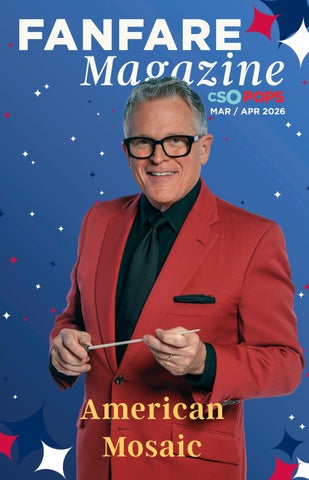
Create a flipbook