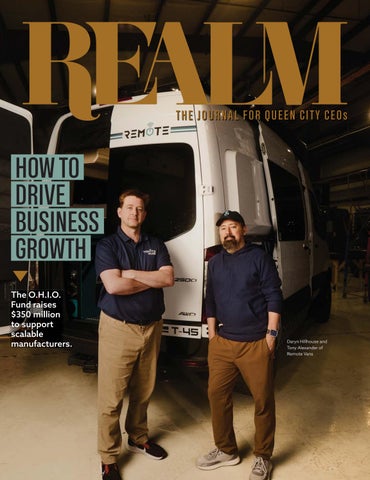
HOW TO DRIVE BUSINESS GROWTH The O.H.I.O. Fund raises $350 million to support scalable manufacturers.
Daryn Hillhouse and Tony Alexander of Remote Vans
Think Think differently
about benefits. aboutyour your small small business business health health benefits. Powered Poweredby by Ohio’s Hometown Health Insurer
In partnership with Medical Mutual, we are offering an expanded ChamberHealth® program to provide you – our members – with premium health insurance coverage while saving you money through group buying power. Through this partnership, we are now able to offer ChamberHealth insurance plans to businesses from 1 to 500 employees in the state of Ohio – an expansion of the program that was previously only available to companies from 2 to 99 employees.
THE BENEFITS
*
ADDITIONAL PLAN OPTIONS INCLUDE:
• Prescription drug coverage
• Wellness programs • Identity theft resolution and remediation services are offered at no additional cost.
TRADITIONAL COPAY AND HIGH-DEDUCTIBLE PLANS WITH HSA
Through ChamberHealth, small businesses and sole proprietors – a first for the ChamberHealth program – can partake in a self-funded insurance plan. Being self-funded has many benefits, including: • The ability to keep costs low since MEWAs are not subject to some of the Affordable Care Act’s (ACA) mandated benefits and taxes • The cost of benefits reflects the unique health of the company and its employees, recognizing that a healthier team should create a better benefits cost outcome • All benefit options are tied to Medical Mutual’s large network of doctors and hospitals, including TriHealth, the Christ Hospital Health Network, and Mercy Health
DENTAL PLANS
LIFE AND DISABILITY PLANS, INDEMNITY PLANS, AND STOP-LOSS COVERAGE
VISION PLANS
LEARN MORE > cincinnatichamber.com/chamberhealth
metro delivers economic development Metro provides safe, reliable, economical rides to more than 35,000 people each day.
But Metro also achieves its mission to drive economic growth and improve quality of life: · Connects 93,400 jobs at over 740 employers to transit service. · Provides 24-hour access to more than 220,000 Hamilton County jobs. · Generates $850 million in total wages for the local economy. · Increases independence and mobility for people with disabilities with 24-hour Access service. · Awards more than $317 million to 100+ infrastructure projects throughout the county under the Metro Transit Infrastructure Fund. · Distributes $500,000 annually to Everybody Rides Metro so more than 100 partner agencies can remove transportation as a barrier to jobs, healthcare, and more.
Whether you ride the bus or not, Metro is your way to go for a brighter, more connected future in Hamilton County.
www.go-metro.com
TABLE OF CONTENTS VOL.6, NO.4
CINCINNATI USA REGIONAL CHAMBER PRESIDENT AND CEO Brendon Cull
04 LETTER FROM BRENDON CULL
TRAFFIC MANAGER Tracey Brachle
08 BY THE NUMBERS
10 TECHNOLOGY DOME SWEET DOME
16 ECONOMIC
The city of Cincinnati pulls out all the stops to beat the snow
SUPPORTING SMALL BUSINESSES
PG. 14 PG. 30
DEVELOPMENT
12 TALENT CINCINNATI STATE MEETS THE MARKET
Seven business owners received $5,000 grants in 2025 from Storefronts to the Forefront
The school plans to double its aviation maintenance technician enrollment again
18 FOOD & BEVERAGE
14 ARTS & CULTURE RISING DEMAND FOR CAR CLUBS Cincinnati car culture enters a new era of bespoke storage spaces
BOARD CHAIR James Watkins President and CEO, Triversity Construction
A rundown on the Flying Pig Marathon’s regional economic impact.
THE JUMP
SERVING UP FOOD AS MEDICINE
CHIEF BUSINESS OFFICER Kate Ward
CHAMBER OFFICE 3 E. Fourth St. Cincinnati, OH 45202 (513) 579-3100 All contents © 2025 Cincinnati Regional Chamber. The contents cannot be reproduced in any manner, whole or in part, without written permission from the Cincinnati Regional Chamber.
DEEP DIVES
Why La Soupe provides healthy, doctor-approved meals for those in need
22
FROM THE PUBLISHERS OF
THE O.H.I.O. FUND’S INVESTMENT ROADMAP How the fund raised $350 million in 16 months to supercharge business growth across the state.
PG. 52
30
THE BIG CONVENTION REINVENTION The Cincinnati Convention Center’s transformation is brand new from the ground up.
36
A BUZZWORTHY FUTURE FOR COVINGTON 50 ASK ME ABOUT
Get to know Jim Danneman of Huntington Bank; Ryan James, the newest face on Cincinnati City Council; and Streetpops founder and CEO Sara Bornick
52 PHOTO ESSAY: PERFECT NORTH SLOPES How a cherished winter destination keeps up with technological advances and unpredictable weather conditions
New City Manager Sharmili Reddy jumps in to manage a beehive of activity.
42
STRIVING TO MAKE A DIFFERENCE StriveTogether paves a path toward economic mobility for millions of young people nationally.
PUBLISHER Ivy Bayer EDITOR-IN-CHIEF John Fox DIRECTOR OF EDITORIAL OPERATIONS Amanda Boyd Walters DESIGN DIRECTOR Brittany Dexter ART DIRECTORS Stefanie Hadiwidjaja, Sophie Kallis, Matthew Spoleti, Emi Villavicencio DIRECTOR OF BUSINESS DEVELOPMENT Tony Frank SENIOR ACCOUNT MANAGERS Maggie Goecke, Joe Hoffecker, Julie Poyer SENIOR MANAGER, SPONSORSHIP SALES Chris Ohmer ACCOUNT REPRESENTATIVES Laura Bowling, Sarah Riesenberger PRODUCTION DIRECTOR Vu Luong EDITORIAL AND ADVERTISING Email cmletters@cincinnatimagazine.com Website cincinnatimagazine.com Phone (513) 421-4300 Subscriptions (800) 846-4333
O N T H E C O V E R : P H O T O G R A P H BY S H O N C U R T I S
P H O T O G R A P H S C O U R T E SY ( T O P ) M O TA / ( M I D D L E ) J O S E S A L A Z A R / ( B O T T O M ) BY G R A N T M OX L E Y
WINTER 2025 REALM 3
WELCOME
A
new year has a way of sharpening our focus and inviting reflection, renewal, and a recommitment to what comes next. As we step into 2026, I’m thinking about our past and our future. This year brings important historical milestones from our past: the 250th birthday of the United States of America and, more relevant locally, the 50th anniversary of both Oktoberfest Zinzinnati and Leadership Cincinnati. But it’s the future that runs through this Winter issue of Realm. You’ll see it in the O.H.I.O. Fund, where public and private partners are choosing to invest boldly in the future of our region. You’ll see it in the newly renovated Cincinnati Convention Center, a tangible expression of our readiness to welcome what’s next. You’ll see it in StriveTogether, where leaders across education, business, philanthropy, and government are coming together to drive better outcomes for future generations, proving that progress accelerates when sectors align around shared purpose. It’s in the ethos or organizations like La Soupe that use innovative ways to solve community challenges. And you’ll see it in our civic leaders, including the new city manager of Covington. The start of a new year brings energy and inspiration and, with it, a reminder that growth is something we create. It requires openness, collaboration, and the courage to evolve. As you read this issue, I hope it sparks a renewed commitment to producing growth together—for our economy, our region, and the next generation.
BRENDON CULL BCull@cincinnatichamber.com
4 REALM WINTER 2025
P H O T O G R A P H OBY T O GJ ERRAEPMH YBYK RTAKMT KE RT K
Whether you’re a start-up or a mid-size company celebrating a landmark anniversary, Heritage Bank can provide the banking solutions and expertise essential to your success. We’re small business banking specialists inspired by our customers’ vision, ingenuity and grit. We’re a community bank vested in the region you call home. •
•
Recommended by business customers 5Xs more often than average business bank.
•
Agile, responsive bankers.
•
Local ownership and decision making.
Efficient conventional and SBA lending.
•
Robust Treasury Management Services.
www.OurHeritage.bank
ELM ST. PLAZA
DOWNTOWN CINCINNATI CONVENTION CENTER
SHARONVILLE CONVENTION CENTER
In Cincy, meetings aren’t just events, they’re experiences waiting to be crafted. Discover Cincy’s endless meeting options they’re Fresh, Bold, and New!
THE JUMP
LA SOUPE WORKS WITH CINCINNATI CHILDREN’S AND UC HEALTH TO OFFER FOOD AS MEDICINE. P H O T O G R A P H BY H AT S U E
Get a jump on news about Cincinnati State’s expanded aerospace maintenance technician program and the Flying Pig Marathon’s economic impact. And catch up on the local growth of luxury car clubs, Storefront to the Forefront grant winners, and the city of Cincinnati’s cool snowplow tracker technology. WINTER 2025 REALM 7
THE JUMP
TOTAL ESTIMATED IMPACT [Flying Pig Marathon events, May 2025]
When the Flying Pig Marathon debuted in 1999, few could have imagined how deeply it would shape Cincinnati’s civic identity. The event focused on community rather than competition, and registration nearly doubled within five years. The nonprofit Cincinnati Marathon Inc. was created to manage the race and reinvest proceeds into the community, rebranding as Pig Works in 2019 to signal a new era of events and programs. The 2025 Economic Impact of the Cincinnati Flying Pig Marathon Report was released recently to quantify its impact in the 15-county Cincinnati region. Statistics provided by the Cincinnati Regional Chamber’s Center for Research & Data.
OUTPUT
EARNINGS
JOBS CREATED
NONLOCAL PARTICIPANTS
$30.7 mil
$10.7 mil
281
LOCAL PARTICIPANTS
$14.9 mil
$4.4 mil
388
NONLOCAL SPONSORS
$224,000
$74,000
2
TOTAL
$45.9 mil
$15.2 mil
671
FLYING PIG GROWTH [Flying Pig events registration, 1999-Present]
50,000
40,000
30,000
TOTAL PARTICIPANTS [Flying Pig Marathon events, May 2025]
20,000
MARATHON
HALF MARATHON
OTHER RACES
ALL PARTICIPANTS
5,686
7,942
23,896
42,809
LOCAL 2,215
LOCAL 7,942
LOCAL 16,039
LOCAL 26,197
NONLOCAL 3,471
NONLOCAL 5,284
NONLOCAL 7,857
NONLOCAL 16,612
10,000
1999
2006
2011
2018
2022
2025
6,163
15,756
30,408
43,127
12,066
42,809
THE NEED FOR SPEED [Finish times for Flying Pig Marathon]
SPENDING BY NONLOCALS
MEN 2025
[Flying Pig Marathon events, May 2025]
Sean Ryan — 2:22:43 Record (2006) | Cecil Franke — 2:20:26
LODGING
DINING
$5.0 million
$3.2 million
SHORT-TERM RENTALS
GAS PURCAHSED LOCALLY
FLYING PIG EXPO
$1.4 million
$1.1 million
$1.0 million
WOMEN 2025
Tori Parkinson — 2:40:06 Record (2002) | Tatyana Pozdnyakova — 2:34:33
TOTAL SPENDING: $15.7 million 8 REALM WINTER 2025
I C O N S BY T H E N O U N P R O J E C T. C O M / A S H O K
THE JUMP
TECHNOLOGY
DOME SWEET DOME Complaining about how, when, and why certain streets get plowed is a local winter tradition as ingrained as the Crosstown Shootout and the Shillito elves. For those who love or hate snow, the city’s Snow Plow Tracker is a fun, interactive way to pass time during each storm.
TREAT THEM RIGHT
Cincinnati’s Department of Public Services turns on the Snow Plow Tracker during full winter response operations, when crews work around the clock. GPS devices in each truck are tracked on a city street map to display real-time locations and the types of treatments each is doing.
COLORING ON THE LINES
The Tracker color-codes streets depending on their status: Untreated, Pretreated (liquid salt brine or beet juice was applied to help prevent snow and ice from bonding to the pavement), Salted, Plowed (snow was physically pushed from the right-of-way), Salted and Plowed, and Problem (blocked access or equipment malfunction).
PRIMARY ATTENTION
Plow crews work 12-hour day and night shifts during full winter response periods, with more than 50 drivers on each shift. Primary routes such as hills, bridges, major thoroughfares, and the downtown business district are serviced first.
SIDE HUSTLES
City officials like to remind us that property owners are legally responsible for maintaining all sidewalks adjacent to their property, especially during snow or ice events.
10 REALM WINTER 2025
P H O T O G R A P H BY A N D R E W D O E N C H
WINTER 2025 REALM 11
THE JUMP
TALENT
CINCINNATI STATE MEETS THE MARKET
The school plans to double its aviation maintenance technician enrollment again.
—SARAH M. MULLINS
Every commercial airplane that lands at CVG requires maintenance by licensed technicians to fly safely. That’s hundreds of flights in and out every week, and yet a nationwide shortage of aviation maintenance technicians threatens to curtail flight expansion here and elsewhere. Cincinnati State is attempting to fill the talent gap by
expanding its popular aviation maintenance technology degree offerings. Program Chair Jeff Wright, himself a Cincinnati State alum, says proof of student interest is in the enrollment numbers. “Since I’ve been the program chair, we’ve grown from approximately 80 students up to about 195, more than doubling our growth in the last
12 REALM WINTER 2025
eight or nine years,” he says. That mirrors overall industry growth across what he refers to as the region’s aerospace corridor, fueled by manufacturing, commercial, and passenger airline expansions. Cincinnati State’s degree model turns students into earners before they graduate, taking advantage of businesses that offer
co-op opportunities. When he was a student, Wright participated in a co-op with Comair Airlines that launched his aviation career. “A lot of students have the opportunity upon graduation to continue on with their employer,” he says. “Some of the employers train them while they’re here so they’re hiring trained employees right out of college.” It’s one of a handful of programs at U.S. colleges offering paid co-ops, which are real-world placements at which students make $20 to $25 an hour while working alongside technicians at companies like GE Aerospace and Delta Air Lines. The work is woven into an FAA-certified curriculum where students split time between classroom instruction and hands-on training in hangars filled with aircraft engines, avionics systems, and helicopters. Cincinnati State’s
two-year program allows students to earn certifications that qualify them for jobs paying $30 to $48 an hour immediately upon graduation, creating what Wright calls turnkey-ready employees who require minimal additional training. The model works so well that employers don’t wait for career fairs but come directly to campus, with PrimeFlight recently hiring 30 to 40 students and GE Aerospace hiring 10 co-op positions. Students who want a job graduate with a job, Wright says, with placement rates near 100 percent.
Because of the program’s success, Cincinnati State has proposed an $8.6-million expansion to grow its 33,000-square-foot Harrison campus facility to 54,000 square feet by adding a second hangar, new labs, and more classrooms. Capacity would nearly double, allowing enrollment to grow to 350 students. As CVG continues to grow commercial operations with Amazon and DHL as well as with passenger airlines and GE Aerospace serving as a worldwide leader in engine technology, the demand grows for aviation maintenance technicians. CVG officials project a need for 1,300 additional AMTs in the region within the next few years, while Boeing forecasts a need for 716,000 new AMTs globally over the next two decades. “The need is literally worldwide,” says Wright. “Companies come to us, and we’re trying to fill the need for these local and national employers.”
TAKING OFF Cincinnati State students get hands-on experience at its Harrison aviation facility.
P H O T O G R A P H S C O U R T E SY C I N C I N N AT I S TAT E
rrightnow.com
THE JUMP
ARTS & CULTURE
RISING DEMAND FOR CAR CLUBS Cincinnati car culture enters a new era of bespoke storage spaces. —ELIZABETH MILLER WOOD
On any given Saturday, hundreds of car enthusiasts are gathered around the city to show and share their prized wheeled possessions. These “cars and coffee” meetups aren’t new. In fact, Cincinnati enjoys a renowned reputation for its car appreciation culture, stemming from deep roots in automotive manufacturing. Today, however, Cincinnati car culture is rapidly evolving with the rising demand for car clubs. These “country clubs for cars” offer collectors not just storage but also opportunities to engage in likeminded communities. One such venue is Mota in Blue Ash, a 55-space warehouse that opened in 2022 and recently changed ownership. The pristine walls of this three-tired, 16,000-square-foot showroom boast everything from vintage Mercedes and classic American muscle cars to exotic Lamborghinis, Ferraris, and Porches. Overlooking the warehouse is a stylish bar and lounge for members to meet, mingle, or even entertain. For owner Dan Wiggins, Mota’s “white glove” approach makes it unique. The facility is not open to the public, and you won’t find its name plastered outside the building. The highly discreet, highly secure space is intentionally hidden in plain sight to offer members both privacy and accessibility. “Access is big for us,” says Wiggins. 14 REALM WINTER 2025
Mota Car Club
“Our customers’ most valuable asset is time.” With 24 hours’ notice, cars members’ can be ready and waiting for pickup. Mota currently has a membership waitlist, but Wiggins says the company plans to expand. In the meantime, car enthusiasts can join its social membership, which provides access to the lounge and monthly events. Dan Neyer, owner of Torque Suites, offers a slightly different take on custom car storage. His new 30-unit facilities in Oakley and Blue
Ash offer private, siloed storage spaces for cars and other toys such as boats, motorcycles, kayaks, and artwork, or even home office space. The concept was birthed out of the pandemic, when people were craving “second places” to connect and entertain. Now the suites are starting to attract those looking for both storage and socializing—especially those right-sizing the footprint of their primary residences. “It’s really opened my eyes as far as what Torque can provide for the community,” says Neyer, president and CEO of Neyer Properties. “It’s what people want.” Torque’s base suite models are approximately 30-by-40 feet plus a mezzanine and bathroom that start around $300,000. They come in finish-shell condition and can be combined together and customized with kitchens, bars, lifts, and other specialty finishes. Some owners even plan to add patios and outdoor entertainment space. As of November, Torque Suites had pre-sold nearly half of its Oakley units and two-thirds of its Phase 1 units in Blue Ash. It appears that demand for car clubs is revving up in Cincinnati for the long haul. Torque Suites
P H O T O G R A P H S C O U R T E SY ( T O P ) R F G R A P H I C S / ( B O T T O M ) T O R Q U E S U I T E S
POWERING THE MINDS Behind Tomorrow’s Machines
PIONEERING A CUTTING-EDGE PROGRAM TO PREPARE FUTURE AI PROFESSIONALS Our Bachelor of Science in Artificial Intelligence at the College of Engineering and Computing is only the second of its kind in Ohio and one of very few in the United States. We combine technical expertise with domain-specific application to ensure our graduates don’t just understand how AI works — they know how to employ critical thinking to use its power responsibly, effectively, and ethically. Miami’s College of Engineering and Computing is Creating the Next Generation of Innovators MiamiOH.edu/AI
BUILD THE FUTURE
THE JUMP
ECONOMIC DEVELOPMENT
SUPPORTING SMALL BUSINESSES Seven business owners received $5,000 grants in Storefronts to the Forefront’s 2025 program. –SARAH M. MULLINS
The Storefronts to the Forefront program has wrapped up its fourth year of supporting small businesses with $5,000 grants that can be used to buy new equipment as well as fund marketing efforts and expansion plans. The Duke Energy, Huntington Bank, and Cincinnati Regional Chamber partnership fosters vibrant communities by supporting cornerstones of various neighborhood business districts. Businesses in seven neighborhoods across the region received grants in 2025. Beyond the financial support, each recipient benefits from a comprehensive marketing campaign—including promo-
16 REALM WINTER 2025
tion through social media, email outreach, and a partnership with Fox19—helping to shine a spotlight on both the businesses and their home neighborhoods. One of the recipients is Strasse Dog, a pet store located in Covington’s MainStrasse area offering cat and dog food along with grooming services. Co-owner Jeff Routt takes pride in curating a selection of products that benefit the local community. “When you go to a big box store, they’ll sell you anything they can to make a dollar,” he says. “Here, I’m very particular with what we bring in. Customers can rest assured that I
Shirley Richmond and Jeff Routt of Strasse Dog (above) and Marvin Smith of Ollie’s Trolley.
know what I’m selling and I can tailor-make a diet for dogs who are having problems.” Strasse Dog carries a variety of foods, including kibble, raw, and frozen options along with cat food and treats. Pet owners in the neighborhood enjoy their personalized recommendations to support dietary needs and their grooming services that keep them looking their best. “When they’re shopping local, the money stays here in the community,” says Routt. “We spend our money here in the community, too, and we probably have the healthiest dogs on this block.” Despite being a small shop, Routt keeps prices competitive, with pet food and treats priced a few dollars less than big box stores. Routt says he plans to use Storefront funds to upgrade the grooming area and make repairs on the company’s delivery vehicles. In the West End, Ollie’s Trolley has become such a neighborhood staple that the city renamed a part of Liberty Street for owner Mar-
vin Smith last summer. He opened the iconic streetcar-shaped takeout restaurant in 1993 in order to give his then-11-year-old daughter something to do after school. More than three decades later, he says, “I enjoy the satisfaction of being able to stay in business against all odds. We know how to treat people. Good food and good service wins all the time.” Smith says he plans to use the Storefront funds to update the restaurant so he can continue to offer burgers, barbeque ribs, classic sides, and desserts for years to come. “Storefronts to the Forefront is completely on target,” he says. “They get it.” The other 2025 grant recipients include A&S Fashions in Northgate, Daylily Deli in the East End, Dot’s Fine Shoe Repair in St. Bernard, Walker Bros. Ice Cream in Montgomery, and Wyatt’s Supermarket in Falmouth. A total of 30 neighborhood businesses have received grants through the program over the past four years.
P H O T O G R A P H BY S K Y L I N N J E N K I N S ( T O P ) / P H O T O G R A P H C O U R T E SY ( B O T T O M ) O L L I E ’ S T R O L L E Y
An Exhibition Humanity Needs You to See at Cincinnati Union Terminal Open for a Limited Time – Plan Your Visit cincymuseum.org/Auschwitz
Visit the exhibition then continue your leadership journey. The Nancy & David Wolf Holocaust & Humanity Center’s professional development opportunities empower you to lead with humanity. holocaustandhumanity.org/upstander
THE JUMP
FOOD & BEVERAGE
SERVING FOOD AS MEDICINE
Why La Soupe provides healthy, doctor-approved meals for those in need.
vides the children and their families with nutrition education throughout the study. Upon its completion, participants take a hands-on cooking class at La Soupe to learn how to prepare Hannah Griswold, La Soupe’s interim exec- their favorite meals themselves. utive director and Food As Medicine director, At UC, La Soupe joined forces with a resays the program’s mission is to integrate good search study focusing on cardiovascular disease food into the healing process. “For those who prevention and management for expectant are chronically ill and can’t shop or cook for Black mothers in Hamilton County, led by themselves, we create a whole food meal that’s Francoise Knox Kazimierczuk, M.D. La Soupe easy to heat and eat,” she says. “Nothing pro- provides MTMs free of charge to participants cessed, no fillers, no additives, with the maxi- to help address pregnancy-related hypertension mum nutrient dose. If the meal and to minimize infant and maternal morbidity. is tailored for diabetes, for ex- “A vibrant ample, it can help improve your Those involved in La Soupe’s city takes disease management, quality of FAM program believe its reach will care of the life, and longevity.” extend far beyond the individual to MTMs are distributed in least of us, benefit society as a whole. “We have conjunction with pilot programs a significant problem in our comespecially at both Cincinnati Children’s munity related to infant and materHospital and UC Maternal moms and nal health, which is important when Health. Children’s researchers babies.” you think about family structure aim to counter childhood obeand dynamics,” says Kazimierczuk. sity by promoting healthier eating through a “When you have a family member or a child combination of MTMs and increased physi- who isn’t well, it affects us as a community, and cal activity. Participants receive meal deliveries if we’re trying to be a vibrant city or county we for 12 weeks. In addition, a registered dietitian should be focusing on the least of us, especially nutritionist from the HealthWorks! Clinic pro- moms and babies.”
–ELIZABETH A. LOWRY
We’ve long heard that you are what you eat. But for people facing food insecurity compounded with a challenging medical diagnosis, getting adequate nutrition seemed to be wishful thinking—until La Soupe stepped in with its Food As Medicine program. Founded in 2015, La Soupe helps bridge the gap between food waste and hunger by turning surplus ingredients from local restaurants and shops into healthy meals for those in need. In the past decade, the organization has transformed 1.4 million pounds of excess food into more than a million servings delivered among 73 communities via various partnerships. While many people receive nourishment through these meals, the “sickest of the sick” were not aways able to accomplish their dietary needs. That all changed in 2022 when La Soupe chefs and volunteers completed specialized training that certified them to prepare Medically Tailored Meals (MTMs) to meet specific needs of people with both chronic health conditions and food insecurity. And so the organization launched Food As Medicine. 18 REALM WINTER 2025
P H O T O G R A P H BY H AT S U E
CINCINNATI & NKY’S T_ƋÅ ī՞AƥÅĘTڑŶ žƙī_ž COLD STORAGE
DISTRIBUTION
MULTIFAMILY
OFFICE
_˷ʹɤͅʹǸʧ˷˰ɤ˷ʹڑբڑLjǸͣʹɤڑģǸ˷Ǹʊɤ˰ɤ˷ʹڑբڑģǸ˷ʅǸɆʹͅʧ˷ʊڑբڑĘʧʅɤڑƋɆʧɤ˷ɆɤͣڑբڑڑTǸʹǸڑIɤ˷ʹɤͣͅڑբ¡ڑʧʊʔɤͅ_ڑɒɆǸʹʧ̇˷
Experience a Better Way to Build. _īžڑՋԏڑLj ž_¡ŀƥƋ_ڑڑTÅƋƙžÅAƥƙÅŀīڑՎڑՋԖڑƙŀŶڑԏԎԎڑT_ƋÅ ī՞AƥÅĘT ڑÅžģƋ
arcocincinnati.com
DEEP DIVE
THE REGION AND STATE INVEST ALMOST $1 BILLION IN CONVENTION CENTER AREA REDEVELOPMENT. R E N D E R I N G BY M O O DY N O L A N A N D T VS
22
The O.H.I.O. Fund’s New Investment Roadmap
30
Downtown’s Convention Reinvention
36
Sharmili Reddy on Covington’s Future Buzz
42
Strive Together Focuses on Economic Mobility
WINTER 2025 REALM 21
DEEP DIVE
An Investment
22 REALM WINTER 2025
P H O T O G R A P H BY S H O N C U R T I S
Roadmap
HOW THE O.H.I.O. FUND RAISED $350 MILLION IN 16 MONTHS TO SUPERCHARGE BUSINESS GROWTH ACROSS THE STATE. BY DAVID HOLTHAUS PHOTOGRAPH BY SHON CURTIS
START YOUR ENGINES Remote Vans cofounders Daryn Hillhouse (left) and Tony Alexander at their St. Bernard facility.
DEEP DIVE
T CUSTOM MANUFACTURING
Remote Vans has expanded its sales of re-engineered Mercedes Sprinter vans through dealers in 16 states.
he pandemic was trying for ever yone. For someone with a penchant for adventure travel, it was downright confining. After a few months of lockdown, Tony Alexander was ready to bust out. The businesses he started, including an online travel registry, were taking a hit. On a whim, he bought a commercial van, outfitted it with creature comforts as well as the tech hardware to enable him to work remotely, and prepared to hit the road. He shared his idea with Daryn Hillhouse, a South African who had served in the British Army, started an adventure travel company, and also found himself cooped up in Cincinnati in 2020. Their entrepreneurial instincts
24 REALM WINTER 2025
kicked in. “We were both kind of looking for something to do,” says Alexander. “So we decided to figure out how to build out these vans, and maybe it would become something.” Alexander had access to the old Moerlein brewery in Over-the-Rhine, where he assembled a team and began re-engineering Mercedes Sprinter vans with beds, kitchens, showers, energy storage, and power capacity, building them on a custom basis for people eager to experience the van life. As the concept found success, Alexander and Hillhouse saw opportunity. Was this going to be a buildone-at-a-time custom order plan, or could they ramp up production, build on spec, and sell the vans around the country? They decided on the latter plan, but that would take capital. “In order
to get the company where we wanted to go, we had to scale much larger,” says Alexander. The company spends millions on chassis, seats, power systems, lights, water pumps, cabinets, and all the accoutrements that create a home on the road, but traditional banks balked at extending that kind of credit to such a young company. They would need an alternate source of financing. Enter the O.H.I.O. Fund, which led a round of financing that enabled the company, now called Remote Vans, to acquire an industrial space in St. Bernard, invest in equipment and components, and essentially create an assembly line to build a lineup of adventure vans. “We’re basically a car company now,” Alexander says, describing four models that range in price from $174,900 to $247,900. Remote Vans are now sold in 16
P H O T O G R A P H S C O U R T E SY R E M O T E VA N S
states through eight different recreational vehicle dealers. As a startup, it got off the ground with funding raised through family and friends, but to get to the next level, says Alexander, “We needed deeper pockets and more access to capital.” The O.H.I.O. Fund (which stands for Ohio High-Growth Investment Opportunities), established in 2024, is a private entity effort to raise money and invest it in Ohio-based companies with high potential to grow. In its first 16 months, it’s raised $350 million and invested $148 million in 25 companies, including Remote Vans. The fund invests in companies across a range of sectors: manufacturing, biotech, digital infrastructure, logistics, real estate and others. The chief criteria for funding is that the business be located in Ohio and be poised for rapid growth. “The focus of the O.H.I.O. Fund is, at its core, filling a missing piece of the of the investing landscape, which is growth capital,” says fund cofounder Jill Meyer. She is a Cincinnatian, an attorney who for 20 years worked for one of the largest law firms in the state and then served for nearly eight years as CEO of the Cincinnati Regional Chamber. She joined three other cofounders, all Ohioans, as the fund began courting investors, raising money, and scouting for investments.
THE SINGAPORE MODEL
D
ESPITE A DIVERSE, growing $900 billion economy, the state of Ohio—and the middle of the country in general—continue to lag the coasts in capital investment in businesses. California and Massachusetts rank first and second in the rate of private capital
investment, far exceeding the rest of the states, according to an analysis published in 2023 by S&P Global. Ohio ranked 30th, below states such as North Carolina, Tennessee, and Georgia. Nearly 15 years ago, the state created JobsOhio, endowing it with a stream of money from the state-con-
P H O T O G R A P H S C O U R T E SY ( T O P ) B R O W N _ P H O T O / S T O C K . A D O B E . C O M / ( B O T T O M ) O . H . I . O . F U N D
trolled liquor sales and appointing it as the lead government agency for attracting and keeping jobs and businesses. JobsOhio is a nonprofit, public-private organization offering grants, loans, and tax incentives to help fund business expansions and relocations. In contrast, the O.H.I.O. Fund,
BOOST GROWTH O.H.I.O. Fund cofounders Jill Meyer and Mike Venerable say a similar fund model helped Singapore’s economy boom (top).
WINTER 2025 REALM 25
DEEP DIVE
OHIOANS FOR OHIO
Like Meyer and Venerable, O.H.I.O. Fund cofounders Mark Kvamme (left) and Ray Leach have had long careers building businesses in Ohio.
despite its name, is not a state entity but a private firm that’s built a pool of capital from some of the state’s biggest banks and corporations and wealthiest individuals. Its mission is to both invest in young growth-potential Ohio businesses and deliver strong returns for its investors. “Our portfolio is geographically focused only in Ohio but across asset classes, as long as it’s about potential returns for our investors,” says Meyer. The fund’s cofounders were inspired by a sovereign wealth fund in Singapore called Temasek. In the 1970s, Singapore was adjusting to unexpected independence from Great Britain and the withdrawal of the British armed forces, groundbreaking events that threatened to diminish the city-state’s economy. Its government created Temasek to own and manage dozens of industrial and commercial businesses that had previously been government-owned, with a mandate to grow them. Temasek’s initial portfolio of 35 companies acquired from the government’s finance ministry was val-
26 REALM WINTER 2025
ued at $354 million. As its pool of capital grew, it was invested in transportation and industrials, financial services, telecommunications, real estate, life sciences, and more, as well as in businesses outside of Singapore in Asia and the Americas. Temnasek’s portfolio today is valued at $434 billion, while Singapore’s economy is one of the fastest growing in the world. “Clearly, that fund was a key component of what transformed Singapore into the economy that it is today,” says O.H.I.O. Fund cofounder Mike Venerable. Venerable is also a Cincinnatian who for more than 17 years was a director and ultimately CEO of CincyTech USA, an early stage, not-forprofit investor that’s funded dozens of high-tech, regional startups. The O.H.I.O. Fund deploys his and his cofounders’ experience and its investor network to source, analyze, and select companies for investment who are, in Venerable’s term, “growthy.” They’re typically established companies that are generating considerable revenue and are prepared to scale up
to accelerate growth. Revenue at Remote Vans, for example, grew 900 percent from 2023 to 2024 and experienced significant growth again this year, says Alexander. The company employs more than 50 people and recently named Hillhouse CEO. Venerable knew Alexander from the CincyTech days and brought the company to the attention of the fund’s other managers. The fund is the brainchild of Mark Kvamme, its CEO and chief investment officer, whose street cred runs deep in Ohio’s venture capital world. He was chosen in 2011 by then-Governor John Kasich to be the state’s director of development and then was installed by Kasich as the first leader of JobsOhio. The governor had imported Kvamme from Silicon Valley, where he was a venture capitalist, most notably with Sequoia Capital, known for its early investments in tech pioneers like Apple and Google. Kvamme didn’t stay long at JobsOhio, but he got it off the ground. Today it’s the center of gravity for attracting and retaining jobs across the state, and in 2024 it reported securing new, planned capital investment of $19.3 billion in 377 projects. Kvamme remained interested in Ohio’s potential and started a Columbus-based venture firm, Drive Capital, to invest in startups situated in the Midwest. He stepped back from Drive in 2022, and his attention turned to creating the O.H.I.O. Fund concept and raising money. “We’ve proven there’s untapped talent here waiting to be nurtured,” Kvamme says in his O.H.I.O. Fund bio. The fund is designed to keep capital within Ohio, enabling local companies to grow without the need to sell big stakes to out-of-state private equity firms or to other investors
P H O T O G R A P H S C O U R T E SY O . H . I . O . F U N D
outside the state who may demand control or significant stake in ownership, which could lead to relocation or to technology, innovations, and other intellectual property leaving the state. The fourth cofounder is Ray Leach, who serves as president and chief financial officer. He was the founding CEO of JumpStart, a Cleveland-based early-stage venture fund and accelerator focused on tech startups.
LEANING IN ON MANUFACTURING
T
HE O.H.I.O. FUND HAS identified six industry sectors its leaders say are “future proof,” meaning they’re already well-established in the state and have good growth prospects. The six are aerospace, with a large workforce and supply chain led by Evendale-based GE Aerospace; advanced manufacturing, with companies like Intel investing in central Ohio and legacy industries in glass and rubber adapting new technologies; biotech and health care, with major research and development spending led by institutions such as Cincinnati Children’s Hospital; digital infrastructure, with giants such as Meta, Microsoft, and Google having already established significant operations here; automotive, with Honda, Ford, and Stellantis operating major manufacturing facilities; and consumer goods and logistics, with giants such as Procter & Gamble, Kroger, and Total Quality Logistics employing tens of thousands in the state. These megacompanies spend billions of dollars with their supplier networks, creating deep supply chains that can create attractive sources of investment to the state. As the trend
to reshore suppliers to the U.S. grows, driven by supply chain disruptions from the global pandemic and more recent tariff complexities, domestic suppliers become a growth investment. “We’re looking to invest across the continuum of the value chain,” says Venerable. “There are layers and layers of expertise in the state that are embedded in these value chains and these core industries. That’s really starting to take off with reindustrialization and the desire to move supply chains back here.” While much of the venture world on the coasts is focused on hightech and artificial intelligence, the O.H.I.O. Fund emphasizes its broad approach to investment decisions that embrace Ohio’s strengths, including manufacturing. “There aren’t a lot of funds today that are really leaning in on some of the bright stars in the manufacturing space,” says Meyer. “That’s always been a core strength of the state and especially of southwest Ohio.” The investment in Remote Vans, which is repurposing an old steel processing plant into a new age vehicle assembly space, is an example. “I’m a little biased,” Alexander says, “but to have a very healthy economy in a region or a state you need to have a mix of light industrial, heavy industrial, high tech, and biomedical. You need the whole mix.” The fund’s first investment was in a company cofounded by Kvamme to license the technology and equipment of a manufacturer in China that makes modules housing semiconductor chips used in vehicles, health care equipment, manufacturing operations, and other arenas. Eagle Electronics, based in northeast Ohio, makes the components in partnership
with another technology company. Domestic production of the modules could help allay security concerns about buying internet-connected products from an overseas manufacturer, the company says. Eagle CEO and cofounder T.J. Dembinski recently announced the O.H.I.O. Fund-backed acquisition of Wireless Mobilty and creation of a new combined company, Eagle Wireless. The O.H.I.O. Fund has invested in a company founded in California in 2019 that moved to Ohio to manufacture electric-engine and internal-combustion-engine shuttle buses and small school buses. Endera now operates out of a former Philips electronics plant in Ottawa in western Ohio.
“MANUFACTURING HAS ALWAYS BEEN A CORE STRENGTH OF THE STATE AND ESPECIALLY OF SOUTHWEST OHIO,” SAYS JILL MEYER.
It’s also invested in a Columbus-based company called Connect Housing Blocks that employs more than 100 people manufacturing modular housing units that can be combined to form apartments. Health care and biomedical firms are in the mix as well. Another Cincinnati-based investment was in JucaBio, which is creating a portfolio of pharmaceutical drugs. Its model is WINTER 2025 REALM 27
DEEP DIVE
TAKEAWAYS INVESTING IN GROWTH The O.H.I.O. Fund was established in 2024 to raise and invest money in Ohiobased companies with high potential to grow. So far it’s invested $148 million in 25 companies, including St. Bernard-based Remote Vans, Montgomery-based JucaBio, and a new robotic welding company to be based in Camp Washington. LEADERS WITH EXPERIENCE O.H.I.O. Fund cofounders include Jill Meyer, former CEO of the Cincinnati Regional Chamber; Mike Venerable, former CEO of CincyTech; and Mark Kvamme, the state’s former director of development and first leader of JobsOhio. MAKING CONNECTIONS Local investors in the fund include Western & Southern, Fifth Third Bancorp, American Financial Group, First Financial Bank, Cincinnati Children’s, Greater Cincinnati Foundation, and several high-net-worth individuals. “To date, our deal flow has almost all come through our investor network,” says Meyer.
to identify, acquire, and advance early-stage therapeutics from academic research, large pharmaceutical companies, and other biotech companies. Its leading acquisition is a drug to treat lung disease acquired from Sanofi, one of the world’s largest pharma companies. The O.H.I.O. Fund also invests in real estate, including Rickenbacker South Industrial Rail Park, a 671acre site in Pickaway County next to a major rail line and has major electric infrastructure available for industrial users.
SOUTHWEST OHIO’S OPPORTUNITIES
R
AISING $350 MILLION in little more than a year, as the O.H.I.O. Fund did, is an
impressive feat. It was accomplished through the contributions of about 120 investors, nearly all of them from Ohio. As of November, the lion’s share of the investment dollars, 58 percent, had come from the state’s northeast region, with about 14 percent raised from southwest Ohio investors. The local investors include a who’s who of Greater Cincinnati funders: Western & Southern, Fifth Third Bancorp, American Financial Group, First Financial Bank, Cincinnati Children’s, Greater Cincinnati Foundation, and several high-net-worth individuals. They provide not only a financial foundation but connections and insight into promising companies to invest in around the state. “To date, our deal flow has almost all come through our investor network,” says Meyer. “The men, women, and companies investing in the O.H.I.O. Fund are also
BLOCK INVESTMENT
The O.H.I.O. Fund invested in Connect Housing Blocks (above), which manufactures modular housing units that can be combined to form apartments like those in the Trolley District in Columbus (opposite page).
P H O T O G R A P H S C O U R T E SY C O N N E C T H O U S I N G B LO C KS
bringing us a very rich pipeline of deal flow from all parts of the state, and that’s critically important.” In September, the fund announced it contributed to a $70-million round of funding for Splash Financial, a 12-year-old Cleveland-based fintech that connects borrowers with a network of lenders through its automated loan processing technology. The company said it plans to use the funding to expand into offering access to home equity lines of credit through credit unions and community banks. In October, the fund announced an investment in Ease Logistics, a Dublin-based firm that for eight consecutive years has made the annual Inc. 5000 ranking of the fastest-growing private U.S. companies. The company is working with a software developer to expand its AI technology platform.
“We’re trying to change that mindset of so many investors, including Cincinnati investors, that to get the best returns they have to go outside of Ohio,” Meyer says. “They don’t.” A number of the fund’s key early investments were in companies located in central and northeast Ohio, but more activity is happening in the Cincinnati region as business leaders become familiar with the opportunities. “We’re talking about building economies, raising money, and investing money in every corner of the state, from southeast to northwest,” says Meyer. The fund’s latest investment is a new company setting up shop in the traditionally industrial neighborhood of Camp Washington. Although the company is new, it’s not really a startup. The business is based on the technology of a Columbus company that provides autonomous robotic welding systems to a variety of manufacturers, a potential solution for a nationwide shortage of welders. That company recognized an opportunity to build
a robotic welding company from the ground up, a change from its model of installing its robotic machines in traditional welding shops. “We’ve worked with them to essentially form a new company that will be located in Cincinnati to do robotic welding,” says Venerable. Engineering talent from global aerospace companies has been recruited here to run the new company, which is expected to be announced some time in the first quarter of 2026. The O.H.I.O. Fund’s connections and financial support sealed the deal to locate the company in Cincinnati’s urban industrial corridor, says Meyer. “That doesn’t happen without the O.H.I.O. Fund, without private investors pooling their money, and having a group of people with a growth mindset looking around the state to say, What do we need to build, and where do we need to put it?”
WINTER 2025 REALM 29
DEEP DIVE
The Big Convention Reinvention
THE CINCINNATI CONVENTION CENTER TRANSFORMATION IS BRAND NEW FROM THE GROUND UP. BY CARRIE BLACKMORE
30 REALM WINTER 2025
I
ce skaters glide by on a skating rink on the new Elm Street Plaza, as visitors sit around fire pits or inside glass igloos enjoying a hot cocoa or a cocktail. Across Fifth Street, hungry diners enter the new Salazar restaurant, while others stroll a couple blocks east to check out Winterhaus on Fountain Square, a new 65-by-65-foot heated enclosure featuring a bar and comfortable seating. Keeping watch over it all stands the reopened Cincinnati Convention Center, which project leaders call a “total modernization” of the former Duke Energy Convention Center. Expanded multiple times since it first opened in 1967, this is the first major remodel in 20 years. “It’s not a renovation, it’s a reinvention,” says Julie Calvert, president of Visit Cincy, the region’s destination marketing and management organization. “We’re not talking about just a fresh coat of paint. We built a brand-new convention center from the ground up.” The $264-million update features a new exterior on the building, with many more windows of-
C O N V E N T I O N C E N T E R P H O T O G R A P H BY Z A K K A U T H
fering convention attendees soaring views of the city and allowing natural light to fill the center. The concourses have been widened with new food and beverage alcoves and networking nooks. New mechanical, electrical, technological, and plumbing systems were installed throughout the building, along with new digital signage for each room. A new 6,000-square-foot rooftop terrace was added for outdoor meetings and social meetups. While the center remains roughly the same overall size at 750,000 square feet, this redesign allows the space to be configured in multiple new ways so that it ’s more functional and flexible and maximizes revenue opportunities, planners say. Eventually it will be connected by a skywalk across Fifth Street to a new $536-million, 700-room Marriott convention headquarters hotel, scheduled to open in summer 2028.
These redevelopments, including the 2.5-acre Elm Street Plaza on the convention center’s doorstep and conversion of the old Saks store into Paycor offices and Salazar restaurant, will breathe new life into the southwest corner of downtown, Calvert says, while also making the city more attractive to meeting and convention planners. “We’re selling this vibrancy happening in Cincinnati,” she says. “We’re not just a city that goes into hibernation when it’s cold. We’re active 365 days a year.” Project leaders say they’re beginning to see a return on the investment already, as convention center bookings for 2026 thus far represent $37 million in economic impact. Groups reaching out to book the convention center have been, on average, 20 percent larger than before the district’s revitalization, according to statistics provided by Visit Cincy.
I READY TO GO
Visit Cincy’s Julie Calvert and ASM Global’s Bob Louis say the new convention center projects present tangible “vibrancy” for Cincinnati visitors.
H E A D S H O T S C O U R T E SY ( B O B LO U I S ) A S M G LO B A L / ( J U L I E C A LV E R T ) V I S I T C I N CY / I C E S K AT I N G P H O T O G R A P H BY J E R E M Y K R A M E R
NSIDE THE NEW CONVENtion center, Director of Sales Bob Louis points out some of his favorite touches. Warm wood tones throughout the center. Accents of Rookwood tile and terrazzo flooring. The addition of Mothers’ Rooms for nursing moms. Breakout spaces in the wider concourses. New views of Carew Tower, the city’s west side, and City Hall are enticing, he says, as are massive new digital signs inside and outside that will help orient and inform visitors. The renovation includes new and preserved art by local artists, Louis says, including the new piece “Children Building a City” by AnTevin Brown and two Charlie Harper mosaics first installed in 1967. Louis says he’s hearing a lot of positive feedback so far from potential clients, including those who are happy that the largest ballroom (now named Cincinnatus) hasn’t changed, aside from
WINTER 2025 REALM 31
DEEP DIVE
roughly $1 million in lighting and tech upgrades. Exhibit halls on the main floor can now be divided into smaller spaces to create lounges and meeting rooms off of the main convention floor. Another big change is that the convention center is under new management after the city ended its contract with Los Angeles-based Oak View Group. The city of Cincinnati, which
32 REALM WINTER 2025
KEY PLAYERS
3CDC’s Katie Westbrook and restaurateur Jose Salazar.
owns the convention center, selected ASM Global to manage it in August 2024; ASM was acquired later by Legends and rebranded as Legends Global. The New York-based company added Cincinnati to its portfolio of roughly 450 convention centers, music venues, and sports venues around the globe—including the Dallas Cowboys, New York Mets, PGA of America, and
the International and Exhibit Convention Centre in Sydney, Australia. The center has hired Chicago-based Levy Restaurants as its exclusive food and beverage provider, Louis says, and that team will deliver “a culinary experience that is as dynamic as the guests they serve” in the center’s new eateries. Cincinnati-based Prestige AV and Creative Services is the preferred audio and visual partner, providing set design, equipment rental, technical expertise, and professional installation. When planners got started reimagining the center, they were determined not to think of the building as “boxes where meetings happen,” says Katie Westbrook, senior vice president of development at 3CDC, which managed the design and construction project. Instead, they leaned into a look and feel that focuses on hospitality and comfort, she says. Westbrook has been working for 3CDC for nearly 14 years, directly managing such redevelopment projects as the headquarters for Empower Media in Over-the-Rhine; Court and Walnut streets, including Kroger on the Rhine; and The Foundry, the conversion of the former Macy’s store into a mixed-use development that now houses Divisions Maintenance Group, Deloitte, and Turner Construction along with new bars and restaurants. “Based on some of the changing dynamics of conventions wanting more outdoor space, we thought that this was the perfect opportunity to create a public plaza that would not just be a great asset to the convention center but also a catalyst for other development down there,” says Westbrook. Project leaders decided to permanently close Elm Street between Fifth and Sixth streets so that the convention center doors open right up to the pedestrian plaza, allowing convention
H E A D S H O T C O U R T E SY 3 C D C / P H O T O G R A P H S P R O V I D E D BY S A L A Z A R / E X T E R I O R BY L I Z F O R D
groups to use the space for opening receptions and client and networking events. That’s become a big selling point, Louis says.
C
ALVERT IS HAPPY TO re p o r t t h a t , d u r i n g t h e 18-month renovation project, Visit Cincy didn’t lose any of the annual conventions it had hosted in previous years, even though many had to find alternative venues for one or two events. The first annual event to return is Redsfest, which runs January 16-17. “We’re excited to welcome them all back,” Calvert says. “It’s like your friends that you’ve missed and they’re coming back to something that’s so much more enjoyable and so much improved.” Planners expect the upgrades to lure bigger groups to Cincinnati, and Calvert is excited to announce one already. In July, the city will welcome its largest conference of the year, the
R E N D E R I N G C O U R T E SY M O O DY N O L A N A N D T V S
International Conclave of the Omega Psi Phi, the first international fraternal organization founded at a historically Black college, Howard University. Today Omega Psi Phi has more than 700 chapters across the globe, including the U.S., Mexico, and China, and should attract more than 10,000 visitors to the Queen City, Calvert says. The month before, Cincinnati will welcome back an educational conference where Advanced Placement tests for the College Board are scored. Lasting almost the entire month of June, the conference represents about 19,000 hotel nights, Calvert says. Redevelopment in this part of downtown is being supported and financed by a series of partners. The state of Ohio pledged $46 million, the city of Cincinnati made a $30-million direct contribution, and Hamilton County
“WE NEED THE NAME OF CINCINNATI TO BE CLOSELY ASSOCIATED WITH THIS BUILDING,” SAYS JULIE CALVERT, “SO WHEN PEOPLE SEE IT THEY CINCINNATI.” SAY, OH, THAT’S CINCINNATI.
Commissioners chipped in $15 million and agreed to raise the county’s Transit Occupancy Tax (TOT) by 1 percent. Most of the $264-million price tag for work on the convention center and Elm Street Plaza ($219 million) was paid for by the issuance of public bonds by the Port of Greater Cincinnati Development Authority, backed by revenue pledged via TOT proceeds from the city and county. The city is working on re-selling WINTER 2025 REALM 33
DEEP DIVE
TAKEAWAYS MILLIONS OF UPDATES The $264-million Cincinnati Convention Center renovation project added a new exterior on the building and more windows with city views, bringing natural light inside. Concourses were widened with new food and beverage alcoves and new mechanical, electrical, and plumbing systems installed throughout. A rooftop terrace and Elm Street Plaza spread the convention experience outdoors. BET ON DOWNTOWN The city, county, state, and private partners are investing close to $1 billion total in the southwest quadrant of downtown with the new convention center, Marriott hotel, Paycor/Salazar building, and supporting infrastructure. TOURISM ECONOMY Visitors spend $6.5 billion annually in Hamilton County, while 67,000 jobs are supported by the tourism industry in the region. Visitor spending resulted in $352 million in local taxes in 2024.
the center’s naming rights, after Duke Energy agreed to end its contract early. No matter which company gets the naming rights this time, Calvert says, the center will be referred to as the Such-and-Such Cincinnati Convention Center going forward. “Duke has been a great partner, but what city is Duke,” she says. “We really need the name of Cincinnati to be closely associated with this building so when people see it they say, Oh, that’s Cincinnati.” The “CINCINNATI” sign on the building’s west side facing Interstate 75 has been replaced with a new LED version that Calvert calls a “digital canvas” capable of containing signature visuals like Bengals stripes or Reds or FC Cincinnati motifs. Beyond being centrally located to many other parts of the U.S., Cincinnati makes a great host city for multiple reasons, Calvert says. “We’ve got a lot going on,” she says. “Whether you’re here for business, for a convention, or for leisure, we invite you into our story. We want you to experience the things that make Cincinnati great—our sports, our arts, our culture, our culinary, our festivals like BLINK, Oktoberfest. The city is not only alive and vibrant, but we create a sense of belonging for anybody to be here.” Thus far, the convention center has meetings booked as far out as 2029 and is now entertaining bids through 2031.
T
HESE REDEVELOPMENT projects are now part of the city’s Fountain District, project planners say, offering a plethora of locally owned restaurants like Jeff Ruby’s Steakhouse, The Davidson, Marigold, Via Vite, Maplewood, Mita’s, Salazar, and Baru as well as unique
entertainment venues like the karaoke bar Tokyo Kitty, simulated golf experience at Five Iron Golf, and recently opened interactive dart bar and restaurant Flight Club. The convention center is also in walking distance of The Banks and Smale Riverfront Park, the city’s sports stadiums to the south, and historic Over-the-Rhine to the north, with nearby access to the streetcar connecting visitors to Findlay Market and everything in between.
“WE THINK THE REWARD IS GOING TO BE BIGGER AND BETTER CONVENTIONS COMING TO TOWN AND A MASSIVE BOOST OVERALL TO THE REGIONAL ECONOMY,” SAYS 3CDC’S JOE RUDEMILLER.
“We are all really excited to be adding another civic space, Elm Street Plaza, to our portfolio,” says Joe Rudemiller, spokesman for 3CDC. “It will impact what Visit Cincy and Legends Global can do in terms of bookings, but we’re also really excited about what it’s going to do for the southwest quadrant of downtown.” When Elm Street Plaza is not being used by conventioneers, it will be managed and programmed by 3CDC, similar to arrangements at Fountain Square and Washington Park. The UC Health Ice Rink was moved from the square to the plaza this winter and enlarged; it remains open for public skat-
ONLY HERE
An upgraded CINCINNATI sign on the convention center’s west exterior wall is just one improvement to help Visit Cincy market this downtown area as “only in Cincinnati.”
ing through mid-February. When it’s removed, an interactive water fountain will become the focal point in warmer months. More public art will be installed through partnerships with a local artist collective, Black Art Speaks, and AGAR arts marketing agency. The Marriott headquarters hotel will be developed and owned by Atlanta-based Portman Holdings, which also purchased the nearby Westin Hotel with plans to update it. If you include the WHEX parking lot redevelopment on Fourth Street, which will create parking for the convention hotel and the public, total updates in the area so far represent an $828 million investment, Rudemiller says. “It has been a collaborative effort among public and private parties across all sectors,” he says. “We think the reward to the region is going to be increased attendance, bigger and better conventions coming to town, and a massive boost P H O T O G R A P H BY J E R E M Y K R A M E R
overall to the regional economy.” Properties adjacent to the convention center are sparking redevelopment interest, too, Westbrook says, including the former Convention Place Mall at 435 Elm Street, which was torn down in 2024 and is development ready. The Port Authority plans to demolish a garage it owns at Sixth and Elm streets, and Brent Spence Bridge reconstruction will eventually open up another 8-10 acres of land west of the convention center, Rudemiller says. “I don’t know how the community ultimately wants to develop that,” he says, “but we think that’s another area the city can take advantage of.” Visitors spend $6.5 billion annually in Hamilton County, and roughly 67,000 jobs are supported by the tourism industry in our region, with visitor spending resulting in $352 million in local taxes in 2024. “This city is constantly reinventing itself,” says
Calvert, who has been selling the Cincinnati experience for 30 years. “Good enough is not good enough. You want to be great.” Visit Cincy and its partners, including the new Cincinnati Regional Sports Commission, have made it clear that they want to host the NFL Draft one of these years, for example, and the revamped convention center, new hotel, and all of the development around it will up the city’s ante, Calvert says. She hopes that local organizations and business leaders will stop to consider the convention center—as well as Cincinnati’s other meeting spaces like the Sharonville Convention Center and the Northern Kentucky Convention Center—for their future meetings and gatherings. “Whether you’re small or you’re large, have your meeting in Cincinnati,” says Calvert. “Be an active part of selling this city. Be loud, be proud.” WINTER 2025 REALM 35
DEEP DIVE
A Buzzworthy Future for Covington NEW CITY MANAGER SHARMILI REDDY JUMPS IN TO MANAGE A BEEHIVE OF ACTIVITY. BY JOHN FOX
S
harmili Reddy started work as Covington City Manager in mid-August, bringing 20 years of experience in Northern Kentucky government to one of the region’s highest profile positions. She’s had little time to catch her breath, jumping right in to manage once-in-a-generation projects, including a brand new City Hall, redevelopment of the old IRS site, and a major bridge closure. Covington has always played a prominent role in the region as the largest city in Northern Kentucky and fifth largest in the state. But the current activity level there would be impressive for much larger municipalities. In the next few months, the state will tear down the Fourth Street/Route 8 Bridge for a total replacement, cutting off a major east-west route across Northern Kentucky, and the first housing construction will start at the Covington Central Riverfront site, former home of the IRS processing complex. Over the coming year, construction of the new City Hall on Scott Street will wrap up, design plans will be released for the University of Kentucky’s new medical school and Northern Kentucky University’s new law school buildings 36 REALM WINTER 2025
P H O T O G R A P H BY A N D R E W D O E N C H
NEW CITY HALL Covington is building a new government center on Scott Street.
As other developers start to see the first housing and the garage come out of the ground, they’ll be able to visualize what the site could actually look like and that it’s happening. A bold vision like this takes time and patience, and we’re more focused on getting it right than getting it done fast.
This project reminds me of what’s happened in Over-the-Rhine, where they needed someone to take a chance and go first with investment.
downtown, and Brent Spence Bridge site work will finally get underway. Oh, and the position of Covington City Manager goes away at the end of the year. City voters approved a shift from the City Manager form of government to the Mayor/Council system several years ago, and it takes effect on January 1, 2027. Reddy will help Mayor Ron Washington and City Commissioners set up the new structure while hoping to continue serving in leadership. Reddy has navigated plenty of change in her career, working in several planning and administration capacities in Ft. Mitchell and Kenton County. She first came to the region from her native India for a master’s degree in community planning at UC’s College of Design, Architecture, Art, and Planning, then worked in Pennsylvania and Louisville before moving back here in 2005. She spoke with Realm to discuss the city’s beehive of activity and her plans for proactively engaging residents, businesses, and visitors during this busy period.
Your highest profile development effort right now is the Covington Central Riverfront project at the old R E N D E R I N G C O U R T E SY C I T Y O F C O V I N G T O N
IRS site. You’re essentially creating a new urban neighbohood and enlisting different developers to build their own blocks so the area doesn’t end up with a uniform look and feel, correct? Our first phase is about installing—or reinstalling—public infrastructure to the site, starting with the basic street grid network. Three lots have been sold, and we know the development happening there. Block A just broke ground in December and will consist of 10 single family homes along Fourth Street from Funke Real Estate Group. Next to that in Block B will be 16 townhomes from Drees Homes. We’ve also sold Lot M, which will be 257 apartments in two five-story buildings, along with about 7,000 square feet of commercial space. So we know those three are going to happen in a fairly short timeline. Phase 2 will include a parking garage that needs to be built in order to spur development across the rest of the site. So between the garage and the street grid, we will have put the basic public infrastructure in place.
It’s been about five or six years since the city’s original vision was set, but we’ve never said that there wouldn’t be changes along the way. Residents and businesses continue to provide feedback. Like with any other vision, we review our assumptions and our plans over time and make sure that it’s all progressing well.
Another high-profile development is the OneNKY Center at the Roebling Bridge, which opened in September as a gateway to the city across from The Ascent. How does bringing Northern Kentucky’s economic development organizations under one roof there benefit Covington? We are thrilled to have them all choosing to be in downtown, which will certainly help Covington coordinate better on regional and statewide issues. We have so many things happening right now that it’s really nice to have meetNKY, BE-NKY, the Northern Kentucky Chamber, and others close by. At the end of the day, it’s an amazing office space bringing employees to our restaurants and our riverfront amenities and bringing clients and visitors to our city. We’ve already been in meetings with the WINTER 2025 REALM 37
DEEP DIVE
to the Central Riverfront mixed use lots. Our streets are packed on weekends. People love the vibe we provide. So we do a rent subsidy program, a facade improvement program, and a historic sign restoration program, and Covington has invested a total of $1,016,827 across all three programs. Small businesses, in turn, invested $11,406,187 of their own capital, an impressive ratio of 1:11.2. I love the charm and the vibe that old signs bring to our business districts.
various organizations when, once we’re in the building, we’ll just walk over to the folks at another one to ask what they think of this or that. And the state invested $15 million to build the LifeSciKY space on the building’s second floor, which will offer lab and startup support to life science research organizations that otherwise would have to invest in building out their own spaces. I like to think about it as entrepreneurship in the life science arena, and there’s nowhere else in Kentucky where that’s available.
Covington has invested in local entrepreneurs and, in particular, in small businesses. Why is that a priority? SparkHaus is our most recent development when it comes to those focus areas. It officially opened in September on Madison Avenue to provide co-working space, private offices, and meeting/event space for entrepreneurs. The city’s Board of Commissioners 38 REALM WINTER 2025
established a grant program for SparkHaus that will be used to attract companies from outside Covington to locate there and cover administrative costs for Entrepreneur Day Programming for local high school students, among other initiatives. One great example of what’s happening at SparkHaus is the startup Proximity, which moved into the building once it opened. The founder, Grant Murray, is working on innovative solutions for parking, and I don’t know all the details, but he’s working with Covington’s parking authority—and other cities—to figure out parking solutions in urban settings. If you’re in an urban environment, you know that parking is always a big issue. Now that he’s working at SparkHaus, we hope he falls in love with Covington and the business is successful and he decides to stay here when he expands and looks for office space. Supporting small businesses is a huge priority for us. They’re an integral part of our entire commercial ecosystem here and why people love coming to Covington. We’ll also be recruiting small, locally owned businesses
As neighborhoods become successful—from MainStrasse to the Madison and Pike section to the new central riverfront development—how do you keep residents and small businesses in place? One of the key initiatives Mayor Ron Washington has focused on since he took office is housing. We’re very clear that Covington is an inclusive community. We want everybody here, and we’re very welcoming. The market will do what it does, but we can still look for specific strategic opportunities where we can accommodate everybody. We’re in the preliminary phases of planning that housing initiative, but it targets that $15- to $25-anhour person: teachers, firefighters, people in the service industry. Some people call it workforce housing or affordable housing or attainable housing, but it’s about helping people who are not making a lot of money stay where they want to live and not get priced out. Housing affordability is an issue across the country. Mayor Washington recently took some of us on a tour across the city to remind everyone that Covington is more than just north of Fourth Street. The city goes all the way to Taylor Mill, and so much of our community is truly affordable. Latonia is a beautiful, tight-knit
R E N D E R I N G C O U R T E SY C I T Y O F C O V I N G T O N
community that offers good amenities, is easily accessible, and has smaller starter homes. Prices are still higher than 10 years ago, but there is still so much to the city that allows people to stay in their homes and preserve that residential character we’ve had for a long time.
Speaking of north of Fourth Street and accessibility, what is the status of the Brent Spence Bridge project in Covington? I know it often seems like nothing is going on with this project, but we are deep in that world every day at City Hall. There are two bridge projects taking up a lot of our time behind the scenes: Brent Spence and the Fourth Street/Route 8 Bridge connecting to
R E N D E R I N G C O U R T E SY K Y T C D I S T R I C T 6 .
Newport, which closes in mid-January. The public portion of the Brent Spence project is supposed to start in some capacity in late spring. In my four months here I’ve seen excellent cooperation among government and business interests to get ready for both, particularly the Fourth Street project. That bridge is being torn down and replaced on the same site, with a two and a half year timeline. Brent Spence is going to take longer, of course, potentially five to six years. The Kentucky Transportation Cabinet has been very supportive of the city’s efforts. In December Mayor Washington announced a $750,000 state grant to help fund our Bridging the Gap program to keep residents, businesses, and visitors informed and engaged throughout both bridge
projects. Obviously, communication will be one of the biggest items with that.
Can I ask you if you’ve learned some lessons from the I-471 bridge fire in late 2024 that really impacted Newport and Bellevue businesses and commuters? We absolutely learned lessons on the impact and what those communities did to minimize that impact by coming up with creative solutions and incentives. They had to react to the fire, while we’re able to be more proactive and make plans now to partner with our businesses. They know their clientele and what brings people to down-
MORE ACCESS
Covington is working to attract new residents at the old IRS site (opposite page) and to connect better with neighboring river cities (below).
WINTER 2025 REALM 39
DEEP DIVE
TAKEAWAYS BRIDGING THE GAP Sharmili Reddy became Covington City Manager in August as the city juggles multiple large-scale development projects, from the old IRS site and a replacement Fourth Street Bridge to a brand new City Hall and Brent Spence Bridge groundbreaking. Plus her job title goes away on January 1, 2027. HOUSING SQUEEZE Reddy and other city leaders are working on ways to keep longtime residents and businesses involved in Covington’s growth and success. A new housing initiative will target people making $15-$25 an hour to help them not get priced out. The city also has several grant programs available to boost small businesses. WORKING TOGETHER Reddy says being a regional thinker comes naturally to her, thanks to her various government roles across Northern Kentucky over 20 years. “So anytime we need resources or a connection or some help, I feel like I know who to call and who to rely on,” she says.
town Covington, so we want to be supportive of their ideas on how to keep bringing customers through their doors. We’re talking about proactive communication and marketing and telling our visitors and workers, Hey, it’s still easy to come to Covington. These projects might be happening, but the city is still open for business. We’re working closely with Newport, Campbell County, Kenton County, meetNKY, the Chamber, the Kentucky Transportation Cabinet, and other partners. So the theme of regionalism is super important for this project, because the Brent Spence Bridge is not only huge for the future of Kentucky, it’s huge for the country because of the amount of GDP that moves across it. We put together a group of folks representing businesses in three different districts in Covington—MainStrasse, the central business district, and Roebling Point—to ask for ideas. And what’s come out of that is some really cool concepts people are excited about. We talked about how we can let people know that it’ll still be easy to get around Covington and park during these bridge projects. We’re hoping that a lot of these short-term projects will benefit the city long after the bridges are finished.
Will Covington be able to take advantage of the new Brent Spence
“THE MORE PEOPLE WE CAN BRING HERE TO GET THE COVINGTON EXPERIENCE, THE MORE EXCITING IT IS FOR US AS A CITY. I HOPE SOME OF THEM WOULD JUST NATURALLY STAY BECAUSE THEY’D FALL IN LOVE WITH THE PLACE.”
Bridge configuration to recapture usable land as planners are hoping to do on the Cincinnati side? This project is not so much about new land on the Covington side, and this is where our partnership with the Kentucky Transportation Cabinet has been fantastic. We are getting a new master plan for Goebel Park next to the highway, which has been needing some attention for a long time. We’re working on a maintenance of traffic plan with KYTC in order to minimize traffic disruptions during construction. We will know three months ahead of time before any closures take place, and there will be at least one highway exit for Covington maintained at all times.
The University of Kentucky is opening a medical school in downtown Covington, while Northern Kentucky University is relocating its law school there. What will those projects mean for the city? The more people we can bring here to get the Covington experience, the more exciting it is for us as a city. These schools will bring a whole new population and age group to the city that’s going to truly raise the bar here. Of course that’s going to spur some additional development—new housing, maybe—and new partnerships. I wonder, for instance, would the new law school attract more law firms to locate nearby, or doctor offices or medical groups to
locate near the med school. I mean, the state’s future doctors and lawyers are going to be educated right here, and I hope some of them would just naturally stay because they’d fall in love with the place.
You’ve worked in local government in multiple Northern Kentucky jurisdictions and often been on the other side in conversations or negotiations with the city of Covington. Have you started to take advantage of your connections around the region to benefit Covington? I’ve been in the region for about 20 years now, and my roles have kind of morphed over the years between countywide, then city, then back to countywide, and now back to city. You can say this about Cincinnati in general, but Northern Kentucky is a really tight-knit community. Everyone is either related to somebody or knows somebody. It’s literally like one degree of separation. It took me a while to become a part of that fabric, but I’ve received tremendous support and encouragement in every role I’ve held. Thinking regionally but acting locally is in my DNA. So anytime we need resources or a connection or some help, I feel like I know who to call. I know who to rely on, because the relationship is already there. I wouldn’t say that getting things done in Covington is difficult, it’s just more complex because the issues we deal with aren’t necessarily issues you
P H O T O G R A P H BY C H R I S V O N H O L L E
deal with outside of an urban core. But it certainly helps to have that perspective from the outside looking in and now being in it. The Southbank Partners organization pulls together city managers and administrators from Northern Kentucky’s river cities to meet monthly. So we’re in a room every month talking about new projects, challenges, and how to coordinate. We tend to lean on each other. I feel like at any point in time I can pick up the phone and call one of them and be like, Hey, are you dealing with this? What have you done with that? So we’re not reinventing the wheel and can move faster. We deal with similar issues as Newport, Bellevue, Dayton, and Ludlow, and we also have similar goals: trying to increase housing and small businesses, trying to attract and retain talent, trying to bring in visitors.
Covington city voters voted to change from a City Manager form of government to more of a strong mayor structure in January 2027, which means your job goes away in a year. If so, why did you take this job? Many big and medium-sized cities have a City Administrator structure for a reason, because we’re supposed to be nonpolitical, focused on the community needs, and helping elected officials implement their priorities. So my role will change from a title standpoint, from City Manager to City Administrator, and the mayor will be the city’s executive authority. My focus is on doing a good job for the city in the next year. I’m not too worried, to be honest—I want to give
it all I got, and I’m hoping to roll into the City Administrator role. I’m used to the mayor/council form of government from previous jobs, so I’m already kind of shifting to that mindset, knowing that it’s coming in a year. The next year will see us updating our city ordinances to reflect this new form of government and improving efficiencies. For instance, under the current system every single city employee hiring has to go through the Board of Commissioners, which means at least a twoweek public process. In the new form of government, other than the four positions that are statutorily required to have council approval—City Administrator, Police Chief, Fire Chief, and City Clerk—the others can be handled administratively under the Mayor’s authority. That’s a new level of efficiency in a 400-person city staff, though we have to balance that with not losing accountability and public scrutiny. We have a transition committee in place made up of residents who are helping the city look at new efficiencies, and we’re hoping to have a plan in place by July. WINTER 2025 REALM 41
DEEP DIVE
Striving to Make a Difference STRIVETOGETHER PAVES A PATH TOWARD ECONOMIC MOBILITY FOR MILLIONS OF YOUNG PEOPLE NATIONWIDE. BY SARAH M. MULLINS
C
ommunities across the U.S. spend millions of dollars trying to help children succeed. Schools invest in curriculum, nonprofits host after-school programs, businesses fund scholarships, and local governments support early childhood education. These organizations often track their own metrics, report to their own boards, and celebrate wins in siloes—while systemic challenges remain and students can fall through the cracks on the path to economic mobility. StriveTogether is working to change this silo solution approach. The nation’s largest
42 REALM WINTER 2025
network of place-based education partnerships has spent nearly two decades demonstrating that outcomes improve when communities align around the same goals and share the same data. It isn’t necessarily about launching new programs, but better coordinating what already exists. Place-based partnerships connect nonprofits, businesses, schools, philanthropy, and other organizations by bringing together regional leaders to build a stronger future for their community. By taking a cradle-to-career approach, children are set up for eco-
C O L L A G E BY S T E F H A D I W I D J A J A
nomic mobility from the moment they’re born to the time they enter the workforce. “Economic mobility in the U.S. has been declining since the 1940s,” says Jennifer Blatz, president and CEO of downtown-based StriveTogether. “People don’t realize that many young people are not on a path to economic mobility, which is essential to achieving the American dream.” According to Opportunity Insights, only half of U.S. children these days grow up to earn more than their parents did. StriveTogether’s goal is to put four million more young people on a path to economic mobility by 2030, and they’re already seeing progress toward this goal in 69 communities across 28 states. A key contributing factor is access to a quality education. “You really can’t know whether or not a young person is on the path to economic mobility until a person is 30 years old or so,” says Blatz. “But a set of key research and data outcomes shows that if young people are on track and ready to learn when they start kindergarten, if they’re reading at grade level by third grade, if they’re on an advanced math pathway and taking Algebra I by eighth grade, graduating from high school on time, earning a credential, or entering some form of post secondary education, and completing that credential or postsecondary degree, economic mobility will be much easier to attain.”
B
EFORE THE NONPROFit organization officially launched as StriveTogether, the work started coming together in 2006. Nancy Zimpher, who had recently become president of the University of Cincinnati, became concerned that 40 percent of children starting at Cincinnati Public Schools
H E A D S H O T C O U R T E SY S T R I V E T O G E T H E R
weren’t ready for kindergarten and started conversations with other area education leaders, including O’dell Owens, the Hamilton County Coroner who later would become Cincinnati State president. When discussing a college readiness program, he said, “As long as we remain program rich and systems poor, we will not get more kids into college. And what’s more, I’m going to keep seeing dead kids on my table.” His direct statement resonated with leaders and soon became a foundation for encouraging change. Rather than starting new programs, the approach leveraged existing resources, shared data, and aligned around similar goals. They worked with local partners like Cincinnati Children’s Hospital and GE Aviation to help make data-driven decisions and shape their work to be more human-centered. The model attracted national attention by 2011, including coverage in Stanford Social Innovation Review. Communities were reaching out, wanting to know how to replicate the Cincinnati partnerships, and so StriveTogether was born as a network to support the movement. Greg Landsman served as executive director for almost five years before being elected to Cincinnati City Council and the U.S. House of Representatives. Nearly two decades later, the “program rich, systems poor” foundation remains at the heart of StriveTogether’s work. The organization builds infrastructure to allow communities to plan around programs, organizations, and initiatives they already have, to maintain data, and to collectively work toward putting children on a path to economic mobility. It reorganized as a 501(c)3 nonprofit in 2017
A NEW PATH
StriveTogether CEO Jennifer Blatz says economic mobility is essential to achieving the American dream.
and developed a new strategic plan to focus on systems change and economic mobility. Today, the Cradle to Career Network reaches 13 million children in 28 states, including eight million children of color. The approach isn’t limited to just the U.S., either, but has been recognized globally. “Earlier this year, I had an opportunity to go over to the UK and see the Cradle to Career Network they had launched based on the work of StriveTogether, and they have place-based Cradle to Career partnerships across the UK,” says Blatz, adding that she and her colleagues were recognized at the World Economic Forum Annual Meeting with the global Schwab Foundation Social Innovation Award for Collective Social Innovation. “It’s really exciting that this approach, which has its roots in Cincinnati, has become a global model for boosting economic mobility.” Despite the additional attention, Blatz has her eyes on 2030. “We’re really focused on our big goal of putting four million more young people on a path to economic mobility by the year 2030,” she says. “That’s going to require us to not only work with these local place-based partnerships but to also build partnership coalitions of to influence state and federal public policy.” StriveTogether actively works to multiplying impact by creating new community leaders others through formal training offerings. Courses cover topics like leading change, using data, building civic infrastructure, and collaboration. “This work takes a unique set of skills that aren’t necessarily taught,” says Blatz. “None of us got a degree in this type of work, so we’ve launched a training hub with hundreds of courses online along with coaching and virtual support, bringing together different partners from across the country and across the globe.” WINTER 2025 REALM 43
DEEP DIVE
“WITHIN FIVE YEARS, WE CLOSED THE EQUITY GAP BETWEEN BLACK AND WHITE STUDENTS IN CENTRAL TEXAS BY 91 PERCENT,” SAYS KACY KAI OF AUSTIN’S E3 ALLIANCE.
Blatz’s goal is to host 75,000 training hours with community partners by 2030, with more than 5,000 hours already completed. Training is available to help with each of the seven cradle-to-career milestones StriveTogether has identified as being key to building economic mobility in adulthood. Kindergarten readiness: According to the American Academy of Pediatrics, a child’s success in kindergarten was a consistent predictor of high school success, including academic and health outcomes, school connectedness, and graduation rates.
44 REALM WINTER 2025
Early grade reading: When students are proficient in reading by the end of third grade, they’re four times more likely to complete high school, according to the Annie E. Casey Foundation. Middle grade math: A strong foundation in math at the middle school level improves future workforce opportunity. High school graduation: High school graduation is a major indicator for future earnings. High school graduates on average make at least $10,000 more annually than individuals who don’t complete high school, according to the U.S. Census Bureau. It also predicts health issues, higher mortality, teen childbearing, and tendencies toward crimal behavior. Postsecondary enrollment: Attending a public four-year institution boosts a student’s household income at age 30 by 20 percent, according to Annenberg Brown University. Postsecondary graduation: An associate or bachelor’s degree on average earns $442,000 to $1,051,000 more over a 40-year career than a high school graduate, according to the U.S. Census Bureau.
Employment: The final step and ultimate goal in the cradle-to-career progression.
T
HE PROOF OF STRIVETogether’s approach is in the results. Across the network, communities are closing achievement gaps and implementing policies that impact children daily. Two initiative examples show how this coordination translates into measurable impact, starting with math readiness in Texas. E3 Alliance is a place-based partnership in Austin bringing stakeholder groups together to evaluate data on kindergarten readiness and key literacy milestones, including educators at all levels. They realized that fewer students were enrolling in advanced math, while research showed that taking Algebra by the eighth grade is a key predictor of postsecondary enrollment and subsequent economic mobility. The alliance conducted a comprehensive study in Texas on the issue of math-course taking patterns and found that completing advanced math courses in high school correlated with college enrollment, retention, and degree or credential completion.
P H O T O G R A P H S C O U R T E SY S T R I V E T O G E T H E R
SUCCESS STORIES Upon further evaluation, disparities emerged among the students enrolling in these advanced math pathways. “Our highest-performing Black and Hispanic students in central Texas were completing Algebra I by eighth grade at significantly lower rates compared to their white and Asian peers,” says Kaci Kai, E3 Alliance’s senior director of communications. Among the top 20 percent of students in state math assessments, says Kai, 90 percent of White students were completing Algebra I by eighth grade but only 33 percent of Black students and 46 percent of Hispanic students were. All of the higher scorers had demonstrated the same excellent math ability, but their pathways differed based on race. “I viscerally remember some educators crying in that meeting. ‘What was the cause of these disparities?’ ” wrote Susan Dawson in her book Changing Education Systems, sharing the steering committee’s reaction to the research. What they learned is that, in order to enter an advanced math pathway in middle school, teachers needed to enroll or rec-
H E A D S H O T C O U R T E SY E 3 A L L I A N C E
ommend students. “You either had to be ‘in the know’ or someone ‘in the know’ had to advocate on your behalf,” says Kai. “Our steering committee determined that implicit bias was a root cause of these disparities and crafted recommendations to close the gaps.” Teachers and community members studied the data with E3 Alliance and came up with a relatively simple policy shift to automatically enroll students in advanced math if they met certain criteria. Students would then have to opt out of taking advanced math. By automatically opting high-performing math students into advanced eighth-grade math courses, they reduced the equity gap between high-performing Black and White students. “Within five years, we closed the equity gap between Black and White students in Central Texas by 91 percent,” says Kai. E3 Alliance helped introduce a bipartisan bill in the Texas legislature in 2024 that requires school districts to automatically opt the top 40 percent of the highest performing math students into advanced math classes, which means that all high-performing stu-
dents across the state now have access to advanced math. “Once you work in changing systems that can positively impact tens of thousands or hundreds of thousands of students each year for decades to come, it’s hard to do anything smaller,” says Kai. In a Colorado region where more than 105,000 young people are falling short of the key Cradle to Career milestones, StriveTogether partnered
The Appalachian Cradle to Career Partnership is working to boost college pathways for students (above), while Kaci Kai of the E3 Alliance (below) is focused on improving math scores in central Texas.
WINTER 2025 REALM 45
DEEP DIVE
BUILDING A NEWTORK
TAKEAWAYS NATIONAL SCOPE StriveTogether connects nonprofits, businesses, schools, philanthropy, and other organizations to build a stronger future for their community by focusing on cradle-to-career education support to help set up children for economic mobility later in life. Almost 70 communities in 28 states are currently participating. LOCAL MODEL After launching as a pilot program to improve kids’ kindergarten readiness in Cincinnati, StriveTogether education principles are now embraced as a global model for boosting economic mobility. PROOF IN THE NUMBERS Improvements in math scores, return to pre-pandemic academic results, college enrollment and success, and job access have been reported in many U.S. communities working with StriveTogether. All of that “is essential to achieving the American dream,” says President and CEO Jennifer Blatz.
The Rocky Mountain Partnership Cradle to Career, led by Lisandra Gonzales (right), is working to get student achievement levels back to pre-pandemic trends.
with the Rocky Mountain Partnership to launched an initiative to change student success trajectory by 2030. “That number of young people can feel overwhelming, and in the past many partners struggled to understand how their individual contributions made a meaningful difference,” says Lisandra Gonzales, CEO of Rocky Mountain Partnership Cradle to Career. “When we help partners identify how many young people they will support to reach a milestone, they can immediately see where they fit.” StriveTogether helps build civic infrastructure that’s needed to work across systems, and their coaching, financial investment, and thought partnership encourages consistency. Gonzales says their support proved essential as local partners came together to set a target. When they analyzed the rate of progress the region was making before the pandemic disrupted outcomes for young people across the country, partnership leaders agreed that the most realistic and meaningful first benchmark would be to return to pre-pandemic trends by 2030. “When we modeled what it would take to get there, that equated to supporting 71,000 additional young people to meet key milestones,” says Gonzales. Setting the goal is one thing, but reaching it requires a strategic approach, and thus they created the
“WHEN WE HELP PARTNERS IDENTIFY HOW MANY YOUNG PEOPLE THEY WILL SUPPORT TO REACH A MILESTONE, THEY CAN IMMEDIATELY SEE WHERE THEY FIT,” SAYS LISANDRA GONZALES OF THE ROCKY MOUNTAIN PARTNERSHIP.
“Know Your Number” campaign to transform an overwhelming statistic into clear and tangible commitments. “The Know Your Number campaign is a way to humanize this work and mobilize a community to rally,” says Blatz. “It also reall adds accountability for getting those results.” The campaign works by helping each partner organization identify its
P H O T O G R A P H C O U R T E SY C R A D L E T O C A R E E R
More U.S. Partnerships StriveTogether’s network partners are using data and collaborating with a variety of stakeholders and organizations across the country to remove barriers and create pathways toward economic mobility. Here are a few more examples of how the work is producing measurable results. specific contribution to the overarching 71,000 goal. A workforce organization might commit to helping young people earn industry credentials, while an early childhood program focuses on preparing children for kindergarten. So far, partners across Adams County and the cities of Arvada, Aurora, and Broomfield (all near Denver) have committed to supporting a total of 52,359 more young people by 2030, covering most of the region’s target number. Early data shows that their work is already moving the needle on outcomes. Gonzales says her team works closely with Target Champions and High Impact Project partners to review data, interpret trends, and walk through continuous improvement cycles to see what’s working, where strategies need to shift, and where additional support is needed. “The campaign moves our focus from credit to contribution,” she says. “For a long time in collective impact work, conversations about who gets credit for progress could get in the way of true collaboration. Know Your Number has helped shift that dynamic, because everyone can now see their clear piece of the puzzle and how it contributes to the shared goal.”
C O L L A G E S BY S T E F H A D I W I D J A J A
IMPROVED POSTSECONDARY COMPLETION RATES IN SOUTHEASTERN KENTUCKY The Appalachian Cradle to Career Partnership launched initiatives like dual-credit courses, paid internships, and hands-on STEM learning to help students gain skills and confidence to complete their programs and enter the workforce. Postsecondary completion rates climbed from 6 percent in 2017 to 26 percent in 2023.
INVESTING IN EARLY CHILDHOOD LITERACY IN WISCONSIN Four Cradle to Career Network members teamed up to push for investments in child care and literacy. In July 2025, Governor Tony Evers signed into law a $330-million budget dedicated to early childhood and literacy, the largest commitment in the state’s history.
CHILDCARE REFORM IN CONNECTICUT Multiple organizations aligned strategies to
advocate for statewide reform. Connecticut legislators passed multiple bills, including a $600-million budget to sustain affordable childcare into the future.
INCREASED ACCESS TO LEARNING AND WORKFORCE DEVELOPMENT OPPORTUNITIES IN BALTIMORE Network member Baltimore’s Promise increased access to learning opportunities. A separate initiative, CareerBound, aligns education and employer needs through apprenticeships and by connecting high school graduates to occupational training programs. The program has served more than 900 youth, increasing annual earnings by an average of $10,000 for graduates. They plan to expand to 8,000 participants by 2030.
WINTER 2025 REALM 47
A
Monday, March 9, 2026 VIP Admission: 5:30 pm
N CI
N CIN
AT I M A G A Z I N E
EV
EN
T
Newport Car Barn, 1102 Brighton Street, Newport, KY 41071
General Admission: 6:00 pm
Join Cincinnati Magazine at our annual Best Restaurants Tasting Event at Newport Car Barn. Enjoy bites from this year’s top restaurants and sample treats from our key sponsors. Get your tickets today at CincinnatiMagazine.com/BestRestaurantsEvent
Presented by
Thank You to Our Sponsors
ASK ME ABOUT
RYAN JAMES NEW CITY COUNCILMEMBER CITY OF CINCINNATI ASK ME ABOUT Joining Cincinnati City Council member as the youngest Black man ever elected in the city.
JIM DANNEMAN REGIONAL PRESIDENT FOR SOUTHERN OHIO/KENTUCKY
WHAT’S THE STATUS OF YOUR FRANCHISE DIVISION? We of-
ASK ME ABOUT My new role.
HUNTINGTON BANK
banking model is a winning strategy, and that’s what attracted me a thoughtful ap- to Huntington. We’ve proach to how regional banking been growing through deliverfunctions and how we interact ing stability. with customers. We have tailored HOW WILL YOUR PREVIOUS BANKING solutions with EXPERIENCE each individual INFORM YOUR customer, and PERSPECTIVE? we’re focused In my 30 years on providing a working in local focus to the Cincinnati everything we do. Our regional market, I’ve had
HOW DO YOU PLAN TO REINFORCE HUNTINGTON BANK’S REGIONAL MISSION? There’s
50 REALM WINTER 2025
a great opportunity to be face to face with a lot of great customers, colleagues, and community partners. There’s a tremendous desire to invest and serve locally in this region. People here can see through phony, and they want to do business with folks who care about them. I’ve seen my fair share of businesses have success
and failure in this community, and it helps when you know what works—it gives you some credibility. We are seeking growth through the lens of tailoring solutions around the customers’ needs, not around the bank’s needs.
WILL HUNTINGTON CONTINUE TO SUPPORT AFFORDABLE HOUSING
INITIATIVES? One of the pillars of Huntington’s core mission is to strengthen the communities we serve. We will continue to invest in affordable housing. When you build a better community, you build a better bank. –ELIZABETH MILLER WOOD
ficially launched the Streetpops franchise program in early 2025 after spending more than a decade perfecting our product, brand, and systems. The response has been encouraging, and there’s been steady interest. While no locations have formally signed on yet, we’re deep in conversations with several prospective franchisees and are excited about the momentum building around the program.
WHERE ARE YOU HOPING NEW FRANCHISES WILL LAUNCH?
Our ideal first wave of franchises will be in the Midwest and surrounding regions where we can provide close support, but we’re also looking at key markets outside of Ohio that align with our brand—places with strong community events, vibrant food culture, and warm-weather seasons that make Streetpops a natural
P H O T O G R A P H C O U RPT HE SY O T OHGURNATPI HN GBY T O TNKBT AKNT KK
WHAT WILL BE YOUR BRINGING AND PAST PRIORITIES AS A PROFESSIONAL EXCOUNCIL MEMBER? PERIENCES INFORM Housing stability, YOUR APPROACH cost of living TO CIVIC IMPACT? relief, and stronger pathways to economic opportunity. That means protecting renters and homeowners, supporting small businesses, and making city services work better for working people. I am focused on results families can actually feel in their day-today lives.
HOW WILL YOUR CHILDHOOD UP-
fit. We’re hands-on with our franchisees, especially at the start. Our team provides comprehensive training, ongoing operational support, marketing resources, and sourcing advantages so that each location feels connected and set up for success.
WHAT’S UNIQUE ABOUT A STREETPOPS FRANCHISE OPPORTUNITY?
Streetpops is more than just a frozen treat—it’s an experience. Franchisees get to be part of a brand that’s colorful, joyful, and rooted in quality, with pops made from real fruit, fresh herbs, and clean ingredients. What makes it especially appealing is the model’s flexibility; franchisees can often run the business right out of their home with a freezer, carts, and a truck, keeping overhead low while tapping into multiple revenue streams like festivals, farmers’ markets, catering, and sports venues. It’s a fun, modern business that brings happiness to communities. – E . M . W .
When my family’s small business crashed, we experienced homelessness, and I learned how fast stability can disappear. Because of that, I dedicated my career to building policy and programs that give real working people the tools to survive and thrive. That lived experience keeps my leadership grounded, urgent, and
focused on real outcomes.
WHAT IS YOUR VISION FOR A BETTER CINCINNATI? My vision is a Cincinnati where you don’t have to be wealthy or well connected to thrive. A city where housing is stable, jobs pay enough to live on, and neighborhoods are safe, connected, and full of opportunity. I want Cincinnati to be a place where hard work is met with real possibility. –E.M.W.
SARA BORNICK FOUNDER AND CEO STREETPOPS ASK ME ABOUT The launch of our new franchise model.
PH HE AO DT OS GH RO AT PCHOSU CR OT EUSY R T ETSY K T (KT O P ) RYA N J A M E S / ( B O T T O M ) S T R E E T P O P S
WINTER 2025 REALM 51
PHOTO ESSAY
’TIS THE SEASON AT PERFECT NORTH SLOPES How a cherished winter destination keeps up with technological advances and unpredictable weather conditions. –JOHN FOX
PHOTOGRAPHS BY GRANT MOXLEY
52 REALM WINTER 2025
WINTER 2025 REALM 53
PHOTO ESSAY
LET IT SNOW
Perfect North Slopes has been one of the region’s favorite winter destinations for 45 years, hosting a range of skill levels on 23 ski trails and 25 tubing lanes from early December through early March. Daily, weekly, and season passes are available, with skis, snowboards, boots, poles, and helmets on site to rent.
ELEVATE THE EXPERIENCE
It’s not exactly the Rocky Mountains in Indiana, but Perfect North is able to make its own snow when temperatures are at or below freezing. Their sophisticated network of underground pipes pumps water from the property’s lake to snow guns that can quickly lay down a solid base of snow. It doesn’t hurt when we get natural snowfall like what the region saw in December.
INSTANT UPDATES
Snow conditions, chair lift access, and trail and terrain park availability are posted daily on the company’s website: perfectnorth.com/snow-report.
54 REALM WINTER 2026
TEACH ME TO SKI
First-come-first-served group lessons are offered hourly seven days a week to anyone with a lift ticket and equipment. Private lessons can be arranged for skiers as young as 4 years old as well as total beginners of all ages.
THE PERFECT FAMILY
Clyde and Ella Mae Perfect, high school sweethearts in Colerain Township, moved their growing family to a southeastern Indiana cattle farm in 1965, converting part of the hilly land to ski slopes in 1980. Perfect North would add ski runs and chair lifts over the years and embrace snowboarding and tubing. The family-run company recently acquired ski resorts in West Virginia and Michigan.
The Highest Paid Grads in Ohio!* This fall, Cincinnati State reached its highest fall enrollment in 12 years–up 12.7% from last year. At the same time, the Ohio Department of Higher Education ranks our graduates #1 in Ohio for community college earnings–averaging $54,308 a year!
Learn more here!
*Ohio Department of Higher Education FY26 Community College Post-graduation Outcomes
Energize your heart, mind, and spirit— Explore Impact 100 Today. Fill your heart.
Expand your mind.
Fuel your spirit.
At Impact 100, we bring women together to pool resources and fund lifechanging grants. You can be part of a powerful movement using collective giving to create real transformation, right here.
Gain a deeper understanding of the impressive work going on in our region. At Impact 100, women come together not just to give, but to learn. Explore the needs in our region, the nonprofits addressing them, and the real difference your giving makes.
Connect with sharp, compassionate women who live with purpose. Be part of a community that funds $100,000 grants by pooling $1,000 annual memberships. Attend one of our events or browse www.impact100.org to learn more.
EXPLORE
Reclaim the
HUMAN ADVANTAGE
How Writers Can Still Create Connections in an AI World At Miami University’s Howe Center for Writing Excellence, we believe that writing is more than communication — it’s creating a connection. As Director Elizabeth Wardle notes in her recent Entrepreneur Magazine article about the dangers of using AI to write for you, “There’s so much to gain by writing things yourself — and much to lose when you outsource it.” In a world where AI-generated content is rapidly evolving, we’re ensuring our students are equipped with the skills and support to develop their own unique ideas and build authentic connections that technology alone can’t replicate.
READ THE ARTICLE