P 42 - Robotics goes far beyond the individual robot: “It always encompasses the entire system, including sensors, actuators, software and infrastructure.”
- Prof. Dr Katharina Hölzle
![]()


P 42 - Robotics goes far beyond the individual robot: “It always encompasses the entire system, including sensors, actuators, software and infrastructure.”
- Prof. Dr Katharina Hölzle

Gocator® 2D cameras combine high-speed imaging and deep edge AI (deep learning-powered intelligence executed on-device), in one compact, IP67-rated package—built on the NVIDIA Jetson Orin NX and powered by onboard GoPxL IIoT vision software. These cameras capture, inspect, and output results at up to 84 fps—no PC, no cloud, no middleware—just powerful inspection performance, straight from the camera.

End Users and Manufacturers of consumer and industrial products who need a reliable, flexible, and easy-to-maintain vision system that can scale with their needs.
System Integrators and Control Engineers who need fast deployment, zero-PC architectures, and easy scaling across cells.
Gocator 3D Sensor Users who need to add 2D cosmetic and label checks inside the same 3D/GoPxL ecosystem.


Rapid Deployment
High-quality results delivered on-camera with none of the complexity of PC-based vision.

Edge AI Performance
On-camera training and inference for anomaly detection, image classification, and OCR.

Unified Capability
One UI, one job file, shared workflows—no middleware, no integration overhead.

Automation-Ready I/O
Native EtherNet/IP, PROFINET, Modbus TCP, and MQTT for seamless factory integration.

High-Speed Imaging 5MP/12MP global shutter sensors delivering up to 84 FPS for real-time inspection at line speed.

GoPxL Onboard (v1.4)
No-code inspection pipelines, accelerated AI tools, custom HMIs with GoHMI, and full browserbased configuration— running directly on the device.


Rugged Industrial Architecture
IP67-rated, fanless, vibration-resistant design with sealed M12 connectors.

Open & Scalable
No subscriptions, complete protocol support, flexible extension through scripts and the Python GDK, and fast redeployment across new lines or sites.


Editor
Oliver Batt oliver@cimltd.co.uk
Publication Manager
James Burke jb@mepca.com 01795 509105
Head of Brand Development
Jim Bearden jim@mepca.com 01795 509105
Design & Production
Grant Waters grant@cimltd.co.uk
James Taylor james@cimltd.co.uk
Administration Manager
Natalie Woollin admin@cimltd.co.uk 01795 509103
Credit Facilities Manager
Gwen Lee creditcontrol@cimltd.co.uk 01795 509103
Head of Digital
Xhulio Bishtaja digital@cimltd.co.uk
Marketing Manager
Lucas Payne lucas@cimltd.co.uk
Director Tom Woollin tom@cimltd.co.uk
Managing Director
John Denning
© 2026 Cogent Multimedia Limited, 1st Floor, Saphir House, 5 Jubilee Way, Faversham, Kent, ME13 8GD. No part of this magazine may be reproduced or stored in a retrieval system or transmitted in any form – electronic, mechanical or physical – without express prior permission and written consent of the publisher. Contributions are invited and when not accepted will be returned only if accompanied by a fully stamped and addressed envelope. Manuscripts should be typewritten. No responsibility can be taken for drawings, photographs or literary contributions during transmission or in the editor’s hands. In the absence of an agreement the copyright of all contributions, literary, photographic or artistic, belongs to Cogent Multimedia Limited. The publisher accepts no responsibility in respect of advertisements appearing in the magazine and the opinions expressed do not necessarily represent the views of the publisher. The publisher cannot accept liability for any loss arising from the late appearance or nonpublication of any advertisement.

Welcome dear reader to the May issue of MEPCA magazine.

Robots! As the UK manufacturing sector is all too aware, we don’t have enough of them. Indeed, the UK ranks 24th in global industrial robotic density, well behind other comparable G7 nations, a factor which is impeding UK industry’s growth and competitivity. In this month’s extensive Robotics & Automation focus, you’ll find fresh perspectives on how to address the robotics gap, along with instructive success stories and case studies from across the breadth of industry. The focus is led by LMI Technologies, which shares a practical framework for future-proofing vision systems (page 18) for AI, crucial for many robotic and automated systems.
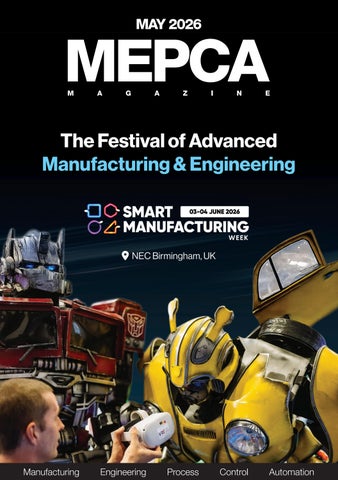
The familiar robots looming on our cover this month will be attending this year’s Smart Manufacturing Week, a celebrated festival of advanced manufacturing. Discover what’s in store for attendees this year, including details of the hotly anticipated new FightFest competition, in our Cover Story (page 14).
As the host of a long running manufacturing podcast, our May Manufacturing Champion is more used to asking the questions; turn to page 12 to learn why they are reframing the narrative of UK manufacturing.
Within our events section, I report on this year’s National Manufacturing Summit, held at the MTC, Coventry (page 82), sharing my key takeaways from the event. Also in this section, are 4 further reasons to hit the road in June and attend one of the great events taking place. May the weather be in your favour.
@Mepca-magazine
To subscribe to MEPCA visit our website www.mepca.com or scan the QR code.


Acollaboration between global beauty products manufaturer Meiyume and Swindon-based waste management operator Hills Waste Solutions, has resulted in Meiyume’s Trowbridge site achieving 100% landfill diversion.
Sustainability is intrinsic to every aspect of how Meiyume works, and in 2025 the company appointed Hills, to play a key role in their journey to net zero in the UK. As Caroline Wilde, Divisional Director - Commercial & Industrial at Hills Waste Solutions explains: “We designed a contract for Meiyume, tailored to encourage collaboration and delivery of improvements to efficiency, and sustainability performance. From day one the focus has been on partnership, with an aim of reducing waste, and embedding circular economy principles. We felt it was important that Meiyume were fully immersed the processes in dealing with the waste, and so we arranged

for key members of their team to visit facilities including Energy from Waste plants and Mechanical Recycling Facilities. Our combined efforts have achieved some great results, not least of which is helping Meiyume achieve 100% landfill diversion at their Trowbridge manufacturing site.”
One of the important activities that manufacturing businesses must undertake is reporting, to meet regulatory requirements under Extended Producer Liability (EPR).
As Tula Welsh explains: “By using Hills’ Online Portal, Meiyume has been able to access all the relevant documentation they need containing weights by waste type, collection and disposal information as well as all their invoices and scheduling of collections, historical and future collections.”
hills-waste.co.uk
High performance transmission specialist Hewland Engineering has strengthened its commitment to the UK defence sector by signing the Armed Forces Covenant. The official signatory ceremony, which took place at the 2026 Commercial Vehicle Show (21 April, NEC Birmingham), was overseen by Lt.-Col Duncan Southill from the British Army.
Supporting those who have served their country and ensuring that they are treated with fairness and respect, the covenant recognises the sacrifices made by ex-forces personnel and champions national equality. It covers education and wellbeing, as well as housing, careers, healthcare, financial assistance and discounted services.
By signing the covenant, Hewland pledges to uphold its principles by supporting the wellbeing of veteran team members. The business has also set out its own set of commitments, which include a vow to support the wider defence community (including cadets, reservists and their partners).
Darren Carter, business development director at Hewland Engineering, has been appointed covenant champion and will be responsible for ensuring the team acts in accordance with its pledges. He commented: “Signing the Armed Forces Covenant demonstrates our

commitment to the wellbeing of the ex-forces community, as well as the UK defence sector as a whole.
“With a number of ex-forces personnel already working within the Hewland team, supporting veteran personnel and promoting equality is an important corporate priority. As our internal champion, I’m delighted to have signed the Armed Forces Covenant and will be working hard with all of our excellent colleagues to enact our pledges.”
hewland.com
UK manufacturing production falls for first time in 6 months as input price inflation soars due to the conflict in the Middle East, which has led to rising energy costs and supply chain disruption, but existing challenges and domestic economic policy have also played their part.
The Manufacturing Purchasing Managers’ Index (PMI) dropped in March to 51.0, down from February’s 51.7, below the 51.4 estimated, indicating a contraction in production output for the first time in 6 months.
S&P Global’s PMI1 is a diffusion index based on monthly survey results of purchasing managers from manufacturing firms throughout the UK. For policy makers and traders, it is an invaluable resource and a reliable indicator of the economic health of the manufacturing sector. Readings above 50.0 show expansion; readings below 50.0 indicate contraction.
For the last 5 months, the reading had sat above 50.0, indicating stable growth, which had contributed to an optimistic outlook for the year ahead.
In March US-Israel’s war with Iran has created fresh geopolitical turmoil across the Middle East, affecting both energy fuel prices and disrupting supply chains, particularly due to the closure of the Strait of Hormuz, a vital global trade route.
According to Rob Dobson at S&P Global Market Intelligence, if there is a positive to take from this development, it’s that new order inflows remain strong: “This suggests that the drop in production is currently more of a supply issue than one caused by an outright downturn in demand.” But he does not see how this can last without a swift resolution to the Iran war.
Following the release of the purchasing managers’ index (PMI) figures, Gareth Anderson, head of business management at Allica Bank, said:
“Today’s PMI figures reflect what established manufacturing businesses have been telling us directly: cost pressures remain persistent, and margins are still under real strain, particularly for firms exposed to energy and imported inputs.
“The ongoing conflict in Iran is something coming up more frequently in conversations with customers, particularly in terms of its potential impact on fuel costs, inflation and the wider cost of borrowing. It’s adding another layer of uncertainty at a time when many were already operating with tight margins.
“In response, we’re seeing businesses take a very deliberate approach – strengthening scenario planning,

There’s still ambition to grow, but it’s being balanced with a clear focus on resilience and maintaining control in the months ahead.
Gareth Anderson, head of business management at Allica Bank.
preparing for multiple outcomes and making decisions more quickly where needed. There’s still ambition to grow, but it’s being balanced with a clear focus on resilience and maintaining control in the months ahead.”
For many UK manufacturers, the war in Iran has exasperated their struggle with rising operational costs and supply chain challenges, a reminder of the wider issues undermining UK manufacturing’s resilience, which policy makers must do their upmost to address.
1pmi.spglobal.com/Public/Release/PressReleases
Here, Bryan Vint, Programme Manager, Made Smarter South East, shares how the programme has accelerated digital manufacturing in the South East since its launch last year.
For manufacturers across the South East, the past year has been one of both pressure and progress. Global instability has once again exposed how fragile supply chains can be. Ongoing conflict in the Middle East, alongside continued volatility in energy markets, has highlighted the extent to which UK manufacturing still relies on complex, interconnected systems. Against that backdrop, resilience is no longer a long-term ambition. It is an immediate priority.
That is why the first year of Made Smarter South East has been so important.
Launched in April 2025, the programme set out to build a practical, accessible and high-impact pathway for SME manufacturers to adopt technologies and develop the skills needed to use them effectively.
In just 12 months, we have engaged with 273 manufacturers, delivered 137 diagnostic workshops and created 93 digital roadmaps. Alongside this, we have supported 41 leaders through our Leadership and Digital Champion programmes, placed six digital interns into businesses and approved funding for 20 technology projects, unlocking around £1 million of investment in areas such as automation, data systems and additive manufacturing.
More importantly, we have seen a shift in mindset. For many of the businesses we’ve worked with, digital transformation is no longer seen as disruptive. It is becoming a practical tool for solving real operational challenges, improving productivity, reducing waste and creating the capacity to grow.
At BWB Technologies in Newbury, a digital roadmap led to investment in a new CRM system that is expected to reduce administrative workload by 20 percent while improving lead conversion rates, supporting ambitious growth plans over the next three years.
Brick Kiln Composites in Banbury has used the Leadership programme to explore how digital technologies can strengthen every stage of the manufacturing process, from procurement through to quality assurance, building a more efficient and resilient operation.
Meanwhile, Art4site in Kent has combined leadership training with the placement of a digital intern to streamline production, improving integration between customer-facing systems and backend databases to

reduce manual processes and errors.
For businesses like these, the combination of technology, skills and leadership support is not just enabling change, it is embedding it.
This is what success looks like in a pilot year. Not just activity, but momentum.
That momentum now matters more than ever, because the challenges facing manufacturers are not going away. If anything, they are intensifying, making agility, visibility and informed decision-making essential capabilities for businesses looking to remain competitive.
That is why we are pleased to see the programme continuing from April, backed by a further £3.1 million of investment. This next phase will allow us to reach hundreds more manufacturers across the South East, building on what we have learned and scaling what works. We are now doubling both the scale and pace of delivery.
The first year of Made Smarter South East has shown what is possible when the right support is in place. The next year is about going further and faster.
madesmarter.uk
Sustainable pumping must be a strategic priority not a peripheral consideration, says Wayne Rose, Chief Executive, British Pump Manufacturers Association (BPMA).
Energy efficiency has become central to how the UK Pump industry innovates, competes and contributes to national sustainability goals. Given that pumping systems account for a significant proportion of electricity use across industry, utilities and building services, the opportunity to reduce energy consumption, and associated carbon emissions, is both substantial and urgent.
Encouragingly, the industry has made considerable progress. Advances in hydraulic design, materials engineering and intelligent control systems are enabling modern pumps to operate more efficiently than ever before. However, the greatest gains are increasingly being realised not at the component level alone, but through a more holistic approach to system design. Correct pump selection, the use of variable speed drives, and optimised system layouts can dramatically reduce energy demand over the lifetime of an installation.
This shift towards system-level thinking also reinforces the importance of evaluating whole-life cost, rather than focusing solely on upfront capital expenditure. In many cases, the energy consumed by a pump during operation far outweighs its initial purchase price. As such, investment in higher efficiency equipment and better system design often delivers rapid payback, alongside long-term environmental benefits.
At the same time, the policy landscape is evolving to reinforce these priorities. Decarbonisation initiatives, including Carbon Border Measures (CBM) and broader net zero commitments, are placing increasing pressure on organisations to demonstrate both energy efficiency and carbon transparency. For pump manufacturers and suppliers, this means not only delivering high-performance products, but also providing clear data on energy use and lifecycle impact.
Importantly, responsibility for delivering these gains does not sit with manufacturers alone. Achieving meaningful improvements in energy efficiency requires collaboration across the entire value chain, from designers and specifiers to installers, operators and maintenance teams. Even the most efficient pump can underperform if it is poorly specified, incorrectly installed or inadequately maintained.
This highlights a critical need for greater awareness and education across the market. Specifiers and end users must be equipped with the knowledge to make informed decisions, ensuring systems are designed and operated for

optimal performance. At the British Pump Manufacturers Association (BPMA), we are committed to supporting this through technical guidance, training programmes and industry advocacy, helping to raise standards and promote best practice.
Sustainability, once viewed primarily through the lens of compliance, is now a defining commercial driver. Customers increasingly expect solutions that align with their environmental objectives, and those manufacturers and suppliers who can demonstrate genuine efficiency gains will be best placed to succeed.
Looking ahead, the role of the pump industry in supporting the UK’s transition to a low-carbon economy will only grow in importance. By continuing to prioritise energy efficiency, embracing innovation and fostering collaboration across the supply chain, the sector can play a pivotal role in delivering both economic and environmental value.
To learn more about the work undertaken by the BPMA on behalf of the UK’s Pump industry, please visit:
bpma.org.uk
MEPCA is delighted to celebrate Chris Greenough, MD at Westley Engineering, as our Manufacturing Champion for May. Talking with our editor, Chris shares insights from 30 years in the industry and discusses the importance of reshaping the narrative of UK manufacturing.
Over a career that has taken him from the shop floor as a press operator, to the board room as CEO, Chris Greenough has become a passionate advocate for UK manufacturing, helping to drive strategic partnerships, innovation and a shared sense of purpose across the industry.
During this time UK manufacturing has weathered many storms, from the recession in 2008, to Brexit, then COVID, and more recently the disruptive effect of the conflict in Iran. It seems to be getting harder all the time, but as a result he believes the industry has grown ever more resilient:
“I think UK manufacturing is even more agile and specialised than it was when I first started. I think now we’ve almost got resilience to the headwinds. Every year a new headwind comes and every year we deal with it differently.”
As part of the Support UK Manufacturing Campaign – helmed by another of our Manufacturing Champions, Andrea Wilson – he has helped raise UK manufacturing’s profile and provide it a voice, particularly for SMEs, which have been overlooked by government policy, and he has long been vocal on the need to re-shape the narrative of UK manufacturing in the face of broadly negative media coverage.
Of course, UK manufacturing is facing substantial challenges, but the growing skills shortage is one of them, and by presenting the industry as struggling when its success rests on encouraging new talent and raising its global profile is counterproductive. As Chris put it, “Why would I want my child to go into UK manufacturing when all I see in the mainstream media is doom and gloom, and redundancies?”
He believes a tonal shift of how UK manufacturing is treated needs to be adopted across government, education, media and industry. As the founder of MTD SME Focus Podcast, which he hosted for 5 years, exceeding 200 episodes, Chris has provided a regular place to celebrate UK manufacturing; on LinkedIn, he shares good news stories every Monday.
“Some weeks it’s really hard to find something positive,” he admits, but by looking past the headline and uncovering the real story, there are usually positive takeaways to be found that speak to the resilience of UK manufacturing. Has this push to re-frame the narrative had a positive

impact? He believes so: “I think there is a switch now, certainly in terms of government and in terms of the mainstream media. They know how important manufacturing is for this country.”
This change has been gradual, but whether that’s because of current events showing the benefit of a strong domestic manufacturing base, or due to the efforts of Chris and other industry advocates, it’s hard to say. Whatever the reason, the message is clear: if we want UK manufacturing to grow and succeed, we must recognise how it already is, and make a habit of sharing these stories.
westleyengineering.co.uk


Smart Manufacturing Week returns to the NEC in Birmingham on 3-4 June 2026. Discover what the fifth edition of the largest festival of advanced manufacturing and engineering has in store for attendees, including this year’s themes, the co-location benefits, and a brand-new feature.

Last year, Smart Manufacturing Week welcomed 13,500 manufacturers, engineers, designers, maintenance professionals, industry leaders and technology solution providers from across every vertical sector.
The event addresses the urgent need for digital transformation, supply chain resilience and workforce skills, featuring over 150 expert speakers across its seven Solution Theatres. It aims to answer the sector’s most pressing questions.
Visitors can expect a powerhouse lineup of over 450 exhibitors, including industry giants like Beckhoff, FANUC, Schneider Electric, Solutions PT, and Sage. They’ll showcase the latest in robotics, IIoT, automation and more.
Smart Manufacturing Week is an umbrella for several distinct shows. The show is home to six exclusive live events: Smart Factory, Drives & Controls, Maintec, Design & Engineering and Manufacturing Digitalisation Summit, proving it to be a must-attend for anyone in the sector.
Each co-located event reflects the modern-day factory that the exhibitors have solutions and technology for, and the visitors are operating in day in and day out.
Maintenance and automation are no longer individual parts but must work in unison to keep the manufacturing site running smoothly.
Not only that, but for another year, Smart Manufacturing Week (including Smart Factory Expo, Drives + Controls,


Maintec and Design + Engineering Expo) is partnering with Interplas, TCT 360, Med-Tech and Subcon, all taking place at the NEC on the same dates. A single ticket provides access to every show.
That means more technology, more suppliers, more live demonstrations and more practical insight across design, plastics, additive manufacturing, medical manufacturing, subcontracting, automation, drives and controls, and smart factory solutions.
A dynamic new feature for 2026 is FightFest, a competitive element located within the Drives & Controls section. Taking place on the Accu Bots stand, this high-energy robot-fighting competition is aligned with automation and robotics, a core event theme.
Designed to encourage engagement and hands-on experience in engineering, the event will see students from across the UK competing with custom-made robots, alongside professional teams live over the two days.
While undoubtedly a fun feature of the show floor, FightFest showcases the need to engage and develop the next generation of engineers who must be proficient in mechanical design, programming and prototyping to meet the demands of the smart factories of the future.
Found on the show floor in the Drives & Controls area, the dedicated feature will demonstrate how precision motors, sophisticated speed controllers and robust power transmission components must perform with unerring reliability under the most extreme physical stresses imaginable.
One of the core themes of the 2026 show is AI and Industrial Data. With a dedicated solution theatre, experts are taking to the stage to move beyond the buzz of generative AI and tackle the world of industrial AI.
This marks a shift from amassing data to the goal of generating actionable insights, returning to the humancentric application of machine intelligence. It’s not about replacing the worker but empowering them with the correct tools to foster a smarter, more efficient and more innovative workforce.
In the theatre, experts will prioritise what is most critical to the UK industrial climate, including operational resilience, using Aito’s predictive system failure before they occur, supply chain visibility allowing manufacturers to
navigate global volatility with real-time transparency and solving the labour shortage and system integration.
Sustainability and net zero are no longer just about waste reduction and resource optimisation; they go beyond that. It has evolved into a fundamental architectural shift, where digital transparency and real-time data allow manufacturers to weave circularity into the very fabric of their supply chains and product lifecycles.
Smart Manufacturing Week 2026 presents a prime opportunity to explore advancements in sustainable supply chains, enhance ESG data and reporting frameworks, and discover new pathways for decarbonisation and efficiency across your operations.
In the Leadership & Strategy theatre, keynotes by manufacturing leaders will explore how to upskill workforces to implement net-zero tech and manage change for efficiency.
Over at the Maintenance stage, you can hear how to integrate sustainability into day-to-day operations, ensuring machines stay working for longer, reducing energy-intensive downtime and maximising asset lifecycles through data-driven strategies.
Smart Manufacturing Week 2026 is about connecting with like-minded individuals within the industry to help solve the big challenges, from solution providers in software and robotics to industry leaders at manufacturing giants. Attendees walk away with insight they didn’t have before.
Chris Allen, Marketing Manager of Smart Manufacturing Week, noted the event’s unique value in the market: “Smart Manufacturing Week is the one moment each year where our whole industry comes together – not just to showcase technology, but to share ideas, solve problems and genuinely connect. It’s a place where conversations spark innovations.”
Ensure you are making the most of your time, plan online using the AI tool on the website. By just inserting your company and job title, it will plan your must-see keynotes and panels, which exhibitors you need to visit and how you will benefit from attending.
The competitive advantage for 2026 and beyond lies in the technologies showcased in Birmingham this June.
smartmanufacturingweek.com


STEGO’s IOC 074 brings analogue sensors into the digital age by conver ting up to three 4–20 mA signals into the IO-Link protocol. It’s the ideal solution for retrofitting legacy systems and enabling modern, forward-compatible automation infrastructures.
www.stego-group.com


Sponsored By
As AI adoption accelerates in machine vision, manufacturers are rethinking how inspection systems are designed to ensure long-term flexibility, scalability and performance. LMI Technologies shares a practical framework for future-proof vision systems.
Artificial intelligence is now firmly established within machine vision.
Across industries such as electronics, automotive and packaging, AI-driven inspection is solving problems beyond traditional rules-based approaches. Surface defect detection, classification and inspection of complex or highly variable features are now routinely addressed using models trained on production data rather than predefined thresholds.
As adoption continues, a structural limitation is becoming more apparent. Many AI-enabled vision systems are deployed within closed, proprietary environments where model development, execution and system integration are tightly coupled. This can streamline initial deployment, but introduces constraints that become more pronounced over time, particularly as the pace of AI model innovation rapidly accelerates.

In response, inspection platforms such as GoPxL from LMI Technologies address this challenge by separating how inspection systems operate from how AI models are developed. This allows manufacturers to integrate, update and deploy the latest models as they evolve, rather than remaining locked into a fixed ecosystem.
The central issue is no longer simply whether AI can be deployed successfully, but whether the systems used to deploy it can adapt as the technology evolves.
Machine vision has historically benefited from modularity. Cameras, software and control systems could be selected based on application requirements, and individual components replaced or upgraded without a full system redesign.
AI-based inspection has shifted this balance. Solutions are often delivered as tightly integrated environments where model training, deployment and execution are restricted to vendor-specific tools, binding workflows to a single ecosystem.
This dependency limits the ability to adopt new developments. Integrating a better or custom model
may require significant reconfiguration, if possible at all. Given the pace of AI innovation, this introduces risk not traditionally associated with machine vision systems.
Manufacturers are increasingly evaluating inspection systems based on how effectively they separate workflow execution from the origin of the AI model.
Platforms such as GoPxL are designed with this separation in mind. Rather than dictating how models are developed, they provide a consistent environment for configuring, executing and integrating inspection within production systems. AI models can be introduced, updated, or replaced without changes to the underlying architecture.
This approach supports models developed using frameworks such as PyTorch and TensorFlow, as well as internally developed or third-party solutions. A single pipeline does not constrain manufacturers and new techniques can be adopted as they emerge.
In this model, the platform becomes the long-term asset, while the model remains a variable component.
A further shift lies in how inspection logic is organised. Conventional systems often implement inspection as discrete tools across multiple environments, increasing configuration and maintenance complexity, especially when combining AI and rules-based methods.
Modern platforms instead structure inspection as a continuous workflow. Data progresses through defined stages—from acquisition and alignment to detection, measurement, and decision-making—within a single environment. AI-driven and traditional tools operate sequentially on the same dataset, ensuring consistency across the process.
Within GoPxL, this workflow-driven structure defines how inspection is implemented. Tool chaining enables multiple processing stages within a unified pipeline, ensuring consistent preprocessing such as cropping, alignment and filtering. The result is more reliable model performance, reduced dependence on external data transfer, and simpler system configuration.
Critically, this architecture separates what changes from what does not. AI models can be updated, swapped, or versioned at the tool level as they improve, while the surrounding inspection framework—preprocessing, rulesbased measurements, HMI and industrial communication protocols—remains stable. This avoids repeated revalidation of components that do not evolve at the same pace, reducing engineering overhead while preserving flexibility.
In general, this approach enables more complex inspection requirements without introducing additional integration layers.
Flexibility extends beyond model selection to system-level adaptability.
Traditionally, this required either constrained toolsets or fully custom PC-based development. The former limits capability, while the latter introduces significant engineering overhead.
Platforms such as GoPxL provide a balanced approach: a structured inspection environment with controlled extensibility through SDK and REST API interfaces, along with a Python-based development kit (GDK) for developing and deploying custom tools within the workflow.
This allows engineers to integrate proprietary algorithms, adapt inspection logic and extend functionality without introducing external processing layers, preserving system cohesion while expanding capability.
AI-based inspection depends on data. Maintaining performance requires ongoing access to production data and the ability to refine models over time.
Supporting systems can extend this capability by centralising inspection data across production environments, including data collection at scale, centralised curation, distributed labelling with traceability,

and structured model training workflows.
As models mature, they can be deployed into inspection environments such as GoPxL, enabling a continuous cycle from data acquisition to deployment. This approach supports ongoing performance improvement over time and across production fleets, without tying system design to any specific upstream data infrastructure.
Inspection systems must operate within broader industrial automation environments.
GoPxL supports standard industrial communication protocols, allowing results to be transmitted directly to PLCs and control systems. This enables real-time actions such as part rejection or process adjustment, while supporting integration with higher-level monitoring systems.
The platform also supports custom operator interfaces with GoHMI, allowing inspection data to be presented in application-specific formats, improving visibility and system operation on the production floor.
AI is reshaping machine vision, but system design determines whether that investment remains viable over time.
While proprietary environments may offer short-term simplicity, they introduce long-term limitations. Open inspection platforms provide a more adaptable approach by separating the inspection framework from the AI model and supporting extensibility, data integration and system interoperability.
As AI continues to evolve, the ability to accommodate change within inspection systems is becoming a fundamental requirement for long-term success.
lmi3D.de
Here, LMI Technologies outline 5 key considerations for implementing adaptable, AIenabled inspection systems in production environments.
Modern AI-driven inspection systems must do more than deliver accurate results; they must be designed for adaptability, maintainability and long-term operational use. As manufacturers move toward more flexible architectures, platforms such as GoPxL reflect a broader shift toward separating system design from AI model evolution, ensuring inspection workflows remain stable even as models improve. Outlined below are 5 key considerations for their implementation.
AI models evolve rapidly, often outpacing the systems used to deploy them.
Designing inspection systems that separate model development from execution allows manufacturers to introduce new or updated models without rebuilding infrastructure. This reduces dependency on a fixed toolchain and ensures long-term flexibility as AI techniques advance.
Consistency in workflow design is essential for scalability.
Structuring inspection as a repeatable sequence— alignment, detection, identification, and measurement— enables different applications to be implemented within a common framework. This simplifies deployment across multiple lines and reduces engineering variability, while allowing AI and rules-based tools to operate together within the same logic.
Inspection requirements often extend beyond predefined capabilities.
Systems should support extensibility through APIs or embedded development environments, allowing engineers to integrate proprietary algorithms and application-specific logic. This enables customisation without introducing external processing layers or fragmenting the system architecture.

AI performance depends on data quality and continuity. Inspection systems should capture, organise and reuse production data as part of normal operation. This includes enabling data collection across lines, maintaining traceability and supporting efficient labeling and dataset preparation. A well-defined data pipeline allows models to be refined over time and ensures inspection accuracy remains consistent.
Inspection systems are rarely deployed in isolation. Designing for scalability ensures that workflows, models, and configurations can be replicated across multiple lines or facilities with minimal rework. Maintaining consistent interfaces and communication protocols reduces commissioning time and supports uniform inspection standards across operations.
Implementing AI in machine vision is as much a system design challenge as it is a technical one. By focusing on separation of concerns, workflow consistency, extensibility, data integration and scalability, manufacturers can build inspection systems that remain effective as requirements evolve. Flexible platforms provide the foundation, but long-term success depends on how systems are structured around them. lmi3d.com

Modern manufacturing depends on warehouses maintaining accurate, real-time inventory data, enabling just in time production models, and rapidly adapting to supply chain disruptions.
Recent case studies demonstrate the transformative impact three main technologies can have on manufacturing operations:
1. Robotics: the productivity multiplier
2. Digital Twins: the crystal ball for operations
3. Data intelligence systems: the foundation of smart operations
DexoryView is at the heart of this transformation.


Domestic and regional manufacturing is currently under pressure on various fronts, from tariffs and energy costs to increasing competition and major geopolitical uncertainty, creating an extremely challenging trading environment. Manufacturers must rethink automation to stay competitive, says Volker Spanier, Head of Manufacturing Solutions, Epson EMEAR.

As reported1 by MEPCA earlier this month, for example, the Middle East conflict has contributed to the first fall in UK manufacturing output in six months. More broadly, European industries, with the automotive industry an important example, are facing intense and growing competition from a range of Chinese manufacturers. Their combination of innovation and aggressive pricing is resonating with consumers, with over a million2 cars sold across the region last year, accounting for 7% of the market.
In response, European manufacturers are increasingly focusing on cost and long-term production performance, with automation now viewed as part of a wider ecosystem
that includes technology, integration, support and partnerships rather than isolated technology investments.
Traditionally, automation investment focused on acquiring standalone robotics systems, often prioritising performance and throughput over integration and longterm efficiency. In the current environment, however, this approach is becoming harder to justify as manufacturers struggle to compete on price alone.
Instead, differentiation is increasingly being driven by production reliability and consistency. While lower-cost automation solutions may appear attractive at the point of purchase, they do not always operate as consistently once deployed in live production environments. Even short periods of manufacturing downtime, for example, can disrupt output and increase operational costs, making
reliability a critical factor in technology selection. Specifically, automation strategies are no longer determined solely by robotic performance and efficiency. What’s increasingly important is how well these technologies integrate with existing production processes and how reliably they operate in real-world environments, where systems must fit into established workflows rather than requiring workflows to be redesigned. In this context, manufacturers are placing greater emphasis on testing and validating automation in real-world conditions before full deployment.
At the same time, modern automation systems are becoming easier to program and redeploy, allowing manufacturers to adapt them to different tasks as requirements change. This is also reducing reliance on highly specialised technical skills, lowering the barrier to entry for manufacturers that may not have extensive in-house robotics expertise. This means automation is becoming more accessible to medium-sized manufacturers, not just large enterprises with significant capital and technical resources. Rather than committing to large-scale deployments upfront, manufacturers can begin with smaller implementations and expand over time as confidence and capability grow.
This approach also plays to the requirement that automation systems can support multiple applications over their lifecycle, rather than remain fixed to a single task, improving long-term value and flexibility.
To support this process, technology partners, including system integrators and machine builders, are playing a critical role in designing and adapting robotics and automation systems for specific use cases. Their involvement has brought greater flexibility to the commercial models available for automation investment, with leasing and service-based options enabling manufacturers to access automation without a significant upfront outlay. This allows organisations to align automation investment more closely with demand, particularly in industries where product lifecycles are shorter and production requirements change on a regular basis.
As part of this innovation trend, it will come as little surprise to hear that AI is becoming more visible in manufacturing settings. It’s important to understand, however, that AI is currently playing more of a supporting role in specific areas such as programming and diagnostics, and its wider application needs to be carefully considered. Rather than being applied universally, AI is most effective when used in clearly defined scenarios where it can deliver measurable value
Human oversight remains essential to ensure that systems operate safely, reliably and in line with production requirements.
Similarly, data is playing an increasingly important role, enabling manufacturers to gain greater visibility into system performance under real-world conditions.


This includes areas such as identifying inefficiencies, understanding where processes can be improved or even supporting more informed operational decision-making. Access to operational data also enables more proactive maintenance strategies, helping to reduce unplanned downtime and extend the lifespan of automation systems. When shared between manufacturers and technology providers, this data can support continuous improvement, informing future system design and performance enhancements.
This shift towards ecosystem-based automation, where technology, integration, support and partnerships work more closely together, is changing how many manufacturers approach long-term investment. For these organisations, success depends on the ability to adapt deeply embedded production processes more quickly and cost effectively to address emerging challenges and opportunities. But with European manufacturers likely to remain under macro-economic pressure for the foreseeable future, this kind of innovation is key to longterm competitiveness and profitability.
epson.eu/en_EU
1See page 9
2businesskorea.co.kr/news/articleView.html?idxno=267144
As modern manufacturing evolves under the pressures of production, automation platforms must transform in kind to meet these demands. Bosch Rexroth examines the trends of this evolution, from the integration of AI into control systems, to increased connectivity and cybersecurity.
Industrial automation is undergoing a significant transformation as manufacturers respond to growing demands for connectivity, flexibility and security.
Modern production systems must communicate across organisational and technological boundaries, exchange data in real time and embed increasing levels of software intelligence directly into machines. In this environment, openness is emerging as a key driver of innovation, while cybersecurity is essential to maintaining trust.
A central response to these challenges is the development of integrated, modular automation platforms. Solutions from companies such as Bosch Rexroth aim to reduce the complexity traditionally associated with automation projects. By combining hardware, software, applications and digital services into a unified ecosystem, these platforms can shorten engineering timelines, minimise integration risks and accelerate time to value.
One of the most notable trends is the integration of artificial intelligence (AI) into control systems. AI capabilities are increasingly available across a range of performance levels, enabling data to be processed directly at the edge. This supports use cases such as predictive maintenance and real-time quality control without reliance on external infrastructure. At the same time, the adoption of high-performance computing technologies, including GPU-based systems, is expanding the scope for advanced vision applications and data-intensive processing within industrial environments.
Advances are also evident in motion control and drive technology. Compact, energy-efficient drive systems are reducing the need for traditional control cabinets, offering greater flexibility in machine design. These hardware developments are complemented by software platforms capable of integrating motion, CNC, and robotics functions within a single environment, simplifying both engineering and operation.
Safety technology is evolving in parallel. There is a clear shift toward software-based safety solutions that remove the need for dedicated hardware. By integrating safety functions directly into standard control systems, manufacturers can reduce system complexity, save space, and maintain compliance with safety requirements while

gaining additional flexibility.
In intralogistics, new motion technologies are enabling more adaptable production and material handling systems. Planar transport systems and high-speed solutions are being refined to support a wider range of layouts and applications. Their integration into broader automation platforms ensures consistent communication and control across operations.
Software architecture plays a critical role in enabling these developments. Linux-based industrial operating systems are helping to bridge the gap between operational technology (OT) and IT. By running independently of hardware and supporting deployment from field devices to the cloud, they provide a unified foundation for control, analysis and management. Virtualisation further enhances this flexibility by allowing applications to run wherever they deliver the greatest benefit.
As connectivity increases, cybersecurity becomes ever more important. The adoption of “secure by design” principles and compliance with standards such as IEC 62443 are becoming essential. In addition, tools that provide network visibility and identify vulnerabilities are supporting more proactive approaches to system security.
Together, these trends highlight a shift toward more open, intelligent and secure automation systems, reflecting the evolving needs of modern manufacturing. boschrexroth.co.uk

ctrlX OS from Bosch Rexroth: ready for the Cyber Resilience Act
ctrlX OS is Cyber Resilience Act-ready, Bosch Rexroth’s secure-by-design, IEC 62443-certified platform delivers built-in protection and easy to manage security updates, helping automation systems meet CRA requirements with ease.

The UK’s robotics gap is well documented. With just under 29,000 industrial robots in operation compared to more than 269,000 in Germany, the opportunity is clear, but so is the challenge. For many UK manufacturers, the hesitation isn’t about whether automation delivers value, it’s about handling the complexity. Unified Robot Control offers a solution.
Traditional robot deployments carry a hidden cost: dedicated controllers sitting alongside existing machine architecture, specialist programming languages that few in-house engineers know, and commissioning processes that stretch timelines and inflate budgets. For businesses already stretched on skills and capital, that friction is enough to delay the decision indefinitely.
Unified Robot Control removes it.
Rather than treating robots as a separate system bolted onto a production line, unified control brings robot motion directly into the same architecture that governs the rest of the machine. Using Rockwell Automation’s Logix controllers, Kinetix® drives and the Studio 5000® environment, engineers configure, program and commission robots in the same software they use every day with no additional languages, no additional controllers.
Rockwell Automation’s partnerships with leading robot manufacturers, including Comau and Autonox, mean the platform supports a wide range of robot geometries. Integrators can standardise around a single control architecture without sacrificing the freedom to choose the right mechanical system for each application. Rockwell Automation’s ongoing collaboration with Comau has been particularly focused on eliminating robot-specific programming languages; one of the most persistent sources of complexity in traditional deployments.
For engineers, the result is a single development environment for programming, testing and optimisation. Machine behaviour, safety and motion can be synchronised more precisely, and when something needs changing or scaling, the team that maintains the line is already equipped to do it.
The applications are well suited to where UK manufacturers are already looking: end-of-line palletising, high-speed pick-and-place, packaging and material handling. Repetitive, predictable tasks where the ROI case is strong and the ability to scale quickly – without reinventing the control architecture each time – matters.
Emulate3D® digital twin technology extends the advantage further, allowing virtual commissioning before any hardware is purchased. Design work happens upfront,

errors surface early and build time is compressed.
The question for most UK manufacturers is no longer whether to invest in robotics. It’s how to do it with confidence. By simplifying integration and leveraging widely adopted automation software, unified robot control removes many of the traditional barriers to entry.
To find out how a unified robot control strategy could support your investment, contact Routeco for expert guidance, system design support and hands-on demonstrations using Rockwell Automation technologies. bit.ly/4e1rFgP

ABB Launches new, high-speed, higher payload PoWa cobot family meets need for industrial-grade performance in collaborative robotics, lowering the barrier to automation for both SMEs and large enterprises. Andrea Cassoni, Head of Collaborative Robots at ABB Robotics explains more.
ABB Robotics is combining the flexibility of cobots with higher payloads and performance, with the launch of its new PoWa cobot family into the rapidly expanding global collaborative robot market, which ABB Robotics estimates will grow by 20 percent annually through to 2028.
“Cobots are growing significantly faster than traditional industrial robots, driven by demands from both small and midsized companies starting their automation journey as well as large enterprises,” said Andrea Cassoni, Head of Collaborative Robots at ABB Robotics. “These customers are seeking higher speeds and payloads, but also greater ease of use, and compact designs. Established manufacturers want to automate heavier, fast cycle applications, without the complexity and operational rigidity of traditional industrial robots. We are meeting these needs with the global launch of our high-speed PoWa™ cobot family – a name that symbolises its powerful, industrial-grade performance in a compact collaborative robot form.”
The new PoWa family addresses a long-standing gap in the market between traditional cobots, that often lack the speed and payload required for industrial applications, and conventional industrial robots, which are designed for highly specialized, large-scale automation environments, going beyond the needs of many collaborative tasks.
PoWa extends ABB Robotics’ comprehensive cobot offer with industrial-grade performance including six different payload categories, from 7kg to 30kg, the longest reach and highest arm load on the market and best-in-class top speed of up to 5.8 m/s.*
Purpose-built for compact environments and ideally suited for applications such as high-speed machine tending, palletizing, screwdriving and arcwelding, PoWa enables manufacturers to automate heavier and faster processes, while maintaining the flexibility, ease of use and compact footprint of collaborative robotics.
PoWa cobots are exceptionally easy to use, through programmable buttons on the arm-side interface and no-code programming and are compatible with an extensive ecosystem of third-party accessories. PoWa can be unboxed and operational within an hour and enables seamless plug-and-play with a wide range of tools,

blending industrial-grade connectivity and performance with collaborative robot flexibility.
Powered by the ABB OmniCore controller platform, the new PoWa cobots deliver best-in-class motion control, speed, and precision and can be integrated with ABB Robotics’ expanding suite of AI-powered software, including Robot Studio® and Wizard Easy Programming, enabling intuitive programming, fast deployment and maximum uptime.
Ensuring collaborative robots can do more things, in more places, and do it faster, safer and smarter is part of ABB Robotics vision for more autonomous and versatile robotics (AVRTM). By developing a new generation of intelligent, flexible, adaptative, and collaborative multiskilled robots, ABB Robotics furthers robots’ ability to learn, understand and plan independently, giving them greater autonomy and versatility. abb.com/global/en/areas/robotics

Drive Return on Investment at Every Stage of Your Maintenance Maturity Journey with our Scalable, AI-Ready CMMS

Smarter maintenance powered by your asset data.

From reactive to predictive, we’re with you.
Simple to set up. Easy to use. Built for results.
Where are You on Your Maintenance Maturity Journey?
If you’re ready to take the next step, why not book a personalised demo to see how ShireSystem can support your maintenance transformation

Albert Jagger Limited, a manufacturer of transport and industrial hardware, has strengthened its production capability through the installation of a new robotic welder. The investment marks a significant step in the company’s ongoing automation strategy, designed to increase output, improve weld consistency and support future growth.
As engineering operations grew, Albert Jagger faced a manufacturing challenge: how to expand welding capacity without disrupting the existing factory layout. Rather than adding another manual welding bay, the company opted for a bespoke robotic welding cell tailored to its production requirements.
The system delivers high-quality MIG welds with short cycle times, enabling the company to increase productivity while maintaining strict quality standards. By integrating the automate cell into its existing workflow, Albert Jagger has been able to add capacity without major structural changes to the facility.
Automation of repetitive welding tasks allow the robotic system to deliver highly consistent results across production batches. Precise motion control and repeatable weld paths reduce variability and help minimise defects.
The result is a reduction in rework and improved process stability, ensuring finished components meet the company’s quality requirements while maintaining efficiency production throughput.
Shorter cycle times from the robotic cell enable Albert Jagger to respond more quickly to customer demand. The system is designed for continuous operation, allowing production to run beyond standard working hours when required, including overnight or at weekends.
In addition to increased throughput, the automated process reduces downtime and material waste, supporting overall operation efficiency.
The company emphasises that the robotic welder has been introduced to complement, rather than replace, its workforce. By automating hazardous or repetitive welding operations, the system reduces operator exposure to potentially dangerous tasks and contributes to a safer working environment.
Alongside the installation, Albert Jagger has invested in training programmes to equip employees with the skills

needed to operate, programme and maintain the new robotic equipment.
The new installation incorporates a turntable workstation, welding power source, automated wire feed system and a next-generation arc welding robot. The system is designed to support high payload handling, fast integration into existing production lines, and straightforward programming via modern user interfaces.
With automation and digital technologies continuing to reshape the manufacturing sector, Albert Jagger views robotic welding as an important part of its long-term strategy. The company will continue to invest in advanced manufacturing technologies to remain competitive and meet evolving customer requirements.
By combining automation with workforce development, Albert Jagger aims to strengthen its manufacturing capabilities while preparing for future advances in robotics and intelligent production systems. Discover more about Albert Jagger:
albertjagger.co.uk
maxon has released a zero-backlash gearhead, enabling a DC or brushless DC (BLDC) drive system to achieve the highest level of precision. The new GSW A gearhead, based on strain wave technology, also offers a high reduction ratio in a compact footprint, capable of delivering up to 71Nm torque. These features make it ideal for high-precision robotic control.
The GSW A gearhead achieves zero backlash thanks to its strain wave design. Based on elastic deformation, the strain wave operating principle ensures continuous engagement of the gear teeth, removing the lowest tolerances of mechanical play to increase precision.
The operation of the strain wave design includes a flexible cup with external gear teeth, known as the flex spline. This cup is deformed by the wave generator, a rotating disc that compresses the flex spline into an elliptical wave that continuously engages with the gear teeth of a third, outer ring. This transmission process ensures zero backlash combined with smooth torque transmission, optimising high-precision motion.
The GSW A strain wave gearhead achieves high torque generation as the design can engage a greater proportion of gear teeth, improving load distribution and optimising torque density. The gearhead delivers up to 27Nm continuous torque, as well as 37Nm intermittent torque, and 71Nm overload torque. High reduction ratios in a single stage are also available, including up to 100:1, as well as 80:1, and 50: 1.
While high torsional rigidity enables the GSW A gearhead to transmit motion without delay, low mass enhances high dynamics, with designs available in 300g and 460g options. The new gearhead can also operate at input speeds up to 8,500 rpm intermittent duty.
Backdrive is an important feature of the GSW A gearhead, enabling the output shaft to drive the input shaft in reverse. Allowing manual intervention of a robot arm, this is an important safety feature, which can also be used for robot teaching.
The form factor of the strain wave design lends itself to integration into space-restricted applications. With a flat profile, the 55mm diameter version is just 30.3mm in length, while the 62mm diameter design is 32.4mm long.
These features make the maxon GSW A gearhead advantageous for robot designers, particularly in applications that demand the highest precision, such as distal arm joint control for surgical robots.
maxon also integrates its GSW A gearhead within its HPJ High Precision Joints modules for robot designers.


Integrating a brushless DC motor, the strain wave gear, plus a dual encoder layout, the complete HPJ unit matches control precision with ease of design integration.
“For application designers who require precision motion control for DC and brushless DC motors, the strain wave gearhead is the pinnacle,” says maxon UK & Ireland Managing Director, Will Mason. “With zero backlash, the new GSW A strain wave gearhead will enhance control, alongside high torque transmission in a compact design.”
To find out more about the new GSW A strain wave gearhead, visit the company’s website. maxongroup.com/en-gb
As Britian industry continues to trail behind the global average in robotics density, UK manufacturers would benefit from a gentler introduction to automation, says Nigel Dean, Marketing Manager at LC Automation.
The UK’s sluggish uptake of industrial automation and robotics is becoming a serious competitive liability that the Government is slowly waking up to. Compared to our European neighbours and the wider global manufacturing community, British industry continues to lag behind in adopting new technologies that could dramatically boost productivity and product quality. And while that makes for a convenient stick with which to beat UK manufacturers, the picture isn’t always so black and white.
Yes, the data is uncomfortable. The UK ranks well below the global average for robot density in manufacturing, trailing behind countries such as Germany, Sweden, and even Slovenia. The consequences feed directly into the productivity gap that has dogged British industry for years, leaving manufacturers less competitive in global markets, and more vulnerable to energy prices and other cost pressures they don’t have the resources to absorb.
But before we lay all the blame at the feet of factory owners and operations managers, it is worth asking whether the automation industry itself has done enough to make adoption genuinely accessible. Because in many cases, it simply has not.
Asking an SME manufacturer with no prior experience of automation to invest in a complex, multi-axis robotic arm is a bit like asking someone who has never laced up a pair of trainers to sign up for the London Marathon. A small number of highly motivated individuals might attempt it. Most, quite sensibly, would look at the scale of the challenge and walk away. The technology feels out of reach. It’s too expensive, too complex, too dependent on specialist skills that are already in short supply.
What British manufacturing actually needs is a Couch to 5K equivalent: a practical, low-barrier entry point that helps manufacturers to take their first steps into automation, experience some tangible benefits, and build both confidence and capability over time.
That is precisely where Cartesian robots have an increasingly important role to play. Unlike their more
graduate robotics engineer to deploy and run them.

accessible to technicians and engineers already working on the shop floor.
A Cartesian robot is often the best solution for applications involving two or three axes of movement, such as pick-and-place, laying glue paths, dispensing, assembly or inspection. They can deliver real, measurable improvements without the steep learning curve or the capital outlay that puts so many manufacturers off larger robot solutions.
The goal is not to keep companies at the starting line forever. It is to get them moving. Once a manufacturer has experienced the benefits of automation first-hand; seen the ROI, and grown comfortable with the technology, the step up to more advanced solutions becomes far less daunting.
The marathon can wait. Right now, let’s just get UK manufacturing off the sofa.
bit.ly/41JWqj2
Automation systems now play a central role across manufacturing, logistics and infrastructure. Whether used in robotic cells or distributed control systems, performance depends on consistent and well-managed power architecture.
In automation, the choice between AC and DC power supplies remains a key design decision. In practice, most automation systems rely on both. The real challenge lies in how effectively power is converted, distributed and controlled across the application.
Automation design continues to evolve, with systems becoming more compact and increasingly interconnected. Expectations around efficiency, uptime and compliance have increased.
It involves working with distributed control architectures, which feature high-density control panels, sensitive electronics requiring that require stable voltage, and systems expected to operate continuously.
These factors place greater emphasis on defining the power strategy early in the design process.
AC power is typically supplied from the mains and used as the primary input in industrial systems.
DC power is required by control and electronic components, including PLCs, sensors, communication modules, and embedded controllers.
As a result, AC/DC conversion is usually the first stage in mains-powered systems, followed by DC/DC conversion where different voltage levels or isolation requirements must be addressed.
AC/DC power supplies convert mains input into a stable DC output for system-level distribution.
In industrial automation, these units are commonly installed within control cabinets or mounted on DIN rails. Selection is typically based on:
• Input voltage range
• Thermal performance within the enclosure
• Efficiency under varying load conditions
• Compliance with safety and EMC standards
Enclosed, DIN rail and chassis mount designs are widely used, depending on environmental conditions, available space and cooling requirements.

Once DC power has been established, DC/DC converters regulate, step, or isolate voltage levels for specific subsystems.
They are widely used across control boards, communication modules, and isolated circuits, where voltage stability and noise control directly affect performance.
PCB mount DC/DC converters support compact layouts and maintain consistent electrical performance across sensitive components.
Challenges often arise when power supply selection is delayed. This can lead to issues with thermal constraints within enclosures, or challenges meeting EMC compliance; it may also result in additional filtering requirements and layout limitations.
Addressing these issues late in the design cycle increases development time and complexity.
Treating the power supply as part of the initial system architecture supports better alignment with performance and compliance.
As automation systems advance, careful consideration of power supply design remains essential for reliable and predictable performance.
idealpower.co.uk
Dave Walsha, Sales and Marketing Director at DC motor supplier EMS, explores how robotics is placing increasing demands on motor technology and what engineers must consider when selecting motors to ensure the performance and precision that modern automation demands.
According to the latest data from the International Federation of Robotics (IFR), the UK currently operates about 101 robots per 10,000 employees. With the world average cited at 126 units, the UK needs to catch up if it’s to reach the forefront of robotic technology.
Robots are no longer confined to the assembly lines of the automotive sector. Today, they’re operating in surgical fields, warehouses, agricultural sectors and even homes. As robotic systems become more specialised and integrated into diverse environments, the demands placed on their core components have grown too.
Robotics requires precise, fast and dynamic motion. Motors are required to provide high torque, run with good reliability over extended duty cycles and easily interface with sensing and control systems. Other limits, such as low noise and weight, apply when the motor is located within a mobile or collaborative robot.
To engineers, this means motor selection is not just a matter of choosing something that fits but also identifying the solution that meets the entire mechanical and control needs of an application. Understanding how these requirements shape motor operation is the secret to delivering more successful robotic systems.
There is no one-size-fits-all when it comes to motors. The choice depends on what the motor will do, whether that’s handling a surgical instrument with sub-millimetre precision or powering an articulated arm in a factory.
Brushless DC motors are likely to be the preferred choice in most robotic applications given that they are efficient, durable and require little maintenance. They are lightweight but can provide smooth and controlled movement, making brushless motors the best choice for dynamic operation where precision and reliability are a priority.
Stepper motors offer true open loop positioning while being a cost-efficient option for less complex robotic operations, such as small pick-and-place systems or lightduty automated devices, where high torque variation or speed isn’t as important. However, they fall short in

operations demanding dynamic response and continuous movement, as their stepwise motion can limit smooth acceleration and precision at higher speeds.
For confined spaces or where weight is a consideration, coreless motor or flat motor designs are a sensible choice. They have an excellent power-to-size ratio, making them ideal for miniature robotic joints, mobile devices, or any application where compact, lightweight components are critical without sacrificing performance.
Choosing the right motor for a robot application starts with a good understanding of technical specifications. Speed is an important factor. Robots require smooth acceleration and braking to deliver repeatable and accurate motion. Weight and size of the motor are also important, especially where space is limited.
The period of time that the motor runs for per operation, or duty cycle, affects thermal performance and overheating can reduce motor life or cause failure, so the thermal ratings of the motor must be appropriate for the application.


Robotics systems often operate in challenging environments, from dusty factory floors to temperature limits or vibrations in mobile robots. The selection of motors capable of withstanding such temperatures, with no compromise on quality, is critical to reliability. Look for motors with suitable ingress protection (IP) ratings, strong housing and coating if there is a possibility of dust, dampness or chemical exposure. Motor selection is all about finding the right balance between mechanical, electrical and environmental needs, in order to deliver a smooth and efficient performance.
A motor is not a standalone device; its operation is contingent upon the feedback and control systems to which it’s being matched. Closed-loop control, through resolvers or encoders, gives robots the precision and responsiveness they are required to possess. Encoders of high resolution allow the position and speed information that are critical to let the controller make real-time adjustments.
Integrated motors, motors with onboard drivers and encoders, simplify system design and reduce footprint, which is especially worth the cost in space-constrained robotics applications. They can also increase reliability by reducing wiring and connection points.
In choosing motors, engineers must consider how feedback and control features track the motion profile and accuracy requirements of the robot. Selecting a motor with versatile integration skills allows engineers to expand and upgrade in the future, maintaining systems flexible as technology continues to advance.
Robotic surgery makes some of the most demanding challenges for motor technology. Surgical use requires motors to be accurate, compact, quiet and capable of delivering smooth high-speed motion. Space constraints in surgical tools are often critical, making ultra-flat brushless DC motors a natural fit.
A good example is FAULHABER’s BXT flat motor family: capable of enabling high torque in very small packages with integrated encoder solutions, it offers the precise control surgeons require. Gear ratios and feedback systems are often also customised to allow surgical robots to hold steady positions or respond quickly to subtle movements.
To the future, neurosurgery is a field where even greater precision is required. Brushless motors with integral gearing and high-resolution encoders provide the stable accurate control the applications require, offering smooth motion without overshoot.
One of the most significant aspects is haptic feedback: the sense of touch. High-end micromotors that offer smooth, responsive torque can transfer realistic tactile feel to surgeons so that they can feel the pressure being applied on delicate tissues. Further ahead, advances in AI and robotics could lead to autonomous performing systems with the capability to perform some functions independently; this would enable operations to be faster, safer and more effective.
Specialists in micromotors, such as EMS, work with medical device OEMs to develop motors that meet the strict regulatory and performance requirements of lifesupport applications. This collaboration enables surgical robots to deliver stable, precise performance in highly demanding environments.
At the heart of each successful robot is a motor tailored specifically to meet the requirements of its intended use. From performance and power to size and reliability, the right motor specification lays the groundwork for performance and longevity.
Having suppliers on board from the beginning who you can rely upon, ensures motors are appropriately designed and purchased from day one, without delays and redesign costs. With the UK pushing to catch up in the robotics race, getting motor selection has never been more important.
www.ems-limited.co.uk
MEPCA interviews Suraj Patel, Sales Manager at Endoline Robotics, a UK-based integrator of packaging and palletising systems. He outlines how robotic automation is evolving within end-of-line applications and the practical considerations for successful implementation.
End-of-line operations are increasingly becoming a constraint within high-throughput manufacturing environments, particularly as SKU complexity rises and labour availability remains inconsistent. Robotics is now playing a more defined role in addressing these challenges, enabling manufacturers to improve throughput, consistency, and system resilience.
The application of robotics at end-of-line has shifted from isolated, high-volume use cases to more flexible, integrated systems capable of handling variable production demands. Historically, robotic palletising was often considered costprohibitive and complex, requiring specialist programming and significant floor space.
Advances in control systems, end-of-arm tooling, and integration capabilities have changed this. Robotics is now routinely deployed to improve repeatability, throughput and load stability across a wider range of production environments.
As line speeds increase and product formats diversify, manual processes become less viable. Robotics enables consistent handling at higher speeds while reducing variability associated with manual intervention. In addition, integration with upstream equipment allows for more coordinated, continuous operation, supporting overall line efficiency rather than acting as a standalone process.
Retrofitting robotics into existing production environments presents several engineering challenges, with space constraints being one of the most common. End-of-line areas are typically designed around manual operations, with limited allowance for additional equipment, as most floor space is prioritised for primary production or warehousing.
This can be addressed through bespoke system design. Robotic cells can be engineered to operate within constrained footprints by optimising layouts and
integrating compact conveyor systems that manage product flow efficiently.
Another key consideration is how new automation integrates with existing equipment. Rather than replacing systems entirely, many manufacturers adopt a staged approach, adding new robotic cells alongside legacy or previously installed equipment. This approach enables manufacturers to scale incrementally, aligning automation investment with production growth while maintaining continuity on the line.
A recent installation at a UK flour mill demonstrates how our robotic automation can be introduced to enhance, rather than replace, existing systems. The site integrated a new robotic palletising solution alongside an existing Endoline robotic palletiser, creating a more flexible and scalable end-of-line operation.
Previously, production was limited to handling two SKUs simultaneously at a relatively modest rate. Following the upgrade, the facility is now capable of processing three SKUs concurrently, while also increasing overall throughput.
The addition of a dedicated conveyor network ensures


In advanced manufacturing, deviations in a robot’s commanded pose or path can lead to production issues and place pressure on engineering teams. INSPHERE, provider of intelligent automation solutions, offers advice on maintaining precision in demanding manufacturing environments.
Industrial robots can be highly productive, but thermal variation, mechanical wear and payload differences all contribute to positional drift. Such drift often goes undetected until it begins to affect quality outcomes. This creates a persistent challenge for engineers: how to ensure that a system designed for precision continues to perform as expected throughout its operational lifecycle.
Traditional approaches such as periodic calibration and downstream inspection remain widely used. However, these are lagging indicators, which rely on the assumption that performance remains stable between interventions. By the time deviations are identified through inspection processes, the impact has often already been felt in the form of scrap, rework or disruption to production schedules.
A more continuous, proactive approach is required. Advances in metrology and control systems can monitor robot performance in real-time, within the production environment itself, rather than relying solely on periodic validation.
Once deviations have been identified, it essential that they are corrected.
Robot control software platforms such as ORATM are designed to take measurement data and compare it against intended robot behaviour. This enables the creation of a live digital representation of the process, highlighting any deviation from expected performance. ORA provides in-process improvements through a highly intuitive user interface.
Where appropriate, corrective action can be applied during operation, reducing the likelihood of a deviation progressing into a quality issue.
ORA’s sensor agnostic feature gives manufacturers the opportunity to integrate into any existing robot cell and benefit from 24/7 monitoring and in-process adjustments,

without manual intervention.
Measurement sensors gather all positional data from a robot cell, which is transferred to ORA and compared to the desired robot path. A digital twin allows users to view frames and their associated CAD models in real time. If deviations are identified, the positional revisions are fed back to the robots, allowing corrections to be made inprocess, thereby avoiding production errors.
For production managers, the benefit of continually measuring activity and correcting deviation in-process lies in improved consistency. By achieving more accurate and reliable automated processes, manufacturers can benefit from fewer quality issues and improved throughput, with reduced waste and downtime.
Insphereltd.com


- your robot cell is primed for precision
- you monitor and control activity in-process
- you do this with the help of a live digital twin ORA robot control software is compatible with all major robot brands. Contact us for a demo today at insphereltd.com

An electronics manufacturer was able to fully automate printed circuit board identification at the start of production, on all SMT-lines, with the A8500 FlexCell Printer Applicators from Brady. Read the case study here.

Alarge electronics manufacturer wanted to bring printed circuit board traceability labelling to the start of its SMT production lines. This would enable the company to track every PCB in production by scanning labels at any location along the line. Because of label variety and the number of labels required on each PCB, labels could not be printed in advance. Any equipment used to enable the solution had to be fast, and able to place labels on both sides of a PCB with 0,1 mm maximum tolerance.
Brady proposed its A8500 FlexCell Printer Applicator and extremely thin B-7727 polyimide labels for auto-apply. The system recognises PCBs and automatically prints and applies every label required on both sides of a PCB, in 3 seconds per label.
The A8500 FlexCell Printer Applicator can print and place a label anywhere on a PCB in 3 seconds. Designed as a production line module with SMEMA compliance, it can be plugged in anywhere along an SMT production line. To further support the electronics manufacturer, Brady equipped the system with a software package that automatically recognises barcodes on PCB base plates. When passing through, the system auto-recognises the project the PCB belongs to. The FlexCell then prints and places all required labels in the right locations. Each label is placed with pressurised air, at 0,1 mm

maximum accuracy tolerance, both on the top and bottom of PCBs. Label data are sourced from the customer’s central ICT systems. The FlexCell liners were adapted to also enable automatic label placement at the edge of PCB’s, making full use of the system’s high label placement accuracy and precision. In addition, a pause option was added for quality checks at discretion; the FlexCell simply resumes serialisation where it left off, without any further manual intervention.
After label sample testing, the electronics manufacturer selected Brady’s B-7727 polyimide label. Designed to withstand multiple cycles of harsh condition washes for printed circuit boards, the label stays attached and remains legible throughout printed circuit board production. 0.1 mm thick, it is able to resist temperatures up to 300°C for 80 seconds without any visible effect. This allows tiny label QR-codes to be read by scanners throughout production.
With multiple A8500 FlexCell Printer Applicators in place, the large electronics manufacturer can quickly label printed circuit boards at the start of production. This enables real-time tracking of PCBs in production and generates data for efficiency analysis. All without delays or production bottlenecks, and in full compliance with printed circuit board traceability requirements from customers. To learn more, visit Brady’s website. bradyeurope.com/flexcell


Schmersal’s innovative DHS door handle system combines the functions of a robust door handle with the signalling of machine status via illuminated handle or push-button.
The door handle system is designed for use with the AZM40 solenoid interlock or with safety sensors from the RSS36 and RSS260 series or as a stand-alone solution. The illuminating handle signals various machine conditions over its area using seven different colours, enabling the user to control the colours individually to signal the machine status.
Schmersal’s innovative DHS door handle system combines the functions of a robust door handle with the signalling of machine status via illuminated handle or push-button.
In addition, a push button is available, which can be individually adapted to customer requirements using the coloured push button caps. The pushbutton can be used for tasks such as a reset function or a request to open the guard door.
The door handle system is designed for use with the AZM40 solenoid interlock or with safety sensors from the RSS36 and RSS260 series or as a stand-alone solution. The illuminating handle signals various machine conditions over its area using seven different colours, enabling the user to control the colours individually to signal the machine status.
SCHMERSAL | Enigma Business Park Malvern, Worcestershire, WR14 1GL
www.schmersal.co.uk uksupport@schmersal.com
In addition, a push button is available, which can be individually adapted to customer requirements using the coloured push button caps. The pushbutton can be used for tasks such as a reset function or a request to open the guard door.

Prof. Dr Katharina Hölzle from the University of Stuttgart, Germany, and the Fraunhofer IAO, and Hubertus Breier, Executive Board Member for Technology and Innovation at LAPP, discuss how robotics is evolving technologically and socially, and what role connectivity solutions play in this.
“Arobot is a programmable system comprising electronic, electrical and mechanical components,” explains Hölzle. Robotics goes far beyond the individual robot: “It always encompasses the entire system, including sensors, actuators, software and infrastructure.” Humanrobot interaction is currently developing particularly dynamically. Collaborative robots, known as cobots, and humanoid systems are increasingly coming into focus.
The fundamental definition of robotics has hardly changed over the decades, emphasises Hölzle. What has changed, however, is the nature of collaboration: “Following a prolonged plateau phase, we are experiencing a significant upswing in collaborative robotics thanks to advances in AI and sensor technology.” Open data spaces and interoperable platforms, on which algorithms, sensors and actuators interact seamlessly, are crucial for the next leap in productivity.
This development also presents the industry with new challenges, particularly in terms of connection technology. “Robotics is one of the most demanding application fields for our products,” says Hubertus Breier. Due to free threedimensional movements, high bending and torsional forces act on cables simultaneously. LAPP responds with specially developed cables, connectors and pre-assembled systems. “Our cables can withstand up to two twists per metre and survive ten million cycles.”
Alongside traditional industrial robots, service robots are gaining significant importance; in logistics, care or research, for example. LAPP is recording dynamic growth particularly in Asia and is specifically expanding production capacities there. “Cobots often require miniaturised, flexible solutions or retrofit products to integrate additional sensor technology,” says Breier. Extreme fields of application such as underwater robotics or high-temperature applications are also coming more into focus.
With the increasing proximity between humans and machines, working environments are changing fundamentally. “The idea that robots will take over

everything and humans will simply press a button is wrong,” clarifies Hölzle. Rather, it is about a constant negotiation of roles. Acceptance, safety and emotional perception play a central role in this.
Service robotics offers enormous potential, particularly in the healthcare and care sectors. Despite high data protection requirements, there is a great deal of openness because robotics reduces the workload. At the same time, industries with dangerous or hard-to-access working environments benefit. For LAPP, this results in a clear mission: “We develop connection solutions that function reliably even under extreme conditions,” says Breier.
A look into the future reveals a flexible, AI-supported production system. Hölzle speaks of a ‘breathing factory’ capable of efficiently manufacturing customised products. Breier envisages greater regional value creation, humanoid robots in assembly and exoskeletons to reduce physical strain. Both agree: “Nobody wants a society in which humans no longer have a meaningful place.” Robotics of the future is therefore, above all, one thing – a joint endeavour involving humans, machines and technology. lapp.com/en_GB/gb/GBP/


It’s time to rethink the narrative around industrial robots and their position in the Net Zero future, says Alexandru Shehari, Robotics & Motion Control Product Manager, Schneider Electric UK&I.

The perception of industrial robots is always shifting. For example, the fear of operator job losses being superseded by a recognition of new and better roles that adapt and apply the technology. But one big question remains even in 2026, are robots good or bad for sustainability? One perception could be that heavy and power-hungry robots lead to higher energy consumption, not less. However, nextgeneration robots and cobots represent one of the most powerful levers a manufacturer can pull to genuinely move the needle towards Net Zero.
Traditional industrial robots were designed with the single priority of improving throughput. Energy efficiency was a secondary concern, if it was a concern at all. Today’s robots and cobots are designed completely differently, leveraging smart automation systems to consider sustainability in every aspect.
For example, moving mass is lower today when compared to legacy robots. This is achieved through lighter materials and better mechanical structures. In turn it means less force, therefore less energy required to perform
the task. In high-throughput applications, over thousands of cycles, this lightweighting has a significant cumulative impact on consumption.
Another energy-saving tactic is to adopt regenerative drives to capture and reuse energy that would have previously been lost. In addition, intelligent motion profiles optimise acceleration, speed and paths based on the tasks, rather than simply moving material from one place to another as quickly as possible. Each of these elements means the energy footprint per robot has dropped dramatically.
Real efficiency gains are not only in the unit itself, but in what surrounds it. Modern energy management software and connected architectures enable full visibility of energy consumption across entire facilities. Open, softwaredefined automation pushes this further by enabling integration of all automation technologies regardless of vendor or installation date, meaning next-generation robots can deliver meaningful efficiency gains in new and brownfield facilities.
One of the most straightforward factors that support a business and sustainability case for robotics is one that does not get talked about enough: precision reduces waste.
Whether it is a pick-and-place Delta robot on a food line or a Cartesian robot handling intricate assembly, the accuracy of modern systems reduces the consumption of raw materials through fewer rejects, less rework and lower scrap rates. For manufacturers addressing sustainability, energy consumption is only one piece of the puzzle, true sustainability means taking a circular approach and making the most of every resource.
One aspect that is often undervalued in terms of sustainability is a manufacturer’s ability to reconfigure a production line or process without costly reengineering.
For example, a cobot can be reprogrammed in under an hour, providing flexibility so that a business does not need to build a new line, new equipment, or scrap existing setups every time production needs change.
This flexibility avoids the need for dedicated new equipment and in terms of sustainability, it avoids the high embodied carbon of new systems, which shows up in a life cycle assessment. However, it also makes business sense as it avoids the associated capital cost, insurance, maintenance, spare parts and even physical footprint.
It is why companies have deployed cobots across sectors from food and beverage to defence to logistics. They are not just reporting operational gains, but also a fundamentally different relationship with their assets.
Assessing the sustainability potential of robots is not just about what happens during production, it’s essential to plan and deploy robots carefully at the start and end of life.
Digital twin technology empowers manufacturers and

OEMs to simulate, validate and optimise a robotic cell before a single bolt is tightened on the shop floor. This can speed up commissioning, ensure fewer site visits, less travel, less wasted time and rework, therefore saving CO2 emissions.
Once in operation, the same data-driven approach enables predictive maintenance. In turn, uptime improves, spares are only replaced when needed, and the asset lasts longer, which is the best outcome in terms of sustainability.
At end of an installation’s life, partnering with a supplier that collects equipment for reuse or recycling will save CO2 emissions and recover valuable materials.
It might seem tempting to frame sustainability as a future challenge, something to plan for, budget for, and address later. But, with regulations tightening, ambitious SBTi targets being set, energy costs rising, and Net Zero 2050 moving from aspiration to obligation, the businesses that move now are the ones that will build a genuine competitive advantage. Those who wait will spend the next decade retrofitting under pressure.
The tools exist today, the technology is proven, deployed at scale, and accessible to businesses of every size, for brand-new greenfield facilities and for integrating into a plant full of legacy equipment.
Robotics cannot solve the sustainability challenge on their own. But as part of a connected, intelligent automation strategy, they are one of the most practical, high-ROI tools available to manufacturers right now. As for the perception that robots cost sustainability? It is time to leave that in the past where it belongs.
se.com/uk/en/
As automated warehouse solutions are typically focused on movement and storage, one labour-intensive manual task is overlooked: pallet unwrapping. Introducing the VARO Pallet Unwrapper, which automates this repetitive and ergonomically challenging manual task.

The unwrapping process begins as a pallet enters the system, either as a standalone unit or integrated within an existing production line.
Designed to accommodate standard pallet formats (including EUR EPAL and US sizes up to 1200 x 1200 mm) and heights of up to 2.7 metres, the system is built with flexibility in mind. The system is also capable of handling irregularly shaped or unevenly stacked pallets, automatically adapting to their contours without the need for pre-programming.
Once positioned, the machine initiates a controlled cutting sequence. Rather than relying on blunt force or manual slicing, the stretch film is precisely and gently cut,

ensuring that the goods beneath remain undamaged. This is particularly relevant for unstable or irregularly stacked loads, where traditional manual methods can introduce risk. The pallet is first measured with millimetre precision, allowing the cutting mechanism to follow the exact shape of the load for consistent and accurate results.
Following the cut, the system proceeds to fully remove the stretch film automatically, eliminating the need for human intervention. In more advanced configurations, such as the “Unwrapper Control,” the machine can also handle top covers, caps and securing strips, extending automation beyond basic side wrapping. The removed film can be simultaneously extracted via an optional
suction-based system, where it is transported, separated and prepared for recycling or reuse, supporting more sustainable operations.
A notable feature of the system is its ability to manage unstable palletised goods. In configurations designed for complex loads—such as bottles, drums, or loosely stacked containers—the machine incorporates enclosing sides that stabilise the pallet before and during film removal. This ensures that products do not shift or collapse once the tension of the wrap is released.
Additionally, the system can correct minor inconsistencies in pallet stacking, effectively preparing loads for downstream processes. This stabilisation step is critical in automated environments where variability in incoming pallets can disrupt flow.
Importantly, the ongoing safety issue of pallet stack integrity is mitigated as much as possible as staff can stand back, or indeed continue working in other areas while the risk point of releasing stretch film tension is taken care of by the VARO system.
For enhanced performance, an optional AI-based addon is available, capable of detecting abnormalities in pallet structure or wrapping and adjusting the process accordingly to maintain stability and efficiency. Data, therefore, is also available.
The VARO Unwrapper is designed for continuous, multi-shift operation, supporting high-capacity logistics environments. Its compact footprint allows it to function either as a standalone unit or as part of a larger automated line, positioned before or after other processes such as depalletizing.
Typical process times average around 60 seconds per pallet, depending on load characteristics such as height, shape and film type, enabling consistent and predictable throughput.
For operations seeking further automation, the system can be paired with an integrated robotic cell, enabling goods to be handled individually or layer-by-layer immediately after unwrapping. This creates a seamless transition from inbound pallet handling to downstream processing.
In high-volume environments, the system is capable of processing up to hundreds or even thousands of pallets per day, supporting round-the-clock operation without interruption.
From an operational standpoint, the system addresses three key concerns:
• Safety: by removing manual cutting, the risk of workplace injury is significantly reduced.
• Product integrity: controlled cutting and stabilisation minimise the chance of damaging goods.
• Efficiency: automation eliminates a labour-intensive step,

improving throughput and consistency.
Additionally, the system reduces repetitive and ergonomically challenging manual tasks, contributing to improved working conditions and lower long-term labour costs.
Environmental performance is also improved, as extracted stretch film can be immediately collected, compacted, and directed into recycling streams, reducing waste and supporting sustainability targets.
These benefits are particularly relevant in facilities handling large volumes of pallets daily, where even small inefficiencies can scale rapidly.
While much of warehouse automation has focused on movement and storage, pallet unwrapping has remained an unaddressed gap. Systems like the VARO Unwrapper demonstrate how targeted innovation in a single process step can contribute to broader operational gains.
By combining precise cutting, automated removal, and load stabilisation, the technology reframes unwrapping as a controlled, repeatable process rather than a manual necessity. In doing so, it aligns this final stage of inbound handling with the wider trajectory of warehouse automation.
Furthermore, VARO offers multiple system configurations—such as Cut, Core, and Control—allowing businesses to select a solution tailored to their specific operational complexity and load stability requirements. friedheim.co.uk
In laboratories hygiene is paramount, yet it remains common for glassware to be cleaned manually. While automated cleaning solutions can be costly, labs should look beyond the upfront investment to the long-term benefits of reliability and consistency that only automation can provide, says Nadine Bellamy-Thomas, LMD Sales Manager GB & IE at Miele Professional.
Laboratory cleaning rarely attracts much attention until something goes wrong. A questionable result, damaged glassware or an unexpected health and safety issue can all trace their roots back to how equipment was cleaned.
Despite this, many laboratories still rely heavily on manual washing, often because it feels familiar and financially safer. Automation, meanwhile, is often viewed as a considered investment rather than an everyday necessity, particularly in laboratories accustomed to manual routines.
In reality, the decision between manual and automated cleaning shapes everything from data reliability to staff wellbeing and environmental impact.
Cleaning glassware by hand remains common across a wide range of laboratories. It offers flexibility and requires little upfront investment, which explains its continued appeal. Yet manual cleaning introduces a level of inconsistency that is difficult to eliminate. The outcome depends on who is doing the cleaning and how closely they follow an informal process that may exist only in habit rather than documentation.
Residues from chemicals, reagents or samples are not always visible. A flask that looks clean, for example, may still carry trace contamination that interferes with subsequent work. Over time, this can undermine confidence in results, particularly in analytical or research settings where reproducibility is essential.
There is also the physical burden of manual cleaning. Standing at a sink, handling contaminated glassware and working with detergents and solvents exposes staff to avoidable risks. Minor cuts, skin irritation and inhalation of aerosols tend to be treated as part of the job rather than symptoms of a flawed process, issues that rarely appear in budget discussions.
Glassware itself pays a price. Repeated brushing and uneven handling increase the likelihood of scratches, etching and breakage. The cost of replacement is often absorbed quietly, without recognising that cleaning practices are shortening the lifespan of expensive items.

Automated cleaning changes the dynamic by removing much of this variability. A programmed cycle applies the same conditions each time, using controlled temperatures, water volumes and detergent dosing. This consistency supports reliable outcomes, especially where glassware cleanliness has a direct influence on experimental results. Time is another factor. Manual washing scales poorly, with each additional item adding to the workload. Automated systems work in batches, allowing dozens of items to be cleaned in a single cycle with limited staff input. That time can be redirected towards skilled

laboratory tasks rather than routine washing, a change that often improves job satisfaction as much as productivity.
Automation also reduces direct exposure to hazards. Less handling means fewer injuries and lower contact with chemicals. For many laboratories, this alone justifies a closer look at automated options, particularly where health and safety policies are becoming more stringent.
Miele’s 360PRO approach is designed to support automated processes within a broader laboratory setup, helping to illustrate how they can sit naturally within everyday laboratory work. This can be seen in machines such as those in Miele’s ExpertLine range, which are built to integrate into existing laboratory environments rather than operate in isolation.
Rather than treating individual machines as standalone additions, Miele’s 360PRO approach is planned around workflow, space and reprocessing requirements, allowing equipment to support cleaning in a way that follows the rhythm of the lab rather than disrupting it. Here, cleanliness becomes part of a controlled process that supports accuracy and safety, rather than a background task left to individual judgement.
Sustainability is increasingly becoming part of laboratory decision making, and cleaning methods play a larger role than often assumed. Manual washing typically involves running water for extended periods, with little control over temperature or volume. Detergents are added by eye, which can lead to overuse due to the belief that more product delivers better results.
Automated cleaning systems are engineered to use only what is needed for each cycle. Water, energy and

chemicals are matched to the load and the programme, reducing waste without compromising cleanliness. Over time, this can significantly lower overall consumption, particularly in busy laboratories.
There is also a sustainability benefit in extending the life of glassware. Gentler, repeatable cleaning reduces damage, cutting down on replacement purchases and the associated environmental costs of manufacturing and transport. These gains may appear small at first, but they accumulate overtime.
The financial debate around manual versus automated cleaning often focuses on purchase price. This view overlooks the ongoing costs tied to labour, injuries, inconsistent results and glassware replacement. When these factors are considered together, automation frequently proves less expensive over its working life.
Culture matters too. Laboratories that invest in consistent, well-designed processes tend to see higher standards across the board. Cleaning may be routine, but it reflects how seriously an organisation treats accuracy, safety and responsibility.
Manual cleaning will continue to have a place, particularly in very small or specialised settings. The issue is not that one method is universally right, but that the choice should be made with a clear understanding of the consequences. In laboratories where precision and reliability matter, the way glassware is cleaned deserves far more attention than it usually receives.
For more information on how Miele Professional supports labs, visit: bit.ly/4cbPLnO
In this exclusive Q&A, Mike Gulliford, Managing Director at Apex Dynamics UK, worldclass manufacturer of planetary gearboxes, introduces the GV/GVR series and explains why it’s ideally suited to Automated Guided Vehicles.
Because this is your Robotics & Automation edition, and our GV/GVR products are a series of planetary gearboxes designed specifically for Automated Guided Vehicles, which are a mobile robotics platform with growing use in manufacturing applications. We launched GV/GVR in the UK back in June, and we’ve seen great success with it. Apex created the range due to the growing popularity of AGVs in both manufacturing and logistics.
Many people think of mobile robots in the context of logistics applications, but they are widely used in manufacturing. AGVs use sensors to navigate without human intervention along a predefined route, transporting materials and products along factory floors or through factory warehouses. They can be used at any point in the manufacturing process to transport anything from raw materials to finished goods, improving efficiency and reducing human error in manufacturing plants across Britain. Examples of how they are used in manufacturing are for taking parts to assembly lines, or moving components from one workstation to another.
The GV/GVR series features a minimised gearbox length for high reduction ratio, and optimised space arrangement inside mobile automation machines. Its compact footprint and range of mounting options provide a solution to space problems and the new gearboxes can be tailored to suit design needs. The tough GV/GVR-Series’ high precision taper roller bearings equip the gearboxes with high loading capacity, meeting the needs of dynamic mobile machinery.
Meanwhile, high torsional rigidity and wheel hub supporting high vertical load capacity ensure the gearboxes are capable of handling maximum vertical loads of up to 1,450 Kg and output torque ranges from 54 Nm –418 Nm. Delivering optimised moment of inertia, the high efficiency planetary gearbox series from Apex Dynamics has low backlash, ring-gear housing rotation and 100%

optimised helical bevel gearing hardened to 840 HV for high efficiency and precision.
There certainly is! This is a bit more generalist, and not specifically related to the product, but Apex Dynamics products in the UK all come with our market-leading fiveyear warranty and fast, guaranteed delivery times. If you ask me, you cannot put a price on the value of this to our customers.
bit.ly/4sz00qX
In the following robotics case study, discover how start-up Unchained Robotics delivers personalised calendars of varying formats to customers, at pace, using a system comprising a collaborative robot and 3D sensor from ifm.
An industrial area on the outskirts of Paderborn in East Westphalia. This is where large quantities of calendars are produced in a great variety of different formats, from DIN A5 to DIN A3. They are all packed for shipment and fed to the pick & place station from Unchained Robotics. Here, a laser scanner automatically detects the bar code to allow tracking via track & trace, before the calendar is picked from the conveyor belt by a collaborative robot and placed on a transport pallet or in a post box, neatly sorted by size.
The heart of the robot installation is the 3D sensor from ifm, the O3D. The operating principle of the O3D is based on the time-of-flight principle.
By means of 23,000 pixels arranged in a matrix, the 3D sensor detects the time needed by the light emitted to reach the sensor again as a reflection per capture. Based on this data, the O3D precisely calculates the spatial dimensions of objects and scenes.
“We particularly opted for the O3D and for ifm because of the easy integration into our in-house developed software,” said Mladen Milicevic, one of the founders of Unchained Robotics. “And if we had questions, ifm’s support helped us quickly and competently.”
Depending on the format, the robot places up to 12 calendars in a 3 x 4 pattern at the placement location. Thanks to the precise positioning, a stack height of up to 70 centimetres is possible even on open pallets. The high precision obtained by the 3D sensor is indispensable for the pick & place task carried out by the robot.
With a frequency rate of eight seconds, the pick & place solution of the start-up also masters the high requirements placed on it in the time before Christmas, when up to 6,000 calendars per day leave the printing shop. The packages can have a weight of up to eight kilograms.
Another advantage of this powerful combination of sensor and software: as no other system components

are required besides the robot arm, the costs for implementation are kept to a minimum.
The O3D is a central element of the pick & place solution from Unchained Robotics. Thanks to the exact detection in three dimensions of the packages, the 3D sensor provides reliable information to the software which helps to precisely control the robot arm. Even during the printing shop’s busiest times, the calendars are reliably put in the correct placement location, and reach the customers in time.
ifm.com/gb/en
In robotic warehouses, autonomous mobile robots, robotic picking units and high-speed sorting systems all depend on uninterrupted communication and power delivery. In this environment, the connector becomes a critical component rather than a passive interface. Here, Lee Slater at connector specialist PEI-Genesis discusses the importance of connectors in increasing the efficiency and reliability of modern warehouses.

Within automated warehouses, connectors face a level of dynamic stress rarely encountered in traditional, stationary industrial environments. Constant vibration, rapid acceleration and deceleration, repetitive docking cycles, cable flexing and electromagnetic interference from dense motor activity create an environment where weak interconnects fail quickly.
A connector suitable for a stationary control panel may degrade rapidly on a robot executing continuous manoeuvres across multiple shifts. True resilience requires connectors that maintain electrical integrity while resisting mechanical wear, environmental contamination and fluctuating thermal loads, even as data and power requirements grow more complex.
Modern robots integrate machine vision, advanced sensor arrays and edge-processing modules that rely on stable high-speed data transmission. High-density connector formats with carefully controlled impedance and precisionengineered contacts provide the channels needed for these workloads while protecting signal integrity under motion and vibration.
As data rates increase and robots process more information at the edge, these interconnects must also manage electromagnetic compatibility challenges, ensuring that dense clusters of wireless and wired systems can coexist without cross-talk or latency-inducing interference.
A recent robotics industry analysis noted a surge in the

deployment of AI-driven humanoid and mobile robotic systems in logistics and production, emphasising that their adoption is contingent on reliable, interferenceresilient communication infrastructure. This showcases the shift towards connectors that are not just rugged but engineered for environments where data is as missioncritical as power.
Mechanical resilience remains equally important. Robotic warehouses rely on frequent battery changes, automated docking and continuous interaction with charging infrastructure. These applications require connectors capable of thousands of mating and unmating cycles without significant wear to contacts or housings.
Advanced sealing technologies, such as IP67 or IP69K-rated housings with overmoulded gaskets shield connectors from dust ingress, moisture and the fine particulate matter that circulates in busy logistics hubs. At the materials level, engineered alloys like nickelplated brass, stainless steel or hard-anodised aluminium, combined with corrosion-resistant contact platings such as gold or palladium-nickel, provide durability against oxidation, abrasion and thermal cycling. The result is an interconnect designed to operate as a long-life component of the robotic system rather than a consumable accessory.
The next generation of robotic warehouses will place even greater demands on interconnect systems. As fleets scale and facilities integrate more autonomous functions, connectors will increasingly serve as the physical foundation for modularity and upgradeability. Connector families designed with consistent geometries and scalable contact counts enable manufacturers to add processing units, expand sensing capability or incorporate enhanced communications modules without redesigning entire platforms.
This theme is reflected across the automation industry. A 2025 workforce study on warehouse robotics found that

98 per cent of workers report productivity improvements in automated facilities, but also that operational success depends on reducing unplanned downtime, much of which originates at electrical interconnect points rather than software or mechanical faults. The reliability of connectors has become a top-tier priority for organisations scaling robotics at speed.
Power architecture is also undergoing transformation. Robots now carry heavier computational loads, more advanced sensing arrays and increasingly energy-hungry machine-vision systems. Meanwhile, operators push for accelerated charging cycles, extended run times and reduced energy loss during peak operation.
This combination drives demand for connectors capable of managing higher current densities with precise thermal dissipation properties and robust insulation. Customisable assemblies, an area where PEI-Genesis maintains deep expertise, ensure that connectors match the exact electrical and thermal requirements of each robotic platform instead of relying on generic configurations.
As warehouses transition into fully autonomous, high-bandwidth environments, the performance of the interconnect layer becomes inseparable from the performance of the robots themselves. Every navigation decision, sensor update and charging cycle relies on connectors engineered to withstand constant motion, electrical noise and environmental stress.
Going forward, the real differentiator in warehouse automation will lie in how effectively these physical interfaces support scalability, uptime and system longevity. With the right connector strategy, operators can build robotic fleets that are not only faster and smarter, but far more resilient to the demands of continuous operation.
To explore high-reliability connector solutions engineered for robotic and industrial automation environments, visit PEI-Genesis:
peigenesis.com
In following case study from industrial connectivity specialist Brainboxes, Industrial Networking Solutions (INS) are put to the test in subsea robotic inspection.
Hundreds of metres beneath the ocean, subsea systems operate in the harshest conditions on Earth. Extreme pressure, fluctuating temperatures and unstable connections disrupt critical communication. Data interruptions can impact operational efficiency, inspection accuracy and performance.
TSC Subsea, a leader in robotic inspection, deploys underwater vehicles in these challenging conditions. Whether navigating the deep-sea or coordinating tasks, robotic operations depend on accurate communication between sensors, controllers and third-party equipment. As industrial processes become data-driven, engineers require networking solutions that combine reliability with flexible design.
To preserve communication in harsh subsea environments, TSC Subsea relies on Brainboxes’ industrial Ethernet switches and Remote I/O modules. The team transmits data from cameras, sensors and control systems. The switches provide a simple, robust network framework for continuous data flow.
Certain inspection tasks require high-resolution imaging to detect fine structural defects, such as hairline cracks.
TSC Subsea uses Brainboxes Gigabit network switches to ensure real-time high-bandwidth transmission without loss or delay. These switches reinforce resilient networks that support accurate monitoring and automated decisionmaking in demanding underwater surroundings. Their rugged, lightweight design maintains performance under vibration, humidity and fluctuating power. This reliable data flow enables predictive maintenance, remote monitoring, and precise coordination between multiple automated processes.
In subsea operations, sensor signals are often distributed across separate wiring runs. This makes data collection slow, fragmented and difficult to manage in environments exposed to high pressure, corrosion and sealed thermal conditions. To solve this, TSC Subsea uses Brainboxes Remote I/O devices to consolidate dispersed sensor inputs into a single, networked interface. This provides instant access to critical signals, allowing engineers to respond to changes in sensor readings. Consequently, improving safety and reducing downtime. The Remote I/O modules transformed complex and disconnected wiring into a cohesive, responsive network supporting fast decisionmaking and precise operational control.

Next-generation subsea vehicles are packed with advanced sensors, control systems, and communication modules. These sensors are sealed within enclosures where every cubic centimetre of space and watt of power is tightly constrained. In these environments, efficient use of physical footprint and energy is critical to operational performance and thermal stability. To meet these demands, TSC Subsea has deployed Brainboxes Pure Embedded Ethernet Switch range into their technologies.
The devices provide high-speed Gigabit performance and ultra-low power consumption in a compact form factor, allowing engineers to add networking capability without sacrificing space. More functionality can be delivered within a smaller form-factor, supporting compact and capable subsea robotics platforms.
From automated production lines to deep-sea inspection vehicles, challenges differ, but dependable communication remains constant. By combining robust connectivity with adaptable solutions, Brainboxes enables organisations to scale automation and respond to the growing demands of the industry.
brainboxes.com

Introducing Trio Motion’s new Motion-PLC series, which seamlessly integrates advanced motion control and expandable PLC.
Recently launched by Trio Motion and available with full support from Mclennan, the new Motion-PLC series offers a powerful solution as an EtherCAT servo controller for synchronised motion with PLC integrated machine control.
As a perfect fit for Mclennan’s motion system design and build service, the new Motion-PLC is offered in three model configurations with feature enabled codes (FECs) that competitively address low- to medium-axis count requirements for applications from simple point-to-point positioning systems to complex, tightly synchronised multi-axis stand-alone machines. An integrated slice interface and dedicated expandable digital and analogue I/O slice modules complete the system with programming via IEC61131-3 or TrioBASIC and Trio’s Function Blocks software.
Trio’s Motion-PLC range combines MCS series motion controllers and MS series I/O slice modules. The MCS-30 offers up to 4 motion axes with simple control for point-topoint positioning whilst the MCS 40, along with the higherperformance MCS 50, are ‘Flexible Machine Controllers’ that will address more complex axis-and machinesynchronised tasks.
With the capability for rapid machine development, all MCS series servo controllers feature a slice interface that facilitates seamless integration of Trio’s MS I/O system that supports up to 16 variously configured slice modules of 16 digital inputs or outputs, or blocks of 4 analogue inputs or outputs. Trio’s MS I/O slice modules can also connect to an EtherCAT coupler for flexible integration. The DIN-rail front mounted system features spring clamp connectors with push-button removal that make wiring fast, facilitating quick and flexible machine set-up.
MCS series motion controllers are based on the ARM Cortex A55 processor with a 600MHz clock frequency and 64-bit position register precision for exceptional motion and machine synchronisation, and motion cycle times to 1 ms. The multitasking operating system includes a comprehensive motion library, offering capabilities such as electronic gearbox, axis to axis interpolation, mathematical functions and I/O interaction. Programming is efficiently

accomplished using the TrioBASIC motion language or IEC61131 standards. Setup and diagnostics are facilitated through Trio’s Motion Perfect software.
The MCS-40 and -50 also supports Uniplay, Modbus TCP, PROFINET IO, and Ethernet/IP protocols. Software tools are available for cam profile generation, robotic kinematic transformations and CAD path conversion, further supporting minimum application development timescales.
This versatile motion control system ensures seamless integration with Trio’s DX series distributed servo drives covering power ranges from 50W to 7.5kW in a choice of three model variants. Complete standalone machine operation can also be realised with Trio’s UNIPLAY HMI 7” and 10” colour touch screen displays.
Mclennan distributes and manufactures advanced motion control technology, and offers custom design and build services for tailored motion sub-systems used in industrial and research applications. For further information on Mclennan’s design and build service:
mclennan.co.uk


As demand for end-of-line packaging machines continues, this is placing greater importance on the motors, gears and controls that move them. George Sparrow, Group Sales Manager at Parvalux, explains.
Online retail demand shows no signs of slowing.
In February, the Office for National Statistics reported that 28% of all retail sales are made online. With an equivalent growth in the UK’s warehousing, property expert Savills said last year’s total represented a 15% year-on-year increase. In line, this has driven acceleration in demand for end-of-line packaging solutions.
End-of-line packaging applications such as void filling, pallet wrapping, case sealing, and on-demand systems, are designed to group and secure products for distribution. The crucial requirement is flexibility as these machines must continuously adapt to different packaging sizes, varying loads, and changing material behaviour, such as film tension or fill density.
These machines rely on movement; to effectively respond to real-world changes in motion conditions, this depends on a capable drive system. Centred around the motor and gear, the drive system must feature a wide torque and speed range, enabling the machine to manage a scale of packaging sizes, configurations and weights. Torque density is key as it allows a machine to handle a wider load range while retaining a compact footprint, with a design that also minimises energy use.

To achieve drive system flexibility, scalable torque and speed must be accompanied by sufficient precision to ensure packaging quality and material use efficiency. As a result, characteristics such as low motor inertia and low gearbox backlash, combined with efficient integration to precise sensor and control technology, must be considered.
While flexible capability allows a single machine to handle a wider range of packaging formats, maintaining high productivity in real world operating conditions is critical. That makes drive system reliability fundamental. The motors must withstand frequent start–stop operation and sustained high torque demands over long operating hours. If they are not properly designed, manufactured and

tested for these conditions, the cost is not just component replacement, but unplanned downtime.
The design integration of motors, gears, and controls can be enhanced and streamlined with specific expertise. As well as achieving the most effective drive system for requirements, this approach can also free up OEM engineering time. Parvalux engineers are well placed to provide design advice as they are supported by the full range of technologies, including permanent magnet (brushed) DC motors, brushless DC motors, and AC motors, as well as various gear types including geared motors - plus motor and gear customisation. Parvalux also provides control solutions with a wide range through partnership within the maxon Group.
Parvalux manufactures thousands of drive systems every year at its state-of-the-art UK facility in a process qualified by years of use from applications around the world. To achieve the drive systems integral to smart, flexible and dependable end-of-line packaging machines, ensuring quality in design and manufacture is essential.
To assist drive system selection for your end-of-line packaging machines, read the guide:
uk.maxongroup.com/-packaging-automation-uk

With an expansive standard product range, and the ability to create fully custom solutions from scratch, Parvalux geared electric motors are the first choice for many manufacturers of packaging automation systems such as void-filling systems, shrink wrapping machines, on-demand packaging systems, and case sealing machines.
Visit www.parvalux.com/packaging-automation or scan the QR code to find out more.
In modern process automation and machine construction, precision is fundamental. From improving system efficiency to maintaining consistent product quality, accurate motion feedback plays a critical role. Encoders sit at the heart of this process.
Encoders enable engineers to monitor and control movement, optimise machine performance, and ultimately reduce downtime and operational costs. At a practical level, encoders translate motion into actionable data. Whether measuring speed, position, or distance, they provide the feedback required for synchronisation, control and optimisation. When applied correctly, this translates directly into improved productivity and more efficient system operation.
One proven solution in linear measurement is the TR1 TruTrac® measuring wheel encoder. Designed as a compact, all-in-one unit, it integrates an encoder, measuring wheel, and spring-loaded torsion arm into a single assembly. This simplifies installation while maintaining reliable contact across a range of surfaces.

The TR1 has established itself as a versatile option for applications requiring accurate tracking of velocity, position, and distance. Its flexible mounting options, adjustable torsion load, and reversible shaft allow engineers to install it in a variety of orientations. Combined with durable construction and the ability to operate at speeds up to 3000 ft/min, it delivers consistent performance even in demanding industrial environments.
Building on this foundation, the next generation TRP Tru-TracPro™ introduces a significant shift in how linear measurement systems are configured and optimised. While retaining the proven mechanical design of the TR1, the TRP adds full field programmability, which allows resolution to be adjusted from 1 up to 100,000 counts per revolution without changing hardware. This eliminates the need to swap measuring wheels or redesign system parameters when requirements change.
For system integrators, this flexibility is particularly valuable. With up to 40 selectable waveforms, in-situ calibration, and features such as Teach Index positioning, the TRP enables precise system tuning directly on-site.
User-defined settings can be stored alongside factory defaults, and implementation is supported through simple, downloadable programming software.
This software-driven approach reduces complexity across the entire lifecycle; from design and commissioning to maintenance and inventory management. Instead of stocking multiple encoder variants, engineers can deploy a single configurable solution across multiple applications.
Both the TR1 and TRP are widely used across industries, including machine building, robotics, material handling, packaging and food production. Typical applications include cut-to-length processes, spooling, print registration, and any system where accurate linear feedback is critical.
The progression from TR1 to TRP highlights a broader trend in motion control: shifting from fixed hardware configurations to adaptable, software-defined solutions.
For engineers, this means greater control, faster commissioning and more efficient systems, demonstrating that even small components can have a significant impact on overall machine performance.
encoder.co.uk


Justin Walker, Invertek’s Product Manager, introduces the latest general purpose variable frequency drive from Invertek Drives, Optidrive E4.
The Optidrive E4 includes dual-channel safe torque off (STO) certified to SIL3 as standard to provide enhanced levels of safety required in many industrial applications.
Safe torque off is activated by an emergency stop or a safety gate trigger which activates an STO signal. The STO circuit disables the Insulated-Gate Bipolar Transistor (IGBT) in the drive, preventing torque-generating energy from being supplied to the motor. The motor then coasts to a smooth stop.
This all happens whilst the drive remains connected to the mains power supply, allowing continued monitoring and enabling faster restarts. Integrating the stop function into the VFD simplifies safety-circuit design by removing the need for extra components and wiring.
“SIL3 certified STO is required where safety is paramount,” comments Invertek’s Product Manager Justin Walker. “For example, in machinery and manufacturing operations including CNC machining, automated cells and robotic arms. Safe torque off is also widely used in materials handling applications, high-speed packaging, heavy industry and process control, and energy production.
“STO prevents accidental restarts during maintenance operations or emergencies.
This is vital in applications where unscheduled motor


operation has the potential to cause physical injury to machine operators and maintenance personnel.”
Dual-channel STO is safer than single-channel STO because either independent channel can remove torque, and both channels would have to fail for the safety function to be lost. This enables compliance with functional safety standards, providing Safety Integrity Level (SIL) and PL e/Cat 3 safety and performance without relying on external contactors. Using two channels ensures there is not a single point of failure in the system; this means that motor driven operations with dual-channel STO significantly reduces risk compared to single channel or non STO motor-driven systems.
“Using automation to override the risks caused by human behaviour is proven to help keep people safe. Dual-channel STO offers the ‘belt and braces’ approach to safety and is particularly valuable for machine builders who need to ensure their products are compliant with the machinery directive and international product standards,” continues Justin. “By integrating an Optidrive E4 VFD into the machine’s design, manufacturers can be confident that their customers will benefit from precise motor control, energy efficiencies and the highest levels of safety.”
Visit the Invertek Drives’ website below to find out more about the new Optidrive E4 with built in STO certified to SIL3.
invertekdrives.com

In high-volume manufacturing, synchronising upstream and downstream processes is essential for maintaining efficiency. This was the focus of a project for a major office supplies manufacturer that required a flexible conveyor system with integrated buffering for handling carton blanks.
The conveyor system needed to transport stacks of carton blanks in different formats, each weighing 7–10 kg. These were produced by a cutting machine at a rate of six stacks per minute. However, the cutter was located in a separate room behind a fire protection wall, meaning stacks had to pass through a fire flap before entering the main conveyor line.
A key challenge was the mismatch in production speeds. While the cutting system produced six stacks per minute, two downstream stack magazines could only process four. This required a buffering solution to decouple the processes while maintaining a steady material flow. Accurate alignment of stacks before entering the magazines was also critical to avoid errors. Additionally, the design needed to include safe crossing points so operators could access both sides of the system without disrupting production.
To meet these requirements, a conveyor and storage system around 10 metres long was developed using a modular approach. At its core is the mk RBM-P 2255 roller conveyor with a Poly-V drive, enabling both transport and buffering within a single system. This allows controlled accumulation and release of stacks, compensating for the differing speeds between processes.
mk’s KGF.P 2040.02 curved belt conveyors were added to manage directional changes within the available space, ensuring smooth handling while maintaining stack orientation. An integrated alignment unit positions each stack correctly before transfer, while pneumatic pushers move them accurately into the magazines. This coordinated system reduces the risk of jams and ensures consistent operation.
Operator safety and usability were addressed through two pneumatically operated swivel passageways. These allow safe crossing over the conveyor line, complete with cable bridges, ensuring easy access without interrupting workflow.
The conveyor system also offers flexible control through segmented drives, allowing variable speeds and start-stop functions in different sections. This is particularly useful for buffering, where precise flow control is essential. The design is easy to maintain, with smooth surfaces and minimal edges, making it suitable for clean production


environments. Optional features such as high protection ratings and braking systems further increase adaptability.
Overall, the solution provides reliable process decoupling, improved safety and efficient handling. It highlights how combining modular components with customised engineering can deliver a scalable and effective conveyor system tailored to specific production needs.
As the only UK and Ireland distributor of the mk conveyors, visit AdaptTech’s website to find out more. adapt-tech.co.uk


Industries such as oil & gas, hydrogen processing and chemical manufacturing require accurate pressure measurement, but collecting that data safely is paramount. ESI introduces the ESI-USB-PLUS, a practical solution to accurate pressure measurement in hazardous areas.
Until recently, accessing digital pressure data in these environments using ESI-USB software was not possible. Operators instead relied on standalone instruments or complex data acquisition systems, limiting flexibility. The introduction of the ESI-USB-PLUS has transformed the process of digital pressure measurement in hazardous applications.
When combined with an intrinsically safe pressure transmitter and a suitable Zener barrier, the ESI-USB-PLUS provides a reliable solution for capturing and analysing pressure data safely.
At its core, the ESI-USB-PLUS is a versatile analogue-todigital interface that connects traditional analogue sensors directly to a computer via USB. Supporting both 4–20 mA and 0–10 V signals, it enables a wide range of transmitters and process instruments to be monitored, logged and analysed without complex hardware. An additional input channel for a PT100 temperature sensor allows simultaneous pressure and temperature monitoring within one compact device. With plug-and-play connectivity and automatic device detection, users can quickly turn a laptop or PC into a complete measurement station.
Although the ESI-USB-PLUS is installed in the safe area, it integrates seamlessly into hazardous applications using an intrinsically safe pressure transmitter in the hazardous zone, connected via a Zener barrier.
The Zener barrier acts as a protective interface, limiting voltage and current entering the hazardous area to prevent ignition. This ensures that, even under fault conditions, energy levels remain below those required to ignite explosive atmospheres. This method is widely used in lowpower instrumentation because it prevents ignition rather than containing it.
A typical setup includes the GS4200EX intrinsically safe pressure transmitter. Installed in the hazardous area, it delivers accurate measurement and outputs a stable 4–20 mA signal suitable for safe transmission through a Zener barrier.
The GS4200EX measures pressure in the hazardous zone and transmits its signal safely into the safe area, where it

connects to the ESI-USB-PLUS. The interface converts this analogue signal into digital data for PC-based analysis. This approach allows safe access to high-quality measurement data without placing non-certified electronics in hazardous zones, while also eliminating the need for bulky explosionproof enclosures.
Paired with ESI-USB software, the ESI-USB-PLUS transforms raw signals into meaningful insights, enabling analogue transmitters to be used digitally in hazardous applications.
The software automatically detects the device and streams live data for real-time monitoring. Users can view data graphically or in tables, select engineering units and adjust scales. High-resolution sampling captures dynamic pressure events with precision.
Advanced features include data logging, export to Excel or PDF and custom report generation. Alarm settings, automated test sequences, and multi-channel viewing for up to 16 sensors make it ideal for laboratory testing, field diagnostics and process validation.
Compact, easy to deploy and highly adaptable, the ESIUSB-PLUS simplifies complex measurement challenges into a straightforward, plug-and-play solution, bringing clarity, control and accessibility to pressure measurement in demanding hazardous environments.
esi-tec.com


In this exclusive Q&A, Lulu Crosthwaite-Eyre, Managing Director of Cygnus Instruments Ltd, Dorchester-based ultrasonic testing pioneers, discusses the safety, accuracy and operational benefits offered by ultrasonic inspection and surveying techniques.

WHAT DOES CORROSION INSPECTION AND WALL THICKNESS SURVEYING OF HOT ASSETS INVOLVE, AND WHY ARE THEY SO CRITICAL?
Between 150-500⁰C, whilst still perfectly able to perform its structural function, the internal properties of a metal (e.g. steel) start to change when hot. Corrosion inspection and wall thickness surveying of hot assets require specialist ultrasonic transducers and a thickness gauge with suitable features for this kind of work. When Cygnus introduced a high temperature probe into our range of transducers, for use with either the Cygnus 1 Ex Ultrasonic Thickness Gauge (“UTG”) or Cygnus 6+ UTG, we learned that it was not only about the probe surviving and functioning when brought into contact with a hot surface, but also about the performance of the gauge AND different techniques are required too.
Infrastructure in many sectors gets hot, under normal operation. It saves a plant huge amounts of time, disruption and cost if routine maintenance inspections for structural wear and corrosion can be carried out whilst still in operation. Not only is stopping production and waiting for plant to cool down disruptive to operations, but regular
cooling and heating can impact its structural integrity. Therefore, ultrasonic thickness gauging of hot assets is critical for safety, monitoring corrosion and/or erosion, and prolonging the life of such infrastructure.
HOW CAN CYGNUS INSTRUMENTS ASSIST COMPANIES WITH THESE PROCESSES?
Whilst high temperature wall thickness measurement techniques are rarely taught through formal training, Ultrasonic Testing (“UT”)

Level II or III is recommended for a good understanding of relevant physics and the equipment being deployed. High temperature inspection techniques, developed through experience by inspectors, serve to preserve the particular type of high temperature probe in hand; overcome couplant and probe zeroing limitations; optimise use of gain to calibrate at high temperature and then measure a hot structure; filter out noise and capture (often fleeting) true measurements; and lastly re-analyse data postinspection.
Cygnus helps by offering high temperature probes, which can remain in continuous contact with a hot surface without degrading, facilitating better measurement capture, and we supply the optimal high temperature couplant for use with our probes. Both the Cygnus 6+ UTG and Cygnus 1 Ex have high temperature compensation, log-able A-scans, manual gain and an intuitive user interface, which are all key for high temp measurement. Furthermore, a user can deploy adjustable gates, blanking (to block out noise) and freeze an A-scan with the Cygnus 1 Ex, which also has an optional faster refresh rate.
Most notable of all is the IECEx/ATEX/UKEX Zone 0 rating of the Cygnus 1 Ex gauge, which means it is safe for use in the most highly rated hazardous environments and is unique in the world in this respect. This means that if Zone 0, 1 or 2 explosive atmospheres are present, there is no need to shut down a plant or apply for a Hot Work Permit to carry out thickness measurements with the Cygnus 1 Ex UTG.
Non-destructive Testing (“NDT”) is used to inspect the integrity of infrastructure, without, for example, needing to cut out a section to measure it. In the case of ultrasonic inspection, Cygnus thickness gauges pulse ultrasound into a material and interpret the returning waves, after the ultrasound has bounced around inside it. Cygnus technology essentially enables users to determine whether a metal or dense plastic structure has become thinner since it was built, or since the last time it was inspected at that exact spot. This is key for detecting and monitoring corrosion or wear of assets prior to structural failure. Plant renewals or repairs can be carried out before a leak or collapse, avoiding dangers, environmental impacts and costly losses of cargo, product or the asset itself. NDT enables responsible and predictive maintenance of infrastructure.
All Cygnus products are ruggedised, produce reliable measurements and with the correct selection of probe (single crystal), there is no need to remove protective coatings to get an accurate measurement of the base material behind a coating. Removing coatings is timeconsuming and undermines their protective purpose. With Cygnus gauges, coatings such as paint, rubber, epoxy, glass, 3LPP, 3LP, FBE, and GRE can be completely ignored – the user simply measures through it! cygnus-instruments.com

PATENTED DESIGNS
UNIQUE 5 YEAR WARRANTY


It starts with design and we have Patented Designs for high performance.
On our complete range of servo gearboxes and rack and pinion products.
UNMATCHED 2-3 WEEK LEAD TIME
On our standard range of planetary and spiral bevel gearboxes and rack and pinion solutions.
ON-TIME DELIVERY OR IT’S FREE!
Guaranteed delivery - another industry rst for Apex Dynamics. FREE PRODUCT if we are late on what we acknowledged as the delivery date.
acknowledged as the delivery date.
ATEX AS STANDARD
LARGEST RANGE OF REPLACEMENTS
We have the largest range of drop-in replacements and ratios of any major planetary gearbox manufacturer
Apex has achieved Category II 2 GD c T6 classi cation on our standard gearbox ranges, to the latest ATEX DIRECTIVE 2014/34/EU .
Patented Designs
5 Year Warranty
5 Year Warranty 2-3 Week Lead Time
2-3 Week Lead Time
Guaranteed Delivery
Largest Range of Drop-In Replacements
Guaranteed Delivery ATEX as Standard Patented Designs

Across the pharmaceutical, chemical and life sciences sectors, maintaining control over environmental conditions is becoming increasingly complex. With constantly evolving regulations, demanding supply chains and heightened scrutiny around data integrity, organisations must ensure their monitoring systems are accurate, fully compliant and audit ready.

Tepnel Pharma Services operates within this landscape, providing analytical and stability testing services in a tightly regulated GMP environment. Like many organisations across the pharmaceutical and chemical supply chain, their work depends on maintaining strictly controlled laboratory and storage conditions, where even minute environmental variations can impact product quality, testing outcomes and regulatory submissions.
To support this, Tepnel utilises Tinytag data loggers to continuously monitor temperature and humidity across laboratory and storage environments. This data forms a critical part of their environmental monitoring system, supporting GMP compliance, internal reporting, audit readiness and long-term analysis.
However, for organisations operating in regulated environments, collecting data is only one part of the challenge. Systems must also be formally qualified, ensuring they are installed correctly and operating as intended. All of which, must be supported by robust documentation.
Tepnel identified the need for IQOQ qualification to meet internal quality standards and regulatory expectations. Prior to implementing the service, they faced challenges common across the sector, including documentation consistency, limited internal resources and the administrative burden of qualification activities.
Tinytag’s structured IQOQ service addressed these challenges directly. Our process is clear, well-documented

and efficiently executed, aimed at delivering a high level of assurance while minimising operational disruption. By managing the qualification process, Tinytag reduces the demand on internal teams, allowing specialists to remain focused on core analytical and quality functions.
The result was a fully qualified, audit-ready monitoring framework that supports regulatory compliance, strengthens data integrity and improves overall confidence in environmental monitoring systems.
These challenges are not unique to life sciences. Across the wider chemicals, process and manufacturing sectors showcased at CHEMUK, organisations face similar pressures: ensuring compliance, maintaining product integrity and demonstrating control in increasingly complex operational environments.
As regulatory expectations continue to evolve, structured qualification processes such as IQOQ are becoming essential, not only for compliance, but for building resilient, dependable monitoring systems that support long-term operational performance.
As Tepnel’s CEO, Alexander Perez, summarises: “Tinytag has strengthened our environmental monitoring capability, providing reliable data. The structured IQ/ OQ process enhanced both compliance and confidence. It’s a solution that integrates seamlessly into a GMP environment and supports the high standards we maintain at Tepnel.”
geminidataloggers.com/iqoq

For many manufacturers, inventory management remains a manual, labour-intensive task. This can be avoided by implementing the right Enterprise Resource Planning (ERP) software. The key features and benefits of automated inventory management are laid out here.
An automated inventory management system is a software-based solution that aims to automate workflows and minimise the effort needed to manage a company’s inventory.
The key features of a robust automated inventory system are:
• Automated inventory tracking. Using lot and serial numbers to record stock movements in real time, giving users an accurate view of what you have, where it is, and which materials were used in which products.
• Assisted inventory planning. Using current inventory, order and production data to help businesses plan purchasing, calculate material needs and prepare for future demand.
• Instant inventory valuation. Continuously tracking inventory costs so you can always see stock value, cash tied up in inventory, and its impact on COGS.
• Reporting and analytics. Providing reports on stock levels, movement history, aging, expiry, and other metrics to support better inventory decisions.
• Inventory notifications. Alerts users to important events such as low stock, quality checks, order updates, and task assignments.
• Barcode-supported data entry. Speeding up and improving data accuracy by capturing inventory transactions instantly while drastically reducing manual entry work.
• Multi-channel syncing. Connecting with e-commerce and CRM platforms so that inventory is continuously updated automatically across all channels.
• Multi-site inventory management. Allowing you to manage stock across multiple warehouse locations within one system, making operations easier to scale.
Automated inventory management brings a multitude of benefits to businesses, regardless of their size or industry. The most compelling is cost reduction. As automated systems improve inventory control and eliminate manual processes, it results in lower labour expenses, reduced carrying costs and less cash tied up in inventory. In addition, automation mitigates the risk of human error by ensuring that everyone has the same up-to-date data to

work with, reducing costly mistakes.
A good automated inventory system will provide a clear view of stock levels and performance, enabling businesses to make informed decisions about purchasing, sales and replenishment. Further to this, through the use of historical data to achieve accurate demand forecasts, automation can optimise stock levels for more effective replenishment
Automation provides a solid foundation for quality control, compliance and recalls by offering full traceability, which makes it easier to track inventory movements throughout the supply chain.
Optimised inventory and accessible data ensure that businesses can quickly provide accurate quotes and get products out the door faster, contributing to faster fulfilment. And as automated management solutions can adapt to handle an increased number of SKUs and other inventory and production data, it supports scalability.
Instead of an inventory-only solution, manufacturers should choose a manufacturing-centric system, designed to address the complex needs of manufacturing operations. Manufacturing ERP software like MRPeasy integrates inventory, production, sales, procurement and finances to provide manufacturers with a centralised platform to manage their whole operation.
For more information and a free trial, please visit the MRPeasy’s website or visit them at Stand B50 on June 3-4 during Smart Manufacturing Week at the Birmingham NEC. mrpeasy.co.uk

Sarah Collins, Head of SME Industries, Barclays UK Business Bank, on how UK manufacturers are investing through uncertainty.
UK manufacturing has rarely been short of challenges, but today they feel different in scale and complexity. Energy volatility, rising fuel costs and fragile supply chains are converging as manufacturers are also being asked to invest in automation, decarbonisation and productivity. For many businesses, the question is how to navigate a complex and fluid macroeconomic environment while continuing to grow.
Energy remains a particularly acute concern. As manufacturers increasingly deploy robotics and advanced machinery to boost productivity and address labour shortages, electricity and fuel requirements inevitably rise. Our latest Barclays Business Prosperity Index research shows that energy costs are now cited as a pressure by more than nine in ten manufacturing businesses, making it the single biggest cost concern in the sector.
Material and logistics costs are adding further strain. Nearly nine in ten manufacturers report material costs weighing on their businesses, while four in five say supply chain and logistics costs are putting pressure on margins.
Yet what continues to stand out is the sector’s underlying resilience. Despite persistent cost pressures, nine in ten manufacturing firms say they feel confident about the future prosperity of their own business over the next year. Across our conversations with clients, we see businesses continuing to invest deliberately in areas that will determine their future position in global markets.
This is where the role of finance, and of long-standing banking partnerships, becomes critical. Access to the right mix of funding can be the difference between delaying a strategic investment and moving ahead when an opportunity presents itself.
A good example is Colbree Precision Ltd (now Advanced Manufacturing Corporation Ltd), a UK precision engineering firm established more than 40 years ago and banked with Barclays since inception. The business manufactures high quality precision components for sectors including aerospace, automotive, defence, healthcare and technology. Ninety-nine per cent of its income is generated in the UK, and it employs around 40 people locally in Pitstone.
Colbree (AMC) has invested heavily in machinery to increase output and efficiency, expanded its electronics capability, and secured longer term contracts – including growth linked to demand from Aerospace and Defence

sectors. Last year, Barclays also supported the business with asset-financing through our partner Propel, helping to introduce a new machine that increases production capacity through unmanned operations and improves overall efficiency. Barclays has also supported the purchase of its freehold manufacturing site in Pitstone, providing long term stability and a platform for future growth. It is a reminder that, even amid global uncertainty, confident, well targeted investment remains possible when it is matched with appropriate backing.
At Barclays, we see our role not simply as a provider of finance, but as a long-term partner to the sector. From asset finance and working capital solutions to commercial mortgages and specialist support through partners such as Propel, our focus is on helping manufacturers manage today’s pressures while positioning themselves for tomorrow’s opportunities.
Uncertainty may define the moment, but it does not have to define the outcome. With the right investment, the right support and a clear focus on the long term, UK manufacturing can continue to play its vital role in driving growth, innovation and wider economic-prosperity.
barclays.co.uk/business-banking/

AERZEN Machines are proud to reveal that its screw compressors have been part of sustainability initiatives, playing a significant role in the transition to clean energy as part of global net-zero efforts. Learn here how a former coal-fired power station was successfully converted from fossil fuel use to sustainable, low carbon, biomass electricity production.
Committed to run a more sustainable operation, the power station decided to transition from coal to renewable energy by using biomass wood pellets.
Required was a unit capable of delivering 1,600 Sm³/ hr against a maximum differential pressure of 1,500 mbar(g). Fortunately, AERZEN resilient direct-driven screw compressors met this specification so it supplied 15x VML AERZEN E-class screw compressors. Given the critical nature of the operation, the power station also demanded zero unplanned downtime. To ensure this, 12 compressors were purchased to convey the wood pellets into the furnace, while 3 remained on standby.
The installed AERZEN screw compressors were equipped with vibration sensors, enabling real-time monitoring and quick responses to potential issues. Installed in 2016, the compressors have continued to operate flawlessly.
AERZEN Machines has been providing planned maintenance for this power station for 10 years, with scheduled servicing and overhauls for all 12 duty screw compressors.
As a result, the power plant hasn’t experienced unplanned downtime. The screw compressors installed have consistently proven their reliability, supporting the


The power station has a very secure, reliable and sustainable solution. The site is energy efficient and is using renewable resources to power its plants, contributing to the global net-zero initiative. Visit AERZEN’s website for more information.
aerzen.com
Customised process gas, compressors and blowers
Technological experience for more than 160 years
Customised engineering and tailored compressor and blower solutions
Efficient and reliable process solutions for critical process and challenging applications
Innovative solutions for process gas, LNG and hydrogen compression


In practice, liquid dosing performance is rarely certain. To address this, operators should rethink dosing accuracy by look beyond metering pumps, as demonstrated in the following case study from flow metre specialist Bronkhorst.
Metering pumps have long been the default choice for liquid dosing. They are robust, familiar, and – at least in theory – predictable. Set the stroke volume, define the speed, and the flow should follow. For many applications, that assumption holds. But what if a process demands more than “good enough”? That was the question facing an industrial user whose dosing process relied on a metering pump. On paper, everything looked right. In practice, the results were increasingly difficult to explain.
Like many operators, the customer trusted volumetric dosing logic: a known pump displacement over time should result in a known flow. Yet variations appeared in downstream results, even though pump settings remained unchanged. Adjusting the speed helped briefly but never solved the issue. Gradually, confidence in the setup faded. The problem was not a faulty pump, but a basic limitation: pumps move liquids, but they do not verify how much actually reaches the process.
Real-world dosing systems rarely run under constant conditions. Back pressure fluctuates, temperatures drift, and liquid properties can change over time. Internal pump components also wear. Each factor affects the volume delivered per stroke. Individually, the deviations seem small; together, they can push accuracy beyond acceptable limits – often without clear warning. In this case, the pump continued to perform mechanically as expected, while the process quietly received too much or too little liquid.
Without direct insight into actual flow, operators relied on experience, manual checks, and frequent recalibration. The process worked, but required constant attention. Repeatability between batches was hard to guarantee, and confidence in dosing data weakened whenever conditions changed. The key question became not how to fine tune the pump, but how to verify what the process was really getting.

The breakthrough came with a simple shift in perspective. Instead of inferring flow from pump motion, the customer installed a Bronkhorst Coriolis flow meter downstream. This immediately exposed the gap between theoretical and actual dosing, while providing real time insight the pump itself could not deliver.
With measured flow as a reference, the system evolved from a fixed, open loop setup into a responsive one. The pump could automatically compensate for changing conditions, resulting in improved stability, better repeatability and far less manual intervention.
Volumetric dosing can be sufficient under stable conditions. But when precision, consistency, or traceability become critical, control without measurement reaches its limits. Sometimes, improving performance is not about changing what moves the fluid, but about measuring what flows.
bronkhorst.com


Fluid independent flow measurement and control
Gas or liquid flow rates: 400 mg/h to 30 kg/h
Very compact: same footprint as thermal MFC
High accuracy, excellent repeatability
Fast and stable control with integrated pump or regulation valve
IP65 design, optional: ATEX approval Cat.3, Zone 2
Scan QR code for more information
When CHEMUK returns to the NEC Birmingham 20–21 May 2026, the exhibition will again bring together the full breadth of the UK’s chemicals, process engineering and formulated products sectors.
With the entire industry ecosystem under one roof, CHEMUK goes beyond a broad overview, offering a clear alignment between policy and practice across the sector.
Featuring more than 600 exhibitors and over 100 expert speaker sessions, the event offers a comprehensive view of the industry, structured across five dedicated show zones spanning chemicals supply, chemicals management, process and chemical engineering, laboratory R&D and formulated product manufacture.
A defining development for 2026 is the introduction of multi-session stakeholder programmes. Moving beyond standalone presentations, these coordinated content streams create a more cohesive agenda, enabling deeper exploration of key issues across multiple sessions.
Contributors include the Royal Society of Chemistry, Institution of Chemical Engineers, Institution of Mechanical Engineers, Chemical Business Association and British Coatings Federation, alongside UK Government participation and input from the Henry Royce Institute. Together, they bring a more joined-up perspective, linking policy, regulation and real-world implementation.
Complementing this, keynote contributions from major international suppliers including Lanxess, Merck, Nouryon and BASF will connect high-level strategy with day-to-day operational challenges, providing both strategic context and practical insight.
Across the programme, several themes stand out. UK REACH remains a central concern, alongside decarbonisation, the energy transition and green chemistry, all of which continue to influence both longterm strategy and operational decision-making.
At the same time, digitalisation and the growing role of AI in process industries are gaining momentum, reflecting a wider shift towards efficiency, automation and smarter use of data across manufacturing environments.
The agenda also addresses critical regulatory and risk challenges, including PFAS, alongside broader compliance,

safety and ESG considerations that are reshaping how organisations operate and invest.
This focus is reflected across the exhibition floor, where the five show zones provide a clear framework for navigating the event.
The Chemicals Supply and Chemicals Management zones cover sourcing, distribution, logistics, storage, handling and regulatory compliance, ensuring that core supply chain functions are fully represented. The Process and Chemical Engineering zone focuses on plant, equipment, automation and operational efficiency, while the Chemicals Laboratory zone highlights advances in analytical science, testing, scale-up and innovation. Completing the picture, the Formulated Product Manufacture zone showcases downstream applications, contract manufacturing and product development.
Alongside these zones, dedicated content themes will run throughout the show. Sessions focused on home and personal care, cosmetics and household and industrial cleaning products underline the continued importance of formulation-led sectors. A strong downstream industries focus, spanning adhesives, lubricants, pharmaceuticals and agrochemicals further highlights how innovation is increasingly driven by end-use application.
Secure your free event ticket here:
chemicalukexpo.com

The National Manufacturing Summit 2026 returned the Manufacturing Technology Centre (MTC), Coventry, for the sixth year to power progress in UK manufacturing. Here, MEPCA provides insights from this flagship event designed by industry for industry.
The sixth edition of the National Manufacturing Summit exceeded expectations in every respect, attracting over 550 onsite and over 5,000 virtual attendees, along with 33 exhibitors, sponsors and partners. The auditorium was packed, as were the workshops and breakout sessions, and nearly every available space was a buzz as manufacturing leaders converged to network and collaborate.
It is hard to imagine a more appropriate location for a summit dedicated to the progress of UK manufacturing than the MTC, a place where manufacturing innovation is pioneered, and the engineers and manufacturers of tomorrow are trained.
The exhibitors and sponsors of the event demonstrated the diversity of the manufacturing supply chain in a microcosm, helping to establish the business-to-business connections that are so crucial to the sector, providing access to finance, skills and compliance support.
Among those improving industry skills were PAIR, a startup founded to address the growing adoption gap between what AI tools are capable of and their use. By helping manufacturers get value from generative AI, it improves productivity and job fulfilment. “We are called PAIR because we think the future is one where we pair the best of human intelligence with the best of artificial intelligence,” said James Kuht, PAIR’s CEO.
There were 44 industry-leading speakers over the course of the day. The morning sessions were a pulse-check of UK manufacturing, providing data-driven analysis and real-world insights from businesses, ranging from SMEs to international enterprises. Later seminars and breakout sessions provided a more practical, hands-on approach to industry challenges.
In one notable afternoon session, Agility Cyber’s CEO, Jonathan Sword, delivered a fresh perspective on cybersecurity, intended to cut through the bombardment of cybersecurity products available on the market.
He held that retrospective improvement, such as compliance training and security tools, are an inefficient approach to the challenge of cybersecurity. The current vendor-led narrative places busy people at fault by clicking on a link, providing training and tools and compliance to

reduce that risk, whereas a technical solution will prevent nefarious links presenting a risk to the system at all.
To illustrate this, he looked at cybersecurity attack trees, looking at a business from the perspective of a “threat actor” attempting to get access to the system.
Vendors, he said, provide a solution to the “tributaries” of the attack tree. As these are highly variable, it is more effective to focus on the point where these threats converge to deploy a technical solution, rendering any attack futile. With this approach, he insisted, companies can “reverse the equity of power” held over companies by threat actors.
Speaking with our editor after the summit, Mike Wilson, Chief Automation Officer at the MTC shared his experiences. Alongside Adam Vicary, Chief Executive of Castings PLC, he delivered an instructive breakout session on the benefits robotics adoption. There had been a “big buzz” around the session, he recalled, with 60 plus people in the room and people standing outside. In particular, he was overwhelmed by how receptive and engaged the audience were, which was illustrated by the session running over and the organisers stepping in to move everyone on. For him, this level of engagement was also a good indicator of the success of the event as a whole.
On how the wider impact of the event can be measured, Mike Wilson explained that in addition to the “obvious,


immediate measures,” of attendance and participation, the MTC also look at both the increases in number of robots – short-term and long-term – and the individual stories of businesses that have purchased robots as a consequence of speaking with them.
One such success story is Adam Vicary, Castings PLC, who prior to engaging with Mike Wilson (in his prior role at ABB) had not employed a single robot; he now has 70 and is an advocate for robotic automation in manufacturing.
Towards the end of the summit, the main auditorium held an energetic, future-focused panel discussion.
Panellists included Dr Nandini Chakravorti, Director of Digital Engineering, MTC, Jennifer Griffith, Net Zero Skills Project Lead at NMIS and Rob Harvey, Head of Production Systems, Rolls-Royce. Topics included AI and data-driven solutions, which panellists agreed were being slowed down by data siloing, as well manufacturers not recognising the value of their data, something which is so crucial to both digitalisation and automation.
Driven by questions from the audience, the panel also addressed supply chain vulnerabilities, with key takeaways including the agility in component production brought by additive manufacturing, the benefit of onshoring on energy efficiency and sustainability, particularly in the food & beverage sector, along with the broader strategic importance of the UK’s Net Zero efforts in reducing operational cost and waste.
This lively discussion culminated with a focus on the skills gap and specifically how to prepare manufacturers and engineers for the skills they will need for tomorrow, in such a swiftly evolving sector.
Arguably the most inspiring story of the afternoon was
delivered by Mike Scudamore, Team Principal at Team BRIT, an F1 racing team with a difference. Team BRIT’s mission is to provide technology-enabled equity to enable people with a range of disabilities to compete in F1, a sport for which there is no paralympic equivalent.
The team’s drivers include amputees and those with neurological and psychological conditions, and each disadvantage presents a new engineering challenge for the team to solve. As Mike Scudamore explained, the rudimentary adaptions made to road vehicles for disabled people are fine for general use, but are not designed to handle a hairpin turn at 100 miles an hour. This requires innovative solutions to enable each individual to compete in F1, while of course mitigating any additional weight to the vehicle.
The systems created by Team BRIT to meet these challenges are no doubt patentable and would have a wider commercial applicability, but while the team sell a handful of the systems year, Mike Scudamore insisted that it will remain “open source” to enable as many disabled people around the world to get into racing as possible.
Outside of this differing commercial approach, there many lessons for the industry and parallels to draw to agile manufacturing.
“We’ve got a problem in the morning, something’s designed in the afternoon, it’s 3D printed overnight, it’s on the car by the following day. That’s the sort of lead time we’re working to,” he explained.
Racing is defined by immovable deadlines. Unlike in engineering or software development, there can be no project slip; the race starts when it starts. It served as a potent reminder of what can be achieved when deadlines are treated as immovable from the project outset. Mike Scudamore’s concluding advice for manufacturers was: be innovative, be fast paced.
nmsummit.co.uk
Med-Tech Expo 2026 arrives 3–4 June 2026 at the NEC, Birmingham, as a key meeting point for the UK’s medical technology sector, uniting healthcare leaders, innovators and solution providers to explore the latest advances shaping patient care.
Taking place alongside a dynamic conference programme, Med-Tech Expo 2026 offers two days of insight, collaboration and cutting-edge development across med-tech innovation. Visitors can expect a comprehensive showcase of technologies and services driving the future of healthcare, including live demonstrations of emerging medical technologies and solutions; innovations in diagnostics, devices, and digital health; start-ups and scale-ups presenting breakthrough concepts; and networking opportunities with clinicians, buyers and innovators. From early-stage ideas to market-ready solutions, the exhibition highlights the full med-tech development lifecycle.
A major feature of Med-Tech Expo is its expert-led conference, focused on real-world challenges in bringing medical technologies to market.
This timely session explores how procurement strategies can deliver better patient outcomes while maximising value:
• Chris Whitehouse (Whitehouse Communications) – Chair
• David Lawson MCIPS (Department of Health and Social Care)
• Richard Maddison (Essity, UK & Ireland)
• Professor Sally Lewis (Swansea University / NHS Wales) Together, the panel will examine how healthcare systems can move beyond cost-driven models toward value-based decision-making.
Jacqui O’Connor (MedScan 3D) will demonstrate how high-fidelity anatomical models are accelerating medical device development—bridging the gap between design, testing, and clinical application.
In “Why Everyone Hates Regulations – Until They Don’t,” Tarn Brown (Columbus Global UK) reframes compliance as a strategic capability rather than a barrier, offering a fresh perspective on navigating complex regulatory environments.

Vesa Taitto (ThinPrinting by St Michel Print) explores the future of ultrathin, sustainable Instructions for Use (IFUs), addressing both environmental impact and usability in medical products.
Med-Tech Expo 2026 is co-located with two major manufacturing events – TCT 3Sixty and Interplas – giving attendees access to a wider ecosystem of innovation across additive manufacturing, plastics and production technologies. This unique co-location creates opportunities to gain cross-sector insights driving next-generation healthcare products.
Med-Tech Expo 2026 offers a focused look at the technologies and strategies shaping modern healthcare. Attendees will gain insight into real-world med-tech applications; guidance on regulation, procurement and market access; exposure to emerging technologies and innovations; and opportunities to connect with industry leaders and peers.
Whether attendees are developing new devices, navigating compliance, or scaling innovation, MedTech Expo provides practical knowledge and valuable connections.
Register to attend for free:
med-techexpo.com/index/registration
3-4 JUNE 2026

The UK’s Dedicated Event for Medical Device Design and Manufacturing.
Advance your medical device development with the latest design, materials and manufacturing solutions.
Connect with over 150 specialist suppliers and gain insights into quality, compliance and innovation.
Secure your place today at med-tech expo or scan the QR code

CO-LOCATED WITH:
TCT 3Sixty returns to the NEC, Birmingham, 2–4 June 2026, as one of the UK’s leading events for additive manufacturing (AM) and 3D printing, bringing together innovators, engineers, and decision-makers from across the manufacturing spectrum.
With a strong focus on real-world applications, the 2026 edition TCT 3Sixty promises three days of insight, innovation and industry connection.
Visitors can expect a vibrant exhibition packed with the latest in AM technology and solutions. Key features include: live technology demonstrations from leading global exhibitors; new product launches across hardware, materials and software; application showcases spanning aerospace, automotive, healthcare, and more; and dedicated networking opportunities to connect with peers and suppliers.
Whether you’re exploring AM for the first time or scaling up adoption, the show floor offers practical inspiration at every turn.
A major draw of TCT 3Sixty is its free-to-attend conference programme, delivering expert-led sessions focused on real industry challenges and opportunities.
This year’s programme features leading organisations sharing their AM journeys:
• Automotive: Luke Fox (Jaguar Land Rover) on building effective business cases for AM
• Aerospace: Ben O’Brien (Rolls-Royce) reflecting on introducing AM within a major aerospace prime
• Consumer Goods: Justin Summer Hayes (Nestlé) on navigating the challenges of AM adoption in a global business
A focal point for 2026 is addressing the AM skills gap and preparing the next generation and the event will feature insights from Sofia Barker (GKN Aerospace) on how internships create real-world engineers; Professor Robert Kay (University of Leeds) on aligning education with industry needs; closing the talent gap across the AM sector is addressed by Loxley Graham (Alexander Daniels Global); while Steve Cox (AMFORi Consulting) will discuss why

additive manufacturing is now a WorldSkills discipline.
The defence sector takes a prominent role, showcasing how AM is transforming critical applications.
• Project Tampa: Edit Barbantan (MOD) and Kyle Cobb (DOW) on collaborative AM in defence
• Future Manufacturing: Marcus Potter and Daniel Jackson (RBSL) on embracing AM in mobility
• Innovation & Heritage: Stuart Douglas (Babcock) on using AM to preserve ceremonial equipment
TCT 3Sixty 2026 offers a comprehensive look at additive manufacturing today and its future direction. Attendees will benefit from:
• Practical, experience-led insights
• Access to cutting-edge technology
• Cross-industry perspectives
• Opportunities to build valuable connections
From strategic planning to hands-on exploration, TCT 3Sixty remains a key destination for anyone looking to harness the full potential of additive manufacturing.
For a free visitor pass visit the website below or scan the QR code. tct3sixty.com


The UK’s must-attend plastics manufacturing event, Interplas UK, is back 2–4 June 2026 at the NEC Birmingham. Attendees can expect cutting-edge machinery and breakthrough materials, and an insightful conference programme tackling the industry’s most vital topics.
Interplas UK returns to the NEC Birmingham in June 2026 at a pivotal time for the plastics manufacturing sector. As the UK’s longest-established and leading exhibition for the industry, its triennial format lends each edition particular weight, and 2026 is widely expected to be one of the most consequential in recent years.
With hundreds of suppliers expected from across the full plastics supply chain, Interplas 2026 will be one of the most comprehensive gatherings of plastics technology, machinery, materials and services in the UK calendar.
The exhibition floor is the core strength of Interplas, bringing together an unrivalled concentration of suppliers and solution providers. Visitors will be able to engage directly with global manufacturers, specialist innovators and UK-based engineering firms across every stage of production.
Leading exhibitors already expected to feature include major industry names such as Arburg, ENGEL, KraussMaffei, Husky Injection Molding Systems, and Wittmann Battenfeld, alongside many more key suppliers from across automation, materials and recycling technologies.
Key features include hundreds of leading suppliers showcasing machinery, tooling, materials and automation solutions; live demonstrations of the latest injection moulding, extrusion, thermoforming and recycling technologies; new product launches across materials innovation, smart manufacturing and sustainable plastics solutions; and extensive networking opportunities with engineers, procurement teams and senior industry leaders.
Alongside the exhibition, Interplas UK 2026 will feature a free-to-attend conference programme focused on the most pressing challenges and opportunities shaping the plastics sector.
This year’s agenda centres on three key themes: AI in manufacturing, skills development and sustainability/ recycling.

Exploring how artificial intelligence and digital tools are transforming plastics production, efficiency, and quality control:
• Paul Byrnes (Mavarick) – “Utilising AI to Manage Risks in the Plastics Value Chain”
• David Raine (Sumitomo (SHI) Demag]) – “Turnkey Predictions and Practicalities”
Addressing the industry’s evolving skills landscape and the need to attract and retain the next generation of talent:
• Richard Brown (Sierra 75) – “Polymer Training and Workforce Capability”
• Amy Stanier (RAVAGO) – “Why Plastic Expertise Needs a New Approach to Learning”
A major focus for Interplas 2026, reflecting the industry’s rapid shift towards circularity and responsible material use:
• Jorunn Nilsen (Norner AS) – “Safety Aspects of Recycled HDPE in Contact-Sensitive Applications”
• Steve Morgan (RECOUP) – “Making UK Plastics Recycling Work: Insights, Interventions & Pathways to Circularity” From cutting-edge machinery to breakthrough materials and sustainability solutions, Interplas UK 2026 is set to be the most important meeting point for the plastics industry in the UK. Register for a free pass on Interplas’ website. interplasuk.com


The ELEVATE™ lifting column extends the range of your cobot palletiser, taking performance to new heights.