ARTIGO TÉCNICO Francesco Mondada1, Michael Bonani1, Xavier Raemy2, James Pugh2, Christopher Cianci2, Adam Klaptocz3, Stéphane Magnenat1, Jean-Christophe Zufferey3, Dario Floreano3, Alcherio Martinoli2
THE E-PUCK, A ROBOT DESIGNED FOR EDUCATION IN ENGINEERING ABSTRACT Mobile robots have the potential to become the ideal tool to teach a broad range of engineering disciplines. Indeed, mobile robots are getting increasingly complex and accessible. They embed elements from diverse fields such as mechanics, digital electronics, automatic control, signal processing, embedded programming, and energy management. Moreover, they are attractive for students which increases their motivation to learn. However, the requirements of an effective education tool bring new constraints to robotics. This article presents the e-puck robot design, which specifically targets engineering education at university level. Thanks to its particular design, the e-puck can be used in a large spectrum of teaching activities, not strictly related to robotics. Through a systematic evaluation by the students, we show that the epuck fits this purpose and is appreciated by 90 percent of a large sample of students.
I. INTRODUCTION Mobile robots are both fascinating objects and the result of the fusion of multiple competences. This fascination leads to the organization of plenty of robotics contests worldwide annually [16]. From an engineering point of view, the design and control of mobile robots requires skills in many disciplines such as mechanics, electronics, energy management, computer science, signal processing, and automatic control. The combination of these two aspects (fascination and inter-disciplinarity) makes mobile robots an excellent educational platform that enables students to address a broad range of engineering fields. This paper presents, for the first time, the design approach resulting in the e-puck1, an educational desktop mobile robot developed at the École Polytechnique Fédérale de Lausanne (EPFL) for a broad exploitation in teaching activities. The main objectives of this development were: › The use of a common platform in all EPFL courses related to mobile robotics, to replace the different robots previously in use. › The use of a mobile robot in non-robotic courses, for instance signal processing, automatic control, and embedded programming, in order to propose more project-based exercises. › The introduction of mobile robots earlier in the curriculum, which implies the deployment in larger classes (50 to 100 students).
II. EXISTING ROBOTS FOR EDUCATION A wide range of mobile robots are available on the market. In this section we survey the subset of them that we think to be relevant as educational platforms.
This work was supported by the École Polytechnique Fédérale de Lausanne, Switzerland (EPFL, http://www.epfl.ch) in the framework of a FIFO project (Fond pour l’Innovation dans la Formation). All authors are associated with EPFL, in the following laboratories: 1. Laboratoire de Syst`emes Robotiques, 2. Distributed Intelligent Systems and Algorithms Laboratory, 3. Laboratory of Intelligent Systems.
1
[6]
e-puck: http://www.e-puck.org
UREËWLFD
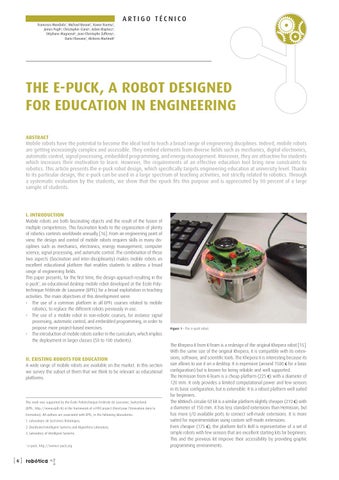
Figure 1 • The e-puck robot.
The Khepera II from K-Team is a redesign of the original Khepera robot [15]. With the same size of the original Khepera, it is compatible with its extensions, software, and scientific tools. The Khepera II is interesting because its size allows to use it on a desktop. It is expensive (around 1500 Φ for a basic configuration) but is known for being reliable and well supported. The Hemisson from K-Team is a cheap platform (225 Φ) with a diameter of 120 mm. It only provides a limited computational power and few sensors in its basic configuration, but is extensible. It is a robust platform well suited for beginners. The IdMind’s circular GT kit is a similar platform slightly cheaper (210 Φ) with a diameter of 150 mm. It has less standard extensions than Hemisson, but has more I/O available ports to connect self-made extensions. It is more suited for experimentation using custom self-made extensions. Even cheaper (175 Φ), the platform Bot’n Roll is representative of a set of simple robots with few sensors that are excellent starting kits for beginners. This and the previous kit improve their accessibility by providing graphic programming environments.