ARTIGO TÉCNICO Nuno Lau1, Member, IEEE, Luís Seabra Lopes1, Member, IEEE, Gustavo A. Corrente2 1 Transverse Activity on Intelligent Robotics - IEETA, Dep. of Electronics, Telecommunications and Informatics, Universidade de Aveiro, Portugal {nunolau, lsl}@ua.pt 2 Nokia Siemens Networks Portugal / Aveiro, Portugal gustavo@ua.pt
CAMBADA: INFORMATION SHARING AND TEAM COORDINATION ABSTRACT This paper presents the architecture, information sharing and team coordination methodologies of the CAMBADA RoboCup middlesize league (MSL) team. An overview of the software architecture and individual decision capabilities of the agents is also presented. The information sharing and integration strategy is designed to both improve the accuracy of world models and to support the team coordination. Part of the coordination model is based on previous work in the Simulation League, which has been adapted to the MSL environment. With the described design, CAMBADA reached the 1st place in the Portuguese Robotics Open in 2007 and the 5th place in RoboCup 2007 world championship. I. INTRODUCTION ROBOTIC soccer is currently one of the most popular research domains in the area of multi-robot systems. The RoboCup rules and regulations for different robotic soccer modalities are widely accepted and followed. Many robotic soccer projects use RoboCup competitions for testing and validation of the adopted approaches. In the context of RoboCup, the so-called “middle-size league” (MSL) is one of the most challenging, since robotic players must be completely autonomous and must play in a field of 12 m x 18 m [13]. In this modality, teams are composed of at most six wheeled robots with a maximum height of 80 cm and a maximum weight of 40 Kg. The rules of this modality establish several constraints to simplify perception and world modeling. In particular, the ball is orange, the field is green, the field lines are white, the players are black, etc. The duration of a game is 30 minutes, not including a halftime interval of 5 minutes. The referee orders are communicated to the teams using an application called “referee box”. The referee box sends the referee orders to the team through a wired LAN TCP link connected to the base station of each team. It is the team’s responsibility to communicate these orders to the robots inside the field via standard wireless LAN. No human interference is allowed during the games except for removing malfunctioning robots and re-entering robots in the game.
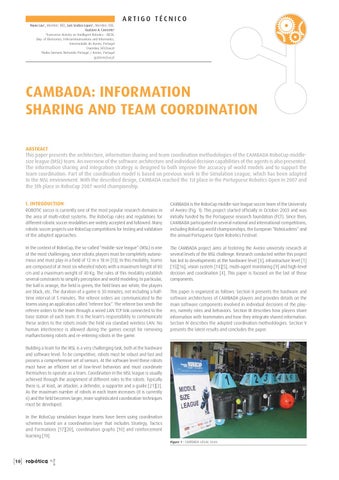
CAMBADA is the RoboCup middle-size league soccer team of the University of Aveiro (Fig. 1). This project started officially in October 2003 and was initially funded by the Portuguese research foundation (FCT). Since then, CAMBADA participated in several national and international competitions, including RoboCup world championships, the European “RoboLudens” and the annual Portuguese Open Robotics Festival. The CAMBADA project aims at fostering the Aveiro university research at several levels of the MSL challenge. Research conducted within this project has led to developments at the hardware level [3], infrastructure level [1] [15][16], vision system [14][5], multi-agent monitoring [9] and high-level decision and coordination [4]. This paper is focused on the last of these components. This paper is organized as follows: Section II presents the hardware and software architectures of CAMBADA players and provides details on the main software components involved in individual decisions of the players, namely roles and behaviors. Section III describes how players share information with teammates and how they integrate shared information. Section IV describes the adopted coordination methodologies. Section V presents the latest results and concludes the paper.
Building a team for the MSL is a very challenging task, both at the hardware and software level. To be competitive, robots must be robust and fast and possess a comprehensive set of sensors. At the software level these robots must have an efficient set of low-level behaviors and must coordinate themselves to operate as a team. Coordination in the MSL league is usually achieved through the assignment of different roles to the robots. Typically there is, at least, an attacker, a defender, a supporter and a goalie [21][2]. As the maximum number of robots in each team increases (it is currently 6) and the field becomes larger, more sophisticated coordination techniques must be developed. In the RoboCup simulation league teams have been using coordination schemes based on a coordination layer that includes Strategy, Tactics and Formations [17][20], coordination graphs [10] and reinforcement learning [19]. Figure 1 . CAMBADA robotic team.
[10]
robótica